Those Wacky Nazis
Years after Adolf Hitler had been Germany’s dictator, many Americans still couldn’t take him seriously. They’d seen him in newsreels, waving his arms and screaming, acting like a complete lunatic. They’d laughed at his imitators — Moe Howard of the Three Stooges or Charlie Chaplin — who’d portrayed him in movies as a ranting, bumbling egomaniac. Far from the realities of life in Europe, Americans found it hard to take Hitler seriously, particularly when the media liked presenting him as a humorous sidelight in the news.
This was how he was treated when the Post first took notice of him. Sensing the whole National Socialist Movement was a quaint joke, the Post editors sent a writer who’d present the Nazis as humorously as possible.
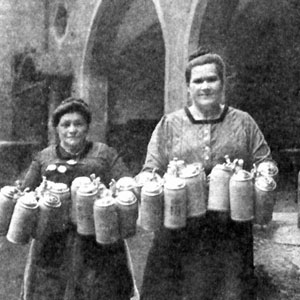
Kenneth L. Roberts was a frequent contributor and a critic of just about anything new or foreign. The editors could rely on him to write a scathing report of extremist politics in Weimar Germany. They couldn’t have been disappointed with his dismissively titled “Suds,” which appeared in the October 27, 1923, issue. Asserting that beer was the guiding force in German politics, the article was illustrated with two barmaids demonstrating their remarkable grasp of the issues. (Click Here to read the entire article from the Post.)
Roberts opened his piece by establishing his contempt for Germans. “In certain respects Berlin is the center of Germany. It is the seat of government. There the heads are the squarest, the prices are the highest, the banks are the largest, and the buildings belong to the most violent neo-German school of architecture. … There is more depravity in Berlin than elsewhere in Germany, more gloom and depression, more of the newly rich off-scourings of other races, more of that wild German nightlife that is about as spontaneous and joyous as a Monday morning in a morgue. In such ways as these Berlin is Germany’s heart.”
Having sharpened his scorn on the German capital, he closed in on the southern province of Bavaria.
“One finds cement-headed plotting and foggy intrigue at its very apex. There is always a plot on foot in Munich — either a plot to push France into the Atlantic Ocean or to shove Russia across the Ural Mountains or to shoot somebody or to seize something. In Munich one finds the thickest ankles, the most peculiar garments … the wildest rumors, the roundest heads … and a more passionate devotion to the consuming of beer than exists in any other part of the known world … that beer plays a more powerful part of the life, custom, and activities of the Bavarians than almost anything else.”

His condescension toward Germany probably arose from the contempt many Americans felt for the country they had defeated in the last war. Americans had little understanding or sympathy for the country’s civil unrest, unstable government, skyrocketing inflation, or the German character.
“A Bavarian,” Roberts continued, “who is full of an evening’s accumulation of his favorite bräu will frequently burst into tears over the most trivial occurrences. … [When] a flannel-mouthed German orator becomes inflamed by beer and feels obliged to rise to his feet and find fault with the world in general … the beer drinkers pound the table with their firsts, hiccup openly, and agree vociferously that the speaker has given tongue to the Wisdom of Solomon.”
Hitler was, to Roberts, just another flannel mouth. A very ordinary person, he concluded, but a great talker with a detailed agenda. As leader of the National Socialist Workers’ Party, Hitler had made a list of demands to the Allied powers, which naturally included releasing Germany from the penalties imposed by the Versailles Treaty. It also demanded punishment for war profiteers, non-Germans, and, especially, Jews.
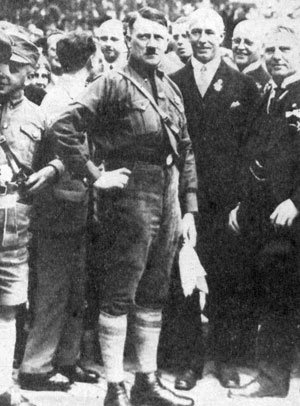
“There are several other demands on Hitler’s list,” Roberts wrote, “including a few that are never made public. In fact, whenever he thinks of anything new to demand he demands it. Demands don’t cost anything”
Roberts frankly admired the fascists of Italy and thought that a little fascism — if such a thing is possible — would be good for America. But he had only scorn for these Bavarians, who did little more than issue demands and play soldier. When the weekend came, “the Bavarian Fascisti sportively line up in military array,” Roberts wrote, “march 10 or 15 miles into the country until they reach a likely terrain, and then proceed to march, countermarch, issue hoarse orders, discipline each other, kick dust up each other’s backs, dream, hope, conspire, plot, and otherwise have a full day of South German sport and social activity.”
Roberts had the perspective of a man who viewed foreigners with contempt. He also had the view of a man who regarded Germany without getting out of his car. For example, he believed everything you needed to know about Bavarians could be learned by how poorly they gave travel directions. Ask anyone in France for directions, he said, and they “almost invariably understand the question and instantly hurl back accurate answers. The Bavarians, no matter of what age or condition of life, never understand, don’t particularly want to understand, and are usually incapable of answering after understanding has been forced on them.” He didn’t like the bicycle riders any more. “Finding himself directly in the path of an approaching automobile … the Munich bicyclist rides serenely on his way, leaving it to the automobilist to run his machine into a tree, drive it through a shop window or drop dead from heart failure.” He probably thought the Sauerbraten was overdone, the beds were lumpy, and — from what I’ve read of him — the waiters were insufficiently respectful.
With Hitler and the Germans portrayed as such laughable goons, it’s no surprise Americans dismissed the Nazi threat for so long.
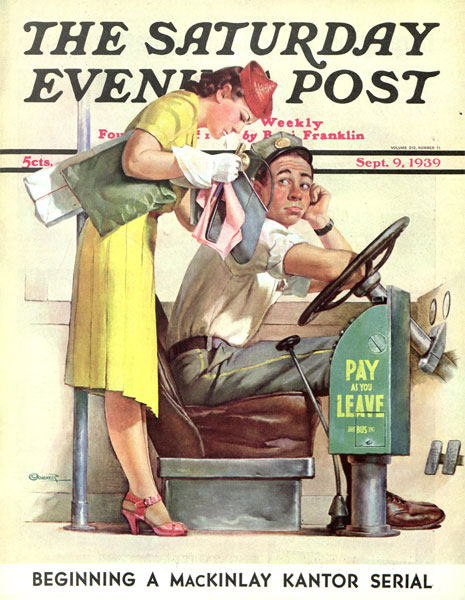
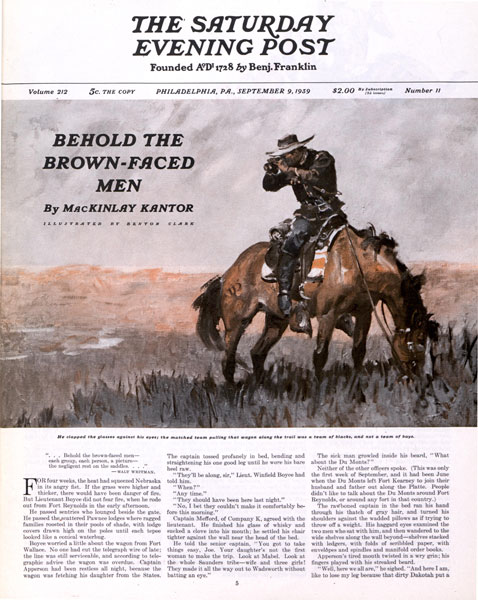
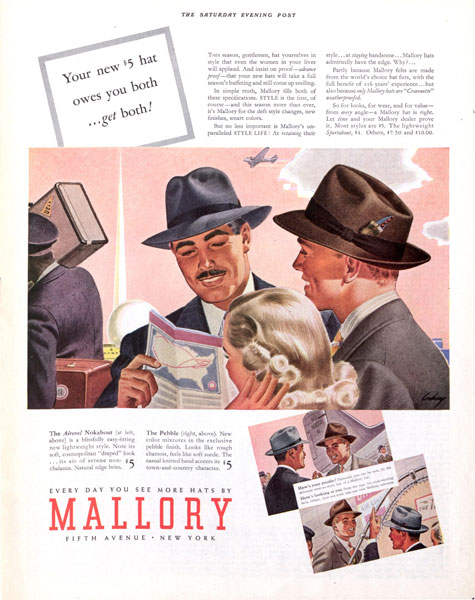
Step into 1939 with a peek at these pages from The Saturday Evening Post 75 years ago:

How TV News Plays to Our Darkest Fears

Breaking news: Something terrible has happened out there … calamitous … innocents have perished … it is beyond horrific. Instantly, TV newsrooms across America crackle. Adrenaline pumps. The on-camera anchors are visibly jazzed.
Excuse me? Jazzed? Ladies and gentlemen, we have descended into the apocalyptic universe of 24-hour cable, where bad news is good news and extremely bad news is the best news of all, meaning there will be year-end staff bonuses. Which raises the question: What kind of demented people are we?
We are a cable-news-watching people, that’s who. A few weeks ago I heard Robert Bryce, author of the book Smaller Faster Lighter Denser Cheaper, declare on a talk show that millions of Americans “aren’t happy unless they’re scared and miserable.” I assume he wasn’t just talking about devotees of Larry King’s vitamin infomercials. Fact is, the big cable channels incessantly tease the thrill of catastrophe: Either it’s about to happen or it just did. Scared yet?
When a mass casualty event occurs — the Newtown shootings, say, or the downing of the Malaysian airliner — barely an hour passes before hyper-caffeinated producers have created catchy graphics and even theme music for the miniseries they are rushing to launch. That’s either brilliant marketing or all kinds of icky, depending on your tolerance for revulsion.
“Personally, I hate that stuff,” says Michelle Kosinski, a longtime NBC News correspondent, now handling the White House beat for CNN. “The branding, the titles. It looks like a parody of news coverage.”

Blanketing one big story while short-shrifting others — as in CNN’s weeks-long Malaysia Flight 370 marathon — tends to attract viewership and mockery in equal measure. “After a few days of that kind of coverage, it can turn people off,” Kosinski says. Following a small Los Angeles earthquake in June, comedian Paula Poundstone tweeted: “Early reports say there was no dmage [sic] … but CNN will keep trying.” Ouch.
I reached out to a dozen TV insiders, and all agreed: What cable delivers on the heels of a tragedy may be unseemly and warped, but it’s also mesmerizing. “It always goes back to the mystery,” says Chris Ariens, managing editor of the TVNewser blog. “That’s the TV draw.”
“Why” is a reasonable thing to ask. However, “the country has many real problems, and the fixation on catastrophes amounts to so much wasted effort. It drives me crazy,” says Lauren Ashburn, a Fox News contributor. Terry Anzur, a TV-news coach who’s anchored for CBS and NBC, adds that, regrettably, cable news has degenerated “into a form of chicken.” It’s a game everyone is guaranteed to lose.
Look, there’s no gainsaying that the cable news crews have conspired to raise our national blood pressure. They giddily activate our night tremors because it means money, and because they can. The technology that allows cameras to go live anywhere, anytime is addictive. What news director is going to leave those cool toys in a box?
And almost always, we, the advertisers’ dupes — er, audience — will stay glued to the screen, no matter what. “When journalists are rewarded for viewership, there’s a perverse motivation to play into people’s attraction to freak shows and horror,” Danah Boyd, who works at Microsoft Research, wrote in an essay not long ago. She added that this occurs “regardless of the social consequences.”
Is there any way to defend the way cable gorges itself on these mortifyingly sad dramas? Probably not. “With all the new tools at our disposal, we might be better at chasing the moment, but we’re losing the meaning,” says Lisa McRee, a former co-anchor on ABC’s Good Morning America.
Maybe she should take it up with Leonard Steinhorn, a professor of public communication at American University in Washington, D.C., who argues that “these catastrophes are like Greek tragedies. TV understands our fears, our anxieties.” Ultimately, the professor says, the soap-operatic coverage of grand trauma “serves as a national binding experience.”
Only, of course, if we’re willing to be so bound. An alternative position is that, dependably, it’s not only tragic news that will keep breaking, but our collective national dignity as well.
May/June 2014 Limerick Laugh Winner and Runners-up
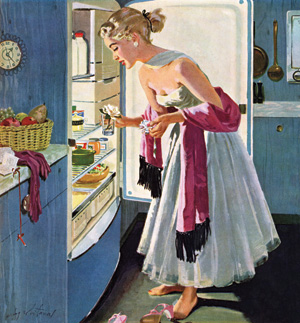
His well-bred gentility sold her,
But then he began to get bolder.
So our cool-headed Midge
Put the flower in the fridge
After giving her date the cold shoulder.
—Jeanne Kaufman, Boulder, Colorado
Congratulations to Jeanne Kaufman! For her limerick describing M. Coburn “Coby” Whitmore’s illustration Prom Memento (above), Jeanne wins $25 — and our gratitude for a job well done. If you’d like to enter the Limerick Laughs Contest for our upcoming issue, submit your limerick via our online entry form.
Of course, Jeanne’s limerick wasn’t the only one we liked! Here are some of our favorite limericks from our runners-up, in no particular order:
With a touch, the door echoes her sigh,
And the scent of romance dances by
From the small space reserved,
Where her dreams are preserved,
Tucked between last night’s roast and the pie.
— Carrie Clickard, Gainesville, Michigan
She hummed to herself the prom ballad.
Her wish to preserve it was valid.
But her piece of the past
Wasn’t destined to last;
Her grandma mixed it in the salad.
— Patrick McKeon, Pennington, New Jersey
The prom was all right, I suppose.
For dinner he took me to Joe’s.
This Patty McDougal
Was way beyond frugal.
For dessert he suggested my rose.
— Andrew Janik, Hadley, New York
The evening has come to a close.
It’s here I am saving my rose
And thinking of Hughes
With humongous shoes—
Oh, let there be ice for my toes!
— Georgia Suprenant, St. Anne, Illinois
The gala was really quite splendid!
But now that the evening has ended,
I’ll save the corsage,
To be an homage,
For I hope he’ll become my intended!
— Karen Mueller, Oak Harbor, Washington
After dancing all through the night,
She’s reminded in limited light,
Though her tootsies are weary,
Her date was a dearie,
His choice of a flower just right!
— Larry Mann, Danville, Virginia
It’s 1:25. I’m awake
And searching for something to bake.
Hugh left me a flower
But come on, at this hour?
I don’t want romance — I want cake.
— Samuel Zifchak, Melbourne, Victoria, Australia
She stores her corsage from prom night
And knows one day at its sight,
She will reminisce
The night’s front porch kiss,
Cut short when dad turned on the light!
— Angie Gyetvai, Oldcastle, Ontario, Canada
To remember this night’s celebration,
I’ll hold onto this lovely carnation.
And hope it will last
As a memory past
With the help of some refrigeration.
— Steve Pavelich, Grand Blanc, Michigan
The night at the prom was pure bliss,
Including the thrill of first kiss.
The gardenia shall wilt.
The boyfriend will jilt.
But right now “oh the joy” for this miss.
— Sally Havens, Dublin, Ohio
Remembering Joan Rivers
“I have to work,” comedian Joan Rivers told Post reporter W.H. Mannville backstage in 1967 after killing it at the now defunct Manhattan nightclub Downstairs at the Upstairs. Only seven years into her career and Joan Rivers was already surprising reporters with the fearless drive and rapier wit that made her a success and unforgettable to the world.
We invite you to step back into that smoky nightclub and catch a glimpse of Joan River’s act, as told by Manville, almost 50 years ago:
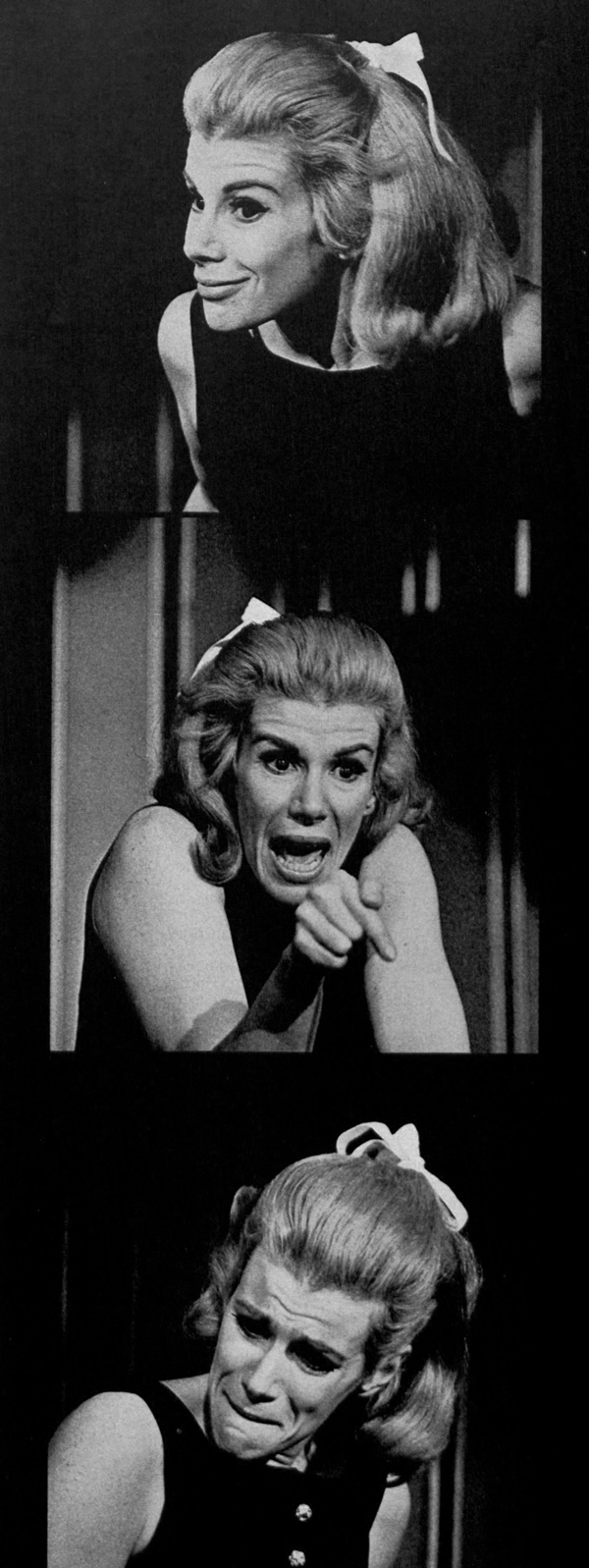
She waits for the laugh, and the spotlight, falling across her anxious, narrow, pretty face, fills the hollows beneath her thin cheekbones with shadows. During her act Joan rushes around the stage, peering into the blackness. “And when you’re single?” she goes on. “The girl has to wait for the dumb phone to ring, but a man can call anyone he wants in the whole world: ‘Hello, I just saw your name on a men’s-room wall, and thought I’d give you a cal …’ A single girl, she’s 30, she’s an old maid. A man, he’s 90 years old, he’s single, he’s a catch. ‘We have an extra man.’ ‘Bring him along.’ He’s 93.’ Bring him, bring him.’ ‘He’s dead.’ BRING HIM! We’ll just say he’s shy.'”
“When it all started,” Rivers told Mannville after the show, “when I told my mother and father I was going into the business, they didn’t speak to me for a year. To them it was showbiz first, and next, white slavery in Argentina, right? The yelling scene the day I told them! My mother ran around the house slamming the windows shut. She didn’t want the neighbors to hear what a scandal her daughter had become.
“But I had to be a success,” Rivers continued. “Anyway, after the argument with my parents, I left. I never asked them for a penny again. It was never offered. I slept in my car that night. It wasn’t the last time.”
Excerpt from “Who Are You, Joan?” by W.H. Mann, The Saturday Evening Post, July 1, 1967, photos by Stephen Manville.
Rain Delay
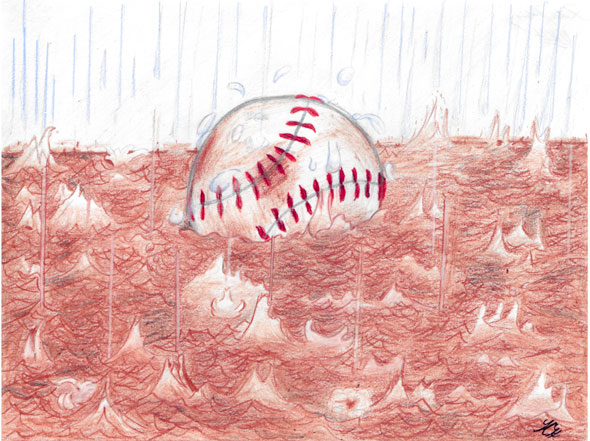
Against the background of the bleachers, the rain, heavy at times, is nearly invisible. Water collects in the depressions of the tarpaulin that covers the infield, its impact creating the illusion that the raindrops are boiling up from beneath the surface of the puddles. Storm clouds, dark and bulbous from a lifetime of drink, hover over Fenway Park, belying the forecast for clearing weather posted on the scoreboard. Fans crowd the upper grandstand seeking shelter, but a few, bright red in newly purchased Red Sox ponchos, huddle in the lower boxes, the expensive seats. In the bleachers, college students stripped to the waist celebrate the end of exams by playing volleyball with giant beach balls, as much a part of baseball at Fenway Park as hot dog and peanut vendors. Bounced from section to section, the beach balls bring to the games a sense of humor more welcome than the mindless wave that begins in the corner of the centerfield bleachers and circles the stands for a time or three before dying to the relief of everyone except the young and the drunk. During the games, the ushers, older men working to supplement Social Security, deliver the beach balls to the Red Sox bullpen where one of the relievers eggs on the crowd by puncturing the beach balls with a groundskeeper’s rake.
Beach balls often invade the box seats where Malone sits, season tickets, but only the day games because Malone believes baseball should be played in daylight and on natural grass. The night games he sells. Malone’s seats align with home plate between a right-handed batter and the catcher, perfectly positioned to see curve balls break, splitters sink, to hear the explosion of fast balls in the catcher’s mitt. Nothing better than the sound of a fast ball when the pitcher’s throwing heat.
The grandstand overhangs Malone’s seats by two rows and the rain only douses them when a strong wind blows in from right field. Today, so far, Malone and his oldest son, Teddy, named in homage to Ted Williams, remain dry. A few rows in front of them, a hot dog vendor sets up on an empty seat. Fans rush down from the upper grandstand. People love to eat during a rain delay, and the easy sales are worth the damp shoulders. Teddy, soon to be 17, buys two for each of them, paying out of his own pocket, his earnings from a part time job, a sign of the shifting relationship between father and son from dependency to whatever.
Malone misses the 6-year-old he coached at T-ball. He never appreciated how hard a game baseball was to teach until he coached Teddy’s T-ball team. Malone taught himself by playing pick-up games in the park and schoolyard, eventually learning enough to pitch for his eighth grade intramural team. Teddy went further, making his high school team as a starting outfielder. It’s this Teddy, the Teddy who has such a strong sense of himself, who tempts Malone to speak. Years earlier, when the cancer was diagnosed, excised, re-excised, Teddy was too young to be told; now, five years later, the window of highest risk having closed without a recurrence, statistics favor Malone’s survival. Even the great Ted Williams made outs 65 percent of the time.
Malone would have hidden this from Teddy but for the newspaper article his wife clipped and left on the kitchen table. Researchers had isolated a gene that makes some people more susceptible to cancer than others. If it’s genetic, it’s inheritable, and Teddy or his brother or sister might carry that gene, might transmit it to their own children. Slipped my mind, Malone imagines himself saying years later when one of his grandchildren is diagnosed and Teddy or one of his other children calls him on it.
On the scoreboard screen, the history of the Red Sox flashes; the sound is too muddied to be understood, but not the images, the successes of the early years of the 20th century, the failures of ’46, ’67, ’75, ’86. The triumph of 2004 is in the future. A fortuneteller once told Malone 2004 would be the year. When he asked if he would live to see it, the crystal ball fogged up.
Malone makes small talk with the people from Salem on his right, those from Holyoke on his left. Their row, seven seats, has been together for several seasons, and Malone with the middle seats shares a friendship with both that is lubricated by anonymity. Yet the Holyokes and the Salems remain strangers to each other, Malone a wall rather than a bridge. For the Holyokes, Malone senses the ballplayers have replaced the children now out of the house as the glue holding together the marriage and he is especially cheered to see husband and wife each opening day. The scoreboard repeats the weather forecast promising clearing weather, restates the teams’ commitment to play the game, thanks the fans for their patience.
For Malone, baseball unites. Skipping back and forth from his side of the family to his wife’s, five generations suffering with and rooting for the Red Sox. The first two came from the old country, born into a world where baseball didn’t exist, buried out of one where it was a religion. Family apocrypha blames the Red Sox for the death of Teddy’s grandmother’s grandmother on his mother’s side who died of heart failure while listening to the radio broadcast of the Red Sox losing the ’48 playoff to Cleveland. Teddy laughed at that story, but Malone’s wife, seething as if the story were about her mother instead of some distant relative she never met, insisted it was coincidence. For Malone, coincidence is an excuse, not an explanation. Otherwise, the newspaper article coming so soon after the closing of the five-year window could be dismissed as coincidence as well. Life, like baseball, is a game of inches, not a game of random chance. Only the rain, nearly invisible, is real.
“You know,” Malone says, softly so the Holyokes and the Salems won’t overhear, “there was a newspaper story this week that says some researchers think cancer is genetic.”
Teddy licks the mustard off his lips. “Mom told me.” He waves at the ice cream man.
Malone stares at his feet while Teddy eats his ice cream and kicks at the mound of peanut shells beneath his seat discarded by the people in the row behind him.
Teddy licks the wrapper clean. “What’re you saying, Dad? That DNA is destiny and I’ll get cancer ’cause you got it?”
Whatever hope for the future that came with Teddy’s buying the hot dogs washes away with the rain. Malone wishes the rain would stop, the game would start, lightning would strike the centerfield flagpole, anything. He stands, stretches, peels the seat of his pants away from his buttocks. Teddy looks up at his father like he did the summer Malone taught him how to hit live pitching. “Keep your eye on the ball,” Malone said over and over. Now, Teddy does. On the field, a member of the ground crew inspects the outfield with the umpire crew chief. Their footprints fill with water, a sure sign the game will not start even if the rain stops. To Malone’s left, the Holyokes offer farewells, expressing confidence the sun will shine for tomorrow’s game.
“Maybe they have the right idea,” Malone suggests.
“Your call, Dad.”
The rain delay drags into a second hour. The hot dog vender runs out, departs, returns with a fresh supply. In the bleachers, the college students, still naked to the waist, continue to punch beach balls back and forth over an invisible volleyball net. For some, the rain is a celebration.
Read More Contemporary Fiction
Japan’s Bigger Game
courtesy Wikimedia Commons
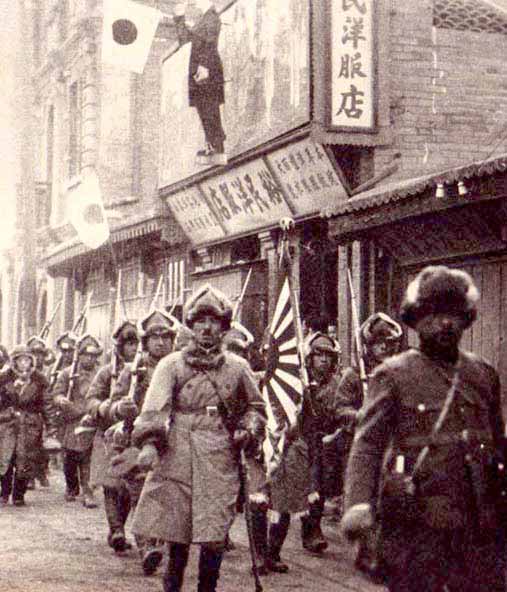
Eight years before the fighting began in Europe, Japan was already at war in China. In 1931, the Empire of Japan sent its army into the northern province of Manchuria. By 1937, it had set up a puppet government in the province and was moving south toward Beijing and then-capital city Nanjing.
People were surprised at the ferocity and audacity of Japan’s invasion. With one-sixth the population of China, did Japan really think it could conquer 450 million people and control over 4 million square miles? What did Japan’s rulers hope to accomplish?
One goal was the government’s need to consolidate its power. Tyrannical governments use war to unite their subjects and to extinguish any opposition. For years, the military rulers in Tokyo had taken advantage of the China campaign to appropriate Japan’s resources for the war effort and silence their political opponents in Tokyo.
Step into 1939 with a peek at these pages from The Saturday Evening Post 75 years ago:
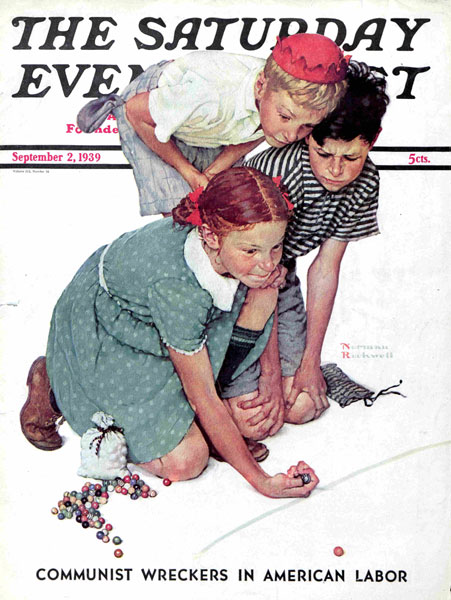
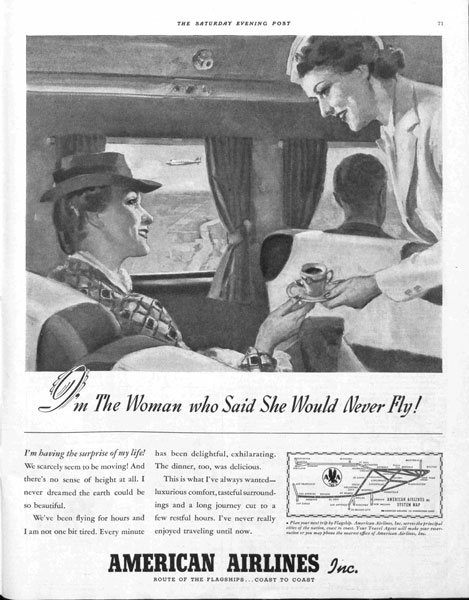
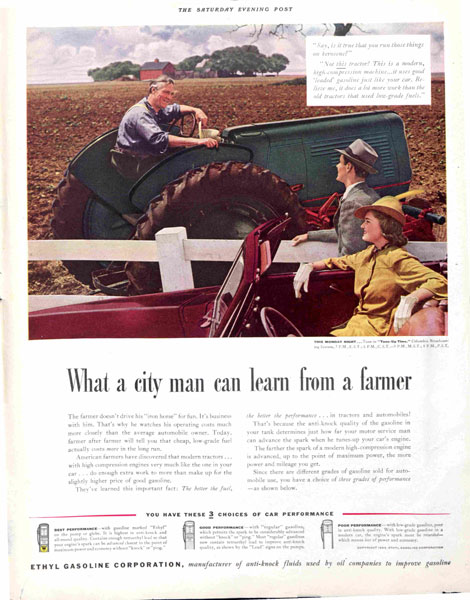
The invasion’s other goal was to make all of Asia into a colony of Japan. The Imperial Japanese army had begun with China, the closest and richest prize. Decades of civil war and the lack of a central government had left China vulnerable. But Japan was looking at an enemy even bigger than China, according to Edgar Snow. A highly respected China expert, Snow was writing for the Post back in the 1930s, and in the September 2, 1939, issue, he laid out Japan’s ultimate goal: “the liquidation… of the international system of balance of power whereby Britain has, for many years, dominated most of the Orient.” (Read the entire article from the September 2, 1939 issue of The Saturday Evening Post here.)
Japan had been applying pressure on the British colonial power throughout the 1930s. In 1937, when Japan had captured the Chinese city of Tientsin, its troops avoided the British concession — an enclave of British subjects and businesses enjoying an unlimited lease of land within the city. However, the Japanese began a campaign of harassment.
“It was a matter of no great astonishment,” Snow wrote, “that the Japanese army virtually incarcerated the entire British population of Tientsin behind electrically charged barbed-wire barricades. Or that a strict blockade was imposed. Or that British subjects were submitted to indignity as a matter of routine, such as having their false teeth examined, or having passports stuffed down their throats. Or that the samurai undressed and exposed British women to the full view of a not very interested Chinese public, some of whom were paid ten cents a day to assemble and recite an anti-British litany.”
Meanwhile, “British ships are stopped, searched, and excluded from Chinese waters,” Snow continued, “at Japanese will. [Britain’s military attaché] for China, is seized and imprisoned, apparently to be held indefinitely by the Japanese army. … Japanese aviators, having machine-gunned one British ambassador out of China, amuse themselves by bombing the British Embassy in Chungking.”
Japan hoped to force Great Britain out of Asia and take over her colonies. This would have been even more ambitious than conquering China, if not for the help of Japan’s two allies, Germany and Italy. Together, the three Axis powers applied pressure on Great Britain, first on one hemisphere, then on the other.
In 1938, Hitler demanded the right to occupy the Sudetenland region of Czechoslovakia. When the British caved in to his demands, the Japanese were encouraged to make demands of their own. In the summer of 1939, the British government again bought their way out of war in Asia by agreeing, in effect, to recognize Japan’s occupation of China and not interfere in its conquest.
“This at least is clear,” concluded Snow. “Under the leverage of the Eurasian Axis, Britain’s outer ramparts of empire in China are rapidly collapsing. A narrowing margin of political maneuver is forcing upon British diplomacy a decision between two extremes … complete appeasement of Japan … or complete resistance.”
Reading Snow’s glum prediction, I’m impressed that Great Britain managed to avoid war in Asia for another two years.
Ultimately, even British maneuvering and negotiations couldn’t overcome Japanese audacity. In December 1941, Japan — still very much at war with China — declared war on Great Britain and attacked colonies in Malaya, Singapore, Burma, Borneo, and Hong Kong. And, apparently feeling two great nations weren’t enough of a challenge, the Japanese also declared war on the United States.
Mentioning Mentia

“You’re listening to K double oh K, your source for talk radio in the metroplex. This is A Box Full of Minds and I’m your host, Katie Brigand. My guest this hour is Dr. Phil Gudenov, the author of Mentioning Mentia. Dr. Gudenov, thank you for joining us on A Box Full of Minds.”
“The pleasure is mine, Katie. Thanks for having me.”
“Our regular listeners will recognize Dr. Gudenov from previous programs. He’s a popular guest speaker and his last book, How Smart Is Smart Enough? spent 16 weeks on The New York Times Best Sellers list. Tell us what motivated you to write this new book.”
“Well, Katie, as you know, Mentia is a pervasive problem in America, especially among people over the age of 50. Almost everyone has a family member or knows someone suffering from Mentia.”
“So true. Can you tell our listeners a bit about the causes of this debilitating condition?”
“Sure. So, there are known genetic markers associated with Mentia. If your parents or grandparents have ever been diagnosed with it, your chances of someday suffering from Mentia are significantly higher.”
“Mmmm. A frightening thought.”
“Exactly. No one should have to endure this disruptive attack on their central nervous system to say nothing of the social stigma that is so often associated with Mentia. I’ve written this book to inform people of the signs that indicate the onset of Mentia, what they can do about it if a loved one begins to exhibit these signs, and I provide information on the many healthcare professionals who have devoted their lives to conquering the disease.”
“Can you give us an idea what to look for if we suspect a loved one may be suffering from Mentia?”
“Absolutely. The top 10 signs to watch for are, first, remembering everything. They may have memory issues that will completely disrupt the normal flow of family life. Second, they may be constantly planning ahead and solving problems.”
“Oh, my.”
“Yes. Third, they may be very good at accomplishing tasks, especially familiar tasks. It’s almost like they’re a machine, just getting things done. Fourth, they always know where they are and may be acutely aware of the time. Fifth, their cognitive skills are heightened, they are keenly aware of the meanings of visual images and spatial relationships.”
“My gosh. It’s a little frightening considering just the things you’ve mentioned so far. And that’s not even the whole list, right?”
“Well, yeah, it’s frightening. And there’s more. Three more, no, four … the sixth sign of the onset of Mentia is an excellent command of both speech and the written word. Seventh, they seem to never misplace things, especially things they frequently use. Number eight, they may always exercise excellent judgment. Nine, they are driven to be extremely active in work and social life. And finally, their moods and personalities are utterly predictable.”
“My goodness, that’s a lot to consider. I’m just imagining how I would feel if my mother or father began to exhibit any or, God forbid, all of those symptoms, and I’m frankly terrified at the prospect.”
“Yes, Katie, the challenge can seem overwhelming. But, it’s important to remember that the medical community has made many advances in treating Mentia, and new breakthroughs are anticipated.”
“So, there are medications that have proven effective in alleviating symptoms?”
“Absolutely. Although we do not as yet have a cure, we do have some very effective drugs with a great track record of combating the symptoms and slowing down the progression of Mentia in most individuals.”
“You know, you mentioned the social stigma attached to Mentia. I know it’s politically incorrect in this day and age to think of Mentia sufferers this way, but I sometimes think of them as that cute old person who knows everything. Know what I mean? They’re just kind of cute, the way they insist on everything. I mean, I know I’m wrong to think of them that way, there’s nothing cute per se about this terrible disease, but surely I’m not the only one who sometimes thinks of them as cute or that little smarty pants.”
“No, Katie, you’re not alone. Unfortunately, we have a long history of these people being presented in a comical or even flattering manner in arts and literature. Sherlock Holmes comes to mind, and he’s just one of numerous examples I could mention, if I was the sort of person who liked rattling off lists of relevant data.”
“You’re kidding me.”
“No. Well, yes, a little. What I’m trying to say is that before we understood the disease, we had a tendency to present it in all sorts of media as this benign state of consciousness. We even sometimes implied it was a good thing.”
“Mmmm, mmmm. How far we’ve come.”
“Exactly. No one is immune to Mentia. It can strike anywhere, at anytime. Surely all of us can recall elected officials who’ve gone off on tangents about global warming, tax reform, civil rights, and the like. Imagine the shame you might feel if you were related to one of those highly Mentive politicians. Or the shame they, themselves might feel if and when they returned to a normal state of mind.”
“It gives me the heebie-jeebies.”
“As well it should.”
“Dr. Gudenov, you mentioned drug therapies. Are there other things the average person can do to lessen the likelihood of Mentia?”
“Watch television.”
“Television. I hadn’t thought of that, but it makes perfect sense.”
“And when I say television, I don’t mean indiscriminate viewing of just any program. I mean reality television. The more commercials the better. Fortunately for us, social scientists in the ’90s realized that many TV programs were actually encouraging critical thought. You’ve probably noticed that all that sort of thing has been removed from current programming.”
“But, what of that dear old grandma or grandpa who insists on watching documentaries on DVD or VHS?”
Why Veterans Hurt

When I joined the Army as a 17-year-old, I expected to face many challenges and hardships as an individual — whether that meant getting yelled at or shot at or made to jump out of airplanes. What I didn’t yet understand was how much I’d put aside my individual concerns and focus on my fellow service members — or how much they’d do the same for me. The truth is that I had never been in such a supportive social environment in my life.
That might sound odd to people who’ve never been in the military. Getting chewed out for not having shoes shined hardly seems supportive to most people. But that’s just one part of the military experience. In the Army, it mattered to someone else whether my boots fit properly. It mattered to someone else whether I had been to the dentist recently. It mattered to someone else if I wasn’t where I was supposed to be at the right time. To be sure, all of this attention paid to my performance was in the interest of team performance, but it also meant someone was always there for me.
And then you exit the service. No more intrusive surprise health and welfare inspections. No more grueling runs and setting your speed to the slowest member of your group. No more morning formations. No more of the countless bureaucratic irritations of military life. Paradise, right?
Actually, for many of us, no. Gone, suddenly, is the cohesive structure that existed to take care of you. Gone is that strong sense of social security. Gone are friends from your ready-made peer group, who are just as invested in your success as you are in theirs.
News reports carry a lot of disheartening statistics about U.S. Veterans. (Like the U.S. Department of Veterans Affairs, I capitalize the word Veterans to be respectful.) Nearly a fifth of Veterans between 18 and 24 are jobless. Veterans suffer a 33 percent higher rate of narcotics overdoses than the rest of the population, and their suicide rate is slightly higher, too. People often react to this with pity, assuming that the cause is tied to trauma suffered while in the service.
But I suspect that the main contributor to adjusting to civilian life is something else entirely, and rarely is it because of battle trauma. Rather, when Veterans leave military service, many of them, like me, are leaving the most cohesive and helpful social network they’ve ever experienced. And that hurts. Most recent Veterans aren’t suffering because they remember what was bad. They’re suffering because they miss what was good.
One friend went from being a combat medic in the Army to a transfer student in the health field at a major university. He got good grades, but none of his efforts to connect with his new peers and replace the social cohesion he was missing worked. He nearly wound up dropping out of school. Simply put, he felt isolated and adrift. Another friend, a smart, capable Marine, floundered when discharged from the service around the time of her divorce. For a stretch she was even homeless. What rescued her was a stint with AmeriCorps, the federal community service organization, which gave her a job that led to full-time employment with a national nonprofit. AmeriCorps offered my friend three crucial things: a new mission, a new purpose, and a strong, supportive social network in which people were invested in one another’s well-being and success. That allowed her to get back on her feet.
Those who have served in the military are resilient, capable leaders. Veterans aren’t looking for a handout and certainly don’t want to be pitied. If civilian life could offer Veterans more of the virtues of military life — accountability, cohesion, a sense of purpose — I suspect you’d hear less about the “problems” Veterans face and more about the achievements that come from harnessing such vast energy, discipline, and public spirit.
Comfort Cravings

Fall is the tastiest season of all. Farmers market shelves are piled high with the bounty of the harvest, including two comfort food favorites — exquisite eggplant and butternut squash. But if you’re like me, you may be perplexed about what to do with the produce once it is sitting on your kitchen counter. Not to worry. We turned to the connoisseur of culinary curiosities, Andrew Zimmern, host of the Travel Channel series Bizarre Foods America, for expert ideas on picking and prepping the versatile and nutritious fall vegetables.
“Choose firm, smooth eggplants,” says Zimmern. “If you push with your thumb and the flesh gives slightly then bounces back, it is ripe. If an indentation remains, it’s past its prime. Buy firm, blemish-free winter squash and store in a very cool, dark place; it will keep all winter.”
To read the entire article from this and other issues, subscribe to The Saturday Evening Post.
Homeless Pets Fly to Safety
Last year Chopper was a down-and-out Chihuahua from the rough-and-tumble back alleys of Sacramento, California. His tough life cost him an eye and landed him in county lockup (er, that would be the local pound to us humans).
With dozens of other Chihuahuas surrounding him, he had little chance of being adopted. That meant that big kennel in the sky for Chopper. “He came so close to being euthanized,” says Sharon Lohman, president and founder of New Beginnings, an all-volunteer animal rescue group in Merced County. “He had been sitting there for almost three months. They usually only have about three weeks.”
Now Chopper is a pampered pooch living in the lap of luxury — literally! — with a well-to-do family in Missoula, Montana. His favorite hobbies are hiking, swimming, and just plain frolicking with his new canine brother and sister — a pit bull and a blue heeler. And he was even featured on a local calendar from the Humane Society of Western Montana.
That’s all because the lucky pooch was airlifted out of the danger zone by Dog Is My CoPilot Inc., a nonprofit started two years ago by retired orthopedic surgeon and pilot Dr. Peter Rork. The organization, based in Jackson Hole, Wyoming, works in conjunction with shelters and various local animal groups like New Beginnings to fly Chihuahuas, so numerous in the American Southwest border states that they are practically unadoptable, as well as a variety of other dogs and cats, to places where they are rare and sought after.
To hear Rork, 61, tell it, he owes a debt to the critters he ferries northward. That’s because saving them actually saved him. His new bride, only 41 years old, died in his arms after a sudden cardiac arrest in 2012. “Her death broke me,” explains Rork. “I would wake up and pour myself a cup of coffee and just sit there staring into the cup. The next thing I knew the sun was coming up.” Rork says he could not go back to being a doctor; his “heart just wasn’t in it anymore.” …
To read the entire article from this and other issues, subscribe to The Saturday Evening Post.
In Sickness and in Health

I’m guessing you didn’t know that September has a ribbon too — a little-seen light-blue ribbon, the sign of
Prostate Cancer Awareness Month. (Muskoka Stock Photos © Shutterstock)
My husband, Bob, has what you might call an allergy to doctors. “I used to measure my health each year by whether I could run the nearly 7.5-mile San Francisco Bay to Breakers race in under an hour,” he says.
So it was on a summer day in 2012 that I had to practically chase my 58-year-old spouse out of the house for a long-overdue physical exam I’d booked for him. (I’d set up my annual physical, complete with mammogram, for the same day.)
What precipitated the doctor visit for Bob was not a symptom — he was perfectly healthy — but rather a vague worry I’d been feeling ever since a good friend of ours was diagnosed with prostate cancer (out of the blue) a few months earlier. And I learned from just the briefest online search that Bob was nearing the age when prostate cancer surges. Dr. Patrick Walsh of Johns Hopkins University, considered one of the world’s foremost authorities on the disease, writes, “After age 60, prostate cancer seems to shift into high gear — and a man is three times more likely to develop it than a woman is to develop breast cancer.”
The American Cancer Society estimates that 232,570 women will be diagnosed with invasive breast cancer this year. The prostate cancer number is almost the same, 233,000. Still, our awareness of the two is not at all equal. October, with its ubiquitous pink ribbons, has come to symbolize breast cancer awareness. Buildings across America, even the White House, light up in pink. NFL players, the epitome of male power and strength, sport the ribbon and don pink accessories to raise awareness. I’m guessing you didn’t know that September has a ribbon too — a little-seen light-blue ribbon that is the sign of Prostate Cancer Awareness Month. I certainly didn’t. But my understanding of the disease was about to grow exponentially.
You may well ask why planning the checkup had fallen to me, but it’s actually quite common for a wife to take on the role of health cop for her family. According to Gary Brice, executive director of the DeGraff Memorial Hospital McLaughlin Center in North Tonawanda, New York, most men don’t like to show weakness and most women “don’t have trouble admitting health problems.” He explains that women are also more familiar with healthcare in general after years of having pelvic examinations, as well as taking children to the pediatrician.
If distrust of doctors was a constant for Bob, he’d reinvented nearly everything else about himself about 10 years earlier. “At 50 everything changed in my life,” he says. At the time, the two of us moved from California to the East Coast after I accepted a promotion (I work in newspaper sales and marketing). For Bob, the move meant leaving behind a 30-year career in automotive service and going back to school. “I didn’t have the opportunity to finish college, so I went back and became the oldest kid in my class.” By 2012, Bob was in his personal prime time and working in real estate.
ON THE MORNING OF THE APPOINTMENT, I REMINDED BOB to be sure to ask for his prostate-specific antigen (PSA) level to be checked as part of the blood work the doctor would order. PSA is an enzyme made by the prostate and an elevated level is considered one of the most useful serum tumor markers for any malignancy. In fact, the majority of prostate cancers are found through the PSA test, not the dreaded digital rectal exam.
Funny thing about the PSA. Recommendations from the U.S. Preventive Services Task Force (USPSTF) urge primary caregivers against using this test. The argument is that PSA tests can give a false positive or detect slow-growing cancers that are unlikely to cause a problem during a patient’s lifetime. Treating these cancers can do more harm than good, argues USPSTF Chair Dr. Michael LeFevre.
Sure enough, his doctor had no plans to offer the PSA test because Bob had no family history of prostate cancer and there was nothing of note on the digital exam. But Bob insisted. “You don’t know my wife,” he said. The doctor reluctantly checked the box on the blood work order.
Much to the doctor’s surprise, Bob’s blood test showed an elevated PSA level. The doctor downplayed it as a likely false positive, and Bob didn’t even bother to tell me about it. “I didn’t want to scare you,” he says.
The doctor ordered a second test. The results were the same, and Bob was referred to a urologist for further evaluation. “I was still in denial even after the second PSA test,” he admits.
Turns out, that’s a common reaction, but at least this time he told me about it. “Research shows that many men do not get tested for prostate cancer, because they fear the effects of surgery they may not even need,” Dr. Drew Pinsky, the popular HLN host and himself a prostate cancer survivor, writes on his blog. “What concerns many males faced with prostate cancer is not the cancer itself, but possible incontinence, and [loss of] sex.”
The urologist performed a biopsy, where tissue samples of the prostate gland and the surrounding area were taken using a needle inserted through the wall of the rectum. He warned Bob that there could be complications from a prostate biopsy such as infection and excess bleeding. But the 30-minute procedure went without incident and Bob experienced very little pain. “It was exactly as the doctor described. And I had no issues afterward. I drove myself home,” Bob recalls.
A few days later, on my husband’s 59th birthday, we received the results, and the news was devastating. Not only were there moderately aggressive cancer cells concentrated on one side of Bob’s prostate, there were also cancer cells in areas outside of the gland. With evidence that the cancer had escaped the prostate, the urologist ordered a CT scan and a bone scan to see whether Bob’s cancer had spread even farther. The sentence spoken by the urologist on that fateful day woke me up to the serious situation we were facing: “There is no known cure for prostate cancer that has spread to other parts of the body.”
No known cure. Three of the most terrifying words I have ever heard. But it was almost worse when my ever-optimistic, upbeat husband confided to me, “I think we are in trouble.”
Are We Losing the Stars?
“If you see a car along that road,” Tyler Nordgren warned me, “don’t look at the headlights. It’ll ruin your night vision for two hours.” Nordgren and I had pitched our tents under the brow of Mount Whitney in the Alabama Hills, a field of boulders near Death Valley. We watched it get dark, and in the nighttime horizon, the sky was perforated by stars and streaked by the Milky Way. Or, to put it in approximate scientific terms, it was probably a class 3 on the Bortle Dark-Sky Scale, the 9-level numeric metric of night sky brightness.
Even so, we could still see domes of hazy light from 200-odd miles south in Los Angeles and 250 miles east in Las Vegas. That encroaching urban glow was like highlighter calling attention to the issue that Nordgren, a prophet whose cause is light pollution, wanted to illustrate for me.
“We’re losing the stars,” the 45-year-old astronomer said. “Think about it this way: For 4.5 billion years, Earth has been a planet with a day and a night. Since the electric light bulb was invented, we’ve progressively lit up the night, and have gotten rid of it. Now 99 percent of the [continental U.S.] population lives under skies filled with light pollution.”
Nordgren is an affable, engaging, and quotable Cassandra, an enthusiastic and patient teacher who loves his subject and wants you to love it, too. Those attributes, along with his book for a lay audience, Stars Above, Earth Below: A Guide to Astronomy in the National Parks, have pushed him to center stage of a small but impassioned movement to preserve natural night skies. When he is not lecturing at the University of Redlands, a California liberal arts college, Nordgren is a much sought-after itinerant preacher intent on bringing people revelation of the stars they have, almost everywhere, lost sight of.

Our vanishing stars: Increasing light pollution from 1950 to 2025.
(P. Cinzano, F. Falchi [ISTIL-Light Pollution Science and Technology Institute],
C.D. Elvidge [NOAA National Geophysical Data Center, Boulder].
© Royal Astronomical Society. Reproduced from the Monthly Notices of the RAS by permission of Blackwell Science.)
Almost the entire eastern half of the United States, the West Coast, and almost every place with an airport large enough to receive commercial jets are too lit up to get a good view of stars. The phenomenon is illustrated by the first World Atlas of artificial night sky brightness. Based on spacecraft images of Earth in 1996-97, it shows a spectrum from black, representing the natural night sky, to pink, in which artificial light effectively erases any view of the stars at all. Green is where you lose visibility of the Milky Way. The map of the contiguous 48 states — and much of Europe — looks like a video-game screen showing a carpet bombing, the map a splash of green, yellow, red, and pink.

For roughly the past two decades, at least two-thirds of the U.S. population have not been able to see the Milky Way at all, and it will get worse before it gets better. …
To read the entire article from this and other issues, subscribe to The Saturday Evening Post.
Jay Leno’s Garage
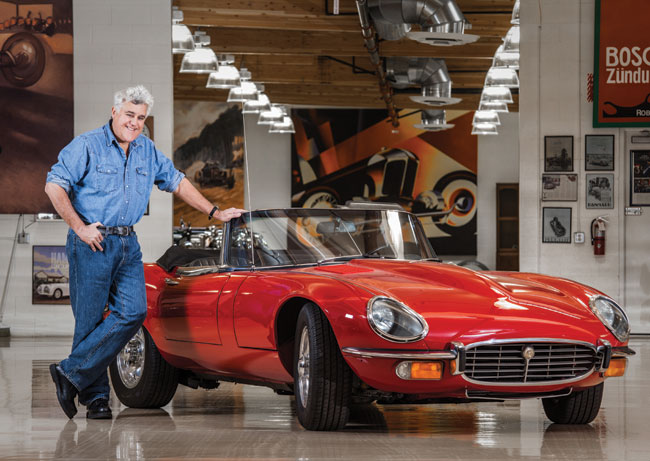
Jay Leno loves making people laugh and he loves cars. Those passions have shaped his life. After 22 years as host of The Tonight Show, he stepped down earlier this year but he’s working as hard as ever. When he isn’t traveling the globe performing stand-up gigs from Detroit to London and Rome, you can find him in his garage in North Hollywood getting hands-on with a multi-million-dollar array of perfectly maintained classic automobiles.
Leno’s affection for his four-wheeled collection — not to mention dozens of motorcycles — is on display every week in his hit Web series, Jay Leno’s Garage (nbc.com/jay-lenos-garage), on a YouTube channel that boasts nearly 1 million subscribers and draws 5 million views each month. Clad in his trademark denim shirt and jeans, Jay Leno drops one-liners on the series, but he also gets serious about his collection — whether he’s restoring a vintage Bentley, tooling down the highway in a classic Mustang convertible, or taking a souped-up Ferrari to the limit on a test track. He may be a famous face but that doesn’t keep him from rolling up his sleeves and going under the hood.
If you think driving around in one of his ultra-expensive supercars is an ego trip for Leno, you’ll be surprised to know him as I have. He’s among the least affected and most genuine celebrities in a town where the pursuit of fame can become toxic. If a kid happens to admire the Lamborghini Diablo Leno chose to drive for the day, Jay might just invite the kid to sit in the driver’s seat — with the car parked, of course. Whether it’s a car buff or a fan looking for an autograph, Jay takes time to chat.
His love affair with cars still takes a backseat to the real love of his life. Leno and his wife, Mavis, have been married for 34 years. What’s kept them together? Jay jokes, “Opposites attract. And when I come home late from the garage smelling of brake fluid, she knows where I’ve been.”

Watch the episode on Jay Leno’s Garage. (Photo by Dalton Walker)
Leno was a high school kid in his hometown, Andover, Massachusetts, flipping hamburgers at McDonald’s where he won first prize performing a comedy routine for the restaurant’s talent show. Later, he moved to Boston, worked at Foreign Motors car dealership, and dreamed of owning his first set of wheels before eventually embarking on a career as a stand-up comic. After years on the comedy circuit, he snared the brass ring in 1992 when hired to replace retiring late-night host Johnny Carson of The Tonight Show. Ratings success brought him big bucks, millions of fans, and a range of awards.
Now, Jay is adding one more trophy to the shelf. He’ll be the first top-rated late-night TV host to receive the coveted Mark Twain Prize for American Humor, joining such past honorees as Richard Pryor, Carol Burnett, and Bill Cosby. “I’m a big fan of Mark Twain,” he deadpanned. “A Tale of Two Cities is one of my favorite books.” (The event takes place at the Kennedy Center on October 19.)
We sat down on stools in the kitchen area of Leno’s impressive garage. The sound of motors being tested was background music.
Jeanne Wolf: You’ve never kept your love of cars hidden, but it’s especially evident in your Web show, Jay Leno’s Garage. You’re really having fun.
Jay Leno: The cool thing about the website is that it goes around the world. I guess my favorite part is that people get to see cars in motion. In car magazines you just see still pictures. Also, I’m not competing with something I’ve already done. No sitting behind a desk.
JW: And you’ve got a lot of viewers.
JL: It’s done quite well actually, and I’m thrilled with that — especially considering that it is all sort of word of mouth.
JW: Is love affair too strong an expression to use about America and cars?
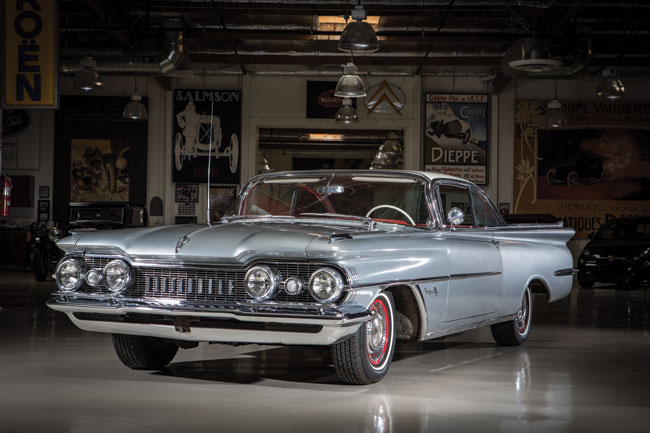
JL: It’s a lot different than it used to be. I think the love affair is sort of over. When I was a kid in the ’60s and ’70s, car culture was pretty much what social media is now. You had songs like “Little GTO” and “Hey, Little Cobra” and “409.” Nobody sings about cars anymore. I was born the day I got my driver’s license.
JW: What was that day like?
JL: Your dad would teach you to drive. And, then, on your 16th birthday, you’d get your license, and you take your mom’s car out and try to go 100. I remember I was in my mom’s Falcon doing 96 … 97 … 98 – just barely trying to break it. I don’t think kids do that anymore. Now when kids want to get away, they can Skype in their room and see things they’re not supposed to see. When we were kids you physically had to leave your house, and the car was what took you to where the girls were or where things were going on or where the hangout was. In a lot of ways, the iPhone and social media have replaced the car. So I think that the love affair has dwindled but the hard-core romantics will keep it going.
JW: So you’re a hard-core car romantic?
JL: I like what it represents. The automobile is a piece of industrial history in America. It’s had a huge effect on our lives. When Henry Ford created the Model T, it was sort of the iPhone of the day. Before that cars were really just a plaything for the rich. When you buy an old car and fix it up and you drive it, there’s a bit more pride because you know what it took to get it running. That’s part of the romance. Modern cars are harder to bond with because they don’t break down. I’d say the American car dream is still around, but it’s not as big a deal.
JW: What was the first car that you owned?
JL: It was a ’34 Ford pickup truck. I got it when I was 14. We had a 300-foot driveway, and I would just drive up and down the driveway for hours at a time. When I got it, it didn’t run. My dad said if I could fix it then it’d be my car. You sort of learned to respect the machine and how to make it work. That’s probably what really got me into cars. And that’s what has kept me involved in creating my own collection and building the garage.
JW: When you were doing well and you could pick any car you wanted, did you buy something high-end?
JL: I never really bought any luxury cars when I first became successful. I got cars that I liked. The first real luxury car I bought was for my dad. I always told him that when I made it big I’d get him a Cadillac. So I took him down to Woodworth Motors in Andover, Massachusetts. My dad being Italian sees this big white Cadillac with red velour upholstery and, of course, he wanted that. So I buy him this ridiculous, garish white Cadillac, and my mother was embarrassed to ride in it. When they were driving down the street she would sit in the passenger seat, and if they pulled up to another car and people would look at it, she would motion them to roll down the window and say, “We’re not really Cadillac people. Our son got us this.” It was hilarious.
JW: What was the first expensive car that you bought for yourself because you really wanted it?
JL: I got a 1954 Jaguar XK120. There was a reason. When I was 9 years old, I was riding my bicycle in our town — where nobody had fancy cars — and I saw a man drive a 1951 Jaguar XK120 out of a barn. It was a little two-seater roadster, and I was mesmerized. He called me over — Don Milligan is his name — and asked if I’d like to sit in it, and I said sure. The car is parked in the same barn as it was in 1959. He still owns it.

JW: Is it a good day when you’re sitting in this huge garage tinkering with a car or trying to get it to run better?
JL: I love the challenge. That’s what we’re doing with that steam car over there. The gray and red one is called a Doble steam car. It was driven by Howard Hughes. We’ve been trying to get it up and running. The metal is 100 years old and things crack, so it takes a lot of work.
JW: How did you find that car?
JL: Old cars find you. I get letters every week from guys in their 70s, 80s, 90s who say, “Oh, I’ve had this car all my life. I don’t have any kids. I want it to go to a good home.” I always promise them that I’ll never sell it, which I don’t. That’s actually how I’ve acquired most of these cars, and they all have some sort of fascinating story behind them.
JW: How many cars do you have in here?
JL: I think about 128 and 93 motorcycles. Something like that.
JW: Do any new cars capture your fancy?
JL: Oh, very much so! I like the technology. I’ve got a Chevy Volt in here. I’m interested in some of the hybrid stuff that’s happening. Cars used to get 8 miles per gallon. Now they have three times the horsepower, and they’re getting 30 or 40 miles per gallon. The auto industry is still innovative. All of a sudden you’ve got the Tesla. When electric cars first came out they were slow, but they got pretty good mileage. Now you have the Tesla, which is electric and sexy and fast and luxurious. It has all the benefits of the gas car without a lot of the drawbacks. So, once again, engineers are making new things work.
JW: How about driverless cars?
JL: I’m not against them. I see driverless cars now — only people are at the wheel. They’re texting or talking or doing their makeup, or a guy is combing his hair. At least if a computer is driving it’s paying attention. I would rather have a computer driving than those idiots I see out on the freeway who think driving is so boring they’re doing something else.
JW: Don’t you want to share your love of cars with the younger generation even if they are into social media?
JL: I meet kids that remind me of myself when I was 15 or 16. Every now and then I’ll get a letter from one saying they’d love to ride in a certain car, so I invite them over and we go for a drive. I like to let kids sit in a car and grab the steering wheel and kind of feel what it’s like. I remember when I picked up my McLaren, there were two kids at the dealership just watching us. I invited them in, and they took pictures and sat in the car. They’ll remember that their whole lives the way
I remember Don Milligan for letting me sit in his Jaguar when I was 9.
JW: How do you pick which car to drive from this huge collection?
JL: It’s generally whatever I’ve been working on that day. You say, “Oh, that one’s fixed?” Then you test it, and hope it will hold up. When you deal with cars – and many of these cars are well-over 100 years old – something is always breaking. To me, how I get there is always way more important than where I’m going.
JW: A lot of people remember a car as the first place that they got to make out. Did you have any four-wheel romances?
JL: My wife, Mavis, and I did get romantic in my ’55 Buick that I still have next door. So on our 25th anniversary we took the car out and went back to that place where we had parked. There are a million houses there now, so we ended up in someone’s driveway around midnight. Then, of course, it was “Ow! My hair!” And I accidentally hit the horn. Of course. The light comes on on the porch, and a guy comes out. We were more successful the first time, but the basic idea was there.
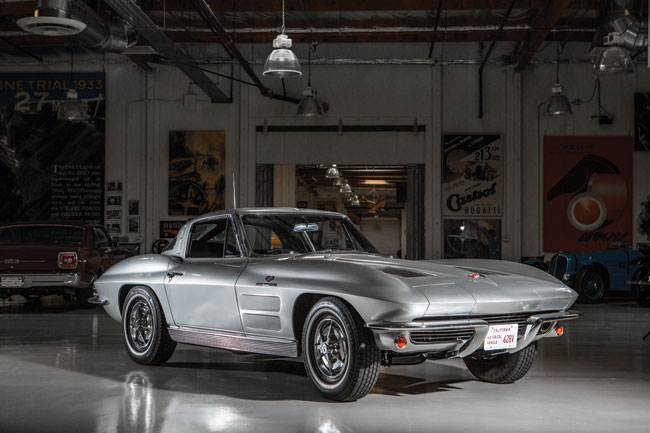
Watch the June 8, 2014, episode on Jay Leno’s Garage to learn more.
(Photo by Walker Dalton)
JW: Ever bought a car on some crazy impulse?
JL: One holiday we go down to buy a Christmas tree. It was some ridiculous price, and I complained to the guy, but he said it was free delivery. I said, “OK. Fine.” So I buy it, and he asked me where I live. I told him Beverly Hills and gave the address, and he says, “Oh. That’s two miles out of the delivery zone. It’s gonna be an extra $50.” I was so mad. So I told him to wait. I went to the Chevy dealer across the street and bought a truck on the spot, brought it over, put the tree in the back, and drove it home. I still have the truck. That was the last time I did something that stupid.
JW: As a celebrity, do you always get great service from the valet?
JL: I hate valet parking. I’ll always look for a place on the street. You ever read the back of a valet ticket? No responsibility for damage. And if your car is stolen, the police don’t look for it for 30 days because you voluntarily gave the key to someone else!
JW: We’re all wondering what you’re gonna do next.
JL: I’m doing what I like. I like being a comic. I like going on the road. It’s kind of fun now that I’m not on TV. People don’t see you everyday. I might do something on TV — I don’t know what. I’m not gonna do another late-night show or something like that.
JW: Does it feel different?
JL: I know that some people when they leave a TV show they don’t have a table at a certain restaurant or whatever, but nothing has changed for me. It’s not like I’ve lost all these perks that went with being the star on a TV show.
JW: People wonder why you don’t seem to get angry or you aren’t meaner. You really seem to be a nice guy.
JL: There’s enough meanness. I mean when I look at TMZ and I see celebrities having feuds and it’s just “Eff you,” “No, eff you!” I don’t get that. If you’re in show business and you’re doing well, just thank your lucky stars. Peoples’ lives are hard enough without having to see a lot of negative stuff. I think when people see you and you’re a comedian, the first thing you should do is be funny. They don’t want to hear you whine or complain. I mean, you’re a rich guy and you’re getting mad? Shut up.
JW: Where did that attitude come from?
JL: I think it’s probably a little bit from having Depression-era parents. My mom came to this country by herself when she was 11. It was rough for her, so I always try to keep that in perspective. When I started The Tonight Show, it was originally The Tonight Show Starring Jay Leno and my mother said, “Oh, starring! Mr. Big Shot!” She always used to make me feel so guilty. I changed it to The Tonight Show with Jay Leno just so my mother wouldn’t think I was trying to be a big shot. The real trick is to make show-business money and lead a normal life. I can’t impress anybody in show business, but I can fix a car. Then I go home and they say, “The big meatball is for Jay. Jay gets the big meatball!” That’s when I feel like a big shot.
A Look Inside Germany’s First Conquest
courtesy Wikimedia Commons
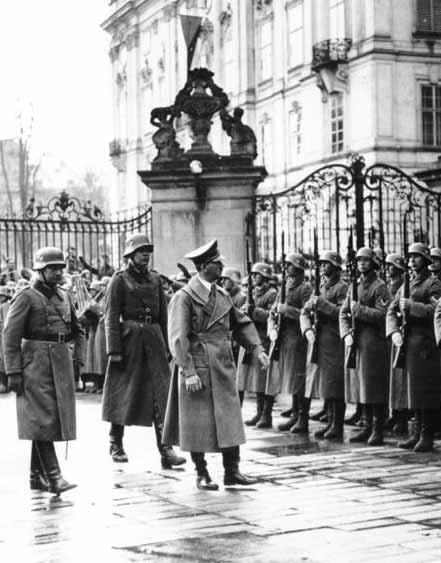
By coincidence, a Post article about Czechoslovakia, the first nation conquered by Hitler, appeared just as he was grabbing up his second.
“Nazi Germany’s First Colony” appeared in the Post on August 26, 1939, the day Hitler had originally planned to invade Poland (Read full article here). But his plans were pushed back, and the issue was still on newsstands when Hitler’s armies crossed the border into Poland on September 1. The ensuing blitzkrieg, which brutally crushed all Polish resistance, had little in common with the swift, bloodless conquest of Czechoslovakia.
The Czech republic had already been reduced when Great Britain and France allowed Hitler to occupy its borderlands in 1938. The next year, he returned to grab the remaining provinces of Bohemia and Moravia through threats of invasion. United Press reporter Edward W. Beattie Jr., who was in Czechoslovakia at the time, described the curious manner of the German invasion.
After bribing a taxi driver to take him toward Germany’s advancing forces, Beattie was startled when German scouts suddenly appeared, moving rapidly, coming down the road toward him: “When we met them head-on, the driver tried frantically to turn. It was too late. The unit began passing us. The officer in command leaned out over the side of [his] scout car. I thought he was going to ask for identification but all he said was: ‘From now on in this country, you drive on the right-hand side of the road.’ The occupation was as easy as that” (collected in They Were There: The Story of World War II, edited by Curt Riess, Garden City Publishing, 1945).
Step into 1939 with a peek at these pages from this week’s Post, 75 years ago:
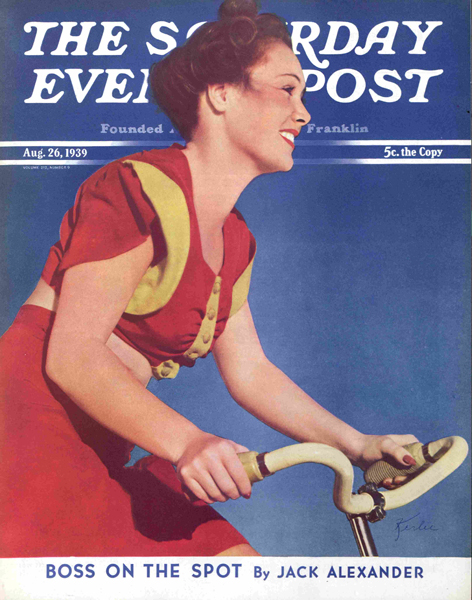

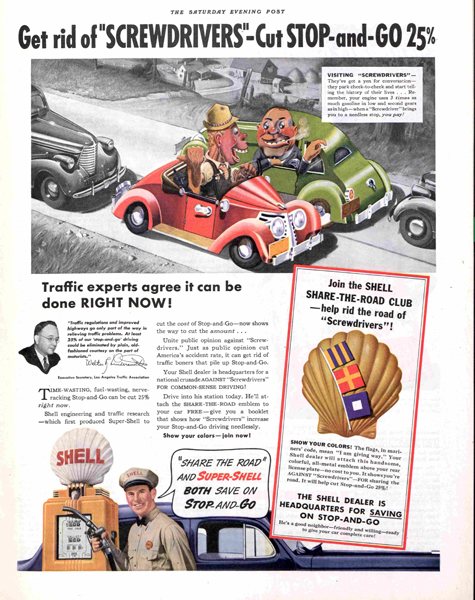
There was no violence, no popular uprising, no guerilla warfare. The Germans simply took up residence in the capital city, Prague, and began appropriating what they wanted. Resistance was reduced to futile gestures, like the one Beattie recounted when he and other foreign correspondents had visited a nightclub. Taking advantage of their journalistic immunity, the reporters ordered the band to play “It’s a Long Way to Tipperary,” “Over There,” and other Allied songs from the First World War. In a scene reminiscent of the movie Casablanca, the songs made “a couple of dozen German officers at other tables [get] more and more restless.
“Finally two officers a short distance away pounded for silence,” Beattie wrote, “and one of them came over and demanded that we stop ‘insulting the German army.’ Later in the evening, when everyone was drinking pretty heavily, he drew me to one side and said, ‘You don’t think we like this sort of thing too much, do you? For God’s sake, let us try to make this occupation as decent as possible.’ (The army’s part in the occupation was decent in every way. Of course, the Gestapo and the S.S. arrived later.)”
Beattie’s observation was echoed by the Post’s foreign correspondent Demaree Bess: “Greater Germany has planted her first colony in the heart of Europe. Bohemia and Moravia … have become as much of a colony as any island in the South Seas. The Czechs have assumed the inferior status of natives. … [They] do most of the work and the Germans pull all the wires.” It was the Germans’ goal to turn the republic into an efficient workhouse and profit center for the German Reich.
In these early days, they were careful not to make their exploitation too obvious. As Bess wrote, the Germans still hoped to win the cooperation of Czech workers and industrialists. At least that was the intent of the new government the Germans set up in Prague. Their biggest obstacle, it turned out, was other Germans — the Gestapo, the S.S., and officials of the Nazi party.
Nazi officials descended on Prague with the sole purpose of enriching themselves. They were soon disrupting Czech manufacturing by raising production quotas while limiting managers’ profits. The Nazis were further disrupting the economy by ruthlessly exploiting the Jews.
“When the Germans entered Prague without warning last March, they made it clear at once that life would become intolerable for Jews,” wrote Bess. “Thousands therefore went to the German secret police to apply for permission to leave the country. They were told their applications could not be filed until they had made ‘satisfactory arrangements’ with a Nazi-controlled bank, which demanded full powers of attorney over their property.”
The full savagery of Nazi domination was still in the future. But already, under German rule, life was becoming miserable for the Czechs. Consequently, Bess reported, “I know of only one European country today whose people, in very large numbers, actually desire a general European war. That country is the German protectorate of Bohemia and Moravia. The Czechs say they have discovered that some things are worse than modern war.”
They were about to find out that modern war could be much, much worse.
Listen to President Roosevelt’s August 28, 1939 address to the Herald-Tribune Forum. In talking about the need for peace, he is already distancing himself from the old policy of peace by appeasing Hitler.
Listen to a radio speech on the BBC given on August 27, 1939 by Jan Masaryk, the former head of the Czech nation. He had seen his country betrayed by his allies, Great Britain and France, who allowed Hitler to seize first the border regions of Czechoslovakia, then the entire nation, rather than go to war with Germany.
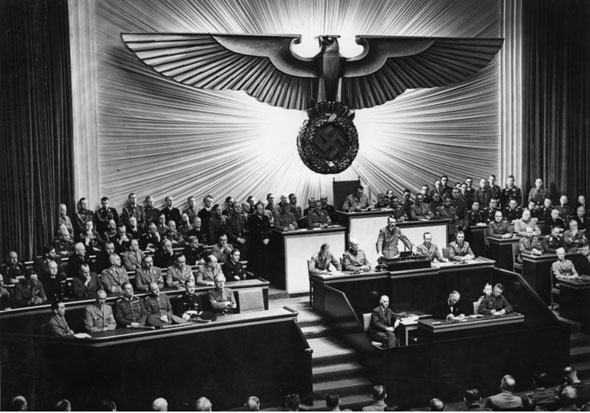
Listen as Adolf Hitler justifies his invasion of Poland to an ecstatic Reichstag.
Meanwhile, as you’ll hear, Great Britain and France are hurriedly summoning their governments to respond to Germany’s aggression.
Love, Logic, and Bacteria
She did not just take her hand off the railing and put it on your face, the OCD voice said. Now you’re gonna get a disease. How could she do that?
But all she’s doing is showing you affection, the intellectual voice said. There’s nothing there. Can’t you see that? You’ll be fine. You won’t get sick. Your skin won’t get infected. There’s—nothing—on—the—railing. Look! There’s nothing there.
I took Shawn’s hand off of my cheek, ran off of the fire escape and into the bathroom. Washed my hands and cheek until I heard Shawn yell for me to shut the door when I was done. When I finished, I found her standing at the elevator; the down arrow button lit up. Not a smile, a kiss, or even an attempt to hold my hand when I approached. The whole walk to dinner was in silence. She wore this face, this slightly miffed face, and I knew for the first time she knew about my obsessive-compulsive disorder.
The setting sun was reflecting off of the tall Boston buildings. The quarter moon was lucid and rising through the reds, purples, oranges, and peachy colors in the sky. The relaxed air was filled with the scent of budding trees. But as we walked through Harvard Yard to the restaurant, I couldn’t stop wondering if perhaps I didn’t do as good a job hiding my OCD as I thought I did. Perhaps Shawn noticed my frequent hand washing, and how I kept my hands in my pockets when we walked in public. Maybe she saw how freaked out I got whenever someone sniffled, sneezed, or coughed near me. Maybe what I thought I hid she saw, and she just let it ride instead of bringing it up. Maybe all my obsessions were too much for her, and she hid that from me. My mind was reeling. The intellectual voice was buzzing around inside my head like a bumblebee, but all I could hear was the OCD voice hissing like a snake underneath, saying over and over, Shawn knows you have OCD.

We got to the restaurant, and sat at the table in silence. I was terrified to tell her about my OCD. The thought caused an overwhelming sense of fear to rise up and rush my head. I couldn’t quell the fear no matter how tight I tried to hold to reality. It kept coming with each step the waitress made toward the table. Shawn smiled at me with her stop-you-dead smile, leaned forward, and kissed me. Right then I was reminded of our first night together, five months ago. Me curled up against her as we lay staring out at the night sky, falling asleep in her arms, her falling asleep in my arms. An experience I hadn’t had with anyone before. Until Shawn I wasn’t able to fall asleep in the same bed with anyone. Until Shawn I hadn’t any idea how to fall asleep in a woman’s arms. Until Shawn I didn’t even know it was possible to wake up holding hands. But when her alarm clock woke me up and I felt her fingers still folded in mine and then turned over and saw that she was sound asleep, I knew right then, right there that she was here to be more than just my fiancée, more than my friend, or even the mother of my unborn child. She was a sacred gift from heaven that came to stop the crying in my soul.
You have to tell her, the intellectual voice said, because if you don’t you are going to lose her. I lowered my head to the table, and my eyes locked on to the waitress’s hands as she sat our plates down. Do it, Allen, just do it, the intellectual voice kept saying, but all I could do was stare at the raised red bumps all over the waitress’s hands.
Captain Technology
The jar of tomato sauce tingled hollowly as it smashed on the floor to the right of my cash register. Working in retail is not for the faint of heart; tomato sauce soaked my pants up to the knees. After I retired, this part-time cashier’s job had sounded like fun. It wasn’t. Even worse, heavy rain came the second I left work. I was ready for a shower, lunch, and a nap.
First, though, I decided to get all business out of the way and check my emails. My laptop’s screen flickered longer than usual as it connected to the Internet. Nothing happened.
“That’s funny,” I mumbled, “it was working fine yesterday.” I tried again with the same result. Captain Technology — that’s the code name I’d given myself — doesn’t need to resort to whacking the computer when it acts up. No, he hits the restart button. I did and got the same message, no connection. My inclination was to postpone the emails until after a nap, but I couldn’t. The Internet is a technological narcotic.
“Think the problem through, Captain.” I told myself. “The cleaners came this morning. Bet one of them knocked a cable loose from the main computer.”
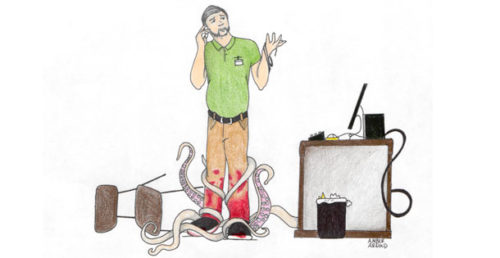
I plodded downstairs to the home office and looked behind the desk. What I saw made my heart stop cold. There was a mass of tangled wires and cables, the unraveling of which would have been fit for one of the modern-day seven labors of Hercules. Captain Nemo would have ordered out his divers to do battle with this giant octopus. Too bad I was the only one home. It’s a good thing that Captain Technology is never intimidated.
“You can do this, Captain.” I said bravely.
I knelt on the floor and unscrewed and tightened every coaxial cable, Ethernet cable, and power cord between the computer, modem, and router. Captain Technology has become fluent in “technolease.” Restarting the computer for good measure, I confidently waited. Nothing.
The screen displayed a message that may as well have been in Greek. I was stumped. But, Captain Technology, like a farmer, always has a plan. I called the cable company for support. I should have put on my truss before calling.
First, the mechanical voice was running the gauntlet of recorded messaging.
“Hello! Thank you for calling Dynamic Cable. Due to the unusually heavy call volume, you may want to try your call again later. The current anticipated wait time to speak to a customer service representative is five to 10 minutes.”
Undaunted, I called the robot lady’s bluff and stayed on the line. I dutifully punched all of the numbers at the required prompts. The recording hadn’t underestimated the wait time. Incredibly, a live voice spoke on the phone.
“Hello, this is Jeff, and thank you for calling Dynamic Cable. I’ll be assisting you today. May I have the number that you’re calling from?”
“But, I just gave your company all of my information.”
“I know, and thank you, but for security reasons I need to ask for it again.”
I couldn’t tell whether he was smiling. I took a calming breath before repeating the information. My arm had grown tired from holding my mobile phone too long, so I went to adjust position. Somehow, Captain Technology hit the disconnect button. I looked at the computer screen. It still displayed the same no-connection message. The cable-and-wire octopus still menacingly guarded its secret. I paced to the kitchen, back to the home office, and then back to the kitchen trying to think.
There was nothing for it but to call back the cable company.
Things hadn’t improved. The call volume was still unusually high and there was the same long wait with the same bad music.
“Hello, this is Katelyn, and thank you for calling Dynamic Cable. I’ll be assisting you today. First, though, I’ll need to obtain some information from you.”
I was too tired to argue, so capitulated.
Katelyn deftly took my information. “OK, let’s address the problem.”
Her attitude was “can do.” Now we were getting somewhere. I unplugged while she pinged; I unhooked while she pinged. Still no connection.
“I think I see the problem.” Katelyn said. “Your modem is at end of life.”
“What, I just bought it a couple of years ago. That’s incredible. Do you know that my family had a refrigerator that ran for 45 years? And it was still running when we gave it away. We only gave it up because we got tired of defrosting it.”
“I’m sorry, I don’t understand.” Her tone implied she was irritated by being distracted from her script.
“I said we only gave up the fridge after 45 years because we got tired of defrosting it. The melting ice was too messy.”
“I’m sorry, I still don’t understand.” Her voice held a strained patience. “How did ice get into the fridge? Ice goes in the freezer.”
“Look, I’m just trying to figure out why the modem is at ‘end of life’ as you say. It’s only a couple of years old. You’re making it sound like a cancer patient.”
There was a pause and the sound of keys clicking. “No sir, our records indicate that we installed the modem six years ago.”
“What do you mean? I installed the modem, not Dynamic Cable.”
Another pause, filled in by an exasperated sigh. “Maybe you mean that it was the router that you installed.”
Maybe I wasn’t Captain Technology after all.
She unexpectedly perked up. “Before we go any further, I’ve just seen how we could save you $20 a month on your cable bill. The plan would still give you all of your present cable stations and high-speed Internet access.” She paused dramatically. “And you get a landline.”
I wanted to ask her if we could just address the Internet problem but took the bait. I’d been thinking about getting a landline. Having only a mobile phone didn’t feel right.
“Gee, I’ve kind of missed not having a landline.”
Her chuckle surprised me. “I hear that a lot from …” She caught herself.
“… from old people.” I finished for her.
“Oh no, sir, not at all. You sound very young.”
I let that go. “OK, I may be interested in the plan. What do I need to do to get a landline?”
She repeated the entire plan to me without taking a breath. It didn’t answer my question.
I tried again. “What does the phone plug into?”
“Into the modem, so that works out. You’ll need a new one anyway because there’s a special Ethernet for the phone line. It should take two to three days to ship out to you.”
“Two to three days without the Internet? That’s a long time.”
Katelyn didn’t answer, but Captain Technology had an idea.
“Katelyn, there’s a Dynamic Cable store not too far away. Can I take this old modem there, switch it out, and return it once the new modem for the phone gets delivered?”
“Why yes, I hadn’t thought of that. First, though, let’s complete the order for the new plan. Oh, by the way,” she slid in, “there’s a two year lock-in period.”
“Great, two years before the mast.”
“Excuse me, sir, two years what?”
“Never mind.”
The short run from the car to the cable store drenched me. My hair was plastered down like Alfalfa’s in Our Gang. Three ladies behind the counter looked me over as I came through the door. They were kind enough not to mention anything about the cowlick sticking up from the back of my head.
I placed the old modem on the counter. “How come things always bust on rainy days?”
“Can I help you?” one of the women asked as if she hadn’t heard what I said.
As I was describing the problem to her, the other two ladies were discussing stew recipes. My stomach growled. I’d forgotten about lunch. And that reminded me that my in-laws would soon be arriving for dinner.
I hurried home and whipped the modem together. One green light came on reassuringly. Trouble was that three other lights were blinking like a Christmas tree. If I’d been in a better mood, I would have thought they looked festive.
I got a hand towel from a kitchen drawer and dried off. The gleam from the fancy new coffee machine caught my eye. No, this wasn’t the time to take a break. My stomach growled again. Or the time to eat, it seemed. I’d need to suck it up and run the gauntlet at Dynamic Cable again.
Twenty minutes later, Denise from Dynamic was asking me to unplug the coaxial cable from the wall. My back was numb and sore from working behind the computer for so long. What I saw when I finally made it down to the floor was embarrassing. I’d forgotten to screw the coaxial cable back into the wall.
“Sure, I’ll do it right now.” I lied.
I screwed them together optimistic everything would work. After all, I had a new modem and everything was at last connected. The same message about there being no available Internet connection was staring at me. The cable-and-wire octopus seemed to smile sardonically. I longed for the tubes and diodes of my old TV.
“Ah, sorry, Denise, but nothing’s working.”
“That’s strange,” I heard tapping on her end of the line. I think she was growing tired of me.
I studied the cables again. One end of an Ethernet cable looked funny. One of the cleaners must have tugged it too hard when she was dusting. A new modem probably had never been needed. I felt bad. The thing may have been near “end of life,” but it wasn’t dead. I couldn’t worry about that now though. My wife was due home shortly and company was coming.
“Denise, one of these cables looks like it might be broken.”
Cutting the conversation short, I unhooked the cable, and ran back out into the rain. I raced to the big box store, found my way to the electronics section, and stopped. I was looking stupidly at a large rack of cables as water mixed with reconstituted tomato sauce puddled at my feet.
A young clerk walked over to me. “Can I help you, Captain?”
Captain? She at least could have called me by my full code name. I showed her the cable.
She plucked a replacement from the wall and went to ring up the order.
“Do you want to buy the warranty that goes with it?”
“Pardon me?”
“There’s a warranty that goes with the cable. If anything ever happens to it, we’ll replace it free.”
I was amazed. The store expected me to buy a warranty for a $15.00 cable? She had to be joking. I wanted to tell her so, but fell into the trap.
“How much is the warranty?”
“Two dollars.”
I politely declined.
Once home, I hurriedly plugged the new cable into the router and ran it into computer. The modem still only showed one green light with the other three flashing. They reminded me of distress signals. Captain Technology sat down at his desk in defeat. Surrender tasted bitter. I wasn’t even hungry anymore.
I picked up the modem to make a formal surrender. Wait a minute. Something about the router caught my eye. How come it wasn’t showing any lights? Embarrassed — even though I was alone — I checked the router’s power button. I hit the router’s power button. All was well. The Internet was restored.
Captain Technology had failed to see that one of the cleaners had inadvertently turned off the router.
The back door opened and I heard my wife’s cheerful, “Hello, honey, I’m home. How was your day?”