Love at Six
© 2014
Six-year-old Zachary had been in his room all evening.
Mary Ann kept tiptoeing over to her grandson’s quarters in the guest room and pressing her ear to the door. She thought she could hear him crying. “Sweetie,” she said, taking a step back. “Are you okay?” She returned her right ear to the door. Zachary didn’t answer. “Can I come in?” she asked.
Mary Ann loved her grandson, but she couldn’t stand when things got tricky like this. She only got to see him every other month when his mother would drive him up from Vermont, so she felt a little out of sorts when the seas got rough. It was especially hard to do without Tobias around. Her husband had always been better at solving problems.
“Zachary, can I come in?” she called again. “Do you want dinner? Do you want me to read you a bedtime story?” There was no answer. “Didn’t you have a good time today? I thought we had such a good time.”
Finally, she turned the handle and opened the door to the guest room. Zachary had been scared to sleep on the room’s high bed, so she’d piled a bunch of blankets on the floor in front of the fireplace. He was twisted on his side, crying. Next to him was a stuffed animal, an old Rottweiler that was missing his nose. She’d only seen Zachary cry once before when he’d fallen from a tree in her daughter’s backyard, but these tears, she thought, had nothing to do with physical discomfort.
In time, she managed to lower herself to the ground and curl up next to Zachary. He didn’t budge, but he took her hand and rubbed it. The meeting of two such things—young and old skin—made her happy. “Did you have a good day today?” she asked. “Are you okay?”
“Kind of,” Zachary said. He twisted his head and lined his gaze with Mary Ann’s. His eyes were glassy and tears had left the tops of his cheeks shiny.
“What do you mean ‘kind of’?” she asked. “Ever since you got off the phone with your mom you’ve been quiet. Then you came in here and didn’t even have supper. The grilled cheese I made you is cold, and the tomato bisque looks ugly.”
“I’m sorry, Grandma,” he said, flopping onto his back and shutting his eyes. His lids pushed out the remaining tears and he erased them with his knuckles.
“It’s all right. I can make you another one if you feel like it. The first one wasn’t that good anyway. Maybe I can do better.”
She’d gotten along without Tobias these past seven years and was proud of that, but sometimes having a person in the house made it hard. Taking care of someone else reminded her of taking care of Tobias, bringing him soup in bed and scanning his back for bedsores. She missed him so much that it was best she didn’t think of him and how happy he’d made her. It’d been years since someone had kissed her goodnight and whispered “I love you,” and it seemed like the words were on the verge of extinction.
“What happened on the phone with your mother? Did you tell her how much fun we had at the lighthouse? How we may have seen a shark? I think it was a shark, don’t you? Wasn’t it great up there? Up so high? And we were so lucky that the nice man was there, and that he opened up the stairs and led us up to the top. You know, I’ve been there maybe twenty times, but never to the top. You have to be someone special to go up there. Maybe they saw you and that’s why they allowed it.”
Zachary laughed. Mary Ann continued to stroke his fingers.
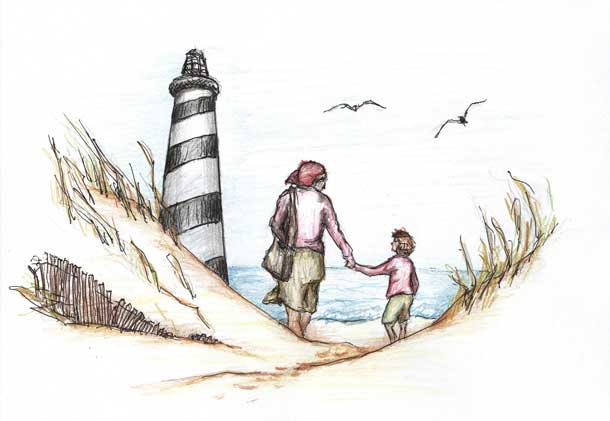
“It was a perfect day,” he admitted. “I love the lighthouse. I really do. It’s so tall, and I love that it’s painted like a candy cane. Why do they make them like that? Is it so ships can see them from far away?”
“I don’t know. They’re not always striped. We should have asked the park ranger. He would’ve known. Are you warm enough? Do you have enough blankets? Are you homesick? Do you want to go home? You know, tomorrow it’s supposed to be another beautiful day and we can go to the botanical gardens and feed the ducks. I’ve got some stale bread that they really like.”
“Why don’t we buy them good bread?”
“I hear they like stale bread better,” she cajoled.
“Really?”
Mary Ann nodded. She moved her hand to his belly and patted his soft flesh. She didn’t see her daughter in Zachary, but she could hear her—the curiosity and innocence. “Do you want me to put on a fire for you, like last night?”
“Yes, please.”
“It wasn’t too hot?”
“It was hot, but I liked the sound, and I didn’t need a nightlight because the flames were so big.”
Rarely did she make a fire these days, even when the Maine winters were harsh. Tobias had installed the best heating system, so she just pressed the lever to the right when the temperature dropped. Still, she knew that all heat wasn’t created equal, and that a fire was still king, especially in the eyes of child.
Zachary and his mother lived in an apartment in Montpelier, and it didn’t have a fireplace. Last night, when she’d gotten up to get a glass of water, she’d peeked into the guest bedroom and spotted Zachary–sitting up ‘Indian style,’ she thought they called it—a few feet from the fire, mesmerized by it. Plus, she thought it probably did the chimney good. It was seldom used even when Tobias was alive, and she thought the flames’ flickers erased the bricks’ long-lasting chill.
She went to get more wood for the fire, and as she piled it in a heap, she turned back and glanced at Zachary. He was smiling now, and his eyes were bright and clear. “So,” Mary Ann said, “what happened on the phone with your mother?”
“I told her that I want to work in a lighthouse when I grow up,” he said.
“Oh, Sweetie, that’s wonderful!” She piled on more wood and pulled a few sheets of newspaper from the adjacent basket. The funnies were dusty and over four years old. She jammed them underneath the grate, struck a match, and then had Zachary bring the fire to the cartoons. “You’re so aware and bright—you’ll make sure nothing happens to those ships.”
“She said it can’t happen,” he pouted. “That all lighthouses are now automatic or something.”
“Is that true?”
“I guess.”
“And that’s what made you sad?” Mary Ann returned to Zachary and they both sat, staring at the fire, studying the flames as they bent and twisted through the wood.
“Yes. I was so excited. I knew what I wanted to do with my life and where I wanted to live and how it was all gonna be, and then my stupid mom ruined it all,” he said as the tears began to well in his eyes again.
“Honey, it’s okay. Shhh.” Mary Ann scratched his back.
“I was gonna live in Maine and have a dog–a big dog–maybe a St. Bernard with one of those little barrels around his neck,” he explained as he cried some more. There was little build up with his tears, Mary Ann thought. They went from zero to sobbing in moments. “And then. And then…” he trailed off.
Mary Ann draped a quilt over her grandson’s shoulders. “And then?” she asked. “And then what?”
“And then my mom told me about you,” he mumbled sadly.
Mary Ann pressed her tongue against the roof of her mouth. “Oh, dear,” she said. “What about me? Did I do something wrong? If I did, Zachary, I’m deeply sorry. I really am.”
She worried that their visits would be spaced out even farther now, and that instead of meeting every other month, they would be every three or four months. In time, Zachary may not want to make the trek up the interstate to spend the weekend with her at all.
He spoke so softly she couldn’t quite hear him.
“What was that?” Mary Ann asked.
“I said,” he said, shaking the quilt from his back, “that I wanted to live in the lighthouse and be with my dog—the St. Bernard—and that I wanted to marry you, but she told me that I couldn’t marry you. That you only marry people you love. And then I told her that I loved you more than any other girl and she told me that that is a different kind of love. Is it true?”
Mary Ann paused. She looked at Zachary and brushed some of the straight hair from his face, tucking it behind his ears. She swiped her fingers below his eyes to rub out the remaining droplets of tears. Smoke built up in the chimney and the fire began to catch, popping and crackling.
“It’s true,” she finally said, “but it’s a better kind of love–one that’s sure to last forever.”
Zachary nodded, inched closer to his grandmother, and then nuzzled his face against her left arm. She kissed the top of his head, drew in his warm scent, and watched the blaze wrap the dry pine.
The Leopold and Loeb Murder Trial, 90 years later
Source: German Federal Archives, Bundesarchiv, Bild 102-00652 / CC-BY-SA
The recent news of a bungled execution has again stirred debate over capital punishment, emotions running high between advocates and opponents of state executions.
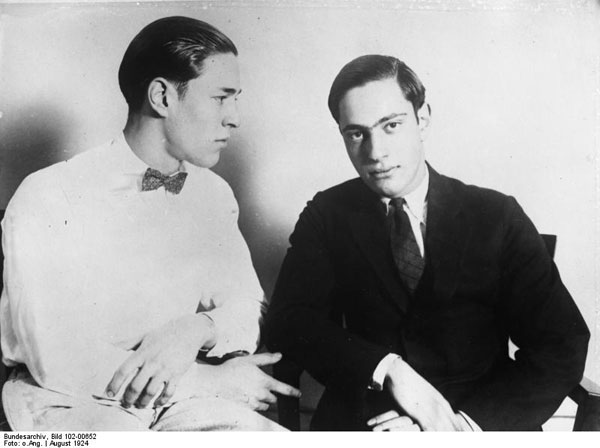
So it is interesting that this week marks the 90th anniversary of a horrific crime and a defense that, remarkably, spared the lives of two killers. If any criminals were worthy candidates for execution, they would have been Nathan Leopold and Richard Loeb.
In 1924, they pled guilty in a Chicago courtroom for a crime with a shocking motive. The two teenagers—wealthy and highly intelligent—had murdered a fourteen-year-old boy to prove their ability to live beyond traditional ideas of good and evil and to demonstrate their intellectual superiority.
They began with petty crimes in 1923: theft, arson, and vandalism, but then set their sights on committing the perfect crime.
On May 21, 1924, Leopold and Loeb rented a car and drove to a school in the Kenwood area of Chicago, where they would find their intended victim: Robert Franks. Loeb was able to convince the boy to get into the car with them because Franks was his cousin, and he had played tennis at the Loeb house often.
With the boy inside, the car sped off. The moment the car turned the corner, one of the young men—it could never be established whether it was Loeb or Leopold—dragged Franks into the back seat and killed him by repeated blows to the head with a chisel.
The young men wrapped the boy’s body in a robe and drove south to the Illinois/Indiana border. Their destination was Wolf Lake, a stretch of open industrial land beyond the Chicago limits where Leopold had frequently gone bird-watching. There, they dumped the body in a railroad culvert and returned home. That night, Leopold called Bobby Franks’ mother to tell her that her son had been kidnapped. The next day, they mailed a ransom demand, which had been written on a stolen typewriter.
Even before any ransom could be delivered, however, a worker discovered the body of young Franks. Leopold and Loeb decided to abandon the kidnapping, a ruse only intended to distract the police. They destroyed the typewriter and the robe they had used to wrapped the body, and then went on with their lives, convinced that the crime would never be traced back to them.
Leopold simply ignored the outcry in the newspapers, but Loeb couldn’t stay away from the investigation. He followed the police and reporters covering the case, and struck up conversations with them so he could offer some misleading theories about the crime.
While searching the area where the body had been discovered, a detective found a pair of glasses with a unique hinge design. He learned that only three pairs of glasses such as these had been sold in Chicago, one of them to Nathan Leopold. When questioned, Leopold told the police that, as an avid birdwatcher, he often visited the marshes around Wolf Lake, and that he must have dropped the glasses in the marsh on a similar expedition.
Source: German Federal Archives, Bundesarchiv, Bild 102-12794 / CC-BY-SA
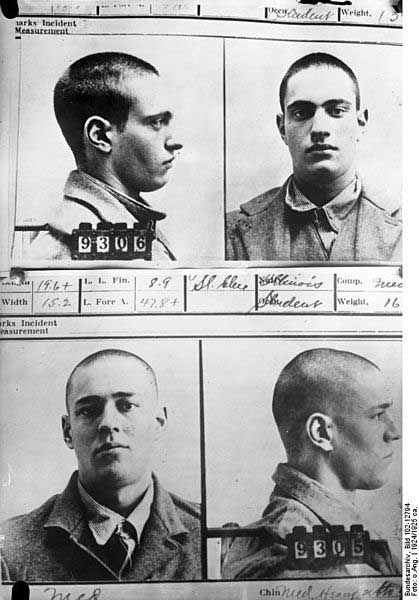
The police now treated Leopold and his friend Loeb as suspects. When they were brought in for questioning, both young men claimed they spent the night in the family car, cruising around Chicago, looking for girls. But the Leopold family chauffeur later told police he had been working on the family car all that night.
Confronted with this inconsistency, Leopold broke down and confessed. Loeb soon admitted his guilt as well.
The trial that followed grabbed headlines across the country. Loeb’s family, fearing their son would be executed for the murder, hired Clarence Darrow, the famous defense attorney and well known opponent of capital punishment.
Following Darrow’s orders, the young men pled guilty to the charge, which meant they would be tried without a jury. Darrow believed he could get leniency more easily from the judge than from a jury.
With the question of guilt answered, America’s newspapers now focused on the question of whether or not Leopold and Loeb would hang.
As the trial closed, Darrow summed up his defense before the judge in an argument that ran for 12 hours. He made the usual argument that capital punishment did not prevent other crimes. Murderers simply did not think of being caught and executed at the moment they killed.
He asked the judge to consider the age of the defendants: Leopold was 19 and Loeb, 18. He added that hanging the young men would also mean a life-long sentence of bereavement for their families.
But in his summing up, Darrow addressed the larger issue of public vengeance and disrespect for life. From time to time, he said, a blood hunger had risen up in society. When Americans were consumed with a desire to punish others or defend themselves, they would “place a cheap value on human life.”
He had seen it in 1917, when the country had been consumed with war fever. Young men were encouraged to see killing as a solution. “The tales of death were in their homes, their playgrounds, their schools; they were in the newspapers that they read; it was a part of the common frenzy—what was a life?” he asked. “It was nothing. It was the least sacred thing in existence and these boys were trained to this cruelty.”
After the war, he argued, the homicide rates had risen. A generation had grown inured to killing, often seeing it as a solution to problems.
America, Darrow argued, needed to return to the level of civilization it had enjoyed before it contracted war fever. “More and more fathers and mothers, the humane, the kind and the hopeful… ask that the shedding of blood be stopped, and that the normal feelings of man resume their sway… I am pleading that we overcome cruelty with kindness and hatred with love.”
Source: German Federal Archives, Bundesarchiv, Bild 102-10970 / CC-BY-SA
“I know the future is on my side,” Darrow said. “Your Honor stands between the past and the future. You may hang these boys; you may hang them by the neck until they are dead. But in doing it you will turn your face toward the past.”
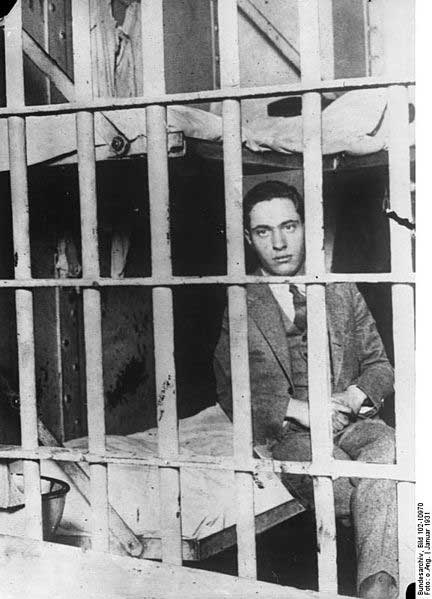
In the end, the judge sentenced both Leopold and Loeb to life imprisonment plus 99 years for the kidnapping.
It is interesting to note that Darrow did not argue that Leopold or Loeb would reform if spared a death sentence. He knew they were “not fit” to be loose in society. “I believe they will not be, until they pass through the next stage of life, at forty-five or fifty,” he admitted. “Whether they will then, I cannot tell…”
“When life and age have changed their bodies, as they do, and have changed their emotions, as they do—that they may once more return to life. I would be the last person on earth to close the door of hope to any human being that lives, and least of all to my clients. But what have they to look forward to? Nothing.”
Loeb was killed by an inmate after twelve years in prison, but Leopold lived long enough to be paroled and was released in 1958, having serving 33 years. He had kept his sanity by teaching classes for other inmates, learning over two dozen languages, organizing libraries in the prison, and participating in medical research.
Upon his release, he moved to Puerto Rico where he had been hired by the Church of the Brethren. For the remaining 11 years of his life, he worked among the poor as a hospital technician.
He had often been asked in prison if he had reformed. As a Post article reported in 1955, he would reply that he was “quite a different person today. Even physically there is not a cell in my body that was there in 1924.”
Despite all the years that had passed since his vicious crime, he still could not understand or explain his own actions. The Post quoted him as saying,
“I am in no different positions today than I was twenty-nine years ago. I can’t give you a motive that makes sense. It was just a damn-fool stunt done by a child, a child without any judgment. It seems absurd to me today, as it must to you and all other people. I am in no better position today to give you a motive than I was then.”
Beyond the Canvas: Flapper-era glamour fades as The Great Depression looms
August 22, 1932.
© SEPS 2014
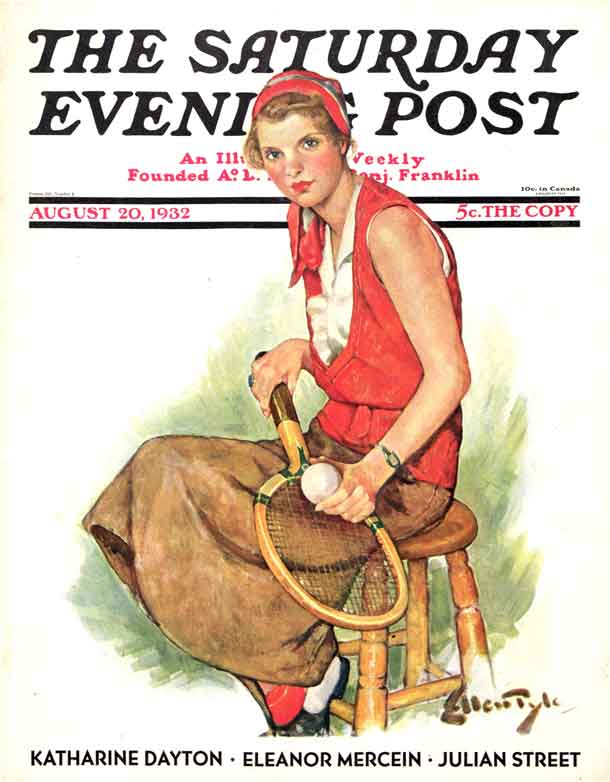
Ellen Bernard Thompson Pyle’s early illustrations for The Saturday Evening Post idealized the 1920s era of glamorous parties and celebration in much the same way Norman Rockwell would later celebrate an idealized rural America of the 1940s and 1950s.
But her notorious depictions of confident flappers in short dresses and even shorter haircuts changed when The Great Depression hit America in October of 1929. Pyle’s color palette and composition took on a darker tone that reflected the nation’s mood.
Pyle’s illustrations from the 1920s and 1930s show women competing in activities like archery, swimming, tennis, gardening, and hockey. The paintings are joyous and playful in the 1920s but become reserved in the 1930s.
Pyle’s August 20, 1932 cover, “The American Girl,” is a perfect example of the change in tone. Where Pyle once showed women smiling in brightly colored outfits, fashionable haircuts, and make-up, this Depression-era cover shows a female tennis player in a muted, brown canvas skirt and a loosely-hanging red top, her hair pulled back by a handkerchief. The glow of her cheeks results from the effort of her workout; it is not the rosy blush of joviality.
Not only has the color and hubris drained from the painting, but Pyle also foregoes her 20s era props of luxurious cars and carriages. This woman just sits on a simple wooden stool. Unlike her carefree flapper predecessor, the American girl of the 1930s is now a resilient heroine who adapts to tougher circumstances. She does without.
The darker color palette of browns and deep reds, combined with the wood of the racket and stool, project an air of simplicity as opposed to the gaudy glam of the decade prior. Rather than show an idealized world of parties that the majority of Americans would never know, Pyle turned to a sense of realism that would better connect with the struggles many Post readers were facing during the Great Depression.
Beyond the Canvas: Late Night Snack
March 22,1941.
© SEPS 2014
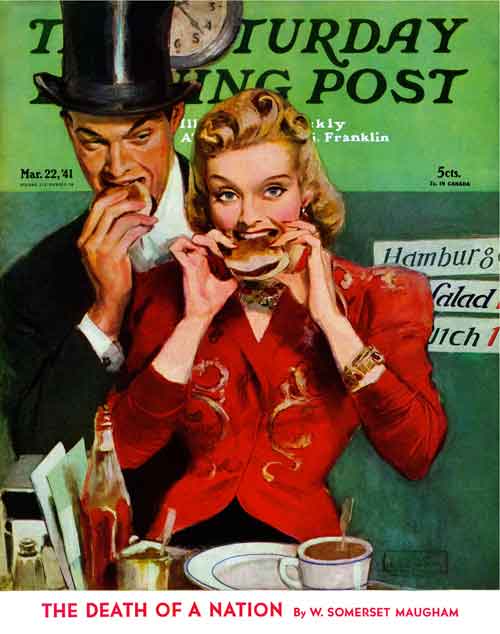
John LaGatta was an artist known to blend the glamour, extravagance, and sensual atmosphere of 1920s haute couture with the realistic scenes of American life. His March 22, 1941 cover for The Saturday Evening Post does just that. “Late Night Snack” keeps the high-class party going into the wee hours of the morning at a simple American diner.
Unlike the quiet, demure insomniacs of Edward Hopper’s Nighthawks, LaGatta shows two partygoers out of their element, enjoying the remnants of their fun-filled night in a low-key restaurant at 2:23a.m. (depending on how one reads the clock’s thick brushstrokes).
One wouldn’t think the tails-and-top-hats crowd would so eagerly enjoy a late-night hamburger and cup of coffee at a local dive, but all that drinking and dancing can work up anyone’s appetite.
At the tail end of The Great Depression, the bubble of Gatsby-esque extravagance had long since burst. The average American of the 1940s might not grab a late night bite in gala attire, but people still got dolled up for events; dates that might’ve ended with a post-midnight snack in the neighborhood burger shack.
Thus, The Saturday Evening Post readership–and all Americans really–can relate to this cover on realistic terms while at the same time romanticizing the glamour of the party they imagine the subjects have just left. It’s relatable even if the painting idealizes the unfamiliar, like a never-ending, “old Hollywood”-era affair.
The woman in the painting eats with some sense of unfamiliarity, a mix of not wanting to ruin her lipstick and maybe not knowing how to properly eat a hamburger. Her fashionable sleeves are rolled up, showing how ready she is to bite into this American classic.
The work’s color scheme is highly contrasted to make the scene pop with activity. The reds of her jacket and fingernails, along with the ketchup bottle, draw the eyes to the center of the painting and cause the moment of taking a bite to jump off the page.
The gentleman’s eyebrows raise in anticipation of her reaction, as do her own. This may be the couples’ first time getting a burger together, so they’ll make sure to savor the as yet untested American treat.
LaGatta does a magnificent job of mixing his famous, extravagant style with down-home Americana. He painted many covers for the Post, all including beautiful, graceful women. His depictions were never explicitly sexual. Rather, they were as some critics have called them, “frank admirations of beauty.”
Hush, Now
© 2014
My grandfather, a fiercely private man, born in the nineteenth century, could never have imagined his personal life would be posted and available to any yahoo out there for thirty-two dollars a month. I guess at this point he has moved on.
During an innocent search on one of those genealogy websites, an unknown relative appeared. I was only wanting to see my ancestry line like the celebrities on that TV show. Really, I was hoping to find a connection to the Salem witch trials. No witches so far, but I hadn’t finished looking. I know they are out there somewhere. The trouble was, I found an unknown uncle. On my mother’s side. Again. Seems her father had another family she found out about after his death. As an only child, she was thrilled to find her half-sisters still living on the East Coast, odd elderly spinsters, but sisters nonetheless.
The website glaringly exposed my grandfather’s previous wife and listed my mother’s half-sibs with their birth dates neatly typed on the form. No big surprises. I recall seeing the old copy of our family tree with a thick, black band of ink drawn over the previous wife. Ah, those were the days when an inch or two of white-out could solve a multitude of problems.
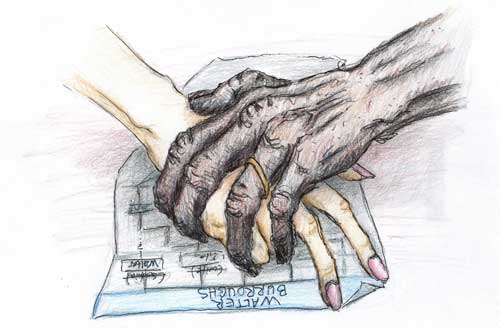
My only memory of my Grandpa Walter is sitting together on a big, covered porch in Dayton, Ohio. I was about six. I was putting stamps into a child’s stamp book, and he was breathing. He gazed down at the small, green valley in front of us. White horses grazed peacefully. I don’t remember talking to him due to the lung machine the size of a refrigerator he was attached to. Occasionally, he would take the mask off and enjoy a pipeful of sweet cherry tobacco, which I can still smell sometimes. At the age of six, I saw nothing wrong with this and neither did he.
I was conjuring up that rich, tobacco smell when a tantalizing little icon swirled up on the screen asking me if I wanted to see something else. Well, do ya? It seemed a little condescending. Only a middle-aged woman in her newly empty nest would go this far anyhow. The last of my three kids had recently left for college in a blur of loud music and hair straighteners. I really had to find something better to do than plot our family tree. It was that TV show that started the whole thing.
Without hesitation, I clicked the mysterious icon and waited patiently while the screen produced a copy of an old, hand-written record of people and their households in a 1919 census. In tidy, cursive handwriting that you don’t see anymore, my grandfather’s name was listed, along with a wife, Sophia. Sophia. What an exotic name after weeks of looking at Ebenezers and, I kid you not, Ichabods. “Swine Flu” was scrawled under the “died” section for poor Sophia. My heart sank. I had just met her. The date was a few years before his marriage to a second wife, my grandmother coming in a distant third.
I was so excited to discover this wonderful tidbit that I almost missed the sweetest thing of all. A baby. Baby Walter. Another half-sib for my mother. I never thought of these people as related to me. My first thought was to call her. Then it occurred to me that maybe all of these “surprises” were becoming difficult for Mom. My second thought was, he could still be alive.
Feeling like Nancy Drew herself, I entered the baby’s name in a search. A matching result came up so quickly there wasn’t even time to bite my fingernails. There it was, Walter Z. Burroughs, born 1918, Salem, Mass. I broke the news to my Yorkshire Terrier, who showed overwhelming enthusiasm, wagging and panting at the discovery. Now what?
I went to the online white pages and there he was again, 93 years old, from Massachusetts, living in Tacoma, Washington. Tacoma! Really! Not thirty minutes away from my home? What a strange coincidence. With a shaky hand, I wrote down the address and phone number. The site indicated that it was a nursing home in an area I was not familiar with.
When my husband came home that evening I bombarded him with my news. “I have an uncle.” Since both of my parents were supposedly only children, my family tree is an extremely tall, thin one–a towering pine, perhaps. My husband’s is more like family groundcover, so I don’t think he could possibly feel my excitement at this discovery.
“Call him,” he said casually as he stabbed a scalloped potato. I don’t know if he even likes scalloped potatoes. It was the kids’ favorite.
“Is it a good idea to call a 93 year old man and rock his world at this point?” I pondered. I pictured my frail grandfather withering away at the end of his oxygen tube like the last tomato on an October vine.
“I say call him. He’s your uncle, after all. Good dinner, by the way.” He wiped his mouth, gave me a quick smile, and headed for the garage to work on his never-ending wood project. Soon, the sander growled in the distance while I cleared our few dishes off the table.
I thought about calling my daughter, Chloe, at college to see what she recommended, but I knew her answer would be, “Go, go meet this man now!” Which was not a bad idea. He may not be around much longer. I decided I would call her after I did this brave and outgoing thing.
The next morning was a Tuesday, as good as any. I kissed my husband good-bye and rinsed out the coffee press. Walter’s phone number sat on the counter. I wiped down the stove top and then started pulling things out of the refrigerator to be tossed. Enough, I thought, holding a half-empty jar of sauerkraut. “I’m being a wimp,” I told the dog. He heard, “Do you want a cookie?” and started bouncing maniacally up the cabinets toward his treat bag. It was enough encouragement for me.
I picked up the phone, gave the dog a cookie, and quickly dialed the number. It rang once, and I hoped I would get an answering machine to at least try out my voice.
“Sunset Nursing Home. May I help you?” asked a deep, female voice rough with the sound of years of hard work (and maybe a few cigarettes).
“Yes, I am trying to reach Walter Burroughs.” I curled my hair with my fingers, a nervous habit I haven’t done in twenty years.
“Certainly.” The voice sounded curious. “May I tell him who’s calling?”
“OK. My name is Jan Wilmitsky, but he won’t know me.”
“Just one minute, dear.”
I waited while big band music played in my ear. I pictured Walter, in a black suit, with a silver cane, seated in an elegant concert hall enjoying the music when an usher taps his shoulder to inform him of my interrupting call. Instead, another female voice, this one softer, came over the line. “This is Dolly.”
My heart pounded in my chest. “Oh, hello. This is Jan Wilmitsky. I’m trying to reach Walter Burroughs.” He must have refused to leave the concert hall.
“I’m Mr. Burroughs’ nurse. He’s sleeping now. Can I take a message?”
I was afraid of sounding like a crazy person. These women seemed a little protective of my precious uncle.
“Oh, yes, sure. Like I said, my name is Jan Wilmitsky.”
“Got it.”
“And I believe I may be Mr. Burroughs’ niece.”
“Really?” The nurse sounded optimistic but quite cautious.
“It shows in the records I have recently uncovered that he is my uncle from his father’s side. I would like to come and talk to him if that’s possible.” I hated how my voice rose up at the end like a question. He was possibly family after all. I lowered my voice, kind of like Oprah’s, and gave her my phone number.
“I’ll give him the message,” Dolly said in a professional manner.
By the following afternoon I had received a phone call back from Dolly and had a meeting arranged for four o’clock the next day. Old people have to move fast. No time to waste. Four o’clock, tea time. Yes, he was definitely one of us.
Beyond the Canvas: Muddy Mother’s Day
May 11, 1957. © SEPS 2014
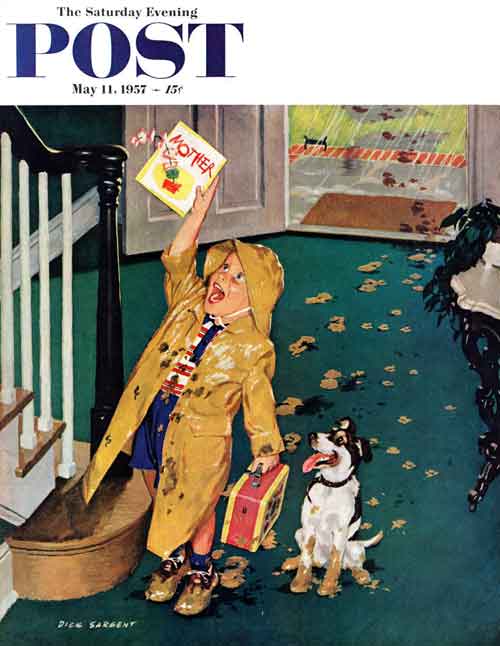
As illustrator Richard “Dick” Sargent once said, when it comes to children, “expect the unexpected.” On his May 11, 1957 cover for The Saturday Evening Postc, “Happy Mother’s Day,” we see a jubilant young man enter the family home with gifts for his mother: a Mother’s Day card, a muddy-pawed pooch, and a muddied front hall.
The perspective of the cover illustration is tilted off-center to give us the impression of being taller than the subject, the same view as an adult looking down on a child. The boy’s broad smile and call up the stairs tell the viewer he’s entirely ignorant of his heinous mud-tracking crime. In his excitement to impress his mother with a gift, he’s forgotten to take off his galoshes.
This funny, relatable situational comedy has happened to American families a million times over. Children are filled with impulse, an innocence of excitement that gets in the way of all other thoughts. Even for those of us who have never had children, we have all been children and can understand this moment. Bursting to share our joy or discoveries, we forget (despite a million admonitions) to take off our shoes once inside, tracking mud and other undesirables through Mom’s clean house. It’s adorable irony that this boy’s excitement over giving his mother a homemade card, which he likely hopes will make her day, has inadvertently given her more hassle than happiness.
This may even be a true story that happened to the artist. Sargent loved children, and he enjoyed illustrating scenes from his own life. He often used his own mischievous, redheaded son, Anthony, as a model. In fact, Anthony appears here as our muddy little man. Perhaps this was Sargent’s perspective one day as he came around the corner to check out the commotion in the front hall.
In the end, Sargent’s simple scene of a rainy May Mother’s day shows that even poor weather cannot deter the happiness and excitement of a loving child. Although the floor is muddied, the child’s intentions never were.
America’s First Superstar: William Cody (AKA Buffalo Bill) and his Wild West
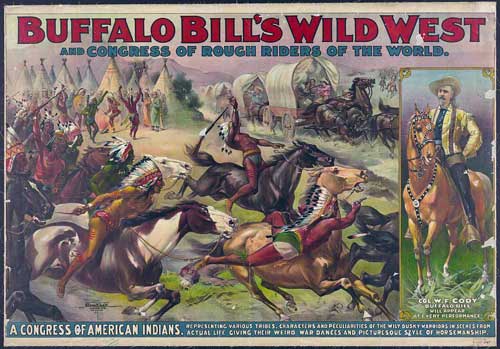
There had never been a celebrity like him. At the height of his popularity, William F. Cody was probably the most recognized man on earth. He received the adulation normally reserved for kings and presidents. And he became the idol of a generation through thousands of appearances in his own extravaganza: Buffalo Bill’s Wild West and Congress of Rough Riders of the World.
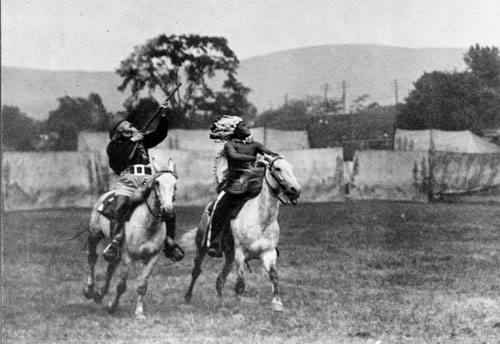
The show was as unique as the man. Far more than a circus or rodeo, his 1,000-member troupe featured exhibitions by talented riders and marksmen of the west. A typical show would include trick riding and races between cowboys as well as Native Americans. One of the big stars was the diminutive (4’11”) Annie Oakley who, shooting at a distance of 30 paces, could split playing cards edge-wise, hit dimes tossed in the air, or knock a cigarette from the lips of her husband.
The show also included western melodramas that mixed historical fact and fiction, like the re-enactment of Custer’s last stand, in which a regiment of cowboys dressed as soldiers were defeated by Indian riders. After the last man has fallen, Cody and his men would ride onto the scene too late to save Custer or his men. Next came the re-enactment of Cody’s shooting and scalping of the Cheyenne warrior Yellow Hand—a true occurrence—which was presented as his revenge for Custer. The final number was an attack by Native American horsemen on the cabin of a pioneer family. In this case, Buffalo Bill and his men arrived in time to drive off the Indians and save the white settlers.
Source: Library of Congress
The secret to the show’s remarkable success and long run—from 1883 to 1906—was Cody himself. He was more than a skilled marksman and horseman, he was the real thing—a true hero of the old west.
At the age of 11, he was working as a rider for a wagon train. Over the years, he found work as buffalo hunter, pony-express rider, trapper, prospector, and Army scout (which is how he earned the Medal of Honor).
In 1869, he came to the public’s attention when writer Ned Buntline made him the hero of one of his dime novels Buffalo Bill, The King of the Border Men. The book became a successful play. When Buntline wrote a second Cody play, Scout of the West, Cody agreed to play the lead, and for the next ten years, he appeared before the public as a theatrical version of himself.
During this time years, it appears Cody tried to copy Buntline’s success by writing a novel of his own. Prairie Prince, The Boy Outlaw; or, Trailed to His Doom, appeared in our October 16, 1875 issue.
The story opens with a young woman…
“A maiden upon whose sunny head but fifteen summer suns have shone.” She is wandering the prairie, stalked by a pair of hungry wolves. She is saved at the last minute by “a mere lad… tall in stature, well formed, with broad, square shoulders, small waist, and limbs of which an Apollo might well have been proud, while his every movement was graceful” etc.
When the young lady’s father, Major Racine, asks the identity of his daughter’s rescuer, an orderly says, “It is the Prairie Prince, sir.”
“No!” exclaims the Major. “Can this be that daring boy whose wonderful deeds have gone along the whole border, and have gained him the name of the Prairie Prince?” And Major Racine gazed with a strange interest into the boy’s face, while the soldiers crowded around and bent upon him looks of admiration and respect. Quietly, and with a proud smile upon his lip, the youth sat his horse, his clear, piercing eyes meeting the gaze of the military commander” etc.
The authorship is debatable. “Prairie Prince” might have been Cody’s own novel, or something Ned Buntline wrote under Cody’s name. If it was Cody’s work, he was smart not to make writing his future.
Source: Library of Congress
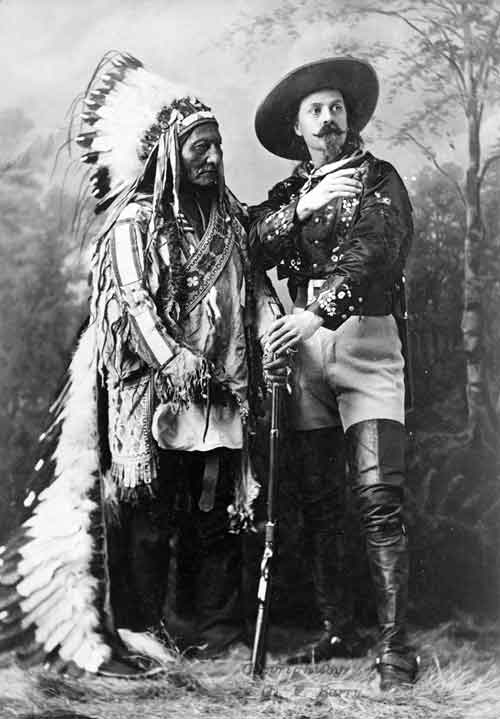
After a decade of playing someone else’s version of Buffalo Bill, Cody decided to present his own version of the character. On May 1, 1883, he premiered his Wild West show, appearing with a troupe of veteran cowhands and Indian riders from the Sioux tribe.
Up to that time, much of America’s entertainment was based on European styles and traditions. But Cody introduced the country to something wholly American. It was new, exciting, and home-grown.
A year after the Wild West opened, Cody received a letter from Mark Twain who praised the show–“It brought vividly back the breezy wild life of the Great Plains and the Rocky Mountains, and stirred me like a war-song”–and encouraged Cody to take his “purely and distinctively American” show to Europe.
Three years later, Cody followed Twain’s advice. The Wild West troupe arrived in Great Britain in time for Queen Victoria’s Golden Jubilee. Over the next four months, over 2.5 million Britons watched Cody’s spectacle and formed a general impression of Americans from this extraordinary showman.
He wasn’t a bad representative of his countrymen. He was well-mannered, good-looking, and could skillfully handle a gun and a horse. And he was highly representative of Americans in his attitude toward the modern age. He regarded the past with a conflicted, sentimental perspective; he liked progress but hated the cost. He celebrated the white settlement of the west but regretted what it had destroyed.
His ambivalence can be seen in “Hunting Down the Buffalo,” which he wrote for the Post on July 15, 1899. “As late as 1869, General Sherman reported nine million buffaloes on the prairies, and this was a conservative estimate. Ten years later these vast herds were completely wiped out—a whole division of the animal kingdom stung to death by the bullets of wasteful professional hunters, who left millions of pounds of fine meat rotting in the sun.”
He assured Post readers that the slaughter was necessary: “It was a sharp, quick way of ridding the plains of a cumbrance that had to give place to a wiser use of these fine grazing lands. It was another instance of civilization getting what it wanted and never minding the cost.” It is a curious attitude for a man who earned his reputation and nickname for killing buffalo.
In the article, he drew a parallel between the fate of the buffalo and the Native American. “We could not make useful citizens of the Indian, and we could not run our brands on the buffalo, so now there are few Indians and no buffaloes.” Both, he believed, had fallen victim to the greed of white settlers.
His audience might not have shared this conclusion, but they were applauding it when they watched his show. His fair-minded attitude was part of the appeal of the Wild West. Like most superstars, his success came from an ability to see a little farther down the road than his audience.
Beyond The Canvas: Grandstand Grand Slam
April 22,1950. © SEPS 2014
Click here to license this and other artwork by Stevan Dohanos.
Click here to purchase this and other artwork by Stevan Dohanos from Art.com.
April welcomes the fresh green bloom of spring, as well as Opening Weekend for America’s favorite pastime: baseball.
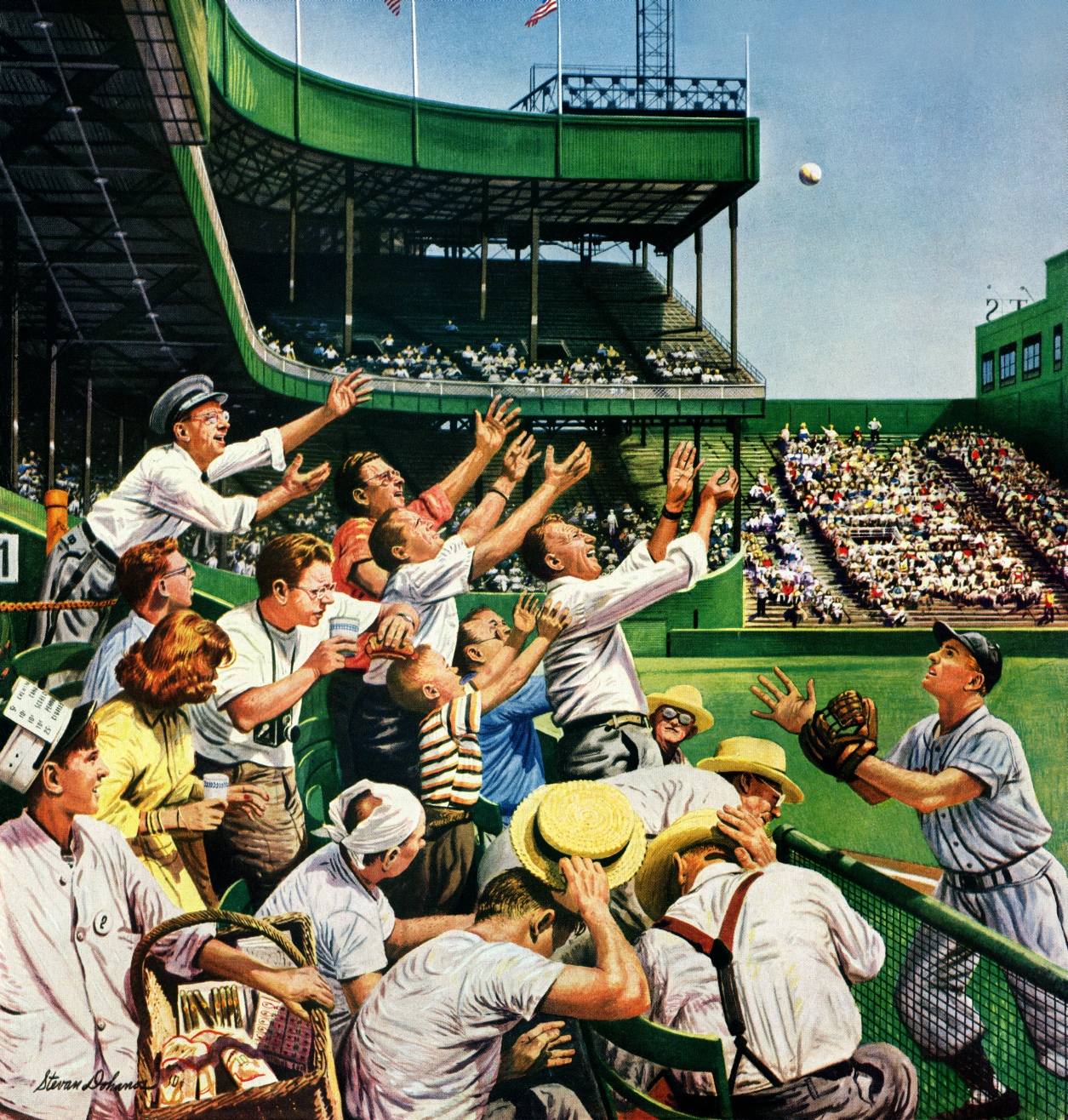
In his April 22, 1950 cover for The Saturday Evening Post , illustrator Stevan Dohanos depicts a wide variety of reactions to an incoming fly ball on a sunny day at the ballpark.
The green upper decks curve around the back end of the stadium and enlarge the grandeur of the atmosphere as they approach the outfielder’s apparently useless attempt to catch a ball among the throngs of an excited crowd.
This game is not a casual affair taking place over a relaxing weekend afternoon. This outing plays host to a devoted baseball following. The scene takes place somewhere between late morning and afternoon. The adults in the stands are playing hooky, and should they catch that prize ball, they would have no one and nowhere to brag to for fear of being discovered out of the office. If you look carefully into the crowd, most of the men are still wearing their work attire. They have rolled up sleeves, but they still wear slacks, ties, button-down shirts, suspenders, and even a bus driver’s hat on the man in the back row.
The illustration shows that love of the game transcends generations. Boys and men all reach to the sky, hopeful for momentary fame, hoping to be “that guy” lucky enough to snatch a professional, maybe even game-ending ball. For the men, there are resurgent childhood dreams of one day playing professionally. The boys in the stands are instilled with those hopes and dreams for the first time.
Structurally, Dohanos composes a triangle across the cover by using the reaching crowd and outfielder as linear markers to draw the viewer’s eye to the falling trajectory of the incoming baseball. The immense stadium and rows of stands are simply background to the scene unfolding at the painting’s foreground.
The color palette blends the semi-yellowed field with the straw hats and yellow dress of the baseball-avoiding bystanders. The bright yellow colors disperse the white-collar chaotic mess in the stands. Some individuals sit back without a care while others hide or turn away. A select few in the section dive for the ball.
Like the viewer, the rest of the stadium watches this freeze-frame scene. The narrative indicates that a fan’s catch would ensure a home run against the outfielder jumping for the fences. We are brought into the scene’s tension, the game, and the stadium’s excited, cheerful atmosphere.
64 years later, America still eagerly awaits the baseball season and its longstanding tradition of spring’s Opening Day. The fields are watered and mowed, the sun is shining, and there’s always a chance it could be any one of us in the stands, ready to catch that home run ball.

Finding My Voice

I sit in front of the microphone, looking through a window at my producer in the control booth. I’m about to begin one of the scariest jobs of my life. I don’t know why I agreed to narrate an hour-long radio documentary about Hurricane Katrina. “What was I thinking?” I ask myself. “This can only go wrong.”
An engineer flips the switch. The producer, Rachel McCarthy, signals me to begin. I open my mouth, and for a few seconds nothing comes out. That silence is followed by a cacophony of clicking and choking, random guttural syllables and the occasional complete word. It sounds nothing like language at all, nothing like the beautiful phrases inside my head. I want to surrender and quit, just call off this entire project.
Rachel assures me there’s plenty of time, that she remains confident in my ability to pull off what, to me, seems impossible. As a journalist who stutters, I have good days and bad ones, days when the words glide out of my mouth, and others when my vocal cords feel as knotted as pretzels. Today is a bad day.
It’s the type of day that makes me think it would be easier to be an accountant. Lock myself in an office and never talk to anyone. But journalism is the only career I’ve ever wanted to pursue. When I was growing up, adults questioned my wisdom; even I doubted my own chance at success. A professor who gave me an A in her class warned me that I’d never make it as a reporter unless I overcame the stutter.
Yet in the three decades since graduation, I’ve built a career I feel proud of. I write for national magazines, trying to put human faces on complex issues. I make the occasional radio documentary. I turn away almost as many assignments as I accept. These days, I think my success is not in spite of my stutter, but rather because of it. Still, it’s never easy.
Research has not come up with a single cause of stuttering: Like many conditions, it’s the product of both genetic and neurophysiological factors. Scientists have found structural and functional differences in the brains of people who stutter. Various stresses, including the reactions of impatient listeners, can aggravate the symptoms.
Given the complexities of the syndrome, the wisest modern speech therapists don’t aim to “cure” stuttering in adults. Instead they help patients stutter easily and openly, without the breathless struggle that marks my own worst bouts, and feel more comfortable living with the remaining dysfluencies. Confident and effective communication, rather than vocal perfection, becomes the goal.
It’s a worthy aim that I embrace intellectually and actually believe on my better days. But stuttering has a way of deflating even the most self-confident speaker. For one, it’s exhausting: The very process of speaking means doing battle with a larynx that feels tied up in knots. Stuttering also involves “secondary symptoms” such as head jerks and facial tics.
None of this, though, is as dispiriting as the reactions I get from certain listeners: the recommendations that I sing my words or think before I speak; the laughter and mockery; the assumption that I must be “crazy” or “retarded.” Servers in restaurants turn to my dining companions, silently pleading with them to order for me. Years ago, an editor told me outright that he wouldn’t hire a stutterer, even though I was the best-qualified candidate.
This ostracism is one reason why I think stuttering makes me a better journalist. Aside from the speech impediment, I haven’t encountered a lot of struggle in my life. But my stutter has taught me about bias and marginalization. It has taught me how easy it is to overlook someone’s talent because of a trait irrelevant to job performance: disability, race, family status, religion, physical appearance.
It has helped me empathize with the struggles of African-Americans, single mothers, evangelicals, immigrants, teenagers, people in wheelchairs, transgender people, the poor. I find myself seeking common ground with — or at least seeking to understand–people whose political views are out of the mainstream, even if I disagree with them. I’ve learned to make the extra effort to understand individuals whose lives are unlike mine, because I know how blithely other journalists might unwittingly dismiss them. I know it because of how many people have unwittingly dismissed me.
It’s easy to talk with people who are able bodied, affluent, and college educated. They speak in quotable, syntactically correct sentences, with speech that’s easy to understand. They make my job easier by providing coherent analyses. Indeed, my research must include interviews with these folks. But when we journalists limit ourselves to them, we strip our craft of its texture. My stutter is a daily reminder–an alarm that goes off every time I talk–to interview people who might be harder to communicate with.
The other lesson my stutter has offered me is simple: Shut up and listen. I don’t particularly like the physical effort of speaking. So I’m content to ask others to tell me their stories, then sit back, take notes, and make eye contact. I don’t feel compelled to fill the silences; I know someone will fill them, and I prefer it be the interviewee. By listening intently, then following up with gentle questions about missing details, I often wind up with richer, more nuanced stories.
These days, I can tell some of those stories aloud, literally. As our Hurricane Katrina recording session proceeded into the third hour, and then the fourth, my vocal cords gradually relaxed. In the final 30 minutes, Rachel asked me to read the narration script one last time.
Mysteriously, the stutter temporarily disappeared in that final reading, and the words tumbled out fluently. In the control booth, Rachel’s eyes grew wide.
When I finished the last page, she let out a whoop. So did I, realizing that–even though it took a lot of stuttering to get there–I was one step closer to finding my voice.
How Will You Feel Then?
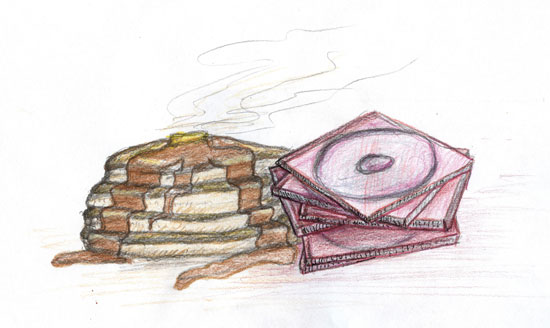
There is an old man teetering through the locker room, pedaling homemade DVDs and breathing like a Freightliner truck. He’s wearing mismatched tennis shoes, a plain white shirt and a pair of khakis wrinkled like the skin of a cottonwood. “Did I give you one of these already?” he asks. “Yes,” they say, “I believe so,” and he keeps moving, three steps forward, one step back, inhale, exhale, a stack of rose-tinted jewel cases fixed between his fingers.
They are lying, these men, financial advisers and media specialists and high school civics instructors. They do not possess this man’s DVD. They do not want it, and do not wish to give him the wrong idea. They are not the right audience. They are very busy. They must go home now, back to their wives and children. They must be on their way.
Soon he will reach my locker. I have just showered. I am still wet and half-naked and my own family is waiting on me for Pancake Night. But I know better. I am better. I have read books, walked through museums, paid money for feature-length documentary films.
I understand empathy. I employ it on a regular basis. I tip the doorman at my office building. I ask my secretary about her weekend plans. In truth, I’d rather not speak to this man, either; I’d rather duck his gaze and sprint for the exit. But to circle this room like a hopeless poltergeist, day in and day out, invisible and ignored—how he must suffer! None of us know him. We do not know his story, but to land at the YMCA pedaling nondescript DVDs, well, the word “downtrodden” comes to mind.
It’s important to ask questions to men like this, to say hello, to meet their gaze when we pass them on the street or find them pedaling DVDs at the YMCA. It’s important to remember the world is unfair, that we do not all share a common heritage, a common childhood, a common blessing.
He’s coming closer now, his shoelaces trailing like alley cats behind him. He looks arthritic, hunchbacked, emphysemic. He’s probably been smoking for years, since he was a kid. They started young back then. No filters. Or maybe he picked it up in the war—maybe he’s a veteran. Korea. Vietnam. Could you blame him for smoking? Flushing out the tunnels, braving booby traps and landmines. And if he is a vet–I’d put money on it–how will you feel then, knowing you’ve ignored a man who nearly died for you and your country, an American hero?
Of course, I could be wrong, and that’s the point: we don’t know. But this much is evident: he’s lived hard. I worry he’s alone in the world. If he had a family, surely they wouldn’t let him live like this, smelling like a dumpster and pinballing from one locker to the next.
Maybe he had a family like mine once, a pretty wife, two kids. Maybe they loved him, and maybe they died, or maybe they fell out of love with him and left, and maybe then he crumbled, fell from grace to the nearest YMCA. It’s important to ask questions to men like this.
There are now only three men between us. I have not looked him in the eye, but I can sense his trajectory, I’m sure of it, can feel his gaze heating up my neck like the coils of an electric stove. I won’t ignore him–of course not–but what will I say? How will I answer his questions?
And how long will it take, because truly, my family is waiting for me. On Pancake Night, I cook dinner. I flip the pancakes. “I like my syrup with a bit of pancake,” Casey Jo likes to say, mimicking me. Kevin likes his with peanut butter. Jane knows my pancakes are only pancakes, but the kids believe they are something special. They believe in the ritual of Pancake Night, and Jane plays along. Pancake night is their favorite night of the week. I really shouldn’t let them wait. I really must be on my way.
“Did I give you one of these already?” he asks, placing the DVD in my hand before I can answer. He’s looking right at me. I can see a bit of food on his tongue. His lips are wet.
The smell is overwhelming me and I am holding my breath. There is something crusty on the jewel case.
“I’m not sure,” I say, “what’s on it?”
“Nothing,” he says. “Totally blank.”
And before I know it he’s shuffling away, head hung low, whispering something I can’t make out.
“Fill it with whatever you like,” he says.
Whatever Happened to John Scopes, the ‘Monkey-Trial Man’?
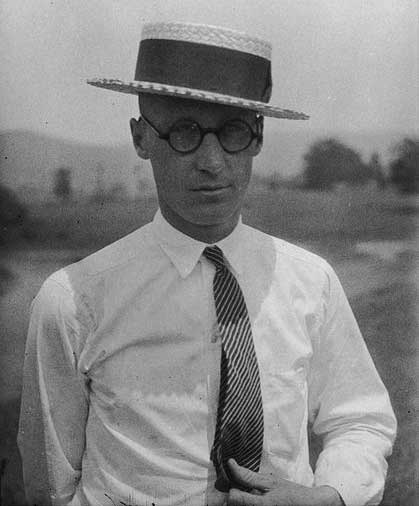
It has come down to us a pivotal moment in American history, a classic confrontation between science and faith.
In 1925, John T. Scopes was arrested in Dayton, Tennessee, for the crime of teaching evolution in the local high school.
The resulting trial came mid-way through a decade that seemed obsessed with sensational stories. That summer, newspapers had given lurid coverage to the ongoing troubles with bootleggers, the excesses of jazz-crazed youth, critical response to Fitzgerald’s Great Gatsby, and the meaning of a parade by 40,000 members of the Ku Klux Klan through Washington, D.C.
But for many days that summer, the Scopes trial crowded every other story off the front page.
Over 100 newspaper reporters swooped down onto the town of Dayton, as well as throngs of tourists, not to mention pro-science and pro-Bible advocates eager for an audience. Street-corner preachers drew crowds of gawkers and idlers by damning Scopes and the theory that humans had “descended from a lower order of animals.” They demanded every sort of punishment for Scopes, just short of execution.
Also crowding into the little town was Scopes’ defense team, which included the nationally renowned lawyer Clarence Darrow. The prosecution team included former secretary of state and evangelist William Jennings Bryan. The trial became a spectacle as Darrow put Bryan on the witness stand and cross-examined his fundamentalist beliefs.
It all made for good copy, and it encouraged Americans to debate the meaning and consequences of the trial. Lost in all the noise, though, was the fact that the event—Scopes’ teaching from the state approved biology book on April 24, his subsequent arrest, and the trial, were all a stunt.
The American Civil Liberties Union wanted a test case to see if the Tennessee courts would enforce its new “Butler Act,” which outlawed the teaching of evolution.
The community leaders of Dayton, Tennessee, saw an opportunity to hold the test case in their jurisdiction and profit from the attention and tourism that would result.
John T. Scopes agreed to be the subject of the case. He was charged with having taught evolution on April 25, 1925, and quickly released on $500 bail posted by a Baltimore newspaper.
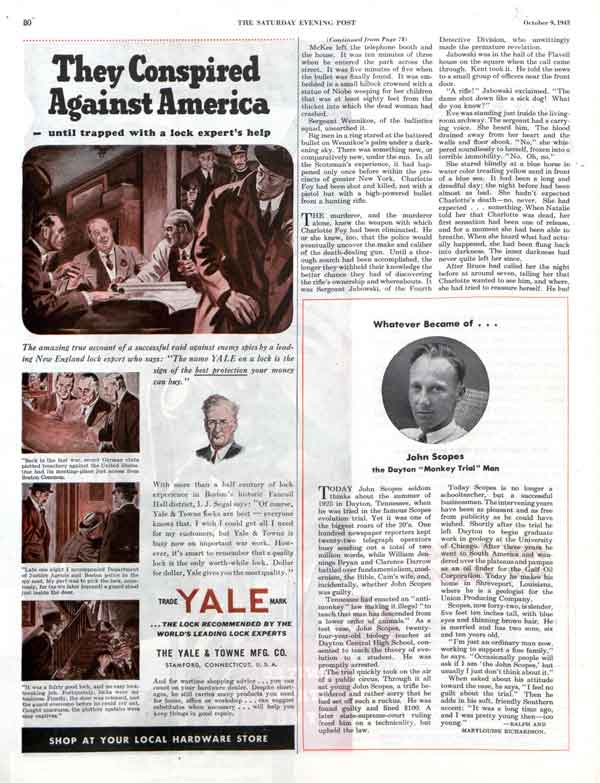
October 9, 1943. © SEPS 2014
If you’re familiar with the story, or you’ve seen its dramatized account in the play/film “Inherit The Wind,” you know Scopes was found guilty.
The sensational aspects of the story ended there, and few people are aware of what happened after the verdict. The judge set a fine of $100. Scopes’ lawyers appealed the verdict to the Tennessee Supreme Court, which supported the lower court’s verdict. However, the higher court—perhaps eager to get rid of the case—noted that the judge, not the jury, had set the amount of the fine. On this technicality, the Supreme Court overturned Scopes’ conviction.
The Scopes trial was one of the last great cases of Darrow’s career, and Bryan died just five days after the trial. Tennessee’s Butler Act remained in effect until 1967, at which point the state’s teachers were free to incorporate the theory of evolution into their biology curricula. In 2012, a new state law required science teachers to present evolution as a “controversial” and questionable theory.
And John Scopes? The ‘victim,’ according to some journalists? The ‘criminal’ whose punishment could not be too severe, according to others?
He appears to have slipped neatly back into the obscurity from which he had come.
Shortly after his conviction was overturned, he became a graduate geology student at the University of Chicago. He was later hired by Gulf Oil to look for oil deposits in South America. He wound up in Shreveport, Louisiana, studying oil reserves until his retirement in 1963.
“I’m just an ordinary man now, working to support a fine family,” he told the Post in October 1943. “Occasionally people will ask if I am ‘the John Scopes,’ but usually I just don’t think about it.
“I feel no guilt about the trial,” he said, adding quietly. “It was a long time ago, and I was pretty young then—too young.”
Correction: An earlier version of this article referred to Bryan as a former vice president. Bryan was a former secretary of state, not vice president.
Beyond the Canvas: Date Night Deflated
June 6, 1936. © SEPS 2014
Click here to license this piece from Curtis Publishing.
Click here to purchase this and other pieces by Frances Tipton hunter at Art.com.
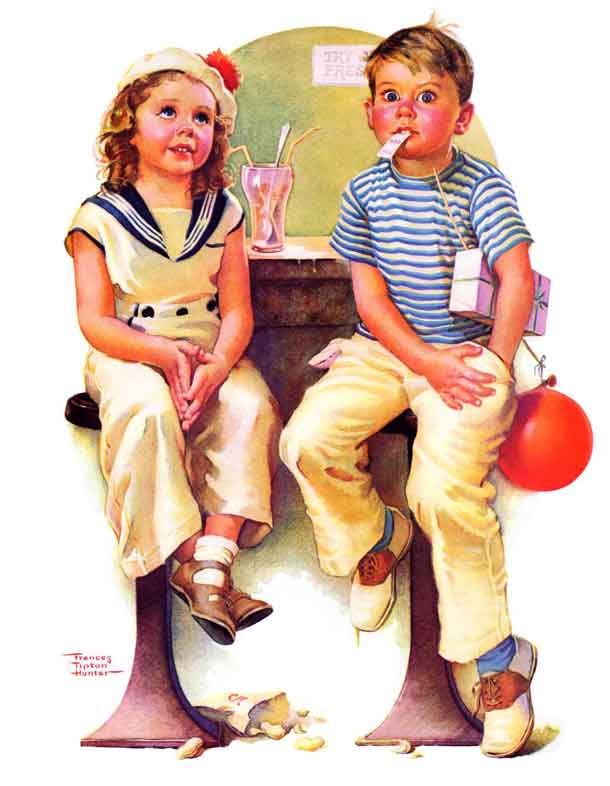
The June 6, 1936 cover of The Saturday Evening Post,“No Money For Her Soda,” shows two kids who’ve spent the day with each other, and a boy who doesn’t have two pennies left to rub together. Even in this embarrassing moment the artist’s use of small children in a setting for adults, while using a bright color palette, manages to keep the scene innocent and playful.
Frances Tipton Hunter’s first cover for The Saturday Evening Post does a wonderful job arranging tokens of the day’s activities around the counter. The remnants of the day rest under the boy’s arm, on the floor, and even held between his teeth, including a ticket stub, a gift-wrapped box, an empty soda glass, and a bag of ballpark peanuts. Just in case we need further evidence of the boy’s financial predicament (and we don’t really), the boy’s pockets are turned inside out.
Much like the works of Norman Rockwell, Frances Tipton Hunter painted innocent boys and girls living idealized American childhoods, complete with this idyllic failure of financial preparation. Your heart aches as what looks to be a fun-filled day comes to a stalled, awkward end—the partially deflated balloon representing the increasingly poor prospects of their future together.
Painted at the height of the Great Depression, the picture of a young spendthrift on a badly planned date automatically raises broader questions. Though the work depicts children, could this catastrophic date, complete with reckless money management, have hit a little too close to home for a struggling 1930s America?
The two children sit upon adult-sized, vertical barstools (feet dangling), staged symmetrically opposite one another to draw the viewer’s attention to the compositional “H” frame’s center. The horizontal line of the bar cuts across the image, drawing the eye in to navigate the story’s narrative, a pocket-searching hand and the counter’s empty glass.
Further dissecting the work’s structural composition, Hunter’s set design and palette interact with the overall story to tone down the seriousness of the subject matter. The lighter hues–pinks, peaches, blues, beige, and white all work to soften the severity of the situation. Hunter even changed the Post font color to a fun, light-hearted pink.
The white backdrop of the cover’s negative space pulls the scene forward dimensionally from the rest of the cover, creating depth layered from the barstools to the bar, to the back wall of the soda shop. The entire scene steps out from the cutoff nameplate of The Saturday Evening Post as an entrée into their moment.
This momentary glimpse into a child’s hardship brings both a smile and a reminder to keep track of one’s finances.
January/February 2014 Limerick Laughs Winner and Runners-Up
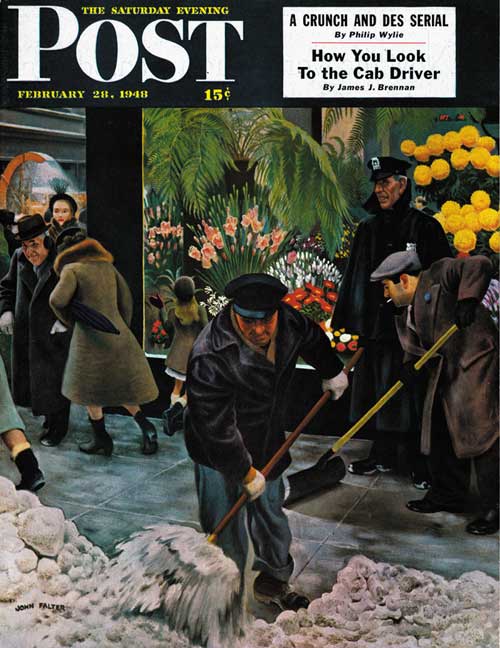
I’ve been shovelin’ this sidewalk for hours,
And it’s quite nearly robbed all me powers.
But the toil’s not the reason,
Tis all of the sneezin’.
You see’s, I’m allergic to flowers.
—John Eggerton, Springfield, Virginia
Of course, John’s limerick wasn’t the only one we liked! Here are some of our favorite limericks from our runners-up, in no particular order:
A florist named Tropical Joe
Was weary of shoveling snow.
His balmy green thumb
Froze up and turned numb,
And resentment was all he could grow.
—Michelle Barnes, Gainesville, Florida
My job as a sweeper is tough;
I really have had quite enough.
I surely am through,
Because all I do
Is heave around forkfuls of fluff.
—David Warren, Lake Oswego, Oregon
It’s hard to clean up snow,
You can’t use a rake or a hoe.
A shovel is best
When put to the test,
Until the wind starts-in to blow.
—Cathy Fleming, Coal City, Illinois
This cold weather gives me the blues.
It freezes my gloves and my shoes.
I shovel this stuff,
But I’ve had enough—
Next winter I’m booking a cruise!
—Mary Starn, Orrville, Ohio
Forecasters do have a knack
For inches of snow keeping track.
Some think it’s pretty.
But for those in the city,
The snow is a pain in the back.
—Tim Cannon, Osceola, Iowa
Although I don’t mean to be picky,
This weather’s incredibly icky.
Too bad there’s a guard in
the front of that garden.
Now getting inside will be tricky.
—Neal Levin, Bloomfield Hills, Michigan
There was an old fellow named Cox,
Who spent his life shoveling rocks.
Said he got his powers
From sniffing the flowers;
He was a delightful old fox.
—Bill Jones, Johnstown, Pennsylvania
The shop called the Tropical Bloom
Is filled with a floral perfume
That’s cheerful and gracious,
A delightful oasis,
From winter’s unstoppable gloom.
—Buffy Silverman, Augusta, Michigan
It is not really quite apropos
That the flower men must shovel snow.
But they must sell their posies
If it means frozen toesies,
Since the bank account’s running so low.
—Patrick McKeon, Pennington, New Jersey
There once was a shoveler named Ray,
A situation he thought gross and gray.
He hated ice slush
Like so much dead mush,
So he hopped the next flight to L.A.
—Terry Free, Andover, Minnesota
Oh me, oh my, what a mess.
This will certainly be a test
For two men with shovels
To be quick on the double,
So ladies will not be distressed.
—Judy Shannon, Huntsville, Missouri
The Dog Ate My Homework
The fact of the matter was, I didn’t have anyone else to blame. So I blamed Roscoe–perhaps ill-advised, him being my father’s K-9 partner-in-waiting, but I had completely forgotten my homework. I wasn’t in the habit of lying or putting blame where it didn’t belong, but I was caught off guard–daydreaming about Roscoe, in fact. My third grade teacher now loomed over my desk, expectant, her hand outstretched, fingers wiggling. And in my deer-in-the-headlights stare, with Miss Underwood frowning down at me, the words blurted out all on their own.
“Roscoe ate it.”
“What?” Miss Underwood scowled more, if that were possible. She planted her fists against her ample hips and leaned in, hovering over me.
I blinked, swallowed a spitless lump in my throat, and having already lied, promptly repeated myself. “Roscoe ate it,” I said with slightly more conviction.
Miss Underwood stood stiff, smack dab in front of my desk, so close I should have been able to smell the little flowers on her dress. I had an overpowering impulse to move away from her, but my chair shackled me to the spot. I stared at the vibrant gladiola sprouting out from beneath Miss Underwood’s belt, and felt the entire class’s attention span shake from all else and swoop down on me.
“Mister Pike. You are not lying to me, are you?” It was more a challenge than a question.
Miss Underwood absolutely terrified me–almost as much as did the prospect of acquiring the entire class’s ridicule or getting caught in a bald-faced lie–and such terror can be a remarkable survival mechanism, because my brain spun a web and my mouth spewed it out without so much as consulting with me. I sat, breathless and rapt with the rest of the class, listening to this story unfold.
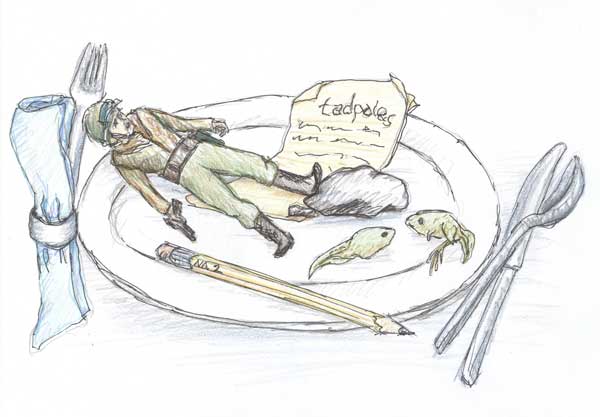
“Oh, no ma’am,” a voice–my voice–poured out of me, my brain, frenetic, only barely keeping a syllable ahead of my mouth. “I wrote my report on the metamorphosis of tadpoles into frogs,” I heard. (It was a good thing I had recently become fascinated by this amphibious process and had not only been reading about it but observing it in the natural setting of our backyard.) “And I took the paper with me to the pond so that I could look at them and draw pictures to show the stages, and Roscoe came with me, and I had a tadpole on the top of the paper so I could trace it and Roscoe saw it and before I knew what happened he jumped on it and swallowed it whole, and the paper.”
I shifted my bug-eyed gaze up the floral landscape to the teacher’s face. Miss Underwood remained completely still.
“And the rock that I had holding the paper down,” my voice said. Her eye twitched, barely perceptible. “And the pencil I was using.” Her brows drew closer together. “And then it was dark, and I couldn’t draw them again, and then I had to do my chores and it was time for bed.”
Miss Underwood frowned, unwedged one hand from her hip and pointed at my chest. “You’d better be sure to get that dog to the vet, young man.”
“Yes, ma’am.” I nodded vigorously. “We’re taking him this afternoon.”
“Good,” she said. “And re-write your report and bring it in tomorrow. Along with a report on how Roscoe did at the vet’s.”
“Yes, ma’am,” I said, and wondered if the pittance I had in the Mason jar under my bed could buy me a plane, train, or boat ticket anywhere else in the world.
*****
That afternoon, when I slouched from the school bus, Roscoe careened down the driveway to meet me, his half-grown legs all knobs and paws flying indiscriminately; he seemed none the worse for wear for his “misadventure” of the day before. I trudged up the driveway, the pup orbiting around me, bounding and panting, pausing only to wolf down my mother’s lone remaining gladiola. While my reporting of late had been very light on honesty, there was truth to the fact that Roscoe was a one-canine mauling, gulping, devouring, completely-nondiscriminatory eating machine. The gladiolas, much to my mother’s dismay, had vanished into his maw during a single galumphing frenzy; this was shortly after Roscoe had discovered the infinite wonders that the frog pond in the backyard held. Mom had admonished my father to restrain the dog. Dad had testified that socialization was critical to Roscoe’s mental development and future as a police dog. Mom declared her flowers unfair casualties. Dad promised to build a fence for her gardens (a moot point, as Roscoe had already decimated them).
The sound of my mother’s footsteps on the porch drew my attention; I looked up to see Roscoe gleefully caprioling by her side. She had her arms crossed over her chest, and was staring at me with an expression that immediately made me slow my already lethargic trudge.
“I hear Roscoe ate your homework,” she said. There was no tone of accusation or belief–or even disbelief, for that matter–just a simple statement. I stopped and looked up at her, and for two ticks of a heartbeat I was on the verge of coming clean. I steeled myself to admit my lie, to face the consequences, and to be a better man for it. During those two ticks of a heartbeat, Roscoe splayed himself on the porch and latched onto one of the banister posts, gnawing and grunting.
“Yes ma’am,” I said, and felt the heat rise under my collar as I lied to my own mother. I looked intently at Roscoe (who supported my story with his every action) to avoid looking in my mother’s eyes. I heard her sigh.
“Well, alright then. I called Dr. Brown’s office as soon as Miss Underwood phoned me, so let’s get things together and get going. Hopefully, he’ll be fine; it’s that rock I’m worried about.”
I nodded and walked up the porch steps, head down and ashamed, and slipped past my mother, past the squirming, euphoric mass of German shepherd enthusiasm. My mother stayed on the porch while I dropped my book bag on the kitchen table. Roscoe leapt up, flung himself against her legs. Out of the corner of my eye, I saw her reach down idly and rub his head. He gazed up at her adoringly, his tongue lolling out of his mouth, wood splinters flecking his lips; his tailed swished nonstop across the porch.
“Maybe the paper and rock and all just went right through him,” I said, and hoped that if a dog actually were to eat a paper and a rock, they might actually move right along. Otherwise, I was going to be busted when the vet checked the dog out and declared him devoid of foreign objects. Not that I wanted him to have a problem; I didn’t, but his clean bill of health was my sentence. Granted, it was of my own making.
“I hope so,” Mom’s voice came in from the porch. I heard her add, under her breath, “Roscoe, you’re going to be the death of me if you live long enough.”
*****
In the vet’s waiting room, I studiously worked on my tadpole-to-frog report, shielding it from Roscoe, who my mother worked up a sweat restraining. And when it was finally his turn to go in and be examined, and I was left with silence and the weight of my own guilt, I could barely remember the details of amphibian metamorphosis, much less write about them. Mom, quiet, read a paperback. The clock on the wall ticked off five minutes, 10, 15; the smell of the waiting room mixed with the odor of wet dog, cat pee, and rodent cage litter, and I began to feel nauseous.
“How’s your paper coming?” Mom asked. I shrugged. I sweated.
I was nearly to the point of breaking down and admitting my guilt, or at least bolting from the waiting room and into the parking lot, when Dr. Brown summoned us. Mom clutched her purse, and I drooped behind her, a condemned man going to the gallows. The vet brought us into the execution chamber, and closed the door. The harsh florescent lights gleamed, ruthless and all-seeing. Roscoe was not in the room to witness my punishment.
Dr. Brown cleared his throat. I felt a prickling thrill of sweat, and stared fixedly at the poster of canine parasites on the wall. “Well, we took x-rays of Roscoe, and we don’t see your rock or your paper.”
I couldn’t help a fleeting glance at the vet; he met my eyes for a beat, then looked over at Mom. “But it’s a good thing you brought him in, because we did see something else.”
I blinked, confused.
“Oh?” my mother said.
Dr. Brown turned his back to us, popped a thick sheet of film against a panel, and turned on the light behind it. Ribs and spine and gray masses flickered to light. Dr. Brown glanced over his shoulder toward us. Both Mom and I leaned toward the glowing image. Dr. Brown cleared his throat again and pointed to something in the middle of the picture. I looked closer, squinted, and then with a sting of recognition, I understood the image on the screen. My mother realized at the same time, and she chuffed, glancing sidelong at me.
“This,” Dr. Brown said, tapping the image of my G.I. Joe, recently MIA, “needs to come out. And it won’t come out the easy way like that rock did,” he glanced down at me again. “It will snag other things he swallows, and you’re going to have a bad emergency situation, maybe a dead dog.”
My mother reached for the collar of her blouse, pressed her hand flat. “Oh, no. Oh, poor Roscoe!”
My skin prickled again, but I wasn’t worried about my guilt and punishment anymore. “Will he be okay?” My voice sounded tiny and tremulous. “He won’t really die, will he?”
Dr. Brown smiled then. “No, I think we got him in time. We’ll put him on the surgery schedule for the morning, and he should be right as rain in a month’s time.” He reached a hand out and ruffled my hair. I realized I was crying. “In a way, it’s a good thing he ate your homework, otherwise you might not have found out about this until it was too late.”
I looked up at him lamely.
*****
That weekend, Dad fenced off what was left of Mom’s gardens, I patrolled the entire house and yard and commandeered all swallowable objects (and even some that didn’t seem swallowable), and my folks and I discussed the new obedience regimen for Roscoe. When he came home a few days later, belly shaved but none-the-worse for wear, I doted on him and chaperoned him vigilantly. After a short period of gorging withdrawal, Roscoe adjusted gleefully to his obedience training, and was already ahead of the learning curve when he officially entered his police-dog training.
I was too ashamed to ever admit to my parents my panic-induced homework fabrication. I like to think that the guilt and anxiety I experienced for that long afternoon was punishment enough, and sometimes, I also like to think that it was all part of the plan for Roscoe’s long and decorated life. I like to think that, but I don’t believe it much more than Miss Underwood believed me.
What’s Your Death Style?
Do you know about Death Cafés? They’re still pretty new on the scene. If you imagine them as not-quite-underground meetups where you sit around and enjoy refreshments while musing over the morbid, tantalizing subject of human demise, you’ve pretty much got the concept.
Sound like fun? No? Well, Death Cafés are kind of creepy. But lots of people are eager to gather and gab about their secret concerns: “Why do I fear death so?” “What happens to bodies in graves?” In fact, everything about death is inherently intriguing, including that most eternal of questions: What do I want done with my body after I’m gone?
In America, where our ashes can be spread at the 18th hole or converted into precious jewelry or shot into Earth orbit, traditional body-in-steel-casket burial is no longer the go-to choice. We’re a society that prides itself on novelty, including what death care executives (yes, that’s what they call themselves) refer to as “final disposition” of our corpses.
The most trendy among today’s options are “natural burials,” in which you may go green by having yourself lowered into the soil in a hand-painted coffin made of biodegradable woven fabric. Your earthly remains decompose into earthy remains, thus preserving the land for use by the living. Europeans have practiced natural burial for ages. “People in the rest of the world think we Americans are just batty when they see what we do with our caskets,” says Cynthia Beal, founder of Natural Burial Company.
Some of the newer alternatives to burial are a blast–literally. Jeff Staab, who bills himself as “the world’s leading authority on the scattering of ashes,” will gladly set you up with an Ash Scattering Machine ($500 per use) or a Loved One Launcher ($350 to own), both of which can propel a mixture of cremains and, if you wish, confetti for a distance of 75 feet; the airstream can carry the particles for miles beyond, says Staab.
“I’ve even been along on a ski slope for a Dixie cup toast-and-toss,” boasts Staab, who runs a company called Cremation Solutions. “But you don’t want to be downwind for that!” “Uh, is that even legal?” I wonder. “Don’t ask, don’t tell,” Staab replies.
Another popular trend is to have a portion of your cremated remains pressed into a custom-made under-sea reef formation. Also hot is the be-some-bling option. A few ashes are stuffed into kitschy jewelry; be prepared to drop as much as $19,000 to have a lock of hair or some ashes compressed into an actual diamond.
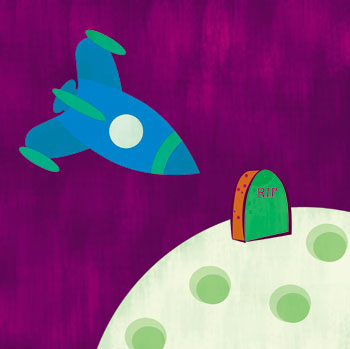
But the most grand way of saying sayonara has got to be the space journey. Charles Chafer, the CEO of Celestis, says his company can get a smidgen of what was once you into a payload container sent to outer space. Cost: as little as $1,000. If you’d like your ashes slammed into the moon’s surface, that’s more like $10,000. It’s pricey, but “going to the moon is a hopeful statement,” Chafer says.
Less ambitious, but more “final” in a sense, is a controversial procedure developed in Scotland just now gaining limited support in the U.S. This novel solution turns bodies into, well, a solution. The technical name is alkaline hydrolysis. Let’s just say this basically amounts to chemically converting corpses into something not unlike a broth that might be poured down a drain at your local Jiffy Lube.
With all the plotting by savvy death care marketers, you’d understand why some might nervously wrestle with the choice about their body’s afterlife. I asked myself who in all the country is possibly best positioned to make a considered decision on such a thing. I figured it might be Mary Roach, author of the national best-seller Stiff: The Curious Lives of Human Cadavers. So, I ask her about her own final disposition. “I’m in a deep state of denial. It’s embarrassing,” Roach tells me. “I like the trend toward green burials. I like the frugality.” Or, she says, “Maybe I’ll have my ashes scattered somewhere. Or I’ll donate my body. Or, uh…”
Indeed, it can be a particularly tough call these days because, more than ever, the style you specify for your exit expresses a powerful final statement about your life.
Another Level: How Candy Crush nearly crushed my soul

You mean you’re playing now?”
My husband is curled over something held low in his lap. He doesn’t answer.
“OK then,” I say. “Let me try for awhile.”
“No. I thought you quit.”
“Just one time. Just a little bit. Then I’ll be done.”
He ignores me, his eyes fixed, glazed, a zoned-out slackness to his mouth. I’m momentarily piqued, but then feel a flash of relief. I’ve dodged a bullet. If I relapse, there’s no knowing how far it’ll go.
At first, it’s simple: Line up three of a kind and they drop.
Get four in a row and they turn into a super one; the same thing happens if you make a T or a letter L–a different kind of super one.
Knock two super ones together, they throb and explode in a torrent of colors, sending little jelly-like fish swimming around the screen.
“It’s free” is the come on, but you can pay to get “boosters,” little cheats to help you win–a hammer, a hand, a giant bam-bam lollipop.
I swore I’d never pay to play. Except maybe just for this level, the one that’s impossible.
I’m on a binge this week. I have a crick in my shoulder, a pain in my neck. I see colored dots even when I’m not playing.
At the beginning of each game, I say, This is the last. See, I’m actually not the kind of person who plays video games.
Then I hit “play again.”
“Come to bed,” my husband says. I settle in next to his warm furry nakedness, then grab my phone for just one more round. He groans and turns over.
I dream of lining things up, having them drop.
In the morning, I play just one game. Hair of the dog and all.
I wait while it loads; anticipation builds. Like making the preparations for drug use, the rolling or grinding or measuring, or whatever.
The relief when the board’s set up. Happy colors, happy music. My path set out for me. I can do this!
I start slow–most of the levels aren’t timed. I’ll play it smart this time, try and line up my moves, don’t go for the easy three, the pulsing ones the game prompts me with if I seem to deliberate too long.
My unfinished novel pants at my feet like an annoying dog; I pointedly ignore it and start another level.
Line up, slide down. Line up, line up, slide down.
Nasty game this time. A couple more tries. Then, good round! Almost cleared the board. Try again.
Be careful, too many random choices and you can lose your life.
All the time, the game is nudging–give your friends lives! Invite your friends! Ask your friends to unlock levels! Share your wins!
Give a life to a friend. See, I’m magnanimous. Or, then I feel guilty, like a dealer, roping them in.
Accept a life from a friend. I’m popular–someone likes me!
I play day and night. I have to beat one level before doing any other task–one level stretching to several. I start to get antsy hanging out with friends, anxious for them to leave so I can go and play.
Ashamed, I hide my phone from prying eyes, toggle off the screen when someone comes in the room. I hope it saved; I was doing well.
Finally, I screw up my resolve and remove the app entirely.
Actually, semi-finally–the next morning, I put it back on and play again. Amazingly, I easily pass the level on which I’d spent the whole previous day. See, it knows when you’re leaving and acts sweet, like an abusive boyfriend. It wants you dependent and passive. It acts indifferent, but wants you there.
It understands you. It wants you.
One day I quit, cold turkey. I post on Facebook, I’m done with the world’s most addictive game. Later, friends tell me they started playing because of my post, addictive being the highest recommendation.