Farm in Limestone County, Pennsylvania. Source: Gerry Dincher
After two years of debate, Congress finally passed a new farm bill this week. Concerns about the bill’s $478 billion price tag have long stalled the bill, but the past two weeks have seen rapid progress, and Obama is set to sign the farm bill into law this week.
The farm bill has a long history dating back to the Great Depression and has grown considerably since then. Though it once comprised solely farm aid, other programs such as the food stamp program became part of the bill in the 1970s. Since then, food stamp spending in particular has grown: it now comprises nearly four-fifths of the bill’s total spending.
New Deal Origins
An Oklahoma farm during the Great Depression. Source: U.S. Department of Agriculture
Farmers had a rough time in the early 20th century. Crop prices rose dramatically during the 1910s as World War I disrupted European agriculture and drove demand for American crops. In response, many farmers stepped up production with the help of new machines like the combine harvester.
After the war ended, European demand dropped and crop prices plummeted. Many farmers struggled in the 1920s, even as the rest of the economy prospered. Between 1924 and 1928, Congress repeatedly passed legislation to regulate crop prices, but President Coolidge consistently vetoed farm relief.
Things got even worse when the Great Depression hit in 1929. By 1932, crop prices were less than a third of what they had been in 1920.
As part of the New Deal, President Roosevelt sought to help farmers by boosting crop prices. The first farm bill, passed in 1933, launched a program to raise agricultural prices by paying farmers to limit production. In 1938, Congress established the program on a permanent basis, to be renewed every five years.
The 1933 farm bill was just one of Roosevelt’s New Deal programs aimed at helping Americans cope with the Great Depression. Another of these was the first food stamp program, launched in 1939. Agriculture Secretary Henry Wallace, the program’s first administrator, described how it could solve two problems at once:
“We got a picture of a gorge, with farm surpluses on one cliff and under-nourished city folks with outstretched hands on the other. We set out to find a practical way to build a bridge across that chasm.”
Over four years, the food stamp program cost $262 million and helped 20 million Americans. A few years later, under a booming wartime economy, the program no longer seemed necessary. It ended in 1943.
Food Stamps Revived
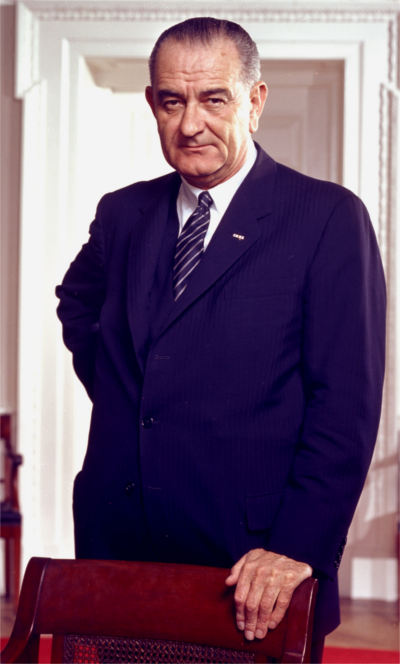
President Johnson renewed the farm bill permanently in 1964. Source: White House Press Office
Nearly 20 years after the end of the first food stamp program, President Kennedy launched a pilot program to test the viability of food stamps. With the 1964 Food Stamp Act, Congress and President Johnson expanded the food stamp program and made it permanent. Though the act included price supports for cotton and wheat, it remained largely separate from the existing farm bill.
The 1977 Food and Agriculture Act was the first to include the entire food stamp program within the farm bill. Since then, food stamps and farm aid have almost always been discussed in tandem.
One of the biggest changes to the farm bill came in 1996, when Congress voted to gradually eliminate farm subsidies over the next seven years. In 1997, however, crop prices slumped, and the next year Congress relaunched agricultural subsidies. This time, instead of paying farmers not to grow, the government offered direct payments to farmers based on how much land they had.
The Current Farm Bill
Congress passed the last farm bill in 2008, which budgeted for $288 billion in relief over five years. The new farm bill would allocate $478 billion over the next five years.
That price tag has been the most contentious point of debate, and the main reason the bill has taken so long, particularly since the Tea Party, which has had a huge influence over House Republicans since 2010, has made spending cuts their top priority.
So why has the farm bill budget grown so much? Food stamps and other nutritional programs comprise nearly 80 percent of its cost, totaling nearly $400 billion of the bill’s five-year spending. From $17 billion annual spending in 2000, food stamps grew to $38 billion in 2008 and $80 billion in 2013, doubling under Bush and then doubling again under Obama.
Economic circumstances are partly to blame. As unemployment rose during the 2009 recession, so did food stamp participation, from 28 million in 2008 to 45 million in 2011. Policy plays a role also. After welfare cuts in the 1990s, President Bush expanded the food stamp program in the 2002 farm bill. The 2009 stimulus also temporarily increased benefits.
The 2014 farm bill cuts $4 billion over five years–approximately 1 percent of current food stamp spending. The biggest way it accomplishes this is by tightening a loophole by which states could make someone applicable for federal aid by giving them just $1 in heating assistance.
Joint Session of Congress, 2009. Official White House photo.
Outside of food stamps, the bill cuts $7 billion from direct payments to farmers, but adds funding to crop insurance to compensate. Overall, the new farm bill reduces spending by $8 billion, a small fragment of what remains of a hefty set of programs.
The new farm bill also requires meat to be labeled based on where the animals were born, raised, and slaughtered. It does not include a controversial amendment from Iowa Congressman Steve King, which would have restricted states’ ability to regulate agricultural products.
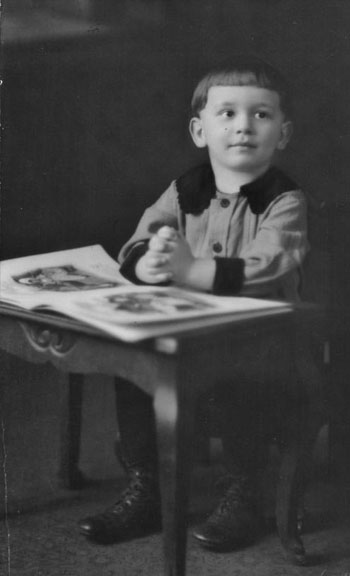
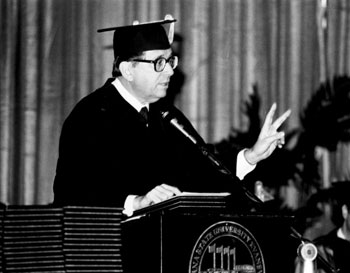
After a lifetime of public service , Dr. Beurt R. SerVaas was called to “final duty” on February 2, 2014. Son of Beurt Hans and Lela Etta (nee Neff) SerVaas, Dr. SerVaas was born in Indianapolis on May 7, 1919.
A 1937 graduate of Shortridge High School, Dr. SerVaas was named to the high honor roll for all four years. At 15, he achieved the rank of Eagle Scout. Sixty years later the national Scouting organization honored him as a Distinguished Eagle Scout. He continued to serve scouting and was named one of Indiana’s most distinguished scouts of the past 100 years. He obtained an amateur radio license from the Federal Communications Commission, also at 15, and to generations of amateur radio operators thereafter he was known as W9WVO.
Although awarded a scholarship to Indiana University, SerVaas lacked funds to live on the Bloomington campus, so he took a janitorial job at the Indianapolis IU Extension Division while carrying a full load of science classes. He needed to learn Spanish to qualify for jobs in Argentina, so SerVaas, with a $35 loan from his Grandfather Neff, hitchhiked to Mexico City and enrolled at the University of Mexico.
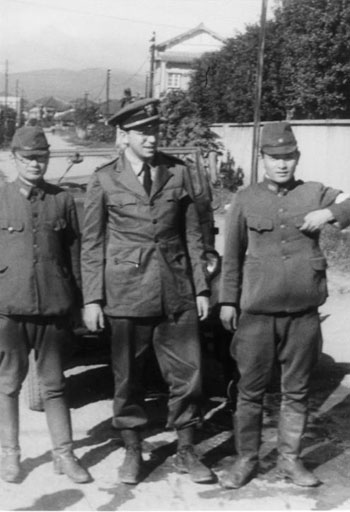
SerVaas (center) served in the China theatre in World War II as a commanding naval officer.
When war broke out in Europe in 1939, SerVaas returned home to study at IU, graduating in May 1941 with a degree in chemistry, history, and Spanish. He accepted a position at Shortridge High School where he taught chemistry and Spanish, and commuted to Purdue University as a DuPont scholar to complete post-graduate work in chemistry.
Recruited by the newly formed Office of Strategic Services (OSS, now known as the CIA), SerVaas served in the China theatre in World War II as a naval officer commanding a group of 15 men. The group flew from a small airbase in India and jumped into the outback of southwestern China with only a rucksack filled with survival gear, weapons, and a radio transceiver–the only link to the American command. Their mission was to disrupt Japanese river supply lines, train Chinese troops, and work with a newly formed OSS group to establish intelligence resources essential in preparing for the invasion of the Japanese mainland.
As the war in China ebbed, SerVaas was assigned a potential suicide mission still legendary in the intelligence community. The American command in China sent SerVaas, alone and armed only with cyanide suicide pills, to the heavily fortified Japanese garrison on Formosa (Taiwan) with a surrender demand. Successful in the mission, SerVaas received a battlefield commission to Navy Lieutenant, the Bronze Star, and was invited to return to Taiwan with Chinese and American officials to witness the Japanese surrender ceremony.
Ten years after the war, SerVaas was invited back to Taiwan to receive the Chiang Kai-shek Medal of Honor. Later, Taipei city officials, urged by SerVaas, formed a sister city alliance with Indianapolis, a partnership still working for the economic and cultural benefit of both populations.
Using $5,600 he saved during his long war years, SerVaas bought a four-person electroplating company on the eastside of Indianapolis. A fan of a particularly effective cleanser/polish he used on his plated metals, SerVaas then purchased Bar Keepers Friend from the Gisler family in the late 1950s.
Once established as an entrepreneur, SerVaas, known as the “business doctor,” continued to purchase and aid in the recovery of plants that manufactured school buses, truck engines, food machinery, chemicals, auto parts, pharmaceuticals, and magazines. His initiation into heavy manufacturing came when he took North Vernon Forge out of bankruptcy, and eventually acquired additional plants in Michigan, east Chicago, and Ohio.
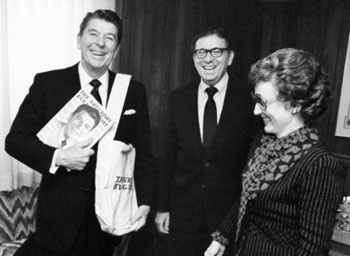
Former President Ronald Reagan (left) poses with a copy of The Saturday Evening Post with his portrait on the cover and a Post delivery bag. Dr. SerVaas (center), and Dr. Corey SerVaas (right) look on.
SerVaas bought control of Bridgeport Brass from absentee owners and saved more than 1,000 jobs for Indianapolis. Later, at the urging of Mayor Bill Hudnut, he “rescued” historic downtown Uniroyal Rubber Company, saving another 600 jobs. SerVaas also purchased struggling Franklin Power in Franklin, Indiana. With the purchase of the then-bankrupt Curtis Publishing Company, SerVaas brought the famed magazine, The Saturday Evening Post, to Indianapolis from Philadelphia.
His business interests were international in scope with operations in Canada, Mexico, South Africa, Italy, Poland and the UK. In Poland, he built the first color TV manufacturing plant in Eastern Europe, prior to the fall of the Iron Curtain.
With a doctorate in Medical Science, SerVaas served as chairman of the Governor’s Indiana State Commission on Medical Education. The group brought together forces for the implementation of SerVaas’s plan for medical school reorganization, which passed the Indiana General Assembly without one dissenting vote.
Dr. SerVaas served as chairman of the Governor’s Indiana State Commission on Medical Education, chairman of the original State Commission for Higher Education where he helped plan for the development of IUPUI, and served on the Indiana State Board of Health’s board of directors.
SerVaas later became chairman of the original State Commission for Higher Education where, with the partnership of IU President John Ryan, he helped plan for the development of IUPUI. He also served on the Indiana State Board of Health’s board of directors.
Always a proponent for healthy lifestyles, Dr. SerVaas was one of the founders of the National Institute for Fitness and Sport (NIFS). As its early chairman of the board, he helped raise $12 million from the city, state, and the Lilly Endowment for the institute’s creation bordering White River State Park.
After Dr. SerVaas lost a kidney in surgery, he searched for a better way to relieve such suffering. He found a German instrument which shatters kidney stones with sound waves, allowing out-patient operations at a very reasonable cost and under local anesthetic. Naming the instrument a Lithotripter, SerVaas helped fund the cost of bringing it to Methodist Hospital where, still today, it relieves kidney stone suffering with its innovative technology.
Dr. SerVaas often told how his native city was nicknamed “India-noplace” or “Naptown.” During the 11 years of the Depression, no new buildings were erected; banks failed, and the city was gray, dirty, and somewhat desolate. After his return from the war, he was discouraged to see that not much had improved. He entered public service to help bring about a vision of change. In 1962, SerVaas was elected to the Marion County Council where he served as a member for four years, vice president for five years, and president of the subsequent City-County Council for 32 years. Remarkably, in all 41 years of leadership, he never missed a council meeting in spite of travel to his many worldwide business interests.
SerVaas loved problem solving, and the city he served offered innumerable opportunities for his efforts, always within the framework of study and research. First among the governing challenges he faced was increasing the city tax base to help rebuild the dreary downtown. He conceived the model of Uni-Gov, a county-wide restructuring which was enacted–under the leadership of Mayor Richard Lugar– by the General Assembly in 1967. The visionary form of government helped propel Indianapolis to national recognition as a clean, safe, exciting, and prosperous place to live and work.
His support for the Indy Greenways was instrumental in the eventual development of a county-wide system. He took an avid interest in neighborhood organizations and helped fund improvements at Holliday Park and the purchase of the Juan Solomon Park addition. He believed in and supported comprehensive land-use planning, initiated the upgrade of Monument Circle, and played a major role in bringing the Colts to Indianapolis.
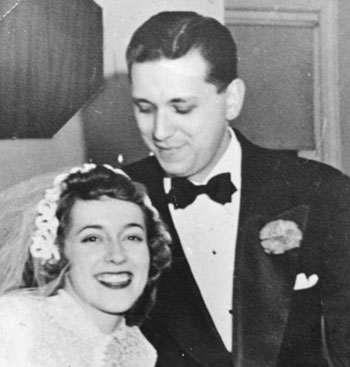
Beurt married wife Corey Synhorst on February 4, 1950.
Decorated World War II China theatre combat officer; family patriarch; business, political, and civic leader; advocate for healthy living; advisor, mentor, and friend of national and international leaders, Dr. Beurt R. SerVaas received many citations and honors. Recipient of honorary degrees from four institutions of higher learning; induction into the Central Indiana Business, IU Alumni and Indianapolis Public Schools Halls of Fame; named Sagamore of the Wabash by four Indiana governors; and having the City-County Building’s auditorium designated as the Dr. Beurt R. SerVaas Public Assembly Room are some of the recognitions he was awarded. He was especially pleased to receive the Horatio Alger National Award in Detroit in 1980–the honor recognizes community leaders who demonstrate remarkable achievements through honesty, hard work, self-reliance, and perseverance over adversity.
Dr. Beurt R. SerVaas was predeceased by his parents and brother William. Surviving are sister Lela Williams; wife Cory Synhorst SerVaas; children Eric (Marcia), Joan (Larry Roan), Paul (Marsha), Kristin (William Loomis), Amy (Jeff Riesmeyer); special assistant and great nephew Hans; 22 grandchildren, and two great-granddaughters.
The funeral service is at 3p.m. Saturday, February 8, 2014 at Second Presbyterian Church, 7700 N. Meridian Street, Meridian Hills, IN 46260 with calling there from 1p.m. until service time. Burial follows immediately at Washington Park North located at 2706 Kessler Blvd. West Drive, Indianapolis, IN 46228. In lieu of flowers, memorial contributions may be made in Dr. SerVaas’s honor to the Scottish Rite Cathedral Foundation, Boy Scouts of America, Indianapolis Humane Society, or National Institute for Fitness and Sport.
Cover of the Fall 1972 issue of The Saturday Evening Post. Photo by Ollie Atkins
Buried in the archives of The Saturday Evening Post are treasures from the nation’s nearly 300 years of history, whether in vintage advertising, classic illustrations, or insightful reporting that illuminates life in America of decades now passed.
Frequently we find old articles with an interesting point of view, providing us with insight on specific historical events from the people who lived through them.
And in the case of this gem from our Fall 1972 issue (right), some articles look much different when measured with the hindsight of history.
Then-President of the United States Richard Nixon wrote this letter for the Post in relation to a photo essay by official White House photographer Ollie Atkins, which appeared in the same issue. The full text of Nixon’s letter appears below. Click here to see the photo essay as it originally appeared in the Post.
To Communicate Dimensions of Truth
By Richard Nixon
In the archives and libraries of America are carefully preserved the records of each of our Presidents—letters, minutes, diaries, memoranda—and now even tape—recorded interviews with those who are a part of past administrations. But only in recent times has the strong effort been made to preserve a complete photographic account of Presidential history.
Though I often joke with Ollie Atkins, the official White House photographer, about his persistent efforts always to be in the right place at the right time with his cameras, I must say that I am very happy indeed with the modern practice of keeping a full photographic record of the Presidency. For as I look over Ollie’s pictures, including those which make up the photographic essay on these pages, I realize again their unique ability to communicate dimensions of truth which are often missed in the written record.
Through these pictures, for example, I can feel again the sense we all had in Peking and Moscow of participating in one of history’s watershed moments. And I am reminded, too, as I look through these photos, of nuances of personality in those I have known which are sometimes difficult to put into language. By helping to preserve the mood, the spirit, the character of a person or an event—or an entire administration—the photographer can perform, I believe, a unique public service.
When historians study all the records of the Nixon years, I hope they will conclude that these were good years, years in which we ended a difficult war, achieved significant arms control agreements and made peaceful negotiation the way of life among nations. I hope, too, that this Administration will be remembered as one which reordered an economy which had grown dependent on wartime spending, decentralized and revitalized a Federal bureaucracy which had grown rigid and unresponsive, and helped a divided Nation substitute the rule of reason for confrontation and disorder.
There have been moments of disappointment in these years, of course, but there have been many more moments of great satisfaction. After nearly four years as President, I believe we can be proud of the record we are leaving for those who will write the history of this Administration—even as I am proud of this photographic essay concerning some of its highlights
{signed} Richard Nixon
PRESIDENT OF THE UNITED STATES
Born on January 2, 1893, Charles Kaiser grew up knowing an entirely different era of art history than the one he would help shape in the twentieth century.
Kaiser’s arc of five cover illustrations for The Saturday Evening Post between May of 1942 and August of 1943 centered the emotional experience surrounding the holidays.
His illustrations are still engaging largely thanks to the expressive faces of his characters: a young boy smiling as he bites into watermelon on the Fourth of July; a spooked little girl peeking out from behind a witch’s mask on Halloween; or Lady Luck hiding her war bond stamps in her cap, her face full of excitement and anticipation.
Originally from Buffalo, New York, Kaiser headed to the heart of the Midwest to study art and illustration under artist Henry George Keller in Cleveland, Ohio. After his apprenticeship, Kaiser headed to the big city to strive for his dream and make a name for himself in the art world. He moved to Greenwich Village in New York City to find work as an illustrator. He succeeded, and was made a member of the Society of Illustrators relatively early in life, but then resigning from his longstanding membership in the organization by 1940 at the age of 47.
Interestingly enough, it was after his resignation from the society that illustration work from The Saturday Evening Post poured in.
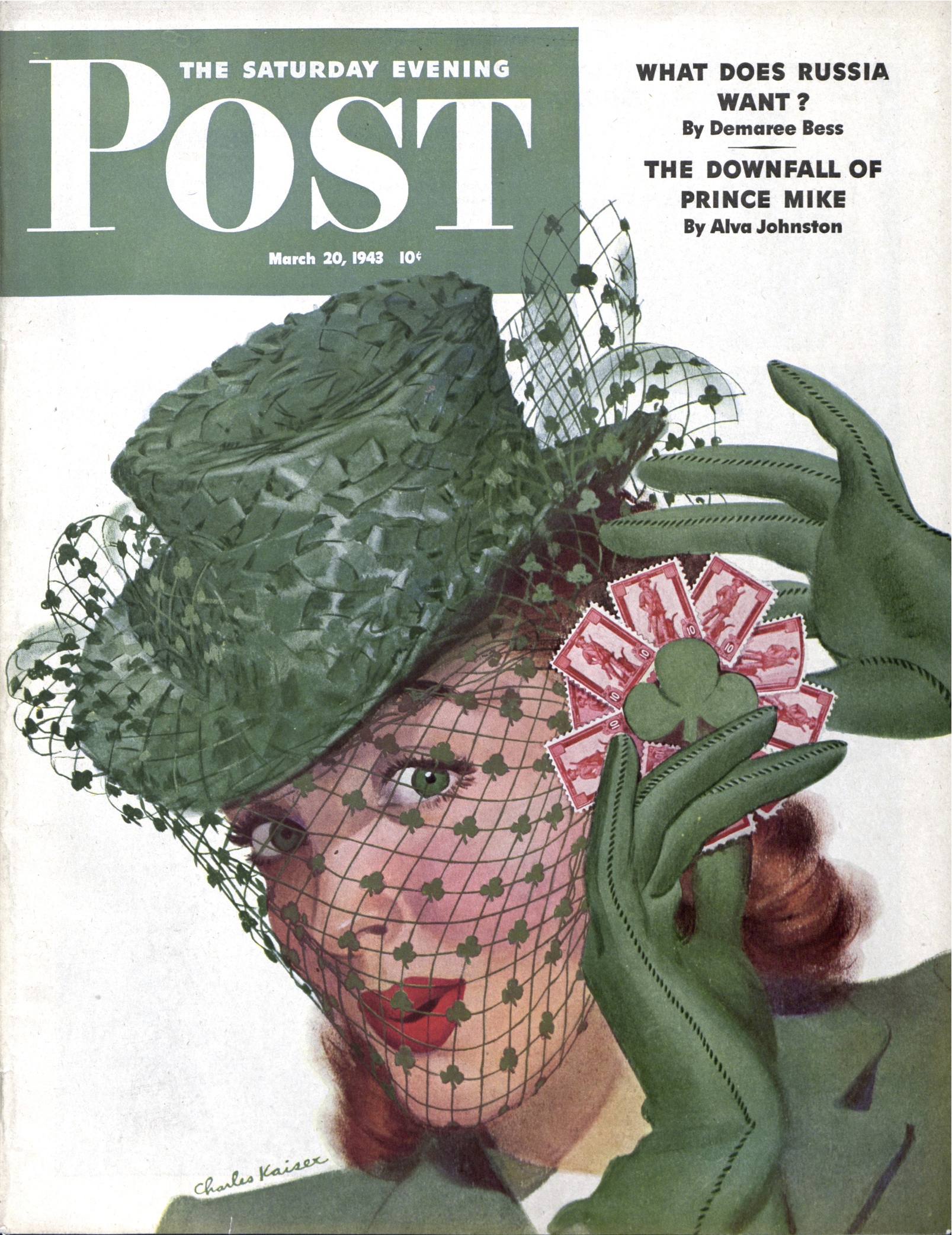
His most famous work for the Post, “Shamrock Chapeau,” is this exciting St. Patrick’s Day cover from March 20th, 1943. Lady Luck is personified as a woman dressed in green for the holiday’s festivities.
The proper woman of the time wears a green top hat and a veil, symbolic of a poker face. She is covered in clovers and holds what look to be playing cards clasped by a large clover. Lady Luck’s cards are actually war bond stamps, sold to support the war effort. She holds them out to the viewer, implying that America shouldn’t leave victory up to chance. If luck favors the prepared, America should buy war bonds.
Lady Luck’s look of surprise is a double-edged sword–the purchase of a bond could make all the difference in who wins the war. Luck be a lady!
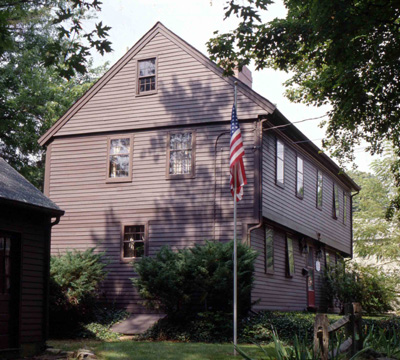
Like the 250-year-old house from Ipswich in the Smithsonian’s National Museum of American History, your home has a story to tell and a place in history. Whether you own your house, rent it, or live in an apartment, you and your family can become house detectives and discover the history of your home.
1. Start at home. The best source about your home is the building itself, and everyone in the family can join in this part of the investigation. Look at the separate parts of the building—roof, walls, chimneys, doors, windows, and foundation. Note what materials they are made of and how the different parts are joined to one another. Try to distinguish original materials from later additions.
Look at the style of the house, too, inside and out (and use the books listed on the back panel of this brochure to help identify building styles and materials). The style of a building is a clue to its age—but not proof. In some parts of the country, a building style stays popular longer than in others. Keep careful notes and take pictures. The clues you record will be useful later on in your investigation.
2. Go to the courthouse, or wherever deed records are kept in your community. Using deed records, you can create a chronological list of all of the owners of a piece of property. The list you compile will be the backbone of your home’s history.
Ask for the index to deeds by buyer. Start with the deed to the present owner. Note the seller’s name and the legal description of the property. Then use the index to find the seller’s deed to the same piece of property and note whom the seller bought it from. Work your way back through the deeds to the original owner, make a copy of each deed, and keep track of the page and volume numbers. A sharp increase in the value of the property could mean a building was added to it.
3. Look at other public records, especially if you find gaps in the deed records. Sometimes property passes from one owner to another through a mortgage or a will, and these documents will probably be wherever you found the deeds (or at least nearby).
Mortgage records often contain detailed descriptions of buildings. Wills and other probate records may list one or more of the previous owners, and you can examine the records filed under their names to see if there are any mentions of the property. Local tax records may reveal the dates of additions and improvements to property by a change in its valuation, and maps of property made by surveyors can show a tool shed or a well that no longer exists. Be sure to make photocopies of all the records that you think will be helpful.
A glance at public records could reveal your home's rich history. Photo courtesy of the National Museum of American History.4.Go to the library. To learn more about the people who lived in your home, go to the local history section of your public library or to your local historical society. Ask a librarian to help you find indexes to town and county histories, manuscripts, and other materials about local history. You might find the papers of a former owner or even a diary of life in your home!
City directories often list people’s occupations as well as addresses and can help to establish the dates that a person lived at a particular address. A librarian can also direct you to federal and state census records. They can contain vast amounts of information about households.
A good library or Internet project for children is to create a timeline of American history starting with the approximate construction date of your building. When the kids have completed a simple timeline for the nation, the family can work together to combine it with the timeline for your home and look for connections. You might find a
link between a big event in American history and a small event in your home’s history.
5. Read a map. Your librarian can guide you to city and county maps that may show your building with the owner’s or resident’s name written beside it. Such maps often show the location of old roads and other landmarks that may have disappeared. Insurance maps, especially those produced by the Sanborn Map Co., contain a wealth of information about individual structures, including the materials from which they were built.
6. Look at a picture. Your local library or historical society may have old photographs of your building, or there may be some in your neighbors’ attics. Postcards can be helpful, too. Many towns are represented in nineteenth-century lithographs called “bird’s-eye views,” which sometimes provide an accurate picture of every residence in town. Don’t forget to take a few photographs of your home for the project, or better yet, have children in the family take the photographs or draw pictures of your building.
7. Talk to people. Try to track down former residents or their children. They may be able to help you date changes or tell you stories about their lives in your home. Neighbors can be helpful, too, if they have lived in the neighborhood a long time. The whole family can put together a list of questions to ask the neighbors about your home and neighborhood. While you are talking to them, ask if they have any family pictures that might show your building in the background.
8. Put it all together. When you have finished your research, you will have a stack of written notes, photocopies of documents and maps, and photographs. These are like the pieces of a puzzle. Use them to create a timeline of your home’s past and to write a narrative history. Enlist everyone in the family to help create a scrapbook that weaves together the narrative history, photocopies, drawings, and photographs, and then make enough copies to give your family and friends. Be sure to place a copy in your local historical society or library, so that your home will have a place in history.
9. Is the building you’re living in brand new? Then start your own history of your home. Using some of the steps outlined above, find out what was there before your building was built and why the neighborhood changed. Then take photos of your home and write about your experiences living in it. You will be making history for your family and community.
Further reading. These books to may help in your research:
Barbara J. Howe. Houses and Homes: Exploring Their History.
Nashville, Tennessee: American Association
for State and Local History, 1987.
Howard Hugh. How Old Is This House?
New York: Noonday Press, 1989.
Sally Light. House Histories: A Guide
to Tracing the Genealogy of Your Home.
Spencertown, New York: Golden Hill Press, 1997.
Virginia and Lee McAlester. A Field Guide to American Houses.
New York: Alfred A. Knopf, 1997.
As editor and publisher of The Saturday Evening Post magazine, Dr. Cory SerVaas brought a passion for health and prevention to the publication. A journalist and physician, Dr. Cory interviewed some of the world’s leading scientists, physicians, and researchers, translating complex material into easy-to-read and understand articles.
You can read some of Dr. Cory fascinating interviews from the pages of the magazine, beginning with the articles below:
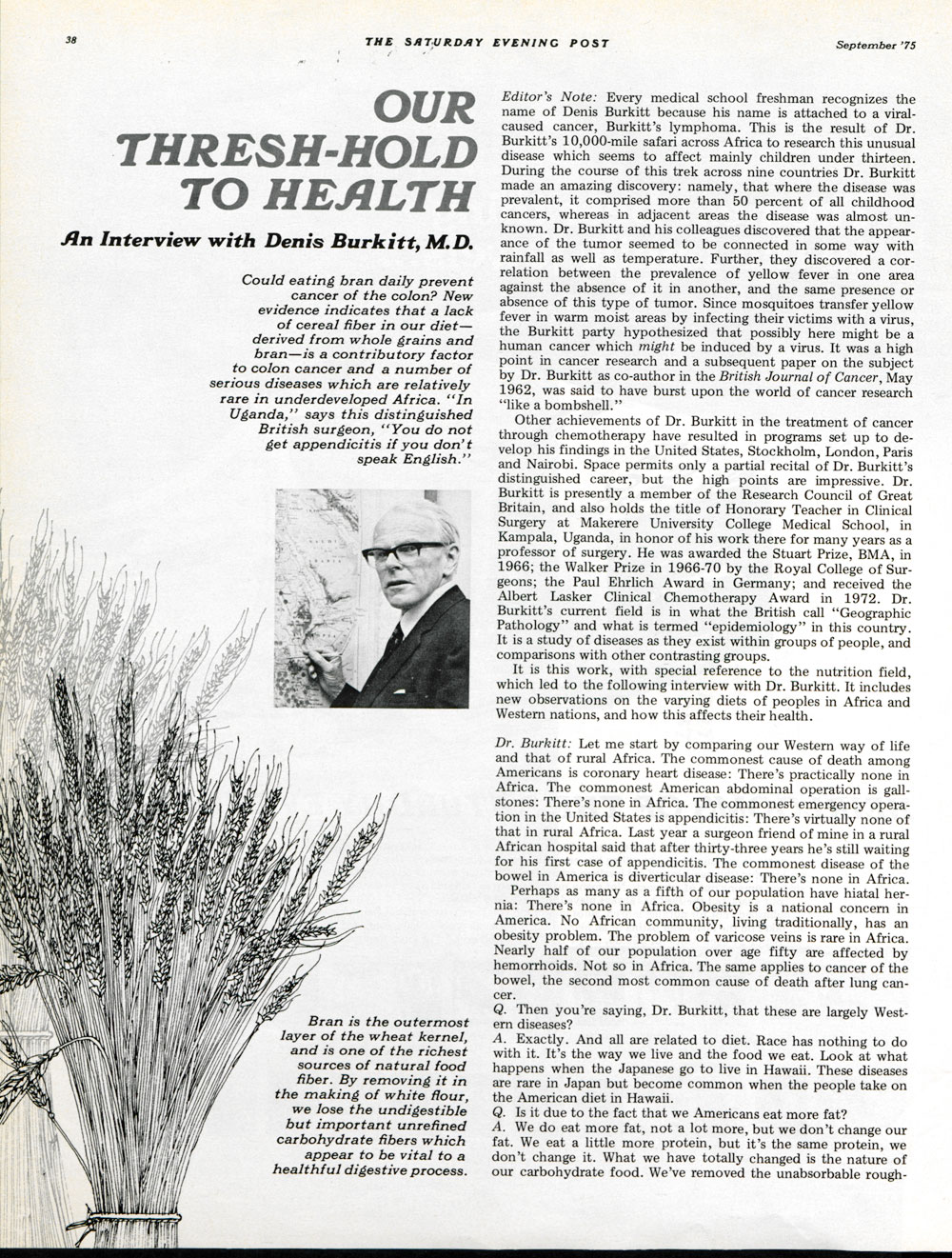
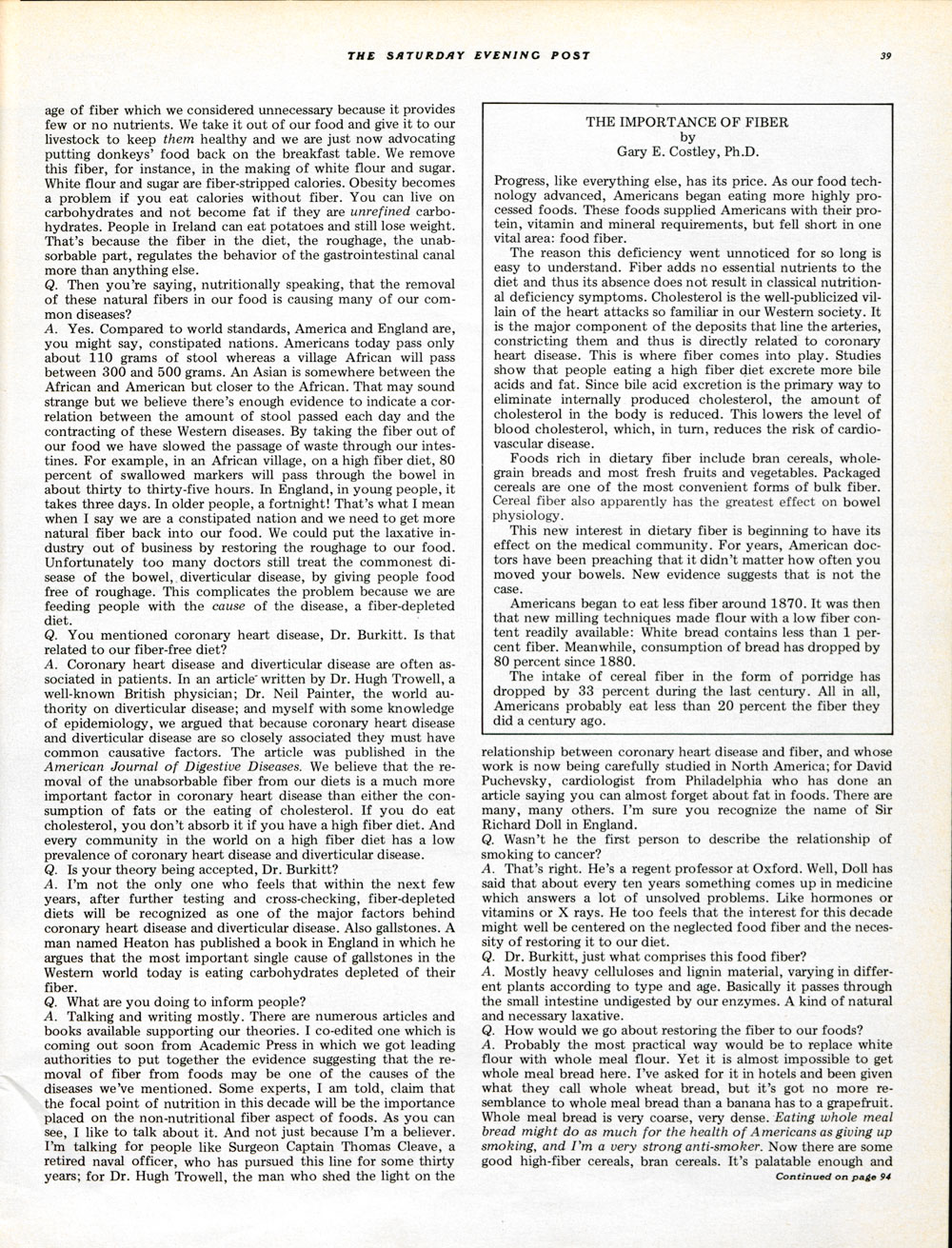
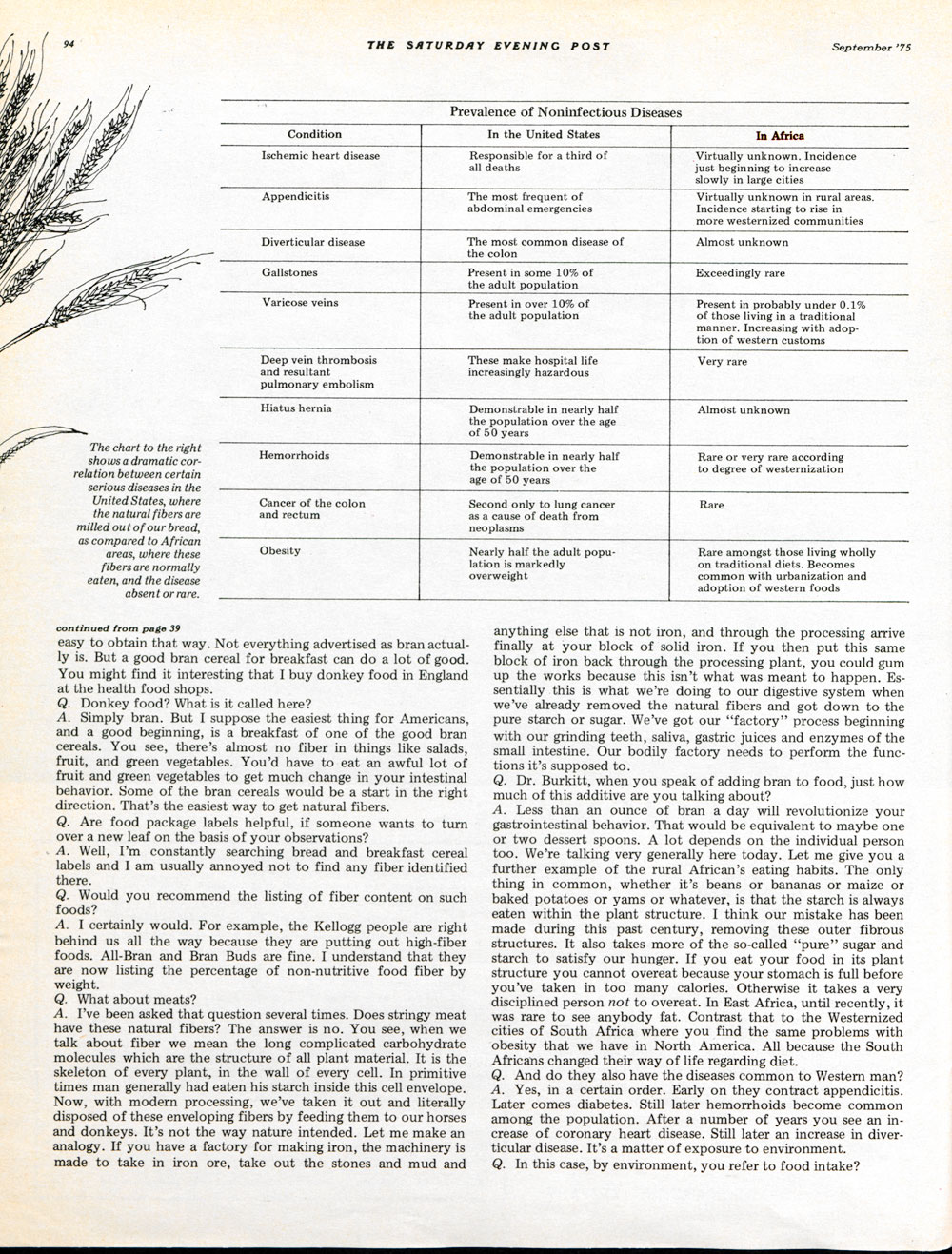
Our Thresh-hold To Health – September 1975
Page 1 of "Our Thresh-hold To Health"Page 2 of "TOur Thresh-hold To Health"Page 3 of "Our Thresh-hold To Health"Page 4 of "Our Thresh-hold To Health"Page 6 of "Our Thresh-hold To Health"
On February 22, America celebrates the anniversary of the birth of President George Washington. Washington’s importance has been so beyond question that his name is everywhere. His face adorns the dollar bill and the 25-cent coin. Across the United States, 26 mountains are named after the first president, as well as 740 schools, a dozen colleges and universities, 155 towns and counties, various bridges, parks and forts; not to mention the capital of the country. And the count continues.
In the June 20, 1931, issue of The Saturday Evening Post, editors wrote about the bicentennial of Washington’s birth. Six years in planning, the momentous celebration called upon the “hearty cooperation of every state, town, and village, of all public institutions, of churches, universities, schools, women’s clubs and social organizations throughout the land.”
The nationwide undertaking, the editors noted, was appropriate because “history affords no more satisfying national hero than George Washington.”
Light the candles, the Great Smoky Mountains National Park is 75 years old this summer. Standing at Newfound Gap with the hazy ridges of the Appalachians stretching to the horizon, I try to visualize what the scene looked like when President Franklin D. Roosevelt delivered the dedication at this spot. By the time the park was established in 1934, 80 percent of the hills and valleys had been clear cut by timber companies. Not a promising start for what has become the keystone national park east of the Mississippi River.
Yet today you would never guess the mountain slopes had been stripped, the streams silted, and the wildlife decimated. From The Rockefeller Memorial, where FDR stood with one foot in Tennessee and the other in North Carolina, the view is breathtaking. The densely forested hills, verdant valleys, and wildflower-lined roadways show little sign of past abuse.
At the Sugarland Visitor Center at the Gatlinburg, Tennessee, entrance, Ranger Arthur McDade explains the beginnings of the park. “This was the first citizen-driven park in the nation. With the help of $5 million in matching funds from the Rockefeller Foundation, Tennessee and North Carolina raised enough money to purchase the acreage required to establish the park. This park is a testament to citizen efforts to donate and preserve. And with 50 to 80 inches of rain annually and a long growing season, the park is a testament to nature’s ability to recover.”
In the early 1920s the people of Tennessee and North Carolina realized that a park in the Appalachian Mountains could rival the great western parks with both natural beauty and the economic benefits from tourism. The movement developed with citizen advocates and automobile clubs in Knoxville and Asheville leading the way. Finally in 1926, Congress agreed to establish an Appalachian park if the states could acquire 150,000 acres to donate to the federal government.
The John Oliver HouseUnlike Western parks where all the land was owned by the government, in the Smoky Mountains, timber companies and small farmers owned the land. Over the next four years, the states acquired 6,000 plots of land, some from willing sellers and some by eminent domain. In 1934, Congress authorized the park with 400,000 acres.
“First, the Cherokee gave up their land when the government forced them out,” Ranger McDade says. “Then the American-European farmers gave up the land. Now we have a great chunk of the southern Appalachian Mountains preserved for posterity.”
By the time the park became a reality, however, the country was in the midst of the Great Depression and funding for development seemed impossible. But the Civilian Conservation Corps came to the rescue by sending 1,000 young men to build the roads, buildings, and trails that are still the backbone of the park infrastructure.
Though decimated by logging, the mountain ecosystem recovered with the spread of the plants and animals that survived in the hollers and hills too steep to cut. Now a designated UNESCO International Biosphere Reserve, the park boasts more species of plants than all of Europe. An ongoing biological inventory has documented 1,500 species of flowering plants and 130 species of trees. The study has discovered 900 species previously unknown and estimates the park may harbor as many as 100,000 life forms.
Sampling the magic and majesty of the mountains is as easy as getting out of your car and walking down one of the forest trails. Along the road, “Quiet Walkways” lead far enough into the woods to escape road noise. Yet, according to the park administrators, five out of six of the nearly 10 million visitors have only a “windshield experience.”
Azalea and Rhododendron blossom in the Smokies Courtesy: Gatlinburg Department of Tourism
“We offer lots of ways to see the park,” says Nancy Gray, park public relations officer. “We have auto trails with stops and printed guides and self-guided nature trails from one-fourth to one-mile long. From June through October, rangers lead interpretive hikes and present programs. Best of all, the park has 800 miles of trails that vary from easy strolls to 71-mile hikes of the Appalachian Trail.”
For an introduction to the lure of the Smokies, we hike to Laurel Falls, a 1.3-mile walk through a forest of oaks and maples with a dense understory of mountain laurel and rhododendron. In June flamboyant blooms cover the shrubs, and in the fall the maples turn blushing hues of reds and oranges. Today shades of green color the valleys and distant ridges. Couples pushing strollers and people of all ages flock down the family-friendly, paved trail to the 80-foot waterfall.
Besides the wonders of nature, the park preserves seven historic districts where settlers carved out small farming communities in the rich valleys. The Cades Cove district preserves 10 cabins, barns, outbuildings, and churches from the 125 families that lived here in 1900. An 11-mile, one-way loop circles the perimeter with abandoned fields in the center.
To get a closer feel for the land and its pioneer inhabitants, we rent bicycles at the visitor center and cruise the rolling, winding lane. A cloudless blue sky and precipitous mountain ridges frame fields chest-high in grass and sunflowers. With little road traffic, the silence of history mingles with the whisper of the breeze. We stop at log cabins with split-rail fences and walk among the weathered gravestones in cemeteries behind white, clapboard churches. The land shaped the lives of these farmers as much as they shaped it.
The Rockefeller Memorial marks the site where President Franklin D. Roosevelt dedicated the park in September 2, 1940 Photo courtesy Gatlinburg Department of TourismAt Clingmans Dome, a short drive from Newfound Gap, a paved but steep one-half-mile trail leads to a 54-foot observation tower. At 6,643 feet, the view from the highest point in the park encompasses a horizon-to-horizon panorama that on rare clear days extends 100 miles into seven states.
Though majestic, the view also captures the history of mountains under siege since the first axmen invaded the pristine forests. Dead-standing Fraser fir trees killed by balsam woolly adelgid, an Asian parasite introduced in 1963, surround the tower. In 1929, the chestnut blight from Asia killed the keystone tree species and forever changed the makeup of the ecosystem. The latest threat to the forest emerged in 2002 when another Asian woolly adelgid that kills hemlock, another keystone species of the forest, entered the park.
Axes and plows decimated the forests of the Smoky Mountains in the past, and imported species threaten the future, but they are minor disturbances compared to what these resilient mountains have endured through the ages. Born from the collision of tectonic plates 200 million years ago, the Appalachian range has seen its rugged peaks worn down to rounded domes, ice ages come and go, and climate changes from near subarctic to today’s moderate winters. After seven decades of the healing touch of undisturbed nature, the rejuvenated Smokies once again have the power to inspire even the drive-through tourist.
Traditions won’t take care of themselves. They’re living creatures that require our careful tending to survive across time. But the care and feeding of traditions is a tricky job. Alter a tradition too much and you can undermine its value. Leave it untended and it can lose its meaning and become an archaic curiosity.
We could offer hundreds of examples of the challenge of maintaining tradition, but this week is the anniversary of a particularly good example: the 1973 introduction of the Designated Hitter Rule to major-league baseball.
Baseball's 10th Man by Joseph Durso July/August 1973
Keep in mind that baseball continually changes. It has altered so much since its earliest form that a game played by 1880 rules looks oddly quaint to modern viewers. Year after year, the baseball commission had imposed rules to improve the game: making it safer, more competitive, and more enjoyable to play and watch. Some of the changes, though, were made to increase the profitability of the baseball. The Designated Hitter (DH) Rule falls into this last category. Team owners hoped that the DH would boost scores and, more important, revenues.
The rule was a response to a generally accepted fact of baseball: pitchers were generally the weakest batters on the team. They might be able to hurl thunder and lightning across home plate, or make a ball dance slowly toward home plate to seduce batters into fevered swinging, but they rarely had the additional talent for hitting the ball. So when it came time for a pitchers turn at bat, it was often the sleepiest part of the game.
The DH rule allowed a team to add a 10th player who would go to bat for the pitcher. Inevitably, the DH was a powerful batter who would rarely play the field. The first DH stepped into the batter’s box in 1973. Larry Eugene Hisle batted in place of the Minnesota Twins’ pitcher in a pre-season game and hit a home run with two men on base, then a grand slam.
According to a Post article,
“when nine of the twelve clubs in the American League drew fewer than a
million customers in 1972, the stampede was on. The villain: the 6-foot-4-inch pitcher with overpowering stuff. The victim: the man waving a baseball bat 60/2 feet away. The reason, suggested Gabe Paul: “The pitchers and the stadium grew too big.”
“Larry Hisle didn’t realize it at the time, but that was his cue. Actually, the cue had been sneaking up on him. In 1895, the infield fly rule was adopted to keep smart infielders from tricking unsmart base-runners. In 1901, it was revised to protect the innocent. In 1920, the spitball was outlawed. In 1950, the strike zone was defined (armpit to top of knee). In 1963, it was defined again (top of shoulder to bottom of knee). In 1969, would you believe armpit to top of knee again?
“Then men walked on the moon, the Mets won the pennant and the redink wretches of the American League began clamoring for somebody, anybody, to put more clout into the old ball game. Enter the tenth man: the ‘designated hitter.’
“He arrived in 1969, during the same summer Neil Armstrong arrived on the
shore of the Sea of Tranquility, but nobody paid much attention. Still, in places like Rochester and Syracuse and Toledo, he was often the talk of the town: the man who did nothing but bat for the pitcher… He was experimental that summer, his stage was the [highest level of the minor league] and his impact on the seas of baseball tranquility was immediate.
“Batting averages in the league promptly rose by as much as 17 points for the first-place club. More runs were scored. The designated hitters collectively batted 120 points higher than the pitchers they replaced. The pitchers — who were allowed to stay in the
game strictly as pitchers — began to stick around a lot longer.
“Also, since nothing takes so much time in a baseball game as changing [an exhausted] pitcher, the games zipped along: ten minutes shorter on the average. The fans, reported George Sisler, the league president, “overwhelmingly liked it” when polled.”
Today, the support is far from overwhelming. Many fans still refuse to accept the idea. To them, the DH rule is the worst change ever introduced to the game. They consider the DH an alien on the team — a creature spawned in the box office to ruin the spirit of the game.
Fortunately, baseball offers an alternative: the DH Rule is used by only half of the major-league teams; there are no designated hitters on National League teams. So when fans debate the virtues and evils of designated hitters, they can compare the performance of teams between the two leagues.
You don’t have to be a rabid baseball fan to see an intriguing question beneath the controversy. The Designated Hitter Rule is a fundamental controversy that can be found in art, goverment, philosophy, and religion: is it better to change the rules to achieve desired results, or should we improve our performance within the existing rules? This question in this controversy is similar to that which launched the Reformation and split the artistic community over Modernism.
We can argue that altering the game of baseball to make it more appealing will ensure the survival of the sport. We can also argue that a game that’s changed to make it more amusing is no longer the original game. When we change the form of a baseball game, we also change its substance. And after 36 years, a lot of people don’t like the new substance that is Designated Hitter baseball.
At one level, it is just an argument about what makes good baseball. At another level, though, it is a debate about playing with tradition.
Some will say baseball is a metaphor for life. We believe what the learned theologian Rev. Arthur Heinze says: “Life is a metaphor for baseball.”
Child Stars are nothing new. They say music is the universal language, and as long as music has been around, kids have understood its appeal as well as anyone.
Still, understanding is different from actually creating music. Some kids really were born to play. All of these stars were drawn to music at a young age–some as young as three-years-old. What makes these stars stand out is how they have adapted over the years, building legacies that lasted well beyond their young ambitions.
Wolfgang Amadeus Mozart
A young Mozart, as painted by Pietro Antonio Lorenzoni
Wolfgang Amadeus Mozart, born 1756, might be the most fantastic child prodigy who ever lived. When his older sister began music lessons in 1759, a three-year-old Wolfgang looked on and began to play music on the clavier when he had the chance. At four his father began teaching young Wolfgang basic pieces, and at five Wolfgang composed his first original piece of music.
He went on to spend almost all of his youth, from the ages of seven through seventeen, on tour as a musical prodigy. At the age of 14 he visited Rome, heard Gregorio Allegri’s Miserere twice, and transcribed the piece from memory. The piece was forbidden from being copied – the Vatican only allowed it to be played in the Sistine Chapel, and even then only twice a year – and the Pope summoned Mozart to Rome upon hearing the young musician had published the work. But instead of punishing him, the Pope personally congratulated young Mozart for his musical genius, and even released the piece for publication. Not bad for a teenager.
At 17, Mozart began work as a court musician in Salzberg. A few years later he moved to Vienna, where he had one of the most successful careers in the history of music, composing operas such as The Magic Flute and Don Giovanni, as well as hundreds of symphonies, chamber pieces and other works. He died in 1791, leaving his famous Requiem Mass unfinished.
Stevie Wonder
Stevie Wonder in 1963, as photographed by Vytas Valaitis
Stevie Wonder was already a multi-instrumentalist at 11 years old, when Ronnie White of the Miracles brought him him in to audition before Motown founder Berry Gordy. Gordy liked what he saw: ‘Little Stevie’ released his first two albums in 1962, and had his first major hit, the song “Fingertips”, in 1963.
The Post actually covered Stevie Wonder in October 1963, in an article on teen pop titled “The Dumb Sound” (Oops). When it comes to this ‘sound’, writer Alfred Aronowitz emphasizes uniqueness over straightforward, lyrical content:
The main gimmick on any pop record, in fact, is the sound. “That’s what the kids listen for,” says Dick Clark, who, as conductor of ABC-TV’s American Bandstand since 1957, has been in the business of helping to decide what the kids listen to. “The more different, the more original, the more unique the sound is, the more chance a record stands of becoming a hit.”
At the time, Stevie Wonder was riding high on the strength of “Fingertips”, which had reached the top of the Billboard Hot 100 that summer. He wasn’t the only young star around — the article mentions a number of other teenage or preteen contemporaries. But most have these have since been forgotten. Stevie Wonder, on the other hand, went on to record over 30 U.S. top ten hits.
Part of what made Stevie Wonder such a long-term success was that he kept innovating. As he got older, he kept adding elements of genres such as funk and jazz, while playing with new technologies that included synthesizers, talk boxes and sampling. It also helped that he wrote most of his own songs, and that he was a talented enough songwriter to come up with so many classics.
Michael Jackson
Michael Jackson and Stevie Wonder in the studio, 1974. Source: www.afropunk.com
Michael Jackson remains one of the most well-known — and most complicated — child stars of our time. Like the others on our list, Michael Jackson got into music at an exceptionally early age. He joined his older brothers’ band as a backup musician at the age of six, and by the time he was eight he was sharing lead vocals with his brother Jermaine. The Jackson 5 had a string of number one hits in the 1960s, including classics such as “ABC” and “I Want You Back”.
Jackson actually learned a little from another name on this list: Stevie Wonder. Stevie Wonder describes meeting Michael Jackson when the singer was around ten years old:
He would always come into the studio curious about how I worked and what I did. “How do you do that? Why do you do that?” I think he understood clearly from seeing various people do the music scene that it definitely took work.
Michael Jackson continued his interest in Stevie Wonder’s recording techniques as both men developed as artists. When Stevie Wonder was making some of his greatest work in the 1970s, Jackson often sat in on his recording sessions:
I wanted to experience it all. So Stevie Wonder used to literally let me sit like a fly on the wall. I got to see Songs in the Key of Life get made, some of the most golden things.
Not too long after watching Wonder record Songs in the Key of Life, Michael Jackson released his solo breakthrough, Off the Wall. Like Stevie Wonder, Michael Jackson began writing his own songs and integrating new elements of genres such as funk, disco, and modern pop into his music.
Justin Timberlake
Yes, those are cornrows. Source: Virgin Media
Like many young performers at the time, Justin Timberlake first appeared on the TV show Star Search. Back then, the 11-year-old from Memphis played country music under the name Justin Randall.
Though he didn’t win Star Search, his appearance there helped Justin Timberlake land a spot on the childrens’ variety show Mickey Mouse Club in 1993. It was there that he first met Britney Spears and Christina Aguilera, as well as JC Chasez, whom Timberlake recruited into the newly forming boy band N’Sync. The band released its self-titled debut album in 1998, which sold 11 million copies and made Timberlake a 17-year-old superstar.
N’Sync soon became one of the most successful pop acts of the 1990s, with over 50 million total albums sold. Since the group broke up in 2002, Justin Timberlake has released four solo albums, three of which topped the Billboard 200 list. He has also starred in a number of movies, including the critically acclaimed films The Social Network and Inside Llewyn Davis, which is currently in theaters. The 20/20 Experience, which Timberlake released last March, was the bestselling album of 2013.
Britney Spears
The Mickey Mouse Club of the early 90s. That’s Ryan Gosling and Britney Spears in the front row, and Justin Timberlake in the back right. Source: Buena Vista Pictures
Born in 1981, Britney Spears started dance and voice lessons at the age of three and began performing publicly at the age of five. At 11, she joined the off-Broadway musical Ruthless as an understudy to the lead actress, who plays a child star. Like Justin Timberlake and many of her contemporaries, she auditioned for Star Search and joined the cast of The Mickey Mouse Club in 1992.
After the show ended in 1996, Britney returned to high school as a normal student–but only temporarily. In 1997 she joined the female pop group Innosense. Shortly after that, she recorded her first solo album, Baby One More Time, which sold more than ten million copies within a year. Since then she’s sold more than 100 million albums, making her one of the bestselling artists of all time.
Like some current pop stars, Britney Spears ran into some controversy as she got older–if, by controversy you mean the kind of events worth stopping the news for because they involve a celebrity doing something brash. The height of this might have been the moment Britney Spears showed up at a hair salon and shaved most of her hair off, which became a perfect example of media obsession.
Beyoncé Knowles
Beyonce’s High School Yearbook Photo. Source: www.untitledflow.com
Beyoncé Knowles began taking dance lessons and singing back in elementary school. She won her school talent show at the age of seven, beating a number of teenagers in the process. Alongside childhood friends Kelly Rowland and LaTavia Roberson, she formed the girl group Girl’s Tyme at the age of eight and — big surprise — tried out for Star Search.
They didn’t win, but in 1996 they signed a deal with Columbia Records and changed the group’s name to — wait for it — Destiny’s Child. They began recording their debut album that year, when Beyoncé was 15. The group recorded several hits over the next few years, including the songs “Survivor” and “Say My Name”.
In recent years, Beyoncé has released a series of critically acclaimed solo albums, each more ambitious than the last. Last year she took the music world by complete surprise when she released her newest album, titled Beyoncé, without any prior announcement whatsoever. The album has sold three million copies so far.
Artist, blogger, and social media health activist Jenna Dye Visscher has been painting apples—lots and lots of them. Why? To draw attention to the most overlooked cause of persistent back pain in young adults—a type of arthritis called Ankylosing Spondylitis (AS) that attacks joints in the backbone and those between the spine and pelvis. Ankles and other parts of the body can also be affected.
“For an entire year, I painted an apple a day to help raise awareness and funds for the Spondylitis Association of America—and just to have fun! Apples symbolize that health and healing are possible despite dealing with a difficult and painful disease,” explains Visscher, who is one of approximately 2.4 million Americans living with AS.
Here’s Jenna’s story as told to the Post:
For me, AS began suddenly with unexplained pain and fatigue, and it changed my life completely. I was afraid to sleep because of severe stiffness upon waking. Every bump in the road made me wince, and I only ate at restaurants with soft benches or chairs.
Who is Most at Risk?
The exact cause of Ankylosing Spondylitis (AS) is not yet known. Factors that raise one’s chances of developing AS include:
A positive blood test for the HLA-B27 protein
A family history of AS
A personal history of frequent GI infections
Being a male age 17 to 45*
*AS can also occur in women and children, and in older adults.
—Spondylitis Association of America
And that’s only part of it! When the condition was having its heyday, my eyes became painfully sensitive to light—eye inflammation is another symptom of AS. And I learned to skillfully hide my fingers, elbows, and ears when the AS-related problem called psoriatic arthritis was shredding them apart.
It took six years of searching before I was diagnosed with AS. I had been treated with pain medications and tried physical therapy, but not until I started Remicade therapy to stop inflammation on a cellular level did I regain a measure of my life back.
With each infusion my body seemed to straighten up just a bit and move with more ease. My mind began to clear as the constant pain released some of its grasp. Most importantly, I was showing signs of being me again.
After a few months I was smiling, laughing, and able to contemplate what to do with my life again. The colors I had become unable to see came flooding back and, along with them, I began to feel the pull of my creativity. The change was overwhelming to me.
I am a lover and a fighter, a dreamer and an idealist. I have a painful disease and don’t know what my future holds. AS is not curable, but I will not live in fear of the “what ifs.” I fought hard during years of pain and fatigue before finding a diagnosis and a course of treatment that restored my health and my spark. I choose to fight for awareness of a disease called Spondylitis that affects so many, but is known by so few.
•Applying heat to stiff joints and cold to inflamed areas
•Alternative treatments: acupuncture, massage, yoga, implanted TENS unit to block pain signals to brain
— Spondylitis Association of America
To the newly diagnosed, and to those facing symptoms and still seeking a diagnosis:
Know that you can lead a good life: it is just going to look different than what you thought.
Educate yourself about the disease and available treatments, and advocate for the best care possible with your doctors and insurance providers.
Be strong. The AS journey can and will be extremely difficult. You CAN regain a measure of quality of life. Good care is your responsibility – and no one can do it for you.
Search out support. Good information is available at the Spondylitis Association of America (spondylitis.org, 1-800-777-8189) and support groups can be a blessing. Check out online support as well. Many people blog or use social media to share their thoughts, feelings, and knowledge about AS.
Seek acceptance. Denial and anger are inevitable. But when you move past these stages of grieving your old self, work to find a place of acceptance and happiness. Most days will be difficult, but knowing you can absolutely get past them will make you stronger than almost anyone you encounter in life. Be proud and stand tall in that knowledge.
Dare to dream! I’m taking a vacation after my 365 days of apples. But then I’ll be looking for new outlets for my advocacy and art and perhaps one day found a non-profit that uses art for good causes. Big dreams! But I’ve learned that if you fight past the tough challenges and minor setbacks, dreams can happen.
The aroma of a garlic-laden tomato sauce spiked with sausage, meatballs, and rolled-up meat braciola can bring tears to the eyes of many Italian-Americans.
Sunday gravy, also known as Sunday sauce, evokes memories of weekend family gatherings in which mom or grandma presided over the constantly stirred pot of sauce and meat, and various relatives were tasked with procuring the essential provisions—the cannoli and sesame bread from the bakery or the wine from the cellar.
Sunday gravy was more than just a big, belt-loosening meal. In close-knit Italian-American homes, it was a virtual religion. “Each Sunday, we were constantly traveling to homes of different relatives,” says John Mariani, a New York food author whose books include How Italian Food Conquered the World. “It truly was a moveable feast.’’
The proprietors of Frankies Spuntino restaurant in Brooklyn, Frank Falcinelli and Frank Castronovo, write that “Sunday sauce—the meal, the menu, the way of life—is the source and summation’’ of their restaurant business.
They recall how on Sundays their family kitchens would “start to fill with that hunger-inducing humidity, the tomato and pork simmering away in the pot.’’
Castronovo remembered that Sundays “even when I was a teenager and wanted to be a punk … I’d still stop and eat at my grandma’s house before the rest of the day went down.”
The best Sunday gravy simmers on the stove for hours, permitting the ingredients (the meat choices are seemingly limitless) to infuse the sauce with an unparalleled meatiness that no quickie marinara could ever hope to replicate. The long, slow cooking time was also time for families to spend with each other, reinforcing ties that could withstand the harsh realities of the outside world.
In a way, the history of Sunday gravy encapsulates the story of Italian immigration to the U.S. and the prosperity succeeding generations found in America. “Very, very impoverished Southern Italian women, whose only reason for living was giving birth to children and feeding them, suddenly found an abundance of cheap food in the U.S.,” Mariani says. “It radically changed their self image.”
The meats in the sauce became a symbol of plenty. Meat had been a rarity in the old country, and if there was any of it at all in a meal, it was usually pork. But in the U.S., immigrant women bought beef “because they could,” Mariani said. Mariani, whose Virtual Gourmet newsletter is available at JohnMariani.com, describes his father as coming from a traditional Italian-American family while his mother, though of Italian descent, grew up in more Americanized surroundings.
Before his father’s parents would bless the marriage, Mariani’s grandmother “demanded that my mom must learn how to make Sunday gravy.”
Along with the other staples of Italian-American cuisine, Sunday gravy has vaulted from family food to the culinary mainstream, even as a once-in-a-while treat for today’s health-conscious eaters. TV food stars Rachael Ray and Giada De Laurentiis regularly feature touched-up variations on the classic Italian-American repertoire. And, although “The Sopranos” is widely despised by Italian-Americans for its twisted depiction of their cherished family values, the show often featured sumptuous Sunday meals with pots and pots of sauce, meat, and pasta—and the cookbook spawned by the show features a Sunday gravy recipe.
For better or worse, 21st-century America has made celebrating the Sunday tradition much more difficult for families. “Sunday is now a time for attending soccer games, getting in 18 holes of golf … or watching three NFL games without interruption,” Mariani says.
But Mariani and other Italian-American food advocates nevertheless remain intent on keeping tradition alive. “My family still gets together on Sunday afternoons just as it always has, and the food is as good as it ever was,” Falcinelli wrote in The Frankies Spuntino Kitchen Companion & Cooking Manual. “Growing up, I didn’t see it as an amazing culinary tradition, but I did appreciate how good the eating was.”
Mom’s SauceRecipe courtesy John Mariani.
(Makes 10 servings)
Ingredients Before his father’s parents would bless their marriage, food writer John Mariani’s grandmother demanded that his mom learn how to make Sunday gravy.
2/3 cup olive oil
3 large onions, chopped
2 large carrots, chopped
1 celery stick, chopped
6 garlic cloves, chopped
4 teaspoons salt (optional)
1 ½ teaspoons freshly ground pepper
3 bay leaves
2 teaspoons oregano
1 cup water
2 teaspoons sugar
3 28-ounce cans Italian whole tomatoes, crushed or coarsely chopped
1 6-ounce can tomato paste
Directions
1. In large stockpot, heat olive oil. When hot, add onions, carrots, and celery. Sauté on medium heat for 10 minutes, stirring occasionally until lightly browned. Push vegetables to the side and add garlic. Season vegetables with some of the salt (optional) and pepper and cook for another 2 minutes.
2. Add bay leaves, oregano, water, sugar, tomatoes, and tomato paste to stockpot. Mix well and bring to boil. Season with rest of the salt (optional) and pepper. Reduce heat to low or medium-low and let cook for 45 minutes. Adjust seasonings. Sauce improves if made day before.
Nutrition Facts
Per serving of Sauce
Calories: 241
Total Fat: 17 g (Sat. Fat: 2 g)
Sodium: 50 mg*
Carbohydrates: 22 g
Fiber: 5 g
Protein: 4 g
Diabetic Exchanges: 1.5 carbohydrate
*If you leave out optional salt and use no-salt-added canned tomatoes.
Tip: This sauce may be used in making lasagna or served with pasta of your choice. For Sunday gravy, add meats to sauce before serving. The end game is serving a sauce heaped with a variety of meats—take your pick. Meats that need tenderizing benefit from hours cooked in Sunday gravy, and they impart a wonderful meaty flavor. If adding meatballs, however, draw off some sauce and add meat-balls to it. Simmer them in the gravy, then add back to the main sauce.
The Oscar-nominated film The Artist shows how much silent movie actors disliked the arrival of sound to cinema. But it wasn’t just the silent actors and actresses who disliked the ‘talkies.’ As Wesley Stout reported in his Post article “Beautiful, But No Longer Dumb,”
There are several hundred thousand, perhaps several million, moviegoers of all kinds and flavors in the United State who continue to protest in this late spring of 1929 that they do not like talking pictures and will not have them.
Though grousing and whining about the end of silence in movie theaters reminded Stout of a movie theater he visited as a boy. Each night, a small audience would gather, slump into the seats, and snooze through the night while the projectionist changed reels and showed the same movie over and over. “The only comment from the house was a contented snoring,” Stout said.
[I suspect] the outcry against talking pictures is being led by those patrons who have found the dim cathedral light, the overstuffed upholsteries and the easily ignored entertainment to be the perfect soporific. They resent having their sleep interrupted.
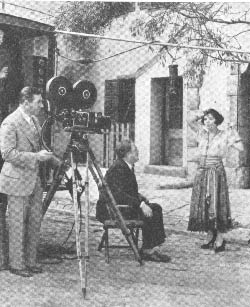
Technicians move a microphone boom closer to Renee Adoree.
Stout admitted that some Americans disliked ‘talkies’ because they’d only seen the first productions, which had been filmed and shown on inadequate equipment. Other just disliked change, or enjoyed adopting a fashionable opinion. He was particularly surprised the complaints that rose from newspapers’ drama critics—
A majority of whom, until recently, rarely have had a kind word to say of pictures… [Now they] look upon the least silent celluloid as the Ark of the Covenant about to be profaned by vulgar hands.
Not that long ago, Stout reminded readers, silent movies arrived with images of the world without sound.
When pictures first were shown, audiences felt this lack. Lips moved, traffic flowed, shots were fired, horses galloped, pies were thrown, and the Empire State Express flashed through Tarrytown in a world suddenly become stone deaf.
In the course of years we adjusted our ears to this unnatural silence and, creatures of habit that we are, it is the returning sound that now offends our senses.
Now, Stout declared, American audiences would adapt again.
Freed from the constraints of silent filming, studios began producing lavish musicals.
Here is a prediction:
The silent picture will be as dead as the souvenir teaspoon within a very short time, and none but professional adopters of lost causes will mourn at its tomb…
Talking pictures will produce better entertainment for considerably less money.
When the hisses and the catcalls have subsided, we shall proceed…
The addition of speech, music, and sound-effects to moving pictures has expanded their entertainment and artistic possibilities beyond anything the most farsighted can foresee today.
Talkies wouldn’t just offer talk, they’d bring along their own musical accompaniment— and not just a theater organ or piano, but full orchestras, famous singers, and choruses.
Millions have never seen a real musical comedy or revue. Such entertainment has been confined for years to the larger cities and played at prices prohibitive to John and Mary. Shortly they will be available at movie prices to any town large enough to support a wired movie house.
In Stout’s experience, the sound quality of movies already surpassed the best theatrical production. In 1927, he had seen “Show Boat” performed onstage at New York’s Ziegfield Theater. Even though he sat in the tenth row, “I distinguished no two consecutive words of Helen Morgan’s song “Bill.” Then he saw a film version of the play.
I again saw Miss Morgan, just as on Sixth Avenue, New York, except that I saw her more clearly… And I heard every word of the lyrics of “Bill” — lyrics very well worth hearing.
She was in New York and I in Salt Lake, but, the illusion being complete, I forgot that at her first note.
The arrival of talkies, Stout continued, would let comedies move beyond the limits of sight gags. And in drama, the ability to speak lines would enable movies actors to add depth to their performances, and touch audiences as never before. A theater manager had recently told Stout,
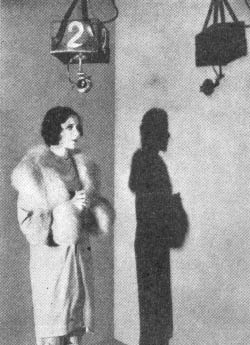
Mary Brian prepares for her voice test. She was one of the actresses who successfully moved from silents to sound.
“[in silent movies] the story was unimportant because the real drama went on in [the viewers’] own imaginations.
“All they asked was a push to start them off, and the regulation clinch at the end… They identified themselves with the stars.
“The screen reached them only with images; the actors had no more reality than the watcher invested them with.
“But once an actress spoke, the real woman broke through. Her personality reaches out and shakes the audience out of its private dreams. They are forced to take note of character now.”
The added dimension of speech, according to this manager, would have a “profound effect on daily life.” Movie-makers would be forced to write intelligent dialogue. And youngsters would stop imitating the shallow characters they’d seen in movies because they would see true personalities in movies.
As a prediction, it contained a large dose of wishful thinking. Sound didn’t force movies to become more intelligent and youngsters didn’t stop mimicking insipid role models they saw in movie melodramas. But the potential for sound pictures was still immense— so immense that Stout himself was tempted into making a rash prediction.
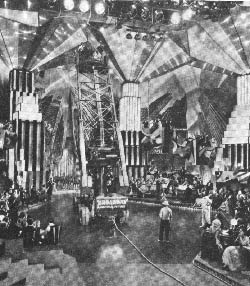
Sound recording was soon moving out of the studio onto elaborate backlot stages like this one for "Hearts in Exile."
Very probably the stage —musical, vaudeville and legitimate—oh, yes, legitimate! —will not survive the new competition long.
No pencil can figure how the stage of Shakespeare and his successors can compete with them, even under the highly special conditions of Broadway.
Stout fell into the trap that has swallowed up many other prophets. He believed that the latest innovation in entertainment meant the extinction of any older style. Radio was supposed to bring the death of newspapers. Television would kill radio. The internet would bury television. E-books will replace books in print. And ‘talkies’ meant the end of live theater.
Americans, however, are hungry for entertainment, and never fully abandon any diversion. In a culture where long-playing records continue to survive amid CDs, no medium ever disappears.
In the Nov/Dec 2012 story “Treasuring Memories,” Scott Tims of Dallas, Texas, describes how he’s been impacted by the stories told around the holiday table.
In these videos, he’s compiled memories and photos from his grandmother, Eva Marie Brawner-Malone, 98, who grew up during the Great Depression in Grand Saline, Texas. (See also “Tracing Family Roots” to begin your own genealogy journey.)
How was the world different for my grandfather? Why did my family come to America? What role did my ancestors play in the military? These questions are common, and many people are finding joy in discovering the answers. (See also “Tracing Family Roots” to begin your own genealogy journey.)
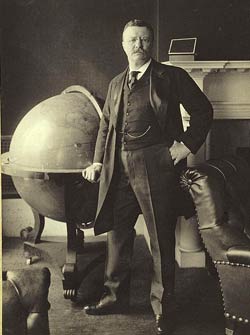
It’s impossible to declare precisely what would have happened had Theodore Roosevelt been re-elected in 1912. But throughout his career, he was interested in global politics and spreading American influence. There is no question that, as president in 1913, he would have taken a far different course during World War I than the one taken by Wilson. Here’s how we think it might have happened.
In this alternative history …
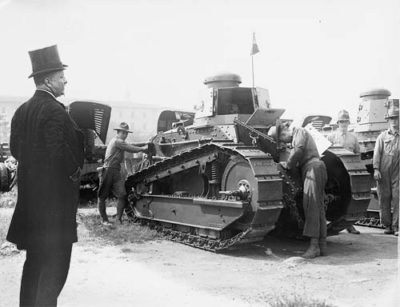
How It Might Have Looked: President Roosevelt reviews tanks from 1st Armored “Rough Riders” battalion heading to France.
• America enters World War I two years earlier.
Teddy Roosevelt could never sit by and watch a fight: he either had to break it up or join in. So when the old Rough Rider hears, in 1914, that Germany has marched over neutral Belgium to attack France, he commits our resources, and then our soldiers, to the Allied cause.
• World War I ends two years sooner.
It takes almost a year to build the ships, arm the troops, train them, and land them in France. By late 1915, though, the American Expeditionary Force of 10 million soldiers is fighting alongside the French and English armies on the Western Front. Even with the wasteful tactics of the European generals, which sometimes wipe out thousands of soldiers in hours, the Allies put enough pressure on the Germans to crack their defenses. The Kaiser’s army falls back, across France, into Germany, with the Allies in pursuit. As winter begins in 1916, the Germans are asking for peace terms.
• Adolf Hitler never comes to power.
The German people see their army in retreat, and the Allied armies occupying their cities. They blame their defeat on the military adventurers who run the Kaiser’s government. When young Adolf Hitler starts proclaiming the invincibility of the German army, and the need to prepare again for war, few Germans are interested. Mostly, they’re relieved when the occupying Allied forces arrest him and keep him in a French prison. Without him, the National Socialist party withers away.
The global peacemaker.
• The Communists never gain power in Russia.
Although the Russian army suffers a paralyzing defeat on the Eastern Front, it is mostly intact when the war ends and the troops march home. The German government is too busy saving itself in 1917 to send the exiled Lenin back into Russia. Without their charismatic leader, the Bolsheviks of Moscow make little progress stirring up revolution. Russian veterans happily round up the loudest revolutionaries and ship them off to Siberia. By November, when the Bolsheviks would have seized the government, they have disappeared underground.
• Europe forms a union.
Since the war ends almost two years earlier, Roosevelt is able to talk the Allies into seeking reasonable reparation costs from the Germans and their allies, the Austrians. Before he dies in office in 1918, he has convinced England, France, and Italy to a continental plan similar to that created for France after Napoleon’s defeat. Having exiled its Kaiser and become a Republic, Germany is invited to rejoin the European nations. For the next 30 years, the Congress of Paris ensures the status quo between nations and suppresses any talk of revolution or nationalism.
All these benefits wouldn’t have accrued without some problems. According to one way of looking at history, if Communism didn’t get a strong foothold in Russia, it would have done so in Germany. Japan would still have emerged as a world power and very likely would still have invaded China. If successful, Japan and the US would have very likely found themselves in conflict over control of the Pacific.
Very probably, the atom bomb would have still been developed. Given human nature, it’s very likely one country or another would have had the curiosity to use it. Which country that might have been is anyone’s guess …