A Brief History of the NSA: From 1917 to 2014
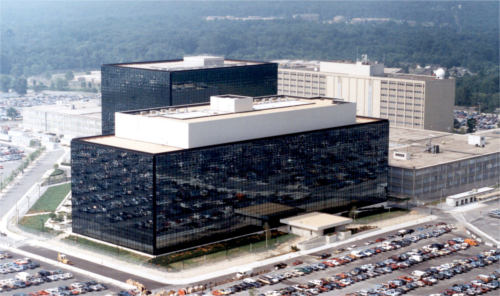
As you might expect from an intelligence organization, the National Security Agency has always done its best to avoid unwanted scrutiny from the American public.
So naturally, the NSA was more than a little “uncomfortable” when Edward Snowden exposed its most secret intelligence-gathering programs, including spying on allied government communications.
But the agency isn’t a stranger to intelligence leakers, and it isn’t really news that the NSA has been spying on people here in our own country. As a matter of fact, that’s precisely their job, and has been since President Harry Truman ordered the NSA into existence in 1952.
The Black Chamber
The agency’s origins date back to July 1917, when a man named Herbert O. Yardley became the head of the newly created Cipher Bureau of Military Intelligence.
Just three months before, the United States had declared war on Germany and its allies. The need for better communications intelligence couldn’t have been more plain. One of the major factors that brought the U.S. into the war was the infamous Zimmerman Telegram, in which the German Foreign Secretary attempted to entice Mexico into war against the U.S. When British codebreakers intercepted this message, it naturally inflamed the U.S. and proved the value of signals intelligence.
After the war ended in 1919, Yardley’s Cipher Bureau moved to New York City and shifted its focus from military to diplomatic intelligence. Its greatest success came in 1922, when its surveillance of Japanese communications helped American diplomats negotiate with Japan at the Washington Naval Conference on naval arms limitations.
The Cipher Bureau’s methods were somewhat questionable: deals with Western Union and other telegraph companies gave the Cipher Bureau unprecedented access to messages entering and exiting the United States. When Secretary of State Henry Stimson decided to close the agency in 1929, he cited moral opposition to its increasing surveillance, though his reasoning may also have been partly financial. In any case, Hoover’s administration did not see the need for peacetime surveillance and the agency was shuttered.
Between World Wars
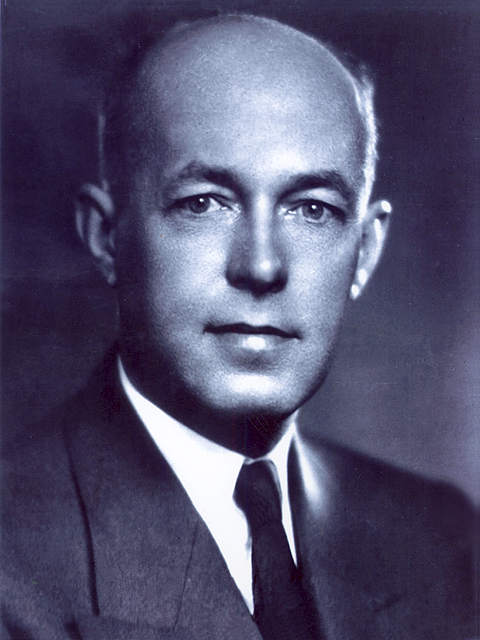
The end of the Cipher Bureau left Yardley unemployed and bitter. In 1931 he published The American Black Chamber, detailing the activities and exploits of the Cipher Bureau. The book, excerpted in The Saturday Evening Post, shocked the public and the intelligence community, as well as the countries Yardley had spied on. And so the founding father of American surveillance also became its first traitor. The National Surveillance Agency prophetically made the Edward Snowden comparison itself in a 1986 memo: It was as if an NSA employee had publicly revealed the complete communications intelligence operations of the Agency for the past twelve years.
By the time Yardley had published his book, it was already out of date on American spy programs. In May 1929, five months before the end of the Cipher Bureau, the U.S. Army had decided to form its own agency independent of the State Department. The following year, William Friedman began building the Signal Intelligence Service (SIS). It’s unclear to what extent the end of the Cipher Bureau and the birth of the SIS are related, but in October 1929, Friedman went to New York to obtain the files Yardley’s agency had gathered. The SIS expanded rapidly in the 1930s, especially in the Pacific, where it opened bases from Alaska to China to Australia in response to the increasingly aggressive Japanese Empire.
From World War to Cold War

The army’s decision to focus its surveillance on Japan proved prescient when a Japanese fleet attacked Pearl Harbor on December 7, 1941. By then the SIS had already cracked Japan’s Purple cipher, used for diplomatic correspondence, and in March 1942, the SIS cracked the JN-25 code, Japan’s primary naval code, which enabled the U.S. Navy to anticipate the Japanese attack on Midway in June 1942. In another key success, the SIS uncovered Admiral Yamamoto’s travel plans, the commander-in-chief of the Japanese Combined Fleet. The army scrambled a squadron of American fighters to successfully shoot down Yamamoto’s plane in April 1943.
Following the war, President Truman reorganized American signals intelligence under the National Security Agency (NSA) in 1952. In 1957, the NSA moved to Fort Meade in Maryland, where it is still based today.
The NSA began as a secret organization, half-jokingly referred to by many as “No Such Agency.” But as the NSA grew to a peak of more than 90,000 employees in 1969–making it the largest intelligence organization in the U.S., if not the world–it became harder to deny its existence.
During this period, the NSA’s intelligence contributions helped the U.S. anticipate Cold War events like the Cuban Missile Crisis and the foundation of the Berlin Wall. But the NSA wasn’t always successful. Faulty intelligence in August 1964 distorted the events of the Gulf of Tonkin incident, drawing the U.S. into the Vietnam War.
In the Public Eye
The first wave of controversy surrounding the NSA came in the 1970s. The aftermath of Watergate brought U.S. intelligence agencies under suspicion, and alongside the CIA and the FBI, the NSA became a subject of the U.S. Senate Church Committee investigation in 1975. The committee’s findings exposed the NSA to public scrutiny for the first time.
The investigation brought surprising revelations. Since 1945, the NSA had been spying on telegrams entering and leaving the U.S., including the correspondence of American citizens, under a program called Project SHAMROCK. Under Project MINARET, the NSA monitored the communications of civil rights leaders and opponents of the Vietnam War, including targets such as Martin Luther King, Jr., Mohammed Ali, Jane Fonda, and two active U.S. Senators. The NSA had launched this program in 1967 to monitor suspected terrorists and drug traffickers, but successive presidents used it to track all manner of political dissidents.
The Church Committee’s findings led Congress to enact the Foreign Intelligence Surveillance Act (FISA) in 1978, which set guidelines for what the NSA could collect and how they could collect it. No longer could the NSA conduct warrantless surveillance on American citizens; instead, the organization would have to go through a special surveillance court, created by the FISA act.
After 1978, the NSA returned to laying low, and with the end of the Cold War, the agency began to shrink into the early ’90s. Current estimates place the number of employees at around 40,000.
Terrorism, Data Mining and Edward Snowden
The NSA’s role shifted again following the September 11 terrorist attacks. In 2002, it launched a ‘data mining’ program to compile and sift through electronic transaction data. That same year, President George W. Bush authorized the NSA to monitor the phone calls and emails of American citizens without a warrant from the intelligence court. The New York Times exposed this program in 2005, and under legal doubts and public pressure, Bush ended the warrantless wiretap program in 2007.
In June 2013, the NSA returned to the media spotlight when NSA contractor Edward Snowden revealed that the agency had been secretly gathering Internet and telephone data on millions of Americans. Snowden also revealed that the U.S. was spying on allied leaders, such as German Chancellor Angela Merkel.
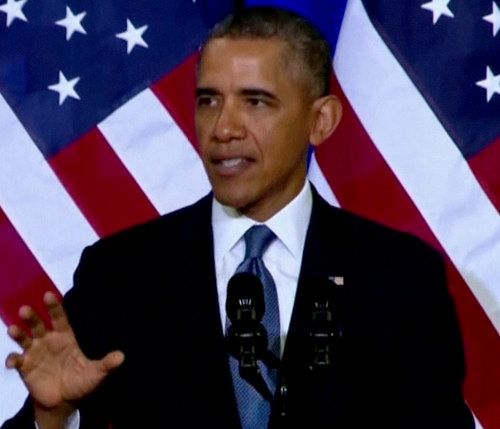
In light of the current controversy, the future of these programs is up in the air. In a speech given early Friday morning, President Obama announced that the NSA will no longer hold American phone records. It remains unclear whether phone companies or another third-party organization will manage this data.
Lisa Kudrow
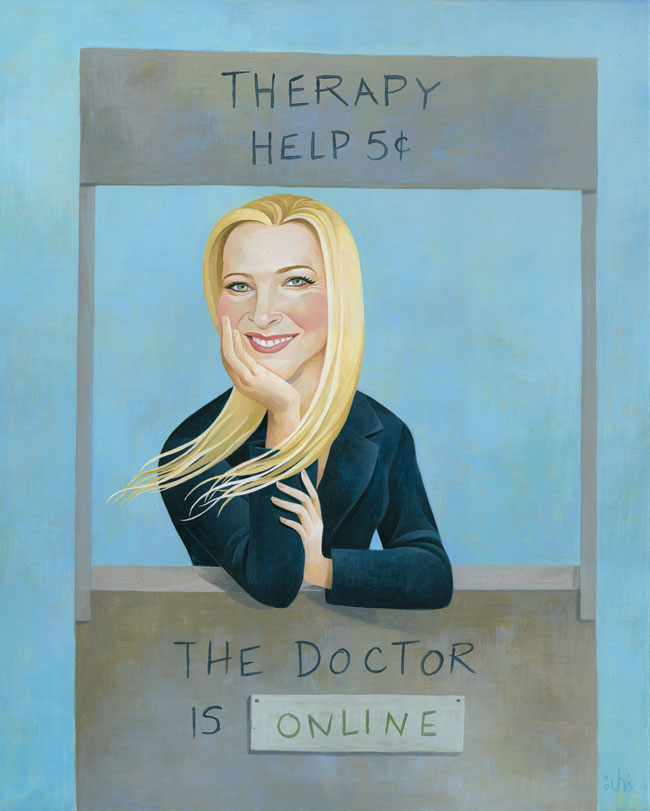
Illustration by Jody Hewgill
When Lisa Kudrow and the five other cast members of Friends decided to leave that show after its 10th season in 2004, they were giving up the most lucrative deal in TV history. For their last two seasons, they were each being paid a million dollars per episode. Yet, they agreed it was time to move on. Friends is syndicated around the world, so it seems those characters will never disappear from view, but Kudrow has done quite well for herself in the years since the show ended, as an innovative producer (Web Therapy and Who Do You Think You Are?), and before, as a versatile actor (The Opposite of Sex, Wonderland, and Analyze This).
Kudrow was born in Encino, California, on July 30, 1963. Her father is a retired doctor specializing in headache research. She has two older brothers, one, a neurologist, and her sister is a sculptor. Growing up, she was shy and felt awkward, and only started to blossom when she went off to study at Vassar. It was her intention to follow her father and brother into the medical profession, but then her brother’s best friend, Jon Lovitz, suggested she give improvisation a try, and once Kudrow hit the stage at The Groundlings, she was hooked. She went on countless auditions, with guest appearances on Cheers and Newhart, finally landing a small role as a waitress in Mad About You. That led to Friends and an Emmy for Best Supporting Actress in 1998. She married advertising executive Michel Stern in 1995, and they have a son, Julian, 15.
Question: You turned 50 in July. How did you celebrate that?
Lisa Kudrow: Quietly.
Q: How old do you feel?
LK: In my 40s.
Q: Three years ago you gave the commencement address at Vassar. What did you say that you wish someone had said to you when you graduated?
LK: People who are 22 sometimes don’t listen. What I wanted to impart was that it’s going to be hard, but don’t let it get to you. You have to look at spinning disappointment into road signs. If something doesn’t work, go another way. You can’t take it personally.
Q: So your theme was don’t give up, because failure can lead to success. How much failure did you have to deal with yourself?
LK: A lot, but I chose not to look at it that way. Every audition you don’t do well in, the job you didn’t get, you get into trouble when you start looking at it as failure. I try to be happy for everything that happens, the good and the bad. Otherwise I wouldn’t be right here.
Q: It seems like you’ve experienced more good than bad lately. Your show Web Therapy started as three-minute shorts on the Internet and was picked up as a series of half-hour episodes on Showtime. How did that start?
LK: I was asked if I wanted to do a Web series and said no. But whenever I say absolutely not, I know that’s not rational. My brain just keeps on working on it anyway. So I thought if you were going to do a Web series, you should go straight into the storm, and make it about the Internet. I started thinking about things that people do on the Internet—people were revealing themselves, they were dating, doing intimate things really quickly, with not a lot of thought. And I thought, nothing could be a worse idea than to do therapy. That’s a funny idea, how people could go online and do a three-minute session with a so-called therapist and be able to say at work, “Yeah, I’m in therapy.” Then L Studio asked us if we had any ideas for a Web series, and we said, “There’s one thing we would do.” So then we had to figure out the details.
Q: Can you describe how you saw your character Fiona Wallice?
LK: She doesn’t know much about therapy, and she’s not even accredited. So we made her really self-serving, judgmental, and not having to adhere to any rules of therapy. I’ve been in therapy but I’m not a trained therapist, so that’s perfect. [Laughs.]
Q: How did you manage to get people like Julia Louis-Dreyfus to play your sister, Lily Tomlin your scheming mother, Meryl Streep the guide to set your gay husband straight, Steve Carell as your boyfriend, and Meg Ryan as a happy hoarder?
LK: In the beginning it was very hard. No one knew what it was. So we went to people we knew, like Bob Balaban and Jane Lynch, who had just shot the Glee pilot. Then Courteney Cox agreed to do it, which was a big deal. My co-producers are friends with Julia Louis-Dreyfus, and she agreed to play my sister. Then we asked Lily Tomlin, and she had so many ideas, which took it to a higher level. We just said, “You’re in a psychiatric hospital” and she said, “That’s good. I want to have sock puppets and make socko drama.” And she came in with these sock puppets with wigs that matched her own wigs. Hilarious. Then I ran into Meryl Streep, and she said she’d love to do it. She’s just fantastic.
Q: When David Schwimmer’s character began to get too dark, did you have to stop filming and regroup?
LK: No, we didn’t have to stop and regroup [laughs], but at one point we did have to go, “Wait, is he really going to rape me?” His story line was that he had once witnessed me having an affair with his father, and the only solution he had discovered, with his horrible therapist, to purge this was to sleep with me. He was so good. Oh my God! He just blew us away.
Q: Why are we fascinated by watching despicable people on reality shows?
LK: Because we can’t believe our eyes. Maybe it’s just a window into my soul, but sometimes you see something that makes you so mad, and you’d like to say something, but you don’t. And then you see these people on these shows doing it, and it makes you feel better that you did keep it to yourself. You’re grateful to your parents for raising you better than that.
Q: Do you think reality-type shows will always be with us, or will the pendulum swing back to scripted shows?
LK: That’s a good question. Game shows and contests have never gone away. I’m nervous for the biographical reality shows because what’s next? The actual Colosseum where people are killing each other? I don’t know what other level it can go to.
Q: You’re doing a biographical show with Who Do You Think You Are?
LK: That’s more like a documentary series than a reality series. They call it alternative reality because they think no one will want to watch documentaries.
Q: You traced your own genealogy for one episode. You knew that some of your family had been lost in the Holocaust—what did you find out that you didn’t know?
LK: Since I was a kid I had seen documentaries about the Holocaust, and I read what I could about it. I watched World at War—remember that series? They had a number of episodes on the Holocaust. There was some pretty graphic stuff in there. I took a lot of Jewish history classes and studied Hebrew for two years in college. But the striking thing to me is that while I studied it, I never applied it to my own family history. So I didn’t have to be burdened with the nightmare of what happened to people I knew. Then as I got older my grandmother told me it was Hitler who killed everybody in her family, and that’s the first time I came face-to-face with it. In my fully denial state of mind it was, “No, no, we’re not part of the Holocaust.” But I learned we are.
The Genius Who Launched the Martian Invasion
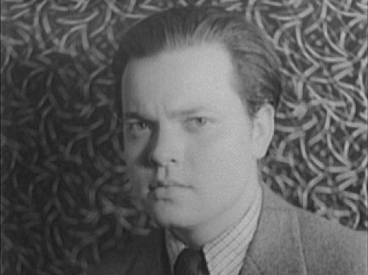
Orson Welles would be pleased; his name is now permanently linked with a national holiday. Halloween has become something of a “feast day” for the producer-actor, whose broadcast of H.G. Wells’ The War of the Worlds was first heard 75 years ago. Each year at this time, it is replayed on the radio and Web, with added commentary about the massive panic it caused when it originally aired. [Click here to read more about America’s reaction to the broadcast “Are We Ready for a Martian Invasion?”]
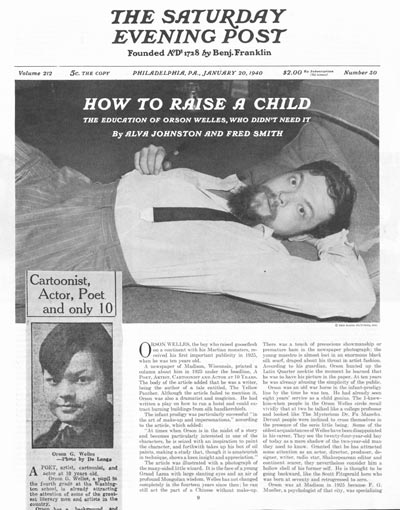
Welles—the revolutionary director of Citizen Kane, the talented Shakespearean actor, and the man who scared Americans into a massive panic in 1938—had an insatiable appetite for attention. His hunger for renown began in his earliest years, when his intelligence won him the flattering attention of adults. His ability to speak in complete sentences at age 2 earned him the reputation of a child genius. By the time he was 4 years old, he was convinced of what doting adults had repeatedly told him: He was destined for greatness. Not yet old enough for school, he was impatient to achieve his destiny. In those early years, “his main ambition was to escape from childhood,” wrote Alva Johnston and Fred Smith in their 1940 series on Welles, “How To Raise A Child.”
By the time he was 10, Welles—ready to set out into the world and support himself on his talent—“eloped” with his foster parents’ daughter, who was also 10. They were eventually found in Milwaukee, living on the coins they earned from singing and dancing on street corners. Returned to his foster parents, he was enrolled in the local public school.
He made no effort to conceal his boredom with the curriculum. One day in the fourth grade, “he announced that he would like to deliver a lecture on ancient and modern art,” wrote Johnston and Smith. “The teacher offered to turn the class over to him. That did not meet his views. He wanted the whole school. This was arranged. Orson gave a 10-minute history of art and then launched into an attack on the school’s methods of teaching art, which, he said, were sterile; instead of encouraging self-expression, they encouraged feeble imitation and produced lifeless copyists.
by Alva Johnston and Fred Smith
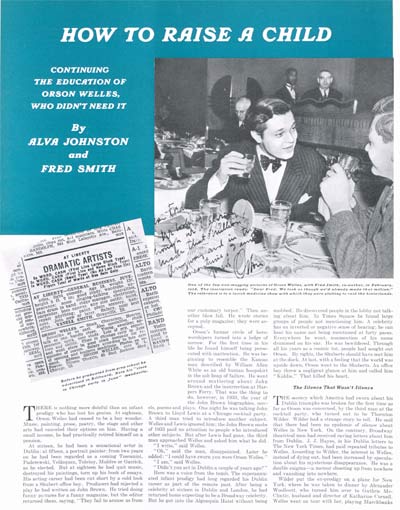
Who Didn’t Need It”
by Alva Johnston and Fred Smith
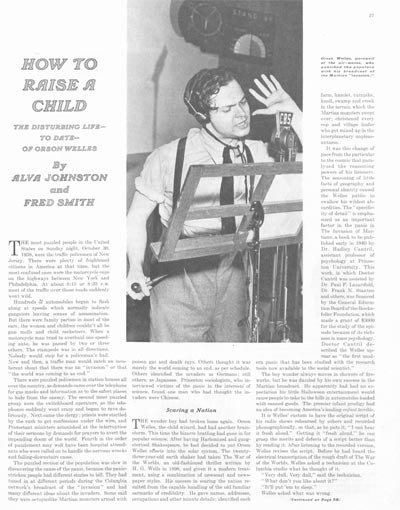
by Alva Johnston and Fred Smith
“‘You mustn’t criticize the public school system, Orson,’ interrupted a teacher.
“‘If the public-school system needs criticizing, I will criticize it,’ he replied.”
That little exchange won him notice in the local paper in Madison, Wisconsin. When interviewed, Welles made it clear that he was a child genius—a “cartoonist, actor, and poet.” Playing on his air of a prodigy, Johnston and Smith observed, “he was already abusing the simplicity of the public.”
Welles was eventually put under the guardianship of a Chicago physician who wanted to develop the boy’s genius. The remaining years of his education were quite informal—little more than Welles educating himself according to his own theories. He developed a remarkable knowledge of ancient history, art, and drama, and considerable skill as a magician. But he saw no need to master basic arithmetic. He was confident at age 10 that “there will always be people around to add and subtract for me.”
Welles grew up without the steadying influence of a stable family. When he was still young, his parents separated, then died. His extended family, which showed little interest in the boy, appears to have been a rare collection of small-town eccentrics.
Johnston and Smith were particularly impressed by Welles’ great aunts. “One was an important topic of conversation in Kenosha [Wisconsin] because she used her electric limousine to run after, not to ride in. She tied herself to the machine by a long rope and took her exercise by using the car as a pacemaker. Another, besides wearing a riding habit at all times, hailed her friends on the streets of Kenosha by lifting an enormous wig and waving it at them. A third is still the subject of speculation; she fell out, of a rickshaw in China and was never heard of again.” Yet another tried to achieve big-city decadence on a small-town budget. She “took baths in ginger ale because, as she told [Welles], it was cheaper than champagne.”
The boy’s inclination toward eccentricity was only encouraged by the adults who kept reminding him of his remarkable intelligence and talent. Surprisingly, Welles never developed into a spoiled brat. “Infant prodigies are usually admired and feared, rather than loved,” wrote Johnston and Smith. “The average prodigy is an arrogant little hellhound. According to the authorities, Orson was not so bad as might have been expected. Ashton Stevens described him as ‘gabby and precocious, but not snooty.’ Others say he was gentle and patient with the absurdities of adults.”
At the age of 16, he had talked his way into leading roles in the theaters of Dublin and London. When he returned to America, though, he found no demand for his acting or his plays. “For the first time in his life he found himself being persecuted with inattention,” Johnston and Smith reported. In Times Square, he was stunned to find large groups of people not mentioning him. A prodigy can only take so much neglect. Welles hopped a steamer and sailed to northern Africa for a change of scenery while writing a book on the plays of Shakespeare.
He returned to New York to find that Broadway had caught up with his European reputation. By age 19, he had several starring roles on Broadway and was starting to work in radio. By age 23, he produced his panic-inducing tale of Martians and death rays.
In the days that followed that October 30, 1938, broadcast, he must have wondered if he’d played his young prodigy card once too often. Hundreds of people were furious with him for both scaring them and then making them feel foolish. He had also made enemies in Hollywood, where he was considered both too young and too talented. “During its first two decades, the picture business was rich in child colossuses,” wrote Johnston and Smith. “It is in the nature of things that the superannuated infant prodigies and their cohorts should disapprove of a fresh young infant prodigy.” Yet here was the 24-year-old Welles being paid more than $150,000 plus percentage for every movie he made, and over $5,000 for each of his weekly radio broadcasts.
The press eventually dropped the story of the broadcast after Welles made an earnest apology. And victims of the hysteria no longer wanted to talk about how they were frightened into a blind panic. The outrage died away. But many Americans continued to regard him with the wary indulgence adults often give children who are too smart for their own good.
‘My Pink Ribbon’
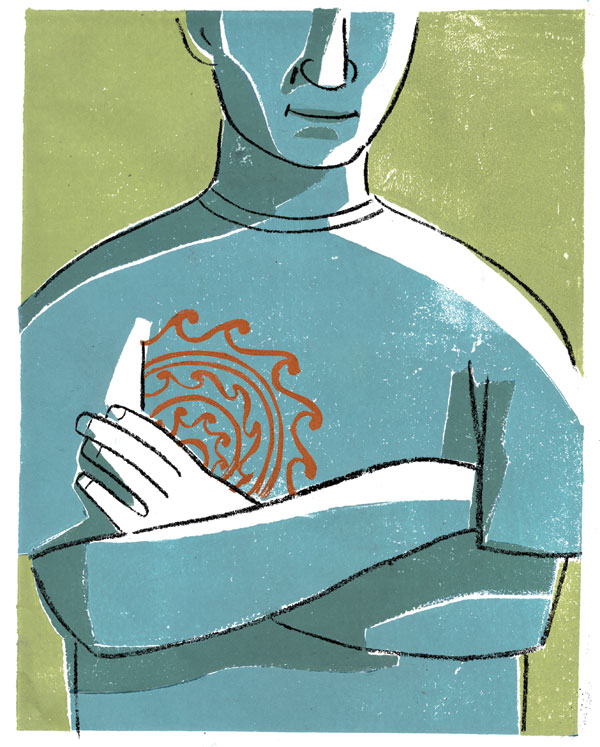
Illustration by Hadley Hooper.
October is Breast Cancer Awareness Month. It’s a time when it seems you hear about breast cancer everywhere you turn. Pro football teams play their October games wearing pink shoelaces and cleats, chin straps, wristbands, and helmet decals. Even the game balls have pink ribbon decals.
The public relations campaign to get us thinking about breast cancer has been quite effective. But with all the attention to the issue, most are still not aware that men can, and do, get breast cancer. I say this from first-hand experience. In June 2010, after a seven-mile run near my home in Anderson, Indiana, I noticed a swelling in my left breast, and, when I massaged it, I felt a palpable lump.
I didn’t think much of it at the time, but I was concerned enough to have it checked by a surgeon I’d seen a year before for a minor procedure. When I arrived at his office two weeks later, I showed him the swelling and he did a fine needle aspiration (biopsy) of the lump right on the spot.
An hour later, the report came back. I’d tested positive for breast cancer. I was still in his office, stunned, as he informed me, “For men, there’s really only one option—a complete mastectomy.”
Feeling numb, I said “OK” and scheduled the surgery for four days later. Then I had to go home and tell my wife, Elise, whom I had not told about the lump or the doctor’s visit because I hadn’t wanted her to worry.
At the appointed time, the surgeon removed my entire left breast. He also took four lymph nodes. Afterward he biopsied the nodes to see if the cancer had spread. The test came back positive for one of the nodes. Not a good sign. The surgeon told me that because he’d found cancer in that first node, it was very likely that the cancer had traveled elsewhere in my body.
Up until then, stunned though I was, I hadn’t worried too much. Now, it was different. I started thinking about dying. I began reading everything I could about breast cancer. One of the first stories I found online was about a 28-year-old British man who died after a four-year battle with breast cancer. And here I was, in my 60s. But, I reminded myself, I was quite healthy. I have been a runner all my adult life. I’d quit smoking 18 years earlier. I rarely drank alcohol.
I ate nutritious foods almost all the time. Plus, there was no history of breast cancer in my long-lived family, which included two older sisters and my 92-year-old mother never had cancer.
I returned to the hospital for surgery two weeks later, this time to remove nine more lymph nodes. About a week later, I went with Elise to the doctor’s office to learn the biopsy results. I felt very nervous as we awaited the verdict.
Amazingly, all nine lymph nodes tested negative. Elise and I both found ourselves weeping tears of joy. It was like having a death sentence commuted.
The follow-up treatment wasn’t so terribly bad, all things considered. I made it through 49 chemotherapy and radiation treatments over the next eight months. Throughout that period, I never experienced fatigue, nausea, or missed a day of work. My oncologist told me I was lucky; only about 10 percent of his patients breeze through treatment with so few side effects. Yes, I lost my hair and my fingernails, and I had some digestive problems, but I was indeed lucky.

I like to think some of my success with the treatment has to do with three decisions I made early on. First, I decided to be candid about my cancer and discuss it with anyone who was interested. Second, after reading the excellent Life Over Cancer: The Block Center Program for Integrative Cancer Treatment by Keith Block, M.D., a Chicago oncologist, I decided to eliminate red meat and dairy products from my diet. Block points out that the Japanese, for example, have significantly lower rates of cancer than Americans and eat significantly higher amounts of seafood. Summarizing several studies, The Physicians Committee for Responsible Medicine at cancerproject.org concludes, “Even within Japan, affluent women who eat meat daily have an 8.5 times higher risk of breast cancer than poorer women who rarely or never eat meat.”
I began eating broiled or baked fish six or seven days a week combined with lots of beans, fresh fruits, vegetables, and nuts. I also started taking whey protein, flaxseed, and fish oil supplements.
Although some oncologists advise against strenuous exercise during chemotherapy, my third decision was to continue running and weightlifting, something I had been doing for more than 25 years. Block says, “My own clinical experience … has repeatedly confirmed the therapeutic benefits of exercise for people with cancer. Even walking … for three to five hours a week is correlated with a 50 percent decline in mortality from breast cancer.”
There’s also something else—a strong foundation of spiritual support. In his book, Block encourages meditation, spiritual disciplines, and connection with a loving community or support group. I try to spend time every morning in prayer, meditation, and reading the Psalms and other Bible passages. I know I could not have survived my year of treatment so easily without my faith and dozens of supportive friends in our a loving congregation at at St. George Orthodox Christian Church in Fishers, Indiana. And Elise’s prayers, cheerful outlook, and daily encouragement also made a tremendous difference.
When the treatment phase came to an end, I celebrated by running the Indianapolis 500 Festival Mini-Marathon, the largest 13-mile race in the country. At 7:30 a.m. on May 7, 2011, nine days after I finished radiation treatments, we were off. When I finished three hours and 28 minutes later, I ranked 26,307th out of 35,000 runners. Of course, I didn’t care where I placed. I was a winner. I ran another half marathon in October 2012 and, as you read this, I will be running another one. I plan to complete at least one half marathon a year for as long as I am able. As Robert Frost wrote, “The woods are lovely, dark and deep. But I have promises to keep and miles to go before I sleep.”
Related: Men and Breast Cancer: The Facts
Your Government Inaction: The Do-Nothing Congress of 50 Years Ago
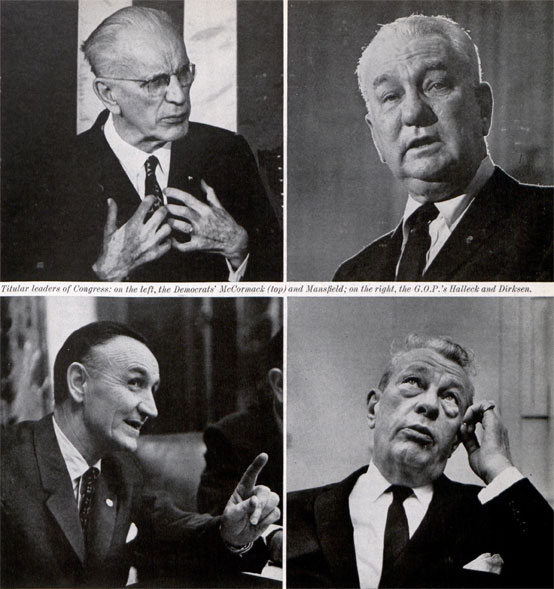
Read enough history and you’ll find it hard to escape a recurring sense of déjà vu: the feeling that you’ve previously experienced the present moment.
We had one of those déjà-vu moments when we read in a recent Gallup poll that the public’s approval rating of Congress had struck a historic low point. More than 80 percent of Americans disapprove of the way Congress is handling its job. This is no sudden unpopularity, either. In five of the past six years, the approval rating has remained below 20 percent.
The reason for dissatisfaction is not hard to find. The House and Senate have all but shut down because legislators have chosen not to act rather than compromise with their political opponents. Today’s 113th Congress looks like it will surpass the inactivity of the 112th, which passed the fewest bills of any Congress in the past 72 years.
This legislative stagnation bears a discouraging similarity to what was described 50 years ago by the Post’s political reporter, Stewart Alsop. In “The Failure of Congress,” Alsop reported, “The Congress of the United States is in deep trouble … more than ever before, the public attitude toward Congress is a mixture of indifference, amusement, and contempt. … The reputation of Congress is … ‘lower than a snake’s belly.’”
Alsop stated that the 88th Congress of 1963 had failed because it wouldn’t move beyond a political impasse. “Never before in history,” he wrote, “has Congress talked so long to accomplish so little. … Appropriations are supposed to be approved by the end of July each year, to provide money for the next fiscal year. As of late fall, the State, Justice and Commerce departments are still living hand-to-mouth, because Congress has never got round to voting funds for them.”
What made the stalemate of the 88th Congress so unusual was that it wasn’t caused by the usual war between Republicans and Democrats. The Republicans were too few in number to mount any serious opposition; their 33 senators were easily outvoted by the 67 Democrats.
No, the Congressional impasse of 50 years ago was the product of a split between factions within the Democratic party. One faction Alsop called the “generally liberal Presidential party.” The other was “the generally conservative Party of the Congressional Establishment” comprised of Southern Democrats and senior Republicans.
“On major issues—if the issue can be brought to a vote—the Presidential Party usually has the edge,” wrote Alsop. “But the machinery of Congress is controlled by the Establishment Party. So bills the Establishment Party does not like either do not come to a vote at all, or come to a vote after endless delays and in emasculated form.”
Remarkably, Alsop said, Southern legislators within the Establishment dominated Congress even though they represented less than 17 percent of the voting population.
This minority could steer the course in Congress because they knew how to gather and wield power—something their opponents never mastered. “The damn liberals,” Senator Hubert Humphrey of Minnesota sputtered, “they just don’t understand power. All they understand is sentiment.” Humphrey, a leading liberal himself, added, “After all politics is just the way you spell power, but the liberals think power is sinful.” Another liberal senator agreed with Humphrey, telling Alsop, “Power is like sex. If you think it’s sinful, you don’t enjoy it and you’re not much good at it.”
The chief cause of the 1963 impasse, according to Alsop, was President Kennedy’s proposed civil rights legislation, which sought to end segregation in schools and businesses as well as the suppression of black voters. The Establishment’s strategy was to delay the civil rights bill, and anything else along with it, Alsop said, though he could find no Southern congressman who’d admit it on record.
Yet, in the end, Congress passed the civil rights bill before its adjournment in 1964, though not without considerable maneuvering and pressure from President Johnson.
Criticizing Congress is a fine, old American tradition. You can find the Post expressing disapproval of its inaction for nearly as long as it has been in print. An editorial from March 9, 1822, for example, marveled at how little had been accomplished by the 17th Congress. It had sat for three months, it said, listening to committees, issuing reports, requesting more committees, and proposing more laws. The paperwork had piled up in Washington until the tables were groaning under the weight. And after all this work had excited the nation’s hopes for legislative action, “what has been the result? Procrastination. Debate. … New committees. New Reports. New speeches … and, finally, indefinite postponements.”
It seems that Americans have long been patient with their Congress, but is that patience endless? Does the triumph of politics over governance ultimately corrode America’s faith in their government? Alsop thought so. “When the citizens of a democracy begin to hold their legislature in contempt,” he wrote, “democracy is itself in danger.”
A Very Eligible Politician
This is the first installment of our series “Reconstructing Kennedy.” Click here to read part two, “Kennedy on the Campaign Trail.”
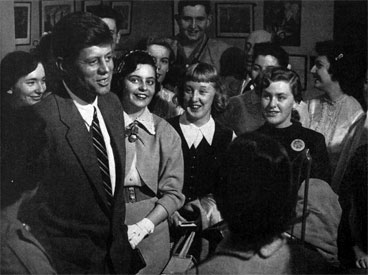
The first time the Post took notice of John F. Kennedy, he was still a very junior senator from Massachusetts. It was unusual for the magazine to run a feature article on a senator, particularly one as young and inexperienced as Kennedy. But Paul F. Healy, author of “The Senate’s Gay Young Bachelor,” found Kennedy particularly newsworthy.
For one thing, he was a fresh face in the senate, idealistic and energetic. The 36-year-old senator had “that look of youth,” Healy wrote. “He was six feet tall, with a lean, straight, hard physique and the innocently respectful face of an altar boy at High Mass.”
Throughout his career, his youthful looks prevented many colleagues and foreign leaders from taking him seriously. His appearance and demeanor could prove a handicap, as on the day he was boarding the subway car that ran between the Capital and the Senate Office Building. As he stepped into the car, the subway guard told him, “Stand back; let the senators go first!” The anecdote says much about Kennedy’s youthful looks, as does the fact that he complied and waited for the other senators to board ahead of him.
But his appearance proved a strong advantage among women voters. “During the campaign,” Healy wrote, “every woman who met Kennedy wanted either to mother him or marry him. At first glance, he looked a little lonesome, and in need of a haircut and perhaps a square meal… Many women have hopefully concluded that Kennedy needs looking after. In their opinion, he is, as a young millionaire senator, just about the most eligible bachelor in the United States—and the least justifiable one.”
On the date that line appeared in the Post, Kennedy had less than 100 days of bachelorhood left. He was already engaged to Jacqueline Bouvier, but the couple delayed the announcement of their wedding until the after the bachelor story ran.
Healy was also fascinated by Kennedy’s background: here was a young man who had grown up in comfort and privilege but who had requested combat duty in the second world war. Due to his nautical experience, Kennedy was given command of a torpedo boat in the South Pacific. On a moonless night in August, 1943, a Japanese destroyer ran over Kennedy’s PT boat, cutting it in two. Kennedy led the survivors on a swim to a distant island, helping one wounded man to safety by holding the strap of the man’s life vest in his teeth as he swam. Kennedy’s citation for “extremely heroic conduct,” says, “During the following six days, he succeeded in getting his crew ashore, and after swimming many hours attempting to secure food and aid, finally effected the rescue of his men.”
According to Healy, Kennedy’s war experiences had made him “more serious.” Though still young, he was “basically a mature and responsible fellow [who] possesses an inner fire which has enabled him to rise gallantly to the occasion whenever it was required.” He also had the sort of character that made people want to do something for him. This compelling appeal might be the earliest reference to what was later called the Kennedy “charisma.” The term was applied to the president so often that many people began to wonder if it had been made up just for Kennedy. By the time he was in the White House, Kennedy’s critics were heartily sick of hearing about charisma. They argued that it was no more than superficial charm, and that Kennedy’s political success could all be attributed to the judicious application of his father’s fortune.
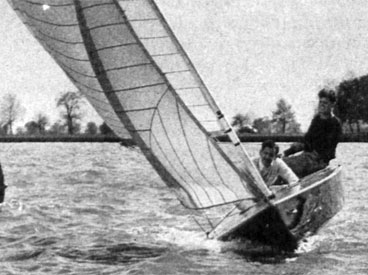
Kennedy made fun of the accusation that his father had bought his victories. Speaking at a Washington dinner during his 1958 campaign, Kennedy pulled from his pocket a “telegram,” which he said was sent from his wealthy father, former ambassador to the United Kingdom Joseph Kennedy, who was sunning somewhere on the French Riviera. He told the attendees, “I have just received the following wire from my generous daddy. It says, ‘Dear Jack, don’t buy a single vote more than is necessary. I’ll be damned if I’m going to pay for a landslide.'”
Kennedy could afford to joke about his father’s influence because it was widely known how hard he worked for each political victory. Healy’s article is the first of many that would repeat the same story: Kennedy was a relentless campaigner. He rose early, traveled long, gave numerous speeches that rarely repeated each other, shook any hand he could, and retired at night with time enough to get four hours’ sleep.
It was an impressive performance for someone who, until seven years earlier, had intended to be a journalist. His father had groomed his oldest boy, Joe, Jr., for a political career and expected him to keep winning until he entered the White House. But after Joe died in World War II, Joe’s expectant look turned to John.
For a very brief period, John Kennedy worked for Hearst newspapers, and was looking forward to an intellectual’s life of researching and writing history. But then a vacancy opened up in the Massachusetts’ 11th district. Kennedy ran and won. He may not have loved politics, but he was always competitive and he loved winning.
This early decisive victory was the start of a trajectory that would take him from congressman to president in just 14 years.
To read more from the Post‘s series on John F. Kennedy, click here.
Kennedy on the Campaign Trail
This is the second installment of our series “Reconstructing Kennedy.” Click here to read part one, “A Very Eligible Politician.”
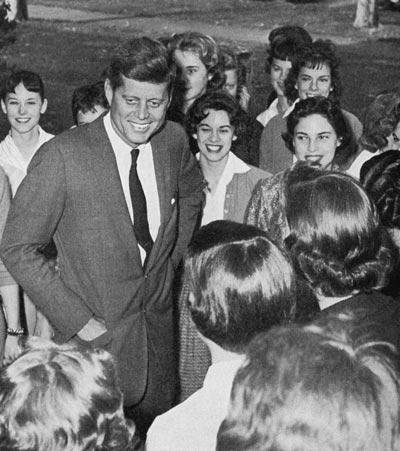
We tend to remember him as president; it’s hard to remember that shortly before he ran for office, John F. Kennedy was as a relatively unknown young senator, and that once he was in the race, he faced serious obstacles in his bid for the presidency. But that was his situation in early 1960, when Post reporter Stewart Alsop listed ten reasons Kennedy might not win his party’s nomination.
The first was religion. No Catholic had ever successfully run for president, and many Americans in 1960 wondered if the country was ready for a Catholic in the White House. Throughout the presidential campaign, Kennedy worked hard to convince voters his religion would not shape his executive decisions. Yet the doubts persisted. In “Campaigning With Kennedy,” Post reporter Beverly Smith wrote of being present when a reporter read a statement from protestant ministers suggesting Kennedy’s decisions might be shaped by the Vatican.
Smith could see Kennedy working hard to control his anger and return a civil response. “We saw the flush spread upward from his throat into his tanned, suddenly tense face.” But when Kennedy responded, it was in a calm, controlled, but icy voice. “Our Constitution is very clear on the separation of church and state; I have been very clear—and precise—in my commitments to that Constitution, not merely because I take the oath which is taken to God but also because I believe it represents the happiest arrangement for the organization of a society.”
He went on to remind his questioners the Constitution forbade setting any religious qualification for the presidential office.
Another obstacle was Kennedy’s family background. His father, Joseph P. Kennedy, had made a quarter of a billion dollars as a stock market speculator and liquor importer (though never in bootleg alcohol, despite the rumors.) Along the way to acquiring his fortune, Joseph had made “a whole slew of enemies,” which John inherited.
He also inherited the suspicion that Joe Kennedy would buy his son’s election to the White House, and then tell John how to run the country. But from very early in the campaign, John asserted that he would not be shaped by his father’s more conservative politics, wrote Smith. “When the older Kennedy is moved to express his political views, which are rather to the right of his friend Herbert Hoover’s, his son is apt to break in with, ‘We’ve heard the former ambassador’s views, now let’s get on with our business.’”
Kennedy’s campaign benefitted from the powerful support of his siblings. His four sisters and two brothers had worked hard in his Massachusetts campaigns for Congress and the Senate. When he announced in 1959 that he intended to run for president, they pooled their money and bought him a private airplane, complete with sleeping quarters. The gift plane, wrote Stewart Alsop, showed Kennedy’s opponents what his Massachusetts challengers had already learned, “When you run against Jack, you aren’t running against just one Kennedy, but the whole tribe.”
“His two brothers,” Alsop continued, “are already working hard for him. They are Bob Kennedy, nationally known for his work as counsel… investigating racketeering in the labor-management field; and the youngest brother, Ted, a husky ex-footballer and recent graduate of the University of Virginia Law School.”
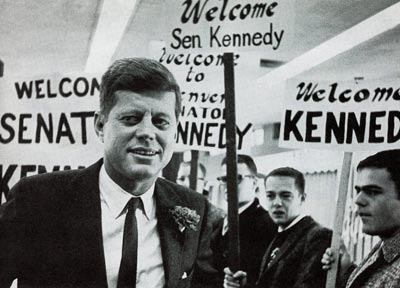
Smith believed John Kennedy’s greatest family asset, though, was his wife, Jacqueline. “Reporters covering the Kennedy campaigns wondered at first how a very shy, very beautiful, very young woman would go down with the voters as a potential first lady. By the time the West Virginia campaign ended, they were unanimously convinced that the beautiful Jackie was a major Kennedy political asset.”
Another obstacle in Kennedy’s campaign was his youth. Many voters refused to believe a 43-year-old man without executive experience could run the country. But while his youth lost him the senior vote, it gained him supporters in the younger generation. Smith observed, “In each state I visited with Kennedy, I was impressed by the number of youthful volunteers working ardently for his cause… [They reminded me] that Theodore Roosevelt entered the White House at forty-two, Washington took command of the Continental Army at forty-three, and Thomas Jefferson drafted the Declaration of Independence when he was thirty-three.”
The young voters of 1960 who rallied to Kennedy’s cause had been born in the Depression, grown up during a world war, and reached maturity as America entered a seemingly endless cold war with a possible risk of nuclear war. By the time the 1950s drew to a close, they had grown tired of the continuing crises. They wanted a freedom from worry and a world of opportunity in which they could make their mark. And, like so many of their elders, they wanted to make the world a better place. Kennedy spoke directly to these yearnings, but in an unexpected manner.
“When he gets down to the substance of his speeches, he preaches a hard gospel,” Smith observed. “In politics this is unusual, if not unpalatable. American voters are used to being told that they are the salt of the earth and there’s a good time coming. Kennedy’s message is quite different. He does not flatter or talk down.” To illustrate, Smith offered a typical quote from one of Kennedy’s speeches: “Ours is a great country, but we can make it a greater country. It is powerful, but we must make it more powerful. I ask your help. I promise you no sure solutions, no easy life. The years ahead, for all of us, will be as difficult as any in our history. There are new frontiers for America to conquer—frontiers of the mind, the will, the spirit of man.”
Such words had an unusual effect on the crowds. While Kennedy told them they had better prepare for harder work and stricter self-discipline, Smith could see puzzled uneasiness on their faces. But Kennedy argued his point with facts and earnest vitality. When he finished, there would often be a moment of intense silence before a rising ovation began.
Smith’s conclusion reflected the desire for change many Americans felt at the start of a new decade. “It is not that Kennedy has ‘changed’ his audience. But most of us have, beneath our outer optimism, a troubled feeling that we have failed to live up to the greatness of our heritage. It is this chord which Kennedy strikes and brings to life.”
It was a chord that would resonate long after Kennedy was gone.
To read more from the Post‘s series on John F. Kennedy, click here.
Osteoporosis and Your Spine

While osteoporosis is often associated with hip fractures, experts warn that small bones in the spine (33 vertebrae in all) are also prime targets for the bone damaging condition. In fact, more than 700,000 spinal fractures due to osteoporosis (double the number of broken hips) occur each year.
According to the National Osteoporosis Foundation, roughly two out of three spinal fractures (also called vertebral compression fractures or VCFs) go undiagnosed and untreated, mistaken for a pulled muscle or part of normal aging.
And the stakes are high: having one of these fractures raises the risk of new breaks. Left untreated, people can lose height and develop a “hump” back (medical name: kyphosis) that threatens appearance, mobility, and overall health. You are at increased risk for VCFs if:
- You are age 50 (or postmenopausal) or older
- You have osteoporosis or low bone mineral density
- You have had a prior spine (or other bone) fracture after age 50
- You have a family history of osteoporosis, fractures, or kyphosis
Fortunately, several options can help ease pain and shore up backbones. Wearing a brace and taking pills to boost bone density can help. One minimally invasive procedure called kyphoplasty uses a balloon to lift the fractured bone and return it to the correct position. Then, doctors stabilize the fracture with cement to restore height and lower the risk for future fractures.
Protect your spine. Take a one-minute risk test at worldosteoporosisday.org, and ask your healthcare provider about a bone density test. If you suspect a spinal fracture, see your doctor or a spine specialist as soon as possible.
Learn more about balloon kyphoplasty from the National Library of Medicine and medical device manufacturer Medtronic.
Rethinking Kennedy’s Camelot
This is the third installment of our series “Reconstructing Kennedy.”
In the years following the death of President Kennedy, many people often spoke of his presidency as an idyllic time. Picking up on Jackie Kennedy’s reference to the Richard Burton-Julie Andrews musical, they dubbed those pre-assassination days as “Camelot,” a noble, idyllic but ultimately doomed kingdom.
It is easy to imagine such a bright, innocent time existed on the far side of the tragedy. But was the country truly different before Kennedy’s assassination?
Excerpts from several Post articles in 1963, prior to the president’s death, demonstrate that in truth America was already in the midst of troubling times that little resembled the idyllic innocence of “Camelot.”

In March of 1963, the Post ran “Survival of the Fewest,” which informed readers that the U.S. could not protect them from a possible nuclear attack. Government strategists had calculated that nuclear weapons from a Russian attack would directly kill 21 million Americans. Radioactive fallout would kill an additional 13 million, they estimated, unless citizens had access to bomb shelters.
At the time of the article, the Kennedy administration had already called on the nation to construct enough fallout-shelter space for 240 million Americans over a five-year span, yet few Americans took action to protect themselves from nuclear holocaust. Only a small fraction of the necessary fallout shelters were built, because homeowners found them expensive, inefficient, and hard to assemble. Radio stations continued to regularly test their connections with the CONELRAD civil defense system, and school children still huddled under their desks when the town siren was tested, but by 1964, demand had disappeared and one California dealer couldn’t even give the shelters away.
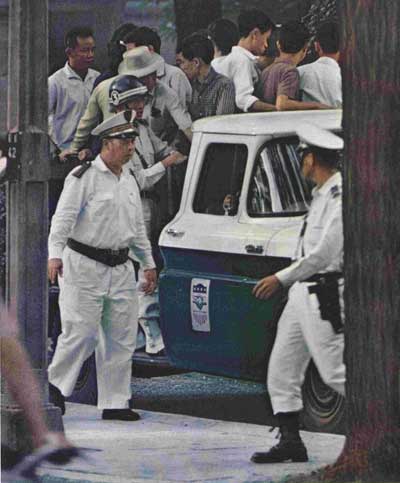
At the same time that Americans worried about Russia’s nuclear arsenal, they learned that the U.S. was getting pulled into yet another distant confrontation with Communism. In September of 1963, the Post reported in “The Edge of Chaos” that, “President Kennedy, convinced that a Communist takeover of South Vietnam might mean the fall of Southeast Asia, has repeatedly promised to defeat the guerillas that dominate much of the country. He has backed up his words with a 16,000-man U.S. force in Vietnam—more than 100 have lost their lives—and with $1.5 million a day spent on the war.”
© Curtis Publishing Co.
“But,” the article continued, “the spectacle of American-trained troops using American weapons to raid Buddhist temples made clear one fact that U.S. officials have long tried to evade: No matter how much the United States supports the unpopular regime of Ngo Dinh Diem, this regime’s chances of victory over the Communists are just about nil.”
Ever since World War II, the country had been opposing communist expansion, first in Eastern Europe, and then in Central America, Africa, and Asia. Its principal weapons in this fight were money, arms, and military supporters. But by the 1960S a new element had been added to the Cold War, instigated partly by a novel that had been serialized in the Post.
In 1958, Eugene Burdick and William Lederer wrote The Ugly American out of their anger at seeing American prestige dissolving in Southeast Asia. They were outraged by the way American diplomats and advisors were “ doing the wrong thing, or doing the right thing the wrong way, or just doing nothing.”
Serialized in five parts from October 4, 1958 to November 8, 1958, their novel about a fictional diplomat in Asia drew a generally negative response from government officials. The State Department dismissed the book as a “distortion,” and it was criticized by President Eisenhower and several senators. But after Senator John Kennedy read the book, he bought copies for the entire senate, and the government began to respond.
In “The Ugly American Revisited,” [June 4, 1963], Burdick and Lederer reported, “American foreign aid is now a much more practical, tough-minded proposition than it was five years ago.”
In their article, the authors also admitted they’d been stunned by the public response to their book, which had sold nearly 4 million copies. Even more startling were the thousands of letters from individual Americans asking, “What can I do?” To the authors, this response reflected a deep concern among Americans about their position in the world. “They are often confused, often angry, but always willing to learn. They possess a quiet awareness of the deadly peril in which we live. And they are, more important, ready to ‘do something about it.’”
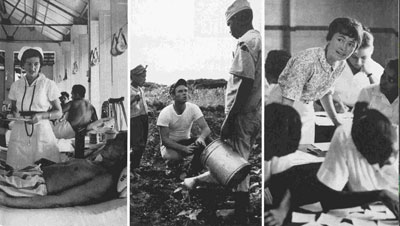
What many of them did about it, wrote Burdick and Lederer, was volunteer for the Peace Corps, which Kennedy had founded as one of his first acts, in 1961, and which had been a resounding success. “Indeed, it is quite without parallel in history,” they wrote two years later. “It is a source of great pride to us that a majority of Peace Corps volunteers indicated that their first interest in foreign affairs came from reading ‘The Ugly American.’”
Burdick and Lederer saw a new mood spreading through the country. “Americans, in both high and low places, are willing to be critical of themselves without falling into despair. On balance, America is surely moving with greater energy, more skill and more confidence in its overseas operations.”
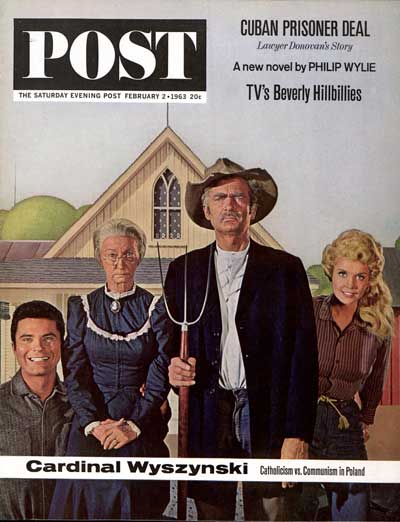
But the America of 50 years ago could also be characterized by its entertainment, some of which did not especially resonate with the nobility of the knights of the round table. The most popular television show, The Beverly Hillbillies, was a prime target for reviewers’ abuse (the Post declared it was “deliberately concocted for mass tastelessness.”)
But television in 1963 also had the sedate and reliable Walter Cronkite, whom the Post profiled in March of that year. Cronkite was still relatively young, just a few months older than President Kennedy. But he, too, was a veteran, having reported World War II from a B-17 and with the 101st Airborne division.
“He has conversed with queens and dictators,” wrote Post author Lewis Lapham, “lived under the polar ice for a week, seen governments fall and atomic bombs exploded.”
And he was now the trusted anchorman of the CBS evening news, a post he was to hold for another 18 years.
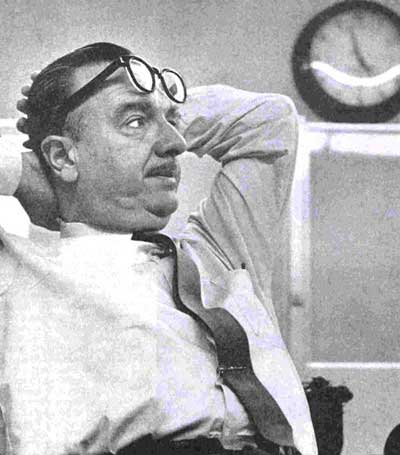
In that distant time, before Americans preferred their news heavily seasoned with entertainment, Cronkite won the loyalty of viewers with his fairness and adherence to facts.
“Cronkite’s detractors usually criticize him for this unwillingness to advance an outspoken opinion. They complain that he is too polite, too bland, too dull,” wrote Lapham. “He considers the criticism unreasonable. ‘Probably if I made a few more acerbic remarks, I might win a few more viewers,’ he concedes, ‘but I don’t feel like being funny with the news; I don’t think that’s my place.’”
Just a few months after Lapham’s article was published, Cronkite became part of the permanent memories of a generation of Americans when he delivered the news of President Kennedy’s assassination.
“If, in the search of our conscience we find a new dedication to the American concepts that brook no political, sectional, religious or racial divisions,” Cronkite observed following Kennedy’s funeral, “then maybe it may yet be possible to say that John Fitzgerald Kennedy did not die in vain.”
To read more from the Post‘s series on John F. Kennedy, click here.
How the Early 1960s Looked to Americans
This is the fifth installment of our series “Reconstructing Kennedy.”
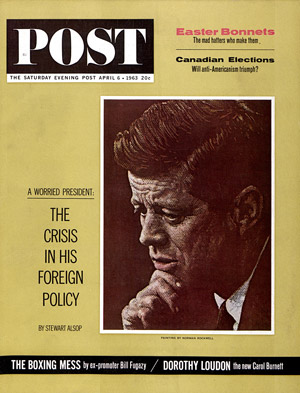
April 6, 1963
Scroll below for a decade of vintage ads
and Post art from 1953 to 1963.
(Click on images to expand.)
The decade began with a more promising look than the last three: The 1930s had started with the Depression, the 1940s with a world war, and the 1950s with the Korean conflict and the threat of nuclear war.
But the 1960s began with the election of a young, optimistic president who spoke of new opportunities. “Change is the law of life,” John F. Kennedy said, and in his inaugural address, he talked about “a new generation,” “a new alliance for progress,” “a new endeavor,” and “a new world of law.”
Such words were welcome to the younger generation, which had grown up in the shadow of war. They were eager for change, which began as Kennedy took office. But it did not begin with Kennedy alone. The changes that reshaped the country in the 1960s came from developments that started even before Kennedy took office.
In February 1960, months before Kennedy’s election, four black students sat down at a “whites-only” lunch counter and asked for service. When denied, they waited quietly and went home when the store closed. The next day, they were back with more students. It was not the first sit-in, but this one caught the attention of the press. The students eventually succeeded in pressuring the store to integrate its lunch counter, which encouraged black students in other college towns to stage their own sit-ins. The era of group protests for civil rights had begun.
On May 10, 1960, The New York Times ran a brief article announcing FDA approval for Enovid for use as an oral contraceptive. Freeing women from the fear of unwanted pregnancy, “the pill” was on its way to revolutionizing the sex life of the country.
On March 1, 1961, President Kennedy signed an order establishing the Peace Corps. Within three months, it had received 11,000 applications from Americans. By 1963, over 7,000 Americans had put their lives on hold for two years to bring technical assistance and goodwill to underdeveloped nations. Today, almost a quarter-million Americans have served in the Corps.
Two months later, President Kennedy ordered 400 Green Beret soldiers to South Vietnam. These “special advisors” were only intended to train the republic’s solders fighting communist guerillas. Kennedy hoped it would be a brief, successful intervention by the U.S. But by the next year, the number of U.S. troops had grown to 50,000. Before the decade was over, America had sent more than half a million soldiers to Vietnam and, coincidentally, created an immense anti-war movement at home.
In September of 1962, Rachel Carson published a book about chemical pesticides’ effects on wildlife. Her Silent Spring led to a Federal inquiry and new restrictions on the use of these chemicals. But the book can also be credited with helping start the modern environmental movement.
In 1963, Betty Friedan proposed writing an article about the unhappiness and discontent among American women. When no magazine accepted the article, she wrote a book on the subject, The Feminine Mystique. Many historians believe it launched the new wave of feminism, which would change the relations between the sexes in our country.
Few Americans could be faulted for not recognizing these early signs of massive change. It was easier to see changes closer to home. One of the most noticeable ways in which life was different in the 1960s was the manner in which many American could spend their free time.
At the close of World War II, they had relied on radio and motion pictures for entertainment; network broadcasting of television shows was virtually nonexistent. Fifteen years later, Americans were spending five hours every night in front of their TV sets. Manufacturers were starting to push color sets, even though major networks didn’t fully switch to color broadcasting until 1967.
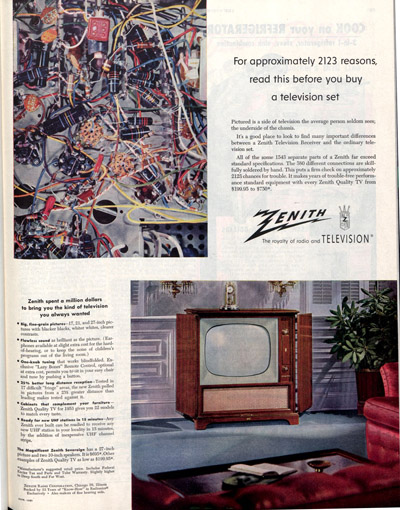
Zenith TV
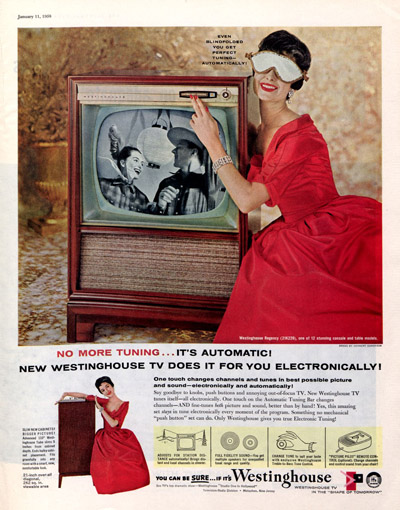
Westinghouse TV
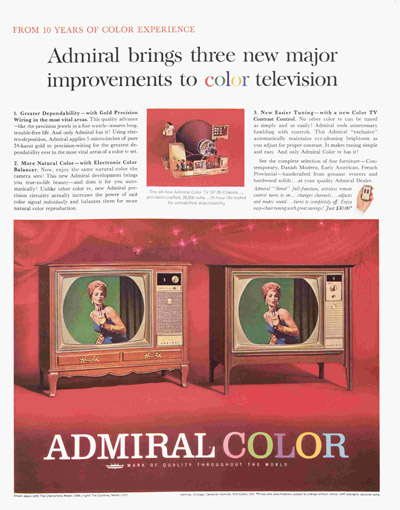
Admiral Color TV
When they weren’t in front of the television, Americans were spending more time on the telephone. The modern phones of 1963 were portable (i.e., no longer fastened to the wall), used buttons instead of rotary dials, and even had speakers so you could talk on the phone with both hands.
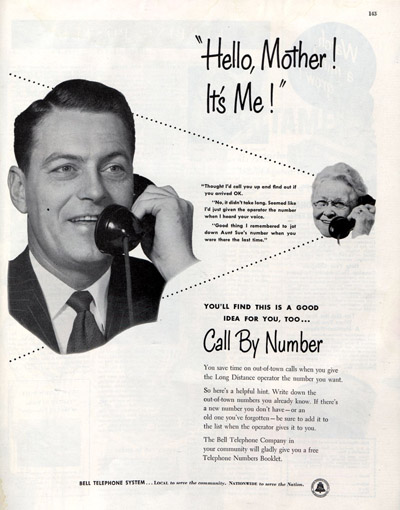
Bell telephone
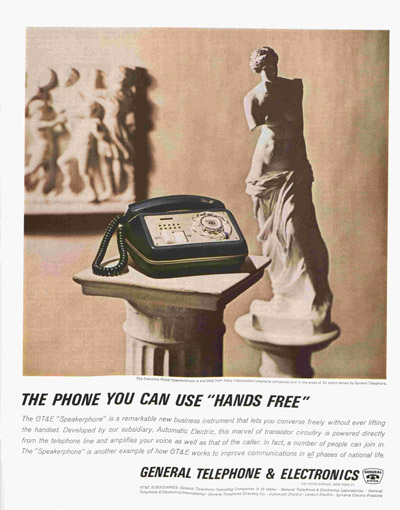
GTE Telephone

Bell Telephone
Most Americans knew little about the schools of modern design, but they could tell that their washing machine, which looked so up-to-date in 1953, now looked dated. The newer models were more compact, more efficient, and available in pink!
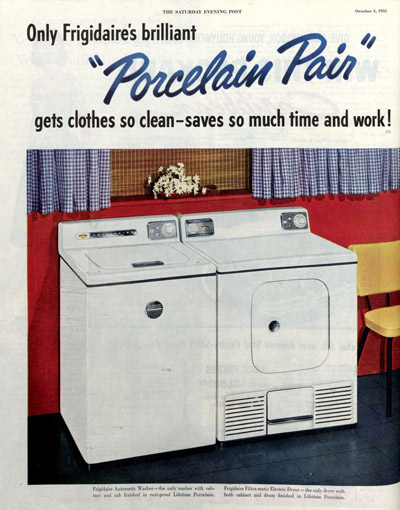
Frigidaire Washing Machine

General Electric Washing Machine

Westinghouse Washing Machine
Transportation was also changing. Flying had once been a luxury only the rich could afford. Now, more and more Americans were crossing the country by air instead of driving the nation’s pre-interstate highway system. Between 1953 and 1963, the annual civilian air traffic rose from 8 million hours to 15 million.
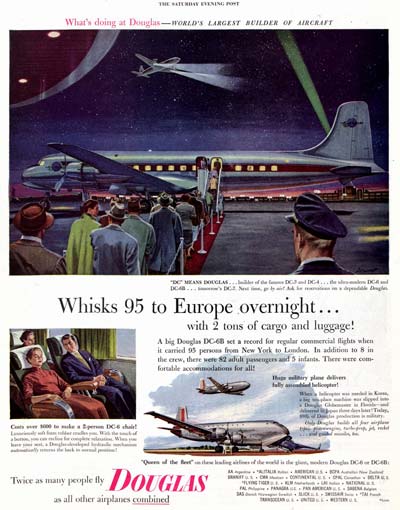
Douglas Airplanes
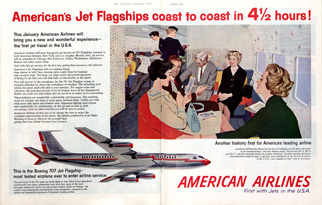
American Airlines
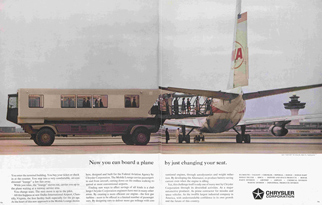
Chrysler
Meanwhile, 94 million American drivers were supporting the nation’s auto industry that turned out over 7 million cars every year. Anyone shopping for a new car in 1963 would have been struck by how much American auto design had changed over the years. The new cars seemed less enthralled with vast chrome grills. They were lower, sleeker, and more aerodynamic. They had lost the corpulent curves and, though still large, they were styled to reflect a modern idea of simple, straight-lined elegance that implied speed even when the car was standing still.
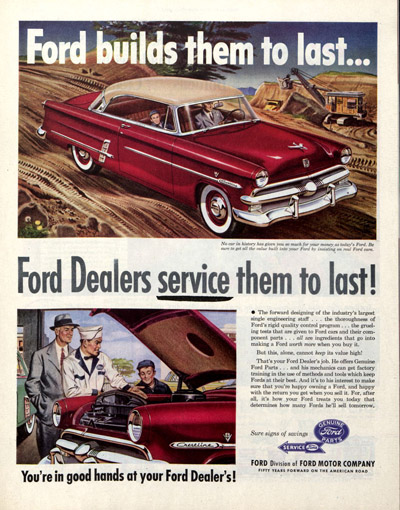
Ford
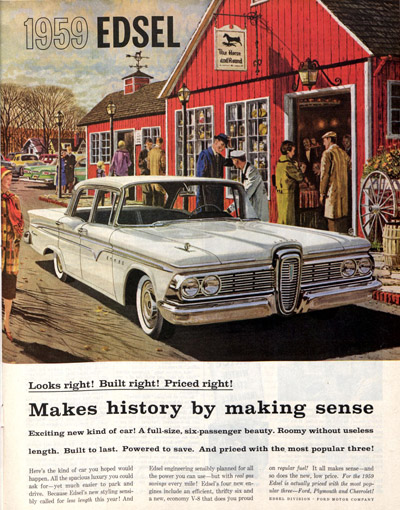
Ford
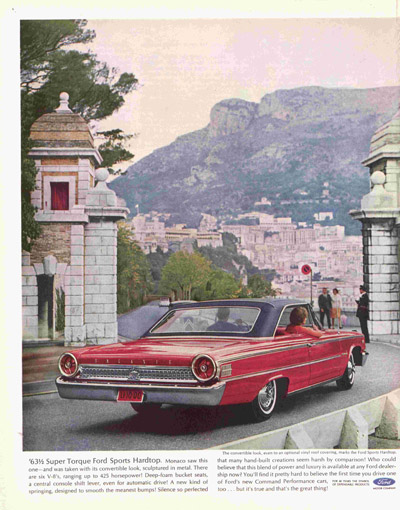
Ford
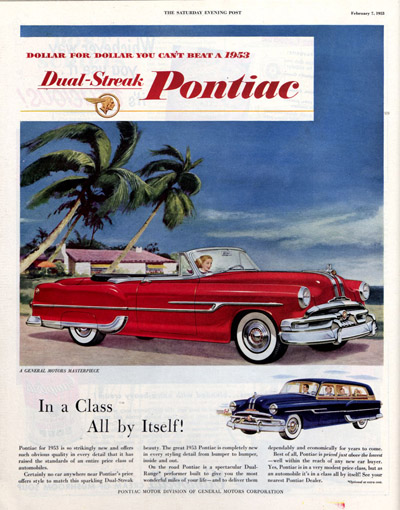
Pontiac
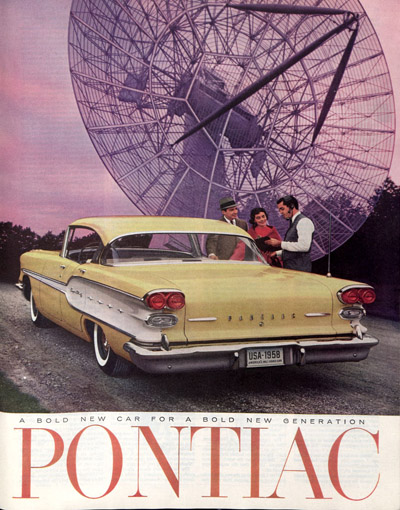
Pontiac
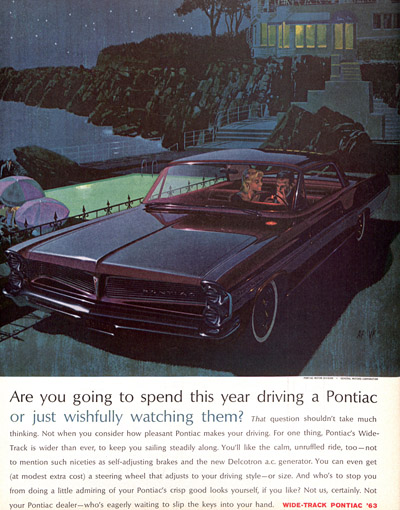
Pontiac
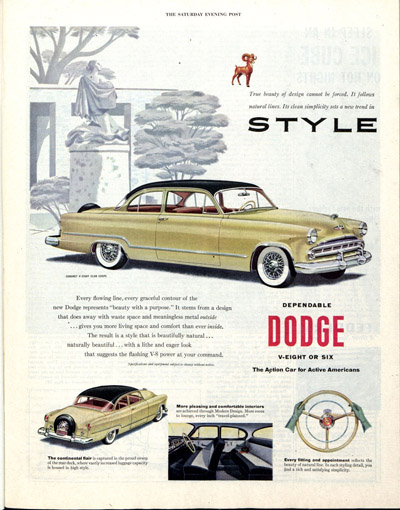
Dodge
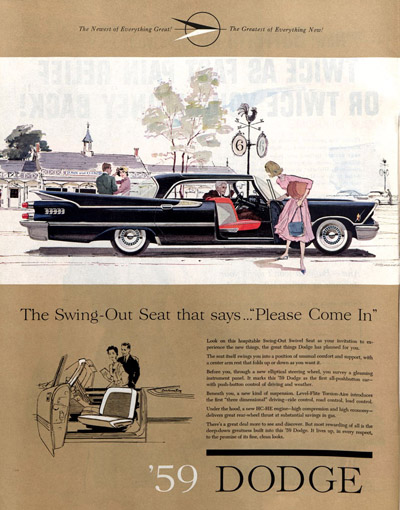
Dodge
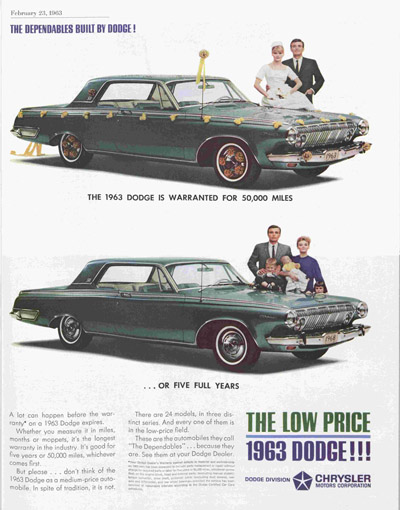
Dodge
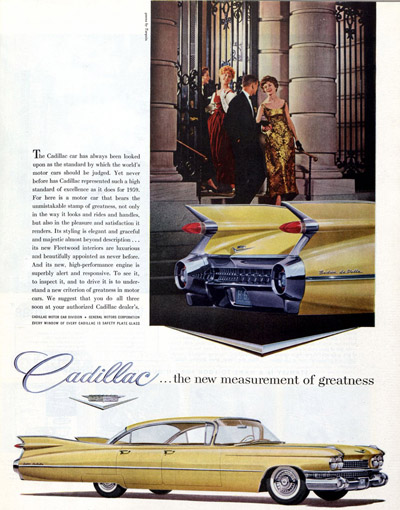
Cadillac
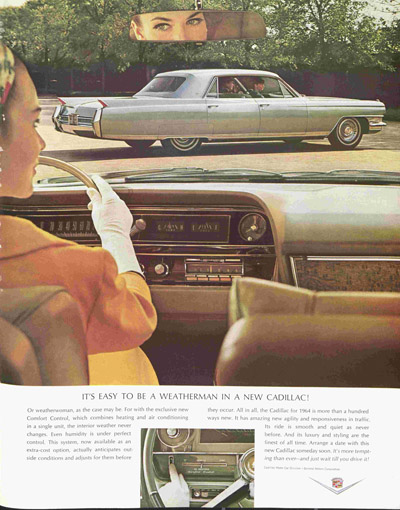
Cadillac
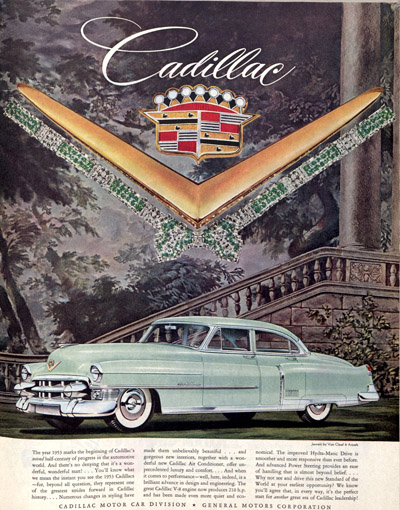
Cadillac
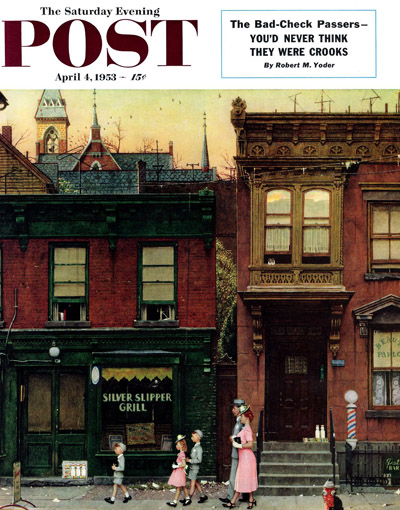
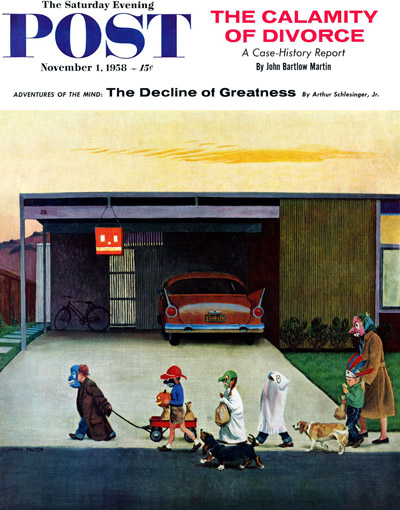
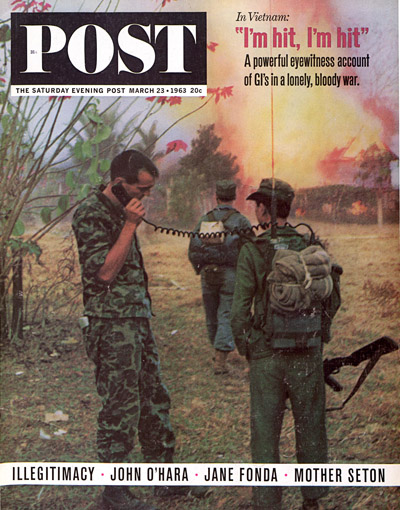
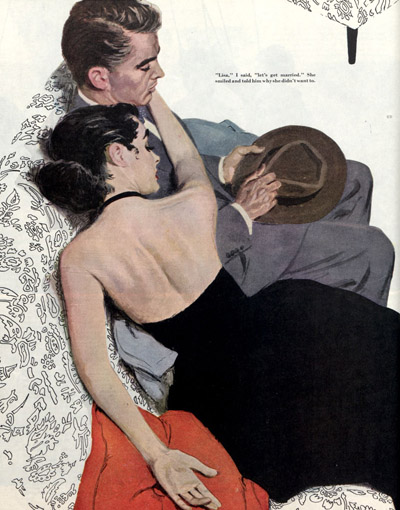
Over 6.5 million Americans would also have seen change in their weekly copies of the Post. Between 1953 and 1963, the illustration style of the magazine became more impressionistic. By 1963, the magazine had changed to meet Americans’ preference for photographic illustration. Most of the covers featured color photos instead of illustration, and many of the articles inside used full-page and color photography.
Once the Post had dictated popular tastes in American entertainment. Now it hurried to catch up with the popular tastes shaped by the new electronic media.
The Saturday Evening Post
The Saturday Evening Post
The Saturday Evening Post
Time Out!

At Mathews Elementary School in Austin, Texas, 10 fifth grade girls are sitting cross-legged on the music room floor with closed eyes and hands folded in their laps, waiting for the egg timer to go off. Jeanne Demers, 47, a campus coordinator for GENaustin—the Girls Empowerment Network—is overseeing this “mindfulness” exercise, which is intended to give today’s text-crazy, over-stimulated, media-saturated kids a quiet, still moment in their hectic days. One girl swings her hair around, another peeks at her friends, but most of them look peaceful. When the egg timer goes off, they journal about what went through their minds during the three-minute “mindful listening” exercise.
Demers, a pretty, bright-eyed woman who looks a bit like Annette Bening, reports that this peacefulness did not come right away. “It was a hard sell at first, suggesting quiet and stillness to some of the girls I work with.”
Demers is trained in something called Mindfulness-Based Stress Reduction (MBSR), a technique developed by Jon Kabat-Zinn at the University of Massachusetts Medical School. The Mathews girls took to mindful practice with interest and openness, but when instructing girls in some of her schools to “put on their quiet, still bodies and sit like queens,” they made every possible excuse why they couldn’t sit quietly with their eyes closed, alone with their own thoughts, for even one minute. They claimed it was “really awkward” and tried escaping to the bathroom, which showed Demers “how much they actually needed this!” Today, when she comes once a week with her Tibetan bowl (“the girls jockey for who gets to ring it this week”) and egg timer, “they won’t let me not do it.” Besides a bit of quiet time, what mindfulness really gives them, she has learned, is the ability to self-regulate their feelings and behavior by giving them a relationship with their own minds. “That,” says Jeanne Demers, “is social intelligence.”
When our Founding Fathers wrote the Constitution, they did not declare that all men are created equal and mindful, but they might well have in light of this growing phenomenon. “Mindfulness” in the form of meditation, yoga, centering prayer, and other mind-body practices, is sweeping across our stressed-out land like a great breath of fresh air. In addition to a growing number of public school districts, major corporations, prison systems, healthcare organizations, arms of the U.S. military—even our representatives on Capitol Hill—are turning to mindfulness practices to help meet the demands of our hyperkinetic world.
According to the World Health Organization, the yearly cost of stress to American businesses is as high as $300 billion. Over the past 30 years, self-reported levels of stress have increased 18 percent for women and 25 percent for men. By all accounts, we have never been more maxed out or deficiently attentive in our nation’s history. Fortunately, help is on the way. “Mindfulness is the next great movement in the United States,” I’m told by Congressman Tim Ryan (D-Ohio). The author of A Mindful Nation, Ryan has become the foremost crusader for higher consciousness on Capitol Hill. When I ask the congressman whether mindfulness practice isn’t a bit, well, esoteric, for mainstream America, Ryan, a good-old-boy type with an easy manner, lets out a good laugh. “Go tell that to the Marines,” he says. “Go tell that to corporations like Proctor and Gamble, Target, General Mills. There is nothing esoteric about it. Mindfulness is completely simple. We’re talking about watching the breath here. There’s nothing un-American about that!”
Last year, Ryan founded what’s known as the Quiet Time Caucus on Capitol Hill. Once a week, 30 minutes of quiet time is made available in the speaker’s chapel just off the rotunda for anyone who wants it. The caucus has been a great success among members of both parties. Ryan explains, “There are no rules. You can meditate, you can pray, or stare into space. The only rule is you can’t talk.” He hopes that learning to be quiet together will help members of our gridlocked government to reconnect and find solutions to the nation’s problems. “There’s a great deal of frustration in Washington right now,” Ryan reminds me. “When our lawmakers can come together, and approach their jobs with a touch of mindfulness, everyone is bound to benefit.”
A mindfulness movement on Capitol Hill? What’s going on here? Something long overdue but not out of the ordinary, if you listen to advocates of the practice. “Mindfulness is an inherent human ability—something that we all have—to be fully attentive to where we are and what we are doing at any given moment,” says Barry Boyce, editor-in-chief of Mindful magazine.
“It’s a methodology that anyone can use,” adds Sharon Salzberg, co-founder of the Insight Meditation Society in Barre, Massachusetts. “You don’t have to have a belief system. It requires no faith or ideology. Mindfulness is as simple as watching your breath.” When she and her colleagues Jack Kornfield and Joseph Goldstein returned from their travels in Asia 35 years ago and began informally sharing meditation practices learned from Buddhist teachers (“just because it was helping us so much”), mindfulness was a movement catering to the chosen few. Today, Salzberg’s nonstop travel schedule takes her to public schools, domestic violence shelters, hospitals, financial institutions, programs to help international humanitarian aid workers, and more. “I never thought I’d live to see the day,” Salzberg admits. “It’s amazing to see what’s happening.”
At Google, Chade-Meng Tan, one of the company’s earliest engineers (and founder of their Search Inside Yourself Program) compares this mainstreaming of “mind fitness” to the early days of the physical fitness movement in the U.S. “In the beginning, fitness was just for ‘nuts,’” says Meng (as Tan likes to be called). “Then in the 1920s, after it was studied, it became an established field. People knew it was good for them and learned how to do it. This revolution will happen in the same way. Mindfulness is ‘meta-fitness.’”
Hundreds of studies conclude that when we spend regular intervals being quiet, emptying our minds, relaxing our nervous systems, and raising awareness of what’s going on between our ears, we are, indeed, happier, healthier, more competent, helpful, empathic, and creative-minded people. Research suggests that mindfulness practices are useful in the treatment of pain, stress, anxiety, depressive relapse, disordered eating, and addiction.
Using the fMRI machine, neuroscientists have deduced that engagement in mindful thinking causes what they call a “left shift” in the brain. This results in increased activation of the brain’s left frontal regions, a process associated with more positive emotional states. Richard Davidson, a Harvard-educated psychiatrist and researcher at the University of Wisconsin, Madison, has studied the effects of meditation on the brain for 30 years. “Mindfulness practices can actually change the function and structure of the brain,” Davidson explains. “We have the ability to regulate both attention and emotion, both of which are more flexible and plastic than we had previously considered. In other words, our behavior can literally help shape the structure and functioning of our own brains.”
Proponents of mindfulness hope that practice will ultimately lead to paradigmatic shifts in how we do business. According to Meng, mindfulness is perfectly compatible with a more enlightened approach to capitalism. Yes, it’ll always be a dog-eat-dog world, but “people play sports among friends,” he points out. “It’s competitive but not in a negative way. The key is to compete in ways that consciously create the greater good. We must remember that the human mind can be fundamentally upgraded in a way that’s good for the individual, good for business, and good for the world all at once.”
“Finding the win-win-win is the way,” agrees Janice Marturano, a vice-president at General Mills and now head of the Institute for Mindful Leadership. “People today are double-booked and living on auto pilot. What I hear over and over again from leaders around the world, when they’re asked what the one thing is that they most need to be the kind of leader they want to be, they all say space. When we begin to transform our organizations and communities, we also transform the way in which we meet our lives.” Marturano suggests that we begin by taking what she calls “purposeful pauses” during the day. “Purposeful pauses don’t add time to your day,” Marturano is quick to acknowledge, “but they do encourage us to find those moments in the day when we can reset. The body gets rest, the mind gets rest, and this space makes a big difference in how exhausted we are at the end of the day.”
Facing a record suicide rate and thousands of veterans seeking treatment for post-traumatic stress, the U.S. military has begun testing a series of brain calming exercises called Mindfulness-Based Mind Fitness Training (or M-Fit). “The data support it,” retired Major General Melvin Spiese told NBC news. Spiese was convinced after looking at the scientific research and taking M-Fit himself. “While teaching troops to shoot makes them a better warfighter, teaching mindfulness makes them a better person by helping them to decompress, which could have lasting effects,” he went on to say. Such as performing more effectively on the battlefield. Such as improving cognitive function. “It’s like doing pushups for the brain,” Major Spiese has said.
Back in Austin, Jeanne Demers is inspired about going even further with mindfulness practice with her clubGEN girls next year. “It’s exciting,” she says, “because they get it. They’re like little scientists, these girls, observing and noticing what they’re giving their attention to. That ability allows for so much—in every aspect of their lives. It’s a total game changer.”
Gorgeous Hudson River Valley

What American artists once considered the center of the universe is only about 125 miles up the Hudson River from New York City. As someone who grew up in the West, maybe I can deal with that, but the fact that the center of the universe happens to look something like a Persian harem house from a 1950s pulp romance cover comes as a complete surprise.
Olana, once home of artist Frederic Church, though, does have exactly the view I’d expected: the Hudson River, in low light, turning the water as silver as the good tableware your grandmother only got out at Christmas.
And that’s what I’ve come here for. That view.
Where I come from, you can go hours without seeing a single person and water is rarely more than a trickle. Put me east of the Mississippi River, though, and I not only feel the urge to jump in, find out what that much wet feels like, but the number of people around starts me feeling like I’ve been jammed into the back of a clown car, and it’s never going to completely empty out.
But there was a moment in history when the east was as empty as the landscape in a John Ford cowboy movie, and it was here, along the Hudson, that the record of the time was captured by a group known as the Hudson River school of painters. Depending on which expert you ask, they were active from maybe as early as 1825, certainly by 1850, and had pretty much all died out or gone on to something else by the end of the Civil War. That was when the world’s concerns had moved on to things other than idyllic views of mountains and rivers and crags and dark forests, the landscape of fairy tales and haunts, of places that have never seen a human footprint. Think of them as the visual equivalents of the transcendentalists in writing—Emerson, Thoreau, Muir, who were working at around the same time.
So I’ve come to look at the views they looked at, see if the landscape is still recognizable. See if we can still transcend.
What the Hudson River school did was paint huge canvases of the wild, a world of towering mountains, skies that never stopped, storm clouds the size of whatever countries their ancestors had fled, waterfalls pouring down like nature had nothing whatsoever to do but be profligate. They put Rembrandt light behind endless forests. And if they put people in their work at all, they were tiny, overwhelmed by the scale, by the size of the world itself. Frederic Church, the big gun of the movement, made some paintings so large that when they went on display, audiences used opera glasses so they could see all the details.
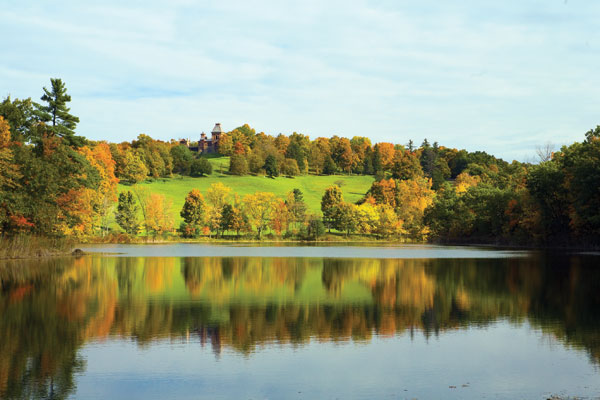
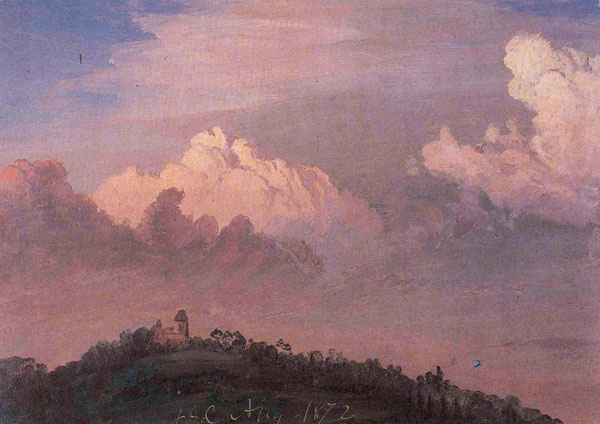
The artist painted the estate and its sweeping views multiple times. (Compare this landscape to a painted version, below.)
And that gave him the money to come here, to Olana, where he built a house only slightly smaller than a shopping mall—and now open for tours. His studio is a long room on one end of the house, Persian-influenced details worked into the walls and ceilings, into the shapes of the doorways. Though he travelled widely throughout his career, once Church created Olana, he stayed as close to home as he could. Why bother to go anywhere else? As far as he was concerned, it was truly the center of the world.
And so he spent much of his life painting the river that dominates the view from the front of the house. Olana is home to an American castle, a huge place for huge paintings of a huge landscape. But it’s a weird contrast to Thomas Cole’s own house, just five or 10 minutes away (and to get between the two, you cross the Rip Van Winkle Bridge, which just because of its name makes me ridiculously happy).
Considering the whole school was Cole’s idea to begin with, it’s odd that his whole house isn’t much bigger than Church’s studio. Cole’s house has a balcony on the second floor with no doors leading out to it; even if you climbed out the window, the view would only be of trees. He owned land clear down to the river, but was happy in this house where he couldn’t see the water at all. Did he spend too much time painting, thinking about it? Was he afraid seeing it day after day would ease its power over his imagination, overwhelm him by scale the way it did Church?
Cole’s 1825 Lake with Dead Trees is usually considered the first true Hudson River school painting. It might, in fact, be the first time anybody ever really looked at the United States and didn’t try to see Europe instead. In fact, that’s what the Hudson River school was all about, and what makes Cole and his cohorts so cool, such rebels: They reversed a thousand years of European painting, where, even in a landscape, people were still the most important feature. The Hudson River school is declaring that on a continent the size of North America, humans would never be more than punctuation marks.
The earliest settlers in the United States tried to map the old world onto the new—hence, New England, New York, New Hampshire, New Paltz. The Hudson River school thought a hundred years of this attempt at building a continental mirror was enough; they were the first to try and see the landscape on its own terms, for itself.
One single view dominates the Hudson River school. In the mid-1800s, painters ran through hundreds of gallons of paint, acres of canvas, trying to get a particular bend in the river, the view from West Point, the landscape from the high defensive cliffs that are now the riverside boundary of the military academy. You can still go see the view from there; security just means there are a few hoops to jump through, a lot of ID to show, and then face the whole question of why, on one of the prettiest spots along the entire Hudson River, the military decided to build such … military looking buildings. Even the cathedral looks as though it sucks in sunlight as joyfully as a black hole.
But what the military fails to provide, the world offers in abundance. It’s autumn, and every tree on the grounds is busy showing how lavish nature can be: spend all summer growing leaves, just to toss them, a million shades of red and orange, across the neatly manicured lawn, as exuberant as finger painting done by a kid who just discovered a new box of paints.
I stand on the point, the river wide and slow below me, coming around a bend like a graceful dancer. I roll an acorn I’ve picked up across my fingers, as if I could feel in its smoothness the water below. The far bank is trees and a wildness that I always forget is possible in the eastern United States—sorry, but if you grow up in the west, it’s hard to believe New York is not paved from border to border like a Walmart parking lot.
Maybe it’s inevitable that over the past few years, the Hudson River school has gotten organized by its descendants and fans. Whereas I count on luck and stumbling across what I’m looking for, now assorted organizations are putting together trails, pilgrimages to the homes, the locations, the views. Every town museum along the way, every college, has a few Hudson River school paintings. You could spend a day just in the museum near Sarah Lawrence, moving from one view of the river to another. The Hudson River School Art Trail has put together a guidebook, a brochure of sites, a chance to bring this movement under control.
But wasn’t it really all about a lack of control to begin with? Weren’t the painters trying to show that the landscape was always going to be bigger than the people, that there was no good way to tame it?

I stop at Kaaterskill Falls, outside Palenville, and near where Rip Van Winkle went to sleep. Cole came here by steamboat passing West Point and planning when he’d paint that before reaching the Kaaterskill cliff. When he got there, he painted the falls from both above and below, and the paintings became so famous that a stop here was as important to early tourists on the river as a look at the Statue of Liberty is to a modern New York sightseer. William Cullen Bryant’s poem on the falls, written about the same time Cole was here, says, “’Tis only the torrent tumbling o’er, / In the midst of those glassy walls, / Gushing, and plunging, and beating the floor / Of the rocky basin in which it falls. / ’Tis only the torrent—but why that start? / Why gazes the youth with a throbbing heart?”
I walk to the edge of the falls, the torrent dropping away beneath me—the friend who drove me clearly wishing I was afraid of heights, his heart maybe throbbing a bit more than mine—and look at a century of initials carved into the rocks at the water’s edge. Through the 1800s, the nearby hotels would sell picnic lunches, and you could come here and pretend you were inside a painting all day. Even stay at the hotels, if you could afford the $2.50 a night, and live inside this new idea of landscape, what was really new about the New World. Size. Light. Room to redefine. When my ancestors gave up their farm in Scotland, walking away from stone fences their ancestors had started a thousand years before, here’s what they came for.
And it begins here, with how a bunch of people saw the Hudson. And how they showed us to look at the river and through that river, the world.
Because we were raised by the Hudson to expect beauty to unroll forever outside, if we truly pay attention, we are seldom, if ever, disappointed. On the Hudson, wrote Henry James, we travel through “the strong silver light, all simplifying and ennobling … of the last classic elegance, overhanging vast receding reaches of river, mountain-guarded and dim, which took their place in the geography of the ideal.”
Right now, I have a hundred miles of river left to see. When Nathaniel Hawthorne went up the Hudson on his way to Niagara in 1835, he said he’d been putting it off because he didn’t want “to exchange the pleasures of hope for those of memory.”
The river an evening silver beside me, I roll down the car windows, wondering where I’ll cross that balance point of hope and memory. Or if I’ll just find the balance point among all the other beauties there are to see in the geography of the ideal.
It isn’t until weeks later, when I’m back home, before I realize I never once touched the water. The view was all I needed, the only sense I really had to fill.
Related: Find out where to go and what to see, plus don’t-miss attractions in the Hudson River Valley.
In the Picture
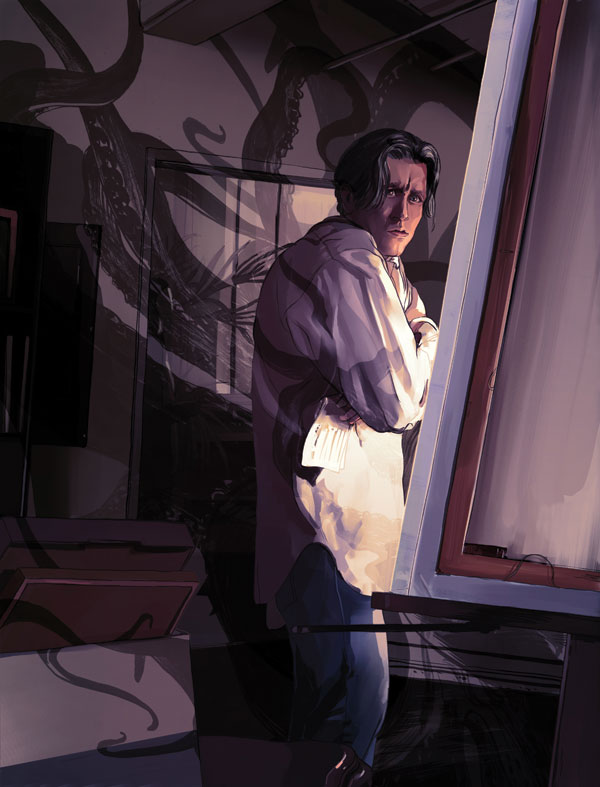
Larry Hogarth stood in his office at the back of the gallery, arms crossed, eyeing his latest acquisition with silent glee. The big canvas, unsigned, unframed, and a little tattered at the edges, dealt with religious themes. Hogarth saw at least three different biblical stories crammed in together, each situated in a different portion of the canvas, yet intertwining and overlapping. Here was Moses, calling down the frogs and flies upon Egypt, and Satan, thrust from heaven in a ball of flame, and Jacob, assailed on his ladder by a faceless long-bodied creature from hell. The painting was in oils, with extensive use of gold leaf, as if to remind the viewer of grim medieval times when such salutary art had been the norm. All that gold, allied to the preoccupation with punishment and cruelty, revealed the piece to be from the hand of J.V. Mortensen, from early in his career, Hogarth was almost sure, when Mortensen was living in Los Angeles, working out of a tin hut on Electric Avenue down in Venice. If Hogarth was right about this, and after all he’d put down actual money in the belief that he was right, this picture could easily be worth $25,000.
Twenty-five grand! thought Larry Hogarth, who was tall, and of uncertain middle-age, still handsome, in a decayed sort of way, but running to fat and with unkempt gray hair that came to his shoulders. His mean slot of a mouth encircled loose and creaky teeth. He had a baggy and slightly pockmarked face, glazed by a film of sweat, the face of a man who wants it all but never much likes what he gets, a man with something fundamentally untrustworthy in his grungy soul.
Twenty-five thousand dollars: however you looked at it, a tidy sum that would help keep the IRS at bay, enable a day or two in Vegas, seed the funding of a couple of new exhibitions, and some much needed dentistry. It could even pay off a little of the alimony his ex-wives clamored for. Those vultures! Maybe he’d forget about the alimony.
“Excuse me, Larry,” said Nora Vazquez, Hogarth’s assistant, standing in the doorway with her customary shy awkwardness. She was a skinny girl with incredible eyes and the tattoo of a rose on her shoulder. “Somebody to see you.”
“Who?”
“I don’t know. She didn’t say,” said Nora, compelled to add: “She’s, like, totally beautiful.”
“As beautiful as you, Nora?” said Hogarth with a twinkle, noting with satisfaction the blush that rose through Nora’s cheeks. Her withdrawn manner hinted at roiling sexual depths. Or so it seemed to Larry Hogarth, that devout opportunist. He was paying Nora’s salary after all. Well, not exactly. She was an intern on vacation from film school at USC. Nobody could deny he was doing her a favor.
“I’ll be right out,” Hogarth said, casting a final glance at the Mortensen canvas, struck by the hellish figure that was tormenting Jacob in the center of the picture. Not a dog, Hogarth concluded, nor yet a leopard or any other kind of dangerous cat. There was something uncertain and vague about the creature, almost as if Mortensen himself, usually such a meticulous impresario of his worlds, had been so haunted by this particular creation that he could not bring himself to finish it.
The woman was slender, with ash-blond hair falling straight and satin-sheeny long. She wore a white silk blouse and tight jeans with just the right amount of expensive fade. Silver rings adorned vermilion-painted toes that peeped out from within soft leather sandals. An actress, Hogarth knew. Megan Something. An Irish name. She’d been big, about 10 years ago, and carried herself as though she still was, with a certain impetuous and airy confidence. Had she landed a part in some new show he hadn’t heard about? Hogarth reminded himself to pay better attention to the trades. Megan Maloney. That was the name. How old was she? About 40, Hogarth reckoned, though she could easily pass for 35. And still exuding that certain sexual something, he had to admit. Her mouth was red as a strawberry.
“Hello! Hello! Hello!” said Hogarth, stepping up and offering his hand, never one to hide the angle of his profession that touched upon the sideshow barker. “How may I be of assistance?”
Megan Maloney’s cool, slender fingers touched Hogarth’s for only a second. She cocked her head to one side with a smile. “This is gonna sound, like, totally weird,” she began, talking like a ditzy teenager. “I’m here for a friend. She doesn’t know I’m here. But I’m, like, here. Because she lost a picture. More like some kind of a painting, I guess. About this big.”
Megan Maloney’s sweetly lotioned hands wafted around, sketching out a largish portion of air.
“Really?” said Hogarth. “What happened?”
“A while back my friend’s husband died in a car crash. He was still young, only in his 40s.”
“That’s sad,” Hogarth said, laying it on thick. Where was the harm?
“It was, like, totally tragic,” said Megan Maloney, shaking her head. “But my friend Lily, she’s been fighting to get past it. Anyway, she decided she needed to clean house a little. So her kids organized a garage sale. And this painting somehow got sold that shouldn’t have been.”
She smiled with a flourish, as if everything had now been explained, and, indeed, Hogarth saw the conversational road ahead.
“It’s by J.V. Mortensen,” Megan Maloney said.
Ah, thought Hogarth.
“I don’t know anything about art, not even what I like,” said Megan Maloney, throwing her amused eyes around at the pictures on the walls of the Hogarth gallery. “But I guess he’s pretty famous.”
“For sure,” agreed Hogarth equably, sucking at a sore spot on his upper left gum. Damn teeth. An insistent reminder of mortality. “Mortensen has a following.”
“He and Lily’s husband were friends. The painting was a gift. Lily’s, like, ashamed because she never really liked it.”
“Why?”
“She says something about it scared her,” said Megan Maloney, raising and dropping her shoulders with a shrug of practiced elegance. “How weird is that?”
“Art can perturb. It should be part of the territory,” said Hogarth.
“No kidding! That painting feels important to Lily now, though.”
I bet, thought Hogarth, picturing the grief-filled widow, greedy for bucks. “I feel for your friend, but I can’t remember when I last saw a Mortensen,” he said. “I’ll ask around. Do you have a photograph of the picture?”
“Well, like, duh – no!”
“A pity,” said Hogarth, stuffing his voice with concern. “That would have been helpful.”
Megan Maloney crossed her arms. She puffed out her cheeks. She was looking at Hogarth interrogatively. “You’re not making this easy, are you?”
“I’m not sure I catch your drift,” he said.
“Let’s face it, dude. You gave a 10-year-old kid five bucks for that picture.”
Hogarth felt his hair prickle and his spine stiffen.
“You stole it.”
All his life people had been telling Larry Hogarth he was wrong, or selfish, or bad, and he did hate to be so accused. He refused to contemplate standing down, or confessing, or even feeling ashamed.
“I think you should leave now,” Hogarth said, bringing his dodgy teeth together with a click. What could this sexy clown of a woman do with her painted little toes?
“Listen, sleazoid, you are so busted,” said Megan Maloney, no longer ditzy, more like a lioness with a toothache. “Hand over that picture — or live to regret it.”
“Threats?” Hogarth made no effort to disguise his amusement. “Get the hell out of my gallery and go get your career back, bitch.”
Megan Maloney raised her eyes to his.
And then time passed. Time must have passed. It had to have. But Hogarth could remember none of it. One moment he was standing on the polished gray stone floor of his gallery with Megan Maloney. The next moment, or it seemed like it was the next moment, his feet remained in the exact same position, but she was gone, and instead he faced the gallery’s shut door and the windows of plate glass that looked out onto the bustle of 16th Street.
Nora Vazquez was where she’d been, behind her little desk in the corner. But was the screen of her iMac glowing brighter, bluer? Had the light in the gallery therefore grown dimmer? Hogarth felt faint and dizzy, as though the physical bits of his brain, the very cells and bones and blood vessels themselves, were shifting and spinning like a broken crystal ball or the inside of a kaleidoscope.
“Are you alright? Do you need a little drinkie?” a voice was saying, the voice of a woman he’d never seen before and hadn’t noticed come in. She called across to Nora Vazquez. “Bring this poor man a glass of water. Or a shot of vodka.”
The Rise of the Black Activists
This is the fifth installment in our six-part series, “The Long March on Washington.” In part one, “It’s Our Country, Too,” we looked at the limited wartime opportunities for black Americans in the 1940s. In part two, “Black Neighbors, White Neighborhoods,” we covered integration in neighborhoods throughout the 1950s. In part three, “Black Students, White Schools,” we reported on integration in the classroom. And in part four, “The Deep South Says ‘Never,’” we covered the White Citizens’ Councils campaign to shut down the movement toward integration.
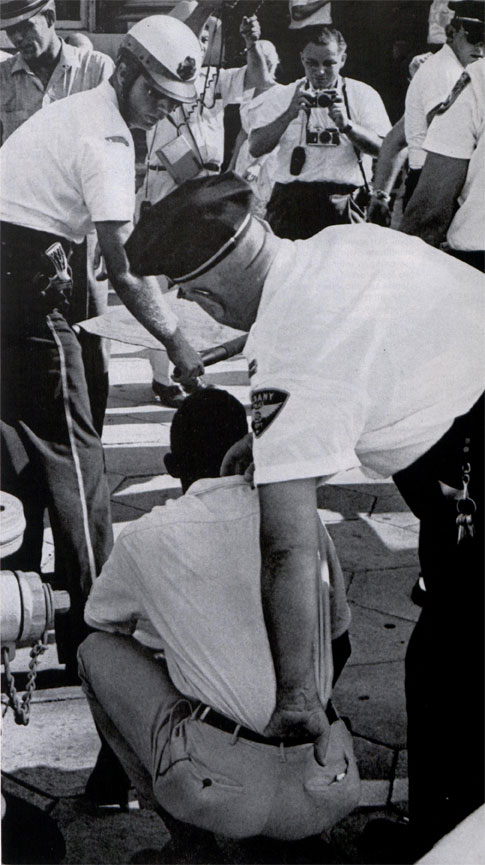
By 1963, the Post was calling it a “revolution.”
In a July 13, 1963, editorial, the authors conceded it was a harsh word. “But there is no denying black forces are drawn up in a battle line that confronts the white man wherever he stands on the principles and practices of segregation.”
Black Americans’ struggle for civil rights had become a revolution, they said, “because the rule of law has failed … the voices of reason have not been heard.” Consequently, the nation had a duty to “accommodate the legitimate aims of this Negro revolution with as little violence and damage to our society as possible.”
Only a few years earlier, the Post’s reporting on civil rights had presented black Americans as generally background players—passive figures quietly enduring centuries of prejudice. All the initiatives seemed to be taken by white politicians or segregation groups like the Klan or White Citizens’ Councils.
But that changed in 1960, as black activists became the protagonists in their own history. As Ben Bagdikian wrote in his 1962 Post article, “Negro Youth’s New March on Dixie,” the country was seeing “the first generation of American Negroes to grow up with the assumption, ‘Segregation is dead.’” And now this new generation had launched a broad offensive in the fight for civil rights.
It began with the sit-in, a form of protest that had been sporadically used since the 1940s. The sit-ins were staged at the lunch counters of drug stores and ice cream parlors, where black men and women would take seats in areas reserved for whites only. They would ask for service and, of course, be refused. They would then remain in their seats, waiting to be served, until the store closed or they were arrested.
In February 1960, four students sat in the whites-only section of a lunch counter inside the Greensboro, North Carolina, Woolworth’s store. They were refused service, as expected. When the store closed that night, they left peaceably. The next day they returned along with 16 more protestors, all of who were refused service. On the third day, 60 protestors showed up. On the fourth day, 300 protestors crowded into Woolworth’s to join the daily sit-in. White customers began avoiding the lunch counter and the store’s business declined. Eventually the store’s owners relented and ended segregated service. The first black customer at the Greensboro Woolworth’s was served on July 25, 1960.
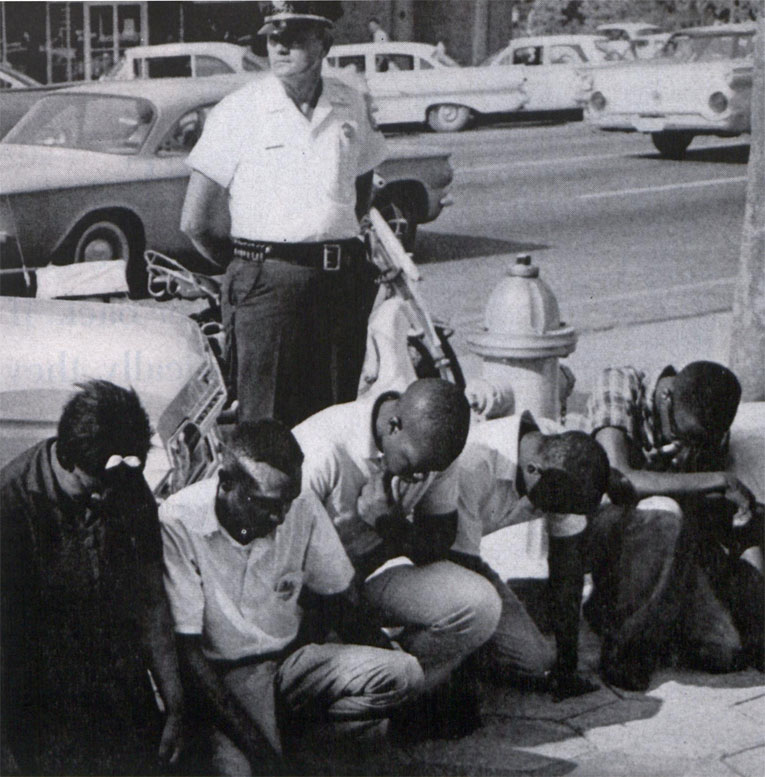
1963 © SEPS
Bagdikian was impressed with the way the black community joined into this activism. In Orangeburg, South Carolina, for example, when students were refused service at a lunch counter, 25 other students from a local college protested. “When their college threatened to expel the students, 500 others marched downtown. When the city said it would arrest all demonstrators, 1,400 paraded silently on City Hall.”
By the first anniversary of the Greensboro sit-in, black protestors had staged 48,000 demonstrations in seven Southern states.
At the same time, a new campaign to help Southern blacks register to vote drew volunteers from across the country. Harvard doctoral student Robert Moses told Bagdikian, “I saw a picture in The New York Times of Negro college students ‘sitting in’ at a lunch counter in North Carolina. The students in that picture had a certain look on their faces—sort of sullen, angry, determined. Before, the Negro in the South had always looked on the defensive, cringing. This time they were taking the initiative. They were kids my age, and I knew this had something to do with my own life. It made me realize that for a long time I had been troubled by the problem of being a Negro and at the same time being an American. This was the answer.”
Moses, then a Ph.D. candidate at Harvard, was one of many black Americans heading south to coach Southern black voters on ways to pass their state’s registration tests. He wound up in Liberty, Mississippi, where 5,000 black voters lived but only one was registered to vote.
While he was committed to non-violent means, his opponents weren’t. On August 29, 1961, Bagdikian reported, “Moses was struck down by a cousin of the local sheriff and beaten on the head until his face and clothes were covered with blood.” A week later, one of his colleagues was kicked to semi-consciousness. A month later, another was shot dead.
The following year, black Americans made a further advance against segregated institutions. After a long fight in the courts, James Meredith enrolled at the University of Mississippi, becoming its first black student. The night he arrived at the university, guarded by U.S. marshals, the campus exploded in a riot. More than 28 marshals were shot and 160 were injured. Two men, a student and a French reporter, were shot and killed, and 200 people were arrested.
But Meredith, like Moses, was undeterred by the violence. “In the past, the Negro has not been allowed to receive the education he needs. If this is the way it must be accomplished, and I believe it is, then it is not too high a price to pay.”
He believed he was working toward a future in which black Americans were fully integrated into society. In the past, he said, they had only regarded themselves, and their accomplishments, in relation to other blacks. “That’s not good enough. We have to see ourselves in the whole society. If America isn’t for everybody, it isn’t America.”
Coming Next: The Dangerous Doctor King
Swift Kick Foods Chocolate Zucchini Bread


The Woodland Park Farmers’ Market has been a staple of summer in Teller County, Colorado, since the market’s inception in 1991. The market has seen tremendous growth in its 23-year history. It is now home to roughly 100 vendors, which include large farms, craftspeople, and entrepreneurs who produce goods from their homes utilizing Colorado’s Cottage Food Act. (The 2012 act modified the definition of retail food establishment in the state’s Food Protection Act.)
This recipe is from Swift Kick Foods owned by Sara Higgins. It has been a favorite recipe in her home for many years and puts a healthy, chocolate twist on traditional zucchini bread.
Swift Kick Foods Chocolate Zucchini Bread
(Makes 1 loaf)
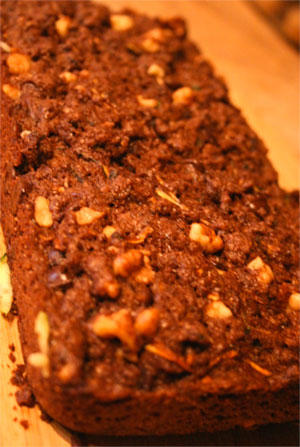
Ingredients
- 1 egg
- ½ cup vanilla yogurt
- ¼ cup canola oil
- 1 ½ cups grated zucchini, squeezed and drained
- ¾ cup rapadura, sugar or other sweetener
- ½ cup all-purpose flour
- 1 cup whole wheat flour
- ¼ cup cocoa powder
- 1 teaspoon baking soda
- ½ teaspoon salt
- ½ teaspoon cinnamon
- ½ cup chocolate chips (if desired)
- ½ cup chopped nuts (if desired)
Directions
- Preheat Oven to 350°F
- Grease a 9” x 5” bread pan or an 8” x 8” square pan
- Combine in large bowl: egg, vanilla yogurt, and canola oil.
- Add grated zucchini and sweetener and mix together.
- Sift together flour, cocoa powder, baking soda, salt, and cinnamon. Then combine dry mixture and liquid ingredients with a few swift strokes.
- If using, stir in chocolate chips and nuts.
- Pour batter into prepared pan.
- Bake 50–70 minutes for bread pan, 30–40 minutes for square pan until done. (Or when cake tester/toothpick inserted into bread’s center comes out clean.)
Tribute to Our Troops Essay Contest Winners
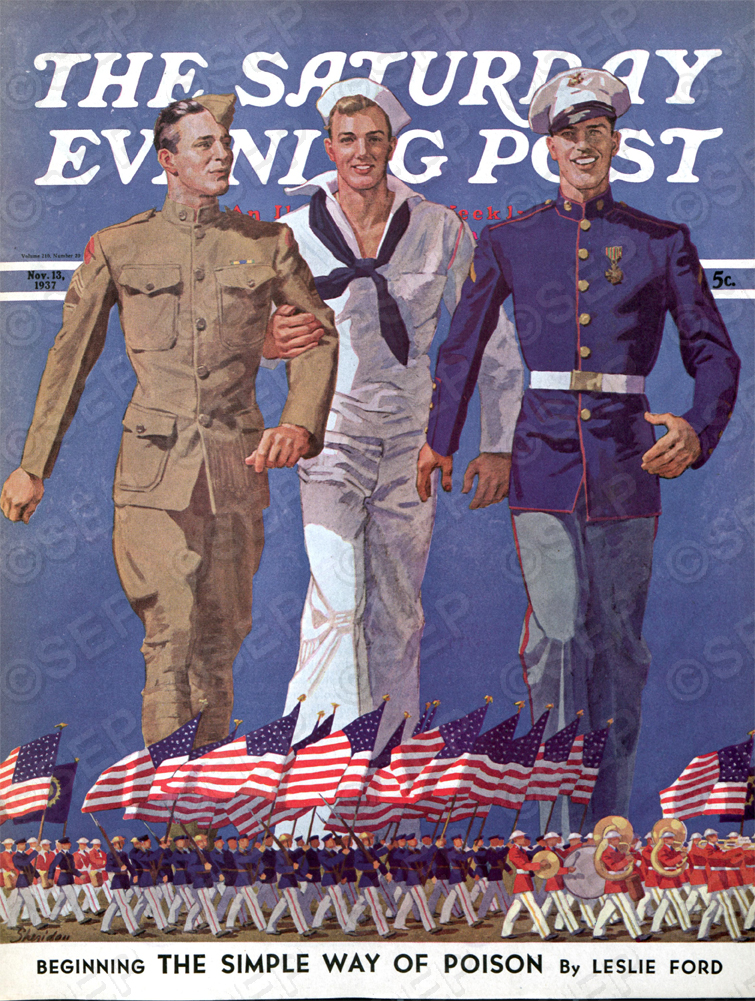
Thank you to all who participated in The Saturday Evening Post’s Tribute to Our Troops essay contest.
“The Saturday Evening Post, for nearly 300 years, has been proud to showcase the American way, and through this contest we honor soldiers past and present who risk their lives every day for our country,” says Steven Slon, editorial director and associate publisher. “We are very excited to present the inspiring tributes from our readers.”
Each of the winners will receive a watch courtesy of our co-sponsor Speidel.
“Speidel is very proud to have been a part of The Saturday Evening Post Tribute to Our Troops essay contest, and we offer our heartfelt thanks and congratulations to each of the winners,” said Lynn-Marie Cerce, co-owner of Speidel. “We would also like to thank all of our loyal customers—many of them Saturday Evening Post readers—who help us provide critically-needed financial support and services to members of the military and their families through our Change A Band, Change A Life™ charitable giving program.”
As part of the program Speidel is donating a portion of all sales proceeds, including purchases made online at speidel.com to Operation Homefront.
The following essays are the top 20 entries selected by the Post editors:
Honor Thy Brother
By Elizabeth Heaney
Walking through the battalion offices, I see a big, broad-shouldered staff sergeant intently focused on a dark blue uniform lying on his desktop. As I watch from the doorway, he leans over and places a narrow silver pin on the uniform’s chest. Before attaching the pin, he checks its placement in all four directions with a measuring device that calculates tiny, perfect millimeters.
After securing the pin, he checks each brass button down the front of the uniform in those same precise millimeters.
He’s wearing delicately thin white gloves on his huge hands, and touches the uniform gently, reverently. I’d seen soldiers prepare their dress uniforms to go up for promotion; this was different.
“Looks nice—you up for promotion?” I say from the doorway.
“No, ma’am. I’m escorting Tompkins’ body back to Iowa.”
Silence stretches between us.
“I’m so sorry you have to do that.” Then I add, “And I’m very grateful you will.”
“I wouldn’t have it any other way, ma’am. He was my soldier.”
Always a Hero
By Anne Linja
Navy Master Chief David Charles Linja—my husband, my hero—was holding my hand as we headed towards his retirement ceremony. There were many emotions and thoughts going through my mind. The most prevalent was “He’s coming home to us, our family. The U.S. may have had his heart, soul, and body for 30 years—and thankfully he stayed safe throughout all those years—but now he’ll be husband, dad, brother, son.”
As we stepped into the elevator, a fellow squid said, “Good morning, Master Chief!”
I responded, “He’s retiring today. It’s his last day.”
The sailor looked at me and respectfully said, “No, ma’am. He’ll always be a master chief.”
My husband suddenly had the biggest grin on his face, full of pride, knowing that he spent the last 30 years doing exactly what he was supposed to do.
Job Well Done
By Kathy Manier
While growing up in Orange County, I was always taught to thank our military for their service but never really had a full grasp of why I was thanking them—except for the obvious reason, fighting for my freedom.
Within the last couple years, I’ve personally come to know many service members, and their stories are humbling to say the least. To them, they are not heroes nor see any need to be thanked. They go to work every day like the rest of us—to do their job as best as they know how—except they don’t always get to come home at the end of the day.
They leave their families for months on end, work through holidays, and take the weight of the world’s problems on their shoulders. They sacrifice their safety, getting shot at, but for them it’s just another day at the office.
So for all the tears before each deployment, the PTSD that becomes the norm, the loved ones that are lost, the weeks of training in the middle of nowhere with no shower or bed, and the endless sacrifices they make on a daily basis, I thank them for their service, for just doing what they consider their “job.”
In the Steps of Our Ancestors
By Debbi Nelson
As a female child born into a lineage of proud males, I was raised on stories of ancestors who fought and died in the great conflicts—dating back to the American Revolution—of these United States. Images of draft cards and photos and the family stories still hold places of honor in my mind. As a youth, I could recite the stories, but, as an adult, I can feel them.
These were gutsy, in-your-face characters that hid their fears and left their families to benefit something bigger than themselves. Some never returned to their mothers or children. Some carried the horrors of war with them for the rest of their lives. But all of them watched with real pride each time the wind was slapped back by the Stars and Stripes. Their lives, and the lives of their comrades, were gifts that will never be forgotten.
Today, in big cities and small towns across this country, the tradition continues. I see young men and women putting their lives on hold in order to put on uniforms. The transportation and technology are different, but the American soldier is still the same, unafraid to defend. May God bless their every step!
No Thank You Required
By Greg Woodburn
After enjoying a wonderful meal on vacation with our two then-young children, we waited for our check.
Ten minutes became 30.
And we finally left without paying, but let me explain: Two businessmen across the room paid our bill, but requested we not be told until after they left. They saw a happy family, the waiter now explained, and simply wanted to do something kind with no thank you required.
Fourteen years passed, and then, last summer when I was leaving a local steak house, a U.S. soldier dressed in camouflage walked in.
“Hi,” I said. ”I want to thank you for all you do.”
“I appreciate that very much, sir,” the authentic American hero humbly replied while shaking my hand.
I wanted to say more, something less trite, but the table for two was ready and the hostess led the strapping soldier and his happy mother away.
I hope they ordered appetizers, wine to celebrate his homecoming, prime rib, plus dessert. And afterwards, I hope they had to wait a good long while, enjoying each other’s company and some laughs—even as they grew a bit impatient wondering where in the world their waiter was with the check.