Mexican Spinach Salad
Raw spinach is varied and versatile. For starters, you can choose from three types of spinach—tender baby leaves; larger, more flavorful flat-leaf spinach; and super-dark, curly Savoy spinach that’s almost meaty.
Not surprisingly, dressings are equally varied: creamy ranch; an Asian combo of rice vinegar, soy sauce and sesame oil; simple olive oil whisked with lemon juice; slightly sweet balsamic vinaigrette; or one with a touch of raspberry vinegar. I even like using the orange Japanese dressings that include carrot and miso.
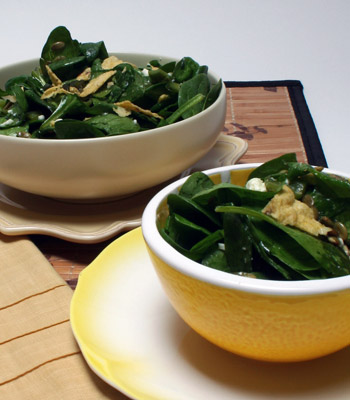
So far, the most unusual spinach salad I have tossed up is this one with Mexican flavors. It includes heat from roasted poblano pepper and crunch from corn chips, along with a shower of crumbled feta, and a sweet-tart lime and honey dressing.
Mexican Spinach Salad
(Makes 4 servings)
Dressing ingredients
- 1 teaspoon honey
- 1 tablespoon fresh lime juice
- 1 teaspoon apple cider vinegar
- ¼ teaspoon salt
- 1 tablespoon canola oil
Salad ingredients
- 3 tablespoons raw pumpkin seeds
- 1 poblano chile pepper
- 6 cups baby spinach
- 3 tablespoons finely crumbled reduced-fat feta cheese
- ½ cup baked corn chips
Directions
- For dressing, in small bowl, whisk honey, lime juice, vinegar and salt until salt dissolves. Whisk in oil. Set dressing aside for up to 1 hour, remixing it before using.
- Set small, heavy skillet over medium-high heat for 1 minute. Add pumpkin seeds to dry pan. Slip your hand into oven mitt, and lift pan, moving it in circular motion over heat to keep seeds moving so they do not burn. When many seeds are golden and some have popped, about 2 minutes, spread them on dinner plate to cool.
- Using tongs, hold pepper over open flame and turn it until skin is charred all over, about 4 minutes. May also char pepper under broiler or over outdoor grill. When pepper is cool enough to handle, with your fingers, slip off charred skin. Halve pepper lengthwise, and use small knife to remove seeds and ribs. Chop half the pepper; set other half aside for another use.
- In large salad bowl, place spinach. Add chopped poblano. Just before serving, pour on dressing and toss to coat spinach and pepper. Sprinkle on toasted pumpkin seeds and feta. A few at a time, lightly crush corn chips over salad. Toss, and divide salad among 4 individual salad bowls.
Nutrition Facts
Per serving
Calories: 130
Total fat: 8 g
Saturated fat: 1.5 g
Carbohydrate: 12 g
Fiber: 3 g
Protein: 4 g
Sodium: 210 mg
Warehouse Chic
Around the country, gritty industrialization is giving way to industrial chic as derelict warehouse districts are being revitalized into thriving art enclaves. These aren’t just hipster hangouts of vegan food trucks and green markets. They’re areas that have undergone a process known in urban planning circles as adaptive reuse. The idea being that structurally sound and historically significant buildings are reclaimed, repurposed, and reborn as the linchpins of creative new zones of commerce and tourism. Credit usually goes to young folks and artists who are drawn to these regions by the low cost of housing. Then, as the districts gain critical mass, preservationists, developers, and urban planners take notice, and previously forlorn neighborhoods evolve into places worth visiting. Art is often still the economic driver, but food and lodging tend to be cutting edge as well. Here are seven once-shunned areas now enjoying architectural and cultural renaissance.
Los Angeles’ Arts District
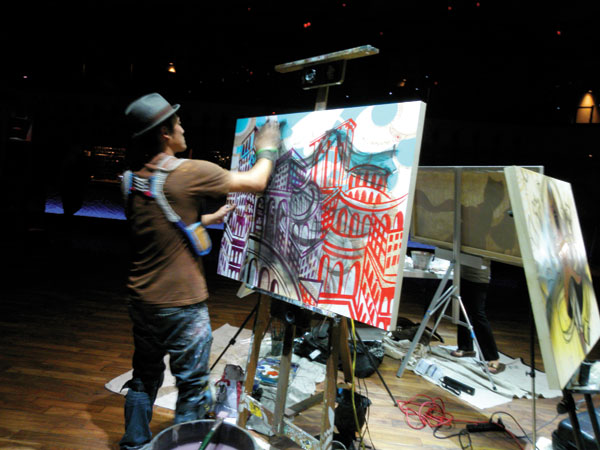
When you spot graffiti-covered walls and giant outdoor murals, you know the Los Angeles Arts District is in your line of sight. This neighborhood of aging warehouses, food-processing plants, and low-rise manufacturing facilities on downtown’s eastern fringe gained traction with artists who unofficially moved into vacant buildings in the late 1970s. The city eventually gave its stamp of approval on these live/work spaces when it passed an Artist in Residence ordinance in 1981.
The billboards on display are the antithesis of the corporate kind you see along the highway. They’re a robust collection of street-art murals including some by Europe’s elite artists: Banksy (England), JR (France), and Aryz (Spain).
As America’s entertainment capital, LA is the place artists from around the globe want to be seen. A few blocks west of where the artists live is where many of their works are displayed in the Historic Core neighborhood. In a city of automobiles, locals joke, the BMW stops here. Only in this area will you see 40,000 Angelenos get out of their cars and talk to each other face to face.
When to go: Second Thursdays of every month for the Downtown LA Art Walk.
Where to eat: Bäco Mercat, a small-plate favorite. Try one of the stuffed flatbread sandwiches with a glass of custom-made tamarind and mango pop. (408 S. Main Street; 213-687-8808; bacomercat.com)
Where to stay: AirBnB is the place to experience life in a true downtown loft for less than the cost of a hotel. (airbnb.com)
Don’t miss … a nightcap at The Varnish. Head for an unmarked door at the back of Cole’s restaurant for a vintage cocktail at this speakeasy-style watering hole (118 E. Sixth Street; 213-622-9999; 213nightlife.com/thevarnish)
The End of Dot and Dash?
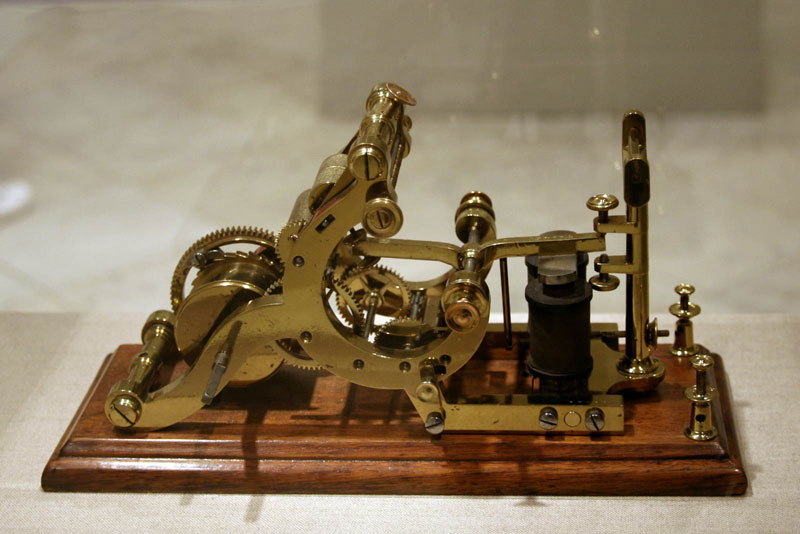
It was supposed to be the end of an era. On Sunday, July 14, 2013, according to news sources, a communications worker in India would transmit the last commercial telegram.
Thus would end an epoch that began 169 years ago, on May 24, 1844, when American inventor Samuel Morse sent the first telegram from Washington, D.C., to Baltimore. You may remember that the words of that momentous first telegram were taken from Numbers 23:23, “What hath God wrought.” The first words sent over a commercial telegraph line were not quite so reverent.
That line was strung between Lancaster and Harrisburg, Pennsylvania, by a company under the direction of Morse’s associate, Henry O’Reilly. A few years later, the Post published an account of the telegraph’s early construction:
Magnetic Telegraph
August 5, 1849
Gen. Moorhead, President of Atlantic & Ohio Telegraph Co.We were looked upon as denizens of another world, come to break the quiet, honest industry, and sobriety of Pennsylvania. Then it was mooted abroad that a pigeon had been killed on the wires, that birds had been found dead underneath it, explosions had been heard in the office, and a humming sound had been heard at midnight from the poles as if some divinity held converse with the winds at that lone hour, and the terror increased.
One frightened matron, it was said, fenced a pole carefully, to keep her cow from the contagious touch that would spoil her milk and bewitch her head. Others carefully watched in the distance to see the developments of this last iniquity …
The first foot of wire was erected on a fine, star-lit morning, upon a pole adjoining the outer bridge at Lancaster, the 10th of November 1846 and kept moving on until the evening of Thanksgiving Day. With the snow blowing piteously through the almost naked streets of Harrisburg, four hungry, dirty, unkempt, and unshaven men [stood] near the railroad depot, with an empty reel and wearied hands, hitching the last thread of the mystic line to the post opposite its destined termination.
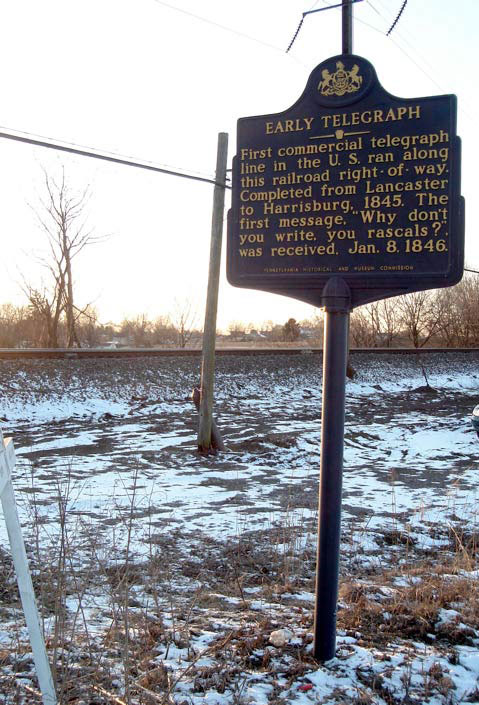
On New Year’s Day, 1847, O’Reilly was ready to send his historic first telegram. Its message, now captured on a historic marker beside a Pennsylvania highway, read, “Why don’t you write, you rascals?”
It may not be easy for us to comprehend the miraculous impact of the telegraph on the world of the 1840s. It could spread news in minutes that previously would have taken weeks or even months to reach the villages and towns along America’s frontier. As early as 1846, historian Donald S. Frazier writes, “The implications [of the telegraph] for the U.S.-Mexican War were profound. … News from the front arrived in just a few days, and politicians and generals alike could react rapidly to changing circumstances. The public kept abreast of news and supported the war to a greater or lesser degree based on the latest reports …”
Although the telegraph brought fame and wealth to Morse, he had endured years of poverty and frustration before its success, and then had to fight off others who claimed it as their own invention.
In fact, in January of 1839, the Post has seemingly endorsed the cause of one such claimant: “The invention of the Electro Magnetic Telegraph, claimed by Mr. S.F.B. Morse of New York, appears to be entirely due to Dr. Chas. T. Jackson, of Boston, who conceived the idea of such an instrument during his return voyage from Europe, in the packet-ship Sully, in October, 1812.”
Jackson first made his claim in the Boston Post (no relation), alleging that he had “freely communicated” all the details of his telegraph to Morse, who “pretended to feel a great interest in the invention.” Morse denied Jackson’s claim, and ultimately, the U.S. Patent Office denied the doctor any rights to the patent. The decision was just one in a series of setbacks for Jackson, who made several unsuccessful claims to other men’s discoveries throughout his career.
Now, we are told by news sources, the telegraph is passing into history. Yet the telegram will live on. Even after the last message is sent over the wires in India, several companies, which are easily found on the Internet, will still provide telegraphic services; that is, they will deliver your message, on paper, within 24 hours. Farsighted Morse would probably not be surprised to see that even in an age of texting and emailing, people sometimes still need to have their words delivered by hand.
Curried Pasta

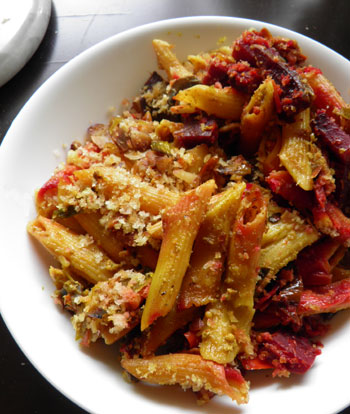
When you’re buying from your farmers market and from other local sources all year long, sometimes it can be hard to find a good recipe for the seasonal produce that’s available. But curried pasta easily handles it all. The picture accompanying the recipe below shows a curry of red beets and leeks, but you can substitute any combination of vegetables using the guidelines below to make this delicious meal.
Curried Pasta
Ingredients
- 2-3 pounds vegetables, equal amounts root crops, allium crops, and greens
- 4 tablespoons coconut oil
- Curry spices (recipe follows)
- 1 pound pasta, cooked, drained, and rinsed (use thicker noodles that will hold sauce, such as elbow, penne, or gemelli)
- 14-ounce can first-press coconut milk (should be about ½ cream)
- 12-ounce can evaporated milk
- 1-2 cups stock
- Topping (recipe follows)
Curry spices
- 1 tablespoon cumin powder
- 1 tablespoon coriander powder
- 1 tablespoon mustard seed
- 1 tablespoon turmeric powder
- 1 tablespoon ginger powder
- 2 tablespoons salt
- ½ tablespoon granulated garlic
- ¼ teaspoon cinnamon powder
- ⅛ teaspoon cloves powder
- Pinch chili pepper flakes or to taste
Topping
- ½ cup butter
- ½ cup almond slices
- 1 cup panko bread crumbs
Directions
- Wash vegetables. Chop alliums and roots, place in large bowl and set aside.
- Chop greens, placing thick, fibrous stems in large bowl with alliums and roots. Place leaves and thinner stalks in smaller bowl and set aside.
- In separate bowl, combine curry spices. Set aside.
- In wide, deep sauce pan, melt coconut oil and add curry spices. When it starts to bubble, add chopped allium, roots, and fibrous greens. Bring them up to temperature until they begin to soften (about 5 minutes).
- Add coconut milk and evaporated milk to curried vegetables. When it begins to bubble, remove from heat and add greens, allow to wilt.
- Add 1-2 cups of stock, depending on desired thickness of your sauce.
- In 10″ x 14″ x 3″ baking dish, pour pasta and curried vegetables. Mix thoroughly. Set aside.
- For topping: In sauce pan, melt butter over medium heat. Add almond slices and panko, and stir continuously until butter is completely absorbed (about 2 minutes).
- Spread topping evenly over the dish, and bake in oven at 400°F for 20 minutes or until top starts to brown.
- Let rest for 15-20 minutes before serving.
March/April 2013 Limerick Laughs Contest Winner and Runners-Up
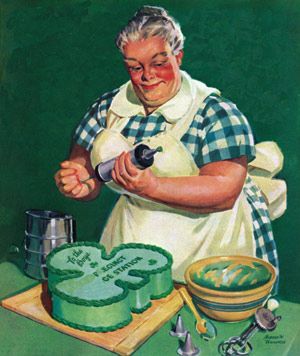
I’m making this cake for a few
Of all of our brave lads in blue,
For Casey and Ryan
And Patrick O’Brien
And all of the other cops too!
—Philip Lindal, Yale, Michigan
Congratulations to Philip Lindal! For his poem describing the illustration by Albert W. Hampson, Philip wins a monetary award—and our gratitude for a job well done. If you’d like to enter the Limerick Laughs Contest for our upcoming issue, you can submit your limerick via the entry form here.
Of course, Philip’s limerick wasn’t the only one we liked! Here are some of our favorite runners-up, in no particular order:
Old, gray, but still a bit frisky,
Not afraid to do something risky,
She’d win their hearts over
When inside the clover
They find the fine pint o’ whiskey.—Ken Elinsky, Solon, Ohio
Had a cake, made from scratch, it was true,
For the boys, who worked hard, wearing blue.
As I tripped at the door
And the cake hit the floor,
There was nothing to say but “Boohoo!”—JoAnn White, Watertown, New York
Ms. O’Malley did make a great cake
For the boys at the station to take.
And her boy in the clink
Should be out in a blink.
One bite, and they’d know their mistake.—Mark Blackwell, Mt. Pleasant, South Carolina
This woman, though not very lean,
Is this year’s St. Patrick’s Day queen.
Does her cake have a hint
Of lime or of mint?
Who cares, just as long as it’s green.—Neal Levin, Bloomfield Hills, Michigan
My neighbor, Miss Brigid O’Connor,
Baked shamrocks in Saint Paddy’s honor.
The pretty green icing
Turned out quite enticing,
Since good fairies’ spells were upon her.—Caroline Sposto, Memphis, Tennessee
Oh, she was an expert cake maker,
An icer as well as a baker.
But seeing her size,
We can all surmise
That she was an often partaker.—Cornelius Jonker; Grand Rapids, Michigan
The police well-deserve this cake treat.
Her inscription sure made it complete.
This shamrock design
Will suit the cops fine,
But it’s almost too pretty to eat!—Mary Collins Ryan; Bradford, Pennsylvania
A labor of love, this creation,
For “my boys” down at the station.
Takes hours to make
This type of cake,
But I am so proud of their dedication.—Virginia Wilson; Port Orange, Florida
Mustard Chicken with Summer Vegetables
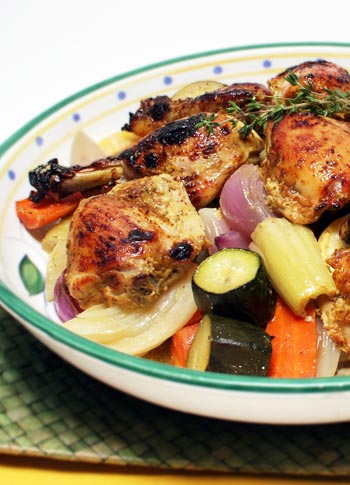
Convenient and easy to prepare, this dish makes a great complete summer meal. It also allows you to combine the best of the garden into a single dish.
The fennel with its subtle anise taste adds an unexpected flavor twist to the roasted vegetables. The smaller fennel bulbs are less fibrous, but if you have large bulbs, you can peel off the outer layers for more tender pieces. The much underutilized fennel has a storied past. It was reportedly Thomas Jefferson’s favorite vegetable.
Note: When it comes to summer vegetables, the term “new potatoes” is often confusing. They are not a separate variety of potato, but merely immature or younger versions of other varieties. Harvested during the spring and summer, the skin of new potatoes is generally thinner than the skin found on older ones. Not surprisingly, they are rarely peeled before cooking. Because they are small, they blend well with other vegetables and are perfect for roasted dishes.
Mustard Chicken with Summer Vegetables
(Makes 4 servings)
Ingredients
- 4 tablespoons stone ground mustard
- 2 tablespoons reduced-sodium soy sauce
- 4 chicken legs, skin removed
- 4 chicken thighs, skin removed
- 1 medium fennel bulb, cut into 1-inch wedges
- 2 small yellow squash, sliced 1 ½-inch thick
- 2 small zucchini, sliced 1 ½-inch thick
- 4 carrots, sliced in half lengthwise
- 4 celery stalks, sliced into 2-inch pieces
- 1 red onion, cut into 1-inch wedges
- 8 whole new red potatoes or 4 small red potatoes, halved
- 4 sprigs fresh thyme
- 1 tablespoon olive oil
- Salt and freshly ground black pepper
Directions
- Preheat oven to 400°F.
- In large mixing bowl, whisk together mustard and soy sauce. Add chicken and coat well.
- In large baking pan, arrange fennel, squash, zucchini, carrots, celery, onion, potatoes, and thyme. Brush vegetables with oil and season with salt and pepper to taste. Place chicken over vegetables. Brush chicken with mustard sauce. Cover pan with foil and roast for approximately 50 minutes, or until chicken is cooked through and vegetables are tender. Remove foil, increase oven temperature to broil and roast another 4-5 minutes to brown vegetables and chicken. Serve.
Nutrition Facts
Per serving
Calories: 400
Total fat: 12 g
Saturated fat: 3 g
Carbohydrate: 40 g
Fiber: 7 g
Protein: 28 g
Sodium: 460 mg
The Bionic Man Is Real!
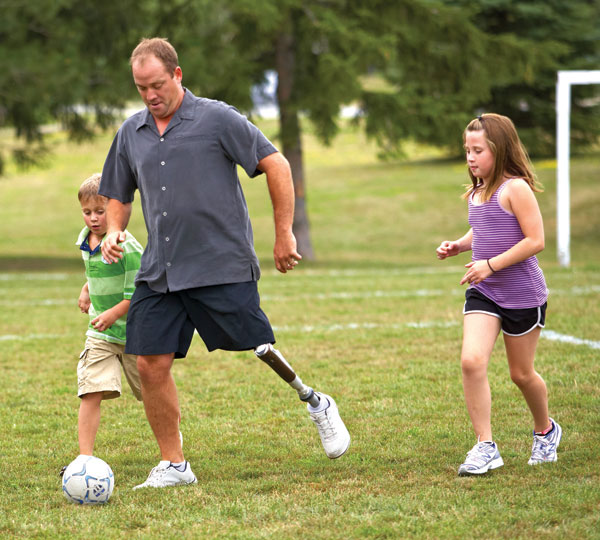
The freak accident that upended John Voelpel’s life happened so fast he barely had time to react. As the attorney drove to Tampa, Florida, to have dinner with friends, an intoxicated driver—a speed demon doing 85 in a 45 mile-per-hour zone—slammed into his car head-on. Despite the shock of the collision, Voelpel’s prognosis didn’t look so bad initially: He’d sustained a compound fracture in his right foot. He anticipated a gradual recovery, but complications kept getting in the way. “I developed a bone infection as a result of the compound fracture, and I never got extension in my knee after months in physical therapy,” he says. “I decided it was time to get on with life.” His doctors agreed, and they amputated his right leg above the knee.
After Voelpel recovered from his operation, he learned to use a prosthesis called the C-Leg from German manufacturer Otto Bock. While it was functional enough to get him from place to place, it never really felt like part of his own body. So when University of South Florida (USF) physical therapist Jason Highsmith invited Voelpel to enter trials of the Genium—an Otto Bock leg with a new microprocessor-controlled knee—he readily signed up.
Voelpel wasn’t sure what to expect when he showed up at USF for his Genium-powered leg. But as he maneuvered through a series of everyday tasks in the lab, including walking on level and inclined surfaces, loading washers, and carrying groceries up and down stairs, he started to realize just how responsive his new knee was. Not only was he able to ascend stairs, something he’d never been able to do with the C-Leg, he could walk comfortably on uneven terrain.
Voelpel’s newfound mobility got him thinking about a level of activity that would have been inconceivable before. Like hiking a steep forest trail, taking an overnight backpacking trip—so many options! “In terms of matching the natural gait and rhythm of my sound left leg, the Genium is at least twice as good as the C-Leg,” he says. “It has truly made a wonderful improvement in my life.”
When Luke Skywalker donned a cybernetic hand in The Empire Strikes Back to replace the limb he’d lost in a duel with Darth Vader, fully functional prostheses seemed squarely in the realm of science fiction, and would remain there for quite some time. As recently as 2009, inventor Dean Kamen recalled what a senior military surgeon had told him years before: “At the end of the Civil War, they were shooting each other with muskets. If somebody lost an arm, we gave them a wooden stick with a hook on it. Now, we’ve got F18s and F22s, and if somebody loses an arm we give them a plastic stick with a hook on it.”
In the past few years, though, prosthetic technology has progressed far beyond simple stick-and-hook designs. The newest prostheses, both commercial and experimental, closely mimic natural limbs in function and responsiveness, and they’re proving their worth in everyday tasks, combat missions, and Olympic races alike. By detecting users’ intent and adjusting accordingly, the most sophisticated replacement limbs can make almost as many complex movements as wearers can imagine. “Everything is intuitive,” says Levi Hargrove, director of the Neural Engineering for Prosthetics and Orthotics Laboratory at the Rehabilitation Institute of Chicago. “Patients are able to walk around normally as if they’re using their own legs.”
Of course, let’s face it, America’s wars have moved the dial on prosthetic research: “Conflicts that produce limb loss do accelerate advances,” says John Fergason, a prosthetist who works with returning veterans at Brooke Army Medical Center (BAMC).
The 450-bed facility where he works is a tan behemoth that rises up from the rolling plains outside San Antonio, Texas. There, amputees injured in far-flung places like Iraq and Afghanistan converge on the center to undergo rehabilitation and to prepare themselves to re-enter normal life. The first step is making molds of their “residual limbs”—whatever remains of the original part, known as the stump. Technicians then scan these molds and import the data into special computer programs to design artificial limbs perfectly fitted to the contours of the wearer’s body.
One of the most significant advances in the past decade has been the emergence of powered prosthetic joints. “Now you have devices that are battery-operated and will generate power and push-off. The joint is pushing off the ground for you—you’re not lifting dead weight,” Fergason says. Another big boon to returning vets are microprocessor-controlled artificial limbs, which allow users to perform a dizzying variety of physical feats. Fergason says he now makes most adjustments to patients’ artificial limbs using Bluetooth. “I can control the swing rate, how much resistance [the leg] will give when they’re descending a hill, make it lock in any position, make it free swing.”
After soldiers are fitted with their new prostheses, they embark on intensive physical therapy and training geared toward helping them become comfortable with the replacement limbs. “It can take weeks to a couple of months to maximize the use of a microprocessor knee,” Fergason says. That’s because wearers have to become intimately familiar with the intricacies of the device: exactly how the knee reacts when they move their artificial leg forward to take a step, how it flexes when the heel strikes the ground.
‘Coming Generations Will Call You Blessed’
This is the last installment of our six-part series on the Civil War, marking the 150th anniversary of the Battle of Gettysburg. To recap: In part one, “The News from Gettysburg: A Hazardous Move,” we described how the Post reported the initial news of the invasion. In part two, “Scrambling for Soldiers,” we looked at the renewed attention to the draft. In part three, “Americans United to Support the Civil War Troops,” we covered the Sanitary Commission, an organization of Union women volunteers whose fight against disease helped save thousands of soldiers’ lives. In part four, “Where the Civil War was Won,” we looked at the Post’s war coverage from the battlefield. And in part five, “Little Women Among the Causalities,” we shared a harrowing description of Louisa May Alcott’s work as a Civil War nurse.
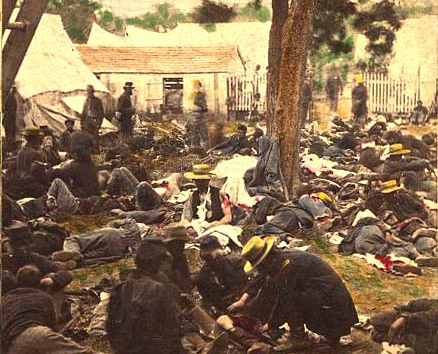
courtesy of the Library of Congress.
One week after the Battle of Gettysburg, the Post’s “Sanitary Commission Department,” a column that reported on the group’s extraordinary work, printed Dr. W. H. Bowman’s moving testimonial to the commission.
The letter is especially impressive because Bowman, a surgeon in the 27th Illinois Infantry, started out with a prejudice common among military doctors against civilian volunteers in their hospitals. But after seeing how much his patients benefitted from the commission’s services, his resentment changed to gratitude.
Bowman saw the Sanitary Commission as a sign of a civilization’s progress and a reflection of a unified spirit that could not be defeated.
Bowman’s idea that mankind had entered a new epoch because of this new effort by volunteers may seem extreme. Yet he had a valid point. Americans were no longer content to let their soldiers struggle and suffer alone on the battlefield. Thousands of volunteers committed themselves to “mitigate the horrors of war” by supporting their fighting men directly. It was the beginning of a 150-year-old tradition, continued by countless organizations today.
Camp Shaeffer, on Stone River
Tenn.
April 30, 1863Dr. A.L. Casleman—
Dear Sir;
Having had some practical acquaintance with the working of the Western Branch of the Sanitary Commission for nearly twenty months, I deem it my duty as a surgeon in the army to express the high appreciation I feel of the efficient and benevolence of your organization.I was, I confess, considerably prejudiced against the operation of the Commission at the start.
In the autumn of 1861, the approach of cold weather, coupled with the fact that my supply of bed clothing was entirely insufficient to keep my sick comfortable, led me to look around anxiously for the means to meet the emergency. Government supplies were not available. At this time your Commission, co-operating with the good ladies of our state, stepped in and supplied the want, which Government, with the immense demand on its energies and resources, had not been able to meet.
Our shivering sick were made comfortable, and I was relieved of a heavy care. I have never ceased to be grateful.
This spring when scurvy appeared in our commands, your Commission furnished us the first and most efficient means for combating it, viz: fresh vegetables. Government is doing its best now but red tape tangles the feet of benevolence.
The many home comforts which, through you, have so promptly reached the sick and wounded in the field, and which could not have been otherwise supplied, have made us feel that patriotic benevolence is a power in the land, and the Sanitary Commission its legitimate mode of expression in the army. You have encountered immense obstacles in your progress, and nobly surmounted them.
Much benevolent, self-denying contributions, doubtless have been wasted in the commencement, owing to want of knowledge of what was most needed and the best way to apply the means. Sometimes it may have been unfaithfully used by unprincipled surgeons. But I think the instances are much more rare than has been imagined.
Our profession has been much slandered in the army. Mean, unprincipled men do sometimes get into our hospitals as patients. When their appetites are held in restraint by the judicious surgeon he is often doubtless maliciously charged with using for himself what he prevents them from unwisely or selfishly consuming.
In the providence of God, good and evil seem to go side by side, that mankind may see and learn the beauty of the one and the hideousness of the other. Your Commission, noble and pure as are its objects and labors, seems to be no exception to this general law.
History will note the advent of your organization as an epoch marking the advance of mankind to a higher civilization and coming generations will call you blessed.
It is the first systematic organized national effort, by voluntary agencies and contributions, to mitigate the horrors of war that the world has ever witnessed. A nation with such an interior life cannot be destroyed. The world cannot do it. God, the Infinitely Just and Loving, will protect such a people.
Go on then in your good work. The time will come when those who have refused to assist, will be ashamed to have it know that they stood aloof. The self-denying contributions to the relief of the brave defenders of the nation’s life will enjoy abundant recompense in the appropriation of the good, and conscious of having acted in harmony with the noblest impulse of humanity
W.H. Bowman
Surg, 27th Ill
and Brigade Surgeon
3rd Div 20th Army Corps
Peachy Mustard Pork Chops
Preserve summer peaches for this quick and delicious entree. To make it a meal, serve chops with grilled red onions, mashed sweet potatoes, and sliced tomatoes and cucumbers. Tip: Remember to baste throughout the cooking process to keep the meat moist.
Peachy Mustard Pork Chops
(Makes 4 servings)
Prep Time: 5 minutes
Cook Time: 10 minutes
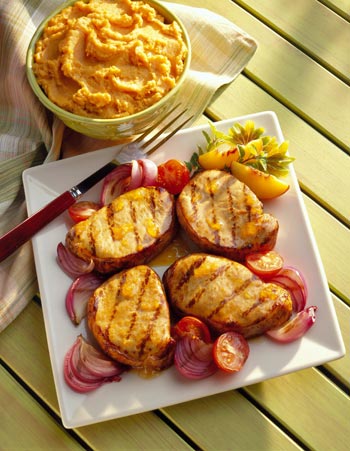
Ingredients
- 4 pork chops, ¾-inch thick
- ¼ cup peach preserves
- ⅓ cup honey mustard
- 2 tablespoons lemon juice
Directions
- Stir together preserves, mustard, and lemon juice.
- Grill chops over a medium-hot fire, turning occasionally and basting with sauce, just until done, 8–9 minutes until internal temperature on a thermometer reads 145°F, followed by a 3-minute rest time. Discard any leftover basting sauce.
Nutrition Facts
Per serving
Calories: 254
Total fat: 9 g
Saturated fat: 1 g
Carbohydrate: 24 g
Protein: 25 g
Sodium: 180 mg
Recipe and photo courtesy of the National Pork Board.
Roman Style Broccoli Sauté
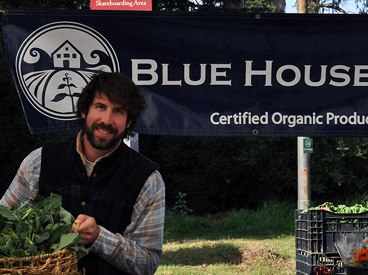
Photo by Anna Buss
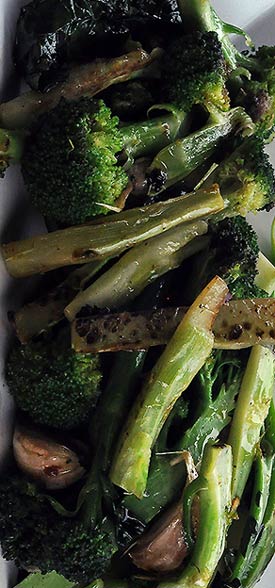
Often when people are preparing broccoli, they think that the only usable part is the floret. But surprisingly enough, the stem and the leaves offer a depth of texture and flavor that you don’t want to miss out on.
For the freshest broccoli, choose those with long stems and leaves. We were won over by the beautiful broccoli from Blue House Farms at Upper Haight Farmers’ Market in San Francisco. Enjoy this simple recipe!
Roman Style Broccoli Sauté
(Serves 4-6)
Ingredients
- 1 head broccoli
- 3 cloves garlic, unpeeled*
- Zest and juice from ½ lemon
- 3 tablespoons extra virgin olive oil
- 1 teaspoon red chili flakes
- Salt and pepper to taste
Directions
- Starting from the base of the stem, use a paring knife to peel away the fibrous exterior. Keep the broccoli leaves for sauté. Remove the stem from the broccoli head and cut it into batons (long, thin rectangular shapes). Slice the florets in half. Set broccoli pieces aside.
- Smash garlic cloves and place in cold sauté pan, add pinch of salt and olive oil. (Smashing the garlic and adding salt helps to break down the enzymatic wall which will encourage the release of flavor into the oil.) Bring pan to medium-high heat. When the oil starts to bubble, add broccoli and pinch of salt. Move broccoli around pan several times and then let sit, allowing broccoli to caramelize.
- While broccoli is caramelizing, zest one lemon. Add splash of lemon juice to deglaze sauté pan. As steam rises, drag spoon across pan picking up broccoli and all fond (little brown bits at the bottom of the pan). Add zest and chili flakes, stir, and remove pan from heat.
- To serve, lay broccoli on plate and drizzle with extra virgin olive oil.
*Leaving the skin on the cloves helps to prevent the garlic from burning. The dish can be plated with or without the garlic.
Recipe created by Mario Hernandez, program coordinator and market chef for Cookin’ the Market
Eat Color!
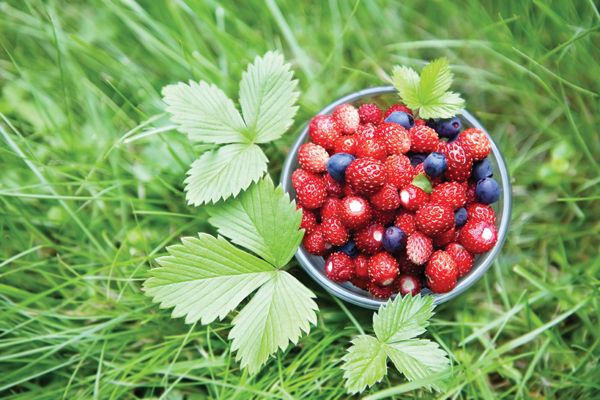
Foods naturally red, blue, and purple contain powerful anthocyanin antioxidants widely believed to benefit the heart and blood vessels. And now there’s proof that eating three or more servings of strawberries and blueberries per week may help women reduce their risk of a heart attack by one-third—according to a large study of women aged between 25 and 42 registered with the Nurses’ Health Study II. Scientists from the University of East Anglia in collaboration with the Harvard School of Public Health say anthocyanins in berries may help dilate arteries and counter the build-up of plaque. “We have shown that even at an early age, eating more of these fruits may reduce risk of a heart attack later in life. This is the first study to look at the impact of diet in younger and middle-aged women,” says the lead researcher.
The American Heart Association recommends at least 4.5 cups per day of fruits and vegetables as part of a healthy lifestyle that can help avoid risks for heart disease and stroke. Eating enough fruits and vegetables also has other benefits: the recommendation to reduce cancer risk is the same.
Little Women Among the Casualties
This is the fifth installment of our six-part series on the Civil War, marking the 150th anniversary of the Battle of Gettysburg. To recap: In part one, “The News from Gettysburg: A Hazardous Move,” we described how the Post reported the initial news of the invasion. In part two, “Scrambling for Soldiers,” we looked at the renewed attention to the draft. In part three, “Americans United to Support the Civil War Troops,” we covered a special organization of volunteers who helped save thousands of soldiers’ lives. And in part four, “Where the Civil War was Won,” we looked at the Post’s war coverage from the battlefield.
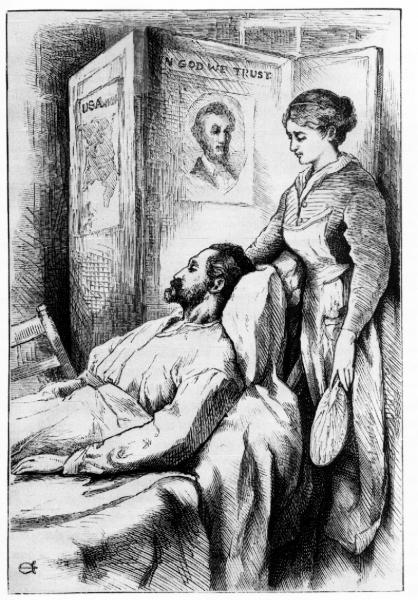
American novelist Louisa May Alcott knew firsthand the terrible price of victory in the Civil War. From 1862 to 1863, she cared for wounded soldiers at a military hospital in Georgetown, D.C.
She wrote about her experiences in a series of letters for the abolitionist paper, Boston Commonwealth. The entire series of letters, published as Hospital Sketches in 1863, earned Alcott her first public attention as an author and praise for her sensitivity and wit.
Five years later, she became one of America’s foremost writers with her classic novel Little Women.
The Post published this excerpt on July 25, 1863, just a few weeks after Gettysburg, when Union hospitals were overflowing with the thousands of casualties from the battle. Here, Alcott describes her first day on duty in December 1862, when the hospital received grievously wounded soldiers from Fredericksburg.
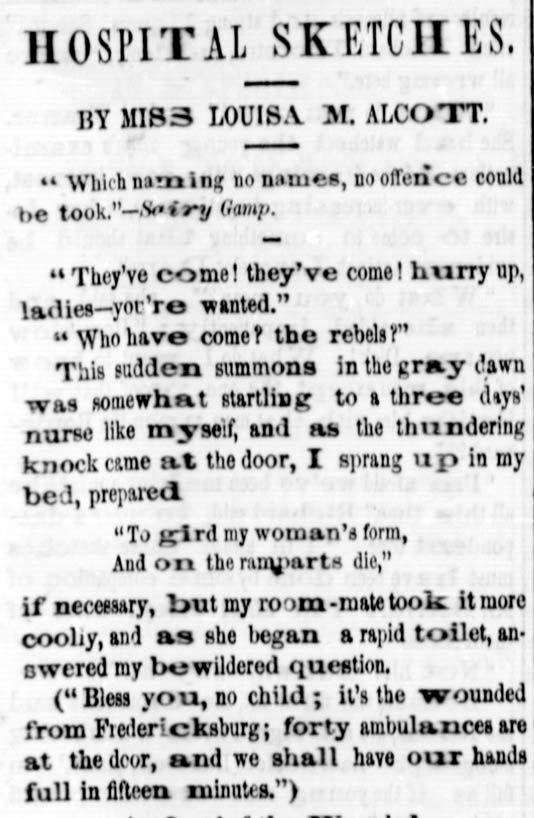
Hospital Sketches by Miss Louisa M. Alcott
“Which naming no names, no offence could be took.”
— Sairy Gamp
They’ve come! they’ve come! Hurry up, ladies—you’re wanted.”
“Who have come? the rebels?”This sudden summons in the gray dawn was somewhat startling to a three days’ nurse like myself, and, as the thundering knock came at our door, I sprang up in my bed, prepared
“To gird my woman’s form,
And on the ramparts die,”if necessary; but my room-mate took it more coolly, and, as she began a rapid toilet, answered my bewildered question,—(“Bless you, no child; it’s the wounded from Fredericksburg; forty ambulances are at the door, and we shall have our hands full in fifteen minutes.”)
Arrival of the Wounded
The sight of several stretchers, each with its legless, armless, or desperately wounded occupant, entering my ward, admonished me that I was there to work, not to wonder or weep; so I corked up my feelings, and returned to the path of duty, which was rather “a hard road to travel” just then.The house had been a hotel before hospitals were needed, and many of the doors still bore their old names; some not so inappropriate as might be imagined, for my ward was in truth a ball-room, if gun-shot wounds could christen it.
Forty beds were prepared, many already tenanted by tired men who fell down anywhere, and drowsed till the smell of food roused them. Round the great stove was gathered the dreariest group I ever saw—ragged, gaunt and pale, mud to the knees, with bloody bandages untouched since put on days before; many bundled up in blankets, coats being lost or useless; and all wearing that disheartened look which proclaimed defeat, more plainly than any telegram of the Burnside blunder. I pitied them so much, I dared not speak to them, though, remembering all they had been through since the route at Fredericksburg, I yearned to serve the dreariest of them all. Presently, Miss Blank tore me from my refuge behind piles of one-sleeved shirts, odd socks, bandages and lint; put basin, sponge, towels, and a block of brown soap into my hands, with these appalling directions:
“Come, my dear, begin to wash as fast as you can. Tell them to take off socks, coats and shirts, scrub them well, put on clean shirts, and the attendants will finish them off, and lay them in bed.”
If she had requested me to shave them all, or dance a hornpipe on the stove funnel, I should have been less staggered; but to scrub some dozen lords of creation at a moment’s notice, was really–really–. However, there was no time for nonsense, and, having resolved when I came to do everything I was bid, I drowned my scruples in my wash-bowl, clutched my soap manfully, and, assuming a business-like air, made a dab at the first dirty specimen I saw, bent on performing my task vi et armis (by force of arms) if necessary.
I chanced to light on a withered old Irishman, wounded in the head, which caused that portion of his frame to be tastefully laid out like a garden, the bandages being the walks, his hair the shrubbery. He was so overpowered by the honor of having a lady wash him, as he expressed it, that he did nothing but roll up his eyes, and bless me, in an irresistible style which was too much for my sense of the ludicrous; so we laughed together, and when I knelt down to take off his shoes, he “flopped” also, and wouldn’t hear of my touching “them dirty crayters. May your bed above be aisy darlin’, for the day’s work ye ar doon! —Whoosh! there ye are, and bedad, it’s hard tellin’ which is the dirtiest, the fut or the shoe.” It was; and if he hadn’t been to the fore, I should have gone on pulling, under the impression that the “fut” was a boot, for trousers, socks, shoes and legs were a mass of mud. This comical tableau produced a general grin, at which propitious beginning I took heart and scrubbed away like any tidy parent on a Saturday night.
Some of them took the performance like sleepy children, leaning their tired heads against me as I worked, others looked grimly scandalized, and several of the roughest colored like bashful girls. One wore a soiled little bag about his neck, and, as I moved it, to bathe his wounded breast, I said,
“Your talisman didn’t save you, did it?”“Well, I reckon it did, ma’am, for that shot would a gone a couple a inches deeper but for my old mammy’s camphor bag,” answered the cheerful philosopher.
Another, with a gun-shot wound through the cheek, asked for a looking-glass, and when I brought one, regarded his swollen face with a dolorous expression, as he muttered—
“I vow to gosh, that’s too bad! I warn’t a bad looking chap before, and now I’m done for; won’t there be a thunderin’ scar? and what on earth will Josephine Skinner say?”
He looked up at me with his one eye so appealingly, that I controlled my risibles, and assured him that if Josephine was a girl of sense, she would admire the honorable scar, as a lasting proof that he had faced the enemy, for all women thought a wound the best decoration a brave soldier could wear. I hope Miss Skinner verified the good opinion I so rashly expressed of her, but I shall never know.
The next scrubbee was a nice looking lad, with a curly brown mane, and a budding trace of gingerbread over the lip, which he called his beard, and defended stoutly, when the barber jocosely suggested its immolation. He lay on a bed, with one leg gone, and the right arm so shattered that it must evidently follow: yet the little Sergeant was as merry as if his afflictions were not worth lamenting over; and when a drop or two of salt water mingled with my suds at the sight of this strong young body, so marred and maimed, the boy looked up, with a brave smile, though there was a little quiver of the lips, as he said,
“Now don’t you fret yourself about me, miss; I’m first rate here, for it’s nuts to lie still on this bed, after knocking about in those confounded ambulances that shake what there is left of a fellow to jelly. I never was in one of these places before, and think this cleaning up a jolly thing for us, though I’m afraid it isn’t for you ladies.”
“Is this your first battle, Sergeant?”
“No, miss; I’ve been in six scrimmages, and never got a scratch till this last one; but it’s done the business pretty thoroughly for me, I should say. Lord! what a scramble there’ll be for arms and legs, when we old boys come out of our graves, on the Judgment Day: wonder if we shall get our own again? If we do, my leg will have to tramp from Fredericksburg, my arm from here, I suppose, and meet my body, wherever it may be.”
The fancy seemed to tickle him mightily.
Coming Next: The Work of the Sanitary Commission Inspires Another Convert
Berry Parfait with Lemon Curd Dip
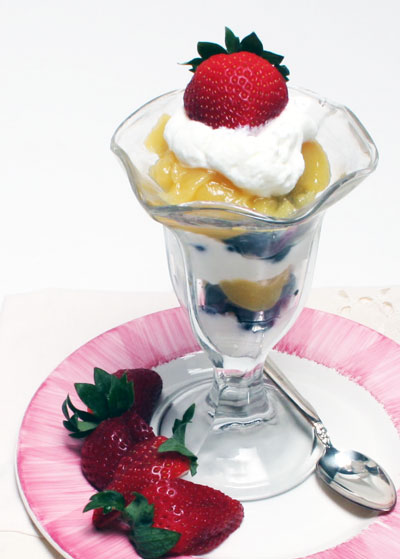
When local berries are out of season and supermarket ones are costly, this berry parfait made with lemon curd is an easy way to enjoy even a few fresh blueberries and strawberries. For something more casual, spread the lemon curd on whole-grain toast then top with fresh berries.
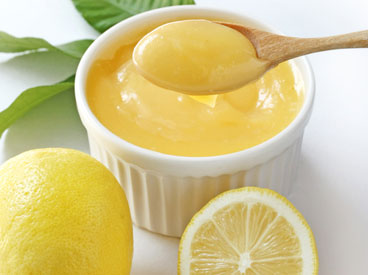
When berries are plentiful, make a lavish spread with big, frosty looking blueberries mixed with jeweled strawberries on bamboo skewers. Have a crystal bowl on the side filled with homemade lemon curd dip for a truly elegant dessert. For dipping, lemon curd should be looser and less sweet than the classic curd. You can achieve this by making it with less butter and sugar.
Lemon Curd Dip
(Makes 6 servings)
Ingredients
- 3 large egg yolks
- ⅔ cup sugar
- ½ cup fresh lemon juice
- 2 tablespoons unsalted butter, thinly sliced and chilled
Directions
- In heavy, medium saucepan, whisk to combine egg yolks, sugar, and lemon juice. Over medium-low heat, cook while whisking constantly until mixture looks silky and lightly coats spoon. (When you run a finger down back of spoon, it should leave a clear line.) This takes up to 10 minutes. If mixture starts to steam, reduce heat.
- Off heat, add cold butter and whisk rapidly until combined. Scoop lemon curd into bowl or serving bowl and let stand until room temperature.
- Cover lemon curd with plastic wrap, pressing against surface, and refrigerate curd for at least 12 and preferably 24 hours. It will thicken as it chills. Lemon curd keeps for 4 days, tightly covered in refrigerator.
- To serve, see Berry Parfait with Lemon Curd Dip or place bowl of chilled lemon curd on large plate and surround it with berries.
Nutrition Facts
Per serving (3 tablespoons)
Calories: 152
Total fat: 6 g
Saturated fat: 3 g
Carbohydrate: 24 g
Fiber: 0 g
Protein: 18 g
Sodium: 5 mg
Berry Parfait with Lemon Curd Dip
(Makes 1 serving)
Ingredients
- ¼ cup nonfat Greek yogurt, divided
- ¼ cup berries in season, divided
- 3 tablespoons Lemon Curd Dip, divided (see recipe above)
- 1 whole strawberry for garnish
Directions
In a parfait glass, layer 1 tablespoon Greek yogurt, 1 tablespoon berries, 1 ½ tablespoon lemon curd dip. Repeat layers with 2 tablespoon yogurt, 1 ½ tablespoon berries, 1 ½ tablespoon lemon curd. Top with 1 tablespoon yogurt, remaining blueberries and whole strawberry.
Nutrition Facts
Per serving
Calories: 210
Total fat: 6 g
Saturated fat: 3.5 g
Carbohydrate: 29 g
Fiber: 2 g
Protein: 7 g
Sodium: 25 mg
Where the Civil War was Won
This is the fourth installment of our six-part series on the Battle of Gettysburg. To recap: In part one, “The News from Gettysburg: A Hazardous Move,” we described how the Post reported the initial news of the invasion. In part two, “Scrambling for Soldiers,” we looked at the renewed attention to the draft. And in part three, “Americans United to Support the Civil War Troops,” we covered a special organization of volunteers who helped save thousands of soldiers’ lives.
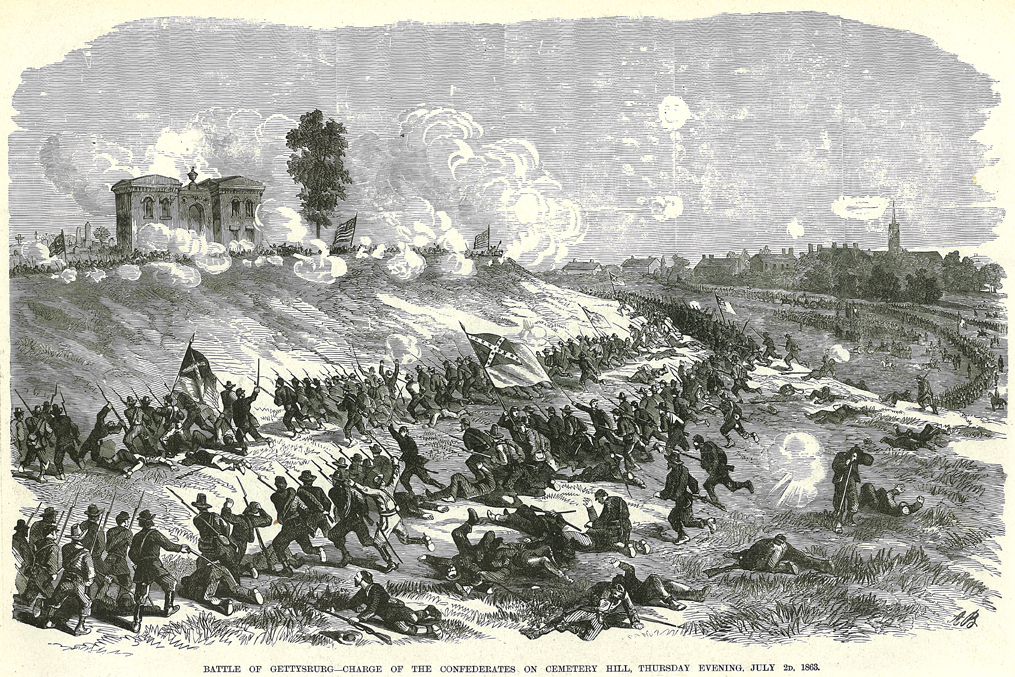
Unfortunately, the Post didn’t have regular reports from correspondents in the field like the major newspapers. So the editors provided bulletins taken from military dispatches telegraphed to Washington, D.C., which were inserted just before the paper went to press. For example, the July 1863 issue included this update:
HARRISBURG, June 28, P.M.—The capital of the state is in danger. The enemy is within four miles of our works and advancing. The cannonading has been distinctly heard for three hours. … Rebels have occupied successively [nine towns] and are now spread over all the region lying between the Susquehanna and Laurel Ridge. Not a single point in that whole section remains in our possession.
Some of the Post’s war coverage reflects the values peculiar of those times. While modern readers might want to know more about the experiences of the fighting men, the Post editors felt it was important to report how many cannons and flags were lost in battle. They also gave much coverage to the cavalry, which was assumed to be essential to an army’s success. A Post writer observed, “On a field of warfare where the distances are so great, the cavalry arm of the service is not only useful but absolutely indispensable.” At Gettysburg, we now know, the cavalry played a minor role, which barely affected the outcome of the battle. The battle was won by the men of the Union infantry and artillery who withstood massive Confederate assaults all along the Union lines.
In hindsight it’s interesting to note that the Post gave slight coverage to what would become one of the most memorable events of the Civil War. Shortly after the shooting had stopped on the battlefield, a correspondent filed this report:
HEADQUARTERS, ARMY OF POTOMAC, JULY 3—At daylight, Lee’s right wing batteries opened upon our left, and shortly after those of his centre followed. After half an hour’s cannonading, doing but little damage to us, the fire slackened, and only occasional shots were exchanged. Shortly afterwards, the enemy’s center, composed entirely of infantry and sharpshooters, made an attack on our left wing. So suddenly and impetuously was it accomplished, that our skirmishers and front lines were driven back from their entrenchments …
With these few words, the reporter covered what would become one of the most famous events of the battle: the attack on Cemetery Ridge by three Confederate Generals: Maj. Gen. Isaac R. Trimble, Brig. Gen. J. Johnston Pettigrew, and Maj. Gen. George Pickett.
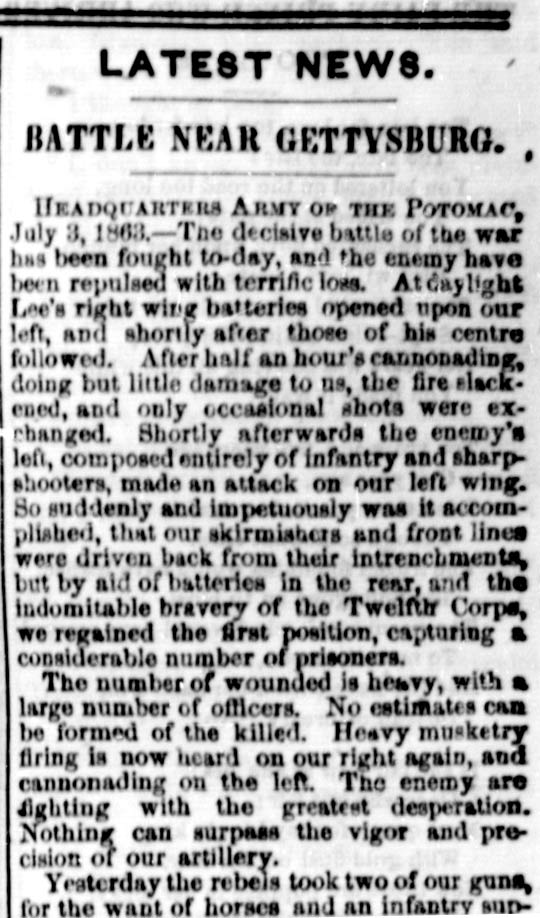
Pickett’s Charge, as it came to be known, began on the afternoon of July 3, 1863, when 13,000 rebel soldiers emerged from the woods west of Emmitsburg Road. They formed themselves into two lines of battle more than 1 mile wide and marched, not charged, straight toward the waiting Yankee line. Before them lay 1,400 yards of open fields that rose gradually to a ridge where the Union infantry and artillery had an unobstructed line of fire. The Confederates tried to hold their formation, but the line became disjointed as the soldiers had to climb fences to proceed. And, as the Union cannon fire began, great holes appeared in the line. The gaps grew wider as the rebels came within range of the Union muskets. Before the Confederates reached the crest of the ridge, half of their number had been killed or wounded. Yet the rebels continued on with a relentless, steady pace until, within yards, they finally broke into a charge. They slammed into the Union line and began a fighting hand-to-hand struggle with the Yankee defenders. For a few minutes, the outcome of the battle and, some say, of the war, hung in the balance as Northern and Southern soldiers crowded at the breached Union line.
For the Confederates, a breakthrough here would cut the Union Army in two, a victory that would culminate two years of fighting in which the Union had not won a single, definitive victory against Lee’s men. Lee wanted this victory, not just to clear the way for marching into Baltimore or Washington, D.C., but to destroy the North’s morale.
For the Union, however, this was not just another battle. The Federals had seen two years of fighting in a long, frustrated struggle to seize the Confederate capitol at Richmond, Virginia. They were well acquainted with defeat; General Lee had defeated them so often that many were starting to believe he was invincible. Now, here was Lee in the North with the 70,000 men of his formidable Army of Northern Virginia.
The Union soldiers knew that the outcome of this fight would decide the fate of their army and their country. On Wednesday and Thursday, they had fought with growing desperation as the rebel army broke through their defenses three times. Each time, Union reserves appeared at the last minute to hold the line. Yet each save had extracted a heavy cost. The divisions on the right and left of the Union line probably wouldn’t withstand one more attack. Fortunately for the Union, on the third day, the rebels had chosen to attack the center of the line.
And so, sometime around 3:30 p.m. on July 3, 1863, a crowd of gray uniforms spilled over the low stone wall on Cemetery Ridge. The Union soldiers gathered to push them back. Soon there was a dense crowd at the wall fighting hand-to-hand, the men were packed so tightly that many of the soldiers couldn’t even use their rifles as clubs.
And then—
… by aid of batteries in the rear, and the indomitable bravery of the Twelfth Corps, we regained the first position, capturing a considerable number of prisoners.
The Post’s correspondent didn’t recognize the history held within that paragraph of news, but he was surprisingly farsighted in his judgment. Because even with the rebel army still on the field, with both armies exhausted and no one quite certain that Lee wouldn’t try another attack, he felt confident to write the enemy had been repulsed in—as he called it—“the decisive battle of the war.”
Coming Next: Little Women in a Military Hospital
Rockets’ Red Glare
Our country turns 237 years old this July. Our town will celebrate the way it always has, with a fireworks show that begins, now that we’re on daylight savings time, somewhere around midnight. For the past 10 years, the fireworks have been shot off from the field by the school. We citizens watch from the parking lot. The adults are relaxed, sitting in lawn chairs carried in for the occasion. The children are hopeful, praying a wayward spark will find its way into a schoolhouse crevice where it will smolder until the deep hours of the morning before bursting into flame, leveling the building while the town slumbers unaware, freeing them from the tedium of education.

When our sons were small, the fireworks were held at the park, launched from the Little League field, while we watched from the sledding hill above the basketball courts. A fear of injury spurred the move. One year, a firework prematurely exploded, showering sparks on a row of onlookers. To me, that is no reason to move. The experience is enhanced when danger lurks. As our country was born in war, it seems fitting our celebration of its birth should likewise entail some risk.
Many annual fetes tarnish over time, but fireworks have never lost their luster. They are as thrilling now as they were when I was a child.
Last year, when the town board canceled them because of the drought and fear of fire, I was as disconsolate as a 5-year-old missing Christmas. A few hardy souls drove to the city to see the fireworks, there being no grass or hayfields to ignite, but I prefer to watch them in the company of friends and compare them to years past.
The year to beat in our town was 1976, when the fireworks were held at the county fairgrounds to accommodate a projected record bicentennial crowd. But the crowd was the same size as always since everyone goes each year, bicentennial or not. The town board, drunk with patriotism, purchased twice the number of fireworks they normally did, plus an American flag ground display, which no one could see since it was flat on the ground.
When the amusement park, King’s Island, opened and townspeople began to go there for vacation, they told of the fireworks that ended each day. This seemed wrong to me, making coarse and common that which was prized for its rarity. Then the Indianapolis symphony began visiting our town each summer for a concert in the park, and had fireworks accompaniment to Sousa’s “Stars and Stripes Forever.” While impressive, it felt decadent, like eating steak and lobster every night for dinner. It was too rich a diet.
But it did not end there. Someone thought it would be good to shoot off fireworks when our high school football team scored a touchdown, so now we have them at every home game in the fall. The basketball team must slog on without such encouragement, it being impractical to shoot fireworks in the school gym.
Though some are concerned with this invasive spread, no one has voiced their concerns aloud, it being un-American to protest fireworks.
So I, being a minister and accustomed to delivering blunt messages, will say what must be said—fireworks outside the Fourth of July are an abomination against God, an unnatural act. It is a return to concubines and multiple wives; it is excess; it is gluttony; it is gilding every surface with gold, so that nothing is precious any longer. It is indicative of our more-is-best culture, which believes that because something is enjoyed one day, it must be had every day. It is kin to the trend of awarding the last place team a trophy for participation, of spreading honors so thin they mean nothing.
Some things, exquisite in scarcity, are garish in abundance. Give me one night each July, in the company of friends, recalling past glories, amidst the sacred sounds of burst and boom.
Travel Apps
Ready, set, go! Enjoy a summer getaway with free travel apps that help with the planning.
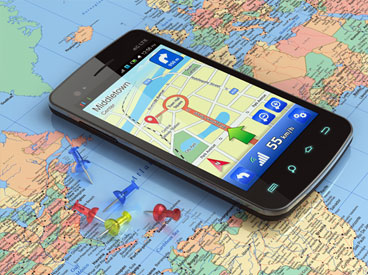
- Travelzoo. Get deals on flights, hotels, packages, and local entertainment.
- TripIt. Organize hotel, plane, and event confirmations into an itinerary.
- FlightAware. Check real-time status of flights and airport delays.
- Whichfestival. Find home-grown fun, food, and music by date and place.
- Foursquare. Log in for tips and discounts at local hot spots.
- Google Goggles. Search the Web about anything you see by snapping its picture.