Heroes of Vietnam: Death in the Ia Drang Valley
 This article and other features about America in Vietnam can be found in the Post’s Special Collector’s Edition, The Heroes of Vietnam. This edition can be ordered here.
Originally published January 28, 1967.
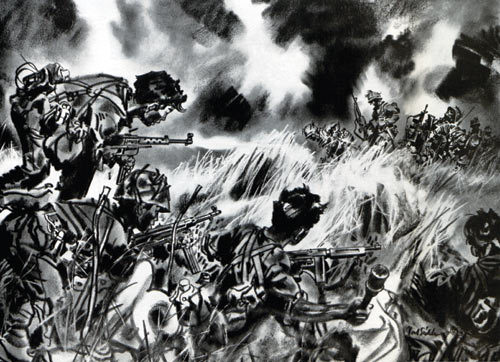
Spc. 4/c Jack P. Smith was a supply clerk in the 1st Air Cavalry Division in South Vietnam. Smith’s company — Charlie Company of the 2nd Battalion, 7th Cavalry (Regiment) — had never been in action, and Smith, who was 20 years old, had come to believe that it never would. “We thought we were a sham,” Smith recalls today. “We dug and walked and looked for an enemy who was never there.”
In November 1965, units of the 7th Cavalry began to make the first American penetration in force of a communist stronghold near the Cambodian border. On November 15, Smith’s battalion was ordered in to help the 1st Battalion, which was meeting strong resistance. This was the beginning of the Battle of the Ia Drang Valley, the first pitched battle fought by American soldiers in the war for Vietnam, and the bloodiest engagement of the long and divisive struggle.
After a day of marching into the jungle, Smith and the 500 other men of the 2nd Battalion came upon a clearing, known on the maps as X‑ray, where the 1st Battalion was fighting. The names of the soldiers have been changed, but in all other respects, this is what happened.
The 1st Battalion had been fighting continuously for three or four days, and I had never seen such filthy troops. Some of them had blood on their faces from scratches and from other guys’ wounds. Some had long rips in their clothing where shrapnel and bullets had missed them. They all had that look of shock. They said little, just looked around with darting, nervous eyes.
Whenever I heard a shell coming close, I’d duck, but they’d keep standing. After three days of constant bombardment, you get so you can tell from the sound how close a shell is going to land within 50 to 75 feet. There were some wounded lying around, bandaged up with filthy shirts and bandages, smoking cigarettes or lying in a coma with plasma bottles hanging above their stretchers.
Late that morning, the Cong made a charge. About 100 of them jumped up and made for our lines, and all hell broke loose. The people in that sector opened up with everything they had. Then a couple of our Skyraiders came in. One of them dropped a lot of stuff that shimmered in the sun like green confetti. It looked like a ticker-tape parade, but when the things hit the ground, the little pieces exploded. They were anti-personnel charges. Every one of the gooks was killed. Another group on the other side almost made it to the lines. There weren’t enough GIs there, and they couldn’t shoot them down fast enough. A plane dropped some napalm bombs just in front of the line. I couldn’t see the gooks. But I could hear them scream as they burned. A hundred men dead, just like that.
My company, Charlie Company, took over its sector of the battalion perimeter and started to dig in. At three o’clock another attack came, but it never amounted to anything. I didn’t get any sleep that night. There was continuous firing from one until four, and it was as bright as day with the flares lighting up the sky.
The next morning, the order came for us to move out. I guess our commanders felt the battle was over. The three battalions of PAVN (People’s Army of Vietnam — the North Vietnamese) were destroyed. There must have been about 1,000 rotting bodies out there, starting about 20 feet from us and surrounding the giant circle of foxholes. As we left the perimeter, we walked by them. Some of them had been lying out there for four days. There are more ants in Vietnam than in any place I have ever seen.
We were being withdrawn to Landing Zone Albany, some 6 miles away, where we were to be picked up by helicopter. About noon the column stopped and everybody flopped on the ground. It turned out that our reconnaissance platoon had come upon four sleeping PAVN who had claimed they were deserters. They said that there were three or four snipers in the trees up ahead — friends of theirs who did not want to surrender.
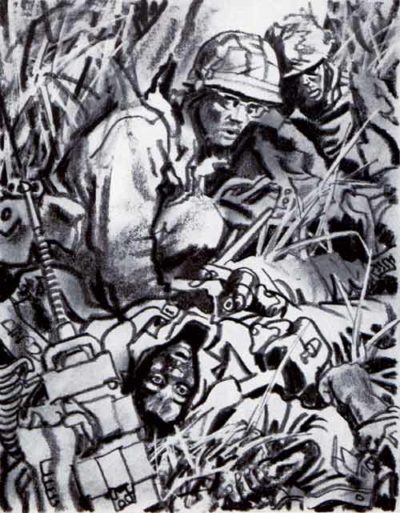
The head of the column formed by our battalion was already in the landing zone, which was actually only 30 yards to our left. But our company was still in the woods and elephant grass. I dropped my gear and my ax, which was standard equipment for supply clerks like me. We used them to cut down trees to help make landing zones for our helicopters. The day had grown very hot. I was about one-quarter through a smoke when a few shots cracked at the front of the column.
I flipped my cigarette butt, lay down, and grabbed my M-16. The fire in front was still growing. Then a few shots were fired right behind me. They seemed to come from the trees. There was firing all over the place now, and I was getting scared. A bullet hit the dirt a foot to my side, and some started whistling over my head.
This wasn’t the three or four snipers we had been warned about. There were over 100 North Vietnamese snipers tied in the trees above us — so we learned later — way above us, in the top branches. The firing kept increasing.
Our executive officer (XO) jumped up and said, “Follow me, and let’s get the hell out of here.” I followed him, along with the rest of the headquarters section and the 1st Platoon. We crouched and ran to the right toward what we thought was the landing zone. But it was only a small clearing — the L.Z. was to our left. We were running deeper into the ambush.
The fire was still increasing. We were all crouched as low as possible, but still keeping up a steady trot, looking from side to side. I glanced back at Richards, one of the company’s radio operators. Just as I looked back, he moaned softly and fell to the ground. I knelt down and looked at him, and he shuddered and started to gurgle deep in his stomach. His eyes and tongue popped out, and he died. He had a hole straight through his heart.
I had been screaming for a medic. I stopped. I looked up. Everyone had stopped. All of a sudden all the snipers opened up with automatic weapons. There were PAVN with machine guns hidden behind every anthill. The noise was deafening.
Then the men started dropping. It was unbelievable. I knelt there staring as at least 20 men dropped within a few seconds. I still had not recovered from the shock of seeing Richards killed, but the jolt of seeing men die so quickly brought me back to life. I hit the dirt fast. The XO was to my left, and Wallace was to my right, with Burroughs to his right. We were touching each other lying there in the tall elephant grass.
Men all around me were screaming. The fire was now a continuous roar. We were even being fired at by our own guys. No one knew where the fire was coming from, and so the men were shooting everywhere. Some were in shock and were blazing away at everything they saw or imagined they saw.
The XO let out a low moan, and his head sank. I felt a flash of panic. I had been assuming that he would get us out of this. Enlisted men may scoff at officers back in the billets, but when the fighting begins, the men automatically become very dependent upon them. Now I felt terribly alone.
The XO had been hit in the small of the back. I ripped off his shirt and there it was: a groove to the right of his spine. The bullet was still in there. He was in a great deal of pain, so a rifleman named Wilson and I removed his gear as best we could, and I bandaged his wound. It was not bleeding much on the outside, but he was very close to passing out.
Just then Wallace let out a “Huh!” A bullet had creased his upper arm and entered his side. He was bleeding in spurts. I ripped away his shirt with my knife and did him up. Then the XO screamed: A bullet had gone through his boot, taking all his toes with it. He was in agony and crying. Wallace was swearing and in shock. I was crying and holding on to the XO’s hand to keep from going crazy.
The grass in front of Wallace’s head began to fall as if a lawnmower were passing. It was a machine gun, and I could see the vague outline of the Cong’s head behind the foot or so of elephant grass. The noise of firing from all directions was so great that I couldn’t even hear a machine gun being fired three feet in front of me and one foot above my head.
As if in a dream, I picked up my rifle, put it on automatic, pushed the barrel into the Cong’s face and pulled the trigger. I saw his face disappear. I guess I blew his head off, but I never saw his body and did not look for it.
Wallace screamed. I had fired the burst pretty close to his ear, but I didn’t hit him. Bullets by the thousands were coming from the trees, from the L.Z., from the very ground, it seemed. There was a huge thump nearby. Burroughs rolled over and started a scream, though it sounded more like a growl. He had been lying on his side when a grenade went off about three or four feet from him. He looked as though someone had poured red paint over him from head to toe.
After that everything began getting hazy. I lay there for several minutes, and I think I was beginning to go into shock. I don’t remember much.
The amazing thing about all this was that from the time Richards was killed to the time Burroughs was hit, only a minute or two had elapsed. Hundreds of men had been hit all around us, and the sound of men screaming was almost as loud as the firing.
The XO was going fast. He told me his wife’s name was Carol. He told me that if he didn’t make it, I was to write her and tell her that he loved her. Then he somehow managed to crawl away, saying that he was going to organize the troops. It was his positive decision to do something that reinforced my own will to go on.
Then our artillery and air strikes started to come in. They saved our lives. Just before they started, I could hear North Vietnamese voices on our right. The PAVN battalion was moving in on us, into the woods. The Skyraiders were dropping napalm bombs a hundred feet in front of me on a PAVN machine-gun complex. I felt the hot blast and saw the elephant grass curling ahead of me. The victims were screaming — some of them were our own men who were trapped outside the wood line.
At an altitude of 200 feet, it’s difficult to distinguish one soldier from another. It’s unfortunate and horrible, but most of the battalion’s casualties in the first hour or so were from our own men, firing at everything in sight.
No matter what you did, you got hit. The snipers in the trees just waited for someone to move, then shot him. I could hear the North Vietnamese entering the woods from our right. They were creeping along, babbling and arguing among themselves, calling to each other when they found a live GI. Then they shot him.
I decided that it was time to move. I crawled off to my left a few feet, to where Sgt. Moore and Thompson were lying. Sgt. Moore had been hit in the chest three times. He was in pain and sinking fast. Thompson was hit only lightly in the leg. I asked the sergeant to hold my hand. He must have known then that he was dying, but he managed to assure me that everything would be all right.
I knew there wasn’t much chance of that. This was a massacre, and I was one of a handful not yet wounded. All around me, those who were not already dead were dying or severely wounded, most of them hit several times. I must have been talking a lot, but I have no idea what I was saying. I think it was, “Oh God, Oh God, Oh God,” over and over. Then I would cry. To get closer to the ground, I had dumped my gear, including the ax I had been carrying, and I had lost my rifle, but that was no problem. There were weapons of every kind lying everywhere.
Sgt. Moore asked me if I thought he would make it. I squeezed his hand and told him sure. He said that he was in a lot of pain, and every now and then he would scream. He was obviously bleeding internally quite a bit. I was sure that he would die before the night. I had seen his wife and four kids at Fort Benning. He had made it through World War II and Korea, but this little war had got him.
I found a hand grenade and put it next to me. Then I pulled out my first-aid pack and opened it. I still was not wounded, but I knew I would be soon.
At that instant, I heard a babble of Vietnamese voices close by. They sounded like little children, cruel children. The sound of those voices, of the enemy that close, was the most frightening thing I have ever experienced. Combat creates a mindless fear, but this was worse, naked panic.
A small group of PAVN was rapidly approaching. There was a heavy rustling of elephant grass and a constant babbling of high-pitched voices. I told Sgt. Moore to shut up and play dead. I was thinking of using my grenade, but I was scared that it wouldn’t get them all, and that they were so close that I would blow myself up too.
My mind was made up for me, because all of a sudden, they were there. I stuck the grenade under my belly so that even if I was hit the grenade would not go off too easily, and if it did go off I would not feel pain. I willed myself to stop shaking, and I stopped breathing. There were about 10 or 12 of them, I figure. They took me for dead, thank God. They lay down all around me, still babbling.
One of them lay down on top of me and started to set up his machine gun. He dropped his canister next to my side. His feet were by my head, and his head was between my feet. He was about six feet tall and pretty bony. He probably couldn’t feel me shaking because he was shaking so much himself.
I thought I was gone. I was trying like hell to act dead, however the hell one does that.
The Cong opened up on our mortar platoon, which was set up around a big tree nearby. The platoon returned the fire, killing about half of the Cong, and miraculously not hitting me. All of a sudden a dozen loud crumph sounds went off all around me. Assuming that all the GIs in front of them were dead, our mortar platoon had opened up with M-79 grenade launchers. The Cong jumped up off me, moaning with fear, and the other PAVN began to move around. They apparently knew the M-79. Then a second series of explosions went off, killing all the Cong as they got up to run. One grenade landed between Thompson’s head and Sgt. Moore’s chest. Sgt. Moore saved my life; he took most of the shrapnel in his side. A piece got me in the head.
It felt as if a white-hot sledge hammer had hit the right side of my face. Then something hot and stinging hit my left leg. I lost consciousness for a few seconds. I came out of it feeling intense pain in my leg and a numbness in my head. I didn’t dare feel my face: I thought the whole side of it had gone. Blood was pouring down my forehead and filling the hollow of my eyeglasses. It was also pouring out of my mouth. I slapped a bandage on the side of my face and tied it around my head. I was numbed, but I suddenly felt better. It had happened, and I was still alive.
I decided it was time to get out. None of my buddies appeared able to move. The Cong obviously had the mortar platoon pegged, and they would try to overrun it again. I was going to be right in their path. I crawled over Sgt. Moore, who had half his chest gone, and Thompson, who had no head left. Wilson, who had helped me with the XO, had been hit badly, but I couldn’t tell where. All that moved was his eyes. He asked me for some water. I gave him one of the two canteens I had scrounged. I still had the hand grenade.
I crawled over many bodies, all still. The 1st Platoon just didn’t exist anymore. One guy had his arm blown off. There was only some shredded skin and a piece of bone sticking out of his sleeve. The sight didn’t bother me anymore. The artillery was still keeping up a steady barrage, as were the planes, and the noise was as loud as ever, but I didn’t hear it anymore. It was a miracle I didn’t get shot by the snipers in the trees while I was moving.
came across Sgt. Barker, who stuck a .45 in my face. He thought I was a Cong and almost shot me. Apparently I was now close to the mortar platoon. Many other wounded men had crawled over there, including the medic Novak, who had run out of supplies after five minutes. Barker was hit in the legs. Caine was hurt badly too. There were many others, all in bad shape. I lay there with the hand grenade under me, praying. The Cong made several more attacks, which the mortar platoon fought off with 79s.
The Cong figured out that the mortar platoon was right by that tree, and three of their machine-gun crews crawled up and started to blaze away. It had taken them only a minute or so to find exactly where the platoon was; it took them half a minute to wipe it out. When they opened up, I heard a guy close by scream, then another, and another. Every few seconds someone would scream. Some got hit several times. In 30 seconds, the platoon was virtually nonexistent. I heard Lt. Sheldon scream three times, but he lived. I think only five or six guys from the platoon were alive the next day.
It also seemed that most of them were hit in the belly. I don’t know why, but when a man is hit in the belly, he screams an unearthly scream. Something you cannot imagine; you actually have to hear it. When a man is hit in the chest or the belly, he keeps on screaming, sometimes until he dies. I just lay there, numb, listening to the bullets whining over me and the 15 or 20 men close to me screaming and screaming and screaming. They didn’t ever stop for breath. They kept on until they were hoarse, then they would bleed through their mouths and pass out. They would wake up and start screaming again. Then they would die.
I started crying. Sgt. Gale was lying near me. He had been hit badly in the stomach and was in great pain. He would lie very still for a while and then scream. He would scream for a doctor, then he would scream for a medic. He pleaded with anyone he saw to help him, for the love of God, to stop his pain or kill him. He would thrash around and scream some more, and then lie still for a while. He was bleeding a lot. Everyone was. No matter where you put your hand, the ground was sticky.
Sgt. Gale lay there for over six hours before he died. No one had any medical supplies, no one could move, and no one would shoot him.
Several guys shot themselves that day. Schiff, although he was not wounded, completely lost his head and killed himself with his own grenade. Two other men, both wounded, shot themselves with .45s rather than let themselves be captured alive by the gooks. No one will ever know how many chose that way out, since all the dead had been hit over and over again.
All afternoon we could hear the PAVN, a whole battalion, running through the grass and trees. Hundreds of GIs were scattered on the ground like salt. Sprinkled among them like pepper were the wounded and dead Cong. The GIs who were wounded badly were screaming for medics. The Cong soon found them and killed them.
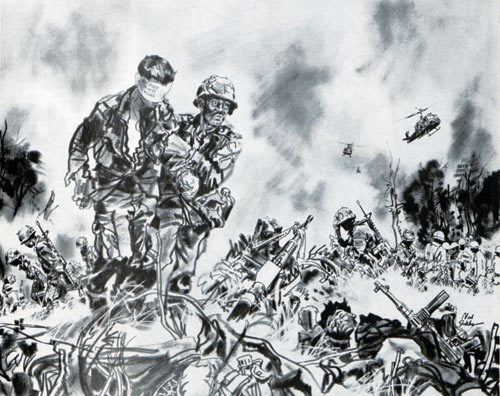
All afternoon there was smoke, artillery, screaming, moaning, fear, bullets, blood, and little yellow men running around screeching with glee when they found one of us alive, or screaming and moaning with fear when they ran into a grenade or a bullet. I suppose that all massacres in wars are a bloody mess, but this one seemed bloodier to me because I was caught in it.
About dusk a few helicopters tried landing in the L.Z., about 40 yards over to the left, but whenever one came within 100 feet of the ground, so many machine guns would open up on him that it sounded like a training company at a machine-gun range.
At dusk the North Vietnamese started to mortar us. Some of the mortars they used were ours that they had captured. Suddenly the ground behind me lifted up, and there was a tremendous noise. I knew something big had gone off right behind me. At the same time I felt something white-hot go into my right thigh. I started screaming and screaming. The pain was terrible. Then I said, “My legs, God, my legs,” over and over.
Still screaming, I ripped the bandage off my face and tied it around my thigh. It didn’t fit, so I held it as tight as I could with my fingers. I could feel the blood pouring out of the hole. I cried and moaned. It was hurting unbelievably. The realization came to me now, for the first time, that I was not going to live.
With hardly any light left, the Cong decided to infiltrate the woods thoroughly. They were running everywhere. There were no groupings of Americans left in the woods, just a GI here and there. The planes had left, but the artillery kept up the barrage.
Then the flares started up. As long as there was some light, the Cong wouldn’t try an all-out attack. I was lying there in a stupor, thirsty. God, I was thirsty. I had been all afternoon with no water, sweating like hell.
I decided to chance a cigarette. All my original equipment and weapons were gone, but somehow my cigarettes were still with me. The ends were bloody. I tore off the ends and lit the middle part of a cigarette.
Cupping it and blowing away the smoke, I managed to escape detection. I knew I was a fool. But at this stage I didn’t really give a damn. By now the small-arms fire had stopped almost entirely. The woods were left to the dead, the wounded, and the artillery barrage.
At nightfall I had crawled across to where Barker, Caine, and a few others were lying. I didn’t say a word. I just lay there on my back, listening to the swishing of grass, the sporadic fire and the constant artillery, which was coming pretty close. For over six hours now, shells had been landing within a hundred yards of me.
I didn’t move, because I couldn’t. Reaching around, I found a canteen of water. The guy who had taken the last drink from it must have been hit in the face, because the water was about one third blood. I didn’t mind. I passed it around.
About an hour after dark there was a heavy concentration of small-arms fire all around us. It lasted about five minutes. It was repeated at intervals all night long. Battalion Hq. was firing a protective fire, and we were right in the path of the bullets. Some of our men were getting hit by the rounds ricocheting through the woods.
I lay there shivering. At night in the highlands the temperature goes down to 50 or so. About midnight I heard the grass swishing. It was men, and a lot of them too. I took my hand grenade and straightened out the pin. I thought to myself that now at last they were going to come and kill all the wounded that were left. I was sure I was going to die, and I really did not care anymore. I did not want them to take me alive. The others around me were either unconscious or didn’t care. They were just lying there. I think most of them had quietly died in the last few hours. I know one — I did not recognize him — wanted to be alone to die. When he felt himself going, he crawled over me (I don’t know how), and a few minutes later I heard him gurgle and, I guess, die.
Then suddenly I realized that the men were making little whistling noises.
Maybe these weren’t the Cong. A few seconds later, a patrol of GIs came into view, about 15 guys in line, looking for wounded.
Everyone started pawing toward them and crying. It turned me into a babbling idiot. I grabbed one of the guys and wouldn’t let go. They had four stretchers with them, and they took the four worst wounded and all the walking wounded, about 10 or so, from the company. I was desperate, and I told the leader I could walk, but when Peters helped me to my feet, I passed out cold.
When I regained consciousness, they had gone, but their medic was left behind, a few feet from me, by a tree. He hadn’t seen me, and had already used his meager supply of bandages on those guys who had crawled up around the tree. His patrol said they would be back in a few hours.
I clung to the hope, but I knew damn well they weren’t coming back. Novak, who was one of the walking wounded, had left me his .45. I lost one of the magazines, and the only other one had only three bullets in it. I still had the hand grenade.
I crawled up to the tree. There were about eight guys there, all badly wounded. Lt. Sheldon was there, and he had the only operational radio left in the company. I couldn’t hear him, but he was talking to the company commander, who had gotten separated from us. Lt. Sheldon had been wounded in the thighbone, the kneecap, and the ankle.
Some time after midnight, in my half-conscious stupor, I heard a lot of rustling on both sides of the tree. I nudged the lieutenant, and then he heard it too. Slowly, everyone who could move started to arm himself. I don’t know who it was — it might even have been me — but someone made a noise with a weapon.
The swishing noise stopped immediately. Ten yards or so from us an excited babbling started. The gooks must have thought they had run into a pocket of resistance around the tree. Thank God, they didn’t dare rush us, because we wouldn’t have lasted a second. Half of us were too weak to even cock our weapons. As a matter of fact, there were a couple who did not have fingers to cock with.
Then a clanking noise started: They were setting up a machine gun right next to us. I noticed that some artillery shells were landing close now, and every few seconds they seemed to creep closer to us, until one of the Cong screamed. Then the babbling grew louder. I heard the lieutenant on the radio; he was requesting a salvo to bracket us. A few seconds later there was a loud whistling in the air and shells were landing all around us, again and again. I heard the Cong run away. They left some of their wounded a couple of yards from us, moaning and screaming, but they died within a few minutes.
Every half hour or so the artillery would start all over again. It was a long night. Every time, the shells came so close to our position that we could hear the shrapnel striking the tree a foot or so above our heads, and could hear other pieces humming by just inches over us.
All night long the Cong had been moving around killing the wounded. Every few minutes I heard some guy start screaming, “No, no, no, please,” and then a burst of bullets. When they found a guy who was wounded, they’d make an awful racket. They’d yell for their buddies and babble awhile, then turn the poor devil over and listen to him while they stuck a barrel in his face and squeezed.
About an hour before dawn the artillery stopped, except for an occasional shell. But the small-arms firing started up again, just as heavy as it had been the previous afternoon. The GIs about a mile away were advancing and clearing the ground and trees of Cong (and a few Americans too). The snipers, all around the trees and in them, started firing back.
When a bullet is fired at you, it makes a distinctive, sharp cracking sound. The firing by the GIs was all cracks. I could hear thuds all around me from the bullets. I thought I was all dried out from bleeding and sweating, but now I started sweating all over again. I thought, How futile it would be to die now from an American bullet. I just barely managed to keep myself from screaming out loud. I think some guy near me got hit. He let out a long sigh and gurgled.
Soon the sky began to turn red and orange. There was complete silence everywhere now. Not even the birds started their usual singing. As the sun was coming up, everyone expected a human-wave charge by the PAVN, and then a total massacre. We didn’t know that the few Cong left from the battle had pulled out just before dawn, leaving only their wounded and a few suicide squads behind.
When the light grew stronger, I could see all around me. The scene might have been the devil’s butcher shop. There were dead men all around the tree. I found that the dead body I had been resting my head on was that of Burgess, one of my buddies. I could hardly recognize him. He was a professional saxophone player with only two weeks left in the Army.
Right in front of me was Sgt. Delaney with both his legs blown off. I had been staring at him all night without knowing who he was. His eyes were open and covered with dirt. Sgt. Gale was dead too. Most of the dead were unrecognizable and were beginning to stink. There was blood and mess all over the place.
Half a dozen of the wounded were alive. Lord, who was full of shrapnel; Lt. Sheldon, with several bullet wounds; Morris, shot in the legs and arm; Sloan, with his fingers shot off; Olson, with his leg shot up and hands mutilated; and some guy from another company who was holding his guts from falling out.
Dead Cong were hanging out of the trees everywhere. The Americans had fired bursts that had blown some snipers right out of the trees. But these guys, they were just hanging and dangling there in silence.
We were all sprawled out in various stages of unconsciousness. My wounds had started bleeding again, and the heat was getting bad. The ants were getting to my legs.
Lt. Sheldon passed out, so I took over the radio. That whole morning is rather blurred in my memory. I remember talking for a long time with someone from Battalion Hq. He kept telling me to keep calm, that they would have the medics and helicopters in there in no time. He asked me about the condition of the wounded. I told him that the few who were still alive wouldn’t last long. I listened for a long time on the radio to chitchat between medevac pilots, Air Force jet pilots, and Battalion Hq. Every now and then I would call up and ask when they were going to pick us up. I’m sure I said a lot of other things, but I don’t remember much about it.
I just couldn’t understand at first why the medevacs didn’t come in and get us. Finally I heard on the radio that they wouldn’t land because no one knew whether or not the area was secure. Some of the wounded guys were beginning to babble. It seemed like hours before anything happened.
Then a small Air Force spotter plane was buzzing overhead. It dropped a couple of flares in the L.Z. nearby, marking the spot for an airstrike. I thought, My God, the strike is going to land on top of us. I got through to the old man — the company commander — who was up ahead, and he said that it wouldn’t come near us and for us not to worry. But I worried, and it landed pretty damn close.
There was silence for a while, then they started hitting the L.Z. with artillery, a lot of it. This lasted for a half hour or so, and then the small arms started again, whistling and buzzing through the woods. I was terrified. I thought, My Lord, is this never going to end? If we’re going to die, let’s get it over with.
Finally the firing stopped, and there was a ghastly silence. Then the old man got on the radio again and talked to me. He called in a helicopter and told me to guide it over our area. I talked to the pilot, directing him, until he said he could see me. Some of the wounded saw the chopper and started yelling, “Medic! Medic!” Others were moaning feebly and struggling to wave at the chopper.
The old man saw the helicopter circling and said he was coming to help us. He asked me to throw a smoke grenade, which I pulled off Lt. Sheldon’s gear. It went off, and the old man saw it, because soon after that I heard the guys coming. They were shooting as they walked along. I screamed into the radio, “Don’t shoot, don’t shoot,” but they called back and said they were just shooting PAVN.
Then I saw them: The 1st sergeant, our captain, and the two radio operators. The captain came up to me and asked me how I was.
I said to him: “Sorry, sir, I lost my —— ax.”
He said, “Don’t worry, Smitty, we’ll get you another one.”
The medics at the L.Z. cut off my boots and put bandages on me. My wounds were in pretty bad shape. You know what happens when you take raw meat and throw it on the ground on a sunny day. We were out there for 24 hours, and Vietnam is nothing but one big anthill.
I was put in a medevac chopper and flown to Pleiku, where they changed dressings and stuck all sorts of tubes in my arms. At Pleiku I saw Gruber briefly. He was a clerk in the battalion, and my Army buddy. We talked until they put me in the plane. I learned that Stern and Deschamps, close friends, had been found dead together, shot in the backs of their heads, executed by the Cong. Gruber had identified their bodies. Everyone was crying. Like most of the men in our battalion, I had lost all my Army friends.
I heard the casualty figures a few days later. The North Vietnamese unit had been wiped out — over 500 dead. Out of some 500 men in our battalion alone, about 150 had been killed, and only 84 returned to base camp a few days later. In my company, which was right in the middle of the ambush, we had 93 percent casualties — one half dead, one half wounded. Almost all the wounded were crippled for life. The company, in fact, was very nearly annihilated.
Our unit is part of the 7th Cavalry — Custer’s old unit. That day in the Ia Drang Valley, history repeated itself.
After a week in and out of field hospitals, I ended up at Camp Zama in Japan. They have operated on me twice. They tell me that I’ll walk again, and that my legs are going to be fine. But no one can tell me when I will stop having nightmares.
Postscript: Jack Smith did recover from his wounds and was sent back to his unit in Vietnam, where he served as a supply clerk from January to July 1966. He did not see any more action. He finished up his military career training recruits at Fort Dix, New Jersey.
—“Death in the Ia Drang Valley,” January 28, 1967
Olympic History: Our Dim Chances at the Olympics in the Alps
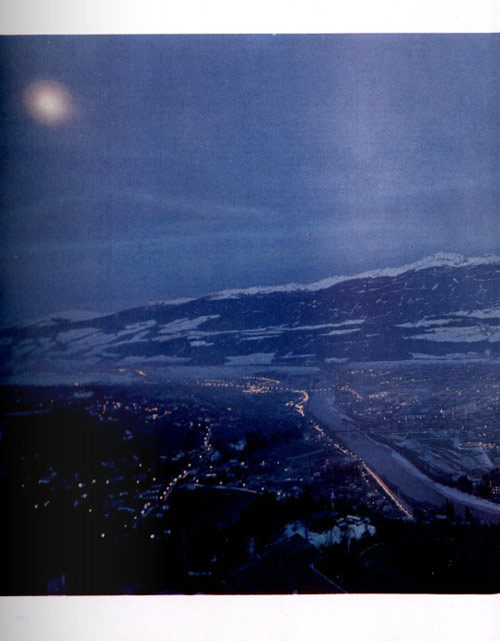
Sports writer Frank Graham, Jr. — son of famed boxing writer Frank Graham — marveled at the apt Alpine terrain of Innsbruck, Austria when he covered the Winter Olympics for the Post in 1964. To bring the Winter Olympics to Innsbruck was “as fitting as it would be to stage the track-and-field games on the plains of Greece.”
A tragic shadow was cast on the Games after the 1961 plane crash in Brussels that killed all 18 athletes of the U.S. figure skating team. New skaters were filling the void, though, and the team ended up with a couple of bronzes.
Graham’s most inaccurate forecast was his claim that we didn’t stand a chance in speed skating: “Speed skating belongs to the Scandinavians and the Russians. Our only triumph since the war was Ken Henry’s gold medal in the 500-meter race at the 1952 Olympics. It is unlikely that the United States will spring a similar surprise this year.” As it turned out, American Terry McDermott won our only gold medal that year in the 500-meter, beating out two Russians and a Norwegian.
McDermott was canonized upon his return to the U.S. with an appearance on “The Ed Sullivan Show” on February 9, 1964 — the same night a certain British rock group made their U.S. debut.
Olympic History: What Makes a Good Bobsledder?
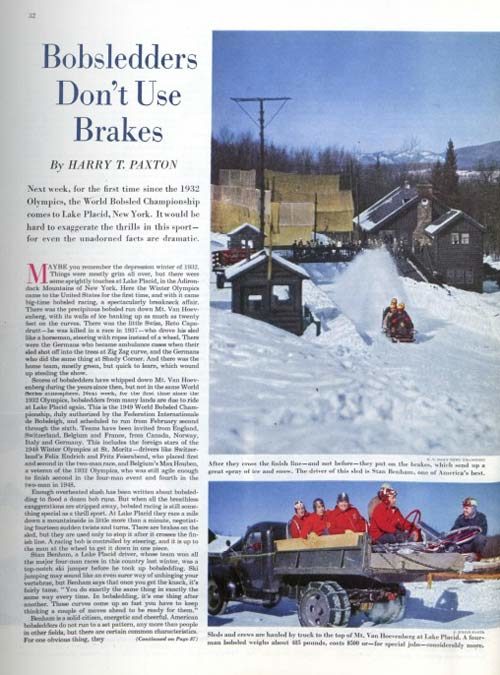
Common qualities of bobsledders probably haven’t changed much since the Post wrote about them in 1949: they are mechanically minded, levelheaded, and usually live near a sledding course. In 1949, there was only one course in the U.S.—at Lake Placid—so that’s where all the best American bobsledders came from.
The other common characteristic was being male. In 1940, a woman—Katherine Dewey—drove a four-man sled to victory in the A.A.U. Championship. She was the only woman in the competition, but her reign didn’t last long. “This pill was too bitter for some of the lads to swallow. The next winter Katharine was barred from racing.”
Bobsledding has changed in significant ways since 1950: the sleds are more enclosed, weight limits have been imposed, and women now compete in one- and two-person bobsleigh.
One thing that has remained true 70 years later is this: “For all its clocklike techniques, bobsled racing still contains a large element of luck. One bad break—one bad heat—and the race goes out the window.”
Healthy Weight, Healthy Mind: 8 Simple Tips for Losing Weight with a Food Journal
We are pleased to bring you this regular column by Dr. David Creel, a licensed psychologist, certified clinical exercise physiologist and registered dietitian. He is also credentialed as a certified diabetes educator and the author of A Size That Fits: Lose Weight and Keep it off, One Thought at a Time (NorLightsPress, 2017). See all of David Creel’s articles here.
Do you have a weight loss question for Dr. Creel? Email him at [email protected]. He may answer your question in a future column.
Creating and maintaining a food diary is one of the best ways to increase awareness of what you’re doing. A food journal is to an overweight person as a speedometer is to a speed demon trying to slow down.
If you dread the idea of having a paper journal you must pull out each time you eat, hide for fear someone might look at, or misplace multiple times a day, you can relax and let technology eliminate these barriers. A multitude of apps allows us to discreetly track eating and physical activity. It’s as simple as pulling out your phone and entering a little information each time you eat. Many of the applications have features that allow you to scan the UPC code of a food in order to add it to your diary. At all times during the day you can see how many calories you’ve eaten and how many remain, which will guide you during situations like that late-night trip to the refrigerator. You can also pay attention to other dietary factors such as percent of calories coming from fat, protein and carbohydrate, the grams of fiber you have consumed, and so on. If you aren’t into technology, there’s no reason you can’t keep a paper food journal. Many of my patients prefer this simple pen-and-paper method. If you’re working with a professional to manage your weight, a food journal highlights the strengths and weaknesses of your diet, and can guide the discussion about your eating patterns.
Tracking food intake will help you pay attention to what you’re eating, educate you on the source of calories, allow you to examine patterns of behavior you may want to modify, and help explain why your weight is changing. Whether you use a paper journal, an app, or a website to track your eating, the following suggestions will help you get the most out of self- monitoring.
1. Include everything you eat
The primary goal of keeping a record is to increase awareness and ultimately change your behavior. Therefore, you should “partner” with your journal, agreeing to report everything you eat. That includes a handful of peanuts, a small piece of candy, a bite of your spouse’s cake, etc. Having incomplete or inaccurate food records will frustrate you, because according to the records, you should be losing weight, but aren’t. Yes, it’s a bit inconvenient to record every little thing you put in your mouth, but therein lies the beauty of self-monitoring. It can cause you to pause and ask yourself, “Do I really want these peanuts if I have to record them? Am I really that hungry?” If you’re eating out of habit, your food journal is a deterrent to mindless eating and grazing.
2. Include all beverages containing calories
Many people who record their intake are lackadaisical about including beverages. Soda, juices, alcohol, sport drinks, and even some diet beverages contain calories and can be a significant contributor to weight.
3. Measure your portions
Although researchers have developed a way to determine portion sizes by taking photos of our food, there is currently no good, commercially available technology to track portion sizes without some work on your part. Weighing and measuring food can be helpful because our eyes fool us into believing we’re eating less than we really consume. Although a food label may list ¾ cup of cereal as a serving, that may not be typical for you. Once you determine how much a cup of milk fills your glasses, what one cup of pasta looks like on your plates, and the size of three ounces of meat (about the size of a deck of cards), you may not need to get the measuring cups and food scale out for each meal. However, spot-checking portion sizes is generally a good idea to make sure your perception isn’t drifting. If you aren’t losing weight as expected, returning to exact measuring may be helpful.
4. Include the good days and the not-so-good days
We often learn more from our struggles in life than we learn from success. Although it’s psychologically challenging to record food intake when we feel as if we’re going off the rails, this can be immensely helpful. Tracking deviations helps reveal our relationship with food. Behavior is easier to correct when we’re aware of food-related triggers and typical responses. For example, perhaps you overeat when dining out with friends or after a stressful day at work when you feel too tired to cook. People who pay attention to these trigger events usually get off track less often and stay off track for shorter periods, compared to those who feel discouraged, stop being mindful, and abandon the food journal.
Food journaling is part of a larger process of changing your relationship with food. In order to get the most out of it, you need to reinforce healthy behavior, but also understand and change your unhealthy responses to stressful situations.
5. Record as you go
Record the foods you eat as you eat them. Waiting until the end of the day to write down what you’re doing is like waiting until you get your credit card statement to determine if you’re sticking to a budget. Tracking as you go leads to awareness. You are self-monitoring your behavior rather than just producing a record. In addition, the longer you wait to record your intake, the more you misremember what and how much you ate. It’s easy to forget exactly what you consumed, and portion sizes tend to shrink when you rely on memory.
6. Tell a story
Your food journal should tell a story. When you’re losing weight it should be evident why this is occurring. Remember, it takes approximately a 3,500-calorie deficit to yield a pound of weight loss, so we aren’t looking at food records to explain day-to-day changes in weight. Rather, we can examine eating patterns over several weeks to explain weight changes. If the numbers don’t add up, look for sources of error in your reporting.
I’ve often reviewed patients’ food journals that indicate they eat less than 1,200 calories per day, yet aren’t losing weight. Sometimes patients attribute this lack of weight loss to a slow metabolism, decreased physical activity, or having a Martian-like physiology that defies the laws of thermodynamics. But the true reason is usually based on inaccurate reporting. The most common errors come from waiting too long to record intake or failing to weigh and measure food. Other patients may be eating a lot of unknown calorie foods. They may frequently stop at a mom-and-pop diner for lunch, and although they do their best to determine portion sizes and calories, they really don’t know what’s in the food. Lastly, people using electronic apps make mistakes by selecting foods from the database that don’t match what they actually consumed.
7. Consider the peculiar
Spray margarine is a great way to get the flavor of butter without the calories. The primary ingredients are water and oil. If you look at the food label it indicates “0” calories. In fact, it does have calories because it contains oil. But the serving size is “one spray” and rounding the calories of one spray to the nearest digit allows the manufacturer to indicate it has no calories. I’ve never seen anyone stop after one squirt, but nevertheless, it’s a lower-calorie alternative to other added fats.
Tammy, who liked the taste of butter but didn’t want the consequences of calories, was an avid food label reader and decided to use spray margarine. In her eyes this was a “free food” because the label clearly read it had zero calories. Since it was calorie-free, she didn’t bother putting it in her food journal. Due to great investigative work by one of our registered dietitians, we were able to solve the mystery of why Tammy was gaining weight; she consumed up to two bottles of spray margarine every day. She would take off the spray top and pour it on almost everything she ate. This gross-me-out use of spray margarine obviously contributed to her unexplained weight gain.
Another client asked me if she needed to include sugar-free gum in her food journal. My first response was “no.” Sugar-free gum only has five calories per stick and the act of chewing gum actually burns a few calories and may prevent someone from mindlessly eating snacks. To me, the calories in the gum were a wash. But as we continued to talk, I began to understand she really liked gum. In fact, she was compulsive about chewing it. She was an ex-smoker who used gum to deal with anxiety. She would chew a piece of gum just long enough to get the sweet taste from it, and then she would spit it out and get another piece. She was going through five or six of the 10-piece packs per day. She consumed enough sugar-free gum every day to equal the calories in two regular sodas. Although her breath was always great, she wasn’t adequately handling the stress of work. She had a good sense of humor about her gum issue but realized this compulsive chewing was contributing to the problem with her weight. We worked together to help her manage stress in better ways.
8. Remember the spirit of the food journal
The goal of keeping a food journal is to become more aware of your relationship with food, which will help you establish healthy eating habits that lead to weight loss or maintaining a healthier weight. Most people, even those who are successful, don’t use the journal every day for the rest of their lives. However, self-monitoring your diet regularly in the early stages of weight loss is extremely important in order to learn more about your eating patterns and educate yourself on where, when, and under what psychological or environmental circumstances you consume extra calories.
Over time you may decide to only record your food during the times you struggle most, such as evenings or weekends. You may eventually stop recording everything you eat and simply have a daily checklist. Others have successfully used food journaling in tandem with self-weighing, only recording their foods when weight begins to climb.
Come back each week for more healthy weight loss advice from Dr. David Creel.
News of the Week: Olympic Shrugs, Lincoln Logs, and the Possible Return of Seinfeld
The Thrill of Victory, etc.
I know this may make me a bad sports fan or a bad American or maybe a bad person in general, but I have no interest at all in the Olympics. Not only do I find making a commitment to watch the coverage a rather overwhelming task, I have no interest in the specific sports themselves, the figure skating and the skiing and the luging. I thought in the back of my mind that I might just be a little irritated at all of the NBC coverage interrupting regularly scheduled programming, but then I realized I don’t watch anything on NBC’s prime time schedule.
Maybe if I actually sat down and forced myself to watch the coverage, I would get into the Olympics. But who has time for that when there are reruns of Everybody Loves Raymond to watch for the tenth time?
Of course, I’m well aware that the Olympics are an important story right now, and I certainly don’t want my Debbie Downerism to ruin your enjoyment of the Games. Here’s the official site, where you can keep track of all of the results.
Is This Really Lincoln’s Cabin?
Anyone who has ever played with Lincoln Logs knows that the 16th President grew up in a log cabin. But did he really? And if he did, which log cabin did he grow up in? CBS Sunday Morning tries to figure it all out:
New Emojis Are Here (Please Contain Your Excitement)
Have you ever been writing a Facebook post or an email, and you want to talk about a lobster, but typing out the word lobster just takes too long, so you say to yourself, “I really wish someone would create a picture of a lobster that I can insert here so the person I’m sending this to knows what I’m talking about”? Well, you’re in luck! The lobster is just one of 157 new emojis that have been released by the Unicode Consortium, which sounds like an organization James Bond would battle but is actually the people who make sure we have a universally agreed-upon series of computer code, software, applications, computer languages, and lobster pics.
If You Woke Up in 1918 …
Here’s a question posed on Twitter this week by Sirius XM host Eric Alper:
https://twitter.com/ThatEricAlper/status/962188018978193408
I’d go to Kentucky and try to figure out if Lincoln grew up in a log cabin.
New Books
Here are four new books that are well worth your time:
- Feel Free, by Zadie Smith. The British writer has released another collection of terrific essays on everything from Brexit and Facebook to rap stars and libraries.
- Damn the Naysayers, by Dr. Doug Zipes. The Post contributor has written a memoir on how the words “no, you can’t” shaped his life, and how they “challenged him to come to terms with who he is, where he wants to go, and what he wants to be.”
- The Rub of Time, by Martin Amis. In this jam-packed collection of essays and reportage, the acclaimed writer aims a critical eye at President Trump, Saul Bellow, Las Vegas, professional tennis, and more.
- The Atomic City Girls, by Janet Beard. This is the new paperback version of the book that came out last year. It tells a story you might not have heard before about the women who worked on the Manhattan Project during World War II.
RIP Vic Damone, John Gavin, Marty Allen, John Perry Barlow, and Bill Crider
Frank Sinatra once said that Vic Damone had “the best pipes in the business.” The singer, famous for such hits as “On the Street Where You Live” and “Wives and Lovers,” died Sunday at the age of 89.
John Gavin is probably best known as the hero in the movie Psycho, but he also had roles in movies like Spartacus and Imitation of Life, as well as the TV series Destry. He was later Ambassador to Mexico under President Reagan. He died last Friday at the age of 86.
Marty Allen was half of the comedy duo Allen & Rossi, known for his catchphrase “Hello Dere!” He died earlier this week at the age of 95.
John Perry Barlow was not only founder of the Electronic Frontier Foundation and a fighter for a free and open internet, but he also wrote lyrics for the Grateful Dead. Barlow died last Wednesday at the age of 70.
Bill Crider was a beloved writer of almost 100 books, including Westerns, science fiction, mysteries, and action-adventure novels. He died Monday at the age of 76.
The Best and the Worst
The best thing I saw this week – or at least the thing that made me laugh the most – is this advertisement (not sure where it ran) from someone named Alex:
https://twitter.com/_youhadonejob1/status/963772594628554752
Alex, if you’re reading this, here are some tips on how to make up with Jodie.
The worst news came from Jerry Seinfeld, who told Ellen DeGeneres that it’s “possible” Seinfeld could join other sitcoms like Roseanne and Murphy Brown and stage a comeback. It’s not that I don’t love Seinfeld; it’s one of my favorite shows. But that’s why I don’t want to see it come back. It might tarnish the perfect memory that it is.
The way Seinfeld says “possible” makes me believe it’s probably never going to happen – it’s also “possible” I’ll win the Publishers Clearing House Sweepstakes – though if the cast wants to destroy every single copy of the series finale and redo that episode, I might be up for that.
This Week in History
Last Peanuts (February 13, 2000)
The final comic strip drawn by Charles Schulz ran the day after the artist passed away at the age of 77. Here are some comics that Schulz did for the Post, just before he started Peanuts in 1950.
Susan B. Anthony Born (February 15, 1820)
Post Archive Director Jeff Nilsson has the story on how Anthony was arrested for illegally voting in the election of 1872.
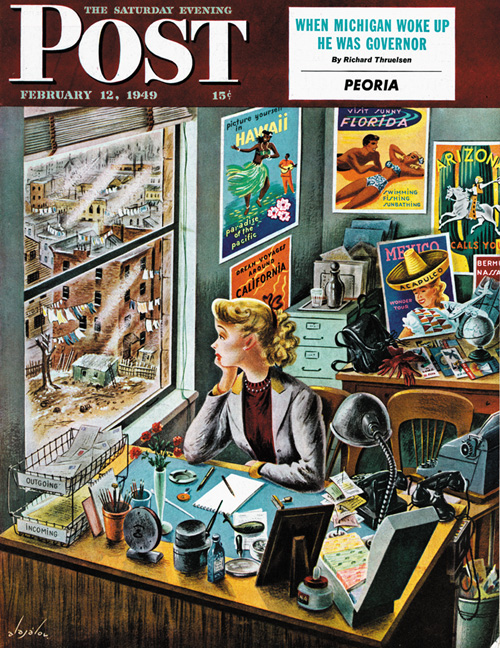
This Week in Saturday Evening Post History: Travel Agent at Desk (February 12, 1949)
Constantin Alajalov
February 12, 1949
As I mentioned last week, I’m not ready to give up on winter (ask me again in three weeks), but I know that a lot of people are yearning for warmer temps, the bloom of flowers, and the ability to walk outside without wearing a heavy jacket. Like the woman in this cover by Constantin Alajálov. She’s looking at the cold and the snow outside of her office window, knowing she has to deal with people who are going to Florida and Hawaii and other warm locales.
Today Is National Almond Day

They say (“they” are always saying something) that almonds are good for you and we should all eat more of them. That doesn’t mean we can eat a bag of them a day and still expect to fit into shorts when the warmer weather starts, but if you want a snack, they’re one of the better options in moderation.
To celebrate National Almond Day, you can add some almonds to this Red Rice Stuffing with Dried Fruit or maybe this Pan-Roasted Chicken with Carrots and Almonds.
Okay, if you’re looking for something sweeter, you can make this Chocolate-on-Chocolate Tart with Maple Almonds or these almonds of the candied variety.
Next Week’s Holidays and Events
National Drink Wine Day (February 18)
I’m not really sure why this day is specifically called “Drink Wine Day” instead of just “Wine Day.” What else are you supposed to do with it?
Presidents’ Day (February 19)
The holiday is held on George Washington’s actual birthday, but Abraham Lincoln’s actual birthday was last Monday. So not only does Lincoln not get a cabin, but everyone forgets his real birthday.
5 Weird Sports That Almost Made It to the Winter Olympics
Up until the 1990s, Olympic host countries could add demonstration sports to the list of competitions, often using the opportunity to garner international exposure for a popular local sport. Medals from these competitions were smaller than true Olympic medals, and they weren’t included in a country’s official medal count.
Sometimes a demonstration sport would go on to become a full-fledged Olympic event. This happened with curling, for example, which was a demonstration sport in 1932, 1988, and 1992 and became a full Olympic event in 1998. But other times, the demonstration sports just didn’t make the Olympic cut.
Here are five of the stranger Winter Olympics demonstration sports that weren’t adopted by the International Olympic Committee.
1. Winter Pentathlon
A demonstration sport at the 1948 Winter Games in St. Moritz, Switzerland, the winter pentathlon sounds more like James Bond try-outs than an Olympic sport. As the name suggests, the competition consisted of five events: cross-country skiing, shooting, downhill skiing, fencing, and horse riding.
It was modeled after the modern pentathlon of the Summer Games, which consists of swimming, pistol shooting (now laser pistols), running, fencing, and horse riding. In fact, a number of the athletes who competed in the winter pentathlon demonstration came back during the Summer Games to compete in the modern pentathlon.
Though the biathlon (cross-country skiing and shooting) remains an Olympic sport, the winter pentathlon never really caught on.
2. Skijoring
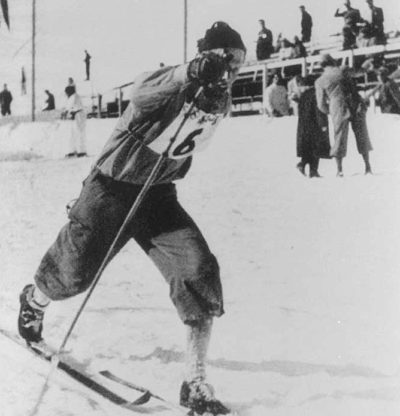
Halfway between dogsledding and cross-country skiing is the sport of skijoring. In this competition, competitors on skis hold the reins and are pulled across the snow and ice behind either one or two dogs or a horse. When it was a demonstration sport at the 1928 Winter Games in St. Moritz, Switzerland, athletes raced across a frozen lake behind horses.
Skijoring is alive and well today around the world. SkijorUSA offers information and organizes races in the United States and is trying to get the sport reintroduced to the Winter Olympics.
3. Bandy
At first glance, bandy looks a lot like ice hockey, but it’s much closer to field hockey on ice. It’s played on a field of ice roughly equivalent to the size of a field hockey pitch (or a soccer field). Two teams of 11 athletes use curved sticks to propel a small ball (as opposed to a puck) up the ice and into a rectangular goal. Unlike both field and ice hockey, the goalkeeper does not use a stick for defense — only gloved hands.
After ice hockey, bandy is one of the most popular ice sports in the world. The Federation of International Bandy also has alternate rules for “rink bandy,” which uses smaller teams on a smaller ice hockey rink. It was a demonstration sport at the 1952 Winter Games in Oslo, Norway, but was ultimately abandoned because it was too much like ice hockey. However, as its popularity grows, it could make a comeback: It’s being considered for the 2022 Winter Games in Beijing.
4. Speed Skiing
Imagine the ski jump competition, with the steep, straight slope curving up into a ramp that sends the athlete into the air. Now take out the ramp, and that’s pretty much speed skiing. The goal of speed skiing, which was a demonstration sport at the 1992 Games in Albertville, France, is to gain as much speed as you can. Competitors ski in a straight line down a half-kilometer slope to the finish line, exceeding speeds of 120 miles per hour.
Speed skiing is still a contemporary sport — there are around 30 specially built slopes for it around the globe — but it didn’t make the cut after the 1992 Games, in part because the high speed makes it so dangerous. The world record as of February 2018 is 158.424 miles per hour.
5. Ski Ballet
Ski ballet was a demonstration sport at both the 1988 Calgary Games and the 1992 Albertville Games, and it’s exactly what it sounds like. Similar to figure skating on skis, ski ballet competitors would drift down a moderate slope while spinning, jumping, and — with the help of a pair of ski poles — flipping through the air while music plays.
Ski ballet, which is also called acroski, was a type of freestyle skiing that gained some worldwide popularity during the 1980s and ’90s. After failing to make the Olympic cut in 1992, however, the sport more or less died off. The International Ski Federation ended all formal ski ballet competition in 2000.
Plumber’s Helper
“What did he do this time, Emma?” John the plumber asked. A handsome man near my age, John had visited my home more times than I could count during the previous couple of years, and he always greeted me with a smile. I wondered if it was because he genuinely liked seeing me, or if he just liked the steady work my son and I provided.
The last time John had been to my house was to remove a stuffed bunny Austin had tried to flush down the toilet. The time before that, my son had emptied his marble collection into the kitchen sink and the marbles had rolled into the garbage disposal. Lucky, I saw them head down the drain and knew not turn the disposal on.
“I can’t blame my son this time,” I explained as I reached down and patted Austin’s head. My son liked John and always answered the door with me when he knew we were expecting the plumber. I was beginning to wonder if he did some of the things he did because he knew I would call John. “I dropped an earring in the bathroom sink, and it went down the drain before I could stop it. I wouldn’t care if it were costume jewelry, but it’s a diamond stud from a pair my husband gave me.”
John appeared disappointed when he asked, “You’re married?”
We had never discussed my marital status, nor had we ever discussed his, but neither of us wore wedding rings.
“I — We lost Austin’s father two years ago,” I said. Though I still missed my husband, I had reached the point where I was ready to move on with my life. What bothered me most is that Austin had been so young when his father died that he never really had the chance to bond with him. “Cancer.”
“I didn’t know,” John said. “I’m sorry for your loss.”
The look on the plumber’s face and the sincerity in his pale blue eyes let me know he really did feel sorry.
“My husband used to take care of things like this,” I continued, “but now that he’s gone—”
When I let my sentence hang in the air, John finished it. “Now that your husband’s gone you have to do everything, including be both mother and father.”
I nodded. “I’m learning to do things I never thought I would have to do. Just in the last year I’ve learned how to change a tire and charge a car battery.”
After listening to my list of newly acquired skills, none of which involved plumbing, John asked, “You haven’t run the water since you dropped the earring, have you?”
“Heavens, no!”
John smiled. “Then it should be easy enough to rescue your earring, Emma. Let me get my toolbox.”
I watched as John walked to his van, admiring his clean blue uniform and the professional way he presented himself each time I called him for help. His entire demeanor was unlike that of other tradesmen I had hired to fix things, which is why his number was the only plumber’s number saved in my cellphone. When John returned, he asked my son if he wanted to help rescue my earring. Austin beamed and nodded vigorously.
“Show Mr. John where the bathroom is,” I told my son, even though I felt certain the plumber would remember the way, having once rescued a waterlogged bunny from the only toilet in the house.
I followed them and sat on the edge of the bathtub. My son sat cross-legged on the floor, and we watched John open the cabinet below the sink and examine everything. Then he placed a bucket beneath the pipes to catch any water that spilled out.
He tapped the drain pipe with one finger and told my son, “This is a p-trap —”
When Austin giggled, John gave him a stern glare and continued.
“— and we have to remove it to get your mother’s earring.”
“How?”
John took several things from his tool chest. He showed Austin how to adjust a crescent wrench and fit it around one of the slip nuts. Then he loosened the nut before letting my son finish unscrewing it.
As they were working, I asked, “Do you like being a plumber?”
With a glint in his eye, John said, “Sometimes it’s draining.”
I laughed at his little joke.
“Mostly I like being my own boss,” he said, “but it’s tough on relationships. I get calls all hours of the night and I can’t afford to turn down work. Worse, I haven’t had a home-cooked meal in ages.”
“Try dating as a single parent,” I said, subtly letting him know that I had begun dating again. “I’ve tried a few times, but men just don’t understand that my son takes priority.”
By then, John was half-under the sink with Austin so I couldn’t see his face when he said, “Maybe you’ve dated the wrong men.”
Maybe I had, but I didn’t admit that out loud.
John loosened the other slip nut and let Austin unscrew it. Then he removed the J-bend pipe and upended it over the bucket. A bunch of dirty water and other gunk cascaded out. Austin stuck his hand in it and pulled out my missing diamond stud.
“Here it is, Mom!” my son said as he handed it to me. I would have to clean the diamond stud before I wore it, but I was glad not to have lost the last Christmas gift my husband ever gave me.
While I watched, John showed Austin how to put everything back together and test for leaks. Then my son and I walked John to the front door, where the plumber and I stood in the open doorway smiling at one another as if neither wanted the moment to end.
“How much do I owe you this time?” I asked as I reached for my purse.
“There’s no charge, Emma.”
I looked up. “But —”
“Austin did most of the work,” John said with a smile. I smiled in return when he added, “I just loaned him the tools.”
“I did!” my son insisted. “I did everything just like Mr. John told me.”
We stared at each other for a moment more before John asked, “Is there anything else I can do for you before I go?”
“There is,” I told him. I knew I was taking a risk when I continued, but it was a risk I felt certain would be worthwhile. “We’re having dinner at six o’clock tonight, and we’d like for you to join us.”
“I —” He hesitated.
Austin’s eyes had grown big and round when he realized that I had just invited his favorite person to dinner. He grabbed the plumber’s hand and added, “Please, Mr. John?”
I added, “And we won’t get upset if you get a call and have to rush off in the middle of dinner to unclog someone else’s pipes.”
John smiled and his blue eyes twinkled. “I won’t rush off during dinner. I wouldn’t do that to you, Emma. I’ll let the answering service take my calls. After all, I know what takes priority.”
Bridging the Divide: Friendship Across Partisan Lines
This article is part of a series representing a collaboration between The Saturday Evening Post and AllSides. The purpose of the series is to take a divisive issue and explore not only the differences but also the commonalities on both sides of the debate.
What does a progressive woman from Berkeley, California have in common with a conservative man from small-town America? On paper, not much, but in the case of Joan Blades and John Gable, they share at least one thing — a deep desire to heal the political divide.

As they detail in their recent TED Talk, the two joined forces to build bridges across partisan landmines after a chance meeting on Capitol Hill. Blades is co-founder of Living Room Conversations, which provides a step-by-step guide to approaching political conversations with respectful dialogue. Gable’s company, AllSides, aims to cut through media bias by providing multiple perspectives on the contentious issues facing our country. Together, the two solidified an unlikely business partnership dedicated to popping filter bubbles — those pesky echo chambers that form when we’re only exposed to views we agree with.
But, more importantly, they forged a friendship.
One Sentence, a List of Email Addresses, and an Internet Connection

A longtime progressive and resident of the Bay Area, Blades started MoveOn.org, a website committed to social organizing. After a grassroots beginning, it soon became the standard-bearer for using online petitions for political advocacy. Her first project was a one-sentence appeal written during the Bill Clinton/Monica Lewinsky scandal: “Congress must immediately censure the president and move on to pressing issues facing the nation.”
It went viral.
Blades couldn’t have predicted the response. What began as an email to a few friends rapidly ballooned, with hundreds of thousands of Democrats and Republicans alike adding their names to the cause.
MoveOn now identifies as progressive. But while Blades’ initial vision was certainly political, in her mind, it wasn’t left, right, or anything in between.
“I didn’t think of it as bipartisan,” she said when recounting the organization’s first days. Rather, she saw it as something for “everyone” — a movement that transcended political affiliation entirely. After watching the impact she had with one sentence, a list of email addresses, and an internet connection, she was hooked.
A Conservative in a Dark Blue State
John Gable is also a resident of the Bay Area by way of Stearns, KY, a stark transition from deep red to dark blue territory. Following a stint in Republican politics where he worked for Senator Mitch McConnell (R-KY), the Republican National Committee, and former president George H.W. Bush, he transitioned to Silicon Valley.

Uprooted from his conservative background, he found himself surrounded by people who disagreed with him on just about everything.
Well, almost everything. Like Blades, he’s a firm believer in technology’s potential to enact positive change. His foray onto the web was a bit less humble than his progressive counterpart’s, landing the role of product management lead at Netscape Navigator. The experience solidified his belief that this new terrain would provide enormous benefit to the global community. As one of the pioneers of the World Wide Web, he saw that the possibilities were endless.
Filter Bubbles
Twenty years later, both Blades and Gable have seen the societal benefits of technology first-hand, particularly with the internet’s unfettered access to limitless resources—knowledge, people, and otherwise. But they also concede that the pendulum may have swung too far, with online platforms increasingly sowing division. When they first met back in 2005, they teamed up to address this phenomenon.
“There’s just too much noise,” says Gable.
As content proliferates at a rapid pace, humans filter the majority out, and our technology self-selects so that we hear what we want to hear. Algorithms on popular websites analyze our political preferences and highlight news articles accordingly, eliminating opposing views. The “unfollow” button on social media provides an easy escape hatch when an idea we perceive as offensive comes into plain sight. And the 24-hour cable news cycle serves more to inflame than inform in hopes of maintaining a loyal customer base.
According to Gable, we’ve concocted the perfect recipe for an echo chamber, with a few extra dollops of partisan rancor.
Blades attests to the danger of filter bubbles, admitting that, just ten years ago, she “didn’t have any conservative friends.” Born and raised in Berkeley, she had never cultivated a relationship with someone outside of her progressive circle, a testament to the geographic and social factors that exacerbate the political divide.
So in 2010, she started Living Room Conversations, affording her the opportunity to engage in a national, civil dialogue with people of all different persuasions. And she says the best parts are the cross-partisan friendships that survive regardless of Trump or anti-Trump sentiment.
“This is one of the things I love about Joan,” says Gable. “She truly did burst her own filter bubble.”
Gable followed a different trajectory, as his filter bubble was forcefully popped after leaving Red America for the liberal coast. Frustrated by a pervasive unwillingness of some to understand the “other side,” he started AllSides.com. The site showcases a diverse array of voices on current events to expose people to the “full picture,” not just one slant.
Although Blades and Gable came from polar opposite backgrounds, they met in the middle.
A Polarized Nation
It goes without saying, but when the 2016 election came to a close, people were shocked. According to Gable and Blades, these filter bubbles deserve a great deal of the blame, with various areas of the country completely unaware of the others’ perspective. But even more so, the filter bubbles emphasize a sharp increase in polarization, where any slight divergence in political opinion is just cause for severing ties with friends or family.
As a result, many stay “in the closet” for fear of losing loved ones.
Listening Beyond Our Bubble
Following their talk at TEDWomen in New Orleans, a young woman approached the pair to share her own story. A liberal, she actively avoided political conversations with her conservative father, so vexed was she that a loved one subscribed to an agenda she viewed as oppressive.
But when the health care debate came to a head in recent months, she couldn’t hold her tongue any longer. As a supporter of progressive health care policies, she agonized over why her father would stand in the way of universal coverage. She broached the subject, but instead of asking to respond, she asked to listen—to understand.
“I feel it is my responsibility to provide for my family,” he said. “I want to provide for my family, and I feel like the government is taking that away from me.”
It wasn’t the answer she expected. It didn’t come from a place of malice or greed, but from a place of protection and love. It wasn’t oppressive; it was honest. It was human.
“The best way to be heard is to truly hear the other person first,” says Gable. “It all comes down to listening beyond our bubble.”
Blades wholeheartedly agrees. “Reaching out and having conversations with people that we don’t normally have conversations with is actually a really fun thing to do,” she says. Apart from the numerous emotional and intellectual benefits, she emphasizes that it’s an exciting, edifying process. “You make friends with people you otherwise wouldn’t and all of a sudden, so much more makes sense,” says Blades.
“It’s an adventure.”
Olympic History: Are Ski Jumpers Born That Way?
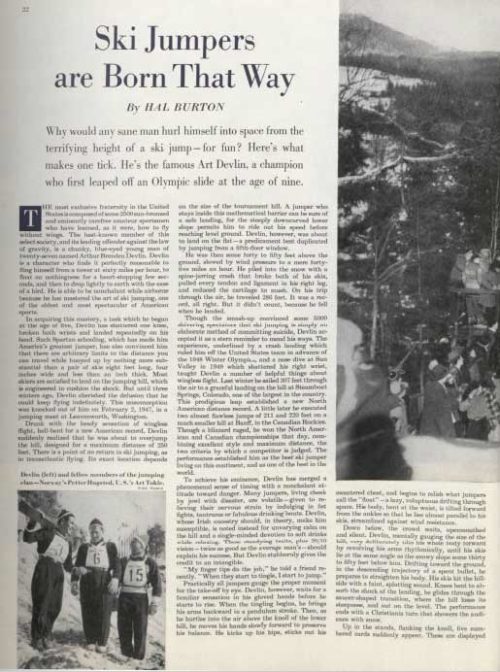
In this 1950 article, the Post interviewed brave – or is it foolish? – ski jumper Art Devlin, including the memorable time that, in a bid for a record, he overjumped the ski hill:
He piled into the snow with a spine-jarring crash that broke both of his skis, pulled every tendon and ligament in his right leg, and reduced the cartilage to mush. On his trip through the air, he traveled 286 feet. It was a record, all right. But it didn’t count, because he fell when he landed.
The article details Devlin’s incredible skill, his derring-do, and his ability to attract large crowds “whether hungry for excitement or determined to find out why ski jumpers don’t kill themselves.”
While modern fans also marvel at the fearlessness of ski jumpers, some things have changed since 1950. Many jumpers used to turn to liquid courage:
Two of these worthies, who shall remain unnamed, could not jump effectively without a little stimulant. Each would carry a half pint of whisky to the top of the hill, drain it while waiting to start, and then kick off into space surrounded by a rosy haze of bourbon.
(Despite Devlin’s boldness on the hill, he was a straight arrow, sticking to soda pop and early bedtimes.)
Earlier that year, Devlin had finished fifth in the individual large hill at the 1950 FIS Nordic World Ski Championships in Lake Placid. He would go on to compete in the 1952 and 1956 Olympics. While he didn’t medal, he never gave up his love for “flight without wings.”
Post Travels: Spring Training Home Runs Reach Beyond the Stadiums in Arizona
It’s about that time again. Time for the boys of summer to get back to work. Half of all Major League clubs—that’s 15 teams—pack their bags and head to the Phoenix, Arizona area for spring training. Stadium hopping couldn’t be easier thanks to the close proximity of the numerous ball parks. Scottsdale alone is home three teams: the San Francisco Giants, Colorado Rockies and Arizona Diamondbacks.
In addition to the obvious hundreds of games, spring training offers baseball fans a seemingly endless number of perks including cheap seats, access to favorite players, and sunny skies, just to name a few. But in between home runs and seventh inning stretches, the Arizona desert is full of surprises, and I’m not talking about the kind you find in a box of Cracker Jacks. Fans can fly high in a hot air balloon, kayak with wild horses, or come face to face with a fire breathing dragon. It’s the kind of adventures vacations are made of; the kind of adventures that might even have baseball fans thinking about skipping a game or two.
Up, Up and Away
It’s easy to get carried away and forget about the first pitch when you’re soaring across the Sonoran Desert. Hot air balloon rides typically rise up with the sun, so you have to roll out of bed in the dark, but it’s worth the early wake-up call. (Select times of year, afternoon/sunset flights are available.) Hot Air Expeditions has been flying in Arizona for more than 25 years. Take-off and landing sites vary depending on wind conditions, but the views are always exhilarating.

Whether you’re a first-time flier or ballooning pro, don’t forget to wear comfortable clothes and shoes. Layers are best. The temperature above should be about the same as the temperature on the ground, but be sure to bring along a hat. The hot air used to keep balloons afloat can make your head feel toasty warm as well. Once back on solid ground, fliers enjoy a sit-down gourmet breakfast in the desert complete with mimosas.
Wild and Refreshingly Wet
When you think of the desert, water isn’t typically part of the picture that comes to mind, but the Lower Salt River is a spot you’ll want to seek out and dip your toes into. Most stretches are only a few feet deep, and gentle conditions make it a place you’ll want to kayak or go paddle boarding again and again.
“The experience is different every time you are out there,” says Annemarie Kruse, Director of Marketing for Arizona Outback Adventures. “The water flow varies. The wildlife varies.”
The cast of amazing characters that call the Lower Salt River home includes beavers, river otters, and bald eagles, but it’s the wild horses that seem to make the most lasting impressions. (They even have their own Facebook page.) Some believe the wild horses are descendants of Iberian horses originally brought to the area by Spanish explorers in the 1500s. Regardless of where their origins lie, a 2017 census estimated more than 400 mustangs make their home along the entirety of the Salt River.
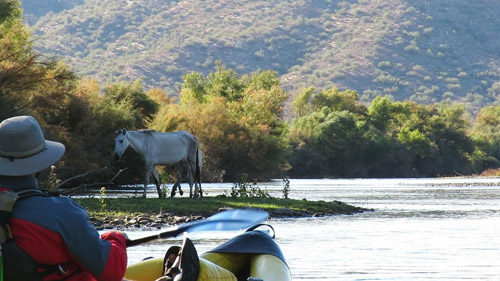
Mother Nature is never a sure bet, but if you’re lucky you’ll catch sight of a few grazing along the river’s edge as you float by. Arizona Outback Adventures runs half-day guided kayaking and stand up paddle board tours. They provide all the necessary gear, including water, snacks, and dry bags.
Arizona’s Artsy Side
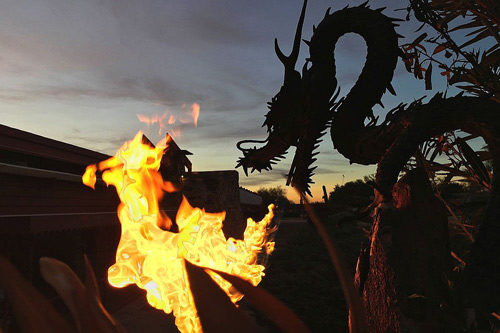
Taliesin West was the winter home and school of architect Frank Lloyd Wright. It was built by Wright and his apprentices in the 1930s, but constantly evolved until his death in 1959. A home, studio, and architecture school, tours of the National Historic Landmark are offered daily. Reservations are strongly recommended to avoid disappointment. If you can make it work with your schedule, the night tour comes with the strong possibility of an amazing sunset and a glimpse of a fire breathing dragon…sculpture.
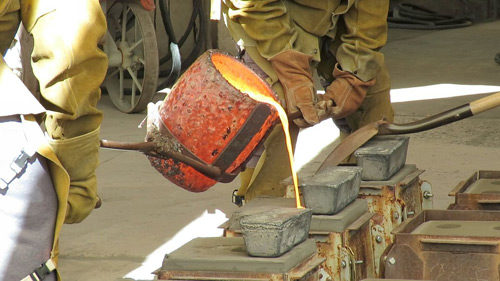
You’ll feel the heat when visiting nearby Cosanti too, as you watch artisans at the foundry create wind bells out of liquid bronze, heated to more than two thousand degrees. Cosanti is the home and studio of late architect and craftsman Paolo Soleri. The former Wright student was known for creating many things, including wind bells.
What time was that game again?
Curtis Stone’s Comfort Zone: Perfect Winter Pasta Dishes
There is something about pasta that is naturally satisfying, enriching, and comforting, and depending on the ingredients you’re using, a great pasta dish can be a meal in a bowl. You can add whatever you fancy — seasonal produce from the farmers market, a handful of capers from the pantry, or a quick grating of Parmesan. It’s up to you.
A hearty one-pot meal, Winter Vegetable and Italian Sausage Soup features two of my favorite root vegetables — parsnips and carrots. Personally, I like a surprise on the plate, which is why Spaghetti with Tuna and Spinach works well — an unlikely pairing that’s healthy, delicious, and simple to prepare.
When it comes to cooking pasta, here are the most common mistakes and how to avoid them.
Use a big pot filled with plenty of cold water and salt; too small a pot causes noodles to stick together and cook unevenly. Don’t add oil to the pot, which can prevent sauce from sticking to the pasta. Bring water to a roiling boil, then add pasta and cook uncovered, stirring occasionally, at a fast boil. Taste for doneness often until pasta is firm but tender — al dente. Few things are worse than an overcooked pasta. When pasta is ready, turn off heat and save some of the cooking water for later use in adjusting the consistency of the sauce. Drain immediately but do not rinse; it washes away starch that helps bind sauce to pasta — and some of the wonderful flavor. By following a few simple rules, you’ll make perfect pasta every time.

Winter Vegetable and Italian Sausage Soup
(Makes 8 servings)
- 2 pounds Italian turkey sausage, casings removed
- 2 tablespoons olive oil
- 2 large onions, finely chopped
- 10 garlic cloves, finely chopped
- 2 teaspoons fennel seeds, lightly crushed (use mortar and pestle or crush under heavy skillet)
- 4 sprigs fresh rosemary
- 4 carrots, peeled and cut into 1⁄³-inch pieces
- 4 parsnips, peeled and cut into 1⁄³-inch pieces
- 8 cups reduced-sodium chicken broth
- 2 cups shell-shaped pasta
- 2 15-ounce cans white kidney (cannellini) beans, rinsed and drained
- 1 6-ounce bag baby spinach Parmesan cheese (optional), for grating
Heat large heavy pot over medium-high heat. Add sausage and cook, stirring and breaking up sausage into bite-size pieces with a wooden spoon for 5 minutes, or until browned. Using slotted spoon, transfer sausage to bowl. Pour off fat from pot.
Add oil to pot and then add onions and cook, stirring occasionally, for 4 minutes or until softened slightly. Stir in garlic, fennel seeds, and rosemary and cook for 1 minute or until fragrant. Reduce heat to medium, add carrots and parsnips, and cook for 5 minutes, or until almost tender. Season with salt and pepper.
Return sausage to pot. Stir in broth and 2 cups water, raise heat to high, cover, and bring to a boil. Skim any fat or foam that rises to top of soup.
Add pasta to boiling soup and cook, stirring often, for 8 minutes, or until tender but still firm to bite. Remove and discard rosemary stems.
Gently stir in beans and simmer for 2 minutes, or until heated through. Remove from heat and fold in spinach. Season to taste with salt and pepper.
Ladle soup into bowls, top with Parmesan cheese, if desired, and serve.
Per serving
- Calories: 600
- Total Fat: 17 g
- Saturated Fat: 3 g
- Sodium: 1492 g
- Carbohydrate: 63 g
- Fiber: 12 g
- Protein: 45 g
- Diabetic Exchanges: 3 CHO, 5 protein, 3 vegetable, 1½ fat

Spaghetti with Tuna and Spinach
(Makes 4 servings)
- 10 ounces spaghetti
- 3 tablespoons extra-virgin olive oil, divided, plus more for serving
- 3 ounces shallots, finely chopped
- 6 garlic cloves, finely chopped
- ½ teaspoon dried red pepper flakes (optional)
- 1 cup dry white wine
- 1 6.5-ounce can pole-caught tuna chunks in oil, drained
- 6 cups loosely packed fresh baby spinach (3 ounces)
- Finely grated zest of 1 lemon
Bring large pot of salted water to boil over high heat. Add spaghetti and cook, stirring often to keep strands separated, for 12 minutes or until tender but still firm to bite. Drain pasta, reserving ½ cup pasta water.
Meanwhile, heat large heavy frying pan over high heat. Add 1 tablespoon oil, then add shallots, garlic, and red pepper flakes, if using. Cook, stirring, for 1 minute, then add wine and cook for 4 minutes, or until reduced by three-fourths. Stir in remaining 2 tablespoons oil and season with salt and pepper. Reduce heat to low and add tuna, stirring lightly to break up tuna.
Add spaghetti to pan and toss to coat with liquid. Add spinach and lemon zest and toss, adding enough reserved pasta water to make light sauce. Season pasta to taste with salt and freshly ground black pepper. Using tongs, divide pasta among 4 bowls. Drizzle oil over each serving and serve immediately.
Per serving
- Calories: 323
- Total Fat: 15 g
- Saturated Fat: 2 g
- Sodium: 215 mg
- Carbohydrate: 16 g
- Fiber: 2 g
- Protein: 16 g
- Diabetic Exchanges: 1 CHO, 2 protein, 1 vegetable, 2 fat
This article is featured in the January/February 2018 issue of The Saturday Evening Post. Subscribe to the magazine for more art, inspiring stories, fiction, humor, and features from our archives.
Recipes courtesy of Curtis Stone. Look for Curtis as head judge of Top Chef Junior on Universal Kids. The chef shares two more pasta recipes —Turkey and Mushroom Bolognese and Farfalle with Chickpeas, Baby Kale, and Dates — at saturdayeveningpost.com/winterpasta.
Rockwell Video Minute: The Marriage License
Norman Rockwell captures the contrast between a gloomy municipal office and the joy of a young couple applying for their marriage license.
See all of the videos in our Rockwell Video Minute series at www.saturdayeveningpost/rockwell-video.
Cover Collection: Put a Ring on It
Valentine’s Day is a popular time to get engaged, so we thought we’d share some of our loveliest engagement covers, from early-1900s Edwardian beauties to the 1960s woman who knows just what she wants.
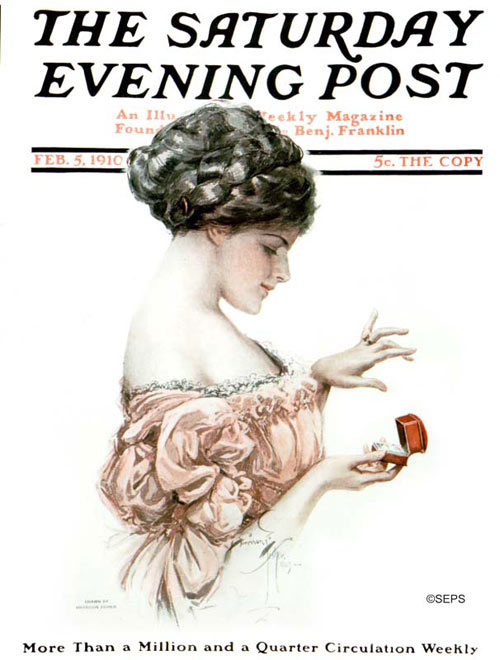
Harrison Fisher
February 5, 1910
This artist’s “Fisher Girl” was as well known at the time as Charles Dana Gibson’s “Gibson Girl.” The rosy cheeks and softly styled hair were hallmarks of his style, and this 1910 cover bears all the characteristic of a typical Fisher cover. His art appeared frequently in The Saturday Evening Post and Cosmopolitan, which called him “The World’s Greatest Artist.” He clearly had a preference for painting women, as the bridegroom is nowhere to be seen.
John LaGatta
May 17, 1930
Artist John LaGatta used depictions of glamorous, elegant women in a romanticized world of “old Hollywood” to provide an escape from the realities of the Great Depression. Coming to America from Italy with nothing, LaGatta eventually become one of the most sought after illustrators in the country, earning as much as $100,000 a year throughout the 1930s and 40s. This illustration is typical of his oil-over-charcoal technique.
George Hughes
January 22, 1949
When an artist in Arlington, Vermont, needs models, he can always call on neighbors—it must have been a rare citizen of that New England town whose face hadn’t appeared in at least one cover or illustration. So George Hughes drafted artist Mead Schaeffer‘s daughters Patty and Lee. Lee is the one with the engagement ring; you might remember her from this crazy story. Then he asked neighbor Paul Benjamin to pose as the gent who didn’t share the ladies’ excitement about matrimony. “The picture is out of character,” said Hughes. “Benjamin actually is a very amiable guy.” The only real problem was the bus. Arlington wasn’t big enough to need city bus service, and Hughes had to wait until a bus operator who hauls workers to a nearby factory had a bus in the garage for repairs.
Constantin Alajalov
May 7, 1949
This cover features an emerald necklace (in the background, middle shelf) that was in the Post twice. It first appeared in May of 1948, in an photo for an article about Jules Glaenzer of Cartier and Company. When artist Alajalov, a friend of Glaenzer, wanted to look at a jewelry store without buying jewels, he just popped in at Cartier. “Want to put this in the picture?” Glaenzer asked, producing the necklace featuring a 107-carat emerald. “As an academic question, how much is it?” Alajalov asked, his eyes watering. “A million dollars,” was the reply. “Let’s just see the price tag.” the painter gasped. Glaenzer replied, “We never tag anything over a hundred thousand dollars.” (No word on how much that engagement ring cost.)
Constantin Alajalov
July 15, 1950
Constantin Alajalov must have been in a loving mood, because here we have yet another engagement ring cover from him. The young couple may only have eyes for each other, but the proprieter would rather have his eyes on his TV set at home.
Kurt Ard
February 22, 1958
Artist Kurt Ard is an expert at painting charming scenes of everyday life: a boy waiting nervously in the dentist’s chair, a couple (one luxuriating, the other suffering) in the sun, a group of ladies—and one tired boy—at the hair salon. Ard clearly shares Norman Rockwell’s sense of mischief and warmth that make his illustrations universally appealing.
George Hughes
February 11, 1961
This cover by George Hughes brings to mind the slogan of a Baltimore, Maryland, jewelry store: “Marriages are made in heaven, but engagements are made at S. and N. Katz.” Love may be forever, but the price has sure gone up over the years.
Found Family: Genealogy, Mysterious Grandfathers, and Secret Scandals
Ever since I could recall, there was a family photo that intrigued me: It showed my dad at about 10 months old, sitting on the grass, dressed in a fancy outfit, looking up at someone who was torn from the picture. Beside him, all that was left was a set of legs wearing pressed slacks and boots polished to a military shine.
Over the years, I asked my grandmother about the man missing from the picture. Her answers — “he’s no one” or “he doesn’t matter” — betrayed just enough emotion that I couldn’t let it go. Later, when I asked yet again, she said the man was called Lorris and then snatched the photo from me and replaced it with a much coveted, but completely off-limits, Harlequin Romance.
Growing up in western Canada, I had grandparents, aunts, uncles, cousins, and a plethora of more-distant relatives, all of whom gathered regularly for a progression of holidays, weddings, baptisms, graduations, and funerals. I’m not sure when I started to notice that one segment of my family was entirely absent, but I learned if I asked my grandmother about my dad’s father, I got a blistering silence or a “mind your own business” in response.
One day, when I asked why she became a nurse, she explained that when she was young, women could be schoolteachers, nurses, nuns, or wives, and she hadn’t been in a hurry to marry. When I tried to ask her about a bombshell a second cousin had dropped — that Grandma wasn’t just a nurse but also a nun — she ignored my question by reaching high up on her bookshelf and letting me look through her much-loved book on the royal family. We debated whether Prince Andrew or Prince Edward was more handsome.
Because she was always reluctant to talk about herself, I had to piece together my grandmother’s story through rumor and family lore. She entered the convent as a young woman and became a nursing sister during World War II. Through the war, she was stationed at the University of British Columbia and worked with young soldiers. While there, she wrote her sister that she’d fallen in love with a soldier named Lorris Selkirk. Sometime later, she bore his child. The relationship didn’t last, and she was left with a fatherless son and a harsh bitterness that followed her through life.
She was excommunicated by the church for refusing to give her son up for adoption, and my dad’s early years were a blur of constant movement as she traveled to a series of remote northern Canadian communities under assumed identities. To hide her shame, sometimes she claimed to be a war widow; other times, she posed as a nun and found work in hospitals where the need for nurses was so great no one asked questions. To maintain this fiction, of course, she couldn’t have my dad around. They’d move into a boarding house and, having secretly made arrangements with the proprietors, she would disappear in the middle of the night without a goodbye, sometimes not returning for months. Later, she told my mum she did it this way so he wouldn’t notice and be sad.
As an adult, I visited a Catholic hospital on a remote First Nations reserve were she’d worked for a year or two. Sure enough, I found her name in the records — as a nun. My dad would have been 6.
By the time my dad was 12, their peripatetic lifestyle came to an end. My grandmother married and started a new life with the kind pharmacist I knew as my grandfather. She died when I was a teenager, and with her went the answers to many questions I would like to have asked.
Years later, I was assigned a magazine story on how to use the internet for genealogical research. All I knew about my paternal side was the Selkirk name. So I visited my dad to see what he knew. He cheerfully unearthed a baby book showing a family tree with both his father’s and paternal grandparents’ names. I was surprised these mysterious names even existed. But when I asked him about them, he said, “They didn’t want me and my mother. So I don’t need to know anything about them.”
The first few times I found new information, I shared it with him. He was fascinated to learn our Canadian history began with the arrival of Robert Selkirk, a Scottish farmer born in 1812. Robert, along with his wife Catharine, raised at least five Quebec-born children on an Ontario farm; one of them was my direct ancestor James.
But when I started to tell him about James, who was his great-grandfather and who was still alive when he was born, my dad said he didn’t care. When I offered to send links to the high school picture of his father I’d unearthed, he told me he didn’t need to know what his father had looked like. “We were hurt enough by that family. I prefer to respect my mother’s memory,” my dad wrote back. “So perhaps you could leave me out of your genealogical research.”
I thought I was done. Genealogy had given me what I expected: It had connected me to the long-dead past. But then modern media did its thing, and a surprise connection to a present-day relative arrived in my inbox:
Dear Diane, I am a great grandson of James and Wilhelmina Selkirk. My Grandma was Ola, who was born the year after Earle, your great-grandfather. —Tom
The fact that my grandmother gave my dad his father’s surname has always puzzled me. If she wanted, she could have easily hidden that information. But both my sister and I got the impression that, despite her reticence to talk about it, the Selkirk name was important to her. So much so that we both kept the name when we married and then passed it on to our own children.
So I quickly emailed Tom back. After all, he was family. And within a few minutes, thanks to a link he had sent, I was looking at photos from five generations and 150 years of my family’s life in Canada.
Then I got another note from Tom, apologizing for “letting the cat out of the bag.” He explained he’d been at a family gathering and mentioned meeting me to my dad’s 82-year-old aunt Marilyn, who was shocked. She told him she’d tried for years to find her older brother’s unacknowledged child.
Marilyn and I exchanged emails for several months. Hers were long, breathless streams of consciousness which jumped from childhood memories to old ancestral history to current stories about relatives I didn’t know. She would also send me packages in the mail filled with exuberant sketches, photos of her paintings, and other keepsakes. My letters back were briefer — the only history I had to share was my own.
I forwarded my dad all the emails, telling him he could always delete them if he really didn’t want to know anything. Marilyn had told me her deepest wish was to meet her long-deceased brother’s son. When my dad refused, I arranged for my sister and me plus our two teenaged daughters to meet her in his place.
When we arrived, Marilyn’s makeup was impeccable, and her clothes looked like they’d come off a fashion runway. She surprised us by planning a party for that first meeting. Her house was full of flowers and food, as well as a constant stream of people. I expected to encounter suspicion — or at least questions — about how I knew we were family, but instead we got a warm and happy welcome. It was joyful, but also heartbreaking. I couldn’t understand why my father and grandmother had never been wrapped into this loving family.
As the party slowed, Marilyn became pensive and nervous. Showing me photos, she told funny stories about her brother, including the fact that he hated sandwiches (a quirk that matched my own). She explained where my height, hair color, and love of bagpipes came from. My father, we discovered, looked remarkably like his father, putting to rest doubts no one seemed to have.
After asking our girls to leave the room, Marilyn finally filled me in on the details of the scandal. Her mother, it seemed, had been horrified her 19-year-old son had fathered a baby with a much older woman. (Not only was my grandmother 32 at the time, but she was of a different faith — it’s not clear if they even knew she was a nun.) While Lorris had initially taken responsibility for his son, his mother suggested he might not have been the only man in my grandmother’s life.
A humiliating court case followed. This was well before the era of paternity tests, and my grandmother was forced to swear in open court that Lorris was indeed her son’s father. Even with the court finding in her favor, the Selkirk family wouldn’t accept her. Lorris had child support garnished from his army wages, and his mother blamed my grandmother for the black mark this left on his record. Because of the dishonor, he never advanced the way he was expected to in the army. He went on to marry and have five other children — keeping my dad a secret from them all. My grandmother refused to ever let Lorris see his son again.
I had a new empathy for my grandmother. I could easily imagine her — that she’d found love and then had to go through such public rejection. Marilyn, who was only a child when my dad was born, felt guilty by association. The impropriety, which Marilyn thought was too racy for the girls to hear, seemed so insignificant in light of all the pain it caused.
People are warned when they reach out to solve family secrets that they might not always like the answers. Adoption agencies, genealogists, and now some of the companies that provide DNA tests caution that not all connections turn out to be happy ones. Love and forgiveness seem like such simple answers in retrospect — but it still took more than 75 years for my aunt to find her family.
Recently I sent my dad a note with a phone number, reminding him his aunt is now elderly and that if there’s a part of him that wonders about her, he might want to get on with it. I thought that my email would end up wherever the other ones about his family went, but instead, a few days later, I got a brief response back: “I called. She’s a fascinating lady. I don’t know why I waited so long. Thank you.”
Have you uncovered amazing tales about your ancestors? Leave your stories in the comments below.
Diane Selkirk’s last article for the Post was “Our Life on the Water in the March/April 2015 issue. For more about the author, visit dianeselkirk.com.
This story appears in the March/April 2018 issue of The Saturday Evening Post. Subscribe to the magazine for more art, inspiring stories, fiction, humor, and features from our archives.
11 Love Letters from Presidents That Will Make You Melt (or Blush)
We know that presidents have their hidden selves. But the love letters of some presidents show the unexpectedly romantic side of our chief executives. Here are excerpts from the love letters of eleven of our presidents.
- George Washington was known to be reserved and even austere, but one letter from June 23, 1775, hints at the warm (if not quite rising to “passionate”) feelings he directed to Martha.
I go [from Philadelphia] fully trusting in that Providence, which has been more bountiful to me than I deserve, & in full confidence of a happy meeting with you sometime in the Fall—I have not time to add more, as I am surrounded with Company to take leave of me—I retain an unalterable affection for you, which neither time or distance can change…
- John Adams, on the other hand, freely expressed his love for his wife, Abigail, who returned his feelings in a lively correspondence. Addressing one letter to “Miss Adorable” on October 4, 1762, he wrote:
By the same Token that the Bearer [Adams himself] hereof sat up with you last night I hereby order you to give him, as many Kisses, and as many Hours of your Company after 9 O’Clock as he shall please to Demand and charge them to my Account… I presume I have good Right to draw upon you for the Kisses as I have given two three Millions at least, when one has been received, and of Consequence, the Account between us is immensely in favor of yours.
- John Tyler’s photographs show nothing of the passionate man revealed in this December 5, 1812, letter to his fiancée, Letitia Christian, three months before their marriage:
From the first moment of my acquaintance with you I felt the influence of genuine affection; but now, when I reflect upon the sacrifice which you make to virtue and to feeling, by conferring your hand on one who has nothing to boast of, but an honest and upright soul and a heart of purest love, I feel gratitude super-added to affection for you. Indeed, I so esteem myself most rich in possessing you… to ensure your happiness is now my only object — and whether I float or sink in the stream of fortune, you may be assured of this, that I shall never cease to love you. Suffer me to assure you of my constant esteem and affection, and believe me to be Yrs. Most affectionately, John Tyler
- Chester A. Arthur appears to have been a devoted spouse to Ellen Lewis Herndon. Here is his birthday letter to her from August 30, 1857:
This is your birth-day — my own precious darling — my own Nell. The remembrance came with my first waking in the early morning — as the thought of you always does and as I kissed your dear image, darling, my heart was full to overflowing with love and prayer for you!
How full of joy and happiness the world seemed to me, for I felt that you are my own Nell — that you love me!
I was happy and thanked God that he had so blessed me!
I would that the next [birthday] may find me with you, and that I may tell you all I would wish, all that my heart is now too full for me to write. — My heart is full indeed for my thoughts have been of your all the day.
Good night. May God bless and keep you always my darling.
Your own Chester
- On October 7, 1880, Theodore Roosevelt wrote to his nineteen-year-old fiancée Alice Lee of his love.
Oh my darling, I do so hope and pray I can make you happy. I shall try very hard to be as unselfish and sunny tempered as you are, and I shall save you from every care I can. My own true love, you have made my happiness almost too great; and I feel I can do so little for you in return. I worship you so that it seems almost desecration to touch you, and yet when I am with you I can hardly let you a moment out of my arms. My purest queen, no man was worthy of your love; but I shall try very hard to deserve it, at least in. Goodbye, my own heart’s darling. Your Loving Thee
- Woodrow Wilson’s first met Edith Bolling in 1915, and fell head-over-heels in love. He was so infatuated that he would break into a dance, singing “Oh, You Beautiful Doll.” Teddy Roosevelt, who despised Wilson, wouldn’t believe it. He said, “No evidence could ever make the American people believe that a man like Woodrow Wilson, cast so perfectly as the apothecary’s clerk, could ever play Romeo.Yet Wilson could write Edith notes like this:
You are more wonderful and lovely in my eyes than you ever were before; and my pride and joy and gratitude that you should love me with such a perfect love are beyond all expression, except in some great poem which I cannot write.
- When it comes to rating presidents by their love letters, Warren G. Harding’s name should have an asterisk beside it. He had a loveless marriage to Florence Kling De Wolfe, but he had plenty of love to express to Carrie Fulton Phillips. They started a 15-year affair in 1905, and he often wrote her passionate, explicit notes.Harding’s letters to Phillips—over 1000 of them—were made public in 2014. Harding was confident that she would burn them, as he directed her to do. “They are too inflammable to keep,” he wrote her. Unfortunately, she saved them, enabling future generations to be embarrassed for the late president.
My Carrie, Beloved and Adored, I do love you so… I wonder if you realize how much — how faithfully, how gladly… how passionately. Yes you do know the last, you must have felt the proof.
Honestly, I hurt with the insatiate longing, until I feel that there will never be any relief untiI I take a long, deep, wild draught on your lips and then bury my face on your pillowing breasts. Oh, Carrie! I want the solace you only can give. It is awful to hunger so and be so wholly denied…
Wouldn’t you like to get sopping wet out on Superior — not the lake — for the joy of fevered fondling and melting kisses? Wouldn’t you like to make the suspected occupant of the next room jealous of the joys he could not know, as we did in morning communion at Richmond?
- Harry Truman was as plain-spoken in love as in everything else. On December 21, 1911, wrote his girlfriend, Bess Wallace.
I suppose that I am too crazy about you anyway. Every time I see you I get more so, if it is possible. I know I haven’t any right to, but there are certain things that can’t be helped and that is one of them. I wouldn’t help it if I could, you know.
Writing from Berlin, 33 years later, Truman told 60-year-old Bess, whom he’d married in 1919, how much a long-distance call made him miss her.
It made me terribly home sick when I talked with you yesterday morning. It seemed as if you were just around the corner, if 6,000 miles can be just around the corner. I spent the day after the call trying to think up reasons why I should bust up the Conference and go home.
- When Richard Nixon fell for Pat Ryan, he fell hard. He proposed to her on their first date. When she didn’t accept, an undaunted Nixon agreed to drive her on dates with other men, just to be with her. And he wrote her love letters, like this undated example:
Every day and every night I want to see you and be with you. Yet I have no feeling of selfish ownership or jealousy. Let’s go for a long ride Sunday; let’s go to the mountains weekends; let’s read books in front of fires; most of all, let’s really grow together and find the happiness we know is ours.
- George H. W. Bush has never got over the thrill of marrying Barbara Pierce. On January 6, 1994, he wrote her:
Will you marry me? Whoops. I forgot you did that 49 years ago today. I was very happy on that day in 1945, but I’m even happier today. You give me joy that few men know. I’ve climbed perhaps the highest mountain in the world, but even that cannot hold a candle to being Barbara’s husband.
- But of all the presidents, the love-letter master was probably Ronald Reagan, who wrote highly romantic notes to his wife Nancy Davis throughout their marriage. On Valentine’s Day, 1960, he wrote her:
Feb. 14 may be the date they observe and call Valentine’s day but that is for people of only ordinary luck. I happen to have a “Valentine Life” which started on March 4 1952 [their wedding anniversary] and will continue as long as I have you. Therefore realizing the importance of this to me, will you be my Valentine from now on and for ever and ever? Ya see my choice is limited, a Valentine life or no life because I love you very much.

North Country Girl: Chapter 39 — Life as a Mexican Groupie
For more about Gay Haubner’s life in the North Country, read the other chapters in her serialized memoir.
As a horny, homely teenager I often daydreamed of being a rock groupie, pinballing between Roger Daltrey and Robert Plant, with a quick stop at Mick Jagger, dressed in cute hippie clothes, my eyeglasses magically vanishing from off my face at the same time I grew three inches in height and four in bust line.
But I had never come face-to-face (or face to any other body part) with a celebrity. Growing up in Duluth, Minnesota, our local VIPs included Mr. Toot, the host of afternoon cartoons; Dottie Becker, the bubble headed brunette with the rigid smile, the doyen of the one-to-three TV slot (the second Dottie’s unhinged grin appeared on our TV, my mother marched over to click it off, believing that Dottie had unfairly beaten her out in the audition); Ready Kilowatt, the electric company’s mascot; and Joe Huie, the eponym and ever-present owner of Duluth’s only 24-hour restaurant.
Now I was with a rock asteroid, the “International Singing Sensation” Fito Giron, who had plucked me from out of the flock of Spring Break coeds, locked eyes with me during his romantic rendition of “Wooly Bully,” and introduced me to disco dancing and then his bed. That night with Fito was the start of my marvelous, award-winning Spring Break in Acapulco, a fantasy “Where the Hombres Are.”

The next afternoon, I disentangled myself from the silk sheets, stumbled into the tropical sun, found a cab, and went to the Holiday in Hell Inn to collect my travel partner Mindy. Mindy and I headed back to the El Presidente pool, where we were greeted like visiting royalty by the staff. Fito and Jorge did not show up that day. In fact we never saw them by the pool again. Just as I started to panic—had I been dumped after a single night?—and steeled myself for a conversation with a beer-chugging Aggie, a waiter delivered a message with my coconut: Mindy and I were to meet Fito and Jorge for dinner at Carlos’N Charlie’s, the restaurant equivalent of Armando’s.
Carlos’N Charlie’s was what Pracna might have become if it had better food, real plates, and prettier customers who were not bundled up in turtlenecks and sweaters. The second story restaurant perched above the bustling main drag was bathed in flattering light, with more flattery coming from the handsome and obliging waiters and bartenders.
Carlos’N Charlie’s became our regular spot, whether Fito was there to pick up the check or not. Every night, the charming and smiling maître d’ whisked Mindy and me inside and led us to one of the coveted balcony tables overlooking the crowd milling about on the street, waiting and waiting to get in. If Fito did show up to dine with us, he always ordered oysters, which were served in a dozen different ways, from my favorite, Rockefeller, tucked under blankets of bread crumbs and béchamel and spinach, to the way Fito liked them, still quivering on the half shell.
These were my first raw oysters, as I had a serious grudge against them: on my hands, under the still visible white marks from flint knapping disasters, were faint scars from amateur oyster-shucking at my first restaurant job. Fito held the shell, rough on the bottom, pearly smooth on top, up to my lips like a raw, salty kiss, and gently slid the oyster into my mouth as if it were his tongue. Each oyster was followed by a real kiss and a silent promise to prove the purported potency of oysters later that night.

After dinner, we crossed the street to the El Presidente to watch Fito gyrate his hips, sweat, Wooly Bully, and thrill the females in the audience. I never tired of his cheesy, Latin Tom Jones act, I guess all groupies must enjoy seeing the same damn show over and over. Then it was into the Mercedes and off to Armando’s, for hours of vodka, champagne, and dancing as foreplay. During the day I tried to catch up on my sleep on a lounge chair by the El Presidente pool, relying on Mindy to chase away drunken college boys.
Guys kept trying to pick us up at the pool or Carlos’N Charlie’s, but I was with the handsomest man in Acapulco. I had no desire to hang out with a sun-burned economics major from Purdue or an aspiring journalist from Northwestern. I urged Mindy to get some Spring Break action herself; as sweet and accommodating as Jorge was, in the orbit of Fito’s brilliant sun he was a dull little moon and was not about to get lucky with Mindy. Mindy assured me again and again that she was having a great time at the El Presidente pool and cocktail lounge and at Armando’s. She was fine playing Ethel Mertz but she did not need a Fred around.
Towards the end of our Spring Break week, Mindy and I were on our usual pool side lounges, she sipping a cocktail and me trying to ignore the blaring music and glaring sun and catch a short nap, when a short, bald, whiskey-colored man in a black Speedo popped up like Rumpelstiltskin. We were bored of toying with the male Spring Breakers and I was running on too little sleep to shoo anyone away, so we ended up listening to this dark imp’s spiel.

Baldy was American, he was semi-amusing, and he said he was rich. Would we like to see his house, have a swim, maybe stay for dinner? Mindy and I had a quick whispered confab. We agreed that it would be fun to see something else in Acapulco besides the El Presidente and Armando’s, and if the old codger did turn out to be a creep the two of us could easily take him. And we wouldn’t have to hear “Hey, where do you go to school?¨ or “Didn’t I see you girls dancing at Le Dome (heavens no!) last night?” one more time that afternoon. Mindy and I were the Spring Break golden girls, nothing bad could happen to us. A visit to Baldy’s would be one more fabulous adventure.
Baldy did have an incredible house, cantilevered over the ocean on the rocky cliffs at the far side of Acapulco, where you could safely swim in the ocean without worrying about garbage floating by or the sharks that followed the garbage. His house had a huge picture window angled so that all you could see was blue sea and sky. Despite the streaming sunlight outside, the inside of the house was dark and gloomy, with heavy mission furniture and ugly, shadowy, oversized paintings in gilded frames on every wall. Baldy had actual servants, which I thought existed only in books or royal palaces. One of them, a short silent woman, brought us chicken sandwiches and icy Coronas as we sat on the patio looking out to sea, before vanishing back into the dark interior.
After lunch, Baldy, who had stayed in his black Speedo the whole time, encouraged Mindy and me to change into our bikinis and take a swim. There was no pool or sandy beach. Hammered into the rock cliff was a death-defying red metal ladder that descended thirty feet from the patio to a sea-level cement platform. The ladder looked almost as dangerous as going off with a strange man in a foreign country, but Mindy and I managed to make our rickety way down to the sea. The water was calm and so clear it was like looking through blue tinted glass; we could see silvery fish darting about the sandy bottom. We leapt in; it was as if we were diving into an aquarium. We were splashing about in the water when Baldy completed his slow, ape-like descent down the ladder; he sat on the cement, dangling his feet in the ocean and licking his lips.
“Take off your swimsuits!” he shouted. Since I was well beyond my bad girl tipping point, off went my bikini top. Mindy quickly followed. We frolicked like mermaids, enjoying our very first swim in the warm Pacific Ocean, purposely not looking at Baldy, who stayed dry up on the platform, probably congratulating himself on finally getting what he dreamt of when he invested in an ocean front house in Acapulco.
To Baldy’s evident disappointment, Mindy and I put our bikini tops back on before pulling ourselves up on the platform to make final, second-to-the-last-day improvements on our tans. We didn’t have a chance of achieving a skin tone like Baldy’s (which had an unsettling resemblance to a well-worn loafer), but we had finally managed to shed our corpse-like Minnesota Winter White. Baldy slithered about as we basked, but he didn’t say or do anything overly disgusting besides drool all over himself. He eventually managed to sputter out “Are you staying for dinner?”
Mindy and I had eaten dinner at Carlos’N Charlie’s every night, and it had been delicious and fun and paid for by Fito most of the time. But we were getting close to the end of our Spring Break, and I was obsessed with what would happen next.
I hit the jackpot in Spring Break romances, out on the town and in bed every night with the handsomest man I had ever seen. I was ecstatic with my fairy tale adventure, but inside I held on to a hard nugget of truth: in Fito’s world I was a pretty butterfly, there for him to enjoy for a few days and then gone forever. The day I flew home to Minneapolis, Fito would be back at the El Presidente pool, picking out another pretty blonde to admire him from her front row table at his show and dance with at Armando’s, a new girl to feed oysters to. And then another the next week.
I had no illusions. I knew I meant about as much to Fito as an ice cream cone.
I was not in love, I never thought of myself as Fito’s girlfriend. He was good-looking, drove a fancy car, was a big fish in Acapulco, and that was more than enough. We never had a conversation that went beyond “Would you like another drink?” or “Roll over.” He was singing on stage, we were dancing at Armando’s, or we were in bed. I had no idea of who was inside that tan, handsome veneer, if he had brothers or sisters, where he came from—all I knew about Fito was that he like oysters, drank champagne or vodka on the rocks, and idolized Sam the Sham.
What I did know with absolute certainty was that I was rapidly approaching my expiration date. Late one night as we were leaving Armando’s, another blonde, this one a real Scandinavian, an adorable dead ringer for Elke Sommer in The Russians Are Coming, The Russians Are Coming! rushed up to Fito in tears, pounded on his chest with her pretty fists, and wept “Por que, Fito, por que?” Fito yanked himself away from her and responded with a burst of angry Spanish that Miss Sweden seemed to grasp, because she shot back a tearful response in rapid-fire Spanish. I only understood a few words of what she was saying: “Claro, mi amor, pero…” but the whole scene and back story was uncomfortably clear. Miss Sweden was yesterday’s girl. I grabbed Mindy and dashed for the bathroom, where we stayed as long as possible, applying layers of mascara, while the bored ladies room attendant counted up her tips and gave us the stink-eye to get out. When we finally emerged Miss Sweden was gone, Fito was brushing off the sleeves of his shirt and looking annoyed, and Jorge was telling us the car was ready. If I had needed a wake up call, this would have been it, a cautionary tale that prettier girls than me had been tossed to the wayside by Fito.
That night I lay next to a snoring Fito and swore that I would never pull a scene like that. But the memory of that poor girl ate away at me; I was obsessed with the very real possibility that in one of the two nights we had left Fito would stroll into Carlos’N Charlie’s with his arm around a new blonde, leaving me to gnaw on my spare ribs in humiliation. The Spring Break movie in my head did not end with me being publicly jilted. I was determined not to let that happen.
I needed an exit strategy and Baldy’s dinner invitation helped me make one. I decided to let Fito wonder why I wasn’t at his show or at Carlos’N Charlie’s that night. After dinner, Mindy and I would go to Armando’s by ourselves. If Fito were there with a new girl, Mindy and I could dance together, lost in the pounding music, the throngs of people, and the dazzling disco lights. Other men would quickly find us, ask us to dance, and buy us drinks. Thanks for the memories, Fito.
How could I have been so cold-blooded and calculating about the end of a romantic fling? How did I, a 20-year-old from small town Duluth, grasp the social nuances of such an exotic place, and why the hell did I care? I didn’t know the difference between a Studebaker and a Mercedes. I had never seen valet parking or a woman stationed in a ladies’ room in front of a counter full of toiletries, handing you a towel and waiting for a dollar in return.
I will be eternally grateful to Mindy for being not just a good friend but also the perfect travel partner. She was fine with us having dinner at Baldy’s. After we said yes, we’d stay, Baldy made his precarious way up the ladder to give his staff instructions for dinner. Mindy and I spent the rest of the afternoon sunning and swimming, and refining our plans for that evening.
Baldy’s dining room was even darker than the rest of the house, the only light the flickering flames from two immense candelabras that would not have looked out of place in a Dracula movie. Baldy almost vanished into the paneled background, his skin the same shade as the wood. There were also surprise guests. Baldy leaned into the candlelight to introduce us to his friends, two older Mexican men who were several degrees creepier than Baldy, and who were joining us for dinner.
This is one of the few meals I have had that I cannot recall a single thing I ate. Baldy’s amigos spoke just enough English to ask Mindy and me leering questions about our boyfriends, our underwear, and what were thought of Mexican men. When necessary, Baldy translated for them, looking like a successful hunter who has bagged two fat quail and is showing them off to his buddies. As the small silent maid glided around the table, refilling our wine glasses for the fourth time, Mindy and I exchanged the classic girlfriend Let’s Get Out of Here Look: brows raised as high as possible, eyeballs darting to one side. When Baldy chirped “Dessert?” Mindy and I, not knowing if we were going to eat dessert or be it, simultaneously hopped up as if electrified, grabbed our bags, and headed for the door, looking over our shoulders to thank Baldy, express our pleasure at meeting his two awful friends, and protest that we needed to be someplace else immediately.
Mindy and I ran down the hill in the dark; I didn’t look back, fearful that what I would see would be Baldy and friends chasing us down, three elderly zombies, arms outstretched, followed by one of his servants carrying a net. As we dashed down the cobbled street I could hear the men yelling at Mindy and me to come back, when a cab miraculously appeared. We had escaped that weird dungeon disguised as a beach house unharmed.
It was too early to make an appearance at Armando’s. After I got my breath back from running, hyperventilating with fear, and the hysterical laughter that followed, I came up with a new plan. We still had time to catch Fito’s show. If Fito had tired of me, our names would have dropped off the guest list. The maître d’ would shake his head, and I could quietly slip away. We would skip Armando’s and venture out to one of the B-list discos or even head back to our crap hotel for a full night’s sleep. Our Spring Break was almost over anyway; we had only one more day.
But on our second-to-last night in Acapulco, when Mindy and I presented ourselves at the maître d’s stand, we were given our usual warm greeting and ushered down to the front row to watch Fito’s show yet again (“Wooly Boooley! Wooly Boooley! Wooly Boooley!”).
Later, at Armando’s, Fito hollered in my ear, “I didn’t see you at Carlos’N Charlie’s.” I thought quick and yelled back that Mindy and I had eaten at Blackbeard’s, an expensive steak house across from Carlo’N Charlie’s, but his attention had already turned from me to instructing the waiter where to place the ice bucket.