Your Weekly Checkup: High Blood Pressure — The Silent Killer
We are pleased to bring you Your Weekly Checkup, a regular online column by Dr. Douglas Zipes, an internationally acclaimed cardiologist, professor, author, inventor, and authority on pacing and electrophysiology. Dr. Zipes is also a contributor to The Saturday Evening Post print magazine. Subscribe to receive thoughtful articles, new fiction, health and wellness advice, and gems from our archive.
My blood pressure (BP) has kept pace with my age, slowly creeping up despite a healthy life style. Aging blood vessels become less pliant and cause BP to rise in older people. Psychosocial stress can also play a role. Recent estimates indicate that almost 900 million adults worldwide have a systolic BP of 140 mm Hg or higher, with 80% of people older than 75 years being hypertensive.
It s not by accident that hypertension, one of the leading causes of heart disease and stroke, is called the silent killer. In its early stages, an elevated BP produces no symptoms even as the constant pounding begins to take its toll on kidneys, heart, brain and other organs. Symptoms appear when these organs show the effects of wear and tear: kidney failure, heart attacks, heart failure, and strokes. Fortunately, my astute physician spotted the BP rise early and instituted appropriate treatment. Older patients benefit most from controlled BP, experiencing reduced cardiovascular and kidney disease, strokes, and mortality.
What is a normal blood pressure? Experts have recently reevaluated hypertensive guidelines, defining the various BP stages as follows:
- Normal: Less than 120 systolic/80 diastolic mm Hg
- Elevated: Systolic 120-129 and diastolic less than 80 mm Hg
- Stage 1 hypertension: Systolic 130-139 or diastolic 80-89 mm Hg
- Stage 2 hypertension: Systolic at least 140 or diastolic at least 90 mm Hg
- Hypertensive crisis: Systolic over 180 and/or diastolic over 120 mm Hg, with patients needing prompt changes in medication if there are no other indications of problems, or immediate hospitalization if there are signs of organ damage.
Who should be treated and with what? Initially, lifestyle modifications including the DASH diet (Dietary Approaches to Stop Hypertension: reducing salt and processed foods; eating potassium-rich fruits and vegetables, whole grains, low-fat dairy foods, and lean sources of protein), exercise, weight loss, moderate alcohol consumption, and stopping smoking should be adopted by everyone.
Medications are recommended for Stage I hypertension if a patient has already had a cardiovascular event such as a heart attack or stroke, or is at high risk of heart attack or stroke based on age, the presence of diabetes mellitus, chronic kidney disease or calculation of atherosclerotic risk.
The biggest risks of intensive BP therapy are dizziness on standing in frail elderly patients and acute kidney injury in patients with long-standing diabetes and kidney disease. Because coronary heart disease (atherosclerosis) goes hand-in-hand with hypertension, statin therapy is indicated for many patients with hypertension. Medication non-adherence is a major cause of apparent drug-resistant hypertension and adverse cardiovascular outcomes.
There are lots of things in life beyond our control that can influence our health: genes, sex, and age, for example. However, regulating BP is one risk factor we can control to reduce many adverse outcomes, particularly as we grow older. Check with your doctor. Monitor your BP. You ll be glad you did.
September/October 2017 Limerick Laughs Winner and Runners-Up
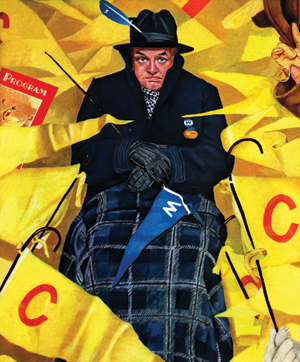
This highly unorthodox fellow
Sports blue in an ocean of yellow.
He is only on hand
Since his son’s in the band.
(It’s a brass band, and he’s playing cello.)
Congratulations to Jeff Foster of San Francisco, California! For his limerick, Jeff wins $25 and our gratitude for his witty and entertaining poem describing Sitting on the Wrong Side, Gene Pelham’s cover from November 15, 1941.
If you’d like to enter the Limerick Laughs Contest for our next issue of The Saturday Evening Post, submit your limerick through our online entry form.
Our readers sent us a lot of great, funny limericks. Here are some more of our favorites, in no particular order:
A faithful fan of West U.,
Among fans of the opposite crew,
With muffs on his ears
To drown out their cheers —
What else could the poor guy do?—Howard D. Dashke, Caseyville, Illinois
This fan’s in a heck of a fix,
Forlorn as his team takes its licks.
Surrounded by yellow,
This unhappy fellow
Would do well to just hit the bricks.—Bruce Beardsley, Rochester, New York
The loneliest man in the stands
Is not the one stuck behind bands.
He’s the visiting fan
With no escape plan
While the home team’s lead slowly expands.—Jerry Dorbin, Santa Fe, New Mexico
Our fan though his ticket was true.
He came with a banner in blue.
What he found out instead
Made his face turn bright red:
The flags had a much diff’rent hue.—Dick Swain, Champaign, Illinois
Oh I wonder just what I can do.
The score is now 20 to 2.
I’m such a sad fellow,
Surrounded by yellow,
While my flag and I are so blue!—Angie Gyetvai, Oldcastle, Ontario, Canada
There is little more greatly resented
Than a fan who has bravely dissented
And refuses to bend
As he proudly defends
The team he has long represented.—Mark Stellinga, Tiffin, Iowa
The look on his face held the clue
To a day he’d prefer to redo:
“What’s most upsetting,
Of course, is the betting
Of all of my money on blue.”—Paul Desjardins, West Kelowna, British Columbia, Canada
As a fan watched the drubbing unfold,
He could feel disappointment take hold.
When they asked, “Happy sir?”
His remark was just “Brrr!”
For the weather and game left him cold.—Roy Skibiski, Lawndale, California
His cheeks with their rosy red glow
Aren’t flushed from the cold and the snow.
The frustrated fellow
Surrounded by yellow
Is angry and ready to blow.
—Joyce Petricheck, Finleyville, Pennsylvania
Movies to Watch Over the Holiday Break
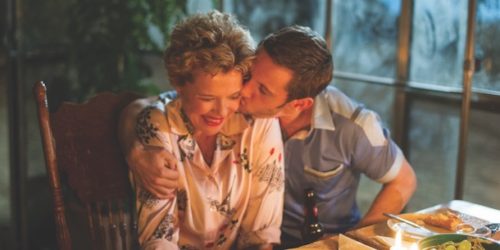
Film Stars Don’t Die in Liverpool (December 29)
Oscar alert for Annette Bening: She’s breathtaking as 1950s movie star Gloria Grahame. We find her in late 1970s Liverpool, seriously ill, and throwing herself into an affair with a handsome actor decades her junior (played by Jamie Bell). Bening, gloriously unafraid to show her age on screen, brings yet another indelible screen character to life.
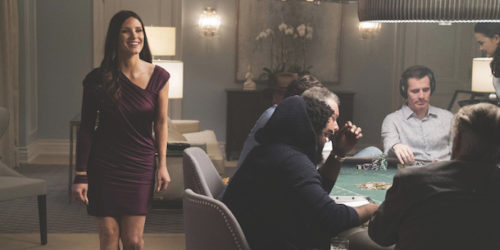
Molly’s Game (January 5)
Writer/director Aaron Sorkin (The Social Network) packs this based-on-a-true-story script with his usual wall-to-wall one-liners, and Jessica Chastain dazzles as a former Olympic skier who went on to run L.A.’s most exclusive illegal poker game. Idris Elba ditches his British accent as Molly’s lawyer, desperately trying to get her to roll over on her high-profile clients.

The Leisure Seeker (January 19)
Helen Mirren and Donald Sutherland make a truly endearing pair in this funny and sometimes heartbreaking story of an elderly couple taking one last jaunt in their trusty old motor home. Mirren is adorable, adopting a lyrical southern drawl. Sutherland, making the most of the best role he’s had in years, charms as a brilliant professor struggling with Alzheimer’s.
Follow Bill Newcott at saturdayeveningpost.com/movies or at his website, moviesfortherestofus.com.
This article is featured in the January/February 2018 issue of The Saturday Evening Post. Subscribe to the magazine for more art, inspiring stories, fiction, humor, and features from our archives.
Our First Christmas Without Mom
My mother died this past summer, so we’re sailing into the holidays absent our commodore. For the 63 years my parents were married, my mother let my father think he was in charge, though we all knew she steered the ship of state, both deftly and demurely.
It’s an odd feeling to imagine Christmas without Mom. She did much of the holiday’s obvious work, plus a hundred other little things we’ll likely forget in the holiday rush. I fear no one will remember to buy a flannel shirt for a down-on-his-luck man in our town, and have it gift-wrapped and under the tree, awaiting his arrival on Christmas Eve. He’s spent Christmas Eve with our family for nearly 40 years, and I don’t want the ball to drop on my watch, so I’ve written in the December 12 square of our refrigerator calendar, “Buy Dale a shirt.” Mom would never forgive us if Dale had to go without a new shirt this Christmas.
When I was little, maybe five or six, my mother took me to Danner’s five-and-dime on the Danville town square and bought me a little red Christmas elf to go on the tree. A few years later, the elf fell forward onto a hot bulb and rested there, burning his face. Now he’s an elf with a bad sunburn. Even though it was mine, Mom wouldn’t let me take the elf with me when I moved from home, but last year, while taking down the tree, she handed me the elf and told me to take good care of him. I’ve since invested that handing-over with all sorts of meaning — that Mom sensed it would be her last Christmas with us and wanted to make sure the elf was not orphaned. I keep it on the bookshelf next to my desk, its red face shining forth, keeping watch by night.
Mom never wanted anything for Christmas.
“I have everything I need,” she would tell us when we asked her what she wanted. So our gifts to her were always stabs in the dark, wild guesses, graciously received, but seldom used. Crystal vases, pottery, Irish sweaters, tucked away in back closets, while the handmade gifts we gave her as children — plastic birds, woven potholders, paint-by-number pictures — enjoyed an eternal place of prominence. One Christmas, after receiving a royalty check, I bought her a new kitchen stove and she spent the next year trying to pay me for it, slipping money in my pockets when I came to visit.
When I was a kid, I would tell my mother I loved her in the way small children do, spontaneously with great enthusiasm. When I became a teenager, and prone to embarrassment, I ended that practice and didn’t resume it for several decades. Even then, almost up until she passed, I would say it in a silly voice I reserve for endearments, so as not to sound too earnest. The day before she died, Mom took my hand and said, “I love you, Philip. You’ve been a wonderful son.” And for the first time since childhood, I told her I loved her in a normal voice. I wish I hadn’t stopped telling her I loved her when I was a teenager.
I’ve lived long enough to know Hallmark’s depiction of mothers isn’t entirely accurate. Having children doesn’t miraculously instill one with compassion, wisdom, patience, and love. Wouldn’t it be wonderful if one couldn’t sire or bear a child until those qualities were present? If God ever puts me in charge of reproduction, I’m going to do something about that.
But my mother had all those virtues and more, which I didn’t appreciate as a kid, so I would ask her for other presents at Christmastime, not realizing she had already given me the loveliest gifts one person can ever give another.
Philip Gulley is a Quaker pastor and the author of 22 books. See also our feature article about Gulley and his wife in the November/December 2017 issue.
News of the Week: Rockers Snubbed, the Grinch Arrested, and Chestnuts Roasting, Well, Everywhere
2018 Rock & Roll Hall of Fame Inductees
Of course, I mean the year 2018. It would be really weird if the Rock & Roll Hall of Fame inducted that many musicians in a single year.
The inductees this time around are Dire Straits, The Moody Blues, The Cars, Bon Jovi, Nina Simone, and Sister Rosetta Tharpe. All fine choices, I guess (don’t get me started on Bon Jovi), but it means that a lot of people didn’t make it again this year (musicians are eligible 25 years after the release of their first commercial recording), including Depeche Mode, Judas Priest, Eurythmics, the Zombies, Janet Jackson, Devo, New Order, Iron Maiden, Roxy Music, the Cure, Tina Turner, and the Smiths.
I would also add Marshall Crenshaw to that list. I don’t know if he’ll ever be nominated but he deserves to be there.
Stink, Stank, Stunk!
This is a great story. It involves a five-year-old boy from Jackson, Mississippi, who called 911. Why did he call? Because he was upset that the Grinch was going to steal Christmas.
The father got on the phone to assure the 911 operator that there was no problem. The police went to the house to check on things anyway, and the boy showed them a YouTube clip of the Grinch and what he had planned. The police assured him that they weren’t going to let the green guy steal anything, and to prove it, they invited the boy to the police station two nights later so he could actually lock up the Grinch in a cell.
Of course, now the family has to make sure the boy doesn’t watch The Grinch Who Stole Christmas again, or he may think the Grinch escaped. Or at least let him watch it until the end, when his heart grows bigger as he learns the true meaning of the holiday and gives all the gifts back.
It’s the Most Wonderful, Annoying Words of the Year
Every December, magazines, newspapers, and websites release their best-and-worst lists for the year. The best and worst movies, the best and worst albums, the best and worst political stories of the year. It’s a year-end tradition we look forward to as much as stuffing and the first snow.
I don’t know if this counts as a “best” or a “worst” — maybe it’s the best of the worst — but the list of the most annoying words of 2017 has been released by Marist College. For the ninth year in a row, Americans have declared the word whatever the “winner.”
Other annoying words and phrases of the year include fake news; literally; you know what I mean; ya know, right; and huge. Actually, I would add the words actually, like, irregardless, basically, selfie, hashtag, and viral.
Maybe Marist should declare that whatever can no longer be named an annoying word of the year. It’s won way too many years. It’s the Modern Family of annoying words and should take itself out of consideration.
New Raymond Chandler
Raymond Chandler is one of my favorite writers, so when I heard that there was a newly discovered short story about to be published, I was more excited than a salad in a paper towel factory (I have no idea what that even means, that’s how excited I am). The story is in the current issue of The Strand, and it’s titled “It’s All Right — He Only Died.”
From that title, you might be expecting a two-fisted Philip Marlowe detective tale, but it’s actually about … the U.S. healthcare system? That’s right, Chandler was thinking about that way back in the 1950s (he died in 1959). Luckily, in the six decades since the story was written, we’ve completely solved any problems we may have had with healthcare.
Last-Minute Gift Idea
Did you know that Christmas is this Monday? That means you only have this weekend to buy the rest of your gifts, unless you’re one of those people who goes to CVS on Christmas morning and grabs a box of chocolate or whatever perfume is on sale.
May I suggest something that can be enjoyed the entire year, something that’s like getting a new Christmas gift every other month? A subscription to The Saturday Evening Post! Right now you can get an entire year (six issues) for a savings of up to 49 percent. With that subscription, you also get discounts on car rentals, travel, entertainment, even insurance! It’s a great deal and a great magazine (and I’d say that even if I didn’t work here).
RIP Keely Smith
Keely Smith was an acclaimed singer known for her partnership with husband and bandleader Louis Prima. She is remembered for such songs as “I Wish You Love,” “That Old Black Magic,” and “I’ve Got You Under My Skin.” She died Saturday at the age of 89.
Here’s her version of “I’ll Be Home for Christmas.”
The Best and the Worst
Best: My favorite things this week haven’t even happened yet. They’re on TV tonight. CBS is continuing its annual tradition of showing back-to-back classic episodes of I Love Lucy and The Dick Van Dyke Show. It all starts at 8 p.m.
Worst: This also involves CBS’s airing of I Love Lucy and The Dick Van Dyke Show. As I mentioned just four seconds ago, it’s great that they air these episodes every Christmas. But do they have to be colorized? And do they have to be the edited versions of the episodes? That’s a travesty (the latter more than the former). These shows were both originally on CBS, so I don’t know why they have to show edited versions. And as for colorizing them, that was interesting the first time as a little historical pop culture curio, but colorizing TV shows and movies rarely works (the colorized Miracle on 34th Street I watched the other night looked awful). Really, viewers can handle black and white.
This Week in History
Wright Brothers Take Off (December 17, 1903)
Here’s an interview the Post did with Orville Wright in 1928 on the 25th anniversary of the historic flight.
A Christmas Carol Published (December 19, 1843)
The classic Charles Dickens novella has been filmed a gazillion times and the basic plot has been used in countless stories and TV shows. The first film made from the story was a 1901 short silent film titled Scrooge, or, Marley’s Ghost.
If you really enjoy the story, you could start a collection of various editions. This guy did, and he’s up to 1,000 of them.
This Week in Saturday Evening Post History: Centering the Christmas Tree (December 22, 1951)
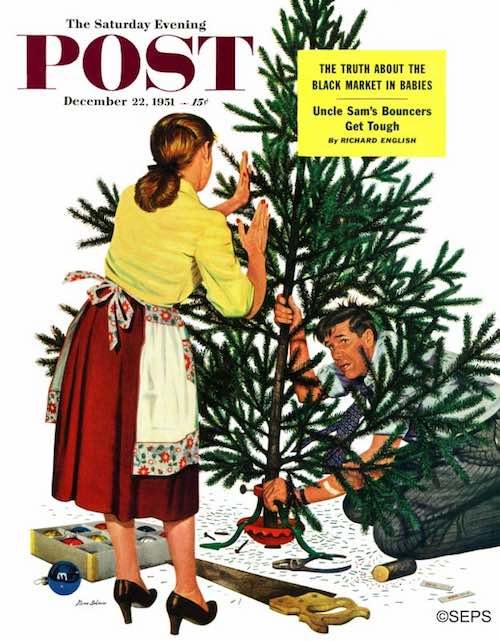
Stevan Dohanos
December 22, 1951
Remember I told you a couple of weeks ago that I like artificial Christmas trees because they don’t shed like real trees? Look at this cover by Stevan Dohanos. Just look at it! Pine needles all over the place.
Christmas Recipes
I was listening to “The Christmas Song” the other day — I’ve already heard it 100 times this month — and realized that it’s been 30 years since I’ve had chestnuts roasting on an open fire. Actually, I’ve never had chestnuts roasting on an open fire. My mom used to boil them.
But it did get me thinking about the foods that are mentioned in Christmas songs, so I thought I’d list some recipes for you to make this holiday season. Here are five vintage and delicious recipes for chestnuts, and if you enjoy “We Wish You a Merry Christmas,” here’s a recipe for figgy pudding. Brenda Lee sang about pumpkin pie in “Rockin’ Around the Christmas Tree,” and if you’re a “Grandma Got Run Over by a Reindeer” fan, here’s an eggnog recipe from Alton Brown (please note that it includes bourbon). And don’t forget, it’s a marshmallow world that we live in.
Merry Christmas!
Next Week’s Holidays and Events
Boxing Day (December 26)
The holiday started in Britain in the 1830s as a day to honor “post-men, errand-boys, and servants of various kinds.”
National Fruitcake Day (December 27)
Also known as “The Day Everyone Throws Away the Fruitcake They Got for Christmas” Day.
Saint Nicotine Delivers a Christmas Goose
Ahhh … Christmas was in the air again; you could smell it — that odd, friendly stink of burnt cookies, wet galoshes, and aluminum paint on hot radiators. Dime store poinsettias, candy-apple red and fake as a cheap toupee, sprouted everywhere, and the living room floor was a minefield of broken glass ornaments.
My mother, who wasn’t exactly in a festive mood yet, flitted about the kitchen like a gypsy moth on speed. Right now, she was busy reading my Old Man the riot act.
“That thing’s a monstrosity. I do NOT want it in the house!”
She wasn’t about to give in. My mother wasn’t one to mince words, especially around Christmas, when potato salad fever was raging and there were still mountains of boiled spuds to conquer.
“Aw, c’mon,” the Old Man argued, a cigarette dangling from his lips. He lifted a glass of apple cider, gesturing grandly — a connoisseur in his gallery. “This is really special. It’s hand painted!” Hand painted! That clinched it for my father, whose collecting tastes ran to naughty postcards and dried armadillos covered with pictures of donkeys and napping Mexicans.
The object in question was a life-size cardboard Santa Claus that the Old Man had schlepped home on the subway after his office Christmas party. With a fluffy white beard and massive beer gut, it was actually a primo Kris Kringle, except that this jolly old elf had the face of a serial killer. Still, I was more than impressed with the weird twisted smile, spooky eyes and all. In fact, I loved it! How could my mother be so closed-minded? Why couldn’t she recognize an artistic masterpiece when it was staring her in the face?
Suddenly, a string of flashbulbs went off on the dimmest recesses of my eggnog-addled brain. “Hey, how about this?” I blurted out. “I could take him to the Christmas pageant.”
My parents stared at each other; they were thunderstruck.
“You know, that’s not a bad idea,” the Old Man mused, stroking the stubble on his chin. There was a faraway look in his eyes. “Yeah, share it with the kids at school.” He cocked his thumb and forefinger at me like a pistol and let out with a spectacular belch that spanned an octave. I chortled with glee.
The Old Man definitely had that magic touch.
My mother just rolled her eyes, which made her look like Little Orphan Annie. When I tried my hand at an impersonation, she shot me one bodacious evil eye. Even a peace offering of a half-empty glass of cider didn’t help much.
“Ooh! How can you drink this? It’s turned,” she said, making a sour face. “Put the jug with the garbage on your way out, honey. Okay?”
Sure.
I grabbed the jug along with my Elmer Fudd hat and jacket and was off to P.S. 13, the demon Santa strapped to a beat-up Flexible Flyer that scraped along the slushy sidewalk with a sound like fingernails on a blackboard.
A half-hour later, I was furiously trying to con Mrs. Van Devanter into a Santa/pageant tie-in. “My father calls him Saint Nicotine because he works for this tobacco company, and it was an ad for …”
“Old V.D.,” as we kids referred to her when she was out of earshot, had obviously heard a generous plenty of malarkey in her time. She looked at me as if she’d just spotted a spittoon under somebody’s desk, then silenced me with an index finger to her lips.
“William,” she said condescendingly, “the Santa’s not bad — except that his face gives me the goose bumps. You’ll have to cover that awful slogan on the toy pouch, though. May I suggest a traditional holiday message? ‘Merry Christmas to all, and to all a good night’ would be nice. Oh, and get Peter to help you. Remember, he’s in the pageant this year.”
Hoo-boy! Peter Marcucci — a pudgy nerd of a kid who knew the entire periodic table of elements by heart and could give tedious recitations of bad poetry for 20 minutes at a clip. But the actual written word remained an elusive butterfly, my friend.
Marcucci may have been dyslexic, or just a space cadet; even as a sixth-grader he could barely get a grip on “The Little Engine That Could.” I was assigned to be his “reading buddy” or whatever they called it in 1956 — penance for accidentally breaking the head off Cornelia Street Cal, the school’s prized stuffed woodchuck. It’s a long story.
Anyway, Marcucci did pretty well with the Santa project. He stared at the offending slogan for several long minutes, then scissored a perfect circle of green construction paper to glue over it. I hand-lettered the politically correct new message, and that was that. Or so I thought.
Pageant morning dawned bright and cheerful — for a December morning in Brooklyn, at least. As I meandered toward school, skillfully crunching dull black lumps of city snow under a pair of new Thom McAn wingtips, I heard a sunny voice calling out my name.
Whoa! It was the siren call of Becky Parmelee! — the very same Becky Parmelee who traipsed merrily though my lushest fantasies, excluding those devoted to firecrackers and chemistry sets, of course. At age 12, she was a genuine carrot-topped, tin-grinned love goddess. Becky threw her arms around my shoulders and actually hugged me! My knees were rubber, my brain cells jelly. It was true love!
“It’s so-o-o nice what you’re doing for Peter,” she cooed. “He really looks up to you. I think it’s just wonderful.” Without mentioning the thing about the woodchuck, I took the lead. “Well, ahem, I always like to … you know … uh, help out.” I couldn’t believe this drivel was coming out of my mouth. Peter Marcucci was a pest and everybody knew it!
Suddenly, I was vaguely aware that Becky was saying something again; her lips were moving, her voice coy and seductive.
“Maybe we could catch the Winter Cartoon Festival at the Evergreen after the pageant.”
What? I nearly hawked a mammoth pink wad of Dubble Bubble gum into the slush, but recovered with considerable aplomb.
“Uh, yeah, I guess I’ll be able to make it this afternoon,” I answered, mustering up as much world weariness as an almost 13-year-old could. “How about 1:30?”
Becky’s face lit up with a smile so achingly soulful it would haunt me for years to come. With that, I tripped on my shoelaces and went sprawling into a pile of snow, if it could still be called snow after aging to perfection on the sidewalks of New York for close to a week. I should have seen it as a warning.
P.S. 13’s annual Christmas pageant was a humiliating ritual that called for otherwise normal kids to dress up like snow fairies and elves. Worse, there was a new wrinkle that year — a stage-managed “holiday culture quiz.” It was a shameless fraud, and I was in up to my armpits.
The big shindig got underway at around noon when Mr. Feigenbaum, a.k.a. “Basket Ass Barney,” launched into his pageant message, a stem-winder in the classic style. Endless and stupefying, it was the kind of speech that grade school principals everywhere have managed to elevate to an art form. It truly was Barney Feigenbaum’s finest hour; he was on a roll and he knew it. We were lectured on Judeo-Christian traditions, early pagan rituals, Charles Dickens, and so on.
What did I care? Not one wit. Bring ’em on! The Israelites, the Druids! Tiny Tim! Yawn. It would all be over in an hour or so, and I had a date with Becky Parmelee!
The pageant dragged on.
Ingrid Lillycrap (I swear that was her name) gave an excruciating rendition of “White Christmas” on the violin, and the McSween brothers, bad to the bone in real life, now were dressed in cutesy green rayon elf costumes as they lip-synched a few Bing Crosby hits. Tony Giordano, who fancied himself to be Ridgewood’s answer to Gene Kelly, performed a sprightly tap dance to an accordion arrangement of “Rudolph the Red-Nosed Reindeer” — a surprising crowd-pleaser.
Saint Nicotine stood defiantly at center stage, taking everything in, saying nothing.
Finally: My debut as Holiday Quizmaster. I tossed out a few carefully rehearsed questions:
“On what day is Little Christmas celebrated?”
“What were the gifts of the Magi?”
“The carol ‘Silent Night’ was first performed on what musical instrument?”
No problem. The quiz was rigged; each kid who raised his hand knew the answer in advance. It was all an act!
At last, the wrap-up question, directed to my protege, good old Peter Marcucci.
“Peter,” I ventured, “what did Santa yell as he drove out of sight on Christmas Eve?”
Dead, stone-cold silence.
Little beads of sweat formed under my collar. This wasn’t in the script.
“Peter, uh, remember Santa?” I ad-libbed, casually waving toward the smirking devil doll we’d rigged with the “Merry Christmas” message. A faint flicker of recognition spread across Marcucci’s face. He winked at me.
Marcucci rose purposefully and looked directly at the audience. His voice was strong and confident: “L.S./M.F.T. — Lucky Strike Means Fine Tobacco. Rich, smooth Luckies are always at the top of my Christmas shopping list!”
There were a few chuckles at first. Then hoots of laughter and derision exploded from the audience, rising in a deafening crescendo of whistles and catcalls.
I covered my eyes and sunk into an armchair decorated to look somewhat like a reindeer.
Mr. Feigenbaum, who had worked himself into a dervish-like frenzy over our screwup, snatched the microphone from its stand and began pleading for silence.
“Okay, that’s it for this year’s Christmas pageant,” he shouted over the feedback. “Nice comic touch at the end there, boys. Let’s have a big hand for William and Peter.” Then, covering the mic, he turned to me and whispered menacingly, “I’ll see you in my office next week.”
It didn’t get any better. Becky Parmelee was furious. She loathed me!
“How could you do this to Peter?” she hissed. “I’m so-o-o disappointed in you. Come on, Peter — I don’t think William is interested in going to the cartoon festival with us.”
Marcucci, bewildered by all the fuss, stared at the sidewalk and whistled tunelessly.
My world had crumbled like a stale kaiser roll. I watched for what seemed forever as Marcucci — who had utterly ruined my life — walked off hand-in-hand with my beloved Becky. I was devastated.
The apartment was empty when I got home. The Old Man — a master of aluminum paint technique — was out helping the D’Angelos spruce up their radiators for the holidays. My mother was at Aunt Rose’s, whipping up still more potato salad.
I rescued the cider jug from the garbage and poured myself a glass. Then another. And still another. Not bad at all. It had a great tangy edge, a merry fizzle on the way down. Pretty soon I was feeling kind of warm and fuzzy.
Pff-f-t! Becky was gone. So what? There were other girls to dazzle with my charms. Yeah, Mr. Feigenbaum would be on my case like stink on a monkey. But that wouldn’t happen until next week. Hey! It was Christmas!
Before long, I felt a little too warm and fuzzy; a small, sickish feeling had blossomed in the pit of my stomach. I cranked open a window and breathed deeply. The air was cold and snow-flaky damp. Suddenly I detected the “delicate” aroma of garlic and pepperoni from Mama Laguzza’s Pizzeria just down the street. Now I was in trouble… big time!
A few blocks away, Dickie the janitor was sorting through trash in the basement at P.S. 13. Dickie, who’d been known to take a nip or two on the job, screeched like a boiled owl when the leering face surfaced in a pile of soggy Christmas wrap and dead composition books. Then he broke into a loud, braying laugh, shaking his head as he tossed the cardboard dummy into the incinerator, where it vanished in a starburst of golden sparks.
Meet the 2018 Great American Fiction Contest Prize Winners
Meet the Winner!
Julia Rocchi

“‘Open Season at the Café Rumba‘ has always held a special place in my heart, and I’m thrilled it has found a home in such a celebrated magazine,” says Rocchi, who was “beyond excited” on learning she had won first place, publication in the Post, and a prize of $500. “To be placed in the company of historic greats such as Ray Bradbury and Agatha Christie — not to mention Norman Rockwell — is truly an honor.”
Temperatures rise at Café Rumba as the spicy rhythms of Latin music heat up the atmosphere in the fast-paced tale about Nancy, a middle-aged divorcée embarking on a salsa adventure — in part inspired by the author’s own experience signing up solo for dance classes after college.
“Nancy, the story’s protagonist, emerged from a writing prompt in my very first class for my graduate writing degree, Rocchi says. In mere minutes, her voice — along with her fears, quirks, and hopes — appeared on the page, vibrant and undeniable, and I knew I had to follow her wherever she led me not where I led her. Through every draft of ‘Café Rumba’ and there have been many — I’ve rooted for Nancy to take a risk and thrive. I hope Post readers will feel the same and come to love her as much as I do.”
Since receiving an M.A. in Writing from Johns Hopkins University in 2015, Rocchi has published short stories in Mulberry Fork Review and Bourbon Penn literary journals as well as poetry and essays on spirituality on her website (juliarocchi.com). But “Open Season at the Café Rumba” is her first story published in a national magazine.
“To my fellow writers out there, bear this in mind: My story received 18 rejections before reaching The Saturday Evening Post,” Rocchi says. “Whatever you do, keep the faith — and keep submitting! The world wants to hear your voice.”
Meet the Runners-Up

Benjamin Kilgore
Title: “Into Each Life”
Storyline: A boy befriends the filly tethered to a pole in his backyard — both longing to break free from the silence around them.
Bio: First short story published by a national magazine; 2017 Glimmer Train Very Short Fiction Contest honorable mention; 2016 Great American Fiction Contest honorable mention.

Michelle Reiter
Title: “Lloyd and Mary”
Storyline: A successful real estate agent and his wife live life by rote until an unbearable loss shatters their well-ordered world.
Bio: First short story published by a national magazine; 2008 Associated Press award for humor columns; 2014 Frederick Buechner Award for excellence in writing.

Myrna West
Title: “Shackled”
Storyline: In 1966, Kelly is finishing her sabbatical in southern Turkey, a place that would disrupt her life forever.
Bio: Great American Fiction Contest runner-up in 2015 and honorable mention in 2017; honorable mention 2015 Glimmer Train’s Very Short Fiction Award.

Bari Lynn Hein
Title: “Skyscrapers”
Storyline: Nursing an injury, Kate stares out the window of her 43rd-floor apartment and notices a face staring back.
Bio: First short story published by a national magazine; 2016 daCunha Editors Choice Award. For more, visit barilynnhein.com.

Donna Baier Stein
Title: “A Landing Called Compromise”
Storyline: Martha Blalock never liked Zula Blix, who flirts with every man in New Madrid Baptist Church, but soon both recognize what they have to lose.
Bio: Published work has appeared in Writers Digest, Virginia Quarterly Review, New York Quarterly, and many other publications. Her first novel, The Silver Baron’s Wife, was released in 2016, and her story collection Sympathetic People in 2015. For more, visit donnabaierstein.com.
Read the Best!
Post editors are delighted by the storytelling and fine writing of this year’s entrants. We’ve compiled the best stories our winner, runners-up, and honorable mentions in an e-book, available on your favorite platforms for $3.99. Order now at saturdayeveningpost.com/fiction-books.
Menus for a Christmas Dinner, 1913 Style
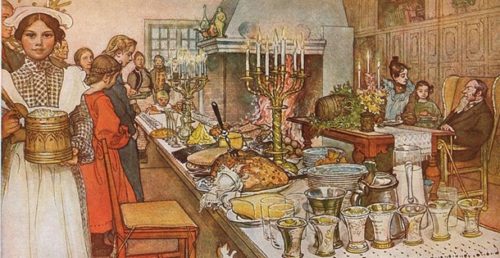
Looking for last-minute Christmas dinner ideas? Here are two full-course holiday meals — and a few choice recipes — circa 1913.
—
A Christmas Dinner
Originally published in The Country Gentleman, December 20, 1913
Menu No. 1
- Tomato Soup
- Croutons
- Celery
- Onions
- Pickles
- Roast Turkey with Oyster Dressing
- Hot Slaw
- Cranberry Soup
- Mashed Potatoes
- Baked Squash
- Stewed Onions
- Fruit and Nut Salad
- Cheese Straws
- Frozen Custard
- Plum pudding
- Raisins
- Coffee
- Mints
Menu No. 2
- Clear Soup
- Crackers
- Piccalilli
- Celery
- Currant Jelly
- Roast Duck with Walnut Stuffing
- Apple Sauce
- Candied Sweet Potatoes
- Scalloped Tomatoes
- Spinach
- Lettuce Salad
- Cheese Balls
- Suet Pudding
- Pumpkin Pie
- Coffee
- Fruit
- Nuts
These Recipes Are from Grandmother’s Cookbook
PLUM PUDDING — 1 cupful of molasses, 1 cupful of milk, 1 cupful of suet chopped fine, 2 eggs, 2 cupfuls of flour — or enough to make a batter as stiff as cake — 1 cupful of raisins, 1 cupful of currants, cupful of citron sliced, a tablespoonful of candied orange peel, a tablespoonful of candied lemon peel, 2 teaspoonfuls of cinnamon, 1/2 teaspoonful of cloves, 1/2 teaspoonful of nutmeg, 3 teaspoonfuls of mace, and a rounding teaspoonful of soda.
Before starting to mix this it is well to have the fruits prepared and floured, ready to mix in. When making follow the rotation of ingredients as given. Save a little of the milk to mix with the soda, which is added last. Steam three hours in an old-fashioned pudding mold with hole in center.
WALNUT STUFFING — Boil and mash a pound of white potatoes. Season them well with salt, pepper and butter, then add pint of chopped walnuts and the dressing is ready for use.
CANDIED SWEET POTATOES — Boil medium-sized sweet potatoes until done. When cold pare and cut in half lengthwise. Place the potatoes in a skillet in which a generous piece of butter and a little lard have been melted. Sprinkle the potatoes thickly with brown sugar, and fry on all sides an even brown. Watch closely, as they burn readily.
PUMPKIN CUSTARD — Three cupfuls of pumpkin, a cupful of milk, a cupful of sugar, a tablespoonful of butter, a teaspoonful each of ginger, cinnamon and finely sifted bread crumbs, and 3 eggs. Salt and nutmeg to taste.
Boil and drain the pumpkin well. Press through the colander and to 3 cupfuls of pumpkin add the melted butter, sugar, spices and crumbs. Mix thoroughly, add the well-beaten yolks of the eggs and the milk, and lastly the whites, beaten stiff.
BAKED SQUASH — Cut in half a large oval squash, remove the seeds and, after par-boiling, scrape out the pulp and put it through the ricer. Then into a buttered baking dish place the squash in layers, dredge each layer lightly with flour, add generous pieces of butter, season with paprika and salt, and moisten with cream. Cover the top layer with bread crumbs and dot liberally with butter. This recipe should take about a cupful of milk and 2 tablespoonfuls of flour. Bake until brown.
OYSTER STUFFING — Melt a cupful of butter on the top of the stove and add 50 good-sized oysters drained from the liquor. Cook slightly until the gills begin to curl. Then add the oyster liquor and enough crumbed bread to fill the turkey. If this mixture is dry add sufficient milk to make it pretty moist. Season with salt and pepper and about 2 tablespoonfuls of minced parsley. Last of all add 4 or 5 well-beaten eggs. Cook this mixture until it is well thickened before putting it into the turkey.
FROZEN CUSTARD — Make a boiled custard with 3 cupfuls of milk, the yolks of 4 eggs and the whites of 2. Sweeten to taste. Let the custard cool and then add a teaspoonful of vanilla and a cupful of good cream. Freeze. Just before packing it away fold in the whites of 2 eggs which have been beaten light with 2 tablespoonfuls of sugar.
HOT SLAW — Chop fine a small head of cabbage. Beat together a cupful of sour cream, an egg, a tablespoonful of sugar and half a teaspoonful of mustard dissolved in cupful of vinegar. Have a pan hot, pour in the mixture and when the boiling point is reached add the cabbage well-floured and salted. Heat through and serve with a dash of paprika on the top.

Can You Solve These 1879 “Crossword” Puzzles?
The first modern crossword puzzle appeared in the New York World newspaper on December 21, 1913. There were items called “cross word” puzzles long before that date, but resembled modern crosswords only in that they were both word games. As long ago as 1879, the Post ran something it called “Cross Word” puzzles alongside acrostics, cryptograms, anagrams, and other brain teasers.
Examples of Cross Word Puzzles
The purpose of these Cross Words was to discover a word within a group of letters. On each line, readers were given the letters of one word, from which they were to subtract the letters of a second word. From these remaining letters, one letter from each line would reveal the word. The main clue to the word was contained in the last two lines of the poem.
In the February 15, 1879, puzzle below, for example, the first line tells you that the first letter of the mystery word could be any of the six letters in message minus the letters in not. So you would subtract the repeated letters and be left with m.e.s.a.g. Once you narrowed down the choices that could be used for the letter of the final word, you would then refer to the last two lines of the poem to guess the answer. (The valid letters for each line are shown in parentheses, and the correct letter is printed in red.)
In message but not in not, (m. e. s. a. g.)
In ballot but not in vote, (b. a. l.)
In flower but not in bud, (f. l. o. w. e. r.)
In water but not in mud, (w. a. t. e. r.)
In winter but not in spring, (w. t. e.)
In bellow but not in slug, (b. e. o. w.)
In promise but not in wish, (p. r. o. m. e.)
In minnow but not in fish. (m. n. o. w.)
Whole emits a shining light
Only to be seen at night.
The answer — glowworm — can be found by looking at the main clue in the final couplet, then using the available letters to find the right word.
The solutions to puzzles always appeared in the following week’s issue. Readers who sent in correct puzzle solutions won six-month subscriptions to the Post. However, they had to submit answers to all the puzzles on the page to be considered for the prize.
Here’s another, from June 28, 1879:
In wherefore not in wily,
In purchase not in buy,
In juiceless not in dry,
In explore not in pry,
In submit not in try,
In vanish not in fly,
In behold not in spy,
In lament not in cry,
In labor not in ply,
The answer will imply,
An answer or reply.
Answer: Rejoinder
Double Cross Word Puzzles
A double cross word puzzle worked the same way, except that each line contains two letters that create two different words, as in this puzzle from September 6, 1879:
In cheap not in dear,
In bright not in clear,
In cat not in mouse,
In park not in house.
In crawl not in run,
In priest not in nun,
In cakes not in ale,
In dark not in pale,
In chip not in wood,
In cap not in hood,
In keep not in moat,
In sheep not in goat,
In worn not in old.
In brass not in gold.
The WHOLE’S the name of a noted book.
Amusing it will prove;
You may also for its author look,
You will find them both above.
Answers: Pickwick Papers and Charles Dickens
Word Shape Puzzles
Another type of puzzle didn’t use the name cross word, but was closer to the modern crosswords we know. To solve the puzzle, you use the clues to choose words that, when their letters are properly aligned, create a shape. You know if the answers are correct if they read both vertically and horizontally or, if the clues indicate, digaonally. Here’s an example:
A SQUARE, from September 13, 1879
- A town in Italy
- An ancient French philosopher
- A half foot in poetry
- A crystalizable substance
- A river in Virginia
- One of the British isles
- Appendixes
Solution:
C A S O R I A
A B E L A R D
S E M I P E D
O L I V I L E
R A P I D A N
I R E L A N D
A D D E N D A
A SQUARE, from March 8, 1879
- A man ne’er needs a barber more,
Than when his hair is first; - This lord egged on a cruel war,
That on our land did burst; - A sort of wicker basket this
To carry queen’s-ware in; - To put in circulation this–
or issue bogus “tin.” - Opposed to here, means FIFTH and last–
A word you will require
To solve this square and send a list
Complete as you desire.
Solution:
U N C U T
N O R T H
C R A T E
U T T E R
T H E R E
Try Your Hand at These 19th Century Puzzles
With this introduction, we offer three puzzles from 1879:
Puzzle #1: Cross Word, from July 26, 1879
In wrong not in right,
In dark not in night,
In yeast not in light,
In wreck, not in storm,
In shape not in form,
In learn not in know,
In send not in go.
The whole ‘mongst children you will find
An inclination of the mind.
Puzzle #2: No. 86 Square, from April 5, 1879
- A disease
- A shoot
- Idle
- Rough
- A town in Ohio
- To serve
Puzzle #3: No. 107 A Diamond, April 19, 1879
- A letter
- A quibble
- Relating to an hour
- Sagacious
- Traditional
- An idiot
- A flower
- An abbreviation for one of the U.S.
- A letter
Solutions
Solution to Puzzle #1
Wayward
Solution to Puzzle #2
A S T H M A
S P R O U T
T R U A N T
H O A R S E
M U N S O N
A T T E N D
Solution to Puzzle #3
A
P U N
H O R A L
P O L I T I C
A U R I C U L A R
N A T U R A L
L I L A C
C A L
R
3 Questions for Sam Elliott
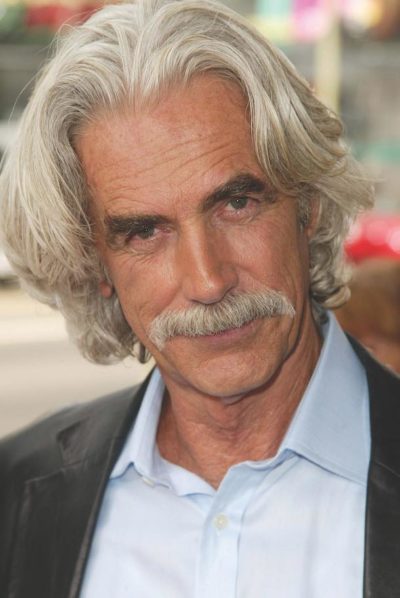
“Who knows what Sam Elliot’s first film was?” the moderator of a Hollywood event shouts out to the audience. “Butch Cassidy and the Sundance Kid” a bunch of voices call back. “Right!” Sam Elliot, the star says with a quiet smile. “Does it count if all you could see is my shadow on the wall? And me saying one line?” The crowd laughs. But check it out. It’s true.
We’ve seen that handsome face with the trademark mustache in about 50 movies, from Tombstone and Road House to The Big Lebowski and Rough Riders, along with many television shows — mostly westerns. And, of course, we recognize Elliott’s distinctive rumbly cowboy voice in a string of commercials.
In 2017’s The Hero, a movie written expressly for him, Elliott’s performance is startling and impressive as an aging actor now battling cancer who had one major hit and is hungering for another big one even as his time is running out.
You can also catch Elliott co-starring with Ashton Kutcher and Danny Masterson in the Netflix series The Ranch. He plays the dad of two hard-drinking sons. The younger actors asked Elliott for a lot of advice off screen. “I just tell ’em what I think,” he says, smiling. “It’s his first time doing a show in front of an audience. There’s no horse but there sure is a dog.”
—-
Jeanne Wolf: In The Hero, you get very sexy with your younger girlfriend, played by Laura Prepon. That’s just one of several bedroom scenes you’ve put on the screen recently with some very attractive leading ladies. Jane Fonda, Blythe Danner, Lilly Tomlin, and Debra Winger have all been in your arms. And no one forgets you with Cher in Mask. People are calling you a “hottie.”
Sam Elliott: I don’t think I’m going to be redefined, but I do feel lucky to still get some good parts, and that includes the ones where I “get the girl.” Laura was a stunner every day on the set. We knew the film would be adult and provocative. She jokes about him being older but you can see that they connect romantically. I think Laura was a very important part of making the guy I play, who hasn’t always been great with his ex-wife or his daughter, likeable … no, I should say loveable. We grew very comfortable working together.
When I got in bed with Blythe Danner in I’ll See You in My Dreams, she told me that she’d never kissed anyone with a mustache, so that was fun. These scenes are just part of acting, and we’re respectful of each other. I still dearly love my wife, Katherine. So being romantic with these gals is part of the job. It’s also really sweet. Yes, really sweet. Of course, my wife teases me about being called a gray-haired lover.
JW: After doing so much work on screens big and small, do you still get excited when you step on a set?
SE: I love it. I think if you can’t have fun making any kind of movies or TV shows, then you’re doing it wrong. I’ve been very lucky. I’ve carved out a little niche here in Hollywood. I’ve wanted to do this since I was 8 years old.
I try to count my blessings, and I have to tell you that my wife reminds me of that often. I tend to be more of a grouser about things than she is. I tend to be more cynical. I’ve got to say that it is tough to be as thankful and upbeat as I’d like. It’s hard to do in this world if you look at the broad picture.
JW: That voice of yours has gotten you a lot of recognition. You came to Hollywood as a Texan with the drawl to match. So I want to know if, along the way, anyone ever said to you, “Lose that accent. You’ll never get a job.”
SE: That did happen. A guy named Mike Greenblatt told me that one time. He worked at a big agency, and he said, “You ought to get voice and diction lessons. You need to learn how to talk.” They wanted me to speed up and enunciate. I went through trying to do that for a time, but I’m glad it didn’t work out. I’ve played a lot of guys who have that Western sensibility. It’s me being me.
Even in The Hero, we start and end with my character doing commercials in a recording booth. I’ve done a lot of them. I’m especially proud of being the voice of Smokey the Bear. It’s me who says, “Only you can prevent wildfires.” I found out that Smokey has the same birthday as mine, August 9, 1944!
This article is featured in the January/February 2018 issue of The Saturday Evening Post. Subscribe to the magazine for more art, inspiring stories, fiction, humor, and features from our archives.
Booth Tarkington’s ‘Freedom of Speech’
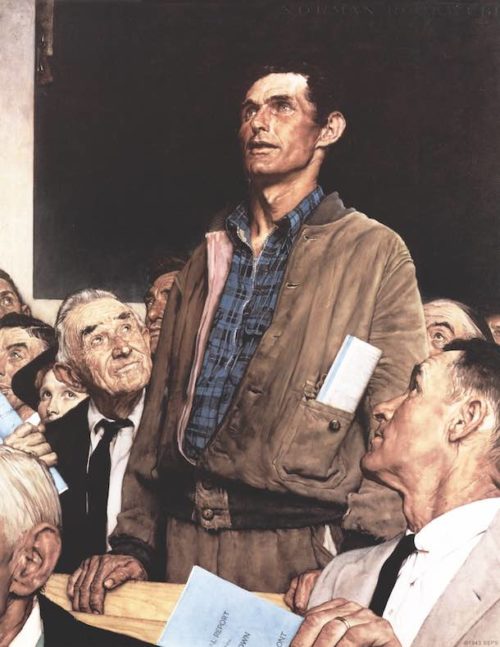
In 1943, the Post commissioned four writers to craft an essay to accompany each of Norman Rockwell’s Four Freedoms paintings, which had quickly come to represent America’s moral imperative during World War II. You can read the other three essays here.
Freedom of Speech
Originally published February 20, 1943
In a small chalet on the mountain road from Verona to Innsbruck, two furtive tourists sat, pretending not to study each other. Outdoors, the great hills rose in peace that summer evening in 1912; indoors, the two remaining patrons, both young, both dusty from the road, sat across the room from each other, each supping at his own small table.
One was a robustly active figure, dark, with a bull head; the other was thin and mouse-haired. It was somewhat surprising to see him take from his knapsack several sketches in watercolor. Upon this, the dark young traveler, who’d been scribbling notes in a memorandum book, decided to speak.
“You’re a painter, I see.”
“Yes,” the insignificant one replied, his small eyes singularly hard and cold. “You, sir, I take to be a writer?”
The dark young man brought his glass of red wine and his plate of cheese and hard sausage to the painter’s table. “You permit?” he asked as he sat down. “By profession I am a journalist.”
“An editor, I think,” the watercolor painter responded. “I might guess that you’ve written editorials not relished by the authorities.”
“Why do you guess that?”
“Because,” the painter said, “when other guests were here, a shabby man slipped in and whispered to you. A small thing, but I observed it, though I am not a detective.”
“Not a detective,” the dark young man repeated.
“And yet perhaps dangerously observant. This suggests that possibly you do a little in a conspiratorial way yourself.”
“Why do you say that?”
“Because of your appearance. You’re precisely a person nobody would notice, but you have an uneasy yet coldly purposeful eye. And because behind us it’s only a step over the mountain path to Switzerland, where political refugees are safe.”
“Yes, no doubt fortunately for you!” The mouse-haired painter smiled. “As for me, I am in no trouble with the authorities, but I admit that I have certain ideas.”
“I was sure you have.” The journalist drank half his wine. “Ideas? With such men as you and me, that means ambitions. Socialism, of course. That would be a first step only toward what we really want. Am I right?”
“Here in this lonely place” — the painter smiled faintly — “it is safe to admit that one has dazzling thoughts. You and I, strangers and met by chance, perceive that each in his own country seeks an extreme amount of success. That means power. That is what we really want. We are two queer men. Should we both perhaps be rightly thought insane?”
“Greatness is easily mistaken for insanity,” the swarthy young man said. “Greatness is the ability to reduce the most intricate facts to simple terms. For instance, take fighting. Success is obtained by putting your enemy off his guard, then striking him where he is weakest — in the back, if possible. War is as simple as that.”
“Yes, and so is politics,” the painter assented absently as he ate some of the fruit that formed his supper. “Our mutual understanding of greatness helps to show that we are not lunatics, but only a simple matter of geography is needed to prove our sanity.”
“Geography?” The journalist didn’t follow this thought. “How so?”
“Imagine a map.” The painter ate a grape. “Put yourself in England, for instance, and put me and my dazzling ideas into that polyglot zoo, the United States of America. You in England can bellow attacks on the government till you wear out your larynx, and some people will agree with you and some won’t, and that is all that would happen. In America I could do the same. Do you not agree?”
“Certainly,” the journalist said. “In those countries the people create their own governments. They make them what they please, and so the people really are the governments. They let anybody stand up and say what he thinks. If they believe he’s said something sensible, they vote to do what he suggests. If they think he is foolish, they vote no. Those countries are poor fields for such as you and me, because why conspire in a wine cellar to change laws that permit themselves to be changed openly?”
“Exactly.” The watercolor painter smiled his faint strange smile. “Speech is the expression of thought and will. Therefore, freedom of speech means freedom of the people. If you prevent them from expressing their will in speech, you have them enchained, an absolute monarchy. Of course, nowadays he who chains the people is called a dictator.”
“My friend!” the dark young man exclaimed.
“We understand each other. But where men cannot speak out, they will whisper. You and I will have to talk out of the sides of our mouths until we have established the revolutions we contemplate. For a moment, suppose us successful. We are dictators, let us say. Then in our turn do we permit no freedom of speech? If we don’t, men will talk out of the sides of their mouths against us. So they may overthrow us in turn. You see the problem?”
“Yes, my friend. Like everything else, it is simple. In America or England, so long as governments actually exist by means of freedom of speech, you and I could not even get started; and when we shall have become masters of our own countries, we shall not be able to last a day unless we destroy freedom of speech. The answer is this: We do destroy it.”
“But how?”
“By means of a purge.”
“Purge?” The word seemed new to the journalist. “What is that?”
Once more was seen the watercolor painter’s peculiarly icy smile. “My friend, if I had a brother who talked against me, either out of the side of his mouth or the front of it, and lived to run away, he might have to leave his wife and child behind him. A purge is a form of carbolic acid that would include the wife and child.”
“I see.” The dark youth looked admiring, but shivered slightly. “On the one hand, then, there is freedom of speech, and on the other this fatal acid you call a purge. The two cannot exist together in the same country. The people of the earth can take their choice, but you and I can succeed only where we persuade them to choose the purge. They would be brainless to make such a choice — utterly brainless!”
“On the other hand,” said the painter, “many people can be talked into anything, even if it is terrible for themselves. I shall flatter all the millions of my own people into accepting me and the purge instead of freedom.”
He spoke with a confidence so monstrous in one of his commonplace and ungifted appearance that the other stared aghast. At this moment, however, a shrill whistle was heard outside. Without another word the dark young man rose, woke the landlord, paid his score and departed hurriedly.
The painter spoke to the landlord: “That fellow seems to be some sort of shady character, rather a weak one. Do you know him?”
“Yes and no,” the landlord replied. “He’s in and out, mainly after dark. One meets all sorts of people in the Brenner Pass. You might run across him here again, yourself, someday. I don’t know his whole name, but I have heard him called ‘Benito,’ my dear young Herr Hitler.”
Can Software Replace Human Intuition?

If you’re 33 years old and have attended a few family Thanksgivings in a row without a date, the topic of mate choice is likely to arise. And just about everybody will have an opinion.
“Seth needs a crazy girl, like him,” my sister says.
“You’re crazy! He needs a normal girl to balance him out,” my brother says.
“Seth’s not crazy,” my mother says.
“You’re crazy! Of course Seth is crazy,” my father says.
All of a sudden, my shy, soft-spoken grandmother, quiet through the dinner, speaks. The loud, aggressive New York voices go silent, and all eyes focus on the small old lady with short yellow hair and still a trace of an Eastern European accent. “Seth, you need a nice girl. Not too pretty. Very smart. Good with people. Social, so you will do things. Sense of humor, because you have a good sense of humor.”
Why does this old woman’s advice command such attention and respect in my family? Well, my 88-year-old grandmother has seen more than everybody else at the table. She’s observed more marriages, many that worked and many that didn’t. And over the decades, she has catalogued the qualities that make for successful relationships. At that Thanksgiving table, for that question, my grandmother has access to the largest number of data points. My grandmother is Big Data.
Like it or not, data is playing an increasingly important role in all of our lives — and its role is going to get larger. Newspapers now have full sections devoted to data. Companies have teams with the exclusive task of analyzing their data. Investors give startups tens of millions of dollars if they can store more data. Even if you never learn how to run a regression or calculate a confidence interval, you are going to encounter a lot of data — in the pages you read, the business meetings you attend, the gossip you hear next to the watercoolers you drink from.
Many people are anxious over this development. They are intimidated by data, easily lost and confused in a world of numbers. They think that a quantitative understanding of the world is for a select few left-brained prodigies, not for them. As soon as they encounter numbers, they are ready to turn the page, end the meeting, or change the conversation.
But I have spent 10 years in the data analysis business and have been fortunate to work with many of the top people in the field. And one of the most important lessons I have learned is this: Good data science is less complicated than people think. The best data science, in fact, is surprisingly intuitive.
What makes data science intuitive? At its core, data science is about spotting patterns and predicting how one variable will affect another. People do this all the time.
Just think about how my grandmother gave me relationship advice. She utilized the large database of relationships that her brain has uploaded over a near century of life — in the stories she has heard from her family, her friends, her acquaintances. She limited her analysis to a sample of relationships in which the man had many qualities that I have — a sensitive temperament, a tendency to isolate himself, a sense of humor. She zeroed in on key qualities of the woman — how kind she was, how smart she was, how pretty she was. She correlated these key qualities of the woman with a key quality of the relationship — whether it was a good one. Finally, she reported her results. In other words, she spotted patterns and predicted how one variable will affect another. Grandma is a data scientist.
You are a data scientist, too. When you were a kid, you noticed that when you cried, your mom gave you attention. That is data science. When you reached adulthood, you noticed that if you complain too much, people want to hang out with you less. That is data science, too.
Because data science is so natural, the best Big Data studies, I have found, can be understood by just about any smart person. If you can’t understand a study, the problem is probably with the study, not with you.
Want proof that great data science tends to be intuitive? I recently came across a study that may be one of the most important conducted in the past few years. It is also one of the most intuitive studies I’ve ever seen. I want you to think not just about the importance of the study — but how natural and grandma-like it is.
The study was by a team of researchers from Columbia University and Microsoft. The team wanted to find what symptoms predict pancreatic cancer. This disease has a low five-year survival rate — only about 3 percent — but early detection can double a patient’s chances.
The researchers’ method? They utilized data from tens of thousands of anonymous users of Bing, Microsoft’s search engine. They coded a user as having recently been given a diagnosis of pancreatic cancer based on unmistakable searches, such as “just diagnosed with pancreatic cancer” or “I was told I have pancreatic cancer, what to expect.”
Next, the researchers looked at searches for health symptoms. They compared that small number of users who later reported a pancreatic cancer diagnosis with those who didn’t. What symptoms, in other words, predict that, in a few weeks or months, a user will be reporting a diagnosis?
The results were striking. Searching for back pain and then yellowing skin turned out to be a sign of pancreatic cancer; searching for just back pain alone made it unlikely someone had pancreatic cancer. Similarly, searching for indigestion and then abdominal pain was evidence of pancreatic cancer, while searching for just indigestion without abdominal pain meant a person was unlikely to have it. The researchers could identify 5 to 15 percent of cases with almost no false positives. Now, this may not sound like a great rate, but if you have pancreatic cancer, even a 10 percent chance of possibly doubling your chances of survival would feel like a windfall.
The paper detailing this study would be difficult for non-experts to fully make sense of. It includes a lot of technical jargon, such as the Kolmogorov-Smirnov test, the meaning of which, I have to admit, I had forgotten. (It’s a way to determine whether a model correctly fits data.)
However, note how natural and intuitive this remarkable study is at its most fundamental level. The researchers looked at a wide array of medical cases and tried to connect symptoms to a particular illness. You know who else uses this methodology in trying to figure out whether someone has a disease? Husbands and wives, mothers and fathers, and nurses and doctors. Based on experience and knowledge, they try to connect fevers, headaches, runny noses, and stomach pains to various diseases. In other words, the Columbia and Microsoft researchers wrote a groundbreaking study by utilizing the natural, obvious methodology that everybody uses to make health diagnoses.
But wait. Let’s slow down here. If the methodology of the best data science is frequently natural and intuitive, as I claim, this raises a fundamental question about the value of Big Data. If humans are naturally data scientists, if data science is intuitive, why do we need computers and statistical software? Why do we need the Kolmogorov-Smirnov test? Can’t we just use our gut? Can’t we do it like Grandma does, like nurses and doctors do?
This gets to an argument intensified after the release of Malcolm Gladwell’s bestselling book Blink, which extols the magic of people’s gut instincts. Gladwell tells the stories of people who, relying solely on their guts, can tell whether a statue is fake; whether a tennis player will fault before he hits the ball; how much a customer is willing to pay. The heroes in Blink do not run regressions; they do not calculate confidence intervals; they do not run Kolmogorov-Smirnov tests. But they generally make remarkable predictions. Many people have intuitively supported Gladwell’s defense of intuition: They trust their guts and feelings. Fans of Blink might celebrate the wisdom of my grandmother giving relationship advice without the aid of computers. Fans of Blink may be less apt to celebrate my studies or other studies which use computers. If Big Data — of the computer type, rather than the grandma type — is a revolution, it has to prove that it’s more powerful than our unaided intuition, which, as Gladwell has pointed out, can often be remarkable.
The Columbia and Microsoft study offers a clear example of rigorous data science and computers teaching us things our gut alone could never find. This is also one case where the size of the data set matters. Sometimes there is insufficient experience for our unaided gut to draw upon. It is unlikely that you — or your close friends or family members — have seen enough cases of pancreatic cancer to tease out the difference between indigestion followed by abdominal pain compared to indigestion alone. Indeed, it is inevitable, as the Bing data set gets bigger, that the researchers will pick up many more subtle patterns in the timing of symptoms — for this and other illnesses — that even doctors might miss.
Moreover, while our gut may usually give us a good general sense of how the world works, it is frequently not precise. We need data to sharpen the picture. Consider, for example, the effects of weather on mood. You would probably guess that people are more likely to feel more gloomy on a 10-degree day than on a 70-degree day. Indeed, this is correct. But you might not guess how big an impact this temperature difference can make. I looked for correlations between an area’s Google searches for depression and a wide range of factors, including economic conditions, education levels, and church attendance. Winter climate swamped all the rest. In winter months, warm climates, such as that of Honolulu, have 40 percent fewer depression searches than cold climates, such as that of Chicago. Just how significant is this effect? An optimistic read of the effectiveness of antidepressants would find that the most effective drugs decrease the incidence of depression by only about 20 percent. To judge from the Google numbers, a Chicago-to-Honolulu move would be at least twice as effective as medication for your winter blues. (Full disclosure: Shortly after I completed this study, I moved from California to New York. Using data to learn what you should do is often easy. Actually doing it is tough.)
Sometimes our gut, when not guided by careful computer analysis, can be dead wrong. We can get blinded by our own experiences and prejudices. Indeed, even though my grandmother is able to utilize her decades of experience to give better relationship advice than the rest of my family, she still has some dubious views on what makes a relationship last. For example, she has frequently emphasized to me the importance of having common friends. She believes that this was a key factor in her marriage’s success: She spent most warm evenings with her husband, my grandfather, in their small backyard in Queens, New York, sitting on lawn chairs and gossiping with their tight group of neighbors.
However, at the risk of throwing my own grandmother under the bus, data science suggests that Grandma’s theory is wrong. A team of computer scientists recently analyzed the biggest data set ever assembled on human relationships — Facebook. They looked at a large number of couples who were, at some point, “in a relationship.” Some of these couples stayed “in a relationship.” Others switched their status to “single.” Having a common core group of friends, the researchers found, is a strong predictor that a relationship will not last. Perhaps hanging out every night with your partner and the same small group of people is not such a good thing; separate social circles may help make relationships stronger.
As you can see, our intuition alone, when we stay away from the computers and go with our gut, can sometimes amaze. But it can make big mistakes. Grandma may have fallen into one cognitive trap: We tend to exaggerate the relevance of our own experience. In the parlance of data scientists, we weight our data, and we give far too much weight to one particular data point: ourselves.
Grandma was so focused on her evening schmoozes with Grandpa and their friends that she did not think enough about other couples. She forgot to fully consider her brother-in-law and his wife, who chitchatted most nights with a small, consistent group of friends but who fought frequently and divorced. She forgot to fully consider my parents, her daughter and son-in-law. My parents go their separate ways many nights — my dad to a jazz club or ball game with his friends, my mom to a restaurant or the theater with her friends — yet they remain happily married.
When relying on our gut, we can also be thrown off by the basic human fascination with the dramatic. We tend to overestimate the prevalence of anything that makes for a memorable story. For example, when asked in a survey, people consistently rank tornadoes as a more common cause of death than asthma. In fact, asthma causes about 70 times more deaths. Deaths by asthma don’t stand out — and don’t make the news. Deaths by tornadoes do.
We are often wrong, in other words, about how the world works when we rely just on what we hear or personally experience. While the methodology of good data science is often intuitive, the results are frequently counterintuitive. Data science takes a natural and intuitive human process — spotting patterns and making sense of them — and injects it with steroids, often showing us that the world works in a completely different way from how we thought it did.
It took time for the natural sciences to begin changing our lives — to create penicillin, satellites, and computers. It may take time before Big Data leads the social and behavioral sciences to important advances in the way we love, learn, and live. But I believe such advances are coming. I hope, in fact, that some of you reading this help create them.
Seth Stephens-Davidowitz is a Harvard-trained economist, former Google data scientist, and author of The New York Times best-seller Everybody Lies (Dey Street Books, 2017).
This article is featured in the January/February 2018 issue of The Saturday Evening Post. Subscribe to the magazine for more art, inspiring stories, fiction, humor, and features from our archives.
From the book Everybody Lies: Big Data, New Data, and What the Internet Can Tell Us about Who We Really Are by Seth Stephens-Davidowitz.
Copyright © 2017 by Seth Stephend-Davidowitz. reprinted by permisson of Dey Street Books, an imprint of Harper-Collins Publishers.
Carlos Bulosan’s ‘Freedom from Want’
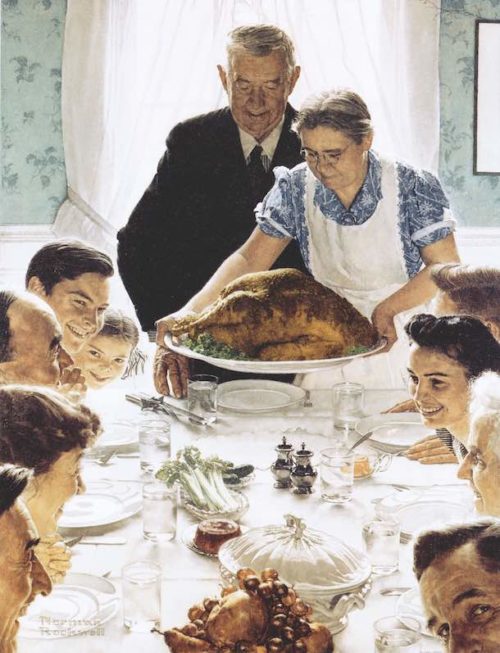
In 1943, the Post commissioned four writers to craft an essay to accompany each of Norman Rockwell’s Four Freedoms paintings, which had quickly come to represent America’s moral imperative during World War II. You can read the other three essays here.
Freedom from Want
Originally published March 6, 1943
If you want to know what we are, look upon the farms or upon the hard pavements of the city. You usually see us working or waiting for work, and you think you know us, but our outward guise is more deceptive than our history.
Our history has many strands of fear and hope, that snarl and converge at several points in time and space. We clear the forest and the mountains of the land. We cross the river and the wind. We harness wild beast and living steel. We celebrate labor, wisdom, peace of the soul.
When our crops are burned or plowed under, we are angry and confused. Sometimes we ask if this is the real America. Sometimes we watch our long shadows and doubt the future. But we have learned to emulate our ideals from these trials. We know there were men who came and stayed to build America. We know they came because there is something in America that they needed, and which needed them.
We march on, though sometimes strange moods fill our children. Our march toward security and peace is the march of freedom — the freedom that we should like to become a living part of. It is the dignity of the individual to live in a society of free men, where the spirit of understanding and belief exist; of understanding that all men are equal; that all men, whatever their color, race, religion or estate, should be given equal opportunity to serve themselves and each other according to their needs and abilities.
But we are not really free unless we use what we produce. So long as the fruit of our labor is denied us, so long will want manifest itself in a world of slaves. It is only when we have plenty to eat — plenty of everything — that we begin to understand what freedom means. To us, freedom is not an intangible thing. When we have enough to eat, then we are healthy enough to enjoy what we eat. Then we have the time and ability to read and think and discuss things. Then we are not merely living but also becoming a creative part of life. It is only then that we become a growing part of democracy.
We do not take democracy for granted. We feel it grow in our working together — many millions of us working toward a common purpose. If it took us several decades of sacrifices to arrive at this faith, it is because it took us that long to know what part of America is ours.
Our faith has been shaken many times, and now it is put to question. Our faith is a living thing, and it can be crippled or chained. It can be killed by denying us enough food or clothing, by blasting away our personalities and keeping us in constant fear. Unless we are properly prepared, the powers of darkness will have good reason to catch us unaware and trample our lives.
The totalitarian nations hate democracy. They hate us because we ask for a definite guaranty of freedom of religion, freedom of expression, and freedom from fear and want. Our challenge to tyranny is the depth of our faith in a democracy worth defending. Although they spread lies about us, the way of life we cherish is not dead. The American Dream is only hidden away, and it will push its way up and grow again.
We have moved down the years steadily toward the practice of democracy. We become animate in the growth of Kansas wheat or in the ring of Mississippi rain. We tremble in the strong winds of the Great Lakes. We cut timbers in Oregon just as the wild flowers blossom in Maine. We are multitudes in Pennsylvania mines, in Alaskan canneries. We are millions from Puget Sound to Florida. In violent factories, crowded tenements, teeming cities. Our numbers increase as the war revolves into years and increases hunger, disease, death, and fear.
But sometimes we wonder if we are really a part of America. We recognize the mainsprings of American democracy in our right to form unions and bargain through them collectively, our opportunity to sell our products at reasonable prices, and the privilege of our children to attend schools where they learn the truth about the world in which they live. We also recognize the forces which have been trying to falsify American history — the forces which drive many Americans to a corner of compromise with those who would distort the ideals of men that died for freedom.
Sometimes we walk across the land looking for something to hold on to. We cannot believe that the resources of this country are exhausted. Even when we see our children suffer humiliations, we cannot believe that America has no more place for us. We realize that what is wrong is not in our system of government, but in the ideals which were blasted away by a materialistic age. We know that we can truly find and identify ourselves with a living tradition if we walk proudly in familiar streets. It is a great honor to walk on the American earth.
If you want to know what we are, look at the men reading books, searching in the dark pages of history for the lost word, the key to the mystery of living peace. We are factory hands, field hands, mill hands, searching, building, and molding structures. We are doctors, scientists, chemists, discovering and eliminating disease, hunger, and antagonism. We are soldiers, Navy men, citizens, guarding the imperishable dream of our fathers to live in freedom. We are the living dream of dead men. We are the living spirit of free men.
Everywhere we are on the march, passing through darkness into a sphere of economic peace. When we have the freedom to think and discuss things without fear, when peace and security are assured, when the futures of our children are ensured — then we have resurrected and cultivated the early beginnings of democracy. And America lives and becomes a growing part of our aspirations again.
We have been marching for the last 150 years. We sacrifice our individual liberties, and sometimes we fail and suffer. Sometimes we divide into separate groups and our methods conflict, though we all aim at one common goal. The significant thing is that we march on without turning back. What we want is peace, not violence. We know that we thrive and prosper only in peace.
We are bleeding where clubs are smashing heads, where bayonets are gleaming. We are fighting where the bullet is crashing upon armorless citizens, where the tear gas is choking unprotected children. Under the lynch trees, amidst hysterical mobs. Where the prisoner is beaten to confess a crime he did not commit. Where the honest man is hanged because he told the truth.
We are the sufferers who suffer for natural love of man for another man, who commemorate the humanities of every man. We are the creators of abundance.
We are the desires of anonymous men. We are the subways of suffering, the well of dignities. We are the living testament of a flowering race.
But our march to freedom is not complete unless want is annihilated. The America we hope to see is not merely a physical but also a spiritual and an intellectual world. We are the mirror of what America is. If America wants us to be living and free, then we must be living and free. If we fail, then America fails.
What do we want? We want complete security and peace. We want to share the promises and fruits of American life. We want to be free from fear and hunger.
If you want to know what we are — we are marching!
The Four Freedoms Essays
Americans of 1943 knew the Second World War was being fought to preserve individual freedom, but many had trouble imagining just what that freedom looked like. In February and March of that year, Norman Rockwell — inspired by President Franklin Roosevelt’s 1941 “Four Freedoms” speech — gave Americans a vision of the freedoms that justified all the sacrifice and suffering the war had brought them.
His paintings of President Roosevelt’s four postwar goals resonated so deeply with Americans in the 1940s that they became iconic symbols of American life, and they are still powerful images of what we prize in our country.
That same year, the Post commissioned four authors to write essays to accompany each Freedom painting.

“Freedom of Speech” by Booth Tarkington
Longtime Post contributor and a two-time Pulitzer Prize–winning novelist Booth Tarkington depicted his ideas of free speech by way of a parable about the chance meeting of two young men at a small chalet in the Alps.

“Freedom of Worship” by Will Durant
A historian and philosopher, Will Durant spent 40 years writing the masterful, 11-volume series The Story of Civilization. In his essay, he identifies a little white church and its tall steeple as a symbol of the promise of freedom of worship.
“Freedom from Want” by Carlos Bulosan
A Filipino novelist and labor organizer in the U.S., Carlos Bulosan reminds us in his essay that freedom from want is not something that we can be given, but something we must earn — all of us together — through hard work, shared goals, and an honest sense of unity and equality.
“Freedom from Fear” by Stephen Vincent Benét
The essay by poet and novelist Stephen Vincent Benét appeared in the Post on the day of his death. In it, he reminds readers that the fight against fear is ultimately a fight against ignorance, and that it is not enough to fight our own ignorance, to hoard knowledge for our own peace of mind; to free ourselves from fear, all of mankind must grow its understanding together.
Stephen Vincent Benét’s ‘Freedom from Fear’
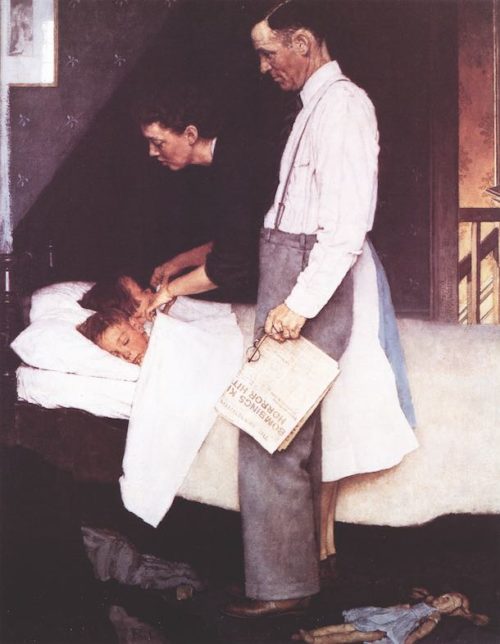
In 1943, the Post commissioned four writers to craft an essay to accompany each of Norman Rockwell’s Four Freedoms paintings, which had quickly come to represent America’s moral imperative during World War II. You can read the other three essays here.
Freedom from Fear
Originally published on March 13, 1943
What do we mean when we say “freedom from fear”? It isn’t just a formula or a set of words. It’s a look in the eyes and a feeling in the heart and a thing to be won against odds. It goes to the roots of life — to a man and a woman and their children and the home they can make and keep.
Fear has walked at man’s heels through many ages — fear of wild beasts and wilder nature, fear of the inexplicable gods of thunder and lightning, fear of his neighbor man.
He saw his rooftree burned with fire from heaven — and did not know why. He saw his children die of plague — and did not know why. He saw them starve, he saw them made slaves. It happened — he did not know why. Those things had always happened.
Then he set himself to find out — first one thing, then another. Slowly, through centuries, he fought his battle with fear. And wise men and teachers arose to help him in the battle.
His children and he did not have to die of plague. His children and he did not have to make human sacrifices to appease the wrath of inexplicable gods. His children and he did not have to kill the stranger just because he was a stranger. His children and he did not have to be slaves. And the shape of Fear grew less.
No one man did this by himself. It took many men and women, over many years. It took saints and martyrs and prophets — and the common people. It started with the first fire in the first cave — the fire that scared away the beasts of the night. It will not end with the conquest of far planets.
Since our nation began, men and women have come here for just that freedom — freedom from the fear that lies at the heart of every unjust law, of every tyrannical exercise of power by one man over another man. They came from every stock — the men who had seen the face of tyranny, the men who wanted room to breathe and a chance to be men. And the cranks and the starry-eyed came, too, to build Zion and New Harmony and Americanopolis and the states and cities that perished before they lived — the valuable cranks who push the world ahead an inch. And a lot of it never happened, but we did make a free nation.
“How are you ever going to live out there, stranger?”
“We’ll live on weevily wheat and the free air.” If they had the free air, they’d put up with the weevily wheat.
So, in our corner of the world, and for most of our people, we got rid of certain fears. We got rid of them, we got used to being rid of them. It took struggle and fighting and a lot of working things out. But 130 million people lived at peace with one another and ran their own government. And because they were free from fear, they were able to live better, by and large and on the whole, than any 130 million people had lived before. Because fear may drive a burdened man for a mile, but it is only freedom that makes his load light for the long carry.
And meanwhile around us the world grew smaller and smaller. If you looked at it on the school maps, yes, it looked like the same big world with a big, safe corner for us. But all the time invention and mechanical skill were making it smaller and smaller. When the Wright brothers made their first flights at Kittyhawk, the world shrank. With those first flights, the world began to come together, and distant nations to jostle their neighbor nations.
Now, again in our time, we know Fear — armed Fear, droning through the sky. It’s a different sound from the war whoop and the shot in the lonesome clearing, and yet it is much the same for all of us. It is quiet in the house tonight and the children are asleep. But innocence, good will, distance, peaceable intent, will not keep those children safe from the fear in the sky. No one man can keep his house safe in a shrunken world. No one man can make his own clearing and say “This is mine. Keep out.” And yet, if the world is to go on, if man is to survive and prosper, the house of man must be kept safe.
So, what do we mean by “freedom from fear”?
We do not mean freedom from responsibility — freedom from struggle and toil, from hardship and danger. We do not intend to breed a race wrapped in cotton wool, too delicate to stand rough weather. In any world of man that we can imagine, fear and the conquest of fear must play a part.
But we have the chance, if we have the brains and the courage, to destroy the worst fears that harry man today — the fear of starving to death, the fear of being a slave, the fear of being stamped into the dust because he is one kind of man and not another, the fear of unprovoked attack and ghastly death for himself and for his children because of the greed and power of willful and evil men and deluded nations.
It will not be easy to destroy those fears. No one man can do it alone. No one nation can do it alone. It must be all men.
It is not enough to say, “Here, in our country, we are strong. Let the rest of the world sink or swim. We can take care of ourselves.” That may have been true at one time, but it is no longer true. We are not an island in space, but a continent in the world. While the air is the air, a bomb can kill your children and mine. Fear and ignorance a thousand miles away may spread pestilence in our own town. A war between nations on the other side of the globe may endanger all we love and cherish.
War, famine, disease are no longer local problems or even national problems. They are problems that concern the whole world and every man. That is a hard lesson to learn, and yet, for our own survival, we must learn it.
A hundred and sixty-odd years ago, we, as a nation, asserted that all men were created equal, that all men were entitled to life, liberty, and the pursuit of happiness. Those were large assertions, but we have tried to live up to them. We have not always succeeded; we have often failed. But our will and desire as a nation have been to live up to them.
Now, in concert with other free nations, we say that those children you see and other children like them all over the world shall grow to manhood and womanhood free from fear. We say that neither their minds nor their bodies shall be cramped or distorted or broken by tyranny and oppression. We say they shall have a chance, and an equal chance, to grow and develop and lead the lives they choose to lead, not lives mapped out for them by a master. And we say that freedom for ourselves involves freedom for others — that it is a universal right, neither lightly given by providence nor to be maintained by words alone, but by acts and deeds and living.
We who are alive today did not make our free institutions. We got them from the men of the past, and we hold them in trust for the future. Should we put ease and selfishness above them, that trust will fail and we shall lose all, not a portion or a degree of liberty, but all that has been built for us and all that we hope to build. Real peace will not be won with one victory. It can be won only by long determination, firm resolve, and a wish to share and work with other men, no matter what their race or creed or condition. And yet, we do have the choice. We can have freedom from fear.
Here is a house, a woman, a man, their children. They are not free from life and the obligations of life. But they can be free from fear. All over the world, they can be free from fear. And we know they are not yet free.
Will Durant’s ‘Freedom of Worship’
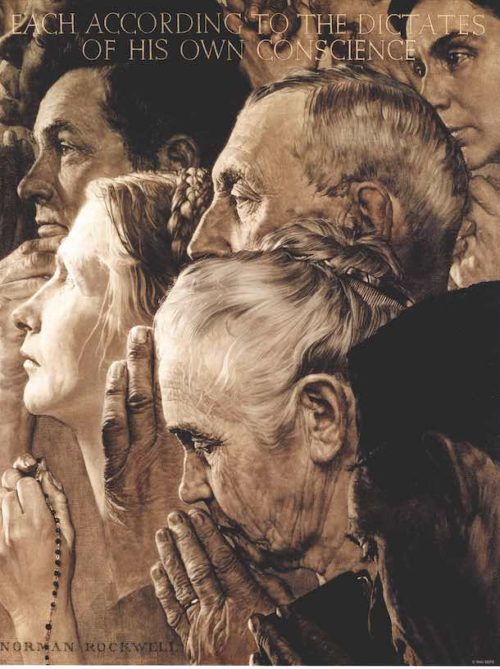
In 1943, the Post commissioned four writers to craft an essay to accompany each of Norman Rockwell’s Four Freedoms paintings, which had quickly come to represent America’s moral imperative during World War II. You can read the other three essays here.
Freedom of Worship
Originally published February 27, 1943
Down in the valley below the hill where I spend my summers is a little white church whose steeple has been my guiding goal in many a pleasant walk.
Often, as I passed the door on weekdays when all was silent there, I wished that I might enter, sit quietly in one of the empty pews, and feel more deeply the wonder and the longing that had built such chapels — temples and mosques and great cathedrals — everywhere on the earth.
Man differs from the animal in two things: He laughs, and he prays. Perhaps the animal laughs when he plays, and prays when he begs or mourns; we shall never know any soul but our own, and never that. But the mark of man is that he beats his head against the riddle of life, knows his infinite weakness of body and mind, lifts up his heart to a hidden presence and power, and finds in his faith a beacon of heartening hope, a pillar of strength for his fragile decency.
These men of the fields, coming from afar in the uncomfortable finery of a Sabbath morn, greeting one another with bluff cordiality, entering to worship their God in their own fashion — I think, sometimes, that they know more than I shall ever find in all my books. They have no words to tell me what they know, but that is because religion, like music, lives in a world beyond words, or thoughts, or things. They have felt the mystery of consciousness within themselves, and will not say that they are machines. They have seen the growth of the soil and the child, they have stood in awe amid the swelling fields, in the humming and teeming woods, and they have sensed in every cell and atom the same creative power that wells up in their own striving and fulfillment. Their unmoved faces conceal a silent thankfulness for the rich increase of summer, the mortal loveliness of autumn and the gay resurrection of the spring. They have watched patiently the movement of the stars, and found in them a majestic order so harmoniously regular that our ears would hear its music were it not eternal. Their tired eyes have known the ineffable splendor of earth and sky, even in tempest, terror, and destruction; and they have never doubted that in this beauty some sense and meaning dwell. They have seen death, and reached beyond it with their hope.
And so they worship. The poetry of their ritual redeems the prose of their daily toil; the prayers they pray are secret summonses to their better selves; the songs they sing are shouts of joy in their refreshened strength. The commandments they receive, through which they can live with one another in order and peace, come to them as the imperatives of an inescapable deity, not as the edicts of questionable men. Through these commands they are made part of a divine drama, and their harassed lives take on a scope and dignity that cannot be canceled out by death.
This little church is the first and final symbol of America. For men came across the sea not merely to find new soil for their plows but to win freedom for their souls, to think and speak and worship as they would. This is the freedom men value most of all; for this they have borne countless persecutions and fought more bravely than for food or gold. These men coming out of their chapel — what is the finest thing about them, next to their undiscourageable life? It is that they do not demand that others should worship as they do, or even that others should worship at all. In that waving valley are some who have not come to this service. It is not held against them; mutely these worshipers understand that faith takes many forms, and that men name with diverse words the hope that in their hearts is one.
It is astonishing and inspiring that after all the bloodshed of history, this land should house in fellowship a hundred religions and a hundred doubts. This is with us an already ancient heritage; and because we knew such freedom of worship from our birth, we took it for granted and expected it of all mature men. Until yesterday, the whole civilized world seemed secure in that liberty.
But now suddenly, through some paranoiac mania of racial superiority, or some obscene sadism of political strategy, persecution is renewed, and men are commanded to render unto Caesar the things that are Caesar’s, and unto Caesar the things that are God’s. The Japanese, who once made all things beautiful, begin to exclude from their realm every faith but the childish belief in the divinity of their emperor. The Italians, who twice littered their peninsula with genius, are compelled to oppress a handful of hunted men. The French, once honored in every land for civilization and courtesy, hand over desolate refugees to the coldest murderers that history has ever known. The Germans, who once made the world their debtors in science, scholarship, philosophy, and music, are prodded into one of the bitterest persecutions in all the annals of savagery by men who seem to delight in human misery, who openly pledge themselves to destroy Christianity, who seem resolved to leave their people no religion but war, and no God but the state.
It is incredible that such reactionary madness can express the mind and heart of an adult nation. A man’s dealings with his God should be a sacred thing, inviolable by any potentate. No ruler has yet existed who was wise enough to instruct a saint; and a good man who is not great is a hundred times more precious than a great man who is not good. Therefore, when we denounce the imprisonment of the heroic Niemoller, the silencing of the brave Faulhaber, we are defending the freedom of the German people as well as of the human spirit everywhere. When we yield our sons to war, it is in the trust that their sacrifice will bring to us and our allies no inch of alien soil, no selfish monopoly of the world’s resources or trade, but only the privilege of winning for all peoples the most precious gifts in the orbit of life — freedom of body and soul, of movement and enterprise, of thought and utterance, of faith and worship, of hope and charity, of a humane fellowship with all men.
If our sons and brothers accomplish this, if by their toil and suffering they can carry to all mankind the boon and stimulus of an ordered liberty, it will be an achievement beside which all the triumphs of Alexander, Caesar, and Napoleon will be a little thing. To that purpose they are offering their youth and their blood. To that purpose and to them we others, regretting that we cannot stand beside them, dedicate the remainder of our lives.