Healthy Weight, Healthy Mind: Use B-SMART Goals for Weight Loss Success
We are pleased to bring you this regular column by Dr. David Creel, a licensed psychologist, certified clinical exercise physiologist and registered dietitian. He is also credentialed as a certified diabetes educator and the author of A Size That Fits: Lose Weight and Keep it off, One Thought at a Time (NorLightsPress, 2017).
Do you have a weight loss question for Dr. Creel? Email him at [email protected]. He may answer your question in a future column.
The B Is for Behavior
Outcome goals are king in weight management, but they shouldn’t be.
I will lose 30 pounds and keep it off
I’m going to get off my blood pressure medication.
This year I will run a 10k race.
There’s nothing wrong with these goals. Losing weight, getting off medication, and fitness events are all good things. But if this is the extent of goal setting you may fall short. Each outcome goal we set should be coupled with specific actions to support the goal. These actions are called behavioral goals. Although a baseball coach may have a goal to win the championship, nothing is going to happen without specific behavioral goals for the team. Likewise, if your desire to lose 30 pounds isn’t coupled with clear-cut behavioral goals, it probably won’t happen. Action-oriented goals for weight management can include anything that directly or indirectly impacts weight:
| Self-weighing | Food journaling | Weighing/measuring food |
| Shopping from a grocery list | Meal planning | Tracking steps |
| Going to the gym | Walking the dog | Rating/hunger |
| Sleep | Time spent watching TV | Alcohol intake |
| Dining out | Playing in a sports league | Eating less at night |
| Eating at the table | Walking on lunch hour | Prayer habits |
| Meditation | Journaling thoughts | Batch cooking |
| Seeing a therapist | Taking an exercise class | Attending a support group |
Specific (S) and Measurable (M)
Setting criteria you can measure is an excellent way to find and define specific goals. People frequently tell me their weight-related goals are to exercise more this month, eat better, or get back on track. What do these mean? One more step, one more bite of broccoli? Is getting back on track just a frame of mind or an actual set of behaviors?
Suppose you want to focus on increasing vegetables, eating breakfast, and reducing your calorie intake late at night. Specific and measurable goals could be:
- I will eat two cups of vegetables at least four days this week.
- I will eat something before 9:30 a.m. six days this week.
- I will track the calories in my snacks after dinner and stay under 300 for at least five days this week.
If your goal involves physical activity, take a few minutes to think about what you’ll do, how often you’ll do it, and the amount of time you’ll spend. Also consider factors that affect your activities, such as thunderstorms (if it’s raining I will walk on the treadmill instead of riding my bike outside). For example:
- This week I will walk outside or on my treadmill before work for at least 30 minutes.
- I will go to Zumba class on Saturday.
- I will wear my Fitbit every day this week and reach 10,000 steps on at least five days.
- I will walk on my lunch hour on Tuesday, Thursday, and Friday.
Generally speaking, the more specific and detailed the plan, the better. On one occasion, however, I got more information than I bargained for. Marie told me her plan was to continue doing resistance training three times per week with rubber tubing. I asked her what days and times she would work out and which exercises she would do. Marie told me she waited until the evening to do her exercises because that’s when her husband was home and he liked to watch her workout. Straight faced she added, “He likes it because I work out in the buff.” Since the success rates for maintaining marriages and fitness programs aren’t so great, I supported this plan. I decided to forego my usual questions about exercise form and technique and assumed she was working all her major muscle groups. Since that day, I always feel the need to wipe down rubber tubing before I use it at the gym!
A = Attainable
This step of goal setting is where things often fall apart. In our minds we know what’s recommended, ideal, or possible — and so we set goals accordingly. We ignore that the planets would have to align in perfect order to create the circumstances for us to achieve these goals. If you typically eat three vegetables per month, immediately transitioning to five servings per day is highly improbable. Even though 10,000 steps is recommended, increasing from 4,000 to 6,000 may be more realistic in the beginning. This approach worked well for Janet.
When Janet told me she was wearing her pedometer faithfully, I didn’t really believe this was true. I couldn’t imagine she was truly walking only 900 to 1,200 steps each day. She must be only wearing it a few hours during the day; maybe the pedometer is a lemon or the batteries are bad. The average American, who is notoriously sedentary, accumulates five times as many steps. Although she was overweight, Janet wasn’t disabled in any way. Her knees seemed to be in shape to handle walking and she didn’t complain of any other limitations. Janet would have to increase her walking by a factor of 10 to reach the recommended 10,000 steps per day.
When she described her lifestyle things began to make sense. She was a busy account manager at her firm but worked from home. She parked at her desk all day, only getting up to go to the bathroom or kitchen, both near her office. When she finished working, she would sometimes run an errand or do some light house cleaning, but that was about it for physical activity. In the evening Janet often returned to her computer to finish work, fall into the abyss of social media, or play solitaire. She and her husband would also watch an hour or two of TV. She’d never been an exerciser but was open to the idea of becoming more physically active. She had recently lost weight without exercise but knew her chances of keeping it off were not good unless she moved more. Janet also wanted to feel better. She felt sluggish. Like a toddler who can’t sit still, her body yearned for movement.
She started with a goal of 3,000 steps each day, which she achieved easily just by getting out of her chair more during her work day and doing a daily errand that required some walking. After several weeks of this, we set a goal of 5,000 steps per day at least five days per week. She was able to accomplish this on the weekend by doing yard work and more housecleaning. On work days she decided to walk for 20 minutes when she took a break for lunch. Janet enjoyed the concrete aspect of tracking her steps and the challenge of reaching her goals. She was also motivated by the fact that she felt more energetic, could concentrate better throughout the day, and slept soundly at night.
sometimes they simply keep us from sliding backward.
The next goal was to reach 8,000 steps at least three days per week. Again, the weekends were easier. Janet added a 40-minute walk to her already established weekend routine. She also began taking a 40-minute walk with her husband on Wednesday or Thursday evenings. Janet and I continued to set progressive goals and after six months she took 7,000 to 11,000 steps at least five days per week. We didn’t quite reach 10,000 steps every day, but we were close. Janet was now walking in place during long conference calls and enthusiastically signed up for her first 5K. She was always excited to tell me about her new step record, which finally hit 15,000 per day, thanks to a 40-minute Saturday walk plus a trip to the flea market.
Setting attainable goals requires setting aside our should thoughts and all or nothing thinking and focusing on progress, not perfection. Goals need not be like a light switch we flip on and off, going full force and then regressing back to nothing. Instead our goals can be more like a dimmer switch that’s always turned on, sometimes shining brightly and at other times softly illuminating. No matter the intensity of our goals, the act of setting them helps keep us mindful of long-term objectives. Each month, week, or day, consider what you can realistically accomplish. During a busy week of travel, you may focus on maintaining your weight by getting to the hotel gym three times and avoiding dessert and alcohol when dining out in the evening. When you’re at home with better control of the environment, you can turn the dimmer switch up to more frequent exercise, lower-calorie food preparation, and a greater variety of vegetables than were available while traveling. The famed Scottish novelist Robert Louis Stevenson put it this way: “Don’t judge each day by the harvest you reap but by the seeds that you plant.”
“T” Is for Time Frame
Short-term and long-term goals are both important, especially when we focus on losing a substantial amount of weight. Losing 30 pounds means you have to create a 105,000 calorie deficit over an extended period of time. Unfortunately, once you lose weight, the hardest part of weight management awaits you — maintenance. To keep the weight off you’ll need to sustain most of the behavior that helped you lose weight in the first place. A 30-pound weight loss from conventional treatments may take six months to a year as you consistently burn more calories than you consume. Therefore, you’ll need to set many short-term goals along the way. You will have to manage your weight, just as supervisors manage a business, frequently evaluating success and failure while readjusting your goals and objectives.
A common error in goal setting is to have long-term goals without setting enough goals for the short run. In some circumstances I discourage long-term goals, such as overall weight loss, until a client has a chance to set short- term behavioral goals and see how much work weight loss requires. A healthy weight is the weight you reach when you do healthy things over an extended period of time. This can’t be determined by a chart, a formula, or even the weight you felt great at 20 years ago. You’re setting yourself up for disappointment if you set a weight goal you can only reach if you behave in a way that isn’t healthy or realistic to sustain.
That’s why specific shorter-term goals with a wait-and-see approach are often more effective. You’ll get immediate returns by feeling better and becoming more fit, instead of holding onto a distant “pie in the sky” goal. The idea of that goal may still exist, but it won’t be your main focus.
encourage you to be diligent about frequently evaluating your progress.
Although no secret formula exists for timing your goals and reviewing progress, I encourage at least weekly goal-setting sessions during the early stages of weight loss. Once a week you can either meet with a professional, a peer, or yourself to review how you did with the previous week’s goals. If you achieved them, how did you do it? If you didn’t, why not? Were your goals unrealistic, not specific enough, or maybe not that important to you? Or was it a problem with execution? Do you need a more specific action plan, such as making sure you go to the grocery store over the weekend and stock up on food to cook healthier meals? Perhaps your goal of exercising in the morning will only work if you have a plan that helps you get to bed earlier the night before. Did you put everyone else’s needs in front of your own? You might reevaluate your thinking.
Over time, accomplishing these short-term goals may lead to habits you follow without thinking. When this happens, weight management becomes easier. However, because obesity is a chronic, relapsing condition, I encourage you to be diligent about frequently evaluating your progress. If your behavior starts to drift in the wrong direction, you can quickly identify the problem areas and use goal setting to help you get back on track. This may be as simple as weighing daily and observing your weight graph once a month to spot trends. Some of my long-term clients, even if they’re doing well, return to the office every month or two for exactly this reason.
Trailblazer Opha May Johnson Becomes the First Female Marine
It’s been said that history is made by those who show up. Last week,The New York Times ran a story on First Lieuntenant Marina A. Hierl; Hierl is one of only two women to pass the Marine Corps Infantry Officer Course. Lieutenant Hierl made further history as she was assigned her own platoon to lead. Hierl is one of the people that shows up. Opha May Johnson led the way for women like Lieutenant Hierl and proved that you can make history by showing up first. 100 years ago today, Johnson earned the distinction of becoming the first woman to enlist in the United States Marine Corps.
Born Opha May Jacob in Kokomo, Indiana in 1879, the future Marine attended Wood’s Commercial College. She earned the rank of salutatorian, graduating from the shorthand and typewriting department in 1895. Three years later, she married Victor Johnson, musical director of the Lafayette Square Opera House in Washington D.C.
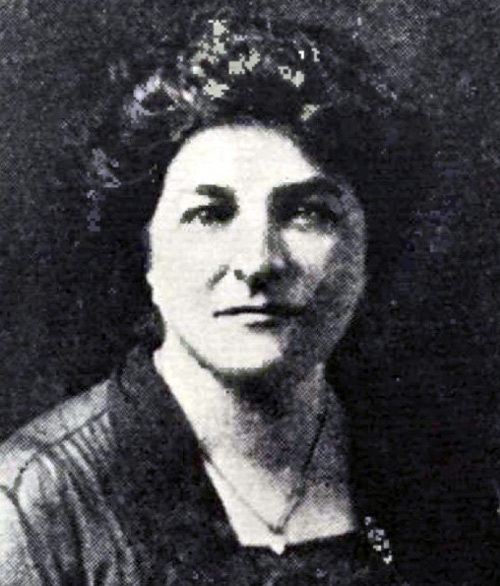
According to the Richmond Time-Dispatch dated September 1, 1918, Johnson was already a civil servant, working for the Interstate Commerce Department, when the chance came up for her to apply to the United States Marine Corps Reserve. The reserve had been established in 1916, concurrent with the U.S.’s involvement in World War I. During the last two years of the war, women were allowed to join branches and reserves to cover responsibilities typically held by men that were under active deployment; 33,000 women would eventually serve support staff.
On that day in 1918, Opha May Johnson found herself at the front of the line. Private Johnson became the first of over 300 women that would enlist in the Marine Corps during the remainder of World War I. Her first assignment sent her to Marine Corps headquarters; she worked there as clerk where she managed the records of the other new, female Marines. After the conclusion of World War I in November, 1918, the various branches of the service began discharging all women from active duty. Johnson took a job as a clerk in the War Department (which would be renamed as the Department of Defense in 1949).
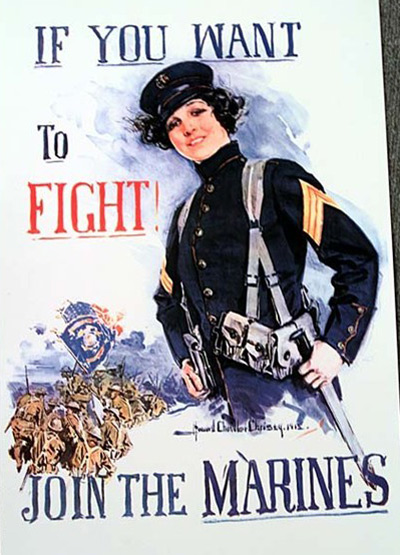
Johnson died on August 11, 1955, at Mount Alto Veteran’s Hospital in Washington, D.C. Her funeral services coincidentally fell on August 13, 37 years to the day after she enlisted. She is buried in an unmarked grave in Rock Creek Cemetery in D.C. Last year, the Women Marines Association began to fund-raise to install an official marker; the successful project will result in a site unveiling on August 29, with the Commandant of the Marine Corps, General Robert B. Neller, scheduled to speak.
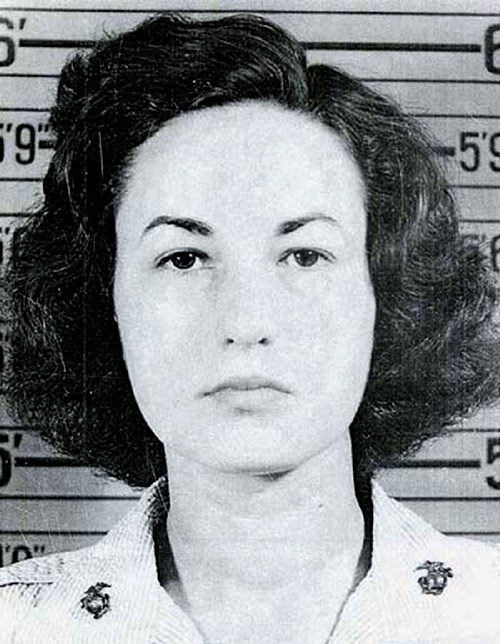
Since Johnson’s historic enlistment, thousands of women have served in the U.S. Armed Forces in combat and support capacities. As of 2015, around 2 million veterans in the U.S. were women. Johnson helped pave the way for later Marines like Bea Arthur; before becoming the actress best known for Maude and The Golden Girls, Arthur drove a truck as a member of the Women’s Reserve and attained the rank of staff sergeant during her stateside service in World War II. The late Margaret Brewer, the first female Marine to be made a general, was promoted to brigadier general in 1979. As of May 2018, 92 women serve in combat positions in the USMC; approximately 7% of the 186,000 active Marines are women.
50 Years Ago: Ravi Shankar’s Misgivings About the ’60s
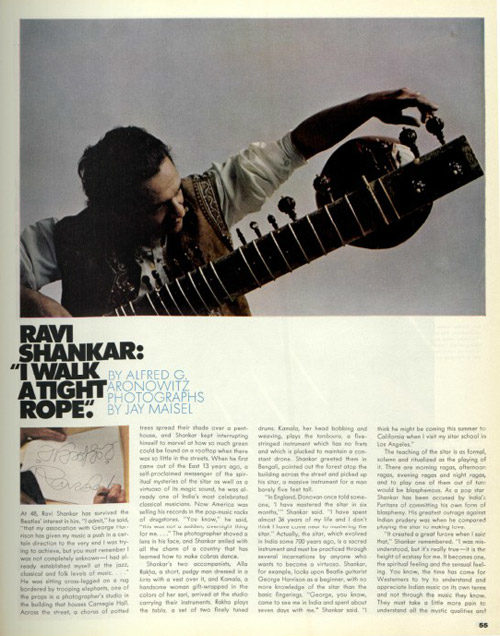
Decades before “world music” became an identifiable genre in the U.S., Ravi Shankar travelled the globe carving out a place for his classical sitar music. The traditional Indian instrument resonated with the flower children of the ’60s, and Shankar became an unlikely rock star, developing a relationship with George Harrison and eventually performing at Woodstock. Despite his success in turning a generation on to his culture — or because of it — the raga composer was deeply conflicted about hippie appreciation of Indian musical traditions, drug use, and the possible bastardization of his craft.
Shankar described his cultural moment as “walking on a tightrope” to this magazine in a profile published 50 years ago. “I have had to be so careful in not doing anything to be exploiting the situation,” he said, “To keep the sanctity of the music has been a very difficult job.”
The Beatles weren’t the only pop group using the sitar in the ’60s. Donovan, The Rolling Stones, The Cyrkle, The Mamas and the Papas, and even Elvis utilized its reverberating strings in their recordings. Shankar didn’t disapprove of popular musicians’ embrace of his sacred instrument, but he was distrustful of the pattern of fads in America: “The time has come for Westerners to try to understand and appreciate Indian music on its own terms and not through the music they know. They must take a little more pain to understand all the mystic qualities and not just the speed and excitement.”
That the appeal of Indian musical stylings was largely psychedelic troubled Shankar even more. The association of his rich cultural heritage with drugs like LSD and marijuana was, in his eyes, blasphemous. The cover of Jimi Hendrix’s 1967 album, Axis: Bold as Love, illustrates how Hindu symbolism and iconography could be appropriated by the rebellious counterculture of 1960s America and reimagined for purposes of psychedelia. Shankar was upset to see youth smoking pot and making out during his performances, and he stormed offstage numerous times, according to a 1985 interview with The New York Times.
Keeping the indigenous traditions and intricacies of the sitar while fostering cultural fusion was Shankar’s musical task. Although the Beatles utilized its exotic sound in pop songs like “Norwegian Wood (This Bird Has Flown),” Shankar’s own performances with the instrument sometimes ran seven to nine hours, with avid (sober) music lovers sitting entranced by his raga compositions. Shankar had no interest in learning to play the guitar.
In spite of the self-indulgence of the ’60s youth, Shankar believed the cultural transformation underway was sincere in many ways and could provide a pathway to greater appreciation of Indian customs and, particularly, music. As a performer, his influence spread further than the trends of pop. Shankar performed with the London Symphony Orchestra, John Coltrane, and Philip Glass. He composed film scores for Satyajit Ray, Norman McLaren, and Richard Attenborough, and he even served in the upper chamber of the Parliament of India for six years. Shankar’s daughters, Norah Jones and Anoushka Shankar, are respectively a jazz singer and a sitar musician. Throughout his long life, Shankar transcended the pop culture label of his craft and proved to American audiences that sitar music, as he said in 1968, “is not rock and roll.”
Comedians in the White House: Our Favorite Jokes by Presidents
“Thanks, folks. I’m here all this term.”
The president of the United State is supposed to represent the people of the country. And since we Americans have a sense of humor that is strong as it is broad, it’s not surprising that presidents can occasionally crack up their audiences.
Here are a few chuckles from our Chief Executives.
John Adams
on the legislature
“In my many years I have come to a conclusion that one useless man is a shame, two is a law firm, and three or more is a congress.”
Abraham Lincoln
of a political foe
“He can compress the most words into the smallest idea of any man I ever met.”
Theodore Roosevelt
on corruption in Congress
“When they call the roll in the Senate, the Senators do not know whether to answer ‘present’ or ‘not guilty.'”
Calvin Coolidge
to a woman sitting next to President Coolidge at a dinner party told him she’d bet a friend she could get at least three words of conversation out of him.
“You lose.”
Franklin Roosevelt
on being informed by an aide that Eleanor Roosevelt (who was conducting a fact-finding tour of a penitentiary) was “in prison.”
“I’m not surprised, but for what?”
John F. Kennedy
“I was almost late here today, but I had a very good taxi driver who brought me through the traffic jam. I was going to give him a very large tip and tell him to vote Democratic and then I remember some advice Senator Green had given me, so I gave him no tip at all and told him to vote Republican.”
Lyndon B. Johnson
addressing a Marine who said, “Mr. President, this is your helicopter over here.”
“They’re all mine, son.”
Jimmy Carter
on a late resurgence of his popularity
“My esteem in this country has gone up substantially. It is very nice now when people wave at me they use all their fingers.”
Ronald Reagan
on other politicians
“I have left orders to be awakened at any time in case of national emergency — even if I’m in a Cabinet meeting.”
Bill Clinton
describing the White House
“Being president is like running a cemetery: you’ve got a lot of people under you and nobody’s listening.”
George W. Bush
“No matter how tough it gets, however, I have no intention of becoming a lame-duck president. Unless, of course, Cheney accidentally shoots me in the leg.”
Barack Obama
on his name
”Many of you know that I got my name, Barack, from my father. What you may not know is Barack is actually Swahili for ‘That One.’ And I got my middle name from somebody who obviously didn’t think I’d ever run for president.”
Donald Trump
on wife Melania Trump’s Republican National Convention speech
“The media is even more biased this year than ever before — ever. You want the proof? Michelle Obama gives a speech and everyone loves it — it’s fantastic. They think she’s absolutely great. My wife, Melania, gives the exact same speech, and people get on her case.”
Featured image: Jimmy Carter, Bill Clinton, Barack Obama, and George W. Bush in 2013 (Pete Souza, White House photo)
5-Minute Fitness: Tight Rope Tap
Try this balancing act from fitness expert Jessica Smith and Harvard neurologist Marie Pasinski in Smith’s DVD series Walk Strong: Total Transformation 6 Week System. “Walking along an imaginary tightrope engages the part of your brain that coordinates movement and will improve your agility and give you a more youthful stride,” Dr. Pasinski says.
Tight Rope Tap
1 With arms swinging naturally by sides, walk forward along a single line on the floor. Step forward right, left, right and then quickly lift left knee in front of hip, tapping the top of left thigh with both hands.
2 Immediately repeat pattern moving backward: Step back left, right, left and then lift right knee up in front of hip, tapping top of right thigh with both hands.
3 Repeat steps for a total of 4 reps. Then reverse, starting with left foot leading forward first for 4 additional reps. Add 1-3 sets to your regular workout any time you want to strengthen your body and your mind at the same time.
Movies for the Rest of Us with Bill Newcott: The Meg, Christopher Robin, and Magic Music
Saturday Evening Post movie critic Bill Newcott reviews over-the-top shark movie The Meg, a new take on a beloved children’s classic, Christopher Robin, and the documentary 40 Years in the Making: The Magic Music Movie, including an interview with director Lee Aronsohn. He also reviews home movie releases The House of Tomorrow and Avengers: Infinity War.
30 Years Ago: The Civil Liberties Act of 1988 Addresses a Wartime Injustice
The internment of Japanese Americans during World War II remains a stain on American history. From 1942-1946, close to 120,000 people of Japanese ancestry were relocated to internment camps in the western United States. Over sixty percent of the interned people were American citizens. The motivation for this program was born out of wartime fear following the attack on Pearl Harbor and an underlying current of racist discomfort that was already present. More than 40 years after the final camp closed in 1946, and 30 years ago today, President Reagan signed the Civil Liberties Act of 1988, a law that awarded restitution to over 80,000 people.
Internment began in February, 1942, following President Franklin Delano Roosevelt’s signing of Executive Order 9066. Initially, Roosevelt and FBI Director J. Edgar Hoover put little stock in rumors of anti-American activity and potential sabotage. However, the U.S. had just seen the unexpected Pearl Harbor attack after years of Japanese conquest in the Pacific between 1936 and 1942. Japanese occupied or controlled areas included all of Korea, portions of mainland China, Vietnam, Thailand, the Philippines, and many more.

A fear that an invasion of the West Coast of the U.S. was imminent festered and grew, exacerbated by the Roberts Commission report on the Pearl Harbor attack and statements by Lieutenant General John L. DeWitt, head of the Western Defense Command, spreading a myth that Japanese immigrants remained loyal to the Emperor no matter where they lived. Testifying before Congress in 1943, DeWitt went so far as to say, “I don’t want any of them [persons of Japanese ancestry] here. They are a dangerous element. There is no way to determine their loyalty… It makes no difference whether he is an American citizen, he is still a Japanese. American citizenship does not necessarily determine loyalty… But we must worry about the Japanese all the time until he is wiped off the map”
The order resulted in thousands being moved to camps and detention facilities in nearly 70 locations spread throughout the U.S. A number of the long-term camps were labeled as relocation centers, while detention camps also held a sizeable number of German and Italian-Americans. Over 30,000 of the detainees were children, among them George Takei, who would later gain fame as Lieutenant Hikaru Sulu on Star Trek. Takei, who was first interned at five and spent time in multiple facilities, would later star in the Broadway musical Allegiance, based on his own experiences in the camps.
Japanese Relocation, produced by the Office of War Information, attempted to justify the government’s case for internment.
After the war, the internment locations went through a closing process that lasted, in some cases, until 1946. The internment experience had cost the victims property, careers, and, in a few cases, their lives. Widespread depression and trauma among detainees was observed in reports from the War Relocation Authority. An early attempt to compensate the population came with the American Japanese Claims Act of 1948, which allowed Japanese-Americans to try to recoup property losses. Unfortunately, detainee records destroyed by the IRS and documentation lost due to the movement of families between their homes and various facilitiesed to a number of unsuccessful filings; over 26,000 claims were filed, but of the possible total award of $148 million in requests, only $37 million was ever paid out.
Reagan opened the signing ceremony by saying, “We gather here today to right a grave wrong.”
The Act covered a number of items, including a formal apology to those interned on behalf of the government, and a tacit acknowledgement that the relocations were an injustice. The act granted every living detainee the sum of $20,000; beginning in 1990, checks were sent to 82,219 survivors. Items 6 and 7 of the Purposes section of the Act remain strikingly relevant today, as they “discourage the occurrence of similar injustices and violations of civil liberties in the future” and “make more credible and sincere any declaration of concern by the United States over violations of human rights committed by other nations.” Furthermore, that Act codified that the entire policy of internment was based on “race prejudice, war hysteria, and a failure of political leadership,” rather than any genuine threat.
Recovery Garden
Kahl crept like a child. He couldn’t remember the last time he’d felt giddy. He couldn’t remember if he’d ever felt giddy. Victoria’s garden was one of the few experiences he’d had at Peaceful River Psychiatric Treatment Center that made his stay bearable. Her relentless production of roses and peonies and daffodils from found objects and those recovered from locked storage spoke to a part of his soul that could never be stirred by years of private art lessons or family art retreats. Even though she’d liberated his wallet from the little plastic bin that held his personal effects, something about having his possessions reborn as a flower made Kahl feel chosen.
He inched though the garden slowly, peering into the shadowy corners as best he could with the sparse light from high windows that were impossible to jump out of. When Victoria had come to PRPTC six years ago and begun her work, the doctors and staff had taken her flowers down each night. The sharp edges of broken plastic and provocative nature of high-fashion magazine clippings weren’t conducive to a healing environment, they’d claimed. She’d never let it quell her artistic fire, though. She’d pilfered from waste bins, hoarded supplies in her bathroom vent, and pocketed personal effects from other patients’ visitors. A self-help pamphlet repurposed as a weedy dandelion, a wire from a child’s toy bent into a stigma, a condom wrapper cut delicately into a spray of baby’s breath, anything was fair game if it was for the garden. To hear the orderlies tell it, Victoria had persisted in planting her nightly paper and plastic for two years before they stopped taking it down each morning. Victoria enacted a dedication to her art that Kahl’s mother would have revered.
When he found his flower among the week’s new plantings near the doorway that led to the group therapy room, Kahl didn’t mind that his company-issued business card had been torn into uneven strips. He’d always thought the burnt orange and mustard New City Graphic Design had chosen was ugly, but as a lily filament it was shocking against the family photo petals. He didn’t even mind that she’d used his social security card as a sepal, wrapping the flower at its base. He would just get another one when he got out. If he got out.
After two months of what his father had dubbed “severe melancholy,” his mother had insisted he see a psychiatrist — her psychiatrist. Kahl had ambled dutifully through the following weeks including two psych evaluations and, ultimately, a voluntary stay at hotel Peaceful River. His time at PRPTC was the longest stretch of his life he could remember not feeling suffocating pressure to find inside himself the brilliant, cutting-edge artist he unquestionably was never going to be.
“Kahlo Devrinskie,” came a voice to his left as the fluorescents flickered on. Jay Fredrickson took a predatory step forward as Kahl threw a hand up to shield his eyes from the sudden assault of light. “I never pegged you for the sneaking kind. Is it the pudding cups? You can’t have any extra. I already counted them.”
Jay paused, scrutinizing the other man, and Kahl stood straighter. “Or maybe you just wanted to sit in the garden.”
“She took something of mine,” Kahl snapped.
“Of course she did,” Jay said. “She takes something of everyone’s. See that one?” Jay pointed to a flower hanging from the ceiling. “She made the petals from my divorce decree. It’s a morning glory. See, the long vine was the restraining order my ex took out. Morning glories are invasive, you know.” The vines of Jay’s morning glory wound around other flowers to the top of the door frame. The words “obsessive compulsive” superimposed themselves over every word Jay said. Kahl wondered if Jay was superimposing the words “clinically depressed” over Kahl’s responses. “What’d she take from you?”
“My wallet.” Kahl glanced sideways at Jay and eased half a step away from the other man.
“Is that what she used, the actual wallet?”
“No,” Kahl plucked his flower from the wall near the top of the door frame. “The petals are a picture from my last family reunion. We did this big paintball canvas for my mom’s birthday. The picture is me and my brother and sisters with the canvas.” Kahl touched the business card filament topped with bits of paper from his last group art therapy class. Watching Victoria crumple and palm the pearl blue page with an abstract heart blotted onto its center had been the only stirring part of the session. The red was a fitting compliment to the flower now that it had been rolled and flattened into little anthers.
“Maybe you can tape the picture back together,” Jay said.
Kahl shrugged. He thought the picture was more evocative in its second incarnation.
“What’s that?” Jay pointed to the hard, dark stem.
“It used to be a business card,” Kahl said. “A guy I know, a guy I met anyway, gave it to me.”
“It’s plastic,” Jay said.
“Yeah, I know.” Kahl felt a smile spread from his lips to his eyes. “He has this urban planning firm that specializes in sustainability. He had his cards made of recycled plastic.” Kahl twisted the stem between his thumb and finger wondering how she’d molded the plastic into shape without breaking it. “We worked together on a pro-bono project for a school in my neighborhood. I guess it doesn’t matter. It’s ruined now.”
“So get another one,” Jay said. He shuffled to the snack cupboard and popped the lock with a fork. “Nutter Butter? The nurses like these, so nobody counts them.”
Kahl shook his head. “I can’t get another one. I haven’t talked to this guy for a year.”
“Ain’t he your friend?” Jay scowled at Kahl before he gingerly opened the bag of cookies and slumped into a chair.
“No,” Kahl said. “He offered me a job at his firm. It’s not a kind of work I’ve done before.” Kahl searched the room for a better explanation, but all he found was himself and Jay and the cookies. “I’ll have a cookie after all.” He sat neatly in the chair next to Jay.
“Do you want the job?” Jay asked. “You got this guy’s card in your wallet for a year. You must want the job.”
“I’m an artist, not a planner,” Kahl said.
“We had art therapy together, remember?” Jay said. “You’re a real tidy fella with a good eye for color and balance, but you ain’t no artist.” He snorted a laugh and then coughed cookie into his hand. He scrubbed his hand on his pants and plucked another cookie from the pack.
“Maybe so,” Kahl said. He dropped the flower on the table. He’d taken that card out of his wallet, run his fingers over the raised type, every night for a year. He’d set his phone on the table and tried to see himself dialing the numbers. Sometimes he’d dialed them, but never hit send. Looking back, every night he’d gone to bed feeling a little heavier, a little slower.
From memory, Kahl sketched the plastic business card onto a piece of scrap paper. “Maybe I will call,” he said. He could nearly feel the buttons of the phone under his fingertips. It seemed so astoundingly possible — not just the job, but a thousand other things. He twirled the flower again slowly, the newness of old things taking root in his heart. “In the morning, I think,” he said to Jay who nodded and mumbled some kind of affirmation through a mouth full of cookie. Kahl stood, pushed his chair squarely under the table, and slipped the paper into his pocket. He walked quietly back to his room, but not before replacing his flower where Victoria had planted it.
News of the Week: Star Trek Favorite Returns, There’s a New Hemingway Story, and Is a Hot Dog a Sandwich?
Make It So (Again)
A friend of mine went to the annual Star Trek convention in Las Vegas last week. In addition to the speeches and autograph sessions and hobnobbing with fellow geeks … I mean dedicated fans … some big news was unveiled, and it concerns one of the franchise’s favorite characters.
Actor Patrick Stewart took the stage and announced that he will bring back his Star Trek: The Next Generation character Jean-Luc Picard for a new series that will air on the CBS All Access streaming service. The service currently airs another Trek show, Discovery, which takes place between the original series and The Next Generation.
There are no details on the plot or title of the show, but I’m going to assume that the new series won’t just feature a retired Picard reading books in a comfy chair while sipping Earl Grey tea. There has to be some action, some adventure involved, so I assume that Picard will either be an instructor at Starfleet Academy (which will give younger actors the chance to do all of the action) or maybe they’ll completely fool us and Picard will once again be captain of the Enterprise or a new ship.
Since I know what Starfleet is, and that Picard’s signature line is “Make it so,” and I know the history of all the shows, I guess I can lump myself into that “geek” category too, apparently.
New Hemingway
“A Room on the Garden Side” is a short story written by Ernest Hemingway in 1956, five years before his suicide. The narrator is an American writer, probably based on Hemingway himself, and the story is set days after the 1944 liberation of Paris. It’s one of five stories that Hemingway wrote that he didn’t want released until after his death, and now, 57 years later, it’s being published in The Strand Magazine.
The Strand should really release a new anthology of these recently discovered stories. Last year they published a new story by Raymond Chandler, and in 2015 they published one by F. Scott Fitzgerald.
Pizza Guy Plays Piano
When you get a pizza delivered to your home, you don’t expect this:
I hope they gave him a good tip.
What Is a Hot Dog?
National Review’s Jonah Goldberg writes about politics and culture for a living, so he’s not a stranger to controversies and arguments. But nothing else he writes could ever be as controversial as his latest piece, where he declares that … are you sitting down? … a hot dog is not a sandwich!
It’s not a crazy assertion. After all, just because you have a filling and some sort of bread product doesn’t mean it automatically becomes a “sandwich.” But here’s why I hesitate on agreeing with him 100%.
A hot dog is just a hot dog. It doesn’t always go in a bun; it exists without anything else. It’s a “hot dog,” just like ham isn’t called a “ham sandwich” until you put it between two slices of bread. So I ask, if you slice the hot dog a certain way, so it fits between two slices of bread, why isn’t that a sandwich? You can argue that a hot dog put into a hot dog bun isn’t a sandwich, but if you put hot dogs in between two slices of Wonder Bread, why does that make it ineligible for sandwich status?
Goldberg says “a hot dog isn’t served between two slices of bread.” But … what if it is served that way? Doesn’t that change things? By that “one slice of bread vs. two slices of bread” logic, if you make a quick late night snack by taking some cheese or ham or even peanut butter and putting it on one slice of bread and then folding it, does that mean it’s not a sandwich? I would say no, of course it’s still a sandwich. And then there are open-face sandwiches …
But that’s not a hill I’m willing to die on. I’ve never really given any thought to the “sandwiches vs. hot dogs” debate. They (along with cheeseburgers) have always been naturally separate in my mind, and a case could be made either way. You can argue about it in the comments below.
The Winner of the Brady Bunch House Is … Not Lance Bass
Last week I told you that the Brady Bunch house was for sale. This week, *NSYNC member Lance Bass posted on social media that he had bought the house and was going to renovate the interior so it looked like the interior of the house on the show (which was just a studio set). But the next day, Bass posted a follow-up on Instagram which disclosed that his winning bid had been rejected and another buyer’s had been accepted.
The winning bidder? HGTV! The network says that they are going to renovate the house so it looks like it did in the early ’70s. I’m sure they’ll make a TV show out of the project, and if they’re smart, they’ll give it away as a prize in one of their “dream home” contests. I have no plans to move to North Hollywood, California, but if I win I’ll let you know.
RIP Charlotte Rae, Stan Mikita, Shelly Cohen, Joël Robuchon, and Robert Martin
Charlotte Rae was best known for her role as Mrs. Garrett on Diff’rent Strokes and The Facts of Life, but she was a veteran actress who played a variety of parts on TV and movies since the early ’50s. She was nominated for several Tonys and an Emmy. She died Sunday at the age of 92.
Stan Mikita was a legendary member of the Chicago Blackhawks hockey team, who still holds the team record for goals scored. He was also an eight-time All-Star. He died Tuesday at the age of 78.
Shelly Cohen was the assistant musical director for every single episode of Johnny Carson’s Tonight Show. He died last month at the age of 84.
Joël Robuchon was an award-winning French chef whose influence can be felt throughout the restaurant world. He died Monday at the age of 73.
Robert Martin flew dozens of missions during World War II as one of the Tuskegee Airmen. He died last month at the age of 99.
This Week in History
DuMont TV Network’s Final Broadcast (August 6, 1956)
Even though a lot of people might not remember it, DuMont was one of the big TV networks from 1946 until its end in 1956. Many of the shows aired on the network are gone forever, but several still exist. Here’s a list.
Hiroshima Bombed (August 6, 1945)
The Enola Gay dropped the first of two atomic bombs at 8:15 a.m., instantly killing over 50,000 people and eventually killing over 100,000. The second bomb was dropped three days later over Nagasaki.
If you haven’t read John Hersey’s classic New Yorker article “Hiroshima,” you should. Some people have called the 1946 piece the best magazine article ever written.
This Week in Saturday Evening Post History: Eighteenth Hole (August 6, 1955)
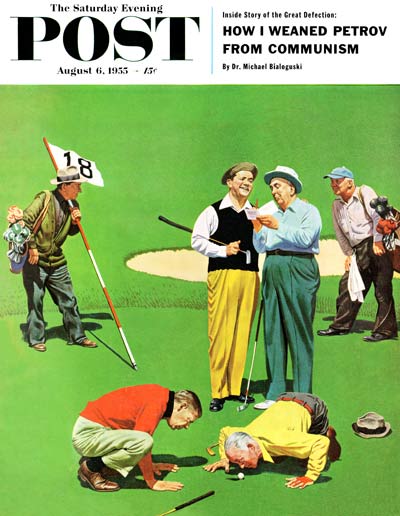
I’ve played golf around 20 times in my life, but I don’t understand this John Falter cover. Where’s the windmill and the clown’s mouth and the little bridge you putt the ball over?
Quote of the Week
“I won’t comment on that.”
—actress Kathleen Turner, on what she thinks of the acting abilities of the Friends cast, in a wide-ranging, controversial interview at Vulture. She also had choice words for Burt Reynolds, Elizabeth Taylor, and a “very famous Hollywood actress” who has “played the same role for 20 years” that I’m going to assume is Julia Roberts.
August Is National Sandwich Month
I’m not sure what I can possibly link to when it comes to sandwiches. The possibilities are endless, right? So I’ve decided to point you to some sandwiches you may not have heard of before, sandwiches you probably never thought of making yourself.
You can try this Baked Bean French Toast Sandwich, this Grilled Macaroni and Cheese Sandwich, or maybe you can travel to Treylor Park restaurant in Savannah, Georgia, where you can order this Grilled Apple Pie Sandwich. That actually sounds pretty fantastic. I’ve put apples into sandwiches before and they always seem to make things better.
And let’s not forget Elvis Presley’s favorite sandwich, peanut butter, bacon, and bananas on white bread. The King also liked the Fool’s Gold Loaf, which is a loaf of Italian bread stuffed with an entire jar of peanut butter, a jar of grape jelly, and a pound of bacon.
Should you include hot dogs in your sandwich? That’s entirely up to you. Perhaps you can try them with some potato salad, graham crackers, and maple syrup on white bread.

Next Week’s Holidays and Events
National Tell a Joke Day (August 16)
How do you catch a unique rabbit?
U nique up on him.
How do you catch a tame one?
The tame way!
Hey, I didn’t say it was called National Tell a Good Joke Day.
Considering History: Confederate Memorials, Racist Histories, and Charlottesville
This column by American studies professor Ben Railton explores the connections between America’s past and present.
On August 12th, 2017, as my sons and I drove from Boston to my childhood hometown of Charlottesville, Virginia for our annual visit with my parents, the small Central Virginia city erupted in violence. A gathering of white supremacists, neo-Confederates, and neo-Nazis known as the “Unite the Right” rally spurred counter-protests from antifa and other groups, and conflicts broke out again and again. In the day’s most horrific moment, a white supremacist named James Alex Fields Jr. drove his car into a group of counter-protesters, injuring thirty-five and murdering a young Charlottesville resident named Heather Heyer.

We’ll be driving down to Charlottesville again this coming weekend, on the one-year anniversary of those events. At the same time, many of the rally’s organizers and participants will be attending their own anniversary event, another “Unite the Right” rally in Washington, D.C. As that D.C. rally makes clear, these are national issues and conflicts that extend far beyond Charlottesville. Yet there are two distinct but interconnected histories within Charlottesville that provide vital contexts for these contemporary events: histories of Confederate memory and racial segregation.
Charlottesville saw no direct military action during the Civil War, but it was home to one of the war’s largest Confederate hospitals (which cared for more than 22,000 by the war’s end), and not coincidentally to one of its largest cemeteries for the Confederate dead (with more than 1000 buried there). For a few decades after the war, that cemetery remained largely private and unacknowledged. But in 1893 the Ladies’ Confederate Memorial Association (a predecessor to the Daughters of the Confederacy) dedicated a more formal Confederate Monument and Cemetery. The monument goes beyond the cemetery’s specific contexts to narrate a broader and striking reframing of Confederate memory, focused both on an idealization of the past and an extension of that heroic mythic history into the present, as it honors “the bravery, devotion, and performance of every Confederate soldier and the honor due every Confederate veteran.”
While the cemetery monument represented a significant step in the city’s memorialization of the Confederacy, it was more than two decades later that the city erected the now infamous downtown statues of Robert E. Lee and Stonewall Jackson. Dedicated in 1921 (Jackson) and 1924 (Lee), these statues were funded by, and constructed on land donated to the city by, Paul Goodlue McIntire, a local boy who had made a fortune on the New York Stock Exchange and returned to give much of it back to his hometown. McIntire also funded three other city parks and two different Charlottesville statues in honor of the Lewis and Clark expedition (Lewis was born in neighboring Albemarle county and the expedition set off from the area in 1804), so it’s fair to say that his interests in public land and collective memory extended well beyond the Confederacy. Yet the Lee and Jackson statues are located in Charlottesville’s most historic and central area, adjacent to its city hall and county courthouse (Jackson is directly outside the courthouse building), and thus occupy powerfully symbolic space in the city.

Moreover, there is at least one piece of direct evidence that McIntire’s public contributions were intended to preserve and further racial segregation in Charlottesville. As discovered by a Charlottesville Daily Progress reporter in 2009, the mid-1920s deed for the city’s McIntire Park, the only one of these McIntire-endowed parks named directly for the benefactor, includes this requirement: “Said property shall be held and used in perpetuity by the said City for a public park and playground for the white people of the City of Charlottesville.”
Of course all Southern cities practiced racial segregation in a variety of small and large ways throughout the Jim Crow era, but Charlottesville represents a particularly extreme case. That’s most especially true of the city’s public school system, which was one of the last in the United States to desegregate after the 1954 Brown v. Board of Education decision. All of the city’s public schools resisted desegregation for more than five years, supported by white supremacist officials such as U.S. Senator Harry Byrd and numerous members of the state General Assembly. The Assembly’s “massive resistance” bills gave Governor Lindsay Almond the authority to close any school where black and white students would attend together, and in the fall of 1958 he used that authority to close Charlottesville’s all-white Lane and Venable Elementary Schools for five months rather than admit African American students. All the city’s schools remained segregated throughout that school year, including Lane and Venable when they reopened in February 1959. That autumn, the first three African American students attended Lane High School, marking the start of integrated public education in the city. Although some Charlottesville public schools did not accept their first African American students for another year or two, the Supreme Court had ruled massive resistance unconstitutional in 1959, and the formal battle against educational integration in the city was over.
These were only the most nationally prominent of the city’s many late 1950s and 60s battles over integration. A mixed-race group of University of Virginia students and activists attempted to integrate the white-only University (movie) Theater in 1961, but the theater remained segregated until after the Civil Rights Act passed in July 1964. An even more overt conflict took place in 1963 at Buddy’s Restaurant, a popular establishment that, like many in the city, served only a white clientele. Inspired by the Civil Rights Movement’s demonstrations across the South, and supported by the local NAACP chapter, a mixed-race group of protesters led by community activists and ministers Floyd and William Johnson attempted to stage a sit-in at Buddy’s on Memorial Day in 1963. They were denied entrance to the restaurant and met with violence by white customers and counter-protesters; both Floyd and William Johnson were physically assaulted (Floyd had to spend two nights in the hospital), and other protesters including University of Virginia History Professor and Civil Rights ally Paul Gaston were likewise bloodied. The resulting press coverage caused a number of local establishments to voluntarily desegregate, but Buddy’s remained segregated until the Civil Rights Act passed—and then its owner Buddy Glover chose to close rather than desegregate.
All of these histories came together in the current movement to remove the city’s Confederate monuments. While that campaign has been driven in part by city councilors such as Kristin Szakos and Vice Mayor Wes Bellamy, another prominent argument for removing the statues came from Charlottesville public school students of color. Zyahna Bryant, an African American student at Charlottesville High School (my own alma mater), organized a March 2016 change.org petition to the City Council requesting that the Lee statue in particular be removed. Bryant and hundreds of her high school peers (along with many other Charlottesville residents) signed off on the statement, which reads in part, “As a younger African American resident in this city, I am often exposed to different forms of racism that are embedded in the history of the south and particularly this city. My peers and I feel strongly about the removal of the statue because it makes us feel uncomfortable and it is very offensive. I do not go to the park for that reason, and I am certain that others feel the same way.”
How each American community remembers the various histories out of which it has developed, and just as importantly how it engages with what has been included and what has been left out of its public and collective memories, are thorny and vital 21st century questions. Charlottesville is poised to help us answer those questions, but only if we resist the kinds of divisive and violent voices, and their white supremacist visions of the past, that dominated the city in August 2017.
Post Travels: Big, Beautiful, Bucket List Alaska
Alaska is big and beautiful — loaded with glaciers, animal life, and snow-capped mountains — and visitors coming in droves to see it all. Sailing with Windstar Cruises, long summer days presented once-in-a-lifetime opportunities over and over again, from kayaking around icebergs in Tracy Arm Fjord, to watching harbor seals lounge nearby Aialik Glacier, to catching a ride in a helicopter in Juneau so you could go for a walk atop Mendenhall Glacier. As highlights from my time in Alaska show, Mother Nature has a knack for taking your breath away.
How to Get an Honest Answer
You can sniff out a lie, right?
The deceiver always cracks under pressure or blathers nervously about unimportant details. They shift their eyes to the right.
In reality — although most people feel as though they can tell when they’re being lied to — our ability to determine truthfulness is probably not much better than chance.
Julia Minson teaches negotiation as an Assistant Professor of Public Policy at the Harvard Kennedy School. In one of her classes, Minson conducts an experiment in which four students report to the class on the happenings of their previous day. Two of the students, however, are instructed to fabricate their stories. After interrogating the volunteers, their peers vote on who is telling the truth. In a class of about 60, the students are unable to deliver accurate results. “These are Master’s-level students of policy,” Minson says, “Most people think they can tell a lie from a truth, and they really can’t.”
Even with minimal preparation, it’s fairly easy for most people to invent a believable falsehood. But there is help for the truth-seekers out there. Although you might not be able to discern if someone is telling you a bald-faced lie, you can shrewdly phrase your questions to extract the truth. Especially in stressful situations, the style of your query can determine whether you get an honest answer.
Minson led a series of recently-published studies on eliciting the truth in strategic negotiations — situations like interviews or purchasing a car. People tend to think of asking questions as an opportunity to gather information, but, in reality, the way you phrase questions reveals a lot about yourself. The answers you get could depend on what you’re projecting.
The studies focused on the veracity of responses when asked negative assumption questions (ones that assume a problem), positive assumption questions (ones that assume the absence of a problem), and general questions. Let’s say you’re interviewing a potential job candidate for your company. A negative assumption question would be, “How many times each day would you say you tweet during work hours?,” and the positive assumption alternative would be, “You don’t use social media during work, right?” The former type of questioning “increased disclosure of undesirable behavior” more often than positive assumption or general questions.
“When you ask questions that are more direct and assertive, it signals to the other person that you’re knowledgeable about an area and you’re not easily fooled,” Minson says. Since negotiations tend to make people anxious, many fall into the trap of asking softball questions when buying a used car or touring the umpteenth apartment in a long search for housing. A tendency for passivity can be escalated by inexperience, too. The bottom line is: if your ask is docile, people might be telling you what you want to hear instead of hard facts.
If the tactic makes you feel a little like Tom Cruise drilling Jack Nicholson in the courtroom in A Few Good Men, that’s because using assertive questions that assume problems is common in legal spheres. It’s all about cornering your “witness” with evidence and forcing them to take a stance. If you give people room to equivocate and eschew the truth, odds are that they will.
The next time you find yourself negotiating, ask the tough questions and bear awkward silences as long as is necessary to get the salesman (or contractor or hiring manager) to spill their guts.
The behavioral science of seeking the truth is a little more complicated between people with established relationships. Since friends and lovers have developed opinions of you over time, they’re less likely to read too much into your intelligence and experience from a single question. Minson says that it is still important to be mindful of how the questions you ask can reveal your opinions and knowledge, though. The way you bring up a new topic to your spouse or child can signal your position on the matter whether you intend to or not.
For impressionable adolescents, just asking questions can normalize behavior. That can be a good thing if you’re asking teens about exercise, but interrogating them unfoundedly about illegal drug use could backfire.
Given the new insight into cut-throat negotiating, does this mean we should all become hyper-aggressive schemers aiming to manipulate others in search of pure honesty? Probably not. A straightforward approach to strategic situations could help you gain an edge, though, as long as you can handle the truth.
North Country Girl: Chapter 64 — The Accidental Editor
For more about Gay Haubner’s life in the North Country, read the other chapters in her serialized memoir.
The Cape Cod vacation of drinking, solo hiking, and free fish was over; I was back at work. I fretted over my imprisonment in my secretarial fishbowl and tried to figure out a way to escape to the editorial side of Viva. The insanity of my chocolate article — an article both the advertising saleswomen and the editorial staff hated, an article about candy only one percent of the world could afford, an article written by a secretary — was a Hershey’s miniature of the insanity that Viva was at the time, a mashup of Vogue, Playgirl, and Ms.
The imaginary reader of Viva was a young woman with an unlimited budget for clothes and makeup (not to mention chocolates), who enjoyed sex with a wide variety of partners and without a shred of guilt, with literary taste that ran to Alice Munro and Joyce Carol Oats and who was a card-carrying leftie. I’d love to meet that girl. She’d be my new best friend.
The editors were on a mission to put Viva on the side of the angels, feminist angels anyway, with serious articles about the Equal Rights Amendment, sexism around the world, and profiles of firebrand women’s libbers.
This antidote to Viva’s penis problem (an experiment with the full Monty that did not end soon enough) was like grabbing the wheel of a car headed off a cliff and yanking it as far to the other side as possible, no matter what was there. Their concept of the Viva reader was the female equivalent of the man who supposedly bought Playboy for the articles, a reader so enthralled with the feminist content that she could ignore the gauzy photos of entwined lovers caught in the act, the ads for Penthouse, and the tips on how to make your boobs look bigger.
The sex advice column was replaced with features on notable but forgotten women in history, called, of course, “Her Story.” I managed to corner Viva editor Gini in the art department after days of bird-dogging her, toting around a tome on the French Revolution.
“Gini, have you heard of Madame Roland?” I asked and showed her an engraving of one of the most important thinkers and salon hostesses of the French Revolution; the engraving portrayed Madame Roland bravely ascending the steps of the guillotine (sent there by her male oppressors).
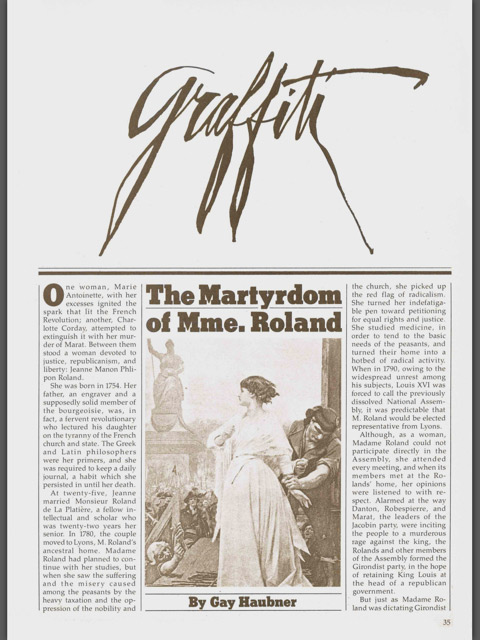
Rowan Johnson, Viva’s art director, looked over and realized that here was camera-ready art and therefore one less thing for him to do: “Yeah, Madame Rolaid, everyone’s heard of her, she’s famous in South Africa,” he said, and toddled off to lunch.
Gini gave her grudging consent to yet another secretary-written article, and I had my second byline in Viva. And despite my bad reputation as a mere secretary and a fake Pet, I began to worm my way into the good graces of the Viva staff.
Except for the fearsome Anna Wintour, the fashion editor. Kathy Keeton once asked me to deliver some notes about the fashion pages to Anna Wintour. I tiptoed up to her always closed office, thinking “Thar be dragons here.” To my surprise, my tentative knock (I was going to rap softly once and then dash back to my cubicle) was answered by a cracking of the door and a sliver of Anna Wintour’s face appeared, the part with the nose she looked down on me with. “Yes?”
I apologized for having to interrupt Miss Wintour with written instructions from our boss. Anna responded with an expression telegraphing no, she could not possibly read anything written by such a person as a South African. I backed off, curtsying my way down the hall, when she said, “I have this jacket,” and stuck her right hand out the crack of the door, holding on the crook of her index finger a brown and ivory houndstooth. “Maybe you would like it. I was going to give it to my maid.” It was an Yves St. Laurent and I wore it wore for twenty years.
I had barely snatched up the jacket when Anna shut the door on my face. I slipped Kathy’s hand-written pages under the door and immediately heard the rustling of paper being trod on by high heels.
(In 1979 after the tax break ended and Viva shut down, we broke into Anna Wintour’s office. It was a treasure trove — racks of designer clothes, shoes, and handbags, and bins of cosmetics, lotions, and perfume. The stuff was piled to the ceiling, as if the Collyer brothers had been fashion victims. It was a fluke that Anna had given me that Saint Laurent jacket, as apparently she never parted with as much as a lipstick.)
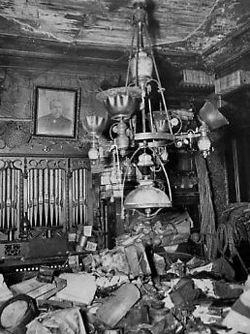
By the time I got back to Miss Keeton, she had forgotten about her notes to Anna Wintour and was in the grip of a brainstorm:
“Gay, get me Gini and that beauty woman, Suzanna. Oh, and…Anna Wintour” here Kathy looked off in the air, as if trying to will Anna Wintour to appear.
I was not about to go back to the lioness’s den.
“Miss Keeton, I just dropped your notes off. Anna wasn’t available.”
Kathy sighed, out of relief or frustration, I couldn’t tell. “Well fetch that round-faced girl who works for her.” That would be Georgia Gunn, Anna Wintour’s lackey and a lovely person.
Once I gathered everyone in Miss Keeton’s office, I headed back to my fishbowl.
“Wait Gay,” commanded Kathy. “I want you to stay.”
Was this it? Was I being promoted to the editorial staff?
Kathy spoke slowly as if announcing the discovery of the double helix. “Viva…is…going…to…”
Run recipes? Go back to naked men? Shut down completely?
“Do a makeover.” Kathy sat back and awaited the accolades. I was the only one who beamed and smiled; nobody in that room had the nerve to tell Miss Keeton that even in 1978, the makeover was not a new idea; women’s magazines had traded for years in the ugly duckling business.
“Two actually. We’ll makeover Gay,” she ordered, pointing at that insignificant person badly in need of a haircut who was standing in the back, arms full of page proofs, mouth hanging open. “And that little brunette girl of Rowan’s” meaning the art director’s assistant, Wanda DiBenedetto. And that was all; we were dismissed to carry out Kathy’s demands.
A week later I had a day off from my secretarial fishbowl and telephoning perverts, a day spent in a photo studio being transformed from frumpy and cheerful to Green Steel. The new me looked like a sawed-off villainess in a made-for-TV spy movie.
After loading about ten pounds of slap on my face, the makeup artist finished her work by smearing on a lipstick the exact shade of my outfit: a gold satin shirt and matching knickers. After a costume change, the makeup woman was called on again to brush contour shadow on my chest, in a bootless attempt to make it appear that I had two real breasts under the man-tailored jacket.
I tried not to take those gold satin knickers personally. Georgia Gunn told me Anna Wintour had been so offended by the trite, hackneyed, boring makeover idea that she had refused to take any part in it. Plus it was not being shot in Marrakech or Tahiti.
Georgia, caught between Kathy Keeton and Anna Wintour, Scylla and Charybdis, brought the clothing to the shoot, threw it in our direction, and spent the rest of the time hiding in a corner.
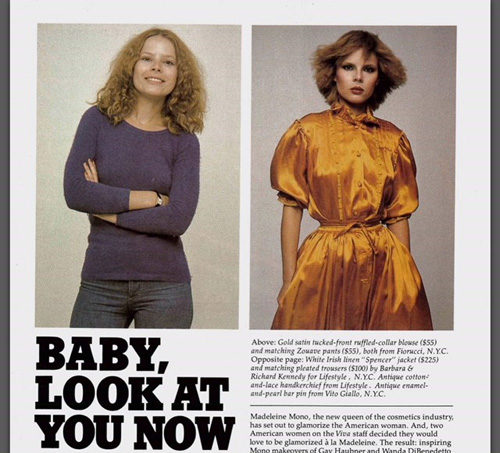

The day after my makeover shoot, Stephanie Coombs announced her resignation; she had landed a book contract and was on her way to becoming a full-time writer. Hoping that I was still basking in the twinkle of the diamond bracelet, I approached Miss Keeton on bended knee and asked for the now-open assistant editor position. I got it.
That issue of Viva, where I was transformed into a cut-rate Morgan Fairchild, was where my name first appeared on the editorial masthead.
My freelance for Oui prepared me for my slight responsibilities as assistant editor. Like Oui, Viva ran 10-12 short pieces in the front of the magazine promoting new books, music, places to go, things to eat, stuff to put on your hair, face, and body — except for “NO CLOTHES” as decreed by Anna Wintour; she would have had my guts for gaiters if I encroached on her fashion kingdom by so much as a hat pin.
I also accommodated the despondent Viva ad saleswomen, further befuddling the Viva reader by plugging cameras — “The Single Lens Reflex for the Single Girl,” stereo equipment — “Speakers for the House,” cheap foreign cars — “Drive Him Crazy,” and booze — “Cocktail Tease,” lifting copy directly from press releases and hoping I’d find a Technics turntable or a bottle of Galliano or a small Subaru delivered to my desk as my reward.
My goal was to get free stuff. I had barely got to taste the chocolaty fruits of my original Viva article. The first things I wrote as a real editor, even if only an assistant one, was on Viva letterhead to record companies telling them that my new position would include music reviews. The albums duly arrived, as did the occasional pair of concert tickets. Haircuts and manicures cost me only tips, because I wrote about new styles and trends from NYC’s “top” salons — the salons that colored my hair and scraped my foot calluses for free.
Whatever was fashionable in beauty, food, music, nightlife, Viva’s readers found in my little section, “Tattler,” three months after it had already passed out of style in New York City.
“Clever Women Are Dangerous Too” by Jon Cleary
Summer is for steamy romance. Our new series of classic fiction from the 1940s and ’50s features sexy intrigue from the archives for all of your beach reading needs. In “Clever Women Are Dangerous Too,” Australian magazine editor Charlie looks to a young, new cover girl for love, but his longtime colleague with a sharp tongue won’t let him get away without a struggle.
Australian author Jon Cleary wrote romance and crime stories for the Post at the dawn of his prolific career as a novelist and screenwriter. Under his editor, Graham Greene, Cleary wrote fiction of all stripes, from war stories to political thrillers to his famous Scobie Malone detective series. His snappy dialogue and whip-smart prose made him a hit, selling about 8 million books in his lifetime.
Charlie Harriss pressed the buzzer, and when the door opened he wondered if he’d come to the wrong flat. He checked the brass number beside the door. That was the right one, all right. He looked back at the blonde number in the doorway. An unbiased observer would have said she was all right too. Gray-eyed, beautifully shaped and 99 percent beautifully tanned. The other one percent was covered by a Bikini bathing suit.
“Is Miss Conlan at home?”
Charlie was a tall, good-looking young man, with early streaks of gray in his brown hair, a tired look about his eyes and absolutely no interest in intelligent, beautifully shaped young ladies. For the last four years Charlie had been surrounded by clever, good-looking women, and now they meant no more to him than stray dogs do to a pound-keeper.
“Won’t you come in?” The blonde’s voice was like bells across a deep valley, musical and empty. Charlie followed her into the flat, automatically but academically noting the well-oiled motion of her hips. “Miss Conlan had to rush out to buy something for her camera — a light meter or something. Though I don’t know why. I think there’s enough light here, don’t you?”
“There seems enough,” said Charlie, idly noticing how it made itself at home on her curves.
“I don’t know much about photography,” the blonde said, taking her time about the four-syllable word. “Miss Conlan must be awfully clever.”
“Fiendish” was a better word, Charlie thought; Joy Conlan was one of the clever women who plagued him at his office. “Are you a relative of Miss Conlan?” he said.
“Oh, goodness, no!” She lowered her eyelashes and somehow seemed a little more clothed. “I’m a model.”
“You must be new. I know all the models in Sydney,” Charlie said; then added as an afterthought and a precaution, “professionally, that is.”
“This is my first job,” the blonde said. “I’ve never done it before. It’s sort of exciting, isn’t it?”
“Yes,” said Charlie, beginning to wonder how she managed to stay within the limited boundaries of the bathing suit. “What’s your name?”
“Imogene,” said the blonde.
She was a friendly girl, putting things on a first-name basis right away. Charlie, too, decided to be informal. “I’m Charlie. An old friend of Miss Conlan.” Abruptly he remembered the streaks of gray in his hair. “But not that old.”
“Oh, I don’t mind old men,” Imogene said. “I think gray hair makes a man look distinctive, don’t you?”
“I hadn’t thought about it,” said Charlie, wondering if they were thinking of the same adjective. “How old are you, Imogene?”
“Nineteen,” Imogene said, and threw out her chest.
“Very nice,” said Charlie, suddenly deaf to what she had said. “Shall we sit down?”
They sat down, and in the new posture half of Imogene’s bathing suit seemed to disappear into thin air. Charlie tried to think of other things, but they, too, seemed to have disappeared. This morning the world had been full of news. But now it was just a vacuum, like Imogene’s head. Charlie was beginning to realize there were other women in the world besides clever ones. He looked at Imogene with renewed interest, then blushed for the nature of his interest.
“Do you work, Charlie?” Imogene said.
“Oh, sort of,” said Charlie, wondering that she hadn’t recognized the lines of slavery in his brow. Maybe I don’t look as harried as I think. “I make enough to buy a crust and a glass of beer. Speaking of food, would you have dinner with me tonight?”
“Oh, I don’t know,” Imogene said, the phrase falling glibly off her tongue. “Miss Conlan said a model should never have late nights, not if she wants to last.”
“Did she say anything about not eating?” Charlie said, wondering why Miss Conlan didn’t mind her own business. For four years she had been trying to run his life, and now here she was organizing this poor defenseless girl.
“No-o-o. But what about the late night?” Imogene said. “I want to make good as a model, Charlie. I’ve never been any good at anything else.” Again the eyelashes did their best to cover her.
You just haven’t made the most of your assets, Charlie thought; then realized that for the first time he himself was beginning to realize a girl could have other assets than brains. “Well, don’t let’s spoil your life by making a recluse of you.”
“Oh, goodness, I’d never want to be anything like that!” Imogene said, aghast. “Whatever it is.”
Charlie smiled at her, more and more fascinated with her each time she opened her trap. Then the door opened and Joy Conlan came in. Joy was dressed in a pale lemon linen dress that looked like the leftover from a bargain sale, tan shoes so worn over on their sides that at first glance their wearer looked bandy, and a large picture hat whose brim hung down in front of Joy’s face like a curtain.
“Sorry I was so long, Imogene.” The curtain went up, and Joy saw Charlie. “Greetings. What are you doing here?” She threw her hat away casually, as if it had cost but a few shillings, which it had. “Or are my evil thoughts correct?”
“You’re a cynical old wench,” Charlie said. “I’m just offering to improve Imogene’s mind.”
Joy squinted at him, then shrugged. “Well, we all have hobbies. Some have easy ones, others have impossible ones.” She looked at Imogene. “You know who he is, darling?”
“Oh, yes,” Imogene said brightly. “Charlie.”
Joy closed her eyes for a moment, as if she had just been hit on the forehead with a hammer. Then she opened them. “Yes, he’s Charlie. Charles B. Harriss, with two esses. He edits the magazine you’re going to be on the fashion pages of.”
“You have a preposition hanging there,” Charlie said.
“I always hang my prepositions,” said Joy. She looked back at Imogene. “He’s the editor and only man around Portia, the Magazine For Smart Women.”
“But he said he only earned enough for a crust and a beer!” Imogene looked at Charlie with a look bordering on intelligent. “Why, Charlie, you could make me a famous cover girl. Like Dusty Anderson or Gypsy Rose Lee.”
“How covered do you want to be?” Joy said, talking almost to herself.
Charlie shrugged. “I’ll see what I can do.”
“Your job must be awfully interesting,” Imogene said. “How much a year do you earn?”
“You’d better go and put some clothes on,” Joy said. “I’d hate to see you catch cold.”
“Oh, I’m not cold,” Imogene said. “I’m warm.”
“So am I,” said Charlie.
“For different reasons, obviously,” Joy said… . “Go on, Imogene. I shan’t let Charlie get away.”
Imogene left them with a smile and a ripple of the hips. Charlie looked after her until the door closed behind her.
“Put your eyes back in their sockets,” Joy said. “Now what is this?” She dropped ungracefully into a chair and drew her feet up under her. She pushed her thick dark hair back with an impatient hand. “Why the interest in Miss Sun Tan?”
“Who is she?” Charlie said. “What’s she doing here at your flat?”
“I’m using her for the fashion spread in the late summer issue. The studio’s being painted, so I brought her here.”
“Her face is familiar,” said Charlie.
“Did you notice she had one?” Joy said. “She was Business Girl of the Month in your last issue. But it was just a head study. That was why you didn’t recognize her.”
Charlie had been editor of Portia from just a few months after his breaking relations with the army, and Joy was the magazine’s top staff photographer. Six months ago they had dreamed up the idea of a series on up-and-coming young women, and Charlie had left the choice of subjects to Joy.
“But, heck,” Charlie said, “that series is supposed to feature smart girls.”
“How can I photograph brains?” Joy’s gray eyes lifted toward the ceiling in exasperation. “All the public wants is a pretty face.”
“Have you been giving me Dumb Doras all through the series?”
“Of course. Are you complaining?”
“No,” said Charlie, remembering the battles in the office with determined young women who knew too much. The gray in his hair had come only after he’d joined the magazine. “But I wish I’d known sooner.”
Joy squinted at him again and bit her lower lip. “What’s the matter with you? There’s something going on in that overpaid skull of yours — ”
“I’m just tired of smart, clever, independent, brainy women, that’s all,” said Charlie. He leaned back in his chair, relaxing completely, struck with a beautiful thought. “I’m thinking of marrying a bird-brain, like Imogene.”
“You sound like a bird-brain yourself,” Joy said. Again the wayward hair was pushed back. “You’d be as bored as blazes within a week. All that girl has is a sun tan and a Size 36. You need more than that for a successful marriage.”
“Such as?” said Charles. “None of the clever women I know has appealed to me in the way Imogene has. None of them has what she has.”
“Maybe we have. Maybe we just don’t display it the way she does.” Joy tried to rearrange the shape of the lemon linen, but she would have had more success shaping a sugar bag. “Anyhow, you’re too old for her. You’re old enough to be her father.”
“If I were, I’d have been a child bridegroom,” said Charlie. “You’re no teenager yourself.”
“I’m 29,” Joy said. “Ten years older than she, and old enough to be — er — matured.” She slapped her knees. “Golly, I think I’ll marry you myself.”
Charlie laughed hollowly. “I’d rather see myself dead.”
“So would I,” said Joy. “In preference to your marrying Imogene with the light-brained head.”
The door opened and Imogene made her entrance on cue, clad for the street. Charlie couldn’t think of a street where she wouldn’t cause a commotion, but he knew there must be one somewhere; the world couldn’t be that small. The plunging neckline of her dress had developed into a headlong dive, and elsewhere, when she moved, the seams sang like taut guy ropes in a gale.
“Beautiful,” said Charlie; he was fast developing an entirely new outlook on women.
“Going to a masquerade, darling?” Joy said.
Imogene didn’t know what a masquerade was, but she didn’t bat an eyelash. Smart as a whip, she said, “I’m going to dinner with Charlie.”
“She certainly is,” Charlie said, springing to his feet with more agility than he’d shown in months. “I’m going to show her something of life with a capital L.”
“Picture books were made for girls like her,” Joy murmured. “Well, I wish you anything but a boring evening, Imogene. And I’ll want you here at seven-thirty in the morning.”
“Oh, my goodness!” Imogene said. “But that’s almost when the sun comes up.”
“The farmers have been up three or four hours by that time,” Joy said.
“Why don’t you get one of the farmers, then?” Charlie said, and laughed at his own repartee; he felt like a comedian who’d just found a new book of jokes.
“I would,” said Joy, “if I could find one who’d look good in a Bikini bathing suit.”
“What do you want with her at that hour?” Charlie said. “She’ll be here at nine. Like any respectable working girl,”
“She’ll be out of a job, if she is,” said Joy. “And let’s leave respectability out of this. It’s irrelevant to the subject under discussion.”
All this multiple-syllable talk was above Imogene’s pretty blond head, but it made no difference to her; she just loved the sound of the words.
“I am protecting the girl from herself . . . and you. Something tells me you aren’t the Charlie Harriss I’ve known all these years,” said Joy. “I want her to have an early night and I want her here at seven-thirty in the morning. Understand?”
“Imagine being married to you,” Charlie said.
“If you were,” said Joy, “you wouldn’t be allowed out with any plunging necklines.”
“Are you married to Miss Conlan?” Imogene said to Charlie.
“No,” said Charlie. “Fortunately.”
“Oh, good,” said Imogene. “Let’s go to dinner.”
“Watch your figure,” Joy said as they went out the door.
“Her figure’s all right,” said Charlie.
“I was talking about yours,” said Joy.
Charlie wondered if the sedentary life was giving him editor’s spread.
Imogene and Charlie went to a little restaurant in King’s Cross. The waiter handed Imogene the elaborate menu and stood waiting for her to order. Imogene studied the menu for almost five minutes, her eyes crossed in concentration and her red lips caught between her teeth; international treaties had never received such careful scanning. Then she looked up. “Steak and eggs, please.”
Charlie shrugged and ordered the same. Over dinner, the conversation was light and inconsequential, about the weather and bathing suits and the pain in Imogene’s mother’s side. Imogene wasn’t one to let the conversational ball gather dust in a corner. Charlie, for his part, ate his steak and eggs, and rested his brain. Imogene was as good as a vacation.
Later they drove out to Tamarama and parked on the road that skirted the top of the cliffs. Below them the waves thundered on the rocks, and far out the moon was rising out of its own reflection on the sea. It was a night for romance, and the girl’s intellectual capacity didn’t count here.
Imogene was leaning back in the seat, the moonlight striking sideways across her face and the plunging neckline. Charlie looked at her and was glad he was sitting down; his knees had gone.
“Have you ever thought of marriage, Imogene?” he said.
“Oh, yes,” said Imogene eagerly.
“To what sort of man?”
“Oh, any man would do,” Imogene said; she wasn’t hard to please, like some girls. “How old are you, Charlie?”
“Thirty-two,” said Charlie. “Don’t scream.”
“Why, that’s not old,” Imogene said. “Why, daddy’s 40.”
Charlie felt better. He put an arm about her, protectively. She turned toward him and he felt her lips press on his. He had only a dim idea of what was happening to him. Behind her head he saw the moon splinter on the sea and his blood began to thunder louder than the surf below them. Your blood pressure’s caught up with you, he thought. You’re older than you think. This is the beginning of a stroke…
“You’d never know,” Imogene said.
“Know what?”
“That you were 32. Not the way you kiss.”
“Thank you,” said Charlie, who had never considered that he might be beyond the kissing stage. “We could be very happy, Imogene.”
“Are you proposing to me, Charlie?” Imogene said.
“Not exactly.” The habit of caution was hard to throw off. Charlie smiled the disarming smile he’d been practicing for the last four years, his only defense against the clever women who had tried to run him. “But we could think about it, couldn’t we?”
“I don’t think much about anything,” Imogene said truthfully. “How soon could you make me a cover girl, Charlie darlie?”
She’s mercenary, Charlie thought. But so are the clever ones. And at least all Imogene wants is fame. The smart ones would want a joint bank account.
He kissed her on the forehead, like a father. “Any time you wish, honeybunch.” His voice sounded strange in his own ears, but he was game. “Lovey dovey.”
Later that night, in his bachelor flat, Charlie lay awake and took stock of the situation. He was getting on, there was no denying that, and it was time he settled down. He’d been working too hard lately. You could flog a middle-aged horse just so far; then he either lay down and died or went to the old folks’ home. He wasn’t middle-aged yet, but he believed firmly in the saying, “It’s later than you think.” Each morning when he woke he expected to find he’d suddenly lost 10 years overnight.
Charlie had been too long badgered and bullied by clever women, and Imogene looked like the ideal escape. Tomorrow he would ask her to marry him. . . .
Next morning was Saturday, so Charlie didn’t have to go to the office. Instead he went to Joy’s flat. At 10 o’clock, having allowed the girls an hour to get some work done, he pressed the buzzer and waited for another view of the next-to-nothing bathing suit.
The door was opened by Joy in the lemon linen sugar bag. “Where is she?”
“Who?” said Charlie.”
Miss Intellect. I’ve been waiting for her since half past seven.” Joy kicked the door shut behind them. “She doesn’t know it, but she’s unemployed.”
“It doesn’t matter,” said Charlie. “I wouldn’t want any wife of mine to work.”
“You haven’t got a wife,” Joy said. Then she looked at him again. “Have you?”
“Not yet,” said Charlie. “But it’s only a matter of time.”
“Who’s the lottery winner?” Joy said.
“Imogene,” said Charlie.
Joy blinked, and pulled slowly and savagely at her hair. “Charlie, you weren’t serious yesterday… . Oh, no!” She suddenly spun and folded onto a couch, burying her face in a cushion and shaking convulsively.
“It’s no laughing matter.” Charlie sat down carefully in a chair; he was putting on weight or they were making pants tighter this year. Joy continued to shake like a girl riding pillion on a motor bike, her face still buried in the cushion. Charlie watched the spasm for a few minutes, then said, “I repeat, it’s no laughing matter.”
Joy lifted her face from the cushion. Her hair hung down like dark seaweed, her eyes were red and glistening, and her nose twitched to one side as she sniffled.
“I think you — ” Then Charlie took a second look at her. “You’re crying!”
“I’ve got something in my eye,” Joy sniffled. “No woman in her right senses would waste tears over you.”
“You were crying over me,” said Charlie, full of a wonder and tenderness; he felt like someone’s mother being helped across a busy street. “Joy, I didn’t know! I never — ”
But Joy had left him, slamming the bedroom door behind her as the front-door buzzer buzzed. Charlie, still in a daze, climbed carefully out of his chair.
“Why, Charlie darlie,” said Imogene, as he opened the door to her. “Have you been here all night?”
“Certainly not,” Charlie said. “If you remember, I didn’t leave you until two o’clock.”
Imogene closed her eyes and rocked her head ecstatically. “Oh, I can remember it just like it was last night. Daddy wanted to know why I’d stayed out so late. He was really wild, till I told him you were going to make me famous. He said you must be a miracle worker.” She opened one eye. “I didn’t tell him we were going to be married, Charlie darlie.”
“That’s good,” said Charlie, still with half his mind on Joy.
Both eyes came open suddenly, like searchlights. “Charlie!”
The bedroom door opened and Joy came in. She had dried her eyes, stopped sniffling and combed her hair. There was no sign of the broken blossom of a few minutes ago.
“Hello, Imogene darling,” she said. “Charlie and I were talking about you only a few moments ago. We said we’ll ask Imogene to go on the picnic with us “‘
“What picnic?” said Imogene and Charlie.
“We’re going to Coogee. Charlie has his car, and it’s much too hot for work.”
“But what’ll I wear?” said Imogene and Charlie.
“You, Imogene, can wear the Bikini suit,” Joy said. “And Charlie can hire trunks at the beach.”
“It’s a wonderful idea,” Imogene said. “I just love the beach, don’t you, Charlie darlie?”
“Charlie darlie used to be a surf god,” Joy said. “He gave it up when they cut the legs off bathing suits.”
“Sour women have an acid wit,” said Charlie; he’d been mistaken about the tender feeling for Joy. He was just a softie for tears, that was all. “Have you packed the basket for the picnic we’ve been planning so long for?”
“You have a preposition hanging there,” Joy said.
“That’s not all I’d like to hang,” Charlie said.
Joy smiled at him. “You love your little joke,” she said. “We’ll call in somewhere and buy a picnic lunch.”
“I haven’t been on a picnic since I was a child,” Imogene said.
“Only yesterday,” said Joy, and closed the door behind them.
The three of them crowded into the front seat of Charlie’s convertible, Imogene practically in Charlie’s pocket and Joy practically in the door pocket.
“Comfy, darling?” Joy said.
“Oh, yes, thank you,” said Imogene.
“I meant Charlie,” Joy said, and smiled sweetly at Imogene. “After all, he’s my oldest friend. I can’t think of anyone older. Had you noticed the gray in his hair?”
Charlie shot the car forward with a jerk, but Joy was expecting it. She just smiled at him while she helped Imogene down into the seat again. “Don’t mind him, Imogene. He got his driver’s license in a tank.”
In the city, while Charlie sat in stolid silence and Imogene sat almost in his lap, Joy disappeared into a department store. She returned with a picnic basket.
“Righto.” She squeezed back into the car. “Let’s go, lovers.”
The beach at Coogee was crowded. Charlie left the girls and headed for the men’s dressing rooms. He hired a pair of trunks, sucked in his stomach and went out to find a place on the sands.
Women, he thought. They tried to trap you with either sex appeal or sobs. If they got you with neither, they turned into bitter old harpies. Like Joy. Imogene would be the same in another 10 years. And she probably wouldn’t have her build then. That was what had got him. The 36. At his age, he should be ashamed of himself. He must have been out of his mind yesterday and last night. Well, he wouldn’t fall again. He’d go on being a bachelor until he was too old to be anything else. They could parade all the Bikini bathing suits in the world before him and he wouldn’t raise a whistle.
A chorus of whistles made him look up to see Imogene standing over him. Here in the open, she looked even more uncovered than yesterday. I could have been wrong, Charlie thought, and despised himself for his weakness.
“Where’s Joy?” he said.
“She’s coming,” Imogene said. “Couldn’t we run off and leave her, Charlie darlie? I want you to myself.”
There was another chorus of whistles. Charlie looked up again. Joy was standing over him, the wayward dark hair now neatly braided on her small neat head.
“Don’t look now,” she said, putting down the picnic basket, “but your eyeballs are showing.”
Charlie was speechless. But Imogene wasn’t. “Why, Miss Conlan! That suit’s exactly like mine!”
“Not quite, darling,” said Joy, running a hand over her hip. “There isn’t so much of it.”
Charlie let out his breath and his stomach; he felt weak and middle-aged and flummoxed. “Four years I’ve known you — ” He looked at Joy as if she were a stranger; the second bikini suit revealed a figure that was even a little more curved than Imogene’s. “And I never knew — ”
“You’ve always been interested only in my brain,” Joy said. “You’ve got only yourself to blame if you’ve had a surfeit of clever women around you. What did you expect when you said your magazine was For Smart Women Only?”
The girls sat down, one on each side of him. In the background the whistles were still rising and falling like the cries of lost sailors.
“Charlie,” said Imogene, “don’t look at Miss Conlan like that!”
“I’ll look at her any way I want to,” Charlie said. “I looked at you like this yesterday.”
“There’s no charge,” said Joy.
“I won’t have you looking at her like that!” Imogene said. “Not when we’re going to be married.”
“We’re not going to be married.” Charlie turned full on to Imogene, keeping his eyes on a level with hers, so he wouldn’t be distracted. “I haven’t asked you. I only suggested. Now I’ve changed my mind. The suggestion is retracted.”
“You can’t do that, whatever it is,” Imogene exclaimed. “I’ll sue you for breach of premises.”
Charlie still kept his eyes at the proper level. “You haven’t a leg to stand on.”
“You said you liked my legs,” Imogene said, and stood up. “You said — ”
“I said nothing that hasn’t been said to you before.” Charlie also stood up. “I apologize if I misled you. But I know now that you were interested only in what I could do for your career.”
“What career?” Imogene said. “You haven’t even promised to put me on one cover, even.”
“What’s going on here?” said a bull-like voice. “Or what’s coming off?”
The beach inspector, all muscles and sun tan, came to a halt beside Imogene. He looked her up and down twice; then, like Charlie, looked her in the eyes fixedly. “You can’t get around like that on this beach.”
“And why not?” said Imogene, throwing out her chest defiantly.
“Because it’s — it’s indecent,” said the beach inspector, and was greeted with hoots from the crowd now gathering around. “You’ll have to go and put some clothes on.”
There were groans from the crowd.
“I’ll do nothing of the sort,” Imogene said; she didn’t have much of a mind, but it was all her own.
“Yes, you will!” said the inspector, and felt for Imogene’s arm without removing his gaze from her face.
Imogene looked at Charlie with scorn. Then she looked at the bulging muscles of the beach inspector and a familiar gleam of interest came back into her eyes. Men were just the most wonderful things. She leaned against the beach inspector like a cat against a table leg.
“If I go,” she said, “then she has to go too!”
“Who?” said the inspector.
Imogene looked at Charlie again, then dramatically flung an accusing arm. Then she stopped, as if paralysis had set in. Her mouth opened and the big eyes followed suit. The inspector and Charlie followed her pointing finger. Joy smiled up at them.
“Hello,” she said, and delicately arranged the skirt of the lemon linen about her legs; she couldn’t have been more covered if she’d been wearing a tent. “Having trouble?”
“No,” said the inspector, still conscious of Imogene leaning against him. “None that I can’t deal with.” And he gently hustled the still-dumb Imogene off toward the dressing rooms, to a thundering accompaniment of boos from the crowd.
Joy looked up at Charlie. “Going to sit down? Your figure’s showing.”
Charlie sat down. “How did you do it?”
“Sleight of hand,” Joy said. “It pays to be clever.”
Charlie looked at the lemon linen. “Well, it got you out of trouble. But I prefer you in the bathing suit.”
“Maybe I’ll wear it in our own swimming pool,” Joy said. “We’re going to have one, aren’t we?”
Charlie stared hard at her. “Are you proposing to me?”
“Yes,” said Joy. “I’m going to marry you before some other predatory blonde gets you into trouble.”
“I’ll think over the offer,” Charlie said, but he knew he didn’t have a chance. “But what about Imogene? She’ll be back as soon as she is dressed and there’ll be another scene. Hadn’t we better get out of here?”
“There’s plenty of time,” Joy said, and opened the picnic basket to disclose Imogene’s clothes rolled in a neat bundle. “A clever woman thinks of everything.”
Charlie smiled and relaxed. His middle age was going to be all right, with a clever, good-figured woman to organize everything and make life comfortable for him. He might even let his editor’s spread spread a little more.
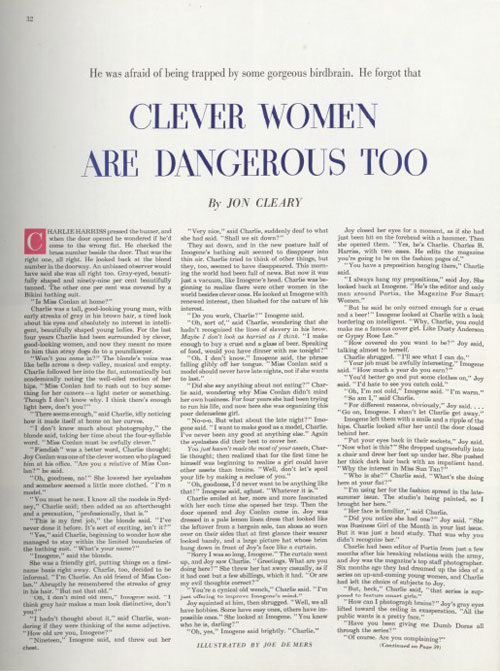
Your Weekly Checkup: Ticks May Make You Allergic to Meat
“Your Weekly Checkup” is our online column by Dr. Douglas Zipes, an internationally acclaimed cardiologist, professor, author, inventor, and authority on pacing and electrophysiology. Dr. Zipes is also a contributor to The Saturday Evening Post print magazine. Subscribe to receive thoughtful articles, new fiction, health and wellness advice, and gems from our archive.
Order Dr. Zipes’ new book, Damn the Naysayers: A Doctor’s Memoir.
In a column several months ago, I wrote that illnesses caused by the bite of an infected mosquito, tick or flea (vector-borne diseases) have more than tripled in the United States from 2004 to 2016. I noted that the usual diseases spread by ticks such as Lyme disease, Rocky Mountain spotted fever, and tularemia; and mosquitoes, which transmit West Nile virus, Zika, dengue, and chikungunya, were increasing.
I did not discuss a fascinating, relatively newly described entity called tick-borne meat allergy.
Several types of ticks, including the lone-star tick (females have a distinctive white mark on their backs) common in southeast parts of the U.S. have been demonstrated to cause an allergic reaction to ingested meat. Affected individuals become allergic to a complex sugar compound called galactose-alpha-1,3-galactose, or alpha-gal (AG) for short.
When the lone-star tick feeds, AG leaks from its mouth into the wound, exposing the victim’s immune system to the sugar and an enzyme in the tick’s saliva, prompting the immune system to remember and pursue AG at the next exposure. AG is normally part of our cell membranes, but under certain circumstances, if the immune system learns to see AG in the mammalian meat we eat as foreign and threatening, it can trigger an allergic response.
Unlike the typical allergic reaction to shell fish or peanuts, the allergic response to AG is delayed; so, some hours after a steak dinner, for example, the allergy strikes with itching, hives, abdominal pain and — in severe cases — respiratory distress and an anaphylactic reaction. The allergic reaction can also appear after a lifetime of meat ingestion without problems. The tick apparently changes an already established tolerance, causing the immune system to attack what it previously ignored.
Once sensitized, some victims find they can no longer tolerate beef, pork, lamb — even milk or butter, which contain only very small amounts of AG. Fatty meats trigger a greater response, while grilled meats, less so because of less fat. Alcohol and exercise taken with meat can increase the allergic reaction by apparently making the gut more permeable to the sugar. Higher amounts of AG in different meats may explain differences in allergic symptom severity.
Allergic sensitization to alpha-gal has been associated with a greater risk of arterial plaques in the coronary arteries, a potential cause of heart attacks.
Tick-related meat allergy appears to be on the rise, perhaps due to changes in microbes the tick carries, making its bite more allergenic, or simply due to an increase in the number of ticks.
Mysteries remain: for example, two people can be bitten by the same tick but only one develops an allergic reaction; or a person can have allergic antibodies directed at AG but not develop a symptomatic reaction. The allergy can fade in time in some individuals.
Regardless, follow the advice I gave previously to reduce your chances for tick exposure.
The Power of Touch
I have been a physician for decades, treating many, many patients under many different circumstances. But the case of Mr. Danska, which was only a short‑term relationship, just a one‑night stand, was the one that got me thinking about how medicine is not only a craft and a science but also an art. That it has something unexplainable about it, which is its heart.
It started one night when I was on call for the ICU, resting in the tiny airless call room reserved for the senior medical resident. I was lying on the bed, eyes closed. It was only 9 p.m., but I’d learned to take my rest when I could get it. My beeper went off. It was the ER. There was an admission for me — a 42-year-old guy having a massive heart attack.
I left the call room, went downstairs, and found Mr. Danska lying on a gurney in the hallway with his head elevated. He was a small, slim man with thinning blond hair. He had oxygen going, an IV in each arm, and an EKG monitor next to him. He was pale under his tan, drawn but calm.
We rolled Mr. D out of the ER toward the elevator, and I distracted him with chitchat. The elevator doors opened. It was empty, and we three got in. The intern pushed 7 and the doors closed. It was quiet. The elevator started to go up. Suddenly …
“Damn.”
“What?” the intern asked.
“Look at the monitor,” I said. “He’s in V‑tach.” V‑tach is ventricular tachycardia, a rapid heart rate that arises from a damaged left ventricle and can turn quickly into ventricular fibrillation, a pre‑death rhythm.
“Should we shock him?”
I was watching the monitor and Mr. D. “Not yet.”
Then Mr. D’s eyes closed and his head dropped back. The elevator stopped at 4 and the doors opened, but no one got in. The doors closed.
Mr. D was now unconscious. But I didn’t want to shock him. We were alone in an elevator — anything could happen. He could flatline, and then what were we going to do? So I decided to try carotid sinus massage.
The way carotid sinus massage works is that the carotid sinus is in the carotid artery, which takes blood from the heart to the brain. It is a small group of pressure‑sensitive cells in a little pouch, or sinus, and it regulates the pulse, fast or slow depending on the blood pressure it senses in the artery. If the blood pressure is low, it speeds up the heart; if the blood pressure is high, it slows down the pulse. The idea behind carotid massage is that rubbing the carotid artery at the level of the carotid sinus puts pressure on those cells; they sense the blood pressure as being high, and therefore they slow the pulse down. It is a mechanical, not a chemical or electrical, way to slow or sometimes even convert a rapid cardiac rhythm.
I put two fingers on the right side of Mr. D’s neck where the carotid sinus should be and then rubbed pretty hard. And sure enough, as I was rubbing and watching, the monitor showed the green sawtooth line of V‑tach slowing, then stopping and going flat for a second, and then starting up again in a perfectly normal sinus rhythm. A few seconds later, Mr. D woke up and the elevator doors opened. We wheeled him through the double doors of the ICU into his room and then turned him over to the care of the ICU nurses. That was always a relief, because the ICU nurses were amazing. They were with their cardiac patients all day and all night and had tricks we doctors didn’t even dream of.
I went back to the call room, which was right next to the ICU, and lay down on the bed. Some time later, the phone rang. It was Linda, Mr. D’s nurse. Mr. D was back in V-tach. Would I come over and take a look?
I got up, went into the ICU, and found Mr. D. He was out of it all right — unconscious, and his blood pressure was down to 80. I checked the monitor. Yes, it was V‑tach.
I stood on Mr. D’s right, draped my fingers around his neck, and rubbed, again, for 10 seconds. The sawtooth green line of V‑tach slowed, stretched out, stopped, flatlined, and then resumed a normal sinus rhythm.
Then I showed Linda what to do if he went into V-tach again, and I returned to the call room. I fell asleep, but soon there was a knock on the door and a quiet voice.
“Dr. S, sorry to bother you again, but he’s back in V‑tach and I tried carotid massage but it didn’t work.”
“Okay, no problem. I’ll be over.”
By now it was 2 a.m., and Mr. D was looking pretty tired and wan. He, too, was worried. But he was awake.
“Hi, Mr. D. How’re you doing? How’s the pain?”
“It’s okay. It’s better. But I can feel that fluttering in my chest. Are you going to shock me?”
“Well, maybe. Let’s see.” I stood there and draped my fingers over his neck and rubbed his carotid, and he converted again from V‑tach to normal sinus. He could feel the difference from the inside and smiled up at me.
Then Linda asked, “How come I couldn’t do that? Show me again, will you? And let me get one of the other nurses so she can see.” She went out.
Mr. D and I stayed together for a while. We were both tired and quiet, but somehow companionable. Mr. D trusted me by this time; he trusted my fingers, and he relaxed.
Linda returned with another nurse, and I gave them a demonstration. I drew an X over the spot on Mr. D’s neck. “This is where the carotid sinus is, more or less. Stand on the right side, drape your fingers over, and rub, like this, maybe for 10 seconds. This amount of pressure …” I leaned across the bed and rubbed Linda’s forearm.
They nodded. They got it. It wasn’t difficult.
I left and went back to my call room and fell asleep around 3 a.m.
But soon after, there was a whisper at the door.
“It’s Linda. I’m sorry, Dr. S, but we both tried, and it didn’t work.”
I got up, went in, massaged Mr. D’s neck, and he converted. And so it went for the rest of the night. About every half an hour, Mr. D went into V‑tach, and my fingers converted him back. I didn’t mind. But I did wonder why such a wonderful ICU nurse as Linda couldn’t do the same thing. Strange.
Around 5 a.m., Mr. D went to sleep. His pain had resolved, and the irritable area of his heart, neither completely dead nor completely alive, that had been causing all those episodes of V‑tach, relaxed too. There were no more calls to the call room, and I, too, slept.
Two weeks later, it was the day of Mr. Danska’s discharge. Since our night together, we hadn’t seen each other, but I’d heard he’d done well. He was walking without pain, without oxygen, and his wife came in and took him home. But that afternoon, a box was delivered to the operator’s cubbyhole and she called me.
“Dr. S? It’s the operator. A florist just delivered a box for you. … No, no card. … I don’t know. … Well, you’ll have to come down and get it before I leave at five.”
Later in the day, when everything was quiet, I went to get it. I walked down the stairs, thinking about Mr. D, his heart, and my fingers. I was remembering that no matter how well I tried to teach those amazing nurses how to massage his carotid sinus, his heart responded only to my touch. What was that about, really?
I recalled one of my favorite attendings, Dr. Towie Fong, and how I once saw him stop a patient’s continuous seizures with his hands — by touching. He’d laughed a little self-consciously when he saw me notice, then lifted up his hands, shown them to me, and said, “These hands! Victoria, these hands!”
I wasn’t sure what he meant by that. I did not think Mr. D’s heart had something to do with my hands. It was simply that my fingers knew where to go and how to press; they just knew. It wasn’t a healing touch. It was more the way a good cook knows to put a little more salt in the broth without even tasting, or a really good gardener stops at a plant, adjusts its leaves, and gives it a smidgeon of water. My fingers just knew. It was something extra, almost unnamable, just a feeling.
I knocked on the operator’s door, and she handed me the long white box that had been crowding her cubbyhole all afternoon.
I stood outside her door and opened it. Inside, nestled in soft white tissue, were one dozen long‑stemmed red roses.
They were an answer and a message, and the absence of a card confirmed the message. Mr. Danska knew I would know who sent them, for the same reason he sent them. Which was that we had connected, and it was that personal connection his carotid sinus responded to.
They were the answer to my question, “What was that about?”
Medicine, those roses told me, was not only a craft but also an art because, like any true art, it is based on love between subject and object — between a painter and his canvas, a sculptor and his stone, a writer and his words. That didn’t mean that medicine wasn’t also a craft. It certainly was a craft because it was a skill — many skills, acquired over thousands of hours and thousands of patients. But it was also an art because there was that seventh sense to it — knowing where to put my fingers — or rather, my fingers knowing where to go.
Art is what you can’t teach. I just knew and felt exactly where “it” — the right place to press — was, even though anatomy has never been my forte, and I can’t tell you without looking it up where exactly the carotid sinus is. But I can see and feel, to this day, exactly where and how much to press on Mr. Danska’s neck. I “had a feel” for it. That “feel” was made up of that personal connection, acknowledged by those red roses, without a card but with confidence they didn’t need a card. Roses — the personal, the intimate, the face‑to‑face — and art — the extra, that separates it from craft — in a long white box, like a beating heart in a living body.
From Slow Medicine: The Way to Healing by Victoria Sweet, published by Riverhead Books, an imprint of Penguin Publishing Group, a divsion of Penguin Random House LLC. Copyright © 2017 by Victoria Sweet.
Victoria Sweet was a physician at San Francisco’s Laguna Honda Hospital for more than 20 years, an experience she chronicled in God’s Hotel: A Doctor, a Hospital, and a Pilgrimage to the Heart of Medicine. An associate clinical professor of medicine at the University of California, San Francisco, she is also a prize-winning historian with a Ph.D. in history and social medicine, and the recipient of a Guggenheim Fellowship.
This article is featured in the July/August 2018 issue of The Saturday Evening Post. Subscribe to the magazine for more art, inspiring stories, fiction, humor, and features from our archives.
The Great Divide: Doctor and Patient
Over the decades, the Post reported how rapid advances in the science of medicine and the surge of specialization slowly began to erode the doctor-patient relationship, which is the heart and art of medicine.
Priceless Ingredient
Probably there is no figure in our society quite so firmly entrenched and close to our hearts as the traditional image of the American family doctor. But recently something has begun to go wrong with the picture. Doctors have changed, we hear. They don’t really care anymore about the welfare of their patients. Something has been changing in the medical profession. The most fundamental change in medicine in recent decades has been the almost incredible growth of new medical knowledge. Medicine has in fact become an overwhelming field for any one man to master in its entirety. We might even argue that the solo general practitioner is becoming an anachronism.
As the familiar image of the family doctor changes, the one great contribution which he and he alone could make is lost — his time-honored function as friend, counselor, and listener-to-troubles, bringing comfort to his patients not by the kind of medicine he practiced but simply by being there, listening and understanding and helping. It is one great flaw in the growing pattern of super-specialization in medicine. Somewhere along the line we risk losing a priceless ingredient in the doctor-patient relationship. No amount of efficient, expert, even brilliant medical care can ever really replace its loss, and we hope we will not discover too late that part of what we have lost is irreplaceable.
—“The Changing Role of the Family Doctor” by Alan E. Nourse, M.D., October 17, 1959
Unsolvable Dilemma
Never before have Americans lived so long, enjoyed such good health, and been so free of crippling diseases. Yet never before in the history of American medicine has the American physician been the subject of so much complaint and criticism. Despite his astonishing success with diagnosis, drugs, and techniques, there is an undercurrent of discontent about him, a mental malaise that shows itself in recurrent complaints.
“He’s a good doctor, I suppose,” a middle-aged woman says. “Medically speaking, I mean. But he acts as if he couldn’t care less about me.”
This impossible demand has placed the doctor in what probably is an unsolvable dilemma — the desire to be both an efficient scientist and a time-devoting friend to his patients.
—“The American Doctor: Death of a Legend in an Era of Miracles” by Evan Hill, June 15, 1963
One man the Town couldn’t spare
A young doctor who had opened his first office in Northern Vermont had to journey to Poughkeepsie, New York, in 1911. Overnight he stopped in Arlington, Vermont, putting up in a pre-Revolutionary inn. It was an old town, flourishing long before Ethan Allen’s Green Mountain Boys were born, as Early American as pewter. The traveler liked the looks of the place so well that he resolved to stay there. He has become an all but indispensable citizen, a leading physician and a wheelhorse in town affairs. Dr. George A. Russell, M.D., personifies a whole band of hardworking men who deserve well of the republic — the family doctors. Their fame is not horizontal and national, but vertical and local. In an age of specialists, here are “generalists,” expected to battle everything from appendicitis to zonulitis. Arlington puts it like this: “We couldn’t do without Dr. Russell. He’s one man the town couldn’t spare.”
—“Norman Rockwell Visits a Country Doctor,” April 12, 1947