Cover Collection: Celebrating Alaska
150 years ago today, Alaska was formally transferred from Russia to the United States. The purchase of the $7.2 million was widely derided until gold was discovered 30 years later. Alaska became even more valuable during World War II as a military outpost. One hundred years after its purchase, North America’s largest oil field was discovered in Prudhoe Bay. Today, Alaska is celebrated not only for its rich natural resources, but also its rugged beauty and unique culture.
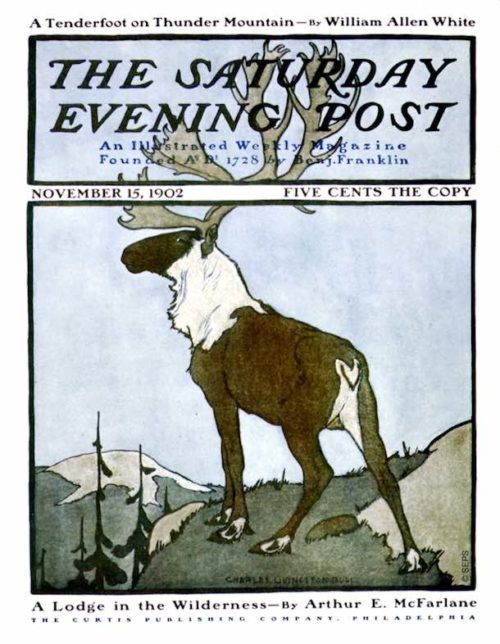
Charles Bull
November 15, 1902
Charles Bull painted many striking scenes of the Pacific Northwest, including Alaska. Despite his grand depictions of animals in nature, Bull got most of his inspiration from sketching animals at the Bronx Zoo.
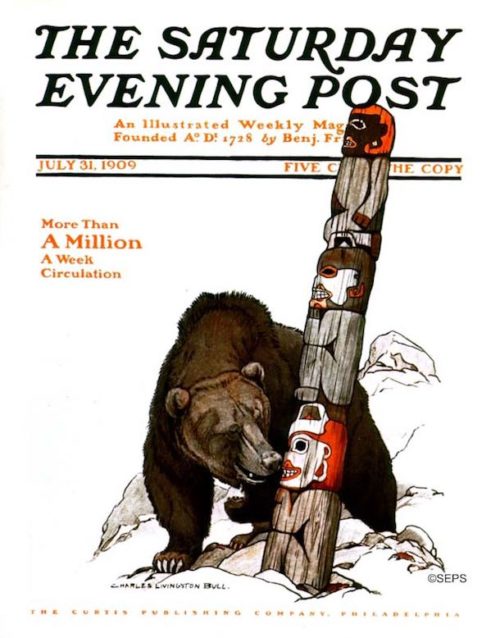
Charles Bull
July 31, 1909
The gold rush in Alaska and the Yukon territory brought many people to the area seeking their fortunes. It also piqued the interest of Americans in the the lower 48. When Charles Bull painted this cover, Alaksa was not yet even a territory; that wouldn’t happen until 1912. But Americans were likely fascinated by the region’s large animals, chilly climate, and Inuit and Yupik culture.
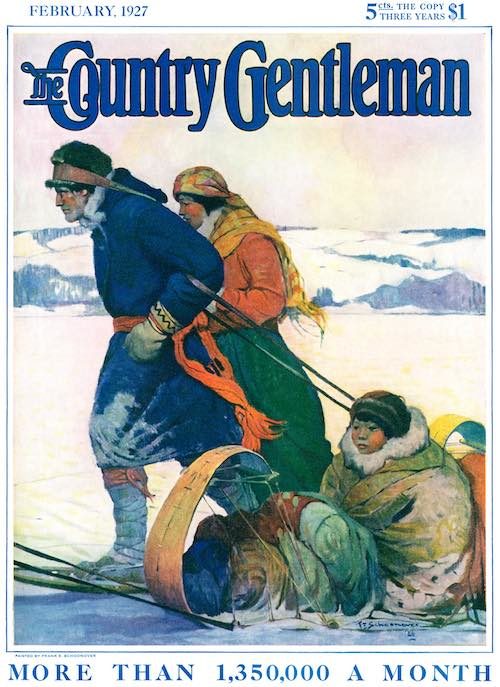
Frank E. Schoonover
February 1, 1927
Artist Frank Schoonover was part of of the Brandywine School, and studied under Howard Pyle. He painted more than 2,000 illustrations in his lifetime. This included eight covers for the Saturday Evening Post’s sister publication, Country Gentleman. Several of his covers depicted vividly colored scenes of Native Americans going about their daily lives. This cover was the first one that Schoonover painted for Country Gentleman.

Charles Hargens
July 1, 1939
Even back in 1939, cruise ships were invading the isolated and pristine shores of Alaska. Artist Charles Hargens painted ten covers for the Post and Country Gentleman, a fraction of the more than 3,000 magazine covers he illustration. Hargens was known as a stickler for accuracy in his paintings.
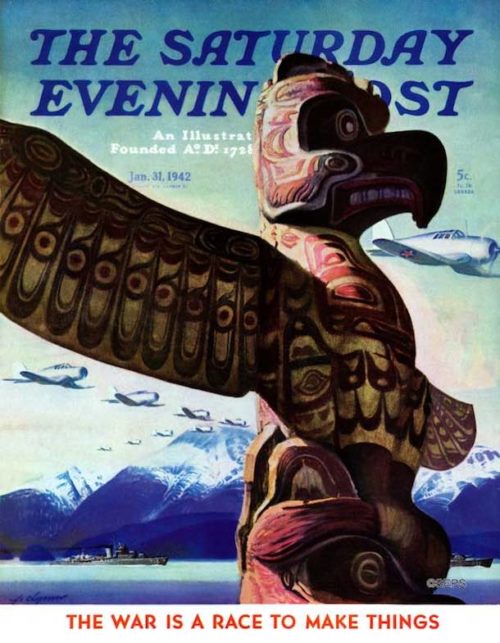
John Clymer
January 31, 1942
This cover by John Clymer illustrates the strategic importance of Alaska during World War II. Clymer painted this picture before he joined the Marines. He recalled, “I was thirty-six years old at the time, and going through boot camp with a bunch of kids nearly killed me. ¹” This was his first Post cover, but he would go on to paint 79 more.

John Clymer
July 25, 1959
One overheated July day when artist John Clymer was motoring in Alaska he paused at this spot at Portage Glacier. People came and boated around beside the small bergs. Next day, when John returned to sketch, a change of wind had blown Mother Nature’s chopped ice over against the glacier, and the sketching spot was as hot as Tophet. The artist says no, he did not go over and take a ride on the glacier.

Constantin Alajalov
November 12, 1960
Alaska, along with Hawaii, were the “new” states in 1960. Cover artist Constantin Alajalov shows the citizens of each state waiting in line to vote in the 1960 presidential election (Nixon v. Kennedy—Kennedy won). Alajalov earned his voting rights the hard way. He was born in Rostov, Russia, and arrived in New York in 1923.
North Country Girl: Chapter 22 — Gay’s First Date
For more about Gay Haubner’s life in the North Country, read the other chapters in her serialized memoir. The Post will publish a new segment each week.
I spent most of ninth grade imagining myself flitting about Haight-Ashbury, swinging my love beads and my perfect, shiny, Michelle Phillips hair, ingesting an interesting variety of drugs, and being fawned over by boys who looked like Mick Jagger or Jim Morrison. But my sad reality was that I was a plain girl with glasses, wearing clothes picked out by my mother, a girl who had never even sipped a beer or smoked a cigarette.
The swinging 60s, the youth revolt, consciousness-raising, be-ins and sit-ins and rap sessions were all happening very far away. Duluth was still country clubs, bridge parties, scary greasers from the West End with pomaded hair, black leather jackets, and white tees, useless home ec lessons, Sunday church dresses, dads driving while drinking a can of Grain Belt beer and then chucking the empty to the side of the road. We were so far out of the mainstream we hadn’t even gotten the Keep America Beautiful message.
No Duluth tradition was as firmly welded into the past as Cotillion. Every year, twenty fourteen-year-old boys and twenty fourteen-year-old girls were invited to take part in Cotillion, or in plain English, ballroom dancing lessons. This was a privilege reserved for kids from “better” families: we were the sons and daughters of doctors, lawyers, businessmen, who lived in the big houses in the prestigious neighborhoods. Never mind that the rest of the country was doing the frug, the pony, and the monkey. We chosen few were learning to fox trot.
Cotillion was held Thursday nights, from seven to nine on the second floor of Northland Country Club, and if that was a ballroom I’m the Queen of Spain. A long bench ran along all four sides of a drab, drafty room, half occupied with sweating, dweeby boys in ill-fitting jackets and strangling neckties, and half by anxious, overdressed girls. Girls were required to wear white gloves, god forbid our hands should touch sweaty boy hands. Dancing was taught and decorum maintained by two elderly, overweight matrons, who had been annoying the golden youth of Duluth for years untold.
For most of the dragging hours, the boys asked the girls to dance. Who knows what was worst: waiting, waiting, waiting, until I was the only girl still sitting on the bench and short, pimply Tom Gunderson, after examining the ceiling and the floor, just in case there was another girl hiding there, grudgingly asked me to dance; or on the rare occasion, when the planets aligned, of a girl asking a boy dance, when I had to decide how high to aim and how quick to move. A boy couldn’t turn me down, but he could make a face letting me know that he was hoping any other girl would have gotten to him before I did.

I hated Cotillion. It reinforced my lowly standing in the ninth grade boy-girl Olympics: only if a spelling bee broke out would I ever be any boy’s first choice. And it was impossible for me to learn to fox trot or cha cha or waltz, being literally unable to tell my right foot from my left. My unlucky partner and I would be shoved to the side of the room by one of the dance mistresses, who would then loom over me, glaring at my feet and shouting “ONE AND TWO AND CHA CHA CHA.”
My mother was thrilled to supply dress after dress for Cotillion; but it didn’t matter how cute my dress was; no boy cared about a dress. This was a lesson I was unable to get through my head; at the ninth grade graduation party my adorable Dr. Zhivago-inspired dress and fancy beauty shop up sweep failed to entice a single boy to ask me to dance.
Cotillion did teach me how to keep my tears of embarrassment and shame damned up those nights when the boy-girl numbers did not match and I was left alone on the bench, dance after dance, until some unfortunate boy was forced to come over and offer me a sweaty palm. I learned that when it’s whispered through the ballroom that Martin Luther King was assassinated, and the dance mistress is still clapping her hands and telling the boys to hurry and pick out their partners, that something is severely screwed-up.
After being chosen last at every Cotillion and left holding up the wall at the ninth grade graduation dance (I finally retreated to the girls’ bathroom where I had a good cry and then washed my face so my mom wouldn’t know that her choice of dress and hair do had not worked a miracle) I was convinced that I would never have a boyfriend.
Then one warmish June day, right before the end of school, I received two gentleman callers. My mother, down to one of her last nerves, had thrown all three of us girls out of the house. Heidi and Lani had gone off in search of other kids; I was slumped on the front steps engaged in my favorite outdoor activity, reading a book, when down Lakeview Avenue lumbered two gangly teenage boys, looking, shockingly, for me. It was Joe Sloan and Wesley Baggot.
Wesley was in ninth grade at Woodland, though not in any of my classes, and definitely not a member of Cotillion, having the longish hair and scruffiness of a would-be greaser. He was cute enough, though, and he was a boy. I had never spoken to Joe Sloan, who was taller with longer hair, and an air of mystery. The Sloans, a family of seven or eight children, lived in an immense robber baron mansion, a house with an unknowable number of rooms built of ominous black stone blocks, complete with gatehouse and a quarter-mile of winding driveway, set back on acres of dark piney woods. I had been delivered several times to this house to play with a girl my age, Jane Sloan, a musical prodigy who eventually went off to boarding school. I don’t remember if we played Barbies or board games or hide and seek in that huge house, my memory is stuck on the concert grand piano, ebony black and the size of a car, smack in the middle of a living room as big as a tennis court, and on the industrial-size chrome milk dispenser in their kitchen: you’d lift the heavy lever and milk would run from a clear tube into your glass. I also remember glimpses of Jane’s brother Joe, who had a reputation for borderline juvenile delinquency, and who attended not a fancy pants boarding school, but one intended to correct the waywardness of rich boys.
Of my two suitors, of course I preferred Joe Sloan, especially because when they stopped at my front sidewalk, he lit a cigarette. I managed to not hyperventilate and to actually make small talk with two boys, discussing the merits of East High, where I was going, and whose students were regarded by all other Duluth teens as Cake Eaters, and Central, the other side of the track school, whose sports teams regularly thumped East, and where Wesley was headed. Joe did not comment on his school, but lit another cigarette and said he had to go. Joe and Wesley gave me a “See ya,” ambled off, and I rushed back into the house to call Cindy Moreland and tell her that I had just talked to two boys, one of whom was a year older and really, really cute, then spent the rest of the day imagine Joe reaching for me and sweeping me up in a passionate kiss that tasted like Lucky Strikes.

It took a few more visits from the two boys before the semi-awful truth came out: I was not the object of Joe’s desire. It was Wesley Baggot who asked me out on my first date. I can count on the fingers of one hand how often a boy has asked me to the movies, so every moment of that event is etched into my brain.
What I wore: black elephant bells of thin-wale corduroy with a pink and green rosebud print. I wish I still had those pants. The bell bottoms were so wide, Wesley Baggot asked if I were wearing two skirts. We went to a James Bond double feature, Dr. No and Goldfinger, very racy stuff for fourteen-year-old me. At some point after the appearance of Odd Job, Wesley’s hand crawled over the arm of the seat to search for mine. Caught in his death grip, I proceeded to lose all feeling in my right hand. I tried to ignore the pins and needles shooting up my arm and the intense embarrassment of watching Pussy Galore and James Bond going at it in on the big screen in Technicolor so I could memorize every detail of my first date, which I poured out to Cindy Moreland the next day, as we wrapped album covers in tin foil to use as reflectors and basted ourselves in baby oil in an attempt to woo a California tan from the pale Minnesota sun.

She sympathized with me over losing out on Joe Sloan, but a boy was a boy. Wesley
Baggot had paid for my ticket, bought me buttered popcorn and a waxy cup of Coca-Cola, and that was an official date. The next step in the Duluth dating ritual was dinner at Somebody’s Place, a small teen-friendly restaurant where no liquor was served; you washed down your choice of thirty-six different hamburgers (ranging from the Italian with red sauce and mozzarella to the “sundae burger” with chocolate syrup and whipped cream) with Swamp Water (a mixture of coke, root beer, and 7-Up), or a pretentious pot of orange and cinnamon Constant Comment tea.
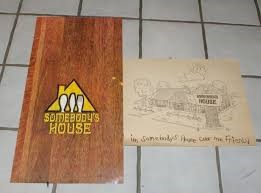
I spent hours waiting for the phone to ring or for Joe and Wesley to show up again on my front lawn, hours in front of the bathroom mirror, applying a pale pink Yardley Slicker to my lips then attempting a sexy Honor Blackman pout, taking my glasses off, thinking I couldn’t read the Somebody’s House menu without them, putting them back on, realizing that I knew all twenty-eight hamburgers by heart, taking them off again, peering under my lashes trying to see what I looked like when I closed my eyes and puckered up for a kiss…all in vain. Joe Sloan and Wesley Baggot had vanished. The phone continued to not ring and I descended into the horrors of the teen girl mope.
Celebrity Encounters: Lunch with Bo Derek

Around the time I was casting Jaws 3, People 0 (a film I hope you never see), Blake Edwards invited me to a screening of his newest comedy featuring an unknown actress. I instantly knew this was the woman I wanted for the female lead in my Jaws sequel, so I arranged for her to meet me at my office at Universal. We then walked to the studio commissary, a bustling, noisy place that sometimes got so loud you had to strain just to hear across the table. But when we entered, the sound level suddenly dropped to zero. I could see every eye in the place staring at us. It was like entering church.
We sat down. Waiters with notes from other diners started to arrive: “Who is she?” “Matty, can I drop by and say hello?” “Introduce me or I’ll shoot myself!” I looked around the room, smiled, and showed her the notes. She smiled too. She was used to it. And that was my first day at Universal with Bo Derek.
—Matty Simmons is the producer of Animal House and other films
This article is featured in the September/October 2017 issue of The Saturday Evening Post. Subscribe to the magazine for more art, inspiring stories, fiction, humor, and features from our archives.
Rockwell Video Minute: Wanderlust
Norman Rockwell often yearned to get away from work, a longing reflected in many covers, but none more so than the image of a hiker with his faithful dog.
See all of the videos in our Rockwell Video Minute series at www.saturdayeveningpost/rockwell-video.
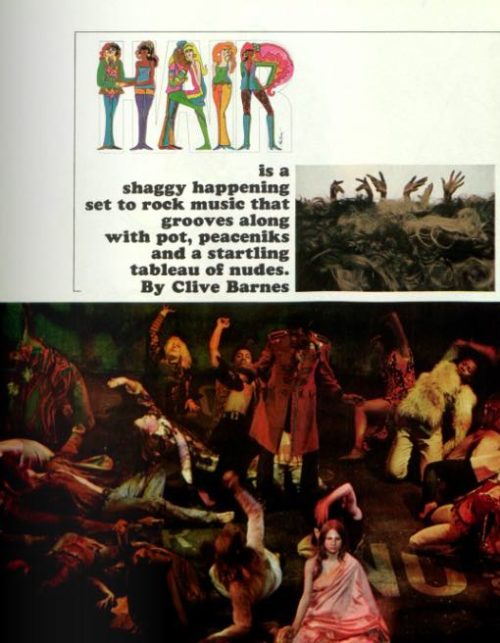
Broadway on Acid: The First Rock Musical
As long as the performers stood stationary, James Rado said, a New York City ordinance allowed nudity in theatrical productions. Rado, along with his collaborator Gerome Ragni, took this opportunity to include a scene in their free-spirited musical in which the cast of over 20 performers shed their beads and jeans to sing a number stark naked. Before Hair, there was The Sound of Music and Camelot; after Hair, anything was possible.
Although 50 years have passed since its off-Broadway debut at the Public Theater, the American Tribal Love-Rock Musical endures as a stoned tribute to irreverent youth. What Ragni and Rado’s rock musical lacked in any manner of coherent plot, it made up for in cultural immediacy. The show was staged following the Summer of Love, and it depicted the tumultuous sixties in the thick of it: a two-and-a-half-hour war protest onstage complete with hashish, Shakespeare, and Kama Sutra.

The music of Hair achieved, perhaps, the most diverse recognition of any Broadway musical, with The 5th Dimension’s “Aquarius/Let the Sun Shine In,” Three Dog Night’s “Easy to Be Hard,” The Cowsills’ “Hair,” and Nina Simone’s “Ain’t Got No/I Got Life” reaching radio-listening ears throughout the ’60s and ’70s. Many of the score’s numbers, however, were seemingly unconducive to pop success. “Sodomy” and “Hashish” are virtually musical inventories of sexual taboos and psychedelic drugs, respectively, and other numbers like “Colored Spade” and “Black Boys” presented assertive discussions on race and interracial love. Nevertheless, the musical’s original Broadway cast album charted at number one in the Billboard 200. No other Broadway musical cast album has reached that spot since, although The Hamilton Mixtape hit number one last year.
The mainstream success of Hair came with swift — and sometimes violent — backlash. A performance in Boston was cancelled after the State Supreme Court found issue with its desecration of the American flag, and the Hanna Theater in Cleveland lost more than 40 windows to a bomb during its Hair run. In a bizarre 1971 protest to the musical tour, a Christian minister in St. Paul released about a dozen mice into the theater on opening night hoping to scare audiences out of the blasphemous production. His protest was unsuccessful.

Clive Barnes gave an incredulously supportive review of Broadway’s Hair in this magazine in the same 1968 issue containing an editorial titled “I Don’t Trust Anyone Under 30.” Barnes forecasted the arrival of similar stage shows: “Two things though are certain: First, the new permissiveness has arrived on Broadway. Second, so has rock music. In some instances this will merely mean Broadway musicals that are louder and nuder.” The theater critic wasn’t hallucinating: by 1971, Godspell and Jesus Christ Superstar continued the rock musical tradition — sans sacrilege — and Oh! Calcutta! cast members were strutting across the stage of the Belasco Theatre in the buff for entire scenes.

The rock musical is now a regular occurrence, with hits like Rent, The Rocky Horror Show, and Spring Awakening. Despite uproarious claims, Hair did not ravage the sanctity of the Broadway stage (at least not as severely as Spider-Man: Turn Off the Dark or Carrie: The Musical). The strange trip of a show unapologetically and authentically reflected Vietnam-era counterculture in a way that is difficult to pull off with the current trend of meticulously tailored jukebox musicals and adaptations. As Barnes puts it, Hair’s “Thoreau skepticism that is as American as apple pie or burning draft cards” continues to call its audience at once back to nature and into outer space.
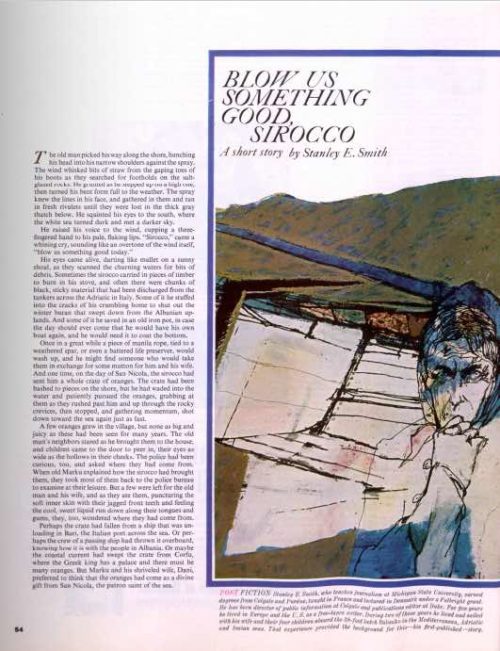
“Blow Us Something Good, Sirocco” by Stanley E. Smith
Stanley E. Smith’s two years of sailing with his wife and four children aboard the 38-foot ketch Babauko in the Mediterranean, Adriatic, and Ionian seas provided the background for his first short story in 1964. Smith taught journalism at Michigan State University after a Fulbright grant had taken him to Denmark and France to lecture. “Blow Us Something Good, Sirocco” follows an elderly couple in Communist Albania as they hatch a plan to escape across the Adriatic to Italy. Albania’s stint of communism after World War II was led by head of state Enver Hoxha, who implemented a strict atheist state along with a system of agricultural cooperatives that fell with the rest of the Eastern Bloc in the late 1980s.
The old man picked his way along the shore, hunching his head into his narrow shoulders against the spray. The wind whisked bits of straw from the gaping toes of his boots as they searched for footholds on the salt glazed rocks. He grunted as he stepped up on a high one, then turned his bent form full to the weather. The spray knew the lines in his face, and gathered in them and ran in fresh rivulets until they were lost in the thick gray thatch below. He squinted his eyes to the south, where the white sea turned dark and met a darker sky.
He raised his voice to the wind, cupping a three fingered hand to his pale, flaking lips. “Sirocco,” came a whining cry, sounding like an overtone of the wind itself, “blow us something good today.”
His eyes came alive, darting like mullet on a sunny shoal, as they scanned the churning waters for bits of debris. Sometimes the sirocco carried in pieces of timber to burn in his stove, and often there were chunks of black, sticky material that had been discharged from the tankers across the Adriatic in Italy. Some of it he stuffed into the cracks of his crumbling home to shut out the winter buran that swept down from the Albanian uplands. And some of it he saved in an old iron pot, in case the day should ever come that he would have his own boat again, and he would need it to coat the bottom.
Once in a great while a piece of manila rope, tied to a weathered spar, or even a battered life preserver, would wash up, and he might find someone who would take them in exchange for some mutton for him and his wife. And one time, on the day of San Nicola, the sirocco had sent him a whole crate of oranges. The crate had been bashed to pieces on the shore, but he had waded into the water and patiently pursued the oranges, grabbing at them as they rushed past him and up through the rocky crevices, then stopped, and gathering momentum, shot down toward the sea again just as fast.
A few oranges grew in the village, but none as big and juicy as these had been seen for many years. The old man’s neighbors stared as he brought them to the house, and children came to the door to peer in, their eyes as wide as the hollows in their cheeks. The police had been curious, too, and asked where they had come from. When old Marku explained how the sirocco had brought them, they took most of them back to the police bureau to examine at their leisure. But a few were left for the old man and his wife, and as they ate them, puncturing the soft inner skin with their jagged front teeth and feeling the cool, sweet liquid run down along their tongues and gums, they, too, wondered where they had come from.
Perhaps the crate had fallen from a ship that was unloading in Bari, the Italian port across the sea. Or perhaps the crew of a passing ship had thrown it overboard, knowing how it is with the people in Albania. Or maybe the coastal current had swept the crate from Corfu, where the Greek king has a palace and there must be many oranges. But Marku and his shriveled wife, Dani, preferred to think that the oranges had come as a divine gift from San Nicola, the patron saint of the sea.
Now, however, old Marku saw nothing — nothing but water and sky and rocks, the rocks rising steeply to the barren mountains behind, where occasionally a rough stone wall indicated a lonely patch of earth where perhaps a cabbage root might find sparse nourishment. He turned and plodded on, pulling his goatskin more closely about his body. It was January, and even the sirocco, which swept across the Mediterranean from the south, felt cold.
Time passed slowly as he padded stiffly from rock to rock. His eyes had begun to tear from the wind and salt, but still they had sighted nothing to take back to his barren hovel. Once he looked back toward the mouth of the cove where his village lay and saw the police patrol boat nosing out toward the sea, its sharp bow rising and plunging with the great swells the sirocco brought. He stopped to watch as the patrol boat swung broadside to the sea, rolling dangerously until its engine drove its stern to the weather and it headed back into the safety of the cove.
As he watched, the sharpness left his eyes and the tenseness left his face. He could feel the deck under his feet, feel the surge of the sea beneath the boat. It was his own fishing boat again, and his sons, Bero and Milo, were with him.
“Bero,” he called aloud, “take the tiller a while.” It was a long, graceful tiller, one that Marku had hewn from an ash timber, curving it with sure, skillful strokes of his adz.
When Bero had settled in the stern and hugged the tiller under his arm, the father walked forward on the deck, smiling as Milo snatched squirming fish from the net. He trimmed the big lateen sail, then stepped carefully over the nets and stood in the bow, his body adjusting unconsciously to the boat’s pitching. The wind was strong, and he breathed some of the strength of it deep down into his lungs. Far ahead, he could see the high rocks that marked the entrance to the cove.
Suddenly his eyes fastened themselves on something in the water. He watched silently as the boat drew nearer to it. First it looked like pieces of timber, but then he saw it was more than that. His heart began to pound harder as he recognized the battered remains of a boat. “Bero! Milo!” he called, turning to his sons. “It’s a boat! A sunken boat!”
But his sons were not there behind him, nor his little fishing boat, nor even the sea. There were only rocks: sharp, dark, cold rocks, rising to the mountains behind. At once he realized he had been daydreaming, as he had been doing more and more lately. He felt foolish, and lowered his head and turned his face to the sea again.
He looked, then rubbed his eyes roughly. The hulk was still there, its sunken form rising and falling in the rolling sea. He rubbed his eyes again and cursed them, cursed his age, cursed his hunger, cursed those who had taken away his fishing boat and had caused his misery. But no matter how much he cursed, how much he rubbed his burning eyes, the vision would not disappear.
He sat down on a rock and buried his eyes in his hands. “Relax, old man,” he said aloud. “After a few minutes look again. If it is still there, then it is real. Then you must pray to San Nicola to help you get it to shelter before it is pounded to bits.”
When he felt the pounding in his chest grow slower and less violent, he stood up and raised his eyes slowly and calmly toward the sea. In the first instant he saw nothing. Then the troughs of the sea lifted and there, only a hundred meters away, rose the oaken stem of a boat. He threw his gnarled fingers to the sky, his high-pitched voice singing out above the sound of the sea and the wind: “San Nicola, give me strength. Give me time.”
As the boat drifted shoreward, his eyes measured the distance along the shore to where the sea met a high wall of rock with a thunderous roar, driving great sheets of water high into the air. Along that violent wall, he knew, was a small, sea-carved cavern. He had known it since he was a boy, and he knew that if the tide and the crashing waves would permit it, the cavern would protect his prize, not only from the onslaught of the sea, but from the eyes of the police as well.
Then he rushed, sometimes stumbling and crawling over the rocks, to where the boat would wash ashore. His bony legs banged against the rocks, but he felt nothing. His body was shaking, but it was no longer from the cold.
He grew exultant as the boat washed nearer. “Ha, Sirocco,” he shouted, “so this time you have brought me a boat. But this will not be a fishing boat. It will be for this.” He made a chopping motion with his open right hand on his left arm and shot his left hand in the direction of the sea. “To Italy!” he cried. “To Italy, like Bero and Milo!” He began to laugh. He laughed wildly, uncontrollably, and tears flowed from his eyes.
Still laughing, he stumbled into the spray and foam, grasping for rocks as he thrashed his way through the angry water. Once he slipped, and his entire body sank beneath a wave. Only a flap of his goatskin was visible on the foam. But he was up again almost at once, shaking the cold water from his head.
As he reached for the boat a wave carried it on its crest and swept it down toward him. He braced his feet against the slippery rocks and threw his shoulder against the floating hulk. Its weight bore down on him with crushing force, and his feet slid out from under him. He felt himself pushed beneath the surface, the boat’s heavy hull moving over him.
“Strength,” he thought desperately, as he doubled his legs and fought for another foothold, “strength.” There was a sharp sensation in the middle of his back as a jagged spike from the boat’s bared frames gouged through his goatskin cape. But his groping feet at last found something solid, and he straightened his legs.
The bow moved then, moved in the direction he wanted it to. His head emerged from the water and he gasped for breath. “Keep it moving,” he muttered. “Keep it moving, or it will crush you.”
For more than an hour he battled, straining to keep the bow headed along the shore, struggling to keep the wreck moving. Twice it got away and bashed against the rocks to open new gaps in its ragged planking. His fingers were numb with cold, and bleeding from being crushed between wood and rock. This did not bother him, because there was no real boatman in the village with ten fingers left, and he had already lost two. But there was no longer any feeling in his legs, and he was afraid that the cold water had sapped too much of the life from them.
At last he reached the wall of rock. A crest carried him high in the air and he could see the opening of the cavern. It was like the mouth of a giant animal, alternately gulping and vomiting tons of water. The old man’s feet would no longer reach the bottom, but he hung on to the stern of the boat, holding it back to let the bow swing toward the opening. It was only a small opening now, for the sirocco had raised the level of the water half a meter, and the crests of the swells crashed above the top of it.
Slowly the boat and Marku edged forward, the old man’s head bobbing up and down with the swells. When the bow settled in a trough and the stern mounted the following crest, he gathered what remained of his fleeting strength and gave a great push. The bow carried under the top of the opening, but as it rose again there was a sound of grinding and tearing of wood as the stem struck the rock above it.
“Fast, now,” the old man thought, “or all will be lost.” Each time the bow dipped he pushed again, and each time it was followed by a wrenching crash. But slowly the boat was entering the cavern. One last heave and it was through the opening, and the old man, finding footing again, hurried after it, as a crest suddenly bore him upward and crashed his head against the rock. For an instant he was dazed. When his senses returned he was inside the cavern, his body draped across the sunken boat.
He worked on sheer will, his strength completely gone, his hands and feet numb, and blood oozing from a dozen places on his body. But it was easier now, and soon he had dragged the boat back into the dark recesses of the cavern, where it finally settled on the gravel bottom, rocking gently in the diminished swells.
The old man collapsed on a rock, his breath coming in spasms. “Home, now,” he gasped. “Must get strength again to work on the boat.” He forced himself to his feet and groped his way to the narrow opening at the back of the cavern. It was dark outside, and he shivered as the wind struck his water-soaked clothes.
Bleeding, half numb, shaking with cold, and his mind blurred by exhaustion, he forced his battered body across the rocks toward his home. Each rock seemed higher, every step more painful. It seemed that hours had passed before he reached the rough path leading to his home, but at last he stood before the door, weaving and mumbling unintelligibly to himself. With his last ounce of energy, he pushed against the door and pitched headlong across the stone threshold. Only then did he let his consciousness drift away completely.
When he awakened, he was lying in his old iron bed. He knew he had been there for a long time because the wind had died down and the rains had come. He moved to get up, but pains shot through his back, his legs, his hands, his head. “Mother of Jesus,” he said aloud, “what has happened to me?”
Dani heard him and came over to the bed, her rag-wrapped feet scuffing hurriedly across the bare stone floor. Colorless eyes peered out between the wrinkles as she bent her short, lean body over the old man. “Marku?” she said quietly.
“How long have I been here like this?”
“For two nights and a day,” she said.
She looked at his face. “Are you really awake, Marku?”
“I am awake, yes, Dani. My head is awake, but I think my body is dead and already in hell. When I try to move, fire shoots through every part of it.”
“You were bleeding all over,” she said. “And you were shaking so much I could not keep the cloths on your wounds.”
The wrinkles in the old man’s face deepened as he struggled to remember. “But what was it, Dani, that caused me to be struck by the angry hand of God?”
“If you do not know, Marku, then it is all the worse. All I know is what you said while you slept. Twice I heard you say something about the rocks and the boat.”
“The boat,” said the old man sharply, and as he remembered, his muscles tensed, sending new pains through his body. He couldn’t speak for a few minutes, but when his muscles had relaxed again he said quietly, almost in a whisper, “We have a boat now, Dani. The sirocco has brought us a boat.”
The old woman’s eyes showed nothing. The deep lines in the leathery skin of her face didn’t move. She simply stood, looking into the old man’s gray eyes.
“Did you hear me, woman?” he said, a little impatiently. “We have a boat.”
“Yes,” she answered softly, nodding her head. “We have a boat.” She stood up slowly and shuffled back to the broken iron stove.
Hours had never seemed as long to the old man as they did during the next days. The only thing that occupied his mind was the boat, the boat. If only he could move his pain-wracked body to see it; to see if it really could be salvaged; to see if one day it might float again, to carry him and Dani away.
The rain stopped, and the wind switched to the ponent, blowing out of the west. Still the old man could not leave his bed, and still he thought of the boat. He remembered where he had hidden some of his tools, guarding them jealously lest Dani take them to trade for food. There was a saw, and an adz, and a dulled auger. It wasn’t much, but it was enough, he thought. Enough if only his body would become strong enough to make use of them.
Dani did her best to help him get his strength back. At first she brought him only rosemary tea and potions brewed from other herbs she had gathered on the mountain. Then she gave him cabbage and a little coarse bread, and a piece of goat meat she had salted herself only a few months before. At first, when Dani served him, Marku would talk about the boat. But she only nodded at him and said, “Yes, Marku, our boat,” and turned away again. So he stopped talking to her about it and just thought about it to himself.
Twenty-three days passed before the old man felt well enough to leave the house. He stuffed some fresh straw into what remained of his boots and slung the goatskin around his shoulders, his fisherman’s hat on his head. Outside, it was warm in the sun, and the levanter, the east wind, barely moved the small patches of white in the sky. He went to the stone shelter behind his house, came out with a bundle wrapped in an old cloth, and set out along the rocky path toward the shore.
He walked stiffly at first, but as he neared the cavern, the stiffness left, and he was leaping from rock to rock like a boy. When he arrived at the narrow crevice which led below, he stopped, looked carefully all around him, and slid quickly down between the rocks.
It was still there, resting on the gravel bottom, with shafts of light from cracks in the rocks above throwing golden beams on it. The old man stopped before it, surveying it with wide eyes. “Mother of Jesus,” he muttered. “She is a beautiful boat.”
When he had finished staring at the boat, he moved it higher on the gravel and examined the frames and planking. There was much to do, he thought, and it would be difficult finding wood to repair it. But it could be done. And if the weather were kind one day, the boat would be strong enough to carry them to Italy.
He was unfolding the cloth bundle when he first had the strange feeling. It was the same feeling he used to have just before they took his boat away, when he was unloading his fish at the dock. Someone was always watching, always counting, always scheming. Now he knew someone was watching again. He turned and raised his head slowly. He saw the boy, standing in a corner of the cavern looking at him.
“What are you doing here?” the old man shouted angrily.
“Nothing,” the boy answered. “I saw you bring the boat here when the sirocco was blowing.”
The old man suddenly felt jealous, cheated of his secret knowledge, his secret prize. “Who are you? Where do you come from?” he asked the boy sharply
“I am Marash, son of Gjiregji Krujan,” the boy said softly
The old man felt something thick and hard forming in his stomach. He turned from the boy and looked at the boat, and he thought he would be sick. “Krujan, Krujan,” he repeated to himself. Krujan, who had been responsible for taking away the old man’s fishing boat. Krujan, the former keeper of the bread shop who was now sitting behind a desk in a government office in Shengjin. Krujan, who had betrayed his own friends and even now was telling lies about them to the Chinese, who had come to mete out the proper punishments.
Slowly he began to fold the cloth back over the saw, the adz and the auger What would be the use? Fix up the boat with his own sweat and toil so that Krujan could take it to use for himself? “No,” he thought, “he can take it like it is. Or he can leave it. It makes no difference.”
He picked up the bundle and turned to the boy again. He looked into his face for a long time without saying anything. It was a strong face, and the eyes in it were wide and calm. “How old are you?” the old man asked.
“I am nineteen,” the boy replied. He still had not moved from his corner.
The old man studied him silently for another few minutes. Then he turned, set the bundle down again and unfolded the cloth. Maybe he won’t tell his father, he thought. And what if he does? Twenty-four days ago I had no boat. And if it is taken away when I finish it, I will still have no boat. It is all the same. And I will enjoy the work.
He started by turning the boat over with the help of the broken boom as a lever, propping the bow and stern on piles of rocks. Then he took his saw and began cutting away the splintered planking, sawing them square where they crossed a solid frame. He forgot about the boy, and the boy said nothing, and once when the old man looked up from his work, the boy was gone. He shrugged and went back to his sawing.
Days went by, then weeks, as the old man worked slowly but steadily on the boat. Sometimes he would run out of wood, and have to spend his time along the shore, searching for more. Once he had to wait a whole week before he had wood to work with. It would come in all shapes and sizes, but he was skilled with his adz, and he had time.
In the evening, near the stove, he would carve wooden plugs. Sometimes Dani would look at him with soft eyes and shake her head. He was too occupied with his carving to notice.
The boy came quite often to stand in his corner and watch, but it didn’t bother the old man. He knew that one day he would lose the boat, but working on it made him happy. His eyes shone when he stepped back to see how it was taking shape under his own hands.
Sometimes the boy would talk to him, or ask him questions. “You are making the boat very strong.” he said one time. “How will it go on the big sea?”
“It will go very well,” answered the old man, “if it is sailed well.”
“Have you ever been to Italy?” the boy asked another time.
“Yes,” said the old man. “A long time ago. I sailed a boat there.”
“My father says there are capitalists in Italy.”
“I didn’t’ notice any,” said the old man. He stroked for a while with the adz and then looked up at the boy. “Tell me, what is a capitalist?”
“My father says they are people who make too much money so that the poor people cannot live.”
“And here,” said the old man, “there are no capitalists, and the poor people are not really poor at all.” He went back to his stroking. “Has your father ever been to Italy?” he asked.
“No,” the boy answered. “But he read about the capitalists there. One of our Communist leaders has written it.”
“Do you believe it?” asked the old man.
The boy hesitated for a moment and looked away. “Sometimes it is very difficult to know what to believe,” he said.
One day the boy brought a few dozen nails with him and the old man smiled at him. Nails were impossible for him to buy, and the wooden plugs were difficult to manage in some places on the boat.
“When will the boat be finished?” the boy asked one day.
“In May, or June, perhaps.”
“Is it difficult to sail a boat like this one?”
“No,” said the old man, “it is quite easy. Especially when you get a steady wind like the mistral.”
Gradually the old man told him more about boats and about fishing, and told him how happy he had been when his two sons had gone fishing with him. Then he would remember who the boy’s father was, and remain quiet for a long time before speaking again.
Sometimes the boy would talk strangely, of things not related to the boat. “I have a girl,” he said to the old man once.
“So?” he replied. “It is good to have a girl.”
“But I would like to marry this girl. My father says I am too young to think about getting married. Do you think nineteen is too young?”
The old man looked closely at the boy. “It is very young to get married,” he said at last. “But it depends on who it is. If he is a man when he is nineteen, then he is not too young.”
The boy smiled at this, and gradually began to relax with the old man. Sometimes he helped him turn the boat over, or held a plank while the old man drilled it with his auger and set it in place with a wooden plug or one of the nails the boy had brought. Or he would dampen the plank with an old piece of wet burlap as the old man bent and twisted it over the small fire he had built. But he never became completely at ease, and the old man never let himself completely forget who the boy’s father was.
The closest he came to forgetting was the time he was working and suddenly the end of a tree trunk appeared in the crevice leading into the cavern. Slowly it slid down, and finally the boy appeared, puffing and grinning, his face red with exertion. “Will this be good for a mast?” he asked.
The old man walked closer to examine it. After a while he said, “I think I could not have picked a better one myself. Where did you find it?”
“Over there, in the forest,” the boy said, pointing eastward.
“But that is a long way.”
The boy shook his head. “I have been two days getting it,” he said. “When I go home my father will be more angry than he has ever been before.”
Weeks and months passed by, and by June the old man was caulking the boat with the shreds of bits of rope he had saved.
Then one day he carried the iron pot with the black, tarlike material in it to the cavern and put it over the fire
“Is this the last thing?” the boy asked.
“The last thing.” The old man nodded. “I have made a sail at home out of some scraps of cloth. It is not pretty, but I think it will be strong enough. Tomorrow I will lash it to the boom. Then all will be ready, except for stepping the mast. That cannot be done until the boat is floated out of the cavern. But it will be easy. The mast is not very heavy.”
Old Marku was pleased with the boat, and with his work. He could not remember being as happy in many years. He sang as he dipped the stick into the hot, black liquid and smeared it over the hull. When it was finished he said good-bye to the boy and hurried home, jumping across rocks and humming as he went. He burst into the door of his house and shouted for Dani.
“Hurry, old woman,” he sang out. “I have something important to tell you.”
She scurried into the house through the back door, carrying a few leaves of cabbage in one hand. Her eyes looked frightened.
“Put down your cabbage leaves, old woman,” he said, taking them from her hand and setting them on the table. Then he steered her to a stool. “Sit down, now, and just for this once hear me through.”
She obeyed him, drawing her body close to her knees as she hunched on the stool. The old man looked at her and thought how pitiful she looked, how like an animal. Praise to God that it had not always been like this. There was a time when they had lived like people.
“Dani,” he said quietly, “I know what you think, that I am sick in my mind, that I see things that are not really there, that I do strange things without any sense or reason. Perhaps it is better that you have thought so, and that some of the village people think the same thing.”
He breathed deeply and took her by the hand. “But listen, Dani, it is not so. I am old, but my mind is still as it was twenty years ago. This which I have said about the boat is true, Dani. The sirocco washed it up last January, when I came back to the house beaten and bleeding. I have worked hard, and the boat is ready to sail now. It is a very small boat, but it is very strong.” He paused for an instant before he said, “I think it can take us safely to Italy, Dani. Perhaps we could find Bero and Milo.”
A spark flickered in her lifeless eyes for a second, and he remembered how they had been many years before. Then the look of fright returned. “Is it really possible, Marku, that a small boat can go across the sea?”
“I swear it,” said the old man solemnly. “When the mistral blows, but not too strongly, then it is a good time.”
He did not know how to tell her about the boy, and about what might happen to the boat. She was already frightened, and this would only make it worse. But he had to tell her.
“Dani,” he began, “there is a boy who knows about the boat. He has seen me working on it.”
“Who is he?” she asked quickly.
“He is Marash, son of Gjiregji Krujan,” the old man said, looking straight into her eyes.
“Krujan,” she repeated, spitting the name out like the rotten part of an apple. She stood up, clenching her fists, and started to move stiffly away. “Old man,” she muttered bitterly, “you are even more crazy than I thought.”
He reached quickly and caught her by the arm. “Wait, Dani,” he said, turning her around. “Perhaps the boy will not tell.”
“Perhaps he will not tell,” she said fiercely. “Perhaps they will not take the boat. Perhaps they will not throw you in prison until you die. Perhaps,” she flung at him, twisting herself away and spitting on the floor
“But I do not think he will tell,” the old man said weakly. He knew that it sounded insane, but he believed it. “Tomorrow I will put the sail on the boat. Then it will be completely finished. We will give the boy three days to tell, and for them to come and take the boat away. If it is still there after three days, then we will know that the boat is ours, and we will go, the first night that the mistral blows, but not too hard.”
She didn’t answer him.
The next day he strapped the sail on his back and carried it to the boat. Carefully he lashed it to the long boom, and made the sheets fast. Then he stood back and looked at the boat, first from one angle, and then from another. “Thank you, San Nicola,” he said aloud, “for giving me the strength to finish it. Perhaps I will not see it again, but it has been good for me.” He turned then and climbed up through the hole in the rocks.
The next three days were very long for the old man, even longer than the days he had spent in the iron bed in January. He wanted to go to the boat, but he knew it was better to stay away. He tried to keep himself busy with small tasks in order not to think about it, but digging rocks out of the soil reminded him about the battle he had fought with the rocks to save the boat, and patching the holes in his old house was too much like caulking the hull of the boat. He tried wandering down to the waterfront in the cove, where his forsaken cronies gathered to gossip and stare at the water, but he discovered that he could talk about nothing if he could not talk about the boat.
By the time the third day came, Marku paced around his little house until Dani scolded him out. He walked back and forth to the village. He walked up and down the path that led to the shore. But he did not go down to the shore, nor would he look in the direction of the boat. He only noticed that the mistral was blowing, and that it was not blowing too hard.
At last the sun went down, red and round, until the sea swallowed it, and for the first time in many, many months Marku saw the green flash as the last thin slice disappeared. He waited impatiently for the darkness to follow, and when at last it came, he walked for the hundredth time that day down the path to the shore, trying to control the urge to run. The moon lighted the tops of the rocks as he strode across them. It was full, but it would set soon, leaving the night black except for the stars.
He reached the cavern entrance quickly and scrambled nimbly below. His heart was pounding wildly as he turned his head to where the boat should be. A beam of moonlight shone down through the rocks, silhouetting the back boat.
“Mother of Jesus,” he muttered. He rushed over to the boat and felt it with his hands to make sure his eyes weren’t playing tricks on him. Then he turned and ran to the entrance, scrambling up the rocks like a fleeing animal.
Dani was sitting at the table when he came through the door. “It is still there,” he gasped between breaths. His eyes were glowing and his cheeks were very red. “Dani, the boat. It is still there. It is ours. We must get ready to leave.”
Dani stood up, her eyes dazed with confusion. She looked about her and raised her open palms. “Get ready?” she said. “Get what ready? There is nothing to get ready.”
“All the better,” the old man said. “Then let us go now.”
They collected a few things around the room and put them in an old string bag. The woman put a loaf of hard bread and a piece of salted goat meat on top. Then they left the house and closed the door tight. Dani stood before the door, saying nothing.
“Come, Dani,” the old man whispered impatiently. “We must hurry now.” He took her by the arm and pulled her along the path with him. He guided her down to the shore and helped her walk from rock to rock. The wind was still blowing gently, sending small waves lapping into the shore. When they reached the beginning of the rock wall where the cavern was, Marku said, “Wait here, Dani, and I will bring the boat.”
It was black in the cavern, but the old man knew it as well as his own house. The excitement seemed to give him added strength, and he easily moved the boat from the gravel into the water. Climbing in, he guided it through the cavern. When he reached the mouth, he pushed heavily against a rock and quickly ducked his head below the coaming. The boat shot through the opening, out into the fresh sea air.
Dani was still standing there, and Marku took the boat to her and made it fast to the rocks. Then he climbed out and stood beside her.
“Look at her, Dani,” he said proudly. “She is a beautiful boat.”
“It is very small for such a great journey,” Dani replied.
“Small, yes,” he said, “but strong. Now, I must step the mast and we will be away.” He started into the boat again, but stopped suddenly as a strange noise reached his ears. Dani heard it, too, and looked up along the shore where it seemed to come from. Then it sounded again, the sound of one rock crashing into others.
“Someone is coming,” the old man whispered. “Well,” he said, “one cannot always have good luck.”
Dani clutched the old man’s arm, closed her eyes tightly, and whispered prayers. Her body was trembling.
“Madonna, it is the boy,” the old man said as a figure emerged from the blackness. “But he has brought someone with him. Perhaps it is the devil himself, Krujan.”
The figures came closer, and old Marku saw that the second one was a girl. “Boy,” he called out, “have you come to take the boat away?” But why did you wait so long? Why did you let us have so much hope?”
They boy came close so that he could see the old man’s face. “We have come here for three nights, old man, but you did not come. This is the girl I told you about. But I didn’t tell you all.” He was breathing heavily, and his voice was pitched high and uneven. He looked back up toward the mountains before he went on. “My girl — she and her family will be arrested any day for what they say is treason against the government. I have seen this I my father’s papers. I — I think he is even responsible for it. You see, he doesn’t want us…”
“He stopped and swallowed hard, then with an effort controlled his voice. “We want to go away together,” he said, drawing closer and looking in to the old man’s eyes. “Will you take us with you?”
“You want to go to Italy with us?” the old man asked, his voice rising uncertainly.
“Will you take us?” the boy asked again. The girl moved closer to him and put her head against his shoulder.
The old man looked at the boy for a full minute without speaking. Then a smile slowly traced its way across his lips. “But what about those, how did you call them, those capitalists, in Italy?”
“Perhaps they are not so bad,” the boy answered. “Anyway, we will see.” He was smiling, too.
With the boy’s help the old man stepped the mast, feeling it slip snugly into place. “It is your mast,” he said to the boy. “It is my boat, but it is your mast. Now,” he said finally, “we must go.”
The girl climbed into the boat and huddled down next to the boy. Only Dani stood on the shore now.
“Hurry, Dani,” the old man called as he fastened the rough oars in place to row out beyond the rocks.
“Marku,” she said after a few minutes, “I cannot go.”
The old man climbed up on shore and stood in front of her. “But we have hoped for this as long as we can remember, Dani. Now our chance has come.”
“If we had gone at first, then it would have been different,” she said. “But now we are very old.” She started to cry. Marku had not seen her cry in many years.
“Marku,” she repeated, “I cannot go. If you feel that you must go, then go. But I was born here, Marku, and I will die here, now that the time has come close.”
The boy looked up from the boat and called, “We are ready. Hadn’t we better start?”
The old man looked down at him and the girl. He looked at Dani. He looked up at the sky and felt the wind on his face. Then he spoke. “The mistral will take you out of danger tonight. Then it will die out, and the sirocco will come. But that, too, will be a gentle wind. By tomorrow night you will be there.”
“But why do you not come,” the boy said, “after all of your work?”
The old man paused for a moment. “You and the girl are going to Italy so you can begin your life together,” he said slowly. “I will stay here so that my woman and I can finish ours together.”
He bent over and pushed the boat out into the water. The boy took the oars and rowed it past the rocks. “Thank you, old man,” he called.
Dani and Marku watched as the boat moved farther away. They heard the oars stop and saw the outline of the sail rising against the sky.
“It is a beautiful boat the sirocco brought us,” the old man said.
“Yes,” she replied, “it is a beautiful boat.” Then she took his arm and they walked across the rocks toward their home.
Don’t Have a Cow
In 1843, my wife’s family settled along Youngs Creek in Orange County, Indiana, and has been there ever since. We grow hay, which for years got cut, baled, and fed to our neighbors’ cattle. Then my son, in a burst of entrepreneurial spirit, decided to eliminate the customer and raise the cattle himself, so we fenced in the hay field, bought some cows, and turned them loose to dine al fresco.
It’s good to have cattle back in the fields, to sit on the porch on a summer evening and watch cows gather under the trees by the creek. If everyone had a cow to look at, it would cut the rates of depression and anxiety in half. Unless they owned the cow and had to worry about selling it for a profit, which is nearly impossible these days.
The cattle and I are skittish around one another, so we’re working to establish trust, mindful of boundaries, limiting our exchanges to polite greetings — except when one is sick and I have to distract it with a cowboy song while my son jabs it with a needle. “Happy Trails” and “Red River Valley” are especially popular with the bovine crowd, even more so when accompanied by a guitar, like in the old movies with Roy Rogers and Dale Evans, which is where I learned everything I know about cows.
To the uninformed, cows seem like easy money, nibbling contentedly at the grass, but the average cow is a disaster waiting to happen, prone to a variety of poxes, viruses, and oddities, despite its hardy appearance. One cow snuck a stem of alfalfa, got bloated with gas, and exploded before our very eyes. It didn’t even blow up into convenient pieces, like New York strips, T-bones, and filets.

Cows have an unerring knack for eating the one thing they shouldn’t. Our barn is 100 years old, and when my wife’s great-grandfather built it, he inadvertently dropped a nail on the ground. A century later, a cow came along and ate it. This is so common a problem that veterinarians have a name for it — hardware disease. A dozen cows will watch while another cow eats a nail and flops over dead, and an hour later will do the same thing themselves. Cows have many virtues, but intelligence isn’t one of them.
Nevertheless, one persists with cattle in the grim hope that after buying the land, building the barn, stringing the fence, paying for feed, hiring the vet, and growing the herd, there will be a modest profit. But moneywise, one would come out ahead working the hamburger line at McDonald’s. One forgets all that when sitting on the porch on a summer evening, watching the cows chew their way across the pasture toward the trees along the creek. Then they seem like a painting, as if Johannes Vermeer decided to paint a cow instead of a girl with a pearl earring. I could have bought a Vermeer painting for what I’ve spent on our cows. I could have lined the walls of every room in my house with cow paintings, been surrounded by serene cows doing cow things, without having to feed one, or get up at three on a March morning to check on a birthing cow, or keep my eyes peeled for the lurking nail.
When our friends ask how things are going, I smile and give them a thumbs-up. “Couldn’t be better,” I say. But they see the worry lines, the baggy eyes, the limp from when the heifer stepped on my foot, the stooped back from lifting bales of hay, and know otherwise. Cows, I have learned, will make a liar out of the most honest of men.
Philip Gulley is a Quaker pastor and the author of 22 books, including the Harmony and Hope series featuring Sam Gardner.
This article is featured in the September/October 2017 issue of The Saturday Evening Post. Subscribe to the magazine for more art, inspiring stories, fiction, humor, and features from our archives.
Old Words and New Terms: Dictionary Development
Though they may conjure images of dusty antiquity, dictionaries are more akin to lively snakes, regularly shedding their skins of dilapidated words and devouring fresh new ones. Some of the recent verbal dreck include the outdated words brabble, cramoisie, growlery, and Ostmark. If you can’t use any of those vocables in a sentence, don’t worry — you’ll never need to. They’ve been eliminated from the reference work.
A growlery is basically a man cave, the latter a phrase Merriam-Webster’s lexicographers added in 2012 suggesting a room filled with football pennants, motorcycles, and beer paraphernalia. In September of this year, the dictionary behemoth announced that new additions to the lexicon included dog whistle and hive mind. The lexical hive mind drives the transformation of our dictionaries after all.
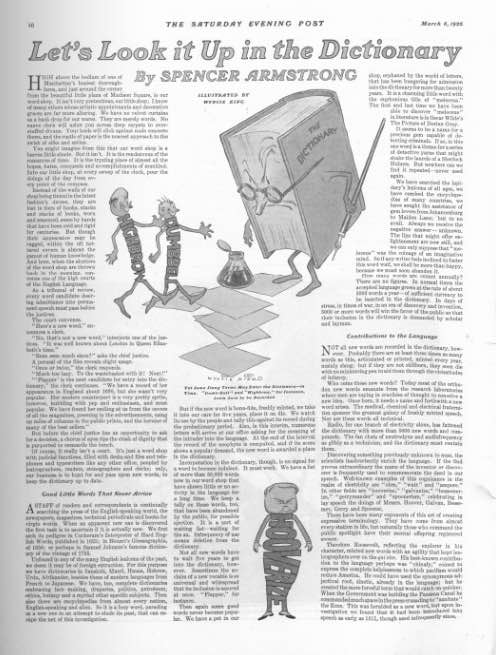
That isn’t to say there aren’t standards for new entries. Fresh vocabulary surfaces in various fashions — technology, politics, culture — but new words have to show robustness and staying power to warrant inclusion in dictionaries. In 1926, the Post’s article “Let’s Look It Up in the Dictionary” observed the process of inducting new words at a Manhattan editing house. Flapper, highbrow, and dumbbell were the new dictionary fare at the time, and meloceus was on the chopping block. “To gain a place in the dictionary, a word must express a thought, or new variance of a thought, that is not in the compendium already,” the author alleges. Furthermore, new language must pass a sort of popularity test, since “infrequency of use means deletion from the dictionary.”
If dictionaries were invented to enlighten the public as well as reflect its language, perhaps they’ve been working. Experts in 1926 estimated that “a college graduate has a command of upward of 20,000 words,” while the average person knew around 10,000. In 2013, data from The Economist revealed that most native English-speaking adults had a vocabulary of 20,000–35,000 words. While the credit for this lexical progress could be due to any number of factors, dictionaries deserve some recognition for our greater literacy.
Comprehension of language and objective meaning comes before all other communication. Dictionaries bridge gaps between social divisions and geographies, rendering the editors at Merriam-Webster and Oxford University Press quite influential after all. “But the lexicographer doesn’t make the language in any sense,” as the Post clarified in 1926; “he merely records the best of it, that which is used or usable. Neither can speakers or authors force new vehicles of speech into the language; not even the President.”
Vintage Dictionary Advertisements
The following item appeared in The Saturday Evening Post on December 27, 1828, shortly after Noah Webster published his American Dictionary of the English Language:
Webster’s Dictionary has been issued from the press of Mr. Converse, the publisher. It is contained in two large quarto volumes, and is executed in a manner highly creditable to the press of our country. He introduces into his new dictionary as legitimate, the word lengthy. We should like to know whether his reasons for doing so are breadthy and strengthy.
Acting as authorities on spelling, meaning, and usage, dictionaries have courted controversy from the beginning. That controversy thickened around the turn of the century as competition grew and copyright became an issue. Dictionary publishers’ disputes and dilemmas can be traced through their advertisements that appeared in the Post over time.

Click to Enlarge
If we had a copy of a Webster’s Dictionary from 1899, we would look up the word adequate to see if there is some older, more superlative definition of the word we don’t know about. It sounds wholly incongruous compared with the hyperbole-heavy advertisements of the 20th century to advertise a dictionary’s “sizable vocabulary, complete definitions and adequate etymologies.”

The University Society’s six-volume Encyclopedic Dictionary was likely more encyclopedia than dictionary, but it did, according to this ad, contain definitions for 250,000 words. This type of blurring of dictionaries as authorities on language and dictionaries as authorities on everything would continue, both in advertisements and in the minds of information-hungry consumers.

Click to Enlarge
In 1909, the Merriam Company issued a completely revised edition of its unabridged dictionary, calling it Webster’s New International Dictionary of the English Language. Readers of the Post were further enticed to buy with the promise of exclusive free gifts — a marketing tactic that lives on today.

Click to Enlarge
At the turn of the century, George W. Ogilvie published what he called Webster’s Dictionary. Since the Merriam Company had bought all rights to Noah Webster’s creation after he died in 1843, a copyright infringement lawsuit naturally followed. In 1908, the First Circuit Court of Appeals ruled that the copyright on the name had run out in 1889 and that “Webster” was in the public domain. That meant that anyone could publish a dictionary and call it Webster’s Dictionary. And many companies did.
Following the ruling, Merriam-Webster ads began including warnings like the one in this full-page 1910 ad: “Caution. Look for the circular trade-mark and our name — MERRIAM — on the title-page. Beware of so-called Webster dictionaries.”

Click to Enlarge
For many children, a dictionary ranks somewhere just ahead of new socks as an exciting Christmas gift. But Santa knows that the knowledge in a dictionary is a gift for the whole family that will be around long after those socks are too threadbare to darn. One can just imagine old Saint Nick attempting to stuff an unabridged dictionary into a Christmas stocking.

Click to Enlarge
Because it was less expensive and more accessible than a multivolume encyclopedia, the dictionary became, for many, the go-to source for information about all facets of life. The Merriam Company seized on this idea and began marketing its unabridged dictionary as “The Supreme Authority.”

Click to Enlarge
An unabridged dictionary is a large, heavy thing. But in the 1910s, the Merriam Company offered a new edition printed on thinner, lighter India paper. The image in this 1912 ad implies that, at only 7 pounds, the India paper edition is so light even a woman can lift it.

Click to Enlarge
Not all publishers attempted to exploit Webster’s name to garner sales. This 1913 ad shows Funk and Wagnalls’ simply named New Standard Dictionary, along with an endorsement from fiction author and Post contributor Jack London. Considering the trend at the time to exclude vulgarities and “substandard” terms — not to mention the sometimes impossible task of tracing word etymologies — it’s unlikely that this dictionary delivered on this ad’s promise to give “the source, spelling, and meaning of every living word in the English language.”

Click to Enlarge
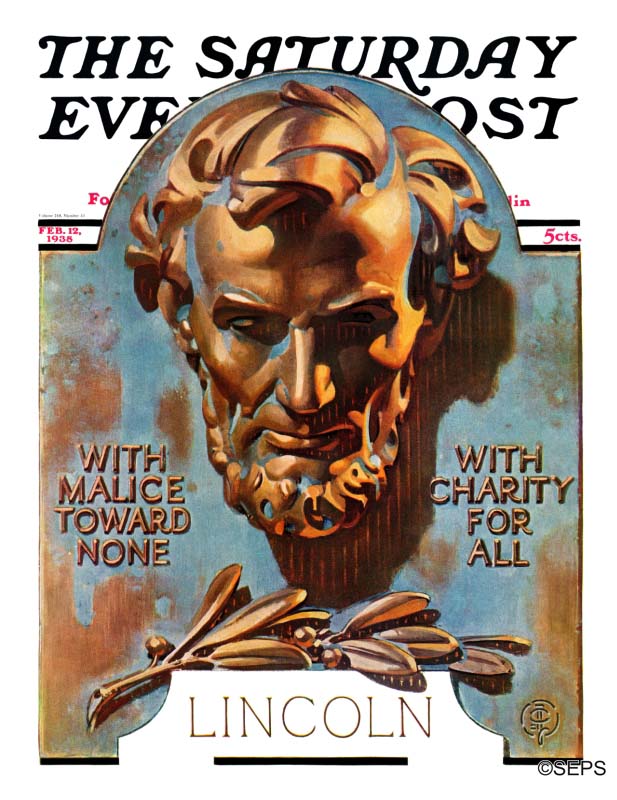
The Merriam Company’s pursuit of its copyright neither began nor ended with the Court’s 1908 decision. In 1917, a suit against the Saalfield Publishing Company resulted in an injunction barring that company from using the title Webster’s Dictionary without including a disclaimer that it wasn’t the original Webster’s Dictionary. Even 20 years later, in ads for its second edition of the New International Dictionary, the Merriam Company was still letting the public know.
Click to Enlarge
In 1938, trouble was brewing in Europe, and dictionary ads of the times offered clarity and understanding for Americans trying to comprehend what was going on “over there.” To this day, dictionaries can offer insight into complex world issues in ways Noah Webster probably never imagined.
The Struggles of Judy Garland
Originally published April 2, 1955.
On-screen, she melted the audience’s hearts. But even at the triumphant peak of her career, Judy Garland worried herself sick. The true story of the dazzling, unhappy star.
I dropped in at Warner Bros. studio in Burbank the other day and found the old battleground strangely demure. The absence of Errol Flynn, Bette Davis, Humphrey Bogart and Ann Sheridan, who kept things in an interesting uproar a few years ago, was not enough to account for the calm. There was a kind of postoperative shock about it.
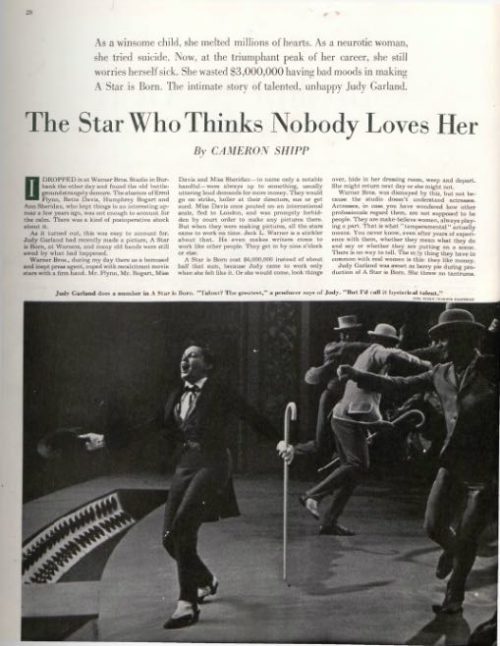
As it turned out, this environmental strangeness was easy to account for. Judy Garland had recently made a picture, A Star is Born, at Warners, and many old hands were still awed by what had happened.
A Star is Born cost $6,000,000 instead of about half that sum, because Judy came to work only when she felt like it. Or she would come, look things over, hide in her dressing room, weep and depart. She might return the next day or she might not.
After finishing this picture, her first in nearly four years, Judy barely had time to sleep late after the premiere before an old and familiar lament echoed through Hollywood. You can hear this bewildering recitative today wherever two or three industry people are gathered together.
It begins invariably with professions of love and esteem. It takes various forms, but the gist is this: “She’s the greatest, that girl. Got the most exciting talent in show business.
Who else can belt over a song like Judy Garland? She’s the greatest, that’s all. I tell you, I love her. I love her, but…”
Judy Garland today is a short, soft-spoken young woman of 32. She has the same naive sort of charm she has exhibited in more than 40 motion pictures. She uses her enormous brown eyes appealingly, like a gracious child. She proves to be an entertaining storyteller and imitator.
On the whole, Judy has made the happiest and most tuneful pictures — but she has been Hollywood’s unhappiest star. Roger Edens, who wrote many of her great song hits, puts it like this: “She ought to enjoy being the enormous international celebrity she is. But she doesn’t enjoy it. She doesn’t know it. She has more talent than anybody who ever came along, but she doesn’t understand that either. Everybody loves Judy, but she thinks nobody loves her.”
When Judy first went to work at M-G-M in 1935, she was 13 years old, thick around the middle and as strong as a pony. She was not especially pretty when Louis B. Mayer and Arthur Freed put her under contract, but she had those swimming dark eyes, a clean fresh kind of charm and the stout torso it takes to sing out a brassy song. She had been singing since she was 3 years old and had been called “little leather lungs.” Years later she said this “leather-lung” title humiliated her — she would rather have been told she was a pretty little girl, or even a nice little girl. Judy liked to sing, everyone at M-G-M recalls, but she hated work and resented authority.
She grew up, literally, before the eyes of millions of spectators.
An Overworked Actress
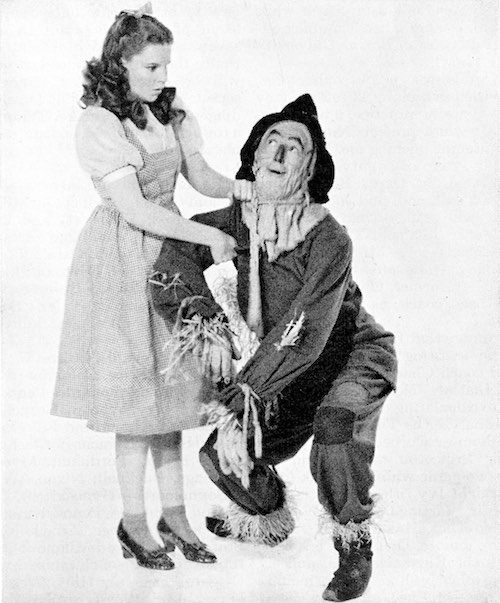
From the beginning, Judy’s pictures were big, requiring long, wearying rehearsals and recording stints, dancing and acting as well as singing. Judy threw herself into each production as if it were a last-ditch stand. But her closest friends insist that she never wanted to be a movie star at all. She merely wanted to sing and would have preferred to make records for jukeboxes.
She had a tendency toward gaining weight, and M-G-M laid down stern dietary laws to Judy, who responded hysterically: She refused to eat either lunch or dinner and kept up this starvation regime for years. Breakfast and then black coffee and cigarettes for lunch and dinner — four packs a day.
Hedda Hopper tells me she once saw Judy trying to do a dance sequence and almost dropping from exhaustion.
“I’m too hungry,” it’s said she told her director.
“Get on with it and you won’t feel hungry,” the director said.
Long hours of lming and starvation exhausted her, and then insomnia set in. Judy’s solution for that problem: She took pills. The next step was pills to wake her up. She became
a virtual automaton, turned off and on by formulas.
Judy earned $5,000 a week, later $150,000 per picture, and saved not a cent. But where the money went, nobody knows.
Judy ceased to be biddable in 1945. She was world-famous, hungry, sleepy and unhappy. She held up productions, a cardinal sin in Hollywood, wept in her dressing room and cried that no one loved her.
In May 1949, Judy walked out on the studio. It began with her refusal to go on with Annie Get Your Gun, produced by her old friend and admirer Arthur Freed. Judy worked for six weeks, recorded all the songs — now collector’s items — then fled from M-G-M at the lunch hour one day and wailed she could not go on.
She was suspended and taken off salary. She was broke. But it was Louis B. Mayer, head of the studio, who sent her to Peter Bent Brigham Hospital in Boston and paid the bill. Judy stayed there 11 weeks, started to sleep regularly and gained weight.
Then the studio called her back for Summer Stock, produced by Joe Pasternak. “Too fat,” they said again. More hysterics and more delays, but the picture was finally finished. It was not a great picture, but it made Judy’s fans happy.
After this, she went right into Royal Wedding. This one she never finished — again she ran — and Jane Powell was called in to take over. The studio suspended her. The long-term contract was dissolved at Judy’s request. This left her alone, jobless and broke. Her reputation for neurotics, delays and temperament was now so widely known that no producer with a clear head would consider her for a picture.
Road To Redemption

But there was a man named Sid Luft. Mr. Luft, a former test pilot for Douglas Aircraft, once private secretary to Eleanor Powell, the dancer, and by this time an independent promoter, is a handsome and muscular fellow who exudes confidence. Luft had little money and was known only as a clever operator, but he appeared virtually out of nowhere and offered Judy the three things she desperately needed — sympathy, strength and a way to escape from M-G-M. He took it for granted that people mean what they say when they profess to love Judy.
Acting fast on this principle, Luft went to M-G-M and had no trouble at all borrowing Roger Edens, who is under contract there, to write a show. He offered the show to London’s famous Palladium, where only the most reliable stars are considered, and the offer was snapped up. Judy opened there on April 10, 1951, tripped and fell flat on her face before a distinguished opening-night audience.
“Go on, Judy, we love you!” the Londoners screamed to her. She went on in concert pitch and scored a damp-eyed triumph.
Later that year she brought vaudeville back to the great Palace Theater in New York. She was overweight again, but when she sang “Over the Rainbow,” Broadway gave Judy, then 29, the kind of sentimental, sobbing welcome usually reserved for the aged great. There has possibly never been a finer personal triumph on stage. Judy collapsed from overwork after six weeks, but she rested a few days, returned and enjoyed a run of 19 weeks. Night after night, audiences called out the old refrain, “Judy, we love you!”
“That was the real start of the Garland Legend,” Roger Edens says. “She did become legend then, but she doesn’t know it yet.”
Sid and Judy brought the show on to Los Angeles and another tearful, shrilling triumph. In the spring of 1952, after columns of speculation had been printed, they were married near Hollister, California. It looked for sure now as if Judy had lived up to her famed “Over the Rainbow” song and had found, at last, what she could do and how to be happy doing it.
But by the end of the year, Judy faced a traumatic legal battle with her mother, with whom she had been estranged for several years. The unsavory story was rehearsed again in the press, and some who used to say ‘‘I love Judy” decided they were wrong. Judy collapsed and went under the care of a doctor.
When Judy finally emerged, it was to make A Star is Born, at Warner Bros., and, as noted in the beginning, she approached this as fearfully as a child in the dark.
“She was terrified,” Luft said the other day. She hadn’t made a picture in nearly four years. “She thought she was through and washed up all over again. That’s why she made that picture so difficult. But she gave an Academy Award performance, didn’t she?”
This article and other features about the stars of Tinseltown can be found in the Post’s Special Collector’s Edition, The Golden Age of Hollywood. This edition can be ordered here.
Was John Brown a Terrorist or a Freedom Fighter?
John Brown was an abolitionist in the mid-1800s who believed that violent confrontation was the only way to overthrow slavery in the United States. His raid of the federal arsenal at Harper’s Ferry, West Virginia, 158 years ago today, on Oct 16, 1859, is widely acknowledged to be one of the major triggers of the Civil War.
Before the raiders were finally subdued by a force led by Col. Robert E. Lee, seventeen people were killed–two slaves, three townsmen, a slaveholder, one Marine, and ten of Brown’s men. Another ten were injured.
Southerners viewed Brown’s actions with fear and shock. They believed that arming slaves and inciting them to rebel was nothing more than terrorism. Many northerners agreed. Brown was swiftly put on trial for treason. When he was hanged on Dec. 2, 1859, he handed a note to a guard with these words: “I, John Brown, am now quite certain that the crimes of this guilty land will never be purged away but with blood. I had, as I now think, vainly flattered myself that without very much bloodshed it might be done.”
The Harpers Ferry raid galvanized the nation, but Brown’s final address to the court, which was published in The Saturday Evening Post and other Northern newspapers, helped convince many that he was a martyr for freedom and not simply a violent criminal.

John Brown’s address to the court, published in The Saturday Evening Post on Nov. 12, 1859:
I have, may it please the Court, a few words to say.
In the first place, I deny everything but what I have all along admitted, the design on my part to free the slaves. I intended certainly to have made a clean thing of that matter, as I did last winter, when I went into Missouri and there took the slaves without the snapping of a gun on either side, moved them through the country, and finally left them in Canada.
I designed to have done the same thing again, on a larger scale. That was all I intended; I never did intend to commit murder or treason, or to destroy property, or to excite or incite the slaves to rebellion and to make an insurrection.
I have another objection, and that is, it is unjust that I should suffer such a penalty. Had I interfered in the manner which I admit, and which I admit has been fairly proved (for I admire the truthfulness and candor of the greater portion of the witnesses who have testified in this case,) had I so interfered in behalf of the rich, the powerful, the intelligent, the so-called great, or in behalf of their friends, either father, mother, brother, sister, wife or children, or any of that class, and suffered and sacrificed what I have in this interference, it would have been all right. Every man in this Court would have deemed it an act worthy of reward rather than punishment. This Court acknowledges, as I suppose, the validity of the law of God. I see a book kissed here which I suppose to be the Bible, or at least the New Testament. That teaches me that all things whatsoever I would that men should do to me, I should do even so unto them! It teaches me further to ‘remember them that are in bonds as bound with them!’ I endeavored to act up to that instruction. I say, I am yet too young to understand that God is any respecter of persons. I believe, that to have interfered as I have done, as I have always freely admitted I have done, in behalf of His despised poor, was no wrong, but right. Now, if it is deemed necessary that I should forfeit my life for the furtherance of the ends of justice, and mingle my blood further with the blood of my children and with the blood of millions in this slave country, whose rights are disregarded by wicked, cruel and unjust enactments, I admit, so let it be done.
Let me say one word further. I feel entirely satisfied with the treatment I have received on my trial. Considering all the circumstances, it has been more generous than I expected, but I feel no consciousness of guilt. I have stated from the first what was my intention and what was not. I never had any design against the life of any person, nor any disposition to commit treason, or excite the slaves to rebel, or make any general insurrection. I never encouraged any man to do so, but always discouraged any idea of that kind. Let me say also, in regard to the statements made by some of those connected with me: I hear it has been stated by some of them that I have induced them to join me— but the contrary is true. I do not say this to injure them, but as regretting their weakness. Not one joined me but of his own accord, and the greater part at their own expense. A number of them I never saw and never had a word of conversation with, till the day they came to me, and that was for the purpose I have stated.
Now I have done.
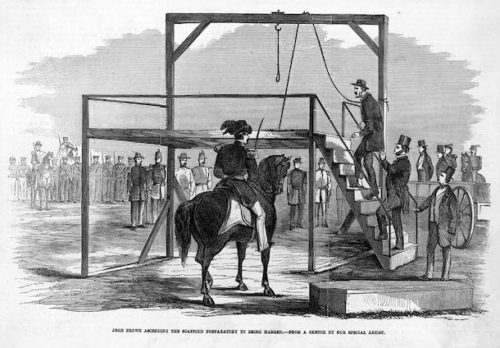
Read the Post’s coverage of John Brown’s speech as it appeared in the November 12, 1859, issue.
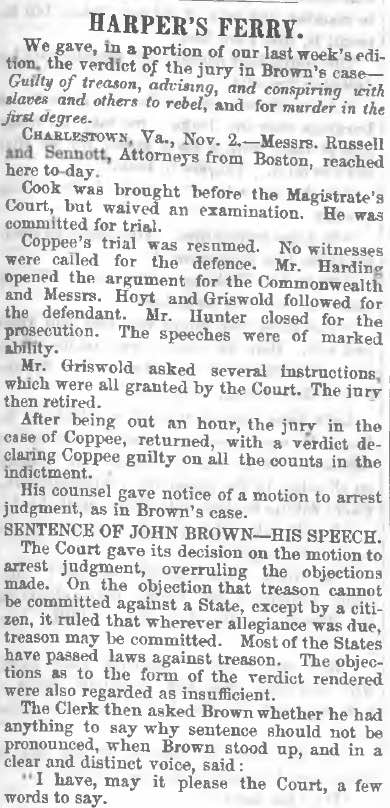
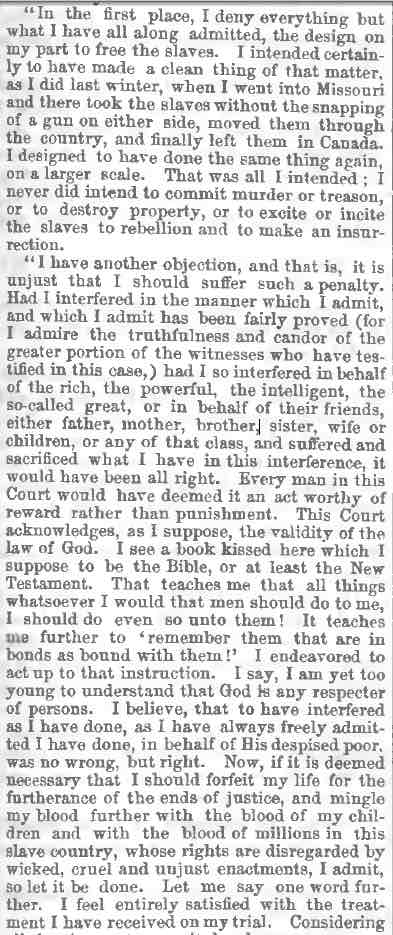
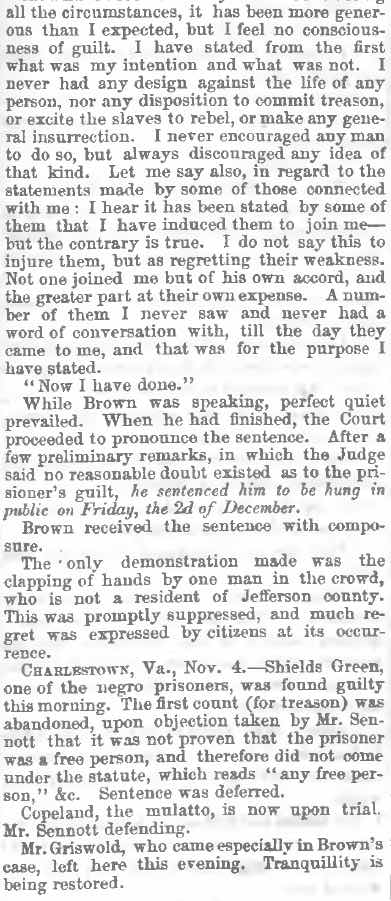
Featured image: “The Tragic Prelude” by John Stewart Curry, United Missouri Bank of Kansas City, Wikimedia Commons

Raymond Chandler
“When in doubt, have a man come through a door with a gun in his hand.” ~Raymond Chandler’s advice for writer’s block
It was Sunday and the deli downstairs was closed. I’d made myself a sandwich from the mini-fridge for lunch and left it sitting by the coffeemaker. You could make a sandwich and then walk away from it, forget it ever happened. It would sit there half-eaten and never glower at you, getting cold, never wonder what time you’d be home for dinner. It was the kind of meal I could get behind.
I sat there going over what I knew about the case. I could see it from every angle except clear through it. I had all the facts — boy, did I have them. I had them from the first wife who now ran a palm reading parlor on Venice and a star jockey out at Santa Anita. I had them from one son who flew in for a day to see his lawyers and the other one, still dressed for what seemed like a good idea at the time, sleeping the heart right out of another Tuesday in his Malibu villa. The light on the breakers was clearer than an angel’s tears. That was the problem with Southern California: It made you feel so good. The sun congratulated you for just crawling out of bed, and by the time you stumbled out to your convertible, all was forgiven.
Except me. I wasn’t getting anywhere, so I got up. The light sliding through the blinds right now was making me feel lousy at my job. I stood there with my back to the room, watching traffic wash down the avenue. Maybe I had something against feeling good. Maybe I had something against being stumped.
There was a knock. I turned around. A man came through the door with a gun in his hand.
Afterwards, they found themselves at the usual Chinese restaurant. A tiny place whose style had departed, like a glamorous daughter. By the register, the obligatory clipping — some critic’s compliments from the early days — was yellowing in plastic.
Anna set the menu down, brass corners clicking on the tabletop.
“I can’t do this anymore,” she announced.
“What, the egg foo young?” said Clive. “I was thinking of trying something different myself.”
Anna began to cry. Clive sighed. “You know, Graham Greene dedicated The End of the Affair to Catherine Walston, but afterwards, they carried on for another 10 years.” Clive had an unhealthy interest in adultery in the abstract. Just once, he thought, I’d like to share with a woman something illicit that wasn’t tawdry. One of those European affairs that leave you with a profound appreciation of human nature.
“I feel so completely stuck in a rut,” said Anna.
Just then, the bell by the front door jangled. A man in a ski mask dashed in with a gun in his hand.
They had come to what always gummed up this stretch: a highway swooping overhead to merge in from the left. Without fail, cars that sailed by the gridlock, merging only at the very last minute, were let in, a lesson Jerry had taken to heart. The freeway was a distillation of the social contract. Someone was going to be an asshole, and someone else was going to look the other way. Out of the corner of his eye he saw a car length open up to the left, but it was too late. A woman in a blue hatchback had closed the gap.
It was the wave that did it. He wrenched in right after her, to the protests of those behind. Women! What was going on in those pretty little heads? That flutter of the hand, like a royal dismissal — was it supposed to be magic? Was it supposed to make everything all right? He fumbled around behind the passenger seat. He’d been saving something up for just such an occasion.
The grip fit in his hand like a hair dryer’s. It even had a strap for his wrist. He rolled down the window.
“Bitch,” he said. The megaphone gave his voice official heft. It carried and echoed. A few drivers looked around, startled from their audiobooks. “Yeah, you in the blue Prius. I mean, the hell were you thinking?”
He flicked on his high beams. Then her brake lights went dark.
He had not thought it humanly possible for him to be more pissed off than he was. Her car was just sitting there before him, in the road.
The door opened and she stepped out with a gun in her hand.
My dad always figured that whatever happened between him and my mom, and later between the two of us, we’d always have the movies. He only ever really opened up to pronounce upon our national dream life. He liked The Magnificent Seven because they “weren’t in it to get rich.” A red-blooded pacifist, he wasn’t above a Bond ending or a good car chase: “like watching money burn.” His idea of generation gap was how your daddy’s assholes inevitably became your idols: Paul Newman in Hud, say, or that con artist Shane. “There’s no anti-hero so low some hungry-hearted pipsqueak won’t give him credence. Next thing you know, Dirty Harry’s no psycho, just your everyday sumbitch with a sailor’s mouth and a heart of gold.” I thought Sergeant Hartman in Full Metal Jacket fit the bill exactly, but when I said so, he almost burst a vein. Six months later, I enlisted. We didn’t speak for three years.
“But these days,” he said the last time we talked, “what really gets my goat is when they can’t be bothered to develop a character we care about, so they put some random kid in danger. No one wants to see that. Sure, Hitchcock himself stooped to it, but it was a cheap twang on the heartstrings even then, and he was the master.”
“It’s a different world, Pops.”
“So they tell me. Anyhow, gotta run, show’s starting.”
I can picture that multiplex perfectly. We wound up there whenever I’d visit. Now when I close my eyes, I see him pocketing his cell phone, ambling down the long slow carpeted slope. Not a single preview leaves him eager, but it gives the yahoos coming in late time to find a seat and crackle open their candy. The movie starts with a bang. Some do-gooder’s getting chased over rooftops. Shots are fired. When the screaming starts, it takes him a minute to figure out it’s coming from the back of the theatre.
In the early hours of November 2, 2013, in Dearborn Heights, Michigan, 19-year-old Renisha McBride stood on the porch of Theodore Wafer, pounding at his door. Her car had broken down, and her cell phone was dead. Her blood alcohol level was at .218 — three times the legal limit — and earlier that evening, she had been smoking marijuana. The door opened, and out came Mr. Wafer with a gun in his hand.
On the night of September 21, 2014, 60-year-old Iphigenia Christian woke up for no particular reason. She had been having trouble sleeping lately, for which her doctor had just that morning prescribed her pills. Remembering she had left them in the kitchen, she went downstairs to look for them. The last thing she saw was her husband, wakened by the noise, coming through the doorway with a gun in his hand.
These are true stories. None of them happened to me, or anyone I know. I read about the first one a week ago, and then the more I read, the more I seemed to find. Psychologists call this “frequency illusion,” in which selective attention is reinforced by confirmation bias, but the colloquial name for it is the “Baader-Meinhof phenomenon,” named for the West German terrorist group also known as the Red Army Faction. A man who’d never heard of them before came up with this name. One day he read about them, and the next thing he knew, there were terrorists everywhere he looked.
This is something that did happen to me: On December 10, 2014, I went to Home Depot with my wife. I guess this is a western, in that my wife is a civilizing influence. When I was a boy I read about a boy and a girl who ran away to a museum. I thought I’d do them one better by running away to a furniture store. Home Depot is kind of like that: a gallery of pretend. There’s a lamp for every kind of lifestyle, more lamps than lives you can ever live, even if you grew up lucky enough to have parents who said you could be anything. The model kitchens make me want to pick a mock domestic spat over some issue my wife and I have yet to face. Not money, we already fight about that. A baby, maybe? She will slam the fridge and cross her arms, and I will flick the tap on and off with an idiot grin, delighted by the lack of water. Through the paneless window we can spy on neighbors waffling over a new dishwasher. But not today. Today we have come shopping for a new front door, one that fits flush and doesn’t let in a draft. A front door is like the face you show the world, she says. In the next department down, doors hang hinged along the aisle like pages in a giant book. One door closes and another opens. Flip, flip, flip. They are running some promotion. Plastered on each door is a life-size Elvis Presley as a cowboy, pistol drawn. The poster is tinged pastel, with DayGlo stars shooting out. I feel dizzy; I have to sit down. My wife asks, “What’s the matter?” but I can’t explain. What should I say? That we’re lucky? That I feel guilty about our luck? That I’m dumb about the problems of the world and don’t know which is worse: that I think we’re safe or that we’re really not, or that no matter how unsafe we are, there will always be someone worse off? I want to hold her and say, in spite of all our problems we have our whole lives ahead of us, but instead I hold my head in my hands. Flip, flip, flip. It’s too ridiculous; it’s just Elvis. It never happens to anyone you know, until someone you know can’t believe it happened to you. Endless choices. Endless doors. And behind every door, a man with a gun in his hand.
When he opens his eyes, the pain is gone. He’s been squeezing them so tightly shut! His tears roll up his cheeks, paths drying behind them along every anguished furrow. They tremble at the edge of his lower lid till, with a blink, he scoops them back inside his eye. Of course his skin is still clammy and his heart a-hammer. Relax, he tells himself, and to his surprise it works — it never seems to at the office. He stretches one leg out and then the other. Was he really in a fetal curl? A woman comes darting at him sideways. Unthinkingly, he receives her with a kick. Before he can apologize, a scream comes funneling back to his wide-open mouth; he gulps it down. His throat feels raw. She backpedals away from him, waving her arms, streaks of mascara vanishing from her cheeks. He clambers out from under the row of seats by the gate.
All around him, people are jogging backward through the terminal. He joins them. When in Rome … Some stop and, without breaking stride, pick up bags they’ve dropped. Others stumble and fall, but they get up again. A flood of Coke sweeps ice cubes back into an empty cup, and when it bounces from the ground, a man’s hand is there to catch it. Nice, he nods at the man. Suddenly, he coughs a piece of gum into his mouth. With every chew it seems to get some snap back, bursts of flavor wriggling into the elastomer. He loves gum, he remembers.
He whips his head around just in time to catch another scream: the delicious whoompf of air in his mouth, a quick pump of receiving gut. His throat feels better with every scream he swallows. There’s a fever in the air, catching. Everyone is swallowing their screams. Is it some new fad?
A whizzing past his ear. From behind, a harsh staccato chatter he knows only from action movies. Wait, so that’s what this is, right? Of course! They’re shooting an action movie at the airport. Why didn’t he remember? Everyone, everything, is being recalled for a second take. A bullet is plucked from a wall; splintered plaster rushes to fill the gap. Another one removes a puncture from a garbage can. A stuntman collects his shattered shin from the floor. This is some next-level stuff! The bullets are thicker in the air now. He backpedals on, chewing gum, untouched. How do you know you’re the hero? he remembers a stuntman telling him once. The bad guys are missing you as closely as possible, expertly accommodating the fickle akimbo of each balletic dodge, like the circus knife-thrower in unrequited love with his bewitching assistant. He must be a hero. He feels his legs pump. It’s like he’s watching himself already. Will he ever do better than this?
But back at security, nothing is explained. There’s a lot of pushing and shoving to get back in line, people insisting on the exact order they were in before. Continuity is key. Where are the cameras? TSA seems to be filling in for PAs on crowd-wrangling duty. The bad guy — is there only one? — seems really angry about the do-over, on the verge of a diva freakout. The guards hold out their hands, trying to calm him down. Finally, the man lowers his assault rifle. The crowd lets out a held breath.
He feels his heart slowing, adrenaline draining away. The worst part of these shoots? The wait.
One last glance and he’s checking his phone, the man with the gun completely forgotten. Around him: grumbling about security checkpoints, anxiety about making flights. His saliva has almost finished restoring full flavor to the gum, just a little more prodding and smoothing. Out it comes with a trick of the tongue, clean-smelling and freshly powdered. He nestles it lovingly, absently in its foil wrapper: a matter of habit, not thought. The little acts we take for granted, in which such care inheres, like pulling covers over a loved one — for, having done them so often, it seems we will go on doing them forever. He slides the stick in beside five others just like it, and tucks the pack into his jacket pocket. Unnoticed, a man backs through the glass doors, just another in a crowd of the coming and going.
News of the Week: Bad Weather, Pillsbury Dough, and the Rise and Fall of Stamp Collecting
October Surprise
Muggy today.
Muggy is not a word that should be used after Columbus Day. I’ll accept crisp, cool, and even apple-picking, but not muggy (or any of its sister words: humid, stifling, oppressive). This is October. Hockey season has begun. There are already Thanksgiving decorations at the supermarket. Shouldn’t we be wearing pants instead of shorts and drinking hot tea instead of iced?
I don’t know what the weather has been like where you are, but here in New England it feels like June or July. It has actually been rather depressing. Sure, I really dislike summer weather anyway (what many would consider “nice weather” I consider “bad weather”), but I sense that even people who live in flip-flops and love the beach are wondering when they can put their air conditioners away until next year.
Eat Love? Nay!
You can find a lot of things in granola: nuts, fruit, grains, brown sugar. But one thing you won’t find (and can’t eat) is “love.”
That’s the finding of the Food and Drug Administration in their case against the Nashoba Brook Bakery in Massachusetts, which for years has listed “love” as one of the ingredients on the granola they make and sell. Of course, the bakery wasn’t saying that there was an actual ingredient they put in the granola called “love.” It was more about the love and care they put into the making of their products. But the FDA says no, you can’t do that. They ruled that “a human emotion cannot be an ingredient in baked goods,” a line that has a sort of poetry about it.
This ruling has gotten a lot of attention, but what got a bit lost in the story is that the bakery has a few actual health code violations they have to deal with. But the company says they’ve already dealt with those problems.
Pillsbury Dough (Now with Less Dough)
There are changes afoot at The Pillsbury Bake-Off.
Since 1996, the company has given $1 million to the grand prize winner of the cooking contest (along with lesser amounts for other competitions within the contest). Before that, they gave $25,000. With the return of the contest this year — the most recent year for the contest was in 2014, with the winning recipe being Peanutty Pie Crust Clusters — Pillsbury is making several changes that might irk some longtime fans and participants.
First, they’re dropping the $1 million prize and going with $50,000. Now, that might seem like a lot less money, and it is, but the winner also gets a complete kitchen makeover from General Electric, an article in Food Network Magazine, and a guest appearance on Food Network’s The Kitchen. The total prize package is now around $92,000. I don’t know if cooks will find those things an adequate replacement for the million, but that’s the reality of the situation this time around.
Also, the contest is now completely online. You have until November 10 to get in your recipes for Cozy Breakfasts, Appetizers for Any Party, Dinners with Heart, and No-Fuss Desserts. Three winners will be named in each category, and the big winner from those winners.
Make sure you check the official rules to see if “love” is an acceptable ingredient.
Whatever Happened to Philately?
Stamp collecting has always seemed like a Herculean hobby to me. So many stamps, so many themes, how do you even know where to begin? But it’s also something I’ve always wanted to do.
This New York Times op-ed by a former stamp collector is rather sad. The author actually got rid of his stamp collection recently, even though he had an emotional attachment to it. With everyone paying bills online and stamps being produced in a cheaper way, he feels he’s being realistic about giving up his hobby.
But is being realistic even part of having a hobby? Even if people aren’t sending as many letters as they once did, does that make the collecting any less enjoyable or important? I would think that these factors would make stamp collecting even more enjoyable and necessary. Then again, as someone who still sends out letters, I have a soft spot in my heart for stamps and envelopes and the smell and feel printed matter.
I draw the line at quill pens though.
Overload
We are drowning in news and information. We have 24-hour news channels and social media, and it seems like a never-ending flow of information and words and pictures are streaming into our heads every single day. I used to laugh at people who needed “digital detox” days or breaks from technology, but I understand it completely. As this Guardian piece notes, our brains are being hijacked. I actually think that getting away from it all once in a while can give us a better perspective on the world when we come back to our computers and phones.
Ex-Face the Nation host Bob Schieffer has a new book out, Overload: Finding the Truth in Today’s Deluge of News, which delves into how all of the media and technology changes are not only affecting how news is reported but how we consume it. It could even be dangerous.
Schieffer interviewed 40 journalists for the book.
RIP Ralphie May, Bob Schiller, Y.A. Tittle, Mark Mooney, Nora Johnson, Elizabeth Baur, and Jack Good
Ralphie May was the big, beloved standup comic who came in second on the first Last Comic Standing on NBC in 2003. He died last Friday at the age of 45.
Bob Schiller was one half of a great comedy writing team with Bob Weiskopf. They wrote for I Love Lucy (including the famous “grape-stomping” episode and some of the episodes where the Ricardos and Mertzes visit Hollywood) and later for shows like All in the Family, Maude, and The Carol Burnett Show. Schiller died Tuesday at the age of 98.
Y.A. Tittle was a Hall of Fame quarterback who helped lead the New York Giants to three consecutive championship games and was seen in one of the iconic sports photographs of the 20th century. He died Sunday at the age of 90.
Mark Mooney was a veteran reporter who wrote one of the great goodbye columns in journalism history. He died last Friday at the age of 66.
Nora Johnson wrote the classic novel The World of Henry Orient, later made into a film starring Peter Sellers, along with other works. She died last Thursday at the age of 84.
Elizabeth Baur played Officer Fran Belding on Ironside and co-starred on the western Lancer. She also appeared in movies like The Boston Strangler and TV shows like Emergency! and Remington Steele. She died in late September at the age of 69.
Jack Good was an influential music and TV producer who changed how television presented rock and pop to British and American audiences with shows like Shindig!, Oh Boy!, and Six-Five Special. He died in September at the age of 86.
This Week in History
The Great Chicago Fire (October 8–10, 1871)
The classic story is that a cow owned by a Mrs. O’Leary started the fire that destroyed much of the city, killed as many as 300, and left a third of the citizens homeless by knocking over a lamp, but there’s always been some skepticism about that. It might have been caused by gamblers knocking over a lantern or simply related to other fires that were happening in the area at the time.
Eleanor Roosevelt Born (October 11, 1884)
Did the former First Lady write for the Post? She did! Roosevelt wrote a five-part series in 1958 in which she gave her opinion of several people, including Winston Churchill, Richard Nixon, and John F. Kennedy. Five years earlier, she appeared as the mystery guest on What’s My Line?
This Week in Saturday Evening Post History: Flirting Soda Jerk (October 11, 1947)
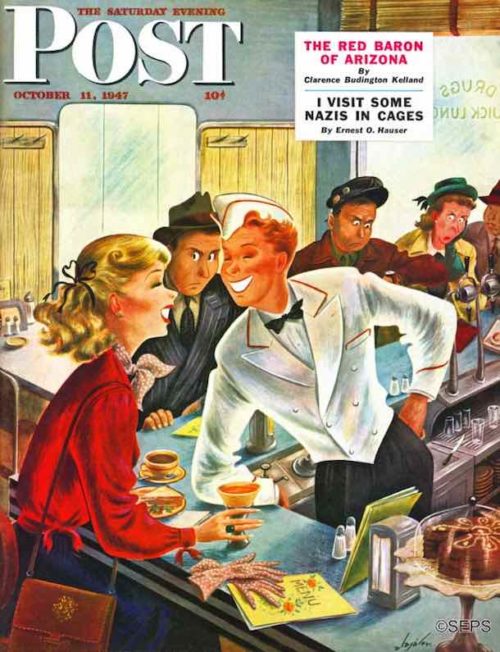
Constantin Alajalov
October 11,1947
I was looking at these pictures of beautiful soda fountains that I’d love to visit (road trip anyone?) and wondering, do soda jerks still exist? They do, of course, though I wonder if teens today would like being called “jerks” in any context. I love this cover by Constantin Alajálov. It’s very 1940s, with its sharp lines and big grins and all the men in hats, irritated that the guy in the paper hat is paying more attention to the cute girl at the counter instead of refilling their coffees.
National Yorkshire Pudding Day
Like a lot of people, I used to think that Yorkshire Pudding was, well, pudding. English pudding, but pudding nonetheless, a chocolate, gooey concoction you ate with a spoon. But I found out a few years ago that it’s actually a type of popover. Okay, so I’m not completely up to speed on my food knowledge.
Today is National Yorkshire Pudding Day, so here’s a recipe for a classic version and here’s a recipe for what we call Anytime Popovers.
Today is also Friday the 13th. That has nothing to do with Yorkshire Pudding, but it seems odd not to mention it.
Next Week’s Holidays and Events
Dictionary Day (October 16)
When I was a kid, I used to read the dictionary. Not just once in a great while when I needed the definition or correct spelling of a word; I read it all the time, for pleasure, like kids read Harry Potter. There’s something fascinating about words, their origins, and their meanings. I even love how a dictionary is formatted, and even though we now live in a world when dictionaries are just a few clicks away, a big old Webster’s or Oxford or American Heritage are still something we should all own.
Boss’s Day (October 16)
This holiday was started by Patricia Bays Haroski in 1958. Some people don’t think much of the day, but I’d like to take this opportunity to say that my boss is the nicest, kindest, best-looking person on the planet.
Thrills! Chills! Ratings! The Allure of America’s Midnight Horror Shows
Nobody likes to watch scary movies alone. A charming onscreen host to break up the tension of Son of Dracula or (god forbid) The Wasp Woman with spooky shtick was a successful television formula for decades.
Vampira was one such horror hostess, and probably the first, in 1954. In KABC-TV’s The Vampira Show, the femme fatale with a 17-inch waist creeps toward the camera through a foggy cemetery and lets out a shriek. “Screaming relaxes me so,” she says. Every horror host had a signature introduction and tone, from Doctor Lucifer and Sammy Terry to Sinister Seymour and Elvira. When did these ghoulish emcees die off?
The start of the midnight movie phenomenon is documented in the Post’s 1958 article, “TV’s Midnight Madness.” When Associated Artists Productions and Columbia Picture’s Screen Gems starting selling packages of old monster movies to local television stations in 1957, it seemed the dated, cheesy films would need an extra element to appeal to audiences. Philadelphia’s John Zacherle played a tall undertaker-like character named Roland in WCAU’s Shock Theater. His gimmicky sketches and interaction with viewers alongside films like Cry of the Werewolf and Murder on a Honeymoon were a big hit. In fact, “an American Research Bureau survey showed it even outranking such network favorites as Ed Sullivan and Studio One,” and “in some cities, the weirdie films earned ratings for their stations 10 or 12 times what they had been.” A new style of television was born.
Various manners of horror hosts spawned across the U.S.: snarky, outlandish, creepy, and shocking. Fan letters were a staple in Zacherle’s show. When he asked fans to send in three hairs from their head to make a pillow for his undead — and offscreen — wife, 23,000 letters came into the station.

In Los Angeles and New York City, Fright Night was a long-running program with hosts Larry Vincent and, later, Moona Lisa. Elvira’s Movie Macabre replaced the show in 1981 and pushed the envelope of horror hosts with its sexually suggestive goth bombshell. Elvira’s risqué quips and criticism of the show’s B-horror features earned her a top spot in cult fandom.
Today, horror hosts are as much a part of nostalgia as the monster movies they often introduced. With the transformation of television to cable providers and streaming services, local talent decked out in capes and fangs doesn’t make the airwaves anymore. That isn’t to say that horror has gone away; the genre is as popular as ever. Last month the newest film adaptation of Stephen King’s It opened to the most successful weekend in horror movie history. On television, episodic horror series are ever-popular. American Horror Story, The Walking Dead, and Stranger Things have masses of viewers. Even The X-Files is getting a second chance.
In “TV’s Midnight Madness,” author Roul Tunley claims that Western society’s fascination with fright traces back to Greek theater and was prevalent in Shakespeare and Goethe: “Down through the ages, both audiences and playwrights have realized that one of the simplest ways of exorcising personal ghosts is by having them hauled out in public in a spine-tingling play.” Tunley concluded that “the current preoccupation with shock entertainment and movie horror may represent an escape from the real horror all around us.” The same psychological phenomenon may explain popularity of gorier, more horrifying tropes today. The only difference is the lack of a jocular persona to guide us through the nightmare.

Saving His Music: A Story of Memory and Meaning

All his life, Steve Goodwin had been a private man. No matter the circumstances, he’d say he was doing just fine. But as he sat in his Wilsonville home that Monday morning, he wasn’t fine.
Over the weekend, he’d argued with his youngest daughter, Melissa. The blow-up ended when his daughter, her voice shaking and tears in her eyes, opened the front door to her home and told him to leave.
As is the case in all families, they’d had minor disagreements before. But Saturday’s battle had been raw. Steve knew he needed to set things straight. It was time to reveal his secret.
With paper and pen, he retreated to a quiet place in his home. He struggled to find the right words, to explain why he’d been so different these past months. When finished, he told his wife, Joni, he was ready.
She called Melissa, who lived three blocks away. After she arrived, they gathered in the living room and made small talk. Then, from a shirt pocket, Steve pulled out his handwritten notes.
Mom and I saw a neurologist. I have a spot in my brain. I am being honest. If this progresses into Alzheimer’s, I know what it is like. I saw my mom. I experienced the pain of her personality changing, her being unkind to me and saying hurtful things.
If I ever do or say anything hurtful, I want you to know that I am sorry.
No matter what I do and say, you are my little girl and I love you.

Photo: Beth Nakamura/The Oregonian
Tears and hugs. Questions with no answers. Fear and doubt bubbling below the surface as each grappled with dark thoughts, knowing the family would be forever changed.
For Melissa, the bitter news explained so much.
The argument, so out of character for her father, started after her parents came over to help take down her Christmas tree because Melissa’s husband wasn’t home.
While Melissa removed ornaments and lights, her parents kept an eye on the boys, 2 and 4, who ran through the house, loud and wound up.
Melissa noticed her father, always so easygoing, was clearly irritated with the boys. She figured he hadn’t yet had his morning coffee. She climbed off the ladder and made him a cup. It didn’t help. Within the confines of the living room, the tension built.
And then he snapped at the boys.
Melissa, feeling protective, confronted her father. She didn’t know what was wrong with him. She yelled, then cried and said it was time for her parents to leave.
What was happening with dad?
Now she knew.
But the real change, she realized, began the previous summer. She’d been at her parents’ house, and she’d asked her father to play his piano, something he’d done all her life. Steve was a software engineer by profession, but music was his true passion. Growing up, Melissa and her sister fell asleep each night to his music. Decades later, the music allowed Melissa, now in her late 30s, to forever be the little girl who so loved her father.
“My father expressed himself through his music,” Melissa said. “That’s how I knew what was in his heart.”
On that summer day, she watched in confusion as her father, always so smooth and proficient, fumbled and stopped. He said he hadn’t been practicing. Now she knew the truth.
Now, they were on a race to save the music. Read the rest of the story and hear Steve Goodwin’s music.
Tom Hallman Jr. is a Pulitzer Prize–winning journalist at The Oregonian and author of several books. His work has appeared in Esquire, Men’s Health, Reader’s Digest, and other magazines.
This is an excerpt of the article featured in the November/December 2017 issue of The Saturday Evening Post. Subscribe to the magazine for more art, inspiring stories, fiction, humor, and features from our archives.
Curtis Stone’s Seasonal Autumn Side Dishes
Freshen up your autumn dinners with these two delicious seasonal side dishes from celebrity chef Curtis Stone.
Butternut Squash with Sage and Brown Butter

(Makes 6 servings)
Although the coming of autumn conjures thoughts of pumpkins, both carved up and in pies, the pumpkin’s cousin, the butternut squash, offers an alternative culinary opportunity for your dining delight. This recipe includes toasted shelled pumpkin seeds, so after you’re done carving your jack-o’-lantern, put the seeds you scooped out to good use — or just buy them already prepared in the produce department.
- 2 butternut squash (about 1 pound each), peeled, halved, seeded, and cut into 2-inch cubes
- 2 tablespoons olive oil
- Kosher salt and freshly ground black pepper
- 2 tablespoons unsalted butter, diced
- ¼ cup thinly sliced fresh sage leaves
- 2 tablespoons toasted shelled pumpkin seeds (pepitas)
- 1 ounce Parmesan cheese, shaved
Preheat the oven 450°F. On large heavy baking sheet, toss squash with oil to coat and season with salt and pepper. Scatter butter over squash. Roast squash for about 20 minutes, or until it begins to soften and turn golden brown. Scatter sage over squash and toss well. Continue roasting for about 15 minutes, or until squash is tender and well caramelized. Season to taste with salt and pepper. Divide the squash among 6 plates, sprinkle with pumpkin seeds and cheese, and serve immediately.
Make-Ahead: The butternut squash can be cut up to 6 hours ahead, covered, and refrigerated.
Per Serving:
Calories: 186
Total Fat: 16 g
Saturated Fat: 5 g
Sodium: 611 mg
Carbohydrate: 7 g
Fiber: 2 g
Protein: 5 g
Diabetic Exchanges: 1½ vegetable, ¼ Dairy, ¼ lean protein; 2½ fat
Pan-Roasted Brussels Sprouts with Chorizo
(Makes 4 servings)
September to mid-February is peak season for Brussels sprouts. This vegetable has gotten a bad reputation for being bitter, but when prepared well, it can add a complex and delicious flavor to your meal.
- 1 teaspoon caraway seeds
- 2 tablespoons olive oil
- 1 ½ pounds Brussels sprouts (about 20 medium), halved and tough outer leaves removed
- 2 scallions, trimmed and thinly sliced
- ¼ cup diced Spanish chorizo
- Kosher salt and freshly ground black pepper
In small heavy skillet, stir caraway seeds over medium heat for about 2 minutes, or until toasted and fragrant. Transfer seeds to spice grinder or mortar and pestle and grind to powder.
Heat large heavy skillet over medium heat. Add oil; then add Brussels sprouts, scallions, and chorizo and sauté for about 5 minutes, or until Brussels sprouts are tender and beginning to caramelize. Mix in ground caraway. Season to taste with salt and pepper and serve immediately.
Make-Ahead: The Brussels sprouts can be prepped and the chorizo diced up to 4 hours ahead, covered, and refrigerated.
Per Serving:
Calories: 132
Total Fat: 9.2 g
Saturated Fat: 0
Sodium: 667 mg
Carbohydrate: 10 g
Fiber: 5 g
Protein: 5 g
Diabetic Exchanges: 2 vegetable, ¼ lean protein, 2 fat
Excerpted from Good Food, Good Life by Curtis Stone. Copyright © 2015 by Curtis Stone. Excerpted by permission of Ballantine Books, a division of Random House LLC. All rights reserved. No part of this excerpt may be reproduced or reprinted without permission in writing from the publisher.