An Inn-to-Inn Leaf-Peeping Driving Tour of Coastal Maine
This self-guided itinerary spans Kennebunkport to Bar Harbor, touring you through vibrant autumn landscapes and quaint New England towns and ending each day at a luxury inn. The inns featured in this tour are considered some of Maine’s finest and are renowned for their lavish accommodations, multi-course gourmet breakfasts, and friendly innkeepers who provide insider tips for the best sightseeing and photo ops. Start with Walker’s Point, summer home to President George H.W. Bush; next, it’s on to Portland Head Light, one of the first lighthouses in the country; you’ll also visit Damariscotta River, Acadia National Forest, and the islands around Penobscot Bay. Along the way are farm markets abounding with seasonal provisions, boutiques selling local handicrafts, and eateries where you can sample lobster and other local fare. Rates for the inns range from $150 to $295 per night, and all include cooked-to-order breakfast (innsalongthecoast.com/7-day-fall-tour).
This article is featured in the September/October 2017 issue of The Saturday Evening Post. Subscribe to the magazine for more art, inspiring stories, fiction, humor, and features from our archives.
“Baby Talk” by Rupert Hughes
The wisest thing Professor Stuart Litton was ever caught at was the thing he was most ashamed of. He had begun to accumulate knowledge at an age when most boys are learning to fight and to explain at home how they got their clothes torn. He wore out spectacles almost as fast as his brothers wore out copper-toed boots; but he did not begin to acquire wisdom until he was just making forty. Up to that time, if the serpent is the standard, Professor Litton was about as wise as an angleworm.
He submerged himself in books for nearly 40 years; and then — in the words of Leonard Teed — then he “came up for air.” This man Teed was the complete opposite of Litton. For one thing he was the liveliest young student in the university where Litton was the solemnest old professor. Teed had scientific ambitions and hated Greek and Latin, which Litton felt almost necessary to salvation. Teed regarded Litton and his Latin as the sole obstacles to his success in college; and, though Litton was too much of a gentleheart to hate anybody, if he could have hated anybody it would have been Teed. A girl was concerned in one of their earliest encounters, though Litton’s share in it was as unromantic as possible.
Teed, it seems, had violated one of the rules at Webster University. He had chatted with Miss Fannie Newman — a pretty student in the Woman’s College — after nine o’clock; nay, more, he had sat on a campus bench bidding her good night for half an hour, and, with that brilliant mathematical mind of his, had selected the bench at the greatest possible distance from the smallest cluster of lamp-posts.
On this account he was haled before the disciplinary committee of the faculty. Litton happened to be on that committee. Teed made the best fight he could. He showed himself a Greek — in argument at least — and, like an old sophist, he tried to prove: first, that he was not on the campus with the girl; second, that if he had been it was too dark for them to be seen; and third, that he was engaged to the girl anyway and had a right to spoon with her.
The accusing witness was a janitor whom Teed had played various jokes on and had neglected to appease with tips. Teed submitted him to a fierce cross-examination; forced him to admit that he could not see the loving couple and had identified them solely by their voices. Teed insisted on the exact words overheard; and, as often happens to the too-ardent cross-examiner, he got what he asked for and wished he had not. The janitor, blushing at what he remembered, pleaded:
“You don’t vant I should say it exectly vat I heered?”
“Exactly!” Teed answered in his iciest tone.
“Veil,” the janitor mumbled, “it vas such a foolish talk as — but — veil, ven I come by I hear voman’s voice says: ‘Me loafs oo besser as oo loafs me!” Teed flushed and the Faculty sat forward. “Den I hear man’s voice says: `Nozie-vozie, mezie-vezie — ’ Must I got to tell it all?”
“Go on!” said Teed grimly; and the old German mopped his brow with anguish and snorted with rage:
“‘Mezie-vezie loafs oozie-voozie bestest!’”
The purple-faced members of the faculty were hanging on to their own safety valves to keep from exploding — all save Professor Litton, who felt that his hearing must be defective. Teed, fighting in the last ditch, said:
“But such language does not prove the identity of the — er — participants. You said you knew positively.”
The janitor, writhing with disgust and indignation, went on:
“Ven I hear such nonsunse I stop and listen if it is two people escapet from de loonatic house. And den young voman says: ‘It doesn’t loaf its Fannie-vannie one teeny-veeny mite!’ And young man says: ‘So sure my name iss Lennie Teedie-veedie, little Fannie Newman iss de onliest gerl I ever loafed!’”
The cross-examiner crumpled up in a chair, while the members of the faculty behaved like children bursting with giggles in church — all save Litton, who had listened with increasing amazement and now leaned forward to demand of the janitor:
“Mr. Kraus, you don’t mean to say that two of our students actually disgraced this institution with conversation that would be appropriate only to a nursery?”
Mr. Kraus thundered:
“De talk of dose stoodents vould disgrace de nursery! It vas so sickenink I can’t forget ut. I try to, but I keep rememberink Oozie-voozie! Mezie-vezie!”
Mr. Kraus was excused in a state of hydrophobic rage and Teed withdrew in all meekness.
Litton had fallen into a stupor of despair at the futility of learning. He remained in a state of coma while the rest of the committee laughed over the familiar idiocies and debated a verdict. Two of the professors, touched by some reminiscence of romance, voted to ignore the incident as a trivial commonplace of youth. Two others, though full of sympathy for Teed — Miss Fannie was very pretty — voted for his suspension as a necessary example, lest the campus be overrun by duets in lovers’ Latin. The result was a tie and Litton was roused from his trance to cast the deciding vote.
Now Professor Litton had read a vast amount about love. The classics are full of its every imaginable version or perversion; but Litton had seen it expressed only in the polished phrases of Anacreon, Bion, Propertius and the others. He had not guessed that, however these men polished their verses, they doubtless addressed their sweethearts with all the imbecility of sincerity.
Litton’s own experience gave him little help. In his late youth he had thought himself in love twice and had expressed his fiery emotions in a Latin epistle, an elegy, and a number of very correct Alcaics. They pleased his teacher, but frightened the spectacles off one bookish young woman, and drove the other to the arms of a prescription clerk, who knew no Latin except what was on his drug bottles.
Litton had thenceforward been wedded to knowledge. He read nearly everything ancient, but he must have forgotten the sentence of Publilius Syrus: “Even a god could hardly love and be wise.” He felt no mercy in his soft heart for the soft-headed Teed. He was a worshiper of language for its own sake and cast a vote accordingly.
“I do not question the propriety of the conduct of these young people,” he said. “Mr. Teed claims to be engaged to the estimable young woman.”
“Ah!” said Professor Mackail delightedly. Teed was the brightest pupil in his laboratory and he had voted for acquittal. His joy vanished as Professor Litton went on:
“But” — he spoke the word with emphasis — “but, waiving all questions of propriety, I do feel that we should administer a stinging rebuke to the use of such appallingly infantile language by one of our students. Surely a man’s culture should show itself, above all, in the addresses he pays to the young lady of his choice. What vanity to build and conduct a great institution of learning, such as this aims to be, and then permit one of its pupils to express his regard for a student in the Annex in such language as even Mr. Kraus was reluctant to quote: ‘Mezie-wezie loves oozie-woozie bestest!’ — if I remember rightly. Really, gentlemen, if this is permitted we might as well change the university to a kindergarten. For his own sake I vote that Mr. Teed be given six months of meditation at home; and I trust that the Faculty of the Woman’s College will have a similar regard for its ideals and the welfare of the misguided young woman.”
Professor Mackail protested furiously, but his advocacy only embittered Litton — for Mackail was the leader of the faction that had tried for years to place Webster University in line with others by removing Latin and Greek from the position of required studies.
Mackail and his crew pretended that French and German, or science, were appropriate substitutes for the classic languages in the case of those whose tastes were not scholastic; but to Litton it was a religion that no man should be allowed to spend four years in college without at least rubbing up against Homer, Æschylus, Vergil and Horace.
As Litton put it: “No man has a right to an Alma Mater who doesn’t know what the words mean; and nobody has a right to graduate without knowing at least enough Latin to read his own diploma.”
This old war had been fought with all the bitterness and professional jealousy of scholarship, which rival those of religion and exceed those of the stage. For yet a while Litton and his followers had vanquished opposition. He little dreamed what he was preparing for himself in punishing Teed.
Teed accepted his banishment with poor grace but a magnificent determination to come back and graduate. The effect of his punishment was shown when, after six months of rustic meditation, he set out for the university, leaving behind him his Fannie, who had been too timid to return to the scene of her discomfiture. Teed’s goodbye words ran something like this:
“Bess its ickle heartums! Don’t se care! Soonie as Teedle-weedle gets graduated he’ll get fine job and marry his Fansy-Pansy very first sing.” Then he kissed her “Goo’byjums” — and went back with the face of a Regulus returning to be tortured by the enemy.
II
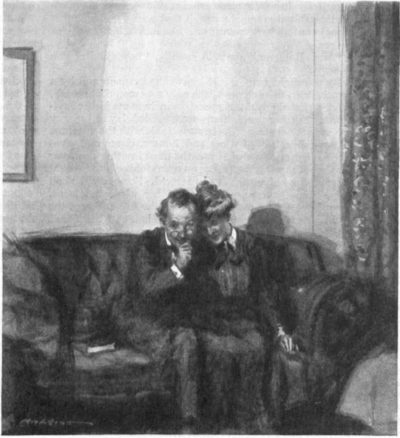 Teed had a splendid mind for everything material and modern, but he could not and would not master the languages he called dead. His mistranslations of the classics were themselves classics. They sent the other students into uproars; but Litton saw nothing funny in them. When he received Teed’s examination papers he marked them with a pitiless exactitude.
Teed reached the end of his Junior year with a heap of conditions in the classics. Litton insisted that he should not be allowed to graduate until he cleaned them up. This meant that Teed must tutor all through his last vacation or carry double work throughout his Senior year — when he expected to play some patriotic or Alma-Matriotic football.
Teed had no intention of enduring either of these inconveniences; he trusted to fate to inspire him somehow with some scheme for attaining his diploma without delay. His future job depended on his diploma — and his girl depended on his job.
He did not intend to be kept from either by any ancient authors. He had not the faintest idea how he was going to bridge that chasm — but, as he wrote to his Fansy-Pansy, “Love will find the way.”
While Teed was taking thought for the beginning of his lifework Litton was completing his — or at least he thought he was. With the splendid devotion of the scholar he had selected for his contribution to human welfare the best possible edition of the work least likely to be read by anybody. A firm of publishers had kindly consented to print it — at Litton’s expense.
Litton would donate a copy to his own university; two or three college libraries would purchase copies out of respect to the learned professor; and Litton would give away a few more. The rest would stand in an undisturbed stack of increasing dust, there to remain unread as long perhaps as the myriads of Babylonian classics that Assurbani-pal had copied in brick volumes for his great library at Nineveh.
Professor Litton had chosen for his lifework a recension of the ponderous epic in 48 books that old Nonnus wrote in Egypt, the labyrinthine Dionysiaka describing the voyage of Bacchus to India and back.
A pretty theme for an old water-drinker who had never tasted wine! But Litton toiled over the Greek text, added copious notes as to minute variants, appallingly learned prolegomena, an index, and finally an English version in prose. He had begun to translate it into hexameters, but he feared that he would never live to finish it. It was hard enough for a man like Litton to express at all the florid spirit of an author whose theme was “the voluptuous phalanxes” of Bacchus’ army — “the heroic race of such unusual warriors; the shaggy satyrs; the breed of centaurs; the tribes of Sileni, whose legs bristle with hair; and the battalions of Bassarids.”
He had kept at it all these years, however, and it was ready now for the eyes of a world that would never see it. He had watched it through the compositors’ hands, keeping a tireless eye on the infinite nuisance of Greek accents.
He had read the galley proofs, the page proofs, and now at last the black-bordered foundry proofs.
He scorned to write the bastard “O. K.” of approval and wrote, instead, a stately “Imprimatur.” He placed the proofs in their envelope and sealed it with lips that trembled like a priest’s when giving an illuminated Gospel a ritual kiss.
The hour was late when Professor Litton finished. He stamped the brown-paper envelope and went down the steps of the boarding house that had been for years his nearest approach to a home. He left the precious envelope on the halltree, whence it would be taken to the post office for the first mail.
Feeling the need of a breath of air he stepped out on the porch. It was a spring midnight and the college roofs were wonderful under the quivering moon — or tremolo sub himine, as he remembered it. And he remembered how Quintus Smyrnæus had said that the Amazon queen walked among her outshone handmaidens “as when, on the wide heavens, among the stars, the divine Selene moves preeminent among them all.”
He thought of everything in terms of the past; yet, when he heard, mingled with the vague rumor of the night, a distant song of befuddled collegians, among whose voices Teed’s soared preeminent above the key, he was not pleasantly reminded of the tipsy army of Dionysus. He was revolted and, returning to his solitude, closed an indignant door on the disgrace.
Poor old Litton! His learning had so frail a connection with the life about him! Steeped in the classics and acquainted with the minutest details of their texts, he never caught their spirit; never seemed to realize that they are classics because their authors were so close to life and imbued them with such vitality that time has not yet rendered them obsolete.
He had hardly suspected the mischief that is in them. A more innocent man could hardly be imagined or one more versed in the lore of evil. Persons who believe that what is called immoral literature has a debasing effect must overlook such men as Litton. He dwelt among those Greek and Roman authors who excelled in exploiting the basest emotions and made poems out of putridity.
He read in the original those terrifying pages that nobody has ever dared to put into English without paraphrase — the polished infamies of Martial; the exquisite atrocities of Theocritus and Catullus. Yet these books left him as unsullied as water leaves a duck’s back. They infected him no more than a medical work gives the doctor that studies it the diseases it describes. The appallingly learned Professor Litton was a babe in arms compared with many of his pupils, who read little — or with the janitor, who read nothing at all.
And now, arrived at a scant forty and looking a neglected fifty, short-sighted, stoop-shouldered and absent-minded to a proverb, he cast a last fond look at the parcel containing his translation of the Bacchic epic and climbed the stairs to his bachelor bedroom, took off his shabby garments and stretched himself out in the illiterate sleep of a tired farmhand.
Just one dream he had — a nightmare in which he read a printed copy of his work, and a wrongly accented enclitic stuck out from one of the pages like a sore thumb. He woke in a cold sweat, ran to his duplicate proofs, found that his text was correct — and went back to bed contented.
Of such things his terrors and his joys had consisted all his years.
III
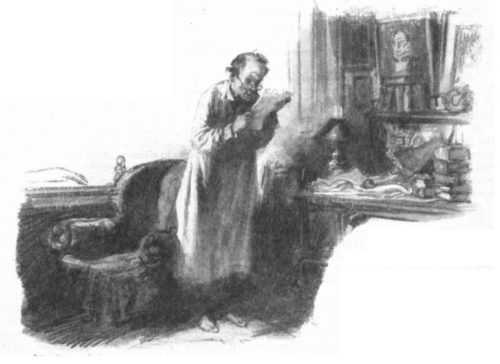
The next morning, he felt like a laborer whose factory has closed. Every day would be Sunday hereafter until he got another job. In this unwonted sloth he dawdled over his porridge, his weak tea and his morning paper.
Headlines caught his eyes shouting the familiar name of Joel Brown — familiar to the world at large because of the man’s tremendous success and relentless severity in business. Brown fell in love with one of those shy, sly young women who make a business of millionaires. He fell out with a thud and his Flossie entered a suit for breach of promise, submitting selected letters of Brown’s as proofs of his guile and of her weak, womanly trust.
The newspapers pounced on them with joy, as cats pounce and purr on catnip. The whole country studied Brown’s letters with the rapture of eavesdropping. Such letters! Such oozing molasses of sentiment! Such elephantine coquetry! Joel weighed 218 pounds and called himself Little Brownie and Pet Chickie!
This was the literature that the bewildered Litton found in the first paper he had read carefully since he came up for air. One of the letters ran something like this:
Angel of the skies! My own Flossie-dovelet! Your Little Brownie has not seenest thee for a whole half a day, and he is pining, starving, famishing, perishing for a word from your blushing liplets. Oh, my Peaches and Cream! Oh, my Sugar Plum! How can your Pet Chickie live the eternity until he claspeths thee again this evening? When can your Brownie-wownie call you all his ownest only one? Ten billion kisses I send you from
Your own, owner, ownest,
PET CHICKIE-BROWNIE.
X X X X X X X X X X X X X X X
The X’s, Flossie explained, indicated kisses — a dozen to an X.
The jury laughed Little Brownie out of court after pinning a twenty-five-thousand-dollar verdict to his coattail. The nation elected him the Pantaloon of the hour and pounded him with bladders and slapsticks.
Professor Litton had heard nothing of the preliminary fanfare of the suit. As he read of it now he was too much puzzled to be amused. He read with the same incredulity he had felt when he heard the janitor quote Teed’s remarks to his fiancée. Litton called his landlady’s attention to the remarkable case. She had been reading it, with greedyglee, every morning. She had had such letters herself in her better days. She felt sorry for poor Mr. Brown and sorrier for the poor professor when he said:
“Poor Mr. Brown must have gone quite insane. Nobody could have built up such wealth without brains; yet nobody with brains could have written such letters. Ergo, he has lost his brains.”
“You’ll be late to prayers,” was all the landlady said. She treated Litton as if he were a half-witted son. And he obeyed her, forsook his unfinished tea and hurried away to the chapel. Thence he went to his classroom, where Teed achieved some further miracles of mistranslation. Litton thought how curious it was that this young man, of whom his scientific professor spoke so highly, should have fallen into the same delirium of amorous idiocy as the famous plutocrat, Joel Brown.
When the class was dismissed he sank back in his chair by the classroom window. It was wide ajar today for the first time since winter. April, like an early morning housemaid, was throwing open all the windows of the world. Litton felt a delicious lassitude; he was bewildered with leisure. A kind of sweet loneliness fell on him. He had made no provision for times like these.
He sat back and twiddled his thumbs. His eyes roved lazily about the campus. The wind that fluttered the sparse forelock on his overweening forehead hummed in his ears. It had a distance in it. It brought soft cadences of faint voices from the athletic field. They seemed to come from no place nearer than the Athenian Academe.
Along the paths of the campus a few women were sauntering, for the students and teachers in the Women’s Annex had the privilege of the libraries, the laboratories and lecture rooms. Across Litton’s field of view passed a figure that caught his eye. Absently he followed it as it enlarged with approach. He realized that it was Professor Martha Binley, Ph. D., who taught Greek over there in the Annex.
“How well she is looking!” he mused.
The very thought startled him, as if someone had spoken unexpectedly. He wondered that he had noticed her appearance. After the windowsill blotted her from view he still wondered, dallying comfortably with the reverie.
IV
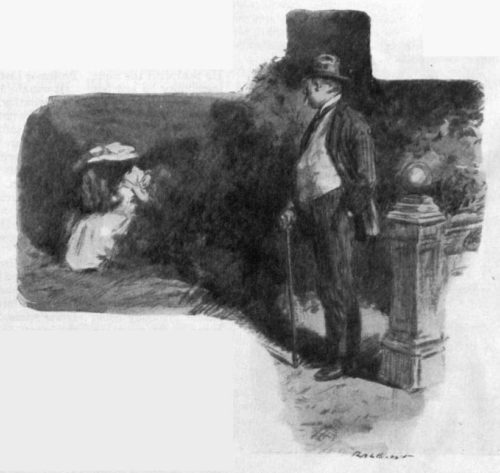
There was a knock at his door and in response to his call the door opened — and she stood there.
“May I come in?” she said.
“Certainly.”
Before he knew it some impulse of gallantry hoisted him to his feet. He lifted a bundle of archeological reviews from a chair close to his desk and waited until she sat down. The chair was nearer his than he realized, and as Professor Binley dropped into it she was so close that Professor Litton pushed his spectacles up to his forehead.
It was the first time she had seen his eyes except through glasses darkly. She noted their color instantly, womanlike. They were not dull, either, as she had imagined. A cloying fragrance saluted his nostrils.
“What are the flowers you are wearing; may I ask?” he said — he hardly knew a harebell from a peony.
“These are hyacinths,” she said. “One of the girls gave them to me. I just pinned them on.”
“Ah, hyacinths!” he murmured. “Ah, yes; I’ve read so much about them. So these are hyacinths! Such a pretty story the Greeks had. You remember it, no doubt?”
She said she did; but, schoolmaster that he was, he went right on:
“Apollo loved young Hyacinthus — or Huakinthos as the Greeks called it — and was teaching him to throw the discus, when a jealous breeze blew the discus aside. It struck the boy in the forehead. He fell dead, and from his blood this flower sprang. The petals, they said, were marked with the letters Ai, Ai! — Alas! Alas! And the poet Moschus, you remember, in his Lament for Bion, says:
“Nun huakinthe lalei to sa grammata kai pleon aiai!”
“Or, as I once Englished it — let me see, I put it into hexameters — it was a long while ago. Ah, I have it!”
And with the orotund notes a poet assumes when reciting his own words, he intoned:
“Now, little hyacinth, babble thy syllables — louder yet — Aiai ! Whimper with all of thy petals; a beautiful singer has perished.”
Professor Binley stared at him in amazement and cried:
“Charming! Beautiful! Your own translation, you say?”
And he, somewhat shaken by her enthusiasm, waved it aside.
“A little exercise of my Freshman year. But to get back to our — hyacinths: Theocritus, you remember, speaks of the ‘lettered hyacinth.’ May I see whether we can find the words there?”
He bent forward to take and she bent forward to give the flowers. Her hair brushed his forehead with a peculiar influence; and when their fingers touched he noted how soft and warm her hand was. He flushed strangely. She was flushed a little, too, possibly from embarrassment — possibly from the warmth of the day, with its insinuation of spring.
He pulled his spectacles over his eyes in a comfortable discomfiture and peered at the flowers closely. And she peered, too, breathing foolishly fast. When he could not find the living letters he shook his head and felt again the soft touch of her hair.
“I can’t find the words — can you? Your eyes are brighter than mine.”
She bent closer and both their hands held the flowers. He looked down into her hair. It struck him that it was a remarkably beautiful idea — a woman’s hair — especially hers, streaked as it was with white — silken silver. When she shook her head a snowy thread tickled his nose amusingly.
“I can’t find anything like it,” she confessed.
Then he said:
“I’ve just remembered. Theocritus calls the hyacinth black — melan — and so does Vergil. These cannot be hyacinths at all.”
He was bitterly disappointed. It would have been delightful to meet the flower in the flesh that he knew so well in literature. Doctor Martha answered with quiet strength:
“These are hyacinths.”
“But the Greeks — “
“Didn’t know everything,” she said; “or perhaps they referred to another flower. But then we have dark-purple hyacinths.”
“Ah!” he said. “Sappho speaks of the hyacinths as purple — porphuron.”
Thus the modern world was reconciled with the Greek and he felt easier; but there was a gentle forcefulness about her that surprised him. He wondered whether she would not be interested in hearing about his edition of Nonnus. He assumed that she would be, being evidently intelligent. So he told her. He told her and told her, and she listened with almost devout interest. He was still telling her when the students in other classes stampeded to lunch with a many-hoofed clatter. When they straggled back from lunch he was still telling her.
It was not until he was interrupted by an afternoon class of his own that he realized how long he had talked. He apologized to Professor Binley; but she said she was honored beyond words. She had come to ask him a technical question in prosody, as from one professor to another; but she had forgotten it altogether — at least she put it off to another visit. She hastened away in a flutter, feeling slightly as though she had been to a tryst.
Litton went without his lunch that day; but he was browsing on memories of his visitor. He had not talked so long to a woman since he could remember. This was the only woman who had let him talk uninterruptedly about himself — a very superior woman, everybody said.
When he went to his room that night he was still thinking of hyacinths and of her who had brought them to his eyes.
He knocked from his desk a book. It fell open at a page. As he picked it up he noted that it was a copy of the anonymous old spring rhapsody, the Pervigilium Veneris, with its ceaselessly reiterated refrain: “Tomorrow he shall love who never loved before.” As he fell asleep it was running through his head like a popular tune: Cras amet qui nunquam amavit; quique amavit eras amet.
It struck him as an omen; but it did not terrify him.
V
Professor Martha called again to ask her question in verse technic. The answer led to further talk and the consultation of books. She was a trifle nearsighted and too proud to wear glasses, so she had to bend close to the page; and her hair tickled his nose again foolishly.
Conference bred conference, and one day she asked him whether she would dare ask him to call. He rewarded her bravery by calling. She lived in a dormitory, with a parlor for the reception of guests. Male students were allowed to call on only two evenings a week. Litton did not call on those evenings; yet the fact that he called at all swept through the town like a silent thunderbolt. The students were mysteriously apprised of the fact that old Professor Litton and Professor Martha Binley were sitting up and taking notice. To the youngsters it looked like a flirtation in an Old Folks’ Home.
Litton’s very digestion was affected; his brain was in a whirl. He was the prey of the most childish alarms; gusts of petulant emotion swept through him if Martha were late when he called; he was mad with jealousy if she mentioned another professor.
She was growing more careful of her appearance. A new youth had come to her. She took fifteen years off her looks by simply fluffing her hair out of its professorial constriction. Professor Mackail noticed it and mentioned to Professor Litton that Professor Binley was looking ever so much better.
“She’s not half homely for such an old maid!” he said.
Professor Litton felt murder in his heart. He wanted to slay the reprobate twice — once for daring to observe Martha’s beauty and once for his parsimony of praise.
That evening when he called on Martha he was tortured with a sullen mood. She finally coaxed from him the astounding admission that he suspected her of flirting with Mackail. She was too new in love to recognize the ultimate compliment of his distress. She was horrified by his distrust, and so hurt that she broke forth in a storm of tears and denunciation. Their precious evening ended in a priceless quarrel of amazing violence. He stamped down the outer steps as she stamped up the inner.
For three days they did not meet and the university wore almost visible mourning for its pets. Poor Litton had not known that the human heart could suffer such agony. He was fairly burned alive with loneliness and resentment — like another Hercules blistering in the shirt of Nessus. And Martha was suffering likewise as Jason’s second wife was consumed in the terrible poisoned robe that Medea sent her.
One evening a hollow-eyed Litton crept up the dormitory steps and asked the overjoyed maid for Professor Binley. When she appeared he caught her in his arms as if she were a spar and he a drowning sailor. They made up like young lovers and swore oaths that they would never quarrel again — oaths which, fortunately for the variety of their future existence, they found capable of infinite breaking and mending.
Each denied that the other could possibly love each. He decried himself as a stupid, ugly old fogy; and she cried him up as the wisest and most beautiful and best of men. Since best sounded rather weak, she called him the bestest; and he did not charge the impossible word against her as he had against Teed. He did not remember that Teed had ever used such language. Nobody could ever have used such language, because nobody was ever like her!
And when she said that he could not possibly love a homely, scrawny old maid like her, he delivered a eulogy that would have struck Aphrodite, rising milkily from the sea, as a slight exaggeration. And as for old maid, he cried in a curious blending of puerility and scholasticism:
“Old maid, do you say? And has my little Margywargles forgotten what Sappho said of an old maid? We’d have lost it if some old scholiast on the stupid old sophist Hermogenes hadn’t happened to quote it to explain the word glukumalon — an apple grafted on a quince. Sappho said this old maid was like — let me see! — ‘like the sweet apple that blushes on the top of the bough — on the tip of the topmost; and the apple-gatherers forgot it — no, they did not forget it; they just could not get it!’ And that’s you, Moggles mine! You’re an old maid because you’ve been out of reach of everybody. I can’t climb to you; so you’re going to drop into my arms — aren’t you?”
She said she supposed she was. And she did.
Triumphantly he said: “Hadn’t we better announce our engagement?” This threw her into a turmoil of fear. “Oh, not yet! Not yet! I’m afraid to let the students all know it. A little later — on Commencement Day will be time enough.”
He bowed to her decision — not for the last time.
For a time Litton had taken pleasure in employing his learning in the service of Martha’s beauty. He called her classic names — Mew Delieix, or Glukutate, or Melema. A poem that he had always thought the last word in silliness became a modest expression of his own emotions — the poem in which Catullus begs Lesbia: “Give me a thousand kisses, then a hundred, then a thousand more, then a second hundred; then, when we have made up thousands galore, we shall mix them up so that we shall not know — nor any enemy be able to cast a spell because he knows — how many kisses there are.”
His scholarship began to weary her, however, and it began to seem an affectation to him; so that he was soon mangling the English language in speech and in the frequent notes be found it necessary to send his idol on infinitely unimportant matters that could not wait from after lunch to after dinner.
She coined phrases for him, too, and his heart rejoiced when she achieved the epoch-making revision of Stuart into Stookie-tookie! He had thought that Toodie was wonderful, but it was a mere stepping-stone to Stookie-tookie.
Her babble ran through his head like music, and it softened his heart, so that almost nothing could bring him to earth except the recitations of Teed, who crashed through the classics like a bull in a china shop or, as Litton’s Greeks put it, like an ass among beehives.
During those black days when Litton had quarreled with Martha he had fiercely reminded Teed that only a month remained before his final examinations, and warned him that he would hold him strictly to account. No classics, no diploma!
Teed had sulked and moped while Litton sulked and moped; but when Litton was reconciled to Martha the sun seemed to come out on Teed’s clouded world too. He took a sudden extra interest in his electrical studies and obtained permission to work in the laboratory overtime. He obtained permission even to visit the big city: for certain apparatus. And he wrote the despondent, distant Fannie Newman that there would “shortly be something doing in the classics.”
VI
One afternoon Professor Litton, having dismissed his class — in which he was obliged to rebuke Teed more severely than usual — fell to remembering his last communion with Martha, the things he had said — and heard! He wondered, as a philologist, at the strange prevalence of the “oo” sound in his lovemaking. It was plainly an onomatopoeic word representing the soul’s delight. Oo! was what Ah! is to the soul in exaltation and Oh! to the soul in surprise. If the hyacinths babbled Ai, Ai! the roses must murmur Oo! Oo!
The more he thought it over, the more nonsense it became, as all words turn to drivel on repetition; but chiefly he was amazed that even love could have wrought this change in him. In his distress he happened to think of Dean Swift. Had not that fierce satirist created a dialect of his own for his everlastingly mysterious love affairs?
Eager for the comfort of fellowship in disgrace he hurried to the library and sought out the works of the Dean of St. Patrick’s. But in the Journal to Stella he found what he sought — and more. Expressions of the most appalling coarseness alternated with the most insipid tendernesses.
The old dean had a code of abbreviations: M.D. for “My dear”; Ppt. for “Poppet”; Pdfr. for “Poor dear foolish rogue”; Oo or zoo or loo stood for “you”; Deelest for “Dearest”; and Rettle for “Letter “; and Dollars for “Girl”; Vely for “Very,” and Hele and Lele for “Here and there.” Litton copied out for his own comfort and Martha’s this passage:
Do you know what? When I am writing in my own language I make up my mouth just as if I was speaking it: “Zoo must cly Lele and Hele, and Hele aden. Must loo mimitate Pdfr., pay? Iss, and so la shall! And so leles fol ee rettle. Dood mollow.”
And Dean Swift had written this while he was in London two hundred years before, a great man among great men. With such authority back of him Litton went back to his empty classroom feeling as proud as Gulliver in Lilliput. A little later he was Gulliver in Brobdingnag.
Alone at his desk, with none of his students in the seats before him, he took from his pocket — his left pocket — a photograph of Professor Martha Binley. It had been taken one day on a picnic far from the spying eyes of pupils. Her hair was all windblown, her eyes frowned gleamingly into the sun, and her mouth was curled with laughter.
He sat there alone — the learned professor — and talked to this snapshot in a dialogue he would have recently accepted as a perfect examination paper for matriculation in an insane asylum.
“Well, Margy-wargy, zoo and Stookietookie is dust like old Dean Swiffkins, isn’t we?”
There was a rap on the door and the knob turned as he shot the photograph into his pocket and pretended to be reading a volume of Bacchylides — upside down. The intruder was Teed. Litton was too much startled and too throbbing with guilt to express his indignation. He stammered:
“We-well, Teed?” He almost called him Teedleums, his tongue had so caught the rhythm of love.
Teed came forward with an ominous self-confidence bordering on insolence. There was a glow in his eye that made his former tyrant quail.
“Professor, I’d like a word with you about those conditions. I wish you’d let me off on ‘em.”
“Let you off, Te-Teed?”
“Yes, sir. I can’t get ready for the exams. I’ve boned until my skull’s cracked and it lets the blamed stuff run out faster than I can cram it in. The minute I leave college I expect to forget everything I’ve learned here anyway; so I’d be ever so much obliged if you’d just pass me along.”
“I don’t think I quite comprehend,” said Litton, who was beginning to regain his pedagogical dignity.
“All you’ve gotta do,” said Teed, “is to put a high enough mark on my papers. You gimme a special examination and I’ll make the best stab I can at answering the questions; then you just shut one eye and mark it just over the failure line. That’ll save you a lot o’ time and fix me hunkydory.”
Litton was glaring at him, hearing the illiterate “gimme” and “gotta,” and wondering that a man should spend four years in college and scrape off so little paint. Then he began to realize the meaning of Teed’s proposal. His own honor was in traffic. He groaned in suffocation:
“Do you dare to ask me to put false marks on examination papers, sir?”
“Aw, professor, what’s the dif? You couldn’t grind Latin and Greek into me with a steel-rolling machine. Gimme a chance! There’s a little girl waiting for me outside and a big job. I can’t get one without the other — and I don’t get either unless you folks slip me the sheepskin.”
“Impossible, sir! Astounding! Insulting! Impossible!”
“Have a heart, can’t you?”
“Leave the room, sir, at once!”
“All right!” Teed sighed, and turned away. At the door he paused to murmur: “All right for you, Stookie-tookie!”
Litton’s spectacles almost exploded from his nose.
“What’s that?” he shrieked.
Teed turned and came back, with an intolerable smirk, straight to the desk. He leaned on it with odious familiarity and grinned.
“Say, prof, did you ever hear of the dictagraph?”
“No! And I don’t care to now.”
“You ought to read some of the modern languages, prof! Dictagraph comes from two perfectly good Latin words: dictum and graft — well, you’ll know ‘em. But the Greeks weren’t wise to this little device. I got part of it here.”
He took from his pocket the earpiece of the familiar engine of latter-day detective romance. He explained it to the horribly fascinated Litton, whose hair stood on end and whose voice stuck in his throat in the best Vergilian manner. Before he quite understood its black magic Litton suspected the infernal purpose it had been put to. His wrath had melted to a sickening fear when Teed reached the conclusion of his uninterrupted discourse:
“The other night I was calling on a pair of girls over at the dormitory where your — where Professor Binley lives. They pointed out the sofa near the fireplace where you and the professoress sit and hold hands and make googoo eyes.”
There was that awful “oo” sound again! Litton was in an icy perspiration; but he was even more afraid for his beloved, precious sweetheart than for himself — and that was being about as much afraid as there is. Teed went on relentlessly, gloating like a satyric mask:”
“Well, I had an idea, and the girls fell for it with a yip of joy. The next evening I called I carried a wire from my room across to that dormitory and nobody paid any attention while I brought it through a window and under the carpet to the back of the sofa. And there it waited, laying for you. And over at my digs I had it attached to a phonograph by a little invention of my own.
“Gosh! It was wonderful! It even repeated the creak of those old, rusty springs while you waited for her. And when she came — well, anyway, I got every word you said, engraved in wax, like one of those old poets of yours used to write.”
Litton was afraid to ask evidence in verification. Teed supplied the unspoken demand:
“For instance: the first thing she says to you is: ‘Oh, there you are, my little lover! I thought you’d never come!’ And you says: ‘Did it miss its stupid old Stookie?’ And she says: Hideously! Sit down, honeyheart.’ And splung went the spring — and splung again! Then she says: ‘Did it have a mis’ble day in hateful old classroom? Put its boo’ful head on Margy-wargy’s shojer.’ Then you says — ”
“Stop!” Litton cried, raising the only missile he could find, an inkstand. “Who knows of this infamy besides you?”
“Nobody yet — on my word of honor.”
“Honor!”, sneered Litton, so savagely that Teed’s shameless leer vanished in a glare of anger.
“Nobody yet! The girls are dying to hear and some of the fellows knew what I was up to; but I was thinking that I’d tell ‘em that the blamed thing didn’t work, provided — provided”
“Provided?” Litton wailed miserably. “Provided you could see your way clear to being a little careless with your marks on my exam papers.”
Litton sat with his head whirling and roaring like a coffee grinder. A multitude of considerations ran through and were crushed into powder — his honor; her honor; the standards of the university; the standards of a lover; the unimportance of Teed; the all-importance of Martha; the secret disloyalty to the Faculty; the open disloyalty to his best-beloved. He heard Teed’s voice as from far off:
“Of course, if you can’t see your way to sparing my sweetheart’s feelings I don’t see why I’m expected to spare yours — or to lie to the fellows and girls who are perishing to hear how two professors talk when they’re in love.”
Another long pause. Then the artful Teed moved to the door and turned the knob. Litton could not speak; but he threw a look that was like a grappling-iron and Teed came back.
“How do I know,” Litton moaned, “How do I know that you will keep your word?”
“How do I know that you’ll keep yours?” Teed replied with the insolence of a conqueror.
“Sir!” Litton flared — but weakly, like a sick candle.
“Well,” Teed drawled, “I’ll bring you the cylinders. I’ll have to trust you, as one gentleman to another.”
“Gentleman!” Litton snarled in hydrophobic frenzy.
“Well, as one lover to another, then,” Teed laughed. “Do I get my diploma?” Litton’s head was so heavy he could not nod it. “It’s my diploma in exchange for your records. Come on, professor — be a sport! And take it from me, it’s no fun having the words you whisper in a girl’s ear in the dark shouted out loud in the open court. And mine were repeated in a Dutch dialect! I got yours just as they came from your lips — and hers.”
That ended it. Litton surrendered; passed himself under the yoke; pledged himself to the loathsome compact; and Teed went to fetch the price of his degree of Bachelor of Arts.
Litton hung dejected beyond feeling for a long while. His heart was whimpering Ai, Ai! He felt himself crushed under a hundred different crimes. He felt that he could never look up again. Then he heard a soft tap at the door. He could not raise his eyes or his voice. He heard the door open and supposed it was Teed bringing him the wages of his shame; but he heard another voice — an unimaginably beautiful, tragically tender voice — crooning:
“Oo-oo! Stookie-tookie!” He looked up. How radiant she was! He could only sigh. She came across to him as gracefully and lightly as Iris running down a rainbow. She was murmuring: “I just had to slip over and tell you something.”
“Well, Martha!” he sighed.
She stopped short, as if he had struck her.
“‘Martha’? What’s the matter? You aren’t mad at me, are you, Stookie?”
“How could I be angry with you, Marg — er—- Martha?”
“Then why don’t you call me Margywargleums? “
He stared at her. Her whimsical smile, trembling to a piteously pretty hint of terror, overwhelmed him. He hesitated, then shoved back his chair and, rising, caught her to him so tightly that she gasped out: “Oo!” There it was again! He laughed like an overgrown cub as he cried:
“Why don’t I call you Margy-wargleums? Well, what a darned fool I’d be not to! Margy-wargleums!”
To such ruin does love — the blind, the lawless, the illiterate child — bring the noblest intelligence and the loftiest principles.
The Post Keeps Tabs on the CIA
On this day in 1947, the CIA was established by the U.S. National Security Act. Seventy years later, America still can’t quite make up its mind about the Central Intelligence Agency. Does it serve the country or its own agenda?
The agency’s declared mission is to monitor “foreign threats to our citizens, infrastructure, and allies.” It is understandably reluctant to publicize much of its work, but a few years ago it posted several accomplishments on its website. They included identifying terrorist groups and assessing their capabilities, controlling the spread of weapons of mass destruction, gathering intelligence on Russia’s unpredictable government and economy, and destroying international drug trafficking.
No one can deny that the CIA played important role in helping the U.S. wage the Cold War. Even the Russians credit the agency with preventing the spread of communism into western Europe.
If only the agency’s record was all so positive. Unfortunately, the CIA has had some memorable failures as well, such as arming the Mujahideen in Afghanistan. It seemed a good idea when these Muslim fighters pushed the Soviet Union out of their country. It seemed a very bad idea when they re-formed as al-Qaeda and ISIS.
The Post became as fascinated by the CIA as the rest of America and published several articles about the agency throughout the 1960s.
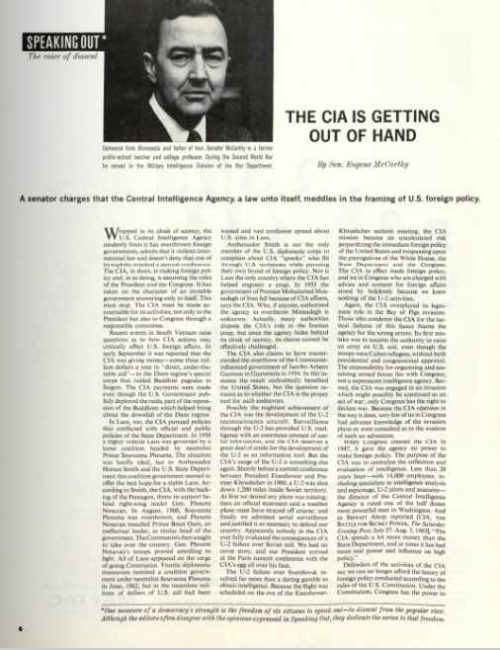
The CIA Is Getting Out of Hand
In “The CIA Is Getting Out of Hand” from the January 4, 1964, issue of the Post, Senator Eugene McCarthy pointed out other jobs the CIA wouldn’t be bragging about. They included engineering the overthrow of the governments of Laos, Iran, and Guatemala. (Years later, critics would also place the responsibility for toppling the Chilean government in 1973 on the CIA.) He also mentioned the CIA’s botched Cuban coup at the Bay of Pigs.
The agency lacked any accountability, McCarthy wrote, and its activities sometimes ran counter to stated American policy. It was the CIA, he added, that was telling the president that South Vietnam, with U.S. support, could defeat the communist forces and remain an independent republic. They stuck by that opinion for years while America poured lives and fortunes into the war.
To rein in the agency, McCarthy called for a congressional committee to supervise its actions. That committee — the House Permanent Select Committee on Intelligence — was eventually established in 1976.
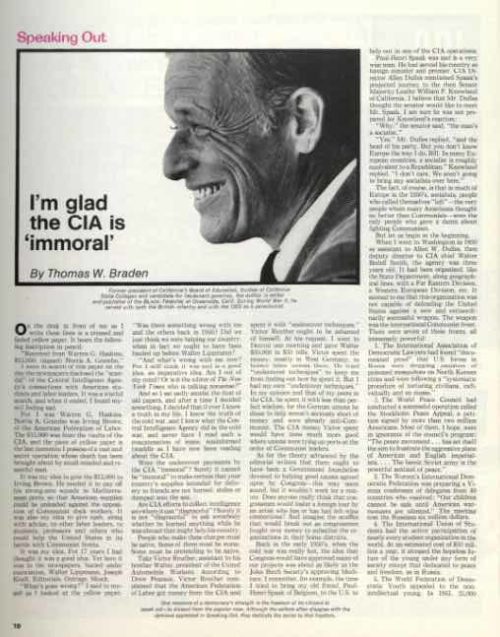
I’m Glad the CIA Is Immoral
But that oversight was still in the future when Thomas Braden wrote “I’m Glad the CIA Is Immoral” in the May 20, 1967, issue of the Post. He had worked with the agency to counter Soviet propaganda. Through covert operations, he set up programs that would shift the political alignments in labor, arts, and student groups around the world away from the Soviets.
He acknowledged that the agency had purposely hidden these projects from public scrutiny. But if deception, misinformation, and propaganda were immoral, so what? The U.S. was engaged in a cold war with Soviet Russia, he wrote, and war was inherently “immoral, wrong and disgraceful.”
“The cold war was and is a war fought with ideas instead of bombs. And our country has had a clear-cut choice: Either we win the war or lose it.”
Letter from the CIA
The intelligence industry has always been associated with issues of right and wrong. It has also been associated with glamour and intrigue.
In 1968, journalist Anne Chamberlin set out to discover if the CIA was as fascinating as she thought. In “Letter from the CIA,” she reports that the agency flatly turned down her request for a tour or an interview. When she decided to just show up anyway, she found America’s spy headquarters was — surprise!— a lot like other Washington bureaucratic offices.
I asked where I could find the man who had asked me not to come and was quickly escorted to a sort of reception room, with government leather couches, magazines on the tables and a desk presided over by a cheerful lady who asked me to fill in a pink form. It asked who I was, who employs me and whom I wanted to see. Then I was issued a large numbered badge and turned over to a young woman who led me to the office of my reluctant host.
Chamberlin eventually got access to the man she had been trying to see, but learned little other than, like any agency, the CIA had budget woes, too.
Whether you love or hate the agency, you can expect to hear more about it in the coming years, as intelligence, not firepower, becomes the first line of our national defense.
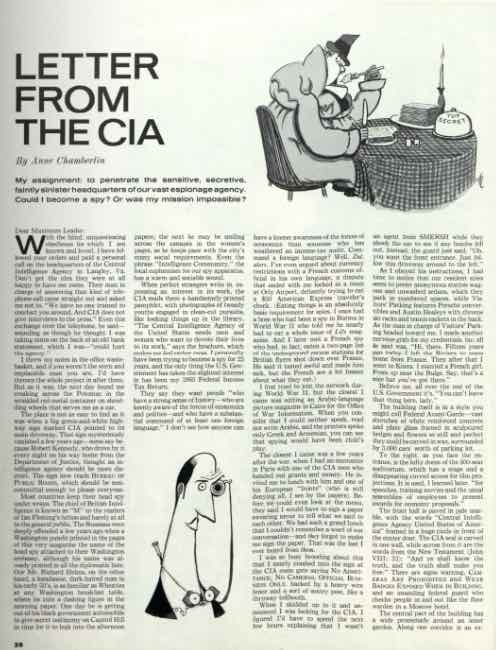
Featured image: Illustration by Arnold Roth for “Letter from the CIA” by Anne Chamberlin, from the March 23, 1968, issue of the Post.
Leading Men of Hollywood: Kirk Douglas
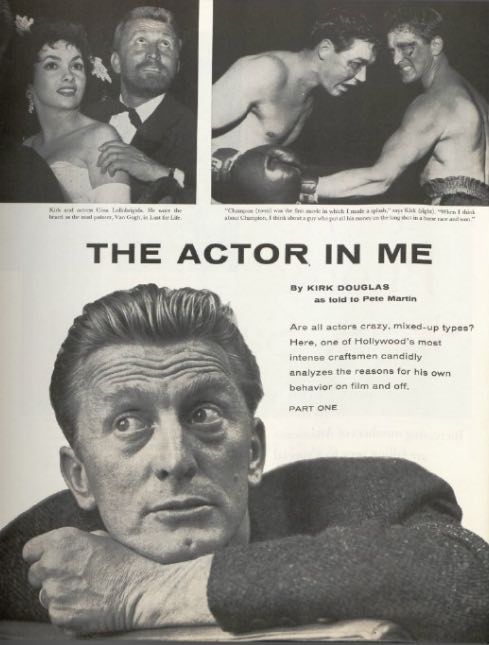
This is an abridged version of two articles written by Kirk Douglas with Pete Martin, which appeared in the in the June 22 and June 29, 1957, issues of The Saturday Evening Post. You can read the complete original article in the flipbook, below.
This article and other features about the stars of Tinseltown can be found in the Post’s Special Collector’s Edition, The Golden Age of Hollywood. This edition can be ordered here.
Apparently the public takes it for granted that if you’re a successful actor, you must be a schmoe. There’s nothing like scoring a hit to make people hunt for new, unpleasant traits in your character. Searching for them, they discover them whether they’re there or not. Then they say, “What did I tell you? He’s changed.”
Usually the change is in other people, not the actor. As a raw newcomer to Hollywood, I had trouble getting a table in the swankier local restaurants. Now I can get a table most of the time, although I don’t deserve it any more than I did 10 years ago. What has changed is not me but the attitude of the headwaiters toward me.
The first movie in which I made a splash was Champion. After I appeared in it, I was told by a woman columnist, “You’ve changed. Now you’re sexy.”
A writer told me: “Making a hit in Champion changed your personality. I don’t like you now.”
“I haven’t changed,” I told him. “I was an s.o.b. before I did Champion and I’m still an s.o.b., only I was too unimportant for you to notice it before.”
I think that I’m still the way I was before Champion. I didn’t kowtow to producers then; I’m not noted for it now. Even when I was a bum, standing in line on the Bowery to buy a cheap Salvation Army meal, I didn’t buddy up to people I thought were jerks, no matter how much good they could do me. This is not always the accepted way to get ahead. Too often in the entertainment field, the idea persists that you can ignore influential creeps only after you have become successful.
Nowadays when I go back to my hometown, Amsterdam, New York, everybody there takes it for granted that I must have an ego the size of a weather balloon. People in Amsterdam ask me, “Do you remember when we did so-and-so?” and when I say, “Sure, I remember,” they’re amazed.
“What do you know!” they exclaim. “Kirk remembers.”
I want to ask them, “If you remember little things that happened around you. How many people are doing what they want to do? Yet no one ever hit an actor over the head to make him become an actor. You’re an actor because that’s what you want to be, despite all the difficulties.
An actor’s need to project his emotions from his insides to his outside sandpapers his nerves. His feelings lie so close to the surface that such terms as “crazy” and “mixed up” are often applied to him.
My friend, producer-director Billy Wilder, gives me the berry for hankering to play every good role Hollywood offers. He says, “Kirk gives you all he’s got. His chest begins to heave even before a director snaps his fingers. He doesn’t need violins playing in a corner to put him in the right mood.” I hope he’s right. If he means that I enjoy acting, he is right.
There’s another thing about actors — every one of them wants to play each role he’s given better than it’s humanly possible for him to play it. I not only want to achieve perfection in each role I play, I want to play all the good roles there are to play. It’s absurd to feel this way, but it makes me unhappy that I can’t be starring in my next picture, The Viking, and playing two other top roles at the same time.
I’ll always believe that there’s value in being willing to work like a horse to do a better job. Until I played the prize fighter in Champion, I had never boxed at all. When I started work in Champion, I had three left hands, none of which could jab or throw a punch, but I trained in a gym until I became a passable fighter.
It could be that my willingness to work long and hard to master a new skill is just another manifestation of my desire to create a sensation with an unexpected accomplishment; then throw it away by saying, “It’s really nothing.” But I honestly don’t think that’s it. It’s not so much exhibitionism on my part as a need to believe in those games of “Let’s pretend.” If I believe in them hard enough, moviegoers may believe in them too.
The Truth
I’m the kind of actor I am because in a few small, important ways I am still the boy named Issur Danielovitch who lived near the carpet mills in Amsterdam, New York. If an actor lets himself become blasé, he can’t play the game of let’s pretend, which is the essence of being an actor. He’s lost if he says to himself, “What am I doing here, a grown man, pretending I’m a cowboy? This is ridiculous.”
If you can’t pretend without being self-conscious, if you begin to think, Get me, everybody. I’m an actor, and I’m acting the pants off of this role. You’ll end up by thinking of yourself as a star with a capital S, and you will be a flop with a capital F.
Perhaps I’ve dwelt too long on the odd traits of actors; they have virtues too. The most generous people I’ve ever dealt with are actors and newspapermen. Pass the hat for a needy co-worker in either group and you’d better have a big hat. And no one is willing to work harder than an actor—to the end of his endurance, if need be. This goes for any actor, famous or obscure.
My agent once said of me, “Kirk is always riding me to put out more effort on his behalf. I spend more time on him than I do on any other two stars on my list, so in a way he’s more trouble to me than he’s worth. But it’s only fair to say that the guy drives himself harder than he drives me. ‘Hey, Douglas,’ he tells himself. ‘Do something. Get going! Get off the dime!’”
Whatever drive I have stems from lessons learned a long time ago. When I was working my way through St. Lawrence University, I once lost my small fund of cash in a poker game. Much ashamed, I had to go home to my hard-pressed mother and tell her.
“You are such a fool,” she chided me. “You bet money on cards. What do the cards know about you? What do they care?” She gave me a hug and said, “Everyone likes to gamble. There’s nothing wrong with gambling. You want to bet? O.K., bet. But gamble on yourself.”
I have found that the perfect place to take her advice is in acting. I’ve never hesitated to gamble for really big stakes—abandoning my contract at Warner’s, starting my own independent company, Bryna Productions. I’ve been lucky enough to make a few good pictures, but I don’t assume that I’ll never boot one. No one bats a thousand in any league, and a champ is a guy who walks into the ring one day and gets clobbered by a kid no one ever heard of. All I can do is work as hard as I know how, and, when the chips are down, gamble on myself.
This article and other features about the stars of Tinseltown can be found in the Post’s Special Collector’s Edition, The Golden Age of Hollywood. This edition can be ordered here.
The Monkee Business
“Want spirited Ben Frank’s types,” claimed an ad put into Hollywood trade papers by two television producers in the fall of 1965. The producers were Berton Schneider and Robert Rafelson, and they were referring to a coffeehouse on Sunset Boulevard that attracted musicians and other long-haired crazies from the nearby music venues, Whisky a Go Go and The Trip.
Schneider and Rafelson were out to make a sitcom that could ride the coattails of the Beatles’ stardom, and — after rigorous auditions with hundreds of hopefuls — they wound up with four guys who would comprise a fictional pop sensation. In time, The Monkees would transcend the contrived identities of their characters, but the original goal was good television.
The only Monkee who didn’t have to audition was Davy Jones. He had starred in Oliver! on West End and on Broadway, and his Tony-nominated performance was featured on the Ed Sullivan Show the same night as The Beatles’ first, iconic appearance. Other than Jones, the producers’ intention was to stock the show with no-names. “I would rather work with amateur actors,” Rafelson had said. “If you hired professionals you wouldn’t get the primitiveness we were looking for.”
Despite its obvious nods to the Fab Four, The Monkees pioneered a television style for American audiences. The improvisation, jump cuts, and self-referential nature of the show put an absurdist spin on avant garde cinema styles of the time.
Fifty years ago, The Saturday Evening Post’s 1967 article, “When Four Nice Boys Go Ape!,” gives Bert Schneider’s original pitch for the show: “Hollywood has a thing for making pictures that talk down to young people… We want to do a series in the New Wave style. A very far out show.” French New Wave cinema was popular in artsy circles in the late 1950s and early ’60s — characterized by sometimes plotless expressions of jazz and passion in Paris.
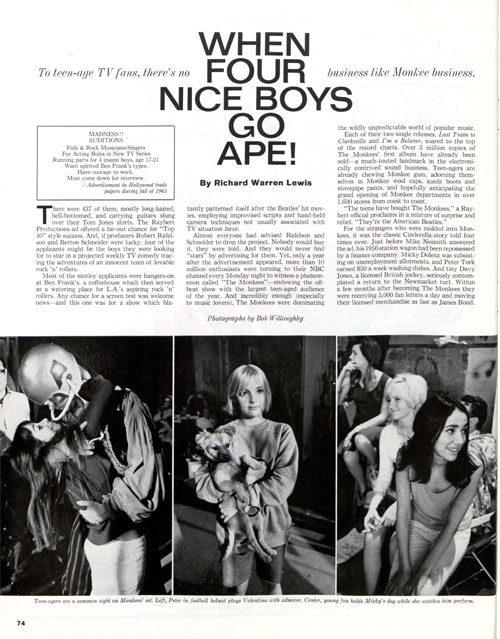
In a particularly free-spirited second-season episode, “Monkees in Paris,” the boys romp around the City of Light being chased by Parisian models before, in turn, chasing those same models and, finally, kissing them and picking flowers. It’s a jolly, albeit senseless, chapter containing sparse dialogue and inadequate gags, but the episode showed the bandmates in uninhibited form. Though The Monkees never made it into the Cahiers du Cinéma, the blend of wacky comedy and unconventional film techniques was a refreshing oddity in the television landscape of family sitcoms and westerns.
The Monkees only lasted two seasons despite winning a couple of Emmys. Still, the show was a goldmine when it came to merchandise. As Columbia television executive Jackie Cooper said in 1967, “The Monkees are not only in show business, they’re in the advertising business.” The fictional Monkees’ pad may have sported a groovy sign proclaiming “MONEY IS THE ROOT OF ALL EVIL,” but anti-consumerism was the real act. Monkee gum and Monkee dolls— even a green wool cap that cost 48 cents more than Michael Nesmith paid for his original — were marketed to adoring fans.
If they started as television actors, The Monkees were quickly transformed into a viable touring band. Before their tour in December 1966, their first album, The Monkees, was a huge success, spending 13 weeks on the number one Billboard spot. They actually sold more records than the Beatles and the Rolling Stones combined in 1967. But the band members began to vocalize their discomfort with the charade. Michael Nesmith told The Saturday Evening Post, “The music had nothing to do with us… It was totally dishonest. Do you know how debilitating it is to sit up and have to duplicate somebody else’s records? That’s really what we were doing.”
Though Davy Jones, Michael Nesmith, Peter Tork, and Micky Dolenz had contributed to the album, the songwriting and instrumentation was largely carried out by seasoned professionals. Their second album, More of the Monkees, was produced in the same way, leading to discontent between band members and Donald Kirshner, “The Man with the Golden Ear” hired from the start by Schneider and Rafelson to produce The Monkees’ tunes. Kirshner used songwriters and musicians he knew, like Carole King, Neil Diamond, Neil Sedaka, and Glen Campbell to create The Monkees’ sound. The bad press the band received from their supposed inauthenticity furthered the divide until Kirshner was ousted from the process in November 1967.
Left to their own devices, The Monkees continued churning out hit records and singles. What started as a fictitious, struggling band had transformed into a breathing, hit-making machine. Michael Nesmith was, perhaps, the greatest advocate for Monkee-autonomy in the music process. He had faith in the group’s creative ability, despite its affected beginnings: “Tell the world that we’re synthetic because, damn it, we are… Tell the world we don’t record our own music. But that’s us they see on television. The show is really part of us. They’re not seeing something invalid.” In 1968’s The Birds, the Bees & the Monkees, the group made an eclectic psychedelic, pop, and folk album headed by the song “Dream World” with lyrics (by Davy Jones) that could whimsically narrate The Monkees’ artistic maturation: “Why don’t you come out of your dream world/ It’s not real/ It’s not the way it seems to be/ Why don’t you come into the real world/ Come with me/ We’ll share our thoughts, forget the dreams/ You’ll see.”
News of the Week: New TV Shows, Expensive Phones, and Why People Steal All the Jack Kerouac
Is Your DVR as Full as Mine?
The new TV season is just about here. One show I’ve been waiting for, Fox’s The Orville, has already debuted, and I like it. I’m still not sure if it’s a sendup of Star Trek, a sincere homage, or both, but it’s a fun show and I’m going to keep watching.

It would take the entire column to list all the new shows that are coming to our screens and when they premiere, so I’ll leave that to the people who write about television full-time, including Kate Aurthur and Jarett Wieselman at BuzzFeed, Robert Lloyd at The Los Angeles Times, and Sophie Gilbert at The Atlantic. And of course, check out TV Guide for their big annual fall preview issue. They have all of the premiere dates for both new and returning shows.
I still have 20 or 30 episodes of various TV shows to catch up on from last season. I used to write about TV full-time, but I don’t know if I could do it today. With the addition of Netflix and Hulu and Amazon and other streaming services to an already crowded broadcast and cable schedule, watching television has, in a way, become exhausting.
I Will Never Spend $1,000 on a Phone
I’m an Apple loyalist and have been since around 1985, but there’s a limit to that loyalty. This week, Apple released new products and updates to old products. There’s the iPhone 8, and new features for the Apple Watch (which bring it even closer to Dick Tracy territory), and there’s also a special iPhone X. Please don’t say “ex,” as the X stands for 10.
It costs $1,000.
I don’t currently own a cellphone, but when I get one, it’s going to be a dumbphone, one that simply — gasp! — makes phone calls. I’m already online 10 hours a day on my laptop, so I don’t need to be tempted when I’m at the supermarket or at a restaurant. The X has a nicer screen, longer battery life, can be unlocked using facial recognition, has no “home” button (everything is touch-screen now), and you can now turn your face into an emoji, if you’ve always wanted to turn your face into an emoji.
If you’re wondering why they went from the iPhone 8 to the 10, I don’t know. Maybe the 9 will come out as a rare, “lost” edition next year.
People Have Already Forgotten about Fidget Spinners
Maybe the iPhone X will be one of the hot toys this December (though I don’t know if anything that costs $1,000 can be considered a toy). Every year around this time, news shows and morning shows and websites start to release their lists of the toys they think every single kid is going to want to find under the tree this Christmas.
A lot of people go by Walmart’s annual list, and this year they’ve picked 25 toys they think will sell big, including littleBits Star Wars Droid Inventor Kit, Barbie DreamHorse and Doll (that’s horse, not house), Fisher-Price Zoom ’n’ Crawl Monster, the Soggy Doggy Board Game, and Hatchimals, which were popular before but are making a big comeback, like denim overalls and bubonic plague.
I don’t even know if anything on that list would interest me even if I were 9 years old. Don’t kids still play outside or at least enjoy board games?
Who Is Stealing All the Bukowski and Kerouac?
I don’t know what the statute of limitations is on something like this, but I have a confession to make. When I was a little kid, I stole a book from a bookstore. It was one of those pocket guides to space and the planets (it was the “pocket” aspect that made it easy to steal). I’m not going to try to justify the theft, but in my defense, I will say that I was really into space when I was young.
Adults steal books too, like ones by Charles Bukowski and Jack Kerouac. They’re always on the top of the list when it comes to books that are stolen, and have been for many years. In this interview by NPR’s Scott Simon, the owner of Porter Square Books in Cambridge, Massachusetts, discusses what books get stolen the most and the theories on why the same authors are targeted.
What I would tell these people is that it’s wrong to steal. But if you are going to steal, let me know and I can give you the names of some other authors you might like.
The Worst Thing Since Jack the Ripper
This is both fascinating and disgusting.
Beneath London, there’s a monster. It’s not a living creature that’s set to devour you, but it might be even worse. They’re calling it the Whitechapel fatberg, and it’s a giant mass of fat, disposable wipes, condoms, diapers, and other gross things Londoners have discarded that is clogging a century-old stretch of the city’s sewer system. It’s a sixth of a mile long, weighs 140 tons, and is bigger than a similar thing that was found beneath London a few years ago. Now I’m going to stop writing about this because it’s freaking me out.
Wasn’t Fatberg the name of a chubby character from an ’80s teen comedy movie?
RIP Don Ohlmeyer, Troy Gentry, Don Williams, Edith Windsor, Blake Heron, Gene Michael, Sugar Ramos, Jerry Pournelle, Len Wein, Jack Keil
Don Ohlmeyer was a veteran TV executive who was not only famous for being one of the first producers of Monday Night Football and for playing a huge role in NBC’s “Must-See TV” lineup in the 1980’s and ’90s, he’s famous for firing Saturday Night Live’s Norm Macdonald after Macdonald made too many jokes about Ohlmeyer’s friend O.J. Simpson. Ohlmeyer died Sunday at the age of 72.
Troy Gentry was part of the popular country duo Montgomery and Gentry, known for such songs as “My Town” and “Headlights.” He died in a helicopter crash last Friday at the age of 50.
Don Williams was a country star too. He started playing in bands in the mid-’60s and eventually became popular as a solo artist in the ’70s with songs like “The Shelter of Your Eyes” and “I Wouldn’t Want to Live If You Didn’t Love Me.” Williams died last Friday at the age of 78.
Edith Windsor became a champion of gay rights when she was the lead plaintiff in the landmark Supreme Court case where the court decided that gay couples have a right to get married in any state, just like heterosexual couples, and are also entitled to the same benefits. Windsor died Tuesday at the age of 88.
Actor Blake Heron was probably best known for his role at age 13 in the 1996 film Shiloh. He later appeared in TV shows like Nick Freno: Licensed Teacher, Good vs. Evil, ER, The Practice, and Justfied, as well as many movies. Heron died last week at the age of 35.
Gene Michael played for the New York Yankees in the late ’60s and early ’70s and even managed the team in the ’80s, but he found even more success in the ’90s as an executive, where he built the Yankees into a championship team. One of his big moves was signing Derek Jeter. Michael died last Thursday at the age of 79.
Sugar Ramos was a boxer who is unfortunately best known for winning his 1963 fight with Davey Moore. Though Moore survived the fight and even talked at a press conference later, he collapsed and fell into a coma shortly afterward; he died three days later. Ramos passed away Sunday at the age of 75.
Jerry Pournelle was an award-winning writer known for several classic works of science fiction and nonfiction. He was also a columnist for Byte and Galaxy and maintained the popular blog Chaos Manor. He died last Friday at the age of 84.
Len Wein was a comic book artist who worked on many series and created the characters Wolverine and Swamp Thing. He died Sunday at the age of 69.
Jack Keil not only created McGruff the Crime Dog, he provided the voice for the character. He died August 25 at the age of 94.
The Current War
Benedict Cumberbatch (Sherlock) is a good actor who seems to be in everything these days, including the new movie The Current War. He plays Thomas Edison, and the film explores the battle between Edison and George Westinghouse for the control of electricity. It opens on November 24. Here’s the trailer.
Here’s Post Archive Director Jeff Nilsson on Edison’s solution to copyright theft. Edison only made money from one of his many patents in his lifetime.
This Week in History
“United Colonies” Becomes “United States” (September 9, 1776)
The original thirteen colonies became the United States after the U.S. declared independence from Britain and defeated them in the Revolutionary War.
President McKinley Dies 8 Days After Being Shot (September 14, 1901)
McKinley isn’t as instantly well known as many other presidents, but he is one of only four that were assassinated. He’s also on the $500 bill. I don’t know how many of you have a $500 bill in your wallet, but go check to see what he looked like.
This Week in Saturday Evening Post History: “Morning Coffee Break” (September 12, 1959)
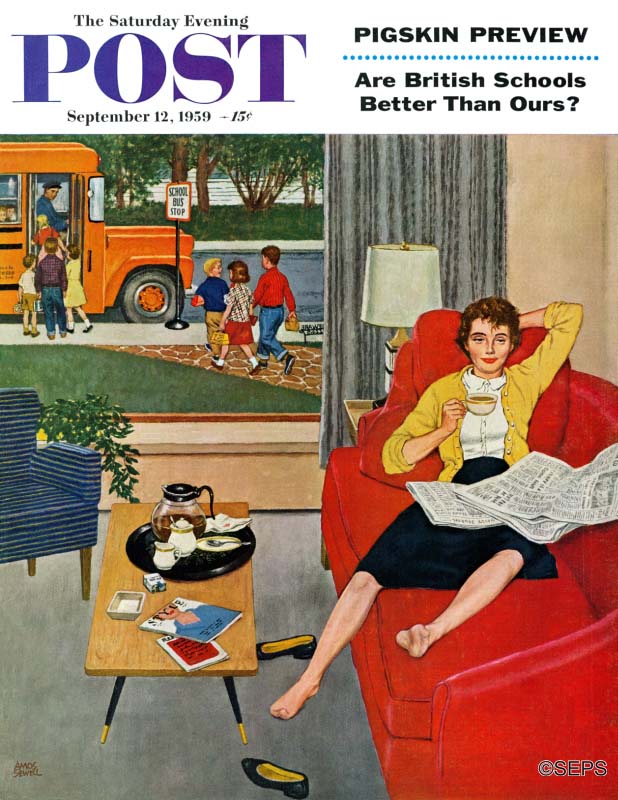
I’m not a parent, so I have a question for all the people out there with children: Does this cover by Amos Sewell accurately depict what it’s like when summer is over and the kids finally go back to school? You love them and hold them close, and it’s great they’re on summer break, but you’re manically happy when September rolls around and they’re out of your hair so you can read the pap … I mean browse Facebook and drink your coffee in peace?
September Is National Biscuit Month
It was cool last week, but this week, summer returned with a muggy vengeance in my part of the country. It’s so warm, I had to go back to drinking cold beverages instead of hot tea. But the cold days and nights will be here soon enough, so it’s time for biscuits.
Here’s a recipe from Paula Deen for Homemade Biscuits, and since they’re from Paula Deen, you know there’s going to be a lot of butter and sugar. If you want something a little healthier, how about this Healthy Chicken Pot Pie that utilizes flaky refrigerator biscuits.
If you decide to make the pot pie and go to the store for the biscuits, please don’t steal them.
Avoiding a Fiery Death and Other Life Choices
My neighbor Becky is going through my closet. It is after midnight. She’s trying to decide what should go into the suitcase on my bed.
“How’s it possible that you’re 26 and you’ve yet to step foot on an airplane, anyway?” Becky asks me while holding two skirts out in front of her.
I almost blow her off and just tell her it’s a long story. But I’ve listened to Becky’s baggage a lot lately and something tells me she might actually get a kick out of the story. I stretch out on my bed next to the suitcase where I can watch her sift through my wardrobe while I explain my lack of travel experience.
It’s all because of my aunt Rhoda. She had one of her Visions with a capital V during my sixth birthday party. It was about 20 minutes before we cut the birthday cake and a spectacular cake it was. Rainbow sprinkles cake mix with hard candy letters that spelled out Happy Birthday Claudia! and tasted like overly sweet chalk. The letters were nestled in at least two inches of frosting. My mom may not have been much of a baker, but she knew what made 6-year-olds happy. She’d sprung for three tubs of frosting. I’m pretty sure there were multiple puddles of rainbow sprinkled vomit in the rose bushes before that party was over.
But that, of course, wasn’t the point. The point was that Aunt Rhoda had Seen with a capital S that I was doomed to a bloody and fiery death due to a plane crash. When and where was unclear, of course. Not that anyone knew what she’d Seen at all when the Vision hit her. She screeched like a pig bound for the bacon factory, clutched her head between her overly accessorized hands, and collapsed in the grass, sobbing and ruining a perfectly good game of Red Light, Green Light. She was lucky she didn’t get trampled by a herd of kindergartners.
Everyone just froze and waited, knowing that Aunt Rhoda was about to drop some kind of bomb. But she wouldn’t talk to anyone except my mother. She waved her over, gripped my mother’s hands, and held them over her heart. She made her lean in real close and solemnly swear that she’d never let me get on an airplane.
So my lifetime travels have been limited to places that could only be reached by train, car, or bus. My mother once said she’d rather I hitchhike than fly.
As I finish the story, I wait for Becky’s reaction. She’s learned some of my family history in the couple years we’ve known each other, but until this point, I’ve stayed away from the most eccentric branches of my family tree. Becky is still focused on my wardrobe, and I’m grateful that she hasn’t pointed out that I own far too many clothes for someone who is living on student loans and a minimum-wage part-time barista gig.
Despite my overabundance of clothes, I’m wearing only my bra and a pair of boy-short undies because I was in the middle of changing for bed when Becky invited herself over to help me pack. Becky is wearing gym shorts and an oversized T-shirt that says MARINES across the chest, clothes her boyfriend, Craig, has left at her place and that she sleeps in when he works nights. Craig has been the focus of our conversations lately when Becky comes over to hang out. He’s really been pushing her to get married lately, and Becky is not sure she’s ready for all that. He wants to start a family. He’s 15 years older than her. A Marine turned air-traffic controller. A solid, quiet, loyal man who thrives on organization. He takes really good care of himself, and Becky is always quick to point out that he’s way hotter than most guys our age. He also takes really good care of Becky, and I don’t think she’ll have an unhappy life if she marries him. But it’s never that simple, of course. I can’t say that I’m disappointed that we aren’t discussing him tonight.
“But, I mean, that’s not really why you’ve never flown, right?” Becky asks while contemplating a red blouse with a Peter Pan collar before putting it back among my other rarely-worn professional attire that I assume I might need someday if I ever finish my thesis and get my degree. “Like, was your aunt ever right with her other visions?” I can hear it in her voice, she doesn’t capitalize the V.
I shrug. “Well, she did predict she’d die in a car accident.” I lie flat on my back and study the patterns in the popcorn ceiling.
Becky stops rifling through my wardrobe long enough to narrow her eyes at me. “Shut. Up. She didn’t, did she?”
I prop myself back up on one elbow and pause for effect. “Wrapped her car around the statue of some semi-famous poet that stands in the middle of town square. I can’t remember his name now. He wrote about cows a lot.”
“Oh, I’m so sorry,” Becky says automatically, but she’s become distracted by a yellow floral dress that is too retro for my taste but bought anyway because it was on sale, and it reminded me of Becky. It still has the tags on it.
I shrug again and flop back down. “Eh, any one of us could have predicted that one. It seemed like the drunker she was, the easier it was for her to find her car keys. My uncle actually flushed them down the toilet once, but that last time he only hid them in a bag of frozen chicken nuggets. We were just glad the only other casualty was the cow poet.”
Becky curls her lip in a disgusted Elvis kind of way, and I worry that my casualness over my aunt’s alcoholism and subsequent tragic death might make her think I’m cold-hearted. I’m not, but I can come off that way I’ve been told.
“Well, I could see how her vision might have scarred you as a kid.”
“I guess,” I murmur. “I wasn’t even there when it all happened though. I was sitting on the front steps waiting for my dad.”
“He was late to your party?”
“Naw, see, my mom hadn’t yet broken it to me that he’d left. I still thought he was on a business trip. He’d been gone for something like two months at that point, but I figured he had to come back for my birthday. Like it was a dad law or something.”
Becky folds a pair of jeans into my suitcase with the skill she’s perfected by working in no less than eight different clothing store chains since she was in high school. I like watching the efficiency of her long fingers. Tonight they are bare because like me, she should be in bed asleep right now. But like Aunt Rhoda, Becky likes her accessories. Unlike Aunt Rhoda’s explosion of costume jewelry, Becky’s rings and bracelets are chosen to complement each other. Delicate bands of silver, small stones and a flower here and there. The absence of accessories tonight somehow seems provocative, like Becky is standing before me naked. Her long, slender fingers are perfectly manicured, and her skin is soft and smells of sandalwood rose lotion. I will sometimes sniff at the bottle of it she keeps on the back of her toilet when I’m across the hall at her apartment, but I never try any for myself because my hands are large and rough, and it seems wrong to have them smelling like Becky.
“Your mom waited that long to tell you?” she asks. “She let you just sit there and wait for him on your birthday?”
“Ironically, she later told me she waited to tell me because she didn’t want to ruin my birthday. But it doesn’t add. Personally, I think she really didn’t believe he’d miss my birthday either. Maybe neither of us knew he was really gone until that day.”
Becky adds four tops to my suitcase, two plain tees — one black, one red, a halter top, and a simple silk blouse. All would look good with the pair of jeans, and I’d be covered for almost any occasion. It seemed so simple now that Becky was done, and I wondered why I’d texted her saying I didn’t know what to pack.
“That’s it?” I ask.
She nods. “Well, and shoes, of course, but you can handle the rest, right? Unless you want me to pick out your underwear and PJs too.”
“It just doesn’t seem like enough.”
She flips the suitcase closed. “Don’t enforce the stereotype. You’re only going for a long weekend.”
I sigh. “I’m not even sure I should go.”
She rolls her eyes and sits on the foot of the bed. “Why? Because of Aunt Rhoda?”
I sit up and grab one of my pillows and clutch it to my torso. “No, because I haven’t seen or spoken to my father in 20 years, and then all of a sudden I get this email saying he wants a relationship with me? That he’s sorry for the past two decades? Like, what’s up with that?”
Becky sets the suitcase on the floor next to the bed and scoots up next to me so she’s leaning against the headboard with her knees drawn up.
“But won’t you regret it if you don’t go? I mean, it’s not like you have an unlimited amount of time on this.”
I cover my face with the pillow because she’s right. I’m flying to see my father because in his email, he used the vague term of “failing health” as a reason that he couldn’t come to me. Before I’d thought it through though, I’d written him back, casually mentioning spring break was coming up, and I didn’t have any plans other than to pick up some extra hours at the coffee shop where I worked while going to grad school. The next thing I knew, I was agreeing to let him buy me a plane ticket. I mentioned neither Aunt Rhoda nor my sixth birthday party.
“But do I even want to hear what he has to say?” I counter underneath my pillow.
Becky is quiet for a few moments, and I move the pillow to see if she somehow left without me noticing. But she’s still sitting there. She’s pulled the band out of her long blonde hair, and she’s running her fingers through it, dividing it into two sections to braid. I’ve seen her do this many times over the last few months. It’s her thinking habit.
“Sometimes it’s just hard to know what it is that you want out of life. Like, you’re just going along, living life, and people come into it, and you’re like, yeah, I’m happy with this person. Let’s make a life together. But then, maybe you figure out that the happy you felt with that person wasn’t a forever happy. You know what I mean?”
Becky usually braids her hair when she’s thinking about Craig. After three years of dating, she’s found herself living in a constant state of guilt because she just isn’t sure what she wants, but she does love Craig. It seems that every time he works overnight, or doesn’t spend the night because he has a really early shift, Becky is over at my place looking to me for guidance. The last time we had such an evening, it led to me pouring us shots while we made a pro-con list. I have a firm no straight girls’ policy in place, but Becky kissed me first. Not that we’re ever going to talk about that. I sometimes wonder if Becky even remembers what happened or if she’s suffering from tequila-induced amnesia. The pro-con list is in my nightstand drawer. I’m keeping it handy, just in case she doesn’t remember which side was longer.
“So are you just saying that I should forgive him for walking out just because they got married too young?”
Becky shakes her head. “Of course not. That was pretty shitty of him. But I’m just saying — hear what he has to say. And then say your own stuff back. You don’t want to carry all that around for the rest of your life, knowing you passed up your chance to unload it.”
Her hair is now in two sloppy braids, and I resist the urge to reach out and play with a loose tendril that is curled behind her ear. Becky slides down the wall so that now she’s also lying flat on her back staring at the patterns in the popcorn ceiling. I squint up at it, blurring the popcorn so that it might look a little like clouds from an airplane window.
I sigh.
“So what are you going to say to him?” Becky asks.
I lay there and imagine my plane flying through the clouds tomorrow morning. “I don’t know,” I say. “Maybe I’ll get lucky and won’t have to say anything at all.”
Becky finds my hand and squeezes it. We lie there, side by side, staring upward, waiting for wisdom to crash down upon us from the sky.
The Bleak and Beautiful Galápagos
It’s mating season on the beach of North Seymour, one of the smaller of the Galápagos Islands, and I’m watching one of the ridiculously comical male blue-footed boobies performing his mating dance. He kicks up his webbed blue feet one at a time, points his beak at the sky, spreads his wings, and whistles like a construction worker. Quite a show. Nearby, a female booby watches with seeming indifference while discreetly taking note of her suitor’s feet. The bluer they are, the healthier he is, and that’s why he’s showing them off. Finally, she answers his whistle with a honk. For a booby, that’s amore.

More avian love is in the air. A male frigate bird has puffed out his brilliant red breast to the size of a football, tilting his head back for the full display.

Joshua E. Bush
Our guide to this extraordinary spectacle reminds us not to walk too close to the mating birds, but the plain fact is they’re oblivious to the human intrusion. It’s as if we are invisible to them.
It’s understandable that most people believe the Galápagos Islands are a lush, tropical paradise teeming with wildlife. You’ve heard about the giant tortoises, certainly. And maybe you’ve also heard about the clownish boobies and other exotic birds that nest there. But what you might not know is that the archipelago of 13 large islands, 6 smaller islands, and over 40 islets collectively known as the Galápagos are all dormant volcanoes thrusting their barren peaks up from the sea. In truth, these islands are anything but lush. On many, the landscape is bleak — all black lava with very little soil, no rain for months at a time, and hardly any natural source of potable water — and lambasted daily by the sun. What little vegetation has taken hold needs to be extremely hardy. Same for the animals. But the reward for being able to survive in this desolate landscape and in this unforgiving climate is that there are few natural predators. And the reward for humans who visit is that the creatures of the Galápagos don’t fear us, because they have no experience with fear, no genetic memory of needing to flee, fight, or hide in order to survive.

We associate the islands with Darwin, who studied finches when he arrived here in 1835. (As for the giant tortoises, sorry to say, the young naturalist had no compunction about dining on them, as was common practice at the time.) Darwin’s finches are thought to have arrived at the islands after being blown offshore centuries earlier. As you may remember from high school biology, the importance of the finches was that, in their continued isolation, not just from the mainland, but from each other on different islands in the archipelago, they evolved into several distinct species. This observation would lead to Darwin’s theory of evolution as described in The Origin of Species, published in 1859.
Herman Melville’s travels also brought him here in 1841. Thirteen years later, he published a popular novella about the region, The Encantadas, or The Enchanted Isles. (At the time, the name was understood to mean “bewitched” rather than “magical.”) Melville was horrified by what he saw: “Take five-and-twenty heaps of cinders dumped here and there in an outside city lot; imagine some of them magnified into mountains … and you will have a fit idea of the general aspect of the Encantadas. … To them change never comes; neither the change of seasons nor of sorrows. Cut by the Equator, they know not autumn, and they know not spring; while already reduced to the lees of fire, ruin itself cannot work more upon them … they are cracked by an everlasting drought beneath a torrid sky.”
Now, at the risk of contradicting one of our greatest writers, I have to say that, in their fearsome bleakness, the islands actually are extraordinarily beautiful — a beauty that stems in part from being unspoiled by man. Those who arrived here in the colonial era with intent to plunder simply couldn’t cut it. Credit not just the harsh climate and lack of water but also the unreliable currents and equatorial doldrums for making the region so difficult to navigate in a sailing ship that these islands were never good candidates for colonization. In a turnabout, today it is man — under the auspices of the Ecuadorian government — who is protecting the region from being spoiled.
Joshua E. Bush
I’ve come to the Galápagos onboard the Endeavor II, operated by National Geographic Expeditions in partnership with Lindblad Expeditions. Their fleet of seven small ships, carrying no more than 62 to 148 guests, take travelers to out-of-the-way places like the Galápagos, Antarctica, and Alaska’s inside passage. On our ship, one of the newest of the fleet, 79 passengers travel in extreme comfort with 58 staffers, including several naturalists, a photography expert, snorkel guides, videographer, plus cooks, servers, cleaning staff, and ship’s captain and crew. But, despite the amenities, the vibe is strikingly different from that of a large cruise ship. As our expedition leader (and sometimes den mother) Cindy Manning announces via shipwide intercom soon after we embark, we are decidedly “not on a vacation.” This is a true expedition, she reminds us (somewhat unnecessarily since no one comes to the Galápagos to lounge by a pool), with lots to do, lots to learn. The days start early — some of the morning excursions ashore depart as early as 6:30 in order to avoid the heat — and continue with lectures at noon, maybe a snorkel trip in the afternoon, and another shore excursion or hike before dinner. See a sample entry from my journal (below).
On one very special morning, I join a walk billed as a photography session along the beach on Santiago Island. Within minutes of landing, we come upon a sea tortoise laying her eggs barely hidden in the sparse mangrove trees just off the beach. She’s been laying all night, and we’ve encountered her in the process of covering them up, her huge flippers tossing up great plumes of sand. We keep a respectful distance and click away. When she finishes, she drags herself slowly, with huge effort, back to the sea, clearly exhausted. We learn later that these turtles lay 80-200 eggs at a time, a process that takes all night. Only one in a thousand eggs survives the birds, snakes, and iguanas that dine on them. Unlike in some other locales, here the park rangers do nothing to protect the eggs, regarding that as interfering with nature.
Part of the magic of the Galápagos is a sense of stepping back in time and grasping the relative unimportance of man and the brevity of human life in the history of the planet. We certainly lose our connection to the natural world in our day-to-day lives. But now, transported back through the eons in this unspoiled setting, the concerns of one’s own small life have, for a time, faded away. Instead, in even briefly observing these extraordinary creatures in their natural habitat, we can fully share Darwin’s conviction that “the love for all living creatures is the most noble attribute of man.”

Joshua E. Bush
A Typical Day
Sample entry from the author’s journal
Tuesday morning: Our ship traveled overnight around the northern tip of Isabela Island to Fernandina, the westernmost island in the archipelago, and also the youngest at 500,000 years old. With ship anchored a few hundred yards offshore, embark zodiacs (small inflatable boats) at 6:30 a.m. Above us the dormant volcano rises to nearly 5,000 feet, its flanks streaked with fresh lava flows, black and lifeless. Getting off the craft, we cross solid black slabs of “ropy” lava. Slippery when wet.

Joshua E. Bush
Step carefully over and around hundreds of prehistoric-looking, black marine iguanas that lie basking in the sun and are disinclined to move just because humans are present. They need to warm their bodies to 40°C (about 104°F) before they can go in the water to feed. Occasionally one of them will seem to “sneeze” out a white spray that coats their heads white. These unique creatures possess a gland in their skull that allows them to drink sea water and expel the salt through a portal above their eyes.

Joshua E. Bush
Sea lions playing along the water’s edge or sleeping half immersed in water on the sandy beach. A young sea lion nursing just yards away from us, indifferent to human presence.
A group of four flightless cormorants. With no natural predators, no need to fly. Evolved oversized webbed feet for diving and tiny wings used only for balance as they hop from rock
to rock along the shore.
Back on the ship. Lecture at noon on plate tectonics. The hotspot on the sea floor that produced the volcanoes of the Galápagos remained stationary while the plates shifted eastward, producing a series of islands roughly along a line. I picture the plate sliding and the volcanoes popping up in a neat row over 2 million years.
Afternoon: Over lunchtime, ship has moved us a short distance to a harbor on Isabela Island, the largest island in the chain. We hop back on the zodiacs for a snorkel trip along the shore, below a cliff face. Before departing, we spy three hammerhead sharks, their long white forms shimmering in the crystal water, patrolling the area around the ship. Will we see them in the water?

Learn there may be sea turtles in the area. Dive in, and there’s nothing at first. A couple minutes later: large form in the water. Humongous sea turtle (shell about three feet in diameter) coming directly at me. About two feet away, it seems suddenly to notice the human intrusion and descends just low enough to pass beneath me, like a truck pulling around a parked car. Moments later, a group of four turtles, then suddenly too many to count. Amazing!
Penguins swimming super fast underwater. Try to keep up. Can’t. Then, some young sea lions playing, swirling around end over end. An adult sea lion surges up from the deep, chasing a blowfish. It plays with the fish at the surface, just a few yards away from me, but then the fish inflates. Sea lion seems to lose interest and swims away.
No sign of sharks.

Late afternoon: Another zodiac excursion, planned for those who don’t snorkel. I hop aboard to get the surface view. Multitude of sea turtles, just below the surface, making beautiful patterns in the water. Startling us, a sea lion pops out of the water, halfway into the boat, splashing us, seeming to want to come aboard. Try to snap picture, but just get half his head as he slides back into the water. Later, a hike, dinner (Ecuadorian barbecue), early to bed.
Steven Slon is the editorial director for The Saturday Evening Post. His last article for the Post was a profile of racecar driver Mario Andretti in the May/June issue.
This article is featured in the September/October 2017 issue of The Saturday Evening Post. Subscribe to the magazine for more art, inspiring stories, fiction, humor, and features from our archives.
The Unexpected and Unwelcome Presidency of Teddy Roosevelt
The Republican Party was in shock on September 14, 1901; not only was President McKinley dead, but his unpredictable young vice president was taking his place.
Somebody had to stop Theodore Roosevelt.
The charismatic young politician had risen quickly in the Republican party, from New York police commissioner, to assistant secretary of the Navy, to colonel of the Rough Riders in Cuba.
Returning from Cuba, he was asked to run in the 1898 governor’s race for New York. The Republican establishment really didn’t want Roosevelt, but it was either run him or lose the governorship.
After he won, Roosevelt proved to be as troublesome as they expected, advocating corporate taxes, attacking monopolies, regulating railroads, going after political corruption, and promoting civil-service reform and conservation of natural resources — all while generally ignoring the wishes of Republican party officials.
New York’s Republicans wanted him out of the state. They pushed him on to Washington, positioning him to be William McKinley’s vice president. He won the nomination unanimously and helped McKinley win the 1900 presidential election in a landslide. For six months, he chafed in the powerless role.
Then, on September 6, 1901, President McKinley was assassinated. The country was shocked, especially the Republican old guard. The news prompted the national head of the Republican party to say, “Now look, that damned cowboy is president of the United States.”
But young Republicans were delighted. Theodore Roosevelt had been one of the most outspoken proponents of the kind of progressive reform they wanted.
Owen Wister, an aspiring author and an old friend of Roosevelt’s, thought America needed a proper introduction to the new president. In his article for the Post, “Theodore Roosevelt, Harvard ’80,” he presented the Theodore Roosevelt he knew — a man he clearly idolized.
Wister first met Roosevelt when they both attended Harvard. Wister was undergoing an initiation into the Porcellian Club, one of the private clubs for upperclassmen. He doesn’t seem embarrassed at all to recount in his article what must have been a humiliating hazing; he only recounts how much fun Roosevelt seemed to bring to the event.
Wister acknowledged Americans’ anxiety about Roosevelt’s youth and his “cowboy” reputation. But the new president’s love of the outdoors didn’t make him a cowboy, he wrote, any more than working in New York politics turned him into a saloon politician.
Wister’s style is consistent with his era: florid, a little windy, and as stiff as the high, starched collars that men wore at that time. But his article is interesting for its attention to Roosevelt’s privileged background. He seems almost to apologize for Roosevelt’s upper-class background and education. But then, he was writing in an age when the wealthy patricians simply avoided politics.
I have seen too many gentlemen who thought themselves too good to go into politics. I count among my acquaintances strong, healthy, well dressed, educated men, who would rather sit on the decks of yachts, or drink champagne in London and Paris, than lift a finger for their country.
No other country … has … so many people having both the leisure and the equipment to be of use in the Commonwealth who yet frivolously wash their hands of all concern in their country’s welfare.
Wister hoped Roosevelt might encourage other aristocrats to “help manage the Ship of State.”
As he sits in the White House, let all young college boys think of him as the most wholesome example they have ever seen in their lives.
Wister needn’t have worried about the country’s regard of Theodore Roosevelt. When he ran for the office of president in 1904, he won by a landslide, carrying 32 of 45 states. The only states he didn’t win were in the old South, which would never vote Republican no matter how talented and well educated he was.
Featured image: Portrait of Theodore Roosevelt by Edward Penfield from the March 4, 1905 issue of the Post.
North Country Girl: Chapter 17: Life in a Boy’s Dorm
For more about Gay Haubner’s life in the North Country, read the other chapters in her serialized memoir. The Post will publish a new segment each week.
I never became one of the popular or cool girls at Woodland Junior High, although thanks to my shopaholic mother’s inability to stay out of department stores, I was voted Best Dressed. I was not doomed to friendlessness though; history repeated itself when I was scooped up by another pale blonde with an outré home life.
When I was in sixth grade, Congdon had offered weekly violin, viola, or cello lessons, complete with an instrument to take home, to any student who wanted them. (Someone must have noticed the complete lack of arts in the curriculum.) My mother pushed me to take violin, and I gave in, daydreaming of playing on stage, dressed in the figure-hugging black sequined dress, “Solo in the Spotlight” from my Barbie collection, accompanied by a very handsome man at a grand piano, although the image of a long-haired Bugs Bunny at the Steinway kept intruding. Every Wednesday, I brought my violin to school, lied to the saint of a violin teacher about how much I had practiced that week, and screeched out an unchanging set of scales and simple tunes.
At Woodland Junior High, seventh and eighth grade students were required to take a music class: orchestra, band, choir, or for the hopelessly tin-eared, music appreciation class, where I probably should have been. But my year of sawing out “Twinkle Twinkle” earned me a place in the last row of second violins, where I shared a music stand with Wendy Miller. We immediately bonded over our lowly status in Orchestra and our hatred of the teacher/conductor, Mr. Peleski, who constantly stopped in the middle of a piece, tapping his stand furiously with his baton, to single us out and with good reason. If Wendy and I were not ruining the music, we were hiding behind our music stand, whispering.
Like my old pal Becky Sweet, Wendy was a transplant, a rarity in a place where it seemed everyone grew up, went to school, got a job, married, and started their own families without ever leaving Duluth. People lived next door to their grandparents, or grew up in the same house their parents had been born in. Everyone knew everyone else (“Now do you mean the Andersons who live on Arrowhead Road or the Andersons who go to Sacred Heart?”) Meeting two girls in two years who were newcomers to Duluth was almost astronomically improbable.
Wendy was from International Falls, a town known (even in the Icebox City, Duluth) as being way too cold, even though Wendy confessed to feeling a tingle of pride every time she saw Frostbite Falls on “Rocky and Bullwinkle.” International Falls was even better known for being permeated with the unholy stink from its huge paper factory, the reason for the town’s existence.
Wendy’s father had worked at this factory. That was all the information I ever got out of Wendy. I had been raised not to ask personal questions, and at twelve, I was too young to go immediately into the heat-seeking confessional mode with a new friend. Everyone had two parents, just like everyone had two arms and two legs. I would never ask anyone “What happened to your arm?” A misplaced parent was just too embarrassing to talk about, so I never knew whether Wendy’s father was dead or still back in International Falls, inhaling paper fumes.
Wendy’s mom was that rare creature I thought existed only on TV: a working mother. The two of them had moved to Duluth because Wendy’s mom had gotten a job as a dorm mother at the University. My new best friend lived in a boy’s dormitory.
How anybody thought it was a good idea to have a youngish, not unattractive single mom and her pre-teen daughter live with fifty eighteen-year-old guys, even in those days of innocence, is baffling.
The first week of school, I told my mother I was going the next afternoon to my new friend Wendy’s and her mother would drive me home. “Her mother works for the college,” I said, knowing instinctively to leave out her mother’s actual job title and the lack of a father.
Wendy and I lugged our textbooks and homework (no backpacks, and evidently we were all too stupid to even put our shit in a bag) up the hill from Woodland Junior High to the uninspired modern mediocrity that was the University of Minnesota Duluth campus. Most of the old gothic red stone buildings had been torn down and replaced by flat-topped white or red brick ones; the campus looked as if it were made of Legos. One of the long narrow buildings, which resembled a motel gone incognito, was the home of my new best friend.
Wendy and her mother lived in a tiny two-bedroom apartment at the front of the dorm. I was enchanted. It looked like my old Barbie Dream House! The couch was attached to the wall and the TV sat on a built-in shelf. The kitchen was just one side of the living room, with fridge, stove, and dishwasher, all slightly smaller than normal, lined up in a neat row. Wendy’s bedroom was just a bit wider than the space taken up by the two single beds. And there were boys everywhere: hanging around outside, cruising down the dorm halls, sprawled on the dorm mother’s sofa.
These spotty farm boys (most of the students in the dorms came from towns ever smaller than Duluth) were Olympians to Wendy and me, who looked upon even ninth grade boys as being as unobtainable as Illya Kuriakan or Napoleon Solo, our beau ideals from our favorite TV show, “The Man from U.N.C.L.E.” (thankfully Wendy preferred Illya). These freshmen were a separate species, not boys, but not grown-ups either.
Not one of those college boys took any notice at all of the two glasses-wearing, flat-chested, giggly girls who were always around. If we had caught the eye of even the homeliest, most acned boy, things could have gone horribly wrong.
Wendy’s mom was required to be at the dorm almost all of the time, but her actual duties, other than sewing on a button, or giving instructions on the use of an iron, were non-existent. The freshman boys got up to nothing worse that drinking near-beer semi-secretively and smoking cigarettes openly in their rooms, but I guess the dorm mom was there to provide a semblance of adult supervision, locking up the front door at midnight (latecomers just rapped on dorm room windows till someone let them in).
The dorm boys all looked and acted pretty much the same. I kept learning their names and then immediately forgetting them. Except for one.
Let’s call him Joe. Joe was different because he had a drum kit in his dorm room. I never saw it as Wendy and I were strictly forbidden to go back into the boys’ rooms, or even into the hallway, but I imagine it as one big drum, one little, and two cymbals, a “My First Drum Kit.” Over and over, a vaguely familiar drum track with a six-count bang bang bang in the middle echoed down the dorm hallway. A few weeks into the school year, the dorm boys were saying that Joe was the drummer on “I Fought the Law.” The Bobby Fuller Band were not the Beatles or The Rolling Stones. I may have been able to find a photo of the Bobby Fuller Band in a teen fan magazine, if I ever bought one; even if the band had appeared on ”Hullabaloo” or “Shindig!” the camera would never have lingered on the drummer. Joe could be the drummer for Gary and the Pacemakers, for all we knew; after all, he did have drums.

A few days later Wendy gave me the news that Joe had admitted that he was the drummer on “I Fought the Law,” wowing everyone on campus. Someone famous was in Duluth and we knew him! Rosy-faced girls began to hang around outside the dorm, gloved hands shoved in coat pockets, necks craned, hoping for a glimpse of the rock ‘n’ roll guy. He gave an interview to the “Bulldog,” the UMD newspaper, about his other life as a member of a band, when he wasn’t studying plant biology or geography. Alongside the interview ran his photo, sticks in the air as ready as a sixgun.
Then Joe cracked. He contacted Channel 6, one of our three TV stations, told them that he was the drummer for the Bobby Fuller Band, and offered to play his drums live on their station. At the appointed times, I sat cross-egged in front of my television, thrilled by my brush with fame. Our kitchen phone cord was stretched from a coil to a taut line, so Wendy and I could talk; she told me there were so many guys smashed around the TV in her living room you couldn’t move. A voice announced, “Ladies and gentleman, Joe from the Bobby Fuller Band!” The camera turned on Joe, in black and white, sweating and shaking. There were no drums. Joe stammered out that he had to come clean. He wasn’t the drummer from The Bobby Fuller Band. He had made it all up. He just really, really, liked that song.
Wendy had hung up from her end. I turned off the TV and walked away and never saw Joe again.
My former best friend, Becky Sweet, was obsessed with George Harrison and sex; I don’t think she knew the name of a single boy in our sixth grade class. My new best friend, Wendy, was obsessed with boys and getting a boyfriend. I was twelve, a year younger than Wendy, but my own hormones were starting to percolate. I was literally fertile grounds. Whenever I found even a slightly suggestive scene in a book, I would read it over and over again, imagining myself as the character, whether her clothes were being gently removed or if she was being gang-raped. I relied on books, my oldest and best friends, to tell me about sex, which seemed equally horrifying and thrilling. I wondered, what did it feel like to have a boy touch your breast? What did a penis actually look like? And most important, why didn’t any of my books tell me how to get a boy to like you?
Wendy was convinced that the first steps to winning a boyfriend were cute clothes and lip gloss. My mother, who would have picked out clothes for a potted cactus, agreed. Mom was thrilled that I was finally taking an interest in what she bought for me, instead of sulking while she pawed through dresses in Glass Block’s Junior Department, hoping we would get ice cream at Bridgeman’s when this ordeal was over, while Lani ran amok in the store, knocking down racks of clothing.

I still hadn’t gotten through my straight-A-student brain that seventh grade boys had no appreciation for teen fashion. Wendy and I and our cute clothes held zero appeal for them. But I found almost all of the boys fascinating. They were new. I hadn’t spent years in elementary school with them. I had never seen them pick their nose and eat it, or cheat on a spelling test. These boys hadn’t pushed me off a swing or thrown a dodgeball right at my face.
Some of these Woodland boys were mini-hoodlums, who got into daily after-school fights at “The Hill,” a grassy mound behind the parking lot, fights that were pointedly ignored by teachers headed for their cars. I lurked at the farthest back of the crowd, not knowing the contestants or their beefs. These fights were usually shoving and name-calling, and ended in minutes with a split lip, bloody nose, or black eye. Girls either followed the winner or tried to console the loser. I would file away the new curse words I learned and head over to Wendy’s to lie about how close I had been to the fight.
Some of these boys were jocks in the making, playing all four junior varsity sports and growing muscles and confidence. Groups of jocks always hovered around the popular girls’ table in the cafeteria, a table ruled over by Colleen Finuchin. Wendy and I could do nothing but look on with awe. Every few weeks, Colleen would invite some girl who was not a member of her clique to sit at her table. The poor sap would be so happy, surrounded by cute boys, soaking in popularity. Until the inevitable day would arise: the sap would show up at Colleen’s table, lunch tray in hand, and find her spot taken by a new grinning sucker. “Sorry, there’s no room,” Colleen would say, and turn to whisper something in her new best friend’s ear while the exile turned red and trembled before turning away in shame, wondering what sin she had committed to be banished. Wendy and I were so low in seventh grade status that we were never invited to sit at Colleen’s table. I like to think that we would have been smart enough to say no.
The clutch of smart, nerdy boys was the only pool where I had a chance of fishing for a boyfriend. I had an entrée into this group: there were a few boys I knew from that wonderful fifth grade enrichment program. They squinted at me and said, “Oh yeah. Gay. You read that Greek myth wrapped in a bed sheet.” I could talk to Bart Schneider or Tom Hoff without feeling that I needed to pee, but neither they nor any of their geeky pals asked me to a junior high afternoon football game or offered to buy me a sundae at Bridgeman’s,
Margaret Chase Smith: The First Senator to Confront McCarthy
On September 13, 1948, Margaret Chase Smith was elected to the Senate, making her the first woman to serve in both houses of Congress.
Smith was the first woman elected to the Senate on her own merit. Six women had served in the Senate before she arrived there in 1948 (including one who served for a single day), but each of her predecessors had been chosen to complete the term of a man, often their recently deceased husbands. This was how Smith herself entered politics, but not what kept her going.
As the Post reported it in 1948 in “Senator from the Five-and-Ten,” her husband, Maine Congressman Clyde Smith, suffered a heart attack in 1940 just before filing for the upcoming primary election to run for a third term. His doctor advised him to have his politically savvy wife file instead. If Clyde got better, she could step down from the campaign, and he would replace her.
But Clyde Smith died soon afterward. In a special election, Margaret Smith was chosen to complete the remainder of his term, launching her political career as Maine’s newest Congressional representative. She won the general election the following September.
In 1947, Maine’s incumbent Senator Wallace White Jr. announced that he would retire when his term was over in 1948. Smith decided to run. In the Republican primary — which was tantamount to the election itself — she received more votes than the other three male candidates combined.
Her gender was not the only notable thing about Smith. In 1950, she publicly denounced Senator Joe McCarthy for promoting himself and silencing his critics by playing on America’s Cold War fears, four years before most of her colleagues did so. The Senate wouldn’t vote to censure him for behavior “contrary to senatorial traditions” until 1954.
Like her colleagues, Smith had initially been impressed when McCarthy first announced he had the names of hundreds of communist agents working in the federal government. He promoted the idea of a vast communist conspiracy within the country and himself as America’s best defense against it. Senator Smith challenged him to release the names, but he refused.
So on June 1, 1950, she delivered a Declaration of Conscience to her colleagues. Co-signed by six other moderate Republicans, it denounced McCarthy’s slandering and fearmongering, which he hid behind a façade of patriotism. She said:
I do not like the way the Senate has been made a rendezvous for vilification for selfish political gain at the sacrifice of individual reputations and national unity.
Those of us who shout the loudest about Americanism in making character assassinations are all too frequently those who, by our own words and acts, ignore some of the basic principles of Americanism: the right to criticize; the right to hold unpopular beliefs; the right to protest; the right to independent thought. The exercise of these rights should not cost one single American citizen his reputation or his right to a livelihood.
I don’t want to see the Republican Party ride to political victory on the Four Horsemen of Calumny—Fear, Ignorance, Bigotry, and Smear. … Surely we Republicans aren’t that desperate for victory.
Her declaration was not warmly received, and McCarthy soon took his revenge by removing Smith from the powerful Permanent Subcommittee on Investigations. He also gave financial support to a Republican who unsuccessfully challenged Smith’s re-election. But Smith prevailed, retaining her Senate seat until 1973.
Smith is also remembered as the first woman to gather any noticeable support for a presidential bid in a major political party. In 1964, she announced her candidacy for the Republican nomination. Many Americans laughed at the idea. But President Kennedy took her candidacy seriously, telling reporters she would be a formidable opponent.
He probably remembered her voice raised against McCarthy years earlier. It was act of courage and integrity, two qualities Americans like in their presidents. And, as the financier Bernard Baruch said, if a man had delivered her Declaration of Conscience, “he would be the next president.”
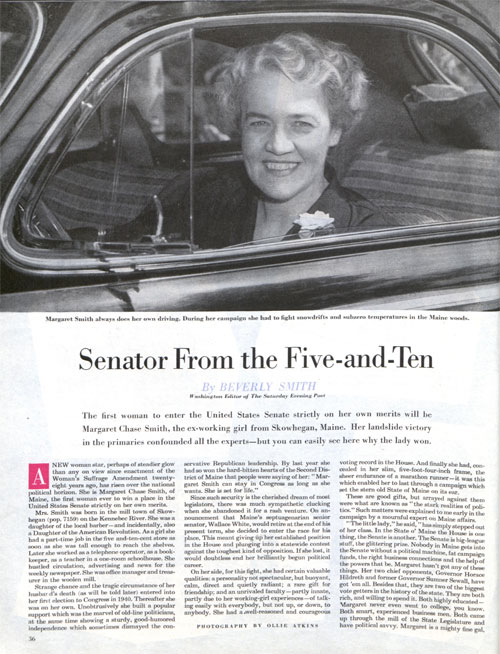
Featured image: Photo by Ollie Atkins for “Senator from the Five-and-Ten,” from the September 11, 1948, issue of the Post.
Illustrations: Clowning Around
They might conjure fond memories of circus antics or be your worst nightmare, but clowns were a popular subject for Saturday Evening Post covers, due largely in part to the popularity of circuses in the first half of the twentieth century. We looked through our archive to find clown illustrations by some of our best known artists, including Norman Rockwell and J.C. Leyendecker. Most of our clowns are charming (or at least not frightening), but we did find one particularly scary clown from an image illustrating a short story. The clown in the picture might not be central to the story, but he more than makes up for it in creepiness.
Edward Penfield
August 22, 1903
This not-so-cheery clown has been stuck with the job of handing out circus flyers. The artist is Edward Penfield, known as the father of the art poster. His first posters were created to advertise issues of Harper’s magazine from the late 1800s. He later created 20 covers for the Post, using his signature strong lines and bold style.
Norman Rockwell
May 18, 1918
Norman Rockwell painted several circus-themed covers, including this one fairly early in his career. Here, the world-weary clown, his newspaper folded “subway style,” ignores the awestruck country boy. The dog in the illustration is Lambert, Rockwell’s own pet. Rockwell recalls that Lambert was a thoughtful model, who, when placed in position on the stand, would sit for hours with his head cocked to one side.
J.C. Leyendecker
July 29, 1922
In the mid-1800s, the Standard Poodle became a popular circus performer because of its intelligence and stamina. Leyendecker painted six circus-themed covers for the Post, with our poodle friend making a second appearance in one of them.
Norman Rockwell
May 26, 1923
A look behind the scenes at the big top reveals the house of disciplined practice that result in a show that delights the circus-goers in the ring. The pup learns his lesson under the stern eye of the older dog, who manages a degree of dignity despite the absurdity of the costume.
John E. Sheridan
June 3, 1939
From 1931 to 1939 Sheridan illustrated thirteen covers for Post with predominant sporting and military themes, so this vivid picture of a clown and his dog was quite the departure for him.
Ben Stahl
January 3, 1942
Ah, here is the inside illustration we warmed you about! The major action is taking place on the left side of the illustration, with the policeman looking on with concern. But that clown! His intentions seems to be more Stephen-Kingian and less Norman-Rockwellian.
John Atherton
July 8, 1944
World War II was raging, and the pages of this issue were filled with advertisments supporting the war and stories of soldiers in battle. The Post must have thought that its readers needed a little respite; this John Atherton cover was the result.
When the Post Launched Lassie’s Lucrative Career
After seven successful films, Pal the dog was ready to save the day weekly as Lassie on television. The series ran for 19 seasons, and it first aired on this day in 1954 on CBS.
In the pilot episode, “The Inheritance,” the young, rambunctious Jeff Miller inherits Lassie from her departed owner. In a room full of impatient, hopeful inheritors, Jeff embraces the old girl and proclaims, “Lassie!” He keeps the pooch until a move to the city in the fourth season forces Jeff to leave her with the new lead boy, Timmy.
Pal only played the courageous canine for the first two episodes, though. Afterwards, he retired from show business for good. Pal’s descendants took up the role until the show ended in 1973. In Ace Collins’ book Lassie: A Dog’s Life, actor Tommy Rettig (Jeff Miller) said Pal, in retirement deemed The Old Man, would still come to the set every day with his pup, Lassie, Jr.: “When Rudd would ask Lassie, Jr. to do something, if you were behind the set, you could see The Old Man get up from his bed and go through the routine back there.”
The Lassie franchise started with a short story, “Lassie Come-Home” by Eric Knight, first published in The Saturday Evening Post in 1938. The ensuing novel spawned the film career of Pal the Rough Collie and his owner and trainer, Rudd Weatherwax. The Post’s 1949 article, “Lassie Did Come Home — Rich,” tells about Pal’s lucrative thespian career — the dog was making $25,000 per year. Ironically, Weatherwax had only paid ten bucks for Pal when he got him as a pup, and the runt didn’t have any pedigree papers to speak of.
Pal’s legacy was unquestioned after the movies’ tremendous successes. He had received around 30,000 fan letters in 1949, and his progeny were going for up to $300.
At the end of Lassie’s pilot, the pooch saves the day by rescuing a $2,000 inheritance from the dastardly farmhand Matt Willis. In reality, the doggy female impersonator was fetching much more than that on a monthly basis. In the final scene, Jeff anxiously gazes at Lassie, wondering if she will decide to accept her new home. After some pacing — during which it appears the dog is actually considering whether to stay with Jeff or run free — Lassie bounds into the boy’s arms, prompting Gramps to claim, “She’s all yours, now. She’s done ‘er decidin’.”
Leading Men of Hollywood: Tony Curtis
This article and other features about the stars of Tinseltown can be found in the Post’s Special Collector’s Edition, The Golden Age of Hollywood. This edition can be ordered here.
As far back as he can remember, Tony Curtis always wanted to be a movie star. It was not, of course, a very unusual dream, particularly for a boy who grew up in poverty and felt himself a misfit, an outcast. What is somewhat surprising—and not least of all to Curtis himself—is that the dream came true.
Tony was born Bernard (Bernie) Schwartz, on June 3, l925, the son of Hungarian Jews who had come to America after the World War I, met here and married. Manny Schwartz was a tailor who wanted to be an actor. But acting jobs were scarce during the Depression, especially for a man with no experience; and Manny supported his family with a succession of tailoring jobs. He was a good tailor, Tony thinks, but his heart was never in it; and the family was constantly moving as Manny went from one job to another.
Probably this constant moving was the first cause of young Bernie’s insecurity—he never stayed in any one place long enough to feel that he belonged. As a boy he was small and skinny, and the bigger boys used to pick on him—“not because it was me,” Tony says, “but a new kid in any neighborhood would be picked on. So I said, ‘I gotta find a way of not getting my nose punched every time, because it gets to be a drag.’ So I said, ‘How do I do it?’ And I got it: I was going to be the crazy new kid on the block.”
Slight as he was, Bernie had good coordination and a kind of flamboyant daring, and he developed a trick of swinging aboard a fast-moving trolley by running alongside, then grabbing the handrail and letting the trolley’s momentum whip his feet off the ground step. “Now this was a remarkable test,” he says, “and I used to do it in every new neighborhood.” He would pick his time—after school was out and when two or three of the neighborhood kids were watching and maybe nudging each other, saying, “There’s our mark.” And he would do his trick with the trolley and then sass the motorman—“which would break up these kids,” he says, and from then on they wouldn’t fool with me.
Then, when Bernie was 13, his 10-year-old brother Julius was killed. Losing his brother was bad enough, but far worse was the fact that Bernie blamed himself for Julius’s death. Like all children, he carried in his conscience an accumulation of real and imagined sins. Tony says, “I was sure this was my God’s way of punishing me for being a bad kid. I remember going down to the East River and asking God: If he would return my brother, I wouldn’t tell anybody that he’d been returned—just let me see him.”
But the one place where he could forget his guilts and fears was in the movie theater. Looking back, Tony says, “My whole culture as a boy was pictures. For 11 cents you could sit in the theater, right in the front row, and sit for 10 hours, which I did constantly.” His particular idols were Cary Grant, Jimmy Cagney, Humphrey Bogart and Errol Flynn. “Each of these fellas,” he says, “gave me a different feeling when I left the theater. Cary Grant made me feel chic and smart. Jimmy Cagney made me feel cocky. Humphrey Bogart made me feel mean. Errol Flynn made me feel dashing and swashbuckling. And I remember I would come out of a movie and I would be choking with the desire to do what these fellas had done on the screen. I started hitching rides on trolley cars, but I used to do it the way I imagined Errol Flynn would leap on a trolley car. It was never just to get a ride; I was off to conquer something.”
The spell of movies colored everything he did. “Each day,” he says, “when I went out into the world it was a whole new experience. What will I run into? What will I find? Do I dare go out by myself? And we would go all over Manhattan, two or three of us—like knights, close together—just waiting for the situation to come up. Run! We had to hide, steal. We did everything. And it really was thrilling.”
Finally, in the spring of l948, Bernie was given the chance to join the pictures for real when Universal-International Pictures signed the 23-year-old actor to a seven-year contract with a starting salary of $l00 a week.
The first thing the studio did was change his name.
Almost from the start Tony attracted a quite remarkable fan following. Prodded by his popularity with the fans, the studio decided to try Tony in starring roles. The first of these, released in l95l, was an Arabian horse opera called The Prince Who Was a Thief. Tony, of course, was the prince—and not a very regal one, according to The New York Times. One of the troubles, no doubt, lay in the fact that, while Tony had by then greatly improved his diction, traces of New York did occasionally creep into his speech. “I had one scene with Piper Laurie,” he recalls, “sitting on top of a hill, looking down at this beautiful castle. I had my arm around Piper, and I said, ‘Yonder lies the castle of my fodder.’ And it’s still in the movie!” This breaks him up.
But if Tony’s diction suffered a slip now and then during this period, it was probably because, since August of 1950, he had been devoting most of his energies to the wooing of Janet Leigh.
The following April, he proposed.
In many respects it was an ideal marriage, but “we had some tense moments,” Tony says.
Perhaps the most important cause of this tension at home was the fact that, little by little, Tony had started to lose his old happy-go-lucky attitude toward his work. For six years he had taken things at the studio pretty much as they came: bit parts, bigger parts—it was all fun for him. He was in Hollywood, wasn’t he? Working in pictures, living out his old childhood dream? By l954, however, as one lightweight starring role followed another, he began to realize that what he was doing wasn’t really acting at all. The studio heads and film directors never really pushed me, he says. “If I had difficulty with a scene, they cut the scene out. Everything I did fitted my personality. If I played a prize fighter or a knight in armor, it was basically the same story.”
By and large the critics gave him the back of their hand—“and they were right,” he says. But the studio wasn’t interested in making him an actor; he was a profitable commodity just as he was—as long as they could use him in low-budget pictures and finish shooting in a fast three weeks. And as Tony began to realize how precarious and, in a way, how false his position in Hollywood was, all the old insecurity came flooding back.
“Maybe,” he says, “in realizing that there was more to acting than what I had been doing, I saw the great lack I had as a performer and the great lack I had as a person. And maybe one side of me was saying, ‘Grab what you can and run with it,’ and the other side was saying, ‘You’re a schnook, and you’re distasteful, and you’re dishonest, and you’re just nothing.’ And I found myself terribly insecure, terribly frightened by life.”
REDEVOTION TO THE CRAFT
Blake Edwards, his director friend, who had been through a bad period himself, saw what was happening to Tony and sent him to his own psychoanalyst. Tony went to the doctor regularly for the better part of three years, and slowly but steadily the analysis helped, teaching him to talk out his problems. “This is the difficult thing for human beings to do,” he says, “to articulate their weaknesses. But I feel if you’re going to survive as a human being, you have to do it, because as soon as you say it to yourself, all of a sudden you realize that maybe all is not lost.”
Probably as important to Tony’s recovery as the analysis itself was the strength and support that Janet gave him. The final rung to his salvation was hammered into place when he was offered a part in Burt Lancaster’s 1956 production Trapeze. With Trapeze, Tony really started studying his craft. For the first time he was co-starred with people who knew something about acting, and it amazed him to find how much he could learn from simply watching them.
Since then, he says, “I haven’t cared about the billing. I haven’t cared about the money. I’ve just wanted to work with the masters.”
Elvis on Ed Sullivan Show and the Clash of Sex and Race
Ed Sullivan changed his tune on “Elvis the Pelvis” after the up-and-coming star performed on The Steve Allen Show in 1956 and topped Sullivan’s ratings for the first time. Despite his earlier refusals (“I’ll not have him at any price — he’s not my cup of tea”), Sullivan booked Elvis for an unprecedented $50,000 for three appearances.
The first of those appearances was 61 years ago today, and it was the most-watched broadcast of the ’50s, summoning 82.6 percent of America’s television viewers.
Sullivan was recovering from a car accident the night of the broadcast, and Elvis was filming his first movie in Hollywood, so Brit Charles Laughton introduced Presley’s live Los Angeles performance. The CBS Television Studios set was decorated with abstract guitars, and Elvis appeared onstage in a plaid jacket, clearing his throat to giddy laughter from the hyper crowd. He performed “Don’t Be Cruel” and “Love Me Tender” and then — later in the show — Little Richard’s “Ready Teddy” and his own rendition of “Hound Dog.”
Like most of Elvis’ life, the first Ed Sullivan Show performance is shrouded in myth. Despite the availability of the original recording online, people still claim that Laughton introduced the singer as “Elvin” Presley and that the hip-swinger was recorded only from the waist up. In reality, Laughton clearly said “Elvis,” and a variety of camera shots were used. During “Hound Dog,” however, the show’s producer seemed to favor tighter angles of the performer.
Three years later, the Saturday Evening Post article “It All Started with Elvis” proposed the homegrown celebrity acts and one-hit wonders coming into popularity were indebted to the success of “The King.” Writers Ren Grevatt and Merrill Pollack claim, “The ‘frantic’ sound is popular nowadays, and it applies to youngsters, like Presley, whose style is characterized by a frenzied, uninhibited, out-of-breath delivery. The ‘wail,’ the ‘moan,’ the ‘groan’ and the ‘shriek’ can, by extension, be considered legitimate categories.” In other words, Elvis brought sex to the stage.
At least, that was the supposed reasoning for the Nashville and St. Louis protests of his famed second appearance on the Ed Sullivan Show. Perhaps another reason for the disdain of Elvis’ performances is apparent in the 1959 Post article, in which Sam Phillips of Sun Recording Studios recalls his first experience recording young Elvis: “He was a white boy, but he was singing like a Negro.” The then-acceptable term for African-Americans is used several times in the article in reference to the music of rhythm-and-blues artists like Arthur Crudup and “Big Mama” Thornton — original performers of songs Presley would make famous, including “Hound Dog.” Although Elvis admittedly took considerable inspiration from country singers like Roy Acuff and Hank Snow, his dependence on black music and musicians is undeniable.
Phillips laments that Presley’s music was often rejected in the beginning due to its connection with African-American music: “The only place we got his records played at first was in the Negro sections of Chicago and Detroit and in California. Most of the Northern fellows were used to playing the smooth, sugary stuff, and in the South, even though Elvis was a hillbilly, the hillbilly disc jockeys refused to play him because they said he was singing ‘darky’ music.”
Whether this all amounts to Elvis bridging racial divides or profiting from another style is a subject of debate; it’s probably a bit of both.
In a 2007 New York Times article, Peter Guralnick discusses Presley’s refutation of his nickname “King of Rock ’n’ Roll,” citing Fats Domino as “one of my influences from way back.” Guralnick writes, “The larger point, of course, was that no one should be called king; surely the music, the American musical tradition that Elvis so strongly embraced, could stand on its own by now, after crossing all borders of race, class and even nationality.”
Despite a clear understanding of his roots, Presley himself was aloof about his own role as a sex symbol. The 1965 Post story “There’ll Always Be an Elvis” notes, “The criticisms stung both Elvis and his family. ‘I didn’t do no dirty body movements,’ he announced self-righteously. ‘When I sing, I just start jumping. If I stand still, I’m dead.’” The feigned innocence would be repeated by countless boy bands and pop divas several decades later, but Elvis very clearly understood the edge behind his performances as well as the reactions they would garner.
Perhaps author and psychologist Dr. Harold Greenwald put it best, saying “Elvis has sort of a dread fascination for lonely women. … He seems to be uninhibited and wild. And there is a hint of cruelty to him. When he sings, he is like a method actor: He is in some fantasy of his own which coincides with the fantasies of his listeners.”
Ford, Nixon, and the Controversies behind Presidential Pardons
On September 8, 1974, in one of the most controversial shows of presidential clemency, Gerald Ford pardoned “all offenses against the United States” that Richard Nixon may have committed between January 20, 1969 and August 9, 1974.
According to Alexander Hamilton, the Constitution gives the president the power to pardon criminals in order “to restore tranquility to the commonwealth” in politically divisive cases. But sometimes, instead of tranquility, pardons further divided the country and even destroyed presidents’ careers. Although few pardons are without controversy, some have created more waves than others.
Here’s a look at some of the more memorable pardons by our nation’s presidents.
George Washington and the Whiskey Rebellion
George Washington granted the first presidential pardon when he spared the lives of two men who’d been sentenced to hang for their part in Pennsylvania’s Whiskey Rebellion. Washington had sensed the rebellion was dying away and didn’t want to revive the cause by hanging men for treason. Hamilton didn’t approve; he wanted to make an example to other tax resisters. But pardoning the men shifted the country’s attentions away from the fading rebellion and helped defuse lingering anti-government feelings.
Andrew Johnson and the Confederacy
Andrew Johnson had the same idea in 1865, but not the same results. After the Civil War ended, he sought to reunite the country by pardoning thousands of former office-holders of the Confederacy. He believed he was carrying out the lenient attitude that President Lincoln would have wanted. Within a year of the war’s end, Johnson had granted pardons to more than 6,000 former officials of the Confederacy.
Members of the Republican Party were furious with Johnson. They believed he was giving power back to the rebels and traitors who’d started the war. Some senators thought Johnson was guilty of treason for aiding the Union’s former enemies. The Republicans split between the pro- and anti-Johnson factions. In 1868, Johnson’s opponents began impeachment hearings against him. Johnson escaped impeachment by one vote, but the Republicans, and the nation, remained divided between pro- and anti-leniency factions for years.
Harry Truman and the Conscientious Objectors
During World War II, over 15,000 Americans objected to participating in the war and refused to serve in the military. When the war ended, President Truman asked a board to review these cases to see who truly qualified for conscientious-objector status. The board found 1,500 objectors who had legitimate religious convictions barring them from service. Truman pardoned these men on December 23, 1947.
Amnesty activists pleaded with Truman to pardon the others, but he refused. Believing he’d released all honest draft resisters, he regarded the remaining conscientious objectors as “just plain cowards or shirkers.”
Jimmy Carter and the Draft Dodgers
In 1977, President Jimmy Carter was considering the fate of American men who’d refused to serve in the Vietnam War. The war had ended, but thousands who had evaded the draft were still in prison. Carter knew Americans were sharply divided over the war. He thought pardoning the draft dodgers would help resolve the divisions and move the country forward.
On January 21, 1977, he extended amnesty to all men who’d failed to register for the draft or who fled the country to avoid conscription. This included more than 50,000 American men who’d fled to Canada. The amnesty did not extend to over 500,000 men who were imprisoned for going AWOL while in uniform.
The pardon was welcomed by the families of draft dodgers, but veterans who’d served in Vietnam were infuriated. Resentment among Americans who’d supported the war only deepened. The pardon helped erode Carter’s support and probably contributed to his failed re-election bid.
Ford and Nixon
One of the most controversial presidential pardons was Gerald Ford’s pardoning of Richard Nixon. Ford must have known he’d lose some of the general support he’d enjoyed when he took over the White House after Nixon left. But he’d seen the country preoccupied by the Watergate scandal for over a year, and he knew a lengthy, public trial of Nixon, which would consume at least another year, would further divide pro- and anti-Nixon camps and distract the nation from pressing economic and international issues.
Ford was ready to move on, but the country wasn’t. Though praised by legislators in both parties, he was criticized by many Americans who wanted to see justice meted out to Nixon. A Gallup poll that month showed most Americans disapproved of the pardon. Instead of restoring tranquility to the nation, as he’d hoped, Ford had raised the Watergate issue to even greater prominence. The unpopularity of this action probably cost Ford the presidential election in 1978.
Pardons and Politics
Since then, critics have seen political motives in presidential pardons. Some considered President George H.W. Bush’s pardoning of six participants in the Iran-Contra Affair as a convenient way of protecting himself from having to testify on the affair before Congress. Some of President Clinton’s pardons were viewed by critics as efforts to protect major donors or buy votes among minority groups. In 2007, President George W. Bush commuted the prison sentence of vice-presidential advisor Lewis Libby, who’d been convicted for obstruction of justice and perjury. Bush’s action was so widely considered a cover-up for the president’s involvement that the House Judiciary Committee investigated whether pardons were being used for political gain.
It’s impossible for a president not to gain political advantages by extending a pardon. But the chief motive in pardoning should always be what Hamilton described in 1787 — restoring tranquility to the commonwealth — even if some Americans aren’t ready to forgive.
Featured image: Gerald R. Ford (White House Archives, Gerald R. Ford Library)