A World War II Hero Remembers Guadalcanal
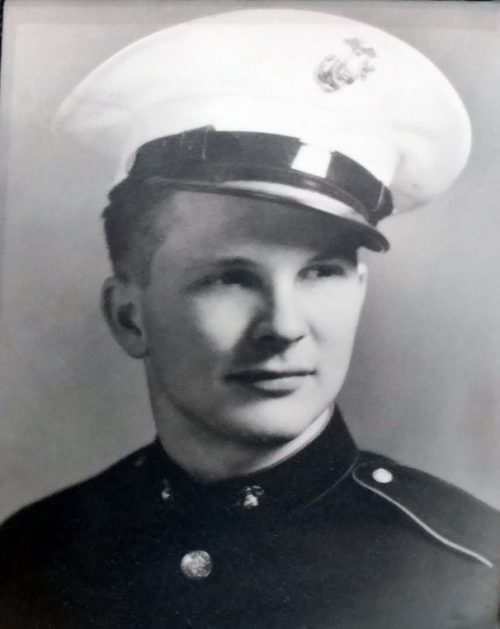
August 7 marks the 75th anniversary of one of the most brutal battles of World War II, the Battle of Guadalcanal. World War II veteran Roy Roush recalls his experiences as a member of the 2nd Marine Division during frontline action at this critical campaign.
Roush enlisted in the U.S. Marine Corps on July 4, 1942, the day after the end of his junior year of high school.
Now 92 years old and one of only two people still alive from his company, Roush remembers how he survived: “The reason we were so successful is because we were all teenagers. Out of 175 men in our company, 90 percent of us were teenagers. Teenagers think they can do anything, and they always did.”
After the surprise attack by the Japanese on Pearl Harbor on December 7, 1941, they set out to take over the South Pacific islands to prevent a retaliatory attack by the United States. When the Japanese military began to build an airfield in 1942 in the Solomon Islands, U.S. forces saw a target, and one of the most important battles of World War II was fought here.
The United States forces landed in the Solomon Islands on August 7, 1942 — eight months to the day after Pearl Harbor — and the six-month battle that followed ended Japan’s eastward advance. The fighting conditions were gruesome on both sides, with lack of clean water, insufficient supplies, and mosquitoes causing many soldiers to suffer dysentery and malaria.
Rousch recalls his experience in Guadalcanal: “[I] walked up to the front line from the beach, and it was about five miles carrying a browning automatic rifle (BAR) and nearly one hundred pounds of ammunition and gear. It was a jungle hell where nothing was accommodating. We were thirsty, tired, covered in scratches from the jungle. There was never enough food or water. You could not sleep at night because of the mosquitoes and infiltrating Japanese.”

Rousch’s 2nd Marine Division landed in the Solomon Islands at Kukum Beach near Henderson Field on Guadalcanal. Roush says that he would rather return to all three of the other campaigns he served in later in the war — on Tarawa, Saipan, and Tinian — than go back to the conditions at the Battle of Guadalcanal.
The Guadalcanal operation holds the record as the longest and largest of all beachheads ever secured by Marines, but victory came at a price, and the territory was as unwelcoming as the opposition. The water they drank was so dirty, Roush “strained it through his teeth to keep from choking on it.” His company had to hack its way through the jungle with machetes and bayonets. The soldiers all lost weight; Roush went from 175 pounds to 130 pounds from lack of supplies, illness, fatigue, and the jungle heat.
When Roush’s battalion left the Solomon Islands for Wellington, New Zealand, on February 19, 1943, nearly all the members were hospitalized for severe malaria; two died, and some had to be medically discharged. Roush was in the hospital in July 1943 when Eleanor Roosevelt visited the ward and said, “My husband, the President of the United States, has asked me to say hello to you all and to say how much we appreciate what you have done.”
The Solomon Islands Campaign cost the Allies approximately 7,100 men, 29 ships, and 615 aircraft, according to the National WWII Museum. The Japanese lost 31,000 men, 38 ships, and 683 aircraft. Despite the odds, Roush made it home from World War II and chose to serve again during the Korean War as a fighter pilot.
After an honorable discharge from the Air Force in 1954, Roush moved to Los Angeles, where he now lives with his wife in a house with floor-to-ceiling windows and glass doors overlooking the San Fernando Valley. He earned both a Masters and Ph.D. in archeology and wrote the book Open Fire! about his personal story of frontline combat.
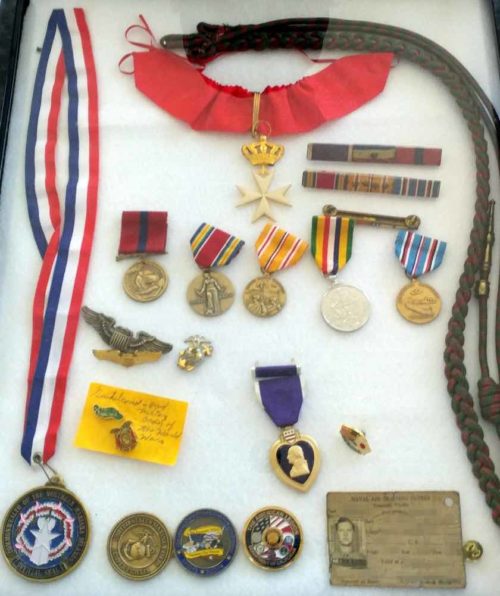
Roush was knighted by the Knights of St. John of Jerusalem and has a purple heart. He was a hero to our country during battle, and he continues to serve as an inspiration. Roush proves that if you put your mind to it, you can accomplish anything. As he says in the first line of his book, “We were just a bunch of American kids, led by some good officers who thought that we could do anything, and somehow, we always did.”
Read Jeff Nilsson’s Post Perspective on Guadalcanal, The Battle of Guadalcanal: The End of the Beginning.
Screen Sirens of Hollywood: Raquel Welch
This article and other features about the stars of Tinseltown can be found in the Post’s Special Collector’s Edition, The Golden Age of Hollywood. This edition can be ordered here.
It’s fabulous,” the real-estate saleswoman assured them. “It’s just divine. You can move in without changing a thing. The house is listed in MANSIONS OF BEVERLY HILLS as one of the most outstanding.”
Raquel Welch parked her Silver Cloud Rolls-Royce before the former home of the late David O. Selznick and got out. She wore a leather trench coat, form-fitting gabardine slacks and tan boots that clicked on the stone walk as she strode toward the ornately carved front door.
The Rolls had been a 25th-birthday present from her husband, Patrick Curtis, who followed a discreet two paces behind, nervously whistling “The High and the Mighty.” The $345,000 price tag on the two-acre estate was not, however, inconsistent with his wife’s increasing eminence.
During the previous year, her photograph had graced the covers of more than 200 overseas magazines. Her long brown hair, high cheekbones and lithe torso had captivated most of Europe.
French headline writers had christened her “La Plus Belle Fille du Monde”; in Rome, Raquel was known as “L’Attrice Piu Bella Dell ‘Anno.” Unable to scale the walls of her rented 13-room Appian Way villa, swarming paparazzi tried to bribe the help. They were competing for the 1 million lire that had been ordered for pictures of her two children—by a previous, secret marriage—who were hidden inside the villa. Raquel doused her antagonists with a water pistol.
A photograph of Raquel curtsying before Queen Elizabeth at a Royal Command Performance received front-page treatment in London; better-known entertainers, such as Rex Harrison and Julie Christie, went virtually ignored. In Spain, readers avidly followed “La Vida Secreta de Raquel Welch,” a newspaper serial enhanced by color illustrations of Raquel in bikinis.
“Europeans never realized that I was an American,” says the Latin-looking Miss Welch, née Tequada, whose parents claim Castilian-Spanish and English-Scottish descent. “They were sure I was French. They were sure I was Italian. They were sure I was Spanish. That’s why I was so popular in Europe. There is a very big anti-American thing going on over there.”
A more accurate explanation of Raquel’s popularity would be the shrewdly managed publicity campaign by which she quickly eclipsed many of the leading sex symbols of the 1960s. The producers of ONE MILLION YEARS, B.C., one of the six films she completed in a year and a half, helped promote her sex image, as well as the picture, by mailing out 10,000 unconventional Christmas cards—11-by-14 photographs of Raquel posing in a Stone Age swimsuit fashioned from barely enough chamois to clean a very small windshield.
Her glowing overseas press notices filled a 15-cubic-foot steamer trunk that cost hundreds of dollars to ship back to the States. It contained dozens of bulging scrapbooks, Manila envelopes crammed with newspaper and magazine stories, a plaque naming her “Star of the Sixties,” cans of television film, matchboxes decorated with revealing replicas of Raquel, and hundreds of loose snapshots of Raquel modeling hostess outfits
or introducing backless bikinis at St.-Tropez.
Now, after what the LONDON DAILY MAIL called “the most amazing personality buildup since Marilyn Monroe,” Raquel and Patrick Curtis were seeking a Hollywood headquarters for the steamer trunk, themselves, the children, the English nanny, the housekeeper and the five cars they had accumulated abroad.
“Isn’t it a magnificent house?” the saleswoman said as they all walked upstairs to the second story of the Selznick mansion. “You don’t find houses like this in Los Angeles any more. Steel and concrete. Fully air- conditioned. Copper plumbing. Your railing here is solid pewter.”
“That’s something we’ve kind of always wanted,” Patrick grumbled.
Curtis, 32, grew up in Hollywood as Patrick Smith, a child actor (he later played a priest in THE GREAT IMPOSTOR and borrowed his current surname from the picture’s star, Tony Curtis). He met Raquel three years ago.
“If you want to deal with Raquel, you have to deal with me,” Curtis says. “Because I push the buttons. I’m the guy who’s in control of the situation. And I make damned good deals.”
Under his guidance Raquel’s earnings have soared from $500 a week for a bit role in A HOUSE IS NOT A HOME to as high as $20,000 a day for a two-week stint on a German production. The contracts he masterminded in Europe required film companies to provide her with chauffeured limousines, air-cooled dressing trailers, personal hairdressers, makeup men, wardrobe attendants, lavish living quarters and the right to veto any photographs of herself that she deemed unflattering. She has rejected a $500,000 bid, Curtis claims, for her services in a sequel to ONE MILLION YEARS, B.C. and several lucrative offers for television series. “I don’t see anybody becoming a big star from TV,” he says. “Certainly not a girl.”
It was Curtis who suggested the daring amber-colored culotte outfit Raquel wore at this year’s Academy Award ceremonies. Appropriately enough, when she walked on stage, the orchestra played “You’re Gonna Hear From Me.” e $2,000 costume won Raquel décolletage honors for the evening (humorist Stan Freberg, gazing upon her 37-22-35 figure, described her as “The Thinking Man’s Twiggy”), though not the approval of all. “The lovely Raquel Welch deserves to be locked away for appearing in an out t that made her look like a sausage-stuffed sweatsock,” sniffed an unappreciative couturier.
Unlike the couturier and most film critics, who belittle Raquel’s limited acting ability, moviegoers seem pleased by what they see. It was her simulated striptease that highlighted A SWINGIN’ SUMMER, the low-budget beach movie that first brought Raquel to the attention of major Hollywood studios. Though critics roasted the film, its profits were more than triple its cost.
Clad in a skin-tight rubber wet suit for FANTASTIC VOYAGE, she played a technician aboard a miniaturized submarine cruising through the bloodstream of a stricken scientist. Twentieth Century-Fox made sums that were anything but miniature.
In ONE MILLION YEARS, B.C., Raquel’s only dialogue consisted of three words: “Akita!” (Help!), “Tumak” (her prehistoric lover) and “Seron” (her pterodactyl co-star). Sound-effect experts dubbed in the grunts and screams that made up the rest of her spoken performance. Again the film pained reviewers and delighted the viewing public.
Success, Not Without Work
Since their return from the Continent, the couple’s bedroom in a rented Beverly Hills home has seen considerable service. Their bedtime ritual centers upon the improvement of Raquel’s diction. Curtis has given her a leather-bound edition of THE COMPLETE WORKS OF SHAKESPEARE. Reading from it aloud, he reasons, will inject more emotion into her bland voice and help erase her irritating habit of dropping g’s. Sometimes Raquel recites a sonnet. More often Curtis prompts her with the opening lines of a familiar request of Hamlet’s: “Speak the speech, I pray you, as I pronounced it to you, trippingly on the tongue … .” Raquel continues, employing an affected British accent. By the time she has reached, “I would have such a fellow whipped for o’er-doing Termagant,” Curtis is usually asleep. “When you’re an old married man,” he says, “you run out of things to say.”
Raquel consults a voice coach three times a week (“The president should have a committee for pure American speech,” she says, “for recapturing the pride in our language”); to keep her stomach flat, she works out twice a week in a dance studio. She also believes in facial isometrics; driving her car, she constantly wiggles her ear muscles and makes her nostrils are. “In front of a camera.” she explains, “everything you do is magnified. I have to put so much of my energy into making myself an extremely dynamic, feminine person on the screen.”
When their house tour was over, Patrick took the real-estate woman’s business card, thanked her and followed Raquel into the Rolls.
“There have been lots and lots of people who have tried to manufacture stars.” Raquel said as she drove back down the winding driveway. “But it’s never worked unless the person has something. And there’s a certain pretentiousness about me that kind of lends itself to the business I’m in.”
“The way you can tell a movie star is whether they can be impersonated,” Curtis observed. “It’s easy to impersonate Cary Grant or Cagney or Jimmy Stewart because they all have their de nite mannerisms and personalities.”
A moment later he began to whistle cheerfully, as well he might given the family’s current circumstances. For the time being at least, Raquel Welch seems to be doing a splendid impersonation of a movie star.
How Hiroshima Changed the Way We Think about War
Seventy-two years ago, America dropped the first atomic bomb ever used in war. Many Americans were happy to hear the news that a bomb had destroyed the Japanese city of Hiroshima. They were elated at the prospect of an imminent end to the war. And for some, there was satisfaction that the bomb, which had instantly killed over 50,000 Japanese, was fitting vengeance for the attack on Pearl Harbor.
But in the months that followed, the enormity of the bomb’s deadly force began to sink in. Americans grew concerned that a weapon could hold such devastating power.
Only America possessed an atomic bomb at the time, but many assumed it would only be a matter of time before other nations developed their own atomic program. (In fact, the Soviet Union announced its own atomic bomb three years later.)
The concerns grew as the death toll in Hiroshima continued to climb. By year’s end, it had reached 140,000 as people succumbed to the effects of burns, radiation, and other illnesses. In Nagasaki, which had been bombed three days after Hiroshima, the number killed reached 70,000.
It was plain to see that war had been changed.
The Army’s General Staff College conducted an in-depth study of just how the bomb had altered America’s defense strategy. Now, countries that went to war with atomic weapons would face a stalemate neither would want to break. An atomic war was unwinnable and, perhaps, unwageable.
The Army concluded that America’s primary defense in the future would not be military force but diplomatic pressure: negotiations, sanctions, embargoes, compromises. And since diplomacy works best when supported by other countries, America would have to be involved in international politics to support its alliances and control the use of atomic weapons.
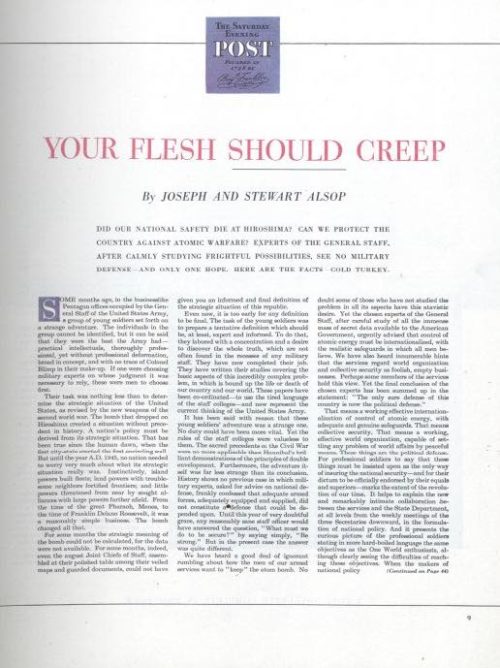
The alternative, a purely military defense in the atomic age, would require vast alterations in the country, according to Joseph and Stewart Alsop. In their July 13, 1946 Post article, “Your Flesh Should Creep,” they described how a military approach to waging atomic warfare would affect America.
- Cities would have to be redeveloped to reduce concentrations of population and industry. Great citieswouldbecome ghost towns.
- Americans — men and women — would be “trained in group action, in group discipline and in the disaster-control procedures required in time of great emergency. Each citizen will learn his doomsday duties.”
- A specially trained, unelected, emergency government would be keptwithin a cave ready to take over the administration of the country.
Some aspects of a military approach to waging atomic warfare were adopted, however, even though the Alsops would have thought them unfeasible.
For example, they scoffed at the military notion of building an immense, invulnerable mechanism of retaliation — a chain of rocket installations, across the nation, buried deep underground, operating on 24-hour-a-day alert.
“No true democracy,” they wrote, “can maintain an immense and powerful armament in a state of 24-hour alert for years and decades on end.”
Moreover, such a system would require one person with the ultimate responsibility to launch Armageddon on the enemy. “No true democracy can confide to a single individual, the rocket controller, such responsibility as would be his,” they added.
Yet over 1,000 Minuteman missiles were stored in underground silos in the 1960s, and Atlas Intercontinental Ballistic Missiles were kept in silos on six Air Force bases. And — despite deep misgivings — there is, indeed, one person with the responsibility of launching our nuclear arsenal: the president.
Featured image: Wrecked framework of the Museum of Science and Industry in Hiroshima, Japan. (Shutterstock)
Over-Town
Doris decides to walk to the Pebbly Beach freight yard. The tug won’t be leaving for San Pedro for a couple of hours, and she has nothing but time. A white van passes her on the winding shoreline road from Avalon. The driver beeps its horn. She waves automatically. After 50-plus years on Catalina Island, everybody knows her. She and Jack spent rainy nights in the back of Luau Larry’s, nursing something alcoholic and listening to their neighbors’ stories. Now it’s the town’s turn to pay attention.
The wind wet with sea spray blows cold. She pulls her shawl tight around her slender body and fights to keep gray hair out of her eyes. Puffy clouds drift overhead and push up over the channel and the mainland, glowing pink in the afternoon light. The road’s gravel shoulder crunches under her sturdy shoes. At the freight yard, Julio comes out of his shack and joins her. He smells of bourbon.
“Sorry to hear about Jack. The county brought him down an hour ago. He’s all secured.”
“Thanks, Julio. Welch and Sons will be on the docks to meet the boat. Who’s the skipper today?”
“The new guy, McGregor. But the channel should stay flat, a real milk run.”
“What about those?” Doris points to the clouds.
“Yeah, they could mean somethin’. But it’s May. I can’t remember the last time we had a hard blow in May.”
She nods and stares at the three loaded barges tethered to the dock behind a stubby tugboat. She checks her watch.
“So you gonna, ya know … see him off?” Julio asks.
“Nah, I just wanted to make sure he … he made it here.”
“I’m real sorry, Doris. Everybody loved Jack … he’ll be missed.”
“Our daughters are flyin’ in from Boston. I’m going over-town on the 9:50 tomorrow to meet ’em at LAX.”
“You got somebody to watch your house?”
“Oh yeah, the whole street has been banging on my door all week. Juanita will feed my cats.”
“Good, good.”
They gaze across the freight yard at the 4:40 ferry entering Avalon Harbor. It’s packed with tourists, ready to enjoy a lively weekend on The Island of Romance. Fifty-three years ago, Jack brought his new bride, Doris, over on the Great White Steamer from Wilmington. The town of Avalon used to have a brass band that welcomed the incoming tourists while speedboats crisscrossed the harbor, pulling water skiers — beautiful girls in tight bathing suits. But all of that’s gone, replaced by huge cruise ships anchored off Lovers Cove, disgorging their throngs of Asian and European visitors.
“How long you gonna be over-town?” Julio asks.
“Maybe four days. The funeral’s the day after tomorrow.”
“Too bad Jack couldn’t stay on island.”
Doris sighs. “Yeah, if it was up to me, I’d spread his ashes over the channel, out beyond Abalone Point. But his sister wants to plant him in the ground with the rest of their family.”
“Huh. Well, let me know if I can help. You … you are comin’ back, aren’t you?”
Doris laughs. “I get a headache every time I go over-town. That damn LA smog and traffic is murder. But our oldest daughter wants me to go back to Boston with her. I don’t know … can’t decide.” She stares at the tugboat until their silence becomes awkward. “I’ll see ya, Julio.”
She tucks her long hair down the back of her blouse, tightens her shawl and walks toward Avalon. At Abalone Point she stares across the harbor at the round seaside Casino, glowing white in the fading sun. By the time she gets to the ferry landing, the inbound crowd has cleared out, whisked away by taxis to their hotels. The lights flick on under the palm trees along Crescent Avenue, the restaurants and bars already deep into their happy hours. Happy hours … Jeez, I could use a few of those.
Eric’s On The Pier has shuttered its windows for the night. Flags hang limply in the evening quiet. She thinks about going up canyon to their empty cottage, one of many tiny wooden boxes built on the flats between the wars.
But her stomach growls. Haven’t eaten since breakfast … need food. Walking behind a clot of tourists, she stops in front of the entrance to Steve’s Steakhouse & Seafood. The long staircase provides the only access to the second-floor restaurant with arched windows that look onto Avalon Harbor and the California mainland beyond. Jack had complained about not being able to eat there, the stroke confining him to a wheelchair those last two years. Doris grabs the banister and pulls herself up the stairs.
Gloria, the hostess, sees her coming and hurries to meet her, clasps an elbow in her warm brown hands, and helps Doris the rest of the way. “Next time just yell from the bottom and I’ll come getcha.”
“I want to do it by myself as long as I can.”
“I understand … and I’m so sorry about Jack.”
“Thanks, Gloria. Now, please find me a window seat and a Cadillac margarita.”
The crowded restaurant rumbles with the sound of boisterous tourists waiting at the bar to be seated. But Gloria takes her to a table for two that offers the finest view of the harbor. A huge margarita appears before her along with a menu. She grins and gulps the tart cocktail, the best in town, then stares at the food selection. An age-spotted hand touches her arm, and she looks up. It’s Steve, the owner.
“Doris, how are you doing?” He kneels beside her. His thick silver hair flows back from a forehead that’s a study in deep crevasses and wrinkles. But his gray eyes remain clear. He grins, showing off full dentures.
“I’m doing good, Steve. Everybody’s been so … so kind.”
“Well, you and Jack were always nice to all of us, the best Post Office people we’ve ever had.”
“Yeah, we liked working all those years, even during Vietnam when we’d watch for draft notices from the Selective Service.”
“The new people at the Post Office are good. But Jack had a way of … of, ya know, connecting.”
“Yes, he missed coming here … but those last years he couldn’t get up the stairs.”
“You should have told me … we could have fixed a plate to go.”
“It wasn’t just the food he missed. It was this place and … and you.”
“Yeah, I miss him too.” Steve sucks in a deep breath and forces a smile. “So what are you gonna do now?”
“I don’t know. My daughters want me to move back East. I’m going over-town tomorrow to meet them at the airport.”
“You’re not actually thinking of moving, are you?”
Doris stares out the window at the blue, pink, and gold mainland. “I … I don’t know. I’ve been here so long. But I’m … I’m old, and old goats move near their kids.”
“Do you need help?”
“Sometimes. But I guess I’ve learned from Jack to make do.”
“Yeah, I get that. You’re tough, Doris.”
“Not that tough.”
Steve bows his head and stands. Someone calls his name and he hurries away, a broad grin pasted on his face.
Doris orders her favorite dinner, the seafood platter, and another margarita. Anita hasn’t cleared away the extra place setting across from her. She stares at the empty wine glass, the neatly arranged silverware and smiles, pictures Jack gulping a glass of cabernet and ravaging the bread basket while telling an oft-told tale about his early days as a South Coast fisherman.
Outside, the purple night closes in on the little town. A gust of wind slams the picture window next to Doris, and she jumps. Palm trees bend in the squall and drop dry fronds onto the beach. Tourists along Crescent Avenue scurry for cover as the rain drenches Avalon. Whitecaps cover the once-calm San Pedro Channel. The little tugboat chugs through the tortured sea, towing its precious cargo; its running lights twinkle in the gloom.
Doris sips her margarita, eats a humongous piece of mud pie, and asks Anita for the check. But the waitress shakes her head. “Complements of Steve … and … and me. I’m sorry for your loss. You were always kind to me as a kid, my first babysitter.”
“Yikes, the years sure flow by so fast. You were such a … a …”
“Go ahead and say it, a brat. I realize how bad I was, now that I have rug rats of my own. You should visit us sometimes. We’d love to have you join us for dinner.”
“Thanks, Anita. That would be great.”
Doris descends the stairs slowly with Gloria at her elbow for support. The wind howls, sending litter flying along the street. She wraps her shawl tight and pushes westward, past closed shops and crowded bars and restaurants, their patrons seemingly ignorant of the gale outside, much less the one inside Doris.
At Metropole Avenue she turns up canyon. The lights from Vons Grocery spill across the sidewalk. Even in the storm, the place hums with customers — business owners and employees doing their after-work shopping before going home. She pushes her way down the narrow wall aisle and pulls a bottle of cheap tequila from the shelf, grabs some batteries for her flashlight, a jar of Folgers, a box of powered-sugar donuts, and waits in line at Pedro’s check stand. He works fast, his head down, scanning each item with a practiced grace.
“So where’s Chico tonight?” he asks Estella, the woman in front of Doris.
“No lo sé. Probably messin’ ’round with his friends.”
“Yeah, I hardly see my own son, even on school nights.”
“We’re lucky we live on an island. We’d never see those fools if we lived over-town. Oh, hello Doris. How are you doin’?”
Doris raises her tired face and smiles. “Okay … one foot in front of the other, ya know.”
Estella places a hand on her shoulder. “I’m walkin’ your way after I’m done here. Do you want some company?”
“Sure. But I’m about talked out.”
“That’s okay. You know me, I can talk for both of us.”
Pedro charges Doris only $5 for the groceries. She’s too tired to protest and thanks him for the discount. The sky over Avalon has cleared. She wanders up canyon, with Estella at her side chattering about sons and daughters, ex-husbands, and the snooty German tourists that leave 5 percent tips at the Pancake Cottage.
They stop in front of Doris’ house. “You want me to come in for a while?” Estella asks.
“No, I’m fine. I need to pack. I’m over-town tomorrow.”
“Well, you’d better not be gone for long. Who else am I gonna complain to about my idiot kids? I should pay you instead of that shrink I’m seeing in Long Beach.”
Doris gives Estella a hug, the woman not wanting to let go, then ducks inside her cottage. She nearly trips over Estupido, her chocolate-brown cat who often forgets where his litter box is kept and makes unfortunate deposits throughout the house. She clicks on the kitchen light and her other cat, Rosalia, glares at her from the top of the refrigerator.
She fills their bowls with kibble, mixes a strong drink, and sits in front of the TV, thinking. Boston … could I handle snow after all these years away from it? And Sarah can be such a control freak. She’s been hiding gray hairs for years with those ugly dye jobs. Nobody has that shade of red hair. Still, it’d be nice to be close to her and the grandkids, to have somebody in the house with me or at least close by. And I won’t be able to walk to the grocery too much longer. I’ll have to get one of those electric carts to roll over people’s toes on the sidewalk.
In her mind, Doris tallies the pros and cons, the physical and emotional pluses and minuses of moving in with her oldest daughter’s family. But the arithmetic still doesn’t satisfy, and the effort exhausts her. At midnight, she folds back the covers and slips into bed, dizzy from the booze and the constant mental battles. Estupido climbs onto her chest, tickles her cheek with his whiskers and purrs. In a minute, Rosalia lies across her legs, the two cats effectively pinning her to the mattress.
She dozes. The bedside phone rings. Doris jerks upward, sending the cats into sub-orbital flight with the maximum of squabbling. She fumbles in the dark for the receiver. The person on the other end speaks gibberish.
“Whoever you are, slow down. I can’t understand … and English, please.”
“Sorry, Doris. This is … is Julio.”
The poor man sounds like he’s not sure. “What’s going on, Julio? Didn’t the funeral guys show up in San Pedro to claim the body?”
“Oh, they were there all right … but they didn’t need to be.”
Doris sits up, wide awake. “What’s that supposed to mean?”
“Well, it’s like this, that freak squall turned the last barge broadside to the swell and snapped its towline.”
“The tugs carry spare lines, don’t they?”
“Yes … yes. But the barge listed hard to port. The containers broke free and …”
“And what, Julio?”
“They sank. I’m … I’m sorry but Jack’s at the bottom of the channel, over 2,000 feet down.”
In the darkness, Doris feels her face split with a grin and she chokes back the laughter that wants to explode. “It doesn’t sound like Jack wanted to leave the island either.”
“What … what are you talking about?”
“Don’t worry, Julio. I’ll speak with you in the morning. I have some grave-side services to cancel and some phone calls to make to my daughters. I won’t be going over-town after all. They can come to me.”
News of the Week: Summer Heat, Sam Shepard, and the Scariness of Mac and Cheese
There’s Only One Good Thing about August
I walked to the convenience store today and it was like walking through a sauna, the kind of heat that makes your skin feel dry and moist at the same time. There was no air, no breeze, nothing but a wall of heat and steam that made every step a chore. When I got to the store, it was air conditioned, and I wanted to just stand there all day long next to the Slim Jims. But I don’t think the guy behind the counter would have liked that, though he would have had someone to talk to.
Like most people who don’t have air conditioning, I spend most of my time in the summer sweating (the rest of the time is taken up killing bugs). I don’t like summer, and I particularly don’t like the time of summer we’re officially in now, the “dog days of summer.” According to National Geographic, the phrase doesn’t come from the image of dogs lying around in the heat during the month of August; it actually comes from Greek beliefs about a star.
I like August for one thing and one thing only: It’s the signpost that says SUMMER IS COMING TO AN END. Soon the kids will be back in school, Labor Day will be over, and we’ll be digging our sweaters out of the closet. I can’t wait.
RIP Sam Shepard, Judith Jones, Jeanne Moreau, Marty Sklar, John G. Morris, Patty Deutsch, Michael Johnson
Sam Shepard was a true Renaissance man, one who worked as a writer, actor, artist, and maybe even philosopher. He wrote many plays, including Buried Child (for which he won the Pulitzer Prize), True West, and Fool for Love. He acted in many films, including The Right Stuff, Black Hawk Down, and Frances, and wrote many screenplays and short story collections. Shepard died last week at the age of 73.
Shepard is one of the writers interviewed for the new documentary California Typewriter, which opens on August 18:
If not for Judith Jones, we might not know Julia Child and Anne Frank. Jones was the editor who saw the value in Child’s Mastering the Art of French Cooking and rescued Frank’s Diary of a Young Girl from the rejection pile. She also worked with writers such as John Updike, Lidia Bastianich, and Anne Tyler. She passed away Wednesday at the age of 93.
Jeanne Moreau was an acclaimed French actress who appeared in such films as Diary of a Chambermaid, Jules and Jim, and The Trial. A 1965 profile of her in the Post paints her as an artist of intellect, culture, and sensitivity. She died last week at the age of 89.
Marty Sklar was a Disney “Imagineer” whose work was vital to the development of the Disney theme parks. He died last Thursday at the age of 83.
John G. Morris was a veteran photo editor who worked for Life, The New York Times, Time, Magnum Photos, The Washington Post, and National Geographic, in a career that started during World War II. He died last Friday at the age of 100.
You remember comedian and actress Patty Deutsch from her appearances on Match Game and Tattletales. She also appeared in Rowan & Martin’s Laugh-In and did voice work for many cartoons. She died last Wednesday at the age of 73.
Michael Johnson was a musician whose songs you loved but you didn’t know who did them, songs like “Bluer Than Blue,” “Give Me Wings,” and “The Moon Is Still Over Her Shoulder.” He also did this beautiful hit from 1979:
Johnson died last week at the age of 72.
Flake News
Two new books you might be interested in. The first, by Republican Senator Jeff Flake, is called Conscience of a Conservative. If that title sounds familiar to you, it’s also the title of the classic 1960 book by Senator Barry Goldwater. Flake’s book is getting a lot of attention.
The other book is Sting-Ray Afternoons, a memoir by sportswriter Steve Rushin that looks back at his years growing up in the 1970s. Since I also grew up in the 1970s, I’m putting this on my “must-read” list, even if I wasn’t a big rider of bikes.
Should You Be Afraid of Mac and Cheese?
The short answer I want to give is “no.” The longer answer is … well, let’s have James Hamblin of The Atlantic answer that question from a reader.
Specifically, the reader is referring to a New York Times piece from earlier this year that reported that the powdered cheese used in many mac and cheese products might be hazardous. Of course, the real story isn’t something you can fit in a headline or tweet, so Hamblin gives up the real deal.
This is all part of a fantastic new column by Hamblin called “Asking for a Friend,” where he answers medical and health questions from readers. He did another health-oriented video series for the magazine called “If Our Bodies Could Talk” (you can check out the archive here) and released a book by the same title last year.
Mission Control Is Falling Apart
NASA’s control center at the Johnson Space Center in Houston, Texas — the HQ that controlled Apollo 11, the Space Shuttle, and many other space missions — is not in good shape. It hasn’t been used since 1992, and though tourists still visit it, it has been pretty much ignored for the past couple of decades. It’s falling apart and some equipment has even been stolen. As Today’s Kerry Sanders reports, the facility has started a Kickstarter campaign to raise money to restore it and create an interactive tourist center, one that looks exactly as it did in the 1960s and ’70s — right down to the coffee cups and ash trays on the consoles!
Man Has Lived Alone on Island for 28 Years
In 1989, Mauro Morandi landed his catamaran on Budelli Island, which is near Sardinia and Corsica. He liked the place so much that when he found out that the island’s caretaker was retiring, he decided to take the job.
He’s still there, and at the age of 78, he doesn’t want to live anywhere else. The island used to be a big tourist spot, but because the Italian government closed it off for ecological/historical reasons, Morandi is the only one there.
This Week in History
President Harding Dies (August 2, 1923)
As Post Archive Director Jeff Nilsson explains, Harding was plagued by many scandals at the time of his death. Samuel Blythe wrote a defense of Harding for the July 28, 1923, issue of the Post, and Harding’s wife, Florence, was reading it to him when he died in bed.
Ernie Pyle Born (August 3, 1900)
The famous war correspondent died from gunshot wounds on a small island in Japan on April 18, 1945. Writer and 60 Minutes essayist Andy Rooney was a friend of Pyle, and Mike Leonard has a nice piece about the friendship at the National Society of Newspaper Columnists website.
This Week in Saturday Evening Post History: “Inn In Ogunquit” (August 2, 1947)
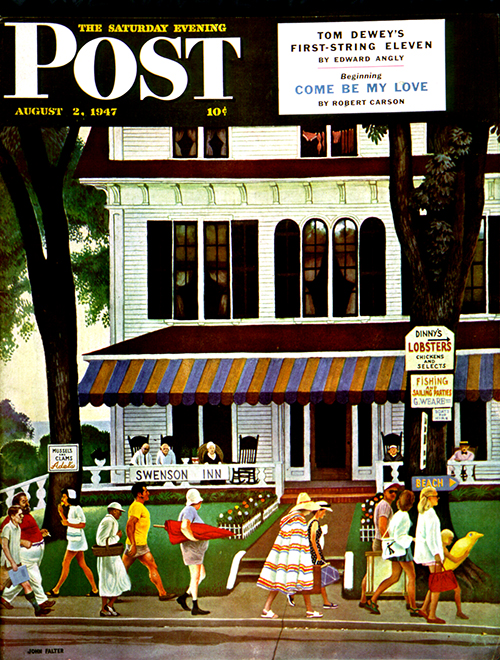
John Falter
August 2, 1947
I live in a big tourist town (the population almost doubles in the summer) known for its beaches, and I see this scene all the time: people walking down the street carrying things to the beach. Times have changed, though. The people in this John Falter cover don’t seem to be taking much. Maybe an umbrella, a picnic basket, and … what is that yellow thing, a bird? A duck? The people I’ve seen this summer are carrying chairs and backpacks and giant coolers I’m sure are just filled with soda pop.
August Is National Peach Month
I can’t eat peaches. I like the taste but the fuzzy skin sets my teeth on edge. I do love nectarines though, which I think of as “peaches you can actually touch.”
But if you have no such phobia (I mean “adorable quirk”), here are some recipes for National Peach Month, including a Peach Johnnycake and this Rustic Open-Faced Peach Pie.
I understand that both of these recipes require an oven being turned on, and maybe in this heat you don’t want to do that. In which case I’d just get some peaches from the store and eat them. Or some nectarines.
Next Week’s Holidays and Events
National Underwear Day (August 5)
I guess you can celebrate the day by … wearing underwear?
National Lighthouse Day (August 7)
As the National Lighthouse Foundation site explains, the act passed by Congress in 1789 also mentions beacons, buoys, and public piers. But “National Lighthouses, Beacons, Buoys, and Piers Day” doesn’t have the same ring to it.
Movies for the Rest of Us with Bill Newcott: Race in America
Award-winning film critic and writer Bill Newcott has been covering Hollywood for more than 40 years. He is the creator of AARP’s Movies For Grownups franchise and the movie critic for The Saturday Evening Post.
Saturday Evening Post movie critic Bill Newcott reviews two films that take dramatically different looks at race in America, Detroit and The Big Sick. He also interviews screen veteran Ronny Cox, director Frankie Fenton, director Simon Fitzmaurice, and actor Albert Brooks.
Listen to all of Bill’s podcasts.
Where Was Your Favorite NBA Team in 1949?
Pro basketball has come a long way since August 3, 1949. That was the day that two struggling basketball leagues — the Basketball Association of America (BAA) and its rival, the National Basketball League (NBL) — merged to form the National Basketball Association.
The future of professional basketball was far from certain at that time. Baseball and football were much more popular around the country, and many basketball teams were located in small, Midwestern cities that had trouble generating enough revenue to stay alive.
But popular enthusiasm for basketball started growing in the mid-1950s, thanks in large part to the performance of the Fort Wayne (Indiana) Zollner Pistons.
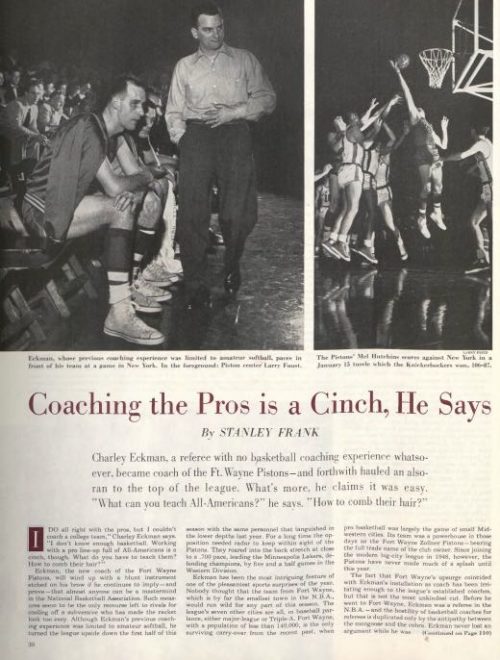
The team was named after Fred Zollner, who manufactured automobile and truck pistons. It was Zollner who brought the BAA and NBL together to form a single pro league. And it was Zollner who hired Charley Eckman away from officiating to coach his Pistons.
The team had won the national championship in 1944 and 1945 but had lost momentum under coach Frank Birch. Eckman seemed to fire up the Pistons again. For the next three years, the Pistons made the playoffs, though they fell just short of the championship.
Shortly after “Coaching the Pros Is Easy” appeared in the Post in 1955, Zollner moved the Pistons to Detroit. As he told author Stanley Frank, a community the size of Fort Wayne couldn’t support more than one home game a week.
Eckman went along with the team but didn’t stay long. He was let go after starting the season with a 9-16 record. He returned to refereeing and eventually moved into broadcasting.
The Pistons’ move was typical. Of the original 17 professional basketball teams in the two leagues, most have survived by changing their home towns and their names. Only two of the original teams have remained unchanged: the New York Knickerbockers and the Boston Celtics.
Here is where the other 14 teams went:
| Team | League | Founded | Fate |
|---|---|---|---|
| Baltimore Bullets | BAA | 1944 | Folded in 1954 (Not to be confused with the Baltimore Bullets of 1963, who were originally the Chicago Packers, and are now the Washington Wizards) |
| Cleveland Rebels | BAA | 1946 | Folded in 1947 |
| Detroit Falcons | BAA | 1946 | Folded in 1948 |
| Minneapolis Lakers | NBL | 1947 | Became the Los Angeles Lakers in 1960 |
| Philadelphia Warriors | BAA | 1946 | Became the San Francisco Warriors in 1962 and the Golden State Warriors in 1971 |
| Pittsburgh Ironmen | BAA | 1946 | Folded in 1947 |
| Providence Steamrollers | BAA | 1946 | Folded in 1949 |
| Rochester Royals | BAA | 1948 | Became the Cincinnati Royals in 1975; the Kansas City-Omaha Kings in 1972; the Kansas City Kings in 1975; and the Sacramento Kings in 1985 |
| St. Louis Bombers | BAA | 1946 | Folded in 1950 |
| Syracuse Nationals | NBL | 1946 | Became the Philadelphia 76ers in 1963 |
| Tri-City Blackhawks | NBL | 1946 | Became the Milwaukee Hawks in 1951; the St. Louis Hawks in 1955; and the Atlanta Hawks in 1968 |
| Toronto Huskies | BAA | 1946 | Folded in 1947 |
| Washington Capitols | BAA | 1946 | Folded in 1951 |
Featured image: Shutterstock
The Saturday Evening Podcast: My Wife Wants a Japanese Bidet
In this reading of his Saturday Evening Post article, Mark Orwoll discovers that plumbing is the glue that holds a marriage together.
Read author Mark Orwoll’s essay, “My Wife Wants a Japanese Bidet,” from the July/August 2017 issue of the Post.
My Wife Wants a Japanese Bidet
Whenever a delivery service leaves a cardboard box on our front porch, I know I’m in trouble, because it’s usually something expensive that requires tools I don’t have.
On a recent Thursday night, Kathy and my in-laws were in our kitchen, ready for our weekly card party. “What’s in the box?” I asked nervously, referring to a package on our kitchen counter. She turned to me and made a face that my in-laws couldn’t see.
“It’s that cleaner,” she said.
“What cleaner?” I asked, because I’m stupid and haven’t learned when to simply shut up.
“That cleaner,” she said, with that slight hiss in her voice that lets me know to back off. “The one I already told you about.”
Ah yes, the … er, cleaner. She was being discreet in front of family, but in fact she was referring to a contraption called a Japanese bidet, a device that mounts to a toilet bowl and shoots a water spray to clean your private parts. Much loved in Europe, bidets are generally freestanding plumbing fixtures positioned next to a toilet. In Japan, however, owing to the small size of most homes, a separate fixture is impractical.
Kathy had found one online for only $30 and placed the order. But I perceived a potential problem, and it had to do with water temperature. The water source for most toilets is cold. While this unit could indeed operate with warm water, as most Japanese bidets do, the hot-water source in our bathroom was too far away to be connected to the device.
“That’s okay,” she said. “Cold water is fine.”
I thought, Famous last words.
So Saturday morning found us at Berger’s Hardware to buy a flexible tube to connect the bidet to the water outlet. I nearly bought one the wrong length, not realizing I would have had to put a kink in it to fit — and possibly choke off the water. Thankfully, I listened to the advice of Berger’s plumbing supervisor and bought a long tube that I could loop and easily attach at both ends. “Trust me,” he said. “I’ve spent a lot of time with toilets. You want to loop that tube.
Definitely. Loop the tube.”
Plumbing and I have never really seen eye to eye. In order to get down to business, I have to screw up my courage somewhat. I get all the tools I’ll need and lay them out on an old towel. I read the instructions for whatever fixtures I’m installing. (I’m basically procrastinating, is what I’m doing.) Ultimately, I take a deep breath and set to it. In my plumbing mindset, I expect my wife to be my assistant, as in, “Hand me that wrench, dear.” “This one? Here you go, sweetheart.” In reality, when I ask for the wrench, the response is more likely to be that I shouldn’t use a wrench, that the nut should only be finger-tight, and besides, that wrench is so old, we should get rid of it, and don’t forget we’re going to the Svensgaards’ on Sunday for dinner.
Fast-forward to three hours later. Somehow, I managed to make all the connections. And then came time for the test. Kathy nodded toward the hallway and said, “Out,” and shut the door behind me. A minute passed. Two.
“What’s it like?” I called out. “Is it working? More importantly, is it leaking?”
Silence.
I knocked on the door. “Kat? You all right? Is it working?”
The door opened, and there stood Kathy. “I like it,” she said and smiled. “I admit I’d like it better if it shot out warm water, because that blast of cold water is sure gonna wake you up on a winter morning.”
“But — you like it?”
“I love it,” she said. “And I know it was a lot of hassle for you, so thank you, Sparky.”
She reached out her arms and hugged me. So yes, it was worth it — for both of us.
Mark Orwoll is former international editor of Travel + Leisure. Listen to Mark read this essay.
This article is featured in the July/August 2017 issue of The Saturday Evening Post. Subscribe to the magazine for more art, inspiring stories, fiction, humor, and features from our archives.
Cover Gallery: Summer in the City
Allen Saalburg
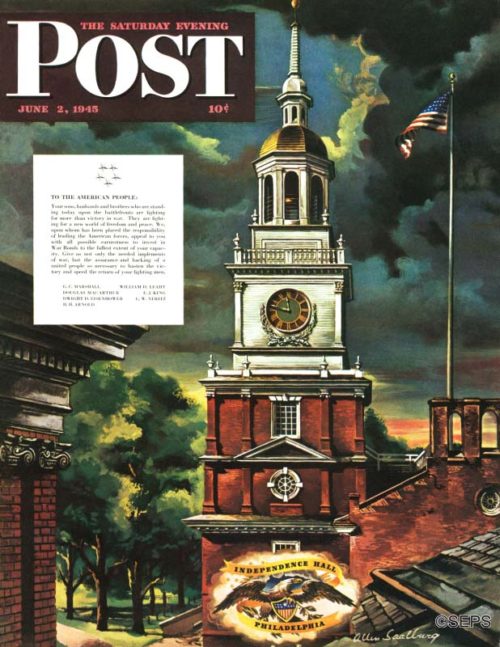
June 2, 1945
Independence Hall, more than any other structure, is a symbol of American perseverance and love of liberty. Saalburg’s painting is a view of Independence Hall looking west. The building at the left is The American Philosophical Society, The Post’s original offices were directly behind the trees in the left foreground.

John Falter
August 17, 1946
This 1946 view is from the fifty-fourth floor of the Chrysler Building, looking south. There were sun bathers on almost every roof, stewing, frying and boiling in the early afternoon sun.

John Falter
July 11, 1953
In New York’s famous wilderness, Central Park, you can hike, boat, bicycle, ride horseback, woo a wife, climb small mountains, get lost in small woods, and on the zoo trail meet many wild animals including people who make faces at monkeys. If you don’t think New Yorkers get more exercise than country people, buy some liniment and see how far you can trudge in the park without crying, “Help! Taxi!”

John Falter
June 5, 1954
Down out of the city’s cubbyholes come the inhabitants to enjoy some fresh air and automobile fumes. On second thought, ignore that glum remark, for actually these folks are having a swell time.
John Falter
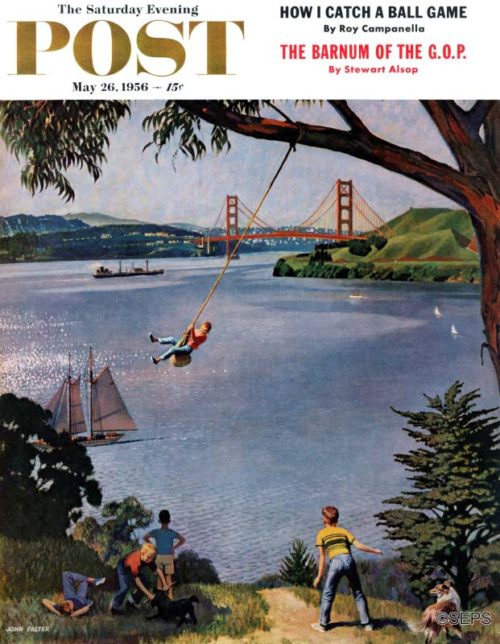
May 26, 1956
When artist John Falter was risking his boyhood, he used to take off on a bag swing from the roof of a shed, part of his joy being to see if he could avoid demolishing his bones against the shed on the way back. Recently when Falter was strolling along Belvedere Island, admiring the grace of Golden Gate Bridge across the azure bay, he happily discovered that modern kids still relax in the mellow old hair-raising way.
Ben Kimberly Prins
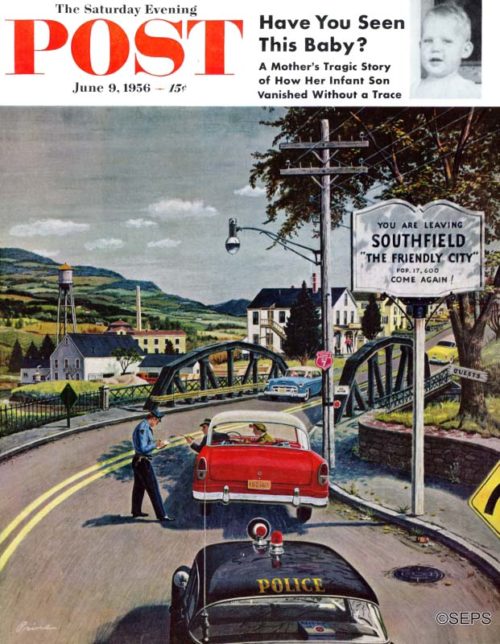
June 9, 1956
See the sociable traffic officer of Friendly City chatting warmly with strangers from a distant clime. The amiable man has even got out of his car to ask them their names and where they may be from. Will he hospitably invite them to pause awhile and be personally greeted by an official of the municipality? What is he writing for them—a complimentary ticket to the policemen’s ball? In any event, the travelers in Ben Prins’ genial scene will always carry an emotion in their hearts for Southfield, and if they ever return, will pass through at greatly reduced speed, the better to enjoy the changing beauty of its traffic lights and the curving artistry of the paintings on its pavements—and, to be sure, the better to see whether their old friend in blue is still there.
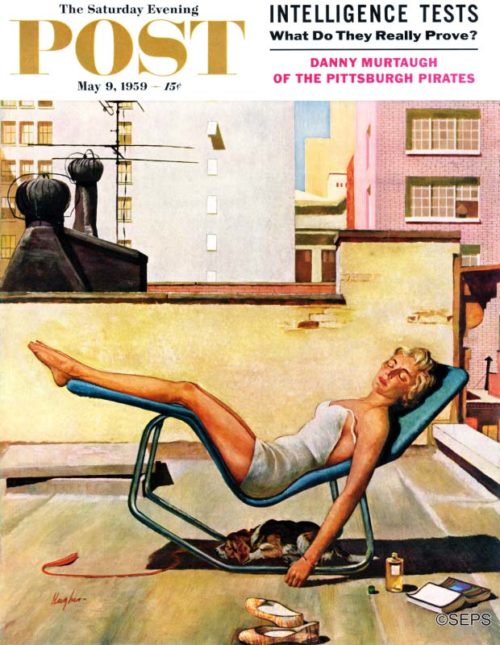
George Hughes
May 9, 1959
The day is Sunday, and this is a midtown Manhattan beach scene. As our fair lady enjoys a exposure to sunbeams, she should take care lest it degenerate into erythema solare, an inflammation of the skin.
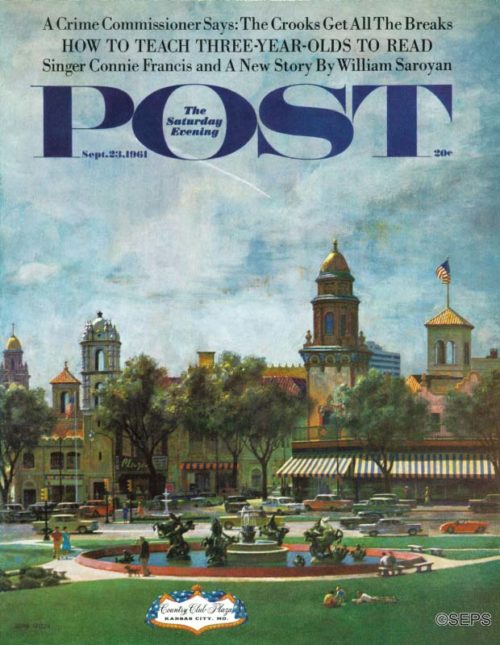
John Falter
September 23, 1961
Our cover scene is in Kansas City, “the gateway to the Southwest,” and you are looking at the intersection where U.S. 50, gateway to the Country Club Plaza shopping center, crosses J. C. Nichols Parkway. This elegant community of shops was conceived and built by Jesse Clyde Nichols (1880-1950), to whom the fountain in the foreground is a memorial. The scene appealed to artist John Falter because the Old World architecture seemed to symbolize our nation’s roots—which is not to deny the notion expressed by lyricist Oscar Hammerstein in Oklahoma! that “everything’s up-to-date in Kansas City.”
Agricultural Revolution and the Hope Wheat of World War II: 75 Years Ago
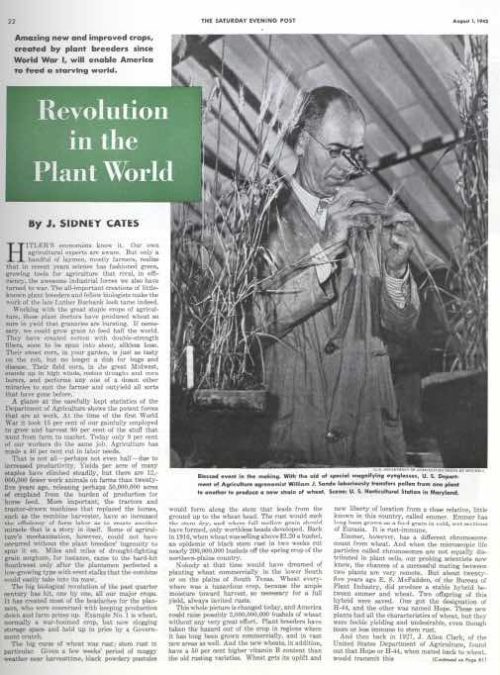
 Seventy-five years ago this week, the Post article “Revolution in the Plant World” was boasting of U.S. agriculture’s “40 percent cut in labor needs” since the first World War because of advancements in farming technology and crop hybridization. Tractors were replacing work animals at a breakneck speed, and a relatively recent wheat hybrid called “Hope wheat” had virtually saved wheat agriculture in the United States.

The Hope wheat was a hybrid between traditional wheat and Yaroslav emmer, an ancient grain also known as farro. The successful crossbreeding of the two — thought impossible by most scientists at the time — was performed by E.S. McFadden, a South Dakota farmer and student. As a child, McFadden watched a stem rust epidemic wipe out half the wheat fields in South Dakota, while the emmer crop was unaffected. His hybrid wheat was the reason for the Post’s 1942 claim that the “whole picture is changed today, and America could raise possibly 2,000,000,000 bushels of wheat without any very great effort.” Hope wheat spread across the prairies and set the stage for Norman Borlaug’s Green Revolution of the 1960s, earning the Iowa farmer a Nobel Peace Prize.
Today’s food system comes with its own challenges that were unforeseeable in 1942. Nitrogen fertilizers — necessary for hybrid high-yield variety crops — pollute the country’s waterways, and industrial agriculture threatens biodiversity. According to a 2016 report from The Guardian, we’re throwing away half of our food anyway. But, the sentiment from 75 years ago still rings true: “Maybe we have got too much new agriculture. Maybe. But a full smokehouse and granary and fruit bin are most comforting at a time when the world has gone mad.”
North Country Girl: Chapter 11 — Summer Sleep-Away Camp
For more about Gay Haubner’s life in the North Country, read the other chapters in her serialized memoir. The Post will publish a new segment each week.
The days pass slowly in elementary school, with any occasion that broke up the routine a cause for celebration. The one or two days Miss Ritchie fell ill, we were minded by a clueless substitute or by the principal herself, Miss Brown. We would fess up to what page we were on in our math workbook, read silently for hours, and when all other options were exhausted, Mr. Swan would wheel in the projector and set up a black and white film on the wonders of electricity or atomic energy. We loved them. As much as I adored Miss Ritchie, a day not spent watching her fill up the blackboard with decimals and parts of speech was a good day.
We rarely went on field trips. Once a year we would go to the St. Louis Historical Museum, which was boring beyond belief, and once a year to the Chisholm House. The Chisholm House was a turn-of-the-century mansion chock-a-block with stuff: heavy ornate furniture, oversized paintings of Chisolms with gilt frames that had turned dark with age, chipped mannequins in antique dresses and crooked wigs propped around a tea table. There was one room devoted to mourning attire, which was creepy and fascinating, with displays of elaborate jet necklaces and jewelry made of the dearly beloved’s hair.
Our fourth grade classroom had occasional visitors. In October a woman came to guilt-trip us into ruining our Halloween by asking for money for UNICEF instead of candy. She spoke to us about starving children in Africa and handed out little orange and black “Trick or Treat for UNICEF” houses that we were supposed to fill with pennies and bring back to school on November 1. I am sure that all of us, right down to the most goody-goody — who was probably me — simply pawed through our mothers’ purses to fill those boxes. If I had actually tricked or treated for pennies instead of candy, I probably would have gotten both, but I wasn’t taking any chances of missing out on the once-a-year binge fest of Bazooka and Dubble Bubble; Zagnut, Bun, Bit-O-Honey, Zero, and 100 Grand candy bars, wax lips and moustaches, candy necklaces, and the home-made popcorn balls given out by a lady who lived a few houses down from us on Lakeview Drive. Even the disgusting tooth-cementing Mary Janes were welcome, to be traded later at a discount.

We also had a fireman come to Congdon to lecture us on fire prevention. He left us with a safety check sheet depicting an open-face house with flames from different causes breaking out in every room. To this day I have an irrational fear of oily rags, although I have no idea why anyone would keep oily rags in their home.
***
In the spring, the boys were shunted off somewhere for an hour while we girls stayed in the classroom for a slide presentation on the YWCA summer camp, Camp Wanakiwin. It looked like heaven. A trampoline! Archery! Canoes! Fireside sing-alongs! And best of all, real horses! Our local dairy, Springhill Farms, offered Shetland pony rides to little kids and there was also a farm where I had been taken trail riding once by my dad, who bragged to the owner that he was an excellent rider. As we approached the barn at the end of the ride, even though we had done nothing more exciting than a three-minute jostling trot across a field, my dad’s horse took off for home like Sea Biscuit, ignoring my dad’s curses and frantic rein pulling, which only succeeded in veering the horse to the right. Dad slammed into the side of the barn door and went sailing off the horse. After that, when my sister and I begged to go riding, he would let each of us invite a friend, and then sit in the car smoking and reading the paper for an hour.

There was no instruction on those trail rides, outside of being told that if I held on to the saddle horn and the horse started to gallop, I would break my thumb; we got on the horse, rode through woods and fields, dismounted, and had a Nehi grape soda from the pop machine. Camp Wanakiwin offered riding lessons, as long as you had special permission from your parents and paid an extra $20 fee.
I had managed to lose my Fire Prevention Check Sheet in five minutes, but I clutched the Camp Wanakiwin pamphlet to my chest all the way home, where I showed it to my mom and begged to go to sleep away camp. She couldn’t say yes fast enough, probably amazed that her introverted kid actually wanted to be around other girls for two weeks straight, and delighted at anything that would pry my nose out of a book.
We then called the Lindburgs in Carlton, to see if my old friend Judy, who was even more horse-crazed than I was, wanted to go with me to camp. There was one problem: Judy, at the advanced age of ten, still wet the bed nightly. While the rest of us arrived at camp with sleeping bags, Judy came with a rubber mattress cover and several sets of bed sheets, which she and our cabin counselor whisked off her bunk every morning and brought to the camp laundry. Minnesota nice, none of the other girls in our cabin ever said a word.
Camp Wanakiwin (in Ojibaway, “Place of the Frozen Girls”) was not quite as depicted in the slide show and the brochure. There was a brand new trampoline, where a number of girls broke arms or collarbones or wrists in the two weeks of camp. There was archery, where you needed to have the upper body strength of Superman to draw the bowstring far enough back to reach the target pinned to a haystack a mile away; my arrows simply fell off the bow and on to the ground.
And there was horseback riding, where I was humiliatingly assigned to the Beginners group, despite my vast pony and trail riding experience. This meant I spent twelve out of fourteen days riding around in the ring, as if I were on a carousel, when I had pictured myself galloping through the fields like Dale Evans.
Then there were the features that the slides and brochure didn’t show: There were two bathhouses, one for the younger girls and one for the older, with very stinky toilets and cold water showers. Most of us regarded our daily swimming lesson in the icy waters of Hanging Horn Lake as all the washing up we needed.
A lot of government surplus food made its way into the Camp Wanakiwin kitchen. Every meal included a big pitcher of a disgusting pale blue liquid made from powdered milk. Thankfully there were also pitchers of off brand Tang for breakfast and fake Kool-Aid (always red) to wash down lunch and dinner, but on cereal mornings the only option was to eat dry corn flakes, a situation I remedied by piling on spoonfuls of sugar, something I was not allowed to do at home. There were huge blocks of bright yellow cheese the exact consistency of modeling clay, and boxes of powdered eggs, which made watery scrambled eggs that looked like the last bits of throw-up. I didn’t eat real eggs or cheese, so I never touched the stuff, even though picky eaters were frowned upon by the camp staff. Pancake breakfasts and spaghetti dinners were the highlights; desserts were Jell-O or applesauce or canned peaches or other things that aren’t really desserts. We were allowed to spend a small amount on candy each day at the camp store, which was only open after lunch, followed by the mandatory “Quiet Time,” my favorite camp activity, an hour I spent lounging on my bunk, eating Mike and Ikes and reading a thread-worn and musty old novel from the camp’s very limited library.
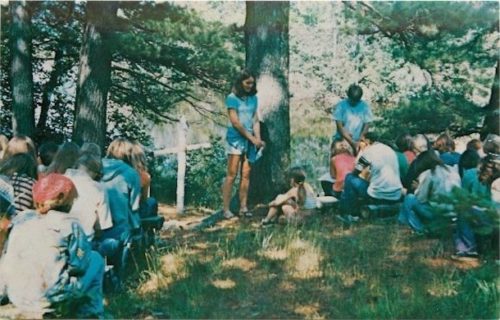
The brochure hadn’t mentioned “Quiet Time;” there was nothing about the required Sunday services either, although that should not have been surprising as the camp was run by the Young Women’s Christian Association. Most of the girls were herded down to a lakeside chapel, where they sat on benches surrounding a white wooden cross listening to counselors read from the Bible. Judy and I were not so fortunate. We Catholic girls were rousted out of bed early Sunday morning to board the camp bus into Moose Lake for eight o’clock Mass (in Latin back them) in a small stuffy church.
Two girls in our bunkhouse, the Applebaum cousins, got a free pass on Sundays. They were exotic Jewish specimens from Minneapolis whose family owned the Applebaum chain of supermarkets. The minute we met, before I had a chance to wonder why rich girls would be at a camp with cold water showers and government cheese, the cousins informed me that because they were Jewish they were not allowed at any of the nice summer camps closer to the Twin Cities. I saw no reason to not believe them, but it seemed an embarrassing thing for someone to admit. The Applebaum cousins were pretty, both with long lustrous hair and olive skin. They were going into sixth grade, so they were almost two years older that I was. They claimed to have boyfriends, and they knew exactly how babies were made. They gleefully shared that information with the rest of the cabin one night after lights out, provoking such a shocked chorus of “Gross!” “Ew!” and “Yuck!” that our counselor had to come out of her room to shush us.
We were expected to be asleep by nine, and usually were, as we were woken every morning at six to be in place for the daily flag raising ritual half an hour later. The rest of the day was one damn activity after the other. On our first day at camp, every girl was given a slip of paper with the schedule of sports and classes she had signed up for, plus the mandatory daily swimming lessons, and some kind of chore, such as setting up for meals. There was tennis, which I was terrible at, badminton, which I sucked at almost as much but which seemed to matter less, volleyball and softball, with the potential of being hit in the face really hard by a ball, and arts and crafts, where I was as good as anyone else at making lanyards and flower pressings. There was also boating, which involved four girls lifting an incredibly heavy wooden rowboat into the lake and then going around in circles for an hour, trying not to whack each other with the oars. You had to pass boating before you could advance to canoeing, which is the only reason anyone signed up for it.
My swimming class was scheduled for eight o’clock, right after breakfast and before the sun had the chance to raise the water a single degree. It was hard to learn any of the strokes when you were blue, teeth-chattering, and had your arms tightly wrapped around yourself in a vain attempt to keep from freezing.
In the evening, we had sing-a-longs, nature lectures, bonfires, the camp talent show, and Christmas in July, where we decorated a fir tree with paper chains, exchanged Secret Santa presents (“I made you a lanyard!” “Aw, I made you a lanyard too!”) and a counselor dressed as Santa Claus gave out packages of government cookies which we washed down with lukewarm, watery government cocoa.
Despite the bad food, the cold showers, the even colder lake, and my inability to become proficient at a single sport, I loved Camp Wanakiwin. I loved being on my own, even if my day was as regimented as a Red Army soldier. Unlike some of the girls in my cabin, including Judy Lindburg, I wasn’t homesick for a minute. Then a week after I arrived, I watched in horror as a big green Chrysler pulled into camp. I knew that car. Out popped my father and my sister Lani, carrying a small suitcase. Despite our constant bickering, she had missed me and thrown tantrum after tantrum at not being allowed to go to camp too. She was only six and you were supposed to be seven to go to Camp Wanakiwin, but my father knew people and pulled strings and managed to get Lani off to camp for the second week of the session. Fortunately, I rarely had to see her, as the activities were divided by age, so twelve and thirteen year olds wouldn’t be bouncing smaller girls off the trampoline or beaning them with softballs.
Seven days later my parents came to collect us. My bunkmates and I exchanged addresses, promised to write, and made plans to reunite next summer at the same session. I spent three more summers at Camp Wanakiwin, and although I never saw the Applebaum cousins again, each summer provided a boatload of sexual misinformation whispered among my sister campers after lights-out.
Shortest Stays in the White House
Yesterday, Communications-Director-in-Waiting Anthony Scaramucci resigned before he had officially assumed his post, so it can’t be said that he had the shortest tenure in the current White House — because he didn’t have any tenure. General Michael Flynn, who announced in February that he was leaving his position of National Security Advisor, had served just 24 days.
Death and Illness
Two dozen days is a pretty short stay for a Cabinet member, but he does not hold the record for brevity of tenure. That honor goes to Thomas W. Gilmer, a Virginia congressman who was appointed Secretary of the Navy by President John Tyler. He assumed the office on February 19, 1844, and died 10 days later.
Death was also the culprit in the short term of office for President William Henry Harrison, who is still remembered for three things: winning the Battle of Tippecanoe, delivering the longest inaugural address, and dying 32 days after becoming president. His unexpected death is now attributed to typhoid, a common ailment at the time in Washington, which hadn’t yet engineered a proper system for disposing of sewage.
And while Elihu Washburne didn’t die while serving as Secretary of State under Ulysses S. Grant, he became ill after his appointment on March 5, 1869, and resigned 11 days later.
A few of our vice presidents had short terms because the president under whom they served died unexpectedly. This was the case for John Tyler, who succeeded William Henry Harrison after his death from typhoid, making Tyler’s vice presidency the shortest on record, at 33 days. Andrew Johnson served as VP for only 43 days and became president after Abraham Lincoln was assassinated.
Out of Time
Luckily, death was not a typical reason for a short period of service. More commonly, a president’s term would end and his staff would be replaced. When President James Buchanan left office, so did his recently appointed postmaster general, Horatio King, who served just 21 days.
Similarly, the first agriculture secretary served just 20 days. Previously the Commissioner of Agriculture, Norman J. Colman had pushed President Grover Cleveland to create a Department of Agriculture. He was named its first secretary on February 15, 1889. Unfortunately, President Cleveland left office 20 days later, and so did Colman.
And when President Lyndon Johnson left office, so did Treasury Secretary Joseph Barr, after only 21 days in the position. Because of his short tenure, Barr’s signature appeared only on the one-dollar bill.
Politics and Drama
While these resignations occurred during peaceful transitions, several were the result of White House tensions. Edwin M. Stanton briefly served as Attorney General for the last days of President Buchanan’s term. Stanton perceived that Buchanan was too soft in his treatment of the South before the Civil War and resigned after 76 days. But he was recalled by President Lincoln to become Secretary of War, a post he held for six years.
More recently, Attorney General Elliot Richardson resigned on October 20, 1973, rather than comply with President Nixon’s orders to fire the special prosecutor looking into the Watergate scandal. He had lasted 150 days.
Donald Trump’s former chief of staff, Reince Preibus, served 189 days — the shortest time anyone has served in this position. Preibus resigned, but many believe he was pushed out after a stormy six months in the White House.
Michael Dubke accepted the position of White House Communications Director in March 2017. Anticipating another staff shake-up, he submitted his resignation to President Trump 85 days later. He had replaced Sean Spicer — and was succeeded by him as well. Spicer served in the White House for 183 days as Communications Director, press secretary, or some combination of the two, before resigning in July rather than working with Scaramucci.
Not all short terms are accompanied by death or drama: Friends talked Congressman Thomas McKennan into becoming Interior Secretary for President Fillmore. He didn’t think he would like the job. After 29 days, he was certain, and he left.
Shortest Stays in the White House
| Person | Position | President Served | Tenure | Reason for Leaving |
|---|---|---|---|---|
| Thomas W. Gilmer | Secretary of the Navy | John Tyler | 10 days | death |
| Elihu Washburne | Secretary of State | Ulysses S. Grant | 11 days | illness/resignation |
| Norman J. Colman | Secretary of Agriculture | Grover Cleveland | 20 days | end of the president’s term |
| Horatio King | Postmaster General | James Buchanan | 21 days | end of the president’s term |
| Michael Flynn | National Security Advisor | Donald Trump | 24 days | resignation |
| Thomas McKennan | Secretary of the Interior | Millard Fillmore | 29 days | resignation |
| Joseph Barr | Secretary of the Treasury | Lyndon Johnson | 31 days | resignation at end of the president’s term |
| William Henry Harrison | President | William Henry Harrison | 32 days | death (typhoid) |
| John Tyler | Vice President | William Henry Harrison | 33 days | became president |
| Robert C. Wood | Secretary of Housing and Urban Development | Lyndon Johnson | 34 days | end of the president’s term |
| Robert Bacon | Secretary of State | Theodore Roosevelt | 38 days | end of the president’s term |
| Lawrence Eagleburger | Secretary of State | George H.W. Bush | 43 days | end of the president’s term |
| Andrew Johnson | Vice President | Abraham Lincoln | 43 days | became president |
| Jonathan Daniels | Press Secretary | Franklin D. Roosevelt | 45 days | left after FDR’s death |
| Edwin M. Stanton | Attorney General | James Buchanan | 76 days | resignation |
| Michael Dubke | Communications Director | Donald Trump | 85 days | resignation |
| Elliot Richardson | Attorney General | Richard Nixon | 150 days | resignation |
| Sean Spicer | Communications Director/press secretary | Donald Trump | 183 days | resignation |
| Reince Preibus | Chief of Staff | Donald Trump | 189 days | resignation |
Featured image: Shutterstock
Remembering Jeanne Moreau
The French New Wave actor known for cerebral performances in the films of Europe’s most acclaimed directors has passed away at the age of 89. In his written tribute to Moreau’s craft and legacy, New Yorker writer Richard Brody said of the French actor, “She was an artist raised and trained in traditions that she expanded without destroying; she embodied not the narrowly intellectual artist but the person of culture, and she also embodied the paradoxes of culture in an age when its own presumptions were being challenged.” Moreau’s complex artistry was a perfect fit for avant garde European cinema, demonstrated by her impressive list of cinematic collaborators: Luis Buñuel, Orson Welles, François Truffaut, and Jean-Luc Godard, among others.
In the 1965 Post profile, “Jeanne Moreau: Death, Suffering, Love,” C. Robert Jennings visits Moreau’s Riviera estate to learn more about the already-accomplished actor. She talks about her lover, Pierre Cardin, her transparent nature, and even her family’s attempt to escape from Nazi-occupied Paris in her childhood. At the time, Moreau was preparing to star in Viva Maria! alongside Brigitte Bardot: “‘Men,’ she said, ‘don’t want to believe in friendship between women. But I need women to keep my equilibrium — and to laugh.’”
Jennings’s story captured the sensitivity and intellect of Moreau at a time when American interest in her gritty films was mostly limited to metropolises and fringe groups. The profile suggests a delicate — but deep — artist following her instinct into cinema history.
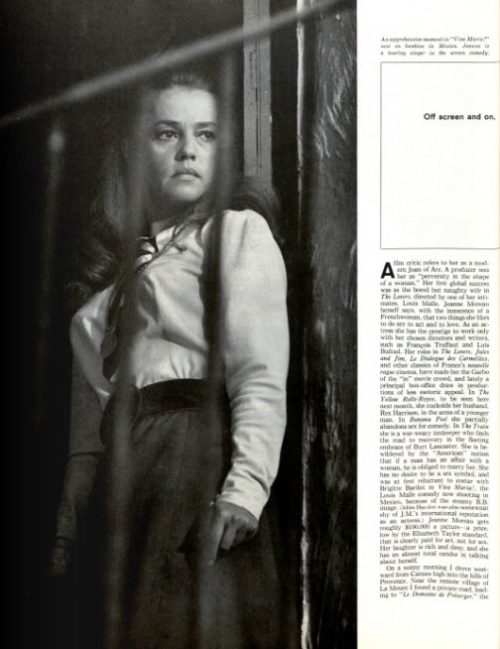
Love” by C. Robert Jennings. Published in 1965 in the Post.
Another Overdose Is Startling Reminder of the Nation’s Crisis
America’s drug epidemic is in the news spotlight again as Nashville Mayor Megan Barry lost her only son to an overdose over the weekend. Barry and her husband “received news that no parents should ever have to hear” on Sunday morning, according to a statement released by the couple. Though the substance in question is not known, more than 60 percent of drug overdose deaths involve an opioid, according to the CDC.
The New York Times estimates that 59,000 to 65,000 Americans died of drug overdoses in 2016, and this year’s number will likely climb even higher. The statistics — while substantial — cannot impart the suffering of parents, teachers, children, and others who are losing their loved ones to the worst drug crisis this country has ever seen.
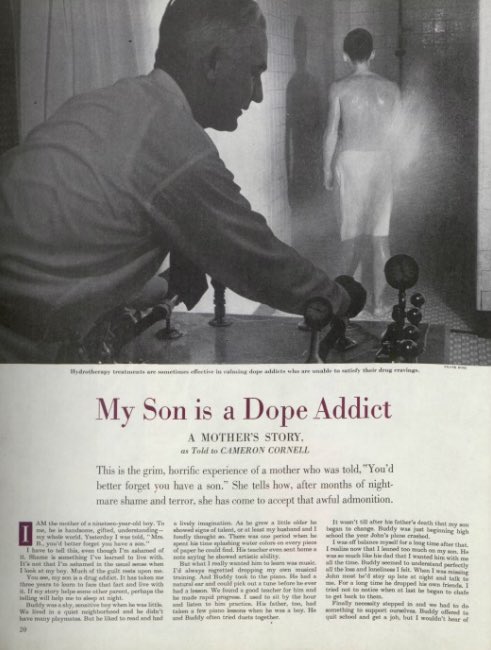
The problem is severe, but not necessarily new. The Post story “My Son Is a Dope Addict” details a mother’s grim experience with heroin in the family in 1952. Her otherwise talented and loving teenage son sells off their possessions and leaves nightly to get his “jolt.” The story offers a comprehensive view of how opioids can wreck a household even if there isn’t an overdose. The nameless narrator watches her teenager slowly fade from her until she is told, “you’d better forget you have a son.”
The harrowing tale came before addiction was so alive in the public consciousness, and certainly before prescription opioid sales nearly quadrupled in 16 years (1999 to 2015). The American nightmare it depicts — one of deception, doubt, financial burden, and grief — is a prescient report that remains relevant as addiction in the country continues to rise.
The Rude Pace of Life…in 1907
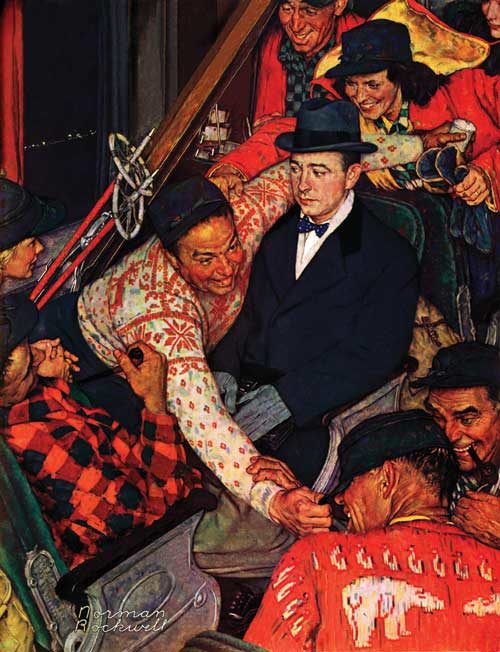
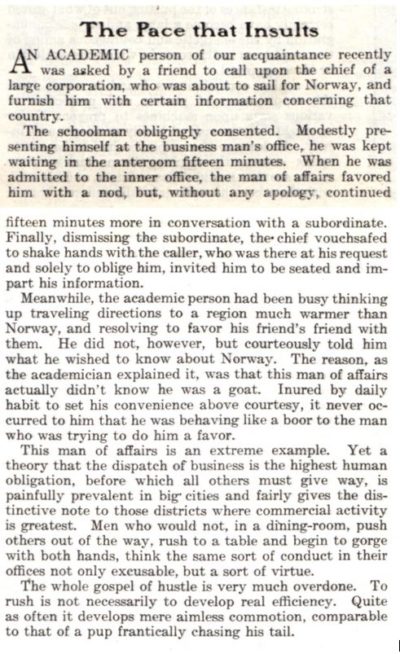
Men who would not, in a dining-room, push others out of the way, rush to a table, and begin to gorge with both hands, think the same sort of conduct in their offices not only excusable, but a sort of virtue.
The whole gospel of hustle is very much overdone. To rush is not necessarily to develop real efficiency. Quite as often it develops mere aimless commotion, comparable to that of a pup frantically chasing his tail.
This article is featured in the July/August 2017 issue of The Saturday Evening Post. Subscribe to the magazine for more art, inspiring stories, fiction, humor, and features from our archives.