How Stan Musial Went from Wretched to Record-Breaker
This article and other features about baseball can be found in the Post’s Special Collector’s Edition, Baseball: The Glory Years. This edition can be ordered here.
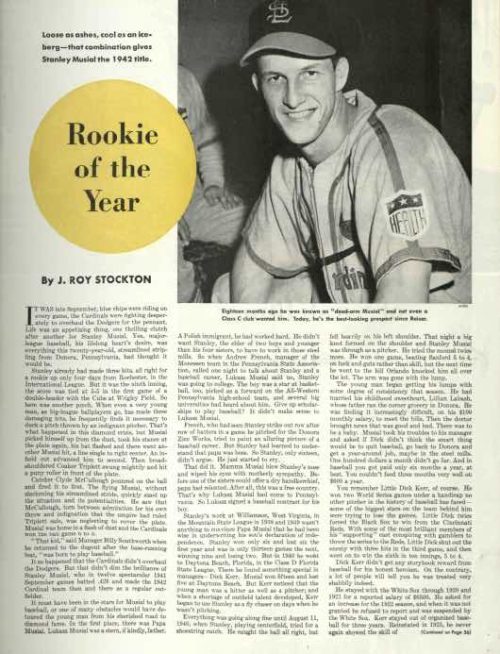
It must have been in the stars for Musial to play baseball, or one of many obstacles would have detoured the young man from his cherished road to diamond fame.
Naturally, this spring Stan was the most-talked-about recruit in the 1942 Grapefruit League. The head-lines he won last fall put the spotlight, and the pressure, on him. But he was only warming up for another kicking around by the fickle fates of baseball.
For this spring that injured shoulder — and perhaps the coast-to-coast ballyhoo about his September razzle- dazzle — handicapped Musial.
He couldn’t hit and his throwing was so weak that observers shook their heads. Manager Billy Southworth, however, stayed doggedly with the young out elder.
“I can’t quit on him,” he would say.
“He won’t give up, and I certainly won’t.” And so Billy benched him for a rest and put him back in the outfield a week later, against a right-handed pitcher. Musial plastered the fences with line drives. When a left-hander took over for the other side in a late inning, Southworth started to bow to percentage and send in a right-handed batter for Musial. But he changed his mind and let Musial hit, and the Donora Greyhound got another safety, a triple that drove in two runs and gave the St. Louis Cards a victory in the exhibition.
“That’s why I can’t quit on him,” Billy grinned that evening, under the palms in front of the hotel. “He’s that kind of a boy. Slump, maybe. We all have ’em. Pressure, yes. It’s been terrific. Everybody wants to know where’s that guy Musial they’ve been hearing so much about. The kid naturally thinks he ought to hit a home run every time up. But he was born to play baseball and he’ll make it.”
“The kid is an iceberg,” says Rochester’s Tony Kaufmann. “If you tapped him, you’d find ice water in his veins. Yankee Stadium or cow pasture — just another place to play ball, to him.”
Baseball fans like a boy who can run like a deer and hit like a Cobb, and the cash customers quickly took the modest Musial to their hearts. They gave him an ovation the first time he stepped to the plate as the season opened in St. Louis, and it was the same in every city — even in Brooklyn. There a noisy Flatbush bleacher fan, the most vicious of the species, complainingly complimented the Donora Greyhound after a particularly adroit running catch.
“Hey, music box,” the fan raucoused, “how in de woild kin ennybody run so fast and see so good, yuh bum, yuh?” It is a rare caress for a Flatbush fan to glorify an enemy thus by calling him a bum, an elegance jealously guarded for home heroes. Guess Southworth was right about Musial and his birthright.
— “Rookie of the Year” by J. Roy Stockton, Sept. 12, 1942
Post Travels: A Brief Visit to Ireland — Day 4–6: The Wild Atlantic Way
Steve Slon attends a conference of travel writers in Ireland and does a little sightseeing, as well. See the entire series.
Day 4: Cork
For the next few days we will be traveling south and west along what’s known as the Wild Atlantic Way. It’s a tourism trail that meanders along the coastline, marked by signs with an up-and-down zigzag pattern that looks a bit like waves if you look at it one way and a bit like what WAW would look like if you joined the letters together and eliminated the crossbar line from the A.

The landscape changes as we roll from Kilkenny down through Tipperary toward Cork, with hedgerows giving way to stonewalls.
On to the city of Cork.
Cork is a port town, famous for being the last port made by the Titanic before its fateful journey.
Cork has a museum of butter, where apparently there’s a sample of a 1000-year-old slab of butter. We didn’t get to experience this museum, unfortunately.
Fun fact: One thinks of Guinness as being the national beverage of Ireland. In fact, it’s more of a Dublin thing. Here in the south, those from Cork drink Murphy’s stout. Kinda violation of the local ethos to order a Guinness.
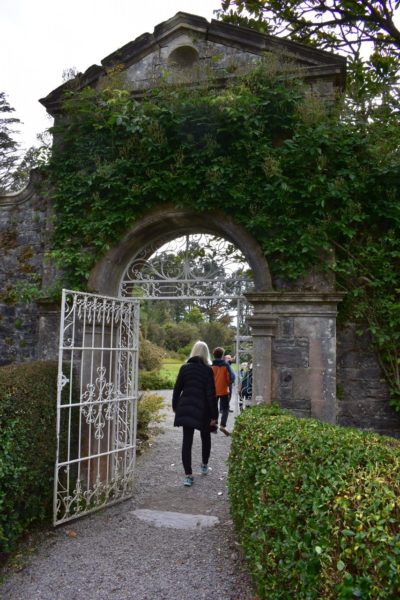
Stopped in Glengariff on the coast, where we boarded a ferry to Garinish Island.

The island was privately held until being bequeathed to the Irish people in 1953. Beautiful Italian garden by Annan Bryce and Harold Peto, the famous garden designer.





Sea lions lazed on the rocks on this little outcrop of Garinish Island.

We spend the night at the Beara Coast Hotel in Castletownbere, where our room has a wonderful view of the harbor.
My dinner companion is Don Dowling, who does some independent work as a travel guide, but for this trip is our bus driver. Over the course of the meal, Don regales me with quotations from Sherwood Anderson, Yeats, and a little bit of Shakespeare. I’m humbled as much by his power of memory as by his intelligence and erudition.

Day 5: Ring of Kerry
Joined by local guide Paddy O’Sullivan, who speaks in a thick Cork accent that’s a bit hard to understand, we take a gentle walk on Beara Peninsula, stopping at the ruins of Donboy Castle, dating to 1200.




In the afternoon, drive part of the beautiful Ring of Kerry. The sun has broken through and we stop at a lookout point called “Ladies View.” The name comes from the visit made by Queen Victoria in 1861 with full royal retinue. Her ladies in waiting scouted the area for appropriate places for the Queen to enjoy, and they were so taken with this location that it evermore bore the name “Ladies View.” The region was practically bankrupted by the Queen’s visit, since it took a small army to move her around as she brought not only clothing but furniture she was accustomed to wherever she traveled.

In the afternoon, we stop at a small museum dedicated to Skellig Michael, a rocky island eight miles offshore where early Christian monks created austere living quarters 1400 years ago. The museum is on the mainland and sells tickets for the boat ride to the island, weather permitting. We don’t have time to make the journey, but doubt it would have been possible, thanks to rain and fog. Skellig Michael is popular with Star Wars fans, as it was the site of the final scene in the 2015 movie The Force Awakens, and will continue to have a role in the 2018 release, The Last Jedi.

Our after-dinner talk is with astronomer Steve Lynott about the Kerry Dark Sky experience. The International Dark-Sky Association (bet you didn’t know there was such a thing) has designated the Kerry region of Ireland as one of only three “Dark Sky Reserves” on the planet—places where there is very little artificial light messing with your ability to see stars. On a clear night, the view here is stunning. Or so we are told. It’s been cloudy for past few days, so we don’t get to witness the night sky firsthand, but the subject of light pollution is an important one. I learned from Lynott that when you have been exposed to normal electric lighting, it takes your eyes more than 20 minutes to see in the dark. Red light doesn’t have the same effect. So, next time you go sky gazing, screw a red light bulb into your flashlight, Lynott says.
Day 6: Valentia Island
A gentle walk along the shore on Valentia island. The name suggests Spanish origin, but in fact the word derives from the the Irish word Beal Inse (which translates as “Island in the mouth of the sound.”) Our walk takes us up a long gradual rise where there are reputed to be great views of the Skellig Islands, but we’re all fogged in. An eerie, otherworldly mist surrounds us. No ocean view today, but a pleasant feeling to be walking near the shore with only the sounds of sea birds and gentle lapping of the waves to tell us where we are.


Afterwards, a visit to an ice cream stand connected to a small dairy farm of about 100 cows.

The farmer scornfully says most commercial ice cream relies too much on skim milk; says he throws out the skim and uses only the rich cream. His cows are outdoors almost all the time, grazing on grass. The ice cream is out of this world.
That evening, arrive in Dingle, driving down roads so narrow our bus has to pull over and stop to allow cars to pass in the opposite direction.
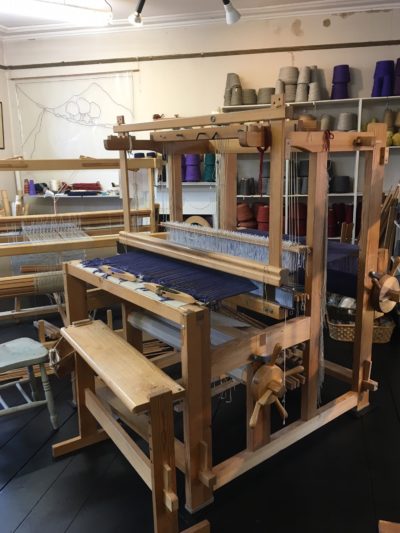
Dingle is a quaint tourist town that has remade itself as a foodie destination. After checking out local crafts (some very fine weavings) and some touristy junk, we grab a beer at Foxy John’s, a hardware store/pub where, at 6 p.m., the music starts playing.

Afterwards, dinner at Global Village, a Michelin recommended restaurant right across from Foxy’s. The food is not at all like the hearty Irish fare one expects in these parts. Rather it’s the delicate, carefully sauced, small-portioned, type of eats one associates with the continent. Did that sound snarky? I didn’t mean it to. The food was delicious.
The Real Mexican Border Problem
 Hundreds of Mexican residents of the United States have been turned into bandits by treatment received at the hands of Americans. And when these hombres sneak back across the Boundary to burn and steal, it is in retaliation for the wrongs they have endured. It is common practice in the Lower Valley to hire Mexican desperadoes to frighten the legitimate Mexican ranchers and farmers with threats of death unless they leave the United States. When the unfortunate Mexicans are properly scared by these bandits, along come the American plotters with an offer to buy their stock at bargain-sale figures. Naturally the despoiled natives are bitter when they awake later to full knowledge of the trick. So they put their heads together to get even with the gringos — to do some pillaging on their own account — and we have another “raid.”
—“Jouncing Uncle Sam” by George Pattullo, May 19, 1917
This article is featured in the May/June 2017 issue of The Saturday Evening Post. Subscribe to the magazine for more art, inspiring stories, fiction, humor, and features from our archives.
News of the Week: Retro Tech, YouTube Stars, and the Dangers of Working from Home
Can Pagers Be Far Behind?

It seems that a lot of old technology is making a comeback. We’ve seen a new fondness for typewriters, retro video games, and even vinyl records. Maybe pagers and butter churns are next, but in the meantime we can enjoy the return of cassette tapes.
This Boston Globe article gives a rundown of how “the kids” are getting their music these days. In my day, we had to walk four miles through the snow to buy our music, but now kids have formats like streaming and YouTube and iTunes. But for some reason, cassette tapes are also becoming a little more popular than they were 15 years ago, when no one cared about or missed them.
Okay, so cassettes are back. What I want to know is, what the heck do you play them on? If they still make tape decks, I can’t imagine spending money on one. I remember spending a lot of time picking out various stereo components when I was in my teens and 20s and spending extra money for the premium blank tapes, but the cassette is one technology I don’t see a need to bring back. And I really don’t want to hear that 8-tracks are back.
YouTube Killed the Medical Star
I’ve wanted to be a writer since I was a little kid, but I distinctly remember also wanting to be a baseball player, a detective, and a stuntman. Those seem like old-fashioned goals now, as many kids now want to grow up to sit in front of a screen.
A poll by the travel company First Choice, in which they surveyed 1,000 kids aged 6 to 17, reveals that 75 percent of those kids want to grow up to be YouTube stars, vloggers, and bloggers. Occupations such as doctor and lawyer placed lower on the list, and “TV presenter” came before writer and athlete. I don’t know how “TV presenter” got to be a thing, but I guess we should be happy that “reality show star” isn’t on the list.
Hopefully, kids understand that most people who are on YouTube or blog don’t make a lot of money. Not everyone can be PewDiePie.
7,000 Letters
As a big fan of handwritten letters, this is my favorite story of the week.
Ninety-eight-year-old Alleen Cooper, from Lakewood, California, has been writing letters to American troops since World War II. She has written over 7,000 of them, and she writes them all by hand. She’s up there in age but she says she doesn’t plan on stopping because the men and women overseas appreciate them so much.
I bet those 7,000 letters are approximately 7,000 more than most people write these days.
Homework

A lot of people think that working from home is a perfect situation. You can make your own hours! There’s no office politics! No commuting! You can come and go as you please!
As someone who has worked from home for many, many years, I can tell you that while it’s great that I don’t have to put on a tie or shave every day, it’s also difficult to concentrate on work when you have a TV and couch calling you, visitors coming to the door, the phone ringing all the time, and no coworkers pushing you to work and helping you concentrate.
This NBC News piece focuses on another problem with working from home: loneliness. You’re isolated from other people and you don’t have the interaction and feedback you get working with other people someplace else. This may seem like a good thing — you can focus on your work — but it often doesn’t work out that way. The internet and social media? They can help but can be a distraction you don’t want.
I think people who work from home should get a dog.
RIP Gregg Allman, Zbigniew Brzezinski, Frank Deford, Denis Johnson, Jared Martin, Jim Bunning, and Manuel Noriega
Gregg Allman was a rock legend and leader of The Allman Brothers Band, who had classic songs such as “Ramblin’ Man,” “Whippin’ Post,” “Midnight Rider,” and “Melissa.” He died Saturday at the age of 69.
Zbigniew Brzezinski was national security adviser under President Jimmy Carter and was author of several political books. His daughter is Morning Joe co-host Mika Brzezinski. He died last Friday at the age of 89.
Frank Deford was a veteran sports journalist and commentator, writing for Sports Illustrated for 30 years and appearing on NPR, NBC, ESPN, and HBO. He passed away May 28 at the age of 78.
Denis Johnson was the acclaimed author of the story collection Jesus’ Son as well as several novels, plays, and poems. He died last week at the age of 67.
Jared Martin played Dusty Farlow on Dallas, was a regular on The Fantastic Journey and War of the Worlds TV series, and appeared on dozens of other shows. He died last week at the age of 75.
Jim Bunning was a Hall of Fame pitcher (he threw no-hitters in both the American and National Leagues) and former Republican senator from Kentucky. He died last weekend at the age of 75.
Manuel Noriega was the former Panamanian dictator who was eventually sent to prison in the United States, France, and Panama for drug charges and murder. He died Monday at the age of 83.
This Week in History
John F. Kennedy Born (May 29, 1917)
This week marked the 100th birthday of our 35th president. Here’s our December 14, 1963 issue, with a cover portrait by Norman Rockwell, in which we reprinted a piece that originally ran when Kennedy was running for president.
Sgt. Pepper’s Lonely Heart’s Club Band Released (June 1, 1967)
The classic Beatles album was released 50 years ago this week and changed rock ’n’ roll forever. Can you name all of the people on the cover?
This Week in Saturday Evening Post History: Charles M. Schulz’s First Appearance (May 29, 1948)
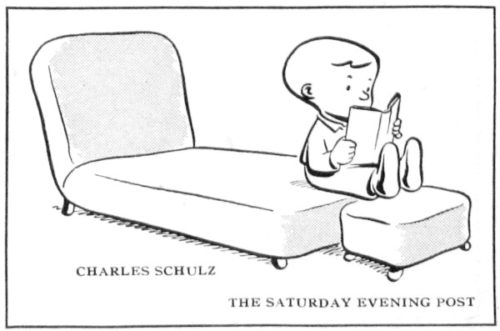
This was the very first comic that Schulz published in The Saturday Evening Post, two years before the debut of Peanuts. It’s interesting that the 17 cartoons that Schulz drew for the Post don’t have titles, even though he was drawing a strip called Li’l Folks for the St. Paul Pioneer Press at the time.
National Turkey Lovers’ Month

There is no sensible reason why National Turkey Lovers’ Month should be celebrated in June. Turkey is not a June food. Sure, we eat sliced turkey in sandwiches during the summer, but turkey is a fall and winter food, a Thanksgiving and Christmas tradition, not something you eat wearing shorts. And who wants to have the oven on all day long in June?
So what I’ll point you to this week are some recipes for turkey sandwiches, like this Turkey, Cheddar, and Green Apple sandwich from Martha Stewart, this Turkey Sandwich with Cream Cheese and Bacon, and this California-Style Turkey Sandwich, with avocado and Monterey Jack cheese.
If you insist on cooking a turkey, then you can make Monica Geller’s famous Moist Maker. Just make sure you don’t leave it in your office fridge.
Next Week’s Holidays and Events
National Yo-Yo Day (June 6)
It’s celebrated on June 6 because Donald Duncan Sr., who started the Duncan Company, maker of yo-yos and other fine toys, was born on this day in 1892.
Donald Duck Day (June 9)
Here’s another person with the initials D.D. we celebrate this week. He made his first appearance in the cartoon “The Wise Little Hen” on June 9, 1934. This means I have two things in common with Donald Duck: we were born on the same day and we both usually walk around without pants.
The Sea Children
Mam always said that a child born with a caul across its face would never drown. Of all her seven children, only the second-youngest, Francis, had been blessed with this gift.
We lived in a small fishing village on the west coast of Ireland, a place where one road took you in and the same road took you back out again. My brothers had my father’s coloring, pale-skinned and dark-haired with flecks of salty white. I took after my mother. “Hair as red as a rowan berry,” she liked to say. “Your namesake.”
We grew up with the salt air in our lungs, in our hair, and dusting our milk-bottle skin. Fishing was what the men knew, and our father was no different. He worked boats, stout vessels with weather-worn hulls bobbing up and down on the sea, traveling up from the south looking for fat Atlantic quarry. When the days were good, he’d come home with fish guts under his fingernails and buckets of mackerel, coalfish, and once, a blue shark with cold, dead eyes tucked under his arm. When the days were bad he’d come home with nothing but salt brine on his breath and a pocketful of trinkets.
“Can’t eat none of that, Breandán,” said Mam.
Our father liked to collect things: rocks that glittered in the sunlight, frosted blue and green sea glass rubbed smooth by the fractious currents, discarded mussel, oyster and crab shells, and any other curiosities that washed up on the shore. He kept them on the mantelpiece, lined up like trophies. When the trips were harsh, Mam would light a fire, pour him half a glass of strong whiskey, and fill his pipe, and we would gather round him to hear the stories behind his treasure. His favorite was a perfectly round stone of stippled gray-and-white granite that fit in the palm of his calloused hand. I’d nestle into the crook of his arm and he’d hold it up in front of me and ask, “You know what this is, Rowan?” and sometimes I’d say yes because I did, and sometimes I’d say no because I wanted to listen to him talk until the fire died.
“This was a cannonball once,” he said, “hundreds of years ago, when the Spanish sailed up the Channel fleeing the English. The English attacked them in the night with fire ships, flames burning higher than you could imagine. They scattered the Spaniards, and the captains set a course around Scotland trying to find their way back home. Some went the wrong way. Ended up here. More’n a few were wrecked off the coast. Wrecked, an’ thousands of men drowned.”
“Them captains mustn’t’ve known the waters like you, Da,” said Francis.
My father sucked on his pipe and stared at the dying fire. “Some did an’ some didn’t. Makes no difference sometimes. The sea has its own way of doing things.”
When each of my brothers came of age, he took them out on the water, first on his old sailboat Rockabill so they could get their bearings, then on the trawlers that docked looking for able-bodied sea hands. There they learned how to make a living. Mam worried some, but she was a fishwife, and fishwives “know only three things, Rowan: raising children, gutting fish, and how to keep their tongue.”
But she never worried about Francis.
“Came into this world with a caul across his face,” she’d boast to the other wives. “A born sailor.”
I’d cry when another brother left us for the ocean. They’d be gone for days, father and son, sometimes weeks, and when they came back it was as two tired old men. Eventually my brothers grew weary of our small village and spread out across Ireland looking for work, settling in Kilkeel, Galway, and Killybegs.
But Francis was the youngest son and so was last to leave.
When his time came, our father took him out on the Rockabill like all the rest. He taught Francis how to knot a figure of eight, a blood knot bend, and a hangman’s noose. He showed him how to read a chart and jibe a sail and move the tiller to steer the boat. In the winter, Francis practiced his knots by the fire, then took his rope and knowledge outside in the summer where the sun beat down on our faces and a northern wind tickled the tops of trees. He recited all the different sailing terms and their meanings, like holding ground, pitchpole, and luffing.
I asked Mam when it would be my turn.
“A ship’s no place for a girl, Rowan,” she said, running her knife through the belly of a young pollock. “Bad luck’s what it is.”
It was still summer when my father called Francis to get ready to go out on the water. I sat rigid in the armchair opposite Mam, clutching her spool of gray wool in my fist, the click clack click clack of her knitting needles filling the room. My father stopped in the doorway, his head cocked to the side. “Do you want to come?” he asked me. I threw the wool onto the chair and scrambled to my feet. Mam pressed her lips into a thin line.
“We’re not going far, Nora,” said my father.
As I clambered over the side of the Rockabill, Francis raised one dark eyebrow and smirked, but he said nothing.
We sailed to the old lighthouse on the edge of Clew Bay. Francis had our father’s keen eye, and after a few minutes ashore, he bent down and found his own treasure amongst the brittle crab skeletons and gray-green seaweed.
“Look at this rock, Da,” he yelled. “There’s a hole gone through it!”
Father held the stone in his hand, turned it once or twice, held it up in the air, and looked through the hole. He pressed it into Francis’s palm. “Keep that, lad. It’s a lucky stone.”
“Why?” I asked.
“It’s a rare thing to find,” he said.
We stayed there a while, and I searched for my own lucky stone. I stared hard at the shingle, scrutinizing every rock, every pebble. But they all looked the same: round, gray, and solid. I moved closer to the water and slipped on a rock covered in slimy seaweed and fell, cutting my knee open where the skin was thinnest. I bit my lip and held back tears, not wanting to cry in front of them.
“Here, now. Let the sea make it better,” said my father. He scooped up water in his hands and splashed it onto my knee. The cold helped dull the sting. In the distance, the sun glowed dark orange on the water.
“Time to go, I reckon,” Father said, and he picked me up and carried me back to the boat.
At home, Francis showed Mam his find and she admired it, holding it up to the light just like Father had done.
“Sure, that’s a lucky stone,” she said. She found a piece of green ribbon from her sewing box, threaded it through the hole and tied both ends together. “Now you can wear it around your neck.”
That evening, I accidentally scratched the cut on my knee and it bled again, only a little, but enough to create fresh salt tears that I couldn’t contain in the safety and comfort of home. Francis took off his lucky stone and put it round my neck, where it stayed for years.
“You need this more than me,” he said. “I was born with the caul.”
Most folks were born, lived and died in the village. The elders, with their mottled skin like the dried white turbots that hung in their pantries, called us the Sea Children because we played on the shingle collecting shells, driftwood, or small stones to throw at each other when we were bored. We’d play as long as we could, feeling the spray across our faces, before the waves licked the flood walls and we had to slope back to our fatherless houses.
One day, when Francis was 14 and I was 12, the Sea Children gathered on a part of the beach where only the gulls could see us.
“I’ll never drown,” said Francis. “Me Mam says so.”
“Yeah, right,” sneered one, a green city boy with bright blond hair. His family had traveled from one of the big towns inland, looking for work on the boats. “What makes you so special?”
“Was born with a caul,” Francis said. A few children nodded respectfully; they understood this magic, having been born and shaped by the sea.
The blond boy twisted his face. “Prove it,” he said.
“How?” said Francis.
“Swim down to the bottom of the sea and bring back a shell.”
“What if there isn’t any shells?”
The blond boy considered this. “Well, bring up something up from the bottom. Else we’ll know you didn’t go all the way down.”
Francis nodded. The children who hadn’t already drifted over to watch as Francis took off his shoes, socks, and then his cotton shirt. He made to set them on the ground, but I swooped in, picked them up off the rocks, and clutched them to my chest. Francis swung his arms from side to side then round in big, slow circles.
“Gotta warm up first,” he said. Some girls a year or so older than me giggled and blushed. I scowled at them — my brother was a born sailor; he had no interest in silly schoolgirls.
“Go on,” someone urged.
“Yeah, what you waiting for?”
My brother shrugged and started towards the water. He’d barely dipped a toe when the blond boy shouted.
“No, that’s too easy. You should jump in. From somewhere high.”
“Yeah!” came a chorus of voices.
“Okay,” Francis said. “From where?”
“The jetty,” said the blond boy. “Jump from the end of the jetty.”
We moved as one across the stones, Francis leading the way along the edge of the world. There was a chill in the air and I shivered, but Francis didn’t seem to notice the cold. The older kids walked slowly, holding younger siblings’ hands tight, knowing that if a small ankle should twist or snap between the spaces in the large pebbles they, the older ones, might never see daylight again.
The jetty stretched out across the water. Its spindly legs had bent and warped with time and constant lashings from storms. The sun hung low on the horizon but it didn’t matter; the water hadn’t reached the flood walls and it was the sea that told us when to go home.
We picked our way along the jetty, some confidently leaping over holes made by missing planks, others skirting around them, not daring to look up in case they slipped through and vanished.
Francis reached the end first. He stood looking out across the water, assessing its depths. The other children formed a crowd behind him. A small boy leant against one of the support pillars but heard a sharp snap and jumped up again, blushing. Above our heads, the sky bled navy in the east, creeping and swallowing the gray clouds.
“Okay, here’s good,” said the blond boy. Francis nodded. He stretched his arms out again and took a few deep breaths. He glanced behind him and grinned at us all. Then he swung his arms into the air, arched his back, and jumped headfirst into the sea. The slap of skin against water made me shiver. A few people clapped. Somebody whistled, impressed. The boy who’d snapped the pillar ran to the spot where Francis hit the water, white froth churning and fizzing in a circle. The boy lay on his belly with his head sticking out over the edge. “He’s gone!” he cried.
The blond boy folded his arms and hardened his face. I crossed my fingers underneath Francis’s shirt, so none of the other children could see. The sun had disappeared completely, and the wind took advantage, pushing the waves higher and higher. An older boy in his father’s oversized coat stood near the back and held his sister’s hand to keep her from wandering too close. Her bare legs were slapped pink from the cold, but she didn’t cry, didn’t complain. Her brother glanced at the stone wall, our designated keeper of time.
Without thinking, I squeezed the stone around my neck and said a silent prayer. It felt cold in my hand.
“I don’t think he’s gonna make it,” whispered a girl with smooth copper-colored hair, another green city dweller whose father had come to earn a summer’s living from the sea.
“Shut up!” I hissed, whirling on the spot. “He’ll be back. He’s a born sailor! He had the caul.”
No one spoke. The boy on his belly counted out loud so we could all hear: “one Mississippi, two Mississippi, three Mississippi …”
I wanted to tell him to stop, to shut up just like I’d told that stupid copper-haired girl who was born in the city, who didn’t know anything about anything. But my lungs were empty, and I’d pressed my lips together so hard I thought I might slip and bite them.
“… eleven Mississippi, twelve Mississippi, thirteen Mississippi …”
The blond boy uncrossed his arms and stared at the spot, eyes narrowed. He chewed on his lip, then shook his head and looked around at the other faces as though daring them to accuse him of something.
In my mind, I thought about what would happen if Francis didn’t come back up, if the sea kept him for itself. I wondered, for a moment, if our father would shout for me when the fishing ships came calling.
Somebody coughed, the older boy, our time keeper. The waves came in across the beach, white foamy fingers slapping against the stones of the flood walls. He turned around and began to walk back towards the village, pulling his sister behind him. No one else followed.
“… twenty-one Mississippi, twenty-two Mississippi, twenty-three Mississi—” A splash and a strangled cry made us jump. The boy on his belly bucked up on all fours in fright. The rest of us rushed forward, pushing and shoving for space on the narrow platform.
My brother bobbed up and down in the water, shaking his head and blinking the salt water out of his eyes, adjusting to the dryness in the air. His skin looked pale in the semi-darkness.
“Quick, somebody help me get him up.”
A few of the older boys leaned over, grabbed Francis under the shoulders and hoisted him up onto the jetty. He coughed and slapped his fist against the wood, but when he stopped he pushed himself up onto shaky legs, chest heaving. He thrust something into the blond boy’s hands and shook himself off like a dog. The girls who’d giggled and blushed squealed as ice-cold droplets hit their skin.
I beamed. “Told you he could do it,” I said to the girl with the copper hair.
I handed Francis his clothes, and he pulled them on, not caring about getting them wet. I followed him back along the jetty and the Sea Children parted to let us through. Behind us, voices struggled to be heard above the waves.
“What you got there?”
“Let us see!”
And though I didn’t turn to look, I could imagine the blond boy’s sour face as the Sea Children pushed and shoved to see the bright white whelk shell in his hands.
Years later our father captained his own ship, the Kilamara, and he and Francis and a handful of other sailors traveled far out on the ocean. Mam kissed Francis on the forehead, like she’d done with all her sons whenever they went out to sea.
“My born sailor,” she said. “Come home to me safe.”
When their fishing boat capsized a week later in a freak hurricane, people laid flowers tied with seaweed at our door while we waited for the ocean to return what had once been ours. Tides came and went. Three young sailors survived for two days in an oarless lifeboat, half-dead from thirst and exposure. They found my father’s body a hundred miles south, and that was all.
Mam said it was just my father’s time, that the sea took back what it was owed. She sat in her rocking chair by the fireplace which was unlit and black and cold. “When the sea takes a man,” she said, “sometimes it gives him back. Sometimes alive, sometimes not. Makes no difference to the sea.” She rocked slowly back and forth. “And sometimes it doesn’t give anything back at all.”
Time passed and I grew older. As soon as I was able, I moved away from the village and made my home inland, where the musty, heavy perfume of earth and leaves stuck to my hair and country dust settled on my skin. I married a man with copper-colored hair and kind eyes, and we had our own children, two boys. They played in the dirt beneath a sturdy oak tree, digging holes just for the pleasure of it, sometimes filling them back in again, sometimes not. They brought back the treasures they found and kept them by the sides of their beds, clusters of tiny brown acorns, waxy red and green leaves, rough pine cones still with mud caught in the folds. They trapped moths that stopped to rest on the mint bush and corralled them into old jam jars with tiny pinpricks in the lids.
“You can keep them for the night,” I said, “but tomorrow we will set them free.”
I hung my brother’s lucky stone — for it was truly his, and not mine — on the mantelpiece, above crackling fires in winter, and when it was too warm for a fire, a vase of fresh-cut garden flowers. One evening, on a night no more special than any other, Francis fidgeted restlessly in the armchair, the way all little boys do when they need their sleep but don’t want to draw attention to themselves for fear of being put to bed.
“Mam.”
“Mmm?”
“I heard on telly that sometimes people go missing, and they turn up in a place but don’t remember who they were or where they’re from.”
“I’ve heard that too.”
“Mam?”
“Yeah?”
“Do you think maybe that’s what happened to your brother? Uncle Francis?”
“I don’t know, pet. Maybe.”
He loitered in the doorway. “Night, Mam.”
“Goodnight, Francis.”
Sometimes I lay awake and imagine the Sea Children waiting for their fathers and brothers on the beaches, their pockets heavy with stones. I think of Francis: born, raised, and returned to his true father, the sea.
And then I remember him standing on the jetty, tall and proud, impervious to the saltwater racing down his back and chest. And I cross my fingers under the bedcovers, in the dark, where no one else can see.
9 Sex Symbols Before Marilyn Monroe
Many will scroll past images of Marilyn Monroe on their social media feeds today, on what would have been her 91st birthday, remembering her as the glamourous bombshell of a bygone era. Although Monroe redefined what it meant to be an American sex symbol, she didn’t originate the role. That office was occupied by several women before her, reaching all the way back to the 1860s. Each of these women represented the changing ideals of beauty, charm, mystery, sex appeal, and skimpy outfits, often seasoned with a dash of scandal.
1. Adah Isaacs Menken knew how to get publicity in the 1860s. She wore her hair and her skirts far shorter than was acceptable. She held press conferences in her suite, sipping champagne and smoking cigarettes. But nothing drew attention like her portrayal of a Tartar warrior in the play Mazeppa. At the end of the play, Menken was stripped of her costume, under which she wore flesh-colored tights. The apparently nude actress was then tied to the back of a horse and sent off into the wilderness. New Yorkers were shocked by her performance, but not enough to hurt ticket sales.
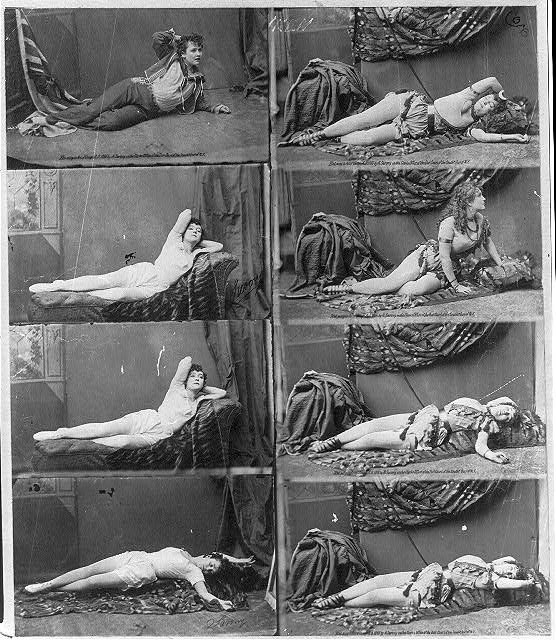

2. Lilly Langtry started her career as a famous beauty by becoming a popular artist’s model in England in the 1870s. She had an athletic figure, the result of daily exercise, and face that artists believed was a model of classical beauty. She drew the attention of the Prince of Wales and the two had a scandalous affair, which was an open secret. After breaking up with the Prince, Ms. Langtry sailed to America where she charmed New Yorkers with her poise, manners, and diction, while shocking them with her love affairs.
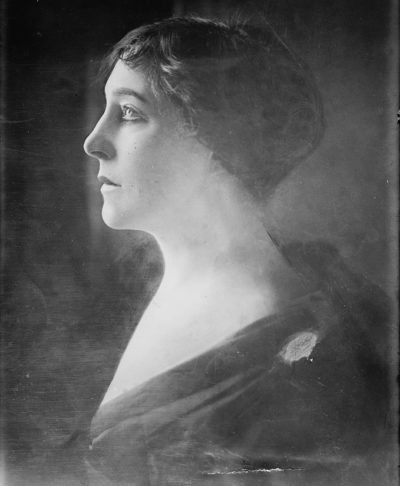

3. Lillian Russell was a popular singer and actress in the 1880s, famed for her performances in operettas. She came to embody the opulence of turn-of-the-century America. She enjoyed a lavish lifestyle, complete with a gold-plated, diamond-inlaid bicycle custom-made by Tiffany’s. She was admired for her full, statuesque figure, which was widely regarded as the ideal of feminine beauty.
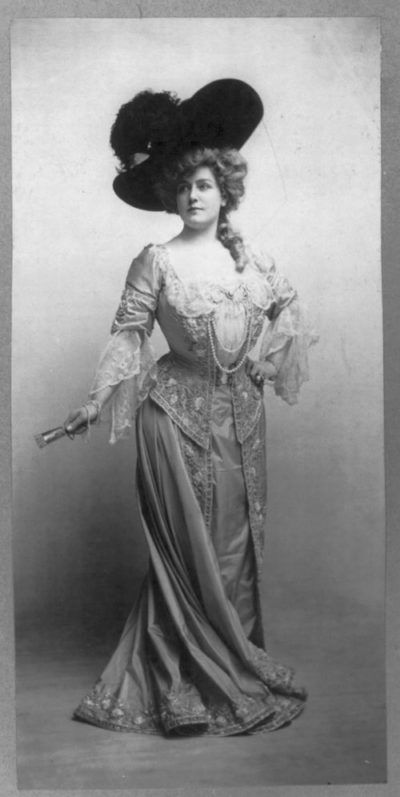
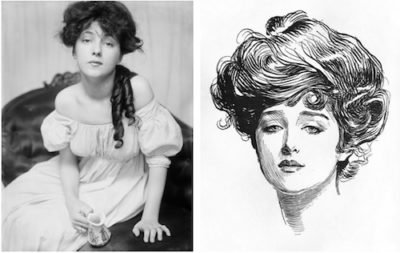
4. Beauty and scandal combined to give Evelyn Nesbit an undeserved reputation as a femme fatale. She was a model for several artists, including Charles Dana Gibson, inspiring him to create his series of “Gibson Girl” illustrations in the 1890s. In 1906, Nesbit’s wealthy but unbalanced husband, Harry Thaw, shot New York architect Stanford White. During Thaw’s trial, the country learned the reason for the shooting: White had befriended the 14-year-old Nesbit, then drugged and assaulted her at age 16. After Thaw was committed to an asylum, Nesbit tried to support herself in vaudeville and early motion pictures, but she never lost the stigma of a “fatal beauty.”

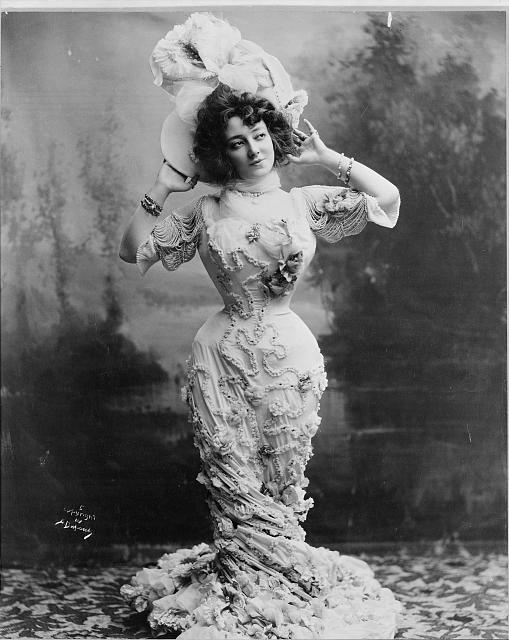
5. In the 1900s, a new manner of beauty came into fashion. Instead of the refined style of the Gibson girl or the voluptuous, full-figured ideal of a Lillian Russell, the popular star of the day was petite, wasp-waisted Anna Held. Her popularity was fueled by a continual flood of promotion by her husband, producer Florenz Ziegfeld. Newspapers and their readers were barraged with photos of Held and articles about her beauty, her jewelry, her fans, and her legendary milk baths.
6. The most popular star of vaudeville in 1910, Eva Tanguay, had an uninhibited, carefree manner. Her singing and dancing conveyed an earthy sensuality. She presented herself as a wild, independent woman, singing songs like “It’s All Been Done Before but Not the Way I Do It”, “I Want Someone to Go Wild with Me”, and “Go As Far As You Like.” Her small, lithe figure and unpretentious style appealed to people who were tiring of the Victorian standards of beauty.
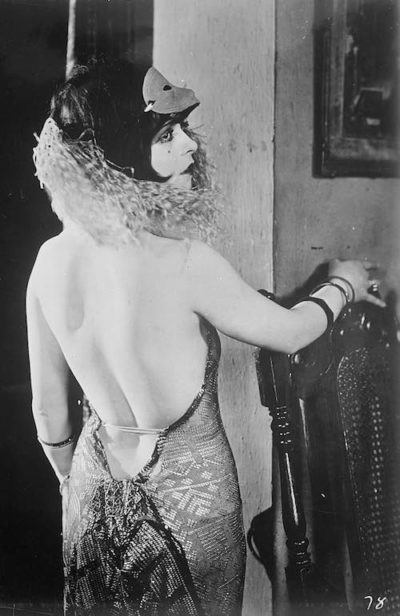
7. Theda Bara was the biggest star of the movies’ silent era, earning the equivalent of $56,000 a week. On film, she usually played a “vamp,” short for “vampire”—a beautiful woman who seduced and destroyed men. Bara performed some variation of this role in nearly 40 movies. Watching her movies today, it’s hard to see what Americans found seductive about her. Bara’s acting is as overdone as the eye makeup she wore. Fortunately, she was helped by some of the most daring costumes seen up to that time.

8. Clara Bow was known as the “It” girl partly because she had starred in a movie of that name, but mostly because she exuded “it” — that combination of charm, humor, and sex appeal. In her silent films of the 1920s, she helped popularize the new, jazz-age woman. A movie director described her as “the personification of the ideal aristocratic flapper: mischievous, pretty, aggressive, quick-tempered and deeply sentimental.”
9. Mae West began singing and dancing on Broadway in the 1910s. She got her first starring role in a play she wrote and directed. It was entitled simply Sex, and before it was shut down by the city authorities, it had raised West to icon status. Several other plays followed, all on adult themes. In Diamond Lil, she drew heavy criticism, and crowds, playing a sexy and smart woman. She continued to play women with pronounced libidos, comporting herself with a mixture of satire and comedy.
Mae West and some of her famous one-liners.
 Interested in glamour and movies? Relive The Golden Age of Hollywood with this new collection of behind-the-scenes interviews — straight from the pages of The Saturday Evening Post — with the celebrities who defined “glamour” for a generation. Order The Golden Age of Hollywood today.
Rockwell Video Minute: Homecoming—Union Station
Learn about Norman Rockwell’s process of painting this merry image from our December 23, 1944, cover, in which friends and families reunite at Chicago’s Union Station.
See all of the videos in our Rockwell Video Minute series at www.saturdayeveningpost/rockwell-video.
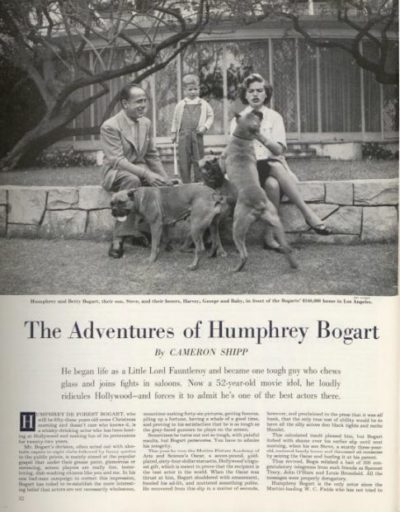
Humphrey Bogart’s Dark Side
Originally published August 2, 1952
Humphrey DeForest Bogart, who will be 53 years old come Christmas morning and doesn’t care who knows it, is a whisky-drinking actor who has been hooting at Hollywood and making fun of its pretensions for 22 years. Mr. Bogart’s derision, often acted out with alcoholic capers in night clubs followed by funny quotes in the public prints, is mainly aimed at the popular gospel that under their grease paint, glamorous or menacing, screen players are really fine, home-loving, dish-washing citizens like you and me. In his one bad-man campaign to correct this impression, Bogart has toiled to reestablish the more interesting belief that actors are not necessarily wholesome, meantime making 46 pictures, getting famous, piling up a fortune, having a whale of a good time, and proving to his satisfaction that he is as tough as the gray-faced gunmen he plays on the screen.
Bogart is the kind of guest you would enjoy having in your house — perhaps twice. He will not drink up all your likker [sic]. Indeed he is likely to nurse two Scotches with a moderate dash of soda all evening. He is likely to behave and be darkly charming. But he is also certain to incite a minimum of two fist fights and eight yelling arguments, and exit laughing. Mr. Bogart is a noncatalytic social agent and the precise answer to Dale Carnegie.
He earns between $300,000 and $400,000 a year today, heads his own production company, owns a famous racing yacht, is one of the last of the great movie stars whose names go above the picture title every time, and has as his wife Lauren Bacall, a fully accredited glamour girl 24 years his junior, brainy enough and tough enough never to take any lip from him.
“He’s a complex guy and hard to live with, but I’m not dazzled anymore. I think I can handle him.”
—Lauren Bacall
Whether Humphrey Bogart could possibly be as tough as he acts in pictures is a matter frequently in dispute. Bogart himself proclaims that he is not physically tough, but that he is mentally a very hard man. He has on several occasions risked destruction in order to hold up his end as a tough guy.
Bogart met the challenge the hard way in Oran when, during the war, he and his then-current wife, Mayo Methot, went over to entertain troops. They fell in, naturally, with the paratroopers, hard, lean, taut-nerved young men who took toughness for granted. Disaster arrived when the paratroopers decided to teach Bogart the trick of rolling with the fall after making a parachute landing. The scene of action was a bistro, and Bogart’s taking-off place was a bar. No parachute. Bogie leaped, dived, lit on his head, and knocked himself out.
In the late ’30s and early ’40s, Bogart would come to Warner Brothers Studio with hangovers so deep they cast shadows. I was there at the time and I marveled not for days, but for years, as the man toiled, letter-perfect before the camera, turning in smooth, underplayed, professional characterizations of cheap villains in many pictures by no means worthy of an actor of talent. During this period he fought with Jack L. Warner for better parts. The Bogart-Warner battles were notable, getting Bogie suspended 11 times, but eventually winning him top-star status and top-star pay, $3,500 a week, along with James Cagney, Edward G. Robinson, and George Raft, villains he had to fight his way past to reach the top. In the midst of these forays and night-long arguments, he had strength enough to caper.
Once, producer Mark Hellinger took him to a Sunset Strip gambling establishment. The man at the peephole immediately locked the door. “Bogart is barred. Creates disturbances,” he said.
“This is the new Bogart,” Hellinger promised. “The sober Bogart. I vouch for him, on my honor.”
The peephole man bugged a big eye.
“Mr. Hellinger,” he said quietly. “Mr. Hellinger, look behind you.”
Sid Avery
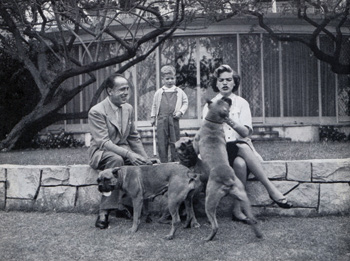
Bogart was fighting with two parking-lot attendants.
“You know he did that just to cross me up,” Hellinger always insisted.
Mrs. Bogart, whom he calls “Betty,” her real name, admits that she is often terrified by the Bogart temper, a white-faced anger which cannot be appeased. But what mystifies her is this: Mrs. May Smith, his cook, has been with him for 16 years. Aurellio Salazar, his gardener, for 15; and Mrs. Kathleen Sloan, his secretary, for 8.
“Wives come and go, but they stay,” says Betty, vastly puzzled. “He’s a complex guy and hard to live with, but I’m not dazzled anymore. I think I can handle him.”
Everybody else in Hollywood thinks she can too.
Dave Chasen, who throws Bogie out of his restaurant once or twice a month for old times’ sake, is the author of two sentences which come close to summing the man up. “He’s a hell of a guy until 11:30,” says Dave. “The only trouble with Bogie is, he thinks he’s Bogart.”
—“The Adventures of Humphrey Bogart” by Cameron Shipp,
August 2, 1952
This article is featured in the May/June 2017 issue of The Saturday Evening Post. Subscribe to the magazine for more art, inspiring stories, fiction, humor, and features from our archives.
Cover Gallery: Bridal Wave
June means the start of wedding season. These Post covers show beautiful brides of the twentieth century.
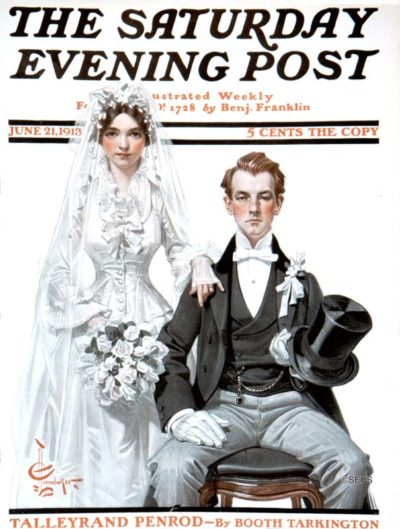
J. C. Leyendecker
June 21, 1913
In this painting by prolific artist J.C. Leyendecker, he shows a solemn couple having their photograph taken. Leyendecker illustrated the nuptial moments of other pairs, including Romeo and Juliet and Henry V and Catherine Valois. It appears this couple has got the “wedded” part down, if not the “bliss.”
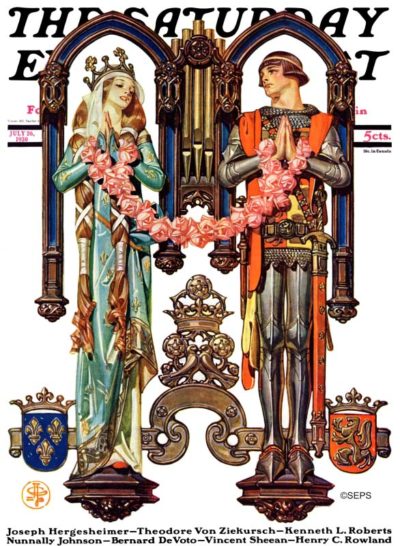
July 26, 1930
J.C. Leyendecker
Catherine of Valois married Henry V in June of 1420 and later gave birth to Henry VI. Henry V died shortly after his son’s birth, leaving the young Catherine a widow and her infant son the King of England.
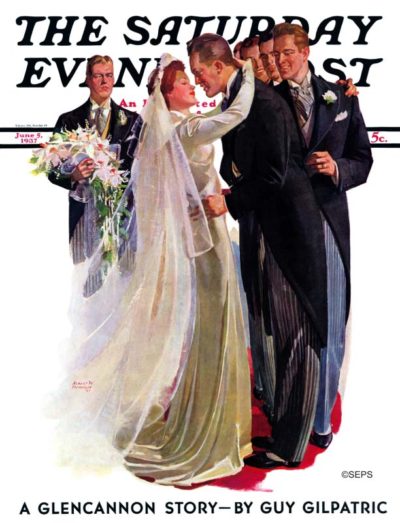
Albert W. Hampson
June 5, 1937
The groom doesn’t look too happy about this scenario. Given the line of enthusiastic groomsmen, the bride may not have enough energy for the honeymoon.
John LaGatta
June 24, 1939
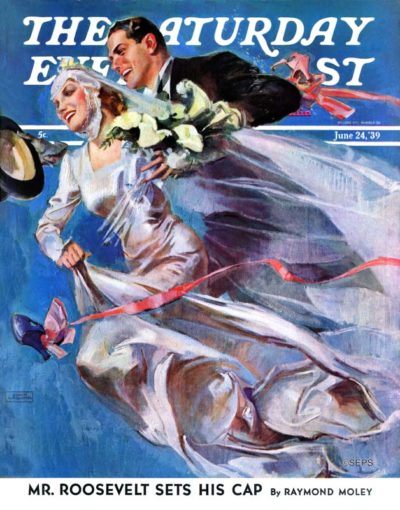
LaGatta had an uncanny knack for translating from model to canvas an appreciation and sensual perspective of the female figure. LaGatta began his artistic process by sketching the models in charcoal and pastels and then would almost always refine his interpretation into an oil painting. His subjects were sophisticated, upper-class men and women with long graceful figures and with classic clothing designs. His images gave the impression that the models didn’t have a care in the world, as in this 1939 cover of a couple running off after their wedding ceremony.
Wynn Richards
June 8, 1940
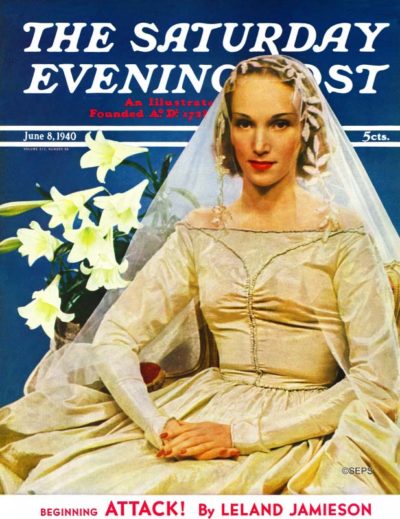
This 1940 bridal photograph was Wynn Richards’ one and only cover for the Saturday Evening Post. Richards was born “Martha Kinman Wynn” before marrying Dorsey Eugene Richards, according to her biography.. She opened her own photography studio in 1919, but left the business to a friend after a social scandal that involved her taking nude portraits of a local school teacher. Richards divorced her husband and left their son with his grandmother before opening a new portrait studio a few years later. Initially signing her work “Matsy Wynn Richards,” she learned that revealing her gender could hinder her career, and changed her signature to “Wynn Richards.” Richard’s work mostly appeared in Vogue, Harper’s Bazaar, and Mademoiselle magazine.
Constantin Alajalov
June 1, 1946
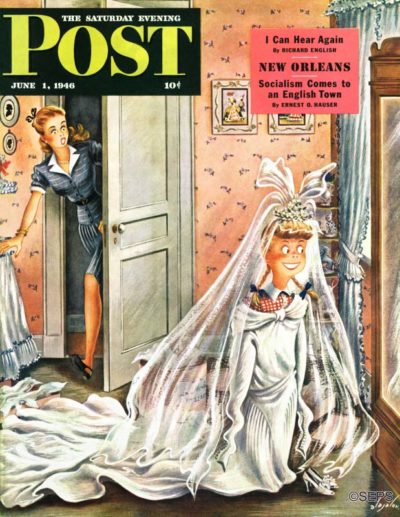
[From the editors of the June 1, 1946 issue of the Post] Just after Constantin Alajalov finished his kid-sister painting, he set out from New York for Florida, to work on other cover assignments. The artist went by automobile, and sent back a short report on his three-day journey. The highways are full of displaced persons at the moment, sorting themselves out after the great disruption of war, and we think Alajalov’s account is a thumbnail picture of America in Transition. “The first day,” he wrote, “I picked up a corporal just back from Tokyo, hitch-hiking to Alabama to marry a girl there. The second day I picked up a marine hitch-hiking to Jacksonville, Florida, to get his wife. The third day I picked up a sailor who was going to Miami for any girl he could get.”
May 29, 1954
John Clymer
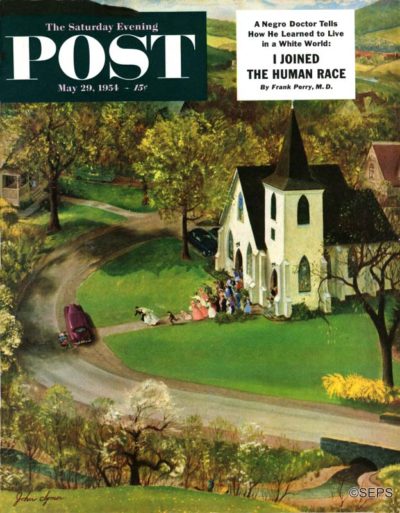
[From the editors of the May 29, 1954 Post] Away go the newly-marrieds into their brave new world and thank heaven it isn’t raining. John Clymer is nice about weather; on his covers it hardly ever rains. That church, says Clymer, is located in one state and the landscape in another state, and the honeymoon will take place in the state of bliss always visited on such trips.
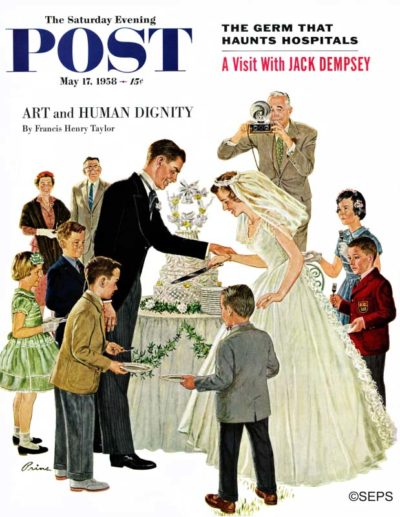
May 17, 1958
Ben Prins
[From the editors of the May 17, 1958 Post] Here come the bride and groom to carve the cake. Two-handed carving isn’t an efficient way to dismember food, but He and She have just become One and this is the tender symbol of their unity. They probably aren’t hungry; in a day or two food will become attractive, but right now they are not of this world, they are up in the clouds, in a state of bliss where folks subsist on love alone. Conversely, those youngsters have their feet on the ground and their eyes on the cake. Oh, the girls may save a few crumbs to put under their pillows to incite romantic dreaming, but the boys will put their cake where it belongs, and let’s hope they don’t consume enough to turn dreams into nightmares. Well, a toast to artist Ben Prins’ newlyweds: bon voyage, all the way through life!
North Country Girl: Chapter 2 — What I Didn’t Learn in Kindergarten
For more about Gay Haubner’s life in the North Country, read the other chapters in her serialized memoir. The Post will publish a new segment each week.
I had started kindergarten age four on the army base in Hawaii. My father, a captain, had wrangled this early admission to get me out of my mother’s hair while she coped with a new baby. After a several month gap in my education while we lived with my grandparents, I was sent off to Cobb Elementary School as soon as we moved into the Woodland house, in the middle of the school year. I was the new kid, the smallest kid, and a year younger than most of my classmates. The old maid teacher (the Duluth Board of Education required that all elementary teachers be grey or white haired spinsters) carefully instructed me that if I had to throw up I should not run around the room but stay in one place, the only useful thing I learned in kindergarten. I painted at the easel, sang Old McDonald, pressed my hand into a disc of wet clay to create a Mother’s Day present, and made not a single friend. This would have distressed my mother if she had had the time to notice; she spent the entire day wrestling with a skinny, shrieking, thrashing toddler who fought tooth and claw against sleeping and eating and everything else.
I was friendless, but not unhappy. I had my books and my dolls and a baby sister to boss around. And every day at 3, I had The Bozo Show on our black and white TV. When Bozo wasn’t showing cartoons, but clowning around in the studio, I went back to my book while Lani rampaged through the house. Neither of us were interested in Bozo’s puerile antics or the tedium of listening to the dozens of snotty-nosed kids squashed on bleachers trying to remember their own names for the camera.
At that time we only had two TV stations in Duluth, neither of which was particularly dedicated to children’s programs. On weekday mornings there was Romper Room, which my mother attempted to park my squirming sister in front of. I was a classic Goody Two Shoes and even I was repelled by Romper Room’s “Do Be a Do-Bee” kid propaganda. And I knew that at the end of each show when Miss Mary looked through her Magic Mirror, she would never see Gay and Lani, only Billy and Nancy and Susie.

The high point of my week was Saturday morning, the one time Lani and I could spend hours sprawled in all our glory and pajamas in front of the TV. The first thing to come on screen after the weirdly fascinating test pattern were wonderful old black and white cartoons, Merrie Melodies, Betty Boop, Popeye the Sailor Man, one after the other, with no interruptions from silly clowns or idiot children. Then came Mighty Mouse to save the day. The rest of the morning was not as idyllic, consisting of old half-hour shows thought suitable for kids: Roy Rogers, featuring Trigger and Dale Evans and for some reason Nellybelle the Jeep. The Lone Ranger and Zorro, both of whom were much handsomer and more dashing than stodgy Roy Rogers. Sky King, with his cute daughter, Penny, capturing various bad guys through aviation. And my favorites, the horse shows: Fury and My Friend Flicka.
I had a few plastic toy horses, inspired by the far better collection owned by my one and only friend, Judy Lindberg, who lived a few houses down from my grandparents in Carlton. Judy and I had become friends during my parent’s house-hunting days, when she was summoned to play with me. Round-faced Judy seemed almost as friendless as I was. I envied her world-class plastic horse collection, her thousands of Legos (My mother hated anything with lots of tiny pieces), and her status as an only child, a rare exotic when two kids seemed the minimum and lots of families had five or six. Judy’s very German grandfather, Karl, and her parents, Vera, with raven Elizabeth Taylor hair, and roly-poly Julius, owned Carlton’s one and only restaurant. The small café had a few booths along one side and on the other a long counter with those glorious chrome stools; Judy and I were strictly forbidden to do any spinning on them. On the counter and tables were the most adorable china cow creamers, as Minnesotans drank coffee with every meal. I broke one once, mesmerized by the stream of milk pouring out of the cow’s mouth, and I was scared for weeks to go to Judy’s house, terrified of what Germanic punishment might be meted out by her formidable grandpa Karl.

I got to play with Judy quite often, even after our move to Duluth; my family spent almost every Sunday in Carlton. While the adults sat around drinking and talking and drinking, I walked myself down the street to Judy’s, where we played horsies or Legos or fooled around with her mother’s electric organ, or I would sneak a look at Judy’s collection of fascinating, brightly-illustrated books that tried to explain Catholic theology at an 8-year-old level. Judy complained that reading wasn’t playing, and she was right.
***
If Judy wasn’t around on our Sunday trips to Carlton, I roamed about outside by myself, or explored my grandparent’s big house. On the ground floor there was a small wood-paneled room decorated with the heads of animals. My grandfather loved to hunt; in the winter he would drive around the county, dropping bales of hay off in the woods to make sure enough deer would survive so he could shoot them the following fall. There was an elegant living room that we never sat in; everyone congregated in the new glass-walled sunroom my grandparents had added on so they could look out at the snow eight months a year. My grandmother had remodeled her kitchen at the same time; her aqua blue and pale yellow kitchen was right out of Disney’s Tomorrowland and seemed the height of modern sophistication to me: the freezer made ice, there was a dishwasher, and the Formica counters were festooned with space age parabolas.
Upstairs were “the boys’ rooms” that had belonged to my dad and his two brothers. There the main attractions were the leather albums of coins and stamps from Rhodesia, Ceylon, French Guinea, and other exotic-sounding places I longed to visit even though those countries were just a colorful bit of paper or a coin with a hole stamped out; I could not have found them on a map.
Also upstairs was my grandma’s big bedroom, neat as a pin, reeking of Youth Dew, and too intimidating for me to do anything besides look at myself in her three-sided dresser mirror.
Best of all, my grandparents had a room just for books. It wasn’t big, but it was definitely a library, with towering bookcases on all sides holding hundreds of books in no particular order. There were tomes on dentistry, dusty fabric-covered novels with tiny type and no conversations, ancient nature books with pastel drawings of birds and moths—I just had to keep pulling books down from the shelves until I found something I could enjoy. When I did, I left that book on a lower shelf so I could find it again the following Sunday. There were two books I read again and again; a book on space travel, with lurid sci-fi paintings of the rings of Saturn as seen from the surface of that planet, and sunset on Mars with its two moons hanging in the sky; and a guide to hunting in Africa, bound in leopard-print paper and filled with black and white photos of living and just-shot gnus, zebras, lions, and a wide variety of antelope. If I ever go to Africa, I will carefully shake out my shoes every morning, having seen a photo of a large scorpion that had been extracted from the author’s boot. When I was in junior high, I discovered in my grandparents’ library an unaccountable paperback of Hell’s Angels by Hunter S. Thompson, with such horrifying descriptions of sex and violence, including bikers pulling a train on one poor girl, that I took special care in secreting it behind the encyclopedias so I could read it again and again. I have no idea who would have brought that book into that house.

My grandfather had a small bedroom tucked beneath the stairs, where he retreated immediately after Sunday dinner. I thought it was funny that my grandpa’s bedtime was 7:30 until I realized years later that this was his regular time to pass out from drinking 7&7’s all day. Every Sunday I scarfed down my own dinner as fast as possible to catch Lassie and the Walt Disney Show, which later became the even more unmissable Wonderful World of Color. My mother and grandmother cleaned up the dinner plates, my dad built himself a last highball, and then we piled back in the car, my dad drunk and all of us seat belt-less, to drive the half hour back home, where I had to go immediately to bed.
My grandfather’s brother was married to my grandmother’s sister, but while my grandpa was the big man and my grandma the snooty matron in their town of 400 souls, my great uncle Cliff and great aunt Marge were stuck on a farm with a thousand turkeys. Every Christmas Eve Cliff and Marge opened their rambling 1920’s house to dozens of relatives. Aunt Marge started baking in the beginning of December: there were cut-out sugar cookies shaped like stars, bells, and camels, dusted with red and green sugars; spritz cookies, ridged wreathes of pale green, decorated with those adorable little silver balls that you’re not suppose to eat, but that I could never resist crunching between my teeth; pfefferneuse, snowy with powdered sugar, that I always forgot I didn’t like until I had popped one in my mouth; chocolate drops, that I did like, tart lemon bars, homemade white bread to be slathered with butter, and stolen, studded with candied cherries and iced with white sugar frosting.

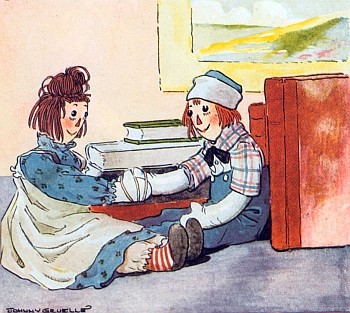
Marge made candy as well, a feat I have tried again and again to duplicate and consistently failed at: chocolate walnut fudge and penuche and divinity. These were the main attractions for me and it was torture to gaze upon the kitchen table groaning with sweets and not be able to have any until I choked down a plate of wild rice with mushrooms and chicken, baked ham, mashed potatoes, string bean casserole, and ambrosia salad. There were bowls of many other things, such as beets and lima beans, that I didn’t eat, and since it was Christmas, nobody made me. It was farmhouse cooking at its most gargantuan. I don’t think anyone even thought of bringing a dish to Aunt Marge’s Christmas Eve. It would have been like showing up at the miracle of the loaves and fishes with a Tupperware container of pasta salad. Our family did presents Christmas morning, after Santa came. Cliff and Marge did presents Christmas Eve, between bouts of eating. There was always one present for me, so I would have something to open; I tried not to look disappointed at the handmade monkey sock puppet or yoyo doll. Then there was that annus horribilius when my sister got a Raggedy Ann doll, something I had always wanted; I gleefully torn open my own gift to reveal the dreaded stitched grin of Raggedy Andy. I cried all the way home.
George Orwell’s 1984: A Review
We share a review of George Orwell’s 1984 from The September 1, 1972, issue of the Post, 23 years after the initial publication of the book. The reviewer notes, “The realization has been gradually growing that Orwell possessed completely remarkable insights and foresights, that he saw something then that the rest of us are only beginning to see now.”
Sales of the influential book have spiked in the last four months, as people once again find Orwell’s writing to have resonance in today’s political climate.
***
When it appeared in 1949. Orwell’s ominously titled 1984 doubtless seemed to many to be at most an absurd parody of the Russian communist state, so overdrawn and so farfetched that it offered little to the reader.
But each successive year since its initial publication has brought revised appraisal, a growing anxiety on the part of past and new readers alike that it was just possible that they were missing the message. The realization has been gradually growing that Orwell possessed completely remarkable insights and foresights, that he saw something then that the rest of us are only beginning to see now.
Orwell was born in Bengal at the beginning of this century, completed his formal education at Eton, became a thoroughgoing Socialist who fought with the Loyalists during the Spanish Civil War. He was to die at forty-six, but not before he had clearly, if frighteningly, depicted the fate of mankind if the direction of political and social forces were not reversed.
In the present edition Erich Fromm has written a short but illuminating “Afterword” that ought to be read before tackling 1984 itself.
Reviewing earlier Utopias, such as the work of Thomas More which gave us the name, Fromm correctly identifies them as expressions of the perfectibility of man, as the basis for a happy optimism about man’s future.
Against these he contrasts the “negative utopias” of which 1984 is perhaps the most notable. Writing of them, he even anticipates the title that Skinner was to choose ten years later: “The question is a philosophical, anthropological and psychological one, and perhaps also a religious one. It is, can human nature be changed in such a way that man will forget his longing for freedom, for dignity, for integrity, for love—that is to say, can man forget he is human’!”
Winston Smith is the man about whom Orwell’s book revolves, London is the scene of the action, and all through the narrative words and expressions evolve which have worked their way into our own everyday vocabularies.
Winston’s flat, like everyone’s, is under the eternal surveillance of a telescreen through which, as posters everywhere proclaim. BIG BROTHER IS WATCHING YOU. Not too far away was the Ministry of Truth, said to contain three thousand rooms, which carried on its side these distillations of party wisdom:
War Is Peace
Freedom Is Slavery
Ignorance Is Strength
There was “the Ministry of Peace, which concerned itself with war; the Ministry of Love, which maintained law and order; and the Ministry of Plenty, which was responsible for economic affairs. Their names, in Newspeak: Minitrue, Minipax, Miniluv and Miniplenty.”
We witness a forbidden love that began and briefly flourished under the unseen eyes of the Thought Police, a love that subsequent torture led both participants to betray and denounce the other.
We see history recorded, history erased, so that nothing is known of yesterday, so that even the today that we think we see is wholly the contrivance of Big Brother.
We observe O’Brien from the Thought Police, presiding over the degradation and reconstitution of Winston, by means of drugs, electric shock treatments, starvation, beating. We hear him summarize the new world the party was forging.
“In our world there will be no emotions except fear, rage, triumph, and self-abasement. . . . We have cut the links between child and parent, between man and man, and between man and woman. No one dares trust a wife or child or a friend any longer. If you want a picture of the future, imagine a boot stomping on a human face—forever.”
Fromm ends his “Afterword” with the admonition that “Books like Orwell’s are powerful warnings and it would be most unfortunate if the reader smugly interpreted 1984 as another description of Stalinist barbarism, and if he does not see that it means us, too.”
The People Nobody Wants: The Plight of Japanese-Americans in 1942
Originally published May 9, 1942
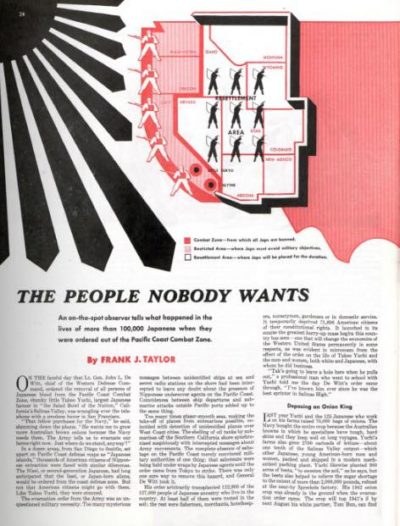
On the fateful day that Lt. Gen. John L. De Witt, chief of the Western Defense Command, ordered the removal of all persons of Japanese blood from the Pacific Coast Combat Zone, chunky little Takeo Yuchi, largest Japanese farmer in “the Salad Bowl of the Nation,” California’s Salinas Valley, was wrangling over the telephone with a produce buyer in San Francisco.
“That fellow purchases for the Navy,” he said, slamming down the phone. “He wants me to grow more Australian brown onions because the Navy needs them. The Army tells us to evacuate our farms right now. Just where do we stand, anyway?”
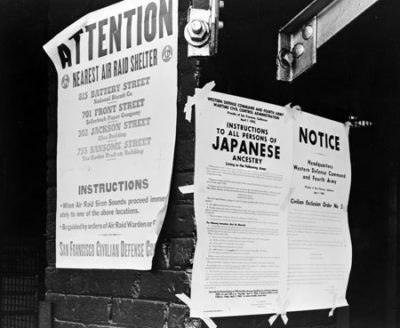
In a dozen areas, from San Diego to Seattle, set apart on Pacific Coast defense maps as “Japanese islands,” thousands of American citizens of Nipponese extraction were faced with similar dilemmas. The Nisei, or second-generation Japanese, had long anticipated that the Issei, or Japan-born aliens, would be ordered from the coast defense zone. But not that American citizens might go with them. Like Takeo Yuchi, they were stunned.
At least half of the 112,905 people of Japanese ancestry affected by the order were rooted in the soil; the rest were fishermen, merchants, hotelkeepers, nurserymen, gardeners, or in domestic service. It temporarily deprived 71,896 American citizens of their constitutional rights. It launched in its course the greatest hurry-up mass hegira this country has seen.
“Tak’s going to leave a hole here when he pulls out,” a professional man who went to school with Yuchi told me the day De Witt’s order came through. “I’ve known him ever since he was the best sprinter in Salinas High.”
Yuchi’s own family, consisting of his alien mother, his Salinas-born wife, his 8-year-old daughter, 6-year-old son, and a baby daughter, is an average California-Japanese household. His wife’s brother, Hideo Abe, is in the Army. His younger brother, Masao, was called in by the local draft board for his physical examination the day I was there. Of the 21,000 Japanese families on the Pacific Coast, one in every five has contributed a son to the Army.
“Well, are you going to go voluntarily or wait until the Army evacuates you?” I asked.
“It’s a tough one to figure out,” Yuchi replied. “I’m American. I speak English better than I do Japanese. I think in English, not Japanese.”
After leaving the Yuchi household, I called on another Nisei, Dr. Harry Y. Kita, a dentist. Prior to Pearl Harbor, Kita, a University of California graduate, enjoyed a thriving practice. Half of the patients who sat in his three chairs were whites. Since then, most of them had been from the Japanese community. “I haven’t much practice left,” said Kita, with a hearty but forced laugh. “I understand why it is,” he continued. “I feel American. I think American. I talk American. My only connection with Japan is that I look Japanese.”
“Could you tell a good Japanese from a bad one?” I asked him.
“No more than you could,” he replied. “But if I knew one who was disloyal to this country, you can bet I’d turn him in.”
Dorothea Lange
Vegetable Wars
From white vegetable growers I heard the other side of the story. The Salinas Vegetable Grower-Shipper Association had just published a brochure titled NO JAPS NEEDED to counteract a widespread impression that Californians would go hungry if the Japanese truck gardeners were removed. The dislike of the militant Grower-Shipper Association for the valley’s Japanese farmers is an old and bitter one. The association is composed of a few score large-scale white growers who lease lands, produce lettuce, carrots, and other fresh vegetables the year round in the Salinas, Imperial, and Salt River Valleys for the Eastern markets. … At one time the lettuce growers, like the sugar-beet growers, depended upon Japanese for field labor. As the Japanese, one by one, became farmers in their own right, and competitors, their places in the field were taken by Mexican or Filipino labor. White men and women, largely Oklahomans, handled the trimming, icing, and crating in the packing plants, but they were never able to endure the back-breaking stoop work in the fields. Only the short-legged Japs could take that.
Shortly after December 7, the association dispatched its managing secretary, Austin E. Anson, to Washington to urge the federal authorities to remove all Japanese from the area. “We’re charged with wanting to get rid of the Japs for selfish reasons,” Anson told me. “We might as well be honest. We do. It’s a question of whether the white man lives on the Pacific Coast or the brown men. They came into this valley to work, and they stayed to take over. … If all the Japs were removed tomorrow, we’d never miss them in two weeks, because the white farmers can take over and produce everything the Jap grows. And we don’t want them back when the war ends, either.”
The Japanese-American loyalty creed, to which all Nisei publicly subscribe, is about to get its first real test, particularly these portions of it: “… I am firm in my belief that American sportsmanship and attitude of fair play will judge citizenship and patriotism on the basis of action and achievement, and not on the basis of physical characteristics. … Although some individuals may discriminate against me, I shall never become bitter or lose faith, for I know that such persons are not representative of the majority of the American people. …” In such a test, the tolerance of the new host states will also feel the fire which has been ignited by the obvious requirements of a stern military emergency.
—“The People Nobody Wants,” Frank J. Taylor,
May 9, 1942
This article is featured in the May/June 2017 issue of The Saturday Evening Post. Subscribe to the magazine for more art, inspiring stories, fiction, humor, and features from our archives.
Also read Unwanted: A Teenage Memoir of Japanese Internment from the May/June 2017 issue of The Saturday Evening Post.
“Comrades in Arms” by Josephine Daskam Bacon
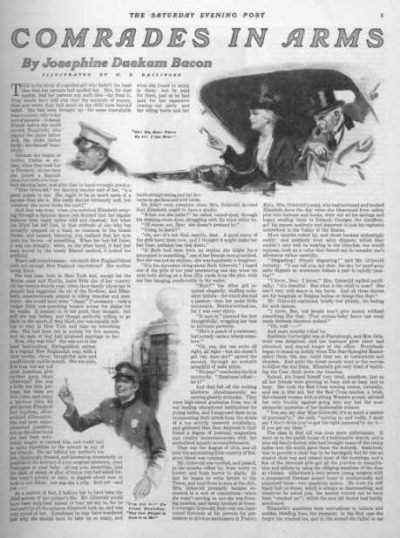
This is the story of a spoiled girl who hadn’t the least idea that her parents had spoiled her. Nor, for that matter, had her parents any such idea — far from it. They would have told you that the amounts of money, time and worry they had spent on the child were beyond belief. She had been brought up—for some inscrutable reason known only to her sort of parents — to speak French before she could speak English; she played the piano rather well, the violin rather badly; she danced beautifully.
German she began at twelve, Italian at sixteen, when they took her to Florence; at one time she joined a Spanish class, but shifted to barefoot dancing later, and after that to hand-wrought jewelry.
“Miss Griswold,” her dancing teacher said of her, “is a great puzzle to me. She ought to be so much more of a success than she is. She really dances extremely well, but somehow she never looks the part!”
And that was true; when you watched Elizabeth swaying through a Spanish dance you decided that her regular features were really rather cold and classical; but when she lifted her left foot, in that attitude of one who has unwarily stepped on a toad, so common to the Greek friezes, and paused, listening, you realized that her eyes were too brown — or something. When her hair fell loose, it was too straight; when, on the other hand, it had just been waved by the trusty Marcel method, it looked too artificial.
Was it self-consciousness — too much New England blood with not enough New England convictions? Her mother never knew.
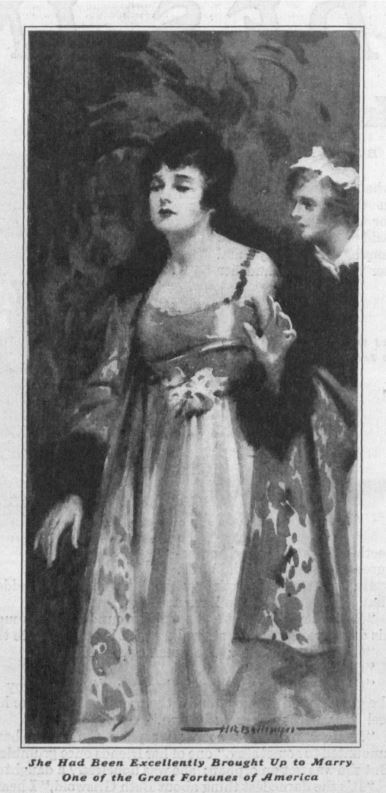
She had been born in New York and, except for the Maine coast and Florida, knew little else of her country till her twenty-fourth year, when their family physician in despair had suggested the air of the Rockies; and Elizabeth, conscientiously attired in riding breeches and sombrero—she would have worn “chaps” if necessary — rode a vulgar little cow-punching bronco across the plains for six weeks. It seemed to do her good, they thought; but still she was listless, and though perfectly willing to go back to the ranch, if they liked, she was equally willing to stay in New York and take up something else. She had been out in society for five seasons, and no man or boy had proposed marriage to her.
Now, why was this? She was not in the least bad-looking; distinguished, rather, in a regular New Englandish way, with a clear profile, clever, thoughtful eyes and a sufficiently mobile mouth. She was pale, it is true, but are not most American girls rather pale than otherwise? She was a little too thin perhaps, but these are thin years, and many a luscious little fat girl envied Elizabeth her hipless, slim-ankled silhouette. She had been super-educated possibly; but on the other hand she had been sedulously taught to conceal this, and could talk as many banalities to the minute as any of her friends. She sat behind her mother’s tea urn, charmingly dressed, and listened as interestedly as possible to the account of your surgical operation, your Pekingese or your baby—giving you, meantime, just the dash of cream or slice of lemon you had asked for. She wasn’t prickly or catty or piggish about men or rude to her elders; nor was she a prig. And yet—and yet —
As a matter of fact, I believe her to have been the chief sorrow of her mother’s life. Mr. Griswold would have been surprised indeed to hear me say so, for he had paid for all the subjects Elizabeth took up, and was very proud of her. Sometimes he may have wondered just why she should have to take up so many, and what she found to enjoy in them; but he paid for them, just as he had paid for her expensive coming-out party and her riding boots and her teeth-straightening and her lectures on gardens and wild birds.
He didn’t even complain when Mrs. Griswold decided that Elizabeth ought to have a studio.
“B-but can she paint?” he called, round-eyed, through his dressing-room door, struggling with his third white tie.
“Of course not, Ben; she doesn’t pretend to.”
“Going to learn?”
“Oh, no — it’s not that, exactly, dear. A good many of the girls have them now, and I thought it might make her feel freer, perhaps less tied down.”
“If Beth had been born an orphan she might have amounted to something,” one of her friends once grumbled. But she was not an orphan; she was hopelessly a daughter.
“It’s the darnedest thing about Beth Griswold,” I heard one of the girls of her year murmuring one day when we were both sitting on a float fifty yards from the pier, with our feet hanging comfortably in the water.
 “Huh?” the other girl inquired elegantly, stuffing sodamint tablets—for which she had a passion — into her moist little red mouth. Neither noticed me, for I was over thirty.
“It sure is,” pursued the first thoughtfully, wriggling her toes in intricate patterns.
“She’s a peach of a swimmer, but nobody cares a whoop somehow.”
“Oh, yes, she can swim all right, all right — but she doesn’t get ‘em, does she?” agreed the second, through an ecstatic mouthful of soda mints.
“No pep!” concluded the first succinctly. “Dead man’s float — let’s?”
And they fell off the rocking platform simultaneously, assuming ghastly attitudes. They were high-stand graduates from one of our leading educational institutions for young ladies, and I supposed them to be recuperating their minds from the strain of a too strictly censored vocabulary, and gathered that they deplored in their friend a degree of personal magnetism and vitality incommensurate with her undoubted aquatic accomplishments.
That was the August of 1914, and all over the astonishing little country of Belgium blood was running.
Mr. Griswold was worried, and passed, as the months rolled by, from worry to horror, and from horror to alarm. At last he began to write letters to the Times, and read them to men at the club. Mrs. Griswold promptly became enmeshed in a web of committees — when she wasn’t serving on one she was forming another, and rarely lunched at home. Cortwright Griswold, their only son, hammered furiously at his parents for permission to drive an ambulance in France; Katy, Mrs. Griswold’s maid, who had buttoned and hooked Elizabeth since the day when she blossomed from safety pins into buttons and hooks, drew out all her savings and began sending them to Ireland; Georges, the chauffeur, got his papers suddenly and departed to join his regiment somewhere in the Valley of the Marne.
More months rolled by, and shoes became sickeningly costly; and suddenly even satin slippers, which they couldn’t very well be wearing in the trenches, one would suppose, took on a value that forced one to consider one’s allowance rather carefully.
“Disgusting! Simply disgusting!” said Mr. Griswold irritably. “I can tell you, my dear, the day for pearl-gray satin slippers at seventeen dollars a pair is rapidly passing!”
“I know, Ben; I know,” Mrs. Griswold replied pacifically; “it’s dreadful. But what is the child to wear? She can’t very well dance in tan boots. And all these dances are for hospitals or Belgian babies or things like that.”
Mr. Griswold explained, briefly but plainly, his feeling for such dances.
“I know, Ben, but people won’t give money without something like that. That orphan-baby dance last week made thirteen hundred dollars.”
“Oh, well — ”
And more months rolled by.
Suddenly Cortwright was at Plattsburgh, and Mrs. Griswold was delighted, and her husband grew silent and absorbed, and stayed longer at the office. Everybody began to stand up jerkily when The Star-Spangled Banner asked them, Oh, say, could they see, at restaurants and theaters. And quite the nicest people went to the movies to follow the war films. Elizabeth got very tired of watching the Czar climb down the trenches.
Indeed, she found herself very tired, somehow, just as all her friends were growing so busy and so busy and so busy. She took the Red Cross nursing course, naturally, and one in first aid, but the Red Cross teacher, a brisk, flat-chested woman with a strong Western accent, advised her very frankly against going into any but the most elemental mysteries of her fashionable science.
“You see, my dear Miss Griswold, it’s so much a matter of pursonal’ty,” she said, “nursing is; and reelly, I must say I don’t think you’ve got the right pursonal’ty for it — if you get my idear.”
The class in first aid was even more unfortunate. It went on in the parish house of a fashionable church, and a nice old family doctor, who had brought many of the young ladies into the world, gave them the lectures. Somebody was to provide a choir boy to be bandaged, but he was an elusive choir boy and missed most of the mornings, and a few of the cleverest girls got all the practice in resuscitation and splints by using the obliging members of the class as victims. Afterward a very severe young surgeon with a pronounced German accent burst in unexpectedly and examined them—two questions apiece. He wore his stiff black hair en brosse, which is always so disconcerting, and whatever he asked you, the answer turned out to have been “cracked ice”; which the nice old doctor had hardly mentioned.
Elizabeth’s questions were convulsions in infants and sudden bleeding from the stomach; in the first case she forgot the cracked ice, and in the second she failed to see how it could be usefully applied, unless the patient could be induced to eat it, and as she presupposed him to be unconscious at the time, she didn’t suggest it. When they turned up at the parish house the next week to get their diplomas, they were met by a typewritten slip, sandwiched between the choir rehearsal and the Ladies’ Auxiliary, which informed them that none of the class had passed!
Elizabeth didn’t care very much; it had been her mother’s idea. She went languidly to a set of talks on the Balkan Situation, where everybody knitted; and later joined a committee for collecting old linen for a big, new surgical-dressings committee. But the district given her was away up on the West Side, and as she couldn’t take the motor on those days and wasn’t allowed to use the subway, she stood so long on the corner in the rain waiting for the bus that she caught a heavy cold, which ran into tonsillitis — it was, you will remember, a tonsillitis year — and by the time she could get out again her place on the committee had been filled by an energetic girl with an electric runabout of her own.
The months rolled by and there was getting to be quite a little list of Americans who had been killed, in one way or another, on account of this horrible European war, and many of her friends wore little button knots of Allied ribbon. Mrs. Griswold was forced in the interests of digestion to ask guests not to mention the President if they could help it, it made Ben so angry; and Cortwright, who became 21 on a Tuesday, ran away to France with one of his cousins on the Thursday following, and drove his new birthday car through the second war zone, filled with hospital supplies. Mr. Griswold scolded him soundly by letter and boasted of him at the club, and his mother turned his bedroom and study into a shipping depot for tobacco for the trenches and old clothes for various devastated regions.
Mr. Griswold became chairman of one of the relief committees at the club and secretary and treasurer of a Harvard Alumni committee, and went to a great many men’s dinners. As Mrs. Griswold rarely came home to luncheon now, and the cook’s son had recently joined the National Guard, which for some reason preyed on his mother’s mind to such an extent that she confined herself to what she called some little thing on a tray for Miss Elizabeth, the girl, who had never been much interested in her food, began to grow really thin and you noticed her cheek bones.
I mentioned this, incidentally, to Mrs. Griswold, who became extremely vexed and left me with the impression that Elizabeth was very unpatriotic to have grown so thin, and I nearly as much so to have remarked it. A bottle of port-and-iron was placed on the sideboard, out of which the girl very sensibly poured a little over the roots of the table ferns now and then. I call her action sensible because iron disagreed with her digestion — feeling, indeed, like a sharp three-cornered stone in her chest—and the port went to her head.
The months rolled on, and now a strange thing occurred: utterly aside from Europe, and the President, and the ridiculous state of the Army, and the probable effect of German propaganda on the Irish, something happened to Elizabeth herself! Something, actually, which her mother had not planned and her father had not paid for — something she stumbled into all alone!
It happened in this way:
She was in the habit of going to her Cousin Lou’s once a week or so, to play with the children when their mademoiselle went for her weekly afternoon out, an afternoon devoted nowadays to packing great bales of comforts for the American Fund for the French wounded. There had always been a Fraulein until now, but when all the Frauleins turned out to be without doubt German spies—;they spent their time in giving important Germans maps of their employers’ houses—Cousin Lou turned away hers, weeping—she had been the most marvelous packer, my dear, and knitted the most beautiful sweaters, and the baby cried for a week! —and engaged Mlle. Dupuy, who slapped the children, one feared, and had headaches; but then, think what France did for us when we were fighting for our freedom!
Elizabeth was really fond of children and got on well with them. She sang them funny little French songs that her old bonne had been used to sing to her: Maman, les Oils bateaux qui s’en vont and Il pleut, it pleut, bergere; she tied bandages on their wounded soldier dolls; she even had tea with them occasionally.
One afternoon Lou was having a meeting at her house, and mademoiselle had agreed to stay with the children, as it was raining. Elizabeth, who had come as usual, strayed into the meeting, at her cousin’s earnest request, and listened politely to the speaker, an eager, dynamic little creature —nobody in particular, really — with a solid genius for organization and inspiration. She had been a trained nurse, it appeared, had married a doctor, and lived in an apartment on Gramercy Park. She had raised thousands of dollars for the orphaned children of France, and did mighty fieldwork as a missionary for that cause. Indeed, she threw out, in passing, the desire of her heart was to dedicate herself entirely to that work and direct it from the city headquarters all day long, but that she could not feel justified in leaving her three children, the oldest not yet seven, to the care of servants.
“Think, only think!” she cried, throwing out her arms with an impassioned little gesture, “think what I could do for this wonderful work of ours if only some one of the hundreds of nice women in New York who are of no earthly use to anybody would come and take care of my children! I don’t say wash them and blow their noses for them and tidy their rooms — I can afford a good nurse for that. But my husband doesn’t approve of schools for children until they are eight years old, and I’ve always been with them a great deal; I don’t want to leave them with servants. Somebody ought to organize all the women who haven’t any special gift and release those of us who have! They ought not to expect any pay” — her smile was half whimsical, half fanatic —“they ought to feel that they’re just doing their bit. Don’t you agree with me, ladies?”
They laughed and applauded enthusiastically; her ardor was contagious. “Heavens! I wish she could reorganize the office for us!” murmured the woman whose name headed the engraved letter paper of the great charity; “she’s a little wonder!”
Then they moved and seconded for a few minutes and went on to the next thing — all, that is, but Elizabeth. She sat staring at the little speaker, and later followed her quietly into a Madison Avenue street car.
“I am Elizabeth Griswold,” she explained, “and I wondered if you would be willing to let me take care of your children while you were at headquarters? I could come every day if you liked. Lou Delanoy is my cousin.”
“I think that’s perfectly fine of you, Miss Griswold,” cried the little wonder delightedly. “I should like to be at headquarters from nine till five, except Saturdays, this month anyway. Things are in an awful mess down there. I’ll have Dagmar bring the children right down to the park to you on fine days, and then she can address circulars for me and attend to the telephone. I knew there must be hundreds of girls who would like to help me out, but I didn’t expect to find one so soon. And you realize, don’t you, that you’ll be doing every bit as much in your way as I shall be in mine?”
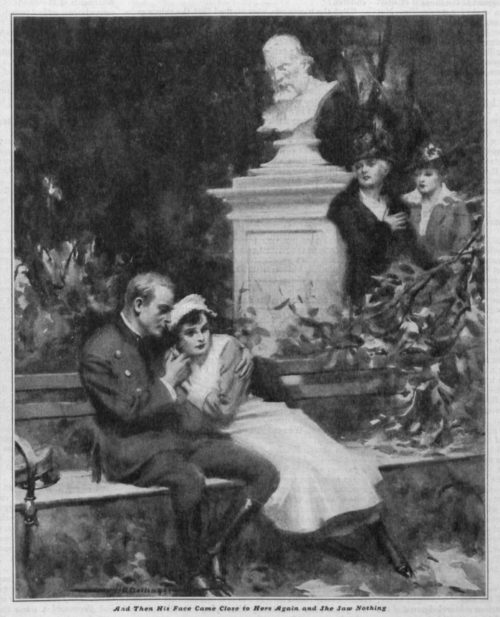 Elizabeth smiled vaguely.
“I wanted to do something,” she said. “Shall I come tomorrow?”
Her next step I am almost ashamed to tell you, if you happen to be a sensible, practical person: She went to a most expensive specialty shop on the expensive avenue and asked for nurses’ uniforms. Blue ones she purchased, with bib aprons and little caps that stood up in the front; and when the attendant asked “Will you like to look at the capes and bonnets, miss?” she nodded seriously.
“They’re thirty dollars — but of course the war — ” murmured the attendant; and Elizabeth, to whom it had never occurred that a coat could be purchased for thirty dollars, said gravely “Of course.”
“The nurse will be about your size, miss?”
“Yes—about my size,” said Elizabeth.
Now of course you and I would never have been so foolish. We know that one can sit in Gramercy Park and superintend the play of three children in whatever dress she happens to have on at the time — a bathing suit, as far as that goes, were it not for the park regulations. But Elizabeth, you must remember, was only 24, and had, like most people, her own particular little romantic tendencies. They may not have been yours or mine, but they were hers; and, besides, all her friends were fussing about some kind of uniform or other — this was her uniform.
She never, in her wildest dreams, could have imagined what that uniform was to do for her!
At eight the next morning she stood by her mother’s breakfast tray.
“I’m doing some work for the Relief Reorganization Committee,” she announced briefly; “I’ll be busy all day, probably.”
“That’s good,” Mrs. Griswold replied, her eyes on her mail; “there’s nothing like an interest — Oh, what a fool that stenographer is! I shall simply have to have a special one for my department, that’s all. Remember, dear, we’re dining at seven tonight—your father had to take a box for that Serbian Relief concert. I asked Doctor Henderson.”
Elizabeth left the room in silence, with her lips pressed together. She understood perfectly well about Doctor Henderson. He was forty and distinctly baldish and a little tiresome. Adenoids were — or was — his specialty, and he danced painstakingly, with a tendency to perspiration and counting the time under his breath. Nobody had ever suggested that since she was nearly 25 and since he was the only unmarried man — at least he was a widower — who had ever shown the least interest in her, and since he was doing very well indeed and would undoubtedly do much better, why, he was a very desirable extra man to sit in the box or go on to a dance later. Nobody, I say, had ever so slightly suggested it, but Elizabeth understood very well. She was serious; Doctor Henderson was serious. The inference was obvious.
Of course it all seems very queer to me, if you ask me. Why a young person should be brought up like a duchess in order to marry a surgeon at the last, I can’t see. He was making, we’ll say, 20,000 a year; maybe a bit less, maybe a bit more. But we all know what rents are in New York, and a doctor must have a decent house in a decent part of the town if he wants to cut out rich children’s adenoids. And Elizabeth didn’t know whether chops grew in the sheep’s cheeks or in its legs. And I told you what her evening slippers cost. She had no idea what wages parlor maids get nowadays or what coal costs a ton. Somebody had always turned on her bath for her, and one day when her little satin bed shoes had not been placed by the side of her bed, she had been obliged to sit on her toes and call to her mother to ring for Katy to ask where they were! It is not that she was lazy at all, I assure you, but it never occurred to her that it was a part of her duty to hunt for her bed slippers.
In other words, she had been excellently brought up to marry one of the great fortunes of America; or perhaps it is only fair to add that she would have been useful to a brilliant young attaché to an important foreign embassy — but even he would have had to be reasonably well off, don’t you see?
The three little Gramercy Park children didn’t worry over all this, however. They were nice children and they took to Elizabeth promptly.
This isn’t a bit like the old novels, you see; there is no suffering governess involved, patiently bearing with the rudenesses and cruelties of the brutal and the rich. No; it is really true that children brought up by their mothers are infinitely nicer and more interesting than children brought up by servants. The names of these children were Marjory and Barbara and Kenneth, and they were as pleasant as their names. Marjory rolled a hoop, Barbara pretended to be an Indian, and Kenneth sat in a sort of infantile bath chair and talked to the birds, having but slight command of ordinary English. Elizabeth sat on a bench and impersonated, alternately, a buffalo and a white captive, neither of which roles was at all difficult. Her hands were in her lap and she gazed at the spring sky and the feathery trees. She was particularly contented and was enjoying a new sensation; she was looking prettier than ever before in her life, and she knew it!
For that strange thing, artistic setting, had transformed her, and though it might take an artist to have analyzed this, it didn’t require an artist to realize it, you see. Elizabeth had always been dressed by her mother, who had never been able to resist managing everything and everybody round her, and she had never observed that what had suited her in her youth didn’t suit her daughter today. If she had seen this daughter on her bench in Gramercy Park it would have dawned on her that she should have been sent to fancy-dress balls as Priscilla, the Puritan maiden, and not as a Persian princess. The prim little white collar, like a clergyman’s, the clean blue and white of the uniform — above all, the flat little English bonnet, which was nothing but a smooth bow spread over her smooth hair, framing her smooth forehead — all made her type jump out to you. The girl was charming.
Her hair came down in a sharp widow’s peak straight between her level brows; her eyes looked large and interesting. As an efficient New York beauty one wouldn’t have considered her, of course, but as a nurse in a park she was strongly arresting. She showed every inch of her breeding, every ounce of her education, every minute of the repressions of civilization that had fixed her type and personality. I tell you, she looked like the nurses Mr. Gibson and Mr. Christy draw on magazine covers; and you know as well as I do that men cut these out and frame them. Anyone would have turned to look at her.
It is very ironic that Mrs. Griswold could not know this, isn’t it?
At half past twelve they all went in to luncheon, and Elizabeth ate a chop and a baked potato and a large helping of string beans and two pieces of raisin bread, besides a dish of rice pudding with currant jelly and meringue on the top. While they took an hour’s nap she lay on a comfortable sofa and read a silly story in a magazine. There seemed to be no books of any particular cultural value about, and the doctor had to have plenty of magazines for his patients, for it is well known that you cannot be a doctor without magazines.
There was no tension in the house — nothing to live up to; that had all been transferred to headquarters. Elizabeth, though she did not know it, relaxed for very nearly the first time in her life. For culture, you understand, is quite as wearing as wage-earning If you go at it as seriously.
By quarter of three they were in the jolly, fenced-in little park again, and other children were playing with them. Barbara was a mermaid this time, and Miss Gizzle, as they called her, a shipwrecked mariner. Later she played a harp on her bench, while Barbara wallowed in the surf at her feet, to the great amusement of the young policeman who tramped round the park.
Dagmar called for them at five, and Elizabeth, her cheek moist from three sincere kisses, walked up Lexington Avenue to her studio, now a really useful room, changed her dress with all the thrill of a heroine in a melodrama, and hurried home.
“That’s a pretty frock, dear,” said Mr. Griswold at dinner; “pink becomes you.”
“I’ve worn it every night this week, papa,” she said, surprised.
The doctor examined the dress attentively, but he was not given to personalities.
The first day of the next week a slight accident occurred: Dagmar lost her park key. As you probably know, only the favored inhabitants of the borders of this park may enter it, and they have, each family, a key. Dagmar, much flustered, because she had heavy telephone duty that day, could offer no better suggestion than that someone should consult the policeman, who might know what to do; there was not a soul inside the iron fence, for it threatened rain, and they were very early.
“Very well,” said Elizabeth, and with her charges hanging to her skirts she went to meet the uniform that meant knowledge and protection.
“Have you a key to the park, officer?” she asked as he hastened his step a little to join her.
She did not notice the quick interest in his eyes; she was not in the habit of noticing policemen’s eyes. Are you?
She did not know, naturally, that her method of addressing this representative of the law was not at all the method of nursemaids in general. To her he was a servant of the city, paid to direct her to places she didn’t know, to clear the streets for her to cross, to keep from her eyes and ears things objectionable.
To him, as he looked down from his young tallness at the widow’s peak on her smooth forehead and listened to her clear, low voice, each word so perfectly cut from the others, she was simply the loveliest thing he had ever seen or heard.
“A key — into the park?” he repeated vaguely.
“Yes, yes — surely you or somebody must have one. We belong here,” she added hastily, “only our key is lost.”
“Oh, I’ve seen you here,” he said; “that’s all right. But — I don’t know — ”
He blushed violently through his freckled face up to his curly, sandy hair. He was fearfully embarrassed. Elizabeth, of course, could not know, but this was the first time he had ever been asked for the key, and he simply couldn’t remember, for the life of him, whether he ought to have one or not! He was clearly very much upset and she felt amused and sorry for him at the same time. Barbara pranced eagerly at her side.
“Let’s get in the first, Gizzle, the very first,” she begged.
“Look here,” he said abruptly; “I might just as well tell you as let you find out — I’m not very strong on this key business. I’m new here, you see, and if they told me about it I must have forgotten. Excuse me — I’ll look in my book.”
She waited, smiling, disarmed by this frankness, while he drew a little book out of his pocket and consulted it.
“It gets me,” he admitted at length; “I’ll have to call up and find out. I’m sorry — ”
“Oh, it doesn’t matter,” she said; “some of the nurses will soon come along and they can let us in. It was our fault, really.”
“But I’m supposed to help you out,” he insisted ruefully. “It doesn’t look as if I was much good, does it?”
He was quite young and so shy, evidently, that Elizabeth couldn’t resist laughing. Barbara laughed with her, and in a moment he was laughing too; and they all laughed together.
“You’re good-natured, anyway,” he said. For a moment she stiffened and stared slightly, then, with a sudden recollection, began to laugh again. Why shouldn’t a policeman be friendly with a nurse? This was part of the game. “Oh, well, why not be?” she answered; “it’s a lovely morning!”
“You’re right, it is!”
But he was looking at her and not at the morning; and she knew it.
Her spirits mounted; this was the nearest to an adventure that she had ever been in all her life. What would he have thought if he knew?
Dagmar was waving furiously; encumbered with Kenneth, she could neither leave him nor fly to the house.
“The other nurse wants to tell you something, doesn’t she?” he asked. “Shall I go and see?”
“Oh, no, I’ll go — just stay here with the children!” she cried, and flew across to the beckoning figure. Suppose Dagmar should call her Miss Griswold. That would spoil it all.
Dagmar had just remembered; the key was on the umbrella stand. Seizing the go-cart, Elizabeth piloted it halfway across the street, but only halfway, because the young officer ran to her aid.
“Let me take it,” he said, and pushed it carefully over.
They stood by the gate, waiting.
“They’re nice kiddies, aren’t they?” he muttered, still shy, but unwilling to yield to his shyness and go. “I like ‘em that age.”
“Yes; they’re very nice,” she replied, amused.
“I’ve noticed you before,” he volunteered; “you seemed kind to them. Some of the nurses — well, you can’t help wondering if the mothers know, that’s all.”
“I know,” she agreed gravely.
“Why don’t they take care of them themselves, anyway?” he blurted out, still staring at her.
Of course he couldn’t have known that she knew he was staring, she reasoned, so she looked the other way and let him. She didn’t know that she liked it, you see; she thought she was just not hurting his feelings!
“Why,” she explained thoughtfully, “I suppose they have other things to do, don’t you? Rich women, you know, don’t expect to take care of babies.”
“Oh! Rich women! Phew!” he burst out with a look of such disgust that she had to laugh again.
“Some of them are quite nice, really,” she hazarded.
“Not for mine!” he cried abruptly, and then as Dagmar approached, panting, with the key, he lifted his cap and walked away suddenly, very stiff in the back, as one remembering his high position and responsibility.
All that day the little encounter amused her in memory; she smiled, recalling his flushed, freckled embarrassment, his ingenious appeal to her mercy.
“He’s an awful nice p’liceman,” said Barbara; “but he oughtened to have forgottened his key, ought he?”
“He’s just beginning p’licing prob’ly,” suggested Marjory; and it occurred to Elizabeth that recruits must learn, somehow, somewhere, and that this was as good a place as any other to break them in.
The next morning he was at the gate as they came up.
“I’ve got it!” he cried boyishly, and held up a key. “The Cap. forgot to give it to me — what do you think of that?”
“Are you learning how to p’lice?” Marjory inquired with interest.
“I certainly am,” said he, strolling into the park. “You watch me police this park, now!”
They sat on the bench and he stalked stiff and straight round it, to the delight of all the other children.
As he drew up before them and saluted gravely, Barbara spoke: “You aren’t a blue policeman,” she announced; “why aren’t you blue?”
And Elizabeth realized suddenly that this was so; she had not noticed it.
“Because we’re sort of beginners,” he explained good-naturedly; “we aren’t fat enough for the blue uniforms, kiddie.”
“I s’pose they put you here because there’s only children, mostly?” said Marjory.
“That’s the idea.”
“What’s your name, p’liceman?” demanded Barbara.
“My name’s David,” said he. “I hope you like it?”
“Where were you before you came here?” Elizabeth asked. “What did you do?”
She spoke as she would have spoken to an interesting, well-mannered young guide or courier abroad. She forgot that he could not be expected to understand across what a gulf her interest stretched; that to him her kind young voice was only the voice of a kind young woman in a nurse’s uniform.
“Oh, I was on the rural police upstate,” he answered, flushing a little, “in Westchester County.”
“Oh yes,” she said, remembering the lean, olive-trousered men she had so often motored past; “those men round the aqueduct?”
“Yes,” he said simply; and she noticed that he didn’t say “yes ma’am” or even “yes, lady.” She liked it in him; of course those boys upstate must be of a very different class from the ordinary city policeman. That was why his voice was so pleasant and his manner only shy, only a little awkward — not common or impertinent. She remembered, suddenly, that one of her father’s uncles had been the sheriff of the little village where the Griswolds were born. And somehow this remembrance pleased her.
The girl did not realize, you must believe, with what unconscious expectation her days were filled after this. She did not realize that she came a little earlier each morning; that he entered the park as a matter of course and strolled about with her; that he waited at the gate; that he found the one open place at the north end and leaned, talking, against the iron spikes, while she sat, listening, on her bench, with Kenneth beside her.
One day, when it rained hard all day, she wondered why she was so restless, why the children tried her so, why a little paining shadow darkened everything inside her. Then, when it cleared suddenly, at half past four, she wondered again at the quickness of her shaking fingers as she pulled on their rubbers, for she was in too much of a hurry to wait for Dagmar.
“I can take them, Miss Griswold,” said the nursemaid; but she answered sharply, “No, indeed! The air will do us all good. Hurry, Marjory!”
As they entered the dripping park he swung over to them, slim flanked, with a long, young stride; why did Doctor Henderson’s short, nervous step patter through her mind?
A rubber poncho fell to his hips; he looked like some young officer on the stage.
“Oh! I never thought you’d come!” he cried; and a strange, crowded sensation pushed up round her — her — why, was that her heart? Why was she breathing so hard? Why should they laugh so, suddenly?
The sun poured out; the grass was emerald, diamond studded; the trees were full of birds. She glanced up at him, over the swinging rubber cape, and met his eyes full. They were blue eyes, and suddenly they turned into shining, piercing arrows that rained down, all fiery, into hers. It was blue and yet it was fire; it frightened her and yet it brought her peace; it threatened and yet it held.
You know, of course, what it was, but Elizabeth did not.
She knew, naturally, that people fell in love; she supposed they did it at a ball or in a gondola or while hearing beautiful music. Perhaps they looked up from some book of poems they were reading together. You see, she thought, poor child, that it was an idea — a something that attacked the mind. And of course it occurred between people of the same class.
So when he swung along beside her and looked at her — and looked at her — and her knees began to shake and that great wave rose and swelled in her side, the girl thought she was ill, and dropped, panting, on her bench; which was very damp, but she never knew it. He sat near her and it seemed to her that the side of her body next him belonged to some other person than herself—he was so near — so near —
They had not spoken. She glanced down at his hands; they were clenched on his knees. She wondered why.
“I — I never knew anybody like you,” he said, and his voice sounded husky and far away.
A lifetime of self-restraint came to help her.
“It — it cleared off, d-didn’t it?” she murmured.
He turned and seized her hands roughly; there was a wild, hot look in his eyes.
“Listen,” he said, “were you ever — fond of anybody — before?”
Then, at last, she knew. Then it burst on her. Her eyes darkened, and all the terrible, ridiculous, impossible future spread before her. Fond? Fond? She sprang up from the bench.
“You have made a mistake, I think!” she said. “Will you please go away now? Come, children!”
She never even saw which way he went.
That evening her father looked curiously at her.
“Haven’t you gained a little, Beth?” he said. “Is it that tonic?”
Mrs. Griswold also looked.
“She’s certainly improved amazingly,” she said thoughtfully. “Lou asked me what she was doing nowadays, to be so handsome.” She narrowed her eyes, and her daughter’s wavered and fell under hers.
The next day was Friday, and she stayed at home. The next was Saturday, and she bore it until four o’clock. Then she knew what had happened to her, and that she could not live so far from the park that was all the world to her. Something tore at her side and ached and cried there, and part of her lay on her bed and wept, and part of her sat on a bench and felt his hands. So that at five she crept out of her studio in her cap and cloak, and went, ashamed and secret, to watch him there — only to watch him, for she had no duty in the park that day.
She slipped through the gate as one of the last two nurses was leaving.
“The children have just gone in,” said this nurse carelessly; and “I know, I know,” Elizabeth said, and made for her bench, to weep there.
But he stalked in after her, and caught her in a grasp she had never known or dreamed of, and shook her a little and said, “I thought you’d never come!”
For a moment she saw the blue burning of his eyes, and then she saw nothing more, for he had kissed her.
Later she sat in his arms, in a great serene calm, and they talked.
“But you knew — you didn’t think that I didn’t mean for us to be married?” he said seriously. “You little darling, I’d never marry anybody in the world but you! There never was anybody like you! When I think of all the useless, silly, flirting fools — ”
“Perhaps you don’t know every kind of girl there is in the world,” she said, smiling adorably at him — oh, what would he say when he knew! — “but I will marry you, David dear; indeed I will. Don’t mind what anybody may say, ever. I tell you that I will.”
You see, all her culture counted at the last; and she knew that in the face of an enormous thing like this, nothing — nothing in the world — should separate them. Policeman or ambassador, a Griswold or a nursemaid, it was all the same. Nobody had ever told her that this kind of feeling existed, but now that she knew it she knew that every other feeling in the world is unimportant beside it. That strong, wonderful creature with his burning eyes was hers, and she was his. “You see, you’ve done something,” he repeated. “You amount to something. You’re a real person, you darling little Lizzie — you’re not just a dressed-up doll!”
“But — but you love me, anyway?” she begged. Oh, would he ever forgive her when he knew?
“Do I love you?” he laughed through all his freckles; “you wait till I can show you!”
And then his face came close to hers again and she saw nothing — not even her mother and her Cousin Lou, who could have touched her as she came out of the park.
Mrs. Griswold and her husband sat in a bitter silence in their motor. There was a heavy block on the avenue and they had to wait; something had broken down ahead.
“When can you see him, do you think?” said Mrs. Griswold. “Will you tell him that I am taking her away directly, and that under no circumstances can he even — ”
“Bessie, the girl’s twenty-five,” said her husband patiently; “I’m afraid you can’t really — ”
“Oh!” his wife cried, “please, please, Ben!”
“You’re sure you actually saw — ”
“Saw! Saw!” she echoed. “Great heavens; she was in his arms! He kissed her a dozen times! Saw!”
Her father winced.
“Don’t I tell you she doesn’t deny it for a moment? When I told her that the woman’s maid had told her mistress about it, and that she had had the decency to communicate directly with Lou, and that Lou and I went down to see for ourselves whether such a thing could be possible, and actually found them practically alone there, at that hour — what do you think she said? “
“I’m sure, my dear, I can’t tell.”
“‘We were engaged, mamma,’ she said; ‘wasn’t it all right?’”
Mr. Griswold sighed. He looked old.
“I’ll see him, dear; I’ll see him,” was all he said.
“And she has never buttoned her boots in her life!” cried Mrs. Griswold. “Oh, it’s too horrible!”
“I think she should have, then,” said Mr. Griswold shortly. “Look here, Bessie! Our girl would never marry a cad — I’m sure of that. I’d rather see her happy than grow up a sour old maid! There’s no doubt something can be got for the fellow to do — ”
“Oh! Oh, Ben! There he is! I see him!”
“What? Hush, Bessie, for heaven’s sake! Where are you looking?”
“There! In the club!”
In her confusion Mrs. Griswold had so far forgotten herself as to fix her eyes on a certain large window beside the pavement.
“Nonsense!” said her husband briefly.
“Ben, I tell you that was the man. And he had that very uniform on! A tall, sandy-haired, freckled fellow — very plain. Go up there and get him! Go now!”
“My dear girl, policemen don’t go into clubs. Not into the lounge, anyhow. I can’t — please, Bessie, don’t make a scene!”
“Then I’ll go myself,” said Mrs. Griswold simply.
“Oh, Lord — wait a minute,” he implored, for he believed she would do it. “Tell What’s-his-name to pull up on the corner, if this block ever breaks, and I’ll come there. At least I can get a drink.”
Harassed and gray, he wormed a way through the choked street and disappeared behind the great door. His wife sat, stony, in the motor, staring into the past. All that beautiful dainty girlhood, its perfection of detail, its costly foundations, laid through years — for what? A traffic policeman dashed through on a motor cycle, and she shuddered and cried a little, silently.
What could they do for him? Ben Griswold had a large professional income, it is true, but comparatively small investments; they lived furiously on what he made. Elizabeth and Cortwright had been their investments—and now Cort was driving a muddy truck somewhere in France, and Beth was engaged to marry a policeman! Such a quiet, steady girl — too quiet, her mother had secretly muttered in her heart.
They emerged from the block and waited in the side street among the club taxicabs.
“Extra! Extra!” yelled the newsboys. “United States on verge o’ war!”
Well, perhaps that would make a difference. If there should be war, people might forget sooner — but oh, how it cut her! How it cut!
The door slammed beside her.
“Get along home, Georges!” said Mr. Griswold. “I always forget Georges has gone. Well, Betsy, buck up, my dear; it might be worse.”
“Ben! It was the man!”
“Yes, my dear, it was. You have good eyes, if you are an old lady:”
“Ben! He — he was a — a — ”
“Oh, yes; he’s a policeman, all right. No doubt of that.”
“Ben! Does he admit — ”
“He came right up to me, my dear, and asked my permission to marry my daughter. He didn’t know who she was at all till this morning. He thought she was a nurse girl, it seems.”
“Oh! That ridiculous costume! But he knew perfectly—the idea! As if anyone could think Elizabeth was a nurse!”
“Well—I don’t know. It seems he did.”
“What was he doing — a man like that in that club?”
“He was drinking a Scotch and soda, my dear.”
“Ben! An ordinary policeman!”
“I shouldn’t exactly say that, Bessie. Not exactly. You see — oh, hang it all, Betsy, I can’t quite believe it myself, yet! Look here, dear. You remember when the commissioner swore in all those extra fellows to help out the police in case of riots or whatever — ”
“No.”
“Well, he did. He — he’s one of those.”
“Oh. Is it a better kind?”
“Oh, Lord, I suppose it is. Betsy, old lady, you certainly had a bad time. I — I felt it myself. But what could I do? You wouldn’t let me talk to her. I wonder what she’ll say?”
“Say? Ben Griswold, what do you mean?”
For his eyes were strange, his voice was shaky and sounded like the voice of the young man who had asked her to marry him 27 years ago, when she was 24.
“I mean when she sees this,” and he stuck his hand into his waistcoat and dropped a flash of white light into her lap.
It was of glass apparently, but blinding, and about the size of a five-cent piece.
“He seems very fond of her, Betsy. He says she’s the only girl he ever looked at; and, by George, I nearly believed him!”
“But, Ben — ”
“You never even asked his name, my dear.”
“But how — ”
“His name is Craigie — David Craigie.”
“N — not — Ben, it’s not the David Craigie?”
“I’m afraid it is, my dear. I wish he didn’t have quite so much, Bessie. It’s a pretty heavy responsibility, you know.”
She stared at him, stupid in the great revulsion.
“He said he got sick of signing checks all the time, and not doing anything; he’s a shy sort of chap, Bessie. He equipped an entire volunteer company up at that big place of theirs on the Hudson, you know, and still he couldn’t feel like anything useful, he said, so he went into the rural police volunteers up there and then joined the reserves here. He’s very quiet, you know— nobody knows him much.
“He told me he hated the sight of a girl till he saw Beth. Suspected ‘em all, I suppose. Sort of a serious chap — just the sort for her, I should say. Nothing very showy, but all there.”
“But, Ben — that old Mr. Craigie has — how much money has he, Ben?”
“A good deal more than anybody ought to have, my dear,” said her husband soberly; “somewhere round forty or fifty million, I’ve heard. We didn’t discuss it. He told me — young Craigie did — that Beth had found out somewhere how much a roundsman got a year, and explained to him how they would manage to live on it — twelve hundred, I think it was. He was thinking all the time that she thought it would be a rise in the world!
“And now,’ he says to me, ‘now I know what she was really thinking — my God, I love her more than ever, Mr. Griswold!’”
Mrs. Griswold was not listening, one fears. She was staring at the ridiculous shiny ring of white fire in her hand. Later, she cried a little and kissed her husband in the motor and he patted her shoulder. The last 24 hours had been hard for her, as you will understand.
So Elizabeth was married, in white satin, very plain indeed — to draw the eye to the great rope of pearls, her bridal gift from her husband. The biggest was about the size of a big white grape, and they ran down from that through moth balls to the little ones at the clasp, which were the size of peas. She looked very lovely and distinguished, and not at all tired; perhaps because she had refused to bother about anything, before the wedding, and passed most of her time in Gramercy Park. Marjory and Barbara were flower girls, and Kenneth sat in a front pew and talked with imaginary birds all through the service.
It is difficult to point a moral against foolish mothers from this story, for though Mrs. Griswold was undoubtedly foolish to have brought up her daughter to marry a multimillionaire, yet, you see, she did marry a multimillionaire. Which was, nevertheless, no credit to Mrs. Griswold, inasmuch as Elizabeth supposed herself to be about to marry a policeman!
After the wedding the reporters all rushed off to Mr. Craigie’s special car, which lay conspicuously in the Grand Central Station, en route for his Adirondack camp. A tall man and a lady in a thick veil climbed hastily into this car, and nobody dreamed that they were Mr. Craigie’s man and Mrs. Craigie’s maid.
And so, naturally enough, nobody dreamed of following the young couple to a modest but comfortable apartment overlooking Gramercy Park, which had been cleaned and polished to a state of supremacy by Dagmar, and vacated just before the wedding by the wondering Barbara and Marjory. Kenneth never wondered at anything.
They sat on a little balcony ringed round with geranium boxes and looked out over their park, sleeping in full white moonlight.
Will you laugh too much when I tell you that she wore a white cap and bib and apron, and that he was in the full uniform of the Police Reserve?
Of course you and I wouldn’t have done that on our wedding night, but they were not 25, either of them; and, though nobody knew it, they were a little romantic!
“I shall always love you in it,” she said, and kissed the buttons, which simply shows you how many extra kisses she had.
“And you really would have married me — you little wonderful thing?” he asked adoringly.
“Of course,” she said. “Of course, David. Weren’t you going to marry me?”
“Oh, but that was different,” he said, and kissed her again — but not her buttons.
And now I know you will laugh when I have to admit that over the nurse’s blue and white fell the milky, marvelous pearls that you must have seen in the photographs!
Because, you see, though she was romantic and though she had never been in love before, and though she had been perfectly ready to marry a policeman, she was only human after all!
Fielding Tips from Willie Mays
This article and other features about baseball can be found in the Post’s Special Collector’s Edition, Baseball: The Glory Years. This edition can be ordered here.
“My biggest thrill,” says Willie Mays, “is playing ball every day.” And then he emphasizes, “I didn’t say being a ballplayer. I said playing ball.”
Willie Mays gets no great kick out of being a celebrity. He would prefer to do his work and be let alone.
This impression comes through strongly when Willie talks about the catch he made of Vic Wertz’s drive in deepest center field to save the opening game of the 1954 World series against Cleveland. This was certainly one of the most-publicized feats in recent sports history, but Willie does not think it was his greatest catch, or even a particularly great one. The publicity came out of the setting — the World series — and the fact that it was Willie mMys who had done it.
“A great catch,” Mays explains, “is when you don’t think you’re going to get there. The thing was that I knew I had that one all along. all the time I was running i had the picture in my head of where I’d be when I caught it, and how I’d turn to make the throw to second to keep Larry Doby from going all the way around.”
It may seem odd that a man would resent excessive praise, and yet this is a natural reflection of the way Willie feels about baseball. If they falsely exalt his good catches, are they not cheapening his really great ones?
To say that Mays is generous is like saying that Dwight Eisenhower went to West Point. It’s only the beginning of the story. Before he got married, Willie used to carry up to $1,000 around in his pockets and hand money around almost upon request. Almost everybody at the Harlem bar Red Rooster — including the guy who sweeps up — has at least one of Willie’s monogrammed sport shirts. Willie buys them in lots. To admire a Mays shirt is to get it hot off his back.
When it’s going good for Mays, there’s no better ballplayer in action today. He is the sort of competitor the sports writers like to describe as a “natural” — signifying an athlete who, through some special dispensation, springs from the earth fully equipped to do his job. a natural or not, Willie Mays works at his business. He is still the first man on the practice field and the last one off.
— “The Woes of Willie Mays” by Edward Linn, April 13, 1957
Unwanted: A Teenage Memoir of Japanese Internment
I am a member of a once despised minority group, American Japanese, who spent three-and-a-half years incarcerated in an American concentration camp during World War II. Although that ordeal ended 72 years ago, the impact of that experience on my life and its broader implications for American society resonate deeply to this day.
At the beginning of the war, roughly 10 percent of the adult “alien” men on the West Coast (Japan-born persons being ineligible for citizenship) were picked up by the FBI as potentially dangerous and interned by the Justice Department, effectively robbing the community of leadership. We had been under surveillance for quite a while, and these men were singled out. My father, who was an alien, was not picked up, though many of our friends were. None ever were convicted of a crime or act of sabotage, though many were held for years in captivity.
I was a U.S. citizen by birth, but the distinction meant nothing at the time. My entire family — my parents, two sisters, and I — was sent to Poston in southwestern Arizona, geographically the largest of the 10 War Relocation Authority (WRA) camps where American Japanese were held. At the time, I had just turned 12. By the time we were permitted to leave, I was 15.

Photo by Dave Izu
We, along with approximately 120,000 others, spent the better part of four years in desolate areas where we were monitored, our movements restricted. We ate in mess halls, and our tar-paper barracks were so flimsy I remember wind and dust storms so strong that rooftops were torn off, debris flying around like crumpled paper.
Perhaps even more of a shock to me than the prison-like conditions was the fact that for the first time in my life, I was living totally surrounded by others of Japanese descent. In my early school years, most of my classmates were white, with a scattering of Mexican-American kids. Although I was one of the few American Japanese in my small town, I never experienced any prejudice there. But at Poston, my farm upbringing contrasted sharply with the sophistication, manners, and clothes of the American-Japanese kids from Los Angeles and other cities.
Here we were, all locked up together, doing our best to be “normal” teens. My mother disapproved of the camp’s faster growing-up process, driven by the city kids. She wasn’t sure about my going to the parties and dances that were a big part of teen life at the camp, and she did not want me to have a brassiere or wear makeup. I missed my white classmates, my home, my town, and my less-pressured life. I felt like an ugly duckling.
We had the trappings of society like schools, jobs, a camp government, a police and fire department. My father did some woodcarving while my mother took sewing lessons, making our dresses. I spent a lot of time reading books from the library. But life was far from normal. The usual social hierarchy was turned upside down, with the elders stripped of power and the young freer to pursue their interests.
It was the pettiness of life in camp that got to me. Almost every aspect of everyone’s life was known to all, and this promoted a culture of gossip and rumor mongering, with whispers and speculations about others filling our time. The meanness, the nastiness exhibited, the way we picked on one another, was an ugliness I hadn’t known before. Of course, it was a manifestation of the cramped living conditions, the forced idleness, and the insecurity of our situation.
A group formerly known for hard work and pride in our accomplishments was reduced to committing little acts of rebellion aimed generally at the government and administration who were oppressing us. People “stole” wood scraps to make furniture and pilfered food from the mess halls. Many did not feel that manual work was worth doing and slacked off, held strikes, and quit their “jobs.” My father “borrowed” a tractor and took a mob of kids to the Colorado River, a couple of miles from the camp.
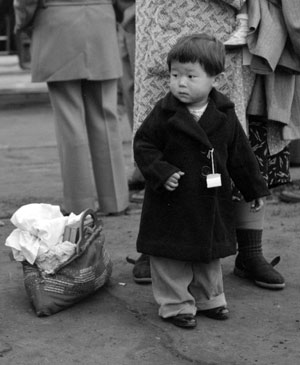
Photo from The National Archives and records Administration
I was too young and naive to understand the bigger picture, but the smaller world I inhabited was beset with contradictions. In eighth grade, a white schoolteacher from Massachusetts ordered us to memorize a Marc Antony speech from Shakespeare’s Julius Caesar. “Friends, Romans, countrymen, lend me your ears,” it began. “I come to bury Caesar, not to praise him. The evil that men do lives after them; The good is oft interred with their bones.” We labored mightily to master those lines and dozens more. But, alas, most of us had trouble doing it, and she castigated us as ignorant, lazy know-nothings.
There were those, particularly older men, who listened to Japanese propaganda broadcasts on smuggled-in radios. Reports of Japanese victories would elicit some cheers. Clumps of men would discuss the latest “news,” sneering at those who didn’t believe, severely criticizing those who remained loyal to the U.S.
Our community was caught up in this international war at a particularly sensitive period. My parents’ generation was still culturally old country. Some, like my mother, never learned to speak English. Their children, including me, were rapidly becoming Americanized. I joined the Girl Scouts and edited the junior high newspaper, The Desert Daze.
In prewar times, it was customary to send children to Japanese school because many believed that eventually they were going to return to their home country. In some places, it was a Saturday-only class, but in my case, we attended an hour of Japanese lessons each day, after American school, and our teachers were brought from Japan. I perfected my calligraphy and reading and writing, but the authoritarian style and emphasis on obedience went against what we were learning in the American school. Even though most of us spoke Japanese at home with our parents, we weren’t interested in it. English was becoming our main language.
These intergenerational conflicts, typical of the American immigrant experience, intensified in the camp. In the beginning, because no Issei (immigrant generation) were allowed any leadership roles in the camps, the block managers and elected members of the camp councils were all young people who had been born on American soil. This powerlessness of the older men was manifest in continuous grumbling about how callow and ill-prepared for leadership the young were.
A call by the Japanese American Citizens League (composed of young men and women who acted as the liaison between the people and the government) to allow young men to serve in the American military to prove their loyalty provoked intense conflict. I had no brothers, but I know that my parents thought that to send our youth to fight for this country, the very country that had imprisoned us, was absolutely unacceptable. I had cousins who “resisted,” refusing to comply with draft orders, and I also had an uncle who served as an officer in the Army, fighting in Europe.
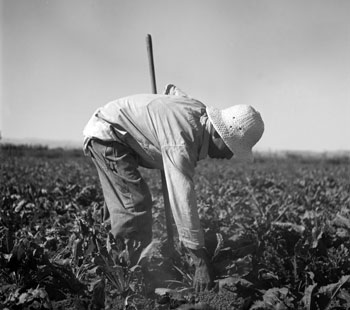
Russell Lee/Library of Congress
These divisions in the camp were reflected in my family. Several years into our incarceration, my father decided that he would apply for repatriation. He had had enough of the mistreatment, feeling that prospects would be better in Japan, where the family had some property. I was astounded and angry. America was my home, and I knew that I was not Japanese. I had no interest in going to Japan. I’d seen enough of the patriarchal, authoritarian style of Japanese society in my own family and others to know that I didn’t want to be a Japanese woman, subservient and under the control of men.
I fought with my parents, even writing letters to magazine editors, but nothing I did would change their minds. As the war wound down I watched as friends left, moving to eastern parts of the U.S. and then back to the West Coast. I was feeling trapped. But when Japan was defeated, my father learned that there was nothing to go back to. He changed his mind and we resettled in Oceanside.
For the rest of my father’s life, we never talked about the camp experience in a serious way. It was too painful. He started farming again but wasn’t very successful. Two years later my mother died of bleeding ulcers. My father became more passive and quiet.
For my part, I was relieved that the ordeal was over and determined to put it out of my mind. I went to college, married a white man, raised a family, lived mostly in white society. I protested the Vietnam War and was active in the civil rights movement. And in the course of these activities, I began to think about my own background.
The wars against Korea and Vietnam made me very aware of American attitudes toward Asians, and the topic of camp came up from time to time. I ran into a therapist at a party who questioned me about my experience, and I brushed it off as not very important. But she pressed on, telling me how formative those early adolescent years were, that I should reexamine those times. This stuck with me, and when a movement for redress began to take shape, I joined in and worked at the legislative level and as a named plaintiff in a court case that went to the Supreme Court.
I learned that the most damaging event that occurred in the camps was a so-called “loyalty questionnaire” administered in 1943, mandatory for everyone 17 and older. It was used to separate the “loyal” from the “disloyal.” It was a poorly designed instrument, resulting in divided families, friends. On the question of agreeing to serve in the American military, to say no was to automatically designate “disloyalty.” My cousins said no and were charged with being draft dodgers. A sympathetic judge fined them one penny.
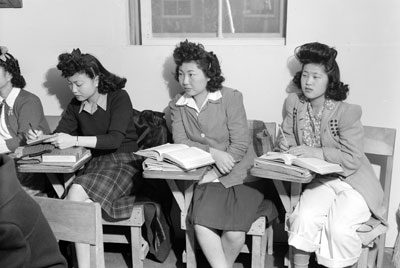
After the government turned the camp at Tule Lake into a segregation center for all “disloyals” and troublemakers, I watched friends loaded onto trucks to be taken there. By the flimsy logic of the day, our family should have been sent there as well — I never learned why we were not. Perhaps a fortunate oversight kept us out.
The government seemed hell-bent on tarnishing all of us as aliens — and enemy aliens at that. How could we remain “loyal” to a country that had held us captive for years, impoverishing us in so many ways? How were we to
respond to these humiliations and victimization? We were expected to disallow our Japanese heritage and submit to the demands of our captors. And we did. But it left us with a badly damaged community, an ever-present split between the “loyals” and “disloyals,” and a deep understanding about how vulnerable we were.
Ironically, we were very good at adapting and melting into the American middle class, earning the label of “model minority.” In my own case, I lost my primal language, distanced myself from the American-Japanese community, and for many years didn’t look back. We paid a heavy emotional price, and the issue of identity has always dogged us: Can we truly be American?
It’s been a long time since World War II, and one would think that Poston would be a fading memory, but it is not. I have made pilgrimages to Tule Lake, seeking a better understanding of our history. Though I have spent my years in white society and my children are half white, I am certain that given particular circumstances, I could be targeted again for my political views, ethnic background, for my religion or being a member of a group identified as other.
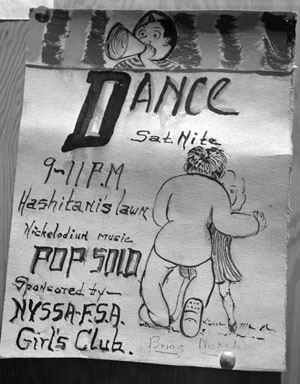
I am not bitter, but I remain quite angry. I am a liberal, a believer in equality, but I am also a cynic. I don’t think that our Founding Fathers really meant to extend equality to everybody, but the words and sentiments remain part of our Constitution. The struggle for our ideals continues, and it is necessary to remind us about what happened to me and 120,000 other Americans, because without that memory, it could easily happen again.
Chizu Omori is a freelance journalist and co-producer of the documentary Rabbit in the Moon with her sister Emiko Omori, chronicling the experiences of Japanese Americans in WWII internment camps. This essay is part of What It Means to Be American, a partnership of the Smithsonian’s National Museum of American History and Zócalo Public Square.
This article is featured in the May/June 2017 issue of The Saturday Evening Post. Subscribe to the magazine for more art, inspiring stories, fiction, humor, and features from our archives.
Originally published at Zócalo Public Square (zocalopublicsquare.org).
Happy Birthday, Count Dracula!
Count Dracula lives — at least his legend does. Since his first appearance in Bram Stoker’s novel, Dracula, in 1897, he has continually scared generations of readers and moviegoers for 120 years.
Dracula is the most successful of a long line of vampires. His literary forebears stretch back to the vampires that appeared in stories and poems of the early 1700s. But it is Count Dracula who has become the quintessential vampire in the popular imagination.
Stoker was inspired to write his novel by an 1885 essay about the superstitions of Transylvania. It described how, according to legend, the vampires of central Romania lived, bred, and were killed.
Stoker also drew on the stories of Vlad Dracula, a ruthless prince of the Wallachia region, which later became part of Romania. The famed 15th century warrior-prince earned the unpleasant title “Vlad the Impaler.”


The personality of Count Dracula, however, was based on the famed actor Henry Irving. Stoker was Irving’s personal assistant, and he lived in awe and dread of the Victorian-era superstar. In Stoker’s book, he gives the count the austere, haughty, manipulative manner that Stoker endured in his work with Irving.
Dracula was adapted for film in 1931. The count was portrayed by Hungarian-born Bela Lugosi, who gave him a convincingly foreign and appropriately creepy character. Lugosi had successfully played the count on Broadway, but his movie performance was enhanced by atmospheric scenery, dramatic lighting, and close-ups of Lugosi’s expressions. The actor’s heavy Hungarian accent became so closely associated with the character that it is still instantly recognizable, even in a bad imitation.

Stoker never enjoyed financial success from Dracula. But the critics praised it, as did the Saturday Evening Post’s reviewer in 1900, the year after Dracula’s American publication.

In Stoker’s book, the count hailed from Transylvania, a region in central Romania. The book and movie have made it undoubtedly the most famous of all Romanian regions but have forever linked it to the Dracula legend.
Dracula’s significance to the region was lost on Transylvanians during the communist era, from 1944 to 1989. In 1965, Post contributor Gene Smith traveled there to visit the setting of Bram Stoker’s book. As he learned, there was little room for such bourgeois fantasies. When Smith asked his tour guide what she knew about Count Dracula, she shocked him by asking, “Who is Dracula?” When he told her, she dismissed such a silly notion. “We have no counts in the Romanian People’s Republic.”
Today, Romania is a sovereign state in the European Union. Freed from communist restraint, the locals are ready to cash in on Dracula tourism. It’s nice to know the count is welcome in his hometown in time for his 120th birthday.
Featured image: Wikimedia Commons
