News of the Week: Blockbuster, the World Series of Poker, and Why You’re Storing Bread Wrong
One Is the Loneliest Number
All the things we used to love are going away.
Post Archive Director Jeff Nilsson highlighted some of them in this piece from earlier this year, and in addition to things like neighborhood mailboxes, department stores, and bank branches, he included Blockbuster Video. He mentioned that there were 10 Blockbuster stores left (there were almost 9,000 in its heyday), with seven of them being in Alaska. As of a few weeks ago, there were only two left in Alaska, and those two stores closed last week. What all that video store math means is that there is now only one Blockbuster left anywhere, and I’m running it out of my apartment.
Well, no. Actually, the last Blockbuster is in Bend, Oregon. Yup, you can still go there and rent movies! In an odd way, the closing of all of the Blockbuster locations might be a blessing to the last location, because now they’re getting a lot of press for being the last one, and maybe they’ll get more customers, the ones who might want to go there out of a feeling of nostalgia or don’t want to stream or rent from that Redbox at the supermarket. CBS’s Jamie Yuccas visited the store and filed this story.
All In
Poker isn’t as popular as it once was. There actually might be more people playing it these days — especially online — but it’s not as “hot” as it was 10 or 15 years ago, when ESPN and other networks started televising tournaments and a different kind of “sports” star emerged. It pretty much started when unknown Chris Moneymaker (such a perfect name) won the World Series of Poker in 2003. He made people think they could win too.
This year’s winner was crowned last week at the Rio All-Suite Hotel and Casino in Las Vegas. John Cynn beat Tony Miles in an epic showdown that lasted 10 ½ hours and 442 hands, including a spectacular made-for-TV hand where Miles made a successful $95 million bluff.
Cynn won $8.8 million and a nice World Series of Poker bracelet. He had a nice run in 2016 too; he came in 11th.
On Broadway
There’s a scene in the original 1933 film version of King Kong where the giant ape is unveiled on stage at a Broadway theater. I’ve always wondered why the people who captured Kong would unveil him in that matter (with all those people, not knowing how strong he is?). But it’s a great idea and a great visual: A giant ape on a stage in front of an audience escapes and goes on a rampage.
Now we’ll be able to experience that same scene with King Kong: Alive on Broadway, the Broadway version of a show that ran in Australia and has been in the works for several years. It’s going to include some impressive animatronics and special effects, as this Hollywood Reporter behind-the-scenes video illustrates.
Green Acres: The Musical
It probably won’t be as exciting as King Kong, but maybe you’d like to see a stage show based on a ’60s sitcom.
We could probably think of a lot of TV sitcoms that might work as stage musicals. Bewitched and I Dream of Jeannie come immediately to mind, not only for the plots and settings that would lend themselves to the stage, but also for what they could do with the magic scenes. But I wouldn’t have thought at all that Green Acres would be coming to Broadway, though that’s exactly what is in the works.
If you don’t remember the show, lawyer Oliver Douglas and his wife Lisa move from New York City to a small-town farm. He wants to do it; she hates the idea. Wacky chaos ensues. The official press release for the stage show says, “What happens when two people in love find themselves wanting opposite lives sends us on a journey that is both hilarious and filled with heart.” That certainly sounds more ambitious than the TV show.
Coming soon: F Troop: Alive on Broadway!
Blondie Won’t Be Coming to Blu-ray (Not Yet Anyway)
You might be familiar with the series of Blondie movies released in the 1940s, based on the classic comic strip. Turner Classic Movies runs them. You might not know that there was a TV series in 1957, however. It starred Arthur Lake and Pamela Britton and ran for 24 episodes. Recently there was a campaign to get the series released on Blu-ray and … well, it failed.
David Kawas, founder of ClassicFlix, created a Kickstarter for the project, which needed to reach $20,000. Unfortunately, when the campaign ended last week, it had only reached $6,626. Oh well. Maybe he’ll try it again in the future.
Interestingly, there was also a 1968 Blondie sitcom that ran for only 13 episodes.
How Do You Store Bread?
That may seem like an odd question, but not if you think about it. There are many ways to close and store a bag of bread, as shown in this illustration by graphic designer Kallista Zhang. Which do you do?
We're all in agreement here that chaotic neutral is the most efficient and easy way to store bread, right? pic.twitter.com/EtdSi2WGS0
— The Darkest Timeline Numbersmuncher (@NumbersMuncher) July 12, 2018
I’m a Lawful Neutral person (even if the artist did confuse things by calling the twist tie that comes with bread a “bag clip,” which is a different thing). I don’t trust Chaotic Evil people.
RIP Nancy Sinatra Sr., Roger Perry, and Ron Satlof
Nancy Sinatra Sr. was the first wife of Frank Sinatra and the mother of his three children (Nancy, Frank, and Tina). She died last Friday at the age of 101.
Roger Perry was a veteran actor who appeared on such shows as Star Trek, Arrest and Trial, The Facts of Life, and Falcon Crest, as well as cult classic movies like The Thing with Two Heads and Count Yorga, Vampire. He died last week at the age of 85.
Ron Satlof was an assistant director on the Martin Scorsese film Mean Streets and director of eight Perry Mason TV movies and dozens of episodes of other shows. He died earlier this month at the age of 79.
This Week in History
First Atomic Bomb Test (July 16, 1945)
The test, code-named “Trinity,” happened in the New Mexico desert and was the result of years of testing as part of the secret Manhattan Project.
The Catcher in the Rye Published (July 16, 1951)
The classic J.D. Salinger novel is one of those books that every American should read, and you can for free at the Internet Archive.
This Week in Saturday Evening Post History: Lookout Point (July 18, 1953)
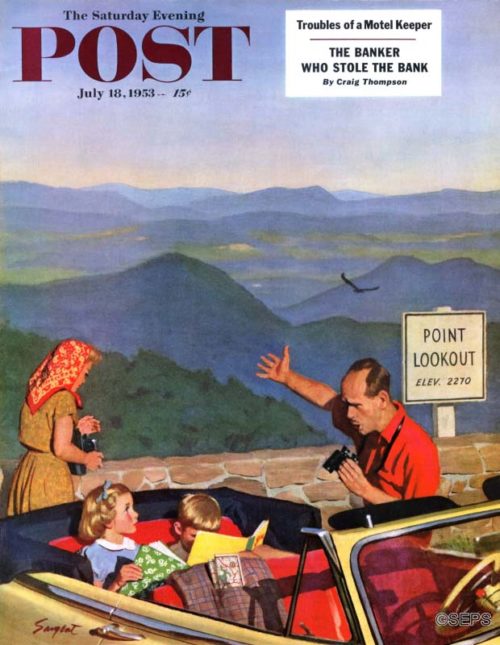
Richard Sargent
July 18, 1953
This Richard Sargent cover shows a family on Point Lookout at Lookout Mountain in Tennessee. Point Lookout is now called Sunset Rock.
How dare those kids actually have their noses in books! Today, those kids would be on their phones.
Quote of the Week
“Order Restored: The Guy in the Office Who Was Always Watching the World Cup Is Back to Having Nothing”
—headline at ClickHole, sister site of The Onion
Fortune Cookie Day
I don’t eat as much Chinese food as I used to, so I haven’t opened a fortune cookie in a few years (the person who delivers my pizzas never has any fortune cookies). Today is Fortune Cookie Day, and you can celebrate in one of two ways. You can order some Chinese food tonight and get one, or you can play with this online fortune cookie generator.
I got “A great person was born on your birthday.” It’s nice if they’re talking about me, but they’re probably referring to Cole Porter.
Next Week’s Holidays and Events
Shark Week (starts July 22)
This is the 30th anniversary of Discovery Channel’s annual extravaganza of shark-related programming. Here’s the Post’s Bill Newcott with a montage of great film and TV moments involving sharks.
System Administrator Day (July 27)
If your company’s computer network is up and running, this is the day to thank your SysAdmin.
Tuskers
Beginning of the end, is what I thought. One bum step put me out for a week. Mostly I was confined to the decking in front of my tent on the edge of camp, leg up, ice pack on my ankle.
My three Batswana guys came out for their instructions when they felt like it. The English girls, Pippa and Ellie, visited occasionally, fussing. Leaving hours with myself, worried about being, now, in sight of 50, and what that means when your job is essentially physical. Then the elephant turned up, and there were two of us contemplating mortality.
He was alongside without preamble. How he got through the mopane woodland without snap or crunch, I don’t know. Elephants are not stealthy by nature. I lifted my eyes and there he was, more topography than animal: a vertical landscape of ridges and fissures, crusted with sand and dirt, patched with thickets of wiry hair.
First thing you’re supposed to do if an elephant appears without warning is stay stock-still. My enforced immobility took care of the dissident impulse to run like blerrie hell. In the immediate moment, my breathing stopped. I brought it back online, keeping the breaths long and shallow.
My crutches were flat to the decking. I reached a slow hand to gauge the gap, coming up short by some centimeters. Opportunism was not a getaway option. So long as the elephant stayed where he was, side-on, head behind the tent, there was no immediate danger. No sooner had I made that assessment, he began to reverse.
The heavy skin sagging from the peak and hollow of his pelvis pulled taut as one stump foot lifted and reached back, then the other. A ragged ear came into view, the big, veined sheet of it pinned down with black studs. When the ear flapped, those studs burst into an eddy of flies. They fixed again when the ear flapped back.
The elephant halted full profile. An amber eye glimmered behind a thick brush of eyelashes. He stood there for an age, though in real time no more than five, six minutes. When he shifted again, I was hopeful he would leave me to my boredom. No such luck. His rear end rotated, tamping down saplings and bushes, until we were face to face. More than that. His trunk snaked my way, and we were nose to nose.
With snuffles of stagnant air, the prehensile tip explored my nose and brow, tip-tapped up across my forehead, pinched through my hair. I took it as a gathering of information; he didn’t quite know what he had in front of him. When the trunk drew away, I was of the presumption that he was blind, or near enough.
Deaf as well, maybe. I tested it. “Hey, guy,” I spoke. He was impassive. “Hey!” I repeated several times, dialing up to the verge of shouting. Finally his ears twitched. The flies scattered, then coalesced. “Hey,” I said again, reducing the volume a touch. His ears responded; the flies likewise.
If he intended malice he would have threatened it by now. I was confident enough of that to divert my attention to rearranging my predicament. I took the mostly melted ice pack off my ankle and eased that leg to the deck, wincing at the electric jolt when my swollen foot touched the slats. I bent forward to snag the crutches, slid them round, lifted them up, clamped them vertical between my knees. I checked the elephant’s reaction.
He had stayed as he was, head-on and inert. Now I was able to take a good look at him and saw just how old this guy was. His tusks were thick, not especially long. That’s typical for the Okavango. The ivory here doesn’t measure up to other parts of Africa. Some of the researchers would give you an explanation, but don’t ask me on that kind of science. Camp maintenance is my limit.
His declined senses and the jut of his pelvis were giveaways of his age. His scooped-out temples, deeply cast with shadow, compounded the evidence. Now as I said, I’m no expert, but I’ve seen plenty of elephants in my time, and I estimated that this guy was north of 60 at least. Maybe past 70 even. In a place like the Okavango Delta, with its floods and droughts and bushfires, that’s some achievement.
“Hey, man,” I said, intuitively modulating my voice to be heard without causing alarm. “What brings you here?”
He transferred weight between his front legs. There was weariness in the movement, and also intransigence. He’d touched and sniffed my face, he’d heard my voice, and he was going nowhere.
At my age, there’s only so long you can wait out a situation before your bladder has its say. I climbed the crutches and hooked my arms over them, then shuffled the long way round my chair to the tent, watching him all the while. I’d left the flap half-fastened. I unzipped the remainder and went in, through to the bathroom out back. I relieved my discomfort and flushed.
Rational thinking would have kept me in the tent. I could continue my convalescence as easy inside as out. Hell, man, my tent’s stocked with a few books, a Walkman and some tapes, and a cool box of Castles. It would be no great inconvenience. But there was something about that old guy. A recognition, you could say. A common ground. A solidarity. I couldn’t just leave him there. So I pegged back out, turned the chair slightly toward him, moved the table on which I’d left a couple of books, and binocs, and a bottle of water, and brought the other chair round to rest my leg on. Reorganized, I sat back down.
This was us for the next three days. I took regular toilet breaks. The elephant just went where he was standing, never more than a strained trickle. Three times a day I crutched my way over to the dining hut for meals. The elephant had no apparent appetite or thirst. Nights I slept inside with the zip down tight, not against him, but in mind of the usual nocturnal threats of the bundu. If anything, I slept better for knowing I had a sentry outside.
First afternoon, Ellie came out to check on me, totally unaware I had company. I cut short her shouted greeting with a palm held up rigid, then a finger to my mouth. I waved her across to me. She’s been in the Okavango 18 months now and studies lions for her day job, so it takes more than a bull elephant to scare her off.
She came in close, crouching beside me with her hand partly on the cuff of my shorts, partly on the skin of my thigh. For a time I was more conscious of that than of the elephant. Was it just an innocent sign she was at ease with me, now that we had known each other as colleagues for a few weeks? Or something more?
“How long’s he been here?” she whispered.
“Couple hours,” I whispered into her close ear. She smelled fresh and scented, like a shower.
“Goodness me, he’s getting on a bit. How old do you think?”
I told her my upper-end estimate. Over 70. She nodded in acceptance. On some matters of opinion, the researchers seem to regard me as a peer. Hell, I’m no kind of zoologist, and there’s plenty I don’t know. But you put a man in the bush most of his life, he picks up a thing or two. I know wild animals better than I know people. Often prefer them, too. There’s no subterfuge. If you can read the signs, it’s all in plain view.
We whispered to and fro a few times more, and I inhaled my fill. At last Ellie said she had to get back; she was heading out with Pippa to track the Burbank pride. They’d been putting in good work with those lions these past weeks. Those two girls, fearless, man. I’ve seen them sitting on the roof of their Land Rover, not a care in the world, with the lions all round them. Like I say, if you can read the signs.
Ellie lifted her hand away to stand up. Its pressure lingered long after she’d retraced the path through camp to the office hut.
Second day the elephant was still beside the decking, same position, same demeanor. After breakfast, I arranged myself in situ and started thinking about that sense of solidarity I’d felt the previous day.
The two of us were not so different, clinging to our memories of how things used to be. I guessed he’d come to this patch of mopane woodland because it meant something to him. He would have known it long before the research camp was here, with its line of tents, and the office and dining huts, and the generator chugging out noise and fumes, and the comings and goings of people and vehicles.
In his lifetime, the entire Okavango had been transformed, not just this wooded island between the channels. The southern part of the delta has been carved into concessions for tourist lodges and research camps. The elephant’s luckiest stroke was living away from the old hunting concessions up north. You won’t find many old bulls there, if any.
Did he wonder where the tribal villages had gone? Did he mind the whole place becoming crisscrossed with sandy roads? Was he irritated by the Cessnas droning overhead between airstrips, and the motorboats whining along the channels? Did he tolerate vehicles stopping beside him with camera lenses glinting and autofocuses beeping, or was he one of those bulls who’d send them into reverse-gear retreat with a show of bluster?
His past is here. Mine is South Africa, where everything also is beyond recognition. My home street in Joburg, in Bellevue East … hell, man. Every family I knew way back when is gone. I can’t go there and be safe. You can lay on all the political reasons you like, and sure, they’d be justified, but I can’t help but take it personal when nobody gives a damn about how I’ve lost my place in the world. I’m left drifting here and there for jobs, and my fitness for heavy-duty maintenance is fast running out. After that, then what?
Third day, the elephant died. I saw it coming for an hour or two. When I came back from breakfast he had moved round to the front of the decking. Both ears had wilted, giving a different shape to his head. The flies now were crusted around his eyes and in the lip of his trunk.
My ankle was restored enough for me to be able to walk with a stick. I hobbled across to him and, cautiously, from my elevated position on the slats, placed my palm on the broad part of his trunk between his tusks. His eyes closed. We stayed joined for some time.
Ellie and Pippa came to see how he was and rested their hands on my shoulders while I rested my hand on the elephant. The girls stayed with me as the indications became ominous. The elephant began to sway. We could hear the rattle of his lungs, transmitted short through his mouth and long through his trunk. He moved into a clumsy turn, rotating to the view that had been my first sight. His profile was diminished now. Whether he was still conscious, we couldn’t tell. Finally, with terminal inevitability, he keeled away from us, breaking into the undergrowth like a felled tree. The disturbance settled to indifferent stillness.
We went down to him. His eye opened in acknowledgment. We swept away the bothering flies, and we stroked his thick, bristly hide. When the eye sank into its socket, we knew he’d gone. We maintained our vigil for a few more minutes, affording him some final dignity.
It all changed when Ellie radioed the news to the office, one hand on Pippa’s arm while she made the call. There was as much in that touch as the one to my thigh. Camaraderie, you could call it. The girls are half my age, and some. Their fondness for me is the same they’d have for a grizzled old lion. Or this elephant.
We knew he couldn’t be left. The carcass would soon attract hyenas, crocs up from the channel, maybe lions even. Not to mention the stench. Aussie male and female — the chief researchers, our bosses — drafted in a tractor from the tourist lodge. Noosed around the neck by chain, the elephant was unceremoniously dragged through the thick bush in front of my tent to the edge of the water, then across mud and reeds to a clearing a couple of klicks from camp.
The lodge’s return for their help was the elephant’s skull, which would be left out for weeks to be picked clean, then installed in front of reception as a feature. The tusks were chainsawed out by Parks and Wildlife for transportation to the government ivory store in Gaborone.
The bush in front of my tent was left flattened to the channel. A cluster of hippos wallowed there. I had heard them often enough; now I could see them. At dusk I steered my chair to gaze out, alone with my thoughts.
There was movement behind me, and a voice. “How are you feeling?”
“Better,” I said reflexively. Then, with consideration: “Haven’t ironed out the limp yet, but I’ll be back to work tomorrow.”
“The elephant, I meant.” Ellie scraped a chair across the boards to settle beside me. “You’re missing him, I’m sure.”
“Ag.” I reached to the top left pocket of my shirt, where I once kept a pack of Marlboros. A good 10 years since I quit. Old habits. I exhaled a lungful of air. Clicked tongue to teeth for final punctuation.
Her hand extended toward me, paused. “I know. I know.” Her fingers hovered short of my forearm. Pulled back.
The decking seemed somehow more spacious than before. Not because of the elephant’s absence or the opening up of the bush. The liberated dimension was vertical, like a roof removed. Whatever had been bearing down on me no longer was.
Stars infiltrated the sky, diluted by the near-full moon as it rose. The usual obligations were sidelined. I didn’t offer Ellie a Castle or anything. No pressure to talk, even. My compulsion to reach for absent cigarettes went away.
The night took the initiative. Hippos, hauling out to graze on the floodplain, chuntered. The creaking-door call of a Pel’s fishing owl above us, two or three trees over. Hyenas chuckled across the firebreak behind camp. The sustained roar and trailing coughs of a lion, out by the airstrip.
At seven, one of my guys would beat the drum to summon us to the dining hut for supper. That would be it. We would return to the fold of daily gossip. Lion news, usually. No doubt tonight overshadowed by the elephant. It being a Thursday, bobotie for main course, with milk tart for dessert. Insects buzzing against the bare lightbulbs overhead, and some of us fingertip-fishing strays out of our drinks. Bundu life has its routines.
But this was new. Ellie beside me, and a view ahead. Beyond the hatchwork of reeds, the liquid moonlight shimmered. Entrancing, luring. Almost obtainable.
9 Creative Campfire Dishes for Your Next Adventure
Spending a weekend in the woods can be a highlight of the summer, but getting back to basics doesn’t mean you have to sustain yourself on hot dogs. Rough it like a professional this season with these simple methods for campfire cuisine. No gas stove required!
Campfire Breadsticks
With a clean stick and a package of crescent roll dough, you can make campfire breadsticks to add to any meal. Roll the dough into a long, thin strip and wrap it around the stick (tucking it at the ends so it doesn’t fall off), then cook it over the fire’s coals until browned. Enjoy with garlic and cheese or jam.

Foil Packet Dinners
Doing the dishes at a campsite is tedious, but you can skip the cleanup by cooking a full meal in foil. The possible combinations of meats and veggies are endless. Use heavy-duty foil, fold up the sides and top to keep the moisture inside, and place the packets on burning coals for 20-30 minutes (or until your meat is cooked through). Try Tex Mex White Bean Chicken or Pineapple and Shrimp for gourmet fare by the fire.
Bacon Skewers
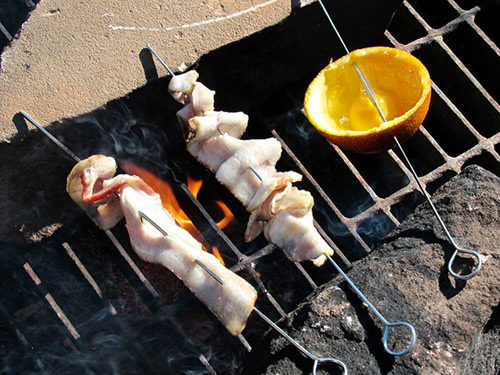
With metal skewers, there’s no need to soak them beforehand or worry about catching them on fire. For crispy, juicy bacon over an open campfire, weave your strips onto the skewer two-deep and place them on your grill grate over the embers for about 30 minutes, turning often. Make a hearty breakfast or BLTs without fussing with a skillet.
Coffee
You don’t have to settle for instant coffee out-of-doors. Caffeine lovers can still get their fix with these low-tech (and low-cost) brewing gadgets:
Pour-over — A simple plastic funnel with a disposable paper insert sits atop your mug, allowing a slow drip of joe. Heat the water with a metal kettle and pour carefully for one cup at a time.
French press — Make coffee for the whole crew at once, but be careful camping with glass. Alternatively, try a sturdier camping French press.
Aeropress — For campers who can’t go without their espresso, the Aeropress is an easy, quick way to make a strong brew. The plastic parts and reusable metal filter make for a quick cleanup and a perfect camping coffee companion.

Vegetarian Chili and Cornbread
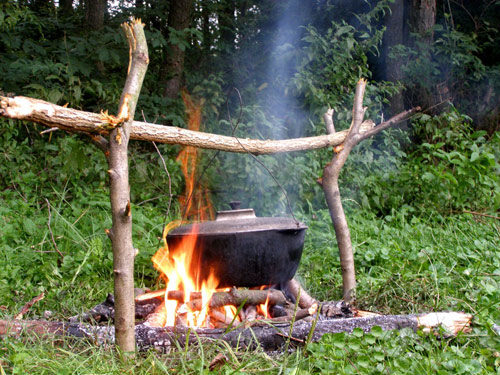
With a Dutch oven atop campfire coals, you can make your chili and cornbread in one pot. Just sauté onions and garlic in oil before adding beans, peppers, tomatoes, zucchini, tomato paste, and spices. Prepare the cornbread mix while your chili is simmering, and add the batter to the top of the chili when you’re ready. Place coals on top of the lid, and before long you’ll have a hearty two-in-one dinner.
Breakfast Hash
It doesn’t get much easier than frying up potatoes, veggies, and meat in a skillet and cracking some eggs over it. Skillet hash is a camping go-to, but you can always mix things up with sweet potatoes, turnips, chickpeas, pancetta, chorizo, and any spices you can imagine.

Chilaquiles
Another skillet dish that can be as simple or as complex as you like are Mexican chilaquiles. Start by reducing a fresh salsa, store-bought or homemade, on the skillet. Add tortilla chips and stir to make a sort of stovetop casserole. Finally, crack some eggs over the top, and add your favorite Mexican cheese, chives, avocado, cilantro, and anything else you’d like.

Chocolate Orange Cakes
Maybe you never thought you’d bake a cake while camping. As it turns out, a whole, empty orange peel is perfect for baking a personal-sized chocolate dessert with a citrusy zing. Pour in the batter, wrap it up with heavy-duty foil, and set it on hot coals for 20-30 minutes.
Cast Iron Pies
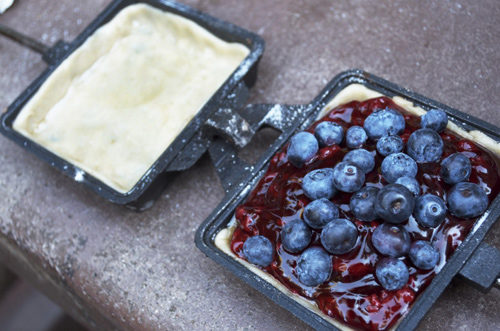
With a pie iron, you can make all sorts of sweet and savory sandwich creations. You put bread or dough with a filling into the iron container, close it up, and heat it in campfire coals for around 5 minutes. Try a Croque Monsieur or Blueberry Cheese-Stuffed French Toast.
What is your favorite food to prepare on a camping trip? Leave some ideas in the comments!
North Country Girl: Chapter 61 — The Flying Fake Penthouse Pet
For more about Gay Haubner’s life in the North Country, read the other chapters in her serialized memoir.
Some names have been changed.
I had landed my first job in New York: secretary to Kathy Keeton, publisher of on-the-skids Viva magazine, sister publication to the notorious and extremely successful Penthouse. Viva was one of my favorite magazines, and my salary was enough keep the wolf from the door of the Lilliputian Chelsea apartment I shared with my artist boyfriend, Michael.
There was one catch. According to managing editor Bernie Exeter, who had hired me, if I wanted to keep my job I had to sleep with him. Under this threatening black cloud, I was reduced to a wreck of a secretary, concentrating mostly on avoiding Bernie. Thankfully my responsibilities did not go much beyond answering the phone, making cups of tea, and fetching cigarettes for Miss Keeton.
Before my first wretched week at Viva was out, Debby Dichter, the assistant managing editor, who was friendlier to me than anyone else, popped into my cubicle with her usual mass of papers and an “I’ve got a secret” smirk.
“Don’t say anything to anyone else but Bernie’s been fired. I’m the new managing editor.” I swallowed and breathed and croaked out something between a “What?” and a “How?”
“Stephanie Coombs, the editorial assistant, you’ve met her, she’s young and blonde, like you. Bernie told her if she didn’t sleep with him he’d get her fired.” Debby’s eyes widened at such villainy. “Ugh, I mean can you imagine. Stephanie laughed at him and went right in to see Kathy.”
I now remembered: Stephanie had showed up unannounced the day before, saying “Sorry, Miss Keeton. It’s important. Can I shut the door?”
Debby continued, thrilled with her juicy tidbit. “Stephanie told Kathy what Bernie said to her. So Bernie’s fired and Stephanie’s new title is assistant editor.”
My relief was a physical lightening, as if I had been carrying around an incubus who suddenly pulled his teeth from my neck and flew away. Then I was furious, mostly at myself. Could it have been that simple? Did I just miss out on a promotion from secretary into the vacant editorial assistant slot? It was too late now. I couldn’t raise my hand and wail, “Me too, Miss Keeton, me too!”
It took a few hours for my mind to process the most important lesson: It wasn’t my fault. Whatever sick, misbegotten idea I had that when men acted like assholes it was because of something I said or did or how I looked, even as an eight-year-old being molested in Goldfine’s toy department, was wrong. It wasn’t me. It was them. Evil Bernie thought he had the power to bully young blondes into sex until one of them laughed in his face and busted him.
The waves of emotions had wiped me out by the time I got home. I just wanted to sit on our tiny orange couch in our sloping apartment and have Michael hold me. “Is everything okay?” he asked. “You’ve been so strange. Do you hate the job? You can quit. Well, maybe you could find another job and then quit…”
“I’m fine,” I said and made him stop talking with a kiss.
I was fine. I liked Miss Keeton, even if I felt like a combination zookeeper and handmaiden to this glamorous creature from another world. I was slightly in awe of the editorial staff, some of whom treated me like the secretary I was, some of whom acted as if I might be their equal, and one of whom, Debby Dichter, now elevated to the even more frantic managing editor position, seemed to want to be my friend. Debby knew everything that was going on not only at Viva but also at Penthouse magazine; she and her Penthouse counterpart spent hours commiserating on the inability of anyone to ever get anything in on deadline.
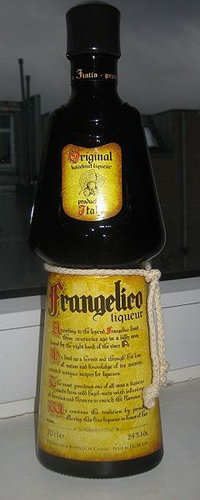
Debby made Chinese food for Michael and me in her Upper East Side studio; over sesame noodles she dished about the magazine. Debby was not as confident as Bernie Exeter had been about Viva’s future.
“Just look,” she said, opening the current issue. “Other than the cigarettes, there are no paid ads! This,” pointing to an ad for Frangelico liqueur, “was free ‘cause they bought an ad in Penthouse. I have to keep pages and pages of Viva open every month, in case a miracle happens and someone sells an ad. That’s why there’s this,” she said, stabbing a photo of a pouting, bare-breasted woman in a big straw hat and pearls, a full-page ad promoting Penthouse magazine. “And this,” turning to an ad for Penthouse Forum, a Reader’s Digest-sized magazine for material too filthy for Penthouse itself. “Otherwise we’d be running blank pages every month.” Debby closed the magazine in disgust. “Viva could have recipes for apple pie and articles on the joys of motherhood, and we’d still be the penis magazine; we’re losing millions of dollars every year. You’ll be okay, you’re Kathy’s secretary.” I flinched. “But the rest of us?”
As managing editor, Debby was a professional worrier. But Viva was only kept alive because of the cascade of cash generated by Penthouse.
Money poured in faster than it could be spent. Bob bought a museum’s worth of art to fill The House (we were never allowed to call it a mansion, even though it was the largest private residence in Manhattan; mansion smacked too much of the Playboy universe); Miss Keeton bought jewelry and a trio of enormous, hideous, pedigreed Rhodesian Ridgebacks that were prone to attack guests to The House and could only be controlled on their walks to Central Park by Guccione’s mobbed up chauffeur, Guy.

Even though neither Bob nor Kathy ever showed any interest in automobiles unless they were Penthouse advertisers (a tiny contingent of Asian car manufacturers), Penthouse also sponsored a Formula One race car, driven by the International Motorsports Hall of Famer, Stirling Moss.
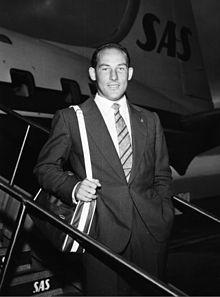
One Friday, a few weeks after my escape from the lustful, lubricious Bernie Exeter, Miss Keeton called me into her office.
“Gay, I need you to work on Sunday.”
“Yes Miss Keeton.” I didn’t mind. I was even a bit excited. I imagined that working on Sunday meant that I would finally get to see the inside of The Guccione House (if I didn’t get my throat ripped out by Ridgebacks) and its fabled masterpieces, including, according to Debby Dichter, a Picasso hanging above the basement swimming pool.
“Guy will pick you up, very early I’m afraid, to get you to the airport on time.”
Wait, what? “Yes, ah Miss Keeton?”
She waved a hand at me, her version of “Shut up.”
“Wear that…that ‘outfit’ you had on the first day.” She was alluding to the fatal Kenzo tunic and harem pants I wore when I met Bernie Exeter, an outfit that laid crumpled on my closet floor, a painful reminder of my stupidity. “And,” here Kathy wrinkled her elegant nose as she looked down it at my ankle boots, “Nice shoes. Something with a heel.” Kathy, who never had to race down subway stairs to catch a train, lived in strappy, glittery stilettos.
I was mystified, stunned into silence. Kathy sighed, and deigned to explain.
“Shonna Lynne is sick. Well, she claims she’s sick. You’re going to take her place.” Shonna Lynne, who went on to star in I Need 2 Black Men and Deep Throat Girls 11 was April’s Pet of the Month; she had two large assets I did not. Kathy seemed to have the same thought and her eyes briefly rested on my chest. She said, “You’ll be fine, that other blonde girl is going too,” and I was dismissed.
I was going to be a Fake Pet. Shonna Lynne and a dozen other real Pets were kept around to pretty up The House, promote Penthouse, and amuse (in many ways) advertisers. These girls, despite their sultry, wide open photos in the magazine, always started off eager to please; they still believed that they had just gotten their first big break and did everything they were told, sweet obedient puppies.
As the months passed, and Hollywood kept refusing to call, sadder but wiser Pets would clue the newbies in that their real future was not on the big screen, but on the small stage at strip joints, where they could earn $1,000 a night. Once the Pets were raking in the dough, when their presence was requested at a trade show or dinner with a potential advertiser, Shonna and her ilk were no longer available. One would think that being a Pet meant having sixteen near-fatal periods a year, a stomach highly susceptive to food poisoning, and at least eight deathly-ill grandmas.
I had not realized that posing as a Penthouse Pet was part of my job description; I can’t imagine that the sullen brunette I replaced as Miss Keeton’s secretary was ever asked to don the “Penthouse Pet” sash Cy Preston, Penthouse’s PR guy, handed to me as I scrambled into the limo at six in the morning on that freezing cold, pouring rainy Sunday.
Along with the gnomish Cy, who I knew from his weekly meetings with Kathy on the “Viva Problem,” there were six girls, all as gloomy as the weather; one of them, a blonde with a chest as unimpressive as my own, I recognized; she worked in the opposite end of the office from me.
“Mr. Preston,” I ventured. “Where are we going?”
“The race,” he answered, then realized that Kathy had told me nothing. “Elmira. Watkins Glen.” I blinked blankly. “Stirling Moss. Formula One. We’re hosting a big party, flew a bunch of advertisers and circulation guys up there yesterday, all you have to do is walk around, look pretty, act nice. And if you don’t get too drunk, you might get to wave a flag, but we’re counting on Vicki.” Here Cy waved at a dozing redhead; she was Penthouse royalty, The Pet of the Year, Vicki Johnson.

I had only a rudimentary grasp of New York geography, but I knew, as I looked out the limo’s dark tinted windows through the now Noah’s Ark level downpour, that we were leaving Manhattan, headed for New Jersey. The other girls in the car were asleep, with the exception of the sullen blonde from the office who was smoking a cigarette as if she hated it. I was about to introduce myself, when she scowled at me through the menthol smoke.
We pulled into a small airfield, the limo drove right up to a plane, and Cy Preston escorted us one by one on board, shielding our (well, everyone else’s) elaborately styled hairdos and carefully applied cosmetics under his umbrella. We took off, headed north into even more rain, and within the hour, descended through the dark grey clouds to an even smaller airfield, where we were decanted into a pair of Lincolns under a monsoon that flattened everyone’s hair and washed away the layers of makeup and turned Cy’s umbrella inside out.
“It looks like you girls will have time to get pretty again,” said Cy, looking out ahead at an endless queue of motionless cars; we were as deadlocked as any traffic jam in Lagos or New Delhi. In the time it took to drive half a mile, we girls could have gone through a dozen different wardrobe changes. Cy kept looking at his watch, rolling down the window to stick his head out, to the shrieks of those of us getting soaked in the back seat, and muttering to himself.
I don’t know why the Pets weren’t brought in the night before; money could not have been an issue. But now, despite the blast of chilly air every time he opened the window, Cy Preston was sweating bullets. At this rate, we’d be lucky to make it to the track in time for Vicki to wave the checkered flag signaling the end of the race.
“I gotta get to a phone,” Cy instructed the driver, who pulled out of the endless line of traffic and into a gas station. Fifteen minutes passed before Cy reappeared, drenched to the skin.
“You know where the high school is?” Cy asked the driver, who nodded and headed back the way we had come, followed by the second car. We ended up by the school’s football field, in the parking lot behind the bleachers. Everyone but me smoked as we waited for something.
This is where I cue “Ride of the Valkyries” in my inner movie, accompanied by a “whump whump whump,” first barely heard over the pitchfork rain that became louder and louder, until from out of the leaden sky onto the football field descended an Army helicopter. Cy had called in the troops.
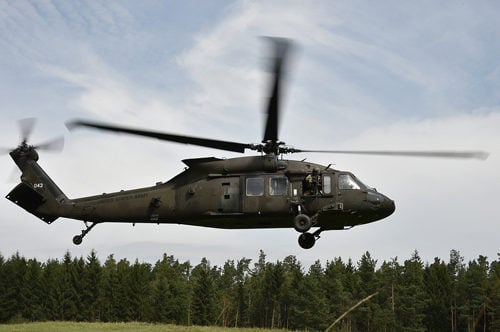
Out of the helicopter jumped a man in uniform and helmet, who dashed over to our car, crouching close to the ground. Cy rolled down the window. “Mr. Preston?” the soldier asked, while getting a good look at the Pets huddled in the back seat. “We’ll get you to Watkins Glen in a jiffy. Now y’all gotta be real careful when you run to the copter, hunch over so the blades don’t hit ya.”
With this encouragement, I followed Cy out of the car and immediately sunk up to my ankles in mud, my high heels vanishing beneath the sodden grass. I leaned on a thrilled soldier to extricate my feet from the mire, took off my ruined shoes, and ran barefoot to the helicopter.
When we were all on board, the pilot turned around with a mile-wide grin and said, “Wowee, who’s gonna believe this!” as excited with his cargo of Pets as if we were bare-assed naked.
The Army was all it could be. We flew over that unmoving, endless line of cars and within minutes set down in the relatively dry center of the racetrack. Cy shook hands with the pilots, crowed “Pet of the Year, guys!” and made Vicki kiss them, which she did damply and graciously. He then hustled us across the race course to where several large tents sagged sadly in the rain.
One of those tents was festooned with a drooping “Penthouse Formula One” banner; despite the crappy planning someone had actually thought to partition off a small changing area inside. “Fix yourself up, girls,” ordered Cy.
I watched the other girls whip out hot curlers, blow dryers, and makeup kits bigger than my grandfather’s tackle box. I had a lipgloss, ruined shoes, and mud-spattered white pants I would never wear again. My “Penthouse Pet” sash had somehow gotten ripped. I was too intimidated to ask to borrow a comb.
When we emerged half an hour later, the wet chicks were transformed into a bevy of (mostly) busty beauties, ready to charm the crowd — except for me. Cy sighed, took me aside, said, “I won’t tell,” and relieved me of my sash. I did not get to wave a flag and managed to avoid talking to anyone. I did position myself right by the extensive buffet table and ate so many shrimp I came up in a rash the next day.
Post Travels: A Whirlwind Spin through Montreal
Even with the best-planned vacations, it seems like there’s never enough time to do it all. And when time is tight, squeezing in everything on your wish list feels even more impossible. Quick trips may not be ideal, but if you’re willing to relax and enjoy them for what they are, they can offer a fun-filled peek into a new-to-you destination, especially when it comes to exploring cities like Montreal. Here are our picks for getting the most out of a whirlwind tour in this classic Quebec city.
Go for a Spin & Turn Heads
A bike-friendly city, you’d be amazed by how much Montreal ground you can cover on two wheels. Spade & Palacio runs a number of bike tours designed to give riders a local perspective into the French-speaking city of more than 4 million. (Don’t worry, English is commonly spoken as well.) The Beyond the Bike Lanes tour highlights the city’s rich collection of street art, taking time to stop and explain the history and stories behind the colorful murals.
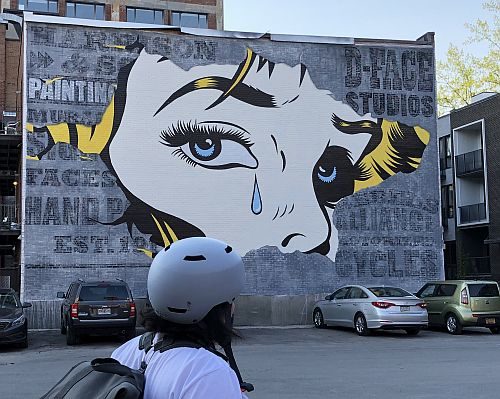
It also introduces visitors to neighborhoods and charming residential areas they might not discover on their own, as well as hotspots like Montréal’s Gay Village. The canopy of multi-colored balls that come together to create a unique rainbow flag atop the neighborhood’s main drag is smile inducing. During summer months the artery is pedestrian only, so you’ll have to get off and walk your bikes, but that’s just fine because it gives more time to soak in the festive surroundings.
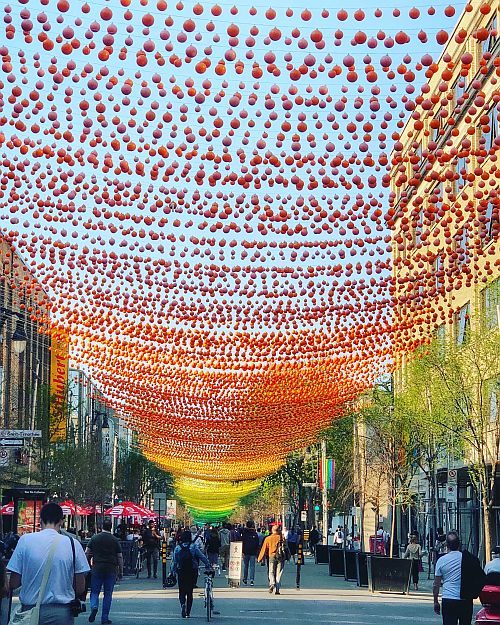
Be prepared to turn heads as you roll through town. The bikes used by Spade & Palacio come from a local bike shop that recycles old bike frames. To add just the right finishing touch, they’re painted hot pink, making it next to impossible not to get noticed.
Go to New Heights

You may not have time to visit all of the city’s iconic landmarks, but you can still see many of them with one scenic trip to the Observatorie Place Ville Marie. Set on the 46th floor, you can get the lay of the land from high above Montreal. Keep your eyes peeled for sights like the Saint Lawrence River, Old Montreal, and the Olympic Stadium.
Go to Church

It’s not what you think. Not even close.
On select afternoons and evenings, the Notre-Dame Basilica (built between 1824 and 1829) hosts Aura, a light and sound show. Projected throughout the Basilica, colorful lasers and lighting combine with the church’s Gothic Revival architecture to create visual effects set to a music soundtrack performed by more than 30 musicians, and 20 choir singers. The Basilica’s organ is also featured. Show goers are encouraged to walk around the uniquely lit Basilica before grabbing a seat in a pew for the main multimedia performance. Plan on about 45 minutes total.
Go to Sleep, Eventually
Fairmont The Queen Elizabeth reopened its doors in July 2017 after a major one-year $105-million ($140 CAD) renovation. Set in downtown Montreal, the hotel boasts 950 guestrooms, a fitness center with indoor pool, and an assortment of bars and eateries.

If you’re in the mood to splurge, you can stay in the John Lennon and Yoko Ono Suite. It’s the room where the iconic couple held their “bed-in” protest, and where the song “Give Peace a Chance” was recorded. Rates start range from $1,686 ($2,249 CAD) to $1,807 ($2,409 CAD) a night.
Con Watch: Watch Out for New Medicare Card Scams
Steve Weisman is a lawyer, college professor, author, and one of the country’s leading experts in cybersecurity, identity theft, and scams. See Steve’s other Con Watch articles.
Medicare has used Social Security numbers as Medicare ID numbers since its inception in 1965, a practice that has put recipients at increased risk of identity theft. And while federal law has prohibited using Social Security numbers as driver’s license numbers since 2005, Medicare resisted this change for many years.
In 2015, Congress finally enacted a law requiring Medicare to start using randomly generated numbers and letters for Medicare identification. This April, Medicare began sending the new cards by regular mail to all 60 million Americans enrolled in Medicare. The process, however, will not be swift. To get a little more information about your own card, you can register online to receive an email alert when your new Medicare card is in the mail.
Between April 2018 and December 31, 2019, Medicare recipients can use either their Social Security number or their new, more secure Medicare ID number. Starting in 2020, only the new Medicare ID numbers will be used.
Many people are confused about the switchover to the new cards, however, and scammers are taking advantage of the confusion. Pretending to be Medicare employees, the scammers call Medicare recipients and tell them they need to register over the phone to get their new card or risk losing benefits. They then ask for victims’ present Medicare ID number — their Social Security number — and use that information to steal their identity.
In another variation of the scam, victims are told they need to pay for the new card with a credit card or electronic bank payment. Remember: There is no charge for the new Medicare card.
If you are a Medicare recipient, you will eventually get your new card in the mail. You don’t need to do or pay anything to get your new card. If you need to update your mailing address, go online to My Social Security Account, a service of the Social Security Administration that allows you to set up a personal online account. Not only can you update your personal information, but you can also view your earnings history and estimates of benefits, manage your benefits, and set up or change direct electronic deposits.
This is a tremendously convenient service, but it also provides a great opportunity for scammers to set up My Social Security Accounts for people who have not already done so themselves and then to direct benefit checks to their own bank accounts. Even though the Social Security Administration, as part of the process for opening a My Social Security Account, requires verification of personal information by asking questions only the Social Security recipient should know, too often this information is available to a determined identity thief.
In order to improve the security of the accounts, the SSA now requires people to use dual-factor authentication to access their accounts. The authentication is a one-time code sent to either the user’s email or cellphone. But still, using an email address for dual-factor authentication may prove problematic because it is not particularly difficult for a sophisticated hacker to gain access to someone’s email account.
Just as the best defense against income tax identity theft is to file your income tax return before an identity thief does so in your name, so the best defense against the fraudulent use of your Social Security Account is for you to set one up first and protect its safety with a strong username and password. For information about signing up for a My Social Security Account, go to https://ssa.gov/myaccount/.
As a general rule, never provide your Social Security number, credit card number, or any other personal information to anyone who calls you on the phone; you can never be sure they are legitimate. Even if your caller ID indicates the call is from Medicare, the IRS, or some other legitimate organization, your caller ID can be tricked through a technique called “spoofing.” Medicare will not call you and ask for personal information. If you get a call that appears legitimate, but they’re asking for personal information, merely hang up and call the company or agency at a number that you independently know is legitimate.
If you have a question about your new Medicare card, you can call Medicare at 1-800-633-4227.
Dark Knight, Dark Theater: 75 Years of Big-Screen Batman
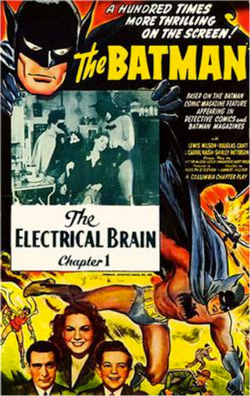
Adam West. Michael Keaton. Val Kilmer. George Clooney. Christian Bale. Ben Affleck. Lewis Wilson. Wait . . . Lewis Wilson? That’s correct. The first actor to play Batman on the big screen, Wilson starred in the serial Batman, released 75 years ago this week in 1943.
The Columbia Pictures serial followed a pattern typical of the format at the time: There were 15 chapters of roughly 17 minutes each, with a new installment released weekly ahead of features at the theatres. While the black-and-white production might look cheap and dated to modern audiences, Columbia invested more in Batman than in any of their other pictures at the time, and gave it a marketing push equal to that of their regular features. Critics of superhero film hype probably need to start here.
Batman attracted positive attention from fans of the Caped Crusader because it remained faithful to the general principles of the comics created by Bob Kane and Bill Finger, among others. Unlike the Republic’s Captain America serial of 1944 — which changed Cap’s origin, secret identity, and costume and replaced his shield with a gun — the Columbia take on Batman took pains to stay close to the original. Batman was millionaire Bruce Wayne, Robin (played by Douglas Croft) was Dick Grayson, and Alfred was, well, Alfred (played by William Austin). In fact, after the serial’s success, the portly Alfred of the comics was changed to resemble the thin, mustachioed Austin. The serial indelibly added to the mythos by showing Batman and Robin operating out of a Batcave under Wayne Manor.
The original trailer for the 1943 Batman serial.
One notable change was a result of film censor rules of the time. Since various offices disapproved of vigilantism in films, Batman and Robin were given a government agent affiliation for the purposes of this particular adventure. It’s a minor thing in retrospect, and not terribly dissimilar to Batman’s relationship with the Gotham City Police Department in the later 1960s television series.
The plot’s pretty standard for action serials of the time: the villain, Dr. Daka, is the Japanese leader of an Axis saboteur ring, and Batman and Robin are out to stop him. What makes the serial stand out, apart from decent attempts at costumes, are set pieces that include the gadgetry and traps that would become hallmarks of Batman in the comics and on screens large and small. Daka meets his end falling through a trapdoor into a pit of crocodiles (although writer Roy Thomas used him in the 1980s for a brief run in All-Star Squadron, a book that dealt with DC heroes in World War II).
Columbia had a hit on its hands with Batman, and it led to the immediate green-lighting of a serial based on radio and comics character the Green Hornet. Unfortunately, The Green Hornet tanked at the box office, which was in part responsible for the delay in producing the Batman sequel, Batman and Robin, which didn’t come until 1949, with a different cast. Ironically, Green Hornet would, like Batman, later be featured in a TV show in the ’60s, and they would even cross over in a two-part episode in 1967.
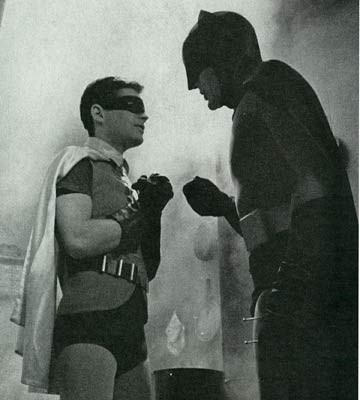
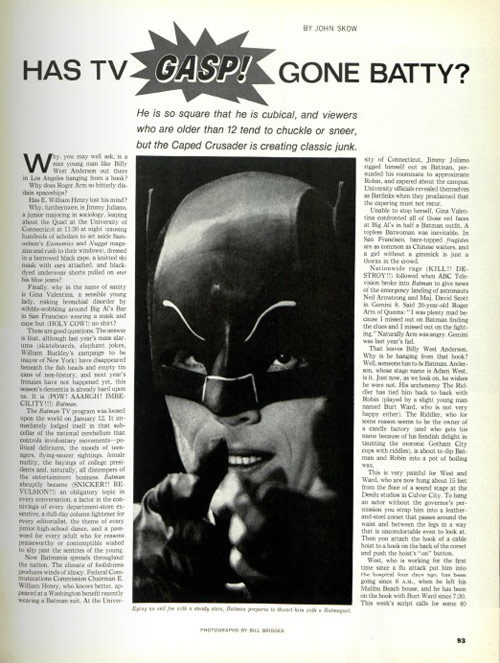
For on-screen appearances, Batman remained on the bench through the ’50s, even as the comics continued their ongoing run. He hit the screen again in a big way in 1966, when Adam West brought him to life for the Batman TV series. As it hit new heights of popularity, The Post visited the set for the May 7, 1966 article “Has TV (GASP!) Gone Batty?”. The series ran for three seasons and spun off a feature film, Batman: The Movie, in 1966, as well.
After the campy show came to a close, Batman spent most of the ’70s and ’80s confined to animation, regularly appearing on the various seasons of The Super Friends from 1973 to 1986. West provided the voice of Batman for the final two seasons. West and Burt Ward (Robin) also reprised their roles for a pair of live-action specials in 1979.
But the big screen beckoned Batman again in 1989. Batman, starring Michael Keaton, Jack Nicholson (The Joker), and Kim Basinger (Vicki Vale), crushed the box office that summer, earning over $400 million. Warner Brothers launched a full-blown multimedia franchise at that point, including a rebooted animated take on the Dark Knight that resulted in subsequent spin-offs for Superman and the Justice League. The movies marched onward with Keaton again in Batman Returns (1992), Val Kilmer in Batman Forever (1995), and George Clooney in Batman & Robin (1997).
The first theatrical trailer for Batman Begins from 2005.
For a variety of reasons, Batman & Robin failed with the public. While the animation marched on, it would be eight years before another live-action Batman film. Director Christopher Nolan took the helm, assembling a cast of heavy hitters (Gary Oldman, Morgan Freeman, Liam Neeson, etc.) around Christian Bale as the lead in 2005’s Batman Begins. The hit film led to 2008’s The Dark Knight, a massive critical and commercial success fueled by the Oscar-winning depiction of the Joker by Heath Ledger, who would sadly die of an accidental overdose prior to the film’s release.
Batman continues to be a major film presence. After Nolan closed his trilogy with The Dark Knight Rises in 2012, a new version of the Caped Crusader emerged in Batman v. Superman: Dawn of Justice. The 2016 film gave us Ben Affleck in the role; he would return for Suicide Squad in 2016 and Justice League in 2017.
Presently, plans at Warner appear to be up in the air. Director Matt Reeves has the keys to the franchise and appears to want to, like Nolan, veer younger with his hero again. Whatever the case, it seems certain that Batman will never be gone from the big screen for long.
The Art of the Post: The Earliest Covers of the Post
Read all of art critic David Apatoff’s columns here.
The Saturday Evening Post was famous for its colorful covers.

In his 1948 history of the Post, George Horace Lorimer and the Saturday Evening Post, John Tebbel wrote that the Post’s covers “were easily the Post’s most distinctive feature, its most popular single item and its greatest sales asset.” The Post’s editor-in-chief always chose the cover personally, applying very exacting standards. He would never trust such an important decision to a mere art director:
Lorimer picked the covers as a weekly routine, with the same unerring judgment he exercised on the editorial content. Fifteen or more cover candidates would be lined up on the floor, leaning against the wall, and the boss would walk past them like a general reviewing troops. As he made his rapid progress he would stab at them with a finger and keep up a running monologue: ‘Out, out, out, maybe this one, maybe, out, out, this one.’…. His genius for picking covers was affirmed time and time again by the evidences of their enormous popularity. In some Midwestern communities there were groups of readers who maintained betting pools on the topic of the next week’s cover.
So it’s hard to imagine that, for much of its history, the Post had no cover picture at all.

The magazine began as text densely packed into tight columns on both sides of the page. It was up to the reader to visualize whatever was going on in the articles they read. The Post’s creative “look” was limited to a few different styles of typography. In fact, the Post might never have had its famous cover pictures if three crucial developments hadn’t come together simultaneously at the end of the 19th century. If any one of those developments had not taken place, the magazine revolution might not have conquered the world. As it was, the Post combined those developments to become the leading circulation magazine in the country.
Development No. 1: A New Kind of Paper Was Invented
In the beginning, paper was expensive, so magazines couldn’t afford the luxury of large pages and the empty white space necessary for illustrations and modern design. Through most of the 19th century, magazines were printed on paper made of “rag” content. Rag paper became even more expensive after the Civil War when supply could not keep up with increasing demand. After much experimentation, the paper industry finally produced new kinds of paper from wood pulp, paper that was strong enough to be used in the new high-speed rotary presses and durable enough so that it didn’t fall apart after multiple readings. It was clean and white, making a good platform for reproducing images. And perhaps best of all, the new paper was only 1/20th the cost of rag paper, so it gave magazines creative freedom to design larger and longer magazines with all kinds of eye-catching and imaginative formats. The cheaper paper reduced the price of magazines, making them accessible to masses of readers who previously couldn’t afford to subscribe. The price of the Post dropped to five cents, where it remained for decades.
The new paper was a great boon for magazines, but it wasn’t sufficient by itself.
Development No. 2: Better Ways of Reproducing Pictures Were Invented
When the Post began, it was difficult to print even the most basic black and white images, and they rarely turned out well. Crude images such as silhouettes of heads, pointing hands or simple graphic symbols were occasionally inserted into the text to sustain the interest of readers and give their eyes a little rest from long, monotonous columns of words.

These images were printed using woodcuts or wood engravings, carved by hand into actual blocks of wood, then inked and pressed against paper. This meant the images couldn’t be too complicated. They couldn’t be in color. They couldn’t be used for high circulation magazines because the wooden blocks would wear out after a limited number of printings. (Of course, high circulation was not a big problem. In the early days the Post had only a few hundred subscribers.)
But by the end of the 19th century, innovations in printing technology enabled magazines to reproduce a wide variety of expressive, interesting illustrations. Photographic processes replaced the old-fashioned wood engravers. Quality artists were attracted to the field when they discovered their work could be reproduced accurately. Vivid color reproduction and halftone engraving served as a magnet for new readers. The first color cover of the Post appeared on September 30, 1899, at the beginning of a great surge in the Post’s circulation.

The new technique for printing pictures was a great boon for magazines, but even more changes were in store for the magazine business.
Development No. 3: A New Business Model Was Invented
Magazines were originally paid for solely by subscribers. As magazines learned to print more copies using new high-speed printers and deliver those copies to homes across a wider area using improved transportation, subscription lists grew. However, even with many new readers, magazines could never afford to hire the most talented artists in the land to paint large, full color oil paintings for illustrations. The crucial difference was a new business model: mass marketing.
For most of its history, the Post rarely included advertising. In 1898 the Post was purchased by Cyrus Curtis (the Publisher of Ladies’ Home Journal) for a thousand dollars. At that time it had a total circulation of 10,473, and its advertising revenues for the July 1898 issue were a pitiful $290. Curtis hired a new editor, a visionary named George Lorimer, who saw the potential in the new developments described above — the better paper and the new printing techniques — and began transforming the Post with images. The first genuine full page cover illustration, proudly displaying what readers would find within, appeared in black and white on September 2, 1899.
But for Lorimer, advertising revenues were the engine that would power the growth of the new Post. The first full page illustration in the Post was not the cover but an advertisement for Quaker oats. Lorimer believed he could attract more readers with pictures, and that more readers would attract not only more subscription fees but also more advertisers. Lorimer increased the size of the page, making it more hospitable for big pictures. He expanded the length of the magazine to 24 pages (and suggested that it would soon grow to 32). He gambled much of the future of the magazine on pictures.
While this new content increased the cost of producing the Post, it also attracted millions of subscribers and made the Post the ideal forum for America’s new manufacturing industry looking for ways to market everything from soap to cars. The Post rapidly outdistanced all of its competitors as a way to reach homes across the country. Advertising revenues subsidized the 5 cent cover price and enabled the Post to commission brilliant illustrations for each issue.
Lorimer was said to have accomplished for the American magazine what Henry Ford did for the automobile. The new business model was a great boon for magazines, but it wasn’t sufficient by itself. If not for the new potential created by the development of new paper and the development of new printing capability, the new business model would not have become so successful.
A Magazine Renaissance
At the end of the 19th century the combination of these three developments led to the Post’s renaissance. The transformation didn’t take place instantaneously. During the transition the magazine sometimes offered hybrid covers that were half illustration, half table of contents.
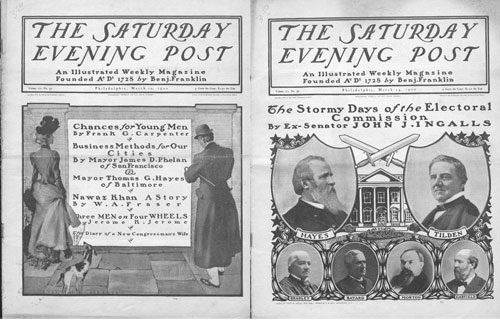
But popular opinion became clear and there was no turning back. The cover pictures on the Post became an institution. New topics for covers were proposed not only by Post cover artists but also by readers and by the editorial staff of the Post who would come back from their vacations or business travel with lists of sights they’d seen that might make a good cover. Hollywood studios would contact the Post to get the name of a fetching model who had appeared in a Post cover. Everyone wanted to participate in the process, and that helped create the momentum that would serve the Post cover well for the next several decades.
The Bird Man of Yucatán
Years ago, I stopped to photograph in a Mayan village in Mexico, a place so small that it still isn’t on most maps. Rows of traditional thatched-roof houses lined both sides of the highway. It reminded me of an English village, each house behind a whitewashed drystone wall, except there were vivid tropical flowers and fruit trees in each yard.
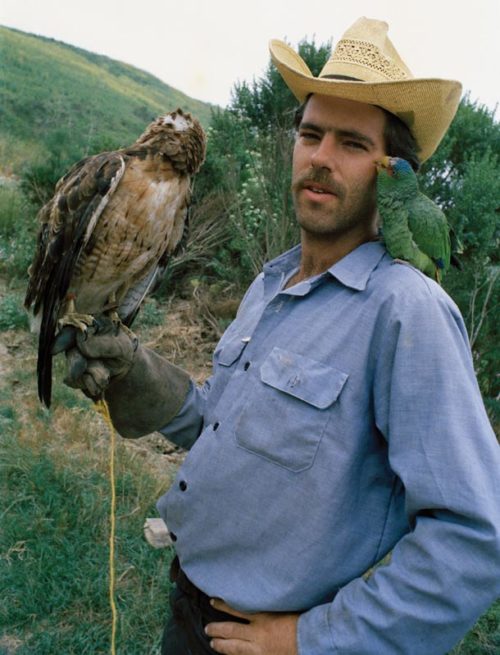
A family offered to sell me a baby parrot. I put out my finger. The parrot climbed up, not stopping until it was nuzzling against my neck. I called him Suc Tuc, the name of the village. He would squawk when he wanted food. He squawked all the time. Every day I’d buy fresh ground corn masa. I’d pinch little bits into bite-size balls to put in his mouth, like a mother bird feeding her baby. As he grew, he started eating on his own. I added fruit to his diet.
He matured into a beautiful bird. Actually, that’s not entirely true. Even that young, he was more like a crusty little sidekick, a bit scruffy, and we traveled everywhere together. This wasn’t a bird that lived in a nice cage in a nice house. We were living in the jungle. I had long hair back then, and at night he would often crawl underneath it and fall asleep on my shoulder. When I spent a rainy season in the jungles of Quintana Roo below Tulum with a family of chicleros — the men who bleed chicozapote trees for chicle, the resin used to make chewing gum — I’d leave Suc Tuc on my hammock ropes every morning when I went out. I’d whistle for him when I returned, and he’d whistle back to let me know where he was.
Driving back to California in December, we hit cold weather. Suc Tuc crawled in my mummy bag with me when I camped at night and slept next to my head. I’d put a piece of paper under him so I didn’t have to clean the bag. I shoulder-trained him to jump off so he wouldn’t soil my shirt.
I got a job in construction so I could make enough money to return to Yucatán. In the spring, I was laying adobe brick on a large house. I brought Suc Tuc to work every day. Another worker brought his dog with him, a big St. Bernard. The dog pounced and then swallowed my parrot when he flew off my shoulder for a bathroom break. I jumped off the scaffolding, picked up the St. Bernard by his tail, and kicked him in the belly until he vomited my bird. Suc Tuc was covered in saliva, he had a puncture wound in his chest, and he was missing feathers, but he took one look at me and squawked the equivalent of “Mama!”
He lost so many feathers I put him in a box with a goosenecked lamp to keep him warm. He recovered but never flew again. I tried to un-train him not to jump off my shoulder, but he’d plop to the ground, poop, and climb right back up.
When I saw the red-tailed hawk lying dead on the road, I immediately pulled over. It wasn’t right that such a beautiful bird be reduced to a bloody stain of flesh and feathers, each successive set of tires pushing it further into the asphalt. I put her on the floor of the cab of my pickup. I pulled back onto the freeway, shifting gears until I was doing 70 miles an hour again. A few minutes later, in a flurry of feathers, the red-tailed hawk was standing next to me on the seat. I tried not to make any sudden movements. I raised my foot off the accelerator. If she attacked me, we were both dead because we were still going too fast if I lost control. Out of the corner of my eye, I watched her examine me. I could only wonder what she was thinking. One moment she was flying, the next finding herself inside my pickup. She had probably been stunned in a collision with a truck. It must have occurred right before I arrived because no one had run over her.
She stood next to me, watching the sky move past the windshield without a trace of wind or air currents. When she didn’t attack, I spoke to her in a low voice I hoped sounded comforting and reassuring. She looked at me appraisingly and somehow understood I was not a threat and we could share my pickup cab together until we arrived home.
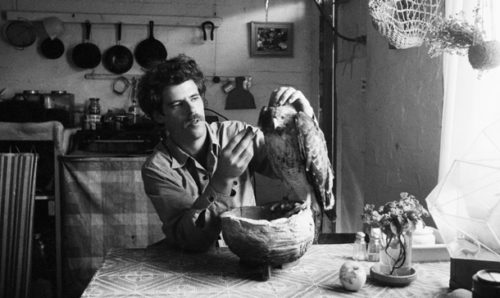
I had a pair of welding gloves in the barn, and I put one on and held out my hand. Her talons were perfect crescents that came to needle-sharp points. She gently climbed on, gripping just enough to keep her balance. I hoped she was simply stunned and would be able to fly. I moved my hand up and down, enough so that she had to open her broad rounded wings to keep her balance. But she didn’t fly off.
We looked at each other. I told her she was a beautiful bird. Her chest was the color of a coffee stain moving to cream, her wings and back were dark chocolate, and she had cinnamon coloring on top of her head.
I went to the store and bought hamburger. I carefully fed her, wary of her piercing raptor’s beak. When I offered the first little ball, she delicately took it from my fingers. She didn’t lunge for it. It reminded me of feeding Suc Tuc when he was a baby. He was watching from the other side of the kitchen. I worried the hawk would think he was an appetizer if he was on my shoulder.
Parrots enjoy being scratched around the head, especially the nape of the neck. Scratching from behind, I would use my thumb and middle finger, and Suc Tuc would put his head down and ruffle his feathers. This is an area birds can’t reach when they preen themselves, so I was helping to groom him. He enjoyed it so much so he would duck his head and ruffle his feathers whenever he wanted me to do it.
I wondered if I could scratch the hawk’s head too. A bird is vulnerable when it puts its head down. Would she trust me enough to let me do it? I knew I shouldn’t try, but curiosity got the better of me. After feeding her, I slowly moved my hand behind her head. I lightly scratched the nape of her neck. She ruffled her feathers and lowered her head. I scratched harder and she lowered her head even more. I was in my kitchen, holding on my hand a wild red-tailed hawk I had just scraped off the highway. Instead of fighting, clawing, and pecking to escape, she was ruffling her feathers so I could groom her. I’ve only experienced trust like that with small children and animals. Each time reminds me I have to live up to it.
There weren’t any raptor rescue centers then like there are today, so I tried to rehabilitate the hawk myself. I also didn’t find any manuals on how to heal a hawk. This was decades before the internet. I had to come up with a plan of my own. I thought she would need to use her wing to strengthen it. I spent a lot of time working with her every day. She would hop on my hand whenever I put it in front of her. I kept expecting her to dig in with her talons, but she never did.
I bought some mice from a pet store and took the hawk out to the corral. My horses didn’t seem surprised, but they kept their distance. I put her on the top rail of the corral, then tied dental floss to a mouse with about 20 feet of lead, and tied that to a fence post. I let the mouse loose and hoped the hawk would try to pounce on it. It was lucky the mouse was tied up because she hopped around chasing it before she caught it. Day-by-day she progressed from falling to gliding to actually flapping her wings. I didn’t have to tie up the mice any longer.
After a few days, I put Suc Tuc on my shoulder. I walked over to the hawk and put out my hand. She hopped on and looked at Suc Tuc with feral interest, not unlike the white mice I provided her at the corral. But she didn’t lunge for him, so I carried them both. Soon they both wanted attention. Suc Tuc would bend his head forward, ruffling out his feathers for me to scratch him. I’d rub his head until the hawk indicated she wanted attention. Then I’d switch and scratch her head. Suc Tuc would then busy himself grooming me, nibbling around my ear, but he never acted jealous of the hawk. We’d go for walks together. The barn was at the bottom of a valley, with hills rising on three sides covered in grass and brush. I wanted the hawk to spend as much time outside as possible and excite her to try to fly. We scared up jackrabbits that darted away while birds flitted around us. I wondered how long she would be content to move as slowly as I walked.
After about a month, she took wing and flew off. It was time. She needed to be wild. The first few days she would circle the barn and sit high on a branch in a eucalyptus tree on the hillside. Red-tails have a very identifiable screech, and I’d look up when I heard her, but then we both had our own separate lives to live and I stopped looking for her.
Of course I wished she would come back to visit. I dreamt I could whistle for her and she’d answer from high above and I’d put out my arm and she’d come swooping down to land on it. A red-tailed hawk is so thrilling to watch, soaring effortlessly, so regal, graceful, and beautiful.
It made me think of our relationships with wild animals. When people ask each other, “If you came back as an animal, what would you want to be?” many name a dominant animal in their environment, such as a lion, a tiger, an elephant, or a red-tailed hawk.
I don’t, and I’ve thought about it a long time. I want to come back as a canyon wren. They’re not that pretty, although they have the same rust coloring as a red-tailed hawk. But it has the most mellifluous and evocative song, like a cool trickle of water descending over rocks, a sweet cascade of falling liquid notes. It always puts me in a good mood. Wouldn’t it be wonderful to add beauty to the world every time you opened your mouth?
Macduff Everton is a photographer living in Santa Barbara, California, who photographed the Yucatán peninsula for “Floating Toward Ecstasy” (Jan/Feb 2017). For more, visit macduffeverton.com.
This article is featured in the July/August 2018 issue of The Saturday Evening Post. Subscribe to the magazine for more art, inspiring stories, fiction, humor, and features from our archives.
Your Weekly Checkup: What You Need to Know about Heart Disease in Women
“Your Weekly Checkup” is our online column by Dr. Douglas Zipes, an internationally acclaimed cardiologist, professor, author, inventor, and authority on pacing and electrophysiology. Dr. Zipes is also a contributor to The Saturday Evening Post print magazine. Subscribe to receive thoughtful articles, new fiction, health and wellness advice, and gems from our archive.
Order Dr. Zipes’ new book, Damn the Naysayers: A Doctor’s Memoir.
Every 40 seconds, someone in the U.S. has a heart attack.
The American Heart Association has led the effort to educate women about their risk of heart disease, stressing that more women die of heart related problems (1 in 4) than of breast cancer. In fact, the AHA has stated that “Every minute in the United States, someone’s wife, mother, daughter or sister dies from heart disease, stroke or another form of cardiovascular disease.”
Each year, more than 30,000 women younger than 55 years old are hospitalized with an acute heart attack. Importantly, women may be more likely than men to experience lesser-known heart attack symptoms such as chest pressure, tightness, or discomfort, in addition to chest pain. The pain and discomfort can be in the jaw, neck, arms, or between the shoulder blades. Heart attack symptoms unrelated to chest pain can include shortness of breath, a cold sweat, nausea or lightheadedness. Misinterpreting such heart attack symptoms can put women at a greater risk of death.
Young women with an acute heart attack may have more health conditions such as congestive heart failure, hypertension, renal failure, chronic obstructive pulmonary disease, and diabetes mellitus. They may also experience a longer length of stay in the hospital and have higher in-hospital mortality than men. Women with a history of autoimmune diseases such as lupus, rheumatoid arthritis, or psoriatic arthritis, as well as a history of preeclampsia, hypertension during pregnancy, and gestational diabetes, have increased risk for heart disease.
Some women may not have obstructions in the large coronary arteries that men exhibit but rather have involvement of small coronary arteries that may escape notice but are still able to cause a heart attack.
Women undergoing procedures such as coronary artery stent placement or coronary artery bypass surgery may experience worse outcomes than men, a finding possibly related to other health conditions and increased surgery-related complications.
Women need to be aware of their heart disease risk, how symptoms can present, and the potential outcome. Prevention is the fundamental order of the day, which can be impacted by healthy lifestyle choices such as a proper diet, exercise, blood pressure control, and smoking cessation. A happy marriage helps.
Finally, if you suspect you are having heart problems, do not hesitate to call your health care professional, or 911 if it’s an emergency. Do not worry about false alarms. It is better to be safe than sorry.
The Father of the Space Shuttle: George Mueller
You’re 12 years old in 1930. Your life revolves around building model planes and reading science fiction. One day, you’re going to send mankind to the moon. That, in brief, is the story of the Father of the Space Shuttle, the Man That Ran the Moon, one of NASA’s “most brilliant and fearless managers.” He was an electrical engineer, a senior vice president for General Dynamics, and much more. He’s George Mueller, he would have been 100 years old today, and here’s how he helped to take us to the stars
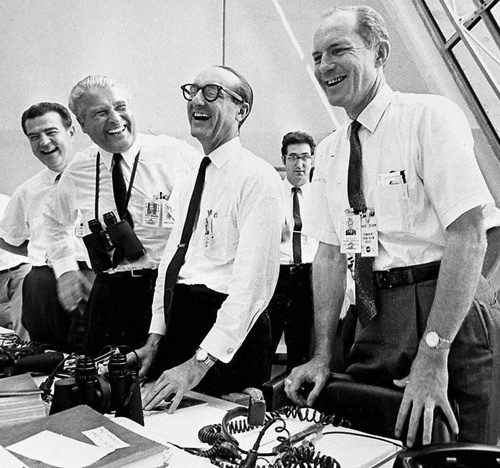
Born in St. Louis, Mueller grew up an avowed science fiction fan. His electrician father inspired some of his other interests, like building radios. He also got into construction modeling in his youth, including building and racing model airplanes. Mueller wanted to be an aeronautical engineer, but the affordable schools around him offered no programs. He began studying mechanical engineering before finally settling on electrical engineering. Mueller later received a television fellowship for graduate school at Purdue University, and he worked TV projects at the school while they built their first transmitter.
After Purdue, Mueller got a job with Bell Labs, working on video camera tubes and, later, airborne radar. He also worked on a team attempting to develop a working transistor, though his co-worker William Shockley and his team would beat Mueller’s group to it. Mueller went on to earn a doctorate in physics in 1951. Afterward, he taught at Ohio State while consulting for tech firm Ramo-Woolridge. In 1957, they hired him away for a full-time job as director of their Electronics Laboratories.
Mueller found himself in charge of more and more functions as groups combined into bigger verticals within the company and after Ramo-Woolridge merged with Thompson Products Company to form TRW. By that point, Mueller was working on missile systems and found himself working regularly with NASA. NASA wanted to bring Mueller over, but he would agree only if NASA restructured their departments. For him, they did. So in 1963, Mueller joined NASA’s OMSF, the Office of Manned Space Flight.
It didn’t take long for Mueller’s intelligence and intuitive understanding of structures to affect how NASA worked. In short order, three other divisions reported to him. He initially clashed with the legendary Wernher von Braun over organizational ideals, but von Braun eventually reorganized the Marshall Space Flight Center for him in a way that increased their large project capacity. Mueller also seized control of NASA’s schedule, determined to make a moon landing by 1970. He created structures that allowed different programs to communicate directly, cutting out extra steps and waste, and encouraged the hiring of more Air Force personnel for their flight and engineering experience.
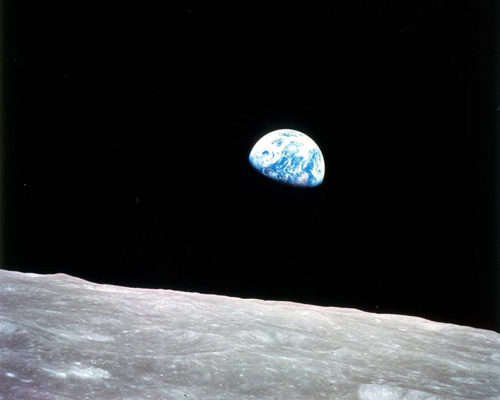
More dynamically, he pushed an idea, called “all-up testing,” in which NASA tested the entire rocket at once, rather than testing a rocket in stages with dummy parts and sections. This considerably advanced NASA’s schedule. Von Braun himself noted, in a story recounted on NASA.gov, “It sounded reckless, but George Mueller’s reasoning was impeccable.”
Not only did the “all-up testing” concept work, it worked with remarkable speed. The two unmanned test flights of the Saturn V rocket were successful; the third flight put Apollo 8 in orbit around the moon in 1968. The sixth Saturn V launch took Apollo 11 to the moon’s surface.
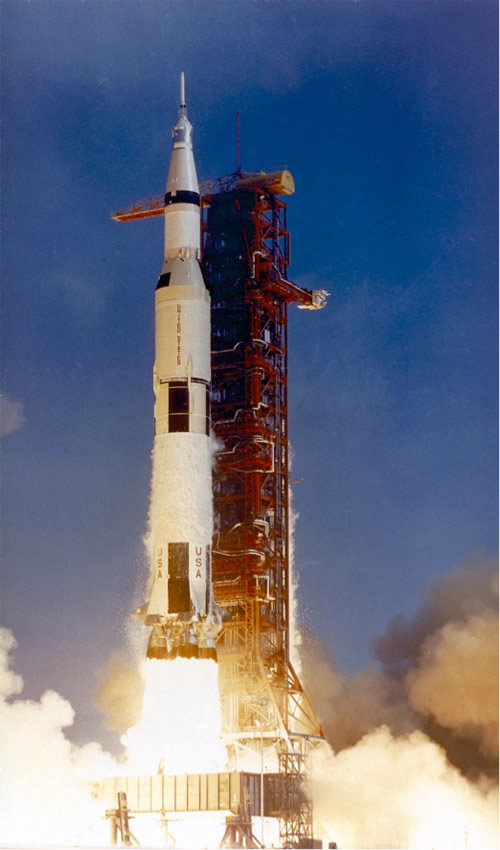
Even as the moon missions were grabbing headlines, Mueller assembled an Apollo Applications Office to devise different ways to use that system. He suggested everything from a fixed lunar base to what would become the Mars probe landings. Various cutbacks meant that the office produced only one of Mueller’s proposals: the orbiting space station Skylab.
Mueller’s other legacy, apart from his sweeping reorganizations and his roles in Apollo and Skylab, is subject to a bit more debate. Many call Mueller the Father of the Space Shuttle, but some critics argue that —considering the number of hands involved — the title overstates Mueller’s personal contribution. However, most generally agree the space shuttle had no greater advocate than Mueller, who tenaciously pushed for reusable vehicles for years. As early as 1967, Mueller held a symposium at NASA about shuttle design and low-cost flight. His vision would help drive the shuttle program after he left NASA.
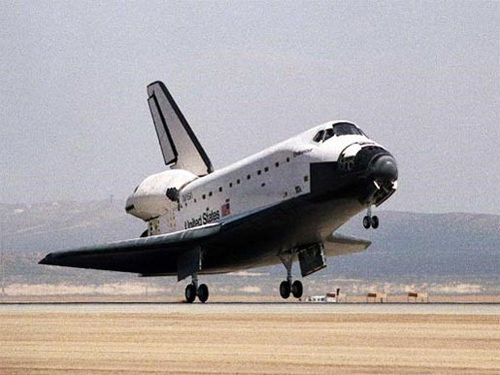
Mueller resigned from NASA in December of 1969, just less than five months after the moon landing. Rumors about his motivation for leaving circulated, but Mueller himself disclosed that a combination of the end of the Apollo program and a desire to return to the private sector sealed the deal. In a 1998 interview for the Johnson Space Center Oral History Project, Mueller said, “My salary was half what I was making in industry when I went there, and it was just a strain to keep the family going and work going at the same time. So I went back to industry.” General Dynamics, System Development Corporation, and Kistler Aerospace were just a few of the businesses that Mueller worked and consulted for after leaving NASA.
When he passed in 2015, Mueller’s death made national news. Headlines hailed him as the Father of the Space Shuttle and the Man That Managed the Moon. His work and organizational sensibility can still be seen in NASA today. His story demonstrates that a childhood of daydreaming and the application of hard work can result in amazing things. And really, he never stopped dreaming. As he said in 1998, “You think of the pioneers that opened up the West. Well, you ought to think of pioneers opening up space in the same fashion.”
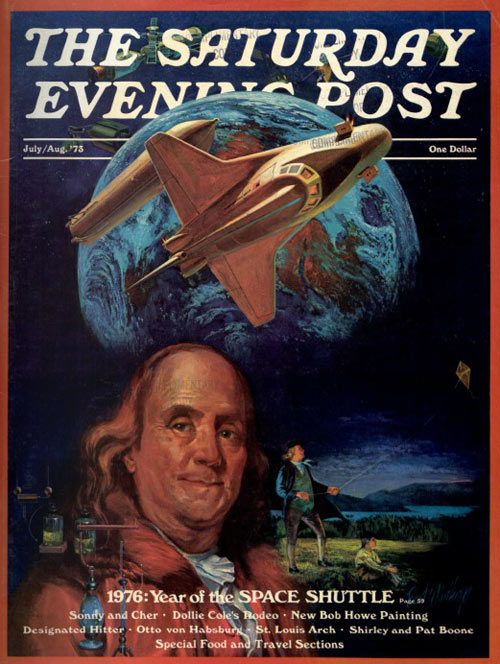
The Civil War: One Woman’s Ordeal
This article and other stories of the Civil War can be found in the Post’s Special Collector’s Edition, The Saturday Evening Post: Untold Stories of the Civil War.
—This account appeared in the July 22, 1961, issue of The Saturday Evening Post.
For two memorable, action-packed months in 1863, 19-year-old Lucy Bundy Cobb found herself caught up in the crazy whirl of the Civil War. She hurried from her home in Ohio to Winchester, Virginia, to nurse her ill husband, a Union officer. The Confederates seized Winchester and captured both of them. Lucy was sent to a prison in Richmond and exchanged without knowing her husband’s fate. A keen and sensitive observer, she related her experiences in later years to her son, Howard Bundy Cobb, and a grandson, retired Col. Ralph C. Benner. Cobb wrote down her story and Benner preserved the manuscript, giving us a rare and exciting insight to Civil War life and adventure.
* * *
In the telegram the colonel commanding the 116th Ohio Volunteer Infantry requested that I come at once. My husband and other officers had typhoid fever, and nurses were needed badly at the hospital in Winchester, a Virginia city which our troops had occupied.
At the head of his own company of recruits, John Haskell Cobb had left me on our farm in southeastern Ohio scarcely a year before. With the help of an occasional old man or boy, my Aunt Sarah and I had managed to put in a crop to feed ourselves and our livestock.
My father, Congressman Hezekiah S. Bundy, hurried up the path to our farm cottage as soon as he learned of the telegram. “Lu,” he began fussily, “get ready immediately. I must go back to Washington soon anyway, and will take you directly to the Secretary of War for authorization to join your husband.”
Hurriedly assembling what few clothes I found suitable, I clambered into father’s low-swung carriage. The going was slow, but we finally boarded the smoky old railway coach and patiently slept in our seats through the night trip to the capital. The next morning found us in the office of the Secretary of War.
The voice of Secretary Edwin M. Stanton seemed to come from the depths of his iron-gray beard. “Congressman Bundy, I’ll grant this pass for your daughter, but if she were my daughter, I’d send her home. Too many officers’ wives are going to the battle front. A girl of 19 should be far from the scenes of war!”
Vividly the words of that telegram came to me, and my face must have changed expression. “No, no! I cannot turn back now. John needs me. I must go!” My voice evidently held a pleading note, for the Secretary of War grimly signed his name to a paper which he handed me. “May God be with you,” he said gently. Then, turning away hastily, he seemed to dismiss me to a foolhardy venture.
I was wholly unprepared for what I was to find in Winchester. This little town in the heart of the Shenandoah Valley changed hands between the North and the South many times during the war. This morning, however, it lay calmly in the sun under the old Star Fort whose earthworks frowned down on the cluster of cottages where the Union Army had its headquarters.
No one received me at the dwelling where I dismounted from the stage and struggled with my carpetbag. And my knock received no reply. The front room was evidently an office, so I ventured timidly into the house. From the rear I heard a sound which filled me with misgiving. Dropping my bag, I hastened in the direction of that feverish moan.
“John!” I cried, only to receive a vacant stare as he tossed about in bed in a tangle of sheets. My heavily bearded young husband had lost many pounds. I seized his weak, thin shoulders, pressing him back gently onto the none-too-clean pillow. He yielded to my ministrations without giving a sign of recognition.
Anxious days followed. John lay feeble and helpless, feverishly trying to lead his men against imaginary breast-works manned by “Johnny Rebs” blazing away. It was a lengthy vigil. But when John’s eyes opened with awareness and he murmured, “Lu!” the weak smile with which he greeted me left me breathless. The tension was broken. Tears came to my eyes for the first time, and I sank down on the bed in relief.
John was soon sitting up, but I kept close to my convalescent husband. Soon the rumblings of war drew nearer. The Confederate Army, if not blocked, would soon engage Star Fort. Our entire regiment was thrown into action.
For hours the din of battle kept coming across the brow of a nearby hill. Soon noncombatants and stragglers entered town, bringing to me a glimpse of the meaning of war. As evening approached, I became prepared for most any eventuality. There came an order to all noncombatants. “We must go up to the fort,” John announced.
Star Fort was nothing more than a hollowed-out earth-works on the brow of a hill overlooking Winchester. Noncombatants huddled in one corner. Gunners and swarms of infantrymen milled about in confusion. We watched apathetically while the Union flag was lowered from the main staff. I experienced a feeling of helplessness as a white cloth was run up in its stead. The firing ceased. Columns of troops marched out in surrender. Then there appeared the first gray uniforms I had ever seen. Where Old Glory had waved but half an hour before, we watched the Stars and Bars rise! I looked from the flag to John’s face for reassurance. There was none. Instead, with compressed lips, he handed me his watch. “Here, Lu,” he said tonelessly, “hide this among your petticoats. No rebel shall wear it. Smuggle it through the lines when you are exchanged.”
“John! We are not to be separated,” I cried, clinging to his sleeve. “I’ll not leave you here.” Then several other facts became clear to me. “Is there danger of you being sent to Libby Prison?”
Very soon, several Confederate officers came up and said all women would soon be transported to Richmond.
I rushed back to John, bursting into tears. That awful name “Richmond” filled me with such fright that I closed my eyes and hid my head on his shoulder. I was still clinging desperately to him when a rebel private soldier forcibly but gently released my grasp, saying, “Sorry, lady, but it is the captain’s orders. You need have no fear of us Southerners. We never hurt a lady.” John, weak and pale, let his arms fall to his sides. He swayed and nearly fell.
Common transport wagons, pulled by four horses, were ready for us. Sitting on straw on the wagon floors, we journeyed for long, weary days into the South. Our greatest concern was for food. As it was next to impossible to obtain fresh food, offerings from charitable Southerners along the way were welcomed. At one village where the women appeared particularly desirous of giving us food, however, they did it in a surly manner with many an ugly curl marring the symmetry of a pretty lip. The sandwiches looked good and fresh. The bread was clean and handed us in clean paper. But intuition filled us with suspicion. We noticed the younger women and children, particularly, gazing at us as if expecting some demonstration. There were facial demonstrations very soon. For when we half- famished women bit into the sandwiches, we discovered the bread had been spread with soap! The Southern women screeched and howled with amusement as we threw the bread away, violently wiping out dry and soapy mouths. The guards, however, were more than apologetic for the shameless womenfolk.
Finally arriving in Richmond, we were taken directly to an old tobacco warehouse across from historic Libby Prison. From the barred windows of our jail, nicknamed “Castle Thunder,” we could see Union soldiers pacing back and forth in old Libby, where I was fearful John would eventually be imprisoned. Days of idleness followed.
On the 14th day, word came that our exchange had been effected. No group of prisoners was more grateful for freedom than we Northern women. But our preparations were marred by wistful glances across at grim old Libby. Perhaps our husbands languished behind those ugly walls.
Aroused at 2 a.m. on a June day in 1863, 42 women prisoners were marched down the three flights of rickety warehouse stairs, out into the dim light of Richmond streets, to the bank of the James River. A makeshift bridge of two planks led over the murky water to the boats. Once safe on the opposite shore, we boarded a flag-of-truce vessel and steamed by way of the James River, Chesapeake Bay, and Potomac to Washington. Finally, I was allowed to go to Pittsburgh and then home.
I arrived at my destination with mixed feelings. For a moment I was glad. Then it came to me with a rush that I had failed! I had gone to bring back my sick husband. And here I was on the threshold, empty-handed. Aunt Sarah said nothing about John, and I was grateful. Soon I went out to the pasture where the farm horses grazed contentedly. My mare Polly loped over to me, thrusting her nose in welcome. I felt comforted. I tried to shut out the memory of war and was thankful that my Polly never would sniff burnt powder or hear the whiz of a Minié bullet.
On my third day at home, a disturbing conversation took place. Aunt Sarah, after talking with someone who paused outside her window, asked me, “Had you heard? Morgan’s Confederate raiders are coming up the river valley.”
My heart sank. “You don’t mean that his horsemen may overrun this farm! War does things to peaceful homes in the South. Surely we in Ohio are not faced with that kind of devastation!”
Soon a crowd of women gathered in the yard, evidently to see me. Many were wives of soldiers whom John had enlisted in his company. In the vanguard was Sally Saxe, whose husband I had last seen in the dim twilight of the Star Fort at Winchester, supporting my swaying John.
“Lucy,” Sally said anxiously, “you know about war. What air we goin’ to do? Morgan’s men may be jist over the hill. I’m scairt to death!”
I put a reassuring hand on her shoulder and spoke to the crowd. “Neighbors, the Confederate soldiers are not bad. I spent two months among them and they do not make war on women and children. They may take our feed and even our livestock, but they will not hurt you.”
Sally and some others were not convinced. “They may burn our houses or carry us off!” she wailed. Others joined in the cry.
By the next dawn, gray horsemen appeared from all directions as if they had dropped from the skies. Gen. John Hunt Morgan, a dashing cavalryman with a full mustache and pointed beard, rode up to the farm majestically. He quartered a detachment of men overnight in our barn. Soon I heard a firm knock at my kitchen door. It proved to be one of Morgan’s officers.
“Madam, have you flour in your house? You have some hungry visitors. We’ll have to ask you for food.”
I answered him calmly, in a tone as neutral as possible. “Yes, sir, I have flour. How much of it do you want?”
Removing his hat, he appeared embarrassed. Then he explained. “You see, lady, actually we can’t use flour. We are asking you to bake us a batch of bread — a big batch, all the flour you have in the house. We are hungry and we are living off the country as we go.”
“Very well,” I answered, “but it must be made from biscuit dough. There is no time for yeast bread.”
“Thanks, lady, any kind of bread will do.” The soldier smiled appreciatively and backed away. However, I saw him eying our speckled hens and broods of fryers, and surmised correctly that they would disappear before morning. We baked bread until our backs felt broken and the larder was almost empty — all but what Aunt Sarah had grimly secreted in the attic. She planned not to starve.
Yet it was a relief to be left some property. I began to feel safer, when a commotion in the barnyard brought back all my dread. Three burly soldiers closed in on Polly and slipped a rope over her silky neck. I grabbed the rude halter and turned wrathfully on the three men. “You can’t have Polly!” I stormed. “Let go that rope. Let go, I say!” As I jerked the rope away from them, a sergeant came up.
“But, lady,” the sergeant began apologetically, “General Morgan gave orders we were to take all sound horses we needed, and no mere woman can interfere with us. We are not taking your farm team. We want only the mare and are leaving this Thoroughbred in exchange. He has a sore back and needs a long rest.”
I looked where he pointed. There, standing dejectedly, was a handsome Kentucky gelding, a standard-bred horse whose coal-black coat glistened in the morning sun. I reasoned that there was little I could do against these marauders. Sadly and slowly I released my hold on Polly and suffered her to be led away.
* * *
One morning, Ronald Saxe, Sally’s son, came up and burst out “Pa’s home!”.
As his father had been captured with my John, I grabbed his shoulders. “Why didn’t my husband come with him?” He hesitated. I shook him.
The boy broke into a stream of words. “Pa said he and Cpt. John slipped out of the prison stockade at Winchester the night after you left for Richmond. They got clean away and struck out north as fast as the captain could travel, hiding daytime and walking nights. They forded or swam rivers until they got into Ohio. They rested some and foraged for food too. Then they heard about Morgan’s raid. The captain insisted on going to head off the rebels. They crept up close to one of the rebs’ advance amps below Pomeroy at night. And what do you think? There was Polly, tied to a tree with some other horses.”
“The captain vowed he’d get Polly away from the rebs. Pa couldn’t stop him. That night, the two of them tried to steal Polly and another horse. But Polly gave them away. She neighed when she smelled familiar folks, and the guards pounced on them. They soon found out that your husband was a captain in the Union Army. So they held him. Gen. Morgan, they said, isn’t letting Yankee officers go because they are valuable for exchange. They let Pa go.”
I burst into tears. The boy stole silently away as if he had been guilty of some crime. The slow, creeping paralysis of war was enfolding us. Hours seemed to pass. Suddenly Pvt. Saxe and wife Sally rushed up to the door.
“Morgan was captured not 20 hours after he turned me loose,” Saxe shouted. “There is a chance that his prisoner detail never got back across the Ohio River,” Saxe explained. I sat silently, too tired to think. My gaze wandered out over the field and down the valley road. Suddenly my eyes became riveted to a familiar moving object. I got to my feet and advanced instinctively to the gate.
In a lather of foam, panting with her nostrils aquiver, Polly came to a stop. Her rider flung himself from the saddle. The mare stood motionless while my soldier husband gathered me into his arms.
“Lu!” he cried brokenly, while I could only reply, “John!”
— From “One Woman’s Ordeal,” from the July 22, 1961, issue of The Saturday Evening Post
Healthy Weight, Healthy Mind: Be Your Own Best Friend
We are pleased to bring you this regular column by Dr. David Creel, a licensed psychologist, certified clinical exercise physiologist and registered dietitian. He is also credentialed as a certified diabetes educator and the author of A Size That Fits: Lose Weight and Keep it off, One Thought at a Time (NorLightsPress, 2017).
Do you have a weight loss question for Dr. Creel? Email him at [email protected]. He may answer your question in a future column.
Some people find it difficult to dispute their own thoughts. If you’ve spent years believing something and feeling a certain way about it, changing your viewpoint is tough. These may be things you learned in childhood and never questioned.
Several strategies can help adjust your perspective. One of the most effective ways to deal with stinkin’ thinkin’ is asking, “What would I tell a close friend who has dysfunctional thoughts about this exact situation?”
Imagine your friend, a single mom, calls you and says, with a note of hysteria in her voice: “I just got laid off at work. I won’t be able to feed my kids. We’ll be homeless and my kids will never forgive me for putting them through this. I’m such a loser! If I’d finished college, I’d have a better job and none of this would be happening.”
With those thoughts, no wonder she’s upset. As a good friend you would be a voice of reason, helping her calm down and see things differently so she can begin problem solving. After expressing your sympathy, you might start by asking if she has any savings or family members who can help. You might have suggestions for finding another job right away. Plus, what evidence does she have that her kids will be traumatized? You might gently point out that the kids are influenced by her reactions. You would certainly remind her that she isn’t a loser —hasn’t she always provided for her children and found a way when times were tough? In short, you would show your friend a different perspective, talking her down with a combination of affection, calmness, and logic.
Your friend’s emotional reaction to losing her job probably stems from thoughts and beliefs about herself, such as: “I’m a failure. I can’t control what happens to me and I can’t deal with challenges.” You would never say those things to her, but she says them to herself.
Have you noticed we sometimes show kindness to our friends while being cruel to ourselves? You wouldn’t tell a friend, “Yes, you’re a big loser for not finishing school and losing your job. You’re going to be homeless and get what you deserve.”
Hopefully, you also wouldn’t give your friend superficial feedback, like “Stop worrying. Things will work out for the best.” Instead, you would dig into her concerns to help her balance logic and emotion so she could stop worrying so much and find a solution to her solvable problems.
When you’re trying to dispute your thoughts and beliefs, I challenge you do so as if you were speaking to your best friend. Acknowledge negative thoughts, but also look for a functional perspective that will help you calm your nerves and feel hopeful. See yourself as your own best friend. Disarm negative thoughts and beliefs about yourself by providing facts to the contrary. Accept your imperfections, speak to yourself respectfully, and lift yourself up as you work on making better decisions in the future.
News of the Week: Rescued Kids, Summer Songs, and Comedians in Cars Getting Sued
They’re Out!
A lot of things happened this week that I don’t quite understand. I don’t get why people would want to run with bulls in Spain; I am baffled by Roger Federer’s Wimbledon loss to Kevin Anderson after being up two sets to none; and I am surprisingly irritated that more and more restaurants are getting rid of straws. I never knew I’d be so nostalgic for straws.
But I did figure out one thing, and I’ll make a prediction.
The kids and rescuers involved in the dramatic cave rescue in Thailand are going to be named Time’s “Persons of the Year” at the end of 2018. I mean, they have to be, right? Unless something really major happens in the next five months, it’s a pretty safe bet they’ll get the honor.
Also: This is the most interesting story I’ve ever heard that involved soccer.
Whenever You’re on My Mind
With iTunes, streaming services, and YouTube, I’m going to guess that a lot of people don’t listen to the radio as much as they used to. But I try to as much as I can (mostly Sirius XM), and I’ve noticed there are certain songs they play in the summer more than in the winter. It can’t be a coincidence that there are many songs — I’m talking mostly about rock and pop of the ’80s and ’90s — that don’t get much airplay in the colder months, but are played a lot during the warmer ones. I don’t know if these songs were originally released during ’80s and ’90s summers, but the programmers and DJs at the stations know that they conjure up the feel of summer.
I’m a bit of a weirdo when it comes to when and what I listen to. There are certain artists and songs I listen to only in the summer, and certain artists and songs I only listen to in the fall and winter. It has nothing to do with when the songs were released. It’s just that I have separated the artists into groups and even separated different genres. At first I thought it might be a young/old thing, that I play the music of my youth during the summer because it reminds me of summers when I was a teen. But that doesn’t really explain it. I listen to standards — Frank Sinatra, Dean Martin, Rosemary Clooney, Vic Damone, Peggy Lee — only in the fall and winter. I’ll never listen to them during the summer, and I haven’t quite figured out why. It just makes sense to me. Maybe I associate my favorite style of music (standards) with my favorite cold seasons (fall and winter) and don’t want my favorite type of music to be played in my least favorite season (summer)?
Anyone else do this, or am I just strange? Forget I asked that question. You’re listening to WSEP, and here’s Marshall Crenshaw with “Whenever You’re on My Mind”:
Might as Well Jump (Jump!)
For a six-month period when I was a kid, I played with my Evel Knievel Stunt Cycle every day. I got it as a Christmas gift and became obsessed. It never worked quite as well as the commercial showed, but I remember one stunt I did that came off flawlessly. I set up two ramps (album covers) on each end of a bunch of books. I revved up the cycle and it went over the first ramp and landed perfectly on the other ramp. It was so perfect that I wish I had a way to film it back then. If it happened today, I’d put it up on YouTube and get a million hits.
That memory is one of the reasons I watched Travis Pastrana’s attempt to replicate three of Evel’s classic jumps on the History Channel this week. Sure, the live, three-hour special was 177 minutes of hype, gabbing, and fluff, but the jumps were still exciting. Here’s the video. Spoiler alert: He made all three.
For a brief moment this week, it was like watching ABC’s The Wide World of Sports circa 1974.
So What’s the Deal with This Lawsuit?
The new season of Jerry Seinfeld’s Comedians in Cars Getting Coffee just premiered (it’s on Netflix now). The guests this season include Jerry Lewis, Alec Baldwin, Ellen DeGeneres, Dave Chappelle, John Mulaney, Tracy Morgan, Zach Galifianakis, Kate McKinnon, Brian Regan, Neal Brennan, Hasan Minhaj, and Dana Carvey.
But it’s not a completely happy time, because Seinfeld is being sued over the show. It seems that a friend of Seinfeld’s who directed the pilot episode of CCC (which is easier to write than the name of the show so let’s just go with that) says that he created it and now wants a cut of the money. Seinfeld has responded by saying the guy is suing just because he saw how much Netflix paid for the show.
Georgia vs. South Carolina
Did you know that there’s a peach war going on?
When you think of peaches and you think of a state, you think of Georgia, right? It’s not called “The Peach State” for nothing.
But South Carolina (for the record, “The Palmetto State”) wants to change all that. They want to be known for their peaches too and have started a war. And since this is 2018, it started where most wars now start, on Twitter.
https://twitter.com/SCDAgriculture/status/1014230517431009280?ref_src=twsrc%5Etfw
Here’s the whole story. I never really thought that Georgia was called “The Peach State” based on how many peaches are harvested. Rhode Island is called “The Ocean State,” but there are other states on an ocean.
Would You Try a Carrot Dog?
People are mad about hot dogs.
I don’t mean they’re mad in an “I love them so I’m going to eat 74 of them in 10 minutes” way. I mean people are angry about them. Specifically, they’re angry about carrot dogs, the new vegan alternative to whatever it is they put in regular hot dogs, from The Washington Post’s Joe Yonan.
They’re basically just charred and flavored carrots, and the “hot dog-ness” comes from the bun and the toppings. Seems pointless yet harmless, but that’s not how they’re being received. Golf Digest calls them despicable and horrid, and comedy writer Ashley Nicole Black says that if you make them, “I will cut you.”
In other hot dog news that people are angry about, Costco is taking Polish dogs off their menu.
How about Pickle Ice Cream?
We’ve reached the point in food creation now where they’re just combining foods at random. Case in point: pickle ice cream.
You’ll find it at the Lucky Pickle Dumpling Company in Manhattan. It’s probably just a temporary trend: a fad for the summer. I don’t think you’re going to see Baskin Robbins or Ben & Jerry’s going all-in on pickle ice cream.
The most adventurous I get with ice cream is combining two normal, established flavors. My current obsession: chocolate chip mixed with coffee — you have to go with a chocolate chip ice cream that has small bits of chip throughout as well as the big chips.
Pickle ice cream sounds like the perfect food for women who are expecting a child. Apparently all I know about women being pregnant is what I’ve learned from old sitcoms.
RIP Tab Hunter, Steve Ditko, Eugene Pitt, and Alan Diaz
Tab Hunter was a major movie star and sex symbol in the 1950s. He appeared in such movies as Damn Yankees, Battle Cry, and That Kind of Woman, and starred in his own TV show, The Tab Hunter Show, in the early ’60s. He later wrote his autobiography, Tab Hunter Confidential (with Turner Classic Movies host Eddie Muller), which chronicled his life and career as a closeted gay man in Hollywood. Hunter died Sunday at the age of 86.
Here’s a remembrance of Hunter from one of his good friends, Robert Wagner.
Steve Ditko was an artist and illustrator who co-created such iconic comic book heroes as Spider-Man and Doctor Strange. He died June 29 at the age of 90.
Check out Nicholas Gilmore’s piece on superhero movies and Infinity War in particular.
Eugene Pitt was founder and lead singer of the doo-wop group The Jive Five, famous for such hits as “What Time Is It?” (also covered by the aforementioned Marshall Crenshaw) and “My True Story.” The group may actually be even better known for writing the theme song for the kids cable channel Nickelodeon. Pitt died in June at the age of 80.
Alan Diaz was responsible for some of the more famous photographs of the past 25 years, including this picture of Cuban refugee Elian Gonzalez and this photo of the man looking for “hanging chads” during the recount of the 2000 presidential election. He died last Tuesday at the age of 71.

Quote of the Week
So now that Hardiman has been second place two times in a row, he’s the next Bachelor, right?
— Evan Siegfried (@evansiegfried) July 10, 2018
—writer Evan Siegfried on Judge Thomas Hardiman being passed over for a second time after President Trump picked Brett Kavanaugh for the Supreme Court.
This Week in History
Satchel Paige Born (July 7, 1906)
The pitcher played for several Negro league teams in the 1920s and ’30s before debuting with the Cleveland Indians in 1948 at the age of 42.
Sliced Bread Sold for First Time (July 7, 1928)
Otto Rohwedder of Davenport, Iowa, invented the first bread-slicing machine, and the first slices were sold to the public at the Chillicothe Baking Company in Chillicothe, Missouri.
Boy, when this was introduced to the public, it must have been the best thing since … well, whatever we compared best things to before this.
This Week in Saturday Evening Post History: Sweating Man Reading (July 9, 1910)
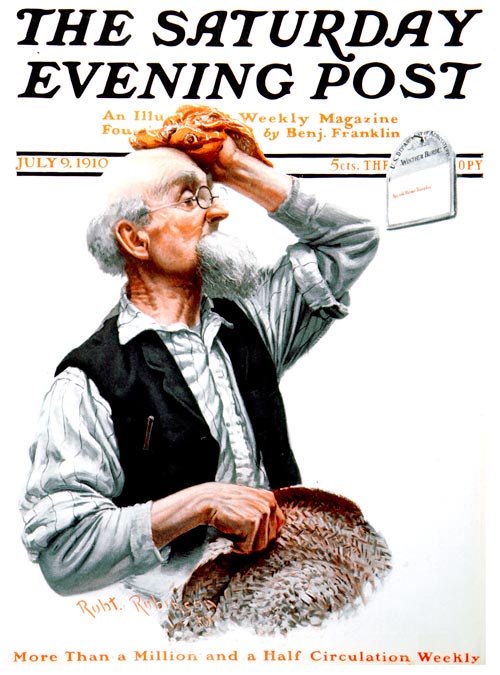
Robert Robinson
July 9, 1910
The man on this Robert Robinson cover illustrates what a lot of people around the U.S. have been going through the past couple of weeks. If he’s really that hot, he should lose the vest. Also, why is the notice from the Weather Bureau levitating?
Today Is National French Fries Day
Do people actually go to the trouble of making french fries at home? I may sound lazy, but it seems to be one of those foods that is more of a hassle than anything else, especially when you can go out and buy McDonald’s fries (even Julia Child loved them!). But if you want to make them at home, here’s a recipe from Ree Drummond.
They go great with carrot dogs.
Next Week’s Holidays and Events
National Nude Day (July 14)
I want to be a bit of a rebel, so I’m going to celebrate the day by wearing clothes.
Bucket List
Piper’s in my purse. In a ziplock baggie. Our family isn’t big on frills. We use what works. But that doesn’t mean there can’t be magic. These days I constantly try to remind myself of this. It isn’t easy, but I try hard. Remember Mom, what Einstein tells us. The most beautiful experience we can have is the mysterious.
Piper wanted to drive cross country. Among 10,000 other things. She had quite the bucket list. Most everything had no reason, other than the doing. She started the list when she was 8. She wrote the first two things on a to-do list I kept stuck to the fridge with a magnet. Fix washer in bathroom sink. Buy bleach. Meet a real Indian. Catch a rainbow trout with Dad. The list ran on to other scraps. Eventually it made its way into a leather notebook she bought herself. She managed to strike through more than a few things on the list.
The leather notebook is in the glove box of the car. I glance to the glove box — See? We’re really doing this — as I turn off the two-lane road and on to a dirt track. I can see the trailer a mile away, the night shadows just drawing away from it. Everywhere is brown grass, looks like it hasn’t seen water since Moses did his parting. Albuquerque is a long way from home. For one thing, everything is wide open, so you can see for miles. The sky looks bigger. It’s like you are an insect, and God took the lid off the jar.
I park in the dirt lot in front of a bleached trailer. I’m the only car. Already my stomach’s heavy and bubbling, like cumin was tossed in, and stones to go with it. My hands are jittery. I sit for a minute, gripping the wheel and watching the sun pull free of the mountains. I tell myself me being here would make Piper laugh herself blue. Which she did a lot. I mean, her face would actually turn blue. The first time, Sean thought she was choking. I’d never seen him move so fast.
I get out of the car. About 50 yards away, there’s a man sitting in a plastic chair, his back to me. In the field beyond him, five large wicker baskets are scattered about, as if giants had just fled a picnic. When he stands and walks toward me, my heart jumps. I breathe fast. I want to laugh. I want to cry. Durn you, Piper.
I hold my breath. Get a grip on yourself, Scarlett.
The man has an easy smile and a comic book in one hand.
“Can I help you, ma’am?”
I see the wedding ring on his scarred, brown hand. I wonder if he has a daughter.
I try not to stare.
“I’d like to take a balloon ride.”
When the man consults the sun, he looks to me like he’s in a poster. The sun is now barely looking down on the mountains.
“You’re a trifle early, even by ballooning standards.”
“It’s something I’ve always wanted to do.”
The man’s eyes flick to the trailer.
“Well I’m happy to help, but we don’t open until six-thirty, and the woman who runs this place is particular about procedure and paperwork.”
“I can wait,” I say.
The man hesitates.
“Here’s the thing,” he says. “It’ll be expensive. She charges a flat rate for going up. Usually, you split it with the other people in the group. But there’s no groups today. Our season doesn’t really start up until school gets out.”
I have lived every day worrying about money.
“It’s okay,” I say.
The man nods toward the trailer.
“Door’s open, and I’ve got a pot of free coffee going if you’d like some. I’m the only one who drinks it. Folgers isn’t up to Griselda’s snuff. The paperwork’s on the desk, if you want to get a jump on things.” He winks. “Word of warning. Griselda isn’t overly charming in the morning. She isn’t really Griselda, either. It’s just what I call her. You might want to try Monica.”
He gives me the once over, but not in the way most men do. More like he’s skimming the paper, looking for something interesting to read.
“My guess is you can handle yourself, but don’t say I didn’t warn you,” he says.
I walk up the swaying steps. I leave the rutted door open so I can see out. I pour myself coffee and sit. At twenty past six, a rusted gold Cadillac crackles to a stop in front of the trailer. A blonde in a tight white dress gets out of the car. She walks carefully toward the trailer atop high heels. Steam rises from the reusable cup in her hand. The man stands and waves to her, but she does not acknowledge him.
I stand as her steps set the trailer rocking.
First time round, lots of women don’t like me. I suppose I’m a funny mix. Daddy used to say I was all sugar on the outside, and all cuss and vinegar directly under that. I’m told I have attitude and blue eyes that knock people back. Looks come in handy, but I don’t put any stock in them. It’s just a mask.
Monica gives me a different head to toe. I wait while she does. It’s her place. She should have first say. I try to look friendly.
“He told you to come in,” she says.
“Yes. The gentleman out front.”
“I didn’t realize there was a gentleman out front.”
“He offered me coffee.”
“Of course he did.”
She walks behind the desk and sits. Sipping her coffee, she looks up at me.
“You know the cost,” she says.
Two months’ rent.
“Yes.”
I’m a good actor, but the woman sees it stings.
She plucks the two-way radio from its stand.
“Say goodbye to Spiderman, and get in here,” she says.
Stepping inside, the man grins at me, then turns to the desk.
“You told her to fill out the paperwork?”
“Good morning, Monica.”
“I asked you a question, Gary.”
The name is a bit of a surprise. I wouldn’t have expected something so bland.
“I did ask her to fill out the paperwork,” Gary says. “The sun’s up. Carpe diem.”
“I like to see the paperwork filled out.”
Gary turns his hands out, the way all men do.
“Why sit idle?” he says.
“Because it’s something you’re good at.”
She looks at me.
I take the cash from my purse.
She counts the bills and hands a 20 back.
“Discount for paying cash,” she says.
She looks to Gary.
“Take her up whenever you’re ready,” she says.
Out under the big sky, Gary says, “She’s a tad gruff at times. The rest of the time, she’s bossy with those she knows.”
Gary claps his hands together. The sound rings like a rifle shot.
“So Scarlett, it’s nice to meet you. My name is Gary, and I’ll be your pilot.”
I’m having fourth thoughts. I feel out of place. Disoriented. Helplessness is not my condition, though I’m growing more accustomed to it.
“What do I do?” I say.
Gary flips his pony tail over his shoulder.
“Just get your affairs in order.”
Gary knows.
“Sorry,” he says. “It’s part of the shtick. There is one thing you can do.” He nods at the purse clenched in my hand. “Folks tend to drop things, and it’s not that easy going up and down. You can leave it in the trailer, if it’s easier. It’ll be safe there.”
“I’d just as soon walk it back to the car.”
“Of course.”
I don’t care about the purse, or most of its contents. I come back from the car wearing a jacket. The North Face. It’s Piper’s. We were the same size.
Gary is bumping a wheelbarrow across the scruffy grass. The balloon is in a burlap bag that doesn’t look all that big.
“Don’t worry,” smiles Gary, “it’s all there.”
We crunch through the grass, the mountains looking down on us. We must look very small.
“She was my wife, you know.”
“I know.”
Gary weaves the wheelbarrow as he walks.
“Funny, in the end, the things that bring you down,” he says. “We were married twenty-five years, happy at that until the last few years. Then the little things that used to go away, didn’t. They just piled up until we were both standing there, miserable under the weight. I guess parting was our way of lightening the load.”
Gary drops the back end of the wheelbarrow. With a grunt, he drops the burlap bag in the grass. Opening the end, he begins hauling out a kaleidoscope of pink, blue, and orange fabric. Like a magician.
“Little, stupid things,” he says, pulling hand over hand. “Monica, she always wanted a lawn, but as you can see, the place isn’t exactly lawn friendly. Before they started pumping water in here, the only ones crazy enough to live here were the Indians.”
Gary spreads the balloon, carefully smoothing each section.
“We’re separated. Irreconcilable differences is what the lawyers lump all the small things under. She wants to put sprinklers in here too. Says green grass would make us look more professional. I can’t imagine the water bill for a place this size.”
Gary looks up at the pale blue sky. It’s like a bowl turned upside down.
“It’s a beautiful day for flying,” he says.
Piper always wanted to fly. Not fly in a plane. She did that to France, and she hated every second of it, being shoehorned in with a bunch of sweating, whining, surreptitiously farting passengers. No, she wanted to fly. To lift off the ground, and go. When she was 6, she declared she would. She was so damn determined, for a time I followed her pretty much everywhere. I was sure she’d find herself a ladder, clamber up on the roof and jump.
Dreams of flying, they’re probably not hard for you to imagine. Most of us dream about flying. But Piper didn’t let it rest there. No, she studied it, and she came across some interesting things. One night at dinner, she looked across the table at us.
“Odonata,” she said.
“What, honey?”
I tried to be a good parent.
“Dragonfly,” she said.
Sean’s eyes were always tired, but they always brightened when Piper started in on something. It hurt me a little, but they really were kindred spirits. Sometimes it seemed like one knew what the other one was going to say before they said it. The way Sean would look at her, as if she was the Second Coming. In a way, she was. Sean was a wild thing until he became a father.
Sean put down his forkload of meatloaf.
“Tell us some more,” he said.
The flickering candle light on her sober face made her look like one of those announcers in an old-time movie newscast. War has been declared …
She placed both hands on the table.
“Beware the dragonfly,” she said. “They can fly straight up. They can fly straight down. They can fly in one place, like a helicopter. They catch their prey in midair, but no one sees it because they do it so fast. The only way you can tell is you see them chewing.”
She regarded us with her funeral director’s face.
“They are one of the world’s most fearsome predators,” our daughter said. “They lived with the dinosaurs. Magic in real life.”
There is roaring in my ears. The bellow of Tyrannosaurus Rex.
The gas that’s making the flame that’s filling the balloon.
Gary shouts.
“Scarlett? Back away a little, please.”
The balloon fidgets on the grass, then it lifts and swings up over the basket. It looks like a sausage, but it is rounding fast. It means business. It is going to fly.
When it is round, Gary opens the wicker gate and bows.
“Your carriage,” he says.
I am a slender woman, but when I step into the basket the whole damn thing rocks. Everything moves but the stone in my stomach.
I don’t have internet. I don’t have a computer. Sean took it when he left. Two months after Piper died, I went to the library. The librarian, a crotchety old lady even the adults fear, took me gently by the arm and led me to a table. She found me the rest of Albert Einstein’s quote. We read it together because there was nobody else in the library, and then she left me alone in the room full of books. The full Monty goes like this. The most beautiful experience we can have is the mysterious. It is the fundamental emotion which stands at the cradle of true art and science. Whoever does not know it can no longer marvel, is as good as dead and his eyes are dimmed.
Piper’s eyes were anything but dimmed. Still, she didn’t see the cab. She stepped off the curb, and she was dead. People shouted in French, but it made no damn difference.
The cabbie was speeding. Twenty yards away, the Seine spun past, probably in no hurry.
When Sean took the news on the phone, it looked like his back broke.
I grip the railing of the wicker basket with my right hand. I’d grip it with both hands, but my left hand is in Piper’s jacket pocket.
I’ve thought about this all the way across Arkansas, through Oklahoma and down across Texas. The more I thought about it, the righter it seemed. These open skies, they kept whispering to me.
The fire-gas contraption roars again. I wish I would get eaten. Gary unloops the last rope. The basket starts a sideways slide. The cold stone in my stomach slides with it. I hate weakness, but I’m strong enough to admit to it. Just going up on the roof to rescue Piper would have been a chore.
“Ballooning is the oldest form of flight!” Gary shouts over the blast furnace roar.
That sure doesn’t help.
The basket swings skyward.
It’s not as if we’re flying. It’s as if the ground is falling away. My stomach falls with it.
Durn you, Piper.
I force my eyes open, but not because I’m paying buckets of money for this.
It’s silent now. Just the wind.
Gary rests a hand gently on my shoulder.
“Good,” he says. “I’d have felt real guilty if you’d gone through the whole thing with your eyes closed.”
Now that the ground’s so far away, it isn’t so bad. It may be a little good, a lovely drifting away from gravity-bound life. Away from the dullness that drains joy and imagination. That makes us adults. That makes us forget our dreams. That sends us to our grave even before our time.
“I’m okay now,” I say.
“I believe you are.”
The wind doles out cool slaps. I feel light and free. I feel the glory of soaring.
This is what it feels like when you run off the roof, lifting toward the sun.
Mr. Einstein, you are right.
Not that I let go of the railing.
I look toward the mountains. They look like sleeping dinosaurs. Maybe they are.
“My daughter wanted to fly.”
Gary watches the mountains too.
“Good for her,” he says.
The breezes circle us as if we are some curiosity.
“I brought something.”
“I’ll give you a moment,” Gary says.
“Thank you.”
Gary moves to the other side of the basket.
The ashes just drift away. One second, Piper is here. The next, she’s gone.
What can you say?
“Odonata,” I whisper.
When Gary steps back, he says, “Makes you feel privileged, doesn’t it? A few steps closer to heaven.”
“How high do you go?”
His noble face is impassive, but I know he is smiling inside.
“Depends on the conditions,” he says.
“How are the conditions?”
“Good,” says Gary. “Real good.”
Back on the crackly grass, Gary shakes my hand. I feel his wedding ring.
“It was an honor,” he says.
Driving away I see him in the rearview mirror, walking up the trailer steps. I know Monica stepped into the rest room to tidy up when he radioed to say we were 10 minutes away. Like most men, Gary understands some things, but not others. Why would a woman get dressed up like that to sit in a trailer in the middle of nowhere? It’s almost funny how we see some things so clearly, and others we’re struck dumb and blind. It’s another mystery, isn’t it?
I’m not sure where I am when I pull off to the side of the road. Dust rises around the car. The desert runs everywhere. The dome sky looks down.
The dust disappears just like the ashes.
Sean has caller ID. He answers before the second ring.
“I met an Indian,” I say. I feel the sun through the window. I don’t try to wipe away the tears, but I try to keep the stuttering from my voice. “He had beautiful black hair, and he liked comic books.”
There is a pause.
“I always liked Indians,” Sean says. “They remind me of wild places.”
Outside, the sun bakes rock and dust. In a trailer, maybe a man and a woman are talking.
“You’d like it where I’m sitting.”
I hear Sean’s breathing, and then he says in the voice he only used around Piper, “I think I would.”
After we hang up, I sit and look through the windshield. The empty road is razor straight. A truck comes up over the horizon’s edge.
I open the glove box.
I don’t walk far. I place the notebook on a rock, so that it looks up at the blue sky.
As I step back up to the car, the truck blasts past. The car rocks, but the desert stays like it was.
Maybe no one will find the notebook. Maybe the person who finds it will try a few of the things themselves. I like that idea. Though in the end, we each have our own bucket list. Whether we know it or not. Sometimes the list changes, depending on the circumstances.
I bump the car up on the road. All the windows are down. As the car gains speed, wind fills the car with a madcap whopping. Paper cartwheels and dances.
Piper was right. You can fly.
Something opens in my chest, and I drive toward the sun.
Movies for the Rest of Us with Bill Newcott: Shark Week
Bill Newcott reviews Gauguin: Voyage to Tahiti, Mamma Mia! Here We Go Again, and The Equalizer 2 starring Denzel Washington and directed by Antoine Fuqua. (He also pays homage to the best “walking away from an explosion” scenes). Don’t miss Bill’s reviews of latest home video releases, including National Parks Adventure, On Chesil Beach, Isle of Dogs, and Tully. Finally, it wouldn’t be summer without Shark Week.