Smartphone Deniers
Sometimes I dream I’ve lost my iPhone. I’m adrift in the universe, cut off from my Facebook, Google, Twitter, email, texting, YouTube, livestream, and camera apps. It’s a terrifying prospect.
Like millions of Americans, I’m unashamedly addicted to my silicon-stuffed little slab. In just 10 years’ time, smartphones have managed to both transform and torture our culture (and me). These days, rather few of us can get to the morning’s first cuppa without reflexively checking in with our iOS- or Android-powered phone. Pathetic, eh?
Yet there are perfectly decent people — maybe you’re among them? — who dismiss smartphones, or even resent them. They just want to be left the hell alone by the millions of buzzing, beeping, and vibrating apps that are the signature of these pricey devices. Why? Because they don’t see the point of having massive processing power — not to mention GPS tracking — in the palm of their hand.
For some consumers, of course, cost is a hang-up, especially as you can grab a sweet little flip phone or bar-style model for under 20 bucks. Ramon Llamas, a market research analyst at IDC, which focuses on mobile-phone trends, told me the choice of a basic phone over a do-everything smartphone “really just comes down to one thing: cost.” Except that does not really tell the entire story.
Nancy Wintner, a veteran PR consultant in Pittsburgh, represents another perspective. “I have no interest in carrying my computer around in my purse,” she said to me, emphatically. She uses a bar phone that has limited functionality. “It meets my needs. I don’t feel disconnected from the world. I can always just pick up the phone and make a call.”
People like Wintner are not necessarily tech-averse outliers. They merely “choose to avoid the constant bombardment of information,” Bob O’Donnell, chief analyst at TECHnalysis Research, told me.
Others, according to O’Donnell, avoid smartphones largely because they cling to an old-fashioned notion of independence. “They’ve chosen to walk away from the overwhelming connectedness of modern life. It’s a retro thing.” These are the same folks who are drawn to the resurgence of vinyl records. “They are making a philosophical statement,” O’Donnell said.
Not surprisingly, one finds a diminishing number of smartphone users in the upper age ranges — but not by much. Until about the age of 75, O’Donnell said, people are generally willing smartphone users. After that, less so.
Someone like Snow Philip, a part-time journalist in Key West, Florida, is, at 74, right on the cusp. Philip owns a smartphone — it was a gift — but she’s packed it away. “I think it would complicate my life, which is full and rich. I don’t want to be as obsessed as everybody else, Facebooking and Twittering all the time,” she said when I called her on her landline. “It’s very unattractive to me.”
And then we have the last of the BlackBerry hangers-on, those stubborn few. Their devices today incorporate some smartphone-style goodies but are sparer by far. Among the most high-profile proponents is Michelle Kosinski, White House correspondent for CNN. Maybe you’ve seen her tapping away on her little BlackBerry in the White House briefing room. “I really love its simplicity and the [physical] keyboard,” Kosinski told me. “Emotionally, when I touch it, I think through it. And iPhone apps just annoy me.”
Most others in the White House press corps “have conceded defeat,” Kosinski said of the once ubiquitous BlackBerrys, but she’s in until the bitter end. Just in case, she’s stashed a bunch of older models in a drawer at home. “It may be the longest relationship I’ve ever had,” she said to me with a guilty giggle.
To those of us who love our phones to excess, Kosinki’s sentiment, though intended to be cute, has the sad, unmistakable ring of truth.
Cable Neuhaus writes about popular culture and media.
Top 10 Winter Reads
Fiction
The Girl Before
by J.P. Delaney
An enthralling psychological thriller that spins one woman’s seemingly good fortune, and another woman’s mysterious fate, through a maelstrom of duplicity, death, and deception.
Ballantine
The Sleepwalker 
by Chris Bohjalian
In this thriller about lies, loss, and buried desire, Annalee Ahlberg is a sleepwalker who goes missing. While she has disappeared in the past, this time seems eerily different, and her children are worried.
Doubleday
 Lincoln in the Bardo
by George Saunders
In 1862, Abraham Lincoln lost his 11-year-old son, Willie. The National Book Award winner draws inspiration from this event to write a kaleidoscopic tale that takes place in a single night.
Random House
 4 3 2 1
by Paul Auster
A child is born two weeks early in 1947. Starting at the maternity ward, Auster explores four separate paths for the child. Inventive yet realistic, this is one of Auster’s greatest works. Perhaps the best.
Henry Holt
 The Futures
by Anna Pitoniak
Evan and Julia are from widely divergent backgrounds. After they meet at Yale and fall in love, they move to New York, where all is rosy until the 2008 financial collapse hits.
Lee Boudreaux Books
Nonfiction
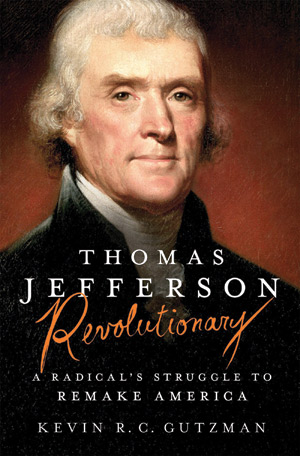 Thomas Jefferson — Revolutionary
by Kevin R. C. Gutzman
Fascinating perspective on a radical founding father. Jefferson had very clear thoughts on citizenship, the size and scope of government, and other important topics of the time that still resonate today.
St. Martin’s Press
 The Nature Fix
by Florence Williams
We all know that nature is good for us. In this book, the author looks at the intersection of nature, mood, health, and creativity.
W.W. Norton
 Portraits Of Courage
by George W. Bush
A vibrant collection of oil paintings and stories honoring the sacrifice and courage of America’s military veterans. Net author proceeds donated to George W. Bush Institute’s Military Service Initiative.
Crown
 The Lost City of the Monkey God
by Douglas Preston
In 2012, the best-selling thriller writer boarded a small plane into the Honduran interior to search for a fabled lost city. Here is that story.
Grand Central Publishing
 Ripper: The Secret Life of Walter Sickert
by Patricia Cornwell
This best-selling author has been on the trail of Jack the Ripper for years. Here, she adds more extensive evidence to her theory that the fabled murderer was a charismatic Victorian painter.
Thomas & Mercer
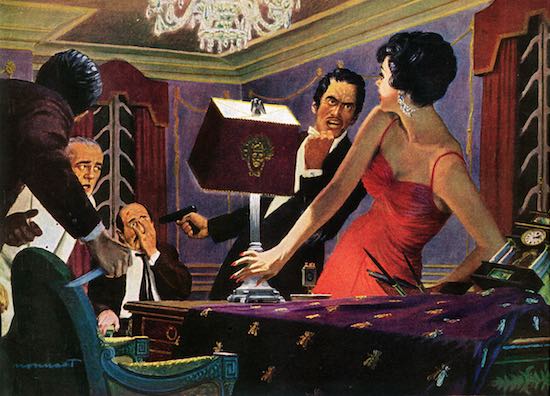
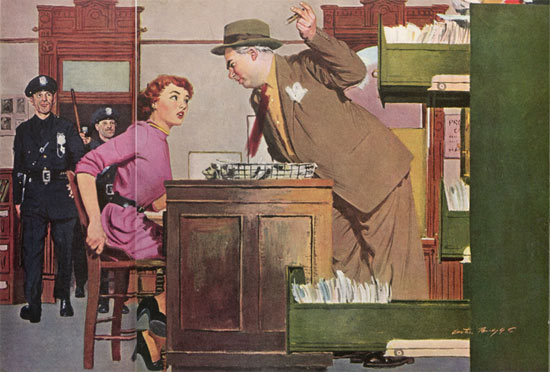
Gallery: Women of Mystery
Whether the women in these 1950s-era illustrations are solving crimes or committing them, you can be sure there’s plenty of intrigue afoot!
Which mystery-themed illustration do you like more? Let us know by responding with one of the designated emojis on our Facebook post! You’ll be entered into a random drawing for a chance to win a DVD set of Acorn TV‘s Agatha Christie’s And Then There Were None.
In And Then There Were None, Ten strangers meet in a solitary mansion on a remote island near the Devon coast. Awaiting the arrival of their hosts, they start to die, one by one. Based on the best-selling book by Agatha Christie, this lavish adaptation features an all-star cast including Aidan Turner (Poldark), Charles Dance (Game of Thrones), Toby Stephens (Vexed), Anna Maxwell Smith (The Bletchley Circle), Miranda Richardson (The Hours), and Sam Neill (Peaky Blinders). Seen on Lifetime.
Deadline to vote is January 23. See Official Rules.
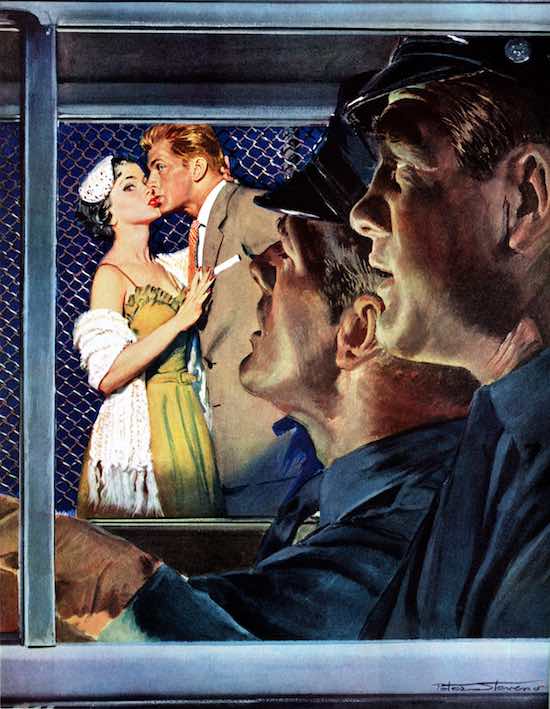
The Outcasts
Peter Stevens
September 29, 1956

Furlough in Flatbush
Frederic Varady
August 19, 1944
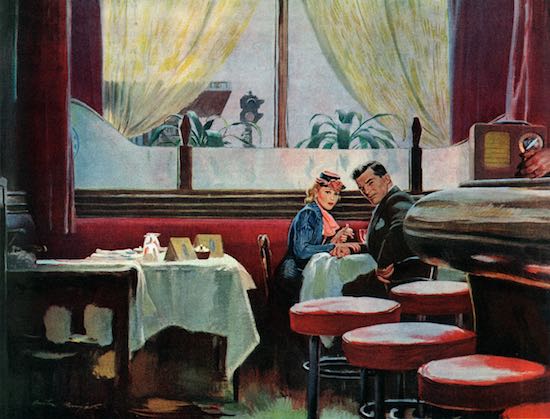
The Unsuspected
Austin Briggs
August 11, 1945
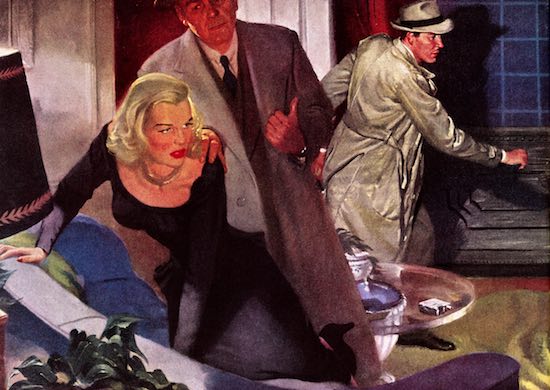
Sentence of Death
Ken Riley
October 23, 1948
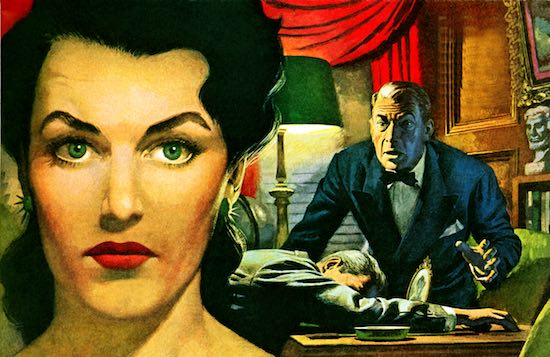
Easy to Murder
James R. Bingham
January 6, 1951

Girls Are Where You Find Them
George Englert
January 17, 1953

Death in the Wind
Bernard D’Andrea
November 5, 1955
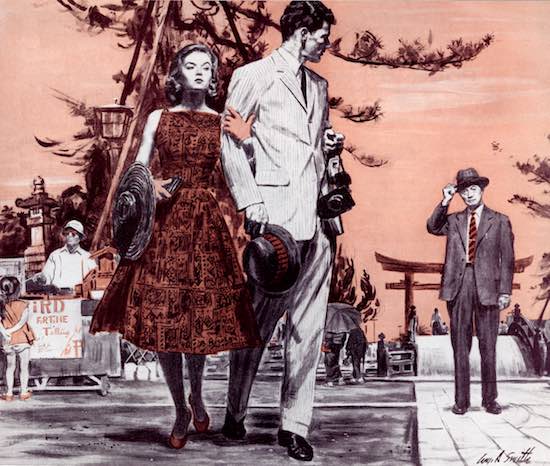
Rendezvous in Tokyo
William A. Smith
December 15, 1956
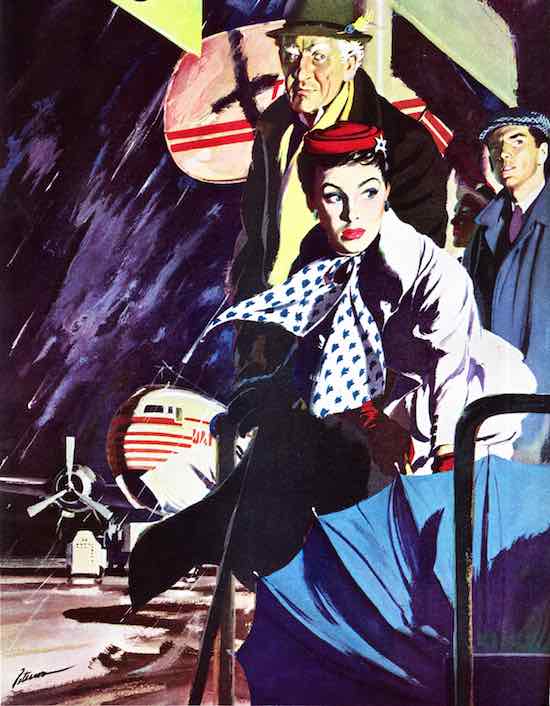
Murder on Order
Perry Peterson
March 9, 1957
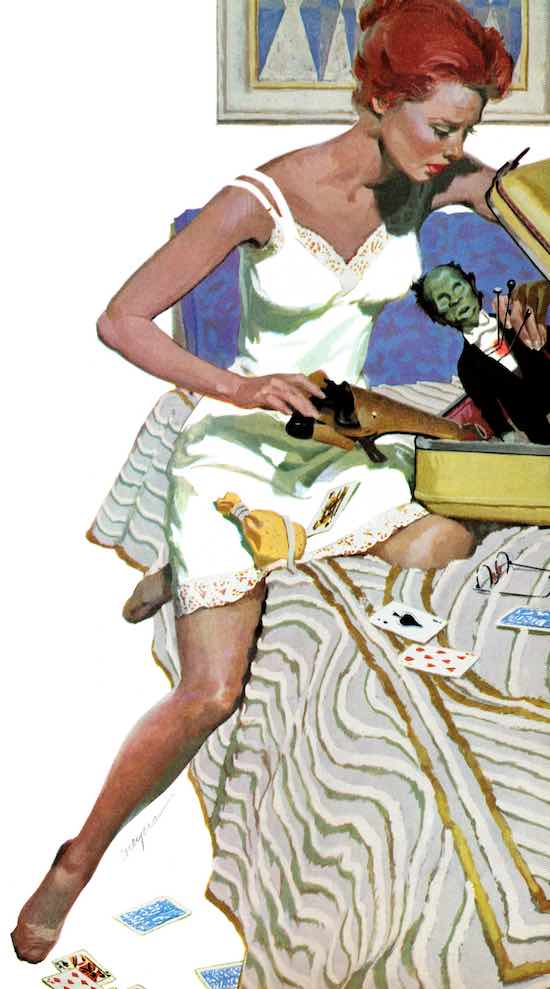
The Artless Heiress
Robert Meyers
June 1, 1957
Gem Thief
November 29, 1958
It All Happened to Me
Austin Briggs
July 1, 1950

Feminine Reflex
George Englert
September 3, 1949
Whose Motor Was It Really?
This article from the April 15, 1911 issue of the Saturday Evening Post was featured in the Post’s Special Collector’s Edition: Automobiles in America!
Patent attorney George B. Selden’s 1879 design for the gas-powered internal combustion engine would for a time command fees from the entire car business. That’s remarkable considering automobiles would not be built for sale until the late 1890s. In this article, published in 1911, just months after the patent was finally struck down, the Post describes the extraordinary lengths Selden took to make sure his patent would hold up once cars became a practical reality.
George B. Selden was a patent attorney practicing in Rochester when, in 1876, he conceived the idea of a carriage propelled by a gasoline engine. He led an application for a patent on May 8, 1879, for a “road engine.” Had that patent been issued in the regular course of patent office events it would have expired about the year 1896, just when the first motor cars were seen in our streets, and Selden would have had absolutely nothing to show for whatever time, money, and thought he had spent on his invention. But Selden, being a patent lawyer, knew more than the ordinary inventor. He knew that he was ahead of the times, that he must file an application for a patent to forestall any subsequent inventor who also would devise a “road engine,” and yet he realized that no patent must issue to him before the world was ready to pay him royalties. Under the law that was in force up to 1897, an application for a patent could always be prosecuted within two years of the last official action.
The record of the case in the patent office shows that the application was rejected on May 31, 1879, and that an amendment was not led until May 26, 1881, nearly two years later. A second rejection on June 17, 1881, was followed on May 15, 1883, by another amendment. An official letter sent to Selden on June 15, 1885, was not acted upon until June 13, 1887, only two days before the expiration of the two years of grace allowed by law. Another rejection on June 21, 1887, was answered by a letter dated April 13, 1889, and by an amendment filed on June 10, 1889. The original specification and claims were now such a tangled mass of corrections that the patent office demanded a “smooth copy” on June 14, 1889. Although the case was ready for issue, the demand was not complied with until June 6, 1891, nine days before the statutory limit. An official letter, which required the filing of a new oath, was not answered until June 28, 1892. The case was then transferred to another examiner, by whom some of the claims previously allowed were rejected on July 29, 1893. An amendment in reply was not led until April 1, 1895. Finally on November 5, 1895, the patent was definitely issued, but without a single one of the original 19 claims.
Obtaining a patent is one thing; earning respect for it is another. Selden’s patent was always looked upon askance by automobile makers and laughed at by patent lawyers. Its validity was ever in doubt. Yet it was made to earn a fortune despite the cloud that hovered over it. After passing into the control of a manufacturing company, it was eventually acquired by the Association of Licensed Automobile Manufacturers. That association hit upon the ingenious expedient of charging such a small royalty for the right to manufacture under this patent of doubtful validity that most automobile makers decided to pay rather than to engage in litigation that would prove a thousand times more expensive and would probably drag along for a decade. The royalty paid by the licensees has uctuated from 1.25 percent to a fraction of 1 percent. Small as this tribute was, the sum total must have amounted to several million dollars.
Revolutionists in invention are as little likely to die rich as are revolutionists in politics, and the guillotine of the business world is ever ready to cut short the career of the Robespierre of mechanics.
—“The Business Side of Invention,”
The Saturday Evening Post, April 15, 1911
Winter Soups Take Root

When I walk in the door on a bone-chillingly cold winter’s day, I enjoy hunkering down in front of the fireplace with a piping hot bowl of homemade soup or stew to warm body and spirit.
No matter what the season, my cooking philosophy is this: Keep it simple and cook with naturally produced, seasonal ingredients, just as Mother Nature intended. If you use the right ingredients at the right time of year, it’s hard to go wrong.
The beauty of soups and stews is that the combination of seasonal ingredients you can pile into recipes is infinite. During the winter months, veggies like carrot, parsnip, potato, cauliflower, celery root, and fennel are in season and cook up beautifully in soups and stews, softening in flavorful broths on the stovetop.
I have two restaurants and two little boys, so life is pretty busy in the Stone home right now. That’s why now more than ever, make-ahead meals like soups are a real lifesaver for my wife Linds and I. There’s nothing better than the delicious aromas of homemade soup or stew wafting through the house while the family is puttering around on a Sunday afternoon.
What’s great about Weeknight Navy Bean and Ham Soup is that you can make it with dried beans but without the usual 12-hour presoak, becoming a wholesome meal you can enjoy any weeknight — thus the name. Though it may look unassuming, Creamy Celery Root Soup is a favorite in the Stone household. Each spoonful boasts a rich texture and wonderful flavor reminiscent of celery and parsley — sure to win the whole family over.
Creamy Celery Root Soup
(Makes 8 servings)
2 tablespoons (1/4 stick) unsalted butter
1/2 cup coarsely chopped shallots
3 pounds celery root, peeled and cut into 1-inch cubes
3 cups low-sodium chicken broth
3 cups 2% reduced-fat milk
3/4 cup heavy cream
2 fresh thyme sprigs
1 bay leaf
1 1/2 teaspoons kosher salt
2 teaspoons extra-virgin olive oil, for garnish
2 tablespoons chopped fresh chives, for garnish

Photography by Ray Kachatorian
In large heavy saucepan, melt butter over medium heat. Add shallots and sauté for 2 minutes, or until translucent. Add celery root, broth, milk, cream, thyme sprigs, bay leaf, and salt and bring to gentle simmer. Reduce heat to medium-low and continue to simmer very gently, uncovered, stirring occasionally, for 35 minutes, or until celery root is tender enough to mash with spoon. Remove from heat and remove thyme sprigs and bay leaf. Working in batches, using slotted spoon, transfer celery root and shallots to blender (preferably high-powered one) and blend until smooth, adding enough of cooking liquid to form smooth and creamy soup (you may not need all of liquid); return pureed soup to pot and rewarm over low heat before serving. Ladle soup into bowls. Drizzle with olive oil, sprinkle with chives, and serve.
Make-Ahead: Can be made one day ahead, cooled, covered, and refrigerated. Rewarm, covered, over low heat, adding more broth if necessary.
Per serving
Calories: 205
Total Fat: 11 g
Saturated Fat: 6 g
Sodium: 665 mg
Carbohydrate: 21 g
Fiber: 3 g
Protein: 7.6 g
Diabetic Exchanges: ¼ vegetable, ½ low-fat milk, 1 ¾ fat
Weeknight Navy Bean and Ham Soup
(Makes 8 servings)
2 tablespoons (1/4 stick) unsalted butter
6 ounces 3/4-inch-thick sliced cooked smoked ham (such as Black Forest), torn into 3/4-inch pieces
1 medium onion, chopped
2 large carrots, diced
2 large celery stalks, diced
2 garlic cloves, finely chopped
1 bay leaf
2 tablespoons chopped fresh sage
1 pound dried navy beans or other small white beans,picked over, rinsed, and drained
5 cups water
4 cups low-sodium chicken broth
Extra-virgin olive oil, for drizzling

In 8-quart pressure cooker, melt butter over medium-high heat. Add ham and sauté for 3 minutes, or until golden brown. Add onion, carrots, celery, garlic, bay leaf, and sage and sauté for 1 minute, or until fragrant. Add beans, 5 cups water, and broth. Lock pressure cooker lid in place and bring to high pressure over high heat, about 15 minutes. Reduce heat to medium-low to stabilize pressure and cook 40 minutes. Remove from heat and allow pressure to subside on its own, about 20 minutes. Unlock pressure cooker and remove lid, tilting it away from you to allow steam to escape. Beans will be very tender. For thicker consistency, coarsely mash bean mixture. Season soup to taste with salt and pepper. Ladle soup into bowls, drizzle with olive oil, and serve.
Make-Ahead: Soup can be made up to 3 days ahead, cooled, covered, and refrigerated. Rewarm, covered, over medium heat, adding more broth if necessary.
Per serving
Calories: 284
Total Fat: 7 g
Saturated Fat: 3 g
Sodium: 593 mg
Carbohydrate: 38 g
Fiber: 10 g
Protein: 19 g
Diabetic Exchanges: ½ vegetable, 2 ½ starch, ½ lean protein, 1 fat
Feeling under the weather? Try Curtis’ “Homemade Chicken Soup Makes Me Feel Better” recipe, featuring kohlrabi, celery root, and turnips, available at saturdayeveningpost.com/feel-better-soup.
Excerpted from Good Food, Good Life by Curtis Stone. Copyright © 2015 by Curtis Stone. Excerpted by permission of Ballantine Books, a division of Random House LLC. All rights reserved. No part of this excerpt may be reproduced or printed without permission in writing from the publisher. Photography by Ray Kachatorian.
“Under the Deck Awnings” by Jack London
“Can any man — a gentleman, I mean — call a woman a pig?” The little man flung this challenge forth to the whole group, then leaned back in his deckchair, sipping lemonade with an air commingled of certitude and watchful belligerence. Nobody made answer. They were used to the little man and his sudden passions and high elevations.
“I repeat, it was in my presence that he said a certain lady, whom none of you knows, was a pig. He did not say swine. He grossly said that she was a pig. And I hold that no man who is a man could possibly make such a remark about any woman.”
Doctor Dawson puffed stolidly at his black pipe. Matthews, with knees hunched up and clasped by his arms, was absorbed in the flight of a guny. Sweet, finishing his Scotch and soda, was questing about with his eyes for a deck-steward.
“I ask you, Mr. Treloar, can any man call any woman a pig?”
Treloar, who happened to be sitting next to him, was startled by the abruptness of the attack, and wondered what grounds he had ever given the little man to believe that he could call a woman a pig.
“I should say,” he began his hesitant answer, “that it — er — depends on the — er — the lady.” The little man was aghast.
“You mean —” he quavered.
“That I have seen female humans who were as bad as pigs — and worse.”
There was a long, painful silence. The little man seemed withered by the coarse brutality of the reply. In his face was unutterable hurt and woe.
“You have told of a man who made a not nice remark, and you have classified him,” Treloar said in cold, even tones. “I shall now tell you about a woman — I beg your pardon — a lady — and when I have finished I shall ask you to classify her. Miss Caruthers I shall call her, principally for the reason that it is not her name. It was on a P.& 0. boat, and it occurred several years ago.
“Miss Caruthers was charming. No; that is not the word. She was amazing. She was a young woman and a lady. Her father was a certain high official whose name, if I mentioned it, would be immediately recognized by all of you. She was with her mother and two maids at the time, going out to join the old gentleman wherever you like to wish in the East.
“She — and pardon me for repeating — was amazing. It is the one adequate word. Even the most minor adjectives applicable to her are bound to be sheer superlatives. There was nothing she could not do better than any woman and than most men. Sing, play — bah ! — as some rhetorician once said of old Nap, competition fled from her. Swim! She could have made a fortune and a name as a public performer. She was one of those rare women who can strip off all the frills of dress and in a simple swimming suit be more satisfyingly beautiful. Dress! She was an artist. Her taste was unerring.
“But her swimming. Physically, she was the perfect woman — you know what I mean; not in the gross, muscular way of acrobats, but in all the delicacy of line and fragility of frame and texture; and combined with this, strength. How she could do it was the marvel. You know the wonder of a woman’s arm — the forearm, I mean; the sweet fading away from rounded biceps and hint of muscle, down through small elbow and firm, soft swell to the wrist, small — unthinkably small and round and strong? This was hers. And yet, to see her swimming the sharp, quick English overhand stroke, and getting somewhere with it too, was — well, I understand anatomy and athletics and such things, and yet it was a mystery to me how she could do it.
“She could stay under water for two minutes. I have timed her. No man on board, except Dennitson, could capture as many coins as she with a single dive. On the forward main deck was a big canvas tank with six feet of sea-water. We used to toss small coins into it. I have seen her dive from the bridge deck — no mean feat in itself — into that six feet of water and fetch up no less than forty-seven coins, scattered at random over the whole bottom of the tank. Dennitson, a quiet young Englishman, never exceeded her in this, though he made it a point always to tie her score.
“She was a sea-woman, true. But she was a land-woman, a horsewoman — a — she was the universal woman. To see her, all softness of flowing dress, surrounded by half a dozen eager men, languidly careless of them, or flashing brightness and wit on them and at them and through them, one would fancy she was good for nothing else in the world. At such moments I have compelled myself to remember her score of forty-seven coins from the bottom of the swimming tank. But that was she — the everlasting wonder of a woman who did all things well.
“She fascinated every betrousered human around her. She had me — and I don’t mind confessing it — she had me to heel along with the rest. Young puppies and old gray dogs who ought to have known better — oh, they all came up and crawled round her skirts and whined and fawned when she whistled. They were all guilty, from young Ardmore, a pink cherub of nineteen, outward bound for some clerkship in the consular service, to old Captain Bentley, grizzled and seaworn, and as emotional, to look at, as a Chinese joss. There was a nice middle-aged chap, Perkins, I believe, who forgot his wife was on board until Miss Caruthers sent him to the right-about and back where he belonged.
“Men were wax in her hands. She melted them, or softly moulded them, or incinerated them, as she pleased. There wasn’t a steward, even, grand and remote as she was, who at her bidding would have hesitated to souse the Old Man himself with a plate of soup. You have all seen such women — a sort of world’s desire to all men. As a man-conqueror she was supreme. She was a whiplash, a sting and a flame, an electric spark. Oh, believe me, at times there were flashes of will that scorched through her beauty and seduction and smote a victim into blank and shivering idiocy and fear!
“And don’t fail to mark, in the light of what is to come, that she was a prideful woman: pride of race, pride of caste, pride of sex, pride of power — she had it all, a pride strange and willful and terrible.
“She ran the ship, she ran the voyage, she ran everything — and she ran Dennitson. That he had outdistanced the pack even the least wise of us admitted. That she liked him, and that this feeling was growing, there was not a doubt. I am certain that she looked on him with kinder eyes than she had ever looked with on man before. We still worshiped and were always hanging about waiting to be whistled up, though we knew that Dennitson was laps and laps ahead of us. What might have happened we shall never know, for we came to Colombo and something else happened.
“You know Colombo, and how the native boys dive for coins in the shark-infested bay? Of course it is only among the ground sharks and fish sharks that they venture. It is almost uncanny the way they know sharks and can sense the presence of a real killer — a tiger shark, for instance, or a gray nurse strayed up from Australian waters. But let such a shark appear and, long before the passengers can guess, every mother’s son of them is out of the water in a wild scramble for safety.
“It was just after tiffin and Miss Caruthers was holding her usual court under the deck-awnings. Old Captain Bentley had just been whistled up and had granted her what he had never granted before–nor since — permission for the boys to come up on the promenade deck. You see, Miss Caruthers was a swimmer and she was interested. She took up a collection of all our small change and herself tossed it overside, singly and in handfuls, arranging the terms of the contests, chiding a miss, giving extra rewards to clever wins; in short, managing the whole exhibition.
“She was especially keen on their jumping. You know, jumping feet-first from a height, it is very difficult to hold the body perpendicularly while in the air. The center of gravity of the human body is high, and the tendency is to overtopple, but the little beggars employed a method new to her, which she desired to learn. Leaping from the davits of the boat deck above, they plunged downward, their faces and shoulders bowed forward, looking at the water; and only at the last moment did they abruptly straighten up and enter the water erect and true.
“It was a pretty sight. Their diving was not so good, though there was one of them who was excellent at it, as he was at all the other stunts. Some white man must have taught him, for he made the proper swan dive and did it as beautifully as I have ever seen it done. You know, it is head-first into the water; and from a great height the problem is to enter the water at the perfect angle. Miss the angle and it means at the least a twisted back and injury for life. Also, it has meant death for many a bungler. This boy could do it — seventy feet I know he cleared in one dive from the rigging — clenched hands on chest, head thrown back, sailing more like a bird, upward and out, and out and down, body flat on the air, so that if it struck the surface in that position it would be split in half like a herring. But the moment before the water is reached the head drops forward, the hands go out and lock the arms in an arch in advance of the head, and the body curves gracefully downward and enters the water just right.
“This the boy did again and again to the delight of all of us, but particularly of Miss Caruthers. He could not have been a moment over twelve or thirteen, yet he was by far the cleverest of the gang. He was the favorite of his crowd and its leader. Though there were many older than he, they acknowledged his chieftaincy. He was a beautiful boy, a lithe young god in breathing bronze, eyes wide apart, intelligent and daring — a bubble, a mote, a beautiful flash and sparkle of life. You have seen wonderfully glorious creatures — animals, anything, a leopard, a horse — restless, eager, too much alive ever to be still, silken of muscle, each slightest movement a benediction of grace, every action wild, untrammeled, and over all spilling out that intense vitality, that sheen and luster of living light. The boy had it. Life poured out of him almost in an effulgence. His skin glowed with it. It burned in his eyes. I swear I could almost hear it crackle from him. Looking at him, it was as if a whiff of ozone came to one’s nostrils — so fresh and young was he, so resplendent with health, so wildly wild.
“This was the boy, and it was he who gave the alarm in the midst of the sport. The boys made a dash of it for the gangway platform, swimming the fastest strokes they knew, pell-mell, floundering and splashing, fright in their faces, clambering out with jumps and surges, any way to get out, lending one another a hand to safety, till all were strung along the gangway and peering down into the water.
“‘What is the matter?’ asked Miss Caruthers.
“‘A shark, I fancy,’ Captain Bentley answered. ‘Lucky little beggars that he didn’t get one of them.’
“‘Are they afraid of sharks?’ she asked.
“‘Aren’t you?’ he asked back.
She shuddered, looked overside at the water and made a moue.
“‘Not for the world would I venture where a shark might be,’ she said, and shuddered again. They are horrible! Horrible!’
“The boys came up on the promenade deck, clustering close to the rail and worshiping Miss Caruthers, who had flung them such a wealth of bakshish. The performance being over, Captain Bentley motioned to them to clear out; but she stopped him.
“‘One moment, please, Captain. I have always understood that the natives are not afraid of sharks.’
“She beckoned the boy of the swan dive nearer to her and signed to him to dive over again. He shook his head and, along with all his crew behind him, laughed as if it were a good joke.
“‘Shark,’ he volunteered, pointing to the water.
“‘No!’ she said. ‘There is no shark.’
“But he nodded his head positively and the boys behind him nodded with equal positiveness.
“‘No, no, no!’ she cried. And then to us: Who’ll lend me a half-crown and a sovereign?’ “Immediately the half dozen of us were presenting her with half-crowns and sovereigns, and she accepted the two coins from young Ardmore.
“She held up the half-crown for the boys to see, but there was no eager rush to the rail preparatory to leaping. They stood there grinning sheepishly. She offered the coin to each one individually, and each, as his turn came, rubbed his foot against his calf, shook his head and grinned. Then she tossed the half-crown overboard. With wistful, regretful faces they watched its silver flight through the air, but not one moved to follow it.
“‘Don’t do it with the sovereign,’ Dennitson said to her in a low voice.
“She took no notice, but held up the gold coin before the eyes of the boy of the swan dive.
“‘Don’t!’ said Captain Bentley. ‘I wouldn’t throw a sick cat overside with a shark around.’
“But she laughed, bent on her purpose, and continued to dazzle the boy.
“‘Don’t tempt him,’ Dennitson urged. ‘It is a fortune to him and he might go over after it.’
“‘Wouldn’t you?’ she flared at him. `If I threw it?’ This last more softly.
“Dennitson shook his head.
“‘Your price is high,’ she said. For how many sovereigns would you go?’
“‘There are not enough coined to get me overside,’ was his answer.
“She debated a moment, the boy forgotten in her tilt with Dennitson.
“‘For me?’ she said very softly.
“‘To save your life — yes; but not otherwise.’
“She turned back to the boy. Again she held the coin before his eyes, dazzling him with the vastness of its value. Then she made as if to toss it out, and involuntarily he made a half movement toward the rail, but was checked by sharp cries of reproof from his companions. There was anger in their voices as well.
“‘I know it is only fooling,’ Dennitson said. ‘Carry it as far as you like, but for Heaven’s sake don’t throw it.’
“Whether it was that strange willfulness of hers, or whether she doubted the boy could be persuaded, there is no telling. It was unexpected to all of us. Out from the shade of the awning the coin flashed golden in the blaze of sunshine and fell toward the sea in a glittering arch. Before a hand could stay him the boy was over the rail and curving beautifully downward after the coin. Both were in the air at the same time. It was a pretty sight. The sovereign cut the water sharply, and at the very spot, almost at the same instant with scarcely a splash, the boy entered.
“From the quicker-eyed black boys watching came an exclamation. We were all at the rail. Don’t tell me it is necessary for a shark to turn on its back. That one didn’t. In the clear water, from the height we were above it, we saw everything. The shark was a big brute and with one drive he cut the boy squarely in half.
“There was a murmur or something from among us — who made it I did not know; it might have been I. And then there was silence. Miss Caruthers was the first to speak. Her face was deathly white.
“‘I — I never dreamed!’ she said, and laughed a short, hysterical laugh.
“All her pride was at work to give her control. She turned weakly toward Dennitson, and then on from one to another of us. In her eyes was a terrible sickness and her lips were trembling. We were brutes — oh, I know it, now that I look back upon it; but we did nothing!
“‘Mr. Dennitson,’ she said — ‘Tom, won’t you take me below?’
“He never changed the direction of his gaze, which was the bleakest I have ever seen in a man’s face; nor did he move an eyelid. He took a cigarette from his case and lighted it. Captain Bentley made a nasty sound in his throat and spat overboard. That was all — that and the silence.
“She turned away and started to walk firmly down the deck. Twenty feet away she swayed and thrust a hand against the wall to save herself; and so she went on, supporting herself against the cabins and walking very slowly.”
Treloar ceased. He turned his head and favored the little man with a look of cold inquiry. “Well?” he said finally. “Classify her.”
The little man gulped and swallowed. “I have nothing to say,” he said. “Nothing whatever to say.”
September/October 2016 Limerick Laughs Winner and Runners-Up

“Interference!” was the referee’s call
When the pup deflected the ball.
“The game can’t go on
Till that mongrel is gone.
We’re not playing fetch after all.”
Congratulations to Karen Meissner of Bothell, Washington! For her outstanding limerick, she wins $25 and our gratitude for this funny and entertaining poem describing Dog on the Field (above) by Lonie Bee. You can enter the Limerick Laughs Contest for our next issue of The Saturday Evening Post through our online entry form.
Karen’s limerick wasn’t the only one we liked. In no particular order, here are some of our other favorite contest entries:
There once was a young mutt named Prince
Who easily vaulted the fence
And catching the ball
Was no trouble at all
But the man in the stripes took offense!—Harold Long, Cathedral City, California
The home team was taking a whipping,
When a dog from nowhere came ripping
The play was a fumble,
The ref took a tumble,
And the dog was ejected for clipping.—Dennis Reaves, Oxford, Alabama
Sometimes there is no one at all
To whom I can throw the football.
But one day there was:
The game ended because
It’s my dog who would come when I call.—“Sue Do Nyhm,” Grenada, Mississippi
When Fido first made his appearance,
The ref’s incline granted him clearance.
For ball-chasing, though,
The ref whistled, “Whoa!”
And benched him for Pooch Interference.—S.E. Reynolds, Winger, Minnesota
The home team was gaining some traction
Till the mascot got into the action.
The ref made the call,
“No biting the ball!”
And he tagged the pup with an infraction.—Lisa Timpf, Simcoe, Ontario, Canada
This dog could be a receiver.
Of that I am a believer.
The ref made a call.
The dog got the ball,
Cause he is a pure-bred retriever.—Angie Gyetvai, Oldcastle, Ontario, Canada
His dignity had definitely flown,
For as he ran through
Most everyone knew
That the pup was the ref’s very own.—Lyn Tutor, Magee, Mississippi
This dog is the new substitute
He’s not very big, but he’s cute
As he darts to and fro
He’s stealing the show
With a long run and ref in pursuit.—Chet Cutshall, Willowick, Ohio
In the rulebook that referees wield
Is the penalty for ref-tripping revealed?
It’s most likely not known —
Throw a flag or a bone
For an illegal beagle downfield?—Ross Steacy, St. Johns, Arizona
News of the Week: After Christmas, Last Christmas, and What to Do On New Year’s Eve
That Christmas Feeling
I don’t know what it feels like at your home the days and nights after Christmas, but in mine it feels like it could be October 9 or January 16. Maybe it’s because I didn’t have a tree and only got four cards this year, or maybe it’s because it’s currently 56 degrees, but that Christmas feeling practically vanished on the morning of December 26. It’s been like that for a few years now. I’m going to eat some festive-looking cookies and listen to “The Most Wonderful Time of the Year” several times to force the holiday mood back into me.

Actually, a lot of people don’t like hearing Christmas songs after the big day is over. For them, the songs need to stop at 11:59 p.m. on Christmas night. I’ve never been that way, though. I don’t mind if the holiday tunes continue until the night of January 1. Though anything after that just seems odd and … sad? Though I would make the case that a lot of Christmas songs are actually just winter songs. You can listen to “Baby, It’s Cold Outside” in January and February, because it is (or should be). You can crank up “Let It Snow! Let It Snow! Let It Snow!” until winter’s over because you want to let it. You can even play “Sleigh Ride” because that’s not something you only do in December (in fact, weather-wise, you’re more likely to do it in January or February).
I wouldn’t go with “Jingle Bells,” though. While one could argue that’s more winter/sleigh ride–oriented and isn’t geared toward Christmas, just try to listen to it without thinking of Santa.
RIP Carrie Fisher, Debbie Reynolds, George Michael, Richard Adams, and George Irving
When we all heard that Carrie Fisher had suffered a heart attack on a plane headed to Los Angeles last week, we thought that she would be okay. But the actress passed away on Tuesday at the age of 60.
Fisher, of course, is famous for playing Princess Leia in the first three Star Wars films and last year’s The Force Awakens, and she’d already completed filming her parts for Star Wars VIII. But she was also in many other famous films, including When Harry Met Sally, Shampoo, Hannah and Her Sisters, and Come Back, Little Sheba. She also appeared in TV shows like 30 Rock, Frasier, Laverne & Shirley, Smallville, The Big Bang Theory, and Family Guy (she played Peter’s boss, Angela). She was also an acclaimed writer, penning such books as Postcards from the Edge, Wishful Drinking, and last month’s The Princess Diarist, which sold out on Amazon a few hours after her death was announced. She also worked as a script doctor on many films.
no words #Devastated pic.twitter.com/R9Xo7IBKmh
— Mark Hamill (@MarkHamill) December 27, 2016
And if the death of Fisher wasn’t enough for her family to deal with, just one day later her mother, actress Debbie Reynolds, passed away after suffering a stroke. She was 84.

Reynolds’s career started in the late ’40s with bit parts, which led to her big role in the classic musical Singin’ in the Rain in 1952. She also appeared in The Affairs of Dobie Gillis, Susan Slept Here, Tammy and the Bachelor, The Tender Trap, and How the West Was Won, as well as dozens of other films. On TV she starred in The Debbie Reynolds Show, Aloha, Paradise, The Love Boat, The Golden Girls, and Family Guy, and was nominated for an Emmy for playing Grace’s mom on Will & Grace, along with a ton of other credits over the past 60-plus years. She was nominated for a Best Actress Oscar for her role in The Unsinkable Molly Brown.
If I can inject a quick personal story: I met Reynolds in 1994 when she appeared in an episode of Wings where I appeared as an extra. I just met her for a quick moment (she was with her good friend Rip Taylor) when she talked to the extras that were gathered backstage. She gave a funny performance in that episode.
According to her son Todd, her last words before the stroke were “I miss her so much. I want to be with Carrie.”
I’ve heard “Last Christmas” a lot this month, and a friend commented that it’s odd that the singer of that song should die around the holidays. George Michael passed away Sunday at the age of 53.
Michael hit big fame as half of the duo Wham! (along with Andrew Ridgeley). Besides “Last Christmas,” their hits include “Wake Me Up Before You Go-Go,” “Careless Whisper,” and “Everything She Wants.” When the band broke up in 1986, Michael went on to have solo hits like “Faith,” “Father Figure,” and “I Want Your Sex” (or “I Want Your Love,” depending on what radio station you were listening to at the time). He also teamed with Aretha Franklin for “I Knew You Were Waiting” and Elton John for “Don’t Let the Sun Go Down on Me.”
Richard Adams was the author of the classic children’s book Watership Down, as well as the novels The Plague Dogs, The Girl in a Swing, and Shardik. He passed away Tuesday at the age of 96.
George S. Irving was a Tony-winning stage actor since the early ’40s, appearing in such productions as Oklahoma!, Call Me Mister, Gentlemen Prefer Blondes, Two’s Company, Can-Can, Irma La Douce, and the revival of Pirates of Penzance. He was also seen in such TV shows as The Patty Duke Show, Naked City, All in the Family, Ryan’s Hope, and the cartoons Underdog and Go-Go Gophers.
You probably heard his voice on TV this Christmas season; he was the voice of Heat Miser in the animated classic The Year Without a Santa Claus. Irving died Monday at the age of 94.
The Musketeers of Pig Alley
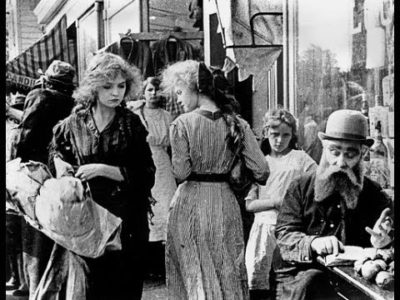
The Library of Congress has announced that 25 films have been added to the National Film Registry, and many of them share a theme. The list includes The Breakfast Club, Rushmore, Blackboard Jungle, East of Eden, and The Decline of Western Civilization, all films that center around teens and their problems.
Other films on the list include Funny Girl, The Lion King, Lost Horizon, and two films I’ve never heard of: D.W. Griffith’s 1912 The Musketeers of Pig Alley (known as the first gangster film) and 1903’s The Life of an American Fireman, one of the earliest feature films.
Sorry, no Adam Sandler films are on the National Film Registry list, but maybe they just haven’t seen Grown Ups 2 yet.
This Week in History
Clara Barton Born (December 25, 1821)
The nurse and patent office clerk started the American Red Cross in 1881.
Norman Rockwell’s Discovery Cover Published (December 29, 1956)
Rockwell’s last Christmas cover for The Saturday Evening Post showed what happens when kids go snooping in their parents’ bedroom after Christmas.
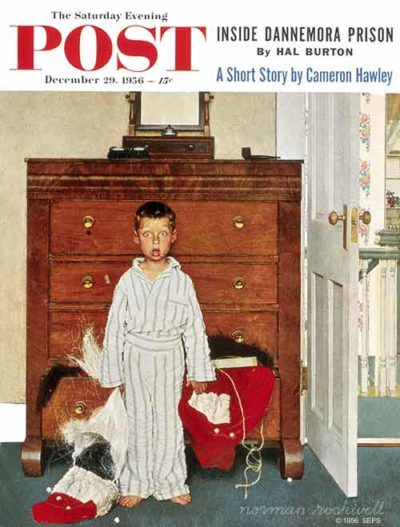
“The Discovery”
From December 29, 1956
USS Monitor Sinks (December 30, 1862)
The remains of the steamship, which sank during a storm off Cape Hatteras, North Carolina, were found in 1973. Several parts of the ship are in the Mariners’ Museum and Park in Newport Beach, Virginia.
What Are You Doing New Year’s Eve?
The world can be divided into two distinct groups: people who go out on New Year’s Eve and those who stay home. I’m in the latter group. Have been for years. I don’t want to deal with the craziness, the crowds, the forced fun, the cold temperatures. Also, I might miss the Three Stooges marathon.
What are you doing on New Year’s Eve? Going out or staying in to watch the Times Square ball drop on TV? Let us know below in the comments or on our Facebook page.
Resolutions and Recipes

A lot of people say they don’t make resolutions. I’m not sure I believe them. You may not sit down and think of making resolutions in a specific, planned way, but when one year is ending and a new one is beginning, it’s natural for us to think about what has happened in the past year and how we’re going to change/improve things in the coming year, career-wise, family-wise, health-wise. You’re actually making resolutions without even realizing that you’re making resolutions.
If you’re entertaining this New Year’s Eve, how about trying some party-themed recipes? To start things off with an appetizer, try these Bacon Cheese Puffs or these Curry Deviled Eggs. For the main course, you can make this Classic Pot Roast or Coffee-Cured Chicken. For dessert, there’s this Caramel Fondue or this Chocolate–Peanut Butter Cheesecake. And to toast at midnight, how about this Grand Champagne Cocktail?
Happy New Year! I’m making the same two resolutions I made last year. I won’t tell you what they are, but if I actually succeed, I’ll let you know.
Next Week’s Holidays and Events
New Year’s Day (January 1)
If you’re not skiing or traveling or sleeping really late because you had a hard night, maybe you can spend the day in front of the TV watching football, parades, the annual Twilight Zone marathon on Syfy, and at night catching the season premiere of Sherlock on PBS.
National Hobby Month (starts January 1)
It’s a good month to start a new hobby or get back to your old one. I used to collect TV Guide. Yes, I am Frank Costanza.
The Awkwards
Hector arrived at the office early as usual on a warm and wet November morning, well into the dreaded fourth quarter at the country’s largest online and televised home shopping network. Inside, he walked through hushed hallways and past dimly lit perimeter conference rooms.
When he turned the corner to his cubicle he thought for an instant that maybe it wouldn’t be there; that maybe by some alternate-universe wrinkle in time it had disappeared and wasn’t lurking in the shadows; that the previous late-afternoon meeting with his supervisor, Alan, hadn’t actually taken place and it wasn’t really true that he had spent the last 10 years at QVC. But when he switched on his desk lamp there it was, waiting for him, mocking with the reedy cackle of a comic book villain — the Certificate of Achievement. Hector sank into his chair without taking off his jacket, still beaded with rain, and rested his head in his hands, elbows straddling the marbled parchment.
He had landed the position right out of college. A fine arts major with a gift for computers, he had parlayed the combination into a corporate gig, the plan being to pay off some student loans and get out. He had finally been ready to take the leap almost three years ago, to leave and start the life that he’d pictured for himself since he was a teenager — when she showed up. Elaine Solange moved into the cubicle next to him one day, quiet at first if you could believe that, and he began to look forward to coming to work. God only knows why, though. She was mostly a pain in the ass.
It wasn’t that he had fallen in love with her or anything; that he had fallen for someone just out of his reach — him being good looking but not leading-man good looking and more like the funny Mediterranean-featured sidekick, not to mention she had a boyfriend, Eric the Viking.
Except that she was beautiful. And it wasn’t that she was beautiful and didn’t know it, she knew, it just wasn’t that big a deal to her. Five-foot-ten and model-pretty but about 20 pounds too rich to be the real thing, a point that she refused to care about and anyway, on her it worked, just not in front of the camera. Directing setups and lighting and stylists all to get the perfect product shot was what she was good at; behind the camera was where she belonged, and it suited her. She was naturally bossy.
The office slowly came to life as people trailed in. Elaine banged her way to her desk and Hector waited. He often found reasons throughout the day to peer over the top of his cube — standing up to stretch, reaching into his overhead bin to file a scrap of paper or to investigate after being hit by the latest projectile that she lobbed over the cubicle wall. This morning, an almond. It bounced off his shoulder and landed on the desk. He stood up and shook it in his open fist, tilting his chin at her as she sat with her legs crossed.
“Always eating, this one,” Hector said.
Elaine dug into the bag of nuts and shoved a few more into her mouth. “I’m tall. I need a lot of calories.”
“At that rate your head should be hitting the ceiling.”
“It does,” she said in between chews. “I have to duck when I walk through the revolving door every day. I’m a giant.”
“You’re Godzilla.”
Elaine laughed. “You’re just jealous because I’m taller than you when I wear heels.”
“Which is always,” Hector said.
Well not quite always. Sometimes when she was scheduled for a full day in the studio she wore skinny capris and sneakers with ankle socks. White ankle socks that drew his eye down and then up the curve of her calf, especially in the summer, those white ankle socks against her tanned skin.
“Jesus,” Hector said. “You should just strap that under your chin like a feedbag.”
Elaine tossed another at him and he ducked.
He said. “You millennials think you’re so special.”
“We are.” She said as she twirled her silky dark hair into a bun, securing it to the top of her head with a pencil.
“Right,” Hector said. “Center of the universe.”
“I don’t know what you’re talking about. You’re one too.”
“Yeah, but I’m one of the originals,” Hector said. “That’s why I can’t talk to you.”
He watched Elaine grab another handful, reach up and begin to place a row of almonds across the top ledge of the cube wall. Her fingernails were short and painted dark blue.
“What are you doing now?” he said.
“I’m lining them up here, and whenever I need to get your attention, I’ll just flick one at you.”
“Perfect,” Hector said. He sighed, sat back down, and turned on the portable television that sat nestled in a corner of his desk, an electronic that came with every cubicle, all tuned to the 24-hour broadcast. With the sound muted, an image flickered onto the screen of a lovely miniature ceramic Christmas village. The camera panned across gleaming Victorian houses and shops along a picturesque main street, flickering street lamps, and evergreens flocked with snow, window gazers and serenading carolers and running kids with ice skates flung across their shoulders. When they cut to the host her Chiclet-toothed smile practically gave off animated sparkles as her lips formed the words Today’s Special Value!
“Speaking of Godzilla,” Elaine continued to talk through the cube wall. “You didn’t ask me how my shoot went yesterday with America’s Number-One Cooking Sweetheart.”
“How did your shoot go, Elaine?”
“What a monster. I’m going to be retouching all day today because, God forbid, her arms look too fat.”
“What’s it for?”
“A promo. You should have seen Alan slobbering all over her in the studio.”
“Lucky her.”
“I ran into him on my way in. He’s already bugging me about it.”
“Due today of course.”
“At four. I’m taking my time, though.” Elaine snickered. “He’s such a dork.”
Sandy, a 40-ish waif with boy-short hair, walked through. Her messenger bag beat a quick-time rhythm against her thigh as she headed for her desk. “Good morning, glories,” she said.
On the TV screen in the corner of Hector’s desk, rows of snow shovels hung on racks like soldiers, brightly colored and ready for duty. All on Easy Pay! A cheerful man dressed in flannel and turquoise nylon snow boots demonstrated how easy it was to use the specially shaped handle by digging along the hardwood floor and throwing a scoopful of air behind him.
Hector held the phone to his ear and half-listened to the drone of the midmorning conference call. He pulled an almond out from under his monitor and threw it in the trash.
As that rare bird that understood numbers as well as aesthetics, Hector had become the go-to guy for everything from coding algorithms to set design. He would much rather have flown under the radar in his role as web and social media director but more and more the strategists wanted his input. It put him smack in the middle of the chaos, amid the timpani beat of marketing plans and sales goals.
Sometimes the incessant stream of online ads, email blasts, and the generally manic atmosphere that crescendoed to ever rising heights this time of year nauseated him. The charm of the TV hosts with their trompe-l’oeil personalities became as sugar-sweet as the gingerbread houses that lined the hallways; those minor network celebrities that were filmed with gauzed lenses and warm fireplace light, who spoke with Georgian or Texan lilts, with just the right amount of twang, perfected with the help of a speech coach because research showed that Southern accents were believed to be the friendliest. Hector saw how the well-oiled machine worked its way into viewers’ homes and minds and couldn’t help thinking of a tapeworm.
“People can always turn the TV off,” Hector’s friend Ron had said during one of their many chats. “They haven’t found a way to beam it directly into your brain yet.”
“Yet,” Hector said.
“Yeah. That’s what they’re doing in those offices on the third floor. The ones where you need a special pass for the elevator.”
“Stay tuned.”
Hector listened quietly on the phone and doodled on a yellow Post-it note. If he was holding a pencil or pen, Hector was creating a scene. It was what he did in every spare minute, what he lost himself in and made time stand still, what kept the demons at bay. His cube walls were covered with pen and ink drawings, some black and white, some fully colored, of action figures flying and running and fighting, whimsical characters from imaginary worlds, excerpts from graphic novels in various stages of completion, all with the detail and beauty of a Renaissance painting. He kept the artwork tacked to his cube walls much the same way that people with children kept pictures of them on their desks, as a reminder. When passersby stopped to chat they would leaf through the latest offerings and never left without commenting and shaking their heads, Hector, man, you should be working at Marvel. What are you doing here?
Elaine’s cube was always Alan’s first stop on his daily rounds. He sat on the edge of her desk and exhaled audibly in a passive complaint about the pain in his low back and the prevailing burden of his job. His jeans were cuffed and a bright red sweater stretched over his middle-aged paunch.
“Any questions about the promo?”
“Nope.”
“And we’ll have it in time to run just before she goes on the air? She’ll be live today.”
“Making good progress.”
“Great! Thank you!” Alan said in a singsong way meant to let employees know how much they’re appreciated and an obvious tool learned in a management seminar. He stuck his head around the wall of the cube. “How’s it going Hector?” he said, releasing a plume of stale coffee breath.
“Pretty good.”
“Plans for Thanksgiving?”
“Just the usual trip to see the family. How about you?”
Alan began a longwinded account of his upcoming holiday plans, and Hector was reminded of his own obligatory trek home. He was always apprehensive about going back — sitting through the forced politeness of his thin-lipped stepmother, enduring his much older sister with her bouffant hairdo and farting bulldog, having to field work questions from his dad whose own body was bent from a lifetime of manual labor and who could rest easy knowing Hector had a secure job with a 401k.
The upstate Pennsylvania town where Hector grew up was a place from which his original escape seemed like dumb luck. Every time he went back he had to be on guard against getting trapped in it again — the quicksand of inertia so easy to sink into, the tangle of remote back roads, the blanket of dormancy that he was always tempted to curl up into, still and unmoving like the hills themselves.
Alan rapped on the desk with two knuckles and startled Hector back to attention. “All good though.” He got up with a grunt. “Have you given anymore thought to what we talked about yesterday? I know they’d love to have you upstairs in R&D. Pick that brain of yours!”
“Yeah, no. Still thinking.” Hector winced. That was all he needed.
“Well, let me know.” Alan pointed back at him as he walked away. “Great job.”
After a minute, Hector stood up. “I think I need a Silkwood shower.”
“Really.”
“Poor guy. Just walking around is a chore for him.”
“We should all chip in and buy him a Segway. How did he ever get to be head of the department?”
“It’s a mystery.” Hector watched as Elaine sliced into a blood orange on the cutting board she kept handy. “And the promo?”
She smirked. “I haven’t started it yet.”
“That’s what I thought. Why do you always have to cut things so close?”
“I like how flustered he gets.”
“You’re pushing your luck with him, you know.”
“Okay, dramatic,” Elaine said.
Sandy appeared at Hector’s cube. “So what are you two up to?” she said.
“Did you get your hair cut again?” Elaine said.
“Yeah. Do you like it? I like it. It’s nice and short. I like the way this new woman does it.” Sandy ran a hand back through her hair. “We’re getting together on Saturday.”
“I knew you had a crush on her,” Elaine said. “It’s a good thing you finally asked her out. Your whole head would have been shaved pretty soon. Where are you going?”
“Bowling,” Sandy said. Her Converse high-tops squeaked as she extended her arm back then out in front of her and landed in a perfect bowling stance.
“Oh, brother.”
“What. Bowling is a good first date. It’ll be fun.”
“Oh, Sandy,” Elaine said. “Why not a romantic candle-lit dinner? You could wear your frilliest dress.”
Sandy stretched the bottom of her t-shirt out over her jeans. “Have you ever seen me in anything other than this?”
“No. That’s the point. Come on. You know you secretly want to look girly. Here,” Elaine dug in her purse. “At least let me paint your nails for you.” She pulled out two bottles of nail polish and pushed out a chair with her foot.
“Sit down.”
“You’re not painting my nails.”
“I want you to look pretty. How about pink?”
As one of the segment producers, Sandy had sharpened her teeth over the years on cast and crew alike, yet she regularly let herself be pulled into Elaine’s orbit. She stood in her usual half-hearted posture of protest, hands on hips, shoulders rounded. She glanced at Hector and gestured with her palms toward the ceiling.
“Don’t look at me,” Hector said.
Elaine shook the bottle. “Okay. Blue then.”
Sandy sat down and held out the thumb of her right hand. “You can paint one nail.” Elaine exhaled in mock exasperation.
Ron strolled up on the three of them in a vintage elbow-patched sport coat and tweed flat cap. His Tony Stark beard was meticulously shaped and trimmed.
“Bonjour,” he said.
“Hey, Ron,” said Hector.
“What’s going on here?”
“We’re getting Sandy ready for her date on Saturday,” Elaine said. “You know, I always wanted to work in a nail salon. It was really my first choice of careers, but my mother talked me out of it.” She looked up at Ron. “You look like a professor,” she said.
“That’s what I was going for.” Ron slowly gravitated to Elaine’s side, another of her clumsy satellites wobbling on their paths around her in an awkward attraction. “You know you could easily be a model,” he said. “Has anyone ever approached you about it?”
“And have to starve myself? No thanks.”
Hector chuckled. “That’ll be the day.”
“How tall is Eric?” Ron said.
“Six four. We met at volleyball camp.”
“He’s a chef, right?”
“Yeah. I was like a heat-seeking missile.” She blew on Sandy’s hand. “There. I think you’ll get lucky now.”
Sandy held up her thumb and examined it. “You’re a lunatic.”
“I’m Captain Fantastic,” Elaine said. She turned back to her screen. “Oh, wait. You guys,” she said. “Check this out.”
Hector got up and joined Sandy and Ron as Elaine pulled up an image — a festive holiday spread overflowing with branded kitchenware, behind stood a figure in a gesture of offering but instead of America’s Cooking Sweetheart the figure of a giant reptile leaned over the table, teeth bared, opened scaly arms, and tail encircling the bounty.
Sandy and Ron erupted and Elaine, tickled with her prank the most, laughed until she had a coughing fit.
Even Hector couldn’t help himself. “This is what you’ve been doing all morning? I’m glad your retouching skills aren’t going to waste.”
When the laughter subsided Ron wandered back to Hector’s desk. He pulled at the corner of the parchment paper that was buried beneath papers and notebooks. “What’s this?” he said.
“Nothing,” Hector said.
“Did you guys know about this? Certificate of achievement for 10 years of service,” Ron read aloud.
“Hector!” Elaine said. “Let me see that.” She took it from Ron. “Oh. We need to celebrate.”
“No, we don’t,” Hector said.
“Wow. Ten years?” Sandy said.
“Yeah,” Hector looked at her and rolled his eyes.
“I can’t believe it’s been 10 years.”
“Me either,” said Hector. “Give me that.”
Elaine held the certificate up out of his reach. “No way.”
Hector returned from the dining center with a tuna salad sandwich and a bag of chips. He blankly stared at the TV as he ate. Diamond and gold jewelry sparkled on the meticulously manicured hand of a model as she tilted and tipped her finger in the stage light. In your home for just $339.77! (plus, 13 additional payments of $339.77).
A pink frosted cupcake with a cellophaned lollipop sticking out of the top appeared on his desk. Ron, Sandy, and Elaine stood behind him.
“They didn’t have candles,” Sandy said.
“Shall we sing?” said Elaine.
“If you start singing, I’m leaving.”
“Oh, sit down. Here, let’s cut it.” Elaine brought over her paring knife and cut the cupcake into four sections. They each took a piece.
“To 10 years,” Sandy said.
“Wow, Hector. You’re old,” Elaine went to her desk.
Ron said, “So. Are you getting a ring for Christmas this year?”
“I don’t know,” Elaine said. “Maybe. We’re still trying to pay off some bills. And save a little.”
“Oh, it’ll give you a nice story to tell your kids,” Ron said. “How poor you were when you were first married. You love him, right?”
“I do.”
“And do you like him?” Ron said. “It’s even better to like someone, don’t you think?”
“I don’t know. What do you think Hector? Which is better? Hector. Are you listening?”
“Don’t you have a deadline?”
“What’s wrong?” Ron said.
“Nothing,” Hector said and walked away. He chose his usual route through the vast complex, a hike he took whenever he needed to get away from his desk and think. He rode the elevator up then down, wandering through the maze of floors and empty meeting rooms, finally rambling to the sublevel ground floor where he strayed into and around wardrobe closets, exploring storage rooms stacked with boxes and bins of merchandise of every description. He ended up in the darkened stage wings of the broadcast studio and for a while, watched an on-air program in progress featuring high-end leather handbags. He made his way around to the back of the amphitheater and found a seat in the back. The host, a blonde beauty in a Chanel suit and four-inch pumps, carried a microphone up and down the aisle staircases, interviewing audience members as if they were part of a talk show.
“Tell me what you love about this bag!”
“Oh, I have three in three different colors,” a gray-haired woman waved and stood up. “It’s such a great accessory. I wear them with everything from jeans to my little black dress! And, oh, I have to tell you. You’re my favorite Q personality! I just love you!”
“Oh my! Well, I love you too!” The host put her arm around the woman’s shoulder and squeezed.
“You’re the best and so friendly,” the woman gushed. “I just watch you all the time!”
“That’s so sweet. Thank you! And I’m being told now, only a hundred and fifty left in the two-toned rose and indigo, such a beautiful combination of leathers. Makes a lovely Christmas gift for that special someone or just for yourself! Call in now for the rose and indigo before they’re all gone!”
Hector made his way back to his desk as the afternoon was winding down. He sat and was immediately hit on the head by a crumpled piece of yellow paper. He opened it and smoothed out the creases, revealing a crude drawing of a cat.
“What’s this supposed to be?” He said through the cube wall.
“Sadie, my cat.”
“Why are the lines all wiggly? Too much caffeine?”
“That’s just the way I draw.”
“Well, Sadie looks nervous. Like she’s been through some shit.”
Alan walked into Elaine’s cube. “Have you sent the promo to the control room yet? She’ll be on the air momentarily.” He sat on the edge of her desk, his knee bounced up and down and the whistle in his nose got louder with each deep breath.
“Just. About. Ready.” Elaine said.
“Okay. Can we do that now?”
“Sure!”
Alan’s cell rang. “Okay. I’ll be right there.” He turned back to Elaine. “So we’re all good here?”
“Sent.”
“Great. Thank you!” Alan got up and walked away.
“Happy?” Hector said.
“Uh-huh. He had a little bead of sweat trickling down his face.” She laughed under her breath. “And with minutes to spare.”
“You need to get a new hobby.”
“I always manage to pull it off, don’t I?”
“Yeah. One of these days …”
Elaine’s iPhone appeared at the top of the cube wall.
“Here’s Sadie for real,” she said. “Doesn’t she have the sweetest face?”
“Mm hmm.”
“Are you thinking what I’m thinking?”
“I doubt it.”
“We should get you a pet. How about a cat? You wouldn’t have to walk it.”
“That’s tempting.”
“I’m going to look on a rescue site.”
“Don’t do that. I already have a pet,” Hector said. “A pet squirrel.”
Elaine laughed. “Really.”
“Pretty much. I watch him sit on my deck and eat nuts. We make eye contact.”
“Is he house trained?”
“He’s an outdoor squirrel.”
Elaine was silent.
Hector stood up. “His name is … Are you okay?”
“I think sent the wrong file.” Elaine stared at her monitor. “I sent the wrong file.”
“What?”
“I sent the lizard picture.”
Hector chuckled. “Good one.”
“I’m not kidding.” Elaine gasped. “Oh, no. It’s going live.”
“When?” Hector said.
“Four o’clock.” Elaine looked at the clock. “Now. Two minutes!”
“Christ almighty, Elaine.”
“Oh, God. I’m going to lose my job.”
Elaine covered her mouth, her eyes brimming, and Hector’s heart picked up. He dialed his desk phone. “I warned you about this.”
“What are you doing?” Elaine said.
“Hang on.”
“Who are you calling?”
“The broadcast director.”
“Who?”
“Shut up a minute. Hey, Paul, it’s Hector. Hey man, can you stop the image feed? … The segment break … Yeah, there’s been a mix up … I know, right? … Can you … It’s kind of an emergency, though … No. Don’t put me …”
The Creature appeared on Hector’s TV screen. A muffled laugh came from the other cubes on the floor. Hector’s hand dropped to the desk, still clutching the receiver. He heard Paul come back on the line. “What the … !”
Hector watched as Elaine’s face flooded with panic, then resignation, and his heart pounded louder. He could hear Paul’s tinny voice yelling at the people around him in the control room. “Go to screen thirty-two! Thirty-two!”
In less than 10 seconds the image was switched to a swirling animation of the QVC holiday greeting but Hector knew the damage had been done. His peripheral vision began to close in on him, his temples ached, his ears filled with static and his thoughts became a jumbled mess, pinging back and forth against his skull. He stood with the phone in his hand unable to move. Then Paul’s voice broke through the static in Hector’s ears. “Somebody get in there, and tell me who sent this!”
At once, Hector’s head cleared and he instinctively dove for his keyboard, sending it clicking like a crackling fire beneath his fingers, his mind working three, four steps ahead, racing against the person in the control room who was now searching for the culprit. Windows popped up on his monitor as he typed in security pass codes to restricted areas, more windows, more pass codes, drilling down through the back alleys of the system, ducking in and out of subterranean portals, weaving through tunnels and shadowy passageways and finally reaching his destination. Hector scrolled through the neon code and found the line of script he was looking for. He pictured Elaine on the other side of the cube wall and placed the blinking curser behind her ID address. He backed it out and typed in his own.
Hector worked his way back to the surface of the system, closing each access window along the way. Just before he dropped the receiver onto the cradle, he heard Paul’s voice through the line, “You’ve got to be kidding me. Hec … ?”
Hector took a deep breath and went to Elaine’s side of the cube. She looked at him as if she were falling from the roof of a skyscraper.
“I’ve got you,” Hector said.
“What am I going to do?”
“Keep quiet for one thing.” Hector plugged a USB stick into Elaine’s laptop, took her mouse from her hand, double-clicked, then pushed it back across the desk. “You don’t know a thing about it. Copy the file onto this then delete it from your hard drive. Just do it? And don’t ask questions? Please?”
Hector went back to his desk and loaded the file onto his computer.
“But Hector, I can’t let you take the …”
“Yes, you can.”
Alan walked, breathless, into Elaine’s cube. “Elaine?”
Hector stood up. “It was me.”
Alan was caught off guard. “What?”
“I created it. I sent it.”
Alan looked at Elaine suspiciously and then back at Hector. “Why would you even …?”
“I thought they would get a kick out of it down in the control room,” Hector said. “I guess the files got mixed up. Sorry.”
Alan leaned on the cube wall, still catching his breath. “You know I can verify …” he said.
“Yeah.”
Elaine sat mute. Alan looked at her again, beginning to understand, then said to Hector, “Can I see you?”
“Sure,” Hector said, raising his eyebrows at Elaine as he followed Alan to his office.
Hector returned to find Elaine at her computer. “What are you still doing here?” he said.
“What happened?”
Hector grabbed his case from under his desk. “Well, they think they can do enough damage control, you know, since she’s been one of their biggest partners for such a long time and she would have a lot to lose if she left, but they also would really hate to let me go so maybe I’d be happier somewhere I wouldn’t have to deal with day-to-day operations and maybe that position upstairs would be a good option for me at this point after all.”
“So they didn’t fire you?”
“Nah. I knew they wouldn’t fire me.” Hector began to take down his drawings from the cube wall and pack them into his case.
“Hector, thank you. I … What are you doing?”
“You know, I just couldn’t picture it — in meetings all day, focus groups, and all that nonsense. Like crossing over or something. So I said no thanks. Not right for me and so forth.” Hector smiled.
Elaine looked stunned. “Hector. What am I going to do without you?”
“It’s the end of an era.”
“I can’t imagine.”
“Yeah, well.” He pointed at the certificate lying on Elaine’s desk. “You can keep that.”
“Oh, thanks.”
Hector zipped his bag shut. “Okay. I’m going to get going.”
“Wait a minute. Wait. We’ll stay in touch, right?”
“Absolutely.”
“You mean it?”
“Absolutely.”
“Can I have a hug?”
“A hug? What are you getting sentimental all of a sudden?”
“Yeah.” She stepped into him before he could protest further. “Come on.”
Hector put his arms around her, and the scent of her hair filled his brain. It was the moment he had dreamed of and rehearsed, his opening, and with it right there in front of him to take, suddenly, he knew it could wait.
“How will I ever live without all the harassment?” Hector said as they let go.
“I bet you’ll miss it.” She smiled and touched his arm. “Take care, okay?”
Hector picked up his bag. “You too.”
“See ya.”
Hector made his way through the warren of cubicles, down the hallway, and to the security desk. Through the glass doors he could see the rain had stopped. He turned in his employee badge.
“Hey, Hector,” the uniformed officer said. “How about this weather?”
Hector raised his forearm with his windbreaker draped over it. “No kidding.”
“Crazy. Take it easy, man.” The guard buzzed the door open.
Hector stepped into the automatic turnstile and walked the semicircle through the enclosed tube and out of the building. He headed down the path toward the parking lot, hooked his finger through the loop in the collar of his jacket, and flung it back over his shoulder. It caught in the warm breeze and billowed behind him like a cape.
Why Americans Don’t Trust the CIA
Many Americans were surprised to hear of the CIA report that Russian hackers had intervened in the presidential election. They were also surprised when supporters of President-elect Trump dismissed the CIA’s charges, claiming they were politically motivated.
Such criticism of the government’s intelligence agency goes well back in our history. Traditionally, Americans have felt that espionage is basically dishonorable and somehow un-American.
Back in 1929, for example, Secretary of State Henry L. Stimson was disturbed to learn that the Army’s Cipher Bureau was reading the coded messages of foreign diplomats. “Gentlemen,” he sniffed, “do not read each other’s mail.”
Another reason for Americans’ historic dislike of intelligence operations has been its unreliability. During the Civil War, for example, the Union army was continually misled by intelligence reports that often exaggerated the size of enemy forces by as much as 50 percent.
Intelligence workers earned new respect during the Second World War when they were able to crack the enemies’ military codes. But in the Cold War that followed, suspicions grew that covert-intelligence agencies were becoming too powerful. Also, as Thomas Braden recounts in “I’m Glad the CIA Is ‘Immoral,’” legislators wouldn’t fund intelligence operations that didn’t support their personal political agendas.
The CIA, along with the media that reported its findings, left itself open to criticism because it collaborated for years in shaping the news. In the 1950s the CIA launched the covert Operation Mockingbird to build anticommunist sentiments at home and abroad. Thomas W. Braden was a key player.
In his article, he describes how the operation countered the Soviets’ propaganda and fake grass-roots campaigns in neutral countries. The operation channeled money to anticommunist labor leaders and student organizations in western Europe and launched a cultural magazine to promote anti-Soviet ideas. It also built goodwill by financing cultural exchanges like the Boston Symphony’s triumphant tour of Europe.
In this article, Braden was responding to criticism from The New York Times, which had called the CIA’s programs immoral and scandalous. Braden considered his programs simply beating the Soviet Union at its own game. Overall, Braden’s piece makes a good case for the CIA’s program.
But one fact diminishes the effectiveness of his argument: Operation Mockingbird also worked to influence American media. Working with nearly unlimited funds, the CIA paid newspapers and wire agencies to present its doctored versions of news stories. Post contributor Stewart Alsop was part of the Mockingbird operation, as was his brother Joseph. For decades, these journalists presented major news events with a slant that the Agency approved. Despite a federal law that prohibited domestic operations, Operation Mockingbird continued for decades at home and abroad with little oversight.
The legacy of programs like Mockingbird is that, today, Americans can’t be certain whether a CIA report is completely true, mostly true, somewhat true, or simply a lie it would like us to believe. Even the best information from the agency is vulnerable to doubt.
I’m Glad the CIA is ‘Immoral’
By Thomas W. Braden
Originally published on May 20, 1967
On the desk in front of me as I write these lines is a creased and faded yellow paper. It bears the following inscription in pencil:
“Received from Warren G. Haskins, $15,000. (signed) Norris A. Grambo.”
I went in search of this paper on the day the newspapers disclosed the “scandal” of the Central Intelligence Agency’s connections with American students and labor leaders. It was a wistful search, and when it ended, I found myself feeling sad.
For I was Warren G. Haskins. Norris A. Grambo was Irving Brown, of the American Federation of Labor. The $15,000 was from the vaults of the CIA, and the piece of yellow paper is the last memento I possess of a vast and secret operation whose death has been brought about by small-minded and resentful men.
It was my idea to give the $15,000 to Irving Brown. He needed it to pay off his strong-arm squads in Mediterranean ports, so that American supplies could be unloaded against the opposition of Communist dock workers. It was also my idea to give cash, along with advice, to other labor leaders, to students, professors and others who could help the United States in its battle with Communist fronts.
It was my idea. For 17 years I had thought it was a good idea. Yet here it was in the newspapers, buried under excoriation. Walter Lippmann, Joseph Kraft. Editorials. Outrage. Shock.
“What’s gone wrong?” I said to myself as I looked at the yellow paper. “Was there something wrong with me and the others back in 1950? Did we just think we were helping our country, when in fact we ought to have been hauled up before Walter Lippmann?
“And what’s wrong with me now? For I still think it was and is a good idea, an imperative idea. Am I out of my mind? Or is it the editor of The New York Times who is talking nonsense?”
And so I sat sadly amidst the dust of old papers, and after a time I decided something. I decided that if ever I knew a truth in my life, I knew the truth of the Cold War, and I knew what the Central Intelligence Agency did in the Cold War, and never have I read such a concentration of inane, misinformed twaddle as I have now been reading about the CIA.
Were the undercover payments by the CIA “immoral”? Surely it cannot be “immoral” to make certain that your country’s supplies intended for delivery to friends are not burned, stolen, or dumped into the sea.
Are CIA efforts to collect intelligence anywhere it can “disgraceful”? Surely it is not “disgraceful” to ask somebody whether he learned anything while he was abroad that might help his country.
People who make these charges must be naïve. Some of them must be worse. Some must be pretending to be naïve.
Take Victor Reuther, assistant to his brother Walter, president of the United Automobile Workers. According to Drew Pearson, Victor Reuther complained that the American Federation of Labor got money from the CIA and spent it with “undercover techniques.” Victor Reuther ought to be ashamed of himself. At his request, I went to Detroit one morning and gave Walter $50,000 in $50 bills. Victor spent the money, mostly in West Germany, to bolster labor unions there. He tried “undercover techniques” to keep me from finding out how he spent it. But I had my own “undercover techniques.” In my opinion and that of my peers in the CIA, he spent it with less than perfect wisdom, for the German unions he chose to help weren’t seriously short of money and were already anti-Communist. The CIA money Victor spent would have done much more good where unions were tying up ports at the order of Communist leaders.
As for the theory advanced by the editorial writers that there ought to have been a government foundation devoted to helping good causes agreed upon by Congress — this may seem sound, but it wouldn’t work for a minute. Does anyone really think that congressmen would foster a foreign tour by an artist who has or has had left-wing connections? And imagine the scuffles that would break out as congressmen fought over money to subsidize the organizations in their home districts.
Back in the early 1950s, when the Cold War was really hot, the idea that Congress would have approved many of our projects was about as likely as the John Birch Society’s approving Medicare. I remember, for example, the time I tried to bring my old friend, Paul-Henri Spaak of Belgium, to the U.S. to help out in one of the CIA operations.
Paul-Henri Spaak was and is a very wise man. He had served his country as foreign minister and premier. CIA Director Allen Dulles mentioned Spaak’s projected journey to the then Senate Majority Leader William F. Knowland of California. I believe that Mr. Dulles thought the senator would like to meet Mr. Spaak. I am sure he was not prepared for Knowland’s reaction:
“Why,” the senator said, “the man’s a socialist.”
“Yes,” Mr. Dulles replied, “and the head of his party. But you don’t know Europe the way I do, Bill. In many European countries, a socialist is roughly equivalent to a Republican.”
Knowland replied, “I don’t care. We aren’t going to bring any socialists over here.”
The fact, of course, is that in much of Europe in the 1950s, socialists, people who called themselves “left” — the very people whom many Americans thought no better than Communists — were the only people who gave a damn about fighting Communism.
But let us begin at the beginning.
When I went to Washington in 1950 as assistant to Allen W. Dulles, then deputy director to CIA chief Walter Bedell Smith, the agency was three years old. It had been organized, like the State Department, along geographical lines, with a Far Eastern Division, a West European Division, etc. It seemed to me that this organization was not capable of defending the United States against a new and extraordinarily successful weapon. The weapon was the international Communist front. There were seven of these fronts, all immensely powerful.
- The International Association of Democratic Lawyers had found “documented proof” that U.S. forces in Korea were dropping canisters of poisoned mosquitoes on North Korean cities and were following a “systematic procedure of torturing civilians, individually and en masse.”
- The World Peace Council had conducted a successful operation called the Stockholm Peace Appeal, a petition signed by more than two million Americans. Most of them, I hope, were in ignorance of the council’s program: “The peace movement … has set itself the aim to frustrate the aggressive plans of American and English imperialists. … The heroic Soviet army is the powerful sentinel of peace.”
- The Women’s International Democratic Federation was preparing a Vienna conference of delegates from 40 countries who resolved: “Our children cannot be safe until America warmongers are silenced.” The meeting cost the Russians $6 million.
- The International Union of Students had the active participation of nearly every student organization in the world. At an estimated cost of $50 million a year, it stressed the hopeless future of the young under any form of society except that dedicated to peace and freedom, as in Russia.
- The World Federation of Democratic Youth appealed to the nonintellectual young. In 1951, 25,000 young people were brought to Berlin from all over the world, to be harangued (mostly about American atrocities). The estimated cost: $50 million.
- The International Organization of Journalists was founded in Copenhagen in 1946 by a non-Communist majority. A year later the Communists took it over. By 1950 it was an active supporter of every Communist cause.
- The World Federation of Trade Unions controlled the two most powerful labor unions in France and Italy and took its orders directly from Soviet Intelligence. Yet it was able to mask its Communist allegiance so successfully that the CIO belonged to it for a time.
All in all, the CIA estimated, the Soviet Union was annually spending $250 million on its various fronts. They were worth every penny of it. Consider what they had accomplished.
First, they had stolen the great words. Years after I left the CIA, the late United States Ambassador Adlai Stevenson told me how he had been outraged when delegates from underdeveloped countries, young men who had come to maturity during the Cold War, assumed that anyone who was for “Peace” and “Freedom” and “Justice” must also be for Communism.
Second, by constant repetition of the twin promises of the Russian revolution — the promises of a classless society and of a transformed mankind — the fronts had thrown a peculiar spell over some of the world’s intellectuals, artists, writers, scientists, many of whom behaved like disciplined party-liners.
Third, millions of people who would not consciously have supported the interests of the Soviet Union had joined organizations devoted ostensibly to good causes, but secretly owned and operated by and for the Kremlin.
How odd, I thought to myself as I watched these developments, that Communists, who are afraid to join anything but the Communist Party, should gain mass allies through organizational war while we Americans, who join everything, were sitting here tongue-tied.
And so it came about that I had a chat with Allen Dulles. It was late in the day and his secretary had gone. I told him I thought the CIA ought to take on the Russians by penetrating a battery of international fronts. I told him I thought it should be a worldwide operation with a single headquarters.
“You know,” he said, leaning back in his chair and lighting his pipe, “I think you may have something there. There’s no doubt in my mind that we’re losing the Cold War. Why don’t you take it up down below?”
It was nearly three months later that I came to his office again — this time to resign. On the morning of that day there had been a meeting for which my assistants and I had been preparing ourselves carefully. We had been studying Russian front movements, and working out a counteroffensive. We knew that the men who ran CIA’s area divisions were jealous of their power. But we thought we had logic on our side. And surely logic would appeal to Frank Wisner.
Frank Wisner, in my view, was an authentic American hero. A war hero. A Cold War hero. He died by his own hand in 1965. But he had been crushed long before by the dangerous detail connected with Cold War operations. At this point in my story, however, he was still gay, almost boyishly charming, cool yet coiled, a low hurdler from Mississippi constrained by a vest.
He had one of those purposefully obscure CIA titles: Director of Policy Coordination. But everyone knew that he had run CIA since the death of the wartime OSS, run it through a succession of rabbit warrens hidden in the bureaucracy of the State Department, run it when nobody but Frank Wisner cared whether the country had an intelligence service. Now that it was clear that Bedell Smith and Allen Dulles were really going to take over, Frank Wisner still ran it while they tried to learn what it was they were supposed to run.
And so, as we prepared for the meeting, it was decided that I should pitch my argument to Wisner. He knew more than the others. He could overrule them.
The others sat in front of me in straight-backed chairs, wearing the troubled looks of responsibility. I began by assuring them that I proposed to do nothing in my area without the approval of the chief of that area. I thought, when I finished, that I had made a good case. Wisner gestured at the Chief, Western Europe. “Frank,” came the response, “this is just another one of those goddamned proposals for getting into everybody’s hair.”
One by one the others agreed. Only Richard G. Stilwell, the Chief, Far East, a hard-driving soldier in civilian clothes who now commands U.S. forces in Thailand, said he had no objection. We all waited to hear what Wisner would say.
Incredibly, he put his hands out, palms down. “Well,” he said, looking at me, “you heard the verdict.”
Just as incredibly, he smiled.
Sadly, I walked down the long hall, and sadly reported to my staff that the day was lost. Then I went to Mr. Dulles’s office and resigned. “Oh,” said Mr. Dulles, blandly, “Frank and I had talked about his decision. I overruled him.” He looked up at me from over his papers. “He asked me to.”
Thus was the International Organization Division of CIA born, and thus began the first centralized effort to combat Communist fronts.
Perhaps “combat” does not describe the relative strengths brought to battle. For we started with nothing but the truth. Yet within three years we had made solid accomplishments. Few of them would have been possible without undercover methods.
I remember the enormous joy I got when the Boston Symphony Orchestra won more acclaim for the U.S. in Paris than John Foster Dulles or Dwight D. Eisenhower could have brought with a hundred speeches. And then there was Encounter, the magazine published in England and dedicated to the proposition that cultural achievement and political freedom were interdependent. Money for both the orchestra’s tour and the magazine’s publication came from the CIA, and few outside the CIA knew about it. We had placed one agent in a Europe-based organization of intellectuals called the Congress for Cultural Freedom. Another agent became an editor of Encounter. The agents could not only propose anti-Communist programs to the official leaders of the organizations but they could also suggest ways and means to solve the inevitable budgetary problems. Why not see if the needed money could be obtained from “American foundations”? As the agents knew, the CIA-financed foundations were quite generous when it came to the national interest.
I remember with great pleasure the day an agent came in with the news that four national student organizations had broken away from the Communist International Union of Students and joined our student outfit instead. I remember how Eleanor Roosevelt, glad to help our new International Committee of Women, answered point for point the charges about germ warfare that the Communist women’s organization had put forward. I remember the organizations of seamen’s unions in India and in the Baltic ports.
There were, of course, difficulties, sometimes unexpected. One was the World Assembly of Youth.
We were casting about for something to compete with the Soviet Union in its hold over young people when we discovered this organization based in Dakar. It was dwindling in membership, and apparently not doing much.
After a careful assessment, we decided to put an agent into the assembly. It took a minimum of six months and often a year just to get a man into an organization. Thereafter, except for what advice and help we could lend, he was on his own. But, in this case, we couldn’t give any help whatsoever. The agent couldn’t find anybody in the organization who wanted any.
The mystery was eventually solved by the man on the spot. WAY, as we had come to call it, was the creature of French intelligence — the Deuxième Bureau. Two French agents held key WAY posts. The French Communist Party seemed strong enough to win a general election. French intelligence was waiting to see what would happen.
We didn’t wait. Within a year, our man brought about the defeat of his two fellow officers in an election. After that, WAY took a pro-Western stand.
But our greatest difficulty was with labor. When I left the agency in 1954, we were still worrying about the problem. It was personified by Jay Lovestone, assistant to David Dubinsky in the International Ladies’ Garment Workers’ Union.
Once chief of the Communist Part in the United States, Lovestone had an enormous grasp of foreign-intelligence operations. In 1947 the Communist Confèdèration Gènèrale du Travail led a strike in Paris which came very nearly to paralyzing the French economy. A takeover of the government was feared.
Into this crisis stepped Lovestone and his assistant, Irving Brown. With funds from Dubinsky’s union, they organized Force Ouvrière, a non-Communist union. When they ran out of money, they appealed to the CIA. Thus began the secret subsidy of free trade unions which soon spread to Italy. Without that subsidy, postwar history might have gone very differently.
But though Lovestone wanted our money, he didn’t want to tell us precisely how he spent it. We knew that non-Communist unions in France and Italy were holding their own. We knew that he was paying them nearly $2 million annually. In his view, what more did we need to know?
We countered that the unions were not growing as rapidly as we wished and that many members were not paying dues. We wanted to be consulted as to how to correct these weaknesses.
I appealed to a high and responsible leader. He kept repeating, “Lovestone and his bunch do a good job.”
And so they did. After that meeting, so did we. We cut the subsidy down, and with the money saved we set up new networks in other international labor organizations. Within two years, the free labor movement, still holding its own in France and Italy, was going even better elsewhere.
Looking back now, it seems to me that the argument was largely a waste of time. The only argument that mattered was the one with the Communists for the loyalty of millions of workers. That argument, with the help of Lovestone and Brown, was effectively made.
By 1953, we were operating or influencing international organizations in every field where Communist fronts had previously seized ground, and in some where they had not even begun to operate. The money we spent was very little by Soviet standards. But that was reflected in the first rule of our operational plan: “Limit the money to amounts private organizations can credibly spend.” The other rules were equally obvious: “Use legitimate, existing organizations; disguise the extent of American interest; protect the integrity of the organization by not requiring it to support every aspect of the official American policy.”
Such was the status of the organizational weapon when I left the CIA. No doubt it grew stronger later on, as those who took charge gained experience. Was it a good thing to forge such a weapon? In my opinion then — and now — it was essential.
Was it “immoral,” “wrong,” “disgraceful”? Only in the sense that war itself is immoral, wrong, and disgraceful.
For the Cold War was and is a war, fought with ideas instead of bombs. And our country has had a clear-cut choice: Either we win the war or lose it. This war is still going on, and I do not mean to imply that we have won it. But we have not lost it either.
It is now 12 years since Winston Churchill accurately defined the world as “divided intellectually and to a large extent geographically between the creeds of Communist discipline and individual freedom.” I have heard it said that this definition is no longer accurate. I share the hope that John Kennedy’s appeal to the Russians “to help us make the world safe for diversity” reflects the spirit of a new age.
But I am not banking on it, and neither, in my opinion, was the late president. The choice between innocence and power involves the most difficult of decisions. But when an adversary attacks with his weapons disguised as good works, to choose innocence is to choose defeat. So long as the Soviet Union attacks deviously, we shall need weapons to fight back, and a government locked in a power struggle cannot acknowledge all the programs it must carry out to cope with its enemies. The weapons we need now cannot, alas, be the same ones that we first used in the 1950s. But the new weapons should be capable of the same affirmative response as the ones we forged 17 years ago, when it seemed that the Communists, unchecked, would win the alliance of most of the world.
Featured image: Shutterstock
Most Popular Art and Cover Galleries of 2016
1. Norman Rockwell’s Four Freedoms
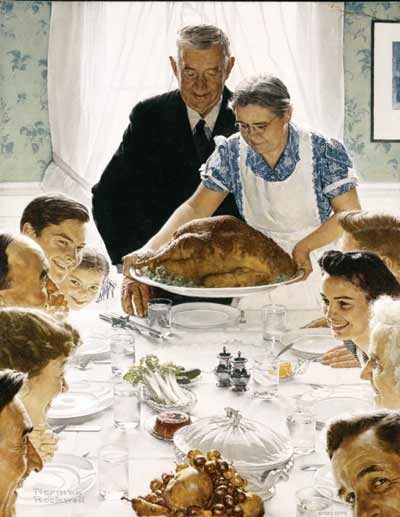
Norman Rockwell
March 6, 1943
Inspired by Franklin D. Roosevelt’s famous “Four Freedoms” speech delivered to Congress on the eve of World War II, Norman Rockwell created four paintings depicting simple family scenes, illustrating freedoms Americans often take for granted.
2. Classic Covers: Thanksgiving
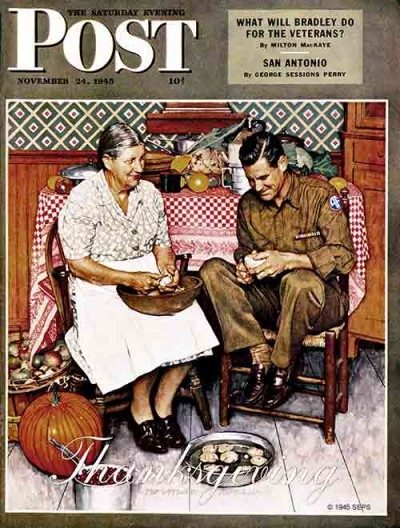
Norman Rockwell
November 24, 1945
Norman Rockwell and his mentor, J. C. Leyendecker, not only created more Post covers than any other artists, but also helped shape the way Americans think about Thanksgiving.
3. Rockwell—1940s
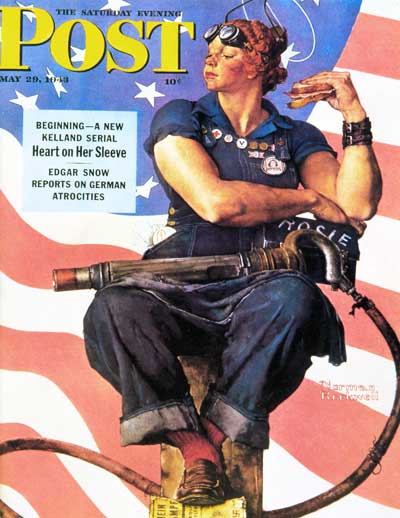
Norman Rockwell
This gallery displays all of Norman Rockwell’s Saturday Evening Post covers from the 1940s, one of his most prolific—and most loved—periods. It is, of course, replete with illustrations from World War II, including this iconic picture of Rosie the Riveter.
4. Rockwell Paints Rockwell
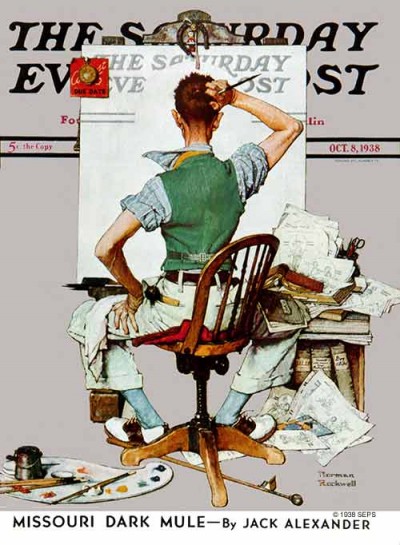
Norman Rockwell
October 8, 1938
How often did Norman Rockwell show up in his own art? You’d be surprised!
5. Rockwell—1930s
Norman Rockwell
July 13, 1935
Norman Rockwell’s Post covers from the ‘30s feature a wide array of characters—from children to movie stars, from the worldly to the working-class. Throughout this decade, he painted 69 covers for the magazine.
6. Rockwell—1950s
Norman Rockwell
March 15,1958
Rockwell painted some of his best known covers in the 1950s, including “Before the Shot,” (above), “Shiner,” and “Runaway.”
7. J. C. Leyendecker Gallery
J.C. Leyendecker
November 4, 1933
J. C. Leyendecker was one of the most popular and prolific cover artists for the Post. Norman Rockwell at one time considered Leyendecker his primary mentor, as he heavily influenced Rockwell’s early style and was a true master illustrator of the 20th century.
8. Rockwell—1960s
Norman Rockwell
December 14, 1963
This was the last decade that Rockwell painted covers for the Post, including a number of elegant portraits of Kennedy, Nixon, and Nehru.
9. Rockwell’s School Teachers
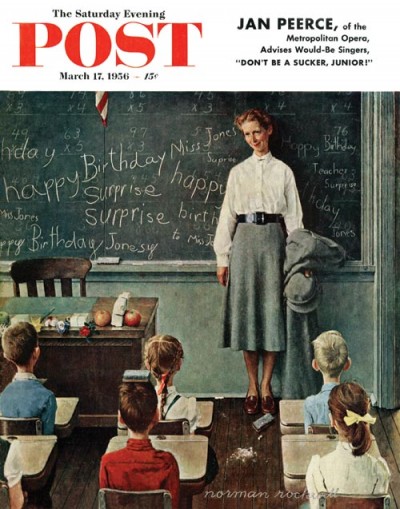
Norman Rockwell
March 17, 1956
“Happy Birthday, Miss Jones” is a Rockwell classic, but it wasn’t without reader complaints. Diana Denny reviews the many portraits of teachers that Rockwell painted.
10. John Falter Gallery
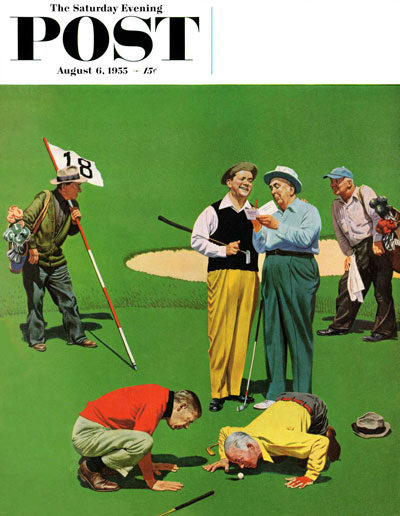
John Falter
August 6, 1955
John Falter created 129 Post covers over the course of his career. Much like Norman Rockwell, his works are simple observations of everyday American life.
Cover Gallery: Hit the Slopes!
Heinrich Pfeifer
January 9, 1904
Eugene Iverd
March 3, 1928
Bradshaw Crandall
March 2, 1935
Ski Weld
February 26, 1938

Walt Otto
January 28, 1939
February 22, 1941
Mead Schaeffer
March 27, 1943

Mead Schaeffer
February 2, 1946

Constantin Alajalov
January 25, 1947
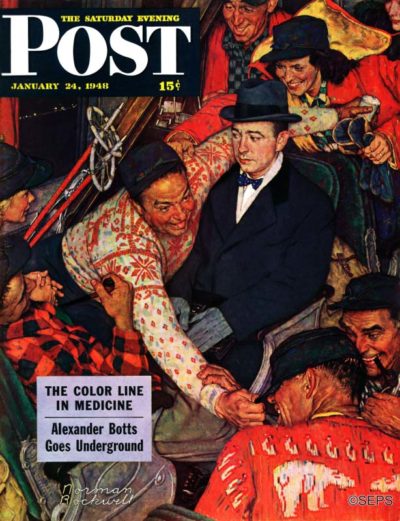
Norman Rockwell
January 24, 1948

John Clymer
February 17, 1951
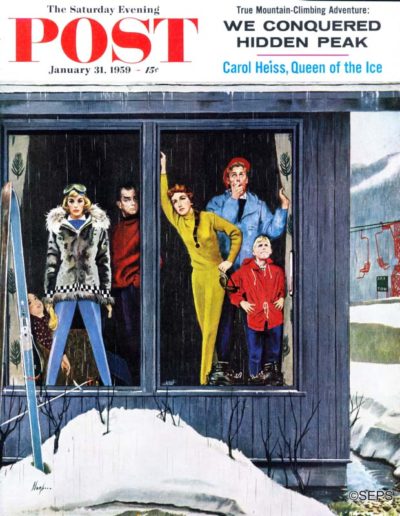
George Hughes
January 31, 1959
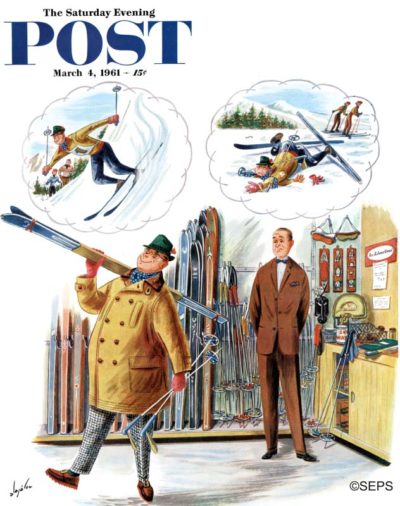
Constantin Alajalov
March 4, 1961
Most Popular Post Contemporary Fiction of 2016
The Saturday Evening Post continues to discover and publish the works of new, talented authors. Take a look at our most read contemporary fiction short stories.

1. “Zelda, Burning” by Celeste McMaster
Winner of the 2016 Great American Fiction Contest: At Highland Hospital, Zelda Fitzgerald found refuge from the world — but not from Scott. Read more »

2. “Swindy Wagon and the Charidy Band” by Dakota James
Four children get a crash course in charity and capitalism in this satire from Dakota James. Read more »

3. “Facts Concerning My Father’s Disappearance” by Sacha Idell
The mysterious circumstances around a father’s disappearance are catalogued by his child, with only token postcards, an abandoned suitcase, and a collection of miniature giraffe statues for guidance. Read more »

4. “Welcoming Death” by Jake Teeny
Third runner-up in the 2016 Great American Fiction Contest: Was Perry really face to face with Death, or was it all just an elaborate dream? Read more »

5. “The Eyes of Thomas Andrews” by Dan Reilly
John’s scale replica of the RMS Titanic was almost perfect, but the strange messages he receives over the radio may mean that it’s more than just a model. Read more »

6. “The Parties Involved” by Elizabeth Jennings
Urged by his literary agent, a recently single author attends a Halloween party despite his better judgment. Read more »

7. “The Magic Circle” by Ruth Knafo Setto
First runner-up in the 2016 Great American Fiction Contest: On a fall night in 1963, a young immigrant struggles to support his family and hold on to a dream. Read more »

8. “A Short Ride to Mercy” by Jim Gray
Fifth runner-up in the 2016 Great American Fiction Contest: Sam didn’t become his dog until Marlene left. The older they got, the more they depended on each other — now more than ever. Read more »

9. “Every Hero an Hombre, Every Wolf a Clown” by Doug Lane
In a Texas town where luchadores and clowns just don’t mix, one father risks exposing his double life to grant his son’s birthday wish in this fun story by Doug Lane.
Read more »

10. “Five in the Fifth” by Eileen M. Hopsicker
Fourth runner-up in the 2016 Great American Fiction Contest: Working at the Evergreen Nursing Home, young Jerry Keller didn’t think much about the future until he met Millie.
Read more »
Most Popular Post Classic Fiction of 2016
In the Saturday Evening Post’s nearly 200-year history, we have published some amazing fiction by prominent authors. Here is a list of the short stories you visited most often in 2016.

1. “Miss Temptation” by Kurt Vonnegut
A soldier just back from Korea disrupts a small town’s daily ritual—and makes a pretty girl cry—in Kurt Vonnegut’s well-loved short story. Read more »

2. “The Happiness Machine” by Ray Bradbury
It was the most incredible apparatus ever built. But not even the inventor knew the amazing things it could do…Read more »

3. “Screwtape Proposes A Toast” by C.S. Lewis
Written in 1959 by C.S. Lewis (29 November 1898 – 22 November 1963) of The Chronicles of Narnia fame, “Screwtape Proposes a Toast” is a follow-up to his very popular Screwtape Letters. Read more »
4. “The No-Talent Kid” by Kurt Vonnegut
Nothing could shake Walter’s determination to get into the marching band. So how could his conductor tell him how misplaced his ambition was? Read more »

5. ”The Bus” by Shirley Jackson
Everyone knows you can’t go home again; but every once in a while, in a terrible nightmare, you are there. Read more »

6. “The Kid Nobody Could Handle” by Kurt Vonnegut
What this town needed was some excitement, and Jim knew just how to provide it. Read more »

7. “Sucker” by Carson McCullers
What this town needed was some excitement, and Jim knew just how to provide it. Read more »

8. “The Actress and the Cop” by William Saroyan
Romance from the archive: His business was chasing lawbreakers. Then, one day, he became involved in an escapade with a glamorous Hollywood star. Read this 1957 novelette by William Saroyan. Read more »
9. “The Bishop’s Beggar” by Stephen Vincent Benét
From the Post archive, a timeless tale from one of America’s greatest storytellers.
Read more »

10. “The Conscience of the Court” by Zora Neale Hurston
In 1950s Jacksonville, Laura Lee Kimble stands accused of beating a man nearly to death. Author Zora Neale Hurston tells her story of speaking truth to power.
Read more »
The Fir Tree
Originally published on December 1, 1977
There was such a pretty little fir tree standing in the wood. It grew in a good place, able to catch the sun, getting plenty of fresh air; and many bigger companions grew round about, both firs and pines. But the little fir tree was so impatient to grow: it thought nothing of the warm sunshine and the fresh air; it cared nothing for the village children, prattling away as they gathered strawberries or raspberries. Often they would come along carrying a whole jugful or a string of strawberries threaded on straw, and, sitting down by the little tree, would say: “Isn’t it a pretty little one!” The tree hated to hear it.
“Oh, if only I were such a big tree like the others!” sighed the little tree. “I’d be able to spread my branches right out and from my top see into the wide world! The birds would come and build their nests in my branches, and when the wind blew I’d be able to nod as grandly as they all do!”
Often in the wintertime, when the snow lay glistening white all around, a hare would come bounding along and leap right over the little tree — and how that did annoy it! But two winters went by, and by the third the tree was so big that the hare had to go round it. Oh, to grow, to grow, to get big and old! That was the only nice thing in all the world, thought the tree.
In the autumn the woodcutters always came and felled some of the tallest trees. This happened every year; and the young fir tree, which by now was quite well grown, trembled to see it, for the magnificent trees would fall creaking and crashing to the ground. Then their branches would be cut away, and they would look altogether bare and long and narrow; one hardly knew them again. And they would be laid on wagons, and horses would pull them away out of the wood.
Where were they going? What was in store for them?
When the swallow and the stork came, in the spring, the tree said to them: “Don’t you know where they were taken? Didn’t you meet them?”
The swallows knew nothing, but the stork, looking thoughtful, nodded its head and said: “Well, I believe so! I met lots of new ships on my flight from Egypt, and there were splendid masts on them. I dare say they were the ones — they smell of fir. I can give you news of them — they’ve come out on top!”
“Oh, if only I were big enough to fly away over the sea!”
“Be glad of your youth!” said the sunbeams. “Be glad of your healthy growth, of that young life that’s in you!”
And the wind kissed the tree and the dew shed tears over it, but the fir tree didn’t understand.
Now, at Christmastime quite young trees would be felled, trees which often were not even as big or as old as this fir tree which knew neither peace nor rest but was forever wanting to push on. These young trees — and they were the nicest ones of all — were always left with their branches on. They were placed on wagons, and pulled off out of the wood by horses.
“Where are they going?” asked the fir tree. “They’re no bigger than I am, and one of them was even a lot smaller. Why were they left with all their branches on? Where are they going to?”
“We’ll tell you where! We’ll tell you where!” chirruped the sparrows. “We’ve been in the town, looking in through the windows! We know where they go to! Why, they go to the greatest honor and glory you can think of! We’ve peeped in through the windows and seen them planted in the middle of the warm room and decorated with the loveliest of things, such as golden apples, gingerbread, toys, and hundreds and hundreds of candles!”
“And then. . . ?” asked the fir tree, trembling in all its branches. “And then? What happens then?”
“Why, that’s all we saw! It was marvelous!”
“I wonder if I was born for this glorious life?” thought the tree joyfully. “It’s even better than crossing the sea! I’m just dying for it! I do wish it was Christmas! I’m pining! I can’t think what’s come over me!”
“Be glad of me!” said the air and the sunshine. “Be glad of your healthy youth, here in the open!”
But it wasn’t a bit glad, though it grew and grew. Winter and summer, it was always green, dark green; and people who saw it said: “That’s a nice tree!” And at Christmas it was the first of all to be felled. The axe cut deep into its marrow and it fell with a sigh to the ground, feeling a pain and faintness. It was so sad at the thought of parting from home, from the spot where it had grown up, knowing that it would never more see its dear old companions, the little bushes and the flowers that grew round it, nor even, perhaps, the birds. Going away wasn’t a bit pleasant. It came to itself in the yard when, unloaded along with the other trees, it heard a man say: “That’s a beauty! We’ll have that one!”
Now two servants in full dress came and took the tree into a lovely big room. There were portraits hanging on the walls, and standing by the large tiled fireplace were big Chinese vases with lions on the lids. There were rocking chairs, silk sofas, and big tables piled with picture books and toys worth a hundred times a hundred shillings — or so the children said. The fir tree was stood up in a big barrel filled with sand, though nobody could see it was a barrel, as green cloth was hung round it and it stood on a big gaily colored carpet. How the tree trembled! Whatever was going to happen? Servants and young ladies both began to decorate it. On the branches they hung little bags cut out of colored paper, each one filled with sweets. Golden apples and walnuts hung as though they had grown there, and over a hundred red, blue, and white candles were fixed on to the branches. Dolls that were the living image of people (and that the tree had never seen the like of) hung among the greenery, and right at the very top was a big star made of gold tinsel. It was gorgeous, positively gorgeous!
“Tonight,” they all said, “tonight it’s going to be all lit up!”
“Oh,” thought the tree, “if only it was tonight! If only the lights would soon go on! And I wonder what will happen then? Will trees come from the wood to look at me, I wonder? Will the sparrows fly about the window, I wonder? Shall I grow fast here and stand decorated winter and summer, I wonder?”
Oh yes, it had the right ideas. But the sheer longing had given it a proper bark ache; and bark ache is as bad for a tree as headache is for us.
At last the candles were lit. What splendor, what magic! The glory of it made the tree tremble in every limb: so much that one of the candles set fire to the greenery; it hurt horribly.
“Goodness gracious!” cried the young ladies, hastening to put it out.
The tree was too frightened even to tremble now. It was really horrid! It was so afraid of losing some of its finery, and was quite bewildered by all the glory. And then all at once the folding doors were opened and a crowd of children came rushing in, as though they would upset the whole tree; the older people quietly followed them. The little ones stood perfectly still, but only for a moment; for then they all shouted for joy, making the whole place ring with their cries. They danced round the tree, while presents were picked off one after another.
“What are they up to?” thought the tree. “What’s going to happen?” The candles burnt right down to the branches, and as they did so they were blown out and afterwards the children were allowed to strip the tree. And the way they rushed at it, making it creak in all its branches! If it hadn’t been fastened to the ceiling by its tip and its golden star it would have crashed.
The children were skipping around with their splendid toys, nobody looking at the tree except the old nurse, who went peering in among the branches, though only to see whether a fig or an apple had been forgotten.
“A story! A story!” cried the children, pulling a fat little man over toward the tree. And sitting down underneath it, he said: “Now we’re in the wood, and it won’t do the tree any harm to listen to it. But I’m only going to tell one story. Would you like the one about Imsy Whimsy, or the one about Willy Nilly, who fell downstairs and yet came out top and married the princess?”
“Imsy Whimsy!” cried some. “Willy Nilly!” cried others. There never was such shouting and screaming! Only the fir tree held its tongue, thinking to itself: “Don’t I come in here! Don’t I have a part?” Of course it had been in it; it had played its part.
And then the man told the story of Willy Nilly, who fell downstairs and yet came out top and married the princess. And the children clapped their hands and shouted: “Go on! Go on!” wanting “Imsy Whimsy” as well, but getting only “Willy Nilly.” The fir tree stood perfectly still and full of thought: the birds in the wood had never told anything of this sort. “Willy Nilly fell downstairs and yet married the princess! Ah yes, that’s the way of the world!” thought the fir tree, believing the story to be true because such a nice man had told it. “Ah yes, who knows? Perhaps I shall fall downstairs and marry a princess!” And it looked forward to being dressed in candles and toys and in gold and fruit the next day.
“I won’t tremble tomorrow!” it thought. “I’ll really enjoy all my splendor. I shall hear the story of Willy Nilly again tomorrow, and perhaps the one about Imsy Whimsy as well.” And the tree stood silent and thoughtful all night.
In the morning the servants came in.
“Now for the finery again!” thought the tree. But they dragged it out of the room and upstairs into the attic, where, in a dark corner, without a gleam of daylight, they left it. “What’s the meaning of this?” thought the tree. “I wonder what I’m going to do here? I wonder what I’m going to be told here?” And, leaning up against the wall, it stood thinking and thinking. And it had plenty of time for it, for days and nights went by. Nobody came; and when at long last somebody did, it was only to put some big boxes away in a corner. The tree stood quite hidden; anyone would have thought it was clean forgotten.
“It’ll be winter outside!” thought the tree. “The ground will be hard and covered with snow; they won’t be able to plant me. So they’ll be leaving me here in shelter till the spring! How very thoughtful of them! How good human beings are! If only it wasn’t so dark — and so dreadfully lonely! Not even a little hare! It was really so nice in the wood when the snow lay round about and the hare bounded past; yes, even when it jumped over me, though then I didn’t like it. It’s so awfully lonely up here!”
“Squeak, squeak!” said a little mouse just then, popping out of its hole, followed by another one. They came sniffing at the fir tree and slipping in and out among its branches.
“Isn’t it horribly cold!” said the little mice. “It’s a heavenly place, though, except for that! Isn’t it, old fir tree?”
“I’m not at all old!” said the fir tree. “There are plenty a lot older than I am!”
“Where do you come from?” asked the mice. “And what do you know?” (They were so dreadfully inquisitive.) “Tell us, please, about the loveliest place on earth! Have you been there? Have you been in the larder, where there are cheeses on the shelves and hams hanging under the ceiling; where life’s a bed of tallow candles, and where you go in lean and come out fat?”
“I don’t know the place!” said the tree. “But I know the wood where the sun shines, and where the birds sing!” And it told the whole story of its youth. The mice had never heard the like of it, and they listened and they said: “Why, what a lot you’ve seen! How happy you have been!”
“Have I?” said the fir tree, thinking over the story it had been telling. “Why yes, they were rather pleasant times, when you come to think of it!” And then it went on to tell of Christmas Eve, when it had been decorated with cakes and candles.
“Oh,” said the little mice, “how happy you’ve been, old fir tree!”
“I’m not old at all!” said the tree. “I only came out of the wood this winter! I’m in my prime and have only had my growth checked!”
“What a lovely storyteller you are!” said the little mice; and the next night they brought four other little mice to listen to the tree. And the more it told, the more clearly it remembered everything; and it thought to itself: “Yes, they were rather pleasant times! But they may come again; they may come again! Willy Nilly fell downstairs and yet married the princess, and perhaps I may marry a princess.” And the fir tree’s thoughts turned to a birch tree— such a pretty little birch tree—which grew in the wood; to the fir tree this was a real, lovely princess.
“Who’s Willy Nilly?” asked the little mice. And the fir tree told them the whole fairy tale; it remembered every single word of it. And the little mice were ready to jump right to the top of the tree for very joy. The next night many more mice came, and on the Sunday even two rats. But they said that the story wasn’t amusing, and this saddened the little mice, for now they, too, thought less of it.
“Is that the only story you know?” asked the rats.
“That’s all!” answered the tree. “I heard it on the happiest evening of my life; only then I never realized how happy I was!”
“It’s an extremely bad story! Don’t you know any with bacon and tallow candles in? No pantry stories?”
“No!” said the tree.
“Then you can keep it!” said the rats, and in they went.
In the end the little mice also stayed away, and the tree sighed: “It was so nice when the nimble little mice used to sit round me, listening to my story! Now even that’s all gone! But I’ll remember to enjoy myself when I’m taken out again!”
But when would that be… ? Well now, one morning somebody came rummaging about in the attic. The boxes were moved and the tree was pulled out. It was rather rough, the way they threw it on the floor, but then all at once a man dragged it toward the stairs where the daylight shone.
“Now for a new life!” thought the tree. It could feel the fresh air and the first sunbeam — and now it was out in the yard. It was all so quick; the tree clean forgot to look at itself, there was so much to see round about. The yard was next to a garden, and everything there was in bloom. Roses hung fresh and fragrant over the little railing, the lime trees were blossoming, and the swallows were flying about saying: “Twitter-twitter-tweet, my husband’s come!” But they didn’t mean the fir tree.
“Now I shall live!” it cried joyfully, spreading wide its branches. But, alas, they were all withered and yellow; and it lay in a corner among weeds and nettles. The gold paper star was still at the top, glittering now in the brilliant sunshine.
Playing in the yard were a few of the merry children who had danced round the tree at Christmastime and had been so delighted with it. One of the smallest rushed up and tore off the gold star.
“Look what’s still on the ugly old Christmas tree!” he said, trampling on its branches and crunching them under his boots.
And the tree looked at all the glorious flowers and fresh growth in the garden, and it looked at itself; and it wished that it had stayed in its dark corner of the attic. It thought of the freshness of youth in the wood, of the merry Christmas Eve, and of the little mice that had listened so delighted to the story of Willy Nilly.
“All, all over!” said the poor little tree. “If only I’d been happy when I could have been! All, all over!”
And the servant came and chopped the tree into little bits; a whole bundle of them. It made a lovely blaze under the scullery copper; and it sighed so deeply, every sigh like a little crackle. So the children playing in the yard ran inside and sat down in front of the fire, looking into it and crying “Bing, bang!”
The boys played in the yard, the smallest wearing on his breast the gold star which the tree had borne on its happiest evening. Now that was all over, and it was all over with the tree, and the story’s over as well! All, all over! And that’s the way of every story!
Let’s Make Football a College Major
On a fall day in 2012, right after taking a frustrating sociology exam for which he would receive a B, Cardale Jones – a student-athlete at Ohio State University – tweeted something that he would later regret:

Jones saw college as football and classes as an inconvenience. At the time, and again two years later when the quarterback led his team to a national championship, Jones’s tweet brought intense criticism. But maybe it shouldn’t have.
College football players spend more than 40 hours per week on football, including time on the practice field, in the weight room, with trainers, and in film study and team meetings. On average, college athletes spend more than 30 hours a week on their sport. The US National Collegiate Athletic Association has a rule limiting college athletes to 20 hours per week, but it is rife with loopholes and a target of lawsuits.
Such ambitious schedules leave college athletes exhausted and with little energy for coursework. In many cases, the primary reason they are attending college in the first place is to play a sport. Many athletes evince a dedication exceeding all but the most committed students of the sciences or humanities.
In fact, the phrase ‘student athlete’ is redundant. To be an athlete is to be the student of a discipline as rigorous and as noble as literature, chemistry or philosophy. The ancient Greeks, who invented the idea and practice of the academy, conceived of athletics as a basic component of education and culture (paideia).
Ancient precedents aside, any college course catalogue today reveals many majors focused primarily on a physical or practical, rather than theoretical, field of study. The University of California, Berkeley, my alma mater, supports majors in art practice, dance and performance studies, theatre and performance studies, music, film, creative writing, journalism, communications, and business administration. The art practice major consists ‘largely of studio courses’ and focuses on artistic production, although students also take classes in art history, theory and business. All of these majors combine educational requirements of practice and theory, but focus on practice. They provide an obvious model for majors in sport.
The football major, for example, would consist of the practicum, the many hours of physical training, practice, film study and meetings. Courses would also be required in the history, science, criticism and business of the discipline, as well as in the related fields of physiology, nutrition, journalism and sports management. Indeed, all of these fields of study already exist. A graduate of the football major could claim some expertise in the field, and be someone with the potential for significant impact, as an athlete, coach, trainer, agent, commentator, consultant, or team member in a complex organisation.
Some critics might argue that sport is not intellectual enough to be enshrined as a field of academic study. But this objection presumes a much too restricted view of intellect, a proper account of which must also clearly make room for performative activities such as art, theatre and dance. Thanks to recent scientific and academic research, we have a much better appreciation of the intelligence required for athletic excellence.
Sport intelligence requires cognitive performance that is extremely demanding: the ability to read the complexity of a situation, to come to near-instantaneous intuitive judgments about how to react, and to move the body accordingly. It requires, as the journalist Chuck Squatriglia explained about soccer research in Wired, ‘what neuropsychologists call executive functions, which include the ability to be immediately creative, see new solutions and quickly change tactics’.
In this respect, the demands of football are especially rigorous. Because it involves large teams with 22 players lining up on any one play to perform a strategic manoeuver, if on offence, or to counter that manoeuver, if on defence, it requires more preparation off the field than any other sport. American football players spend more time in meeting rooms, watching film and reading binders of plays than doing anything else. As Nicholas Dawidoff wrote in The New Yorker:
In developing a game plan, coaches typically break down everything that happened in the opponent’s past four games to granular levels of ‘tendencies’ – down, distance (to a first down), field position, and time remaining on the game clock. Once assembled, this research fills many pages of the game-plan binders players are given on Wednesday to prepare them for Sunday. (Teams have also begun to use iPads.) The binders are dense with intricate drawings and written instructions. They are often as thick as a left tackle’s fist.
What players learn is then tested under high-stress real-world conditions, in practice and actual games. How many fields of study can say the same?
I would also argue that people suffer from an impoverished view of the human mind. The popular tendency is to think of consciousness as something that happens inside the head or the brain, but philosophers are challenging this view with an approach that sees the mind as the interaction of one’s entire neurological system with the environment. The US philosopher Alva Noë, for example, who has written several books exploring a new theory of mind, appeals to practices such as dance, which demonstrate how mental activities can be bodily and spatio-temporally extended, coordinated and social, and both reactive to and manipulative of other people and the world. And psychologists such as Howard Gardner have theorised that kinaesthetic intelligence, the ability to use the body to solve problems, is a distinct form of intelligence worth study.
While these distinctions might be unfamiliar to many, people do seem to recognise the unique intelligence of athletes and how that intelligence can translate into other domains. Businesses, law firms and other complex organisations requiring a sophisticated balance of competition and cooperation often recruit from college athletics, especially from team sports.
Creating sports majors also addresses real problems. Unlike philosophy or anthropology, sport is a booming multi-billion dollar industry in the United States and around the world. It offers potential for employment in an extensive variety of fields: coaching (high school, college, pro), physical training, marketing, law, consulting, design, management, and more. Sports majors would help athletes to succeed in these fields. If Cardale Jones, for example, does not make it in the National Football League, his next-best options might be as a football coach, trainer, agent or businessman.
For at least a century, US universities have decided to include athletics in higher education, and that is not going to change. Nor should it. We just haven’t pursued the logic to its proper end. It is time to make football a major.
David V Johnson
This article was originally published at Aeon and has been republished under Creative Commons.