3 Questions for Allison Janney

Seven-time Emmy winner Allison Janney is drawn to bold and eccentric characters. She was hilariously hateful in Bad Words, zany in Hairspray (the audience loved it when she yelled “devil child” at poor Amanda Bynes), and of course, tough and efficient as C.J. Cregg in The West Wing. Coming soon is a juicy role in Tim Burton’s Miss Peregrine’s Home for Peculiar Children and her first time playing a detective in The Girl on the Train.
As she launches into her fourth season of CBS’s dark comedy Mom as Bonnie, a recovering alcoholic and addict, she admits it’s “fun to play someone who is inappropriate and says things you wish you could say but you don’t.” But offscreen, what she treasures most is having friends over and “playing a game, laughing, just hanging out.”
Jeanne Wolf: It tickles me that you can become wild and rude on the screen because the women you portray are so different from you.
Allison Janney: It’s true. Some of the gals I play are fearless, but personally, I have to work on my own fear and low self-esteem. I’m really thin-skinned. I don’t even go online because I could not stand to read most things written about me. Acting is cathartic in some way. I feel very connected when I’m acting — more connected than when I’m just walking around as Allison.
JW:What about being in the public eye — all those red carpets?
AJ: It’s incredibly nerve wracking. Sometimes I wish I could disappear into the crowd. But my height makes that impossible. I’m six feet. With heels on, I tower way above everyone. I practice in front of the mirror and say to myself, “Just relax, breathe, be yourself,” but it never seems to go as well in front of the cameras. Now, my boyfriend (Phil Joncas) doesn’t care about any of that stuff. I’m always afraid reporters are going to write about us and bring up our age difference (she’s 56; he’s 36), but he’s like, “Babe, I don’t care.” It’s a great quality not to worry about what other people think of you.
JW: Did you draw on your own mother for Mom?
AJ: Not at all. Bonnie is the one character that I’m totally not like, and neither is my mother. Playing her is kind of like laughing in church. It feels so wrong and yet so good. My parents, especially my mother, are very grounded people. They aren’t really impressed with Hollywood or celebrities. I had to call my mom to tell her I was nominated for the Emmys this year. Mom said, “Oh that’s wonderful! That’s great.” Then she went on with whatever she was doing. Some people want their kids to accomplish what they didn’t accomplish themselves, but my parents aren’t like that. They sort of let us find our way, you know? I’m grateful for that.
News of the Week: Classic Rock, Campaign Bumper Stickers, and Christmas in October
Cleveland Rocks
For some reason, I thought that Yes was already in the Rock and Roll Hall of Fame, but while they’ve been nominated before, they’ve never made it. Maybe this year will be different, as they’re on the list of the 2017 nominees. Other nominees are Bad Brains, Joan Baez, The Cars, Chic, Depeche Mode, ELO, The J. Geils Band, Janet Jackson, Jane’s Addiction, Journey, Chaka Khan, Kraftwerk, MC5, Pearl Jam, Tupac Shakur, Steppenwolf, Joe Tex, and The Zombies. This is Chic’s 11th nomination!
You can help decide who gets into the Hall by going to the official site and making your choices. Voting ends on December 5.
In related news, The Nobel Prize academy can’t find Rock and Roll Hall of Fame inductee and new Nobel Prize for Literature winner Bob Dylan. If it helps, tomorrow he’s going to be performing at the WinStar World Casino and Resort in Thackerville, Oklahoma.
Au H2O in ’64
CBS Sunday Morning had an interesting segment this week: campaign bumper stickers. The first ones were actually made out of metal. The stickers arrived in the 1940s.
RIP Eddie Applegate
2016 is turning into the “who died from The Patty Duke Show this week?” year. In March, we saw the passing of Patty Duke, and then in May her co-star William Schallert died. Now Eddie Applegate has passed away.
Applegate played Patty Lane’s boyfriend Richard Harrison on the sitcom that ran from 1963 to 1966. He also appeared in TV shows like Gunsmoke, The Lucy Show, The Many Loves of Dobie Gillis, Daktari, and Nancy, as well as the 2010 movie Easy A. He died Monday at the age of 81.
October Books
Some new fall books you might be interested in:
The New York Times Book of the Dead, edited by William McDonald. This happy little volume contains 320 obituaries from the newspaper, along with access to 10,000 more on a special website.
A Torch Kept Lit, edited by James Rosen. Speaking of famous dead people, here’s a collection of eulogies written by William F. Buckley Jr. Included are remembrances of Ronald Reagan, Elvis Presley, John Lennon, Winston Churchill, Martin Luther King Jr., and Truman Capote.
The Age of Daredevils, by Michael Clarkson. A history of the many people who tried to go over Niagara Falls in a barrel early in the 20th century.
Ghostland: An American History in Haunted Places, by Colin Dickey. A travelogue of places in the U.S. that are supposedly haunted, with lots of historical information about each place. Just in time for Halloween.
Happy Hallo … I mean Merry Christmas!
Here we are, ten days before Halloween, and they’re already running Christmas commercials. I saw this one on Tuesday night:
In a few years we’ll come home after watching the Fourth of July fireworks and Frosty the Snowman will be on TV.
Starburst? Seriously?
I refuse to believe that Starburst is the most popular Halloween candy in my state of Massachusetts.
But that’s what this map from Influenster says. They did a state-by-state survey of Halloween candy and Starburst rules The Bay State. I have not eaten a Starburst in 25 years and I can’t remember the last time I saw anyone eating/buying/talking about them (though to be honest, I don’t really keep track of other people’s candy purchases). I’ll take Reese’s Peanut Butter Cups.
Survey reveals America's favorite Halloween candy by state; candy corn is “candy of choice” in most number of states https://t.co/W412Peno3D pic.twitter.com/8DYPsMf8OH
— ABC News (@ABC) October 18, 2016
Who the heck is eating all that candy corn? I mean, come on.
This Week in History: Noah Webster Born (October 16, 1758)
Have you ever used Webster’s Dictionary? This is the guy to thank.
This Week in History: New York World’s Fair Closes (October 17, 1965)
The fair was open for two six-month runs in 1964 and 1965. Some of the buildings are still standing, if in poor condition, and you can see the Unisphere every year when the U.S. Open is played at Flushing Meadows, New York.
This Week in History: Cuba Embargo Begins (October 19, 1960)
President Obama has eased aspects of the embargo, and now you can get Cuban rum and cigars again!
National Nut Day
Saturday is National Nut Day.
A couple of years ago, I made a batch of spiced nuts that was well-received by my family during the holidays. Unfortunately, I can’t remember the recipe and can’t find it online, so how about this spiced nuts recipe from Emeril Lagasse? Here’s a chocolate zucchini bread recipe that includes chopped nuts, and here’s one for dark chocolate bark with roasted almonds and seeds.
I would have included a recipe for fruitcake, but that’s a Christmas thing and it’s still Halloween time. Even though they’re already playing Christmas commercials. Before Halloween.
Next Week’s Holidays and Events
Mother-in-Law Day (October 23)
Come on, you can put aside all of those jokes for one day.
Bill Murray receives the Mark Twain Prize for American Humor (October 23)
The Kennedy Center ceremony will be telecast on PBS at 9 p.m. Eastern on October 28 (check local listings). Here’s a piece by Saturday Evening Post Archive Director Jeff Nilsson on the surprising and familiar Twain.
Navy Day (October 27)
The day was chosen because October 27 is President Theodore Roosevelt’s birthday, though some want to change it to October 13.
The Parties Involved
The door is answered by Sylvia Plath, blue dress belled out around her slender hips, head stuck in a cardboard oven. This comes as no surprise; there is one every year. This particular Sylvia braces the doorframe with one arm, still holding a glass of red wine so that I may see into the apartment but not enter. She smiles with gray-tinged teeth — a close match for the gray-blue of her artificial asphyxiation face paint, though likely a result of the wine now gently sloshing onto the linoleum. Waves of heat and noise seep out from the doorway, pressing me backward, carrying snippets of conversation: “… the next date on my tour …” “… have you seen pictures of the new baby? …” but by the time they reach the hall it sounds like, Get out while you still can.
The annual agency costume party: where “highbrow” is not the same as “in good taste.” True, there will not likely be any sexy nurses or policewomen on this particular occasion, but a sexy Jane Eyre or Hester Prynne is not entirely out of the question. Somewhere, I imagine, in the bustling apartment behind the blue-faced Ms. Plath, I will eventually run into Virginia Woolf as well, complete with stones in the pockets of her sweater.
Sylvia — otherwise known as Helen from the HR department — makes a vain attempt at embracing me fondly. Her wide, cardboard headpiece knocks first against the doorframe and then against my jaw before she settles for a polite pat on the shoulder. “You’re so late!” she says, though she continues to block the door. It does not seem to occur to her that my entrance is dependent on her position. She looks me up and down then, attempting to conceal her distaste as she takes in my faded jeans and sweater. I clear my throat. The green is somewhat pukey, I’ll admit. Cheryl always did most of the shopping.
Sylvia-aka-Helen steps aside, allowing me to pass into the apartment where other well-known characters and embodied puns are milling about, drinks in hand. The air smells like perfume, and body heat, and booze. In the living room, Daisy Buchanan is playing the piano with the characteristic lilt of one too many glasses of champagne. Bobbing along with each note, the rapidly wilting actual daisy tucked into her flapper headband. I have been instructed by Mike, my literary agent, to “stay connected,” to “network.” This is important for my career, according to Mike. My so-called career, according to Cheryl.
In the kitchen, a small banquet table has been set out with drinks and finger foods, wine and beer bottles leaning out of buckets of ice. I crack open a beer and glance at my watch. One hour would be polite, two downright generous. Mike is nowhere to be found, though he has guaranteed me his attendance.
I mingle dutifully. Scarlett O’Hara in accounting has just gotten engaged. Cyrano in copyrights wants to tell me about his bowling league. Across the room, a memoirist dressed as some sort of dead pig has just spilled guacamole down his chin. I am the only guest not in costume, a fact that does not go unnoticed. I adopt a facial expression that I hope will convey “I know,” before another person can say “But you’re not dressed up!” Oh really? I hadn’t noticed.
“Jimmy-boy!” a voice calls out. It is not Mike’s. Rather, it is the too-loud-for-the-room shout of Dale Gibbons, a writer of football biographies and another (I would not say “fellow”) client of Cabot & Bartram. The right side of his shirt is untucked, revealing a hair-covered patch of protruding abdominal flesh. He clinks his empty beer bottle against mine.
“Dale,” I acknowledge. He has sweat stains under his armpits. I cannot imagine how this is in any way good for my (so-called) career.
Dale wastes no time. “Where’s the missus?” he asks. Well, it isn’t a question about my costume. I have prepared a number of lies for this scenario, lies I have told repeatedly during my dutiful mingling. She is under the weather. Or her mother is. Poor thing. She is working late, or away on business — explanations I have heard enough times myself that they almost sound like the truth. But Dale does not give me the opportunity. “She find something better to do?” He chuckles and begins elbowing me in the ribs, as if we are old friends, which we are not. “Or maybe someone better to do? Heh heh. Am I right?”
“Excuse me,” I say, pushing past him with perhaps more force than is necessary. I head for the kitchen, weaving my way through the hall where a small commotion is stirring. Sylvia’s oven has knocked over a vase.
Cheryl was a fan of Sylvia Plath, the real one. Twenty-one years old, brushing one long strand of hair after another out of her eyes as she sits, cross-legged, bent over a book. This is my eternal image of young Cheryl, happy Cheryl, my Cheryl — sometimes in front of a fireplace, sometimes on a wide expanse of university lawn, but always bent over a book, struggling to manage that unruly cascade of hair. “Tortured poet,” she would say then, scribbling down lines in the margins of her notebooks. “Such beautiful honesty,” she would say.
“Don’t you have any decent ties?” she says now. “There’s no money in that kind of work,” she says. “Come on, don’t, I’m going to be late.”
I spot Mike chatting with a petite blonde, a receptionist, I think. She is leaning against the marble countertop, her chest thrust forward in a medieval corset. One hand is flirtatiously stroking his arm. Of the 15-or-so women at the party, at least half have held varying degrees of affection for Mike. He wraps one finger with a lock of her hair. I crack another beer.
After my first missed deadline, she cut it all off. Her hair, I mean. An efficiency cut, sleek, just past her ears. I can’t say that the two events were related, but I can’t say that they weren’t. The memory of her at the salon is a false one — I wasn’t there, didn’t know about it until it was too late. Still, mixed in with nightmares of lost teeth and manuscript pages blown away in the wind were the long strands of her hair sailing down from the impossibly high barber’s chair, disappearing into nothingness.
“Dress for the job you want,” she had said, patting her new hair in front of the mirror, eyeing my open terrycloth bathrobe.
“… a startling portrayal of the decay of innocence …”
“… do you think she’s had Botox? Just look at her forehead …”
Mike is whispering something into the receptionist’s ear.
After the haircut, it was the newspapers. Every so often, one would appear on the kitchen table, casually flipped open to the want ads. “You know,” she had even said once, over breakfast, “I think Jerry in the New Haven office is looking for a new assistant.” As if that were somehow more respectable, as if she wouldn’t divorce an office assistant faster than you could say, “Here’s your nonfat mocha latte.” I stuck a fork into my eggs, letting them bleed slowly onto the plate. Free range, just like she’d asked for, even though they were twice the price. “You could at least apply,” she’d said.
I said, “Is there more coffee?”
This would be cited later, as a Reason. As an explanation for how it was, in fact, my fault. How she had tried. Oh, how she had tried.
Still, you can’t look at a person like that, pointedly waggling your fork at him, without making that person feel small. Even now, I could shrink down inside my beer bottle for good.
Across the kitchen, Mike turns, slipping something into his back pocket. The receptionist giggles and whispers something into his ear, her hand now tracing the line of his shoulder. Still, when he sees me, he is quick to disentangle himself and head in my direction. I am grateful for this. If I had seen me from across the room, I’m not sure I would have done the same.
“Hoffman!” he shouts, clapping me on the back. “Where’s your damn costume?”
Mike is dressed as what I can only assume is a Mr. Darcy, white tube socks pulled up to the knees of his rolled trousers. I take a long swig of beer and shrug. “Here,” I say, grabbing the dish soap and sponge from the sink behind me, “I’m ‘All Washed Up.’” The laugh that comes next is not as friendly or lighthearted as I had meant it to be.
I don’t say that it’s sitting at home, in the back of the closet, still wrapped in protective plastic. I don’t say that I couldn’t bring myself to show up as only one half of Tristan and Isolde — a costume planned in advance, before I discovered that Cheryl had instead become one half of Lady Chatterley’s Lover.
Mike’s expression becomes suddenly serious. “Hey, man,” he says. “It’s a party. Come on, you used to love these things.”
I try to imagine a time at which I would have loved these things. After the first book came out maybe, or even the second. They were mine, at least, a thing entirely apart from Cheryl’s corporate dinner parties — all pencil skirts and sports jackets, not a single head in a cardboard oven.
I’m struck suddenly by a certain sympathy for, even solidarity with the tasteless Sylvia-Helen, the drunk Daisy Buchanan. I lift my now-empty beer bottle as if to make a toast. Go forth, I want to say, and be tasteless! To hell with corner offices! Free-range eggs be damned! We are artists! Free from the confines of claustrophobic top-buttoned collars! It is the visionless world, not the cardboard oven, that suffocates us! Mike looks at me strangely and I realize I am not actually saying any of these things. Only holding my bottle aloft and squinting into the middle distance. “Sorry,” I say. I lower my arm.
It’s been three years since I’ve published. Most days I just sit at my desk in my shorts, fingers stained with the orange residue of Cheez Doodles, computer keyboard spotless. Sylvia Plath — had she had Cheez Doodles — would have understood.
Poe’s raven brushes past me in a tight black mini-skirt — a novelist, newly picked up, whose name I can’t recall, though something tells me it may actually be Raven. Her hair is black, as it should be, and her stockings have that thin line that runs up the back of her calves. Mike’s gaze follows her as she passes. She glances backward, batting her heavily blackened eyelashes. This gesture is for Mike, not for me, and he knows this. The blond receptionist, I’d wager, will be going home disappointed.
“Excuse me for a minute,” Mike says, his eyes still on the raven though he is talking to me. Before I can answer, he is already hurrying away, grabbing playfully at the girl’s feather boa. I tell myself that this is not a slight, that his interest in her is in no way the professional sort, and it’s true. He will take her home, sleep with her, and not even ask her about the novel she’s written. When her book hits the shelves, he may not even realize that it’s hers, that it was born of his own agency. But what does Poe’s Raven care? She is young, “up-and-coming,” with a book on the market, and a bed that isn’t empty.
Whoever is playing the piano — still Daisy? — has grown increasingly sloppy, and guests are gradually abandoning the living room for the kitchen. I scan the crowd for the receptionist. I wonder if she, too, has moved on — her Mr. Darcy all but forgotten, Wickham the better choice after all. But no. If I cannot see her here in the kitchen, it is because she has already locked herself in the bathroom. Her gut now pressing tight against her corset, rumbling with one too many beers. She has seen them together before, of course, and yes, now it all makes sense. The person she loves, that she’s invested in — made sacrifices for! — drawn into the arms of another, and yes, yes, maybe that other is more successful, and she a mere receptionist, but does that make her less human? If you prick us, do we not bleed? If you tickle us, do we not tell you to stop? If you step out on us for greener pastures with glass office doors and leather desk chairs, should we not feel poisoned?
It is loud in the kitchen. More guests seem to have arrived — though I have not seen the door open — and the faces I know are lost in a sea of iconic, recognizable strangers.
“… pictures from the honeymoon in Maui …”
“… it’s an all-vegan day spa …”
“… yes, we’re meeting to discuss the movie rights on Tuesday …”
The heat in the kitchen is stifling.
“… just fax it over …”
“… we’re thinking Braelyn if it’s a boy …”
I glance toward the front entrance — wishing for the cool night air, for a glass of whiskey, for solitude — but find that my path is obstructed. Back against the door, Sylvia Plath is posing for a photograph, one arm around the waist of Virginia Woolf, who smiles gleefully as she holds up a handful of stones. An acquaintance taps me on the shoulder and for the third, or fourth, or fifth time tonight, I am asked, “How’s your wife?” and “Where’s your costume?” and “How’s that novel coming?” and just for a moment I can feel the stones in my pockets; I can smell the gas in my nose.
Before LOL and BTW, There Were KUBIT and PYTUO
Abbreviations in electronic communication have a long tradition in the U.S. The forerunners of LOL, BTW, and FWIW date from the 19th century, as Americans tried to save money on costly telegrams. In 1860, a message from New York to New Orleans cost $2.70 — the equivalent of over $70 today— and only permitted the sender a 10-word message. Transcontinental telegrams, which were introduced on October 24, 1861, were even more expensive: A 10-word telegram from California to the East Coast cost more than $210 in modern currency.
Americans soon found ways to say more with less, dropping nonessential prepositions, articles, punctuation, and any words that could be omitted while retaining the sense of the message. This message from the Wright brothers to their father on December 17, 1903, is a good example of “telegraphese”:
Success four flights thursday morning all against twenty one mile wind started from level with engine power alone average speed through air thirty one miles longest 57 seconds inform Press home Christmas
But as businesses grew more dependent on communication with remote salespeople, they began developing their own abbreviations. Eventually, businesses constructed their own system of code words for commonly used phrases, as “Lost Your Money? Wire KUBIT” explains. Now they could keep in touch with the home office and not exceed 10 words.
It’s surprising that codes haven’t made a comeback. Coded messages might not be understood as quickly as common acronyms and initialisms, but a simple decoder app could quickly render the gibberish back into English. Coded texts also add another level of security, and protecting emails and texts from interception is getting harder all the time.
Lost Your Money? Wire KUBIT
By Paul D. Green
Originally published on November 6, 1948
Commercial codes, like double talk and nuclear fission, require a lot of understanding. To the average person, the oddly combined letters, GAHGU, appearing in a business telegram, might suggest approaching nausea. But to men like William J. Mitchel, who know commercial codes, these letters stand for “cod-liver oil.” Similarly, the letters AAAAA, in code language, mean “goose feathers, No. 1 grade,” and the letters ZZZZZ mean “bamboo steel.” Between these combinations are 456,000 other possible combinations, which may mean anything from a single word to a whole page of text.
In 26 years of code building, Mitchel has sold some 40,000 general business codes at from $40 to $75 each. In addition, he has made private codes for more than 300 large firms, including Standard Oil and General Motors. His largest private code contained 400,000 five-letter combinations, took two years and nine assistants to assemble, and cost the silk-importing firm that ordered it $100,000. Military and diplomatic codes are in an entirely different field; they are so much more complicated that only during wartime does the government bother to censor commercial codes.
Commercial codes have two main purposes: to cut cable and telegram costs and to make messages confidential. The cheaper business codes may be read by anyone willing to buy a code book; the more expensive private codes are carefully guarded, and code books are given only to trusted officials. The saving in telegraphic charges through the use of codes is easily understood. For example, the five-letter combination LIMUD stands for the phrase, “Cannot return unless you prepay passage.” PYTUO means, “Have collided with an iceberg,” and KUBIT means, “Have lost all my money.” There are more pleasant messages in any commercial code book, but the general idea is to make a few letters do the work of many words. Happily, the telegraph companies smile on this effort, and encourage code users by giving them a 40 percent discount. The discount, plus the saving of words, explains the great saving.
As codes are handled by humans, occasional mistakes crop up. Years ago a Brazilian castor-bean grower wired a New York merchant the code word NFHIU, which means, “Cannot sell.” The message, jumbled en route, arrived as NHFIU, which means, “Sell, if you cannot do better.” The merchant sold, and the castor-bean grower lost a lot of money. The Supreme Court has ruled that the telegraph company isn’t responsible for such mistakes.
Most of these errors happened because there was only a one-letter difference in every five-letter combination. Then William Mitchel revolutionized the commercial-code business by trotting out a code that had two letters different in every combination. From this solid springboard, he jumped to become head of the Acme Code Company, with offices in London, New York and San Francisco, and to be considered by many the top commercial-code man in the world.
Here’s how the codes operate: The sender uses the subject index of his code book to find the phrase and code equivalent he needs for his message. The receiver simply takes his code book and runs down the alphabetically listed combinations until he finds the right one.
Mitchel often is asked to decode personal messages. He thinks the saddest words of code or pen came to him when he decoded one that a young lady received from a man she obviously knew not wisely, but too well. It read: “I am giving you up for my wife.”
Featured image: Shutterstock
Dandelion as Delicacy
As foraging gains popularity, people are rethinking the words they use to describe the plants they see every day. For example, most of us think of dandelions as weeds to be pulled and thrown away or obliterated with herbicides.
But to Peggy Jones, dandelions are a healthful delicacy and, in her younger years, even a cash crop. In “My Love Affair with Dandelion,” first published in 1991, Jones shares not only her memories of collecting and preparing dandelions, but her family recipe for them, too.
Have you ever tried dandelion? What’s the tastiest way to prepare them?
My Love Affair with Dandelion
By Peggy Jones
Originally published on March 1, 1991
The author finds that the common weed can be a healthful delicacy.
It must have begun in my childhood as the Great Depression helped to shape our menus. Salads in winter months usually were limited to coleslaw or chilled canned tomatoes. Perhaps we bought lettuce for special occasions. By February we were more than ready for fresh greens.
We also ate a common weed that, as we learned later, was an excellent source of vitamin A, calcium, and potassium, with one-half cup of greens providing 60 to 80 percent of the recommended daily allowance for vitamin A, 121 milligrams of potassium, 73 mg of calcium, and only 17 calories. All we knew at the time was that we liked dandelion, which seemed refreshingly wholesome.
“All right, children,” Mother would say as my brother, Bob, and I arrived home from school. “When you change your clothes, dress real warm. It’s time to gather dandelion.” She would hand us each a basket and butcher knife, and we would head for the open fields around our home.
Years later, I asked her how she could stand to see us out in such blustery, cold weather. Granted, our ears and hands were covered but, oh, the wind! “I felt it was building character,” was her reply.
Once Mother finished supper dishes, she would pull up a stool by the sink and attack the job of cleaning our harvest.
No one has ever measured up to her meticulous work. Armed with a paring knife, she dealt with each individual stalk. Folding back any brown layer, she cut off the root neatly and trimmed the leaf ends off, because they could be bitter. She cut the hearts crisscross to make sure any dirt would be washed away. Actually, part of the appeal was the fact it was dandelion heart salad.
When finished, she used four waters to wash thoroughly, and even more if she saw any signs of residue. Then, for the rest of the night, she placed the covered pans, filled with water, in the back porch to keep the dandelion crisp and chilled. Today we have refrigerators!
Though we never cooked the dandelion, it was wilted by the boiled sauce we poured on it.
Our fondness for dandelion spread, and the neighbors wanted some. So Bob and I developed a little business: Mother cleaned quantities until well after midnight, and we sold dandelion at 10 cents a quart in the morning before leaving for school. For two years running we sold enough to pay our way to summer camp at $12 a week, a tidy sum in those days.
Years later, when Bob became a prisoner of war during the Battle of the Bulge in World War II, he scoured the campgrounds for every dandelion he could see, cleaning and washing his find as best he could. He ate it knowing he was getting important nutrients his diet was lacking.
I continued to eat dandelion, also. No matter where I lived it never seemed like spring if I didn’t gather a mess or two of dandelion. The farther south we lived, the more bitter it tasted. The cold-weather climate seemed to be ideal.
Dandelion growing in a lawn is usually not as good as that found in the garden or a free area, nor is it tender and succulent once flowers appear. It is definitely an early spring delicacy. The sooner it is gathered, the better it is. While vacationing in Williamsburg one March, I just could not resist gathering dandelion from the children’s play area outside our motel.
My dandelion gathering was not limited to the United States. While visiting in Sweden one April, we were shocked at the price of food. Our hostess served salad (Chinese cabbage) only once. She presented us only a sad, wilted stalk, and we had to pay an exorbitant price to get it. But just 50 feet away in her garden was the richest dandelion I had ever seen. The white part of the stalk was inches high.
“How about if I pick some and fix it for dinner?” I asked.
“Fine,” she answered. The hostess said she had read that dandelion was one of the richest sources of vitamins and nutrients. “I went out on the lawn and dug some,” she said. “It was late summer and it was so bitter. Furthermore, I didn’t know how to prepare it.”
As I used the precious egg, bacon and vinegar, I thought how dreadful a waste of good food it would be if they didn’t like it. Fortunately, they did, raving and telling their friends about it. Before leaving I gave a lesson on the whole process; they, hopefully, have been enjoying some dandelion every spring.
After living in the South for many years, we returned to Pennsylvania for retirement. Naturally I looked forward to my favorite salad. By now my husband was as addicted as I. It was as good as we remembered.
Thinking of our former next door neighbor who had always been our best customer, I realized she probably hadn’t had any dandelion for years. In her late 80s, with sight about gone, I wondered if she wouldn’t enjoy our mutual favorite salad again.
Ringing her doorbell just as I had almost 60 years ago, I waited. As she appeared I told her I had a gift for her. Would she care for a box of dandelion just as she had many years ago? When she realized what it was she kissed me and said, “There isn’t anything in the world you could give me that I’d rather have.”
Driving home and thinking over the pleasure this worldwide common weed gives to some of us, I thought, “Why not share the blessing?”
Our Pennsylvania Dutch Recipe
(Makes 4 servings)
- 1 beaten egg white
- 2–3 tablespoons vinegar
- 1 teaspoon honey
- 2–3 tablespoon water
- Salt, if desired
- 4–5 cups dandelion
- 1 strip bacon (optional)
- 2 tablespoons onion, diced
Combine egg white, vinegar, honey, and water in bowl and beat well. Fry diced bacon. When partly cooked, pour off grease, add onion, and continue frying. Add egg mixture. Cook until thick, stirring constantly. Pour over well-drained dandelion and mix thoroughly. Hardboiled egg white optional.
The Politics of Rage

America has witnessed heated presidential campaigns before, but seldom with the level of vociferous anger being expressed this year. While much of the rage seems to be directed at “others” — Mexicans, Muslims, and immigrants from all over — many have pointed out that its true source is the enormous social and economic shift brought about by technology. As author Michael Kimmel argues in his book Angry White Men, many voters feel “betrayed by the country they love, discarded like trash on the side of the information superhighway.”
Where does reasonable anger at bad luck or circumstance end and irrational hatred begin? For historical perspective, a lesson can be drawn from World War II, when rage against the Japanese bubbled over following the attack on Pearl Harbor. At the time, motion pictures, cartoons, and propaganda depicted the Japanese as buck-toothed, semi-human caricatures. No less a figure than General John L. DeWitt, head of the Western Defense Command, told Congress at the time, “The Japanese are an enemy race. We must worry about the Japanese all the time until [they are] wiped off the face of the map.”
Even at the height of World War II, most Americans were outraged by such rhetoric. In a 1943 editorial, the Post lauded “the wave of indifference which greeted the recent effort of a small group of super-duper patriots to make the rest of us feel guilty for not hating the enemy enough.”
More hate, the editors pointed out, was not an answer to the world’s problems, nor would it lead the Allies to victory:
“Undoubtedly, there are plenty of reasons to hate our enemies. Those who know what the Japanese have done to captured soldiers and civilians could not exclude hate from their hearts if they wanted to. But this has not much to do with winning the war, and certainly nothing at all to do with making the peace.”
“We wonder why people deplore our lack of interest in hatred,” added Pacific-based Staff Sergeant Hobert Skidmore in an article published a few months later. Speaking for his fellow soldiers, he continued, “We know the quality of hatred. But charity is greater in us than hatred. [Anger] is not an abiding and continued feeling. It is the thing that makes a soldier in combat achieve the nearly impossible. But it must be controlled. An angry man has his guard down. He endangers himself and the other members of his ship, or plane, or gun crew, or foxhole. There is a word we have in the Army for a guy who is always filled with anger and hatred. It isn’t a pretty word.
“At the right time and for the right thing, anger is valuable. A continuing hatred isn’t worth a damn. Do our civilian law officers hate criminals and lawbreakers? No, they have contempt for them and arrest them and punish them. It is a very satisfactory and democratic solution.
“Hatred we know. We are fighting an enemy capable of hatred. They really loathe us and no fooling about that. They hate us with a blind fury: You probably have noticed that they are losing the war, will lose the peace, will lose something the people of a nation should never lose.”
Today, as campaign rhetoric becomes increasingly inflamed, these reasonable words bear repeating.
Research by Saturday Evening Post archivist Jeff Nilsson.
Blood Sausage
Carol thinks it only appropriate to dress in black for her journey to the butcher shop. It’s time to collect the fresh blood she ordered. A pig has been slaughtered especially for her, then suspended by its cloven hooves and bled into a basin. Through the glass partition, she sees what remains of the hog hanging from a rope, waiting to be dismembered. The butcher gives her a knowing smirk, then motions for her to follow him into the back where he hands her the vital fluid. His thick knuckles brush hers. She cringes, thanking him profusely for satisfying her unusual order. He shrugs.
When Carol learned that the butcher raised his own pigs, she begged him for a quart of this sanguinary delicacy. She was planning a grand surprise for her husband, who was raised on a farm in Czechoslovakia. Packing the plastic container in an insulated cooler bag, she buckles it awkwardly into the passenger seat and rushes home before it coagulates.
In her splattered apron, Carol follows the repugnant recipe to a T, mixing the pork blood into a bowl of diced onions, lard, apples, fatback, garlic, parsley, nutmeg, cream, egg, and a dash of salt and pepper. Her stomach lurches when the blood dribbles off the wooden spoon, trailing down as if from an invisible gash. She can barely bring herself to watch the dark goop congeal as it cooks, binding itself to the other ingredients. It’s hard to imagine young Pavel devouring such a dish at his farmhouse table, but it was his father’s specialty.
Carol hopes this gesture will wake Pavel from his emotional catatonia. They’ve been married 16 years and their relationship is beginning to sag at the center like a worn mattress. A decade ago, an ectopic pregnancy rendered Carol infertile. Although she knows it’s a self-punishing habit, she still sheds secret tears at the shame of her physical failure.
She stuffs the hog casings, then squeals as she drops each sausage into 185 degree water, darting back as it splashes out from the pot. Pavel takes no notice as he breezes through the front door, patting down his wispy brown hair, and kisses her on the cheek.
“I have to change my shirt.” His ballpoint pen has bled through his breast pocket again. He slips into their bedroom before taking his seat at the dining room table. Relieved her work is almost done, she sautés the curled sausages in browning butter and serves them to Pavel with mashed potatoes garnished with parsley.
Pavel blinks.
Carol blinks back.
“I made these by hand,” Carol emphasizes. “They’re —”
“Oh.” Pavel looks hesitant. “Yes, I know what they are.”
He smiles nervously and accidentally gurgles like a choking baby. They lock eyes. Without a word, they decide to take the first bite simultaneously, but fail to coordinate the lifting of their forks.
“Thank you,” Pavel says, with a tentative swallow. “It was sweet of you to remember my father’s old dish.”
Carol savors the taste of blood sausage for the first time. The link is soft and crumbles in her mouth. She chews slowly. Each slice is earthy, almost indecently rich. She glances at Pavel to gauge his reaction. Clumps of gore stick between his teeth. He resembles a masticating animal. His lips retract fiercely, and his tongue is stained a dark burgundy.
* * *
Later that night, Carol is jolted out of sleep, as if a hidden defibrillator had charged her body with 1,000 volts of solitude. She blinks, flapping her eyelids toward her husband, then back to the ceiling, and again toward her husband. Then deep into the abyss.
She notices the red, glowing eyes of the television and the smoke detector, and the blue, snake-like slit of the DVD player tracking her like nocturnal predators. She rolls instinctually toward Pavel for protection, but recoils in the other direction. Something is different. He’s off-kilter. Her husband is dreaming strange and unknowable things. It feels like Pavel’s subconscious is summoning these radiant predators out of the dark.
* * *
Since that dinner, Carol senses a shift — her balding husband has become strangely lupine. Pavel is now mysterious when he sleeps, grinding his teeth and snarling, flinging his slender fingers through the air in claw-like slices.
Carol is repulsed. And fascinated. She takes breaks from her calligraphy work to nap in the afternoons; she needs to stay up to observe her husband’s nocturnal life.
In the evening, she slips on her nightie and crawls in between the sheets at 10:30. Pretending to drift off, she peeks out of her parted eyelids, watching as Pavel straps on his sleep mask. As soon as he’s settled, she rolls away from him and slides her butt against his hip, waiting for the purring vibrations of his chest before turning around.
It doesn’t take long for Carol to discover a pattern. Every night, sometime after 2 a.m., Pavel cups his hands over his ears and screams in horror. She can hardly believe these passionate outbursts are coming from a man who typically swallows his words as if they’re his only form of sustenance. A man who no longer has a single word for her as they trade sheepish glances across the dining room table, trying to quiet the metal scrapes of their utensils.
She’s deciphered two words to date. Two words that she’s mulled over for hours. Two words with sinister implications: “butchered” and “her.”
Carol looks at Pavel differently as he slips his argyle socks into the worn beds of his leather loafers and leaves for his accounting firm. This meek accountant is suddenly titillating, licentiously secretive, afflicted with midnight passions. As she cleans his breakfast plate, she wonders whether she really knows her husband. Their relationship has been on a backwards trajectory. When they first met, they fell into an uncanny intimacy, as if they’d already known each other a lifetime. They communicated with the slightest squint of the eyes and twitch of the lips, anticipated the other’s needs before they even needed. But over the years they’d grown less and less acquainted with each other, until they failed to understand even the most pointed words, stopped using their eyes and mouths altogether, and finally matured into intimate strangers.
There was a time when Carol would affix each of her limbs around Pavel as if they had possessed serrated suckers. Carol’s chitinous tentacles would draw him toward her colossal beak, shredding him with her tooth-lined tongue. Her knees would buckle at the mere sight of him, as if Carol In Love attempted the impossible — 43 feet of giant squid lurching out of the ocean and endeavoring to walk on land.
But time had caused them to drift apart. Carol Not Loved now feels submerged. No longer like a colossal squid, but rather like a slightly plump woman trapped 1,000 meters below sea level, with frightening phosphorescent predators trawling for her in the dark.
Things have changed, Carol thinks, scraping away the remains of Pavel’s untouched meal, flipping over the plate and banging it against the rim of the trash can. Pavel used to love her bacon-filled pancakes. Her breakfasts were a form of culinary foreplay, teasing his palate, ensuring his quick return home from work to indulge in her delectable dinners. Carol quantifies her husband’s love by his appetite, rating his consumption like a Dr. Love Meter arcade game. If Pavel utters mmm … CLAMMY. Clears his plate … SEXY. Back for seconds … HOT STUFF. No left-overs … LOVE FEVER.
* * *
At 10:30 that night, her nightie on, his mask strapped, Carol feigns sleep, flips over, and after 2 a.m., like clockwork, Pavel cries out “My love!”
Carol shivers.
She meticulously adds these words to “butchered” and “her.” It’s inconceivable that this two-timing man-beast is referring to his infertile wife, with whom he is silently wallowing in a mid-marriage crisis. Did Pavel ever butcher a woman in a fit of amorous rage?
Lost in ambivalence — dejected, tantalized, and terror-stricken — Carol swirls with emotions that mingle but don’t mix, like water and oil bouncing off each other in a buoyant separateness. In this state of utter confusion, she flops face down into her pillow and weeps. The cable box is blinking in her direction. Her vision blurs and, for a moment, she sees a blue-black silhouette at the foot of the bed, as if a giant squid has squeezed out its ink in the form of a man.
* * *
The next day Carol sniffs Pavel’s dirty trousers and rifles through his pockets for incriminating evidence. She smells baby powder and crotch sweat, only unearthing a paperclip, bubble gum wrapper, and a twenty-dollar bill folded into an origami crane. It dawns on her that Pavel couldn’t be cheating on her:
- He’s never come home past 7 pm at night.
- He still pops pink bubbles into his mustache.
- He folds his money into miniature animals.
The real shock is that she’s married to a knock-kneed schoolboy.
Undaunted, Carol Not Loved decides that Pavel’s affections can be revived with one last, orgiastic banquet: Salzburger Wiener Schnitzel vom Schwein stuffed with mushrooms, bacon, onions, and herbs, unctuously smothered with a fried egg, anchovies, capers, and sour cream. And in case that’s not fully to his liking, she prepares an alternate schnitzel dish with a gypsy style tomato sauce, served with bell peppers and onion slices, accompanied by potato salad, boiled potatoes with parsley and butter, snow peas, gravy, horseradish, sourdough bread, pickles, lentil salad, sauerkraut with tomatoes and cumin, chips, lemon wedges, white rice, and a decadently buttery spaetzle.
* * *
That night, there’s a lot of stabbing, cutting, and shuffling, and very little swallowing. Pavel doesn’t comment on the “toothsome” dinner, as he often referred to Carol’s cooking. In fact, behind the flares of the burning candlesticks, she sees him puckering his lips in disgust. Carol closes her eyes conjuring up Pavel’s gummy grin as he saws through a naked woman who’s splayed voluptuously across a butcher block. When she opens her eyes, she catches him spitting out bites of her pork cutlet into his napkin.
“Would you, uh, mind terribly if I go to bed without finishing dinner?” He asks, wrapping the linen around his discarded food.
Carol trails him into the bedroom and shuts herself in the bathroom. She clogs her wrinkles with a collagen cream, pinches her cheeks until they’re bruised, curls her lashes with a metal clamp, and teases her hair like a ’60s tramp. She risks wearing her sleeveless nightgown, which reveals her slackening arms. Seductively shuffling into the chamber, she flips off the overhead light.
Slipping beneath the covers, Carol slithers towards Pavel like a sidewinder rattlesnake, leaving J-shaped wrinkles in the sheets. Her tense panting heats his neck. Her hand emerges beneath the blanket. Carol fans out her fingers, sliding them delicately across his skin, and firmly gropes his thigh. Pavel yelps. Carol recoils back into her burrow, miserable and heartbroken.
She looms over Pavel while he sleeps, constantly checking the clock until it strikes 2 a.m. She watches his teeth gnash together and the left side of his upper lip curl back in a growl. Foam collects around his mouth. He resembles a rabid wolf. As he’s aged, his teeth have become irregularly fanged and yellow. Pavel’s jowls flex. Carol leans in closer. His stomach muscles tighten. “Into the meat grinder!”
* * *
The next day, Carol becomes unhinged, rearranging Pavel’s night-time words into all possible combinations, interpreting the sequences as complex algorithms — butchered her, my love, in the meat grinder; my love, butchered her, in the meat grinder; in the meat grinder, my love, butchered her; butchered her in the meat grinder, my love — arriving finally at the only logical conclusion:
- Her husband had an affair.
- When the tramp got pregnant, she blackmailed him.
- So he butchered her and fed her into a meat grinder.
* * *
That night, scared of Pavel, Carol hides her pocketknife inside her bathrobe. She follows him as he sets his briefcase down in his office and slips out of his loafers and into his worn sheepskin slippers. She realizes that she has no idea what her husband does all day when he leaves the house — When did he become such a rapacious brute? And why the hell has he taken to lacerating his huggy pillow? She pivots every which way in order to avoid turning her back on him. He twitches nervously and asks, “Would you, um, mind terribly if I skip dinner tonight?”
She doesn’t want to anger her husband. “Oh, that would be fine,” she gushes, calling him sweetheart for the first time in years. They look at each other in shock, then turn away again. Pavel munches on some crackers. Carol lurks in a corner of the kitchen. I want to feel like a giant squid again! She seethes in his direction, dreading the nocturnal abyss awaiting her.
* * *
In bed, Carol wedges the pocketknife between the headboard and the mattress, then erects a pillow wall between them. She can’t stand touching Pavel. Touching him only reminds her of his inability to touch her. When she inadvertently brushes him, she feels his discomfort in her fingertips and hears the panicky intake of his breath. What’s worse, she’s jealous of the marbled woman whom Pavel fed lustfully into the meat grinder. For a second, Carol laughs at her own perverse thought — My husband doesn’t even love me enough to murder me!
Carol bitterly watches the clock change, and just past 2 a.m., Pavel suddenly cups his ears and shouts “Adriana!”
Carol had always remained silent, but on hearing this name, she can’t stop screaming, not even for a breath. Pavel lunges upwards, rips off his sleep mask, and wails frantically in response. Carol’s knife is pointed at him. Their eyes distend outward. Tonsils spasm in the rear of their throats. Their faces flush with blood. They both sob for a long time, hysterical with confusion, and don’t quiet down until the first morning light starts to bleed gently through the bedroom curtains.
They remain frozen in dumbfounded silence.
Carol blinks.
Pavel blinks.
When the alarm goes off, they both erupt in riotous laughter. They snicker together at the puny pocketknife, which Carol waves comically in the air like a stage prop. Stomachs cramped with mirth, they wrap their arms around their waists to soothe their mutual pain.
Another silence sets in.
In the first blush, Pavel turns on the table-side lamp. The beady red eyes of the electronic predators retreat from the light.
“Do you know that you’ve been screaming in your sleep?” Carol asks.
Embarrassed, Pavel reaches out his hand, which softens its claw-like stiffness and curls around her. “Oh, honey. Uh, so sorry. D-did I wake you?”
“You’ve been shouting things like ‘butchered her’ and ‘meat grinder.’”
Pavel swallows, straightening his rumpled pajama top. His speech is more accented than usual and seems rusty like an ancient pitted cleaver, “I’ve, uh, been dreaming about my p-piggy Adriana. She was my childhood pet, but, uh, one day my father up and made her into b-blood sausage.”
Carol gasps. Why had he never told her before? She wraps a tentacle around his back and suctions her hand to his shoulder, drawing him delicately back onto a cradle of pillows.
“He told me what the sausage was made of only after I ate it.”
Pavel’s stomach grumbles. He grins awkwardly. “I’m starving. I, um, haven’t been eating much lately since, you know, after we had those links. You wouldn’t by any chance be willing to make your bacon pancakes?”
She motions for him to follow her, flipping on every light as they pass through the withdrawing darkness, vanquishing each inky apparition on their way to the kitchen.
News of the Week: Bond, Better Bad Words, and the Best Costumes for Halloween
Never Say Never Again
Hey, remember that time Daniel Craig said he’d rather break a glass and slit his wrists than play James Bond again? Well … never mind!
Craig now says that he wants to make another Bond movie. In fact, he says he’s “got the best job in the world,” and “if I were to stop doing it I would miss it terribly.” No decision has been made on the next Bond film, but now that Craig is on board for another one, we should hear an announcement from the producers in the next few months.
For the record, Craig says the reason he mentioned in an interview that he couldn’t imagine playing the secret agent again is because it was the day after filming had ended on SPECTRE and he was tired and just wanted to get away from it. Let’s hope the plot of the next movie isn’t like the plot of that film, which was, well, really stupid. There are better 007 films.
Dagnabbit!
Do you like to swear a lot? Is it more of a hobby or something you simply can’t control? Maybe you can try one of these 50 alternatives to your traditional four letter words from The Tennessean.
Many of the words you might have heard before, but they really should make a comeback whether they’re used as cuss words or not: “balderdash!” “gadzooks!” “jeepers!” and “zoinks!” which you might remember from Scooby-Doo. I have no idea why so many of the words on the list revolve around food — like “peas and rice!” and “cheese and crackers!” — but they seem to work.
Some of the more creative ideas on the list include “Corn Nuts!” “tartar sauce!” “son of a monkey!” and “William Shatner!” Not sure how the actual William Shatner will feel about that. Missing from the list is “Kelly Clarkson!” which Steve Carell yelled when getting waxed in The 40-Year-Old Virgin, and the classic “hell” alternative, “heck.”
I might start using these words, even in print. After a while it gets tedious having to type #$%&!
Halloween Costume Ideas
There are two types of people in the world: those who plan their Halloween costume weeks in advance, and those who wait until October 30 to put something together. It’s the 14th, so you should probably start thinking about how you’re going to dress like Donald Trump, Hillary Clinton, those kids from Stranger Things, or Pokémon. Hey, maybe you can go as a basket of deplorables! (If you actually do that one, please let us know how you did it.)
The hot costume right now is Ken Bone, the man in the red sweater who asked a question at last week’s presidential debate. But hurry up — the sweaters are a hot item right now. If they’re sold out, maybe you can get one of his official, limited-edition T-shirts or sweatshirts. But you’ll have to act fast with those too because they’re available for only one week.
For the 20th year in a row, I’m going as “short balding writer.”
RIP Patricia Barry
There seems to be a lot of soap opera–related deaths recently. In the past few weeks, we’ve seen both Agnes Nixon and Larkin Malloy pass away, and now comes word that Patricia Barry has died at the age of 93. She played one of Bill Hayes’ wives on Days of Our Lives in the ’70s and ran a drug cartel on All My Children in the early ’80s. She then went on to play Miss Sally on the soap I watched, Guiding Light.
Barry was also in many movies, including Send Me No Flowers, Safe at Home, The Beast with Five Fingers, Twilight Zone: The Movie, and the cult classic Kitten with a Whip, as well as TV shows like Columbo, Providence, Murder, She Wrote, Dallas, Maverick, The Donna Reed Show, Dr. Kildare, and Harris Against the World, a forgotten one-season comedy where she played Jack Klugman’s wife.
New DVDs: The Golden Age of Television
This sounds like a fun set from Time-Life. It’s an 11-DVD compilation of episodes from many classic TV variety shows, including The Tonight Show Starring Johnny Carson, The Carol Burnett Show, The Ed Sullivan Show, The Andy Williams Show, and the best of several Bob Hope specials. Lots of bonus features are included, as well as a 44-page collectible booklet.
This is actually a great way to sample shows you might not have seen before or haven’t seen in a long time but were unsure whether you wanted to buy their individual DVD sets because they might not hold up. You can buy this set only at the website that Time-Life has set up.
This Week in History: John Lennon Born (October 9, 1940)
The Beatles guitarist and singer was born in Liverpool, England. He passed away on December 8, 1980, after being shot outside his apartment in New York City.
This Week in History: Nikita Khrushchev Speaks at the United Nations (October 12, 1960)
But the Soviet leader’s defiant speech didn’t actually contain the phrase, “We will bury you.”
This Week in History: Winnie-the-Pooh Published (October 14, 1926)
Pooh’s name had hyphens in it when A.A. Milne’s original story collection was published, but when Disney bought the rights in 1966 and made animated features, they got rid of them, making the character Winnie the Pooh.
Today is National Dessert Day
Desserts are a rather big food category. I don’t know if there’s enough room on this site to list all of the great dessert recipes I could find, but I’ll name a few you might want to try.
Here’s a Plum and Pear Crumble that sounds very fall and holiday-ish, as does this Pumpkin Chocolate Chip Cake with Spiced Glaze. If you want something a bit lighter, try this Old-Fashioned Rice Pudding. And if you’re feeling a bit more daring, how about Aunt Mary Ann’s Four-Layer Whiskey Cake?
Next Week’s Holidays and Events
Presidential Debate (October 19)
Don’t worry, folks. This election is almost over! The final presidential debate will take place at the University of Nevada in Las Vegas. The fun (?) starts at 9 p.m. Eastern.
Make a Difference Day (October 22)
The day started in 1992, and it’s one of the biggest single days of the year to help improve the lives of others.
The Worst Presidential Election in U.S. History
Allegations of election fraud and corruption traditionally come after the votes are cast, but in the current election, accusations that the 2016 election is “rigged” started months before election day. It’s unlikely that a presidential election could be “fixed” by one party without the other party learning of it or being implicit in it. In fact, in the closest historical example we have of a rigged presidential election, both parties were part of the deal.
On election night, November 7, 1876, presidential candidates Rutherford B. Hayes (Republican) and Samuel Tilden (Democrat) went to bed believing Tilden had won. He had 184 electoral votes to Hayes’ 165 and needed just one more vote to win. That last vote could have come from any of four states that hadn’t yet reported results: Oregon, Florida, South Carolina, and Louisiana. Each party declared its candidate the winner in all four states.
With the election undecided, the Post editors published “Three Cheers For —.” It put the best face on the situation, urged patience, assured readers that both candidates were honorable and worthy of the office, and showed support for the new president, whoever he was.
Three Cheers For —
Editorial
Originally published on November 18, 1876
At the date of this writing, November 10th, when this page must be sent to press, it is known that somebody is elected President of the United States, but whether Tilden or Hayes is not fully decided, although appearances favor the former.
The fact that the election has been such a close one we believe to be a most happy one for the country. Neither party can afford to conduct the administration loosely or corruptly when its hold on power is so slight; so that in either case we may expect the incumbent to “put the best foot forward.”
The closeness of the result will also, or ought to, be a consolation to the defeated, although many will be disposed to consider it an aggravation. Let it be remembered, however, that we are all in the same boat, whoever holds the helm. The party in power cannot afford to peril the interest of the country, for their own interest are thereby placed in jeopardy. Let the defeated comfort themselves with the thought, “we can stand it if you can.” If taxes are increased, the party who increase them must pay their share, and so of other results which partisans are apt to fear.
The country may congratulate itself on the fact that either of the candidates, personally, is not only unobjectionable, but of a character that will well sustain the dignity of the Presidential office and the honor of the nation. So, then, now we lift our hats and say: three cheers for ———.
Republicans believed Democrats in the South had used force and intimidation to keep black Republican voters away from the polls and had padded the vote tallies with the Democratic ballots of nonexistent men. They created an election board that threw out enough presumably fraudulent ballots to award Hayes the electoral votes.
The Democrats created their own election board, which not only concluded that Tilden had won the presidency, but that a number of Democratic candidates who’d been defeated by Republicans, many of whom were black, had actually won.
As the stalemate continued, partisan bitterness grew, as did fear that a lengthy political battle would spark another revolt in the South. The editor of a Washington paper was arrested for encouraging Democrats to arm themselves and declaring that he was for “Tilden or blood.” President Grant quietly arranged federal troops around the entrances to Washington to block insurrectionists from entering the city. Soldiers were sent to guard the federal arsenals in South Carolina and Louisiana, where officials worried that mobs would break in and seize weapons for an uprising.
A month after the election, there was less good will and humor in the country. Post editors published “Matches in a Powder House,” denouncing the men who exploited the mob’s fears and resentments. Contrasting the U.S. with revolution-torn Mexico, they urged readers to ignore the men who spoke of taking the law into their own hands.
Violence was worse than voter fraud.
Matches in a Powder House
Editorial
Originally published on December 9, 1876
The madman who would recklessly scatter matches in a powder magazine would soon be placed where his freaks would be harmless. There are crazy heads of the press just now more dangerous to community than the lunatic referred to; writers who for sensational purposes are appealing to partisan spirit already raised to the highest pitch by the exciting political contest through which the country has just passed. Pending the decision for which all are anxiously waiting as to who are the successful candidates, threats of violence, bloodshed, and civil war are covertly or openly uttered apparently with the hope of influencing the result, or at least of keeping up an excitement and profiting by it.
Unfortunately, there is too much powder lying around loosely to permit such firebrands to be scattered harmlessly. Disappointed office-seekers, men wrought up by party feeling, gamblers who have large sums staked upon the issue, desperate speculators mindful of fortunes rapidly acquired during the recent war and ready again to peril the nation to fill their pockets, and that large class of thoughtless men who are ready to rush into any tumult, are not slow to catch at such incendiary utterances.
Such words, whether thoughtlessly or maliciously uttered, should be met with the sternest indignation. This is not Mexico. The people of the United States are law-abiding. They know that for every wrong there is legal remedy; that retribution can be speedily meted out to offenders even in the highest places, by peaceful but sure methods. No wrong would be so monstrous as the kindling of civil war, and those who even indirectly lead their followers to its contemplation are guilty of a higher crime than the worst of election frauds.
The arguing continued while December came and went. As the new year dawned, the three southern states had competing governors and legislatures. Congress took action, and the House and Senate each set up a panel to investigate. The Democratic-controlled House committee found evidence of Republican corruption and awarded the election to Tilden. The Republican-controlled Senate committee found corruption by Democrats and decided Hayes had won.
To break the stalemate, the House Judiciary Committee proposed a bipartisan group to study the election results.
Just days before the March 5 inauguration, the bipartisan commission decided that Hayes had won the election, though he had not won the popular vote — but it wasn’t their decision that settled the matter. It was an arrangement worked out between the Republicans and Democrats in an unofficial, closed session: Hayes would gain the presidency without objection from the Democrats. In return, the Republicans would withdraw their support of the Republican officials elected in the three southern states and, more importantly, remove federal troops from the South, thus ending Reconstruction.
This arrangement essentially handed political power in the South back to the men who had supported secession and served the Confederacy, and hindered efforts to protect the civil rights of African Americans.
When You Can’t See the Forage for the Weeds…
Foraging — searching the wild for natural, nutritional food — has lately become a trend, but it is far from recent. As the current issue of the Post shows, the idea was popular back in 1962, when naturalist Euell Gibbons published his field guide to edible wild plants, Stalking the Wild Asparagus. But foraging was a hot topic back in 1942. Americans, expecting shortages and rationing during the war, were willing to experiment with new food sources. Rackham Holt told readers where to find them in “How to Have Fun with Weeds,” reproduced below.
And it’s true that many of the plants Holt identifies as edible are called weeds. But weed is a relative term that shouldn’t discourage anyone. After all, Holt says, a weed is only a plant that’s growing in the wrong place.
It’s not surprising that foraging has become popular. It offers all the benefits of natural foods with the thrill of the hunt. Foragers dine on wild plants that reach their table without additives, preservatives, or even cultivation. Plants don’t get any more natural than those grown by chance.
Free, fun, and nutritious, foraging is more than just assembling a meal. It’s an adventure.
How to Have Fun with Weeds
By Rackham Holt
Originally published on June 20, 1942
“Have you weeded yet, dear?”
“Yes, mother.”
“And did you get a good salad?”
“Some lovely fresh dandelions and that wild lettuce I put the berry box over last week is blanched now, and some peppergrass and plantain and rabbit tobacco, and I got some chickweed to garnish the meat, and some lamb’s-quarters for a hot vegetable and, mother, may I make a pie?”
“What sort of pie?”
“I found a large patch of sour grass, and father said he thinks sour-grass pie is swell.”
This sort of conversation could happen here if Americans would learn that weeds are tasty food.
Dr. George Washington Carver, scientist and nutritionist, was walking along the road of the campus farm of Tuskegee Institute in Alabama when a tramp, miserable and forlorn, edged up. “Could you give me a dime for something to eat?”
Doctor Carver fished out the ten cents and watched the man elongate his legs in the direction of the shops, less than a quarter of a mile away. Sadly he shook his head, which was graying over the shortsightedness of his brothers and sisters who would not see what their eyes beheld.
“It’s pitiful, pitiful,” he said to his companion. “Between here and town there’s enough food to feed a town.” He pointed to the weeds growing beside the road and to the wild plums overhead. “And a balanced diet too.”
This was back in 1917, when there was a war on and food had to be conserved. Doctor Carver had exhibited about a dozen plants classed as noxious weeds, demonstrated them, and explained how they could be utilized in the human diet. Many, in Southern states, grew all the year round; most were abundant nearly everywhere in the early spring and late fall, when the garden supply was low, one group coming right after another.
One definition of a weed is any plant growing in ground that is or has been cultivated, usually to the detriment of the crop; it is economically useless and possesses exuberant growth. Well, all weeds are plants, all plants can be weeds, but no plant need be a weed. Not if you reduce the definition to its essentials — a weed is a plant out of place. Okra in a cornfield is a weed because it is out of place. So is the cocklebur in a wheatfield, but in its proper place it becomes an important medicinal crop. The oxeye daisy, famed in song and story, is an abomination on the farm, and laws have been passed against planting it. But just shred the leaves of this Chrysanthemum leucanthemum with some dandelion leaves — Taraxacum officinale — and you’ll have a highly edible dish.
If you like lettuce, there are several wild varieties, probably growing right on your lawn. They have a milky juice and some have prickles, but you can cut these off with scissors. The smooth kinds you can blanch simply by turning a cover of some sort over them for a week or so, depending on the weather, and it will do no harm to peek occasionally to see how they are coming on. When blanched, they become crisp and richer in flavor than the cultivated sorts. Many other salad plants respond to this treatment also — rabbit tobacco — Antennaria plantaginifolia — and chicory — Cichorium intybus.
If you like chicory in your coffee — some people do — you can peel the chicory roots, dry them in the sun, roast, and brew. And, for a slight change in taste, you can do the same with dandelion roots.
As for the exuberant growth of weeds, Nature scatters billions of seeds. Only a few survive. The weaker perish; it is the law of life. Some we cultivate carefully, guarding them from fungus diseases and insect enemies. But often the wild plants are more palatable than the cultivated ones, which have been robbed of vitality by coddling. The lowly ones outside the fence have strength of character; they will dare to come up earlier than the tenderly nurtured within the enclosure, and will still be flourishing when the short growing span of the latter is finished. You don’t have to hoe around them or pick bugs off or spray; they’re there because they have already mastered the rules for survival.
As I say, Doctor Carver mentioned this matter in 1917, but, being a man of infinite patience, he is very happy to mention the matter again. No one need go hungry if he will but stoop and pluck a weed.
One of the choicest of vegetables is lamb’s-quarters — Chenopodium album. To the laity it is variously known as lamb’s-lettuce, corn salad, wild spinach. Like cultivated spinach and beetroot, it belongs to the goosefoot family, is distinguished by its spoon-shaped leaves, is scattered over the temperate and subtropical sections of the country, and is available from early until late summer. It grows freely, makes an immense amount of green stuff, is tender, crisp, and cooks easily, and its slightly bitter taste blends well with other greens. The whole plant can be picked when it is six inches high.
Doctor Carver had said this was of high food and medicinal value before Dr. Elmer McCollum tested it on his rats and announced it contained the fat-soluble A — one of the much-needed properties called vitamins.
In the bad old days when the word makers had no science to guide them and had to depend solely on empiricism, they devised the name vegetable from vegetus, which means “active” or “lively.” One of the most enlivening ways to procure these is to pluck them from the abounding breast of Mother Nature. Having discovered, by the empiric method, that vegetables were good for you, they said these plants had medicinal properties. Some of the generic medicinal properties have now been nailed down to vitamins and essential mineral salts.
These last are found only in minute quantities in the human body — 20 to 30 grams total of about 17 minerals — but their lack is distinctly detrimental to health. The deficiency is evidenced by subnormal growth in a child, lessened resistance to infection, loss of weight, and anemia. And if you get anemia you know what you have to do — swallow liver pills. The iron, manganese, calcium, copper, phosphorus, and so on, are constantly being lost and must as constantly be replaced, which a diet containing an abundance of green fodder automatically takes care of.
The Green Road to Health
No other food contributes to the table so many varieties and savors as the leafy vegetable — sour, sweet, pungent, bitter, bland, aromatic. The greener they are, the more A they contain, and that, with calcium, is most likely to be missing from the diet. What makes French beans and English peas turn brown if cooked too long? The acid in the vegetables when heat is applied destroys the pretty green chlorophyll.
If you must cook them, use only a small amount of rapidly boiling water for the shortest possible time. Take at least some raw. The C is lost in cooking and the minerals are dissolved in the water and simply go down the drain unless the water finds its way into the soup pot.
Leafy vegetables are credited with having a beneficial effect on the alimentary tract and the liver; they are the least fattening of foods, unless served up with a rich dressing, but are rightly named “protective.” Something will get you if you don’t eat them.
Feel sluggish? Many of the so-called “Nature’s remedies” for this deplorable condition contain psyllium seeds. How about just picking the whole plant, the dooryard plantain — Plantago major? The exercise might even do the same amount of good.
Clover tops, alfalfa, thistles — snip off the prickles — bedstraw, peppergrass, wild geranium, purslane, hawkweed, Flora’s-paintbrush, field sorrel, water cress, shepherd’s-purse, and the dainty chickweed, which is pretty as to appearance and delicate as to taste, can be happily combined in salads or stews, cold or hot, with benefit to all.
Another nice thing. If you don’t like the popular names, you can make up some to suit yourself. If an attractive-looking plant crinkles at the edges, you can call it “curly” something or other. If you notice sheep smacking or drooling over it, you can call it sheep weed. Botanists will regard this sort of fun coldly, and they have, after all, made it possible for you to tell the difference between the edible and the nonedible. Some weeds are poisonous, and, though the danger of eating them in sufficient quantity to be dangerous is slight, it would be well to confine yourself to those which have been tested for edibility according to their botanical — not their local — names.
The soulless little boy who tends the swine would call one delicious plant which I have in mind a pigweed, but to Wordsworth and to me it is the evening primrose, and to Doctor Carver it is Enothera biennis. He would even call the amaranth a careless weed, and does — the same amaranth which grows wild here and has long been eaten in India. England and France carried out some research on it during the last war — apparently it takes a war to bring certain hidden virtues to light and put restraints on certain types of waste. Amaranth, too, is delectable in a salad.
You can’t make an acceptable salad without garlic or onions, or both; of course not. But you don’t have to walk far to find these members of the lily family growing wild also.
If it’s amusement you’re after, try this: Sometime in the early spring when onion tops are tender, cut a few pieces of fat bacon into a pan, and as they begin to crisp, stir in the finely cut tops of an onion or so, which have vitamins A, B, C, and D, and all the minerals, and are just as oniony as the bulbs, only slightly more ladylike. When these are done, add beaten and seasoned eggs, and see if you don’t want to eat the dish piping hot.
From Soup to Dessert
There’s no reason, by the way, why you should not eat the tops of carrots as well as of beets. They’re brimming with vitamin G.
A new type of creamed soup with a fillip is one made from sour grass, or old-fashioned sheep sorrel — Oxalis. It requires quite a number of the thin pretty leaves, because they shrink when cooked. Put them through a sieve and add stock and thickening and butter, and you’ll have a Gallic delight. The same bright sharp flavor can be called the epicure’s dream at the end of a meal also. Cook, strain, and from there on treat as you would the filling for an apple pie.
Curled dock — Rumex crispus — a member of the buckwheat family, of which there are about 21 varieties, and all edible, makes as good a pie as its cousin, the cultivated rhubarb, and one with which you can fool your own mother. It is rich in C, if you eat it raw, and all the minerals, is supposed to be a laxative and astringent, a tonic, and good for the digestion. It grows almost throughout the land and is almost universally relished.
Somewhere between the soup and the sweet comes the luxury vegetable. A little earlier than asparagus in most localities, the tender shoots of the pokeweed — Phytolacca decandra — poke up through the soil. Time was when they were considered poisonous. But so was the tomato in grandmother’s day. When the shoots are about six inches high, and before the leaves start to uncurl, cut enough for the family, boil two or three minutes in slightly salted water and throw the water away. From then on, you can regard them as asparagus tips.
Or take the swamp milkweed — Asclepias incarnata — or common silk weed — Asclepias syriaca. Cut just before the leaves are half grown, they also serve as delicious substitutes for asparagus, creamed on toast or with hollandaise sauce.
When sumac berries are still whitish, or, to put it another way, before they turn red in the autumn, you can shake them up in water to make a cooling and refreshing pseudo lemonade.
Being robust in flavor, weeds keep well. You can pack them in cans or jars, or dehydrate them and have shelves full of winter succulence. Many of these plants, such as wild ginger, you can rub to a powder and keep that way. You don’t know the true meaning of pot herbs until you have sprinkled wild-bergamot powder into bean soup.
It cannot be said that the American front has been explored until every native weed has been probed for its values. You can combine the fun of exploration with pleasures of the palate. If you have no room for a patriotic garden of your own, there is nothing whatever to prevent you from taking a walk out into the country or the suburbs with a basket. Or offering to weed your neighbor’s garden.
‘A Very Private Moment’
Something new for you.
I recently discovered this Saturday Evening Post cover by my grandfather Norman Rockwell from March 19, 1949: Prom Dress. It has become one of my new favorites. Perhaps because it reminds me of myself as a teenager.
It is a very private moment in a young woman’s life. She stands on that imperceptible precipice between childhood and becoming a woman. It’s her first prom. She has thought of this moment for years — what will it be like, who will she go with, how will she feel? Her nervous, slightly tentative excitement is palpable as she gingerly holds up the dress in front of the full-length mirror. This mirror has reflected her back to herself for years — it has been a silent witness to each unfolding year of her childhood.
The purity, delicacy, and appeal of the new dress contrasts with the lived-in, worn-out room. From the looks of the elegant dress box it seems she went to the Big City, perhaps saved her money over time and got the dress of her dreams. Rockwell chose to paint the walls a yellowed ivory to emphasize the untouched white of the dress. You wouldn’t know how drab the walls are without the crisp, clean white gown — the two representing where she has come from and where she is going.
The see-through chiffon layers with sparkles are reminiscent of a delicate confection. A Cinderella dress. With gold shoes like ballet slippers waiting to be danced in. From the other side of the room, the faded pink wallpaper with a subtle feminine design frames her reflected face, and there is a hint of the wallpaper to the left of the closet door — hidden touches of pink where you don’t expect them.
Her old clothes hang neglected in the closet. My grandfather didn’t want you to miss this — he illumined the contents with the light from a closet window. A tired petticoat pops its way out of the rack, asking to be remembered. Her pajamas and ice skates hang in disarray on the door. All the remnants of the childhood she is leaving behind.
In his autobiography My Adventures as an Illustrator, Norman Rockwell remembers a vivid moment from his own childhood:
“I can remember walking into a room in a friend’s house during a swimming party one summer afternoon when I was ten or twelve years old. … All around the room, lying in disorder on chairs, tables, the windowsills, were girls’ underthings. … I stopped, utterly thrilled by the sense of femininity. … The pink ribbons on a bodice stirred in the breeze. I felt I had penetrated into the strange, secret world of girls, which had heretofore been closed to me. I could hardly breathe, the sense of it was so strong. The delicate, frilled underthings … seemed suddenly, for the first time in my life, to show me what girls were. They weren’t just annoying creatures who threw a baseball awkwardly. … Girls were different.”
She has always been a country girl, living far from the sophistication of the city. But a new world, a new identity awaits her. Is she ready?
Her rolled-up baggy jeans, drooping socks, and worn shoes are familiar, comfortable, and safe. She stands slightly pigeon-toed. This is a girl who knows hard work, has never been scared of it. She puts her hair up quickly with a clip and looks in the mirror with quiet intensity. Who is this woman who stares back at her? A very pretty, determined face emerges from the tomboy inside.
In Rockwell’s paintings the magic and mystery are in the details. The textured rug reminds us of a country lawn; the old, dark Victorian stool is an outdated symbol from another time; the soft, comfy pink blanket has been on her bed for years; papers carelessly stuffed into shelves; and yet we notice the delicate string falling from the dress box, a new chapter has been opened.
Four years after World War II the country was beginning to recover from its dark period and awaken to the idea of new possibility and a fresh beginning.
My grandfather’s art reminds us that no matter what transition we are facing, or how trepidatious we may feel, everything will turn out all right. He leaves you with the anticipation of a happy ending. And isn’t that what we all secretly want? To know that in the end, all will be well, we will be safe, loved, and cared for.
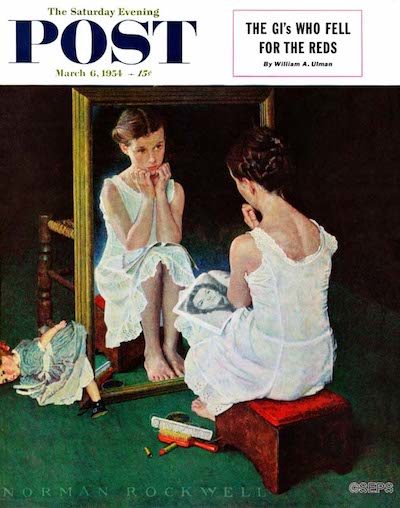
. March 6, 1954. © SEPS
Prom Dress preceeded Rockwell’s ultimate mirror of the transition from childhood, one of his true masterpieces, Girl at Mirror, 1954. The transition into adolescence is a recurring theme in his work; it was a time of heightened sensory awareness and precariousness in his own life. And his paintings reflect that tender moment.
I never had a prom. Losing myself in my grandfather’s painting makes me feel as if I did have one, though. Thanks, Pop.
Warmest wishes,
Abigail
Anyone Can Be President — Unless He Has a Mustache
In 1948, Emilie Spencer Deer, a solidly Republican woman from Ohio, announced to her family that she would vote for President Truman instead of the Republican candidate Thomas Dewey because she could not vote for a man with a mustache. She was neither foolish nor alone in her opinion. Educated and conscientious, she was, like other women of her day, simply reading the signs of what a good man looked like at the time. A clean-shaven man was team player, whereas a mustachioed one demonstrated a willful independence that was not worthy of her confidence.
Emilie Deer was a voter in Ohio, one of three hotly contested states whose loss cost Dewey the election. In California, Indiana, and Ohio combined, Dewey lost by a mere 38,218 votes out of 8.6 million cast — just four-tenths of 1 percent. Had he won just over half of that tiny margin he would have become president. Indeed, the election was so close that the polls got it wrong and the Chicago Daily Tribune famously printed an errant early edition with the blaring headline “Dewey Defeats Truman.” The winner was only too happy to hold it up as a symbol of his come-from-behind victory.
It’s true that Truman had leveraged his populist “Give ’em hell” persona to rally the workingman behind the standard-bearer of the “Fair Deal.” There was, however, more to this confrontation than political policy. Dewey and Truman also offered voters contrasting images of masculinity: Truman complemented his trim, carefully tailored suits, and clean-shaven face with a warm smile, while Dewey appeared neat, but rather less congenial. Emilie Deer’s story suggests the additional facial hair may have been crucial in establishing a negative image of Dewey. More to the point, women judging male character may have determined the outcome.
At first, the mustache worked in Dewey’s favor. In the 1930s, he made a name for himself prosecuting mob bosses in New York, his home state, where his facial hair added to his reputation of forcefulness, and helped a self-conscious Dewey compensate for his short stature. One admiring male journalist effused that “in this clean-shaven age … [Dewey’s mustache] is little short of epic. It is fulsome, luxuriant, raven black, compelling, and curved in a way to gladden an artist’s eye.” Dewey was, in that writer’s opinion, “a Clark Gable of candidates” with more charm, personality, and political sex appeal than other Republicans. This was an overstatement. Dewey famously lacked the warm charisma of a movie star, and his mustache was not Gable’s dashing pencil trace, but a thicker and less distinctive brush.
Mustache murmurs began immediately, however, when Dewey launched his first campaign in 1944. Women writers were the most critical. After attending the Republican National Convention in Chicago that July, Helen Essary, a syndicated political columnist, declared herself impressed by Dewey’s intelligence and courage, but hopeful that the candidate would get himself to a barber right away. “I have heard dozens of women make the same criticism of the gentleman from New York,” Essary wrote. “It takes from the seriousness and strength of his face. Moreover it will not help with the women vote. … You see only the mustache. You remember only the mustache. Without it, Governor Dewey would look a million percent more real as the proper man for the White House job he is after.”
Edith Efron, writing in the pages of The New York Times Sunday Magazine in August 1944, also concluded that Dewey “may be elected to office, but it will be in spite of his ‘manly attributes’ — not because of them.” To Efron, it seemed clear that whatever reasons a man had for wearing one, a mustache had a profound, often negative effect. “It plays many roles today,” she wrote. “It is Chaplin-pathetic, Hitler-psychopathic, Gable-debonnair, Lou Lehr–wacky. It perplexes. It fascinates. It amuses. And it repels.” Those writers who defended Dewey, usually male, agreed that mustaches marked an assertive type of man, but they read this as a positive quality.
From the female writers’ perspective, Dewey failed to meet the standard of modern manhood. In the early 20th century, shaving was, along with an appropriate suit, tie, and hat, a sign that a man was a conforming member of the masculine collective, whether it was the army, a company, or a sports team. Hollywood already knew what Dewey did not. Women in general would rather not see a leading man with facial fuzz. In the late 1930s, after evaluating the reaction of women in test audiences to actors with and without a mustache, the big studios advised their male stars to stay shaved.
When he ran again, in 1948, Dewey trimmed back his already modest mustache, but it still loomed large in perceptions of him as a candidate. Once again, female columnists raised objections while Dewey himself preserved his dignity by ignoring the issue. Only after the election, he explained to a female voter in New York that shaving had irritated his lip, and when he let it grow, his wife liked it. He left it to others to respond to popular suspicions that the mustache affirmed his reputation for arrogance. One obliging columnist insisted that the nominee was not affecting “a trick trim … like some movie actors have. The Dewey mustache is merely a part of him.” While Dewey’s hairy lip contrasted in some respects with his generally dull and stiff manner — as one wag put it, like a swear word in an unexpressive sentence — the whole package created the impression of a man who was both willful and aloof.
Dewey’s defeat helps explain why he has been the only major candidate since 1912 to sport facial hair. In the era of television and the internet, voters have increasingly relied on physical cues to assess a candidate’s qualities, and voters in our own day still tend to interpret the male face as they did in the 1940s. A recent study suggested that women are less likely to support a bearded candidate, and when former contenders Al Gore and Paul Ryan grew beards, it was readily interpreted as a retreat from presidential ambitions. Even in Canada, shaving off the beard can signal a serious run for office, as in the case of Canada’s new prime minister, Justin Trudeau.
After his near miss with destiny, Dewey seems to have been aware that his mustache had cost him support. In 1950, the wistful governor told a visiting group of Boy Scouts, “Remember fellows, any boy can become president — unless he’s got a mustache.” It was a joke — sort of.
Christopher Oldston-Moore wrote this for What It Means to Be American, a national conversation hosted by the Smithsonian and Zócalo Public Square. Originally published at Zócalo Public Square.
News of the Week: Roller Coasters, Ruined Paella, and a Random Rant about the Weather
Roller Coasters Probably Don’t Cure Kidney Stones
That sounds like Mad Libs, doesn’t it? It’s a headline that seems to just throw random nouns and verbs together. It might as well say, “Pickles Can’t Predict the Stock Market,” or, “Using Sun Tan Lotion Won’t Help You Travel Through Time.” (Side note: You should watch the new time-travel drama Timeless Mondays on NBC. Really fun show.)
But using roller coasters to help deal with kidney stones is actually a real thing. It seems that the jostling your body takes while riding on the amusement park rides might actually help you pass the stones. So instead of an operation, maybe your doctor will tell you to ride a roller coaster three times. (Just pray your kidney stones don’t flare up in the middle of winter when the parks are closed.)
Don’t get too excited yet though. As Slate says, this seems to be one of those specific, fun studies that comes up every other week that we really have to take with a grain of salt (which is something that might lead to kidney stones).
Nobody Likes Jamie Oliver’s Paella
Chef Jamie Oliver’s “Recipe of the Day” quickly became “Controversy of the Day” online. He made a paella and had the audacity to add chorizo to it.
https://twitter.com/jamieoliver/status/783251738509836288
Protestors — yes, there are paella protestors — freaked out on social media and called out Oliver for his “abomination.” It seems that “real” paella has to use certain ingredients, such as Spanish rice, chicken, rabbit, and green beans — and chorizo specifically is not one of them. And for the record, no potatoes, peas, or garlic either.
I don’t know, Oliver’s dish looks pretty good to me.
RIP Richard Trentlage and Rod Temperton
Richard Trentlage was responsible for many classic ad jingles over his long career, including “McDonald’s is your kind of place,” The National Safety Council’s “Buckle up for safety, buckle up,” and V8’s “Wow, it sure doesn’t taste like tomato juice.” But he’s probably best known for this little tune:
It was announced this week that Trentlage had died of congestive heart failure on September 21 at the age of 87.
Rod Temperton passed away in London at the age of 66. He wrote many Michael Jackson songs you know, including “Thriller,” “Off The Wall,” and “Rock with You.” He also wrote Heatwave’s “Boogie Nights” and George Benson’s “Give Me the Night” and wrote songs for Aretha Franklin, Donna Summer, and many others.
Goodbye Carnegie Deli
The Carnegie Deli is closing after 79 years.
Owner Marian Harper says that all of the early mornings and late nights have taken their toll, and it’s time to shut the doors. The famous Manhattan restaurant will close at the end of the year.
Sigh. Yet another legendary institution I didn’t get to experience before it closed. Now, if you want to visit a real classic NYC deli, you’ll be going to Katz’s. But Carnegie actually has a restaurant in Las Vegas too, at The Mirage, and that’s going to stay open.
An Open Letter to All of the Meteorologists I Watch Every Day
Dear Meteorologists,
Can you tell me why you think it’s so interesting that one recent day was the first time since April that the morning temperatures were in the 40s? Did you really expect it to be in the 40s in the summer months of June, July, and August? It’s like you’ve just told us it’s the first time it hit the 40s in 10 years. Now that would be an interesting factoid.
It’s the same thing every June. You’ll breathlessly tell us that it’s the first time the temperature has hit 90 in 182 days or something. Can you believe it?! Yes, I actually can because I don’t expect it to be 90 degrees in October, November, December, January, February, or the early spring months.
Sometimes numbers are just numbers, and they don’t make the weather segment any more exciting.
And the Highest Paid Actor on TV is …
Nope, it’s not Kevin Spacey or Mark Harmon or Kerry Washington or Julia Louis-Dreyfus or any of the voice actors on The Simpsons. Guess again. Come on, give it a shot. Never mind, you’ll never guess, but Variety has the list of the highest paid actors on television, along with what talk show hosts, news anchors, and reality show hosts get paid. The top three actors all come from the same show.
The highest-paid person on TV overall? It’s Judge Judy Sheindlin, who makes $47 million a year.
This Week in History: Peanuts debuts (October 2, 1950)
Charles Schulz drew the strip until the last comic ran on February 12, 2000, just one day after he passed away at the age of 77. Nobody took over for him; the strips you read now are reprints from the past.
Here’s the very first Peanuts comic. That punch line is funny yet also a bit caustic.
This Week in History: The Dick Van Dyke Show premieres (October 3, 1961)
This is my favorite comedy of all-time, and this week marked 55 years since it debuted on CBS. It’s amazing how well the show holds up today. And to think that it was almost canceled after the first season because of low ratings.
Here’s a little curio from the early ’60s: Rob and Laura Petrie doing a commercial for Kent cigarettes on the set of the show.
This Week in History: Soviet Union Launches Sputnik I (October 4, 1957)
The launch of the first satellite spurred the United States into action, leading to our own satellites and the creation of NASA.
National Apple Month
October is the month we celebrate Red Delicious, Gala, Fuji, McIntosh, Empire, Pink Lady, and of course the classic Granny Smith. How ’bout them apples?
Here’s a recipe for Rachel Allen’s Irish Apple Cake, and here’s one for Bacon, Cheddar, and Apple Bake. This Applesauce Cake from Betty Crocker is a great fall dessert to try, and if you want to use apples in something other than a dessert or snack, how about some Apple Stuffed Chicken Breasts?
You could even add some apples to your paella if you want. Just don’t tell anyone on social media about it.
Next Week’s Holidays and Events
Presidential Debate (October 9)
The second debate between Donald Trump and Hillary Clinton, from Washington University in St. Louis, Missouri, will air on many stations starting at 9 p.m. Except for NBC, which is showing the Giants/Packers football game.
Columbus Day (October 10)
Or, if you’re in Denver, you can celebrate Indigenous Peoples’ Day.
Canadian Thanksgiving (October 10)
Yup, they have Thanksgiving too.
The Alley
Don’t go into the alley, Sara’s mother always said. Don’t drive through the alley either, her father added, citing how people would lay down bits of glass to pierce your tires or metal to damage the undercarriage of your car, and if you don’t make it out, well, then you’ve got real problems, sister. The alley was where all the troublemakers and the gang bangers and the drug dealers would hang out, according to him, but Sara never once saw any of those dangers. She loved the alley between her block and the next. It wasn’t one of those dark, narrow alleyways between tall buildings, the kind you saw in all the movies and homicide mystery shows, but a spacious suburban one, lined with fences and garages hidden behind bungalow-style homes on one side, dumpsters and the back entrances of business on the other. Sometimes at night, or in those hours of twilight where the shadows stretched, it might send a small shiver up her spine, but Sara never felt frightened in that alley, never scared or spooked or anything like that.
Sara didn’t even fear the beast that lived in the inexplicable deep-dark shadow underneath the telephone pole by the taquería’s dumpster. For the longest time, Sara was like everyone else, passing by this deep-dark patch, this strange hole in the scenery, and she would think nothing of it, except perhaps a small tug in the back of her mind that something was off, something wasn’t quite right there. Space didn’t seem to add up, like the world had gone slightly askew, but it was such a fleeting and absurd thing that most people shook their heads and continued on. Not Sara. She was determined to figure it out, staring hard at the deep-dark spot whose existence her brain tried to deny. It was a constant fight against the natural inclination to just glance over it, or past it, or beyond it, because it couldn’t possibly exist. After a while, she finally got it to snap into relief instead of sliding away to the corners of her vision, as clear and obvious as the colorful mural on the back wall of Pat’s Public House a few spaces down.
At first, it seemed like just a black hole, but super-dark, a rich inky blot on the landscape. Sara thought of touching it, passing her hand through it to see what it felt like, and she imagined it being very cold and tingly. Only an idiot would blindly thrust a part of herself into some unknown black mass, though. She started with a brick, a broken chunk of debris sitting in a patch of grass near the corner of a garage, just big enough to fit in her hand. She hesitated for a moment before hurling it through the center of the dark spot.
Nothing.
The half-brick disappeared into the darkness, but there was no sound, no clatter, no thunk or even a thwoop like a TV sound effect. The darkness didn’t shift or change or react at all except that Sara had to shift her focus, concentrating on it again to make it stay. Dread clenched her stomach for a moment, but it was swiftly overtaken by overwhelming disappointment. Maybe, for all its strangeness, the dark spot was nothing special after all.
Sara turned to stalk back home when she heard a dull thud behind her. She spun around, and there was the half-brick sitting in the middle of the alley in front of the strange spot. She picked it up, turning it over in her hand. Nothing had changed about its composition. It was exactly as it had been when she threw it, same weight, same shape, same everything. She lifted her eyes and regarded the spot curiously, a frown creasing her forehead.
She threw it again, sticking around to wait this time. A moment later, the brick returned, landing in the exact same spot. She threw it a third time, and the return was even quicker, followed by a low, irritated growl that was so quiet she’d have missed it if she weren’t paying attention. Sara’s eyes stretched wide with surprise, and part of her wanted to run, but that part was easily conquered by the stronger, fearless desire to know more.
“Hello?” she asked, her voice timid as she leaned in to peer into the spot. It pulled at her mind as if trying to slip away from her attention, but she held it fast. “Are you there? Habla español? I’m sorry I threw that brick at you, but I just wanted to see what would happen.”
Sara felt dumb, like she was losing her mind, but no. It was there, the brick was there, she had watched it emerge from the darkness, and she had heard that rumbling growl. It had happened, and she wouldn’t let sheer impracticability persuade her otherwise. But there was nothing forthcoming from the pit at the moment, and she figured it unwise to upset the thing further. She looked up to the sky, squinting in the sun, which seemed impossibly bright after she’d spent so long staring at something so impossibly dark.
When she lowered her eyes, she had trouble finding the spot again, as if it kept slipping away from her vision whenever she looked at it. But she focused, clamping down on it tight. “Don’t think you can get off that easy,” she said. “I’ll be back tomorrow, okay? So I hope you’re still here when I get back.”
It was still there, in the same spot, though it tried to convince Sara that it wasn’t. There was a small tin garbage can nearby, the kind no one even used anymore, and she flipped it upside down in front of the hole, perching herself on it as she stared forward intently. She’d swiped a pack of hot dogs from the fridge, figuring she’d deal with the consequences of the missing food later. They sat in her lap for a moment as she considered the blackness.
“Hello,” she finally said, “it’s me again. Sara, that’s my name. I don’t think I told you. I live right over there, and I threw that brick at you. Sorry about that. I brought something better this time. They’re hot dogs. I think you’ll like them.”
She carefully slipped one of the dull, pinkish tubes of meat from the package, dangling it in front of herself before tossing it forward into the hole. Patiently, she waited for the hole to spit it back out as it had the brick. But nothing happened. Smiling faintly, Sara tossed another in. Again, she waited. Again, nothing. By the fourth hot dog, a sound like a contented purring emerged, so she continued until the pack of hot dogs was entirely gone.
“That’s all for today,” Sara announced, sliding off the trash can. “I don’t know if I can get you more hot dogs any time soon, but I’ll come by often, don’t worry.”
She kept her word, but she was starting to wonder why. Save for the occasional growl or murmur, nothing much happened with the black space. It merely existed, and to what purpose, she wasn’t sure. She speculated at it, babbling her theories out loud. Was it some sort of alien lifeform? A rift in the space-time continuum? A portal to hell? What, if anything, was on the other side? She had at one point watched in stock-still horror and fascination as a stray cat sniffed around the edges, then stepped forward into the space halfway. The tail left behind seemed to twitch happily, then it suddenly turned violent, muscles in its flank tensing, bottom lowered in an attempt to anchor itself. But it was no use. It was sucked into the blackness. Sara thought she heard a faint, pitiful meow, followed by a distant rumble, a deep chuckle or gathering thunder, she couldn’t tell which.
What happened to the cat? The implications were terrifying and exciting. Was it still alive in there, or had it been eaten? Why did it eject the brick, but not the hot dogs? And it seemed to actually pull the cat in. At the risk of upsetting the creature, Sara began to experiment. Anything made of meat was ripe for the taking, it seemed, while it rejected sticks and books and a handful of jacks and her brother’s Nerf football. Apples and bananas and crowns of broccoli were similarly thrown back, but it took frozen chicken nuggets as easily as it had the hot dogs. When she experimented with a steak, she set it down in front of the hole and nothing happened. Then she poked half of it in, leaving the other half exposed to the real world. It was yanked into the darkness, just like the cat, and it remained inside, also like the cat. Leaning in as close as she dared, she listened and thought she heard the faint smacking rhythm of mastication.
“Huh.” Sara placed her hands on her hips, and, really, that was all she could do. Her foot tapped on the pavement as she thought. What was the point of all this? Should she do something, tell someone? It didn’t seem dangerous unless something interacted with it, so that made it pretty harmless, didn’t it?
But what happened to things once they went through? Sara left the alley then, having nothing more to give the dark space, but thoughts of it stuck with her, clinging to her skull and refusing to leave. They plagued her, leaving her usually quiet and brooding and distracted. Her mother began to question her about the food that had gone missing, waving her arms as she complained that these things couldn’t have just grown legs and walked out, and Sara could only absentmindedly muse that perhaps they had, which lead to being promptly grounded for back talk. That suited her just fine, as it allowed her more time to figure out this enigma in the quiet solitude of her bedroom.
At school, her friends were getting annoyed with her and her complete lack of attention, and the teachers were getting concerned, except for Mr. Carson, who was more than happy to indulge in a student’s sudden passion for outer space, even if she was a little fixated with black holes and dark matter in particular. The councilor came to talk to her, but she shrugged off the concern, saying that she just had a lot of things on her mind. There was no way she could try to explain her bizarre friend to anyone when she barely understood it herself.
There was nothing online, nothing in the library. Sara was starting to wonder if the thing was nothing at all, not in the sense that she imagined it, but just that it was the very essence of nothingness, maybe like what the Buddhists believed, but not really. An abstract concept not conceivable by puny human understanding. That made her feel a little better about her inability to solve this particular puzzle, if it existed well beyond her ability to comprehend. It made her smile with a sense of whimsy, tremble in frightened awe, and cry deep rivers of emotions unlike anything she’d felt before. It consumed her, just as neatly and quickly as it consumed the cat and the hot dogs and the T-bone steak her mom had bought for her dad’s birthday.
Sara went back as often as she could, forcing herself to look at it while it tried to get her to look elsewhere, thinking about it, pondering it, just being near it. She started saving her money to buy sticks of beef jerky for it, snapping off pieces and tossing them idly inside.
And then, as sudden as the first lightning bug of summer, a thought came to her and she couldn’t put it down. It felt so natural, so obvious, that she was almost ashamed she hadn’t thought of it before. She hopped down from the can, bit into a bit of jerky for herself, and approached the black spot in the alley by the dumpster. She got down on her hands and knees and crawled torward the darkness. There was no hesitation, no second thoughts; this was the right path, and she knew that now. There was no other choice than to see for herself. Somehow, deep down, she knew she had to embrace the thing that no one else could even see. She had to go in there herself, having exhausted all her other resources and methods.
Sara didn’t know what to expect, but she would have never expected the experience to be so unexceptional. When she was close enough, she lifted her hand and pressed it through. No change in temperature, no tingling cold or scorching heat. She thought maybe it would tickle on her skin, inspire all the hairs on her arm to straighten up and tremble, but it didn’t. She wiggled her fingers to find little resistance, no denser air or the feel of whatever the thing inside might be made of. She wanted to brush its fur, touch its scales, even the warm wetness of its drool, if it had any of those things, but there was nothing, nothing at all.
Taking a deep breath, she put her hand down and continued forward, ducking her head as it breeched the threshold. Sounds from the outside word, the passing cars, the loud Mexican music spilling out from someone’s kitchen window, the dull hum of late summer cicadas, they were all still there, but muted, and when Sara turned her head to look back through the portal, there was nothing but blackness. She couldn’t even see her own body. It must have been an interesting sight for anyone walking by the alley, to see the tail end of a girl protruding out, with the rest of her swallowed up by some space otherwise nonexistent in the world. Feeling it would be best to avoid that kind of situation, she kept moving, though she couldn’t truly tell when she was all in.
When she opened her mouth to say something, to call out to whatever she’d been feeling, no sound came out. The darkness seemed to rush inside, filling her mouth, silencing her. But she thought it, and she felt the thought leaving her and spreading out, dispersing into blackness itself. Hello, she thought. I’m here; are you? But she wasn’t there, nothing was. Not her body or her voice. Only her thoughts and the thought of her.
Once she realized her thoughts were there, though they weren’t, swallowed up by the darkness, and she felt the concept of her divide itself up into a million invisible black pieces, spreading out and fading, fading, fading. Was there a faint sound, a soft, gentle rumble, the smacking of lips, before she ceased to be? Or was that just the sound of everything stopping as she became one with the deep, unfathomable, impossible darkness?
Make Vegetables Great Again!
American eaters can be truly adventurous, ready to try out a new restaurant, a new barbecue recipe, or a new foreign cuisine. We just aren’t adventurous enough to make fruits and vegetables a standard in our daily diet. According to a recent survey, only 4% of Americans are eating enough vegetables.
Perhaps our diet is still being shaped by our historic reliance on meats and starches. For so long, the American diet was restricted to what was immediately available. When fruits and vegetables went out of season, we had a choice: wait for spring or open a jar of preserves.
By the mid-1800s, though, iceboxes enabled some cooks to keep foods fresher longer. And when refrigeration made it to transportation and into the home, fruits and vegetables could travel farther and last longer before going bad. Although this gave the average American the ability to eat more vegetables, it didn’t give them much of a reason to.
Because getting fresh produce is one thing; knowing how to cook it well is another.
As food writer and restaurant owner George Rector points out in “Rhapsody in Greens,” vegetables are usually so overcooked that they arrive on the dinner table with little flavor or nutrition left. His informative and humorous 1935 article explains the proper way to cook a vegetable so it can be “as cheering to the soul as it is beneficial to the body.” He also encourages readers to try obscure greens, such as finocchio, fiddle-neck ferns, and beet tops.
Rhapsody in Greens
By George Rector
Excerpted from an article originally published on November 2, 1935
Thanks to scientists, everybody is now aware that you have to eat green vegetables to keep healthy. But science hasn’t bothered — which may be a good thing in a way, since you can’t cook with a test-tube mind — to be equally enterprising about ways of making green stuff as cheering to the soul as it is beneficial to the body. There is no sorrier sight this side of the grave than the standard vegetable plate. And yet its unappetizing presentation is as much of a “must” in modern life as gas for the car, not to mention its yeoman service in keeping the feminine waistline within the bounds of fashion, if not of reason.
Now You’ll Like Spinach
Vitamins and reducing between them have done for vegetables what Tex Rickard did for prize fighting. But the gastronomical angle has been shockingly ignored during the build-up, much as if falling in love were being widely recommended as merely good for the stunted ego. That kind of spectacle makes you see what foreigners mean when they complain that Americans eat what they’re told is healthful, with no thought of the taste. That doesn’t happen to be true, but in certain lights the evidence looks damning.
Spinach is the proverbially tasteless vegetable — in toy shops they even sell spinach toys for bribing the young into eating it — but it’s also true that peas and string beans and cabbage and carrots and all the other green vegetables can be, and often are, as dull as last year’s phone book and as subtly flavored as a cardboard box. The human palate, a finicky faculty which is more precious than rubies, has every right to rebel at wet green hay for food; particularly since it’s thoroughly unnecessary. There is too little understanding of the simple fact that cooking your spinach without water, except that which clings to the leaves, trusting in its own ample juices, retains the flavor essences that make it the joy of real epicures; or that cooking a ham bone with it cheers up both food and feeder; or that, to get into the fancier touches, chopping and creaming it or serving it with poached eggs and grated cheese as eggs Florentine will make the rankest spinach hater wonder where it’s been all his life. Any one of those dodges is a dramatic demonstration that green vegetables provide half the finest flavors known to man, but to get those flavors, you have to treat your raw materials like ladies.
Eating in Foreign Lands
Some travel for health, some for lack of something better to do, some because a travel agent sent them a folder about the joys of winter sports in Tierra del Fuego. But one of my reasons for going to distant places is the prospect of new things to eat. And vegetables are the gastronomic explorer’s long suit. Sheep, hogs, cattle, and chickens are more or less alike everywhere, and a national cuisine can throw variety into them only by varying the cooking process — it’s just a question of boiled sheep’s tails in Afghanistan and roasted sheep’s legs in Simpson’s-on-the-Strand. But, although I’ve since met it on Italian pushcarts in New York, I had to go to Italy for my first meeting with finocchio, that crazy plant which looks something like celery and tastes far too much like licorice; not an experience you want to repeat often, but all in a good cause. I don’t even know the names of some of those futuristic Japanese vegetables which are grand when cooked into suki–yaki, but when pickled in the fiendish Japanese fashion produce much the same effect as a Jerusalem artichoke soaked in kerosene and then left to ripen in the bottom of a fisherman’s dory for two months. I haven’t met the Polynesians’ poi in person, but someday I’ll be digging my left fin into a mess of it, served by a young lady in a grass skirt, and checking it off in my memory along with bamboo shoots and fiddle-neck ferns and the kind of peas that the French cook pods and all. Also I have still to meet the boiled hops which are said to be still eaten in little-frequented parts of England. My natural affection for hops and all their consequences leads me to look forward to that with some pleasure.
The Fiddle-Neck Fern as Food
Fiddle-neck ferns, by the way, show that this country of ours, in spite of all fads, fancies, and foreign aspersions, manages to retain a fundamentally sound attitude toward eating. The fiddle-neck fern is the young shoot of the ferns that grow in the Maine woods, cut by the astute native while still light green and tender, and cooked like greens; the name deriving from the fact that a young fern shoot is all curled up at the end like one of those rolled-up paper tubes they blow in your face on New Year’s Eve. They taste, simply and beautifully, like the soul of spring. Spring, of course, is the queen season of the year for dyed-in-the-wool greens lovers, as well as for poets and the manufacturers of tonics, and a man who has acquired a real taste in the subtle bitternesses of wild greens is well on the way to being a genuine and home-grown epicure. For him the return of the sun means the return of horseradish and turnip and mustard and radish greens, some of which, like mustard, are so bitter that they’re better mixed with something mild like chard — a stepping down of flavor which is only the proper treatment, like mixing Scotch with water. It’s a special taste, but no one is ever happier than a greens hound crawling round a vacant lot on a warm spring afternoon, wielding a blunt knife in the pursuit of young leaves of dandelion and mustard.
If pushed, he will put up with such domesticated but rare items as chicory and endive greens, and will babble by the hour about the glories of young beet tops. The amateur gardener naturally thins most of his beets, so the survivors can develop to the proper size for ordinary cooking. But he can probably afford to let a row or so grow a little further without thinning, till they’re around five inches high, then root up the whole works, tiny beet and all, wash it thoroughly, nip off the thready tail of the little beet — only the tail to keep from “bleeding” it — and cook the whole plant to the tender point in as little water as possible, along with the indispensable ham bone or piece of fat bacon. There is a distressingly rare dish which is as healthful as it is comforting. Sometimes you can get beet tops in the markets, but they’re seldom young enough to give you the last fine careless rapture of flavor, and besides, it’s the lingering sweetness of the miniature beet on the end which adds the crowning touch. Very young beet greens are available in the markets in the early spring and are most delicious when tenderly steamed and served au beurre.
When I think of how any and all greens are abused by the average cook, I feel like taking out a charter for an S.P.C.G. [Society for the Prevention of Cruelty to Greens]. Ordinary greens are always more or less gritty, because the lady in charge didn’t know about washing them by soaking in gallons of cold water, with the greens floating on top and the dirt sinking far below to the bottom, and then not pouring them out with the water into the sink, but lifting them off the top. They’ll be flavorless because she drowned them in water while boiling, and then drained the water off. As I’ve already mentioned somewhat querulously, spinach needs only the water which clings to the leaves. And one of the better ways to handle kale and beet tops is to treat them as you would spinach: Cook them for five minutes with water that clings to the leaves, then drain and pitch them into an iron pan in which some fine chopped bacon — easy on the bacon — has been sizzled just enough to start the fat rendering well. Cover that tight, let the natural juices do the cooking until your greens are tender, and you have something as extra in its own way as fine old brandy.
Putting Steam to Work
When you’ve developed your courage by doing spinach without water, try peas with lettuce leaves and discover just how delicate the pea can be when properly educated. The best receptacle for this job is a heavy metal pot with a tight-fitting lid and a good six inches of depth — iron, copper or aluminum, it doesn’t matter so much if the metal is good and thick. Wash your shelled peas and allow as much water as possible to cling to them. Then put a tablespoon of butter, without melting it, in your deep pot and introduce the peas. Cover the peas with some large lettuce leaves that are dripping wet, clamp on the cover, set it over the low flame and let the water on the lettuce and the natural moisture of the peas work up a bland but efficient steam, then immediately reduce the heat. This method cooks everything to a point of tenderness you never met before. The lettuce is thrown away before serving, but its soul remains behind in the flavor. You may prefer to introduce some chopped onion before steaming or to dust the peas with a little sugar after they hit the pan — I recommend both — but don’t miss the main and significant point, which is the consequences of steaming, not boiling.
The more I fiddle with food, the more thoroughly I am convinced that steaming is the best way of tackling most vegetables. It keeps in vitamins and flavor both, which means that here is a process satisfying both dietitian and gourmet, who are usually clawing at each other’s throats. A capacious vegetable steamer belongs in every right-thinking kitchen, along with a drip coffeepot and a pepper mill and a wooden salad bowl anointed with ancient garlic and all the rest of my idées fixes in the way of cooking equipment. And a steamer with several compartments makes it possible to combine several vegetables, with a minimum of trouble. A mixture of peas, young lima beans, and string beans, piping hot from the steamer and covered thickly with heavy cream that’s been whipped just enough to start thickening, or that grand old American dish, succotash, which, in its finest version, consists of fresh lima beans and green corn cut off the cob, seasoned with butter, salt, and pepper after steaming and then cooked for a few decisive minutes in cream.
Steamed cabbage, doused with butter, salt, and pepper before serving, can alone cause revolutions in people’s attitude toward that plebeian plant — the kind of people who really get the horror of that melancholy statement made by Walter Hines Page, the wartime ambassador to England, to the effect that there were only three vegetables known in England, and two of them were cabbage. I always think of cabbage, though, as a shining example of how something intrinsically first-rate can get a bad name through mistreatment. The American male has every reason for his notorious affection for corned beef and cabbage, but, when it’s either neglected or ruined when attempted, he prefers to leave it as just a glorious memory. It may do no good at all, but here goes for the resurrection anyway: I know a man who can make corned beef roll over and make a noise exactly like Virginia ham when he bakes it, and when he combines it with cabbage, the stars in their courses stop rolling to take a sniff. According to him, the secret lies in starting your beef in cold water and never letting it reach a fast boil, just a gentle simmer for the period, somewhat under four hours, you’ll want for a five-pound piece, starting with cold water. And he insists on skimming the fat off the water at least twice during the boiling. The cabbage should be sliced across the bottom to cut loose the first layer of leaves, and then quartered. Half an hour before the beef will be done, in she goes, to simmer along with her soulmate; and I recommend including half a dozen grains of whole black pepper. English mustard as a relish for it is a universal note, but chopped onion sprinkled over the plat is a preference of my own that you might take to. It sounds almost too simple to go wrong on, but it’s a mortal fact that the results of misguided at- tempts often remind you of the cowboy in The Virginian who said, on trying the corned beef, that it felt like he was chewing a hammock.
Meet Bubble-and-Squeak
A first-rate version of this dish will make your wife look thoughtful after the second bite and admit after the third that it isn’t bad at all. When she’s been softened up, get her to throw you some bubble-and-squeak for Sunday breakfast. Cabbage boiled to death and potatoes ditto are two of the pillars of British civilization and two disgraces to a civilized nation, but the Englishman who first fried the two together was a genius — never mind the name. I first met the results in the days when Rector’s was booming enough to supply my father with a yacht — a two-masted schooner which floated quite as well as Mr. Morgan’s — named the Atlantic. One summer the Atlantic boasted a Portuguese cook who was nothing to boast of. The old gentleman was pretty finicky about food, as he had every right to be, and, at breakfast one morning, he was just telling me he’d made up his mind to fire the Portygee and get somebody who knew how to boil water at least, when in came the steward with a small platter of piping hot bubble-and-squeak. Father hung his nose over it a moment — it had been browned just right in a minimum of mixed bacon fat and butter — glanced suspiciously at a forkful, stowed it, swallowed it, rolled up his eyes, and instructed me to go out to the galley and tell the Portygee that his pay was raised five dollars a week.
Or, moving over into red cabbage, which isn’t quite comfortably domiciled in some sections of the country yet, combine it with apples and red wine — a German idea, and a beauty.
Shred an average-sized, firm head up fairly fine and bestow the shreds in that same tight-lidded, heavy pot we’ve been talking about, along with four apples pared and sliced, three tablespoons of butter, a quarter cup of vinegar, a third of a cup of sugar — brown sugar preferred — a teaspoon of salt, a light pinch of cayenne — that red-headed and indispensable devil — and a cup of any old red wine, domestic or imported. After that it’s just two hours of simmering in its own juices over a low flame — with the wine and the butter she can’t burn — and, when that gets to the table, you may begin to understand the Egyptians, who worshiped red cabbage along with Isis and Osiris.
The Romantic Tomato
In his pursuit of the higher life, the overmoral vegetarian is also apt to forget the ornamental properties of vegetables. Painters don’t. No painter ever goes for long without tearing off a still life consisting of three carrots, an onion, a big red tomato, and a basket of Brussels sprouts, thus emphasizing again the intimate connection between high art and a boiled dinner. Certainly this question of looks had a lot to do with the past of vegetables. The business of putting a pinch of soda in with green peas and beans to give them that awful Paris-green color I do not approve. I suppose eating with your eyes is all right if you like it, but my own tastes don’t run that way. But things like tomatoes and eggplant might never have got anywhere if they hadn’t been cultivated as garden ornaments because they were handsome, long before they reached the table. In its ornamental period, the tomato was known as a love apple — the name being an outrageous example of mistranslation. When the Moors first brought tomatoes into Sicily, the Sicilians called them pomi di Moro — meaning “Moor’s apples.” Then the French met them under that name, and thought they were saying, pomi d’amore, meaning “apples of love.” So it got into French as pommes d’amour, and into English as “love apples.” As a natural consequence, tomatoes got a wholly undeserved reputation as something good for making the girlfriend fall in love with you — and so, for all I know, the first man who ate a tomato and found it was delicious was merely trying to work up his nerve to pop the question. He was taking a desperate chance, just the same, because tomatoes were long supposed to be poisonous.
After which dazzling burst of scholarship, let me point out that, besides both being among the raving beauties of the vegetable kingdom, tomatoes and eggplants are naturally coupled in the betting by being natural partners in gastronomy. Tomatoes are approximately foolproof, but, in general, eggplant is even worse mishandled than greens. Frying it in butter, which is as far as most cooks get, is about as sensible as stewing a nice young broiling chicken. Its delicate sub-bitterness won’t stand such treatment. There’s a way of baking it sliced with lemon juice that does it justice, and eggplant Provençal, which rings in the helpful tomato, is one of the most princely dishes in the Continental cuisine.
Peel your eggplant or not, depending on whether you like the fairly heavy bitterness of its skin. Anyway, slice it crosswise into quarter-inch disks and sauté the slices gently for 10 or 15 minutes in butter. Jean Frenchman includes a shallot with them, and if you can get shallots, more power to you. Sauté your tomatoes cut in half the same way; the number of tomatoes depends on the size of your eggplant. Butter a big flat baking dish and line the bottom with slices of eggplant covered in turn with a layer of tomatoes. Salt, a light pinch of cayenne pepper, and a dusting of grated cheese. Another layer of eggplant ditto, another layer of tomatoes ditto and seasoning ditto. After it’s baked about an hour in an average oven, the liquid that oozes out of the vegetables will be pretty well cooked away and the top beautifully brown. I can turn vegetarian in the presence of this dish and dine on nothing else, if the supply holds out. Along the Riviera they use olive oil instead of butter, of course, and there’s a considerable load of garlic in the makings.
You can do as you like about the garlic, but the butter will richen things up more, even if it does make the sautéing a little trickier.
It’s all in giving your vegetables a break, allowing them a small portion of the same care and forethought that meats receive as a matter of course. Even the lowly carrot, which is so good for you and so dull to eat, can step out as carrots Vichy and go to town as brilliantly as Cinderella. That’s just steaming your carrots along with a bay leaf, draining and letting them cool enough to handle, then slicing as thin as possible and browning in butter, both sides. With a sprinkling of chopped parsley they’re as handsome as they are sweet and juicy. And don’t get the idea, by the way, that parsley is a mere ornament. The other day I did meet a very pretty and charming young lady with a boutonniere of parsley for nothing but ornament, but the fact is that its queer, half-acid, half-musty flavor is the secret of many a famous dish. The French throw in an extra wrinkle in doing carrots Vichy in Vichy water, but between you and me, that’s only an excuse for giving the dish a name.
New Ways to a Man’s Heart
The more you shop around in the inner arcana of cooking, the more you realize that somewhere, sometime, somebody has cooked everything cookable. It never occurs to the average mistress of a kitchen to explore the possibilities of braised celery and endive and lettuce, although the results may go far toward solving the problem of how to get green stuff into Junior, and, more likely than not, the family cookbook contains full instructions for all three. She never heard of the admirable practice of frying thin slices of cucumber in batter as a side partner for fish, or of stuffing a pared and cored cucumber like a tomato. She even allows such reputable country dishes as fried oyster plant, done much the same way as carrots Vichy — you may have to ask for salsify to get it in your town — and wilted lettuce to slide ignored into the discard. Wilted lettuce is a homely thing, native to up-country farmhouses, but it’s the best way of explaining why the conventional salad never took hold on the old-fashioned American cuisine. A bit of chopped bacon in a frying pan, sizzling to a brown, some sharp vinegar and a little sugar thrown in — stand away while she steams and sputters — and then the large leaves of old-fashioned lettuce tossed in and chivvied round in the hot mixture till they’re limp as a wet glove and a rich dark green. The bacon and vinegar and sugar combine into a barbaric symphony of clashing and yet harmonizing flavors, and the lettuce turns out comfortingly chewy and surprisingly suggestive of a second helping. A man who won’t eat cold salads can often be made into a wilted-lettuce addict, which hornswoggles him neatly and painlessly into his share of roughage and vitamins.
Much as I reprehend eating with the eyes, I must admit that there is something in making a vegetable look interesting, which is why a baked stuffed tomato is always regarded with such respect — although it’s good eating, too — and undoubtedly why artichokes have always been among the aristocrats of the vegetable world. The amount of nourishment you get from artichoke leaves could be put in your eye with no inconvenience whatever and, unless you regard them as I do — as a fine excuse for consuming Hollandaise or vinaigrette dressing — the only point is the fascination of pulling them apart leaf by leaf and finding one good mouthful of heart in the middle. That appeals to everybody who ever took an alarm clock apart as a small boy.
Romance and Artichokes
One of our customers in the old days at Rector’s even made use of them in his affaires de cœur. He was always in love with another girl, and, although he was rich and not bad-looking, he was unlucky in love and would come into Rector’s to brood over his troubles alone, parked solitary at a table, without a word to throw at a dog. During one of these private wakes of his, he happened to order an artichoke Hollandaise — and presently the whole restaurant was treated to the spectacle of this young man, totally unconscious of his surroundings, playing “She loves me, she loves me not,” with the artichoke leaves. It got to be a regular thing with every new girl. Maybe artichoke leaves come in pairs — I’m not botanist enough to know — but anyway, he was always coming out on “She loves me not,” even counting the tiniest leaves, and feeling much worse in consequence. Finally a waiter took pity on him and carefully removed one leaf before serving him.
From then on, he came out on “She loves me,” and he would walk out of the place with his head up and his stick swinging and a five-dollar tip left behind on the table, as happy as a little boy with a new pair of red-top boots. He can’t have got much of the flavor of his Hollandaise, which is one of the more delicate consolations for living here below, but then, you have to pay some penalty for being in love. And I suppose you also have to pay some penalty for living, in an age when science gets more attention than flavor. But when I get down to eating by theory, I’ll follow the principle laid down by Dr. Horace Fletcher, the old fellow who invented Fletcherizing and carried it so far that he made his disciples chew even milk thoroughly before they swallowed it. As that would indicate, he was something of a crank. But he did write these noble words: “Trust to nature absolutely. … If she calls for pie at midnight, eat it then.” I’d like to be there and have a piece with him.
You can find out more about the Rectors and their famed New York City restaurants at The American Menu.
FDR Asks, ‘Can Vice Presidents Be Useful?’
Lost in the noise and excitement of a presidential campaign is the quieter contest for the vice presidency. With few exceptions (the 2008 competition between Joe Biden and Sarah Palin being one), it never draws the same public interest as the presidential race because it’s really not a contest between vice presidential candidates.
The vice-presidential hopefuls are more or less surrogates for their presidential running mates. And once elected, the vice president’s job doesn’t draw much fascination from the public. The VP presides over the Senate, attends public functions not important enough to merit the president’s attendance, and, of course, remains ready to step into the big job if the president is killed or incapacitated.
Long before he ran for president, Franklin Delano Roosevelt tried out for the Veep’s job. He’d been appointed assistant secretary of the Navy in 1913 and worked in that capacity through the First World War. Shortly afterward, he was offered a chance to campaign with the Democratic presidential nominee of 1920, James M. Cox.
Being chosen as Cox’s running mate was a step up for FDR, but he was under no illusions about the importance of the VP position. He envisioned bigger things for the office. And so, in 1920, the Post published his article, “Can the Vice President Be Useful?” in which he suggested a new role for the vice president that would help make Congress more efficient.
We aren’t giving away anything by telling you that no one took up Roosevelt’s suggestion. Still, it’s an intriguing idea to give the VPOTUS more substantial work for the position’s $230,700 annual salary.
Can the Vice President Be Useful?
By Franklin D. Roosevelt, Reported by Donald Wilhelm
Excerpted from an article originally published on October 16, 1920
Library of Congress
There is probably no better example of what might be called the industrial waste at Washington than is shown by the traditional conception of the duties of the vice president. Here is a man supposedly fully capable in an emergency to act as President of the United States; who has been nominated and elected by exactly the same procedure as that surrounding the nomination and election of the president himself. No precaution which the framers of our Constitution could design was neglected to assure the people that their vice president would be chosen with the same care with which the president is chosen and elected to office by the will of the majority of the citizens. Yet the only official work devised for him to do is to preside over the Senate, which is in session hardly more than half of each day and hardly more than half the days of each year, and, moreover — notably during long set speeches — is often presided over by a senator called to the chair by the vice president.
I believe that Washington must be reorganized, that voters will insist upon it, and I hope sincerely that the vice president’s job will be one of those which will be attended to. Just what the added duties of the vice president will eventually be, of course, no one can forecast. The most one can do certainly is to suggest the background of the office and of the government and indicate what might be done in the foreground, by the vice president especially.
Clearly, at the very outset, two facts are evident: First, such functions as the vice president may perform strictly in relation to the Senate are for the Senate itself to decide; second, the reorganization of the governmental machinery cannot be achieved in any event by the Senate alone, by Congress alone, or by the president and the department heads alone. All must lend a hand if reorganization is to be achieved at all, and the vice president with the rest.
In a large sense the first step must come in betterment of the relations between Congress and the White House. I think the first count in the nation’s bill of complaint is that the legislative and executive families are all but disastrously too far apart when they are of different political faiths, and still too far apart when they are of the same political faith. In some countries having a parliamentary form of government — England, for instance — the prime minister, who bears analogy to our president, and the members of the cabinet have access to the floors of their legislative bodies, where, though they cannot, of course, vote, they can yet outline personally the pros and cons of their policies. It is worth noting that President Washington several times occupied a seat on the floor of the Senate in order personally to make his views known. Years later, an attempt was made to encourage this practice and to establish it by joint resolution. Again, it is worth noting that President Wilson, in order to present his views to Congress most successfully, personally addressed it on various occasions. The question accordingly comes to mind: Cannot the vice president so utilize his high office as to help bridge the dangerous and increasing gap between Congress and any administration?
The Family Feud
It is my thought that reorganization itself, not only of all the factors that bear on the relationship of Congress with the office of the president but the reorganization of the executive departments themselves, can never be achieved until Congress and the White House are in closer touch. Certainly no commission of experts called in from outside by either Congress or the president can succeed with the gigantic problem of reorganization of this, the biggest and most intricate business in the world.
The proof is in: President Taft tried and signally failed after his commission had all been ground up between the upper and the nether millstones. It is certain that no Congressional commission can succeed in reorganizing the executive departments and bureaus without the cooperation of the president and the heads of the departments and bureaus, though such a body as the Congressional Commission on Reclassification of Government Personnel, which does not disturb the various entities, might succeed in its particular task. And certainly no president can achieve reorganization of even the executive departments without such cooperation from Congress as will result in necessary legislation. It follows, in other words, that harmony is the shibboleth.
The question, then, that occurs to one at this juncture is: Would it be possible for the vice president, who is not tied down to a desk, to help? Especially in relation to problems where the jurisdiction or control does not rest in one department but partly in one and partly in others? In other words, wouldn’t it be practicable for the vice president, at the request of a department head or at the request of the president, to study such a situation and report?
Anyone who has grappled with governmental inertia will understand why such suggestions are in point. Like most young men, when I went to Washington I felt that the traditional inertia in the departments was not a real thing but rather an excuse for laziness. I discovered very soon that though it is intangible and therefore all the harder to grapple with, it is as real as anything in the world, as real a thing as if it had flesh and blood, though you can never put your finger just here or there and say: “Here is the monkey wrench in this machinery!”
Liaison Service
It has been said very frequently, by executives in Washington, and others, that the trouble all lies with Congress.
But the broader view is that the trouble is the result of lack of plan, or, more accurately, our inability to adjust our tremendous growth to the old, existing plan; and running that idea back, you soon discover that the dire need of adjustments — in other words, the dire need of reorganization — is largely due to the wide gap between the executive and the legislative families.
We return thus to our starting point — the need of utilizing every possible aid in overcoming the gap between Congress and the executive branch of the government — and the desirability of making fuller and more satisfactory use of the vice president in overcoming that gap; in Congress, where his duties and prerogatives are in the hands of the Senate, and in the White House and executive departments, where his usefulness depends largely upon his relationship to the president and his willingness to aid the president.
There is hardly any limitation upon the ways in which the vice president might be of service to the president. He might serve as an executive aid to the president, and in that capacity could easily enough, even if he did not possess such executive authority as might without a Constitutional amendment be granted him, exercise considerable influence through his close relationship with the president. He could, at the request of the president, serve in relation to the determination of large matters of policy that do not belong in the province of a member of the president’s cabinet. He might serve as a kind of liaison officer to Congress and aid perhaps in carrying the large burden of interpreting administration policies to Congress and to the public.
Conclusively, when one has thus considered the background of our government and realized the urgent need of accomplishing reforms in the foreground, the desirability of making fuller and from every approach more satisfactory use of the vice president is apparent. The question, then, resolves itself into the problem of ways and means. And in meeting the problem of ways and means, the most that one now can do is to trust to American resourcefulness.