The most popular band in the U.S. during the 1920s was Paul Whiteman and His Orchestra. Though Whiteman was known during his time as the “King of Jazz,” he is a controversial figure to jazz historians today. One reason is because his orchestra for the most part didn’t play what today we think of as real jazz. Their music was completely arranged, the crucial improvisational aspect of jazz almost completely removed. Much of their music bears a greater resemblance to Lawrence Welk than to, say, Benny Goodman.
Nonetheless, Paul Whiteman can be credited with taking the jazz idiom from the dives and juke joints of New Orleans and Chicago and popularizing it among a nationwide, and eventually worldwide, audience.
In 1926, Whiteman contributed a three-part series to the Post simply titled “Jazz,” in which he, along with Mary Margaret McBride — who, over a 40-year career as a radio interviewer, earned the title “The First Lady of Radio” — explains what jazz is and how he came to be the “King of Jazz.”
In the following excerpts from Part I, Whiteman talks about the years leading up to the Roaring Twenties, detailing how he discovered jazz and the hardships and lucky breaks that ultimately led to the creation of his jazz orchestra and its first recording contracts.
This post was published to mark National Jazz Appreciation Month. We’ll publish more historical articles about jazz greats as the month progresses, and you can catch them all in “Jazz History by Men Who Made It.”
Jazz, Part I
By Paul Whiteman and Mary Margaret McBride
Originally published on February 27, 1926
There was every reason why jazz should have burst forth at the touch of a hundred or more orchestra leaders in 1915. The time was ripe for almost any explosion. The war spirit was on the loose. The whole tempo of the country was speeded up. Wheels turned like mad. Every factory was manned by night and day shifts. Americans — and the term included Slavs, Teutons, Orientals, Latins welded into one great mass as if by the gigantic machines they tended — lived harder, faster than ever before. They could not go on so without some new outlet. Work was not enough. And America had not yet found out how to play; the hard-pressed, hard-working young country had no folk songs, no village dances on the green.
A showman, Joseph K. Gorham, gets credit for first realizing the possibilities of the underworld waif. Gorham, a newcomer to New Orleans, heard a group of musicians playing on the street to advertise a prize fight. He was halted first by the perspiring, grotesque energy of the four players. They shook, they pranced, they twisted their lean legs and arms, they swayed like madmen to a fantastic measure wrung from a trombone, clarinet, cornet, and drum. They even tore off their collars, coats, and hats to free themselves for a very frenzy of syncopation. As a finger-snapping black hearer put it, they played “like all de debbils was atter ’em.”
Mr. Gorham, with the sure instinct of the good showman, pushed his way through the excited crowd and interviewed the leader. He discovered that not one of the players in Brown’s Orchestra, as they called themselves, could read a note of music. Nevertheless, the showman knew that he had made a find, and he listed the conductor’s name with an address on Camp Street for future reference.
Brown’s Orchestra was not the first to wear the name “jazz.” Bert Kelly, of Chicago, is credited with inventing the term “jazz band.” He used it to describe a group of musicians that he hired out to the Boosters’ Club at the Morrison Hotel in Chicago. The Boosters’ Club promptly raised all its prices, alleging that this newfangled jazz came high.
Meantime, Brown’s Orchestra had been taken over by Mr. Gorham and placed at Lamb’s Café in Chicago. The players burst upon an unsuspecting world with a bang that nearly shattered Lamb’s roof. The manager hastily telegraphed Mr. Gorham to call off his jazz babies. Gorham instead urged patience and advised the band to “ease down a little.” They did so with great profit to themselves, for soon crowds were being turned away in droves. This, so far as cabaret history goes, was the first official appearance of a jazz band.
Since Mr. Kelly’s experiment with the word, there have been hundreds of attempts to find a new name for modern American music, but the public refuses them all. They are used to “jazz,” and the word expresses something to them that the music seems to mean.
I cannot see that it matters much. Sometimes I regret the origin of the word because I think it probably has stirred up sentiment against the music. But if jazz turns out to be a good product, it won’t really make much difference what it is called. Words, like men, climb up or slip down in the world, and when a word has made good and stands for something real and worthwhile, I am not one to bring up its past against it.
It is a relief to be able to prove at last that I did not invent jazz. I took it where I found it, and I sometimes wish the preachers and club-lady uplifters who put jazz on the grill wouldn’t concentrate on me. I really don’t deserve it. I don’t deserve the snorting editorials in newspapers from Burma to Sydney either.
All I did was to orchestrate jazz. If I had not done it, somebody else would have. The time was ripe for that. Conditions produce the men, not men the conditions. It merely happened that I was the fortunate person who combined the idea, the place, and the time. At least I think I was fortunate. Others are not so sanguine.
I guess it is a good thing I inherited a certain musical knack from my parents, for I lack stick-to-itiveness. Yet I invariably admire the things that are hardest to do. That is what first attracted me to jazz. The popular idea is that jazz is a snap to play. This is all wrong. After you have mastered your instrument, it is easy enough to qualify in a symphony by following the score as written. But a jazz score can never be played as it is written. The musician has to know how to give the jazz effect.
At 16, I started ragging — of course we had not heard of “jazzing” then — the classics. A friend and I won a good deal of notice with this trick from the older members of the Denver Symphony, in which I had then begun to play. They used to keep us at it for hours. Our favorite classic for jazzing was “The Poet and Peasant Overture.”
When Jazz Banishes the Blues
The warden of the Nebraska Insane Asylum heard us and thought our music might soothe his patients. He invited us down for a weekend at the asylum, and we played all the pieces we knew. We made a great hit, especially with an old fellow who thought he was Nero. He was so fascinated with the intricacies of ragtime that he tried to play it on a fiddle he carried around with him, and after that, we had the daily spectacle of watching Nero jazz it up while — he said — Rome burned.
I got my musical education from my father and teachers he selected. All were serious and talented musicians. One was Max Bendix, for whom I worked later in the San Francisco Symphony. I can’t remember the time when I didn’t know the feel of a bow in my hand, and my first lessons were taken from my father when I was such a baby that I actually have no recollection of them.
At 17, I was chief viola player in the Denver Symphony, and five years later went to the Pacific Coast to seek adventure. I finally found the excitement I craved in the San Francisco Exposition and played with the World’s Fair orchestra until the exposition closed. I was at the same time a member of the Minetti String Quartet. When the exposition closed, I looked around for something new to do. By that time I was thoroughly dissatisfied with symphony work. The pay was poor and there was little chance for initiative. And then — along came jazz.
We first met — jazz and I — at a dance dive on the Barbary Coast. It screeched and bellowed at me from a trick platform in the middle of a smoke-hazed, beer-fumed room. And it hit me hard. I had been blue all day, starting with the morning, when I got out on the wrong side of the bed. I’m superstitious sometimes, and that was one of them. I cracked my shaving mirror; there was a button off my coat; my coffee was cold; my three-minute egg hard-boiled; I spilled the salt; it rained; at rehearsal my fiddle went blooey; a wisdom tooth jumped. When the old second violinist moaned that a musician’s life is a dog’s life, I agreed.
By evening I wanted only bed or the Bay. Then Walter Bell, a fellow musician, dropped in and said, “Let’s make a night of it.”
“You may make a whole week of it if you like,” I grouched. “I’m going to bed.”
He was set on taking me out with him, even if he took me on a stretcher.
Brute force finally won. He picked the jazziest of the jazz places — to cheer me up, he said. We ambled at length into a madhouse. Men and women were whirling and twirling feverishly there. Sometimes they snapped their fingers and yelled loud enough to drown the music — if music it was.
My whole body began to sit up and take notice. It was like coming out of blackness into bright light. My blues evaporated when treated by the Georgia Blues that some trombonist was wailing about. My head was dizzy, but my feet seemed to understand that tune. They began to pat wildly. I wanted to whoop. I wanted to dance. I wanted to sing. I did them all. Raucous? Yes. Crude? Undoubtedly. Unmusical? Sure thing. But rhythmic, catching as the smallpox, and spirit-lifting. That was jazz then. I liked it, though it puzzled me. Even then it seemed to me to have vitality, sincerity and truth in it. In spite of its uncouthness, it was trying to say something peculiarly American, just as an uneducated man struggles ungrammatically to express an original and true idea. I wanted to know jazz better.
It was immediately clear that I was going to. Coming as I did from an environment where music was taken for granted as a sort of daily necessity, jazz never did shock me. It only worried and obsessed me. The fantastic beat drummed in my ears long after the strident echoes had died, and sleep for nights became a syncopated mockery. Strains pestered me like a hunch you can’t get the hang of.
In those first days I never thought seriously of taking up jazz playing, yet in the back of my mind was the conviction that I’d have to turn over a new leaf soon if I really wanted to amount to anything. It was the crisis in my life. Spiritually, though there was no reason or excuse for it that I can think of now, I was becoming a loafer, without ambition or purpose. The easy, comfortable, dependent days of my childhood could never come back again. I was out on my own and fast making a mess of life. Perhaps most young men go through the stage. It may be that to all youngsters there comes a time when they wear out their interest in the things they are used to doing and need something fresh and exciting. At least it was so with me.
If I stayed with the symphony I was pretty sure to continue following the line of no resistance. A viola player could go little further than I had already gone. Ready-made scores, study, and methods of playing made it unnecessary for me to attempt any originality. And I had such stores of vitality which had to be turned into some channel. If there was no chance for it to go into my work, it was likely that I would divert it to wild parties and drink.
Don’t imagine for a moment that I thought all this out clearly. I only knew that I was listless, dissatisfied and despondent. Of course, I had money troubles too. All of us did. We often took extra jobs to make ends meet. I drove a taxicab myself for a while and, at that, was usually broke. Then jazz stepped in.
Learning Jazz by Observation
I have to smile when I start presenting jazz in the role of reformer. I began to experiment with the new music because it was interesting. That is to say, soon after I heard jazz for the first time, I resigned my job with the symphony and applied at Tait’s for a place in a jazz band.
I got it, and for two days lived in a sort of daze. The thing that rattled round me like hail wasn’t music in the sense I had known it. I couldn’t understand it — couldn’t get the hang of it. But others were getting it — fat-faced businessmen who had never in their lives listened to any music except cheap, thin, popular tunes; rouged, young-old women who had never once heard a real concert. Something happened to them, just as it happened to me that first night — something that shook off their false faces and made them real and human, spontaneous and alive for once. What on earth was it?
“Jazz it up, jazz it up,” the conductor would snort impatiently at about this point in my reflections. And I would try, but I couldn’t. It was as if something held me too tight inside. I wanted to give myself up to the rhythm like the other players. I wanted to sway and pat and enjoy myself just as they seemed to be doing. But it was no good. The second day the director fired me. He was kind enough, but brief.
“You can’t jazz, that’s all,” he told me. I nodded dully, watching the red hat of a girl at the other end of the room bobbing in an ecstasy of syncopation. Then I walked out of Tait’s, mild as milk, and went home to my hall bedroom on Eddy Street and slept. I slept clear around the clock. When I woke up I was mad.
So they said I couldn’t jazz, did they? Well, I’d show ’em. I’d learn to jazz. I’d learn if it took a year.
You know the thirst for knowledge that always seems to attack the ambitious young man in the advertisement when he reads of mail-order training courses. I felt just like that, but though there are plenty of them now, there were no mail jazz courses then, so I had to invent a method of educating myself. This was to visit the restaurants where jazz was being played. A difficulty arose here. I had no money, and they expected you to order food and drink in all those places. My old awe for head waiters increased during this time about a thousandfold. They were so muscular. I had never noticed what brawny fellows a restaurant uses for head waitering. In an argument with them, one would be nowhere at all.
Luckily I had a fairly presentable dress suit left over from symphony days. In this I made a moderately prosperous-looking figure, and there really was no way that a head waiter who didn’t know me could tell that I hadn’t a dime in my broadcloth pockets. My cue was to appear when the music was at its height. I would hang around the entrance as though waiting for somebody, but really studying the orchestra. If necessary, I would make an effort to get a special kind of table, such as head waiters give only to best-paying patrons. Of course without the proffer of kale [money] I had no chance, and thus my way would be paved for an indignant retreat. The drawback was that this trick couldn’t be used more than once on a restaurant.
These mere snatches of study I eked out with experiments in my hall bedroom. Two landladies put me out during this period on complaint of tenants above and below, for I experimented with my violin as well as pencil and paper. There were no saxophone-proof apartments in those days. No wonder the architect who invented them stands to make a fortune.
After many attempts, I finally worked out an orchestration and learned what I wanted to know about faking. Faking was what the early jazz orchestras relied upon. That is, they had no scores, each man working out his part for himself, faking as he went along. Up to that time, there had never been a jazz orchestration. I made the first and started in the jazz-orchestra business. That sounds simple. But it wasn’t. The first hundred days of any business have their discouragements, and there was nobody hankering for the opportunity to finance my jazz band — not after I had got myself fired because I couldn’t play jazz. However, I managed to borrow a few hundred dollars on personal credit to guarantee my men’s salaries. What I could scrape together was not enough to guarantee any salary for myself though, and so in those days I learned a good deal about plain living and high thinking.
It was slow work gathering men, because I wanted only those who could realize what I was trying to do. I hardly knew myself, except that I saw possibilities in the music if it could be put on a scored, trained basis. The usual jazz orchestra gang was no good for my purpose, and neither were the more set-in-their-way symphony players. I needed musically trained youngsters who were ambitious, slightly discontented, and willing to adventure a little.
In San Francisco band circles, I became known as a sort of nut. Leaders sent the men they discharged and those that they couldn’t handle because of stubborn or freak streaks to me with the message, “Here’s another nut.” Occasionally one of these did fit into my scheme exactly as if he had been created for it. At last I had seven men of spirit and enterprise, all anxious to start.
Then the war broke out. We got the news in the midst of a rehearsal. And that, of course, ended that. In the following 24 hours, I tried all recruiting stations within walking distance and got turned down. In spite of recent thin living, I weighed 300 pounds, and the rules said I was “no good for combatant purposes.”
A Slim Chance of Keeping Fat
After much argument, Washington ruled that I could enlist as a band leader, and I finally put on a Navy uniform, especially made. I had lost my seven picked men, but the Navy had plenty of material for experimentation. Best of all, we had discipline, so that the trombonist couldn’t get off practice whenever he had been out late the night before, and the French horn dared not pipe a word about headaches.
It was a grilling sort of life, and after I was out, I was all nerves. I was short of funds, too, so there was no chance of starting my own orchestra again, and I took charge of the Fairmont Hotel orchestra in San Francisco. I would direct a punchy jazz number and then I would go out of sight and cry for 10 minutes. This went on until I lost exactly a hundred pounds, falling off in three months from 285 to 185. When I went to a doctor, he told me to stop working and worrying.
There I was, a ham symphony player, determined to break into something that the best people then considered the lowest of the low. It didn’t look like much of a future, did it? Yet not long before in New York, if I had only known it, something had happened that showed the mango magic was working.
The original Dixieland Jazz Band went East and was hired by the Reisenweber Café. Remember, up to then, New York had never heard any jazz. Chicago had and New Orleans and San Francisco, but not New York. The café made something of a point of the band’s debut — raised the cover charge and boosted the food prices. The dancers came, too, but when they heard the music, they didn’t know what to make of it.
The band played an entire jazz selection. Not a soul stepped out on the floor. The café manager, standing on the sidelines, was ready to weep with wretchedness. The men guests were suddenly conscious of their high collars and the women of shoes that hurt. And there sat the unhappy band, banging away, surrounded by a scene as festive as a funeral.
Finally the manager, desperate, dry lipped but determined, raised an arm to halt the incomprehensible music. “This is jazz, ladies and gentlemen,” he pleaded. “It’s to be danced to.”
Perhaps it was his woebegone countenance that relieved the strain. At any rate, somebody laughed and every gentleman grabbed his lady and began to cavort. Bang, bang, slap-bang, hip hooray! Jazz had hit New York and New York had gone down before it! In two years, the thing had sprung from New Orleans to Chicago, from Chicago to San Francisco, had taken rough form and overrun the continent, had captured New York and spread from North to South and from East to West, with only isolated portions of New England and New Englandism holding out against it.
A Symphony Past and Jazz Future
A reporter who once came to get a success story from me complained bitterly that I hadn’t undergone enough hardships. He explained that to be of any real value for his kind of tale, I should have started to work at 12 to support an invalid mother and 14 small brothers and sisters. Another thing he deplored was that I hadn’t “fought my way up.” In fact, he intimated that it looked to him as if I’d risen without much trouble and then gone down again of my own accord. That was his opinion of jazz, and he’s not alone in it.
Every day or so somebody emphasizes my horrible jazz present by referring to my honorable symphony and string-quartet past. There are plenty of people who carry around that double-edged knife and use it any time to stab jazz and the leaders of the jazz movement simultaneously.
I am less vulnerable to such digs, now that I’m standing on my own legs with a clear idea of what I am trying to do. And I don’t mind admitting that having the price of a good-sized meal in my pocket adds a lot to my self-confidence. You can’t get away from human nature — at least I can’t — and I have no patience with the idea that art and starvation are twin sisters.
There was a time when legs and pockets gave out all at once. That was after the war, when I broke down at the Fairmont and had to give up my orchestra and take to bed for several months. For a while then, I really did debate whether I hadn’t better let the I-told-you-sos who said jazz would bring me to no good end have it their own way.
I didn’t, but when I finally got well, I hadn’t a penny and was warned by my doctor not to take on much responsibility or hard work for a while. I finally set out to build up a band at the Potter Hotel in Santa Barbara. My old prewar men were too expensive to be thought of in this venture, and so I had to make a new start with raw recruits.
These came chiefly from the high school. Bright, ambitious, nice youngsters they were, thrilled about jazz and eager to learn. The trouble was, not one of them had been taught to read music. Our rehearsals had to be conducted by ear, and I had to build my boys into my musical idea without a trace of musical foundation. It was like making writers of free verse out of children who didn’t know the alphabet. When a lad who could read notes applied for a job, I hailed him as manna from heaven — and he turned out to be the worst of the lot. He knew no more about music than a parrot knows about grammar.
Those untrained children with their desire to learn made me realize what could be done by the schools if they would only take hold. It’s my idea that every child ought to go to school with books under one arm and a horn or some other instrument under the other. Music — that is, music they play themselves — arouses the interest of boys and girls alike and may, I believe, make the bad ones good and the good ones better.
From what I have seen, it seems to me that most music teachers must be teaching music as Latin teachers teach Latin — as though it were a dead language — something without any meaning in real life, something to be learned by rote. Music is a language all right, but a living, changing, vital language. The solemn respect some people give it belongs only to things dead and canonized.
When the Dancers Paid the Fiddler
Hardly a day passed that I didn’t get some new idea for scoring or instrumentation, but I didn’t have, and couldn’t get, an adequate laboratory for testing my inventions. The more I worked with jazz, the surer I was that its authentic vitality would take root and develop on what I called a symphonic basis. I was longing to try it anyway.
Saving money became suddenly a passion with me — spendthrift and wastrel that I had always been. I wanted to save now because I wanted to be able to afford a good orchestra. For a while I led a sort of wandering minstrel life, directing bands in Pasadena, Los Angeles, and San Francisco as opportunity came.
Intent on making as much money as I could as quickly as possible, I joined a group which played for dancing at the beach hotels on a the-dancer-pays-the-fiddler plan. We musicians were equipped with a big can into which our patrons threw dollars in return for jazz. At first this made me miserably ashamed. I felt as if I were acting the cap-holding monkey for the hand-organ grinder on a street corner. But my need for money was so strong just then that when I saw the coins pouring in, I abandoned my scruples.
We players walked about among the crowd, and when one piece was finished, we waited for somebody to feed the can before we started another. The movie folks were good customers — so good that we often allowed credit to the more reliable ones, including Charlie Chaplin. When they were dancing with someone they liked they would hold up their fingers to indicate how much they were willing to pay to have the dance prolonged. We followed them around with our eyes, and as long as they’d continue to hold up fingers from time to time, we continued to play. We enjoyed it — and if some little girl from the provinces was dancing with a movie hero, she certainly did too.
Once it cost an Iowa grocer $60 to keep a famous film vamp for six dances. When we had played four dances without a pause between, people began to drop away. During the fifth, only a few couples still hung on, and when we were going fervently on into the sixth, the last of them puffed off the floor — and still that Iowa grocer danced. But he was fat and perhaps thrift began to stir in the back of his mind, for during the sixth, he held up no more fingers. When we stopped, he came breathless off the floor, and we tackled him for our money. He tried to shade the price until one of our number basely suggested that perhaps he would rather have us send the bill back to his hometown. Then he came through.
A Chance with a Real Orchestra
It wasn’t pretty, but it was certainly life — absurd, chaotic, full of vigor, change, excitement, and battle. Meantime, I was slowly piling up some money, which mostly had to go to pay my debts, and hanging doggedly on to my ambition. It takes money to hold a first-class orchestra together, and there weren’t many people in those days who believed in jazz enough to back it. Not my kind of jazz anyway, for I was regarded as one who had highfaluting and impractical ideas.
One day when I was feeling particularly broke — a new dun had just arrived — he came to see me.
“Think you could make good with a real orchestra if you got the chance?” he asked after a little casual talk.
“Aw, what’s the use?” I muttered, not even looking at hum. “I haven’t got the chance!”
“Are you so sure about that?” he flung back, and there was something in his voice that startled me. I grabbed him by the arm just as he was pretending to walk off.
“What do you mean?” I begged, and I expect he has a scar today from my grip.
“Well,” said he, preparing to dodge thanks by fleeing round the corner. “I’ve just guaranteed your orchestra salaries for a month to the management of the Alexandria in Los Angeles. You start the 13th.”
Another time, that 13th might have given me superstitious pause, but on this one occasion I didn’t even think of it. Moreover, we did open on the 13th, and I’ll never forget the first night if I live to be a million.
Word had got about among some of my friends in the movies that I was going to make my “debut” at the Alexandria, so a lot of the picture people showed up. More than that, they acted as if they were crazy about our music and clapped so much that we were delirious with happiness and played better than we ever did in our lives before.
I think some of them went out between dances and telephoned to friends, because couples kept pouring in. I guess there never was a more generous orchestra than we were that night. We kept playing encore after encore until even the most insatiable dancers cried enough. You see, in spite of the stories about its illicit gayety, Hollywood gets pretty dull of evenings, and the stars were glad enough to have something new to do.
Of course, we were pleased that the first night went off so well, but we knew we weren’t out of the woods yet by a long shot; so the next day and the next, we tried harder and harder. I suppose I must have slept some during that time, but I can’t remember any periods of sweet, dreamless ease. Our first-night customers stayed with us, though, and at the end of the month, John Hernan was told we had made good, and at the end of the year, symphonic jazz had proved so attractive that the Alexandria’s cover receipts had considerably more than doubled.
The Short End of Cooperation
It would seem that I should have been earning plenty of money by this time, but I was not. Starting on a shoestring as I had, we adopted the cooperative plan in the orchestra. I was to have the largest share. That was all right as far as it went, but the difficulty was that whenever one of my men threatened to accept a better offer, I had to take something off my own salary to keep him satisfied.
One day a fellow came up with a telegram. Without a word, he handed it to me and I read an offer from another leader at $25 a week more than he was getting.
“Well?” he prompted, when I didn’t speak.
The reason I didn’t speak was that I was figuring how much I could cut down on what I was getting and still eat regularly. He was a good man and I wanted to be fair with him.
Finally I said, “Will a $30 raise be all right?”
He thought it would and hurried off, jubilant. That week, and for many weeks following, I paid him $30 of my own money — until one day I found out he had faked the telegram. He hadn’t even had another offer.
It was not until much later, when we began to make records, that dissatisfaction arose among the men over the cooperative system and we gave it up. It wasn’t very fair. For instance, in making a record the drummer, who might strike his cymbal once in an entire number, got the same as the man who played five or six instruments and worked every second of the time. After that, I paid the men a straight salary, varying according to ability and usefulness. And from that time I began to make some real money myself.
For quite a while I did the arrangements and orchestrations as well as the conducting, but it was too much for one man; so we took on Ferdie Grofé, symphony player and composer. Now the two of us work out our ideas together.
The chance for the orchestra — or band, we called it then — to go East came when the Ambassador Hotel at Atlantic City was opened. Until we went to Atlantic City, the only recognition we had won, aside from the approval of those who danced to our music, came from persons interested in our trick of jazzing the classics; that is, of applying our peculiar treatment of rhythm and color to well-known masterpieces.
The notice this brought us was not always of the pleasantest. Certain correspondents called us scoundrels and desecrators, and one man described us as ghouls “bestializing the world’s sweetest harmonies” — rather a mixed metaphor, it seemed to me. Seven different kinds of hell were predicted for us, and one woman with a gift of epithet termed us “vultures, devouring the dead masters.”
I don’t get mad at these communications, and I always read them. Sometimes even I can see justice in them. Besides, it’s good to know the worst that people think of us. But of course I don’t agree that we have done such very terrible things to the classics.
I worship certain of the classics myself and respect them all. But I doubt if it hurts Tchaikovsky or even Bach when we rearrange what they have written — provided we choose appropriate compositions of theirs — and play it to people who have not heard it before. I have never had the feeling that I must keep my hands off the dead masters, as people feel that they must not speak the truth of the dead unless it is a complimentary truth.
Atlantic City was like a new world — a world we didn’t like so well at first. After a few weeks of it, the boys wanted to go back to the Coast. The golden sunshine and the wholehearted camaraderie of California had taken on increased enchantment as the distance between us widened. In short, they were homesick.
Even though we eventually did well at the Ambassador, we might have gone home if a phonograph concern had not held a convention at Atlantic City. A representative of the company happened to lunch at the Ambassador and heard us play. It was a good deal like being rushed for a fraternity at college. He came up and urgently insisted that we do nothing about a phonograph contract until he had time to communicate with his firm. Only six of our men had yet come on and I suggested that he wait until he could hear us all.
“We’re much better full force,” I argued.
“Nonsense!” he surprised us by saying. “You can’t be much better than you are now!”
And in a few days we had a nice, fat, two-year contract. After that we got used to cyclone happenings. The Palais Royal Café in New York City also waved a contract at us. Vaudeville scouts approached us. Our pictures were in the papers. The slings and arrows of fortune still pierced us occasionally, but on the whole we were almost surfeited with applause.
Into the midst of our already busy days came now a contract for a season with the Ziegfeld Follies. The first night we played with them was one of the most miserable I ever spent.
We were seated on a platform designed to move forward. When the time came for it to start, it didn’t. We had stage fright anyway, and the failure of the mechanism to work on schedule fairly froze the smiles on our faces. We played on, but I thought we sounded worse than the worst dress rehearsal we had ever had. And then, when we weren’t expecting it, the platform gave a leap like a skittish colt, flinging us forward and almost knocking our teeth loose. I thought, of course, we were a flop, and wouldn’t even read the papers next day. But to my surprise, I heard they had spoken very well of us, and the next night we got on all right.
The Fad for the Foreign
New York is a queer city. I have the theory that novelty, not luck or ability, is what gets by there. New York doesn’t seem to care about merit so much as it does about something new to tickle its eyes, its palate, or its ears.
We knew that to New York we were just a novelty at a dull season, something to make the great city stop, listen, and dance for the time. We had a hankering to be taken seriously. We had an idea that there was something worthwhile about jazz — danceable as it was. We were doing the best we could with it, and once in a while there was the satisfaction of hearing a flapper humming really good music without knowing it was good— something we had sold her.
But no one took us seriously. At that stage, it wouldn’t have done to say anything about jazz being an art, even a lively one. The artistic would merely have scoffed and the flapper and her beau would have looked sheepish at being accused of a liking for anything highbrow.
I thought it would be a good thing to get out of New York for a while. Besides, I had seen, as everybody must see, the American adoration for the European. I knew singers, nice American boys and girls, who were unable to get a hearing in their own country until they had studied in Italy or France. They were not particularly improved by the European period that I could see. On the contrary, they usually lost something — whatever it was that made them distinctive. But the point was, they had gained what the public wanted them to have — foreign flavor — especially if they returned wearing a foreign name.
I figured that my orchestra would probably get more serious consideration for what was in the back of my head to do if we obtained a little of the foreign stamp ourselves. And we wouldn’t need to bring back any Russian prefixes or French suffixes either. The end of it was that we sailed for Europe March 3, 1923. We were a strictly American bunch. Most of us had never been abroad. Wild Westerners all, we had managed to adapt ourselves to Broadway, but Europe was something else again.
There was a terrified lump in my throat as the Statue of Liberty curtsied out of sight. I had a premonition we had better have stayed at home. The boys were excited and confident.
“Lookut what we did to New York,” one encouraged me on a seasick day, when I was proclaiming quite audibly that I wished we had never come.
This sounds like the plot of a Syfy TV movie — where a stolen skull seeks revenge on those who took it and tries to reunite with the rest of the body — but it really appears that playwright William Shakespeare’s noggin is missing!
According to archaeologists and a radar scan, the skull isn’t where it should be, 400 years after the Bard died and was buried in the Church of the Holy Trinity in Stratford-upon-Avon, England. It seems some sort of vandalism occurred at some point, and now the skull is missing.
The whole history of the grave is rather odd. It’s not even marked with his name, there was a rumor that the skull was buried at another church several miles away (it wasn’t), and news of the missing skull was actually already published 137 years ago in an 1879 issue of Argosy. Findings of this investigation were part of a new TV special that aired on Channel 4 in Britain last weekend.
If Syfy does make a movie, they can call it Skullnado.
Before Google, People Asked Librarians Things
A few weeks ago, I was watching Desk Set, the 1957 Spencer Tracy/Katherine Hepburn movie in which Tracy plays an efficiency expert hired by a TV network to replace the fact-checkers in the network’s research department. People call the fact-checkers on the phone, and they go to their books to find out the answers for them. It seems quaint in this age of Google, when every piece of information (or misinformation) you could ever want is just a few clicks away, but this is how people used to find out things. You either called someone or looked it up in a book.
I thought of that movie after seeing this tweet from former New Yorker writer Nancy Franklin, a bunch of questions that people typed or wrote up and submitted to librarians at the New York Public Library so they could look up the answer:
The Telegraph has a lot more examples of questions curious library-goers had years ago for the New York Public Library. Is there a book that dramatizes bedbugs? Why are there so many squirrels in 18th-century paintings? Who kisses first, a house guest or the host? What time does a bluebird sing?
Like Nicholas Carr, I sometimes wonder if having a resource like Google and the Web is hurting our memories and our brains in general.
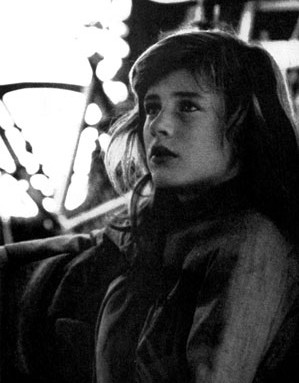
Patty Duke is probably best known to fans of a certain age for her role as identical cousins Cathy and Patty Lane on the sitcom The Patty Duke Show. But before that she won a Best Supporting Oscar at 16 for her role as Helen Keller in The Miracle Worker. She appeared in dozens of TV shows and movies since the mid-1950s, most recently in Glee, Liv & Maddie, and the 2017 movie Power of the Air. Off-screen she was a big supporter of charities and an advocate for mental health. Duke passed away Tuesday at the age of 69. Her son actor Sean Astin broke the news.
MeTV started running a promo in January for The Patty Duke Show featuring Duke and co-star William Schallert. Yup, he’s still acting at age 93:
Earl Hamner Jr. was probably best known as the creator of The Waltons (did you know he was also the narrator of the series?), but he had a long, varied career in film, TV, and books. Besides The Waltons, Hamner wrote for The Twilight Zone, Falcon Crest, Gentle Ben, The Invaders, and many other shows. He also wrote the screenplays for the 1973 version of Charlotte’s Web, Where The Lillies Bloom, Spencer’s Mountain, and the TV movie Heidi, which we’ve mentioned here before. He also wrote several novels and nonfiction books. Hamner died at the age of 92 in Los Angeles.
I could write a lot about Jim Harrison, author of Legends of the Fall and many other novels, stories, and poems. He passed away last Saturday in Arizona at the age of 78, but I think this tweet from writer Walter Kirn sums it up quite nicely:
Goodbye #JimHarrison, deep old American Druid of the woods. You were a poet beast & story singer, roaring, incorrigible, yet snow drop clear
Wind Sprints, by Joseph Epstein. Epstein is one of the great essayists, and this is his latest collection. It’ contains shorter works from the past 20 years, focusing on everything from aging and pop culture and technology to politics and sports and everything in between. Basically it’s about life, and a fine read. (Wind Sprints will be released on April 7.)
Approval Junkie, by Faith Salie. This is the CBS Sunday Morning contributor’s collection of essays on “her lifelong quest for approval.” Her segments on the show are quite good, and this promises to be a fun read. (Approval Junkie will be released on April 19.)
Slow Burn, by Ace Atkins. This is the next book in the Spenser series created by the late Robert B. Parker. Atkins, whose other books include the Quinn Colson series and the Nick Travers books, took over for Parker in 2012. It’s his fifth Spenser book, and fans won’t be disappointed with his take on the Boston private investigator. (Slow Burn will be released on May 3.)
Catch The Catch
Sometimes a TV show catches you off guard. You’ve seen the commercials for it, but it’s not getting a lot of buzz. And besides, you’re behind on 27 other shows. I almost decided not to watch ABC’s The Catch (I still have two seasons of Agent Carter to watch), and that would have been a big mistake.
The Catch stars Mireille Enos (from The Killing) and Peter Krause (from Sports Night and Six Feet Under). It’s hard to explain the plot without giving away the many twists and other pleasures of the show, but let’s just say it’s about a private investigation firm trying to find a notorious thief they’ve nicknamed Mr. X. It’s really well done and entertaining, with good-looking stars and a lot of style. It’s a breath of fresh air in a TV landscape filled with superheroes, serial killers, and zombies.
It reminds me of a cross between The Thomas Crown Affair and Eyes, the terrific Tim Daly show that also aired on ABC in 2005 but was canceled after only a handful of episodes.
In January, I showed you how to make the perfect peanut butter and jelly sandwich, but tomorrow there’s an entire day devoted to it. I can’t really give you that many recipes for a peanut butter and jelly sandwich — beyond trying different styles of peanut butter or flavors of jelly — so I thought I’d do a little digging to find out how it was invented.
Believe it or not, we have actor Humphrey Bogart to thank for the sandwich. While having lunch at Fox Films (later 20th Century Fox) in 1930, where he was filming Up the River with the aforementioned Spencer Tracy, Bogart realized that the studio commissary was out of ketchup, which is what he usually had with his peanut butter in a sandwich. Bogart tried mustard, mashed potatoes, even tomatoes, but nothing tasted right. He noticed the jelly that was sitting on a tray of condiments, left over from breakfast, and decided to give it a shot. He loved it and told other people about it, and it quickly caught on. The rest, as they say, is history.
And if you believe that story, please note what day today is.
Upcoming Events and Anniversaries
Jesse James killed (April 3, 1882)
Here’s a nice remembrance of someone depicted on a 1948 John Falter cover of The Saturday Evening Post as a boy, playing in the same area where people like Jesse James and the Pony Express riders once traveled.
President Truman signs the Marshall Plan (April 3, 1948)
Also called the European Recovery Program, the Marshall Plan gave $13 billion in aid to help Europe rebuild after World War II.
Washington Irving born (April 3, 1783)
Irving’s story The Devil and Tom Walker was the inspiration for Stephen Vincent Benét’s short story The Devil and Daniel Webster, which first appeared in The Saturday Evening Post in October 1936.
First female mayor elected (April 4, 1887)
Her name was Susanna M. Salter, and she was the mayor of Argonia, Kansas, in 1887 and ’88.
President William Henry Harrison dies (April 4, 1841)
The Church of Jesus Christ of Latter-day Saints established (April 6, 1830)
The Supreme Court ruled 49 years later that America’s civil rights laws trumped the Mormon Church’s polygamy practice.
Civil Rights Act of 1866 enacted (April 9, 1866)
The bill that granted all citizens the same rights regardless of color, even if they were former slaves, was passed by Congress over the veto of President Johnson.
Like many kids, my first visit to a major league ballpark was with my father. I was about 10 or 11, and the Philadelphia Phillies were playing a day game at the old Connie Mack Stadium. I’d watched games on TV — my Dad was a die-hard Phillies fan — but they hadn’t prepared me for this. I was enchanted by the ballpark: the sound and bustle of the crowd, the smell of peanuts (and cigars in that era), the manicured field glowing green in the summer sunlight, the crack of bat against ball, the huge Ballantine’s Beer sign over the scoreboard, the hot dogs for a quarter. Above all, the sight of my dad enjoying himself and rooting for his team.
I don’t remember who won that afternoon. I would guess the Phils lost; they were a terrible team in the late ’50s. It didn’t matter. I was hooked. This was the way to enjoy baseball — in the stands along with other like-minded fans who came to savor the game in its slow-paced purity.
Once I was able to buy my own tickets, I went to as many games as possible, at least three or four a season, wherever I happened to be living. I’ve been to two World Series games (both in New York), and I’ve been lucky to have friends with season seats (excellent ones in Los Angeles). Attending a ballgame became akin to a sacred ritual, with the ballpark the local cathedral dedicated to the Great American Pastime. Every spring, I would peruse the new schedule and assess which home games would be the most fun to catch.
Not this year.
Instead of going to the ballpark, I plan to keep score in front of the HD big-screen in the comfort of my home, where I can whip up a plate of nachos, grab a beer from the refrigerator, and don’t have to stand in line to use the bathroom.
What happened? Simply put, the experience has been ruined.
For starters, going to a big league ballgame nowadays requires a major financial commitment. Tally up the costs of a good seat (say, field level along the third base line), parking ($20), food ($6 a hot dog), and drink ($8 a beer), and you’re looking at maybe $120 for an afternoon or evening’s entertainment. To bring the family along, you might need to take out a loan.
But this isn’t about the money. I am still willing to pony up the necessary funds to see two competitive teams battle it out, maybe once or twice a year.
No, it’s the fans today who have turned me off. Take the chuckleheads who insist on starting the wave for no apparent reason, creating a distraction from the game at hand. My question to them: If you’d rather leap up every 15 seconds with your arms flapping in the air than pay attention to what’s happening on the field, why are you there? The same goes for those benighted individuals who spend almost the entire game staring into their smartphones or taking selfies, oblivious to the incredible catch in left field.
But the worst development in fan misbehavior is the stand-during-every-play crowd. They give a new meaning to “standing room only.”
Whenever the count gets close or there are men on base, they rise to their feet and start clapping and roaring, blocking the view of those of us who prefer to watch from our seats. Children and short people are left to their imaginations.
Hey, I’m all for enthusiasm. I stand and clap and roar for a big hit or crucial strikeout along with the best of them, but I didn’t shell out a small fortune to look at someone’s backside for most of the game.
Here’s what I propose: Aside from standing to sing the national anthem, fans should be prohibited from standing for more than one play an inning. Until the seventh inning, that is, after which they can stand as much as they darn please. And anyone caught doing the wave will be asked to leave the premises.
Sadly, that’ll never happen. So this baseball season, you’ll find me at home, where the beers are free, the food is mere steps away, and nobody is standing between me and the game on TV.
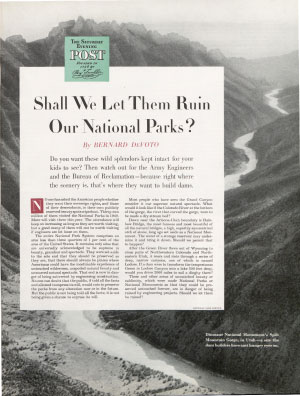
“If the people of the United States want their Grand Canyon to remain as it is, they had better keep an eye on it,” Bernard DeVoto warned in a 1950 Post article. “Most people who have seen the Grand Canyon consider it our supreme natural spectacle. What would it look like if the Colorado River at the bottom of the gorge, the river that carved the gorge, were to be made a dry streambed?”
Read those words today, and your first thought might go to climate change, remembering the California drought headlines or a photo of the bleached river basin you saw on your smartphone at breakfast. But in 1950, DeVoto was protesting the Bureau of Reclamation’s Colorado River Project.
The Pulitzer Prize–winning historian was among the first to bring national opposition to the project’s three major dam proposals — Bridge Canyon, Echo Park, and Glen Canyon. Echo Park was the most controversial as it would cover most of Dinosaur National Monument, and in the end, only Glen Canyon Dam was built, but its benefits are still debated to this day.
Do you want these wild splendors kept intact for your kids to see? Then watch out for the Army Engineers and the Bureau of Reclamation — because right where the scenery is, that’s where they want to build dams.
No one has asked the American people whether they want their sovereign rights, and those of their descendants, in their own publicly reserved beauty spots wiped out. Thirty-two million of them visited the National Parks in 1949. More will visit them this year. The attendance will keep on increasing as long as they are worth visiting, but a good many of them will not be worth visiting if engineers are let loose on them.
Most people who have seen the Grand Canyon consider it our supreme natural spectacle. What would it look like if the Colorado River at the bottom of the gorge, the river that carved the gorge, were to be made a dry streambed?
After the Green River flows out of Wyoming to cross parts of Northwestern Colorado and Northeastern Utah, it roars and riots through a series of deep, narrow canyons, one of which is named Lodore. If a dam were to transform the tempestuous Green in Lodore Canyon into a lake 500 feet deep, would you drive 2,000 miles to sail a dinghy there?
These and other areas of unmatched beauty or sublimity, which were made National Parks or National Monuments so that they could be preserved untouched forever, are in danger of being ruined by engineering projects. Should we let them be ruined?
The National Park Service is a bureau of the Department of the Interior, where, in appropriations, it is overshadowed by the Bureau of Reclamation, which builds dams. Though the Park Service has other duties, its primary job is to administer the National Parks and Monuments. The act of Congress which created it directed it “to conserve the scenery and the natural and historic objects and the wildlife therein, and to provide for the enjoyment of the same in such manner and by such means as will leave them unimpaired for the enjoyment of future generations.”
The legally enacted policy cannot be misconstrued: the parks and monuments are to be preserved as they are naturally, without defacement. It has been maintained so far, though not without hard effort. Because some of these areas contain valuable minerals, timber, water resources, and water power, there have been many attempts to get the law changed so that they could be exploited. These attempts, which would ruin the parks if they succeeded, have heretofore usually been made by private groups intent on getting hold of public resources for their own profit.
In the last few years, however, a curious development has brought the National Park System under attack by two public agencies. Each of them has about a third of a billion dollars of public funds to spend every year, and so can exert incomparably more pressure than any corporation that ever cast a covetous eye on the wilderness beauties which were set aside for posterity to enjoy. One of these agencies is the Bureau of Reclamation, the other the Corps of (Army) Engineers. Their campaign of attrition raises fundamental questions about our grandchildren’s heritage of wilderness scenery. It also involves serious issues in regard to the power of Federal agencies to subvert public policy. How the campaign works and what hinges on it can be clearly seen in the current effort of the Bureau of Reclamation to get authorization, which is now not legally possible, to make over Lodore Canyon in Colorado.
The canyon was named and first traversed by the adventurous one-armed geologist, John Wesley Powell, on his exploration of the Green and Colorado rivers. It was on June 8, 1869, that he took his boats into this deep and narrow gorge. Confined between sandstone walls that are alternately overhanging and set back in terraces, the Green here becomes an unimaginably violent chaos of rapids, falls, whirlpools, sucks, and chutes. This 20-mile stretch is one of the most hazardous — and most spectacular — parts of the so-far-untamed Green River.
Here Is One of Our Great Scenic Areas
Before entering Lodore Canyon, the Green flows tranquilly through a mountain meadow called Brown’s Park. At the lower end of the canyon it emerges into another beautiful, high-walled valley which Powell named Echo Park. Massive rock formations rise from the floor of Echo Park, and here the Yampa River flows into the Green from the east, having just emerged from a narrow, twisting canyon wholly unlike Lodore, but equally overpowering. The Green then flows westward through two more canyons. The setting of these four canyons is a landscape of brilliantly colored, fantastically eroded mesas, buttes, mountains, gulches, and high basins. A panorama of fantasy, overwhelming to the imagination, this high rock desert has certain resemblances to the Bryce Canyon and Zion Canyon country and to Cedar Breaks, all in Utah, and to the setbacks and vistas of the Grand Canyon, which is in Arizona. But as each of these tremendous spectacles is, it is unique, of its own individual character and quality. It is one of the great scenic areas of the United States.
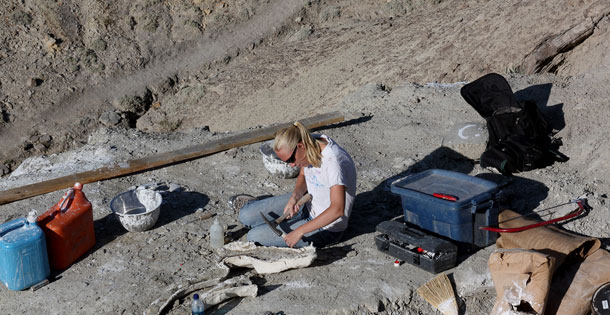
In 1938, Lodore Canyon, Yampa Canyon, Echo Park, the two subsidiary canyons and their rock-desert setting — 327 square miles all told — were made a National Monument and transferred from the public domain to the National Park System. If the area had been called, say, Green River National Monument, its nature and importance would have been self-evident in the name. But a National Monument already existed at its western edge, a small tract of 80 acres which had been set aside to protect the greatest known deposit of Mesozoic fossils, especially dinosaurs. The new reservation was added to this and the whole received the name of the original small part, Dinosaur National Monument. As a result, during the effort to keep a magnificent scenic wilderness from being defaced, many people have supposed that only the quarry where dinosaur fossils are excavated is at stake, though, as a matter of fact, the quarry has never been endangered.
When the monument was established, most of Brown’s Park was left outside the boundaries. This exclusion was made because, years earlier, the Reclamation Service — now the Bureau of Reclamation — had declared Brown’s Park a possible site for a reclamation project — that is, for a reservoir from which water could be pumped to irrigate a small area in Eastern Utah. The Bureau of Reclamation has by now abandoned whatever intention it may have had of so using Brown’s Park. But it has undertaken to construct a hydroelectric-power development in Dinosaur National Monument. Both the laws which govern power projects and those which protect the National Park System forbid the construction of power dams in National Parks and National Monuments. There are, however, various ways of skinning a cat if you are good with a skinning knife. No one has ever said that the Bureau of Reclamation isn’t.
In 1943, the First Assistant Secretary of the Interior made a “reclamation withdrawal” covering most of Dinosaur National Monument — that is, he officially declared it an area which could be used for reclamation projects. The “withdrawal” was almost certainly unauthorizable and therefore of no force. Furthermore, it was so smothered in administrative routine that, though it would destroy the monument, the National Park Service did not learn of it when it was made. On the basis of this questionable and semicovert withdrawal for reclamation — for irrigation — the bureau then began to plan a power development, which is prohibited. It proposed to build two dams with attendant power plants, one at Echo Park, the other at Split Mountain, farther down Green River. The estimated cost of the project is $207 million.
The National Park Service first heard of the project as a daydream of the Bureau of Reclamation in connection with a vast plan for the transformation of the West called the Colorado River Project. The Green River is, of course, part of the Colorado River system. It was, so to speak, a theoretical, just possible expedient to be tentatively considered in case equivalent results could be secured nowhere else in the Colorado River basin — and to be considered then only after exhaustive study and only after consultation with the National Park Service.
In spite of this understanding, and without consulting the Park Service or obtaining clearance from the Secretary of the Interior, the bureau laid the Dinosaur Monument project before the bodies that administer the interstate agreement which apportions water from the Colorado River. In February of this year those bodies recommended the immediate construction of Echo Park Dam. This would require legislation from Congress to authorize construction that is now prohibited in the monument — and the heat was on. Especially, the heat was on the Secretary of the Interior, one of whose duties is to protect the public interests — your interests — in the National Park System. The Western bloc worked smoothly. When Secretary Chapman ordered a public hearing, four Western senators and five Western congressmen appeared to add their testimony to that of embattled mayors and chambers of commerce that the nation would be well served by the abandonment of the policy which has protected the National Parks.
They Say It’s Necessary for Irrigation
The hearing disclosed that not only heat had been generated but much fog, or smoke screen, as well. The Echo Park and Split Mountain project is solely a power development, but it received much support it otherwise might not have got because it has been represented in the West, where irrigation is a sacred word, as an irrigation project. Again, the people of Utah have come, or have been led, to believe that water which the state has been allotted from the Colorado can be got to a still theoretical and prodigiously expensive reclamation project in Central Utah only from the reservoirs which the Bureau of Reclamation has planned in Dinosaur Monument. Actually, the bureau’s own plans show that this water is to be taken from another project, farther up Green River and outside the monument. Utah and neighboring states have come, or have been led, to believe that these dams are indispensable for storage water allotted them from the Colorado. Actually, the bureau plans to provide most of this storage at another dam far to the south of the monument, and the rest of it — if any more is needed for the allocations — could be provided at other sites outside the monument.
Finally, Utah believes that the sites of these dams are the only ones where power for its still-theoretical project could be generated, whereas there are many feasible sites outside Dinosaur Monument. And at the public hearing, Gen. U.S. Grant III, himself an engineer, showed that the use of one of these other sites would reduce the cost of the project by a third. Nevertheless, the various appeals mentioned above have been blended to make a really formidable confusion.
No Western state would receive any benefit from the construction of these dams inside the monument that could not be insured by alternative construction outside it. What about the people of the United States as a whole, whose property the monument is? On behalf of sectional and even local interests, the general public will have to pay the nonrecoverable cost, always a large fraction of the total cost, of a $207 million project. In return it will suffer the permanent ruin of an area of great natural beauty.
For it will be permanently ruined. If you cut down a forest, Nature will probably grow another one in the course of a few centuries, but if you change a river, a mountain or a canyon, you can never change it back again. The downriver dam in Dinosaur Monument would defile the mountain-park country along and below it and substitute a placid reservoir for the turbulent river above it. The other one, Echo Park Dam, would back water so far that throughout the whole extent of Lodore Canyon the Green River, the tempestuous, pulse-stirring river of John Wesley Powell, would become a mere millpond. The same would happen to Yampa Canyon.
Throughout both canyons the deep artificial lakes would engulf magnificent scenery, would reduce by from a fifth to a third the height of the precipitous walls, and would fearfully degrade the great vistas. Echo Park and its magnificent rock formations would be submerged. Dinosaur National Monument as a scenic spectacle would cease to exist.
A specious argument which has been used in connection with this assault on Dinosaur Monument is also a steadily increasing danger to other parts of the National Park System. We long ago passed the point where reclaimed Western land could repay the cost of the projects that reclaimed it, as it was originally intended to do. If it costs several hundred dollars an acre to make land worth $50 an acre, the rest of the cost must be charged to something besides reclamation. If the project includes the production of electricity, the sale of power will take care of part of the remainder. If it includes flood protection — and, nowadays, try to find any dam on any babbling brook that is not supposed to — whatever fraction of the remainder can be allocated to flood control can be written off altogether, since the whole country benefits from reduction of flood losses. But honest cost accounting ends right there; no additional economic justification can be found. Hence the Bureau of Reclamation has begun to publicize a shimmering but carefully unanalyzed value which it calls “recreation.”
If the bureau can successfully allege that its projects create facilities for recreation, then it can charge to them as much of the uneconomic cost as it is able to get away with. Nobody doubts that the American people need facilities for recreation and will need more of them as our population increases. But what kind, where, at what cost, and who shall pay for them? Should we write off $10 million of the cost of an irrigation project because it will provide bass fishing for one North Dakota county? Should Philadelphia and Birmingham be taxed to provide sailboating for Las Vegas?
If it is able to force the Echo Park project through, the Bureau of Reclamation will build some fine highways along the reservoirs. Anyone who travels the 2,000 miles from New York City — or 1,200 from Galveston or 1,000 from Seattle — will no doubt enjoy driving along those roads. He can also do still-water fishing where, before the bureau took benevolent thought of him, he could do only white-water fishing, and he can go boating or sailing on the reservoirs that have obliterated the scenery.
But the New Yorker can go motoring along the Palisades, boating in Central Park, sailing at Larchmont and fishing at many places within an hour of George Washington Bridge. No one will ever drive 2,000 miles to row a boat; no one will ever seek recreation in a National Park except the kind for which the “pleasuring ground” was created — the unique experience of awe and wonder that an untouched wilderness spectacle provides. The only reason why anyone would ever go to Dinosaur National Monument is to see what the Bureau of Reclamation proposes to destroy.
But keeping informed about such attacks on the National Parks is extremely difficult. These plans may be vital for the future of the West, and the future of the West is vitally important to the United States. But the people have no adequate idea of how sound the plans may be, how far some of them may fail, how much money may be wasted. Engineers of unimpeachable professional standing have asserted that large parts of them are mistakenly conceived or even potentially disastrous. But the public has no chance to judge.
It is, in fact, almost impossible to bring effective criticism to bear on the projects of these two agencies. As far as the individual citizen is concerned, the data are kept secret. They are not publicized outside the West and only the favorable ones are publicized there. By the time a project is laid before Congress it has already been decided upon, the local interests have been organized and the Western senators and representatives — one of the most powerful blocs in Congress — have been lined up. Within the West there is severe infighting for the allocation of projects, but when it comes to getting projects to be allocated, there are neither state nor party lines: there is only a solid West. The Bureau of Reclamation and the Army Engineers have a vested institutional interest in the West, the interest not only of continuing to function but of expanding and growing more powerful. They have vast sums of money to spend. Their preliminary planners, field agents, and entire official hierarchy readily lay down the shovel and the hoe, and pick up the microphone at any hint that their plans may be interfered with or even inquired into. Both are able to summon to their support an organized political pressure that only nationwide public opinion could defeat.
That is the larger picture into which the assault on the National Parks fits. Unquestionably, the national interest requires the parks and monuments to be preserved unmarred, as they were intended to be.
No emergency serious enough to justify invading the National Park System arose during either World War. No emergency is in sight now. But with as much time for planning as might be required, with promising and perhaps better alternatives only cursorily investigated, the Bureau of Reclamation is able to threaten Dinosaur National Monument with destruction. And probably the bureau’s hand was not idle in a California agitation that has succeeded in introducing into Congress a bill to investigate all the possible power sites in Kings Canyon National Park. This park preserves the most magnificent mountain country in California outside Yosemite Park. Its boundaries were drawn so as to exclude areas which ought to have been included, but which were left out precisely because they were valuable power sites. The Engineers threaten Mammoth Cave with a dam which even Kentucky does not want. They threaten Glacier Park with a dam which they formally agreed not to build.
If any of these attempts should succeed, the law which protects the parks will be circumvented and there will be no protecting any of them from similar impairment thereafter. The parks do not belong to any bureau, any group of planners or engineers, any state or section. They belong to all of us. Do we want them? Will our grandchildren want them?
Norman Lear sums up his incredible life and career this way in the preface to his book Even This I Get To Experience: “In my 90-plus years I’ve lived a multitude of lives. In the course of all these lives, I had a front-row seat at the birth of television; wrote, produced, created, or developed more than a hundred shows.”
More than just an entertainer, Lear is a man with a deep and abiding concern for the future of America. He counts among his many notable accomplishments his founding of the advocacy organization People For the American Way, and that he purchased a rare original copy of the Declaration of Independence so that he could tour it across the U.S. for people to be reminded of the history of the country he so loves.
Lear attributes his outspokenness to growing up during the years of the Depression in a family that “lived at the top of its lungs and the end of its nerves. They cared about everything and I mean everything,” he says. From humble origins, Lear would go on to make a fortune. At the height of his success, he had nine shows on the air at the same time, with a total audience of 120 million. Along the way, Lear experienced his share of personal setbacks. But he says his gratitude at the simple miracle of being alive has always carried him through difficult times. With a smile and a tug on his signature white hat, he explains, “No matter what I went through, I was always learning. Every day I think to myself, Even this I get to experience.”
Jeanne Wolf:You’re a great storyteller. When did you know that you had that gift?
Norman Lear: I probably knew it later in life than you would imagine. It started with just a lot of hard work, first in publicity and including, believe it or not, a business making little ashtrays that fastened to the lip of a saucer for a cup. It was a totally worthless invention that for some strange reason sold well one Christmas. What changed things is that I finally got a break writing comedy sketches for shows like Martin and Lewis.
JW: Then you came up with All in the Family, which was not that easy to get on the air. What gave you the courage to stick with it when other people were telling you, “We can’t put this on TV”?
NL: It didn’t seem to me to take all that much courage. I just wanted to make people laugh. I wanted to bring the audience to their knees emotionally through laughter. We dealt with serious subjects, but I saw that there was humor in everything.
JW: Not everyone appreciated your message at the time.
NL:Some people started saying, “If you want to send a message, use Western Union. Stop using television.” At the time, the average sitcom was about something like “the roast is ruined and the boss is coming to dinner.” There were hundreds of hours of programming where there was no Vietnam War, no racial problems, no economic problems. Everybody was happy and cheerful. In its own way, that’s a strong point of view. We were simply going in a different direction.
JW: What guided you as you put together one hugely popular series after another?
NL: I always felt that what makes me laugh is going to make you laugh. And what makes me care or cry is going to make you care or cry. I don’t have anything else in the world to go on. I express feelings. And that’s what I think I need from my Congress and what America needs from its leaders. What are you really feeling here? Don’t give us the B.S.
“When I crossed over into my 90s, suddenly I was getting a standing ovation just for standing straight. … It wasn’t the same at 88.”
JW: What would you say is at the root of your deep concern for your country?
NL: My generation was in love with America. When I was a kid, every school had civics classes. We learned early on about our Declaration of Independence, our Bill of Rights, the First Amendment. And so we had a reason to be in love with the core values of this country. And we accomplished a lot. But the fact that we did a good job didn’t make America God’s chosen, although we started to believe it. The promises from our forefathers haven’t been delivered yet. We haven’t made good on all these promises. It’s time we paid attention to making good on them.
JW: When did you first begin to develop sensitivity to racism and bigotry?
NL: I remember I was fooling around with this little crystal radio and I came across a broadcast from Father Coughlin, a vicious, anti-Semitic, anti–Native American, anti-FDR, rogue priest who was preaching hate. It was the first time I realized that there were people out there who didn’t like me because I was born to Jewish parents. And that was startling. But I was taking civics classes and I was being taught that, wait a minute, in my country, that’s un-American. You do not tell people they’re bad Christians or good Christians or bad Americans or good Americans depending on a religion. That was a sustaining moment for me.
JW: So did you let your beliefs be known at a young age? Did you take a public stand on that when you were growing up?
NL: In high school, I entered the American Legion Oratorical Contest. My subject was “The Constitution and Me,” and I talked about how, because I was a member of a minority, my appreciation for the guarantees of the Constitution and the Bill of Rights were probably a little keener because I needed them more. I won that competition and got a scholarship to college, which I otherwise never could have afforded.
JW: Racial dissension, fear of people different from us is still alive and well. The rhetoric is hateful and harsh. Does that scare you?
NL: It doesn’t scare me because it’s the human condition. What scares me is the time it takes for people to react. Basically, this country on the one hand adores what it stands for; on the other hand, it doesn’t want to deliver on what it stands for. So, there isn’t enough conversation about this. And there isn’t enough leadership moving us in the direction of that conversation.
JW: Clearly, you’re a fighter for what you believe in. You also fought many battles with the networks over what was acceptable in prime time. Do some incidents still stick out in your mind?
NL: I’m thinking of an episode of All in the Family. Archie and Edith are married 25 years, it’s a Sunday and they’re in church. The kids decide to surprise them with a brunch for their 25th wedding anniversary. So we find Mike and Gloria alone in the house. Mike realizes his parents won’t be back for a little while, and they go upstairs to the bedroom to have a little fun. A few minutes later, Archie comes back early because he hated the sermon and he hated the minister. Mike and Gloria come running down the stairs buttoning up their clothes. Archie says, “11:10 on a Sunday morning?” The network censor wanted that line out. Why? Because it pointed out to the audience exactly what had happened. So we had a confrontation, and I told them if they cut it, I wouldn’t be there the next day. An hour before the show aired, I still wasn’t sure they had left it in. But I didn’t think I was courageous. I was just resisting silliness. I thought, Archie can’t say that line? That’s silly.
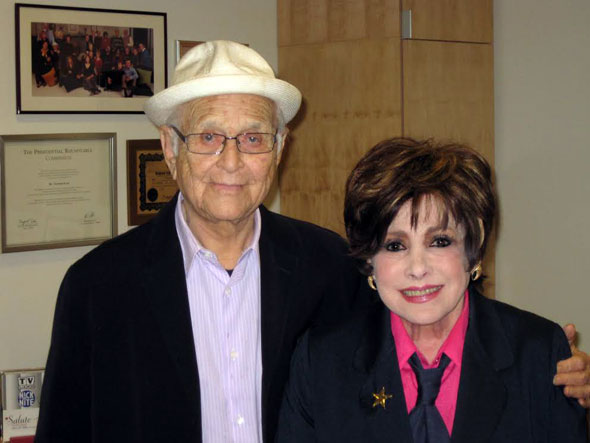
Norman Lear with author Jeanne Wolf (Photo courtesy Jeanne Wolf)
JW: You’ve said that of all the characters you created, the closest one to you is Maude.
NL: I thought of her as reflexively liberal as Archie was reflexively conservative. When Maude said things, she didn’t take full responsibility for getting the facts she needed to back up what she said. That’s a pretty good description of me. I make no bones about it. I’m proud to be a liberal, but I’m not proud that I don’t know enough details to make my case more strongly.
JW: As you get older, people seem to treat you with even more respect, and they want to tap into your wisdom.
NL: When I was 88 or 89, people were sweet and perhaps deferential. But when I crossed over into my 90s, suddenly I was getting a standing ovation just for standing straight. I’d take a few steps and it was overwhelming. I was also considered wise — “Mr. Lear, what do you think about …?” It wasn’t the same at 88.
JW: Can you sum up any of the wisdom that you have to share?
NL: I’m thrown by the word wisdom. My bumper sticker reads, “Just another version of you.” And maybe that’s the lesson of my life — the thing I would most wish to be understood, from anything I’ve said. It means that, as a human being, I’m inherently capable of the worst behavior that we see in any other human being on the globe, and I’m capable of some of the best. We are each of us as human beings capable of the best and the worst. That’s why we are versions of each other. It’s hard to be a human being. In life, the harder the competition, the more we pay for it with energy, with effort, with money. The harder the game, the more we give to it, the more we care about it. So the wonder is, in this game of life, which is so bloody hard, why don’t we experience it with more pleasure?
JW: Are you speaking of yourself? Look at the things you’ve done. You’ve attacked life with passion.
NL: I did find enthusiasm and passion, but there was a good deal of fear early on. I wasn’t born to understand this. I grew to understand it.
JW: What gets you through your day?
NL: Tomorrow. I believe in two small and important words in the English language — over and next. When something is over, it’s over. When I fall asleep, that day is concluded. I’m on to coffee, the taste of tomorrow morning’s coffee. And I think that if you see a connection between over and next, that’s what is meant by living in the moment. At the risk of sounding sanctimonious, I really do see it that way. Living this moment is what we have. You don’t know about the next.
On with the show! Lear today is producing an update of One Day at a Time for Netflix, but with a Cuban-American matriarch. He’s also shopping around a comedic series, Guess Who Died?, about life in a retirement community. Below: Some of his greatest hits.
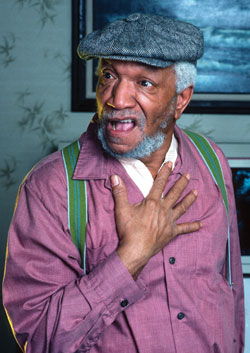
Sanford and Son with Redd Foxx (NBC/Photofest)
The Jeffersons with Marla Gibbs, Franklin Cover, Roxie Roker, Ned Wertimer, Isabel Sanford, Sherman Hemsley (CBS/Photofest)
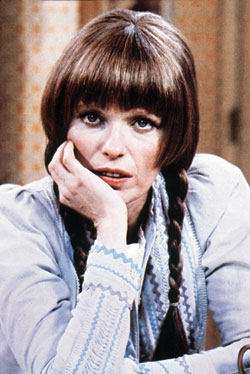
Mary Hartman, Mary Hartman with
Louise Lasser (Columbia Pictures Television/Photofest)
Maude with Bea Arthur, Bill Macy (CBS/Photofest)
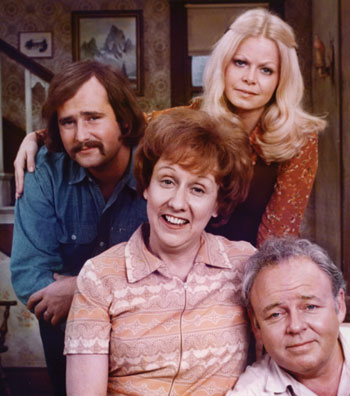
All in the Family with Rob Reiner, Sally Struthers, Carroll O’Connor, Jean Stapleton (CBS/Photofest)
From the “the more things change, the more they stay the same” department comes this video. It has been making the rounds the past couple of weeks, and whatever your opinion of Donald Trump is, it’s rather fascinating. If you replace the name Goldwater with Trump, you can see similarities to some of the criticisms Trump is getting in 2016:
By the way, the actor is William Bogert, who has been in many movies and TV shows and is still acting. He was picked for the Lyndon Johnson spot partly because he really was a Republican.
Wait … That’s David Letterman?!
Have you been wondering what David Letterman has been up to since he retired last year? Apparently, he’s been training for the annual Andrew Weil Lookalike Contest. Here he is photographed while out for a run on vacation:
Garry Shandling died suddenly on Thursday. The comedian and writer called 911 himself from his home but collapsed during the phone call. He was found by paramedics but later died at a Los Angeles hospital.
It’s hard to overestimate how much of an impact the late night talk show satire The Larry Sanders Show had on television. It was one of the early must-see shows on premium cable and set the tone for other shows and movies that skewered what happened behind the scenes of a television series. Before Larry Sanders, he starred in the Fox comedy series It’s Garry Shandling’s Show, which, like The Larry Sanders Show, was ahead of its time. As an actor, Shandling appeared in Iron Man 2 and Captain America: The Winter Soldier, Town & Country, The X-Files, Caroline in the City, and other movies and shows, and at the start of his career wrote for Sanford and Son and Welcome Back, Kotter. He was 66.
He had an incredible career, if you think about it. A baseball player on several major league teams; a sportscaster; a co-host on The Today Show; guest host for Johnny Carson on The Tonight Show; a panelist on shows like What’s My Line?, To Tell The Truth, and Match Game; host of his own game show, He Said, She Said; author of three books, and supporter of many charities and causes. Garagiola passed away Wednesday in Scottsdale, Arizona, at the age of 90. A great life.
Ken Howard also passed away this week. You might remember him as the coach on The White Shadow, as the crazy cable company owner on 30 Rock, and from many other roles. Howard was also the current president of the Screen Actors Guild-AFTRA. He was 71.
Peter Brown was probably best known as the star of the 1960s western TV series Laredo and Lawman, but it’s amazing how many other TV shows and movies he was in, including The Alfred Hitchcock Hour, Magnum, P.I., Wings,Charlie’s Angels, and JAG. He also had regular roles on most of the soap operas over the years, including The Young and the Restless, Days of Our Lives, The Bold and the Beautiful, One Life To Live, and Generations. Brown passed away in Phoenix at the age of 80.
Kraft Mac and Cheese: New Formula, New Spokesman
Speaking of former late-night talk show hosts, I have a confession to make: I liked Craig Kilborn’s stint as host of The Daily Show more than Jon Stewart’s. Well, maybe not more, but certainly just as much. Kilborn has always been derided as the show’s host, with most critics falling all over themselves to praise Stewart. But they hosted very different shows. Stewart skewered politics and the media, while Kilborn’s show was more of a straight comedy/talk show. Both shows were funny in their own way, and I really liked Kilborn’s take. I still wish he hadn’t left CBS’s The Late, Late Show.
I also like Kraft Mac and Cheese, and now the two have finally come together. If you’ve been wondering what Kilborn has been up to the past several years (he really has kept himself out of the public eye), he’s the new spokesman for the boxed pasta, which has gotten a recipe makeover to take out preservatives and dyes. Let’s hope it tastes the same even if it doesn’t look the same. Here’s the new commercial:
Obama’s Trip Reminds Me …
This week, President Obama made the first trip to Cuba by a sitting U.S. president since President Coolidge in 1928. He spoke to the Cuban people in Havana and even went to a baseball game (which was seen as a bad move after the terror attacks in Brussels). But it got me thinking: Havana is a really great movie!
That’s the 1990 Sydney Pollack film with Robert Redford as a gambler who falls in love with the wife of a revolutionary in late 1950s Cuba. It has always been, well, dumped on as a film that’s boring and overlong and tries to be Casablanca but isn’t. It was even insulted in an episode of Seinfeld! I don’t get any of those criticisms, because it’s an incredibly well-acted, engrossing, and beautifully filmed drama. Go stream it — or better yet, buy it because it’s pretty cheap now — and tell me I’m wrong.
What’s Underneath the CBS Broadcast Center?
Mo Rocca guest-hosted CBS Sunday Morning last weekend and did a fantastic job. (Charles Osgood is out for a while after having surgery.) In one segment, he took a tour of the CBS Broadcast Center, the massive New York City studio where the show originates. It’s almost like its own city. There’s also an interesting world beneath the broadcast center that most of the public hasn’t seen until now. And because the show seems to like helping me with the topics I pick for this column, there’s even a section on the aforementioned 1964 Presidential election:
Superman v. Batman v. Superman v. Batman v. Superman v. …
It’s a fine list, and I mostly agree. I’d put the first Superman a little higher and probably wouldn’t put The Dark Knight at number one, but those are minor quibbles. I also like the love for Batman Returns, which I think is an underrated movie. Christopher Walken is great in it, and the movie is like an off-kilter superhero noir.
The Case of the Time-Traveling Twins
If I had an identical twin, I think I would have played a lot of tricks on my family. I mean, what’s the point of looking exactly like someone else if you’re not going to irritate people?
This improv group decided to play a prank on some people, a very public one. They went on a subway and decided to pretend that they were visited by their future selves, who tried to stop their past selves from raising money to build a time machine in the first place. It’s a great idea. I don’t know if the acting is good enough for the other people on the subway to actually believe them (plus it’s, you know, time travel), but you can tell they’re very amused.
It’s probably the greatest thing that has ever happened to these people while riding the New York City subway.
National Make Your Own Holiday Day
There’s a holiday for everything, and I mean everything. National Fluffernutter Day? That’s October 8. National Flip a Coin Day? That’s June 1. And if you like to play the saxophone, set aside November 6. That’s National Saxophone Day.
Tomorrow is National Make Up Your Own Holiday Day. It’s the day you can make up your own special day and celebrate it every single year. So many holidays are already taken, so you have to be a little creative.
With that in mind, I hereby declare that March 26 is now Read An Issue of The Saturday Evening Post While Drinking a Glass of Wine Day. Take a picture of yourself doing it and post it on Facebook or Twitter.
Because Jeredean Hoestler was the only one working the floor of Yours, Mine, Flowers — Darryl was in his office, busy doing “paper work” — she saw the boy enter. He looked to be somewhere in his teens and a little on the hefty side. What people called “well-fed.” He slumped, making it difficult to tell just how tall he was, and besides a brief wave in her direction as he passed by the cash register, his hands remained in the big front pocket of his sweatshirt. She eyed him all down the gardenia aisle, up another, until he stopped at the glass coolers housing the bouquets of assorted roses, irises, and lilies. He opened the cooler door, selecting an arrangement, which shook in his hands. When he returned it, there was such precision, care, like he’d been holding something fragile, like a baby, but hadn’t trusted himself until he could return it to safety. She went over to him, placing her hand lightly on his shoulder.
“Can I help you, sir?” she said, affecting the same flirtatious drawl she gave to men twice and three times his age. She’d found the cadence relaxed them, gave them the impression she was the kind of person they could open up to.
He turned to face her, brushing his bangs away. There was a little baby fat on his cheeks, and his eyes were green. He wore the same shaggy hairstyle that boys had had when Jeredean was in school. “It’s for my — girlfriend,” he said. His voice was deeper than she’d have thought, but sonorous. “It’s … it’s our first Valentine’s.”
“Well, isn’t that just so sweet!” she could hear in her voice that same patronizing tone generations of women in her family had used whenever she’d said or done anything the least bit grown up. She hated that tone, but now that she had started in with it, she found it impossible to stop. “That’s just so sweet. You’re just too much. Coming so early and all.” It was the last week of January, and while some men had done their shopping, they were the catches. Most men were like her Tony, who might remember to pick something up day of, if that. The boy was something, destined to be a catch for certain. And it occurred to her now that he had exuded this new, young romance ever since he’d entered the store. That must have been what drew her attention to him, for few things touched her quite like teenage love.
If more customers had been in the shop, she’d have had to move it along, tell him if he had any questions just ask. Fortunately, he was the only one in the store, and Darryl would just have to tear himself away from whatever it was he was doing if the phone rang. This deserved her attention; he needed her expertise. She wanted to ask how long they’d been together (less than a year, considering his nerves), if this was their first holiday together (without a doubt), had they said the L word yet (wasn’t that what this gift was really about?), but thought better of it. Her hand remained on his shoulder — how long had it been there? — she squeezed it before hiding her hand behind her back. “Do you know what you’re looking for?” she said.
“Honest truth, no,” he said. “But, can I tell you something?”
“Well of course you can, hon! Of course you can.” That annoying tone once more.
He stuck his hand out to her. “Forgive my manners,” he said. “I’m Rich. Rich Phelps, of the Anderson Place Phelps.”
“Jeredean Hoestler. From Goodlettsville. Pleased to meet you, Rich Phelps.”
“Well Mrs. Hoestler —”
“Jeredean, please call me Jeredean.”
He nodded his head. “Well Jeredean, the truth is I aim to marry her one day, this much I know. People think it’s foolish to talk like that, us being young and whatnot, but I know it’s so.”
She moved her hand to her mouth. Her heart felt so full. What a boy! What a sweet boy! If only more men believed in that kind of commitment. It’d taken Tony years to get there, and here this boy already possessed it. “That’s not foolishness.” She dropped her voice and moved closer to him. Their bodies almost touched. “It’s knowing what you want, is all.”
“Exactly,” Rich said, squaring his shoulders. “That’s exactly it.”
“And I’m sure she feels the same way.”
“You think? Well that’s the thing — that’s why I’m here, I guess.”
She was on the verge of some secret, and how she responded mattered. She cleared her throat. “She’s got doubts?”
“I don’t know. Maybe. Thing is, she’s gotten accepted at this school, small place, way up in Ohio. If I were to drive straight from this parking lot there, it’d be” — he eyed the clock; it was five minutes after 3 — “midnight by the time I pulled up. See what I mean.”
“And you aren’t going there.” Of course he wasn’t, what a stupid question to ask.
His natural highlights shone underneath the fluorescent bulbs. He cleared his throat. “No ma’am,” he said. “I was fortunate enough to be born and raised here, the most beautiful place on Earth. My roots are here. I could never bring myself to leave it.”
She’d heard similar sentiments from men throughout town. Even Tony said something like it whenever she mentioned moving west, starting over. What was so special about here? What was so special about these dilapidated farms that were transforming into ugly cookie-cutter subdivisions?
“Don’t get me wrong, Jeredean. Ohio, that’s pretty far, but not that far.” He spoke with such earnestness, as though they’d always known each other, and it surprised her how comfortable she felt around him. “Back in the day, people went years without seeing each other, you know, during wars and whatnot.”
“Where there is real love, there’s no such thing as distance,” she said. She’d heard that somewhere before; it was the kind of line that had stuck with her.
“That’s right. That’s so right. I know that, but Haley doesn’t seem to.”
“Haley,” she said.
“That’s her, that’s my lady,” he pulled out a photo from his wallet, a glossy portrait. She wore a yellow sundress, and her face was mid-smile: tan with brown hair framing her cheeks, brown eyes, perfect teeth, so captivating — nothing like any Haley that Jeredean had met before. That kernel of envy, like she’d felt so often all those years ago in school whenever she saw Tony talking to other girls, burned in her stomach. The girl was beautiful, would have been in any time period. “Anyways, what’s something that says, ‘We are forever, baby,’ but, you know, doesn’t sound so cheesy?”
“Well first off, if such a handsome man were to say that to me, I’d be swept off my feet. That’s the truth. Certainly wouldn’t think it was cheesy. But let’s see.”
She moved him from the coolers, up and down the aisles, pointing to various clusters of generic flowers, and mumbling the negatives for each (these would fade too soon; they never kept as long as they should; these were way overpriced). Through this, she invented reasons to brush up against him, selecting arrangements that required her to reach across his body. He radiated a warmth, a certainty. If she touched him enough, perhaps, like pollen, a little would rub off and move into her. It was an unassuming charm he possessed, for he wasn’t the model of male attractiveness. In fact, he might easily be perceived as shabby, but there was something that drew her to him. He cared — maybe that’s all that mattered. He really cared, and he was sincere.
She didn’t like any of the flowers. “They’re all so boring,” she whispered to him, giggling, and led them to the potted plants section. These were a little pricier, what wives with money bought for living rooms or their husbands’ offices. Then her eyes fell on it. On them.
The cactus had been in the shop so long she couldn’t recall a time before it. It must have arrived sometime during the Southwest fad that went through town, three or four spring seasons ago, and had remained in the same spot on the floor ever since. It’s order price, so much higher than most things in the store, had discouraged Darryl from cutting his losses and getting rid of it. The small pods, each slightly longer than her hand, remained trimmed and presentable (she’d seen to it herself, without even being asked). Still nothing. The main issue stemmed from the fact that some people mistook it for being ugly — each gangly pod covered in wart-like welts. Even Darryl called it “our herpes plant,” but Jeredean had always had an affinity for misunderstood things. It was the only plant in the store that was unique. The only thing that felt real.
“Now this may be a little unconventional,” she said, bending down to scoot it farther into the light. “But I can’t think of anything with more character. It’s my favorite plant here. Has the prettiest name, too.”
“What is it?”
“Opuntia subviolatea. Doesn’t that just sound so interesting?” If she ever had a daughter (if she could ever convince Tony on the kids thing), that would be her name. She almost told Rich this, but reconsidered.
There was a long pause. Rich sucked in his lower lip, and proceeded to chew on it — his thinking face, something she imagined he’d done as a child and would continue to do as an older man, weighing decisions as important as this. “Well,” he said, “That sure is something, Jeredean.”
“You don’t like it?”
“It’s not that, I do. I think it’s — it’s got character, just like you said.” He squatted down on the floor and poked at one of the welts. “Just, well, I guess I’m thinking maybe she wouldn’t is all.”
He wavered on the verge of refusal, and her pulse thumped fast in her neck. Then it came to her. “Listen, Rich. You want a gift that tells her all those sweet things you’ve told me, right?” She pointed to the tallest pod. “Well this is it. This is the gift.”
And before he could offer any response, she continued.
“Just hear me out, real quick. You’ll see what I’m getting at if you do.” She squatted down next to him. “All right, now yours and Haley’s love, well, it’s something wonderful, something beautiful. You two have watered it with time, with dates, with” — Rich began to blush — “You know. Now she’s going away, far away, where that water won’t be. To a land dried out of love.
“Then there’s this plant. Where does it live? A desert! See, it’s used to those kinds of climates. A cactus requires small amounts of nourishment, just a little bit of water in order to survive long droughts. Do you see what I’m trying to say, Rich?” Her mouth had gone dry. He smelled like that shampoo from Walmart. He smelled like green apples. When had she ever talked like this?
She turned her face up toward his and found herself lost in the greenness of his eyes. Water formed around the whites. Not tears, but what men in town referred to as showing emotion. “That’s so right, Jeredean. We can be like this, here. We can survive those, those love droughts.”
She touched his shoulder again, feeling that warmth, and longed to fold herself into him. Instead, she stooped to pick up the cactus. He touched her hand, his fingers, like vines, wrapped around hers until they were almost intertwined. “Please, Jeredean,” he said. “Allow me.”
It cost more than he’d planned on spending, a good deal more — she could tell this from the red blossoming of his face — so before he could say anything about the price, she’d put her employee discount number in and taken an additional 20 percent off that price. She also brought up a new stoneware planter and transferred the cactus into it. “We’ll say there’s a crack in it,” she said, winking. “It was meant to be shown like this.” And it did look beautiful, the gray and green complementing one another.
As they walked out, they continued talking. She didn’t know, or care, what was said. It was the cadence of his voice that made her giddy, made her feel 18 again. She helped secure the cactus in the passenger seat of his Toyota pickup. Tony had driven a model just like it when the truck first came out over 20 years ago. She could remember them driving through the country, listening to cassettes of Confederate Railroad, Alan Jackson, old duets of Johnny Cash and June Carter, their hands having to touch some part of the other’s skin. That touch. He wouldn’t have been born then, Rich. Haley neither. Now here they were, full of that same passion she and Tony had had. Full of it, and thinking nothing of it, or maybe that wasn’t true. Maybe that had only been her.
A silence came over them that hadn’t been there in the store. Something, anything, had to be said. As long as they talked, she might still feel that warmth, still might receive it. She thought about asking some more about Ohio, but how much was there she cared to know? She’d never go there anyway. The wind picked up, cutting through her blouse. She wished for Rich’s sweatshirt, or that he would offer her his passenger seat. Maybe she could cradle the cactus in her lap while they listened to the radio. He coughed a few times, shuffling his feet.
“Do you have anymore questions?” Jeredean asked. “Happy to answer them.”
“No,” he said. He seemed to search for something along the horizon. “Can’t say as I do.”
“What about some information,” she said, “You’ll need to know how to care for it.”
“Oh, you have a packet or something that says what to do?”
They didn’t. She usually told people to water daily, or whenever leaves got a little brown around the edges. “Well, not a packet, exactly, but I can write it all down for you real quick.”
“Oh, well that’s all right. I don’t want to trouble you. Besides I really need to be getting on.” He moved his hand through his hair before sticking it out to her. She took it. It felt oily, wilted in her palm. “Thanks again, Jeredean.”
“Well, if you do end up having any questions about it, please come back, any day. I work every day during the week.”
He smiled, and in one movement, he’d hopped into the truck. From the time he started the truck’s engine until long after he disappeared down the road, she continued to wave.
***
Jeredean stood in the empty circle where the plant had been. Cobwebs and dust occupied the crevices the cactus had hidden. She pictured it in the passenger seat of Rich’s truck, in some foreign room 500 miles away. How strange that a cactus should travel farther than she. Then she thought of Rich, but had problems recalling precisely what he looked like. His face had already morphed, mixing with a thousand other acquaintances. She felt a longing still, but not for the boy. That had been foolish. No, it was for the plant. The cactus. Every morning at work, for as long as she could remember, she’d visited it, tended to whatever it needed. All of the time spent pruning and watering it, singing to it, like her grandmother had taught her. She’d never had something that relied on her, something that depended on her. Now it was gone, and what did she have to nurture?
If only a little Opuntia would come into her life. Tony would see the necessity of a new place, a new start for the family. He’d be so sweet: holding it in his arms, picking the little nettles off its face, rubbing the skin smooth and caressing the little floral blooms with his thumbs. They would place its crib at the foot of the bed, and at night, listening for its breathing, Tony would swallow her up, wrapping himself around her, and whisper, “Our love is being watered, Jeredean. Our love is being watered.”
When she came up front, Darryl stood at the counter, inspecting the receipt. It was against policy to offer discounts during the holidays, so she prepared her defense. It would end in a reprimand, probably, perhaps a warning if she said the right thing. But she was tired and didn’t want it dragged out any longer than necessary.
Not looking up, Darryl placed the receipt in the register. “I don’t know how you managed to get rid of that monstrosity,” he said, “But thank God you did.”
In 2009, documentary filmmaker Ken Burns produced a six-episode tribute, The National Parks: America’s Best Idea, with Dayton Duncan. Despite being filmed at some of nature’s most spectacular locales — from Acadia to Yosemite, Yellowstone to the Grand Canyon, the Everglades of Florida to the Gates of the Arctic in Alaska — it is primarily a story of people: those who devoted themselves to saving a precious portion of the land they loved. At its heart, says Burns, the project is a story about the meaning of democracy.
We had the opportunity to interview Burns at the time of the film’s release. Following is a selection of Burns’ comments from that conversation:
The night before: “I didn’t sleep well the night before we started filming, and as I lay awake, I remembered a moment when I was 6 years old and my mother was dying of cancer. My father was absent in every sense of the word. But there was this day he took me to his house after school. He woke me up in the middle of the night and we drove to Shenandoah National Park at the top of Skyline Drive in the Blue Ridge mountains. That was the first and only road trip I ever took with him, and that was my first visit to a national park. Dad died while we were filming for this series in Yosemite.”
Ken Burns
Land for all to share: “For the first time in all of human history, land was set aside for everyone; not for kings or noblemen or the rich but for everyone. This is a story of how people from every conceivable background — rich and poor; famous and unknown; soldiers and scientists; natives and newcomers; idealists, artists, and entrepreneurs — struggled against those forces of development, those inquisitive and extractive forces that are always with us, that want to dam a river, that want to cut down a stand of trees, that want to mine a canyon. The national parks are the fruit of that desire to save some glimpse, some portion of the primeval existence, so that we would be able to remind ourselves how lucky we were to fall upon this beautiful Garden of Eden of a continent.”
A good problem: “The parks today get 275-million-plus visitations. After The Civil War [Burns’ acclaimed 1990 series] aired, visits increased dramatically at Gettysburg. The superintendent and I were walking toward the visitors’ center and he stooped down, picked up a candy wrapper, waved it in my face and said, ‘It’s all your fault.’ I hope that every park superintendent will be angry at us for drawing new visitors, even if there are traffic jams in Yellowstone, Yosemite, and the Grand Canyon. That’s a good problem to have. The worst thing is when nobody is coming. When nobody cares. The parks need every generation coming back and remembering how wonderful they are.”
Unspoiled places: “I’ll always remember the unexpected emotion I felt seeing our country at its best in unspoiled places. Looking at a river and not seeing a dam, walking through a stand of timber and not thinking about board feet, standing in a canyon and not caring about how much mineral wealth could be extracted. But there’s another part of that feeling. When you’re standing on the rim of the Grand Canyon looking down and seeing the Colorado River flow through rock that’s 1.7 billion years old, it matters very much who is holding your hand. Who you’ve made that trip with just as I did to Shenandoah National Park so many years ago. Could there be a better reason for saving these beautiful places?”
I was driving past our town park the Saturday before Easter last year and noticed a swarm of adults scattering thousands of plastic eggs around the park in preparation for an Easter egg hunt. The eggs were in plain sight, consistent with the current thinking that no child should be expected to work up a sweat. The children were lined up behind a rope, the smallest in front, to get first crack at the eggs, applying a standard of fairness that exists nowhere in the world that I know of. I’m as progressive as they come, but if we give this social tinkering its head, we’ll soon be breaking the legs of the faster children to slow them down.
When I was a kid, the town kept its nose out of the Easter egg business. The day before Easter, my mother went to Johnston’s IGA and bought three dozen eggs, vinegar, and food coloring. While she was boiling the eggs, we poured hot water, vinegar, and food coloring in coffee cups, spread the Saturday morning Indianapolis Star on the kitchen table, and dipped the eggs in the cups. If we were feeling especially creative, we might dip the skinny end of one egg in one color and the fat end in another color. Occasionally, we took leave of our senses entirely and left a band of undyed white around the middle.
The eggs were in plain sight, consistent with the current thinking that no child should be expected to work up a sweat.
My oldest brother, Glenn, hid the eggs in roof gutters 30 feet above the ground, buried in the center of thorn bushes, beneath foundation stones, in hornets’ nests and rattlesnake dens, anyplace at all that could result in our death or disfigurement while retrieving them. It took us weeks to find them, and some we never did discover until they worked their way to the Earth’s surface the next winter, heaved up by the frost like boulders. Sometimes, years later, we would hit an egg with the lawn mower, a puff of white would shoot out the side, and a sulfuric odor would hang in a cloud over the yard for days.
The tally was always lopsided, with one of us finding way more eggs than the other four of us — usually Glenn, since he had hidden them in the first place. Complaining was useless, since our parents wouldn’t have done anything about it except to tell us to stop complaining. It would never have occurred to them to place the eggs in plain sight, or to take us by the hand and guide us from egg to egg, or to urge the bigger children to leave some eggs for the smaller children. On the upside, cheating was permitted, and we happily stole from one another to even the score, celebrating the resurrection of Jesus with larceny and deceit.
The one benefit of not finding eggs was not having to eat them. The days following Easter were spent choking down eggs, the yolks clumping in our throats like mud. Then plastic eggs, filled with chocolate and jellybeans, were invented, which was a promising development, though it never took hold at our house. In later years, my mother weakened and bought us each a chocolate bunny. I’m using the word chocolate in the loosest sense. More accurately, they were made of a waxy substance that resembled chocolate, not unlike Ex-Lax and producing much the same effect.
People who keep track of such things report that Easter is the fifth-highest-spending holiday in America, between Valentine’s Day and Father’s Day. It would have lapped Valentine’s Day some time ago, except my parents stopped buying chocolate bunnies for us when we moved from home. But then, life is one disappointment after another, which the kids in our town will never learn if we keep coddling them.
Did you know that Harrison Ford is only a year younger than Bernie Sanders? Keep that in mind when you imagine him in another Indiana Jones film (Ford, not Bernie Sanders). A fifth film in the series was announced this week, with both Ford and director Steven Spielberg ready to give it another go. It will be released in 2019, when Ford will be 77. If he’s not the guy cracking the whip and jumping from jeeps, maybe there will be a younger guy, and Ford can be to him what Sean Connery was to Ford in the third movie (though I’m sure a lot of fans don’t want that younger guy to be Shia LaBeouf).
Of course, Twitter had fun with the announcement and came up with some possible titles for the movie, including Indiana Jones and the Keys He Left Somewhere, Indiana Jones and the Golden Corral Dinner at 4:30, and Indiana Jones and the Temple of Prunes. But this is probably my favorite:
This video from The Fine Brothers — part of a series where they show kids and teens old technology — has a group of teens that are shown an old desktop computer running Windows 95. Their reactions are what you might expect, everything from commenting on how old the system looks to how hard it is to find the power button.
It was amusing, but then I thought … wait a second.
I don’t know why something is automatically “unknown” to someone simply based on age. I can understand someone younger hating something because it’s different from what they’re used to, but it would be great if they were flexible and curious enough to understand what the tech is and what era it comes from. I mean, look at some of the reactions they have:
“If you go somewhere and they don’t have Wi-Fi, that’s the worst thing that can ever happen to you.”
“Everything looks so dull and ancient.”
“I have no clue what year this is from, but I feel like this is from before I was born.”
“Windows 95 … as in 1995?”
“It’s prehistoric!”
Sure, maybe they haven’t used the system before, but to be this confused? I think it’s part of the attitude that younger people have today — and excuse me if I go into full-on old-crank mode for a moment — where they don’t know about or care about anything that happened before they were born. It reminds me of what happened a few years ago on the 100th anniversary of the Titanic sinking. Teens and young adults commented at the time, after watching the movie Titanic, that they didn’t know it was based on a real event! How is it possible for someone 16 or 18 or 21 years old not to know that, no matter what era they were born in? To people of a certain age now, Full House is old and retro, and they wouldn’t know Lyndon Johnson or Abbott and Costello or All in the Family if you mentioned them. Black-and-white movies make them antsy and bored, and anything that was used before they were born is automatically “worse.”
And I don’t think that teens have been like this in every era. I mean, when I was 18 years old, in 1983, I knew who The Andrews Sisters were, even if they were popular 40 years before.
Thankfully, one kid says, “Those who know technology should know something beyond the current. They need to know part of the past.” That makes me feel a little better. But if these kids actually think a desktop computer running Windows 95 is ancient, their heads would explode if they saw the first Mac or a rotary phone attached to a wall.
Health and fitness guru Richard Simmons hasn’t been in the limelight lately, and that might be a problem.
The New York Daily News published a rather startling investigative report about Simmons, saying he could be trapped in his own home and held hostage by his maid and other people who work for him. The article even interviews close friends of Simmons who have been denied contact with him and who are worried about his health and safety.
In a phone interview on Monday, Simmons told Today that he was fine and not being held hostage. Now, you might think, sure, that’s exactly what someone being held hostage would say! But maybe we should take his word for it and just leave him alone?
Of course, this very same phone interview concerns those friends even more because they say he doesn’t seem like himself and that something’s going on.
I don’t usually write about beer commercials, but when I do, it’s often about the Most Interesting Man in the World ads that Dos Equis has been running the past several years. All that is about to change, though, because the company has decided to end the series of commercials and move in a different direction. The MIMITW, played by actor Jonathan Goldsmith, is going out in a spectacular way in one final ad in which he blasts off into outer space:
Goldsmith, by the way, did a lot more than the Dos Equis ads. He’s been an actor in TV and movies since the early 1960s, sometimes billed as Jonathan Lippe.
It’s the 75th Anniversary of TV Game Shows!
Public Domain, https://commons.wikimedia.org/w/index.php?curid=18592298
I’m the biggest fan of the game show channel BUZZR — if you can fall in love with a TV network, I’m in love with this one — but recently I’ve become a little disappointed with them. More on that in a minute.
2016 marks the 75th anniversary of the television game show. The first game show on broadcast television, which debuted in 1941, was Truth or Consequences, which aired on WNBT on July 1. (Another show, Spelling Bee, aired in 1938, but not on commercial TV.) One of the ways that BUZZR is celebrating is by creating this 2016 BUZZR Bracket, where they pit 16 of the greatest game show hosts against each other in a March Madness–type contest. It kicks off on March 22, and the final will be held April 3.
I was going to say how this was such a great, fun idea — and it is! — but then I noticed something. One of the greatest game show hosts in the history of television isn’t even in the mix! John Daly, the fantastic host of What’s My Line? for 17 years, is missing (as are To Tell The Truth host Bud Collyer and I’ve Got A Secret’s Garry Moore). How does that happen, especially when your channel runs these older shows and they’re a major part of your schedule? Yet they find space in the bracket for Joe Garagiola?!? This needs to be fixed before the contest starts! (For the record, my finalists would be Daly and Bill Cullen.)
Speaking of those three shows, I really hope BUZZR starts running different episodes. They’re stuck on the same single seasons of the shows that they’ve been running for months and months, and while they’re entertaining, I’ve seen each one approximately 27 times. I hope they actually own later seasons and start running them soon.
It was a military prison during the Civil War and became a federal penitentiary in 1934. It’s no longer a prison, but you can take a tour.
“Who Shot J.R.?” episode of Dallas airs (March 21, 1980)
Season-ending cliffhangers are common now, but back in 1980, they were a rare thing. This episode, titled “A House Divided,” shocked viewers and had them guessing all summer long. Fans had to wait until November to find out who the culprit was!
Louis L’Amour born (March 22, 1908)
The author, known as “America’s Storyteller” for his many western novels and stories, was born in Jamestown, North Dakota.
Patrick Henry’s “Liberty or Death” speech (March 23, 1775)
There are knocks and knocks. A knock on the head is no joke. The brain is a delicate thing, or why would the soul be lodged in the brain? Why not in the liver or, if you pardon me, the gut? You can see the soul in the eyes. The eyes are little windows for the soul to look out of.
We had a chimney sweep in town, nicknamed Black Yash. All chimney sweeps are black — what else can they be? — but Yash looked as though he had been born black. His hair was spiky and black as pitch. His eyes were black, and his skin could never be washed free of soot. Only his teeth were white. His father had been the town’s chimney sweep, and Yash inherited the job. He was already a full-grown man, but he wasn’t married and lived with his old mother, Maciechowa.
He came to us once a month, barefoot, and every step would leave a black mark on the floor. My mother, may she rest in peace, would run to meet him and let him come no further. He was paid by the town, but the women would hand him a groschen or a slice of bread after he had done his work. That was the custom. Children were terrified of him, although he never harmed anyone. And while he was the chimney sweep, the chimneys never caught fire. On Sundays, like all gentiles, he would wash up and go to church with his mother. But washed, he seemed even blacker than before; maybe that’s why he had never found a wife.
One Monday — I remember it as yesterday — Feitel the water carrier came in and told us that Yash had fallen off Tevye Boruch’s roof. Tevye Boruch owned a two-story house in the market square. Everybody felt sorry for the chimney sweep. Yash had always clambered over the roofs as nimbly as a cat, but if a man is fated to suffer a misfortune, it cannot be avoided. And it had to be the tallest building in town, too. Feitel said that Yash had struck his head, but had not broken any limbs. Someone had taken him home. He lived on the outskirts of town, near the woods, in a ramshackle hut.
For a while nobody heard of Yash. But what did a chimney sweep matter? If he could no longer work, the town would hire someone else. Then one day Feitel came again, with two pails of water on his yoke, and said to my mother, “Feige Braine, did you hear the news? Yash the chimney sweep has turned into a mind reader.” My mother laughed and spat. “What sort of a joke is that?” she asked. “It’s no joke, Feige Braine,” he said, “it’s no joke at all. He is lying on his cot with a bandaged head and guessing everybody’s secrets.” “Have you gone crazy?” my mother scolded. Soon the whole town was talking about it. The knock on Yash’s head had loosened some screw in his brain, and he became a seer.
We had a teacher in town, Nochem Mecheles, and he called Yash a diviner. Who had ever heard of such a thing? If a knock on the head could make a man a seer, there would have been hundreds of them in every town. But people had gone there and witnessed it with their own eyes. A man would take a fistful of coins from his pocket and ask, “Yash, what have I got in my hand?” And Yash would say, “So many three-groschen coins, so many fours, sixes, kopecks.” The coins would be counted, and everything was right to the last groschen. Another man would ask, “What did I do last week at this time in Lublin?” And Yash would say that he had gone to a tavern with two other men. He described them as if they were standing before him.
When the doctor and the town authorities heard the story, they came running. Maciechowa’s hovel was tiny, and so low that the visitors’ hats touched the ceiling. They started questioning him, and he had all the answers. The priest became alarmed; the peasants had begun to say that Yash was a saint. A little more, and they would have started taking him around on pilgrimages, like an icon. But the doctor said he was not to be moved. Besides, no one had ever seen Yash in church except on Sundays.
Well, there he was lying on his pallet, talking like an ordinary fellow — eating, drinking, playing with the dog his mother kept. But he knew everything: what people had in their breast pockets and in their trouser pockets; where this one had hidden his money; how much that one had squandered on drink the day before yesterday.
When his mother saw the rush of visitors, she began to charge an admission price of a kopeck per head. She got it, too. The doctor wrote a letter to Lublin. The mayor of the town sent in a — what do you call it, now? — a report, and highly placed personages came down from Zamosc and Lublin. The governor himself was said to have sent a deputy. The mayor became frightened and ordered all the streets cleaned up. The marketplace was swept so clean that not a stick or a straw remained on the ground. The town hall was hastily whitewashed. And all because of whom? Yash the chimney sweep. The house of Gitel the innkeeper was in an uproar — who had ever dreamed of such important guests?
The entire company set off to see Yash in his hut. They questioned him, and the things he said struck fear into the hearts of the officials. Who knows what such people can be guilty of? They all took bribes, and he told them so. What does a chimney sweep understand? The most important visitor — I forget his name — insisted that Yash was crazy and should be sent to an asylum. But our doctor argued that the patient could not travel, it would kill him.
It was rumored that the doctor and the governor’s deputy had strong words, and it had almost come to blows. But our doctor was an official himself; he was the county doctor, and he sat on the draft board. He was a hard man — nobody could ever buy him off, so he had no fear of Yash’s second sight. Anyway, the doctor won out.
But afterward the deputy reported that Yash was crazy, and he must have complained against the doctor, because he was soon transferred to another district.
In the meantime, Yash’s head healed and he went back to sweeping chimneys. But he kept his strange powers. He would come into a house for his groschen, and the women would ask him, “Yash, what’s there, in the left-hand drawer?” or, “What do I have in my fist?” or, “What did I eat yesterday at supper?” And he would tell everything. They asked him, “Yash, how do you know such things?” He’d shrug his shoulders: “I just know. It comes from the knock on the head.” And he would point to his temple. He could have been taken to the big cities and people would have bought tickets to see him, but who thought of bothering with such things?
There were several thieves in town. They stole laundry from attics, and whatever else they could lay their hands on. Now they could no longer steal. The victim would come to Yash, and he would tell him the name of the thief and the place where the goods were hidden. The peasants in nearby villages learned about Yash, and whenever a horse was stolen, the owner came to him to find out where it was. Several thieves were already in jail. The thieves had an eye on him and warned openly that he was a marked man. But Yash knew all their plans beforehand. They came to beat him up one night, but he had hidden himself in a neighbor’s barn. They would throw stones at him, but he would jump aside or duck even before the stone came flying.
People mislaid things — money, jewelry — and Yash always told them where they were. He didn’t even stop to think. If a child got lost, the mother ran to Yash, and he would lead her to her child. The thieves began to say that he had stolen the child himself, but nobody believed them. He was not even paid for his advice.
His mother demanded money, but he himself was a half-wit. He never rightly knew the value of a coin.
We had a rabbi in town, Reb Arele. He had come from a big city. On the Great Sabbath before Passover he preached in the synagogue. And what did he talk about? Yash the chimney sweep. The unbelievers, he said, deny that Moses was a prophet. They say that everything must be according to reason. Yet how does Yash the chimney sweep know that Itte Chaye the bagel baker has dropped her wedding ring into the well? And if Yash the chimney sweep can know hidden things, how can anyone doubt the powers of the saints? There were some heretics in our town, but even they had no answer.
In the meantime, news about Yash had reached Warsaw and other places.
The newspapers wrote about him. And a commission was sent down from Warsaw. The mayor again sent out the town crier to order the yards and houses cleaned up. The marketplace was swept again till it was spick-and-span. After Sukkoth, the rains began. We had only one paved street — the church street. Boards and logs were laid out everywhere so that the gentry from Warsaw would not have to wade through mud. Gitel the innkeeper prepared pallets and bedding. The whole town was agog. Yash was the only one who made nothing of it. He went his rounds and swept the chimneys as usual. He did not even have sense enough to be afraid of the Warsaw officials.
Now listen to this: A day before the commission arrived, there was a snowfall and a sudden frost. On the previous night, sparks and even tongues of flame had been seen flying from Chaim the baker’s chimney. Chaim was worried that a fire might break out and sent for Yash the chimney sweep. Yash came with his whisk and swept the chimney. A baker’s oven burns for many hours, and a lot of soot settles in the chimney. As Yash was climbing down, he slipped and fell again. Again he struck his head, but not as hard as the first time. There wasn’t even any blood. He picked himself up and went home.
My dear friends, the next day, when the commission arrived and began to question Yash, he did not know anything. The first knock had opened something up, and the second knock closed it. The gentry asked how much money they had, what they had done yesterday, what they had eaten a week ago at the same time, but Yash only grinned like a fool and answered, “I don’t know.”
The officials were furious. They scolded the police chief and the new doctor. They demanded to know why they had been brought all that way to see this nitwit, this bumpkin who was nothing but an ordinary chimney sweep. The police chief and the others swore that Yash had known everything only a day or two before, but the visitors would not listen. Somebody told them that Yash had fallen off a roof and banged his head again, but you know how people are: They believe only what they see. The police chief came over to Yash and started banging him on the head with his fist. Maybe the screw would fly loose again. But once the little door in the brain is shut, it stays shut.
The commission returned to Warsaw and denied the story from beginning to end. Yash went on sweeping chimneys for another year or two. Then an epidemic broke out in town, and he died.
The brain is full of all sorts of little doors and chambers. Sometimes a knock on the head upsets the whole business. Still, all of it has to do with the soul. Without the soul, the head would be no wiser than the foot.
The last stretch of sky is much too wide, full of turkey vultures and hot air balloons. Under it, we’re on our way to the Lourdes of the Southwest: El Santuario de Chimayó, a pilgrimage center tucked in a nearly blank spot of the New Mexican map, north of Santa Fe, southwest of Taos.
The most devout walk the last miles through the high desert, dragging huge crosses with them, each gasping breath bringing in the scent of sage and creosote.
As many as 40,000 people over Easter weekend, and nearly 300,000 people over the course of a year come this far into the middle of nowhere because dirt taken from a pit inside the church cures anything. Anything at all. People put sprinkles of it on their tongues to cure hearts and bowels; women stand by the edge of the pit, rub dirt on their arms, their knees, the heads of small children. Whatever needs fixed.
It’s taken us two days to get here, driving up from the Arizona desert through a high pass that would have shown seven ranges of mountains had only snow not been falling like a scrim. We’ve spent much of our time in the car trying to decide when a pilgrimage begins. Less than a minute after I picked up my friend James and we left his house, we started arguing about it. Is it when you leave home? Is it when you join a known trail? Is it when some scent in the air lets you know you’re doing something different than normal life?
James is fresh out of law school, having learned from my mistakes. We’d met years ago, right about the time I finished my master’s degree in religious studies. James, then headed for divinity school, opted out. “I can take being disillusioned with the law,” he told me, “but not with God.”
James is on this trip with me because he probably believes. I’m on the trip with him because I wish I believed. But at least pilgrimage is where I understand a certain sense movement allowing for the awesome, in the grand, old meaning of the world.
Were we already on pilgrimage when we stopped at Holbrook’s Wigwam Motel, on a ghost stretch of Route 66? Here at the edge of the Navajo Reservation, we snapped pictures of the concrete teepees — not wigwams at all, but either way, nothing like the traditional Navajo hogan, a kind of igloo made of mud and logs — and I told James about the puppy my ex-wife and I had rescued from right across the street, years ago. Rufus had been abandoned a couple days after Christmas, and until we found him a home with a good boy, all he wanted to do was sit under my chair and play tug of war. That’s the lesson of a dog that we all need to learn: wag your tail at life, and life will wag back. A dog’s pilgrimage is as simple as getting up and celebrating what the world smells like today.
People, though, are a little tougher and need better guidelines, so for many of the devout, the Easter pilgrimage to Chimayó officially begins near the Santa Fe Opera House, where the police barricades start. For the next 30 miles, a quarter of the road is blocked off behind an orange plastic fence, making room for the walking faithful.
We want to stop and talk to them but think it’s wrong to interrupt. Their minds are elsewhere. Some groups look cheerful, like it’s a church picnic; others are somber, concentrating on each step. They’re dressed somewhere between good Sunday clothes and the kind of stuff you buy at REI to go hiking.
Nearly 300,000 over the course of a year come this far into the middle of nowhere because dirt taken from a pit inside the church cures anything.
We drive right past them, and as the desert gives way to a river-bottom oasis, quite suddenly we’re there.
Pilgrimage is as old as the world. The Bible is full of pilgrimages, in both the Old and New Testaments. In Islam, of course, there’s the pilgrimage to Mecca, which all able faithful are required to perform once in their lives.
I’ve stood, surrounded by monkeys, in a spot where the Buddha preached. I’ve walked hundreds of miles in the back country of Japan, following the footsteps of Kobo Daishi, ninth-century saint and all-around good guy. At Santiago de Compostela, in northern Spain, where James the Apostle is said to be buried, there’s a marble pillar all the faithful touch in thanks for a safe journey. So many people have put their hands there over the centuries that when I did the same, my hand sank half an inch deep in the worn-away stone.
And El Santuario de Chimayó breathes the same kind of power. The church sits in a small, adobe-walled courtyard, up a slight hill from an outdoor worship area underneath cottonwoods with hundreds of crosses made of twigs and grass stuck into the bark. Hundreds more are twined and woven into the chain-link fence that keeps a braying donkey away from a few graves half climbed by thick weeds.
The church itself looks like only one thin room, with reredos — small but marvelously decorated and colored altars — to the left and right where the apse would be in something larger. Mud-colored sun filters in through smudged windows, falls on images of San Gabriel holding his sword, San Rafael with a fish.
But after our eyes get used to the light, we notice a low doorway to the left of the altar; it opens to another, even thinner room, hung with prayer beads and retablo and crutches. A man leads his child around, stopping at paintings of cures, shrines the size of Barbie suitcases. “Hands together,” he tells his son, clasping his own tattoo-covered hands — anywhere else, I’d think they were gang tattoos, but here they seem quite different.
Pilgrimage as an art form, that great impulse to let your mind follow your feet, never really took hold in the United States — we are too much a product of Protestantism, which did away with pilgrimage — but here it is, and all its beauty requires nothing but attention. I can’t help but stand here and think we are missing something large and wonderful simply because we forget to look.
Pilgrimage is an expression of gratitude, and for myself, it’s been a long time since I’ve been this happy, this grateful, to be somewhere.
So many people come here, giving thanks over Easter, that signs everywhere ask you not to light candles. Even the flagstones would go up in the flames of devotion.
The church has only one more room, hardly bigger than a shower stall. We have to bend over double to get through that doorway. Inside, the room is almost empty, except for a shallow pit a foot or so across.
And that’s why we’re all here. It’s where the dirt is. The object of the pilgrimage.
El Santuario de Chimayó isn’t particularly old. It was built by communal labor in 1816, villagers getting together to make this chapel, patting down three-foot-thick adobe walls. The church was founded when a man named Bernardo Abeyta, who was walking penance in the hills, saw a bright light coming from a hole. He ran down to the spot, started digging, and discovered a crucifix of Our Lord of Esquipulas.
But the site had long been a popular place of healing for the Isleta Pueblo natives, who’d spent a few thousand years in the area. They knew that this tiny river valley was a place where the earth itself was curative. The very planet belched out smoke, fire, hot water here, from a pit called Tsimajopokwi. But when the twin gods of war killed the guardian of the pit, the springs dried up.
The locals made the best of a bad situation; the pit still cured. People came from hundreds of miles to rub its sand on their bodies, and so when, in the early 1700s, the Catholics moved in, it didn’t seem that strange for them to do the same thing.
Today, the priest, wearing blue pants to match the sky and a clean white shirt, smiles at us, makes sure we don’t need anything translated — a little puzzling, since even if we are the only Anglo faces, everybody is still speaking English — and then gets back to his business. More of us than can fit into the church are scooping up bits of dirt, so he’s setting up for Mass under the cottonwoods.
At the fount, people are filling gallon jugs with holy water.
The dirt is sandy and cool. I imagine the altar boys, noticing the pit getting low, carrying a shovel and whistling while they walk past the donkey to get more dirt from the stream banks. On Good Friday, there must be a bucket brigade passing more in. Each time the dirt gets refilled, the priest offers special blessings, as if the pit were some kind of giant battery charger of the sacred, spreading itself out into grains of sand.
Ladies scoop the dirt into envelopes, Tupperware, special containers sold under a dizzying selection of rosaries (and those forbidden candles) at the nearby gift shop. Once they have their dirt, they smile shyly at each other, adjust their shawls, and say a final prayer, their mission complete. They’re set until next year, when it will be time to make the journey all over again.
Pilgrimage is an expression of gratitude, and for myself, it’s been a long time since I’ve been this happy, this grateful, to be somewhere.
I envy them, deeply. They have what they need, whereas I find myself, yet again, not able to make that leap, to find myself where they are.
We get our dirt, packing it in tiny bottles. Months later, it will still be on my desk, and if I pop the container open, I’ll catch the aroma of a perfect day in a perfect place.
I may never bring myself to use it. As much as I try, I’m simply not that open to the world yet.
We step out of the church into the wide-open, impossibly huge blue sky, and despite all the roadblocks I put up in front of myself, I feel like Rufus the dog must have: how glorious, glorious the world smells right at this moment.
James and I never were able to figure out when a pilgrimage officially starts, and as we walk back toward the car, crossing a stream so small my shoes alone are almost enough to bridge it, he asks me, “When’s a pilgrimage over?” as if the 15 years I’ve spent researching the subject means I have any kind of answer. He should know me better than that.
The priest flips the wrong switch on the PA system, blasting enough noise to shake leaves off the cottonwoods, rustle the grass crosses. He looks up apologetically, turns the electronics over to his assistant.
After a minute, the donkey starts his own sermon again, and I figure that’s a good enough answer to James’ question.
Many Americans think of our national parks as places to go and see the sights, but there are so many things you can do in there, as well. Here are just a few of the fun excursions you can enjoy in our national parks:
HUNT on a trail back through time at Dinosaur National Monument, you can search for fossils (no, you don’t get to keep them).
Paleontological field work at Dinosaur National Monument (NPS photo)
Thanks for playing Rockwell March! The U.S. saw Norman Rockwell’s art on The Saturday Evening Post cover for the first time on May 20, 1916 — almost 100 years ago. To celebrate the upcoming anniversary, we shared 32 of his iconic illustrations on our Rockwell bracket — and asked you to vote for your favorite.
We gathered votes from Facebook, Pinterest, and our website. It was a tough, five-week-long battle, and in the end, Rockwell’s Freedom from Want came out on top! To see the winner close up, just click on the bracket below or scroll down to view each Rockwell contender individually.
Click to enlarge and view the winner up close. Or scroll down to view each image individually.
Click the numbers below to view the Rockwell contenders up close:
So much has already been said about former First Lady Nancy Reagan, who died earlier this week at the age of 94, that I’m not going to repeat it. But Reagan did appear in the pages of The Saturday Evening Post many times over the years, including on the cover of our October 1985 issue. You can also view a gallery of photos from our 2004 memorial to Ronald Reagan.
Other than the players themselves, there was no better ambassador to tennis than Bud Collins. Actually, strike that. Even if you count players, Collins was still the biggest promoter of the sport. He didn’t just cover tennis, it was a part of who he was. Known for the bow ties and wildly colorful pants he would often wear, Collins wrote about tennis for The Boston Globe starting in 1963, wrote Bud Collins’ Tennis Encyclopedia, was a member of the teams that covered tennis for NBC and ESPN for many years, and was inducted into the International Tennis Hall of Fame in 1994. In 2015, the press center at the U.S. Open Tennis Center in Flushing Meadow, New York, was renamed the Bud Collins U.S. Open Media Center in his honor.
There was another death this week, but you might not recognize the name. It was Ray Tomlinson, the man credited with inventing e-mail back in 1971 when he was working on the ARPANET, which later became the system we now know as the Internet. When asked why he chose the @ symbol for e-mails, Tomlinson simply said it “just makes sense.” It makes sense for Twitter, too, as that same symbol is part of everyone’s Twitter handle.
And while we’re talking about e-mail, can we all agree that it’s e-mail and not email? It stands for electronic mail, and that dash needs to be there, doesn’t it?
[Editor’s note:SEP house style calls for the use of the unhyphenated email that Mr. Sassone dislikes. It is only begrudgingly that we allow Mr. Sassone this aberration from house style.]
Carbohydrates: The New Cigarettes?
Every day we hear about some food or drink that isn’t good for us. This week we found out that the thing that’s making us unhealthy is … well, most of the foods we eat.
For the past several years, we’ve been told that eating too many carbs — from pasta, rice, pretzels, potatoes, white flour, and sugar — can be as bad for us as foods high in fat and calories. But here’s a new twist: Those same foods might even be so bad for us they can give us lung cancer. According to studies at the University of Texas MD Anderson Cancer Center, a diet of foods high in the glycemic index can trigger higher levels of blood sugar and insulin, which then increases the level of insulin-like growth factors. Studies on different groups showed that the people who ate a diet of high GI foods had a 49% increase in the possibility of developing lung cancer. This is all just a scientific way of saying that if you eat a lot of white bread, you’re going to die.
Okay, that’s an exaggeration. But it wouldn’t hurt you to eat a carrot once in a while.
Dancing with the Stars Cast Announced
I’m not a reality TV show fan, and I don’t like to write about them often, but since Dancing with the Stars is more of a fun, celebrity-oriented reality competition show — and no one is eating bugs or throwing chairs at one another — I can make an exception. And as a bonus, this season’s cast has a connection to the presidential election!
The new cast includes former Facts of Life star Kim Fields; football players Doug Flutie, Antonio Brown, and Von Miller; Fuller House star Jodie Sweetin; The O.C.’s Mischa Barton; deaf America’s Next Top Model winner Nyle DiMarco; Wanya Morris from Boyz II Men; Fox News’s Geraldo Rivera; mixed martial artist Paige VanZant; and Good Morning America meteorologist Ginger Zee.
Oh, that election connection? Marla Maples will compete, too. She was married to Donald Trump from 1993 to 1999. I’m sure that having her on the show during this election year is a total coincidence.
If Our Bodies Could Talk
If our bodies could talk, they’d probably say, “Stop eating a lot of carbs and eat a carrot once in a while!” Of course, our bodies can’t talk, but Dr. James Hamblin can talk for them. He’s the host of one of the very best video series on the web right now, titled (you guessed it) If Our Bodies Could Talk, over at The Atlantic.
Last year, we told you that Christopher Kimball, host of the PBS cooking shows America’s Test Kitchen and Cook’s Country, couldn’t come to an agreement with the new people in charge and would be leaving the shows after their 2016 seasons (and the cooking magazines, though he will continue to do the weekly radio show). Now comes word that the new hosts have been named for America’s Test Kitchen, and regular viewers will recognize them. Cooks Julia Collin Davison and Bridget Lancaster will now take over as co-hosts.
This is a smart idea. Kimball is loved by fans, and a completely brand new host probably wouldn’t have been greeted too kindly. It will be good to see familiar faces at the helm. A new host for Cook’s Country hasn’t been named yet.
What’s White, Has 8 Arms, and is Currently Freaking Out Scientists?
There’s an old piece of wisdom that says we know more about outer space than we do about what’s going on deep in the ocean. I don’t know how that can possibly be true, but I think about that every time I read a story where scientists have found a bizarre new creature in the water.
This small octopus, probably a new species, was found at 4,290 meters in the Hawaiian Archipelago. It has only one row of suckers, the body is different from most octopuses, and it has such a white, ghostly look to it that it has been nicknamed “Casper.”
And if you insist on just ripping open a bag of chips, the least you could do is take the time to make a dip, like the classic Lipton onion dip that’s been around for decades and remains one of best.
The list started in 1949 after a conversation between FBI Director J. Edgar Hoover and International News Service Editor-In-Chief William Kinsey led to an article about the “toughest guys” the FBI was trying to capture at the time.
O’Henry walked across the room, took one look at him, and yawned. That was enough for John Lyon. God, he said to himself, even the cat thinks I’m boring. He could no longer avoid it. Three months into retirement, and his life had become a tedious routine. It was the same thing day after day, and would continue that way until he died. He needed something new and interesting to save his sanity. He needed a project.
“I’m going to build that,” he declared.
His wife looked up from her book. “Did you say something, dear?”
“I said I’m going to build that.” He pointed at the television.
“You’re going to build a television?”
“What? No. That’s ridiculous. I mean I’m going to build the Titanic.”
Mary Ann realized that John had tuned to a show on the Discovery Channel about the famous ship. Somewhat befuddled, she looked at the program, then at her husband, then back down at her book. “Okay,” she said.
John didn’t intend to build the ship to its full size, of course. He wasn’t a lunatic. His plan, rather, was to build a meticulously detailed scale replica from scratch.
He set up shop on the dining room table, laying down sheets of newspaper to catch the excess sawdust that would kick up while he worked. When Mary Ann walked in, she asked if he was out of his mind, ordered him to take everything down to the basement, and warned him that if she found just one cut in her table, she’d take the saw and kill him with it while he slept.
John, remaining dignified, rolled up the newspaper and told her she was being unreasonable. “I bet Thomas Andrews’ wife never threatened to kill him,” he added.
Thomas Andrews was the chief architect of the RMS Titanic. They talked about him on the Discovery Channel show. Painstaking and meticulous, Andrews would walk all over the ship and jot down in a little notebook any improvements he felt were needed. John liked that, and wanted to bring the same kind of fastidiousness to his model. He found in the garage an old book about the ship that contained a glossy black-and-white photo of Andrews. He propped it in the corner of his workbench for inspiration.
An hour later, he poked his head upstairs and said to Mary Ann, “If I told you that O’Henry is Krazy Glued to the floor, would you tell me that you had a bottle of acetone handy?”
After freeing the cat, John worked long into the night, and the late hours soon became a habit. Over a period of weeks, his model started looking like a real ship. More than that, it started looking like Titanic. He was delighted by his progress.
One night, when the light bulb over his workbench blew out, John went rummaging through the closet for a replacement. A pack of 40-watts sat on the top shelf, and behind them was an old, boxy radio with the power cord wrapped around it. Back at his bench, John screwed in a new bulb and plugged in the radio, curious whether it still worked.
Dialing the stations, he heard mostly static, until he picked up a man speaking in a rich baritone. It was one of those wacky AM talk shows about the supernatural. Callers would recount their experiences with aliens and ghosts and such, and the host (Phil, the guy with the deep voice) would take them all very seriously. John found the show entertaining and kept it on in the background as his work progressed.
After five months, the replica was ready. John covered it with a light cloth, brought Mary Ann down to the basement, and unveiled it like a magician. She gasped.
The finished product was stunning in its accuracy. It looked like someone had zapped the real ship with a shrinking ray and placed it on John’s workbench. All Mary Ann could manage to say, in her amazement, was, “Now what?”
“What do you mean?”
“I mean what are you going to do with it?”
John said he hadn’t thought about that, but he was open to suggestions.
A few hours later, she brought him a suggestion.
“Model Enthusiast?” He read aloud the name of a magazine that Mary Ann had taken out of a brown paper bag filled with groceries. “I found it at the supermarket,” she explained. “I never heard of it either. But look here.” She flipped the magazine to the back cover, where there was a full-page advertisement for a competition. John scanned the copy:
“Grand Prize $5,000 … currently accepting submissions for our annual “Making History” contest … your model must be an accurate, scale replica of an artifact, building, transport, or other structure of historical significance … include with your submission several 8×10 photographs showcasing your work … deadline is Friday, March 20th.”
John beamed at Mary Ann. “Where do we keep the camera?”
He set the old Kodak on the tripod five feet from his model. He started with some wide shots, capturing the grandeur of the ship, and then moved in for the details. As usual, he was working late and listening to the AM talk show hosted by Phil. America the Bizarre with Phil Lazar it was called.
“It’s Free Rein Friday, folks,” Phil was saying. “Anything you want to talk about is fine by me. We have Tom on the line. Go ahead, Tom. Welcome to America the Bizarre. Where you calling from?” Silence followed Phil’s question. “Go ahead, caller. You’re on the air. What’s your topic?”
A series of electronic beeps sputtered over the airwaves, stopped, then started again. The beeps sounded faint and far away. “Bad connection, caller,” Phil said. “Give us a try again later.”
John finished his photo shoot, unplugged the radio, and went up to bed.
The next day, he poked his head out of the back door.
“Mary Ann, magnifying glass?”
She was working in the garden. “I’ll need a little more, dear.”
“Where do we keep it?”
She told him that it was probably next to the tobacco pipe and deerstalker cap above the fireplace, so John went to the store and bought one.
“Look here and tell me what you see.”
John laid out the photos of the model on the dining room table. He thought there was something strange about one of them.
“I see a window,” Mary Ann said, looking through the magnifying glass.
“You see a window. Anything else? It’s a porthole, by the way.”
She looked closer, leaning down until her nose nearly touched the glass.
“I see a window, John.”
“You don’t see a man’s face as well? Right here? Looking out from the window? Call it porthole, please.”
“A man’s face?” She looked again. “Did you put figurines inside the model? That’s clever!”
He told her no, he did not put figurines inside the model. There was no inside of the model. It was only a façade.
“Well, maybe if you look at it long enough, you could make out a face. Like seeing faces in clouds, or something like that.”
John sighed and plucked the magnifying glass out of her hand. “Forget it.” He knew it was absurd, but John could not “unsee” the face in the picture. He went downstairs to the model and examined the porthole in question. All he saw, however, was hollow space, which was to be expected, but he still felt disappointed not to find a little person in there waving at him.
On the radio, Phil was holding court on America the Bizarre.
“George from Ohio. Hello, sir. You’re on the air.”
“Phil, thanks. Big fan. Listen, that call from the other night. The one with the weird beeps. You remember?”
“Sure, what about it?”
The book on John’s workbench was still opened to the photo of Thomas Andrews. He sat up straight, taking new notice of it. Impossible, he thought.
George from Ohio said, “I was in the Army Signal Corps during Vietnam. We used Morse code during that war, if you can believe it.”
John slapped the photo with the mysterious face in the porthole onto the table. He set the magnifying glass over it and then pulled over the picture of Andrews so that the two were side-by-side.
“Phil, those beeps on that call, that was Morse code.”
“You’re kidding. Morse code? What did it say?”
George said he did not have time to write it all down, so Phil replayed the tape. As the beeps again pattered over the airwaves, John stared in disbelief at the image of the face in the porthole. It was Thomas Andrews. He was sure of it. It was him or his twin brother.
“Okay, George,” said Phil when the tape ended. “Decode it for us.”
“Yep. That’s a CQD distress signal.” He cleared his throat before continuing. “Get this, it says, ‘We are in collision with berg. Sinking head-down.’ Then it gives the coordinates 41.46 north, 50.14 west — that’s somewhere in the North Atlantic — and ‘Come as soon as possible.’”
John was too stunned to move. The eyes of Thomas Andrews stared at him from the black-and-white photograph, but the windows and the portholes on his model of the ship remained dark and empty. “Sounds like someone out there is having a little fun with us,” Phil said.
George laughed. “Could be the first crank call ever with a telegraph, Phil.”
“Believe it or not,” the host continued, “Morse Code Tom is calling again on line two. I’m gonna put you on hold, George, okay? Keep your ears open and get ready to do some more decoding.”
John held the radio in his lap and turned the volume to the max.
More beeps now, emerging from a shower of static. Phil let it run until it stopped and then switched back to George.
“Close hatch on D-Deck,” George translated. “Starboard side.”
Neither Phil nor George could make sense of the message. John was equally baffled until he turned his model 180 degrees and looked at the starboard hull. The hatch on D-Deck was wide open. Startled, he reached over and shut it.
“Back to Tom on line two,” Phil reported. “I tell ya, folks, I’m not sure how much I want to indulge this crank caller.”
John squeezed the radio as though it were Phil’s head. “Take the call!”
He did. The Morse code sounded again. Then it was back to George.
“‘Sinking fast!’” George said. “‘Ship design flawed. Must repair.’ Well, it’s too late for that, ain’t it?”
Phil chuckled and thanked George for his help. “Tom,” said the host to the mystery caller. “Not sure what your angle is here, but we can’t take up any more airtime with this. Clever idea, though. Hope you get yourself to a lifeboat!”
John nearly screamed in frustration. His first impulse was to run for the phone and call the show, but when he jumped from the stool, he was still holding the radio and yanked the power cord from the wall. Desperate, he lunged and plugged it back in. “Top of the hour,” Phil was saying. “Time for the news.”
John had the phone in his hand a minute later. Phil’s producer answered and asked what topic John wanted to discuss on the air.
“It’s about the Morse code caller.”
“You him?”
“No, not me. It’s Thomas Andrews.”
“Who’s that?”
“Designed the Titanic.”
“Ain’t he dead?”
“Oh, yes. He went down with the ship.”
The producer hung up.
Around noon the next day, Mary Ann came down to the basement. “John, I haven’t seen you all morning. Everything all right?”
John’s head appeared from behind the model.
“Oh, hey, hon. Just making some modifications to the ship.”
“Modifications?” she asked. “I thought it was finished?”
John came forward, dusting his hands on his shirt like a greasy car mechanic. He took a deep breath.
“Not quite. Remember the face in the porthole I showed you? Turns out that’s Thomas Andrews. And for the past couple of nights he’s been sending messages to this talk show I listen to on the radio, saying that there were flaws in his original design. So I’m fixing them in my replica.”
Mary Ann looked at him, gobsmacked.
“Now, I know what you’re thinking,” John continued. “‘Why change the model at all?’ Well, truth is, I suspect that my model of the Titanic here is connected to the actual Titanic back then.”
“John … ‘connected’?”
“Yeah, like some weird, time-travel, voodoo thing.”
He began telling her about the oddity of the D-Deck hatch, about how the Morse code caller said to close it, and how John had found it wide open, but Mary Ann suddenly started laughing hysterically. And then John started laughing hysterically, too.
“John, this is really loopy,” she said. “Don’t say what you just said to anyone else, okay? They’ll think you’re serious and send the white coats after you. I don’t want to deal with that right now.”
She went back upstairs, still laughing to herself. John stood there a moment and then shrugged and went back to work.
Titanic, John learned, had several key flaws that sealed its fate on the night of April 14, 1912. One flaw was that it had only three propellers. Most ships of the day had four. Operating with one fewer propeller made the massive ship difficult to turn. With four propellers, it most likely would have dodged the iceberg entirely.
Another flaw was the watertight compartments. Titanic had 16 of them, but they extended only as high as E-Deck, just above the surface of the ocean. The iceberg punctured the first six compartments, causing them to flood rapidly, and water spilled over the tops of the low bulkheads, flooding one compartment after another, until the ship was irretrievably lost.
The final flaw was that Titanic had an insufficient number of lifeboats, enough for only half of the 2,200 passengers on board. Originally, it did have enough lifeboats, but they were removed because they cluttered the deck and ruined the view.
John corrected the propellers and the lifeboats easily enough, but when he started on the watertight compartments, he determined that he would have to reconstruct the interior of the ship in its entirety in order to make the new compartments match the original layout. He was extending several of the watertight bulkheads as high as B-Deck, and had to ensure that the extensions didn’t overly interfere with the passenger quarters, which was the problem Andrews faced in 1912.
So he added every deck, every cabin, every staircase, every stateroom, and everything else to his model. He spent long nights lining the corridors with historically accurate carpet patterns, and even constructed a working lift elevator that ran from A-Deck to F-Deck. He added dollhouse furniture, painted balustrades, and generally obsessed over every piece of minutia. All the while, he listened to America the Bizarre, hoping that Phil would field another call from Morse Code Tom, but he never did.
In late September, while John was putting the finishing touches on his modified replica, Mary Ann called to him from the living room, urging him to hurry. Rushing up the steps, John barely noticed O’Henry pass between his legs.
Mary Ann handed him an envelope with the return address Model Enthusiast, LLC. “Results of the contest,” she said.
John read the letter silently:
‘Dear Mr. Lyon,
Thank you for submitting your model of RMS TITANIC to the “Making History” competition. We regret to inform you that while your model is a remarkable piece of craftsmanship, it did not place on our list of finalists. Given the level of effort you have clearly given to this project, we felt it appropriate to share with you the rationale behind this decision.
Our knowledge of this particular ship was admittedly rather thin, so our research team looked into its history and gathered the following basic facts: RMS TITANIC was a transatlantic passenger liner built by the White Star Line in the early 20thcentury. It set sail in 1912 and operated without interruption until it was decommissioned in 1929 with the onset of the Great Depression.
Aside from a mishap with an iceberg on its maiden voyage, which delayed its arrival in New York Harbor by two days, and a kitchen fire in 1916, which left three cooks badly burned, RMS Titanic operated successfully though without distinction. Our panel of judges, therefore, does not feel that this ship is of sufficient historical significance to place highly in our competition. We nevertheless encourage you to submit your other historical projects (should you have them) to the “Making History” competition in the coming years.
Best regards,
Barbara Murdoch
Special Events Coordinator
“Well?” asked Mary Ann. “What’s it say?”
It worked, John thought. The changes worked. I saved the ship!
He handed her the letter in a daze, too astounded to say aloud what he was thinking. As Mary Ann took the letter, a tremendous crash came from the basement.
They rushed down and froze on the staircase, because there was O’Henry, prancing among the ruins of the replica, which lay in an unrecognizable heap on the floor.
After several minutes, John overcame his initial shock and wandered among the wreck. Kicking away a piece of the hull, he uncovered the book that he had displayed on his workbench for so many months.
“John,” Mary Ann said, “In a moment like this, it’s best to focus on the positive.”
The book was lying face down. John picked it up and turned it over. He asked his wife what positive she possibly saw in the situation.
“Why, John, didn’t you read the letter?”
John found himself looking at the familiar black-and-white photo of Thomas Andrews. He had the unnerving impression that the architect was staring directly at him with a profound look of disappointment.
“Didn’t you read the letter?” Mary Ann repeated, holding it up victoriously. “You won first place!”