The Steam-Powered Robot of 1868
When P.T. Barnum’s American Museum burned to the ground on March 3, 1868, New York City’s residents might have worried that they had lost their primary source of the fantastical and extraordinary amid their everyday lives. But in only a few short weeks, the fantastical returned to Broadway, led by a 22-year-old inventor named Zadoc Dederick and his Steam Man.
Though the Steam Man wore a fancy mustache, gloves, and a vest and jacket, he was a man in only the loosest sense of the word. Beneath that fashionable exterior thrummed a steam-powered contraption designed to pull a carriage on a pair of mechanical iron “legs” — a sort of rickshaw-driving golem. The fancy duds and overall human shape, Dederick claimed, were camouflage to avoid frightening horses in the street.
While those who enjoy steampunk literature and fashion dwell in a world of “retro-futurism” — reimagining the steam-powered science fiction of the 19th century — they sometimes overlook the inventors of the time who attempted to turn fiction into fact. Sure, Zadoc Dederick’s steam-powered man (and his plans to build stallions) did not take off as he had hoped. But as the following article (excerpted by the Post from the New York Express on March 21, 1868) reveals, this young man showed the same kind of imagination and ambition that we still prize in the scientists and inventors of the 21st century.
The Steam Man
He Arrives in New York and Astonishes the Metropolitans.
The inventor and exhibitor of the Newark steam man, Mr. Zadoc Dederick, has improved the occasion of the Barnum fire excitement by hiring rooms in the opposite house, on Broadway, for the purpose of exhibiting this eighth wonder of the world. As a speculative enterprise the idea must have been a success, for at 10 o’clock this morning a large number of persons had congregated at the door clamorously seeking admission. Amongst those who sought admission was one of our reporters, who thus describes his interview with this last specimen of the genus homo :—
Mr. Steam Man is a person of commanding presence, standing seven feet nine inches in his stocking vamps, weighs 500 pounds, measures 200 inches round the waist, and [is] decidedly bucolic in general appearance. At this early hour in the morning he was rather in dishabille, and minus his pants. This circumstance, though detracting rather from his comeliness, was yet more than counterbalanced by the greater facilities it gave for the study of human anatomy, and was eagerly availed of for that purpose. The legs are made of iron cranks, screws, springs ad infinitum, not quite as attractive in exterior as those we see in the weekly pictorials, but evidently of greater durability and strength. The motion of the legs is almost fac simile to that of the human extremities, and the manner in which they are set agoing strikingly calls to mind the philosophic apostrophe of the human donkey to his namesake, “How fearfully and wonderfully we are made.” The abdominal region is occupied by a good-sized furnace, which was in full blast. The steam man’s boiler is delicately concealed from the profanity of the public gaze, but is presumed to be somewhere above the furnace. This complex piece of machinery once got out of order, but was happily restored after a careful investigation of the cause and the application of the appropriate remedy. The steam whistle is fixed in his mouth, the gauge at the back of the head, and the safety valve in an appropriate position. He wears a large stove-pipe hat — stove-pipe literally, for it is through the cranium the funnel passes. His hands are gloved, a good moustache ornaments his face, and in outward garb he is rather good-looking than otherwise.
The steam man proper is but the figurehead, as it were, of a handsome phaeton, capable of accommodating four persons, together with a tank to contain half a day’s supply of water and a bunk for a day’s coal. The entire driving machinery is at the rear of the steam man and within easy grasp of the driver seated on the front seat, who at any time can increase or diminish the speed, turn, stop, curve, etc. Twenty pounds of steam will set the man in motion, and twenty cents’ worth of coal will work him for a day — so the inventor avers.
It was the original intention of Mr. Dederick to have exhibited the steam man to-day in full running motion, but this he says would not be permitted by the insurance company. He says that he can easily accomplish a mile in two minutes on a level course, and offers to test this on Long Island Course as soon as the weather gets fine. The engine is four-horse power, and the man takes thirty inches in each stride. Perhaps the most extraordinary attribute of the animal is the faculty of stepping over all obstructions not higher than a foot. (Of course, all these assertions are the inventor’s, and not the result of the reporter’s investigations.) It or he may be detached from a phaeton, and yoked to a sleigh or any kind of wagon. Mr. Dederick is ready to procreate steam men at a cost of $300 apiece. He will also shortly produce a steam horse adapted to plowing and the heavier kinds of draught and burden. Whether the steam man prove of any practical good or not, he is unquestionably a great curiosity. —New York Express
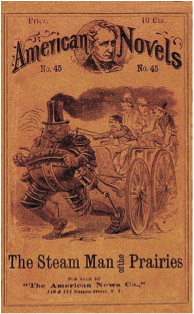 It seems Dederick’s imagination was contagious. Later that same year, and doubtless inspired by Dederick’s invention, Edward Ellis published The Steam Man of the Prairies, which is widely considered the first science fiction dime novel in the United States.
A Landscape So Powerful
When I was in my late teens, some of my friends slung on backpacks and scooted off to see the world. As an East Coast city kid who’d never been past the Mississippi, I wanted to see America. So, after a certain amount of wheedling and cajoling, a friend and I convinced our parents that we could responsibly travel out West by ourselves one summer without getting into too much trouble.
It was a life-changing experience, and one of the highlights was riding up out of Jackson Hole and getting that stunning view of the Teton Mountains just shooting up from the valley floor.
When you’re 17, your first thought is I have to go up there. So, with no experience at such altitude and no technical gear whatsoever (my footwear, if you can call it that, consisted of a pair of work boots with balding tread), we climbed.
Middle Teton (the peak right next to Grand Teton) is a walkable ascent, except for one hairy short section near the top. After a full day’s slog up the glacier and a night camped at the treeline, we reached the peak on day two and munched on cheese sandwiches in the chill thin air. Before us lay a 360-degree view of jagged peaks and unspoiled valleys. About 1,000 feet down, a small lake, still frozen in July, appeared as a patch of turquoise.
You don’t forget something like that. As Karen Berger, who wrote our cover story on the 100th anniversary of the National Park Service, describes her own hike to the top of Yosemite Falls: “The view can make you understand how a landscape can be so powerful that you’d change your life to save it for the next generation.”
And that’s just it. The very notion of preserving, rather than exploiting, great swaths of land for future generations was a novel concept 100 years ago. It took the passage of a law — with, I must add, a drumbeat of support from this magazine — to form the National Park Service. That landmark achievement is honored in this issue. As documentary filmmaker Ken Burns points out, “For the first time in all of human history, land was set aside for everyone; not for kings or noblemen or the rich but for everyone.”
In 1916, when Congress was considering the bill that would ultimately establish the U.S. National Park Service, the Post repeatedly showed its support. That year, a quick succession of editorials from Post editor George Horace Lorimer laid out his arguments for passage of the bill in the issues for January 1, February 12, and March 18.
Saving America’s Living Monuments
When newspapers began printing reports in 1852 of the massive redwoods found along the West Coast, Americans took notice. Whether it was the fact that they were unique to the United States, their longevity, or their sheer size and strength, these giant sequoias stirred in us a sense of pride and patriotism. U.S. naturalists, for example, would have none of it when a British scientist wanted to name the giant redwood after the British general who defeated Napoleon. In fact, the redwood trees in California’s Mariposa Grove were among the first beneficiaries of federal protection when President Lincoln signed “The Yosemite and Big Tree Grant” in 1864, ceding land from Yosemite and Mariposa to the state of California.
But not all the nation’s redwood forests benefited from such protection. Although the Sequoia giganteum, the giant redwood, was of poor quality for lumber, the Sequoia sempervirens, the coastal redwood, was highly prized. The housing boom that accompanied the California Gold Rush turned acres of redwoods into homes. The rebuilding effort after a massive earthquake rocked San Francisco and left it burning for days also depleted the redwood forests, as did another housing boom after World War II.
Conservationists had their work cut out for them, but work they did. In the feature that follows — from the Post of February 7, 1953 — Horace Albright, the second director of the National Park Service, tells the story of a campaign that raised more than $5 million to save 60,000 acres of “the Big Trees” for the public.
Today, roughly 5 percent of California’s virgin redwood forests remain, thanks to the ongoing efforts of conservation groups like the Sempervirens Club, the Save the Redwoods League, and others.
How We Saved the Big Trees
By Horace M. Albright with Frank J. Taylor
February 7, 1953
The mighty redwoods would be practically extinct today — if it hadn’t been for a 30-year crusade of dickering, swapping, money raising, and political trading. Here, by the ex-boss of our National Parks, is the story behind that garnering of $5,000,000 and the saving of 60,000 acres of sequoias.
One day last summer Bernard M. Baruch, who delights in philosophizing on park benches, found himself in a unique setting. On his 82nd birthday, the sage elder statesman sat on a log beneath the world’s tallest living thing, a 364-foot redwood known as The Founders’ Tree in California’s fragrant, cathedral-like Humboldt State Park, and cogitated.
“I have sat upon many park benches, but never before on one in such a setting as this,” mused Baruch. “In the shade of this majestic tree, a man may refresh his spirit, drawing upon the strength and beauty of this living column.”
Many people have drawn strength from these forest giants, some of them thousands of years old. One distinguished visitor, Sir George Campbell, a British representative at the birth of the United Nations in San Francisco, even urged his fellow delegates to “meet outdoors in the great redwood forests”
Most of the people who experience this spiritual lift take the Big Tree groves for granted. The Big Trees were always there; they always will be. It comes as a jolting shock to learn that, except for the dedicated 30-year battle of a small group of Big Tree enthusiasts, most of these magnificent groves would have been stumps by now. Also, to discover that there are still some Big Trees yet to be saved from the lumbermen’s saws.
Along with other zealots, I have been up to my eyebrows in the intriguing, and at times baffling, hobby of saving the Big Trees. Outside of national parks, we don’t want to save all the Big Trees, only the so-called “museum stands.” These are the occasional groves so outstanding in beauty, setting, size, and age that they should be preserved and protected for posterity. We think our grandchildren and their children ought to be able to enjoy these samples of the primitive beauty of the land as it was before the white man applied his ruthless civilizing process to the continent.
Now you would think it would be fairly easy to set aside a few groves of Big Trees out of the vast primeval forests that once blanketed much of our land. It wasn’t. It has turned out to be one of the most difficult projects ever attempted. In fact, nothing short of a crusade could have recovered a small part of the heritage we allowed to slip away through negligence and chicanery.
I was first caught up in this cause in 1915, when I was assistant to Stephen T. Mather, founder and first director of the National Park Service, and the most zealous tree saver of us all. Later, succeeding him as director, I was in a position to spearhead the drive for a while. Since I quit public service in 1933 to head the United States Potash Company, I have devoted time and energy to helping complete the job. Being in the mining business, which utilizes something left for us beneath the earth by time and nature, I feel it my duty to help restore some of our natural resources for future generations. I still keep in touch with national and state park affairs and serve on boards and committees of conservation organizations, including the Save-the-Redwoods League. Not a year passes without some tree-saving project having my attention, and I am in constant touch with Newton B. Drury, secretary of the Save-the-Redwoods League for 20 years, director of the National Park Service for 10 years, and now chief of the California state-park system.
It took a lot of dickering, swapping, money raising and political jockeying to recover the thousands of acres of forest land that have been restored to the people. The Founders’ Tree, under which Bernie Baruch sat, is named for three farsighted visionaries, Pres. Henry Fairfield Osborn, of the American Museum of Natural History; Dr. John C. Merriam, of the University of California, later head of the Carnegie Institution in Washington; and Pres. Madison Grant, of the New York Zoological Society. I came near being the fourth horseman in this founders’ group, when, in the summer of 1917, I met Osborn, Merriam, and Grant at the Bohemian Grove, a small but impressive stand of redwoods saved from destruction by the Bohemian Club of San Francisco. They asked me to join them in a scouting trip into the redwood lumbering belt, where they heard that the Big Trees were being wiped out like so many cornstalks. Unfortunately, I was unable to go.
When Osborn, Merriam, and Grant returned from the scenes of devastation, there was fire in their eyes. They lost no time in organizing the Save-the-Redwoods League, with the enthusiastic aid of Steve Mather, former Congressman William Kent, and leaders of California’s Sierra Club. Franklin K. Lane, Secretary of the Interior, was the first president, and today his ashes rest in Lane Grove, a memorial to him amid the redwoods. Starting with $100 in the kitty, these men launched what is undoubtedly the greatest private conservation movement on record, one that has raised over $5,000,000, for the most part matched with state funds, to purchase some 60,000 acres of sequoias for the public. Although the league was interested mainly in saving redwoods, its example led to the recovery of many acres of other museum stands of virgin timber — sugar pine, yellow or ponderosa pine, Douglas and other firs, spruce, Eastern hardwoods, swamp cypress, even desert saguaros and Joshua trees — all over the country.
To most people, the Big Trees are the sequoias, popularly called redwoods. There are two kinds of sequoia — the gigantea and the sempervirens. Remotely related, the two types of redwood have quite different growing habits, which added to our problems in saving them.
The gigantea, or Big Tree, which is the bulkiest and oldest living thing, survives from pre-glacial days only in damp, sheltered glades from 3,000 to 8,000 feet high on the western slope of the Sierra Nevada range. They have massive trunks insulated with spongy, reddish, almost-fireproof bark, and some of them are nearly 40 feet in diameter. Shallow-rooted, they balance on the surface, probably bulking over 3,000 tons. They sprout only from seed, and mature only after a millennium of growth. There are estimates of about 17,000 gigantea, 10 feet or more in diameter, growing in 70 small groves, extant out of ancient forests that are believed to have once grown widely in every Northern Hemisphere continent. These, generally speaking, are not only quite inaccessible to loggers, but the trees make inferior lumber, because of the brittleness of the wood.
The sempervirens, or coastal redwoods, on the other hand, thrive in the foggy, low regions from the Oregon border to below Big Sur, and fully 60 miles south of Monterey. Too numerous to count, they make excellent lumber, which is highly prized and high-priced. They are easily accessible by road and by railroad, and have been lumbered for a century. Not so thick of girth as the gigantea, they are taller and more graceful. Their grayish-brown bark is also almost fireproof. They grow in a dense, nearly unbroken forest that blankets valleys and hillsides in a narrow belt along the Northern California coast.
In one respect, the coastal redwoods are miracle trees. Soon after a monster is felled, its stump sends out hundreds of shoots. Within half a century a dozen survivors grow into marketable timber trees 100 feet tall. Hence their name, “sequoia everliving.” This reproductive facility made it all the harder to acquire stands of coast redwoods for park purposes, because timber owners are reluctant to part with redwood lands, even those that are cut over. They regard a stand of second-growth redwoods more highly than money in the bank.
When the Save-the-Redwoods crusade was launched in 1917 to protect some of these giants from the ax, there were only four small groves in public ownership. The state of California had one small grove set aside in Big Basin, near Santa Cruz, for a public park; Santa Cruz and Sonoma counties each had a small grove; and the Federal Government owned Muir Woods National Monument in the sheltered canyon at the base of Mount Tamalpais, just north of San Francisco.
The Muir Grove had been bought by Congressman William Kent, who presented it to President Theodore Roosevelt for a national monument to thwart the plans of a local water company, which planned to flood the canyon for a reservoir. Kent had introduced a bill in Congress to authorize the purchase by the Federal Government of a sizable coast-redwood grove for a national park. When this was pigeonholed, Kent and his friend Mather concluded the only way to get another Federal grove was to raise money privately and buy it. With the Save-the-Redwoods League, they plotted to that end by stationing a large open automobile in the redwood area for what they called their “$10,000 tour,” a courtesy trip for anyone of means who might be inspired by a ride through the Big Tree groves to reach for his checkbook and help purchase a few trees.
To point up their sales talk, Mather and Kent took the tour themselves, with amusing results. On the Eel River in Humboldt County, they undertook to inspire some money-raising on a local level. Carried away by his own eloquence, Mather pledged $15,000 for himself, and an equal amount for Kent. This took Kent completely by surprise, but, being a man of means as well as a good sport, he wrote out his check to match Mather’s. That fattened the bank account of the Save-the-Redwoods League.
Later, in 1921, when the league was urging the California legislature to appropriate $300,000 to match private donations for the purchase of park areas, I was on a committee with Kent, Drury, and Dr. William Frederic Bade, president of the Sierra Club, to journey to Sacramento to appear before a joint senate-assembly committee considering appropriations. The legislators quickly endorsed our project, but thrifty Gov. William D. Stephens was so lukewarm, we feared he would veto the bill. Kent had known Stephens intimately when both were congressmen from California, so we decided to call on him.
The governor explained that the state was poor and the schools needed money, and he just couldn’t see spending the $300,000 for some trees. Kent leaped to his feet, pounded on the table, and shouted, “Hell, Bill, shut the schools down! The kids would enjoy it and it would only take them a year or two to make the work up! If these trees all go, it will take two thousand years to make them up!”
The governor signed the bill. The state funds enabled the league, which grew rapidly to 4,000 members, to double its purchases. Each of the league members contributed yearly, and there were some fat donations, particularly after the founders had lured some of their well-to-do friends into taking “the tour.” The $5,000,000 ultimately raised by the league, matched by state money, has bought 60 separate stands of trees along the Redwood Highway.
Mather hit the jackpot in 1926, when he induced John D. Rockefeller Jr., with his wife and three of his sons, to take the tour. After the trip, Mr. Rockefeller pledged $2,000,000 to purchase the Bull Creek Grove, near Dyerville, generally regarded as the most stately and beautiful forest in the world. A shy man, he declined to have the family name attached to the grove, and it has taken a quarter of a century, during which he has contributed many millions for tree buying in Yosemite, the Grand Teton-Jackson Hole country, Great Smokies, Acadia National Park and other areas as well, to persuade him to let the California Park Commission officially rename the Bull Creek stand The Rockefeller Redwood Forest.
Today the screens of big trees saved by the league line much of the Redwood Highway, making it one of the world’s inspiring scenic drives. But for the zeal of the Save-the-Redwoods League, it might have been a pavement running through 200 miles of desolation. Fortunately, the larger redwood companies played ball with us and kept their logging crews away from the highway until the league could raise money to buy the groves selected for purchase.
Saving the Big Trees in the Sierra Nevada was a more complicated task for several reasons. Some of these groves were privately owned, some were in national parks, a few in national forests. Though the giant redwoods made poor lumber, they always grew among stands of pines, firs and cedars coveted by the lumbering interests, and it was almost impossible to cut these trees without damaging the sequoias. Anyway, a Big Tree forest without pines, firs, cedars, and native shrubs all growing naturally and in a primitive state would not be worth saving. So everything had to be acquired.
Few Americans understand the peculiar status of their public domain. They assume that if timber is in the national forests, it is safe, but forget that the United States Forest Service is an agency charged by law to sell timber and to see that it is cut scientifically and profitably — except for occasional “primitive areas” which have been set aside to save primeval forest for inspirational and recreational uses. The conservation agency charged with protecting natural wonders, sublime scenery, and public forests unchanged for posterity is the National Park Service. One of the ironies of the situation is that millions of acres were allowed to slip from public ownership back in the ’80s and ’90s for less than two dollars an acre; today it is with difficulty that we buy the same tracts of timber back for $1,000 an acre, or even more. Many Big Tree groves were fraudulently filed upon in the easy-go days when the Federal Government was eager to settle the West fast. The giant sequoias almost always grow in or near damp glades, where their roots can pump up millions of gallons of water in the course of a year. In the spring and early summer, these glades are swampy. So many Big Trees were finagled into private hands under the infamous Swamp and Overflow Act — since repealed — which encouraged private enterprisers to drain swamps and turn them into productive farmlands.
Many were the wiles and stratagems of the timber hunters, as William B. Greeley, former head of the United States Forest Service, points out in his book, Forests and Men: “Agents of the General Land Office finally checked some S. and O. claims in California, whose swampy character seemed to coincide most strangely, 40 by 40, with choice stands of redwood timber. The locator had attested to the marshy nature of the ground by a sworn statement that he had crossed it in a bateau. What further proof could any reasonable official ask? His affidavit neglected to include a minor detail that the bateau was mounted on axles and wheels, and drawn across the sections of dry land by a yoke of oxen.”
Luckily, the first lumbermen who attempted to turn the Sequoia gigantea into boards found that they had tackled more than they could handle. The Big Trees were simply too huge, as became evident in a ghastly way in the Converse Grove on the western edge of Kings Canyon National Park. Here, 40 years after the lumbering was attempted, lay giant trunks scattered over an alpine basin, shattered into many pieces as they crashed to earth. The lumbermen departed, leaving the logs on the ground, after felling once-majestic trees that were giants when the Christian Era began.
After that debacle, the giant sequoia groves were safe from destruction for a time, for the selfish reason that it did not pay to make lumber of them. As John Muir, the implacable mountaineer, naturalist, and founder of the Sierra Club, once remarked, “No doubt these trees would make lumber after passing through a sawmill, just as George Washington, after passing through the hands of a French cook, would have made food.” Nevertheless, Big Trees are being lumbered this year in the Dillon Grove on the edge of Sequoia National Park, one tree having yielded over 7,000 grape stakes. Spurred by high prices, lumbermen are splitting the huge trunks with enormous wedges, driven by bulldozers, then hauling them off to the sawmills.
The first museum stand of these Big Trees earmarked for posterity was the Mariposa Grove, now in Yosemite National Park. It was ceded by Congress in 1864 to the state of California, becoming the first state park in the United States. It was returned to the Federal Government in 1906. Two landmarks in this grove — the Wawona Tree, so huge that sightseeing busses drive through it, and the Grizzly Giant — are rated by botanists as among the oldest living things on earth.
Sequoia National Park was created in 1890, specifically to save several fine Big Tree stands, but the superlative grove of the area, the Giant Forest, was already in private hands, as a result of a filing under the Swamp and Overflow Act. Almost half a century passed before the people got it back. By that time the Giant Forest was cluttered with shacks, an eyesore in one of Nature’s noblest temples. In 1915, Steve Mather obtained an option to buy the grove for $50,000. By the time Congress got around to appropriating the money, the option had expired and the owners were demanding $20,000 more. Fearful that the price would go still higher, Mather took his troubles to Pres. Gilbert Grosvenor and the trustees of the National Geographic Society, with the result that the society made available the funds to complete the purchase of this magnificent property. The General Sherman Tree, probably the largest in the world, is in the Giant Forest.
Mather made other purchases out of his own funds and with the aid of gifts from friends. Several of these deals took place concurrently with the Teapot Dome and Elk Hills scandals, which got Mather’s superior, Secretary of the Interior Albert B. Fall, into much trouble because he had accepted financial assistance from oilman Edward L. Doheny. Mather used to boast that he “took money from Doheny.” When pressed to explain what he did with the money, Mather always replied, “I bought Big Trees.” Mather, Doheny, Sen. W. F. Chandlery of Fresno, and George Eastman, the camera magnate, put up the cash to purchase the forests along the roads in Sequoia National Park.
By the time the National Park Service was created in 1916, logging railroads had pushed into the Yosemite National Park area, threatening devastation along all three approaches — the Wawona, the Big Oak Flat and the Coulterville roads. Mather, when he took over as director of the National Park Service, could foresee the day when travelers to Yosemite’s grandeur would have to motor more miles through devastated mountainside. Unable to persuade Congress to buy back the timber the Government’s land agents had virtually given to lumbering interests, Mather utilized authority granted in a 1912 Act of Congress and undertook to swap trees along the much-used Wawona road.
The plan was to trade the lumber companies out of screens of sugar pines, yellow pines, cedars, red, white, and Douglas firs by offering them other timber lands inside the park, in areas not visible from the roads. Although the lumber companies agreed in theory to the program, it wasn’t so easy to work out in practice. The loggers demanded bonuses for changing their operations, for moving their railroads and camps, for selective cutting within the park, and for going to the remote areas.
The screens of trees we wanted varied from 200 feet to half a mile in width, depending on the terrain and the view. We couldn’t have the strips too narrow or the timber might be blown down in violent storms; we didn’t want them too wide or the timber would cost too much. It took four years to work out the swaps to save some 10,000 acres of carefully chosen stands of trees. We gave the lumber companies a lot more than they gave us, but we got the Big Trees we wanted, all the way along a new mountain highway, then projected and since completed. The south entrance to the park was saved.
That left the north entrance, via Big Oak Flat, still in danger of devastation. Much of the mountainside outside the park was already cut over, and the loggers had left a scenic mess, if I ever saw one. Unfortunately, we didn’t have comparable timber to exchange on this side of the park, so the swapping idea was out. While working on this pressing problem, Director Mather’s health failed, and then it was up to me to save the timber along these two roads. I had to do it fast or the fine forests would be beyond salvation. The only way to preserve them was to buy the timber back at around five dollars per 1,000 board feet for trees, mostly sugar pine, that we could have bought for two dollars per 1,000 ten years before. It would take a lot of money — over $3,000,000 — to do the job. Even so, in retrospect it was a bargain; fine sugar pine today is worth $45 to $50 per 1,000.
First I talked with Rep. Louis Cramton, of Michigan, and with other congressional leaders who controlled the purse strings, and asked them if they would authorize the Secretary of the Interior to match, dollar for dollar, any money I could raise from private sources. This looked like a bargain to them, so they told me to go ahead. While I was wondering where to turn for money, Nicholas Roosevelt, New York Times writer and wilderness enthusiast, visited Yosemite National Park. He wandered afoot among the huge pine and fir forests, took pictures of the areas being devastated by the loggers, and reported what he had seen so graphically in the Times that it aroused John D. Rockefeller Jr. to quick action. He offered to match, dollar for dollar, whatever the Federal Government put up to buy the trees.
We had the money, but we still didn’t have the trees, because there were two big lumber interests involved, and they were hard traders. One was Jim Tyson, an old-time timber operator and as tough a dealer as I have ever encountered. The other, Alexander Fleming, was a benefactor of California Institute of Technology, who took the attitude that the more dollars he could extract from the Rockefellers, the more it meant for his favorite charity. Luckily, when he had just about bogged down and the fate of the trees was dismal indeed, the San Francisco bankers who had financed the lumbermen and who knew they were losing money at the time on their logging operations cracked down and forced them to accept our offer of $3,300,000 for 15,560 acres of timber. Mr. Rockefeller put up half and Congress voted the other half. Thus we were able to restore to Yosemite National Park much of the valuable land and timber lost in the earlier days.
Farther north are the Calaveras Big Tree Groves, majestic stands of giant sequoias, intermingled with tall and stately sugar and yellow pines, firs, and cedars. Although the Calaveras Groves were not designated park areas, we had planned to get these fine trees in public ownership since 1924, when Mather and I first went in on horseback to see them. Discovered by A.T. Dowd, a miner, in 1852, the Calaveras Big Trees were famous long before Yosemite’s Mariposa Grove and Sequoia’s Giant Forest were known.
The first reports of the gold seekers as to the size of the Calaveras trees were regarded as tall tales. To prove the reports true, five loggers spent 22 days felling one of the giants, after which they smoothed off the stump to make a dance floor twenty-five feet across. The bark from a section of this giant, thirty feet in length, was skinned off the log and sent to London, where a room was built of it in an effort to convince skeptics. Thus the North Calaveras Grove became one of the wonders of the world for early-day travelers to visit. It was made a state park in 1932.
What the thousands of visitors to this grove didn’t know was that a few miles distant, in the Stanislaus River watershed, was another stand of sequoias even more magnificent. This is the South Calaveras Grove, owned by the Pickering Lumber Company, of Kansas City. The South Grove was in no critical danger in 1924, when we visited it via foresters’ trails, so we concentrated our efforts on saving trees about to be felled. Today it is a different story. As a result of the postwar building boom and the increased demand for lumber, the loggers are on the very edge of the South Calaveras Grove. In fact, it is in deadly peril, and saving it is our major objective right now.
In the North Calaveras Grove deal, the Save-the-Redwoods League put up $72,000 and the Calaveras Grove Association raised $32,000. The state matched this money out of a $6,000,000 fund set aside several years ago to acquire sites for state parks. The South Calaveras Grove deal is even more involved. The standing timber has skyrocketed in value, and this means we have to raise millions where we used to raise hundreds of thousands. More than $2,000,000 in cash may be required, half of it to come from private donations, half from the state’s fund. The United States Forest Service is helping out by ceding to the state of California a strip of sugar-pine-and-fir acreage for a parkway between the two groves of sequoias. The Forest Service will also swap other timber for sugar pines owned by the private lumber interests lying immediately north of the South Grove. The sugar pine has been called “our most handsome tree” and “The Queen of the Sierras.”
The spectacular success of the Save-the-Redwoods League inspired similar tree-saving drives in other states. In fact, the movement gained such momentum that in 1921, Mather organized in Des Moines the National Conference on State Parks and set up a small division of the National Park Service to aid state park drives. He kicked off one of the first of these personally around a campfire on Mt. Rainier, where the Washington State Park plan was born in 1921. The Save-the-Trees drive in that state concentrated on the approaches to Mt. Rainier National Park, and on the Olympic National Park, in which thrives a unique rain forest of Sitka spruce, Douglas fir, Western red cedar, and hemlock, giants reaching 200 feet into the sky, with trunks 10 feet through. One Douglas fir in Olympic Park is over 17 feet through, and the largest Alaska cedar ever found, located in this park, is 20 feet in diameter. The annual rainfall of 140 inches a year accounts for the growth.
Usually these state drives gave birth to state parks, but occasionally to a national park. The Great Smoky Mountains National Park contains more than 500,000 acres, with upward of 200,000 acres covered with virgin forests consisting of 130 species of native trees, including many hardwoods. It was acquired with a $5,000,000 contribution from John D. Rockefeller Jr. in honor of his mother, Laura Spelman Rockefeller, matched by a similar sum from the states of North Carolina and Tennessee. This great park was officially dedicated in 1940.
Ten years later, Mr. Rockefeller saved an 1,100-acre tract of virgin Eastern forest on the Blue Ridge Parkway in North Carolina. When our option on this tract, which also included the superb Linville Falls and Gorge, was about to expire without his offer to contribute one half the purchase price being matched, he wired me to acquire the property even if he had to meet the entire cost. He did and the sum was $95,000.
There are still notable stands of native trees in peril, and the danger is that with so much accomplished, the people will become complacent and say we have enough trees in public ownership. Idaho may have enough, Washington may have, and likewise Maine. But with our fast-increasing population, we need more public forests in more states. We don’t want to save all the redwoods, or all the sugar pines, or all the hardwoods. All we hope to do is to keep intact for as long as the trees live the finer groves in which public enjoyment outvalues manyfold the dollar earnings from harvesting timber.
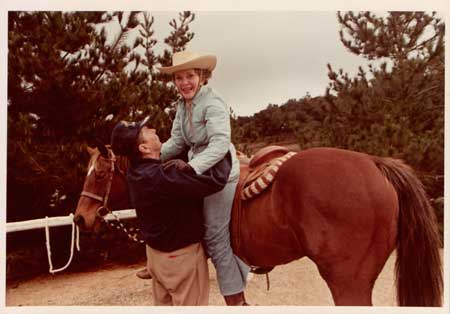
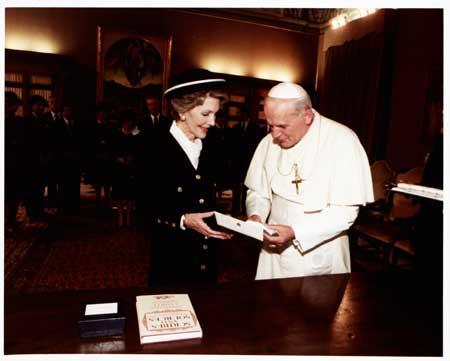
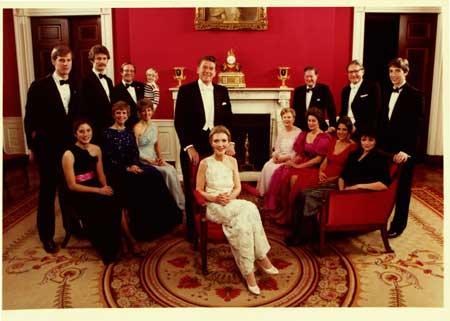
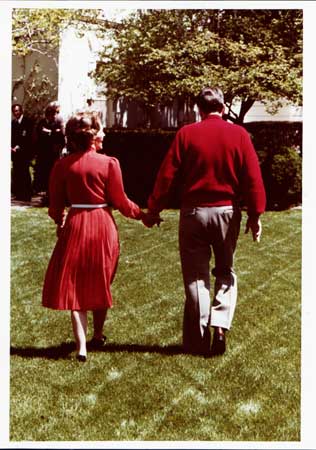
The Post Remembers: Nancy Reagan
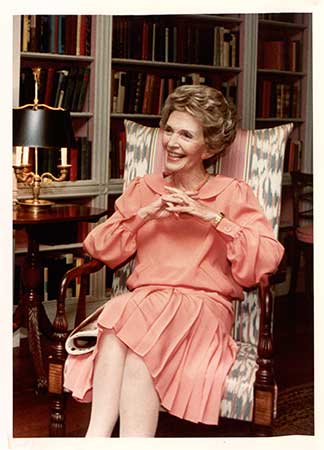
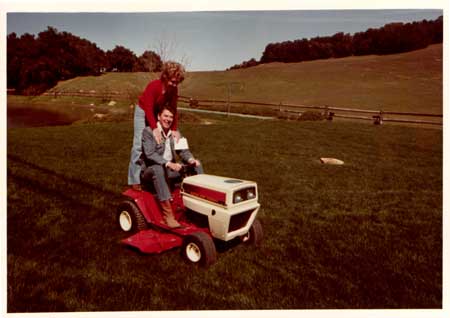
Nancy Reagan, former Hollywood actress, first lady of the United States, and founder of the “Just Say No” anti-drug campaign, died at her Los Angeles home on Sunday, March 6, 2016. She was 94. Below is a look back at the life and times of the Reagans from the archives of The Saturday Evening Post:
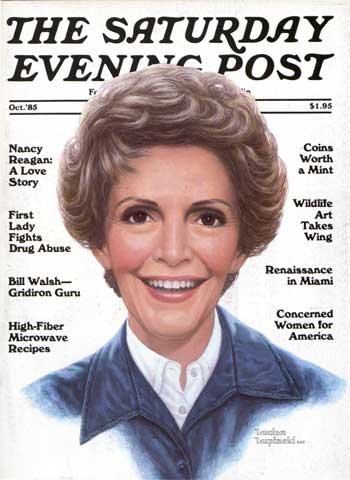
Nancy Reagan: A Love Story
In a 1985 interview, the first lady talked about her relationship with her husband, her new anti-drug campaign, and the cherished memory of her influential stepfather. Read more>>
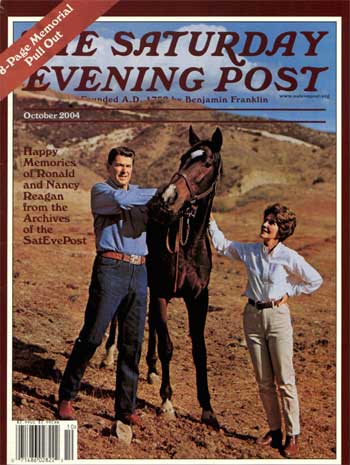
Happy Memories of Ronald and Nancy Reagan
In 2004, the Post ran an eight-page memorial celebrating the life of President Reagan. The memorial includes excerpts from past interviews and images of Nancy and Ronald Reagan from the archive. Read more>>
Photo Gallery from the Archive: Nancy Reagan
To view gallery as a slideshow, click on the images below.
Coloring Books for Grown-ups
If, as some say, you can judge an entire society by the way it treats its most vulnerable, then I’d argue it is equally fair to measure a nation by the way its citizens fritter away their spare time.
Lately, Americans are frittering like mad in a couple of surprising ways: on outdoor courts playing a game called pickleball, and in coloring books.
Let’s begin with the coloring books, which are meant for adults. The craze began more than a year ago. Color me skeptical, even now, but the wild enthusiasm for this hobby shows no signs of fading. Several of the books sit atop our national best-seller lists. (Johanna Basford’s Secret Garden was the first of the blockbusters, but dozens have followed.) Who, exactly, is buying these — and why?
An admission: When I heard about this fad, my initial thought was unashamedly elitist. What kind of latte-fueled exurbanite would exchange nightly yoga classes for the joylessness of coloring? Maybe someone with no life to speak of? Okay, big mistake. Huge. Turns out that adult coloring books are a raging success across nearly every shade and stratum of the American landscape, from pastures to plains to the towers of Manhattan.
Take, as an example, Maria Dorfner, a native Pennsylvanian who works as producer at ABC News in New York. “It calms and centers my mind,” Dorfner, an avid colorer, told me. “Adults need to learn to be more in the moment, like kids with crayons.”
Asked about a Psychology Today story that contended coloring cannot possibly constitute a spiritual experience, despite claims to the contrary by the hobby’s millions of evangelists, Dorfner snapped, “They’re just wrong about that.” Backing her up is a widely shared perception that coloring does indeed both soothe and heal the mind. (And let’s please agree that the illustrators of these exquisitely drawn books are artists; the color-inners are not.)
So, what we have here in our go-go digital age is an analog diversion for stressed-out grown-ups. One sits and colors and dreams, and the day’s tiny troubles appear to vanish.
At the other end of the spectrum is a (slightly) more physically demanding pastime, the game of pickleball. Imagine tennis played with wiffle balls and paddles on a diminutive court — Ping-Pong on a grander scale. The sport has rapidly attracted participants coast to coast, mainly among oldsters: The thrill of victory never flags, but the viability of older knees often does, alas.
This helps explain why pickleball, which has been around for a while, exploded in popularity only recently, as our aging population surged. The USA Pickleball Association reports it witnessed an 84 percent membership increase in the last two years alone and now boasts more than 400,000 active players. An Oregon documentarian is developing a movie about its rise.
Steve Brodsky, a 61-year-old Floridian, captured the excitement perfectly: “Pickleball is for older folks who’ve got the fire in the belly,” he told me. “Guys like me can feel, ‘Wow, I’ve still got it!’”
Hot on pickleball’s heels is a variation on that game called POP Tennis, a rebranded version of what we once knew as paddle tennis. Backed by a fresh infusion of cash from Hollywood agent Ken Lindner (Matt Lauer and Lester Holt are among his clients), the U.S. POP Tennis Association is currently rolling out a national tour. It’s aimed at picking up where pickleball leaves off. The appeal of POP Tennis, Lindner told me, is that “anyone can play, young or old. If you can walk, you can hit the ball immediately.”
What conclusions can be drawn from these trends? Well, whether we choose a pencil or a paddle, and whatever our age, Americans seldom let time go to waste. It’s in our character to be restless; it’s a trait that’s long served us well.
News of the Week: The Return of Scott Kelly, the Departure of George Kennedy, and the Sadness of Never Dunking an Oreo
Meanwhile, an American Hero Returns to Earth
On the night everyone was trying to figure out which candidate was going to win which state, following Twitter jokes about Chris Christie, and watching pundits argue on cable news, something else was going on that maybe we should have paid more attention to.
Astronaut Scott Kelly returned to Earth on Super Tuesday after spending 340 consecutive days in space aboard the International Space Station, a record for an American. Kelly also holds the record for total number of days in space for an American: 520.
Kelly was the perfect choice for this experimental mission because scientists can now study the effect that so many days in space had on Kelly’s body by comparing it to a similar body that was down here on Earth the whole time: his twin brother Mark.
RIP George Kennedy
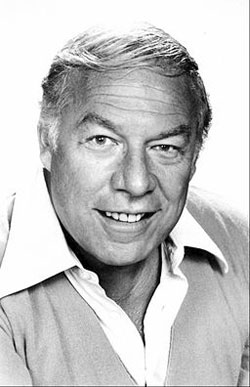
Kennedy just missed making the “In Memoriam” segment of the Oscars that same night. Hopefully they won’t forget him next year, like they forgot Abe Vigoda in this year’s montage.
There are many great obituaries for Kennedy, and at least one that, well, has a rather insulting headline. I’m astonished they haven’t changed that.
By the way, it was reported this week that Jerry Maren, the last surviving Munchkin from The Wizard of Oz, had passed away at the age of 96. But he’s actually still alive. I guess you can’t believe everything on social media.
If You Have Harry Potter Books, You Might Be Rich!
It’s a safe bet that most homes have at least one copy of one of the many Harry Potter books. Go check, because they might be worth a lot of money.
Okay, the one you have probably isn’t, but rare books dealer AbeBooks says that some of the early edition hardcovers of the books can bring in anywhere from $6,500 to $55,000. If the books are signed they might be worth even more.
I bet J.K. Rowling has a lot of early editions. She should sell them!
Putting the “Fuller” in Fuller House

I consume so much pop culture — TV, film, books, magazines, music, the web, etc. — that I often get exhausted. There’s so much pop culture these days that I’m sometimes actually relieved when a TV show I watch is canceled or when it’s one I have no interest in. Hey, don’t have to worry about that one anymore! Such is the case with Fuller House, the reboot of the ’90s sitcom Full House that recently debuted on Netflix and has already been renewed for a second season. I had no interest in the original, so I have no interest in the new version. It makes me happy that I don’t have to think about it.
But I did come across an odd piece of information about the new show. I assumed that the “Fuller” in the title was a play on the title of the original show, showing that this is a continuation of Full House and now it’s “Fuller.” And it does indeed mean that, but did you know that it also refers to the fact that the married name of one of the characters (DJ) is Fuller? I didn’t either.
This reminds me of the time years ago when I found out that the “Grey” in the title Grey’s Anatomy was actually the name of one of the characters on the show. I thought it just referred to the medical book. I got so many nasty comments because I didn’t know that.
So I’m assuming The Price is Right is about the life and career of Vincent Price?
Like, Love, Haha, Wow, Sad, Angry
What do you think of the new Facebook “Reactions” emoticon buttons? Besides the Like button that everyone uses, you now have a choice of several other buttons, too, for those special posts when a simple Like isn’t enough and you want to express your anger, sadness, shock, or unbridled joy. Facebook users have been asking for a Dislike button, too, but that would just cause more trouble than it’s worth.
Of course, if you think Facebook has introduced the new buttons just to please you, well, think again.
The Return of Zubaz Pants
I didn’t even realize they had been gone, but Zubaz (pronounced “Zubas”) pants are back! The baggy pants with the colorful stripes were big in the early ’90s.
I saw the new commercial for the pants last weekend. What the announcer says around the 52-second mark and how the actors look on the couch really amuses me:
I don’t know what you’re wearing as you read this, but I hope it’s not uncomfortable and boring.
National Oreo Day
I have a big confession to make. This isn’t easy for me to admit, so I hope you’ll be understanding when you hear it and won’t judge me for my shortcomings.
I have never dunked an Oreo in milk. I am 50 years old.
This Sunday is National Oreo Day. You can celebrate by twisting them open and licking them, dunking them, or just eating them by the handful, but how about a few recipes? The official Oreo site has several, including an Oreo milk shake, cheesecake bites, and a frozen Oreo torte. You can also try these Oreo cupcakes. And if you really want something different, how about Oreo popcorn?
Maybe I’ll celebrate the day by finally dunking one of those black and white discs in milk.
Upcoming Events and Anniversaries
New York Stock Exchange founded (March 8, 1817)
In a 1914 article for The Saturday Evening Post, Will Payne explained why the start of World War I in Europe closed the New York Stock Exchange from July 31 to November 28, 1914 .
Bobby Fischer born (March 9, 1943)
The Atlantic has an interesting piece on how the chess champion’s life unraveled.
First Book-of-the-Month Club selection published (March 10, 1926)
The first book selected was Lolly Willowes, or The Loving Huntsman, by Sylvia Townsend Warner. The club is actually still around if you’d like to join.
Lawrence Welk born (March 11, 1903)
The Lawrence Welk Show was a staple in my home when I was a kid, and it had an amazing run, debuting in 1955 and ending in 1982.
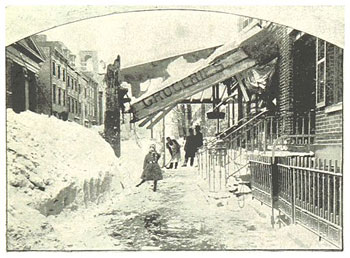
The storm, also called The Great White Hurricane, dropped 40 to 50 inches of snow in many areas from Maine to the Mid-Atlantic coast. Many people were trapped in their homes for a week, and even railroads and telegraph services were disabled.
Jack Kerouac born (March 12, 1922)
He wrote the classic novel On the Road in only three weeks (and on one roll of paper).
How Madame Montgomery Got Swindled
Nobody in town knew exactly where old Missus Montgomery’s fortune came from. Some people claimed she had made a fortuitous investment in a certain software company in its fledging days; others said that her husband, dead these 26 years now, had won a lawsuit against the mining company that had given him a gimp leg and a set of worthless lungs, and that she had simply bidden her time until he coughed himself to death, she waiting two hours to call an ambulance to be sure he was cold. Still others held that she must have made a deal with the devil himself to have fallen into that kind of money — if so, then at least it wasn’t true what some of the old timers said, that the Madame had never set foot in the mine and therefore had no right to the lawsuit money. Indeed, she had gone even further underground. She might have had a direct line to Satan himself.
So it was that Madame Montgomery sat, at 88 years old, behind her curtained windows every day, looking out scornfully at the world. It could be a sunny day or a roaring blizzard: Montgomery would be scornful. There could be salesmen, Jehovah’s Witnesses, or simply kids running down the street to a baseball game on the old diamond: Montgomery would still be scornful. Hell, if it was Jesus Himself, coming back to collect the worthy, she likely would have locked her doors double tight and cackled out, scornfully, “I don’t want none. Now go away!” And, one imagines, Jesus would have been of a mind to oblige her.
There are two principal characters to our tale: Madame Montgomery, of course, and a slick, swindling snake oil salesman by the name of Corey P. Wales, unless you count the two other main characters, those being Greed and Gullibility — but we’ll assume they don’t count, and neither do their bedfellows, Evil, Foolishness, Humiliation … well, you get the idea.
Of Corey P., not much is known. He went to school at some fancy northern university but couldn’t make the grade. Fair enough. People, around here anyway, are more likely to trust a fellow lacking a college degree than a fellow who is in ownership of one. After college, he rattled around for a little while, looking for work. He sold Bibles in the Midwest and apparently did a good enough trade that he could afford food and a place to lay his head at night. But, he decided at some point, it wasn’t much of an existence, being chased by dogs and shotgun-wielding old men crying after him, “We already got us plenty of Bibles!”
He tried his hand at writing books, but apparently no one was interested in publishing his work; that was when he discovered that one had to be more than just a good liar to be a good writer.
And so it went for Corey P. But at some point, he must have heard of Madame Montgomery, because, by the time he sauntered into town, he was already well prepared for her. He drove in with some old pickup truck, the kind you don’t like to follow on the highway for fear of something sharp flying off and giving you a puncture, and parked it at the only little motel in town, and the next day he was already well on his way to swindling old Missus Montgomery.
Two other important things to note about the Madame, and really they should have been mentioned earlier. The first is that she never trusted banks. She might have maintained a bank account, somewhere, but whatever sorry bank it was had only a small fraction of her total holdings. Word was, she had lived through the Great Depression, and when she came out of it, just a young, spitting little hellfire of a girl, she swore she would never put her faith in one of those godforsaken institutions in her life. No one could blame her. It was a minor concession when she got a checking account, but that was for purely technical, financial reasons, we are told. She still loathed writing checks.
The second point, perhaps even more important than the first, is that as she grew in age, her superstitions also grew. When she was young, and called simply “Miss Montgomery,” she employed all the usual elements of superstition in her life: she never walked under ladders, for instance, although that might have been attributed simply to an overabundance of caution. She detested black cats, and even in later years, when her house began to fill up with the wretched animals, not a one of them was black. She threw salt over her shoulder in restaurants. She was extra-careful during full moons.
But time has a way of changing people, and in most cases, rather than changing you, it simply embeds those traits you already have even deeper within yourself. Drunks drink more, smokers smoke more. Madame Montgomery started to dabble in the Black Arts, as they are sometimes known, consulting such trinkets as Ouija boards and tarot cards to divine her future. She became, as a euphemism, more spiritual. Euphemisms aside, she started to go batshit crazy.
But such is the fate of many a wealthy person, and especially so for a single lady getting on in years. She hired and fired helpers and cleaners at an extraordinary rate. A few poor girls, whose command of English was tenuous at best, found themselves in her employ for only two days. They were supposedly Russian immigrants, and in darker circles around town, it was said that they had stumbled upon some strange ritual that old Madame Montgomery was performing in her basement. Probably not, though — probably old Missus Montgomery just didn’t like the looks of them and sent them on their way.
Anyway, as previously stated, Corey P. came into town in his pickup truck, and within a day he had made an agreement with the local library, a small outfit carrying mostly dusty reference books and dime-store paperbacks, to hold a free talk about his own little book. It was titled The Spirit Staircase, and of course the library agreed. Mr. Corey P. Wales was going to be the first bonafide author the library had ever hosted. He would, of course, be available to answer questions and sign books after his talk.
Corey P. was a short, unimposing man, and even if he didn’t finish his schooling, he spoke well and quietly, the kind of talk you get from a man who is used to being listened to, in the end. He showed up to the library carrying a briefcase and dressed in a fancy suit and tie, although it looked like his clothes had seen better days, and a whole bunch of them at that. They were loose-fitting and a bit frayed at the edges, like a kid’s drawing that’s had a few lines erased and cleaned up. His talk was right in the middle room of the library, and he set up a stack of his books right there. They were self-published, pitiful things. His audience consisted of about a dozen people, mostly women and a few outliers, a couple kids who were interested in ghost hunting, and old men who had been dragged along by their wives to submit themselves to a bit of culture. And, of course, in the front row sat Madame Montgomery, dressed fairly to the nines herself, in a rare public appearance.
“I’m here,” began Corey P., “to tell you that there is a lot more to this life than what you see around you.”
He already had her in the palm of his hand. But he wasn’t the type to just make a fist and squash her; his was a more seductive, subtle style. He went on, “I’ve seen ghosts, although my purpose here today isn’t to talk to you about ghosts. I’ve spoken with spirits, although I’m not here to tell you about that, either. I’ve seen a lot of strange things, actually. I’ve seen spoons bent by the power of a masterful mind. I’ve seen a man levitate — this was in India, mind you — about this far off the ground.” Here, Corey P. held his hand about a foot off the library’s carpeted floor, and he held it there for a few seconds, to the rapture of the crowd. “Yes, indeed, I’ve seen those things. But I don’t want to tell stories. When I get to telling stories, people start to look at me funny.” Cue the audience laughter. Even the Madame laughed, her eyes glinting a little. “I’m here today to tell you that all those things are possible because of the spiritual connection we are meant to have with our spiritual selves. And I’m here to tell you how you, too,” and now he picked up one of his books, “can achieve the same thing.”
Corey P. went on to discuss such matters as prayer and meditation, speaking with lost relatives, and feng shui. Madame hung on his every word; most of the people present there did, in fact, because the fella had such an intriguing set of mannerisms about him. Come time for the end of his talk, he fielded a few questions. There were the usual types: a lady wanted to know if he could contact her dead father, for example, and Corey P. responded by closing his eyes real tight, like he was concentrating, and feeling out in the air with his empty hands, and then saying, like he was very disappointed, “I’m sorry ma’am. There are some hucksters out there who will try to fool you. But I’m not one of them. I’m not getting anything.”
Another guy, Gene Robinson from down the mechanic’s, wanted to know who was going to win the next presidential election, still two years away. Corey P. just smiled and gave Gene a little wink. “Well, sir, I don’t know his name, but I can tell you he’s a crook,” he answered, to much audience approval.
And so it went, and then he sold a handful of his books. In the following years, the book would circulate through town, and people would stare down at it like they were looking through old high school yearbooks; Gene bought a copy, as did Ulysses Pearson, a retired schoolteacher, and a few other adventurous souls, including the library, although that copy would mysteriously disappear after Madame Montgomery disappeared.
Of course, Madame Montgomery got a copy, and the author signed it: “For the most beautiful lady in the room.”
The table of contents was nothing special, but chapter eight was the whole focus of Corey P.’s mission. It was titled “Where to Hide Loot, Booty, and Treasure.”
One can just picture, on the one hand, Corey P. Wales as he studied pictures of the old woman’s house and property, as he toiled away writing page upon page of that absolute garbage he would later claim was spiritual truth, smoking away in whatever cell or dungeon he found to work in during those bleak times. Did he struggle over which words to use, like a drunken poet, or did he simply vomit out the majority of the information, taking special care only when he described how close a buried treasure should be located in relation to an old oak tree, how deeply it should be placed beneath the earth, how many paces from the back door it should be so that it could grow while it hibernated in the ground? He drew basic diagrams, one of them so closely approximating the old woman’s property that it boggles the mind how she never realized she was being played.
And, on the other hand, poor old Missus Montgomery, reading through the book and happening upon that fateful chapter, reading it with great interest, mumbling to herself how it seemed like it was written especially for her. Taking her personal treasure — all cash and jewelry, we have been told — and, trusting no one, waiting until the cover of night so that she could drag it into her backyard and start digging, panting with the effort, wiping the sweat from her brow. How accomplished she must have felt, having completed the task laid out for her.
Corey P., waiting in his motel room impatiently for old lady Montgomery to finish. It is impossible to tell how long he gave the process. Perhaps he left town, went to Atlantic City for a while, took a road trip, laid low until his swindler’s sense started tingling. At which point he would have driven directly back to Madame Montgomery’s house, sneaked into her backyard, and started digging.
The rest is mostly speculation. Missus Montgomery drank her coffee one morning and peered out that sooty kitchen window of hers into the yard. She saw the oak tree, casting a long sunrise shadow, and her eye fell upon something amiss: a big heap of dirt where no heap of dirt should have been. She ran into the yard in her stocking feet and peered down into the hole, empty except for a copy of Corey P.’s book. She screamed. Or she simply turned around, went back inside, and got herself dressed. She was not a woman to take such matters lightly. She would have known immediately what had happened; yes, indeed, she was a woman who had seen more than her fair share of scams and swindles throughout her life, and she had never let one of them get away with it. Two and two equaled four, in her world, and she did the math instantly.
She would have packed that old .357 Magnum revolver, fully loaded, into her purse and she would have patted it twice to be sure it was safe. After a moment’s rumination, she would have opened the kitchen window just high enough so that her cats, too numerous to count, could escape to their own separate freedoms in their own good time. She would have grabbed the keys to her old Buick and she would have locked the front door tightly behind her as she left the house.
She would have driven to the library first, and indeed we heard tell of a strangely calm Lady Montgomery who happened through, one chilly morning, enquiring if that fine young man was ever going to come back for a repeat talk. The librarian, a mousy young woman, replied that they had no plans, but that she did have a phone number at which the industrious author could possibly be reached. This she scrawled on a scrap of paper. Missus Montgomery tucked it into her purse, probably right up against the hammer of that impressive revolver she had hidden there.
“Thank you kindly,” she was reported to have said, patting her purse again.
“Think nothing of it,” the librarian responded, and then, as Missus Montgomery was on her way out the front door, she called after her. “Say, did you find that book of his helpful?”
Madame Montgomery paused, hand already resting on the door. “You know,” she said, “I did. It’s already given me new direction in life.”
“That’s good,” the librarian answered, but the old lady was already gone.
Medicine Wasn’t Always a Money-Making Profession
In 2014, U.S. healthcare spending amounted to 17.5% of the gross domestic product; that translates to $9,523 per person, and it’s only going up. With healthcare sucking up more of our money, reports about Big Pharma CEOs with eight-figure salaries, and lowlifes like Martin Shkreli jacking up the price of medicines to nab an even bigger piece of the pie, it’s no wonder that speculation about the future of medicine is more often met with cynicism than with hope.
But it hasn’t always been this way. Once, medical professions were considered noble callings, undertaken for the good of all. The idea of medicine as a money-making profession was ludicrous. In the following address before the New York State Medical Society in 1849, as recorded in the Post on March 24 of that year, Dr. Alexander Stevens claims that “one-third or more of the whole practice of medical men in New York is done without remuneration.”
We certainly don’t wish to deprive physicians and medical researchers of their livelihoods, but reflecting on the passion, integrity, and philanthropy on which the medical industry in America was founded can only do us good.
Disinterestedness of the Medical Profession
From Dr. Stevens’ address before the New York State Medical Society, February 6, 1849
We claim to constitute, or represent a liberal profession; and the very idea or essence of a liberal profession, as distinguished from a trade, is that the acquisition of money is not its primary object. Nor is it so with physicians.
Was the introduction of inoculation for the smallpox a speculation? Was the discovery of the preventive power of vaccination (the labor of close, unremitting, and careful research during a period of several years) made, or conducted with a view to personal emolument? As a matter of course, Dr. Jenner, as soon as he had completed his discovery, published it — made it free to all mankind.
When quinine was first discovered, the mode of preparing it was immediately made known. Recently when some feeble attempts were stated to have been made to obtain a patent for the use of ether, or to conceal the process of etherization, the indignation of the profession was aroused from one end of our country to the other. The money changers were driven from the temple of Humanity.
Medicine a money-making profession! Why one-third or more of the whole practice of medical men in the city of New York is done without remuneration. The hospitals, the almshouses, the dispensaries, the medical and surgical cliniques, the eye infirmary, the orphan and lying-in asylums, the colored home, the institutions for the blind; in fine, all institutions of a charitable kind, so far as I know, are attended gratuitously; and many of them by some of the oldest and most eminent medical men. Nor are the outdoor poor neglected. When they appeal to physicians, not for advice only, but even for services which keep us from our beds, they rarely ask in vain.
I have witnessed examples of self-denial, of steady holding fast on integrity, by scores of medical men; who, amid the pinchings of poverty, have refused to embark in schemes which would have given them wealth, had they chosen to seek it in the walks of quackery. When will the world do justice to such self-denying philanthropy?
A money-making profession! Why the number of destitute widows and orphans of medical men became so great that a few years since, an association was formed, and is now in progress and successful operation, with a fund raised by their own contributions in New York, to secure from destitution after their death, their wives and children. It would have broken our hearts to have encountered them in our daily visits to the almshouses or asylums.
History does not offer a single instance in which a physician has conspired against the welfare of his patient. The successful exercise of the art brings with it joys that make humanity not an instinct merely, but a ruling passion.
National Parks at 100
The long lonely call hung in the night, with notes from a musical scale known only to canines. The next morning, a ranger would tell me it was a coyote, but at that moment — and even now, remembering — I’d swear it was a wolf: one call, not many, and lower-pitched than the coyotes I’d heard before. The difference between a cello and a chorus of pennywhistles.
I was more than 2,000 miles into a 3,000-mile walk along the Continental Divide National Scenic Trail, hiking from Mexico to Canada through five states, 25 national forests, and Rocky Mountain, Yellowstone, and Glacier National Parks. After more than four months, the routines of wilderness living — sleep eat walk eat walk eat sleep — were as comfortable as my broken-in boots; so were the daily chores of route finding, fording rivers, stepping around rattlesnakes, and hanging food in trees where bears presumably couldn’t requisition it. But the wildness of northern Wyoming was a different order of magnitude, and something had shifted inside me. For the first time, I was acutely aware of just how thin the nylon barrier was that separated me from whatever lurked outside.
The next morning, the ranger talked wildlife. Moose injured more tourists than bears, he said, and buffalo were dangerous, too. Visitors got gored, or stomped on: 1,500-pound animals with unpredictable temperaments made lousy selfie-plus-a-wild-beast subjects. As for bears: According to the National Park Service, between 1980 and 2014, there were 45 human injuries caused by grizzly bears in the backcountry, an average of one per year — which means, according to some statistical modeling magic, that the odds of a visitor being injured by a bear in Yellowstone are 1 in 2.2 million.
But statistics are only reassuring in theory. Back in reality, the trail I’d wanted to take was closed because a grizzly mom and cubs had been sighted in the area. A parallel trail was still open. I wondered aloud if the bears knew which trail was for them and which trail was for us. The ranger laughed and sat back looking unworried, but then he carried a gun. I carried a can of bear mace, holstered in a pouch attached to the hipbelt of my backpack. I considered just how fast I could pull it out, pop the safety, aim, and spray. Even if I were the fastest draw in the West, as a defense against the contiguous 48’s most fearsome predator, my weapon felt as insubstantial as the tent I’d lain awake in the night before.
I headed up the Snake River, presumably away from the mother bear. The trail loosely paralleled the Continental Divide through the remote southern borderlands of Yellowstone National Park. A bush shifted in the breeze — or was that a bear? A cloud made a shadow on a boulder — or maybe it was a bear cub? Ahead, a plume of smoke drifted lazily upward. A forest fire? Campsite? But no: It was a backcountry geyser basin spouting sulfurous steam; a faint odor of rotten egg hung in the air. You could believe the border between Earth and hell had broken open here, that the cauldrons of the underworld spewed their stinking concoctions into the clear mountain air. With my mind on grizzly bears, I’d completely forgotten where I was. There were no signs, no boardwalks, no warnings, no guardrails: I saw my first Yellowstone geyser much the same way John Colter, usually credited with being the first European to explore Yellowstone, might have seen it: as a complete surprise.
We have only handed-down hearsay for the details: Colter had earlier been a member of the Lewis and Clark expedition, which passed north of Yellowstone in 1806 but missed it entirely. A few months later, as the expedition was drawing to its close, Colter was honorably discharged in order to guide a trapping party back west toward the Upper Missouri. He spent the next four years exploring the northern Rockies, including the region we now know as Yellowstone. Colter was among that self-selected subset of people who think that walking across half a continent and back was a fine way to pass a year or two. When he finally returned east in 1810, he brought stories of adventures and close brushes with death. Audiences thrilled to his tale of Blackfoot Indians who killed Colter’s traveling companion and then stripped him naked and told him to run, telling him if they caught him, he would die. But Colter’s descriptions of the landscape were so over-the-top that they were greeted with skepticism and the mocking name “Colter’s Hell”; audiences were more apt to believe tales of Indian attacks than stories of gushing geysers and foaming fumaroles.
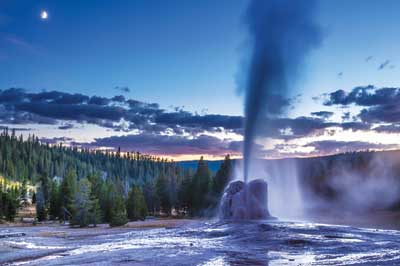
Yellowstone is home to half the world’s geysers. One of 500 in the park, Lone Star Geyser erupts every three hours. (Shutterstock)
Jim Bridger, who explored Yellowstone in the 1820s, fared no better where believability was concerned. In part, that was his own fault: His descriptions of waterfalls falling upward and “petrified trees with petrified birds singing petrified songs” were embellished — okay, slightly more than embellished. But there was truth at the core: What Bridger called a mountain of glass we now know as Obsidian Cliffs, and there is indeed a place where a fish can swim across the Continental Divide — I’ve seen it with my own eyes how the water of Two Ocean Creek runs down the Divide, slows at a saddle, then splits in half, although the only thing that crossed the divide when I was there was a little twig I had tossed in the water to see which ocean it would turn toward.
And so it went. The few people who made their way to remote northwestern Wyoming and returned with stories of geological oddities were roundly thought to be liars. Philadelphia’s Lippincott Magazine rejected one expedition’s story about Yellowstone, saying, “We don’t print fiction.”
And then, in the way of tectonic plates that rearrange themselves to create a new reality, the weight of evidence shifted. Finally, there were too many reports to ignore. Fact was, indeed, stranger than fiction: In a little-known corner of northwestern Wyoming, rivers boiled, mud pots bubbled, and geysers spouted, all in a mountain landscape rich with wildlife and forests.
Here’s the part I find remarkable: Those in the know — the explorers and surveyors and expedition members who were there first — the ones who could have claimed the land, built it up, maybe even ruined it, didn’t.
Instead, there was a consensus of sorts, so widespread that historians still argue whose idea it was, that Yellowstone should be protected for future generations. In 1872, it became the first national park. Not an amusement park. Not part of some commercial boondoggle. Simply a park, with essential services and infrastructure to handle visitors, and the goal of protecting the landscape, unspoiled and undeveloped, for the future. Over the next 44 years, another 34 national parks and monuments would be established and then gathered together into the National Park Service, established by an Act of Congress in 1916. Wallace Stegner called the national parks America’s “best idea,” one that inspired national park systems around the world. Today, 100 years later, America’s National Park Service manages more than 400 units ranging from caves to coral reefs to the St. Louis Gateway Arch to former Japanese internment camps to enormous country-sized swaths of Arctic wildlands — including examples of virtually every environment, ecosystem, and landform to be found in the country.
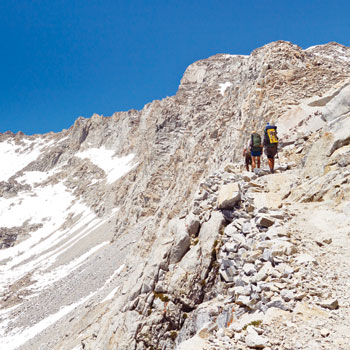
I can’t think of a single thing in my daily routine that is the same as it would have been when the National Park Service was founded 100 years ago: I heat my house with oil, I make coffee in an electric espresso machine, I bank by computer, and I read books on a tablet. But the national parks seem to be places where time stands still: the ranger uniforms, the appropriately rustic buildings, the wooden signs; everything covered with park-service brown-and-green. And the backcountry, where hiking trails act as a sort of time machine, leading us to a world stripped to simple essentials. In modern life, we forget what it means to travel the way most of humanity did for almost all of history, at two or three miles an hour. We forget what a mile actually means. Walking into the backcountry of our national parks, we remember.
Consider this: In the High Sierra of California, following the Pacific Crest Trail across Yosemite, Kings Canyon, and Sequoia national parks, you can hike a full 200 miles — the entire straight-line distance between Washington, D.C., and New York City, and considerably more than the distance between Portland, Oregon, and Seattle, Washington — without seeing a single road, car, cell tower, fence, electric line, or human settlement.
It’s the oldest cliché in the book: largeness of landscape, smallness of human. But when you’re standing atop a high pass looking ahead to the prospect of walking some 500,000 steps, give or take, over mountains, feeling small isn’t so much a cliché as an acute realization of exactly how your all-too-human body measures up against an untamed landscape of high peaks and passes.
Going to Extremes
Facts and figures about our national parks
| Oldest | Youngest |
| Yellowstone: 1864 | Manhattan Project: 2015 |
| Largest | Smallest |
| Wrangell-St. Elias: 13,005 square miles | Hot Springs: 8.7 square miles |
| Highest point | Lowest point |
| Denali: 20,320 feet | Death Valley: 270 feet below sea level |
| Hottest annual temperature |
Coldest annual temperature (excluding Alaska) |
| Death Valley: 134 degrees at Furnace Creek | Yellowstone: 33 degrees |
| Most annual visitors | Fewest annual visitors |
| Great Smoky Mountains: 10 million | Gates of the Arctic: 13,700 |
So: Forester Pass on the border of Kings Canyon and Sequoia National Parks, which, at 13,200 feet, is the highest point on the Pacific Crest Trail. Standing there (really, gasping for breath), I felt a curious mixture of superhuman strength (I’d climbed up here from down there, hadn’t I?) and heart-racing terror (between me and the next piece of pavement, I’d have to climb another five snow- and ice-covered passes, each between 10,000 and 13,000 feet). Below the pass, the mountain dropped away like a chute in one of those extreme-ski videos where a good run means cheating death. In July and August, the trail clings to the steep pitched wall via a corkscrew series of hairpin switchbacks, but I’d arrived in mid-June, and a blanket of snow still covered any slopes gentle enough to hold snow; on the steeper slopes, the rock was bare. Avalanches were a possibility. And if I fell — forget about calling for help. In this zero-bar zone, I’d be better off with carrier pigeons. The nearest road was at least two days’ walk away. I looped the ice ax strap around my wrist and gripped the adze. In the rest of the world, computers connected people and businesses, jet planes carried travelers across oceans, and bank transactions occurred at the speed of light. Here, atop the pass, it may as well have been the year 1868, when John Muir first came to these mountains.
I hasten to add that it’s not necessary to take your life in your hands to experience the High Sierra, or any other backcountry in any other national park. I’ve crossed these parks in July and in August, when the snow is down and the crowds are up, when it’s easier to put one foot in front of the other, not to mention safer. Either way, I marvel at the fact that in a world as protected and regimented as ours, our national parks and our wilderness areas make it possible, within a few hours’ drive of a major metropolis, to walk into a world of ice and snow and high mountains, where civilization is so far away that for all practical purposes — rescue, resupply, a hot bath, a Wi-Fi connection — it might as well not exist.
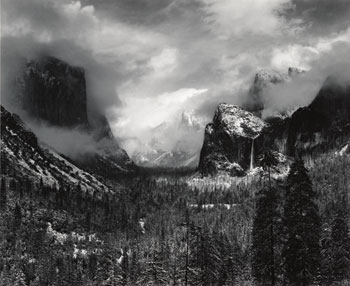
Nor do you have to sleep in a tent to get the full experience: an eyeful of more than you can possibly absorb. I remember my own first visit to Yosemite Valley, when I was young and jaded. I’d just gotten off another long hike in the high country, and I was taking a short detour by car into the Valley. I’d been overwhelmed in the high country; at every single step, you could trip and fall and your camera would shoot off a picture that could, today, make you an Instagram star. I didn’t expect to be overwhelmed on a busy road with cars and tourists and buildings. But then the road bent and the trees opened and I saw the view — that view — Ansel Adams’ view of El Capitan among the swirling black-and-white clouds, the view that each of Yosemite’s annual four million visitors gets to see smack as they enter the park. It stopped me in my tracks. I had to pull off the road for fear I’d wreck the car.
Which was pretty much the same reaction (minus the car) John Muir had when he arrived in Yosemite in 1868, four years after the federal government deeded Yosemite to the State of California for permanent protection. Muir had been peripatetic for a while; he’d explored the northern United States and Canada, then walked a thousand miles from Indianapolis to the Gulf of Mexico. He’d sailed to Cuba, hopped over to Panama, crossed the isthmus (there was no canal then), and caught a steamer to San Francisco, where he asked directions to “someplace wild.” That sent him 200 miles east on foot to the Sierra Nevada, where a rancher offered him a job as a sort of shepherd supervisor: He was to keep an eye on the guy who kept an eye on the sheep.
Muir fell in love with the land, and as lovers tend to, he spent those heady early days obsessing. He took notes on everything from the habits of marmots to the cycles of alpine flowers. He described glaciers and pine cones and the destructive grazing habits of the sheep (which he referred to as “hoofed locusts”). Arriving in Yosemite, he wrote, “Never before had I seen so glorious a landscape, so boundless an affluence of sublime mountain beauty.” Muir would travel widely for the rest of his life; he once wrote, “The world is big and I want to have a good look at it before it gets dark.” But he would always return to the Sierra. It inspired not only his writing, but his activism: founding the Sierra Club, helping to establish Yosemite as well as Sequoia, Mount Rainier, Petrified Forest, and Grand Canyon National Parks, and lobbying for the formation of the National Park Service.
My response to the same view was more ordinary: I took pictures and I drove to the main viewpoints, every inch a tourist. I did climb to the top of Yosemite Falls, where too much curiosity about what lies just over the edge can send you falling to your death. It’s a hike well worth the huffing and puffing. The view can make you understand how a landscape can be so powerful that you’d change your life to save it for the next generation.
The next generation needs it.
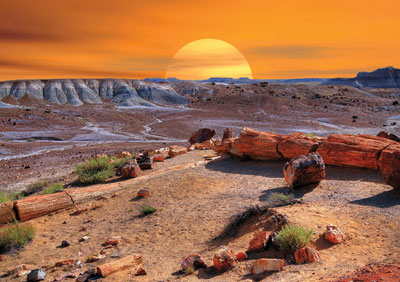
Years ago, I used to lead small groups of Washington, D.C., city kids into the wilds of Shenandoah National Park. We’d sleep in an Appalachian Trail shelter not more than a couple of miles’ walk from Skyline Drive, and the kids would marvel, and sometimes cower, at the great wilderness they thought they’d entered.
At night, the wind would send tree branches rattling against the corrugated iron roof, and deer would snort outside. It’s a startling sound, if you’ve never heard it, somewhere between a bark and a cough — less like Bambi, more like something that could eat you for dinner. The Shenandoah backcountry isn’t true wilderness, what with the highway and the resort and the restaurant and the parking areas and even the lean-tos themselves, but that didn’t matter: The definition of wilderness is very much in the eyes (in this case the ears) of the beholder. A perhaps apocryphal quote from early American settlers came to mind: “Wilderness is a dark and dismal place where all manner of wild beasts dash about uncooked.” I knew what the kids felt like. In Yellowstone, with the howling wolf and the unseen grizzly, I’d felt that way myself. Being in the wilderness makes you reexamine your place on the food chain — an unsettling feeling, even if the only thing outside your tent is a white-tailed deer.
The kids were usually sleepless the first night. By the second night, they were ready to collapse. Hiking in the woods for two days straight can have that effect. The kids learned to work the camping stoves, and we hiked around looking for animal tracks. I was just a hiking guide, not a social worker or a psychologist, but it seemed to me that some of these kids had tough lives back home, and that the outdoors acted as a gentle tonic. “I like it here. I have to breathe harder, but it feels like I can breathe better,” one of them told me. Which nicely sums it up.
In 1916, when Congress was considering the bill that would ultimately establish the U.S. National Park Service, the Post repeatedly showed its support. That year, a quick succession of editorials from Post editor George Horace Lorimer laid out his arguments for passage of the bill in the issues for January 1, February 12, and March 18.
Why the FDA Is Bad News for Cancer Patients
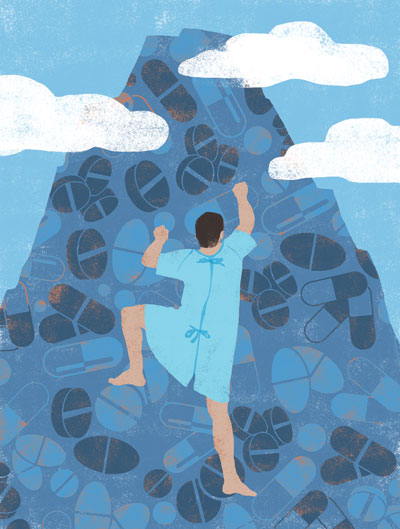
Cancer patients with precious little time need answers, but the FDA restricts and obstructs research, says the former head of the National Cancer Institute.
Illustration by Gwenda Kaczor
When I left the National Cancer Institute (NCI), I was proud of what I had done to reshape it into an organization capable of managing the war on cancer. But one challenge had eluded me: I was unable to persuade the administrators at the Food and Drug Administration (FDA) to change the way they reviewed new cancer drugs. What might work when it came to a new diabetes drug or a cholesterol-lowering pill did not work for cancer drugs. The FDA’s failure to recognize this was impeding our progress. And patients who could have been saved were dying.
Admittedly, the FDA has the most difficult job of all government agencies. Whatever it does, it receives a barrage of criticism. The world outside the FDA seems to be split into two groups. The first includes the many lawyers, doctors, and activists who want every aspect of our food and our drugs to be examined in fine detail before being approved so that we can eliminate as many potential risks as possible. The second group again includes lawyers, doctors, and activists, but this group holds that new drugs are too tightly regulated and that we should relax regulations so we can get potentially lifesaving drugs to patients sooner. Many members of this second group also believe that what we eat is none of the FDA’s business.
If the FDA approves drugs rapidly, it angers the first group. If the FDA approves them too slowly, it angers the second. Of course, both groups have taken things too far. Most of us recognize that we need regulations; we don’t want the FDA to go away. But we do want it to get out of the way. We need some regulations, but we don’t need all that we have now.
Here’s an example of what I mean: aspirin, one of our truly miracle drugs. In its early testing, it produced adenomas (small benign tumors) in the lungs of mice. Nothing like that has been seen in humans, but if aspirin were being developed today, the presence of adenomas might prevent the pill’s approval. Aspirin, like all drugs, has some risks, but that doesn’t mean we should take it out of patients’ hands.
The FDA has brought criticism on itself by seeking (and getting) more and more control over our lives. Twenty-five percent of every dollar we spend in the United States goes to a product regulated by the FDA. The agency has more authority and control over our lives than almost any other government agency. Yet it still wants more.
Purchase the digital edition for your iPad, Nook, or Android tablet:

To purchase a subscription to the print edition of The Saturday Evening Post: 
Kids Need More Time Outdoors
America was still mired in the Depression when my family moved into the south Los Angeles neighborhood of 61st Street, just east of Main Street, which was characterized by peaceful stillness, interrupted in the afternoons and on weekends by the shouts of children at play. My brother Raul and I were 5 and 7 when we moved into that house, oblivious to the difficulties facing the nation.
On the contrary, we felt blessed by the abundant opportunities to explore nature in our new home, even as it stood in the middle of the big city. A bedraggled yucca plant stood in the middle of our front yard, besieged by crabgrass. Even there we found things to study up close and wonder at — the grasshoppers that hopped in during the summer months and the bright yellow dandelions that grew there in profusion. When the dents-de-lion went to seed, they became translucent globes that we held up and blew at to watch their tiny filaments fly off into the air and disappear.
Our summers provided endless opportunities for exploration, as well as a challenge for us to entertain ourselves on days that languidly stretched themselves ever longer.
In the heat of summer nights, as we sat in the front room, we heard loud pinging at the front door — hard-shelled June bugs that, attracted by the house lights, came crashing against the screen. We learned to coddle ladybugs and recite to them the verse that urged them to fly away home because their house was on fire.
Once in a great while, we saw turtles that we suspected were brought in from the desert and had wandered away from their keepers’ homes. We fed them lettuce leaves and looked on as they munched on them. Many were the times, especially when intense summer heat made staying indoors intolerable, when we played outside well into the night, our child sounds competing with the chirping of the crickets.
Nights in Los Angeles were very dark then, and the stars shone brightly. The sight of shooting stars was not uncommon in the era before we became a megalopolis. Occasionally, the darkness was pierced by enormous shafts of light that moved dramatically across the sky, from searchlights placed in front of a market or a carpet store announcing a grand opening. Or a movie premiere.
When the war came, I was in fifth grade. The nights became even darker, as blackouts were ordered to hide us from marauding Japanese planes. Several times, we heard the nighttime wailing of sirens that announced a practice air raid drill and alerted residents to prepare their windows with blackout curtains.
But for the most part, the real world didn’t intrude much in this realm where we were free to be children, even older siblings like me who were genetically programmed toward seriousness. Raul and I did a lot of digging and playing with dirt in our backyard. We spent many days on our knees, inspecting the legions of red ants that entered and exited holes they had dug in the ground. I’m not proud to confess that, like boys before and after us, we indulged in macabre experiments on the poor ants, involving a magnifying glass and concentrated sunrays. Enough said on that.
Digging in dirt was great fun. We flooded an area with water from the garden hose and ran it through little ditches we had dug, damming the water up at intervals with pieces of wood we half buried in the muck. We made little paper boats and sailed them down our boy-made rivers.
But the best way we used our dirt paradise was as a spot for playing a game at which we spent countless hours — marbles. Ernie, my friend from across the street, often joined us. Playing in dirt got us very dirty. We tried to avoid kneeling in the dirt by squatting, which didn’t work at all. We wore overalls, like the ones worn by farmers and garage mechanics, and canvas tennis shoes.
With a stick, we traced a large circle in the dirt and, in its center, placed several marbles that formed the pot we would play for. That is, assuming we were playing “for keeps.”
The boy whose marble stopped closest to a line drawn in the dirt played first. The shooter selected a spot on the circle and, forming a fist with his shooting hand, he knuckled down to play. With his thumb, he propelled a marble toward the pot with the aim of knocking one or more of the marbles out of the ring. He pocketed the ones he knocked out and earned another shot. If the shooter was very good, he could continue until all the marbles were knocked out.
We’d play for countless hours, so many that the fingernails of our right, shooting thumbs developed holes from the pressure of the hundreds of marbles they had propelled.
Marbles and other games taught us the importance of playing by the rules. Arguments occurred when a player insisted on not conforming to them. Ernie’s father, an otherwise extremely mild-mannered man, came over to our house one evening demanding of our parents, for Pete’s sake! the return of his son’s marbles. Losing one’s marbles was not a good thing, then or now.
In summertime, we’d also play a lot of tag with other neighborhood kids, as well as hide-and-seek. The cry of “olly olly oxen free” rang out, signaling the all clear when hiders could emerge from their hiding places. After Frankenstein became a cinematic sensation, the child who was “it” became the monster. The mere thought that a monster was on the hunt for us was chilling, even though we knew it was only a boy or a girl.
On hot summer days, the iceman from Kirker Ice Company made his customary rounds. While he was out of sight, lugging a block of ice into our house for the ice box, children clustered around the back of his truck, packed floor-to-ceiling with ice, and engaged in a harmless but refreshing bit of thievery, helping ourselves to shards of ice that remained on the damp truck bed.
We had roller skates that we fitted over our shoes and tightened against the leather sole. A neat little metal key did the tightening. We skated only on the sidewalk. I never got the hang of braking so I just headed onto the grass until I stopped moving.
Police radio dramas and cowboy movies were popular at the time, and boys liked to wear badges. We made our own. The metal caps of soft drink bottles were lined with cork that we pried out. Then we held the metal cap on the outside of our shirts and pushed the cork into the cap from the inside. The cap stayed put. We became walking advertisements for soft drinks, including that new drink, Dr. Pepper. We wore holster sets that handled two pistols — the large, silver-colored ones being the most popular. Some boys had BB guns that actually shot steel or lead pellets. We didn’t. Mother considered them dangerous and beyond the pale.
Flying kites was fun, too. Raul was much better than I at maneuvering a kite, running to get it airborne and flying like a good kite should. Mine had a maddening tendency to fly in frustrating circles. And then crash.
On especially hot days, we made use of the garden hose and sprinkler that we set in the middle of the lawn. Other neighborhood children would join in as we frolicked around in our bathing suits through the fountain of cool water the sprinkler created for us. Loose grass and weeds and little twigs stuck to the bottoms of our feet.
When you’re 10, your summer is one big block of freedom to be a kid. When it’s 4:18 p.m. in the middle of July and you’re scraping those twigs off your feet and laughing with your friends, the life ahead of you is one of infinite possibility. Mostly, all things, starting with your own imagination, just seem wondrously infinite. I worry that kids today aren’t allowed such space.
As we grew older, the summers got shorter, and our playtime scarcer, until it all became a sepia-tinted memory in a life full of purpose, work, and seriousness.
But that’s another story.
Originally published at Zócalo Public Square (zocalopublicsquare.org)
Lights Out!
Darkness.
As power shuts down, there is darkness and the sudden loss of electrical conveniences. As batteries lose power, there is the more gradual failure of cellphones, portable radios, and flashlights.
Emergency generators provide pockets of light and power, but there is little running water anywhere. In cities with water towers on the roofs of high-rise buildings, gravity keeps the flow going for two, perhaps three days. When this runs out, taps go dry; toilets no longer flush. Emergency supplies of bottled water are too scarce to use for anything but drinking, and there is nowhere to replenish the supply. Disposal of human waste becomes a critical issue within days.
Supermarket and pharmacy shelves are empty in a matter of hours. The city has flooded the streets with police to preserve calm, to maintain order, but the police themselves lack critical information. There is a growing awareness that this power outage extends far beyond any particular city and its suburbs. It may extend over several states. Tens of millions of people appear affected. The assumption that the city, the state, or even the federal government has the plans and the wherewithal to handle this particular crisis is being replaced by the terrible sense that people are increasingly on their own. When that awareness takes hold, it leads to a contagion of panic and chaos.
Preparing for doomsday has its own rich history in this country, and predictions of the apocalypse are hardly new. We lived for decades with the assumption that nuclear war with the Soviet Union was a real possibility. Ultimately, Moscow and Washington came to the conclusion that mutual assured destruction, holding each other hostage to the fear of nuclear reprisal, was a healthier approach to coexistence than mass evacuation or hunkering down in our respective warrens of bomb shelters in the hopes of surviving a nuclear winter.
We are living in different times. Whether the threat of nuclear war has actually receded or we’ve simply become inured to a condition we cannot change, most of us have finally learned “to stop worrying and love the bomb.” In reality, though, the ranks of our enemies, those who would and can inflict serious damage on America, have grown and diversified. So many of our transactions are now conducted in cyberspace that we have developed dependencies we could not even have imagined a generation ago. To be dependent is to be vulnerable. We have grown cheerfully dependent on the benefits of our online transactions, even as we observe the growth of cyber crime. We remain largely oblivious to the potential catastrophe of a well-targeted cyberattack.
On one level, cyber crime is now so commonplace that we have already absorbed it into the catalogue of daily outrages that we observe, briefly register, and ultimately ignore. Over the course of less than a generation, cyber criminals have become adept at using the Internet for robbery on an almost unimaginable scale. Still, despite the media attention generated by the more dazzling smash-and-grab operations, the cyber criminals whose only intention is to siphon off wealth or hijack several million credit card identities should have a lower priority among our concerns. Their goal is merely grand larceny.
More worrisome is the increasing number of cyberattacks designed to vacuum up enormous quantities of data in what appear to be wholesale intelligence-gathering operations. The most ambitious of these was announced on June 4, 2015, and targeted the Office of Personnel Management, which handles government security clearances and federal employee records. The New York Times quoted J. David Cox Sr., the president of the American Federation of Government Employees, as saying the breach might have affected “all 2.1 million current federal employees and an additional 2 million federal retirees and former employees.” FBI director James Comey told a Senate hearing that the actual number of hacked files was likely more than 10 times that number — 22.1 million. Government sources were quoted as claiming that the intrusion originated in China. The Times report raises a number of relevant issues: The probe was initiated at the end of 2014. It wasn’t discovered until April of 2015. It is believed to have originated in China, but the Chinese government has denied the charge, challenging U.S. authorities to provide evidence. Producing evidence would reveal highly classified sources and methods. “The most sophisticated attacks,” the Times noted, “often look as if they were initiated inside the United States, and tracking their true paths can lead down many blind paths.” All of these issues will receive further attention in later chapters. But as disturbing as these massive data-collection operations may be, even they do not come close to representing the greatest cyber threat. Our attention needs to be focused on those who intend widespread destruction.
The Internet provides instant, often anonymous, access to the operations that enable our critical infrastructure systems to function safely and efficiently. In early March 2015, the Government Accountability Office issued a report warning that the air traffic control system is vulnerable to cyberattack. This, the report concluded with commendable understatement, “could disrupt air traffic control operations.” Our rail system, our communications networks, and our healthcare system are similarly vulnerable. If, however, an adversary of this country has as its goal inflicting maximum damage and pain on the largest number of Americans, there may not be a more productive target than one of our electric power grids.
Electricity is what keeps our society tethered to modern times. There are three power grids that generate and distribute electricity throughout the United States, and taking down all or any part of a grid would scatter millions of Americans in a desperate search for light, while those unable to travel would tumble back into something approximating the mid-19th century. The very structure that keeps electricity flowing throughout the United States depends absolutely on computerized systems designed to maintain perfect balance between supply and demand. Maintaining that balance is not an accounting measure, it is an operational imperative. The point needs to be restated: For the grid to remain fully operational, the supply and demand of electricity have to be kept in perfect balance. It is the Internet that provides the instant access to the computerized systems that maintain that equilibrium. If a sophisticated hacker gained access to one of those systems and succeeded in throwing that precarious balance out of kilter, the consequences would be devastating. We can take limited comfort in the knowledge that such an attack would require painstaking preparation and a highly sophisticated understanding of how the system works and where its vulnerabilities lie. Less reassuring is the knowledge that several nations already have that expertise, and — even more unsettling — that criminal and terrorist organizations are in the process of acquiring it. Our media report daily on increasingly bold and costly acts of online piracy that are already costing the U.S. economy countless billions of dollars a year. Cyberattacks as instruments of national policy, though, tend to be less visible because neither the target nor the attacker is inclined to publicize the event.

NASA/Shutterstock
History often provides a lens through which irony comes into focus. The United States, for example, was the first and only nation to have used an atomic weapon, and it has spent the intervening decades trying to limit nuclear proliferation. And the United States, in collaboration with Israel, mounted a hugely successful cyberattack on Iran’s nuclear program in 2008 and now finds itself dealing with the consequences of having been the first to use a digital weapon as an instrument of policy. Iran wasted little time in launching what appeared to be a retaliatory cyberattack, choosing to target Aramco in Saudi Arabia, destroying 30,000 of its computers. Why the Saudi oil giant instead of an American or Israeli target? We can only speculate. Iran may have wanted to issue a warning, demonstrating some of its own cyber capabilities without directly engaging the more dangerous Americans or Israelis. In any event, Iran made its point, and a new style of warfare has, within a matter of only a few years, become commonplace. Russia, China, and Iran, among others, continue on an almost daily basis to demonstrate a range of cyber capabilities in espionage, denial-of-service attacks, and the planting of digital time bombs capable of inflicting widespread damage on a U.S. power grid or other piece of critical infrastructure.
For several reasons, the clear logic of a swift attack and response that enables a policy of deterrence between nuclear rivals does not yet exist in the world of cyber warfare. For one, cyberattacks can be launched or activated from anywhere in the world. The point at which a command originates is often deliberately disguised so that its electronic instruction appears to be coming from a point several iterations removed from its actual location. It is difficult to retaliate against an aggressor with no return address. Nation-states may be inhibited by the prospect of ultimately being unmasked, but it is not easily or instantly accomplished. For another, the list of capable cyberattackers is far more numerous than the current list of the world’s nuclear powers. We literally have no count of how many groups or even individuals are capable of launching truly damaging attacks on our electric power grids — some, perhaps even most of them, uninhibited by the threat of retaliation.
There is scant consolation to be found in the fact that a major attack on the grid hasn’t happened yet. Modified attacks on government, banking, commercial, and infrastructure targets are already occurring daily, and while sufficient motive to take out an electric power grid may be lacking for the moment, capability is not. As the ranks of capable actors grow, the bar for cyber aggression is lowered. The unintended consequences of Internet dependency are already piling up. Prudence suggests that we at least consider the possibility of a cyberattack against the grid, the consequences of which would be so devastating that no administration could consider it anything less than an act of war.
Ours has become a largely reactive culture. We are disinclined to anticipate disaster, let alone prepare for it. We wait for bad things to happen and then we assign blame. Despite mounting evidence of cyber crime and cyber sabotage, there appears to be widespread confidence that each can be contained before it inflicts unacceptable damage. The notion that some entity has either the ability or the motive to launch a sophisticated cyberattack against our nation’s infrastructure, and in particular against our electric power grids, exists, if at all, on the outer fringes of public consciousness. It is true that unless and until it happens, there is no proof that it can; for now, what we are left with, for better or worse, is the testimony of experts. There will be more than a few who take issue with the conclusions of this reporter that the grid is at risk. But the book from which this article is taken reflects the assessment of those in the military and intelligence communities and the academic, industrial, and civic authorities who brought me to the conclusion that it is.
Widespread recognition of the vulnerability of our power grids already exists. Lots of smart people are already offering partial remedies and grappling with solutions. But there is not yet widespread recognition that we have entered a new age in which we are profoundly vulnerable in ways that we have never known before, and so there is neither a sense of national alarm nor the leadership to take us where we need to go. Our national leaders are in a precarious place. They recognize the scale of danger that a successful cyberattack represents. However, portraying it too graphically without having developed practical solutions runs the obvious risk of simply provoking public hysteria.
The Department of Homeland Security (DHS) was created in an atmosphere of national trauma. The world’s greatest superpower was made to realize its vulnerability to a handful of men armed with box cutters. We remain distracted to this day by the prospects of retail terrorism when we should be focused on the wholesale threat of cyber catastrophe. In such an event, the Department of Homeland Security would be working with industry to help them restore and maintain service. It should be focused on developing a more robust survival and recovery program for the general public; but DHS has neither the capacity to defend our national infrastructure against cyberattack nor the wherewithal with which to retaliate. A criminal attack would be the responsibility of the FBI; an attack on infrastructure by a nation-state or a terrorist entity would become the immediate responsibility of the Defense Department. Anticipating and tracking external cyber threats to U.S. infrastructure should be, by virtue of capability if nothing else, the responsibility of the NSA.
Limits that were established in a different era still exist on paper, but they are eroding in practice. The CIA is precluded, by law, from operating within the United States, but maintaining national boundaries in cyberspace may be impossible. Cyber Command is a military operation tasked with organizing the defense of U.S. military networks. The extent to which it can participate in the defense of critical infrastructure within the United States remains murky, but sidelining critical U.S. defense capabilities because we haven’t quite adapted to the notion that a major cyberattack can be as devastating as an invasion makes no sense.
The imposition of order, the distribution of essential supplies, the establishment of shelters for the most vulnerable, the potential management of hundreds of thousands, if not millions, of domestic refugees will be complex enough if the general public knows what to expect and what to do. In the absence of any targeted preparation, in the absence of any serious civil defense campaign that acknowledges the likelihood of such an attack, predictable disorder will be compounded by a profound lack of information. It would be the ultimate irony if the most connected, the most media-saturated population in history failed to disseminate the most elementary survival plan until the power was out and it no longer had the capacity to do so.
There is, as yet, no real sense of alarm attached to the prospect of cyber war. The initial probes — into our banks and credit card companies, into newspapers and government agencies — have tended to leave us unmoved. Past experience in preparing for the unexpected teaches us that, more often than not, we get it wrong. It also teaches that there is value in the act of searching for answers. Acknowledging ignorance is often the first step toward finding a solution. The next step entails identifying the problem.
Here it is: For the first time in the history of warfare, governments need to worry about force projection by individual laptop. Those charged with restoring the nation after such an attack will have to come to terms with the notion that the Internet, among its many, many virtues, is also a weapon of mass destruction.
Crown Publishers
Adapted from Lights Out: A Cyberattack, a
Nation Unprepared, Surviving the Aftermath, Copyright © 2015 by Ted Koppel. Published by Crown Publishers, a division of Penguin Random House LLC.
November/December 2015 Limerick Laughs Winner and Runners-Up
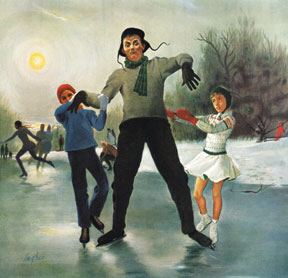
Right now I am seeking assurance
As I start on this test of endurance.
It’s not that I fear
Falling hard on my rear;
It’s worry about my insurance!
—Adele Suga, Vassalboro, Maine
Congratulations to contest-winner Adele Suga! For her limerick describing the George Hughes illustration Ice-skating Class for Dad (above), Adele wins $25 and our gratitude for an entertaining poem. If you’d like to enter the Limerick Laughs Contest for our next issue of The Saturday Evening Post, submit your limerick via our online entry form.
Adele’s limerick wasn’t the only one we liked. Here are some of our other favorite contest entries, in no particular order:
This awkward young dad’s in a bind,
But his teachers are patient and kind.
He’s learning a skill
With a slippery drill
That will yield a most sore behind!—Rose Hester, Brooklyn, New York
He thought he would gracefully glide;
Instead he did clumsily slide.
With his offspring at hand,
He was able to stand,
So all that he hurt was his pride.—Carolyn Tourville, Tullahoma, Tennessee
We didn’t just go ’cause we HAD to …
To skate with our Dad, we were GLAD to.
“You kids will do great
Once I teach you to skate!”
But we ended up teaching our DAD to.Our Dad enjoys making the case
That skating is all about grace:
“It’s rhythmic, poetic,
Refined and aesthetic…”
HEY, DAD JUST FELL FLAT ON HIS FACE!!!—Guy Pietrobono, Washingtonville, New York
On Wall Street, a respected CO.
On the ice … he just couldn’t go.
With some slides and some slids,
Even help from his kids,
He always ended up in the snow!—Marlayne Jackson, New Cumberland, Pennsylvania
When it came to outdoorsy-type stuff,
My dad liked things rugged and rough.
But when it was icy,
Things got a bit dicey.
It turned out he wasn’t so tough.—Neal Levin, Bloomfield Hills, Michigan
“That looks so easy,” he cried.
“I got this — shuffle and glide.”
Now Dad’s steering is errant,
His lost balance apparent.
Here comes a THUD to his pride.—Dan Rogers, Garland, Texas
The Wonderful World of Dr. Seuss
In the summer of 1957, Theodor Geisel, aka Dr. Seuss, had just published a children’s primer called The Cat in the Hat, and his newest story, How the Grinch Stole Christmas, was ready for publication later that year. It was during this interlude that Geisel granted his first Post interview with Robert Cahn, revealing why he became Dr. Seuss, the simple reason he draws the way he does, and the undeniable effect his wife, Helen, has had on his career.
The Wonderful World of Dr. Seuss
By Robert CahnJuly 6, 1957 — Theodor Geisel, alias Dr. Seuss, has captured the imagination of millions of children with his fanciful spoofs: Gerald McBoing-Boing, the Drum-Tummied Snumm, and other creatures from a world of happy nonsense.
For a man whose mind is inhabited by such creatures as a Mop-Noodled Finch, a Salamagoox, or a Bustard — “who only eats custard with sauce made of mustard” — Theodor S. Geisel looks disarmingly rational. As the renowned Dr. Seuss (rhymes with “goose”), he is not, as a few children have pictured him, a wizened old man with flowing white beard. He is whiskerless, has the standard number of arms and legs, and lives quietly with his wife and dog on a hill overlooking La Jolla, California.
Yet for the past thirty years, under the protective alias of Dr. Seuss, Ted Geisel has been an apostle of joyous nonsense. He has fathered a whole modern mythology of bizarre creatures like the Remarkable Foon, “who eats sizzling hot pebbles that fall off the moon,” or the Drum-Tummied Snumm, “who can drum any tune that you might care to hum—doesn’t hurt him a bit ’cause his drum-tummy’s numb.” He has created young Gerald McBoing-Boing, the little boy who cannot speak, but makes sound effects instead. And he is still remembered for the impertinent bugs he concocted along with his famous advertising slogan: Quick, Henry, the Flit!
His annual output of picture books, like Horton Hatches the Egg, Thidwick the Big- Hearted Moose, and On Beyond Zebra, have become a part of the basic children’s literature of the country. They are in constant use at the overseas libraries of the United States Information Agency and have been translated into several foreign languages, including Japanese.
In suburban La Jolla, however, Geisel’s madcap alter ego is completely obscured. Here Theodor Seuss Geisel — Seuss is his mother’s family name — is considered a paragon of propriety. He is a director of the town council, and a trustee of the neighboring San Diego Fine Arts Gallery. His hair is cut regularly, his shoes are always shined, and he gives up his chair when ladies are standing.
The first impression of conservatism is emphasized by his polite attentiveness, not unlike that of a middle-aged bank vice president. Slim and tall, he has graying dark hair parted more or less in the middle. He is as sharp-eyed as a bird, with a long aquiline nose and a wide mouth which has a habit of twisting into puckish grins. And he speaks in the terse hesitancies of the painfully shy man.
But beneath this outer austerity beats a wildly impulsive heart. Even with the most serious intentions, the mind of Ted Geisel is so fanciful that he has never been able completely to subdue it. And he depends at all times on the levelheadedness of his wife, Helen, to pull him out of entanglements in which he has become errantly involved. Yet the unorthodox appearance of the Seuss animals is not entirely due to Geisel’s imagination. The fact is, as Geisel admits, “I just never learned to draw.”
“Ted never studied art or anatomy,” explains Helen. “He puts in joints where he thinks they should be. Elbows and knees have always especially bothered him. Horton is the very best elephant he can draw, but if he stopped to figure out how the knees went, he couldn’t draw him.”
Although the greatest audience for his animals is children, the nonsensical creatures are also in great demand among advertisers seeking a humorous presentation for their products. Sometimes, however, his business clients have lacked the willing imagination of his younger devotees. Once he had to do a horned goat for a billboard. The job was done and paid for, and everyone seemed happy, when the phone rang.
“Now, Geisel, about that goat,” said the advertising-agency executive. “We like it here and it’s a fine goat, but there is just one little thing wrong. Our client thinks it looks like a duck. So would you mind doing us another one?”
To resolve the problem, Geisel drew a duck and submitted it. The client called him up. “Geisel,” he said, “it’s perfect. Best goat I ever saw.”
Children, of course, understand and accept Geisel’s pictures, a fact which led to an unusual assignment two years ago during the height of the controversy over why Johnny can’t read. Textbook publishers and some educators and parents had realized that one trouble was that Johnny’s reader wasn’t readable. Most creators of children’s primers, though experts in form, failed miserably as storytellers. What was required, the publishers knew, was the kind of story that would lead a child from page to page with suspense and delight. Yet most writers were unwilling to accept the severe vocabulary limitations required for a first-grade reader.
Into the impasse stepped Geisel. He offered his services to one of the nation’s leading textbook publishers and was assigned to prepare a book that six-year-olds could read themselves. Unfortunately, the situation soon got out of hand.
“All I needed, I figured, was to find a whale of an exciting subject which would make the average six-year-old want to read like crazy,” says Geisel. “None of the old dull stuff: Dick has a ball. Dick likes the ball. The ball is red, red, red, red.”
His first offer to the publisher was to do a book about scaling the peaks of Everest at sixty degrees below zero.
“Truly exciting,” the publisher agreed. “However, you can’t use the word scaling, you can’t use the word peaks, you can’t use Everest, you can’t use sixty, and you can’t use degrees.
Geisel shortly found himself with a list of 348 words, most of them one-syllable words, which the average six-year-old could recognize — and not a Yuzz-A-Ma-Tuzz or Salamagoox among them. To one who was used to making up new words at will, it was a catastrophe. And yet the publisher had said, “Create a rollicking carefree story packed with action and tingling with suspense.”
Six months after accepting the assignment, Geisel was still staring at the word list, trying to find some words besides ball and tall that rhymed. The list had a daddy, but it didn’t have a caddy. It had a thank, but it had no blank, frank, or stank. Page after page of scrawls was piled in his den. He had accumulated stories which moved along in fine style but got nowhere. One story about a King Cat and a Queen Cat was half finished before he realized that the word queen was not on the list.
One night, when he was almost ready to give up, there emerged from a jumble of sketches a raffish cat wearing a battered stovepipe hat. Geisel checked his list—both hat and cat were on it. Gradually he worked himself out of one literary dead end after another until he had completed his children’s reader.
The Cat in the Hat was published last spring by Houghton Mifflin as a supplementary school text for first graders, and in a popular edition by Random House. It already has been greeted enthusiastically by parents and educators. The story line concerns fanciful adventures occurring when a vagrant cat drops in to play with two small children while their mother is out. The verse, composed from only 220 different basic words, has a delightful meter and builds repetitions through devices such as the cat adding object after object to a juggling act. And the drawings, of course, are pure Seuss.
Although the principal character of The Cat in the Hat turns out all right in the end, he is not quite in keeping with most Seuss animals, which are usually gentle, loving, and true blue. Horton, for instance, is a long-suffering elephant who sits on the egg of Mayzie the Lazy Bird through 12 trouble-filled months. And Thidwick is a moss-munching moose who is victimized by an inconsiderate assortment of freeloading friends nesting in his antlers.
“Ted’s animals are the sort you’d like to take home to meet the family,” says Helen. “They have their own world and their own problems and they seem very logical to me.”
Ted first met Helen Palmer in 1925, at Oxford. Young Geisel was studying English literature, seeking a doctor’s degree so that he could qualify for the faculty at Dartmouth, his alma mater. In one of his classes, he found himself sitting next to an attractive young schoolmarm-to-be who kept admiring the flying horses he doodled in the margin of his notebook.
“I was naturally flattered,” says Geisel, “and in a short time the horses were taking up the middle of my notebook, and my Shakespeare notes — such as they were — were in the margins.”
Within a year, Helen Palmer and Theodor Geisel were engaged. Aware that Ted loved drawing better than studying Shakespeare, Helen encouraged him to forsake temporarily his scholarship quest. In the spring of 1927, Geisel returned to his family home in Springfield, Massachusetts. For 10 weeks he drew cats, elephants, bears, and rejection slips. His family was not especially pleased that their son had junked a promising career as an educator in favor of concocting knock-kneed brown bears. On the other hand, Theodor Geisel, Sr., felt partly responsible. After all, as commissioner of parks in Springfield, he had long had a doting interest in the city zoo, where young Ted had often entered the lion cages, and had played with the kangaroos and cub bears.
Toward the end of the trial period, Geisel’s artistic talents finally were recognized when The Saturday Evening Post bought a cartoon for $25. Geisel moved to New York, sold a page of eggnog-drinking turtles to Judge, a humor magazine, and parlayed the fee into a grubstake for marriage.
It was not as Theodor Geisel that he first broke into print. Desiring to save his name for the great serious work he planned someday to write, he adopted aliases such as Quincy Quilp, Dr. Xavier Ruppzknoff, and Dr. Theophrastus Seuss.He finally settled on just plain Dr. Seuss.
It was an early Dr. Seuss cartoon published by Judge late in 1927 that abruptly changed his life. The cartoon showed a knight in bed, with armor strewn about the castle room and a dragon sticking his snout under the covers. It bore the caption, “By gosh, another dragon! And just after I’d sprayed the whole castle with Flit.”
The cartoon caught the eye of Mrs. Lincoln Cleaves, wife of a McCann-Erickson advertising executive who handled the Flit account for Standard Oil Company of New Jersey. For three weeks Mrs. Cleaves badgered her husband to contact this Dr. Seuss, whoever he was. Finally weakening, Cleaves agreed. Geisel was signed to a contract, and he quickly created the slogan, “Quick, Henry, the Flit.”
A major crisis arose early in the campaign. Some company officials felt the Seuss bugs looked so sweet and lovable that no one would want to use Flit to kill them. Geisel finally convinced the executives that this was just part of a scheme to overcome women’s natural reluctance to think about bugs. “Quick, Henry, the Flit” became a standard line of repartee in radio jokes. A song was based on it. The phrase became a part of the American vernacular for use in emergencies. It was the first major advertising campaign to be based on humorous cartoons.
But Geisel had to find additional outlets for the stream of his invention. For several years he built up his own fleet, the “Seuss Navy,” as a promotion for Standard Oil’s Essomarine products. He awarded honorary admirals’ commissions in the Seuss Navy to noted yachtsmen, steamship-line captains, and naval officers and presided over a yearly banquet for the group. The Seuss admirals even flew their own burgee—a plucked herring on blue field with red trim.
As an added outlet for his fancies, Geisel dreamed up devices to make a fortune. One scheme was for an “Infantagraph.” It was just before the opening of the New York World’s Fair, when everyone was thinking of ways to make money from the out-of-towners who would swarm out to Flushing Meadows. Musing over these vistas of dollar bills, Geisel envisioned a booth on the midway with a huge sign: IF YOU WERE TO MARRY THE PERSON YOU ARE WITH, WHAT WOULD YOUR CHILDREN LOOK LIKE? COME IN AND HAVE YOUR INFANTAGRAPH TAKEN. Certainly this come-on should bring couples into the booth in droves. There they would be photographed, and out would come a composite picture of their features on a naked baby sprawled on a white bearskin rug.
All that was necessary was to devise a camera which could do the trick. Geisel acquired financing and brought a German camera technician to New York from Hollywood. A camera was built. Tests showed that the project was feasible. However, there were many problems, especially in preventing a mustache from coming through on the baby’s picture. They couldn’t perfect the camera while the fair was on, and the enterprise terminated when the war prevented importation of special lenses from Germany.
“It was a wonderful idea,” Geisel says. “Somehow, though, all the babies tended to look like William Randolph Hearst.”
Yet out of the restlessness of the Flit days, there came a rewarding byproduct. Trying to while away the hours on a long, rough Atlantic crossing in 1937, Ted began composing verses to the rhythm of the Kungsholm’s pulsing engines. “Ta-da-da-ta-da-da-ta-da-da-ta-da,” went the engines. “And that is the story that no one can beat,” wrote Geisel. “Ta-da-da-ta-da-da-ta-da-da-ta-da,” went the ship. “If I say that I saw it on Mulberry Street.”
“My contract had nothing to prohibit my writing children’s books,” says Geisel. “When we docked in New York, instead of going to a psychiatrist to get that crazy rhythm out of my head, I decided to illustrate the verses for a children’s book.” After turndowns from several publishers, Geisel interested Marshall (Mike) McClintock, a Dartmouth classmate who was working for Vanguard Press. Vanguard decided to take a chance, and in 1937 published And To Think That I Saw it on Mulberry Street.
Mulberry Street, which relates how a little boy lets his imagination run loose while walking home from school, is today in its 11th printing. It is still in demand at bookstores and libraries, although it must now compete with 12 other Seuss picture books.
Three of them —The 500 Hats of Bartholomew Cubbins, The King’s Stilts, and Bartholomew and the Oobleck — are in prose and have sometimes been compared to the stories of Hans Christian Andersen.
In all his books, Dr. Seuss starts out with a premise so believably fantastic that what follows seems entirely logical. Thus, in On Beyond Zebra, once you admit that the alphabet can extend beyond Z, it follows that the letter Um is for spelling Umbus:
A sort of a cow, with one head and one tail,
But to milk this great cow you need more than one pail!
She has ninety-eight faucets that give milk quite nicely.
Perhaps ninety-nine. I forget just precisely.
And, boy! She is something most people don’t see
Because most people stop at the Z
But not me!The all-time Seuss favorite is Horton Hatches the Egg, which in 1956 sold 15,000 copies, three times as many as when first published in 1940. Horton, a loyal, lovable elephant, gets conned by Mayzie the Lazy Bird into hatching her egg. Horton sits and sits and sits, though ridiculed by friends, frozen by cold, captured by hunters, and finally sold to a circus. When Mayzie returns to claim the egg, just as it starts hatching, it seems that Horton’s faithfulness will go unrewarded. But wait! Coming out of the egg and flying over to Horton is an Elephant-Bird, with ears and tail and a trunk just like his.
And it should be, it should be, it SHOULD be like that!
Because Horton was faithful! He sat and he sat!
He meant what he said and he said what he meant
And they sent him home happy, one hundred per cent.Soon after his first book had been published, the demands on a successful author brought Ted Geisel face to face with a long-standing dread of making public appearances. He was then living in New York and he casuallyagreed to speak at a young women’s college in Westchester, thinking he had ample time to contrive an excuse to get out of it. Unfortunately he forgot the engagement until too late to break it. When Helen insisted that he live up to his agreement, he pleaded sudden illness to no avail. Finally he departed. A couple of hours later, the school called to inquire what was keeping Mr. Geisel. Alarmed, Helen instituted a search. She called his publisher, his friends, then hospitals, but he was nowhere to be found. When Geisel finally returned home, it was discovered that instead of taking the train to Westchester he had hidden out all afternoon at Grand Central Station.
As happens sooner or later with most writers, Geisel has had hit-and-run encounters with Hollywood. During the war, he was an officer with Frank Capra’s educational-film unit and won the Legion of Merit for helping to produce and direct indoctrination films. Shortly after the war, he teamed with Helen to write a screenplay about the rise of the war lords in Japan. The picture, Design for Death, won the 1947 Academy Award for the best feature-length documentary.
In 1951, Geisel created the character of Gerald McBoing-Boing. Young Gerald, whose first words were boing, boing instead of da-da or ma-ma, was originally written for a phonograph record as a satire on parents who fear that slowness in learning to speak indicates a child is dimwitted. The movie cartoon of Geisel’s story won an Academy Award for U.P.A. — United Productions of America — and for Gerald a place in the folklore of America.
In La Jolla, Ted Geisel, citizen, far outranks Dr. Seuss, artist and writer. In addition to his work on the town council and with the San Diego Fine Arts Gallery, he has a special interest. This is to protect La Jolla from Creeping Urbanization. When Ted and Helen Geisel went to La Jolla in 1940, it was a quiet village mostly populated by the wealthy and retired. They bought an old tower on the highest hill and built a house around it. Then came the burgeoning growth of Southern California. Soon they found themselves in the landing path of jet planes, while the town below was invaded by big spenders. A pox of garish neon lights began to blight the community.
While he could not stop the tourist invasion or the jet planes, Geisel has been the prime mover in a campaign to ban commercial billboards and objectionable signs in La Jolla. He even enlisted Dr. Seuss to do an illustrated booklet. In it, two competitive cave men, Guss and Zaxx, engaged in a war to ballyhoo their products, Guss-ma-Tuss and Zaxx-ma-Taxx. Horrendous signs spring up all around, dwarfing their cave sites:
And, thus between them, with impunity
They loused up the entire community.
Sign after sign after sign, until
Their property values slumped to nil.
And even the dinosaurs moved away
From that messed-up spot in the U.S.A.In their tower, the Geisels have a relatively quiet oasis. Their two-acre spot is screened by hundreds of flowering shrubs. Inside the house, all is in perfect order except the den, where Ted spends hours at his drawing board. He loves to draw, but hates to write, and sometimes will spend hours just drawing animals on large sheets of tracing paper. Many of his books, he confesses, have had their start by accident. Horton Hatches the Egg came about because Geisel inadvertently superimposed an elephant over the branches of a small tree he had drawn earlier. So he worked for days trying to figure how Horton could have got into the tree. Then Helen had to figure out how to get Horton down.
The process of turning out a Seuss book is definitely a family affair. “I keep losing my story line and Helen has to find it again,” says Geisel. “She’s a fiend for story line.”
Once the basic idea is set, nearly every line is worked and reworked until both Ted and Helen are satisfied. Geisel’s workroom is always littered with swatches of verses pinned to sketches or taped to a large plate-glass window overlooking the ocean.
All business affairs are run by Helen. Checkbooks confuse Ted, who prefers to count only in large round numbers. Helen also tries to protect Ted from visitors, although in this area she is not always successful. At the slightest provocation, Geisel will halt his work and lead the visitor into the den, where he displays the sketches for his latest book and enthusiastically reads off the verses. There is little doubt that Ted Geisel is himself the first small child for whom he writes.
A few weeks ago, the Geisel household was in one of its “deadline-time-again” emergencies. As usual, Dr. Seuss was in trouble because Geisel couldn’t figure out an ending. He had started off with a wonderful idea — he would do a Christmas book. A bad old Grinch would try to stop Christmas from coming to Who-ville. The suspense had built panel by panel as the little Whos got all their gifts and trees and fixings ready while the Grinch plotted his devilish mission. Then came the stumbling block. How could he end it without being maudlin?
“Helen, Helen, where are you?” Geisel shouted, emerging from his den into the living room. “How do you like this?” he said, dropping a sketch and verse in her lap.
Helen shook her head. Geisel’s face dropped. “No,” she said, “this isn’t it. And besides, you’ve got the papa Who too big. Now he looks like a bug.”
“Well, they are bugs,” said Geisel defensively.
“They are not bugs,” replied Helen. “Those Whos are just small people.”
Geisel retreated to his den to fix the picture and try again with the verses. The dilemma was finally resolved, and How the Grinch Stole Christmas will be published this fall.
On occasion the mother of a young Dr. Seuss follower may wish that the author were less imaginative, especially if her eight-year-old has just ruined two dozen eggs while trying to make Scrambled Eggs Super-dee-Dooper. But most parents consider the Seuss books surefire bedtime stories and are pleased by the hidden gems of wisdom. In Horton Hears a Who, for instance, kind Horton protects the microcosmic inhabitants of a kingdom which exists on a dust speck — “For a person’s a person, no matter how small.” The Whos, about to be boiled in a Beezle-Nut stew because their voices cannot be heard by the outside world, are finally saved when a lone shirker adds his tiny “Yopp” to the united efforts of the citizenry.
And that Yopp, that one small, extra Yopp put it over!
Finally, at last! From that speck on that clover
Their voices were heard! They rang out clear and clean.
And the elephant smiled. “Do you see what I mean?”
They’ve proved they are persons, no matter how small.
And their whole world was saved by the smallest of all!“In our books there is usually a point, if you want to find it,” says Geisel. “But we have discovered that the kids don’t want to feel you are trying to push something down their throats. So when we have a moral, we try to tell it sideways.
Although the Geisels are childless, Ted long ago invented a daughter to vie with the progeny of their friends. Chrysanthemum-Pearl, to whom one of his books is lovingly dedicated, is a comfort to the Geisels, especially when the after-dinner conversation swings around to children and grandchildren. As might be expected, Chrysanthemum-Pearl is a precocious girl who has been able to “whip up the most delicious oyster stew with chocolate frosting and flaming Roman candles,” or who can “carry 1000 stitches on one needle while making long red underdrawers for her Uncle Terwilliger.”
Despite his label as a “children’s author,” Geisel refuses to write down to children. Because of this viewpoint, the Dr. Seuss books are enjoyed by the parents as well as the youngsters. And though contributors to the children’s-book field are often snubbed by the literati, Geisel finally received his reward. One June day in 1955, he was called back to the Dartmouth College commencement exercises.
“Theodor Seuss Geisel, creator of fanciful beasts,” the college president read from a scroll as Geisel walked to the front of the platform. “As author and artist you singlehandedly have stood as Saint George between a generation of parents and the demon dragon of exhausted children on a rainy day. You have stood these many years in the shadow of your learned friend, Dr. Seuss. But the time has come when the good doctor would want you to walk by his side as a full equal. Dartmouth therefore confers on you her Doctorate of Humane Letters.”
Occasionally these days, Doctor Geisel runs into someone who slaps him on the back and says, “Geisel, with all your education, you should be able to do better. There must be some way you could crack the adult field.”
Geisel raises an eyebrow, then smiles. “Write for adults?” he replies. “Why, they’re just obsolete children.”
This isn’t the only time Dr. Seuss has appeared in the pages of the Post. Find out more about him in “The Unforgettable Dr. Seuss.”
Fiction by Dalton Trumbo
Rooting for Bryan Cranston for the Oscar win? Before settling in to watch the 2016 Academy Awards, brush up on fiction by Dalton Trumbo (played by Best Actor nominee Cranston in Trumbo) from our archive:


_pg047a_THE_BLIZZARD_OF_MARCH_1888_(PHOTO_BY_LANGILL).jpg)
“Darling Bill—” by Dalton Trumbo
April 20, 1935
A love-struck Congressman’s secretary sends an errant press release that leads to political corruption. “Darling Bill—” was the first story published in a series of political satire Dalton Trumbo wrote for magazines and film.
“Five C’s for Fever the Five” by Dalton Trumbo
November 30, 1935
A gambler uses his doppelganger to pull off a can’t-lose bet — or so he thinks.
“Darling Bill—” by Dalton Trumbo
Editor’s note: “Darling Bill—” was the first in a series of political satire Dalton Trumbo wrote for magazines and film. The epistolary fiction first appeared in The Saturday Evening Post on April 20, 1935.
OFFICE OF REPRESENTATIVE GEORGE W. BILCHESTER
DARLING BILL: Things have let up a minute, so maybe I’ll get a chance to write you. It isn’t that I don’t want to write oftener, honey. I just don’t get the time. Being secretary to Congressman Bilchester is no party. He is a gloomy old guy, as you must know from seeing him around Dubroc’s store at home so much, and he is always very much alarmed about what is going on here in Washington. He has been having what he calls his nervous stomach all morning about some silly statement to the press. So please excuse all the scratchings-out and misspellings you may find in this letter, because he has been hounding me and I’m so nervous I could just bawl. The thing that has upset him is the Sparling Bill, and I just know he’ll pop in right in the middle of this letter with some more old dictation about it.
Believe me, Bill, I sure wish I was back in Chillburg with you and Mom and Pop. Don’t you be blue about not getting a job. A young man with a fine engineering education like you is bound to get somewhere. If I can ever get old Bilchester cornered long enough, maybe I can talk him out of an appointment for you. But it seems the other side is building all the dams—a thing which I can tell you certainly does not help Mr. Bilchester’s stomach. He says it’s nothing but a scandal anyhow, and that he has a hard enough time getting a janitor appointed, much less somebody important like an engineer. And anyhow, a girl is so unimportant around here she hasn’t much chance to do anything but act dumb and take press statements.
Just a minute, sweet. Here he comes with his press release about the Sparling Bill. I’ll run it off and then finish this letter to you. Until then, darling—
PRESS STATEMENT, REPRESENTATIVE BILCHESTER,
re Federal extravagance:
“The country is being stampeded into insolvency,” declared Representative George W. Bilchester, minority keynoter, in his weekly press conference today. Pointing to billions being “poured into administration rat holes,” Rep. Bilchester reiterated his successful campaign cry of last November by declaring that “nobody is going to shoot Santa Claus, but the old man can be bled to death.”
Decrying Federal appropriations as “mass buying of votes equaled only in decadent ancient Rome,” Bilchester pointed to the Darling Bill as a typical example of legislation which is “saddling unborn generations with present debt.” “The project as outlined in this bill,” warned the prominent conservative, “is not only unnecessary; it is impossible of achievement, unsound in conception, obscure in meaning. Construction at this point is totally unwarranted by the needs of the surrounding community. After the first orgy of Federal spending, it will actually impose a handicap upon all legitimate business men of the district.”
… Well, Bill, here I am back again. Mr. Bilchester has been blowing off to the press about the Sparling Bill, which, I think, calls for a dam somewhere. Gosh, I wish you could help put the darned thing up! Anyhow, honey, don’t worry. The minute you get a job, I’ll be back. I’m not going out with any fellows here, and I don’t even want to, so what you said is all wrong. Lots of them ask me—cute looking ones, too—but I’d rather go to my room and dream about a house of our own, with you and me in it. I hope it’ll be in Chillburg, because Mom and Pop are getting old, and, besides, they would be handy to take care of the children. But I guess an engineer lives most anywhere there’s work. Anyway, I want you to quit worrying and talking about yourself being a hound, because it will give you a complex or something.
Your lovingest,
DORA.
—
WASHINGTON SKELETON
By A. E. McBride
Representative George W. Bilchester, one of the few to escape last fall’s steam roller, roared into page 1 of the conservative press yesterday with a denunciation of the Darling Bill. Unpleasant repercussions on Capitol Hill may result. Administration spokesmen are inclined to pooh-pooh the veteran congressman as a black reactionary, but Bilchester has a fanatical following in his fork of the creek, and his thunderings are not to be taken lightly. Moreover, he has selected a vulnerable spot for his attack. If the considerable study I have given the Darling Bill is worth anything, it is just the measure to crystallize opposition opinion in the House. Majority whips, unawed by meager opposition, fear most the possible insurgents within the party. They are clubbing down opposition to avoid any semblance of a party schism. Upon this fact I base a prediction that we will hear much more about the Darling Bill.
OFFICE OF REPRESENTATIVE GEORGE W. BILCHESTER
DARLING BILL: Oh, gosh, honey, what a mess I’m in! You keep writing me and accusing me of not loving you and of going out with other fellows until I just want to cry. I’ve been crying pretty steady now for almost all night. And it’s all because I love you, Bill, with all my heart and soul. I should think you’d believe in me, darling; and after you hear what has happened to me, I guess you won’t need any more proof. I’ve got to tell somebody, and when I’m tired and homesick, I always think of my darling and of Mom and Pop in Chillburg. So now, at three in the morning, I’m writing, and maybe you’ll see the tear spots on this very paper.
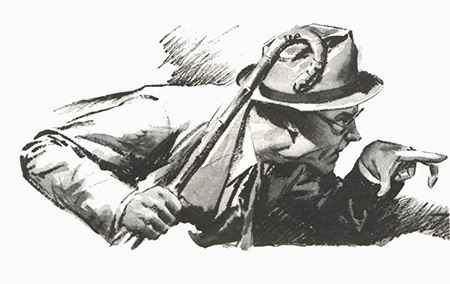
 He kept waving a paperweight in front of me, and I thought he was going to kill me. He said he would smash my head, except that he was no Moses and couldn’t strike water out of a rock. (Illustration by D’Alton Valentine, © SEPS)
Do you remember the letter I wrote you that was interrupted by Mr. Bilchester coming in with an old press statement? Well, in that statement he got awfully mad at the Sparling Bill, which, as I explained in that letter, is going to be a dam somewhere which I sure wish you could help put up. But, honey dear, all the time I was taking his dictation for that statement, I was thinking of you and how you say that you’re a hound, and that I don’t love you and all, and I wrote it down in my notebook as “Darling Bill” instead of “Sparling Bill.” Because, sweetest, whatever you think or hear, you are always in my mind and in my heart. So this statement went to all the newspapers in the world with Mr. Bilchester talking about a Darling Bill which simply doesn’t exist anywhere—except you know where, honey.
Goodness! I never saw anything like Mr. Bilchester when he read that statement in the papers. He came running into my office and yelled at me that I’d ruined him after sixteen years of fearlessly fighting for the people of Chillburg. Fighting for Mom and Pop, he said, and for everybody, including the country and the Constitution; and then I had run a knife in his back, and brought the temple crashing down on his head like Delilah, and disgraced him before all civilization, and set him up in the stocks for history and the administration to hoot at. He said I had betrayed my country and made it possible for the depression to last forever—and a lot more, darling, that I can’t remember.
He kept waving a paperweight in front of me, and I thought he was going to kill me. He said he would smash my head, except that he was no Moses and couldn’t strike water out of a rock. He said he was only Job, and that I was his affliction, and that he was going to purge himself of uncleanliness, and that I was fired. Well, honey, I just broke down and bawled. With that paperweight waving and him yelling and hollering, I lost my head, and first thing I knew I was screaming for Gladys Satter, who is two offices down. I yelled, “Help, Gladys, help!” Then Mr. Bilchester put his hand over my mouth, and I thought maybe he was going to strangle me, and I bit him good and hard.
Just then the phone rang. I guess that sure was a lucky phone call for me, because he stopped with his hand raised in the air, and hollered for me to get out and never show my face in his office again.
I ran out of the office and straight home, and I’ve been here ever since, even though a boy did call me up and ask me to go down to the Mayflower Grill with him. I guess I had a nervous chill, because the landlady said I looked terrible, and asked me if I had any statuary charges against Mr. Bilchester, because if I did, her brother was very good at that kind of thing. Then she put me to bed. I’ve been crying ever since, until it got so I just couldn’t stand it. So now I am writing to you. And I guess I’ll be home pretty soon, honey, and everybody’ll know that I was fired.
I hope you still love me, Bill, because if you didn’t, I’d just die. I want you so bad, and I will be glad to get away from this crazy town. It is no place for a person with refinement, honey. I’ll send you a telegram to let you know when you should come down to the station to meet
Your lovingest,
DORA.
—
INTEROFFICE CORRESPONDENCE
Memo from: E. J. S.
To: SENATOR MAPES
MY DEAR MAPES: Bilchester ran wild again yesterday. The administration doesn’t want to horn in on this, because the Darling Bill is fairly unimportant. But you know we can’t give an inch, or some of these funny new party members may kick over the traces.
Will you get the press boys together this afternoon and give old Bilchester the works? Make it strong. Believe me, I’m going to work on that district of his from now on.
E. J. S.
—
WASHINGTON SKELETON
By A. E. McBride
In one of the most withering blasts of recent months, Senator Chester L. Mapes today named Representative George W. Bilchester as “archconservative public enemy Number One.” The senator’s attack, in which he accused Bilchester of being “brazenly in league with Wall Street piracy,” was a response to Bilchester’s choleric denunciation of the Darling Bill, now pending in the House.
Challenging Bilchester to “name one constructive piece of legislation fostered by his party in the last three years,” Mapes denounced the small but potent bloc in Congress which, he declares, “values a balanced budget above a balanced diet.” Mapes asserted that “so long as there is human misery, this administration will spend money to relieve it, and so long as there is a need for such constructive projects as that embodied in the Darling Bill, the Federal Government will open Treasury gates for their realization.”
Astute observers, among them your correspondent, take the senator’s statement as indicative of the administration attitude. Opposition leaders declare the Mapes statement to be a brazen threat of punishment in the form of patronage limitation for anyone who tosses a wrench in the smooth passage of the Darling Bill.
—
OFFICE OF REPRESENTATIVE GEORGE W. BILCHESTER
DARLING BILL: Well, sweetness, things are beginning to look better, and I may not be back in Chillburg as soon as I thought I would be. You know what you always say about people having to have self-confidence and fighting for the right whenever they are clear on what the right is? Well, I got to thinking about that. And finally I decided that it wasn’t right for Mr. Bilchester to fire me just because I misspelled a tiny little word. And then I figured, like you say, that you should fight for the right just as hard when it’s yourself you’re fighting for as when it’s somebody else.
So the next morning I went down to the office just as if I was still working there, only I had much more self-confidence than usual, because I knew I really wasn’t. I walked right up to Mr. Bilchester, who was looking like he hadn’t slept all night, and told him that I had thought the matter out. I said I had decided that if the mistake I had made was so important, I guessed I would just go down to the newspapers myself and tell them there wasn’t any Darling Bill, and save Mr. Bilchester all that embarrassment. I told him also that I would tell the newspapermen how mean he had been in firing me, and how he had tried to break my head with a paperweight and strangle me, and how I had had to scream for help.
When he heard that he almost jumped across the desk. He told me I shouldn’t take that attitude, and began to pat my back. He told me that, after all, I shouldn’t take things so seriously, and that, of course, I wasn’t fired, and that he wouldn’t think of me taking all the blame for that mistake; just to let it pass and say nothing. He said he hadn’t meant all he said about Moses and Job and firing me, and that maybe I’d get a nice little present from him later. So I went into my office and he cocked his feet on his desk and began reading the morning papers.
In just a minute he came running into my office and showed me a piece in the paper where Senator Mapes had said a lot of nasty things about Mr. Bilchester and a lot of nice things about this old Darling Bill. I got all shaky when I read it, and started to bawl again. But Mr. Bilchester patted me on the head and said something about “out of the mouths of babes.”
“Scoundrels, all of them!” he said. “And this proves it! They don’t even know their own bills! That fellow McBride doesn’t know either. They’ve fallen into my trap! Oh, I’ll bet they’d give a million dollars for just some little swamp named ‘ Darling.’ For years I’ve fought the rascals, and now I have them where I want them! We’ll scourge ’em, Dora! We’ll scourge the Philistines!”
He gave me a funny look, like a crazy man or something, and I almost started hollering for Gladys again, I was so scared. He said something about justice, and told me I was going to get a raise for sure, and not to mention to anyone about my mistake, because it might make it hard for me ever to get another job. So, please, honey, don’t mention it down at Dubroc’s store. Then he said: “I’m going to issue a statement to the press. And it’s going to be about the Darling Bill—get it? And if you dare make a mistake and say Sparling Bill, I’ll strangle you with my bare hands.” So I took his statement, and my, you never saw anything like the things he said about the Darling Bill. He even challenged Senator Mapes to a debate about it, and he dared anyone from the President down to come out and tell the people what the bill called for.
So, you see, darling, everything is all right, and it’s all because you told me about self-confidence and fighting for the right. I’ve got my job, and Mr. Bilehester seems happy again with something to make press statements about, and although I’m crying my heart out to see you again, still it’s just as well one of us has a job, especially if what Mr. Bilchester said about my mistake helping the depression along to get worse is true. If things do get worse on account of a little mistake in spelling, it may be a long while before there are dams enough to go around, since, I understand, there are lots of engineers out of work; although none are as smart as you or half as sweet.
I am not going out with any fellows, darling, although, as I told you, I don’t go without plenty of invitations. I wish you’d stop accusing me of things which I don’t do. Goodness, it’s bad enough around here getting accused of things you really do do. I would like to be at the Gem Theater with you tonight instead of lonesome in my room. Stella wrote me, and said she saw you there with Vergie Peck. I hope you had a good time. Good night for now, honey.
Your lovingest,
DORA.
—
THE NEW YORK CALL HOME OFFICE
Memo from: CITY DESK
To: A. E. MCBRIDE
ANDY: Notice a lot of stink about the Darling Bill lately. Give us fifteen hundred words to catch the Sunday-feature sheet. Bilchester may stir up quite a mess out of this, and I think we should be protected. Your column notices on it weren’t very specific.
WALTER HARRIS.
—
THE NEW YORK CALL
WASHINGTON BUREAU
SENATOR CHESTER L. MAPES,
SENATE OFFICE BUILDING,
WASHINGTON, D. C.
MY DEAR SENATOR: The Call plans to run a detailed analysis of the Darling Bill Sunday. I remember it only vaguely as a hang-over from the last session. I ran something on it then, but I want to avoid a rehash. Perhaps you will dictate to your secretary those points involved which you consider most important.
Yours respectfully,
A. E. MCBRIDE.
—
INTEROFFICE CORRESPONDENCE
Memo from: SENATOR MAPES
To: E. J. S.
DEAR ED: What the hell is this Darling Bill about? I thought I remembered it vaguely as a hang-over from last session. Bilchester is heaping coals on me in the newspapers. McBride wants a story on it. On your suggestion, I saw Jim Lacey. He tells me there is no Darling Bill, has never been any Darling Bill. Now, if there isn’t any Darling Bill, we’d better find one damn quick. Bilchester will crucify the whole administration. You were the one who wanted me to lower the boom on Bilchester re Darling Bill, so what are you going to do about it? I’m not going to be the goat this time.
Yours,
CHET MAPES.
—
INTEROFFICE CORRESPONDENCE
Memo from: E. J. S.
To: SENATOR MAPES
CHET: Did you, or did you not, make a statement to the press praising the Darling Bill? If not, you have a swell libel suit against four press agencies and every first-rate daily in the country. If you did make such a statement, what were you talking about? Looks like you’ve got us in another jam. Agree we must find a Darling Bill. Suggest we meet tonight, 7:30, Mayflower. This is no time to be talking about goats.
E. J. S.
—
OFFICE OF SENATOR CHESTER L. MAPES
MR. A. E. MCBRIDE,
WASHINGTON BUREAU,
NEW YORK CALL.
MY DEAR McBRIDE: I hope you will pardon a little delay in regard to the Darling Bill. To tell you the truth, I have been ill since this matter came up, and am not at all well yet. Rotten weather here, for one from my part of the country. However, I am now going into the bill carefully, with a view to giving you a complete history of the thing. It is entirely too important to be slighted in any way. I suggest you postpone your story a week, in the meanwhile dining with me Monday at the Mayflower, at which time we can have a pleasant chat and also clear up any questions in your mind. Accept again my regrets for the delay.
Sincerely,
CHESTER L. MAPES.
—
THE NEW YORK CALL
WASHINGTON BUREAU
REP. GEORGE W. BILCHESTER,
HOUSE OFFICE BUILDING,
WASHINGTON, D. C.
MY DEAR CONGRESSMAN BILCHESTER: The Call is very anxious to run an analysis of the Darling Bill for the Sunday-feature section, and, of course, no summary would be complete without your opinion. While I know you oppose the bill, I am extremely desirous of having something specific from you upon it. What do you think of the type of structure it calls for? Is, in your opinion, the appropriation for it too heavy? What do you think of the circumstances surrounding its introduction to the lower House? I confess I’m a bit hazy on its history, and I know you can give me the most accurate résumé available. I’ll call at your office tomorrow for a good talk.
Sincerely,
MR. A. E. MCBRIDE.
—
OFFICE OF REPRESENTATIVE GEORGE W. BILCHESTER
MR. A. E. MCBRIDE,
WASHINGTON BUREAU,
THE NEW YORK CALL.
DEAR McBRIDE: I am leaving tonight for New York, hence am sending you herewith the material you request in connection with the Darling Bill. It would be sheer presumption for me to go into detail concerning this grave piece of legislation when addressing the shrewdest correspondent The Call has ever turned loose on us poor legislators. I won’t, therefore, insult your intelligence with petty details, for I suspect you press boys really know as much about the Darling Bill as we do. However, you may quote me as follows:
The project is typical of the porkbarrel legislation being foisted upon the backs of American taxpayers by the most bureaucratic administration in the history of the republic. It calls for millions of dollars to be thrown into a project which no single engineer of repute has declared practical. The surrounding terrain is entirely unadapted to the plan in view. The benefits to be derived from the project are illusory; indeed, one would be tempted to say that the whole matter is essentially an illusion. Senator Mapes and his little coterie of exploiters are trying to bludgeon the people into accepting this infamous plan. Only a few of us dare oppose the present orgy of Treasury tapping. I shall fight the project with every weapon at my disposal. I pledge myself, to my constituents and to the country at large, that this project will never materialize. You may look for something sensational to develop from this latest evidence of administrative incompetency.
I guess that will hold them. If I can help you again, McBride, you know the doors of my office are wide open to the press.
Cordially,
GEORGE W. BILCHESTER.
—
OFFICE OF REPRESENTATIVE GEORGE W. BILCHESTER
DARLING BILL: Honey, things are looking awfully bad again. When Mr. Bilchester first fired me, the only thing I had to think of was the disgrace of losing my job and all. But now the fuss about the Darling Bill looks even more serious. I think I’m in actual danger. I think maybe I’m going to jail. Oh, darling, how I wish I had your brains and self-confidence! Because if a girl ever needed something to bolster her up, that girl is me.
Everything seemed to be going fine until a newspaper writer named McBride, who does a column called Washington Skeleton, came in to see Mr. Bilchester while Mr. Bilchester was in New York. Honest, Bill, that Mr. McBride is the nastiest man I ever saw. He got to asking me so many questions about the Darling Bill so terribly fast that before I knew what I was saying, I told him there wasn’t any Darling Bill anywhere but you. I thought he was going to have a fit, Bill. He began to yell and rave something awful, so I had to run and close the door.
I’m not going to write down here all the things he said, because it would make me ashamed. All I can say about his language is that if anybody in Chillburg talked to a lady like Mr. McBride talked to me, he would have a good fight on his hands, because Chillburg may be a little town, but it still has good morals and good sense, which, as far as I can make out, is something Washington has never heard of.
Anyway, it seems that Mr. McBride had written something in his column about that old Darling Bill as though it was something that really existed and which he knew all about. He said that put him up a creek without any paddle to get home. He said, just like Mr. Bilchester said at first, that I had betrayed him. He said I had polluted the great institution of the American press. He said I had written the obituary of the smartest Washington correspondent that ever lived. He said I had starved his wife and children. He told me he had a story that would make the whole world laugh itself sick, and that he couldn’t touch it, because if he did it would ruin him. He said that the biggest chunk of news ‘in the history of America, was lying festering and dead in my lap.
He said he’d kill me if I ever said a word about it. He said there would probably be a revolution, and that they would burn the Capitol and probably hang Mr. Bilchester and Senator Mapes and me from the White House portico. He said he would light the first match himself, and be the first to kick the boxes out from under our dangling feet. He said he was getting the secret service to watch me, and that if I even moaned in my sleep they would hear me and cut my heart out. He said if I breathed a word to Mr. Bilchester about his visit, he would get the President to put a decree on me, so that no decent person would speak to me as long as I live. He said that even if I did keep my mouth shut, he might decide any minute, just for the fun of it, to call the Army out and have me thrown into a leper colony.
And there I am—just because I loved you so much, darling. Oh, honey, honey, you write how I don’t love you, when I’m sick to see you and crying myself to sleep every night, and maybe will be dead or in jail or watching my skin and fingers drop off by the time this gets to Chillburg. Please, darlingest, love me lots. I take back all that I said about you taking Vergie Peck to the Gem. Of course, I want you to have a good time. Of course, you mustn’t mope and get morose. But please believe me that I love you; and if anything happens to me, tell Mom and Pop that I loved them, too, and even in my grave will be theirs and your
Lovingest,
DORA.
—
THE NEW YORK CALL
WASHINGTON BUREAU
Memo from: A. E. MCBRIDE
To: CITY DESK
DEAR WALT: You know, Walt, that I don’t like to be rushed on a thing like this Darling Bill. I should think the desk would realize sometime that the man in the field has some conception of his job. I’ve been watching this Darling squabble like a hawk. I have more inside dope on it than any man in Washington. I know it like a book. I expect something sensational to develop shortly—something that will nullify any story I might send now. I’ve got Bilchester and Mapes both in my pocket, and when I knock this story out, it’ll be Page 1, not a lousy inside filler. So please believe that little Andy McBride is missing no tricks, and lay off until I can break the thing right.
ANDY.
—
THE NEW YORK CALL
WASHINGTON BUREAU
SENATOR CHESTER L. MAPES,
SENATE OFFICE BUILDING,
WASHINGTON, D. C.
MY DEAR SENATOR: I have received your invitation for dinner Monday and a discussion of the Darling Bill. I feel that the time has come for us to talk plainly, and Monday may be too late for any kind of talk. Since I am unable to reach you personally, I’m obliged to write what never should be set down on paper, particularly in this town. I am one of the three people living who know the full story of the Darling Bill. The other two are Bilchester and his secretary.
The secretary is a mental paralytic from the sticks who is in love with a home-town boy named Bill. When Bilchester dictated to her a press statement intended to denounce the Sparling Bill, she, being the possessor of a decidedly single-track mind, wrote “ Darling” instead of “ Sparling.” When Bilchester’s rave against the Darling Bill was published, I editorialized about it as though it were right up my alley. The next day you spoke warmly in its defense. When I queried you for facts concerning the bill, you gave me excuses. When I queried Bilchester, he presented me with a mess of fire-eating generalities which, incidentally, he released to the press at large. With each succeeding day he bellows more loudly against the bill you are defending, against the bill about which I have written so learnedly, and against the bill which he knows is nonexistent. He is having the time of his life.
This puts everybody concerned on the spot. I am the only columnist fool enough to touch the thing. The press agencies have confined themselves to quotes, hence have clear skirts. But I must protect you to the last, worse luck. The first newshound who gets wind of this phony Darling Bill will break the damnedest story since the Cardiff Giant. That story will blow A. E. McBride into purgatory, while Senator Mapes will go one degree further. It will even be used with devastating effect in the next election.
I trust I have made it plain that we share a mutual peril, hence must devise mutual protection. Bilchester is going to spring the inside dope very soon. I feel it. I know it. You must realize that it will be impossible at this late date to sneak a Darling Bill into the House calendar without some bright newsboy smelling the general bad odor. And still you go on talking about the Darling Bill. Please, please take a tip from Andy McBride, and refer to it, when you have to, as the Darling project. If anybody says, how come the change from “bill” to “project,” say you were misquoted—the same gag you pulled on me when you said reports of Prof. Rawlings’ resignation were lies, and he resigned next day. Doesn’t this suggested change from “bill” to “ project” give you an idea of your only possible out? If it doesn’t, then we are all sunk. I don’t know why I pull your chestnuts out of the fire like this. It must be because half of them are mine. If you are interested in any more ideas on the subject, drop into my office. But drop in quick, because in a day or two it’s every man for himself, and I may decide to protect myself by throwing you to the lions. I don’t want to, but a job’s still a job.
Cordially,
A. E. MCBRIDE.
—
INTEROFFICE CORRESPONDENCE
Memo from: E. J. S.
To: POST OFFICE DEPARTMENT
DEPARTMENT OF THE INTERIOR
DEPARTMENT OF COMMERCE
BUREAU OF RIVERS, HARBORS AND FISHERIES
UNITED STATES FORESTRY SERVICE
UNITED STATES TOPOGRAPHICAL SURVEY
GENTLEMEN: It is imperative you discover in territory within your jurisdiction a junction, reservation, mountain, creek, river, lake, valley, plateau, mesa, arroyo, gulley, desert, plain, canyon, harbor, cove, bay, sound, estuary, beach, peninsula, island or any other natural object which bears the name “ Darling.” Drop all current projects, devote all available men and energy to above-mentioned search, and report progress twice daily until order rescinded.
E. J. S.
—
OFFICE OF REPRESENTATIVE GEORGE W. BILCHESTER
DARLING BILL: Well, honey, Mr. Bilchester says that we are living here on the edge of a volcano which is boiling with the righteous wrath of a sorely oppressed people, and soon will erupt with results that will be very unpleasant to Senator Mapes, Mr. McBride and the Philistines who have impudently plundered our great nation.
I wouldn’t be a bit disappointed if things would erupt all over that Mr. McBride, although I don’t care much about the rest.
My job is going along fine. I have an assistant now who does nothing but clip references to Mr. Bilchester out of newspapers. I don’t understand it very well, but it seems that all the people who didn’t get elected last fall, or who don’t have any money to build dams, have decided that Mr. Bilchester’s fight against the Darling Bill makes him about the smartest man that ever lived. Since Senator Mapes said he didn’t want to debate about the bill, Mr. Bilchester calls the reporters together every day and gives them statements about the “craven minions of a tottering administration.” I think Mr. Bilchester should be a little careful, and I told him so, but he says that Moses didn’t hesitate to smite the golden idols, and that he is the Moses leading America out of bondage. He also said it is my place to take dictation, not give it, which shows it doesn’t pay to take a personal interest in your work.
So far, Mr. Bilchester has received 146 invitations to address protest meetings. He is awfully depressed because of Congress being in session and him having to stay here instead of going out and “enlightening the people.” The news-clipping girl has 1,378 pieces in her file which say that Mr. Bilchester is the man to lead his party to victory in the next election. There are now twenty-seven Bilchester-for-President Clubs, and many more forming. He has been made what they call an honorary member of fourteen labor unions, eight lodges and two tribes of wild Indians, and a college somewhere in the South wants to give him a diploma for political economy or something like that, although, if they could see the measly paycheck I get, they’d understand he knows plenty about economy already.
Mr. Bilehester says that he is practically ready to spring the trap on his enemies. It seems that he is now taking all the credit for that mistake I made in the first place. He goes around mumbling about the great hoax he has worked on the administration to see how far they would go in defending something which doesn’t exist. Everybody has spies in this town. You never know when somebody is in your pocket and when he isn’t. Mr. Bilchester has some in the departmental offices, and they tell him that everybody from E. J. S. on down is hunting like mad for something called “Darling.” Mr. Bilchester sits in his office and sometimes laughs for as long as ten minutes at a time.
In your last letter you told me that you didn’t think Mr. McBride would of talked like he did to me unless I gave him some sort of encouragement. You said no gentleman would dare say insulting things to a girl without she gave him some opening so’s he’d know he could get away with it. Sweetheart, I wish you wouldn’t say or think things like that, because you can’t understand a town like this. They don’t need any encouragement here to say insulting things, and as far as being a gentleman, why, I guess a gentleman wouldn’t last in Washington more than a minute. So please don’t think I go around trying to get insulted. I just act sensible, and when you’re mixed up with congressmen, it is a very, very hard thing to do. Don’t worry about not having a job, Bill, because if things go like Mr. Bilchester thinks they will, you’ll end up by being a cabinet member or something. Because, darling, someone who loves you like nobody’s business is going to be a very influential person around Washington when Mr. Bilchester gets through scourging the Philistines. In fact, she may be secretary to the President of the United States, but in private life she will always be
Your lovingest,
DORA.
—
MR. A. E. MCBRIDE,
WASHINGTON SKELETON,
WASHINGTON, D. C.
DEAR MR. McBRIDE:
“To thine own self be true, And it must follow, as the night the day, Thou canst not then be false to any man.” —Shakespeare.
This is my motto and I am only trying sincerely to live up to it. I am a man of few words, so right off will tell you who I am. My name is Bill Johnson. I live in Chillburg, which is the home town of Representative George W. Bilchester. His secretary, Dora Stamm, is crazy about me. I am going to marry her when I get a job. I do not have a job now. I have been a victim of the depression since I left State U three years ago. I am an engineer, having had two years at State U in that subject.
Due to overcrowded conditions and lack of funds, the university was obliged to raise their grade standards and flunk many students out. I was among those flunked. Since great minds in all fields have been unable to squeeze themselves into the narrow, conventional routine of academic education, the fact that I was flunked makes no impression on me at all. I have self-confidence and a wholesome attitude toward all things, and I will make my mark.
By this time you are wondering why I am writing you, although you have seen that I am a man of insight and intelligence who would not waste your time for nothing. You are right. I am writing you about the Darling Bill. Dora has written me every step about it. I know all. I even know more than all, for I have figured out a solution. It looks to me like this: You made a fool of yourself, writing about the Darling Bill. Senator Mapes also made a fool of himself, talking about the Darling Bill. And the Government will make a fool of itself if it can’t find some place where it can build something with the name of Darling. This will make a bigger stink than anything since the Teapot Dome if it ever comes out. Since I have the solution, I know I am probably the most important man in the whole country. I am modest, but not falsely modest. I am clear-sighted, and you know that I am right.
I have been worried for some time about how to get this information before the right people. At first I hated to think of tripping up Congressman Bilchester, which I am going to do. But after thinking about my motto, I decided he has had a good job for a long while, and is trying very hard to trip up somebody else, so, if he gets tripped up himself, why, it is all in the game. I thought very earnestly about whether I should write you or Senator Mapes, because I want to make absolutely certain that I am not doublecrossed in this matter. I finally decided I would rather trust a newspaperman than a senator, which may or may not be a compliment to you. It is all in the way you think about senators.
When my future wife wrote me that everybody in Washington but Mr. Bilchester was hunting some place called Darling, I got to thinking. As you probably know, the country around Chillburg is very wild, and there is likely to be a place called almost anything in it. I seemed to remember something named Darling Creek, but after inquiring around, I could find no citizens who recalled such a stream. So I went out looking for it myself. If you knew me better, Mr. McBride, you would know that when I look for something, it is practically the same as found. I found Darling Creek. It is 136 miles north of Chillburg, one valley to the west of Jenson Canyon. It is not mentioned on any of the maps, due to the fact that it is only a big spring which comes suddenly out of a mountainside, flows for one mile and fifty-eight feet, then goes into a hole in the ground, never to be seen again.
The reason I thought I remembered this particular stream is because it was beside its banks that Dora Stamm promised to marry me. You will be doing me a big favor by not mentioning this to her. I am very displeased that she should have forgotten Darling Creek, in view of the tender circumstances surrounding it, and since she hasn’t mentioned it in her frequent comments about the search that is going on, I know she has forgotten it. So please say nothing to her about it, and I will take that phase of it up with her by letter. I have found it always the best policy to be very firm and determined in all dealings with women, and when a girl forgets the name of the stream beside which she was proposed to, things have come to a pretty pass.
Now, about the specifications of Darling Creek. I have carefully measured its flow of water and find it to be ten gallons per second, 600 per minute, 36,000 per hour, 155,520,000 per every six months. Unfortunately, this stream dries up part of the year, but I figure that, allowing for seepage, dryness and all, we can count on six months’ flow. 155,520,000 gallons is a lot of water, Mr. McBride, and it is all running into a hole in the ground. My next problem was to figure out what to use it for. The nearest town is Chillburg, 136 miles south, which has plenty of water anyhow. There is only one resident living within fifty miles—this being very wild country—and he is Horace Jenson, who has no need of water in such quantities.
But there is one thing we could do, Mr. McBride. We could stuff up that hole in the ground, and let the stream flow 413 feet into a large, shallow valley. Those 155,520,000 gallons equal 20,790,000 cubic feet, which in turn equal 477 acre-feet of water. All of these figures are approximate, because you don’t come to them until your junior year, which, as I explained, I was unable to attend. But because I have a good head for figures, you can rely on them. Now, as I say, we can back up that 477 acre-feet of water, and it would be swell for ducks, a great many of which pass over this district every season. I have read practically every pamphlet from Washington on wildlife preservation, and can easily see that there is a crying need for something like the Darling Water Foul Preserve. I know that in some respects this doesn’t sound very important. But think. What else are you going to do with 477 acre-feet of water 136 miles from the nearest town, and with only Horace Jenson living anywhere within fifty miles of it? The answer, of course, is nothing—unless you make it a Wild Foul Preserve. I have even gone farther. I have secured from Horace Jenson a petition—inclosed—pointing out the necessity for such a project. Horace’s signature to that petition means that all of the citizens within a fifty-mile radius of the stream have unanimously urged the Government to get busy.
There is the Darling Project for which you are all anxiously looking. Naturally, I have personal reasons for giving it to you. It is not because I love you, for you have said some very uncultured things to my future wife. I have a selfish end in view. I want to be engineer in charge of construction of the Darling Water Foul Preserve. With two men and a cement mixer I can stuff up the hole, and there is nothing more to do but let the water flow. I should have a good fee for thinking of this and doing it. No less than $25,000, because of nobody knowing what the dollar will be worth tomorrow. When it is built, I want to be in charge of its care. I will need a crew of maybe half a dozen men, and for myself a salary of $5000 per annum, with a six-room furnished house, one of the rooms to be a nursery with pictures of the Three Little Pigs painted on the walls. The house, of course, to be strictly modern. I will want my job to be under civil service, because I have no faith in politics, and do not want to be thrown out whenever somebody else is elected to Congress. In return I promise to care tenderly for all ducks that pass our way, and to study up on them conscientiously.
I know this is a perfect set-up for you and Senator Mapes and a lot of gentlemen higher up. I know you will jump at Darling Creek as if it was your long-lost brother, and I will not blame you at all. However, if you should jump at it, and then fail to fulfill the terms I have outlined in this letter, why, then I will simply go to Congressman Bilchester and tell him the circumstances surrounding the selection of Darling Creek, along with a carbon copy of this letter. I have no doubt he will make it known in a great many newspapers, which certainly will be a heavy price for you to pay for cheating me out of what is rightfully mine. I know that when you consider this, you will see that everything I have said is just and reasonable. I do not think we will have any trouble.
I will be waiting for your reply. The check should be certified, because I will need cash to get the cement mixer moved so far. I know you will all be very grateful to me, but I am not doing it for thanks. So please notify me immediately when the Chief Engineer and Maintenance Supervisor of the Darling Water Foul Preserve sets about his duties.
Yours very respectfully,
BILL JOHNSON.
—
BILCHESTER DECLARES DARLING BILL A HOAX CHARGES GO UNANSWERED
“The Darling Bill, which administration spokesman Mapes has been defending so noisily for the past week, has never existed except in my own imagination!” With this startling declaration, Rep. George W. Bilchester this afternoon ripped the lid off official Washington, and started a political bonfire which may signalize the most serious congressional revolt in recent years.
“The bill was invented in my office,” explained Bilchester, “as a hoax to see whether or not the administration itself has any clear knowledge of the legislation it is fostering. The day after I publicly denounced the fictitious bill, Senator Mapes obliged me with a scurrilous personal attack and a defense of the legislation in question.
“Curious to know how far the majority leader would go in his desperate attempt to lend reality to a fairy tale, I continued to goad him and he continued to extol the virtues of the Darling Bill—with results which I now lay before the nation. I have nothing to say, aside from drawing the obvious conclusion that the Darling Bill symbolizes two-thirds of the legislation currently being rammed down Congress’s throat.”
While unprejudiced observers frankly declared the Bilchester hoax to be the most serious attack—and the most deadly—ever made against the administration, conservative forces quickly rallied around Bilchester, with an eye to grooming him for the White House. Newsmen scurrying over Capitol Hill in search of an administration reply were informed that none was forthcoming. It was intimated by one high official that a statement will be released early tomorrow. Senator Mapes, confined to his hotel by illness, could not be reached.
—
MAPES HURLS LIE AT BILCHESTER ATTACKS PROJECT OUTLINED
“Brazen chicanery!” was the retort issued from the sick room of Senator Chester L. Mapes, majority whip of the Senate, when informed of charges by Rep. George W. Bilchester that the much-publicized Darling Bill is a fiction invented by the veteran congressman to bait the administration.
“We have patiently given Mr. Bilchester the rope for which he has been screaming,” said Mapes grimly, “and he appears to have hanged himself with it. He erred from the start. There is not and never has been a Darling ‘Bill.’ In my controversy with the legislator I have always referred to the matter—save when misquoted—as the Darling ‘Project.’ For a project it is, under the administration of the PAP, hence completely divorced from Congress. It was here that Bilchester made his first and most serious mistake.
“He has continually referred to the project as involving millions. The actual appropriation is $825,000. He has declared his office to be flooded with protests. The PAP has in its files a petition urging the project signed by every registered voter within a fifty-mile radius of its site. He has stated that no competent engineer has declared the plan feasible. Mr. William Johnson, whose reputation certainly cannot be challenged, has submitted surveys which demonstrate it is not only feasible but necessary. As Chief Engineer, he is now engaged in the first phase of construction. Bilchester has further accused the administration of vote buying with the project. Actually, the district in which it is located was one of the few to turn in a heavy anti-administration vote last fall.
“Because he obviously hasn’t the faintest idea what the Darling Bill involves, the legislator has carefully refrained from informing his constituents that the project in question is the Darling Water Fowl Preserve, which forms the final link in the nation’s great string of game preserves extending from the Canadian to the Mexican border. And, finally, in none of his vicious attacks has Bilchester once mentioned that the project is situated in his home district, 136 miles north of the city of Chillburg, in which he maintains his legal residence. Further comment seems unnecessary. The entire fabrication demonstrates the hysterical quality of the present reactionary attack.”
Congressman Bilchester’s secretary informed reporters that the legislator flew to New York City yesterday afternoon to fill a speaking engagement. At a late hour last night he had not been located.
—
WASHINGTON SKELETON
By A. E. McBride
Concluding the most dramatic political battle of the current session, Representative George W. Bilchester last night resigned his seat in the lower house and announced his affiliation with the Great Atlantic Life Insurance Company of New York. The veteran legislator, located in his New York hotel, refused to amplify his stand on the Darling Bill. Neither would he confirm reports that his sudden withdrawal from public life at a time when the Presidency seemed almost within his grasp was hastened by an inundation of protest telegrams representing approximately 60 percent of the voters in his Congressional district.
It is not without a touch of melancholy that your Washington correspondent records the passing of one of the town’s greatest political showmen. Once hailed by his constituents as “The Last Conservative,” he has participated in many colorful congressional battles, the most spectacular of which is the Darling controversy, which admittedly occasioned his downfall. His stand on that issue remains a mystery which the most astute political observers are unable to solve. Only one fact can be established in the whole history of the dispute: Bilchester somewhere along the line made a colossal blunder. No one probably will ever know the full history of the Darling affair, unless Bilchester chooses to reveal it. And apparently the ex-congressman, like another famous conservative, “does not choose.” Suffice it to say that a grand fighter has departed from the arena—the last, perhaps, of his kind. The old order passeth, but it is not forgotten.
—
OFFICE OF REPRESENTATIVE GEORGE W. BILCHESTER
DARLING BILL: Oh, honey, I feel so cheap and small and ashamed of myself! I’ve been crying almost from the minute I got your letter. I don’t see how I could have done it, Bill dear. And I do understand why you feel so hurt. I remember everything else about that afternoon. You grabbed me all of a sudden, and put your arms around me, and squeezed me real tight. “Dora,” you said, “all I need is the love of a good woman, a woman who will understand and appreciate me. I will go to the top, Dora, if you want to marry me!” And I was so scared and tickled and funny-feeling inside that I bawled. Oh, honey, I thought you’d never get around to saying it! And I remember the water in the creek, and how we waded, and how you caught me when I almost fell off that slippery rock. But I never did once think of that being Darling Creek. And I’ll kiss you a hundred times for every minute you’ve felt hurt about it. And I’m sorry, sweet, forever and ever. But, Bill, with you there, how could I remember anything like the name of a silly old creek?
Well, as you must know, everything here is finished. I got that awful clipping which the Chillburg Herald printed about Mr. Bilchester. I’ve only heard from him once since he left for New York. It was a little note attached to a letter. The note said:
“DEAR DORA: The Greeks were very clever people, and they proved it with a wooden horse. If the inclosed letter fulfills its purpose, I shall have surpassed the Greeks both in strategy and deadliness. I hope it will get you a job to replace the one you have lost through my resignation. May you bestow upon your next employer the same talents you gave so unstintingly to me. George W. Bilchester.”
And what do you think the letter he had attached to it was? It was addressed to Senator Mapes, recommending me to the senator for a secretary! I was never so surprised in my life, and I think it’s the nicest thing Mr. Bilchester ever did. But I guess he didn’t know that I am going to be the wife of the Chief Engineer and Maintenance Supervisor of the Darling Water Fowl Preserve, and won’t ever need any job but loving my husband—and that’s no job, sweetness!
I also noticed an item in this afternoon’s paper about Mr. McBride. It said that he was resigning from his job writing for that column, Washington Skeleton. It said that because of his rare understanding of Government procedure, and the wide respect he enjoys among newspapermen, he has been appointed to take charge of all Government news which is given out to the press. It also said that Senator Mapes is going to give a big dinner tonight in his honor at the Mayflower. I am beginning to think that Mr. McBride may be a nice person after all, except when excited, because just about an hour ago I received a great big bouquet of the prettiest roses you ever saw, with a little note attached to them. It said:
“My apologies for ungentlemanly behavior toward the future Mrs. Bill Johnson. Please tell your husband that, were I rewriting a certain part of Longfellow, I should change one word in one line, and make it read, ‘A lady with a typewriter shall stand in the great history of the land.’ Andrew E. McBride.”
I don’t know what it means, but I think it’s awfully nice of him, don’t you? But I didn’t answer, Bill. Because you’re the only man I’ll ever write to. And there is absolutely nothing between us. And if I thought you’d want me to, I’d throw his nasty old roses into the garbage right now.
I am leaving Washington tonight on the 6:10, and will telegraph you from Chicago when I will arrive in Chillburg. I can hardly wait, Bill! I’m so proud of you I could die. I really could. Our own house and you with a fine job and me your wife—oh! What will Vergie Peck think? And, oh, honey, I’ll be so glad to get away from this town! A woman here is just a cog in a machine, and never is paid any attention to, and never gets a chance to do anything that really means something. But with me being with you—well, I guess a baby would mean something, wouldn’t it? Woman’s place is in the home all right, just as you always say, and that’s where a certain party I know is headed for as fast as wishes and wheels and engines will take her. Maybe you never heard of her, dearest, but her name is
Your lovingest,
DORA.