
“It may have been a good thing that we eventually went bankrupt.”
—From Billie Burke’s autobiography, With Powder on My Nose
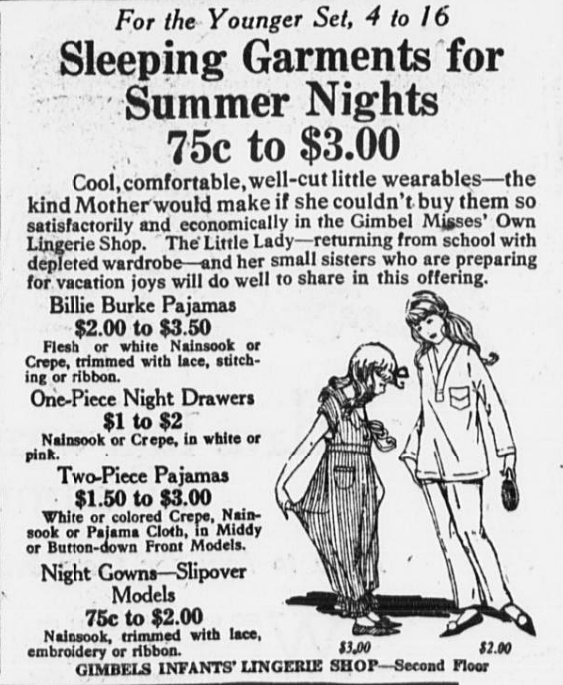
Billlie Burke, the beloved comedian, came to her profession naturally. After a childhood touring America and Europe with her famous father, the P.T. Barnum clown Billy Burke, and her mother Blanche Beatty Burke, the 19-year-old appeared in London’s 1903 play The School Girl. Audiences were so intrigued with the ingenue’s kittenish beauty and fashionable clothes, according to Ziegfeld and His Follies, that her name became synonymous with “adorable behavior” as well as a popular one-piece nightgown.
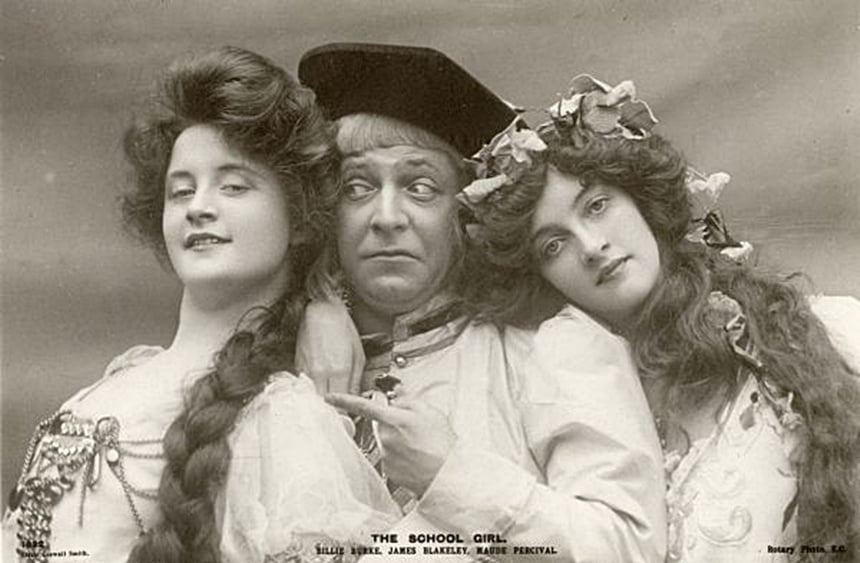
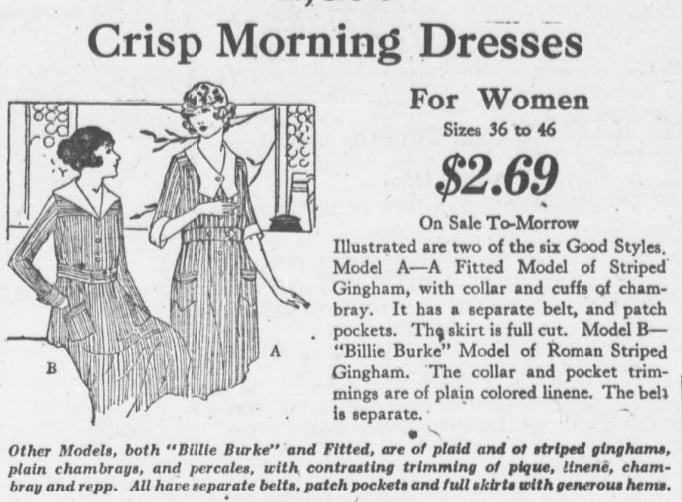
In 1905, when producer Charles Frohman planned to bring The Wife in New York, he asked Burke to join the show and soon became her devoted mentor and agent. After her successful debut in The Wife on Broadway, he assigned Burke a leading role in the 1908 light comedy Love Watches, which inspired a reviewer to call her a “real star,” reports Staging Fashion. But if “my acting did not set the Hudson on fire… there was always a gasp and a little flutter of surprise at my entrance,” Burke recalled in her first memoir, With a Feather on my Nose. Her subsequent stage appearances and high-fashion clothes were soon copied and marketed as “Billie Burke” dresses and accessories. “What I had to do was be as pretty as I could and as gay as I could be on the stage,” she recalled, according to Mrs. Ziegfeld: The Public and Private Lives of Billie Burke.
As a celebrity, Burke appeared in fashionable restaurants like Sherry’s and Delmonico’s, where she was escorted by famous men including Mark Twain, Somerset Maugham, and Enrico Caruso. In response to the opera singer’s attentions, “I said ‘Pouf’ to his rather overpowering brand of love-making.” Burke admitted in her in her first memoir.
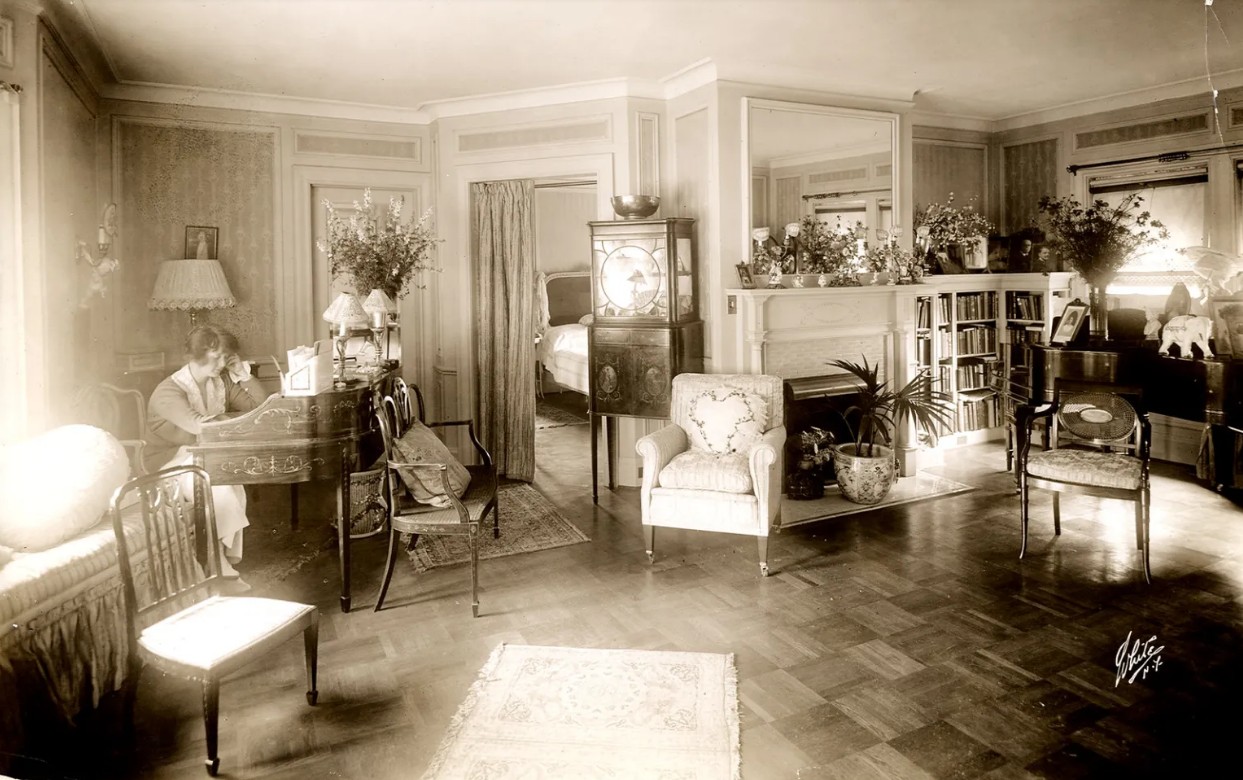
Born on August. 17, 1884, as Mary William Ethelbert Appleton Burke, in Washington, D.C., the actress adopted her famous father’s stage name but spelled it Billie instead of Billy. Despite her frothy on-stage appearances, Burke was a pragmatist. In 1911, she bought a mansion in Hastings, 30 miles north of Manhattan, and dubbed it Burkely Crest. Once when a reporter asked about marriage, Burke said an actress “cannot be happy if she is married and remains on the stage,” according to Mrs. Ziegfeld: The Public and Private Lives of Billie Burke; since she loved acting, only a very special man would make her give it up, “but I have never met such a man.”
That was before New Year’s Eve 1914, when Burke attended a costume ball at the Astor Hotel’s Sixty Club. “At the foot of the stairs stood this man,” she recalled. “He had this Mephistophelean look…and was in full evening dress rather than a costume.” When guests participated in a Paul Jones, or “mixer dance,” Burke was partnered with the man she had noticed at the stairs. Soon she felt “he had danced me into a world of swirling emotion, a new country full of awe and delight.” When another guest greeted her partner as Flo, Burke realized he was the legendary Broadway impresario Florenz Ziegfeld of the glamorous Ziegfeld Follies. She knew that his “reputation with women was dangerous,” she wrote in her memoir, but was still attracted to him.
A few days later she happened to bump into Ziegfeld on the street by chance, but he probably planned it, according to Mrs. Ziegfeld. She was wearing a sable jacket and carrying a chinchilla coat, leading Ziegfeld to comment, “I see you are the most extravagant person in the world, next to me,” according to Burke’s memoir.
Soon he was showering Burke with gifts. When her protective manager Frohman heard about their romance, he exploded and forbade her to date the showman. Burke ignored him, and continued to meet Ziegfeld in secret.
On Saturday, April 11, 1914, after the matinee performance of the light comedy Jerry, a “frantic and frightened” 29-year-old Burke wed 49-year-old Ziegfeld in the storage room of a New Jersey Lutheran church. To punish Burke, Frohman closed Jerry in New York and planned a road tour, presumably to keep the newlyweds apart.
On Burke’s birthday that August, Ziegfeld picked a rose from the garden at Burkely Crest, wrapped two $100 bills around it, and presented it to her with the apology, “All I got.” Only then did Burke realize the full extent of her husband’s roller coaster finances. Since her career was a dependable source of income, she reluctantly agreed to the 72-day road tour for Jerry. While she was on the road, friends mentioned rumors about Ziegfeld’s “attentions to other girls,” but Burke tried to ignore them.
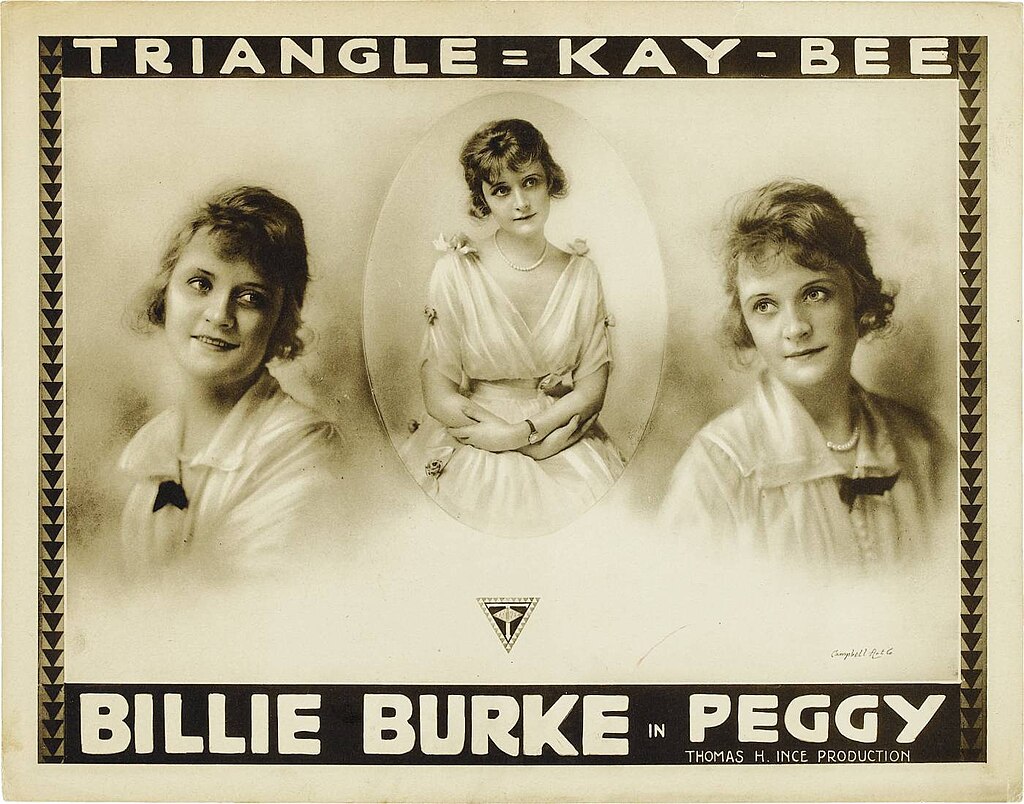
Burke then accepted Hollywood producer Thomas Ince’s offer for a $10,000 weekly salary for the silent movie Peggy. Still, the rumors abounded, among them one about her husband and Olive Thomas, 21-year-old Follies girl. At that time, Burke was in San Francisco and asked Ziegfeld to meet her there. In what she later described as a “fit of blazing red-headed jealousy” she lambasted him for his womanizing, then smashed dishes, tore down the drapes, and dissolved in tears.
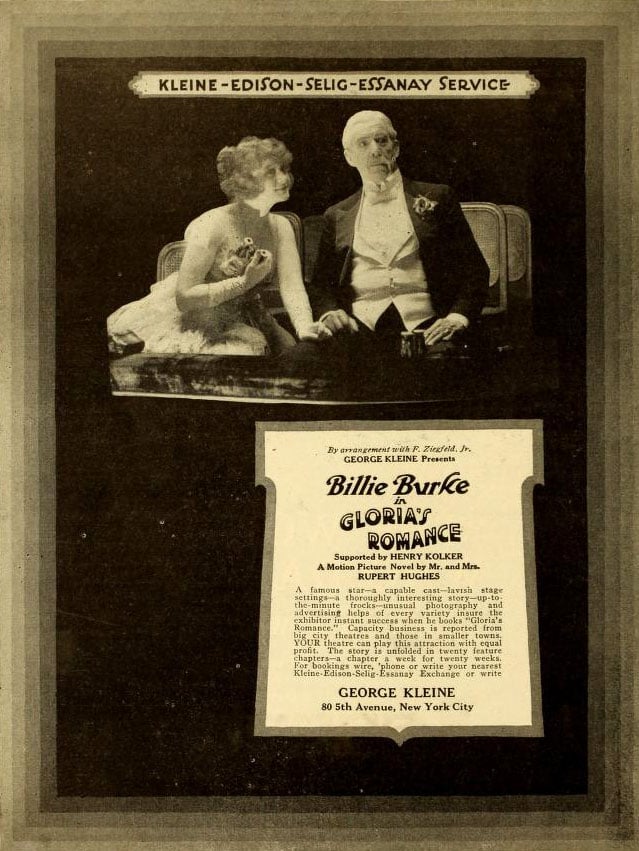
To pacify her, Ziegfeld arranged a role for her in the silent movie Gloria’s Romance. The producer, Max Annenberg, offered $75,000 for Burke’s role, but Ziegfeld demanded twice that sum — and got it, according to Mrs. Ziegfeld. Ultimately, the marriage survived, and on October 16, 1916, Burke gave birth to their daughter, Patricia.
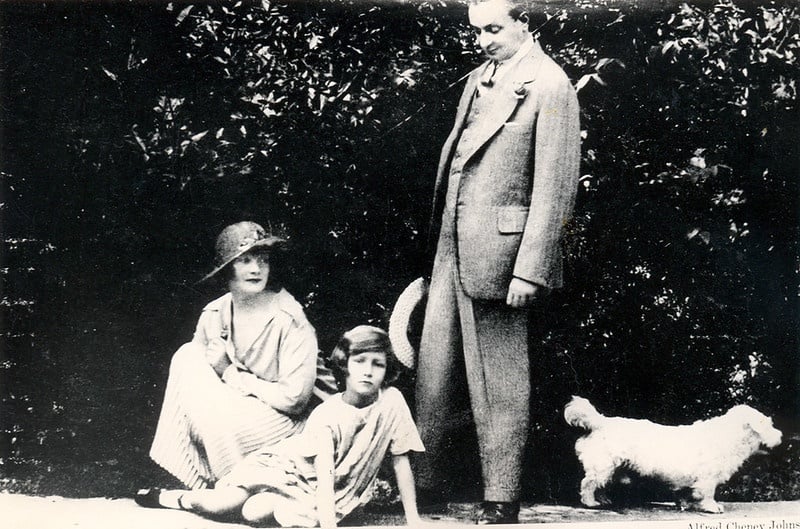
Over the next decade Burke declined several Hollywood roles, hoping that by remaining in New York she could keep Ziegfeld from wandering. During those years she appeared in several plays and 16 silent movies filmed locally, but as she recalled, “I chose my husband over my career.” Still, the rumors persisted. The most humiliating came from Follies ballet star Marilyn Miller, who claimed Ziegfeld wanted marry her, if only Burke would step out of the way.

Outraged, Burke confronted her husband once again. In response, Ziegfeld reached into his pocket and presented her with a $20,000 diamond bracelet from Tiffany’s, which she threw across the room. But Burke loved him, and eventually they reconciled.
On Thursday, October 24, 1929, when the stock market crashed, Ziegfeld lost all his money. “I must find another play and get back to work, that I must help my husband,” was Burke’s first reaction. Fortunately, the $500,000 she had saved in her name had not been invested in stocks, so it was used to pay off some debts, according to Ziegfeld and His Follies. Burke dismissed the servants and sold off many possessions to reduce costs at Burkely Crest.
By 1932, Ziegfeld was a broken man who often hid from his creditors. In desperation, Burke accepted a role in the play The Vinegar Tree at The Belasco Theater in Los Angeles. Director Geoge Cukor then cast her in A Bill of Divorcement with John Barrymore and young Katharine Hepburn. Learning that Ziegfeld was ill with a respiratory infection, Burke asked the producer to close The Vinegar Tree, returned to Manhattan, and by train brought the ailing Ziegfeld back to Los Angeles with her. On July 22, 1932, the 65-year-old Florenz Ziegfeld died.
Despite her grief, Burke reported for the filming of A Bill of Divorcement soon after the funeral. “I did it because I had to, and it was the best thing that could have happened,” she wrote in her second memoir, With Powder on my Nose. Paradoxically, Ziegfeld’s bankruptcy, significant debts, and subsequent death had forced Burke into accepting lucrative roles in the movies. As she told the Washington Post on August 8, 1937, “Motion Pictures tided me over the most difficult part of my life. They were a veritable port in the storm…”
A Bill of Divorcement (Uploaded to YouTube by Artflix – Movie Classics)
Burke’s life improved after Samuel Goldwyn of MGM offered to become her agent and placed her in many movies. Among the most memorable were her starring roles in Dinner at Eight, Topper, and Merrily We Live.
In 1938, after Goldwyn sold the screen rights to The Wizard of Oz to MGM vice president Eddie Mannix, and Burke was chosen to play Glinda the Good Witch. Burke recalled, “My favorite role was in The Wizard of Oz…in which I played Glinda, the Good Fairy. I never played such a being on stage, but this role is as close as I have come in motion pictures to the kinds of part I did in the theater,” referring to the glamorous stage roles she used to play.
While Burke eventually repaid Ziegfeld’s substantial debts, she never resented the challenges of their marriage. Despite the financial problems and how she always “looked at my husband’s beauties with green eyes,” she still missed “the gentle touch of a dear hand, which it seems to me touched me only yesterday,” according to With Powder on My Nose.
Even so, Burke always understood it was important for a woman to retain her own identity. Ziegfeld and His Follies notes that she told a Photoplay reporter, “Please tell Photoplay readers how important it is for a woman who has ever had a career to keep right on loving her work.”
Become a Saturday Evening Post member and enjoy unlimited access. Subscribe now




Comments
Hard to believe that Billie was 54 years old as Glinda the Good Witch in The Wizard of Oz!
With appreciation, Bob. I wish I had a chance to meet Billie. I met and interviewed her daughter Patricia Stephenson years ago, another charming woman. Mrs. Stephenson raved about her mother and said that she had worked hard for years to repay Ziegfeld’s debts.
Thanks Nancy, for this in-depth look into Billie Burke’s life and career. She had her share of ups and downs, but always had that class and charm throughout it all. I appreciate the links here, including the film ‘A Bill of Divorcement’ she made 7 years before ‘The Wizard of Oz’.
It’s easy to see why she was chosen for the role of Glinda, as much as Margaret Hamilton was chosen for hers. Some things just align the way they’re supposed to, at just the right time, which ‘Oz’ definitely did. She had a long, wonderful career before that role of a lifetime, and a lot of good films after it. I think she’d love this feature too, no question about it.