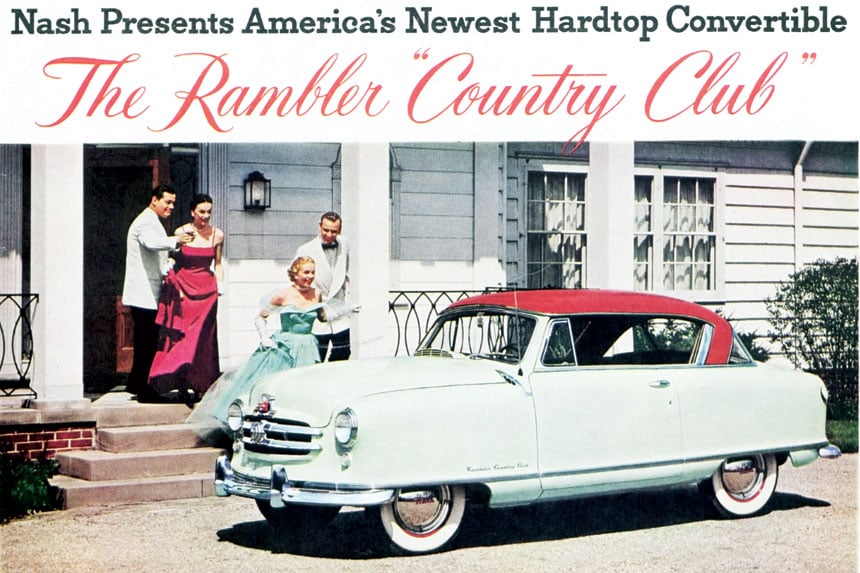
If you look up lists of the great cars of the 1950s, you probably won’t see the Nash Rambler. It’s a pity, because the design and features of the Rambler should permit it to share the stage with the Chevy Bel-Air and Corvette, the Ford Thunderbird and Buick Skylark, and the Cadillac Coupe De Ville.
The Rambler was intended to be America’s first modern, economical, compact car, which would be unlike anything else on the road. It offered a 100-inch wheelbase and a straight six, 82-horsepower engine. Nash helped popularize unibody construction in America, which gave the car greater stability, reduced the vehicle’s weight, and increased its mileage. It was available with several far-sighted options: power steering, power brakes, electrically powered convertible top, and inexpensive air conditioning. And on long journeys, the seats could even recline to form a bed for the family.
From the beginning, the Rambler stuck close to the rounded, aerodynamic style of the 1949 Nash Ambassador, which Nash called its Airflyte body. While the other carmakers were busily turning out angular, chrome-clad behemoths, Nash-Kelvinator was selling the first successful compact car in America and giving consumers a glimpse of their future.
This article is featured in the July/August 2025 issue of The Saturday Evening Post. Subscribe to the magazine for more art, inspiring stories, fiction, humor, and features from our archives.
Become a Saturday Evening Post member and enjoy unlimited access. Subscribe now

Comments
My Mom and Dad’s first new car was a 1964 Rambler Classic. Dad bought it because of the fold-down front seats where Mom and my sister would sleep while Dad and I slept in a tent — all while on vacation. The trunk was huge, considering the size of the car (between mid-size and full-size by today’s car standards). My first car was a used 1964 Rambler American I bought in 1970 while a senior in college. It was Rambler’s first car which began the styling shift to resemble cars of America’s Big 3. My Grandmother bought a new ’64 or ’65 Rambler Classic, which furthered the styling shift — and I always thought it was well designed. I even have a diecast model of that car I bought for my “O” scale train layout.
My father was a Rambler man and as a teen-ager in the sixties that meant I dated and cruised in Ramblers! That didn’t help my image one bit. Then I discovered that Ramblers had a feature few other autos had back then: reclining front seats. Unfortunately young ladies of that decade were wary of seats that could turn into beds. This was a plus when my friends and I would head to the Myrtle Beach area with very little money. The trusty Rambler became a mobile motel room!
This is funny. I drove a Rambler. It was stick. No trouble since I was taught driving a VW with my dad. Sadly, it went to car heaven.
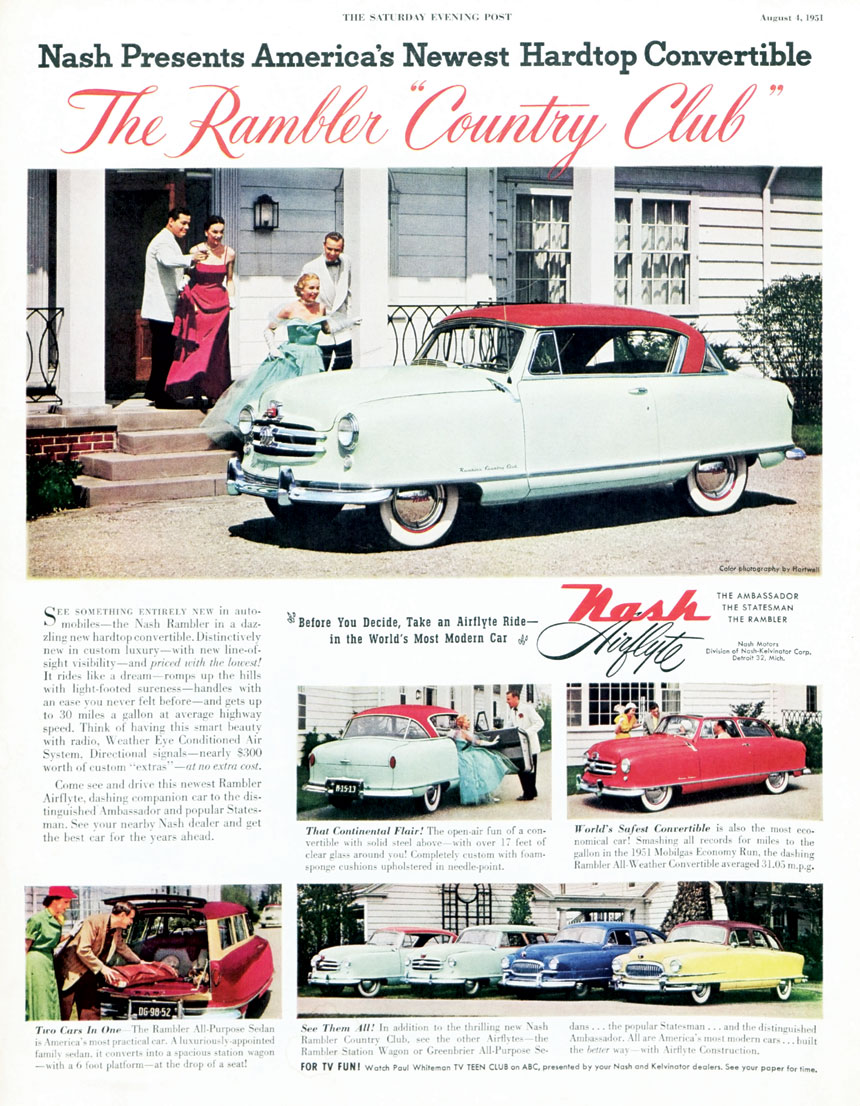
This ad cleverly features some ‘well to do’ people heading off to the country club in this Nash Rambler “Country Club” coupe that suggests they (most likely) could afford a more expensive car, but have wisely chosen the luxury and comfort of economy, without missing out on a thing!
The pictures below accentuate the main part of the ad copy, but goes into more detail with the finer selling points.
Secure as the Big 3 were in 1951, this car (I would think) was probably at least somewhat of a thorn in their sides. When the VW first arrived here in 1955 and was a success, work began in 1956 on what would become the 1960 Chevy Corvair, Ford Falcon and the Plymouth Valiant; all of which debuted in October 1959.