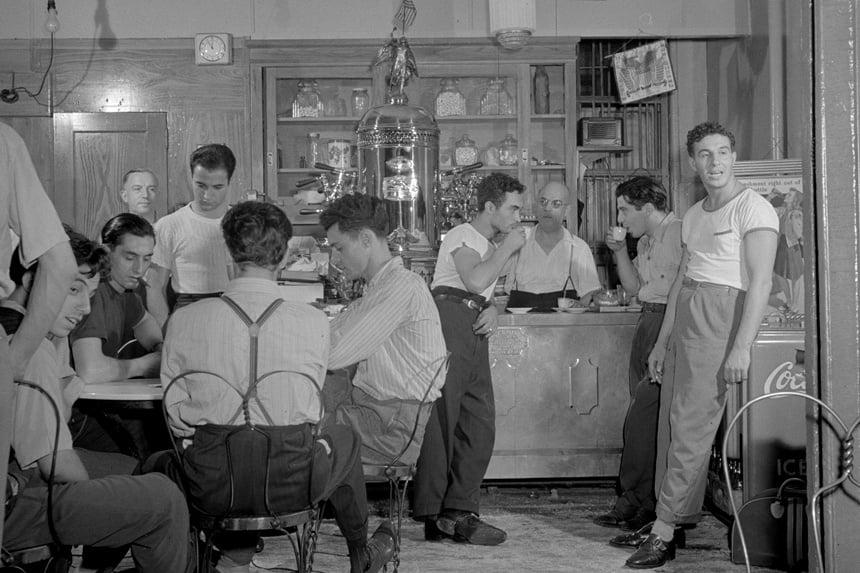
The neon green exterior can fool you with its modernity. But Caffe Reggio has been a functioning coffee shop since 1927, with the lore to back it. Upon entering this small establishment on MacDougal Street in Greenwich Village, New York City, you will see an ornate espresso machine that was built in 1902, Italian Renaissance paintings hanging precariously on the walls, and delicate-looking but sturdy tables and chairs.
Caffe Reggio claims to have served the first espresso in America, and many folks have come here over the years to savor it, including John F. Kennedy, Allen Ginsberg, Jimi Hendrix, Sophia Loren, and David Bowie. The shop has been featured in The Godfather Part II and, more recently, in the Emmy award-winning show The Marvelous Mrs. Maisel. Today, actors, expats, mothers with their toddlers, financiers, and even writers post up at the back of the café to converse, create, and commune.
Not every neighborhood still has a Caffe Reggio. Collective community spaces, watering holes of sorts, have changed over the decades. It’s more likely you’ll find a corporate chain with mythical creatures on its cups served up by men with beautifully manicured mustaches, providing the trendiest flavor-filled must-have drips.
While these places have their own charm and comfort, they offer an atmosphere different from the traditional American coffeehouse, which traces its roots back centuries and across an ocean.
The concept of a coffeehouse originated in Turkey during the late 15th century; it was called Kiva Han, though this is debated since little documentation on the establishment is left. The seriousness with which the Turks kept their coffee matched how strong they served it: unfiltered and black – what we would refer to as “mud” now. When Vienna was invaded by the Turks in 1683, they brought coffee beans with them. Once in Europe, filters, sugars, and creams were added to help soften the bitterness of the brew; later, pastries and other confections were added to the menu. The coffeehouse became synonymous with a place for creative and business communities to congregate, forge connections, develop projects, and conduct negotiations.
Two summers ago, on a walking food tour in Valletta, Malta, where I was visiting family, I learned about some of this history more intimately. In 1565, Turkish slaves, whom the Knights of St. John captured in the Great Siege of Malta, brought coffee beans that were used to trade with the native islanders. Coffee does not grow in Malta, but the drink is so delicious that the Maltese developed their own recipe to stretch the precious beans by adding chicory, aniseed, and cloves. Many regions, even in the U.S., have adapted coffee similarly to suit local tastes or war-related shortages. For instance, New Orleans-style coffee also blends in chicory for its distinctive earthy flavor, a custom that began during the Civil War when a blockade prevented the easy transport of coffee beans.
Coffee traveled to the Americas when it was colonized. Then came the Revolutionary War; the Boston Tea Party changed everything. Drinking tea was politically out, so to enjoy a communal concoction with caffeine, coffee it was. Coffee was now sealed into American history and stayed on the warfront throughout the Civil War.
Appeal to the general masses came during the Great Depression, with coffee and donuts being handed out to the hungry from food banks and soup kitchens; this introduced the idea that affordable coffee should be available to all, even to brew at home. After that, northeastern coffee shops expanded to most major cities in the U.S. and then to smaller communities as well, with the average American now drinking 12 pounds of coffee per year. Newer, commercialized espresso machines were introduced in the late 1940s. The economic expansion of coffee-centered establishments evolved to include many different flavors of coffee and the invention of the coffee break.
To be clear, there is a difference between a coffeehouse and a coffee shop. A coffeehouse focuses on the craft of coffee, while a coffee shop offers a substantial food menu. It’s also important to mention the iconic place in history of diner coffee, both vaunted and maligned. My grandfather spent most of his mornings post-retirement at a coffee counter inside a diner right up until the day he passed; it was actually the last place he visited. My dad says it is what kept him going, the business of communing around a cup of, oftentimes burnt, Joe.
My first experience with this kind of community around coffee was in my Midwestern middle school days. Every morning, feeling like little adults, we would trot to the gas station two blocks away from school and make our own Styrofoam cup cappuccinos from the industrial-looking machine. On our walk back, we would discuss recently broken-up romantic relationships, our favorite lip gloss at the moment, my overzealous poetry, and how to sneak into the current blockbuster at the movie theater. It was a way to bring together a group of girls to form a bond.
Before the arrival of the late-’90s gas station cappuccino machine, there was already a kind of DIY café culture — cozy yet rebellious — shaped by the Beat poets of the 1960s. This atmosphere still reverberates in music and literature today, through figures like Bob Dylan and Jack Kerouac. In the late ’60s to the early ’70s, a new kind of business established itself: the coffee shop chain, which included Peet’s and Starbucks. The curated accent furniture, soft lighting, and light jazz or modern folk music gave a national focal point to this meeting place of playwrights, project managers, students, and parents to collectively relate to. The coffee chain provided a shorthand across the country for not just these brick-and-mortar meeting places, but also consistency in product.
The national chain has morphed over the years into something less cozy, taking on more of a grab-and-go feel marked by fewer seating options and an emphasis on pre-orders. Now, instead of lingering, we carry our iced espressos back to the office.
But these local places of coffee and community still exist in local diners and independently owned cafés, each offering their own take on high-quality, artisanal brew. Now, instead of the subtle growl of pen scratches we have blue-lit screens. This next iteration of a long-standing tradition is all in an effort to connect. In fact, it is the foundation and expression of the coffeesphere’s existence.
As I begin to pack up my coffee-stained canvas backpack, I take my last sip before looking up and out onto the Greenwich Village street to make my way home, and hear someone on their phone over my shoulder, waving furiously over their head at the full table to say, “Look, look, yes! We’re here! Yeah, it’s so good here.”
Become a Saturday Evening Post member and enjoy unlimited access. Subscribe now



Comments
I currently presently not at any point figured out (z11) like it’s far even conceivable yet one in everything about partner buddy made $27,000 best (r4) inside about a month essentially completing this smooth chance and moreover she has provoked me to benefit. forward-thinking data on visiting following
site….
the site is mention in my name for more info