
In 1648, Massachusetts Bay Colony published its first book of laws. Included among its 15 capital crimes was witchcraft. The entry was brief and backed by citations from the Old Testament, including Exodus, Leviticus, and Deuteronomy.
Before America existed, its colonists had already decided what to do with witches: Kill them.
The law read, “If any man or woman be a witch, that is, hath or consulted with a familiar spirit, they shall be put to death. Exod. 22.18. Levit. 20.27. Deut. 1.10.11” This law, created in 1641, was built on England’s Witchcraft Law of 1604. Massachusetts Bay Colony wasn’t alone; some colonies, like Virginia, continued to use England’s law, but others developed their own laws, like the one established in Connecticut Colony in 1642, which read “If any man or woman be a witch (that is) hath or consulteth with a familiar spirit, they shall be put to death. Ex: 22.18: Lev: 20.27: Deu: 18:10, 11”.

The existence of these laws shows that the early British colonists genuinely worried about witches, and accusations of witchcraft were made throughout the century. In 1647, Alse Young was accused of witchcraft in Connecticut and put to death, the first person in the British colonies executed under such laws. Over the next few decades, about 11 people in New England were put to death for witchcraft. But in the 1690s, all that changed in Salem, Massachusetts.
For most Americans, the Salem Witch Trials of 1692 and 1693 are a familiar story that has outlived nearly every other colonial event. The Salem Witch Trials are remembered as an extreme moment of panic in a society very different from the one we live in. Even though fears of witchcraft were more common in the 1600s, it was uncommon to see such a concentrated set of witchcraft accusations in one place.
The hysteria began when three young women became sick in early 1692 and no one knew why. Then fingers began to point. It was witchcraft, the girls said. The witch hunt began there and became the largest of its time and place, with nearly 200 people in Salem and the surrounding areas accused of witchcraft by the end. Twenty were executed. Several more died awaiting trial. In Salem, suspicion became contagious.
In the years after Salem, the same communities that had accused their neighbors began to reckon with what they had done. Ten years later, colonists in Massachusetts began asking the colony to undo the convictions. A 1703 petition from Andover, Salem village, and Topsfield argued that the records should be cleared because the accused and their families still bore “infamy and reproach.” In 1711, the colonial legislature reversed and nullified more than twenty Salem convictions, including some of those executed. Massachusetts formally apologized in 1957, and in 2022 the last accused person, Elizabeth Johnson Jr., was finally exonerated.
The laws vanished, but the figure of the witch remained as a cautionary tale, a political symbol, and a cultural icon. As the United States developed, the word “witch” no longer referred only to neighbors suspected of consorting with spirits. It became a metaphor for women who challenged or simply resisted expectations.

In the 19th century, people with ties to Salem brought its history into broader American culture. Author Nathaniel Hawthorne, born in Salem, returned to Massachusetts Bay Colony and the Puritan legacy with The Scarlet Letter and The House of the Seven Gables. After the Civil War, Charles W. Upham, a Salem resident and Massachusetts politician, gave lectures on the Salem Witch Trials and published a study of the trials, Salem Witchcraft, in 1867. Both treated witchcraft not as supernatural fact but as moral and psychological metaphor; Hawthorne through guilt and repression, Upham through civic failure and mass hysteria. In their hands, Salem’s ghosts became allegory — a reckoning with guilt, repression, and the price of judgement.
By the 19th century, then, witches had moved from courtrooms to the pages of legend and literature. The story of Salem remained alive, even as the idea of witches took on new faces in American culture, from monster to mogul to feminist icon.
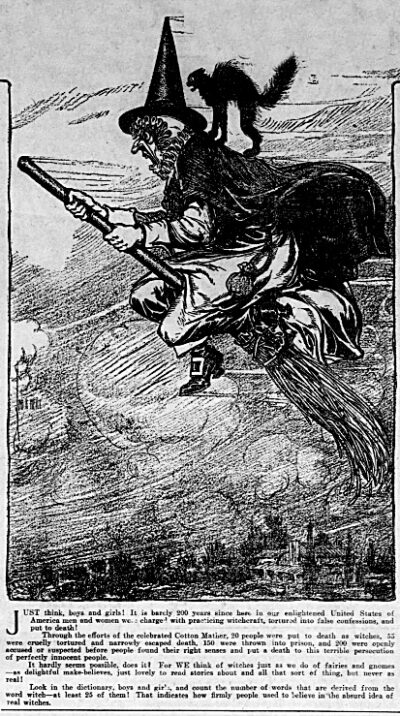
Sometimes, stories of witches centered on the supernatural, such as the legend of the Bell Witch in Tennessee in the early 1800s. L. Frank Baum tapped into the idea of witches in his 1900 book The Wonderful Wizard of Oz, suggesting that witches could be both good and bad. In 1906, The Salt Lake Herald (Utah) published a Halloween-themed section featuring a witch on a broomstick. Its caption reminded young readers of the Salem Witch Trials and pointed out that the dictionary included at least 25 words derived from the word witch: “That indicates how firmly people used to believe in the absurd idea of real witches.”

While the publishers thought people saw real witches as “absurd,” that didn’t stop others from using the term to poke fun at women they didn’t like. Financial maven Hetty Green earned the title the “Witch of Wall Street” in the early 20th century. She was perhaps the richest woman in the world when she died in 1916, having spent years building a fortune through her savvy investments. By then, the witch was less a figure of fear than a label for women who defied convention.
In the 1960s and 1970s, still other women consciously reclaimed the label “witch.” Mary Oneida Toups, the “Witch Queen of New Orleans,” practiced modern witchcraft, while the feminist members of W.I.T.C.H. (the Women’s International Terrorist Conspiracy from Hell) embraced the label as a means of female empowerment.
The law once made witches illegal, but American culture made them immortal. In stories, films, and costumes, the witch became playful, defiant, even empowering. Three centuries ago, a woman could hang for being called a witch. Today, she might wear the title with pride, or a child might wear it for fun. Once a crime, the witch became a mirror for American fears and desires.
Become a Saturday Evening Post member and enjoy unlimited access. Subscribe now




Comments
Sometimes in situations of a niche, we need a witch whose nose can twitch.
I currently presently not at any point figured out (z15) like it’s far even conceivable yet one in everything about partner buddy made $27,000 best (r4) inside about a month essentially completing this smooth chance and moreover she has provoked me to benefit. forward-thinking data on visiting following
site….
the site is mention in my name for more info