This series by American studies professor Ben Railton explores the connections between America’s past and present.
Sunday at sundown kicked off the first night of this year’s celebration of Hanukkah, the eight-day Festival of Lights that commemorates the dedication of the Second Temple in Jerusalem and provides a great deal of wintry warmth for Jewish families and communities around the world. For Jewish American families in particular, like my maternal great-grandparents who came to the United States in the late 19th century as refugees fleeing Eastern European pogroms, holidays like Hanukkah offer connections to the global Jewish community and have also transformed over the centuries into uniquely American celebrations.
Six years ago in this holiday special Considering History column, I wrote about how the life and work of the inspiring Catholic social activist Dorothy Day can help us remember and extend the true spirit of Christmas. For this holiday special column I want to do the same with a parallel Jewish community organization, the Hebrew Immigrant Aid Society (HIAS), which exemplifies the spirit of Hanukkah and the ideals of America alike.
Late 19th Century Community Origins

The last few decades of the 19th century and first few of the 20th saw both a dramatic increase in Jewish immigration to the United States and a concurrent rise in anti-Semitic discrimination. More than 2.8 million Jews immigrated to the U.S. between 1880 and 1925, in the process creating some of the largest Jewish neighborhoods in the world in places like New York City’s Lower East Side. Those immigrants were met with overt anti-Semitism from organizations like the 1890s Immigration Restriction League, which described these new Americans as “beaten men from beaten races, representing the world failures in the struggle for existence,” and worked to exclude them entirely. The Hebrew Immigrant Aid Society gave Jewish immigrants the community and support that were desperately needed during these fraught times.
Although HIAS was formally incorporated in 1903, the organization had been working in New York City’s Lower East Side for nearly two decades by that time. It represented a combination of multiple social efforts in the city, including the Hebrew Sheltering House Association (also known by its Hebrew name Hachnasas Orchim, which roughly translates to “welcoming guests”) and the Women’s Auxiliary. These storefront, tenement, neighborhood organizations also embodied more overarching cultural and national ideals exemplifying the Jewish values of communal care through food deliveries, job opportunities, and much more; and as the first American (and perhaps the first global) organization dedicated to welcoming and supporting refugees.
Ellis Island in 1903
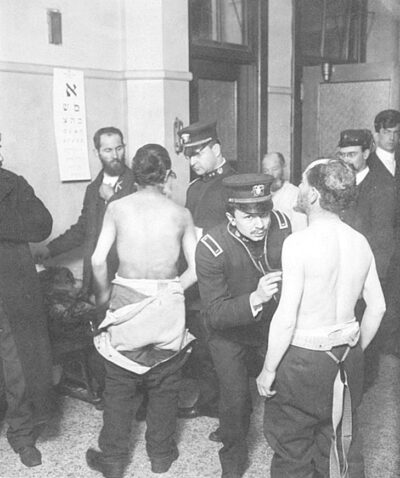
The formal incorporation of HIAS in 1903 was directly related to the ongoing development of the Ellis Island Immigration Station (about a decade old by this point) as a key but complex entry point for most of the era’s Jewish arrivals. Immediately after its incorporation, HIAS would open an office on Ellis Island, for multiple vital purposes: to support those new arrivals through translation, employment opportunities, connections to relatives in the U.S., and more; and to advocate for them during medical screenings, before the Boards of Special Inquiry that had the power to detain and deport arrivals, and at every stage of this fragile process. In its first formal iteration, then, HIAS not only extended the values of communal care, but also directly connected them to the American ideals of equality and equal treatment under the law reaffirmed in the recently ratified 14th Amendment.

The World Wars and Global Solidarity
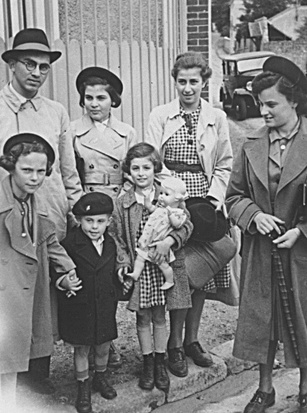
HIAS would continue providing support in New York, on Ellis Island, and throughout the United States over the next few decades. But both the drastic immigration restrictions of the 1920s and the rising global anti-Semitism that culminated in the 1930s-1940s Nazi Party, the Holocaust, and the horrific refugee crisis it produced, meant that fewer Jewish immigrants were able to make it to the U.S. during those decades. In response, HIAS partnered with a number of other organizations to open a new European and eventually global organization, HICEM, which would help more than 250,000 refugees escape the Nazis and resettle hundreds of thousands across the world in the late 1940s. This global organization and effort exemplified Jewish resilience as a worldwide community, but also pushed the United States to defend human rights at home and abroad, an effort that helped produce the United Nations’ 1948 Universal Declaration of Human Rights.
The 1965 Immigration Act and an Inclusive America
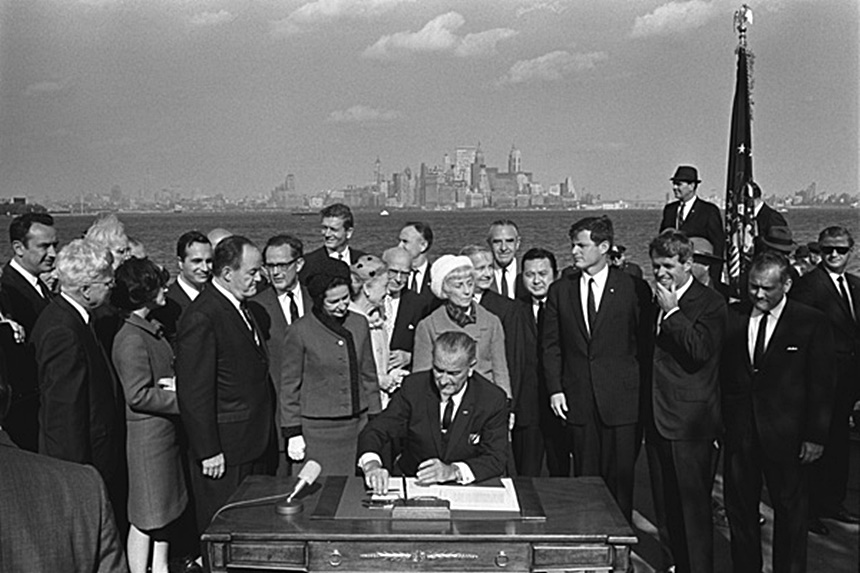

HIAS continued to serve those global communities for the remainder of the 20th century and into the 21st century. But it has never abandoned its foundational purpose of supporting and advocating for immigrants to the U.S., and indeed has only amplified those efforts. It did so for example as one of the most vocal organizations in the fight for the groundbreaking 1965 Immigration and Nationality Act, which reversed those decades of exclusionary policies and helped American immigration law reflect the nation’s diverse community. And it does so today through its support for not only all refugee communities, in America and around the world, but also for undocumented immigrants targeted by current deportation policies. In all those and many other ways, HIAS continues to push America to live up to its ideals and model core Jewish values like welcoming the stranger.
Turn of the Century Jewish Writers Who Advocated for Immigrants
Emma Lazarus

One way to challenge the late 19th century’s xenophobic anti-Semitism is to highlight the multi-century story of Jewish Americans, one that dates back to the mid-17th century and was well-established by the time of the American Revolution and the formation of the United States. Embodying and expressing that longstanding legacy is none other than Emma Lazarus, the late 19th century poet and descendant of Revolutionary-era Jewish arrivals who would pen the period’s most overt pro-immigration literary work: “The New Colossus” (1883), the sonnet inscribed on the pedestal of the Statue of Liberty (for which Lazarus and her poem helped raise funds).
Abraham Cahan

The late 19th century witnessed by far the largest influx of Jewish immigrants to the United States, and that period featureed inspiring figures that exemplify the best of Judaism and American ideals alike. One impressive example is Abraham Cahan, who was a Lithuanian Jewish immigrant who came to the U.S. in 1882 at the age of 22 and became one of the turn of the century’s most influential activists, successful creative writers, and prolific journalists. His advice column “A Bintel Brief,” published weekly in the Jewish Daily Forward newspaper that he founded and edited, modeled communal connections and solidarity with these newest Jewish Americans.
Mary Antin

As an ardent socialist, Cahan frequently offered strident critiques of the ways America was failing working-class and poor immigrants. His perspectives are complemented by the writings of Mary Antin, a Russian Jewish educator and writer who came to the U.S. in the 1890s as a teenager, attended Columbia University’s Teachers College, married the prominent geologist Amadeus Grabau, and achieved a striking level of personal and professional success. She would link her journey to an idealized vision of America in her autobiography The Promised Land (1912), but two years later made a powerful parallel case for all immigrants as embodying American ideals in her book They Who Knock at Our Gates: A Complete Gospel of Immigration (1914).
Become a Saturday Evening Post member and enjoy unlimited access. Subscribe now