This series by American studies professor Ben Railton explores the connections between America’s past and present.
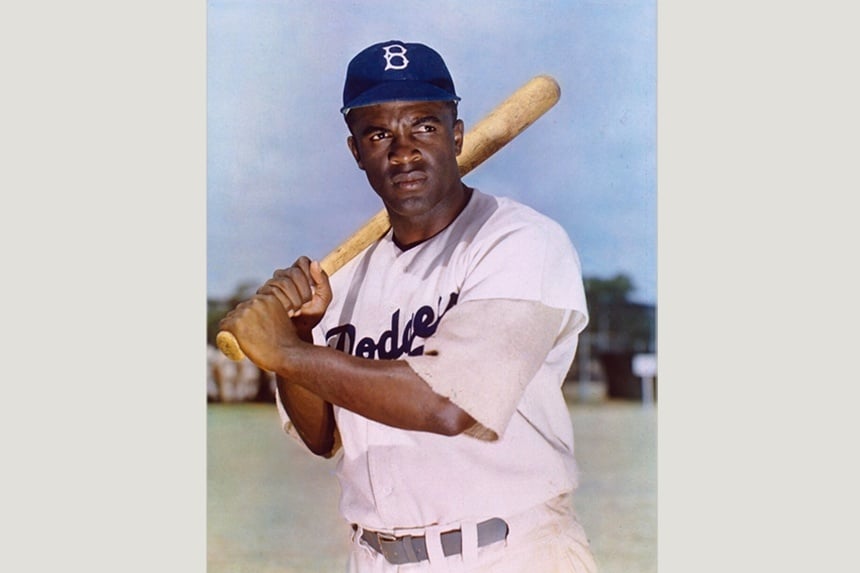
On April 15th, as it has every season since 2004, Major League Baseball celebrated Jackie Robinson Day. No player in Major League nor American sports history is more deserving of such a commemoration than Robinson: He played a central role in integrating the Major Leagues (which began with his first game on April 15, 1947), and he impressively handled that role and all of the challenges it brought with it. He also demonstrated a lifelong commitment to civil rights activism, which I highlighted in this prior column and which Robinson wrote about at length in his autobiography I Never Had It Made (1972).
Jackie Robinson can also help us better remember a largely forgotten teammate and childhood friend, Shigeo “Shig” Takayama.
Robinson opens his autobiography with a moment of change: In 1921, about a year after Robinson’s sharecropper father Jerry abandoned his mother Mallie and their five children, which had happened when Robinson (the youngest) was just 6 months old, Mallie decided to move the family from Cairo, Georgia, to live with her brother Burton in Pasadena, California. Although 1920s Pasadena did not have racially oppressive systems like sharecropping or Jim Crow, it did still feature discriminatory housing “covenants” that limited where non-white families could live. As a result, the neighborhood around the Robinsons’ new home on Pepper Street was quite ethnically diverse. As Robinson writes in his autobiography, “I was a member in good standing of the Pepper Street gang. Our gang was made up of blacks, Japanese, and Mexican kids; all of us came from poor families and had extra time on our hands.”
As Robinson describes it, and as biographers have confirmed, that “gang” was more a community of neighborhood kids than any kind of organized criminal group — a community, Robinson adds, unified by “a growing resentment at being deprived of some of the advantages the white kids had.” Thanks to stories like this 2025 Jackie Robinson Day Guardian article by Pasadena journalist Lynda Lin Grigsby, we’ve learned a lot more about some of Robinson’s childhood neighbors and friends who were part of that community, including Japanese American kids like George Ito and Shig Takayama. Shig’s niece, Joan Takayama-Ogawa, recounts to Grigsby how Shig and others from the neighborhood would walk home from school with Jackie and his siblings, and how “for an after-school snack, they collected free misshapen potato chips from a nearby factory.”
In part one of an extended oral history interview with Richard Hawkins of the Japanese American Military History Collective, conducted in 2003 when Shig was 87 years old, Shig shares his own perspective on another thing that connected him and Jackie when they were teenagers: their talent and love for the game of baseball. As Shig puts it, “I played against [Robinson] in junior high school and I realized how great he was, so, since I was two years older than him, I figured the only way I could play with him was to stay an extra year in junior college.” He did so, and the two played together on the baseball team at Pasadena Junior College (where Robinson starred in four sports) in the 1938 season, with Shig moving from shortstop to third base to make room for Robinson at short. “Baseball was their glue,” writes Nisei Baseball Research Project founder Kerry Yo Nakagawa of the sport’s role in this blossoming relationship between Robinson and Takayama.
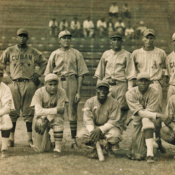
While following that passion to the racially segregated Major Leagues was not possible for either of these young men in the late 1930s, there were still avenues available to baseball players from their respective communities. In the new second season of my podcast Baseball, Bigotry, and the Battle for America, I talk about both the extensive histories of Japanese American semipro baseball throughout the first half of the 20th century and the parallels with the Negro Leagues over those same decades. Those teams and leagues became prominent enough to feature their own World Series, which rivaled MLB’s in fame and audience: The “Negro World Series” was played between league champions in the mid-1920s and again in the 1940s; and the 1935 “Japanese World Series,” was a three-game series that pitted the famous barnstorming semipro squad the Los Angeles Nippons against the Japanese professional team the Tokyo Giants.
Japanese American players became successful enough that one almost integrated the Major Leagues six years before Jackie Robinson’s 1947 debut, but global and national tragedy got in the way. In 1941, star pitcher Henry Honda was signed to a contract by the Cleveland Indians; but before Honda could join the team, the Pearl Harbor attack took place, the Indians voided the contract, and Honda ended up incarcerated at Manzanar internment camp, where he played baseball during the prime years of his career. As Honda later recalled in an interview with Kerry Yo Nakagawa, “You know, I loved baseball then, in the pre-war years and I had a pretty good chance to have a career. I still pitched in the camps and had a pretty good baseball season and career inside the camps, but when I got out my career hopes ended. I loved baseball then and I still love baseball now.”
Like all 120,000 of their fellow Japanese Americans, Shig Takayama and his family were likewise incarcerated, in their case at Arizona’s Gila River camp. Like tens of thousands of Japanese American young men, however, Shig would eventually leave the camp to serve in the U.S. armed forces, seeing extensive action in Europe as he discusses at length in the oral history interview. World War II military service is another inspiring connection between Takayama and Jackie Robinson, but even more inspiring still is what happened to the Takayama home in Pasadena while they were incarcerated. As Grigsby writes, “in the family’s absence, neighbors including the Robinson family helped care for the Takayama home.” As Shig’s niece Joan recounts, “it was as if they walked out one day and then after World War II, came back home.” Perhaps that’s one reason why, Joan adds, “For years, the Takayama family ate black-eyed peas and collard greens on top of white rice.”
As we continue to commemorate Jackie Robinson, each April 15th let’s also celebrate Shig Takayama and his family — and through them, the painful, powerful, profoundly American paired stories of Black and Japanese Americans.
Become a Saturday Evening Post member and enjoy unlimited access. Subscribe now