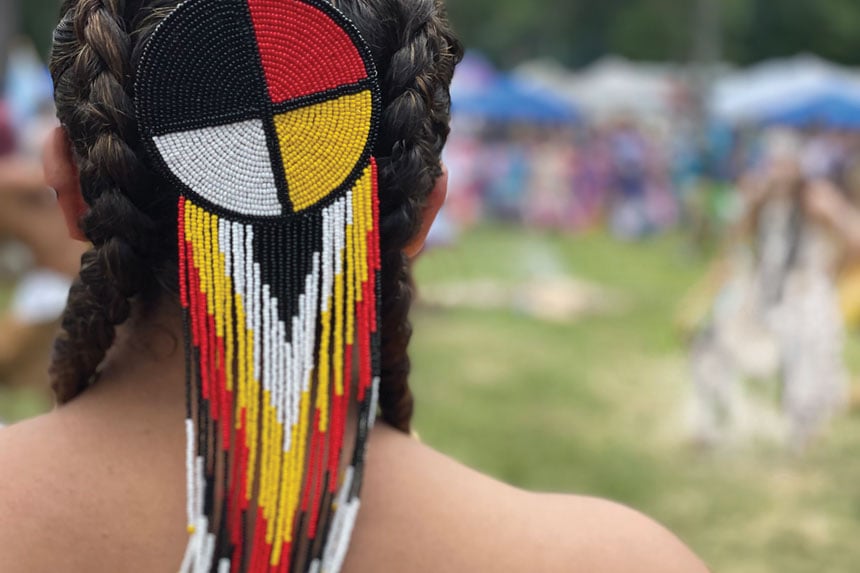
Her visions were no ordinary dreams. For three nights in a row, a circle of unfamiliar faces surrounded Jessie Little Doe Baird as she slept. They spoke a language that Baird, a member of the Mashpee Wampanoag Tribe in eastern Massachusetts, did not know and couldn’t identify. It wasn’t the English she grew up speaking at home. Nor the Portuguese so commonly heard on Cape Cod, where she lives. The vowels were leisurely, slightly nasal; the consonants, soft around the edges.
It was the early 1990s. Only later would Baird, then in her late 20s, realize the mysterious words she heard were Wôpanâak, or Wampanoag, the ancient language of her ancestors, whose last remaining fluent speaker had died some 150 years before. She believes the visions imparted a message — one her people had waited generations for.
“There was a prophecy passed down in our community, and there are references to it in some other languages as well,” says Baird, 62. The version Baird knew, said to be 500 years old, held that the Wampanoag people would one day lose their language, that “the language would leave the community.”
That part had been fulfilled seven generations earlier, when Wôpanâak went quiet, following many years of war, displacement, epidemics, and loss. But the prophecy went on. Eventually, it said, and only when the people were ready, the Wôpanâak language would return home once more.
Reawakening that long-silent language would become a life’s work for Baird, a generation-spanning project unlike any that came before. And today, more than three decades later, Wôpanâak can once again be heard in homes, classrooms, and forests of Cape Cod, where Wampanoag people have lived for more than 12,000 years.
From radio transmissions to social media posts and quiet conversations, we live in a world of near-constant words, so it can come as a surprise that thousands of once-vibrant languages are now on the brink of extinction. Some 44 percent of the more than 7,100 languages in use today are considered endangered by linguists, the researchers who study them. They span cultures and continents, from the Aleut language of Alaska to Argentina’s Tehuelche and the critically endangered Zazao, spoken only by elderly people in the Solomon Islands.
Languages live through their speakers. Often, when the last native speaker dies, their knowledge dies with them. What’s lost goes far beyond vocabulary.
“Language is a big part of identity, of culture,” says Leanne Hinton, an emerita professor of linguistics at the University of California, Berkeley, whose own work has focused on revitalization of threatened Native American languages, including the Havasupai language spoken in northwestern Arizona. “It’s a way of thinking, a way of seeing things. If you lose the meaning of the word, then the word is useless,” says Hinton, explaining that languages can encode worldviews and traditional practices, emotion and humor and ideas. “It’s not always that the word is so important, but the concept that is so important. If you lose the word, you lose the concept.”
A linguistic map of North America is a reminder of the astonishing cultural diversity that greeted Europeans arriving to the continent. Many of the languages once spoken here have already been lost. But it’s still possible to hear the Seneca language amid the forests of western New York, though fewer than 50 fluent speakers remain. And on Maine’s craggy, granitic coast, there are some 500 fluent speakers of Malacite-Passamaquoddy, even if most of them are over the age of 50.
In Maine’s Passamaquoddy reservations, efforts are underway to revitalize the language and to safeguard it for generations to come. They mirror initiatives in Native American communities across the United States, and beyond.
“There’s really been a movement of people discussing how important language is for Indigenous people,” says Brianna Smith, a member of the Passamaquoddy tribe and the director of Speaking Place, a nonprofit in Maine devoted to sustaining endangered languages. In early childhood, Smith spoke the Passamaquoddy language with her grandparents, but it began to slip away once she attended school in English. As an adult raising a daughter of her own, she took stock of what she’d lost and began working to learn more, to share it with others, and to spread the word.
“The language connects to our worldview, and our relationship with everything,” she says. Today, it’s possible to take classes in Passamaquoddy over Zoom; community members can watch online videos of fluent speakers. There’s an online dictionary of nearly 20,000 words, built one-by-one, through intimate, face-to-face interviews with tribal elders — including many conducted by Smith’s grandmother, Margaret “Dolly” Apt.
When Smith’s now-16-year-old daughter reached high school, she took a Passamaquoddy language class. Smith sees it as a sign of positive change. “Even 15 years ago, it never would have happened,” she says.

Revitalizing any endangered language is a massive undertaking, one that strains against countless challenges, from the prevalence of English-language television to still-painful stigmatization and stereotypes. But Jessie Little Doe Baird faced even greater hurdles with Wôpanâak.
Unlike members of the Passamaquoddy community, she had no fluent speakers to interview, no elders to record. No one knew what the language sounded like. Linguists considered it “dead.” All that remained was a trove of historic documents. If Baird had asked an expert, at the time, they might have explained that no dead language, anywhere in the world, had ever returned to life.
“I didn’t actually know that this has never been done, which was really a blessing,” says Baird, recalling the early days of the Wôpanâak Language Reclamation Project, which she co-founded in 1993 with the lofty goal of restoring fluency in her community. Baird had no training in linguistics, so she enrolled in a master’s program at the Massachusetts Institute of Technology, where she began building a Wôpanâak grammar using information from related Algonquian languages, combined with written 17th- and 18th-century documents, including land deeds, legal agreements, and the “Eliot Bible,” a translation of the Bible into the Wôpanâak language by Puritan minister John Eliot that was printed in the 1660s.
Prior to the arrival of Europeans, no Indigenous alphabetic systems existed in North America — the knowledge and history of the Wampanoag people were passed down orally. But once Wôpanâak was written down, in the 1650s, Baird’s ancestors swiftly adapted to the new technology. “More Wampanoag people were literate in Wôpanâak than English speakers were literate in English,” Baird says. “People started writing everything down, and that’s why we have this huge collection of documents today.”
As Baird analyzed the historical archive, the Wôpanâak Language Reclamation Project dictionary swelled to 10,000 words, and kept growing. Even as Baird continued her painstaking academic work, community classes began. Soon, amid Cape Cod’s golden dunes and cranberry bogs, pine forests and beaches, the first stirrings of spoken Wôpanâak were heard. By the early 2000s, some of the tribe’s children, whose ability to acquire new languages far outstrips that of adults, began gathering for regular lessons.
In 2004, when Baird gave birth to a daughter, Mae, the family decided to raise her in Wôpanâak. Now a student at the University of Massachusetts, Dartmouth, Mae grew up speaking it as her first language — making her the first native speaker of Wôpanâak in more than a century.

From the beginning, the groundbreaking nature of Baird’s work drew accolades and support. In 2010, she was a recipient of a grant from the MacArthur Foundation — the so-called “genius” grant — whose funds went to support the effort to revive Wôpanâak. Pulling a language from beyond the brink showed the world it was possible; and in the years since Baird’s vision and subsequent research, new efforts focused on linguistic resilience have cropped up in Native American communities around the United States.
Half a continent away from Cape Cod’s storm-swept coast, linguist Daryl Baldwin, a member of the Miami Tribe of Oklahoma, began studying Myaamiaataweenki. It was his people’s ancestral language, but the last speakers had passed away in the early 1960s. Today, and partly as a result of his work, young members of the Miami Tribe grow up surrounded by the sounds of their language. (Baldwin, like Baird, received a MacArthur Foundation grant.) Within the community, Baldwin has written, the revitalization of language and culture is called myaamiaki eemamwiciki: the Myaamia awakening.
On the eastern bank of Connecticut’s Thames river, the Mohegan Tribe looked to Baird as both inspiration and guide when they sought to reclaim the Mohegan dialect of the Mohegan-Pequot language, which hasn’t been spoken fluently for more than 100 years. (Mohegan and Wôpanâak are related, just two of the dozens of languages in the Algonquian language family that extends from the Atlantic coast to the Rocky Mountains.)
In 2012, the tribe established the Mohegan Language Learning Project, and teachers, trained in an apprenticeship-based program, worked with Baird to create language-learning workbooks. Such grass-roots, local efforts show great promise, Baird says. “I believe that much of language reclamation work is most successful when it’s conducted by Indigenous people from that same community,” she says.
Baird’s work to reclaim Wôpanâak now spans more than three decades, a time in which at least 500 students have participated in classes ranging from a preschool program to a master apprentice program. Their skills vary widely. Master apprentices are full-time language learners, with a salary and the goal of teaching others — of “bringing other people along,” as Baird describes it. “There are probably nine people in the community [whose fluency] is somewhere on the scale where they could bring other people along,” Baird says.
It’s an astonishing success. Yet when it comes to endangered languages — which Wôpanâak still very much is — even such milestones have an air of fragility. “I don’t believe that these languages will ever again be the languages of their communities where everyone speaks it to each other,” says Leanne Hinton, the emeritus linguistics professor, noting that even relatively widely spoken Indigenous languages, like Navajo, face enormous pressure from the English-speaking world that surrounds them.
Still, she says, even a small number of speakers can have a powerful impact on the long-term survival of their languages. “What I have come to believe is that, in most cases, they will find a few people, every generation, who will become specialists in the language, and that there will be opportunities for people to learn it … the language will be back in the community in one way or another.”
In Baird’s own community, those specialists include her children. The current interim director of the Wôpanâak Language Reclamation Project, Tracy Kelley, is Baird’s daughter. Like her mother, and despite the challenges, Kelley remains hopeful.
“We lost our language over the course of quite some time, right? It’s going to take some time to repair that circle,” she says. Kelley studied first as a language apprentice, then went on to get a master’s degree through MIT’s Indigenous Languages Initiative. She’s also the creator of Kun8seeh, a website where tribal households can access online language resources.
Learning and sharing her ancestral language, Kelley says, has transformed the way she sees the world around her. Today, when she takes road trips along the eastern seaboard, she finds herself scanning street signs and place names and maps for Indigenous words that hint at the area’s history, at the long and ongoing story of North America’s native peoples. That sense of interconnectedness fuels her commitment to safeguarding her language for generations yet to come.
“Reclamation is possible. It’s a sacred journey,” she says. “It’s a long journey, but I think it’s one of healing.”
Jen Rose Smith has written for The Washington Post, CNN Travel, Condé Nast Traveler, AFAR, Rolling Stone, USA Today, and Outside Online and is the author of six travel guidebooks to Vermont and New England. For more, visit jenrosesmith.com.
This article is featured in the November/December 2025 issue of The Saturday Evening Post. Subscribe to the magazine for more art, inspiring stories, fiction, humor, and features from our archives.
Become a Saturday Evening Post member and enjoy unlimited access. Subscribe now


Comments
Quite an uplifting and inspiring article. While reading I thought of the lyrics from Paul Revere & the Raiders “Indian Reservation” hit tune…..”took away our native tongue, taught their English to our young.”