The Testament of Ann Lee
⭐️ ⭐️ ⭐️
Rating: R
Run Time: 2 hours 17 minutes
Stars: Amanda Seyfried, Lewis Pullman, Thomasin McKenzie, Christopher Abbott
Writers: Brady Corbet, Mona Fastvold
Director: Mona Fastvold
Reviewed at the Toronto International Film Festival
A stately, historical fever dream blessed with a ferocious performance by Amanda Seyfried, The Testament of Ann Lee relates the origin story of a nearly extinct American religious sect with unblinking authenticity and Olympian artistry.
You have probably heard of the Shakers — the group who in the 18th century captivated America with their riotous worship services and strict communal living, and who in later years became renowned mostly for their simple, extraordinarily practical furniture. Less well known is the sect’s founder, Ann Lee, an uneducated Englishwoman who, emotionally traumatized by losing four babies in childbirth, nevertheless convinced thousands of followers that she was, in the flesh, the Second Coming of Jesus Christ.
Here, Ann is played by Seyfried with the intensity of a raging housefire. Eyes ablaze, infuriated by inequities both social (the subjugation of women) and inexplicable (the loss of her children), young Lee latches onto the exuberant services of England’s “Shaking” Quakers, whose moaning, screaming, bellowing, singing-at-the-top-of-their-lungs manner of worship caused more than a few stiff upper lips to quiver in Georgian England.
At one raucous house service, Ann meets handsome young Abraham Standerin (Christopher Abbott). The two wed, but their repeated attempts at becoming parents end tragically in stillbirths. The unspeakable losses drive Ann to the brink of madness.
Ann ratchets up her religious fervor to the point where local Church of England authorities, who consider the Quaker form of Christianity heretical, throw her into prison. And it is there, sick and starving and sleeping on a pile of hay, that Ann has her revelation: She is the Christ, the female Second Coming, proof of the notion that God, having created both males and females, is in fact the embodiment of both genders.
Few things in life are more empowering, it seems, than the realization that you are God. Emboldened, Ann gathers a handful of the faithful and sets sail for America, where she plans to establish a new spiritual order and the Earthly Kingdom. There are lots of rules, of course: hard work, frequent open worship, and, perhaps most significantly, no sex, not even between married people (a notion that becomes something of a problem for Ann’s husband). The only way Ann’s community of Shakers will ever grow, it turns out, will be through evangelism, a task at which her charismatic brother William (Lewis Pullman) is spectacularly adept.
Whatever miracles Ann perceives in her spiritual journey, the truly transcendent phenomenon here is Seyfried, who uncannily traces Ann’s exodus from a broken victim of circumstance to an iron-spined leader of men and women. Igniting those sapphire-blue eyes, Seyfried takes no prisoners as a woman who may not know exactly what she wants for herself, but who is fiercely aware of the way she wants the world to be.
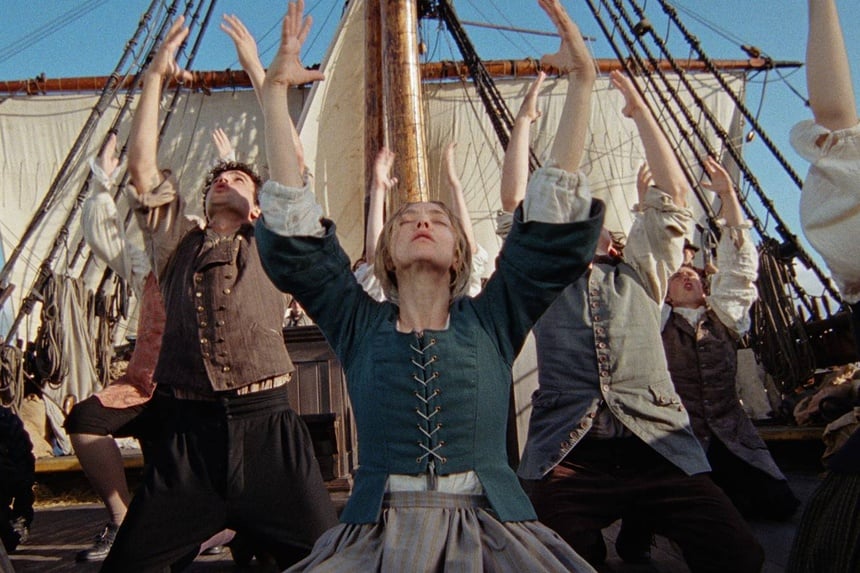
The Testament of Ann Lee doesn’t bill itself as a musical, but it is very much one: Time and again the narrative comes to a standstill for a song drawn from the traditional Shaker hymnal. Composer Daniel Blumberg’s adaptation of the hymns — along with a handful of original songs — adds an ethereal layer to an already otherworldly film, asking the performers to not only sing, but also grunt and wail and bellow with the sort of abandon that made the Shakers outlandish outliers on the American frontier. Choreographer Celia Rowlson-Hall stages the worship scenes as borderline orgiastic tangles of movement that threaten to, at any moment, escalate into cataclysmic spiritual detonation.
Utilizing the rich, shimmering visuals of large-format photographic film, co-writer/director Mona Fastvold illuminates a story that is at once torturously intimate and historically epic (her co-writer, director Brady Corbet, likewise shunned digital cameras in favor of film for his sprawling Oscar-winner The Brutalist).
Impeccably performed by a fully committed cast and lushly offered by a visionary director, The Testimony of Ann Lee is a gorgeous, if often uncomfortable, reminder of the virtues and villainy of blind adherence to spiritual and social norms.
At its peak in the mid-1800s, the Shakers sect counted 5,000 members. The film ends with a note that there are presently two surviving Shakers, living in Maine. It’s worth noting that since the film’s completion, membership has increased by 50 percent.
Become a Saturday Evening Post member and enjoy unlimited access. Subscribe now