“Sound has power!”
The audiologist Deanna Meinke was holding a tuning fork in one hand, and in the other, a Ping-Pong ball dangling from a string — a representation of the inner ear. Her demonstration was well rehearsed: A professor of audiology at the University of Northern Colorado, Meinke is also the codirector of Dangerous Decibels, a nationwide initiative encouraging kids to safeguard their hearing.
Meinke struck the tuning fork against her desk and raised it slowly to the Ping-Pong ball, which sprang away, fell back, then jumped again, dancing spastically until the fork’s hum faded. When she made her wide-eyed declaration that sound has power, her voice lingered on the word power as if casting a spell.
While sound is invisible and ephemeral, it is, fundamentally, a wave of energy triggering a cascade of molecular collisions. From the standpoint of physics, the drop of a pin and an earthquake are close cousins.
Sound moving through the air at sea level cannot exceed 194 decibels, at which point the energy of the sound wave exceeds the atmospheric pressure, pushing the air rather than moving through it, producing a shock wave. In a denser medium, molecules smash together more rapidly, which is why sound moves through water about four times faster than it does through air. In the vacuum of space, by contrast, there are no molecules to vibrate, and silence reigns. As the famous tagline from the 1979 sci-fi classic Alien put it, “In space, no one can hear you scream.”
When we think of noise primarily as loudness and define it by decibels, we are measuring the energy punch that the sound packs, regardless of its source, its meaning, or any other context. This punch can indeed be powerful, potentially damaging the inner ear’s delicate anatomy and causing hearing loss. This alone makes exposure to noise a large and growing public-health problem. According to the Centers for Disease Control and Prevention, about 40 million American adults have noise-induced hearing loss, and by 2060, the number could top 73 million.
But the threat noise poses to our hearing is greater than degraded sensory perception. We hear with our brains as much as our ears, and the fallout of hearing trouble isn’t trivial: Kids who can’t hear well in school are more likely to have delayed cognitive development and struggles with learning, while adults with hearing loss are at an increased risk of social isolation, depression, and dementia.
The deeper we venture into our hearing system, the more the problem of noise expands from decibels alone to something much more complex — something that harms the intricate connections between ear and brain in ways that are far more insidious than we realize. The damage can also profoundly affect our connections with one another.
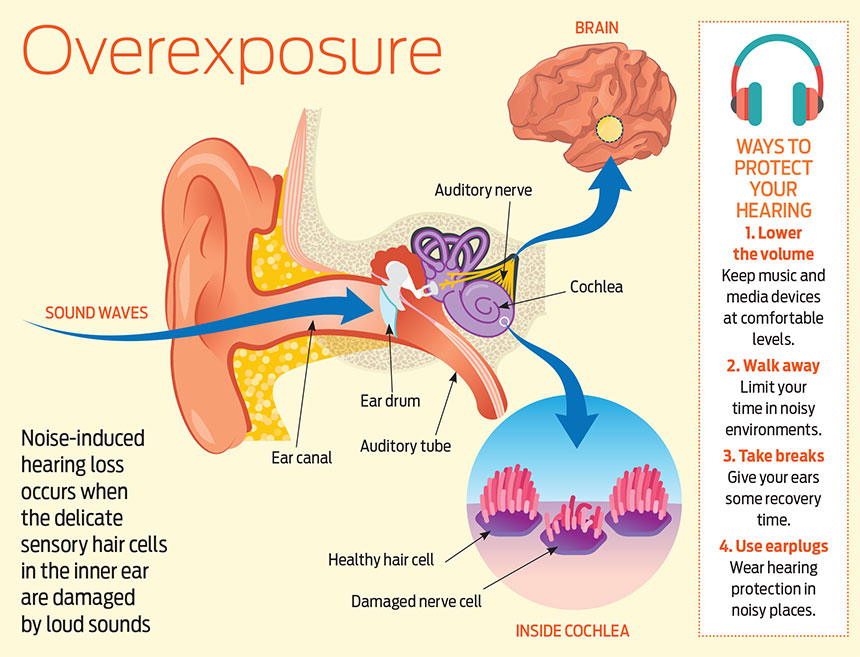
Any exploration of noise must begin here — before a sound is noise, before it is even a sound. A pulse of energy passes through the air until it vibrates your eardrum, the translucent membrane at the boundary to your middle ear. There, three tiny bones known as the ossicles work like a kick-drum pedal to transfer that energy to a much smaller membrane at the entrance to your inner ear and the spiraling snail of fluid-filled bone known as the cochlea. Inside your cochlea, wavelets in the fluid triggered by the vibrations jostle thousands of “hair cells,” which line the length of the spiral and are named for the tufts of hairlike stereocilia protruding from their tips.
A hair cell bent by acoustic energy releases the chemical neurotransmitter glutamate into neural connections at its base, which are known as synaptic ribbons. These synapses then fire off electrical impulses to the auditory nerve, which ferries the acoustic signals to the brain, allowing you to hear.
This is where loudness can start to cause trouble. Louder sounds carry more acoustic energy and trigger a larger release of glutamate. Too much high-decibel excitement causes hair cells to overfill their synaptic ribbons with glutamate, to the point where they swell up and pop — a grisly process known as excitotoxicity. Eventually, the battering caused by noise will kill off entire hair cells.
How much loudness is too much is a matter of ongoing debate. The National Institute for Occupational Safety and Health (NIOSH), for instance, suggests a limit of 85 decibels, which is as loud as heavy traffic, over an eight-hour workday. But that doesn’t mean that 85 decibels is “safe”; it is simply the threshold that a 50-year-old study had linked with a 15 percent rise in the risk of hearing loss for workers, compared to a 29 percent jump at 90 decibels. Both the Environmental Protection Agency and the World Health Organization, meanwhile, recommend that people cap their exposure at 70 decibels (dishwasher loud) over 24 hours.
Most of us have no idea how close we are to these decibel danger zones because almost all the loudness in our lives goes unmeasured. The best data comes from workplaces, and even that is quite limited. In the United States, NIOSH has traditionally focused on a handful of industries in which the most noise hits the most ears, namely, manufacturing, construction, and mining. There, workers’ rates of hearing loss hover between 20 and 25 percent.
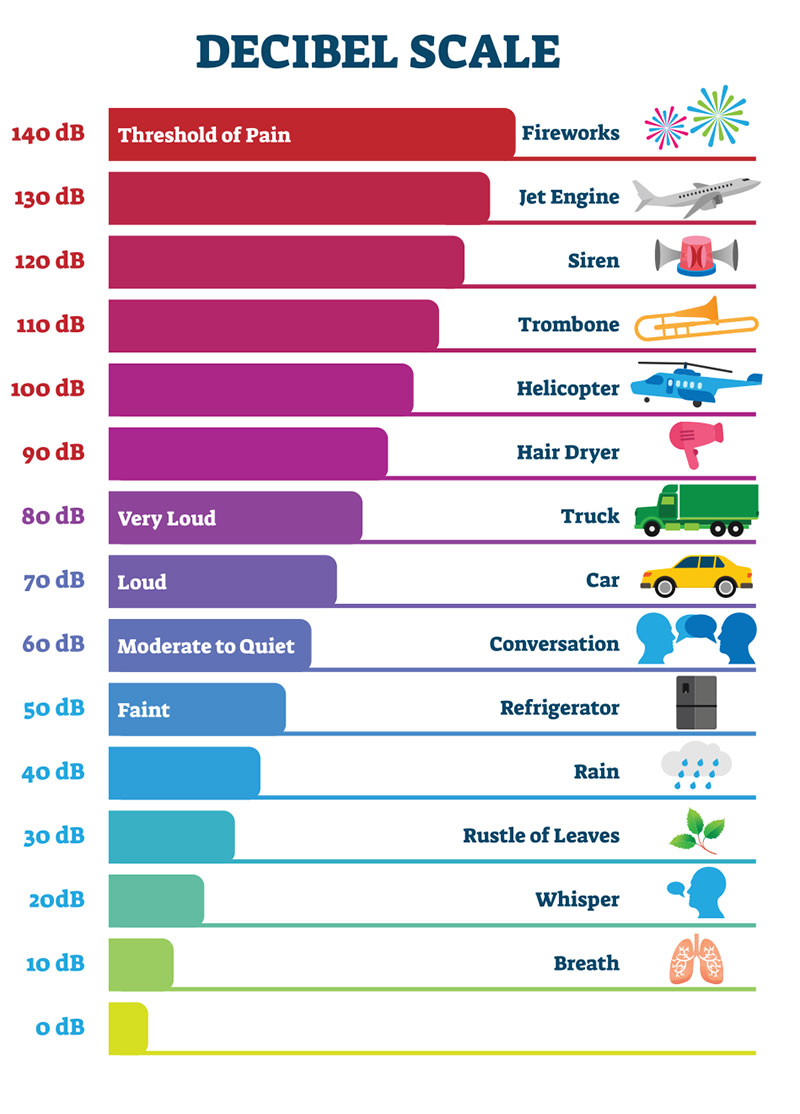
Even less is known about our exposure to non-occupational noise. Spot-checks of New York City’s subway platforms, for example, found that trains screeching into stations emitted up to 111 decibels. A 2021 analysis of hour-long measures of sound levels at ten Nashville music venues found that they averaged 112 decibels and topped 101 decibels 90 percent of the time.
Some loudness is unavoidable, some is forced upon us, and some we choose. But it all adds up. Your ears don’t care if the decibels come from your job, your local bar, or your power tools. They don’t care whether the music blasting from your earbuds is rock, country, or hip-hop. If the sound is loud enough, it will cause damage, and a tiny piece of your sonic world will be lost.
Clearly, the most effective antidote to noise-damaged hearing remains prevention. Yet judging by NIOSH numbers alone, protecting our ears remains a hard sell, despite decades of noise guidelines and awareness campaigns. Outside of work, the idea of hearing protection barely registers.
“We protect what we value,” said Deanna Meinke, the Colorado professor who directs the Dangerous Decibels program, “and I don’t think people value their hearing consciously.”
She and other audiologists suggest that this apathy about our ears is driven by two main factors. First, many people falsely assume that hearing loss is simply part of growing old, like graying hair and wrinkles. Why worry about the inevitable? In truth, hearing acuity does degrade naturally with age, but studies show that a lot of “age-related” loss is likely due to a persistent auditory assault over the years, rather than the years themselves. Second, hearing loss is usually incremental; hearing erodes gradually, as sharpness declines and tones get muddled. And when our auditory inputs falter, our brains do their best to plug the gaps with a mix of memory and prediction. This slow decay disguises the true extent of what we lose as hearing fades.
Getting people to truly care about hearing before it fades will take a more powerful motivator than scary statistics and stricter regulations. It will require a shift in the social norms that swirl around hearing loss. Imagine a future in which hearing devices carry no more stigma than prescription glasses, in which awareness of hearing’s value, and vulnerability, at every age is more widespread, in which nobody looks askance at concertgoers who don a pair of musician’s earplugs before the show.
Despite their patina of permanence, social norms can change rapidly. In the late 1980s, for instance, hardly any musicians or their audiences wore hearing protection — it simply wasn’t rock ’n’ roll. That’s when the punk-rock bassist Kathy Peck found herself needing hearing aids in her 20s and founded HEAR, or Hearing Education and Awareness for Rockers. Soon, some of the world’s biggest rock stars started speaking out about the hearing loss and tinnitus they endured, thanks to their years onstage. Pete Townshend, guitarist for the Who and a tinnitus sufferer, kicked in $10,000 to HEAR’s cause and appeared in the nonprofit’s 1991 documentary Can’t Hear You Knockin’, along with other stars: Debbie Harry, Ray Charles, Lars Ulrich of Metallica, and Mickey Hart of the Grateful Dead. Years of awareness raising followed. Today, in-ear devices that both protect musicians’ hearing and provide them with a clear feed of their own audio are standard gear on stage.
There is also a growing focus on noise and hearing in the realm of personal health tracking, an expanding billion-dollar universe of wearable technologies that keep tabs on everything from sleep to stress to cardiovascular fitness.
While protecting our ears from loudness remains our best weapon against irreversible hearing loss, the motivation to do it will require a deeper appreciation of everything we are protecting. There is a link between defining noise as loudness and considering hearing loss only in terms of degraded sensory perception — this mechanistic framing undersells the threat. Hearing, like our other senses, connects us to our world and to ourselves, and severing these connections cuts deep.
Simply put, ear protection is pro-sound, something Meinke stresses. “Our intention is never to tell people to stop doing noisy things,” she said. “We want to equip them with the strategies to make healthy choices.” Sometimes that means using earplugs. Sometimes it’s turning down the volume. Other times, it’s knowing when to walk away. Meinke preaches flexibility. Some protection is better than no protection. Sooner is better than later, and it’s never too late.
Excerpted from Clamor: How Noise Took Over the World — and How We Can Take It Back. Copyright ©2025 by Chris Berdik. Used with permission of the publisher, W. W. Norton & Company, Inc. All rights reserved
Chris Berdik is a freelance science journalist and author of Mind Over Matter: The Surprising Power of Expectations. His work has appeared in Popular Science, Wired, New Scientist, and The New York Times, among other publications.
This article is featured in the March/April 2026 issue of The Saturday Evening Post. Subscribe to the magazine for more art, inspiring stories, fiction, humor, and features from our archives.
Become a Saturday Evening Post member and enjoy unlimited access. Subscribe now


Comments
“We protect what we value.” I definitely agree with Deanna Meinke, the Colorado professor who directs the Dangerous Decibels program. And the 2nd part “I don’t think people value their hearing consciously.” People tend to value very little, very little of the time, until it’s too late. That’s what happens with the death of common sense.