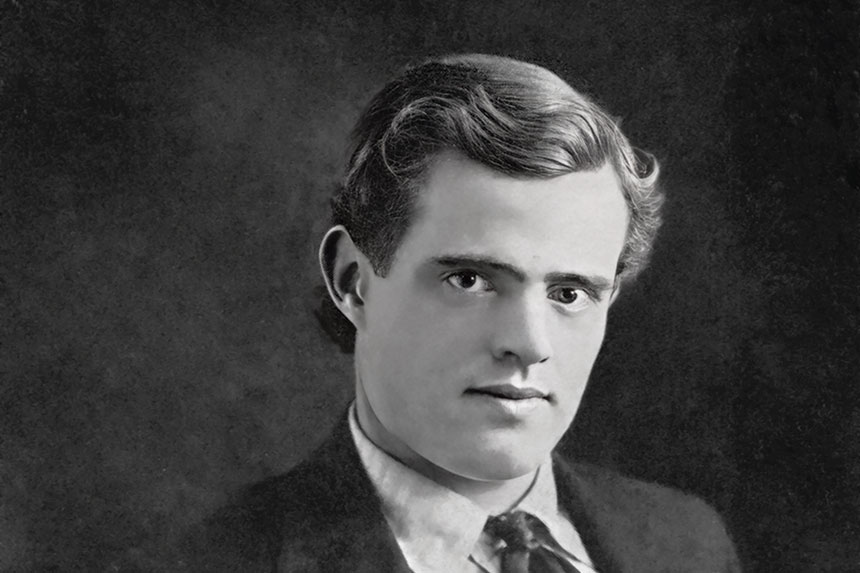
His rise to fame took a unique path. Born and raised in poverty, London traveled the world as a sailor — and the United States as a hobo — before settling down to educate himself. Studying in public libraries, he crammed a four-year high school education into one year and was admitted to the University of California at Berkeley. Yet he only stayed a year before abandoning his studies and taking off for the gold fields of Alaska. After a year of fruitless mining, he returned south and, when he couldn’t find work, began writing for magazines. Here he finally found success. His novel The Call of the Wild was first serialized in The Saturday Evening Post, and it was followed by 16 other works in the magazine. Over the next 17 years, he produced 50 books of fiction and nonfiction.
London was a lover of the wilderness and its creatures, and, as a militant socialist, a stern judge of the comfortable and conforming. As the story “Under the Deck Awnings” shows, he felt the privileged could be guilty of a dangerous recklessness.
Under the Deck Awnings
By Jack London
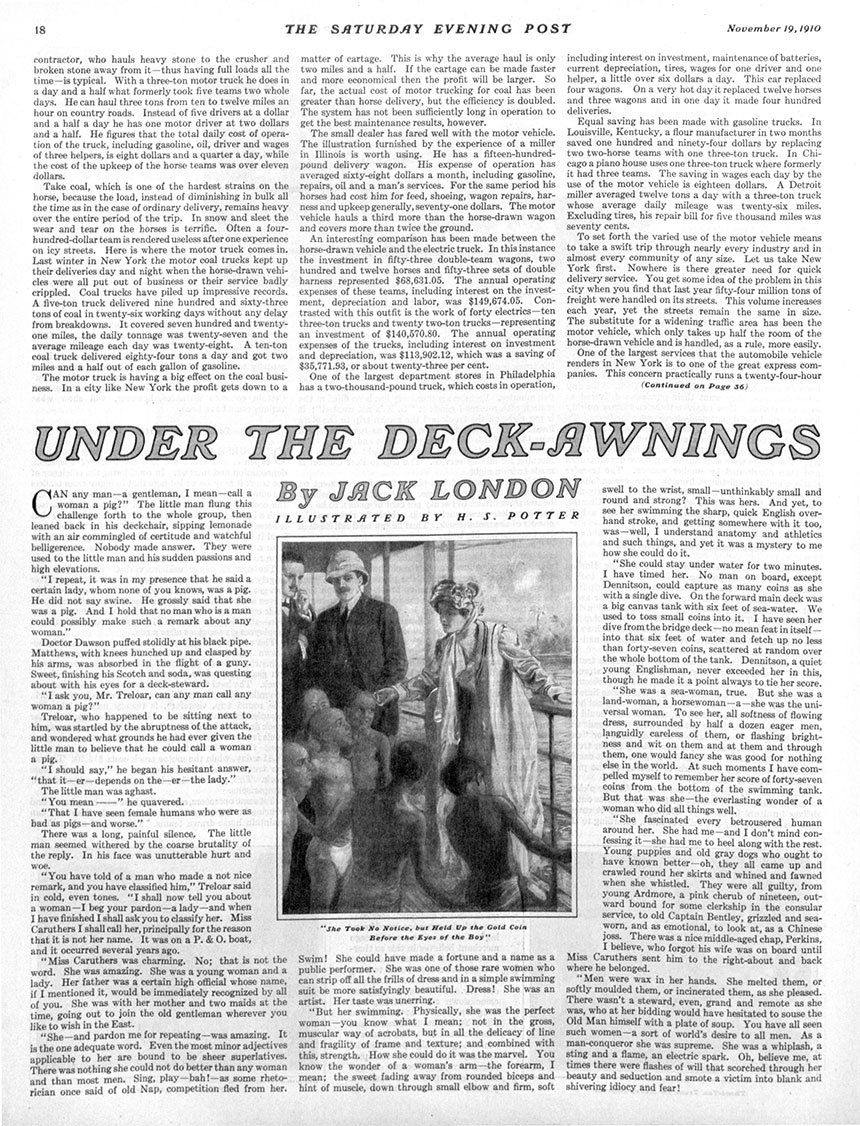
As a group of men sits around in deck chairs, one says he is shocked that a man could refer to a woman as a pig. Beside him, Mr. Treloar replies that he has known women as bad as pigs, and worse. He tells the story Miss Caruthers, a proud but charming young woman who captured the hearts of all the men onboard a ship. One day, off the coast of Sri Lanka, she watched as native boys dove from the ship’s railing to catch coins the passengers threw into the water. But the boys all rushed aboard when a shark was spotted. Convinced that natives aren’t afraid of sharks, Miss Caruthers throws a silver coin overboard; the boys refuse to dive. Dennitson, an Englishman, warns her not to try it again with a more valuable coin.
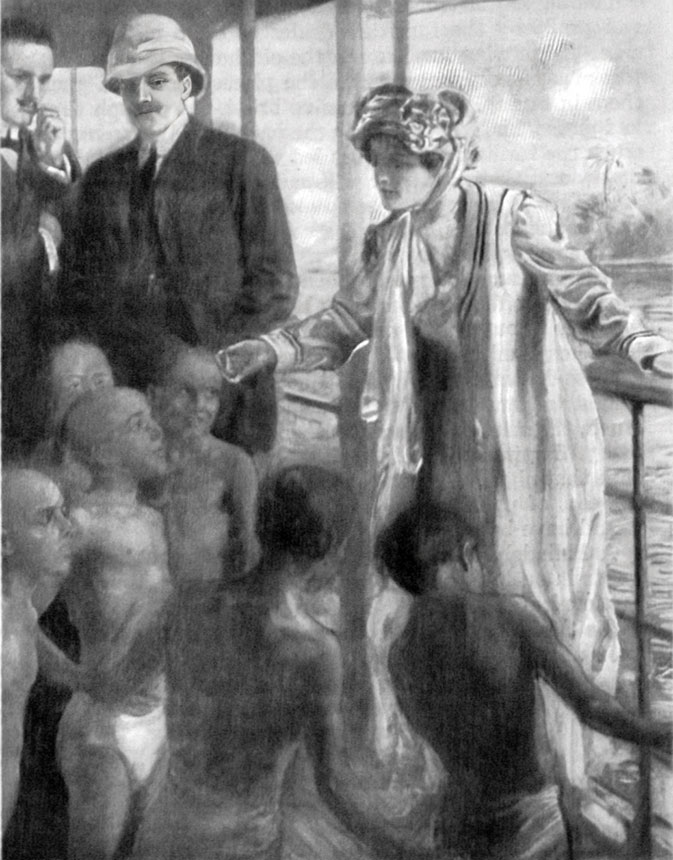
Don’t tempt him,” Dennitson urged. “It is a fortune to him and he might go over after it.”
“Wouldn’t you?” she flared at him. “If I threw it?” This last more softly.
Dennitson shook his head.
“Your price is high,” she said. “For how many sovereigns would you go?”
“There are not enough coined to get me overside,” was his answer.
She debated a moment, the boy forgotten in her tilt with Dennitson.
“For me?” she said very softly.
“To save your life — yes; but not otherwise.”
She turned back to the boy. Again she held the coin before his eyes, dazzling him with the vastness of its value. Then she made as if to toss it out, and involuntarily he made a half movement toward the rail, but was checked by sharp cries of reproof from his companions. There was anger in their voices as well.
“I know it is only fooling,” Dennitson said. “Carry it as far as you like, but for Heaven’s sake don’t throw it.”
Whether it was that strange willfulness of hers, or whether she doubted the boy could be persuaded, there is no telling. It was unexpected to all of us. Out from the shade of the awning the coin flashed golden in the blaze of sunshine and fell toward the sea in a glittering arch. Before a hand could stay him the boy was over the rail and curving beautifully downward after the coin. Both were in the air at the same time. It was a pretty sight. The sovereign cut the water sharply, and at the very spot, almost at the same instant with scarcely a splash, the boy entered.
From the quicker-eyed black boys watching came an exclamation. We were all at the rail. In the clear water, from the height we were above it, we saw everything. The shark was a big brute and with one drive he cut the boy squarely in half.
There was a murmur or something from among us — who made it I did not know; it might have been I. And then there was silence. Miss Caruthers was the first to speak. Her face was deathly white. “‘I — I never dreamed!” she said, and laughed a short, hysterical laugh.
All her pride was at work to give her control. She turned weakly toward Dennitson, and then on from one to another of us. In her eyes was a terrible sickness, and her lips were trembling. We were brutes — oh, I know it, now that I look back upon it; but we did nothing!
“Mr. Dennitson,” she said — “Tom, won’t you take me below?”
He never changed the direction of his gaze, which was the bleakest I have ever seen in a man’s face; nor did he move an eyelid. He took a cigarette from his case and lighted it. Captain Bentley made a nasty sound in his throat and spat overboard. That was all — that and the silence.
She turned away and started to walk firmly down the deck. Twenty feet away she swayed and thrust a hand against the wall to save herself; and so she went on, supporting herself against the cabins and walking very slowly.
—Originally published November 19, 1910
This article is featured in the May/June 2026 issue of The Saturday Evening Post. Subscribe to the magazine for more art, inspiring stories, fiction, humor, and features from our archives.
Become a Saturday Evening Post member and enjoy unlimited access. Subscribe now