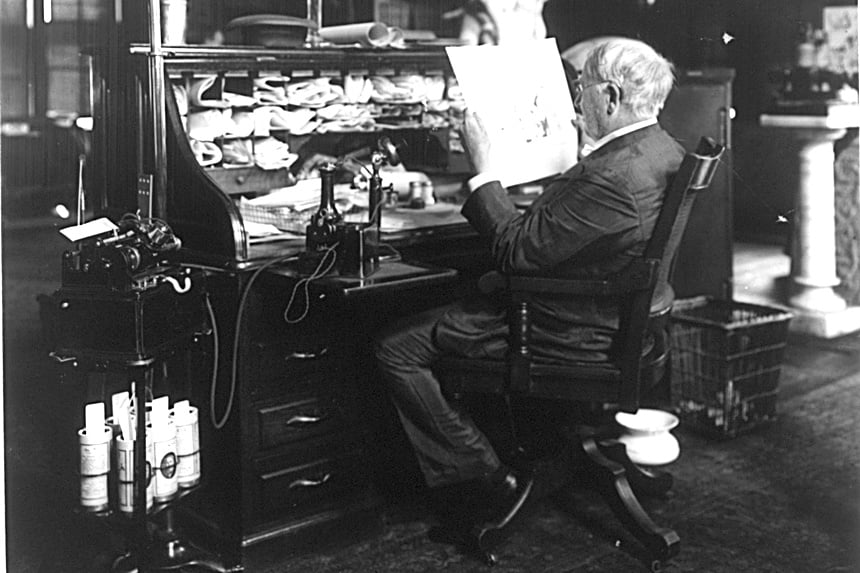
Thomas Edison didn’t have a high opinion of college education.
His own education had been unorthodox. As a child, he had received only a few months of formal schooling. He was largely home-taught by his mother, who encouraged him to pursue learning on his own. The young Edison eagerly read all he could about chemistry, electricity, and steam engines. On the way of becoming an autodidact, he picked up a lot of miscellaneous knowledge that was the sort of information he wanted his managers to know.
So when college graduates applied for jobs at his facilities, he gave them a lengthy test of knowledge they wouldn’t have picked up in their courses.
The questionnaire, which usually ran to more than 140 questions, differed according to the position. A few questions would evaluate the applicants’ technical and business knowledge, but most tested their general knowledge and memorization of facts.
More than 718 applicants took his tests. Just 32 received a passing grade of 90 percent or higher. Even Edison’s son, Theodore, then a student at MIT, failed it.
The New York Times heard about the test and was curious why so few applicants passed.
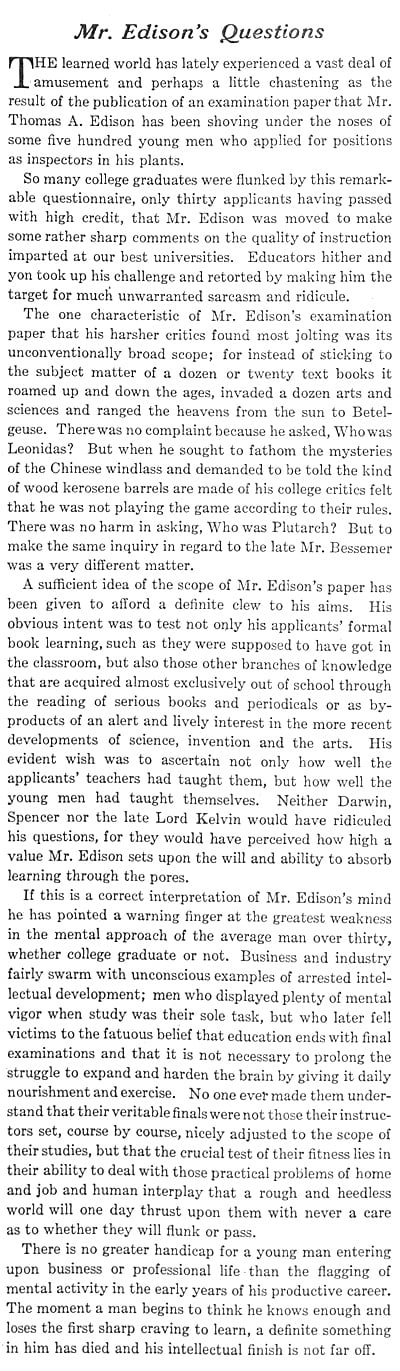
Edison didn’t release copies of the questions, but one of the applicants with a good memory — though not good enough to pass the exam — gave reporters a list of the questions he remembered:
- What large river in the United States flows from south to north?
- What country produces the most nickel?
- Where was Lincoln born?
- What causes the tides?
- Who invented photography?
- In what country other than Australia are kangaroos found?
- What country exports the most coffee?
- What states bound West Virginia?
- What countries surround France?
- What voltage is used on street cars?
- How is sulfuric acid made?
- Who Was Francis Marion?
- Where is Copenhagen? Kenosha?
- What is the price of twelve grains of gold?
- What is the largest telescope in the world?
- What is a Chinese windlass?
- Who was Pizarro?
- Where is Manchuria?
- What is the difference between bituminous and anthracite coal?
- What kind of machine is used to cut the facets of diamonds?
- What is a foot pound?
- What is the distance between the earth and the sun?
- Where are condors found?
- What is the second largest state (in 1921)?
- What is the second smallest state?
- What pressure at the driving wheels does a 25-ton locomotive require when drawing a load of 100 tons on level track?
- If six bricks were placed on a glass plate, would it require more effort to move them if placed side by side or on top of one another?
- What ingredients are in the best white paint?
- On what principle is the telephone based?
- What is the name of a famous violin maker?
- Of what state is Helena the capital?
In reporting on Edison’s questionnaire, the May 11, 1921, issue of the New York Times included remarks from some of its critics. Some said the questions were demeaning and better suited to a high school student just out of school than an engineer with years of experience. Others said the questionnaire only measured a man’s memory and store of miscellaneous information. It ignored an applicant’s knowledge, reasoning ability, and intelligence.
In a June 18, 1921 editorial, the Post editors praised Edison’s questionnaire. Their editorials often criticized college education, which they thought didn’t include enough practical information. They were glad that Edison valued more than classroom learning, and that he wanted applicants who had extended their learning on their own.
Albert Einstein, who was visiting Boston in 1921, was given the list of questions the applicant had recalled. When he came to the question “What is the speed of sound?” he admitted he didn’t know. And he added, “I don’t burden my memory with such facts that I can easily find in any textbook.”
Einstein, who had a PhD in physics, disagreed with the value of memorized facts. He defended the importance of a college education, saying, “It is not so very important for a person to learn facts. For that he does not really need a college. He can learn them from books. The value of an education in a liberal arts college is not the learning of many facts but the training of the mind to think something that cannot be learned from textbooks.”
Become a Saturday Evening Post member and enjoy unlimited access. Subscribe now



Comments
The Manager of electric motors design/development &-etc. here in Peterborough Ontario Canada, devised his own “acceptance” questionaire for graduate engineers applying for a position.
They had to learn how to use a Chinese abacus taught by the owner of a Chinese laundry near to the high school.
Any motor design or size, or useage, had to have a proposal using the abacus, then confirmed by using the slide rule to be accepted by him.
Ouch !!
Sincerely.
Gord Young Peterborough Canada, {still not in the 51st state]