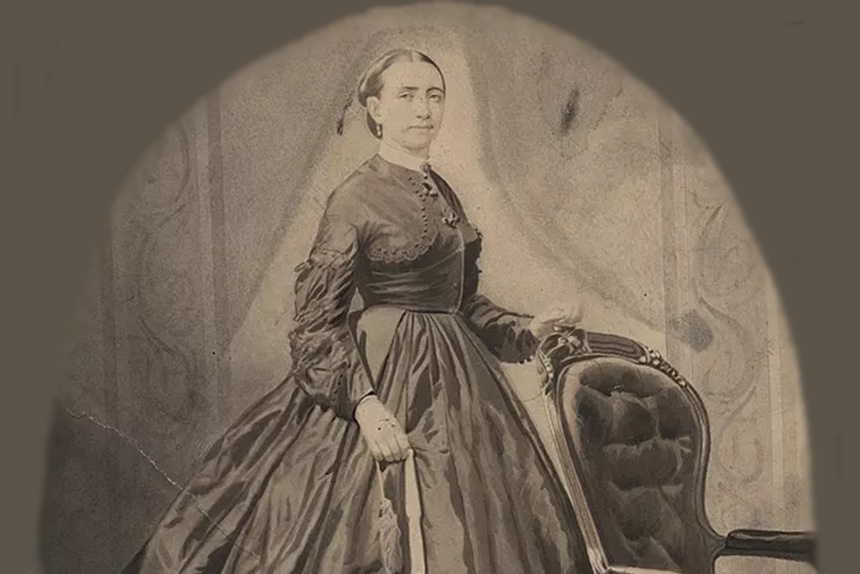
In July 1856 when 23-year-old Kate Warne answered an ad for a detective at Pinkerton’s Chicago agency, Allan Pinkerton was stunned. It was “not the custom to employ women detectives,” he told her. Warne persisted, claiming that “she could go and worm out secrets in many places to which it was impossible for male detectives to gain access.” She added that women more easily befriended other women whose husbands and mates were suspected criminals, especially since those men often bragged to them about their deeds.
Pinkerton decided to hire Kate Warne that day, and she went on to become one of the shrewdest detectives of the 19th century.
Within two years, Warne proved her value after she befriended the wife of Nathan Maroney, a suspect in the $50,000 embezzlement of the Adams Express, a freight and cargo company. Warne replaced her northern accent with a southern one and eventually won the wife’s trust. Using information she gleaned from her “friendship,” Warne not only proved the suspect’s guilt, but also facilitated the return of nearly $40,000 after forcing the embezzler to make a full confession.
Pinkerton was so impressed with Warne that in 1860 he appointed her head of his new Female Detective Bureau in Chicago. Soon afterwards, Warne recruited Elizabeth H. Baker and Hattie Lawton for her bureau; they both later served as Union spies during the Civil War.
The same year that Pinkerton appointed Warne head of the Female Detective Bureau, Abraham Lincoln was elected to the presidency, outraging the Southern states that had seceded from the Union. Their secession created hostilities and disruptions in trade, including reports of threats to the Philadelphia, Wilmington and Baltimore Railroad. Pinkerton sent Warne and other agents to Maryland to investigate. On February 2, 1861, after Warne informed him about a plot to assassinate President-elect Abraham Lincoln, Pinkerton assigned her to Baltimore to find out more. As she did in the Maroney case, Warne disguised herself as a wealthy southern lady. She wore a cockade pin signifying allegiance with the rebels, hobnobbed with locals at secessionist social gatherings, and uncovered key details about the assassination plot. To do so she had to “cultivate the wives and daughters of suspected plotters.”
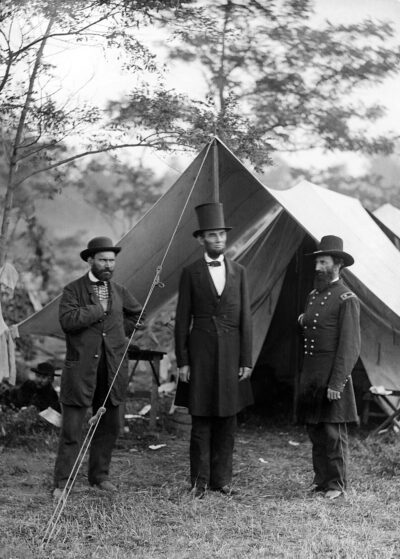
By then, the president-elect was planning a whistle-stop tour from Illinois to Washington, D.C. leading up to his inauguration. One of those stops was in Baltimore, a hub for southern trains. Lincoln’s train would terminate at Calvert Street Station, and he would need to be driven by horse and carriage from Calvert Street to the connecting train at Camden Street Station. It was during that transfer, Warne discovered, that the secessionists planned a street brawl that would immediately summon Baltimore’s police force. Inevitably, that would leave Lincoln “entirely unprotected and at the mercy of a mob of Secessionists.”
After being told about the plot, Lincoln seemed skeptical, but when Frederick W. Seward, the son of William H. Seward, the secretary-of-state designate, confirmed it, the president-elect agreed to amend his travel plans. After arriving in Harrisburg, Pennsylvania, Pinkerton arranged for Lincoln to travel to Philadelphia on a secret Pennsylvania Railroad train. The detective also had the telegraph lines temporarily closed to avoid publicity.
As Pinkerton had planned, on February 22, Lincoln changed clothes at the Philadelphia station, wearing a loose overcoat, a hat pulled over his forehead, and a shawl to disguise himself as an invalid. Surprised to see a woman detective as part of the Pinkerton team, he told Warne, “I believe it has not hitherto been one of the prerequisites of the presidency to acquire in full bloom so charming and accomplished a female relation.”
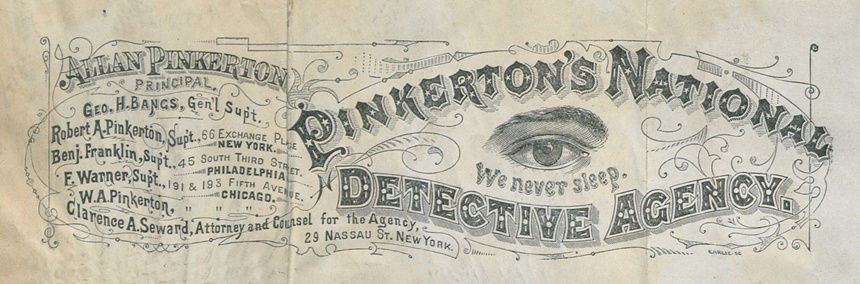
Warne had also arranged for four berths on a Baltimore-bound train for her “sick” brother, herself, and two relatives. The train arrived in Baltimore around 3:30 p.m. Lincoln and his party were secretly transported by carriage to the Camden Street Station where they caught a 4:30 a.m. train for Washington, D.C. During that trip Warne stayed awake all night, which subsequently inspired the Pinkerton agency’s slogan “We Never Sleep.”
The Baltimore Plot, as the foiled plan was later dubbed, was the most famous of Warne’s operations as a detective. Later, during the Civil War, Warne continued her spy work, often infiltrating Confederate groups by posing as a Southern sympathizer and sending the information to Pinkerton.
In the post-war era, Warne helped solve several high-profile murder cases. One of them involved the murder of bank teller George Gordon, who had been killed with the blow by a hammer to his head. Pinkerton already knew that Gordon had been stealing money for his friend Alexander P. Drysdale, but lacked enough proof to have him indicted. Warne consequently assumed the identity of a Mrs. Potter, befriended Drysdale’s wife, and discovered where he had hidden the stolen money.
Another high-profile case solved by Warne’s chameleon-like talent to assume other personalities concerned Captain J.N. Sumner, who believed his widowed sister Annie Thayer and her married lover Mr. Pattmore were trying to poison him and had already murdered Pattmore’s wife. By taking on the identity of a fortune teller, “L.L. Lucille”, Warne coaxed information out of Annie Thayer during a mystical session which led to the conviction of Pattmore.
Simultaneously, she supervised other female detectives in Pinkerton’s agency. Pinkerton told new women recruits that they would train “with the head of my female detectives, Kate Warne. She has never let me down.”
Warne died on January 28, 1868, at age 34 or 35 from pneumonia. It was believed that she was Pinkerton’s mistress, and while that was never confirmed, she was buried in his family plot at the Graceland Cemetery in Chicago.
Her March 19, 1868, obituary in the Democratic Enquirer praised Warne for her “great mental power,” found her “an excellent judge of character” and “the best female detective in America, if not the world.”
Later the Pinkerton Agency claimed that Warne was “a source of inspiration” in the agency’s history and that it sustained her legacy by continuing to hire female detectives.
Become a Saturday Evening Post member and enjoy unlimited access. Subscribe now


.jpg)
Comments
Thanks Nancy, for this wonderful feature on Kate Warne, with the great links! I found her to be SO astounding and astonishing in so many ways, my head was almost spinning by the end from all of her accomplishments. She should have been one of the most famous historical Americans of the 19th century, period!
The fact she was the one who prevented President Lincoln from being assassinated several years earlier due to her sharp detective skills and instincts, changed the course of American history in the early part of the Civil War. Huge beyond measure to say the least, and we have her to thank directly.
Allan Pinkerton really knew his stuff in hiring her, speaking of instincts. Ms. Warne was a shrewd woman of many talents that she tailored to suit what she needed to do in various situations, including changing herself (and her identity as needed) for the different roles she had to play to get the job done, and done right!
I’m sorry she passed away at such a young age from pneumonia. I was hospitalized for it myself in April. Was glad to read she supervised other female detectives in Pinkerton’s agency. She truly was a source of great inspiration. “The best female detective in America, if not the world.” Well deserved words from the Democratic Enquirer in 1868, but far too soon.