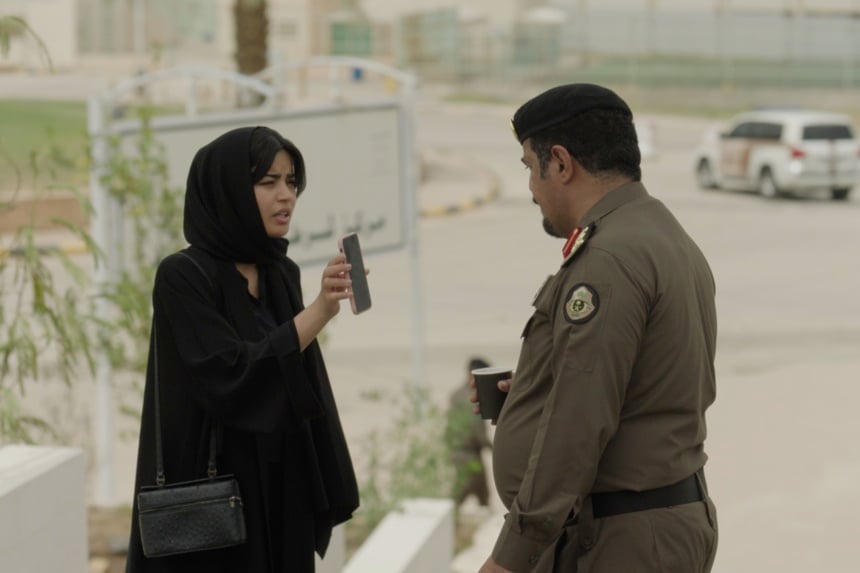
Unidentified
⭐️ ⭐️ ⭐️ ⭐️
Rating: PG-13
Run Time: 1 hour 39 minutes
Stars: Mila Al Zahrani, Shafi Al Harthi
Writers: Haifaa Al-Mansour, Brad Niemann
Director: Haifaa Al-Mansour
Reviewed at the Toronto International Film Festival
Saudi Arabian director Haifaa Al-Mansour’s deliciously twisty, bravely observant murder mystery unravels not only the story of a young woman found murdered in the desert, but also the complicated roles women play in a defiantly paternalistic society.
A disclaimer: When it comes to murder mysteries, I remain, after all these years, the single most gullible consumer you’ll find this side of SpongeBob SquarePants. A film director could wire a neon flashing “He Did It!” sign above any character in the first reel of any movie and, when the final reveal came two hours later, I would whisper, “I did NOT see that coming!”
So, when I tell you Unidentified concludes with a twist that left me speechless in a way reminiscent of Keyser Söze’s reveal in The Usual Suspects, consider the source.
Thirty-ish Nawal (stern-faced Mila Al Zahrani) is a rarity in Saudi Arabia: a working woman carving out a career in a police station. A beneficiary of recent government reforms – she can hop in a car and drive herself anywhere she wants, unaccompanied by a male, for instance – she is nevertheless stifled by condescending officials and the stigma of a recent divorce.
Officially, Nawal’s job is digitizing police files, but detectives frequently consult with her when it comes to delicate investigations that involve a world with which they are woefully unfamiliar: the lives of women.
So, it’s no surprise when Nawal’s boss, a kindly cop named Majid (Shafi Al Harthi), calls her in to help investigate the death of a high school student whose body has been found on a remote desert sand dune. Nawal notices the little things: the girl’s manicure, the needlework on her school uniform. With literal shreds of evidence, she sets about trying to determine the girl’s identity. The cops hope putting a name to the body will help them nab the killer, but Nawal seems more concerned with making sure the girl gets a proper family burial, rather than an ignominious place in a pauper’s grave.
The young woman, it turns out, was about to be married off to an older man – a common fate for Saudi high school girls. That revelation clears the deck for co-writer/director Al-Mansour to address the film’s true target: the ultimate helplessness of women even in a supposedly advanced Middle Eastern country like Saudi Arabia. Was the girl’s death an honor killing? Why are her wealthy mother and sister pretending she never existed? And was her future husband involved?
Infuriatingly, officials seem uninterested in such details – reluctant to risk offending members of any powerful Saudi families. Still, Nawal doggedly pursues the case, first seeking public acknowledgement of the girl’s identity, then pestering the victim’s family to give her a proper Islamic funeral and burial.
Before long, Nawal’s boss is greeting her every morning with a stern reminder to stop pursuing her unofficial investigation. (I am reminded of that old TV detective show, Mannix, where each week Mike Connors’ exasperated boss, played by Joe Campanella, would slam the door and yell, “You’re off the case, Joe!”) She persists, of course – but for reasons that no one, including me, could imagine.
Formulaic murder mysteries often explore matters social and spiritual (Agatha Christie probed the British class system; G.K. Chesterton’s Father Brown traced the intersection of faith and rationality). So, Al-Mansour and her doggedly determined office worker are in good company.
When Nawal’s true interests in the case become known – and after she has successfully used Saudi Arabia’s persistent misogynistic streak to her own ends – it’s hardly a stand-up-and-cheer moment. But you will find yourself catching your breath, and you can ask no more from a first-rate cinematic brain twister like this one.
Become a Saturday Evening Post member and enjoy unlimited access. Subscribe now