Minions 7: Minions and Monsters
⭐️ ⭐️ ⭐️ ⭐️
Rating: PG
Run Time: 1 hour 30 minutes
Stars: Pierre Coffin, Christoph Waltz, Jeff Bridges
Writers: Pierre Coffin, Brian Lynch
Director: Pierre Coffin
I’m going out on a limb here and insisting that one of the smartest movies of the summer; one that will delight discerning film enthusiasts and pure entertainment-seekers alike, is the one that stars 100 or so yellow-colored, pill-shaped, gibberish-uttering, goggle-wearing guys familiar to in-the-know children everywhere as The Minions.
Let’s not belabor the backstory here; suffice to say the Minions are a class of sentient creatures that, in six previous films, have single-mindedly pursued their eternal quest to serve as hench-things to history’s most evil villains. But while the Minions’ loyalty is laudable, they are so hopelessly inept they almost always end up accidentally killing their chosen masters or otherwise putting them permanently out of the Evil Villain business.
Since they’ve supposedly been around since the dawn of time, the Minions can turn up in any chosen period, and in this case that happens to be the 1920s, during the dawn of Hollywood. Stumbling into town after having unwittingly dispatched yet another evil master, the Minions catch the eye of a movie director named Max (voiced by Christoph Waltz) who, with the enthusiastic support of twin studio moguls Frank and Elwood Bright (Jeff Bridges, both of ’em), casts these ever-enthusiastic, seemingly indestructible fellows in a string of fabulously successful action films.
The advent of sound suddenly renders the indecipherable Minions cinematically obsolete, and they are immediately fired – landing them back on the streets, in search of another evil villain to serve.
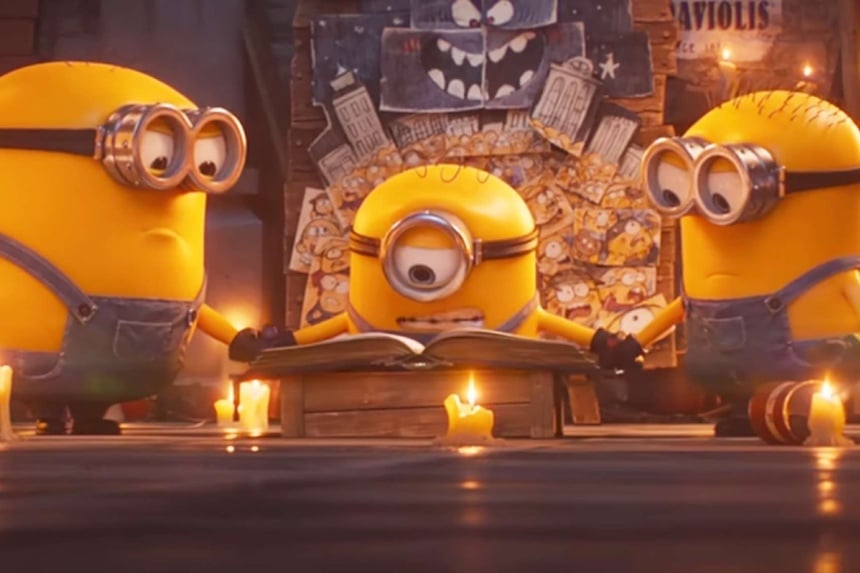
Except, that is, for three Minions named James, Henry, and Ed (the Minions, all uncounted dozens of them, are voiced by co-writer/director Pierre Coffin). Smitten with the movie-making bug, they set out to make their own film, specifically a monster flick. Getting a monster is no trick at all – they conjure up a few from a book of spells once owned by one of their late villain bosses.
Things, of course, go hilariously haywire (although parents should beware that the final beast, a multiple-eyed creature appropriately named Irene, is pretty scary).
So far, so juvenile, right? But stay with me here, because the grownup joys of Minions and Monsters is in its knowing narrative of film history, and the somewhat miraculous ways Coffin & Company weave the Minions into it.
The delights begin in the opening credits, when the Universal Studios logo suddenly winds into reverse, morphing into every single Universal and Universal-International trademark dating back to the 1920s. Interspersed among the credits are clips from pioneering films that, really, only the most astute film buff will recognize: Eadweard Muybridge’s revolutionary 1887 photo sequence of a galloping horse…the Lumière brothers’ 1895 moving images of workers exiting a Paris factory…the Lumières’ The Arrival of a Train at La Ciotat Station (1896), history’s first publicly screened film…a clip from 1895’s The Sprinkler Sprinkles (L’Arroseur Arrose), reputed to be the first comedy film.
Seamlessly incorporated into each clip are Minions getting into the act, playfully participating in the history of early cinema.
For film lovers, the Easter eggs continue all the way through. Marauding Minions instigate the most famous scene of Charlie Chaplin’s Modern Times. They knock a ladder out from under Harold Lloyd, leaving him hanging from a clock tower a la Safety Last! And we finally learn what made that house, with its strategically open window, collapse around Buster Keaton.
Minions step in for Humphrey Bogart in The Maltese Falcon and encounter a very Jaws-like shark. Orson Welles gets not one but two nods: He’s a figure in a glass case at a movie museum, and in a spot-on recreation of Citizen Kane’s opening scene, a Minion hopelessly butchers the seemingly simple one-word line, “Rosebud.”
Minions and Monsters’ nonstop movie nerdiness extends to the soaring score by John Powell, who conducts a full symphony orchestra and 60-voice choir to musically namecheck countless Hollywood classics. I’m guessing if Bernard Herrmann (Psycho) or John Williams (Jaws) or Ennio Morricone (The Good, the Bad, and the Ugly) or Jerry Goldsmith (The Omen) were to accuse him of stealing their stuff, Powell would take it as a compliment.
Minions and Monsters would have done well to stick with the main story and dispense with a distracting side narrative involving a love affair between a Day-the-Earth-Stood-Still-inspired robotic man (Jesse Eisenberg) and a progressive young woman (Zoey Deutch) who, although it is now 1928, is marching for women’s suffrage, 10 years late.
Still, for movie lovers, that’s just quibbling with near-perfection. Finally, in the best Hollywood tradition, not only does Minions and Monsters have a happy ending – there’s also a clear path to a sequel.
Become a Saturday Evening Post member and enjoy unlimited access. Subscribe now