Have you met any “artificial persons” recently?
“Artificial persons,” also called “juridical persons” or “legal persons,” are legal entities that possess some of the rights, privileges, and responsibilities of humans.
An artificial person can own property, sue others and be sued, and enter into contracts in its own name separate from the natural person who operates it, according to the Brennan Center for Justice.
These “persons” include corporations, government agencies, partnerships, and trusts.
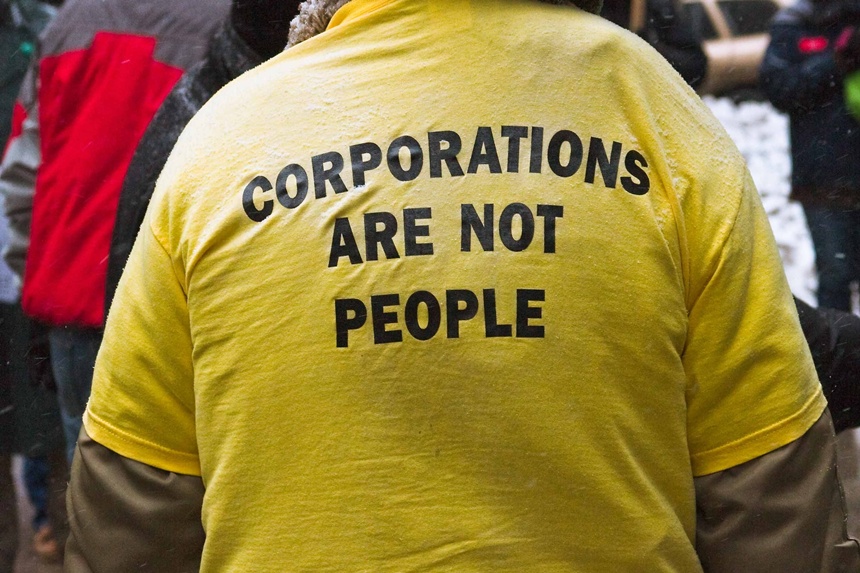
But is it true, as Senator Mitt Romney once told a campaign crowd, that “Corporations are people”? If so, they have some un-people-like characteristics.
They can’t vote in national elections or be They could outlive all of us. They can’t be drafted, physically harmed, or executed. They have the Fourth Amendment right that protect them from unreasonable searches and seizures, but they don’t have Fifth Amendment protection from self-incrimination. They can’t, for example, refuse to provide documents or testify on the grounds they will incriminate themselves.
The idea of artificial persons has its roots in the equal protection clause of the Fourteenth Amendment. It prohibits states from denying equal protection under the laws to any persons within their jurisdiction.
The Unusual Birth of a Concept
Its curious route to becoming a legal principle came from an 1886 Supreme Court decision: Santa Clara County v. Southern Pacific Rail Road.
The case arose from a tax that the state of California imposed on the assets of individuals and businesses.
Southern Pacific refused to pay its assessed tax because the company’s assets were being taxed tax at a higher rate than citizens’ assets.
Southern Pacific’s lawyer said this violated the equal protection clause, which, he argued, applied to corporations as well as people. This lawyer was Roscoe Conkling. Years earlier, when he’d been a member of Congress, he’d been part of the committee that drafted the Fourteenth Amendment. Now, 20 years later, as the surviving member of that committee, he told the court it had always been the committee members’ intent to extend equal protection to corporations as well as to natural persons.
The Amendment’s original wording had specified, “No State shall…deprive any citizen of life, liberty, or property without due process of law; nor deny to any citizen within its jurisdiction the equal protection of the laws.” The word “citizen” was changed to “person,” said Conkling, because the committee wanted to protect corporations from discriminatory state laws.
The Amendment meant to protect the rights of the country’s least privileged citizens, he argued, was also intended to protect the rights of powerful corporations. He supported his claim by showing a notebook he had kept during those long-ago deliberations. His argument was accepted without a serious challenge, and Supreme Court found in favor of Southern Pacific.
Later the case was summarized by an attorney who was the Court’s Reporter of Decisions. In his report, he included a remark made by Chief Justice Morrison Waite during the hearing:
The Court does not wish to hear argument on the question of whether the provision in the Fourteenth Amendment to the Constitution, which forbids a state to deny to any person within its jurisdiction the equal protection of the laws, applies to these corporations. We are all of the opinion that it does.
Waite never offered a reason for the conclusion. The statement was not part of the Court’s formal opinion. Rather, it was a “headnote” of the report. Headnotes are a reporter’s summary of the opinion along with the main facts and arguments of the case. The reporter included the remark, and it set a precedent, even though headnotes have no legal standing.
Freedom of Corporate Speech
Artificial persons gained another right of citizens in 1977, when the Supreme Court recognized corporations’ right of free speech. The ruling came from First National Bank of Boston v. Bellotti. The bank had opposed a referendum that would authorize a graduated personal income tax. They challenged the state law that prevented them from making contributions or expenditures in the cause.
The Court ruled that corporations have a First Amendment right to make contributions to a campaign for a ballot initiative.
The Court had previously ruled in Buckley v. Valeo (1976) that money spent on political campaigns was a form of free speech, which couldn’t be limited.
Justice William Rehnquist dissented from the majority opinion in Bellotti. He argued that a corporation’s right of commercial speech might be necessary to a business, but this doesn’t mean the right of political expression is necessary for a corporation, which is created for commercial purposes. He added:
A State grants to a business corporation the blessings of potentially perpetual life and limited liability to enhance its efficiency as an economic entity. It might reasonably be concluded that those properties, so beneficial in the economic sphere, pose special dangers in the political sphere.
Citizens United Divides Citizens
The Bellotti case was cited in 2010 when the Supreme Court ruled in Citizens United v. FEC that corporations can pay for ads expressly promoting or attacking political candidates. The majority held that political speech is “indispensable to decision making in a democracy, and this is no less true because the speech comes from a corporation.”
Writing for the majority, Justice Kennedy said, “[a] prohibition on corporate independent expenditures is an outright ban on speech,” and “Political speech is ‘indispensable to decision-making in a democracy, and this is no less true because the speech comes from a corporation.’”
Dissenting, Justice John Paul Stevens wrote of the majority opinion:
[T]he Court’s opinion is thus a rejection of the common sense of the American people, who have recognized a need to prevent corporations from undermining self-government since the founding, and who have fought against the distinctive corrupting potential of corporate electioneering since the days of Theodore Roosevelt. It is a strange time to repudiate that common sense. While American democracy is imperfect, few outside the majority of this Court would have thought its flaws included a dearth of corporate money in politics.
The Citizens United decision remains highly controversial, but it wasn’t without precedent. It was a natural extension of the Southern Pacific case. And it remain the law.
But the idea is being challenged. In February, U.S. Representative Pramila Jayapal introduced a Constitutional amendment that would end corporate personhood. She has said, “Corporations are not people and money is not speech.” She has objected to a system that has allowed 88 corporations to spend $852 million on campaigns while paying nothing in taxes.
There is widespread support for reforming campaign financing. But passing the amendment will face opposition from members of Congress who hold their offices with corporate funding.
Meanwhile, Hawaii has enacted state legislation that intends to restrict political spending. The new law, which went into effect this July, blocks corporations, partnerships, and other artificial persons from contributing anything of value to shape elections.
Ultimately, the future of American politics may come down to the question of who holds more power: artificial or natural persons.
Become a Saturday Evening Post member and enjoy unlimited access. Subscribe now