As of this writing, America’s inflation rate stands at 3.7 percent.
Americans are not happy about it.
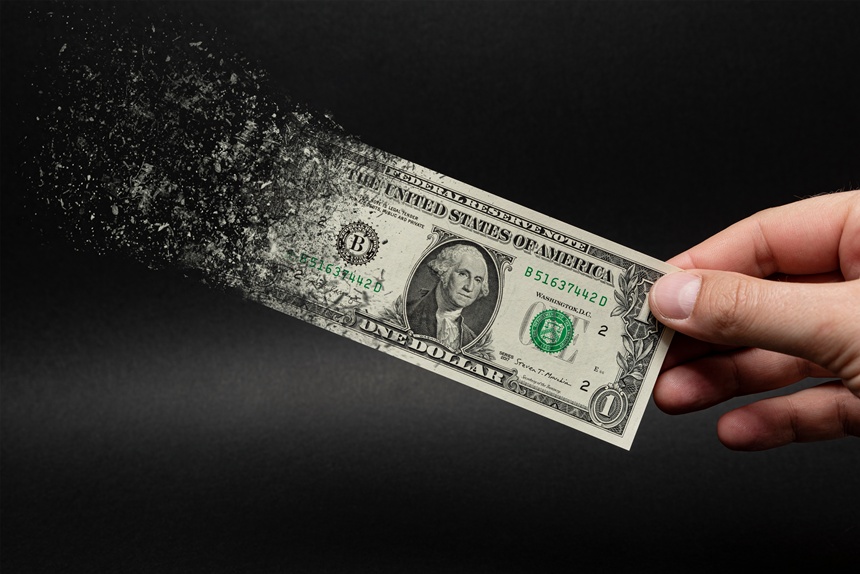
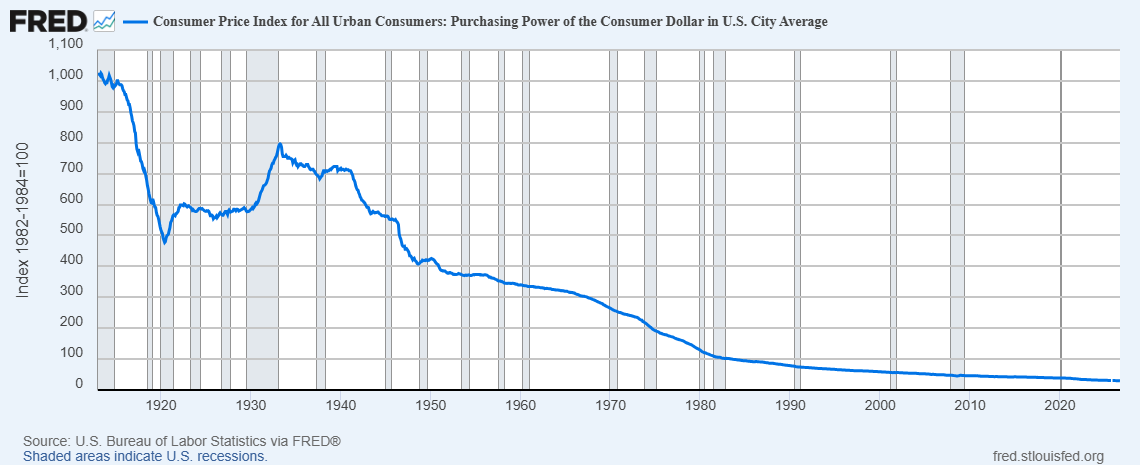
Inflation has almost always been a part of the U.S. economy. It has reduced the purchasing power of the U.S. dollar in all but eight of the last hundred years. One dollar today has 1/26th the purchasing power of a 1933 dollar. In other words, it takes roughly $26 today to buy the same goods and services that cost just one dollar in 1933.
Economists offer three explanations for inflation. The first is “Demand-Pull,” which occurs when consumer demand exceeds supply. Sellers running low on inventory attempt to control purchasing by raising prices. And suddenly the dollar doesn’t go as far as it did. A recent example of Demand-Pull is that manufacturers of specialty microchips for AI can’t keep up with the sudden demand, causing a spike the price of AI hardware.
Next, there’s “Cost-Push” where a business faces higher costs for its production and raises prices to offset its losses. During the oil crisis of the 1970s, OPEC restricted oil exports. The dramatic increase in gas prices forced businesses to increase prices to consumers.
Third, there’s the expectation of inflation. Businesses that foresee a weakened dollar protect themselves by raising their prices in advance. Sometimes, when the anticipated inflation doesn’t materialize, the businesses’ hedge against inflation become profits. This can appear as an intentional profit-making tactic. This was true in 2021, when the Covid pandemic raised inflation to 4.7 percent. Businesses tried to anticipate inflation by raising their price in advance. The resulting price hikes were termed “greedflation.” Evidence suggests there was some greedflation at play: While profits normally account for 33 percent of inflation, in 2021 it was 60 percent.
While a 3.7 percent inflation rate causes general discomfort, it’s still a long way from the inflation rate in 1980, which reached nearly 15 percent. And while the typical inflation drivers mentioned above played a part, there were other factors that acted as accelerants to an economy that was already on fire (and not in a good way).
Starting in the 1960s, America saw “four economic recessions, two severe energy shortages, and the unprecedented peacetime implementation of wage and price controls,” according to Federal Reserve History. All of this was exacerbated by excessive growth in the supply of money due to Federal Reserve policies, namely keeping interest rates low, regardless of inflation risks.
And inflation wasn’t long in coming. It had been a mere 1 percent in 1964, but in 1970, inflation grew to 5.8 percent and was still rising. The Nixon administration hoped to regain some control of the situation by the imposing temporary wage and price controls in 1971. The intent was to halt inflation without raising the interest rate.
The move, Politico reports, was “economically ineffective and politically disastrous,” though not at first. Unemployment dropped a little. Inflation fell to a bearable 3 percent. And low federal interest rates grew the economy at a remarkable rate. Consumers spent freely, which soon created shortages of raw materials. Which led to prices, retail and wholesale, shooting up. Inflation returned.
In addition, Arab nations were angered by America’s military aid to Israel in 1973. In retaliation, their Organization of Petroleum Exporting Countries placed an oil embargo on the U.S. In the fuel shortage that followed, the price of gas jumped skyward, leading to higher costs and more inflation. It also forced businesses to cut back on operations. There was a sharp drop in new hires, and many employees were let go. By the mid-1970s, unemployment was at 8.5 percent.
Meanwhile, Congress was facing budgetary problems, trying to support the U.S. war effort in Vietnam.
Were there not already enough challenges to the U.S. dollar, it lost its gold backing in 1971. Up to then, each dollar had represented a quantity of real gold at $35 an ounce, and American currency remained the basis for international trade. Now, the world was relying on a paper-money standard, which undercut the global sense of the dollar’s value.
In the 1970s, for the first time, the nation saw high inflation and high unemployment, a condition aptly labelled stagflation.
To see what inflation did to prices, consider the figures below. You’d expect prices to rise over the course of ten years, but these prices rose faster than anyone had seen in the previous 35 years.
Average Price |
1970 |
1980 |
| New House | $17,000 | $47,200 |
| New Car | $3,706 | $7,591 |
| Gallon of Gas | 36¢ | $1.34 |
| Gallon of Milk | $1.32 | $2.18 |
| One Dozen Eggs | 60¢ | 83¢ |
| One Pound of Bacon | 85-95¢ | $2.38 |
| One Pound of Coffee | 91¢ | $3.20 |
| Four Years of Tuition, Room, and Board at a Public University | $1,542 | $2,474 |
| Median Family Income | $22,350 | $21,020 |
And while all these prices were going up, the median family income was falling.
America’s unemployment rate had risen from 4.9 percent in 1970 to 7.1 percent in 1980, and its inflation rate had gone from 5.6 percent to 13.5 percent. By summer, it reached 14.5 percent with 7.5 percent unemployment.
Hoping to rein in inflation, a new Federal Reserve head pushed the interest rate to an unprecedented 20 percent. Even so, it took two years of this policy before inflation came down to 7 percent, and six years before it landed at 2 percent.
Today, with inflation at 3.7 percent, we’re still a long way from the 2 percent, which is the long-term goal of the Federal Reserve.
It’s hard to see where our current inflation will take us. Historic averages tell us that inflation that peaks at 4 percent is usually short lived, and we can expect it to slow down in about six months.
But if inflation reaches 6 percent, it will take seven years to fall back to 3 percent. And once it reaches beyond 8 percent, returning to a “normal” level of 3 percent can take anywhere between six and 20 years.
Become a Saturday Evening Post member and enjoy unlimited access. Subscribe now