In a Word: The First Boycott
Managing editor and logophile Andy Hollandbeck reveals the sometimes surprising roots of common English words and phrases. Remember: Etymology tells us where a word comes from, but not what it means today.
For some, the Irish have a reputation for hostility and even violence. This reputation is largely undeserved. Consider, for example, that it was Irish farmers in the 19th century who, through their actions, gave our language the word for one of the most effective forms of peaceful protest: boycotting.
In the mid-1800s, Irish tenant farmers had few rights to the land they worked and were often expected to pay exorbitant (and growing) rents to their aristocratic landlords. The Irish National Land League was founded in 1878 to help secure better working conditions, fairer rents, and more property rights for poor farmers from wealthy landowners, and especially absentee ones.
A famine hit Ireland in 1879, taking a toll not only on farmers’ crops but on their ability to pay their rent. This famine wasn’t nearly as devastating as the Great Famine of 1845-1849 (called the Irish Potato Famine outside of the Emerald Isle), but the memory of that difficult time and the fear of its return haunted Ireland’s farmers.
Into these uncertain and quarrelsome times stepped a man named Charles Cunningham Boycott. In 1880, he was the land agent left in charge of the estate of John Crichton, Lord Erne, in Ireland’s County Mayo. When it came to collecting rents and keeping his tenants in order, Boycott wasn’t a lenient man, and in autumn of that year, he attempted to evict 11 tenants.
But the Irish National Land League wasn’t going to stand for it.
Boycott’s employees and tenants were urged — in some cases possibly forced — to isolate Boycott by withdrawing their labor. All business with Boycott was to stop, from the care of his stables to his laundry to the delivery of his post to, yes, the reaping of crops.
Boycott needed help, but he made a mistake in his choice of savior: He pleaded to the press. In a letter to The Times, he wrote, in part, “I can get no workmen to do anything, and my ruin is openly avowed as the object of the Land League.”
The story became international news. Newspapermen swarmed the county as troops were roused to protect volunteers from the north who stepped in to bring in the harvest, but the damage was done. According to Niall O’Dowd, founder of IrishCentral.com, “the episode cost at least £10,000 to harvest about £500 worth of crops.”
What’s more, the Irish National Land League established itself as a powerful grassroots force, the “Boycott treatment” was proven an effective nonviolent means of protest, and the word boycott entered the English language.
That boycott stems from the name of a particular man is not surprising — English contains many eponyms. What is surprising is how quickly the word caught on, spread, and became a common word in English. Less than half a year after the original boycott — on February 12, 1881 — Saturday Evening Post readers found this announcement in the News Notes column:
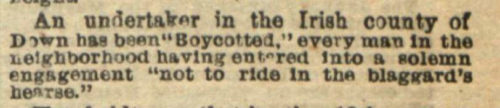
An undertaker in the Irish county of Down has been “Boycotted,” every man in the neighborhood having entered into a solemn engagement “not to ride in the blaggard’s hearse.”
The quotation marks and capitalization mark it as a new word, if not a new idea, for readers. But by just a year and a half later, the quotation marks had fallen away and the capitalization was dropped, and the word was used without any indication that readers might not understand its meaning. The following announcement appeared in the December 16, 1882, issue of the Post:
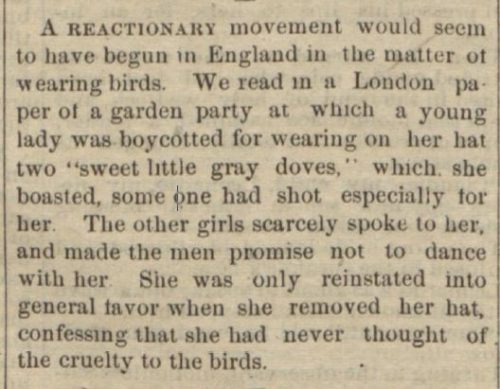
A REACTIONARY movement would seem to have begun in England in the matter of wearing birds. We read in a London paper of a garden party at which a young lady was boycotted for wearing on her hat two “sweet little gray doves,” which, she boasted, some one had shot especially for her. The other girls scarcely spoke to her, and made the men promise not to dance with her. She was only reinstated into general favor when she removed her hat, confessing that she had never thought of the cruelty to the birds.
And it didn’t spread only into English. The word found its way into German as der Boykott, French as le boycottage, and Italian as boicottare, to name but a few. Even more than St. Patrick’s Day, boycotting is an Irish legacy recognized the world over.
Featured image: Shutterstock
In a Word: How English Got Intoxicated
Managing editor and logophile Andy Hollandbeck reveals the sometimes surprising roots of common English words and phrases. Remember: Etymology tells us where a word comes from, but not what it means today.
It’s no feat of mystical divination to predict that a lot of people will find themselves intoxicated this weekend, many of them on green beer. St. Patrick’s Day is this Sunday, and many will use the commemoration of the Irish saint — whether they are Irish or not — as an excuse to lift a pint or nine.
But while Catholicism gave us St. Patrick, and Irish Americans honed his feast day to the celebration it is now, the intoxication that results from that celebration comes, at least etymologically, from warring Greeks.
The ancient Greek archer’s tool of war was the toxon, a word for both bow and arrow. To make their weapon deadlier, archers dipped their arrow tips in poison. Toxikon was the word for a poison-tipped arrow, but over time, the word came to refer to the poison itself. By the time the word was adopted into Latin as toxicum, it had shrugged off its ballistic origins and just meant “poison.”
Fast-forwarding through the Middle Ages, the word entered French and eventually evolved, in the 17th century, into the English word toxic. But while this word was wending its way through lexical evolution, English wasn’t just sitting around waiting to get poisoned. Surprisingly, the word intoxicate appears in English written records a century before toxic does. English speakers, it seems, sought a larger vocabulary for getting drunk than for ingesting toxins.
Perhaps unsurprisingly, Shakespeare used intoxicate (though he certainly didn’t invent the word), in The Life of King Henry V (Act IV, Scene vii), believed to have been written in 1599:
Alexander, … in his rages, and all his furies, and his wraths, and his cholers, and his moods, and his displeasures, and his indignations, and also being a little intoxicates in his prains, did, in his ales and his angers, look you, kill his pest friend, Cleitus.
[Captain Fluellen, the Welshman who provides much if this play’s comic relief, often pronounces his bs as ps, so prains and pest are brains and best deliberately mispronounced for effect.]
The verb intoxicate and its adjective form, intoxicated, derive from the Latin intoxicare “to poison,” which itself traces back to the same Greek toxon. There is some evidence that intoxicate, in its earliest use, literally meant “to poison,” but it didn’t take long before the more metaphorical meaning “to make drunk” took hold.
So if you are among the imbibers during this weekend’s St. Patrick’s Day celebrations, relish in the etymological poignancy of that old bartender’s question, “What’s your poison?” And if you’re doing shots of good Irish whiskey, take a moment to remember the type of shots Greek archers took centuries ago that ultimately led to your ability to become intoxicated.
Featured image: Shutterstock
In a Word: Dord, the Word That Wasn’t
In 1631, a new printing of the Bible contained an egregious mistake. At Exodus 20:14, the Sixth Commandment read, “Thou shalt commit adultery.” Roughly 1,000 of these so-called Wicked Bibles were printed before that missing not was discovered and the printing halted. For some, the existence of the Wicked Bible is a laughable reminder of our fallibility; to others, it’s a disturbing example of how even the most sacred things are not immune to humankind’s imperfections.
There are certain resources that are the secular equivalent of sacred, too. We turn to them for authoritative guidance in our personal and professional lives, rarely questioning the wisdom they hold. Psychiatrists, for example, have the DSM. Congress has the U.S. Code. And frantic, procrastinating middle school students have Wikipedia. For copy editors and proofreaders, the dictionary is such an authoritative resource — a editorial sacred text if ever there was one. Yet it, too, can be subject to human error.
Consider the entry for dord.
In the early 1930s, the editors at G. & C. Merriam Company (now Merriam-Webster, Inc.) were working hard to produce a new unabridged dictionary. One change from the previous edition that was being implemented was the transfer of abbreviation entries from the main part of the dictionary to a separate section immediately following the entries under Z.
A chemistry consultant doing work for the dictionary submitted a handwritten index card — that’s how definitions cycled through the workflow back then — dated July 31, 1931, with an entry for “D or d.” What the consultant was trying to indicate was that either an uppercase D or a lowercase d could be used as an abbreviation for density in physics and chemistry.
Somehow, this card didn’t make it into the stack destined for the new Abbreviations section, but ended up being filed with the unabbreviated words. Furthermore, those spaces around or looked different to the editors than they do to us: Space was routinely added between letters on cards like these to allow room for stress marks and syllable breaks. So to the lexicographer who examined this card, it seemed the consultant had inadvertently omitted the space between the o and the r in the entry for Dord.
So Dord (“corrected” to the lowercase dord to follow house style) made it past the definer, was given a pronunciation, somehow escaped notice of the etymologist, and went unquestioned by the proofreader. When Webster’s New International Dictionary, Second Edition (called W2 for short) was published in 1934, it contained an entry for dord — a “ghost word” that wasn’t really a word — between Dorcopsis and doré.
The error was discovered in 1939, but somehow wasn’t actually corrected in print until 1947.
When the missing not in the Wicked Bible came to light, the men who printed it — Robert Barker and Martin Lucas — were brought to court, fined heavily, and had their printing licenses revoked. King Charles I had even wanted them executed. What copies of the Wicked Bible authorities could get their hands on were incinerated, making them extremely rare today.
The makers of W2 got off easy by comparison. G. & C. Merriam Company wasn’t dragged before some tribunal, and copies of the erroneous dictionary — more than a dozen years’ worth — weren’t rounded up and burned. They aren’t rare, but to dictionary aficionados, they are collector’s items that serve as a constant reminder that nothing is beyond the reach of human error.
Featured image credit: Andy Hollandbeck
Celebrate National Grammar Day by Not Being an Insufferable Know-It-All
If you have someone in your life who helps you make sure your writing is grammatically correct — a spouse, a parent, a coworker, a paid copy editor — today, March 4, is a great day to show your appreciation. It’s National Grammar Day!
Begun in 2008, National Grammar Day is the brainchild of Martha Brockenbrough, author of, among other books, Things That Makes Us [sic]. She chose March 4 as the day to celebrate grammar because, when spoken aloud, the date becomes the complete and grammatically correct sentence “March forth!”
But when it comes to grammar, many people are unfortunately more interested in denigration than celebration, and some might view National Grammar Day as an opportunity to impose their vision of “proper grammar” onto those around them. These type of people will publicly point out errors (or what they believe are errors) in other people’s words, whether they’re spoken, typed, or hastily thumbed out on their smartphones. They’ll take pot shots at grocery-store express checkout lanes for shoppers with “12 items or less” rather than “12 items or fewer.” Some may go so far as to whip out a Sharpie and deface public signs — adding missing punctuation or proofreader’s marks — in the name of “correctness.”
Such unsolicited “correction” of people’s grammar and usage is not only rude, it’s misguided. Don’t do it — especially not today.
Our English teachers tried to teach us good grammar in grade school: How to form plurals. How to conjugate verbs. Where to place commas. How to construct — as well as deconstruct — complex sentences. (Many of these rules aren’t technically grammar at all, but usage and syntax and mechanics, but in the common parlance, we lump them all under the heading grammar in the same we call any music created by an orchestra classical.)
What those same teachers maybe didn’t teach us is that there isn’t only one grammar. There isn’t one set of language rules to govern all English-language communication. There isn’t just one English.
Those grammar-school teachers were teaching us Standard Written English, the form of English preferred by publishing houses and in academia for (surprise!) writing, and conforming to tenets set down by prescriptive authorities (like the Associated Press).

Problem is, no one naturally speaks in Standard Written English — that’s why they have to teach it in school. And while the rules of Standard Written English can be a good guideline for extemporaneous speech, they aren’t absolute. Grammar isn’t monolithic, and language is fluid. People from different locations and backgrounds naturally use different grammatical and mechanical constructions; that’s called dialect. And one’s way of speaking — in word choice, enunciation, and formality — can change from one situation to the next; that’s called register.
We switch registers all the time without even thinking about it. Just think about how, say, a high school student speaks to a teacher in class, compared with how she speaks to the principal when she’s called into the office for a disciplinary problem, compared with how she tells her friends after school about the whole affair. Each situation involves a different level of formality and intimacy that are reflected in language.
We instinctively switch registers all the time depending on whom we are communicating with and how. And while some of the language choices we make don’t jibe with Standard Written English, that doesn’t mean they’re wrong. So while y’all and yinz might not fly in a formal paper, they are perfectly acceptable — which is to say, grammatical — in informal conversations. Same with ain’t.
This idea of the situational malleability of grammar can be difficult for some people to accept. We like our rules, our right-wrong binaries. We like the idea of grammar as mathematics — that there is One Right Way to construct any given sentence, and it’s just a matter of the correct application of rules to find it.
Even professional copy editors — like myself — have struggled with this idea. Many have admitted to me that, in their early lives, they often felt compelled to “help” people use the English language “correctly” by pointing out danglers, misconjugated verbs, nonstandard usage, and mispronunciations. I know I did. I also know exactly when I stopped and why:
Early in the millennium, at a time when I was making the transition from proofreading to copy editing, my then-wife and I were occasionally invited to dinner parties at the home of one of her coworkers — we’ll call her Isabelle. Isabelle was from Brazil; English was her second language. I generally enjoyed the gatherings, and the food was usually fantastic, but during our third or fourth dinner party, I noticed that Isabelle seemed reticent around me.
I mentioned it to my wife on the drive home, and she told me, “Isabelle’s afraid to speak English around you because she thinks you’ll correct her in front of everybody.”
I felt horrible. I had made Isabelle self-conscious and uncomfortable around me because I felt like I had the authority and latitude to “help” her use English “correctly.” I vowed that I would never make anyone feel like that ever again.
And neither should you.
So don’t celebrate National Grammar Day by being an insufferable know-it-all. There are other, more constructive ways to mark the day:
- Focus on your own writing. Is your writing really strong enough that you can critique others’?
- Learn something new about grammar and usage. Like podcasts? Try Grammar Girl. More of a reader than a listener? There are plenty of blogs for you; try Grammargeddon, Grammarphobia, or, for fun comparisons of American and British English, Separated by a Common Language. Or grab an actual dead-tree book (browse through the 420s at your local library).
- Celebrate the ways people intentionally and effectively break the rules of Standard Written English. (Cormac McCarthy won a Pulitzer Prize for a novel that contains plenty of dialogue but no quotation marks.)
- Listen to the ways people speak, and instead of judging their grammar as right or wrong, enjoy the myriad ways people communicate, and consider how your own language has been molded by your experiences.
- Grammar isn’t limited to English, of course, so if you’ve ever dreamed of learning a new language, today is a great day to start.
- By all means, enjoy Weird Al Yankovic’s “Word Crimes” video for the umpteenth time.
- If you have someone who makes your writing better, thank them. (Gifts are always appreciated, of course.)
But unless someone asks for your help or you’re paid to do it, don’t criticize the way other people speak or write. Yes, bona fide mistakes will go uncorrected — who doesn’t make mistakes? You can certainly bask in smugness for recognizing a grammatical “error,” but you won’t be making the world a better place by calling it out.
Featured image: Shutterstock
The Logophile Language Puzzler: Pawn Shops and Workshops
- Johnny needed money fast, so he took his guitar to the pawn shop and put it in
- hawk.
- hoc.
- hock.
- Though you’re liable to find any of these in a carpenter’s workshop, one of them isn’t actually a type of wood. Which one?
- dagwood
- stinkwood
- torchwood
- wormwood
- Episodes of The Twilight Zone almost always end with the bad guys getting their
- just deserts.
- just desserts.
- Trent prefers the microcosmic to the macrocosmic, the underground to the monorail, and ingesting to masticating. What does Trent really like?
Answers and Explanations
1. c. hock
It’s easy to see how hock and hawk can sometimes become confused: They both involve the exchange of goods for money. When you put something in hock, you’re pawning it — giving someone the item in exchange for money with the intention of buying the item back later for a bit more. Hock is believed to come from a Dutch word meaning “jail” or “pen,” and in 19th-century American slang, being in hock also described a person in prison.
To hawk means to sell goods in the open by calling out to people. It’s a back-formation from the word hawker “itinerant vendor” that dates back to the beginning of the 15th century.
Hoc isn’t even English; it’s Latin for “this.” The most common place you’ll see it is in the phrase ad hoc (literally “for this”), meaning “concerned with or formed for a specific purpose only.” You’ll also find it (twice) in post hoc, ergo propter hoc (“after this, therefore because of this”), a phrase used to describe the logical fallacy that because one event followed another, the first event must have caused the second — the basis for many superstitions.
2. a. dagwood
A dagwood is a many-layered sandwich, named after Dagwood Bumstead, the husband in the Blondie comic strip who often created such sandwiches.
Stinkwood is a South African evergreen tree that was once prized by furniture- and cabinet-makers but was so overexploited that it is now a protected species. Stinkwood can also describe any sort of wood that lets off an offensive odor.
Torchwood is a common name of flowering citrus trees and shrubs of the genus Amyris. They’re called torchwood because the wood contains resins that cause it to burn easily and brightly. Torchwood was also a Doctor Who spinoff from the BBC starring John Barrowman as Captain Jack Harkness.
Wormwood is the common name for Artemisia absinthium, whose bitter oils are used to flavor absinthe.
3. a. just deserts
This phrase is the last refuge of an otherwise obsolete meaning of deserts — “that which is deserved.” If you can remember that word deserve, which desert is related to in this instance, you can remember the proper spelling of just deserts. Just desserts has been used as a play on words often enough and for long enough that many people don’t even recognize that it’s supposed to be a pun.
4. Trent likes words that start and end with the same three letters.
It’s all about the spelling here: microcosmic, underground, and ingesting. A few other words that fall into this category are antioxidant, enticement, entertainment, ionization, and tormentor.
This article is featured in the March/April 2019 issue of The Saturday Evening Post. Subscribe to the magazine for more art, inspiring stories, fiction, humor, and features from our archives.
Featured image: Shutterstock
In a Word: A Fruit, a Place, a Color, and a Symbol: Orange
Managing editor and logophile Andy Hollandbeck reveals the sometimes surprising roots of common English words and phrases. Remember: Etymology tells us where a word comes from, but not what it means today.
Orange. It’s a fruit, and it’s a color, and many a curious logophile has wondered which came first.
The short answer: the fruit. The fruit came first.
But here’s the more interesting long answer:
Oranges originated in East Asia, probably in northern India, where the orange tree was called, in Sanskrit, naranga. This became the Arabic naranja as the fruit was brought to the West. In Old Occitan, a French dialect spoken in southern France between approximately 1100 and 1400, the orange was called auranja — the beginning n sound was dropped through the process of metanalysis. (You’ll note that the word didn’t undergo metanalysis in Spanish, where the fruit is naranja and the color is anaranjado.)
Now it just so happened that a common trade route between Marseilles in the south and Paris in the north passed through an area the Romans had called Arausio, a name which over time had been corrupted to Auranche. Whether the name of the fruit passing through the area influenced the geographical name or vice versa is unclear; regardless, both came to be called orange in both French and English by the mid-13th century.
Orange wasn’t commonly used as the name of the color until around 1540; before then, the color was described by English speakers with words like citrine and saffron or, farther back into Old English, something akin to “yellowish-red” or “reddish-yellow.”
In the 17th century, that French principality of Orange was ruled over by a sovereign prince. In 1650, that sovereignty was passed to a newborn whose father had died a week before the boy’s birth. The child’s name was William III, but he would become more commonly known as William of Orange.
William was a staunch Protestant, which often put him at odds with France’s Catholic King Louis XIV. England was also being ruled by a Catholic monarch, James II, and many in England and abroad worried about an alliance between England and France backed by the Catholic Church. So William of Orange had a lot of support among the English aristocracy when he landed with a large fleet on the southern shore of Britain in 1688. In what came to be called the Glorious Revolution, William deposed James (who, it should be noted, was both William’s uncle and his father-in-law) and became King of England, Ireland, and Scotland.
While the change in management was generally welcomed in England, it was a different story in Ireland. Clashes between Protestant Williamite and Catholic Jacobite forces continued until 1691, when James was finally forced to flee to France. This meant that the majority-Catholic Ireland had fallen under the rule of a Protestant king. The historical ramifications of this were widespread, long lasting, and irrelevant to the history of the word orange.
What is pertinent, though, is that because he was William of (the principality of) Orange, the color orange naturally became a symbol of the man and his forces. And this relationship — from the fruit to the principality to the color — is why the flag of Ireland to this day includes an orange bar: It symbolizes William of Orange and his supporters.
Featured image: Shutterstock
In a Word: Disaster Is in the Stars
Managing editor and logophile Andy Hollandbeck reveals the sometimes surprising roots of common English words and phrases. Remember: Etymology tells us where a word comes from, but not what it means today.
When Shakespeare referred to Romeo and Juliet as “a pair of star-cross’d lovers,” he wasn’t just exercising poetic license; he was hinting at the disaster that was written in their stars.
But then, all disasters were once confined to the stars.
In Shakespeare’s time, disaster was astrological, referring not to an earthbound event but to an unfavorable aspect of a star or planet. That astrological essence is contained in the word: Disaster comes from the prefix dis- (well-known from words like discomfort, disorder, and disregard) plus the Latin astro “star.” Etymologically, something that’s disastrous is “ill-starred.”
An astrologer of old might have warned Juliet of a disaster in her stars that indicated a disastrous event was heading her way. No doubt after the pair’s tragic end, some other soothsayer “discovered” that their fate had been obvious in their star charts if anyone had bothered to look.
Over time, disaster came to describe not an astrological signal of a calamitous event, but the calamity itself. These days, most people don’t believe their fate is controlled by the positions of stars and planets, but that doesn’t stop disasters from happening.
Featured image: Shutterstock
In a Word: Mistaking a Tongue for an Ingot
Managing editor and logophile Andy Hollandbeck reveals the sometimes surprising roots of common English words and phrases. Remember: Etymology tells us where a word comes from, but not what it means today.
Etymology isn’t an exact science. Sometimes, especially with a younger word like gerrymander or neologism, we have a record not only of its first use in print, but of the name of the person who coined it and the event that led to its coinage.
But most etymologies aren’t that clear-cut. Words that have evolved for centuries — that began their linguistic journeys during a time when the written record is sparse — are a more difficult matter. Linguists and etymologists must make inferences based on their knowledge of language change and the unearthing of new written sources. That means that sometimes we don’t know exactly how a word was created, and occasionally we end up with multiple separate, sometimes competing, etymologies.
Take the word ingot, for example. We know from the written historical record that ingot originally described the mold in which metal was cast; later it came to mean a chunk of metal molded into a simple shape to make it easier to weigh and store. Etymologists have come up with two possible etymologies of the word.
Its first is, honestly, boring: It might come from the verb geotan, Old English for “to pour,” with the prefix in- added to it. Since ingot began life as the name of the mold itself, an etymology stemming from words that mean “to pour into” makes perfect sense.
The second possibility is more fun.
French has long had the word lingot to describe ingots or metal slugs. (Lingot comes from the Latin word for “tongue,” possibly because of the shape of Medieval ingots.) It’s possible that the English speakers of half a millennium ago, knowing that the French article le (“the”) is contracted to l’ before a word beginning with a vowel sound, assumed lingot was actually l’ingot, so they dropped the (imagined) article to leave the bare noun ingot — and that’s the word that stuck.
Does it sound far-fetched that an error like this could find a permanent home in the English language? It happens more often than you might think. Linguists even have a name for this type of “permanent error”: metanalysis, a change in the division of a word based on how it sounds. It often happens when a word jumps from one language to another, and English is full of words that are the result of metanalysis. Here are just a few:
- Apron entered English as napron, but a napron was misdivided as an apron.
- Nickname was originally an eke-name — eke in this case meaning “also” or “in addition.”
- Newt, that little lizard, began as an eft, became an ewt,and finally morphed into a newt.
- Cherry comes from misunderstanding the French cerise as plural (i.e., cherries) and then dropping the plural ending.
- The same process that turned cerise into cherry also turned pease into pea.
We may never be completely sure what linguistic winds solidified ingot’s place in the English language. It’s fitting that etymology is not an exact science, though, because the process of creating words isn’t either.
The Logophile Language Puzzler: Rain, Reign, or Rein?
- Rebecca had free ______ to decorate her room in any way she wanted.
- rain
- reign
- rein
- Augustus is studying to become a lapidary because he hopes to make a living
- raising butterflies.
- making cheese.
- crafting jewelry.
- What characteristic is shared by incorrect, topple, privilege, and left?
Answers:
1) c
2) c
3) Each word is an antonym of right.
This article is featured in the January/February 2019 issue of The Saturday Evening Post. Subscribe to the magazine for more art, inspiring stories, fiction, humor, and features from our archives.
In a Word: This Arctic Cold Is a Bear
Managing editor and logophile Andy Hollandbeck reveals the sometimes surprising roots of common English words and phrases. Remember: Etymology tells us where a word comes from, but not what it means today.
Those of us in the grip of the polar vortex are having a bear of a time with frigid arctic winds, physically and etymologically. Though the word arctic indicates the coldest climes, it derives from a word for something more associated with warm fur, big hugs, and even forest fires.
In the northern hemisphere, one of the first things budding astronomers learn to identify in the night sky is the Big Dipper — which is technically not a constellation but an asterism, a pattern of stars that make up part of a constellation. The Big Dipper is the flank and tail of the constellation Ursa Major, “the Great Bear,” which, from our perspective, circles the North Star (Polaris) once a day.
Ancient Greek astronomers saw the same Great Bear in the sky, but they didn’t call it Ursa Major — that would be weird because Ursa Majoris is Latin. They called it Arktos Megale. Megale is an etymological aunt to the English prefix mega-, and arktos is Greek for “bear.”
Because early travelers navigating by the stars relied on Arktos Megale to help orient themselves, arktos came to indicate not only the stars but the direction those stars indicated: north. From this meaning of arktos grew the adjective arktikos “of the north” (but literally “of the bear”). It’s this word that evolved through Latin (arcticus) to Medieval Latin (articus) to Old French (artique) to the English arctic that we have today.
It’s either a work of monumental magic or linguistic kismet that polar bears live in the Arctic region — the region named for a bear — and not in the cold southern extremes. Antarctica, then, can be viewed etymologically not only as “land opposite to the north” but also as “the land of no bears,” which it is.
In a Word: 7 Surprising Synonyms for Thesaurus Day
Managing editor and logophile Andy Hollandbeck reveals the sometimes surprising roots of common English words and phrases. Remember: Etymology tells us where a word comes from, but not what it means today.
If ever there was a day for shocking expositions of startling synonymy, outrageous acts of antonymic acrobatics, or other types of lexical legerdemain, it’s tomorrow, January 18, 2019. Why tomorrow? Because tomorrow is the 240th anniversary of the birth (nascence, nativity, geniture) of Peter Mark Roget, the man whose name is synonymous with thesaurus, and each year his birthday is celebrated (observed, proclaimed, revered) as Thesaurus Day.
Are you ready?
We’re here to help with seven lesser-known synonyms of otherwise common concepts. See how many of these great words you can fold into your conversations tomorrow and in the days to come.
Borborygmus: Rumbly Tummy
This word for the rumbling sound your intestines make as gas passes through them is practically an onomatopoeia. It traces back to the Greek borboryzein “to rumble,” a word which might have been coined to imitate the sound of such digestive noises.
Hirsute: Hair Apparent
Hirsute, which means “hairy, furry, or bristly,” comes almost unchanged from its Latin root hirsutus, which means exactly the same thing. If you still have a lot of other hairy people you need to describe, add pilose to your vocabulary, too — it’s yet another word for “hairy.”
Lothario: The Original Don Juan
Lothario was the name of a character in Nicholas Rowe’s 1703 play The Fair Penitent. An unscrupulous womanizer, he seduces Calista, a married woman who becomes the fair penitent of the play’s title. The Lothario character was so popular that it became an archetype in English theatre, and the name Lothario became more and more generic (much like Casanova or Don Juan).
Today, lothario is another word for a philanderer, lecher, or womanizer.
Ort: A Crumby Synonym
Ort hasn’t changed much since it entered Middle English (from Middle Low German) in the 1400s. An ort is a scrap of food left over after a meal — not the kind you wrap up and put in the fridge to eat tomorrow, but the kind you shake off into the trash, rinse off in the sink, or let the family dog lick off the plate before it goes in the dishwasher.
Oxter: It’s the Pits
You’re more likely to see or hear the word oxter across the Pond in Ireland and Scotland. In a bad situation, you might find yourself “up to your oxters in flood water” or, more metaphorically, “up to your oxters in student debt.” Your oxter is your armpit.
Plectrum: Take Your Pick
From the Greek plektron “thing you strike with,” a plectrum is a thin, flat piece of material (often plastic) used to play a stringed musical instrument. You know it more commonly as a guitar pick, though musicians can use plectra (or plectrums) to play all sorts of instruments, from banjo and dulcimer to balalaika and bouzouki.
Zoilus: Ancient Internet Troll
The original Zoilus was a Greek rhetorician and philosopher from the 4th century B.C. He was a harsh critic of Homer, denouncing The Iliad and The Odyssey, written three centuries before Zoilus was born, as mere fables. So constant and belittling was his denigration of Homer that, in his late life, he came to be known as Homeromastix — “scourge of Homer.” Like with Scrooge and Einstein — and Lothario — his name over time came to signify a specific type of person, in this case one given to unjust criticism and tedious fault-finding.
In other words, an internet troll.
In a Word: Thank Goodness for ‘Oxygen’
Managing editor and logophile Andy Hollandbeck reveals the sometimes surprising roots of common English words and phrases. Remember: Etymology tells us where a word comes from, but not what it means today.
Except for the fact that it’s based on a misunderstanding of the element’s properties, the etymology of the word oxygen is neither exciting nor terribly surprising. But the story of how it came to be and the word it replaced — a word you only hear in spelling bees today — is an interesting one.
Before the invention of microscopes powerful enough to reveal the microscopic, scientists formed sometimes complicated theories to explain commonplace occurrences. Fire, for example, was a tough one — what was fire, and why did some things burn more easily and quickly than others?
By the 18th century, the most accepted explanation of fire was phlogiston theory. According to this theory, nearly all substances contained an essence called phlogiston (from the Greek phlox “flame”). When a substance was set on fire, the flame was actually the phlogiston being released and then absorbed by the surround air.
Scientists noticed that when you put a flame in a sealed container, it would eventually burn out. They theorized, then, that air could absorb only a certain amount of phlogiston, and once the air was completely saturated — phlogisticated in the scientific parlance — the burning substance could no longer release its phlogiston.
In 1774, English polymath Joseph Priestley proved that the air we breathe is not a single elementary substance but a mixture of gases, and one of the gases he discovered was crucial for the presence of flame. He believed he had found the substance in the air that absorbed the phlogiston and that was therefore responsible for the existence of flame. Because it had yet to absorb any phlogiston, he called this substance dephlogisticated air.
Luckily for us, at about the same time, French chemist Antoine-Laurent Lavoisier discovered the same element and began studies that ultimately disproved phlogiston theory. He called the element oxygène — from the Greek oxys “acid” and the French ending -gène “something that produces” — because he believed it was essential for the formation of acids. In English, it became oxygen.
Lavoisier was wrong about the link between oxygen and acids, but while oxygen isn’t etymologically the most accurate name to describe the element that keeps us breathing, it’s still loads better than the seven syllables of dephlogisticated air.
In a Word: The Dunce Who Shaped Catholic Theology
Managing editor and logophile Andy Hollandbeck reveals the sometimes surprising roots of common English words and phrases. Remember: Etymology tells us where a word comes from, but not what it means today.
The standard image of a dunce — a dim-witted or stupid person — is of a student forced to wear a humiliating conical hat in front of his or her classmates as punishment for their intellectual shortcomings. It’s ironic, then, that the word dunce derives from the name of one of the most important and influential philosophers and theologians of the Middle Ages.
Little is known about the personal life of John Duns Scotus. He is thought to have been born around 1265 in Duns, Berwickshire, Scotland (hence “Duns Scotus”), and he didn’t live to see his 50th birthday. But during his brief time on earth, Duns Scotus — as he is commonly called — created a school of theological thought that influenced both religious and secular thinking.
Duns Scotus was a Franciscan, and his theology, called Scotism, opposed the teachings of Thomas Aquinas, supported the Immaculate Conception, and included a complex argument of the existence of God. His ideas were studied throughout the great universities of Europe, they had an immense influence in Catholic doctrine, and Duns Scotus was even beatified — in 1993!
Fast-forward two centuries after his death: Die-hard Scotists, also called Dunsmen, fought against the twin waves of the Renaissance and the Reformation, denouncing the new humanist learning and defending Catholic doctrine from Protestant attack. To the then-modern thinker, Dunsmen’s arguments were ultra-conservative, tedious, and often specious, and Dunsman became a pejorative to describe an obstructionist pedant. This later became just duns and then dunce and was generalized to describe any student who seemed unable or unwilling to learn.
As for that pointy hat, some have argued that Duns Scotus himself preferred them, believing either that their conical shape helped funnel knowledge into the wearer’s mind (either literally or metaphorically) or that the shape, with its high apex, was a symbol of knowledge. However, there is little evidence to support the idea that the hat originated with Duns Scotus; he isn’t wearing such a cap in any of the half-dozen or so portraits of the man that still exist. The first recorded mention of the dunce cap appeared in 1840, in Charles Dickens’s The Old Curiosity Shop.
In a Word: Nice and Naughty
Managing editor and logophile Andy Hollandbeck reveals the sometimes surprising roots of common English words and phrases. Remember: Etymology tells us where a word comes from, but not what it means today.
Word has it that Santa Claus is finalizing his Naughty and Nice lists in preparation for next week’s deliveries, but it wasn’t always this way. Santa’s lists didn’t become a Christmas trope until 1934, when the song “Santa Claus Is Coming to Town” hit the radio airwaves and became an immediate hit.
And it’s a good thing, too, because when the words naughty and nice first entered the English language, they both meant something very different from what they do today. In fact, back then you could be on both the Naughty and Nice list, but it meant you were in a pretty dire situation.
Naughty
The word naughty comes from naught (sometimes spelled nought), meaning “nothing.” In the 14th century, it originally described someone who was poor or needy, someone who had naught. But the word quickly took on a more metaphorical meaning, shifting from “lacking in wealth” to “lacking in moral character.” Someone who was naughty was wicked or immoral — in a much less playful sense than the word we know today.
The word’s severity attenuated over the years — indicating disobedience rather than evil — so that we see references to “naughty children” as early as the 1630s. The more sexual connotations of naughty arrived in the 1860s; by the time “Santa Claus Is Coming to Town” told us about Santa’s Naughty list in 1934, many adults were already raring to get onto it.
Nice
The word nice has shifted meanings so quickly and continually that there were times when a writer’s intended meaning wasn’t clear. When it entered the English language in the 13th century, nice — from the Latin nescius, which literally means “not-knowing” — meant “foolish” or “ignorant.” It was not nice to be nice.
During the 14th and 15th centuries, its meaning diverged — possibly because of those using the word and those being labeled by it. It came to describe both “a person or actions considered excessively luxurious” and “someone who is finely arrayed.” One can certainly imagine a commoner referring to a noble in his frilliest finery as nice in a derogatory sense, and the noble accepting the label as a compliment.
Over the next three centuries, the word took on a number of other definitions in the common tongue, including shy or reserved, precise, trivial, discriminating, and as a word to describe polite society. In Romeo and Juliet, Shakespeare may have been playing on the fluidity of the meaning of nice when Benvolio explains to the Prince,
Tybalt, here slain, whom Romeo’s hand did slay;
Romeo, that spoke him fair, bid him bethink
How nice the quarrel was, and urg’d withal
Your high displeasure.
Today, a child is considered nice who is polite and kind — though being obedient is more likely to get one on the more lucrative of Santa’s lists.
In a Word: German Chocolate Cake Isn’t
Managing editor and logophile Andy Hollandbeck reveals the sometimes surprising roots of common English words and phrases. Remember: Etymology tells us where a word comes from, but not what it means today.
If you’re looking for a bit of an Old World twist on dessert for your next holiday pitch-in or family gathering, you should steer clear of German Chocolate Cake. Not only is it not old, it isn’t even German.
The original recipe for German Chocolate Cake — with its layers of chocolate sponge cake separated and topped with pecan-coconut frosting — appeared as the Recipe of the Day in The Dallas Morning News in June 1957. That’s Dallas, Texas; there is no Dallas in Germany.
“But,” you might surmise, “if it isn’t chocolate cake of German origin, could it be a cake made from German Chocolate?” Not exactly: German Chocolate was originally called German’s Chocolate. It was named after the man who formulated it in 1852, Samuel German, who was either American or English, but definitely not German. He created his formula of sweet baking chocolate for Walter Baker & Company.
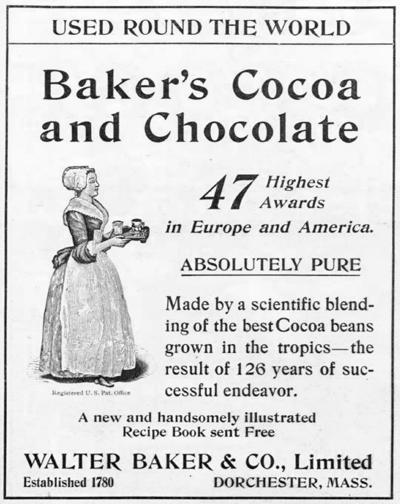
Which leads to another misconception: The product known as Baker’s Chocolate isn’t so called because it was formulated specifically for baking (although German’s Chocolate was) but because of the company that created it. In 1764, John Hannon and Walter Baker began importing cocoa beans and creating and selling chocolate. After Hannon mysteriously disappeared at sea in 1779, Baker became the sole owner of the company they had created, and in 1780, it became Walter Baker & Company, Ltd.
The brand name of the most important ingredient in the original 1957 recipe for German Chocolate Cake was Baker’s German’s Chocolate. Newspapers around the country reprinted that recipe, and it was a big hit — so big, in fact, that, according to All Things Considered, sales of German’s Chocolate shot up 73 percent that year. No one knows exactly how it ended up being called German Chocolate Cake. Perhaps when the recipe was reprinted, newspaper copy editors and proofreaders who were unfamiliar with Baker’s German’s Chocolate dropped the apostrophe-s, assuming it was an error. We may never know.
Logophile Language Puzzlers: Preparing for Winter
- Because of the gelid weather, Eleanor wore ______ to walk the dog.
- sunglasses
- a windbreaker
- a thick woolen coat
- The city ______ voted 11 to 1 to add an ice skating rink to this year’s winter festival.
- consul
- council
- counsel
- Add just one letter to each of these one-syllable words to turn them into common three-syllable words.
- came
- are
- lien
- smile
Answers
- c. a thick woolen coat
Gelid, from the Latin gelidus “frost, cold,” is a rarely used adjective that simply means “very cold.” Eleanor would definitely want to wear a warm coat in gelid weather. So might her dog.
- b. council
Council and counsel (and occasionally consul) are often confused for one another.
- Council: A council (the correct answer) is a body of officials either elected or appointed to make decisions for and represent a larger group. Some things that have councils: cities and towns, church denominations, the Jedi Order
- Counsel: Counsel is often a verb meaning to give advice, but it can also refer to the person giving the advice — usually an attorney. Government officials under suspicion of a crime, for example, might retain legal counsel to advise them on what to do (or what not to do) next. You can, however, seek counsel from a council.
- Consul: A consul is a person from one country residing in another to protect the interests of citizens from their own nation. An American who lost his passport while traveling in Spain, for example, would go to an American consulate for a replacement — or legal counsel, if needed. And ambassador, on the other hand, is a representative from one government who can speak on that government’s behalf to the government of another country.
- cameo, area, alien, simile
Here’s a tougher one: Add one letter to these two-syllable words to take away one syllable.
- ague
- boa
- ragged
- naked
This article is from the November/December 2018 issue of The Saturday Evening Post. Subscribe to the magazine for more art, inspiring stories, fiction, humor, and features from our archives.