Coming Around Again: The Longest Running (and Longest Gaps Between) Hits
To say that 2020 has been an odd year would be an understatement on the order of “The Beatles were mildly popular.” One of the places that the strangeness of our lockdown year has been reflected has been at the movies. With regular theaters closed, drive-ins surged, frequently playing older films. That resulted in the unusual case of 1993’s Jurassic Park hitting the top of the box office again in June. That phenomenon leads to the following questions: what are the biggest gaps between chart toppers, whether at the box office, the record charts, or elsewhere, and what are the film and TV series that have stuck around the longest?
1. When Dinosaurs Ruled the Earth
Jurassic Park stomped to #1 for three weeks upon its initial release in 1993. On June 22nd, lifted by drive-ins, the film took the top spot again 27 years after its original ride. Gone with the Wind remains the all-time box office champion if you adjust for inflation, and the 1939 film had three official re-releases (1989, 1998, 2019), but none of them cracked the #1 spot.
2. Cockroaches and Cher
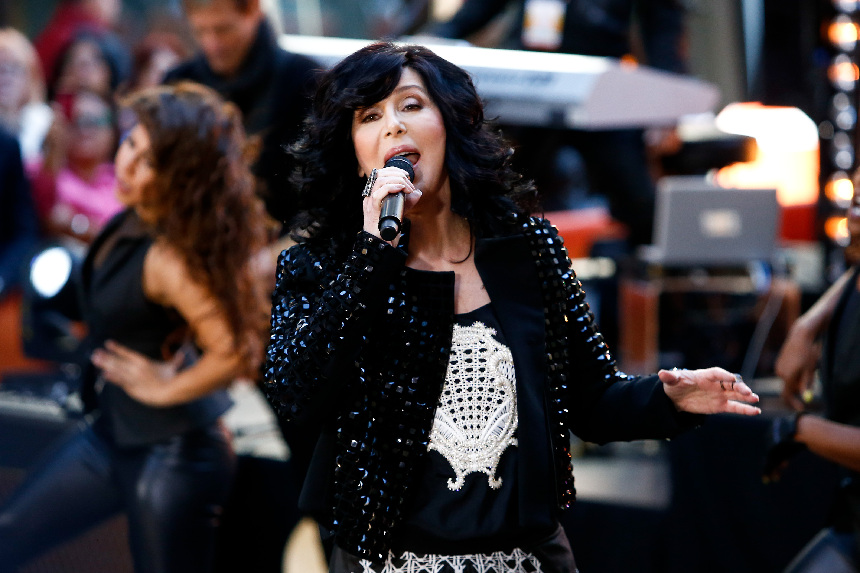
There’s an old joke that goes that if there’s ever a nuclear war, all that’s left will be cockroaches and Cher. While that’s a loving, tongue-in-cheek tribute to the star’s longevity and resiliency, it also has a ring of truth to it where the charts are concerned. Cher hit #1 for the first time in August of 1965 with her then-husband Sonny Bono on their classic “I Got You Babe.” After a continuous run of hits throughout the rest of the 1960s, the 1970s (with three solo #1s), the 1980s, and the 1990s, Cher took “Believe” to #1 in March of 1998. That’s an amazing 33-year-and-seven-month gap between her first #1 and her most recent #1.
Other prodigious gaps between first and most recent #1s have been held by George Harrison (23 years and 11 months between “I Want to Hold Your Hand” as a Beatle in 1964 and “Got My Mind Set on You” in 1988), The Beach Boys (24 years and 5 months between “I Get Around” and “Kokomo”), Elton John (24 years and 8 months between “Crocodile Rock” and “Candle in the Wind 1997”) and Michael Jackson (25 years and 8 months between “I Want You Back” with The Jackson 5 and “You Are Not Alone”).
3. His Name is Series, Longest-Running Series
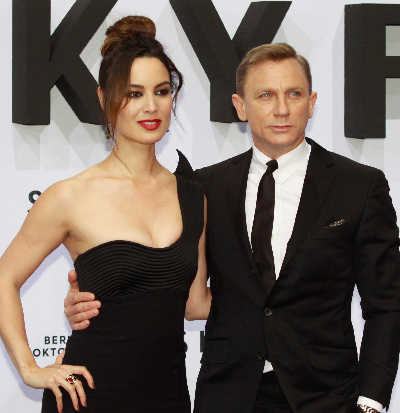
While the overall continuity of the James Bond series is in question, everyone generally treats the films as if they’re part of an ongoing mega-series. It’s the third-highest grossing franchise in movie history, behind only the Marvel Cinematic Universe and Star Wars. But the biggest weapon that Q never designed is Bond’s insane longevity. The first film, Dr. No, was released in October of 1962. If No Time to Die keeps its adjusted November 20, 2020 release date, then that will be 58 years and one month between the first and most recent installments of the series.
4. Call The Doctor!
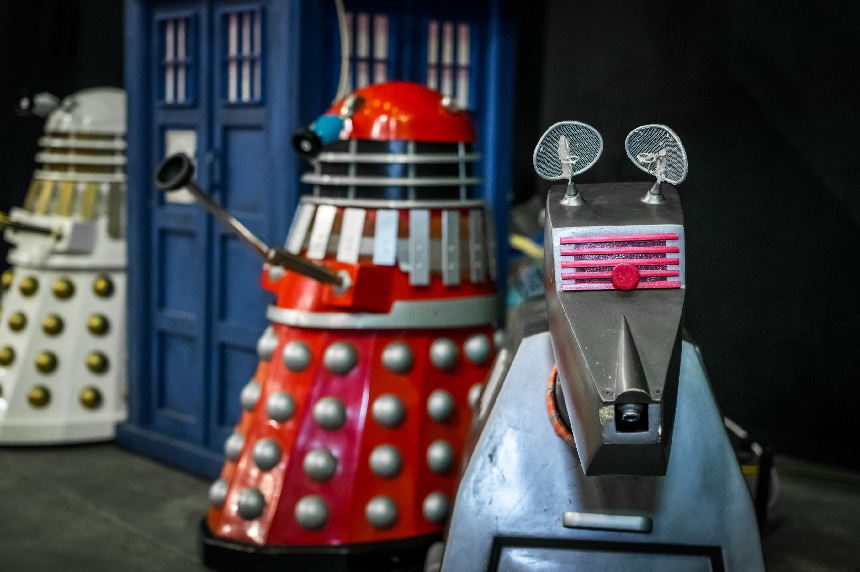
Another British favorite that will seemingly go on forever is Doctor Who. There’s no question about Who continuity; everything is fair game, particularly when your main character is a regenerating Time Lord that is simply the same character in a new form with each re-casting. The Doctor’s first adventure aired in 1963. The original series ran uninterrupted until 1989. A TV film aired in 1996. The series restarted in earnest in 2005 and has been running ever since. The most recent season ended in March of this year. While the worldwide COVID-19 pandemic has put production dates everywhere in question, a special, “Revolution of the Daleks,” should air around the holidays, and the next season is generally expected to air beginning in 2021. If you simply use today as the metric for how long the single continuity of Doctor Who has been running, that’s 57 years of adventures in space and time.
5. Hang on, Marshal Dillon; Detective Benson Is Here
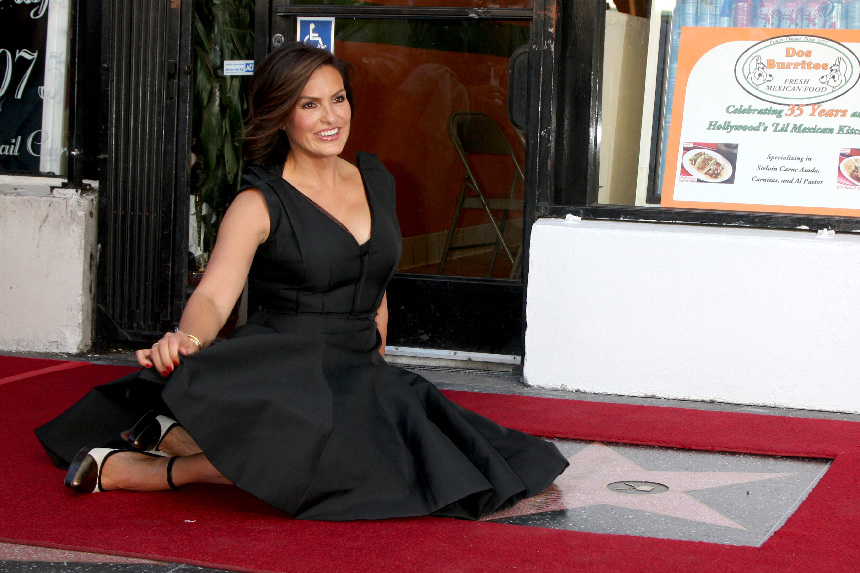
For many years, the issue of the longest-running drama on prime time American television wasn’t a question. That was Gunsmoke, which ran from 1955 to 1975. In 2019, that record was passed by Law & Order: Special Victims Unit, which started in 1999 and is ongoing at present; in fact, NBC has already given it a blanket renewal through a 24th season. The longest-running prime-time program overall is animated comedy The Simpsons, which launched in 1989 and is still running.
On the daytime side, the Guiding Light still holds the record for longest running daytime drama with 57 years on the books at its 2009 sign-off. That record will fall to General Hospital in the very near future. Had it not been for the interruption in production brought on by the COVID-19 pandemic, GH would have passed it this summer. At the moment, a hard pass date can’t be established until production resumes.
6. Seriously, I Was Writing the Whole Time
Some writers seem to function at an inhuman level of output. For every George R.R. Martin, who takes years between A Game of Thrones installments, you have his pal Stephen King, who has averaged 1.4 novels a year since 1974 (plus 11 short story collections, 19 screenplays and five nonfiction works). Then you have the entirely opposite end of the spectrum where dwell writers that have a literal lifetime between their first and second novels. The big winner there is Harper Lee; 55 years passed between the release of To Kill a Mockingbird and Go Set a Watchman. On the technical level, the issue of what to call Watchman exactly is the subject of some debate; yes, it’s a novel, but it’s also really the first draft of what would become Mockingbird.
If you’re looking for the longest gap between an original novel and its sequel, then King might hold the record. It’s true that 59 years passed between the publication of Upton Sinclair’s King Coal and the follow-up The Coal War. However, Sinclair finished the sequel in 1917; the publisher didn’t want to put it out and it sat until 1976, eight years after Sinclair’s passing. King’s gap comes between the 1977 publication of The Shining and its sequel, 2013’s Doctor Sleep, which hit stores 36 years later.
7. Another Day in the 87th Precinct
When it comes to the longest-running series of novels, there are quite a few qualifiers involved. Some novels are franchises given over to other writers, or are based on characters owned by companies rather than individuals. That might account for characters like Doc Savage or Remo Williams/The Destroyer, that have hundreds of novels under their fictional belts. Then you get into series, like Terry Pratchett’s Discworld, with 40 books, or Agatha Christie’s 38 books centered on Hercule Poirot, or the exploits of Rex Stout’s Nero Wolfe in 49 books. Erle Stanley Gardner produced 82 Perry Mason mysteries between 1933 and 1973.
But the longest sustained series by one author appears to be the 87th Precinct series of novels by Ed McBain, which is the pseudonym of Evan Hunter. Between 1956 and 2005, McBain put out 54 novels that take place in one overarching continuity. Set in the city of Isola, a fictional analogue of New York City, the novels follow the cases of the Precinct, most of which involve Detective 2nd Grade Steve Carella.
It seems appropriate to give a mention here to Sue Grafton. From 1982 to 2017, she published “The Alphabet Mysteries,” a series featuring her detective Kinsey Millhone. The books were designed to be a series of 26, one for each letter of the alphabet (A is for Alibi, etc.). The series ran for 35 years. Unfortunately, Grafton passed away in 2017 before beginning the planned Z is for Zero. As opposed to writers like Robert Jordan, who worked with others to see that his Wheel of Time series would be completed after his death, Grafton disdained the idea of having a ghostwriter finish the series. In the Facebook post that announced her mother’s passing, Grafton’s daughter Jamie wrote, “Many of you also know that she was adamant that her books would never be turned into movies or TV shows, and in that same vein, she would never allow a ghost writer to write in her name. Because of all of those things, and out of the deep abiding love and respect for our dear sweet Sue, as far as we in the family are concerned, the alphabet now ends at Y.”
Featured image: Shutterstock
Great Scott!: Back to the Future Hit Screens 35 Years Ago
Some films catch lightning in a bottle; this one caught lightning with a clock tower. Thirty-five years ago, Back to the Future shrugged off troubled early filming (which led to the lead actor being replaced) and went on to become one of the most beloved comedies of all time. It was a massive hit, launching a franchise that included two sequels, an animated series, theme park rides, comic books, video games, and a stage musical while inspiring other shows like Rick and Morty. In honor of the 88 mph that Doc Brown’s DeLorean needs to achieve to time travel, here are eight things about Back to the Future that might have been erased from your memory.
1. Starring … Eric Stoltz?
When shooting commenced on Back to the Future in November 1984, Marty McFly was played by Eric Stoltz. The acclaimed young actor, known in the 1980s for such films as Mask and Some Kind of Wonderful, took the job because Michael J. Fox’s Family Ties commitments kept him tied up. That situation was exacerbated by the fact that Fox’s TV mom, Meredith Baxter Birney, was on maternity leave, necessitating more time in front of the cameras from the rest of the cast. However, a few weeks into filming Back to the Future, director Robert Zemeckis felt that Stoltz, while turning in fine work, was playing the comedic part too dramatically. Stoltz also had misgivings about his own casting, and he agreed to depart the project. Zemeckis went back to NBC, and the producers agreed to a situation whereby Fox could make the film while continuing to work on Family Ties; this meant that Fox spent many weeks filming scenes for the sitcom during the day and shooting the movie at night.
2. Huey Lewis Is Judgmental
The video for “The Power of Love” by Huey Lewis & the News. (Uploaded to YouTube by hueylewisofficial)
During the early scene where Marty’s band, The Pinheads, auditions for the battle of the bands, the nerdy bespectacled judge is played by musician Huey Lewis. Huey Lewis & the News contributed two songs to the film’s soundtrack, “The Power of Love” and “Back in Time;” in fact, a more metal, distorted version of “Love” is Marty’s audition song. “Love” became the band’s first No. 1 on the Hot 100 and earned an Academy Award nomination for Best Original Song.
3. The DeLorean: The Punchline That Time Forgot
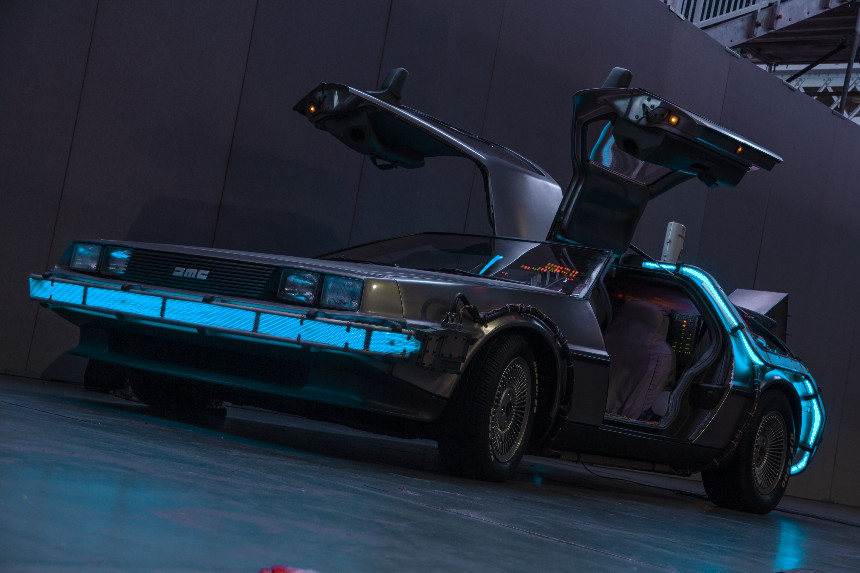
Zemeckis and his BTTF co-writer and producer Bob Gale chose to make the time machine from a DeLorean as because its already futuristic appearance would sell the joke of the car being mistaken for a UFO. The car functioned as a secondary punchline at the time because the DeLorean Motor Company had gone bankrupt a couple of years earlier, and its founder, John DeLorean, had been acquitted in a high-profile drug trafficking trial less than a year before the film opened. During the run of the film in theaters, DeLorean was indicted on fraud and tax evasion charges related to his company’s bankruptcy, but he was acquitted in those cases as well.
4. The Town Square Was Shot ’50s First
Zemeckis shot BTTF’s Hill Valley Town Square scenes on the backlot at Universal Studios. All of the 1950s scenes were shot first, with the set dressed for the period and painted to have a shiny, new quality. When those scenes were wrapped, the set was redressed in a more run-down, ramshackle appearance to capture the decline of the town for the 1980s scenes.
5. Chuck Berry Was Already a Hitmaker
The “Johnny B. Goode” scene from Back to the Future. (Uploaded to YouTube by Movieclips)
The film gives the comedic impression that Marty McFly helped invent rock-’n’-roll and ignite Chuck Berry’s career when he plays “Johnny B. Goode” during the “Enchantment Under the Sea” dance on November 12, 1955. The truth is that Berry already had a hit with “Maybelline ” earlier that year; with song sold a million copies. In fact, though it wasn’t released until 1958, Berry wrote “Johnny B. Goode” in 1955 as well; the opening riff on that tune was, well, swiped from Louis Jordan’s “Ain’t That Just Like a Woman .” Mark Campbell of Jack Mack and the Heart Attack provided Fox’s singing voice in the scene.
6. Biff Seems a Little Bit Familiar (Especially in Part 2)
Thomas F. Wilson played uber-bully Biff Tannen in different incarnations in Back to the Future and its two sequels. However, the adult millionaire Biff from the darker, altered future in the second film was based directly on a real, very familiar person. In an interview with The Daily Beast , Gale was asked about similarities between Biff and the 1980s public persona of a certain current president. Gale said, “We thought about it when we made the movie! Are you kidding? You watch Part II again and there’s a scene where Marty confronts Biff in his office and there’s a huge portrait of Biff on the wall behind Biff, and there’s one moment where Biff kind of stands up and he takes exactly the same pose as the portrait? Yeah.”
7. Stoltz Wasn’t The Only Actor Switched in the Series
It’s not entirely uncommon for parts to be recast as a series of films unfolds. However, the BTTF films had two other significant roles recast for completely different reasons. Crispin Glover memorably played George McFly in the first film, but couldn’t reach an agreement about a contract for the sequels. Actor Jeffrey Weissman was brought in as George, but make-up and other techniques were used to suggest a resemblance to Glover. Footage of Glover from the first film was repurposed in the second. Glover filed suit on the grounds that the producers used his likeness without permission. The case changed the way the Screen Actors Guild negotiates, with contracts now including sections that bar filmmakers from faking a likeness or resemblance without permission or compensation.
The other significant change was the role of Marty’s girlfriend and eventual wife, Jennifer. Claudia Wells played her in the first movie. Unfortunately, Wells’s mother was diagnosed with cancer ahead of the back-to-back shooting of the sequels. She declined the part so she could be available for her family. Elisabeth Shue signed on and played Jennifer in II and III.
8. BTTF Directly Inspired Rick and Morty
The extremely popular Adult Swim animated series Rick and Morty owes its existence to Back to the Future. The show was created by Justin Roiland (who voices both leads) and Dan Harmon (creator of Community). Harmon also co-founded Channel 101, a monthly nonprofit festival for short films; they pair met at an installment and later collaborated on The Real Animated Adventures of Doc and Mharti, a filthy parody of Doc Brown and Marty. When Adult Swim approached Harmon about creating a show for them, Roiland suggested that they take their Doc and Mharti dynamic and repurpose it, dubbing the new versions Rick and Morty. An in-joke in the series is that while they frequently hop between dimensions and alternate reality, Rick often comments that he refuses to do time travel.
Featured image: Thiago Melo / Shutterstock
Review: The Outpost — Movies for the Rest of Us with Bill Newcott
The Outpost
⭐ ⭐ ⭐ ⭐
Rating: R
Run Time: 2 hours 3 minutes
Stars: Orlando Bloom, Scott Eastwood
Writers: Eric Johnson, Paul Tamasy
Director: Rod Lurie
In theaters and streaming on Apple TV and Fandango
I have always had a problematic relationship with war movies, particularly those that are set within the living memory of myself and the people I know — and especially those of more recent vintage, the ones that depict the essential cruelty of combat in ways earlier films seldom did (Think of the D-Day invasion depicted in The Longest Day, told with almost newsreel-like detachment, versus Saving Private Ryan’s version, as horrific a 15 minutes as you’ll ever spend in a movie theater.)
Part of that, I think, comes from the fact that through the sheer randomness of my birth date, I never had to go to war, nor even contemplate the possibility that I might. That made me, from the start, an observer of war rather than a participant; leaving me with a simmering survivor’s guilt I’ve never been quite able to shake.
Beyond that, though, I still have trouble thinking of war movies as “entertainment.” The very word implies fun, or thrills, and that just seems wrong. The idea of getting my jollies from depictions of sacrifice on the altar of human folly seems inappropriate at best; immoral at worst.
So, for me, watching a serious war movie (not a cartoonish one like The Great Escape or The Dirty Dozen) is more akin to a meditative walk through a cemetery than a visit to an amusement park. I’m soaking in the atmosphere, but I’m not really having fun.
Which brings me to the based-on-fact The Outpost, as serious a war film as you will find, and as visceral. After a quick briefing via some terse titles, director Rod Lurie — working from a spitfire script by Oscar winners Eric Johnson and Paul Tamasy (The Fighter) — straps us into a buffeted helicopter, crammed together with a team of U.S. soldiers headed for a remote outpost in the mountains of Afghanistan circa 2007. The men’s faces, barely illuminated by red night lights, fill the screen, their expressions burning with varying states of resolve, confusion, and fear. It’s clear this is no milk run —particularly because the introduction has informed us the men are headed for what the brass candidly refer to as an “indefensible position” — a valley surrounded by steep mountains from which the enemy Taliban can fire at will. It’s just the first of a seemingly endless string of insane official miscalculations that would be the stuff of comedy if the implications were not so deadly serious.
We meet the guys, one by one, identified to us in no-nonsense fashion via their names superimposed on the screen. Aside from Orlando Bloom (The Lord of the Rings), the actors here are by and large not familiar to us —although their last names are: There’s Milo Gibson, son of Mel; Will Attenborough, grandson of Richard; James Jagger, son of Mick (!), and, most notably, Scott Eastwood, son of Clint, who proves himself to be quite the capable stand-in for his poker-faced dad as a no-nonsense sergeant.
Much of The Outpost is spent exploring the complex relationships among the soldiers; a rowdy, seemingly dysfunctional mix of frat hazing, passionate professions of fidelity, and varying measures of adoration and disdain for the Brass. There’s just one constant at Combat Outpost Keating: At any random moment, the surrounding hills can (and will) erupt in hails of enemy gunfire. Lurie’s masterstroke here is in taking that notion of randomness and tightening it around our throats.
After decades of watching war movies, we’ve grown to sense when a script writer is building up to a moment of violence — we’ve even become desensitized to the tricks filmmakers use to try and catch us off-guard. But even as Lurie allows long passages of relative peace to unspool, his actors never let up their sense of vigilance mixed with dread. When those bullets and bombs come flying, we may jump from our seats, but there’s never a moment of surprise in these guys’ eyes.
The Outpost features some of the most stunning you-are-there camera work I’ve ever seen. Cinematographer Lorenzo Senatore (Hellboy) ingeniously employs a camera-carrying drone that weaves in and out of the patrol formations. The uncanny result is a sense of being more than a fly on the wall: we’re a hovering spirit of Death, lingering on one set of haunted eyes, then moving on to the next, contemplating which of these souls we will claim next. It is one of the great artistic tragedies of the COVID-19 theater closures that most audiences will never get to experience Senatore’s artistry on the big screen it deserves.
Inevitably, those small but deadly skirmishes lead to a climactic battle as the Taliban tries to overrun the sickeningly vulnerable post. I will of course defer to anyone who has actually experienced battle, but even if this extended, pulse-pounding scene is one-tenth authentic in its representation of the sheer chaos and shockingly reckless heroism that accompanies it, The Outpost more than qualifies as one of the most important war films of the past decade.
Admittedly, there is one point when The Outpost threatens to dip into Kelly’s Heroes-like cliché: It’s the moment when Eastwood’s sergeant, seeing all is nearly lost, grits his teeth, Dirty Harry-like, and seethes “Not today!” — at which point he becomes a one-man fighting machine, rallying his comrades to follow him to inevitable bloody victory.
It’s a jarring moment, but it is also undeniably thrilling. In fact, it’s just the sort of thing we’ve been secretly hoping for: a hand on our shoulder assuring us everything is going to be okay. Sadly, that’s more than the real-life heroes depicted in this exceptional film ever got. Stick around for the end credits, during which CNN’s Jake Tapper — who wrote the book on which the film is based — interviews the real-life survivors of this, one of the 21st century’s most notable cases of U.S. military hubris — and the incomprehensibly dedicated men who were its devoted victims.
Featured image: Scene from The Outpost (Screen Media)
Ray Harryhausen Set the World in (Stop) Motion
A massively influential artist and filmmaker who inspired some of the greatest talents in the field, Ray Harryhausen was born 100 years ago today. He’s perhaps best known for his innovative work in stop-motion animation, particularly his own technique, dubbed Dynamation.
Stop-motion refers to the process of shooting one frame of a model, making adjustments, and then shooting another frame. As film moves at 24 frames per second, you created the illusion of motion. This technique was used by Willis O’Brien on 1933’s King Kong. That film inspired Harryhausen, and O’Brien became an early mentor, offering advice and critique of Harryhausen’s early work and encouraging him to take sculpture and art classes. After working on films for the Army during World War II, Harryhausen got his first featured job as assistant animator to O’Brien on 1949’s Mighty Joe Young. The film won the Academy Award for Best Visual Effects.
The trailer for The Beast from 20,000 Fathoms (which mentions the Post). (Uploaded to YouTube by Warner Bros.)
Harryhausen would push the envelope of effects in 1953. When he was given complete control over the effects in The Beast from 20,000 Fathoms, he was able to fully integrate his Dynamation process into the film. The technically demanding work involved shooting live-action backgrounds, then animating the stop-motion in front of those backgrounds to make it seems as if the action was occurring in a real-world location. Then the foreground action would be shot and added over the other footage, making it seems as if the live actors and backgrounds were existing in the same space, and interacting with, the models. On a theoretical level, it’s similar to what’s done today with shows like The Mandalorian, which shoot large chunks of scenes in a studio space called The Volume, employing previously shot footage that makes up a virtual background environment.
The Beast from 20,000 Fathoms is near to the heart of The Saturday Evening Post as the original Ray Bradbury story ran in the June 23, 1951 issue. In fact, by the time that Harryhausen worked on the film, he and Bradbury had been friends for years. The original title of the film was to be Monster from the Sea. When the studio discovered that Bradbury’s story also featured an undersea monster drawn to a foghorn, they bought the rights and retitled the film after Bradbury’s short. Ironically, the story would later appear in anthologies as “The Fog Horn,” rather than the film name. Nevertheless, the movie was a major hit at the time, opening more opportunities for Harryhausen and allowing him to continue to innovate with his techniques.
Throughout his career, Harryhausen displayed his genius for creature design and animation in films like It Came from Beneath the Sea, Earth vs. The Flying Saucers, and 20 Million Miles to Earth. All three of those were produced by Charles H. Schneer and became the foundation of a long-lasting and successful partnership. The duo also worked together on a trio of well-received (and much-loved) films based on Sinbad the Sailor of Middle Eastern legends: The 7th Voyage of Sinbad (1958); The Golden Voyage of Sinbad (1974); and Sinbad and the Eye of the Tiger (1977).
However, the film that Harryhausen himself thought of as his best was his 1963 collaboration with Schneer, Jason and the Argonauts. Directed by Don Chaffey, the film features several classic Harryhausen effects sequences. Empire magazine cited Talos from the film as the second greatest movie monster of all time in 2004. The film also contains the praised “skeleton army” sequence, winged harpies, and the many-headed hydra. Despite the advances in technology, the film retains a strong reputation; it was nominated for the American Film Institute’s Top 10 Fantasy Films list in 2008.
While some films were still using techniques that were similar to his, different methods pioneered by the very people whom he had inspired were replacing the kinds of effects that Harryhausen used. The list of those who say that they owe a debt to Harryhausen is staggering, including the likes of Tim Burton, Peter Jackson, George Lucas, Steven Spielberg, James Cameron, Guillermo del Toro, and Wes Anderson. Burton and director Henry Selick would collaborate on films like The Nightmare Before Christmas and James and the Giant Peach that used stop-motion techniques. When Harryhausen passed in 2013, Lucas released a statement that included a simple but massive truth, “Without Ray Harryhausen, there would likely have been no Star Wars.”
The legacy of Ray Harryhausen can be seen today in a variety of ways. The various “walkers” of the Star Wars universe are a tribute, and Peter Jackson’s remake of King Kong was directly inspired by O’Brien and Harryhausen. With his wife of 50 years, Diana, he started the Ray & Diana Harryhausen Foundation, which curates his collection and promotes stop-motion animation; his daughter, Vanessa, remains a trustee. His models and work continue to be exhibited at major museums, while books and podcasts are devoted to his artistry. Over time, he’s accumulated everything from induction into the Science Fiction Hall of Fame, to a star on the Hollywood Walk of Fame, to a special achievement awards from both the BAFTAs and the Oscars. The special effects of today may be so smooth as to almost be indistinguishable from reality, but it was the talent and inventiveness of people like Harryhausen that led, and by example continue to lead, the way.
Featured image: A scene from Jason and the Argonauts, where Jason combats a Hydra (Columbia Pictures / Public domain)
_Hydra_fight.png)
20 Hidden Gems in the Criterion Channel
For years, The Criterion Collection — a vast trove of historic and important world cinema — has searched for a streaming home for its film offerings. Once on Hulu, then Filmstruck, it seems the collection has found a permanent place on The Criterion Channel. As a streaming service, it isn’t the simplest platform (launching it with some devices can be tricky or outright incompatible). But if you can manage to set it up, you’ll gain access to a treasure chest of culture. Flipping through the more than 2,000 movies might be a daunting task, so I’m pleased to report that I’ve spent much of the last 10 years bingeing Criterion films to offer a list of good starters and standouts.
In the Mood for Love (2000)
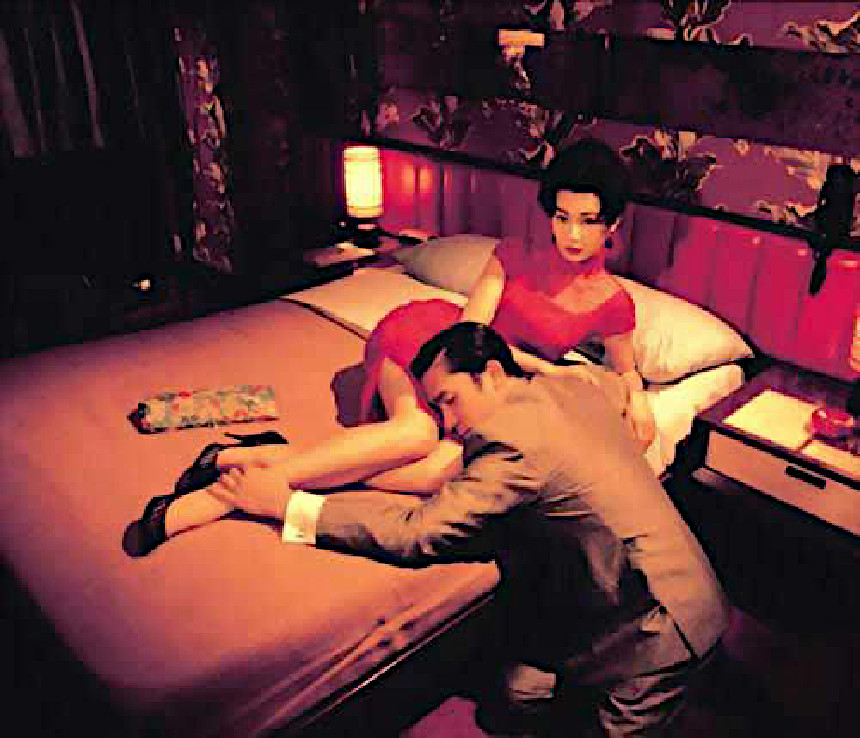
Guru of kaleidoscopic cinema Wong Kar-Wai’s intimate masterpiece builds romantic suspense through an unlikely bond between two neighboring professionals in 1960s Hong Kong. With elegant, heartbreaking performances and a sensory feast of sight and sound, Wong Kar-Wai has created a tense and sympathetic story that must be experienced.
The Player (1992)
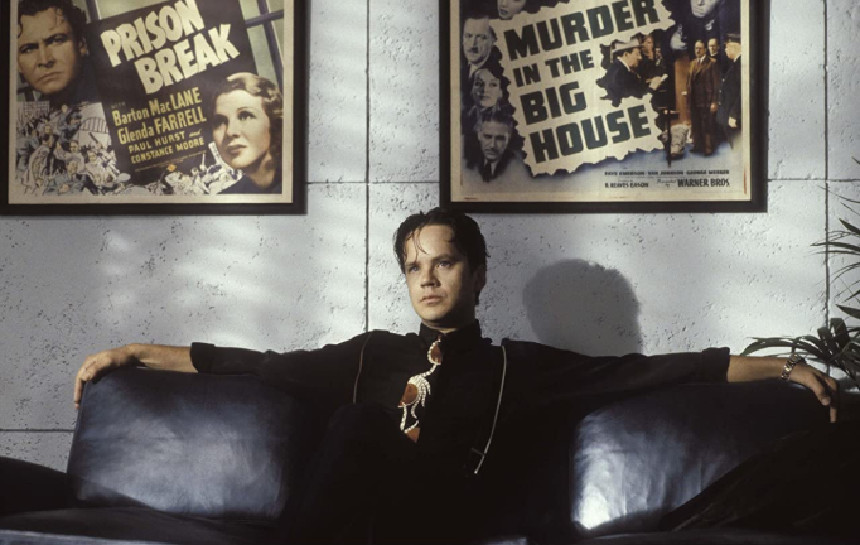
After making his reputation with some big ensemble movies like M*A*S*H and Nashville, Robert Altman made his triumphant return to Hollywood success with this quick-witted satire of the vacuousness of Hollywood itself. It’s devastatingly sharp and funny, and everyone is in it: Burt Reynolds, Whoopi Goldberg, Bruce Willis, James Coburn, Sydney Pollack, Jack Lemmon, Cher. Criterion provides ample extras, like deleted scenes and commentary from Altman himself. By the end, you’ll be working on your elevator pitch for your own screenplay.
La strada (1954)
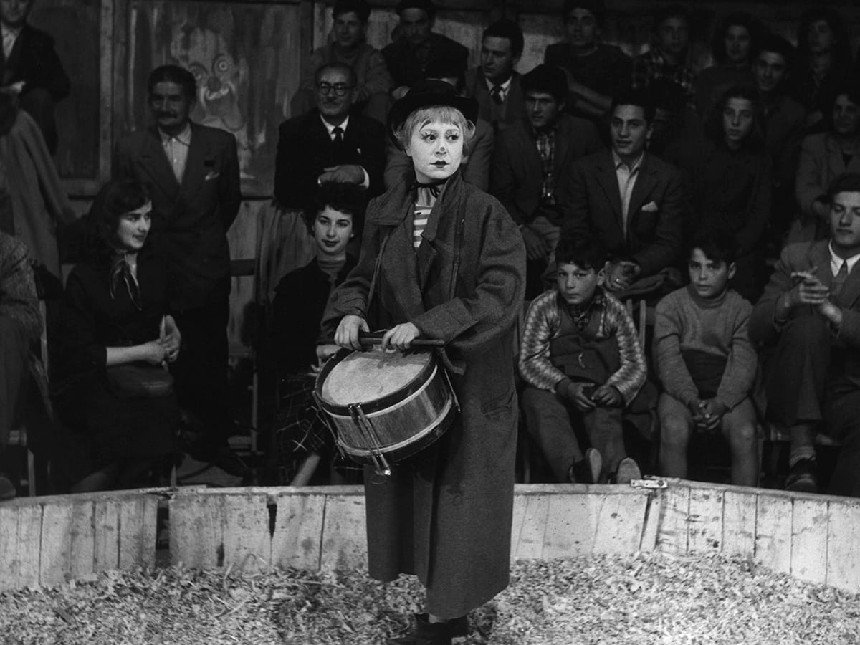
Italian cinema dynamo Federico Fellini directs his wife Giulietta Masina in a whimsical and tragic tale of a traveling sideshow performer and his endearing assistant. La strada, or The Road, won the Oscar for Best Foreign Language Film and marked the start of Fellini’s signature poetic style. Watch Juliet of the Spirits for a more surreal team-up of Fellini and Masina.
Grey Gardens (1976)
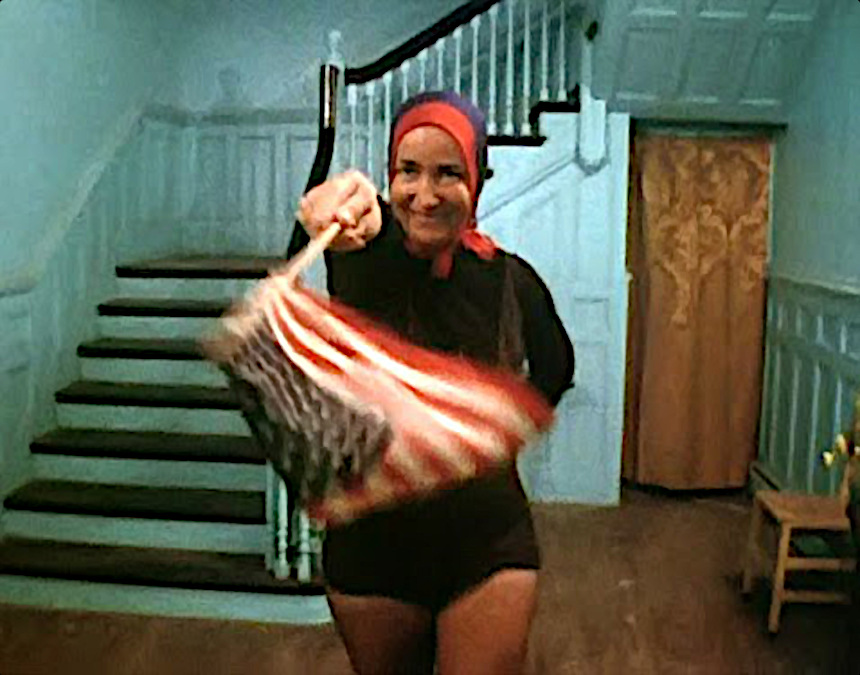
A cult classic documentary on Jackie O.’s reclusive, cat-loving cousins, this portrait of a mother and daughter living in a deteriorating East Hampton mansion offers a rich — and often hilarious — contemplation of the American dream for eccentrics and misfits.
Tie Me Up! Tie Me Down! (1990)
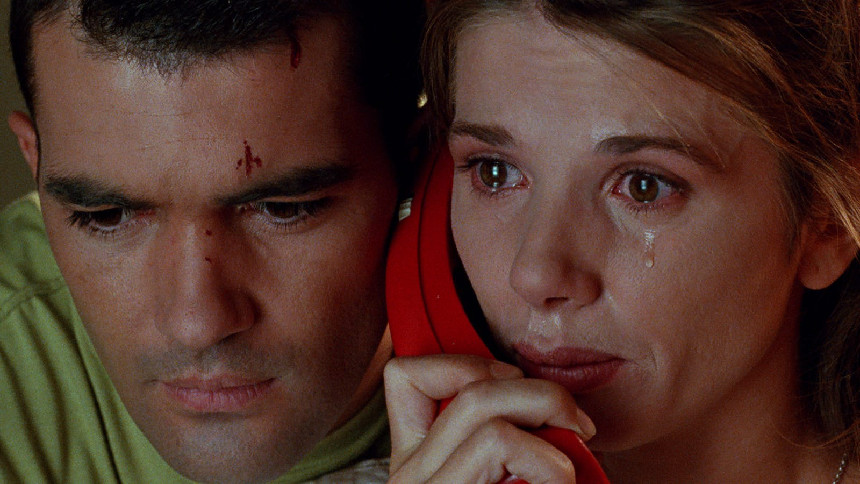
For an evening of bonkers, sexy fun, stream a film by Spain’s own Pedro Almodóvar. Antonio Banderas plays a released psychiatric patient who kidnaps a porn star to make her fall in love with him. With a vivid, economical approach to storytelling, the campy auteur inhabits a world of his own, where romance and danger are often puzzlingly intertwined.
White Material (2009)

A white woman in a former French colony in Africa insists on staying with her coffee plantation even as a civil war rages around her in Claire Denis’s unflinching look at colonialism and family bonds. Isabelle Huppert gives an all-in performance, depicting the crazed desperation of a woman fighting for her legacy against forces she can’t understand.
Monsieur Verdoux (1947)
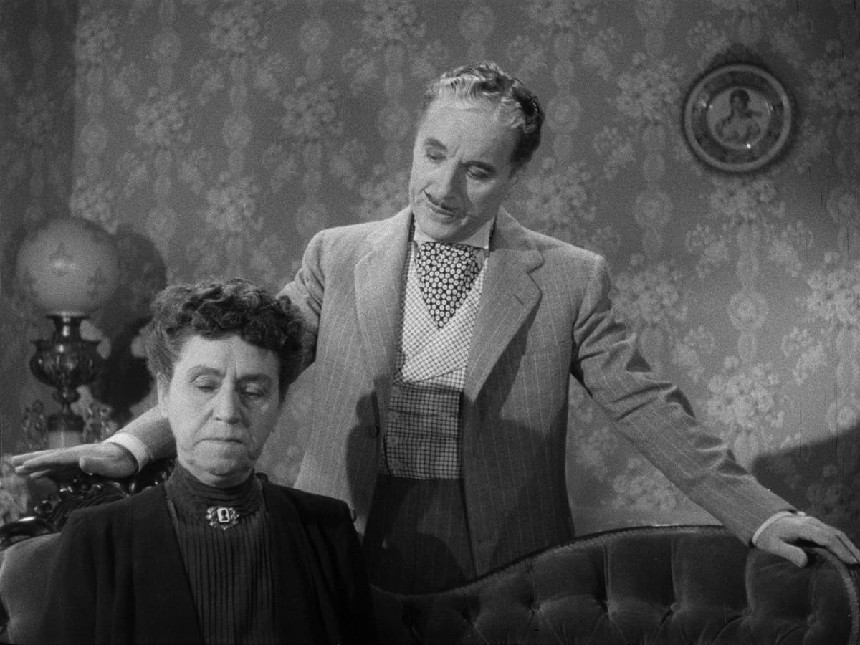
If you’ve never heard Charlie Chaplin’s voice, this uproarious black comedy is the perfect opportunity to witness the Little Tramp in a completely different light: he plays a modern bluebeard, scamming and murdering old women to get by.
Smiles of a Summer Night (1955)
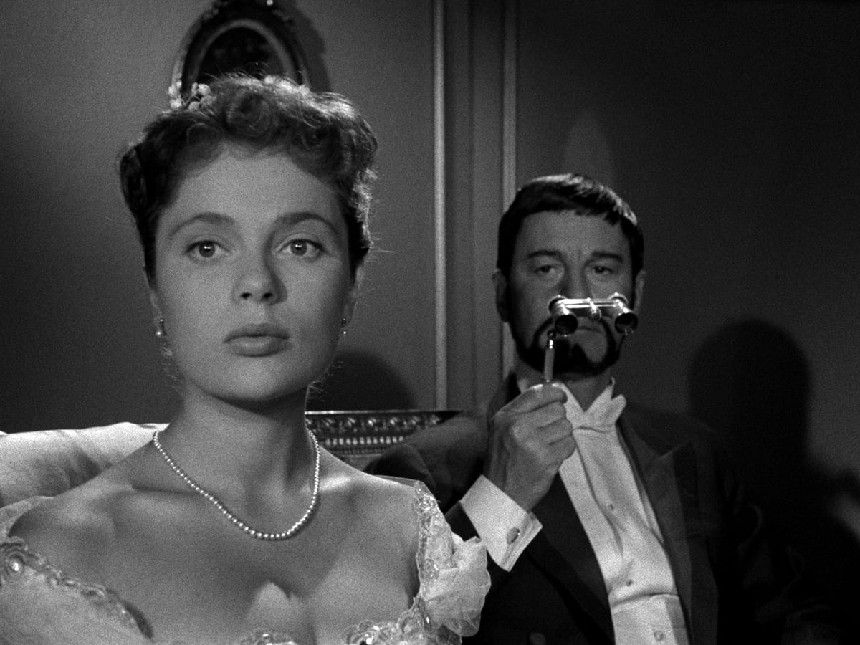
Whether or not he was the greatest filmmaker to have ever lived, Swede Ingmar Bergman was capable of more than heady, molasses-paced existential dramas, as evidenced by this mid-career witty sex comedy. Smiles proved to be Bergman’s first global success and remains the most accessible of his films.
Daughters of the Dust (1991)
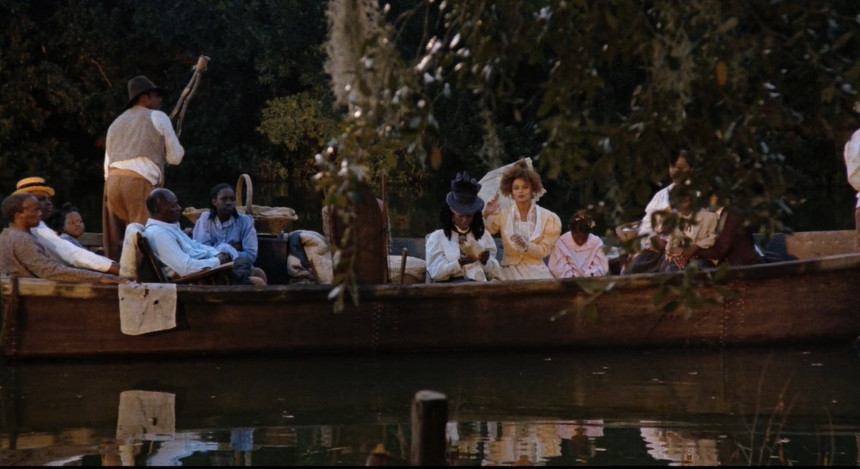
Julie Dash made history when she wrote, directed, and produced this fictionalized portrayal of her Gullah heritage. The film was the first from an African-American woman to have theatrical release in the United States. Her raw, intimate portrait of Gullah women at the turn of the century chronicles a transformative time: a group has decided to leave their island home off the coast of South Carolina to live on the mainland, risking the preservation of their culture in search of opportunity.
God’s Country (1985)
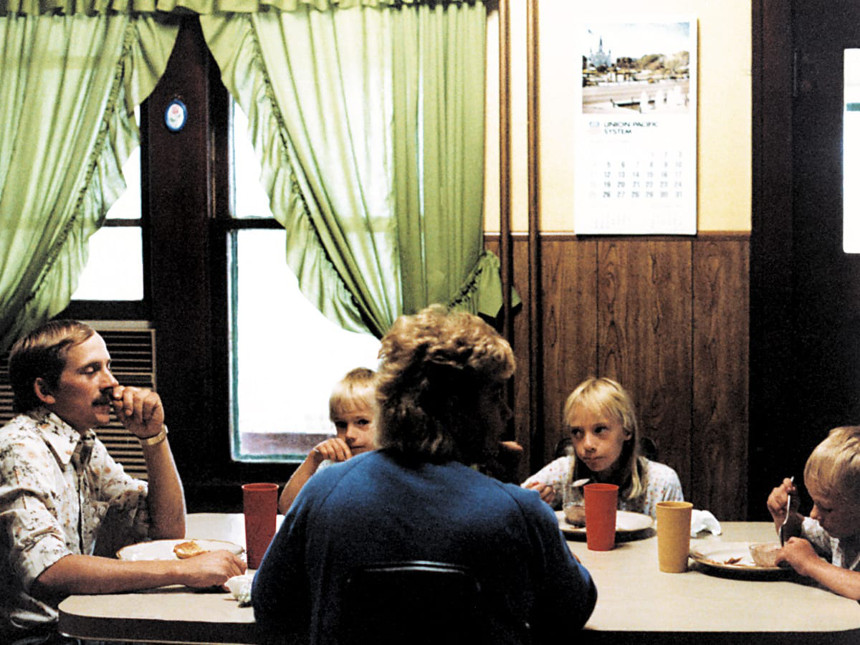
French director Louis Malle traveled to the American Midwest in 1979 to document the lives of several inhabitants of Glencoe, Minnesota, and, when he returned, in 1985, economic frustrations and cultural changes had rocked the farming town. The resulting documentary is a candid and honest look at the American “heartland” and its people through the eyes of a foreigner.
Leviathan (2012)

Created by the Sensory Ethnography Lab at Harvard, this experimental documentary — perhaps more-so than any other — makes the viewer feel as though they are actually in it. “It” is a fishing boat off New Bedford, Massachusetts. The extreme closeups and roaming shots are accompanied by hauntingly comprehensive sound engineering that dives underwater and into the daily lives of working men at sea.
Elevator to the Gallows (1958)

A jazzy, twisting thriller, it’s the stunning debut of director Louis Malle and the breakout performance of Jeanne Moreau, who would go on to an unbelievably illustrious career. Elevator set the stage for a new level of expressive film storytelling in France — and elsewhere — depicting two lovers’ unraveling desperation as their murderous plot goes haywire. And they got Miles Davis to improvise the score.
The Exterminating Angel (1962)
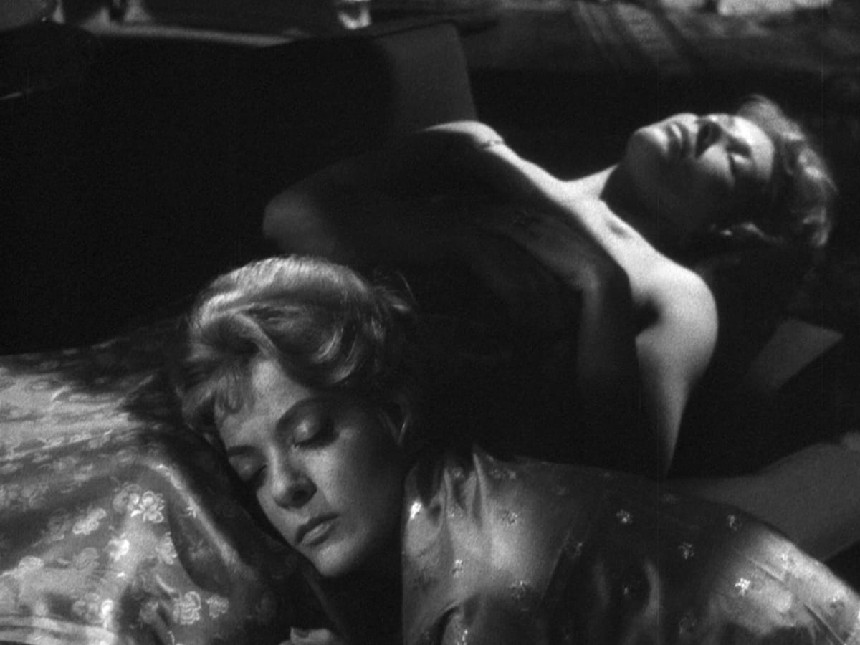
Rumor has it that Stephen Sondheim’s next Broadway musical will be a sort of adaptation of Luis Buñuel’s 1962 surrealist dinner party farce. Buñuel, the same director who shocked viewers at the dawn of cinema with his iconic eye-slicing short film Un Chien Andalou, went on to pioneer absurdist filmmaking throughout the 20th century. In Angel, a neverending bourgeois dinner party exposes the inanity and fragility of the upper class.
Foreign Correspondent (1940)
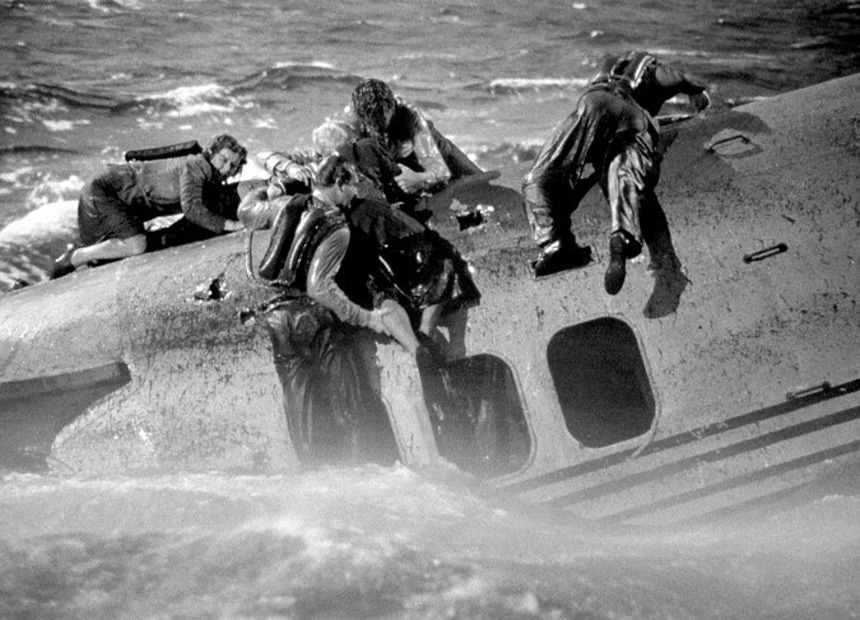
Hitchcock’s second American film, Foreign Correspondent, lost the Best Picture Oscar to Hitchcock’s first American film, Rebecca. The former is a lesser-known rollercoaster of a masterpiece from the master of suspense, following a reporter (Joel McCrea) who stumbles onto an enormous espionage story and finds danger at every turn. Rebecca is also a must-see, but unfortunately it isn’t streaming anywhere currently.
Vivre sa vie (1962)

Most critics would cite Breathless and The 400 Blows as unmissable films of the French New Wave movement (and they’re right), but to take in a unique and utterly watchable expression of the era, go with Godard’s benchmark flick about the tragicomic arc of an aspiring Parisian actress. There’s striking black-and-white cinematography, rock and roll, and a whole lot of smoking.
Claire’s Knee (1970)
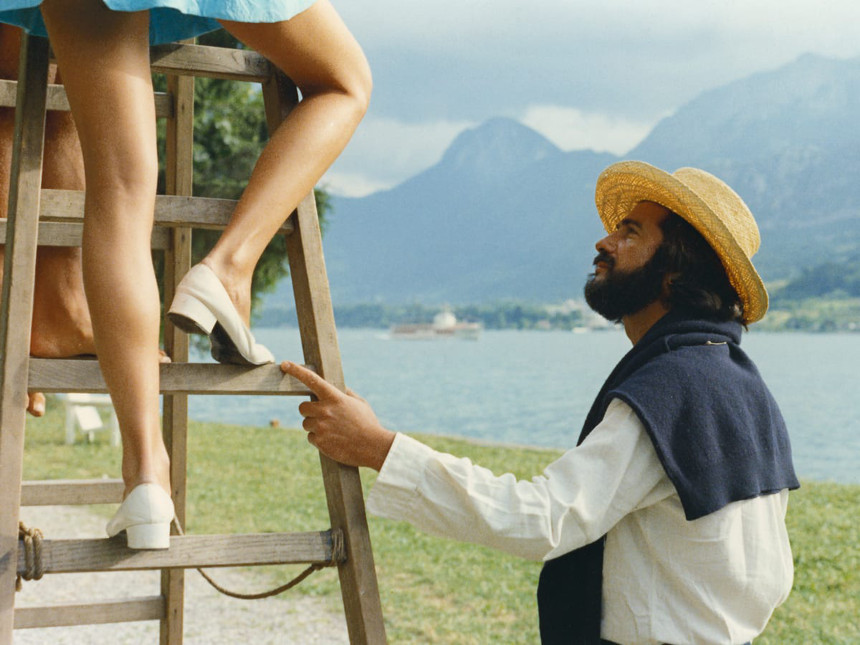
The stunning color photography of the French Alps is only the first thing to notice about this deviant and sensual “moral tale.” With its casual, meandering plot of problematic seduction, Claire’s Knee is not for everyone, but smart dialogue and nuanced performances keep it in the French canon.
Walkabout (1971)
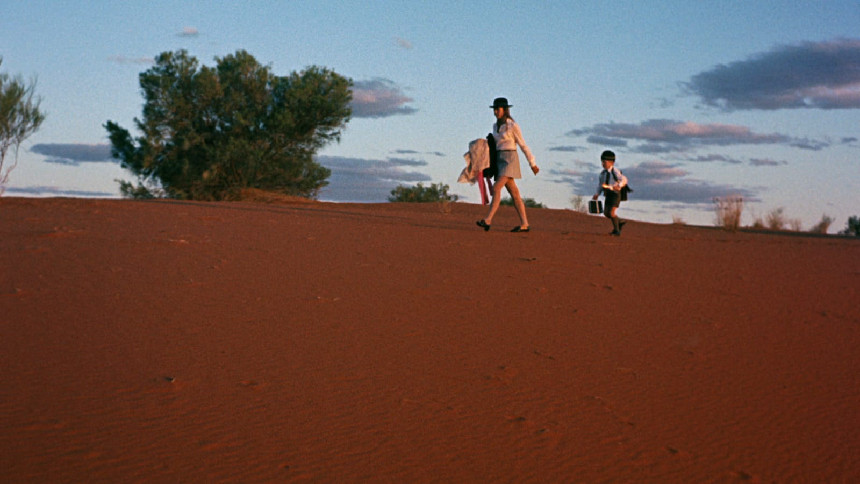
Two young British siblings are stranded in the Australian outback and befriend an Aboriginal boy undergoing his traditional rite of passage. This thought-provoking and disorienting film (from the director of the cult family fantasy The Witches) explores adolescence and the brutality of colonialism in Australia.
Anatomy of a Murder (1959)
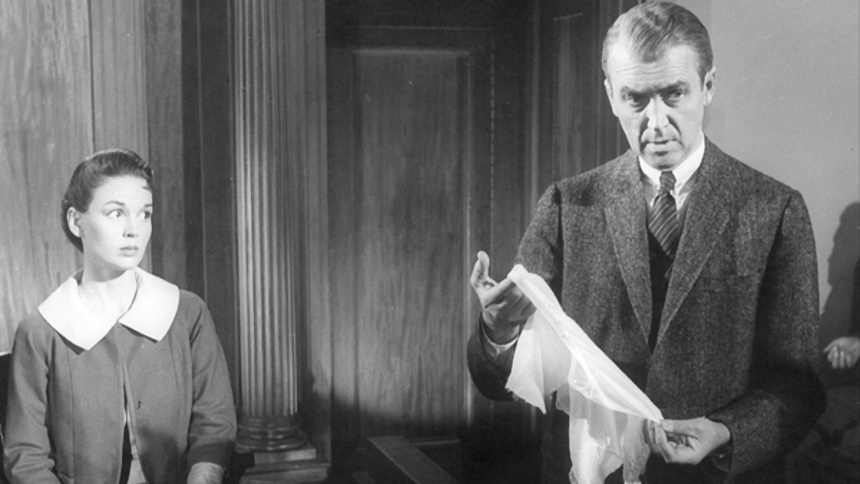
Jimmy Stewart. Otto Preminger. George C. Scott. Duke Ellington. This racy courtroom drama holds up in every way, from its complicated treatment of morality and justice to Preminger’s sophisticated, masterful camerawork.
Throne of Blood (1957)
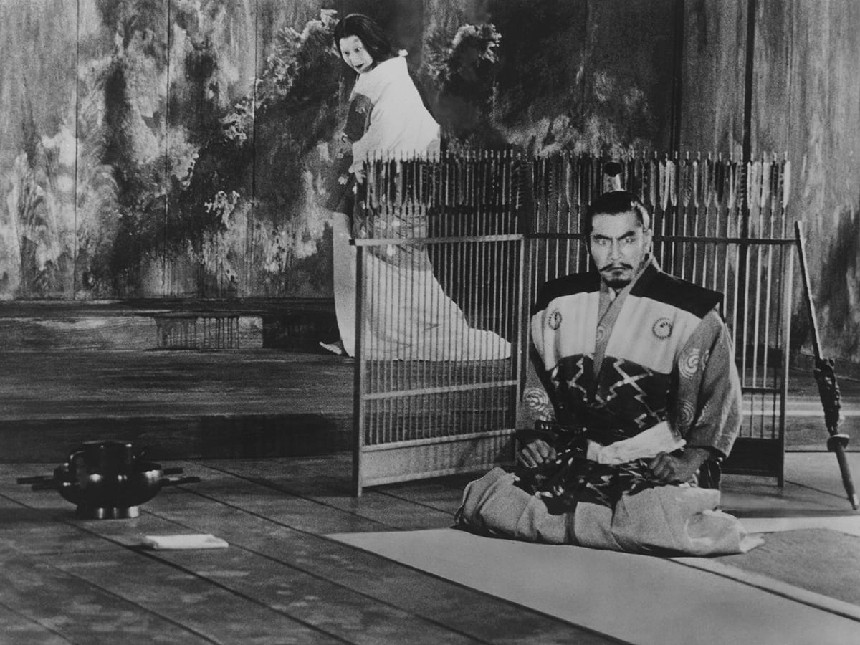
You could spend hours watching Akira Kurosawa’s films on the Criterion Channel, and there wouldn’t be a second wasted. The Japanese director cemented his status as a visual storytelling icon with films such as Rashomon and Seven Samurai, influencing American westerns, thrillers, and virtually every major director across the globe. In Throne of Blood, Kurosawa tells the story of Macbeth with samurais in feudal Japan, mixing traditional Japanese theatre with a Western classic.
An Elephant Sitting Still (2018)

A sweeping, four-hour journey through the lives of various characters crushed by the weight of life’s disappointments, Hu Bo’s only film was released a few years ago to resounding praise for its brutal honesty and stark realism in depicting working-class Chinese. A difficult, but rewarding, viewing experience, Elephant is a unique, roving ride through people and their problems, offering no easy solutions.
Featured image: Les Films du Losange and The Criterion Collection
Movies for the Rest of Us with Bill Newcott: Peter Sellers’ Best Movie Moments
See all Movies for the Rest of Us.
Featured image: The Ghost of Peter Sellers (1091 Media)
The Blues Brothers Took SNL to the Big Screen
When the Not Ready for Prime Time Players hit TV in 1975, few people expected that cast members from Saturday Night Live would soon break into movies. Chevy Chase did it with his 1978 hit Foul Play; that same year, John Belushi had his own hit with National Lampoon’s Animal House. Bill Murray scored the following year with Meatballs. But the first time that SNL characters jumped to movie theaters came in 1980, when Belushi and Dan Aykroyd hit the road as Joliet Jake and Elwood Blues, The Blues Brothers.
Aykroyd and Belushi brought their Blue Brothers characters to life for the first time on the April 22, 1978 show. The original concept was simple in that they were basically just playing the part of a classic rhythm and blues show band. Aykroyd had been a blues fan and got Belushi into it during the after-parties the SNL cast would have at the Holland Tunnel Blues Bar. The pair began to sit in with local bands, and SNL band leader Howard Shore jokingly dubbed the duo the “Blues Brothers.” From there, Aykroyd and Ron Gwynne conceived an elaborate backstory for Jake and Elwood that included being raised in a Catholic orphanage and learning about music from the caretaker, Curtis.
The Blues Brothers perform “Soul Man” on SNL (Uploaded to YouTube by Saturday Night Live)
Before debuting the characters on the show, they collaborated with Paul Shaffer to assemble a legitimate band. “Blue” Lou Marini (sax) and Tom Malone (sax/trombone) had been in Blood, Sweat & Tears and were in the SNL house band. Steve Cropper (guitar) and Donald “Duck” Dunn (bass) were authoritative figures in music, having played on many Stax Records songs and been members of Booker T. & The M.G.’s. The group was rounded out by experienced players Matt “Guitar” Murphy (er, guitar) and Alan Rubin (trumpet). Willie “Too Big” Hall, who had played with Isaac Hayes on “The Theme from Shaft” and more, came in on drums. The band recorded the album Briefcase Full of Blues in 1978 while opening for Steve Martin on tour; positive reviews and their appearances on SNL drove the album to #1 on the charts. Their cover of the Sam & Dave classic “Soul Man,” which they performed on the show, went to #14.
Belushi’s star was going supernova that year. He was easily the most popular SNL player, Animal House was a huge hit, and he and Aykroyd had a #1 album. When the pair suggested that they could see the Blues Brothers on film, a studio bidding war ensued. Universal got the rights and Animal House director John Landis boarded the picture. Landis took Aykroyd’s massive story ideas (a document that took six months to create and was said to be nearly 400 pages) and turned it into a screenplay.
The “I hate Illinois Nazis” scene from The Blues Brothers. (Uploaded to YouTube by Movieclips)
The story involves Elwood retrieving Jake after he gets out of prison. When the brothers discover their former orphanage may close, Jake gets a vision at a church service and decides that they need to go on “a mission from God” to reassemble the band to make enough money to save the home. Along the way, they incur the wrath of the police, a country band, Illinois Nazis, and a murderous mystery woman (Carrie Fisher). The film is filled with musical sequences featuring the likes of James Brown, Ray Charles, Aretha Franklin, and Cab Calloway. The production went over budget thanks to all the cameos, delays from Belushi’s legendary partying, and the record-breaking destruction of over 100 police cars. Though the studio was skeptical about the chances for success, it opened second at the box office in its first week (behind a little picture named The Empire Strikes Back) and went on to be the 10th largest hit of the entire year. The film soundtrack sold a million copies in America.
Aretha Franklin makes acting debut with ‘Blues Brothers’ role (ABC News)
Over the years, the film has become a cult classic and a regular presence in midnight screenings. It did result in a sequel years later, Blue Brothers 2000, which was both a commercial and critical flop. However, the original film proved that SNL characters could make the leap to film. In the decades since, there have been 11 films featuring characters that began as SNL sketches. Aside from The Blues Brothers, the most successful were Wayne’s World, Wayne’s World 2, A Night at the Roxbury, and Superstar (featuring Molly Shannon’s Mary Katherine Gallagher). What Saturday Night Live has proven much more than the ability to launch a film is that it’s almost unequalled as an incubator for comedic talent, with dozens and dozens of successful writers and actors heading out to put out countless acclaimed films, TV shows, and books.
The Blues Brothers remains in popular consciousness for a few reasons. The film is funny, the music is great, and there’s a deceptively heartfelt message under the car crashes; Jake and Elwood know that the orphanage gave them a chance, and they know they need to save it to help other kids that need it, too. It remains a terrific showcase for the varied talents of Belushi, who passed too soon after the film in 1982. The Brothers may have been on a mission from God, but as entertainment, the movie is still divine.
Featured image: steve white photos / Shutterstock.com
Review: The Short History of the Long Road — Movies for the Rest of Us with Bill Newcott
The Short History of the Long Road
⭐ ⭐ ⭐ ⭐
Run Time: 1 hour 30 minutes
Stars: Sabrina Carpenter, Steven Ogg, Danny Trejo, Maggie Siff
Writer/Director: Ani Simon-Kennedy
Decidedly low-key films like The Short History of the Long Road are seldom star-making vehicles, but I have a feeling a decade from now lots of us will look back at this big-hearted road movie and say, “Oh, yeah — that’s the first time I noticed Sabrina Carpenter.”
With a winsomeness and everywoman beauty reminiscent of a younger Saoirse Ronan, 21-year-old Carpenter has actually been around for a while, most notably as a wildly successful teen pop idol. But she really ought to give up the touring grind and concentrate on film — she’s that good in this movie, and she barely sings a note.
In fact, just about the only time Carpenter raises her voice in song is early in the film, as her 17-year-old character, Nola, is tooling along a New Mexico highway with her dad (Westworld’s Steven Ogg) in the beat-up VW Westphalia camper van that they call home. The two are singing along with a radio doo-wop tune, exchanging knowing smiles and laughing like they don’t have a care in the world.
And in a way, they don’t. Dad has designed for his daughter a life of detached hedonism. They sleep wherever they happen to park each night. He picks up pocket money by doing odd jobs. They seek out empty houses and lounge by their swimming pools. Dad is Nola’s teacher, her mentor, and her confidante. Clearly, these two live a life that is utterly entwined.
Then something happens that leaves Nola suddenly on her own. Without friends or known relatives to fall back on, she decides to take the wheel of that van and look for the mother who abandoned her as an infant. Along the way — after a brief but disastrous stay with a family that takes in stray kids — she befriends a gruff but big-hearted garage owner (Danny Trejo, being Danny Trejo in the best possible sense) and a young Native American woman (Jashaun St. John) who is being abused by her father.
Writer/director Ani Simon-Kennedy masterfully manages the ebb and flow of her script, giving each character who enters Nola’s transient life plenty of time to unfold their quirks and qualities. There’s a gentle whimsy to Simon-Kennedy’s storytelling; a sense that good people are everywhere around us — and occasionally we need them to set us straight when we wander off course. (One of the film’s briefest and most tender scenes involves an elderly man who catches Nola trying to siphon gasoline from his camper.)
Nola eventually does find her mom, Cheryl, who owns a struggling diner somewhere in the American desert — and it’s here that The Long Road takes its most intriguing turn. Happy to see her daughter, Cheryl nevertheless remains unrepentant about having abandoned her. She lets the girl sleep over and even helps her raise some money, but she’s clearly miffed when Nola turns up unexpectedly at work — and self-consciously introduces her to the staff as her niece.
Cheryl, a complex character to say the least, is played with perfect precision by Maggie Siff, the invaluable costar of TV’s Mad Men and Billions. Self-confident yet a mass of contradictions, Cheryl tries mightily to mine some trace of motherly instinct — only to find that particular vein came a cropper long ago. Likewise, although she’s yearning for the security of a family, Nola discovers the self-reliant streak instilled by her father is not going to fade any time soon. In a daring and effective writer/director choice, Simon-Kennedy chooses to show us the pair’s denouement from a distance, their words muffled, as if only these two could possibly understand the unique dynamics that draw them together and drive them apart.
The Short History of the Long Road flows with such moments. When the final fade-out comes, you sort of wish you could hitch a ride for the long run.
Featured image: Sabrina Carpenter in The Short History of the Long Road (Photo credit: FilmRise)
Laurel and Hardy’s Comedy Still Holds Up
In order to join the private Laurel and Hardy Appreciation Society Facebook group, one is required to submit, in writing, their favorite Laurel and Hardy scene, probably to weed out spammers and trolls. But if you want to gain membership to the Sons of the Desert — the most widespread and official club for “connoisseurs” of the comic duo — you’ll need to contact the corresponding secretary and find your local chapter, or “tent.”
For 55 years, the Sons of the Desert have made it their mission to keep Laurel and Hardy’s legacy alive across the globe. There are more than 100 “tents,” most of which are named after Laurel and Hardy’s films. The Way Out West tent is located in Los Angeles, the Boston Brats tent is, of course, in Boston, and the Unaccustomed As We Are tent is the chapter in Jakarta, Indonesia. A tent called Berth Marks meets at the Laurel and Hardy Museum in Ulverston, England, where Stan Laurel was born 130 years ago today.
Watching Laurel and Hardy’s movies now, particularly Sons of the Desert, is an exercise in discovery for the uninitiated. Their films display the timelessness of good comedy — wit, slapstick, timing — and the universality of maddening frustration over endless incompetence. Sons begins with the pair causing awkward chaos by interrupting a Shriners-type meeting to squeeze their way to two front seats, and it ends with Stan Laurel’s famous line, once they’ve both been caught lying to their wives about attending a national convention in Chicago: “Honesty is the best politics.” Laurel and Hardy were flanked by plenty of other famous, and acclaimed, comedic actors in their time — Mae West, Charlie Chaplin, the Marx Brothers — but they’ve inspired a uniquely resilient organized fanbase.
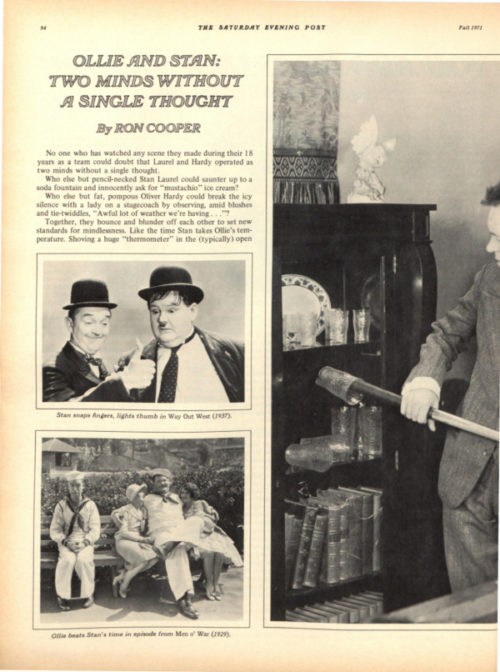
When Ron Cooper wrote about the Sons of the Desert in this magazine in 1971, he was impressed to see a sort of Laurel and Hardy revival underway. Since then, the group only appears to have grown, adding dozens of tents around the world and expanding the fanbase for the comic duo of Hollywood’s Golden Age. Cooper noted Stan Laurel’s approval of the “buff club’s” formation, and his contribution to the Greek motto on the group’s insignia: “Two Minds Without a Single Thought.”
In a 1987 documentary about the Sons of the Desert, its founder John McCabe described the group as “a set of odd, charming, curious, misplaced cherubs.” The farcical organization is run in a similarly absurd fashion as the movie it is named after. The chair is named the “Exhausted Ruler,” a malapropism uttered by Laurel when he means to say “exalted ruler,” and the group joins crossed arms to sing their chant: “We are the sons of the desert/ Having the time of our lives … ” At their biennial conventions, members (which include men and women) share memorabilia, play trivia, drink cocktails at every step (as directed by their constitution), and, of course, watch Laurel and Hardy films.
Gary Russeth, of Harlem, Georgia (Hardy’s birthplace) is the “Grand Sheik” of his local tent, and he runs a local museum. He says he grew up watching Laurel and Hardy on a nine-inch 1947 General Electric portable television set. Speaking to the pair’s enduring popularity, he says, “We have lawyers, teachers, blue- and white-collar people in the Sons of the Desert. It’s a variety of many different groups. I would see these little kids come in, and they’re so smart and they love Laurel and Hardy. It’s basic, like a cartoon. It’s just two funny guys that just constantly have one problem after another. And it’s embellished.”
The Sons‘ 2020 convention was scheduled to occur this month in Providence, Rhode Island, but it was delayed until next year. Laurel and Hardy savants need not dismay over the lack of a formal meeting, though; later this month, Laurel & Hardy: The Definitive Restorations will be released on Blu-ray.
Featured image: Laurel and Hardy in The Flying Deuces (Wikimedia Commons, Public Domain)
_1.jpg)
What Happened to the Summer Movies?
“Summer Movie Season” has been a familiar notion in America for decades. That’s when the crowd-pleasing blockbusters and movies targeted at the kids who are fresh out of school hit the screen. Since the early 2000s, the start of Summer Movie Season kicks off the first weekend in May as studios tie genre releases to Free Comic Book Day to give their big-tent films an extra boost. However, with the COVID-19 pandemic still ongoing, the Summer Movie Season had to make radical adjustments, resulting in three parallel narratives: the push of some films to fall dates, the shifting of other films to streaming platforms, and the unlikely success of “The Wretched” (and now, “Becky”) at drive-in theatres. Sit back, ladies and gentlemen; we’ve got ourselves a triple feature.
Part I: Where Did the Movies Go?
As with any regular summer season, the summer of 2020 was set to be chock-full of blockbuster movies. Those included Mulan, A Quiet Place 2, Black Widow, James Bond installment No Time to Die, Scoob!, Wonder Woman 1984, Pixar’s Soul, Top Gun: Maverick, Ghostbusters: Afterlife, and more. When the threat of the pandemic became clear in March, studios began rapidly moving pictures to other dates or, in some cases, to other platforms. With some indoor theater chains preparing to open in June, we can take a look at where some of these expected big movies have settled. (Note: Dates may still be subject to change.)
The trailer for Tenet. (Uploaded to YouTube by Warner Bros. Pictures)
- Mulan: July 24
- Tenet: July 31 (Updated: Tenet moved back after this article posted.)
- The Spongebob Movie: August 7
- Wonder Woman 1984: August 14
- The Secret Garden: August 14
- Antebellum: August 20
- Bill & Ted Face the Music: August 21 (This is also the original date.)
- New Mutants: August 28 (This is the fifth date for this film. It’s a long story.)
- A Quiet Place 2: September 4
- Candyman: September 25
- Without Remorse: October 2
- The French Dispatch: October 16
- Fatherhood: October 23 (This Kevin Hart film actually moved up from January of 2021.)
- Black Widow: November 6
- Soul: November 20
- No Time to Die: November 25 (Update: This date changed after the article posted.)
- Free Guy: December 11
- Top Gun: Maverick: December 23
The trailer for In the Heights. (Uploaded to YouTube by Warner Bros. Pictures)
Additionally, a number of anticipated films were moved out of 2020 completely. Here are anticipated 2020 openers that ended up shifting to 2021.
- Peter Rabbit 2: The Runaway: January 15
- The Eternals: February 12
- Ghostbuster: Afterlife: March 5
- Raya and the Last Dragon: March 12
- Morbius: March 19
- F9 (Fast & Furious 9): April 2
- Shang-Chi and the Legend of the Ten Rings: May 7
- In the Heights: June 18
- Venom: Let There Be Carnage: June 25
- The Tomorrow War: July 23
- Jungle Cruise: July 30
- Minions: Rise of Gru: July 2
- Mission: Impossible 7: November 19
- The Nightingale: December 22 (Note: This is the Dakota and Elle Fanning WWII drama, not the 2018 Australian film.)
Part II: Where Did the Movies Go on Streaming?
The trailer for Working Man. (Uploaded to YouTube by Brainstorm Media)
As a subset to all of the big date moves for theatrical releases, a number of films were pulled to be released onto VOD or various streaming services. Some have already debuted, while others are on the way. Here are some of those notable switches.
- Trolls 2: World Tour: Digital Rental on April 10
- Blue Story: Digital Rental on May 5
- Working Man: Digital Rental on May 5
- Scoob!: Digital Rental on May 15
- The Lovebirds: Netflix on May 22
- Artemis Fowl: Disney+ on June 12
- Irresistible: Digital Rental on June 26
- Hamilton: Disney+ on July 3
- The Truth: Digital Rental and select theaters on July 3
- Greyhound: AppleTV+ (date pending)
- My Spy: Amazon (date pending)
Part III: How did The Wretched become the #1 movie in America?
As theater chains and local movie houses shut down due to the pandemic, one particular type of venue did manage to start showing films again. That was, of course, the drive-in, where social distancing is built in to the experience as you watch the film from your own car or parking space. As the Post previously reported in 2018, drive-in theaters have experienced something of a minor resurgence in recent years; the pandemic gave those in operation the unique ability to deliver movies when everything else was closed.
The trailer for The Wretched. (Uploaded to YouTube by FilmSelect Trailer)
Of course, the vast majority of big summer releases had already been moved. That gave some smaller films the opportunity to get in front of drive-in viewers eager for a movie experience. Enter Brett and Drew T. Pierce’s horror film, The Wretched. The IFC Films picture premiered at the 2019 Fantasia International Film Festival; it’s received mostly positive reviews with particular praise for its cinematography and atmosphere. On May 1, The Wretched arrived for digital rental . . . and at drive-ins. By the end of the weekend, with essentially no competition from indoor theaters and few other new films on the outdoor screens, The Wretched hit #1 at the box office, pulling in over $65,000 from 12 screens. For the next four weeks, The Wretched sat atop the box office charts, making more money every week as more outdoor screens added the word-of-mouth hit. It was finally dethroned in week six (although it made over $200,000) by the debut of Becky, a thriller featuring burgeoning horror starlet Lulu Wilson.
The success of The Wretched is something of a throwback to the 1950s through the 1980s, when lower-budget films released at drive-ins could still thrive. This is actually a hopeful sign for the movie business, as it might re-open the way for reliable distribution across models; instead of being locked in to indoor theatres, films could consider different viable options for release and still have scaled tiers of success. Certainly, a hugely budgeted Marvel movie couldn’t necessarily make what it needs to by relying solely on drive-ins, but a $1 or $2 million-budgeted thriller could do quite well. If there’s a sustained COVID-19 spike over the summer, drive-ins may be the only places (outside the home) where new films are available.
Like all avenues of American life in 2020, the movies had to adapt quickly to a new normal. And while nothing’s back to the “old normal” yet (and may not be for some time), it’s refreshing to know that there are still pathways for people to embrace escapism. Whether you prefer your films under the stars or in the comfort of your home, it seems that you have plenty of options coming to a screen near you, even if you have to wait a little longer than you expected.
Featured image: Shutterstock
How Urban Cowboy Disrupted Country Music
No matter how you look at the decade, the 1970s were a musical battleground. New and rising genres like disco, punk, funk, and hip-hop arrived as significant acts from the previous decade broke up (The Beatles), faded, or died. The Southern Rock and singer-songwriter movements impacted the charts, as did more socially conscious soul and R&B. In the country music arena, a struggle ensued between a shiny, rhinestone-covered version of the sound and artists who wanted to push for gritand authenticity. By 1980, the clash in country hit a flashpoint in an unlikely place, the John Travolta film Urban Cowboy, which was released 40 years ago this week.
Dolly Parton’s “Here You Come Again” was a #1 pop song in 1977 (Uploaded to YouTube by Dolly Parton)
A fine point about the divergences in country through the 1970s was made in, wouldn’t you know it, The Saturday Evening Post. In a 1975 article, “Nashville – Where It Started,” Paul Hemphill said, “Country music isn’t really country anymore; it is a hybrid of nearly every form of popular music in America.” Hemphill meant the genre wasn’t just cowboy songs or honky tonk or rockabilly; it was a thing that combined all sensibilities, including folk and pop. Song of the biggest stars at the time, like John Denver or Olivia Newton-John, either started in other genres or integrated other styles into the country approach. Denver even won the Country Music Association’s award for Country Music Entertainer of the Year in 1975. Established country artists like Dolly Parton began to regularly score huge hits on the pop charts.
“Are You Sure Hank Done It This Way” by Waylon Jennings (Uploaded to YouTube by Waylon Jennings)
That same year, Waylon Jennings recorded “Are You Sure Hank Done It This Way?” which suggested that a new approach in both style and content was needed in the form. Jennings and other artists like his wife, Jessi Colter, Willie Nelson, Johnny Cash, and others, leaned on a rougher style that became known as Outlaw. Many of those artists chucked the shiny blazers and sparkly suits that had been en vogue for the decade in favor of jeans and leather vests or jackets.
The trailer for Urban Cowboy (Uploaded to YouTube by YouTube Movies / Paramount)
It was against this backdrop that Urban Cowboy came into being. The film drew inspiration from the Esquire article “Urban Cowboy” by Aaron Latham; Latham’s piece centered on a romance at Gilley’s, which was a massive honky tonk club in Pasadena, Texas. Latham and director James Bridges adapted the story into a screenplay with John Travolta and Debra Winger as the leads. It was little wonder that Travolta had an interest in the part; his massive 1977 hit Saturday Night Fever was also based on a magazine piece. Also like Fever, and Travolta’s 1978 hit, Grease, the part would allow him to show his dancing ability against the backdrop of a strong soundtrack (Travolta’s representation had previously suggested he take a cut of the soundtracks for Fever and Grease, a move that paid off to the tune of millions). While the film wasn’t as huge as Fever or Grease, it was a sizeable hit in terms of not just box office, but also fashion and music.
The soundtrack for Urban Cowboy leaned heavily on pop-flavored country and generated five Top 10 country singles (“Love the World Away” by Kenny Rogers; “Look What You’ve Done to Me” by Boz Scaggs; “Stand by Me” by Mickey Gilley; “Lookin’ for Love” by Johnny Lee; “Could I Have This Dance?” by Anne Murray); the latter three all went to #1, and all five crossed over to the Pop Chart. Those songs, along with other hits like Dolly Parton’s title tune from her own 1980 film, 9 to 5, caused a major surge in the popularity of the lighter side of country.
Sylvia performing “Nobody” (Uploaded to YouTube by Sylvia – Topic / Sony Music Entertainment)
However, country traditionalists weren’t exactly thrilled. A definite schism arose in the genre between the rougher outlaw artists and related subgenres, and the more pop-oriented singers and groups. On a commercial level, the pop style was in ascendance, with artists like Rogers and Parton consistently notching hits on both charts. In the wake of the success of Urban Cowboy, new fans of the genre came in concurrent to a spike in the number of stations moving to a country format (some were new, while a few of these had abandoned disco and the 1970s staple AM easy listening formats). TV helped both sides, with the continued success of Hee Haw in syndication showcasing acts from all segments of the country spectrum. Following the lead of 1981’s launch of MTV, the 1983 debut of The Nashville Network gave the genre its own cable platform. Like Hee Haw, the channel featured a variety of artists; however, it did tend to emphasize pop-oriented and video-ready acts like Sylvia, whose “Nobody” went to #15 on the pop charts in 1982.
Of course, no subgenre holds sway forever. Pop crossovers started dropping in the mid-’80s as both the pervasiveness and increased diversity on MTV allowed superstars like Michael Jackson, Madonna, Prince, Bruce Springsteen, and others to dominate the charts, while also allowing booming genres like metal and hip-hop to enjoy crossover success. Country retrenched in the mid-1980s as neotraditionalists like Clint Black, Dwight Yoakam, The Judds, Reba McEntire, and George Strait took over for the rest of the decade.
The Highwomen perform “Redesigning Women.” (Uploaded to YouTube by The Howard Stern Show)
Today, country is as it’s always been: an amalgam of many genres and subgenres. It experienced a huge boom in the early ’90s when SoundScan dramatically changed how sales were counted, and enormous acts like Garth Brooks and Shania Twain were as big as any stars on the planet. Though country still offers the occasional crossover breakout, like Taylor Swift, it’s steady and thriving. Some likened the recent years of male-heavy “bro country” to the Urban Cowboy years, but acts like Brandi Carlile, Maren Morris, the supergroup The Highwomen (of which Carlile and Morris are members), Kacey Musgraves, and Kelsea Ballerini, among others, have carved out a bigger niche for female artists in the last few years. The lesson seems to be that no matter how far you stretch a form, it will at some point always snap back to the essentials. Or, to put it another way, you can put country on the pop charts, but it won’t forget where it came from.
Featured image: ThoseLittleWings / Shutterstock
Review: American Trial: The Eric Garner Story — Movies for the Rest of Us with Bill Newcott
American Trial: The Eric Garner Story
⭐ ⭐ ⭐ ⭐
Rating: NR
Run Time: 1 hour 40 minutes
Director: Roee Messinger
Streaming through independent theater websites. Find the latest links at www.passionriver.com/americantrial.html
It would be difficult to imagine a film more timely than American Trial: The Eric Garner Story — a daringly imaginative attempt to bring closure to one of the more notorious police brutality cases in recent history.
Garner was the Staten Island African-American man who, in 2014, was arrested for selling loose cigarettes on a sidewalk. He ended up face-down on the sidewalk, his neck in a choke hold, gasping “I can’t breathe” — three words that have become a haunting mantra in America’s latter-day civil rights movement.
A grand jury chose not to indict Daniel Pantaleo, the officer who tackled Garner and who, according to the coroner’s office, applied the choke hold that led to Garner’s death. So, aside from a civil suit against the city won by Garner’s family, no one paid a price.
That’s where director Roee Messinger comes in: Summoning equal measures of inspiration and ingenuity, he mounts a trial for Pantaleo on film, hiring actual defense attorneys and real-life prosecutors, and bringing in true-life witnesses to what happened that awful day on Staten Island. We meet Garner’s widow and his best friend — but we also hear testimony from genuine medical experts who differ on the cause of Garner’s death, and real ex-cops who speak urgently about the supreme difficulty of making split-second life-and-death decisions on the street.
Only one actor is employed in the cause: Bronx-born Anthony Altieri, who convincingly plays the accused as a guy who feels badly about what happened — but whose years on the beat have seemingly dulled his ability to respond emotionally to anything.
The result is a film that seems more like a nightly news summary of Pantaleo’s trial, documented by cameras mounted on the periphery of a nondescript urban courtroom. No mahogany tables or soaring windows here — the furniture is purely utilitarian, the lighting harsh, the confines almost claustrophobic. And ever-present on the soundtrack, like a minimalist musical score, clicks the keyboard of the court reporter, a touch that lends uncanny reality to the proceedings.
As the trial unfolds, Messinger seems to consciously eschew every common trope of courtroom dramas. The lawyers don’t perform Shakespearian orations — they read their opening and closing statements from laptops and pads of paper. The jurors seem to occasionally lose interest, or at least focus. There are no tight shots of sweating witnesses, no outbursts from the gallery, no stern lectures from the judge. Then there’s the perfunctory “Good morning” that each lawyer offers to every opposition witness — and their guarded “Good morning” response as they brace for the coming evisceration. This is the American trial process in all its banal beauty; the imperfect grunt work of imperfect people seemingly at odds — yet in a real sense working together to reach that elusive quality called Justice.
An American Trial: The Eric Garner Story won’t replace To Kill a Mockingbird or Inherit the Wind as the cinema’s quintessential courtroom drama, but it may well endure as the most authentic. And because it depicts a trial that never happened, it also serves as a solemn reminder that the denial of justice blocks closure not only for the aggrieved, but the accused, as well.
Featured image: Actor Anthony Altieri with witnesses, friends, and family (Passion River Films)
Movies for the Rest of Us with Bill Newcott: Time Travel
See all Movies for the Rest of Us.
The 15 Best Motown Movie Moments
superThe Motown sound was radio gold, and it turned out to work well in movies too. Berry Gordy Jr.’s record label turned out soul, R&B, and funk hits that have been used to set the tone in a host of movie scenes over the years. When a Motown song plays in your favorite movie, it’s hard not to sing and dance along. Here are 15 of the most memorable Motown movie moments.
1. “Good Morning Heartache” by Diana Ross in Lady Sings the Blues
Uploaded to YouTube by Diana Ross
Diana Ross sings Billie Holiday’s famous song in Motown’s biopic of the legendary jazz singer. She was nominated for an Oscar, and the soundtrack repopularized Holiday’s music as it hit number one on the Billboard chart.
2. “It’s So Hard to Say Goodbye to Yesterday” by G.C. Cameron in Cooley High
Uploaded to YouTube by Boys II Men
G.C. Cameron’s version of the soul song didn’t make much of a splash upon release in 1975, but its use in the funeral scene of Cooley High made it a cultural touchstone. Many others sang “It’s So Hard to Say Goodbye to Yesterday” over the years as a goodbye song, and Boyz II Men made a radio hit out of it in 1991.
3. “Superstition” by Stevie Wonder in The Thing
Uploaded to YouTube by Stevie Wonder
It’s the perfect song to turn up (even when a recent gunshot victim is yelling to turn the music down), and it’s the perfect song for a foreboding scene hinting at a strange presence on an Antarctic research camp.
4. “Ain’t Too Proud to Beg” by The Temptations in The Big Chill
Uploaded to YouTube by The Temptations
Although its soundtrack is chock full of Motown hits, The Big Chill’s best musical moment comes as the group of friends finds solace in dancing to an old song during a difficult time. The song was included in American Film Institute’s “100 Years … 100 Songs” program in 2004.
5. “I Just Called to Say I Love You” by Stevie Wonder in The Woman in Red
Uploaded to YouTube by Steve Wonder / Universal Music Group
Stevie Wonder’s 1984 megahit was the best-selling Motown song ever in the U.K. Gene Wilder’s film “The Woman in Red” included other original Wonder songs, like “Love Light in Flight” and some duets with Dionne Warwick.
6. “The Tracks of My Tears” by The Miracles in Platoon
Uploaded to YouTube by Smokey Robinson – Topic / Atlantic Records
After serving in the U.S. Army in Vietnam, Oliver Stone wrote a script called Break that he struggled for decades to get made into a movie. When he was finally successful, the film Platoon was roundly praised for its realistic portrayal of the Vietnam War, both in terms of horrific combat and scenes like this one that show companionship wrought from the conflict.
7. “Nowhere to Run” by Martha and the Vandellas in Good Morning, Vietnam
Uploaded to YouTube by Martha Reeves & The Vandellas – Topic / Universal Music Group
Robin Williams’ kooky performance as an Army radio deejay during the Vietnam War earned him his first Oscar nomination. The movie’s soundtrack is a spirited list of ’60s pop music, and it includes Martha and the Vandellas’ hit “Nowhere to Run.”
8. “Do You Love Me” by The Contours in Dirty Dancing
Uploaded to YouTube by The Contours / Universal Music Group
Baby Houseman gets her first taste of dirty dancing, watermelon in hand, at a secret staff party in the Catskills. The Contours were an early Motown success, and Dirty Dancing renewed their popularity in 1987.
9. “Ball of Confusion” by The Temptations in Sister Act 2: Back in the Habit
Uploaded to YouTube by The Temptations / Universal Music Group
Whoopi Goldberg trains a choir of nuns to perform Motown hits in Sister Act. In the sequel, they’re seasoned soul sisters with a heavenly Temptations routine that more than does the song justice. Kathy Najimy and Mary Wickes are comedy gold.
10. “Baby Love” by Diana Ross and the Supremes in Jackie Brown
Uploaded to YouTube by The Supremes / Believe SAS
Quentin Tarantino’s love of funk and soul music is on display in this 1997 tribute to blaxploitation films. Hattie Winston serenades an aloof Robert De Niro with a classic Supremes song in full royal blue sparkling garb in a short but memorable scene.
11. “Machine Gun” by The Commodores in Boogie Nights
Uploaded to YouTube by The Commodores / Universal Music Group
The Commodores’s dynamite clavinet instrumental was used widely as a theme in the 1970s and 80s (as well as Beastie Boys’s “Hey Ladies”). Porn star Dirk Diggler shows off his disco moves in his new platform shoes to the song in Paul Thomas Anderson’s chaotic Boogie Nights.
12. “Ain’t No Mountain High Enough” by Marvin Gaye and Tammi Terrell in Stepmom
Uploaded to YouTube by Movieclips
The 1999 drama about a family being ripped apart and mended back together uses one of Motown’s best duets. As a woman who has just received a cancer diagnosis along with news that her ex-husband will remarry soon, Jackie reconnects with her children by lip syncing Marvin Gaye’s and Tammi Terrell’s hit.
13. “Let’s Get It On” by Marvin Gaye in High Fidelity
Uploaded to YouTube by Marvin Gaye / Universal Music Group
In his breakout film role, Jack Black sings Marvin Gaye’s sensual masterpiece “Let’s Get It On.” The song has been used in countless commercials and movies to set a sexy tone, but never was it sung quite like it was by the Tenacious D frontman.
14. “Super Freak” by Rick James in Little Miss Sunshine
Uploaded to YouTube by Movieclips
Unbeknownst to the rest of their family, junior beauty pageant hopeful Olive and her grandfather prepare a dance routine to Rick James’s risqué funk hit about a “very kinky girl” that you “don’t take home to mother.”
15. “I Want You Back” by Jackson 5 in Guardians of the Galaxy
i
Uploaded to YouTube by The Jackson 5 – Topic / Universal Music Group
The old school soundtracks of the popular Marvel franchise feature several Motown hits, but the most iconic among them is perhaps “I Want You Back,” playing to a dancing Baby Groot in his adorable resurrection scene.
Featured image: Shutterstock
Movies for the Rest of Us with Bill Newcott: Lights, Camera, Bible!
See all Movies for the Rest of Us.
Featured image: Paramount / YouTube
50 Years Ago, The Disaster Genre Took Off with AIRPORT
While any kind of art can exist at any moment, we find that certain eras can be defined by a particular kind of entertainment. When it comes to film, the 1950s were certainly the decade of the Western, while the 1980s saw a big boom in the action genre. 50 years ago this week, one production planted the flag for what would become one of the most successful genres of the 1970s: the disaster film. That movie was Airport, and its impact on cinema shouldn’t be underestimated.
Variations of disaster films have existed almost as long as the movies themselves. They took various shapes, from early adaptations of the story of the Titanic to the giant monster and alien invasion movies of the 1950s. Many of those films had a fantastical or historical element; although some did intersect with real-world situations, few were about disasters coming from an everyday event, like catching a flight.
Airport itself didn’t appear out of thin air; it was adapted from Arthur Hailey’s 1968 novel of the same name. Hailey broke big in 1955 with his screenplay Flight into Danger; it was filmed for Canadian television and then adapted for the big screen by Paramount as Zero Hour! He wrote successfully for the screen and in print, but he really cracked the book world open with 1965’s Hotel; that book dug into the inner workings of a hotel against the backdrop of multiple unfolding crises, including a thief, the building’s financial peril, and the dangerous freefall of an elevator. In that work and others, Hailey was distinguished by his research and his use of ordinary people in traumatic circumstances. He applied that formula to the Airport novel, which depicted a fictional Chicago airport trying to avert disaster during a snowstorm. The hit novel got picked up by Universal, and writer-director George Seaton set about creating the adaptation.
The trailer for Airport. (Uploaded to YouTube by YouTube Movies)
Seaton already had a long-established career in Hollywood, which included playing The Lone Ranger on the radio and writing and directing his Christmas classic Miracle on 34th Street from the Valentine Davies story. His producer, Ross Hunter, also had a long record and plenty of hits under his belt. The duo was able to pull in major star power for the film, including Burt Lancaster, Dean Martin, and Jacqueline Bisset. George Kennedy was cast as chief mechanic Joe Patroni; you haven’t seen the last of either.
The film had its New York premiere 50 years ago this week, presented in 70mm at Radio City Music Hall (a first). Critics were, to be kind, NOT kind. However, the film’s mix of recognizable stars, building tension, and cathartic ending (the heroic Patroni clears a stuck jet from a runway, allowing another disabled jet to land safely) made it a hit with audiences. It’s $100 million take at the time would be equivalent to $662 million of today’s dollars, putting it in the vicinity of modern blockbusters like The Sixth Sense and various Marvel, Harry Potter, Star Wars, and Kung Fu Panda installments.
With Airport a hit, the next step was clear. As Tina Fey once put it, “This is Hollywood, and if something kind of works, they’ll just keep doing it until everybody hates it.” Throughout the rest of the decade three more Airport films followed (the imaginatively named Airport ’75, Airport ’77, and The Concorde: Airport ’79). The formula of “lots of stars/plane in danger” remained intact, and Kennedy returned as Patroni in all three sequels. The success of the first film wasn’t lost on other studios, as everyone in town began mining novels and original screenplays for more “disaster pictures.”
The trailer for The Poseidon Adventure. (Uploaded to YouTube by YouTube Movies)
Two years later, another huge entry took to the box office seas with Fox’s The Poseidon Adventure, which was based Paul Gallico’s 1969 novel. The movie was produced by Irwin Allen, who was well known for his run of science-fiction TV shows that included Lost in Space, Voyage to the Bottom of the Sea, Time Tunnel, and Land of the Giants. But after Poseidon, he’d be known as “The Master of Disaster.” The story of a capsized ocean liner and the people fighting to escape it received better reviews than Airport and made almost as much money; it also earned two Oscars (visual effects and song for “The Morning After”) and a Golden Globe for Best Supporting Actress for Shelley Winters.
Allen went out of the ocean and into the fire with 1974’s The Towering Inferno. The movie combined elements from two adapted novels and featured two of the biggest leading men in the world, Paul Newman and Steve McQueen, at the head of a massive cast. Inferno set the box office (groan) on fire and earned praise from key critics like Roger Ebert, who later called it “a brawny blockbuster of a movie, by far the best of the mid-1970s wave of disaster films.” It pulled in eight Oscar nominations, winning three (Cinematography, Film Editing, and Original Song for “We’ll Never Love This Way Again”) and was the second-highest grossing film of the year (behind only Blazin’ Saddles, but topping Airport’s massive 1970 haul). The genre only expanded throughout the rest of the ’70s with Earthquake, Hurricane, and more. One could make the argument that 1975’s Jaws fits in the group, but its overall quality has resulted in the movie being claimed by fans and filmmakers of horror, suspense, and character drama, among others. Terrorism-related disaster films like Black Sunday and Rollercoaster also figured into the genre.
The trailer for Jaws. (Uploaded to YouTube by Movieclips Classic Trailers)
Despite its success and the appellation of “The Golden Age of the Disaster Genre” being applied to the decade, the genre faced stiff competition from other categories. Horror and urban paranoia films like Rosemary’s Baby, The Exorcist, Halloween, and Alien courted mass audiences while providing the same kind of visceral thrills. Complex dramas and crime films from the likes Scorsese and Coppola emerged. And Jaws itself presaged an environment that would find later genre entries competing against legitimate crowd-pleasers like Star Wars, Rocky, Smokey and The Bandit, and the Travolta-powered one-two punch of Saturday Night Fever and Grease.
1979 ended up being the last year of the “Golden Age” as Allen’s The Swarm, Meteor, Airport ’79, and volcanic eruption piece When Time Ran Out all tanked at the box office. 1980 brought Airplane!, a spoof of the genre and air-disaster films in particular; that movie’s success was another signal that the category was more or less over. However, like many other forms of entertainment, “disaster” cinema didn’t die as much as it evolved into other things. Updated variations of those ’50s alien invasion films appeared in the form of Independence Day, and spectacles like James Cameron’s Titanic and films like Volcano and Twister covered similar ground. The sci-fi-driven “pandemic” splinter actually started with 1971’s The Andromeda Strain, but it’s returned over the years in the form of films like Outbreak; the related horror subgenre of the zombie apocalypse shares traits with pandemic and disaster films, notably with science-focused entries like World War Z. The modern super-hero genre incorporates some disaster elements, with the plots of both Batman v. Superman: Dawn of Justice and Captain America: Civil War turning in part on how society deals with the widespread destruction brought on by super-powered battles. In a way, despite competition and parodies and diminishing returns, the disaster genre still managed to survive even itself.
Featured image: Shutterstock