News of the Week: Balls of Cheese, Books on Grammar, and the Brontosaurus Is Back
Hello Again, Brontosaurus

For years, scientists have been telling us that the brontosaurus, the gigantic dinosaur with the long neck we’ve all been familiar with since grade school, never really existed, no matter what TV and the movies told us. Seems that a paleontologist wasn’t quite right a century ago and somehow messed up the prehistoric family tree. It’s actually the same thing as an apatosaurus, and I’ll stop there with the explanation before your eyes start to glaze over.
But hold on! Researchers in the U.K. and Portugal say that there might be just enough evidence to apologize to the brontosauruses (brontosauri?). The researchers say that there are enough differences between the brontosaurus and the apatosaurus to make them distinct.
Of course, now there might be a little backlash to the correction, with some paleontologists telling everyone to just hold on a moment before we bring the brontosaurus back. These dinosaur geeks and their infighting! Whenever I hear the word brontosaurus, the only thing I think of is the Flintstones eating brontosaurus burgers and ribs.
Now, did we ever settle the “is Pluto a planet” argument?
New Books: “Between You & Me”
I have a thing for grammar books. I don’t officially collect them, but while going through my books the other day I realized own eight of them (the books by The Washington Post’s Bill Walsh are some of my favorites). I don’t know how much more you can learn about grammar from reading yet another one, but Mary Norris’s Between You & Me sounds wonderful. Norris has been the copy editor at The New Yorker for more than 30 years and Between You & Me isn’t a straight how-to grammar book; it’s also a memoir. Norris is known as the Comma Queen and has an official site with that name.
The title of the book, of course, refers to a question people often have: Should you say “between you & I” or “between you & me”? Actually, they’re both wrong! The correct phrase is “between I & U.”
We’re off to See the Wizard (Again)

NBC announced that they’re going to do The Wizard of Oz. No, not a movie remake or one of their live specials, this is going to be a TV series based on the books by L. Frank Baum. It will be called Emerald City. The official network press release says that a tornado transports 20-year-old police officer Dorothy Gale and her K9 partner to “a mystical land of competing kingdoms, lethal warriors, dark magic, and a bloody battle for supremacy.” Sounds more like Game of Thrones than L. Frank Baum.
I’ll make a prediction now: In this version, Dorothy will be really sexy, an expert at karate, and will know how to use a sword.
RIP, Percy Sledge
When a man loves a woman, he can’t keep his mind on nothing else.
He’ll trade the world for the good thing he’s found.
If she is bad, he can’t see it, she can do no wrong.
Turn his back on his best friend if he put her down.
Those are memorable (and probably accurate) lyrics to a song that has become iconic after it was recorded in 1966. Just think of all of the TV shows and movies that have used “When a Man Loves a Woman.” The song was sung by Percy Sledge, and he passed away earlier this week at the age of 74.
Sledge wrote the song after his girlfriend left him. He was working at an Alabama hospital at the time. A producer liked the song, originally called “Why Did You Leave Me Baby?,” but asked him to work on the lyrics, which he did with two co-writers.
Letterman’s Final Guests Announced
David Letterman’s final Late Show will be on May 20, and CBS has released the list of celebrities we’ll be seeing on the show for the next month. The list includes such Late Show mainstays as Tom Hanks, Bill Murray, Julia Roberts, Jack Hanna, Tina Fey, Michael Keaton, Steve Martin, George Clooney, Martin Short, Jerry Seinfeld, Howard Stern, Don Rickles, Ray Romano, Elvis Costello, and Oprah Winfrey. You can probably throw in a few surprises here and there too, and I’m really hoping that at some point longtime friends of the show like Regis Philbin, Tom Brokaw, and Teri Garr are added.
I’m surprised Amy Sedaris won’t be on one of his final shows. She was on earlier this week, but you’d think that Letterman would have her on the final week since she was one of his favorite (and best) guests over the years. We’ll probably see her when Stephen Colbert takes over for Letterman this fall, since he and Sedaris are good friends. It will be nice to see her Late Show appearances continue.
It’s National Cheeseball Day
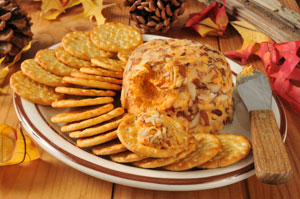
Speaking of Sedaris, today is National Cheeseball Day! No, I’m not insulting her; she makes her own cheeseballs and sells them at a shop near her home (at least she used to — not sure if she still does).
Now, you could go out and buy a cheeseball at your local supermarket, but why not make your own? Rachael Ray has “6 Amazing Cheeseball Recipes”, while Kraft has several more cheeseball recipes and tips. I’m in charge of the cheese and cracker tray during the holidays, but I have to admit I always buy them instead of making them. The idea has never occurred to me, but I think this year I’ll try making them this year.
By the way, I’m not sure why cheeseball is sometimes spelled as one word and sometimes as two (“cheese ball”). Maybe I should read that grammar book and see if the answer is in there.
Upcoming Anniversaries and Events
The Boston Marathon (April 20)
The 119th running of famous road race is this Monday.
Manfred von Richthofen killed in action (April 21, 1918)
Read more about the German fighter pilot you might know better as the Red Baron.
Earth Day (April 22)
This year marks the 45th anniversary of Earth Day.
William Shakespeare born (April 23, 1564)
Did you know you can read the complete works of Shakespeare online for free?
Library of Congress created (April 24, 1800)
The LOC site is one of those places you probably never think of checking out, but it really has some great stuff.
Ella Fitzgerald born (April 25, 1917)
You can check out the singer’s official web site and listen to one of her best songs, “Someone To Watch Over Me”.
Queen of First Impressions
Being miserably bad at something is an undervalued skill in life. Statistically, it is just as difficult to be elite at being deficient as it is to simply be elite, and at times it can be equally valuable — as in the case of Rose Beauford. Ms. Beauford was unremarkable in every sense, with one remarkable exception: She was the best in the world at misjudging people based upon first impressions. Poor Ms. Beauford was utterly incompetent at separating the good from the bad, the well intentioned from the charlatans and everything in-between. You would trust a blind man to guess the size of your shoes by sniffing the soles before you put stock in one of Rose’s character assessments.
Whether Rose was tainted by long-forgotten relationships gone awry, devoid of intuition, or perhaps just flat out of touch with reality was the subject of much discussion within her family, but the answer was of no real consequence. Rose could not be changed at her old age, and no one bothered to try. It took her only a matter of seconds to formulate her opinions, and once she rushed to judgment, the roadmap was set for all future interactions. Rose would entrust complete strangers with her most precious possessions if she found them to be honest, and she would unleash bitter tirades on her new neighbors based on perceived slights that most people would never even notice. She never entrusted truly honest people with anything, and she never unleashed her temper on new acquaintances when it was actually warranted.
On one occasion, Rose was leaving the drug store with a small shopping bag containing a few sundry items when a young man in his 20s asked if she could use help getting to her car. This particular drug store was in Times Square, as Rose had taken the 7 train in to do some early Christmas shopping. Neither the young man’s feigned ignorance to the unlikelihood of Ms. Beauford having a car parked down the street nor his zeal to help carry a plastic bag with travel-sized facial tissues and mascara for an able-bodied lady in her 50s struck Rose as amiss, and she indulged the man in further conversation, taking great pains not to draw attention to her fascination with the tattoo of a rat gnawing its way through a human carcass slithering down his right forearm.
When Rose responded that she was riding the subway, the man persisted. “I don’t want to see nobody take advantage of a sweet young lady like you. If you pay for my train, I’ll ride back home with you to make sure you don’t get hassled or nothin’.”
The man was sweating profusely despite the frigid temperatures. It seemed like a kind offer to Rose and one that she would be remiss in rejecting from such a polite and endearing boy, who she had already determined was perhaps simply a victim of careless parenting. The two of them shared a seat as Rose went on about her strikingly beautiful and desperately single niece, Tanya. When the train stopped in Flushing, Rose wrote down Tanya’s phone number on the side margin of the MTA ticket, handed it to the man, and got his name: Felix. She even offered to call Tanya right then and there on her cell phone and pave the way for Felix’s call, but Felix vehemently advised Ms. Beauford not to reach into her purse on a crowded train.
When Rose had completed the half-mile trek back to her apartment building, she retrieved her keys from the purse, and reached for her phone to call Tanya and relate the good news: Finally, there was a nice boy in New York who wanted to take her out for a date. There was one problem, however: The phone was missing. So was her wallet, as well as a tanzanite bracelet she had just purchased as a Christmas gift for her sister.
Poor Ms. Beauford let out the type of shriek that could only emanate from the gut of a lady whose purse had just been compromised. She wailed to the heavens at her stupidity in letting such valuable items fall out of her purse somewhere in transit, and to the president of the Junior Parish Council for the Holy Church of the Incarnation, who happened to be passing by on the sidewalk at the time, it appeared as if she would faint.
Although he was late for his volunteer work at the local homeless shelter, where he mopped the floors after weekday lunches, the young parishioner rushed up the steps to assist. “Ma’am, are you okay? Can I help you with anything?” Rose looked up from her purse and gave the young man a full once-over — noting the scuffs on his brown leather shoes and the nibble marks on his fingernails. She could tell instantly that he was a fraud, as nail-biting was a sign of insecurity, which was a further sign of weakness and suppressed rage. He was the type of self-loathing youngster capable of snatching her remaining possessions and scampering away, leaving her stranded. Later in his life, he would no doubt segue into violent crime — eventually dying cold and alone in Rikers.
“You get away from me now, or I’ll call the police, you hear? You disgusting creep!” The poor boy sprinted down the street toward the homeless shelter, with Ms. Beauford shaking her finger at him all the way. “These kids,” she muttered to herself. “We need more policemen around here.”
Neither Felix — also known as Victor Joseph Braden, Victor Alan Medina and “Vic the Rat” — nor Rose’s belongings were ever located. Tommy O’Sullivan made it to the shelter just in time to begin mopping the restroom, where he found a man in the throws of a diabetic seizure, and called 911, ultimately saving the man’s life.
On another occasion, Rose bore witness to an armed carjacking on Flatbush after leaving her podiatrist’s office. She was able to catch a glimpse of the suspect’s face from her vantage point approximately one-third of the way down the block, and was called into the precinct along with four other eyewitnesses for a photo lineup. The officers were fairly confident in their ID of the suspect, as he had been linked to six other similar events in the past five months, and the verbal descriptions set forth by the other four witnesses were a direct match. After brief discussions, the officers laid five photographs out on the table. Photographs one, two, and five were of other non-violent offenders who met the general description of the suspect: 5’9”, 165 pounds, and bald with a gray goatee. Photograph three was the suspect, Otis Tereshchenko — a henchman in the local Ukrainian gun-running syndicate. The final photograph, No. 4, was of Lorne McWilliams. Mr. McWilliams was a very minor celebrity around Brooklyn, most known for his tireless work as the long-time director of the largest battered-women’s shelter in New York. When not working to help women escape dangerous relationships and restore their sense of self-worth and independence, Mr. McWilliams also ran a canine rescue operation out of his house.
Rose was the last of the five witnesses to participate in the lineup. Unbeknownst to her, the previous four had all selected the Tereshchenko photograph, No. 3, without hesitation. Rose entered the room, positioned her eyeglasses and began inspecting each photograph in order. As with her predecessors, Ms. Beauford was able to quickly dismiss most of the suspects, but two remained: three and four.
Photograph three matched the suspect’s facial features as best as she could recall, but something gave her pause as she gazed into his soft brown eyes. Neither his shy and forgiving smile nor his shapely cheekbones painted a portrait of a vicious criminal. This was a family man — the type of man who walked his children down the sidewalk to church on Sundays, and spent the rest of the day teaching them their multiplication tables before pressing their clothes for school, reading them a basket full of books, and kissing them goodnight. Rose was sure that a man like this would not be allowed to stay in our country if he was up to some type of mischief.
After dismissing photograph three, she focused her attention again on No. 4. This gentleman’s facial features were more dissimilar to the suspect than No. 3, but she could not dismiss him. As she gazed into his steely bluish-gray eyes, she did not see kindness. She saw anger. The longer she stared, the surer Rose became that the man pictured in photograph four was the suspect — the type of man capable of unthinkable acts of violence. She suddenly found herself unable to look at the photo a moment longer, and turned to the officers, gulped, and pointed at No. 4. “This is him. This is the man who attacked that poor lady and stole her car. I can see it in his eyes. He’s a bad, bad man. Please catch him, officers. This face will haunt me for as long as I live.”
Approximately two weeks later, Rose and her cousin Eunice were enjoying Sunday afternoon tea when Eunice pointed at the newspaper on the kitchen table. “Isn’t this that man you saw commit that awful crime?”
Rose looked down at the paper, and saw photograph three staring her in the face, right above a headline: Ukrainian Gangster Tereshchenko Linked to Wave of Car Burglaries. She turned the page immediately, as if it would make the story disappear. At the bottom of the following page was a smaller story with another photograph above the headline: Women’s Advocate McWilliams Given Lifetime Achievement Award. Pictured in the photo were a group of six women flanking a familiar face. It was the man from photograph four.
“No, Eunice. I think that’s a different story. I don’t recognize that man.”
Two of Rose’s nieces, Tanya and her cousin Daphne realized at one point that Rose’s special skill could be valuable in wading through the countless profiles of the online dating sites to which they both belonged, and they devised a secret system for selecting promising candidates. Each Sunday evening, Rose, Tanya, and Daphne would scroll through several profiles, and Rose would share her impressions based upon the photos and information provided.
“I like him,” Rose would say. “He says here that he has been on disability for chronic bowel disease for three years, and is looking for a woman who will be patient with his frequent long restroom breaks. Says he wants to work in the custodial field. That’s the kind of go-getter you both need. Men are lazy these days.” Naturally, that one would be rejected.
“I like this one too. Has just left inpatient treatment for an unspecified mental disorder and has been encouraged to seek meaningful relationships with the opposite sex. If he’s that honest, he’s a keeper.” Another rejection.
“Not this one,” Rose would say on other occasions. “He’s a cocky one — look, he’s got Harvard Business School here, and CEO of a software company in Manhattan. It says he recently lost his wife to cancer before they had children, and is struggling with re-entering the dating world, but really wants to start a family. See, you don’t want to be tied down at home with a bunch of kids, just so some self-proclaimed hotshot can go work for 18 hours a day.” This one was definitely a keeper.
After enough keepers had emerged from the process, both young ladies found permanent ones, and always thanked their Aunt Rose for setting the wheels in motion. After Rose passed, and their children got older, both women would entertain the family with stories about the trouble their beloved aunt got herself into by virtue of her unique and skillful shortcoming. Through these stories, their children learned that being terribly bad at something is not bad at all. It’s a cause for celebration.
The Truth (at Last) About Disco
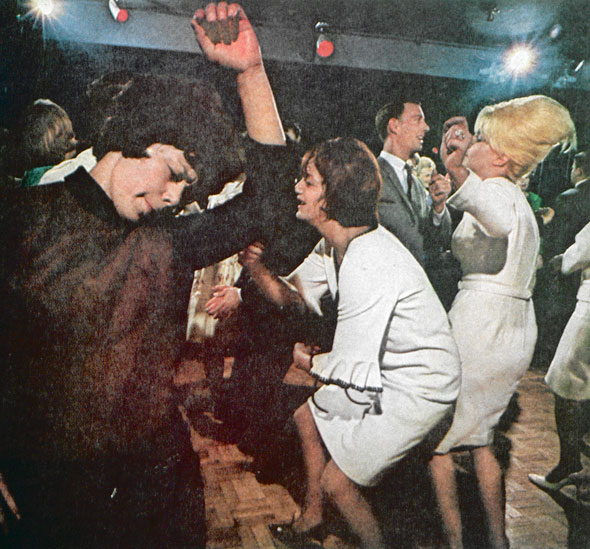
Mention the word discotheque, and most people think of the 1970s — the Bee Gees, Donna Summer, John Travolta, and Saturday Night Fever.
In fact, the disco trend began early in the previous decade, and it changed the way America danced.
Until the late 1950s, social dancing was a fairly formal arrangement. Dancers maintained some physical contact with their partners and engaged in synchronized footwork. If you were a guy who hadn’t learned much about dancing, you could rely on the utilitarian box step (if the music was in four four time) or a basic waltz (a three four rhythm). If you were a girl, you followed your partner’s lead as you danced backward across the floor, pulling your feet away from your partner’s approaching tread.
As rock ’n’ roll started to gain popularity, teens danced to the new sound with swing dances like the Lindy Hop. There was also the Stroll, the Bop, or the Madison. Dancers no longer held onto each other, but their feet moved in unison to established steps.
Then came the hip-swiveling Twist, made popular in 1960 by Chubby Checker. Suddenly dancers were on their own, doing — to use a popular ’60s phrase — “their own thing.” Soon discotheques were popping up across the country.
Writing for the Post in 1965, Norman Poirier described the discotheque scene as “a noisy national madness that the anthropologists of the 21st century will find difficulty in explaining.”
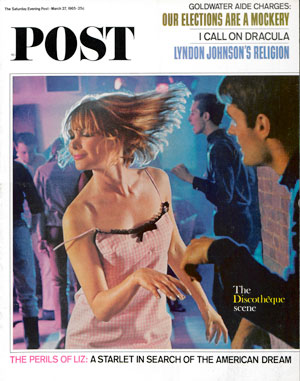
The discotheque, he wrote, had originated in France where the word meant “record library.” He claimed the first discotheque was the Whisky a Go Go in Paris, “where members could dance to records and consume whiskey, a drink many Frenchmen then regarded as exotic.” The term go go, he added, was French slang, that roughly translated to “as much as you want.” The French word for disc jockey, disquaire, never made it across the Atlantic.
By the time Poirier wrote his article, nearly every [major] American city had a “go-go” of its own.
Americans entering a discotheque for the first time in the early ’60s would have noticed the absence of musicians. The management used only recorded music, played continuously. And loud. The sound seemed almost deafening to people accustomed to live bands.
They would also have been surprised by the wide variety of individual dance styles. The Twist had spun off several varieties of new dances. Poirier listed some of the better known styles: the Watusi, Hully Gully, Surf, Swim, Dog, Pony, Ska, Frong, Wobble, Slop, and Jerk.
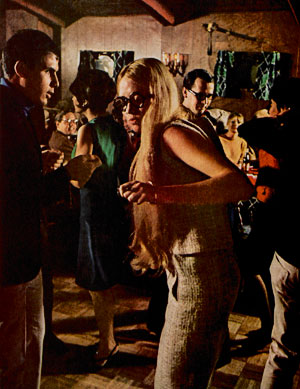
It could have all seemed strange, noisy, and very modern. And to some newcomers, it might have seemed more than a little decadent. The dancers seemed so frenetic and uninhibited. Many grown-ups looked on in astonishment. What were the kids up to? Why had they abandoned the grace and sophistication of ballroom dances?
“There’s no mystery why anyone is doing these dances — they’re fun,” dance instructor “Killer Joe” Piro told Poirier. But he later admitted they weren’t fun for men who felt awkward and uncomfortable with new steps. “Even when we’re alone in my studio, they feel self-conscious. They giggle when I say wiggle. They won’t relax. They’re all tied up. Men are really more scared about how they look than women.”
Men may have felt inhibited by the new, more expressive style of dancing, but their partners weren’t. “The girls really love these dances,” said Piro. The way he described the discotheque phenomenon, it almost sounds like the harbingers of the modern feminism — a new “women’s movement,” you might say.
“The girl is free to do what she wants to. She couldn’t let herself go before the Twist. They must have been swearing under their breath for years — led around, pushed around, held down. Now they can be as wild as they feel. Watch any discotheque and you’ll see it’s the girls who go. On the dance floor they’ve got no inhibitions!”
Men would learn to overcome their self-consciousness. They’d learn the new steps because, like Piro, they realized that if they were going to get any girls, they’d have to Shag and Frug with the rest of the “in” crowd.
Ina Garten’s Tri-Berry Crumbles
“There’s something wonderful about having your own dessert, so I made these crumbles in the small dishes that I usually use for crèmes brûlées. It’s the perfect combination of warm, juicy berries and crunchy oatmeal topping,” says world-class chef Ina Garten (aka the Barefoot Contessa), whose make-ahead recipes and tips are featured in our May/June 2015 issue.
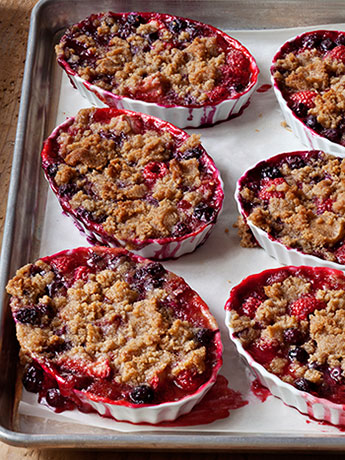
Tri-Berry Crumbles
(Makes 6 servings)
Ingredients
2 cups fresh blueberries (12 ounces)
2½ cups fresh raspberries (18 ounces)
2 cups fresh strawberries, halved, or quartered if large
½ cup granulated sugar
3 tablespoons cornstarch
1½ teaspoons grated lemon zest (2 lemons)
3 tablespoons freshly squeezed lemon juice for the crumble
¾ cup all-purpose flour
¾ cup granulated sugar
½ cup light brown sugar, lightly packed
½ cup old-fashioned oats, such as Quaker
¾ teaspoon ground cinnamon
¾ teaspoon kosher salt
¼ pound (1 stick) unsalted butter, diced, at room temperature
Vanilla ice cream, for serving
Directions
Preheat oven to 350°F. Place 6 crème brûlée dishes on sheet pan lined with parchment paper.
In large bowl, toss together blueberries, raspberries, strawberries, ½ cup granulated sugar, cornstarch, lemon zest, and lemon juice.
Divide mixture evenly among crème brûlée dishes, including any juices that collect.
For crumble, combine flour, ¾ cup granulated sugar, brown sugar, oats, cinnamon, and salt in bowl of electric mixer fitted with paddle attachment. Add butter and mix it on low speed until mixture is crumbly. Pinch it with your fingers until it makes large crumbles and distribute it on berries (it will not cover them entirely).
Bake for 35 to 40 minutes, until juices are bubbly and topping is browned. Serve warm with a small scoop of vanilla ice cream.
Make It Ahead
Assemble the crumbles, refrigerate for up to 4 hours, and bake before serving.
Nutritional Info
Per Serving (with ¼ cup vanilla ice cream)
- Calories: 681
- Total Fat: 25 g
- Saturated Fat: 15 g
- Sodium: 243 mg
- Carbohydrate: 112 g
- Fiber: 7 g
- Protein: 6 g
- Diabetic Exchanges: 4 starch, 3 fruit, 4 fat
Recipe reprinted from Make It Ahead by Ina Garten. Copyright ©2014 by Ina Garten. Photographs by Quentin Bacon. Published by Clarkson Potter/Publishers, an imprint of Penguin Random House LLC.
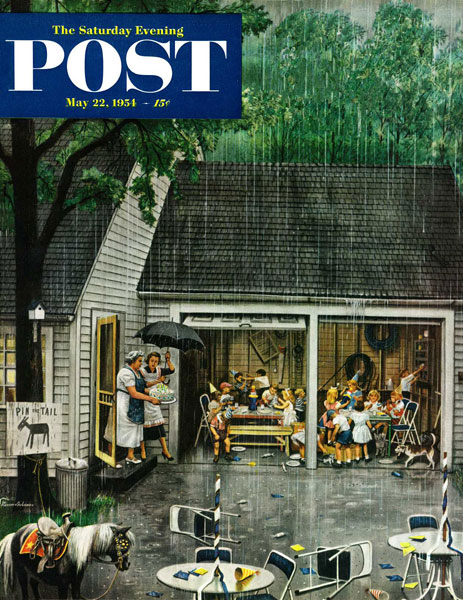
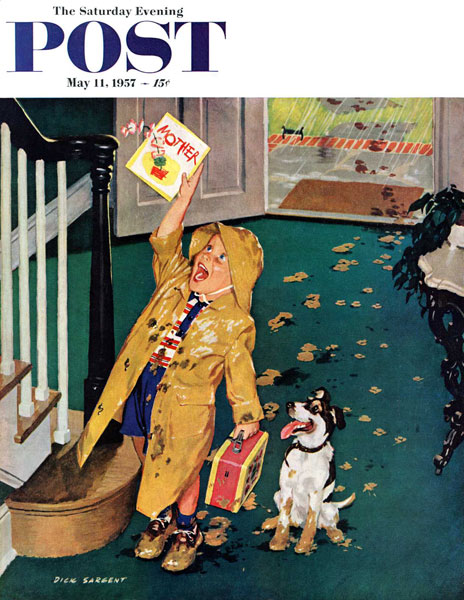
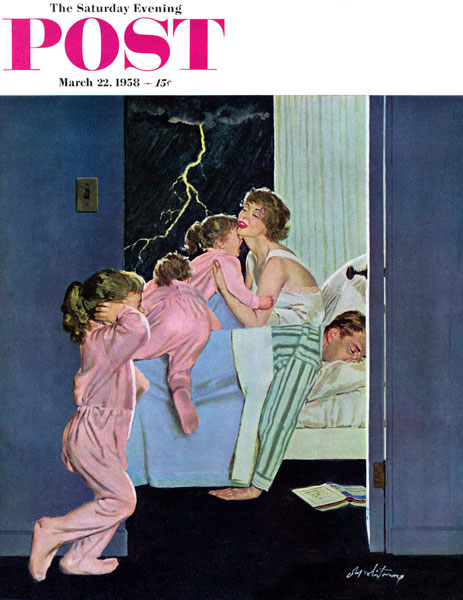
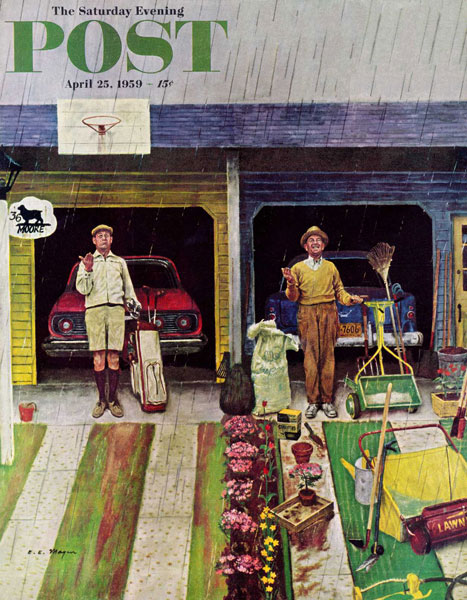
April Showers
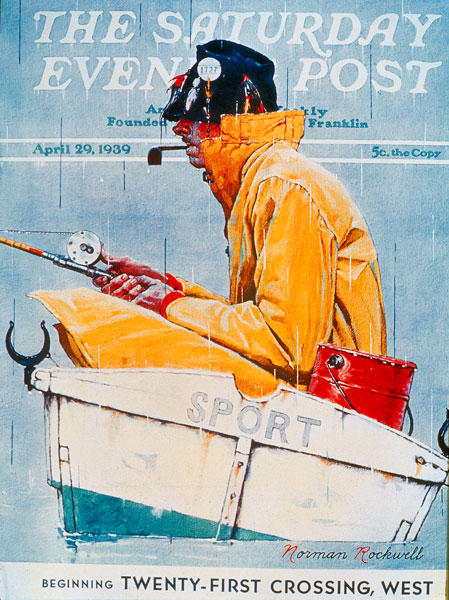
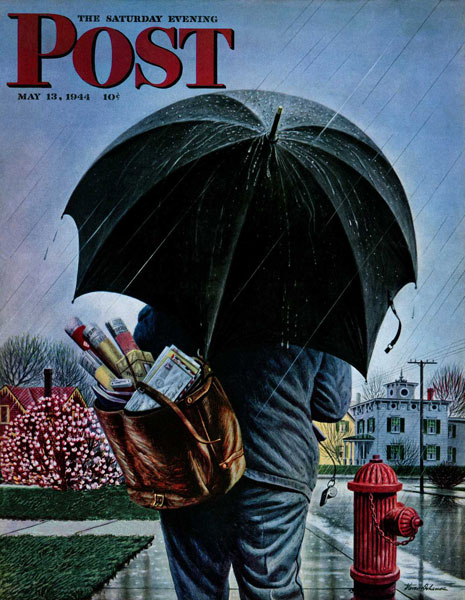
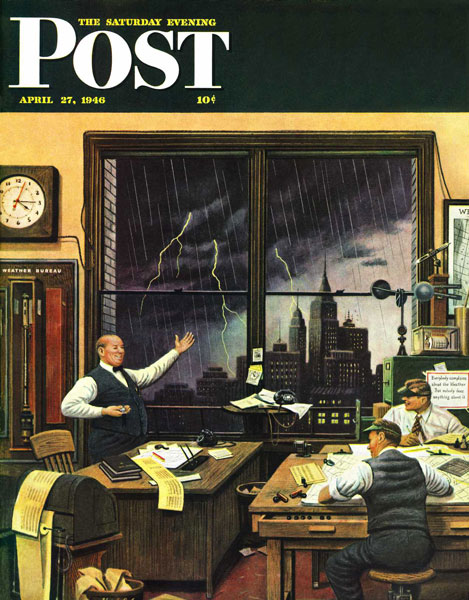
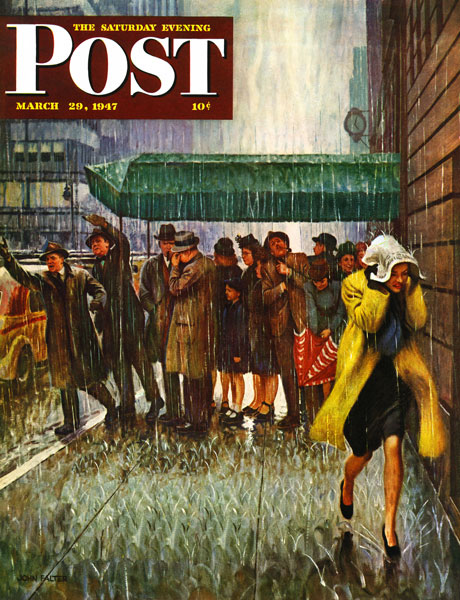
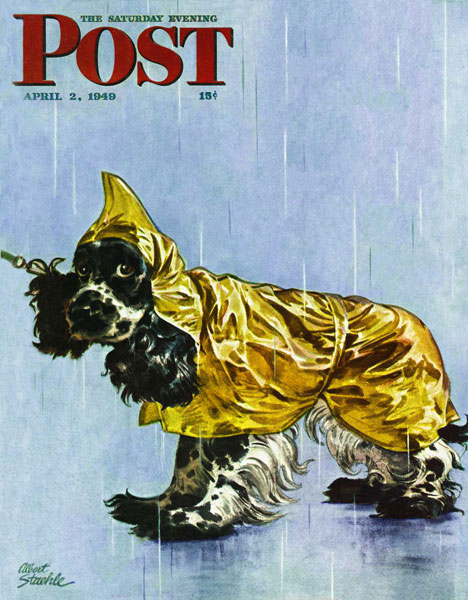
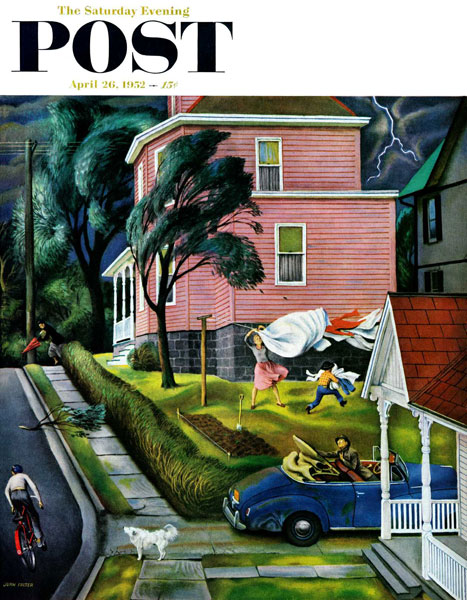
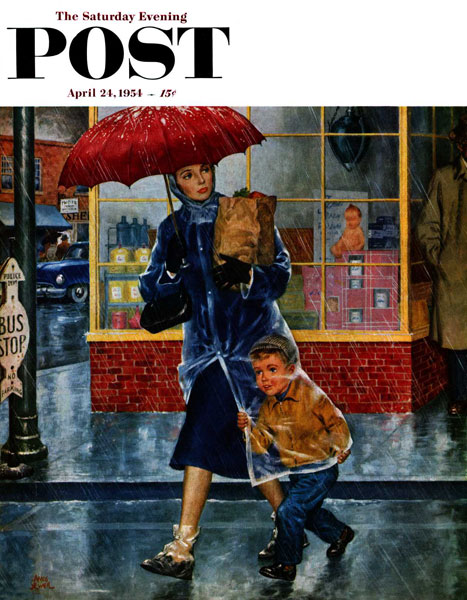
April showers may bring May flowers, but before the flowers come there’s usually some fun to be had — or spoiled.
The way a rainy day affected American leisure activities was a regular subject for Post cover artists. The common conundrum of soggy groceries or a cancelled golf outing is something anyone can relate to. Even if your ambitions are modest — a fishing trip, some yard work, a barbecue — rain can put a damper on things. And it’s funny, but only when it’s not happening to you. Here’s a rare view of some of our classic rainy day art from our archive.
Rainy days on the covers of The Saturday Evening Post (click on the covers to see larger image):

More Great Beaches
In the upcoming May/June 2015 issue, Stephanie Citron shares the sand, sun, and stories of “America’s 10 Best Beaches,” but we really couldn’t stop at 10. Here are 12 more of our faves:
1 Blowing Rocks Preserve, Hobe Sound, Florida
On this craggy Anastasia limestone shoreline (the largest on the U.S. Atlantic Coast), waves crashing against the rocks during high tide force water plumes to shoot as high as 50 feet in the air.

2 Bruneau Dunes State Park, Mountain Home, Idaho
Looming over several freshwater lakes is the largest single-structure sand dune in North America, believed to have been formed by sand left behind from a flood 15,000 years ago.

3 Calvert Cliffs State Park, Lusby, Maryland
Marine fossils, dating from the Miocene Epoch (5-24 million years ago) wash ashore all day long.

4 Coral Pink Sand Dunes State Park, Kanab, Utah
While not technically a beach (it doesn’t front an ocean or lake), the beautiful pink sand (from eroded Navajo sandstone, dating to the Middle Jurassic period) makes this park a worthy stop.

5 Glass Beach, Whitethorn, California
A beach completely covered in sea glass, in a multitude of shapes and colors.

6 Grayton Beach State Park, Grayton Beach, Florida
A dazzling white sand beach sandwiched between the Gulf of Mexico and Western Lake, a rare freshwater coastal dune lake surrounded by a coastal forest of twisted-trunk magnolias and indigenous scrub.

7 Indiana Dunes Lakeshore, Indiana
Beyond the beautiful sand beaches along the southern tip of Lake Michigan you’ll find spectacular dunes.

8 Kaihalulu Beach, Maui, Hawaii
Secluded red sand beach gets its color from the crumbling cindercone cliffs presiding over the beach and the bay. Warning: The trail to this beach is hazardous and should only be attempted by skilled hikers.

9 Medano Creek, Mosca, Colorado
Rent specially designed boards to sand sled down the Great Sand Dunes — the tallest in North America. May-July brings tubing to the freshwater creek reformed each year from snowmelts off the surrounding Sangre de Cristo Mountains.

10 Moonstone Beach Cambria, California
Natural gemstones wash up in the surf, including the namesake moonstones (the chalcedony variety) and semi-precious pebbles of practically every color.

11 Sand Beach, Acadia National Park, Maine
On this pink sand beach tucked between pink granite cliffs, you’ll find high-saline seawater, where the salt level measures a half-cup per gallon.

12 Black Sands Beach, California
A slate-gray sand beach that appears black when wet.

3 Questions for Dee Dee Wood
Dee Dee Wood, 87, is the genius behind the dance numbers in Mary Poppins as well as The Sound of Music and Chitty Chitty Bang Bang, plus countless television specials, not to mention Michael Jackson’s Super Bowl halftime show and the 1984 opening and closing Olympic ceremonies. The dancer-turned-choreographer worked with a cavalcade of superstars ranging from Dick Van Dyke and Julie Andrews to Bing Crosby, Robin Williams, Dolly Parton, Tina Turner, and the list goes on.
The Saturday Evening Post: How did you get your first break as a dancer?
Dee Dee Wood: In my 20s, I auditioned for renowned Broadway stage choreographer Michael Kidd. This was for the original 1950 Broadway production of Guys and Dolls. I completely blew the audition. I had never danced before in high heels, and I wasn’t used to it, but I wanted that job and I was determined to get it. I waited outside the audition studio for three hours while all these other talented people went in and out. When Michael finally came out, I asked him why I didn’t get it, and he told me to go home and practice dancing in heels and come back and try again. I did and I got it. It was the beginning of a great working relationship and friendship. He asked me to be his assistant in 1959’s Li’l Abner. Then I played the lead in the movie version.
SEP: Which is your favorite of all the movies you worked on or danced in?
DW: Mary Poppins, hands down. It was like working with family. Walt Disney was like a grandfather, who was brilliant. And everybody else was like brothers and sisters. Then of course working with Dick Van Dyke, Julie Andrews, and all those talented dancers made it so special. And I got to play a penguin! I was the fourth penguin in the “Penguin Dance.” We filmed dancers performing the steps before animators drew them. That’s actually my voice screaming “Wee!” as the penguins turn around during the number, because every time I would make that turn in rehearsal I would yell out. But meeting the great Walt Disney was the best part. I still remember one day back in 1963 when we were filming Poppins, we saw Walt just sitting on the curb on the street outside his office, just like a regular guy. So then he calls us over, very excited, and points to a Mickey Mouse watch on his wrist and says, “I just got this in the company store, isn’t it great? And I even got it at half off because I work here!”
SEP: Who was your favorite actor to work with? And what was your oddest experience working with a star?
DW: My favorite is Dick Van Dyke by far. I met him when I was asked to teach this then-unknown comic actor a few steps for an upcoming appearance on The Jack Benny Program. He told me he couldn’t dance because he never had a lesson, but he was such a natural. His angular movements and that cartoon-like quality gave us so much to work with. As for the oddest, that would have to be when I staged the Super Bowl show with 500 dancers and with Michael Jackson as the main act. Michael was so worried about security; he had three impersonators walking around the stadium so you never knew who the real Michael was. At one point, I had lunch with two of him! They were so good it was hard to tell which one was real, but once you spoke to them it was obvious they were just hard-working actors trying to do a job.
News of the Week: Emoji, ’90s Nostalgia, and One Really Scary Sitcom Statue
Should Grown Men Use Emoji?
Short answer: No. Long answer: No no no no no no no no no no no no no no.

If you don’t know what emoji are (is?), well, I envy you. They’re the little smiley faces and other faces or symbols you see replacing words online, sort of like really fancy emoticons. The New York Times is asking if grown men should even use them or, you know, stick to words. And it’s not a sexist thing, if you’re wondering. Women use emoji more. Though, as Columbia University linguist John McWhorter says in the article, that might be changing.
I’m not going to use emoji unless they start to replace letters on the keyboard. I don’t care how much they’re beginning to infest the online world. I’m not even used to semicolons yet, even if I do use them in the next story.
Attack of the Lucille Ball Statue!
I love this trend of installing statues of classic TV characters around the country. TV Land has several of them, including a Mary Tyler Moore statue in Minneapolis; Andy and Opie from The Andy Griffith Show in Raleigh, North Carolina; Bob Newhart in Chicago; and Samantha Stephens from Bewitched in Salem, Massachusetts, not too far from me. There’s also a statue of Lucille Ball (which TV Land doesn’t have anything to do with), and it’s completely freaking out fans of the actress.
The 400-pound bronze statue was actually installed in Ball’s hometown of Celoron, New York, six years ago, but efforts to either fix or replace it have really picked up steam recently. There’s a Facebook page called We Love Lucy. Get Rid of this Statue! — and if you listen carefully you can even hear Lucy Ricardo’s famous “WHAAAAAAAAAAAAA.”
The artist is now apologizing and says in a letter to The Hollywood Reporter that he’ll fix it. But the mayor of Celoron, Scott Schrecengost, wants someone else to fix it.
It’s not that it doesn’t look like Lucille Ball. It’s just that it looks like Lucille Ball’s corpse, arisen from her grave a la The Walking Dead.
’90s Nostalgia Has Gotten Out of Hand

For some reason, NBC is bringing back Coach, the Craig T. Nelson sitcom that ran on ABC in the late ’80s to mid-’90s. Fox is bringing back The X-Files. Arrested Development is already back on Netflix, Boy Meets World (only this time with a girl) is currently on Disney, and Bob Odenkirk and David Cross are even going to do a Mr. Show-ish sketch comedy for Netflix. But the biggest news for people whose knowledge of pop culture doesn’t go past 1994 is that Full House might be coming back! I’m using that exclamation point sarcastically!
The update, called Fuller House, will focus on characters DJ Tanner and Kimmy Gibbler. John Stamos, Bob Saget, and Dave Coulier will all make appearances but don’t count on seeing the Olsen twins. Slate has a three-minute video that will tell you all you need to know (and then some) about the show.
You can thank ’90s nostalgia on the Web for this. Soon there will be an entire TV network based on BuzzFeed listicles and GIFs.
RIP, Pillsbury Doughboy and Pet Rock Creators
Here’s more nostalgia, but not in a good way. The creators of two pop culture icons have passed away. Rudolph Perz was an advertising executive who invented the Pillsbury Doughboy for General Mills in 1965. He died at the age of 89 on April 1. And Gary Dahl, the inventor of the 1970s fad Pet Rock, passed away in March. He was 78.
I never owned a Pet Rock. I’m assuming having a rock as a pet must sound awfully confusing to 10-year-olds who have their own smartphones, but it was silly fun. You can actually still buy them. I do have a Pillsbury Doughboy figure somewhere in the house. In the latest TV commercial, someone finally buys him some pants.
Choosing A College? Use Instagram

I realize as I get older, many of my sentences start out with “When I was young…” or “When I was in school…” but when I was in school, we didn’t have the Internet to help us pick a college. We had to use pencils and typewriters and snail mail and our cars to research colleges. We didn’t have websites and Wikipedia and all of the fancy Googles and Tumblrs and Meerkats that kids have these days (oh sorry, Meerkat is already soooooo early 2015 — it’s Periscope now).
Now students are actually using Instagram to see what their colleges are like. Since they can’t actually go to every college campus to see what they’re like (well, they can, but they can’t), kids are looking at the official Instagram accounts for the schools to see what the campuses look like and what student life is like there.
One day, probably not too far from this very moment, people will be able to get their college degrees without ever leaving Facebook. Your GPA will be based on the number of Likes you have.
April Is National Grilled Cheese Month
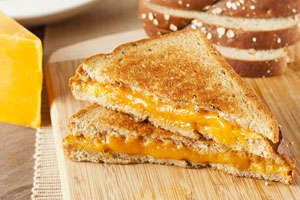
I went on a health kick a few years ago and tried to find smart and healthy alternatives for the foods I loved to eat. One of the things I tried was making a grilled cheese without grilling it. Instead I put the bread in a toaster and quickly put a few slices of low-fat American cheese on the bread while it was still hot. Let’s just say it wasn’t the same. The bread wasn’t the same without butter, and the low-fat cheese tasted like cheese-flavored envelopes.
So let’s celebrate National Grilled Cheese Month by using our stovetops. There are more variations on the classic than you think: Food Network has 50 grilled cheese recipes and All Recipes has several too. You can also check out the Grilled Cheese Academy. As the site says, it’s not a culinary school or a school of higher learning, they just love cheese (from Wisconsin, to be exact).
Upcoming Anniversaries and Events
Thomas Jefferson born (April 13, 1743)
Read what Jefferson and other great Americans had to say about free speech.
President Lincoln shot by John Wilkes Booth (April 14, 1865)
I bet you don’t know what happened to Booth after he shot the president.
Titanic hits iceberg (April 14, 1912)
Read more on the inevitable tragedy of the great ship.
Charlie Chaplin born (April 16, 1889)
Record Store Day (April 18)
Remember independent record stores? Visit one today so they’ll stay in business!
Life After Lincoln
At least one in six Americans can remember the last time a U.S. president was assassinated. And almost all of them can tell you exactly where they were and what they were doing when they heard the news. They can probably also recall their feelings of sorrow, anger, and bewilderment when they heard President Kennedy was dead.
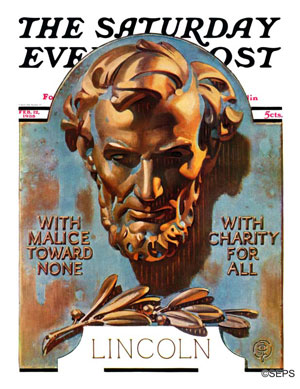
John Atherton
February 12, 1944
Those feelings must have been even more intense in Americans 150 years ago when they heard the news of the first presidential assassination. The president’s death would probably have seemed even more tragic as they realized that Lincoln would never see the reconciliation he’d worked so hard to achieve.
He’d spent the last four years holding the Union cause together, prodding generals, and supplying arms and men to defeat the Confederacy. But with victory in sight, he showed no animosity toward the Rebels. And though he had never spelled out his postwar plans for reconstructing the union, it was widely known he favored clemency toward the Southern secessionists.
Many in the North were hungry for vengeance, including Lincoln’s vice president, who advocated hanging many of the Southern “traitors.” Lincoln was one of the lone voices favoring forgiveness and reconciliation with the South. In his second inaugural address, he asked Americans “to bind up the nation’s wounds … to do all which may achieve and cherish a just and a lasting peace among ourselves.” Just a week before his death, while he was touring recently captured Richmond, a Union general asked Lincoln how he should treat the conquered Confederates. Lincoln said he didn’t want to give specific orders but added, “If I were in your place, I’d let ’em up easy, let ’em up easy.”
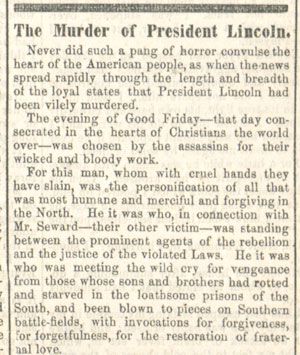
Days after the president’s death, Post editors wrote that they had once sided with the president’s “generous and merciful projects and desires.” But that was before he was shot by John Wilkes Booth, “a representative of those whom [Lincoln] was striving with all his might and influence to shield and benefit.”
The editors still admired Lincoln, but admitted he had a fault of leaning “too much towards gentleness and mercy.” Perhaps Lincoln was wrong, and God had intervened to correct the mistaken notion of mercy:
Has this cruel deed been allowed in the orderings of an all-wise Providence, that we may fully understand the hearts of these men with whom we have been contending, and waste no foolish magnanimity on those who seem incapable of responding to it? Such are the questions which at this moment every loyal man in the North is putting to himself.
To such questions, the editors had their answer: “We feel as if all other feelings were swept aside by the single demand for justice.” As for Lincoln’s call to forgive the South: “The voice of Mercy in our heart has been stilled forever” by the same bullet that silenced the voice of Lincoln.
History shows that vengeance grew stronger in the wake of Lincoln’s death, further complicating the reconciliation he had hoped to achieve.
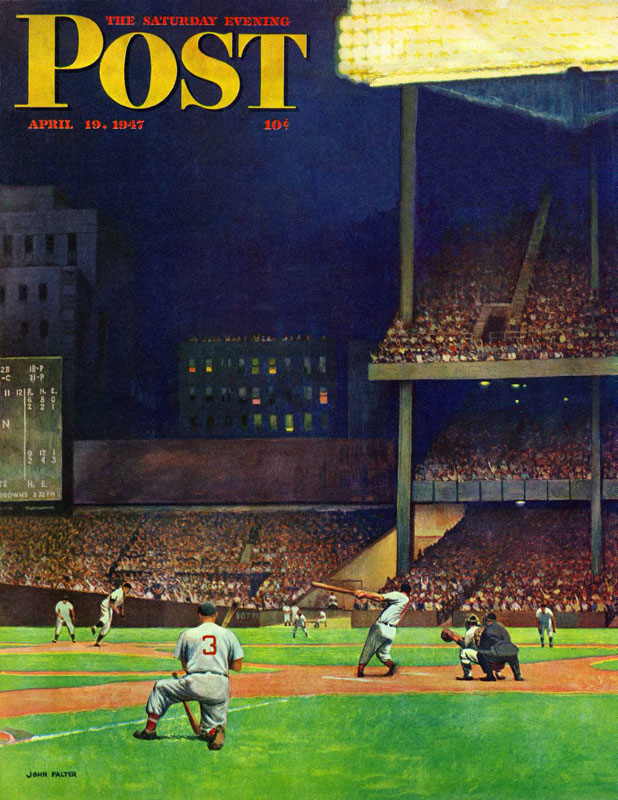
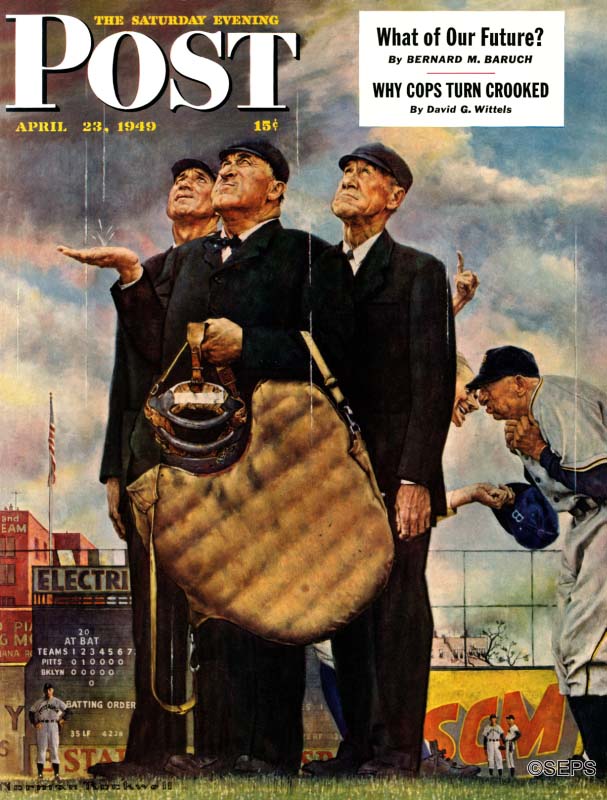
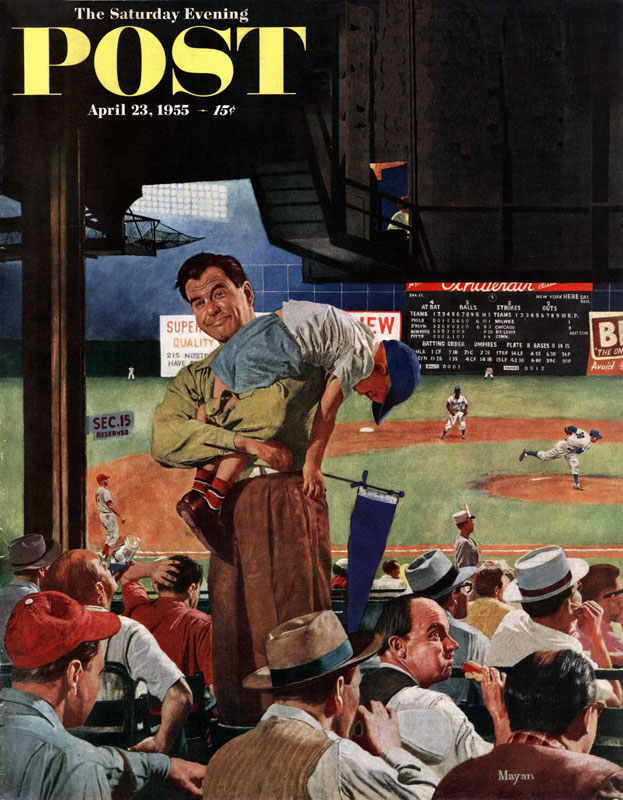
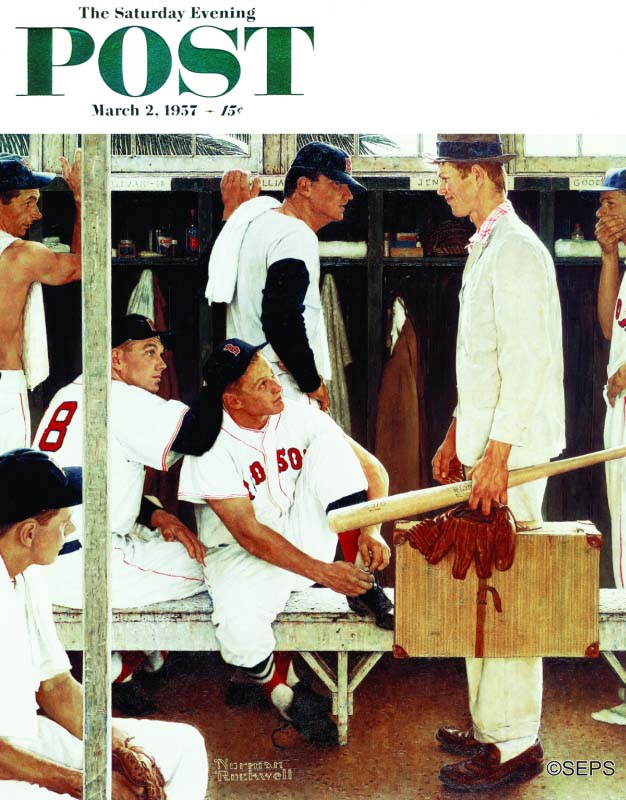
Play Ball!
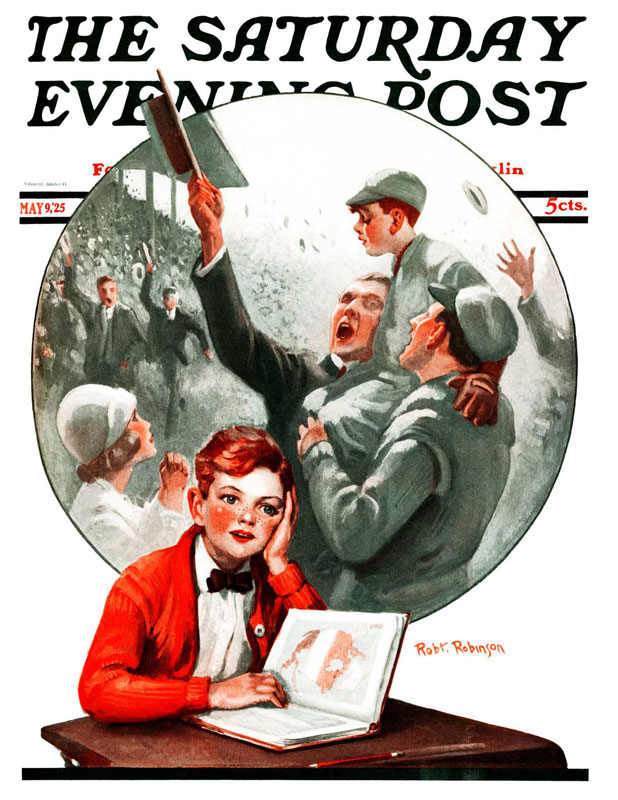
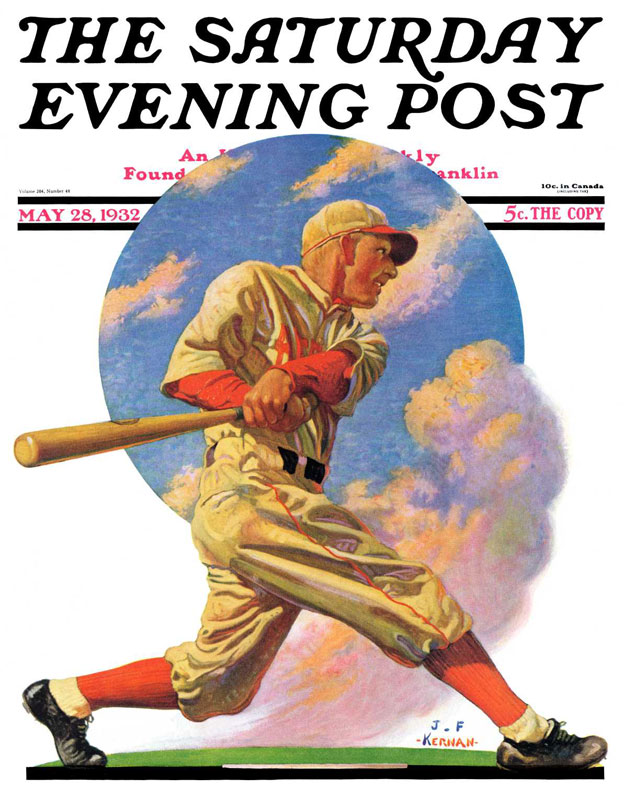
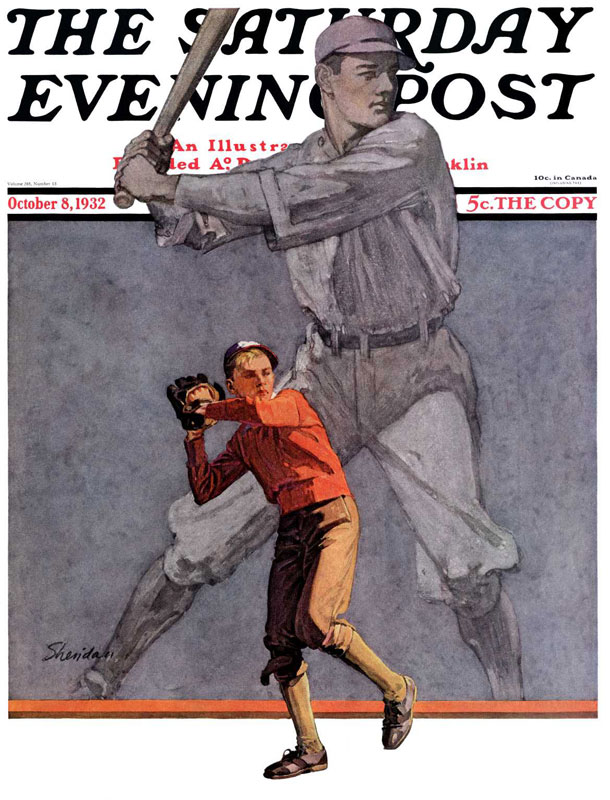
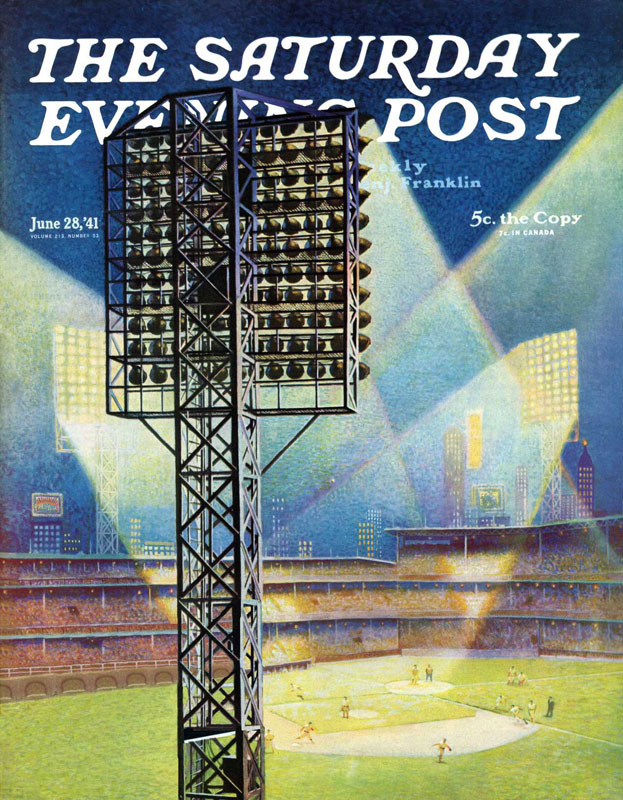
From opening day to the World Series, it’s the fans who make the game. Nearly 75 million Americans will buy a ticket to a ball game this season, and millions more will watch baseball on TVs and mobile devices. Monday marked a record-breaking viewership: 60 million fans accessed Major League Baseball apps to watch season openers.
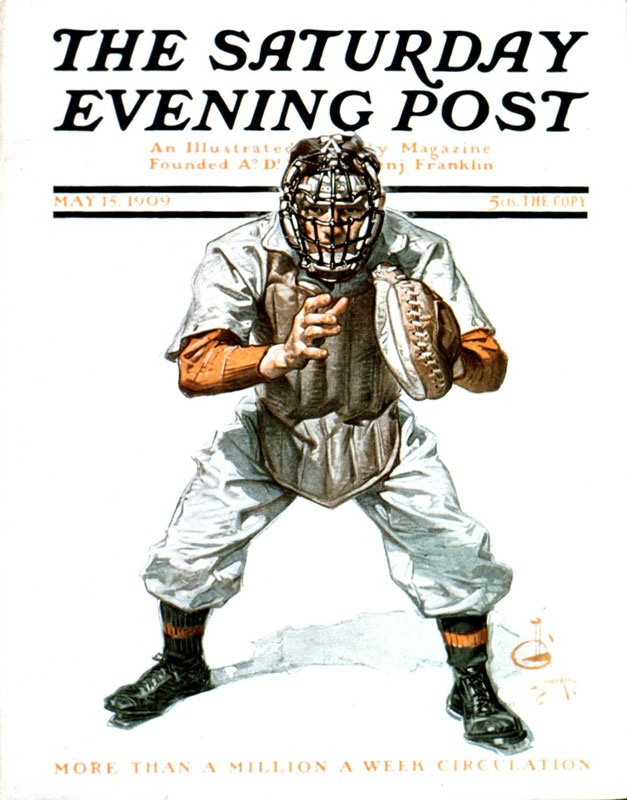
Here’s a cover collection for those dedicated fans whose enduring passion for the game has made baseball a national pastime.
More for baseball lovers: Check out our Baseball Special Collector’s Edition, which includes the illustrations below and dozens more, plus rare photos and interviews with baseball greats.
A look at Baseball on the covers of The Saturday Evening Post (click on the covers to see larger image):


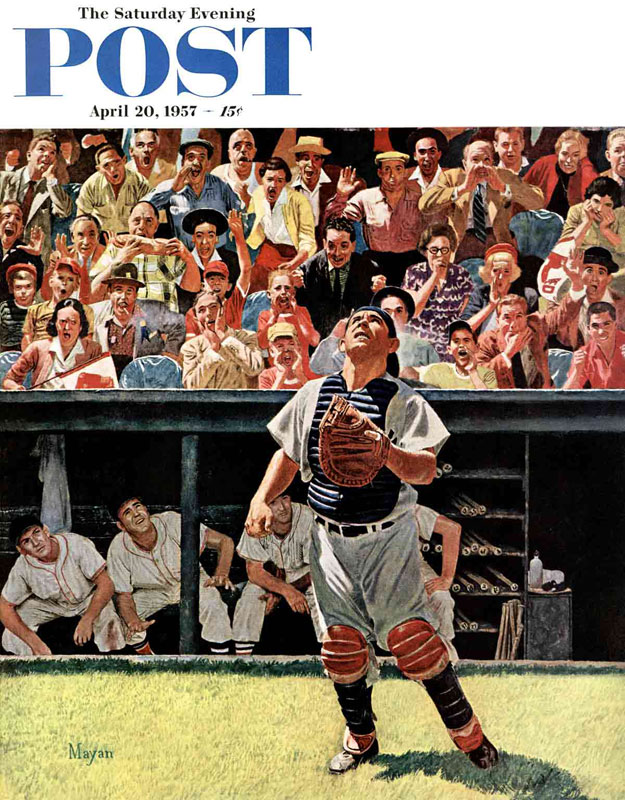
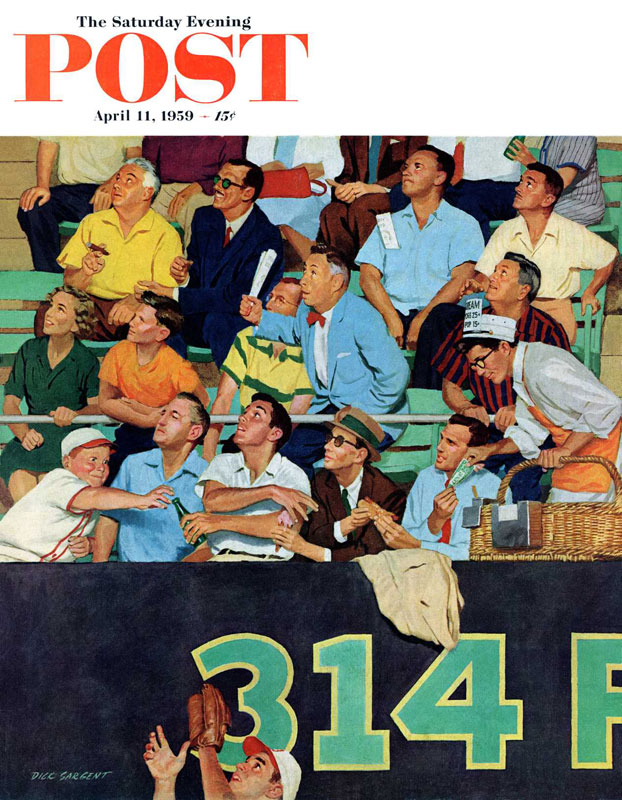
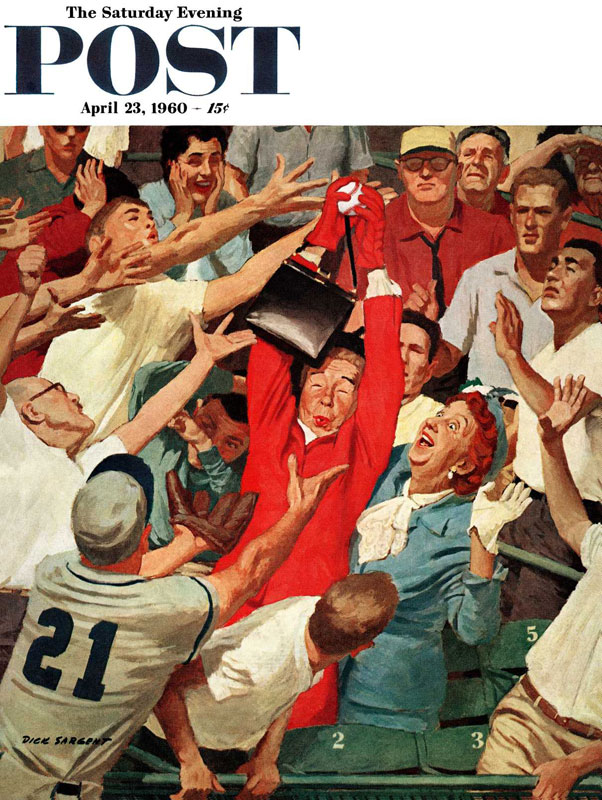
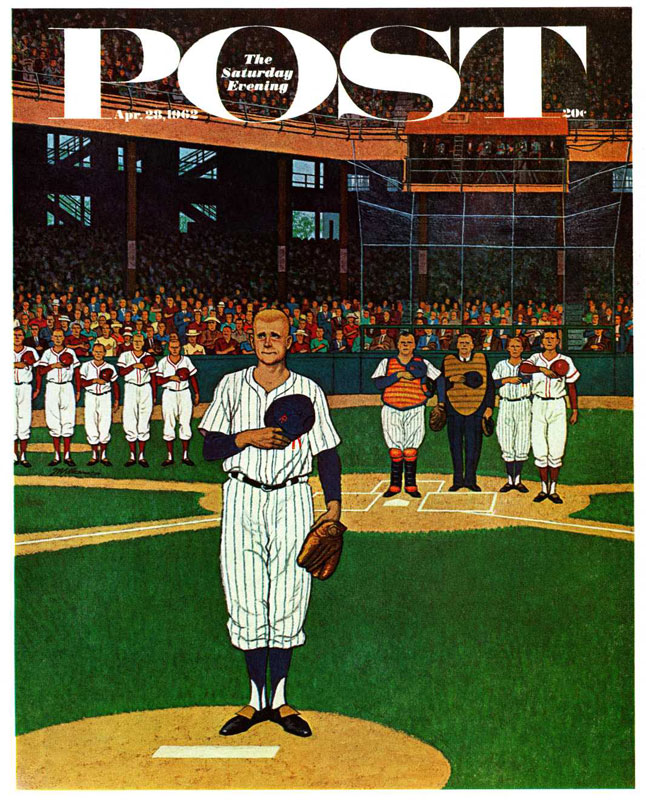
Let’s Brunch!
While the origins of the meal remain a mystery, the word “brunch” first appeared in print in an 1895 article for Hunter’s Weekly. In “Brunch: A Plea,” British writer Guy Beringer proposed an alternative to the heavy post-church fare of the day, in favor of a lighter mid-morning meal.
“Why not a new meal, served around noon, that starts with tea or coffee?” Beringer suggested. “Brunch is cheerful, sociable, and inciting. … It is talk-compelling. It puts you in a good temper, it makes you satisfied with yourself and your fellow beings, it sweeps away the worries and cobwebs of the week.”
More than a century later, Beringer would be happy with the way America embraced and elevated the culinary hybrid to an art form — a tradition treasured by the hungry (and the hungover).
“At brunch, the last thing you want is last-minute fuss,” says Ellie Krieger. “Basically, these recipes can be prepped in advance.”
To keep it light, think alternatives. “For breakfast, people lean on traditional bacon and sausage,” says Krieger. “Instead try Canadian bacon which delivers the same smoky pork flavor, but is a much leaner option.”
As for presentation, Krieger suggests an inexpensive, edible tablescape. “Pick up fresh, colorful spring vegetables and herbs at the farmers market,” Krieger says. “A bunch of fresh mint in a simple vase or untrimmed radishes on a plate makes an elegant centerpiece.”
All recipes courtesy Ellie Krieger.
Spicy Egg and Avocado Wrap
(Makes 4 servings)
Ingredients
- 8 large eggs
- 4 large red-leaf lettuce leaves
- 4 whole-wheat wrap breads (about 9 inches in diameter)
- 1 avocado, pitted, peeled, sliced
- 1 medium tomato (about 4 ounces), sliced
- 1⁄8 English cucumber, thinly sliced
- 1 tablespoon prepared Thai chili sauce or hot sauce, divided
- ½ teaspoon salt
- ½ teaspoon freshly ground black pepper
Directions
Place eggs in a 4-quart saucepan. Cover with water, bring to boil, reduce heat and simmer for 9 minutes. Remove from heat, rinse with cold water and peel. Remove yolks from 4 of the eggs and discard yolks. Slice remaining egg whites and whole eggs into 1/4-inch slices.
Lay piece of lettuce leaf over center of each wrap bread. Top each with avocado, sliced eggs, tomato, and cucumber. Sprinkle with chili sauce and season with salt and pepper. Fold one side of bread about 2 inches over filling to form pocket and roll into wrap. Eat immediately or cover in foil and store in refrigerator for up to 1 day.
Nutritional Info
Per Serving (1 wrap)
- Calories: 370
- Total Fat: 14 g
- Saturated Fat: 3 g
- Sodium: 890 mg
- Carbohydrate: 45 g
- Fiber: 9 g
- Protein: 20 g
- Diabetic Exchanges: 1 starch, 2 medium-fat meat, 2 vegetable, 2 fat

(Photo by Alexandra Grablewski)
Cinnamon Raisin Toast with Honey-Walnut Spread
(Makes 4 servings)
Ingredients
- ½ cup walnut pieces
- ½ cup plain Greek-style nonfat yogurt
- 2 teaspoons honey
- 8 slices cinnamon raisin bread
- 1 peach (or apple or pear), pitted (or cored)
Directions
Toast walnuts in dry skillet over medium-high heat, stirring frequently, until fragrant, 3 to 5 minutes. Allow them to cool slightly, then chop them finely. In small bowl, add chopped walnuts to yogurt and honey and stir until well combined. Spread will keep in refrigerator in airtight container for up to 3 days. Just stir well before using. When ready to serve, toast bread and cut fruit into 1/4–inch slices. Spread about 1 tablespoon of walnut spread onto each piece of bread. Top each piece with few slices of fruit. Eat immediately.
Nutritional Information
Per Serving (2 pieces)
- Calories: 250
- Total Fat: 8 g
- Saturated Fat: 0.5 g
- Protein: 10 g
- Carbohydrate: 37 g
- Fiber: 3 g
- Sodium: 220 mg
- Diabetic Exchanges: 2 starch, ½ fruit, ½ low-fat dairy, 1 fat
(Photo by Alexandra Grablewski)
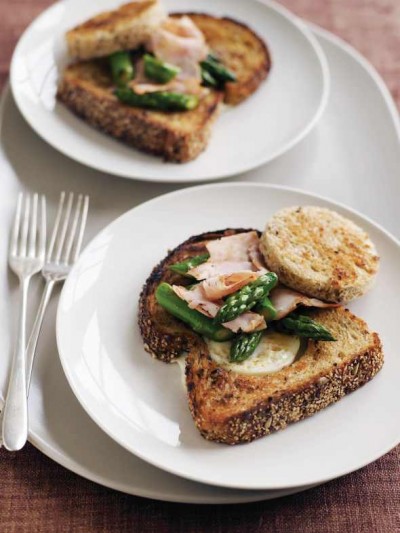
Egg in a Basket with Smoked Turkey and Asparagus
(Makes 4 servings)
Ingredients
- 3/4 pound asparagus stalks
(about 3/4 bunch), woody bottoms removed - 4 pieces whole-wheat sandwich bread
- 4 teaspoons butter, melted
- Cooking spray
- 6 ounces sliced smoked turkey, sliced again into thin ribbons
- 1/4 teaspoon freshly ground black pepper
- 4 large eggs
Directions
Place asparagus in steamer basket over pot of boiling water. Cover and steam until crisp-tender, about 3 minutes. Chop asparagus into 1/2-inch pieces. Brush both sides of each slice of bread with melted butter. Using 3-inch cookie cutter, cut hole in center of each slice of bread; reserve cutouts.
Spray large nonstick skillet with cooking spray and set over medium-high heat. Cook turkey slices until browned around edges, about 3 minutes. Add asparagus and cook until it is heated through, about 2 minutes, then season with pepper. Transfer mixture to plate and cover with foil to keep warm.
Place 2 bread slices and cutouts in same skillet and crack one egg into hole of each slice. Cook until egg whites are set and bread is toasted on underside, about 3 minutes. Using spatula, flip bread/egg slices and cutouts and cook additional 1 minute. Transfer bread/egg pieces to individual plates. Repeat with remaining bread slices and cutouts. Top each one with 1/4 of turkey-asparagus mixture. Arrange cutouts on each plate.
Nutritional Information
Per Serving (1 egg in a basket with ½ cup asparagus-turkey topping and 1 bread cutout)
- Calories: 270
- Total Fat: 11 g
- Saturated Fat: 5 g
- Sodium: 630 mg
- Carbohydrate: 25 g
- Fiber: 5 g
- Protein: 33 g
- Diabetic Exchanges: 1 starch, 1 lean meat, 1 medium fat meat, 1 vegetable, 1 fat
The Inconvenience of It All
I fold backward like a pack of matches. I stretch for two hours daily, and this move is easy for me. But it doesn’t matter because all talent scouts see when they look at me anymore is the accumulation of a few too many years. Why else would No. 7, who fell flat on her face, and No. 12, who tripped on the chorus and didn’t cover it up professionally at all, still be in the running? Here I am waiting in the back row. I didn’t mess up a thing, yet they deliberate. When No. 7 is called, I fight the urge to step forward. I want to shove her out of the way and claim my rightful space.
“The back row is excused,” says the scrawniest of scrawny men. He wears a black turtleneck and fitted slacks. His voice is as slippery as glass.
I watch the rain from the back seat. There are two other performers on the ride. We, the rejected. Melinda, 27 and gorgeous, is in the passenger seat. And Giovanni, nearing 35 and flirtatious — who said I had nice toes on the way up to the audition — is next to me with his head against the opposite window. We are all staring out our respective windows, quiet. The rain begins to race around the car’s exterior, a million dancing feet. The driver is silently cursing the wet roads and sloppy wet turns. His gruff tone, in some inexplicable way, feels close to my heart.
I do not say goodbye as Giovanni collects his backpack and eases out with umbrella poised, and I do not wave when Melinda gets off a few blocks later and I see her run by my window. I live the furthest south, which equates to least desirable here in Canton, but today this doesn’t bother me. Today, it feels fitting, just like my teal tights and this rain, and what I think is the start of a mean case of heartburn.
“Aging is highly inconvenient,” I told my landlord when he asked why my rent was late again. He told me to get a new job, one that’s more “suitable.” I would’ve backhanded him had he said that at the wrong time — like now. But maybe he’s right. I always take this ride anymore. The Giovannis and Melindas of the world take it every now and again.
Coach used to always say, “You can and you will!” May he rest in peace, I think, and I place my hand to my heart. I repeat that old mantra as the shuttle slides on a flooded portion of Fredericksburg Road. “I can and I will,” I say aloud. Just like that I think about a YouTube video that a performer played for me last week. The contortionist had gone viral, whatever that means, and collected a bunch of cash after making a series of videos, showing off what she could do. I look down at my feet and think, or maybe say aloud, “I’ll do that.”
“What?” the driver says. He might be speaking into his phone, so I don’t answer.
I stretch out my hips, balancing my ankle on the opposite knee and bending deeply until I can kiss my thigh, then move my head beyond it. I ease my leg back further so that my calf is situated like a travel pillow. I’ll work on my flips. If I can come up with a routine, maybe my old signature routine, and add a backflip at the end, I’d go viral for sure. For once in quite a long time, my age could be an attribute.
My hamstrings tingle a little, but I ignore the sensation. I catch the driver’s eyes in the rearview and smile with purple lips. Purples and blues were the colors we all wore, right down to the shadows and lipsticks. I think we were fairies or something — don’t remember. Whatever we were supposed to be, I carry the look well. I lick my bottom lip and wink, and the gaze is averted. Too old even for him? He looks a tough-lived 55. I only have a few — 10 or so — years on him. I wonder. Then I notice him looking again and smiling.
“Bad audition?” he asks. Before I can answer, he yells, “Suck it!” to a driver who swerves in the lane next to us.
“It’s all one big learning experience,” I say.
“This rain is killing me today, sweetheart. Sorry for my mouth. Yeah, auditions … I bet. I bet there is always something you can do better. I used to feel that way when I played baseball.”
“Baseball? The difference, um, what’s your name?”
“Max.”
“The difference, Max, is that you don’t get rejected for being old. Your acceptance is based on performance alone. Me, I’m kicking these kids’ asses and still getting the boot.”
“I bet you are,” he says with a touch of sleaze that I kind of like.
The next morning, Max asks me to join him at the doughnut shop — his day job — where he will “hook me up” with a cruller. I tell him I have to get started on my YouTube channel. It’s still raining outside, and when he gets his pants on and ventures toward the window, I smile because I know he’s going to curse at the sky before he goes. I feel connected to him in this strange way.
He yells at the rain, calls it an inconvenience and an asshole. Nature is an asshole, I think, and I look down to my hands. Liver spots — the grossly named logo of old age, of out-of-work acrobats and contortionists. I never looked at my hands when I was younger. My hands were tools, holding me up, twisting body around and facilitating my trademark Ta da! As audiences used their own hands to clap, my soft, young hands did their work.
I watch Max drive off, and I toss his number on my desk. My computer’s camera is not the best, but it will have to do. I dim the lights for mood and tell the camera hello. Then I turn it off and begin to practice. I practice four hours every day, from the time I wake up in the morning to lunch. Then I visualize the flips, the moves. I recall my old routine but add more flourish. I ignore calls, and I continue on. I give it my all. I can. And, I will.
With the camera pointed my way, taking in my perfect pink lips and black leotard with the reflective strips up the side, I introduce myself once again.
I fold backward and feel resistance. My hamstrings ache. But I spring up and back, landing on my feet; and with only a slight waver, I lift my torso with strength. My chest swells toward the ceiling and I reach up like a superhero. The impossible move, the one thing I’ve never been able to do was just done, expertly, in front of all these people. It is here, at the top of my game, that I think about Max and how much I’d love to quit all this and join him at that doughnut shop for chalky coffee, but the rain doesn’t want to stop. The roads are flooded. So I watch my channel, waiting for the first thumbs up.
News of the Week: Don Draper, Dyed Eggs, and The Daily Show
It’s finally April, and we here at The Saturday Evening Post hope that you’ve recovered from both the nasty winter and the devastating news that Zayn Malik has left One Direction. Here’s this week’s roundup.
The End of an Era
The Saturday Evening Post, March/April 2014
Click to read the cast interviews.
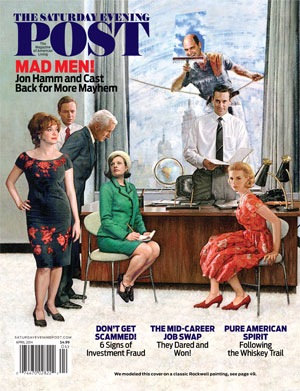
We had to wait a year, but on Sunday at 10 p.m. we’ll see the first of the last seven episodes of Mad Men, AMC’s brilliant drama about advertising execs in the 1960s. I’m going to miss the show — it could be my favorite TV drama of all-time — but on the other hand, seven seasons is a nice, solid run, right?
The cast and creator Matthew Weiner have been making the rounds promoting the show:
Everyone stopped by Today to talk about the last season.
AMC installed a bench at Rockefeller Center where you can sit with Don Draper.
Weiner talked to Esquire about how Mad Men came about and why you’ll never see a spinoff show.
Producer Josh Weltman also talked to Esquire, with the story behind five ad campaigns featured on the show.
If you’re having a finale party, you can get some tips from The Unofficial Mad Men Cookbook .
The Saturday Evening Post has an interview with the cast, an interview with Weiner, and a great gallery of Mad Men-era advertising.
And if you want to read a great history of the show and get all the links to stories I might have missed, take a look at Basket of Kisses, probably the biggest fans and promoters Mad Man has had over the years.
New Daily Show Host Already Has a Controversy
It took about 12 minutes from the time Comedy Central named the new host of The Daily Show to the eruption of a big controversy involving that new host. Trevor Noah, a comedian from South Africa who was a cast member of The Daily Show, will take over for Jon Stewart when Stewart leaves the show later this year.
Now, since this is the age of Twitter and everyone finding out everything about someone at the click of a button or two, it wasn’t long before people found tweets by Noah from a few years ago that joke about women and Jews.
Comedy Central says they are behind Noah and have no plans to replace him as host. Noah himself made a statement about the controversy. Where? On Twitter of course:
To reduce my views to a handful of jokes that didn’t land is not a true reflection of my character, nor my evolution as a comedian.
— Trevor Noah (@Trevornoah) March 31, 2015
I don’t know if this will turn out to be a big controversy as the weeks and months go by. Comedian Jim Norton says that Noah isn’t the problem, we are. I think more people are wondering who Trevor Noah is. Many wanted someone like Tina Fey or Amy Poehler to take over the show, but that wasn’t going to happen. Bill Simmons at Grantland says that Poehler, Louis CK, and Amy Schumer were all asked to be host but they all turned it down.
Heard Comedy Central pursued 3 big-ass names for Daily Show: Poehler, Louis CK, Schumer. Went 0 for 3. Young/cheap/upside was smart audible.
— Bill Simmons (@BillSimmons) March 30, 2015
McDonald’s Testing All-Day Breakfast

Have you ever found yourself wanting an Egg McMuffin, but when you look at your watch (okay, your smartphone) you realize it’s 1 p.m. and McDonald’s isn’t serving breakfast anymore? Well, you soon might be in luck.
McDonald’s is testing all-day breakfast service in San Diego, and if it’s successful every McDonald’s would let you order some OJ and hashbrowns, even if it’s 8 o’clock at night. This isn’t something that’s going to happen across the board this year; it might take a while to implement the change. So if you want breakfast at Mickey Ds, remember that breakfast stops at 10:30 a.m. (11 on the weekends).
McDonald’s hasn’t been doing too well lately. So many other options for people now. All-day breakfast isn’t the only change they’re experimenting with. They’re also thinking about table service and having customers be able to make their own custom burgers.
Can Blogging Kill You?

I know that sounds like a headline from one of the magazines you see at the checkout counter or maybe something from those sites that do a dozen listicles every day (“10 Biggest LOL Cat GIFs Ever!”), but it was actually a fear that longtime politics and culture blogger Andrew Sullivan had. Sullivan recently quit blogging after doing it for 15 years. He said he had to quit because he was doing “40 posts a day, every 20 minutes — seven days a week.”
Now, as someone who has blogged for 19 years, I can confirm it can be intense, especially if your actual job is blogging and you have to feed the always hungry Web beast several times a day for many readers. Though I’m sure there are people who will read about Sullivan and want to switch places with him because they work in a coal mine or work double shifts in a hot restaurant kitchen. I wonder if Sullivan actually had to blog that much.
This doesn’t mean Sullivan is going to stop writing, of course. He’ll still write articles and books, he just needs to take a break from the type of output he was doing, and I can understand that (I hope he stops social media too). I’m not completely convinced that he’s done with blogging for good though. Maybe he’ll cut way down, but I wouldn’t be surprised if he returned in a year or two, depending on what your definition of “blogging” is. He still has a site. Even after his announcement Sullivan blogged a few more times.
But even if he does stop, I hope this doesn’t mean that people think this is another example of “the death of blogging.” Even if social media has taken over, blogging will still be around.
4-Year-Old Girl Wants a Slushie (at 3 a.m.)

We’ve all had this happen. We go to bed, but we wake up a few hours later with a craving. Maybe we’re thirsty or maybe we really want some ice cream or potato chips. As adults we can just get up and go to the kitchen and have what we want, or if we’re really craving something we can jump in the car and drive to the 24-hour convenience store a few blocks away.
But what if you’re only 4 years old? What do you do then? Well, if you’re this little girl in Philadelphia, you hop on the city bus. She really, really, really wanted a Slushie, so she put on her raincoat and got on a bus, and as she sat in the seat said, “All I want is a Slushie.” Which isn’t too much to ask for in life, if you think about it. We all just want our Slushies. The bus driver called the police, and she was reunited with her parents.
I hope she finally got her Slushie. Also: “3 a.m. Slushie” would be a good name for a band
It’s Easter Already?

April 15, 1933
See more Easter covers
Easter seems to have sneaked up on us this year. At least it did with me. Maybe it was all the snow and cold we had during the winter. But Easter is this Sunday, and there are many ways to celebrate.
You could go the Martha Stewart route and take the time to blow out the inside of your eggs and fill them with confetti so you can throw them at people, or you could just sit back and read this list of 9 Things You Didn’t Know About Easter Eggs.
If you’re cooking, you can make these Bacon, Egg and Cheese Easter Baskets, Tyler Florence’s Tangerine-Glazed Easter Ham, and then top off the meal with one of these show-stopping desserts.
Upcoming Anniversaries and Events
Howard Hughes dies (April 5, 1976)
Wikipedia has a detailed timeline on the life of Hughes, including the physical and psychological problems he faced.
U.S. enters World War I (April 6, 1917)
Read Saturday Evening Post archives director Jeff Nilsson’s article, “Did the Post See World War I Coming?”
Henry’s ‘The Gift of the Magi’ published (April 10, 1906)
Here’s some background on the contributions that O. Henry made to The Saturday Evening Post , including “The Ransom of Red Chief.”
The Beatles officially break up (April 10, 1970)
Here’s why the Fab Four broke up, and you can read Cable Neuhaus’ SEP feature, “Long Live The Beatles!”
Russians Go to War to Win at Home
(Bundesarchiv, Bild 183-S01260/CC-BY-SA)
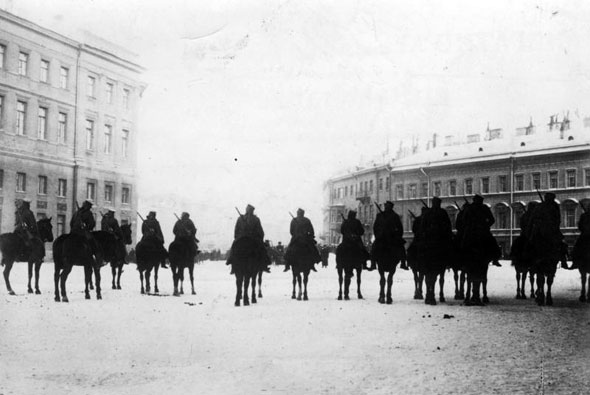
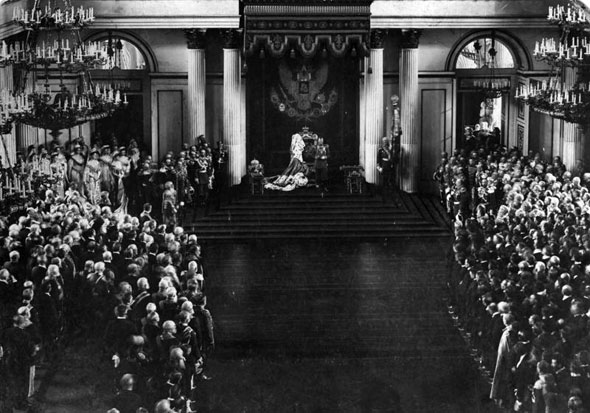
In 1915, Russia was just starting to emerge from centuries of autocratic rule. Czar Nicholas II had recently broken with the Romanov dynasty’s 300-year-long tradition of autocratic rule to give the people a limited voice in their governing. His unprecedented move was a result of Russia being soundly defeated by Japan in the Russo-Japanese War. The loss shook Russians’ faith in their czar, his ministers, and his military officers. The people began calling for reform. At a peaceful protest in St. Petersburg, the czar’s troops fired on a crowd of petitioners. Hundreds were killed and, as news spread, protests and strikes erupted across Russia. In the end, Czar Nicholas permitted an assembly, called the Duma, which had limited lawmaking power. But the government’s underlying corruption and unresponsiveness remained, and public resentment simmered.
(Bundesarchiv, Bild 183-H28740/CC-BY-SA)
Then came World War I. Russia mobilized its army to aid Serbia. But the government’s true reason for entering the war, according to a Post reporter in St. Petersburg at the time, was to regain its hold over its people.
“Report has it that never in the history of Russia had the autocracy been so close to tottering,” wrote Mary Isabel Brush. The czar’s ministers and his brother the grand duke believed a call to arms would revive patriotism and loyalty among the people. Maybe a good war would reunite Russia and put an end to all the talk about representational government.
The working class, however, had other ideas. They welcomed another war because they’d gained so much in the last one. When Brush asked workmen in the shops why they were fighting, the Duma was part of everyone’s answer. “Their legislative body was, to them, the final result of the war preceding, and they felt that the present strife would bring greater power to them.
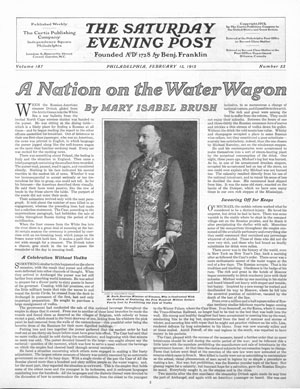
“Let Russia win, and she thought her autocracy would be stronger than in the days of its strength. But the workingman thinks not. He says, let Russia win, and it will mean more rights for him. He will then be in a position to command. One of the large questions is: Which of them knows what he is talking about — the autocracy or the workingman? The answer will be heard round the world.”
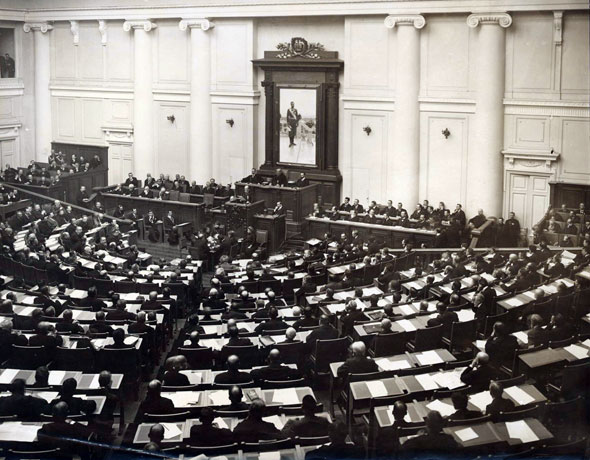
(Bundesarchiv, Bild 183-H28740/CC-BY-SA)
As it turned out, neither the autocrats nor the workers knew what would happen. The element that would soon dominate Russia wasn’t even part of Brush’s consideration. While she may have overlooked the power of Russia’s radical element, Brush was correct in her conclusion: the answer — the Bolshevik Revolution of 1917 — would definitely be heard round the world.
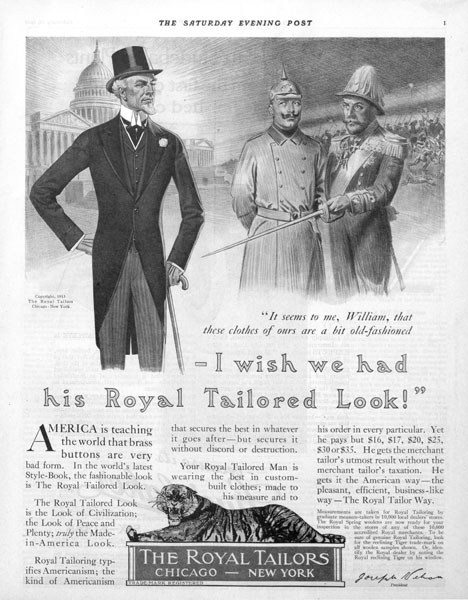
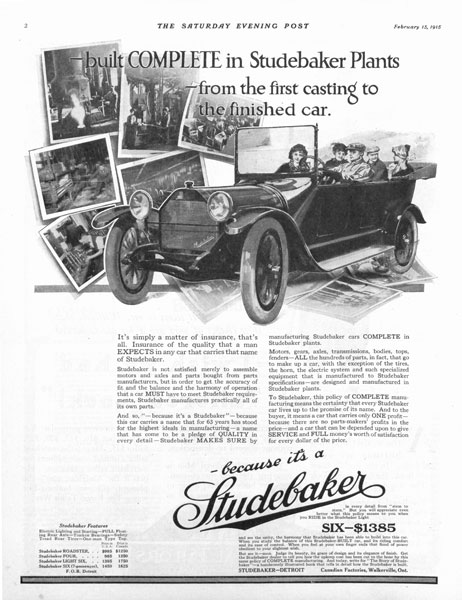
Step into 1915 with a peek at these pages from The Saturday Evening Post February 13, 1915 issue.

Happy April Fools’ Day!
Happy April 1!
Norman Rockwell
April 3, 1943
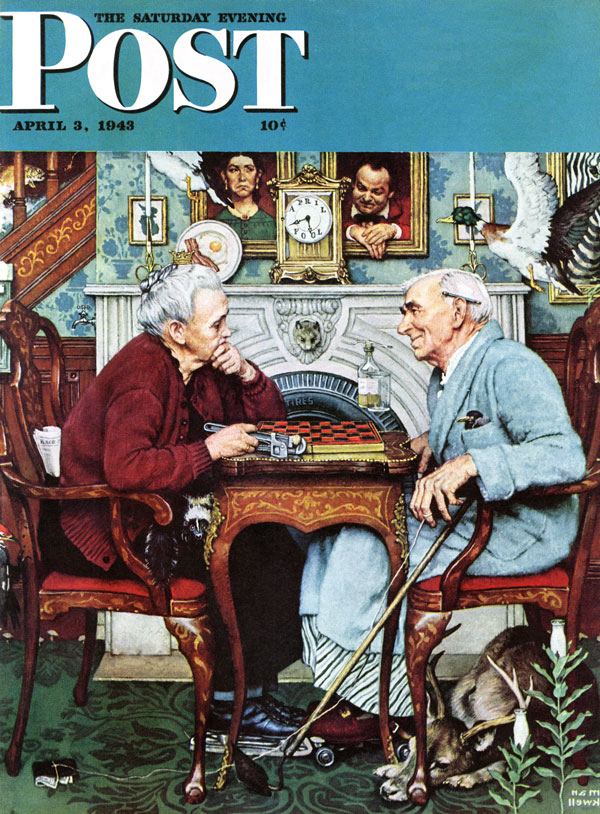
Checkers (aka April Fool, 1943) was Norman Rockwell’s first April Fools’ cover — an older couple in a world filled with silly, nonsensical errors. The Saturday Evening Post published it on April 3, 1943. It was my favorite painting of Pop’s when I was growing up. It is such fun to puzzle out. But not only that. My grandfather did something very original — an April Fools’ cover with all the fun mistakes to find, and he painted it with no less mastery than any other painting. I can’t think of another painting like it. He didn’t give it short shrift because it was a “joke.” That’s what makes it particularly special. He creates a whole new world in this painting, one I think many of us would welcome. Everything is turned upside down — a deer instead of a dog underneath the chair, the cane is a hoe, a carved rat’s head on the mantel, a skunk instead of a cat on the lap of the woman, time has even been altered — a fantastical place to escape to.
It’s no surprise that Pop would choose to create this fun painting after the tedious toil of almost seven months to complete the Four Freedoms. I mentioned this in my recent post on Freedom of Speech. He focused so diligently on getting everything right in the Four Freedoms that his impulse was to balance the serious work with the hilarity of an April Fools’ cover. It’s a perfect example of how my grandfather dealt with difficulties. Humor and fun. And always with a good joke — Pop used to say, “He who laughs last lays the golden egg!”
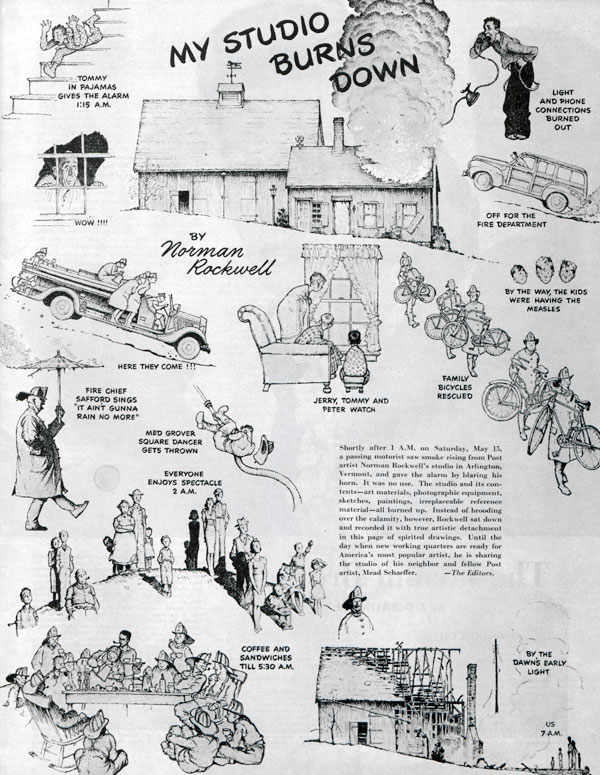
Unfortunately, though, a month later on May 15, my grandfather’s studio burned down. In it were his favorite paintings that he’d been carefully collecting through the years: his large collection of costumes, all the souvenirs and mementos from his travels around the world, his favorite brushes, art books (“all my brains,” he told his friend Clyde Forsythe in a letter describing the loss of the books). Almost his whole world. He had absentmindedly left his pipe near the window seat in his studio. My father, Thomas, was the first to see the fire. He was awakened by the brilliant orange light reflected in his bedroom and the thunder of the studio engulfed in flames. Frightened, Dad ran downstairs and woke the housekeeper and her husband. The telephone wires were burned out so Pop had to get the car and drive to the neighbors’, the Squires, up the one lane dirt road to call the Fire Department.
Almost immediately after the fire, Pop and my grandmother Mary decided to move. They felt the house was too isolated — the nearest neighbors were a mile away. But this is how NR dealt with adverse circumstances — he faced them squarely. I think emotionally it was easier for him to begin all over again, start anew. This is the feeling in many of his paintings — take a difficult situation and find a way, through humor and grace, to move through it and past it.
Norman Rockwell
July 17, 1943
Note NR’s humorous, practically celebratory, page of drawings about the fire — My Studio Burns Down. Its reads almost like a cartoon. My grandfather worked through his darkest moments in his art. He does end the series of drawings with a poignant moment: the family, all alone, looking at the smoldering ruins in the early morning. The scale of the family compared to the scale of the studio says it all. They are very small in the face of the ruins before them.
Warmly,
Abigail
P.S. Our hearts are with all the families and loved ones of those lost in the tragedy of the Germanwings Flight 9525. In the face of deep despair all we can do is come together as one and mourn and comfort each other. Infinite blessings to those souls that departed too soon.
‘I Saw Lee Surrender’
Seth M. Flint, an 18-year-old bugler with the Union Army, was present at the truce ending the Civil War. In 1940, Flint, the last living witness, wrote his recollections for the Post, highlights of which are excerpted here:
Grant calmly receives a historic letter from Lee:
Grant handed the paper to a staff officer, who hurriedly scanned the words. Evidently the staff officers construed this to be assurance of surrender, for every last man of them burst into cheers. The only one who took no part in the impromptu celebration was General Grant, who merely looked on with bland amusement.
A party of Union soldiers rides to meet Lee:
It was not difficult to recognize the famous commander of the Army of Northern Virginia. It was the face beneath the gray felt hat and hair that made the deepest impression on me; I say this because I can still recall it vividly. … Despite its sternness on that day of long ago, I would still call his expression benign. And yet, I remember well that there was something else about him that aroused my deep pity that so great a warrior should be acknowledging defeat.
Grant arrives at the house of Alexander McLean:
Grant looked an old and battered campaigner as he rode into the yard. His single-breasted blouse of blue flannel was unbuttoned at the throat and underneath it could be seen his shirt. His top boots were spattered with mud, and splotches of mud were on his trousers. Unlike Lee, he wore neither sword nor sash, and the only marks of his rank were his shoulder straps.
The day was very warm for early April. Spring was with us at last, and the trees were putting on a tinge of green, the buds showing plentifully on the branches. It was good to be alive on April 9, 1865, and it would be better still if this was the end of four years’ war. … The Sabbath stillness brooded over the land, a welcome relief from the din and hustle and carnage of recent fighting.
That night when I sounded taps, that sweetest of all bugle calls, the notes had scarcely died away when from the distance — it must have been from General Lee’s headquarters — came, silvery clear, the same call; and, despite the sadness of the hour to the boys on the other side, I have a notion that they, like the Yanks, welcomed the end of hostilities and the coming of peace.
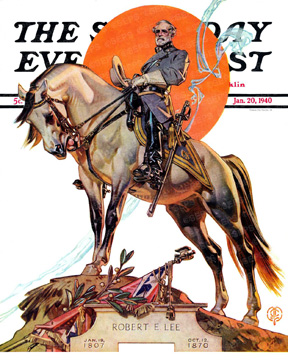
Robert E. Lee on Traveler
J.C. Leyendecker
January 20, 1940
A day later, Union horsemen mingle casually with officers in gray:
I remember how amazed I was as I saw that strange company; and when I learned that among them were Longstreet, Pickett and Gordon — well, it certainly seemed impossible.
Perhaps you can imagine my reaction to the spectacle, after three years of desperate fighting, to see three of the most famous Southern leaders, within 24 hours of Lee’s surrender, shaking hands with Grant and chatting like long-absent neighbors with him and other Federal generals.
How Abe Lincoln would have enjoyed that confab! Like Grant, he would have grasped the hands of those soldiers in Confederate gray and welcomed them back home. Had he been spared, there would have been no Reconstruction.
Soldiers don’t carry hatred; they leave that to the stay-at-homes. We learned that in the next 20 years.