Tylenol’s Modern Spin on ‘Freedom from Want’
I immediately loved the concept for the Tylenol spot, its message spoke to me — it is current and relevant. Taking my grandfather’s painting Freedom from Want, which he painted in 1943, and cleverly bringing that image of family togetherness and celebration into 2015 by reflecting it through three different American families — one African-American, another Asian, and also two moms with their happily extended family. What better way to visually tell the story of how our definition of family is expanding and ever changing? Yet our concept of family remains the same; it is the love and the celebration of that love that connects us all, regardless of race, sexuality, or any other difference. Norman Rockwell’s painting is a timeless reminder of what is most important.
The Year of Two Thanksgivings
With all the concerns about Christmas — or at least Christmas shopping — intruding on Thanksgiving, maybe Thanksgiving should always be the last Thursday of the month. That was the day Lincoln set aside as the national day of giving thanks in 1863.
But in 1939, President Roosevelt moved it to the fourth Thursday of November.
Naturally, many Americans were displeased with the change. They didn’t like having their holiday traditions moved around. And many were upset over Roosevelt’s reason for the move.
That year, Thanksgiving landed on the last day of November. Consequently the Christmas shopping season, which Thanksgiving traditionally marked even then, would be only 24 days long. Hoping to help retailers by extending the shopping season, Roosevelt moved the holiday—and the traditional start of shopping—back one week.
But many Americans had already made plans for the holiday. Football teams had already scheduled their last games of the season — traditionally played on Thanksgiving Day — on the 30th. The new date became a political issue. Republicans who claimed Franklin Roosevelt was tampering with Lincoln’s memory by moving the holiday opposed the holiday’s move and referred to the new date as “Franksgiving.” A New York Times poll showed Republicans opposed the move by 79 percent, Democrats by 48 percent.
Meanwhile, the dueling dates provided material for humorists, like the poet who wrote this item for the Post on October 14, 1939:
Feminine Urge
For practical reasons, Thanksgiving’s been changed,
So I’m thinking of pulling a fast one
By changing my birthday, on account of it comes
Too soon after the last one.
And Jack Benny’s writers worked the topic over for his November 19 show.
In this clip from The Jack Benny Program, Benny’s wife and co-star, Mary Livingstone, reads her poem about the confusion the two Thanksgivings caused. The first voice you’ll hear is Jack Benny. The second male voice is Benny’s announcer, Don Wilson. The third man, who is “all set to be one of them pilgrims,” is bandleader Phil Harris, who played the character of a vain and ignorant playboy. And the fourth is a writer who would occasionally come in to deliver one-liners.
Listen to the clip from Jack Benny’s November 19th, 1939 show
The Great War: November 28, 1914
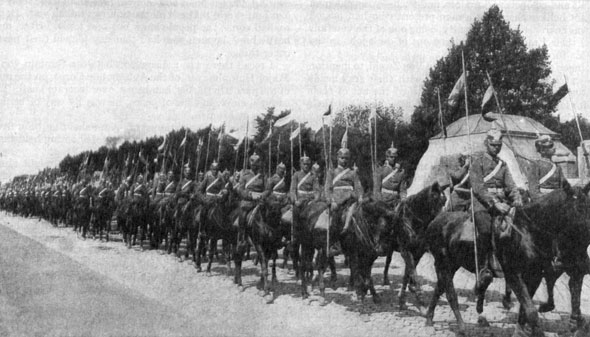
In the November 28, 1914, issue: German army cooks scoop up war medals and journalists fight censorship and military officers for the truth.
Three Generals and a Cook
By Irvin S. Cobb
Still observing the war from the German side, Cobb spent a week socializing with high-ranking officers in the Kaiser’s army. He was particularly impressed by a common soldier who had earned the Iron Cross decoration. Cobb was even more surprised that the medal had been awarded to a cook.
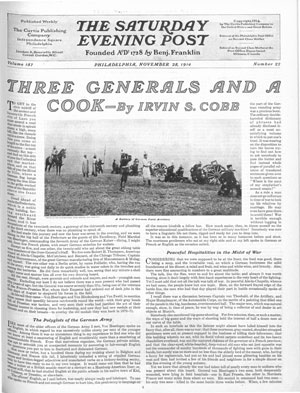
“While the officer rattled the steel lids the cook himself stood rigidly alongside, with his fingers touching the seams of his trousers. Seen by the glare of his own fire he seemed a clod, fit only to make soups and feed a fire box. But by that same flickery light I saw … on the breast of his grease-spattered gray blouse … a black-and-white ribbon with a black-and-white Maltese cross fastened to it. I marveled that a company cook should wear the Iron Cross of the second class and I asked the captain about it. He laughed at the wonder that was evident in my tones.
“‘If you will look more closely,’ he said, ‘you will see that a good many of our cooks already have won the Iron Cross since this war began, and a good many others will yet win it — if they live. We have no braver men in our army than these fellows. They go into the trenches at least twice a day, under the hottest fire sometimes, to carry hot coffee and hot food to the soldiers who fight. A good many of them have already been killed.
“‘Only the other day … two of our cooks at daybreak went so far forward with their wagon that they were almost inside the enemy’s lines. Sixteen bewildered Frenchmen who had got separated from their company … thought the cook wagon with its short smoke funnel and its steel fire box was a new kind of machine gun, and they threw down their guns and surrendered. The two cooks brought their 16 prisoners back to our lines too, but first one of them stood guard over the Frenchmen while the other carried the breakfast coffee to the men who had been all night in the trenches. They are good men, those cooks!’”
“I am in doubt as to which of two men most fitly typifies the spirit of the German Army in this war — the general feeding his men by thousands into the maw of destruction because it is an order, or the pot-wrestling private soldier, the camp cook, going to death with a coffee boiler in his hands — because it is an order.”
The Private War
By Samuel G. Blythe
In modern times, we expect wars to generate a steady stream of new reports from the front lines. But 100 years ago, the military reduced the news stream to a trickle. Every reporter’s dispatch was rigorously censored to remove any information that might aid the enemy or make the military command look bad. And, as Blythe reports, the British and French armies devised several diversions to prevent reporters from reaching the front.
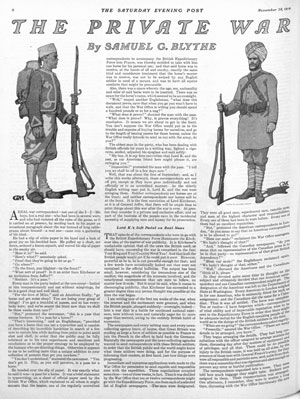
“[British Field Marshall] Kitchener does not recognize any right the public may have to information. … It is Kitchener’s unshakable opinion that all the news the British need; or should have, concerning the war is comprised in the line: Your King and Your Country Need You! And that is all the British people would get if he could put it over. However, powerful as he is, he is not powerful enough for that; and a few words have occasionally leaked out that were not contained in the official bulletins. The output has been small, however, considering the tremendous size of the conflict. …
“Greatly to the astonishment of the British War Office, it was learned that General Joffre, in command of the French troops, strenuously objected to the presence of the English correspondents. It was all very astonishing and very perplexing and very embarrassing. …
“[Some of the more impatient correspondents asked General Joffre about his objections.] ‘Objections?’ was the polite reply. ‘Why, there are no objections on our part, save as we object out of courtesy to, our ally, Great Britain. France will be very happy to have these correspondents with the army; but naturally, if the British authorities think it wiser not to allow them at the front we can do nothing but bow to that decision.’”
“Whereupon the situation became reasonably clear. The British War Office was using the French as the obstacle, and the French were doing the same thing with the British. It was a simple and efficacious case of passing the buck.
“And so it goes. The Press Bureau is press-bureauing; the censors are censoring; and Kitchener, on the British side, and Joffre, on the French side, are seeing to it that not a word is printed about this war which they do not desire to have printed.”
Step into 1914 with a peek at these pages from The Saturday Evening Post 100 years ago.





Happy Thanksgiving to All!
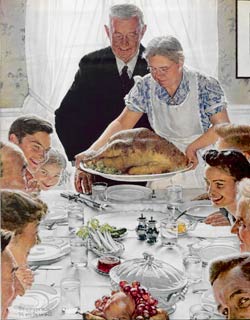
Norman Rockwell
The Saturday Evening Post
March 6, 1943
People have always loved my grandfather’s painting, Freedom from Want, which first appeared in The Saturday Evening Post — it’s been celebrated and even lampooned many times. It is a painting about connection and the celebration of that connection.
No one is looking at the turkey or the grandmother and grandfather, and no one is praying or giving thanks — it’s what I call the “happy error” of the painting. Norman Rockwell was all about faces and interactions; if he painted everyone looking down and praying or looking back toward the grandparents and the turkey, you wouldn’t be able to see any of their faces.
Everyone is connecting with someone — the woman on the left is my grandmother Mary, who is conversing with the attractive woman across the table. The old woman is my great-grandmother, Pop’s mother, and she’s looking at Mary. The two men are interacting in the middle of the table (you just can’t see the one man’s face). The grandparents have a lovely, quiet, unspoken connection — the grandfather is clearly there to support her if the turkey gets too heavy. The man looking out at us is there to bring us into the moment, to invite us in.
The act of setting the turkey on the table brings movement into the painting. You can almost hear the lively exchanges at the table. And who is at the other end of the table? I can almost feel Pop’s presence there.
Enjoy your time with your family. In the end, that is what holidays are about. It’s not about getting the turkey with all its trimmings just right, its not about creating the perfect tablescape. It’s about family coming together to celebrate the simplest things — love and gratitude.
Warmest wishes,
Abigail
P.S. Pop always felt he had made the turkey too big. He also used to joke that the turkey was the only model he ever ate!
Nurse Ingrid
Gray slush on the dirty brown carpet melts into puddles as I wait in the checkout line at the Bibles for Missions thrift store. I wonder why it’s so busy, but then I remember it’s the 30th, check day. I should have come yesterday.
“Morning,” says Hedwig when it’s my turn. Her name is printed in neat block letters on the name tag pinned to her off-white sweater. You could bounce a dime off her tightly permed blue-gray hair. I’ve been to the store so often lately I feel like I know her. She rings my purchases through and with each pair of panties — powder-blue nylon grannies, black lace boy-cuts, hot-pink bikinis, industrial-strength taupe control-panel jobs, no-nonsense white cotton briefs, red satin thongs — her lips purse a little harder, fine lines around them deepen. Finally she says, “These are all different sizes, you know.”
I shrug. “I have a big family.”
Her lips almost disappear. She rings the rest of my order through in silence, the cash register display reflecting in her glasses. She doesn’t believe me, but it’s none of her business. I leave the store with two plastic grocery bags full of panties, 44 pairs at 50 cents each. Twenty-two bucks, and I’ve cleaned out their ladies’ underwear bin for the second time in a month.
Next week, I’ll hit Value Village for a change. Their prices are higher, but the kids who work there couldn’t care less what you buy, or why you buy it. Really, I just want to make a living. That’s all any of us want, isn’t it?
***
Snow whirls outside as Sunniva and Dana and I sit in front of my computer and nibble thick golden slices of Sunniva’s sockerkaka, sponge cake. Dark-haired Dana pushes her glasses further up her nose, reads aloud what she’s typed so far. “Nurse Ingrid is lonely. She is Swedish, blonde, 5’ 4”, age 26. She sounds a lot like you, Sunniva. ”
“Well. I’m a long way from 26. And let’s make her 22.”
“That seems kind of young, don’t you think?” I ask.
“Beth,” says Sunniva. “What the hell difference does it make?”
“You’re right. It doesn’t matter.” I sip my wine. “Thanks for bringing the cake, by the way. It’s awesome.”
“Tack. I’m glad you like it. How about this: She’s lonely, 22, and she loves to sell off her used panties in her own eBay store.”
“Gently used?” I suggest.
“Lovingly used?” Dana muses.
“Let’s just go with ‘used’ for now. We can always change it later,” says Sunniva.
Dana raises her glass. “I’ll drink to that.”
“We should wrap this up for now,” I say. “Almost time to pick up the kids.”
***
Things have been better for me since Sunniva and Dana and I started hanging out together. But many days I still feel lost. When Evan and Henry are at school, instead of doing some of the millions of other things I should do, I find myself once again wandering Westbrook Mall. It’s not that I want to shop for anything, particularly. I just don’t want to be alone with my thoughts. I distract myself by fingering trinkets in the dollar store, by trying on clothes I have no intention of buying. Sometimes I don’t recognize the woman looking back at me in the change rooms — she looks old and tired; her straggly red hair I suddenly realize hasn’t been cut in months. In the food fair I sit with a cup of coffee and watch people come and go. Women with strollers and diaper bags and toddlers; sullen, dark-clad teenagers who should be at school; elderly couples who sit together, each lost to their own silences. Every once in a while I catch a glimpse of a tall man, and before I can stop myself, I’ll think it’s Ian for a second, and in the next instant when I realize, of course, that it’s not, I feel like my insides have been hollowed out.
Then it’s time to go pick the boys up again. This new life as a widow is exhausting, bewildering. I wonder how I’ll ever get used to it. The six weeks I’ve been off work are already almost up, and the college probably expects me to come back, or to tell them whether I am coming back or not. My supervisor, Charlotte, has been really good. But I don’t feel ready to go back, I don’t feel ready to do anything except sleep, and heat up frozen food, and wander Westbrook Mall. I don’t feel ready to make a decision. Everything seems to be out of my control. And it terrifies me.
But then there’s Evan and Henry. They’re my lifeline, all that keeps me from drowning. If I have no other reason to get it together, I have them. Only I have no idea how to even start.
***
We came up with the concept of Nurse Ingrid on one of our special Fridays. Dana’s 3-year-old, Peter, Sunniva’s son John, and my Evan were all in the same preschool class, and Sunniva’s Michael and my Henry were in kindergarten together. All boys, they all got along so well. First we started getting them together for play dates outside of school. Then the three of us started having coffee in the afternoons when they were all in school, which we found a lot more relaxing than play dates. Then the coffee became wine, on special Fridays, once or twice a month. After all, we could walk over to the school from my place. And those Fridays were indeed special. We needed them.
That day the boys all wanted to go to the playground after school, even though it was freezing out, and the three of us huddled near the school doors, tipsy and leaning against the brick wall, while they chased each other up and over and around the dizzyingly red, yellow, and blue playground equipment.
Dana sighed. “Days like this I wish I could work from home. You see all these ads. You know, Internet jobs. Work from home. Beth, didn’t you make money selling stuff on eBay for a while?”
“Yeah, I did. It was kind of fun.”
“You sold vintage clothes, right?”
“Yeah. And other stuff. Collectibles. I got a lot of it when I worked in a thrift store when I was in university. When the kids were little I had to make some room, so I started selling off some of it.”
“So why did you stop?”
“Partly because I ran out of things to sell, and I didn’t have much time to pick up new stock in thrift stores. Partly because it’s still a customer service job — you’re always going to come across cranks and whiners who try to get something for nothing out of you. But mainly I quit because after a while the market got flooded with vintage stuff. I didn’t make enough on each item to make it worthwhile.
“Maybe you just weren’t selling the right clothes,” Sunniva suggested. “A friend of mine told me her sister-in-law sells her used underwear on eBay. For a lot of money.”
Dana’s round gray eyes grew even rounder. “Really? How much?”
“Fifty, a hundred bucks a pair. She lists her auctions as ‘sexy college co-ed used panties,’ sells them to men all over the world.”
I breathed out a low whistle.
“Come on, Beth. Are you shocked?”
“No. I’m figuring out the profit margin. Panties at the Bibles for Missions store are 50 cents a pair.”
“Holy,” said Sunniva in a little cloud of breath.
***
One special Friday we decide to get together in the evening. We order pizzas and Sunniva and Dana bring their kids over. After the kids eat we plug them into Finding Nemo in the family room downstairs, their blond and red and brown heads lined up in a row in front of the TV. The three of us take care of a few Nurse Ingrid auctions that are about to end, then we relax with a drink.
“Cheers,” I say. “Here’s to Nurse Ingrid.”
“She’s bringing in a lot of money, isn’t she?” asks Sunniva.
“She is. I never would have believed it. This is more money than I made working at the drugstore,” Dana says.
“We’ll see, but it looks like Sunniva and I may not have to go back to work, either,” I say.
“Sunniva, why did you quit nursing?” Dana asks. “I mean, it’s a good job.”
Sunniva smiles. “It’s hard work. And crazy hours.”
“It must be stressful,” I say.
“Stressful. Yes, well. That doesn’t even start to describe some of it. You see a lot of things you hoped you’d never see, things you never imagined you’d see, when you work in emerg. And I did it for a lot of years.
“The thing, though, that pushed me over the edge … a man brought his little girl in late one night. Six years old, pretty little thing. She was bleeding very heavily. The father was white as a sheet, wouldn’t tell us what happened. She just sat still, with her legs clamped together, wouldn’t let us examine her, wouldn’t answer any questions. We called the police, of course.”
Sunniva’s voice trails off. I can’t think what to say. Then she continues. “She died later that night and he was charged. I think in the end he was in jail for less than two years.”
“Oh, Sunniva. That is so horrible.”
“It is horrible. And I tried to forget about it. But I just couldn’t. I felt sick every time I went in to work for a long time after that. It really frightened me, it still frightens me, to think that no matter how good our intentions are, no matter how hard we try to help people, there’s so much that’s out of our control.”
Dana gets up. She is pale. “You know, I just realized the time. Mel is going to be back any minute. I should get home.”
“Can’t he get his own dinner?” asks Sunniva.
“I need to get home. I’m sorry,” she mumbles, and goes downstairs to get Peter. He stomps up the stairs, whining that the movie isn’t over.
“Peter. Control yourself,” Dana says through her teeth. She’s bent over, helping him jam his snow boots onto his feet, and I notice that one arm of her glasses is held on with duct tape. I am just about to ask her what happened to them when I think better of it.
I think Sunniva’s story hit close to home for Dana, somehow. I’m sure Sunniva saw it, too, though we let it go, say nothing about it to each other.
***
Hedwig sees me come into the thrift store one morning and whips out from behind the counter with surprising agility, follows me down the housewares aisle, up the ladies’ wear aisle. She dips into the bin of men’s socks, fires rolled up pairs at my head with the precision of a marksman. I try to scream but no sound comes out of my mouth, and I duck into the change room. As soon as I lock the door, she bangs her fists on it, yanks on the handle.
“You think you can hide in there, you panty-hoarding harlot. But you can’t. You’ll have to come out sooner or later.”
Let go, let go of that door handle, I want to scream, and she rams into it with her shoulder.
I wake up covered in sweat. Clearly, there’s a problem here.
***
On a Wednesday morning, I’m in the long line at the Starbucks at Westbrook Mall, telling myself this is it, this is the last time I will wander around here for no reason. I wish they had an express line for people who just want coffee. Just give me a damn medium coffee, I want to say. Instead I wait in line behind people ordering grande half-sweet sugar-free cinnamon dolce nonfat chai-tea misto or tall Americano with a nonfat steamed topper. Listening to them gives me a headache. And the couple in front of me, a beefy tattooed man in a hoodie and a slight dark-haired woman who wears a cropped T-shirt and tight pink pants — tight enough that she can’t be wearing underwear — make out while they wait. They keep jostling me, no matter how far I move away. I’m about to say something when they get up to the counter and order venti nonfat no-whip classic hot chocolates, extra foam or something.
Alas, when I take my damn medium coffee over to get a lid, the lovebirds are there. He has her up against the cream-and-lid station; her hands are down his pants. Just get out of the way, I think. I try to reach around them for a lid, but I can’t. My head throbs.
“Hey, take it somewhere else, would you?” I suggest.
The man spins around, roars, “Who are you telling people what to do?” He grabs the woman, starts kissing her again, but this time he stares at me.
“Charming,” I mutter, and take my lid and leave. Should have sold her some panties while I was at it.
I meant to wander around the mall, but after that I take my damn medium coffee and go home. The experience leaves me a little shaken, feeling fragile. The guy was a total asshole. He could have slugged me, could have whipped out a gun, tough Starbucks gangsta that he obviously was. Then the whole thing could have spun out of control. I could have taken a bullet to the brain. And where would Evan and Henry be then? I would have to be extra careful from now on, that was all. As the only parent, caution was my only choice.
At home I sit down at the computer, decide checking in on a few of our auctions will improve my mood. But there is an email from eBay. I read it a couple of times, then punch in Sunniva’s number, stare at my computer screen in shock as she picks up.
“Hello?”
“Busted! Dammit, Sunniva, we’re busted.”
“Beth?”
“Yes! The panties. We’re busted.”
“What do you mean, busted?” she huffs. “There’s no law against selling used clothes, is there?”
“No, there isn’t. But eBay will no longer allow us to sell used panties. Health regulations or some bullshit. They sent out an email. All our auctions are shut down.”
“Damn.”
“I know.”
Sometimes things happen and you realize maybe it’s a blessing somehow. We all knew the Nurse Ingrid thing wouldn’t last forever. But I think we wanted to be the ones to say it was time, we wanted to be in control of the ending. But there it was, pulled out from under us.
Now what the hell would I do with all those bags of panties? Re-donation seemed like the only answer.
***
After we receive the last payments from our happy customers before Nurse Ingrid suddenly disappears from eBay, we get together to split up the proceeds. It looks like it may be the last time the three of us will gather for a while; Dana’s decided to leave Mel, and she and Peter have moved in with her sister, on the other side of the city. She comes in my front door, stomps her snowy boots on the mat, has a huge red plastic Zeller’s bag in her arms.
“What’s all this? Stuff you’re getting rid of for the move?”
“No.” She nods at the bag. “Take a look.”
I peer inside. The bag is full of panties. New cotton briefs, three to a package, sensible colors: white, ecru, black.
“Oh, my God.”
“They had them on clearance. I just — I’m not really sure what got into me. Can you donate them to the thrift store for me? I won’t have time to swing by there.”
I try to imagine the look on Hedwig’s face when I come in with this donation. “Yeah, no problem. How are you and Peter doing?”
“Good. You know. Pretty good. For now, I think living with Catherine’s going to be the best thing for us. She works nights, so she can get him to and from school once I get a new job.”
“Sounds like you’re getting things under control.”
“Yeah. It’s going to be okay.”
“Dana, we’re not letting you go without having a drink and some sockerkaka with us,” Sunniva says, pouring her a glass of wine. “Sit down. Besides, I have some news, too: I’m going back to work.”
“Really? Where?” I ask.
“The general hospital. It’s a desk job, though, three days a week. Giving advice over the phone. I think I’ll like it.”
“Congratulations,” Dana and I tell her. I’m happy for Sunniva, but surprised. I didn’t see that coming at all.
After Sunniva and Dana leave, I rinse golden cake crumbs from our plates, rinse our wine glasses, and put them in the dishwasher. There’s still some time before I need to go pick up Evan and Henry, so I check my email. There’s an email there from Charlotte at the college. I don’t want to open it. I know what she wants. She wants me to tell her whether or not I’m coming back to work.
While I try to decide whether to open the message, I notice the Nurse Ingrid email file and decide it’s time to delete it, time to let it go. And then that’s it. The last trace of Nurse Ingrid is gone.
I get up, get my boots and coat, go out to pick up the boys. The sun has come out, the warmth feels good on my face. I decide I’ll answer Charlotte’s message after we get back. It’s time now, I can do it. Besides, I tell myself, if I’m having a problem when I’m back at work, if things are getting out of control, I can always phone Sunniva for some advice. Somehow, knowing that makes me feel better.
Who’s Afraid of Mike Nichols?

His name would be familiar to anyone who grew up in the 1960s. Mike Nichols was the hip, laid-back comedian with a martini-dry delivery frequently seen on TV with his co-comedian, Elaine May. (The duo picked up a Grammy for Best Comedy Performance in 1961.) In 1966, though, he steered his career in an entirely new direction when he directed the screen version of Edward Albee’s grueling Who’s Afraid Of Virginia Woolf.
The riveting film fed viewers through an emotional wringer and was nominated for 13 Academy awards, including Best Director. Nichols followed up his success by directing Dustin Hoffman in The Graduate the following year — this time taking home the Oscar for his direction, before moving on to other films, television dramas (winning four Emmys), and Broadway productions (scooping up eight Tonys).

In “All for the Love of Mike” (The Saturday Evening Post, October 9, 1965), author C. Robert Jennings interviews the two leads — Richard Burton and Elizabeth Taylor, who were married at the time — of Nichols’ Hollywood directorial debut and its director on the closed set at Warner Brothers Studio.
The relationship of the trio is almost inordinately warm. “Mike’s a very disturbing man,” says Burton. “You cannot charm him — he sees right through you. He’s among the most intelligent men I’ve ever known, and I’ve known most of them. I dislike him intensely — he’s cleverer than I am. But, alas, I tolerate him.”
And with unabashed sentiment, Liz adds: “I adore Mike, and I could talk about him for hours.”
Miss Taylor calls Nichols “Chicken Fat.” He calls her “Betty,” and he breaks her up — as when he mimicked a classic directorial banality (“Let’s have a nice little scene now with lots of feeling”) by announcing prior to the shooting of a scene: “Let’s have a nice little scene with no feeling.”
Once when Mike forgot to give his players their cue. Liz said, “I can’t act until you say ‘action.’”
“A-a-a-a-a-a-a-a-a-ac-ac-ac-action!” Mike stuttered insanely, shattering Miss Taylor’s professional calm.
Similarly, when Liz fell off a fire-engine-red bicycle, which she rides between the set and her dressing room, Mike carried the bruised star back to work in his arms. “You have to carry me every day,” said Miss Taylor, who was encouraged to put on extra pounds for her part. “I’ll have to get into training,” returned Mike recklessly.
On the Sidelines, Mussolini Awaits His Opportunity

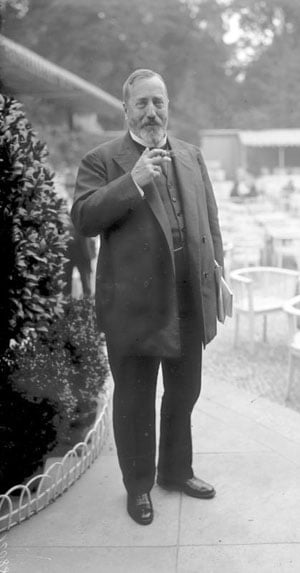
( via Wikimedia Commons)
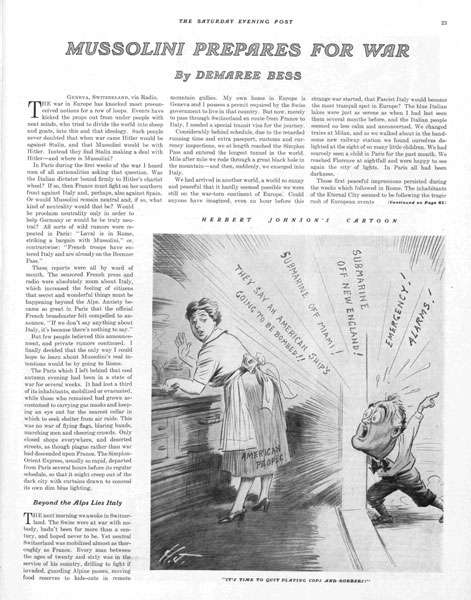
You may have seen the photos of Benito Mussolini’s messy demise. The photos show the corpse of Italy’s ex-dictator, shot, beaten, and kicked, hanging upside down from the roof of a gas station. Seeing the brutality of his death, you get a sense of how fiercely the Italians hated the man who had dragged their country into a war that brought only poverty, disgrace, and death to their land.
Once Mussolini had enjoyed broad support in Italy. He presented himself as the savior of the country, promoting fascism as the solution for the country’s problems. He inspired young Italians to join forces, donning the black shirts of the fascist party members. He also inspired a young Austrian named Adolf Hitler, who looked up to Mussolini as a role model.
But Hitler was a fanatic. Mussolini was an opportunist. And nothing illustrated his opportunism better than his actions in 1939. In May of that year, he and Hitler signed an alliance in which they pledged to come to each other’s aid in the event of war.
Furthermore, the agreement “stipulated that neither of the parties would take action within the next three years [to] cause war in the West,” wrote Post correspondent Demaree Bess. [Read the entire article “Mussolini Prepares for War” from the Nov. 18, 1939 issue of the Post here.] Mussolini needed that delay. His advisors had told him Italy wouldn’t be ready to launch a war before 1942.
Not surprisingly, Hitler ignored this clause in the agreement when, just four months later, he declared war on Poland. As his army launched its blitzkrieg, the world looked to his ally Mussolini. What would Il Duce (the Italians title for “the leader) do now?
Bess was hearing all sorts of wild rumors of possible alliances and confrontations—an alliance between France and Italy, war between France and Italy, even an attack from Germany. “I finally decided that the only way I could hope to learn about Mussolini’s real intentions would be by going to Rome,” he wrote.
Bess left a darkened, huddled Paris that anticipated German bombers at any moment. Traveling south, he found Italy sunny and peaceful. “As we walked about in the handsome new [Milan] railway station, we found ourselves delighted at the sight of so many little children. We had scarcely seen a child in Paris for the past month. We reached Florence at nightfall and were happy to see again the city of lights.”
The Italians were happy again with il Duce, then regarded as a man of peace. He was making no overt moves to drag Italy into Hitler’s crusade against France and England. “[Italy] seemed to be in a position to stay neutral as long as she liked — and to make money trading with the belligerents,” Bess wrote. Yet he became convinced that Mussolini had no intention of staying out of the war a moment longer than necessary. “He is standing on the side line now, watching how things go, but he isn’t idle. … He is preparing for war.”
Il Duce had set the country on the road to war many years earlier. “He has raised a whole generation of Italian youth in the faith that they should live dangerously, that pacifism is a vice,” Bess wrote. And now, though Italy was still neutral, Mussolini’s government was starting to ration food for civilians and stockpile it for the army.
Mussolini’s refusal to join Germany’s war prompted some to believe he was reconsidering his alliance with Hitler, which had always been “extremely unpopular with Italians,” Bess wrote. “Italians naturally dislike Germans. The two races don’t get along well together. Germans are impatient with the easygoing temperament of Italians and don’t conceal their impatience. Italians resent German assumptions of superiority merely because they are more efficient.”
For now, the Germans weren’t pressuring Italy to join their fight. In fact, Hitler found Italian neutrality useful. According to Bess, it allowed Mussolini to play a peacemaker who suggested there could be a “settlement of the war in the West, thus enabling Hitler to pose before his own people as a reasonable man who didn’t want to fight Britain and France.”
France and Great Britain were also satisfied with Italian neutrality, since it enabled them to maintain their control of the Mediterranean Sea without having to engage the Italian fleet.
Mussolini was under no pressure to commit Italy to the world war. “He foresaw that no pressure from either side could or would compel him to enter this war until he was ready to move,” Bess wrote. “Germany’s air force might destroy Italian cities, but what could Germany gain from that?”
Mussolini would remain neutral for as long as it was profitable. But Hitler’s swift victory over France led Mussolini to weigh the profits from war versus peace. If he remained out of the fight, his country might continue its gradual rise in prosperity. And he might take up the offer of trading concession in Africa that Great Britain and France would grant if Italy remained neutral.
But if Italy entered the fight, it might be able to share in Germany’s looting of conquered France. All he needed, Mussolini told his military chief, was to lose a few thousand Italian soldiers in the war to earn a share of the spoils at the victor’s table. And then Italy could simply seize whatever African colonies had belonged to the Allies.
Above all, Mussolini became trapped by his own bravado. Having posed as a modern-day Caesar, he needed to prove the might of his country’s forces.
On June 10, 1940, he committed Italy to the war. He sent his soldiers into France, prompting President Roosevelt to comment, “The hand that held the dagger has struck it into the back of its neighbor.”
The decision began a long, sharp decline in the fortunes of both Italy, and Mussolini, who suffered the consequences in Milan at the hands of an enraged mob.
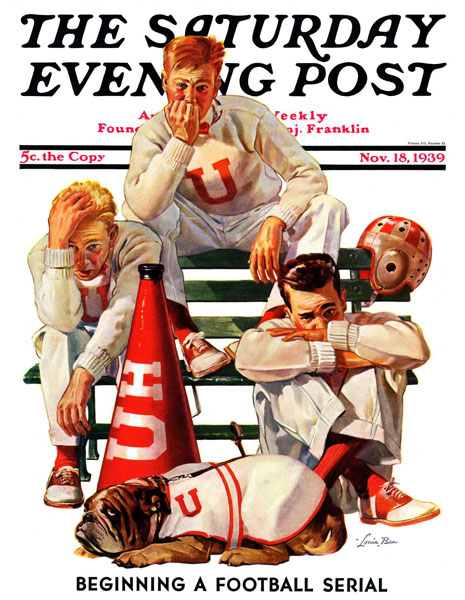
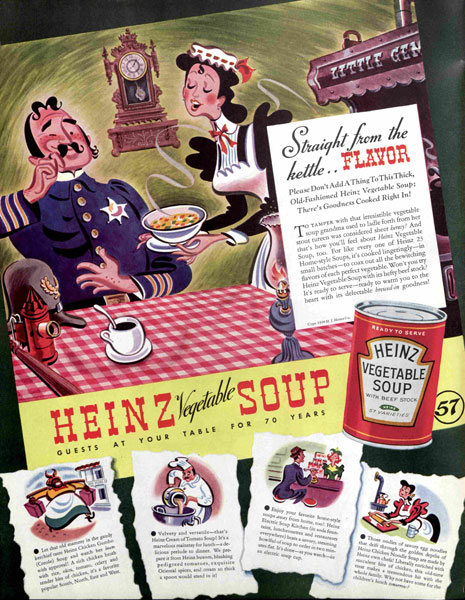
Step into 1939 with a peek at these pages from The Saturday Evening Post 75 years ago:


Pumpkin Pie and I

Every girl has one — that guy that she’s “just friends” with. You’ve known each other for I-don’t-know-how-many years, but you’ve never once been attracted, because you’ve always been, and always will be, “just friends.” All your best friends and family love him. You don’t not like him. You want to like him. But there’s something missing. That spark. That je ne sais quoi.
Pumpkin pie is like that guy. I don’t love pumpkin pie, but I so desperately want to. I love all things pumpkin. I love cinnamon, cloves, ginger, and nutmeg with pumpkin in breads, muffins, and pancakes.
I like pumpkin pie. When it’s around, I eat it without thinking twice. I mean, it’s still a pie. I’ll even eat leftover pumpkin pie sitting in the refrigerator; not even bothering to remove the pie from that middle shelf because I’ve contorted my body to prop open the refrigerator door while I sneak five or six bites straight from the pie dish with my fork.
Still, it drives me mildly insane trying to understand why other people go bonkers over pumpkin pie. Usually, the crust looks and tastes like soggy cardboard, and the filling, which can be wonderfully fragrant and flavorful, has the mealy, squishy consistency of baby food.
I want to love pumpkin pie. I want to look forward to the prospect of it with eager, heart-pounding anticipation as soon as the calendar flips from September to October. Pumpkin pie comes around only once a year, and I want a spring and summer absence to make my heart grow fonder. But it doesn’t. And then something happened. I ran into a recipe from Cook’s Illustrated for the perfect pumpkin pie. It promises a flaky, crisp crust. It promises a smooth, delicious, and firm filling. I baked it, unsure of how I’d end up feeling.
After a little more effort than the Libby’s-like recipes we’re used to, I slipped it gently into the oven. When it came out, I let it cool down. I pierced through that soft, quivering custard with an 8-inch chef’s knife and pulled out a perfect, enormous piece. It was heavy. I put the piece on a plate, and I took a bite.
After all these years, I finally fell in … like. A very, very strong like. The spark was finally lit. Pumpkin pie and I? There’s a little something going on between us now.
Pumpkin Pie
Recipes courtesy America’s Test Kitchen
(Makes 8 servings)
Make sure to buy unsweetened canned pumpkin; avoid pumpkin pie mix. If candied yams are unavailable, regular canned yams can be substituted. When the pie is properly baked, the center 2 inches of the pie should look firm but jiggle slightly. The pie finishes cooking with residual heat; to ensure that the filling sets let it cool at room temperature and not in the refrigerator.

Ingredients
-
1 cup heavy cream
1 cup whole milk
3 large eggs plus 2 large yolks
1 teaspoon vanilla extract
1 (15‑ounce) can unsweetened pumpkin puree
1 cup candied yams, drained
¾ cup (5 ¼ ounces) sugar
¼ cup maple syrup
2 teaspoons grated fresh ginger
1 teaspoon salt
½ teaspoon ground cinnamon
¼ teaspoon ground nutmeg
1 recipe single-crust pie dough, fully baked and still warm (recipe on right)
Directions
-
Adjust oven rack to lowest position and heat oven to 400°F.
Whisk cream, milk, eggs, and yolks, and vanilla together in bowl.
Bring pumpkin puree, yams, sugar, maple syrup, ginger, salt, cinnamon, and nutmeg to simmer in large saucepan and cook, stirring constantly and mashing yams against sides of pot, until thick and shiny, 15 to 20 minutes.
Remove saucepan from heat and whisk in cream mixture until fully incorporated.
Strain mixture through fine-mesh strainer into bowl, using back of ladle or spatula to press solids through strainer. Whisk mixture, then pour into warm prebaked pie crust.
Place pie on rimmed baking sheet and bake for 10 minutes. Reduce oven temperature to 300°F and continue to bake until edges of pie are set and center registers 175°F, 20 to 35 minutes longer.
Let pie cool on wire rack to room temperature, about 3 hours. Serve.
Foolproof Single-Crust Pie Dough
(Makes one 9‑inch pie crust)
Vodka is essential to the tender texture of this crust and imparts no flavor — do not substitute water. This dough is moister than most standard pie doughs and will require lots of flour to roll out (up to 1/4 cup). A food processor is essential for making this dough — it cannot be made by hand.

Ingredients
-
1 1/4 cups (6 ¼ ounces) all-purpose flour
1 tablespoon sugar
½ teaspoon salt
6 tablespoons (3/4 stick) unsalted butter, cut into 1/4‑inch pieces and chilled
4 tablespoons (1/4 cup) vegetable shortening, cut into 2 pieces and chilled
2 tablespoons vodka, chilled
2 tablespoons ice water
Directions
- Process 3/4 cup flour, sugar, and salt in food processor until combined, about 5 seconds. Scatter butter and shortening over top and continue to process until incorporated and mixture begins to form uneven clumps with no remaining floury bits, about 10 seconds.
Scrape down bowl and redistribute dough evenly around processor blade. Sprinkle remaining ½ cup flour over dough and pulse until mixture has broken up into pieces and is evenly distributed around bowl, 4 to 6 pulses. Transfer mixture to medium bowl. Sprinkle vodka and ice water over mixture. Stir and press dough together, using stiff rubber spatula, until dough sticks together.
Turn dough onto sheet of plastic wrap and flatten into 4‑inch disk. Wrap tightly in plastic and refrigerate for 1 hour. Before rolling out dough, let it sit on counter to soften slightly, about 10 minutes. (Dough can be wrapped tightly in plastic and refrigerated for up to 2 days or frozen for up to 1 month. If frozen, let dough thaw completely on counter before rolling it out.)
Adjust oven rack to middle position and heat oven to 425°F. Roll dough into 12‑inch circle on floured counter. Loosely roll dough around rolling pin and gently unroll it onto 9‑inch pie plate, letting excess dough hang over edge. Ease dough into plate by gently lifting edge of dough with your hand while pressing into plate bottom with your other hand. Leave any dough that overhangs plate in place. Wrap dough-lined pie plate loosely in plastic and refrigerate until dough is firm, about 30 minutes.
Trim overhang to ½ inch beyond lip of pie plate. Tuck overhang under itself; folded edge should be flush with edge of pie plate. Crimp dough evenly around edge of pie plate using your fingers. Wrap dough-lined pie plate loosely in plastic and refrigerate until dough is fully chilled and firm, about 15 minutes, before using. Line chilled pie shell with parchment paper or double layer of aluminum foil, covering edges to prevent burning, and fill with pie weights.
For a partially baked crust: Bake until pie dough looks dry and is pale in color, about 15 minutes. Remove weights and parchment and continue to bake crust until light golden brown, 4 to 7 minutes longer. Transfer pie plate to wire rack. (Crust must still be warm when filling is added.)
For a fully baked crust: Bake until pie dough looks dry and is pale in color, about 15 minutes. Remove weights and foil and continue to bake crust until deep golden brown, 8 to 12 minutes longer.
Per Serving
Calories: 545
Total Fat: 31 g
Saturated Fat: 16 g
Sodium: 597 mg
Carbohydrate: 60 g
Fiber: 4 g
Protein: 8.4 g
Diabetic Exchanges: 4 carbohydrate, 6 fat
Cook the Pumpkin
To maximize flavor, we at America’s Test Kitchen, publisher of Cook’s Illustrated, concentrate the pumpkin’s liquid rather than remove it, and we’ve found it best to do this on the stove — an added bonus for the spices that we add to the filling as well. Cooking the fresh ginger and spices along with the pumpkin puree intensifies their taste — the direct heat blooms their flavors. Cooking minimizes the mealy texture in this pie where pumpkin is the star.
Supplement with Yams
When we used solely pumpkin puree, we craved more flavor complexity. We experimented with roasted sweet potatoes, which added a surprisingly deep flavor without a wholly recognizable taste. To streamline this technique, we tried adding canned sweet potatoes — often labeled yams — instead. The yams add a complex flavor that complements the pumpkin.
Add Extra Yolks
Our goal with this pie was to eliminate the grainy texture that plagues most custard in favor of a creamy, sliceable, not-too-dense pie. We start with a balance of whole milk and cream, and firm up the mixture with eggs. We don’t simply add whole eggs, though — that just makes the pie too eggy. Because the whites are filled with much more water than the yolks, we exchange some whole eggs for yolks alone. Don’t forget to pass mixed filling through a fine-mesh strainer. This will ensure the ultimate smooth texture.
Add Hot Filling to Warm Crust
If you’re tempted to bake the pie crust way ahead of time, don’t. It’s imperative that the pie crust is warm when you add the hot filling. If it is not, the pie will become soggy. Using a hot filling in a warm crust allows the custard to firm up quickly in the oven, preventing it from soaking into the crust and turning it soggy. Keep that crust warm!
Turn the Oven High to Low
Most pumpkin pie recipes call for a high oven temperature to expedite cooking time. But as we’ve learned, baking any custard at high heat has its dangers. Once the temperature of custard rises above 185°F it curdles, turning the filling coarse and grainy. This is why we cannot bake the pie at 425°F, as most recipes suggest. Lowering the temperature to 350°F only produces a pie that is curdled and overcooked at the edges and still underdone in the center. But baking at a low 300°F would mean leaving the pie in the oven for 2 hours. What to do? We combine the two techniques, blasting the pie for 10 minutes on high heat and then baking it at 300°F for the rest of the baking time. This lessens the cooking time exponentially and leaves us with a creamy pie that’s fully and evenly cooked from edge to center.
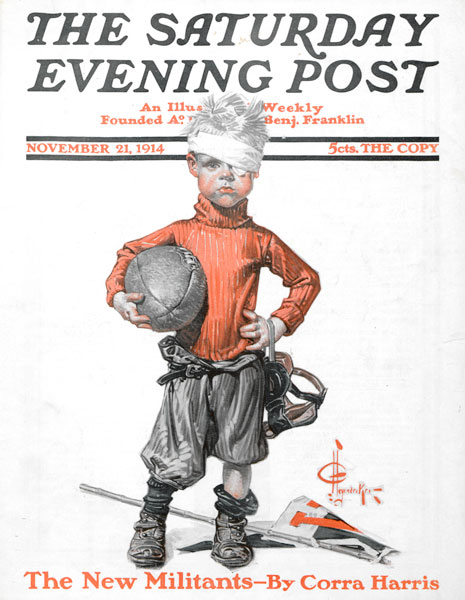
The Great War: November 21, 1914
In the November 21, 1914, issue: A German defends his country’s invasion of Belgium and a Canadian woman faces the scorn and pity of her neighbors after saving her husband from war.
Germany and England — the Real Issue
By Bernhard Dernburg
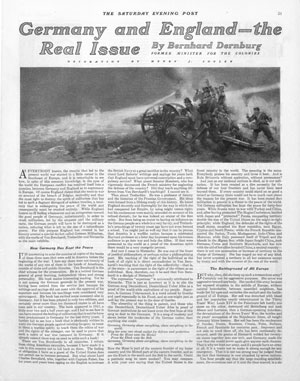
“England claims that she went to war on account of the breach of Belgian neutrality and that she must fight to destroy the spirit of militarism that has led to such a flagrant disregard of solemn treaties, a tendency that is endangering the peace of the world and consequently must be crushed entirely. … Unfortunately, in order to crush militarism … the German people will have to be destroyed as a nation. …
“It has been stated that militarism in general is a threat to the peace of the world. Yet German militarism has kept the peace for 44 years.”
Germany only built up this army because, centuries earlier, its peoples had been pushed around by other nations.
“[Germany’s] soil has been the rendezvous of Swedes, Danes, Russians, Croats, Poles, Italians, French, and Spaniards for centuries past. Impotent and not able to ward them off, she has been continually destroyed, until the genius of Bismarck welded her 26 states together into one unit, and Germany made the vow that she would never again give anyone such chances. That is why we kept our army, and if a people have an army at all, it is a waste not to make it strong enough for any emergency. That it is not too strong may be judged from the fact that Germany is now attacked by seven nations. …”
According to Dernburg, neutral Belgium only had itself to blame for the war that had swept across its land. Hadn’t Germany thoughtfully offered the Belgians an ultimatum, which they turned down?
“It should not be forgotten that the offer of indemnity to Belgium and the full maintenance of her sovereignty, had been made not only once but even a second time … and that it would have been entirely possible for Belgium to avoid all the devastation under which she is now suffering.”
Dernburg concluded by assuring Post readers that Germany had no intention of bothering the United States, or extending the conflict into the Western Hemisphere.
“I … would most emphatically say that, no matter what happens, the Monroe Doctrine will not be violated by Germany either in North America or in South America.”
Three years later, the German government offered Mexico a military alliance. If Mexican forces would help Germany defeat the United States, the German government would give the land of Texas, New Mexico, and Arizona back to Mexico.
War and the Hearth
By Maude Radford Warren
A Canadian woman recalls the anxious days she knew before her husband left for the war. He was a veteran of the Boer War (1899-1902) and, once he returned to their Canadian farm, she explained to Warren why she hoped never to hear of war again.
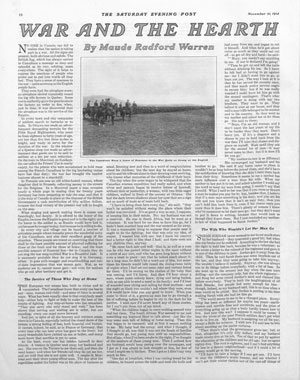
“For a long time he didn’t let a word out of him, but sometimes his friends would talk round the dining-room table of nights when I had set out some cider and currant bread for them. I’d be sewing on the clothes of the baby that was coming, and I’d listen. And then I’d hear about … wounded men crying and calling for their mothers — and the night so black you couldn’t tell where they were, even if it would have done you any good to know. When you come to think of it, a grown-up man has to go through a lot of suffering before he begins to cry in the dark for his mother. I wish now I’d never heard any of those stories, for I can’t put them out of my mind.”
For weeks she had hoped her husband would remain with her, on the farm, if Great Britain entered the fight.
“Then I noticed how my husband would keep poring over the newspaper, and I got so I was afraid to look straight at him, for fear of what I might see in his face. Then I got so I didn’t say very much to him.
“One day at breakfast, when I was cutting bread for the children, he leaned across the table and took the knife and loaf away from me, and began to cut it himself. And when he’d got about twice as much as we could eat cut off — to get all dry and hard — he said: ‘Mary, you needn’t say anything to me. If war is declared I’m going!’
“Then he got up and left the table without drinking his tea. So I knew he felt bad at having to go against me — for I didn’t want him to go, at least not yet.”
As hard as it was to let her husband go off to war again, the woman said, it could be worse. A friend of theirs was now regretting her actions to keep her husband out of uniform.
“Sarah Jordan never seemed to me to set much store by her husband — they quarreled a good bit; but when this war broke out he enlisted. According to the law she had the right to hold him back, because he was a volunteer; so she wrote a letter to the colonel of the regiment and gave it to one of the children to post. Mr. Jordan got it away from the child. Then he told Sarah there was some loophole out of the law, and that they were going to take him anyway. She wouldn’t believe it entirely.
“Anyway, she was always one to do things before everybody, with a lot of fuss. So she went up to the armory one day when the men were drilling — not the company only, but the whole regiment, and flung her arms round Jordan’s neck and claimed him before everybody. They’re both the laughingstock of all their friends; but people feel sorry enough for him though, indeed, as my husband said, this is no time when a man wants to be pitied. But Mr. Jordan is putting in his time making Sarah wish she had let him go.”
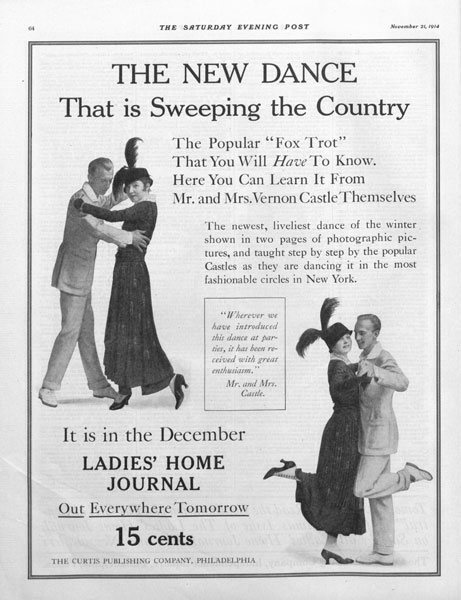
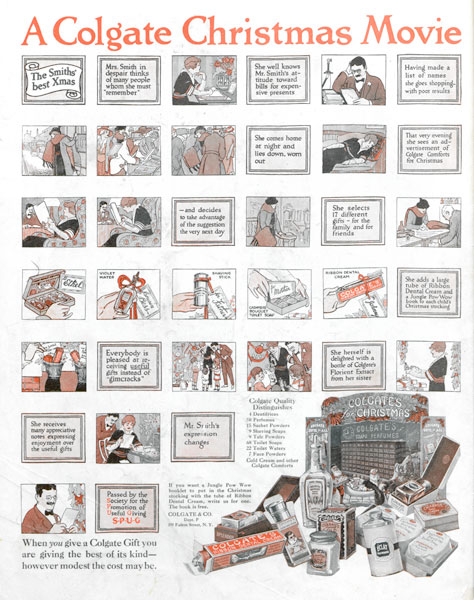
Step into 1914 with a peek at these pages from The Saturday Evening Post 100 years ago.



Hard Times (and Good)
This is the season to count one’s blessings. I’ve had so many over the years that it would be impossible to do a full account on this page. But a patch of rough luck hit our family this year. Our 6-year-old grandson, Sammy, after a bout of inexplicable tummy trouble, was diagnosed with lymphoma. (That would be cancer, but it’s easier to write lymphoma, for some reason.) After the initial shock, everyone rallied, as I suppose people do in wartime. You weep, and then you do what needs to be done. His brave mom spent dozens of nights with him in the hospital this summer and his equally brave dad, my son, was there whenever he wasn’t at work. Sammy was a good soldier throughout; he hung in all those months while his body was being pounded with chemo treatments. I’m not going to say he always did it cheerfully, but he did it.
My wife and I, who happened to be visiting at the time of the diagnosis, moved in temporarily so Sammy’s older sister, Sarah, would have someone to come home to. Together, we got through it, and after nearly four months, I’m happy to say, it’s over. Sammy, now 7, is going to be poked and prodded and otherwise carefully observed for several years, but by the time you read this, he will be back in school, back to normal life, where such questions as when’s dinner or what’s the newest Lego kit are all that matter.
He missed a summer, which in a child’s life is huge. But it will seem like a minor blip just a few years from now. Many people have it a lot worse, as Sammy himself observed. He met children who were looking at multi-year treatments, and poorer prognoses. “Grandma, I’m really lucky,” he said to my wife. “I had cancer, but I had the good kind.”

In the midst of this family crisis, there was also joy from another quarter. Our younger son’s wife had their first baby. She’s possibly the most beautiful little girl you could imagine (our staff fact-checkers verified it!). We were able to break away and spend a few weeks with the new baby, who was born in Rome. And, we fell in love with little Sofia. (How could we resist?)
The Durschlag Twins
I swerved my car to the left, just narrowly avoiding the Durschlag twins. Those little girls were too much. Seriously, they had the run of the neighborhood. It was as if every single property and every object that wasn’t tied down belonged to them. I screeched to a halt, and of course, they started crying in unison. The blond one began hitting her head with her fist, and I had to reach over and grab her hand causing the red-haired one to cry louder. Their mother, Doris, had dyed the twins’ hair so she could tell them apart, but I still couldn’t tell one from the other.
When the dust settled, it turned out they were playing with their little dolls. The twins each had identical twin daughters — grotesque rag dolls — all named Princess. According to the redheaded one, the four dolls had raced out into the street and she and her sister followed after to rescue them, just as I was coming over the hill. I nearly flattened the girls and their little rag toys.
Doris Durschlag came running out of the house in terror. She grabbed her little angels and yelled at me, calling me a reckless menace to the neighborhood. I was, in her words, driving at a madman’s clip — in reality, almost 15 miles per hour. Any slower and I might as well have pulled out a leash and walked my car home.
My personal issue with the twins went back a ways to when I came home from a morning golf game and found them in my front yard: One of them stood screaming while the other lay drowning in my sprinkler. I’m not exaggerating; she was flailing her arms, lying in a pool of water that the two of them created by turning the sprinkler upside down. I called the fire department on my cell phone — which was a bit of an overreaction as it turned out — while racing to the rescue. I turned the hose off and grabbed the drowning redhead, who, after a few healthy smacks on the back, coughed the water up out of her lungs. It was a scene that got the attention of the Hitchenses, my neighbors from across the street, who made a series of frantic telephone calls before they came rushing out to help. Doris Durschlag was one of the phone recipients, and by the time she raced down the street, the fire department was approaching from the other direction. A police car was in close tow with its sirens blaring.
“What did you do to my children?” she yelled as she ran and scooped them up. The girls had calmed down but started crying again when they realized they were in the middle of a bona fide scene and it was their turn to shine. Doris called out to the cop as he stepped out of his squad car.
“Arrest him,” she said pointing to me. “He tried to drown my babies!”
Meanwhile, two firemen were now trying to pry the drowned girl from Doris’ clutches so they could check her vitals. When the police officer approached, I explained I had been on the golf course since six that morning and pointed to my car, which was only partially pulled into the driveway with the driver’s side door still open.
Everybody but Doris believed me.
As time went by, the goofy-faced little Durschlags developed a reputation for wandering the neighborhood like doped-up raccoons. They even went so far as to jump, unattended on the Freiberg family’s trampoline until, after 15 minutes, the two of them did a seat drop together and went ripping through the canvas bed onto the hard ground banging their collective asses. Even though they were only marginally in pain, they had been trained by their mother to bellow the shrill scream of terror whenever they were in trouble, which brought all the neighbors out of their homes and over to the Freiberg’s backyard, and then, of course, someone called the cops. When Rob and Sheila Freiberg came home from an early matinee, there were flashing police lights out front and a crowd milling around their backyard as Doris Durschlag, clutching her two innocent babes, pointed at the Freibergs and yelled, “Killers!”
And now, on Draeger Street, it was my turn again to be the scapegoat.
“I’ll have you locked behind bars for the rest of your natural life, you child endangerer!” Doris was screaming like a maniac causing the boobsie twins to start wailing, loud enough to deserve one of those TV cartoon close-ups of their wide-open mouths, revealing vibrating tonsils.
People were coming out onto their front porches and lawns to study the commotion. I would have thought that after nine years with these children they would all just assume it was more Durschlag idiocy, but I guess there was always the fear that the kids might do something lethal on their property, à la the sprinkler incident at my house or the trampoline business at the Freibergs’.
“Look here, Doris, they ran in front of my car like frightened badgers.”
“My children would do no such thing.” She looked at them. “Would you?”
The blond one started crying, holding up her twin rag dolls with one hand while pointing at me with the other.
Several of the neighbors had become interested in our exchange and had crept closer, so they could hear the conversation. This was a chance for me to plead my case.
“What kind of mother lets her children play in the busy streets of the suburbs? Especially when they’re obviously challenged.”
That was a bad call. While I had her dead to rights on the playing in the streets point, I killed it when I brought up the pink elephant (or whatever you call it) about being “challenged.” Everybody knew her children were missing a few pieces of mental machinery, but nobody dared say anything. I mean, it’s not like they were mentally disabled or autistic or anything that would elicit support or sympathy; they were just peculiar in a Children of the Corn sort of way.
“You will regret those words, Mister!” I had hit a nerve.
“Doris,” I said. “Let’s be adults about this. I have a right to drive home without kids running out in front of my car chasing rag dolls.”
The redheaded one screamed, “They’re not rag dolls, they’re our children,” and started to cry some more.
“Do you see what you’ve done? You are a sick man,” Doris yelled. The crowd was now growing on the sidewalk across the street. Doris looked around at the rubberneckers, none of whom were coming to her rescue. “You’re all sick, every last one of you!” She was screaming hysterically like Blanche in A Streetcar Named Desire.
The blond twin came to her rescue. “Mommy, it’s OK, our children made it!” She held up her two dolls. “We saved them from the bad driver.”
“You haven’t saved them, darling. You don’t know.” She pointed at me. “He’ll keep coming. He’ll always keep coming until he kills every last one of us.” She looked around at the neighbors out on their front lawns and sidewalk. “And you don’t care. None of you care!”
All of a sudden a police car appeared from around the corner. As soon as Doris saw it, she started waving at it madly. “Now you’ll see!” she said.
The cop pulled over looking bored and reluctant. He slammed the gearshift on his steering wheel into park and picked up his radio, probably to announce his location to the dispatcher. He stepped out of the car door to the sound of Doris Durschlag yelling, “Arrest this man, he tried to kill my daughters!”
The redheaded twin yelled, “He tried to kill our daughters too,” and held up the rag dolls again.
“What exactly happened here?”
“What happened,” I said, “was that I was driving home, down Draeger Street, at a safe speed,” I enunciated safe as I looked over at Doris, “when I saw a bunch of objects fly out into the street and then these little imps came chasing after them causing me to hit the brakes at the last minute.”
The cop looked at Doris. “Where were you when all this happened?”
She pointed back at the house. “I was on the front porch dutifully watching my children and had just called them to come away from the street because I could hear this maniac with a revved engine a block away. This man was driving so fast it’s a miracle my children were able to escape death.”
“That’s a damn lie!” I yelled.
“Please watch your language around my children.”
“Sir,” said the cop, “I’m going to have to ask you to tone it down, please.”
I looked at the twins. “I’m sorry, girls.” Of course the blond one instantly started crying again.
“So how fast were you going, anyway?”
“No more than 15 miles an hour. Believe me sir, I live here. I know that there are children. Sometimes they play catch and a ball gets away. But this … this was deliberate.”
“Deliberate?”
“Yes. Those children threw their dolls into the street because a car was coming, and then ran out to grab them.”
Now both of the twins were crying. The cop looked at me funny as if maybe I was the one who was crazy. I looked across the street at the people on the sidewalk, but all were slowly starting to disperse like they didn’t want to get dragged into anything that included law enforcement.
I yelled at them, “Oh, come on!” The neighbors stopped to look at me as they were walking back into their homes. “Someone back me up.” I yelled. “These kids are constant trouble!”
I looked back at the cop, “You,” I said. “You must have reports on these kids; they’re all over the neighborhood jumping peoples fences like squirrels.”
“Sir, what I see here is a tragedy averted. I’m not saying you were driving recklessly, and I’m not saying these kids were playing recklessly. I’m saying it’s just one of those things. Now, let’s face it, it’s an act of grace for everybody involved that nobody got hurt.”
He squatted down in front of the twins. “You two are very lucky to have children of your own,,” he said, as he brushed one of the Durschlag’s bangs out of her eyes. He looked at the other one. “My wife and I both love kids; wish we had some — maybe we will one day.
“Kids, it would be as horrible a day as ever could be imagined if two sweet girls like you … or your daughters,” he said, nodding to the rag dolls, “ever got struck by a vehicle. I beg of you, little darlings, please look both ways before you run out into the street. Promise me this, will you, please? Promise Officer Ferguson that you’ll never run into the street until you’ve looked both ways.”
The two girls smiled. “We promise,” they said in unison and then the blond one held up her two rag dolls and added, “They promise too.”
Officer Ferguson had a tear in his eye as he looked up at me standing there watching this pitiful little reenactment of a pedestrian safety film. “What do you think?” he asked me. “Will they ever run into the street again?”
What the hell could I possibly say?
“No, I think they understand the safety risks now, Officer.” It was as unsatisfactory a moment as I could imagine, but then the blond twin came and grabbed my left leg and hugged it. Then the redhead grabbed the other. The cop watched this as he stood up, and the tears began trickling down his cheeks. I looked over at Doris Durschlag, but she was not at all moved.
“Girls!” she barked. “It’s time to go inside, and let this nice policeman get back to catching criminals.” They let go of my legs and waved goodbye to the two of us and followed their mother into the house.
Officer Ferguson looked at me and smiled. “Kids. They’re so darn cute! Treat ’em right, and you got friends for life.” He patted me on the back and walked over to his squad car and got inside. I walked over to my car, which was parked in the middle of the street, and I got in and drove home.
The next morning when I stepped out my front door, I found the little Durschlag twins walking up my lawn waving the morning paper as they carried it up to my front door.
The Long, Happy Life of a Former Gremlin
Henry “Gremlin” O’Connor still had 64 years of life before him in 1944. But on February 28, he must have doubted if he’d even see his 19th birthday.
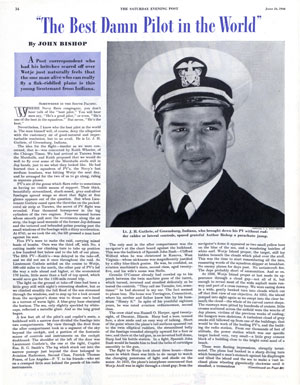
The reason for his concern was explained in the Post article “The Best Damn Pilot in the World” by John Bishop. The writer had accompanied with the crew of a Navy PV-1 Ventura bomber on what was supposed to be a routine, presumably low-risk bombing run over the Wotje Atoll.
Military censors wouldn’t allow Bishop to identify the date of that flight. But we know when it occurred because O’Connor kept a logbook, which is now in the care of his son Bob. The February 28 entry notes that a war correspondent was riding with the crew of the Navy PV-1 Ventura bomber. It also includes this laconic entry: “Took ground fire and the controls were shot away.”
Like so much of what veterans have expressed about their war experiences, this note is remarkable for what it doesn’t say.
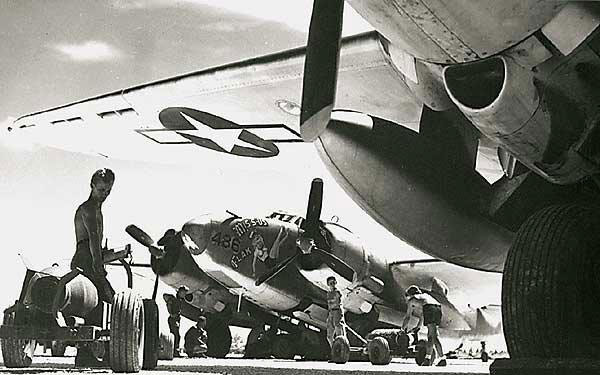
Shortly after the plane was pulling away from the target — a Japanese air base in the Marshall Islands — John Bishop heard “three metallic clashes … above the roar of the engines and the high-pitched note of the wind.” He assumed the clashes were “probably the sound of the bomb-release mechanism.” Then the navigator shouted to Bishop over the noise of the engines, “Take a look at that!” and pointed out the window to a large hole in the tailplane. What Bishop had heard had been the explosions of three 20 mm shells from the Japanese.
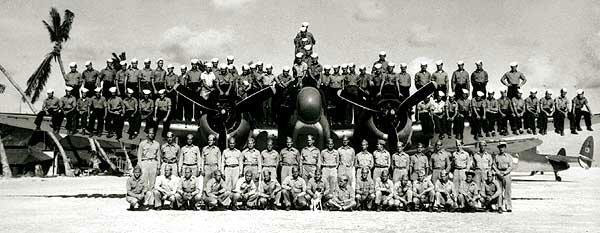
Bishop made his way forward to the cockpit. There, “Lieutenant [J.H.] Guthrie grinned wryly over his shoulder and kicked at the rudder pedals. They bounced back and forth with a sickening abandon. ‘The rudder cables are shot away!’ he shouted cheerfully. ‘And the trim-tab cables too! I have no lateral controls!’”
There was little chance of getting safely back to base now. Bishop, young O’Connor, and the rest of the crew braced themselves for the possibility of having to parachute into the ocean. But Guthrie performed a remarkable feat of piloting, flying back to base and safely landing the shot-up bomber.

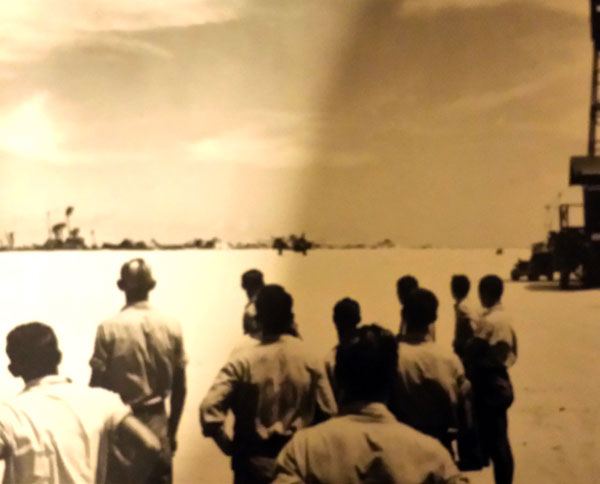
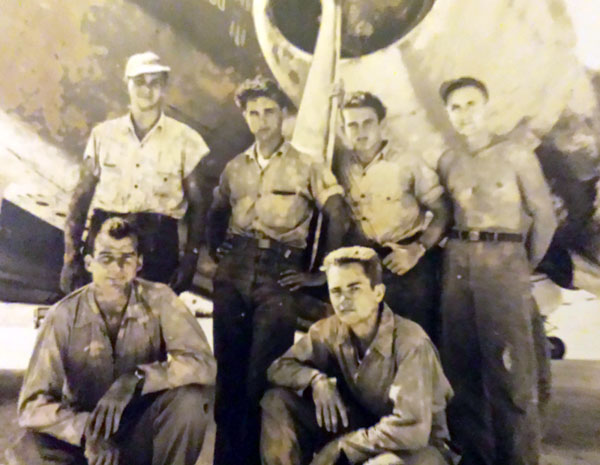
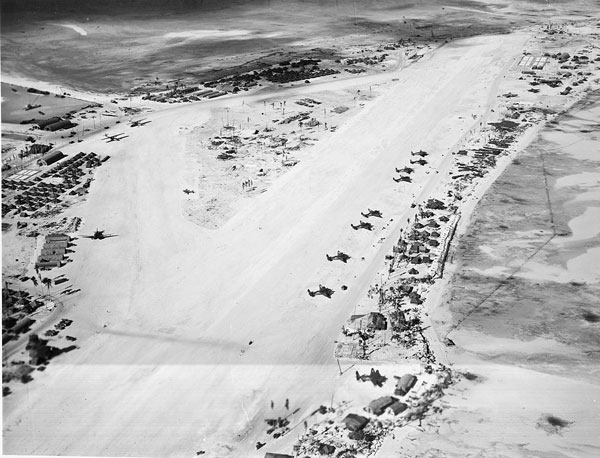
Bob O’Connor knew his father’s flight was the subject of a Post article, but he was unable to find a copy. When he contacted the Post to track down the piece, I had the opportunity to hear how his young father’s life played out after he walked away from that flight.
Henry left the service, returned home, got married and, for a few years, worked as a plumber and house painter. But he was called back to duty when the Korean War began. After this war, he stayed with the Navy, which recognized his leadership abilities. He rose in the ranks, achieving recognition he might never have enjoyed in civilian life. By 1956, he had earned an officer’s commission. By the time he retired in 1974, he had been appointed commanding officer of a new NATO base in Scotland.
Henry O’Connor appears to have earned something even more valuable than military honors. Five years after his death, his children and grandchildren still remember him with admiration and respect. His three boys and two girls are grateful to him for the sense of personal responsibility he drilled into them. But they also benefitted from Henry’s warmth and affability. “Dad was very outgoing, gregarious, and friendly,” says son Bob. “I never heard him say anything bad about anybody. He never met anybody who wasn’t a friend.”
Like many sons of World War II vets, Bob is impressed with the dedication and courage his father showed in his service to the country. His father represented a remarkable generation that Bob feels was shaped by the experience of the Depression. “He certainly didn’t grow up with any sense of entitlement,” he says. “As a generation, they developed a strong, get-it-done work ethic. If they didn’t, they weren’t going to survive.”
He readily admits, “I think that generation saved the world,” adding, “I think that American heroism still exists today. I think we could do it again today.” He saw it in the days following 9/11, in the way Americans came together, at least for a short time. “There are still a lot of proud, young Americans ready to serve their country.”
If young people are still willing to serve, it’s because men like Henry O’Connor made America a country worth serving. And because they set an example of service that will continue to inspire new generations.
The years of service that military men and women have rendered our country is too great to be recognized with just one day out of the year. And the Post would like to launch a continuing tribute on its website, featuring articles, both archival and current, about our veterans. But we’d also like to hear your tributes to U.S. veterans.
We are particularly interested in hearing about servicemen and women who appeared in wartime issues of the Post, whether World War I, II, Korea, or Vietnam. If you, a friend, or family member were mentioned in The Saturday Evening Post, please let us know. Send your emails to [email protected], with Attn: Veterans in the subject line. Please include your contact information: Name, Address, Phone Number, Address, and Social Media URLs (Twitter, Facebook, etc.).
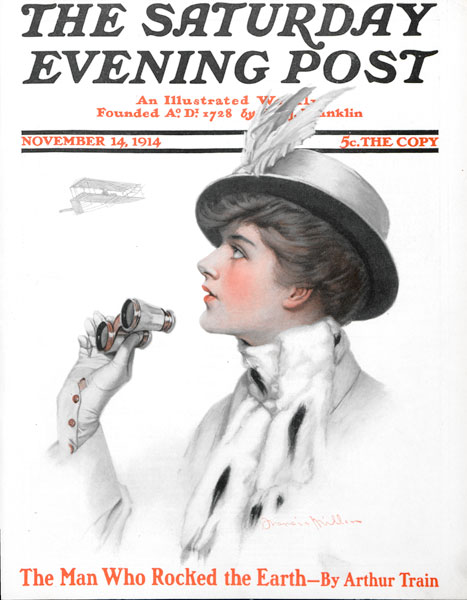
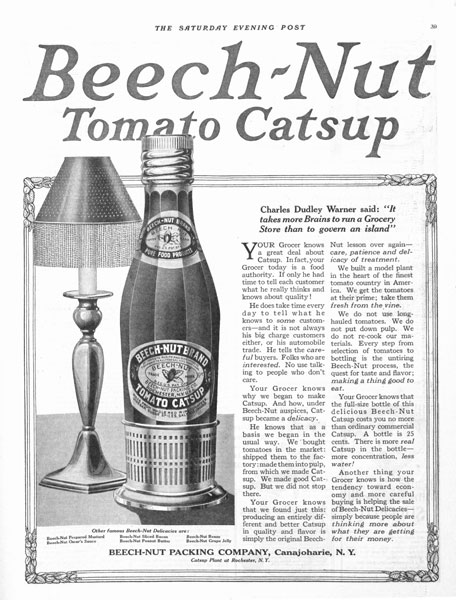
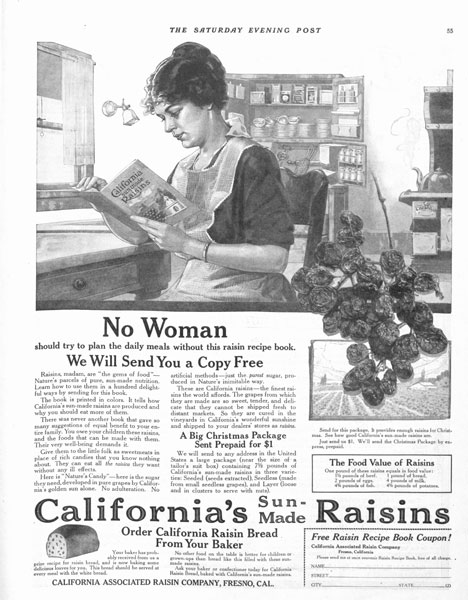
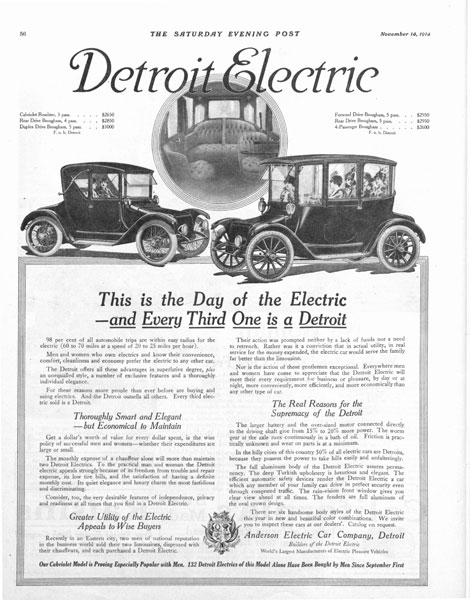
The Great War: November 14, 1914
In the November 14, 1914, issue: Canada goes to war, Great Britain looks for a new theme song, and a journalist downplays the atrocities of a nation invaded.
Booked Through for the Empire
By Maude Redford Warren
Over in Canada, the war enjoyed just as much support as in England, according to Warren. She wrote about the men she saw in an Ottawa parade of Canadian recruits. Their faces, she wrote, clearly showed“love for the Empire, the loyal urge that makes even a cheap soul worth while and that books their bodies through to the end, whatever it be, so it be for the good of the empire.”
But it wasn’t all flag-waving and happy parade. The author spoke with an elderly woman who had been walking alongside the recruits, among [whom/them] was her grandson. The woman spoke of the price she had paid to uphold the British Empire, and all the wars that were supposed to be the last.
“‘It seems to me now that that’s been my whole life — watching men march away. For when I was a little girl in Kingston I saw my father go to the Crimea and I had no more sense than to laugh and clap at the music and the flags. He never came back, and the comfort they offered my mother was that there never would be another war.
“‘My husband went with Gordon to Khartoum when I was a young bride, and though he came back to me he was never a well man. When I had to do his work and mine — not that I wasn’t willing, but it’s hard when a woman has children — the comfort he gave me was that the world was too wise now to have any more wars, except maybe in savage places.
“‘My youngest son went to South Africa, but I wouldn’t go to see him off; he never came back, and they said then that one proof that war was dying out was that England was so ill-prepared to carry through that one.
“Now my eldest son’s only son has gone with the artillery — the only one that could carry on our name. He is sailing down the St. Lawrence now, and maybe it’s true this time that this will be the last war, and maybe it’s not.’
“‘You didn’t try to hold them back?’ one ventures.
“‘No, though I’d never have asked them to go. If a man sees his duty to his country in that way it’s a woman’s place to do her share for the country too. I’m glad I’m a British subject, but there is surely no harm in saying that any woman is lucky who belongs to a country that doesn’t ask her for the lives of her men.’”
Vox Populi
By Samuel G. Blythe

The Briton spirit was just as determined and confident as the German, Blythe reported.
“There is no doubt that Great Britain is loyally and patriotically and unitedly in this enterprise, albeit there is a vast British population that does not yet appreciate the graveness of the dangers that threaten their land. Those who understand are loyal, and those who understand but partially are loyal also, so far as their understanding goes.
“‘This war,’ said [Home Secretary Reginald] McKenna, ‘was not of our seeking, but became our duty. Our case is clear, clean and perfect. It will be so held in the eyes of the world and so recorded in history. Therefore, we must win; and we shall win! There is no doubt of that.’
“‘We didn’t want to go to war,’ said the gardener at Sidcup, ‘but we had to go. Being Britons, we couldn’t do anything else. Now that we have gone to war, we’ll win!’
“Of all the men I talked to that Sunday afternoon there was not one who grumbled over the war, complained about it, bewailed his own hard luck — most of them had been hit one way or another — or expressed any but the most absolute conviction that Great Britain will win the war, and that the German Empire is to be eliminated. I did not find any whiners or any grumblers, or anything but a sort of stolid, philosophical view.”
One of the most discouraging war songs ever written appeared in Great Britain during these months. It was titled, “Your King and Country Need You!”
“This is sung nightly in every music hall and moving-picture show, and is more of a wail than an inciter to gallant deeds of arms.Here is the chorus, which is in slow march time, as the music says, and which the audience are invited to chant slowly with soloists:
“Oh, we don’t want to lose you, but we think you ought to go,
For your King and country both need you so.
We shall want you miss you; but with all our might and main,
We shall cheer you, thank you, kiss you, when you come back again.
“In order that the proprieties may be observed the author supplies a footnote, starred on the word kiss, which says: ‘When used by male voices substitute the word bless for kiss.’
Listen to “Your King and Country Need You!”, recorded by Helen Clark in 1914
Punitives Versus Primitives
By Irvin S. Cobb
Two weeks earlier, Cobb had brought up the topic of wartime atrocities: Germans slaughtering Belgians, and Belgians ambushing, poisoning, and torturing Germans. In this issue he reported on his investigation into the truth behind the rumors.
“From Belgian, from French, and from English sources I have had hundreds of tales of barbarities by Germans. From German sources I have had hundreds of tales of barbarities by Belgians, Russians, French and British — but particularly by Belgians. My deliberate personal opinion is that 80 percent of the stories are absolutely untrue.”
Cobb was, at the time of his writing, visiting the German side of the Western Front as a guest of the German army. For this reason, perhaps, he seems to have been quite sympathetic to their claims of innocence.
“I have found extended areas in Belgium through which hundreds of thousands of German soldiers had passed without signs of wanton damage of any sort — districts where the houses were all intact, the crops untrampled, and the fruit left hanging on the trees, and not so much as a window smashed or a haystack toppled over.”
He even seems to accept, with a regretful shrug, the Germans’ execution of a young Belgian woman. He heard the story from a German doctor in the border town of Aachen.
“During the investment and bombardment of the Liege defenses, a battery of German siege guns was mounted in the village of Dolhain. … From the accuracy with which shots from the Liege forts fell among them the Germans speedily became convinced that someone in the village was secretly communicating with the defending fortresses, telling the gunners there when a shell overshot the German lines or fell short. …
“A young girl, the daughter of a well-to-do citizen, was using a telephone that through some oversight the Germans had failed to destroy. From the window of her father’s house she watched the effect of the Belgian shells, and after each discharge she would call the fort in Liege and direct the batteries there how to aim the next time.
“For days she had been risking her life to do this service for her country. She was detected, tried by court-martial, convicted of violating the articles of warfare by giving aid to the enemy, and condemned to be shot. Next morning this girl, blindfolded and with her arms bound behind her, faced a firing squad. As I conceive it, no more heroic figure will be produced in this war than that Belgian girl, whose name the world may never know.
“‘I do not know how the American people will view the execution of military law on that brave young woman,’
said my informant. ‘I do know that the officers who tried her sorely regretted that, under their oaths to do their duty without being influenced by sentiment or by their natural sympathies, they sentenced her to death. They could do nothing else. She had been instrumental in causing the killing and wounding of many of our men. By the rules of war she had risked her life, and she lost it. Our troops … had no right and no power to spare the girl who, over the telephone, directed the fire of our enemies. But if I were a Belgian I would give my last cent to rear a monument to her memory.’”
Cobb never seems to think it outrageous that a young woman helping her country defend itself against an invading army should be executed as a spy or traitor. Yes, the monument idea was a nice touch, but it was a romantic gesture that saved no one’s life. There would be many more before the war ended.
Step into 1914 with a peek at these pages from The Saturday Evening Post 100 years ago.


The Great War: November 7, 1914
In the November 7, 1914, issue: U-boats put an end to British chivalry, and the Germans offer up some shockingly bad predictions of the war’s end.
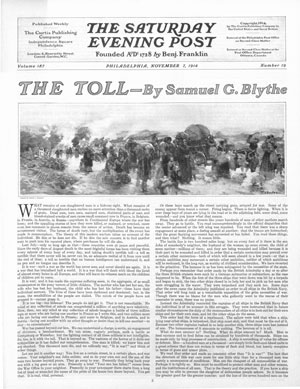
The Toll
By Samuel G. Blythe
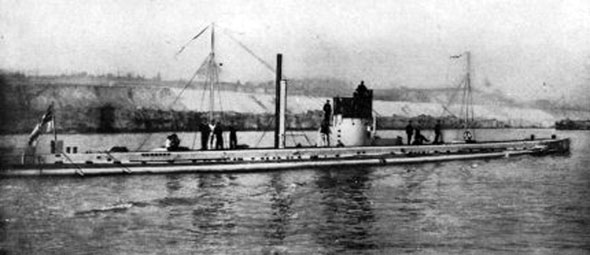
Four months into the conflict, there were signs that this war was going to be different. Modern technology enabled armies to cause more destruction than ever before. The belief that this would be the ultimate, decisive war encouraged them to use the technology with little regard for restraint. As Blythe noted, German U-boats were already making chivalry a fatal indulgence.
“Perhaps you remember that order made by the British Admiralty a day or so after the three British cruisers were sunk by a German submarine or submarines. …
“When the first of the three ships … was hit by a torpedo and began to sink, the two other ships closed in to help her and to pick up her men who were struggling in the water. They were torpedoed and they sank too.
“Some days after the news came the Admiralty published an order to all ships in the British Navy. …They were instructed that … the commanders of all ships are to look out for their own ships and for their own men, and let the other ships do the same. … When a ship, lying near other ships, is torpedoed, that ship must sink, and that must be the end of it. Because two other captains rushed in to help another ship, three ships were lost instead of one. The humaneness of it amounts to nothing. The heroism of it is nil.”
The Grapes of Wrath
By Irvin S. Cobb
Despite signs that there would be less humane, more deadly war than any before, there was no shortage of enthusiasm for the fight. In Germany, Cobb found only eagerness for battle and confidence in victory. He illustrated the popular spirit with an anecdote that sounds like the set-up to a joke. Three Germans walk into a café — a business man, a scientist, and an army officer — and strike up a conversation about the war with Cobb.
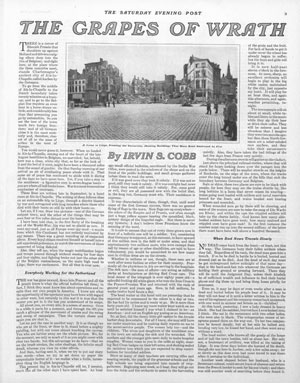
“The business man says, ‘In six weeks from now we shall have beaten France; in six months we shall have driven Russia to cover. For England it will take a year — perhaps longer. And then, as in all games, big and little, the losers will pay. France will be made to pay an indemnity from which she will never recover. Of Belgium I think we shall take a slice of seacoast. … Russia will be so crippled that no longer will the Muscovite peril threaten Europe. Great Britain we shall crush utterly. She shall be shorn of her navy and she shall lose her colonies. … She will become a third-class power and she will stay a third-class power.’
“The scientist spoke next … ‘This war was inevitable. Germany had to expand or be suffocated. And out of this war good will come for all the world, especially for Europe. We Germans are the most industrious, the most earnest, and the best-educated race on this side of the ocean. Under German influence illiteracy will disappear. … And after this war — if we Germans win it — there will never be another universal war.
“The soldier spoke last … ‘War was forced on us by these other powers. … But when war came we were ready and they were not. … Our army will win because it deserves to win through being ready and being complete and being efficient. Don’t discount the efficiency of our navy either. Remember, we Germans have the name of being thorough. When our fleet meets the British fleet I think you will find that we have a few Krupp surprises for them.’”
Step into 1914 with a peek at these pages from The Saturday Evening Post 100 years ago.
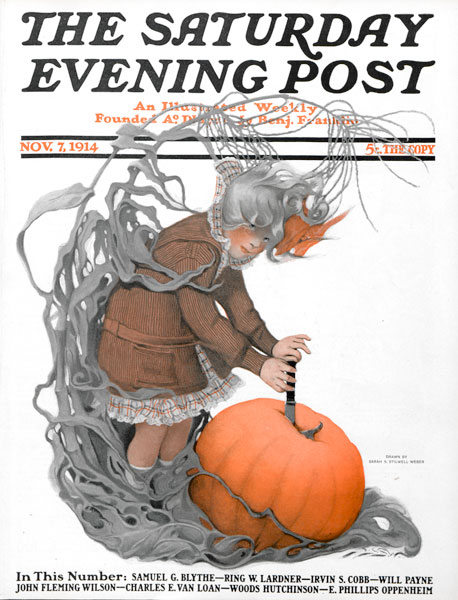
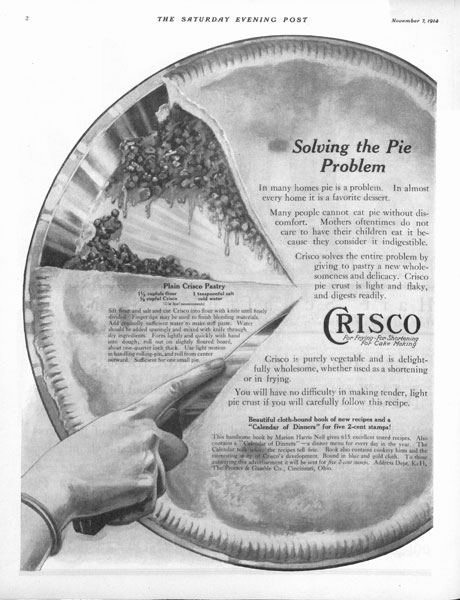


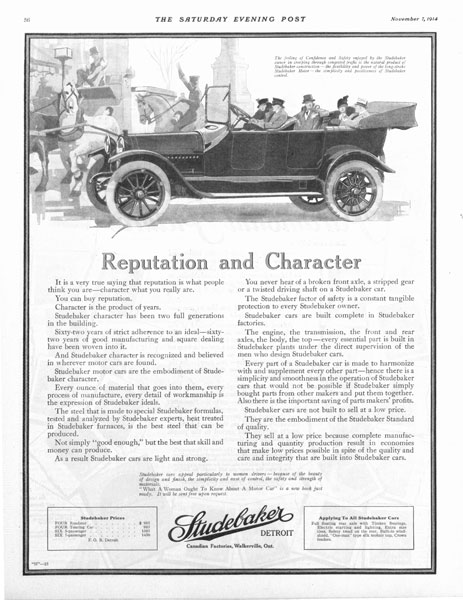

July/Aug 2014 Limerick Laughs Winner and Runners-Up
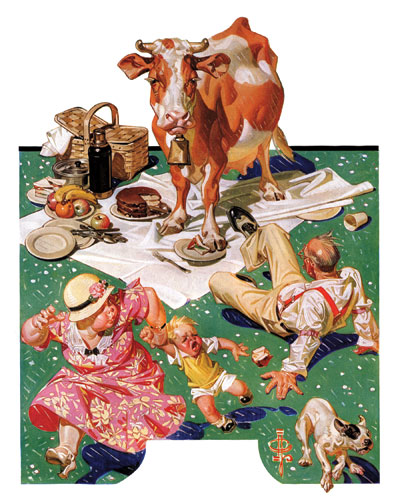
The cow that jumped over the moon
Crashed our picnic today at noon!
We’re in udder despair;
We’re missing a pair
’Cause the dish ran away with the spoon!
—Katharine Wallace, Florence, Alabama
Congratulations to Katharine Wallace! For her limerick describing J.C. Leyendecker’s illustration Cow Joins the Picnic (above), Katharine wins $25 — and our gratitude for a job well done. If you’d like to enter the Limerick Laughs Contest for our upcoming issue, submit your limerick via our online entry form.
Of course, Katharine’s limerick wasn’t the only one we liked! Here are some of our favorite limericks from our runners-up, in no particular order:
Hey! Why are you running away?
I only came over to play.
And this prob’ly sounds rude,
But could I have some food?
I do get quite tired of hay.—Margie Eisenhower, Rancho Cordova, California
There once was a cow named Louise,
Who wandered around in the breeze.
She spotted a bunch
Who were eating lunch,
And chased them away with a sneeze.—Peter Bosse, Millis, Massachusetts
The next time I wish on a star
I’ll be careful just what my words are.
Because I love steak,
I made a mistake,
And forgot to say grilled in a bar.—Ross Simpson, Wickenburg, Arizona
Now this scene may look bad at first glance,
All those people scared out of their pants.
But I’ve got a hunch
At that nice picnic lunch
That cow also squashed all the ants.—Paul Troglia, Milwaukee, Wisconsin
They had eaten so much ’twas a sin.
So they sliced their dessert cake quite thin.
But they never did eat
Cause they all had to beat it
When a guest, uninvited, horned in.—John Peacock, West Dundee, Illinois
The farmer forgot to milk Daisy,
Partaking a chance to be lazy.
Their picnic got messed
As she crashed through their nest,
Since milk weight was driving her crazy!—Doreen Graham, Calgary, Alberta, Canada
There once was a family named Dunn,
A picnic, they thought,
would be fun.
But Bossy showed up
uninvited to sup,
How fast that made Mama Dunn run!—Dianne Boylan, Lowell, Indiana
There once was a friendly bovine
Who thought eating out was divine.
She’s loving the picnic.
The cake is terrific.
And eating alone is just fine.—Cindy Nutter, Coon Rapids, Minnesota
A cow with a hoof in our pie,
Was complaining quite loudly, “Oh, my!
“The herd’s due for tea,
“Grass-cookies at three,
“But your picnic is covering the rye!”—Caralou Strahley, Paulding, Ohio
There was a young heifer named Rhonda
Who, into a picnic, did wanda
Then she thought in surprise,
As folks ran for their lives,
“What a pity they couldn’t stay longa.”—Michelle Gordon, Airway Heights, Washington
“The Bishop’s Beggar” by Stephen Vincent Benét
First published in The Saturday Evening Post on February 14, 1942
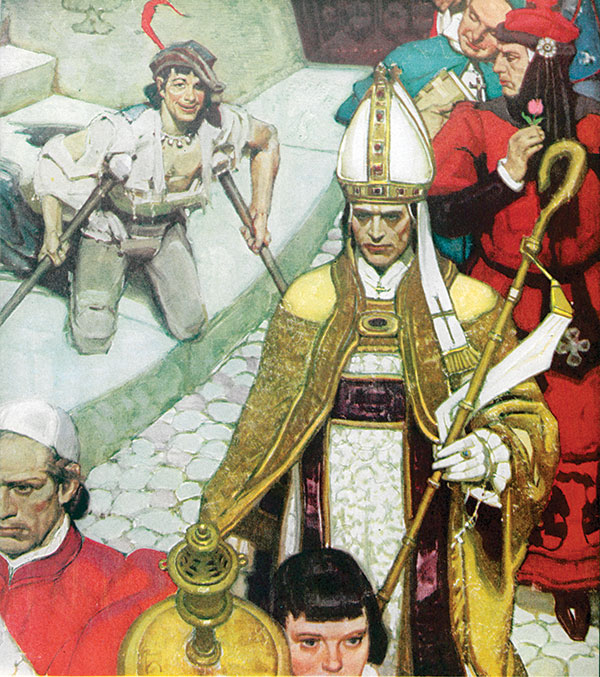
It seems that in the old days there was a bishop of Remo, and he was a heedless and proud young man, though of good intentions. Now, that was possible in those days, when the fire and light of the new learning had spread through Italy and men drank, as if intoxicated, at a new spring. There were bishops who cared less for the Word of God than for their own splendor, and cardinals who were rather men of the world — and of no good world — than sons of the Church. Our bishop was not as idle and self-seeking as some of these; he was a child of his time. He would have liked to be a lord, but his eldest brother was the lord; he would have liked to be a soldier, but his second brother was the soldier. So he went into the Church, for there, too, a man who bore a great name could rise. He was clever, ambitious, and he had great connections. Now and then he asked a disquieting question, but the Baldis had always been original. The path that is rugged for many was made smooth for him from the first. When he was made bishop of Remo, at an early age, the fact did not surprise him. Since he was to be neither lord nor soldier, he found that pleasant enough.
All went well for him, at first. They were glad to have a young and handsome bishop at Remo, for the bishop before him had been old and ill-favored. It was a pleasure to no one to kiss his ring, and he frightened the children with his peering eyes. With the coming of our bishop all this changed. There was a great to-do and refurbishing of the bishop’s palace; the smells of good cooking drifted again from the bishop’s kitchens; when the bishop drove through the city, men threw their caps in the air. Fine new frescoes were in the cathedral, a new way of chanting was in the choir. As for sin and suffering — well, they are always with us. The people of Remo liked to sin pleasantly and be reminded of it as little as possible.
Nevertheless, at times, a grayness would come over our bishop’s spirit. He could not understand why it came. His life was both full and busy. He was a friend to art, a host to the gay and the learned, a ruler of men. He did not meddle in things which did not concern him; he felt in his heart that there was no prize in the Church which might not be within his grasp. And yet, at times, there was a singular grayness within him.
He could not show that grayness before the world, he could not show it to his secretary or the witty company that gathered at his table. He could wrestle with it in prayer, and so he did. But he found it no easy task. Had the devil appeared before him with horns and a tail, he would have known what to do. But a grayness of spirit — a cool little voice in the mind which said to him now and then, “What do you do in these robes, at this place, Gianfrancesco Baldi?” — that was another matter.
Motion in the open air helped him as much as anything. When the grayness oppressed him too severely, he would summon his coach and drive about the countryside. One day, as he drove through a small country village in the hills beyond Remo, it happened. It was nobody’s fault; the bishop’s least of all. He saw to it that he had a skillful coachman and good horses. But when a tall, gangling boy darts across the street right under the nose of the horses, the most skillful coachman cannot always save him. There was a cry, a scream, and a soft jar. Then, where the coach had passed, the boy lay writhing in the street.
The bishop always showed at his best in emergency. When he got out of the coach the angry shouts of the crowd died away to a respectful murmur. He lifted the boy into the coach with his strong arms and drove back with him to Remo. On the way he talked to him soothingly, though the boy was in too much pain to pay much attention to this graciousness. When they got to Remo he had the boy carried to a servant’s room in the palace and doctors summoned. Later on he gave instructions about cleaning the coach.
At dinner his secretary recounted the incident and all men praised the kindliness of the bishop. The bishop passed it off pleasantly, but, at heart, he felt a trifle irritated. He had not felt particularly drawn toward the boy; on the other hand, he could not have left him lying in the road.
By the next day the story had gone all over Remo and there were unusual demonstrations of goodwill as the bishop passed to the cathedral. The bishop received them with dignity, but his irritation remained. He disliked ostentatious shows of virtue and distrusted the fickleness of crowds. Nevertheless, it was his duty to see the boy, and he did so.
Washed, combed, and rid of his vermin, the boy looked ordinary enough, though somewhat older than the bishop had thought him. His body was slight and emaciated, but he had a well-shaped head and large liquid eyes. These stared at the bishop with some intensity; indeed with such intensity that the bishop wondered, at first, if the boy might not be an idiot. But a little conversation proved him sound of mind, though rustic in speech.
His name was Luigi and he was an orphan, living as best he could. In the summer he tended goats; in the winter he lived with his uncle and aunt, tavern keepers, who fed him and beat him. He was about 19. He had made his Easter duty as a Christian. He would never walk again.
Such were the facts of the case, and the bishop thought them over clearheadedly. He wondered what to do with the boy.
“Luigi,” he said, “would you like to go back to your village?”
“Oh, no,” said the boy. “It is a very good village, but now that I can no longer herd goats, there is no place in it for me. Besides, one eats better in Remo — I have had white cheese twice already.”
And he smacked his lips. His voice was remarkably strong and cheerful, the bishop noticed with surprise.
“Very well,” said the bishop patiently. “You need not go back if you do not choose. You are now, in some sense, a ward of the Church, and the wings of the Church are sheltering.” He looked at the boy’s legs, lying limp and motionless under the covers, and felt, though against his will, the natural distaste of the hale man for the maimed. “You might learn some useful trade,” he said thoughtfully. “There are many trades where the hands do all — a cobbler’s, a tailor’s, a basket weaver’s.”
The boy shook his head joyfully. “Oh, no, your lordship,” he said. “Trades take so long to learn and I am very stupid. It would not be worth the expense; your lordship would be embarrassed.”
“My lordship, perhaps, is the best judge of that,” said the bishop a trifle grimly. He kept thinking of the boy’s remark about white cheese; it must be a spare life indeed where white cheese was such a treat. “But we are reasonable,” he said. “Come, what would you be?”
“A beggar!” said the boy, and his dark eyes shone with delight.
“A beggar?” said the bishop, astonished and somewhat revolted.
“Why, yes,” said the boy, as if it were the most natural thing in the world. “For 10 years my father begged on the cathedral steps. That was before your lordship’s time, but he was an excellent beggar and a master of his craft. True, he was subject to continual persecutions and jealousies from the honorable corporation of the beggars of Remo, coming, as he did, from outside the city. It was that which caused the ruin of our fortunes, for, in the end, when he had begun to fail, they threw him down a well, where he caught a bad cold and died of it. But in his good days he could outbeg any two of them. If your lordship would care to have me demonstrate his celebrated fainting fit, when his eyeballs rolled backward in his head —”
“I can think of nothing I should like less,” said the bishop, shocked and disgusted, for it seemed to him an unworthy thing that a sturdy young man, though a cripple, should think of nothing better than beggary. “Besides,” he said, “these other beggars you speak of — if they persecuted your father, no doubt they would persecute you.”
“Me?” said the boy, and laughed. “Oh, once they understood, they would not dare touch me — not even Giuseppe, the Hook. I would be your lordship’s beggar — the bishop’s beggar!” And a light as of great peace and contentment spread over his countenance.
The bishop stared at him for a long time in silence. “That is what you wish?” he said, his voice dry.
“That is what I wish, your lordship,” said the boy, nodding his head.
“So be it,” said the bishop with a sigh, and left. But when his coachman came to him the next morning for orders, it was all he could do to keep from reviling the man.
The bishop was not the sort of man who liked beggars. Indeed, were it not for custom and Christian charity, he would long since have cleared them from the steps of his cathedral. He could not very well do that; he knew what an impression such a move would make. Nevertheless, when he passed among them, as he must at times, he saw to it that his almoner made a suitable distribution, but he himself did his best to see and smell them as little as possible. Their whines and their supplications, their simulated sores and their noisome rags — these were a fret and a burden to him.
Now, it seemed, he was to have a beggar of his own. He would have taken it as a suitable humiliation for pride, but he did not feel himself to be a proud man. Nor could he think of the accident as anything but an accident. Had he deliberately trodden the lad beneath the hooves of his horses — but he had not. He was well liked, able, decisive, a rising son of the Church. Nevertheless, he was to have a beggar — every day he must see his beggar on the cathedral steps, a living reproach, a living lesson in idleness and heedlessness. It was a small thing, but it darkened his dinner and made him sore at heart.
Therefore, he put a mask upon his face. He meant to speak of the thing, so it should be known — at least that might ward off ridicule. He spoke of it to his secretary; the secretary agreed that it was a very seemly and Christian idea of his lordship’s, while the bishop wondered if the man laughed at him in his sleeve. He spoke of it to others; there were compliments, of course. Each time he spoke of it, it turned a small knife in his breast. But that did not keep him from speaking of it, nor from seeing that every care was given Luigi.
Nevertheless, he dreaded the day when Luigi would take up his post on the cathedral steps. He dreaded and yearned for it, both. For then, at last, the thing would be done. After that, like many things, it would become a custom and in time Luigi himself would fade into the mass of whining beggary that haunted the cathedral steps. But things were not to be quite that way.
He admired, while he detested, the thoroughness with which Luigi prepared himself for his profession. He heard the whine ring out from the servants’ quarters — “10 scudi for Luigi!” — he saw the little cart and the crutches Luigi had made for himself. Now and then he heard his own servants laugh at the beggar’s stories. This was hard enough to bear. But at last the day of parting came.
To his disgust, the bishop found the boy neither clean nor well clad, as he had been since his accident, but dirty and dressed in tatters. He opened his mouth to reprove the boy, then he shut it again, for it seemed pitifully true that a beggar must dress his part. Nevertheless, the bishop did not like it. He asked Luigi, coolly, how he meant to live.
“Oh, your lordship’s secretary has found me a very suitable chamber,” said Luigi eagerly. “It is on the ground floor of a rookery by the river and it has room for my crutches, my gear, and my cart. He will move me there tonight. Tomorrow I will be at my post on the cathedral steps.” And he smiled gratefully at the bishop. “That will be a great day.”
“So,” said the bishop, who could not trust himself to say anything further.
“Yet before I go,” said Luigi, “I must thank your lordship for his kindness, and ask your lordship’s blessing on my work. That is only suitable.”
The bishop stiffened. “I may bless you, Luigi,” he said, “but your work I cannot bless. I cannot give the blessing of the Church to the work of a man who lives by beggary when he might live otherwise.”
“Well, then, I must go unblessed,” said Luigi cheerfully. “After all, your lordship has already done so much for me! The bishop’s beggar! How my uncle and aunt will stare!”
Now, of all the vainglorious, self-seeking, worthless, rascally sons of iniquity — and to think that I stand your sponsor, said the bishop, but, fortunately, he did not say it aloud. Silently he extended his ring and Luigi kissed it with such innocent reverence that the bishop was sorely moved to give him his blessing after all. But he summoned up his principles and departed in silence.
The bishop slept ill that night, tormented by dreams of Luigi. He dreamed that, for his sins, he must carry Luigi on his back all the way up the cathedral steps. And as he mounted each step the weight upon his back became more crushing, till at last he woke, unrefreshed.
The next day he went to the cathedral in great state, though it was an ordinary Sunday. Yet he felt the state to be, in some measure, a protection. When he passed by the cathedral steps, the beggars set up their usual supplications. He sent his almoner among them; it was over quicker than he thought. He did not look for Luigi, and yet he felt Luigi’s eyes upon him as he stood there for a moment, splendid in robe and miter. Then the thing was finished.
In the cathedral that day, he preached passionately against the sins of idleness and heedlessness. Seldom had he been so moving — he could feel that from his congregation.
When Mass was over he retired to his palace, exhausted. Yet it was pleasant for him to walk about the palace and know that Luigi was not there.
It was just after vespers when his secretary came to him and told him that a man called Giuseppe, self-styled provost of the Remo beggars, requested an audience. The bishop sighed wearily and ordered the man brought before him. He was a squat fellow of great strength and an evil cast of countenance, for one side of his face had been so burned in a fire that it was as if he had two faces, one of them inhuman. Also, his left arm terminated in an iron hook.
“This is Giuseppe, the beggar, your lordship,” said the secretary, with repugnance.
“Giuseppe, called Double-Face, also called the Hook, provost of the honorable company of the beggars of Remo,” said Giuseppe in a rusty voice, and plumped on his knees.
The bishop raised him and asked his business.
“Well, your lordship, it’s this new fellow, Luigi Lamelegs,” said Giuseppe. “I’ve got nothing against him personal — I wouldn’t hurt a fly myself in a personal way,” and he grinned horribly — “but there he is in a good place on the steps, and your lordship’s servants put him there. Well, now, if he’s your lordship’s beggar, that’s one thing — though, even so, there’s fees and vails to be paid, for that’s the custom. But if he isn’t your lordship’s beggar — and your lordship paid him no attention this morning —”
“Stop!” said the bishop with anger. “Do you mean to tell me that the very steps of the cathedral are bartered and sold among you? Why, this is simony — this is the sin of simony!”
“Your lordship can call it hard words,” said Giuseppe stolidly, “but that’s been the way it’s been done ever since there were beggars in Remo. I paid 20 crowns for my own place, and fought old Marco too. But that’s beside the point. Your lordship has a right to a beggar if your lordship wants one — we’re all agreed on that. But is this man your lordship’s beggar or isn’t he?”
“And supposing I said he was not my beggar?” said the bishop, trembling.
“Well, that’s all we’d want to know,” said Giuseppe. “And thank your lordship kindly. I had my own suspicions of the man from the first. But we’ve got him down by the river now — Carlo and Benito and old blind Marta; she’s a tough one, old blind Marta — and once we’re through with him, he’ll trouble your lordship no more.” And sketching a clumsy salute, the man turned to go.
“Stop!” said the bishop again. “Would you have the guilt of murder upon your conscience?”
“Oh, your lordship takes it too hard,” said Giuseppe, shuffling his feet. “What’s one beggar more or less? We’re not rich folk or learned folk to bother a mind like your lordship’s. We breed and we die, and there’s an end. And even at the best, it’s no bed of roses on the cathedral steps.”
The bishop wished to say many things, but he could think of only one: “I declare to you that this man is my beggar; I stretch my hand over him.”
“Well, that’s very nicely spoken of your lordship,” said Giuseppe, in a grumbling voice, “and I dare say we can make room for him. But if the man’s to keep a whole skin, your lordship had best come with me — old Marta was talking of ear slitting when I left her.”
So they found Luigi, bound but cheerful, in his first-floor chamber by the river, guarded by the persons Giuseppe had described — a hunchback, a dwarf, and a blind woman. The window which gave upon the river was open, and a large sack, weighted with stones, lay in one corner of the room. The bishop’s arrival produced a certain consternation on the part of all but Luigi, who seemed to take it as a matter of course. After the boy had been unbound, the bishop addressed the beggars with some vivacity, declared that Luigi was his beggar, and gave him a piece of silver before them all. This seemed to satisfy the company, who crept away in silence.
“And yet have I done right? Have I done right?” said the bishop, striding up and down the chamber.
“I greatly fear I have condoned the sin of simony! I have spent Mother Church’s substance among the unworthy! And yet, even so, your blood may be upon my head!” and he looked at Luigi doubtfully.
“Oh, your lordship need not take it so hard,” said Luigi, rubbing his arms. “All is safe enough now. I arranged about the dues and vails with Giuseppe while your lordship was discussing her state of grace with Marta. He’s an honest fellow enough and his point is reasonable. One should not take a good place without money to keep it up. Had your lordship given me alms with your own hand this morning, our little difficulty would never have arisen. That was my fault — I assumed that your lordship knew.”
“Knew?” said the bishop. “What should I know of such things? And yet, God forgive me, I am a priest and I should have knowledge of evil.”
“It is merely a difference in knowledge,” said Luigi gently. “Now, your lordship, doubtless, has never been in a room quite like this before.”
The bishop stared at the damp walls and the mean chamber. He smelled the smell that cannot be aired from a room, the smell of poverty itself. He had never doubted his experience before — when he had been first made a priest, he had gone on certain works of charity. Now it seemed that those works must have been rather carefully selected.
“No,” he said, “I have never been in a room just like this one.”
“And yet there are many of us who live in such rooms — and not all beggars,” said Luigi. He changed his tone. “That was a fine rousing sermon your lordship gave us on idleness and heedlessness this morning. Hey, it brought the scudi forth from the good folks’ pockets! An admirable sermon!”
“I am grateful for your encomiums,” said the bishop bitterly. He glanced around the room again. “Is there nought else I can do?” he said unwillingly.
“No, thank your lordship,” said Luigi, and his eyes were smiling. “I have a woman to cook my dinner — it is true she is a thief, but she will not steal from a cripple — and soon, with your lordship’s patronage, I shall be able to afford a charcoal brazier. Moreover, my friends seem to have left me a sack. So, after dinner I shall say my prayers and go to bed to refresh myself for tomorrow’s labor.”
I shall say mine, too, for I need them, said the bishop, though he did not say it to Luigi.
So that was how it began. Soon enough, the bishop’s beggar was a familiar figure on the cathedral steps — one of the admitted curiosities of the town. He was well liked in his trade, for he always had a merry word or a sharp one for his clients — and it passed around until “Luigi says” became a byword. The bishop became used to him as one becomes used to a touch of rheumatism. Other men had their difficulties; he had his beggar. Now and then it seemed odd to the bishop that he had ever thought of the beggars as a vague and indistinguishable heap of misery and rags. He knew them all by now — blind Marta and Carlo, the dwarf; Giuseppe, Double-Face; and Benito, the hunchback. He knew their ways and thoughts. He knew the hovels where they lived and the bread they ate. For every week or so he would slip from his palace to visit Luigi’s chamber.
It was necessary for him to do so, for, to him, Luigi represented the gravest problem of the soul that he had yet encountered. Was the man even a Christian? The bishop was not sure. He professed religion, he followed the rites of the church. Yet sometimes when he confessed, the bishop was appalled. Every sin that could ravage the human heart was there — if not in act, then in desire — and all told so gaily! Sometimes the bishop, angrily, would tax him with willful exaggeration, and Luigi, with a smile, would admit the charge and ask for still another penance. This left the bishop confused.
Yet through the years there grew between the two a singular bond. The bishop may have been heedless, he was not stupid. Very soon he began to realize there was another Remo than the city he had come to first — a city not of lords and scholars and tradesmen and pious ladies, but a city of the poor and the ignorant, the maimed and the oppressed. For, as Luigi said, when one lay all day on the cathedral steps one heard stories, and anyone will talk to a beggar. Some of the stories struck the bishop to the heart. He could hardly believe them at first, yet, when he investigated them, they were true. When he was convinced they were true, he set himself stubbornly to remedy them. He was not always successful — pleasant sinners like the Church to keep its own place. Now and then he discussed his efforts with Luigi, who listened, it seemed to the bishop, with an air of perfect cynicism. It was all very well for a man like the bishop to concern himself about these things, but he was the bishop’s beggar and, if other folk starved and died, it was none of his concern. This irritated the bishop inordinately and made him more determined than ever.
Gradually, he noticed, the composition of his table changed. There were fewer courtiers and scholars; there were more priests from the country, smelling of poverty and chestnut bread. They came in their tattered cassocks, with their big red wrists; at first they were strange and ill-at-ease at his table. But the bishop was able to talk to them. After all, were they not like the old parish priest that Luigi talked of so often? When the ceremony of his table disturbed them he saw to it that there was less ceremony. Luigi mocked him for this and told him bluntly what his richer clients were saying. The bishop rebuked him for impertinence to his spiritual director and persisted.
It is strange how time flies when the heart is occupied. In no time at all, it seemed to the bishop, he was a middle-aged man with gray at his temples, and Luigi a man in his 30s. That seemed odd to the bishop; he did not know where the time had gone. He thought of it, one morning, with a sense of loss. He had meant to do many things — he was still ambitious. Now, when night came, he was often too tired to think. The troubles of many people weighed upon his heart — the troubles of the peasants in the hills, who lived from hand to mouth; the troubles of Domenico, the shoemaker, who had too pretty a daughter; the troubles of Tessa, the flower seller, whose son was a thief. When he had first come to Remo, he had not had all these troubles. He picked up a letter on his desk — a letter that had lain there for days — and, having read it, sat staring.
The dreams of his youth came back to him, doubly hot, doubly dear. While he idled his life away in Remo his brother and his friends had been busy. They had not forgotten him, after all. Cardinal Malaverni, the great sage statesman whose hand was ever upon the strings of policy, meant to pass by Remo on his way to Rome. The bishop knew the cardinal — once, long ago, he had been one of the cardinal’s promising young men. There was a letter also from the bishop’s brother, the lord — a letter that hinted of grave and important matters. The bishop almost sobbed when he thought how long both letters had lain unanswered. He summoned his secretary and set himself about an unaccustomed bustle of preparation.
It often occurred to him, sorrowfully, within the next few days, how foolish it was to leave one’s letters unopened. The preparations went forward for the cardinal’s visit, yet it seemed to him that they went forward ill, though he could not put his finger upon the cause. Somehow he had got out of the way of the world where such things go forward smoothly; he was more used to his country priests than to entertaining distinguished visitors. Nevertheless, he botched together a few Latin verses, saw to it that the hangings in the guest chambers were cleaned and mended, drove his choirmaster nearly frantic, and got in the way of his servants. He noticed that these were no longer afraid of him, but treated him with tolerant patience, more like a friend than a master, and this irked him oddly. What irked him even more, perhaps, was Luigi’s shameless and undisguised self-interest in the whole affair.
“Ah, your lordship, we’ve waited a long time for this,” he said, “but it’s come at last. And everyone knows that a great man like Cardinal Malaverni doesn’t come to a place like Remo for nothing. So all we have to do is to play our cards well, and then, when we move on, as we doubtless shall — well, I, for one, won’t be sorry.”
“Move on?” said the bishop, astonished.
The beggar yawned.
“But how else?” he said. “I have been the bishop’s beggar. When your lordship is made a cardinal I will be the cardinal’s beggar. The post will entail new responsibilities, no doubt, but I have confidence in my abilities. Perhaps I shall even employ an assistant for my actual begging — after all, it is often drafty on the cathedral steps.”
The bishop turned and left him without a word. Yet what Luigi had said caused trouble and disquiet in his heart, for he knew that Luigi often had news of things to come before even the count of Remo had an inkling of them.
At last the great day of the cardinal’s visit came.
Like all such days, it passed as a dream passes, with heat and ceremony and worry about small things. The Latin verses of welcome were unexpectedly well read; on the other hand, the choristers were nervous and did not sing their best. Two gentlemen of the cardinal’s suite had to be lodged over the stables, much to the bishop’s distress, and the crayfish for dinner had been served without sauce.
The bishop hoped that all had gone well, but he did not know. As he sat, at last, alone with his old friend in his study that overlooked the garden, he felt at once wrought up and drowsy.
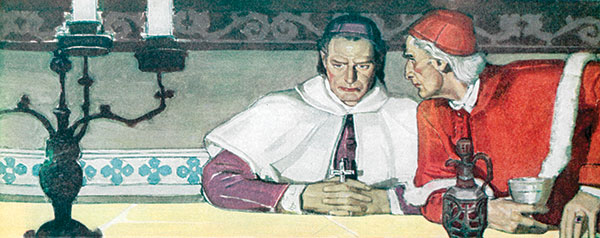
to sit with his old friend in the cool of the evening and renew contact with the great world. (Illustration by Mead Schaeffer)
This should be the real pleasure of the day, to sit with his old friend in the cool of the evening and renew contact with the great world. But the bishop was used to country hours by now and the feast had broken up late. He should be listening to the cardinal with the greatest attention, and yet those accursed crayfish kept coming into his mind.
“Well, Gianfrancesco,” said the cardinal, sipping delicately at his wine, “you have given your old tutor a most charming welcome. Your wine, your people, your guests — it reminds me somehow of one of those fine Virgilian eclogues we used to parse together. ‘Tityre, tu patulae recubans —’”
“The choir,” said the bishop, “the choir usually is —”
“Why, they sang very well!” said the cardinal. “And what good, honest, plain-spoken priests you have in your charge!” He shook his head sadly. “I fear that we do not always get their like in Rome. And yet, each man to his task.”
“They have a hard charge in these hills,” said the bishop wearily. “It was a great honor for them to see Your Eminence.”
“Oh, honor!” said the cardinal. “To see an old man with the gout — yes, I have the gout these days, Gianfrancesco — I fear we both are not so young as we were.” He leaned forward and regarded the bishop attentively. “You, too, have altered, my old friend,” he said softly.
“Your Eminence means that I have rusticated,” said the bishop a trifle bitterly. “Well, it is true.”
“Oh, not rusticated,” said the cardinal, with a charming gesture. “Not at all. But there has been a change — a perceptible one — from the Gianfrancesco I knew.” He took a walnut and began to crack it.
“That Gianfrancesco was a charming and able young man,” he said. “Yet I doubt if he would have made the count of his city do penance in his shirt, for his sins, before the doors of his cathedral.”
“I can explain about that,” said the bishop hurriedly. “The shirt was a silk one and the weather by no means inclement. Moreover, the count’s new tax would have ruined my poor. It is true we have not always seen eye to eye since then, yet I think he respects me more than he did before.”
“That is just what I said to your brother, Piero,” said the cardinal comfortably. “I said, ‘You are wrong to be perturbed about this, Piero; it will have a good effect.’ Yes, even as regards the beggar.”
“My beggar?” said the bishop, and sighed.
“Oh, you know how small things get about,” said the cardinal. “Some small thing is seized upon; it even travels to Rome. The bishop’s beggar — the beggar’s bishop — the bishop who humbles his soul to protect the poor.”
“But it was not like that at all,” said the bishop. “I —”
The cardinal waved him aside. “Do not hide your good works beneath a bushel, Gianfrancesco,” he said. “The Church herself has need of them. These are troubled times we live in. The French king may march any day. There is heresy and dissension abroad. You have no idea what difficult days may lie ahead.” He watched the bishop intently. “Our Holy Father leans much upon my unworthy shoulder,” he said, “and our Holy Father is beginning to age.”
“That is sore news for us all,” said the bishop.
“Sore indeed,” said the cardinal. “And yet, one must face realities. Should our Holy Father die, it will be necessary for those of us who truly love the Church to stand together — more especially in the college of cardinals.” He paused and with a silver nutpick extracted the last meat from the walnut. “I believe that our Holy Father is disposed to reward your own labors with the see of Albano.”
“The see of Albano?” said the bishop as if in a dream, for, as all men knew, Albano was an old and famous diocese outside the walls of Rome and he who was bishop of Albano wore a cardinal’s hat.
“It might have a most excellent effect,” said the cardinal. “I myself think it might. We have clever and able men who are sons of the Church. Indeed. And yet, just at this moment, with both the French and the German parties so active — well, there is perhaps need for another sort of man — at least as regards the people.” He smiled delightfully. “You would be very close to me as cardinal-bishop of Albano — very close to us all,” he said. “I should lean upon you, Gianfrancesco.”
“There is nought that would please me more!” cried the bishop, like a boy. He thought for a moment of the power and the glory, of the great, crowded streets of Rome and the Church that humbles kings. “I would have to leave Remo?” he said.
“Well, yes, naturally, it would mean your having to leave Remo,” said the cardinal. “Your new duties would demand it.”
“That would be hard,” said the bishop. “I would have to leave Luigi and all my people.” He thought of them suddenly — the lame, the halt, the oppressed.
“Your people, perhaps,” said the cardinal, “but certainly not Luigi. He should come with you by all means, as a living example.”
“Oh, no, no, that would never do,” said the bishop. “Your Eminence does not understand. Luigi is difficult enough as a bishop’s beggar. As a cardinal’s beggar, he would be overweening. You have no idea how overweening he would be.”
The cardinal regarded him with a puzzled stare.
“Am I dreaming, Gianfrancesco?” he said. “Or are you declining the see of Albano and a cardinal’s hat for no more reason than that you are attached to a beggar?”
“Oh, no, no, no!” cried the bishop, in an agony. “I am not in the least attached to him — he is my cross and my thorn. But you see, it would be so bad for him if I were to be made a cardinal. I tremble to think what would happen to his soul. And then there are all his companions — Giuseppe, the Hook, is dead, but there is still blind Marta, and Benito, the hunchback, and the new ones. No, I must stay in Remo.”
The cardinal smiled — a smile of exasperation. “I think you have forgotten something, Gianfrancesco,” he said. “I think you have forgotten that obedience is the first law of the Church.”
“I am five times obedient,” said the bishop. “Let our Holy Father do with me as he wills. Let him send me as a missionary to savages; let him strip me of my bishopric and set me to work in the hills. I shall be content. But while I have been given Remo, I have work to do in Remo. I did not expect it to be so when I first came here,” he said in a low voice, “and yet, somehow, I find that it is so.”
The cardinal said nothing at all for a long time.
Then at last he rose, and, pressing the bishop’s hand, he retired to his own quarters. The bishop hoped that he was comfortable in them, though it occurred to him, in the uneasy sleep before dawn, that the chimney smoked.
Next morning the cardinal departed on his journey toward Rome without speaking of these matters further. The bishop felt sorry to see him go, and yet relieved. He had been very glad to see his old friend again — he told himself that. Yet from the moment of the cardinal’s arrival there had been an unfamiliar grayness upon his spirit, and now that grayness was gone. Nevertheless, he knew that he must face Luigi — and that thought was hard for him.
Yet it went well enough, on the whole.
The bishop explained to him, as one explains to a child, that it did not seem as if God had intended him to be a cardinal, only bishop of Remo, and with that Luigi had to be content. He grumbled about it frequently and remarked that if he had known all this in the first place, he might never have accepted the position of bishop’s beggar. But he was not any more overweening than before, and with that the bishop had to be satisfied.
Then came the war with the French, and that was hard upon the bishop. He did not like wars, he did not like the thought of his people being killed. Yet, when the count of Remo fled with most of his soldiery, and the mayor locked himself in his house and stayed there, shaking, there was no one to take over the rule of the town but the bishop. The very beggars in the streets cried out for him; he could not escape the task.
He took it with a heavy heart, under the mocking eyes of Luigi. With Luigi in his cart, he inspected the walls and defenses.
“Well, your lordship has a very pretty problem,” said Luigi. “Half a dozen good cannon shot and the city will be taken by storm.”
“I thought so, I feared so,” said the bishop, sighing. “And yet my people are my people.”
“Your lordship might easily compromise with the enemy,” said Luigi. “They are angry with the count, it is true — they thought they had him bought over. Yet it would mean but two score hangings or so, and a tribute, properly assessed.”
“I cannot permit my flock to be harried and persecuted,” said the bishop.
“Well, if your lordship must die, I will die with your lordship,” said Luigi. “Meanwhile, we might set the townsfolk to work on the walls — at least it will give them something to do. And yet, there may be another way.”
So it was done and the bishop worked day and night, enheartening and encouraging his people. For once, all Remo was one, and the spirit and will that burned within it were the bishop’s. Yet it seemed no time at all before the French sat down before Remo.
They sent a trumpet and a flag to demand the surrender of the city. The bishop received the young officer who came with the trumpet — a dark-faced man he was, with a humorous twist to his mouth. The bishop even took him on a tour of the walls, which seemed to surprise him a little.
“You are well defended,” said the Frenchman politely.
“Oh, no, we are very ill defended,” said the bishop. “My good children have been trying to strengthen the wall with sandbags, but, as you perceive, it is rotten and needs rebuilding. Moreover, the count was badly cheated on his powder. I must speak to him of it sometime, for hardly a gun we have is fit to fire.”
The Frenchman’s astonishment grew. “I do not wish to doubt your lordship’s word,” he said, “but if those things are so, how does your lordship propose to defend Remo?”
“By the will of God,” said the bishop very simply. “I do not wish my poor people killed; neither do I wish them oppressed. If needs must, I shall die in their stead, but they shall go scatheless. Ere you hang one man of Remo, I shall take the noose from around his neck and put it around my own.”
“Your lordship makes things very difficult,” said the Frenchman thoughtfully. “My king has no desire to attack the Church — and, indeed, the walls of Remo seem stronger than your lordship reckons.”
Then he was conscious of a plucking at his sleeve. It was Luigi, the beggar, in his little cart, who, by signs and grimaces, seemed to wish the Frenchman to follow him.
“What is it, Luigi?” said the bishop wearily. “Ah, yes, you wish to show our friend the room where we store the powder. Very well. Then he may see how little we have.”
When the Frenchman rejoined the bishop, he was wiping sweat from his forehead and his face was white. The bishop pressed him to stay for a glass of wine, but he said he must return to his camp, and departed, muttering something incoherent about it being indeed the will of God that defended Remo.
When he had gone, the bishop looked severely upon Luigi. “Luigi,” he said sternly, “I fear you have been up to some of your tricks.”
“How your lordship mistakes me,” said the beggar. “It is true I showed him three of my fellow beggars and they did not seem to him in the best of health. But I did not say they had plague; I let him draw his own conclusions. It took me four days to school them in their parts, but that I did not tell him either.”
“That was hardly honest, Luigi,” said the bishop. “We know there is no plague in the town.”
“We know also that our walls are rotten,” said Luigi, “but the French will not believe that, either. Men of war are extremely suspicious — it is their weakness. We shall wait and see.”
They waited and saw, for that night a council of war was held in the French camp and the officer who had come with the trumpet reported (a) that Remo was held in great force and strongly defended; (b) that its bishop was resolved to die in the breach; and (c) that there was plague in the city. Taking all these factors into account, the French wisely decided, after some 48 hours’ delay, to strike camp and fall back on their main army — which they did just in time to take part in the historic defeat of the whole French invasion a week later. This defeat sealed for all time the heroic defense of Remo; for, had the part of the French army occupied before Remo rejoined their main body before, the historic defeat might have been as historic a victory for the French. As it was, all Italy rang with the name of the bishop of Remo.
But of all this the bishop knew nothing, for his beggar, Luigi, was dying. As the French moved away they had loosed off a few cannon shot, more in irritation than for any real military purpose. However, one of the cannon shot, heedlessly aimed, struck the cathedral steps, and you may still see the scars. It also struck the cart wherein Luigi lay, directing his beggars at one task of defense or another. When the bishop first heard that his beggar was hurt, he went to him at once. But there was little that man could do but wait, and the waiting was long. It was not until seven weeks later that Luigi passed from this earth. He endured, indeed, till the messengers came from Rome.
After they had talked with the bishop, the bishop went alone to his cathedral and prayed. Then he went to see Luigi.
“Well?” said the dying man eagerly, staring at him with limpid eyes.
“His Holiness has been graciously pleased to make of me the first archbishop of Remo, placing under my staff, as well, the dioceses of Ugri and Soneto,” said the bishop slowly. “But I have the news from Cardinal Malaverni, and I may remain here till I die.” He stared at Luigi. “I do not understand,” he said.
“It is well done. You have stood by the poor in their poverty and the wretched in their hour of trial,” said Luigi, and for once there was no trace of mockery in his voice.
“I do not understand. I do not understand at all,” said the bishop again. “And yet I think you deserve recompense rather than I, Luigi.”
“No,” said Luigi, “that I do not.”
The bishop passed his hand across his brow. “I am not a fool,” he said. “It was well done, to humble my spirit. And yet, why did you do so, Luigi?”
“Why, that was my great sin,” said Luigi. “I have confessed many vain and imaginary sins, but never the real one till now.” He paused, as if the words hurt him. “When your lordship’s coach rolled over my legs, I was very bitter,” he said. “A poor man has little. To lose that little — to lose the air on the hills and the springing step, to lie like a log forever because a bishop’s coachman was careless — that made me very bitter. I had rather your lordship had driven over me again than taken me back to your palace and treated me with kindness. I hated your lordship for your indifferent kindness — I hated you for everything.”
“Did you so, Luigi?” said the bishop.
“Yes,” said Luigi. “And I could see that your lordship hated me — or if not hated, loathed, like a crippled dog that one must be kind to without liking. So I set myself out to tease and torment your lordship — at first by being your beggar, then in other ways. I could not believe in goodness; I could not believe there would not come a moment when your lordship would turn upon me and drive me forth.”
He paused a moment and wiped his mouth with a cloth. “Yes, I could not believe that at all,” he said. “But you were not to be broken, Gianfrancesco, my brother. The evil I showed you daily was like a knife in your heart and a burden on your back, but you bore the knife and the burden. I took delight in showing you how ill things went in your city — how, below the fair surface, there was misery and pain. And had you once turned aside from that misery and pain, I would have been satisfied, for then, bishop or no bishop, you would have lost your soul. Was that evil of me, Gianfrancesco?”
“Very evil in intent,” said the bishop steadily, “for, while it is permitted to be tempted, it is evil to tempt. And yet proceed.”
“Well,” said Luigi, with a sudden and childlike stare, “it did not work. The more I tried to make you a bad man, the better man you became. You would not do what was ill; you would not depart from your poor, once you had known them — not even for a red hat or a count’s favor. You would not do ill at all. So now we have defended Remo, the two of us, and I am dying.”
He stirred uneasily in his bed. “It is just as well,” he said, with a trace of his old mockery. “I told my uncle I would live to be a cardinal’s beggar, but I am not sure that I would have liked it. I have been the bishop’s beggar so long. And yet, from the first I have loved you also, Gianfrancesco. Will you give me your blessing now, on me and my work — the blessing you denied me once?”
The bishop’s face was wrung. Yet he lifted his hand and absolved and blessed Luigi. He blessed Luigi and his work in the name of the Father and of the Son and of the Holy Ghost. When that had been done, a smile appeared on Luigi’s face.
“A very fine blessing,” he said. “I must tell that to the Hook when I see him; he will be envious. I wonder, is it drafty on the steps of heaven? A very fine blessing, your lordship … 10 … scudi … for … Luigi.” And with that his jaw dropped and it was over. But the bishop knelt beside the bed with streaming eyes.
All that was a long time ago. But they still tell the story in Remo when they show the bishop’s tomb. He lies upon it, fairly carved in marble. But carved all around the tomb are a multitude of beggars, lame, halt, and misshapen, yet all praising God. And there are words in Latin which say, “It is not enough to have knowledge — these also are my sheep.” Of the tomb of Luigi, the beggar — that no man knows. They say it was beside the bishop’s but, in one war or another, it was destroyed and there is no trace of it now. Yet Luigi was an arrogant spirit; perhaps he would have liked that best.
Want to see your story published? Read our Great American Fiction Contest anthologies to find out what it takes. Order them now at saturdayeveningpost.com/fiction-contest.