The Passing of Our National (Extinct) Bird
One hundred years ago this month, a small gray pigeon with spotted wings became the most famous bird in American history. It achieved this distinction by one simple act — it died. And with it died the species Ectopistes migratorius. The passenger pigeon was no more.
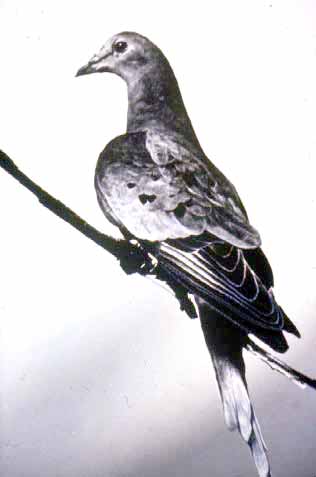
The passing of a species is, of course, significant. But the loss of the passenger pigeon has taken on deeper meaning in our culture. The bird has become a symbol of what we have lost to time, a missing link to the wild abundance of early America. Other species — like the ivory-billed woodpecker and heath hen — have vanished, but they had not impressed Americans as the wild pigeon did with its endless flocks.
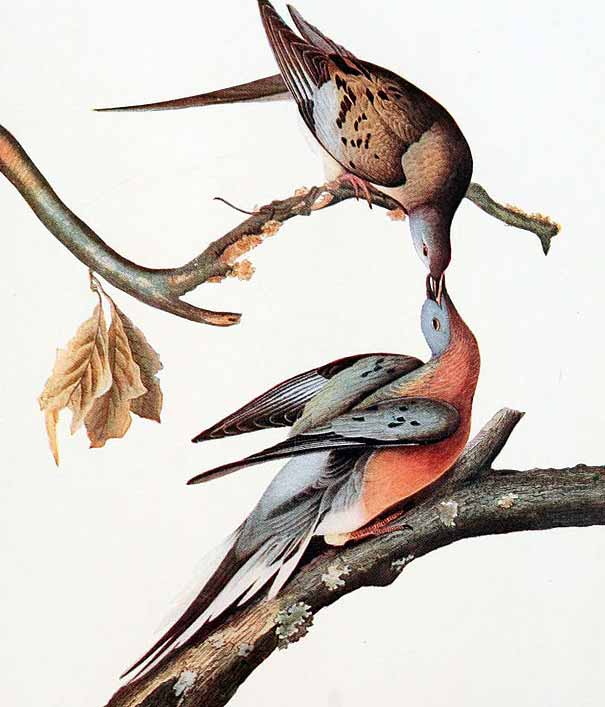
In the early 1800s passenger pigeons were so plentiful that when a flock passed over ornithologist John James Audubon, he heard the sound of “a hard gale at sea” and felt a surprising current of air from the beating of thousands of wings. As the birds came to roost, “a most magnificent as well as wonderful and almost terrifying sight presented itself,” said Audubon. “The pigeons, arriving by thousands, alighted everywhere, one above another, until solid masses as large as hogsheads were formed on the branches all round. Here and there the perches gave way with a crash and, falling on the ground, destroyed hundreds of birds beneath. … It was a scene of uproar and confusion.”
John C. French wrote in The Passenger Pigeon of Pennsylvania of a 2-mile-wide nesting ground stretching through 40 miles of unbroken forest near his Alleghany farm. Every morning pigeons would rise to fill the sky over a mile-wide valley, “eight courses deep at times, for about an hour, with the multitude of birds flowing westward, at the rate of about a mile a minute. … The roar of wings was like a tornado and the morning was darkened as by a heavy thunder shower.”
And yet, within a few decades, the passenger pigeon had become a rarity. As the 20th century began, the species was reduced to just a handful of birds being carefully tended by ornithologists.
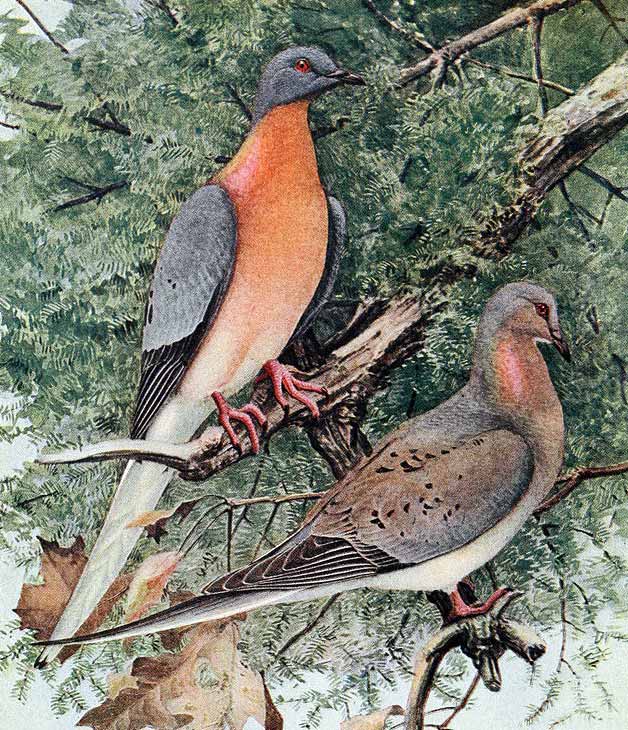
Many Americans refused to believe the bird that had once crowded the skies from horizon to horizon was gone. Some were outraged when author and outdoorsman Emerson Hough made a passing comment in his June 4, 1910, Out-of-Doors column: “There have been no wild pigeons in America for many years.”
The comment prompted letters from Post readers who claimed to have heard about or personally seen flocks of passenger pigeons. Hough responded in October: “It is very surprising how general is the belief that the wild pigeon still exists in considerable numbers in different parts of the United States. Many newspaper stories announcing the ‘return of the pigeons’ appear. … Unfortunately they are not and cannot be true. The majority of the reports of wild pigeons … have come from writers who do not recognize the difference between the band-tailed pigeon and the passenger pigeon.” (“The Past Participle in Pigeons” October 15, 1910)
Hough left no room for argument or hope for a comeback.
He was just as adamant on a second point — humans were responsible for the extinction. His article added a new significance to the passenger-pigeon story. What had been a symbol of lost America was now considered a parable of American greed.
Hunters had assumed an endless supply, Hough wrote, and so slaughtered the pigeons without restraint. “In three years there were shipped from [Hartford] Michigan … 990,000 dozen pigeons — call it a million dozen, so you can remember it easily. They did not count them in less than dozens. This was from one part of one state alone. The town of Shelby, in Michigan, is said to have shipped a third more than did Hartford. It is said that in the heyday of pigeoning in Michigan, the town of Petosky shipped five carloads a day for 30 days,” which Hough calculated to be 14.8 million pigeons in one month.
“Everybody supposed that there would always be millions of them,” wrote Hough. “Everybody supposed that they must breed in immense numbers, six or eight young in a nest, at least. As a matter of fact, the bird was not prolific. It laid but one egg a year.”
Thirty years earlier, conservationists had warned commercial hunters of the inevitable end of this wasteful slaughter. But a Chicago wild-game dealer replied: “The pigeon never will be exterminated so long as forests large enough for their nestings and vast enough for their food remain. … The pigeon is migratory. It can care for itself.” Yet, Hough reported, the dealer’s shrinking supply of pigeon meat was already proving him wrong. The bird had practically disappeared the previous year, “almost at once.”
The suddenness of their passing was mystifying. Several readers wrote in to suggest the pigeons had simply migrated and forgotten to come home. There were no émigré flocks, Hough wrote. The birds had simply been slaughtered in a long frenzy of greed. Men had trapped them in nets, then dispatched them with clubs, boards, rocks, or pincers. Hough recalled one crazed trapper crushing birds’ heads with his teeth. “It was simply rapid butchery and that was all there was to it.” By 1883 they “had well-nigh finished their pretty work. … Fine — isn’t it? — what we practical, simple-minded Americans have done!” (“Regarding Martha,” June 21, 1919)
In 2014 we are accustomed to hearing warnings from conservationists and environmentalists. But 100 years ago, Emerson Hough’s ideas about preserving wildlife were relatively new, and unpopular. Readers often wrote him to complain of new and limited hunting seasons and expanded game preserves. Hough had no sympathy for them. He believed “future generations of Americans have been shamefully wronged by those who have preceded them.”
Throughout the early history of the United States, there had been little distinction made between ambition and greed. But years of “waste, extravagance, insatiate individual greed” as Hough expressed it, would eradicate valuable wildlife. Conservation was needed, he wrote, because, when Americans loved something, they tended to use it up. Given time, they would introduce everything they cared for to the past tense; not just passenger pigeons, but “our sports, our resources, our own country, our own species.”
The Line
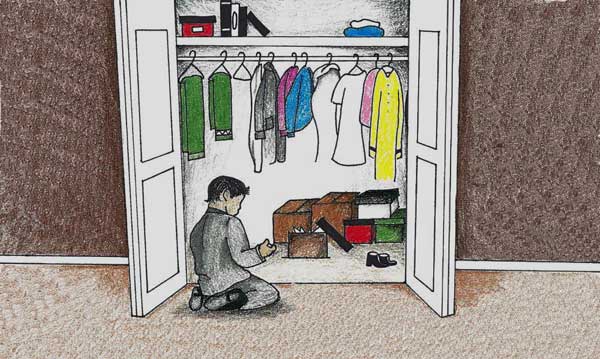
Ricky stumbled upon _____ while digging through a pile of shoeboxes in the back of his grandmother’s closet. Can you imagine? Just sitting there amongst old clothes, letters, books that might have been her most treasured possession. The line between the meaningful and meaningless was almost non-existent to the outsider, though, and without her around to give them life through memory, through experience, they reverted back to being garbage.
This was after the funeral, the awkward meetings, handshakes, lipstick scars from kisses on the cheek. You’re probably too young to remember me. You’ve became a little man! Ricky walked upstairs to get away, slipped into his grandma’s bedroom. Her bed was still unmade from when they found her in it, already gone. With the sheets torn open like that, it was almost like the bed itself was grieving. Ricky walked over, let his hand hover over the sheets, but couldn’t bring himself to touch the bed, afraid it might suck him in, take him with it.
Ricky brushed the dust off of _____, held it up to the window so he could see it better. His grandmother’s house was always dark. The deep brown walls and cramped rooms had a way of swallowing light, killing any warmth that dare enter.
_____ was just the way Ricky’s grandma had described it to him when he was little. This was shocking, coming from a woman who did nothing but tell Ricky incredible stories that were obviously fictitious to anyone but a child. She once told him about the time she and her best friend ran off to join the circus. Literally, she said that they joined a traveling circus. Apparently, the two girls started training for the tightrope walk before deciding they should just go back home. Another story involved the ghost of a little girl whom she would see dancing around a tree in her backyard. Her father had the tree cut down, and the girl never returned. Ricky’s grandmother had lots of stories about ghosts. But they were stories. Just stories.
Ricky held _____ close to his chest, hidden under his arms, like a wound, like a lesion he was ashamed of. He walked downstairs to where his relatives were talking, drinking, the whole house feeling somehow sing-song, the voices blended like they did at church, when everyone sang together, melodic despite the untrained voice, all on different notes. Unknowing eyes might think it was a birthday party, not a wake.
Ricky found his dad talking to his cousin, who’s name Ricky could not remember. He would later remember it (Anna) as she would begin making regular visits to see Ricky and his father. Ricky asked no questions, even after she drove his father’s car into a median on the highway, nicking a car coming the other way. His father was killed instantly, his chest crushed. The driver of other car was decapitated, and Anna got away with only a leg injury, and a limp that followed her for the rest of her life. Anna never even told Ricky she was sorry for killing his father. He felt that she wasn’t actually sorry at all. It didn’t matter, though, neither was Ricky.
“How are you holding up, buddy?” Anna asked, using the appropriate phrasing. You don’t ask people at funerals how they are, because they’re obviously not good. Or, at least that’s what they want everyone to believe. You have to ask it in a way that shows that you’re asking in relative terms. I know you’re not doing well, but in terms of how bad you could be feeling, how are you?
“I’m…I’m okay,” Ricky said. He motioned with his head, trying to dismiss Anna, but she didn’t leave, and in fact leaned in closer.
“What have you got there?” Ricky’ father asked, cocking his head to see around his son’s arms, not even considering that it might be something Ricky wanted to keep secret.
Ricky slowly uncurled his arms, letting ____ drop into his hands, like he was presenting it to his father as a gift, like he was one of the Magi in the nativity scene they use to put up during Christmas. Two white, one black, always.
“Oh, I see,” Ricky’ father said, looking over at Anna, who was smiling. Children, how amusingly naïve. “Did you get that from your grandmother’s room?”
It hadn’t occurred to Ricky until that moment that he might be doing something wrong, that he might be stealing, that somebody else could have already claimed _____.
“Yes,” Ricky said, turning his shoulder to the room, hoping to better hide his treasure.
“Well, it’s very interesting,” his father said, mockingly uninterested, not bothering to try and hide his lack of understanding.
Ricky looked up at his father, confused, certain he was playing a game. “But look. Grandma told me about it, she told me stories. I didn’t think it was real.” Ricky placed ____ into his father’s hands, realizing now how small it seemed when held by a grown man.
His father hefted _____ into the air, catching it bluntly, smiling, trying to appease Ricky, who had to use every bit of will he had to avoid snatching it back from his father. “It’s cool, Ricky. But it’s just _____. Your grandma has plenty of shit like this in that closet of hers.” He handed _____ to Ricky. “Now go put it back where you found it, and come straight back down. I have a few people I want to introduce to you before they have to leave.”
Ricky took _____ back, this time not being as careful to protect it, regretting letting his father touch it, letting his father know that it was important to him, letting his father make it meaningless with a few words. Ricky kept telling himself _____ was important, it was important, it was important, but it was already gone, crossed over into meaninglessness. Such a thin line.
Ricky put _____ back into the closet where he found it, stacked books and shoe boxes back on top of it, hoping no one would ever find, that it would remain there forever, like a fossil, perfectly preserved.
He knew he would never see _____ again.
Years later, after his dad’s accident–another funeral, another party for the departed–Ricky asked his aunt about ______. She had gotten his grandmother’s house, which caused Ricky’s father to hate her until the day he died. Just as well; he seemed to hate almost everyone.
“______?” she said. Attentive. Kind. Fake. “I don’t remember seeing it, but this house is full of that kind of thing. I’ll keep an eye out for it, okay?”
“No big deal,” Ricky said, “Dad had mentioned it a month ago, so I thought I’d ask.” He looked at his aunt’s eyes, her smile, glad to still be above ground, to still have lungs that could hold air, a little too pleased that her abusive brother had died so violently; the closed casket, rumors, whispered details.
Ricky looked at his hand, her lips, cheeks, quivering fingers, all convincing. But her eyes, they gave her away. He wanted to tell her that he was the one that had once cared about ______, not his father. The only person it hurt was Ricky, himself. But he didn’t say anything, just let her have her spiteful victory.
Ricky walked out the backdoor, through the kitchen into the backyard, passing family, friends, or perhaps people that hated his father and were hoping to get a chance to see his grotesque body. Ricky could hardly tell the difference. They all acted the same, spoke the same, were the same.
Ricky planned to leave through the backyard, but when he got there heremembered that there wasn’t a gate. There was no way to leave. He would have to make his way back through the house to the front door. He breathed in the air, wondering if was the same air he had breathed in when he visited as a kid. As he walked back into house, he noticed something in the backyard. A tree stump. He remembered his grandmother’s ghost stories, but in haste, drew no conclusions.
Later, Ricky would say that he knew that was the last time he’d see that house, that he planned on getting into his car and driving until he found something new, something better. That’s a debatable point, but the truth is that he never did see the house. Even after a gas line explosion wrecked most of the house and killed Ricky’s aunt, the last of her siblings, in the process.
Ricky, a thousand miles away, let the phone ring, listened to the messages left by one of his cousins, the details of the explosion, and then updates on his aunt’s condition; then the bad news, and then, finally, funeral plans. He never called back, didn’t even consider the idea of coming to the funeral. He only briefly considered returning a call once, when his cousin mentioned that they had found _____ among the wreckage of his grandmother’s house.
“Must be worth a fortune,” his cousin said, trying not to sound too excited, to get ahead of herself, overplay her hand. As if value is a thing that can be changed by a couple of words.
The Healing: Victim of Brutal Beating Meets Attacker 25 Years Later
Source: FacingFearMovie.com
Back in the ’80s, Matthew Boger and Tim Zaal didn’t have much in common. But fate brought them together one horrible evening.
Matthew was a small-framed 14-year-old from outside San Francisco with a sweet smile and a soft heart. He was also gay, and when he told his mother, she couldn’t accept it. “Take it back,” she told him.
“When I wouldn’t, she threw me against the wall and told me to get out,” he recalls. “That’s the last time I ever saw my mother.”
Matthew hitched a ride to Hollywood and made his home in a park off Santa Monica Boulevard. “I lived in that park 24 hours a day, and I ate out of garbage cans,” says Matthew. “I’m not proud of it, but I did whatever I had to do to survive.”
Tim Zaal was a beefy 17-year-old middle-class kid growing up in the San Gabriel Valley area of Los Angeles. But after his brother was shot by a black man, Tim changed. For him, the incident became an indictment of anyone who was different. And it filled him with hate.
He made it to Hollywood almost every weekend as part of the mass pilgrimage of punk rockers that attended concerts in the area. It was a rough crowd. “Violence was a daily part of my life back then,” says Tim. “It was not uncommon to see people pulled out of their cars and beaten.”
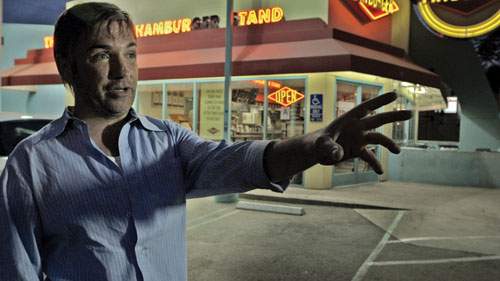
One night in 1980, Matthew and Tim met in Hollywood. “I was at Okie’s Dog getting a hot dog,” recalls Matthew. “They had video games, and it felt like a safe place where I could escape my hell for a few hours.” But Tim and his hooligan friends considered the popular hot dog stand their territory. As Matthew remembers, there was a sudden, loud commotion from across the street. As he turned, he saw Tim shouting, “There they are. Let’s kill all the little faggots.”
“I saw the looks on their faces,” Matthew recalls, “and I said to all the other kids there, ‘Let’s run!’”
Matthew dashed down an alley, but Tim’s crew cut him off. They started kicking Matthew with steel-tipped boots, all the while high-fiving each other. Matthew screamed for help, but it only seemed to make Tim angrier. “So I kicked him in the head as hard as I could,” Tim says. “Then he stopped moving.”
Tim recalls being happy he had knocked Matthew out — until he realized one of the girls in his gang was screaming, “Stop, stop! I think you killed him!”
Panicked, they left Matthew in a pool of blood. “It became a secret,” recalls Tim, “one I never talked about for years. But it was always there.”
But Matthew wasn’t dead; he awoke, bleeding, battered, and alone. He crawled across the street to the park and bandaged himself with T-shirts. Finally he managed to get to his feet and walk to a drugstore where he stole first-aid supplies, then made his way to a McDonald’s for a burger. Nobody offered to help. “It was like I was invisible,” says Matthew. “Here I was, covered in bloody bandages, and nobody said a word to me.”
But the harrowing event did not break his spirit. “I knew then that I could not die on those streets,” says Matthew. “Because then they would have won.”
He wound up getting a job at that same McDonald’s. Flash forward three and a half years: Matthew had not only gotten himself off the streets, but back to school to become a hairstylist–and within a decade he was one of the most sought-after in Los Angeles.
Epiphany in Green
May 3, 2000–that fateful Wednesday. When I got up that morning at 5:30, I didn’t realize what an eventful day it would be. I had retired about nine years earlier, and Wednesday had become the day to mow the lawn. I remember that the weather was turning warmer—warm, that is, for Minnesota. It had been rainy, and the grass was getting tall. It was time to cut it for the first time that spring.
I was ready. The week before I had gone to Rostabelli’s hardware and had the lawn mower blade sharpened. Jim did it himself. I also had bought a new plug (it doesn’t pay to use the one from last year) and an air filter. On the way home I put fresh gas in the can. As soon as I got back, I put the blade and other stuff on the Mohawk. I really like the Mohawk. I’ve had this one seven years, and the one before, sixteen years. I filled the tank with gas and primed the engine. After about fifteen minutes of yanking the cord and adjusting the choke–it always takes long the first time you do it in the spring–the engine kicked over. So I knew I was set for the task next week.
*****
I like to get up early. It’s quiet, and I can read the paper in peace. That Wednesday, as usual, I washed my face and didn’t shower or shave, since I like to do those things after I cut the grass. I put on an old dress shirt that had a spot on it from when I absentmindedly stuck an uncapped pen in the pocket (Bea is always getting on me to throw the shirt out), got into some old jeans, and put on a beat–up pair of Rockports.
I went downstairs to make breakfast, being very careful not to wake Bea. I know better than to wake her—she roars like a lioness protecting her cubs when I do.
I ate what I usually eat on Wednesdays: a bowl of Rice Krispies with one percent milk and half a banana, a piece of whole wheat toast with margarine, and black coffee. I made a big pot of coffee so that Bea could have some as soon as she came down. After two cups she usually starts talking.
I recall that I had just about finished my coffee and was looking at the obituary pages (no one I knew had died that day) when Bea walked in wearing her red bathrobe and red floppy slippers that our daughter had bought her from Target for Christmas. She went over to the coffee pot, her slippers slapping against the floor, and she poured herself a cup. She sipped it at first and, when it had cooled sufficiently, gulped the rest of it down. She then poured another cup and sat down opposite me at our kitchen table.
By this time I was on to the sports pages–the Twins were off to a good start. Bea drank her coffee slowly. I turned to the business section. The market was up, but two of the stocks I was following were down.
Bea finished her coffee and carefully placed her cup in the exact middle of her saucer. “It’s a good thing you’re mowing today,” she said. “The lawn’s starting to look like a jungle.”
I paused, envisioning our yard a haven for all sorts of wondrous creatures: Vividly-colored tropical birds screeching their exotic calls, all varieties of simians swinging in the trees, and beautiful, cat–like beasts waiting to pounce. The more I thought about it, the more I liked the idea.
Every Wednesday morning, starting in May and ending in November, for the last nine years I had been mowing the lawn. Before that, when I was working, it was every Saturday morning. I had been mowing lawns for about forty–five years, I realized, trying to tame nature. But why? Nature is inevitably going to win; it just grows back. So why was I going through all this trouble to keep it at bay? To impress (read: beat) my neighbor, Al Feckenburg? Maybe it was time to enjoy nature instead of fighting it…
“I’m not going to cut the grass today,” I said, having reached a decision.
“You feeling OK?” Bea said as she chewed on a piece of cold pizza she had retrieved from the refrigerator.
“Yeah, I’m feeling fine.”
“The grass is really getting tall,” she insisted. “It might rain tomorrow.”
“Yeah,” I agreed. “The grass keeps growing, and there’s always the chance that it will rain.”
I turned to the comics and glanced at Peanuts.
“Well, then, what are you going to do today?”
“I’ve been thinking of sitting under that big maple in the back, reading a book and watching the birds,” I mused. “You know, in all the years we’ve lived here I never have done that?”
“Maybe that’s because when you go out there either the mosquitoes or the wasps attack you,” Bea jeered. “So when are you planning on mowing?”
“I don’t know, maybe never.”
Bea put down the remains of the pizza and looked at me over her glasses. “Don’t tell me you’re finally going to hire a lawn service.”
“Why would I do that?” I said. “If I want the lawn mowed, I can do it myself.”
Bea picked up her pizza again and started to read the obituary notices. “I see where Sarah Jensen died,” she said.
“Who’s she?”
“Edmund, don’t you remember anything? She and her husband filled in for the Krenshaws at bridge last year.”
“You mean I met her once, a year ago, and I’m supposed to remember her?”
Bea went to the refrigerator, took out another piece of pizza, and poured herself a glass of orange juice. “What brought this all on?” she said.
“What, not remembering Sarah Jensen?”
“No,” she said. “Not cutting the grass.”
“I don’t know exactly. Maybe it’s because I’m seventy–one and having the neatest lawn in the neighborhood isn’t that important anymore. Besides there’s no way I can beat Al Feckenburg. I concede him the championship.”
I was looking at the bridge column, now.
“You can’t just leave the grass grow,” she persisted. “The town’ll get after you.”
“I can always cover it over with concrete.”
Bea dropped her pizza and shot up like she had just sat on a tack. “Concrete? Now you’re just talking crazy!”
“Maybe we should sell the house and the lawn, and move to some place like Australia?”
Bea sat back down and sighed. “Edmund, just what has come over you? Maybe you ought to see Dr. Ellenbogen.”
“I don’t need to. I’m fine. Maybe we ought to think about the rut we’re in. Maybe we should stop doing things just because we’ve always done them.”
“Maybe I should stop cooking?” she tested.
“Maybe. We eat too much anyway.”
“And maybe I should stop cleaning house.”
“Maybe. We don’t need this big house anymore. Trudy moved out a long time ago, and she isn’t going to move back or have any children for us to put up. We can get rid of that crib and playpen you’ve been storing in the attic. Maybe we should live in a hut or a tent…”
Bea bit her lip and silently took her plate, cup and saucer, and glass, and rinsed them in the sink before placing them in the dishwasher.
“Where is this all heading?”
I didn’t answer her. I didn’t know where it was heading.
That day I went outside and sat under the maple with a book I had wanted to read for a long time. I watched some robins pecking for worms, and the chickadees frenetically flying to and from the bird feeder. I listened for the silence. It was a little cool, but there were no mosquitoes or wasps to bother me. I didn’t do anything constructive all day, but I felt my heart pumping, and that was good. I couldn’t wait to see the next morning. Maybe I’d get up to watch the sunrise, or maybe I’d pull the covers over my head and spend the rest of the day in bed.
Beyond The Canvas: Camping and the American Experience
Amos Sewell
September 5, 1953 © SEPS
From cowboys to boy scouts, camping has long been an adventure for all ages. We camp to sightsee in national parks, play in the backyard, cattle drive across the plains, or vacation for fresh air.
For the last hundred years, The Saturday Evening Post has shown many ways in which Americans enjoy the outdoors.
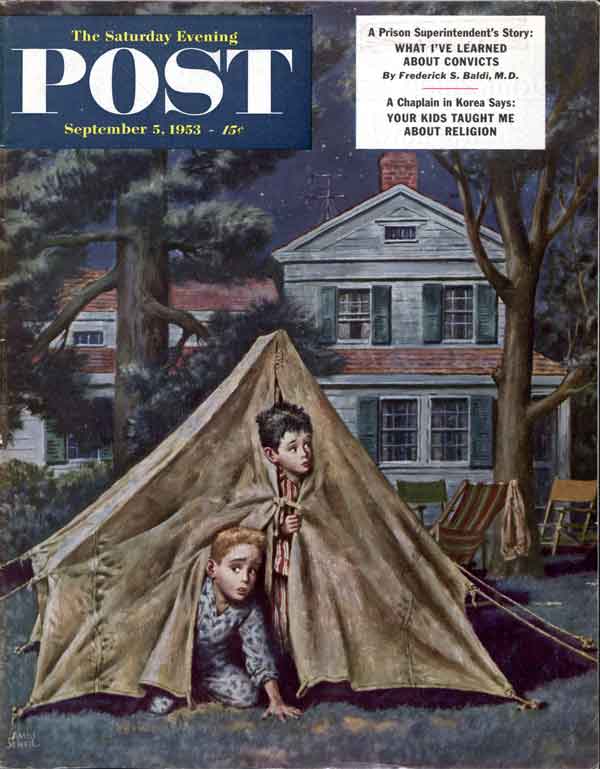
Starting with Amos Sewell’s September 5, 1953 cover, Backyard Campers, two frightened little boys attempt to be tough enough to camp out all by themselves–even if aloneness means the isolation of being the only tent in a fenced-in, suburban yard just steps from the safety of their home.
Still, the little lawn campers are spooked by the foreignness of their own backyard in the darkness. If they get too frightened, they reason, they’ll plan a mad dash to the safety of the house, with warm beds and glowing nightlights for comfort. A rite of passage accomplished, if short-lived.
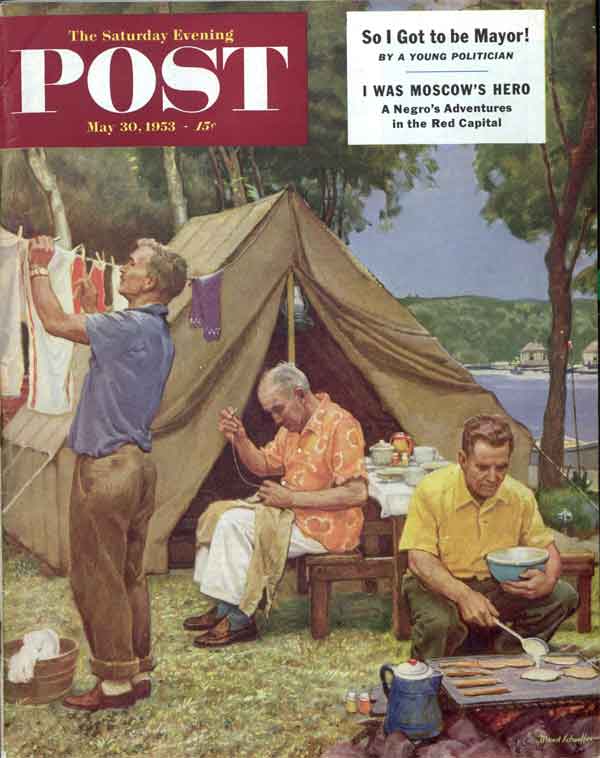
But camping isn’t just a backyard activity for little boys. As Mead Schaeffer shows, it’s a multi-generational bonding experience. His May 30, 1953 cover, Three Generations Camping, provides a more relaxed setting focused on socialization through outdoor enjoyment. The camping tradition turns boys still afraid of the dark into nature-tested outdoorsmen. In Schaeffer’s illustration, we see a whole family tending to their assigned tasks while a communal breakfast cooks over the griddle.
Mead Schaeffer
May 30, 1953 © SEPS
Speaking of campfire food, mealtime around an open fire is almost as much a right of passage as the act of camping itself. What’s a campout without a bonfire, after all? And what’s a bonfire without campfire food?
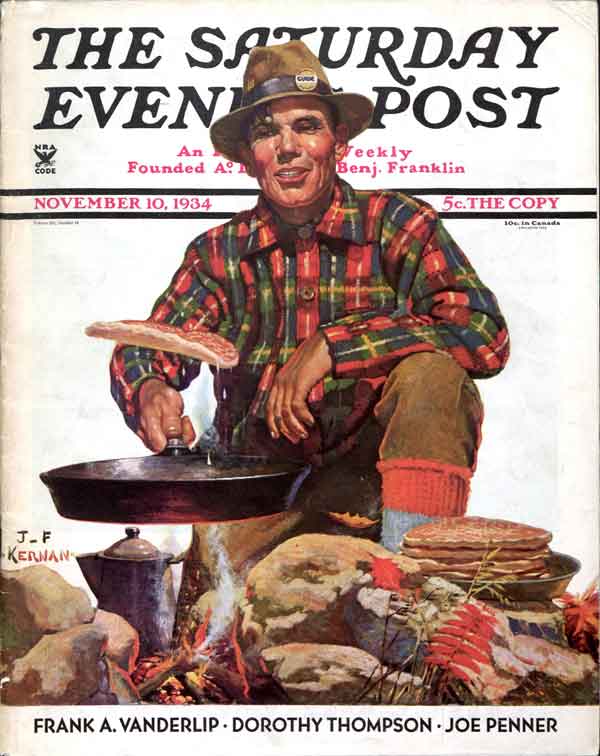
Flapjacks by J.F. Kernan, from the November 10, 1934 issue, shows a camper who’s preparing a fresh stack of pancakes over the fire. Meals are the best time for campers to rest from a day of hiking, fishing, trail riding, and general physical exertion. It’s a time to take the boots off, socialize with peers, enjoy the surroundings, and most importantly, replenish lost calories.
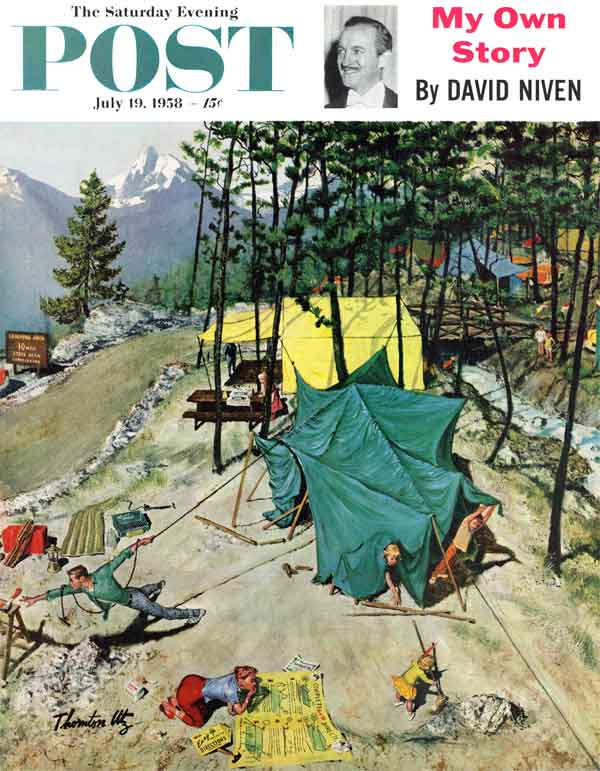
These three Post covers idealize the innocent notions of nighttime fears, the happiness of cooking over a fire, and the communal experience of enjoying the outdoors. However, unforeseen circumstance can cause immense frustration that is a far cry from the glossy memories of a good campout. The difficulty of correctly pitching a tent is a familiar, well-worn joke in our culture, as Thornton Utz shows us in Making Camp, from the July 19, 1958 issue. What a maddening mess!
Camping is integral in the American experience, and arguably the least expensive right of passage in this country. Even before smartphones and computers, people felt the need to escape the city and head for the hills, to breathe fresh air, experience wildlife up close, and live a little simply (if uncomfortably) even if just for a weekend. Along the way, The Saturday Evening Post has shared our nation’s appreciation for this truly American experience.
Thornton Utz
July 19, 1958 © SEPS
Mead Schaeffer
May 30, 1953 © SEPS
Amos Sewell
September 5, 1953 © SEPS
J.F. Kernan
November 10, 1934 © SEPS
Falling In

I slide to the bottom of the steep slope on my feet, skiing on the dew-wet grass, too excited to simply walk. Annette follows tentatively behind me. I pant for breath at the base and wait for her to catch up.
I’ve been trying to get into Annette’s group of friends all year but it isn’t until I read my short story to our grade 7 class that she pays me any attention. I’m still the weird girl who loves reading but now Annette is eager to see the gully where I’d had the adventures I wrote about.
The gully is a huge valley behind my house with trees, grassy slopes and a pond that freezes into a rippled ice-rink every winter. There are beavers, pheasants, muskrats, Canada geese and woodpeckers. And squirrels, mice, frogs and fish. The bigger animals can be kind of scary sometimes. Angry raccoons, vicious geese, frightened skunks, I’ve met them all.
It isn’t a park or a wildlife preserve or anything, just a chunk of wilderness in the middle of our big city. I spend a lot of time down there, usually alone. But I want to share it, the quiet magic that seeps into me every visit.
We follow the path at the bottom of the hill until we come to where it meets a creek. Annette stares at the tall tree lying there, blocking our way. It had fallen a few weeks earlier. I point out the creek still running underneath its branches. Annette glances at it but I can tell she isn’t interested. I need to find something more exciting. And I know the perfect thing–Jungle Jim’s hut.
“Hey, Laura, show me where Jungle Jim lived,” Annette says, as if she’d read my mind.
Jungle Jim was a long-haired teenager who’d lived in the gully last summer, a hero idolized by the neighborhood kids. Nobody knew what happened to him, he’d just disappeared one day. I got shivers just thinking about it. It was his story that caught Annette’s attention.
“Over this way!” I dash off through the trees.
We’re both out of breath by the time we get to the clearing with its small fire-pit. A bunch of boys are already there, sitting on broken lawn chairs someone had dragged down. The clearing smells faintly of the same kind of sweet smoke as Jungle Jim’s hand-rolled cigarettes. A haze hangs in the air and one of the boys holds a smoking joint.
“Take off, little girls,” he sneers. He takes a drag off the joint pinched between his fingers.
I want to say something but I don’t know these teenagers and they’re much bigger than me and Annette. I can see Jungle Jim’s little lean-to right behind them, half hidden in the trees. But there’s no way we’re going to get past those guys.
I stomp away, not noticing Annette isn’t behind me.
“Gimme a puff,” I hear her say.
I spin around and stare at her, standing there with her hand held out. I can’t decide if she is brave or stupid.
The teenagers laugh. “Go away, little girl, you don’t know what you’re doing,” the skinniest one smirks.
“I do too. Gimme a puff!” Annette snatches at the joint. The skinny boy is so surprised he lets it go.
Annette takes a long drag and starts to cough.
“See? I told ya!” He grabs it back and the other boys howl with laughter.
I pull at Annette’s hand, “Come on. Let’s go.”
“You are such a wimp, Laura,” Annette scoffs.
I think hard for something to placate her, “Let’s go to the pond. See the ducks and geese.”
We cut across the grassy flat bottom of the gully heading to the pond on the far side. It’s deserted except for the old lady I see every morning, walking her dog around the pond. She always smiles when she sees me, I don’t know why.
All the ducks are gone but there are a few geese floating in the middle of the water. We sit on the grass and scoop up rocks from the gravel path, tossing them in to see the circles spread out. Annette aims at the geese but she doesn’t even come close, it’s a big pond.
“You’re really lucky to have this so close to your house,” Annette says.
“Yeah, it’s great, isn’t it?” I lie down on the grass and look up at the clouds. The ground is cold under my back and a little wet but I don’t move.
“You should bring me here more often. I’d like to get to know those boys.”
I am thrilled. Annette is the most popular girl at school. I can’t believe she wants to spend time with geeky little me. Well, me and those boys.
“Okay.” I wonder what I should show her next. I look around for inspiration.
We are lying on a grassy slope beside the pond. Our feet are lower than our heads so it’s easy to look around. From here I can see most of my gully spread out in front of me.
My gully—it really does feel like it’s mine. I spend every minute I can down here. I know where the beavers rebuilt their dam every winter. I know the best trees for climbing and which ones have comfortable branches where I can sit and read. I know where the snowdrops first appear every spring and which trees are the driest underneath during the heaviest rains. I know where the squirrels keep their hoards of nuts. I know everything about the gully.
I can’t help it, I start grinning. I am Queen of all I survey. I even forgive those boys for not letting me show Jungle Jim’s place to Annette.
And laying there, all happy inside, with my new best friend beside me, I feel the earth move.
Not like an earthquake, nothing shakes or knocks us around.
I feel the earth spinning.
I feel the motion of the planet, rotating beneath me, flying through space.
The breeze blows in my face as we rush around the sun, the puffy white clouds dragged along by the same solar wind.
I am so small, so tiny, so insignificant, the planet is immense below me. I, no, we are just tiny specks on a ball rocketing through the cosmos. Huge empty space.
Planets and rocks and stars dwarf me.
My hands clench on fistfuls of grass, holding me down so I don’t fly off in the wind. I can barely breathe. My fingers grow wet with grass juice.
We blast through the blackness of space, atoms whip past stealing my breath. Everything expands outward, contracts inward. I am the pulsing heartbeat of the universe.
It is glorious.
Heat blasts over my skin as the sun creeps out from behind a cloud.
I breathe in the smell of crushed grass.
I breathe out the universe.
***
I blink and everything is back to normal; sun and clouds in the sky, grass and pond and trees down below.
Everything exactly the same as it’s always been.
The feeling fades, my throat feels tight with tears. I turn to Annette, searching for the words to ask, to tell, to share the wonder.
“This is boring,” she says.
I close my mouth, lock the words inside.
The old lady’s dog barks behind us and geese take to the air, honking.
“Hello, girls,” a quivery voice comes from the path behind us.
“What d’ya want?” Annette snaps.
I look at her in surprise and face the old lady, my cheeks turning red. “Hi.”
“Beautiful day.”
“Yes.” I don’t know what else to say so I smile at her. She smiles back, flickers of starlight peek out from her eyes, sunlight drifts from her soft wrinkles. Her white hair glows moonlight.
She is part of it. Part of the gully. Part of the universe. Part of everything. She’s felt it too, maybe not today with me, but she’s felt it. I smile at her again, a sharing that doesn’t need words.
“I’m bored. Show me something exciting,” Annette whines.
I glance at her. She seems smaller, deflated. My skin still tingles with stardust and memories. I can do anything, be anyone.
“You go on without me. I’m gonna stay here for a while.” I want that feeling again. A tiny part of me whispers “tell her” but the rest of me doesn’t want to share it, doesn’t want to dilute the memory. Certainly not with Ms. Popular who can’t be polite to a nice old lady. Not with a girl who is so busy looking for excitement that she misses seeing the cosmos.
Annette sneers at me. “Suit yourself, loser.” She jumps to her feet and stomps away, kicking at the rocks on the path.
I watch her go. I know I’m not going to be hanging around with Annette anymore but the thought doesn’t hurt as much as I expected.
The old lady nods her head, in approval, I think. Her footsteps clatter on the gravel as she and her dog crunch away.
Clouds race across the sky and I lie in the damp grass and watch them, waiting to fall into the universe again. Waiting as patiently as I can because I know you can’t force a miracle, an epiphany.
They need to sneak up on you, when you least expect it.
Did the Post See World War I Coming?
In the months following the start of World War I, government leaders on both sides expressed surprise and dismay to find themselves at war. Nobody, they said, had expected it, and certainly nobody wanted it. A Serbian terrorist had simply shot the heir to the Austrian empire. The next they knew, Austria had declared war on Serbia, which prompted Russia to mobilize its army. This caused Austria’s ally, Germany, to declare war on Russia. France then declared war on Germany, and soon Great Britain joined in, followed the next year by Italy.
June 20, 1914 © SEPS
Surely someone must have seen “The Great War” approaching. How could something big enough to cause four years of fighting, 10 million deaths, and the end of three monarchies simply show up without any warning?
Americans were baffled. They had been paying little attention to Europe since the U.S. had forced an ailing Spanish empire to relinquish its Cuban and Philippine colonies. Generally, Americans were happy to ignore Europe’s problems and focus on their own prosperity.
The U.S. in 1914 was still a principally rural country, which had changed little since the 19th Century. The average American lived a horse-powered life on a farm or in a small town, and what he knew of the world came from a local newspaper or from magazines arriving by mail. If he was among the two million subscribers to the Post, however, he might not have been as surprised by the outbreak of war as were the crowned heads of Europe.
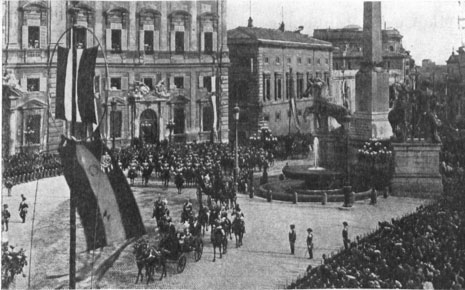
Just one month prior to the start of the war, Post journalist Will Payne reported from Europe, where he had been researching finances on the Continent. He learned that Italians paid more taxes than any other nation in Europe—and were glad to do it. Taxes were essential to maintaining their army, Italians told him, and preventing France and Austria from returning to rule them. In “Barracks and Beggars,” Payne reported that the people of Italy would pay their last cent and put every one of their men in uniform before submitting again to foreign domination.
When Payne crossed the border into France, he found the same militaristic attitude, but in this case the cause for concern was Germany. The French overwhelmingly supported the stiff taxes that were building up their army, though it consumed nearly half the national budget. Nor did the French object when the government extended the length of mandatory national service from two to three years. A banker told Payne, “I was in favor of that, and so, you will find, were a majority of Frenchmen. Look at what they are doing in Germany, with their new regiments and extraordinary war tax. If they arm, we must arm. It is the price of our life. Germany hates us as much as ever. To disarm would be to commit suicide.” Payne added, “nearly all Frenchmen talk the same way.”
June 20, 1914 © SEPS
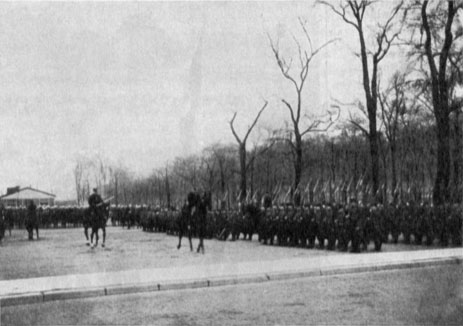
The French believed that military training not only kept the country strong but gave pride to its young men, as well as an appreciation of order and hierarchy. “At least a dozen men, first and last, emphasized the point that it taught obedience to authority; or, as one of them more accurately put it, ‘It teaches people that some must command and some must obey.’”
It was a similar story in Berlin, where Payne found “the German businessman speaks of his war taxes as insurance—that is, he regards the tax receipt as a policy of insurance that for another twelve months no British cruiser will shoot the roof off his warehouse.”
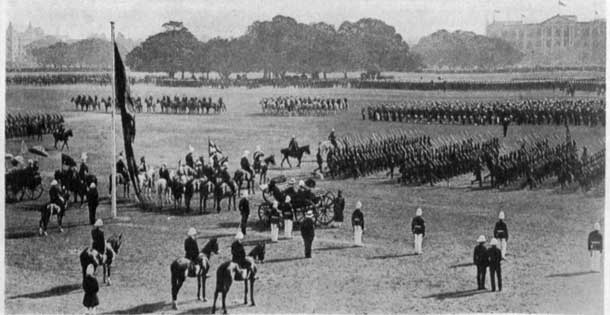
The militant spirit had infected Great Britain as well. The British feared losing the global dominance of its navy, particularly since Germany had begun expanding the number of warships. And so Parliament was continually increasing the budget to expand the Royal Navy. But a naval victory over Germany would be useless, the ministers argued, unless a strong, well-drilled British army could secure victory on land as well. So the army’s budget had to be increased as well. Meanwhile, “elderly gentlemen in possession of pleasant jobs and comfortable incomes” insisted that the young men of England required military drill and discipline to guard their character and protect them from dangerous social ideas.
June 20, 1914 © SEPS
All the nations of Europe, Payne found, were locked in an ever-escalating spiral of military preparation. Every country feared the imminent domination by another.
So, for example, the German Kaiser would call on his nation to ensure its security with more men for its army and more millions for weapons. Russia and France would then call up more men for service and hike their taxes to regain the balance of power. And so Germany would launch yet another campaign to gain a strategic edge.
“Militarism is costing Europe about two and a half billion dollars a year to support in idleness some five million able-bodied men who might be productively employed,” Payne wrote, “and its path still pursues an upward spiral.”
He recognized the militant attitude would seem strange to readers of the Post. “Americans think of war about twice in a decade, and then with no very keen interest,” he wrote. “In Europe they think of it all the time.”
It wouldn’t have surprised him that, when the governments of Europe declared war, the news was welcomed by delirious crowds, who jubilantly marched up and down the streets of Berlin, Paris, St. Petersburg, and London. Men not already in uniform rushed to join the great cause, which would liberate their country, at last, from the perennial threat of some neighboring country.
The leaders of Europe’s government might have been surprised that the war came as it did, when it did, but they shouldn’t have been shocked by the war itself. As the Post had been reporting, they had been stoking the enthusiasm for it for years.
Beyond the Canvas: Covering Up
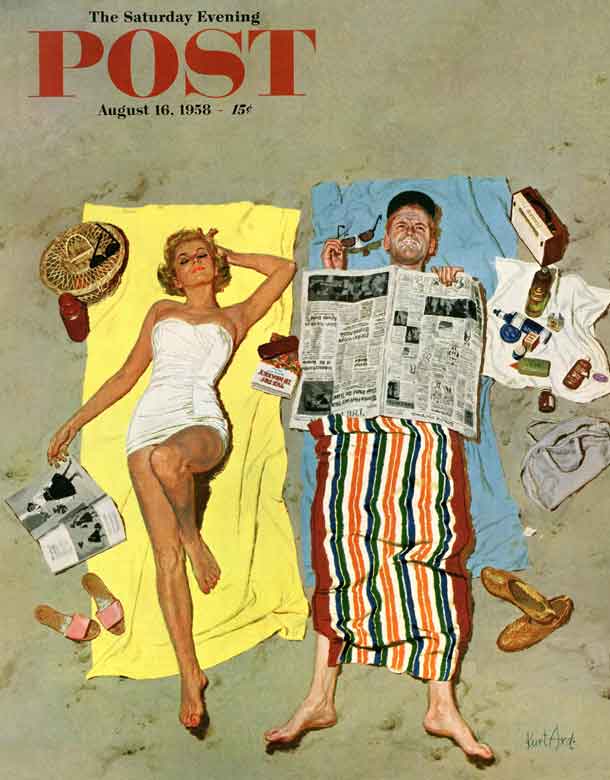
Kurt Ard
August 16, 1958 © SEPS
The Saturday Evening Post’s August 16, 1958 cover “Sunscreen?” wasn’t just about covering up to save delicate skin from a blistering sunburn.
On the surface, the illustration shows a couple who have a different approach to a day on the beach–the woman enjoys the full force of the mid-summer sun, while her companion, much less concerned about tanning his lily-white skin, hides under the safety of his beach towel.
But covering up was more than a relatable joke in this illustration. It was a very real problem artist Kurt Ard had to solve to make his cover appropriate for publication.
Ard painted his illustrations from his studio in Copenhagen, Denmark. When he submitted sketches to The Saturday Evening Post, he had to wait for replies from the art department and his editors before he could start applying paint to canvas, and sometimes he had to stop working all together to wait for approval if he wanted to make any changes to the piece before it was finished.
In the 1950s, bathing suit styles were ever-changing (shrinking mostly). Ard’s initial sketch for ‘Sunscreen?’ included a short skirt for the woman’s swimsuit, as was the European style. But American swimsuits in the 1950s, had a more modest-length skirt with tight shorts underneath to keep the legs covered (more commonly known as a skort).
When Post editors asked for updated sketches, they were shocked to find the tanning woman in short-skirted European swimwear. Ard hadn’t asked for approval to make this change, and wasn’t aware of American sensitivities in swimwear to consider an executive decision like this could pose a problem.
Unfortunately, by the time editors notified Ard that the sketch was inappropriate, it was too late for him to start over on the illustration. Instead, he made a simple fix to cover up both the woman and his mistake by shifting the woman’s left knee so the skirt looked to have fallen back to her hip as she lay down.
He managed to pull off the solution just in time for publication. The viewer still gets the illustration’s contrasting point, and America was none the wiser to the more ‘scandalous’ European swimsuit that had appeared before. This comical cover remains a favorite at the Post to this day.
The Parts You Get to Keep
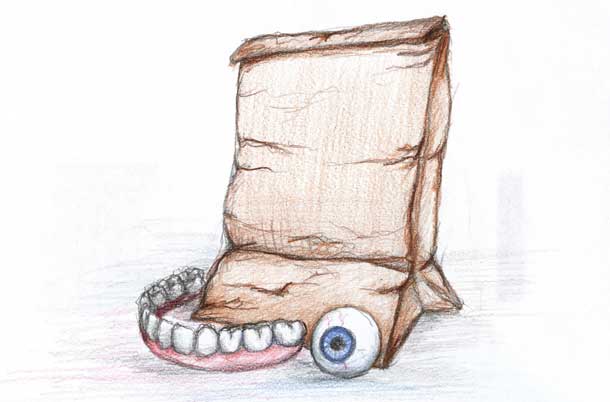
My grandfather looks like that because he has a glass eye, and he can’t help it. He’ll remove it, along with his whole set of teeth, if I ask him to. He’ll be a hollow faced grandfather, if I ask sweetly enough and if he feels up for it.
I traveled once all the way from Raleigh to New York City in the back of my parents’ 1987 Toyota Station Wagon with Laura Newton, who also had a glass eye. She’d lost her real one to cancer when she was a baby, but had a handheld portable television that showed fuzzy programs in black and white, which made up for it.
It felt lonely, staring at that tiny screen while my parents sat quietly in the front seat, fielding bumps in the road and stalling too long in heavy traffic along I-95, my father cussing beneath his mustache while my mother rubbed the top of his hairy paw on the clutch to calm him down. But watching that buzzy little television screen felt like doing something, and it felt novel. Cut the stretch of hours and highway ahead of us into something digestible.
What’s funny is that my grandfather also has cancer, and also has a glass eye, just like Laura, which makes me think they’d have a lot to talk about if they ever met each other. I’m always thinking of ways to make people less lonely, and I think part of this—in this case, at least—involves introducing them to people also missing things in their faces.
I tell him this, standing small by his hospital bed, with its gray-blue and tucked white and antibacterial, band-aid-y smells, and he smiles big which makes his big cheeks even bigger, and the little red spots he had all over his body stand out more red, almost pulsing. He told me once that when you get old enough, the universe gives you red spots, to celebrate your years, alive, on earth. A kind of skin confetti. He was full with spots, especially on his chest, beneath his plot of thick white hair. There must have been hundreds.
My mother is starting to get them, too. I saw three the other day while she was driving me to school; her sweater slipped down her shoulder, revealing the top of her chest and a small bit of her bra, which was bland and beige and utilitarian. Two of the spots were very near each other and the third several inches away, like it had done something to displease the other two and had been ordered away to skulk on its own private patch of skin.
Rabbit and Jo and I were like this. We switched off allegiances by the calendar year; there wasn’t space enough yet in any of our hearts to properly entertain two other people, so one was always forced out. This also provided the other two—the lucky two, allowed their girl-love—games to play at the expense of the third.
Rabbit and I liked to write scripts that we’d plan to send to the Nickelodeon show “Are You Afraid of the Dark” in which we were twins and Jo was our ugly and evil red-headed nemesis, who we were charged to defeat and who always ended up either imprisoned or dead. We’d cackle at each plot twist. Rabbit would suggest “and HERE’S where the red-headed jerk falls in the middle of the haunted field and chokes on a cow pie mixed with her stupid red hair and a bunch of bird bones!” and our eyes would light up because we were so smart, and so good at being cruel. There were other nights we’d kiss each other, just to see what it felt like, or remove all of our clothes and compare our bodies in the coy amber light of her room.
And then it would be me and Jo, secreted away in Jo’s house across the road, throwing pennies at the railroad tracks as we heard the trains’ chugging, lumbering approach, waiting for our change to get smashed flat and wide so we could rub it between our fingers and feel we were holding something rare and extraordinary to keep in our pockets and brag about the next day at school.
Or it was Rabbit and Jo, and I would be the one told to leave their game of Kangaroo hopscotch because it was only meant for two, in the patch of uneven dirt and grass behind Rabbit’s small gray house. Her mother had also painted the door gray, and put in a small row of concrete steps, so the whole place looked somewhat sunk and dead. Like it was always sleepy. I decided I didn’t want to be there anyway, when my own house was pale yellow, with a blue door and a wooden hanging of birds on the door-knocker my mother had found in a catalog from China. It always bothered me, though, that the two baby birds always had their mouths open for something that never came, except when it snowed, and then they just looked cold.
*****
We didn’t see it coming—that we would grow older and go to different schools and become like the triad of small red dots I noticed on my mother’s back a different evening, months after the first time—each one separate from the other by great stretches, like they’d all turned their backs at a common point and walked away.
I’d see Rabbit through the window of my room, which faced her house, walking with a tall prep-school boy to his car and speeding away. We went to different schools, and she’d gotten prettier than I had and it made me jealous and also wonder at how our bodies would compare now, if we’d stripped nude and stared at each other again in the calm hum of lamp light. Like we used to, before it meant anything. I realized I wanted to do that, not necessarily with her, but with others like her. People I didn’t know yet, people I might see as different versions of the self I could have become, had I been different than what I was.
Some years later, my grandfather died. The red dots had made his body their night sky, in summer, in the country, where everything is clear and black behind them. They covered him, his frail little body. I wondered what they would do with the parts of him that weren’t his. His glass eye and fake teeth. I asked one of the nurses if I could have them—his removable parts—and watched her shoulders rise all the way up to her ears. More than anything, she looked worried, and very sad, as she stared at me. They were the only parts of my grandfather I could pull out of him and keep; I had to try to keep him.
My family crowded around his body in the hospital bed, and my aunt kept pulling the blanket further and further up his chest, so he wouldn’t get cold, even though he was dead and that meant he would probably always be cold from now on.
Before we left, the nurse handed me a paper bag; inside it were the bottom set of his teeth and his glass eye in a plastic sandwich bag. I don’t know what changed her mind; maybe she realized, in his pine box in the dirt, he wouldn’t miss them. He and Laura would never have the chance to meet, but, if I ever saw her again, I could show her. Maybe I’d move her to tears, and I’d get to see what it looked like—one eye crying. I’d never seen my grandfather cry. He was of the stoic generations that preceded the generation of my father, who cried all the time, with both eyes.
Rabbit and Jo both came to the funeral, but we’d grown past the point of easy conversation. We moved in different circles now, and I’d started kissing girls, and someone at a party had spotted me and Elena Gunderhurdt pressed into each other against the side of Jacob Wexler’s parents’ garage, and rumors were spread. Most people viewed me like I had a disease they might catch, if they got too close. They didn’t even know about my dead grandfather’s glass eye, watchful on my bookshelf, and still I was ostracized. Jo was cautious, and Rabbit even more so, because of what we’d done together.
What was obliterated was the fact that I kissed boys, too. I kissed them both, when I got the chance. But no one cared about that. All they cared about were the girls, and the infection I held. I didn’t want them to have it. It was painful and wicked, wrapped around my insides with a split snake tongue that jabbed at my heart every so often and doubled me over. I felt cursed, and wished I could be anything else, but it never happened. I was never anything else.
Jo and her family moved away from North Carolina at the end of summer, and we barely hugged goodbye in our cut-off shorts and tube tops in the roundabout between our houses. The Millers’ mailbox sat knocked to its side and smashed on their lawn behind us. Through my bedroom window, I’d seen one of Rabbit’s friends bash it hard with his open fist and hoot and run away into the night like a meat-headed lynx. I’d seen her father drinking on the front porch, rocking in their unpadded swing and swinging his bottle of Jack through the gray air that seemed to come off their gray house like factory steam.
*****
By the time we’d finally reached New York City, on our long trip in the 1987 Toyota Station Wagon, Laura’s television had run out of power. I watched her glass eye to see if it reflected the gray-blackness of the tiny screen differently than a real eye. But it didn’t, really. She just looked ashamed, and then relieved when we reached her aunt’s apartment on the Upper East Side. Even her scoliosis-back, disappearing inside the gold light on the other side of the door, seemed relieved.
I watched Pet Cemetery and read The Phantom Tollbooth, terrified and elated, in my parents’ bed in the hotel room while they went to dinner and walked through the wet streets of New York Autumn, my mother’s heels spearing leaves through their center and dragging them back with her where they split and crumbled along the hotel carpeting. I pretended to be asleep when they came in—drunk, whispering and kissing.
My father lifted me from their bed into his arms and carried me to my cot. His leather jacket was still on and smelled strongly of itself, which was also the smell of him. Raw and spice and safe. Old leather father smells. He shut the light off and hummed “Riders On the Storm” as he pulled the standard-issue hotel blanket up to my chin and I lay awake for a while after that, listening to the sounds of him and my mother enmeshed in nighttime ritual, cataloging the sounds of that particular night spent being alive.
Beyond the Canvas: Running on Fumes
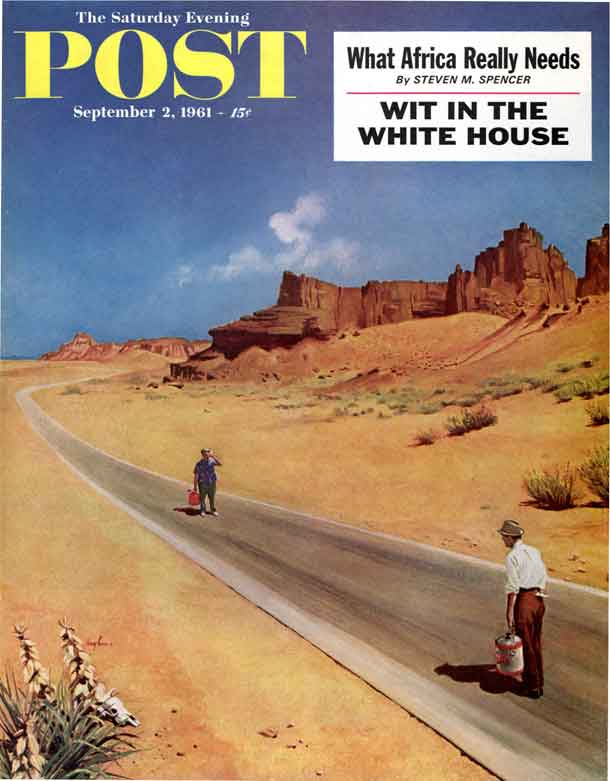
George Hughes
Sept. 2, 1961 © SEPS
What’s worse than walking miles to the gas station after running out of gas? According to artist George Hughes, it’s the reality that there never was a gas station in the first place.
His September 2, 1961 cover, “Out of Gas,” confuses viewers with a befuddling logic problem, a dark joke, and a sad situation one hopes never to encounter.
A realist painter, Hughes incorporates the awe-inspiring vastness of the southwestern American landscape into the story he paints. The surroundings are empty in a borderline surrealist manner. The scope of the desert is immense. The empty blue sky adds to the scene’s sense of total isolation. The large composition’s horizon line trivializes the two human forms to enhance the distance they have already overcome.
Understanding this cover takes some quick logic to work out the predicament. The two men walk the same unending road, hoping to find a gas station. Assuming the next gas station was closer than the last one they had passed, the two men set out ahead of their stalled vehicles in search of an oasis. Unfortunately, as the two men meet what might by several miles down the road from their cars, they realize they assumed incorrectly. They must return from whence they came, and start the journey for a gas station over in the opposite direction.
Hughes picked the exact moment the two men stop in their tracks to realize their horrendous choices. The artist even painted a dried out skull of a dead animal by the side of the road. This simple reminder hints that, while funny, a dehydrating situation is no laughing matter.
Even the title of the illustration provides a quirky, yet insightful pun. Not only are the vehicles out of gas, the men are too. The figures are slumped in hopeless desperation. One man dresses in the casual attire of vacation, the other in white-collar workday clothes. The day hasn’t gone as planned for either one.
George Hughes had a talent for connecting with his audience through humor, and viewers typically enjoy his work because they identify with each painting’s message. One might not ever actually walk the wrong way to a gas station in the desert, but we all face agonizing mistakes we regret when we’re already running on fumes.
The Secret of Bruscar Skerry
It was the third time he threw his plastic into the garbage instead of the nearby recycling bin that I knew with a sudden certainty that Dave Holden from accounting was going straight to hell. I wasn’t sure what hell, exactly, but whatever his spiritual persuasion, he sure wasn’t bound for paradise.
The polyethylene terephthalate in his bottle would degrade quick enough, sure, but plastic doesn’t disappear in a puff of smoke and fluttering doves. It just keeps dividing, into smaller and smaller bits, eventually ending up in the guts of whatever poor creature is clueless enough to swallow it up.
Anyway, I didn’t say anything.
In five minutes I’d clock out of the lab and cash in all my paid time off–nine much-needed months. Work at the Schenectady Chemical Recycling Facility would go on without me. They’d only be missing a handful of plastiphage microbe samples.
I’d developed and synthesized the microbes myself, it wasn’t like I was stealing them from the facility. They were mine, my bacteria babies, and I couldn’t help but feel a certain patriarchal fondness for them.
Now, armed with a doctorate in biochemistry, my dad’s old sportfishing boat, a sealed case of bacteria that could eat through plastic and nine months paid time off, I was ready to clean up the world’s oceans.
It wasn’t so different from maternity leave, really.
I was just taking care of a very dirty, salty child.
In the gyres of the Atlantic and Pacific oceans floats the Great North Atlantic Garbage Patch. The island drifts aimlessly, a tiny sanctuary for all the trash and rubbish of industrialization, birthed of man but not man-made–the collective refuse of the northern hemisphere, fused together through the cyclical patterns of ocean currents. The patch is constantly in transit, spinning clockwise around the Atlantic, and though it swells immensely with every passing year, it remains nigh impossible to find, despite countless attempts by fanatical environmentalists and youthful marine biologists.
Fitting neatly into both categories, I’d fixed up my dad’s old boat. It was cleaning day, and I’d decided to start with the Atlantic.
The Pacific is just too big.
*****
I realized after the first three weeks that it wasn’t going to be quite as easy as I’d hoped.
The hunt for the North Atlantic Garbage Patch took me from the beaches of Morocco to the cliffs of Ireland. On the advice of an itinerant whaler in the Faroe Islands, I spent seventeen days combing the waters north of Shetland. I ran out of fruit leather and rice cakes and moved on to the mackerel I’d been catching and drying on lines above-deck.
Finally, on the 98th day of my quest, I caught wind of my quarry.
My first response was to retch violently, emptying my breakfast out over the starboard side of the Lady Green. The scent of curdled milk, carrion, and old cat litter assailed me, clinging tenaciously to the air about me, surrounding me in a reeking cloud. It smelled like burned plastic and fossilized pizza crusts. It smelled like an Indian landfill after a month-long monsoon.
I clamped shut a pair of nose-clips and maneuvered the Lady closer to the garbage patch.
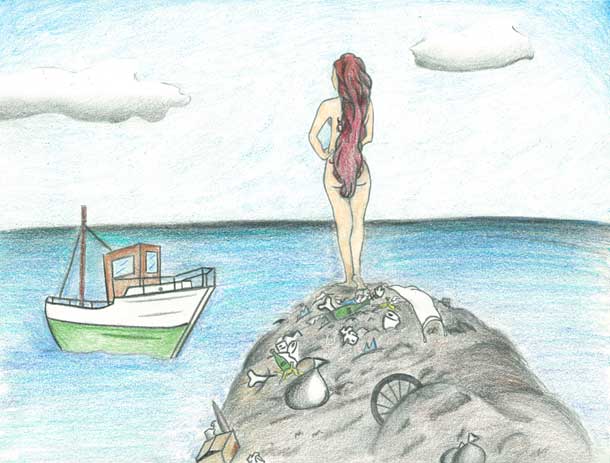
That’s when I saw her–a woman lounging atop the trash, luxuriating in the sun. Curly red hair cascaded down her back, covering her ivory body in a rusty quilt. A stained jacket and sundress lay draped over the trash alongside her. Her eyes shimmered as bright and wet as the meeting point of the sun and the sea, and for a moment, I forgot about the piles of garbage littered all around me, the swelling dunes of refuse that roiled beneath us.
She was pale and thick, and ten types of beautiful.
I cleared my throat, searching for something clever to say, and she squeaked and dove into the water. A moment later, her head broke the surface.
“I’m sorry,” I said, “I didn’t mean to scare you.” I still hadn’t thought of anything clever.
She giggled. “You didn’t scare me. You’re trespassing, though.”
“How’s that? These are international waters. No one owns the North Atlantic Garbage Patch.”
“Garbage Patch?” She spat out a fountain of seawater and glared at me. “This is Bruscar Skerry. My home.”
I raised my eyebrows. “You live on a floating island of trash?”
Somehow, she managed to sniff. “Why wouldn’t I?”
“For one, it stinks.”
“You stink.”
“Well, I’ve been at sea for three months.” I paused. “Still, point taken. Besides the smell, though, this garbage patch is killing countless fish and birds.”
She shrugged. “To live is to kill.” She pointed at the mackerel filets drying over the deck of the Lady Green. “Those fish just fly up onto your deck and skin themselves, did they?”
“Look. Your home is tearing apart fragile ecosystems. I’ve come to put a stop to it.”
“Over my dead body, maybe.”
I sighed. “I think we got off to a rough start. I’m James. What’s your name?”
“Ligeia.” She eyed me suspiciously. “I’m not going to marry you.”
“What?”
“Don’t patronize me. You men are all the same. See a woman enjoying the sun? She must need a husband. Well, that ain’t me, babe.”
“You’re being ridiculous. I’m not trying to marry you.”
“So you don’t want me to come up on your boat?”
“Well,” I cleared my throat. “I guess you’ll have to go somewhere after I destroy the patch. You may as well come with me. I can get you back as far as Belfast, or farther south, if you want.”
“Of course.” She rolled her eyes. “I’ll bet you can make women come with you anywhere.”
“That’s not what I’m saying!”
“You don’t need to say it. I’m not blind. I saw the way you were eyeing me up.”
With that, she dove back under the surface of the water, disappearing under a mound of plastic six-pack rings. I cursed and considered my options.
Beyond the Canvas: The Permanence of Baseball
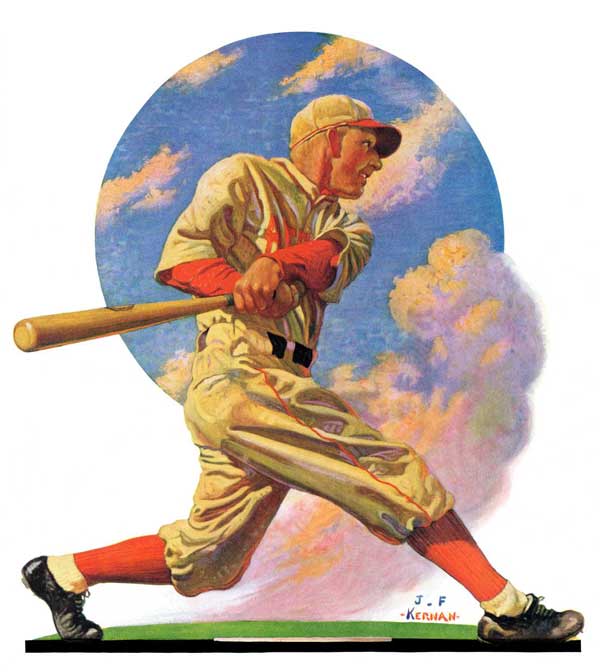
J.F. Kernan
May 28, 1932 © SEPS
Attending a game of America’s favorite pastime is a cultural experience. Scattered across our largest cities and smallest towns, baseball diamonds are famous for their fresh-mown grass, peanut-callers, fighting umpires, and of course, hot dogs and Cracker Jacks. Throughout the twentieth century, The Saturday Evening Post has filled its covers with images of a day at the ballpark.
Traditions big and small helped cement baseball’s dominance in our national sports history.
Beginning with J.F. Kernan’s May 28, 1932 cover Baseball Batter, we see the sport’s uniforms haven’t changed much in the last eighty-two years, and today the atmosphere of a ballpark is much the same as it was back then. Watching from the stands with a beer and a hot dog on a sunny day, one might see a similar batter swinging away over home plate.
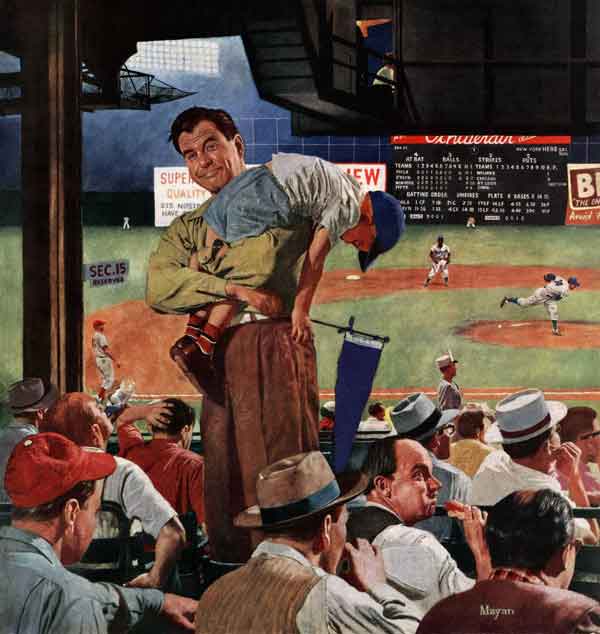
Earl Mayan
April 23, 1955 © SEPS
And how does America get hooked on the game? Earl Mayan’s cover from gives us the explanation. Sleepy Inning shows a father carrying one tuckered out little boy from the stadium. Pennant in hand, the young fan must have cheered himself to exhaustion.
Many American parents start their children on the sport at a young age with little league or t-ball, sometimes before they’re even strong enough to hit a pitch. We also get hooked as a family, since games are an iconic family event–perhaps more so for fathers and sons–where we make memories and form bonds. In the stands, spectators of all ages watch the game while dads shimmy through the crowd with staples from the concession stands.
Rockwell’s Bottom of the Sixth (Three Umpires) from April 23, 1949 focuses on the dour prospects of a universal disappointment–a rained out game. While two team managers fight about whether a player was safe or out, the umpires focus on falling droplets from rumbling storm clouds overhead. Rockwell’s title connotes dread. If the ballpark has to wait for the storm to pass, it’ll be quite a long seventh inning stretch.
Styles and fads have come and gone with each new decade in America’s history, but baseball has stayed nearly constant. Whether you visit Fenway in Boston or Wrigley in Chicago, fans of all ages still cheer from the stands over the sounds of cracking bats and hollering concessioners. As The Saturday Evening Post covers show, we can relate, at least in one way, to the past through the maintained traditions of this shared sporting experience.
J.F. Kernan
May 28, 1932 © SEPS
Earl Mayan
April 23, 1955 © SEPS
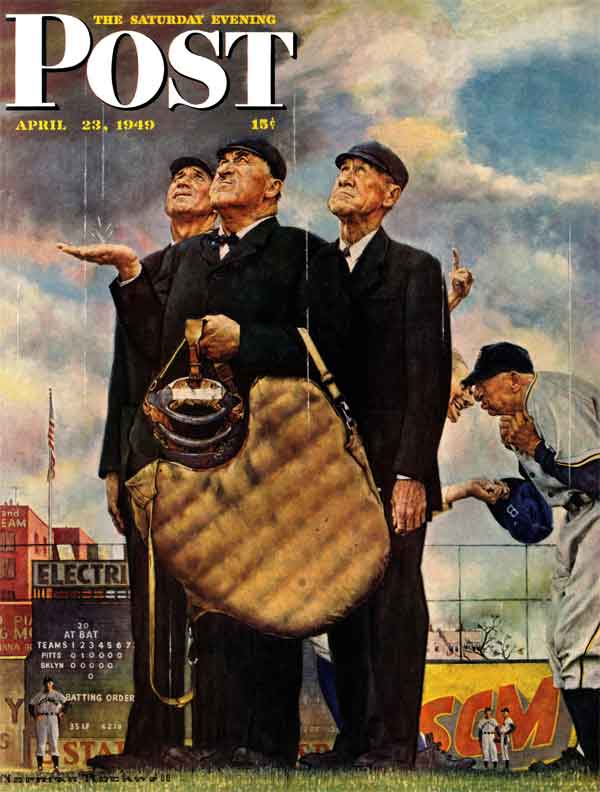
Norman Rockwell
April 23, 1949 © SEPS
Baseball lovers: Don’t miss our Baseball Special Collector’s Edition!Celebrate nearly 200 years of America’s favorite pastime with striking illustrations by Norman Rockwell and other great American artists, rarely seen photos, and stories by the greats and about the greats from the pages of The Saturday Evening Post.Click here to purchase your copy while supplies last!
Summer of My Youth

I’m of the opinion that nothing is ever truly forgotten. A memory can be submerged below the surface, buried for years, then you smell a specific scent or hear a certain phrase and the memory returns. Not always intact. Never perfect. But somewhat restored.
Summer came back to me that way. After thirty years, she returned as I lay on the floor of my office, pain tearing through my chest and down my arm, dying. I saw her, not in the room with me, but in the hot July sun, her dark hair curled around her finger. Her head was tilted in that way she always used to tilt it when she was flirting, grinning up at a boy at an angle to show off her long lashes.
She wasn’t a hallucination. She wasn’t a ghost. And I wasn’t going crazy as the life left me. It was a memory. God only knows what sparked it, but there she was, and I knew exactly what day it was, too: Independence Day, 1961.
It began with oppressive humidity and the threat of a storm that never came. Dark clouds passed over and away without dropping any rain, and afterward people poured out into the sunshine to celebrate their freedom.
It’s odd, the details that sprang to my mind after so many years. I saw her quite clearly. Her searching eyes. Her delicate hands. Her slightly crooked teeth. They all looked right. But something wasn’t. Something was off. I studied her closely, and it took me only a moment to find it. The nose. It wasn’t hers. It was too perfect. Too…man-made. I guess I shouldn’t have been surprised. Thirty years is a long time to remember something as small as a nose, and a memory so long abandoned can never come back completely intact.
At least the freckles–the design they made on my summer girl’s face–were still there, probably ingrained in my memory from the many nights I spent staring at them, counting them, exploring. I searched for constellations in those freckles as eagerly as an amateur astronomer searches the stars for new wonders. And I found plenty of them.
But I had no time for staring that day. It was a day for activity. Only the bees seemed lazy, buzzing around the blackberry bushes in the afternoon sun. The fat, juicy berries hung heavy on the bushes that ran alongside the fence line behind her house. I plucked one from the nearest branch and gave it to her, then we climbed through the four-strands of barbed wire and took off toward the creek.
I chased her, Summer of my youth. We raced through the neighbor’s field. She liked to think she could beat me and I let her edge ahead.
We frolicked across the grassy expanse, jumping and leaping through knee-high stems until, midway through the field, I bounded over a fallen log and landed on the other side with one foot in a hole. I tipped forward, falling flat on my face, and when I clambered to my feet, lucky not to have broken my ankle, I saw her with a hand over her mouth. She only contained the laughter long enough to see that I was okay.
Why was her nose gone from my memory but her laugh echoed around me as if she were in the room?
*****
The sun beat down on us in the empty field as we returned to a sedate walk. I limped slightly.
“You’ll leave soon, won’t you?”
She didn’t look at me. Her gaze was fixed on the ground in front of us. She bent to pick a daisy when we reached the edge of the field and stopped. She twirled it between her fingers, watching the petals spin like a pinwheel.
“I must,” I replied, losing my gaiety.
The seriousness of tomorrow intruded rudely on the day, disturbing me, rupturing the pleasant bubble of well-being that had ballooned within me during that summer of joy.
“Really?” She cocked her head to the side, the cascading ringlets of her brown hair falling over her shoulder. “You must?”
“You know I have to. If I don’t go now, I never will. This is the opportunity of a lifetime.”
I reached out and took her hand in mine. The skin, a shade paler than my own, looked ghostly, almost translucent. Blue veins showed just below the surface.
“You won’t come back.”
The words by themselves sounded accusing or angry, but her tone did not. She said it merely as an observation. A fact.
“I will,” I insisted. “I’ll come back for you.”
At the time I meant it, but I never returned.
Why? I worked, I obtained, I grew. That’s the easiest answer. I never ate a wild blackberry off the bush again after that summer.
She didn’t respond. She knew my own truth better than I. She leaned forward and kissed me gently with soft lips still sticky with juice.
“Why don’t you come with me?” I said as I traced a design idly on the back of her hand with my index finger.
She laughed, pitching forward onto my shoulder. “Henry, you know that’s ridiculous.”
And somehow, it was. She wouldn’t fit in where I was going, and she wouldn’t want to. She wanted a simple, uncomplicated life, and I wanted something different. I wanted to own things, to run things, and most of all, to feel significant.
Well, I achieved. I got everything I ever wanted, didn’t I? My name was on the door of the office. My face was plastered on billboards. I was even featured in cheesy television ads. I personified what I always imagined ‘successful’ to be.
The Civil Rights Act vs. States’ Rights
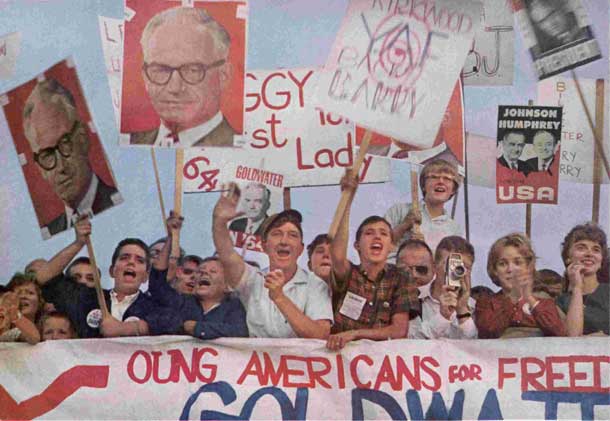
Photo credit: Burt Glinn
The Saturday Evening Post, October 24, 1964.
No one was surprised when President Kennedy’s Civil Rights bill was blocked by a group of 19 senators in 1964. On March 30, they launched a filibuster to prevent a vote on the bill, knowing that if it passed, it would seriously challenge the racial status quo in their states.
As described in a Post editorial, the bill would ensure black Americans’ voting rights, end discrimination in public accommodation, and empower the U.S. Attorney General to bring lawsuits to desegregate public schools. It would also let the federal government cut off assistance to state and local programs that practiced discrimination.
One of the bill’s most vocal opponents was South Carolina’s Strom Thurmond, who called the bill “unconstitutional, unnecessary, unwise…beyond the realm of reason.” A Georgia senator added, “We will resist to the bitter end any measure or any movement which would have a tendency to bring about social equality.”
But after 54 days of filibustering, the bill’s supporters had gathered enough votes to end the filibuster. On June 10, the bill was voted on and passed, 73 to 27. President Johnson signed it into law on July 2, fifty years ago to date.
Arizona’s Barry Goldwater was among the 27 senators who had voted against the civil rights bill, but he wasn’t discouraged by the defeat, because he planned to use the bill’s passage to help him win the presidency in the fall election.
Goldwater recognized that the Civil Rights Act would split the liberal and conservative wings of the Democratic Party. For years, the Democrats had been able to hold these two warring factions together, but as the liberal wing began supporting the growing civil rights movement, many white, conservative Democrats began withdrawing their support of the party their families had supported for generations.
The day would come, Goldwater predicted in a 1963 Post article, “The G.O.P. Invades the South,” when the region would vote solidly Republican. He noted that Republican candidates were already winning elections in Florida, North Carolina, and Georgia. The South would shift its party allegiance, he said, because of “a profound evolution of political thinking and acting.”
It had nothing to do, he asserted, with white voters being angry with liberal Democrats’ support of integration. Southerners were leaving the party, he said, because they believed in “state’s rights,” and limiting the role of the federal government. They viewed the Civil Rights Act as an intrusion that, Goldwater argued, would eventually lead to “the creation of a police state.”
Civil rights were important, Goldwater believed, but they were “resolved more safely and soundly on the state or local level.”
But the local level, as Anthony Lewis wrote, was precisely where the problem lay. (“Goldwater Is Wrong On Civil Right” September 26, 1964) The law in southern states and towns was vigorously enforcing racist policies, using intimidation and violence to deprive African Americans of their rights.
The U.S. Government had tried Goldwater’s approach for nearly a century, Lewis argued. When states were left on their own to handle race relations, “the result was massive inequality, injustice, and cruelty that shocked the conscience of this nation…The law has been cynically manipulated to maintain white supremacy, in defiance of the most elementary rights of a citizen.”
Federal intervention was necessary, he said, to prevent state officials from enforcing racist politics, as in the illustrations he offered:
• When a Mississippi college student asked a country registrar’s help to enroll black voters, the registrar refused, threatened him with a gun, and then, as the student was leaving, clubbed him over the head. The student was then arrested, jailed, and charged with disturbing the peace.
• Twelve black residents in Louisiana asked city officials to form a committee to address race relations in the community. All twelve were arrested on charges of intimidating public officials. Their bail was set at $30,000.
• When a young civil rights worker was arrested in a Georgia town, she called her father, who drove down from Kansas to bail his daughter out of jail. As they were leaving town, a police car pulled them over. The father was arrested, frisked, handcuffed, and put in county jail for “driving a car with a bad muffler.”
• Fifty-seven black Mississippians asked their local deputy sheriff to protect them from harassment during their voter registration campaign. The sheriff arrested them and charged them with disturbing the peace. After a night in jail, 46 of them were tried and sentenced to six months in jail and fined $35,000.
• Over 300 Freedom Riders, both black and white, were arrested in Jackson, MS, for attempting to break local laws that segregated bus terminals. Charged with “breach of peace,” they were unable to get the charges dismissed until they took their case to the Supreme Court
By emphasizing states’ rights and dismissing the problems of civil rights, Lewis wrote, Goldwater encouraged racist politicians like Governor Wallace of Alabama to defy federal law, acts which contributed to the atmosphere of violence in the South.
“There have been so many horrors in the last year,” Lewis wrote, “that one’s senses have become numbed: four little girls killed in the bombing of a Birmingham church; Medgar Evers of the N.A.A.C.P. shot outside his Jackson, Miss., home; a negro army officer murdered as he drove along a Georgia road; three civil rights workers murdered in Mississippi; and 15 negro churches in that state burned within a month.”
While Goldwater was looking forward to a solidly Republican South, a Post editorial was foreseeing an angry black community. Within the decade, the editors wrote, most of America’s largest cities would have populations that were mostly African American. Unless they were “given hope and some sense of citizenship and self respect, this huge majority is dead sure to be led by people who hate the guts of every white man.”
Goldwater lost the 1964 election by the largest margin in 144 years. He won only 38.5 percent of the popular vote and carried just five states in addition to Arizona. All five were in the south.
Beyond the Canvas: Fireworks, Fanfare, and the 4th of July
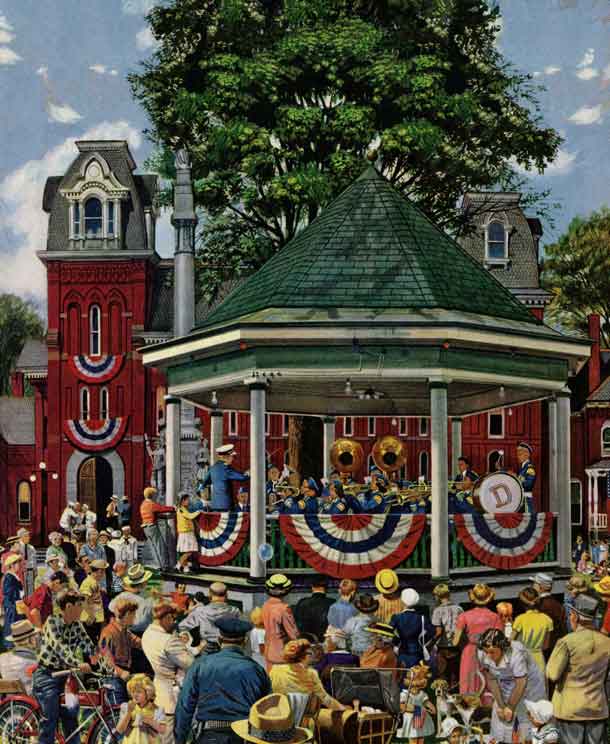
Stevan Dohanos
July 7, 1951 © SEPS
The Saturday Evening Post has celebrated many American Independence Days with beautiful covers that set the country’s mood for the red–white–and–blue doused holiday.
On past covers, our artists chose a variety of ways to show how Americans have gathered for the 4th of July.
The day brings out bands, orchestras, and symphonies to dust off the sheet music and play familiar American tunes.
Stevan Dohanos‘ Patriotic Band Concert from July 7, 1951, shows a community square filled for the day’s brass fanfare.
The lofted gazebo allows attendees a good listening spot from all around the town center. Cities and small towns alike still have parades, ceremonies, concerts, and picnics they offer free of charge.
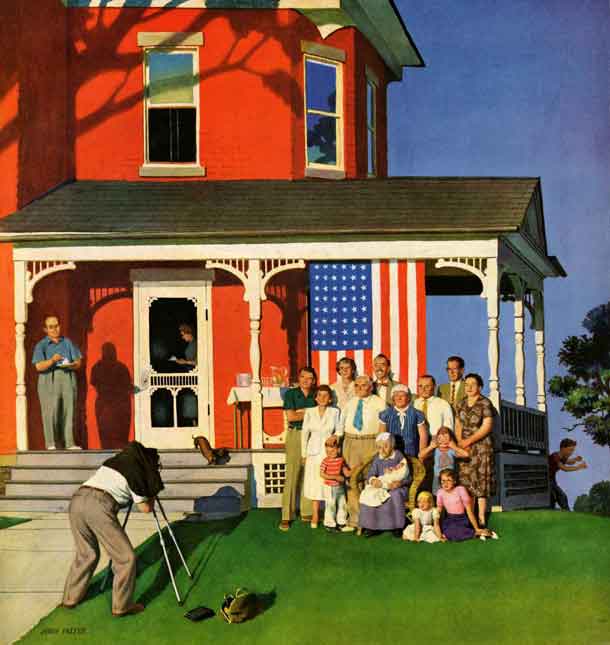
John Falter
July 5, 1952 © SEPS
Our July 5, 1952 cover, Family Portrait on the Fourth by John Falter makes a picture of the fourth of July day itself.
He incorporates the house and unremarkable-yet-presumably-American landscape to create a portrait of celebration in the rural, maybe even more ‘traditional’ parts of the country.
The blue sky, red house, and white porch all enhance the colors of the flag in front of which this family gathers to have their picture taken.
And last but not least, what would Independence Day be without the spectacle of independence night? Ben Prins’ Fireworks from July 4, 1953 marks the holiday’s end with celebratory bombs bursting in air, as we pay homage to those who have fought and died for our country.
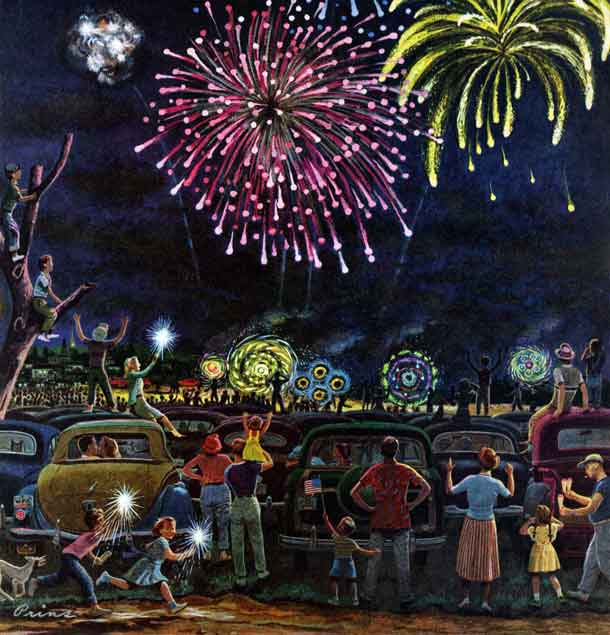
July 4, 1953. © SEPS 2014
If you look closely, you’ll notice that the color scheme of the sparks form a choreographed red, white, and blue flag.
The holiday can be a sticky, humid afternoon of grill smoke and supply errands. But at the end of the gatherings, the family portraits, and the concerts, we settle in for the evening spectacle.
Many families will prepare s’mores over a fire, and await booming fireworks that signal the end of yet another American Independence Day.
Natural Teeth Whiteners

Question: Can you suggest any home remedies to brighten my smile?
–Betsy Wilson, Omaha, Nebraska
Look no further than your kitchen. Several compounds found in foods have been shown to clean and whiten teeth. For a youthful appearance, International Academy for Dental-Facial Esthetics expert Marc Liechtung offers several natural whiteners:
Strawberries: Malic acid in strawberries is good for weekly whitening. Mash 2 or 3 berries with a pinch of baking soda. Brush for several minutes, then rinse well.
More fruits and veggies: Apples, pears, cauliflower, and cucumbers boost saliva production, helping to wash away stains.
Seeds: Poppy and sesame seeds act like natural toothbrushes.
Hard cheese: Academy of General Dentistry says enzymes and calcium in hard cheese fortify teeth and gums.
Steak: According to the American Dental Association, phosphorus in steak strengthens tooth enamel.
Tea: Delivers antioxidant polyphenols and fluoride, which protect against tooth erosion.
Sugarless gum: Artificial sweetener xylitol has been shown to stop tooth decay.