Charity Bawl
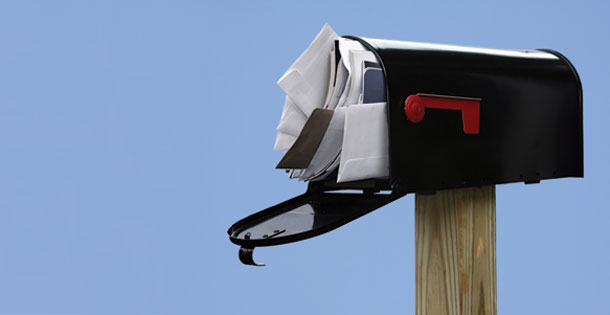
When I was a younger man, I didn’t understand the meaning of the expression “No good deed goes unpunished.” Well, I do now. All I have to do is look in my mailbox.
You see, I’m basically a generous guy. I donate regularly to a lengthy list of charities and causes. I always have; it’s the way I was raised. Even in lean times when I can barely make ends meet, I’ll send $10 or $20 to support this or that group in its time of need, which, as it turns out, is always. I’m billions apart from the likes of Bill Gates or Warren Buffet, but I do what I can.
So, what has been my reward, aside from a small tax deduction and a nice, warm feeling, for this largesse? An ever-rising tidal wave of appeals–as many as a dozen a day–designed to guilt me into a donation. A punishing procession of abused animals, starving children, displaced families, alarmed environmentalists, disabled veterans, even aging nuns–all with their tin cups out.
They arrive not only from the usual suspects, but also from organizations I’ve never heard of before. Obviously, some of my favorite charities have been selling or sharing their donor lists, and I’m a big, fat target for every kindred nonprofit. The mailman must think I’m bucking for canonization.
Now, I understand these folks need to solicit money to continue doing whatever good it is they’re doing. I sympathize, really. But what ticks me off are some of the ways they go about it. There are the unsolicited “special gifts” that invariably get tossed out: key chains, rosary beads, calculators, (hideous) holiday cards, calendars, “Native American” blankets (made in China!), mailing labels (which I never use if I haven’t made a contribution). The thinking behind these cheesy gifts is blatant: We gave you something, now you give us something in return. No thanks.
The blue ribbon for most annoying solicitations, however, goes to those that come with pennies or nickels glued inside (“Just 2 cents a day can keep little N’gomo alive”). I suppose this tactic works, since so many organizations employ it. But it doesn’t work on me. I can’t help thinking: If they need money so much, why are they sending it to me? For the longest time, I would return the coins. No more. Now I peel them off and put them in a jar to save toward donations to my favorite charities, ones that don’t send me useless gifts or loose change.
What’s truly sad about this development is how it has hardened me. It used to pain me to throw away an appeal because I didn’t have the money. But the sheer volume has become intolerable. Recently, I calculated how much I would pay out in a month if I donated just $5 to every appeal I received in the mail. It came to nearly $850 a month, or more than $10,000 a year. It’s getting easier to sigh and throw the lot in the recycling bin.
No, I’m not going to stop giving, but I’m more selective. I wish charities would realize that it doesn’t pay to abuse their donors with constant solicitations. You could kill the Golden Goose that way. Instead of sending key chains or nickels, maybe they should invest in follow-up software that tells them that I’ve just donated so leave me alone for at least a couple of months. Or that they’ve approached me four times already this year with no luck, so I’m obviously not interested. There has to be a better way of doing good.
Just stop the punishment, please.
Darla

She stood there in her velveteen dress, blooming and exotically perfumed, like a hothouse rose sprouting from the asphalt-colored carpet. Her hair, in defiance of modern styles and gravity, had been sculpted into a magnificent bouffant, and her white pumps matched her patent-leather pocketbook exactly.
“May I help you?” I asked, intrigued.
It was early January. The office was sluggish with post-holiday funk, and I hoped this singular woman would provide an engaging distraction.
She placed a hand on her chest, fingers splayed in a fan, long nails shining red. “My name is Darla. I’m the new secretary.” Her words hung in the air like ripe peaches, heavy and sweet.
“The new—” I broke off, confused. The CEO of our small company was out of the country, wooing some potential clients in Beijing. If everything went well, our business would double over the next two years, and more office help would be a necessity. “I’m sorry. I didn’t realize we’d hired an administrative assistant.”
Darla gave me a pitying look. “Oh, honey, you mean no one told you I was comin’? Well, don’t you worry, that sort of thing won’t happen around here anymore. I’m an absolute whiz at the organizational arts.” She opened her pocketbook and pulled out an envelope, which she handed to me with a flourish. “Here are my references.”
At that moment, Gordon, our senior VP, stomped out of his office holding a thick printout. “Guess what, folks? No one ever updated the old spreadsheet with the new product codes, and now all the orders that have come in for the last six weeks will need to be re-entered!”
Doors opened cautiously at the sound of his raised voice, and employees popped their heads out like prairie dogs.
“It’s going to take forever,” Gordon continued, “and all of these orders will probably arrive late, or with the wrong parts. Or both. We’ll lose customers over this. Vanessa’s gonna have a conniption when she gets back from China.”
He paused to wipe his mustache and seemed to notice Darla for the first time. “Who’re you?” he said.
She was unfazed by his hostile tone. “I’m your new best friend, darlin’,” she replied, plucking the sheaf of papers from his fist and smoothing them out.
I glanced down and was surprised to see that I was now holding her pocketbook as well as her references. When had that happened?
The timbre of Darla’s voice changed so that she seemed to be addressing not just Gordon but the entire office. “As soon as somebody finds me a desk and a comfy swivel chair, I’ll set down to work and straighten out those pesky numbers for you.”
Gordon blinked. His face was that of a man who unexpectedly finds himself standing in a sunbeam after months of cold rain.
We held our breath, waiting to see how he would respond.
After a few seconds, he spoke. “Kate, would you please show our new assistant to her desk? She can use Roger’s old office until we can get a more suitable workspace set up for her.”
“Sure,” I said. “It’s right over here.” I was very conscious of Darla gliding along behind me while I walked up to the door. As I opened it and turned on the light, I felt unaccountably nervous. It was a nice enough office, but it was on the small side, and there was no window. “Will this be all right?”
She brushed past me, dusted off the seat of the chair, and settled herself into it. “It will do just fine for now, honey.”
*****
By the following week, Darla was installed behind a large desk in the main office, greeting visitors with irresistible Southern charm, answering the phone, and presiding over everyone’s wellbeing. The stress level in the office had never been lower; our purchasing manager actually cancelled a vacation he’d planned on taking, saying he’d rather be at work than tramping around a muggy amusement park in Florida with his kids. All the little annoyances of the workplace—paper jams in the copy machine, forgotten network passwords, an empty five-gallon bottle on the water cooler—were addressed with relaxed good cheer.
It wasn’t that Darla was fixing these problems herself, but rather that her presence had a calming effect on all of us, and we wandered through our daily tasks with the dopey smiles of lotus-eaters. We all intuitively understood that she was far too busy to be bothered with changing the toner in the printer or refilling the stapler. As a formality, Gordon had called her references, and all of them had said they missed her terribly and their businesses were never the same after she left.
Darla started every day with a towering pile of paperwork on her desk: data that had to be entered, bills and invoices that needed to be paid, printouts of emails that required replies, various forms that needed updating, instruction manuals that had to be proofread, and all kinds of other things. We had yet to discover any document she wasn’t willing to add to her daily stack, which was often two or three inches high by nine o’clock.
Her efficiency was remarkable; as soon as she was finished with one paper, she would reach over and take another, pulling it in a graceful parabola from the pile to the space beside her keyboard, upon which she would immediately start to type with the flamboyance of a concert pianist, each keystroke an event. The whole performance was thrilling to behold. By the end of the day, without fail, the entire stack of papers would be gone.
“How do you do it?” Gordon once asked her. Vanessa had decided to extend her trip to Beijing upon hearing how smoothly things had been running in her absence, so he was still our de facto boss.
“Do what, darlin’?” she said, pushing a tray of double-fudge brownies closer to the edge of her desk. Darla brought in homemade cookies or biscuits or dessert bars for the entire office two or three times a week; a few of our regular customers had already started calling us The Bakery.
“Awwuv ith” —Gordon swallowed a mouthful of brownie— “All of this.” He indicated the tottering pile of papers on her desk. “I’ve never worked for anyone who could get through so much so quickly.” He frowned as he realized what he had said. “Or with anyone,” he added lamely.
“Well, that’s simple,” she said. On this particular day she was wearing a polka-dot blouse with an enormous bow at the neckline. “I know, deep down on the inside, that secretary is the role I was born to play. I’m just a natural helper. I get so much satisfaction from knowing you all can focus better on your own jobs because of my assistance that it barely even feels like work to me.” She peered closely at Gordon. “Were you born to be a vice president, honey?”
Gordon’s mustache twitched. “I don’t know,” he said. “I guess so.”
“Well, you’d better think on it. You’ll never be happy or reach your full potential unless you know yourself. After all, you can put a saddle on a hog, but that won’t make him a show horse.”
Gordon nodded at these wise words and walked away, deep in thought.
Darla took another paper from her stack and resumed her typing, humming to herself.
March/April 2014 Limerick Laughs Winner and Runners-Up
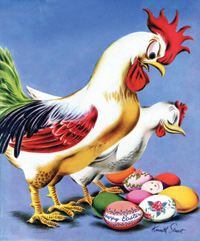
There once was a rooster named Sunny
In love with a young hen named Honey.
Pink, yellow, and blue
Her eggs were a clue
She’s more than just friends with the Bunny.
—Jane Yunker, St. Croix Falls, Wisconsin
Congratulations to Jane Yunker! For her limerick describing Kenneth Stuart’s illustration (above), Jane wins $25—and our gratitude for a job well done. If you’d like to enter the Limerick Laughs Contest for our upcoming issue, submit your limerick via our online entry form.
Of course, Jane’s limerick wasn’t the only one we liked! Here are some of our favorite limericks from our runners-up, in no particular order:
She’s obviously proud of her layin’
Old Rudy’s concern he’s displayin’
But back in the coop
The girls know the scoop.
And who is the Dad they’re not sayin’
—Steve Boneske, Greenfield, New York
Said Rooster to his own dismay:
“Not my hens, such eggs, no way!
There’s but one cock so bold
To make me cluckhold;
That rascal they call Fabergé!”
—William D. Conrad, Vancouver, Washington
They couldn’t tell who was who,
Each egg was a different hue.
Though the hen smiled,
The rooster was riled.
Oh what a ‘fowl’ thing to do!
Louis DiSanto, St. Paul, Minnesota
The rooster who crowed to his honey
Was alarmed when their eggs turned out funny,
He screeched to his hen
“We’ll try it again,
“After donating this batch to the Bunny.”
—Terry Free, Andover, Minnesota
When he looked down, the rooster recoiled
As his plans for a family were spoiled.
While the eggs all looked good
He gave up fatherhood
When he saw that his kids were hardboiled.
—John Peacock, West Dundee, Illinois
Alas, my curiosity begs.
What have you done to those eggs?
The last I knew
My blood line was blue.
Could they have walked in without legs?
—Andrew Janik, Hadley, New York
The hen liked her colored eggs best,
Having left the plain ones in the nest.
But the haughty old rooster,
No Easter egg booster,
Told her to go sit on the rest.
—Ben Lightfoot, Hanston, Kansas
Of all the ridiculous things!
My poor decorated offsprings.
When hatched from the eggs,
They’ll have stems for legs,
And petals all over their wings!
—Angie Gyetvai, Oldcastle, Ontario
This new batch of eggs that we’ve gotten?
I’m feeling like something is rotten.
You’re trying to hide
Some tail on the side,
A tail that (I’m betting) is cotton.
—Jim Schweitzer, Elkhorn, Wisconsin
Flying High: FAQs for Air Travelers

So you’re planning to take an airplane trip. Good for you! Every year, millions of people “take to the skies” for business or pleasure, and statistically only a small percentage of them are killed.
Nevertheless, if this is your first flight, or you haven’t flown in a while, or you’re simply one of the many stupid people found in airports, you’re probably unsure about what to expect. So let’s review the basics:
Q: I have an infant or small child. Are there any special preparations I should make for flying?
A: Definitely. Before you leave home, gather together whatever toys, books, or games you will need to keep your child occupied. Then remain home, occupying your child, until he or she is a minimum of 16 years old.
Q: When should I leave for the airport?
A: You should already be at the airport.
Q: Should I check my luggage?
A: That depends on several factors, the main one being: Do you ever want to see your luggage again?
Q: What are the “do’s” and “don’ts” of airport security screening?
A: We’ll start with a “do”: Relax! Airport security is handled by the Transportation Security Administration, which is an agency of the federal government (Motto: “A Gigantic Bureaucracy Working for You”). Some TSA procedures may seem ridiculous, but remember this: There are real terrorists out there, and it’s the TSA’s job to make sure that these terrorists do not get on an airplane until they have fully complied with TSA procedures.
Make sure your carry-on luggage does not contain any prohibited items, including liquids, gels, gases, or solids. If you plan to wear underwear, wear it on the outside of your other garments so that it is clearly visible to the TSA agents. The heart of the screening procedure is when you go into the “scanner,” which sounds scary, although, in fact, it’s nothing more than a giant microwave oven that bombards your body with atomic radiation.
But there’s no need to worry: The scanner is completely safe for humans as long as (a) you do not remain in there longer than the recommended eight-tenths of a second and (b) TSA agents have remembered to change the power setting from POPCORN back to HUMANS after their break. The scanner serves a vital security function: It “sees” through your clothing and captures an image of your naked body, which is transmitted to a room where specially trained TSA agents decide whether to post it on Facebook. If you would prefer not to have this happen, simply ask to have an agent grope your genitals manually. It’s your right!
The main “don’t” of airport security is: Don’t make inappropriate jokes. TSA agents are responsible for your safety, so they must take every possible threat seriously; if you engage in inappropriate humor, they have no choice but to shoot you.
Q: How do I know which seat on the airplane is mine?
A: It will be the one directly in front of the screaming infant.
Q: When the flight attendant announces for the third time that all cell phones must be turned off immediately or the plane cannot leave the gate, does that mean I should turn my cell phone off?
A: That announcement does not apply to you.
Q: I’m a little nervous about flying. Is this normal?
A: Absolutely! Believe it or not, even many airline crew members admit that flying gives them the “jitters.”
Q: How do they handle it?
A: They smoke crack.
Q: What if something goes wrong with the airplane while it’s flying?
A: There’s nothing to worry about! The pilot will simply land the plane on the Hudson River, where it will float until rescue boats arrive.
Q: What if we’re not flying over the Hudson River?
A: Then you will die. Basically, you should restrict your air travel to flights between New York and Albany.
Q: But I don’t want to go to Albany.
A: Good, because that flight has been canceled.
People in Your Life
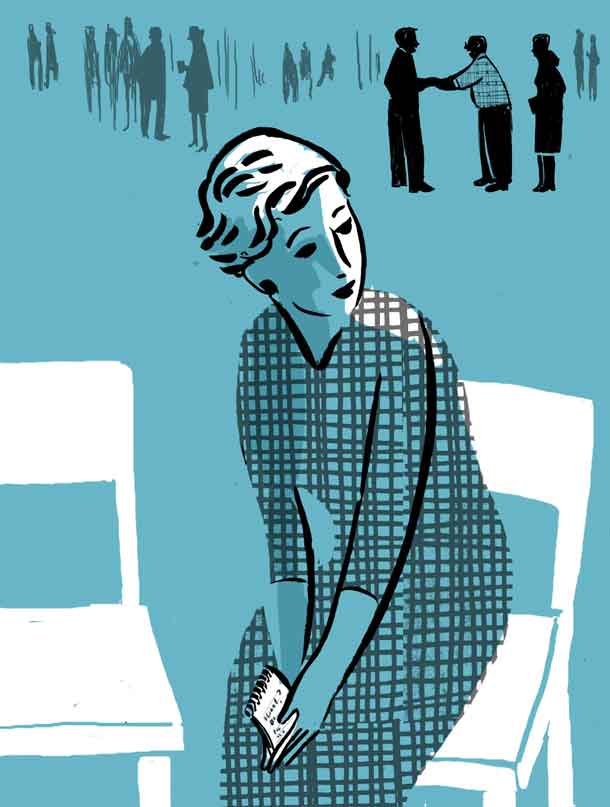
I HADN’T PLANNED TO RUN INTO HARVEY DECKER.
I do sometimes, plan to run into people. I go back to my hometown planning to run into my first true love, a boy who never gave me a look. I rehearse long, desultory conversations we will have–I take both parts: his, wistful with regret and keen awareness of missed opportunity; mine, cavalier and funny and remarkably kind. I’m always planning to run into people, rehearsing how surprised I’ll be. I just hadn’t planned on Harvey Decker.
“Call me if Carlton ever runs off with his secretary,” Harvey Decker called out as he drove away, the last time I saw him, which would have been the summer of 1974. Approximately once in a lifetime someone tosses off a line that will invite chill winds to cause a shiver down your spine, a line that blows the future’s cover, lets you peek inside the crack in time. Just as, once in a lifetime, Carlton, your beanbag of a husband, will suddenly remember, after almost 30 years, that he never wanted to be married in the first place, and in celebration of the dawning of awareness blares easy-listening soft-rock music 24 hours a day. In two months’ time, he’s got his own apartment and says he wants to date around. It’s called midlife dementia.
And when that happens, you remember Harvey Decker’s telling you to call him if you ever find your life turned into a land mine of a cliché. When that happens, you remember everything that anybody ever said to you in your whole life: the guys in college who put the “Help Cure Jock Itch” medical ointment advertisement in your intra-campus mailbox; the blind date who asked you–15 minutes into the proceedings–did you have any girlfriends you could introduce him to; the svelte, blond cousin who gushed in stage whispers at your wedding, “It’s a miracle. I can’t believe it. It’s a miracle.” When your husband of a quarter of a century absconds with both your near and distant futures, memory calls back a whole lifetime of one-liners.
I’m back in Albany for a conference which the signboard outside calls The Psychology of Dental Wellness, which I’m hoping is a serious typo, or I will be the only psychologist in a room crammed full of dentists. I’m working out the logistics and advisability of running a group therapy session for 137 unwilling dentists, when I spot Harvey Decker. He’s wearing a name tag which helps with the what-to-call-him part, but his face I recognize right off the bat. He’s wearing no doubt the same granny glasses that he wore to sharpen up the ’70s, specs resting on the same nose, above the same small mouth with tiny, child-sized teeth.
He doesn’t have a clue who I am. It’s a good thing I didn’t call him up when my husband Carlton did jump ship. (What did you say your name was? Ran off with a secretary you say?) But once I have convinced him that time has indeed done all this to my one face, he seems to remember me entirely.
“I’m really glad to see you,” Harvey says. He sounds glad.
“Where’s Carlton? Is he here too?” Harvey pulls the name out of thin air. The man’s a midlife wonder. Not only does he look about 27, he has a fully functioning memory. I’m 52 and can remember names of close family members. For the rest I rely heavily on pronouns. I, who have abhorred name tags all my life, now wish they were mandatory for anyone appearing in public. “Is Carlton here?” Harvey says again.
“No,” I say. “Carlton isn’t anymore.”
“You mean he’s dead?”
“Only to me,” I say. “We’re divorced.”
“When did that happen?” Harvey says. And it comes back to me. Harvey always had a way of sustaining interest in another person’s life.
“Oh, it’s three years now. The last of our three sons went off to college, and Carlton left the weekend after that.”
I’m hoping Harvey doesn’t say something about why didn’t I call him, but he just shakes his head like that’s about what a person would have expected Carlton to do. He gives no evidence of having been sitting by the phone waiting for my call, lo these 27 years.
“My boys all went to Cornell,” I say. “Didn’t you go there?”
“Stanford.” Harvey smiles.
“Oh yeah, right.” It would have been nice if I could have remembered one proper noun from his past life.
“So,” I say. “I wonder whatever happened to our boss on the education project. Remember Ron-the-priest and the other guy, Sandy?”
“Randy. I see him and his wife Joan a few times a year. Ron Baylor’s still around too. He might be here today. He comes to a lot of these meetings.”
I am dumbfounded. It’s as though I imagined all these people existed only as minor characters in my life story, then disappeared or went on living only in my head or were still sitting in the large upstairs storage room that was our office for the year we worked together, sitting in that high school waiting through time and all eternity for the nasal door chime of a dismissal bell to ring.
Van Gogh’s Holland
Photo source: Shutterstock.com
Some deaths are such cultural touchstones that they become imprinted on our own memories too, like a personal tragedy. That, at least, is the case with Vincent van Gogh. Our collective image of the artist’s last morning, slashing away at a canvas in that Provençal wheat field, the angry crows wheeling above like a beaky Greek chorus, the brooding sky watching as he puts the gun to his stomach, makes for an almost operatic vision. Few endings are as poetic or fitting; we remember Van Gogh’s masterworks but it’s his apotheosis as the artist-turned-ultimate outsider, and sacrificial lamb, that shapes his legend.
The irony of course is that the man famous for his lyrical death adamantly refuses to die. In fact he keeps popping up again and again, and the resurrections seem to be escalating. In the last several years Van Gogh has resurfaced almost monthly in the news. First there was the 2011 biography, Van Gogh: The Life by Steven Naifeh and Gregory White Smith, that claimed his death wasn’t suicide but murder, committed by a bullying, gun-happy teenager.
Then there was the report that his famously blue The Bedroom was never meant to be blue at all; the original palette, researchers discovered, was a violet that changed color because the artist was using cheap, unstable pigment. And then there was the news, in 2013, that the painting Sunset at Montmajour, once rejected as an obviously kitsch, phony forgery, had been reclaimed. Curators at the Van Gogh Museum, giving it a closer look, called it an authentic canvas by the master, suggesting that maybe more Van Goghs are waiting to come tumbling out of some attic, adding to a legacy that keeps growing, changing shape, and just won’t sit still.
All of these new takes on Van Gogh and his art, though, may be eclipsed by a bigger revelation, a reinvention of sorts. The artist, it turns out, was a Dutchman. This of course seems like an obvious epiphany. But most of what we think we know about Van Gogh relates to his French years in Provence, and in the popular imagination the artist–despite that classically guttural Dutch name–has become so Gallic, he has morphed into a flâneur wearing a beret, chomping on a baguette. When people talk about following in Van Gogh’s footsteps they typically mean the paint-splattered circuits around Arles, Saint-Rémy-de-Provence, and Auvers-sur-Oise, a route that the French, absconding with the Dutchman, have wisely turned into a tourist attraction.
But the Dutch are reasserting their own claim. They see Van Gogh not as some Frenchified savant, but as an emphatically homegrown master painter firmly grounded in their spongy, lowland soil. It’s a chauvinistic reclamation that I embrace like any true Dutch-ophile. Blame it on a personal kind of patriotism. My family moved to Holland when I was 4 years old, and the dreamscape of humpbacked bridges and tilting gabled houses looked like the antidote to the anodyne American suburb we left behind.
And although we came back to that suburb a few years later, my Dutch ardor has only grown over the years on frequent return visits to Holland. So it’s heartening to see my own swelling Dutch pride echoed by the country itself. Tired of being cast as a pit stop on every stoners’ year abroad, the Netherlands is focusing on its richer, truer cultural history.
The zealous renovation of Amsterdam’s trifecta of art museums that frame the city’s Museumplein underscores that rediscovery. The contemporary Stedelijk Museum, the Van Gogh Museum, and the Rijksmuseum all reopened, after the city invested millions of dollars in their refurbishment. It is the Rijkmuseum that is winning the most attention for its sleekly reformatted powerhouse galleries that make the case for rediscovering the Dutch masters, those peerless Vermeers and Rembrandts lining the Gallery of Honor.
It’s an easy case to make. Those 17th-century works, the very definitions of masterpieces, remind us that while their European counterparts were still painting fussy royal portraits and martyred saints, Dutch artists, commissioned by more pragmatic burghers, were capturing the beauty of our sensual, earthly world. As the first true modernists, they saw the physical radiance of our everyday, purely human landscape: the parrot tulip and string of pearls; a canal lit by golden lowland sun; and the quietude of a cobbled courtyard.
But it is the Van Gogh Museum that may, in the end, make just as radical a point, arguing for the pioneering force of Dutch art, by refocusing our distracted gaze on a more fully realized Van Gogh. He isn’t just the maestro of Arles in this gallery, but the man who came of age and discovered his artistic, outlier’s voice as a Dutchman.
Planning your own trip to Holland? Click here to find out where to stay and where to eat in Van Gogh’s homeland.
Purchase the digital edition for your iPad, Nook, or Android tablet:

To purchase a subscription to the print edition of The Saturday Evening Post: 
A New American Isolationism?
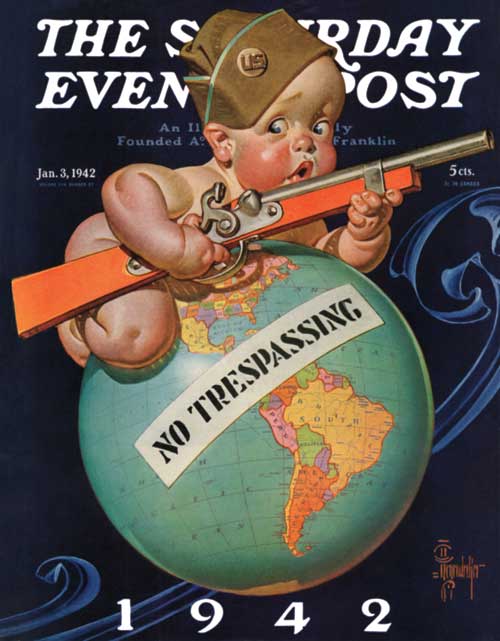
For the past century, the United States has frequently gone to war in the interests of freedom and democracy–often with the unstated (but not necessarily secondary) purpose of protecting our sources of oil or for access to populations who would buy our goods or services.
But the costs lately have become overwhelming, whether measured in cold, hard cash or in lives lost. America has lost its appetite to serve as policeman in the earth’s most horrific trouble spots. We just want to be left alone.
March 2014 marked the first month in more than a decade without a single American combat casualty anywhere in the world. For the vast mass of the American people, getting out of military entanglements is now the expectation rather than some vague hope. After two wars stretching back 13 years, American sentiment has once again tilted toward the isolationism that marked the end of the First World War. “[That conflict] was followed in the ’20s and ’30s by something that…was in fact a rejection of a certain role in the world,” says Robert Kagan of the Brookings Institution and a foreign policy advisor to Senator John McCain’s presidential campaign. “It wasn’t just, ‘Let’s have a little time out here.’ It was, ‘We are not going to be doing that.’”
In fact, it would take a challenge to our very way of life–in the form of Hitler, Mussolini, and that dastardly backdoor attack on Pearl Harbor–to draw us into World War II. And we never really emerged. The Korean War followed just a few years afterward, then it was on into Vietnam, and almost before we all realized what happened, we were on to the Balkans and Sarajevo; the Middle East, Iraq and Afghanistan; and now there’s Syria and Crimea and Ukraine.
And each such adventure has its own price tag. Iraq, a country from which we have already technically departed, is still costing us $3 billion per year. The overall Department of Defense budget totals some $496 billion, or 13.6 percent of the total federal budget today–and that’s with a rapidly shrinking military.
Compare these numbers to those of the Korean War, which cost us $30 billion ($262 billion in today’s dollars) or less than one-third of the cost of the post-9/11 war on terror that includes Iraq and Afghanistan, which the non-partisan Congressional Research Service puts at $859 billion.
With 20/20 hindsight, it’s beginning to look increasingly like our all but universally accepted role as the world’s policeman really peaked sometime during the Korean War. Then began a long, slow descent, largely perceptible only to the most astute observers positioned outside the Beltway. When John F. Kennedy sent us swaggering into the Indochina Wars at the very moment a far more nimble Charles de Gaulle was already extricating France, we were still operating under the assumption that America somehow had a higher calling we needed to fulfill. It seemed only America had the might, and the moral will, to prevent the rapid spread of that evil virus called communism across Indochina, into Thailand, down the Malay Peninsula and across Southeast Asia.
As it happens, I was present as a journalist to witness the final days of America’s foray into Southeast Asia. The final days and weeks of the takeover of Cambodia by the Khmer Rouge were not amusing. Seeing the conflict at this late stage, one forgot the original point of the American mission, to serve in a police capacity in this region.
But was that even an appropriate use of American power and influence? Neither in Korea nor in Vietnam nor in any other police action since–certainly not in Afghanistan or Iraq–has America had the kind of influence over the outcome envisioned at the start of our engagement. Our role was always presented to the public as a limited exercise: Act the role of the good cop, oust the bad guys, clap them in jail, then get the heck out of Dodge.
Of course, it’s never quite worked that way, and we have never learned our lesson. The failure derives not from a lack of good faith, but rather from a lack of vision. When we entered each of these rabbit holes, we never had a real understanding of how we’d emerge. As is clear now, the end game is in most respects far more significant than the entry point.
But if the American people have come full circle in the past century, arriving today at a reluctance for combat that mirrors post-World War I isolationism, many nations still look to the U.S. to play the role of global cop–if only because no other nation has the might or the will to play such a role. “I fear that what is going on now is that Americans are quite understandably not only tired of the burden, but they no longer understand the reasons why we even took on this burden in the first place,” Kagan says.
About those reasons: Sixty years ago, The Saturday Evening Post article “Can We Remake the World Without Going Broke?” observed that the nation’s Mutual Security Program, newly signed into law by Truman with bipartisan support in Congress, was staking the future of the American economy upon “the hope of revolutionizing the non-Soviet world.”
The piece continued: “This program pushes American military frontiers far out into Europe, Asia, and Africa. It consolidates an American pattern for reorganization of the entire non-Soviet world through combined military, economic, financial, and social measures.…It appeals to those who believe that ‘sharing our wealth’ is speeding up some form of world government.…On the other side, it appalls those Americans who are chiefly concerned with the radical changes which ‘mutual security’ means for the American traditional system: indefinite conscription of our young men, Federal expenditures greatly in excess of revenues, unparalleled taxes which are certain to increase, the overhanging threat of monetary inflation which already has reduced the purchasing power of the dollar by more than half.” (For more selections from the Post archive, see page 37.)
Rump

Gordon saw a rump in the air. An enormous rump, with purple fabric stretched taut over its rolling curves to form an oddly soothing landscape. A woman was on the ground, hands flat on the asphalt, peering under a silver Mercedes.
Engine trouble? Some sort of leak? Gordon edged away. The workings of everything—from staplers to carburetors—baffled Gordon. This was a lifelong source of humiliation, made worse by the fact that people tended to turn to him for just such advice. It was his appearance, no doubt. Gordon had regular features, terrific posture and the tucked-in look of a Scout leader. At times he wished for his grouchy son’s receding chin and myopic look. No one mistook Kyle for someone with know-how about ignition switches.
The woman was emerging now. She backed up, straightened her arms and heaved herself up. As she rose into the sunlight something glinted off her black tee shirt, which Gordon noticed was from the famous Aquarium down the coast. A dense school of tiny silver anchovies glittered across the vast sea of her chest. The dazzling display disappeared as the woman leaned to brush the grit off the knees of her purple pants, after which she lumbered to the back of the car and lowered herself to the ground again.
Gordon knew that to stand there and watch would lead to the expectation on anyone’s part, including his own, that he offer assistance. He spun around and found himself staring at a Hallmark store window display leaping with leprechauns. Freckle-faced sprites in green plaid coats peered out from behind oversized shamrocks and buckets brimming with gold. Inside, a cashier was ringing up a pair of glittery green Derbies and laughing with a customer. Here was an entire industry Gordon had never considered. Legions of people designed, manufactured, marketed, delivered and sold geegaws for major and minor holidays and personal milestones, which, in turn, legions of others shopped for with relish. There were all kinds of jobs, when you thought about it.
Gordon checked his watch. He’d promised Barbara to come straight home after the interview this time instead of wandering around for hours, which he’d been guilty of lately. It was hard to watch his kind wife try once again to muster her confidence in him. Her propped-up cheer was flagging. She spoke less and nodded more, as if she were gathering herself for some kind of decision or hard-to-deliver statement. And Kyle? He acted like he didn’t care one way or the other, which, of course, maybe he didn’t, which could, of course, be viewed as either good or bad.
But Gordon had good news this time. Just two hours before, he had felt the interviewing manager’s vigorous handshake and heard his hearty “Welcome aboard!” Only Gordon was having a hard time imagining himself in the lunchroom with the other red-apronned “associates” of the home repair emporium even if his job was just working the returns counter. They would all talk shop and rehash weekend DIY projects. They would know how to help customers find the correct pipe wrench on aisle eight. Gordon would be trading a now-familiar worry about unemployment, which at least held the prospect for some kind of unimagined good outcome, for a fresh daily panic. He needed to—what did the kids say these days? Man up?
Suddenly, the purple pants lady’s face sprung up between two leprechauns. A reflection. She was standing behind the car, staring at Gordon’s back. What if she called to him? Gordon took a step to the right and pressed his palms against the glass door, unleashing a jingle of tiny bells and a blast of potpourri.
He paused inside the door, taking in the display of cards for the grad, the dad, the coach, the new baby, the bereaved. All moods represented—bawdy, mournful, cloying, apologetic, blank. A woman with a purse over her arm was reading and replacing card after card from a circular rack labeled Friendship. Gordon eased by her and took up a position against the wall.
After a moment, a very tan woman in a denim dress called from the register, “May I help you find something?”
Gordon flushed, exposed—the only man among the handful of customers, all of whom had lifted their heads to look at him.
“Just waiting for my wife!” he blurted. Why had he said that? He better leave. Gordon glanced out the window. The Mercedes was backing out of its spot. At the wheel, a white-haired man wearing aviator sunglasses, alone.
The denim lady looked up as Gordon headed for the door.
“I’ll just go see what’s keeping her,” he explained.
The purple rump had moved one car over. It angled up now from beneath a maroon minivan. Had this woman no idea what kind of picture she presented? Surely he had the right to stare now. The rump wagged as she swept her arms back and forth beneath the car. Then she backed up and sat on her haunches. She snapped her head round to throw her brown hair out of her face. It landed in a smooth pageboy, the ends turning neatly under, bracketing a series of chins. Gordon was surprised by her hair, which was thick and glossy and the warm, rich color of expensive wood.
She caught him looking.
“Wretched little bugger!” she said.
“I beg your pardon?” Gordon stammered.
“I don’t suppose you’d like to give me a hand?” she said, clearly not expecting anything of him.
“A hand? With what?” Gordon asked. “What is it that you’re doing, exactly?”
“Trying to get this goddamn bird out from under this car,” she said, hoisting herself up and plodding around to the other side of the van, intent on her mission, ablaze with purpose. Welcome aboard! Gordon imagined someone saying to her and clasping her wide, can-do hand.
“Why do you have to get him?” Gordon asked.
“Because he can’t fly and he’s going to get run over. That’s why,” she said, dropping out of sight again. “That’s why” echoed in Gordon’s head, its cadence a playground retort.
“If you could just block the other side,” her voice called from under the car, “I might be able to get my hands on him.”
A group of laughing women carrying leftovers in waxed boxes walked by, falling silent as they heard this exchange and glancing from Gordon to the protruding rump.
Hate crime inspires “Facing Fear” movie
In “New Beginnings” (July/August 2014), Matthew Bolger talked with writer Chris Benghue about how he survived a brutal beating by a group of teenaged neo-Nazi skinheads, and the chance encounter with his attacker 25 years later that led to forgiveness, and even a kind of friendship.
Inspired by the two men’s journey, film director Jason Cohen adapted the story to the silver screen in an Academy Award®-nominated documentary short, Facing Fear. The film retraces the two men’s upbringings, the attack, and the events that ultimately brought them to reconciliation. Watch the film’s trailer below, and visit the film’s website for more information.
Visit the Simon Wiesenthal Center’s Museum of Tolerance website for more information about stopping intolerance and hatred.
Having a Catch
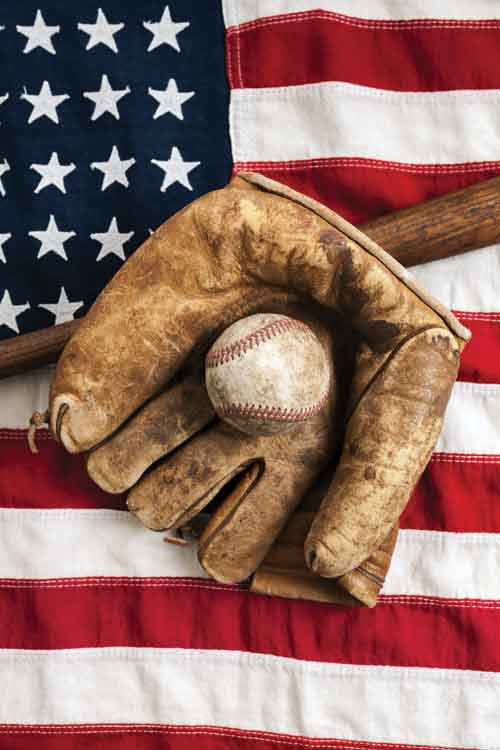
Photo source: Shutterstock.com
Though I live in Los Angeles, my wife and I rarely venture into Beverly Hills. I have very little to look at in these posh palaces of luxury, and thankfully my wife, who is a weaver, prefers to make her own clothing. But she does like Coach bags, and there happens to be a Coach store on Rodeo Drive.
What surprised me when we looked at their window display was a baseball theme, with two-color bats and some multi-colored leather baseball gloves (orange/white, squash/fawn, navy/turquoise).
Inside, in the back of the store, is a small department for men. And sure enough, among the baseball beanbag paperweights and baseball-leather wallets, were some smooth leather baseball gloves that brought back a flood of childhood memories when I slid my hand into one. Good God, I thought, this was my Proustian madeleine.
I remembered Little League tryouts when I was 11 years old. The tryouts were meant to determine which boys would play in the Majors. I was a skinny kid, not very tall or strong, and I clearly belonged in the Minors; but when one of the coaches hit a fly ball to me, I chased it down in the outfield and somehow miraculously caught it. That ruined my chance to play much that summer.
I was put in the Majors, along with boys two and three years older than me where I sat on the bench, waiting to be tapped to pinch run or to play the last inning of a losing game. But still, a memory that I hold most dear is of that special catch during tryouts. The long run on the outfield grass, the hardball arcing over my head, my outstretched left arm, the ball landing in the deep pocket with a thwunk! and the look on everyone’s face when it didn’t drop out of my glove.
As my wife browsed bags, I tried on and pounded a stunning navy/turquoise leather glove. I remembered our junior varsity team in high school. I was 13, playing second base, and I convinced my dad that I needed a new infielder’s mitt. We went to a sporting goods store and I found a nice golden Spalding glove with the name Sam Esposito scrawled in the pocket. Esposito was a utility infielder for the Chicago White Sox in 1952, and from 1955–63. He had a lifetime batting average of .207 and hit just eight home runs in 10 years, so he wasn’t a major league ballplayer for his bat. His fielding percentage was .957. Esposito was a glove man.
I was a die-hard Yankee fan, so I didn’t really follow Sam Esposito, but I liked the glove and have never forgotten his name.
Nor have I forgotten when Mr. Morelli, our junior varsity head coach, decided to move me from second to first. “You need to get a first baseman’s mitt,” he told me. When I protested that I had just got my Sam Esposito infielder’s glove, he said, “You can’t be a first baseman with a glove like that. If you don’t get the right glove, I’ll have to bench you.” Those are cruel words to say to a fledgling ballplayer who had dreams of turning spectacular double plays and not fearing line drives. My dad had paid $29 for that glove. I knew I couldn’t tell him I needed another one, so I stuck to my guns and insisted I could play first base with the glove I had. Mr. Morelli stuck to his guns as well and put another kid at first.
This led to thoughts of my dad. Having a catch was one of the things we did in our backyard on weekends. He was a lefty, so he had an old mitt that couldn’t be passed down. We would play imaginary games, pitching to imaginary hitters, calling balls and strikes as we threw the ball back and forth. I think it’s the nicest memory I have of being with my dad. And just sticking a glove on my hand brought this back to me. If memory can be triggered so powerfully by something this simple, maybe it was worth forking over $348 to buy the glove.
Purchase the digital edition for your iPad, Nook, or Android tablet:
To purchase a subscription to the print edition of The Saturday Evening Post:
Victims of Politics: The 1964 Murder of Three Civil Rights Workers
A recent Pew survey shows a growing division between Americans. Conservatives and liberals are increasingly separated by a political “chasm,” and hostility between the factions is rising.
At least one third of Americans on both the right and left wings believe their ideological opponents pose a “threat to the nation’s well-being.”
Troubling as this might be, we have seen far worse. Fifty years ago, the political divide in America involved more than media spin and postings on partisan websites.
In 1964, African Americans were struggling to win something closer to equal rights through demonstrations, marches, and bloc voting. On the other side of the racial divide, white political organizations in cities and states were opposing them through intimidation, legal obstruction, and violence.
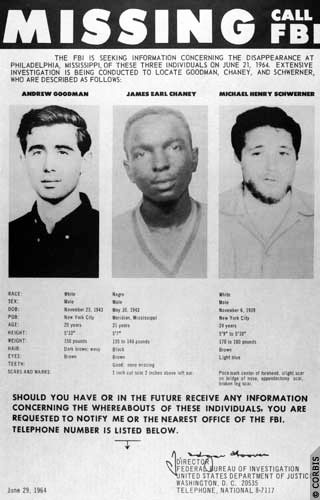
On June 21, the bitter contest reached a turning point when three civil rights workers–James Chaney, Andrew Goodman, and Michael Schwerner–disappeared near Philadelphia, Mississippi.
It is significant that their disappearance–with no evidence of a crime—prompted a national outcry and a federal investigation, because it meant nobody believed civil rights workers just wandered off the map in central Mississippi in 1964. People rightly assumed they had been murdered.
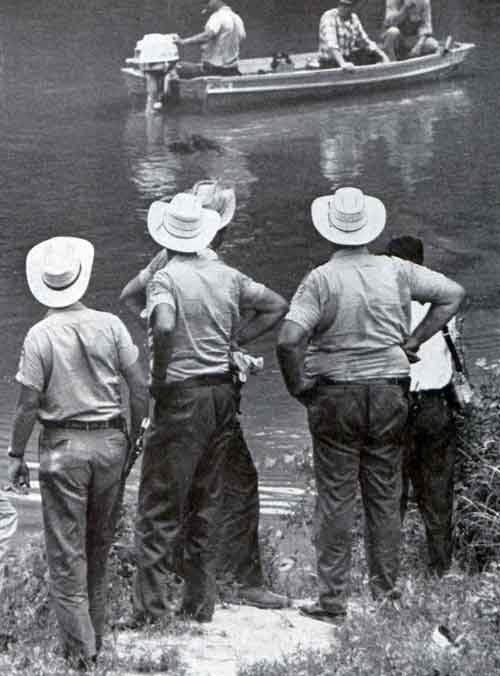
Photo credit Lynn Pelham. © SEPS 1964
Their presumed deaths were another argument in favor of the recently passed Civil Rights Act. Surely, proponents argued, federal laws were needed to secure equal rights when local law enforcement appeared unable, or unwilling, to prevent such crimes.
The federal government had been intervening for years to prevent racial violence, but government efforts were often inconsistent.
Under pressure from President Johnson, FBI Director J. Edgar Hoover sent an agent into central Mississippi to investigate. Attorney General Robert Kennedy sent 150 federal agents.
Sailors from the nearby naval base in Meridian were ordered to help in the search. They began trudging through muddy swamps in Neshoba County and searching cotton fields for freshly turned earth.
But after a month of searching, they found nothing. Only when the FBI paid an informant $25,000 did agents learn the three men’s bodies had been bulldozed into an earthen dam at a local farm.
![“Robert Moses, 29, did most of the planning for this summer’s [Student Nonviolent Coordinating Committee voter registration] project. Raised in Harlem, he has a master’s degree from Harvard.” <br /> Photo credit Lynn Pelham. © SEPS 1964](https://www.saturdayeveningpost.com/wp-content/uploads/satevepost/Moses1.jpg)
Photo credit Lynn Pelham. © SEPS 1964
In the Post’s July 25, 1964 issue, James Atwater interviewed a SNCC volunteer in Mississippi who told him, “I feel I would be willing to give up my life for this movement.” Another volunteer added, “I feel the same way, a willingness to give yourself to a cause that is really great, maybe the only great cause in America.”
The men were not merely idealists. They had already met the hard edge of resistance. Recruited on college campuses to work in the Mississippi Summer Project, they were helping African Americans register to vote and learn reading and writing. And they were being beaten, shot at, and firebombed.
The students knew what awaited them if they met a lynch mob or, worse, hostile police officers. “When you go down those cold stairs at the police station,” said a SNCC volunteer, “you don’t know if you’re going to come back or not. You don’t know if you can take those licks without fighting back, because you might decide to fight back. It all depends on how you want to die.”
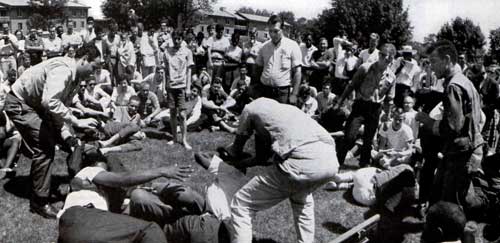
Photo credit Lynn Pelham. © SEPS 1964
After the bodies of the activists had been found, details of their murders emerged, which indicated far more planning than a simple lynching. The White Knights had specifically targeted Schwerner, who was working with members of the Mt. Zion Methodist Church in Longdale, MS. To draw him into a trap, Klan members attacked and beat members of the Mt. Zion congregation. On June 21, Schwerner, Goodman, and Cheney drove to Longdale to encourage the church members not to yield to intimidation.
When they left that afternoon, they avoided the lonely, backwoods road to Meridian and chose to take the highway through Philadelphia. Just as they entered town, Neshoba’s deputy sheriff Cecil Price stopped them for driving 65 mph in a 30 mph zone. He locked them in the county jail for seven hours without allowing them a phone call, and then released them on bail. The last he saw of them, he told the FBI, they had resumed their drive to Meridian.
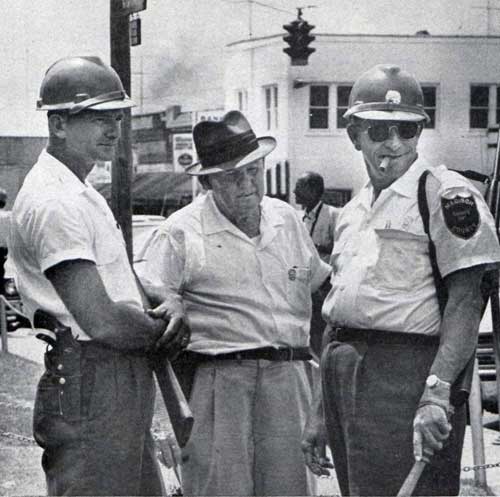
Photo credit Lynn Pelham. © SEPS 1964
In fact, Price had used those hours to summon Klan members, who were waiting when Price raced after the blue station wagon and stopped it again just before it reached the county line. The Klansmen took the civil rights workers to a secluded area, shot them at close range, and disposed of the bodies.
Eventually, the FBI claimed 21 men were part of the conspiracy to murder Chaney, Goodman, and Schwerner. When the state of Mississippi refused to prosecute any of the men, the federal government charged 18 of the men with violating the victims’ civil rights.
Seven of the men were convicted, but none spent more than six years in jail.
Forty years after the killings, however, a group of white and black citizens of Philadelphia asked the state to reconsider the case. In 2005, state prosecutors charged Ray Killen with planning and directing the murders. He was convicted on three charges of manslaughter and is still in a Mississippi penitentiary.
Perhaps we exaggerate when we say the murder of Schwerner, Goodman, and Cheney marked a turning point in the dispute over civil rights in America. Such a term implies that matters improved afterward, or healing began between segregationists and integrationists. That simply did not happen. But, as with other bitter disputes in American history, extremists eventually committed an act that repelled the general American public, and cost them any chance of success.
If You Go: Holland
Discover the Holland that inspired some of Vincent van Gogh’s most famous paintings as author Raphael Kadushin travels into the Dutch landscape and tells the story of a country steadily reclaiming the Dutch painter as its own in “Van Gogh’s Holland” in the July/August 2014 issue. —Editors

Source: Conservatorium Hotel
Where to Stay in Holland
Conservatorium Hotel (conservatoriumhotel.com)
Sitting directly across the street from Amsterdam’s Museumplain (framed by the city’s trifecta of art museums, the Stedelijk Museum, Rijksmuseum, and Van Gogh Museum), this hotel claims pride of place for art lovers who want to make the most of their gallery time in Amsterdam. Opened in 2011 after massive renovation of the 19th-century Renaissance Revival building—which functioned most recently as a music conservatory—the hotel hasn’t lost its original Neo-Gothic patina or handsome vaulted ceilings.
The 129 airy, contemporary guest rooms, designed by Italian architect Piero Lissoni and many reconfigured as duplexes complete with sleeping lofts, contend for the largest in Amsterdam. Plus: State-of-the-art holistic spa-cum-wellbeing center; your own personalized host; a glass-roof atrium lounge that has turned into Amsterdam’s buzziest meeting place; a casual brasserie; and the Tunes Restaurant, where Dutch master chef Schilo van Coevorden dishes up eight-course tasting menus.
The Ambassade Hotel (ambassade-hotel.nl)
Amsterdam’s pioneering canal-house hotel is still its best, and at relative bargain rates. Composed of 10 joined 17th- and 18th-century canal houses, the impeccably managed Golden Age landmark sits on an elegant stretch of the grand Herengracht canal. You can nab the most ethereal views in town if you book a top-floor room.
Bathrooms have recently been updated, but the hotel’s quirky boho appeal, epitomized by its mix of French reproduction furniture and modernist Dutch paintings, remains intact, along with a very serious library stocked with books left behind by its guests. Since the hotel is the premiere destination of most writers passing through Amsterdam on book tour, the collection includes signed editions by everyone from Donna Tartt and Isabel Allende to Paul Theroux, Salman Rushdie, and the late Doris Lessing.
The Dylan (dylanamsterdam.com)
A step up in price from the Ambassade, the Dylan is located in its own landmark canal house and features a recently renovated added wing and seriously designed rooms that veer between black-and-white minimalism and red-lacquered Zen flair. The hotel’s Michelin-starred Vinkeles restaurant ups the ante with chef Dennis Kuipers’ refined food and the lounge and bar regularly fill with the city’s most photogenic hipsters.
Librije’s Hotel (librijeshotel.nl)
Within easy striking distance of Van Gogh’s Drenthe, this may be one of Holland’s most unexpected finds. Located in a monumental, renovated 18th-century women’s prison, in the middle of the hushed town of Zwolle, the hotel offers 19 themed rooms that go for baroque. Consider the Magnolia Suite, which features walls dripping with Swarovski crystals and its own steam sauna.
Where to Eat
Bordewijk (bordewijk.nl)
This long-established insiders restaurant sitting on the Noordermarkt square draws locals for its mix of Mediterranean and lowland cuisine, and its market-fresh food. The kitchen sources directly from the Noordermarkt’s own weekly organic market.
Café Walem (walem.nl)
A casual canal-side café that draws the young and arty, all fighting for the canal side tables and all downing hearty sandwiches like a beef carpaccio on dense Dutch farmer’s bread, and a silky smoked salmon.
Café ‘t Smalle (t-smalle.nl)
The very definition of an Amsterdam brown café (the name comes from the caramel patina that has built up on the walls over centuries worth of smoke) this Dutch still life of a place serves some of the best shrimp croquettes and jenever (aka Dutch gin) in town.
De Kas (restaurantdekas.nl)
The pioneering model of a serious locavore restaurant this organic fantasia comes housed in a circa 1926 greenhouse in the middle of epic Frankendael Park and dishes up the freshest Dutch harvest, some of it grown in the surrounding gardens.
De Librije (librije.com)
The only thing topping the Librije hotel’s sense of excess is the Librije restaurant, a three Michelin star dining destination that lures serious gourmets to Zwolle. Served in the library of a 15th-century Dominican abbey, the multi-course tasting menu features chef Jonnie Boer’s flamboyant, relentlessly ambitious creations (expect lots of foie gras, langoustines, and North Sea crab).
For more information, visit the Netherlands Board of Tourism at holland.com.
The Great Berry Pie Cook-Off
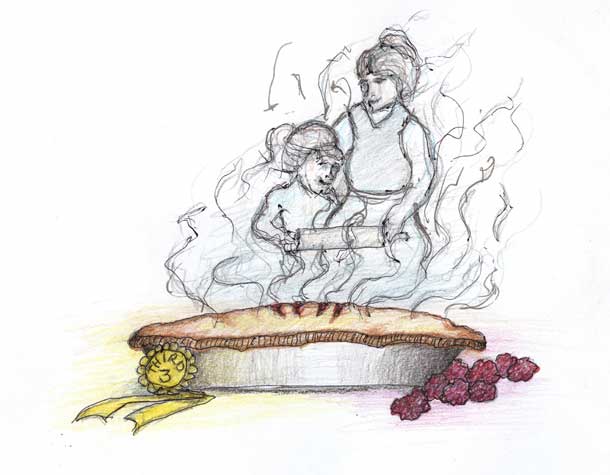
The bright orange ‘#6’ designating space assigned to me was as easy to spot as the manicured nails and made-up faces of a few of the other finalists. I unloaded my backpack on a countertop and then looked around. It was still hard to believe I was there. I’d entered the contest on a fluke.
Not a fluke, actually. I did it for my mother, who’d bake a pie a week leading up to the one she’d enter in the annual Great Berry Pie Cook-off Competition. This meant my sister and I ate pie most every day growing up. It was a staple. We were our mother’s taste testers as she concocted variations in an attempt to bake a winner. Neither of us complained. We liked them–all of them.
Our mother never won a blue ribbon or made the top ten, but she was convinced the pies were why her marriage ended.
“I swear your father was jealous of my pies,” she’d explain. “My baking gave me pleasure.”
Admittedly, he was a controlling man. I bet he was glad she never won a ribbon because if she had, it would have been out of his control and her worth as a pie maker would have been acknowledged.
So this day at the competition I dedicated to my mother. This day in the sterile kitchen was for her. Take that, Dad! Thanks for walking away. You missed some great pies from a great pie maker.
With the backpack emptied, I went looking for a storage closet. One of the rules of the competition was that contestants couldn’t have clutter around the work space. When I returned to my countertop, I found a man in the space next to me. He was contestant number seven.
I was relieved I wouldn’t be baking next to one of those manicured types, although he did have an expensive-looking apron laying on the counter (Another competition rule: contestants must wear aprons.) His name tag announced him to be Richard Lawson, a man with an address from further down in the county. That was where our conversation began.
“You must have started out early to get here on time,” I said with my hand extended in greeting. “I’m Mary Stevens.”
“It’s nice to meet you, Mary,” Richard replied. “I have family in the area so I came last night.”
“I’ve never known a man who bakes pies.”
“My father owned a bakery in the front area of our home,” he explained. “I liked watching him flute his pie crusts. It was an art form for him. He was a master pie-maker.”
“So I don’t stand a chance?”
“I’m not my father when it comes to pies,” he assured me. “I bake when time allows.”
“You didn’t take over the family business?”
“No. I’m a police officer. Baking is how I relax, but that’s not going to be the case today.”
“I’m with you there,” I replied. “I’ve never seen a stove with so many knobs.”
Richard agreed. “All you need is preheat and start. Don’t know why everything has to be so complicated.”
After stashing his duffel bag in the closet, Richard asked about my pie-making history.
I explained about my mother, and then about my current job. “I teach tough kids. Most are marked as failures, but when I take them to the kitchen and we make pies, the kids melt just like butter.”
Just then, a woman introduced herself as Claire Bailey, chairwoman of the 55th Great Berry Pie Cook-off Competition, and asked for everyone’s attention. After welcoming us, she congratulated everyone for making the final cut.
“You were selected from over 1,600 entrants. That’s the highest number to date!”
Once she went over the rules for the day and answered any questions we had, she asked that we introduce ourselves and include a little information about our pies. Some talked about using organic this-and that-berries grown to be the biggest and juiciest in controlled settings, and crusts defined by nonfat and gram count and healthier substitutes.
I had no problem saying words like ‘sugar,’ ‘Crisco,’ and ‘butter,’ or letting them know I’d be using wild raspberries. I ended with something my mother would repeat when she served her pies to her taste tasters, “A great slice of pie warms the heart.”
Richard had similar sentiments when he gave his introduction and talked about his father’s bakery.
“I didn’t realize it at the time, but cutting out doughnuts with my sister created a bond between us that remains today. We’d talk, share secrets. I believe my dad had more in mind than doughnuts when he put us to work.”
After contestant 10 wrapped up her tribute to the organics, we waited anxiously for the official start of the competition. When the clock hit the hour mark, the bake-off was on. With my mother’s apron tied around my waist, I found my momentum. I didn’t use the stainless steel utensils provided. I used my mother’s. The tin measuring cup had dents from falling on the floor so many times, and her yellow ceramic bowl had a few chips around the edges. None of that mattered. They gave me comfort.
“Nice raspberries, Mary,” remarked Richard as he cleaned strawberries for his pie.
“I found a patch along a fence line with berries ripe for picking. The timing was perfect.”
After cutting the lard into the flour and sprinkling the flour with water until it was the right consistency, I divided the dough into two balls. Then I dusted the countertop with flour like my mother used to do. Her fingers reminded me of butterflies fluttering about, dropping flour like a fine snowfall.
“Every part of the process plays into the symphony of the pie,” she’d explain.
My mother’s words played through my mind as I took her rolling pin to the dough. Her song kept singing in my head as I covered her worn pie tin with my rolled-out dough. After trimming, crimping, and fluting the crust, I filled it with raspberries grown in the sun and rain, which I had mixed with sugar and cornstarch, butter and tapioca.
“You have a way with rolling out that dough, Mary,” Richard remarked. “It was a pleasure to watch.”
“You know how you said you believed your dad had more in mind than doughnuts when he put you and your sister to work? I never realized it, but my mother was teaching me lessons never found in a classroom when she made her pies. Like taking pleasure in the task at hand, for example,” I said as I indicated the pie crust.
Minutes later ten pies were baking.
Tensions rose when a news crew came through the door. The other competitors, those manicured ladies, primped themselves for the camera, smiling, showing their starched teeth as Claire Bailey brought the media around. I was hoping my mother might see me wearing her apron on the local news at 6p.m. as a cameraman filmed me taking the piping hot raspberry pie bubbling with juices out of the oven. Maybe she’d hear me praising her when a man with a microphone asked me questions.
But I knew there’d be no chance of anything like that happening.
Once the pies were sliced, the judging began.
D-Day: The Century’s Best Kept Secret
Source: Library of Congress
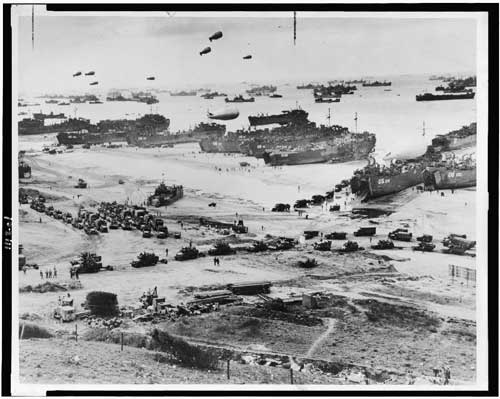
It was 6:30a.m. on the sixth of June, 70 years ago, and Dwight Eisenhower was nervously pacing the floor at his headquarters in Portsmouth, England.
For six months, he had meticulously planned the invasion of Nazi-held Europe. Under his direction, planners had mapped out the assault forces, engineers had developed artificial harbors and amphibious tanks, and soldiers had practiced storming peaceful English beaches.
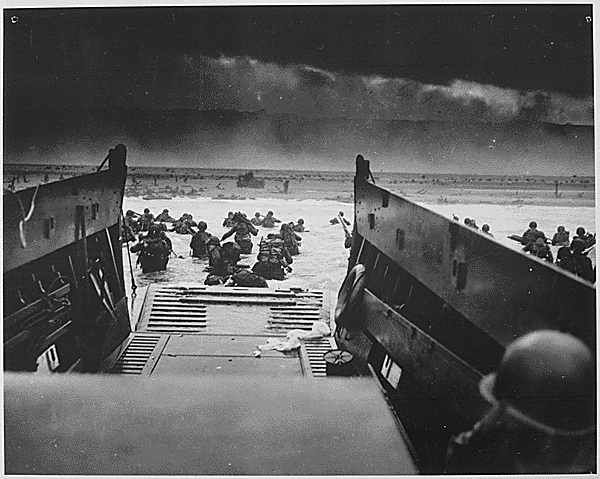
Now the planning, construction, and training were over. The enterprise had been launched—156,000 soldiers; 11,000 aircraft; 5,000 ships and landing craft. Paratroopers had already landed inland and were attacking behind the enemy. An hour earlier, 2,000 tons of bombs began raining down on the German pillboxes and bunkers that overlooked the beach.
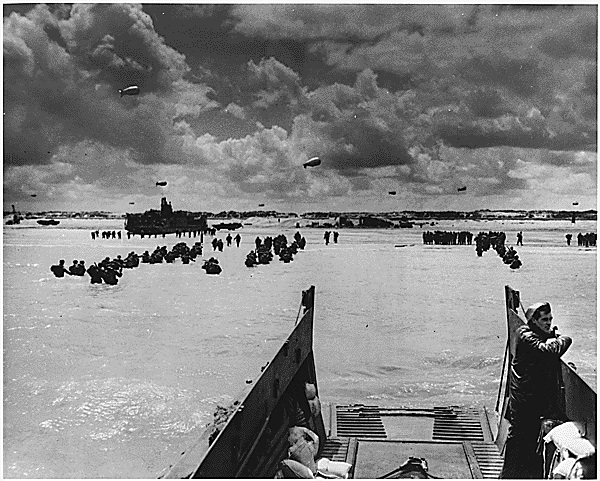
Now the landing craft ramps were lowering and G.I.s were hurrying through the surf onto the shore. In some areas, they stormed onto the beach with few casualties. In other sections, they were suffering 96 percent casualties.
There was little Eisenhower could do except pace, chain-smoke cigarettes, and await news from the front. As David Howarth wrote in his 1959 Post series, “D-Day” –it was now “a soldier’s battle, not a general’s battle. Eisenhower…knew practically nothing of what was happening until the first phase of the battle had been completed.” Not until the end of the day, when U.S. and British troops had established themselves on the beach, could he relax, confident the Germans had not learned the invasion plans.
Allied intelligence officers had been given the job of keeping the plans secret, even though it was known, in part or entirely, to thousands of Allied officers. For the previous six months, they had diligently hunted for any signs that spies in Britain were sending information to the Germans.
In May, they discovered several code names for invasion destinations—“Utah,” “Juno,” “Gold,” “Sword”–being used as answers in the Daily Telegraph’s crossword puzzle. On May 22, the puzzle had used “dives” an invasion target, “Omaha” a beach landing site, and “Dover” the invasion’s departure port. The next week, one of the puzzle answers was “mulberry,” which was also the name of the Allies’ top-secret artificial harbor. British security interrogated the puzzle-maker but, in the end, decided his use of the words was only coincidental.
Source: Franklin D. Roosevelt Library
Then, three days before the invasion, a teletype operator in London was practicing her typing by composing a make-believe news release about the invasion. Her typing was mistakenly entered onto the Associated Press wire service.
Within minutes, 500 American radio stations interrupted their broadcasts to read her practice headline, “Flash: Eisenhower’s headquarters announced landings in France.” Although a correction was issued two minutes later, the nation’s phone lines were jammed with calls from Americans eager to share the news.
So far, it appeared that the massive security efforts had succeeded in surprising the Germans. But there was still the possibility the enemy was aware of the planned invasion and were simply waiting for the Allied armies to gather on the beach before hidden German forces swept down on them.
Eisenhower had to consider this possibility and thousands of others: the planning of D-Day required his attending to thousands of important details. In its earliest phases, his Allied staff had to choose a landing site by studying the entire coastline of Europe, from Norway down to western France. They were looking for clear open beaches that enjoyed good weather, with water shallow enough for landing craft but with deep water nearby to admit battleships.
Two candidates emerged: the French coastal areas near Calais, and Normandy. After much debate, the Allies chose the latter because the Germans, expecting the Allies would use Calais, had neglected the Normandy defenses.
Next the Allies had to choose between landing at high or low tide. If they approached the beach at high tide, they might become stuck on the 500,000 submerged obstacles planted by the Germans. They could avoid these traps by coming in at low tide, but then soldiers would have to race cross 300 yards of beach while exposed to German fire. In the end, they chose the low-tide option but sent tanks ahead to break a path for the soldiers.
Next they had to decide on a time of day. Both the navy and air corps planned an hour’s bombardment of the German guns at first light, just prior to the landing. This helped fix the date, as Howarth wrote. “Low tide in Normandy was an hour after dawn on June 6. On June 5 and 7, it was near enough to be acceptable. After that, the tides would not be right again until about June twentieth.” But June 20 couldn’t work because there would be no moonlight that late in the month, and the paratroopers being dropped behind German lines wanted light for parachuting and landing gliders.
So the planners chose June 5, keeping the 6 and 7 as backup dates. The landings would begin near the French town of Caen at 6:30a.m., preceded by a massive bombing and a landing of paratroopers behind German lines.
Source: Franklin D. Roosevelt Library
But now, with everything decided, the weather became a variable. Storms and rough seas threatened to delay the operation.
The landing craft would be swamped in the high waves expected off the Norman coast. Eisenhower postponed the invasion for a day and waited. When a break in the weather seemed possible early on June 6, he ordered the invasion to proceed.
Had he delayed, the fleet would be forced to return to England and the planners would have to start all over again with a new landing site. After the enemy had seen the invasion force directed at Normandy, they’d be fully prepared for its return.
The Allied intelligence services had helped keep the invasion site a secret by a massive disinformation campaign. They misled the Germans with fake army camps, filled with inflatable trucks and tanks, supported with dummy warships. To add to the deception, the make-believe invasion force was put under the command of General George Patton, a military leader highly regarded by the Germans. On D-Day, as the real invading fleet was sailing south to Normandy, the Allies filled the airwaves with signals from a pretend fleet of ships and airplanes, using technology that made them appear larger than they were.
To support the deception, British intelligence agents had spread hints of a Calais invasion so convincingly that the Germans believed they had discovered a great military secret. Howarth wrote, “The deception was so successful that [the German commander] von Runstedt went on believing for several weeks after the invasion that the landing in Normandy was a feint, and that the main attack was still to come in Calais, and he kept his reserves in Calais.”
We can only guess at Eisenhower’s fears in those early hours of June 6. We know he partly expected failure, for he had already written a note accepting blame for the failed invasion. Not until the Allied soldiers had firmly established a beachhead could he be certain that his invasion force was not sailing into a trap, that the Germans hadn’t learned all the key details in May when the plans had sailed out an open window of the War Office in London.
“Twelve copies of a top-secret dispatch, which gave the whole show away, blew out and fluttered down into the crowded street below,” Howarth wrote. “Staff officers pounded down the stairs, found eleven copies, and spent the next two hours in an agonized search for the twelfth. It had been picked up by a passer-by, who gave it to the sentry on the Horse Guards Parade on the opposite side of Whitehall. Who was this person? Would he be likely to gossip? Nobody ever knew.”
Beyond The Canvas: The Myth of The American West
John Clymer
The Saturday Evening Post
There are few Post cover artists who so appreciated the American west as much as illustrator John Clymer. Born in the Pacific Northwest in Ellensburg, Washington, the artist grew up with vast landscapes of mountains and untouched plains reaching to the horizons.
America’s natural terrain charmed Clymer from a young age. He was taken by the mythos of the American west, of cowboys and Indians, and the thrill of adventure.
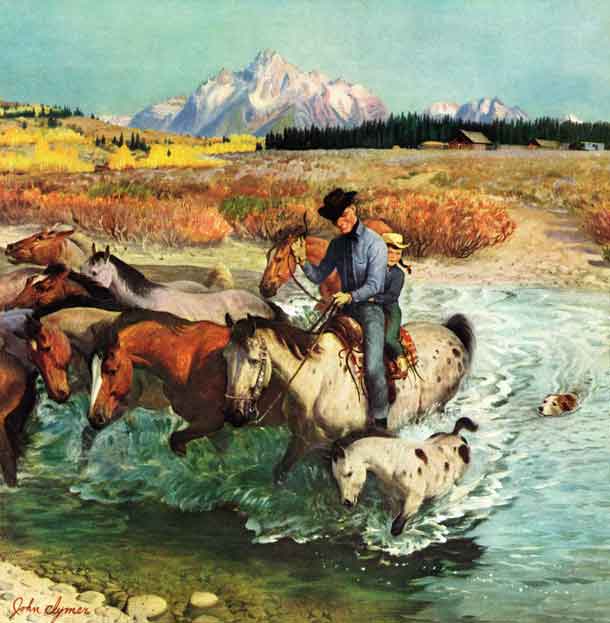
Clymer’s September 13, 1952 cover, “Herding Horses,” embodies the spirit of the American west. In this depiction, a rancher herds his livestock, fording them across a river on the plains. With his own young daughter saddled behind him, the cowboy smiles down on a colt struggling to navigate the waters.
The composition of the painting gives equal focus to the bounty of the surrounding natural elements, as well as the human involvement in living off the land. The top half of the work shows the snow-capped mountains in the distance complete with rolling hills and forest beneath. Sprinkled throughout are the farmsteads of ranchers and farmers who live off the land.
The artist’s decision to use the American Mustang for the river-crossing livestock instead of cattle or oxen adds to the overall wild and untamable nature of the American west. A feral horse that interbred with the European thoroughbred, it became a wild animal on the American plains. Their spots are a noticeable feature of their uncontrolled breeding in the wild. Note that Clymer’s rancher chooses to ride the most spotted mustang of the group rather than a monochrome horse of his herd. This symbolizes the cowboy’s ability to tame the Wild West.
Clymer used a vibrant color pattern to expose the beauty of nature and the change of seasons. A master of illustration who studied under N.C. Wyeth, Clymer shows off his artistic finesse in the clarity of the stream. His ability to successfully illustrate clear water, the rocks beneath, and the horses’ shadows upon the ripples is a testament to his artistic daring.
In fact, Clymer’s well-rounded training is evident throughout the entirety of the work. He is capable of drawing humans, as is evidence by the man and child on horseback. He flawlessly composes the equine trot, one of the most difficult animal forms in motion.
John Clymer was a master of his genre, and his passion for the land translates well onto canvas. Today, his work is well respected and highly lauded by western art museums and societies across the country. His artwork not only maintained but enhanced the myth of the American west. Many of his original paintings and illustrations are on display at the Clymer Museum of Art in Ellensburg, Washington.
How Americans Saw Themselves in the 1950s
Every time you flip through an old magazine, you open a time capsule. Created to meet readers’ most immediate interests, magazines generally reflect the mood and ideas in brief moments in history.
But how accurate is that reflection?
If you look at Post issues from the 1920s, you can get a fairly good sense of that decade. The overall tone of these issues is busy, enthusiastic, often funny, and the hefty magazines are filled with lighthearted stories and lavish advertising.
The 1930s issues, on the other hand, are much thinner. The Depression-era illustrations and advertising seem subdued and cautious. There are fewer stories and the articles seem to focus mostly on business and politics.
In the issues of the early 1940s, every Post article, ad, and cartoon seems to reflect some aspect of World War II.
The issues of the 1950s, however, don’t quite fit their times. To judge from the images, America was a bright, prosperous, and carefree place, which wasn’t entirely true. The country was prospering, yet it was also weighed down with worries. The decade had begun with two wars: a bloody “police action” in Korea that ended in stalemate and a global cold war that just seemed to go on and on. As if this wasn’t bad enough, Russia had stolen America’s atomic bomb secrets; our great adversary was now a nuclear power.
As the 1950s began, it became to Americans clear they wouldn’t get the peace they’d hope to win at the end of World War II. Instead, they would pass the decade in fear of a Soviet attack with atomic weapons. Air-raid drills would send schoolchildren diving under their desks to wonder if, this time, it wasn’t a drill. Their parents would watch news reports of communist influence spreading across the globe.
They would also have sensed an atmosphere of suspicion and resentment in the country as journalists and politicians accused fellow Americans of disloyalty. Senator Joseph McCarthy would draw national attention for his inquiries into suspected communist agents operating throughout the government. His hunt for secret communists reached its peak 60 years ago this month.
When McCarthy’s relentless attack on the U.S. Army proved too much for his Congressional colleagues, he was censured by his colleagues, and his career–and investigations–faded away. Yet the suspicion of covert communism lingered and many Americans felt they could no longer trust their fellow citizens.
The Post wrote a great deal about the red menace in the 1950s, but if you looked only at the images in the magazine, you’d never guess at the cultural atmosphere of dread, suspicion, and uncertainty.
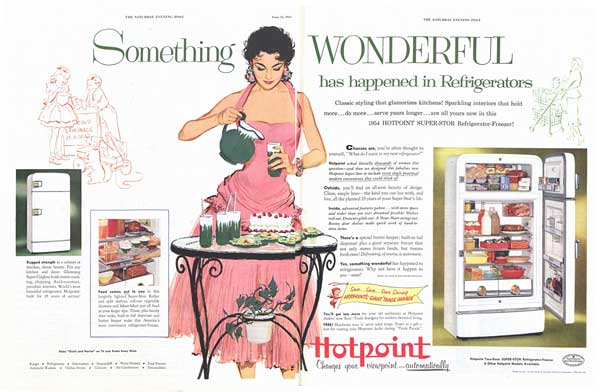
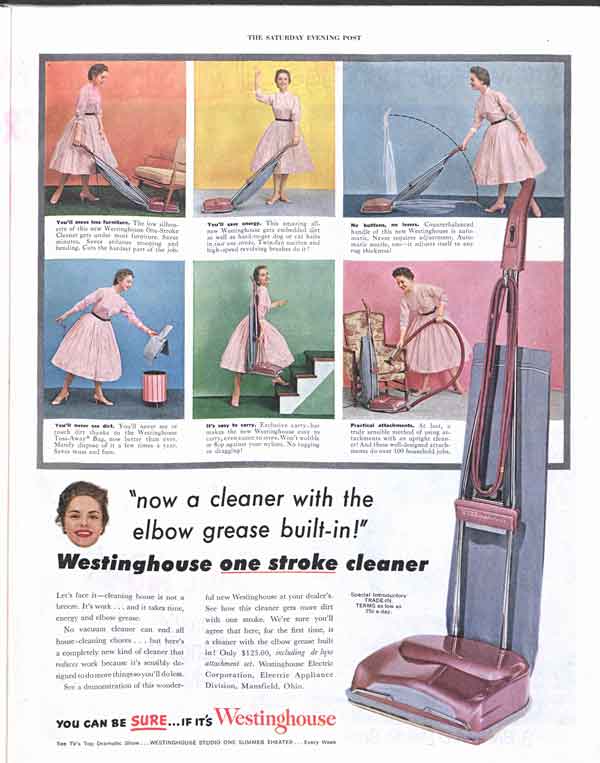
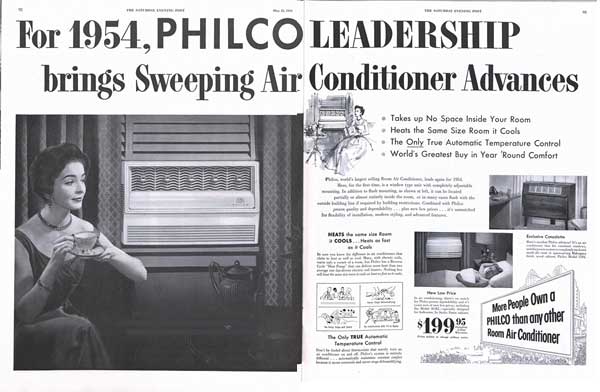
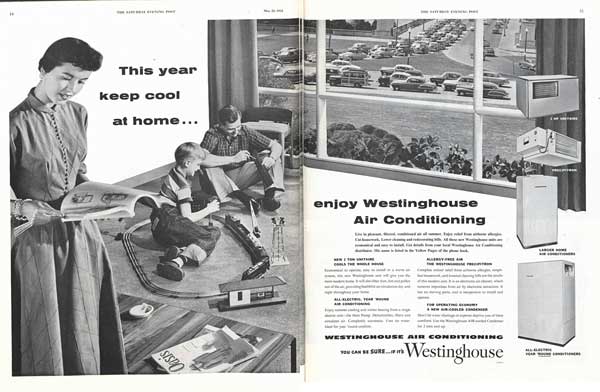
To judge by the ads below, taken from the May and June issues of the Post, Americans of 1954 were perpetually happy, living colorful, comfortable, and gracious lives. The Westinghouse vacuum cleaner, for example, shows us that icon, the 1950s American housewife. Advertisers and television writers, with no intention of being funny, would present her as homey but glamorous, performing housework in a dress and heels.
She cooked in a modern, spacious kitchen that was filled with modern appliances, such as ‘intelligent’ electric stoves, and spacious refrigerators with rotating shelves.



Modern glamour had even entered the bathroom. Manufacturers introduced exotic colors to fixtures that had, for generations, had only been stark white.




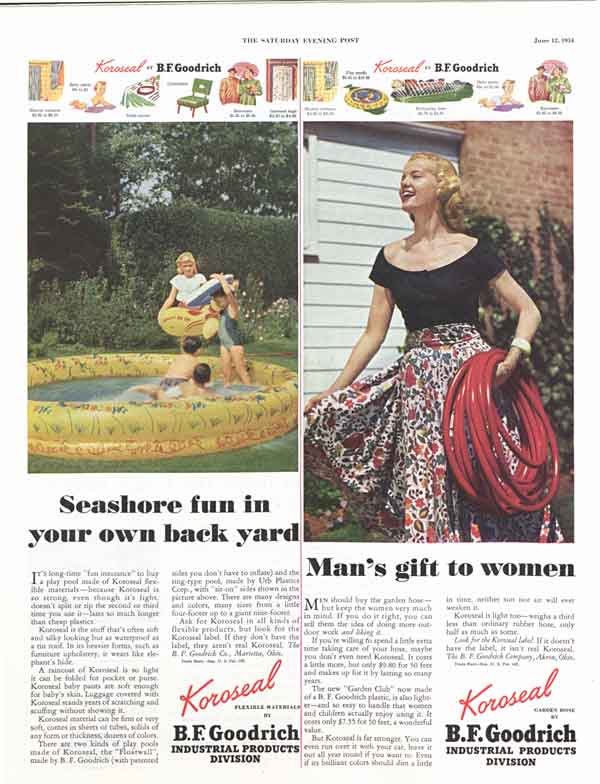
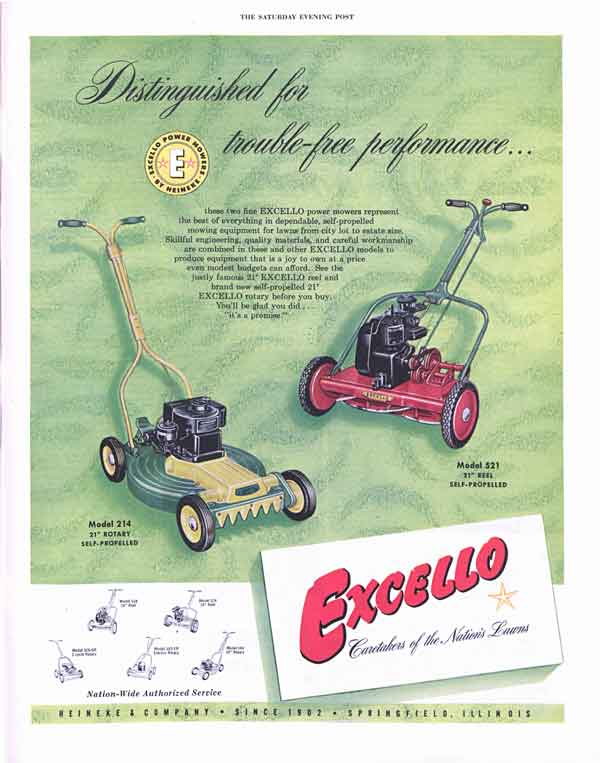
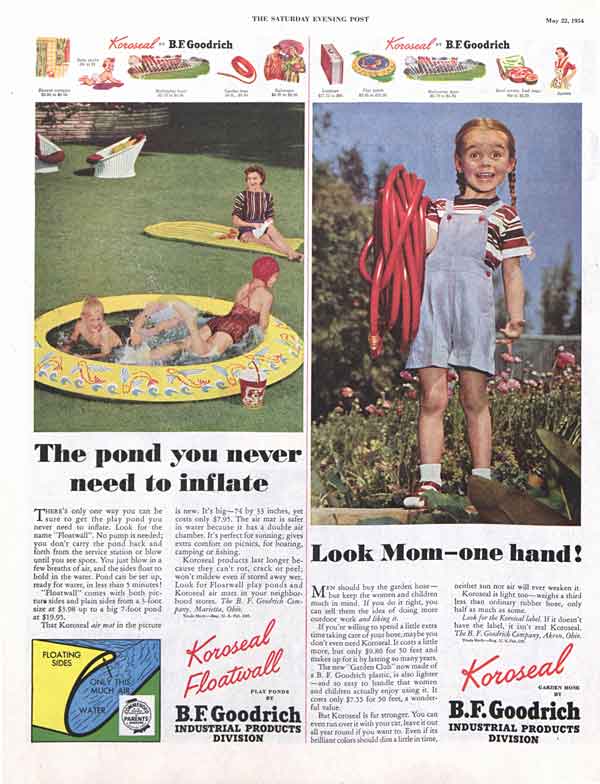
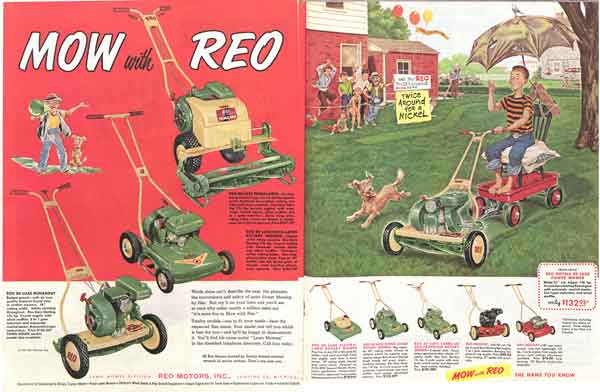
Americans who had moved to the suburbs took pride in their backyards and with summer’s return, the magazine featured advertising from several manufacturers.
The Goodrich ad seems to make unsupported claims in its headlines, but many baby boomers fondly remember those inflatable pools.
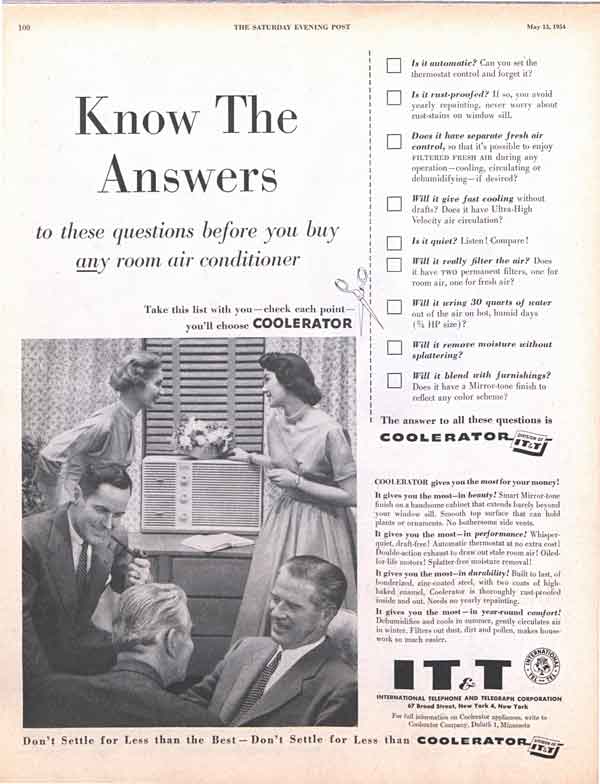
With summer, many readers would again consider the merits of a single-room air conditioner, which were become more affordable very year. Several companies were offering units that summer, including Carrier, whose air-conditioners were so advanced, they could prevent “super brain” computers from over-heating.



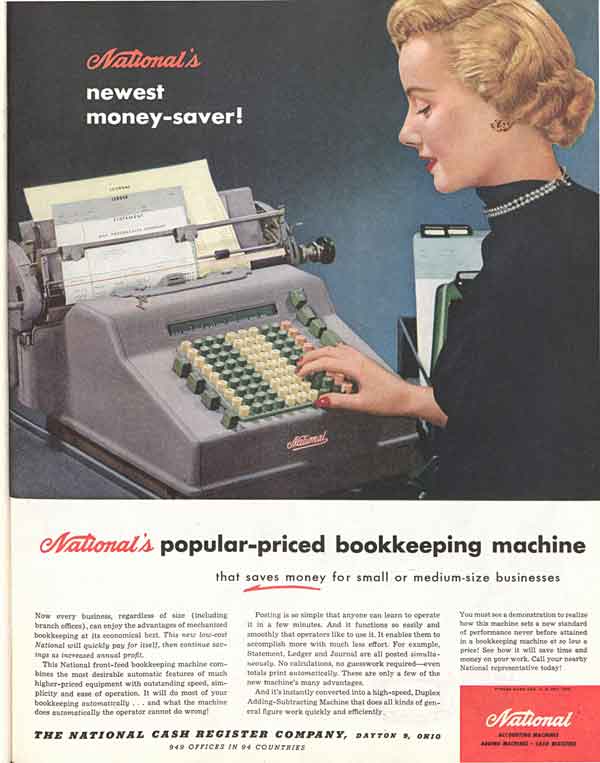
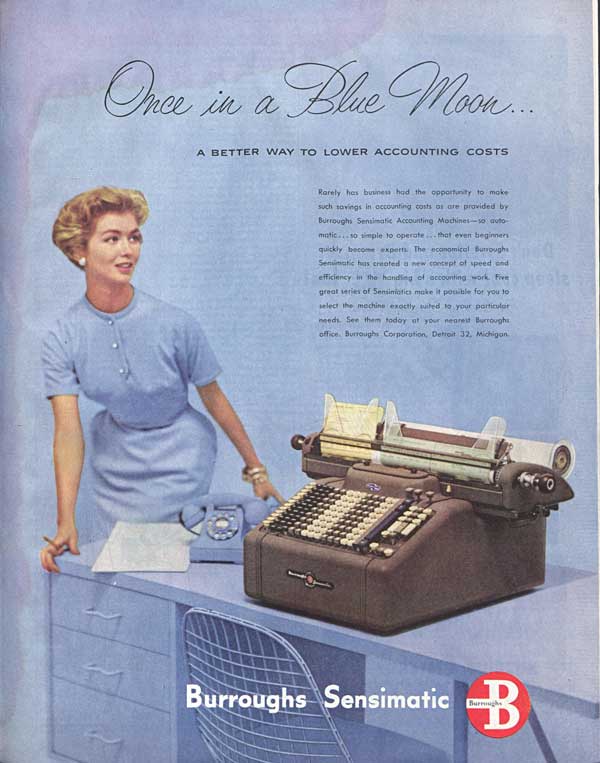
New technology was invading America’s offices. But no matter how much the machines changed, the gender of the operator remained the same.


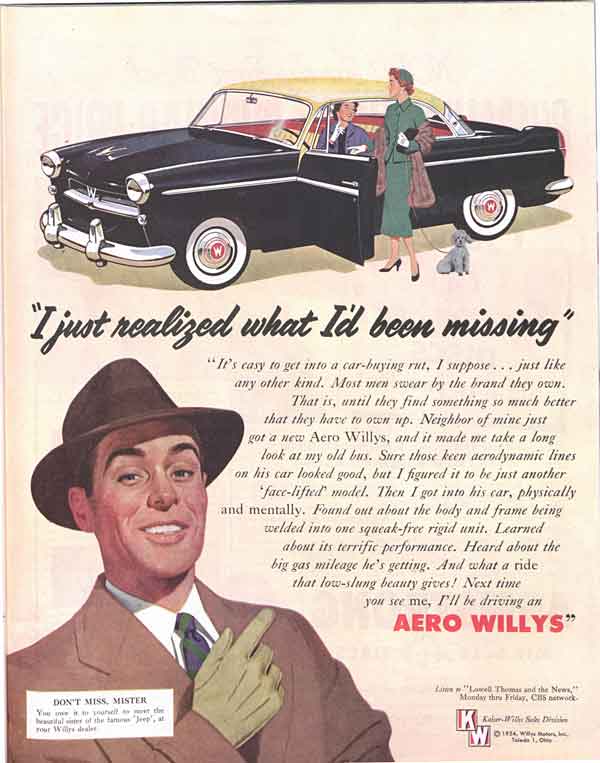
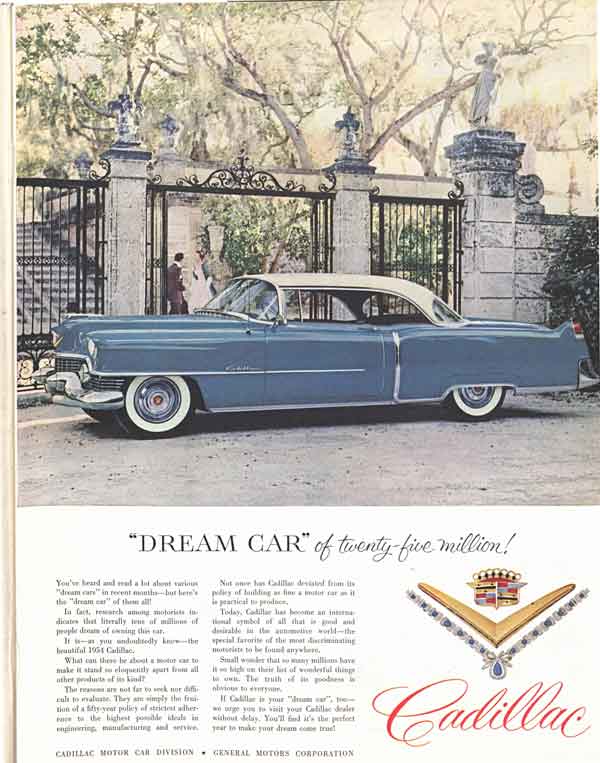
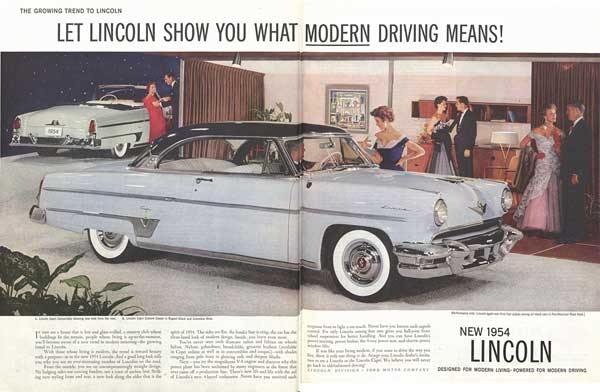
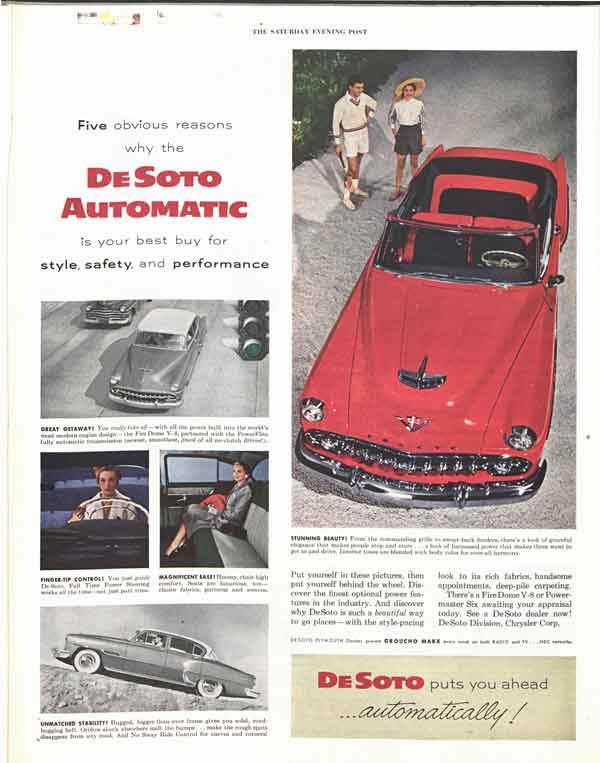
No ad gallery of the 1950s would be complete without a collection of car ads. These models capture an era in which the auto industry, as yet unthreatened by imports or emissons standards, focused on power, size, and glamour.
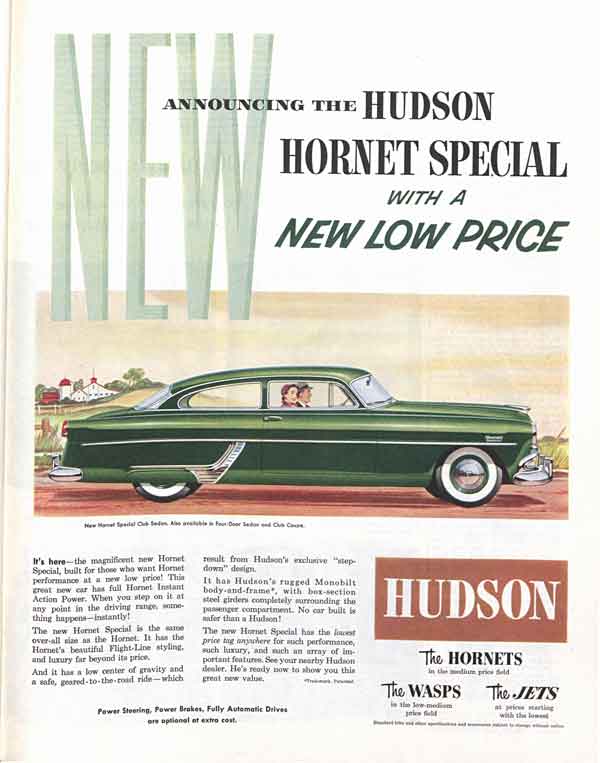



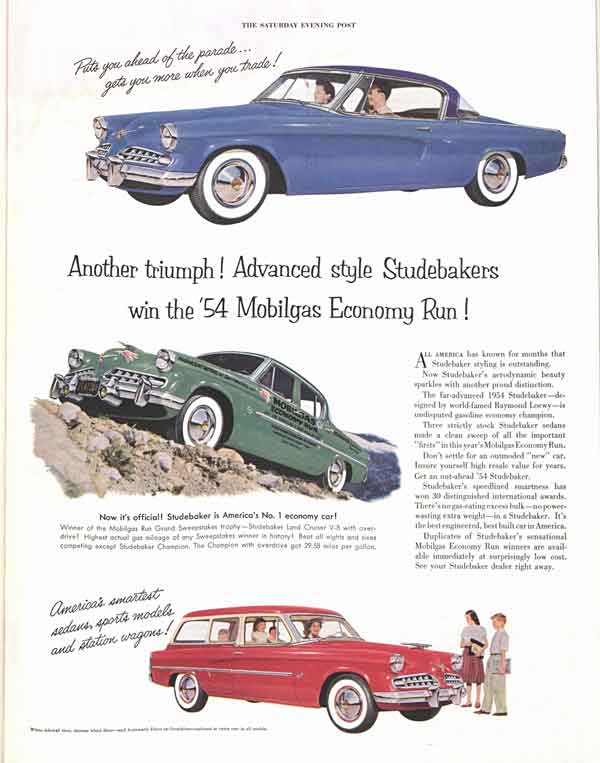
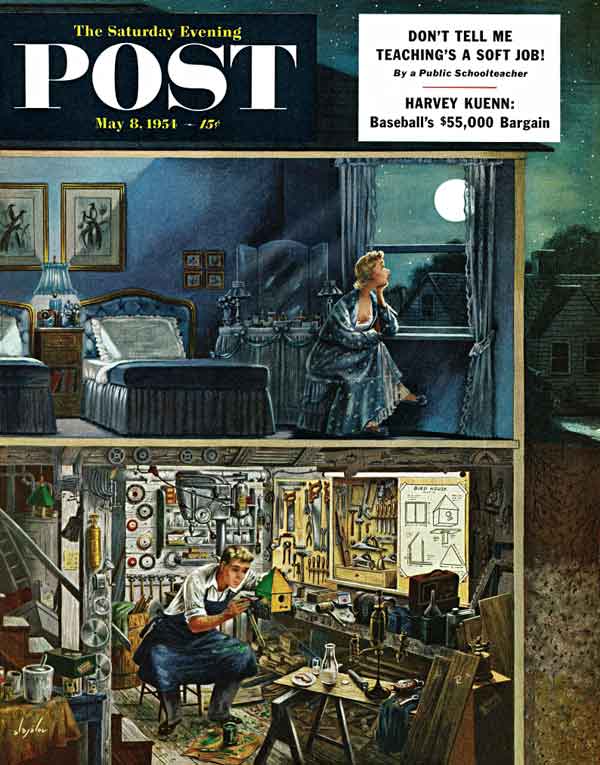
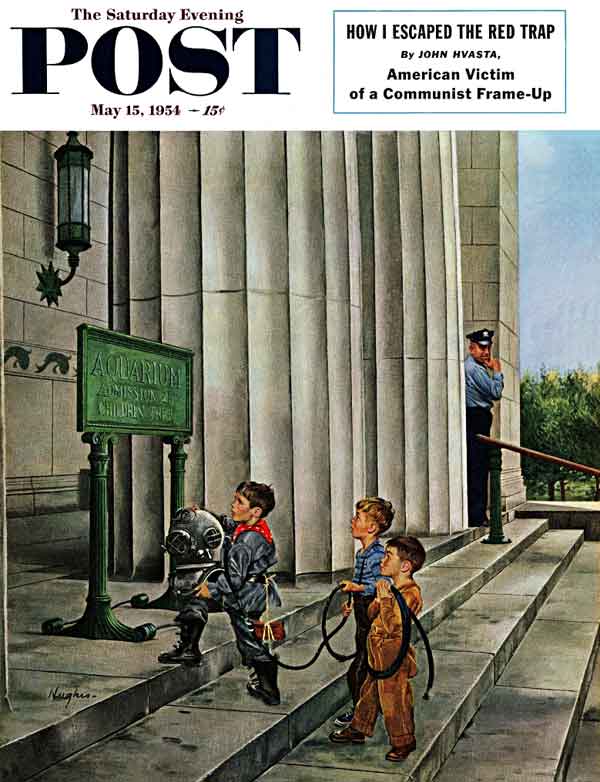
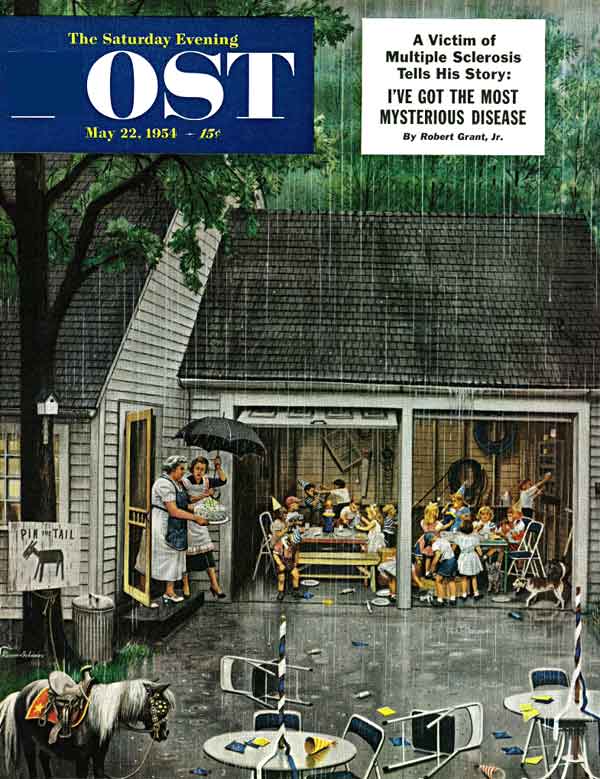
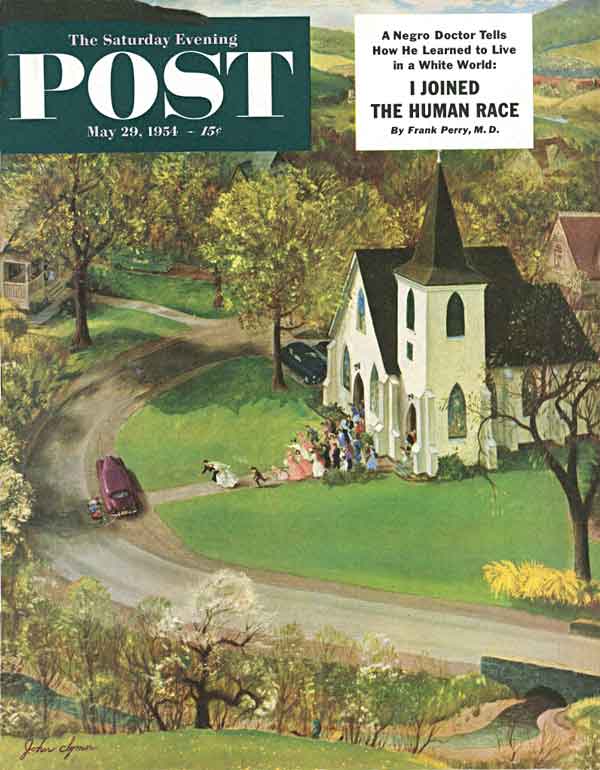
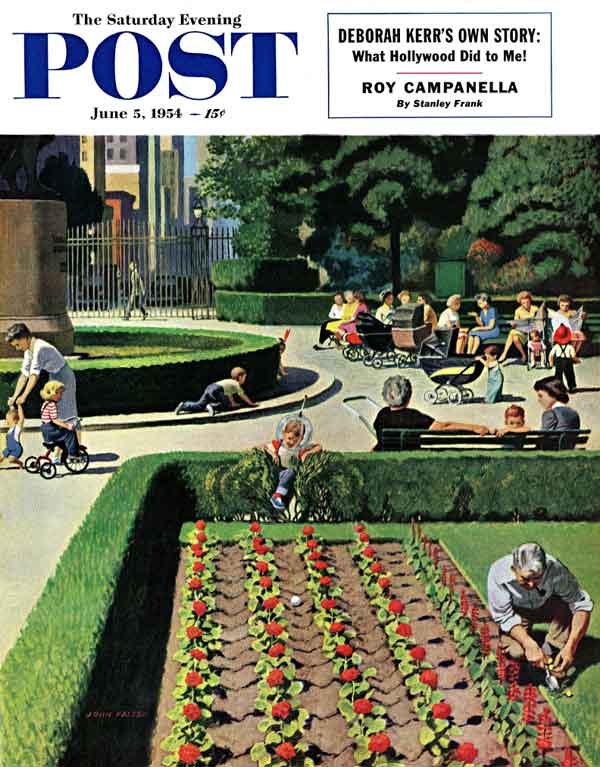
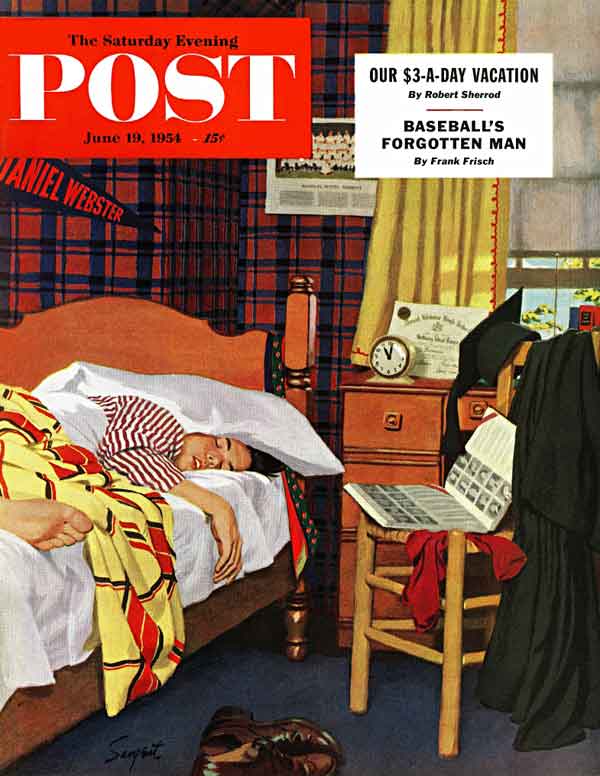
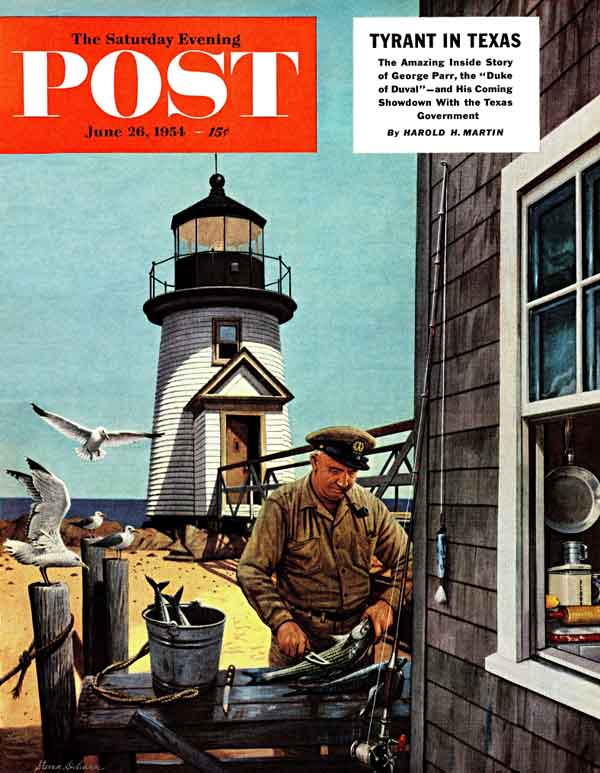
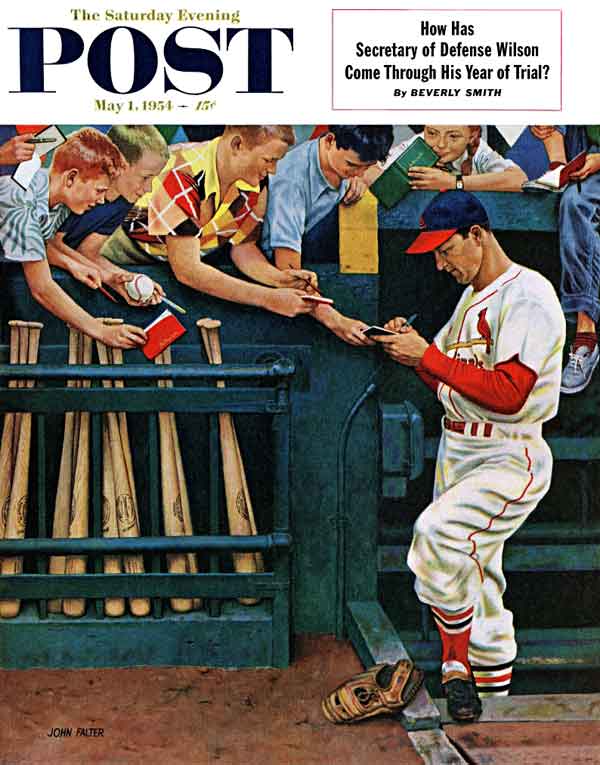
Lastly, we present a gallery of Post coves from those early summer months. Noticeably absent are bomb shelters and students huddled under school room desks.
Like so many of the covers from the 1950s, the art work celebrates intimate, homely moments of small town and suburban family life. We didn’t reflect the country American was in those days. We showed the country as Americans wanted to see it–familiar, peaceful, and contented.