Balancing Act

A few days before the 2012 presidential election, Joe Scarborough, the conservative host of Morning Joe on liberal MSNBC, proclaimed, “Anybody that thinks this race is anything but a tossup right now is such an ideologue … they’re jokes.” He felt reports that put Obama ahead were biased, and he had one particular culprit in mind, Nate Silver, a presumably liberal polling expert who calculated that President Obama had a 79 percent chance of beating Romney.
There was just one problem. It turned out to be Scarborough himself whose judgment was clouded by bias—as Silver recognized when he offered to bet the anchorman $1,000 on the outcome of the election, a wager Scarborough wouldn’t take. Silver turned out to be amazingly accurate in how he called the race.
That’s the problem with media bias. We all know it’s there, and we all know we need to see it, detect it, and overcome it if we’re ever going to know the truth, but we also all see it in different places. All too often, we think whoever we agree with is unbiased. It’s the other guy, the one we disagree with, who holds the biased opinion. How, then, are we ever to get at the truth, the truth we need, not only just to know what’s going on, but to be responsible citizens in a democracy?
It’s a very old problem, and it’s not about to go away, though there are definitely things we can do to try to smoke out biased reporting and see the facts more clearly. We’ll get to that later, but first, a little history. Bias in the media wasn’t always considered a negative. In fact, until about 100 years ago, it hardly ever occurred to anyone that media should be unbiased. Everyone agreed that an informed electorate was the basis of a free society, but they didn’t take that to mean that the news should be delivered without a point of view. They did agree, however, that in the U.S. the freedom of the press was sacred. That was a founding principle of our nation, and one of the great things that set us apart from every government that had come before.
The idea of a truly free press was born in 1735, when a New York newspaperman named John Peter Zenger was put on trial for libel for defaming the royal governor. Zenger’s lawyer insisted that he was innocent because what he had printed was the truth. No law at the time protected a journalist who told truth that hurt a public official, but the jury set Zenger free anyway—and established the notion of a press unafraid to speak truth to power as a cornerstone of liberty.
What makes the jury’s decision all the more intriguing is that it was quite well known that Zenger’s paper had been founded expressly to attack the royal governor. Freedom of the press was considered to be quite a separate matter from bias, as indeed it should be. By the time of the American Revolution, the colonies were awash in partisan newspapers and pamphlets. One of the British outrages that led to the Revolution was the Stamp Act—which put a tax on newspapers. In Europe the press had always been controlled by the ruling aristocracy and bent to serve its purposes; in the colonies, it became the weapon of the people, and publications like Thomas Paine’s pamphlet Common Sense fired the people to revolt against their overseas overlords. The only kind of media bias anyone really worried about was bias imposed from above, by the king and his men.
And so, when the Constitution was written its very first amendment stated “Congress shall make no law respecting an establishment of religion, or prohibiting the free exercise thereof; or abridging the freedom of speech, or of the press …”
With those words, a free press was enshrined along with freedom of speech and religion as one of our most crucial liberties. The government went well beyond mere words in supporting it, too. Where other nations heavily taxed their newspapers, the young United States did the opposite. It subsidized them. The Postal Act of 1792, which established the nation’s mail service, gave newspapers discounted postage rates, and legislators often provided funding for papers in their districts.
With that help the American press flourished so much that by 1835 the U.S. had five times as many daily papers as the British Isles. However, high officials often hated and distrusted what the papers printed. In 1798 President John Adams went so far as to push through the notorious Sedition Act, which made it a crime to publish “false, scandalous, and malicious” writings about the president or Congress. The law would backfire badly, turning its victims into free-speech martyrs. Thomas Jefferson got rid of the Sedition Act soon after he was elected president.
Not all bias is political bias. In the 1830s James Gordon Bennett used sensationalism and colorful embroidering of the truth to build his New York Herald into the biggest newspaper in the world. As but one lurid example, his paper described the corpse of a murdered prostitute in 1836 as follows: “The perfect figure, the exquisite limbs, the fine face, the full arms, the beautiful bust, all, all surpassed in every respect the Venus de Medici.”
Newspapers were, after all, businesses first, and the primary concern was selling papers. By 1871 a British observer would describe the typical American newspaper as “a print published by a literary Barnum, whose type, paper, talents, morality, and taste are all equally wretched and inferior; who is certain to give us flippancy for wit, personality for principle, bombast for eloquence, malignity without satire, and news without truth or reliability.”
How biased was the press in the 19th century? In 1860 Bennett’s Herald reported that Abraham Lincoln was “a fourth-rate lecturer who cannot speak good grammar.”
By the end of that century, the United States was a nation of mass-readership newspapers. Joseph Pulitzer’s New York World led the way, with signs in its city room that read, “Accuracy, Accuracy, Accuracy! Who? What? Where? When? How? The Facts—The Color—The Facts!”
Despite the noble motto, in the World and in its archrival, William Randolph Hearst’s Journal, “there was a lot of willful omission and lying,” as Brooke Gladstone, media historian and host of the NPR show On the Media, points out in her book, The Influencing Machine. Hearst himself is best remembered for his (possibly apocryphal) 1897 telegram to the artist Frederic Remington, who told him there was no fighting in Cuba to report on: “Please remain. You furnish the pictures, and I’ll furnish the war.”
The tide began to turn with the century. Adolph Ochs bought The New York Times in 1896 and announced that it would henceforth “give the news … impartially, without fear or favor, regardless of party, sect, or interest involved.” Lack of bias became a new ideal in the Progressive Era of the early 1900s. In 1904 Joseph Pulitzer endowed one of the first journalism schools, at Columbia University, to “raise journalism to the rank of a learned profession,” and others soon followed. In 1922 editors founded their first professional association, the American Society of Newspaper Editors, and drafted a code of ethics that declared, “News reports should be free from opinion or bias of any kind.”
How The Saturday Evening Post Helped Create Gatsby
In 1918, an ambitious young man from the Midwest traveled south to an army training camp. He was hoping to become an officer, get posted to France, and earn fame and promotion on the Western Front. But the First World War ended before he could distinguish himself.
The trip south wasn’t a complete waste, however, because he found the love of his life: a charming and strong-willed Southern belle. The two fell in love, but the girl refused to marry him because he didn’t have enough money. So he set out to earn the fortune that would win his fiancée back to him.
Up to this point, the story describes the early career of both the fictional Jay Gatsby and his creator, F. Scott Fitzgerald. Gatsby eventually went to work for bootleggers. Fitzgerald returned home to Minnesota and threw himself into writing. Within a year, his career took off when he was discovered by both a book publisher and the editors of The Saturday Evening Post.
In April 1920, Scribner published his first novel, This Side of Paradise. The book was an immediate success; the entire first edition of 60,000 copies sold out within three days.
But even before the novel hit bookstores, the Post was publishing his short stories. Years later, he recalled his excitement at the news of the Post accepting his work: “I’d like to get a thrill like that again but I suppose it’s only once in a lifetime.” The Post’s editors liked his work and published six of his stories in 1920 alone.
Any writer published in the Post during the 1920s would have felt that he or she had ‘arrived.’ No other magazine offered such a large audience—2.5 million readers—or such large payments. Even though he was still an unproven author, Fitzgerald received $400 for his first story. Within a year, the editors had increased his fee to $500. By 1929, they were paying him $4,000 for every story, which would be, roughly, $54,000 today. He began to live extravagantly, spending money as if it would always come as quickly and as easily.
He never again enjoyed the success with a novel as he did with his first. For the rest of his 20-year career, the majority of his income came from short stories—168 of them. And most of this money came from the Post, which published 65 of his stories between 1920 and 1937.
Fitzgerald knew that writing would win him the recognition and success he needed. It would enable him to live like the wealthy students he’d met at Princeton: young men with carefree, careless manners and a natural assumption of privilege and preference. His new wealth also helped convince that charming Southern belle, Zelda Sayre, to marry him. And so, with the Post’s money burning a hole in the pocket of his raccoon coat, Fitzgerald and his free-spending wife began a spree of lavish living that continued through the decade.
His earnings introduced him to the world of Gatsby. He entered a nonstop party, surrounded by the sounds of hot jazz and an ocean of bootleg liquor that extended from nightclubs to exclusive New York hotels. He moved into an exclusive area on Long Island, New York, and eventually relocated to France, where he spent his time among wealthy American émigrés in Paris and the French Riviera.
This new life brought him into close contact with the wealthy, including aimless young people with inherited fortunes. He began to see the emptiness that often lay at the heart of success and the dark edges of the Great American Dream.
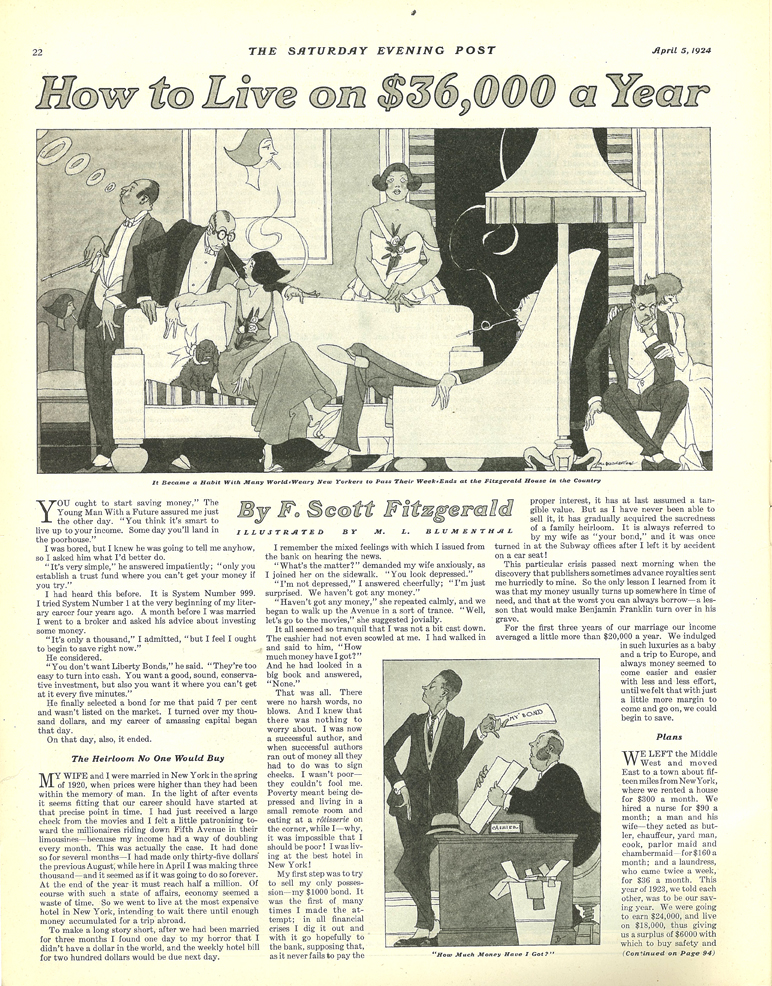
Like Gatsby, Fitzgerald entertained lavishly and continually, spending money on a scale that’s hard to imagine. In 1924, he wrote an article for the Post entitled “How To Live on $36,000 a Year.” It is a humorous piece describing the ineffectual attempts he and his wife made to live within a budget. He wrote it after he realized that, in a single year, he’d burned through the 2013 equivalent of half a million dollars. A few months later, the Post published “How To Live On Practically Nothing A Year,” which told how he moved to Europe where he could live comfortably for far less money. But even with a favorable exchange rate, he had trouble keeping ahead of his spending.
He completed The Great Gatsby while living in France. It is perhaps his greatest work: concise, intriguing, and peopled with memorable characters. Like all his works, it is beautifully written, created by a great writer at the height of his powers. Fitzgerald built his stories with the precision and care of a master jeweler. There is not one wasted or poorly chosen word, or one flabby sentence in its 200 pages.
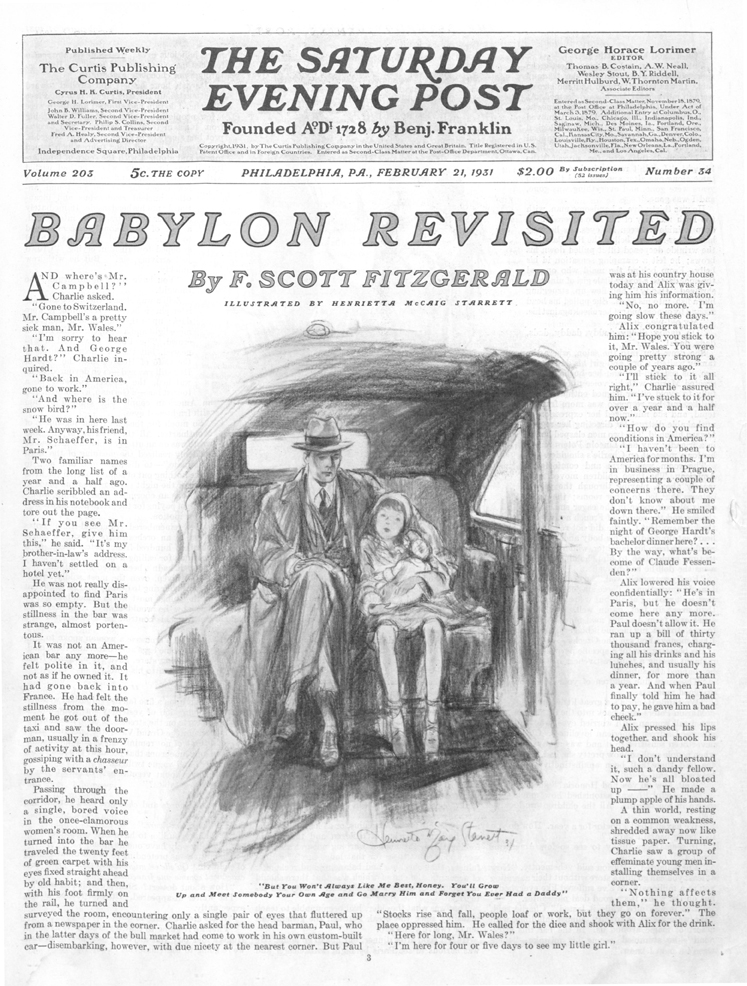
He wanted to write more novels, but he never escaped money problems. As long as the Post continued to pay him so well, he continued writing stories for its pages. Though they weren’t novels, Fitzgerald was proud of his talent for producing these “commercial” pieces. He knew writing magazine fiction was far more difficult than it looked, and he was good at it. His Post stories contain some of his finest, most readable works: “Bernice Bobs Her Hair,” “The Last Belle,” “Babylon Revisited,” “The Ice Palace,” and all the Basil and Josephine stories.
His work for the Post didn’t give him the satisfaction he got from writing The Great Gatsby, which he told a friend was “about the best American novel ever written.” But without the support of the Post, Gatsby would never have been born.
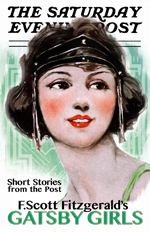
Read F. Scott Fitzgerald’s stories in Gatsby Girls, a collection of his first eight short stories originally published in The Saturday Evening Post and accompanied by original illustrations and beautiful cover images. Available to purchase in both print and digital editions.
For more information, visit shopthepost.com.
Readers’ Favorite Rockwells
We want to hear about your favorite covers from The Saturday Evening Post, whether illustrated by Norman Rockwell or another Post artist. This week we’re reviewing Rockwell favorites from readers and our own staff.
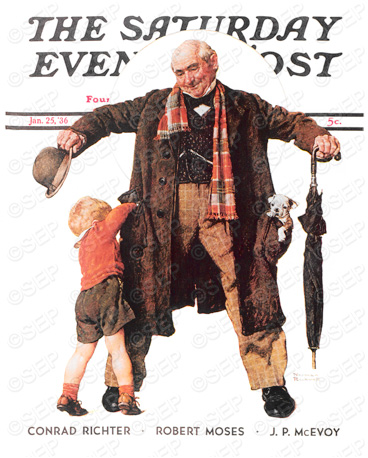
The Gift
Norman Rockwell
January 25, 1936
Helen Palmquist of Lincolnshire, Illinois, went right for a fun one: “My favorite is the little boy looking in Grandpa’s overcoat, not realizing a puppy is in the other pocket.” Rockwell had his beloved Uncle Gil in mind when he created this 1936 cover. Uncle Gil was something of a scientist and inventor, Rockwell wrote in My Life as an Illustrator. “But he did have one eccentricity, he got his holidays mixed up. On Christmas day, with snow on the ground and a cold wind in the trees, Uncle Gil would arrive loaded with firecrackers to celebrate the Fourth of July. On Easter he would bring us Christmas gifts.
“He always had a kind of Christmas spirit about him—jovial, warmhearted, shouting, ‘Warm, Norman, warm!’ as I approached a hidden present and ‘Hurrah!’ when I found it. … I don’t think I have ever enjoyed any gifts as much as I used to Uncle Gil’s.”
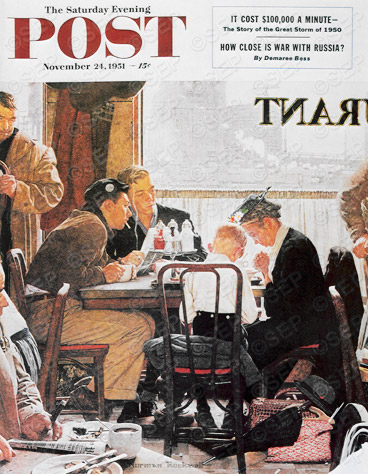
Saying Grace
Norman Rockwell
November 24, 1951
Saying Grace is the favorite of Nicole Beer from our staff in Indianapolis, Indiana. “It reminds me of my grandmother even down to the way Rockwell painted the lady’s hands. I remember being a kid and always praying in public with her before we ate. Everyone would always stare at us and it would make me embarrassed. I hated it as a kid but as an adult, I am so thankful for her and the example she set. I can only hope I am as bold with my faith as she was.”
Saying Grace has an interesting history. Click here to read about which of Rockwell’s sons appears in this illustration and how fellow Post artist George Hughes’ discouragement drove Rockwell to complete this painting.
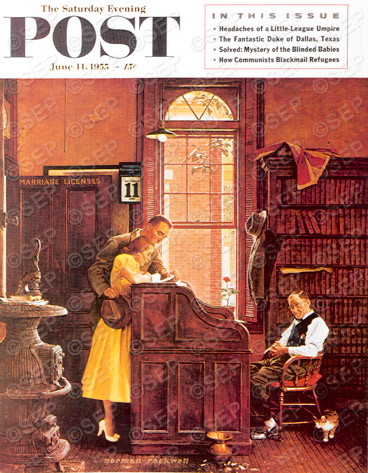
The Marriage License
Norman Rockwell
June 11, 1955
“There is only one that stands head and shoulders above the rest in terms of sheer beauty and deep meaning—The Marriage License,” writes Barbie Thompson of Calgary, Alberta.
“Manning this department, no doubt years before these two lovebirds were even born,” writes Barbie of the elderly clerk, “[he] has seen it all and therefore knows this path all too well—the Good and the Bad, the Happy and Not-So-Happy Endings. The only personal warmth for him now comes from his kitty, those well-smoked cigarettes, and the well-chewed loose tobacco targeted to the spittoon, and the slow-burning, unseen embers from that ancient cast-iron stove.”
Barbie may be more right in that last sentence than she knows. Anne Braman, daughter-in-law of the gentleman who posed as the clerk, wrote in a 1976 Post article that her mother-in law had died the year The Marriage License was painted.
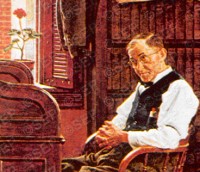
Close-up of elderly clerk.
“Mr. Rockwell—knowing my father-in-law Jason C. Braman—realized how upset he was, and he thought if he could get him to model it would give him something new to think about.”
Rockwell was right about the new activity having a therapeutic effect on the widower, wrote Anne, “As soon as the The Marriage License appeared on the cover of the Post, people recognized him immediately. When his friends commented to him about the cover, he would say, ‘Would you like for me to autograph your copy?’ And he would. When I told Mr. Rockwell about this, he was quite amused.”
[Anne Braman modeled for Rockwell as the schoolteacher in the 1956 cover Happy Birthday Mrs. Jones. Read more about her here.]
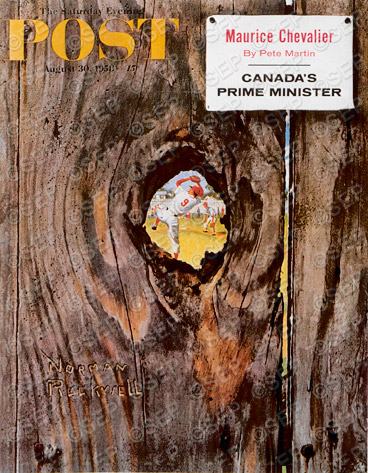
Knothole Baseball
Norman Rockwell
August 30, 2958
“I love all baseball covers, but I find this one particularly interesting,” writes Cris Piquinela one of our Post staffers.
“First off, I don’t think most people looking at this cover would think it is a Rockwell. There are no children or people visible, no characteristic facial expressions. However, what I like about this cover is that it forces me to ‘create’ or imagine the scene in my head. I can’t see the person looking through the hole, but I imagine a freckled, redheaded, barefoot kid. At the same time, I can sense the excitement of the pitch, a great hit by the player at bat, and the entire crowd going crazy. This cover does not tell me what I am looking at … it forces me to imagine it. Plus, I love only having a small piece of the image shown to me.”
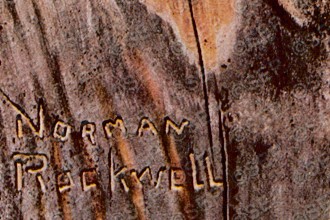
Rockwell’s carved signature.
It is also interesting to note the way Rockwell “carved” his signature in the painting.
A special thank you to readers (and Post staff) for telling us about your favorite Rockwell covers!
Visit our online gallery to review Post covers by your favorite artist.
Coming soon in our Readers’ Favorites series: readers’ favorite covers from Rockwell’s neighbor, friend, and fellow Post artist George Hughes. If you have a favorite George Hughes cover (and there are 115 to choose from) we’ll be glad to feature it.
View covers by George Hughes here, then email us your name, along with the title and date or just a good description of your favorite piece at [email protected].
South of the Border Beans and Rice
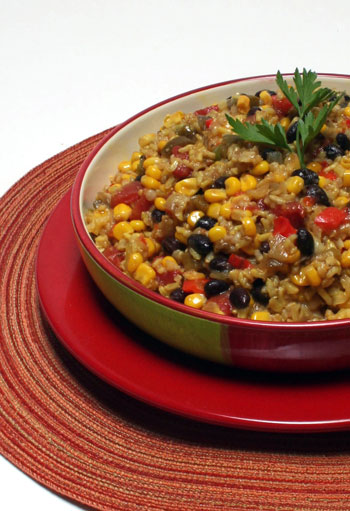
This wonderful, colorful recipe will be a favorite no matter where you are. The brown rice is laced with bell peppers, corn, tomatoes, and black beans. These add to the nutritional quality and keep the rice moist and flavorful. And the black beans actually make this dish a vegetarian meal.
Tip: Customize this dish by adding either mild or hot peppers to obtain the amount of heat you desire.
South of the Border Beans and Rice
(Makes 8 servings)
Ingredients
- 1 tablespoon extra virgin olive oil
- 1 medium green bell pepper, seeded and chopped
- 1 medium red bell pepper, seeded and chopped
- 1 medium onion, chopped
- 4 cloves garlic, minced
- 16 ounces reduced-sodium vegetable broth
- 1 cup uncooked brown rice*
- ½ teaspoon cumin
- ⅛ teaspoon turmeric
- 1 can (15 ounces) black beans, drained and rinsed (or use no salt added)
- 12 ounces corn kernels, no-salt-added canned or frozen
- 1 can (4 ounces) mild green chiles, diced
- 1 can (14 ounces) diced tomatoes, drained
- Salt and freshly ground black pepper to taste
*Unlike white rice, brown rice retains its outer layer of bran and its germ. This results in more fiber and nutritional value. Brown rice also has a mild nutty flavor, as opposed to the bland flavor of white rice.
Directions
- In medium pot, heat oil over medium-high heat. Add peppers, onion, and garlic and sauté for about 4 minutes.
- Stir in broth, rice, cumin, and turmeric. Bring to boil. Reduce heat, cover and simmer for 45–50 minute or until rice is tender (do not stir during this time). Then gently stir in beans, corn, chiles, and tomatoes. Heat through and let stand 5 minutes. Season to taste with salt and pepper and serve.
Nutrition Facts
Per serving
Calories: 220
Total fat: 3 g
Saturated fat: 0 g
Carbohydrate: 42 g
Fiber: 6 g
Protein: 7 g
Sodium: 70 mg
To Boldly Return
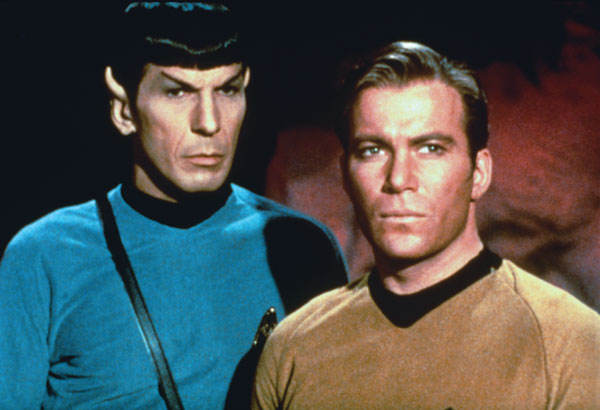
Captain Kirk in Star Trek. Courtesy NBC/Photofest.
Director J. J. Abrams, whose Star Trek Into Darkness opened May 2013, is not counting on the sci-fi special effects (although there will be plenty) to guarantee the success of the sequel to his huge 2009 hit Star Trek. “I want it to be real and relevant,” he says, speaking of the 12th film based on the iconic ’60s TV show. “Cool as they are, the spaceships and the gadgetry aren’t what really matters.”
For Abrams, the crew of the Enterprise is paramount. “You want to be cruising with them on an amazing and fun adventure,” he says, echoing the words of Star Trek’s late creator, Gene Roddenberry, who famously pooh-poohed the technology component of his stories: “I wrote my daydreams,” he said. And his late wife Majel Barrett-Roddenberry pointed out: “He wrote about things that he understood, and that wasn’t science, it wasn’t technology.”
Maybe Roddenberry put his other interests before science, but there are countless concepts and tools we first encountered on Star Trek that have since become, not only real, but a part of our lives.
“Their Universal Translator? Today we’ve got an app for that,” notes Linda Wetzel, who teaches a course at Georgetown University on the philosophy of Star Trek. “We may not have phasers, but we have lasers and tasers. And we can talk to computers now, and they understand us.”
But the show was never really about the gear: “The original series tackled burning issues of the day,” says Wetzel. “It explored big ideas—philosophical, political, and scientific. Star Trek asks ‘What if?’ and just runs with it.”
The show first beamed into millions of living rooms in the tumultuous ’60s when visions of Armageddon danced in our heads; the U.S. and the Soviet Union were uneasy adversaries in a nuclear stand-off. Space exploration had become a priority after the Russians one-upped us with the launch of the Sputnik satellite followed by Uri Gagarin’s historic flight into space. We responded with a huge and expensive effort to put a man on the moon.
Against this dark, historical backdrop, Star Trek broke new ground with a racially diverse spaceship crew that included Nichelle Nichols as communications officer Uhura and George Takei as helmsman Sulu. It held out the possibility that an uncertain future could have a happy ending as The Federation tried to contain the vicious and violent Klingons, whose homeworld Kronos was a superpower not unlike the Soviet Union, while the Enterprise discovered life on other planets. And the series explored timeless questions about where we were going—not just in outer space but in our lives as human beings.
As William Shatner, the original Captain Kirk, explains, “A wonderful story is something people can relate to—whether it’s a search inside or an exploration of our future in space. I think the real, lasting connection is that we entertain people. I never came to the set thinking ‘Today I save the universe.’ I usually would say, ‘Where are the bagels?’”
Professor George Slusser, curator of the Eaton Collection of Science Fiction and Fantasy at University of California, Riverside, agrees. It’s important, he notes, that Roddenberry never let the values he promoted stand in the way of entertaining his audience. “A person who has a hard day isn’t interested in reading about philosophy or hard science,” Slusser says. “But they will sit down with a beer in their hand and watch Star Trek and encounter some grand ideas. And they may not even realize they’re getting them.”
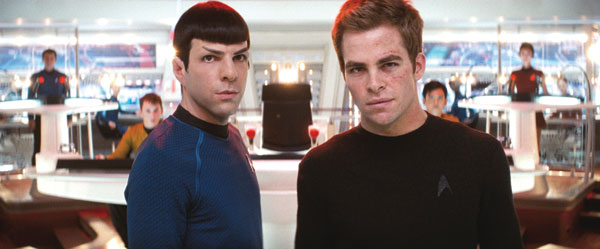
Captain Kirk in Star Trek. Courtesy Paramount/PhotoFest.
As the late James Doohan who played Scotty once put it, “We knew about the lessons in Star Trek, and we knew as actors how important it was that we get them across. I remember Roddenberry once said to me, ‘If we think it’s going to be difficult for the audience to believe something, we’ll just cut to your close-up.’ I thought that was marvelous.”
Leonard Nimoy, who became legendary as Mr. Spock, says that Roddenberry’s perspective on life changed his own. “I was much more emotional before I started to play him,” he remembers. “Spock had a big impact on me personally. It made me understand better how to approach a difficult situation without the emotion taking over. And I hope some of that was passed on to the audience.”
What could have been the end of Star Trek turned out to be a new beginning. After three seasons on NBC, the series was cancelled because of low ratings. But in a serendipitous twist, reruns in TV syndication became more popular than the series had been on NBC and also attracted a coveted younger audience. That led to the first Enterprise venture on the big screen, Star Trek: The Motion Picture. The flick got mixed reviews for drawing mainly on previously produced television episodes, but it scored huge at the box office with ticket sales of $82.3 million domestically, thanks in large part to Trekkers who returned to see it countless times.
The movie’s success jump-started a string of sequels, which were basically review-proof as Trekkers rallied around the box office—although many claimed, in a strange calculation with which a lot of critics seemed to agree, that the even-numbered sequels were always better than the odd-numbered ones.
Roddenberry had little involvement in Star Trek on the big screen but, nearly 20 years after the TV series had debuted on prime time, he re-imagined his vision in the syndicated Star Trek: The Next Generation, or TNG for short. An entirely new cast was led by Patrick Stewart as Captain Jean-Luc Picard, who had the emotional control that was often missing in the impulsive Kirk, and the series’ trademark diversity included Whoopi Goldberg as an alien bartender and LeVar Burton as the blind engineer.
The series reflected a new time in America. While Captain Kirk’s Enterprise was always pressing on to a new planet and another conflict, Captain Picard headed a calmer and more sophisticated ship, complete with chamber music concerts. There was not much fighting but a lot of negotiating. The Klingons had been tamed and were now allies of The Federation. Everything was running pretty smoothly except for frequent technical turmoil ranging from dangerous radiation leaks to warp jumps that had to be calculated to the nanosecond.
Trek Trivia
So you’ve seen all the movies and watched all 716 episodes. But do you have what it takes to move through the ranks of the Starfleet Academy? Pick your choices, then click “Answers” to find your score.
1. “Live long and prosper” is the greeting of which planet?
a. Vulcan
b. Romulus
c. Earth
2. Which actress played the first female commanding officer in a leading role?
a. Kate Mulgrew
b. Denise Crosby
c. Nichelle Nichols
3. Name that alien:
a. Lieutenant Worf, Klingon
b. Nero, Romulan
c. Sybok, Vulcan
4. Who was the captain of the Enterprise in the original Star Trek pilot?
a. Christopher Pike
b. James T. Kirk
c. Jean-Luc Picard
5. In the original series, what was the tip off that a character would die early on in a mission?
a. The character would say the line, “Beam me up, Scotty.”
b. The character was the first one off the ship.
c. The character was wearing a red shirt.
6. Before Leonard Nimoy, which actor did Star Trek creator Gene Roddenberry consider to play Spock?
a. Adam West
b. Patrick Stewart
c. Peter Graves
7. Besides Whoopi Goldberg, which other Oscar host appeared on a Star Trek TV series?
a. Seth McFarland
b. Billy Crystal
c. Johnny Carson
8. Other than Kirstie Alley, which Cheers cast member also appeared in the Star Trek franchise?
a. Rhea Perlman
b. Kelsey Grammer
c. Woody Harrelson
Check the Answers!
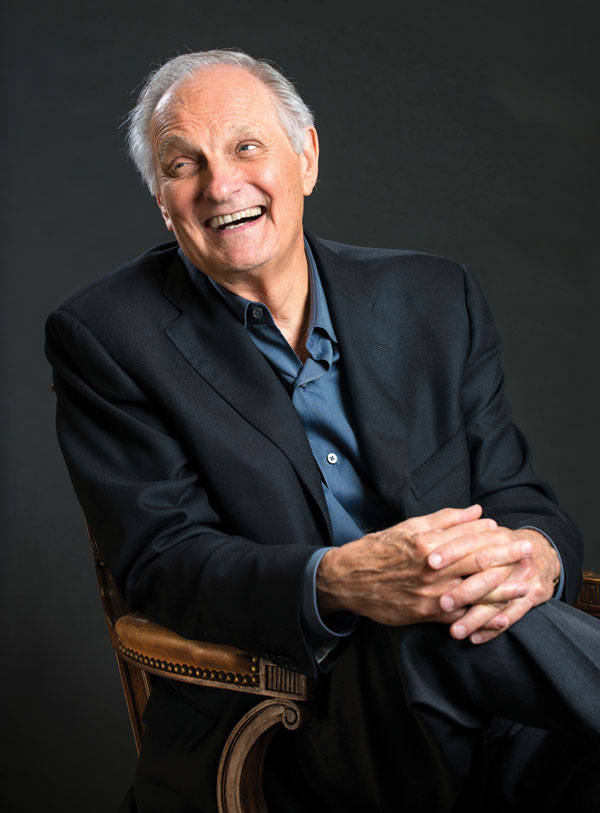
Alan Alda
Credit: Greg Kessler © 2012 World Science Festival
In his first memoir Never Have Your Dog Stuffed: And Other Things I’ve Learned, Alan Alda recalls that as a young child, his mother would often caution him to keep silent in public. “Don’t notice anything,” she’d admonish him. It’s no small irony that years later, he would play a universally beloved television character named Hawkeye.
Alda played that part for 11 years in the classic hit M*A*S*H and, more recently, tweaked liberal sensibilities as the Goldwater-like Arnold Vinick in The West Wing. He is a prolific writer and director with 33 Emmy nominations (six wins) plus three Tony nominations for his work on Broadway. And then there are the many memorable film roles, from Crimes and Misdemeanors to California Suite to, most recently, Tower Heist.
It’s no surprise that Alda’s perpetually in demand for films and TV, but what is surprising is where his heart is these days. His deep-rooted passion for science has evolved into a remarkable endeavor: He’s currently visiting professor at Stony Brook University’s Center for Communicating Science—a department he helped found in 2009 to train scientists to communicate more effectively with the public. As if that weren’t a sufficient departure from show biz, in 2012 Alda and the center also created the Flame Challenge, an annual international contest in which scientists are challenged to explain complex concepts to 11-year-old children. More so than any of his television, stage, or screen credits, Alda is palpably animated when conversing about these unique ventures.
Question: How did you become a visiting professor at Stony Brook University?
Alan Alda: I realized when I was doing Scientific American Frontiers for 11 years on PBS how important it was for the scientists to have really good communication skills. Science really surrounds us in our lives, and it’s at the heart of our economy. We all have to understand it better. So, in my travels, whenever I was at a university where they taught science, I would ask, did they think it would be possible to train scientists as communicators while they are training them as scientists? The only place in the country that really picked up on the idea was Stony Brook. And Howie Schneider, who runs the school of journalism, got very enthused about it and began the Center for Communicating Science. And I’ve been helping with that.
Q: This is a rather unusual move for a movie star.
AA: My relationship with science is as someone who’s curious and hungry to know, hungry to understand. So all I have to offer is my ignorance and my curiosity, which is a good combination, as long as they come together. Ignorance without curiosity is not so hot. But I actually do have something to offer, which is that I’ve spent my life communicating and thinking about how communication works.
Q: There should probably also be a center for communicating economics, public policy, law—all kinds of other disciplines, don’t you think?
AA: I can’t change the entire world [laughing]. Yeah, better communication would be terrific. I’ve often wondered what the “fiscal cliff” was [chuckling], or even what “Obamacare“ actually entails—it’s always been a little murky and could have been communicated better.
Q: And yet we’re voting on these things.
AA: I know that some members of Congress have not understood these subjects as well as they might want to. So, yeah, our lives depend on good communication. Good communication helps personal relationships, it helps bosses and employees get along better. We rely on it.
Q: Speaking of science, what’s the status of your play, Radiance: The Passion of Marie Curie?
AA: We did a wonderful production of it at the Geffen Playhouse in California. Anna Gunn played Marie, and she was fantastic and that was wonderful for me to see. I’m constantly revising it. In the car on the way over here I was making notes on a couple of scenes. It sounds stupid if I tell you how many drafts I have.
Q: I’m a writer. Please, share!
AA: How about 100. I probably will be continuing to work on it until well after I’m dead. I love the character; she is a hero of mine and I want to tell that story as well as I can.
Q: You write, act, direct. Do you sing, too?
AA: I have sung twice on Broadway—in The Apple Tree and in a musical that lasted until the end of the first act. [Laughs.] It was called Café Crown. I have to work hard at singing. I was thrown out of the glee club in high school because I had trouble staying in the same key. I have this unique ability to sing in three keys at once. Seriously, I’ve gotten a lot better over the years. I sing when I have to.
Q: Would you star in a television series again?
AA: If they asked me to do a show that I’m interested in or that I’d get to work with someone that I’d like to work with. I like to work with Laura Linney, so I did her show [The Big C] a few times. I did ER and The West Wing. They were really interesting places to act. And 30 Rock. That was fun. Tina Fey is so brilliant. I’m in this wonderful position where I can do what interests me. And whatever comes along that interests me, I do. The rest of the time I bother scientists about communicating.
Grilled Chimichurri Pork Roast
A savory Argentine marinade filled with antioxidant-rich cloves of sweet garlic, chopped fresh parsley, and a touch of crushed red pepper is easy to prepare the day before, and it makes this no-fuss grilling recipe a real conversation starter.
Serve it with grill-roasted seasonal vegetables and freshly squeezed lemonade.
Grilled Chimichurri Pork Roast

(Makes 12 servings)
Marinating time: 12 hours
Prep time: 15 minutes
Cook time: 1 hour
Ingredients
- 3-pound boneless pork roast
- 1 cup parsley , coarsely chopped
- ¼ cup onion, chopped
- 6 cloves garlic, coarsely chopped
- ¼ cup lemon juice
- ¼ cup olive oil
- 1 teaspoon dried oregano
- 1 teaspoon red pepper, crushed
- 1 teaspoon salt
- ½ teaspoon black pepper
- Lemon slices, for garnish
- Lime slices, for garnish
Directions
- Place pork roast in self-sealing plastic bag. In food processor, place parsley, onion and garlic and pulse until minced. Add remaining ingredients, except garnish, and process to blend. Coat pork in plastic bag with this mixture. Seal bag and refrigerate overnight.
- Prepare medium-hot fire in grill. Remove pork from marinade (discard marinade) and place pork roast over drip pan on grill over indirect heat. Close grill cover and cook about 1 hour (20 minutes per pound), until internal temperature on a thermometer reads 145°F. Remove roast from heat; let rest about 10 minutes before slicing. Garnish with lemon and lime slices.
Nutrition Facts
Per serving
Calories: 145
Total fat: 6 g
Saturated fat: 0 g
Protein: 25 g
Sodium: 100 mg
Are Books Really Here to Stay?
Will we see the end of book publishing in America?
The question would have been unthinkable not very long ago. Today, it’s worth asking because there’s the possibility that electronic books will outgrow and replace printed books. The first electronic book reader was introduced in 2006. Five years later e-books began to outsell printed books.
While digital publishing seems to be growing, the printed book industry is continuing its long decline. Countless independent bookstores have vanished from the American landscape, followed by the demise of the Border’s bookstore chain in 2011. Now, most Americans live within driving distance of only one bookstore—Barnes & Noble—and that company’s health is not exactly robust. (The company plans to close 20 of its stores every year for the next decade.)
However, the fear that book publishing will disappear has been around for more than a century. Back in 1958, for example, this fear prompted American Publisher Bennett Cerf to write “Books Are Here To Stay.” He was writing in response to the concern of parents, educators, and publishers that young Americans were becoming addicted to television. Kids, they said, showed no interest in reading but remained glued to the tube all day. Soon the great publishing houses would shut down, they assumed, and books would start to disappear from the American home.
But Cerf saw things differently, and he knew what he was talking about. He had run Random House publishing for 30 years, and could assure Post readers that “publishers cry more easily than anybody else on earth. … To hear them tell it, there’s always something threatening to bankrupt half the publishers extant. Television is merely their latest bugaboo.”
And then, interestingly, Cerf told us several things that were going to destroy publishing before television.
In the 1900s, he said, a New York publisher prophesied that interurban trolley cars would bring about the end of reading in America. The new trolley lines being built in those days allowed Americans to easily commute between the country and the city. They also permitted the youth to go joyriding for a day, taking a trolley from Chicago to Milwaukee, for example, or Philadelphia to Atlantic City, New Jersey. What youngsters, the publisher asked, would be content with books if they could ride for hours in a trolley car?
Even before the interurban lines were bearing youths away from their books, Cerf said, the bicycle was going to kill the book. Young men and women of the 1890s spent all their free time on bicycles, even taking 100-mile, weekend-long rides, leaving them no time or energy to read.
In the first few decades of the 20th century, books faced growing competition from the phonograph, the radio, and the affordable Model T that seemed to consume more and more of the average American’s time.
Yet with all these alternatives to reading, the popularity of books continued to grow. The Book Of The Month Club, founded 83 years ago this month, proved immensely popular. Between 1926 and 1929, membership grew from 2,000 to 100,000.
Today we are far from seeing the end of publishing. More than a million new titles are produced every year, including over 200,000 self-published books. This latter number is misleading, though, since many of these ‘books’ are purely digital and will never see a single sheet of paper.
As we’ve stated before in the Post Perspective, the love of reading and the love of books are not the same thing. The lovers of reading don’t care if they read text out of a book, off a smartphone, or from the back of a cereal box. As long as it’s legible, they’ll enjoy it.
Book lovers, on the other hand, are enchanted by the feel of a cloth binding, the scent of the pages, and crisp, dark type on white paper. They’ll spend fortunes on books, and care for them tenderly, and might even read some of them.
For lovers of reading, the future has never been better. More people are reading and writing than ever before, and the Web offers an endless supply of new, unexpected material. But for book lovers, the future does not look promising. The number of bookstores, and the size of their inventory, are not likely to grow. However, book lovers should take comfort in the fact that no form of entertainment has ever disappeared. The Internet hasn’t replaced television, which didn’t replace radio, which didn’t replace movies, which didn’t replace the theater, etc. Americans are continually rediscovering and reviving old entertainments and crafts.
We will see fewer large-inventory bookstores in the future, but a growth of print-on-demand (POD) publishers. These small, independent operations will print and bind any book of your choice. You can get the title you want in minutes, and the POD operation doesn’t have to pay the costs of maintaining an inventory of unsold titles.
The good news is that book publishing won’t disappear. The better news is that Americans today are reading more than ever.
Rockwell’s Barbershop Quartet
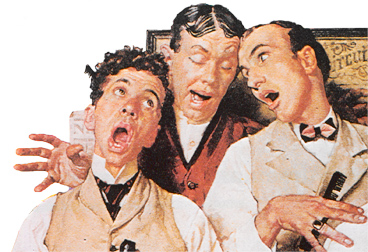
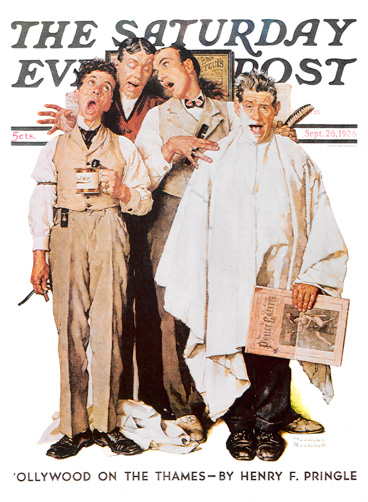
Norman Rockwell did such a remarkable job capturing the singers’ expressions as they hit the perfect note, we wish we could turn up the volume on this 1936 classic. Evoking the turn of the century era, perhaps the Gay ’90s, he is able to indulge his love of costumes and further authenticates the scene with meticulous attention to detail; the shaving brush and mug, straight razor, even a well-used comb that is missing a few teeth (click on images for larger view).
The cover models were all residents of New Rochelle, New York, where Rockwell lived and worked for the first 25 years of his career. The barber on the left was actually a barber by trade. The gentleman in the red vest, to his right, was a member of the town’s fire department. Rockwell’s assistant Carl Johnson made an appearance, too, wearing a bow tie and holding a comb. And on the far right we find customer Walter Beach Humphrey, a friend of Rockwell’s and an illustrator for the Post.
Norman Rockwell
September 26, 1936

The image lives happily on in a larger-than-life mural gracing the side of the landmark building for the Barbershop Harmony Society in Nashville, Tennessee. From the 1890s through the 1930s, the Society states that professional quartets were considered the rock stars of their days. But, barbershop quartets are still alive and very well today—not just for old fogies. Competitions in quartet and chorus categories draw the young in great numbers.
And barbershop singing is not just a world of boater hats and waxed moustaches. The Sweet Adelines is a women’s organization that began in 1945, and today is an international organization with nearly 23,000 members and a schedule of competitions of their own.
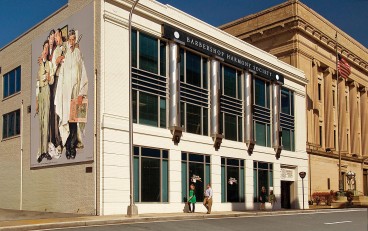
The Society, which celebrates its 75th anniversary this month (April 2013), has also licensed the image for their quartet membership cards. And, Brian Lynch of the organization tells us, “from time to time, you will see a quartet on stage striking this pose in tribute to Rockwell’s great work.”
Lynch continues, “The Society owns a signed, numbered lithograph that Rockwell made from the original sketches, with hand tinting of the tenor’s bow tie performed by the artist. As such, it’s something of a holy relic for barbershoppers.”
To delve into the history of barbershop singing or view videos of harmonizing that would make Norman Rockwell proud, visit the Barbershop Harmony Society website.
From 1918–1950, Rockwell illustrated three other barbershop covers:
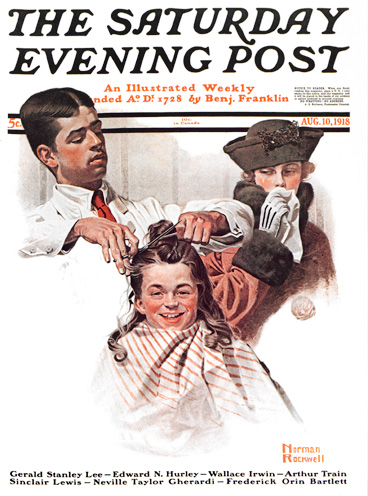
Norman Rockwell
August 10, 1918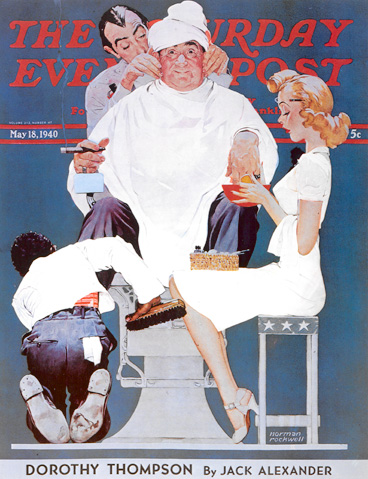
Norman Rockwell
May 18, 1940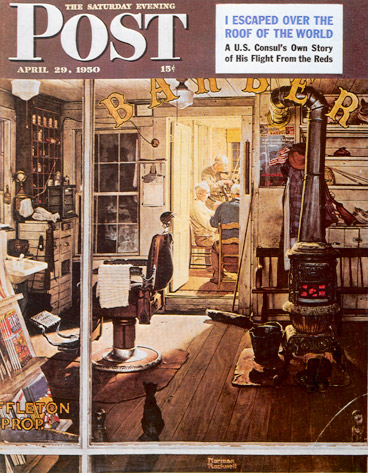
Norman Rockwell
April 29, 1950
Remember to tell us your favorite Post cover for our “Reader Favorites” series. The first “Reader’s Favorite Rockwells” begins next week! Email [email protected] and include your name, along with the title and date or just a good description of your favorite piece.
ANZAC Biscuits
Chocolate chip cookies are an American invention. Around the world, other countries also have sweet treats they created. Think French pain au chocolat and éclairs, Italian biscotti, and the chewy Japanese rice flour treat called mochi.
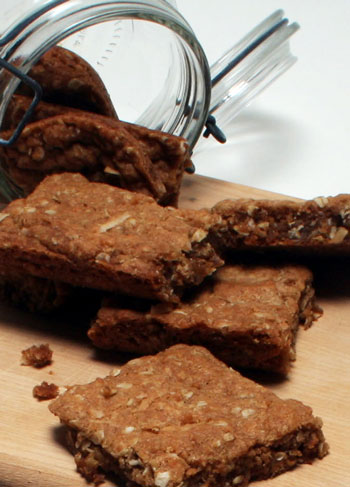
We know little about Australian cooking, so let me introduce you to ANZAC biscuits. ANZAC stands for Australia and New Zealand Army Corps, and a biscuit is a sweet cookie. ANZAC biscuits are like crunchy oatmeal cookies with shredded coconut. They are associated with ANZAC Day (April 25) when during World War I, troops from Down Under landed in Gallipoli to face a horrendous situation. The biscuit was created to send home-cooked food to troops far away and to fortify their limited diet with good nutrition.
As with chocolate chip cookies, recipes for ANZAC biscuits abound. Here, I use a soft buttery spread in place of butter to minimize saturated fat and cut out cholesterol. Keeping the fat content reasonable means this dough works best baked as a bar.
ANZAC Biscuits
(Makes 20 servings)
Ingredients
- 1 cup quick cooking rolled oats
- 1 cup reduced-fat, unsweetened shredded dried coconut (or ½ cup regular, unsweetened shredded coconut)
- ½ cup whole-wheat pastry flour
- ½ cup unbleached all purpose flour
- ½ cup granulated sugar
- ¼ cup packed brown sugar
- ½ teaspoon salt
- ½ cup buttery spread
- 2 tablespoons honey
- ½ teaspoon baking soda
- 2 tablespoons boiling water
- Canola oil cooking spray
Mixing Directions
- In mixing bowl, use whisk to combine oats, coconut, flours, sugars and salt.
- In small pot over medium heat, heat spread until melted. Mix in honey. Remove pot from heat.
- In small bowl, combine baking soda with boiling water. When mixture is foamy, add to melted spread mixture.
- Pour warm mixture into dry ingredients and mix, first using flexible spatula, then your hands, working with your fingers until mixture is evenly moistened. It will be sandy and crumble when squeezed in your fist.
- Cover bowl with plastic wrap and set aside at room temperature for 2–24 hours, until handful squeezed tightly sticks together.
Baking Directions
- Preheat oven to 325°F.
- Coat 11-by-7-inch baking pan with cooking spray. Pour bar mixture into prepared pan and press firmly into even layer.
- Bake 10 minutes. Remove pan and using sharp, thin knife make 4 cuts spaced evenly across wider width of pan. Rotate pan 90 degrees and make 3 cuts across smaller width of pan, creating 20 bars. Return pan to oven and bake for 8-10 minutes, until cookies are deep golden brown. They will be slightly puffy and yield a little when pressed with a finger.
- Set pan on wire baking rack and run knife through cuts. Cool completely. Run knife through cuts again to make sure cookies are completely separated and lift from pan. ANZAC cookies will keep in airtight container for 1 week.
Nutrition Facts
SERVING SIZE
Calories: 130
Total fat: 6 g
Saturated fat: 3 g
Carbohydrate: 17 g
Fiber: 1 g
Protein: 1 g
Sodium: 140 mg
Hand-Painted Silk Scarf
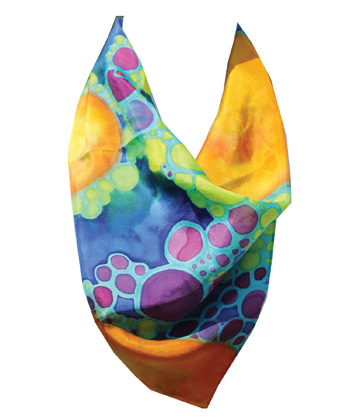
Silk scarves are the perfect accessories for spring. They’re lightweight, versatile, and add a splash of color to drab ensembles. Here’s how to make your own:
Hand-Painted
Silk Scarf
Materials
- White, 100 percent Chinese-silk scarf*
- Dull pencil
- Permanent markers, choice colors
- Jacquard Dye-Na-Flow paint*
*Available at craft stores or online.
Tools
- Two 2-feet-long pieces of freezer paper
- 2-by-2-feet foam board
- 16 thumbtacks
- Iron
- Small paintbrush
Directions
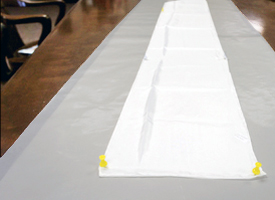
- Lay pieces of freezer paper side by side, shiny side up on foam board. Gently stretch scarf flat over freezer paper. Pin in place with thumbtacks.
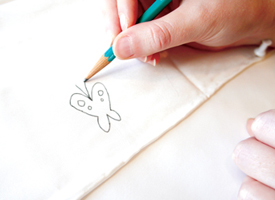
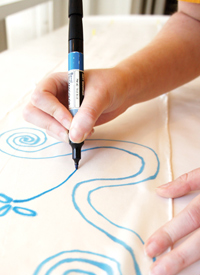
- Lightly sketch shapes on silk with pencil.
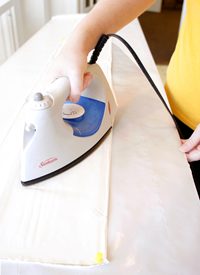
- Heat iron on “silk setting” and press silk to freezer paper until wax begins to melt. Don’t overdo it! Edge of scarf should easily pull away from paper.
- Trace pencil shapes on scarf with permanent markers. Be sure to close shapes so paint will stay within marker lines.
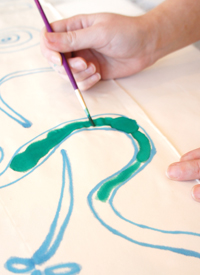
- Paint shapes from center out. Allow paint to spread before adding more paint. Too much paint will overrun marker lines. Dry scarf on board for 24 hours. Remove and dry alone in clothes dryer on high heat for 30 minutes.
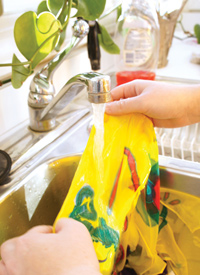
- Rinse scarf in cold water until water runs clear. Air dry.
The Outside World

“You were right,” Susan said. “The view’s great from the other side of the road.”
Jimmy Duncan watched her approach, the sun behind her and the wind riffling her hair. She fiddled with her camera a moment, then plopped down beside him on the grassy hillside. To their left, loomed a wall of black forest; jungle birds screamed and chattered in the trees. To the right, beyond the rented Jeep, a line of ragged mountains marched away into the blue distance.
“How do you know this place?” she asked. “You never said anything about all this.”
“I don’t know the whole country. Just this area.”
She grinned. “And I thought you’d told me all your secrets.”
When he didn’t reply, Susan’s voice turned soft. “This has something to do with the accident, doesn’t it?”
“Why do you think that?”
“Because I know you. The look on your face.”
Jimmy sighed. “That was a long time ago.”
“So?”
“Besides”—he plucked a blade of grass, examined it, twirled it between a thumb and forefinger before the wind took it—“I’m not even sure you’d call it an accident.”
“What would you call it?”
…
“A miracle,” the cop said.
Jimmy turned his head toward the voice. Not his eyes, just his head. His eyes were bandaged tight. “What’d you say?”
“I said it was a miracle. That car of yours was squashed so flat we thought you was too. You’re one lucky fool.”
Jimmy groaned. He didn’t feel lucky. He felt blind, and nauseated, and achy. From somewhere down the hall, he heard the sad rattle of a cart as patients were brought their lunch trays.
“The other driver?” Jimmy asked.
“Not even a bruise. Them 18-wheelers are built like tanks.” Jimmy heard a rasping sound, and realized the cop was scratching his chin. “Want some advice, kid? That truck’s company owns a thousand stores, and we got three witnesses say it ran the light. Sue ’em, settle for a couple million, and move to Hawaii. Beaches, sunsets, girls in grass skirts.”
“What if you can’t see them?” Jimmy asked.
“Yeah, well, that could be a problem.” The cop cleared his throat. “Catch you later.”
Which was a lie. The cop didn’t return. The doctor, however, did. Along with a parade of nurses and orderlies and even a few lawyers. But no friends, and no family. Jimmy didn’t have any of those.
He didn’t even have a home. For the past two months, since the layoff from the warehouse in East Texas, he’d been on the road. Footloose, but not fancy-free. His savings were gone now. He’d hoped to sell some of his paintings, but that notion had suffered the same fate as most of his other ideas. In San Francisco he’d heard about an art colony near Vancouver and headed north. Why not? He’d never seen Canada. Then, in Oregon, a truck had failed to stop for a red light. What had stopped was his tour of the Northwest.
Broke, alone, homeless, blind. Even his artwork was gone, destroyed in the crash. He didn’t know what hospital he was in, or who was paying for his treatment. Uncle Sam, probably.
He almost wished he hadn’t been thrown clear, wished he’d been squashed as flat as his 10-year-old Civic. Easier for everybody.
But life went on.
As if proving that, Jimmy soon learned to ID the hospital staff from their voices. He had little choice; his hearing was one of the few senses he had left. He wondered if he’d ever see anything again.
“Pressure on the optic nerve, plus a scratched cornea,” the doc said. “A specialist is coming in. We’ll know more then.”
Three specialists and two surgeries later, Jimmy was told he would regain his sight. Two months from now, maybe less.
His body was another matter. Multiple head and back injuries, partial paralysis. He could move his neck and his left arm, but only slightly. Otherwise, zip. Each day he was lifted into a wheelchair beside his bed, and each day he wondered why the wheelchair. Did they think he was going someplace? He was left to sit there a couple hours, and then they swung him back into his bed, like a sack of feed. Day after day.
And then he met Maria. She came one morning like a fuzzy dream while he was in the chair and whispered in his ear. He turned his head in the direction of her voice. Many people had spoken to him during his stay, but this was the first whisper. It had a Spanish accent.
“The weendow,” she said. “You must make it to the weendow.” And squeezed his hand. Then she was gone.
A nurse told him later who the woman was. Maria Renaldo, from the fifth floor. A small lady, mid-80s. She loved to talk with patients. No one knew whether her goodwill visits accomplished much, but since she was harmless the hospital allowed her free access.
Playing God with Human DNA
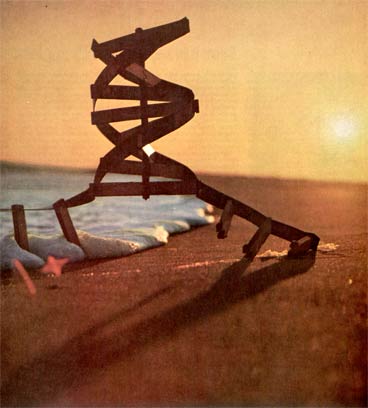
On Thursday, June 13, 2013, the Supreme Court unanimously ruled that human genes isolated from the body can’t be patented.
Such a case would have been unthinkable 60 years ago, when medical researchers were just starting to make progress in molecular biology: the study of how genes control the actions of living cells.
Scientists already knew that chromosomes—the long strands of a complex molecule called DNA—control the function of cells. But they still didn’t understand how DNA holds the information required to assemble and operate every human cell. If they could gain this information—“the molecular facts of life” as a Post author expressed—they might be able to increase, alter, or stop certain activities within cells. Doctors could halt cancers, grow new nerve tissues, or repair cells damaged by disease.
A major breakthrough came on April 25, 1953, when British scientists James Watson and Francis Crick published the results of their DNA research. In the article, they presented their theory on how DNA was constructed and how it worked. [For the Post’s explanation of their work, see “The Messages of Life,” by James Bonner, April 15, 1961.]
Building on the X-ray imaging data of other researchers, Watson and Crick hypothesized that DNA has a double-helix structure. Crudely put, it is shaped like a spiral ladder. Each rung is composed of a link between two nucleotide molecules. All genetic information is encoded within the long sequence of these molecule pairs.
The double-helix model earned international recognition for Watson, Crick, and colleague Maurice Wilkins. Nine years later, it earned them a shared Nobel Prize.
With this new understanding of how DNA works, researchers began searching for ways in which they could manipulate the DNA transfer of genetic material to assist in human reproduction, halt inherited diseases, and regenerate healthy tissue.
However the great potential of genetic medicine brought moral complexities, leading medicine into areas where there are no clear ethical boundaries. For example, prenatal screening might tell parents that their fetus is likely to develop a severe, inherited disease. Should they gamble on a procedure to alter the child’s genetic makeup, or wait to see what develops, knowing that it might then be too late to alter the situation?
Or, a young woman with a history of breast cancer takes a genetic test that reveals she has the breast cancer genes BRCA1 or BRCA2. Should she and her physician consider a radical mastectomy on the potential risk? Should her insurance carrier be involved in the decision?
As early as 1965, the Post was reporting the concerns that genetic manipulation might put too much power into the hands of doctors. In an article ambitiously titled “The Secret of Life,” Journalist Max Gunther asked, “if it becomes possible to control human heredity, who will decide which traits should be inherited by whom? On strictly moral grounds, the thought of man having this power has caused a certain amount of uneasiness among both scientists and laymen.”
Gunther quoted a researcher at the Rockefeller Institute, who told him, “You can see why people might be worried. If we ever reach a stage where we can exert a highly detailed kind of control over life and heredity, we’ll be in somewhat the same position we were in when we harnessed atomic energy.”
Today, in addition to ethical questions, legal and financial concerns are further complicating genetic medicine. Researchers in the past decade have taken information, which was developed by the nonprofit Human Genome Project, and identified which genes are closely linked to diseases. Their sponsoring companies have patented this information—the DNA sequencing that makes up the breast cancer genes, for example. Consequently, other researchers working in this area are prohibited from studying or developing this information.
As the Supreme Court heard from a gene-patent company that wanted to protect the investment it made to find the breast cancer gene, it also heard from doctors, researchers, and patients who want this information made public.
It took the combined genius of Watson, Crick, and others to understand how DNA was structured and how it operated. It will take an even greater work of genius to understand how to balance the medical, financial, legal, political, and ethical applications of what was discovered 60 years ago.
Classic Post Artist: Coles Phillips Exemplified Roaring ’20s Style
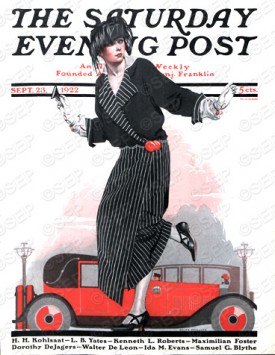
Coles Phillips
September 23, 1922
Coles Phillips (1880-1927) was almost reckless. As a young salesman, he once got caught drawing a caricature of an important client (by the client). Another time he rented a studio with no way to pay for it. But what he lacked in prudence, Phillips made up for with confidence.
He left college in 1904 in his junior year with no plan, and, at that point, no inkling that his future would involve art. He had drawn and sketched since he was a boy but had not considered it a serious endeavor. Instead he began his career as a clerk for a company that sold radiators. That job ended shortly after a major client, who kept Phillips waiting, came up behind Phillips just in time to see the young clerk sketching a caricature of the businessman himself on an old envelope.
No, Phillips didn’t get fired. According to the 1928 Post article, “The Making of an Illustrator,” written by his widow, Teresa Hyde Phillips, the businessman loved the drawing. “He laughed a good deal and wanted to know why a chap with talent like that was holding down a job with a radiator concern.” Before long Phillips was in art school, albeit briefly. He took night classes for about three months. But it was enough time for him to know he wanted to draw. He just needed to figure out how to make it pay.
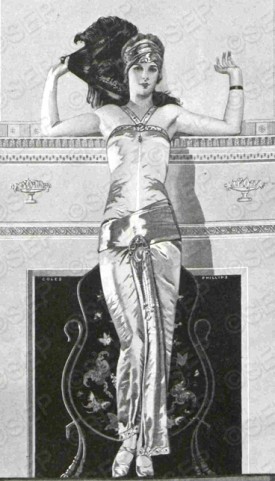
Coles Phillips
May 3, 1924
So the young artist visited a small ad agency with some sketches under his arm. “My name is Coles Phillips,” he said, “and I’ve dropped in with a rather important bit of news. I’m going to work for you.” Although this announcement resulted in “no marked enthusiasm on the part of his host,” his wife wrote, the sketches did impress the agency. This and the artist’s ebullient personality (and the fact “that he had a remarkable ability to sell anything, including his own ideas and work”) led to his securing a position. He was only with the ad agency a short period of time before he decided to open an agency of his own.
But Phillips grew tired of the business end of running an agency and wanted more time to draw. Studying periodicals of the period, he decided he was going to work for Life magazine. Apparently, it never occurred to him that his work could be declined. He rented a studio telling the landlord he had some important orders that would bring in plenty of money to pay him before the month was up.
He then hired a model and worked for weeks on a drawing, while the increasingly nervous landlord made frequent visits. When the drawing was finally ready, he carried it over to the Life building, asking to see the editor.
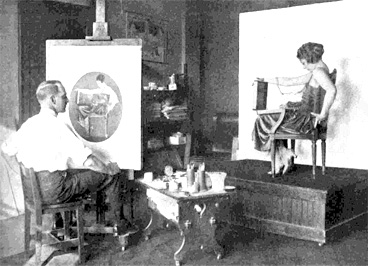
“The Making of an Illustrator,” The Saturday Evening Post; April 7, 1928.
A secretary informed him that Editor John Ames Mitchell was not available and that he only saw artists on Wednesdays. As luck would have it, the business manager, on his way to lunch, stopped and looked at the drawing. “I think Mr. Mitchell would like to see this,” he said.
Soon a secretary appeared with those magic words: “Mr. Mitchell would like to see Mr. Phillips.” There is an old saying that God watches over drunks and fools. Perhaps it should include brash young men. Phillips left with a check for $150.00. (Today the equivalent of that 1907 windfall would be more than $3,600.) He celebrated at a local hangout with his friends, as his wife recalled in the 1928 Post memoir, adding, “I don’t know where the landlord celebrated.”
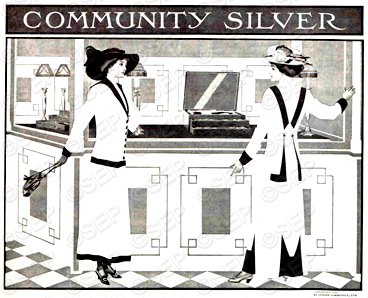
Coles Phillips
December 2, 1911
Around 1908, Mitchell went to Phillips and asked if he could come up with a different kind of image. Phillips had already been working on a technique for an advertising client, and it not only worked for Life, it became the artist’s signature work.“It was what became afterward his well-known fade-away type of drawing, where the figure fades into the background and is caught here and there by some accessory or highlight,” wrote Mrs. Phillips.
The “fade-away” effect was used in this 1911 ad for Community Silver, left, and takes on an art deco vibe in the 1923 Post cover, Broken Pearls, shown below, center. This distinctive technique is shown with dazzling effect in a video put together by KistoDreams.
The likely inspiration for the 1920 cover—below, right—was the F. Scott Fitzgerald story, “Bernice Bobs Her Hair,” which had run in the Post earlier that year. The days of the beautiful but proper Gibson Girl with her lush tresses and cool demeanor was in the past, and the Roaring ’20s were here.
In the ’20s, Phillips was making an excellent living working for advertisers and a number of periodicals, including Ladies Home Journal, Good Housekeeping, and, like fellow New Rochelle resident Norman Rockwell, The Saturday Evening Post.

Norman Rockwell
April 7, 1928
“He used to get marvelous prices for his work as much as, if not more than, any illustrator,” wrote Norman Rockwell speaking of Phillips in My Life as an Illustrator. “First, he’d think of the best price he could hope for; then he’d think of his four children and add four hundred dollars. In the twenties, he received two thousand dollars a picture, which was fabulous.”
Phillips was just as forthright about expressing his opinion of the popular artist’s work, which wasn’t always kind. According to Rockwell, Phillips would criticize his work as too commercial, too bland, saying, “Old men and boys! Haven’t you got any guts? You’re young. Haven’t you got any sex? Old men and boys. For Lord’s sake!”
Although Rockwell thought of Phillips as “a smart fellow” who probably would have succeeded at whatever field he might have chosen, he wrote, “I didn’t lose any sleep over his criticisms. He didn’t like Howard Pyle. Or Rembrandt. Or Degas. Or Leonardo da Vinci. … In fact, he didn’t like anybody and couldn’t understand why an artist would want to paint anything but pretty girls.”
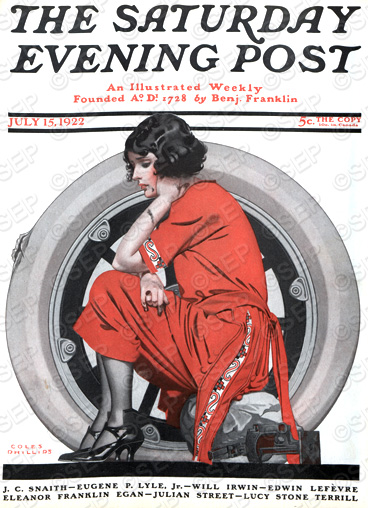
Coles Phillips
July 15, 1922 flat tire

Coles Phillips
November 17, 1923
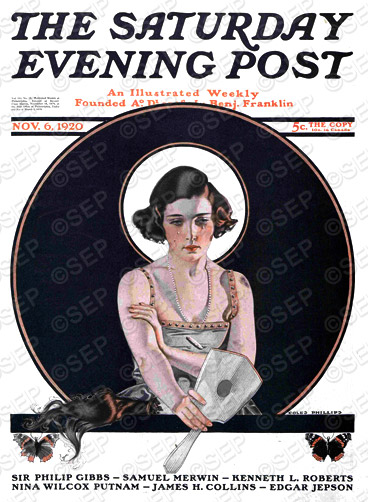
Coles Phillips
November 6, 1920
Only The Facts

How do you know you can trust what you read? Start by recognizing that there is no such thing as completely unbiased news. No one can report any news story without encapsulating complicated events, deciding what’s really important, leaving out what the reporter thinks are insignificant details, and adopting a point of view that makes it possible to stitch together all the elements and tell a story. Therefore no two people will ever report any news story the same way. So there is no such thing as a single objective telling of a news event. That said, the following tactics will bring you closer to the objective truth.
1. Triangulate from less biased sources. Fox News has a clearly conservative slant; MSNBC has a liberal one. Whatever news source you begin with, think about how hard that source tries to be unbiased.
2. Separate news from opinion. Always ask yourself whether what you’re getting is reporting or commentary. In newspapers the distinction is usually pretty clear. There’s news on the front page and commentary on the editorial page. On television and on the Internet, it’s often less clear. Sites like Drudge Report on the right and Talking Points Memo on the left report news, but from a definite point of view and with a lot of opinion mixed in.
3. Be suspicious. Always have your antennae out for anything that sounds untrue. If something you hear or read seems questionable, a simple Google or Google News search can often ferret out the truth. Factcheck.org, politifact.com, and snopes.com are good nonpartisan sites devoted to separating truth from fiction.
4. Balance your news diet. Try to get at least some of your news from the other side. Even if you feel strongly about an issue or a news event yourself, it’s vital to take in opposing positions. Somewhere between one extreme and the other usually lies the truth. But above all …
5. Recognize your own biases. The multiplicity of voices available to us today allows people to find news sources that consistently present the news the way they like it. This tends to strengthen people’s prejudices and make all of us even more polarized than ever. Try always to stay aware of this tendency in yourself. It’s there in all of us.