Rockwell’s Favorite Model, Part III

March 6, 1954
“He is a genius with a childlike heart, a man who leaves a lasting imprint on people as well as on canvas,” Mary Whalen Leonard told the Post in 1976. We spoke with her again recently to ask about one of Norman Rockwell’s most respected paintings—and about the artist himself.
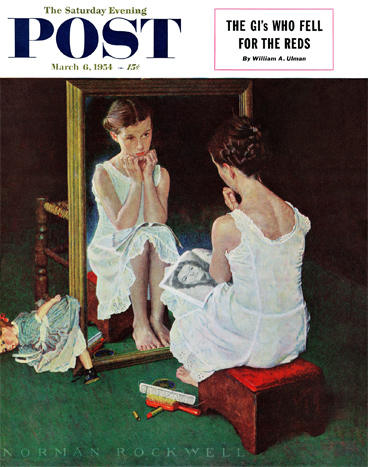
Mary’s pose seems “apprehensive, as if she understands that womanhood is upon her and fears that she is not quite ready,” writes art expert Karal Ann Marling in her 1997 book, Norman Rockwell. However, young Mary didn’t have a clue.
“I was only in fifth or in sixth grade, and I wasn’t a kid who was at all interested in growing up. I was just having a good time,” Mary says.
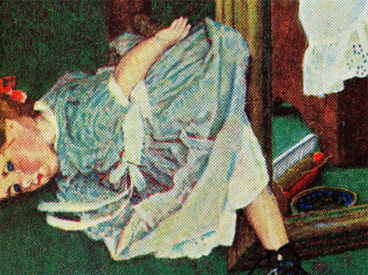
He tried to explain the concept behind the forgotten doll: “You’ve tossed away your doll—you no longer play with dolls.” But Mary, who describes her younger self as a tomboy, says, chuckling, “I was saying to myself, ‘Yeah, I never did that anyway.’”
Rockwell knew that Mary wasn’t grasping the idea, so he tried again, “Now, Mary, don’t you ever stand in front of a mirror and wonder what a beautiful woman you’re going to be? I can remember standing in front of a mirror, combing my hair, wondering how handsome I was going to be.”
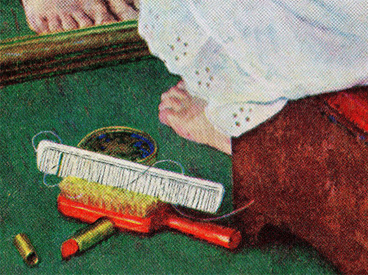
“And quite honestly,” she laughs, “that didn’t make any sense to me because Norman wasn’t handsome! So I didn’t relate to that. I mean I couldn’t get into it. So I think he just told me to think about being a beautiful woman and what I might do with my life. But it did not connect with me.”
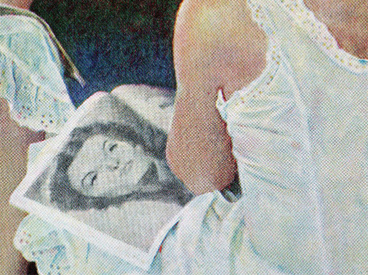
Mary tells us Rockwell felt he had made a mistake including the magazine featuring sexy movie star Jane Russell. “He regretted it deeply. Norman got a lot of criticism—remember this was in the ’50s—that said, ‘Is that all a little girl can dream about is becoming a movie star?’”
“I should not have added the photograph of the movie star,” Rockwell later said in Marling’s book, “the little girl is not wondering if she looks like the star but just trying to estimate her own charms.”
In what would become one of his most respected paintings, Rockwell captured the poignancy and uncertainty of growing up despite the fact that Mary “had no idea what he was talking about.” For decades critics had dismissed Rockwell as simply a popular commercial illustrator. Today, many have concluded that some of his works, however, transcend freckle-faced boys at the ole swimmin’ hole and secure his standing today as a true artist. Girl at the Mirror is such a painting.
Mary, who describes this painting as “very different than most of Rockwell’s covers,” compares the subtle use of color and lighting with another of Rockwell’s finest works. “In The Marriage License,” she explains, “you think you’re going to concentrate on the couple getting their license, but really what you find yourself looking at and being drawn into is the sweet, dear man [the elderly clerk]. Because that’s where the light is, on his face.”
March 6, 1954
By the time Girl at the Mirror was published, Rockwell had moved from Vermont to Stockbridge, Massachusetts. “He wrote me a little note and told me it was going to come out. He sent me a photograph I posed for.”
Mary never knew why Rockwell called her his favorite model, but he had quickly become one of her favorite people. “I kept in touch with him until he died. He always sent me a little note at Christmas time and told me he missed me.”
See Mary today as she talks about the artist in this video, courtesy of the Norman Rockwell Museum.
Interview with Rockwell Model Mary Whalen Leonard
Meet Rockwell model Mary Whalen Leonard. Here, Mary shares memories of what it was like to grow up in the same community as Norman Rockwell.
A special thank you to the Norman Rockwell Museum for sharing the video of Mary Whalen Leonard.
Read our three-part web exclusive with model Mary Whalen Leonard:

Rockwell’s Favorite Model
Meet the small-town girl Rockwell called “the best model I ever had.” Read more »

Rockwell’s Favorite Model, Part II
Ever wonder how Norman Rockwell achieved some of the poses we see? With close-ups and insight from model Mary Whalen Leonard, we’ll show how a cover was done. Read more »

Rockwell’s Favorite Model, Part III
In one of his most respected paintings, Rockwell captures the poignancy of growing up. However, the model “had no idea what he was talking about.” Read more »
Flaxseed Slashes Blood Pressure
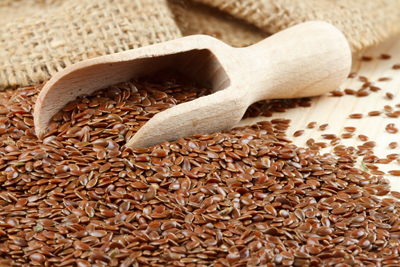
Tiny seeds of the flax plant, high in fiber and omega-3s, produce big drops in blood pressure and may prevent heart attacks and stroke, according to new research.
In the study, people with clogged leg arteries taking flaxseed supplements reduced their top blood pressure (systolic) reading by 10 points and the bottom (diastolic) by seven after six months. This change is the largest decrease in blood pressure ever shown by a dietary intervention, says Dr. Delfin Rodriquez of Cuba who presented the results at the American Heart Association 2012 Scientific Sessions.
The promising findings suggest that people with hypertension turn to the safe and inexpensive dietary supplement before starting drug therapy.
Meet Mad Men Creator Matt Weiner
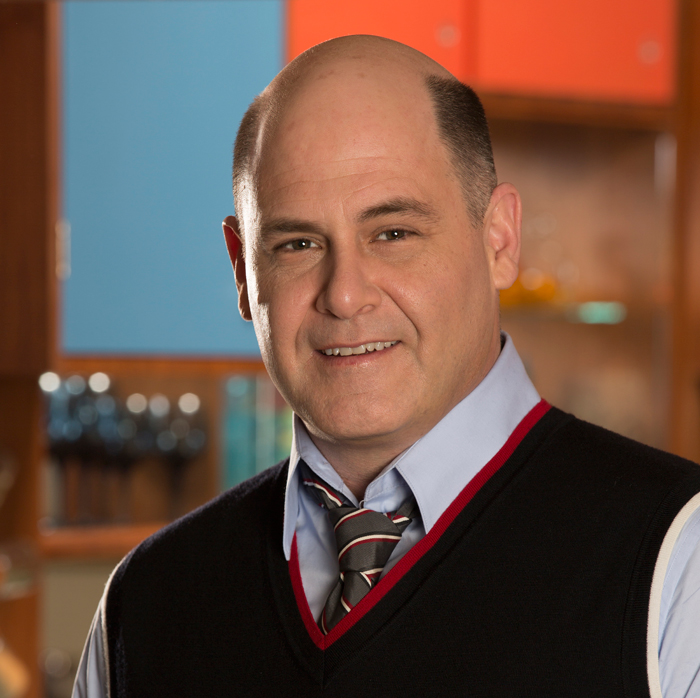
Matt Weiner, the creator of Mad Men, has a shelf full of Emmys and Golden Globes not to mention critical raves for the hit series now in its sixth season. The retro drama about a 1960s ad agency has left its mark on everything from fashion to the way we look at gender roles. So why is Weiner the first to admit he can be a little anxious about being at the top?
Maybe because he’s hardly an overnight success. He can laugh now about all the time he spent after grad school writing scripts, while his architect wife supported the family. Along the way, he wrote the pilot for Mad Men, but received nothing but rejections.
Weiner’s break came when he started writing for The Sopranos. That show was so hot it made his reputation, but even that wasn’t enough to sell HBO on Mad Men. Eventually it was AMC that took the gamble.
Weiner is charming—a great talker—but notoriously close-mouthed about where the series is going and whether the end is in sight. He’s already made his first bid to move to the big screen writing and directing with last fall’s You Are Here starring Zach Galifianakis and Jenna Fischer.
Question: How has success changed you?
Matt Weiner: I’m less combative. Finding an audience of even a few people after being rejected for a long time kind of recalibrates your perception of humanity, believe it or not. But I’m superstitious about the word success. It took awhile to realize that this really happened after years of privation and rejection. Ironically I’m the person who wrote, ‘Happiness is the moment before you need more happiness.’ So even the premise of the question, ‘How do you feel about success?’ is terrifying.
Q: What would you rewrite about yourself?
MW: I’ve got plenty of bad qualities that have not disappeared. I’m working on being more patient. That can be difficult to be around. I am very exacting. I think I can come off seeming unappreciative of the people closest to me sometimes because I have the complete expectation that I’m entitled to their affection. That’s probably my biggest fault—impatience.
Q: Are you different at home?
MW: I’m like every dad, I’m a joke. [He has four sons.] My anger’s a joke. My dissatisfaction’s a joke. My rules are a joke. I’m always fighting to enforce my authority. I work so much that when I come home and say, ‘Hey everybody, don’t do it this way,’ they’re like, ‘If you were here you’d know this is the way we do it.’ It’s like I’m powerless. You know what, once you take physical violence out of the equation, you really have no control over another person. [Laughs]
Q: Have you tried being a diplomat around the house?
MW: I lose my temper. I’ve got a bad temper. I’ll get mad and be swearing and using the ‘F’ word in the kitchen. Afterwards I’m so embarrassed and I look over at my kids in the next room and I’m like, ‘God, I hope they didn’t hear that.’ And I see they are laughing but trying to cover it up so they won’t embarrass me.
Q: What inspired you to be a writer and to stick with that unrealistic ambition?
MW: I had a lot of support from my parents. They loved and admired writers. We have a big poster of Ernest Hemingway in our hallway. I think that that mattered to me that they thought writing could be a heroic profession and a writer could make like a valuable contribution.
Q: What made you aim so high?
MW: I was a terrible student. I had a lot of mentors, teachers who encouraged me, kind of told me whether I believed it or not that I was a late bloomer. I gave a speech at my high school graduation and a dad in my class told me that I could be a TV writer. It wasn’t just any dad, it was Allan Burns who created The Mary Tyler Moore Show. And so I had that in my hip pocket. And then I went to college and did some acting and wrote poetry. Then I went to film school and was out of work for 5 years even though I was writing all the time. I tell people the hardest part about it was not knowing that it was going to be 5 years—it wasn’t that I was going do it, it was those years of not knowing when I was going to be a success.
Q: Don Draper the main character on the show says, ‘Everyone thinks this is temporary.’ Do you think that?
MW: I am extremely aware that the end is coming but not when. I’ve always had to sweat. I never have been sure Mad Men was going to go on again. I live and die by this thing. I want people to say, ‘That was the best season of the show ever.’ I want them to progressively say during the season, ‘That was the best episode of the show ever!’ I am always aspiring to keep it new and fresh. But you’re going to lose if you’re always trying to top yourself. You end up doing something crazy.
Q: You are pretty secretive about the plots of the episodes.
MW: I’m not trying to tease people. I just don’t want to give away to viewers what’s coming because not knowing what is going to happen is part of what keeps people interested. I think fans of the show, the ones who really love it, don’t want to know. But it is hard to talk about a new season without getting specific. At the beginning of a season I’m always like, ‘I’m starting a whole new story. If you don’t like it, then it’s not for you. But it’s not because it’s not as good as last year. It’s just different.’ No matter what happens you’ll be able to understand it. It’s a TV show, it’s not War and Peace.
Q: Are there lessons that having a huge hit have taught you?
MW: At a certain point you realize that being mature in this job is not thinking that you can do it all by yourself. You can’t forget that other people have the best stuff to offer and you need to be excited when you hear something you didn’t think about. I try to remember that I don’t always give enough praise. I get so much attention for my contribution to the series, and I wish I could share the glory a little bit more. I always mention the work of my producers and co-writers but it seldom gets printed. And I want people to know that that’s not my fault. That I try to share the wealth.
Q: What’s the right way to handle fame?
MW: I remember watching Jennifer Lawrence fall on the stairs as she went up to accept her Oscar. And I just thought, ‘If I were to write an acceptance speech, it would start like that.’ That moment to me was kind of like instant humility. She recovered with such grace and good humor. That’s a hard thing for people to understand. You just don’t want to attract the evil eye, become arrogant, rest on your laurels, and take it for granted.
Q: Does the great acceptance of the show give you more creative confidence?
MW: Trying to put a dream into words is a lot of what it is at the beginning of the season. And the ship leaves the port but you still don’t know if it’s any good. That’s the thing that never goes away. You don’t even know, even when the season’s over, even when you win an award, if you like pulled it off. And you know anyone who says they’re only interested in satisfying themselves is a fool.
Why Did the Post Lose its $10 Million Libel Case?
It’s a story that refuses to lie down and be quiet, even half a century later.
In 1963, James Wallace “Wally” Butts Jr., former coach of the University of Georgia’s football team, sued Curtis Publishing, the Post’s parent company, for libel. The case went all the way to the Supreme Court, which ruled a 5–4 decision against Curtis Publishing. Fifty years later, there is growing doubt that it was the right decision.
To understand the doubt, you need to know the background of what the Post claimed was the most shocking sports story since the Chicago Black Sox scandal — a story that began with an overheard phone call, and ended by damaging the credibility of America’s most popular magazine.
On September 13, 1962, George Burnett, an insurance salesman in Atlanta, called a friend at a local public relations firm. As sometimes happened in those days, the phone lines “cross-connected.” Instead of his friend’s voice, Burnett heard a telephone operator identify two famous college football coaches: One was Butts, the athletic director and former coach at the University of Georgia; the other was Paul “Bear” Bryant, coach at the University of Alabama.
Instead of hanging up or announcing his presence, Burnett remained on the line and listened. Over the next 15 minutes, according to what Burnett told the Post, he heard Butts give Bryant details about Georgia’s plays, strategies, and particular formations the team would use against Alabama in the opening game, just nine days away.
Burnett feverishly took notes. When the conversation was over, he had about six pages in all.
After the coaches hung up, Burnett redialed the number. This time the call didn’t get crossed over; he reached his friend at the public relations firm. His friend told him that Butts was, in fact, at the firm and using a phone in a back office.
The next week, Alabama defeated Georgia, to no one’s surprise. Bryant’s team had been widely expected to win. What was unusual was the score: 35-0. Few gamblers would have bet on the winning team; most of the betting action would concern the difference between the teams’ scores. Prior to the game, the point spread had been a mere 17-14 in favor of Alabama. A gambler who knew Alabama secretly had an edge over Georgia could have made a fortune.
The lopsided win bothered Burnett. And he mentioned the matter to a friend, who passed it on to the new Georgia coach, who informed the University of Georgia’s administrators. They asked Butts about the incident. Butts didn’t deny the charge. He admitted to discussing Georgia’s plays with Bryant but said the incident had been misinterpreted. The next day, Butts resigned.
The university’s regents then called in Burnett and grilled him on what he’d heard. They brought up the fact that Burnett might not be a credible witness because he was on probation for writing bad checks. Perhaps he was hoping to gain by making these charges.
Burnett left the meeting convinced the university was going to dispose of the problem by discrediting him. Expecting to face an accusation of slander from Butts, Burnett spoke with his attorney, who suggested he take his story to The Saturday Evening Post.
“The Story of a College Football Fix” appeared in the March 23, 1963, issue. Three days later, Butts sued Curtis Publishing for $10 million.
The case was heard in the Atlanta federal court, where a jury awarded Butts $60,000 in general damages and $3 million in punitive damages. Stunned, Curtis Publishing appealed the verdict, but the Fifth Circuit Court upheld the decision.
Curtis appealed again, believing it could get a favorable hearing in the U.S. Supreme Court, which had recently handed down an important decision concerning the rules of libel. In that case, L.B. Sullivan, the public affairs commissioner of Montgomery, Alabama, had sued The New York Times Company for libel after the paper ran an advertisement for Martin Luther King Jr.’s legal defense fund. He believed its criticism of the city’s police had defamed him personally. But the Supreme Court ruled unanimously in favor of the Times. In the ruling, Justice Hugo Black explained that malice “even as defined by the court, is an elusive, abstract concept, hard to prove and hard to disprove.” In this instance, the Supreme Court declared that a public official could not be libeled unless a publication showed “actual malice” — a statement with reckless disregard for the truth.
Unfortunately for Curtis Publishing, the Supreme Court decided the Post had indeed acted with reckless disregard and upheld the lower court’s decision for Butts. But the award of $3 million was reduced, and eventually Butts accepted $460,000.
Over the past 50 years, journalists who have revisited the case wonder how the Post managed to lose. The reason might be one or several of the following:
- Butts’ lawyer was skillful in diverting suspicion away from his client.
- The Post‘s attorney knew little about football, while Butts’ attorney knew much and could use his knowledge to discredit the value of Burnett’s notes.
- The court was unfavorably impressed by Post editors who didn’t bother to attend the trial but sent depositions of their testimony instead.
- It came out in the trial, that the Post, in its rush to get the story out, had failed to pass the story for review among other editors. Had they done so, they might have caught several minor errors in the story, and would not have approved the sensationalistic tone in the introduction, which included the following incendiary language: “The corrupt were not disreputable gamblers. … The corrupt were two men — Butts and Bryant — employed to educate and to guide young men. … How often do teachers sell out their pupils? We don’t know — yet. For now we can only be appalled.”
- The magazine was operating out of its depth. It had been trying to rebuild its popularity with what its then-editor called “sophisticated muckraking.” It had successfully dug into several political scandals, and had often run stories about college athletics. But when challenged in this case, the Post mounted an indifferent defense with the wrong lawyer.
Yet none of these points changed the facts: The phone call took place, there was backup to support Burnett’s allegations, and, most damningly, during the game, Alabama players had taunted the Georgia team by calling out the code names of Georgia’s plays before they were run. So why did the Post lose all three trials?
To further understand why doubt lingers, we recommend Fumble: Bear Bryant, Wally Butts and the Great College Football Scandal
Rockwell’s Favorite Model, Part II
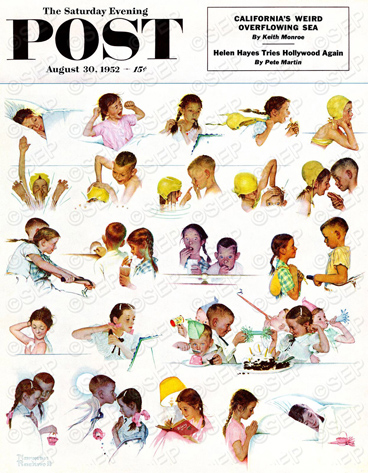
Day in the Life of a Girl
Norman Rockwell
August 30, 1952
Rockwell said he enjoyed working with 9-year-old Mary Whalen, who “could look sad one minute, jolly the next, and raise her eyebrows until they almost jumped over her head.”
“He was very inclusive; he wasn’t authoritarian, telling me what to do,” Mary says. “It was, ‘OK, this is what we’re going to do today.’ He would act it out for me.
“I was reserved and he would just sort of pull [the expressions] out of me by laughing or clapping or stomping his feet or jumping up and down and making me laugh, that kind of thing. And I just felt such a part of what was happening. As a kid, I liked to be a part of something. He knew what he wanted and he knew how to get that out of you. And then when he got [the right expression], he would just shout, ‘Oh, that’s wonderful! That’s wonderful!’”
For the 1952 cover, A Day in the Life of a Girl, Mary gave Rockwell over 20 wonderful expressions.

“It took a week,” Mary tells us, to shoot all the scenes for the 1952 cover. Beginning with getting out of bed, A Day in the Life of a Girl is done sequentially, like a movie reel. Photographer Gene Pelham took dozens of shots, as the artist posed his models.
“When I posed for A Day in the Life of a Girl,” Mary tells us, “I got up early, my mother combed my hair, did my braids, and off we went [to Rockwell’s studio].” The first thing Rockwell said to them was, “We’re going to mess up Mary’s hair,” and with that he tousled her tidy braids.
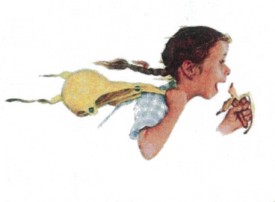
The first six scenes were completed that first day. For this flying out the door on her way to go swimming look, her mother had to hold her pigtails back, while someone else pulled back her swimming cap. When the angles were just right, “Rockwell would yell, ‘Get it!’” Mary says, and Pelham would snap away.
The scene below depicts the old story: Boy meets girl, boy tries to drown girl, spunky girl bawls him out, and then gives him a taste of his own medicine. Ah, young love!
The boy in the love story is Chuck Marsh, another model with a wonderfully expressive face. He was in the earlier Rockwell cover, A Day in the Life of a Boy.

In real life, Mary tells us, she and Chuck never posed in a pool—it was all done in the studio. And when we asked about the dripping wet hair, Mary gave us a glimpse into the glamorous world of modeling: “They poured a bowl of water on me.”
The kids never pushed each other’s heads down either. “We used a bronze bust to lean on … to get the elbow right,” Mary reveals, then adds, “I went to the Rockwell Museum three or four years ago, and they still had that bust in his studio!”
[You can tour the artist’s studio at The Norman Rockwell Museum in Stockbridge, Massachusetts, or take the online tour here.]

Gradually, boy and girl become friends, go for a bike ride and a movie, and then we find them at a birthday party. In this scene, Mary is wearing a party dress Rockwell bought for her. But what sounds like an act of kindness was most likely the artist’s insistence on just the right details. As an example, he shopped several furniture stores for the exact chair he wanted for his delightful Easter Morning cover from 1959.
The party scene involved more models, including Mary’s twin brother, Peter; and Chuck Marsh’s little brother, Donnie, whose mission was simply to devour the cake and ice cream. Donnie’s single-mindedness about the treats made for a difficult day’s shoot, Mary recalls.

Ten-year-old Chuck Marsh noted that this scene was the “toughest time” he ever had posing. He liked Mary very much, but no how, no way was he going to kiss a girl. “Mr. Rockwell finally gave up trying to get me to kiss her,” he said, and the artist posed the two separately. Getting the smooch just right involved Chuck leaning toward—you guessed it—that bronze bust. Who knew the head of a Classical figure could be so utilitarian?

At the end of this long day, Mary is dressed for bed and writing in her diary, no doubt about that moonlit kiss. And the painting is almost complete.
But there was a problem when Rockwell reached his final scene. With the deadline almost upon him, he remembered the many complaints he had received about one aspect of A Day in the Life of a Boy—before retiring for the night, the boy did not say his prayers. So Rockwell called the Whalens and said, “You’ve got to get Mary down here!”
Because the prayer scene was added, another scene was taken out, Mary tells us. Deleted was a charming scene of Mary and Chuck smiling and thanking their hostess (the birthday girl in the pink hat in the party scene above). But the day is done, bedtime prayers said, and Mary drifts off to sleep with a smile on her face and a party favor beside her.
Previous: Rockwell’s Favorite Model
Next: The third and final installment of Rockwell’s Favorite Model, featuring a coming-of-age cover many feel is one of the artist’s finest works.
Spiced Grilled Ham with Citrus Glaze
“Turning to the grill offers home cooks an easy and perhaps unexpected way to treat guests this year,” says Pamela Johnson, Director of Consumer Communications for the National Pork Board, which offers this alternative to the traditional baked ham. “Grilled ham is a twist on the classic preparation that complements a variety of dishes, like roasted potatoes and asparagus spears, at any celebration or future feast.”
To make the recipe your own, try using a different combination of juice and jam, jelly, or marmalade for the glaze—apple juice and grape jelly, orange juice and strawberry jam, or apricot nectar and orange marmalade.
Spiced Grilled Ham with Citrus Glaze
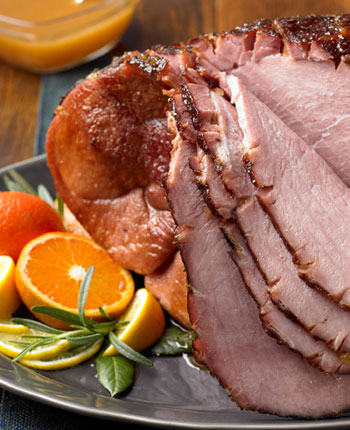
Makes 12 to 14 (4-ounce) servings
Prep time: 15 minutes
Cook time: 1 ½ to 2 hours
Ingredients
- 6 to 7 pound fully cooked bone-in ham, trimmed
- 1 tablespoon ground coriander
- 1 tablespoon ground paprika
- 1 teaspoon ground cumin
- ½ teaspoon ground cinnamon
- ¼ teaspoon ground cloves
- ¼ cup lemon marmalade*
- 2 tablespoons orange juice
- 2 tablespoons packed brown sugar
* If you can’t find lemon marmalade, substitute another citrus marmalade.
Grilling Directions
- Preheat gas or charcoal grill to medium-hot (375 to 425°F). Prepare grill for indirect cooking: For gas grill, turn off center burner; for charcoal grill, bank coals on either side; place drip pan under grate between heat sources.
- Score diamond pattern into ham, about ⅛-inch deep into any fat. In small bowl, combine coriander, paprika, cumin, cinnamon, and cloves. Rub spice mixture over all sides of ham. Place ham, flat side down, in center of grill over drip pan. Cover and cook, adding briquettes to charcoal grill as necessary to maintain heat, until internal temperature of ham reaches 140°F, 1 ½ to 2 hours or 15 to 18 minutes per pound.
- Meanwhile, in small bowl, combine marmalade, orange juice, and sugar.
- Brush marmalade mixture over ham. Cover and grill 5 minutes, until glaze is lightly caramelized. Remove ham from grill, transfer to cutting board, and let rest 15 to 30 minutes before cutting.
Roasting Directions
- Preheat oven to 400°F. Position rack in lower third of oven.
- Score diamond pattern into ham, about ⅛-inch deep into any fat. In small bowl, combine coriander, paprika, cumin, cinnamon, and cloves. Rub spice mixture over all sides of ham. Place ham, flat side down, in large shallow roasting pan and cook until internal temperature of ham reaches 140°F, 1 ½ to 2 hours or 15 to 18 minutes per pound.
- Meanwhile, in small bowl, combine marmalade, orange juice, and sugar.
- Brush marmalade mixture over ham. Return to oven and roast 5 minutes, until glaze is lightly caramelized. Remove ham from oven, transfer to a cutting board, and let rest 15 to 30 minutes before cutting.
Nutrition Facts
Per Serving
Calories: 270
Total fat: 11 g
Saturated fat: 4 g
Carbohydrate: 7 g
Fiber: 0 g
Protein: 34 g
Sodium: 80 mg
Recipe and photo courtesy of the National Pork Board.
Distorted Body Image: Objects in Mirror May Appear Larger Than Actual Size

Studies show that starving oneself causes changes in the brain that can lead to the inability to see oneself objectively. It’s “distorted body image,” according to Cleveland Clinic eating disorders specialist Ellen Rome, M.D., M.P.H.
Women suffering from anorexia, for example, tend to draw their silhouettes or estimate their hip width disproportionately larger than they actually are. This is not a coy way of denying their condition; when confronted with the truth, they will firmly deny their true size. Altered perceptions of body image are predictable and painful—but they are often reversible, says Rome.
For help, turn first to a medical doctor who is well-versed in eating disorders. Contact the National Eating Disorders Association (nationaleatingdisorders.org, 800-931-2237) for local specialists.
Versatile Crochet Scarf Pattern
I have a problem. I hoard yarn. Seriously.
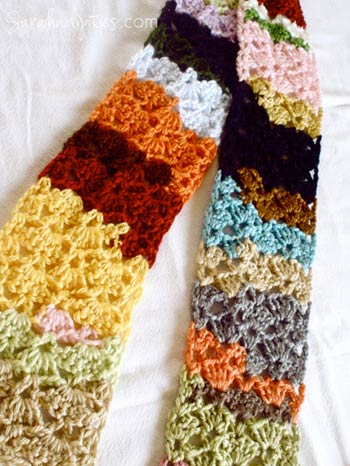
Ask anyone who knows me. I am a notorious neat freak and can’t stand piles of stuff and clutter—except when it comes to yarn. I won’t toss out the little leftover scraps after a project is finished. So I end up with bags of scraps of yarn like this:

So I decided that I needed to find a way to use up my teensy little scraps. Enter the Stash-buster Scarf.
This simple scarf pattern can be used with any kind of yarn and any size hook. It’s super fast and easy … and the scarves you make are great for gifts. As you can see, the type of yarn you use changes the look of the scarf … but they all look fantastic!
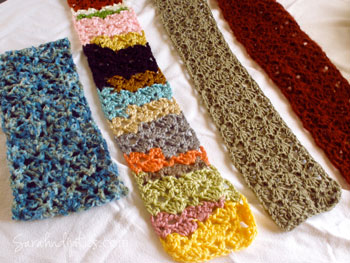
Stash-buster Scarf Crochet Pattern
Materials
- Yarn – any kind
Tools
- Crochet hook – any size that complements your yarn choice
- Yarn needle
Abbreviations
- ch = chain
- sk = skip
- dc = double crochet
- st = stitch
Special Stitches
- Vst = dc, ch 1, dc in same st
- Shell = 5 dc in same st
Directions
- Ch 17.
- Row 1: Dc in 5th ch from hook (counts as 1st Vst). Sk next 2 ch; Shell in next ch; Sk next 2 ch; Vst in next ch; Sk next 2 ch; Shell in next ch; Sk next 2 ch; Vst in last ch. Ch 3 turn.
- Row 2: 2 dc in 1st Vst. Vst in top of next shell. Shell in next Vst. Vst in top of next shell. 3 dc in last Vst. Ch 4, turn.
- Row 3: Dc in same st (counts as 1st Vst, now and throughout). Shell in next Vst. Vst in next shell. Shell in next Vst. Vst in top of ch from previous row. Ch 3, turn.
- Repeat Rows 2 and 3 until desired length is reached.
- End on a Row 3 pattern row. Ch 1, sc in same st; Sc in Vst; ch 2, sc in top of shell; Ch 2, sc in Vst; Ch 2, sc in top of shell; Ch 2, sc in last Vst. Sc in top of beg ch from previous row. Finish off, weave in ends.
You can leave the scarf long, or sew the two ends together to make a circle scarf or cowl. You can add buttons and other embellishments if desired. Have fun with it!
Pattern copyright 2012 by Sarah Anderson. This pattern is free for personal use. Please do not sell this pattern, or claim it to be of your own making. You are free to sell items made using this pattern, as long as credit is given to Sarah Anderson of Sarahndipities for the pattern used.
Spring Recipes from The Green Smoothie Bible
“What you find in season at the spring market will vary based on where you live,”says Kristine Miles, author of The Green Smoothie Bible. “In more moderate climates, such as where I live in Southern Australia, many of these fruits will be readily available, while others may be very hard to find. Use this opportunity to experiment with what is fresh to create your own green smoothies.”

Recipe 1
- 1 cup cranberries
- 1 orange, peeled
- Zest of ½ orange
- 1 ½ cups orange juice
- Greens
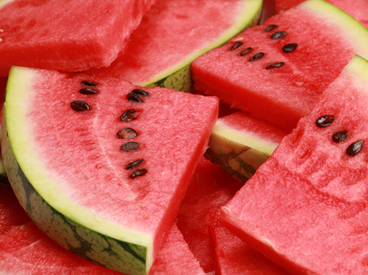
Recipe 2
- 2 ½ cups watermelon
- 1 cup raspberries
- 1 lime, peeled
- Greens
 Tip: If you’re new to green smoothies, Miles recommends that only 10 percent of your smoothie be greens (spinach is a good beginner’s green because of its mild flavor) and gradually increase them to 40 percent as you grow accustomed to the taste.
Looking for more? The Post has featured nine of the 300 recipes available in The Green Smoothie Bible (three summer smoothies, two autumn smoothies, and two winter smoothies). Try one or all and share your green smoothie adventures in the comments below.


First Crocus

First Flower
Norman Rockwell
March 22, 1947
Author Jim Butcher wrote, “Men plan. Fate laughs.” Everyone can pinpoint a time in their lives when fate stepped in and skewered well-laid strategies. That’s particularly true of Gene Pelham, the model in the cover at right celebrating the arrival of spring. The New York native had moved his family to Arlington, Vermont, in 1938 from New Rochelle, New York. In that former life, he was an artist and photographer and knew (and occasionally modeled for) the great Norman Rockwell. But in Arlington, Pelham was happily ensconced in the country and hoped to try his hand at farming, raising livestock, and, in his own words, “building stuff.”
One crisp fall day in 1938, Pelham was working on his car in the front yard of his new Vermont digs when a stranger pulled into his driveway. The driver rolled down his window and said, “Can you tell me where the West Arlington Bridge is?”
As Pelham’s son Tom relates the story, his dad looked up and was amazed to see none other than Rockwell behind the wheel. “Norman? What are you doing here?” Pelham asked. Rockwell explained he was moving to Arlington.
And so, Pelham not only returned to modeling for the First Flower cover but he later became Rockwell’s assistant. He found and photographed models, scouted locations, and more. Fate certainly had other intentions for this would-be farmer.
America’s (Not Quite) First Bank Robbery
This piece was originally published as “America’s First Bank Robbery,” but a recent note (March, 2015) from Adam Berlinger brought to our attention an earlier bank robbery than the one described here. Berlinger sent us a link to an article entitled “America’s First Bank Robbery” (a very fine title) written by Ron Avery, which describes the removal of $162,821 from the Bank of Pennsylvania at Carpenters’ Hall in 1798.
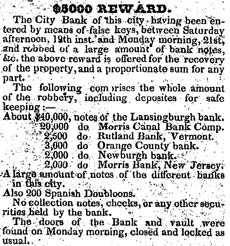
Late on the night of March 20, 1831, two men with a set of homemade keys approached the City Bank of New York. The keys, which had been made from wax impressions of the door locks, enabled the men to let themselves into the bank and lock the doors behind themselves.
What happened that night is generally considered to be the first bank robbery in the U.S. The two men—James Honeyman and William J. Murray—emptied the vault and several safe deposit boxes. By the morning, they had filled several bags with $245,000 in bank notes and coins. It was an incredibly large sum for a robbery, roughly equivalent to $52 million today. The robbery was sensational enough to be rushed into print in the next edition of the Post, under a bold headline offering “$5,000 Reward.”
Honeyman and Murray got away the next morning as the sun rose and the city’s night watchmen went off duty. Carrying the loot under the large capes they were wearing, they hurried to Murray’s house where they divided the money.
Honeyman put his share of the loot into three trunks, then drove to a boarding house, where he rented a private room under the name of Jones.
Less than a month later, the Post was able to report that “something peculiar in his conduct, particularly regarding the trunks, seems to have excited the suspicions of his landlord.”
Once in the rooms, Honeyman divided the stolen money again, taking $37,000 to the house of a Mr. Parkinson, his brother-in-law.
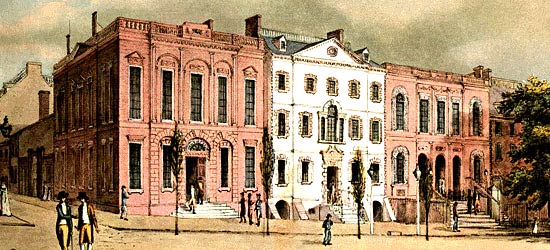
Meanwhile, news of the bank robbery had sped across town and reached the ears of New York’s Chief Constable Jacob Hays. He immediately knew whom to suspect. Honeyman had recently been charged with robbing a store in Brooklyn, but had escaped conviction due to lack of evidence. He had also been caught trying to steal money from a steamboat. And there were rumors that he was still the chief suspect in an English mail-coach robbery. Hays immediately went to Honeyman’s home, but found neither his suspect nor any money.
The following Saturday night, March 24, Honeyman left the boarding house with one of the trunks and told the landlord he would soon return for the others. The landlord, now convinced the trunks contained the stolen bank money, summoned Hays. Together, they opened the remaining trunks where they found $185,758.
The men seated themselves and waited. Three hours later, when Honeyman walked into the room, Hays seized him, put him in handcuffs, and took him before a judge.
The landlord also told Hays that another man had often visited Honeyman. From the description, Hays recognized the man as Murray. The two men were frequently seen together. In fact, they had been close friends ever since meeting in the penal colony at Botany Bay. Both men had beat long odds and escaped Australia to return to England, commit a few more robberies, then flee to the states.
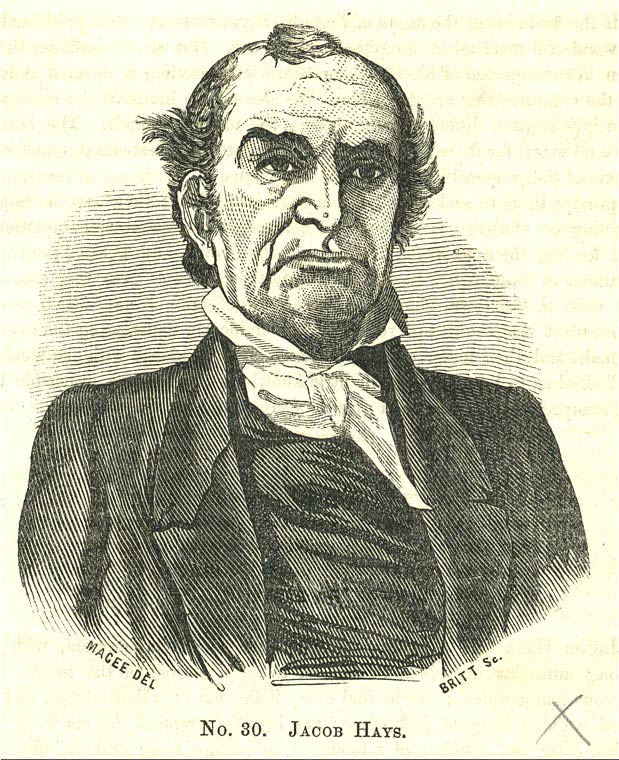
After depositing Honeyman in jail, Hays went to Murray’s house but found the man had fled to Philadelphia. Hays followed after, apprehending Murray and bringing him back to New York for trial.
Both Honeyman and Murray were convicted and sentenced to five years at New York’s Sing Sing prison.
Hays recovered about $176,000 of the stolen money, but had no idea where to find the remaining $69,000. Months passed by, and his searches turned up nothing. City officials accused Hays and one of his associates of keeping the money to themselves.
Then, on September 20, Parkinson entered a bank to exchange some of the bank notes Honeyman had left with him. The bank clerk thought the notes resembled those he had deposited at the City Bank before it was robbed. He notified Hays, who quickly arrested Parkinson. He told the police all he knew and, in exchange for immunity, returned $37,000.
This still left $42,000 unaccounted for, but Hays was exonerated in public opinion. The Post’s editors felt that now, even the most skeptic would see “Mr. Hays is worthy of the important situation which he has so long filled.”
Hays even had the support of the men he’d put behind bars, the Post reported. “While Smith [one of Honeyman’s aliases] and Murray were in prison, awaiting their trial, they were informed that Mr. Hays was openly charged with abstracting that part of the money which was missing. They expressed great indignation at so malignant an accusation and stated that the amount not found had been placed beyond the reach of Hays before Murray was arrested. It can hardly be supposed that any unworthy suspicions can now be attached to this meritorious public servant, who had passed the prime of his years in the discharge of an arduous and unpleasant duty.”
Rockwell’s Favorite Model
“She was the best model I ever had,” Norman Rockwell said of Mary Whalen, who appeared on three Saturday Evening Post covers. Meet Mary, now known as Mary Whalen Leonard, who became Norman Rockwell’s favorite model. How did a young girl meet America’s favorite artist?

Plymouth Ad
Norman Rockwell
December 22, 1951
Young Mary was thirsty. Seeing neighbors at a local basketball game carrying soft drinks, she asked her father for one. He was trying to explain that refreshments were only served at halftime, and that the concession stand was now closed, when a man seated behind them “came very gallantly to my rescue and said, ‘You can have my Coke.’” She “had no clue” who the man was, but gratefully accepted the drink. The gallant man was Norman Rockwell, who “was just sitting behind us, cheering. His son was on the team.”
Talking after the game with Mary’s father (who was Rockwell’s lawyer), the artist asked Mary if she would like to pose for him some day. “I said, ‘Sure!’ although I didn’t know what that meant,” she tells the Post.
She soon found out, when she (in the polka-dotted bathrobe at left), along with her mother, brother, and a young cousin posed for this 1951 Christmas ad for Plymouth. “There was something about the connection with Norman. Maybe it just came at the right time in my life. I was just kind of intrigued by him as a kid. I think it’s because he disarmed me when I went to the studio for the first time, and he said, ‘Call me Norman. My name is Norman.’ I really trusted him. [At that time] you would never call an adult by his first name!”
For the ad “I had to borrow a bathrobe,” Mary says, “because I didn’t have one.” (She’s still not a bathrobe person.)
It is significant that the Plymouth ad has no image of the product or even details about the car’s features: The excited faces of the family say it all. In addition to Post covers, Rockwell did a great deal of illustration for advertising.
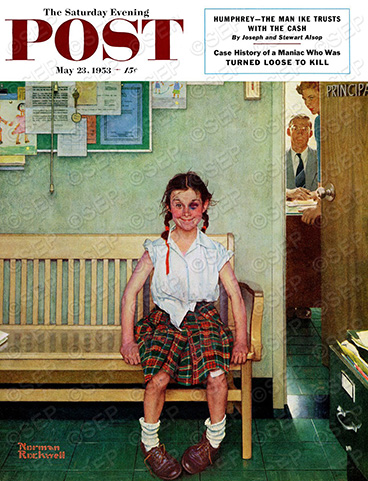
Outside the Principal’s Office
Norman Rockwell
May 23, 1953
When Rockwell decided to use Mary as the model for a cover about a girl with a black eye, he called for her at the local school. Unfortunately, this had the effect of scaring the child. Having never been summoned to the principal’s office, she jumped to the conclusion she was in trouble. “That was really frightening,” Mary tells us today, “I cried! But my sweet brother—he’s my twin brother, so we were in the same class—held my hand, and we walked together.” She was greatly relieved to discover Rockwell there and find out the reason for the command appearance.
Although the scene depicts the principal’s office, her part was done in the artist’s studio. And Mary says she never saw the principal and the secretary in the preliminary sketches. That’s because Rockwell added them later. According to Susan E. Meyer’s book, Norman Rockwell’s People, the artist “wavered back and forth” about including the adults. “He took them out and put them back in. [Fellow cover artist] George Hughes is convinced they were retained because he advised Rockwell to remove them.” (There was a long-running joke that Rockwell would solicit Hughes’ advice, and inevitably do the opposite.)
But Rockwell’s biggest challenge was getting the black eye right. He tried a charcoal mix on his young model, then makeup, but neither looked realistic. He finally advertised for a real black eye in the paper.
He not only got that tricky shiner right, his choice of Mary proved a great one. As a triumphant victor, the model manages the perfect devilish grin, even as the principal and school secretary confer on how to handle the situation.
Part II: Mary gives behind-the-scenes details on how certain poses were done as we review the Rockwell cover A Day in the Life of a Girl.
Yogurt Parfait Shots
For me, winters are spent getting to know fictional characters while curled up with a good book or developing a love-hate relationship with the casts of my favorite reality TV shows. But with spring around the corner, it’s time to get out of the house—or at least tempt my real-life friends out of theirs. And what better way to tempt them than by hosting a party?
March is a great time to get social and celebrate the first days of spring. It’s also National Nutrition Month. So here are three nutritious party recipes guaranteed to cast off the last of those winter doldrums, courtesy of Kids Eat Right, a division of the Academy of Nutrition and Dietetics.
Yogurt Parfait Shots
By Marie Feldman, RD
(Makes 4 servings)

Ingredients
- 1 cup nonfat Greek yogurt
- 4 teaspoons honey or 4 tablespoons light maple syrup
- 4 teaspoons chopped nuts
- Handful of berries (about 12 small raspberries, 8 blackberries, or 2-3 cut up strawberries, or mix n’ match)
Directions
- In small bowl combine the yogurt and honey or maple syrup.
- Spoon sweetened yogurt into four shot glasses until each is half full; this will be about 2 tablespoons for each.
- Add 1 teaspoon chopped nuts to center of each glass.
- Fill glasses with rest of yogurt (again about 2 tablespoons per glass) and top each with a few berries.
- Chill if not serving immediately.
Nutrition Facts
Amount per Serving
Calories: 70
Total fat: 1.5 g
Carbohydrate: 9 g
Fiber: 1 g
Protein: 5 g
Sugars: 8 g
Sodium: 20 mg
More appetizing recipes:
Caprese Salad on a Stick
Turn a delicious salad into a no-muss app.
Peanut Sauce Stir Fry and Tempeh Skewers
Beware: The peanut sauce in this dish might become one of your favorite homemade condiments.
Peanut Sauce Stir-Fry and Tempeh Skewers
Peanut sauce brings this stir fry to life. Once you prepare this sauce, it can be incorporated into a variety of recipes like dipping sauce for spring rolls and dumplings, a condiment on veggie or chicken burger, a salad dressing or a sauce on a Thai pizza.
Peanut Sauce Stir-Fry and Tempeh Skewers
(Makes 4 servings)

Peanut Sauce Ingredients
- 5 tablespoons natural peanut butter (smooth or chunky)
- 5 tablespoons warm water
- 1 tablespoon seasoned brown rice vinegar
- 1 tablespoon low-sodium soy sauce
- 1 tablespoon raw honey
- Dash of cayenne pepper
Stir fry and Skewers Ingredients
Directions
- 6 cups chopped broccoli
- 2 cups sliced carrots
- 2 cups sliced red bell pepper
- 1 cup cooked brown rice
- 1 package (8 ounces) tempeh, cut into 8 pieces, widthwise
- 8 wooden skewers
- 2 green onions, chopped
Directions
- Whisk peanut sauce ingredients until smooth.
- In pan, sauté 6 tablespoons peanut sauce with broccoli, carrots, bell pepper for 6 to 8 minutes, until vegetables are crisp-tender. Stir in cooked brown rice.
- Steam tempeh pieces for 8 minutes, until tender. Put each piece on a skewer and brush with peanut sauce.
- For each serving: Plate 2 cups stir fry and 2 skewers. Sprinkle with green onions.
Nutrition Facts
SERVING SIZE
Calories: 400
Total fat: 17 g
Carbohydrate: 45 g
Fiber: 9 g
Protein: 21 g
Sugars: 13 g
Sodium: 370 mg
Recipe courtesy of Kids Eat Right.
Caprese Salad on a Stick
Salad on a stick? We gave the classic Italian salad a brand new look, and made it fun for the whole family! We skewered the mouth-watering combination of creamy mozzarella, fresh sweet 100 cherry tomatoes, and homegrown basil, drizzled with extra-virgin olive oil, and a pinch of sea salt.
Caprese Salad on a Stick
(Makes 1 skewer/serving)

Ingredients
- ¾ ounces fresh mozzarella cheese (approximately 3 round cheese balls)
- 3 basil leaves
- 3 cherry tomatoes
- 1 teaspoon extra-virgin olive oil
- ⅛ teaspoon sea salt (optional)
- Bamboo skewer
Directions
- Assemble cheese, basil, and tomato, in order, onto skewer, until all ingredients are on stacked beautifully on the skewer.
- Drizzle olive oil over assembled skewer, and add a pinch of sea salt if desired. Enjoy!
Nutrition Facts
SERVING SIZE
Calories: 110
Total fat: 9 g
Carbohydrate: 2 g
Fiber: 1 g
Protein: 4 g
Sugars: 1 g
Sodium: 320 mg
Recipe courtesy of Kids Eat Right.