St. Patrick’s Day Bookmark
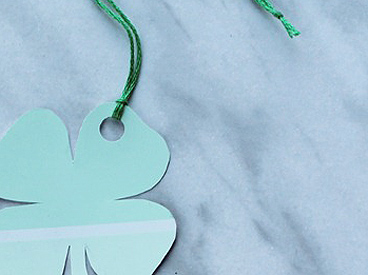
Heather of Setting for Four picked up the idea for this cute craft while roaming the paint aisles of her local home and garden store. “One paint chip will make several bookmarks,” says Heather. “This is a great teacher’s gift!”
How to Make the St. Patrick’s Day Bookmark
Materials
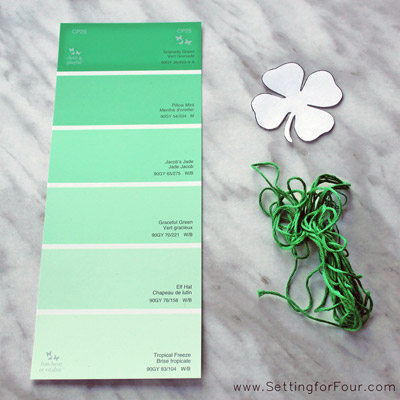
- 1 multi-colored paint chip
- Green embroidery floss, about 8 inches long
Tools
- Pencil
- Scissors
- Hole Punch
Directions
- Using your pencil, draw or trace a clover shape onto the paint chip so that two or more colors show.
- Cut out shape.
- Punch a hole in one of the leaves.
- Fold embroidery floss in half and tie ends in a knot.
- Wrap embroidery floss through hole, making a slipknot to secure.
Rehabbing an Old House: A Safety Checklist
Your number one health concern with rehabbing an old house is protecting kids from lead exposure—and the go-to source for specific information and local referrals is the Environmental Protection Agency (epa.gov). You have a lot of work ahead of you, but before the dust starts to fly …
- Hire a certified lead inspector. It’s best to go with a professional when checking for lead paint: Home lead tests aren’t always reliable.
- Test the water. Water can pick up lead from home plumbing. State testing programs vary, so call your water company for details.
- Shut off the heating and cooling system if possible, or tape plastic over the ductwork while you’re working. Lead dust and other nasty particles from remodeling can get into ductwork and linger for years.
- Have ducts professionally cleaned when renovation is complete.
- Keep your house healthy once you move in by encouraging family and friends to take off their shoes when they enter. The soles of shoes can track lead, pesticides, and plenty of other grimy stuff into the house. Tip: Encourage the practice by placing a storage bench near your home’s primary entrance.
Spotted Dog
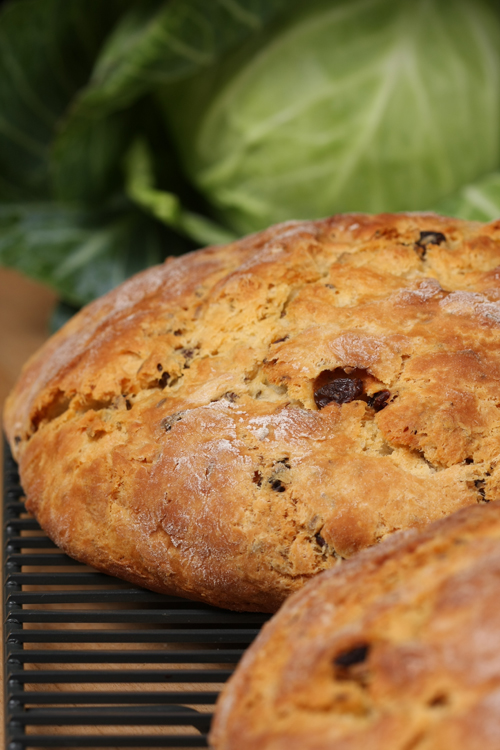
Serve up a slice of leprechaun luck on St. Patty’s Day or any day you choose with this traditional recipe for spotted dog from popular food and travel writer Margaret Johnson’s latest cookbook, Flavors of Ireland
Spotted Dog
Ingredients
- 3 cups all-purpose flour
- ⅔ cup sugar
- 1 teaspoon salt
- 1 tablespoon baking powder
- 1 teaspoon baking soda
- 1 ½ cups raisins
- 3 teaspoons caraway seeds
- 2 large eggs, beaten
- 2 cups buttermilk
- 2 tablespoons salted butter, melted
- Softened butter for serving
Directions
- Preheat oven to 350°F. Grease and flour 9-inch round baking pan.
- In large bowl, combine flour, sugar, salt, baking powder, and baking soda. Stir in raisins and caraway seeds. Make well in center and stir in eggs, buttermilk, and butter.
- Transfer dough to prepared pan and bake for about 1 hour or until top is golden and skewer inserted into center comes out clean.
- Cool in pan on wire rack for 5 minutes and then invert bread onto rack, and let cool completely before slicing. Serve slices spread with butter.
A Walk To Remember
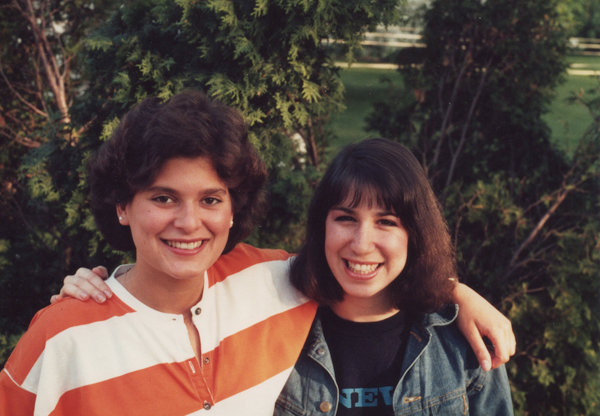
Nearly 2,000 of us gathered at the foot of the Washington Monument on an early May morning waiting for the opening ceremony of the 2012 Avon Walk for Breast Cancer to begin. Clouds of coffee and sunblock hung in the warm, humid air and a song about being strong against all odds thumped out from the loudspeakers like a hopped-up heartbeat.
A group of women wearing pink tulle skirts and black T-shirts embroidered ‘Tutus for Tatas’ across the chest moved toward me as I bent over to tie my sneaker. The fronts of their hats were inscribed in black sharpie: “For Mom”; “In loving memory of Susie”; “For Cathy, Barb and Allison.”
One of them greeted me when I stood up. “Hi, I’m Mary. Who are you walking for?” she asked, smiling and scanning my unadorned T-shirt for clues.
“My friend Leslie,” I said, who was diagnosed with breast cancer 10 years earlier.
The music faded as a man called our attention to the stage. “Good morning,” the speaker’s deep voice boomed. “My name is Mark and I’m walking for my three sisters who were all diagnosed with breast cancer at the same time and died within two years of each other.”
Some walkers stopped warming up their hamstrings to applaud. I reached into my fanny pack for a tissue and before anyone had a chance to recover a woman wearing a bright pink Nicki Minaj wig stepped up to the microphone. “Hello. My name is Margaret and I am 38 years old. This is my second Avon Walk. Four years ago I walked for my aunt Joanie, who is a 26-year survivor. Now, after being diagnosed with breast cancer in 2010, I am proud to say I am a survivor too.”
A woman from the Avon Foundation was the last to speak. She told us that every three minutes someone is diagnosed with breast cancer and every 13 minutes a life is lost to the disease, numbers many of us already knew by heart. I swallowed down the fear that I could become one of her statistics and applauded with the other potential victims around me as she officially opened the event.
As I started to walk, I thought about how lucky I was that Leslie and I were paired as college roommates more than 30 years ago. One evening, a month or two into our freshman year, Leslie and I walked back to our room after dinner to play backgammon, which had become a nightly ritual. We got to know each other over those games, taking turns asking questions about our families, our friends back home, and our likes and dislikes. We always sat on Leslie’s bed, made up with dark green flannel sheets and a red and black plaid wool blanket, all from L.L. Bean, a store based in Maine where her family had a vacation home. On the shelf next to her bed, she lined up three family photographs in matching black frames and a clock radio tuned to the local “Music of Your Life” station. Across the room, I had a rainbow striped quilt on my unmade bed and a poster of Tom Selleck in Magnum, P.I. taped to the wall above it.
About 15 minutes into our first game, the fire alarm went off, and as we rushed out of the room, I caught my finger in the door when I tried to slam it shut. The pain was instant and excrutiating.
Once outside, I began to panic. “I need a doctor, but I think the student health center closed at 6,” I sobbed to Leslie, holding up my swollen finger. My parents had always handled situations like this, and I wasn’t sure what to do.
“Come on,” Leslie said, taking charge. “There’s a hospital three blocks down the street that I pass every day on my way to class. We can walk.”
Five minutes later we were standing in front of the emergency room of the local Veterans Hospital. It was dark and looked closed except for the lighted sign indicating an ambulance entrance. We knocked on the locked door, and a nurse slid open a peek-a-boo panel. All we could see was her face, tilted upward as though she were standing on tippy toes.
“How can I help you?” she asked.
Leslie stepped in front of me and said, “My roommate slammed her finger in a door, and we think it’s broken. Is there a doctor we can see?”
“Is your roommate a veteran?” The nurse’s lips were thin and creased. She smiled, but only with the bottom half of her face.
“Should she be?” Leslie asked.
“If she wants to be treated here, either she or someone in her immediate family needs to be a veteran.”
Leslie looked at me. “Know any veterans, Devra?”
I shook my head, then asked, “What if I split my head open and was standing here with blood running down my face? Would I have to be a veteran to see a doctor?”
Leslie looked at her shoes and stifled a laugh while we waited for a reply. Her right leg started to shake, her tell when she was uncomfortable.
“There is a public hospital half a mile east of here. They take anybody,” the nurse said sharply. Then she lowered herself and snapped the panel shut, so hard it made my finger throb even more.
To distract me from the pain as we walked, Leslie started playing a game to see who could come up with the most gruesome injuries that the veterans-only hospital would turn away.
“What if I were carrying your severed leg while you hopped on one foot. Do you think they’d let us in?”
I knew it was my turn. “Or how about if I just swallowed a pencil and was experiencing stabbing pain in my stomach. Would she open the entire door?”
“Good one. Or what if your eyeball fell out and you showed it to the nurse through the peep hole. Would you get to see a veteran’s doctor? Get it? Peep hole? See a doctor?” Leslie’s words rode out on waves of laughter. We had to stop walking for a moment to give in to our giggles.
I was treated right away at the public hospital, and Leslie and I continued to make each other laugh throughout our friendship. In the late ’80s, we were in each other’s weddings, and when my marriage failed, Leslie offered the wisdom that helped me move on: “Dev, I’m sorry you’re hurting, but everything in life is a crapshoot, so quit your crying and live your life.”
And when she found out a long-term boyfriend dumped me around the same time she was diagnosed, she called and said, “In a lot of ways cancer is easier to deal with than a broken heart because there are treatments for cancer. You’re going to be fine. So am I.”
I participated in my first Avon Walk in 2004 to help Leslie in some way, as she helped me so many times since the night I slammed my finger in the door. Even though Leslie said she didn’t need anyone’s help, I wanted to raise money for the cure she felt we were “this close” to finding. At the opening ceremony I listened to the stories of loss and survival but didn’t relate, because even though Leslie had been fighting recurring cancer for two years, she had everyone convinced that she was going to be fine. I felt the same at the 2005 Walk, probably because Leslie was still alive.
Leslie died in 2006, a few weeks before my third Avon Walk and just shy of her 46th birthday. While leafing through an issue of Oprah magazine during my post-walk pedicure, a J. Crew ad caught my eye. The male model was our dorm manager from freshman year, a closeted, flirtatious blond artist who had a steady stream of boyfriends he didn’t think we noticed. I started to tear out the page to send to Leslie, who I knew would get a kick out of seeing it, but froze when I remembered that she was gone.
The more time passes, the more trouble I have recalling the smell of Leslie’s Clinique Happy perfume, or her quick laugh when I said something she thought was funny, or the way she made me feel safe and loved with her caring wisdom. I miss all of that. As long as she lived, she never lost her sense of humor; around her I always felt as bright and sparkly as she was to me. Gosh, I miss that, too. When she died, our story, our inside jokes, our friendship died with her, and I struggle to keep the image of us—of who I was with her and who we were together—clear in my mind. It’s as though a photograph of her is fading, which makes me feel like I am disappearing too.
I continue to participate in the Avon Walk every year, despite the unwelcome bond I now have with the other walkers who have lost someone they loved to the disease, because when I walk I replay my favorite moments with Leslie. Somehow my grief gives way to the joy I used to feel in her presence, and, for a brief time, I am whole again. Yes, I am committed to raise money to help find the cure that Leslie believed was just steps away. I fundraise and walk with the determination that breast cancer will become something that used to be, like eight-track tapes and rotary dial phones. But mostly I walk to stay connected to Leslie—my lifelong friend—and to keep the part of me that was a part of us alive.
This year, Devra is participating in her 10th Avon Walk in memory of her dear friend and college roommate, Leslie Klein.
The Curious, Campy Success of Batman
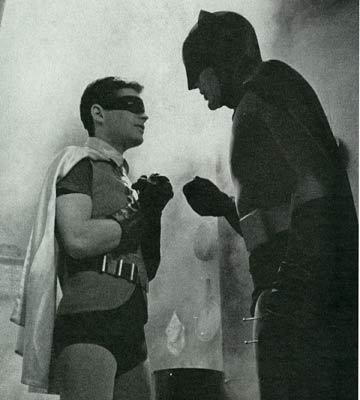
The year was 1966, and television was starting to take itself less seriously. Programs like The Man From U.N.C.L.E. and The Wild Wild West were lightly satirizing action shows by introducing outlandish plots, ridiculous villains, and impossible gadgets.
No show took the concept of self-parody farther than Batman, which premiered in 1966. It purposely exaggerated every cliché of the detective story. Yet, as John Skow pointed out in his May 1966 Post article, it was among the most popular programs of its day. So popular that, when ABC interrupted an episode to report on the emergency return of the Gemini 8 space mission, the network was flooded with protests from outraged fans.
Batman quickly became more than just entertainment. It became the country’s biggest fad. References to the show popped up in conversation and worked their way into late-night talk shows. Everyone seemed to be enjoying this jokey version of a comic book hero. Sales of Batman merchandise in 1966 exceeded $75 million—about 60 percent more than James Bond merchandise had earned in any year.
Unlike the action hero Bond, Batman was purely a comic hero: a parody of every good guy on TV. He was improbably strong, brave, and virtuous to the point of being preachy, as in this typical exchange with a villain:
RIDDLER: “With you two out of the way, nothing stands between me and the Lost Treasure of the Incas … and it’s worth millions!! Hear me, Batman, millions!”
BATMAN: “Just remember, Riddler, you can’t buy friends with money.”
No laugh track accompanied such lines, but viewers quickly lost any doubt they were watching a comedy.
The look of the show—low-budget sets painted with comic-book colors—was heavily influenced by the Pop art craze. Starting in 1962, Pop artists used images from popular entertainment and advertising to ironically reflect American culture. (Remember Andy Warhol’s Campbell’s soup can?) The show’s chief writer, Lorenzo Semple Jr., chose a Pop art style as his protest against conventional TV programming. Serious dramatic shows, he said, relied on semi-truths and evasion. “We started out to do a Pop-art thing and we’re doing it.”
The mocking of the superhero figure also reflected the rise of “camp” humor. Camp emphasized the cheap, gaudy, and sentimental elements of popular culture. It was never meant to ridicule. The purpose was to ‘make fun with’ not ‘make fun of’ popular icons. (However, Skow believed camp humor was “mean spirited … a jeering private laugh at anyone square enough to take the pretension seriously.”)
Another influence on Batman the TV show was the public reaction in the 1950s against violence in comic books. Responding to pressure from parents and educators, publishers established the Comics Code Authority, which prohibited any references to brutality and gore.
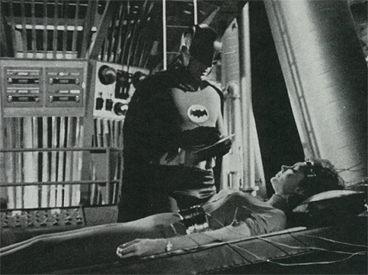
The show took the new comic code even farther by eliminating any hint of violence. Batman was no more dangerous than a pillow fight with very small pillows. The crimes, committed by a gallery of returning characters, would involve stealing something, or taking over Gotham City’s government (in order to steal something). No one was ever murdered on the show. There was nothing more brutal than “comic violence”—burlesqued fistfights in which the words “Pow,” “Bam,” and “Zap” appeared in large, comic-font letters. And Batman always triumphed in the end.
For a while, this satire on a popular comic book hero was a successful formula. By 1968, however, the novelty had worn off and the last show aired 45 years ago this week.
It wasn’t a bad run. The show had been an audacious gamble with viewers’ indulgence. It had assumed, as Skow expressed it, “there was nothing that could make the adult American television watcher feel silly.”
The year that Batman disappeared for the last time into his papier-mâché Batcave, a new crime-fighter rose to the top of the TV rating: the tough, dedicated, but always cool hip Steve McGarrett of Hawaii Five-O.
Batman, of course, didn’t disappear. The comic books are still in print, though they are less restrained in their use of death and violence. The movie versions have become increasingly morose. The most current version, starring Christian Bale, who may be returning in a Justice League movie, is a grim, solitary loner. The caped crusader of the 1960s would barely recognize himself today.
Classic Covers: Women Artists
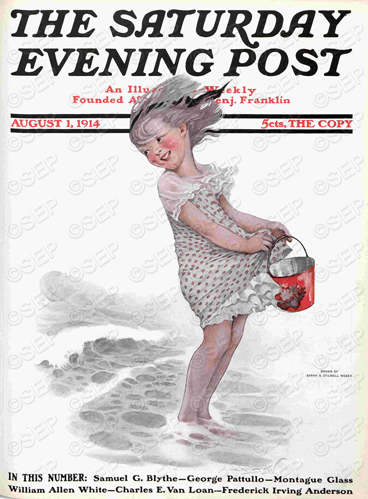
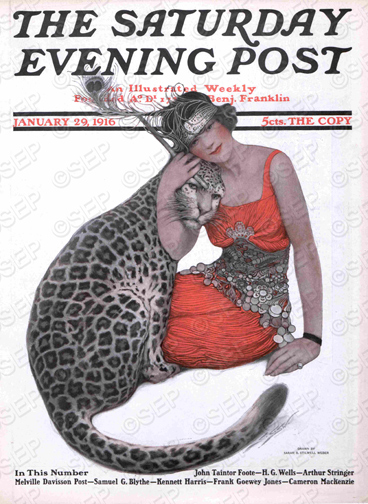
Let’s face it: The venerable old Saturday Evening Post was never in the forefront of the fight for female equality. Yet, as far back as 1904, some of our finest cover artists were women. This week we share the art of three of these fine illustrators.
Sarah Stilwell-Weber
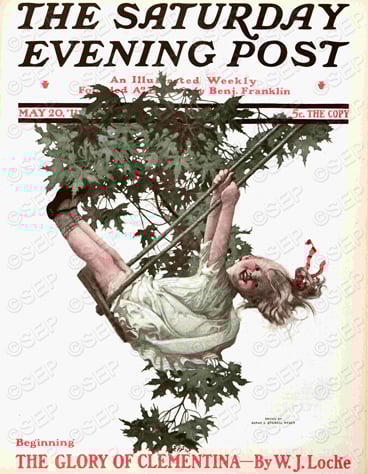
Swing Up High
Sarah Stilwell-Weber
May 20, 1911
From 1904 to 1921, Sarah Stilwell-Webber (1878-1939) created 60 Saturday Evening Post covers, mostly of women and children. Her paintings of lavishly attired women tended toward the exotic and imaginative, like the lady with the leopard below. Her depictions of children, such as this 1911 cover, delightfully conveyed what fun it is to be a child. These depictions are perhaps why she was also a well-known children’s book illustrator.
Stilwell-Weber studied under the preeminent art instructor of the period, Howard Pyle. In addition to the Post, she illustrated for Country Gentleman, Collier’s, and Harper’s Bazaar. Stilwell-Weber remains a prominent name from the Golden Age of American illustration (1880s-1920s), when American periodicals were rich in artwork that could be mass-produced for the first time.
GALLERY:

Katharine Richardson Wireman
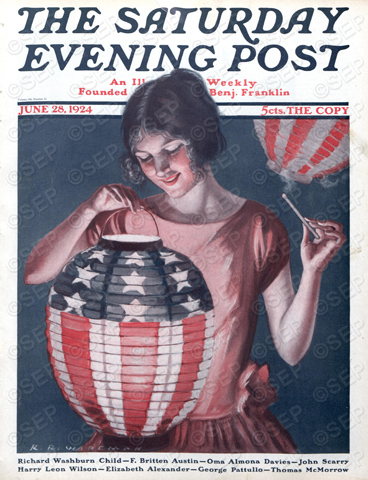
Japanese Lantern
Katharine R. Wireman
June 28, 1924
Lighting a party lantern for the 1924 Fourth of July celebration provides artist Katharine R. Wireman (1878-1966) an opportunity to work with soft light and shadows. Stilwell-Weber’s contemporary, Wireman created the first of her four Post covers in 1906. (Wiremen also painted 22 covers for sister publication, Country Gentleman.) Her works (below) emphasized carefree moments, and she often depicted her characters with rosy cheeks and joyful dispositions.
Wireman studied at the Drexel Institute under Howard Pyle in 1899. She then moved to Germantown, Pennsylvania, where she and a group of close-knit female artists, including Stilwell-Weber, began their illustration careers.
GALLERY:


Neysa McMein
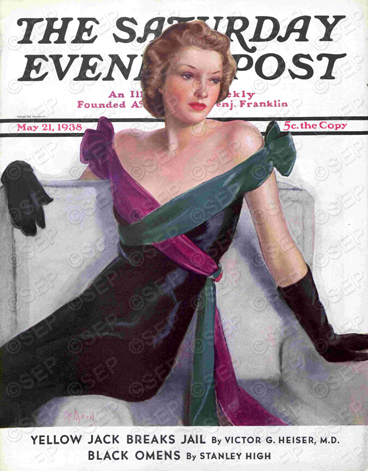
Evening Gown
Neysa McMein
May 21, 1938
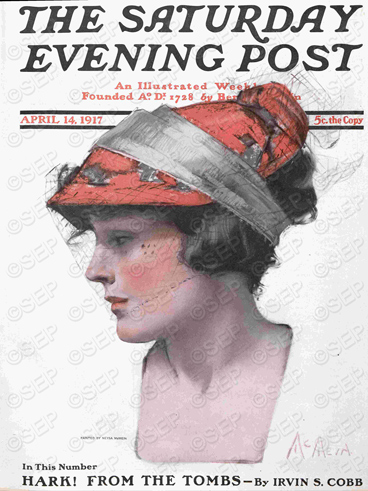
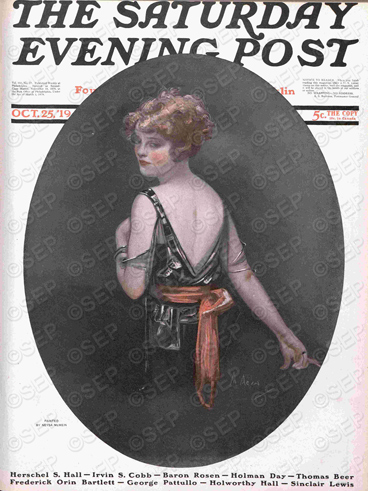
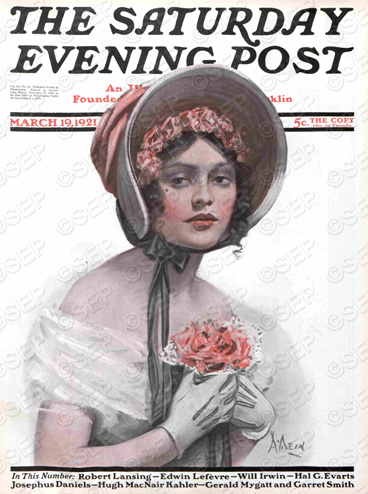
By the Roaring ’20s, artist Neysa McMein (1890-1949) was very much a celebrity, mentioned or quoted in magazine articles, fiction, and in advertisements with some regularity. (A 1928 Post article on renowned violinist Jascha Heifetz tells how the musician and his entourage, stuck in a town where nothing for evening entertainment was open, made their way to Heifetz’s room, where he cleared the bed for a dice game and a cheerful shout came from Neysa McMein “whom one does meet in the oddest places,” according to the story.)
McMein was known to entertain other celebrities of the time, such as Irving Berlin, Richard Rodgers, and Dorothy Parker, note Walt and Roger Reed in The Illustrator in America 1880-1980. She lived in an apartment atop Carnegie Hall, writes drama critic David Finkle in an intriguing 2009 Huffington Post article, and she “was known for throwing open her digs to the rich or not-that-rich and famous.
“Furthermore, McMein had a reputation for being a libertine—or, at the very least, a very liberated lady,” writes Finkle. “…There’s an inherent irony here, too. In contrast with her free-spirit life, McMein’s women were the embodiment of innocence [as we see below in a few of her 62 Post covers]. … McMein was defining the American woman for McCall’s, The Saturday Evening Post, and other publications at the same time as chipping away at the image in her daily affairs.”
GALLERY:
Smart Swaps for Salty Foods: How to Eat Less Sodium

Subbing healthier options for salty favorites cuts back on sodium and can help your heart and blood vessels. Values are based on USDA and manufacturer websites.
- Say “no” to croissants and “yes” to thin-sliced wheat bread.
Sodium Savings: 324 mg per piece -
Stock up on frozen veggies, not canned ones.
Sodium Savings: 342 mg per cup green beans -
Skip chicken labeled “enhanced with chicken broth” and purchase hens with no added salt and water.
Sodium Savings: 180 mg per 4-ounce serving - Grate Swiss cheese over salads and pizza in favor
of Parmesan.
Sodium Savings: 377 mg per ounce - Buy reduced-sodium deli meats.
Sodium Savings: 300 mg per 4-ounce serving of oven-roasted turkey - Check labels on breakfast cereal, soda,
and ice cream for hidden sodium. (Versions of the same product can vary.)
Sodium Savings: 214 mg per cup of Mini-Wheats versus Wheaties
Shamrock Barrette
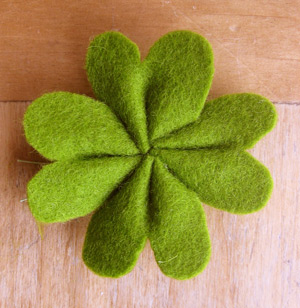
Add a subtle touch to your St. Patrick’s Day wardrobe with this charming barrette by Brenna Berger of Paper & Ink.
Shamrock Barrette
Materials
- Wool felt
- Thread
- Blank barette
Tools
- Sewing needle
- Scissors
Directions
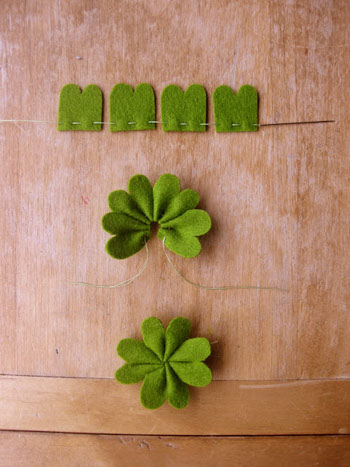
- Cut four leaves in the shape shown at right. Mine measured about ¾ of an inch tall, and nearly an inch wide. I cut two lobes into each petal and flipped the flower over, because I prefer the shape of the bottom of the flower for the center of the clover.
- Sew the leaves together as shown above.
- Tie the threads together tightly at the ends.
- Sew the clover onto a barrette.
- Clip into your little lucky charm’s hair.
Nov/Dec 2012 Limerick Laughs Contest Winner and Runners-Up
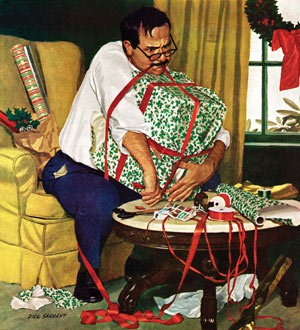
Gift wrapping I don’t understand.
Nothing turns out the way that I planned.
The paper looks bunched.
The ribbon’s all scrunched.
Perhaps I just need a third hand.
Congratulations to Bette Killion! For her poem describing the illustration by Dick Sargent, Bette wins a cash prize—and our gratitude for a job well done. If you’d like to enter the Limerick Laughs Contest for our upcoming issue, you can submit your limerick via the entry form here.
Of course, Bette’s limerick wasn’t the only one we liked! Here are some of our favorite runners-up, in no particular order:
It’s becoming abundantly clear
That the deadline for Christmas is near.
Anxiety grows
As he’s still tying bows.
He’ll give smaller presents next year.—Timothy Cannon, Osceola, Iowa
Thought shopping was the worst of my woes.
Now I’m fumbling with ribbons and bows!
I groan and I sigh
These wrappings to tie
I’m tangled from mustache to toes!—Marlene B. Larson, Larimore, North Dakota
When told by the clerk at the store,
“Wrapping is five dollars more.”
This frugal old elf
Said, “I’ll do it myself!”
Now this chore has him sore to the core.—Ben Griffin, Weleetka, Oklahoma
He tried to be quiet as a mouse
While wrapping the gift for his spouse.
But ribbons and bows
Got wrapped ’round his clothes,
And paper all over the house.—H. Earl Martin, Laurens, South Carolina
The holiday season is bright
But not for this fellow tonight.
He’s sitting there trapped,
Trying to get this gift wrapped.
What an awkward and frustrating sight.—Neal Levin, Bloomfield Hills, Michigan
This chore makes him feel trapped,
But with paper and bows he’ll adapt.
You have to adore him
Like many before him
Into his projects he tends to get wrapped.—D. Brown, Buffalo, Wyoming
Joe Jones was doing his best.
To wrap up the gift was a test.
But that stubborn red ribbon
Was not very forgivin’,
So Joe ended up with a mess.—Amory Minear, Dover, Delaware
Wrapping can be such a chore;
It’s something I’ve come to abhor.
I’m up to my nose
In ribbons and bows,
And forgot to buy tape at the store.—Andrew Murphy, Frackville, Pennsylvania
The Christmas season seems great!
It’s the trials of wrapping some hate.
Our hero is trying
But inwardly crying,
“I’ll never get done at this rate!”—Beverly J. Brouwers, Middlebury, Indiana
How Doctors Die
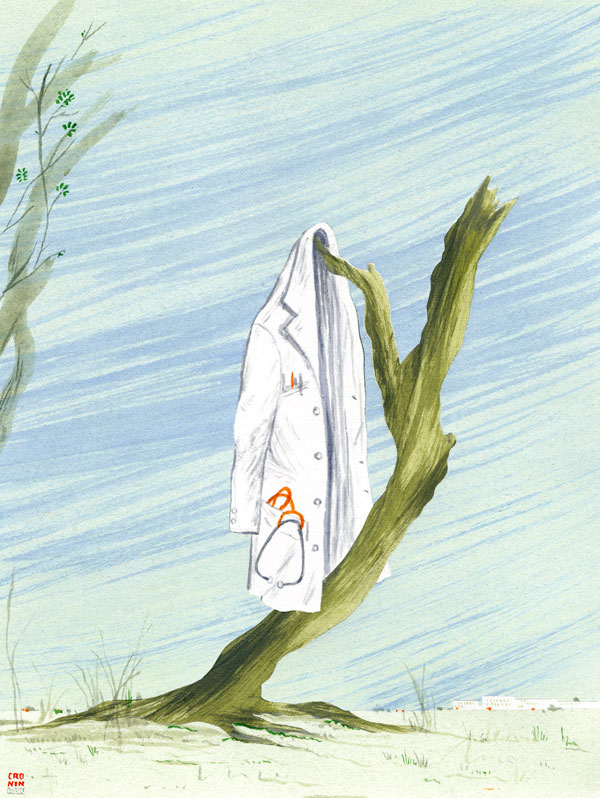
Years ago, Charlie, a highly respected orthopedist and a mentor of mine, found a lump in his stomach. He had a surgeon explore the area, and the diagnosis was pancreatic cancer. This surgeon was one of the best in the country. He had even invented a new procedure for this exact cancer that could triple a patient’s five-year-survival odds—from 5 percent to 15 percent—albeit with a poor quality of life. Charlie was uninterested. He went home the next day, closed his practice, and never set foot in a hospital again. He focused on spending time with family and feeling as good as possible. Several months later, he died at home. He got no chemotherapy, radiation, or surgical treatment. Medicare didn’t spend much on him.
It’s not a frequent topic of discussion, but doctors die, too. And they don’t die like the rest of us. What’s unusual about them is not how much treatment they get compared to most Americans, but how little. For all the time they spend fending off the deaths of others, they tend to be fairly serene when faced with death themselves. They know exactly what is going to happen, they know the choices, and they generally have access to any sort of medical care they could want. But they go gently.
Of course, doctors don’t want to die; they want to live. But they know enough about modern medicine to know its limits. And they know enough about death to know what all people fear most: dying in pain and dying alone. They’ve talked about this with their families. They want to be sure, when the time comes, that no heroic measures will happen—that they will never experience, during their last moments on earth, someone breaking their ribs in an attempt to resuscitate them with CPR (that’s what happens if CPR is done right).
Almost all medical professionals have seen too much of what we call “futile care” being performed on people. That’s when doctors bring the cutting edge of technology to bear on a grievously ill person near the end of life. The patient will get cut open, perforated with tubes, hooked up to machines, and assaulted with drugs. All of this occurs in the Intensive Care Unit at a cost of tens of thousands of dollars a day. What it buys is misery we would not inflict on a terrorist. I cannot count the number of times fellow physicians have told me, in words that vary only slightly, “Promise me if you find me like this that you’ll kill me.” They mean it. Some medical personnel wear medallions stamped “NO CODE” to tell physicians not to perform CPR on them. I have even seen it as a tattoo.
To administer medical care that makes people suffer is anguishing. Physicians are trained to gather information without revealing any of their own feelings, but in private, among fellow doctors, they’ll vent. “How can anyone do that to their family members?” they’ll ask. I suspect it’s one reason physicians have higher rates of alcohol abuse and depression than professionals in most other fields. I know it’s one reason I stopped participating in hospital care for the last 10 years of my practice.
How has it come to this—that doctors administer so much care that they wouldn’t want for themselves? The simple, or not-so-simple, answer is this: patients, doctors, and the system.
To see how patients play a role, imagine a scenario in which someone has lost consciousness and been admitted to an emergency room. As is so often the case, no one has made a plan for this situation, and shocked and scared family members find themselves caught up in a maze of choices. They’re overwhelmed. When doctors ask if they want “everything” done, they answer yes. Then the nightmare begins. Sometimes, a family really means “do everything,” but often they just mean “do everything that’s reasonable.” The problem is that they may not know what’s reasonable, nor, in their confusion and sorrow, will they ask about it or hear what a physician may be telling them. For their part, doctors told to do “everything” will do it, whether it is reasonable or not.
The above scenario is a common one. Feeding into the problem are unrealistic expectations of what doctors can accomplish. Many people think of CPR as a reliable lifesaver when, in fact, the results are usually poor. I’ve had hundreds of people brought to me in the emergency room after getting CPR. Exactly one, a healthy man who’d had no heart troubles (for those who want specifics, he had a “tension pneumothorax”), walked out of the hospital. If a patient suffers from severe illness, old age, or a terminal disease, the odds of a good outcome from CPR are infinitesimal, while the odds of suffering are overwhelming. Poor knowledge and misguided expectations lead to a lot of bad decisions.
But of course it’s not just patients making these things happen. Doctors play an enabling role, too. The trouble is that even doctors who hate to administer futile care must find a way to address the wishes of patients and families. Imagine, once again, the emergency room with those grieving, possibly hysterical, family members. They do not know the doctor. Establishing trust and confidence under such circumstances is a very delicate thing. People are prepared to think the doctor is acting out of base motives, trying to save time, or money, or effort, especially if the doctor is advising against further treatment.
Some doctors are stronger communicators than others, and some doctors are more adamant, but the pressures they all face are similar. When I faced circumstances involving end-of-life choices, I adopted the approach of laying out only the options that I thought were reasonable (as I would in any situation) as early in the process as possible. When patients or families brought up unreasonable choices, I would discuss the issue in layman’s terms that portrayed the downsides clearly. If patients or families still insisted on treatments I considered pointless or harmful, I would offer to transfer their care to another doctor or hospital.
Fabulous Fiji

All I can figure is that Tom Hanks lost his glasses in the plane crash. In the movie Cast Away, he spends years, washed up and alone on a Pacific Island. He gets skinny, grows a beard, nearly goes insane, and ends up spending huge amounts of time talking to a volleyball.
“Oh, yeah, he was on that island right there,” Pilli tells me, indicating a rock tower just around the point. From on top of those rocks, if Hanks had his glasses on, he wouldn’t have had any trouble at all seeing the village where I’m about to sit down to a wonderful meal of fish cooked in coconut. He probably could have even seen the resort one more island over, bures, the traditional Fijian houses, lined up neatly against the shoreline and a bartender who serves the strongest rum punch I’ve ever had.
We’re in the Mamanucas, a chain of islands to the west of Fiji’s main port town of Nadi, on Viti Levu—one of only two of more than 300 islands in the country big enough to show up on most world maps. And it didn’t take getting into a plane crash to get here; actually, the ferry ran right on time and was really comfortable [see “Travel Tips: Fiji,” March/April 2013].
The Mamanucas look like Hawaii before it was Hawaii. They look like the background of every painting Gauguin ever did of a tropical paradise: mountains rising out of the sea, no transition between water and flower-stuffed jungle except lines of powdered sugar beaches. Villages are hidden behind lines of sheltering coconut trees, pandanus, and stuff I’ll never learn the name of but has leaves the size of dinner plates.
I catch a boat over to a beach on the far side of the island from where most of the film was set, unload a picnic lunch and string a hammock under a thatched shelter—a good idea to be under cover, since every now and then from the jungle comes the crash of a coconut falling out of a tree, and that just isn’t something you want to be under.
My ride steers his boat away and for the first and so far only time in my entire life I have a beach completely to myself (well, except once in American Samoa, but that beach was haunted, so technically, I was sharing it with the ghosts) with no chance whatsoever of anyone coming by.
The sand stretches as smooth as a pool table, except for my footprints and some tiny, delicate shells, like a kind of cowrie that’s been Dalmatian spotted.
Let’s face it: If the Garden of Eden had resorts, it would have looked like Fiji.
Which is why Tom wasn’t the first Hollywood star to wash up on Fiji’s shores. Cameras and crews have been coming out here since at least 1932, when Edward Sutherland shot Mr. Robinson Crusoe. No, you probably won’t find that one on DVD. Better chance of seeing Burt Lancaster play His Majesty O’Keefe, a 1954 hit where he realizes it’s more fun to be happy than rich as he walks the streets of Suva, Fiji’s capital (on the other side of the same island as Nadi) despite the fact that the weather forecast never says anything but “rain.” Gregory Peck stood in Suva’s rain during the production of 1974’s The Dove.
But here’s where Hollywood got Fiji very, very wrong: What all the films have in common is that you have to work for paradise, getting there can’t ever come too easy. A little suffering to purify you for the experience, like stripping off the skin from a sunburn.

Yet just like getting to the Mamanucas on a nice, shiny ferry, I didn’t work at all to get here. Fiji is just three hours from Australia, or about 10 from Los Angeles. And the islands have resorts so luxe that the staff actually looks offended if you touch your own bag.
And being here is zero effort. Everybody speaks fluent English, even out in the villages, and they might well be the friendliest people on the entire planet. The only voices you’ll ever hear raised are the constant shouts of “Bula!” the all-purpose greeting and expression of joy.
Isn’t pure joy better for your soul than Hollywood trial and tribulation?
And I’m about to get a whole lot of joy, because the sun’s going down and it’s time for kava.
Kava is the glue that holds Fijian society together, and it was the one thing the missionaries weren’t able to change about the islands. Because the truth is, before the arrival of missionaries in the early 1840s, the Fijians were not exactly known as the nicest people around; in fact, most sailors went a very long way out of their way to avoid Fiji. At least one missionary ended up as soup. At the death of a chief, a passel of his wives would be strangled, so he wouldn’t have to die alone. The Fijians maintained a more or less constant state of war, but at the same time, you can see something deeper was going on, because their war clubs—ironically still the most popular souvenir in all the shops—are works of art, like it would be rude to bash someone in the head with a club that wasn’t as beautifully made as possible, intricately carved and decorated.
But the missionaries, with that famed missionary perseverance, eventually stopped turning into soup and changed the entire local approach to life. Like they did across the tropics, the missionaries convinced people who lived in a hot, sweaty climate to wear clothes suitable for a New England winter. They stopped head bashing from being the sport of choice. And they built churches every 20 feet or so in most villages. When I walk through a Fijian village on a Sunday morning, hymns pour out of a half dozen chapels’ open windows.
But the missionaries couldn’t do anything about kava, and maybe one of the reasons why film crews love Fiji so much is that the national pastime is getting blitzed on kava every evening. Kava is made from the root of a kind of pepper plant. Grind the stuff up, mix it with water, and you get … well, a drink that both looks and tastes remarkably like mud. But mud that first makes your mouth go numb, and then, according to people who apparently have a much lower chemical tolerance than I do, instills you with a very relaxed, happy feeling. So relaxed that you might not want to move for several hours. Or, if you drink enough of it, several days.
7 Steps to Clutter Control
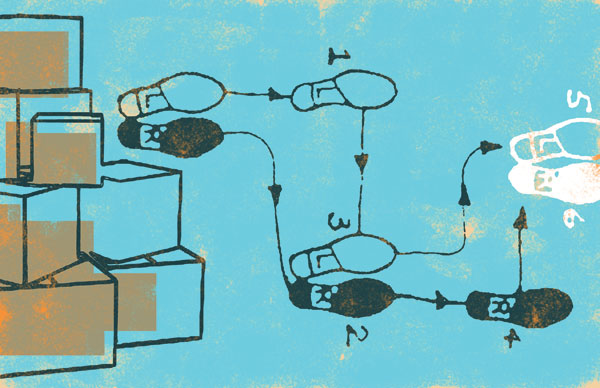
Better planning, smarter strategies reduce stress and save time. Get started now!
1. Enlist the help of a family member or friend who can be supportive, physically and emotionally, and help keep you on task.
2. Analyze each room, and list all the activities that need to be conducted in that space, recommends professional organizer MaryJo Monroe. Then sort items and toss, relocate, or donate items that do not serve the main function of the space.
3. Deal with the biggest items that are cluttering your room first so you can see an immediate impact. “Clearing a large amount of space will boost your morale,” adds Monroe.
4. Install organization systems that are intuitive. Every item needs a home, and the home must suit the need. For instance, if the entry hallway is always cluttered with shoes, put a basket there to contain them.
5. Take decluttering in small steps. Working one room at a time or even a portion of a room at a time, such as the kitchen countertop, will prevent you from becoming overwhelmed and tempted to call it quits. “Doing something feels better than doing nothing,” Monroe says.
6. When evaluating items that hold sentimental value, segregate the object from the memory. If you have Grandma’s china but don’t use it, consider keeping a teacup and saucer to display for that memory boost. Donating the rest to an appreciative family member who will use it is often a better way to honor a loved one’s memory.
7. It’s not only important to think in terms of getting organized but also staying organized. Employ a program of ongoing maintenance, even if it’s only a few minutes a day, so that cleanup occurs while clutter is still in the minimal—not mountainous—stage.
If the task still seems daunting, or the situation has gotten a bit too out of hand, consider hiring a professional organizer who’ll come to your home to help you prioritize and systematize. The nonprofit group National Association of Professional Organizers can help you find an expert in your area. For details, visit the group’s website at napo.net.
Sometimes the mess that seemingly won’t go away is a symptom of a deeper problem. Read more in “End Clutter Now!” March/April 2013.
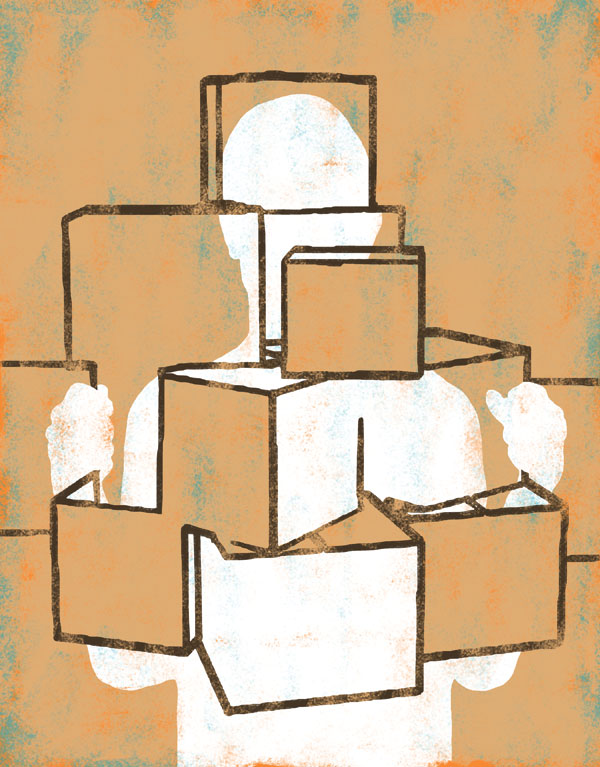
Illustration by Gwenda Kaczor.
Travel Tips: Fiji

Fiji is easily reached by Air Pacific, airpacific.com, which flies direct to Nadi from Los Angeles. They fly two-story 747s; if the plane isn’t too full, you can buy a full row of seats for yourself in the quiet upstairs for a few hundred extra bucks. Money well spent for the 10-hour flight.
Most resorts on Fiji will arrange your transport out from Nadi to the resort; the local airlines are Sun Air, fiji.to, and Turtle Airways, turtleairways.com. Very efficient ferry service is offered by South Sea Cruises, ssc.com.fj; they work with the resorts and offer Nadi to beach service to most major resort areas; from there, a resort boat will come out to take you the rest of the way if need be.
Fiji has accommodations for every budget, but the higher your budget, the happier you’ll be. A local guesthouse with meals might run $20/day. An ultra swank honeymoon-style spot can easily go $2,000/day. And there are plenty of options in between. The best place to start looking is on Fiji’s official website, fijime.com.
There are no bad islands in Fiji; it’s gorgeous from end to end. Whether you’re looking for a private getaway or a big party resort, you won’t have any trouble finding just what you’re after. The only warning is take it easy on the kava (you will be offered kava) until you know how it’s going to affect you.
Read more in “Paradise Found,” March/April 2013.
End Clutter Now!
Some people wear their emotions on their sleeve. Others manifest it in the nest: The state of their homes reflects their state of mind. When depression sets in, the clutter can pile up.
Charles Miles can relate. He owns a three-bedroom Colonial-style home in Bogota, New Jersey, but when he’s feeling blue, routine maintenance is hard to keep up. “There are dishes in the sink. Newspapers on the floor. Instead of putting things away, I leave them where they are. I think, ‘What’s the point?’ I’m just not motivated. It’s the demon I fight all the time.”
Healthcare professionals know all too well the connection between clutter and depression. The abilities you need to keep a home clean and in relative order go by the wayside with depression. People who lose their drive find it hard to handle basic housekeeping and organizational tasks. “A systematic pattern of home neglect is really a form of self-neglect,” says Dr. Holly Parker, a practicing psychologist and faculty member of Harvard University. “People with depression often have low energy, almost like taking gas out of the tank of a car. They lose the motivation to do things they used to love to do. If they give up hobbies, they definitely won’t do housework.”
Clutter is difficult to contain under the best of circumstances. Every Felix Unger has a bit of Oscar Madison in him. For most, it’s a matter of having too much stuff and not enough places to store it. Some have called it an epidemic of affluenza. As a nation of affluence, we buy without thinking what we’re going to do with it, how we’re going to use it, and where we’re going to put it. And because we’re busier than ever, we have less time to figure it all out.
The fact is that previous generations simply didn’t have all the stuff we have today. They were never tempted by 24-hour shopping channels, blasted with emails about last-chance sales, or bombarded with catalogs and junk mail. Generations from baby boomers to millennials may have it all within reach, but most haven’t learned how to keep it in balance. Homes continue to grow fuller, despite our households growing smaller.
It’s not the whole problem, though. Clutter isn’t just about bringing new stuff into the home but the inability to purge the old. Some adhere to the waste not, want not school of housekeeping. Obsolete electronics? Clothes that haven’t fit in years? Broken tools? Folks with a Depression-era mindset hate to throw anything away. And then there are the objects with sentimental value, the biggest clutter culprits because they’re the hardest to part with of all. It’s little wonder why in the U.S. alone, the self-storage industry is a $22 billion business annually.
Living in clutter is more than just a matter of aesthetics. Clutter is an energy sapper that takes its emotional toll and steals domestic joy. If home is where the heap is, it’s a good bet family members are more stressed and less productive. It can create tension in personal relationships. It can cause people to be chronically behind schedule because they can’t find their car keys or they’re unable to sift through their closets for a complete outfit in the morning. And children can suffer as well. Some youngsters experience problems at school because they’re routinely late for class or under prepared for assignments.
Clutter comes in degrees, from mild to severe, from annoying to debilitating. While it can cause anxiety and depression, it can conversely be a symptom of a problem. Professional organizer MaryJo Monroe, owner of reSPACEd, a residential organization and design firm in Portland, Oregon, says one of the first things she notices working with a client who might be depressed is low energy output. “They don’t have stamina. Instead of working two to four hours at a stretch, they’ll start to poop out after an hour.” Another red flag is difficulty making decisions. When the ability to concentrate wanes, figuring out whether to keep, toss, or relocate things becomes impossible.
Self-esteem issues can be at the root. The attitude? I’m just not worth the effort. And it spirals downward from there. When it becomes hard to muster the motivation to turn things around, it can create a negative cycle that feeds on itself. People often become more stressed and more depressed because of the mess. And the inability to dig oneself out brings on feelings of hopelessness.
Losing his job of 14 years started a downward spiral for “John” who was living outside Seattle, Washington. He defaulted on his mortgage and lost his home. The stress caused the dissolution of his marriage and alcohol took over his life. “I started letting things go. Dishes piled up in the sink, garbage was almost never taken out. After all, what was the use? I knew I could pull myself out of it. But not today. Today I didn’t feel like it. I felt like sleeping.” Through the help of a friend, John went into a detox program and got help for his depression. He moved to a new state, got a new job and apartment. “As for how I feel when I come home, the difference is amazing. Coming home to a neat place, and knowing that everything in it—including the cleanliness—was earned by me, makes everything I do there, from waking up in the morning to watching the Late Show before I go to bed, that much sweeter.”
And that message of hope is exactly the one professionals strive to communicate.
Spring is an ideal time to start getting clutter under control. For many, seasons can have a powerful affect on their moods. In the spring, the days are longer, flowers start blooming, people are out and about. Those who struggle during the short, dark days of winter perk up in the spring. “It’s an uplifting time,” Parker says. “You can capitalize on that time of year by getting more things done and capitalize on that boost of mood that comes with longer days.”
Solving clutter problems is a two-step process that takes planning. The first part is getting to the root of the problem, and a number of treatments can help such as therapy, medication, and doing regular exercise.
The second part is putting a system in place. (See “Seven Steps to Clutter Control.”) Enlisting a friend or family member in the organizational process can give the chronically disorganized the cheerleading morale they need to keep going. A home that looks good helps us feel good. And New Jersey homeowner Charles Miles can relate to that, too. When his outlook brightens, tackling the clutter is job number one. His reward for a home organizational makeover is a sense of accomplishment and renewed self-confidence. “I feel great,” says Miles. “I’m like, ‘Let’s invite the neighbors over for dinner!’”
Illustration by Gwenda Kaczor.
Curtis Stone’s Bagel, Egg, and Mushroom Brunch
While the menu options are endless, so are the styles of brunch. Play some nice music, pour through the paper, play a round of croquet, or challenge your dad or a guest to a game of Gin Rummy. After all, brunch is the meal that has something for everyone.
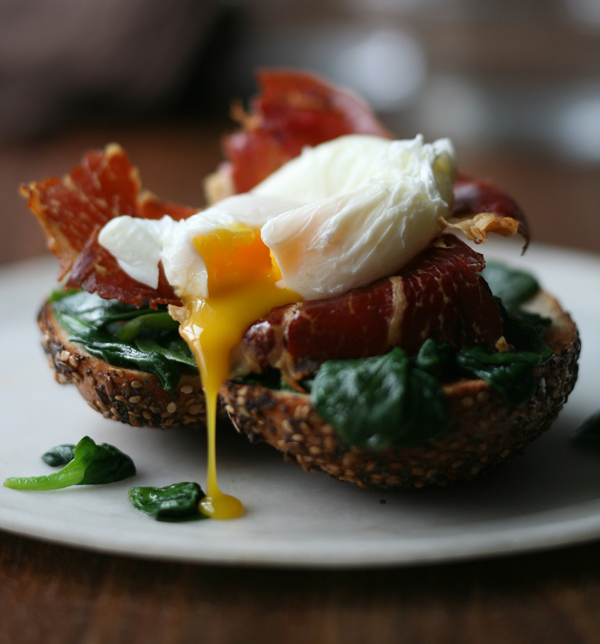
Sautéed Wild Mushrooms, Served On Toasted Bagel with Prosciutto and Poached Eggs
(Makes 4 servings)
Ingredients
- ¾ cup white wine vinegar
- 2 tablespoons olive oil
- 2 tablespoons unsalted butter
- ½ cup shallot, finely chopped
- 1 clove garlic, finely chopped
- 1 pound assorted wild mushrooms
- 1 tablespoon flat leaf parsley, finely sliced
- 4 eggs
- 2 bagels, split and toasted
- Olive oil for toasted bagels
- 4 thin slices prosciutto
Directions
- Place large high-sided saucepan on medium heat and fill (nearly) to top with water.
- Stir in vinegar and bring to boil.
- While water is heating, place large heavy-based fry pan over medium heat.
- Add oil and butter and sweat shallots and garlic for about 30 seconds until fragrant.
- Add mushrooms and sauté for 5 more minutes.
- Season to taste with salt and pepper and toss in parsley.
- While mushrooms are cooking, crack one egg into coffee cup or small bowl and then gently transfer the egg to the barely simmering water.
- Repeat with three more eggs.
- Cook eggs for about 3 minutes, or until whites are set but the yolks are still runny.
- Using slotted spoon, carefully remove eggs from the simmering water and set them on paper towel to drain excess water.
- Set toasted bagel halves cut side up on 4 plates.
- Fold prosicutto over bagels, spoon eggs onto prosciutto and top with a few spoonfuls of mushrooms.
- Serve immediately.
Nutrition Facts
SERVING SIZE: ¼ of total yield
Calories: 470
Total fat: 19 g
Carbohydrate: 49 g
Fiber: 5.6 g
Protein:30 g
Sodium:605 mg
Diabetic Exchanges:3 starch/carbs, 1 medium-fat meat, 1 non-starchy vegetable, 3 fat
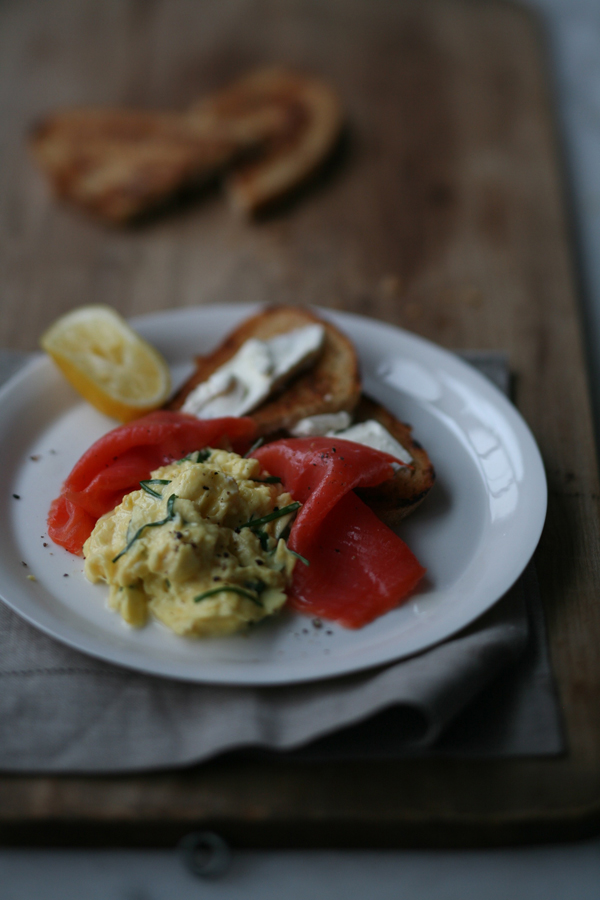
Photo by Quentin Bacon.
Curtis Stone’s Scrambled Eggs with Smoked Salmon and Chives
You’ll have brunch whipped up in a jiffy with this egg and salmon brunch combo. Most of us show up hungry for brunch, however, so put out a fruit platter, some yogurt and granola, or a spread of smoked salmon and bagels for your guests to nibble on when they arrive.
And be sure to pace the meal: People should feel like they could go for a hike after leaving the table.
Scrambled Eggs with Smoked Salmon and Chives
(Makes 4 servings)
Ingredients
- 6 large eggs
- ⅔ cup light cream
- ½ cup 1-inch pieces fresh chives
- ½ teaspoon salt
- ½ teaspoon freshly ground black pepper
- 2 tablespoons unsalted butter
- 4 slices sourdough bread
- 8 tablespoons low-fat cream cheese
- 4 ounces cold-smoked salmon
- 4 lemon wedges
Directions
- Using fork, mix eggs, cream, chives, salt, and pepper in large bowl to blend.
- Melt butter in heavy large nonstick skillet over medium-low heat.
- Add egg mixture to pan.
- Once eggs become just set on bottom of skillet, constantly stir egg mixture very slowly with silicone spatula, scraping the egg mixture from bottom of pan for 8 minutes, or until eggs are no longer runny.
- Toast sourdough bread, then spread with cream cheese.
- Place toast, cream cheese side up, on each plate and top with smoked salmon.
- Spoon the egg mixture over the toast, and serve with lemon wedges.
Nutrition Facts
SERVING SIZE: ¼ total yield
Calories: 431
Total fat: 28 g
Carbohydrate: 21 g
Fiber: 1.3 g
Protein: 22 g
Sodium: 769 mg
Diabetic Exchanges: 1 starch/carb, 1 lean-meat, 1.5 medium-fat meat, 0.5 low-fat milk, 3 fat
Photo by Quentin Bacon.