Curtis Stone’s Whole-Wheat Buttermilk Pancakes with Strawberry-Maple Syrup
One of my best memories is watching my mum flipping her perfect blueberry pancakes on the griddle as we lounged by the table reading the paper.
For the freshest, fluffiest pancakes and waffles, prepare batters just before cooking. If the batter sits too long, it will start to ferment, giving these breakfast goodies a sour flavor.
Whole-Wheat Buttermilk Pancakes with Strawberry-Maple Syrup
(Makes 6 servings—12 pancakes)

Ingredients
Syrup:
-
- ¾ cup pure maple syrup
- 2 teaspoons finely grated orange peel (from 1 orange)
- ½ vanilla bean, halved lengthwise
- 2 cups fresh strawberries, cored and quartered
Pancakes:
- ¾ cup all-purpose flour
- ¾ cup whole-wheat flour
- ½ cup instant oats
- 3 tablespoons caster sugar
- 1 ½ teaspoons baking powder
- ½ teaspoon baking soda
- ½ teaspoon salt
- 1 ½ cups 1 percent low-fat buttermilk
- 2 large eggs
- 1 tablespoon canola oil
- Nonstick cooking spray
- 3 tablespoons unsalted butter
- ½ cup sliced almonds, toasted
Directions
To make syrup:
-
- In heavy medium saucepan, combine maple syrup and orange zest.
- Scrape seeds from vanilla bean into syrup then add bean.
- Bring syrup to boil over high heat.
- Remove saucepan from heat and stir in strawberries.
- Cover and set aside off heat for 15 minutes.
- Before serving, rewarm syrup over medium-low heat just until hot but not simmering, if necessary. Discard vanilla bean.
To make pancakes:
- In large bowl, whisk all-purpose flour, whole-wheat flour, oats, sugar, baking powder, baking soda, and salt to blend.
- In medium bowl, whisk buttermilk, eggs, and oil to blend.
- Pour buttermilk mixture into flour mixture and stir with wooden spoon just until moist but still lumpy.
- Heat large nonstick griddle pan or heavy large nonstick skillet over medium-low heat. Spray pan with nonstick spray.
- Using about ⅓ cup of batter for each pancake, spoon batter onto griddle and cook until pancakes are golden brown and puffed, 2 to 3 minutes per side.
- Wipe griddle or skillet with paper towels and spray with nonstick spray before cooking each batch of pancakes.
- Transfer pancakes to plates.
- Top with butter and spoon strawberries and syrup over pancakes. Sprinkle with almonds and serve immediately.
Nutrition Facts
SYRUP
Calories: 130
Total fat: 0.1 g
Carbohydrate: 33 g
Fiber: 1.5 g
Protein: 0.5 g
Sodium: 5 mg
Diabetic Exchanges: ~2 starch/carb
PANCAKES
Calories: 325
Total Fat: 15g
Carbohydrate: 38 g
Fiber: 4.6 g
Protein: 9.4 g
Sodium: 390 mg
Diabetic Exchanges: 2 starch/carb, 0.5 low-fat milk, 2 fat
Photo courtesy Curtis Stone.
How the Post Reported the Alamo Story
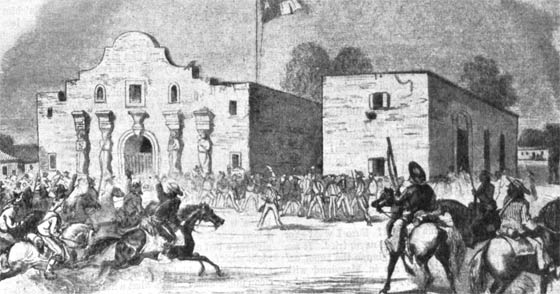
Bad news may travel fast, but at the time of the Alamo siege, it rarely moved faster than the walking pace of a horse or the cruising speed of an early steamship.
So on April 9, 1836, readers must have thought the Post’s news from Texas appeared with unusual speed. A mere four weeks after the event, it reported the Mexican army was besieging the Alamo of San Antonio de Bexar and would likely obtain possession of the place.
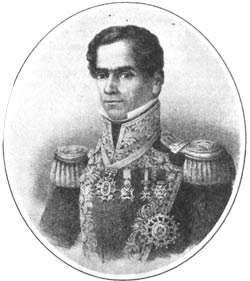
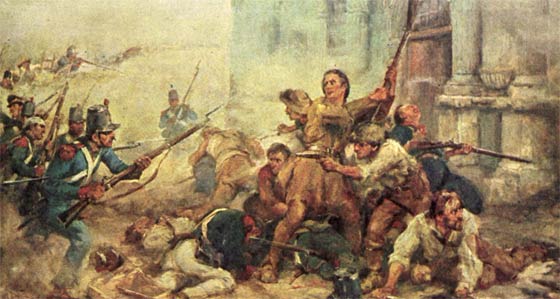
The shocking news had barely sunk in when the next issue brought a report on the fall of the Alamo and the merciless slaughter of prisoners. Under the headline “Horrible Butchery, Highly Important from Texas,” the Post reported: “… On the 6th March, about midnight, the Alamo was assaulted by the whole force of the Mexican army, commanded by [Gen. Antonio López de] Santa Anna in person. The battle was desperate until daylight, when only 7 men belonging to the Texian Garrison were found alive, who cried for quarters, but were told that there was no mercy for them—they then continued fighting until the whole were butchered.
“… Gen. [Jim] Bowie was murdered in his bed sick and helpless. [The Mexican] General Cos, on entering the fort, ordered the servant of Col. Travis to point out the body of his master. [When] he did so, Cos drew his sword and mangled the face and limbs with the malignant feeling of a Comanche savage.”
The victory was as decisive as it was brutal, but Santa Anna’s success only inspired Texans to take arms against him. Hundreds of settlers who had previously refused to support the Texan army before now rushed to offer their services.
These settlers had moved from the U.S. into the Mexican territory of Texas at the invitation of the Mexican government. The leaders in Mexico City hoped they would develop its dry northern plains and build a buffer of loyal inhabitants between themselves and the United States. Under the Mexican Constitution of 1824, the government granted the American immigrants both land and a fair degree of autonomy.
By 1830, however, Santa Anna had become Mexico’s dictator. When he dissolved the country’s legislature, several states in Mexico rose up in rebellion. Santa Anna ruthlessly put down all opposition, and then turned his attention to the northeast and the Texans who showed little inclination to recognize any government.
He decided he could waste no time or mercy suppressing the rebellion, and so marched on San Antonio with 1,800 soldiers to confront a small army of Texans encamped at the Alamo. The commander of the garrison, Col. William Travis, sent out urgent pleas for reinforcements. One of the Texan commanders he was hoping would march over the horizon to his rescue was Col. J.W. Fanning. But Fanning had troubles of his own. As the Post reported: “Distressing news has reached us of the horrible massacre and butchery of the entire command of Col. Fanning, by the tyrant monster Santa Anna and his forces. … Col. F. being overpowered by the Mexicans … capitulated upon the promise of Santa Anna, that himself and soldiers should be treated as prisoners of war. But no sooner had the fiend of hell fastened them in his clutches than he secured their arms, and early next morning ordered them all to be shot.
“The men under the immediate command of Colonel Fanning were all killed but FIVE!” (“Late and Important from Texas,” May 7, 1836).
Post readers had only two weeks to digest this news when the conflict suddenly ended with a surprising victory. On May 28, under the headline “Particulars of the Capture of Santa Anna,” the Post gave a report of the battle at San Jacinto by a Col. Hockley of the Texan army: “We commenced the attack upon them at half-past 5 o’clock, P.M. by a hot fire from our artillery.
“We marched up within 175 yards, unlimbered our pieces and gave them the grape and canister, while our brave riflemen poured in their deadly fire. In fifteen minutes the enemy were flying in every direction, and were hotly pursued by us. They left 500 of their slain behind them.
“Never was there a victory more complete. Gen. Cos was taken and killed by a pistol ball from one of our men, who instantly recognized him.”
Santa Anna was pursued by the Texans for 15 miles until his horse became bogged down near the Brazos River. Abandoning his horse, he ran for the nearby woods with his pursuers close behind. Once among the trees, his trail disappeared. As the Post described these events in an article dated May 28, “The pursuers then spread themselves, and searched the woods for a long time in vain, when it occurred to an old hunter that the [escaping officer] might have ‘taken a tree.’ The tops were then examined, when lo! the game was snugly ensconced in the forks of a large live oak.
“The captors did not know who their prisoner was until they reach the camp, when the Mexican soldiers exclaimed, ‘El General, El Jefe! Santa Anna.’”
Gen. Houston did not execute Santa Anna in reprisal for his slaughter of prisoners, but held him hostage to prevent further actions by the Mexican army.
Santa Anna’s brutality, by general opinion, was both immoral and stupid. Yet he declared he had the right to execute prisoners. Hadn’t he issued a proclamation that branded all supporters of Texan independence to be pirates? Hadn’t he flown a red flag at the Alamo? Didn’t the Texans know this meant he would take no prisoners?
He felt no mercy to foreigners who crossed his border to build their own communities, speak their own language, become prosperous, and aspire to political power.
Santa Anna was eventually returned to Mexico, where he became president again. Breaking the conditions of his release from the U.S., he marched into Texas in 1842, was again defeated, then overthrown, captured, and sent into exile in Cuba. He returned in 1846, declared himself president, was overthrown, and went into exile again. In 1853, he once more returned to Mexico and named himself dictator-for-life. Within a year, he was removed from power, and went into exile. In 1869, he died in New York while trying to raise money for an army that would return him to power.
Classic Art: Rockwell’s Right-hand Man
An artist himself, Gene Pelham was Norman Rockwell’s photographer, prop–man, model wrangler, and much more.
First Flower
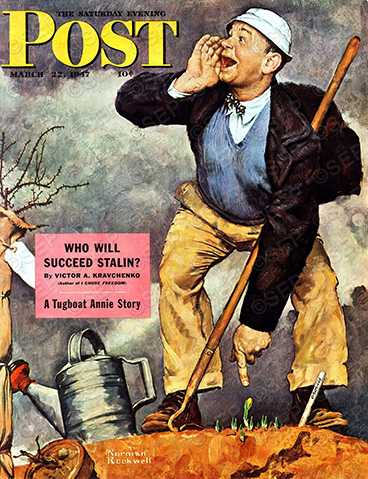
First Flower
Norman Rockwell
March 22, 1947
On a blustery March day a man excitedly spies that first crocus peeking through. The man is Gene Pelham, who as a youth had met Rockwell and occasionally modeled for him while living in New Rochelle, New York.
But in 1938, Marcy Kennedy Knight writes in the March/April 2013 issue of the Post, Pelham moved from New York, filled with visions of a country life. When settled, he dreamed of doing some farming in Arlington, Vermont. But a funny thing happened on the way to his dream. Knight writes that Pelham was in his yard one day when a man seeking directions pulled into his driveway and rolled down his window. Pelham looked up and “was amazed to see none other than Rockwell behind the wheel. ‘Norman? What are you doing here?’ he asked.”
What the artist was doing was moving to Arlington too. “Rockwell was delighted to find Pelham living in Arlington when he and his family arrived, and soon hired him as his studio assistant,” Ron Schick writes in Norman Rockwell: Behind the Camera. Pelham “built props, prepared canvases, wrangled models, and was himself a versatile and expressive model,” continues Schick. “The relationship was mutually beneficial: Pelham grew as an illustrator as he learned from his mentor, and Rockwell gained from Pelham’s considerable range of talents.”
Plumbers
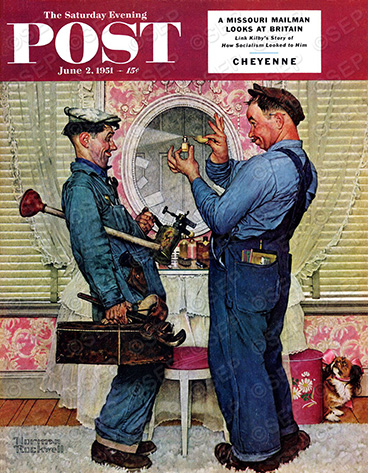
Plumbers
Norman Rockwell
June 21, 1951
Plumbers was one of Rockwell’s most entertaining covers. Pelham (right) and Rockwell’s apprentice Don Winslow are typecast as Laurel and Hardy like characters cutting up in a fancy boudoir, much to the confusion of the Pekingese to the right. Rockwell’s passion for detail works a wonderful contrast between the room with it’s floral wallpaper and frilly vanity and the laborer with their dirty hands and well-used tools. There’s a good chance that Pelham was the one who located the tools. He was key to acquiring props for the artist.
“Dad never threw anything away,” Pelham’s daughter Melinda said in a recent Post interview. “Norman would get these things and say, ‘Here, Gene, take this. I don’t want it.’ I think that’s why he liked my dad so much because my dad could always come up with whatever it was he needed.”
Melinda has had fun over the years, looking at Rockwell’s paintings and recognizing various items. “A lot of the props he would drag from our house. Sometimes I see things in Post covers that are either things I had or someone in my family had.” For example, in Rockwell’s 1943 April Fool cover Melinda recognized the table (“it was my grandmother’s”), the chairs, and the clock that she still owns today.
A more famous prop was Rockwell’s chair, depicted in the cover Blank Canvas. After many years of use, the artist threw the chair out, but Pelham retrieved it and took it home. “Dad used it when he did his own painting,” from then on Melinda told us. And who wouldn’t? After all, America’s favorite illustrator created many iconic images while sitting in that old seat.
New Chair
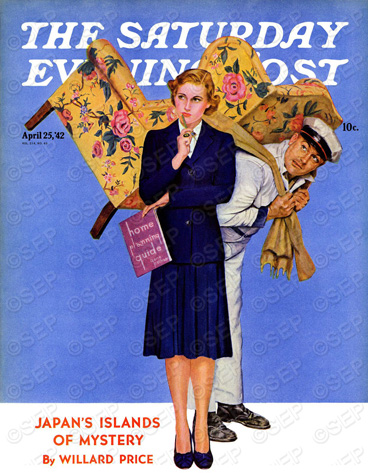
New Chair
Gene Pelham
April 25, 1942
“My father was a landscape painter mostly,” Melinda says. “My mother used to say ‘You should paint more,’ but he didn’t.” Although he did a “few covers for the Post and Collier’s,” it was difficult to make a living at commercial illustration. The competition was great for magazine and advertisement art, and there was certainly no competing with Rockwell, who was at the pinnacle in these venues. Besides, Melinda says, “Norman kept him busy.”
By the time Pelham created this colorful 1942 cover, it was apparent that his move to Vermont’s countryside was the beginning of a trend. That February, the Post noted another of their illustrators, Mead Schaeffer, had “joined Norman Rockwell and Gene Pelham at Arlington, Vermont, in what promises to become a Post art colony.” They were prophetic words, for the tiny town would soon boast fellow cover artists John Atherton and George Hughes. These renowned illustrators socialized and consulted each other on their projects. We can see the influence of Hughes’ humorous everyday situations and Rockwell’s sense of fun in Pelham’s beleaguered moving man.
Fear of Flowers

For those with asthma and/or allergy symptoms, gardening can become more pain than pleasure. But have no fear! Minimizing pesky allergens growing in your own backyard is easy with these tips from the Asthma and Allergy Foundation of America and other experts:
- Pick the right plants. Asthma-friendly choices include St. Augustine grass; azalea, boxwood, and hibiscus shrubs; apple, dogwood, and red maple trees; and begonia, impatiens, snapdragon, and hosta flowering plants.
- Get good ground cover. Opt for gravel, oyster shell, or vinca plants. Conversely, popular covers like wood chips and mulch can retain moisture and encourage mold growth.
- Keep hedges under control. Prune annually to limit height and thin out the oldest wood. Hedge branches trap dust, mold, and pollen.
- Cover up. Wear a hat, glasses, gloves, long-sleeve shirt, and a National Institute of Occupational Safety and Health-approved face mask (available at most garden stores) to keep allergens away from skin and nose.
- Work late. Care for your plants in late afternoon or early evening when pollen counts tend to drop.
- Know the score. Download free mobile apps to get 24/7 pollen counts in your hometown at pollen.com and zyrtec.com. If you have asthma, you can also download an asthma symptom tracker app at asthmamd.org and myasthma.com.
Vegetarian Chili
Kidney beans are packed with benefits for a healthy heart. Soluble fiber to help lower blood cholesterol and glucose levels; B-complex vitamins to help your body create new red blood cells; and omega-3 fatty acids to reduce inflammation, which can damage blood vessels. That’s why this recipe is a double feature for anyone looking to boost heart health during National Heart Month. Not only does the recipe offer a spicy chili starring the wholesome legume, but look no further than the first two steps for a how-to in flavoring the heart-healthy bean for any dish.
Vegetarian Chili
(Makes 4 servings)

Soaking time 24 hours (see tip 1)
Preparation time 50 minutes
Cooking time 2 hours
Ingredients
Beans (see tip 1)
- 1¾ cups dried kidney beans
- 1 carrot, cut into chunks
- ½ onion
- 1 clove garlic
- 1 bouquet garni (see tip 2)
Chili
- ¼ cup olive oil
- 1 cup finely chopped onions
- 1 small red bell pepper, cut into 1-inch strips
- 1 small green bell pepper, cut into 1-inch strips
- 2 cloves garlic, chopped
- 2 hot chile peppers, chopped
- ½ teaspoon ground cumin
- 1 can (28-ounce) diced tomatoes, drained, juice reserved
- 1 cup vegetable stock
- Salt and freshly ground black pepper
- Chopped fresh cilantro
- Tortilla chips
- Lime wedges
Directions
- In bowl, cover dried beans with at least 4 inches of cold water. Cover and let soak for 24 hours. Drain beans and transfer to large pot.
- Add carrot, ½ onion, garlic, bouquet garni, and water to cover by at least 3 inches. Bring to boil over high heat. Reduce heat and boil gently until beans are almost tender, about 50 minutes. Drain well. Discard carrot, onion, garlic, and bouquet garni.
- In pot, heat oil over medium heat. Add finely chopped onions and cook, stirring, until softened but not browned, about 5 minutes. Add red bell pepper, green bell pepper, garlic, chile peppers, and cumin, and cook, stirring, until peppers are softened, about 5 minutes.
- Stir in tomatoes, vegetable stock, and beans. Add enough reserved tomato juice to thin, as necessary. Season with salt and pepper to taste. Bring to boil, stirring. Reduce heat to low, cover and simmer for 15 minutes. Stir in cilantro to taste, cover and simmer until beans are tender and flavors are blended, about 5 minutes.
- Serve with tortilla chips and lime wedges to squeeze overtop.
Tip 1:
In place of dried beans, you can use two 14- to 19-ounce cans kidney beans, drained and rinsed, and skip Steps 1 and 2.
Tip 2:
Bouquet garni is a small bundle of herbs tied together with kitchen string. It is used to add flavor to a simmere or boiled mixture and is generally discarded before the dish is served. Often includes parsley, thyme, and bay leaves but can also include any of your favorite herbs that complement the flavors of your dish.

Brain Hiccups
The door is already swinging shut as a flash of horror hits me. Clunk.
There they are, my car keys, dangling from the side of the steering wheel, a few feet away and impossibly out of reach. The chill autumn evening is fading to dark; I’m in a rest stop 150 miles from home; and I’ve just locked my keys in my car. Right now I hate myself so much. Where’s my brain!?
The fact is, though, we all make dumb mistakes from time to time. Hitting “send” instead of “delete”; driving right past the exit you meant to take; calling your wife by your ex-girlfriend’s name. In the moment, you feel as though your brain has been replaced with a particularly uncerebral variety of brick. But it turns out that screwing up is a surprisingly subtle and nuanced phenomenon, one that results not despite our brain’s sophistication but because of it. Psychologists hope that by understanding how our brains go wrong, they can help us avoid snafus in the future.
The critical research began decades ago, when aviation experts began trying to understand the alarming rate of crashes that then plagued the industry. It was clear that a high proportion of the accidents were due not to mechanical failures but to human error. Researchers found that just as machines tend to break in certain specific ways—“failure modes,” as engineers put it—humans also tend to screw up in a limited number of predictable ways. To put it another way, there’s an order to our irrationality.
Our brains, it turns out, are much more like machines than we realize. As we roam around negotiating our world, it feels like we’re rational creatures who consciously control our behavior. But most of our actual behavior is carried out beyond our consciousness. “Human cognition can be divided between those processes that are automatic and those that are controlled,” explains Dr. Matthew Lieberman, a psychologist at the University of California Los Angeles. Controlled processes, like writing a sonnet or planning a trip, take mental effort. Automatic processes tend to feel effortless, so much so we’re often hardly aware of them at all. “You have no problem opening your eyes and simultaneously experiencing all the objects that are in front of you,” Lieberman points out, even though quite a lot of complex processing is needed to achieve this feat. It just feels easy because all the work is being carried out behind the scrim of awareness.
Automatic brain systems govern both instinctive behavior and well-learned habits—anything you can do quickly and easily, such as brushing your teeth, recognizing your name amid the burble of strangers’ conversation, or jumping at the sound of a loud noise. The automatic brain is a powerful engine, speedy and efficient. But there’s a trade-off for all that speed. The automatic brain is dumb. When faced with multiple possibilities, it doesn’t reason through its options. Instead, it follows very simple rules of thumb, which psychologists call heuristics. The simplicity of these mental programs makes them lightning fast, but when they encounter something they’re not geared for, it’s like a band saw running into a nail.
One automatic routine I find particularly vexatious involves my ATM card. After years of using the cash machine down the block, my brain has developed a deeply ingrained habit: Swipe my card; put card in wallet; enter PIN; select amount of cash; pocket cash; walk away. Easy and effortless! The problem comes when I visit my parents’ home in Florida. The ATM at the bank closest to their house works a little differently: It’s designed to keep the card until the transaction is done. I swipe the card, but don’t return it to my wallet. The rest of the habit unfolds as always: I get the money, put it in my pocket, and walk away. Ten seconds later, the ATM spits out my card. But I’m not there.
I would have stopped making the mistake if I had learned a new habit for taking money out of that particular ATM. But one of the characteristics of the automatic brain is that it’s slow to learn. In 2009, a team led by psychologist Dr. Phillippa Lally at University College of London recruited volunteers who wanted to teach themselves a new habit, such as eating a piece of fruit every day at breakfast or going for a short jog. Every day the subjects were asked to record whether they’d carried out their tasks or not, and to rate whether a task seemed effortless or even “hard not to do,” as a fully ingrained habit can seem. When the results came in, Lally and her colleagues found most of the volunteers’ self-reports followed a similar pattern: The tasks were hard to do at first, but quickly became much easier, and then reached a plateau as the habit took hold. Getting there took persistence. Depending on the person and the habit they were trying to learn, automaticity took anywhere from 18 days to eight months to set in. Consistency turned out to be key. Those who kept blowing off their tasks were less likely to ever form the habit at all. In my case, I just don’t spend enough time in Florida to form a new pattern of behavior.
Many brain hiccup errors occur in a similar fashion—when the conscious and automatic parts of the brain get in each other’s way. When I forget my wife’s birthday, for instance, it’s not because I don’t love her; it’s because I’ve failed to pre-establish a cue that will trigger my conscious memory. When I miss the exit for my in-laws’ house and instead barrel along as if I’m driving to work—which happens to be two exits down the same highway—again, it’s not for lack of love for my in-laws. (No really!) It’s because distraction prevented me from consciously overriding my well-learned habit of going to the office.
In each case, the solution involves identifying where the automatic brain is going wrong and figuring out a way to interrupt that robotic behavior on your own. In the case of my wife’s birthday, I’ve set up a reminder in my iPhone. To avoid missing my in-laws’ exit, I now explicitly ask my wife to remind me when we’re getting close. (Since she doesn’t drive to my office as much as I do, she doesn’t suffer from the same deep behavioral groove.) And when I’m visiting my parents and need cash, I put my wallet back into a different pocket than usual after inserting the card in the ATM. When I reach the end of the routine, the strange sensation of an empty wallet-pocket cues me that something’s amiss and my conscious brain reengages.
Understanding how our brains make mistakes doesn’t mean we’ll never screw up again. But it should, hopefully, improve the odds that we don’t make the same mistakes too many times in a row.
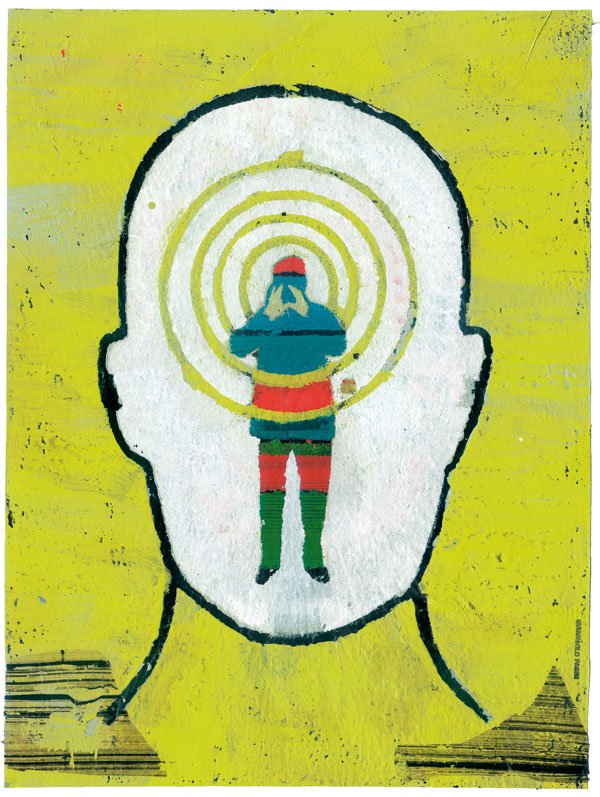
Illustration by Gianpalo Pagni.
Learning to Love Our Lobbyist Friends
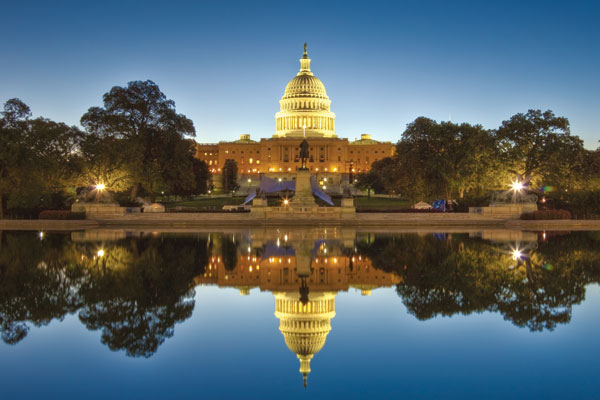
On New Year’s Day, Congress finally, at the very last moment, passed the fiscal cliff legislation that saved the economy from free fall. Everyone on every side of the negotiations made sacrifices to make it happen. Or so it seemed. But one pharmaceutical company got wording stuck in the bill that will bring it hundreds of millions of dollars over the next couple of years.
The law ensures that Amgen, the world’s largest biotechnology business, will have two years to sell its dialysis pill Sensipar without any limits on what Medicare has to pay for it, even though the fiscal cliff bill is supposed to save $4.9 billion over 10 years by reducing overpayments for dialysis drugs and treatments. Exempting Sensipar from those controls will cost Medicare as much as $500 million.
How did the company arrange such a windfall? The provision requested by Amgen was added to the final draft of the legislation by Senate staff members, according to published reports. Why? Amgen has no fewer than 74 lobbyists in Washington, including the former chiefs of staff of both Sen. Mitch McConnell, the Senate minority leader, and Sen. Max Baucus. It has contributed more than $5 million to candidates and their political action committees since 2007. Those lobbyists had repeated meetings with senators’ staffers in the fall. Critics contend that bowing to special interests is part of the reason for our current dilemma.
“Sadly, the lawmaker-lobbyist cabal has once again acted to serve their own financial interests; continuing to place patients at risk and passing the costs on to the taxpayer,” Dennis J. Cotter, a health policy researcher in metropolitan Washington, D.C., told the Post.
Amgen is a very big lobbying presence in Washington, but there’s nothing that special about it. Just about every business there is, from AAI Corporation to Zurich Financial, has its lobbyists prowling the halls of Congress, doing everything they can to serve their industries’ purposes, sometimes at the expense of the greater good. So does just about every special interest group.
Lobbying is a huge business. According to the Center for Responsive Politics, there were 12,051 registered lobbyists in Washington in 2012, and they spent a total of $2.47 billion trying to get government officials to do their bidding. The biggest spender of all? The U.S. Chamber of Commerce, which forked out almost $96 million on lobbying, followed by the National Association of Realtors, $26 million. One of the top industry sectors? Health, which spent $365 million—more than 10 times as much as organized labor.
How can so much money flowing around the nation’s capital not corrupt? It certainly does, and the revolving door between Congress and K Street, the main street of lobbying, is not just a myth. Almost two-thirds of all lobbying, in dollars spent, involves former congressional staffers. Is such a situation excusable? Should it even be legal?
Absolutely. In fact, it’s necessary. And even the founding fathers knew it. Our most revered, sacred law of all enshrines it. The First Amendment to the U.S. Constitution doesn’t just guarantee freedom of speech and religion. It says, in full,
Congress shall make no law respecting an establishment of religion, or prohibiting the free exercise thereof; or abridging the freedom of speech, or of the press; or the right of the people peaceably to assemble, and to petition the Government for a redress of grievances.
Those final words are what allows lobbying. As crucial as is our right to talk freely and worship freely, so is our right to present our concerns to Congress, and to “assemble” to do so—that is, to join forces as part of a special interest group. That’s how government works. Lobbying is as much a part of what makes representative government tick as voting or town hall meetings.

Furthermore, lobbying has evolved over time from a shady and secretive business, where outright bribes were commonplace, to a heavily regulated one, where transparency rules and where the great majority of lobbyists are open and forthright about what they do and how much they spend and why. As enormous a presence as lobbying has become in Washington (and there’s lobbying in every state capital and county and town, too), it is far more civilized and controlled and honorable today than it ever used to be. At various times, laws have been passed to make it more so, when its evils have become too undeniable.
During the very first Congress, in the 1790s, a senator wrote that a lobbyist had said “he would give [Rep. John] Vining a 1,000 Guineas for his Vote, but … he might get it for a 10th part of the Sum.” Men were already descending on Congress to try to influence votes on taxes, federal workers’ pay, veterans’ benefits, and other matters. One of the biggest earliest lobbying interests was the Bank of the United States, a quasi-government institution with enemies that included Thomas Jefferson and James Madison. Its lobbyists’ activities grew so pernicious and yet accepted that in December 1833 Sen. Daniel Webster of Massachusetts wrote to the bank’s president, “I believe my retainer has not been renewed, or refreshed, as usual. If it be wished that my relation to the bank should be continued, it may be well to send me the usual retainer.” Could Tony Soprano demand a payoff more bluntly?
That’s not all Tony Soprano could relate to. According to the late Sen. Robert C. Byrd, who made a study of lobbying in the early United States, “clubs, brothels, and ‘gambling dens’ became natural habitats of the lobbyists, since these institutions were occasionally visited by members of Congress, who, far from home, came seeking good food, drink, and agreeable company.”
By 1869 a newspaper columnist could write this lurid description: “Winding in and out through the long, devious basement passage, crawling through the corridors, trailing its slimy length from gallery to committee room, at last it lies stretched at full length on the floor of Congress—this dazzling reptile, this huge, scaly serpent of the lobby.”
What exactly was the serpent up to? America’s first big industry, the railroad, was growing fast at the time, and it begat America’s first big organized lobbying effort. Laying rails across the country involved getting major government land grants and subsidies, and railroad barons hired hundreds of lobbyists at a time. Their work included giving lawmakers passes for free train travel and even cash payouts. The early railroad lobby reached an ugly peak in the Crédit Mobilier scandal of 1872, when senators and congressmen were given free railroad stock in return for passing railroad-favorable laws.
Smash Star Anjelica Huston

When Anjelica Huston enters a room, she commands your attention just as she does on screen. She’s an imposing presence, even a little intimidating—she’s just so tall!—until she breaks into that charming, mischievous grin. It’s quickly obvious that the actress is nothing like the scheming, tough-as-nails producer, Eileen Rand, whom she plays on the NBC series, Smash.
As Huston speaks, revealing a self-deprecating sense of humor that’s thoroughly endearing, it’s hard to separate the drama in her life from the memorable characters she’s brought to life, from the mob wife in Prizzi’s Honor to Morticia in The Addams Family.
Huston was born into Hollywood royalty. Her dad was legendary director John Huston. Her mother, John’s fourth wife, was Italian ballerina, Enrica “Ricki” Soma. Houseguests ranged from Marlon Brando to John Paul Sartre and John Steinbeck. She began acting in small roles, mainly in her father’s films. Then, just as she was coming into her own, her mother was killed in a car accident. That changed the direction of her life.
She moved to New York, and as a young woman, her grace, stature, and angular good looks led her to modeling. Richard Avedon photographed her for Vogue. The big change in her life came when her father cast her in Prizzi’s Honor, a part that earned her an Oscar and made her a star. She co-starred with her longtime love Jack Nicholson. They were together for 16 years, but once she got famous there was a lot more interest in them as a couple—always talk about the ups and downs of that relationship.
Finally, they split—another big life-changer.
When she and Nicholson parted company, Hollywood watched to see if she’d ever find her Mr. Right. The answer came when she walked down the aisle with celebrated sculptor Robert Graham–known for works like the Olympic Gateway at the Los Angeles Coliseum, the Franklin Delano Roosevelt Memorial in D.C., and the Duke Ellington Monument in New York’s Central Park. The handsome artist and the beautiful actress were a standout couple in the arenas of entertainment and art.
Graham also loved to draw beautiful women and their bodies. There was one star-studded showing of his work where people teased him about nude drawings that looked an awful lot like Anjelica. She casually deflected the questions by talking about “my fantastic husband” and playing up his many other accomplishments. The two were inseparable, so his sudden death from a heart attack four years ago left her shattered. Her many friends within and without Hollywood rallied around her, but she credits Smash—her first venture into series television—with coming at a “vital time” and finally filling a void in her life.
Question: I have known you for years. I listen to the laugh in your voice and you’ve got the greatest smile. Why do they keep casting you as these stern women like Eileen in Smash?
Anjelica Huston: [Laughing] Well, Eileen does have a good sense of humor. But it’s true, they like me to be these slightly sinister characters. It’s good to play against type, I guess.

Q: And what would you say your type is?
AH: I really don’t match any stereotype. I never felt like I “fit in.” That’s probably what makes me a great observer.
Q: But doesn’t your character’s feistiness reflect you maybe just a little?
AH: I would like to be as scrappy as Eileen. I can certainly wrap my brain around her scrappiness. But sometimes I’m a wimp, and other days I think I can conquer the world. I wish I could plan it out a bit better.
Q: You get some steamy romantic scenes on the show. Do you get a kick out of that?
AH: It all depends on who with. But it certainly livens things up—particularly at my age. I remember at the very outset, two years ago, I said to the producers, ‘Please, give me a love interest.’ I think it’s important to see strong women who also have a very vulnerable side and who are allowed to have a sexy side.
Q: As the years pass, what has changed for you?
AH: The older I get, the more I look for a good time. I remember when I was in my 20s and 30s, I was always in some fight with a boyfriend or involved in some drama, something to feel bad about. I feel so the opposite of that now. I just like to have a good time, smile, and be with my friends. You know, tell a story, have a drink. I’m certainly not looking for angst.
“I Tracked the Lindbergh Kidnapper”
[Editor’s Update: March 1, 2017] 85 years ago, the Lindbergh baby was kidnapped. Here is the story of the amateur sleuth who cracked the case.
On April 2, 1932, one month after his infant son had been taken from his nursery bed, aviator Charles Lindbergh helped deliver $50,000 in ransom to a dark figure in a Manhattan cemetery. The man gave directions to where the child could be found, then stepped back into the darkness and disappeared.
Investigators had neither a suspect nor a trail to follow. The only evidence from the kidnapping were 13 ransom notes, a chisel found outside the Lindbergh home, and a homemade ladder the kidnapper had used to reach the second-story nursery window and take the infant.
Police couldn’t even obtain evidence from the recovered child because the baby was not where the kidnapper indicated. In fact, Charles Lindbergh Jr. wasn’t even alive. He’d been killed on the night of the kidnapping and found about two months later.
For the next 29 months, the police were no closer to arresting the man who had abducted the infant son of America’s favorite hero. But one man was quietly pursuing his own investigation and making steady, slow progress toward finding the kidnapper. His story, which he told in his Post article, “Who Made That Ladder?” recounted his years of effort tracking down the man who abducted Charles Lindbergh Jr.
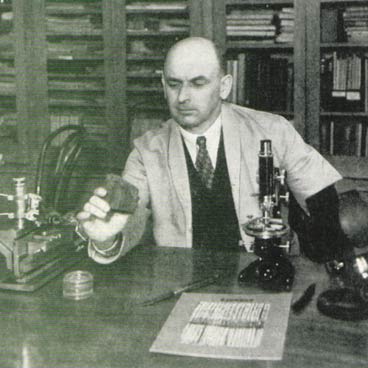
Arthur Koehler worked at the government’s Forest Products Laboratory in Wisconsin, researching new commercial uses for wood. Two months after the kidnapping, investigators from the New Jersey State Police brought him wood samples from the ladder and asked him what he could learn from them.
He quickly identified the wood as North Carolina pine. Through a microscope, he could tell the ladder had been fashioned with a plane that had a dull, chipped blade.
He noticed that the vertical rails had been previously used for something else. Holes spaced 16 inches apart showed where a square-cut nail had been driven through the board, then later pulled out.
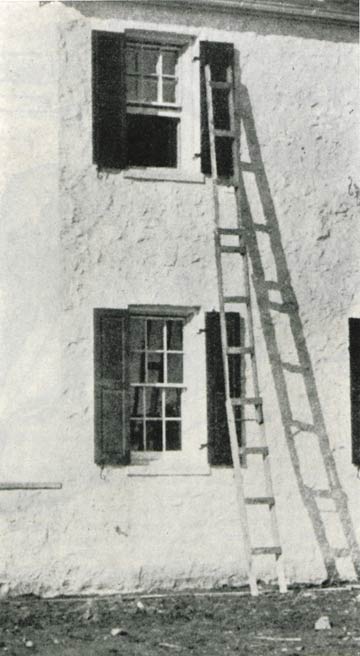
For months, Koehler studied these pieces, particularly the slight undulations in the wood produced when the board was made at the sawmill. He concluded that the board could only have been made with a certain configuration of cutting tools. So, for the next year, he visited dozens of lumber mills, looking for the one that made boards with that unique pattern.
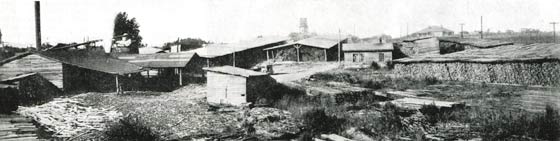
He finally found it in a small town in South Carolina. The mill owners told him they had shipped wood that matched the ladder sample to 42 lumberyards. So Koehler began a new search. All through 1933, he traveled to scores of cities, ruling out lumberyards with wood that didn’t match the ladder’s North Carolina pine.
Finally, in December 1933, he came to the National Lumber & Millwork Company in the Bronx. Yes, the yard foreman told him, they had received a shipment of pine from the South Carolina mill, but that was years ago. It had all been sold long ago.
However, the foreman recalled using some wood from that shipment to build a storage bin. He pulled off a piece of wood from the bin and handed it to Koehler, who quickly pulled out his magnifying glass. “One look was enough!” he wrote. “This made me positive the ladder rails had been a part of a small shipment of 2,263 feet of one-by-four-inch lumber to this Bronx firm.”
The next step was to find who had bought the wood. Unfortunately, all sales at the lumberyard were cash only. They had no receipts that might carry the name of the buyer.
So this was it, Koehler assumed. This was as far as he could go. He could trace the ladder’s wood to a lumberyard but no farther.
While Koehler was learning this from the foreman, two men walked up to the lumberyard’s sales counter. One held out a $10 bill to pay for a 40-cent piece of plywood. But when he saw Koehler, he suddenly changed his mind and left, leaving the wood behind. Thinking the men were acting suspiciously, the foreman went out into the street to get the license number of the car as the men drove away. He had recognized one of the two men, he told Koehler. It was a former employee of the lumberyard, Bruno Richard Hauptmann.
Nine months later, the FBI arrested Hauptmann after he passed some of the ransom money at a gas station. Investigators immediately searched his property and found a box of the ransom money in Hauptmann’s garage.
When Koehler was called to the house, he found a wood plane that made the planing marks on the ladder. More important, he discovered that some flooring boards had been pulled from the joists in the attic. These boards had the same grain pattern and age as the ladder’s wood. He then placed a section of the ladder over the nail holes in the joists: they matched perfectly.
Koehler’s testimony proved invaluable the next year when Hauptmann was tried and convicted.
Reading through his testimony, we found an interesting point that Koehler didn’t make in his article; he conducted his investigation—two years of inquiries, testing, and travel—using only his own time and money.
Oscar Winners Inspired by the Post
Ardent readers might know that the Post has a long-standing tradition of publishing noteworthy fiction, but you might be surprised to hear that many of Tinsel Town’s Oscar-winning films originated as fiction in the pages of The Saturday Evening Post. Check out our list of nine Post-inspired award winners — and two films that, while popular, failed to claim a statue.
Award Winners
You’ll be surprised at which cast member earned the biggest bucks on this set.
Read more >>
Two of this film’s principal stars almost weren’t cast due to fears they wouldn’t get along—which turned out to be true!
Read more >>
One of the most popular Westerns ever made—and it could have happened without John Wayne!
Read more >>
A famous actress broke her hand while slapping away her co-star’s advances during the production of this film.
Read more >>
Though it predates the age of email, this movie is credited with the first use of a popular emoticon.
Read more >>
You’ll never guess what famous movie this director was working on at the same time he made Sand Pebbles.
Read more >>
Sometimes filming on location is a treat … and sometimes, it’s a cramped, sweltering ordeal.
Read more >>
This movie might have been more successful if it hadn’t been for a poorly timed satire with a strikingly similar plot.
Read more >>
Two famous actresses turned down the role of Mattie Ross in the 1969 adaptation.
Read more >>
Popular Films
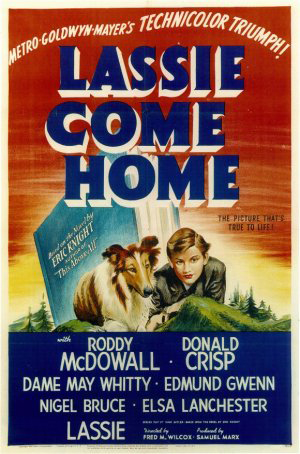
You’d never know this story was supposed to be about the dog, thanks to this wildly popular debonair male lead.
Read more >>
Perhaps one of the most copied plot lines of all time, you’d be surprised at which popular TV shows have retold the tale.
Read more >>
She Wore a Yellow Ribbon (1949)
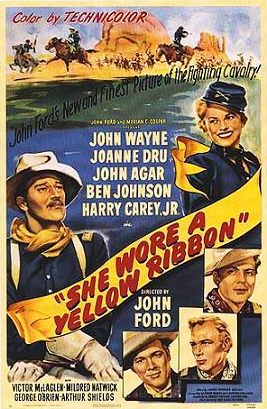
“Command” by James Warner Bellah was fist published by the Post in June of 1948 and tells the story of Capt. Nathan Brittles, who is forced to evacuate the commanding officer’s wife and their niece, Olivia Dandridge, from the fort after the fall of Custer and the 7th Cavalry. Olivia catches the eyes of two young officers, and when she starts to wear a yellow ribbon in her hair—a sign that she has a beau in the Cavalry—but refuses to reveal who she’s wearing it for, trouble ensues.
The story was adapted for the big screen in 1949 under the name She Wore a Yellow Ribbon. Directed by John Ford, the film starred Joanne Dru, John Agar, Harry Carey Jr., and John Wayne as Captain Nathan Brittles. It has become one of the most popular westerns ever made, and on a $1.6 million budget, one of the most expensive. TCM’s Leonard Maltin rated it 3 and a half out of four stars.
It’s also one of Wayne’s most popular westerns, although ironically, Ford only cast John Wayne in the lead after seeing his performance in another western—and another Post original—1948’s Red River. Ribbon won an Academy Award for Best Cinematography in 1950.
True Grit (1969, 2010)
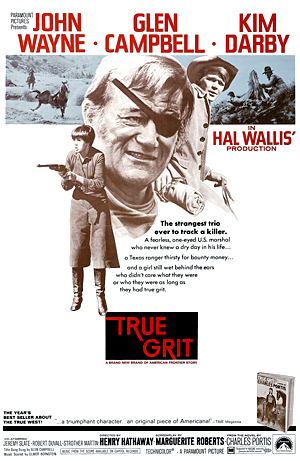
Written by author Charles Portis, “True Grit” appeared in The Saturday Evening Post in 1968 as a three-part serial, was published as a novel in 1969, and then adapted to film in the same year. Starring John Wayne as Rooster Cogburn, Robert Duvall as “Lucky” Ned Pepper, Glen Campbell as La Boeuf, and Kim Darby as heroine Mattie Ross, the film garnered a Golden Globe win for Best Motion Picture, two Oscar noms, and one Best Actor win for John Wayne—his only Academy Award.
Sallie Field and Mia Farrow were both considered for the role of Mattie Ross but turned it down, a decision Farrow later called the worst mistake she ever made.
In 2010, the Cohen brothers’ remake, starring Jeff Bridges, Josh Brolin, Matt Damon, and newcomer Hailee Steinfeld, grossed more than $100 million and earned ten Academy Award nominations, but failed to take home an Oscar.
And Then There Were None (1945)
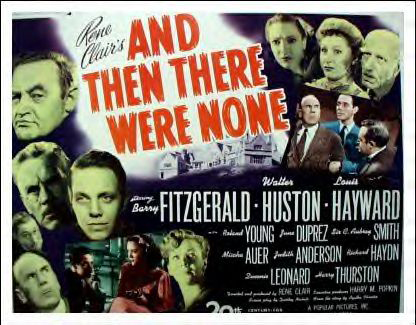
Widely considered one of Agatha Christie’s best who-dunnits, “The Ten Little Indians” first appeared in the Post on May 20, 1939, and ran as a six-part serial before it was published in book form in 1940.
The murder-mystery tale featuring ten strangers who are slowly picked off, one by one, by a mysterious killer made a gripping story for the big screen. Starring Barry Fitzgerald, Walter Huston, and Louis Hayward, the film adheres to the ending of the Ten Little Indians play rather than the novel, which had a considerably darker ending that audiences disliked, and which Christie re-wrote herself to include a romance and a happier resolution. In fact, only the 1987 Soviet film version kept the novel’s original ending.
The 1945 incarnation is the most true to the book, however, and is typically the most popular film adaptation, earning a four-star rating from Leonard Maltin and Turner Classic Movies.
While none of the seven film versions has ever attracted Academy attention, the story’s plotline has been referenced more than fifteen times in popular media, including episodes of Gilligan’s Island, Golden Girls, Supernatural, and in horror flick Friday the 13th.
Death on the Nile (1978)
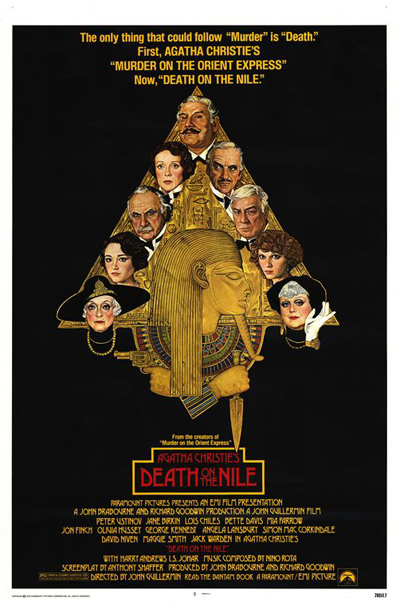
The Post first ran Agatha Christie’s “Death on the Nile” on May 13, 1937, and completed the series in eight parts. In 1978, John Guillermin directed the highly successful film adaptation starring Mia Farrow, Lois Chiles, Bette Davis, Angela Lansbury, Maggie Smith, and Peter Ustinov in the first of his six appearances as the deductive hero, Hercule Poirot. Cybill Shepherd was originally offered the role of the ill-fated Linnet Ridgeway but she turned it down.
To ensue the film’s authenticity and adherence to Christie’s storyline, it was shot on location in Egypt for seven weeks, four weeks entirely on a riverboat steamer. The mid-day heat often rose to more than 130 degrees, halting production until temperatures cooled off. Due to the size of the boat, no one was allowed to have their own dressing room, so all five leading actresses had to share a single room (how that went over, one can only speculate.)
The film was nominated for several awards, including a Golden Globe for Best Foreign Film (England), one BAFTA for Best Actor (Ustinov) and two for Best Supporting Actress (Lansbury and Smith), and it won an Oscar and a BAFTA for Best Costume Design.
The Sand Pebbles (1966)
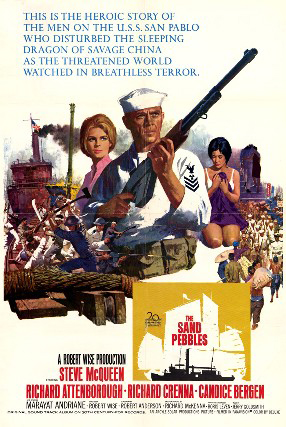
Drawing on his own experience aboard a Yangtze gunboat in the 1960s, author Richard McKenna set the time of his oriental tale a decade earlier, during the Northern Expedition in China. The three-part story first appeared in the Post in November 1962 and made its film debut in 1966.
Pat Boone had campaigned hard for the role of protagonist Jake Holman, but director Robert Wise’s first choice was Paul Newman. In the end, the role went to Steve McQueen.
Initially slotted for nine weeks of filming, the production took seven months to complete thanks to a series of unfortunate delays, including a capsized camera boat which ruined the soundboard, monsoons in Taipei, an abscessed molar that caused McQueen to fall ill, and rumored “hostage taking” of several cast member passports by the Chinese government until additional taxes were paid from filming. At the studio’s insistence, Wise reluctantly occupied the downtime with a “fill in” project he had originally rejected for being “too saccharine”—1965’s The Sound of Music.
For its troubles, Sand Pebbles was nominated for eight Golden Globes, including a win for Richard Attenborough for Best Supporting Actor, and eight Oscar nods, including Best Supporting Actor, Best Picture, and Best Actor—the only Academy Award nomination of Steve McQueen’s career. Wise was said to be so proud of the film that he held annual parties with surviving cast members to commemorate its completion.
Fail Safe (1964, 2000)
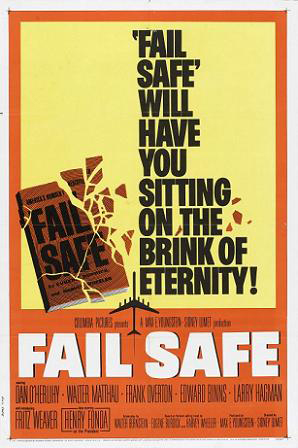
The first film adaptation of Eugene Burdick and Harvey Wheeler’s “Fail-Safe,” which was serialized in the Post in October 1962, was released in 1964 and starred Walter Matthau, Frits Weaver, and Henry Fonda as the American president. While it failed to gain much critical acclaim, the 2000 made-for-TV remake lured several award nominations, including a Golden Globe for Best Mini-Series or Motion Picture Made for TV, three Emmy nods, and two Emmy wins.
Set during the Cold War, the remake stared Walter Cronkite, Noah Wyle, Brian Dennehy, George Clooney, and Richard Dreyfuss as the president scrambling to avert World War III when the United States accidentally drops a nuclear bomb on Moscow. Filmed in black and white, the mini series was actually broadcast live to television audiences, a feat since the set took up two sound stages on the Warner Brothers lot. Harvey Keitel was often running between the two stages just to make his cue.
Despite its positive critical reception, the mini series didn’t do so well with audiences, who had seen Columbia Pictures’ Cold War satire, Dr. Strangelove, earlier the same year. With its strikingly similar plot, audiences assumed Fail Safe was equally ridiculous and stayed away.