The 6 Best Bike Paths in America
A patchwork of diverse landscape and microclimates, America abounds with breathtaking bike routes for riders of all ages and abilities. But spectacular scenery is often just one facet of the multisensory experience. We’ve done the legwork and found six picture-perfect peddling paths that also yield the bonus of unique terrain, local culture, and history.
Mountain Trail
Hiawatha Trail, Mullen, Idaho: This 15-mile, all-downhill route spans the Idaho-Montana state line, routing riders through ten tunnels and seven high-country trestle crossings, offering views of plunging waterfalls and the craggy Bitterroot Mountains.
Coastal Trail
Tony Knowles Coastal Trail, Anchorage, Alaska: Eleven paved miles of riding from downtown Anchorage to glacial parklands offer breathtaking views of arctic tundra, Cook Inlet’s salt marshes, moose, bald eagles, beluga whales, and sweeping vistas of North America’s highest peak, Denali.
—John Muir
River Trail
C&O Canal Trail, Cumberland, Maryland: The 184.5-mile dirt-forest road, spanning western Maryland to Georgetown, includes 11 aqueduct crossovers, 74 lift-locks, the 3,118-foot Paw-Paw tunnel, the Potomac River flanked by dense woodlands, and historic towns, including Harpers Ferry. Lodge at cyclist-friendly B&Bs along the route.
City-to-City Trail
American River Bike Trail, Sacramento-Folsom, California: A 32-mile paved path takes you from Sacramento’s Discovery Park to Folsom Lake past the American River, through riparian woodlands, over scenic overpasses, and across the Guy West Bridge (a small-replica Golden Gate Bridge), with a chance to view local wildlife, like quail, coyotes, and river otters.
Tropical Trail
Shark Valley Trail, Miami, Florida: On this 15-mile paved loop through the Florida Everglades, there are gators, gators everywhere! You’ll also find great blue and tricolored herons, turtles, fish, and millipedes, all inhabiting freshwater swamps, sawgrass marshes, mangrove forests, and gumbo-limbo trees.
Historic Trail
Underground Railroad Bicycle Route, Mobile, Alabama, to Owen Sound, Ontario: A diverse array of topographies and milieus along both bucolic bike lanes and urban tracks await you one this 2,006.5-mile trail that offers many access points. Stop in at historic monuments, markers, safe houses, and significant homes, including Cincinnati’s Harriet Beecher Stowe House.
This article appears in the March/April 2018 issue of The Saturday Evening Post. Subscribe to the magazine for more art, inspiring stories, fiction, humor, and features from our archives.
The Long Slog Toward Fair Housing
Fifty years ago today, the Fair Housing Act — a long-filibustered civil rights bill — was swiftly signed into law following some historic events that framed racial integration as urgent and necessary. These were the publication of the Kerner Report, the findings of the Johnson-appointed National Advisory Commission on Civil Disorders, that cautioned, “Our nation is moving toward two societies, one black, one white — separate and unequal,” and the even more recent assassination of Martin Luther King, Jr.
Less than four years before the landmark legislation, California had voted to nullify its own Rumford Fair Housing Act with Proposition 14, a ballot proposition that guaranteed property rights over civil rights in the California Constitution. Stewart Alsop wrote of Proposition 14 in this magazine shortly before it passed, saying, “It would place the whole subject of fair housing forever out of bounds for the state legislature.” Proposition 14 faced opposition from “Labor, the churches, farsighted Republican businessmen, the Hollywood community, and the whole Democratic leadership,” but, as Alsop noted, the campaign against Prop 14 had everyone on their side but the voters. The proposition passed with over 65 percent of the vote, only to be struck down by the California Supreme Court in 1966.
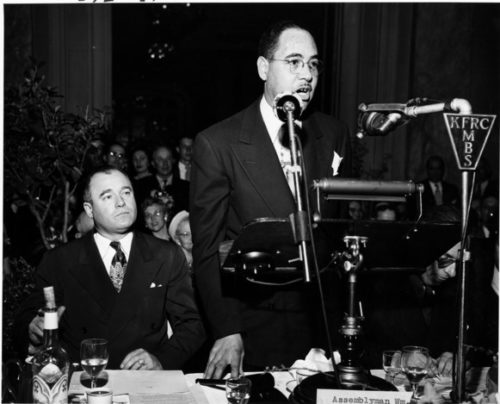
The Rumford Fair Housing Bill was written by William Byron Rumford, the first African-American to hold state public office in Northern California. Rumford had led the passage of the Fair Employment Practices Act of 1959, and, as chairman of the Public Health Committee, he spearheaded regulation of air pollution and DDT. His fair housing bill was predicated, as Alsop put it in 1964, “on the thesis that a Negro’s money is as good as a white’s in buying real estate.” The bill was unpopular for white homeowners and real estate brokers for “pocketbook issues,” and California Governor Pat Brown even remarked, “the guy who votes for the Proposition as a pocketbook issue may vote for Johnson to salve his conscience.”
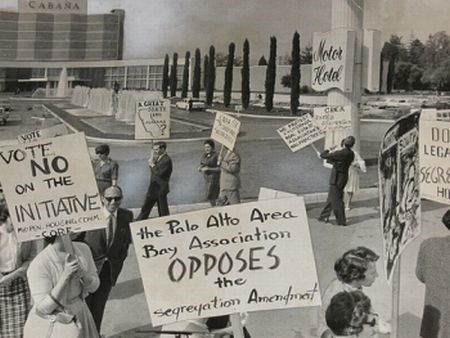
For Alsop, however, the fair housing issue was national in scope: “Either the Negro will be admitted to full citizenship, with the right to buy whatever he has the money to pay for, or there is much worse trouble to come.” Sure enough, the year after Prop 14 passed, the Watts riots in Los Angeles brought urgent attention to the racially sequestered neighborhoods of the city.
President Johnson’s Fair Housing Act prohibited the “refusal to sell or rent a dwelling to any person because of race, color, disability, religion, sex, familial status, or national origin” at the individual level, but modern critics claim that, after 50 years, it has done far too little to “affirmatively” promote integration, as promised. In The New York Times, Walter Mondale, a co-author of the ’68 Fair Housing Act, decried the Ben Carson-led Department of Housing and Urban Development’s decision to delay the Obama-era initiative that required communities to analyze and fix racial segregation or face funding consequences. Mondale holds that the Fair Housing Act ought to (finally) make good on its intentions of widespread change: “The law was informed by the history of segregation, in which individual discrimination was a manifestation of a wider societal rift.”
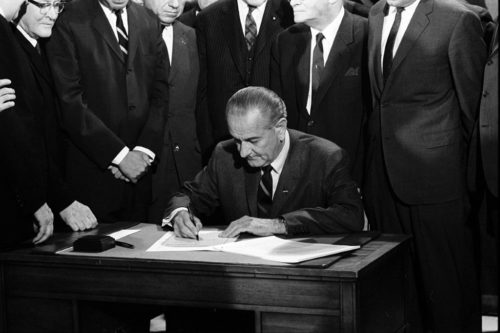
Despite continuing residential segregation that expresses itself in educational disparities, a life expectancy gap, and income inequality, the 50th anniversary of the landmark civil rights bill can serve as a reminder that integration policy, however incremental, is far from impossible.

Cover Collection: Handsome Horses
Our sister publication, The Country Gentleman, has featured dozens of elegant equines. If you’re a horse person, these covers are for you.


F.T. Johnson
April 8, 1916
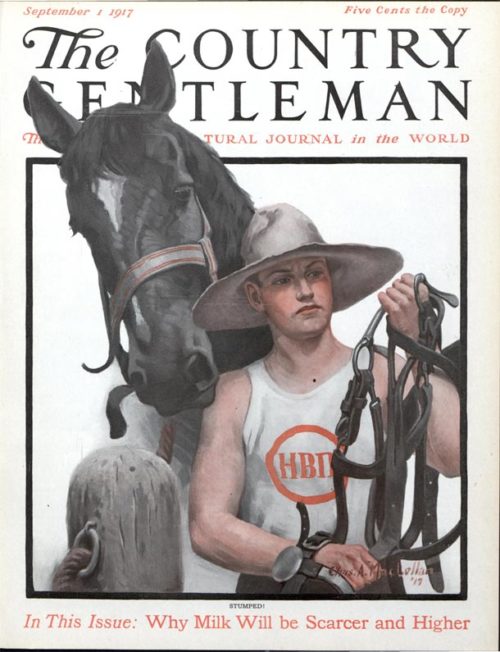
Charles A. MacLellan
September 1, 1917
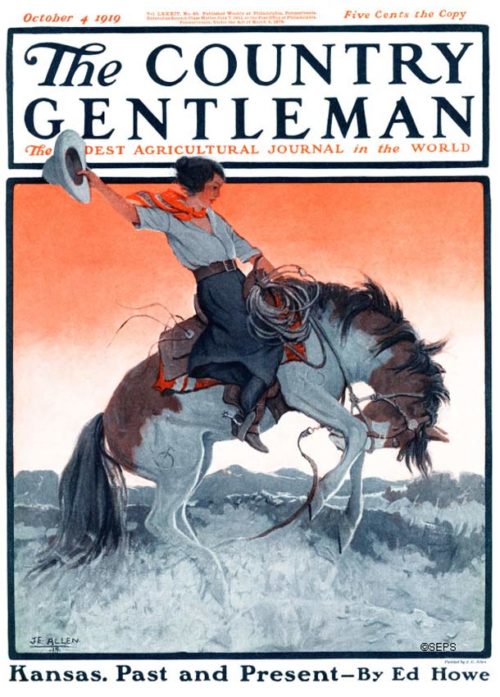
J.C. Allen
October 4, 1919

Harvey Dunn
June 17, 1922
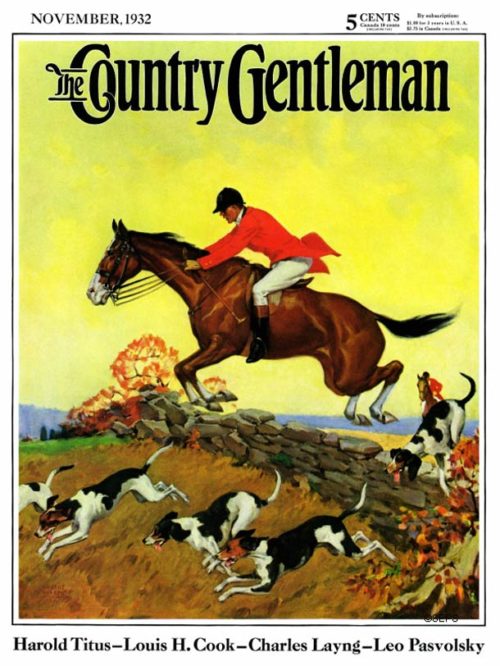
Robert Keareote
November 1, 1932

Paul Bransom
May 1, 1940
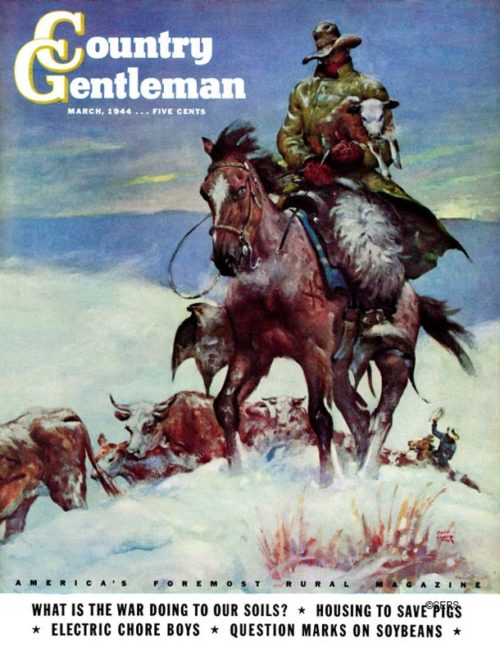
Matt Clark
March 1, 1944
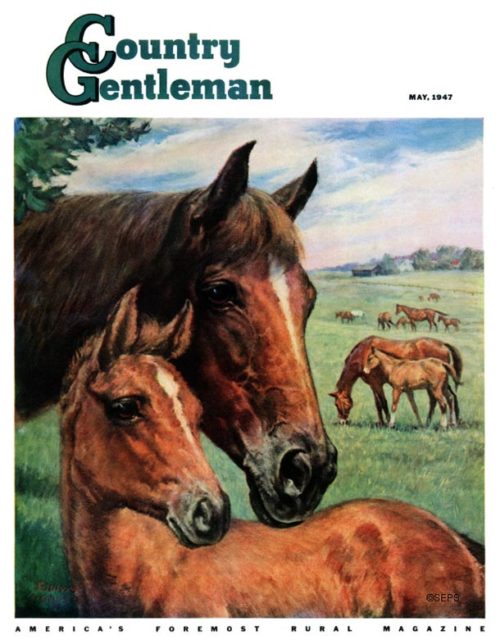
Francis Chase
May 1947
North Country Girl: Chapter 47 — “I Would Like to Purchase One Gun”
For more about Gay Haubner’s life in the North Country, read the other chapters in her serialized memoir.
I moved to Chicago and into what I foolishly thought would be a soft, cushy life, an escape from serving cheeseburgers on paper plates, fretting about money, and living in run-down, under-heated student apartments. I imagined my days would be nothing but reading novels, my head resting on the warm chest of my handsome, wealthy lover, James, while he studied the stock reports. Our glittery, glamorous nights we would spend in Faces, the proto-Studio 54 of Chicago, or in the elegant backgammon club hidden away in the stately Ambassador West Hotel.
What I got was a job as a coat check girl and a half-crazed James watching the value of his stock portfolio circle the drain. I was sorry to see the money go too, and I cared about James, but his black Heathcliffian moods terrified me; he seemed to want to smash things or kill someone.
I love roller coasters, but the one my life with James had turned into was all in the dark: I couldn’t see when the thrilling ascents or stomach-dropping lows were coming. I couldn’t even tell if the ride was over and I needed get off. After only a few months of living with James, was it time to go?
Just when I had mentally packed my suitcases, there outside my coat check jail was James with a wolfish grin and glittering eyes and announcing “I’m hungry. Let’s go eat.” His stocks had rallied, and James was clawing his way back up to his rightful place in the universe.
The market and James’ mood continued to improve. Now he had to cope with his firm belief that only schmucks, putzes, and losers spent the winter in Chicago. Every night at the disco or backgammon club, another of James’s acquaintances came over to say goodbye, off to Miami, Montego Bay, Scottsdale. My backgammon partner held my hands in her bejeweled ones, gave me two quick air kisses, wished me luck, and took herself off to her winter home in Palm Beach.
Despite his reduced fortune, there was no way James was going to be seen in Chicago after January 1. He would rather have hidden in an underground bunker for three months. He had lost a lot of money, but his unsinkable belief in himself made even the slightest gain in his portfolio proof that he was a winner, a winner who was getting the hell out of Chicago.

We were going back to Mexico. But we were not going back to the expensive, gorgeous condo on the beach; James prided himself on being an old Acapulco hand.
“We’ll get a great deal on a place that hasn’t already been rented for the season. I know how to bargain them down.” And to save money on airplane tickets and jeep rental, James and I would drive the Cadillac from Chicago to Acapulco.
I decided not to cash out quite yet. I’d roll the dice with James once more. I happily quit my coat check job and packed up my bikinis and disco clothes in my pink Samsonite. James locked up the apartment, got the El Dorado out of the garage, and we drove off to Mexico.
The James I had moved in with five months ago always had a thick roll of hundred dollar bills on him. I don’t think I had ever heard him say the word bargain. This new cost-conscious James was going to take getting used to.
On the first day of driving, as the sun was setting over Missouri, I pointed out neon “Vacancy” signs. “We don’t need to spend money on a motel. I’m wide awake,” he assured me. We drove through the night, as we had the day, with James chain smoking and declaring that he wasn’t tired or hungry. As always, eating was something to put off as long as possible.
Despite the lack of regular meals and nights spent slumped in the bucket seat that was not quite comfortable enough for sleeping, I felt a glow of happiness growing with each mile that sped under the white walled tires. I was having another adventure, my own version of the movie where the dark and dangerous guy and his blonde girl are on the lam, the two of them against the world.
James was locked behind the leather-covered steering wheel: he couldn’t read catastrophic stock market reports, phone death threats to his broker, or have to face an unlucky run of the dice. The romance of the road relaxed him, too. He was looking forward to cheap and legal Quaaludes, deepening his tan under the Mexican sun, and fleecing suckers at backgammon. Cradled in the cocoon of the Caddy, we sped through the Midwest, chasing AM radio stations that weren’t country or church or squabbling about which of the six cassettes we should play for the hundredth time.
James drove and drove and drove. He was unsure about my driving — almost as unsure as I was. He could pack in a lot of hours behind the wheel, amped on nicotine and his own jumpy energy and his relief over ditching wintery Chicago. I was not eager to switch seats; I had never driven the Cadillac and only held a driver’s license by purest luck: I passed the road test in Colorado Springs by successfully making three right turns.
Finally, even James had to admit that he was human and pulled off the highway, red-eyed and jittery with lack of sleep. It was my turn to drive. I waited until the closest oncoming car was a mile away before pulling out on the Interstate. I glanced over at James, who was already out cold. Had he been awake, it would have been impossible for him not to take over as my driving instructor; James was as proud of his expertise in cars and driving as he was of everything he did. He could have found a lot to criticize in my overly cautious style of driving. But James was sawing logs, oblivious to my re-setting the cruise control to five miles under the speed limit.

As the day slipped by on the unvarying highway, a thin black strip across the brown and dreary plains, I began to feel more confident, since all I had to do was hold on to the wheel and point the car south. I steered that big wide boat of a car down that never-ending blacktop into Texas, feeling as safe as if I were inside an Abrams tank. But I did not have James’s stamina; after a few hours, I pulled into a motel parking lot and woke him up. I was almost in tears; I needed to sleep in a bed and use a bathroom that wasn’t in the back of a gas station.

Texas went on forever, as if it were its own country. We would wake, drive, and sleep, wake, eat a plate of eggs, drive, and sleep, and we’d still be in Texas.
We made one unexpected (by me) pit stop in Dallas. We cruised off the interstate and into a weirdly vacant downtown. I started pointing out hotel signs, thinking: a hot shower! A room service club sandwich eaten in bed in front of a TV! A toilet with that reassuring sanitary strip!
“We’re not staying here,” James side-eyed me. “I just have to pick something up.” What that something was became evident when we pulled up in front of a single story brick and glass store, bordered by alleys on both sides. Above the door was a single word: GUNS. The streaky windows had peeling paper signs announcing: “We buy used guns!” “Ask us about ammo!” and other disheartening phrases. Behind the windows, dusty headless mannequins in camo clothing held rifles in their chipped hands.

I was trying to figure out why all the blood was rushing down from my face and my stomach was clenching, and then my memory flashed on the pair of guns that had robbed and beaten my ex-boyfriend Steve and sent me plummeting naked off a second floor balcony.
James said, “Why do you look like that? It’s not for me. It’s for my doctor, the one who writes me prescriptions for Quaaludes. He said if I brought him a handgun, he’d give me all my scripts for free.” Apparently in Mexico, a much more sensible country, it was easier to buy drugs than guns.
I was spooked enough — unblinking, unthinking — to follow James into the gun shop. A bell rang as we pushed open the door, but I do not think any angels got their wings. The shop, like the street, was deserted. James and I wound our way through the racks and racks of big guns to the back, where a fat, slowly masticating man stood behind a glass display of smaller guns, hand-sized I guess.
Fat Texan took a good long look at the two of us, spit something into a cup, and said “Help ya?”
“Yes sir,” said James, “I would like to purchase a hand gun.” I wandered off to the front of the store, where there was a display of those camo hunting clothes and tried to find something in a size 5. I took one glance back to see James sighting down the barrel of what looked like a prop from Bonanza, my grandma Marie’s favorite TV show. He swung the gun around; the fat Texan had vanished.
I clinked the clothes hangers about and tried to articulate to myself first, so I could then convince James, why this was a Very Bad Idea. I looked out of the smudgy window and watched a black and white police car pull up behind the Cadillac. I didn’t know that I could feel any sicker. I tried to make myself very small and hid behind a rack of XXL neon orange vests.
The doorbell dinged again, the two cops entered the store and made a beeline for James, and I, a child of the sixties, cheesed it, the tinkling of the bell as I threw open the door announcing my getaway.
This is when I learned that it is always a bad idea to run from the police.
I ran without looking across the thankfully carless street, to an abandoned, unfinished office tower. It was fronted with thick cement columns; I ducked behind one that gave me a perfect sightline to the Cadillac, cop car, and gun store. What seemed like an hour passed. Then the cops came out, with James in the middle, thankfully not handcuffed. If they took James to jail and impounded the car, what was I going to do? Could it be illegal to buy a gun, I wondered?
Not in Texas. But transporting a minor across state lines for immoral purposes was. The fat gun store owner had called the cops. He had taken one look at James’s swarthy Greek complexion and realized here was a nefarious foreigner bent on despoiling a flower of American girlhood. James carried an outlaw air, and the two-decade difference in our ages made me look younger than 21. Fat Texan told the cops that I had escaped the evil grasp of my white slaver, who was buying a gun to control me.
I watched from my hiding spot. James lit a cigarette and handed over the car keys to the cops as nonchalantly as if he were handing them to a valet. He leaned against the Caddy and a cop popped the trunk, took out my pink Samsonite, rummaged through it, and held up a pair of white lace panties, evidence that there had been an innocent young girl in the car.
The cops searched James’ luggage and then the rest of the car. “I wasn’t worried,” James told me later. “I knew there was nothing in the car. The problem was you.”
It seemed another hour went by, or at least five or six cigarettes worth of time. Somehow James knew that I had not kept running out to the highway to hitch a ride back north. He threw a cigarette butt down, stomped heavily on it, and hollered, “Gay! Gay! Get yer ass over here!” almost to the admiration of the two cops. He repeated it a couple of times before I was convinced that I had no alternative but to come out.
“Ma’am,” said one of the cops, and I turned around thinking he was talking to someone who had suddenly appeared behind me. “Ma’am! Yes you. Are you okay, ma’am?” I nodded, unable to separate my tongue from the roof of my mouth. “And this is you, right?” He held my driver’s license in one hand, my purse in his other. Again I nodded.
“See sir, she’s free, white, and twenty-one, sir!” cackled James and put his arm around me. I managed to find a weak smile for the two cops, who were obviously disappointed. James shook their hands and apologized for wasting their time. We waited outside the car till they drove away, and then I flopped into the bucket seat, leaving sweat marks on the white leather. James lit another cigarette, started the engine and we pulled gunless out of Big D and headed back south.
“High Life” by Harrison Rhodes
Harrison Rhodes was a novelist, travel book author, and noted playwright from Cleveland. His story “High Life” follows a European king caught up in a love square attempting to balance romance and diplomacy. When he declares his desire to marry an American, chaos erupts within the counsel. Writing of the story in his autobiography, Rhodes offered, “I ought to confess frankly at the very outset that I have lived astonishingly little in the society of royalty, in fact, not at all. I was, like the heroine of that story, born in Ohio, but that fact does not seem to have brought me the social advantages it procured her.”
The train from Geneva, due at Delices-les-Bains at two-thirty, arrived that day only three hours late. This was phenomenal; it was a good omen; it seemed to indicate an approaching return to antebellum conditions, when once or twice a year the train used to come in actually on time. Among the last to descend from a crowded compartment were the ancient Churak and the well-groomed ex-Majesty of Constantia-Felix.
“I hope,” said Georges, “that in time you can accommodate yourself to my democratic habits, Churak. If we had paid for the whole compartment as usual I should have missed the acquaintance of the two gentlemen from St. Gall who travel in underwear and lace goods. You shudder, Churak; so do I. But this is the new world.”
“I am going up to the Hotel de Russie while you get us rooms at the Beaurivage — or somewhere else. Let us not do things by halves. Why not go to some unspeakably cheap and filthy lodging? Our Majesty will dispense with a salon. Why indeed should I have even a bed? If we can only save money enough I intend to have a bottle of champagne for dinner at the Casino tonight. No, you think we oughtn’t to be so extravagant as to dine there? Well then, you at least shan’t. Churak, you’ve been talking economy and price of beefsteak so much lately that I’m determined to save. I think perhaps you had better have no dinner at all. Indeed, as the weather’s good, why shouldn’t you sleep on a bench in the park?”
Such speeches might be taken to indicate a fair degree of high spirits, even in a creature like Georges, who was very subject to cheerfulness. But after he had dismissed the unhappy and rebellious old count and was himself walking slowly up the Allee de Savoie he seemed invaded by some of the evening’s melancholy. He sat down once on a stone bench, took a telegram out of his pocket and read it, and after slowly putting it back traced with his cane a few aimless designs in the gravel of the path before he started on.
The telegram was from Miss Lydia Smith. It said, “Please come and take me home. I’m so unhappy.”
“Poor little Lydia!” he murmured, and yet he smiled, too, as if nothing could be wrong that a wise father could not set right with a word. And yet Georges was neither a fool nor fatuous, as men go.
At the hotel he discovered that Mrs. Hastings had gone out, but that Miss Lydia Smith was at home and would receive her father, Mr. Georges Smith, as he suddenly realized that he now must be. She stood tremulously expectant in the little drawing-room as he was ushered in. He paused a moment; it was in genuine admiration.
“How pretty you look, my dear!” he exclaimed. “And the waist! You couldn’t reasonably wish it to be any smaller. Come now, could you?”
This struck, one would have said, just the right note. Yet all the answer that the little Princess Lydia made was to run across the room and into her father’s arms, where, poor child, she had so rarely been. She took at its full value the promise he had made her only a little while ago, that his waistcoat would be the place where she could always lay that yellow head of hers and cry. The yellow head was more prettily coifed than ever before. And yet tears are always salt and bitter, even from the loveliest blue eyes.
“There, there, my dear!” he murmured, patting her a little awkwardly, just as any unroyal father might have done.
“I’m so glad you’re here, papa. The world isn’t as nice as I thought it was going to be.”
“Poor little modern girl!” he said with affectionate sarcasm. “Poor Miss Smith!”
“Don’t make fun of me, papa. I’m very unhappy.”
“Yes, I know,” he answered soothingly.
“You know? “She seemed a little surprised as she looked up at him through her tears.
“I am, my dear, a very wise fellow; so I know. Shall I tell you the story?”
She disengaged herself and dabbed at her eyes with a handkerchief which — even in this emotional moment — was prettier than any she had ever had before.
“A certain small princess met a young man she liked.”
“How did you guess that, papa?”
“Just my wisdom, dear. And so the little princess let herself drift away with the tide, and the tide was setting toward the islands of romance.”
“Yes, papa.” She wiped away a tear.
“Of course,” Georges continued, “the girl couldn’t altogether forget that she was a princess in disguise and was away from her father’s court in a miserable furnished villa, in a way upon her parole of honor. She knew that the young man was only a bourgeois merchant’s son and that a marriage with him was out of the question, since it would displease the girl’s wonderful father, to whom she really wished to give all the obedience consistent with being quite modern and independent. So when she found the current setting toward those islands was too strong for her she grew frightened. She was still in love with the young man and he with her. But she was afraid of her father. Now suppose that her father can make it all right?”
“But you can’t, papa. You don’t understand at all. The story doesn’t go the way you’ve told it.”
“But aren’t you in love with the young man?”
“No, certainly not!” And she began afresh to cry.
“Isn’t he in love with you?”
“No,” Miss Smith managed to say. “Not a bit.”
“But he must be in love with somebody,” ejaculated Georges impatiently, “at his age.”
“He is,” agreed Miss Smith, and she flung herself down on the sofa and for an instant buried her face in its cushions.
Georges looked at first puzzled, then apprehensive, then frankly perturbed. Against a pale lemon-yellow twilight sky there came slowly up the little path to the pink terrace two figures, a young man and a lovely lady. The Majesty of Constantia Felix stepped to the door.
“Oh, sire,” cried Mrs. Hastings, very prettily sinking in a curtsy, “you surprise and honor us.”
And then: “May I be permitted to present — “
“I already have the honor,” said the king with cold formality.
Young Mr. Morpurgo was blushing heavily. But he pulled himself into some kind of a salute.
“I came, Your Majesty, you see,” he stammered.
“Yes,” replied Georges IV, still glacial, “you seem to have come pretty far, Prince Otto.”
“Prince Otto!” screamed both ladies.
“Of Hellenos?” added Mrs. Hastings.
The creature nodded his head in shame. The dragon took both men in with a glance of scorn.
“Oh, you — you two devils!” she half gasped. “Though that’s not half enough to call you. Oh, Lydia! Lydia!” she cried, turning to the girl. “My poor, deceived, tricked child! I can’t think whether they’ve treated me worse than you or you worse than me.”
“I can’t see,” said Lydia with some acerbity and a good deal of good sense, “that they have done you any harm.”
“Not done me harm?” exclaimed the lady in question. “They’ve played with me, made a fool of me. I shall cable to Washington — to the President. No, I won’t. I’ll make the American eagle scream all by myself far better than he could. You’d better go, Lydia dear. This will soon be no place for you. But remember that I love you, Lydia Smith, and everything’s a mistake. Men especially are a mistake. Royalties above all! You shall come to New York and marry a nice broker. Go, my dear,” she rattled on as she almost pushed Miss Smith out of the door, “and even if you hear them scream don’t come to their rescue. Oh!” she concluded, as alone now she turned with heightened color and snapping eyes to their royal highnesses.
They looked rather sheepishly at each other.
“Fire away!” at last said Georges IV.
“Call us whatever you like,” pleaded the late Mr. Morpurgo.
For just a quarter of an instant she still stood angrily. And then slowly seating herself, she merely smiled at them and shook her head commiseratingly. With an air of infinite leisure and detachment she adjusted the chiffon flounces of her skirt.
“You foolish creatures!” she murmured. And she lit a cigarette, while they watched her as fascinated and doomed white rabbits might a lovely serpent.
Georges IV was the first to pull himself into some semblance of royal dignity. “May I ask —” he began.
“I was told to save your daughter from undesirable young men. I did. But” — and she turned a radiant smile upon Prince Otto — “there was no one to save me from Mr. Morpurgo.”
“I am a fool,” remarked Georges almost bitterly. “Still let us get things clear.”
“By all means, Your Royal Highness. This other highness thinks he’s in love with me.”
“It’s intolerable!” began Constantia-Felix.
“He doesn’t find it so,” said the lady.
“I’ve asked her to be my wife,” said the young Prince Otto, standing very stiff.
“And of course now she refuses and the episode’s over, and better over.”
“I stand quite ready to refuse you, Otto, if I have your permission to do so. You’ve turned out to be the heir to the throne of Hellenos, if there is one. But you must believe me that I thought you were just Morpurgo. This is no trap laid to catch a prince.”
The boy strode across to the window and stood a moment with his back to them. Then he turned and broke out violently to the king.
“There is a trap laid for me, however, and by you, sir! You’re trying to turn me against her just because she did what was decent, brave and sporting. She was guardian of a princess and she guarded.”
“Ah, but this is nice of you, mon prince!” murmured the lady softly.
“What difference does it make to me how I met her, or why she made me fall in love with her? I have met her, I have fallen in love with her. Mrs. Hastings, I repeat my offer. Will you take me?”
“She’s far too intelligent a woman,” protested Georges, “not to know that it’s impossible. Even if it weren’t for your age — “
“Your Majesty is so unwise to rub in the difference in our ages,” from Mrs. Hastings with quite the air of disinterested advice.
“I beg your pardon if for a moment I thought of you as a more suitable bride for — for an older man.”
Prince Otto shot a sudden glance at the king as if an unpleasant suspicion crossed his mind. His shoulders straightened. He looked ready for combat.
Georges went on: “There is also to be considered — ”
“Please don’t say his position,” interrupted the lady. “I think Your Majesty made it quite clear to me in a previous — audience, ought I to say? — that you feel marriage quite out of the question between royalty and the likes of me. And of course I should insist on marriage. And there you are!”
“I have the honor again, madame, to ask your hand.” It was Prince Otto speaking.
“Oh, I wish I knew what to do!” said the lady very pathetically, but somehow with the air of knowing exactly what to do.
“I think —” she began, and then paused, observing delicately, but with satisfaction, the torment to which she was subjecting both gentlemen.
“May I beg,” finally broke forth the older of them, “five minutes alone with you before you come to any conclusion?”
“I object,” began the younger man.
“Oh,” said the lady, “he isn’t going to ask me to marry him! He doesn’t believe in that sort of thing.”
“May I suggest to you, my dear young man, that if it had been possible for a member of a European reigning house to marry Mrs. Hastings someone would have tried long before you?”
“Tried?” asked Otto with a note of sarcasm. “I’m wondering what they called trying.”
“It didn’t consist in asking me at any rate,” she said. “It’s but simple justice to you, Otto, to say that you’re the first to make a definite and legitimate proposal.” Her voice became more serious. “I shan’t forget that, dear boy. Your cause won’t suffer by anything that happens if you leave me alone a minute with an old friend. And whether I take you or refuse you in the end it will be because I believe that in that way lies greater happiness for you. You’ve won that much of my heart.”
She held out her hand to him and he kissed it.
“I shall wait on the terrace till you send for me if it’s all night,” he said, and rushed out with boyish swiftness as if he felt more emotion than he wanted anyone to see just then.
“It’s turned cold,” said the lady after a little pause. “Would you put a match to the fire?”
For a fleeting instant of royal pride he seemed to meditate ringing for a servant, then under her little mocking smile he knelt to the humble task.
“Two old people by the fire, eh?”
“Rubbish!” retorted Georges. “We’re neither of us forty.”
“He’s not thirty and she’s not twenty.”
The wood crackled as it caught, and he rose.
“You are not in love with him, are you?”
“I’m touched by him, pleased by him. Why shouldn’t I be in love with him? Or why should I? In any case, from your point of view he’s an admirable match, isn’t he?”
“Haven’t you a heart?” asked Georges.
“A heart?” she answered. “Yes. But a man must try to find it. Have you a right to know?”
He slumped into a big bechintzed and becushioned chair by the small fire, quite regardless of nice manners, and for a silent moment gazed at it while she stood and gazed at him.
“No,” he said finally, and he looked up at her with a smile not quite so gay as was generally his smile. “Kings have no right to any knowledge of the human heart. Perhaps they couldn’t go on with their poor little métier of being kings if they had. I’ve felt that I must consider the tradition of my race rather than the feelings of my own heart. I’ve felt, even now — now perhaps more than ever — that I must play the farce out. Now more than ever I feel disinclined to. More than ever I want to try my chances against that nice, decent boy, who’s fallen in love with you, as of course he should, and of whom I’m jealous.”
He rose. Again the fire crackled in the soft silence.
“Am I a fool?” he asked at last.
“Not quite,” she said.
“I’m afraid I am. I’m afraid I’m going to be — quite.”
Perhaps he would have been — quite. There was a determined reckless look in his eyes that contrasted oddly with the usual lazy smile. Again he took a step toward her. We shall never know just how many steps he might have taken, nor how far he might have gone. At that moment there was almost a clatter outside. Prince Otto pulled the door upon the terrace open, and the old Count Churak almost staggered into the room. He was winded, he was breathing heavily, yet somehow he was not quite the comic figure that he had seemed by the Lac des Alpes. Something had happened which again ranged the great centuries behind him.
“Your Majesty,” he began, “it has come. Thank God it’s come!”
The air in the snug soft sitting room grew electric, tense.
“What, Churak?” asked Georges; yet, as if already he knew, he unconsciously stood straighter, more like a king.
“There was a telegram at the Hotel Beaurivage. Our friends have risen at last. They are in possession of Lichtenmont and five provinces have declared for you. And the representatives of the new government are already on their way now to the Lac des Alpes to offer you your crown. We must be there tomorrow morning.”
“Can we be?” asked Georges.
“I have a motor at the door. We can be if we drive all night. And they say that the Great Pass is clear of snow.”
“Then we will start at once.” His Majesty of Constantia-Felix put his hand on his servant’s shoulder. “You have done well, old Churak. But will not the all-night run be too hard for you?”
“I will go, sire, if it kills me. I must be with you when justice is done.”
“There, there, you shall,” promised the king.
And his arm went — unroyally perhaps — round both shoulders of his ancient chamberlain. The result was unexpected, for the old man suddenly broke down, and though he fought hard, for a few seconds his half-stifled sobs were the only sound in the small firelit room. And during that little period the little Princess of Constantia-Felix stole in and stood, wide-eyed, watching.
His Majesty turned to his old friend from across the seas.
“You see,” he said lightly, “Fate is perhaps deciding for me — that I am to be quite a fool. Lydia,” he went on to his child. “Will you, if Mrs. Hastings will bring you, start tomorrow for the Lac des Alpes? We are perhaps to go home to Lichtenmont. You think you do not want to go, but perhaps somehow, after all, I can make you happy there, my child. Not that your happiness or mine has much importance, dear. Just now and forever afterward, whatever happens, what matters is our country’s happiness.”
It was perhaps a historic moment which was passing thus in this suite of the Hotel de Russie.
We have, however, already recorded all the strictly historic words there spoken. They were somewhat enigmatic in that they seemed to give no clue as to any project in His Majesty of Constantia-Felix’s mind as regards the matrimonial chances of his offspring.
“I’ll bring her on to Geneva,” said Mrs. Hastings. “And probably neither she nor I will be marrying anyone for the next day or two. At any rate, I think I owe this to Lydia, that she should be married first.”
Both Georges and Otto considered this statement, but to them it seemed to lead nowhere.
Otto again threw open the door and the men went out. The motor whirred away in the darkness and the women knew that Georges was on the road. Was it the road to Lichtenmont?
All through the night the motor whirred toward the Lac des Alpes. A crescent new moon scudded through scattering clouds. Georges IV eyed it warily. Did it, he asked himself, mean hope? Somehow now that the thing he had longed for ever since that night at Lichtenmont had happened — but a new moon is in any case a pretty thing. Clouds too.
They stopped toward midnight at the little Auberge des Grisons, where it was a real pleasure to rout out the innkeeper and make him give them jugs filled with boiling water to pack about poor old Churak in the car. The Great Pass was clear of snow, it was true, but the night air was very bitter. It was almost as great a pleasure to drink a generous cup of a kind of pear brandy native to that canton and not to be neglected by thoughtful drinkers. But soon the motor was again eating up the long empty road. They crossed the pass and slid down the valley that leads finally to the lake.
Count Churak, so cozily jugged — if one may correctly employ that phrase — did not speak. And Georges of Constantia-Felix, peering at the road and at the night without seeming to see them, fell deeper and deeper into his own thoughts. It is quite possible that he had never thought so much before. But even stories must not intrude too far upon a hero’s privacy. Sometimes the mountains reminded him of the Garpentian range in the eastern provinces that were no longer his. Sometimes a pine against the sky made him think of Christmases at Lichtenmont when his grandfather, old Charles X, was still alive. Then jumped the years to that last night of goodbye and to this new night of welcome, when Constantia-Felix was — so it seemed — to take him back. What would she take back — unhappy, racked, yet lovely land? What manner of king could Georges IV ever hope to be? There are moments when the thoughts of kings are long, long thoughts. We will instead merely follow the longish road that leads down from the Great Pass to the sapphire lake. The cold moderated as the motor descended to pleasant lower levels, to vineyards, to sunrise and to coffee and rolls at the little capital, on the terrace of a café by the lakeside, where a sleepy waiter lazily and unwillingly wiped off a tin table, little realizing that it was for the petit dejeuner of a king.
By ten they were at the Château de Branchazay, which instead of sitting peacefully as usual in the sun was already humming with the emissaries of all the dethroned gentlemen of the lake district. Events in Constantia were, it was hoped, a torch lit which would start fires of royalism in all the countries now oppressed — so these exiles phrased it — by democracy. It was the decision of the Council of Montresor — hastily called together the night before — a little earlier than when His Majesty of Constantia-Felix had been drinking pear brandy at the Auberge des Grisons, to request George IV to receive the delegation from Lichtenmont at the Island of Montresor itself, instead of his own modest château of Branchazay, and in the company of his fellow sovereigns, who, it was hoped, would — glittering with gems and orders and gold lace — thus lend to the first restoration all the éclat of a first rate historic event. It was hoped obviously that the repercussion — a charming European word, too little used by us in America — of such a party would enormously aid their own publicity and propaganda at home. Indeed, it urgently and rather pathetically put to the Constantian Georges that since they had all fallen together he should do all in his power to enable them to rise together. It was the opinion of Count Churak, whose importance now almost surpassed that of any unseated monarch, that this procedure would be quite contrary to tradition.
“I point out to you, Churak, that tradition landed us where we are. No, I’ll do what they want. I’ve certain things to say to the Constantian delegation which it might do them all good to hear. Fix the show for nine o’clock tonight, and for the love of heaven let me have some champagne for dinner!”
There were quaint minor events which, much more than the action of the Council of Montresor, made the possible return to Lichtenmont seem real. The local butcher at Larentonville sent up his bill to date, though it was only the twentieth of the month. And the real-estate agent telephoned from Geneva asking when Branchazay was likely to be free. There had been the evening before, it appeared, a little revolutionary trouble in Styrditzia and the grand duke needed a Swiss place in rather a hurry and there was nothing on the lake but the gardener’s cottage on Prince Cezar of Illyria’s place. Now, unfortunately, Hazelinda of Cromatzi, the grand duke’s somewhat plain sister, had been slightly married to Cezar before he became so interested in the Parisian stage and she returned — to the great distress of everyone except her husband — to live with her brother in the family palace at Prymzichoval. So this hut, the real-estate agent judged, was, on account of these family complications, out of the question; and he welcomed the news from Constantia-Felix which seemed to point to a fresh tenant and a fresh commission.
The new Triest-Constantinople express de luxe — though there is precious little luxe about it — arrived at Lausanne at seven-thirty and the Constantian committee was almost at once transferred to a launch belonging to Stefan of Illyria — the one with the cook wife — who thus courteously indicated how happy Constantia could be with Illyria if she could but induce the latter country to call him back.
The twilight still lingered over the Lac des Alpes and a moon still young hung in the western sky. The air was soft and the little island of Montresor with its fairylike palace of white marble seemed fantastically almost to float upon the lake’s placid waters. From various points along the green shores little launches — royal puff-puffs — darted forth, converging upon the isle of counsel, small ill-smelling petrol craft, but heavily freighted with hopes, worthy and unworthy. The concert of Europe tuned up, though the hero of the evening, Georges IV, looked oddly pale and nervous, not elated and triumphant as might a king homeward bound.
Yet the paleness and the look in his face consorted better perhaps than his habitual gayety might have with the solemnity of the moment. The grand salon of the empress was lit by hundreds of candles, an extravagance that had not been indulged in there since Her Majesty’s ball to King Exon early in that fateful summer of 1914. Again kings glittered as of old, and when the doors were flung open and the delegation of humble Constantian subjects advanced toward their monarch, who detached himself from the waiting group, brightest of bright stars, for an instant it seemed that in its flight time had indeed turned back.
There was something in the air, some faint fragrance of the loyalties of an earlier time. One old gentleman broke down and sobbed as he fell on his knees to kiss the hand of his royal master. Even the stout, stubborn young man with a red beard, who represented the new Democratic Law and Order Party in Constantia, bent his head as if even for him there was some transitory romantic magic in the summer night, though the acceptance of royalty by him and his party was only a temporary compromise made necessary by the breakdown of communistic government at Lichtenmont.
The candles flickered gayly in the soft warm breeze that occasionally stole into the empress’ grand salon from off the lake. And Georges IV of Constantia spoke.
“There are some small things,” he began, “I want to say, from the old regime to the new. For since I left so hurriedly my capital — your capital, I should say — of Lichtenmont I have had many long days to meditate in — dull days, sad days, most of them, but excellent for thought. If I go back, as you seem to ask of me, I shall go back to the new regime, not the old. I do not approve of the old regime. It produced bad kings. We were all —” and he turned with an almost intolerable suave politeness to his fellow monarchs — “I make the statement deliberately — we were all bad kings.”
A faint murmur of varying significance and quality ran over the room.
“Shall we make good kings?” he asked, and his voice cut into the growing babble and there was silence again.
“I do not venture to answer for you, my brothers. You may do that if delegations like this should ever come to you.”
Was there a touch of pride here that he should be the first asked home? Yet Georges was in this moment of his humility more pleasingly, more romantically royal than ever before.
“For myself,” he went on, “I cannot say that I am very sure to make the king I ought. If my daughter, if someone else not even of my family, is likely to make a better sovereign I would beg Constantia-Felix so to choose. No one with a sense of humor,” he said, and his eye ranged mockingly over the concert, “can still think kings divine — we least of all who know them best. But” — and again he grew serious — “perhaps kingship is divine — the right to lead a people to happiness. That I have come to see during the hours when I was bored. And it is perhaps too great a strain upon my credulity to believe that I can carry kingship as it should be carried upon my unworthy shoulders.”
Again the murmur ran through the empress’ grand salon, and a little puff of wind suddenly intruding upon these sacred and royal presences blew out some of the candles. In a gloomier light and an eve/flower voice Georges of Constantia went on:
“I will be even more honest. It is an odd sensation for a king — I wonder if any of you has ever tried it? I am thinking of myself. You cannot learn to think about the rights of subjects without thinking about your own rights. Are we not in this new world subjects — subjects of the people? A pretty idea, hein? Perhaps being a king is not my metier. Perhaps I want to be happy too.
“I will tell you what I want, friends from Constantia, and then it will be for you to say whether or not you still want to call me back.
“I am going tomorrow to Geneva to ask a lady to be my wife. She is not eligible by the old rules to be a queen. She is only a citizen of the great democracy of the West — of America. She is, to my taste, more like what a queen should be than are most queens. But the chief thing is — and I apologize for bringing forward such a vulgar reason — I am much attached to her and have been for years. I should dislike to seem grandiloquent, but I think I want my happiness, even at the cost of my throne.”
Disguise it as he might with light phrases, it was an abdication. Describe it as inadequately as we may, it was yet a historic moment, a milestone on the European road toward the future.
There was a silence first; then a faint buzzing such as might grow into a storm. By the doorway, below the startled angry kings, the Constantian delegation put their heads together, and there was almost a half minute’s confused discussion. Then the young man with a red beard pushed his way angrily through his companions and strode toward Georges, who once had been his king, but was now just a man like another and at his mercy. His Majesty — let us for a moment still call him that — turned, pale but still smiling, to meet Redbeard.
“Well?” he asked quite simply.
The young man with the red beard spoke with all the firmness which his countenance indicated. “I don’t know what the others think, Your Majesty, I consider it very chic. Your decision puts Constantia-Felix in the front rank of modern democratic states. I am glad you have chosen a woman of the people. I would welcome her if she were a red Indian or a simple cowgirl of the Far West.”
Georges meditated a moment in surprise. He thought of his inamorata’s costumes from the Rue de la Paix.
“She is scarcely as you so optimistically describe her,” he admitted. “The lady is more — shall I say? — an international.”
“International is good,” said the young man with the red beard. “That will please the radicals.”
“I fear,” said Georges, “and I beg you to believe that it is a matter which does not interest me and has not been investigated by me, but I fear she is something of a capitalist.”
Human nature is of course not what it should be. His Majesty’s phrase seemed to galvanize the whole assemblage to new vitality. At the sound of it the Constantian delegation came forward nearer their king; now suddenly they were warmed, so it seemed, by a more intimate personal feeling for him.
As for the ex-sovereigns of Europe, they moved as one man, as if some spell drew them magically, as if already the melodious clink of American dollars was making lovely music in their ears. A servant was closing some of the windows and relighting the candles; already the world seemed more cheerful.
“This is important, Your Majesty,” began the ancient count, who represented the extreme right, the reactionary royalist party of Constantia-Felix. “The Constantian Treasury —”
“Pardon me,” interrupted Georges, “I am giving thought to the matter for the first time, but I already see that if the lady marries she will be marrying me, not the Constantian Treasury.”
“Obviously,” said another of the delegation — the head of the Black Sea Bank at Lichtenmont — “but the Constantian Treasury might be relieved of your personal allowance — ”
“I am not at all sure that the lady will take me,” suggested Georges.
At first the Constantians seemed perturbed at this thought. Perhaps they saw in the background Miguel of Elzenia, only twenty-five, twist confidently a minute black mustache. Perhaps they heard Heinrich Albert mutter darkly, “Most likely she won’t.”
For an instant the fair bedollared American may have seemed to elude them. Then the sight of Georges, erect, slight, handsome, with the gay, gallant air which had always so far attracted ladies, gave them courage. Forty though he might be, they felt ready to pit him against all royal corners for this unknown American lady’s hand. With a murmur of deprecation and wavings of the hands they expressed their confidence in him.
“How rich is she?” asked one of the princes of Illyria, all children of Nature.
The assemblage was hushed. Yet Georges IV only answered in a very bored voice, “I have so little idea. She keeps the wolf from the door.”
“It will not be difficult to know,” said the ex-King of Romalia sharply, “if you care to go so far as to give us her name. We have always in Romalia kept excellent track of all the marriageable American fortunes. We have always encouraged our younger nobility to go out there after wives. When they left for New York they had very carefully revised lists, and our minister at Washington was always instructed to aid them.
“The results were excellent. Almost eighty-seven percent of those who went out brought back excellent financial results.”
“This is most painful — ” began Georges.
“But important,” interrupted the young man with the red beard. “Would Your Majesty favor us with her name?”
“Under the circumstances,” hesitated our king, “I almost dislike giving it. But no,” he went on with a sudden energy and a quick standing erect proudly, “I am glad to give it. The lady is Florence Hastings, née Denison, widow of the late Alfred Hastings of New York.”
The Constantian delegation, it was evident, did not know Mrs. Hastings. But her name was like a bomb thrown among the monarchs. It blew up first the King of Hellenos — old Gregorius, as his son somewhat disrespectfully termed him. Fairly sputtering with excitement he pushed his way toward Georges.
“What makes you think she will take you — you old Georges?” he called out in an angry raucous voice.
Georges smiled, shrugged his shoulders and bowed from the waist. What else could a gentleman do?
“I understand my son Otto has a pretty good chance,” went on the older man. Georges stared in amazement at him.
“You don’t suppose for a moment that I allow my son to go rampaging round Europe without someone to keep an eye on him? I had a complete report on the affair of Delices-les-Bains. My son is a good bet for place in this race, let me tell you, if he is only an heir apparent. He’s a younger man than you, my boy.”
“He is, as I have every reason to know,” confessed His Majesty of Constantia. “You will note that I admitted I was not sure Mrs. Hastings would accept me. Prince Otto of Hellenos has the honor to be the chief reason why I was not sure.”
“I am glad you admit that,” said old Gregorius, still sputtering. And then he turned to his fellow monarchs and continued in a shrill angry, old voice. “My friends,” he cried, “the Council of Montresor is asked to break the sacred obligation we all entered into to uphold the tradition in our marriages. And we are asked to break it in order that Constantia-Felix, instead of Hellenos, may carry away one of the biggest American fortunes!”
“Have you the figures?” asked the King of Romalia.
“Naturally I have,” said old Gregorius, fumbling in, the breast pocket of his coat.
“I am not a fool. Here we are. These are what was laid before my privy council at a vermuth meeting at the Café du Nord yesterday. The Hastings money is extremely well invested, though there is perhaps a shade too large a proportion in Lehigh Valley and Public Utilities. I should say it is one of the best American fortunes.”
“Tut, tut!” said the old Archduke of Wallankia. “Give us the sum total.”
Old Gregorius tantalizingly delayed to adjust a pair of spectacles. In this pause readers are invited to note the lack of vulgarity in this narrative which has so far dictated that nothing should have been said about our American heroine’s money. The moment, however, cannot longer be postponed. The moment, furthermore, was one which perhaps changed the course of history in all Southeastern Europe.
“The amount is forty-eight millions — about four hundred and sixty-eight thousand dollars — and a few hundreds — that our advices are not quite accurate about. Of this in fluid assets there are — ”
“Ach, Himmel!” groaned Karl of Saxreich. “The injustice this war has inflicted on Germany! To think it will be years before a German can again marry an American dollar princess!”
“Oh, heavens above,” cried one of the princes of Illyria, “she is worth two hundred and eighty million konitskis in Illyrian money, or three billion eight hundred million konitskis at the present rate of exchange!”
“I wonder how she would feel about my morganatic marriage? Of course it is really no bar to my taking a princess,” mused Stefan, “but I am told these Americans are very prudish about extra wives.”
“You say that, trying to bar me,” retorted the Sultan of Zambifor. “I am not a Christian. In my country the position of twenty-third wife is considered very chic.”
“I have the honor to demand of the most noble and royal Council of Montresor” — it was old Ludpvicz of Romalia speaking — “the permission for my son, Claude-Ergone, to seek the hand of this lady in marriage.”
This roused the Constantians. The young man with the red heard bellowed angrily: “This is a matter in which the people must be consulted. We get this money. Our man saw her first.”
“Very good!” yelled old Gregorius in reply.
The barriers between sovereigns and people were certainly broken down at last. The grand salon of the Empress had now the tone of a village market place when a group of excited peasants bargain over a live, squealing pig.
“You say your man saw her first —” and the ex-King of Hellenos shook his fist almost in the beard of the young man. “Yes, he saw her first,” he continued in fury, “but who proposed to her first? Was it not my son?”
Here Georges IV, pale with rage, cut into the discussion, speaking in a low cutting voice.
“Gregorius,” he said, “you are intolerably ill-bred. And besides,” he added, “what do you know of whether your precious Otto has or has not proposed?”
“I know enough,” was the reply. “I had two special agents with field glasses behind a hedge.”
“Did you install a listening-in device in the lady’s sitting room?”
“No, but I wish I had!” said Gregorius.
“Gentlemen, gentlemen —” began the old Archduke of Wallankia.
“There are no gentlemen here,” shouted Redbeard — “only kings and proletarians!”
The archduke gazed at the young man in silence for a moment, then he went on:
“You are treating this as if it were a personal matter, Georges.”
“It is intensely personal to me,” protested Georges.
The old archduke smiled paternally.
“Be a statesman!” he said. “Remember that this is an international question. Remember that it involves the relations of our countries to America. Whichever country first accepts an American queen will probably be very well thought of by the American people. Whichever of us first has an American wife will probably get back on his throne first. As the concert of Europe this council cannot permit one of its number to get ahead of the others like this. No no!”
“Do you mean,” asked Georges, “that she must marry all or none of us? I must warn you that on these terms she’s quite likely to marry none. Great heavens!” he went on. “I suppose that there are probably five million unmarried women, in America!”
“But have they all three billion eight hundred million konitskis at the present rate of exchange?” asked one of the princes of Illyria.
King Gregorius again consulted his paper.
“There were, in the spring of 1914,” he said, “only fifteen thousand six hundred and eighty-nine heiresses in the United States who brought with them over four hundred thousand dollars.”
“I am old” — it was the ancient archduke placidly pursuing his train of thought, unperturbed by interruption — “that is, I am seventy. I have not been married for years. And yet in the interests of my Wallankian people I stand ready to marry this — this — what did you say her name was, Georges?”
There was an instant turmoil in which it became evident that there were several more candidates proposing their names. Then suddenly someone thumped on the table with a gavel and a voice was heard above the din, that of M. Theophile Braun, the representative appointed by the government at Bern to be present at the meetings of the Council of Montresor so that these gatherings should not involve the Swiss Republic in any European difficulties.
“Your Majesties,” yelled Monsieur Theophile, “I must protest against Switzerland being excluded from this opportunity. You must not trample on the rights of neutrals. We have fine, upstanding young Swiss, any one of whom would make an admirable husband for a rich Americaness. I demand that this lady be permitted to consider one of them!”
“Holland will protest, too,” began someone.
“And what will America say?” asked very pertinently the King of Romalia.
“We can always cable to Wilson,” suggested someone else.
The turmoil rose higher. It was evident that the concert of Europe produced the most modern of music, with many discords. It was obvious that it would soon be necessary to separate the second prince of Illyria and the young man with the red beard, who seemed inclined to settle matters by the simple method of la boxe anglaise. At last somehow Georges of Constantia rose above the storm.
“Gentlemen,” he cried, “there is but one person who can settle this! The lady herself!”
“Where is she?” asked His Majesty of Romalia.
“At the Beaurivage in Geneva.”
“Let her be sent for at once.”
“Tonight! Tonight!”
The turmoil rose again. Georges IV consulted his watch.
“Why not?” he asked. “It is nine-thirty. She will have finished dinner.”
“Meanwhile,” said Heinrich Albert, “I feel a need of food. I have had nothing for two hours. There are, I am told, the usual sandwiches in the dining salon. And —” he paused at the climax — is it not almost the climax of our tale? — “I have today had sent here a barrel of echi Miinchener just from over the border.”
About a half hour later two ladies sat alone, concluding a conversation, at the prow of the little launch of the Prince of Illyria, which sped through the warm soft night toward the lovely fabled Island of Montresor. Farther aft the heir of Hellenos — if he could get Hellenos back — smoked a cheap American cigarette. For a day neither of the ladies had had much to say to him.
He had indeed been almost tempted to bare his heart to Miss Bidgerton, who, though bedewed with tears, still exists in our story. Now he meditated in a chastened spirit on life and its uncertainties.
“Lydia,” said the elder lady, “I hope you understand now.”
“I understand,” was the reply, “and I truly forgive you.”
“I wish things were as if we’d never gone to Delices-les-Bains.”
The girl made no comment at first. She seemed to watch the twinkling tiny Swiss towns on the dark shore of the Lac des Alpes.
“No,” she said, “I don’t think so. Miss Lydia Smith was rather silly, as young girls are. The Princess Lydia, if I must be that again, is grown up. And I shall be happy somehow — you’ll see.”
Yes, she looked older in the crescent moon’s faint light.
The older woman leaned forward and took the girl’s hand and said, perhaps unexpectedly, “You know, dear, you’re lovely at last. Is it tears I wonder that make so wonderful a lotion?”
And the little Princess Lydia replied quite frankly, “I’m glad, whatever happens, that I’m prettier and that my waist is not quite so large.”
They were nearing the little Isle de Montresor and the unknown future and the odd, unexplained conference to which they had been hurriedly summoned. At the stern Prince Otto’s glowing cigarette had disappeared; he was coming toward them. But before he came there was between the ladies a final interchange.
“I’ve told you everything, Lydia. And you understand that I love him.”
“I understand,” said the little princess. “I love him too.”
At Geneva no explanations had been given or asked. But now as the old Count Churak, who was waiting at the dock, led Mrs. Hastings ceremoniously up the white marble steps that led to the terrace of the villa her conversational tone was not at all what he considered suitable for the future — Well, for the future what?
“Why am I summoned before the council?” she asked. “I can only think of — wasn’t it Phryne before the Tribunal? I’ve seen the picture. And her costume — well, even now when one doesn’t exactly balk at décolletage, she went lengths that are out of the question. Though of course if I were to — ”
The King of Romalia made the formal speech. And the scene was no longer the indecorous village market place it had been.
“The present occasion, madam, has no historical parallel, but then history is no longer what it was. We are — or we were — Europe. We hope to be Europe again. You, madam, are America. Now that I see you, I may add America at its best. Europe wishes to ally itself with the West. You are already aware that two countries, Hellenos and Constantia-Felix, wish to marry you.”
A faint smile flitted over her face, her color seemed to heighten a little.
“Oh,” she murmured, “does Constantia wish to marry me? I hadn’t quite understood.”
“But we wish you to know before you come to any conclusion that there are other countries which honorably sue for your favor. I speak for my son, but in honor bound I speak for many others here. We ask the privilege of your acquaintance. We ask your consideration.”
Suddenly she looked confused, frightened, very young.
“Your Majesty, this isn’t a joke you are playing upon me?”
“On my honor as a gentleman,” he answered.
And acquiescence was voiced from a score of throats. Her color surged back into her cheek. She sank in a low curtsy.
“It is,” she said, “even for America, almost too great an honor. As to its being for me, it is unbelievable. The world is indeed changed.”
“For the better, we hope,” said His Majesty of Romalia, “if you accept any of us.”
“I marry so rarely,” murmured the lady. “In fact, it has only happened to me once, and then for love. This is all very confusing. The thought of marrying a total stranger is for the moment almost frightening to me.”
“Will you think it horribly discourteous of me if I incline at this moment to someone I already know? May I, in fact, ask that the Council of Montresor permit me to be alone for a few minutes with — ”
She hesitated — out of pure mischievousness, no one could doubt it.
“With Prince Otto of Hellenos?” she said at last.
For an instant one might have thought that the late King of Constantia-Felix had not heard. He stood very erect and very pale. Perhaps it was in his family to improve with age; like his daughter, he had never looked better than now. Are unshed tears as well a magic lotion? He did not seem to see anything but the candles and dark Lac des Alpes beyond. Yet the lady, oddly enough, was staring at him rather than at the heir of Hellenos, who nearby, flushed and handsomely boyish, was poised almost as the young Mercury about to fly.
At last they were alone, and for at least a quarter of a minute silent.
“Do you still want to marry me, Otto?” she asked slowly.
“Did I not ask you?” He flushed a deeper red.
“That is, as you quite well know, not an accurate answer to my question. But I shall not press you. You saw me this afternoon after a hard day’s motoring beginning at an intolerable hour. My appearance may well have led you to suspect the worst.”
“I suspect nothing of you that is not beautiful and kind and good,” he answered.
“Oh, dear, dear young Otto!” she cried softly. “I hope — I so hope you’re right about me! I so hope that what I’m doing now is the best thing for you. You — you must not marry me!”
“Must I not?” he asked gravely, though his eyes were suspiciously, boyishly wet. “Why not?” “
First, because I am so much older than you.”
He protested, but she went on:
“I don’t, of course, mean that I shall actually grow old. That’s absurd nowadays. There are creams and lotions and massage. And modern surgery will lift the skin of your face and take out the wrinkles and the puffiness. It can carve down your hips, they say too. And your neck, with wax injected under the skin — “
“Oh, don’t!” he protested afresh. “It sounds horrible!”
“It is horrible,” she admitted.
“You could never grow old.”
“Well, perhaps I wouldn’t. But I might — yes, at seventy-five or eighty I might begin to fade ever so slightly.”
“You don’t really think all that matters, do you?”
She paused a moment before she answered him and then she said slowly: “No, I don’t think all that matters. Ah, you force me to give you my best reason! I’m really in love — in love with Georges of Constantia-Felix. I think I have been for fifteen years. But until now, when — so it appears — he’s asking me to marry him, I haven’t allowed myself to think of it. Is that being puritanical? I’m afraid I am.”
“I’m glad you are.”
“That’s nice of you, Otto. That’s why besides being young and handsome and a prince you were a temptation to me. But I love him, and it’s better I should. For there’s another good reason for my doing what I am: You’re really in love with Lydia.”
“Oh, you make me out a thing with no mind of my own!” he cried.
“No, I don’t. I make you out just young and natural. You and she love the new world. You love freedom. Don’t you see how wonderful all this is in a prince and a princess?”
“She does look prettier than ever before, doesn’t she?” he said, and then he grew shy again.
“That isn’t what I was talking about,” said Mrs. Hastings with a gay small laugh. “But yes, she does.”
“Ah, but I wouldn’t dare now — “
“Wouldn’t dare, because for a time you’d been led astray by a good woman. Oh, she’ll forgive that! She loves you!”
“Oh, does she?” His eyes shone.
“Yes, she’ll tell you so herself if you’ll give her a chance. And, Otto, she’s a splendid girl.”
He suddenly began to laugh.
“Why, you’ll be my mother.”
“Even that doesn’t discourage me,” she cried.
“If the Council will permit, I’ve made my choice,” she said. “I’ll take ConstantiaFelix.”
And in the empress’ grand salon Georges IV kissed her before them all. Within half an hour on the terrace Otto and the Princess Lydia, too, sealed a bargain in this way.
There is not much more to tell — just a pretty incident.
The Constantian delegation opened a box they had brought along, and lo, there was in it a crown — diamonds and emeralds — and the great ruby of Azanoff. The young man with a red beard, already a hopeless victim to his future queen, dropped on his knees before her, offering it. She took it and lifted it to her head. “Of course,” she said in a low voice to Georges, “my hair’s not dressed for a crown, and besides I’ve a really lovely tiara of my own. Still — “
The glitter of the candlelight was on her, and the spell of the moment caught everyone there. It was a vision no one was ever to forget. Then slowly she lifted the bauble from her shining locks. She took a step forward.
“Listen, Constantians,” she said, “and try to understand: My great-grandfather was a farmer — in Ohio. My grandfather made his money buying and selling cheese. I’m not a queen in the old sense. There is no crown of Constantia which belongs or can belong to me. It is yours. It is the people’s.”
She came nearer them, and the great Azanoff ruby shone upon them all.
“Will you take it and keep it for me so long as you love me, so long as you think I am the queen that there should be in Constantia? Will you not take back the crown? From Ohio to Constantia-Felix, eh? I love your king. If you will let me, I mean to love you and Constantia too.”
It is in such episodes as this that the history of the King and Queen of Constantia is being made in Southeastern Europe.
Considering History: The Great Gatsby, Multicultural New York, and America in 1925
This series by American studies professor Ben Railton explores the connections between America’s past and present.
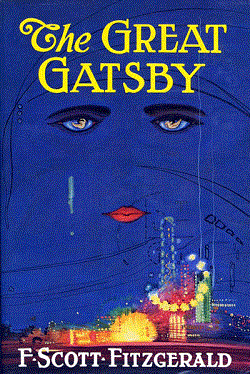
On April 10th, 1925, the first edition of F. Scott Fitzgerald’s novel The Great Gatsby was released in the United States. Originally published to mixed critical reviews and mid-level sales at best, over time Gatsby has become one of the most acclaimed and well-read American novels. It is often located close to the top of “Best of the 20th Century” lists, is a perennial contender for the elusive title of The Great American Novel, and is one of the most frequently taught texts in American classrooms. While Fitzgerald did not choose to go with the alternate title Under the Red, White, and Blue, there’s no question that his book has become closely linked to images of American identity and community—and to national narratives such as the American Dream.
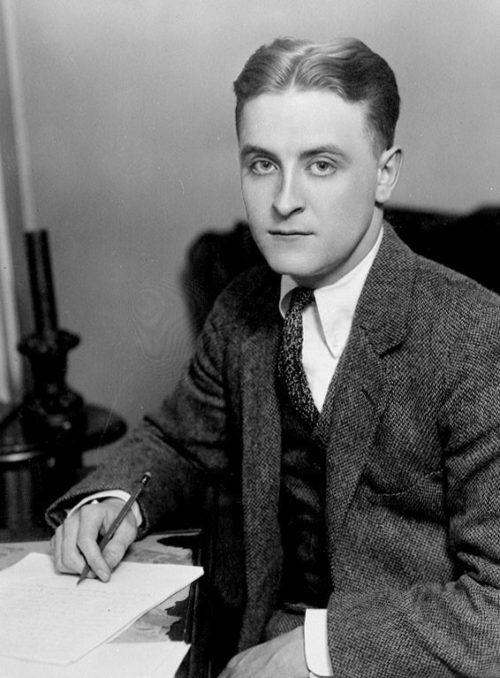
Fitzgerald’s novel is also closely connected with its time period and cultural moment, and specifically with images of the “Roaring Twenties.” The novel’s depictions of wealth, excess, recklessness, the interconnected cultures of alcohol and organized crime during Prohibition, and new technologies like automobiles and Hollywood silent films, have become synonymous with that era between World War I and the Great Depression. Yet while Gatsby certainly captures those historical and cultural contexts, there are many other sides to 1925 America that are much less central to its world. There are other books published in 1925 that can better connect us to those histories and add them into our collective memories of the era.
Perhaps the most striking historical absence from Fitzgerald’s novel is that of African Americans and the nascent Harlem Renaissance. As part of the first wave of what came to be known as the Great Migration, large numbers of African Americans had been migrating to New York City for more than a quarter-century, and the upper Manhattan neighborhood of Harlem was by 1925 one of the nation’s most vibrant African American communities. Many of New York’s white socialites were frequent visitors to and patrons of the jazz clubs, parties, and social events that came to embody the relationship between that Harlem world and the city around it. Yet despite its New York setting, Fitzgerald’s novel does not reference Harlem at all — indeed, the book’s only African American characters are a stereotypical trio of “three modish negroes, two bucks and a girl,” whom the narrator Nick Carraway observes in a passing car, “the yolks of their eyeballs roll[ing] toward us in haughty rivalry.”
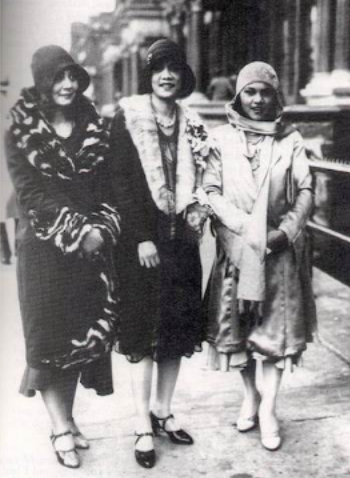
Providing an important corrective to that absence is another ground-breaking 1925 book, The New Negro: Voices of the Harlem Renaissance. Assembled and edited by the philosopher, educator, and activist Alain Locke, The New Negro features a broad and varied collection of African American creative writers, scholars, historians, journalists, and visual artists, highlighting the wide range of forms, topics, and contexts to which this developing Harlem community had already connected. From the first published story by Zora Neale Hurston (who was about to enter Barnard College) to some of the earliest published poems by Langston Hughes, along with contributions from established authors and leaders such as James Weldon Johnson and W.E.B. Du Bois, The New Negro reflects a burgeoning African American, New York, and national community that existed alongside Gatsby’s world but offers a very different side to America in 1925.
In the political realm, many of the most prominent and divisive 1925 debates focused on the interconnected topics of immigration and national identity. Coming at the culmination of a four-decade period of particularly significant waves of immigration, the 1921 Emergency Quota Act and 1924 Quota Act had enshrined exclusionary, white supremacist attitudes in national immigration law. As South Carolina Senator Ellison DuRant Smith put it in a Senate speech in support of the 1924 law, “It seems to me the point as to this measure … is that the time has arrived when we should shut the door. … Thank God we have in America perhaps the largest percentage of any country in the world of the pure, unadulterated Anglo-Saxon stock … and it is for the preservation of that splendid stock that has characterized us that I would make this not an asylum for the oppressed of all countries.” Debates over these laws and policies, and whether for example to extend them to immigrants from Mexico and other Western Hemisphere nations (initially not included in the 1924 Act), continued throughout the remainder of the decade.
Fitzgerald’s novel does include such a white supremacist and xenophobic voice in the character of Tom Buchanan, and particularly his unhinged Chapter 1 rant about how “civilization’s going to pieces” and “if we don’t look out the white race will be—will be utterly submerged.” Tom is as close as the novel has to a villain, and by linking him to these bigoted views Fitzgerald certainly makes a clear point about those national debates. But although New York City was one of the most consistent destinations for the era’s immigrant arrivals (and had been since the late 19th century), Gatsby does not feature any overtly immigrant or even particularly ethnic American characters. Indeed, its only such minor character is Meyer Wolfsheim, the “small, flat-nosed Jew” to whose illicit and criminal activities Jay Gatsby is connected in unclear but unsavory ways and who is at best a stereotypical character of Jewish and Jewish American identity.
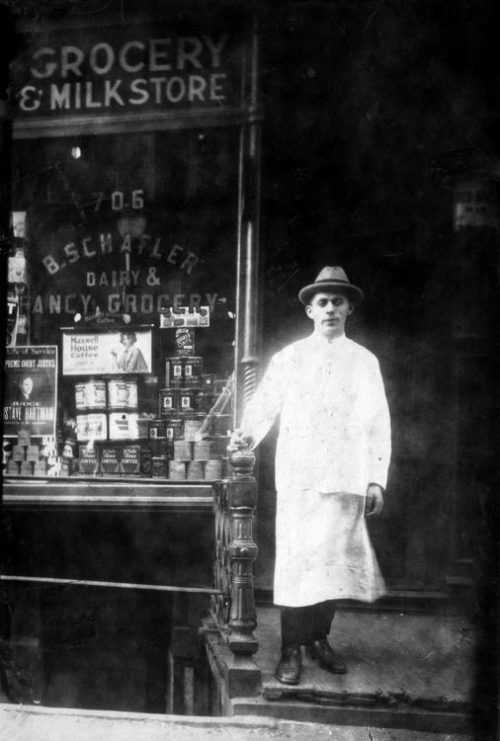
To read about the very distinct images of Jewish immigrants to New York City and Jewish American identities, read Anzia Yezierska’s Bread Givers. This compelling and ground-breaking 1925 novel offers is narrated by Sara Smolinksy, the daughter of Polish Jewish immigrants whose perspective and story we follow from age 10 through her graduation from college and subsequent professional and personal developments. Through Sara’s eyes we see the challenges facing a multi-generational Jewish American immigrant family (with a father determined to maintain his role and identity as an Orthodox Talmud scholar), the communal setting of the Lower East Side’s tenements, and the possibilities and limitations of assimilation into American society for a second-generation immigrant such as Sara.
On the anniversary of Gatsby’s publication, adding books like Bread Givers and The New Negro to our reading list can only help contextualize and expand the world and meanings of Fitzgerald’s classic novel.
Your Weekly Checkup: The Possible Risks and Benefits of Marijuana
“Your Weekly Checkup” is our online column by Dr. Douglas Zipes, an internationally acclaimed cardiologist, professor, author, inventor, and authority on pacing and electrophysiology. Dr. Zipes is also a contributor to The Saturday Evening Post print magazine. Subscribe to receive thoughtful articles, new fiction, health and wellness advice, and gems from our archive.
Order Dr. Zipes’ new book, Damn the Naysayers: A Doctor’s Memoir.
Substance abuse, largely driven by an increase in marijuana smoking, has increased nationally. Marijuana is the most commonly used “illicit” drug in the United States, used by about 12% of people 12 years of age or older [PDF]. Besides smoking, an array of cannabis products exists, such as edibles, transdermal formulations, and vaping, all reducing the need for inhaling a combustible smoke product and possibly improving its safety. While marijuana is not in the addictive class of illicit drugs such as cocaine or heroin, approximately 9% of those who experiment with marijuana become drug-dependent (Drug Alcohol Depend 2011;115:120-130), a percentage even higher among those starting as teenagers. Marijuana dependency in turn can lead to an increased risk of using other illicit drugs.
The legalization of marijuana in multiple states for medical and recreational use has led to an urgent need to better understand its impact on health.
Because the brain continues developing until approximately 21 years, adolescent exposure to marijuana can be particularly harmful. Adults who smoked marijuana regularly from adolescence to adulthood have impaired neural connectivity (fewer fibers) in specific brain regions, possibly accounting for significant declines in IQ, cognitive functioning, and memory. Marijuana exposure impairs thinking, psychomotor skills, and driving ability, making it the illicit drug most frequently reported in connection with impaired driving and car accidents, including fatalities.
Long-term marijuana smoking can inflame bronchial airways, leading to bronchitis, but its risks of causing lung cancer are unclear. While it is well established that cocaine can cause heart attacks, the adverse cardiovascular effects of marijuana are less certain, though marijuana use has been linked to strokes, heart attacks, heart rhythm problems, inflammation of the heart and blood vessels, and heart muscle damage. In general, however, evidence examining the effect of marijuana on cardiovascular risk factors and outcomes, including strokes and heart attacks, is meager. In a recent study of more than 2,000 patients 50 years old or younger admitted to a hospital with a heart attack, 10% admitted to using cocaine and/or marijuana and had higher all-cause and cardiovascular mortality. Marijuana users were more likely to be smokers, which may have played a role. The incidence of out-of-hospital cardiac arrest was higher in individuals using marijuana.
We need to improve our understanding of how to capture the potential medical benefits of marijuana use while avoiding its risks. Marijuana consumption has been reported to increase appetite in wasting diseases such as AIDS, combat nausea and vomiting from cancer-treating drugs, and be beneficial in treating some symptoms of glaucoma, multiple sclerosis, Parkinson’s disease, epilepsy, chronic pain syndromes, and a host of other illnesses. Acceptable medical documentation is skimpy for most of these, however. A just-published paper suggests that marijuana liberalization might help reduce the use and consequences of prescription opioids. This would be a major advance in health care.
It’s important to recognize the possible benefits of marijuana and, at this stage, continue to gather data about this drug before deciding its permanent place in society.
8 Things You Didn’t Know You Could Find at the Public Library
Have you thanked a librarian recently? If not, National Library Week — this year from April 8 to 14 — is a great time to do so, and to find out more about what a great resource your public library can be. This year’s theme is “Libraries Lead.”
In 1958, the American Library Association and libraries across the U.S. sponsored the first National Library Week to encourage people to read more and to use the library’s resources to the fullest. Now celebrating its 60th anniversary, National Library Week is a celebration of the library as a community leader and a supporter of democracy and equality that provides transformative opportunities through education, employment, entrepreneurship, empowerment, and engagement.
Though we still immediately associate libraries with shelf after shelf of books, they have become much more than publicly accessible repositories of ink and paper. Libraries now offer community rooms, DVDs and Blu-Rays, public internet access, online databases, and much more — probably more than you think.
Below are some of the lesser-known resources that might be available at your local library, both online and off. Not all libraries will offer all these things, of course, and yours might have something even more unexpected.
A More Complete Education
To a lifelong learner, a good library can be as good as a university. Libraries offer free access to books on practically any subject you might want to learn — but they go beyond books as well. Your library’s online databases can open up new worlds for you in geography, history, literature, art, health, and business on local, state, national, and international levels.
Looking for a more guided education? Your library may offer the audio classes from The Great Courses or Universal Class. How about learning a new language? Some libraries give their patrons free access to the first level of Rosetta Stone, the leading popular language software, for more than two dozen languages. Also look for full online language courses from Mango Language and other programs.
Games
Besides being a resource for information, the public library is also a safe place for families and young people to gather, meet, and have fun without spending any money. Many libraries are now offering video game nights for teens and tweens to get together and have some fun. But it’s not all about the technology: Your library might have some old-school board games that you can check out and either take home or just play there in the building. Check the library’s schedule for family game nights, too.
Park Passes
Some libraries let you check out passes that get you in to state and national parks, historic sites, and memorials free of charge. These passes are a great way to give cash-strapped families the opportunity to fully enjoy the history and natural beauty of their communities.
Engine Repair Help
Search through your library’s online databases and you might discover that you can access ALLDATA Online or EBSCOhost’s AutoMate, both of which give you easy access to engine repair diagrams, diagnostics, and instructions for most vehicles. Working on something smaller? Look for EBSCO’s Small Engine Repair Reference Center for information about fixing engines on motorcycles, snowmobiles, and even lawn mowers.
Legal Advice
Don’t go asking your librarian to help you write your will, but do check the library’s events calendar. You might find a free, first-come-first-served “Ask a Lawyer” session coming up. Can’t wait until then? Check your library’s online offerings for a database of legal forms. You can find templates and instructions for wills, business contracts, name changes, liens, and more.
Are you an inventor? Many libraries also offer free access to the WEST Patent Database. Your local librarian can help you use it to search patents and then connect you with the resources to file your own.
People to Read With
Libraries are a natural hub for book clubs. Check the library’s events calendar for an opportunity to meet and gab with other people who love the same literary genres you do.
Practice Tests and Testing Help
Whether you’re preparing for an AP exam, the SAT, the GMAT, or just the written exam to get your driver’s license, your library likely has some online test prep help available, including review materials and practice tests. If you’re out of school, you can find help and practice questions for professional certification exams and even the U.S. citizenship test.
Cake Pans
How often does one family need to bake a cake shaped like a dinosaur or an airplane? Probably not often enough to invest in the pan. The librarians in Woodbine, Iowa, recognizing a resource that would otherwise spend most of its life sitting unused on a shelf, offers a collection of about two dozen cake pans in different shapes and sizes to its patrons.
Every library is unique. If you don’t live in Woodbine, you might not find cake pans in your public library’s card catalogue, but chances are you will find something surprising. Talk to your librarian to find out what you don’t know about what’s available to you.
And while you’re there, thank them for keeping this important public service alive.
Healthy Weight, Healthy Mind: 7 Tactics to Avoid Emotional Eating
We are pleased to bring you this regular column by Dr. David Creel, a licensed psychologist, certified clinical exercise physiologist and registered dietitian. He is also credentialed as a certified diabetes educator and the author of A Size That Fits: Lose Weight and Keep it off, One Thought at a Time (NorLightsPress, 2017).
Do you have a weight loss question for Dr. Creel? Email him at [email protected]. He may answer your question in a future column.
“Food is my drug of choice.”
I often hear that phrase while working with people who struggle to lose weight. Using food to cope with problems usually leads to later feelings of disappointment, anxiety, and even self-loathing. The cycle of “feel stressed, overeat, feel bad, overeat again” may continue for years and even become a way of life. The only way to break this cycle is by finding other, more productive, less harmful, ways to deal with emotional issues. Later I’ll discuss how modifying thoughts and beliefs can prevent us from feeling overwhelmed. But for now, let’s assume you’re already feeling pressured, threatened, sad, angry, anxious, or browbeaten. How can you cope?
First, consider a list of healthy, pleasurable activities. Using a delightful distraction like reading, crocheting, or working on a car remodel can provide temporary relief similar to the comfort and distraction you get from food. Adding to your list of alternative activities may help you with eating issues. Consider new hobbies you’ll enjoy—things you’ve always wanted to try. Don’t let your weight stand in the way of trying something new.
These activities promote relaxation and offer temporary relief. But some situations, especially ongoing sources of discontent, are best handled when we process the stress rather than distract ourselves from it. Developing coping mechanisms beyond food is the best way to find peace in spite of undesirable feelings and events. Distractions only scratch the surface of our discontent, like applying a small Band-Aid to a deep cut. Effective emotion-focused coping often requires deeper processing of what’s happening. That includes learning to tell which problems we can solve, versus problems we need to live with for a while.
I admit, coping strategies that aren’t distractions may not be enjoyable in themselves, because you’re facing problems instead of avoiding emotional pain. Creating a relaxed environment for coping activities will help you glean as much immediate contentment from them as possible.
1. Journaling
Journaling has become a wildly popular activity in our culture. Your journal can be a friend who always listens and never says hurtful things. Writing in those pages can help you explore what lies behind feelings such as fear, anger, and pain. Getting specific about things that bother you can help erase superficial worry and uncover more deep-seated issues. With complete privacy, you can explore the past, let go of it, and begin planning for the future. No one has to see your irrational tirades or words that could hurt others. You can edit, keep those pages, or throw them away. Later you might re-read the journal and notice your own faulty reasoning.
But if a journal is only a punching bag of sorts where you vent anger, frustration, and pain, it may not live up to its potential for helping you through stressful times. The goal of journaling is to find meaning, clarity, and eventually peace. Ending some entries by completing statements such as:
“something helpful I’m learning is . . .”
“this probably happened because . . .”
“I want to use this experience to . . .”
“I can start letting go of this because . . .”
“I will be kind to myself because . . .”
. . .can make journaling more therapeutic. You might also finish a painful entry by redirecting your thoughts to the most meaningful parts of your life—things that bring joy, things you’re proud of, and things you look forward to doing.
In addition to your regular journal, keeping a special gratitude journal can direct your thoughts away from negativity and toward the things you’re most thankful for. Writing in detail about people who’ve blessed our lives, possessions we’re grateful for, and experiences that have helped us grow can be uplifting and get us through tough times.
2. Talking to Others
As an alternative to emotional eating, relying on close friends or family members who are good listeners and rational responders can help you deal with stress. Sometimes a quick, supportive phone call or text message can be enough to pull you through a difficult moment. However, keep in mind that friendship and family relationships are two-way streets. If you feel your conversations are burdening others, seek professional help. Therapists not only listen, but can guide you to develop coping skills and manage life in a healthier manner.
3. Religious-based Coping
Although religious practices and beliefs vary a great deal, most people worldwide believe in God or a higher power. The concept of an all-knowing, ever present, loving God is beyond our ability to fully grasp. This can be frustrating and confusing at times, yet accepting this belief can give us a great sense of peace.
When I was a child my family often took summer trips to the beach, which was a 14-hour drive when we were “driving straight through” and “making good time.” Sometimes we left home at 2:00 or 3:00 a.m. so we could check into our hotel in the afternoon. On the way back home we usually left around noon and arrived home a few hours before sunrise. Although my dad drove for many hours through mountains, heavy thunderstorms, and congested traffic, I never worried about safely arriving. I knew Dad would get us there. With no worries at all, I fell asleep alongside my brother and sister — who, by the way, always took more than her fair share of the large back seat in our Chrysler New Yorker. If you believe in an all-powerful God who has your best interests in mind, then you can relate to the peacefulness I felt while riding in our car.
An old saying tells us, “God can move mountains, but bring your shovel.” This is true most of the time. However, sometimes we simply need to wait and trust that, although life brings unexpected and painful turns, we will be okay in the end, even if the pathway is a journey we wouldn’t have chosen. In order to wait more effectively, we can pray, meditate, read faith-based literature, attend services, and socialize with others who remind us to embrace the idea that in the end something helpful will result from our difficult situation.
4. Exercise
Physical activity can relieve anxiety as well as treat and prevent depression. Studies even suggest regular physical activity compares in effectiveness to medications used to treat some mood disorders.
Combining activity with something else you find enjoyable can also be an effective coping strategy. Walking or working out with a friend, taking a group fitness class, walking your dog, or finding a scenic place to ride a bike or walk can enhance your experience and help you deal with life difficulties. On the other hand, don’t underestimate the benefits found in the solitude of exercise. Even walking on a treadmill in a dark basement can be a time of reflection that leaves you more energized and able to think and solve problems more effectively.
5. Breathing
When we’re upset about something, focusing on our breathing is the simplest thing we can do to calm ourselves. Feeling stressed causes us take shallow, rapid breaths as the body’s fight-or-flight response kicks in. You’ll also notice a tendency to clench your jaw, furrow your brow, and tense your shoulders. This is the body’s automatic response to a threat, whether the threat is physical or emotional. When you’re facing an emotional situation, do you really need to run or fight? Instead, you probably want to relax and calm down. Instead of using food to feel better, try focusing on a simple technique you can do anywhere: Deep breathing. This diaphragmatic/belly breathing can slow the heart rate, decrease blood pressure, and calm your nerves. Here’s how to do it: Let your abdomen expand as you deeply inhale. Take the air in through your nose and release it slowly through pursed lips, while visualizing your muscles relaxing. You might also focus on accepting healing light as you inhale and releasing tension with each exhale. For better results, combine this with soothing music, yoga, or other relaxation activities.
6. Helping Others
When you’re dealing with issues that won’t go away overnight, consider helping other people with their problems. This may sound counter-intuitive, but it works. No matter what our circumstance, we can usually find others who are worse off. Feeding the homeless, volunteering at a women’s shelter, or assisting at a school, church, or hospital can take you away from your own issues and give you a sense of purpose. Plus, you’ll meet new people and possibly make friends, while making the world a better place.
Although helping others won’t erase your problems, it may give you a different perspective. When I help transport someone in a wheelchair it’s easier for me to accept the moderate amount of pain in my arthritic joints. When I help families of children with cognitive or physical limitations, my own children’s meltdowns are put into perspective. Providing a backpack with school supplies for a child of an inner-city family reminds me of how fortunate I truly am.
7. Medication
For some people, taking medication is a helpful strategy for coping with stress and psychological conditions. Although you may want to try other strategies first, medication has a place for treating anxiety, depression, and mental illness. You shouldn’t feel ashamed or embarrassed if your doctor prescribes something to help. However, don’t forget that medication is never a substitute for healthy coping; rather, it should be used to make healthy coping easier.
Class of ’41: A Mother’s Secrets Revealed
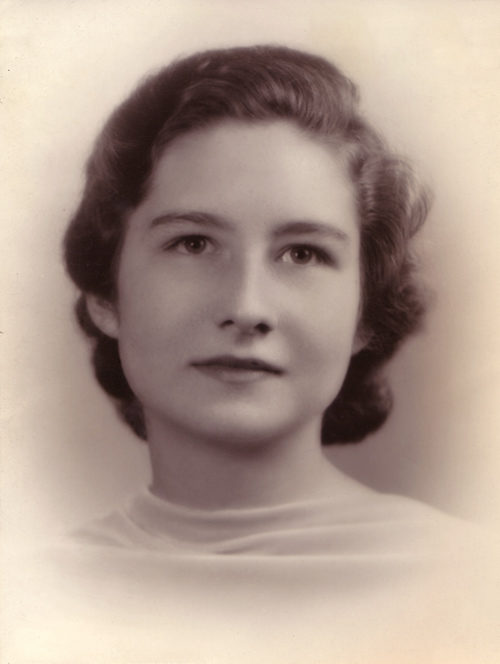
In 2001, on a beautiful spring weekend, I accompanied my mother to her 60th college reunion and got a picture of the young woman she once was.
Thursday, 11:45 p.m. Leftovers
I am visiting my mother at her New York City apartment. Tomorrow, we’ll begin a full weekend of activities for her Vassar College reunion in Poughkeepsie, just an hour and a half north of the city in a chartered bus. We’re sipping beer, and she’s telling stories about old friends and cherished college moments. Finally it’s bedtime.
But first, we must boil the strawberries.
“They could go bad,” she explains, dumping the clinging dregs from the green plastic pint container into a saucepan.
My mother, Jean, is a lot of things — fiercely intelligent, archly funny, and sometimes a bit nutty — but she is never wasteful. She seals up her strawberry mush in a recycled mayonnaise jar, puts it in the fridge. Then she climbs up on a step stool and roots around in an overhead cabinet until she finds another container. Into this one goes a cup of coffee left over from dinner.
Friday, 11 a.m. Some Kinda Wise Guy
The cab driver who’s taking us to Midtown to catch the Poughkeepsie bus is one of those garrulous New York City cabbies out of central casting. I happen to mention we’re going to my mother’s college reunion, and he replies, “But she can’t be your mother. I thought she was your sister.” I roll my eyes, but my mother gets right into it with him: “Well, if your eyesight is so bad, maybe you shouldn’t be driving.”
He clams up for the rest of the ride.
Friday, 3 p.m. The “Ma-Ma” Degree
The reception for the class of ’41 is in a large central dormitory and administration building simply called “Main.”
The room for our reception is grand, with high ceilings and walls decorated in an ornate jade Chinese wallpaper of geese and lily pads. Lest we forget where we are, foot-high golden Vs are tucked into the molding in the four corners of the room.
I meet one of my mother’s classmates, Marta, who is extremely pale and so thin you want to reach for her arm when she stands or takes a step. Her blue eyes are sharp. She tells me about coming to the U.S. from Austria right before the war. How frightened she was the time she heard a fellow shopper in a New York department store loudly criticizing Roosevelt. “Back home, you could get shot for saying such things,” she says.
Marta also tells me another story that I will hear echoed over the next two days. Graduating as a science major, she wanted to study aeronautical engineering. She was told she qualified for acceptance to Polytechnic Institute of Brooklyn, but administrators warned her it would be “difficult” for her there, since there were no toilet facilities in the labs for women. “So instead of an M.A.,” she tells me, “I became a Ma-Ma.”
This was not, it hardly needs to be said, an era when women easily became professionals, even those who were college graduates. Consider the statistics for the class of ’41: Only one-fourth worked outside the home for a full 20 years. Of 252 graduates, 166 described their roles as “chiefly housewife.” More than half reported doing regular volunteer work. And of the 74 who’d held full-time jobs, more than half were, like my mother, teachers.
Another occupation has become more common in recent years: caregiver. My mother was nurse to her mother and, later, to my father, who had Alzheimer’s. It was no easy task, but I never heard her utter a single word of complaint.
One woman tells me she visits her husband in a nursing home all day, every day, even though he no longer recognizes her. “My friends told me I shouldn’t go so much,” she says. “So for a few days I stayed away. When I came back, the nurse said he’d stopped eating. So now I go.”
We are interrupted by Judith, a vigorous woman in a bright red dress who is breathless with excitement. “Do you want to see my diamond pin?” she asks.
“Okay, sure,” I say politely.
The joke is on me. She opens a jewelry box and shows me a dime and a safety pin. Should have seen this coming: Judith is wearing huge red earrings, one says IN and the other says OUT.
Friday, 8:30 p.m. Continuity
My mother has something to tell me. We’ve just finished a buffet dinner under a white tent, sitting with her very dearest old friends, many of whom she’s kept up with through the years. They’ve updated each other on travels, aches, medicines, children, grandchildren, husbands. We pass around the script for a skit, written mostly by Ruth, a professor’s wife, that they’ll perform at tomorrow night’s banquet. The topic is language, words that have disappeared (rumble seat, nylons) and words that have gained common currency but still feel alien and amusing to them (user-friendly, glass ceiling, significant other).
The subtext, of course, is change, something that’s on my mother’s mind a lot lately. But as we’re sipping coffee, she leans over and tells me something that is about not-change — her theory of continuity.
Memories can be handed down from generation to generation, my mother believes. When she was very young, her grandmother lived with her in their New York City apartment. My mother would regularly brush out her grandmother’s long hair. And while she was doing it, her grandmother would describe brushing her own grandmother’s hair. This earlier brushing took place in New Milford, Connecticut, where the family had lived for generations. It was a town my mother knew well. And so, she says, her grandmother’s memory eventually became her own. She describes for me the sun coming in the south-facing window of the sitting room in her grandmother’s childhood home, the feel of the wooden bristle brush in her grandmother’s five-year-old hands. As she describes it, she closes her eyes, and I can see she’s really there, brushing her great-great-grandmother’s hair. I do a little calculation: The scene she’s depicting would have taken place in the 1850s.
Friday, 11:30 p.m. “It’s Ther-a-peu-tic”
My mother and four friends have passed up the obvious option of going to bed. Instead, we’re squeezed around a table at the Mug, a basement campus pub. It’s packed with young men and women, recent graduates sharing their own reunions. (Vassar went coed in 1969.) Donna Summer is pulsating from large speakers. Margaret, one of our crowd, is dancing exuberantly by herself. (As a girl, she was considered clumsy, she tells me. So she was sent to study dance with a disciple of Isadora Duncan, and she’s been dancing ever since.) She insists that we all join her on the crowded dance floor. The six of us gather in a circle. We dance. Ruth, who’s tall and slim but not what you’d call athletic, makes determined up-and-down moves with her fists. My mother, whom I’ve never seen dance to rock, much less disco, gamely shuffles her feet a bit in time to the music. “Come on,” Ruth shouts to her, pumping her hands up and down. “It’s ther-a-peu-tic!” My mother smiles a wry smile and pumps her hands, just a little.
Later, as I’m fighting my way through the dense crowd, ferrying clusters of full beer mugs from the bar to our table, a woman with a “Class of ’96” badge blocks my path and demands, “What year are they?”
“Class of ’41.”
“Awesome!” she squeals.
Saturday, 7 p.m. An Old Memory Made New
The banquet dinner for the class of ’41 begins with a remembrance of classmates who have died. The names, more than 100, are listed on a program. I am struck by how unemotionally this tribute is received. Of course, by a certain age, death might be a familiar presence, I think to myself.
But then the speaker says, “… And, I’m sorry to report that since the printing of this list, two more of us have passed away.” A gasp punctuates the silence as she names the newly dead.
After dinner, my mother and her friends stand and perform their skit. It begins as a series of comments about life in 1941 (“I’ve never seen TV, but I’ve heard of it.”), then flashes forward to 2001, when, according to Ruth’s script, most young people are pretty clueless:
“Do we know where the trade winds are? Or how to find Oslo and Shanghai, Kinsale and Petra?”
“Yes.”
“But our grandchildren don’t.”
“They know Planet Krypton, but they can’t find Crete.”
There’s more in this vein. Then comes the closing line, which draws a good laugh: “You just can’t trust anyone under 80!”
Suddenly, I see them as they were in their early 20s, beautiful, privileged, exquisitely well-educated. I can imagine them putting on a skit like this one — witty and satirical and just a little bit smart-alecky. Each of them is intimately acquainted with the lessons of the Depression. Most of them expect to go forth, marry, and raise children. The European war has already begun; in a matter of months, it will become America’s war too. And so my understanding of my mother’s precious years at college now includes a living picture. She has given me the gift of a memory. She has given me a piece of her life.
Steven Slon is the editorial director for The Saturday Evening Post. Jean Slon passed away in 2008.
This article appeared in the May/June 2018 issue of The Saturday Evening Post. Subscribe to the magazine for more inspiring stories, as well as art, travel, trends, fiction, and features from our archives.
David Fairchild, America’s Top Food Spy
If you had something delicious for lunch today, you likely have David Fairchild to thank for it. Because of him, your diet now includes avocados, quinoa, kale, nectarines, pistachios, cashews, hummus, soybeans, and varieties of mangoes, among other imported foods. You’re also drinking better beer because of superior hops that Fairchild managed to get out of Germany despite its ban on their export.
Not bad for someone you’ve probably never heard of.
In the early 20th century, David Fairchild introduced over 200,000 foreign plants to America. Though many of them never caught on, quite a few became staples of the American diet.
Food in the U.S. during those early decades was bland and monotonous, says Daniel Stone, author of the recently published biography of Fairchild, The Food Explorer.
“For generations, farmers grew little more than corn, wheat, oats, apples, and some tomatoes,” Stone told us in an interview. “Very few of our foods [today] are native to North America.”
The diversity of our current diet is the result of the Department of Agriculture’s search for new and better crops for farmers. In 1898, it opened the Office of Seed and Plant Introduction and made Fairchild its director.
For years, he sailed the world, hiking into the backcountry of distant lands and enduring primitive conditions, disease, and near-death experiences, all to find promising foreign plants and new varieties of crops that America already farmed.
The avocado is a good example. Americans knew about them before the 1890s, but they weren’t part of the national diet until Fairchild sent some Peruvian varieties to Washington, which promoted them to farmers and consumers.
“Fairchild talked about two phases of introducing foods,” Strong said. “First, there was getting farmers to grow the food. And then the challenge of getting people to buy the new foods, eat them, and buy them again.”
Many of Fairchild’s discoveries failed to catch on because they were too unusual for American tastes; others proved impractical for farmers.
“His biggest disappointment was the mangosteen, which is not at all related to the mango,” Strong said. “He thought it was the queen of fruits. But it’s a very weak fruit — there’s not much to it, it ripens quickly, bruises easily, and can’t be shipped long distances.”
Alongside the disappointments were the unexpected, and sometimes delayed, successes. “Fairchild found quinoa in Peru,” Strong said. “He didn’t know what to do with it back in 1898.”
In his book, Strong writes, “It was crunchy and fine, and had a confusing glow. No one knew what part of the plant one should actually eat: its leaves — as with its botanical cousin spinach — or its grain, which were its seeds.”
Quinoa languished until 2005, when scientists recognized this superfood as a source of protein as well as all nine amino acids the human body can’t produce on its own — all without a trace of gluten.
“Suddenly it’s the food of hipsters,” Stone told us. “And the price triples.”
Fairchild had another delayed success. Stone told us, “He would be surprised at how much hype kale has received.” When he came across it in eastern Europe, it was considered cheap food that only peasants ate. Not until the 1990s did we learn that kale has more iron than beef and more calcium, iron, and vitamin K than any other plant.
Fairchild was also instrumental in developing the citrus-food market in the U.S. Traditionally, Americans didn’t eat tropical fruit. But with other agents of the Office of Seed and Plant Introduction, he introduced marketable varieties of mangoes, lemons, and navel oranges. As a result, Strong said, “we eat a lot of tropical fruit, year-round.”
In 1941, the Post’s sister publication, The Country Gentleman, published an interview with Fairchild. Looking back over his career, he said, “There are scores of tropical and subtropical fruits just as good, even better than fruits we know; but we humans are in too much of a diet rut to create a market for them. After all, the body’s first consciousness is of taste; and so, as children, we acquire food prejudices.
“Even if they won’t eat strange fruits,” he mused, “I wish people would be as curious about plants and other living things as they are about themselves.”
You can learn more about Fairchild in Daniel Stone’s book The Food Explorer: The True Adventures of the Globe-Trotting Botanist Who Transformed What America Eats. It’s a fascinating tale full of horticulture, adventure, travel, American history, international relations, and the limits of human endurance. Learn more about it at www.danielstonebooks.com.
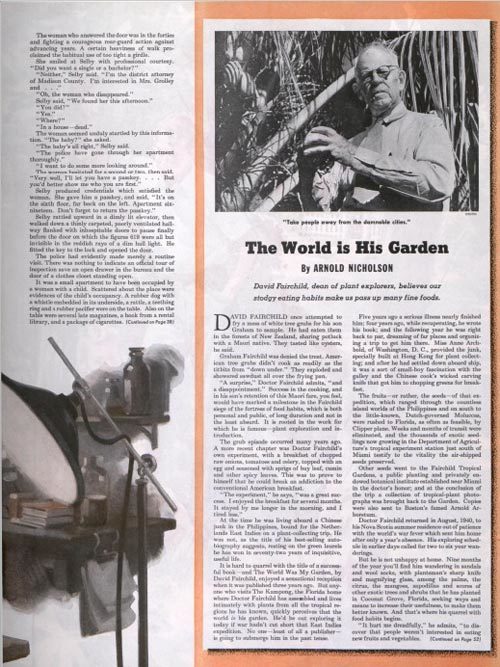
Featured image: Pinto for the November 1, 1941, issue of The Saturday Evening Post. (©SEPS)
Do Something You Like
“Step One: Do Something You Like,” began the first chapter of Meeting People Made Easy. “Join a group with similar interests,” the book continued.
Marylou put the book down. At 33, she still hadn’t met “the one.” But when she considered her likes, they all seemed unlikely — a group for pasta eaters?
She was about to give up when she remembered singing in the Sunday school choir when she was seven. That could be a “similar interest.” She’d loved it. And, her church did have a choir. “I’ll do it!” she said out loud, and resolved that she really would do it.
And so it was that on the second night of choir rehearsal, at the 15-minute break, Marylou sat on the wide church steps wishing she could smoke. To distract herself, she admired the late-model silver sports car parked across the street behind her own eight-year-old sedan. It hadn’t been there when she’d parked an hour ago. She would have noticed.
So far, as her chosen “something you like” to meet “the one,” the choir was disappointing. All the baritones and tenors were married.
She noted that the sports car top was down. The seats were plump and leather-covered. She imagined the owner — lean and tall with dark hair and mischievous brown eyes. He’d hold the car door open for her and they’d exchange a smile as he leaned towards her to close the door. She imagined herself in the passenger seat, hair blowing in the breeze. They’d drive to dinner at that little French restaurant on the river. At the restaurant, he’d order for both of them and pronounce the entrees correctly. Perhaps, champagne, maybe a proposal.
She studied the license plate. It was out of state, a bit of a hitch but nothing that couldn’t be overcome. Perhaps the car owner had just happened to buy the car out of state, or maybe he’d just moved here. Checking the license number … 4ME172 … “For me,” she said, definitely a good sign. As she continued the fantasy, a man ran out of the drugstore. Marylou studied him as he looked up and down the street, crossed, and got into the car. “And so ends another dream,” she said as the car pulled away from the curb. Anyway, judging from what she’d seen of him, he wasn’t the sort who’d have mischievous brown eyes.
A matronly woman stuck her head out the church door. “Marylou? We’re all waiting for you.”
She sighed, put the book in her purse, stood, took another look up and down the street, and headed back into the church.
Half an hour later, the choir’s third try at “Shall We Gather at the River?” was interrupted by the sound of sirens.
The director sighed. “Let’s take a break.”
The sirens came closer and stopped right outside. The choir went as a group to look out the door.
They watched as two policemen jumped out of a patrol car and headed for the drugstore. Another police car pulled up behind it.
“Maybe we better stay away from the door,” muttered Lenore, a soprano.
“It’s all right, he’s gone,” said Marylou.
“Who?”
“Whoever he was in the drugstore.” The one who wasn’t “the one.”
“How do you know?”
“I saw him leave,” Marylou replied.
“You saw him …” Lenore’s voice rose, and she nudged Marylou in the direction of the patrol car as one of the officers came back out of the store.
“Officer!” she called before Marylou could protest. The officer turned and walked toward them.
“Yes, ma’am?”
“What’s happened?” Lenore asked.
“Lieutenant Ferguson, ma’am. There’s been a burglary at the drugstore. They set off an alarm at the security service. No need to be frightened, though. The perp’s long gone.”
Great, thought Marylou, on top of it all my would-be dream man is a burglar.
“Maybe Marylou, here, can help,” offered the soprano, taking Marylou by the arm.
The lieutenant gave Marylou a questioning look. Marylou could not help but notice that he had deep brown eyes and a warm smile. “Did you see anything, ma’am?”
“I saw someone leave.” She described the man remembering to include the details about the suit and hair.
He smiled. “Unfortunately, that describes a lot of people,” he made a note anyway, and snapped the notebook shut. “Appreciate your help. The other officer will take your name and get back to you if we need to.” He turned to go.
“I saw his car, too,” Marylou called after him.
The lieutenant whirled around and came back. “What did you say?”
“I saw his car.”
“How do you know it was his car?”
“He got into it.”
The officer smiled and waited.
“He came out of the store, crossed the street, and got into the car.” Marylou explained. “It was an out-of-state silver sports car. I don’t know what state, but its colors were blue and green.” She had the handsome lieutenant’s full attention now. “The license number was 4ME172.” She blushed remembering her fantasy about the 4ME part.
“Get that on the airwaves, Tim,” he said to his partner.
As his partner turned away, the lieutenant turned back to Marylou with a smile. “You’re very observant, ma’am. How did you notice him, his car, even his license plate?” He looked impressed.
“I was taking a break from choir practice and just happened to see his car. Then he came out.” No need to go into more detail, she thought.
He nodded. “Come down to the station with us and make a statement. It’ll be a great help.”
The two exchanged a smile as he closed the patrol car door after her.
“I think I’d like singing,” he said as he climbed into the front. “Can anyone join the choir?”
“Sure.” Marylou imagined telling him the whole story over a romantic pasta dinner in the not-so-distant future. They’d both laugh. She reminded herself of the book’s final admonition: “Keep an open mind. You could meet someone anytime, anywhere.”
News of the Week: Phones Take Over, Satellites Are Falling, and Weird Al Did Something Cheesy
Brain Drain
I know I’ve talked about smartphones before, how everyone is addicted to them and how they’ve changed everything (mostly for the worse), but indulge me a few more words on the subject. (If you’re already bored, you can scroll down the page a bit and read about Jake Tapper’s new novel and Marilyn Monroe’s new movie.)
To put it simply, being connected all the time isn’t a good thing. Sure, smartphones are great in emergencies, but there’s no mental breathing room anymore. Before smartphones, we would put down our phones and mail, shut off our TVs, stereos, and the internet, and leave the house. Now we carry those things around with us 24/7. We’re always “on,” and it has changed the way we associate with each other and with tech, and has even affected the way that we think. It can’t be good to have this much information coming at us all the time. That’s why I’m in favor of dumb phones — phones that are actually phones and not also connected to the web — instead of smart ones. I’d also suggest signing up for a cheap phone plan if you don’t have to be connected to the web all the time and just want to make and receive calls. And don’t ever give up your landline!
CBS Sunday Morning’s Ted Koppel had a piece on information overload this week, detailing how smartphones, the web, and social media have taken charge of our lives. He even interviewed the guy who invented the Facebook “like”:
On a related note, Tuesday marked the 45th anniversary of the first cellphone call.
Down to Earth
In January, I told you about a Chinese satellite that was going to crash back to Earth. This week, that satellite did indeed come back, and luckily no one was hit by it, though you’d have had better luck hitting the Powerball.
Most of the Tiangong-1 satellite burned up during reentry, and what was left seems to have fallen into the Pacific Ocean. Those of you who had “2500 miles south of Hawaii” in your office pool are the big winners.
2001 at 50
Speaking of things in space: This little admission may destroy any pop culture cred I have and may even get me barred from several theaters, but I’m not a fan of Stanley Kubrick’s 2001: A Space Odyssey. It’s true that I’ve only seen it once, many years ago, but I remember being profoundly disappointed in it, even if I appreciate its influence. Maybe I’ll watch it again to celebrate the film’s 50th anniversary and see if I agree that the film is not only fascinating, but one of the best movies of all time.
New Books
In addition to the new books you’ll find in the current issue of the Post, here are four more that will be released soon.
Look Alive Out There: Essays by Sloane Crosley. Crosley first broke through with her fun essay collection I Was Told There’d Be Cake, and this new one is getting great reviews too. (Out now)
The Hellfire Club by Jake Tapper. The CNN anchor’s first novel is a political thriller set in 1950s Washington, D.C. Here’s an excerpt. (April 24)
The Ideal of Culture: Essays by Joseph Epstein. Epstein is one of our great essayists, and his new collection explores such topics as parenthood, cowardice, grammar, the 1960s, F. Scott Fitzgerald, and reaching the age of 80. (May 7)
Ten Arguments for Deleting Your Social Media Accounts Right Now by Jaron Lanier. As you can read above, this is a subject that’s near and dear to me, so I can’t wait to read what the tech/virtual reality visionary has to say about Facebook and Twitter. (May 29)
Digital Marilyn
It’s obvious that Marilyn Monroe will never really die. Not only does she still make a lot of money decades after her death, but now she’s coming back to the movies.
Actress Suzie Kennedy will portray Monroe in a new film about the actress’s life. She already looks a lot like Monroe, but she’s going to have help from digital technology. A team of tech whizzes took 3,000 photos of Kennedy’s face and body to create an “avatar” of Monroe that will be featured in the film.
This could be an incredible advance in filmmaking. At some point you know we’re going to see new movies and TV shows starring Abbott and Costello, Cary Grant, and Humphrey Bogart. We’ve already seen commercials that use the technology, and digital trickery is used online all the time. But I bet one day we’re going to have entire movies based on the technology, and stars will never stop working. It’s one of those tech developments where you say, “Wow, this is so cool!” and then a few minutes later you say, “My God, where is this leading?”
Congrats
I’d like to take a moment here to say a few words about a couple of milestones at the Post. The first is the magazine itself, which was honored by the Pop Culture Association this week at their 48th conference. They describe us as “an American institution” with a “unique cultural legacy,” and I have to say I agree with that.
And happy anniversary to Executive Editor Patrick Perry, who celebrates 40 years at the magazine!
RIP Steven Bochco, Winnie Mandela, Rusty Staub, Anita Shreve, and Deborah Carrington
Steven Bochco was the legendary TV producer and writer responsible for such shows as Hill Street Blues, L.A. Law, NYPD Blue, Murder One, and Doogie Howser, M.D. He also wrote the iconic sci-fi movie Silent Running and several classic episodes of Columbo. He died Sunday at the age of 74.
Several friends and stars offered their condolences and memories of Bochco in The Hollywood Reporter, including Sharon Lawrence, Jill Eikenberry, and Mike Post.
Winnie Madikizela-Mandela was an anti-apartheid activist and the ex-wife of Nelson Mandela. She died Monday at the age of 81.
Daniel “Rusty” Staub helped the New York Mets win the National League pennant in 1973. He also played for the Detroit Tigers, Texas Rangers, Houston Astros, and Montreal Expos. Staub died last Thursday at the age of 73.
Anita Shreve was a beloved author of such novels as The Pilot’s Wife, The Weight of Water, and Sea Glass. She died last Thursday at the age of 71.
Debbie Lee Carrington was an actress and stuntwoman best known for her appearance in the Arnold Schwarzenegger film Total Recall and her role as the woman Mickey wants to date on Seinfeld. She also appeared on The Drew Carey Show. As a little person, she often doubled for children in movies, including Titanic and Child’s Play. She died in March at the age of 58.
Best and Worst of the Week
Best: Weird Al Yankovic, along with veteran crossword-maker Eric Berlin, took over The New York Times crossword puzzle on Wednesday with a cheese-themed puzzle. An example of the kind of clues you’ll find? 20-across is “Cheesy 1992 military drama.” The answer is A Few Gouda Men.
You have to subscribe to do the puzzle, but you can see what it looks like in this PDF.
Worst: I’ve been meaning to catch up on Instinct, the new police drama starring Alan Cumming. Looks a little routine — an unpredictable genius teams up with a by-the-book detective to solve crimes, how novel — but Cumming is always good, and it looks like fun. But this week’s episode, about an Amish boy who is murdered after he leaves home and moves to New York City, felt familiar to a lot fans. A little bit too familiar. Turns out the plot and scenes mirror a 2009 episode of another buddy-detective show, Bones, right down to some of the clues.
This Week in History
First Issue of TV Guide (April 3, 1953)
Who was on the cover of the first issue? It was a baby. Specifically, the newborn son of Lucille Ball and Desi Arnaz, Desi Arnaz Jr. Ball actually arranged ahead of time to have a caesarean section so the birth would coincide with the airing of the I Love Lucy episode where Ball’s character Lucy Ricardo gave birth as well.
Dr. Martin Luther King Jr. Assassinated (April 4, 1968)
Wednesday marked the 50th anniversary of the death of the civil rights leader. King wrote a piece for the Post in 1964 titled “Negroes Are Not Moving Too Fast,” and here’s an interview NBC’s Sander Vanocur did with King 11 months before his assassination:
This Week in The Country Gentleman History: Cousin Reginald is the Hero (April 6, 1918)
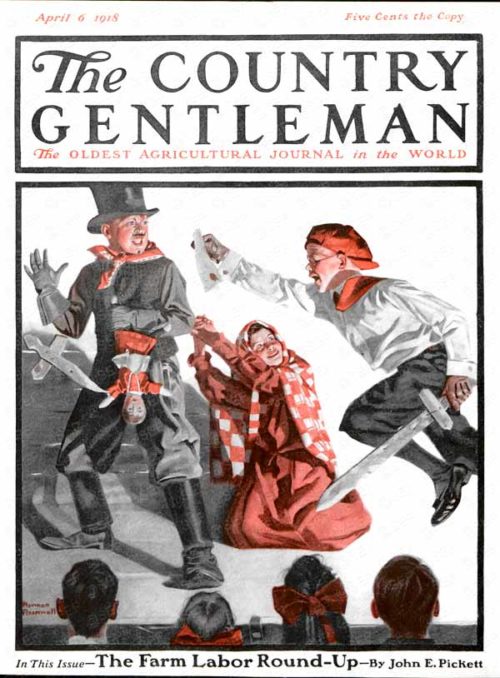
Norman Rockwell
April 6, 1918.
The Country Gentleman, a sister publication of the Post, was published from 1831 to 1955. Norman Rockwell painted several covers for it, including this one. When I first saw it, I couldn’t quite figure out what it was all about. I thought it might be titled “Crazed Fan Disrupts Performance of A Christmas Carol.” The cover is actually part of a series of paintings that Rockwell did for the magazine focusing on a group of boys and their cousin Reginald. That’s Reginald with the sword.
April Is National Grilled Cheese Month
I’m pretty much a traditionalist when it comes to grilled cheese — I prefer cheddar or American cheese on white bread — but there are so many other options if you want to try something a little different for National Grilled Cheese Month.
Here’s a recipe that Bon Appétit calls the “Best-Ever Grilled Cheese,” though it has mayonnaise, so I don’t know if it deserves that title. Here’s one called a Nacho Grilled Cheese, made with jalapeños and Doritos. This one from Genius Kitchen is made with green olives. And if you’re going to have grilled cheese, you can’t forget this.
Maybe you can do Weird Al’s cheese puzzle while eating grilled cheese, if that’s not too much cheese for you all at once.
Next Week’s Holidays and Events
Winston Churchill Day (April 9)
This day is mostly celebrated in the United States, marking the occasion in 1963 when President Kennedy named the British Prime Minister an honorary U.S. citizen. Here’s a 1939 Post piece about Churchill titled “Old Man in a Hurry,” and here’s our interview with John Lithgow, who plays Churchill in the Netflix series The Crown.
National Siblings Day (April 10)
I know, I know, sometimes you argue with your brothers and sisters (I’m the youngest of seven), but maybe today you can put that all aside. You can always argue tomorrow.
1940s Spring Party Menu
Party like it’s 1943! Try this spring buffet menu from the archive, complete with recipes, tips, and a DIY centerpiece. The editors assure that it’s perfectly okay to ask guests to bring their own coffee. It seems like a strange BYO request, but coffee was rationed during World War II, so there was very little of it to share.
—
The Buffet Takes a Bow
Originally published in The Country Gentleman, April 1, 1943
An all-season favorite for a hostess but especially refreshing for spring entertaining is the supper buffet. Its beauty lies in its simplicity, its attractiveness and the hospitable atmosphere that hovers around it.
You can set a pretty table with the centerpiece shown here for an eye catcher. To make it, gather up odds and ends of old candles and melt them over hot water. Pour the wax into nut cups and let harden, inserting birthday-cake candles for wicks. When the wax is thoroughly hardened, slip the candles from the cups and float them in a low bowl around a floral center.
Food for a buffet should be the type that can be prepared beforehand, is simple to serve and easy to eat while juggling the plate on your lap. If the guests are to go back to the table for seconds, the food remaining there should have been replenished to make a showing as fine as the first one.
There are no exact rules about setting a buffet; just figure out the arrangement which will be handiest for the guests. As you go around a buffet table, you usually first pick up your plate, then help yourself to the food and then get your silver and napkin. The beverage is most conveniently served to the guests after they are seated.
Dessert, too, is usually served in this way after the main course is completed, though the table may be reset for the last course if desired.
Buffet Menu
- Rhubarb Juice Cocktail
- Individual Cornish Pasties
- Curried Vegetables en Casserole
- Spiced Peach Salad
- Dessert
- Grape Juice Sherbet
- Walnut Wafers
- Bring-Your-Own Coffee
or
- Hot Mulled Grape Juice
- Cookies
Individual Cornish Pasties
- 2 cups of enriched flour
- 2 teaspoons of salt
- 2 cups of ground kidney suet
- 1/4 cup of shortening
- 1/2 to 3/4 cup of cold water
- 1/2 pound of beef chuck
- 1/4 pound of veal shoulder
- 1/4 pound of pork shoulder
- 2 potatoes
- 1 medium-sized onion
- 6 stems of parsley
- 1 1/4 teaspoons of salt
- 1/4 teaspoon of pepper
- 2 tablespoons of melted butter
- 2 tablespoons of cream
Sift the flour and measure it. Sift it again with the salt and cut in the suet and shortening. Add enough water to make a dough the consistency of pie pastry. Chill the dough.
Grind together the meat, potatoes, onion, and parsley, using the coarse knife of the food grinder. Add any of the vegetable juices which remain in the grinder, together with the seasonings and melted butter.
Roll the chilled dough into a sheet a little over one-eighth inch thick. Cut into four-inch rounds with a floured cutter. Place several heaping teaspoons of the meat mixture on each round, spreading to within one-half inch of the edge. Fold each round in half and press the edges together firmly with a wet fork. Cut several gashes in the top of each pasty. Place pasties on a baking sheet and bake for about 45 minutes in a moderate oven (350°F). About 10 minutes before the pasties are done, add a little bit of cream to each one through the gashes in the pastry. This recipe makes about 15 pasties; allow two for each serving. Pasties may be served hot or cold.
Curried Vegetables en Casserole
- 3 tablespoons of melted butter
- 3 tablespoons of flour
- 1 1/2 teaspoons of curry powder
- 1/8 teaspoon of pepper
- 1 1/2 cups of milk
- 1 1/2 cups of peas
- 1 cup of diced carrots
- 1 1/2 cups of celery, cut in 1-inch pieces
- 1 cup of rice
- 1/3 cup of grated cheese
- ingredient list
Blend the butter, flour, and seasoning. Add the milk and cook, stirring over low heat until thickened. Cook the vegetables and add them to the white sauce.
Cook the rice in salted water until it is tender. Drain it and press onto the bottom and sides of a greased dish. Sprinkle with cheese and heat in a moderate oven (350°F) until lightly browned. Fill dish with the creamed vegetables. Dot the top with paprika and return to the oven to heat. Serves 6.
Grape-Juice Sherbet
- 2 cups of boiling water
- 1 cup of sugar
- 1 tablespoon of grated orange rind
- 1 tablespoon of unflavored gelatin
- 1/4 cup of cold water
- 1/2 cup of orange juice
- 1/4 cup of lemon juice
- 1 1/2 cups of grape juice
Combine the water, sugar and orange rind; boil for 5 minutes. Strain, and add the gelatin which has been softened in the cold water. Stir until dissolved. Cool and add the remaining ingredients.
Pour the mixture into a refrigerator freezing tray and freeze at lowest temperature until firm, then beat thoroughly and let freeze again, stirring occasionally. The sherbet can also be frozen in a hand freezer, using a 4 to 1 mixture of ice to salt. Serves 6 to 8.
Walnut Wafers
- 1/3 cup of butter
- 1/3 cup of sugar
- 2 tablespoons of ice water
- 2 cups of enriched flour
- 1 cup of chopped walnuts
- 1 1/2 teaspoons of vanilla
Cream the butter and gradually add the sugar. Stir in the ice water, then flour which has been sifted before measuring. Add nuts, vanilla and, if necessary, a small amount of additional water. The dough will be crumbly, but press it into flat cakes and place on a lightly greased baking sheet. Flatten each cake with a wet fork to make a thin cooky. Bake in a moderate oven (350°F) for 15 minutes or until lightly browned. Recipe yields 34 small cookies.
Other Foods on the Menu
The rhubarb cocktail can be omitted from the menu, but is a nice starter. You might serve it before dinner in the living room. To make it, cook and strain fresh rhubarb. Sweeten the juice to taste with corn sirup or sugar and dilute, if desired, with water or ginger ale. Chill the cocktail thoroughly before you serve it.
If you have spiced peaches on your canning shelves, serve them as a salad on lettuce, with mayonnaise containing other fruits or nuts.
While it’s perfectly permissible to ask guests to bring their own coffee these days, if you don’t want to do this and if you do not have enough of your own, solve the problem with a dessert beverage such as mulled grape juice. To make enough for six, simmer 6 cups of grape juice with two sticks of cinnamon and 1/2 teaspoon each of cloves, allspice, and nutmeg for 10 minutes. Strain through a cheesecloth, reheat and serve steaming hot in mugs. This, with cookies, would be your dessert instead of the grape-juice sherbet.
No Respect for Teachers
 School-teaching is the most beggarly profession in the United States. No other calling that is presumed to require anything like the same amount of training and ability is so ill-paid. No other calling that is presumed to require a considerable mental discipline and development is held in such low regard or is so little supported by public admiration. No other learned calling except the ministry is pursued under conditions that involve so much humiliation. But, of course, the real victims are millions of prospective citizens, particularly in the country, on whom we are palming off a dastardly swindle.
—“School Victims,” Editorial, April 6, 1918

This article appears in the March/April 2018 issue of The Saturday Evening Post. Subscribe to the magazine for more art, inspiring stories, fiction, humor, and features from our archives.
The Civil Rights Activist Who Worked for the FBI
In his long — yet widely forgotten — fight for civil rights in Washington D.C., Julius Hobson was rarely predictable. The Social Security Administration economist and statistician took on many roles in the 1960s and ’70s in the struggle for racial equality. Hobson was an organizer, a professor, a city councilman, and — perhaps most surprisingly — an FBI informant.
Hobson’s activism was characterized by gimmicky protests as well as pragmatic policy work. His most infamous stunt involved carting cages of giant rats to Georgetown from poorer D.C. neighborhoods in 1964. In his rallies, Hobson claimed he had a rat farm with many more of the vermin, which he threatened to release (legally) in wealthy, white neighborhoods if action wasn’t taken to curb the pest problem in poor black ones. “A D.C. problem usually is not a problem until it is a white problem,” he said.
In reality, no such farm existed, but Hobson’s hoax convinced the city to implement rat patrols in its Northeast and Southeast neighborhoods.
Hobson concerned himself with an array of issues affecting African Americans in D.C., most notably housing, education, law enforcement, and employment. Fifty years ago, Hobson’s editorial for The Saturday Evening Post, “Uncle Sam Is a Bigot,” addressed discriminatory hiring and promoting practices in the federal government. After President Johnson’s 1965 executive order demanding private contractors to “take affirmative action” against employment discrimination, Hobson turned a critical eye to the government’s own agencies and found significant disparities between the experiences of black employees and white ones. Furthermore, he encountered resistance from these departments to confront the issues despite mounting evidence of institutional racism.
Hobson described one grievance proceeding he took part in: “In Washington, D.C., a city 64 percent black, where the Federal Government employs close to half the city’s jobholders, the FCC had managed never to hire a single black programmer. And this single federal agency managed to spend 24,000 tax dollars on two years of hearings to block a black man from moving up one grade from his $4,776-a-year job!” Similar scenarios were to be found in the SSA and the Navy. Overall, he discovered that 88 percent of black federal employees were stuck in the lowest-paying jobs.
The Equal Opportunity Employment Commission, also established in 1965, was largely staffed, Hobson recognized, with the same white men from the personnel staffs of various agencies “who had consistently barred black men from job advancement.” Hobson believed the only remedy to this marginalization was for African Americans to make employment demands and to back them up with a lawsuit.
The litigation route had worked for Hobson the previous year. He had successfully sued the District of Columbia Public Schools to end their practice of “tracking” students according to skill level when he proved the schools were spending more money on white students than on black students.
Hobson died in 1977, but it wasn’t until 1981 that The Washington Post reported on FBI files claiming the self-described Marxist socialist had acted as an informant during the early and mid-1960s, once receiving between $100 and $300 for his work. There was no evidence suggesting Hobson had betrayed his activist community to the FBI, however. In fact, those who knew Hobson said he was likely misinforming the agency to throw them off. He was, after all, described in the FBI’s documents as “an undependable leftist radical who should be kept under surveillance.”
The best explanation of Hobson’s unlikely relationship with the FBI lies in his tendency toward nonviolent protest. Although he had reportedly given the bureau information in advance regarding large-scale protests — the march on Washington in 1963 and a civil rights demonstration at the 1964 Democratic Convention — Hobson often did so with the intention of constraining the more militant groups involved, like the Deacons for Defense and Justice and the Maoist black nationalist Revolutionary Action Movement, who advocated arming their members. A retired FBI agent, and a contact of Hobson’s, corroborated that the activist only divulged information to avoid violent confrontations and was never steered by the agency.
The whole narrative is further muddled by Hobson’s reputation for deception as a means to justice. His demands for equality at any cost cast a puzzling shadow on Hobson’s role in the civil rights movement. Perhaps he is best characterized by his catchphrase, according to his obituary in The Washington Post: “I sleep mad.”