Considering History: Vitriol and Violence, Radical Activism, and the Suffrage Movement
This series by American studies professor Ben Railton explores the connections between America’s past and present.
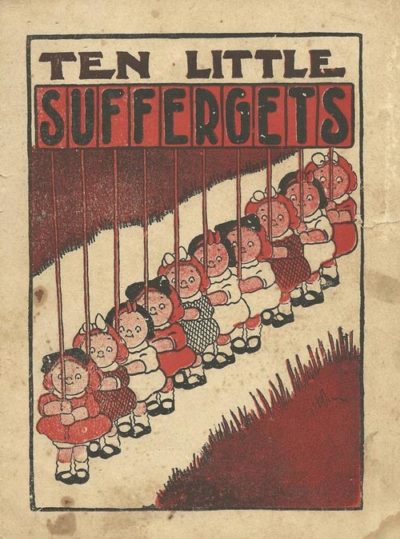
The early-20th-century children’s book Ten Little Suffergets (c.1910-1915) literally and figuratively illustrates the vitriol and violence often directed at the women’s suffrage movement and its participants. Based on the racist nursey rhyme “Ten Little Indians,” the book portrays suffrage activists as a group of spoiled young girls, carrying signs demanding such changes as “Cake Every Day,” “No More Spanking,” and “Down with Teachers” alongside “Equal Rights.” One by one the “suffergets” are either distracted by frivolous pursuits and abandon the cause or are violently removed from the march (such as by an angry father figure). The concluding image is of the final girl’s abandoned “dolly” (looking quite like the girl herself) with a cracked and broken head.
It’s possible in hindsight to see a now broadly accepted cause like women’s suffrage as being widely accepted and shared, as a significant political change that took time to achieve but without the kinds of hostile responses other such social movements have received. But in fact, across its more than half a century of existence, the American suffrage movement was quite the opposite: a profoundly radical and progressive idea that was subjected relentlessly to both rhetorical and actual attacks. Remembering those attacks always helps us consider the consistent courage of suffrage activists in facing such harassment and arguing for their cause, often in the most public places and ways.
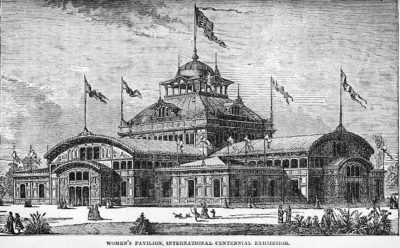
The July 4, 1876 protest at the Centennial Exposition in Philadelphia was one such occasion. For the first time at a World’s Fair, the Centennial included a separate Women’s Pavilion, a space in which to celebrate and share women’s identities, art and culture, and voices. Yet this impressive step was not without its limits, and one was the near-complete absence of any social or political issues — including the era’s most prominent such issue, suffrage — from the pavilion. Indeed, focusing more on domestic arts and crafts and housework, the Women’s Pavilion could be said to reinforce some of the most prominent arguments against women’s participation in the public and political spheres.
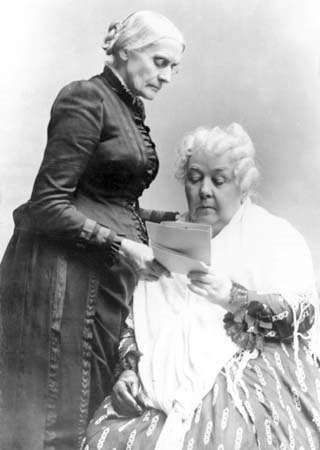
A group of suffrage activists, representing the National Woman Suffrage Association (NWSA), decided to highlight this exclusion and their cause at the Centennial’s most public occasion, the July 4th celebration. Led by Susan B. Anthony, the group erected a stage of their own not far from the celebration’s official platform, and there read aloud a “Declaration of Rights of the Women of the United States” (a revision and extension of the declaration produced at the 1848 Seneca Falls Woman’s Rights Convention). Before doing so, Anthony made clear the group’s willingness to confront their fellow Americans in this most public space, noting, “While the nation is buoyant with patriotism, and all hearts are attuned to praise, it is with sorrow we come to strike the one discordant note, on this 100th anniversary of our country’s birth.” Yet she added, “Our faith is firm and unwavering in the broad principles of human rights proclaimed in 1776, not only as abstract truths but as the cornerstones of a republic.”
Anthony, the NWSA, and their many colleagues continued to strike their discordant note and fight for the extension of those rights for the next four decades. Another very public moment of radical activism, and one met with particularly violent response, was the March 1913 Women’s Suffrage Parade. Held in Washington, DC, on the day before Woodrow Wilson’s inauguration, the parade represented the largest gathering of suffrage activists and allies in American history, with more than 5,000 participants marching down Pennsylvania Avenue.
The marchers were met with sustained hostility, not only from many in the crowd but also from at least some of the police officers tasked to protect the parade. Hundreds of marchers were seriously injured; according to one eyewitness testimony quoted in The Washington Post, two ambulances “came and went constantly for six hours, always impeded and at times actually opposed, so that doctor and driver literally had to fight their way to give succor to the injured.” Yet the marchers, led by prominent activist Alice Paul and attorney Inez Milholland (riding a white horse), persevered, completing their planned route from the Capitol to the Treasury building, and drew national attention to both their cause and the violent attacks upon it.
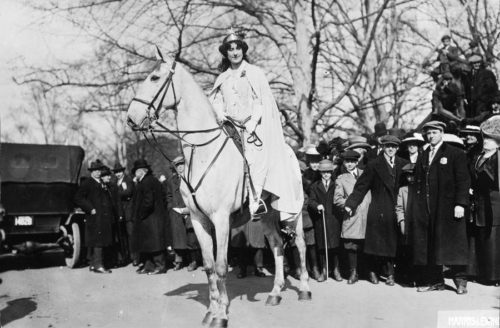
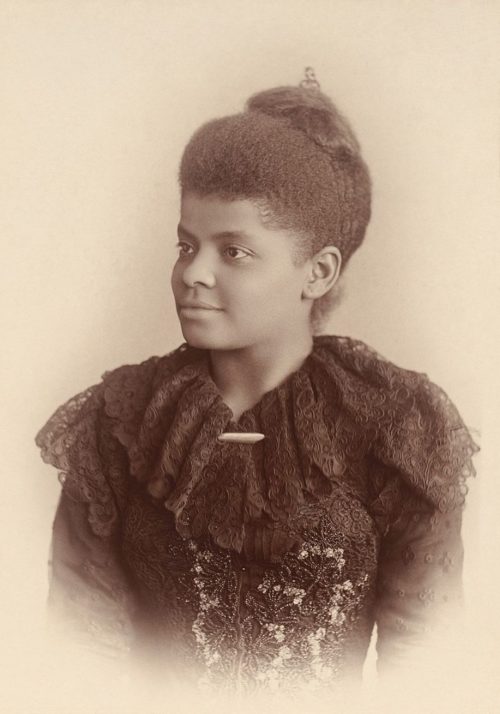
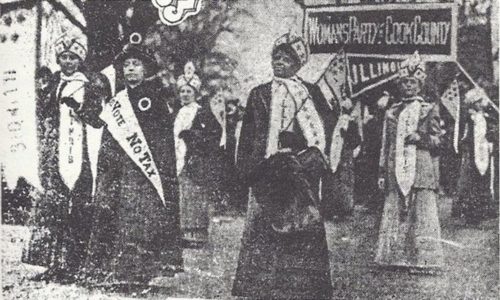
The parade also featured an internal discordant note that produced one more moment of radical courage. The organizers intended the march to be segregated, with a separate cohort of African-American suffrage activists bringing up the rear. The pioneering journalist, anti-lynching crusader, and women’s rights activist Ida B. Wells asked if she could march with the Illinois delegation in the main march, and was initially turned down. Yet Wells did not accept this answer and, with the aid of sympathetic allies, defied this racist division and joined the Illinois delegation as the march began. In so doing, Wells embodied one more moment of radical persistence in the face of contempt and exclusion, a historical lesson that the American suffrage movement offers consistently and crucially.
Con Watch: Getting Something for Nothing on Twitter
Steve Weisman is a lawyer, college professor, author, and one of the country’s leading experts in cybersecurity, identity theft, and scams. See Steve’s other Con Watch articles.
An estimated 157 million people use Twitter each day, so it isn’t surprising that scammers have used Twitter for years to perpetrate scams. The latest Twitter scam is both simple and ingenious.
The scam begins when a thief impersonates the Twitter account of a prominent person with a lot of Twitter followers. They will use an identical photo and choose a Twitter handle that looks similar to the real thing. For instance, Elon Musk’s legitimate handle, @elonmusk, was impersonated by someone using @elonlmusk (with an l). Someone glancing at the scammer’s tweet might not recognize that it is not the Twitter handle of Elon Musk.
In this case, the scammer tweeted, “I’m giving away 5,000 ETH to my followers! To pаrtiсipаte, just send 0.5-1 ETH to the address below and get 5-10 ETH back to the address you used for the transaction.” (ETH is an abbreviation of the cryptocurrency Ethereum.) Victims then send the cryptocurrency in an attempt to receive more in return. Obviously, the real Elon Musk isn’t involved and — surprise! — the victims never get their money.
Although Twitter is shutting down these scammers as soon as they become aware of them, the scams continue to proliferate because Twitter is always playing catch-up; it takes little time or effort for the scammers to start the scam again using the name of another celebrity.
Another version of this scam followed the Academy Awards. When Jordan Peele won the Oscar for best original screenplay, the real Peele tweeted, “I just won an Oscar. WTF?!” Immediately there was a response from the Twitter account @JordanPeele___ that read “Love you guys, heres a gift from me,” with a link to a gift card scam. Jordan Peele’s real Twitter account is “@JordanPeele” (without the underscores at the end), but it’s easy to see how someone not looking closely could mistake the tweet as being from the real Jordan Peele. (Although you would think that it might be a red flag that a tweet from someone who had just won a writing award would use proper punctuation and not write heres.)
Fake Elon Musk and Jordan Peele accounts are only two examples. Variations of the scam have targeted, among others, followers of cybersecurity expert John McAfee, cryptocurrency Ethereum founder Vitalik Buterin, Khloe Kardashian, and Ellen DeGeneres.
This scam is really just another incarnation of the Nigerian email scam. Elon Musk and other well-known people are not giving away large amounts of Bitcoin in return for paying them fewer Bitcoin, and celebrities are not handing out cash or gift cards. It is always dangerous to click on links in tweets, text messages, or emails unless you are absolutely sure that the link is legitimate. Clicking on the links may download malware, such as keystroke-logging software, that can steal all of the information from your phone, computer, or laptop and use that information to make you a victim of identity theft. Merely going to an infected website — even without clicking on anything in the tainted website — may cause you to unwittingly download malware.
How to Avoid This Twitter Scam
- Be aware that this type of scam exists. When responding to a tweet, make sure the tweet you’re responding to is actually from the real person who started the thread by carefully examining the Twitter handle.
- Understand that no one is giving you something for nothing or a lot for a little. While this seems to be common sense, too often our greed blinds us. It’s important to remember that if it looks too good to be true, it usually is.
- Security software is not just for your computer and laptop. You should install security software on all your electronic devices, including your smartphone, and keep that software updated with the latest security patches. But recognize that even the most current security software is always at least 30 days behind the latest versions of malware that exploit newly discovered vulnerabilities.
“The Vandal” by Arthur Heinemann
Margaret Wister paused, as always, before descending the sun-bleached wooden stairway to the beach, not to get her breath but to look about her. Her terry robe was as old as the bathing suit under it, but both were serviceable, and she was not about to charm anyone, not at her age. She was a sturdy, rectangular woman, with a rectangular face and a little bump of a nose, and eyes that reserved comment on what they saw.
A morning mist still hid the Connecticut shoreline, but Long Island Sound was blue and motionless, and two or three sails were sprinkled on it. The public beach was beginning to sprout bright umbrellas and a midweek scattering of mothers and children; their distant voices were like pleasant bird sounds on the wind.
On Margaret’s own beach, four empty beer cans gleamed at her. Beach wanderers occasionally left their droppings. She put up with them, for she was the oddity here, she and her brown-shingled cottage, leftovers from another generation. She picked the cans up, depositing them in her metal trash basket, and stepped over to the weathered beach cabin where she kept her blanket and beach chairs. Years ago the cabin had served as a guest cottage, but it was little more than a storeroom now, cluttered with dusty, rattan furniture.
She had left the cabin door closed, but not locked. It swung open at her touch now, then slammed back against her hand. There was a scurry of movement inside, and a voice said, “Damn it, hurry!” An astonished, primitive anger rose in her. Without thinking, she threw herself against the door. It fell open, and she stumbled in headlong, hitting the opposite wall. In the spinning dimness she saw a girl struggling with the straps of her bikini, a boy in swim trunks helping her. The boy turned, scrambling through the doorway; Margaret’s hand reached out in blind instinct and caught the girl’s ankle, tripping her, and for a moment they wrestled ludicrously. Then she felt herself being pulled away. She tried to hit at the boy who was pulling her, but his fist came at her, and she was down, tasting blood and feeling a swooning agony as the back of her head struck the wall.
The dizziness passed. When she could, she got to her feet and satisfied herself that she could stand and take a step. The face reflected in the wall mirror was that of a stranger: gray hair stringy and awry, eyes puffy, blood oozing over swollen lips. Outrage put every other thought out of her mind, and she pushed through the doorway. Her beach looked at her, innocently empty, as though no one on the pebbly sand had ever been caught up in violence — no one except herself.
She climbed painfully up the steps to the top of the bluff, up the path to her bright little garden, into the darkness of her shingled cottage where she telephoned for the police.
Naturally, Emma arrived just as the prowl car pulled away. That was perhaps two hours later.
Emma was her sister, eight years younger, a childish, chattering, good-hearted woman with orange hair and pink cheeks and a body too plump for its girlish dresses. She insisted on looking after Margaret as if Margaret were senile; and Margaret endured her with dry patience.
Emma said the obvious now, and kept on saying it. “What on earth have you done to your face?” and “What were the police doing here?” and “How dreadful!” Margaret held her patience and allowed Emma to be useful and drive her to her doctor’s and her dentist’s; and when she was satisfied that her face and her teeth were still properly in place, no matter how they felt, she let Emma drive her back home. Then she said she wanted a nap, and Emma left, after one last inanity: “You’re too old to live alone, Margaret; I’ve been telling you that for years.”
“Yes, you have,” said Margaret dryly. As soon as Emma was out of sight, she went down to the little beach cabin again.
The room was as she and the detective had left it, the image of frantic flight still on the tumbled rattan furniture. Without the faintest idea of what she might look for, she got down on her stiff knees and crawled and peered until her head hurt and her knees ached, and she mumbled to herself about her folly. And, in the midst of the familiar, she saw the unfamiliar.
It was a bit of wire, stiff, silverfish, less than two inches long, with clasps at its ends, shaped for a purpose. It lay on the floor, behind the table. She picked it up. As she stared at it, a memory crept out of her adolescence, a memory of discomfort and embarrassment and her mother’s voice saying: “You are not going to be ashamed of your teeth all your life, as I’ve been. You’ve got to wear them.”
Braces. Or were they called retainers now? Retainers were removable, braces fixed. It didn’t matter. She felt a sudden anguish of kinship with that girl in the bikini, and as if she were watching them she saw her and the boy in here again. The image blurred, and she was the girl herself, feeling the painful pressure of the braces as the boy kissed her, breaking away for a moment, turning so the boy could not see her fingers fumbling at the braces, slipping them out, putting them on the table behind her, and turning to the boy again, shyly and eagerly. How long ago? And then she and Timothy Wister had married, and she had put the braces away forever and could forget about them. But this boy wasn’t Tim. Tim was dead and buried, and she was an old woman, a widow for the past 25 years.
Awkwardly she got to her feet and wrapped the wire in her handkerchief. Her lips hurt. Half a century ago, she had mislaid her braces, and her father had raged at her, and she’d had to search the house and grounds for two days until she found them. They were expensive. You don’t throw that kind of money down the drain.
She went up to her cottage, into her bedroom, and put the bit of wire into her handkerchief case. Then, setting her alarm for seven in the evening, she gave in to weariness and slept.
By seven-thirty she was back in the cabin, sitting on the floor of the little curtained closet next to the front door. Her body hurt, but she made herself as comfortable as she could with pillows and a blanket, and waited. If she reached out, she could touch the door, and she would, later, when it became necessary to wedge it shut with the rubber doorstop. She did not know how long she might have to wait, or if her whole idea were foolish and futile. She was no detective; she was Margaret Wister, 68 years old, widow, retired nursery-school teacher, and she ought to know better.
The cabin smelled musty. Time, the vandal, had made his mischief with it. She dozed, and woke, and felt cramped, and almost did not hear the alien sound in the night.
There was a vertical crack at the doorway that suddenly widened, then narrowed again. Margaret heard the sound of breathing, shallow, shaking with fear. It was the girl. Margaret waited, compassionate and calm, listening to the whisper of hands searching wood surfaces. Her own hand ghosted out from the curtained closet and slipped the rubber wedge into place under the door. There was a fretful sniff of impatience, and the room glowed faintly. She could see the flashlight, the girl’s fingers covering its brightness, the reflection of it on the young face.
Margaret said, “You won’t find it.”
The girl gasped. The light swung wildly and went out, and there was a thudding, stumbling noise. The door stopped her; she wrestled with it, panting. Margaret got to her feet stiffly. “You can’t open it,” she said. “I’m not going to hurt you.”
“Get away from me!”
“I don’t intend to go near you.” Margaret’s hand found the floor lamp and turned it on. “I just want to have a look at you.” She had to blink in the brilliance. The girl cowered at the door, hiding her face. She was wearing dungaree shorts and a boy’s shirt. She was slim and long-haired and young — she couldn’t be more than 17 — and she was an animal in terror.
Margaret asked, “What’s your name?” She did not expect an answer. “You might as well tell me your name. I found your braces. I’m sure the police will be able to trace you through them.” She waited, patiently, because she was in full control.
“I didn’t do anything. I didn’t.”
“You broke into property that did not belong to you. You took part in an attack on me — ”
“I didn’t!”
“ — that might have had serious consequences. I don’t know what you and that boy were doing in here before I came in, but I’m sure it would distress your parents.” She made her voice more gentle, “I have no desire to get even with you or to punish you. If I had, I’d have given your braces to the police when I found them.”
“What are you going to do?”
“I haven’t made up my mind.”
The girl was facing her now. She could be a pretty thing, with her tanned face and huge eyes; she’d be beautiful in a few years, but she was thin and graceless now, and terror had made her ugly. “Please don’t tell anyone.”
“At the moment I don’t see why I should. What is your name?”
“Promise me you won’t tell anyone.”
“Don’t bargain.”
“Will you give me my braces back?”
“They’re of no use to me.”
The girl said, “I’m Mary Peterson.”
“Your name. Not someone else’s.” She waited.
“It’s Deedee.”
“Deedee what?”
The girl hesitated. “Warren.”
“What does Deedee stand for?”
“Diane.”
“And the boy’s name?”
The girl was silent.
“The boy’s name, Deedee. He was the one who hit me.” The girl blinked, and an impulse to smile tugged at Margaret’s lips. “You don’t want to betray him.” The loyalties of the young. She herself would have died on a flaming cross before giving Tim away. “Suppose I were to tell you that you can’t have your braces back unless you give me his name?”
No answer, of course.
Margaret said, “Come with me.”
“Why? What are you going to do?”
“We’re going up to my cottage,” said Margaret. She went to the door and pushed the wedge away with her toe.
“What for?”
“Because that’s where I have your braces. I’m giving you back your braces, Deedee Warren.”
“Is that all?”
“For the moment. But tell your friend I want to have a talk with him.”
“I’m sorry he hurt you,” Deedee said belatedly.
“Thank you,” said Margaret.
She went out into the star-speckled night, and Deedee followed her.
…
Next day she was furious with her body; every cell in it ached, and a feverish lassitude held her prisoner. She was the more furious because now Emma would insist on staying with her. Yet when Emma did arrive, Margaret was grateful. Emma said something about garbage on the front walk, which Margaret couldn’t figure out, and a timeless interval after that the doctor was at her bedside, poking at her and telling her that she was lucky not to have pneumonia. Whatever it was that he gave her put her to sleep. When she awoke the aching was gone, but Emma was not.
Emma was not gone until four days later, and when she went there was garbage on the front walk again: orange rinds, coffee grounds, wilted lettuce, plate scrapings. Emma said, “I didn’t want to upset you, but it’s been happening every day. I think you ought to call the police.”
Instead of the police Margaret telephoned every Warren she could find listed in the local book. There wasn’t a Deedee or a Diane among them. Finally, she telephoned her dentist and, pledging him to secrecy, gave him as accurate a description of the girl as she could. He did not have such an orthodontia patient himself, he told her, but he would check his colleagues in the area. By that time an odd kind of memory was tugging at her. She sat and waited for it to show itself.
There had been a child in one of her nursery-school classes, a thin, solemn-eyed little girl of four. “Does not participate in group activities,” Margaret had written of her. When the others sang, she would sit alone, cuddling a rag doll; when the others played with clay, she would be at the piano, touching the notes almost soundlessly, singing to herself. Her mother had been a pretty, fussy woman, somewhat deaf, forever busy with her prettiness. Deedee Williams. Of course.
Her dentist called her back then, to report that a colleague had mentioned a Deedee Williams. She lived on The Hill, in one of the rambling, landscaped monstrosities the developer had christened “estatelets.”
Deedee’s mother said that Deedee was visiting a friend in Nantucket and would not be back until next week. Margaret said she would telephone again.
She could wait.
On some mornings it was beer cans; on others, nothing at all. Twice it was broken glass. Margaret swept it up patiently and put it in the garbage can, wondering at the kind of boy who could do this. A normal one would have been bored with it after a day or so and stopped. There was a sickness here, and knowing that the sickness touched the child Deedee upset her.
That next week she went shopping in Manhattan, and boarded her return train at four-thirty. In the last car, which was air-conditioned, she saw Deedee sitting alone in a double seat. It was as if their meeting had been planned.
Margaret lowered herself into the empty seat beside the girl. “Deedee Williams,” she said. “Williams, not Warren. You should have known I’d find out.”
Deedee stared at her, not speaking, and Margaret wondered that she had not remembered the girl instantly; that four-year-old who stood alone looked at her from this girl’s face, and she wanted to touch the soft cheek as she used to. Instead she asked, “Did you enjoy Nantucket?”
Deedee’s eyes flickered. “How did you know?”
“I’ve learned a great deal about you.”
“How?”
“How doesn’t matter. You live on Larkspur Lane. Your father is an accountant and has an office in Manhattan on East 40th Street. Your mother’s a pretty woman, slightly deaf. You went to the Stony Hollow Nursery School when you were four years old, and one of your teachers was named Margaret Wister. Do you remember her?” She waited. “No, you don’t, do you? It’s the old who remember.”
“What do you want?”
“Don’t you know?” Silence. “He’s told you what he’s been doing, hasn’t he? He’s bragged to you about it. He’s been littering my front walk with garbage almost every day. Does he think he’s frightening me? Do you know?”
The girl seemed to shake her head; Margaret could not be sure.
“Well, what do you think of what he’s been doing?”
No answer.
“Don’t you have an opinion? If you didn’t have an opinion before, do you have one now?” Margaret smiled faintly in the silence. “I don’t give up easily, Deedee. I have 68 years of patience.”
The train rolled and rumbled, the conductor came and punched their tickets, and they sat in the cold breath of the air conditioner. Margaret asked, “Do you have a crush on him?”
Deedee looked away, and Margaret felt a pang of sympathy. “I’m an intrusive old woman, I know. But you two intruded into my life first. We have shared pain and fear and anger, and one of us is going to hurt the other two very badly if this doesn’t stop. Do you know that?”
Silence. Margaret tried another tack. “What’s he like? He’s bright, isn’t he?”
“Yes.” It was a whisper.
“Older than you?”
“Yes.”
“Attractive? Naturally. He seemed tall, though I really couldn’t take the time to measure him. Well built. Muscular.” She touched her jaw. “Does he go to college?”
“He quit last spring.”
“Why?”
“He said it bored him.”
“What’s he been doing since then? Has he a job?”
“I don’t see why you have to know all that.”
“All right. We won’t answer that one. You’re . . . 17, aren’t you? Seventeen and in love, and he’s . . . 20. He is, isn’t he?”
A nod answered her. “Deedee, don’t you have any opinion about the actions of a bright 20-year-old who day after day dumps garbage on an old woman’s front walk?”
The girl asked, “How do you know he’s the one?”
“You’ll admit I have reason to suspect.”
“You can’t prove it.”
“Don’t challenge me, Deedee; we should be honest with each other.”
“What do you want, anyway?” It was almost a cry.
“For one thing, I want him to stop.”
“What do you expect me to do about it?”
“Can’t you get him to stop?” There was no answer. The girl was retreating from her. Margaret tried to reach her, knowing all at once what was under her turmoil. “He won’t listen to you, is that it? And it hurts?” It was the wrong remark, the worst she could have made; they were as far apart as age and anguish could separate them.
Margaret said, “I wore braces on my teeth when I was your age. I know what it’s like. That’s a silly reason for not wanting to see you hurt, isn’t it?”
They were pulling into their station. People were standing in the aisle. Almost desperately Margaret said, “I’m 68 years old, Deedee. At my age one knows how little time is given us. We shouldn’t throw it away.” Deedee pushed past her, and Margaret let her.
“You don’t know what I mean, do you?” Margaret asked, but it was to herself, for Deedee was swallowed in the crowd. “Or care, either.”
There was nothing to sweep up the next day, or the day after that, or the week following. It gave Margaret a strange feeling, for she did not know whether she had won or lost. It was an anticlimax; there was nothing in her life but the absence of annoyance. Deedee became merely a silly teenager with a crush, and the boy was an offstage villain afraid to show his face, hardly worth a hiss. So she weeded her garden and had her daily swim, and the intruding presence remained at the edges of her property, not even growling at her any longer.
On a bright morning in August she opened her front door, picked up her bottle of milk, and saw the package on the step; a shoebox, inexpertly covered with imitation wood-grain paper. A prickling started in her shoulders. She put a hand out cautiously and lifted the cover. Inside, bedded in cotton, as if bedded in a coffin, lay a dead squirrel.
After a while she took it to her refuse can, feeling only a kind of distaste, but when she went into her bedroom to telephone Deedee, a dizziness took hold of her and spun her violently. Then her kettle, boiling away for coffee in the kitchen, began to whistle. She put the telephone down and started over to silence it.
How it happened, she did not know. Perhaps the leg of a chair tripped her. She found herself on the floor, sprawled like a great dummy, gasping for breath, with her left hand twisted beneath her. The kettle screamed at her, and she tried to push herself up, to free the hand, but pain raced up her arm, and she collapsed, for a moment thinking the kettle’s scream was hers.
She could see that her hand was broken. So she sat on the floor, trying to discipline her racing thoughts. The most upsetting was of Emma, back here again, carrying a tray of goodies to the sickbed. After a bit, Margaret got to her feet again, shut off the kettle, went back to the bedroom telephone, and dialed her doctor.
She had plenty of time to think during the rest of the day. In the late afternoon, with her hand like a plaster baby dangling in its sling, she made two calls: one to the woman who did her heavy cleaning, who assured Margaret that she would come over and take care of her; and the other to a woman at the real-estate office, who for some years had been after her to sell her property. The real-estate woman was there in 20 minutes, and 10 minutes after that a FOR SALE sign grew out of the front lawn like an invading weed.
At dusk Margaret settled at her kitchen table with pad and pencil, and started methodically listing every possession she had, from china, Mother’s Spode, to bed linen. After some items she wrote “Keep,” after others, “Sell,” or “Salvation Army,” or “Ask Emma.” It was astonishing how many things one old, unsentimental determinedly practical woman could accumulate, and how many memories they stirred.
At eight-thirty the doorbell sounded. For a moment she did not recognize the girl outside. “Deedee?” she asked, as if from another century.
“May I come in?” Deedee asked, and Margaret stepped back automatically.
The girl stared at her cast-encased arm, and Margaret said,” Don’t mind this. I did something foolish this morning.”
“I saw your sign,” Deedee said, standing there in the hall.
“What sign?”
“For sale.”
“Don’t tell me you want to buy it,” Margaret said.
“No.” Deedee hesitated, and then her words tumbled out. “You don’t have to, Mrs. Wister. He won’t do it anymore. Honestly he won’t. He won’t ever.” Her young face was splotched, and Margaret could see that she had been crying.
“The squirrel,” Margaret said after a while. “He told you about it.”
“Yes.”
“So when you saw my sign you assumed I was selling because — “
“You don’t have to. He promised me he’d never do anything like that again. Never.”
It was hard for Margaret to gather her thoughts. She said, “Come inside,” and “Sit down,” and “Can I get you something?” The girl sat on the edge of a chair as if she might scoot off any minute. Margaret lowered herself to the sofa opposite, looking at the lovely, unhappy face, and a wave of emotion rose in her. She thought, Deedee did this for me, and, disciplining her voice to dryness, she said, “I appreciate this, Deedee.”
The girl shrugged.
“But I’m not selling because of what he’s done to me. I discovered this morning that I’m an old woman and shouldn’t live alone. Not in a house like this.” She added irrelevantly, “My sister wants me to live with her, but I’ll probably take an apartment in town.”
“Oh.” Deedee seemed at a loss, and moved as if to get up. “Well, I guess — ”
Margaret cut her short; she could not let the girl go, not yet. “I’m grateful to you anyway. It’ll be a while before I can move out, and I’d be just as pleased not to have more such gifts from him.” She hesitated, and added, “It must have been difficult for you.”
Again the shrug.
“Apparently both of us made painful discoveries this morning.”
“What?”
“It’s hard, when liking doesn’t go along with loving.”
A flush had risen on Deedee’s face. “He isn’t . . .” she started to say, and repeated, “He isn’t . . .” and she could not say what he wasn’t.
“Bad? Wicked?” Margaret offered her. “I’m sure he isn’t totally. But you wouldn’t be here if you thought nothing was wrong with him. You don’t like what he’s done. You don’t like what it means. Do you?” She made her voice gentle. She wished she had the girl next to her, so her hand could comfort her.
Deedee sat, unable to answer.
“Has he ever told you why he did these things?”
Silence.
“Deedee, has he? I must know.”
It was a mumble, and she had to strain to hear it. “He said, for laughs.”
“Oh, child . . .”
“He hasn’t hurt anyone. When he hit you, he didn’t mean it. It was an accident. It was — ”
“I was there.”
“He hasn’t done anything else. Honestly he hasn’t. And he promised he’d stop.”
“What makes you think he’ll keep this promise?”
“He will.” The girl moved as if to avoid the question, and stood up with awkward defiance. “I just came here to tell you you didn’t have to sell. I didn’t come for a lecture.”
“Deedee, I know I have no right to interfere
“Then don’t!” The girl headed for the door, and Margaret rose, helplessly, wanting to say “No,” and “I don’t want you to get hurt,” but the cry had gone unheard before, and it would now. So she said, almost in surrender, “I’m still grateful to you.”
The door resisted Deedee, then yielded, and she went out into the darkness. Margaret heard her gasp, and panic took hold of her. She almost tripped, hurrying to see. She knew it was the boy looming in the darkness out there. “You,” she said, and anger swept the panic off. “You!” Recklessly, she went out onto the porch. “Show your face. Come here where I can see you.”
“Okay,” he said, and came toward her, so tall and overpowering that she had to step back, in spite of herself, into the light and safety of the hall. He followed her in, with Deedee, looking frightened, behind him.
“Here I am,” he said, smiling. His face was beautiful, with features that belonged in marble. Bright eyes glinted through a heavy fringe of lashes, and a ruddy tan gave the semblance of health, as if there were no sickness there, ever. He was wearing a torn, dirty white shirt that gaped open over his chest, and torn, dirty shorts. His tanned legs were naked down to his sneakers, and those soiled things were his image rather than that beautiful face and that beautiful body.
Margaret found her voice again. “What were you doing out there?”
“Waiting for Deedee.”
“What else?”
“Nothing.” He smiled, enjoying something neither she nor Deedee could see.
“Deedee, would you mind looking?” When the girl had gone, she asked, “What’s your name?”
“Dwight Hunter. My friends call me Ricky.”
“Dwight Hunter.” She knew the name, one of the old families living on one of the last estates in the area. There had been something about the father — alcoholism, something. Deedee was back. “Is he telling the truth? Is he Dwight Hunter?”
The girl nodded. “There wasn’t anything out there.”
“Your father’s name was Dwight.” She remembered now: a suicide, and stories in the tabloids before. Everything has its roots somewhere, she thought. He smiled at her and said, “Yes, ma’am, he shot himself,” as if he had read the memory in her mind.
“I suppose you’re proud of what you’ve done.”
“Would you like me to apologize for it, ma’am?”
“Apologize?” Her voice was sharp; she felt goaded. “Do you think an apology can cover it?”
“What else would you like me to do?”
Everything was wrong. He smiled too much; he was too much the wholesome, charming boy deferring to her age and sex; he was playing the part and enjoying it because he controlled the situation. The smiles, the agreeable acceptance of anything she might say would go on and on, meaning nothing. In frustration she said, “Nothing. Just go. Go! And stay away from me.”
And stay away from Deedee, she wanted to say, and couldn’t. She glanced at the girl; Deedee was staring at him as if she could see nothing else.
“Okay.” He put a hand out, and Deedee took it. They went out together, leaving Margaret alone, weighed down by the cast on her arm, weighed down by her years, by defeat.
Outside, Deedee’s voice said, “Ricky, don’t,” and the boy laughed, and Deedee said, “don’t, don’t, please don’t!” Margaret wrenched open the door with her good hand. Something on the door swung loosely toward her. She saw the boy’s laughing face and Deedee frozen behind him, as she tried to reach whatever it was that hung on her door. It was black; it was loosely tied to the door knocker, and hung limp, somber, funereal. Crape. Funeral crape on her door.
The boy said, “I thought you might need it, grandma. Come on, Deedee.” He reached for Deedee’s hand, laughing, backing away. “I bet you’re going to make trouble for me now, aren’t you, grandma?” His hand tried to seize Deedee’s, but she had shrunk away from him. “Come on, Deedee.”
“No.”
“Come on, I said. I’m not waiting.”
“No.”
“Okay.” He turned without another glance at her, and went off, and after a moment his laugh floated back on the breeze.
They watched until nothing was left of him in the darkness. Then Margaret, one-handed and with gnarled fingers, tried to untie the crape. She felt Deedee beside her, and let her take it down.
“What’ll I do with it?” Deedee asked.
“I’ll put it in the garbage later,” Margaret said. “Do you have any idea where he got it?”
“No.”
“It doesn’t matter.”
The girl’s eyes were huge, but she was not crying. What had happened was beyond crying over. Margaret put her good arm around the girl and guided her back into the living room. They sat on the sofa, and Deedee looked at Margaret and said, “I’m sorry.”
For once Margaret could not speak. She patted the girl’s shoulder, and smiled and nodded and kept her lips shut. She had won, she thought, without triumph, without joy; the boy had won her battle for her, throwing his own cause away, and he didn’t care. He didn’t care. It’s for the best, she thought, but she must never, never say that to Deedee. Deedee would realize it someday, and probably knew it now, without accepting it.
“I think we could both do with a cup of tea,” Margaret said, in as matter-of-fact a voice as she could. The matter of fact would heal Deedee’s wounds as it had always healed her own. Part from your love, sell your home, say goodbye to possessions dusty with memories, and the familiar routine of living will form scar tissue for you.
She picked her way carefully into the kitchen and took up the kettle, and as she filled it she remembered suddenly that only that morning it had screamed and screamed at her.
A Low Blow for High Brow
Stars and critics from the world over have gathered in Hi-Brough, Nebraska for the municipality’s first annual international film festival. The exclusive week-long event has opened its screenings and discussions only to world-renowned film professionals as well as the town’s 571 residents. The amateur critics have weighed in on this year’s selections.
White Is the Luckiest Color (Turkmenistan)
Ashgabat Tourist Center and TurkmenOil collaborated to produce this glowing documentary of Turkmen president and protector, Gurbanguly Berdimuhamedov. The former vice president — who was thrice elected by 97 percent of his constituents — loves the lucky color white, and you will too if you want to travel to Turkmenistan. President Berdimuhamedov’s skeptics have criticized his decision to ban dark-colored automobiles in the capital “City of White Marble,” but this state-sponsored documentary dives into the undeniable power of light colors to bring about wealth and prosperity to the Turkmen people. With stunning, cinematic views of the Kopet Dag mountains and the 65-foot-tall golden statue of President Berdimuhamedov, White Is the Luckiest Color will compel you to book a flight to Ashgabat and drive the whitest car you can find around the marble city, as long as you aren’t a woman.
Hattie Wood (stay-at-home mom): “I had no idea that Turkmenistan’s president invented natural gas extraction, dentistry, and the internet. Maybe we should think about implementing a color-based car ban here.”
An Orchid Is Not an Ending (France)
The Chevrolet household is turned upside down when the enigmatic stranger Jean-Baptiste arrives at their countryside goat farm. Prolonged scenes of silent family breakfasts are interrupted by passionate drama in this sharp contender for the festival’s coveted Palme d’Corn. Intimate portrayals of lovemaking abound in An Orchid Is Not an Ending as the mysterious traveler beds each member of the Chevrolet family without uttering a single mot. In dazzling hi-definition, the film’s iconic final scene statically observes the rural French family sharing a brunch of baguette, fromage, and Chenin Blanc for a harrowing 47 minutes — even longer than the (rumored to be real) depictions of intercourse.
Donna Claiborne (agricultural contractor): “What happened to the goats? They have to be milked every day. These people supposedly run a dairy farm, but you don’t once see them milking their does.”
Dale Johnson (semi-truck operator): “It was good.”
Mighty Jurij (Slovenia)
Born from the tremendously popular comic book series, Mighty Jurij is the first animated adaptation of Slovenia’s favorite badger superhero. Of course, the comic reached its height of popularity in 1976, so younger audiences might be puzzled at Jurij’s glaring communist overtones. In this feature-length film that Ljubljana Magazine called “a startlingly graphic depiction of revolt that leaves little to the imagination in the way of global politics,” Jurij contends with a monocle-sporting dragon trying to return its hoard of gold to the people of the kingdom and convince workers to settle for a sort of market socialism.
Jennifer Meier (convenience store cashier): “The movie was cute, but now my daughter is begging me to buy her a plush toy of Jurij’s sidekick, Proletariat Pigeon.”
Love Like Ice (Sweden)
“You’ve never seen virtual reality like this before!” claimed one critic after experiencing the world premiere of this devastating Scandinavian eco-romance. Audiences are besieged with three and a half hours of immersion into the stark world of Lukas, the film’s 87-year-old protagonist, as he ambles the Swedish tundra in desperate — yet arbitrary — search of something he lost long ago. Something mysterious and immaterial. Something he can never find, despite the omnipresence of a bodiless female voice that whispers to Lukas (and the audience) nihilistic suggestions of suicide.
Jeannie Fritz (accountant): “The voice represents God, I think. Or maybe Satan. The virtual reality helmet gave me a headache.”
Beau Clyde (local business owner): “He’s on an island. That’s the twist at the end.”
Too Rich to Fail (United States)
Pop sensation Katy Perry makes her directorial debut in this zany, will-they-won’t-they comedy about an on-again, off-again, on-again wedding between two middle-aged executive types played by Neve Campbell and up-and-coming actor Kirk Cameron. She’s a bigwig financial consultant, he’s a straight-talking COO at the biggest marketing firm in town. The only problem? They’re entirely incompatible romantically.
Leon Walsh (electrician): “I preferred the Swedish movie to this one, and that’s saying something.”
Read Jeff Brown’s “High Art at Pike’s Peak” from 1968.
The Art of the Post: The Challenge of Illustrating the Earliest Cars
Read all of art critic David Apatoff’s columns here.
The artists of the Saturday Evening Post were sometimes called upon to paint brand-new subjects that had never been painted by traditional artists.
Most of the Post’s illustrators were formally trained in perspective, anatomy, and the other technical skills of art. They learned to paint portraits and landscapes and bowls of fruit. But painting for a weekly periodical is not the same as painting for a gallery or museum. During the long domain of the Post, new inventions such as the radio, airplanes, refrigerators, and televisions were introduced as important phenomena in the daily lives of Americans. When they debuted, they had to be illustrated for the pages of the Post.
This 1929 painting by artist Walter Biggs suggested that the most elegant black-tie parties would benefit from having a Frigidaire-brand refrigerator in the living room so the guests could have ice cubes in their drinks:

There were no paintings by old masters to serve as models for these modern illustrations. Rembrandt never painted a skyscraper or an electric fan. The Post’s artists had to make it up as they went along. Painting the physical object was difficult enough, but the real challenge was to anticipate the cultural significance of the new inventions. What role would they serve? How should they be portrayed?
There’s no better example of this than the early illustrations of cars. It was clear from the very beginning that every family would want a car.
This 1925 illustration by artist M. Leone Bracker depicts a family on their front porch enviously watching their neighbors’ cars drive by. They are stranded, staring while their neighbors have been freed by their automobiles to go “everywhere.”


Before the public had figured out the best ways to use this strange new invention, or even how they preferred it to look, illustrators for the first car ads had to decide on the best way to portray cars.
Some artists tried to relate cars to classical mythology, depicting gods of speed or flight.

Other artists linked the automobile to modern art and design, which was born around the same time as cars.

Illustrator E. Everett Henry (1893-1961) painted this early car in an idealized, art deco style for the May 29, 1926 issue of the Post. Thirty years later when people understood cars better, Henry would illustrate a car as a commonplace everyday nuisance, driving too fast through family neighborhoods.
Some illustrators tried to have it both ways, portraying cars as an invention for both the city and the country markets.

Of course, artists through the ages have always been able to promote products by placing an attractive woman in front of them, even if she has no connection to the product itself:


For a brief period, the Dodge Brothers Company apparently believed the best way to advertise cars was to show paintings of their “mohair velvet upholstery,” which was supposedly comfortable to sit on while watching parades. This campaign did not last long.

A wide variety of artistic talents tried their hand at creating the visual identity of cars. Some of the top illustrators in America who illustrated covers for the Post and other magazines would also paint ads for the auto manufacturers.
In the following picture, an unknown illustrator has left out all the details, giving us just a simplified suggestion of a car. By only implying what the car will do, he leaves it up to his audience to fill in all the details in their minds and imagine how great their new car will be:

In the next example, the illustrator Major Felten (1904-1975) treads very carefully, drawing the car objectively with a light, realistic line. Felten became well known for his bold, exciting paintings of jungle cats and savage warriors, which he created with a heavily stylized look. By comparison this plain vanilla illustration looks timorous, as if he hasn’t quite figured out what to make of this new invention.

Note how many different car companies flourished in those early years as designers and manufacturers experimented with how the new invention should look and function. At the same time, creative artists were offering many different approaches to artistic interpretations of the automobile, giving us this diverse collection of creative pictures. While the artists’ impressions of a car have changed dramatically in the last hundred years, we can still see in these early efforts the same factors that motivate car buyers today— status, luxury, safety, comfort, value, beauty, and good old Fear of Missing Out.
Your Weekly Checkup: Smoking Is Even Worse for You Than You Thought
“Your Weekly Checkup” is our online column by Dr. Douglas Zipes, an internationally acclaimed cardiologist, professor, author, inventor, and authority on pacing and electrophysiology. Dr. Zipes is also a contributor to The Saturday Evening Post print magazine. Subscribe to receive thoughtful articles, new fiction, health and wellness advice, and gems from our archive.
Order Dr. Zipes’ new book, Damn the Naysayers: A Doctor’s Memoir.
I smoked cigarettes for about two years during college and medical school (1960-62) but quit after I attended the autopsy of a smoker who died from cancer of the lung. It was gruesome. I smoked a pipe for another 4 or 5 years and then quit, smoking nothing for the last 50+ years.
A recent study has confirmed the wisdom of stopping smoking. This National Longitudinal Mortality Study (NLMS) followed 357,420 participants from 1985 to 2011. It showed that cigar, pipe, and cigarette use significantly elevated the risk of tobacco-related cancer mortality, as well mortality from most other examined causes of death. Mortality was higher even among nondaily current cigarette users. While increased mortality from cigarette smoking is well known, NLMS established that cigar and pipe smokers were also vulnerable, though the mortality risks for daily pipe and cigar smokers were lower than for daily cigarette smokers.
Sadly, use of combustible tobacco products, including cigars, pipes, and cigarettes, continues to represent the leading cause of preventable deaths in the United States. Most smokers become addicted during their youth. In 2014, the Surgeon General estimated that cigarette smoking caused approximately 480,000 deaths annually.
The Food and Drug Administration, recognizing the addicting power of nicotine, hopes to reduce the number of U.S. smoking deaths by proposing a limit of 0.4 milligrams of nicotine per gram of tobacco, about a 97 percent reduction from present levels. Using simulation models, experts estimated this would cause approximately 5 million smokers to quit in the year after policy implementation. That number would increase to 13 million within five years and would continue to grow because of sustained increases in cessation and decreases in smoking initiation. Unpredictable consequences include whether smokers would smoke more to compensate for the loss of nicotine, would seek other sources of nicotine, and whether black market high-nicotine cigarettes would appear.
The take home message is obvious: quit smoking, whether it is a cigarette, cigar, or pipe. It may be the toughest battle you’ll ever fight, but the rewards are well worth it. And don’t resort to e-cigarettes. More about them next week.
Go Fund Yourself!
What monsters we have created by teaching our children they are geniuses whose every whim should be indulged. Now that they’ve grown, instead of trying to find jobs, these young visionaries are off pursuing projects ranging from altruistic to narcissistic, with most tilting toward the latter.
In the past year alone, I’ve gotten half a dozen requests to finance various whimsical (and decidedly noncommercial) projects on GoFundMe and Kickstarter. One was from a woman who, after completing graduate studies in dance, wanted money to open her own dance school. Then there was the request from a man who, after five years of fruitless struggle to make it as a writer in Hollywood, wanted money to make his own movie. Against my better instincts, I chipped in for this. Needless to say, it won’t be coming to a theater near you anytime soon.
The artist girlfriend of a young musician wanted funding for “a meditation on the life and creative process of a variety of self-taught Spanish artists.” I passed on that one, but she must have been somewhat successful in passing the hat because, shortly after, the musician himself joined in the alms-brigade. His band had made a record and needed money for “mixing and vinyl.”
I’m down with supporting the arts and all, plus the kid is good. But what happened to his parents’ checkbook? Pen run out of ink? Plenty of friends from my generation graduated from fancy private colleges majoring in pottery (as my uncle used to say). Some leaned on their parents to support their art. No one I knew went door to door with his hand out.
Probably the most selfless request I got this year came from a graduate student in women’s studies who was raising money to create fellowships for an international assembly of “youth voices rethinking the war on drugs.” That one at least sounds worthy on paper, but aren’t there grants for that kind of thing?
There are jobs for people who want to be artists. Jobs that allow you to earn the money to follow your dream. What’s wrong with being a waiter or bartender? Or driving for Uber? Somewhere near the intersection of parental leniency and digital expedience, we have created a world where too many young people feel they don’t have to earn their keep the old-fashioned way…or any way at all. Maybe instead of always telling our adult children “Good job!” as if they’re toddlers taking their first steps, it’s time to be hard-nosed and say, “Get a job!” Unless you want to be a professional fundraiser, passing the hat on the internet isn’t a career with a future.
*“Contrariwise,” continued Tweedledee, “if it was so, it might be; and if it were so, it would be; but as it isn’t, it ain’t. That’s logic.”
—Through the Looking Glass, Lewis Carroll
This article is featured in the March/April 2018 issue of The Saturday Evening Post. Subscribe to the magazine for more art, inspiring stories, fiction, humor, and features from our archives.
Francis Drake’s Golden Plate and the Hoax that Backfired

Sometimes a hoax can work too well.
A deception can be so believable, and swallowed so completely, that its victims never catch on. The joke remains without a punchline, and the pranksters never get to see that look on their target’s face when he realizes he’s been duped.
The Drake plate is a good example. What was intended to be a hoax for a friend worked so well that it wasn’t revealed for over 30 years.
The hoax was based on an actual event in 1579, when Sir Francis Drake and his crew sailed up the western coast of South America, plundering Spanish settlements. Somewhere along the northern California coast, he found a safe harbor where he stopped to replenish and repair his ship, the Golden Hind.
After befriending the local people, his crew erected a brass plaque to mark his landing and to claim the land for England. As a measure of authenticity, the plaque held an English sixpence that bore Queen Elizabeth’s image.
Drake never stated publicly where he’d landed, but it is generally believed it was in an area north of San Francisco now called Drake’s Bay.
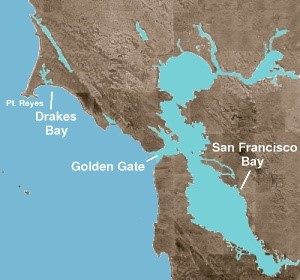

In 1933, a man found an ancient-looking brass plaque in that area. He held onto it, but later threw it away on the highway near Marin, California.
A shop clerk named Beryle Shinn found the same plaque while picnicking in the region in 1936. He took it to Professor Herbert Bolton, a history professor at the University of California, Berkeley.
Bolton had long hoped to find the plate. Each semester, he would ask his students to remain on the lookout for the famous brass plate.
Bolton was excited by Shinn’s discovery, which had a rough hole that about the size of a 16th century English sixpence. After purchasing it, he announced its discovery at the California Historical Society.
Not everyone was convinced. Several historians offered reasons why it couldn’t be authentic. In response, Bolton sent the plate to metallurgic specialists at Columbia College. They studied it and declared it to be consistent with 16th century brass. The brass had not been rolled, like modern brass, but had been hammered and then cut by a chisel. They believed the amount of impurities in the brass and its patina could not have been faked. The plate, they said, was authentic.

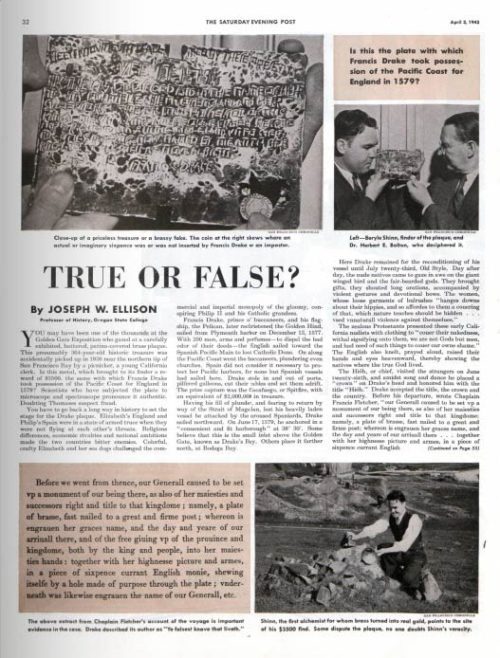
And yet there were doubters. In an April 3, 1943, article, “True or False?,” the Post offered several arguments from skeptics, who took issue with the plate’s lettering, spelling, and general appearance. But the plate was generally accepted as genuine and UC Berkeley’s Bancroft Library proudly kept it on permanent display.
There the matter rested for 40 years, until the 400th anniversary of Drake’s landing. That year, art historians at Oxford studied the plate with more advanced technology than was available in the 1930s. They concluded the brass was made using a 20th century technique. Also, it didn’t show the hammering expected in 16th century brass. And the brass was too pure to have been made over 300 years earlier.
Once the plate was recognized as fake, the marks of deception — the misspellings, the curious wording, the wrong title for Queen Elizabeth — became obvious.
Then, in 2002, four researchers offered an explanation of what lay behind the now-discredited plate. In old age, the conspirators admitted the truth of their misfired prank and let slip the details of how it was perpetrated.
It was simply a joke that got out of hand. It had been dreamed up by members of a group who regularly got together to drink and talk California history. They thought it would be amusing to see Professor Bolton, a fellow member, taken in by a forgery of his much desired plate.
So they bought a brass plate at a shipyard and cut it into shape with modern shears. One of the conspirators, George Clark, hammered the letters into the plate and included a “CG” before Drake’s name. Bolton believed it stood for “captain general” but actually they were Clark’s initials in reverse.
The jokers had planted the plate in late 1933 near Drake’s Bay. After it was recovered three years later, Bolton had quickly announced the plate was genuine.
They tried to remedy his mistake, but the joke had gone too far to alert Bolton without making him look foolish to the academic community. They tried pointing out the plate’s errors to him. One of them wrote a parody that detailed how a fake, historic, brass plate — just like the Drake plate — could have been made. Another prankster created a copy of the plate, with satirical text, to show how easily it could be made.
But any doubts Professor Bolton might have had were put to rest with the (now discredited) electrochemical analysis that had been provided by Columbia.
Rather than being publicly duped, Professor Bolton died in 1953 believing he’d achieved his great academic dream of recovering the Sir Francis Drake’s brass plate. And all the pranksters passed away without telling anyone how their joke backfired on them.
Featured image: Shutterstock
Building Better Roads to Save Lives
 This article and other features about the golden era of American cars can be found in the Post’s Special Collector’s Edition, American Cars: 1940s, ’50s & ’60s.
It took vision (and money) to replace the network of narrow, unsafe roadways originally designed for horse-and-buggy travel with the wide, safe concrete thoroughfares we take for granted today.
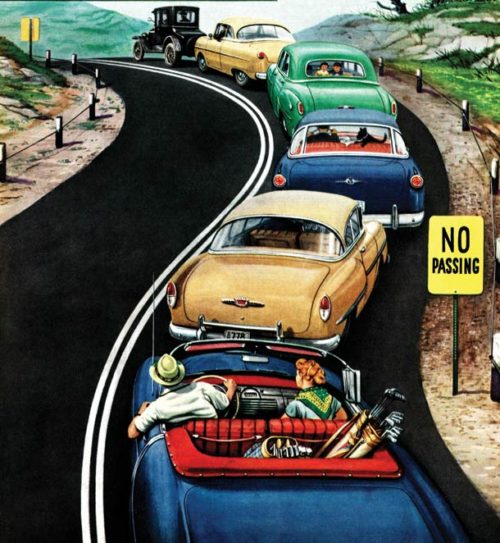
Stevan Dohanos
October 9, 1954
(© SEPS)
—Originally published January 6, 1940—
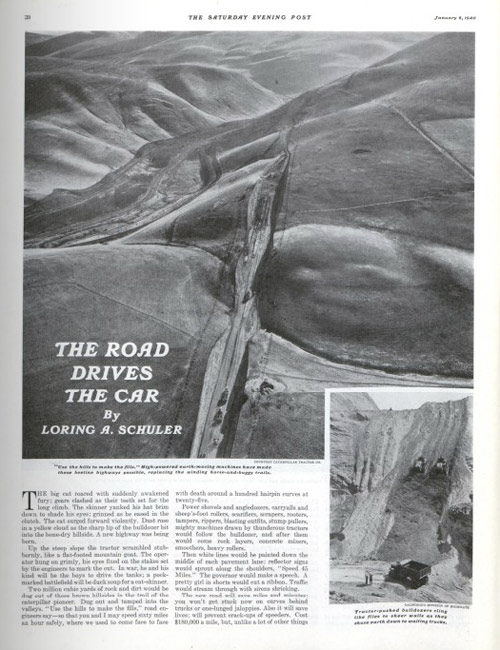
The big cat roared with suddenly awakened fury; gears clashed as their teeth set for the long climb. The skinner yanked his hat brim down to shade his eyes; grinned as he eased in the clutch. The cat surged forward violently. Dust rose in a yellow cloud as the sharp lip of the bulldozer bit into the bone-dry hillside. A new highway was being born.
Up the steep slope the tractor scrambled stubbornly, like a flat-footed mountain goat. The operator hung on grimly, his eyes fixed on the stakes set by the engineers to mark the cut. In war, he and his kind will be the boys to drive the tanks; a pockmarked battlefield will be duck soup for a cat-skinner.
Two million cubic yards of rock and dirt would be dug out of those brown hillsides in the trail of the caterpillar pioneer. Dug out and tamped into the valleys. “Use the hills to make the fills,” road engineers say — so that you and I may speed 60 miles an hour safely, where we used to come face to face with death around a hundred hairpin curves at 25.
Power shovels and angle-dozers, carryalls and sheep’s-foot rollers, scarifiers, scrapers, rooters, tampers, rippers, blasting outfits, stump pullers, mighty machines drawn by thunderous tractors would follow the bulldozer, and after them would come rock layers, concrete mixers, smoothers, heavy rollers.
Then white lines would be painted down the middle of each pavement lane; reflector signs would sprout along the shoulders, “Speed 45 Miles.” The governor would make a speech. A pretty girl in shorts would cut a ribbon. Traffic would stream through with sirens shrieking.
The new road will save miles and minutes; you won’t get stuck now on curves behind trucks or one-lunged jalopies. Also it will save lives, will prevent crack-ups of speeders. Cost $180,000 a mile, but, unlike a lot of other things in government, it’s paid for, and before it was built, engineers had figured how much revenue it would bring in to build more of the same kind. That’s where your gasoline tax goes.
The gas tax is beginning to buy more than asphalt and concrete. On newer roads it is a form of accident and life insurance, which doesn’t pay for death but pays you dividends in life and limb. “Our job,” road builders say, “is to provide a transportation system that the reasonably careful driver can use at 60 miles or more an hour in safety and in comfort and without surprise.”
And so they’re building automatic highways, which swing you safely round curves without slackening speed, give you ample room to pass trucks without danger of sideswiping, warn you by prepared condition of the pavement to get back on your side of the road, steer you through an intersection maze with neither words nor music from the traffic cops.
Out on the Mojave Desert, where summer heat is so intense that motorists travel at night and travel fast, cars constantly ran off a certain curve and wrecked themselves. The road was wide enough; the pavement was good; sight distance was without obstruction. Yet drivers couldn’t stick to the highway round that bend.
California’s safety engineer, J.W. Vickrey, studied, pondered, measured, found that the superelevation had been built to hold cars on that curve at 45. He had it rebuilt, banked for 75-mile speed. The accidents stopped.
“Not very cooperative with the highway patrol,” someone commented.
“We’re trying to save lives,” Vickrey retorted. “If the police think they can stop speeding out there by arrests, they’re welcome to try. We are realists.”
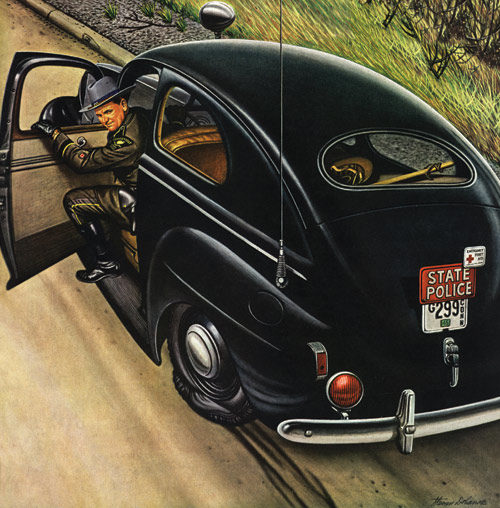
Stevan Dohanos
March 24, 1945
(© SEPS)
Safety without Slogans
Briefly, that tells the story of the newest highway-safety campaign. It is very young. It has no slogans. It is seeking no publicity — no billboards, no write-ups in the papers, no horror pictures of death and disaster. It doesn’t even ask the motorist to slow down. But already its mechanical tricks are beginning to show results. It will get more as we create:
Freeways, which will limit city-gateway highways to through traffic, released from present hindrances and hazards caused by side roads, driveways, parking, hot-dog stands, and 25-mile zoning.
Separate roads for trucks — sometime in the future because of the high cost, but sure to come to relieve delays and accidents.
More four-lane divided highways, especially for 10 miles each side of cities, where congestion piles up, and on hills where you can’t see what’s coming.
More three-lane roads, with roughened center strips.
Longer sight distances for safe passing.
Shorter curves if passing must be prohibited — a very new idea in safety construction, growing out of the fact that drivers lose patience and take a chance if no-passing zones are more than a mile in length.
Intersections scientifically channelized by islands or pavement markings for the benefit of timid drivers.
Greater super-elevation of curves on high-speed highways.
Sandpaper finishes to prevent skidding.
Better stability of foundations.
Postponement of deterioration by intensive research.
Cement-concrete mixtures that will not buckle.
Rubber joints in concrete highways.
Eleven-foot traffic lanes for safe maneuvering at high speed.
Traffic stripes that are nationally understandable.
Smoother pavement as determined by the bump-meter — old macadam often had 70 inches of bumps per mile; new concrete has been laid with as little as 3 ½ inches of irregularities per mile.
Use of fixed-time light signals as defined by traffic count and not by pride or salesmanship — 1,000 vehicles an hour is the minimum to justify the red and green lights.
Stronger bridges — quickly, if we should go to war.
More parking lots in cities — more necessary, engineers declare, than overhead highways, and a lot less expensive.
Pedestrian areas in cities, where motor traffic will be forbidden.
Some of these improvements are already in effect. All of them are being studied nationally, in highway laboratories, on the roads themselves. Engineered safety is based not on guesswork, but on mathematics; not on emotion, but on science, research, electric eyes, and careful recordkeeping. A new idea in construction or design, discovered in California or Missouri or New York, quickly becomes all-American through the coordinating efforts of the Association of State Highway Officials and the National Conference on Street and Highway Safety. Federal aid eliminates state boundaries on the through routes. In effect, all our transcontinental highways, east and west and north and south, are military roads, though we don’t call them that. They have been studied with the War Department, and lately highway engineers have been working with the motor manufacturers to the end that chassis for big guns shall have their weight distributed on many wheels. Most bridges were not built for quite such heavy loads.
All down the line, highway builders are busily planning for growth. Charles Purcell, California’s chief highway engineer, and others like him have not only an unquenchable desire to build more and better and safer roads but also a burning passion to get the gas-tax money’s worth.
In his 11 years in office, Purcell has supervised the spending of a quarter of a billion dollars, but he and his men still think in terms of what can be. “The ultimate development of our transportation system will cost again as much as already has been spent,” Purcell says, “but just as they stand today, our national highways are the finest demonstration of working democracy that the world has ever seen.”
—“The Road Drives the Car,” January 6, 1940
Healthy Weight, Healthy Mind: Low Carb Eating
We are pleased to bring you this regular column by Dr. David Creel, a licensed psychologist, certified clinical exercise physiologist and registered dietitian. He is also credentialed as a certified diabetes educator and the author of A Size That Fits: Lose Weight and Keep it off, One Thought at a Time (NorLightsPress, 2017). See all of Dr. Creel’s columns here.
This week’s column is based on a questions from readers. Do you have a weight loss question for Dr. Creel? Email him at [email protected]. He may answer your question in a future column.
This week I’ve decided to address two questions related to low carbohydrate eating.
- High-protein “keto” diets seem to be extremely effective for many people. What’s your opinion of them as a weight-loss expert?
- I just love starchy food – bread, rice, potatoes – and I am not interested in going “paleo” and cutting them out of my diet entirely. What are some healthy weight loss tips?
Thanks for your questions!
Generally speaking, I’m not a fan of truly ketogenic diets for weight loss. Restricting carbohydrates to 20 grams per day — about what you’ll find in an apple — is not a long-term solution for most people with excess weight. These diets lack balance, eliminate important nutrients, and are generally not sustainable. But, in my experience, most people who say they are following a ketogenic diet are actually following a reduced carbohydrate diet that is not putting them into ketosis. These lower carbohydrate diets are more realistic and can be an effective approach to weight loss. In fact, several large studies show that low carbohydrate diets and low fat diets show similar long-term weight loss.
What matters most is finding a way to consume fewer calories through nutritious, filling foods. If you tend to do better on a lower carbohydrate diet, make sure your protein choices are healthy ones like fish, chicken, turkey, and eggs. At the same time, choose healthy fats that come from avocados, nuts, and vegetable oils. If your low carb eating consists of bacon, sausage, buttered coffee, pork rinds, and ribeye steaks, you may want to rethink what you’re doing.
Personally, I love healthy carbohydrates. Foods like oats, quinoa, brown rice, and fruits provide energy, fiber, and a multitude of nutrients. It is important to limit our processed grains and foods with added sugars (biscuits, sweet cereals, sugar-sweetened drinks, etc.). For my bread, rice, and potato-loving questioner, try balancing your meals with a lean source of protein and vegetables.
- Instead of a large plate of pasta with garlic bread, experiment with making a pasta dish that has diced vegetables and chicken along with a side salad. You’ll still get your pasta, but you won’t overdo it.
- Use rice to accompany a vegetable/meat stir-fry. You’ll enjoy the rice, but it won’t be the star of the show.
- Try hearty whole grain bread on a sandwich loaded with vegetables, avocado and a lean protein.
- And potatoes — they are packed with potassium, vitamin C, and fiber. If you love them, eat them. Just remember that preparation matters. Load a baked potato with ingredients like diced tomatoes, chives, spicy black beans, roasted chickpeas, mushrooms, or lightly sautéed spinach.
Lastly, don’t forget that food is fuel. The timing of our meals and snacks as well as what we’re eating should provide us with energy to move our bodies. In short, our diet fuels physical activity, a key to long term weight loss.
The Saturday Evening Post History Minute: Chung Ling Soo and the Deadly End of an Illusion
One hundred years ago, a famous magician’s life was cut short by a trick that went horribly wrong.
See more History Minute videos.
The Bridge
Then Laurel got a job in Idaho. She called me to tell me the news. She would be leaving in two months. I didn’t take it well. I hung up.
Frantically, she called me over and over, texting me, begging me to answer, to talk it out, to listen to some ideas she had, some kind of compromise. She told me she wouldn’t even take the job if it meant losing me. That it wasn’t worth it, that she’d find something else. Just please text back. I love you, Henry. Please talk to me. You’re breaking my heart.
After an hour of ignored calls, I responded with this:
STOP TEXTING ME. TAKE THE JOB. LEAVE ME ALONE.
Eventually, she did.
It wasn’t lost on me that I was now in the seat of power that Laurel had once occupied during my manic outbursts. It felt good. It felt good to have that leverage. I wanted her to hurt a little. I wanted her to know how it felt to strangle yourself while your partner watched and did nothing.
I knew I wouldn’t stay angry but I tried to. I sat on my bed, stewing in all the worst memories of Laurel I could cultivate, hyper-focusing on her flaws; convincing myself that she wasn’t that great anyway, and hell no I wouldn’t miss her once she left: She’d gained some weight. She always took the aux cord and played her own music while I was driving. She would scream at me when I had panic attacks. She always talked about her exes. I numbed myself to the idea of lasting love, of love in general. It was simply a chemical reaction in the brain as part of our ancient, mammalian instinct to procreate.
Psh. Laurel. Didn’t need her. I shut off.
A few days later, we met up at her request. She wanted to mend things. The idea was we were going to jump in my car and drive somewhere. Just like old times. Like nothing had changed. Everything was fine. I wasn’t going crazy. She wasn’t leaving to another state. Peachy.
When we saw each other, it was like someone had pressed the reset button on us. I didn’t want to touch her. I didn’t want to talk to her. I didn’t want anything to do with her. Laurel was leaving, and I was setting myself up for a fiery crash if I didn’t step out of myself immediately. She got in the car and leaned in to kiss me. I said something like, “Where are we going?” and turned down a random street to pretend that I was too busy to kiss her, and it was simply a matter of safety and not desperate self-preservation. We were off to a great start.
The drive was long and uneventful. I blasted music so I didn’t have to make with the conversation. I felt sick. There must be something wrong with me. Didn’t I love her? Was I kidding myself? Was this intentional? Then why couldn’t I turn it back on?
We drove north until we reached the Bridge of the Gods. Laurel kept it a surprise until we were close. It was somewhere she’d always wanted to visit, but never yet had. I’d never been there either. I had heard about it, but I’d never been there. It was just a bridge. It had a cool name, but it was a bridge. I’d never been interested.
We pulled into an empty lot next to the bridge and parked. It was quiet. The road was empty. Night had fallen. The thick canopy of trees blocked out most of the light from the streetlamps.
Laurel turned to me in the darkness of the car, her face shadowed and blue. We hadn’t spoken more than a few sentences the entire drive. “What the hell is going on?” she asked.
I stared out the windshield and pretended to look for stars. “Nothing is wrong,” I said. “I just don’t feel well.”
Her face scrunched up like she was thinking about something really hard, but she was just angry. I used to love when she made her faces, even her angry ones. Now I just saw the imperfections. I didn’t want it.
“You don’t feel well? Bullshit. This is bullshit. You need to talk to me.”
“I don’t think I can do that right now.”
Laurel glared at the side of my head with the most vicious eyes she could make and waited for me to say something. I looked at her. I didn’t feel anything. I didn’t say anything. She jerked up and got out of the car, slammed the door, and speed-walked down the dirt path to the bridge. I sat there in the driver’s seat and stared at myself in the rearview mirror. I looked skinnier. Less bloated. I looked healthier.
Why did it have to be like this — black and white? Either feel everything and burn to death, or feel nothing and freeze? Here was this woman I loved disappearing into the blur of the moonlight, obscured by the shade of an uncertain future, and I sat there in the car, lost. After everything in my life that had led me to this moment — the childhood I’d tried desperately to forget, the years of lonely and bitter alcoholism, the women I’d used and loved and hated — I understood nothing. I was still lost.
I forced myself to step out before Laurel got to the bridge, and followed slowly behind with my hands in my pockets. I knew I was supposed to feel warm or cold or something, but I felt nothing. I felt nothing at all. I wanted it back.
I stepped underneath the big BRIDGE OF THE GODS sign and walked down the middle of it. Just a bridge. I was right. I didn’t get what the big deal was.
Laurel was halfway down it already so I yelled out, “Hey! Wait up! Hang on!” and took off into a jog to catch up with her. She stopped without looking back and then I was there next to her. We stood silently together and I watched the river run underneath us. I tried to think of what river it might be. Then I decided it didn’t matter. I took Laurel’s hand. I decided that was something I should probably do.
“You can still visit me,” she spoke softly. “It’s just like … a four-hour drive. You could visit on the weekends and I could come see you when I’m not working. It can still work.”
I stared out over the river. It moved slowly and hummed like the wind was beneath us. I thought about if this would be one of those moments I’d look back on and appreciate later. I couldn’t decide. Maybe it would make sense later. That was the easy answer. That helped a little.
“If we’d known each other for longer,” Laurel continued, “I’d have asked you to move with me. That’s how important you are to me. I love you … I love you, Henry.”
A train whistle blew off in the distance. It was coming our way. There were train tracks underneath the bridge. I always wanted to hop a train when I was younger. I was 19 when I read On the Road. That was the moment I decided I wanted to be a writer. I was going to drink and smoke and screw and travel the world, and I’d write about it all. I’d be famous. I’d be beautiful. They’d hail me as the greatest writer of my generation. What I became was a drunk that screwed and smoked, and traveled sometimes and forgot to write about it. As the train passed, though, I realized that I wasn’t so far off. That made me happy.
“Henry?” Laurel’s voice brought me back. “Do you still love me?”
“Yes,” I said. It was melting. But I was glad to see it go. I’d rather feel everything than nothing at all — I chose that right then and there. I wanted the flames.
The train was loud and black and shook the bridge as it passed underneath. The train shook the Bridge of the Gods.
“Can you just come back to Earth?”
I waited until the train passed, shrinking into the darkness of the night. The sound of the whistle carried for a few more seconds after it was gone. Sound really carried out there. There was nothing else to hear. It was Laurel and the train.
“You know I’m gonna mess this up, right? We’re gonna hate each other.” I turned towards her and looked her in the eyes when I said it. I wanted her to know.
Laurel reached over and put her hand to my waist. “Why do you always have to talk like that?”
“Otherwise I’ll drown. I can’t keep this up forever.”
“Keep what up?”
“Not destroying a good thing.”
She looked into my eyes as if searching for something. I didn’t know what she was looking for. I don’t think she found it.
“Okay. Can we just enjoy this while it lasts? Can we at least do that? Then you can destroy it. You can destroy it all, Henry.”
“Okay,” I said.
“Okay,” said Laurel.
Then together we walked back off the bridge.
News of the Week: Geoffrey Fired, Mockingbird Killed, and Unicorn Dip Is Better Than It Sounds
Toys ’Rn’t Them Anymore
I still remember that commercial. I don’t just remember it in a vague way, the general way you might remember something from decades ago, or a feeling you remember more than specific details; I remember everything about it. When I found it on YouTube, I realized that I instantly knew the lyrics word for word, the various scenes, and how they synced with the music, with no struggle to jog my memory whatsoever. That’s either impressive or scary, I’m not sure which, but for some reason it’s embedded in my brain’s hard drive.
So I was a little sad when I heard this week that Toys ’R’ Us is filing for bankruptcy and closing its stores. Thanks to places like Walmart, Amazon, and Target, the iconic chain just couldn’t compete.
It’s probably a little silly to be sad and nostalgic about the closing of a chain of stores, especially ones you haven’t shopped at in many years (which means I was part of the problem, though in my defense, I no longer buy toys), but it’s a special memory for me, and a place and time I consider mental comfort food.
I hate to see brick-and-mortar stores vanish. Do we really want to live in a world where every single thing we do, from the moment we get out of the shower to the time we go to bed, is done online? Everything we buy, everything that entertains us, everything we experience?
I also hate to see Geoffrey out of work. It’s not easy for a giraffe to find another job, at least not one his age.
Killing Another Mockingbird
I didn’t realize that there was a Broadway version of Harper Lee’s To Kill a Mockingbird in the works, and I didn’t realize that West Wing creator Aaron Sorkin was writing it. Lee’s estate knew about it, however, and they’re suing to stop it.
The lawsuit argues that the show is too different from the novel and violates a contract between Lee and the show’s producers that made sure the script wouldn’t stray far from the characters, plot, and tone of the novel. One of the changes the estate is worried about is the depiction of Atticus Finch, who they say is shown at first as a “naive apologist for the racial status quo.”
I wonder if the Mockingbird follow-up, Go Set a Watchman, will figure into the case. Fans of the original novel were also upset at how Finch was depicted in that book.
Snuggie News
Did you buy a Snuggie years ago? Not the Slanket — that was a completely different robe/blanket thing — but a Snuggie. If so, you might be entitled to a refund.
Allstar Marketing Group settled a $7.2 million lawsuit brought by the Federal Trade Commission last week for false advertising. It seems that even though the company was advertising the Snuggie as “buy one, get one free,” they were charging more money than customers thought and didn’t disclose certain additional fees. Customers are going to get an average of $33.14 back.
I have an idea for a product I call the Snop. They’re sneakers with cleaning pads attached to the bottom, so you can mop your floor while you walk around. Investors can email me.
Desk Jobs vs. Physical Labor
I love washing dishes. I don’t mean I enjoy loading dishes into a dishwasher — I haven’t had one of those in 25 years — I mean I actually like manually washing dishes. I also like folding laundry. It’s not something I’d like to do as a career, but it calms me down and helps me think. It’s good to do something during the day that doesn’t involve looking at a screen, tasks and chores that you can complete and consider little victories.
And I’m not the only one who feels that way. CBS Sunday Morning had an intriguing episode this week about the mind, and in one of the segments, they compared desk jobs to physical labor, with some interesting results.
By the way, just so we’re clear, I don’t want to wash your dishes or fold your laundry. I’ll do it for myself, but I’m not looking for any outside work, thanks.
Unicorns: They’re Grrrrrrreat!
Yesterday was a Kellogg’s day. I didn’t eat any cereal, but I did read Howard Markel’s great piece in the current issue of the Post on how the Kellogg brothers changed that industry forever. After reading it, I found out that Kellogg’s has a new cake-flavored cereal out called Unicorn. By all accounts, it seems to basically be Froot Loops, only with some sort of magical white unicorn dust on top. You better grab it online or at your local store, because it’s selling out quickly. Maybe you can sample it at the Kellogg’s restaurant in New York City. Yes, there’s a Kellogg’s restaurant in New York City.
Note: No actual unicorns were harmed in the making of the cereal.
RIP Kate Wilhelm, Nokie Edwards, Ken Flach, and Betty Ann Bowser
Kate Wilhelm was an acclaimed author of science fiction and mystery books. With her husband, writer Damon Knight, she ran the Clarion Writers Workshop for decades. She died March 8 at the age of 89.
Nokie Edwards was the lead guitarist for the Ventures, famous for such songs as the theme to Hawaii Five-O, “Wipe Out,” and “Walk, Don’t Run.” He died last week at the age of 82.
Ken Flach was a professional tennis player who won a 1988 Olympic gold medal, two Wimbledon Championships, and a U.S. Open with his partner Robert Seguso, plus another U.S. Open with Rick Leach, and even the mixed doubles championships at Wimbledon and the French Open with Kathy Jordan. He died last week at the age of 54.
Betty Ann Bowser was a veteran journalist who started in local television in 1966 and went on to work at CBS News and on PBS NewsHour. She died last Friday at the age of 73.
Quote of the Week
From Bob’s Burgers writer Kelvin Yu, about Facebook’s data privacy scandal:
https://twitter.com/InternetKelvin/status/976092573935714304
The Best and the Worst
Best: This week’s episode of The Simpsons was a takeoff of the 1970s TV show Banacek, renamed here as Manacek. What was great about it was that it wasn’t really a Simpsons episode that had Manacek in it; it was more a Manacek episode that had the Simpsons in it. Take a look at the re-creation of the Banacek opening the show did and compare it to the original.
Worst: This is another story from CBS Sunday Morning (hey, it’s a good show!). Vint Cerf, tech legend and an architect of the web, says that digital media like CDs, DVDs, and the equipment they’re used on will eventually go away and stop working. If I were you, I’d start making copies of everything you own and maybe even printing everything out on paper.
This Week in History
Grover Cleveland Born (March 18, 1837)
Cleveland is the only U.S. president to serve two non-consecutive terms, from 1885 to 1889 and 1893 to 1897. He also kept a really big secret.
“Who Shot J.R.?” Episode of Dallas (March 21, 1980)
It’s hard to believe now, in this age of daily spoilers and leaks, but there was a time when you actually didn’t know what was going to happen next on your favorite TV show. When J.R. Ewing was shot, it created a national pop culture frenzy, with fans spending the summer trying to guess whodunit. The show actually filmed several different solutions in case word got out. (Spoiler alert! It was Kristin.)
This Week in Saturday Evening Post History: Fifth Avenue (March 19, 1960)
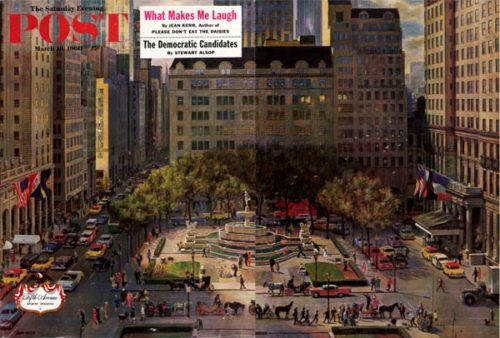
March 19, 1960
Not every Post cover was a big two-page fold-out, which is just another reason to love the terrific work by John Falter. I don’t know how he created such beautiful, realistic detail in his paintings, but he has always been one of my favorite Post artists.
Post Writers You Should Read
This is a new, once-in-a-while feature, where I’ll talk about great writers you might not know much about who have written for the Post. First up is someone mentioned on the cover above, Jean Kerr.
Jean Kerr was an essayist and playwright probably best known for her essay collection Please Don’t Eat the Daisies, which was made into a 1960 movie starring David Niven and Doris Day. Kerr’s plays include The Song of Bernadette, Lunch Hour, and Mary, Mary, which remains one of the longest-running shows of all time. She was a fantastic writer, part Erma Bombeck and part E.B. White, writing mostly about her kids and life in suburbia.
You can read Please Don’t Eat the Daisies for free — that’s right, for free! — at the Internet Archive. One of the pieces in the book, “Where Did You Put the Aspirin?” was originally written for the Post under the title “Children Really Are Not People.”
Today Is National Chip and Dip Day
I agree with Puddy on Seinfeld when he opined that chips and dip can be a meal and not just a snack. Tonight, instead of the usual pizza or steak and salad or chicken with vegetables, how about this Spinach-Artichoke Dip, this Caramelized Onion Dip, or this Nashville Hot Chicken Dip? And if you plan on having a regular meal tonight, maybe you can have a dip for dessert, like this Unicorn Dip.
I really didn’t know there were going to be so many unicorns this week.
Next Week’s Holidays and Events
Earth Hour (March 24)
Specifically, that hour is 8:30 to 9:30 p.m., whatever your time zone in the world.
Palm Sunday (March 25)
This is the day Christians “commemorate Jesus’ triumphal entry into Jerusalem.” Good Friday, the day of his crucifixion, is next week.
Weed Appreciation Day (March 28)
I know what you’re thinking, but it refers to the other kind.
A Course in Nutrition, circa World War II
Build-your-own World War II menu with nutrition basics from 1941.
—
U.S. Needs Us Strong
-Originally published in The Saturday Evening Post, June 1941-
As our part in helping to make America strong, The Saturday Evening Post presents a simple, basic course in nutrition, based on the findings of our Government’s National Nutrition Committee.
Here’s How to Grow Strong, America … Eat These Foods Every Day

Eat Milk and Eggs
- Every child needs a quart of milk a day.
- Every adult needs a pint of milk a day.
- Everyone needs 3 to 4 eggs a week.
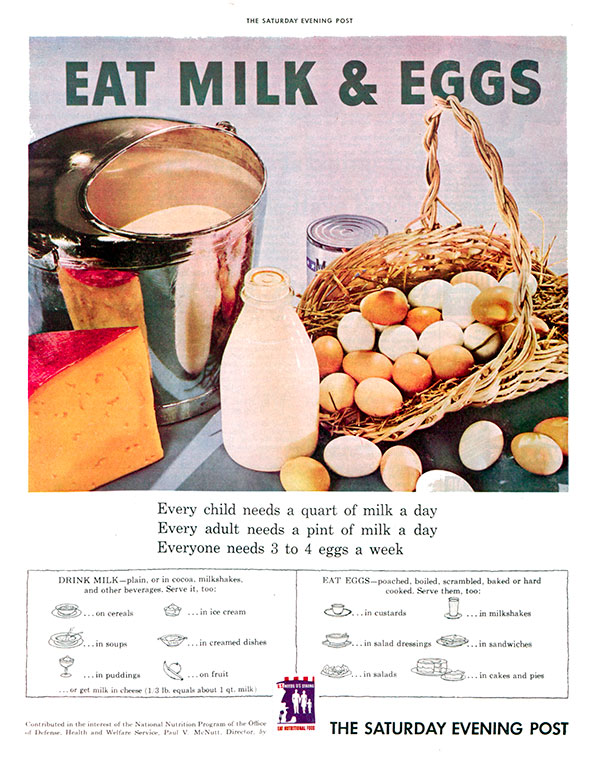
Eat Fruits & Vegetables
- Eat 2 or more fruits every day (1 citrus).
- Eat 2 or more vegetables every day (1 green or yellow).

Eat Meat, Poultry, or Fish
- Eat at least 1 serving of meat poultry or fish every day.
- Build your meals around the main course — meat or poultry — fresh, canned, or frozen.
- Serve fresh, canned, or frozen seafoods once or twice a week, for variety and economy.

Eat Bread & Cereals
- You need whole-grain products (natural whole grain or those restored to whole grain nutritive value) and enriched bread and flour every day. Then eat other foods you also like.

High Art at Pike’s Peak
If you’ve ever read from the Flat Stanley children’s book series, you’re at least somewhat familiar with the writing of Jeff Brown. Raised in New York, Brown became a child actor after attending the Professional Children’s School. His career took him to Hollywood to work as a producer and story consultant with Paramount Studios, but he eventually returned to the East Coast to work in magazines. Brown worked in the editorial departments of The New Yorker, Life, Esquire, and this magazine.
As an associate editor, Brown wrote a few short stories for The Saturday Evening Post, including “Incident on the Tenth Floor.” The following humor short, a write-up of an imaginary international film festival in Colorado, appeared in the Post in 1968. Brown’s sendup of pretension and absurdity in arthouse cinema came at a time of sea change in art and film. Some edits have been made.
For the benefit of those unable to attend next month’s Pikes Peak International Film Festival, here is a review of the more notable entries.
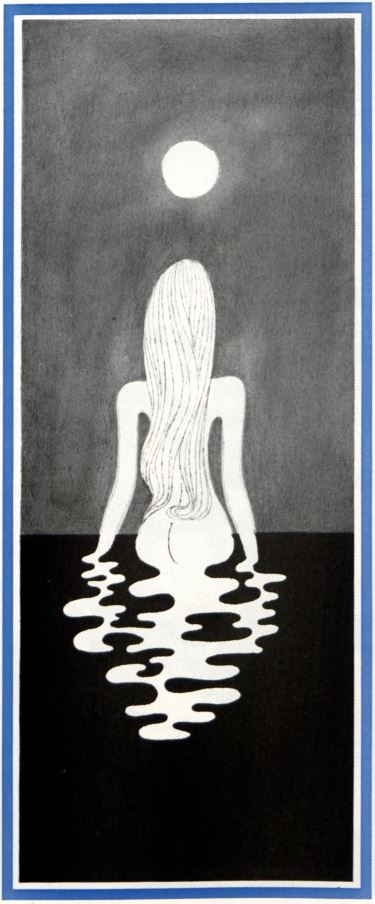
I, NAKED (Sweden)
The lyric pastoralism, the poignant plastic qualities that have long thematically dominated the Swedish film, are much in evidence here. Bathing au naturel in a pond on her father’s farm, lovely 19-year-old Ingrid is secretly observed by a vacationing Oslo banker (Oslö Benker) who later employs her as a maid at his chalet, where she is seduced by her employer’s young son (Jong Söhn) and cast out, only to be held captive in the mountain but of a crazed peat seller (Peter Sellers). Escaping at last, Ingrid returns to her father’s pond; weeping for her lost innocence, she bathes with all her clothes on and drowns.
Awarded the Golden Nude at the recent Trans-Scandinavia Festival, the film is the first directorial effort of one of Sweden’s leading actresses, Mai Güdness, who appears briefly in the role of Ingrid.
SUN KING, SUN KING, SHINE ON ME! (France)
Provocative revelations of intrigue at the court of Louis XIV, directed by Jean-Claude Flangé. the 10-year-old enfant terrible whose first film, The Terrible Infant, (a thinly disguised attack on Flangé’s own baby sister), stunned European audiences last year. Peter Sellers scores brilliantly as Louis XIV, Cardinal Mazarin, Bismarck and Lola Montez.
OUR FRIEND FANGA (Rhodesia)
Game Warden Ronnie Smythe-Hadley’s documentary account of Fanga, a leopard raised from gamboling kitten to mature pet in the Smythe-Hadleys’ African home. The perseverance of the documentary film maker is particularly evidenced by the thrilling climactic footage of Mrs. Smythe-Hadley being devoured by Fanga under the family piano. “She kept shouting. ‘Shoot, shoot!’” her husband recalls. “I knew she meant film, of course, so I just kept grinding away.” His sob-choked narration of the episode pays tribute to his late wife.
FOOLISH CANDY (Poland)
A superb example of Slavic realism, set in the confectionery district of historic Warsaw. In the words of director Stanislaus Czik:
“Here is sad Polish story of old Zygmunt, raisin dipper at State Chocolate Works. Poor lonely man, got all day only little raisins, got for night only miserable two-room flat where live also four brothers, three wives of brothers, eight nephews, four nieces, six cousins, two boarders from Cracow.
“But now comes to Chocolate Works new bonbon girl, Wanda. Very pretty. very athletic, plays every day ping-pong in recreation hall. For Wanda the foolish Zygmunt feels great love, has dreams to win Christmas ping-pong tournament so she will have love for him. From old raisin box, he makes paddle; every night, secret, he has practice in small closet of miserable two-room flat.
“At last is Christmas! Through storm of snow, old Zygmunt goes in street to tournament. But at gates of Chocolate Works — whoosh! whoosh! — wind blows him down, and now on top of him come one streetcar, one bus. So no ping-pong, no Wanda, no more Zygmunt with his foolish dreams.”
The film is cast entirely with amateur chocolate workers.
VILLAGE ON THE GANGES (India)
The story of a small boy’s efforts to teach his water buffalo to swim.
Directed by S.K.R. Himalaya, whose earlier films (Whirl My Dervish and the musical Hello, Delhi!) have been acclaimed for their trenchant portrayals of Indian life.
HERE IS EVIL AMERICA (People’s Republic of China)
From Peking’s Chairman Mao Studios, a documentary designed to acquaint the Chinese people with the United States today. Major sequences depict the hovels of infant munitions workers on President Johnson’s estate in Beverly Hills.
BIKINI BUNNY VOTES FOR LOVE! (United States)
An impetuous teenager (Doris Day) rises from obscurity in the Malibu surf to fame in Washington as Secretary of State. The playboy President (Toshiro Mifune) at first resists his love for the pretty Secretary, but surrenders when Supreme Court justices (Peter Sellers) smuggle her into the White House sauna on the eve of World War III.
In addition to the various national entries, the Pikes Peak Festival will offer two features by the controversial “underground” filmmaker, Cess Poole.
SALAMI: A five-hour study of Poole’s Uncle Max devouring a three-foot Genoa salami.
BEND MY HANDLE BARS: Socialite actress Baby Grace Hohenzollern bathes with a battered Honda in a tub of lime sherbet.
Presented on five split and revolving screens, both films are dramatically enhanced by the flicker of the stroboscopic lighting for which Poole is famed. “Incredible!” said one critic at a recent preview. “Movies have gone as far as they can go!”
“That statement neatly sums up the entire festival,” says the Pikes Peak program director. “We’re sure all who attend will agree.”
Basketball Coaches: The Wackiest Guys in Sports
What makes basketball coaches prone to temper tantrums filled with invective hurling, chair throwing, and wild gesticulating? Is there something inherent in the game that draws the high-strung and anger-prone?
This 1950 article by sports writer Harry T. Paxton from The Saturday Evening Post enumerates the idiosyncrasies of basketball coaches, both college and pro. We learned that tossing of furniture (and even more alarming reactions) was a thing with basketball coaches long before Bobby Knight.
Joe Lapchick, coach of the New York Knicks, “would pick up his chair and smash it on the floor. After he had run through half a dozen wooden chairs in this fashion, they finally got him a special unbreakable model made of stainless steel.”
George Keogan of Notre Dame became infamous, when, upon losing a game because of the timekeeper’s mistake, “he seized the timer’s now empty gun, held it to the student timekeeper’s head and pulled the trigger. Witnesses aren’t sure whether he knew the gun wasn’t loaded. They are confident that at the moment he wished it were.”
Other coaches’ tactics were more devious. The author tells this story of University of Kentucky’s basketball coach, Adolph Rupp:
Kentucky’s football coach, Bear Bryant —a champion recruiter himself—tried to get a Chicago high-school star for his grid team. Bryant campaigned all out to land the boy, but in the end the youngster told Bryant he had made other arrangements. It was with great surprise and glee, therefore, that Bryant spotted the boy on the Kentucky campus wearing a freshman cap the next fall.
“So you decided to come here and play football after all!” Bryant exclaimed. “When are you coming out for freshman practice?”
“Why, I’m not coming out for football, Mr. Bryant,” the boy told him. “You see, Mr. Rupp brought me here on a basketball scholarship.”
There’s no doubt there will be more coaching antics on display in the coming weeks. As Paxton notes, “With the possible exception of the professional comedians, who do it on purpose, there is no occupational group which produces so many weird public performances.”