Flying Cars with Venetian Blinds: 1942 Predictions for the Car of the Future
World War II wouldn’t be over for almost two more years, but Americans were already dreaming about their post-war cars.
So in 1942, the Post asked several auto designers what Americans could expect to see when Detroit began making passenger cars again. Author Edward R. Grace reported, “If our seven prophets are accurate, the postwar era will see more people than ever going places sitting down and they will go faster, more cheaply, and more comfortably, and in lighter, handsomer motorcars.”
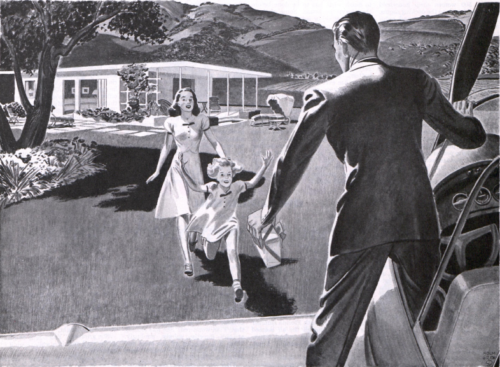
Predictions that Missed the Mark
While some of the designers’ predictions proved accurate, others were wildly fanciful.
-
- Car bodies of molded plastic and plywood
Designers believed plastic could be developed that had 90% of the impact strength of steel. Molded-plastic auto bodies would reduce the weight of automobiles, making them more fuel efficient.The idea of plywood had been borrowed from the combat gliders developed by the Army. The plywood-construction idea was still a promising concept back in 1942, before the gliders were used in the European invasion and earned the nickname “flying coffins.” - Plastic roofs with venetian blinds
“Plastics which permit the transmission of ultra-violet rays will give the passenger a good tan without the discomfort of sunburn, due to the elimination of the infra-red rays,” said a Ford Motor Company designer. “A lightweight venetian blind will control the amount of light desired.”He made these comments at a time when few were aware that tanning could lead to skin cancer. Also, he appears not to have known that it is ultraviolet rays, not infrared, that causes sunburn (although both kinds of radiation can cause cancer).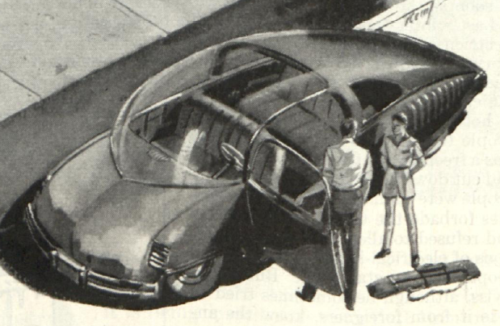
Detail from a January 1943 ad for Celotex building materials. - No steering wheel or windshield wipers
Steering levers were proposed as more powerful, responsive alternatives to steering wheels. Heated windshields would somehow eliminate the need for windshield wipers. - Competition from the aviation industry
America had been remarkably successful in producing aircraft and training pilots on a massive scale for the war. Some auto designers believed that, after the war, aircraft manufacturers would “turn out practicable planes at prices about the same as present-day automobile prices,” said Grace.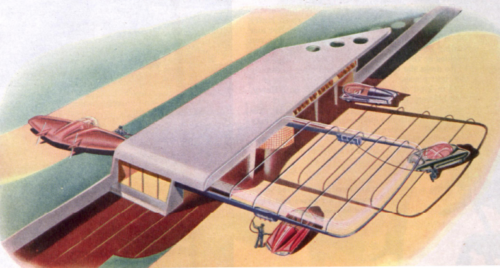 The idea of Americans owning their own planes inspired some of the more fantastic ideas. A designer who’d worked for Packard expected to see “homes, offices, and public buildings designed to accommodate travel by air, which will give an entirely new functional value to roofs. I am confident that there will be many air-colony settlements. You are going to see service stations along our highways designed to accommodate both motorcars and planes.”
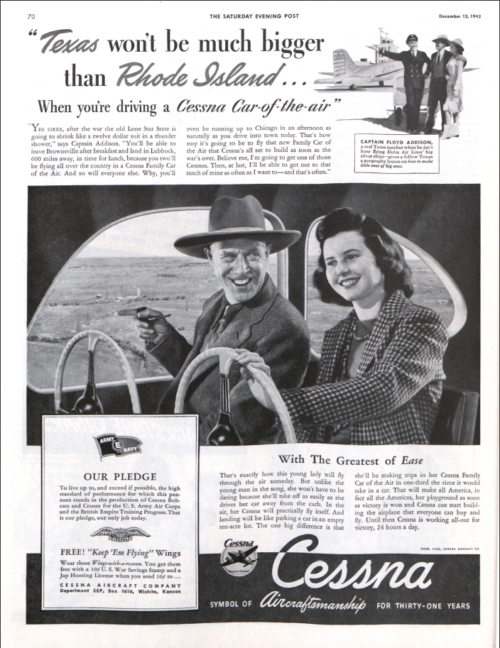
A Cessna ad from 1942 promising a “Car-of-the-air.”
- Car bodies of molded plastic and plywood
Predictions that Came True
But some predictions were spot on:
-
-
- Lighter engines
Building aircraft for the military had taught the auto industry a lot about reducing engine weight. A Chrysler engineer said pre-war auto engines weighed five times as much as an airplane engine that delivered the same horsepower. “It’s possible to eliminate two hundred and fifty from the prevent average of six hundred pounds” — which is close to current range of engine weights. - New, sleeker designs
GM Vice President Harley Earl said the days of the traditional, boxy sedan were over. Postwar cars would do away with the static look. “The public wants low, racy styles,” he said, “fast-looking, graceful cars that are functional in appearance. - A lot more cars on the road
Even though many planners were expecting America would go into a recession when the war ended, GM’s Earl predicted the auto industry would see unprecedented growth. By 1952, he said, the number of automobiles in America would reach 50,000,000, almost twice the number registered in 1941. He was only off by 10%. - Tires that automatically adjust pressure
One designer predicted tires that would automatically adjust pressure according to the road on which they’re travelling. While this feature hasn’t yet arrived, Michelin is developing an airless tire, made of recycled materials, with 3D printed treads that can be changed to accommodate road conditions.
Regardless of what America expected in postwar automobiles, what they got, when commercial-vehicle production resumed in 1945, were 1942 models with new front grills and trimmings. Detroit didn’t turn out any fully new automobiles for another four years.
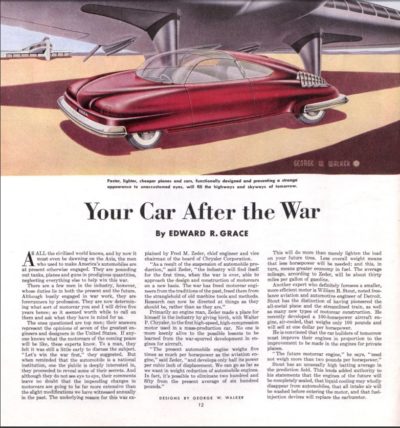
Read “Your Car After the War,” from the November 14, 1942, issue of the Post. - Lighter engines
-
North Country Girl: Chapter 27 — Broomball and Other Activities
For more about Gay Haubner’s life in the North Country, read the other chapters in her serialized memoir. The Post will publish a new segment each week.
On weekend nights, kids meandered from one car to the other at London Inn, asking each other “Where’s the party?” All too often parents selfishly refused to leave home, or a drunken debacle the weekend before had resulted in Wendi Carlson’s mother forbidding her to have friends over, or Mr. and Mrs. Anderson were waging a minor, and ultimately unsuccessful, offensive to take back their basement from East High’s sophomore class.
So my gang of girls ended up doing a lot of drinking al fresco, even when the snow piled four feet high and the temperature dropped to zero. I staved off the cold in long underwear and my toasty army surplus green parka with a neon orange lining, the hood trimmed with fur from some strange beast, the exact same jacket worn by all my friends; when we gathered outside to party, we looked like some weird winter drinking team.
The multiple layers we wore underneath that parka kept us warm, but also made peeing a two-girlfriend job, one to hold you up so you wouldn’t fall bare-assed into the snow and one to block the view from curious teen boys, as the process took a while. You had to unzip and then shove down the three layers of jeans, long underwear, and panties past your knees, before you could grasp the arms of Friend Number One, lean back till your butt was almost touching the snow, and finally feel that hot blissful stream that you hoped missed your boots.
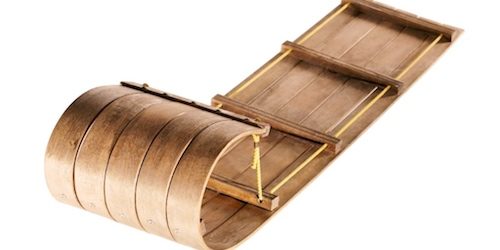
Drunken tobogganing on the hilly ninth hole of Northland Country Club was a favorite winter activity until Andie James knocked out her upper incisors when she shot head first off the sled and we had to deliver her bloody-mouthed and smashed on Tango Orange Flavored Vodka to her distraught parents.
We then took up drunken broomball, the only team sport I have ever enjoyed. The first half of drunken broomball was collecting brooms. We drove up and down the dark snowy streets of Duluth, peering at each porch and stoop illuminated under a circle of pale light til we spotted one that had a simple, regulation, round-handed, yellow-bristled wooden broom leaning against the house, kept there to sweep fresh snow off the steps. Wendi Carlson — no one else was brave enough — leapt out of her well-earned shotgun seat, ran close to the ground in a Groucho Marx crouch to the target house, snatched up the broom, ran back to the car, threw the broom inside, trying not to whack anyone, and hopped in while we all yelled “Go go go!” and the White Delight peeled out.
When we had gathered the same number of brooms as girls, we drove down to the Congdon Elementary ice rink, lovingly created and maintained by Mr. Swan, the scary janitor, every winter. The rink was totally deserted at night, faintly lit by the street lamps and stars. We stuck bottles of Night Train and Tango and Mad Dog and occasionally an actual real bottle of Southern Comfort in a rink-side snowbank and grabbed up our brooms. We slipped and slid skatelessly around the ice, laughing hysterically, falling on our asses, and occasionally swatting a volleyball in the direction of a hockey net. There were many breaks for drinking and helping each other pee. It was always hard for me to remember which net my team was supposed to be aiming at, but I rarely touched broom to ball anyway. I was there for the girls, for the drunkenness, for the laughter. We didn’t keep score; it was like the caucus race in Alice in Wonderland. Suddenly the game would be over and we would head back to the London Inn, thoughtlessly leaving both bottles and brooms scattered on the ice for Mr. Swan to clean up the next morning.

Once the snow was off the ground and the temperature reached a balmy fifty degrees, new drinking venues opened up. Former Girl Scouts and YWCA campers, we built raging bonfires on the lakefront, which attracted boys from miles around, and which I hope we properly extinguished. There was also the abandoned one-room Lakeside train depot, which offered shelter even if it had a faint whiff of hobo piss. This was a popular spot as it was where the trains slowed down before entering the yard. A test of manhood (or drunkenness) was to run alongside the train, jump and pull yourself up the ladder, and ride a few hundred feet down the line before launching yourself off into the cinders that bordered the rails.
Finally, it was Duluth summer, when we would shiver in our bikinis at Park Point beach trying desperately to get a hint of a tan, playing Spades, listening to WEBC on the radio, singing along to “My Cherie Amour” every time it came on, which was twenty times an afternoon, gossiping about boys, and smoking (except me). There were trips out to rustic lake cabins, with smelly outhouses and rooms lit by kerosene lamps, and hopefully, parents back in the bustling city of Duluth, so we could carouse freely, long into the twilight evening, the sun still beaming off the lake water at ten at night. If we were lucky or if someone had dropped a hint, groups of boys discovered our location and arrived by the carload, bearing more bottles of booze and sleeping bags to cuddle and steal kisses in.

With all those other pleasurable activities, enjoyed in the company of my solid band of girlfriends, every week I crossed my fingers and wished that Doug Figge would have to spend both Friday and Saturday nights over the Fryolater. I liked the idea of a boyfriend much more than the boy himself.
***
Before the end of my sophomore year, I received a letter from Global Citizenship, inviting me back for another session of junior international diplomacy. Most of my girlfriends had landed summer jobs; at 15 I was too young for anything but babysitting, which I despised. I had a lot of summer days to fill, so I signed up for another go at becoming a Global Citizen, deciding that the hours spent lost in the black and white visions of Fellini and Bergman more than made up for the tedium of running imaginary countries.
The letter also informed me that this year’s Global Citizenship class would count toward high school graduation credits. Doug Figge listened to my ramblings about last summer’s course — the fabulous movies, the atomic bomb attacks — with half an ear, as he was busy trying to wriggle his hand inside my pants, but he took notice when I mentioned the credit. The next day I found out that Doug, John Bean, and Joe Sloan had all signed up for Global Citizenship.
Joe Sloan had come back from his strict boarding school with a serious hallucinogen habit, which he immediately passed on to Doug and John. Since I was unable to smoke a joint I was never offered so much as half a tab of acid. When not working or at Global Citizenship, the three boys, with me in tow (Mary Ann Stuart was MIA that summer), got high in Joe Sloan’s basement, blasting Cream and looking at the walls. There is no worse hell than being stuck in a room for hours with people who are tripping so hard they forget to turn the record over.
That summer’s Global Citizenship class was a bust. There were the two bright young men from last year, now even more hopeful that all the made-up nations and the kids running them could learn to live in peaceful harmony. The nuclear option had been removed from the game, making it even more tedious and probably closer to what the real UN is like. And instead of those wonderful foreign films, there was Photography. We were broken into groups of four or five, given one (1) camera per group, and ordered to create a slide show depicting a social issue. I don’t know what kind of Dorothea Lange images these young men expected in prosperous Duluth; what they got were mostly photos of the town’s three most prominent winos and a few liquor store Indians.
I was stuck with Doug and John and Joe, who decided our group’s topic would be drugs. I was not given a vote; in fact, I never even got to touch the camera. The boys completed our assignment without ever having to leave Joe Sloan’s basement. They took photos of album covers.
That was our slide show on a social issue: drug-inspired album covers — “Tommy,” “Their Satanic Majesties Request,” (with that weird wavy plastic insert), and “Court of the Crimson King” — one slide clicking into focus after the other, with “Crystal Ship” by the Doors as the soundtrack. After the lights went back on, the two nice young men shook their heads, expressed their disappointment in our group, and told us we would not receive credit for the class. One of the teachers pulled me to the side later to ask, “Are you okay? Are those boys giving you drugs?” If only.
My mother was also taking a class that summer at the university, having decided to resume her college education, which had been interrupted by my conception and birth. Three afternoons a week I had the ultimate teenage luxury: a parentless house. All my girlfriends who were off work came over to sit around the kitchen table, fog up the breakfast nook with cigarette smoke, and make plans for that night (“We’ll meet at the London Inn”). If my sisters were also out of the house, I’d be with Doug on the living room couch, him splayed on top of me, tentacled like an octopus, hands everywhere, oily-faced and hot-breathed.
Why didn’t I just break up with him? Why did I allow him to maul my tiny bosoms when it gave me no pleasure at all? Why did I give in to Doug’s pleas to “Just touch it, just put your fingers on it?” so he could have the spurt of pleasure while all I got was a sticky hand?
I kept hoping that somehow Doug would magically disappear and Joe Sloan would finally realize that we were meant for each other. Or that someone would say, “Here, Gay, here’s a tab of acid,” and make my time with Doug more interesting.
What I got was Doug’s needy grindings of his crotch on my hip bones, his crappy kissing, and his claim of “I love you,” supposedly the magic words that would make it okay to have sex with him. All of which wore me down and wore me down until I finally succumbed on July 20.
Joe Sloan and John Bean were busy in Joe’s basement. Joe had just received a mail order kit to make fireworks, and he and John, pupils the size of pinholes, were cackling uncontrollably as they spilled gunpowder about a small work room. I don’t know if they were making bottle rockets or M-80s; I did know that I did not want to be around in case someone lit a cigarette. So when Doug stuck his tongue in my ear and drew me away up the stairs, I did not object. We crept up the back stairs to a long forgotten room, maybe a former maid’s quarter, with a small window angled under a gable, a single mattress, and a black and white TV on a dresser.
Doug, true to his upbringing, could not resist turning on the television.
“Look!” I cried. “It’s the moon landing!” Doug looked and then fell on top of me, yanking away my tee shirt and shorts. Oh the hell with it, I thought, let’s just get this over. Doug thrust his way inside me while I pretended it didn’t hurt. I turned my head towards the TV and watched Neil Armstrong take his first step on the moon while I said goodbye to my virginity. One small but necessary step for womankind.

For years I had been dying to have sex; I expected the transcendent experience described in my favorite dirty books, not one where my most vivid memory is of an astronaut. Years later, I still felt queasy every time I saw MTV’s logo of a man planting the flag on the moon.
There was no rubber; Doug had never offered to get one, and I had no idea of how to bring up the subject. I took the idea that I could get pregnant from this awkward coupling and stuck in somewhere in my brain where I wouldn’t see it.
When it was finally over, Doug looked at his watch, but not to time his performance. “I have to get to work,” he said, and pulled on his pants. I did not look back to see what bodily fluids we had left on that lonely bed. Doug drove me home, and I called Wendi Carlson and complained. She assured me that every girl’s first time was awful, and that even though I was sore and still finding drops of blood in my panties, if I wanted to eventually enjoy it, I should keep on having sex with Doug.
The Invention of the Vinyl Junkie
Edison announced his new invention, the phonograph, 140 years ago today. He originally intended his recording technology to be used for dictation and historic utterances, but the public wanted something to dance to, and a booming business in music was born. The place of the record album in the history of music playback is unique: unlike other mediums for sound — the fleeting 8-track, for example — the phonograph record has demonstrated a seemingly timeless staying power in the market.
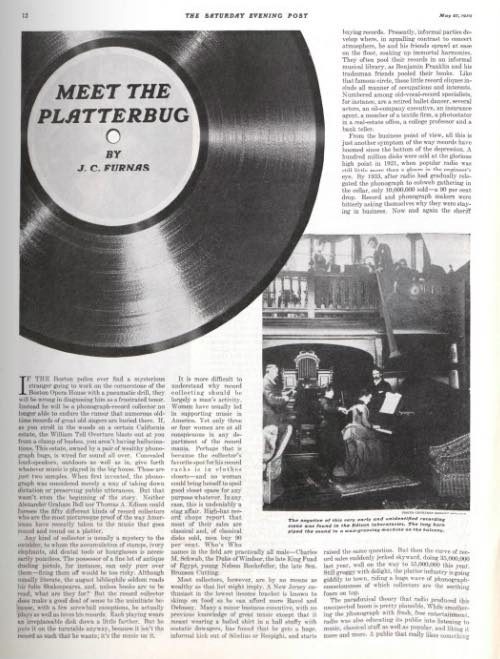
It would seem that records were always meant to be amassed and cherished. The Post’s 1939 story, “Meet the Platterbug,” explored the early obsession with thrift store finds and rarities. The “platter industry,” as it was called, suffered from the advent of the radio in the 1920s, but records were selling even better within 10 years: “The paradoxical theory that radio produced this unexpected boom is pretty plausible. While smothering the phonograph with fresh, free entertainment, radio was also educating its public into listening to music.” The new, musically-versed people wanted to be their own deejays, and they had tastes.
Record collectors in 1939 didn’t have the same breadth of options as a vinyl fanatic nowadays, but music zealots like novelist Dorothy Baker and famed collector Ulysses Walsh were pioneers in the hobby. Collections of hot jazz, Hungarian gypsy music, classical, hillbilly ballads, and even readings of James Joyce had “the variety of a drink list and the confused effect of a pack rat’s nest” on outsiders to the trade. That much hasn’t changed.
The self-proclaimed “live music capital of the world,” Austin, Texas, is saturated with lovers of the melodic and the vintage, so it makes sense that it currently hosts one of the most epic record swaps in the world, the Austin Record Convention. Doug Hanners started the show over 40 years ago, and he doesn’t believe record collecting ever lost much popularity. Collectors from around the world travel to his warehouse each year with hopes of buying or selling some special “platters,” and the general rule is that obscurity drives demand.
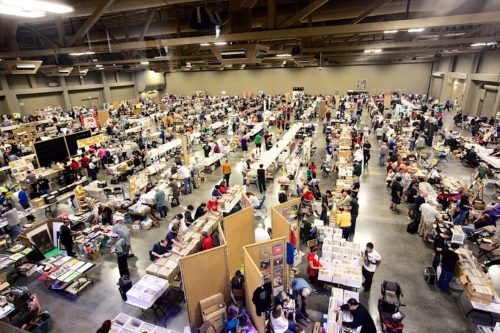
“Something about the human spirit drives people to accumulate stuff,” Hanners said.
Vinyl collectors aren’t just passing back and forth mummified music either. Records sales were the highest in 2015 that they’ve been since 1988 while CD sales dropped, according to Fortune. Plenty of new music is pressed on vinyl, and Sony recently announced that it would begin making records again after 28 years away from the medium. “You can see the cover, touch it, read the liner notes, even smell it. It’s not like other music formats,” according to Hanners.
There is a distinction between a casual collector and a full-on vinyl junkie, however, and it might be somewhere around the thousandth purchase. A Cuban doctor, described in “Meet the Platterbug,” left more than 20,000 operatic vocal recordings when he died. Similar aficionados can be found today. Jeff Gold is one of the biggest names in music collecting. He has worked with Rhino Records, A&M Records, and Warner Bros. as an art director, and his record collection is legendary. In an interview with Dust and Grooves, Gold described his method of quick browsing while searching through bins of records at a store: “in the 41 years I’ve been doing this, I have kind of an unconscious ability to stop at anything that looks interesting or different, without thinking about it. It just happens.” Gold’s stash includes some prized acetate records, namely his Bob Dylan recordings. Acetate was used to make records in the mid-century for, mostly, studio purposes. Although they wear more quickly, acetate platters are a treasured commodity in the collecting world.
With so many genres, small studios, and artists around, a vinyl addict could easily fill warehouses with discs given the budget, but Hanners says record collecting tends toward specialization these days: “The younger collectors tend to focus on specific genres, which will make their collections easier to sell when the time comes.”
And the time will eventually come. Like a stockpile of LPs, Hanners will soon turn over the reins of Austin Records to his son, Nathan, and — if current trends hold — the show will provide a fix to new generations of avid collectors.
Rockwell Video Minute: Freedom from Want
We celebrate Thanksgiving with one of Norman Rockwell’s most famous paintings, “Freedom from Want.”
See all of the videos in our Rockwell Video Minute series at saturdayeveningpost/rockwell-video.
Weaving a New Life in America
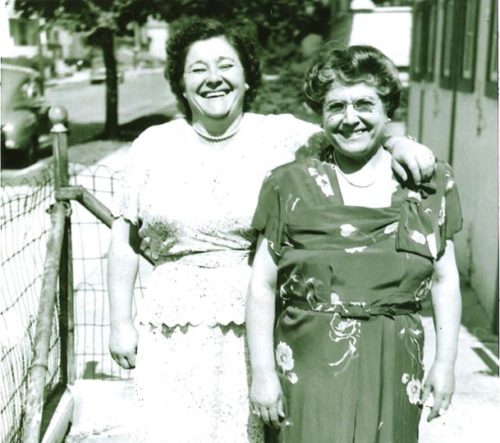
Photo courtesy of Kathleen Garrett
The art of crocheting was her passport from Sicily to upstate New York.
The winter rains had subsided for the moment, but the coastal night air remained chilly and damp. My rent-controlled apartment, with its lack of insulation, mirrored the outside evening temperature as I sat at my desk, struggling to meet a self-imposed deadline. Shoes aren’t allowed in my home, not even for me, and with porous window seals in this old building and its wooden floors, my cold feet needed something warm to cover them.
I’d been away from Santa Monica for quite some time and had yet to fully unpack and organize my apartment. The floor of my closet was a wreck. Piles of miscellaneous footwear and chaos lay everywhere as I dug through debris in the hope of finding a matching pair of slippers.
There, stuck in the corner under the shoe rack and covered in dust, lay a forgotten pair of brightly colored orange woolen slipper-socks my Sicilian grandmother, Teresa, knitted well over a quarter-century ago. I salvaged the little booties, quickly put them on, and was struck by the gems on my feet. The knitting was close to perfect, the craftsmanship remarkable, and the bold orange and light-green yarn woven throughout showed such a playful humor that it made me smile.
Everyone in the family — her children, grandchildren, and great-grandchildren — was given my grandmother Teresa’s crocheted wares. Sometimes they were given as birthday or Christmas gifts, but most of the time, when she finished a project, she would offer the crafted article to whomever wanted it. In my youth, I considered her creations passé and unfashionable. But as the booties instantly warmed my feet, I examined these meticulously made items more closely, marveling at their workmanship and my grandmother’s gumption.
My eye caught another woolen object sticking out from the mound of wreckage at the bottom of the closet. Shoving shoes, boots, and whatever else in that pile aside, I pulled out a knitted wire hanger. Years before the velvet, nonslip hangers became popular, my resourceful grandma took metal hangers and crocheted over them. This woolen covering not only prevents clothes from falling off, but also makes the unsightly wire attractive, with bright, multicolored yarn intricately stitched around it.
Making the best out of unlovely things was a particular skill of Teresa Munafo, born in the small town of Fondachelli-Fantina, Sicily, in 1901. Her father bought cheese from local farmers, picked filbert nuts, and sold them in the coastal city of Messina, some 80 miles away, while her mother raised their four small children. In 1908, the massive Messina earthquake struck southern Italy, killing her father and leaving the family destitute. Teresa’s education never went beyond the third grade, as she and her siblings had to quit school and work picking crops for pennies. At night and whenever there was free time, she and her sister would weave and crochet garments and coverlets for the family.
The art of crocheting developed throughout the world at different periods of time. In Italy, it dates back to the 16th century, and according to Danish researcher Lis Paludan, “crocheting was known as ‘nun’s work’ or ‘nun’s lace,’ where it was worked by nuns for church textiles.”
Teresa’s older brother, at 14, left to find work in America and sent what little money he earned back to the family. Her sister married at 14 or 15 (the exact age is unclear), had two children, and then died of a heart attack at 19.
Teresa found herself pregnant out of wedlock by her first cousin, Carmelo Salamone, when she was 19 — a scandal in her strict Roman Catholic family and community. But Carmelo was unaware he was to become a father and shipped off with his brothers and male cousins in 1920 for America. Learning of Teresa’s condition, he was forced to return to Italy to marry her. Her older brother scornfully asked before her wedding, “Aren’t you ashamed to wear a veil?” referring to its symbolism of purity, which he felt she no longer deserved. Carmelo then went back to America and, two years later, sent for Teresa and their new son to join him. They settled in a large Italian community in Schenectady, New York, which is where Teresa further honed her skills with knitting needles, learned English, and became a businesswoman.
Hanging in the back of my closet was a deep burgundy, button-down, knitted sweater my grandmother made when I was a teenager — not much younger than she’d been when she became pregnant with her first child. At that age, I didn’t think this handcrafted garment was trendy enough to wear, though I couldn’t part with it either. In examining the cardigan more closely on that damp night, I realized its three-quarter sleeves and scoop neck were not out of date at all, but rather fashionable, so I put it on. The softness and warmth of the wool caressed me as though it were the loving embrace of my long-departed grandmother.
Although Teresa had only minimal education, she possessed the work ethic and ingenuity of an executive. When the Great Depression rocked the world, the migrant community of Mont Pleasant, a subsection of Schenectady, was hard hit. Basic household items, such as blankets and curtains, could not be purchased in stores, so the women of the neighborhood sewed, knitted, and crocheted in groups, making these necessities for one another.
Carmelo’s driveway, and the women worked together to create comforters and window dressings. A horse and wagon came around selling thread, yarn, and other needed materials for their projects. This gave Teresa the idea to purchase the materials from wholesalers in New York City and sell them for a small profit to the neighborhood paisans.
As the demand for material grew, so did my grandmother’s need for a supply room. She took over one of her sons’ bedrooms, moving him into his two brothers’ tight sleeping quarters, and filled the new storage space with shelves of material from floor to ceiling. Business went so well that she and her husband decided to buy the apartment building across the street and convert it into a department store, and thus the family business was born.
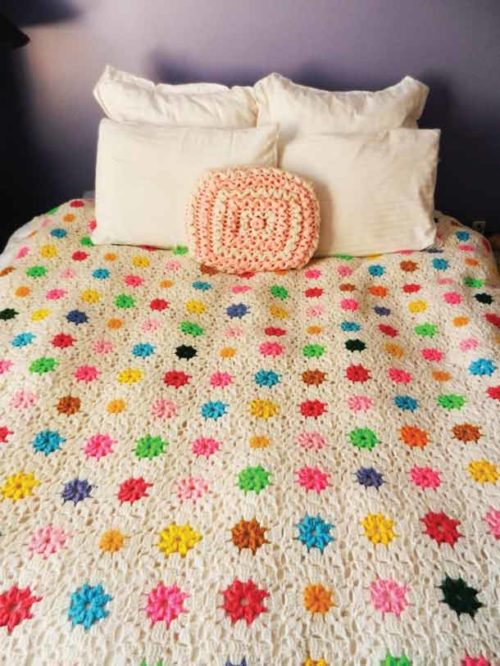
Photo courtesy Kathleen Garrett
The beautiful afghan stretching across my queen-size bed is her largest and one of my most treasured heirlooms. It is white with little granny squares of multicolored flowers knitted throughout. This particular type of blanket was a special work. My uncle offered me his one day since he had so many other knitted throws and blankets she had made. I was thrilled to possess such an artistic treasure.
Looking at the stitching more closely, my grandmother’s nimble fingers appear like a vision, rhythmically and supplely knitting in rapid precision. I recall her barely looking at her hands as her fingers swiftly moved the yarn in and around the needles, creating intricate patterns and designs. She never used a knitting outline or instructions of any kind. Nor did she ever count aloud or write down the stitch number. She just seemed to know how many knits and purls, traveling, twisted, and slip stitches she had done. She knitted blankets, sweaters, bedspreads, booties, baby caps, mittens. She crocheted tablecloths, bedlinens, doilies, and handkerchiefs. Even pocketbooks. There wasn’t anything my grandma’s knitting needles couldn’t create.
Being a disciplined and industrious woman, and believing idle hands are the devil’s workshop, Grandma Teresa attempted to instill her work ethic in her granddaughters, insisting we learn how to knit. But my adolescent temperament couldn’t appreciate the skillfulness and imagination of her work, nor how useful this craft could be. Years later, while performing in a one-woman show, I had to knit a sweater in a scene and thought of all those times she tried in vain to teach me. Fortunately for me and the show, my character knitted badly.
Another of her handmade woolen blankets rests on the back of my sofa. It is a motif — loud, free, and fanciful, with wide lime green and hot pink stripes running throughout. In looking at these whimsical objects, I suddenly realized perhaps this was the only way my grandmother, a serious and formidable woman, could express the imaginative, childlike joviality that was kept bottled within her.
Grandma Teresa was not always as warm as her creations. She did not spoil her grandchildren with outward affection, nor let the grandkids get away with behavior their parents would not allow. Perhaps she never knew what it was like to be a fancy-free child laughing and playing without a care in the world. Maybe the only way she knew to express her love to us kids was to insist on discipline, instill work habits, and give us the tools that brought her a successful life.
Today, when I am wrapped in her afghans or my feet are warmed by her knitted booties, I am reminded of my grandmother, Teresa Munafo Salamone — and inspired by her mettle to come to a new land, taking on a different language, culture, and life, and having the courage to never stop creating.
Kathleen Garrett is an actress, writer, and voiceover talent who works in Los Angeles and New York City. Originally appeared at Zócalo Public Square. This essay is part of What It Means to Be American, a partnership of the Smithsonian’s National Museum of American History and Zócalo Public Square.
This article is featured in the November/December 2017 issue of The Saturday Evening Post. Subscribe to the magazine for more art, inspiring stories, fiction, humor, and features from our archives.
Your Weekly Checkup: Winter Can Be Harmful to Your Health
We are pleased to bring you “Your Weekly Checkup,” a regular online column by Dr. Douglas Zipes, an internationally acclaimed cardiologist, professor, author, inventor, and authority on pacing and electrophysiology. Dr. Zipes is also a contributor to The Saturday Evening Post print magazine. Subscribe to receive thoughtful articles, new fiction, health and wellness advice, and gems from our archive.
We’ve all read that dreaded headline: “Massive heart attack kills man while shoveling snow.” Is it true? Does winter increase the risks for having a heart attack, or could the sudden stress of physical activity in a couch potato be the cause? A recent study from Sweden of more than 280,000 patients suggests that cold air temperature can trigger a heart attack. The investigators found that the number of heart attacks per day was significantly higher during subzero Celsius temperatures compared to when it was warmer.
But winter brings many changes in addition to temperature. The hours of sunlight diminish, which can affect a variety of body functions including mood, body temperature, sleep/wake cycles, and secretion of hormones such as serum cortisol and melatonin. For example, seasonal affective disorder (SAD) is a well-established condition characterized by depression during the winter months, and is treated by exposing patients to a light therapy box emitting 10,000 lux of light each morning to simulate an earlier sunrise. Blood pressure is higher during the winter, as is cholesterol, upper respiratory infections, and the flu. Stroke mortality peaks in January, with a trough in September.
Interestingly, mortality is higher during the winter even in Los Angeles, where the winter temperatures remain mild. A study of over 220,000 deaths from Los Angeles County almost 20 years ago showed that the mean number of deaths was a third higher in December and January than between June and September. An increase in deaths peaked around the holiday season and then fell, raising the question of whether the stress of overeating or drinking during the holiday season, or perhaps sitting down to a turkey dinner with that disagreeable relative, might be a cause. Holiday hedonism is not the likely cause, because in Australia and New Zealand, the same winter influences on mortality occur during their winter months of June through August. In addition, sudden death also peaks in infants during the winter.
So, what can we conclude? Heart attacks, sudden death, and total mortality all increase during winter months, impacted by cold temperatures and other influences as well, such as shorter hours of daylight. My advice is to keep warm and continue your usual activities, diet, and medications. But be alert and check with your physician if you become aware of any new symptoms indicative of a change in health status. And stay happy! It’s good for your health!
World Hello Day: History of a Greeting
Saying hello to someone seems like a mundane thing to do, but sometimes that simple greeting can be the first step toward greater communication and understanding. In 1973, this basic truth was recognized by Michael and Brian McCormack, who mailed 1,360 letters in seven languages to world leaders and government officials to encourage them to participate in the first ever World Hello Day on November 21.
Their campaign was a reaction to the armed conflict between Israel and a coalition of Arab states that had inflamed the Middle East that October. The McCormack brothers hoped to create and promote World Hello Day to remind world leaders of the importance of personal communication for peace, and that they should rely on communication, not force, to resolve their conflicts.
The idea caught on and stayed on; November 21, 2017, marks the 45th World Hello Day.
There are no grand ceremonies or complex traditions for celebrating the day; just make a point of saying hello to at least 10 people, recognizing as you do so the importance of personal communication for mutual understanding and respect.
Just Getting Your Attention
Hello is a greeting that is understood almost everywhere in the world, but it hasn’t always been so. In fact, hello is a relatively young word, dating only back to 1827 according to the Oxford English Dictionary.
Before that, all the way back to the Middle Ages, hail was a common English greeting. (The word is related to health, so it was not only a salutation but well-wishing.) Through the combination of dialects, accents, and the lack of an authority on English spelling, a number of variants of hail developed over the centuries, including hollo and hallo. But even into the 19th century, these words weren’t used as greetings, but to indicate surprise or to attract someone’s attention — much in the same way we use hey and yoo-hoo today.
We can find that usage in the early issues of the Post. This little bit of wordplay appeared, without a byline, in the September 2, 1826, issue:
Capt. — Tom, hand that lady into the boat.
Lady. — O dear I’m as giddy as a goose.
Capt. —Then I’d have you take care, ma’am, you don’t make a duck of it.
’Squire Lollypot— Hallo, there, catch that wail.
Jo. Strickland. — Where? where? Darn me if I wuddent give a hundred dollars to see a whale; I never see wun in my life.
’Sq. Loll. — I begs your pardon, sir; you didn’t hunderstand my meaning; hit’s my vife’s wail, vat she wears hover her vig.
Answering the Phone
Hello began catching on as a greeting through the 19th century, but it wasn’t until the telephone was invented that its future was sealed. A mythology even developed around the connection between phones and hello. One story says that Thomas Edison, whose exploits are often exaggerated, invented the word hello from whole cloth. (He didn’t.) Stranger is the story that telephone inventor Alexander Graham Bell chose hello as a phone greeting because it was the name of his girlfriend, one Margaret Hello. (She never existed — Bell developed the telephone while he was engaged to Mabel Hubbard, and she would be his wife until his death in 1922.)
Though the primary players in those stories are correct, the truth isn’t so provocative. After Bell patented the telephone in 1876 and the technology began to spread, he recommended that users begin a call by saying “ahoy,” a common nautical greeting for more than a century; he answered his phone like that for the rest of his life. Thomas Edison, on the other hand, thought “hello” was a better choice.
When the first telephone book was printed in New Haven, Connecticut, in 1878, it included a “how to” section as well as tips on phone etiquette, including that one should initiate a telephone conversation with “a firm and cheery ‘hulloa.’” By 1880 Edison’s preferred hello had won out.
It isn’t difficult to see why, either. For many land-bound Americans, the nautical ahoy would have been awkward or even unknown. Hello had been gaining popularity around the country over the preceding 50 years and so would have come more naturally to many.
Hello had become such a widespread lexical innovation that it caught the notice of Mark Twain, who used it as a symbol of the distance between Washington politicians and the common man in the following article, which appeared in the Post on February 9, 1868 — a decade before the ahoy/hello controversy:
“Hello.”
“Mark Twain” writes from Washington to the ChicagoRepublican:—
I was standing all by myself in the committee room, reading a vast law book and wondering what it was about, and whether the plaintiff had done so and so, or whether it was the defendant; and which of them they found guilty; and how the mischief they ever knew he was guilty when the words were tangled up so; and noting, with gratification, the references to Perkins v. Bangs, Mo. Rep. iii., &c., whereby it was apparent that if one did not get mixed up enough in that book there were others that could finish him; and wondering also at the bewildering tautology of the said aforesaid book aforesaid, when a youth to fortune and to fame unknown flourished in in the most frisky way, and came to a halt before me. This young man had a moustache that dimmed the lightness of his countenance about as your breath dims the brightness of a razor; and he bored down into it with his fingers and gave it a twist which was singularly gratifying to him, considering that no effect was produced upon the moustache by the operation. He then tilted his little soup-dish to the port side of his head with his gloved hand, and said:
“Hello!”
I said “Hello!”
He looked surprised. Then he said: “Do you belong here?”
I was just finishing a sentence about Perkins v. Bangs. I finished it and observed: “The weather is very fine.”
He whisked nervously up and down the room a couple of turns, and then stopped before me and said: “Are you the clerk of the Judiciary Committee?”
I said, in the urbanest manner: “In view of the circumstance that on so short an acquaintance you betray so much solicitude concerning my business, I will venture to inquire what you may happen to want with the clerk of the Judiciary Committee?”
“That is not answering my question. Are you the clerk of the Judiciary Committee?”
“In view of the circumstance that on so short an acquaintance you betray so much solicitude concerning my business, I will venture to inquire again what you may happen to want with the clerk of the Judiciary Committee?”
“That don’t concern anybody but me. What I want to know is, are you, or are you not, the clerk of the Judiciary Committee?”
“In view, as I said before, of the circumstance that on so short an acquaintance you betray so much solicitude concerning my business, I will venture to inquire once again what you may happen to want with the clerk of the Judiciary Committee.”
He scratched his head in apparent perplexity for a matter of five seconds, and then said, with deliberation and impressive earnestness:
“Well, I’ll be damned.”
“I presume so. I hope so. Still, being a stranger, you cannot expect me to take more than a passing interest in your future plans.”
He looked puzzled and a little chafed. He said:
“Look here; who are you ?”
“In view of the circumstance —”
“Oh, curse the circumstance!”
“Amen.”
He did not reply. He seemed worried and annoyed. Presently he started out and said by George! he would go after the Michigan Senators and inquire into this thing. I said they were esteemed acquaintances of mine, and asked him to say that I was well. But he refused to do this, notwithstanding all my politeness, and was profane again. I never saw such a firebrand as he was.
Now, what can that young fellow mean by going around asking respectable people if they are clerks of Senate Committees? If my feelings are to be outraged in this way I cannot stay in Washington. I don’t like to be called Hello by strangers with imaginary moustaches, either. This young party turned out to be an importation from Kalamazoo, and he wished to ship [as] a sub-clerk to the Judiciary Committee.
He is a little fresh. It might have been better if he had stayed in the Kalamazoological Gardens until he got his growth, perhaps. Still, if his friends would like to have the opinion of a stranger concerning him, I think he will make a success here in one way or another. He has spirit and persistence. The only trouble is that he has most too much “hello” about him.
While Twain may have complained about too much hello back then, today, the word can be the first step toward meaningful and respectful communication. And there can never be too much of that.
Cover Collection: J.C. Leyendecker’s Thanksgiving
Famed artist J. C. Leyenedecker always had a unique point of view. Who else would have dared paint a “butcher baby” for Thanksgiving? We’ve picked some of his most wonderful, winsome, and weird covers for your Thanksgiving enjoyment.
J.C. Leyendecker
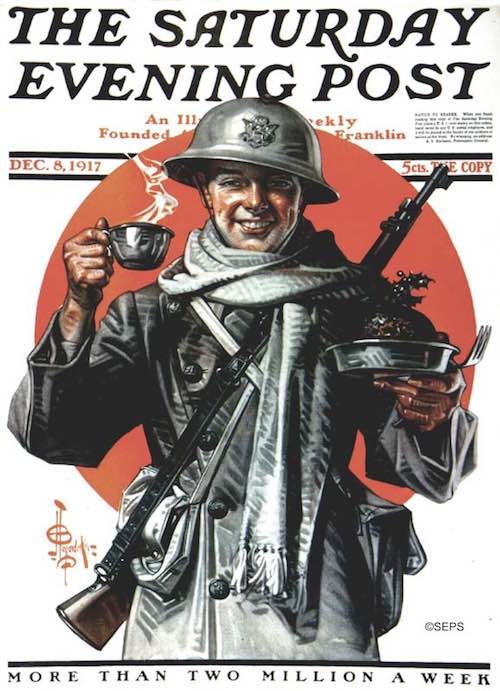
December 8, 1917
The U.S. had recently entered World War I. The Food Administration had just been established. Farmers were asked to increase food production and citizens tried to be mindful of their food consumption to support their soldiers in Europe. This doughboy is enjoying the efforts of the folks on the home front: a warm holiday meal, holly included.
J.C. Leyendecker
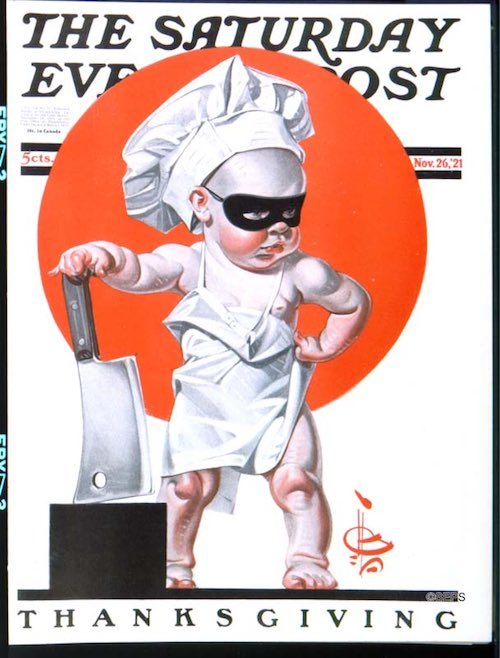
November 26, 1921
Leyendecker was famous for his illustrations of cherubic toddlers. In fact, one was featured on every New Year’s cover of the Post between 1909 and 1943. They occasionally showed up at other times of the year, such as this malevolent moppet wielding a cleaver likely meant for the neck of some poor turkey.
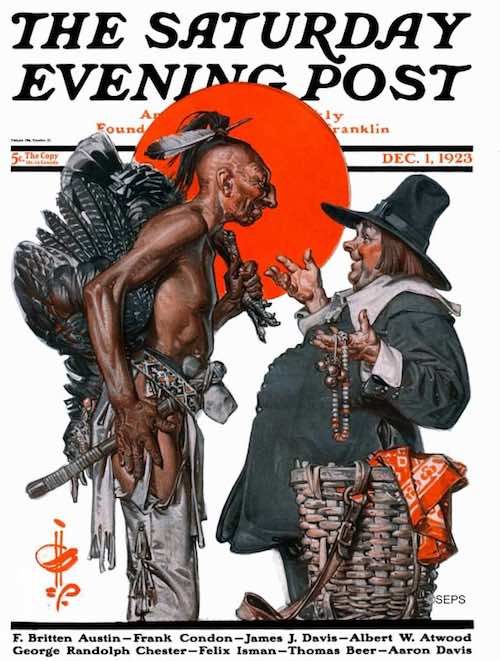
December 1, 1923
Norman Rockwell considered Leyendecker his mentor, and had such admiration for him that he stopped painting Post covers when he reached 321, not wanting to break Leyendecker’s record of 322. In this Thanksgiving picture, one can see Leyendecker’s influence on Rockwell, who employed many of the same techniques: a single scene that tells a rich story interwoven with humor.
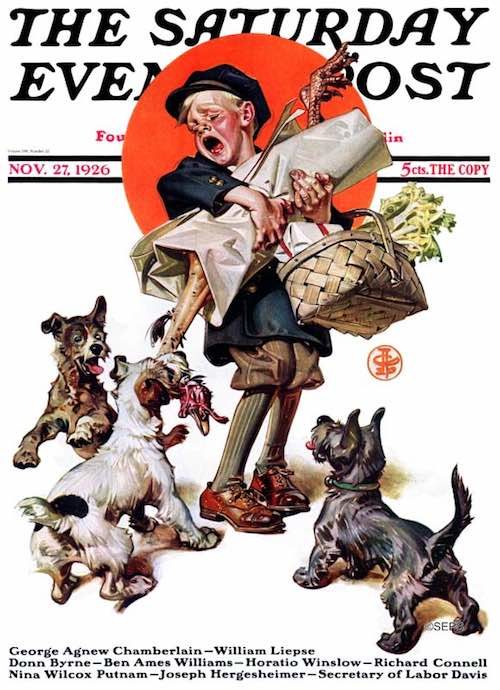
November 27, 1926
This painting features many of Leyendecker’s favorite themes: dogs, children, and a touch of humor. His mastery of these themes led him to many lucrative commercial commissions, including a series of advertisements featuring “Kellogg’s kids” — adorable tykes cheerfully eating their breakfast. The not-so-cheerful boy might have been a model for a Kellogg kid under happier circumstances.
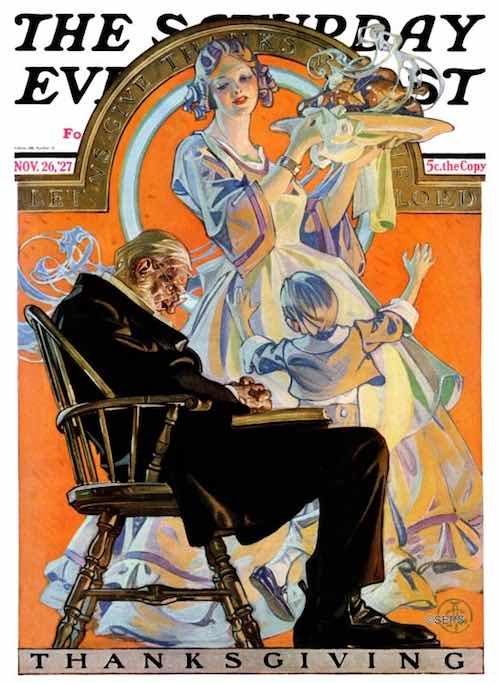
November 26, 1927
Leyendecker was capable of mastering the most poignant of scenes as well. This old man dreams of happy childhood memories.
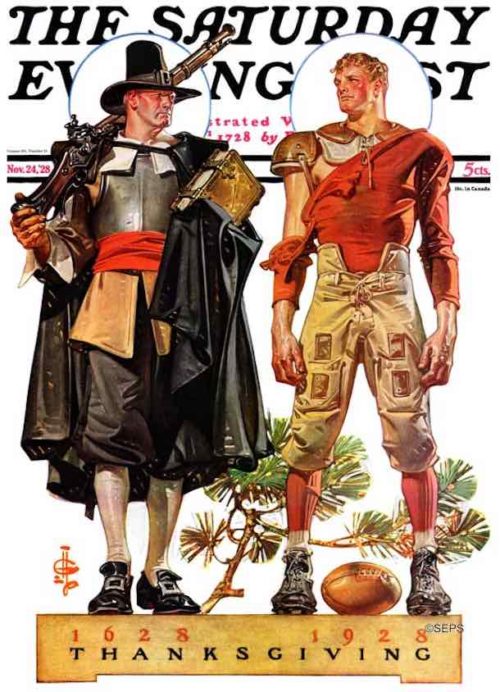
November 24, 1928
Leyendecker honors the 300th anniversary of Thanksgiving by painting our progress from pilgrims to pigskin.
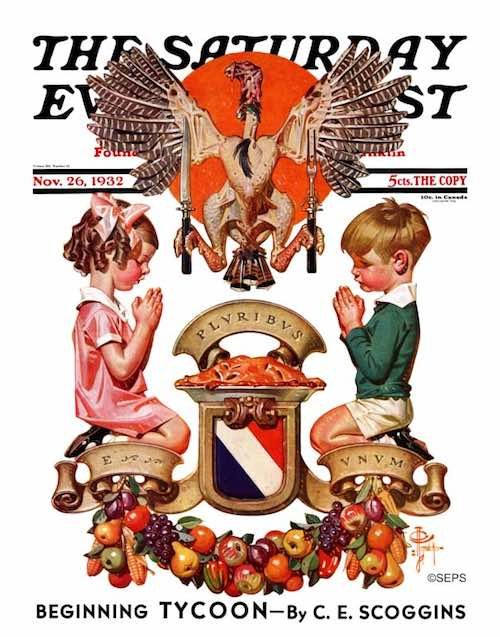
November 26, 1932
The prolific artist wasn’t above depicting the occasional oddity in his paintings. Here we see two sweet children praying over a pie, while above them a not-exactly-stately half-plucked turkey wields knife and fork.
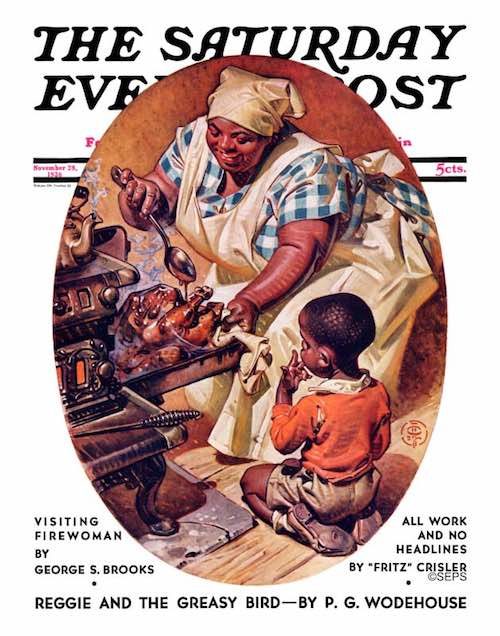
November 28, 1936
This homey scene shows a little boy watching his mother prepare the Thanksgiving turkey. This was one of the few Post covers from the early twentieth century that featured African-American subjects.
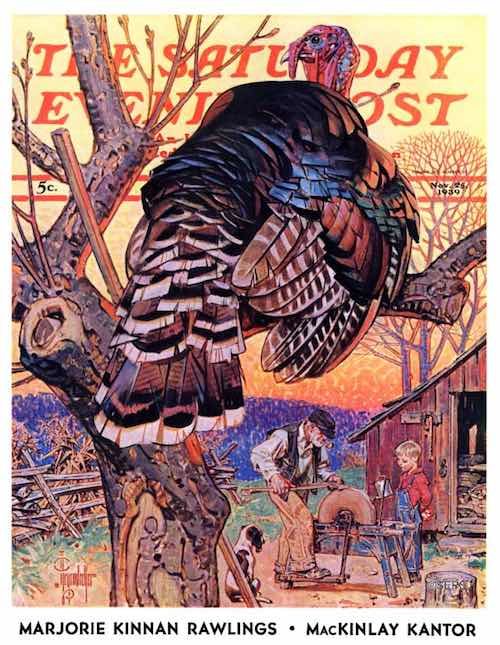
November 25, 1939
This cover juxtaposes the grand, feathered gobbler in the foreground with the preparations for his ultimate fate in the background. For its ungainly shape, turkeys can fly. Maybe this one escaped the axe.
Dancing with My Dad: How Alzheimer’s Helped Us Find a New Rhythm
“Dad came home from dinner and put one sock in the toilet. He put his shoes in the oven and the other sock on the sofa. And now he’s putting his pajama tops around his legs,” my mother whispered in one of our nightly phone conversations. The previous week she told me that my father took all the pictures off the walls. The week before that he would not stop pacing around their apartment.
“His Alzheimer’s is scary and makes me feel like I am living with a stranger,” she said after the here’s-the-bizarre-thing-dad-did-today portion of our call.
“His disease has made him a stranger,” I said, holding back tears and wondering if my dad feels like he is the one living with a stranger.
The dad of my childhood was stern, unemotional and distant. When I was thirteen and on the Bar and Bat Mitzvah circuit, I watched from the sidelines as fathers and daughters were invited to the dance floor. While my girlfriends and their dads, all watery eyes and smiles, waltzed to a recording of “Sunrise, Sunset” from Fiddler on the Roof, I sat next to mine waiting and hoping that he would ask me to dance, but he never did. We rarely interacted. Instead, my father, who worked hard and took his roles of provider and disciplinarian very seriously, preferred to communicate with my three brothers and me through our stay-at-home mom, unless it was to reprimand us for bad behavior or sub-par grades.
After my first marriage failed and I realized that I married someone as emotionally distant as my father, I worked to understand his childhood and any parallels we shared. I learned that my grandfather was also a hard worker, and was just as reticent and uninvolved in my father’s childhood as my father was in mine.
I wanted to alter the pattern I had with my dad, for me and for the two of us, so I made an effort to build a different kind of relationship with him. Instead of letting him automatically pass me over to my mother whenever I called, I engaged him in conversations about my job, my current boyfriend, or how to fix little things around the house. I told him when I struggled at work or suffered from a broken heart, and he consoled me. We grew closer as the dad of my adulthood became softer, more relaxed, and even affectionate.
We were saying goodbye at the end of one of our weekly phone calls when my dad caught me by surprise and said “I love you” to me for the first time. I do not recall exactly when that was, but he said it every time after that until Alzheimer’s stole the words from him, and consequently, me.
His disease snuck up on me. Almost six years ago, while visiting my parents in Florida for their annual Super Bowl party, my mom and I were out grocery shopping when she said to me, “I think there is something wrong with dad.”
“What do you mean,” I asked. My parents, both in their early seventies, were healthy and hale. They were still working and enjoying active lifestyles.
“He couldn’t put together a little cabinet we bought for the microwave and you know how handy he is. He tried over and over again before he finally asked our neighbor to help. And, he’s forgetful. He sometimes asks me the same question I just answered. I’m worried he’s getting Alzheimer’s, just like his mother.”
“Mom, we all forget stuff sometimes,” I said, dismissing her concerns. I did not want to believe that I was losing the father I just found.
The following day, I was in their kitchen making a cup of tea when my dad came to me with his cell phone and asked me how to turn it on. It is an older model flip phone that he has owned for years. I pointed to the button with the green plus sign. “This button turns it on,” I said, trying to sound as casual as possible. Inside, my mother’s voice from the day before was an echo of doom. My dad smiled and thanked me, then went back into the den and sat down in his TV chair. Five minutes later he found me again and we had the exact same interchange. He thanked me again and this time I hugged him and held him tight, wishing I could hold onto him forever and realizing for the first time that I could not.
Not long after that my parents went to a doctor who gave them the deadly diagnosis. My father asked my mother to not tell anyone, including my brothers and me, but she confided in us anyway and asked us not to let on that we knew. Maybe my dad was embarrassed or ashamed, holdover emotions from his childhood when older generations whispered about sickness, as though talking about it would alienate them from their friends and the rest of society.
Conversations with my father got shorter and shorter as he started to withdraw. I felt like he was pushing me away. Sometimes people do that when they feel unworthy of being loved. I will come to regret that I never told my dad that I knew, that I would love him through this disease until the day he dies and beyond, but I was too afraid of humiliating him and exposing my mother’s breach of his privacy to say anything.
Last year, my parents moved up to Northern Virginia to be near my brothers and me, but eventually, my dad’s disease progressed past my mother’s ability to care for him at home. In addition to making him confused, Alzheimer’s caused him to be belligerent, mean, and a flight risk.
The day before we moved my dad into a facility that specializes in caring for people with dementia, we took over his TV chair and hung a handful of family photographs on the beige walls of the sparsely furnished room where he will live for the rest of his life. Maybe the pictures will help him remember us for just a little longer.
To get him to the assisted-living home, my mother, brothers, and I, after a great deal of discussion and negotiation amongst ourselves, lied to him by telling him he had a doctor’s appointment. The nurse manager calls this “lying with love,” a common practice for dealing with people with Alzheimer’s. It felt more like betrayal. After we led my dad into the building on a crisp and bright blue sky October day, we were escorted through two sets of locked doors. The staff quietly coached us to walk away without saying goodbye and asked us to not visit for at least two weeks so my father could get acclimated to his new environment without being tempted to leave. They told us that his disease will allow him to adapt as though he has always lived there and that he will not remember that we banished him from his home, his wife of almost sixty years, and his faithful dog.
The nurse manager called every evening with a report. “Your dad’s integration was a little bumpy,” she said at the beginning of the second week. “He looked for the exit and asked about going home at first, but things are getting much better. He should be ready for visitors soon.”
I try to imagine what my dad must feel like and wonder if he is just as upset about his situation as I am. Maybe I should start to mourn him — the distant father of my youth and the loving father of my adult years — even though he is still living, because I feel an unrecoverable loss, an emptiness created by his wrenching displacement. The nurse manager, who hears me cry during our conversations, reassures me that my dad is adjusting. She tells me to try to see my dad’s world through his eyes, not mine. “Not only would that make the situation easier to understand and accept,” she says, “but it will make your upcoming visits more enjoyable for the both of you.” I am grateful for her advice and soon learn that she is right.
“There you are,” my dad says every time I visit, as though he has been looking for me since the last time I wandered away without saying goodbye. I always find him in one of the wide hallways on his secure floor. Sometimes he is trying to remove pictures from the walls or dragging a chair behind him from the dining room to some location that he feels would be more appropriate. He is nicknamed “the redecorator” by the friendly staff that is not fazed by the same behaviors that seemed so dangerous and disruptive at home. My dad hugs or high-fives every nurse and aide we pass as though they are his new best friends, which I suppose they are.
On one of my recent visits I found my dad, now calm and content, patrolling the halls. As always, he greeted me with a big hug and kiss and we held hands as I walked with him. This has become our new way of enjoying each other’s company, and even though we rarely talk, I feel closer to him than ever before. Eventually, we arrived at one of the common rooms where a piano player was entertaining the residents with songs from the forties and fifties. Nursing assistants were coaxing people to dance, but I remembered all those Bar and Bat Mitzvahs from years ago and was afraid to ask my dad. As the piano player started to sing “Young at Heart,” my dad stopped and turned toward the music. While still holding my hand, he snaked us through the crowd and right there, in the middle of everyone, he put his arms around me and smiled a broad, breathless smile that I had not seen since Alzheimer’s invaded our lives. In that instant I became a thirteen-year-old girl again, but this time, my dad pulled me close and led me around the dance floor while I wished the music would never end.
Indira Gandhi: The First Iron Lady of Politics
Today marks the 100th birthday of the Indian Prime Minister, Indira Gandhi. Though their names were similar, there was no connection between Indira Gandhi and the country’s great champion of independence, Mahatma Gandhi.
Nor was there much connection in their style of politics. In contrast to the Mahtama’s peaceful non-cooperation tactics, Indira boldly used her power as the head of state to undercut her opponents.
In her 1975 interview by the Post, she seems to be a stern, focused woman of steely determination. “She is straight-backed and reserved,” wrote Joy Billington, who described petitioners trying to present the Prime Minister with a sari. Several times the outfit was passed back and forth, the petitioner insisting on getting Indira to accept the dress. But the Prime Minister “makes her point, finally: ‘No, as a matter of principle I don’t accept gifts.’”
Just how determined she could be was revealed just three months after this article appeared.
An Indian court found her guilty of violating campaign laws in her 1971 election, which had led to her appointment as Prime Minister. As punishment, she would have to give up her office and stay out of politics for six years. She appealed the conviction. But when that didn’t work, she declared a national state of emergency and remained in office.
The emergency lasted two years and angered many Indians by introducing laws limiting personal freedoms. When she ended the emergency, her political opponents, many of whom had been jailed, worked to remove her from power. They succeeded in 1977. She was imprisoned for a few months on corruption charges, but in 1979, she and her party returned to power.
In 1984, she was assassinated by her bodyguards, members of the Sikh faith, in retaliation for her ordering the military to put down a Sikh separatist group.
She played a particularly tough brand of politics and, judging by her career, she played it well.
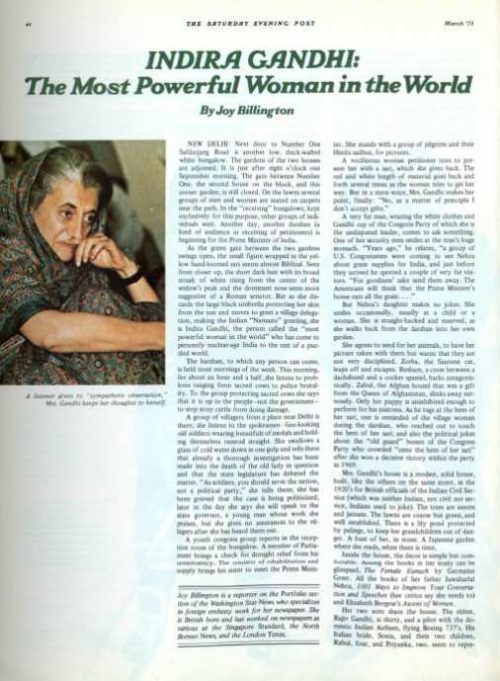
Featured image: Indira Gandhi (Library of Congress)
News of the Week: The Rockefeller Tree, Dangerous Toys, and Little Debbie Needs Your Help!
The Tree Has Arrived
How was your week? I pulled a muscle in my neck, had to get my stove fixed, and for the 32nd year in a row I wasn’t named People’s Sexiest Man Alive. But there is good news: The Christmas season has begun.
You might think the season officially begins when the red and green candy appears on supermarket shelves or when the department stores hang their wreaths, but it officially officially begins when the Christmas tree arrives on a truck in front of Rockefeller Center. It’s almost as if you’re given permission to call it the holiday season and listen to Christmas music when the big tree gets to New York City. Fa-la-la-la-la, la-la-la-la.
The lighting of the 75-foot Norway spruce happens the night of November 29 on NBC.
Toys: The Good, the Bad, and the Ugly

Two different toy-related lists were released this week, one naughty and one nice.
The consumer safety group WATCH (World Against Toys Causing Harm, which sounds like the name of a secret team of superheroes) has released their annual list of the 10 most dangerous toys. This year’s list includes the Wonder Woman Battle-Action Sword, Jetts Heel Wheels, the Slackers Slackline Classic Kit, and the Itty Bittys Baby Plush Stacking Toy. Yes, even toys with the word “plush” in them can be dangerous.
But this week also saw the induction of several toys into the National Toy Hall of Fame. The three inductees are the board game Clue, Wiffle Balls, and paper airplanes. What finalists didn’t make it this year? My Little Pony, Risk, play food (toys that look like food), Transformers, PEZ dispensers, UNO, and sand.
That’s right, sand was a finalist this year. Sand.
Where Will Amazon Build Their New HQ?
That’s the big question every state is asking these days. Well, maybe not Hawaii, but many of the other 49 states. Amazon is going to build a second headquarters, and many cities have submitted plans to the online retailer with their best pitch.
The Wall Street Journal has done a study to figure out which city would be the best fit for Amazon, taking into account such criteria as cost of living, taxes, access to college graduates and tech help, and culture. The paper says that the top three contenders are Dallas, Boston, and Washington, D.C.
What the company should do is build it at the North Pole. There’s plenty of land, there might be some elves looking for work, and people sort of think of Amazon as Santa Claus already.
It Better Not Be the Oatmeal Cremes
Which one? pic.twitter.com/L0JNW7SAVL
— Little Debbie (@LittleDebbie) November 8, 2017
That’s a tweet the snack company sent out recently. They’re getting rid of one of their popular snacks, and they want to know from you which one should go (actually, they say “one gotta go” and boy is that an odd phrase). Of course, there’s no real reason why they have to get rid of one of the snacks. It’s clearly a publicity thing, something they want to become a “meme” and “go viral.” Writer R. L. Stine likes the Oatmeal Creme Pies, and William Shatner wants them all to stick around.
I think it’s obvious which one will be hitting the unemployment line. It’s the Honey Buns. No one has a heart black enough to get rid of a cake shaped like a Christmas tree, Oatmeal Creme Pies are too delicious, and Nutty Buddy rhymes, and everyone likes when foods rhyme. So Honey Buns gotta go.
RIP Liz Smith
Liz Smith was a journalist for 60 years and is best known for writing about celebrities and the culture of Hollywood and New York for various newspapers from 1976 to 2009, when she was let go from The New York Post at age 86. She died Sunday at the age of 94.
Here’s a great video interview with Smith at The New York Times, where she talks about her experiences with people like Frank Sinatra, Donald Trump, Katharine Hepburn, and Barbara Walters.
Casablanca at 75
The classic Humphrey Bogart/Ingrid Bergman drama premiered in New York in November of 1942. Bill Newcott talks about the film in this week’s edition of “Movies for the Rest of Us,” and on Sunday, CBS Sunday Morning did a story about the film and its dedicated fans, including interviews with the children of stars Bogart, Claude Rains, and Paul Henreid.
This Week in History
George S. Patton Born (November 11, 1885)
Post Archive Director Jeff Nilsson explains how General Patton was part of the century’s best-kept secret.
The Star Wars Holiday Special Airs (November 17, 1978)
I’m not even sure if this has been seen on television since it first aired. Maybe only a few times or in snippets here and there. But thanks to YouTube, you can watch the whole thing. Along with Harrison Ford, Mark Hamill, and Carrie Fisher, you get sketches with Bea Arthur, Art Carney, and Harvey Korman. Plus: Jefferson Starship!
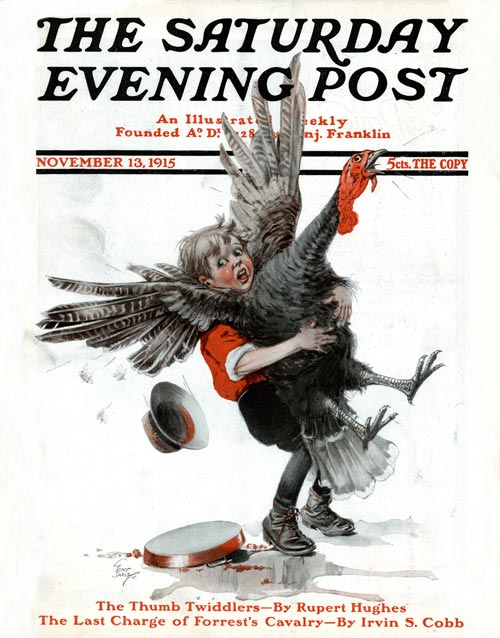
This Week in Saturday Evening Post History: Squawking Turkey (November 13, 1915)
Tony Sarg
November 13, 1915
I’m trying to figure out how the scene in this cover by Tony Sarg unfolded. Why was a little kid sent to get a live turkey that’s even bigger than he is? What exactly is that on the ground, a pan and water?
“The Thumb Twiddlers” — mentioned below the picture — sounds like an article that could be written today about people addicted to smartphones and social media, but it’s actually a short story by writer and director Rupert Hughes, uncle of Howard.
Thanksgiving Recipes
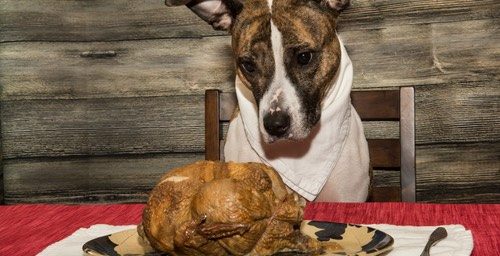
Are you a traditionalist when it comes to Thanksgiving, or are you a bit daring? I’d like to think I’m the type of person who wants to try something new and out of the ordinary, maybe ham instead of turkey or Brussels sprouts or a pie made with a fruit I’ve never tried before. But when you get right down to it, I like my turkey and my mashed potatoes and the classic green bean casserole. Thank you, Dorcas Reilly!
But beyond those favorites, you’re going to need more for the day. Here’s a recipe for a sweet potato casserole, and here’s one for the perfect pie crust. Not sure how to cook your turkey? Here are some tips from McCormick, Food Network, and Melissa Clark at The New York Times.
If you have trouble cooking that turkey, you can always call the Butterball Turkey Talk-Line. They’ll tell you how long to cook your turkey, what to do if you bought your turkey in 1969, and what safety measures you should take for the stuffing.
Next Week’s Holidays and Events
World Hello Day (November 21)
This international holiday started in 1973, and the goal is for everyone on the planet to say “hello” to 10 people. And no, saying it to them on Facebook doesn’t count.
National Tie One On Day (November 22)
Macy’s Thanksgiving Day Parade (November 23)
While the turkey is cooking and the yams are yamming, you can turn the TV to NBC, where you’ll see the Macy’s Thanksgiving Day Parade, which NBC has televised every year since 1948. It starts at 9 a.m. Eastern.
Happy Thanksgiving!
50 Years Ago: An Antacid Trip with the Tweeny-Boppers
 In the 1960s, the Post‘s humor series, “The Human Comedy,” focused on broad social issues and generational divides for its surreal and satirical slant. The creator of Mad Libs and Droodles, Roger Price, wrote this installment of the humor series that was published on November 18, 1967. His “Antacid Trip” journeys through the jive and psychedelics of the younger generation as a not-so-silent member of the Silent Generation.
I guess I should have been prepared, because my friends had been avoiding me for months. Charley, who was 40, and Lyle, who was 41, were always polite when I phoned, but scene-wise we weren’t making it. And real teenagers like Gloria and Harry, who were only 36, cut me dead on the street. But I had absolutely no premonition of disaster when I went into the Discodelic Record Shoppe that day.
“Hey, man,” I said to the clerk, “groove me in with the latest Sonny and Cher album.”
The clerk, like, just looked at me. And then he asked to see my driver’s license.
“Sorry, Work-a-Daddy,” he sneered. “We can’t sell to anybody over 45. Unless you make it with a doctor’s prescription.”
I pulled my Day-Glo forage cap over my eyes and slunk away, convinced my world was ended. I was no longer a swinger; I was too old for the Frug and too young for Medicare. There was nothing left for me but to cut off my tight trousers, give my Humphrey Bogart posters to the Salvation Army and resign myself to endless nights of Gomer Pyle, Johnny Carson and reruns of Bonanza.
But someone up there must dig me, because that very afternoon I ran into Biggy Poindexter.
Biggy had been three years ahead of me in high school, so I knew he must be at least 50. “Hey, Chief,” he yelled at me. “Long time no see.”
Biggy was wearing a triple-breasted red blazer, bifocal shades, a green homburg and bell-bottom trousers. He carried an orange dispatch case, and three large buttons were pinned to his lapels. They read: TWEENY POWER, DON’T TRUST ANYBODY OVER 70 and CHICKEN INSPECTOR.
He sensed my unhappiness immediately. “Hey, how come the long puss, Chief?” he shouted. “I bet you got those old over-the-hill blues, huh?”
I smiled wanly. “That’s about it, Biggy,” I said.
“Gol ding it!” Biggy slapped me on the back. “That’s nowheresville in spades. Us Tweenys got to keep our chins up.”
“Tweenys?”
“Tweeny-Boppers,” Biggy said. “Us kids between forty-five and sixty. After all, Chief, it’s our world. Over eighty-six percent of Americans are under sixty.”
I’d never thought of it like that. I felt a surge of confidence. Maybe I wasn’t really all washed-up.
“Listen,” Biggy yelled. “What you need, Old Buddy, is a trip! Come on, you and me’s gonna mosey pronto over to the Cat’s Pajamas — that’s this hang-out we Tweenies have at the Sheraton-Hilton.”
On the way Biggy explained the basic Tweeny-Bopper philosophy.” We figure those old geezers like Einstein and Eisenhower and Carl Sandburg, they loused everything up and left us this rotten world, but that’s their problem. We do our own thing, you know, and take care of each other, and to hell with the Establishment. What we say is, ‘Tune Out, Turn Over and Drop Everything! — ”
“What do you do for kicks?” I asked.
“Well, like in the daytime we hang around the American Stock Exchange buying and selling two-dollar electronics stocks. Last week we staged a protest march against Federal Trade Commission brutality. Or we go surfing, when the surf is up. I just got myself a brand-new twenty-eight-foot board, with seats, handrails and a crew of three.”
“Solid. What about the night life, Biggy?”
“Well, we may make the scene-orooty at this Tweeny discotheque and dance the Shlump — that’s a dance that you can do sitting down.
“We even have nude parties,” Biggy went on. “They work out pretty well except for one thing. We can never get any girls to come. But the girls would just interfere with the seven-card-stud games anyway.”
At this point Biggy, who had been waving his arms about excitedly, accidentally bumped into a tall bearded boy with hair down to his shoulders.
“Cool it, Papa Brown Shoes,” the boy said. He extended a wilted plastic flower toward Biggy. “Love,” he said. “Love, man.”
“Wrong, Chief,” Biggy hollered. He reached in his pocket, produced a $20 bill and waved it. “Cash,” he said. “Cash, Old Buddy.”
As the boy snatched at the bill, Biggy struck his wrist sharply with a steel ruler, which he evidently carried for this purpose, and moved on. “Town’s getting overrun with squares,” he muttered.
The Cat’s Pajamas was a large, dimly lighted room on the first floor of the Sheraton-Hilton. On the walls were photoposters of Pat Nixon, H.L. Hunt and Hildegarde. A large sign said: MAKE MONEY — NOT WAR. About 20 other Tweeny-Boppers were seated in red-leather booths around the wall, many in advanced stages of torpor.
We had a huge dinner — shrimp cocktail, steak, baked potato, salad, mince pie and brandy. As we lighted up cigars after the meal, Biggy glanced quickly around the room and snapped open the locks on his dispatch case. He took out a polyethylene bag containing about a quarter pound of pure white powder. “You ready for the triporoony, Chief?” he asked.
I nodded eagerly, my sinuses clogging in anticipation. This was It.
“Yessirree Bob, it’s Tripsville time,” Biggy grinned, and carefully measured three heaping spoonfuls of the powder into each of our water glasses. “Uncut stuff,” he said. “Pure NaHCO3. I got it from a druggist in Grosse Pointe.” He held up his glass. “Chug-a-lug, Old Buddy.”
Nervously I drank the water containing the white powder. It had a familiar taste.
“Best damn bicarbonate of soda you can get,” Biggy said, smacking his lips.
Following Biggy’s example. I leaned back in the booth and relaxed. Slowly a feeling of peace began to creep over me. All colors and sounds seemed muted and indistinct. The world suddenly seemed a happy, pleasant place. I remember asking Biggy, before he started snoring, if the other Tweenies in the room were all taking trips.
“You betcher boots,” he muttered. “Every last one of ‘em. They’re all Antacid Heads.”
From that moment on my life was changed. Through Biggy I became a member of the Tweeny-Bopper underground. Every night we Turn On, usually with bicarb, but sometimes with more exotic stomach-expanding drugs such as Bisodol or Alka-Seltzer.
I know that old fogies say we’re nothing but irresponsible kooks, but when I walk down the street with my yellow homburg, my bell-bottom Bermuda shorts and my neon briefcase, I know I’m a member of the Great Society.
The only thing that bothers me are my children. Since I became a Tweeny they’ve started getting crew cuts and wearing neckties, and they take three baths a day. I guess that’s what they mean when they talk about the Generation Gap.
Are Cigarettes Going Away for Good?
The history of cigarettes in the United States is one of a great rise and fall, but will smoking ever completely die out?
Cigarettes were a tiny fraction of total tobacco consumption at the turn of the century, when chewing tobacco, pipes, and cigars were more popular. By 1930 — more than 40 years after the invention of the practical rolling machine — cigarettes had taken over, and by 1965, 42 percent of adults were smoking them. But a government report in the mid-sixties would spell the rapid decline of smoking in America.
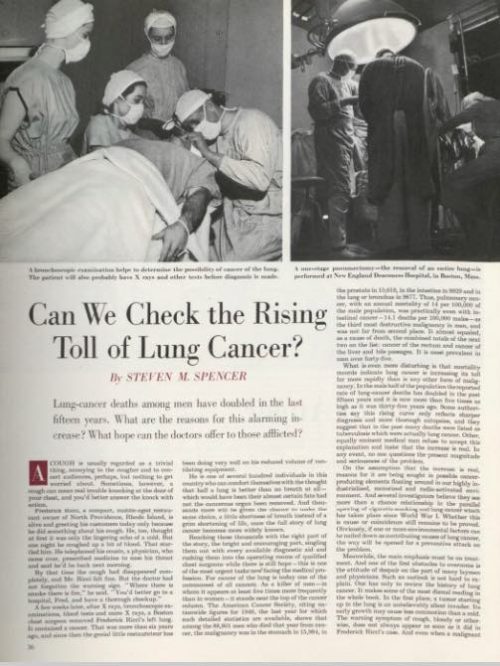
The U.S. Surgeon General’s report in 1964 dealt a permanent, heavy blow to tobacco sales, but it wasn’t the first consideration of the health effects of smoking. In 1950, this magazine explored whether the “cigarette cough” might be indicative of a causative link between smoking and lung cancer in the article, “Can We Check the Rising Toll of Lung Cancer?”
“Whether excessive cigarette smoking is a factor in the commonest form of lung cancer, squamous cell or epidermoid, is being warmly argued,” claimed author Steven M. Spencer after finding that 63 percent of lung cancer patients in a New York survey had smoked cigarettes 25 years or more. Lung cancer was quickly rising at the time — particularly among men — but the breadth of studies didn’t exist to prove that cigarettes were causing it.
Now it does exist, and the smoking rate among adults in the U.S. is down to 15 percent.
The fall of cigarettes in the U.S. could be regarded as an unparalleled victory in public health. “I don’t know of another area in which similar health improvements have been demonstrated,” says Dr. David Hammond, a public health expert from University of Waterloo. Yet despite the dramatic decline, smoking is still the leading cause of death in the U.S. It’s a case of simultaneous success and failure.
Although smoking rates have plummeted across the board, there are still some geographic, social, and economic indicators. The incidence of smoking is about four percent higher in the Midwest than the national average, five percent higher among lesbians, gays, and bisexuals, and more than 10 percent higher for people living under the poverty line. Hammond says, “The good news is that smoking has been going down across all socioeconomic strata; the bad news is that we haven’t narrowed the disparities that have been there for decades.” And narrowing those disparities is in the public interest, since the CDC estimates a loss of more than $300 billion each year due to smoking from direct medical care and loss of productivity.
There are tools for the public fight against cigarettes that have proven effective, like media and regulation on advertisements. Dr. Hammond says the U.S. could improve in other areas, particularly warning labels: “They’re probably among the weakest in the world,” he says, “and they haven’t changed since 1984.” The FDA has released stricter deterrent warnings to be used on cigarette packaging per the Family Smoking Prevention and Tobacco Control Act, but litigation from tobacco companies — framed around First Amendment rights — has kept the reality of the new packaging standards at bay.
Another, more controversial, tool for quitting is the electronic cigarette. Like the prescribed medications for smoking cessation — nicotine patches, gum, and lozenges — e-cigarettes, or vaping, deliver nicotine to the user. The jury is still out on the long-term effects of e-cigarette use, but the harm is estimated to be somewhere between smoking and the aforementioned medications.
Vaping has been found to help smokers quit, but experts worry that it could attract young people to nicotine who never used it in the first place. Dr. Hammond co-authored a study in the Canadian Medical Association Journal regarding youth initiation to smoking and vaping. It found that “the causal nature of this association remains unclear” because of “common factors underlying the use of both e-cigarettes and conventional cigarettes.” While they may not pose a high risk of being a gateway to tobacco use, e-cigarettes warrant more data. “We would be crazy if we weren’t keeping a close eye on the number of kids trying e-cigarettes, but to date it doesn’t seem to be increasing smoking,” according to Hammond.
A variety of approaches, in a variety of fields, seems to be the accepted strategy in taking down cigarettes, but what would victory look like? An absence of cigarette companies? Vaping as a new norm? It’s difficult to imagine that e-cigarette companies would cease to exist after completing the task of taking down big tobacco, but, unlike the latter, the vaping industry is less monolithic and represented by a variety of big and small interests. The conglomerated efforts of tobacco companies, after all, have put up the decades-long fight that continues more than 50 years after a report that probably should have buried the industry. There have been considerable public health triumphs, but the current 480,000 annual smoking-related deaths suggest that there is still a long road ahead.
Curtis Stone’s Roast Pork Loin and Endive Salad with Stilton and Roasted Walnuts
My mum and granny’s roast pork was one of my favorite meals growing up in Australia. Roast Pork Loin with Spiced Apple Compote makes for a lovely Sunday dinner or special-occasion meal. Pork and apples are a classic combination that simply can’t be improved on. The sweetness of the Fuji apples pairs perfectly with savory seasonings of Maldon salt, garlic, and marjoram of the pork.
Pork loin is actually one of the leanest cuts of meat, so keep the outer layer of fat: It bastes the meat perfectly as it roasts and keeps it from becoming dry. If you are concerned about fat content, simply trim excess fat away before carving and serving.
In preparing pork loin, the biggest mistake home chefs make is carving the roast right out of the oven without letting it “rest.” Resting allows juices to redistribute evenly through the meat instead of ending up on the cutting board. I recommend letting the roast rest for 30 minutes before carving, during which time you can prepare the apple compote.
The mix of bitter and crunchy in Endive Salad with Stilton and Roasted Walnuts creates a lush salad perfect for cooler months. The vinegar in the dressing adds a nice acidic balance with the rich pork, and the Stilton and nuts complement the pork and apple flavors as well.
Editor’s note: Look for Curtis as co-host of Moveable Feast with Fine Cooking on PBS and as head judge of Top Chef Junior on Universal Kids.
Roast Pork Loin with Spiced Apple Compote
(Makes 8 servings)
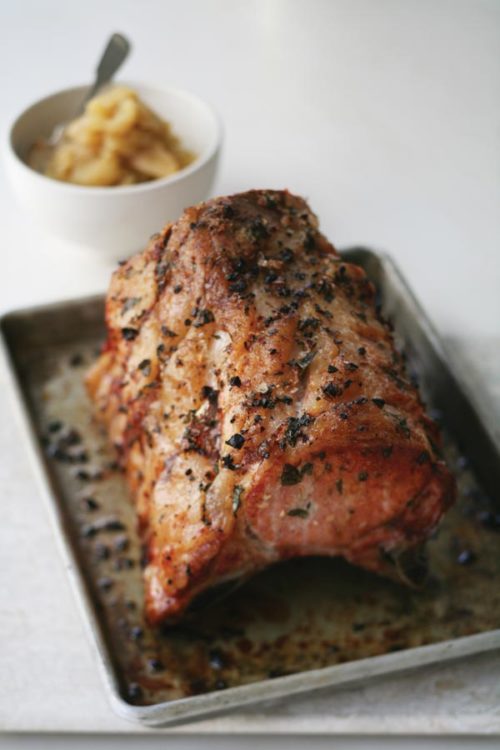
Photo by Quentin Bacon
- 1 3½-pound bone-in pork loin roast (with layer of fat on top still intact)
- 1 tablespoon sea salt, preferably Maldon
- 2 garlic cloves, coarsely chopped
- 2 tablespoons fresh marjoram leaves, coarsely chopped
- 5 Fuji apples (about 1½ pounds total), peeled, cored, and each cut into 8 wedges
- 2 whole cloves
- 1 cinnamon stick
- ¾ cup Calvados (apple brandy)
- 2 teaspoons sugar (optional)
To prepare pork: Position rack on bottom of oven and preheat oven to 475°F. Using sharp knife, score fat that covers top of pork. Rub pork fat with sea salt, garlic, and half of marjoram leaves. Place pork on rack set in heavy roasting pan. Roast for 30 minutes. Then reduce oven temperature to 350°F and roast pork for another 45 minutes, or until instant-read meat thermometer registers 140°F when inserted into center of pork. Remove roasting pan from oven and allow pork to rest for 30 minutes before carving. Combine pan juices from roasting pan with remaining marjoram leaves and set aside to keep warm. Spoon off any fat that rises to top of pan juices.
While pork is resting, prepare apple compote: Combine apples, cloves, and cinnamon stick in large, heavy saucepan over medium to high heat and stir for 3 minutes or until apples just begin to soften slightly. Decrease heat to medium to low. Add Calvados to apples and stir for 5 minutes, or until most liquid has evaporated. Cover pan and cook apples, stirring occasionally, for 8 minutes or until they are tender and most juices have evaporated. Remove saucepan from heat. Remove cloves and cinnamon stick. Using potato masher, coarsely mash apples. If necessary, stir in sugar to sweeten compote slightly.
To serve: Thinly slice pork on cutting board and arrange pork slices on plates. Drizzle pan juices, and any accumulated juices that exuded from pork while it was being sliced, over pork slices. Spoon warm apple compote alongside pork and serve.
Make-ahead: The apple compote can be made up to 4 hours ahead, covered, and refrigerated. Rewarm the compote before serving.
Per serving
- Calories: 380
- Total Fat: 14 g
- Saturated Fat: 4 g
- Sodium: 792 mg
- Carbohydrate: 15 g
- Fiber: 3 g
- Protein: 41 g
- Diabetic Exchanges: 1 fruit, ½ fat, 7 lean protein
Endive Salad with Stilton and Toasted Walnuts
(Makes 6 servings)

Photo by Ray Kachatorian
Dressing
- 3 tablespoons cider vinegar
- 3 tablespoons minced shallots
- 2 tablespoons honey
- 1 tablespoon Dijon mustard
- 2 teaspoons finely chopped fresh tarragon
- 1/4 cup extra-virgin olive oil
- 1 teaspoon finely chopped fresh chives Kosher salt and freshly ground black pepper
Salad
- 1 pound Belgian endive (about 4 large)
- 8 ounces red endive or radicchio di Treviso
- 1 small red pear, cored, cut into thin, matchstick-size strips
- 1 cup red grapes, halved
- 2 ounces Stilton blue cheese, crumbled
- 1 cup walnuts, toasted
To make the dressing: In medium bowl, whisk vinegar, shallots, honey, mustard, and tarragon until blended. Whisk in olive oil. Stir in chives. Season to taste with salt and pepper.
To make the salad: Trim ends of Belgian and red endive and separate leaves. Continue to cut stem end of endives to allow each layer of leaves to be peeled away without ripping leaves. Cut leaves lengthwise in half. In large bowl, combine endive leaves, pear, grapes, and cheese. Coarsely crumble walnuts over salad. Gently toss salad with enough dressing to coat. Divide salad evenly among 6 serving plates, mounding salad in the center. Serve immediately.
Make-ahead: Dressing can be made 1 day ahead, covered, and refrigerated. Let dressing stand at room temperature for 15 minutes and rewhisk before using.
Per serving
- Calories: 261
- Total Fat: 20 g
- Saturated Fat: 4 g
- Sodium: 748 mg
- Carbohydrate: 18 g
- Fiber: 3 g
- Protein: 5 g
- Diabetic Exchanges: 1 vegetable, ½ fruit, ¼ protein, 4 fat
Pick a side: Curtis Stone shares two more holiday favorites — Butternut Squash with Sage and Brown Butter and Pan-Roasted Brussels Sprouts with Chorizo — at saturdayeveningpost.com/holiday17-recipes.
Cover Collection: Time for Pie
Pie follows closely on the heels of turkey as the quintessential Thanksgiving dish. Here are our favorite covers featuring pies — plus recipes — to inspire your pursuit of pastry.
J.L.S. Williams
October 13, 1917
Country Gentleman was a sister publication of The Saturday Evening Post that offered no end of practical advice for farmers and their families. It helped with questions of wintering bees, pruning orchards, and raising hogs. It also featured some pretty delicious pie recipes.
Squash Pie (1917)
1 ½ cupfuls of squash steamed or boiled soft
1 pint of milk
1 cupful of sugar
2 egg yolks
grated rind of half a lemon
2 level tablespoonfuls of cornstarch, moistened with milk
1 cupful of shredded coconut
This recipe is sufficient for two pies. The crusts should be baked separately, first pricking them with a fork to prevent puffing. Mash the squash smooth; add the milk, hot; stir in the sugar, grated lemon rind, cornstarch and yolks of eggs, and boil four minutes, stirring slowly. When nearly cool, fill the baked crusts and sprinkle with shredded coconut.
Norman Rockwell
August 18, 1928
Like Rockwell’s best loved paintings, this one tells a story. A pie was cooling on a window sill and a passing stranger down on his luck couldn’t resist the wonderful aroma. The pie-owner’s dog, however, was having none of it.
Hawaiian Pineapple Fruit Pie (1928)
1 pastry shell
4 slices Hawaiian Pineapple
8 halved peaches
9 prunes
1 cup cream filling
3/4 cup cream, whipped
Spread cream filling lightly in bottom of pastry shell. Steam and stone 9 prunes and arrange on peaches, alternately with pineapple halves. Place prune in the center and garnish with whipped cream. One cup whipped cream may be used instead of cream filling.
William Meade Prince
November 1, 1930
William Meade Prince was a prolific illustrator who created art for many magazines, illustrated the African American stories of Roark Bradford, made posters for the USO and other organizations during World War II, and created the comic strip “Aladdin, Jr.” He also drew one delicious looking pie.
Lemon Pie (1930)
Rich lemon pie calls for six eggs, but the pie is a large one and unusually fine. Cream half a cupful of softened butter with three-quarters of a cupful of granulated sugar and add the well-beaten yolks of six eggs, a quarter of a teaspoonful of salt and one tablespoonful of fine cracker crumbs, the grated rind of two lemons and the stiffly beaten whites of three eggs. Mix the juice of three lemons with three-quarters of a cupful of granulated sugar and add three tablespoonfuls of cold water, stir into the other mixture and bake in one large pastry-lined pie pan or in individual pie pans. Make a meringue of the other three egg whites and six tablespoonfuls of granulated sugar, add one teaspoonful of lemon juice and spread over the cooled pie. Brown very delicately.
J.F. Kernan
July 27, 1935
J.F. Kernan specialized in images of middle-class life for popular magazines from the 1910s to the 1940s. His nostalgic and often humorous illustrations celebrate the simple comforts of home, family, and outdoor recreation. In this case, who needs a fork or plate when blueberry pie is calling your name? We’re betting that white tablecloth and play suit won’t stay white for long.
Blueberry Flummery (1913)
A cupful of water, a quart of blueberries, a cupful of sugar, three tablespoonfuls of lemon juice, a few grains of salt and half a cupful of cornstarch wet in half a cupful of cold water. Add water to the blueberries and bring them to the boiling point, simmering until soft. Then add salt and sugar and, when well dissolved, the cornstarch. Cook over hot water for twenty minutes, add the lemon juice and pour into molds. Chill and serve with cream.
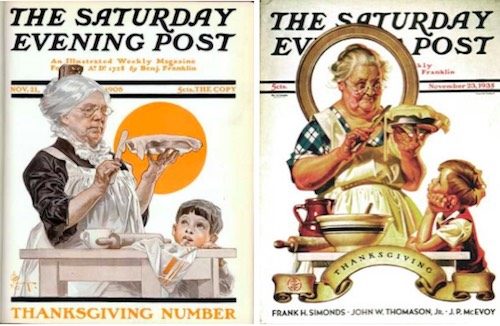
J.C. Leyendecker
November 21, 1908 and November 23, 1935
J.C. Leyendecker, the Post’s most prolific artist with 322 covers to his name, painted this scene more than once. Here we see both the 1908 and 1935 versions of a little boy watching his grandmother trim the pie. The grandma had evolved from stern Victorian to “Aunt Bee,” but not much else in the scene had changed.
Apple Marshmallow Pie (1931)
Pare and slice six well-flavored large apples and simmer till tender in a sirup of half a cupful of sugar and a quarter of a cupful of water. Add a very little nutmeg, cinnamon or grated lemon rind, cool, turn into a baked pastry shell, and top with marshmallows. Place in the oven to brown delicately. Serve with cream. Marshmallow whip or whipped cream may top the pie; in that case browning will be omitted.
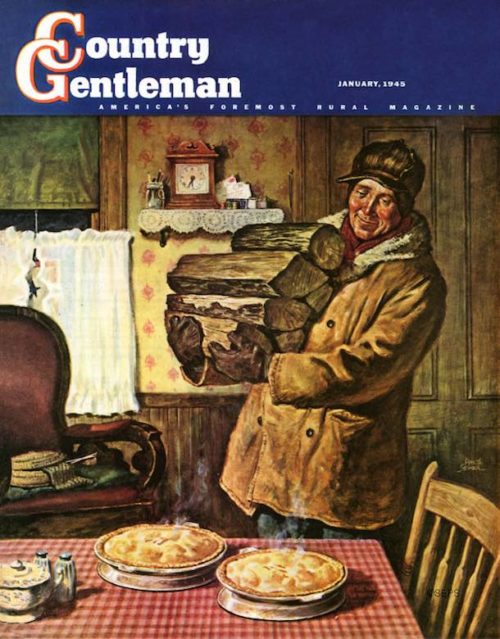
Amos Sewell
January 1, 1945
Although artist Amos Sewell and his wife never had children, many of his 57 Post covers featured kids getting into shenanigans. This country gentleman looks as if he thinking about causing some pie-eating mischief himself.
Apple-Sponge Pie (1932)
Take two tablespoonfuls of butter and rub into it three tablespoonfuls of flour and half a teapsooonful of baking powder. Then add the well-beaten yolks of three eggs, one cupful of apple sauce sweetened, and flavor as you fancy with nutmeg or cinnamon or grated lemon rind. Lastly fold in the stiffly beaten whites of the three eggs and pour into a pan lined with your favorite recipe and bake as you do all custards – a hot oven first to cook the crust quickly – then a slow oven to set the custard. The result is a lovely puffy spongy something which will literally melt in your mouth.
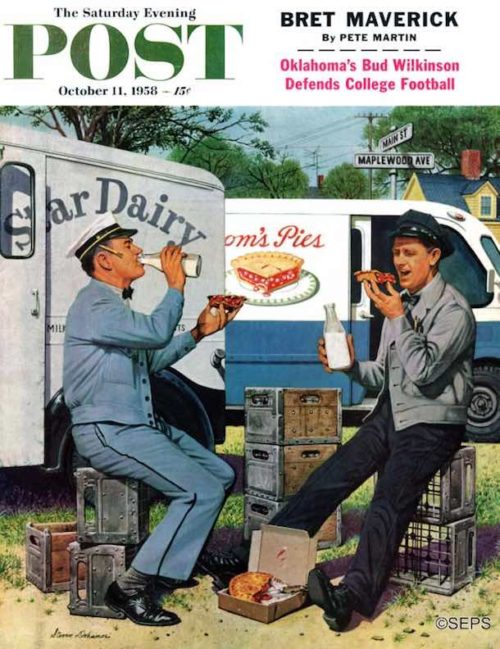
Stevan Dohanos
October 11, 1958
Cherry Betty (1913)
Ten slices of buttered bread, a quart of pitted cherries stewed in a cupful of water and a cupful of sugar. Arrange alternately in a baking dish, cover and bake covered thirty minutes, sifting on the top a fourth of a cupful of brown sugar mixed with half a teaspoonful of cinnamon and a few small pieces of butter during the last ten minutes of the cooking.
Con Watch: 7 Tips for Safely Shopping Online
Steve Weisman is a lawyer, college professor, author and one of the country’s leading experts in cybersecurity, identity theft and scams. See Steve’s other Con Watch articles.
Online shopping is expected to be bigger than ever during this upcoming holiday season. RetailMeNot predicted a 47 percent increase in consumer spending from last year for the Black Friday weekend. Unfortunately, online shopping is also popular with scammers and cybercriminals who set traps for unwary shoppers.
Here are 7 tips for avoiding online shopping scams and lowering your risk of identity theft.
1. Be on the lookout for fake websites. Scammers are adept at constructing phony websites to sell shoddy or even nonexistent items. Often, in an effort to trick you into trusting them, these websites appear to be from legitimate retailers. Here are some tips to help you avoid the fakes:
- Be wary if the price for a high-demand product looks too good to be true. As always, if it looks too good to be true, it probably is.
- Watch for spelling and grammar mistakes on the website. Many of these phony websites are set up by scammers whose primary language is not English.
- Go to www.resellerratings.com to investigate whether a retail website is legitimate. The site offers reviews about particular merchants. If the retailer’s website is not listed or has bad reviews, you should avoid it.
- Confirm that a website is really that of a major retailer by visiting www.whois.com/whois/, which shows the actual owner of the website. If it doesn’t match who it should be, you know not to trust the website.
2. Look for https. Never provide credit card or other sensitive information on a website unless the domain name begins with https. The extra s at the end of http stands for secure and means that your data is being encrypted when it is being transmitted.
3. Use a credit card — not a debit card — for online shopping. The laws pertaining to fraudulent use of your credit card limit your personal liability to no more than $50, and most credit card companies won’t charge you anything for fraudulent use. However, if your debit card has been compromised by an identity thief, you can lose the entire bank account tied to the card if you do not report the crime promptly. Even If you do report the theft of your debit card promptly, your access to your bank account will be frozen while the bank investigates the crime. Note that while the newer EMV chip credit cards have reduced much retail credit card fraud, the chip doesn’t provide any additional benefit when shopping online.
4. Don’t leave your credit card on file with an online retailer. Although it may be convenient to leave your credit card number on file where you regularly shop, doing so puts you in danger of credit card fraud and identity theft if there is a data breach. If you do not choose to keep your credit card number on file with the online retailer, they are not allowed to store it.
5. Consider using a temporary credit card number for online shopping. Purchases will be charged to your regular credit card number, but even if the temporary number falls into the hands of an identity thief, it cannot be used to access your credit card. You can get a temporary card number from your credit card issuer. A potential drawback to using a temporary credit card number is that using one can make returning goods or getting a refund on a purchase more difficult later when you may have to confirm your credit card number.
6. Don’t use public Wi-Fi to shop. The ease with which public Wi-Fi may be hacked was shown in 2015 when, as part of an experiment, a 7-year-old girl needed only 10 minutes and 54 seconds to hack into a public Wi-Fi system. If you do use public Wi-Fi, be sure to take the following precautions:
- Equip your computer, laptop, tablet, or smartphone with security software.
- Keep your security software updated with the latest security patches.
- Turn off sharing in your device settings.
- Consider using encryption software so that your communications are encoded.
- Consider using a Virtual Private Network (VPN), which enables you to send communications through a separate private network while you are on a public network.
7. Don’t click on links in unsolicited emails. The links in these emails or text messages may be tainted with malware that will steal the personal information from your computer or phone and use it to make you a victim of identity theft. The best course of action if you receive such an email or text message that interests you is to go directly to the retailer’s website. If the offer is legitimate, you will find it there.