North Country Girl: Chapter 26 — The London Inn
For more about Gay Haubner’s life in the North Country, read the other chapters in her serialized memoir. The Post will publish a new segment each week.
At fifteen, I was expected to stay at home on school nights, but I was never cut off from my gang. From the second my homework was done, I monopolized the phone, calling one girlfriend after another. The small occurrences at East High that day were fodder for hours of discussion. I started out in the breakfast nook on the wall phone (no one ever used the Princess phone, dusty and neglected on my parents’ bedside table), perched on one of the uncomfortable white wrought iron chairs my mother thought were “so French!” I cradled the handset between my head and shoulder, twisting the plastic-covered coiled telephone wire until it was completely bent out of shape. I eventually stretched the phone line out to its maximum distance so I could lie on the carpeted floor of the dining room, yakking and yakking until my mom turned out the lights, my baby sister tottered over to sit on my head, or my dad came roaring in: “Get off the goddam phone!”

Video of the London Inn in 1970. [Note: video contains repeated use of a vulgar hand gesture.]
Doug Figge, in his role as designated boyfriend, dutifully called every evening he wasn’t working; our phone conversation lasted about three minutes as Doug didn’t have a whole lot to say. Even if he had, I would have been more interested in the doings of natives in Borneo than what went on in the strange, foreign realm of Central High.
The good fairies had granted my two most heartfelt wishes: to be popular and to have a boyfriend. Wish one turned out to be all unicorns and sparkles and rainbows, but the fairy who granted wish two must still have been in training.
It felt right; Doug ticked an item off my list as if he were a school supply: pencils, three-ring binder, protractor, boyfriend. But when Doug kissed me there was none of the earth-shaking passion Forever Amber and Peyton Place and James Bond movies and even Romeo and Juliet had promised. I felt more lust for Roger Daltrey or James Coburn as Our Man Flint than I did for my flesh and blood boyfriend. Yet the Duluth teen code required that Saturday nights were for romance: boyfriend and girlfriend, two by two, and if you weren’t part of a couple, then you were expected to be out on a date, looking for love.
But Friday night was Girls Night, and I would only have stayed home if my feet were nailed to the floor. I lived for those Fridays; surrounded by that bevy of funny, big-hearted girls, I knew that we could do anything, rule the world, stay forever young, and always, always be friends.
Doug’s boss at the Canal Park Drive-In insisted that he work at least one weekend night, frying up onion and green pepper rings, mushrooms, and potato puffs and adding another layer of grease to his hair and face. I didn’t especially look forward to our Saturday dates and I dreaded those weeks he was off Friday night; from Monday to Thursday we would have the same phone conversation:

“So we going out Friday?”
Why didn’t he realize by now that Friday was Girls Night? What did he think had happened that would make me change my mind?
“Friday is when I hang out with my friends,” I sighed.
“I have to work Saturday. If we don’t go out Friday, I won’t see you this weekend. Aren’t you my girlfriend? Don’t you want to be with me?”
Doug thought it was preposterous that any girl would prefer to spend time with other girls when she had a boyfriend, even though “going out” meant nothing more than hours grappling with him in the back seat of his car, while he insistently played “Touch Me” by the Doors on his 8-track and pressed his rock-hard crotch against me. I understood that was what a boyfriend did. I didn’t have to like it.
On Fridays I wanted to be part of the gang, surrounded by my girls, hanging out by the lake or playing Spades in Paula River’s basement, laughing and drinking and smoking (except for me). That was heaven enough.
Suddenly a whole new world of Friday nights opened up for us. Our natural leader, Nancy, was also the oldest; in January she turned sixteen and passed her driver’s test on the first go with an almost perfect score. Her parents, having been worn down by two previous teen-age kids, meekly passed on the battered white sedan that had survived both her older brother and sister, a car known since time immemorial as The White Delight.
The White Delight was our clown car. It was amazing how many girls we could squash in: four in the front and at least five in the back and not a single seat belt. From up in my bedroom I’d hear freedom’s call, the beeping horn of The White Delight, dash out of my house, throw open the car door, and find a lap. I was the smallest so never rated a seat of my own, much less the glorious and shouted for shotgun seat.
Nancy excelled at driving as she did everything else, guided by some mysterious force. She could putter down busy Superior Street at thirty miles an hour without ever looking through the front windshield, as there was always at least one fascinating conversation going on that was more important than the upcoming stoplight. Nancy’s head swiveled and her long brown ponytail bobbed from side to side while five or six of us girls talked and hooted and screamed, yet she never had a single accident, not even a fender bender.
Betsy turned sixteen, got her license, then Debbie, then the rest of my gang of girls. We slipped the surly bounds of earth, liberated by a driver’s license and the use of the family car. I dreamt of the day when I could drive my friends around in my mom’s big green Chrysler New Yorker. But I was a year younger than everyone else and so always a passenger in somebody else’s car as we headed out in a convoy on Friday evenings. (On Saturdays, those of us who were in-between boyfriends or whose boyfriends were working could fit into a single car, on the lookout for boys and trouble.)
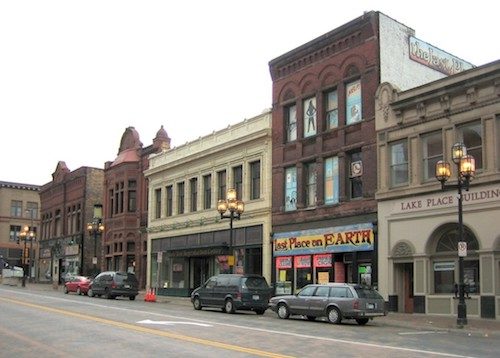
Our first stop was always the London Inn Drive-In. I had been to the London Inn a million times as a kid. Intimidated by the throngs of teen-agers, I would wait in the car for my mother to come out with sacks full of hot burgers (ketchup only for my sister and me) and fries. My job was to hold the flimsy cardboard container of soda pop and keep the cups from spilling, which I managed about a third of the time.
Making your first entrance into the London Inn in a car full of kids was Duluth’s rite of passage: you are now officially a teen-ager. It was the gathering of the clans, a frenzied mating of wild animals, a not-so-secret clubhouse, and Woodstock, all in a half-acre parking lot. On weekend nights there were hundreds of kids, carloads of boys, carloads of girls, with a few couples checking in before heading out to park and neck. In all kinds of weather, we perched on the hood and trunk of The White Delight, smoking (except me) and talking and looking sideways at the boys in the car next to us. Ninety percent of the time we didn’t order so much as a coke.
Video of the London Inn in 1970. [Note: video contains repeated use of a vulgar hand gesture.]
Like everything in Duluth, the London Inn held on to its quaint innocence, its Gidget-like quality. While the owner of the London Inn didn’t seem to mind the swarms of teenagers who constantly surrounded his little business, he drew the line at drinking and fighting. If you got caught doing either, you were banned forever from the London Inn, so basically your life was over, you might as well head off to the Army or the convent.
As often happens when eighty-five teen-age boys convene in one space, looks were traded, names were called, and push came to shove. At that point the hotheads’ pals jumped on their backs and yelled, “Not here! Not here!” Usually that was the end of the scuffle. The combatants gave each other one last dirty look and separated with their pride intact, assuring their friends, “I could have taken him.” Once in a while, arrangements were made to meet elsewhere to settle things, as if the scruffy boys in black leather jackets were gentlemen discussing pistols at dawn.
Our gang’s lovely blonde Paula had a boyfriend, Craig, who was insanely jealous, a young brooding Othello, only paler. I hope he didn’t go on to murder his wife and kids. To make matters worse, Paula was an accomplished coquette. Flirting came as naturally to her as breathing. I marveled at her ability to look a boy in the face while talking to him, brushing her platinum hair out of her eyes, as adorable as a kitten.
If Paula did as much as accept a cigarette from another boy, word would mysteriously and instantly get back to Craig. There would be a squeal of tires into the London Inn parking lot and Craig would jump out, furious, bursting with testosterone, and ready to fight for his woman and defend his manhood. He’d find the guilty party, pull him out of his car, and offer to beat him to a pulp. Somewhere else, of course.
We all swooned. Craig was very handsome and we were stupid girls who thought the willingness to knock the crap out of someone was the ultimate proof of True Love. Paula swooned most of all but always hurried over to assure Craig that nothing had happened, she and that boy had only been talking about, um, school. Paula kissed and cosseted Craig, and they headed off for an hour alone in his car. Only once did we travel en masse up to the empty parking lot of the Super Value grocery store, to watch Craig punch a rival soundly in the nose, dropping him to the asphalt, and breaking his own hand in the process.
My gang’s objective every Friday night was to find a place where we could do some serious drinking. We never considered flouting the London Inn’s ban on liquor. That parking lot was our holy ground. The London Inn was HQ, where we swapped rumors of who was having a party, who had absent parents and an empty house, where in the woods or by the lake could we find a bonfire and a keg of beer. Word went around from car to car, and we headed out to get drunk, already passing bottles of Boone’s Farm Apple Wine from the front seat to the back in The White Delight.
If the party was a flop, with no cute boys or a limited amount of booze or parents who unexpectedly and horribly came home too early, it was back to the London Inn.
When we had exhausted all of our options for drinking, we headed over to Rick Amundson’s, whose house was on Hawthorne Road, catty-corner from mine. After five kids Rick’s parents had given up and permanently ceded the basement over to Rick and basically the entire sophomore class of East. The basement had its own separate entrance, down rickety steps that descend from their back yard, and Rick had glued up ratty squares of mismatched carpet on all four walls and the ceiling in an effort to soundproof the room. But inevitably there were too many kids and too much noise and it was too late, and Mr. Amundson came down thundering down in his slippers and robe and chased everyone out. Back to the London Inn we went, returning to the mothership, until the toll of curfew when all of us teen-age Cinderellas had to leave the ball or be grounded the next weekend. I tumbled out of The White Delight, stumbled into my dark, quiet house, crept up the stairs to my room, brushed the remaining puke out of my teeth, lay down, and tried to will the bed swirlies away. I rose ten hours later, fresh and happy and starving; the gift of youth.
8 Quick Pickle Recipes to Spice Up Your Thanksgiving
Quick pickling is an easier way to enjoy the crisp, zesty pickles you crave without the time-consuming task of preserving and canning. And cucumbers are only the beginning. There are very few rules in the world of quick pickling. Make a brine, choose your fare, and within a day you can enhance salads, sandwiches, and appetizer trays with your cool, colorful creations. Make sure to keep quick pickles refrigerated, and use them within a month.
For the brine:
- 2 cups of water
- 1 cup of vinegar (white, apple cider, or rice wine)
- 2 tablespoons of kosher salt
- 1 tablespoon of sugar (optional)
- Peppercorns and mustard seeds (optional)
Toast the peppercorns and mustard seeds (if using) for a few minutes then add the rest of the ingredients and bring to a boil. Heat until the salt and sugar is dissolved.
After letting the brine cool off and tightly packing your pickling fodder into jars, pour the liquid into the jars ½ inch from the top. Leave them to cool to room temperature, then screw the lids on tightly and refrigerate.
Cauliflower
Toast coriander seeds with your brine, and add turmeric and crushed red pepper flakes for spicy cauliflower pickles.
Chard stems
Chard is an easy-to-grow cool-weather crop that comes in a variety of colors. Slice the stems lengthwise for a crunchy pickled snack.
Herring

Rinse your salted herring, and omit salt from the brine. This Scandinavian pickled fish is great on toast, and you can add onions and lemon to the jar.
Watermelon Rind
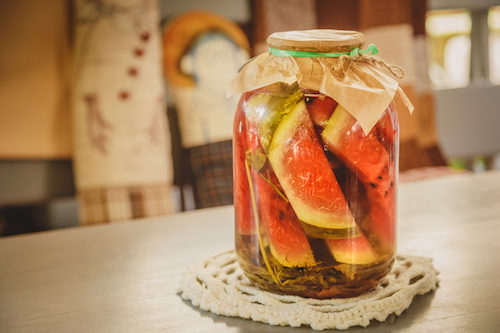
Add extra sugar, ginger and star anise to your brine for this Southern specialty. Instead of tossing watermelon rinds, just peel off the hard skin and turn them into a tangy treat.
Eggs and Beets

Pickling hard-boiled eggs and sliced beets together will give you brightly colored eggs perfect for the Easter table.
Cabbage

Thinly-sliced red cabbage will make a great pickled side dish for heavy meat dishes. Combine Napa cabbage with onions and spices to make a simple Korean kimchi.
Radish, Carrots, and Garlic
A fresh take on bread and butter pickles can be made with radishes and carrots instead. Cut them into 1/4-inch coins and blanch before pickling with dill seed, red pepper flakes, and crushed garlic cloves.
Eggplant
You’ll want to salt and drain eggplant first to draw out some of its moisture, but it pickles well with mint, oregano, red peppers, and olive oil.
The First Working Laser Wows the World
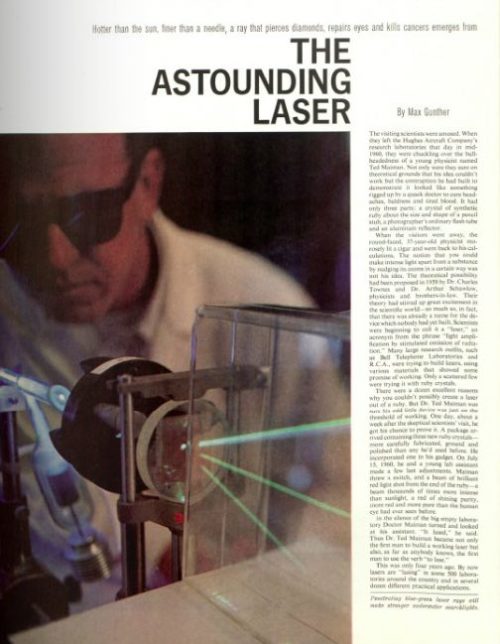
 In 1960, scientists visiting Ted Maiman’s lab thought his laser device was ridiculous: “Not only were they sure on theoretical grounds that his idea couldn’t work but the contraption he had built to demonstrate it looked like something rigged up by a quack doctor to cure headaches, baldness and tired blood.”
A few years later in 1964, when The Saturday Evening Post published “The Astounding Laser,” people were a lot more excited about a device that could “burn holes through diamonds—can vaporize any known substance, in fact.”
Even though the technology was in its infancy when the Post article was written, the laser was already making an impact in numerous fields: surgeons quickly found applications for its ability to make ultra-precise incisions, and the military envisioned lasers in combat. Research power houses IBM and Bell Labs were just figuring out the laser’s awesome potential for engineering and communications. “With a laser and a microscope,” says an IBM engineer, “we may work out techniques that will help us go one step smaller.”
Lasers had come a long way in the few years since Ted Maiman had shown his first working model that used little more than a pencil-shaped ruby, a photographer’s flash unit, and an aluminum reflector. Those scientists might have scoffed at his laser in 1960, but fifty years ago today, Maiman received a patent for his world-changing invention.
“The Cat of the Stars” by Sinclair Lewis
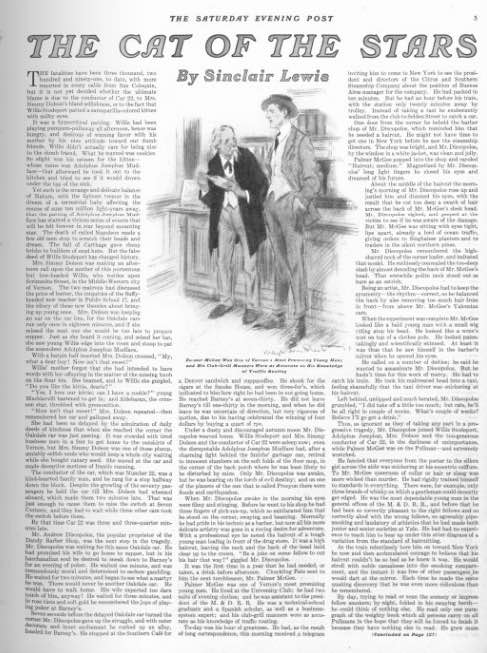
The fatalities have been 2,391, to date, with more reported in every cable from San Coloquin, but it is not yet decided whether the ultimate blame is due to the conductor of Car 22, to Mrs. Simmy Dolson’s bland selfishness, or to the fact that Willis Stodeport patted a sarsaparilla-colored kitten with milky eyes.
It was a hypocritical patting. Willis had been playing pumpum-pullaway all afternoon, hence was hungry, and desirous of winning favor with his mother by his nice attitude toward our dumb friends. Willis didn’t actually care for being nice to the dumb friend. What he wanted was cookies. So slight was his esteem for the kitten — whose name was Adolphus Josephus Mudface — that afterward he took it out to the kitchen and tried to see if it would drown under the tap of the sink.
Yet such is the strange and delicate balance of nature, with the lightest tremor in the dream of a terrestrial baby affecting the course of suns ten million light-years away, that the patting of Adolphus Josephus Mudface has started a vicious series of events that will be felt forever in star beyond mounting star. The death of exiled Napoleon made a few old men stop to scratch their heads and dream. The fall of Carthage gave cheap bricks to builders of mud huts. But the false deed of Willis Stodeport has changed history.
Mrs. Simmy Dolson was making an afternoon call upon the mother of this portentous but tow-headed Willis, who resides upon Scrimmins Street, in the Middle-Western city of Vernon. The two matrons had discussed the price of butter, the iniquities of the fluffy-headed new teacher in Public School 17, and the idiocy of these new theories about bringing up young ones. Mrs. Dolson was keeping an ear on the car line, for the Oakdale cars run only once in eighteen minutes, and if she missed the next one she would be too late to prepare supper. Just as she heard it coming, and seized her hat, she saw young Willis edge into the room and stoop to pat the somnolent Adolphus Josephus Mudface.
With a hatpin half inserted Mrs. Dolson crooned, “My, what a dear boy! Now isn’t that sweet!”
Willis’ mother forgot that she had intended to have words with her offspring in the matter of the missing knob on the flour bin. She beamed, and to Willis she gurgled, “Do you like the kittie, dearie?”
“Yes, I love our kittie; can I have a cookie?” young Machiavelli hastened to get in; and Aldebaran, the crimson star, throbbed with premonition.
“Now isn’t that sweet!” Mrs. Dolson repeated — then remembered her car and galloped away.
She had been so delayed by the admiration of daily deeds of kindness that when she reached the corner the Oakdale car was just passing. It was crowded with tired business men in a fret to get home to the outskirts of Vernon, but Mrs. Simmy Dolson was one of those plump, amiably selfish souls who would keep a whole city waiting while she bought canary seed. She waved at the car and made deceptive motions of frantic running.
The conductor of the car, which was Number 22, was a kind-hearted family man, and he rang for a stop halfway down the block. Despite the growling of the seventy passengers he held the car till Mrs. Dolson had wheezed aboard, which made them two minutes late. That was just enough to cause them to miss the switch at Seven Corners; and they had to wait while three other cars took the switch before them.
By that time Car 22 was three and three-quarter minutes late.
Mr. Andrew Discopolos, the popular proprietor of the Dandy Barber Shop, was the next step in the tragedy. Mr. Discopolos was waiting for this same Oakdale car. He had promised his wife to go home to supper, but in his bacchanalian soul he desired to sneak down to Barney’s for an evening of poker. He waited one minute, and was tremendously moral and determined to eschew gambling. He waited for two minutes, and began to see what a martyr he was. There would never be another Oakdale car. He would have to walk home. His wife expected too darn much of him, anyway! He waited for three minutes, and in rose tints and soft gold he remembered the joys of playing poker at Barney’s.
Seven seconds before the delayed Oakdale car turned the corner Mr. Discopolos gave up the struggle, and with outer decorum and inner excitement he rushed up an alley, headed for Barney’s. He stopped at the Southern Café for a Denver sandwich and cuppacoffee. He shook for the cigars at the Smoke House, and won three-for’s, which indicated to him how right he had been in not going home. He reached Barney’s at seven-thirty. He did not leave Barney’s till one-thirty in the morning, and when he did leave he was uncertain of direction, but very vigorous of motion, due to his having celebrated the winning of four dollars by buying a quart of rye.
Under a dusty and discouraged autumn moon Mr. Discopolos weaved home. Willis Stodeport and Mrs. Simmy Dolson and the conductor of Car 22 were asleep now; even the disreputable Adolphus Josephus Mudface had, after a charming fight behind the Smiths’ garbage can, retired to innocent slumbers on the soft folds of the floor mop, in the corner of the back porch where he was least likely to be disturbed by mice. Only Mr. Discopolos was awake, but he was bearing on the torch of evil destiny; and on one of the planets of the sun that is called Procyon there were floods and earthquakes.
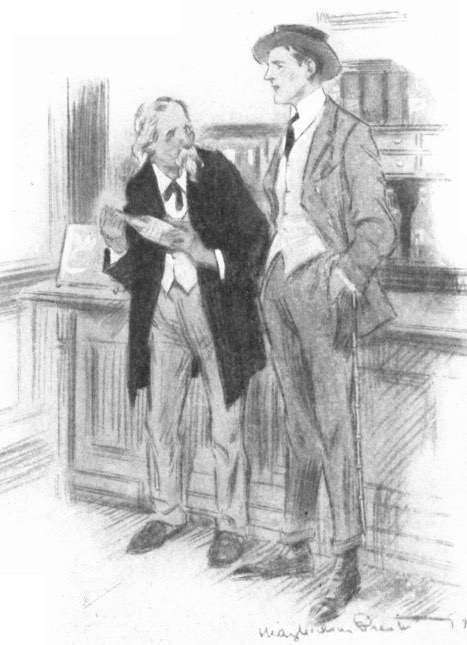
When Mr. Discopolos awoke in the morning his eyes were filmy and stinging. Before he went to his shop he had three fingers of pick-me-up, which so exhilarated him that he stood on the corner, swaying and beaming. Normally he had pride in his technic as a barber, but now all his more delicate artistry was gone in a roving desire for adventure. With a professional eye he noted the haircut of a tough young man loafing in front of the drug store. It was a high haircut, leaving the neck and the back of the head bald clear up to the crown. “Be a joke on some fellow to cut his hair that way!” giggled Mr. Discopolos.
It was the first time in a year that he had needed, or taken, a drink before afternoon. Chuckling fate sent to him the next torchbearer, Mr. Palmer McGee.
Palmer McGee was one of Vernon’s most promising young men. He lived at the University Club; he had two suits of evening clothes; and he was assistant to the president of the M & DRR He was a technical-school graduate and a Spanish scholar, as well as a business system expert; and his club-grill manners were as accurate as his knowledge of traffic routing.
Today was his hour of greatness. He had, as the result of long correspondence, this morning received a telegram inviting him to come to New York to see the president and directors of the Citrus and Southern Steamship Company about the position of Buenos Aires manager for the company. He had packed in 10 minutes. But he had an hour before his train, with the station only 20 minutes away by trolley. Instead of taking a taxi he exuberantly walked from the club to Selden Street to catch a car.
One door from the corner he beheld the barber shop of Mr. Discopolos, which reminded him that he needed a haircut. He might not have time to get one in New York before he saw the steamship directors. The shop was bright, and Mr. Discopolos, by the window in a white jacket, was clean and jolly.
Palmer McGee popped into the shop and caroled “Haircut; medium.” Magnetized by Mr. Discopolos’ long light fingers he closed his eyes and dreamed of his future.
About the middle of the haircut the morning’s morning of Mr. Discopolos rose up and jostled him and dimmed his eyes, with the result that he cut too deep a swath of hair across the back of Mr. McGee’s sleek head. Mr. Discopolos sighed, and peeped at the victim to see if he was aware of the damage. But Mr. McGee was sitting with eyes tight, lips apart, already a lord of ocean traffic, giving orders to Singhalese planters and to traders in the silent northern pines.
Mr. Discopolos remembered the high-shaved neck of the corner loafer, and imitated that model. He ruthlessly concealed the too-deep slash by almost denuding the back of Mr. McGee’s head. That erstwhile polite neck stood out as bare as an ostrich.
Being an artist, Mr. Discopolos had to keep the symmetry — the rhythm — correct, so he balanced the back by also removing too much hair from in front — from above Mr. McGee’s Yalensian ears.
When the experiment was complete Mr. McGee looked like a bald young man with a small wig riding atop his head. He looked like a wren’s nest on top of a clothes pole. He looked painstakingly and scientifically skinned. At least it was thus that he saw himself in the barber’s mirror when he opened his eyes.
He called on a number of deities; he said he wanted to assassinate Mr. Discopolos. But he hadn’t time for this work of mercy. He had to catch his train. He took his maltreated head into a taxi, feeling shamefully that the taxi driver was snickering at his haircut.
Left behind, untipped and much berated, Mr. Discopolos grumbled, “I did take off a little too much; but rats, he’ll be all right in couple of weeks. What’s couple of weeks? Believe I’ll go get a drink.”
Thus, as ignorant as they of taking any part in a progressive tragedy, Mr. Discopolos joined Willis Stodeport, Adolphus Josephus, Mrs. Dolson and the too-generous conductor of Car 22, in the darkness of unimportance, while Palmer McGee was on the Pullman — and extremely wretched.
He fancied that everyone from the porter to the silken girl across the aisle was snickering at his eccentric coiffure. To Mr. McGee queerness of collar or hair or slang was more wicked than murder. He had rigidly trained himself to standards in everything. There were, for example, only three brands of whisky on which a gentleman could decently get edged. He was the most dependable young man in the general offices of the M & DRR, and before that he had been so correctly pleasant to the right fellows and so correctly aloof with the wrong fellows, so agreeably pipe-smoking and laudatory of athletics that he had made both junior and senior societies at Yale. He had had no experience to teach him to bear up under this utter disgrace of a variation from the standard of haircutting.
As the train relentlessly bore him on toward New York he now and then accumulated courage to believe that his haircut couldn’t be so bad as he knew it was. He would stroll with noble casualness into the smoking compartment, and the instant it was free of other passengers he would dart at the mirror. Each time he made the same quaking discovery that he was even more ridiculous than he remembered.
By day, trying to read or scan the scenery or impress fellow smokers; by night, folded in his swaying berth — he could think of nothing else. He read only one paragraph of the weighty book which all persons carry on all Pullmans in the hope that they will be forced to finish it because they have nothing else to read. He grew more and more sensitive. Every time he heard a laugh he was sure that it was directed at him; and because he so uncomfortably looked away from the absent-minded gaze of fellow passengers he made them gaze the harder.
The beautiful self-confidence which had always concealed Mr. McGee’s slight defects from himself and had helped him to rise to the position of assistant to the railway president was torn away, and he began to doubt himself, began to feel that others must doubt him. When he finally crept up the cement incline in the New York station, after a writhing glance at the redcaps, to see if New Yorkers would notice his ludicrousness as much as people had on the way through — he wondered if he could not return to Vernon and wire the steamship directors that he was ill.
He was not exaggerating about the importance of this trip to New York. The directors of the Citrus and Southern Line really were waiting for him. They needed him.
It is a curious fact of psychological economics that there are almost as many large employers waiting and praying for the chance to pay tens of thousands a year to dependable young men as there are dependable young men waiting and praying for the chance to earn a thousand a year. The president of the Citrus and Southern, the pouchy blob-nosed dean of South American and West Indian shipping, had been in the hospital for six months, after Peritonitis. From his bed he had vaguely directed the policies of the company. Things had run well enough, with the old clerks working mechanically. But a crisis had come. The company had either to expand or break.
The Green Feather Line, weary of litigation, wanted to sell all its ships to the Citrus and Southern, which if it bought them might double its business. If some other company bought them and vigorously increased competition the Citrus and Southern might be ruined.
The Citrus and Southern held a five months’ option. By the end of that period they hoped to have found the man who could connect the sick president’s brain with the general office’s body — and they believed that in Palmer McGee they had found that man.
McGee did not know how carefully he had been watched. He had never met one of the directors or officers of the Citrus and Southern, had never seen one of them, and their correspondence had been polite but not exciting. But the two suave gentlemen who had been poking about Vernon lately had been commercial secret agents of the Titanic Rating and Credit Company; and they knew all about McGee, from the number of drinks he had at the club to the amount of his bank account and his manner of listening to the stories of the chief shippers of the M & DRR.
The Citrus and Southern chiefs were certain that they had found their man. McGee was to be sent to Buenos Aires, but only on test. If he was as good as they thought, he would in three months be brought back as vice president, at a salary nearly four times as large as the one he had received in Vernon. In this crisis they had the generosity of despair.
They were to meet McGee in the president’s suite at the hospital at four-thirty; and the train got in at three-fifteen.
McGee went to a hotel, and sat still, scared, looking at himself in a dressing table mirror. He became momently more rustic, more tough, more skinned and awkward in his own eyes.
He called up the hospital, got the president. “Th-this is McGee. I — I’m coming right over,” he quavered.
“Huh! That fellow sounds kind of light-waisted. Not much self-confidence,” complained the president to his old friend, the chairman of the board of directors. “Here, prop me up, Billy. We must give him a thorough look-over. Can’t take any chances.”
The note of doubt was a germ which instantly infected the chairman. “That’s too bad. The Rating and Credit people reported he was a find. But still — of course — ”
When Palmer McGee faced the president, the first vice president and a committee of four directors, three of the six had already turned from welcoming eagerness to stilly doubt. He felt that doubt. But he interpreted it thus:
“They think I’m a complete boob to have a haircut like this. Think I don’t know any better. And I can’t explain. Mustn’t admit that I know there’s anything wrong — mustn’t admit I was an easy mark and let a drunken barber carve me up.”
He was so busy with these corroding reflections that he did not quite catch the sharp question which the president fired at him:
“McGee, what’s your opinion of the future of the competition between Australian wheat and the Argentine crop?”
“I — I — I didn’t quite understand you, sir,” lamented poor McGee, victim of the cat of the trembling stars.
The president thought to himself: “If he can’t get as dead simple a question as that — wonder if the first vice president wouldn’t do, after all? No. Too oldfogyish.”
While he meditated he was repeating the query, without much interest; and without interest he heard McGee’s thorough but shaky answer.
And McGee forgot to put in his unusual information about the future of New Zealand grain.
Two hours later the president and directors decided that McGee “wouldn’t quite do”; which meant that he wouldn’t do at all; and they wearily began to talk of other candidates for the position. None of the others were satisfactory.
Four months later they decided that they would have to go slow; wait for the president to recover. They could find no one adaptable enough to coordinate the president and the working management. So they gave up their option on the steamers of the Green Feather Line.
The best of the jest was that Palmer McGee had looked rather well in his flippant haircut. Because the Chapel Street barber had started cutting his hair a certain length when he had been a Freshman in Yale he had kept up that mode, which was respectable but dull. But the semi-shave had brought out his energetic neck muscles. Never had he looked so taut and trim. Though dozens of people between the Vernon barber shop and the New York hospital had noticed his uneasiness none of them had considered his coiffure queer — they had merely wondered whether he was an embezzler or a forger.
McGee returned to Vernon broken, and General Coreos y Dulce, ex-president of the Central American republic of San Coloquin, entered the train of victims of Willis Stodeport, of Scrimmins Street.
The general had colonized Ynez Island, lying off the coast of San Coloquin. Fields of cane and coffee he had created, and he was happily expropriating 2,000 melodious natives. The general was a merry and easy ruler. When he had accepted the presidency of San Coloquin, after certain military misunderstandings, he hadn’t even executed anybody — except a cousin or two, merely for politeness’ sake.
His colony on Ynez Island was served by the steamers of the Green Feather Line. The business was not yet sufficient to warrant a regular stop, but General Dulce had a private agreement with the manager of the Green Feather, as well as one with the sick president of the Citrus and Southern, which latter agreement was to take effect if the company took over the Green Feather boats.
But when the Citrus and Southern gave up their option the Green Feather fleet was bought, not by another Atlantic line, but by a Seattle firm, for their Alaskan and Siberian trade. Consequently the general had to depend for service on a tin-can line which ran out of San Coloquin.
The owner of that line hated the general; had hated him when the general had been president, and had added to that hate with every meditative gin rickey he had sipped in the long years since. The general’s fruit spoiled aboard the creaky old steamers; it was always too late to catch the boat north. His coffee was drenched, and his sugar short weight. When the general desperately bought a freighter of his own it was mysteriously burned.
Poverty and failure closed in on Ynez Island. The colonists hadn’t enough to eat. When the influenza reached the island the weakened natives died in hordes. Some of them fled to the mainland, carrying the disease. The number of fatalities that would probably have been prevented by comfort and proper food and a supply of drugs has been estimated by Dr. Prof. Sir Henry Henson Sturgis at 3,290. One of the last to die was the broken-hearted general.
Before he died the wheel of fate had turned past him and stopped at a certain European monarch. The general had in all his colonizing and his financial schemes been merely the secret agent of that monarch. The king was uncomfortable on his throne. It rocked and squeaked and threatened to give way at the seat. It was kept together only by many fees for repairs — jolly gifts to the duke who hypocritically led the opposition party, to a foreign agent, to certain clerics and editors and professors, even to the ostensible leader of the left wing of the radical party.
Five years before Willis Stodeport had patted Adolphus Josephus Mudface, the king had realized that he was in danger of using up all his private estate. He had speculated. He had called General Coreos y Dulce from Central America; and it was royalty’s own money that had developed the colonization of Ynez Island.
It had been impossible for the king to keep in touch with the details of the colonization. Had he learned of the loss of the Green Feather service he might have raised funds for the purchase of the whole fleet when the Citrus and Southern gave up the option. But the proud, dogged general, with his sky-climbing mustachios and his belief that one Castilian was cleverer than four Andalusians or eight gringos, had been certain that he could pull through without help from the royal master.
It was not till the approach of death that he sent the coded cablegram which informed the king that he could expect no income from Ynez Island. Then the monarch knew that he could not keep his promises to certain peers and ministers; that his wordiest supporters would join the republican movement; that the gold-crusted but shaky-legged throne would at any moment be kicked out from beneath him by rude persons in mechanics’ boots.
So it came to pass that at a certain hour the farthest stars quivered with mystic forces from the far-off fleck of dust called Earth, forces which would, just for a sketchy beginning, change all the boundaries and customs of Southern Europe. The king had at that hour desperately called in the two ministers and the one foreign emissary whom he trusted, and with that famous weak smile had murmured: “Gentlemen, it is the end. Shall I flee or — or — You remember they didn’t give my cousin the funeral even of a private gentleman.”
At that hour, in a hovel in the Jamaica negro quarter of the capital of San Coloquin, General Coreos y Dulce, friend of composers and masters of science, was dying of nothing at all but sick hope and coldly creeping fear, and a belief that he had pneumonia.
A thousand and more miles away the president of the Citrus and Southern Steamship Company was writing his resignation. His old friend, the chairman of the board of directors, again begged: “But this means the ruin of the company, Ben. We can’t go on without you.”
“I know, Billy,” the president sighed, “but I’m all in. If we could have found someone to carry out my ideas I could have pulled through — and the company could have. Shame we were fooled about that McGee fellow. If we hadn’t wasted so much time looking him over we might have had time to find the right man, and he’d have taken enough worry off my shoulders so that — well, I’ll about pass out in three months, I reckon, old man. Let’s have one more go at pinochle. I have a hunch I’m going to get double pinochle.”
About half an hour after that, and half a continent away, Palmer McGee left the home of the president of the M & DRR. He walked as one dreaming. The railroad president had said: “I don’t know what the trouble is, my boy, but you haven’t been worth a hang for quite a while now. And you’re drinking too much. Better go off some place and get hold of yourself.”
McGee crawled to the nearest telegraph office that was open, and sent a wire to the Buffalo & Bangor, accepting their offer in the purchasing department. The salary was not less than the one he had been receiving, but there was little future. Afterward he had a cocktail, the fourth that evening.
It cannot be authoritatively determined whether it was that evening or the one before that a barber named Discopolos first actually struck his wife, and she observed, “All right. I’ll leave you.” The neighbors say that though this was the first time he had mauled her, things had been going badly with them for many months. One of them asserts that the trouble started on an evening when Discopolos had promised to come home to supper, but had not shown up till one-thirty in the morning. It seems that, though he had forgotten it, this had been her birthday, and she, poor mouse, had prepared a gay little feast for them.
But it is certainly known that at the same hour on the same evening there was much peace and much study of the newspaper comics in the house of the Stodeports on Scrimmins Street.
Willis stooped to pull the tail of Adolphus Josephus Mudface, now a half-grown cat. Mrs. Stodeport complained: “Now, Willie, do let that cat alone! He might scratch you, and you’ll get fleas and things. No telling what all might happen if you go patting and fooling with — ”
Mr. Stodeport yawningly interrupted: “Oh, let the child alone! Way you go on, might think something dreadful would happen, just because he strokes a cat. I suppose probably he might get one of these germs, and spread it, and before he got through with it, maybe be the cause of two, three people taking sick! Ha, ha, ha! Or maybe he might make somebody rob a bank or something just awful! Ha, ha, ha! You better hold in your imagination, mamma! Well — ”
Mr. Stodeport yawned, and put the cat out, and yawned, and wound the clock, and yawned, and went up to bed, still chuckling over his fancy about Willis having a mysterious effect on persons five or six blocks away.
At exactly that moment in a medieval castle about four thousand miles from Willis Stodeport the king of an ancient nation sighed to the Right Honorable the Earl of Arden, KCB, special and secret emissary of the British throne: “Yes, it is the twilight of the gods. I take some little pride in saying that even in my downfall I can see clearly the mysteries of fate. I know definitely that my misfortune is a link in a chain of events that impressively started with — ”
“ — with the loss of thousands of lives and millions of pounds, in San Coloquin,” mused Lord Arden.
“No! No! No! Nothing so earthly and petty. I have long been a student of astrology. My astrologer and I have determined that this evil chance of myself and my poor people is but the last act in a cosmic tragedy that started with an esoteric change in the magnetism of Azimech, the cold and virgin star. At least it is comforting to know that my sorrows originated in nothing trivial, but have been willed by the brooding stars in the farthest abysses of eternal night, and that — ”
“Um. Oh, yes. Yes, I see,” said the Earl of Arden.
Your Weekly Checkup: A New Vaccine for Shingles
We are pleased to bring you “Your Weekly Checkup,” a regular online column by Dr. Douglas Zipes, an internationally acclaimed cardiologist, professor, author, inventor, and authority on pacing and electrophysiology. Dr. Zipes is also a contributor to The Saturday Evening Post print magazine. Subscribe to receive thoughtful articles, new fiction, health and wellness advice, and gems from our archive.
Many readers have had chickenpox as a child. I know I did. A virus called varicella-zoster triggers the itchy blisters, along with fever, fatigue, and headache, normally lasting 5-7 days. After causing chicken pox in the child, this crafty virus lies waiting in the nerve tissues of the body, ready to be reactivated for an encore as shingles in the adult. Now the stage is set for potentially more dire consequences, affecting almost one in three U.S. adults.
Shingles symptoms range in severity from trivial itching to a very painful rash with nerve damage. In its most severe form, it causes strokes, encephalitis, spinal cord damage and loss of vision. Although shingles can occur anywhere on the body such as the face or near the eye, it most often presents as a single band of blisters that follows a nerve route encircling the left or right side of the trunk. The pain can be minimal, with a bit of itching, to excruciating, requiring narcotics for relief. Shingles most commonly affects people ages 50 or older, those with compromised immune systems such as HIV/AIDS, during cancer treatment or after organ transplant.

Here’s the exciting news: The Food and Drug Administration has just approved a new vaccine called Shingrix manufactured by GlaxoSmithKline for adults ages 50 and older. The FDA’s advisory panel has recommended the Shingrix over Merck’s Zostavax. The latter has been the only shingles vaccine available for more than ten years and was recommended for people ages 60 and older. That’s the one I got several years ago. Now, the Advisory Committee on Immunization Practices is recommending people like me receive the new one, Shingrix. Zostavax was given in one dose, and had shown a 51 percent reduction in shingles and a 67 percent reduction in nerve pain. Shingrix requires two doses, and the company said clinical trials showed it to be about 98 percent effective for one year and about 85 percent over three years. A drawback, however, is that more people had adverse reactions to Shingrix than to Zostavax, including fever and muscle aches. The side effects lasted a few days and were not considered serious.
So, readers, listen to the advice from experts. I am a staunch advocate of the benefits of vaccines and this is one vaccine not to pass up. You do not want to get shingles. Get the vaccine instead. I plan to do just that as soon as it is available commercially—either late in 2017 or January of 2018. Check with your doctor about availability and appropriateness.
Movies for the Rest of Us with Bill Newcott: Murder on the Orient Express, Casablanca, Speed Racer
Award-winning film critic and writer Bill Newcott has been covering Hollywood for more than 40 years. He is the creator of AARP’s Movies For Grownups franchise and the movie critic for The Saturday Evening Post.
Join our movie review video podcast, Movies for the Rest of Us with Bill Newcott. This week, Bill reviews Murder on the Orient Express, Casablanca, Big Sonia, Three Billboards Outside Ebbing, Missouri, and Speed Racer.
Classic Movie Stars’ Favorite Roles
Throughout the 1940s and ‘50s, The Saturday Evening Post published a series called “The Role I Liked Best,” where Hollywood movie icons shared why they loved playing a certain character or starring in a particular movie. Here are a few of our favorites.
Spencer Tracy
Three things about the role of Manuel, the Portuguese sherman in Captains Couragous, disturbed me at the start: I had to use makeup for the first time in my screen career, I had to have my hair curled and I had to sing. “Tracy the troubadour,” I could imagine people calling me. Or “Tracy with the light-brown curls.” However, I soon got used to the makeup and curls, and the warbling was easy because Manuel wasn’t supposed to be a good singer. In fact, I had a distinct advantage over other singing members of the cast: They had to be taught to sing off-key; I did it naturally.
Other parts of the role suited me perfectly. The story, based on Kipling’s great novel, had a realistic, mature quality that pleased me. I felt, for example, that Manuel’s death scene — a deviation from the novel — was indicative of the coming of age of motion pictures, for up until that time few heroes had been allowed to die in pictures. I liked the people I was working with, especially Freddie Bartholomew, then a youngster the age of my son, John. The seagoing setting had a natural appeal for me. In shooting this picture we used two schooners, two barges, two water taxis, five speedboats, a tugboat and a number of dories. One of the most exciting parts of making this film was the race between the schooner Oretha F. Spinney, renamed We’re Here for film purposes, and the Mariner, which was once owned by John Barrymore and which had set a record in a trans-Pacific yacht race.
Rita Hayworth
The essence of acting is to be somebody other than yourself, yet in portraying Gilda in the picture of that title, I was more nearly myself than in any other role. Gilda’s story was written to order especially for me, and her character tailored to fit me as carefully as the long black gloves that, in one wild scene, she takes off so suggestively.
Even without this spiritual kinship, I would have loved Gilda for the sheer excitement that surrounded her. Tension and hidden re were implicit in the setting — in romantic Argentina, in the wartime intrigues of international fascism, in the fabulous gambling casino in Buenos Aires, even in the carnival with its snowfall of confetti and in props like the 50-foot gaucho whip that I learned to brandish with menace. The idea of an American girl moving through these scenes was attractive, for I have always been fascinated by Latin American ways through family background as well as inclination.
Gilda herself appealed to me. It was easy to understand her fierce impulse to hurt Johnny Farrell by pretending to be utterly rotten. The problem in portraying her was to express this flagrant abandon yet suggest the love it camouflaged. The glove-removing scene required specially fitted gloves and dozens of rehearsals to achieve exactly the right hint of a strong passion straining to snap its controls.
Glenn Ford, heading a fine cast, which included the veteran trouper George Macready, was particularly challenging as Johnny Farrell. We lived our roles so completely that in one scene we exchanged real, stinging slaps after carefully rehearsing how to fake them.
Rehearsals for Gilda were exhausting, but a welcome change from being typed in lavish musicals. though I like to sing and dance, it was pleasant not to have to limber up for three months before facing the cameras, nor to go home after six-hour rehearsals with aching muscles. Some scenes from Gilda left me equally tired, but the fatigue was mental and was balanced by the satisfaction of creating my first important dramatic role. Public reaction was gratifying: Most fans approved of Gilda, torrid temperament and all.
Lana Turner
It startLed me when Carey Wilson telephoned to say he wanted me to read the script of The Postman Always Rings Twice. I knew this story by James Cain had been on the shelf for 12 years, because no writer had been able to make it censor-proof. But after reading the script, I knew the Johnston Office couldn’t possibly object to it, and I was just as delighted with the role of Cora as I was with the obvious fact that Carey Wilson believed I could give a convincing performance in the part.
It may seem strange that I should choose the part of a completely bad woman as my favorite. The fact is, playing a “wicked woman” makes the audience more aware of you as an actress. This role gave me something to work with. Cora was not the usual heroine but a woman who was willing to involve herself in murder to get what she wanted.
I thought I understood the odd, twisted reasoning that made her yearn for a small piece of property out in the hills — for what she considered respectability and security — and yet, at the same time, led her to do things that ruined her chance of getting what she wanted.
I liked the all-white wardrobe Cora wore and the way she did her hair. But the high point in my enjoyment of this role came after the film was completed. Then James Cain presented me with
a leather-bound first edition of The Postman Always Rings Twice, bearing the message, “For my dear Lana, thank you for giving a performance that was even finer than I expected.
Cary Grant
Wikimedia Commons
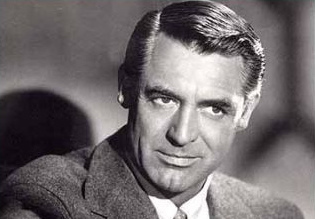
The role of Dexter Haven in The Philadelphia Story was my favorite because I thoroughly enjoyed playing it. I liked working with Katharine Hepburn and Jimmy enjoyed playing it. I liked working with Katharine Hepburn and Jimmy Stewart; I liked the honesty of the story and its gentle humor. And I got special satisfaction from the fact that all the money made by this picture went to the British War Relief and the USO.
I was given the choice of playing Dexter Haven or Mike Connor, the two leading male roles. I took Dexter Haven because it was a shorter part and therefore gave me a little vacation. Jimmy Stewart took Mike Connor and received an Academy Award for his performance. But if our roles had been reversed, I’m sure Jimmy would have won the award anyway.
Not long before, I had worked with Katharine Hepburn in Sylvia Scarlett, which turned out to be a scandalous flop. Then I was with her in Holiday, which suffered because it poked fun at the rich at a time when that exercise had become unpopular. The Philadelphia Story wasn’t a defense of the wealthy, but it did suggest that those who happened to be cushioned with some financial plush were often quite human.
In one scene I had to hit Jimmy Stewart on the jaw. Afterward, looking up from the floor, he said, “What the heck did you do that for?”
Faithful to the script, I answered, “George would have hit you harder.”
Then Jimmy added an impromptu line that stuck. “You’ll do,” he said.
Ginger Rogers
When i played what turned out to be my favorite role &dmash; Kitty Foyle — I had done many musicals and girl-and-boy stories, but never a woman’s story in which all depended on the strength of her characterization. I wanted such an opportunity, but at first I wasn’t keen about trying to portray Kitty, because I didn’t see how the power of the fine story could survive the necessary censoring for the screen. But Donald Ogden Stewart and Dalton Trumbo handled the script so expertly that I was delighted to accept. It was the best dramatic part that ever came my way. I understood and believed in Kitty, and those are requirements for the deep enjoyment of a role.
An especially enjoyable factor was the chance to play Kitty when she was very young &dmash; I had never had the fun of playing a child before. I wore Mary Jane shoes, black stockings, a silly knitted cap and no makeup. One day a big director whom I knew well walked by me without even nodding; I was amused and, of course, pleased when he turned and exclaimed, “I can’t believe it’s you!”
And then there was the inspiration of Sam Wood’s directing. He encouraged freedom of expression
by the cast; if Dennis Morgan, James Craig or any of the rest of us thought of a special piece of business or dialogue, he was always sympathetic. Thus the picture was a blend of the best ideas.
I’m proud that I had the chance to portray Kitty Foyle, and proud of the many Kitty Foyles I’ve come to know off the screen. And I bow to Christopher Morley &mash; the author who knew Kitty so well.
Fred Astaire
It is difficult for me to decide why I liked the role of Jerry Travers in Top Hat better than any other. I guess it was because Jerry was a buoyant, carefree person with a nice sense of humor. The picture itself was one of the best Ginger Rogers and I ever did together, and it was the first I ever made with Irving Berlin’s music, which helped a lot.
In a way, Top Hat marked a milestone in screen musical comedies. Nearly all the other screen musicals had dealt with the backstage problems of their characters. But in Top Hat I played the part of a successful professional dancer whose problems of love and romance came entirely from his private life.
The idea for the dance number that finally gave the picture its name came to me in the middle of the night. I woke suddenly, visualizing a row of top-hatted men. I saw myself shooting them down, one by one, with my walking stick, while I simulated the sound of a machine gun with my tapping feet. I was so stirred by the possibilities of this number that I jumped out of bed, grabbed a handy umbrella and started practicing it. Soon my sister, Adele, called from the next room of our apartment to ask what in the world I was doing.
“Oh, nothing,” I said. “I just had an idea for a number.”
“Well,” Adele said coldly, “this perhaps isn’t the best time of the day to try it out.”
That comment ended my practice session. But the dance idea persisted and finally took its place with other numbers in the picture, like “Cheek to Cheek” and “Isn’t It a Lovely Day to Be Caught in the Rain.”
Elizabeth Taylor
pixabay.com
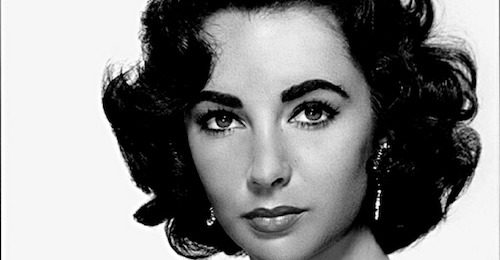
I literally grew into my favorite role — the part of Velvet in the picture National Velvet. I started to qualify for it as a small child by learning to love horses and beginning to ride at the age of 3. When I was 4, my godfather gave me a eld horse, and soon I started jumping and steeplechasing. Later, I read Enid Bagnold’s novel National Velvet and began to dream of playing Velvet in a movie.
So when I reached a relatively ripe 13 and heard that M-G-M planned to produce a picture based on this story, I went to producer Pan Berman and told him how much I wanted the role.
“But you’re too small and frail,” he told me.
“I’ll grow,” I promised.
Afterward mother wondered why I had said that. “You know you haven’t grown a quarter inch in three years,” she pointed out.
“It wasn’t necessary then,” I said. “Now it is.”
Until then, I had eaten like a bird. But after making that promise I started packing away steaks and chops like a lumberjack. In three months I grew about three inches and gained some weight besides. Maybe Nature poked a helpful hand into my buildup program, but I like to think I did it all myself. Anyway, I got my favorite role—and King Charles.
King Charles was supposed to be a mean horse, and only his owner and his trainer were allowed to ride him. But I managed to win his trust by visiting him day after day. Then I persuaded the studio to buy him for the picture, and finally King Charles was presented to me as a birthday gift.
Frank Sinatra
The role of Clarence Doolittle, the shy sailor in Anchors Aweigh, appealed to me most because it gave me a chance to portray the kind of person I understand. There are thousands of boys like Clarence, and plenty of them were in uniform. I talked to some while visiting camps and canteens and hospitals.
Anchors Aweigh was a fantasy, but because he was an understandable guy, Clarence had a basic reality. He also had a Harold Lloyd quality. Harold, as you may remember, achieved fame by playing shy boys at whom you laughed; then you felt sorry for them because they provoked laughter. The same was true to some extent of Clarence, and this made the part particularly sympathetic.
I also liked the role because I had a chance to sing some good numbers, and — this above all — because I was permitted to dance in pictures for the first time. It’s true there were those who suggested the word “dancing” was loosely used in connection with what I did. Once, after working very hard on a dance sequence, I asked Gene Kelly what he thought of it.
“Frank,” he said solemnly, “you may have set dancing back 20 years.”
Pamela Britton, who played a waitress in the film, was kinder. Once, while dancing with her, I forgot my feet completely because I was trying to get my speeches just right. Having stepped on her toes, I quickly apologized.
Pamela smiled bravely. “Oh, that’s all right,” she said. “You’re very light on my feet.”
Alfred Hitchcock
Many moviegoers think I play bit parts in the films I direct as a good-luck gesture that ensures their success. But that’s complete nonsense. I’ve had my share of flops. Actually, I started putting myself in pictures 25 years ago in order to save the cost of extra players. I continued it from habit, I guess, or maybe because I’m just a frustrated ham.
My favorite role was in the picture Lifeboat, and I had an awful time thinking it up. Usually I play a passerby, but you can’t have a passerby out on the ocean. I thought of being a dead body floating past the lifeboat, but I was afraid I’d sink. And I couldn’t play one of the nine survivors, as each had to be played by a competent actor or actress.
Finally I hit on the perfect plan. I was on a strenuous diet at the time, working my way painfully down from 300 to 200 pounds. So I decided to immortalize my reduction and get my bit part by posing for “before” and “after” pictures. These photographs were used in a newspaper advertisement of an imaginary drug, Reduco, and the audience saw them — and me — when William Bendix opened an old newspaper he had picked up on the boat.
This role was a great hit. Letters literally poured in from fat people, asking where they could buy Reduco, the miracle drug that had helped me lose 100 pounds. Maybe I shouldn’t admit it, but I got a certain satisfaction from writing back that the drug didn’t exist, and adding smugly that the best way to lose weight was to go on a strenuous diet, as I had done.
Doris Day
Despite its cozy title, the movie Tea for Two turned out to be pretty much a picnic for the whole cast. I’m sure I never had more fun in any part or picture than I did while playing Nanette in this film.
Because it was a musical, we didn’t have to struggle with a serious message or a deeply moving story. We could relax, which we did. We exchanged mild insults, gave one another oddly autographed pictures and made up a set of nicknames, which we still use when we meet. I was renamed Clara Bixby. Gordon MacRea became Norbert Kunkel, and S. Z. Sakall was Spike. Eve Arden was Rhoda Dings; Billy De Wolfe was Hugh Whipple; and Gene Nelson and his wife were Melvin and Anastasia Pit. To make it more picniclike, we even toasted piñon nuts on the lights of the set.
In addition to all this festivity, I had a very likable part in Nanette, a wealthy girl who wanted to get into show business. I especially enjoyed the opportunity it gave me to dance in pictures for the first time. For, although I had been trained in dancing as a youngster, I had to give it up because of a leg injury in an automobile accident.
All this was 10 years before Tea for Two, and I felt sure my leg was sufficiently strong for any terpsichorean tricks. Actually, I found that, though my leg was fine, my technique was very weak. But Gene and Miriam Nelson were wonderfully patient in retraining me.
A number of fans have written to tell me how much they enjoyed Tea for Two. But I still wonder if anyone could have as much fun watching the picture as we had making it.
Carmen Miranda
The only person who was completely surprised by the audience reaction to the performance of Carmen Miranda in That Night in Rio was Carmen Miranda. I couldn’t understand why the people laughed at me. When I made this picture — my first — I thought I was acting in a drama, and I played it straight. Then, when the film was released, I was told, “You are very funny. You are a fine comedienne.” at was all news to me, but I soon began to like it, because I liked the sound of that friendly laughter.
Actually, I had been happy about my role of Carmen in this picture right from the first. Carmen, like me, was a Brazilian girl, exciting and excitable, and the picture was set in Rio de Janeiro, where I had been born. I enjoyed that, and I enjoyed the chance the picture gave me to speak in Portuguese and to sing some Portuguese songs. When I came to Hollywood, I could only speak about a dozen words of English, and the executives were worried. They thought I would delay the picture while learning how to talk. But I memorized the whole 300 pages of the script and was able to prompt other actors. Of course, I didn’t understand the story — and I certainly had no idea that I was being so funny.
This article and other features about the stars of Tinseltown can be found in the Post’s Special Collector’s Edition, The Golden Age of Hollywood. This edition can be ordered here.
Cover Collection: The Big Cats — Lions, Leopards, and Tigers
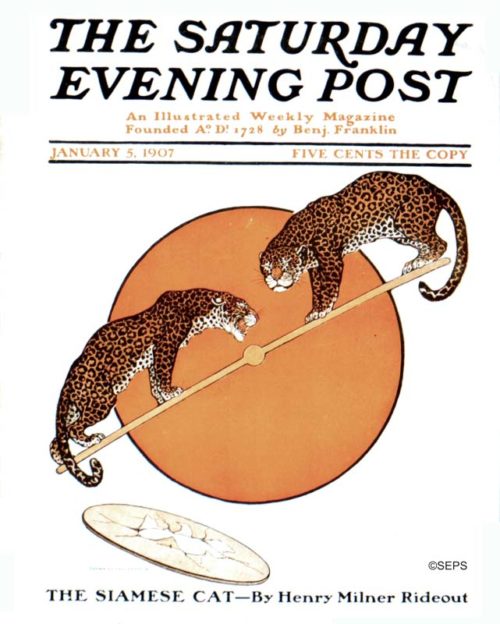
Paul Bransom
January 5, 1907
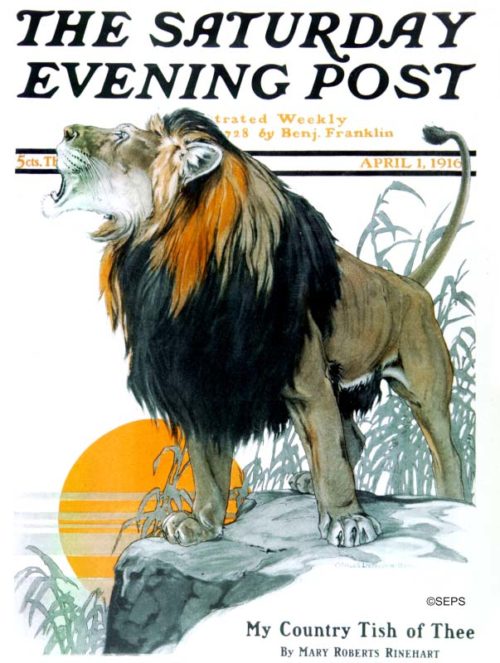
Charles Bull
April 1, 1916
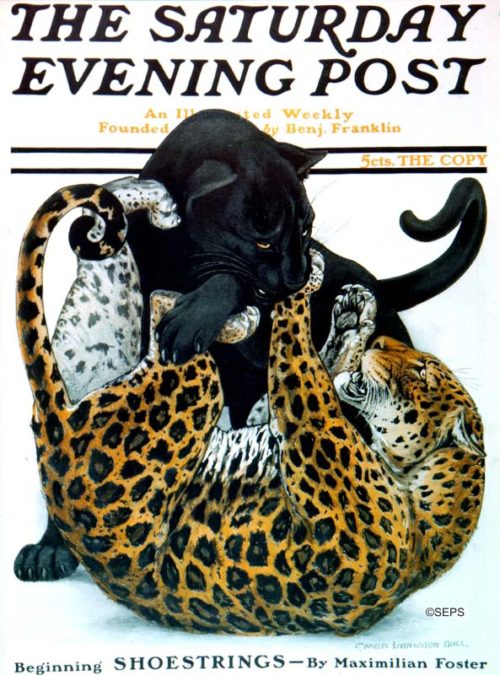
Charles Bull
November 18, 1916
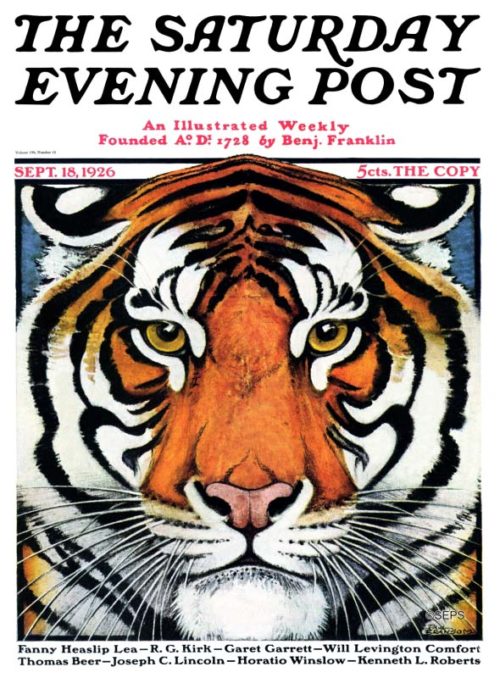
Paul Bransom
September 18, 1926
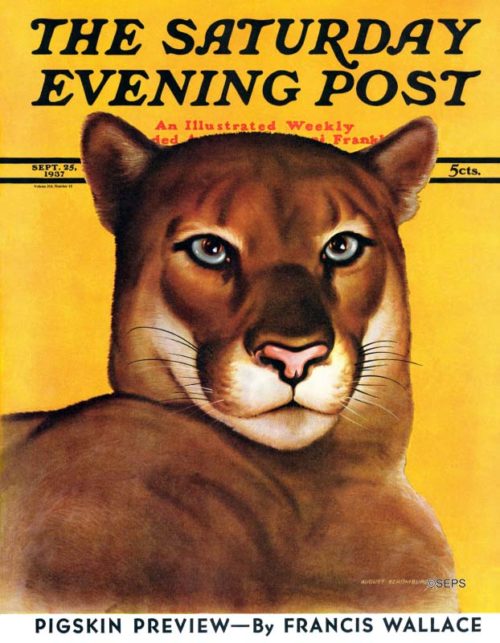
August Schombrug
September 25, 1937
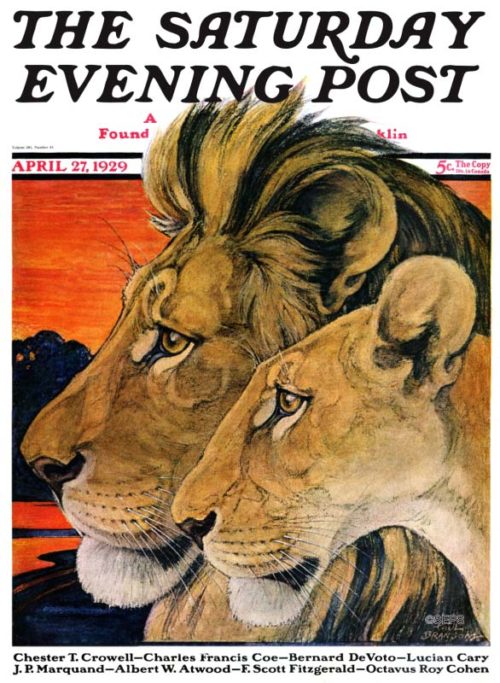
Paul Bransom
April 27, 1929
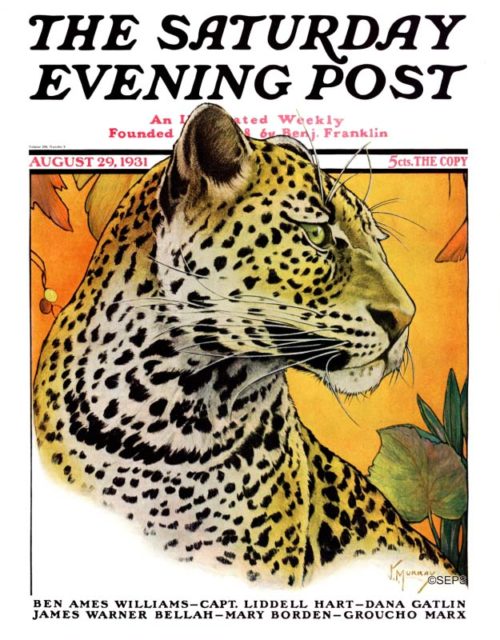
Jack Murray
August 29, 1931
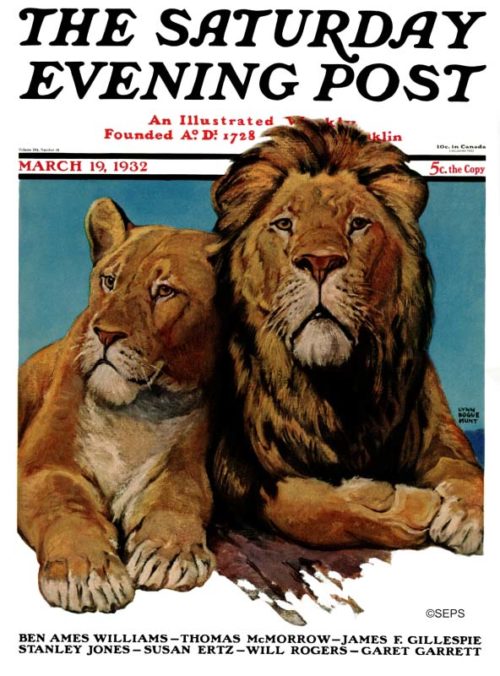
Lynn Bogue Hunt
March 19, 1932
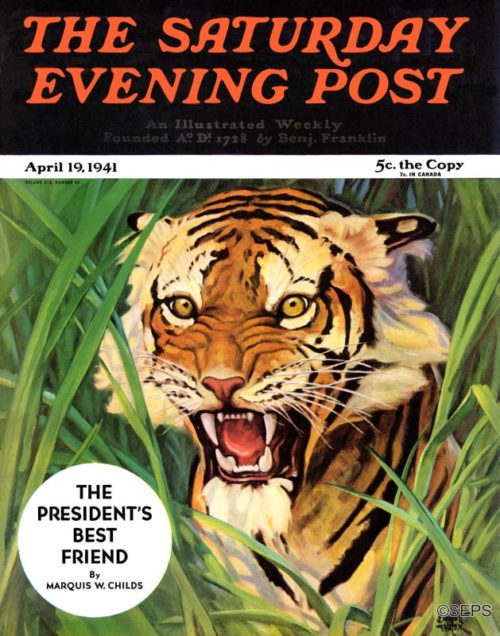
Emmett Watson
April 19, 1941
News of the Week: Changing Time, Selling Rockwell, and Brushing Your Teeth with Oprah
Goodbye “Spring Ahead, Fall Back?”
I like the fact that it gets dark really early now. I find the months that it stays light and warm until 8:30 p.m. depressing. Does that make me weird? Maybe I’m weird.
Apparently there are residents of my state of Massachusetts who hold the opposite view. They want to get rid of Daylight Saving Time for good. A state commission wants to have Massachusetts join the Atlantic time zone, which means the state would be an hour ahead of the Eastern time zone. Farmers say this would help them, but at the same time, it would mess up things like shopping and TV-show watching. Also, it would be weird if not impossible for Massachusetts to do it alone, with the other New England states and New York staying on Eastern time.
One of the other reasons the commission wants to change the time is to attract millennials to Massachusetts, and supposedly millennials hate the dark and cold weather.
Yes, that reason is exactly as stupid as it sounds.
Rockwell Paintings Can Be Sold After All
A judge has ruled that a museum can sell iconic Norman Rockwell paintings, against the wishes of Rockwell’s family.
Rockwell had donated the two works, including his famous Shuffleton’s Barbershop painting, to the Berkshire Museum in Pittsfield, Massachusetts. The museum says that they are having financial troubles and want to sell the two paintings to raise money. They’re looking to get around $50 million.
The Rockwell family, including Rockwell’s grandson Tom, say that Rockwell donated the two paintings to the museum so the public could continue to see them forever. The family sued to stop the sale, but in a 25-page decision, Judge John Agostini ruled in favor of the museum.
YOU Get an Electric Toothbrush, and YOU Get an Electric Toothbrush!
It’s November, and that means Oprah Winfrey has once again chosen her Favorite Things, those must-have items for Christmas. For the past few years she has teamed up with Amazon, which helpfully provides links to each of the items Oprah puts on her list. This year, Oprah appears at Amazon in a flowing blue–and-white dress, delivering beautifully wrapped gifts with the help of her sled dogs.
The items range in price from under $50 (notepads, hand cream, and jammies) to a lot more than that (a Samsung TV in a picture frame). In between, you’ll find books, dog biscuits, a pizza oven, an electric toothbrush, puzzles, even a Greenberg smoked turkey.
You’ll also find something called “Smooshpants.” I don’t know what Smooshpants are.
If It’s Sunday, It’s Meet the Press
Meet the Press is the longest-running TV show in history, having debuted on November 6, 1947 (CBS Evening News is second, having started six months later). NBC has set up a special web page that includes a history of the show as well as several clips from its most important interviews. The show’s first moderator was a pioneering woman named Martha Rountree, and one of the early panelists was Edgar Allen Poe.
No, not that Edgar Allan Poe, this Edgar Allen Poe. The show’s not that old.
The Return of Harold the Baseball Player
Something else celebrating 70 years is the classic Christmas film Miracle on 34th Street, which just so happens to be my second-favorite film of all time, after It’s a Wonderful Life. Miracle is set at Macy’s department store and a major part of the plot revolves around the Macy’s Thanksgiving Day Parade. One of the parade balloons seen in the film, Harold the Baseball Player, is making a comeback in this year’s parade. To honor his appearance in the film, Harold is being repainted black and white so he looks like he did in the black–and-white film.
You can watch the parade on NBC Thanksgiving morning (November 23) at 9 a.m. To really celebrate the 70th anniversary of Miracle on 34th Street and Harold, you should turn off the color on your television.
RIP John Hillerman
John Hillerman is probably best known for his role as Jonathan Higgins, the ex–British military man who took care of the Robin Masters estate on Magnum, P.I. Hillerman also had regular roles on Valerie, One Day at a Time, and The Betty White Show and appeared in movies like Blazing Saddles, The Last Picture Show, Chinatown, and Paper Moon. He died yesterday at the age of 84.
And no, for the last time, there’s no way Higgins could really be Robin Masters.
This Week in History
Will Rogers Born (November 4, 1879)
The death of the American humorist, in a 1935 plane crash in Alaska, paved the way for another writer to take over his weekly syndicated column, even if she didn’t particularly like to write.
“You Won’t Have Nixon to Kick Around” Speech (November 7, 1962)
This was supposedly Richard Nixon’s last press conference. He was angry at the media after losing the 1962 California gubernatorial race to Pat Brown. But if you recall, we did indeed hear from Nixon again.
This Week in Saturday Evening Post History: Cafeteria Dieter (November 10, 1956)
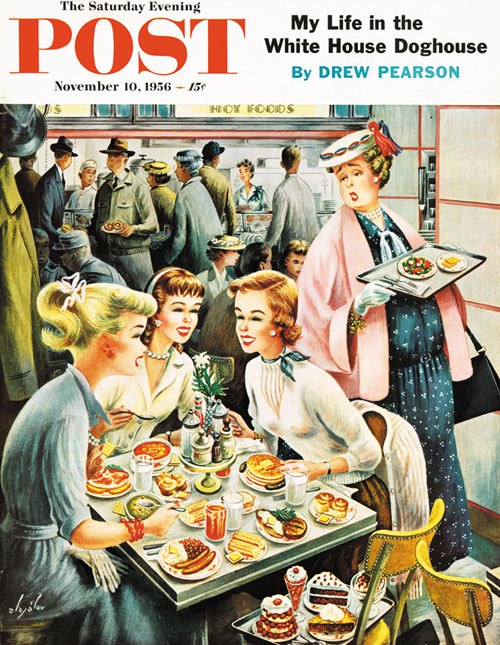
Constantin Alajalov
November 10, 1956
Sometimes I like to look at a Post cover without knowing the title, to see if I can figure out what the cover is supposed to be about. I knew the title of this Constantin Alájalov cover, but if I hadn’t, I could have guessed “Nosy Lady” or “Gossip Girls” or maybe “Older Lady Wishes She Could Eat Like All of These Younger Girls, Oh My God There’s Even Dessert on the Chair.” That last one isn’t far off from the actual title.
Veterans Day
The day is officially tomorrow, November 11, but because that’s a Saturday, it is observed nationally today (if Veterans Day falls on a Sunday, it is observed on Monday). Here’s a quick history of the day, and here’s a piece by Post Archive Director Jeff Nilsson on America’s early efforts to honor our veterans.
Monday Is National Indian Pudding Day
This is a New England favorite I don’t think I’ve had in three decades. It’s comfort food in a bowl, with its warm molasses, brown sugar, and cinnamon. Here’s a classic recipe from Yankee magazine, another New England favorite. Takes about two hours or so.
It’s often served with vanilla ice cream or whipped cream, but you can probably skip that if you’re a dieter, cafeteria or otherwise.
Next Week’s Holidays and Events
National Clean Out Your Refrigerator Day (November 15)

I truly hope that you don’t clean out your refrigerator only once a year, but if that’s the case, the week before Thanksgiving is probably a good time to do it.
National Fast Food Day (November 16)
I know several people who celebrate National Fast Food Day every day. They call it “breakfast” or “lunch.”
Hollywood’s New Maestros: The Rock Stars Who Are Composing Film Scores
The score of a film is unlike a hit song. A movie score is in the background of the action — and usually instrumental. It sets the tone of the film without calling too much attention to itself. Film composers like John Barry, Ennio Morricone, and Henry Mancini made careers for themselves by creating rich soundscapes for cinema of every genre. Comprehensive orchestral training was requisite for composers in Hollywood for many years, but, increasingly, tinseltown has been importing rock and pop musicians to write scores.
There is a history of pop music in movies, but film collaborations from members of Radiohead, Daft Punk, Nine Inch Nails, and Arcade Fire in recent years are blending the mediums like never before. What possesses these rock stars to step out of the spotlight for the more concerted — and sometimes grueling — process of film scoring?
It could be the prospect of artistic growth. Graeme Thomson covered the rise of rock stars in movie music in The Guardian in 2009, venturing, “Although there’s next to no money to be made in writing for film, and all along the line the musician’s vision is subordinate to that of directors, editors and producers, the chance to be a mere cog in a much larger machine seems to offer welcome relief from the essentially solipsistic nature of songwriting.”
Just as a writer desires a prompt, artists of the indie rock world might crave boundaries for their creative instincts. Sometimes the results are groundbreaking.
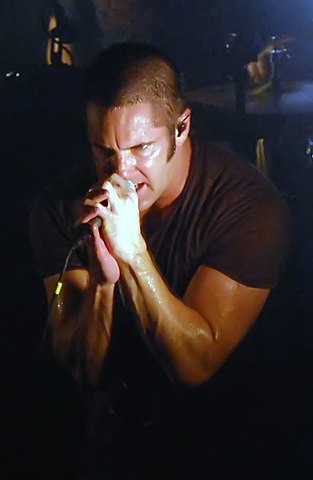
Trent Reznor won an Oscar for his part in scoring The Social Network in 2010. The lead singer of Nine Inch Nails is known for a gritty brand of heavy rock, but his compositions for films like Gone Girl and The Girl With the Dragon Tattoo are more subdued and electronic.
Jonny Greenwood, lead guitarist of the Grammy-winning band Radiohead, has scored several of offbeat director Paul Thomas Anderson’s films. Greenwood started composing for Anderson in the 2007 film There Will Be Blood. Greenwood’s score is an unsettling and, at times, sparse and dissonant accompaniment to Anderson’s film that the New York Times has called the best film (so far) of the 21st century. Greenwood has scored all of Anderson’s films since: The Master, Inherent Vice, and the forthcoming Phantom Thread.
Reznor and Greenwood have garnered significant acclaim for their efforts, but reactions to musicians in the film industry haven’t always been so positive — particularly from career composers. In the ’90s, highly trained orchestrators bemoaned that film scoring was being taken over by amateurs. Many new to the field were missing out on important musical training due to new technologies that rendered comprehensive craftsmanship unnecessary. “And it’s the absence of those skills that many movie professionals believe is the primary reason for a paucity of good film music now,” lamented David Mermelstein in a 1997 article from the New York Times. In Mermelstein’s article, Jerry Goldsmith, composer of scores for Chinatown and Patton, joined several other Hollywood music greats in denouncing the “preponderance of dilettantes and sophomoric people in the business,” but they felt that real talent would ultimately win the day. Has it?
The popification of film scores can be traced back to the ’60s. Mike Nichols pioneered the mixing of popular music with cinema in 1967 with The Graduate. Nichols used Simon & Garfunkel’s folk tunes as a soundtrack to his coming-of-age film about disillusionment and isolation. This practice was brand new at the time, and it paid off: The Graduate was one of the highest-grossing films of the 1960s.

Afterwards, musicians trickled into the industry. Hans Zimmer was associated with several early new wave bands including The Buggles and Krisma before turning to films. Today he is best known as the prolific scorer of dozens of movies, including Pirates of the Caribbean and The Lion King. Tim Burton collaborator Danny Elfman got his start in Oingo Boingo, the eclectic group behind the songs “Dead Man’s Party” and “Weird Science.” Tunesmith Mark Mothersbaugh started in the cult ’80s group Devo. Mothersbaugh has collaborated with Wes Anderson on Bottle Rocket, Rushmore, and The Royal Tenenbaums in addition to his work in many family movies like Halloweentown, Hotel Transylvania, and Cloudy with a Chance of Meatballs. He has even scored several popular video games, namely in the Crash Bandicoot and Sims series. The ’80s and ’90s pop interlopers mostly left their groups for Hollywood pursuits.
These bandmates-turned-maestros signaled a shift in movie music, but it might not be the end of orchestration as we know it. Jon Burlingame teaches film music history at University of Southern California, and he’s been following Hollywood music trends for years. New music technology continues to give rise to original voices in cinema, and Burlingame believes this is good for the industry. However, he says, “There is an advantage to working with a composer who has a big toolbox. You should never count out the level of experience already in Hollywood.”
Composing a film score is still very different than writing a pop or rock song. According to Burlingame, the film composer’s task includes making music that underscores the emotion or drives the action or provides a musical counterpart to the location or time. He says, “These can be challenging prospects for someone who hasn’t worked in film before. You absolutely have to have a dramatic sense. Sometimes it’s an instinct; sometimes you can learn it.” Whatever that dramatic sense entails, it seems that the rock stars are learning it.
See our recent interview with film composer Hans Zimmer from the November/December issue.
I Was a Target of the KGB
Are you Douglas Zipes, the heart specialist from Indiana?” the deep voice over the phone asked, setting in motion the most terrifying yet rewarding series of events in my life.
I sat down on the bed in my tiny room in the Rossiya Hotel in Moscow. I had just checked in after a long flight from the States. Who could know I was here already? Were all the stories I had heard about being spied on in the USSR true?
It was Sunday morning, June 20, 1982, and I had arrived for the World Congress of Cardiology hosted by my friend Evgeny Chazov. I had met Chazov, head of Moscow’s All-Union Scientific Center of Cardiology and personal physician to heads of state, including Brezhnev and Yeltsin, five years earlier. In addition to being a leading clinician, he was the first to show that a clot-buster drug could interrupt a patient’s heart attack.
The Rossiya Hotel was huge, the largest in the world at that time, with more than 3,000 rooms. It sat adjacent to Red Square, a stone’s throw from the Kremlin, and even housed a secret police station with unmarked jail cells.
Little old ladies sat on each hotel floor 24 hours a day. They had a clear view of who walked into and out of each hotel room. When a guest left his room, he handed the LOL his hotel key, which she returned when he came back. She logged each entry and exit on a sheet of paper locked in a desk drawer.
“Are you Douglas Zipes?” the caller asked again.
“Who wants to know?” I responded.
“My name does not matter,” he replied. “Just that I am a refusenik. You know what that is?”
“Yes, a Jew who has tried to get an exit visa to leave the USSR and has been refused.”
“More than that — much more,” he said and went on to explain how they lost their jobs and could not do research or publish papers. “If we don’t get some sort of job,” he said, “the government labels us parasites or hooligans, and then they can do almost anything they want to us, like make us leave Moscow or put us in prison. So, we work in any position, cleaning toilets, sweeping streets, whatever.”
“I’m sorry for that. But why are you calling me?”
“How brave are you?”
I gulped. I didn’t like the way this conversation was going. This was the Soviet Union, and the phone line was likely tapped. The caller seemed to realize that also.
“I am calling from a pay station outside your hotel. I cannot enter the Rossiya — it is strictly forbidden for Russians without special permission papers. If you come down to the sidewalk now, we can talk more. I will approach you holding a folded magazine under my right arm so you will know it is me. Moscow’s Jewish scientists are depending on you. Please come.”
I knew there was a chance the caller would be caught, but he had to have known that and was still taking the risk. If he was willing to accept that, so was I.
The sidewalk around the Rossiya was busy with pedestrian traffic. Beryozka stores reserved for tourists had tables piled high with Russian fur hats, stacks of painted nesting dolls, and silver spoons bearing a Moscow city emblem. Lacquered boxes, pendants, and trays portrayed brightly colored figures on a black background, illustrating Russian fairy tales.
Street food kiosks sold stuffed potatoes and blinchiki, a toasted Russian crepe, and filled the air with delicious scents. The longest lines queued in front of the ice cream booths hawking rich, creamy scoops of vanilla or chocolate. They were flanked by stalls that peddled kvass, a fermented low-alcohol drink made from rye bread, out of large wooden barrels sitting on the sidewalk. The proprietor poured the sweet red liquid into a squat glass secured by a short chain to the kiosk. After each use, he rinsed the glass with water from a pitcher, wiped the rim with a rag that once was white, and refilled it with kvass for the next customer.
I stood in front of the kvass booth thinking how that would play with sanitation officials in the United States. A man with a hat low over his eyes bumped into me. He held a magazine under his right arm.
“Excuse me,” he said in Russian-accented English. “You are Dr. Zipes, yes?”
I nodded.
“I am Viktor. Please to walk alongside me so we can talk.”
I stood there, hesitant, studying his face. He was slim, clean-shaven, with brown eyes that seemed intelligent and kind. His lined face and wisps of gray hair beneath the brown cap put him in his mid-50s, although Russians often looked a lot older than their age.
As we walked, Viktor cast a wary look around and threw the magazine into a trashcan. He led the way with a nod. When the strollers thinned out, he said, “Here it is more quiet and we can talk. It is forbidden to talk to foreigners.” We walked along in silence for several minutes. Viktor glanced around a half-dozen times until we were totally alone on the street, away from all the hubbub.
He held out his hand and formally introduced himself. “I know you are a cardiologist, but you don’t know me. I am a mathematician — or was. I was chairman of my department at the university. A refusenik.
“I applied for an exit visa, but the government said I knew state secrets and could not be trusted to leave. So, they took away my job, and now I sweep city streets. They said I must wait 10 years until the secrets are no longer useful. Then I can reapply.”
“That’s awful,” I said.
He shrugged. “It happened to all of us.” He swept a hand around.
“All of whom?” I didn’t know what I was getting into and had to find out before this went any further. I was in Moscow to lecture at the World Congress of Cardiology, not to be involved in some sort of clandestine activity.
“I will explain,” he said. “Two years ago, we started the Sunday seminars.”
He looked at me to see if that registered. He continued when he saw my blank look.
“About 30 of us, all scientists of various kinds, all refuseniks denied access to our jobs and laboratories. Some of us were even members of the Russian Academy of Science. We could read no journals or newspapers. We could not attend scientific meetings of any kind.”
“Like this World Congress?”
“Exactly. So, when a major scientific meeting was going to be held in Moscow, one of us would invite a visiting scientist to give us a private lecture. We usually did this on Sundays. The subject didn’t matter — we’re all so starved for science, anything new would do. We did this in the apartment of my friend —”
He stopped short. His eyes were fixed, staring straight ahead.
A man approached from the opposite direction. He was tall and broad-shouldered, wearing a suit, tie, and hat despite the warm day. The man advanced, then stopped in front of us. He squinted at my friend and then me — long, penetrating stares. I could almost hear a camera clicking on and off in his head. He continued slowly, passing between us. He craned his head around for another look before he turned the corner.
I felt my heart race.
“What was that about?” I asked, a tremor in my voice.
My friend shook his head. “I don’t know, but there are KGB agents all around, and you have to be alert every minute. Like I said, we are not supposed to talk to foreigners. I could be arrested.”
Viktor was silent until we were well out of the man’s hearing.
“So, we held these Sunday seminars and learned all kinds of new things happening all over the world. It was wonderful.”
He paused. “And?” I prompted.
“The apartment was in the outskirts of Moscow, and we thought we were safe. But one evening during the lecture, the KGB burst in. They arrested us and kept us in jail overnight. But the owner of the apartment — a well-known physicist named Victor Brailovsky — was held for ten months in a Moscow prison, then exiled to Kazakhstan. That ended the Sunday seminars.”
“I’m so sorry. That must’ve been difficult for all of you.”
“Yes. We lost a colleague and have had no seminars for two years. We feel so out of touch with the world. We’re starved for what is happening. That is why I wanted to talk with you.”
I could feel the adrenaline flow. He was sucking me in like quicksand, way over my head. I didn’t know this man from Adam, didn’t know if I could trust him, didn’t know if I was being set up.
I drew a deep breath to calm down and took another look at Viktor. He seemed honest and sincere.
He must’ve seen the initial panic on my face and patted my shoulder. “I know about you from your last visit,” he said. “One of our doctors met you in 1977 and said you could be trusted.”
“Trusted? To do what?” I asked, my voice tremulous.
“To be our first scientist to restart our Sunday seminars.”
I heard the words with a mixture of elation at being chosen by these scientists and fright at the risk it entailed.
“Come,” he said, taking my elbow and then linking his arm in mine. He guided me to a café buried among a small nest of trees. A green awning over its entrance blended with the foliage.
Viktor nodded in its direction. “A friend runs this. We can have a nice tea and talk without strangers to listen.”
We entered the tiny shop where the proprietor, a short, stout man with a long gray beard and bald head, stood behind a small counter. He glanced up from polishing glasses, inspecting each in the window’s light.
The proprietor came forward and greeted Viktor in Russian. Viktor replied and nodded at me. The man smiled, shook my hand, and led us to a table tucked in a secluded corner. Half a dozen empty tables filled the rest of the floor space.
In two minutes, steaming cups of very dark tea appeared on the table, along with a loaf of black bread and a large bottle without a label that looked like water. I knew better. Neither of us reached for the vodka at 11 in the morning.
Viktor ripped off a chunk of bread, dipped it in his tea, and began chewing. “Eat,” he said, nodding at the bread. “It is almost lunch time.
“Let me explain,” Viktor said, swallowing another chunk of bread. “I have a friend with an apartment on the outskirts of Moscow, a real quiet neighborhood where it is likely we would be left alone.”
“Likely? What about the story you just told me?”
He nodded with a sheepish smile.
“What’s different this time?” I asked.
He made circles with his tea cup. “Maybe nothing, maybe everything. It is two years later and maybe the KGB does not care anymore. I cannot give you a guarantee, but if the KGB comes, they will probably leave you alone. At most, you would get a gentle interrogation.”
“What’s gentle?”
“Just a little talking.”
“What happened to the visiting scientist two years ago when the KGB raided?” I asked.
“He was questioned for a few hours and released.”
“And what could happen to you?”
He blew on his tea and sipped. “There is no prediction. They could arrest us or just give us a warning and close down the apartment.”
“Who would come to this Sunday seminar?” I asked.
“All refusenik scientists with no jobs, phones disconnected, mail intercepted, and no scientific meetings. We are hungry for new science of any kind.”
I thought about that. Why would they want a lecture from me? I was a clinical cardiologist who took care of patients. In college, I had had a difficult time getting an acceptable grade in physics, and now I was to lecture world-class Russian mathematicians and physicists? That gave me as much a chill as anticipating a KGB raid.
“I’m a cardiologist.”
“We know. We also know you have published basic research on the heart. That’s what we would like to hear about.”
I sat, took a sip of tea, and pushed the cup away. The tea had grown cold.
My thoughts were on my family, my wife and three children in Indiana. Here I was in Moscow, sitting in a tiny café on a side street near Red Square with a man I’d known for less than an hour asking me to do something my wife — and I guess I as well — would consider crazy.
I also had a responsibility to the World Congress organizers who had invited me to lecture. I could envision the KGB arresting me and the newspapers publishing a picture of me being led off in handcuffs. Delusions or a picture of reality?
The proprietor interrupted my thoughts with a fresh, hot cup of tea.
“Do you have enough courage to do this for us, Dr. Zipes?”
It was as if Viktor had read my mind. How terribly unjust for these scientists to be denied their life’s work simply because they were Jews and wanted to leave the USSR. I could bring them a bit of nourishment, some daylight from the outside world.
I took a moment to answer. “If I do, do you have enough courage to show up?”
He didn’t blink.
“I and 29 others will be there.”
“Where and when?”
“Tomorrow at 2:00.”
“Tomorrow’s Monday,” I said.
He smiled. “For you, we’ll rename them the Monday meetings.”
“Thanks.”
“The apartment is hard to find, and I would like to introduce you to a friend who will take you there.”
“Who is this?” I asked, suspicion surfacing again.
“You still don’t trust me, do you?”
“I’m sorry, it’s just —”
He interrupted with a wave of his hand. “I understand. The man I will take you to now will show you we are all friends you can trust.”
“Who is he?”
“Naum Meiman. Naum was awarded the Stalin Prize for his work in theoretical and experimental physics. Almost like the Nobel Prize. He lost all when he and his wife, Inna, applied for exit visas. He became a refusenik and a member of the Helsinki Watch Group.”
I shook my head.
“A human rights group in Moscow, formed after the Helsinki Accords in 1975. Naum wrote many documents for them — letters of protest that he published in the West. He smuggled them out somehow.”
My mind was ablaze. What in God’s name was I getting into? This was all moving too fast.
“Come,” Viktor said, gripping my arm. “It is a short ride on the underground to his apartment.”
Viktor put some rubles on the table and pushed his chair back. That brought the proprietor running over. He swept up the money and jammed it into Viktor’s pocket, saying something loud in Russian with a shake of his head and a waggled finger. Viktor shrugged, smiled his thanks, and they shook hands.
The open sincerity and trust reassured me. Even so, how dangerous would it be? I stood and shook hands with the proprietor. He held my hand a long time, then covered it with his other hand. The gesture spoke volumes.
I knew Viktor could not guarantee my safety, but whatever happened, I felt good, deep in my gut, that this was the right decision. I had to make my contribution, however tiny, to help these scientists.
Naum Meiman was several inches shorter than I, with a slight paunch and a big smile. Bushy gray eyebrows held almost more hair than his head, which showed a shiny forehead and a halo of gray. I guessed he was in his early 70s.
He and Viktor began speaking Russian in low tones when a stocky woman with an even larger smile interrupted them. Specks of gray flecked her full head of auburn hair. She looked younger than Naum.
“I’m Inna Meiman,” she said with no trace of a Russian accent. She put a hand on each of my shoulders. “I don’t know you yet, but I’m sure I’m going to like you,” she said, pulling me down to kiss each cheek.
I felt my awkwardness melt in the face of such genuine warmth and hospitality.
“Hi,” I said. “Where did you learn such impeccable English?”
“I’m an English teacher,” she replied. “Or was. I’ve written a textbook on advanced English for Russians. I’ve never been out of Russia, but I’ve listened to a lot of American tapes.
“Please sit down,” Inna said, motioning me to a sofa.
Naum sat beside me. Viktor pulled up a chair in front of us while Inna went off to the kitchen, returning with a tray of tea and cookies. Naum handed me a cup of tea and turned up the volume on the radio. I could barely hear him. But no one else could either.
“You have agreed to help us?” he asked.
“I have, but I must tell you, Naum, I have concerns for my safety and yours,” I said.
“As you should,” Naum replied. “But we cannot just sit and let the government prevent us from learning new science. Besides, if the KGB does come, they will be more interested in me than you. They watch me pretty closely these days, and I’m sure they have planted a bug in my apartment, so they may know already what we are planning.”
“Really?” I asked, my heart doing a flip-flop.
“What is your lecture for the World Congress?”
“Our latest studies on the calcium current.”
“That will be perfect,” Naum said. “I will meet you in front of your hotel tomorrow at 12:30.”
Inna came over, sat down beside me, and patted my hand. “It will be fine,” she said. “The authorities won’t want a big blow-up during the World Congress. You’re too important for something like that to happen.”
I raised one eyebrow, a bit skeptical about my own importance. “Will you be there?” I asked.
She shook her head. “I’m an English teacher and wouldn’t have any idea what you were talking about. But I will meet you after your lecture and will have a surprise waiting.”
“Inna, not now,” Naum said, a warning tone in his voice.
“Just a little bit of encouragement,” Inna said, smiling.
Frankly, I thought, if I came out of this okay, that would be surprise enough for me.
That evening, sleep wouldn’t come, despite a sleeping pill. I lay staring at the ceiling, asking myself if what I was doing was sane — not just for me, but for my family. Was I doing it for my ego, playing to the elusive Walter Mitty in me? I was sure that if the KGB did come and I was arrested — no matter how trivial the charges — there would be hell to pay at home, with my university, and with the exchange program, perhaps even with my cardiology practice.
But how could I turn my back on such courageous people who risked so much for a bit of scientific knowledge from the outside world? The question hung unanswered as I fell asleep at about 2:00 in the morning.
I spent the morning attending lectures at the World Congress, but it was hard to concentrate. I couldn’t stop thinking about the refuseniks not being allowed into these halls.
I met Naum at 12:30 outside the Rossiya, as planned. The metro took about 45 minutes, and we exited on the fringe of a small town and walked down a hill to an apartment building, where we started up the stairs. Naum paused at each landing to catch his breath. “Angina,” he said between huffs. He pulled out a handkerchief and wiped his forehead. “I ran out of nitroglycerin. It is hard to get.”
On the third floor, he led the way and knocked three sharp raps. The peephole in the door flashed and the door swung wide and we walked into a crowd of people crammed into a tiny living room. Conversation halted as all eyes swung toward us. Then they applauded, I think for themselves as much as for me. Emotional tension showed on each face. I was sure they were remembering what had happened two years earlier.
As I scanned the room, the full significance of what I was doing hit me. This is the elite of the Jewish Russian scientific intelligentsia in Moscow. How incredibly brave they are, and how driven to take this chance for the sake of science. And I am playing a part of that history.
My heart beat like a trip hammer banging my ribs. I tried to slow my breathing, but I was so keyed up, I was almost panting.
Naum walked to the center of the room, his hand gripping my arm to pull me along. He introduced me to the group and said, “Let’s hold off individual introductions until the end of the lecture since we don’t know how much time we will have.” He looked meaningfully at me. “If all goes well, there’ll be plenty of opportunity later to meet Dr. Zipes and to chat.
“Remember, if we get interrupted, be courteous but courageous. We are doing nothing wrong, just meeting to talk about science. And finally, no political discussions. There could be ears all over.”
A small white screen was already set up at one end of the room, alongside a blackboard. At the other end, a slide projector sat on a small table. I loaded my slides, walked to the front of the room, said hello to the group, and began my lecture about cardiac electrophysiology. I started by explaining some fundamental physiology terms that I would ordinarily present to clinicians. Then I laughed, realizing who was in the audience. These scientists could explain those terms to me.
After about 10 minutes, a loud knock on the door interrupted my lecture. I froze in midsentence, and all heads swiveled toward the door. I think we all held our breaths.
Naum stood, patted the air with his hands to reassure everybody, and then put a finger to his lips. He went to the door and looked out the peephole. Then he laughed with a sigh of relief.
“It’s Igor,” he said, opening the door. “Why are you never on time?” he asked the new arrival, slapping him on the back.
The man shrugged with an embarrassed look and walked in. Two people made a space for him on the floor and I resumed my lecture.
Once I got immersed in the topic, the vastness of what I was doing diminished. I went on for almost an hour, came to the end of my first set of slides, and stopped. “Naum, I think this would be a good time for a break.”
“Good idea,” Naum said. Everyone stood. Some stretched, and others made their way to the bathroom in the hall.
A middle-aged woman emerged from the kitchen — I assumed it was the apartment owner’s wife — with a tray of glasses and cups and a cold pitcher of kvass. Beads of moisture had collected on its surface, coalescing into rivulets running down the side. It made me realize how hot the apartment was. More than 30 of us were jammed into a tiny space. Heavy blue drapes covered the one window.
The woman left everything on the coffee table and returned a moment later with a pot of hot tea and a tray of cookies. People helped themselves to the refreshments, but voices were subdued. We knew we weren’t out of the woods yet.
After about 10 minutes, Naum asked me, “Ready to go again?” I nodded. “How much longer?” he asked.
“Maybe 15 or 20 minutes,” I said. “I want to leave time for questions.”
Naum clapped his hands to get everyone’s attention. “Let’s reconvene,” he said. “Dr. Zipes has about 20 minutes left of his formal presentation. Then we can open it up for questions.”
When I finished, the questions came. They were sharp and demonstrated the grasp these scientists had of the subject matter — even though it was only peripherally related to their own fields. After the last question, they applauded again. Naum shushed them, nodding at the door, and the handclapping changed to pantomime. Then, one by one, they drifted toward me, introduced themselves, and began to talk — interestingly, no longer about science but about relatives they had in the States. Some asked me to deliver messages. By the time I left, my pocket bulged with messages I’d promised to deliver.
Naum advised everyone to leave in staggered groups of no more than two or three. We were the last to go.
Walking down the stairs was a lot easier than ascending, but we now faced hiking up the steep hill to the metro.
As if on cue, a taxi pulled up and the driver shouted something in Russian. Naum put a restraining hand on my arm as we walked toward the cab and mouthed, “KGB. Keep quiet.”
We were silent in the back of the cab. I was exhausted. I didn’t realize how much those two hours had taken out of me. But I felt good inside.
After about 30 minutes, Naum nudged me from my reverie and we exited the cab.
“What was that all about?” I asked.
“KGB tracking me,” Naum said. “They must have known about the seminar but for some reason did nothing. We were lucky. They wanted to find out where I was going next. We’ll walk a bit before we meet our friend. Not that it will do much good. They’re bound to find out.”
“What friend?” I asked. “Where are we going?”
“You’re about to meet one of the bravest women I know.”
Ida Nudel was a short, slender woman with chestnut hair, gray streaks, and intelligent eyes set off by round eyeglass frames. Inna Meiman was with her in the apartment Naum took me to.
“Thank you for what you just did for our friends,” Inna said. “That was very daring of you.”
My little deed was paltry compared to what Ida had accomplished. She had been released several months earlier after serving four years in Siberia for hanging a banner from her Moscow apartment window in 1978 that said, “KGB, give me my visa to Israel.” The government charges against her were “malicious hooliganism.” She had been a known activist since she was refused an exit visa in 1972, campaigning constantly for the other “prisoners of Zion.” They called her “Mama” and “the Angel of Mercy.”
Inna enveloped me in her arms. “I told you I had a surprise,” she said. Inna put her arm across Ida’s shoulder. “This lady is the personification of courage.”
Inna took me by the hand. “Come have some tea. I have sandwiches also. I expect you’re hungry after your lecture.”
Though I had missed lunch, that was the first time I had thought about food.
While we ate, Ida talked about her four years in Siberia. She’d lived alone in a frigid log hut and worked as a night guard at a truck yard. All village residents were warned not to associate with her. “It was hard,” she said. “Very cold and very lonely.” She shuddered at the memory and her eyes moistened.
“And now, I live a nomad’s life, wandering from friend to friend. The KGB will not let me return to my own flat or associate with other refuseniks or foreigners. If they knew I was here talking to you, I could be arrested again and sent back to Siberia. All I want is to join my sister, Elena, in Israel. She got an exit visa in 1972, but the authorities wouldn’t let me go. They said I knew state secrets while working for the Moscow Institute of Planning and Production.”
“I’m so sorry,” I said. “Is there anything I can do to help?”
Naum took a letter from his coat pocket. He unfolded it and smoothed it out on the table. “You can help me get this letter published in an American journal,” he said. “It describes what we are living through, not just the scientists, but all of the refuseniks.”
“No problem,” I said, retrieving a camera from my briefcase. “I’ll take a picture of it to bring back to the States.”
Naum’s face paled. He looked about frantically, spied a radio on a table, flipped it on, and cranked up the volume.
He leaned close to my ear. “The KGB has certain limits,” he said. “Obviously, they must know we are all here, including our friend Ida.” He glanced at Ida, who smiled. “But I think they will leave her alone because of the international interest in what happened to her and that she just came back from Siberia. But they draw the line on some things.” He pointed to the ceiling. “My mistake.”
Directly overhead I saw a tiny metallic protuberance in the ceiling. “A microphone,” he mouthed. Then he said in a loud voice, “No, we don’t want you to take any pictures or to be involved in any way. I will handle this.”
I nodded and started to put my camera away.
He reached over and stopped my hand. “Take the picture,” he mouthed. “And get it published.”
It was almost 7 when I arrived back in Red Square. It had been an incredibly exhausting afternoon, and it felt good to stroll aimlessly past St. Basil’s Cathedral, stare at its flamboyant splendor, and then walk in front of Lenin’s mausoleum. The inevitable line of 40 or 50 people waited their turn to get in.
I continued north past the State Historical Museum, turned the corner to the right, and entered GUM, Moscow’s department store showcase of luxury items for the tourist trade. Rubles were worthless; only hard currency accepted.
I had a late dinner and went to the hotel around 10:00. When I asked for my key, the LOL on my floor gave me a strange look and then handed it to me. When I opened the door, I gasped.
The room had been trashed!
Drawers were pulled out and my clothes scattered about, pockets turned inside out. The mattress lay askew on the bedframe.
I was stunned. I sat down hard on the bed, my head in my hands.
I opened my briefcase and took out the camera. That was why. Someone obviously thought I had come back to the room after leaving Naum and was looking for the film.
What had I gotten myself into? It had all seemed like an exciting adventure — a bit scary to be sure, but still just an adventure. I didn’t think I’d come to any harm, though that was always a possibility — remote, but still a possibility. I was a U.S. citizen. They didn’t imprison U.S. citizens, did they? Of course they did.
I tried to calm down, but my hands shook and I was sweating. I had to get myself together for my lecture in the morning. Fortunately, I would be using the same slides I showed the refuseniks, so that much was done. But I needed some sleep. I took off my jacket and felt a bulge. The messages from all the refuseniks, with phone numbers and names of relatives! What was I going to do with them?
I made sure the door was locked and propped a chair against the doorknob. I undressed and got into bed. I put the film from my camera into the breast pocket of my pajama top. Finally, after much tossing and turning and two sleeping pills, I fell asleep.
The ring of the phone woke me. It seemed like I had just fallen asleep. I looked at the clock on the night table: 4:30 a.m. Who the hell could be calling?
I picked up the receiver and heard … nothing!
Nothing except heavy breathing on the other end — in and out, in and out, like someone straining to catch his breath, a sucked in innhhhhah and a drawn out agghhhah. Over and over.
“Hello? Hello.” No answer, just the deep, labored breaths.
I hung up. Now I was in a total state of panic. Obviously, someone was trying to frighten me — and they had succeeded. I was terrified.
I tried to think straight. What should I do? Call my wife? What good would that do? “Hello, Joan. The KGB just ransacked my room and woke me up early to frighten me. Can you help?” Not likely.
Call Chazov? No, I’d have to tell him where I’d been, what I’d done.
Call the police? Ha, I thought. They were the police — the instrument of supreme power. They imprisoned people. They tortured people. They killed them or had them killed. And here I was meeting with refuseniks — and not just anyrefuseniks. One who had just been released from Siberian exile and was warned not to meet with foreigners. Another who was under constant surveillance.
Oh, and don’t forget trying to smuggle a letter out to the West. I must have been out of my mind. What could I have been thinking? And what if I were caught with all the notes?
What in God’s name should I do? I had no coherent thought, just mental chaos.
I glanced at the clock. It was almost 5:00 a.m. Forget sleep. I was wound so tight I could explode. My heart was racing, I was in a cold sweat, and I was breathing so fast I was seeing spots in my peripheral vision. My lecture was at 9:00 a.m. I was the third speaker, but I had to be in the hall by 7:30 to give the projectionist my slides. Would I be able to concentrate and lecture? Suppose the KGB came in the middle to get me?
A shower. That’s what I needed to relax, a hot shower. I stayed in the spray for as long as the hot water lasted. That helped, and I began to think a little more rationally.
I would keep the film with me. If I were stopped, I would say they were tourist pictures, and if someone demanded I give up the film, I would try to expose the roll before handing it over. But, what about the refuseniks’ notes, what could I do with them?
I had been in the middle of writing a scientific manuscript in longhand on a yellow legal pad for my secretary to type when I returned to my office. I planned to finish it on the plane ride home. Suppose I incorporated their notes as part of the manuscript and then ripped their papers to bits?
Calmer, I set about incorporating the names, messages and phone numbers into my manuscript. My handwriting was terrible to begin with, and I made a conscious effort to make it even more illegible. When I finished, I pushed the sheets of manuscript into one of the folders in my briefcase. I doubted anyone would discover them. I tore the refuseniks’ notes into tiny fragments and put them in my pocket for later disposal.
I glanced at the clock: 6:30. I had better get dressed and leave for the lecture hall. It was a 20-minute walk.
I finished dressing, grabbed my slides and the film, and left. I crossed Red Square, but this time I paid no attention to the landmarks. I was looking for garbage receptacles. At each one, I deposited a little handful of paper shreds. Anyone watching me — were they? — would have thought I was crazy, zigzagging through Red Square from trash can to trash can. But I did it until my pocket was empty.
I finally reached the lecture hall, gave my slides to the projectionist. I couldn’t concentrate, thinking about the film in my pocket and how incriminating it would be if I were caught with it.
Just then a colleague sat down next to me.
Frank Marcus from Tucson was a fellow cardiologist I’d known for ages. A friend I could trust.
The film was burning a hole in my pocket. I could almost feel heat emanating from it. I blurted everything to Frank.
“Look,” he said. “I’ve been a model tourist. I’m leaving for home later today. When the lights dim for the next speaker, pass me the film. No one will suspect me of anything, so I won’t have any problem getting through customs. Once I get home, I’ll mail it to you. How’s that?”
I felt the weight of an elephant lift off my chest, and I wanted to hug him. “Thank you so much, Frank. You’ve saved my life.”
“I don’t know if it’s that dramatic, but I’m glad to help,” Frank said.
The lights went down for the first speaker and I slipped him the film. He put it in his inside coat pocket.
“One other thing, Frank, if it’s not too much trouble.”
“Sure, no problem. What is it?” Frank asked.
“July first is my wife’s birthday. I’m scheduled to go to Saint Petersburg tomorrow sightseeing with some of our colleagues for a few days, but I told Joan I would be back in the West by July first and would call her on her birthday. Would you call her, say, on July second or third, and make sure I have been in contact? If I haven’t, that would mean I’m in deep trouble with the KGB and will need some big-time help.”
“Happy to,” Frank said.
I could have kissed him, I was so relieved.
When it was my turn to present, I gave one of the most animated talks I’d ever given. I felt like a guy sentenced to death who’d been pardoned.
The morning session ended, I thanked Frank again and bolted for open space. I wanted to jump up, kick my heels, and shout, I felt so relieved. The sun was shining, the air was fresh, the grass was green — and I was free!
Or was I?
I left for the airport early the next morning. I was anxious to explore beautiful Saint Petersburg, especially to visit the Hermitage Museum.
When I checked in, the airline agent at the counter said, “Oh, yes, Dr. Zipes, we were expecting you.”
My heart sank. What had they found out?
My mind raced. Maybe Frank got stopped with the film. Unlikely, I thought. There was no reason to suspect him of anything.
It was also unlikely that the KGB had found my shredded notes. They would have had to retrieve them from five or six receptacles and then piece them together.
They must have proof of my lecturing to the refuseniks, I thought, and meeting with Ida Nudel. I hoped she was okay. Returning to Siberia would be horrible.
The young lady asked me to follow her to a VIP lounge. Would the KGB be waiting for me there?
We entered an empty room.
“Please have a seat,” she said. “We’ll come and get you. Help yourself to the refreshments.” She waved her hand toward the bar.
She was so pleasant, I relaxed a little. But maybe that was what the KGB wanted me to do. Have a few drinks and be ready to talk.
I sat stiffly on the edge of my seat and watched the door, waiting for some big guys to come rushing in. When nothing happened, I got up and started pacing. I searched the ceiling for microphones but couldn’t see any.
The ticking clock didn’t help. I was getting nervous I’d miss my flight. Maybe that’s what they intended.
Finally, with only 10 minutes left before takeoff, the young lady entered again, this time with a porter. He tied a large VIP tag to my suitcase and hefted the bag onto a trolley. The young lady said, “Please follow him to the car. Have a good trip.” She smiled and left.
I had no idea what was going on, so I followed the porter. He led me outside to a waiting van and put my bag inside. I had no choice but to get in. As soon as I did, we sped off onto the tarmac toward an Aeroflot plane. The driver stopped at the staircase leading up into the front of the plane. He got out, started up the stairs with my bag, and nodded for me to follow.
The flight attendant met me as I entered the plane. “Good morning, Dr. Zipes,” she said. “It’s a pleasure to have you join us on our flight to Saint Petersburg.” She nodded to the first seat in first class. “Please sit down. We’re ready to take off.”
I was speechless, astonished. Instead of being arrested by the KGB, I was being treated like royalty. I collapsed into the seat. In moments, I heard the roar of the engines.
I closed my eyes and tried to piece together an explanation. It had to have been Chazov. He must have saved me. Maybe he had bargained with the KGB, agreeing they could scare me but nothing more. Maybe the KGB had acted independently. Maybe… maybe… I could guess all I wanted, but I would never know.
Peter the Great founded Saint Petersburg, USSR’s second largest city, in the early 1700s. Situated on the Neva River with a Baltic Sea port, the beautiful city is the most westernized in Russia and is its cultural capital.
City officials had arranged a tour of the Hermitage Museum the afternoon we arrived. There were about 40 sightseers, mainly scientists from Europe and the U.S. Our “guide” was reputed to be a KGB agent, so I was particularly attentive to her directions.
“You will have three hours to tour the museum,” she said as we pulled to a stop. “The bus will remain parked in this lot until you return. Please be prompt.” She checked her watch. “It is precisely 2:00, so everyone must be back by 5.”
The Hermitage was mind blowing, with over 3 million objects (not all on display) housed in six historic buildings. The Winter Palace was one of the six, a spectacular baroque green-and-white edifice built in 1708 on a monumental scale to reflect the imperial power of Russia.
I could have spent days or even weeks at the Hermitage. The three hours evaporated in a flash, and I returned to the bus by 5:00 along with my colleagues — all but one.
Thirty-nine of us waited and waited on the bus until he returned 20 minutes late.
“I’m sorry,” he said, panting and sweating from his run to the bus. “I got lost and went to the wrong parking lot.”
Our guide, revealing her identity or at least her training, responded, “I hope you all see how the freedom of one imprisons many.”
All conversations in the bus halted as the intent of her statement struck home. After a few stunned moments, a guy on my left booed and someone across the aisle hissed. Then we all did. Our guide scrunched up her face, turned her back on the group, and plunked down in her seat in the front of the bus.
The following morning we toured more of the city with a different guide, and in the afternoon, I packed my things and boarded a bus to the airport. That’s when my troubles began — again.
The customs agent wore a face that fit his demeanor: anger. Slits for eyes, unshaven beard, creased forehead, and pockmarked cheeks — he also smelled of a dribbled lunch and body odor.
He started with my gold wedding band. When I had arrived in Moscow days before, I had to declare any valuables I brought with me. The Soviets kept tabs on what expensive items, like jewelry, came in and what when out. I had forgotten to list the ring.
“Where did you buy this ring?” he asked, his tone challenging.
“In the U.S., when I got married.”
“No, you didn’t. You didn’t write it on the entry form, so you didn’t have it when you entered the USSR.”
“I just forgot to write it down.”
“What else did you forget to write down?”
“I think that’s all.”
“We’ll see,” he said. His eyes glittered in anticipation as they locked onto mine. “Empty your pockets.”
A colleague who had waltzed through customs just before me and was waiting a few steps away asked the agent, “Why are you doing this? He’s a VIP. Can’t you see the label on his bag?”
The agent angrily spit on the ground as he answered. “VIP Moscow, not Saint Petersburg! Open everything!”
I had to empty the contents of my suitcase, then my wallet, and finally my briefcase. He had me turn my pockets inside out and then patted me down to be sure they were empty. The line behind me lengthened and the waiting passengers grew fidgety, but he ignored them. He fingered each item, held it to the overhead light for study, and carelessly flipped it back into my suitcase. I had a few rubles left in my wallet and I thought he would steal them, but he didn’t.
I had nothing to hide, but after Moscow, it was enough to make me break out in a cold sweat. I didn’t know whether he knew anything about what I had done, or whether he was just angry at the VIP luggage tag. There was no Chazov here to save me.
Finally, after an agonizing 10 minutes that seemed an eternity, he let me go. I didn’t stop shaking until we had cleared USSR airspace.
I called Joan right after we landed. It was a good thing I did. Frank Marcus had called her as soon as he landed, several days before her birthday. He told her he made it out safely with the film and that when he left Moscow, I was still okay — as far as he knew — and I would try to call her July 1. She had been waiting four days for me to call, frantic, imagining all sorts of horrors, until she heard my voice.
When I finally got home, Frank mailed me the film. Unfortunately, the letter was so blurred — I had taken the photo hurriedly — it was illegible and could not be salvaged. All that worry for nothing. However, I followed through on all the messages the refuseniks had given me. One call was very special — to Olga Plam, Naum’s daughter living in Boulder, Colorado. She had been allowed to emigrate to the U.S. with her husband and son in 1976. Naum had been refused because he knew “state secrets” from nuclear work 25 years earlier. Olga was very concerned about her father’s health, and I was able to reassure her he was doing well.
Around that time, I became chairman of a committee in our temple focused on the plight of the refuseniks. The problem was not generally known to the Indianapolis Jewish community. To highlight the issue, I suggested we call Naum in Moscow and have him address the congregation via a loudspeaker hooked to the phone so they could hear firsthand what he and other refuseniks were living through.
I wrote Naum and asked whether he would be able to accept a call from us in his apartment. He thought it might be possible since his phone was working again, though the “authorities” would certainly listen in and he couldn’t predict what would follow. We arranged a time and a date several weeks hence.
I contacted Olga and invited her to spend a weekend with us in Indianapolis. I would pay her expenses. She eagerly accepted a chance to surprise her father on the phone.
Excitement was palpable as we prepared for the call. We had filled the temple, and everyone was buzzing about whether the call would go through. Naum picked up, and I could hear the happiness in his voice as we said hello. Then I put Olga on. Oh, my goodness! We couldn’t understand a word because they were speaking Russian, but we could hear the joy in their voices.
After three or four minutes, the line suddenly went dead!
Olga’s face turned ashen and she held the receiver out to me with a helpless look, a silent plea to fix it.
With a constriction in my gut, I dialed again and again, but the connection would not go through. We imagined the worst, but found out later the KGB disconnected their phone but had left Naum and Inna alone.
Russian cardiologists invited me back to Moscow to lecture a few years after my 1982 trip, but the Soviet authorities refused to give me a visa. I checked with our local FBI for an explanation. They told me my name was on a black list.
“This is very bad,” they said. “Don’t even consider going. You’ll end up dead in a car accident or mugged in a dark alley.”
Naum contacted me in late 1985 to tell me that Inna had a tumor in her neck, which had been inadequately treated after four surgeries by Moscow physicians. Could I help get her a visa to receive treatment in the U.S.?
Through the efforts of many people — I was a minor player — including the press, prominent rabbis, senators (Ted Kennedy, among others), representatives, and a hunger strike by Inna’s close American friend Lisa Paul, Inna got her visa in January 1987. She was admitted to Georgetown University Hospital for chemotherapy. I spoke with her by phone after she arrived. The travel and the initial medical evaluation had left her exhausted. Before I had a chance to visit, she died.
In 1989, Naum was finally permitted to leave the Soviet Union and moved to Israel. He came to the States for a series of university lectures, and for a medical checkup I performed at Indiana University Medical Center. He died in Tel Aviv in March 2001.
In May 1999, after the collapse of the Soviet Union, I was again invited to Moscow to lecture. The Russians — no longer the USSR — granted me a visa and let me back in. Virtually all the refuseniks who had wanted to leave had departed by then, and the trip was pleasant but uneventful.
My last Russian encounter was an unexpected but happy reunion with my friend Evgeny Chazov. In 1985, he was awarded the Nobel Peace Prize, shared with Bernard Lown, for forming the International Physicians for the Prevention of Nuclear War.
In 2013, the European Society of Cardiology bestowed its highest award, a gold medal, on both Chazov and me at their annual scientific meeting in Amsterdam for our contributions to cardiology. We shared the stage in a wonderful ceremony that highlighted our work in front of several thousand people.
Evgeny was as warm and friendly as he had been when we first met almost 40 years before, and we were both thrilled to receive the honor and to share it with each other. Though tempted, I did not bring up the refusenik incident. Neither did he.
This article is featured in the November/December 2017 issue of The Saturday Evening Post. Subscribe to the magazine for more art, inspiring stories, fiction, humor, and features from our archives.
Seventy-Five Years Ago: America Fights France in Africa
As they rode in bobbing landing crafts toward the coasts of French Morocco and Algeria in 1942, American G.I.s didn’t know what to expect. Would the French soldiers, who guarded the North African ports the Americans wanted to capture, actually fight? They were now under German command, and they’d be ordered to repel the American soldiers who’d soon be swarming up their beaches.
But would they really fight their old ally from the last world war, particularly since the U.S. was fighting to liberate their homeland from German occupation? Hoping that the French wouldn’t resist, the Americans had not bombed the area in preparation of the amphibious assault.
Like everyone else, Robert Wallace, Ensign, USNR, was wondering what the French would do as his landing craft approached the port of Safi in the early morning of November 8, 1942.
In his Post article, “Africa, We Took It and Liked It,” he described the moment when the French and Americans met.
His firsthand report is a lively, colorful recounting of the battle, filled with the sort of detail that history books often miss, like this account of action against a French anti-aircraft battery that had shot down an American bomber. The crew all parachuted to safety but, as he writes, the other Navy pilots were out for revenge.
On the next trip back to Green Beach, I noticed about ten planes circling over the spot where our dive bomber had been shot down. They’d swoop low and then spiral slowly up, daring the antiaircraft gunners to fire. But the Frenchmen weren’t having any. They realize those dive bombers didn’t know just where they were. If they fired on a plane now, the others would be in to plaster them before the smoke of the first shell had cleared away. That ack-ack crew, having proved it could hit something, promptly lost interest in the war. When our jeeps finally located them, the men were calmly playing cards and waiting to surrender.
Featured image: Darby’s Rangers in Northwest Africa, November 1942-March 1943 (U.S. Army Photograph)
North Country Girl: Chapter 25 — No Smoking
After those weekend parties, I walked home alone through the frigid Duluth night, warmed by a sense of belonging, of acceptance. I had found a place in the world, and even more importantly, in high school. My gang of girls ebbed and flowed around me like a school of friendly, benevolent fish. We had our own designated cafeteria table within reach of an artlessly tossed roll from the table where the cute boys sat. Among the hundreds of other kids at East High, we had an uncanny ability to find each other; we never walked alone down those not-so-mean hallways. At birthday sleepovers, all of us would be there, bearing gifts of warm beers, jars of watered-down Beefeaters decanted from our parents’ bars, and packs of Tareytons, the gang’s cigarette of choice. I desperately wanted to be a smoker, like my friends, who tried to teach me how to inhale. I was unable to get past that first puff without coughing until my eyes were bleary, teary, and crossed. Nancy Erman would pound me on the back then pluck the ciggie from my hand to finish it herself.
I spent hours of each school day with Nancy, my own St. Peter who had ushered me into this heaven. We sat next to each other in all our advanced classes. We didn’t whisper or pass notes, we just vibrated together in the comforting solidarity of friendship.
Although most of my new gang had boyfriends, Friday nights were Girls Only, a rule we held to through all three years of high school, including summers. Saturday was date night; if you didn’t already have a steady boyfriend, this was when you tested out new guys at the Norshor or Granada movie theater, or over weird hamburgers at Somebody’s House, or making out in the back seat of a car. My heart-breaking experience with Steve LaFlamme had tamped down my desire to have a real boyfriend; this was a good thing, as outside of the slowly disintegrating Brad McCarthy, no boy seemed interested in me. Most Saturday nights a few phone calls would round up one or two other luckless friends and we single girls would hang out, drink, and look for unclaimed guys. On those nights when all of my friends were paired up with steady or prospective boyfriends, I sat at home, eating popcorn and watching Saturday Night at the Movies with my sullen sister Lani, who only looked up at the TV intermittently between scrawling nipples and pubic hair on all her Barbies with a black Magic Marker.
My friends took it for granted that since I was now a popular girl that I would, like all popular girls do, eventually land a boyfriend, the invisible magnet of popularity snaring and reeling in at least one boy. Even Carol, who despite her constant dieting, seemed to put on a pound a week, was out every Saturday night with big blond Artie, who never spoke but whose size earned him a starting spot on the varsity hockey team. As a token of love, before heading into the penalty box Artie always sent Carol a besotted wave of his gloved hand while standing over the body of his latest victim, who lay sprawled and bleeding on the ice.
Drifting along in my happy cloud of girlfriends, I had almost forgotten about Mary Ann Stuart until I got a letter asking if she could spend a week of Christmas vacation with me, since she had already told her mother I had invited her. Mary Ann arrived in late December, with a deep Florida tan, even bigger breasts, a gift of silver earrings for my still-crusty pierced ears, and disturbing news: we were double dating that night with a friend of John Bean’s.
It was a Friday night. I had looked forward to bringing Mary Ann along when I met up with my gang. They were not an exclusionary bunch, and Mary Ann knew some of the girls from the Deeps. But Mary Ann was too gaga over seeing, and kissing, and being felt up by John Bean to even consider the prospect of drinking lukewarm Fitger’s beer in Wendi Carlson’s bedroom while her mother was at bowling league.
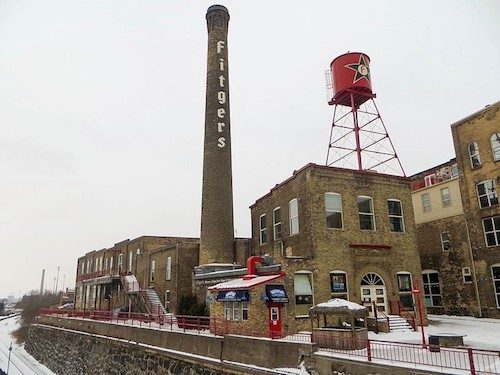
I was torn. Even as it sunk in that I was only the Holiday Inn, that Mary Ann had really come back to Duluth to see John Bean, the code of honor among girlfriends meant that I couldn’t back out of the double date. I called Wendi and said we weren’t coming. Not showing up on a Friday night didn’t mean that you were ostracized or kicked out of the gang; knowing that you had missed out on the fun was punishment enough.
Skipping that Friday night with my friends was the first step in my accidental acquisition of a boyfriend. My date was Doug Figge, a pimply, unremarkable kid whose sole distinction was the ability to grow a slight moustache, a moustache that a first glance looked drawn on with eyebrow pencil. John Bean and Doug Figge went to the mysterious Central High, reputed home of tough guys and greasers, and they worked together at the Canal Drive-In.
Our dates dutifully arrived at seven and manfully shook hands with my father. Had Mary Ann not been there, my dad would never have allowed his just-turned fifteen-year-old daughter to get into a car with two scruffy boys with shaggy hair wearing black leather jackets completely unsuitable for Duluth winters. That must have been some sizeable golf bet.
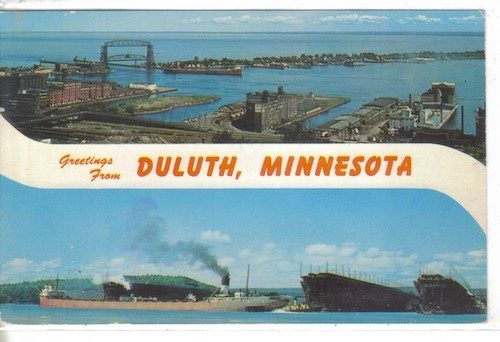
We did not go to Somebody’s House, home of gourmet burgers and real tablecloths. We did not go to the London Inn, the drive-in that was the teeming heart of Duluth teen social life, the destination for every kid with access to a car. We didn’t even go to the Canal Drive-ln, where John and Doug worked, a joint that offered second-rate hamburgers and zero ambience.
We went to Joe Sloan’s house, Joe who had played wingman to Wesley Baggot. I hadn’t been to that house for seven or eight years, back when Joe’s younger sister and I had occasionally played together. The gatehouse and the long driveway leading up to the massive Tudor Revival mansion, ominously stark against the snow, the gleaming grand piano lurking in the immense living room…it was all as familiar and as strange as a dream. Joe, who quickly shooed us inside his oddly dark and silent house, was no taller than he had been when I last saw him six months before, but he seemed older. He mumbled, “Hi Gay, something something” and again I got lost in his dark, deep eyes. I decided I did want a boyfriend, even if he was shut up at boarding school most of the year.
The five of us trooped down to the basement, which disappointingly looked like every other basement rec room used mostly by kids: sticky checkered linoleum tile floor, ping pong table with a torn net and one paddle, scratchy couches with hideous crocheted throws, and an aluminum standing lamp with a single working bulb. In keeping with dating etiquette, I had to sit next to Doug, while sending out frantic thought beams to Joe Sloan: HE’S NOT MY BOYFRIEND.
Joe did have a real stereo system, with separate turntable and speakers, instead of an RCA hi-fi disguised as a piece of classy furniture, or the tinny shoebox-sized contraption I received free (hah!) with my membership in the Columbia Record Club. Joe put “Hey Jude” on the turntable, that seven-minute drone that had been played over and over all fall in every basement and on every car radio. I wasn’t a fan of the B side “Revolution,” either, I just might want to carry a sign by Chairman Mao. But I smiled and twinkled at Joe as if I were the world’s biggest Beatles fan and ever so grateful to him for playing that particular track: Nah nah nah nah nah nah nah nah…
Joe was not paying the least bit of attention to me as he was busy doing something with a small piece of paper. When he lit it on fire, I realized that here, at last, were drugs. The joint was passed around, refused by Mary Ann (“It makes me feel weird”…wasn’t that the point?) and came to me. I was thrilled that finally I was about to experience that transport of consciousness I longed for and scared to death that I would blow it, which I did. I took my first hesitant puff of a joint then erupted in a coughing fit a hundred times worse than a Tareyton one. Kind Nancy was not around to pound my back, Mary Ann just looked on, mortified. None of those boys ever offered me pot again.
Joe started to flip over “Hey Jude” when Doug handed him a Doors album, which gave Doug one point in my eyes, but did not make up for the pimples. No one talked, not even John and Mary Ann, the reunited lovers, who did eventually sneak away somewhere. The Sloan mansion had dozens of rooms they could use; it was a miracle they found their way back to the basement hours later. When Joe and Mary Ann left in search of a private love nest, Doug put his hand over mine, I scooted away, and Joe shut his gorgeous eyes.
That was my week with Mary Ann. If we weren’t in Joe Sloan’s basement, we were lounging around in my bedroom while she told me how much she loved John Bean, how it felt when he touched her, how every night a new piece of clothing was discarded and a new body part caressed.
Mary Ann sweet-talked my mother into driving us down to the Canal Drive-In, where Mary Ann and John traded looks of undying love over the sticky counter while John wrapped hamburgers in waxed paper. The garish yellow and red Canal was lit like an operating room, with chairs meant to encourage you to eat your burger and leave as fast as possible. Coming out of the crisp wintery air, the atmosphere at the Canal was a fug of uncirculated grease. Mary Ann and I sat there, scrunching our bottoms around in those plastic bucket-shaped seats, sipping cokes through paper straws until John and Doug got off their shift and it was off to the Sloan’s basement.
Mary Ann had not flagged in her crusade to pair me up with a boyfriend. She insisted that I like Doug: after all Doug had told John who had told Mary Ann how much he liked me, even though I don’t think we had exchanged ten words. On that basis, one night while Joe slipped into a pot and “Hey Jude” induced trance, Doug and I kissed and did the teen couple couch grapple.
Doug was a boy, so that was exciting, and he was a year older and had a driver’s license and smoked cigarettes and pot. He liked the Doors and he seemed to like me. I tried to like him back, as Joe Sloan still treated me as an inanimate object and there were no other contenders for boyfriend ringing me on the phone or walking me home from school.
Doug did not have all that much going for him as boyfriend material. A pong of French fries always clung to his hair. He went to a different high school so we would never walk hand in hand to class together. I hated going over to his pokey ranch house, which sat on a small, treeless plot in a neighborhood I had never been to before. His grey, sunken-faced parents, who didn’t speak to me, were always watching TV, slumped in matching Barcaloungers too large for their cramped living room. Plastic flowers stuck in empty bottles of Lancers and Blue Nun wine decorated the dining table and sideboard. There was not a single book in that house. I looked down my nose at all of it. I was a hippie, I was a revolutionary, I was a snob.
After her week of love, Mary Ann said goodbye to me through a veil of happy/sad tears: she and John had spent their last night together going all the way. Mary Ann claimed that he had a rubber, but as it was pitch black in that forgotten back bedroom in the Sloan mansion, she could not enlighten me as to how a rubber went on or came off, but who cares, she cried, it was magical, it was heavenly, she loved John Bean so much and he loved her, and she hoped that Doug and I would be just as in love. The sex sounded fun, but I could not imagine Doug Figge on the other end of a mysterious rubber-sheathed penis.
Mary Ann flew home to Florida, Joe Sloan was sent off to his bad boy boarding school, and I went back to East High and the company of my friends; a week away from them felt like an eternity. The girls were thrilled that I finally had a boyfriend, even if he did go to another school and therefore had no status, good or bad, in the East High caste system.
I wasn’t sure I had a boyfriend, or even wanted this particular one. But Doug beat out the competition, as there was none. He’d call, ask me out, and I went, Saturday after Saturday. We didn’t go to the movies or to Bridgeman’s for ice cream. We went to his sad little house, or if John Bean was working, down to the Canal Drive-In where John gave us free onion rings and cokes. When the Canal closed, John and Doug smoked pot and drank beers in the parking lot, while the gale-force wind off the lake buffeted the car. I sat smashed between them, trying not to cough as the air in the car turned blue with smoke. Doug and I would end the evening in the back seat of his parents’ Corvair, negotiating how much I really liked him.
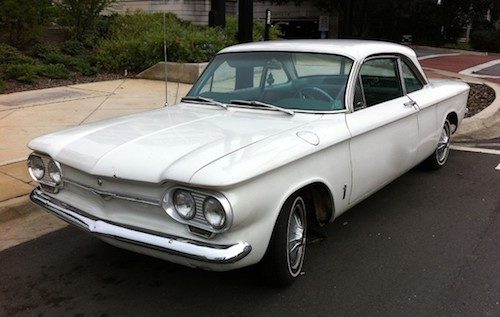
I had no problem letting Doug stick his hand under my shirt. Mary Ann had warned me not to make the same prissy mistake I had with Steve Laflamme. Thanks to sleep-over confessions, I now knew that every girl in my gang who had a boyfriend of several months’ standing had gone at least that far. We girls prided ourselves on sharing everything, starting with the first kiss; our Friday nights were filled with drunken truth-telling and laughter, at ourselves, each other, and our clueless boyfriends. My gang of friends bonded over tales of our teenage romances and the knowledge that all our secrets were safe among us.
Rockwell Finally Appears as Himself in Triple Self-Portrait
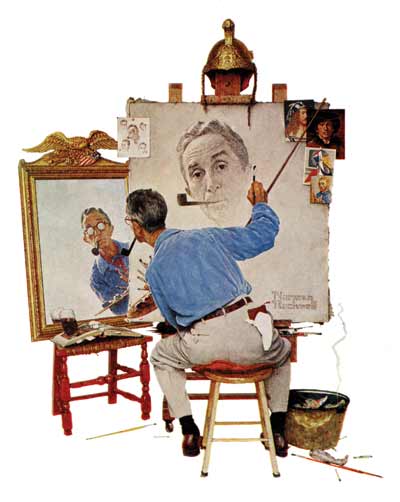
© SEPS
In 1960, Norman Rockwell produced one of the most famous self-portraits in American art. A naturally modest man, he clearly had some reservations about making himself the subject of a cover. He’d put himself on covers before, but usually only as a cameo, never the central figure.
In describing this work, Rockwell explained why his glasses look opaque. “I had to show that my glasses were fogged, and that I couldn’t actually see what I looked like — a homely, lanky fellow — and therefore, I could stretch the truth just a bit and paint myself looking more suave and debonair than I actually am.”
As visual reinforcement of his intentions, at the top of the easel, Rockwell has included a reminder to himself not to be taken in by appearances. He bought this helmet in a Paris antique shop, thinking it was the headdress of an ancient Greek or Roman soldier. Carrying it back to his hotel, he stopped to watch a firefighter working to save a burning building and realized that all French firemen wore helmets identical to the one he’d just purchased.
For all Rockwell’s self-deprecation, the painting is regarded by many as a thoughtful portrait of the artist’s three selves: the painter, the observer, and the public person.
This article is featured in the November/December 2017 issue of The Saturday Evening Post. Subscribe to the magazine for more art, inspiring stories, fiction, humor, and features from our archives.
Your Weekly Checkup: How Well Do Your Medications Mix?
We are pleased to bring you “Your Weekly Checkup,” a regular online column by Dr. Douglas Zipes, an internationally acclaimed cardiologist, professor, author, inventor, and authority on pacing and electrophysiology. Dr. Zipes is also a contributor to The Saturday Evening Post print magazine. Subscribe to receive thoughtful articles, new fiction, health and wellness advice, and gems from our archive.
The young physician starts life with 20 drugs for each disease, and the old physician ends life with one drug for 20 diseases.
—William Osler
We live in an era of polypharmacy. Many people, particularly the elderly, ingest five or more drugs daily for a multitude of common problems such as high blood pressure, arthritis pain, depression, diabetes, and so on. Most of these drugs, when prescribed and carefully monitored by a physician, help relieve symptoms, and some are even lifesaving. However, unintended consequences can cause important side effects.
The greatest risk factor for adverse drug-related events is the number of drugs prescribed. For example, the risk of an adverse drug effect is 50 to 60 percent if four drugs are taken chronically, and almost 100 percent with eight or nine drugs.
It is critical that patients review their entire drug list, including dietary supplements, at each visit with their physician or pharmacist. Often, a physician’s role is to educate patients about what drugs not to take, and to de-prescribe drugs rather than add more. A general recommendation for the patient is to take a drug for the shortest time possible and at the lowest effective dose.
Here are a few common drugs and their side effects to watch for:
- Proton pump inhibitors (for example, Prilosec): loss of electrolytes such as potassium, magnesium, calcium; bone loss and fractures; perhaps dementia and kidney disease
- Statins (for example, Lipitor): muscle pain; type 2 diabetes
- Hypnotics (for example, Ambien): delirium, falls, bone fractures, and motor vehicle crashes
- Selective serotonin reuptake inhibitors (for example, Prozac): falls, loss of sodium
- Fluoroquinolone antibiotics (for example, Cipro): Achilles tendon rupture
- Sulfamethoxazole/trimethoprim antibiotic (for example, Bactrim): elevated potassium
- Opioids (for example, OxyContin): addiction, constipation, nausea, dizziness, somnolence
Drug-drug interactions are of significant concern. Alcohol, statins, warfarin, calcium channel blockers, and many additional drugs can affect the metabolism and/or action of other drugs, which can increase or decrease the drug’s effects. The presence of medical issues such as obesity, kidney, liver or heart disease can impact a drug’s action. When in doubt, check with your physician, and never start or stop a drug without his or her knowledge.
9 Songs of Uprising and Revolution
One hundred years ago today, Vladimir Lenin led the Bolsheviks in their takeover of the Russian Provisional Government. Their anthem was “L’Internationale,” a stirring song about “striking the iron while it is hot.” A catchy tune has always worked to galvanize the oppressed, wretched, and poor into action. The lyrics of revolutionary songs range from fearmongering warnings to prideful exaggerations to simple ridicule. The music varies among regions and time periods, though it often accompanies a march.
American Revolution: “Yankee Doodle”
The upbeat tune traces back to Europe, centuries before the American Revolution, but British soldiers sang “Yankee Doodle” in mockery of the colonists. The lyrics were meant to describe the foolish, classless American soldiers. However, the Yankees claimed the derisory tune as their own (and had the last laugh).
French Revolution: “La Marseillaise”
The French national anthem was written in 1792 as a rousing call to Frenchmen to fight against the Austrian invaders (“They’re coming right into your arms / To cut the throats of your sons, your women!). “La Marseillaise” gained its name from its popularity among the fédérés (volunteer soldiers) from Marseilles in the French Revolution.
Young Turk Revolution: “Mshag Panvor”
Grikor Mirzaian Suni wrote the anthem of the Armenian Revolutionary Federation, “Farmer, Laborer.” The ARF was involved in the Young Turk Revolution of 1908, which led to the dissolution of the Ottoman Empire. The ARF went underground during Soviet control of Armenia, but since the fall of the Soviet Union the party has once again gained influence in government.
Easter Rising: “The Foggy Dew”
Canon O’Neill’s ditty, “The Foggy Dew,” was written in Ireland in 1919 about the Easter Rising, a five-day armed rebellion in Dublin in 1916. O’Neill’s tune comes from other traditional Irish folk songs, but the lyrics reflect many Irish opinions of the time that Irish soldiers leaving to fight in World War I for the British ought to have stayed home to fight for their own independence. The most popular recording of the song is by Sinéad O’Connor with The Chieftains in 1995.
Russian Revolution: “L’Internationale”
Eugène Pottier’s ubiquitous socialist hymn was the anthem of the Russian Revolution as well as the Soviet Union and many other leftist entities worldwide. Vladimir Lenin wrote in 1913: “In whatever country a class-conscious worker finds himself, wherever fate may cast him, however much he may feel himself a stranger, without language, without friends, far from his native country — he can find himself comrades and friends by the familiar refrain of the Internationale.” Pottier wrote the lyrics after the fall of the Paris Commune in 1871.
Mexican Revolution: “La Cucaracha”
The traditional Mexican folk song, “La Cucaracha,” wasn’t originally sung with lines about marijuana, but Pancho Villa’s army added in lyrics when they sang it during the Mexican Revolution. Their version of the mariachi song also contained revolution-specific lyrics about hardship and referred to President Huerta as the cockroach in question.
Cuban Revolution: “Hasta Siempre”
The “Nueva Trovo” movement in Latin America in the 1960s focused on culturally significant, authentic music as opposed to commercial projects. Carlos Puebla’s “Hasta Siempre, Comandante” was written to Che Guevara when the revolutionary departed Cuba to stoke uprisings elsewhere after the Cuban Revolution ended successfully in 1959. “We will carry on / as we followed you then / and with Fidel we say to you / ‘Until forever, Commander!’” ends Puebla’s Cuban folk song.
The Cultural Revolution: “The East is Red”
Mao Zedong disseminated a heroic image of himself in various forms of propaganda during The Cultural Revolution of the 1960s. One of them was “The East is Red,” an unofficial anthem of the People’s Republic of China during that time. The lyrics proclaim “Chairman Mao loves the people / He is our guide / to building a new China / Hurrah, lead us forward!”
Romanian Revolution: “Deșteaptă-te, române!”
“Didn’t we have enough of the blinded despotism / Whose yoke, like cattle, for centuries we have carried?” goes the Romanian national anthem, an old song called “An Echo” written during the revolutions of 1848 in the Austrian Empire. Later titled “Wake Up, Romanian!,” the song was stripped of its national anthem status in 1947 during the country’s stint of communism, and it made a resurgence in the Romanian Revolution in 1989.