Leading Men of Hollywood: Clark Gable
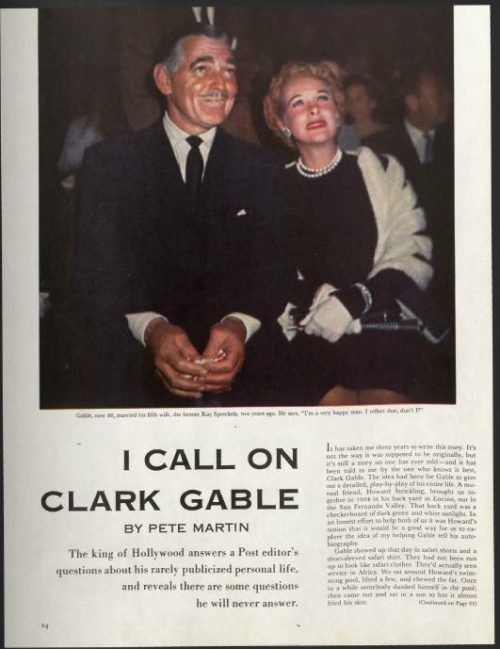
This article was originally published in the Post on October 5, 1957. This and other features about the stars of Tinseltown can be found in the Post’s Special Collector’s Edition, The Golden Age of Hollywood, which can be ordered here.
My wife, Kay, is stopping by at 3 o’clock to pick me up,” Clark Gable told me when he walked into my hotel room for our interview. “You ask me questions, and I’ll tell you the truth. If you ask me something too personal, I’ll say, ‘that’s a question I don’t care to answer; I’m keeping that to myself.’ But if you ask me something that I feel I can answer honestly, I will.”
After I’d tried unsuccessfully to ask him a few personal questions, I asked him about three pictures he’d been in: IT HAPPENED ONE NIGHT, MUTINY ON THE BOUNTY and GONE WITH THE WIND. “I’ve heard you wanted to be in none of them,” I said, “but in each case somebody talked you into changing your mind.”
“IT HAPPENED ONE NIGHT came along early in my motion-picture career,” he said. “For two years after M-G-M put me under contract, I pulled guns on people or hit women in the face. Then M-G-M assigned me to a bad part in DANCING LADY, with Joan Crawford—a picture I didn’t like. But as bad as the part was, it wasn’t as bad as my health.”
“What was wrong with you?” I asked.
“I’d lost a lot of weight. They’d been working me hard, and I was tired. I told myself, ‘If I have a few operations, that will take care of my health and the part in DANCING LADY too.’ I had my appendix and my tonsils out, but it didn’t take care of everything, for M-G-M was mad at me. For some strange reason they thought I’d taken evasive action to avoid their picture. They bided their time during the eight or nine weeks I was in the hospital. Then the very day after I got out they called me in and said, ‘We’re sending you over to Columbia Pictures on a loan-out.’”
“Was that punishment?” I asked.
“At that time Columbia was on the wrong side of the tracks,” Gable said, “and being sent there was a this-will-teach-you-a-lesson deal. I didn’t know anybody at Columbia, but I’d been told, ‘Report to Frank Capra,’ so I reported to him.
“Frank is a nice guy, and he was tolerant of my attitude, which, to put it mildly, wasn’t good. He didn’t know I felt that I had just been swept out of M-G-M’s executive offices with the morning’s trash. I took home the script of IT HAPPENED ONE NIGHT, and I read it. I had a couple of drinks and thought, It can’t be that good. I’d better look at it later. So I had dinner and read it again. It was still good. The next morning, I called Frank and said, ‘I want to apologize for my behavior yesterday. I was rude, and I had no reason to be. You’ve got a fine script. Why you’ve chosen me to be in it I don’t know. You’ve never seen me play comedy on the screen.’”
“Did he ever tell you why he chose you,” I asked.
“I don’t know to this day,” Gable said. “I told him, ‘If you think I can do it, I’ll try, but after three or four days, if you don’t like what you see on the screen, you can call the whole thing o and there’ll be no hard feelings.’ We worked a few days; Frank came to me and said, ‘We’ll have no trouble.’”
In the end, the lm’s female star, Claudette Colbert, and Gable himself won Academy Awards for the year’s best performance by an actress and actor. The picture itself won the award as the outstanding production of 1934. Capra won an Oscar for his direction. Writer Bob Riskin won a similar award for the year’s best screenplay.
Other Roles Nearly Missed
“I didn’t want to be in the second picture you mentioned, MUTINY ON THE BOUNTY, because it was a story about
a crew of Englishmen, and since I obviously wasn’t English, I felt I was badly miscast.
“For a while there was a deadlock. It was broken by Kate Corbaley, who headed M-G-M’s story department. God rest her soul—she’s dead now—but she was a wonderfully kind, white-haired, brilliant woman. She knew I was giving Irving [Thalberg, one of the film’s producers,] a bad time, and she didn’t like civil war in the studio, so she came to me and said, ‘I think you’re making a mistake. I’ve read this story, and I can’t see anybody else playing Fletcher Christian but you.’
“‘Not me, Kate,’ I said stubbornly. “I’d have to wear knee britches and a three-cornered hat. That’s more than I can stomach.’
“‘Don’t be such a mule,’ she told me. ‘Listen.’ So I listened, and after I listened, I said, ‘O.K., let’s go,’ although I still didn’t like it.”
“Did you feel better about it as you went along?” I asked.
“Not me,” he said. “I told everybody who’d listen, ‘I stink in it.’ I didn’t realize I was wrong for several months. But after the studio previewed MUTINY, I got a cablegram from Thalberg: ‘The movie is wonderful. We’re proud of it. You’ll like yourself in it.’ I had to believe Irving because he was a guy you could believe. He didn’t kid himself or anybody else.”
“I don’t see how you could have avoided playing Rhett Butler in GONE WITH THE WIND,” I said. “The whole country cast you in it long before the cameras began to roll.”
“That was exactly the trouble,” Gable clarified. “Not only that but it seemed to me that the public’s casting of me was being guided by an elaborate publicity campaign.”
I disagreed. “That casting was a natural thing,” I said. “No studio or producer controlled it. I sat in any number of bull sessions in friends’ homes while we cast that picture. Nobody said we ought to cast it; we just did. And the way we nonmovie employees cast it was the way it was eventually cast on the screen. Almost everybody agreed on you as Rhett Butler, Leslie Howard as Ashley and Olivia DeHaviland as Melanie.”
“My thinking about it was this,” Gable told me, “that novel was one of the all-time best sellers. People didn’t just read the book; they lived it. They visualized its characters, and they formed passionate convictions about them in their minds. You say a lot of people thought I ought to play Rhett Butler, but I didn’t know how many had formed that opinion.”
“Enough,” I said.
“There are never enough,” he told me. “But one thing was certain: They had a preconceived idea of the kind of Rhett Butler they were going to see, and suppose I came up empty?”
I’d never heard that phrase before, so he explained, “I thought, All of them have already played Rhett in their minds; suppose I don’t come up with what they already have me doing. Then I’m in trouble. If they saw one thing I did that didn’t agree with their remembrance of the book, they’d howl. I’d done the same thing when I’d wanted to be a Shakespearean actor. I’d taken a copy of HAMLET or RICHARD II or OTHELLO to the theater with me, and I’d checked on the Shakespearean actors. I’d say, ‘Why that — missed an “and” or ‘He left out a “but.” He can’t do that.’”
“I’ve seen GONE WITH THE WIND three times,” I told him, “and I had the feeling you enjoyed it.”
“It was a challenge,” he said. “I enjoyed it from that point of view. But my chin was out to there. I knew what people expected of me and suppose I didn’t produce?”
“But you did produce,” I said.
“Maybe so,” he said noncommittally.
“When did you finally get it through your head you’d done all right?”
He said, “The night we opened in Atlanta, I said, ‘I guess this movie is in.’”
“How did you figure that?” I asked. “Did you enjoy it yourself or did you gauge it by other people’s reactions?”
“Other people’s reactions,” he said.
I said, “Have you ever considered retirement? What do you think about your future?”
“That’s a logical question, and I’ll give you a logical answer,” he said. “When the public doesn’t want me any longer, I’ll quit.”
“How will you know?” I asked.
“I don’t want to stay around long enough to bore people, and I won’t. They have their own way of expressing themselves, and unless an actor is looking the other way, he can see the warning. But as long as the people still go to see my films, I’ll do my best to entertain them.”
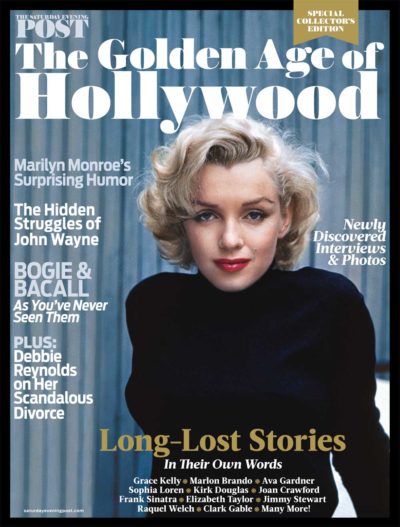 This article and other features about the stars of Tinseltown can be found in the Post’s Special Collector’s Edition, The Golden Age of Hollywood, which can be ordered here.
The Bike Accident
Seconds after the accident, the teenager lay in the road near his damaged bike.
He’d been pedaling on a gravel shoulder, a guitar case strapped to his back, when he veered abruptly onto a two-lane street. The car struck him with a sickening thwunk, and he tumbled across the pavement, bike and body skidding, asphalt shaving his skin. When his momentum finally stopped, he looked at me, eyes wide. And he screamed.
“It’s okay!” I shouted, running from the sidewalk onto the street. “I’ll call 911 — it’s okay!”
I tapped my phone as the driver jerked onto the shoulder. He jogged to us — “You pulled onto the road!” — then gathered himself, directing traffic around the scene. A 911 operator took my call: Where are you? What’s the cross street? Is the victim conscious? Is he breathing okay?
He was conscious, though shaky, still sprawled in the road. He’d stopped screaming. As the minutes passed, he even joked about the rips in his new summer shorts. But he was still wincing and wheezing, the shock still draining his face. And then, as we waited for an ambulance, he did something that startled me.
He pulled his phone from his pocket and called his music teacher.
“Hi — I’m afraid I can’t make it to my lesson tonight,” he said, never mentioning the crash or the road rash that streaked his arms.
It was a strangely courteous gesture given the high-stress situation — like saying “thank you” and “please” while strapped in an electric chair.
So why make that call?
It was, I believe, a fundamental human response. The need to regain control when you’ve lost all control. And yet the entire incident exposed our lack of control, the random ways that lives intersect. Consider this: I’d never walked the route that placed me at the accident. My commuter train had halted one stop before my usual destination — an earlier Amtrak train had struck a pedestrian, causing gridlock — so I left the air-conditioned railcar for a hot walk home. Since I was wearing my workout clothes (the change in plans meant I couldn’t go to the gym), I strapped on my backpack and ran — all of which placed me in the exact spot to witness the crash and call 911.
Who knows? If I’m not there, maybe the driver flees the scene instead of helping. (After directing traffic, he left before the police arrived.) If the biker stops to scratch an itch, if he pedals faster or slower, maybe the accident never happens. Our futures can change in an instant. In June 2016, a woman died at Virginia Beach, Virginia, after being struck by a wind-blown umbrella. What are the odds?
Luck shapes our lives more than we care to admit. We take steps to protect ourselves: We wear seat belts, we wash our hands, we don’t vacation in war zones. But random events can pluck us from quiet safety, like wind whisking paper in a breeze. Wrong place, wrong time. Right place, right time. We are slaves to chance — and that can cause anxiety. In a survey on American fears released in October 2016 by Chapman University, two of the top four fears involved terrorism, that great invisible threat of modern life. Yet our odds of dying in a terrorist attack in the United States are 1 in 20 million.
We can use logic to diminish our fears, but we can’t entirely escape risk. As science writer Kayt Sukel notes in her book The Art of Risk, “There’s risk involved in what you decide to eat for breakfast and in accepting a marriage proposal.
There’s risk in going out in the world. And there’s risk in staying home. Risk is everywhere.” And sometimes we make risks, well, riskier, as the teenage biker made clear with one more surprising, supine comment.
“I wish I’d worn my helmet,” he said.
That’s right — he’d skipped an action he could control. And yet somehow, as his body tumbled across the blacktop, his head never hit the street.
Luck.
After the ambulance arrived, the EMTs helped him sit up. They placed him on a stretcher. Earlier, after I had called 911, an off-duty EMT drove by. She pulled over, asked him questions, comforted him, took his pulse. Another chance encounter, and another lesson: At their core, most people are kind.
When I finished answering questions for the police, my legs were shaking. I was dripping sweat, a combination of stress, heat, and my post-train run. My wife picked me up and drove me to my usual station, where I’d biked that morning. Yes, I’m a biker too, and I was leery of riding home. I could still see the collision, could hear the teenager’s scream, could feel the fear that widened his eyes. If I felt jittery, I can only imagine his anxiety the next time he straddles a bike.
But I see only one response to fear and to our powerlessness in the universe. And so I unlocked my bike, strapped on my helmet, and pedaled home on the asphalt trail.
Ken Budd has written for The New York Times, Smithsonian, McSweeney’s, and National Geographic and is the author of The Voluntourist. For more, visit thevoluntouristbook.com. Listen to an interview with author Ken Budd, where he recounts the events that led him to write this article.
This article is featured in the July/August 2017 issue of The Saturday Evening Post. Subscribe to the magazine for more art, inspiring stories, fiction, humor, and features from our archives.
Humorists on Humor: Cracking the Code on What Cracks Us Up
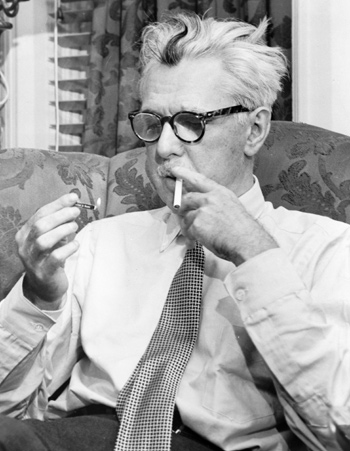
World Telegram & Sun Photo by Fred Palumbo/Library of Congress
One of the most popular writers of his day, James Thurber was, to use his own words, a wit, satirist, and humorist. As he explained, “The wit makes fun of other persons; the satirist makes fun of the world; the humorist makes fun of himself.” Named for him, the Thurber Prize for American Humor is awarded annually to recognize the art of humor writing; the 2017 winner will be announced at Caroline’s Comedy Club in New York City on October 2, 2017. The Post invited previous prize winners and finalists to share thoughts on the art of being funny today.
What characterizes modern American humor?
“People talk about the perils of being politically correct, but in a way it’s just the opposite. There’s so much more you can say now than you could 30 years ago. Louis C.K.’s comedy routines are a case in point, but there are writers who push the envelope just as far. What used to be on the edge is now family humor.”
—Calvin Trillin
Novelist, poet, food writer, regular contributor to The New Yorker; author of Quite Enough of Calvin Trillin
“I tend to write political satire. But I decided that American politics have reached the point of being sufficiently self-satirizing, so for my recent book, The Relic Master, I travel backward in time to the year 1517. And you know, I had such a good time doing it I may just stay in the 16th century. And while it’s probably true that a lot of the comic/satirical energy has shifted to TV, there’s still an awful lot of good stuff being written these days.”
—Christopher Buckley
Novelist, essayist, critic, memoirist; author of No Way to Treat a First Lady
“Humor is less filtered now than it used to be, it’s darker, more inappropriate, but at the same time humor with heart reigns supreme. It’s hard to characterize the humor scene today because it’s so diverse. It’s become a conduit for political issues, for social, class, and gender issues. Is it possible ‘funny’ is getting too ‘serious’? People still want to laugh, but they also want a really good story to go along with it.”
—Sloane Crosley
Essayist, novelist; author of I Was Told There’d Be Cake
What qualities does good humor writing have, and can it be learned?
“Essentially, you take an essential truth and twist it, turn something upside down so it’s seen in unexpected ways. That’s the heart of it. Afterward, there are matters of timing and pacing, a rhythm you need to establish. Throw in some elements of storytelling. Build up, push back, build the tension, and finally you hit the mark. I used to think humor couldn’t possibly be learned, but now I absolutely believe it can. ”
—Laurie Notaro
Journalist, novelist; author of The Idiot Girl and the Flaming Tantrum of Death
“I don’t know how Thurber would do these days. His agent would probably tell him he needs to get a sitcom before he can shop his book around.”
—Dan Zevin
“I think you can analyze what makes good humor. And you can sum up techniques of how to make it work. But something like that would end up in the Journal of Structural Engineering. It would be that dull.”
—John Kenney
Novelist, regular contributor to The New Yorker; author of Truth in Advertising
Where does humor come from? Is there a humor impulse?
“I don’t think it’s a humor impulse. It’s a story impulse. After the idea comes to you, you have to think what form it will work best in — a short piece, a novel, the theater, late-night TV show. I’m blessed that I’ve been able to work in all those forms, so I can decide which one works the best. Maybe next I’ll try writing a pamphlet.”
—Alan Zweibel
Screenwriter (Saturday Night Live), playwright, novelist; author of The Other Shulman
Do you find humor comes out of your own experiences?
“Of course, although I had trouble finding anything funny about turning 80. At least I don’t have to take my shoes off at the airport anymore.”
—Calvin Trillin
Do you see any difference in the humor between men and women?
“I think men and women are equally funny, but because men’s experiences are way different from women’s, it makes for a difference in perspective. That makes us different but equal in a number of ways.”
—Laurie Notaro
“Tina Fey and Lena Dunham have both written staggering, laugh-out-loud funny books. Many of the funniest people writing today are women.”
—John Kenney
Do the internet and social media have an impact on contemporary humor?
“I find a lot of cool, interesting voices on the internet that you won’t find anywhere else. You can publish and reach an audience there that you can’t anywhere else. That means that someone in Minnesota who works at a power company can publish short pieces of comedy that people anywhere in the world can find and laugh at. Through the internet, the sky’s the limit as far as creativity.”
—Steve Hely
Screenwriter (30 Rock, The Office); Author of How I Became a Famous Novelist
Would you consider the humor on American television to be literary in its broadest sense?
“Only written humor, written by one person, published on paper, in a book or magazine, is literary humor. TV sitcom scripts, screenplays, blog posts, transcripts of stand-up routines are all fine, but none come close to literary humor. Every so often, a work of literary humor lasts forever. A few pieces by Thurber fall in that category. Ditto S.J. Perelman and Robert Benchley. Roy Blount is a great literary humorist, as are Garrison Keillor and David Sedaris.
—Ian Frazier
Essayist, staff writer at The New Yorker; author of Lamentations of the Father
“From a book-publishing perspective, I think humor writing is in great shape, just as long as you’re a famous TV star. I don’t know how Thurber would do these days. His agent would probably tell him he needs to get a sitcom before he can shop his book around town. Or at least he’d need an Instagram account. He’d probably be taking selfies with his dogs instead of drawing them.”
—Dan Zevin
NPR contributor; author of Dan Gets a Minivan: Life at the Intersection of Dude and Dad
Laugh Lines
On Parenting: “Parenthood is an amazing opportunity to be able to ruin someone from scratch.”
—Jon Stewart
On Social Media: “Getting your news from Twitter is like asking a cat for directions.”
—Andy Borowitz
On Politics: “Politicians and diapers must be changed often, and for the same reason.”
—Mark Twain
On Marriage: “Never marry a man you wouldn’t want to be divorced from.”
—Nora Ephron
On Religion: “Anyone who thinks sitting in church can make you a Christian must also think that sitting in a garage can make you a car.”
—Garrison Keillor
On Taxes: “Tax reform is taking the taxes off things that have been taxed in the past and putting taxes on things that haven’t been taxed before.”
—Art Buchwald
On Women: “Women are wiser than men because they know less and understand more.”
—James Thurber
On Death: “That would be a good thing for them to cut on my tombstone: Wherever she went, including here, it was against her better judgment”
— Dorothy Parker
Robert Ingersoll and the Lost Art of Public Speaking
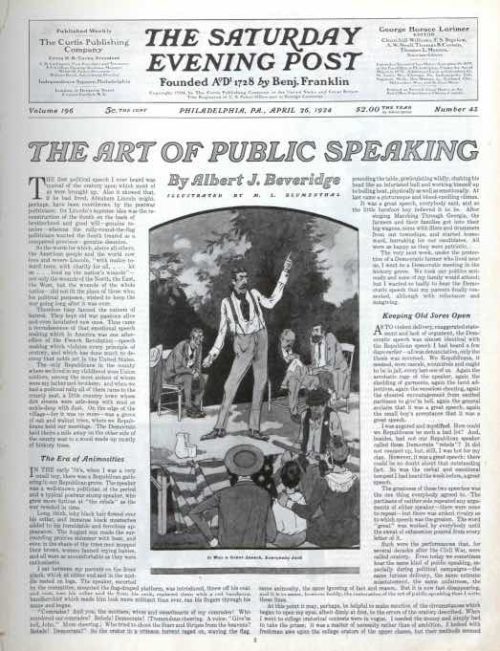
Robert Ingersoll, the 19th-century American thinker and speaker, was born on this day in 1833. Long before talking heads began bloviating nonstop on cable news, the public would line up to see the most impressive orators of the day. Despite social sea changes in the 20th century, this Post article from more than 90 years ago shows that the makings of a good public speech are timeless.
In “The Art of Public Speaking,” a 1924 analysis of oratory, Albert J. Beveridge outlines the traits of an effective speaker. According to Beveridge, an aptitude for communication enters into it, but — as with any art — orators must gain an understanding of the form and its history if they wish to be successful.
As to composition and structure of the speech, the rules of that art may be summarized thus:
Speak only when you have something to say.
Speak only what you believe to be true.
Prepare thoroughly.
Be clear.
Stick to your subject.
Be fair.
Be brief.
Beveridge commends Robert Ingersoll as a “master of the art” and recalls seeing the Civil War veteran speak as a 20-year-old: “In short, everything about Colonel Ingersoll was pleasing, nothing was repellent — a prime requisite to the winning of a cordial hearing from any audience, big or little, rough or polite.” The writer applauds Ingersoll’s conversational tone and natural gestures.
Beveridge omits the topic of Ingersoll’s oration. In fact, Ingersoll was known as “The Great Agnostic” who often criticized religion and spoke on history and humanism. Few sound recordings of Ingersoll exist, but a short speech, “On Hope,” was recorded on gramophone by Emile Berliner in 1897. Ingersoll speaks in a casual, steady rhythm, saying,
I am not trying to destroy another world, but I am endeavoring to prevent the theologians from destroying this. The hope of another life was in the heart long before the sacred books were written and will remain there long after all the sacred books are known to be the work of savage and superstitious men.
Ingersoll’s ideas about secular humanism were not always received well, but his style of calm oration afforded him the best possible response from a 19th-century Midwestern audience. Along with Daniel Webster, Wendell Phillips, and Patrick Henry, Beveridge named Ingersoll “one of the four greatest public speakers America has produced.”
The weightiest advice in Beveridge’s article is his insistence on sincerity and honesty from a speaker, because “ignorance is dangerous:”
First, last and above all else, the public speaker is a teacher. The man or woman who presumes to talk to an audience should know more about the subject discussed than anybody and everybody in that audience. Otherwise, why speak at all? How dismal an uninformed speech! When coupled with sincerity, how pitiable! And how poisonous! For that very ingenuousness often causes the hearers to believe, for the time being, that the speaker knows what he is talking about.
Beveridge’s emphasis on honesty and research came before instant fact-checking and smart phones, yet the importance of his words endures. Whether oration is given on a soapbox, into a gramophone, or livestreamed online, words still matter.
News of the Week: Buttered Rolls, Marilyn Monroe, and Rockwell at the Swimming Hole
Only in New York?
Another week, another controversy that breaks the internet. Sometimes you can see them coming, like that Google manifesto that has the left and the right taking sides, or weird/funny videos that go viral. But sometimes something takes over the web that you could never predict, like that dress a couple of years ago that no one knew the color of (I knew it was black and blue!) Yes, there was a day when everyone online was arguing about the color of a dress.
Now we have a new controversy: buttered rolls!
This New York Times piece by Sadie Stein extols the virtues of the buttered roll, which she and many other people say is a thing unique to New York City. Now, you might have the same first reaction that I and many other people online had: Can’t you get buttered rolls, well, everywhere?
Apparently not! Not like the ones in New York! To be fair, it seems like Stein’s talking about a certain type of roll (a big hard roll with butter in the middle, almost like a butter sandwich) that you get in certain places, like bodegas and carts and delis, and you eat it for breakfast with your morning coffee. I’ve never had one of these, but they still seem like, you know, a roll with butter. I’ve had a lot of those.
This paragraph stands out:
Though of course bread and butter are eaten all over, the buttered roll (or roll with butter, as it is known in parts of New Jersey) is a distinctly local phenomenon. Mention its name outside the New York metropolitan area and you would very likely be met with blank incomprehension.
I very much doubt that, even if our buttered rolls aren’t “buttered rolls.” But what do I know? The article has a lot of defenders, including Stein’s New York Times cohort Pete Wells, and detractors, like BuzzFeed’s Tom Gara. Stein knew there would be people who didn’t understand:
In response to inevitable carping…yes, NYers are incurable solipsists. AND the specific buttered roll discussed here is a specific thing.
— Sadie Stein (@SadieStein) August 2, 2017
David Letterman Is Back!
I knew he wouldn’t stay away. As soon as I heard him talking about how he wished he had thought of Comedians In Cars Getting Coffee and noticed that he had started to do more interviews and podcasts, I knew he would be the anti–Johnny Carson and actually come out of retirement to do another show. Letterman just signed with Netflix to do six episodes of a new talk show starting in 2018. Instead of many guests, Letterman will sit down with one guest for the entire show. I’m thinking it’s going to be more Charlie Rose, less The Late Show.
But Dave, please, shave off that beard.
Speaking of Netflix…
Pop quiz: Who’s going to play Lucille Ball in a new biopic Aaron Sorkin (The West Wing, The Social Network, A Few Good Men) is writing for the streaming service?
- Cate Blanchett
- Meryl Streep
- Debra Messing
- Tea Leoni
- Amy Adams
Here’s the answer. Now we can all make our predictions on who should play Desi Arnaz.
Does America Have a Tattoo Problem?
I was watching an episode of The Dick Van Dyke Show a while back. Sally was telling Rob and Buddy that she would date a guy who had a mustache even though she never liked them before. She then said the next thing she was going to be into was tattoos, which shows how rare it was for men to have them back then (unless you were in the military).
How times have changed. You can’t leave the house without seeing at least one man (or woman) who has at least one tattoo. This piece at The Federalist argues that America has a tattoo problem.
I’ve never been tempted to get a tattoo. I did think about getting my ear pierced for about five minutes back in the ’80s. I’d have to get a really subtle tattoo, small and in a place no one could see it, because, well, they can get out of hand.
A Modern-Day Norman Rockwell Painting
This is proof that Twitter isn’t completely annoying: a photo taken at a recent Boston Red Sox game at Fenway Park that could pass, as Maury Brown says, as a Rockwell:
This is an absolute modern day Norman Rockwell painting. pic.twitter.com/SxYF6JRkof
— Maury Brown (@BizballMaury) August 4, 2017
RIP Glen Campbell, Barbara Cook, Robert Hardy, Don Baylor, Darren Daulton, Daniel Licht, Ty Hardin, Haruo Nakajima
Glen Campbell not only performed such classic songs as “Wichita Lineman,” “Rhinestone Cowboy,” and “Gentle on My Mind,” he was also a member of the famous group of session musicians known as The Wrecking Crew and played guitar on many other songs, including The Beach Boys’ “I Get Around” and “Help Me, Rhonda,” Ricky Nelson’s “Hello, Mary Lou,” Wayne Newton’s “Danke Schoen,” and Frank Sinatra’s “Strangers in the Night.” He died Tuesday after a battle with Alzheimer’s Disease. He was 81.
Barbara Cook was the Broadway soprano who won a Tony for The Music Man and appeared in other classic musicals like Candide and She Loves Me. She passed away Tuesday at the age of 89.
Robert Hardy was a veteran actor who played Cornelius Fudge in the Harry Potter movies and appeared in many other movies and TV shows, including several in which he portrayed Winston Churchill. He died last Thursday at the age of 91.
Don Baylor and Darren Daulton were two baseball favorites who passed away this week. Baylor was not only the 1979 MVP, he led the league in getting hit by pitches: seven times in his career. He died Monday at the age of 68. Daulton was an All-Star catcher for the Philadelphia Phillies. He died Sunday at the age of 55.
Daniel Licht did the music for Dexter and many other TV shows and films. He died last Wednesday at the age of 60.
Ty Hardin played Bronco Layne on the 1958–62 CBS Western Bronco and also appeared in movies like PT 109, The Chapman Report, and Merrill’s Marauders. He died last Thursday at the age of 87.
You wouldn’t recognize Haruo Nakajima because his face was usually hidden inside a suit. The Godzilla suit, to be exact. He was the first person to put it on and stomp around Japan in 1954 and played the monster in 11 more films. Nakajima died Monday at the age of 88.
This Week in History
Marilyn Monroe Dies (August 5, 1962)
The last professional photos of Marilyn Monroe, taken by George Barris three weeks before her death, went up for auction this week. The auction ends at 12:07 p.m ET today, so get your bid in quick.
President Nixon Resigns (August 9, 1974)
Nixon was really excited about taping his Oval Office meetings for posterity, but the practice eventually led to this:
This Week in Saturday Evening Post History: “Swimming Hole” (August 11, 1945)
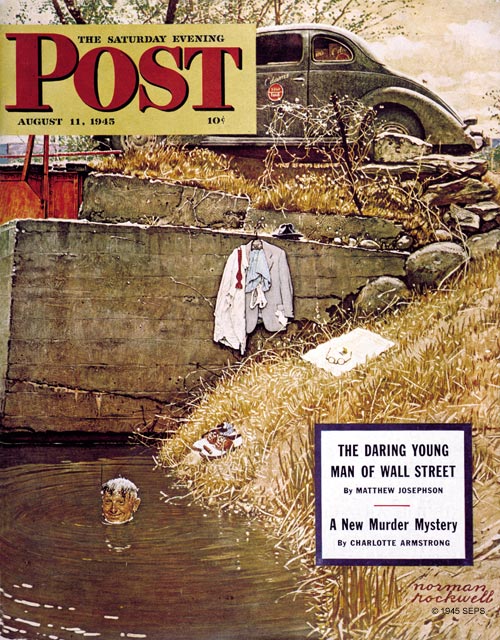
Norman Rockwell
August 11, 1945
© SEPS 1945
Here’s an actual Norman Rockwell cover, one where he shows a salesman taking an impromptu dip on a hot summer day. I’m trying to find his pants, though. I see his shirt, jacket, tie, shoes, and even glasses, but I can’t find the pants.
Paninis
August is National Panini Month. Food Network has 50 panini recipes you can try, which means you can have two every day for the rest of the month without repeating a recipe. If you don’t own a panini press, you’ll have to use a heavy pan to press it down in the skillet.
If a panini is too much work for you, you could just make a regular, old-fashioned sandwich, because it also happens to be National Sandwich Month. You could even have a sandwich on a roll.
You know, with butter.
Next Week’s Holidays and Events
International Left Hander’s Day (August 13)
If you’re right-handed and have always looked at left-handers as “different,” Sunday’s the day you can treat them as if they were normal.
National Roller Coaster Day (August 16)
I’m not a roller coaster fan. I’ve been on one, years ago at Canobie Lake Park in New Hampshire, and I’ll never go on one again. But National Roller Coaster Day is the day to get on one and ride it again and again and again.
The Oracle’s Curse
Just five seconds earlier, she had seemed too good to be true. He should have known there was something a little off, just waiting to reveal itself.
“Come on, it’ll be fun. I’ll pay for it,” Karyn said while the two of them waited for their dessert.
“You don’t really believe in all that?” Larry replied, trying to hedge his tone between faux worry and gentle kidding. “Do you?”
Larry Pemberton really liked this girl. As a guy who always had standards a little too high for his side of the ledger, he didn’t find many women he wanted to see the socially accepted three times. Through two dates, Karyn had seemed like a good match. She was smart, accomplished, beautiful … And, it turned out, a believer in mystical powers.
“It depends,” she said, interrupting his skeptical thoughts. “You have to go to the right one, obviously. A lot of them are just making things up, or telling you what they think you want to hear …”
The concept of a “right” psychic was a concept Larry found pretty silly. He’d thought so even when he was a little kid watching television with his mother on days he was too sick to go to school. One of the daytime talk shows she used to regularly watch would sometimes feature a “celebrity” psychic named Priscilla. Larry must have been home sick for a disproportionate number of her appearances because — despite his mother’s claims that the show usually promoted authors and actors a young boy would find more interesting than a withered woman in a kaftan — Priscilla seemed to show up almost exactly as often as his childhood colds.
“The first time I went was when my friend Monica thought her boyfriend was cheating on her,” Karyn continued. “She only had to ask her a couple of questions …”
Thinking about Priscilla for the first time in years, Larry never really understood why certain psychics broke through as celebrities. Her fame sure wasn’t based on her predictions, which somehow managed to be wrong even with all the vague language she used to hedge against making a definitive call. He couldn’t help but think of some of his favorite examples. One year, she predicted repeatedly that the Detroit Tigers would win the championship, only they lost in the World Series to the Cardinals; Priscilla insisted her second sight didn’t necessarily mean the world championship, and that the American League title qualified. That did provide the saving grace of getting Larry’s mother to stop watching her appearances; Mr. Pemberton had put a pretty significant bet on the Tigers. Even Priscilla’s verbal gymnastics to explain her 2000 election predictions hadn’t accomplished that.
“A lot of people thought it was obvious, but Monica knew as soon as Ms. Aurelia …”
The worst example Larry could remember happened when he was in high school, though it involved a different psychic. When one of his classmates had disappeared for three weeks, the desperate suburban police department struggled to find leads, and hired a local woman who advertised her medium services on bus benches and in the free coupon flier from the grocery store. The move got a lot of local attention, and the psychic’s bloody visions of what had happened to the girl would have made a pretty good plot for a crime novel. The only flaw was that Larry’s classmate turned up a few weeks later, very much alive and not at all dismembered, after hitching a ride back from a trip to follow Phish around the Pacific Northwest without parental permission.
“I’m just saying there’s no way you can know if you’ve never tried it. I never did until college …”
Karyn mentioning college reminded Larry that the girl sitting across from him had gone to the University of Chicago. With a master’s in political science. That she was now a prominent fellow at a think tank on economic policy. She was a lot smarter than him in most ways. Then again, he read once that Arthur Conan Doyle believed in fairies, and Larry personally knew his share of otherwise wise people who still feared the devil literally.
“Besides, it’s not like I’d ever ask her anything important. Usually she just reassures me if I’m on the right track or has some pretty obvious advice. I guess sometimes it’s comforting to hear it from a stranger.”
“Well, I guess I don’t see any harm in that,” Larry said. “Maybe it could be fun. We’ll go on the way home, I promise.”
This eased his mind a little. He did really like this girl. She could have suggested trying just about anything short of ritual animal sacrifice and he would have agreed to give it a try. Plus, it closed the subject for now and let him shift the conversation back to more comfortable territory.
After they finished their profiteroles and paid the bill, Larry got their jackets from the coat check, and they started to walk up Clark Street. He felt he’d picked a perfect night for a long stroll, with the temperature just cool enough to justify jackets but just warm enough for them to enjoy the walk. It wound up not mattering much, as they’d barely walked three blocks before Karyn pointed out the address of the psychic she wanted to visit.
If Larry hadn’t been skeptical already, he would have been as soon as he learned that this supposedly brilliant seer advertised with a short plastic sandwich board placed in front of a mechanic’s garage that had already closed for the night. The cheap letter decals spelled “Miss Aurelia. Psycic. She Knows ALL You’re Secrets. Open 5-10.” The letters were accompanied by a few cone-shaped wizard hats, crescent moons, and stars. Larry checked the time on his cell phone, hoping dinner had run later than he’d thought. It was only 9:32.
“The grammatical errors don’t exactly inspire confidence,” Larry said.
“Okay, smart guy,” Karyn replied, giving him a playful punch in the shoulder. “Just show me you can be flexible on this, and maybe I’ll show you how flexible I can be, if you catch my meaning.” As she said it, she twirled her hair in just the right way, knowing she’d just won that argument. Larry smiled as Karyn rang the doorbell and a loud buzzing sound indicated they could enter.
Miss Aurelia’s door opened to a narrow flight of stairs that led up to what was obviously a pair of residences. The one on the right side had a welcome mat in front and children’s handmade Halloween decorations hung below the brass knocker. The one on the left of the stairs had a frame surrounded by chasing lights and a huge sign reading “Miss Aurelia. Enter and Learn All.” Larry couldn’t help but wonder how often the poor family across the hall had to contend with Aurelia’s customers banging on their door.
“Come in,” a voice called when Karyn rapped gently on the psychic’s door, and the pair entered what struck Larry as the unfortunate result of a major sale at the local head shop. Miss Aurelia had turned her kitchen into a makeshift waiting room, with a pair of upholstered benches and a table full of old magazines positioned next to the front door. The kitchen walls were covered with a patchwork of glow-in-the-dark moon and star decals, and the overhead light fixture had some kind of gel inside that bathed the whole room in a green tint that Larry assumed was meant to be eerie. A few framed photos of specific tarot cards covered the kitchen cabinets, and the round table in the center had a series of card decks in various states of stacking. It also held a half-filled ashtray, the scent of which the various incense burners around the room weren’t masking as well as Miss Aurelia seemed to hope they would.
Then there was Miss Aurelia herself, who entered the kitchen through a curtain of multicolored glass beads. The accent of the voice that told them to come in sounded like some kind of Creole, with a hint of Caribbean inflection thrown in, but Larry could tell right away that it was an affectation. The woman who greeted them was a ruddy-faced Caucasian woman of about 60, with a damp mass of unkempt red hair and a pudgy figure like that of a grandmother in a child’s storybook. She wore an oversized dress that could have been either a large dashiki or a hippie’s maternity wear, and a pair of thick-framed glasses that made her appearance even more comical than her accent.
“Karyn, my chile, how are ya?” the psychic cooed as they hugged, and then turned to shake Larry’s hand. “And dis must be ya new man.”
“That’s some impressive deduction right there,” Larry said, careful to make it sound like a joke, even as the older woman gave him a sideways glance.
“Will ya be wantin’ one reading together, or one each?” Miss Aurelia asked. As she spoke, she was wrapping her hair in a white bath towel, making Larry wonder if it was supposed to look like a turban on a cartoon mystic or if their arrival had interrupted her shower.
“One each,” Karyn said, as she reached into her purse and pulled out a pair of 20s. Larry made a motion to pay, but she waved him off and reminded him that it was her idea and she’d offered to pay.
“Who first?” the psychic asked. She lit a clove cigarette, and the smoke caused Larry to cough, as years of living in a city with no indoor smoking had made his lungs lose their immunity to it.
“First-timers first,” Karyn said, gently pushing Larry forward between his shoulder blades.
Miss Aurelia stubbed out her cigarette in the ashtray in a silent gesture of accommodation, but not without a grudging eye roll in Larry’s direction. “Dis way,” she said, leading Larry through the beaded curtain and down a hallway into a room that was designed to serve as a guest bedroom but which was decorated in the same garish style as the kitchen. They sat on plastic chairs on opposite sides of a card table, as the psychic began shuffling a deck of tarot cards.
“I apologize,” she said. “Do ya want da tarot? I can also read ya cards from da I Ching, or read your lifelines.”
“They’re all just as accurate, huh?” Larry said, no longer trying to mask his sarcasm now that Karyn was several rooms away.
“Ah, I can see ya da not believe in da power,” she said. “How da ya want me to prove it to ya?”
“You can start by dropping the phony accent,” Larry said. “If you really have psychic powers, you can tell me all about it in your regular voice.”
“Oh good,” Miss Aurelia said, instantly taking the lilt out of her voice and letting her accent revert to a standard Midwestern one. “The accent’s hard to keep up sometimes, but I like to give customers the full experience. It adds to the whole sense of intrigue and mystery, don’t you agree?”
“That’s all it took to get you to admit this whole thing is fake?”
“No, I think you misunderstand,” she said, choosing the I Ching deck and shuffling it instead of the tarot. “The power is absolutely real. People just don’t get as excited hearing it in my real voice. One of my mentors said I sounded too much like everyone’s high school English teacher.”
“Well, my high school English teacher was an old man with an Irish brogue …”
“Your sarcasm is noted, sir. Okay? But your girlfriend paid for a reading, and I don’t plan to take her money without giving you an accurate one. As you can see, I’m already shuffling your cards. I want you to clear your mind and focus on one question, anything you want answered. Once it’s in your head, I want you to tell me to stop shuffling three times, and the cards I land on will tell you the answer to your question.”
Not wanting to leave Karyn alone in the waiting room too long, Larry stopped arguing and went ahead with his reading. He didn’t think of any particular question. He just stopped the shuffling at three random intervals and watched Miss Aurelia spread the three cards in front of her, as she explained that every combination of three cards made up a hexagram.
“I can count to six,” Larry said, urging her on with his hand. “So what does it say?”
“You’ve chosen oppressed, a tree surrounded by walls,” she said, pointing to the rows of broken and unbroken lines formed by the cards. “It means ‘Confined, creating success. Constancy of a great person, good fortune. Not a mistake. There are words, not trusted.’ Does that answer your question?”
“I don’t trust these words that you’re saying. Is that what it’s supposed to mean? I’m right?”
“It means it answers your question. Only you know how the answer fits.”
“So in other words, it’s purposefully vague b.s. that anyone can twist into any answer they want.”
“Fine. What will it take to convince you?”
“Something concrete. Something that can be proven right or wrong. Tell me something about me that you couldn’t possibly know.”
“Okay. You really like the woman out there.”
“You don’t need to be a psychic to see that. I’m pretty sure the waiter at dinner figured that one out.”
“Your name is Larry. You’re a professional, probably a lawyer …”
“She told you the first part, and this suit makes the second part a pretty obvious guess.”
“You don’t believe in anything you can’t prove.”
“Me and most people.”
She paused in thought briefly. “Ah, I think I know how to prove it to you.”
“Yeah?” Larry was quickly tiring of this exchange.
“I am going to put a curse on you, one that will have real consequences for your future.”
“Right. That I’d like to see. Go right ahead.”
“So be it.”
With that, Miss Aurelia clapped twice and the lights in the room all turned off, except for the row of black-light lamps on the back wall. She stood and leaned back, with her hands raised toward the ceiling. Tilting her head up, the psychic began to rant in what was either a language Larry didn’t recognize or gibberish designed to sound like that. Then she leaned forward with both arms outstretched and pointed at Larry.
“I curse you Mr. Larry! As a direct result of this meeting tonight, misfortune will befall you, and you will question the way you reacted to me! With all my powers, I assure it!” She didn’t yell it but said it with a hard edge of anger in her voice. She stayed locked on Larry, thrashing her arms at him for a few seconds, then leaned back again. When she sat down and clapped for the lights to return, she instantly reverted to her previous, bemused-but-polite demeanor.
“Wow, that was really scary,” Larry said. “Guess I’m cursed now. Better make sure I don’t walk under a ladder on my way home.”
“Just remember that I told you so,” Miss Aurelia said as she walked to the door and led him back toward the kitchen. “You’ll soon encounter your misfortune.”
“Sure,” Larry said as they passed through the beaded curtain and back to where Karyn was sitting on one of the benches, leafing through a two-year-old issue of a New Age magazine Larry had never seen before.
“How did it go?” Karyn asked as she stood up, giving Larry half a hug. “Told you it would be fun.”
“Yeah, it was really fun,” Larry said, sounding sincere this time. “I guess you were right again.”
“Come chile, it’s ya turn,” Miss Aurelia said, immediately regaining her faux accent. She gave Larry a dirty look before smiling at Karyn and leading her back to the reading room.
While Karyn got her reading, Larry sat on the bench thumbing through magazines before settling on some decade-old National Geographic issues to admire the photography. He couldn’t tell if Karyn’s reading was taking substantially longer than his or if it just felt that way because of his boredom and the oppressive smells of contradictory incense blending.
When Karyn eventually emerged through the beads, without the psychic, Larry asked how the reading went. “Good,” she said. “She answered some important questions.”
“I’ll bet. Ready to head back?”
He walked Karyn another few blocks north to her apartment, again thankful for the weather. Larry made a few light jokes about some of the psychic’s specific guesses, like the shocking observation that he was into the girl he was dating. Karyn laughed, and Larry thought it wasn’t worth bringing up the alleged curse. He wasn’t worried about it, but he also didn’t want to freak her out, knowing she actually believed in some of this hokum.
“This is me,” she said when they got to the front stoop of her brownstone. “Thank you very much for dinner and for coming with me to Miss Aurelia’s.”
She didn’t make any motion to kiss him, and the lack of an invitation to come upstairs left Larry standing there awkwardly, unsure of what to say.
“Um, is there something else you’d like to do?” he tried, hoping to break the tension. “Maybe get a nightcap?”
“No, I don’t think so,” Karyn said, shifting nervously. “The thing is, well, I don’t think we should see each other anymore.”
“What? Did I do something …”
“It was something Miss Aurelia said. She told me you have a dark aura that can only bring bad things to me. I know you don’t really believe in it, but she’s never steered me badly when it comes to relationships …”
Larry tried to protest, but after a few minutes it was clear nothing he said was getting through. He stopped listening closely as she explained further, gave him a short and unemotional hug, and went up her front steps. He tried to gather his thoughts before he turned around and headed back to where he’d parked his car in front of the restaurant.
As a dejected Larry walked, he again saw the psychic’s plastic sandwich board in front of her place. When he looked up, he saw her watching him from her open window above the mechanic’s and smelled the clove cigarette she was smoking. She wasn’t wearing the turban or the oversized glasses anymore, but she did wear a sly smile on her face.
“Hey, Mr. Larry,” she called down. When he looked up, she pointed directly at him, and yelled, “Told you so, you silly man. You should not have doubted the power.” With that, she slammed the window and closed the curtains.
Larry again stood awkwardly for a few seconds, trying to gather his thoughts. Then he went to recover his car and drive home alone, but not before kicking over her sandwich board and jumping on it a few times.
Bob Hope on Golfing with the Presidents
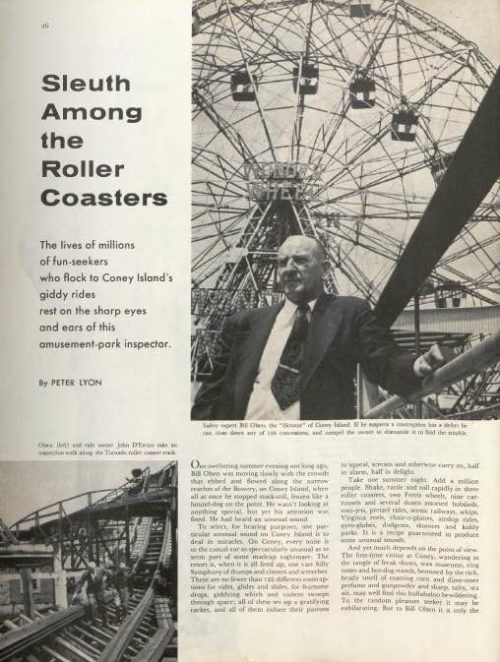
Golf and presidents are no strangers. In this 1986 Post article, Bob Hope shares his stories of teeing off with the the linksmen-in-chief, from Eisenhower to Ford.
Safety Second: Who Regulates Thrill Rides?
What is the price of excitement? Hundreds of millions of thrill ride attendees each year assume it’s the cost of a ticket, but some end up paying with a trip to the emergency room — or worse. Most people figure amusement rides are safe, but the safety regulations are fuzzy.
The United States boasts the tallest thrill rides in the world, and their namesakes suggest ferocity and danger: Fury, Intimidator, Lightning Rod. The appeal of amusement park rides is a feeling of peril — see the Post’s “When Science Takes You on a Ride” — but is there actually a risk?
According to the International Association of Amusement Parks and Attractions (IAAPA), the risk of “being seriously injured on a fixed-site ride at a U.S. amusement park is 1 in 16,000,000,” while the odds of being struck by lightning in the U.S. are 1 in 775,000.
Of course, the numbers are different for mobile rides — the ones found at carnivals and fairs. The U.S. Consumer Product Safety Commission estimates that over 30,000 emergency-room visits in 2016 were a result of thrill ride injuries overall. A recent malfunction on a ride at the Ohio state fair that killed one teenager and injured seven others prompted Governor John Kasich to call it “the worst tragedy in the history of the fair.” Last year three girls fell at least 30 feet from a Ferris wheel car at a county fair in Tennessee, and last week a crew rescued three people from a county fair bungee ride in California.
Some mobile rides have had systemic problems, like the Zipper. In 1977, the CPSC issued a warning to consumers and filed suit against the Chance Manufacturing Co. after four separate accidents on the Zipper left four people dead and two injured. All four incidents involved the locks on the doors of the carriages. This case helped to establish the CPSC as a regulator for carnival rides despite industry claims that a thrill ride is not a “consumer product.”
In 1981, a budget bill stripped federal oversight of fixed-site rides from the CPSC in a move known as the “roller coaster loophole.” This amendment left it up to individual states to set regulatory measures for permanent amusement parks and water parks. Some states have enacted strict regulations, while others remain without any.
In Kansas, amusement parks were left to perform their own inspections until a recent law established tighter rules on reporting accidents as well as a state-sanctioned inspector. This came after Kansas Rep. Scott Schwab’s son died on a water slide at Schlitterbahn Water Park in Kansas City in 2016. The ride, called Verrukt, was the tallest water slide in the world at the time. Immediately following the accident, reporting from several news outlets revealed other riders who had expressed previous concern over the inadequate seatbelt restraints. Schwab gave an emotional speech to the Kansas House in March in support of the law that would add government regulation.
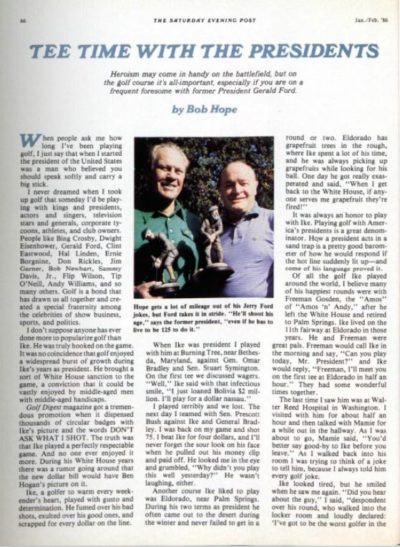
Regulation for the amusement ride industry had been left up to individual companies in the past, when there wasn’t much of an industry. Coney Island employed its own safety inspector in the 1950s, as reported in The Saturday Evening Post’s 1957 article, “Sleuth Among the Roller Coasters.” That sleuth, Bill Olsen, was a Brooklyn elevator inspector charged with issuing licenses to individual ride owners and ensuring their compliance to a safety code seemingly composed of his own whims. The author followed Olsen around the fun park as he relied on his ears to detect any glitches in the park’s 122 rides. To be fair, Olsen’s record during his tenure was laudable: “During the 17 years that he has been the inspector of Coney Island’s rides there has been no major accident and only one minor accident.”
Thrill ride safety is not so conspicuous in the modern days of gargantuan coasters, however. Permanent amusement parks are not under jurisdiction of the CPSC, and they’ve been building taller and faster thrills in recent years. The concern with roller coasters that drop passengers 400 feet at more than 120 miles per hour is less about malfunction than it is about G-force.
Massachusetts Senator Edward Markey has cited the new monster roller coasters as one reason to allow CPSC oversight at fixed-site amusement parks. A recent ABC News story quoted Markey: “Some of these rides now reach speeds of 100 miles per hour and forces greater than astronauts are trained to endure on the space shuttle.” The senator contends that data on injuries from these rides would be more centralized with CPSC oversight.
The amusement park industry is, of course, opposed to any new federal regulations. The IAAPA maintains that “a majority of the injuries occur because the guest didn’t follow posted ride safety guidelines or rode with a pre-existing medical condition.”
Whatever the future of thrill ride regulation may be, Americans do not appear to be halting trips to theme parks. Six Flags Entertainment announced a seventh year of record attendance. For less intrepid riders, technological advancement can afford thrills that rely on illusion instead of linear induction motors. Virtual reality, even in cases of malfunction, is unlikely to cause injury — other than a little nausea.
Featured image by GOLFX on Shutterstock
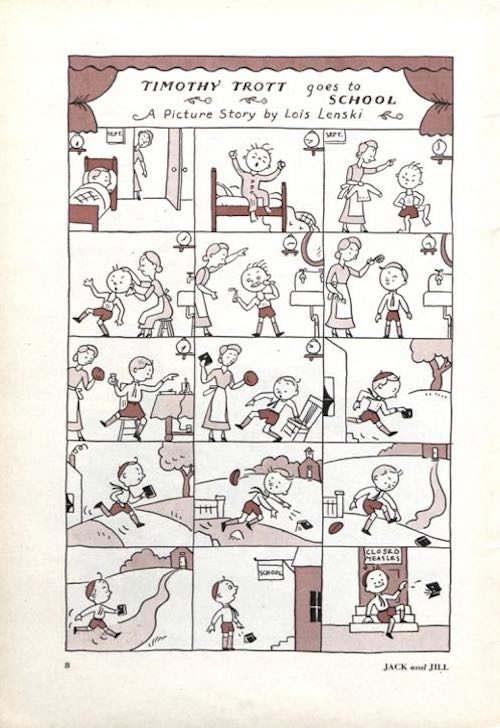
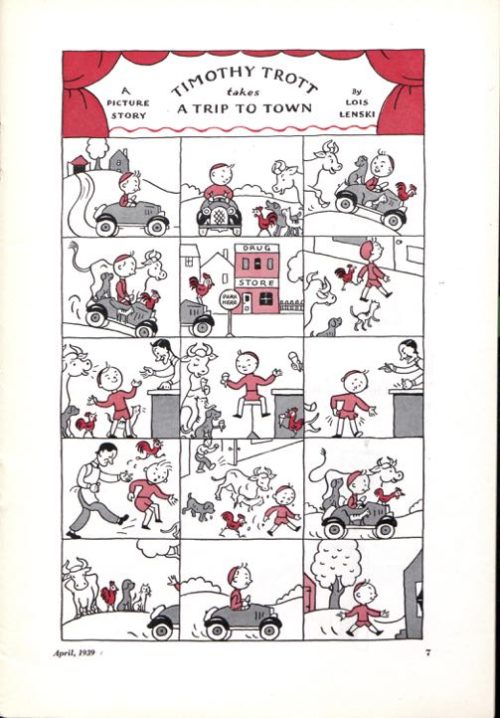
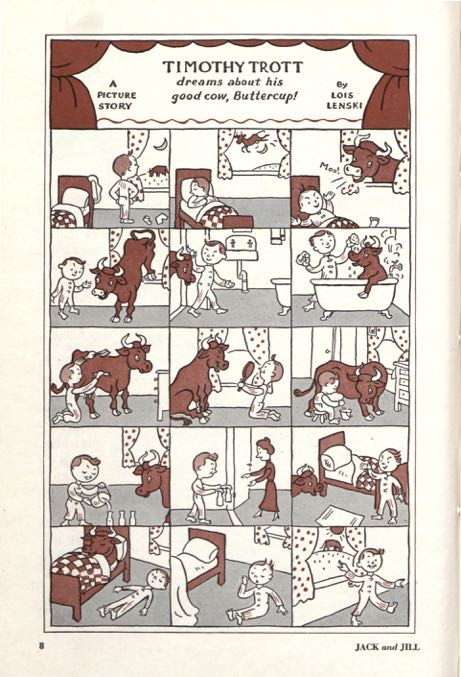
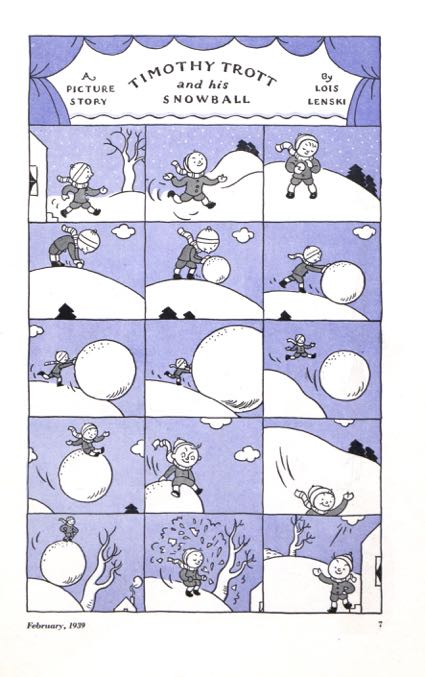
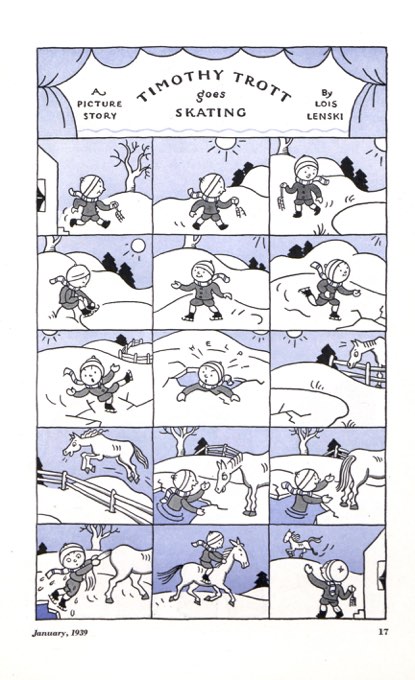
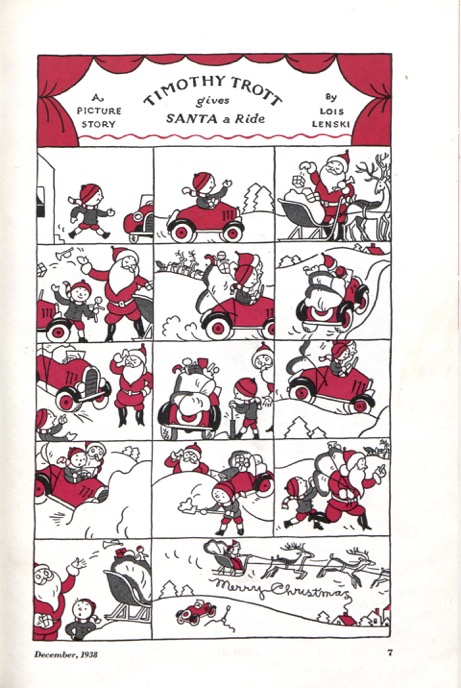
Cartoons: Timothy Trott
In 1938 and 1939, the Post‘s children’s magazine, Jack and Jill, published these charming cartoons by Lois Lenski featuring the adventures of Timothy Trott.
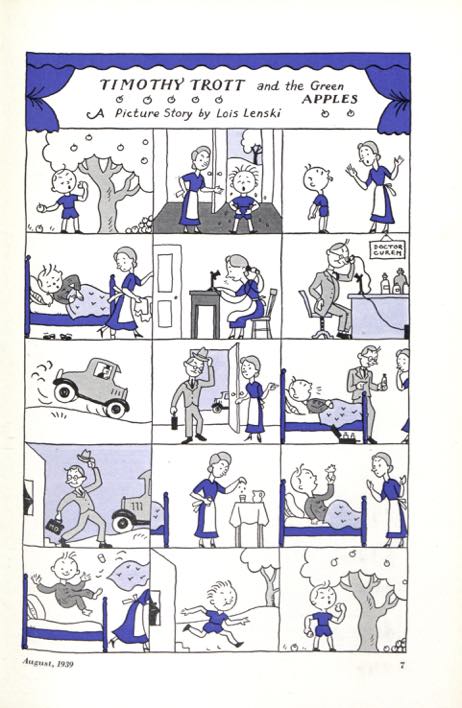
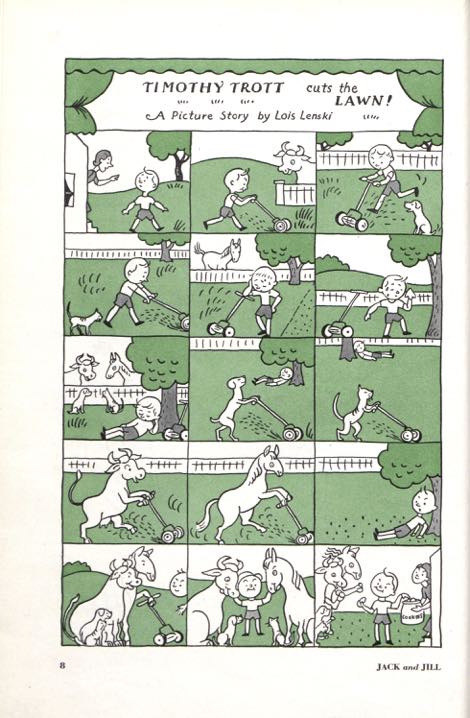
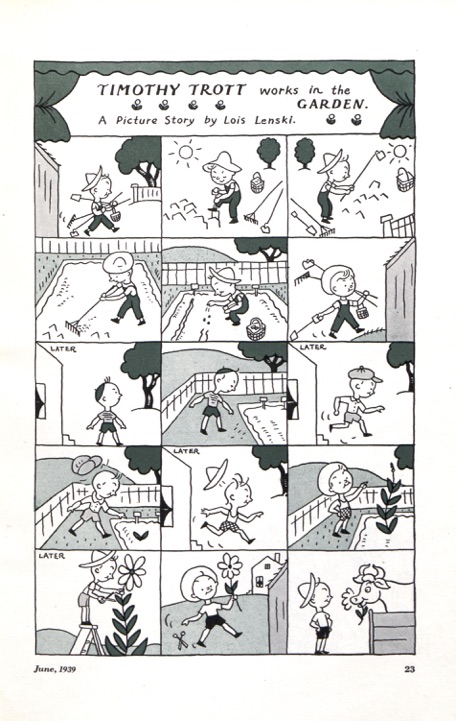
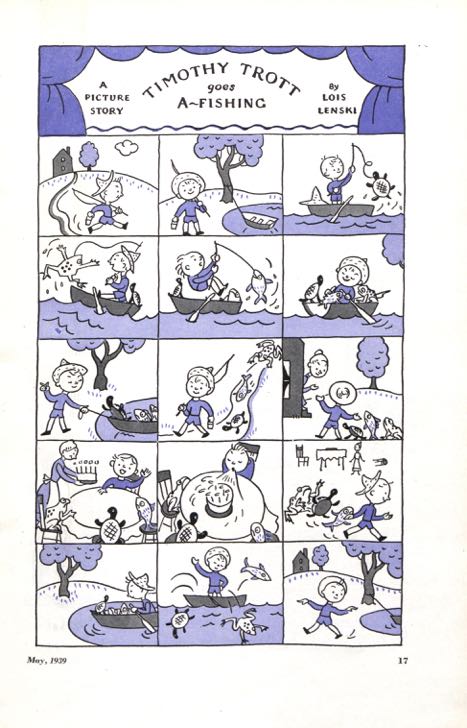
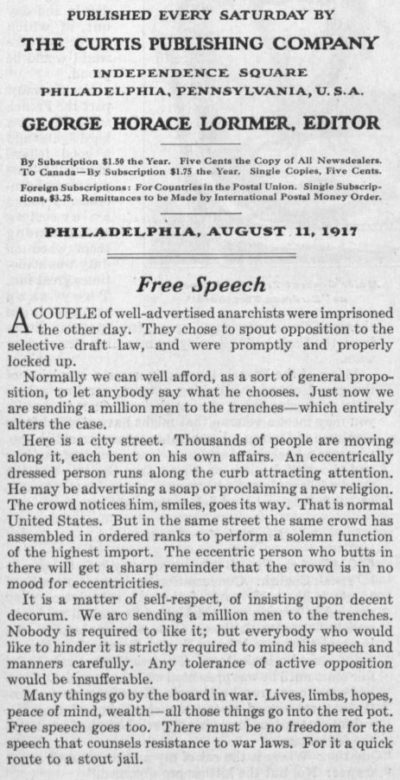
Did We Say That?: Down with Free Speech
“Did We Say That?” is a look at the Post‘s occasional lapses in judgment. In wartime, the 1917 editors argued, this First Amendment right should be suppressed.
Normally we can well afford to let anybody say what he chooses. Just now we are sending a million men to the trenches — which entirely alters the case. Nobody is required to like it; but everybody who would like to hinder it is strictly required to mind his speech and manners carefully. Any tolerance of active opposition would be insufferable. Many things go by the board in war. Lives, limbs, hopes, peace of mind, wealth — all those things go into the red pot. Free speech goes too. There must be no freedom for the speech that counsels resistance to war laws. For it a quick route to a stout jail.
This article is featured in the July/August 2017 issue of The Saturday Evening Post. Subscribe to the magazine for more art, inspiring stories, fiction, humor, and features from our archives.
Cover Gallery: Summer Vacation
It’s the last gasp of summer before the kids go back to school and the days turn cooler. It’s time for summer vacation!
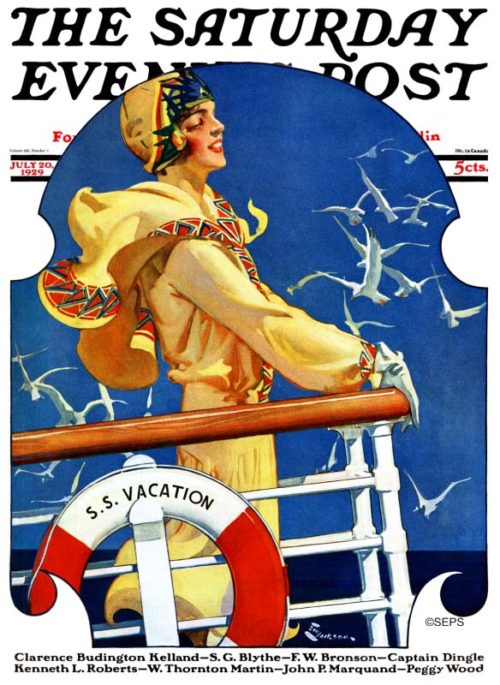
E.M. Jackson
7/20/1929
An artistic specialty of artist E.M. Jackson’s was painting women in poses that made them appear seductive and glamorous amidst architecturally authentic backgrounds. He certainly does so in this 1929 cover, where he captures the joy of an impeccably dressed young woman starting a sea voyage.
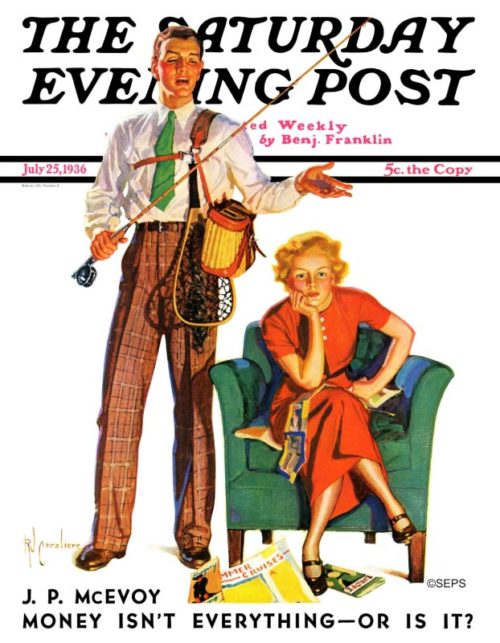
R.J. Cavaliere
7/25/36
When it comes to vacations, some of want luxurious cruises or jaunts across the (other) continent. Others are happy with a few flies and a river full of promise. We wonder who will win this impasse: first class or striped bass?
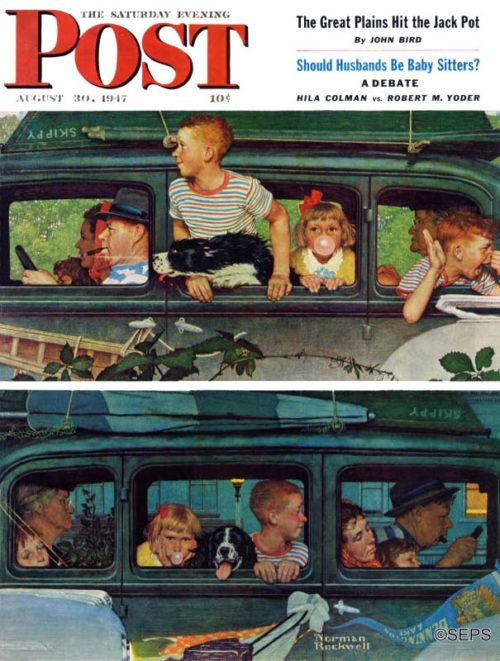
Norman Rockwell
8/30/1947
It is Norman Rockwell’s belief, expressed graphically in his before-and-after pictures on this cover, that there is nothing like a day’s outing to get a family away from the noise and strain of the city, and into the noise and strain of the country. By the time they get back to those city scenes even dad’s cigar is drooping. No, you can’t beat a day in the country, although people keep right on trying.
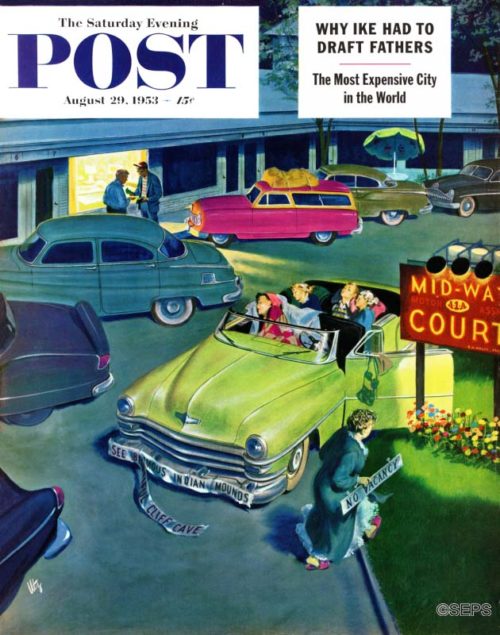
Thornton Utz
8/29/53
Thornton Utz’s astonishing cover proves that somebody actually does get the last room in a motor court. Most motorists, only having had the experience of showing up just after it is gone, have come to think of the guy that does get it as a sort of myth, such as Hermes, the god with the wings on his derby.
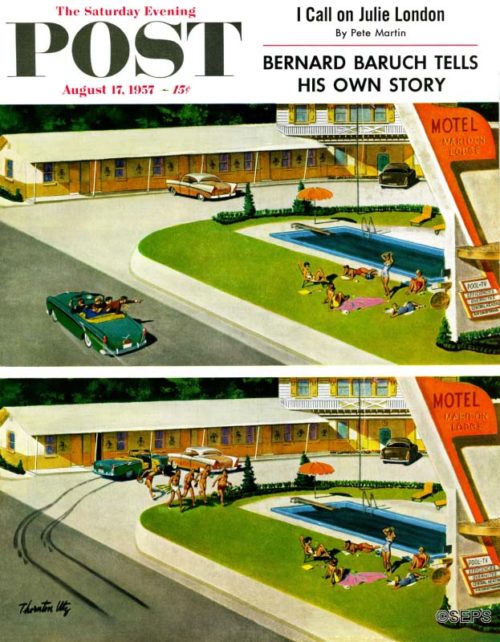
Thornton Utz
8/17/57
The young women who posed for this painting by Thornton Utz were friends of Utz’s daughter, Wendy; Mrs. Utz posed them; Thornton gazed at them from across the street on a ladder; and the Sarasota, Florida, police amiably kept astonished motorists moving past the unlikely scene.
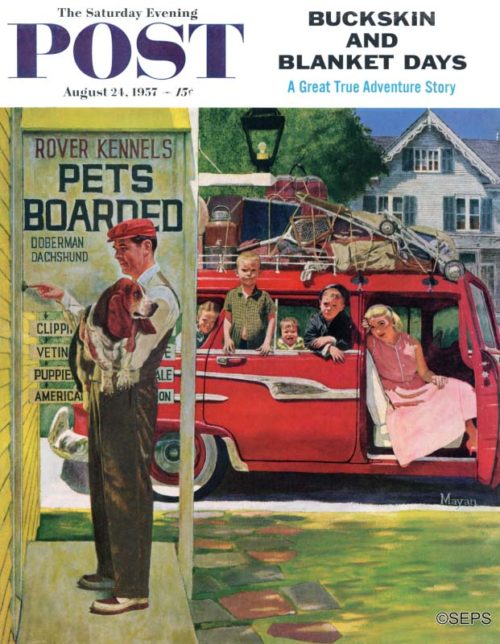
Earl Mayan
8/24/57
That wretched moment when a key family member realizes he doesn’t get to go on vacation with you. That face is almost sad enough to make you turn the car around and unpack that bathing suit (almost).
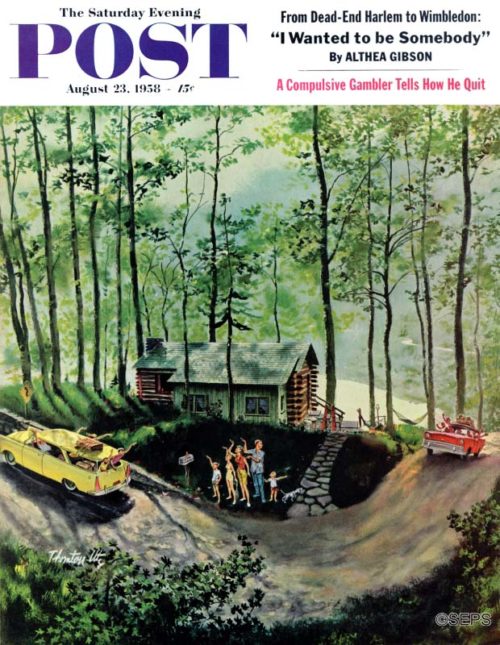
Thornton Utz
8/23/58
This idyllic cabin in the woods would be Walden-esque, if not for all the visitors. Artist Thornton Utz fears that if the departing Joneses see their home-town friends, the arriving Smiths, they’ll come back again. He isn’t pessimistic enough to fear that a third car is approaching beyond the bend in the road.
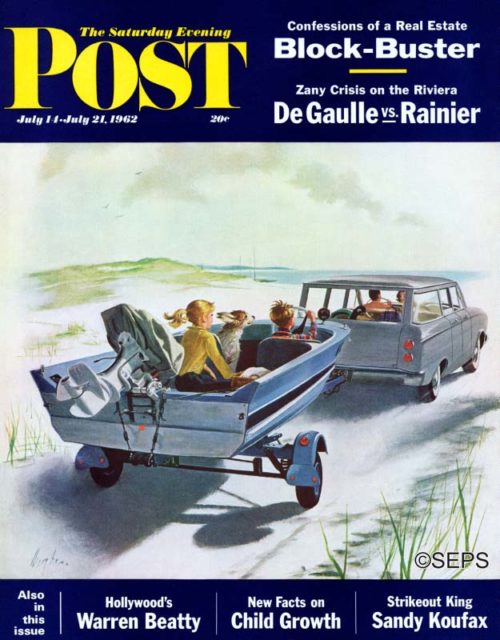
George Hughes
7/14/62
We don’t recommend piling kids into boats on the open road (in fact, it’s definitely illegal — maybe not in 1962, but definitely in 2017). We would like to point out that launchtime and lunchtime seem on a collision course in this George Hughes scene. Will the boat get into the water before little hands get into the picnic basket?
North Country Girl: Chapter 12 — Country Club Days
For more about Gay Haubner’s life in the North Country, read the other chapters in her serialized memoir. The Post will publish a new segment each week.
My sister Lani and I arrived home to the big news that my dad had switched country clubs. For years he had played golf at Ridgeway Country Club, a mysterious place with a ramshackle clubhouse that I had only glimpsed from the outside when my mom dropped off my dad and his club. Ridgeway members golfed, drank, smoked, and played cards; there were no Ladies’ Days or children’s programs.
Now my dad was a member at Northland Country Club, about as waspy a place as could be in Duluth. No Jews of course, and the inclination would probably have been to exclude Catholics as well, except that Duluth had a deep base of Norwegians who were local business and government bigwigs, as well as supporters of the Church.
Northland’s clubhouse was a gleaming white pseudo-mansion that would not have looked out of place on an antebellum plantation, complete with porte-cochere in the front and a two-story columned patio on the side. There was even a guardhouse at the turn off of Superior Street where you had to stop to have your name checked against the membership roll before proceeding up the long driveway. At the top, nestled beside the clubhouse, was a (semi-) heated pool. After being frog marched into the frigid water of Hanging Horn Lake for swimming lessons at camp, Lani and I took the Northland pool as if it were the Caribbean. The only other pool I had been to in Duluth was the indoor one at Woodland Junior High, where I was forced to take swimming lessons year after year, never passing into a higher category than Minnow. It was impossible to learn to swim in that over-chlorinated, dimly lit Woodland pool. It had a ledge all around it made of concrete mixed with pumice and bits of sandpaper that would take the skin off your legs and arms, and was surrounded by tiles so slippery that anything faster than a trudge resulted in immediate expulsion from the swimming class. And since the pool was inside the school, it was thought not necessary to heat it.
Thrilled with the chance to swim in water that was over 70 degrees, Lani and I spent the rest of the summer begging, “Can we go to the pool? Can we go to the pool?” from the time we woke up. When we got to Northland, Lani and I (always having to wait the mandatory thirty minutes if we were there after lunch) gleefully plunged into the pool, tossing beach balls, playing water tag, having breath holding contests, going off the diving board (only allowed after you proved you could swim the length of the pool) and staying in the water all afternoon, emerging at five when the pool closed, blue-lipped and prune-fingered.
Oddly enough, none of my classmates’ families belonged to Northland and most of the kids who were regulars at the pool were younger than I. Lani’s best friend Julie Luster often joined us while her mother golfed or drank at the club bar on Ladies’ Day. Children were not allowed to be at the pool by themselves. Your mother or another member had to sign you in and stay there, so there was always a circle of trapped moms trying to get a hint of a tan from the weak Minnesota sun while regularly being drenched by kids cannon-balling or getting in a forbidden game of chicken while the lifeguard’s back was turned.

Northland’s pool, snack bar, hamburgers and fries served on the patio — along with family Fourth of July parties with sack races, hot dogs, and fireworks — was heaven enough for me. But my parents wanted me to enjoy all the benefits of Northland membership, which included golf and tennis lessons for kids. I had learned to hate tennis at camp, but golf brought me to new levels of wishing I never had to do anything besides sit on the sofa and read. Mini-golf was fun; colored balls, little windmills, a chance to hit your sister with the putter. Golf lessons were ten weeks spent just on my stance, swinging the club at an imaginary ball, then having my body manipulated by a creepy assistant golf pro so I could swing at nothing again. When I was finally given a real golf ball, I managed to sideswipe it, knocking the ball off the tee onto the grass. I was ordered back to stance school, at which point I put my club and feet down and refused to go to golf lessons ever again.
***
In fifth grade I was one of the white mice in another of Duluth’s experiments in education. As a result of all that testing the year before, it was determined that five Congdon fifth graders — me and four boys — deserved “enrichment education.” We would spend our mornings in a special class at Endion Elementary and afternoons at Congdon. I have no idea how my Congdon teacher, the huge Miss Johnson, felt about this. During all my previous elementary school years, there was never any schedule for the day. After we said the Pledge of Allegiance, we might have math or social studies or reading, whatever the teacher felt like teaching. We would go weeks without taking out our music books and then sing for an hour every day for three weeks. But because the five of us would receive “enriched” instruction in English and social studies, Miss Johnson was forced to structure her day to cover those subjects in the morning. In the afternoons, when we were back at Congdon, Miss Johnson would teach math, a smidgen of science (none of those spinster teachers cared about science at all), art, music, and whatever else needed to be taught.
Since there were five of us, the five mothers each took a day of the week to pick all of us up (two kids in the front, three in the back, and please please please don’t let me be squeezed between two boys) in the morning, then shuttle us back to Congdon in time for lunch. It was kind of a requirement for our enriched education, as no other form of transport was offered. My mother bitched — as probably the other four mothers did — every time her day to drive came around.
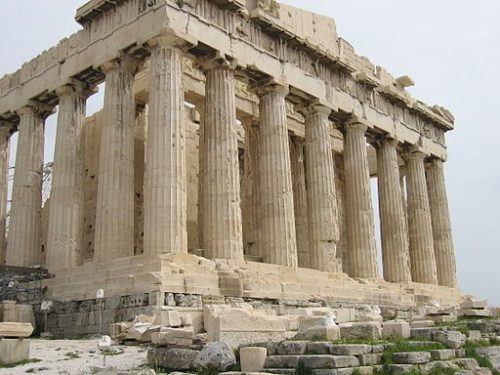
I loved the Endion Elementary enrichment classes, and I adored our teacher. Miss Steinbeck, a classicist, took us through ancient history, from Egypt to Rome. We wrote stories set in those eras, acted out Greek myths, built a tiny Acropolis, studied sculpture and urns and pyramids. It was a geek’s paradise.
It was also the perfect way to make a socially awkward girl like me even more so. Just being out of my regular Congdon class half the day made me an oddball. When I had nothing more exciting to report to my classmates about the mysterious doings of our morning enrichment class than “We looked at hieroglyphics,” I went back to being ignored and then even further alienated from fifth grade girls’ society.
The educational powers that be weren’t done yet. Several students were also pulled out of Miss Johnson’s room one afternoon a week for a special creative writing class, including Nancy Erman, the one friend I had left. I was consumed with jealousy, as it was universally accepted that I was the best writer in fifth grade. Being told that the only reason I didn’t get to go to creative writing was because I was already pulled out of class half the day did not make me feel any better, and I am afraid I was a snotty little bitch to Nancy for quite a while.
Because I was not enough of a weirdo, there came the afternoon when Miss Johnson escorted the girls out of the classroom and down to the gym. Everyone, she announced, “except Gay. Your mother didn’t sign the permission slip.” Every eye, boy and girl, turned towards me as I tried to will myself invisible. Two hours later, the girls returned, giggling and pinching each other. I was too humiliated to ask what I had missed.
I finally got Nancy to tell me. It was a movie about menstruation, sponsored by Modess sanitary pads, starring a caterpillar who turns into a butterfly. Obviously all the other girls would now metamorphose into butterflies while I would remain a lowly caterpillar. I held back my tears till I got home, where my hysterics were poo-pooed by my mother, the cause of my shame. She had received the letter from the school about the movie, decided I was too young to learn about these things (I had kept the info shared by the Applebaum cousins to myself), and tossed the permission slip into the garbage. “I didn’t know you’d be the only one,” she shrugged.
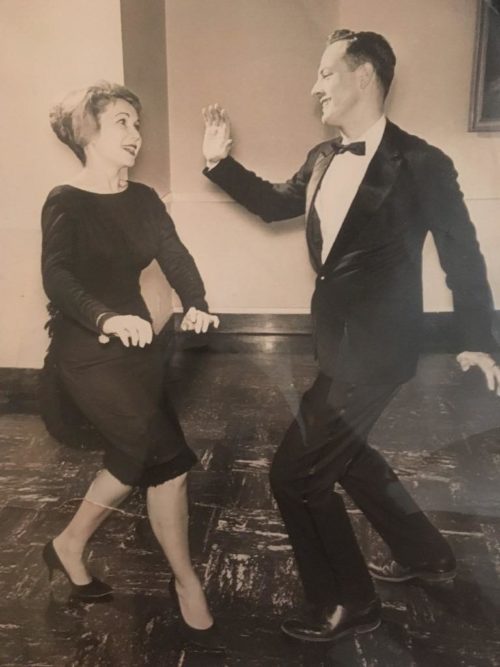
My sex education was complete enough to be equally thrilled and embarrassed when my mother announced that she was pregnant. To me, my mother always seemed much younger than other moms; Nancy Erman had a brother and sister who were in college and her grey-haired mother seemed as old as my grandmothers. The year before my parents had been photographed for the Duluth Tribune learning to do that new dance craze, the Twist. The world had not yet been turned over to teen-agers; thirty-year-olds could still be cool.
Around the time my mother’s pregnancy began to show, other women started asking with suspicious frequency how old she was. Mom, who had always been paranoid about revealing her age, thought they were hinting about getting pregnant at her advanced age, and refused to answer. I heard her constantly griping, “Old biddies, why do they want to know how old I am?” Someone clued her in to the fact she was being vetted for the Junior League, a club that believed itself to be the pinnacle of high society among Duluth women. My mom had been nominated for Junior League but there was a hitch: you had to be under 35 to join the Junior League. But no one came out and said that why she was asking about my mom’s age, I guess in case my mom got blackballed, so she wouldn’t have hurt feelings.
Duluthians of that time loved joining things: churches (everyone belong to some church, Catholic, Lutheran, Congregationalist, even the mysterious Jewish temple), country clubs, Elks, Moose, Rotary, Lion’s Club, the weird Knights of Columbus and the even odder Masons. My mother was a member of the Women’s Dental Auxiliary and drove around the county distributing toothbrushes and toothpaste to rural schools. My Carlton grandmother was a member of the hoity-toity Kitchi Gammi club, where I was once invited to lunch with her in its cavernous, echoing dining room.
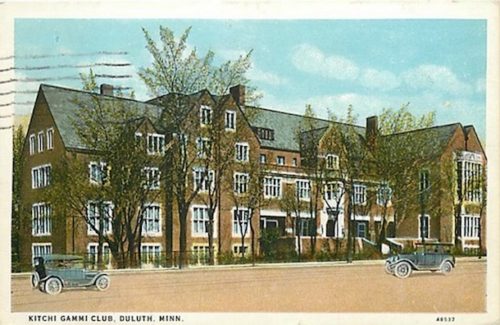
I must have done something wrong — pushed my soup spoon the wrong way or stained the snowy table cloth — as the invitation was not repeated. Grandma Marie was also a member of the Women’s Club, the mother organization to the Junior League, a bunch of do-gooders who were best known for the Duluth Women’s Club Parade of Homes, a chance to poke around in other people’s over-decorated houses for charity.
Why my grandmother Marie couldn’t have just shepherded my mom into Junior League is a mystery. Maybe she was too much of a snob and thought a house painter’s daughter from Aberdeen, South Dakota, even if she was her daughter-in-law, wasn’t good enough to raise money for the Duluth Symphony or the Leif Erickson Park rose gardens.
Alas, my mother never became a Junior Leaguer. Even in an organization composed entirely of women, the husbands had to be considered. My father missed the mandatory Saturday breakfast meeting where my mother was to be interviewed for inclusion in the club; he was too hung over. The Junior League gave him a second chance, he missed that one too.
Nixon’s Resignation and the Legacy of a Flawed President
Just before lunchtime on August 9, 1974, the day after his resignation, President Richard Nixon and his family boarded a helicopter on the White House lawn. Stopping at the helicopter’s door, the president suddenly turned and flung out his hands in a gesture that might have indicated either “peace” or “victory.” Minutes later, the Nixons were borne away to a life after the White House.
For his remaining 20 years, Richard Nixon must have fretted over how history would regard him. At least his reputation wouldn’t be tainted by the stigma of impeachment. Just one week before resigning, the House Judiciary Committee had drawn up articles of impeachment that charged him with obstruction of justice, abuse of presidential powers, and hindrance of the impeachment process.
Nixon was spared that indignity when his successor, President Gerald Ford, pardoned him in September.
The pardon wasn’t a favor to a fellow Republican, Ford explained. Rather, he was thinking about the nation. By blocking any criminal prosecution of Nixon, he hoped to stop the social and political rifts that had developed in America during the Senate’s investigation into the Watergate scandal.
Nixon claimed he had acted on selfless motives. In his resignation speech, he declared, “I have never been a quitter. To leave office before my term is completed is abhorrent to every instinct in my body. But as president, I must put the interest of America first. … Therefore, I shall resign the presidency effective at noon tomorrow.”
Putting “America first” might have been a ruse for protecting his dignity, but Nixon’s character was more complex than that. Although his White House recordings revealed he could be petty, prejudiced, and vengeful on a personal level, his policies and actions showed an astute grasp of the national welfare. If he was prone to stumbling on some matters, like authorizing and covering up the theft of data from the Democratic headquarters, he seems to have been far-sighted on the big picture, as Peter Bloch observes in “Richard Nixon — A Great President!” from the November 2012 issue of the Post.
The article shows how much Nixon’s policies changed the U.S. government. Nixon was responsible for many far-reaching initiatives, such as starting a dialogue with China, establishing the EPA, and enforcing desegregation. Nixon was considered a hard conservative in his day — as demonstrated in his virulent anticommunist campaigns — but would be labeled a moderate by today’s standards..
In time, Americans may acknowledge Nixon’s mark on history aside from his crimes. But for the foreseeable future, his popular legacy will be limited to Watergate and his resignation.

Featured image: Illustration of Richard Nixon by Norman Rockwell for The Saturday Evening Post
Rockwell Video Minute: Triple Self-Portrait
In 1960, Norman Rockwell produced one of the most famous self-portraits in American art.
See all of the videos in our Rockwell Video Minute series at www.saturdayeveningpost.com/rockwell-video.
Rust: Photography Adventures in an Abandoned Steel Mill
For more of Alyssha Eve Csük’s photography, see our online gallery.

Photo by Alyssha Eve Csük
The rustiest place in America is not open to the public. Patrolled by private security guards and town police, the site is enclosed by a tall chain-link fence, which bears these warnings:
PRIVATE PROPERTY NO TRESPASSING
VIOLATORS WILL BE PROSECUTED
NOTICE: THIS AREA UNDER SURVEILLANCE
DANGER
KEEP OUT
PELIGRO
The place is the Bethlehem Steel Works in Bethlehem, Pennsylvania. Once the world’s second-largest steel producer, it has been rusting since the middle of the Civil War, when iron was first made there. Until the mid-1970s, when dust filters arrived, rust from “the Steel” coated the surrounding city, too. It settled on windshields and windowsills and prevented residents from hanging laundry out to dry. Old steelworkers, correlating more rust with more steel production, swear they could tell from the thickness of the rust how big their paychecks would be. In 1995, with the American steel industry in shambles, the paychecks stopped, and the last blast furnace shut down. Since then, the place has done nothing but rust.
Now, from the air, the abandoned complex looks like a decrepit brown castle in an otherwise green city.
One woman is exceptionally familiar with the place. Her name is Alyssha Eve Csük. (Her last name rhymes with book.) The granddaughter of a steelworker, she is a photographer. She photographs rust. She is, as far as I know, the only person who makes a living finding beauty in rust. As such, I joined her at the motherlode — which she calls her playground — on a snowy late-November day to see how she does it.
Her work, which has been featured in photo magazines and The New York Times, hangs in galleries and private homes and corporation lobbies. Corrosion, as Csük sees it, isn’t brown and dreary, nor does it suggest age and decay. When she zooms in on metal, she captures speckled reds, lumpy yellow waves, green crests, serrated blues, orange slashes.
Making art requires bending rules, and the same goes for Csük and her rust art. Technically, she has permission to enter the fenced-off steelworks — property now owned by the Bethlehem Sands Casino Resort — as long as she stays on the ground level. When this does not appeal to her, which is often, she sneaks in. With me, she snuck in.

Photo by Alyssha Eve Csük
Csük drove us over the Lehigh River and parked near the New Street Bridge. Under the bridge, we crossed five sets of railroad tracks, then ascended the grassy levee separating the tracks from the river, and took a right. A half-mile ahead, five 200-foot blast furnaces loomed. Csük walked toward them with purpose.
Five minutes afterward, in the shadow of the Steel, a few obstacles stood in our path. The first was a train, stacked two high with containers, parked on the middle track. Fortuitously, it blocked us from sight. Csük looked both ways and then slid down the slippery levee and climbed up and over it. I followed close behind. She looked both ways again, and jogged over to the second obstacle, the chain-link fence. When she realized that we had left footprints in the snow, she stepped back and tried to brush them away, which only made them worse. From there, we walked along the fence in gravelly spots, so as not to leave footprints. I followed her a bit farther — past the no-trespassing signs — and then, just before noon, we climbed up and over.
Over the next five hours, I watched Csük wander around a maze-like industrial complex calmly and boldly, without a map, in search of aesthetic minutiae that most people miss entirely. To reach good vantage points, she scampered atop a large pipe, 30 feet up, and along a giant crane, even higher. She set up her tripod seven times and took 69 exposures.
First, she hurried through a courtyard overgrown with shrubs and vines and littered with glass shards and old buckets. Massive brown tanks loomed above. She hurried because she was not comfortable out in the open, where she was visible. She made her way to blast furnace D, her favorite. Then she climbed a few steep flights of rusty stairs. Immediately, on the streaked wall of an enormous gas stove, she saw something appealing. A layer of metal pipes had been removed from the stove and tossed into a huge pile on the ground, and now a new rusty surface was visible.
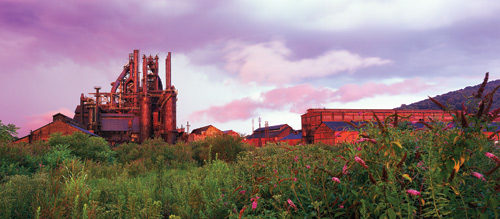
Photo by Alyssha Eve Csük
She said, “There’s something beautiful here. I don’t know if it’ll fit my format. I’ll have to see it with my camera. This is probably just gonna be a sketch.” She opened the tripod and placed it on a metal grate. She put her camera — a 24–105 millimeter — on the tripod and zoomed to 100 millimeters and raised the tripod a hair. “Just like I thought, this really doesn’t fit my format. There’s the potential for something. The image is just a square, but I’m trying to make it fit.”
Csük might spend 15 to 45 minutes fiddling with a composition. In this case, she could tell it wasn’t worth it. Before she packed up, she looked at me and asked, “Did you hear that?” I told her I thought it was the sound of a motorcycle somewhere in town. She said, “Sometimes, things fall here.” She told me later that 30- or 40-pound objects — heavy enough to guarantee death — rain down regularly.
Csük climbed another flight of stairs and walked to a spot where more light struck the stove. She walked slowly, with her head tilted a bit to the left. She said, “I wish we had more of this going on, like a whole brigade of this. Over here is beautiful. I gotta shoot this.” I looked, saw no formation — brigade or platoon or even a mere patrol. She continued, “This was stuff I never got to see before, because it was all covered up. And this’ll weather more, ’cause it’s all exposed.” Positioning the tripod back a few feet, she hunched on both knees. Then she moved the tripod a few inches. She looked through the viewfinder and moved the camera a few more inches. She looked again, and moved the camera a bit to the right. Then a few inches back. Then up a hair. Then to the right a hair. Then up a bit. Finally, with a shutter-release cable on a 3-foot cord held in her right hand, she took a shot. “It’s funny bringing life from something so lifeless,” she admitted, Csük has had plenty of run-ins and close calls at the Steel. She’s nearly bumped into all kinds of vagrants and wanderers, and always spotted them before they spotted her. Once, up on a crane with only one way down, she heard voices in the room below her. She stood still for a half hour until the men left. On a different occasion, she nearly crossed paths with a lunatic from West Chester, who shortly thereafter was arrested and found to be in possession of many guns.
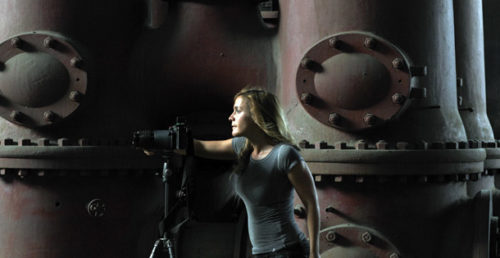
Photo courtesy Alyssha Eve Csük
While poking around with another photographer in 2005, she suffered her closest call. In blast furnace E, she encountered a handful of people, and the pair ran to hide in a dark corner of blast furnace D. On her way through the cavernous room, she fell through a rectangular hole where casts of molten iron were once drained from brick channels into railroad cars below. According to the other photographer, one moment Csük was there, and the next she was mostly gone. “Had it not been for her backpack and camera and tripod, she’d have fallen down to the bottom,” he told me, “far enough to kill her.” The photographer grabbed Csük by the armpits and pulled her out. She’d smashed an expensive Linhof lens and scraped her left leg, but suffered no other injuries. The other photographer now calls her Indiana Jane.
Csük told me to follow her. She led the way down dark staircases, around corners — none of it familiar. From a ledge, she looked west, pointed to a giant exhaust valve inside a cage of beams, and said, “Oh wow. I wish I could photograph that.” She couldn’t get it because her tripod needed to be stationary, on terra firma.
Csük made her way higher, to a perch with an expansive view. She looked out at snowy roofs, admiring the way snow collected on different surfaces, angles, features. Off of one spot, the wet snow avalanched, leaving stripes. On another, the snow caught drips and appeared speckled. “I’m just taking it all in,” she said. She has no problem standing somewhere and looking and looking and looking. She’s patient.
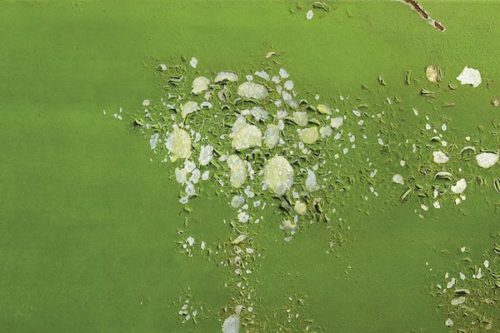
Photo by Alyssha Eve Csük
Halfway down a ramp, Csük saw something. “Wow, it’s beautiful. If you just shift your angle, all these colors come out.” She positioned her camera, took a few frames, and said, “A lot of people would say, ‘I got it.’ I don’t feel like I got it.” Then: “I’m never done with it. I just keep coming back.”
Csük was first officially granted access to the Steel in 2004 by a local developer. When the Sands acquired the land, the new owners were impressed. “They just never knew that rust could be beautiful,” Csük said. “They say, ‘I just never saw rust that way before.’”
Recognizing the obsessed visionary in their presence, the casino hired Csük to document the redevelopment of the steelworks. Redevelopment meant destruction of the place that had enthralled her for years. From 2007 through 2009, all but one of the buildings surrounding the blast furnaces — the mills, the foundries, the forges, the tool shop, the machine shop, the basic oxygen furnace, open hearth furnace, the electric furnace, the Bessemer converter, the sales office — were gutted, destroyed, and leveled. Parking lots were paved in their place. Unobtrusive landscaping was installed. Around the blast furnaces — the only sacred thing remaining, according to Csük — a fence was erected.
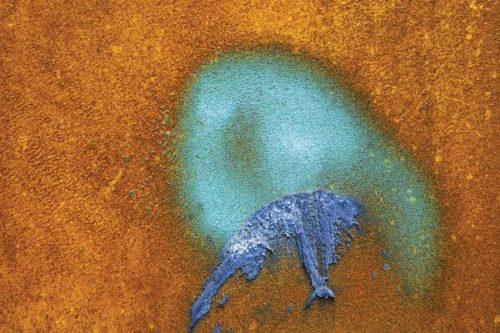
Photo by Alyssha Eve Csük
Csük documented this massive transformation, thinking a book would come out of it. She says it was like watching a slow death. Many of these images, in her collection Industrial Steel, seem reverential, as if the steelyard were an iconic peak or pristine canyon. The environs and their contents are clear: walls, rooms, cranes, coils of wire. They’re shot like landscapes, at dawn, at dusk, under moonlight, in fog, under a blanket of snow. Csük says she spent hours just watching how the light changed on the yards.
Documenting the demolition of the place where she’d become a photographer was just as difficult to reconcile. It forced her to focus on more than just steel and rust and to branch out — into slate and scrap yards and trees. She did this so that her spirit wouldn’t die. Then the economy tanked, and the Sands put the book idea on the back burner.
Now that the blast furnaces are all that remain, any further damage is traumatic. Trespassers have vandalized parts of it. Copper thieves have stolen bits and pieces of it. Set producers on the movie Transformers 2 have transformed part of it. Death, as the poet Wallace Stevens wrote, is the mother of beauty, but only to a point. Hours before, when she climbed to the fourth floor of blast furnace D and noticed that metal pipes had been removed from the stove, she’d looked down, and said, “Oh my gosh, look at that pile. That’s the guts being ripped out. It’s sad.” She wants the Steel to suffer a natural death, not an accelerated, assisted, man-made one.
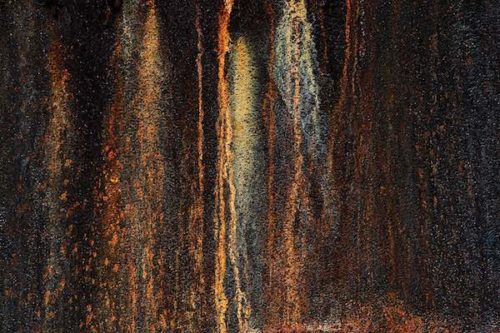
Photo by Alyssha Eve Csük
Depending on their size, Csük’s images sell for $800 to $3,200. She sold somewhere between 100 and 200 prints in 2012. She sold one, 42 inches by 96 inches and printed on metal, for $30,000. When I first held one, at her studio, I was almost convinced the image was 3-D, on account of its richness.
“This makes you think of a kite of color, of shapes,” she said. “A lot of people look at my stuff, and they know it’s rust, but they never think it’s rust. It can’t be too literal.”
Now, with me, Csük had gotten excited about a long, cavernous space beneath the elevated track, because in the winter the space harbors huge icicles, and she led the way down to it. Before the final staircase, she warned, “You gotta be careful. People can see you here.”
Like an old sage, she walked casually through a dark room with black paint peeling off a maroon-and-yellow patch of metal. “This at one time was cobalt blue,” she said. “Cobalt blue. It’s just amazing how it’s changed over the years.” She walked around a furnace and behind massive slag cars — now cauldrons full of green, slushy water. She jumped down a three-foot ledge, and then proceeded into a courtyard, where she looked up at the side of a building. A flock of geese flew overhead, following the river. For a second, their squawking sounded like voices.
All of a sudden, the Bethlehem Steel Works seemed like a historical artifact, as impressive as a pyramid. A few hundred feet away stood blast furnace A, the oldest standing blast furnace of its kind in America. Of Bethlehem, its president in the early 20th century, Charles M. Schwab, used to say he wasn’t in business to make steel but to make money. Bethlehem made plenty of money, but it also made bank vaults, battleships, rail ties, and the enormous 140,000-pound axle at the center of Ferris’s famous wheel. The company built the USS Lexington, America’s second aircraft carrier. That beam captured in the iconic 1932 black-and-white photo, with 11 workers sitting on it, eating a carefree lunch 800 feet above New York City: that’s Bethlehem Steel steel.
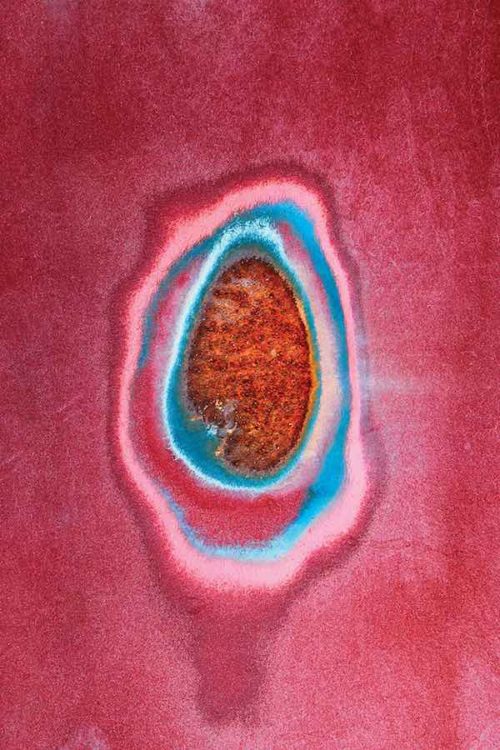
Photo by Alyssha Eve Csük
By 4:30, there was time for only one more shot. She made her way toward the formerly cobalt panel. The best vantage point, she determined, was tricky to get to: up a flight of stairs, down a 10-foot ladder, over a grate, and onto a 4-foot pipe. From there, she’d traverse 40 feet out, using smaller gas pipes as railings, and then follow the pipe where it bent up at 30 degrees. Following behind Csük, I reached down from the top of the ladder to pass her the tripod. The big pipe reminded me of the Alaska pipeline. It was the same size, about as snowy, but it was 30 feet up above concrete and steel instead of 4 feet above tundra.
Getting out turned out to be tougher than getting in. I climbed over the fence first. Once over, Csük passed me her backpack and then climbed over. She made it fewer than 10 feet before she said, “Did you hear that?” It was the sound of a car on gravel — which meant a security patrol. Though Csük couldn’t see anything where the sound had come from, she decided to hustle. She skirted along the fence, and then across the tracks, and onto the levee. I followed.
Suddenly Csük froze. A train was stopped under the bridge, exactly where we wanted to cross. Beside the train, guiding it into position, were two railroad employees. “You do not wanna mess with those guys,” Csük said.
Alyssha Eve Csük — so experienced in patiently extracting beauty from this unfriendly, forsaken place — decided that the most prudent thing to do was make a beeline for terra publica. She slipped down the snowy grass, crossed the tracks, and looked both ways.
Then she ran.
From Rust: The Longest War by Jonathan Waldman. Copyright © 2016 by Jonathan Waldman. Reprinted by permission of Simon & Schuster, Inc.
Jonathan Waldman’s writing has appeared in Wired, Slate, Outside, and The New York Times, among others.
This article is featured in the July/August 2017 issue of The Saturday Evening Post. Subscribe to the magazine for more art, inspiring stories, fiction, humor, and features from our archives.
The Battle of Guadalcanal: The End of the Beginning
Eight months after being attacked at Pearl Harbor, the U.S. finally sent ground forces up against the enemy. The site was a steaming, disease-ridden equatorial island northeast of Australia called Guadalcanal.
The U.S. Navy had already engaged the Japanese at the Battle of Midway and inflicted heavy damage on their navy. Now the Marines and Army troops, along with the Navy, would confront the ground forces of Japan at Guadalcanal.
The Japanese had seized the Solomon Islands in the summer of 1942 and begun building a key airfield on the island. When completed, it would give the Japanese air force control over the shipping lanes between the U.S. and its Australian ally.
Intending to take the airfield from the Japanese, U.S. Marines landed on Guadalcanal on August 7. They met little opposition at first as they marched inland to seize the airfield. But the commander of the assault force grew concerned that he might lose his fighter cover, so he pulled back his supply ships and withdrew, taking away 2,000 men that the Marines were counting on.
Left short of artillery, food, men, and air cover, the Marines remained surrounded by Japanese forces for the next four months. In Washington, there were understandable concerns that Guadalcanal would turn into another Corregidor, where besieged American troops had surrendered to the Japanese.
Over the months that followed, naval and ground forces waged fierce battles for control of the island. The Marines held Henderson Airfield and kept it open for air support despite continual Japanese bombardments and attacks. The Navy fought costly battles that culminated in November with what Admiral Ernest King called “one of the most furious sea battles ever fought.”
In “Guadalcanal — 1942,” Pulitzer Prize–winning historian Samuel Eliot Morison describes the desperate naval engagements that were a crucial part in the victory of this seven-month-long conflict.
Today, the Guadalcanal campaign is memorable for two reasons. First, it was the closest the U.S. came to losing the war in the Pacific, but second, its victory put America on the offensive against Japan for the rest of the war. It was, as Winston Churchill said, “not even the beginning of the end, but it is, perhaps, the end of the beginning.”
Read the Post’s profile of World War II veteran Roy Roush, who fought at Guadalcanal.
Featured image: USMC Archives