The Unsung Heroes of the Moon Mission
Neil Armstrong.
We all know the name. As the first human to set foot on the moon on July 20, 1969, Armstrong is one of the few people whose name nearly all Americans recognize.
Far less famous is Glynn Lunney. As the aeronautical engineer who led the lunar-ascent team for Apollo 11, Lunney was essential in getting Armstrong to the moon and back.
The year after that success, it was Lunney’s leadership that helped rescue the astronauts in the ill-fated Apollo 13 mission. When an oxygen tank exploded, his team rapidly powered up the lunar module and migrated the guidance and navigational data to it from the failing command module.
When this Post article was published on December 28, 1968, these breathless American moments had not yet occurred, and Lunney was “merely” helping run the Apollo program from the ground as the flight director.
In “The Men Who Control Our Missions to the Moon,” author James Atwater describes some of the events in the pre-moon-landing Apollo 8 program, which sent the first spacecraft to orbit the moon. He praises NASA staff members, focusing on three engineers who took pride in the skill and judgment that had earned them a seat in “the trench” — the low, first row of consoles at mission control. It was these men, along with Lunney, who inspired the author to write, just six months before successful Apollo 11 mission, “Incredibly, man is actually going to walk on the moon.”
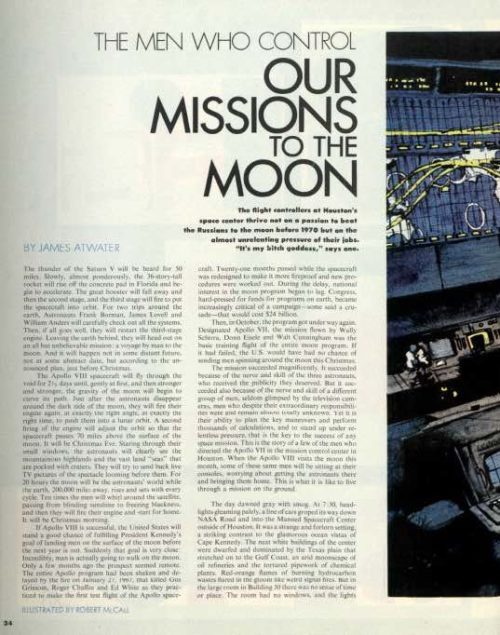
Featured image: Glynn Lunney (NASA)
Pundit School: How Talking Heads Learn to ‘TV’
Television overflows with yakking heads. Tune in at any hour and you’ll find preternaturally attractive people jawing about everything from politics to poultry. “How do they find so many top-notch experts?” you may ask, naively.
Well, the truth is that lots of these “experts” have had the benefit of professional media coaching. They’ve been taught to TV.
If you want to get booked on a show, honing your skills with a reputable media coach is probably a smart idea. It’s a good investment as well for savvy business executives, lawyers, politicians, and even news anchors, all of whom know that being on television can enhance one’s career — or, in a single calamitous moment, flatten it.
T.J. Walker, a New York-based media coach who’s counted several heads of state (Bangkok, Slovenia, and Australia) among his clientele, told me, “The issues may be different, but everyone wants to learn the exact same things”: how to be comfortable on camera, craft a clear message that can be delivered in 30 seconds, respond to difficult questions, and package sharp sound bites.
“You don’t need to look like George Clooney,” Walker told me (although it helps). “If you want to be on TV, have something interesting to say.” And learn to stay cool under stress.
Given their ubiquity on our screens, you might ask why politicians, of all people, would bother with media training. Most are practiced on-camera vets. Exactly. “They plateau,” Walker said. “They don’t advance to the next level.”
Trainers tend to keep a catalogue of do’s and don’ts, and there’s some general agreement on these. Of the two, the don’ts are more fascinating. For example, when you’re on TV, don’t clasp your hands, don’t point at the camera, and don’t apologize for minor fumbles.
Of course, every coach emphasizes different things. Suzanne Sena, who operates out of Los Angeles, places a great deal of attention on “confidence and likability.”
Sena told me that most people, when they begin studying with her, speak too fast. And they often dislike the sound of their own voice. A few have needed a glass of wine to calm jitters. Fortunately, everyone improves.
I asked, “Is it a good idea to smile a lot when you’re on TV?” Unless the situation is way awkward, Sena said, definitely yes. Yet that has sometimes been a sensitive matter for women. “They feel they won’t come across as serious if they smile.”
Sena charges as much as $500 an hour for one-on-one coaching. That’s steep, but she has the creds. She was a Fox News anchor and star of the cable-TV (IFC) series The Onion News Network before launching her coaching business. Remarkably, some coaches have never actually held on-camera jobs. Sena, with all her experience, has contempt for that bunch.
So does Terry Anzur, another L.A.-based trainer, who was a long-time TV anchor at both the national and local levels before shifting focus. Anzur is a sub-specialist: She works mainly with reporters and anchors, but the same basic rules apply.
Appearance, she said when we talked, counts a lot. For women: “Cut your hair properly. It should frame your face.” For men: “If you’re going for the unshaven look, invest in a good beard-trimming instrument. High-definition TV is unforgiving.”
Finally, how can we talk about media without mentioning President Donald Trump, who has been known to flail his arms and make silly faces on TV? Shouldn’t he submit to a little coaching? “He would never do it,” T.J. Walker, the veteran New York pro, said with a laugh. Why? “Because Trump is 100 percent convinced that he’s already the Number One Communicator in the world.” And he did, after all, win a pretty big election.
Watch T.J. Walker’s 9-minute video on how to look confident and relaxed when speaking in public at saturdayeveningpost.com/walker.
This article is featured in the July/August 2017 issue of The Saturday Evening Post. Subscribe to the magazine for more art, inspiring stories, fiction, humor, and features from our archives.
In the last issue, Neuhaus wrote about America’s passion for collecting.
Cover Gallery: A Day at the Beach
These beachgoers on the covers of the Post are having the dream summer vacation.
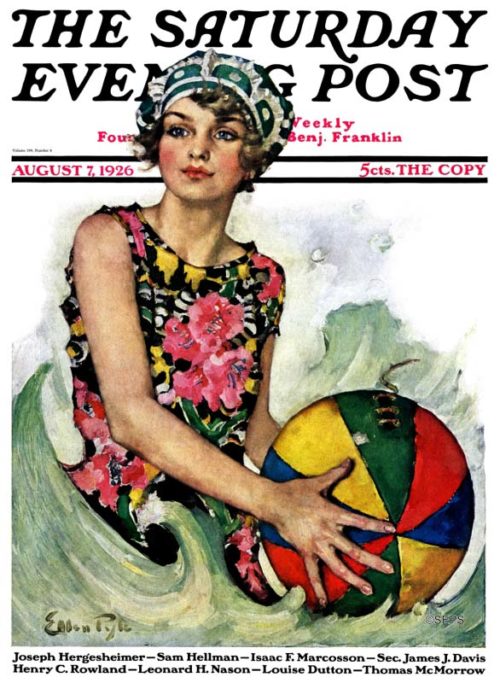
Ellen Pyle
August 7, 1926
The Saturday Evening Post was the first magazine to accept Ellen Pyle’s work after her husband’s death in 1919. “The girl I am most interested in painting is the unaffected natural American type,” Pyle said in her 1928 interview with the Post. Her children often posed as models for Pyle’s paintings, but it was her brilliant use of color and loose, broad brushstroke style that made her one of the Post’s most recognizable female artists.
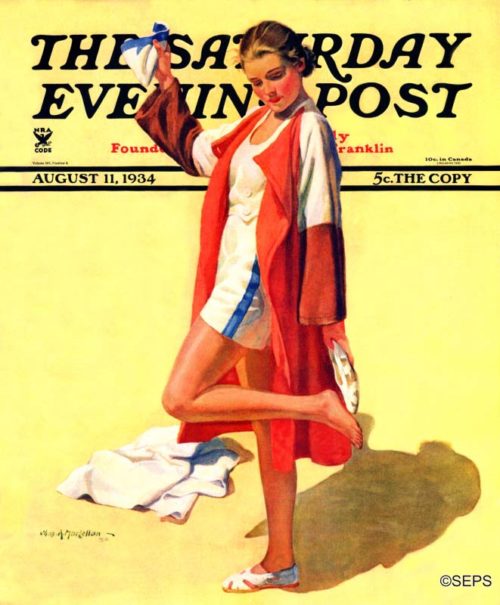
Charles A. MacLellan
August 11, 1934
Charles A. MacLellan started creating art for the Post during a time when narrative illustrations dominated the covers. His most memorable covers were those with children, typically boys. Often these boys were in some kind of trouble, but it’s the kind of trouble that makes their viewer smile. In his portraits of women, MacLellan nearly always drew them in action and often gave his models a prop, such as this woman and her beach clothes.
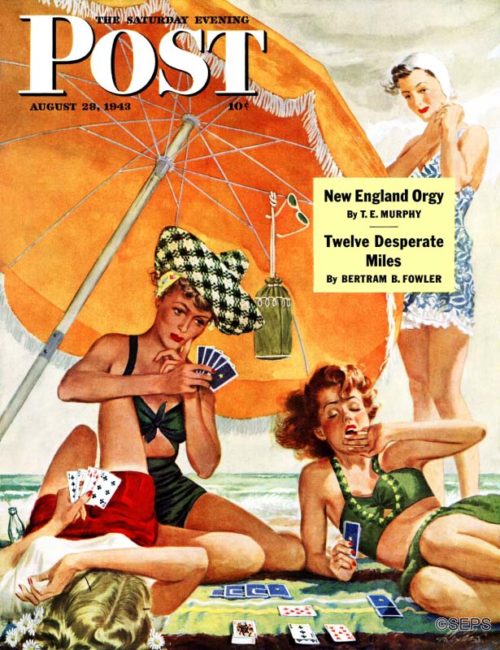
Alex Ross
August 28, 1943
This is one of six covers that Alex Ross painted for the Saturday Evening Post. All of his covers featured beautiful women, but this beach scene is the only one that doesn’t focus on a single girl. This 1943 cover does follow Ross’ usual style, however, because the women don’t appear to be over-joyed about their card game.
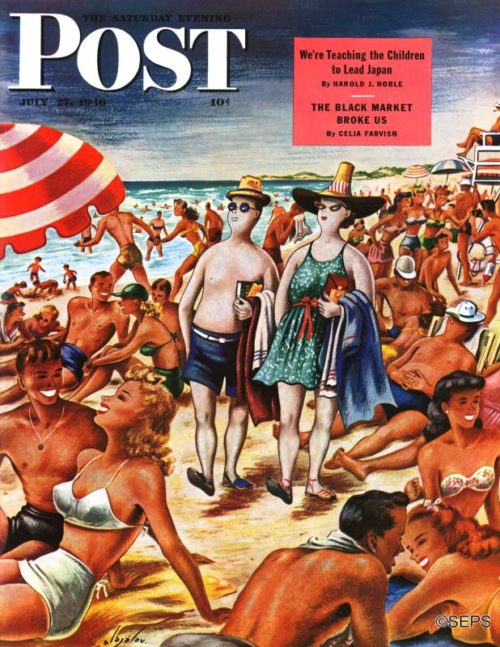
Constantin Alajalov
July 27, 1946
Constanin Alajalov’s painting of the new arrivals picking their green and embarrassed way through the tanned regulars, could have been made on any beach in the country. For that feeling of outstanding pallor is well known from coast to coast, and there is no lotion for it, except that in a few days you can sneer at even later arrivals. Alajalov made his sketches in Palm Beach, Florida, when the Northerners were arriving last winter.
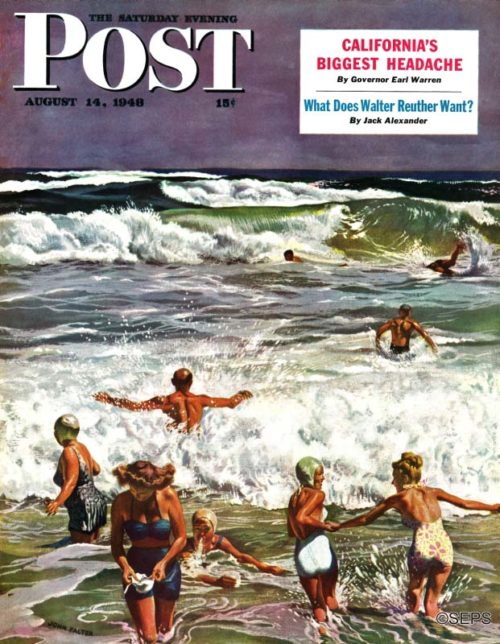
John Falter
August 14, 1948
Artist John Falter’s setting for his surf-bathing cover is Ogunquit, Maine. He made his first sketches while spending the summer in Maine, but didn’t get around to painting until last winter. By that time the lucky lad was in Phoenix, Arizona. The hotter that Arizona sun got, the more fondly the artist thought of Maine’s cool air and cool spray. So he went to work on a picture of Maine as remembered in the Southwest. The pretty girl in the left foreground, just emerging and shaking out her hair, often appears in Falter’s cover paintings. But doesn’t get a model’s pay for her work. She is Margaret Falter. John’s wife.
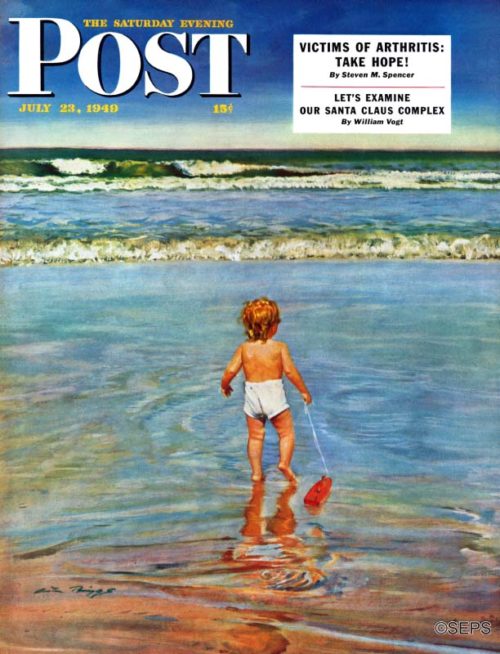
Austin Briggs
July 23, 1949
Don’t worry about the tiny cover girl who is going down to the awesome sea with her eight-inch ship. Just as Austin Briggs, who was vacationing at Folly Beach, Charleston, South Carolina, spied the seagoing tot, her mother let out a yelp and splashed into the foam after her. Now there, thought Briggs prophetically, could be my first Post cover.
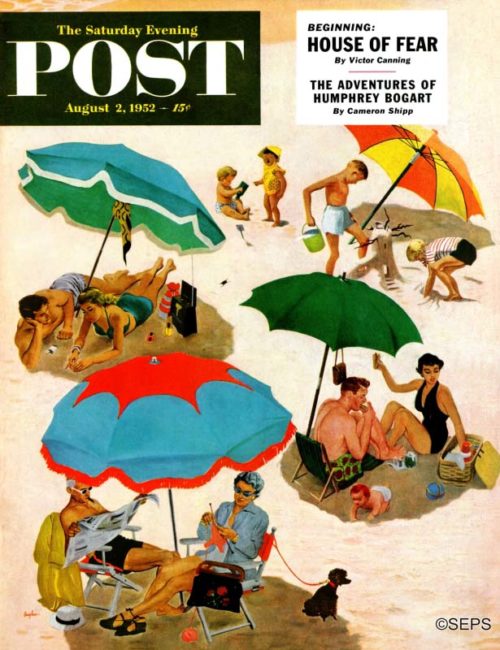
George Hughes
August 2, 1952
In the winter, people buy sun lamps to get sun, and in the summer they buy beach umbrellas to keep the sun off. Well, have a wonderful time, folks; build your sand castles and your dream castles; let the cool winds and the hot dogs renew you; and don’t even let the annoyment creep in if that boy’s radio prevents your hearing the sweet nothings he whispers to his girl. Now turn the page, before the kids start throwing sand.
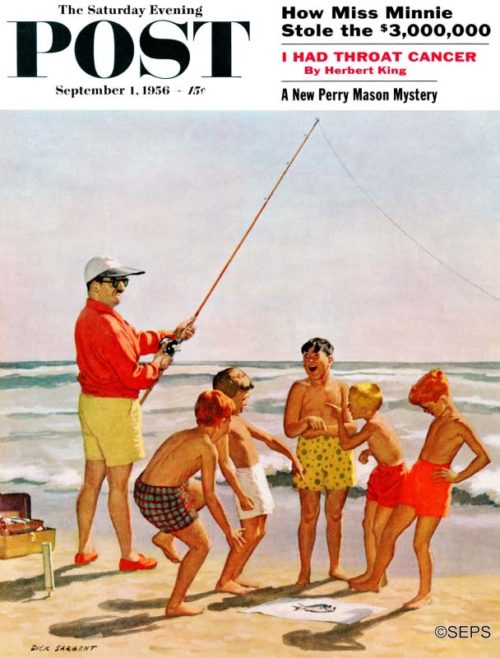
Richard Sargent
September 1, 1956
Mr. Rodney Fischer, an eminent metropolitan banker who is accustomed to being treated with deep respect, is not being. If that is a sardine he has caught, it may cop the surf-casting championship, for it is indeed of great size. But the boys’ happy faces and the man’s apoplectic face indicate that it is a small sample, or child, of something more ambitious. Mr. F. should set his rod in the gadget Dick Sargent has painted behind him, and lie down and relax his bile; if he goes to sleep, he may catch something decent. While he stands up, his blinding raiment must terrify all the fish who are old enough to think.
North Country Girl: Chapter 9 — The Big City of Minneapolis
For more about Gay Haubner’s life in the North Country, read the other chapters in her serialized memoir. The Post will publish a new segment each week.
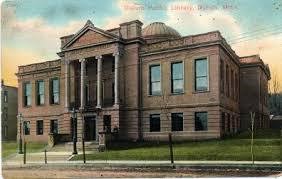
Summer after third grade was spud games in the street, wandering by myself along Congdon Creek, trips to the neighborhood library and occasionally after much begging, to the awesome Carnegie Library downtown, where thousands of books basked in the golden light from the glass dome, reflected back by a floor of pale yellow glass bricks.
A few weeks before school started, my mother, my sister, and I made our annual shopping trip to Minneapolis, the big city, staying downtown at the Radisson or the Dyckman Hotel. On one of these trips the elevator doors at the Dyckman opened to reveal my Aberdeen grandmother, dolled up in a jaunty hat, a fox stole, and too much rouge. We were astonished to see her: grandma had left Duluth three weeks before, but was in no hurry to return to the charms of South Dakota and had settled in at the Dyckman indefinitely without telling us.
We had two main shopping destinations: Dayton’s, which was scented with eucalyptus and had rackety but thrilling wooden escalators (escalators were unknown in Duluth) and the dull as dishwater Donaldson’s, the other big department store. These trips were never on a weekend, as stores were closed on Sundays.
I wasn’t interested in clothes unless they were Barbie-sized. My mother loved clothes; she would sigh when I came down to breakfast in a flowered shirt and plaid skirt and send me back upstairs to puzzle out what a suitable combination might be. Lani and I played hide-and-seek in the racks of dresses in Dayton’s Girls Department while my mother searched for appropriate school clothes that were also on sale in August. Before moving on to Better Ladies or Shoes to do her own shopping, my mom would send my sister and me off to wait for her in Dayton’s Toy Department. Once riding the wooden escalator up to Toys, Lani clutched my hand so hard and looked so unhappy that I was certain she had to poop. An enormous man in faded blue jeans jeans and plaid flannel shirt had followed us up three flights of escalators, positioning himself directly behind my six-year-old sister and rubbing her buttocks all the way. We didn’t say a word to my mother. A few months later, when my mom dumped me in the toy department at Goldfine’s so she could look at carpet samples in peace, a man snuck up and began fondling me as I stared pop-eyed and slack-jawed at the extensive display of Barbie outfits. I sidled away to the baby doll section and didn’t report that incident either: it seemed too shameful, like Lani and I had done something wrong. Pedophiles must have come out in droves to toy departments the weeks before Christmas, waiting for parents to drop off new victims.
I loved the exotic eating adventures Minneapolis offered. We lunched at Dayton’s Skyroom, perched loftily on the eighth floor with floor-to-ceiling windows overlooking the modest downtown and the Mississippi River. The Skyroom was the most lady-like restaurant imaginable and to me the height of sophistication. I don’t think I ever saw a grown man there. Glamorous models strolled through the restaurant, stopping at each table and displaying cards identifying the designer. There was a separate children’s menu, with each dish named after a nursery rhyme character; fitting, as it was all nursery food, with no flavoring, not even salt, food that you could swallow without chewing. I always had the Little Boy Blue, creamed chicken on mashed potatoes. It was delicious. The Skyroom also had that heaven on wheels, a dessert trolley. We were allowed one dessert to split; my sister and I would fight over whether to get chocolate cake or apple pie until my embarrassed mother would pick something else entirely (“Not the rice pudding! Not the rice pudding!”), which we would sulkily share.
When the department stores closed we dined on bland corn, starchy chicken with almonds and piles of white rice (the only Chinese food my picky eater sister would tolerate) and almost too sweet almond cookies at the Nankin restaurant, and then returned to our hotel room with a big bag of warm caramel corn to snack on while we reveled in the wonder of four TV channels.
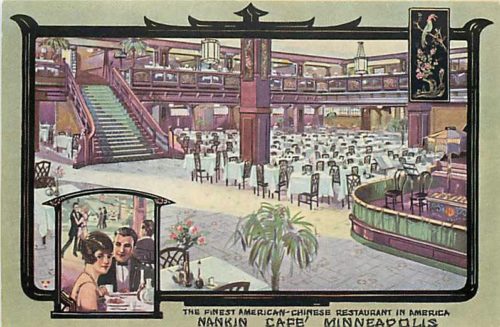
The next morning, we ate breakfast at the Forum, an art deco cafeteria. My mom doted on their fried corn meal mush, a dish whose appeal escaped me. We did a bit more shopping at Dayton’s or Donaldson’s or at Harold’s, a snooty upper end dress shop, where Lani and I were strictly forbidden to tear through the racks. We waited while my mom tried on clothes, sprawling on tastefully upholstered armchairs and kicking each other. We then got back on the train and consolidated our few purchases into one or two shopping bags so my father wouldn’t be able to tell how much we bought. It was never all that much.
It is one of the pleasantest things about childhood, going back to the same places and doing the same things, year after year, as if the world would never change. It didn’t seem possible that all that could disappear: the wooden escalators at Dayton’s, the little silver domed dishes scattered about our white clothed table at the Nankin, the Forum’s black and silver mirrored paneling and the pleasure of resting my chin on the cafeteria tray as I pushed it along the endless railing and never once being allowed to get one of the gleaming sundae glasses brimming with cubes of Jello and topped with a dab of whipped cream (“We have Jello at home.”). But they’re all gone now.
***
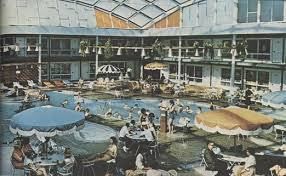
We would make another trip to Minneapolis, usually with my father, in early December. This trip was not as strictly choreographed as our fall visits. We drove, instead of taking the train, always beseeching dad to stop at Tobies in Hinckley for cinnamon rolls the size of our heads. My father hated interrupting the trip; he liked to travel straight through, fueled by chain-smoking Old Golds. Once a decade we got a single cinnamon roll to share (always eaten in the car). Mostly we sped past the crimson and white Tobies sign, whining “Tobies! Tobies!” until requested to shut up. In Minneapolis my father would go to a Vikings game, or take us to the Cinerama where I gave myself a headache trying to look out of the opposite sides of my eyes to take in the enormous movie screen. We’d stay at the Ambassador Motel, a glass-domed two-story building that enclosed a huge indoor amoeba-shaped pool ringed with dozens of half dead palm trees. The air inside was steamy, with the slightest tang of tropical mildew beneath the pucker of chlorine. The pool was ridiculously overheated; swimming in an indoor pool, especially when you could see snow landing on the glass roof above, was pure luxury. Lani and I would spend as long as possible in the hot greenish water, until we were scooped out before our bodies melted into primordial soup.
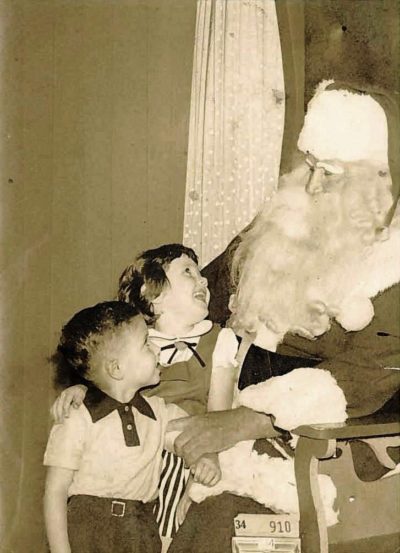
Our chief destination in Minneapolis on those trips was Dayton’s Winter Wonderland in their seventh floor auditorium. We had Santas in Duluth, sad specimens ringing bells on the street, or somebody’s drunk dad in a fake beard and red suit giving away crappy gifts at the Elks Club Christmas party. Dayton’s Santas were naturally endowed, with fluffy white beards, and they didn’t smell. The ordeal of waiting to sit on Santa’s lap was transformed into a thrilling trip to the North Pole. Who wouldn’t stand for hours in a slow, snaking line, when surrounded by acres of enchantment: set against sparkling snowy hills were dozens of miniature mechanized elves, hammering and sawing away in the toy workshop, hitching Rudolf to the sleigh, and packing wrapped gifts in bags. And there was Mrs. Santa in her kitchen, pulling a tray of gingerbread men out of the oven again and again. We were a polite if closely packed line of moms and kids, at least half of whom would be squirming the other way, in desperate need of a bathroom (“I told you to go before!”). Finally we would reach Santa’s inner chamber, where my sister and I, in matching coats, were hoisted onto Santa’s lap; a sadder but wiser photographer quickly snapped our photo in the millisecond before my sister started screaming. I had to quickly convey to Santa the importance of receiving every single item in my exhaustive list, before being handed a Made in China plastic trinket, and herded offstage to where my mom was ordering Christmas cards.
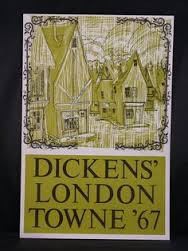 Imagine my horror when in 1964 we arrived at Dayton’s to find that Santa had been shunted into a corner of the Toy Department and the auditorium had been taken over by the Dickens’ London Towne. Gone were the elves, replaced by life-sized automatons of Dickens’ characters, in scenes that faithfully reproduced 19th century London, complete with antiques sent over by the crate from England. Grown-ups oohed and aahed over the elaborate Victorian dresses and hairdos, Lani and I yawned and hit each other. All I knew of Dickens was Mr. Magoo’s Christmas Carol. But over the years, Dickens’ London Towne grew on me, its insane attention to detail and authenticity luring me in, and I was saddened when Dayton’s finally realized they didn’t need to spend millions of dollars to get people to come to the store to buy Christmas gifts. Dickens’ London Towne was no more.
“The Perfect Picture, or What Never Happened” by Wallace Irwin
CHARACTERS
SHAKSPERE, an author.
REMBRANDT, an artist.
MICHAEL ANGELO, a sculptor.
SIR CHRISTOPHER WREN, an architect.
SIR HENRY M. STANLEY, a location hunter.
CRŒSUS, a financial backer.
NAPOLEON, a soldier.
WILL H. HAYS, a dictator.
ANGELIC VISITORS, to be revealed in the plot.
Nearly all the residents of SOUTHERN CALIFORNIA in costume.
$197,432,621.04 worth of actors.
And ARCHIE DE SMITH, motion-picture director and the greatest man on earth.
SCENE
A glacier on Mt. Rainier. The location has nothing to do with the story, but MR. DE SMITH loves to photograph mountains; he is getting ready to produce a motion-picture version of Candida, formerly by George Bernard Shaw.
In the foreground the inhabitants of Southern California in fancy dress are reading New Thought literature or playing poker, according to personal tastes; they have been waiting a month, on salary, for something to happen.
SOUTHERN CALIFORNIANS (pianissimo):
We know not what he’s after
Or why he lingers now.
Let not unseemly laughter
Disturb that marble brow.
(Basso run) That marble brow.
In yonder gold pavilions
Ingeniously he sinks
Another flock of millions—
He thinks! Our Leader thinks!
(Sobbing close harmony) He thinks! Ow-ow — our Leader thinks!
ANGELIC VISITORS (heard in mid-air):
We’re watching this rehearsal;
Be careful what you do,
Or else our heavy curse’ll
Fall suddenly on you.
(General nervousness. Several Spanish señoritas wrap their shawls around their decolletage. Enter SIR HENRY M. STANLEY. He removes his pith helmet to gaze aloft.)
SIR HENRY to a SOUTHERN CALIFORNIAN:
Sir, in my day vast jungles I have crossed,
But as location hunter I am lost.
Tell me, what are those vocal joy dispensers
Chanting on high?
SOUTHERN CALIFORNIAN:
Dunno. I guess they’re censors.
ALL (frightened):
Oh, can it be? Oh, can it be the censors?
(Enter SHAKSPERE and REMBRANDT, arm in arm.)
SHAKSPERE (depressed):
Now is the winter of our discontent.
No more, methinks, I’ll be a monument,
But one like Hector on his chariot wheel
By money chained to make a movie reel.
REMBRANDT:
You’ve said a mouthful, bard. And look at me!
They call me art director here, pardie.
Yet here I stand, so far below the brute
I have to climb a ladder to salute
An angleworm.
(Enter CRŒSUS in a golden chariot with a cashier’s window in front.)
CRŒSUS:
Good morning, famous pair!
Kicking already? Well, that’s only fair.
In this here movie game to which I’m sticking
The high-priced talent’s nearly always
kicking.
Duet (SHAKSPERE and REMBRANDT):
Why are we here, buddy?
Just to stand ’round?
Give us a steer, buddy—
You’re on the ground.
Sketch us out a diagram—
What’s the ideer?
Why are we, why are we,
Why are we here?
(Salvo of trumpets. Heralds, boy scouts, electricians, cameramen, animal trainers, knife throwers, sheriffs, laundrymen, rajahs and cafeteria managers approach in solemn procession.)
FIRST HERALD:
Oyez! Oyez!
Stop all this noyez!
The champion thinker of the earth.
From out his brain of granite,
Has just this instant given birth
To quite a handsome planet!
(The flap of a golden tent opens and MR. DE SMITH. deep in thought, strides forth. A golden chair bearing his name precedes him. Diplomatists follow with office supplies.)
MR. DE SMITH(glaring at Mt. Rainier):
This scene offends our august sight.
Yon mountain’s too much to the right—
Who put it there?
(No answer.)
Dolts, are ye dead?
I think I said,
Who put it there?
SIR HENRY M. STANLEY (apologetically):
The Indians say their own Great Spirit
Tumbled it there and planted near it —
DE SMITH:
Bunk! Now to our scenario.
Where’s that new English writer? Ho!
(SHAKSPERE bows bashfully.)
I’ve read your script and think it’s rotten—
What is your name, please? I’ve forgotten.
SHAKSPERE:
As Shakspere I am known to fame.
DE SMITH:
You hate yourself, and who’s to blame?
So you’re the man I gave the script
Of Candida, and asked it whipped
Into some shape to suit the screen.
(Pointing to SHAKSPERE’S version)
The darndest hash I’ve ever seen!
You’ve made it read, in spite of me,
Just like a parlor comedy.
SHAKSPERE (blushing):
But, good my lord, it looked that way,
And thus the playwright wrote the play.
DE SMITH:
You poor Elizabethan pote,
What care I what the playwright wrote?
Know you not that De Smith—that’s me—
Deals only in Sublimity,
In cyclones, battles, Cain and Abel,
Creation and the Tower of Babel?
Go back to Avon, fly your kite;
And if you can, please, learn to write.
(Stammering, SHAKSPERE totters to the cashier’s window where CRŒSUS writes him a check for $1,000,000.)
CRŒSUS (with a worried look at DE SMITH):
Don’t you suppose we’d better start?
DE SMITH:
Where is Napoleon Bonaparte?
NAPOLEON (saluting):
I’m here to serve, sir.
DE SMITH:
What you deserve, sir,
Is a kick in the pants.
(NAPOLEON cringes.)
Now gimme a chance
To tell what you’re here for, you fella from France.
This Bernard Shaw comedy’s lacking in punch;
So now we’ll begin
Putting it in
With a big battle scene which we’ll shoot before lunch.
I’ve got you an army on yonder high bluff.
Go put them in action at once. Do your stuff.
NAPOLEON:
Thanks, very kindly, your highness, but it —
DE SMITH:
Do as I tell you, you insect, or quit.
(NAPOLEON shuffles away, hat in hand.)
I’ll have trouble yet with that mean little tike.
(Claps hands. Slave appears.)
Where’s that Italian the sculptors call Mike?
SLAVE:
You mean Michael Angelo, highness? He’s here.
MICHAEL ANGELO (kneeling):
By contract, I think, I am booked to appear.
DE SMITH:
Well, don’t brag about it or play to the gallery.
I’m fully aware
Of the honor you bear
In playing with me.
It will double your salary.
Now I’m looking for statues, and out for the best.
Have you got any samples that you can suggest?
MICHAEL ANGELO:
If you’ll pardon my gloom,
Might I venture to say
That my Medici Tomb
Isn’t bad in its way?
DE SMITH:
What, may I ask, does the thing represent?
MICHAEL ANGELO:
Not very much. Just a lady and gent.
They are wearing—ahem —
(Blushes) Oh, I really can’t say.
ANGELIC VISITORS (heard distantly):
Beware the temptation now forninst you!
All that you say will be used aginst you!
DE SMITH (annoyed at interruption):
Go on, Mr. Michael. Speak candidly, pray.
MICHAEL ANGELO:
Well, an ounce or two less than a light negligee.
DE SMITH (pleased):
We’ll try it!
(To CRŒSUS.) We’ll buy it!
(CRŒSUS, with automatic melancholy, dashes off another $1,000,000 check.)
MICHAEL ANGELO:
But, sir, I’m afraid that it isn’t for sale.
DE SMITH:
Don’t bore me with trifles like that. Here’s the kale.
The statues you mention will photograph well
For the big murder scene. We can work it up swell.
(Sudden clamor in the air. Innumerable STATE CENSORS with white wings flapping, come swooping down.)
Hymn of the CENSORS:
Though temptation’s voice be sweet,
Think of what you mustn’t do!
Photographic sin’s defeat
Comes in Statutes One and Two.
All suggestive scenes avoid—
Think of some we have escaped!
Truth can only be enjoyed
When her limbs are thickly draped.
(Consternation. Hoof beats without. Enter WILL H. HAYS, riding furiously on a snowwhite charger. He throws himself at the feet of the DIRECTOR and presents a petition or something tied with a pink ribbon.)
WILL H. HAYS:
Oh, mercy! Oh, goodness! Oh, sugar! Oh, scat!
Whatever your plans are, please, do not do that!
I ask in the name of my Presidencee
Of Producers and Distributors of Amerikee.
How often and often I’ve had a close shave
With naughty directors who will not behave.
But I scold ’em and hold ’em to shame if they won’t—
For the censors will get them, by jing, if I don’t.
By nature I’m simply a kind-hearted man;
I strive to be gentle and sweet when I can,
And teach my producers, by methods so smooth,
To cut out the rough stuff and keep in the smooth.
You must not forget how in me you invest
The power not to order, but merely suggest;
But if you don’t listen, I fear you will get
The ax where they tickled Marie Antoinette.
(At this point SIR CHRISTOPHER WREN, who has been hired as consulting architect and has had nothing to do since the show commenced, leads away MR. HAYS weeping bitterly.)
DE SMITH (annoyed):
My mood is changed. My day is spoiled.
For several hours in vain I’ve toiled.
I do not care for this location.
I have another inspiration.
(With a sweeping gesture of the hand he wipes out Mt. Rainier and everybody on it. Nobody survives, save SHAKSPERE. NAPOLEON, REMBRANDT and the other illustrious employes who, being immortal, cannot bejunked, even by a great producer).
This mountain lacks in pep and passion—
I want volcanoes spouting lava.
Smith will set another fashion—
Come on. Let’s shoot a scene in Java.
(Led by SIR HENRY STANLEY, the little expedition starts south, leaving CRŒSUS behind. He has spent his last million paying off NAPOLEON’S army and has lost interest in the production):
Duet (SHAKSPERE and NAPOLEON):
The movie’s a wondrous invention;
We wonder just how it is made.
With wonderful magic, both comic and tragic,
It puts the black arts in the shade.
In the wonderful progress of science,
Such wonderful pictures it shows,
With armies in motion and storms on the ocean
And airships cavorting like crows.
Oh, wonderful, wonderful wonder!
We wonder such wonders exist.
We out-of-date sages of rather dark ages
Repine for the things we have missed.
And after we’ve watched a rehearsal,
With its wonderful energy tall,
We wonder a scene ever gets on the screen—
For that’s the big wonder of all!
CURTAIN
The Softer Side of Ty Cobb
On July 18, 1927, Ty Cobb became the first baseball player to reach 4,000 hits. Ninety years later, Ty Cobb still holds many records. He also holds onto the reputation of being one mean ballplayer.
Tyrus R. Cobb certainly had a quick temper and was an aggressive athlete. He was argumentative and often engaged in fist fights. But there’s no proof for the stories about him beating up a handicapped man, or of sharpening his spikes so he could sink them into the shins of any opponent who blocked his slide into base.
Many of these stories were fabricated by journalists who knew they could attribute any outrageous actions to Cobb and people would believe them.
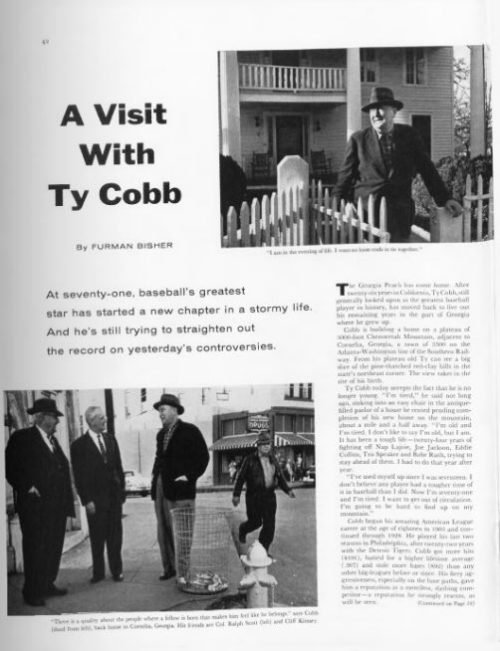
So Post readers familiar with the notorious Cobb would have been surprised to read about the sentimental, soft-hearted philanthropist described in the June 14, 1958, article, “A Visit with Ty Cobb.”
In 1956, Cobb donated $100,000 (worth nearly nine times that amount today) to build a hospital for his small home town. He also established the Ty Cobb Educational Foundation with another $100,000. By 2016, this college fund had disbursed over $16 million to disadvantaged students and is still in operation.
Cobb’s generosity was not a consequence of a large salary. In all his years as a ballplayer, he never earned more than $40,000 a year, even at the height of his 23-year career.
Surprisingly, when he retired in 1928, he was a rich man. During his ball-playing years, he had been wisely investing in rising companies like General Motors and Coca-Cola. When he died, he left an estate worth, in current dollars, over $90 million.
Author Furman Bisher was intent on writing a positive story, which is why he skipped over some unpleasant parts of Cobb’s past. For example, he writes that Herschel Cobb, Ty’s father, “came to an early death at 43 — the victim of an accidental shooting.” What he doesn’t mention is that the shooter was Ty’s mother, who was tried for murder and acquitted.
That story is true.
Featured image: Ty Cobb, 1913 (Library of Congress)
Rockwell Video Minute: Losing the Game
Norman Rockwell captures the drama of everyday events in the form of three stunned cheerleaders after a basketball game that didn’t go the home team’s way.
See all of the videos in our Rockwell Video Minute series at www.saturdayeveningpost/rockwell-video.
Vintage Advertising: Scare Tactics in the 1920s
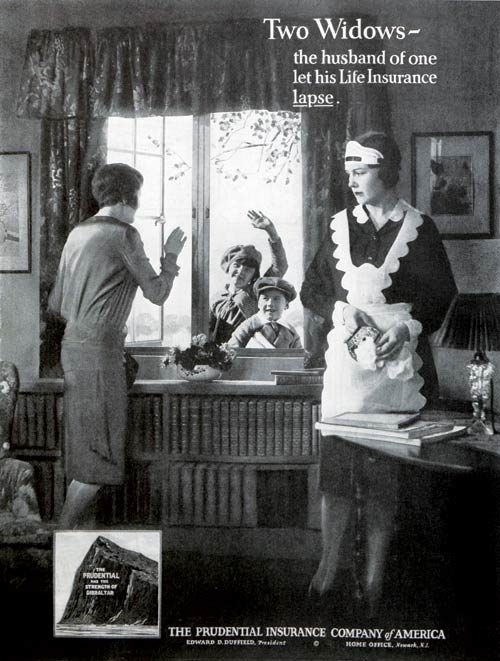
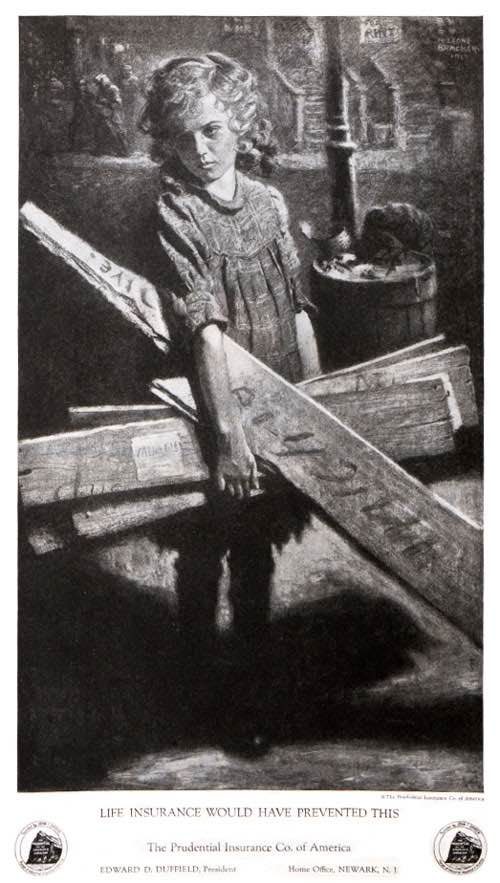
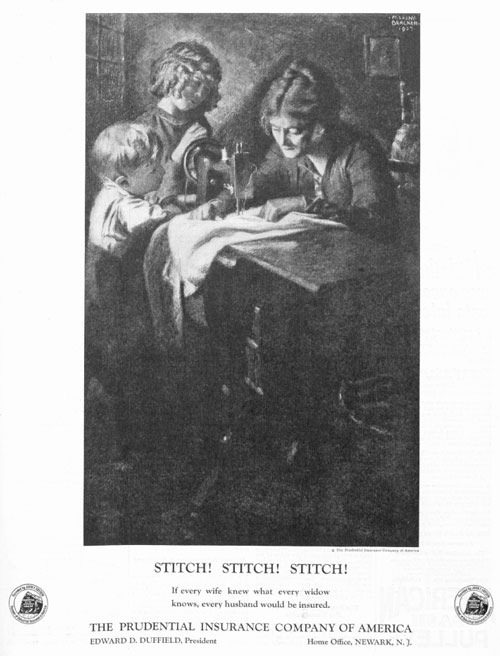
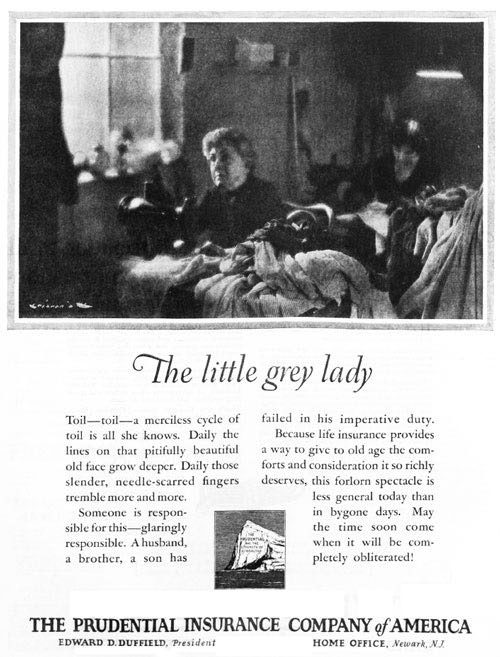
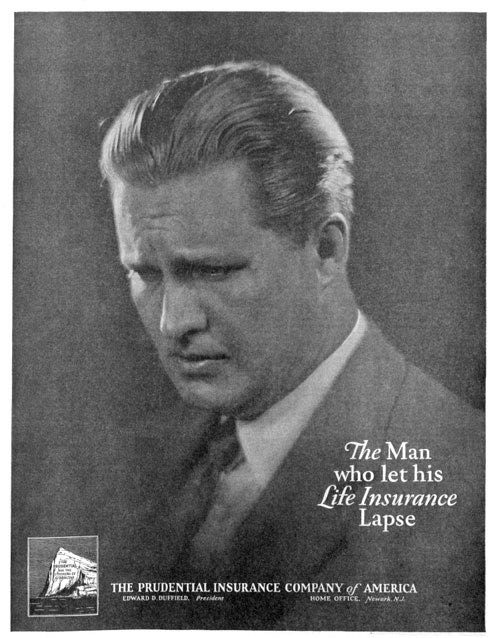
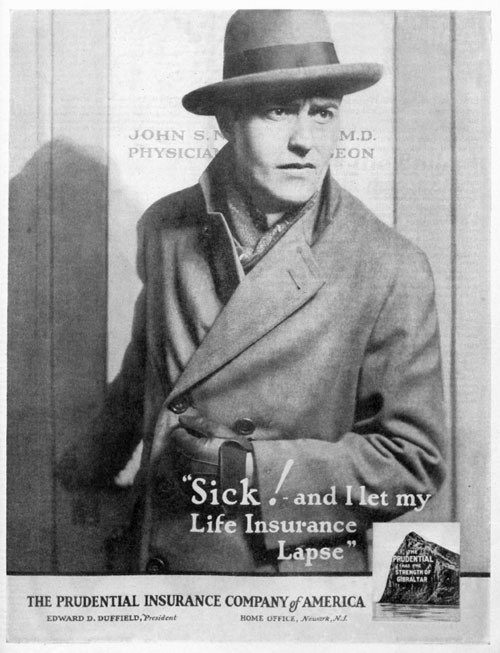
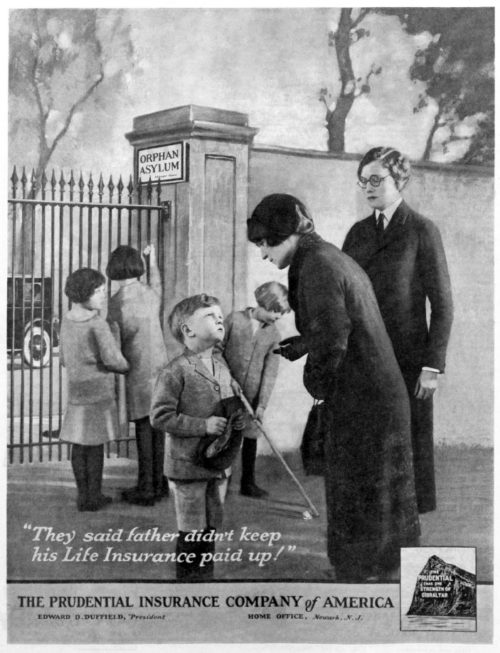
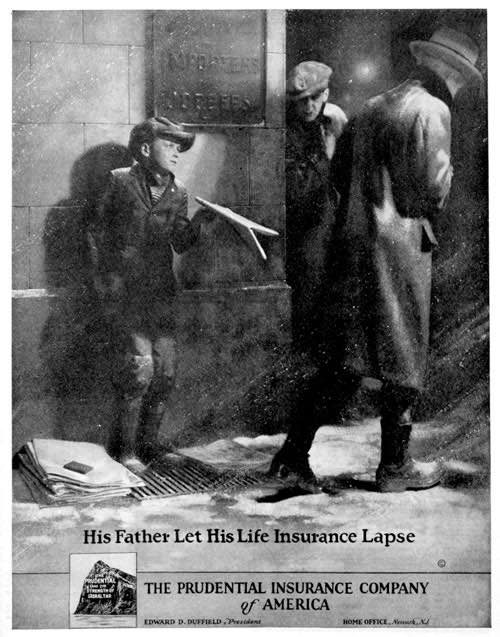
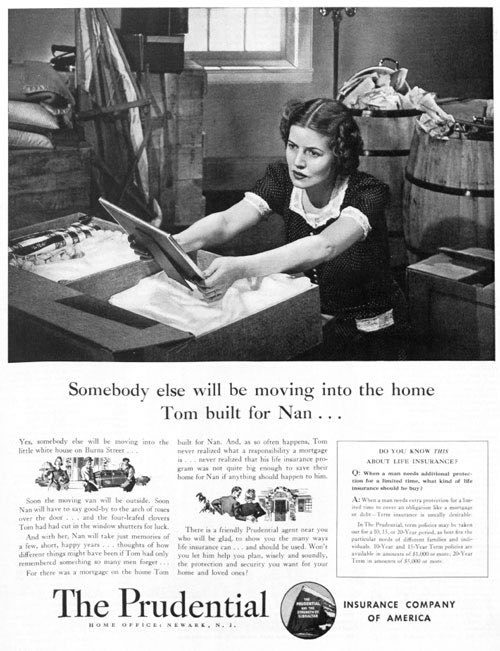
For years, Prudential Insurance’s advertising promoted the company’s rock-solid dependability with its Rock of Gibraltar trademark. But in the 1920s, it began emphasizing the dangers of being uninsured, graphically illustrating the fates that could await customers who let their life insurance lapse.
One ad portrayed a small boy shivering on a street corner, trying to sell papers in the midst of a pounding snowstorm — all because he’d been orphaned by parents who never bought life insurance. Another showed a rapidly aging widow barely supporting herself by sewing because a caregiver “had failed in his imperative duty.”
This series of frightening ads ran from 1926 to early 1930. With the advent of the Depression, Prudential backed away from its scare tactics. Americans of the 1930s no longer had to be reminded how uncertain life could be.
Here is a look back at some of the more frightening scare tactics Prudential used in ads that appeared in the Post during the 1920s.

This article is featured in the July/August 2017 issue of The Saturday Evening Post. Subscribe to the magazine for more art, inspiring stories, fiction, humor, and features from our archives.
Ken Burns on Baseball’s Future
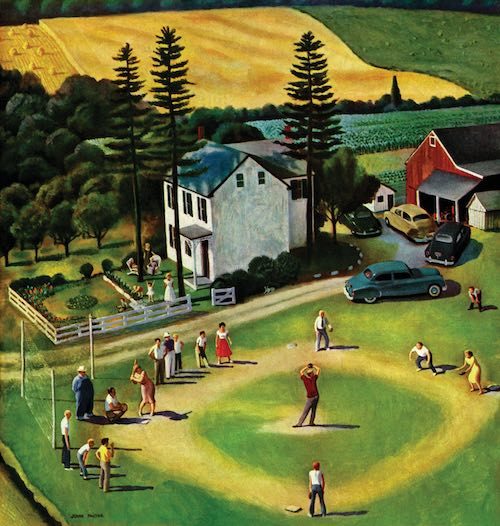
John Falter
September 2, 1950
This article and other features about baseball can be found in the Post’s Special Collector’s Edition, Baseball: The Glory Years. This edition can be ordered here.
Few people have a stronger grip on baseball’s history and its roots in American culture than Ken Burns.
His love of the game was kindled in childhood while playing in the PONY and Little Leagues in Newark, and in his award-winning documentaries Baseball (1994) and The 10th Inning (2010), he explored America’s development through the prism of our national pastime. As he told us, “If you really wanted to know over the whole arc of American history who we were, there was no better metaphor, or past to follow, than the story of baseball.”
In one form or another, Americans have played baseball since the early 19th century. The game has continued uninterrupted (except briefly by strikes) through world wars, labor struggles, the upheaval of the civil rights movement, the rise and fall of cities, and much more.
But where does the game go from here? West Coast Editor Jeannie Wolf, who interviewed Ken Burns for the March/April 2014 issue of The Saturday Evening Post, went back to the filmmaker to ask for his thoughts about the game, its staying power, and how it might change in years to come.
Jeannie Wolf: Let’s start with the present. What do you see as the current state of baseball in America?
Ken Burns: Baseball is in as good shape as it has ever been. It has weathered the great crisis of its labor disputes of the 1990s and the even greater steroid crisis of the 2000s. Commissioner Bud Selig – who is retiring in 2015 – is leaving the game in a very solid place.
But baseball’s no longer the sole national pastime, because there are so many other sports and forms of entertainment. That doesn’t mean that the game’s not central though. When something happens in baseball, we care about it more than we do other sports. I’ll give you an example. When steroids became a problem in Major League Baseball, the news hit the front page of The New York Times — the paper of record. When Bill Romanowski, an NFL linebacker, was charged with using steroids, that was a sports-page story.
What I think is so interesting about base- ball is that it’s viewed as an embodiment of the American ideal yet involves stealing, cheating, labor disputes, racial struggles. Baseball in many ways leads America — in dealing with racial issues, immigrants, labor, and popular culture. It’s a mirror of our times.
Baseball is still the bellwether of our republic, the canary in the coal mine. If baseball is sick, America is sick. But baseball is very healthy right now.
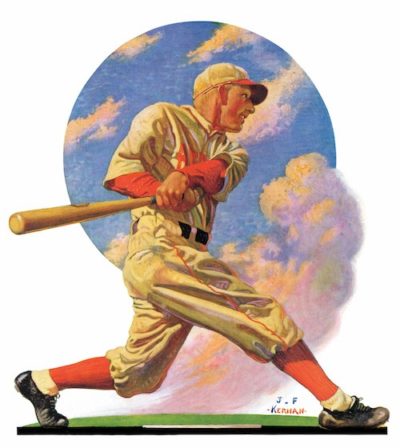
J.F. Kernan
May 28, 1932
JW: With the rapid pace of change today, how will baseball change and evolve?
KB: Besides the Constitution, very few things in this country stay the same. The look of the game may change — they’re always trying to jazz stuff up, more often than not with terrible effect. he uniforms we admire most are ones that barely change. And the ones that we cringe at are ones with the garish colors and strange designs. But they’ll keep fooling around with it. They always have. If you asked me the same question in 1914, I’d give you the same answer. At the time, they were building new stadiums – beautiful new steel stadiums unlike the wood ones that were susceptible to fire – just like we’re building these retro ballparks now that don’t look like the ugly, suburban ballparks they got rid of in Cincinnati, Pittsburgh, and all across the country. But as I said, that’s just the look of things, and doesn’t affect the game.
In the future, I think they will fiddle around with rules to try to speed the game up. But the game’s always had a stately pace, and it’s a mistake to try to become what you’re not. Baseball is the only game in which the defense has the ball. It’s the only game in which you don’t run up and down the rink or the field or the gridiron. You’re on a diamond. You’re in a park. You’re running around the bases. What’s the ultimate object? To come home! It’s a timeless game. There’s no clock. We should play to the strengths of baseball, and I think we will.
For all the superficial changes, I predict the game will stay the same. A .300 hitter means the same thing to my daughters as it does to me as it did to my father and my grandfather and my great-great-grandfather who fought in the Civil War. There is almost nothing in American life that you can say that about. If a .300 hitter stays the same 25 years from now – which I guarantee it will – that’s something.
That is the kind of continuity that hearkens back to the timeless images of Norman Rockwell. It’s comforting. That’s what home is about and that’s the object of this game — to come home. That’s what – in a metaphorical sense — is what we all yearn for, a sense of belonging and place. Baseball can be wildly experimental and has had its issues with labor and drugs. All the things that affect modern society are there in microcosm in baseball. But at the end of the day, the game also reminds us of the timeless virtues that we all subscribe to.
Harvey Kidder
January 1, 1955
JW: Are kids playing the game like they used to, practicing in backyards or school stadiums with dreams of making it into the big leagues?
KB: Kids today may not play the game the way they were when I was growing up and certainly not the way they were when my dad was growing up. There’s less pickup ball, less sandlot ball. It’s all organized league ball, but we still seem to grow the same number of talented players.
JW: Where will players come from?
KB: The play on the field is as good, if not better, than it has ever been. And we’re seeing great players coming into the game from the Dominican Republic, Korea, or Japan. Of course, there are still plenty from Pennsylvania, Southern California, or Arizona. There are still many guys who look like they’ve come right out of a cornfield in middle-America throwing 100-mile-an-hour fastballs, as well as guys who routinely hit the ball out of the park.
But for all these homegrown players, the game will constantly mirror immigration patterns of the United States. Who are the biggest immigrant groups? Asians and Hispanics. If you asked me this question 100 years ago, we’d be talking about the influx of central and southern Europeans who were just then beginning to dominate baseball. Baseball has been a mirror of America since its inception, and it always will be.
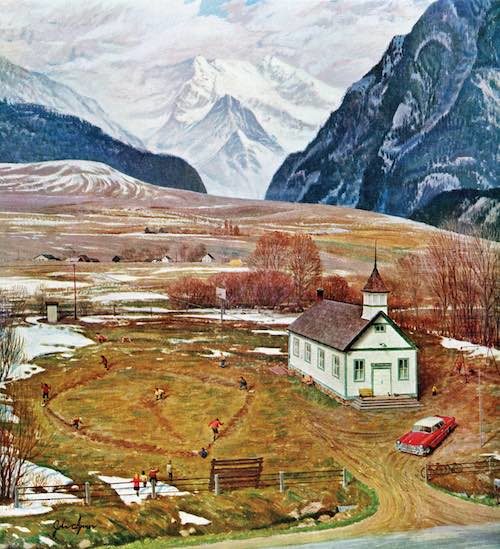
John Clymer
April 2, 1960
JW: What about the fans? Do you see fandom changing over time?
KB: Baseball will always be a game handed down intimately. When you tell stories about a football game, you don’t say, “My mom and my dad took me.” You just say what happened on the field. But when talking about baseball, the story always begins with, “My mom took me to this game…” or “My dad took me to this game …” and then they describe the action. Baseball’s very much a sport tied up with its own history.
Statistics don’t mean nearly as much in basketball or football as they do in baseball. I can say to an average citizen, “714,” and they know that that’s the number of home runs Babe Ruth hit. I can say, “755,” and they know that that’s the number that Hank Aaron hit. I can say ,“406,” and they think, That’s what Ted Williams batted in 1941. I can say “56” and they’d say, “That’s the number of straight games that Joe DiMaggio hit – also in 1941.” I can say the number 42, and they say, “That’s Jackie Robinson’s jersey number that was retired by every team in every ballpark in tribute to the first African-American to play in the major leagues.” Statistics matter. But if I ask, “How many passing yards does the greatest running back have?” People don’t know, and it doesn’t matter as much.
Baseball’s a game very much tied to time, and that’s why we’ll keep creating new fans. There will always be people like me – a father of four daughters who takes his girls to the ballpark. I have the two grown girls, and they are full- edged baseball fans. And I’ve got two little girls, 9 and 3, and I take them to the ball game. I caught a foul ball the last time I took them to a game, and I handed it to my then 8-year-old — and my then 2-year-old looked at me and said, “I want a baseball, too.” We managed to get some guy to buy a baseball then hand it to her, so she was happy about that.
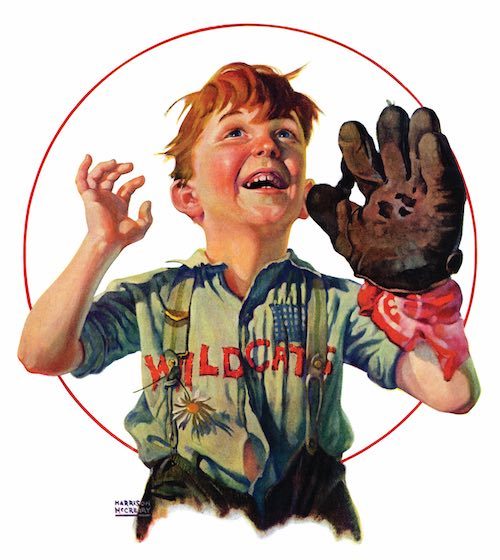
Harrison McCreary
September 7, 1929
JW: Are we also making concession to concession, giving up our stadium favorites in a nod to healthier fare?
KB: Baseball has made a concession to modern appetites and tastes, but I don’t concede anything to concessions. Besides on the Fourth of July, the only time I have a hot dog is when I go to a ballpark where I’ll definitely order one. A hotdog never tastes as good as it does at the ballpark. Give me my peanuts and Cracker Jacks, and I don’t care if I never get back!
Screen Sirens of Hollywood: Grace Kelly Rules the Movies
This article and other features about the stars of Tinseltown can be found in the Post’s Special Collector’s Edition, The Golden Age of Hollywood. This edition can be ordered here.
The headache with any story is usually beginning it. That is not the trouble with the Grace Kelly story.
The tough thing about the Kelly story is this: You run yourself black in the face tracking down everyone— including Grace herself—who can give you an angle on her. You talk to those who’ve worked with her, those who are related to her and those who are her friends. And when you have finished all this, she is still such an elusive subject that writing about her is like trying to wrap up smoke.
When I sat down to talk to the woman herself, her face was expressionless. I saw only the surface of her eyes, not into them. She was poised, cool, collected and wary. She said nothing—unless I asked her a question first. Once or twice, even when I put a direct query to her, she smiled and didn’t answer. However, little by little, she began to come out from behind her private Iron Curtain.
She said that when she met Fred Zinnemann, who had directed her in her first Hollywood venture, HIGH NOON, he had given her some kindly advice. “You ought to learn how to speak to people and what to say to them when you meet them,” he said. Later, she discovered that such advice from Zinnemann had its hilarious aspect, for he himself is so shy that after those sage words, he had almost nothing to say. To make things even clammier, they were both working with Gary Cooper, who had been known for years as the Hollywood actor least likely to be chatty. It was only after Cooper’s discovery that Grace was even shyer than he that his talk moved out of a mumble, and he made so bold as to take her to lunch.
No unusual twist in the Grace Kelly story was involved in her becoming a member of the cast of HIGH NOON. It was simply that, rated o her performance in one Broadway play, THE FATHER, and her countless appearances before the slowly moving and ruthless eyes of TV cameras, her agents convinced those who were casting the film that the Philadelphia girl—who has since been described by one picture maker as having “stainless-steel insides” and who reminds one picture maker of “a cool stream in a mountain hideaway”— was a good bet.
I asked her how she happened to appear in the test Fox had made of her, the test that had had such a profound influence upon her life. “After a brief appearance in FOURTEEN HOURS,” she said, “Metro offered me a stock contract. Other studios did too, but I wasn’t interested. I could earn more modeling. Also, I wanted to try my luck on Broadway. I read for so many plays, I lost count of them. People were confused about my type, but they agreed on one thing: I was in the too category—‘too tall,’ ‘too leggy, ‘too chinny.’”
The Move Into Film
About that time she was studying acting with Sandy Meisner, who taught dramatics at the Neighborhood Playhouse and classes on the side. One day Grace was starting for her class when the Fox New York once called to say, “We want you to come over and see one of our directors, Gregory Ratoff. He’s going to direct a movie called TAXI. He wants to test you for it.” She wore an old skirt and an old shirt. Her hair wasn’t curled. She was minus makeup. But she said, “I’ll stop by.”
When she walked in, a man from her agency was there. “All the other girls looked cute and sweet in high heels,” she told me. “I looked so terrible, my agent was embarrassed. But when Mr. Ratoff saw me, he said, ‘Perfect.’ This was a switch. My whole life people had been telling me I was imperfect. ‘What I like about this girl is she’s not pretty,’ Mr. Ratoff said. My agent insisted, ‘But Mr. Ratoff, she is pretty.’ Mr. Ratoff would not be talked out of it. ‘No, no, no, she is not!’ he said.
“When I took off my coat and he saw my old shirt and skirt, he was in ecstasy. ‘Magnificent,’ he said. ‘Cannot you speak with an Irish accent?’” Apparently this was what was expected of her, and although she’d never spoken with an Irish accent, she said, “Of course.” en she went home and worked on it. After the test was made, Ratoff wanted her for TAXI, but the man who produced it didn’t, although Fox had a contract all ready for her to sign. So that was that.
However, John Ford, who was directing MOGAMBO, saw the Fox test and decided she’d do for his picture. “MOGAMBO had three things that interested me,” she said. “John Ford, Clark Gable and a trip to Africa with expenses paid. If MOGAMBO had been made in Arizona, I wouldn’t have done it.”
I asked her about an anecdote that had been given quite a play in the press. It had to do with her knitting a pair of socks for Clark Gable and hanging them on his tent on Christmas morning while they were on location for MOGAMBO. The way it had happened was different from the printed version—as such things have a way of being. She had tried to knit a pair of socks for Gable, but, like many another knitter with good intentions, she hadn’t finished them in time. “When I realized that I wasn’t going to make it, we were out in Tanganyika, in the middle of nowhere,” she told me, “and I couldn’t buy anything for him. So I stole a pair of his own socks. Each day I stole something else from him. On Christmas Eve I filled one of his socks with his own things and hung it up. It was a silly gesture, but he liked it. I am very fond of Clark.”
Another rumor I had heard was that while they were on-location for MOGAMBO, Gable had gotten a cable from a London columnist and had read it to Grace. It said: “Rumors sweeping England about your romance with Grace Kelly. Please cable confirmation or denial.” “This,” said Gable, “is the greatest compliment I’ve ever had. I’m old enough to be your father.”
Although I’m not good at a personal probe, I asked her about it anyhow. “I should think he would have been able to overcome that feeling,” I said.
Instead of answering, she smiled and didn’t say anything.
But she was forthright when she talked about the way she felt about Hollywood. “At times I think I hate Hollywood,” she said. “In New York you can go anywhere and people respect your privacy. In Hollywood, they don’t. When Bing [Crosby] took me and my sister, Peggy, out to dinner, the papers made a circus out of it. Poor Bing. He couldn’t relax and have a pleasant evening with eight photographers around him. We had to leave.”
I asked her if anyone had told her they thought her aloof. “Lots of people have,” she said. “But until I know people, I can’t give much of myself. A year ago, when people asked me, ‘What about you?’ I froze. I’m better now, but I’m still not cured.” In fact, she said, the first time she met Alfred Hitchcock, who directed her in REAR WINDOW, DIAL M FOR MURDER and TO CATCH A THIEF, she said she could think of nothing to say to him. She remembers, “In a horrible way it seemed funny to have my brain turn to stone.”
That remark made me think of a thing Alfred Hitchcock had told me when I’d asked him for a few human- interest stories about incidents that had occurred during the making of TO CATCH A THIEF: “I have no anecdotes about Grace. To create anecdotes, people must do either silly things or funny things. Of course, there are the kind of phony anecdotes the publicity man assigned to the unit thinks up, but the really funny things one does or says do not happen on schedule. Anecdotes grow with the years, like the rings on a tree. And Grace hasn’t many years. However, she has a quality that is far more important. She can play comedy not sexily but elegantly. It’s a quality most women do not have. It has already taken her a long way. It may even take her to the top.”
News of the Week: Earhart’s Fate, Emmy Nominations, and the Easiest Iced Coffee
What Really Happened to Amelia Earhart?
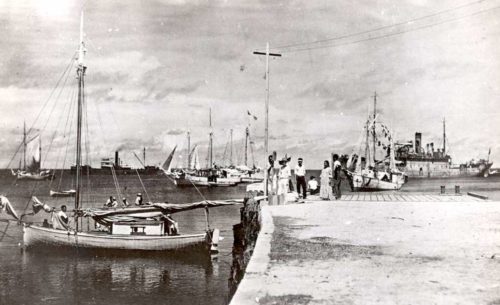
That’s a silly question for many people, because they think the answer is rather simple: Earhart and her navigator Fred Noonan tried to go around the world in 1937 and crashed into the ocean. But there have been many theories that Earhart and Noonan actually landed their plane in the South Pacific and survived, at least for a while, and either they perished on an island because they were injured and hungry or they were captured by the Japanese and abandoned by the U.S. government. The latter theory got a big boost from a new History Channel special that aired on Sunday.
The evidence that’s getting the most hype is a (supposedly) newly discovered photograph that might show Earhart and Noonan on a dock after their plane landed, and it might even show the plane being towed by a Japanese ship. The special goes through the usual interviews with experts, photo analysis, face and body recognition tests, and interviews with eyewitnesses and officials, but it’s really hard to say if it makes sense or not. While you can watch the special and think that they make a good case, you also have to pay attention to evidence that came to light this week that (might) show that the photo was either taken a couple of years before Earhart and Noonan made their flight or maybe a few years after. And if other experts can’t decide on when the picture was taken, it’s going to remain a mystery for many people.
I’ve gone back and forth on this over the years. I thought I was going to find the History Channel special ridiculous, but a lot of it was convincing. And it wasn’t just that photo. It’s really just another piece of evidence the show presented along with other government documents and eyewitness accounts. But at the same time, the evidence that the photo was taken at a different time is rather compelling too, and no one can really tell who is in the photo anyway.
So, to summarize: Did Earhart and Noonan survive but die of starvation on an island? Yes. And no! Did Earhart and Noonan survive but get captured by the Japanese? Yes. And no! Did they crash into the water and were never found? Possibly!
Emmy Nominations
The nominations for the 69th annual Emmy Awards were announced yesterday morning. You can read a complete list of the nominations here, so let’s talk about what wasn’t nominated.
The biggest snub for me is the same snub that happens every year: The Middle got ignored. I don’t understand how the show and its cast get no love while Modern Family is fawned over every single year (and it got another Outstanding Comedy nom this year). It’s truly one of the great Emmy mysteries of the past 69 years.
Other people and shows not nominated include The Tonight Show (even though The Late Show, The Late Late Show, Full Frontal, Jimmy Kimmel Live, Last Week Tonight, and Real Time with Bill Maher were all nominated), Richard Dreyfus for playing Bernie Madoff (Robert DeNiro got a nomination for the other Bernie Madoff movie), and no Outstanding Drama nomination for The Leftovers.
I will mention two people who were nominated because we talked about the show they were nominated for just last week. Both Susan Sarandon and Jessica Lange were nominated for Feud: Bette and Joan. Even in 2017, Bette and Joan are going to battle each other.
The Emmy Awards will be broadcast September 17 at 8 p.m. on CBS.
Be a Coffee Achiever!
Every week, it seems that something that was shown to be bad for us is now good for us. This week it’s coffee! Coffee has been shown to be bad for us because of all the caffeine but also good for us because certain compounds in coffee may have an effect on everything from Alzheimer’s to cancer. The latest research shows that people who regularly drink coffee live longer, in general, than people who don’t.
This will be good news for people who actually can’t even function without having at least one cup on the morning, though it must be said it’s not a license to suddenly suck down more Venti Mocha Frappuccinos from Starbucks.
Evil Villains, Fun Stamps
The United States Postal Service is releasing 10 stamps tomorrow featuring villains from various Disney animated films, including Cruella De Vil from 101 Dalmatians, the Queen from Snow White and the Seven Dwarfs, Scar from The Lion King, and Captain Hook from Peter Pan.
The Farmer Who Cloned Wimbledon
I thought I was obsessed with tennis because I have been watching every second of the Wimbledon Championships that are currently going on in England. I do this with almost every tennis tournament, but I don’t think I love it so much that I would take the time to re-create a tournament in my backyard.
But that’s what this guy did. He has fond childhood memories of listening to Wimbledon matches via shortwave radio with his grandfather, so he decided to build a Wimbledon replica on his Iowa farm. And as you can see from the video, he’s not the only one who uses it.
RIP Sheila Michaels, Spencer Johnson, Kenneth Silverman, Nelsan Ellis, Randy Schell, Ji-Tu Cumbuka, and Joe Robinson
Although she didn’t invent it — it was being used in steno books for a while — Sheila Michaels was the person responsible for bringing Ms. into our vocabulary. She died June 22 at the age of 78.
Spencer Johnson was an author who wrote the bestselling business books Who Moved My Cheese? and The One-Minute Manager. He died Monday at the age of 78.
Kenneth Silverman was an author as well, having written biographies of Cotton Mather, Edgar Allan Poe, Samuel Morse, Harry Houdini, and composer John Cage. He died last Friday at the age of 81.
Nelsan Ellis was a regular on TV shows like Elementary and True Blood and was in movies such as The Help. He passed away last week at the age of 39.
Randy Schell was an actor whose voice you heard on shows like Blindspot, Life in Pieces, and Fear the Walking Dead (a prequel series to The Walking Dead), and in commercials for McDonald’s, Geico, Coca-Cola, Nike, and many other companies. He died Saturday in a skydiving accident. Schell was 64.
Ji-Tu Cumbuka was an actor who had roles in movies like Harlem Nights and Bachelor Party as well as in TV shows like Roots and A Man Called Sloane (he played Robert Conrad’s friend with the steel hand). He died Tuesday at the age of 77.
Joe Robinson played the bad guy that James Bond beats up in the elevator in Diamonds Are Forever. He also had roles in A Kid for Two Farthings and The Loneliness of the Long Distance Runner, and he also taught fighting to many actors. He died July 3 at the age of 90.
This Week in History
Henry David Thoreau Born (July 12, 1817)
Here’s a great piece by Post Archive Director Jeff Nilsson on the Massachusetts philosopher and poet and how he was an unlikely hero in the fight for personal liberty — plus a funny piece about how Thoreau might have responded to the publishing industry of the 1960s.
Live Aid Concerts Held (July 13, 1985)
I’ve always felt a kinship with musician Phil Collins. On the same day he was doing double duty in the all-star mega-concert for charity, taking the Concorde so he could perform in both the London and Philadelphia venues, I was working a double shift at a pizza restaurant. We watched it on the big-screen TV with the customers.
This Week in Saturday Evening Post History: “Billboard Painters” (July 13, 1957)
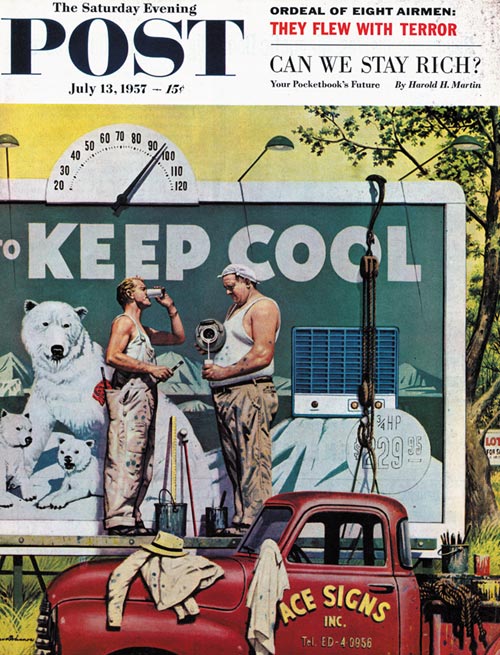
Stevan Dohanos
July 13, 1957
This cover by Stevan Dohanos could be called the sequel to the February 14, 1948, cover Dohanos did for the Post, which depicted the billboard painters working in the middle of winter, dreaming of an escape to a warmer place.
Summer Drinks
According to the weather widget on my computer, it’s only 76 degrees as I type this. But with the humidity factored in, things can only be described as … “gross.” I need something cold.
Here’s a drink named after someone I mentioned above. No, not Phil Collins (I’m not aware of a drink named after the singer); it’s The Amelia, named after Amelia Earhart. I actually found two different recipes for cocktails named after her, but this one seems to have more history behind it, and it’s a variation on the classic Aviation.
And since coffee is so good for us, how about a recipe for an easy iced coffee? You know it’s the truth because it’s actually called Easy Iced Coffee. It’s just a little warm water, instant coffee, sugar, and milk.
I don’t know if this coffee drink will actually help you live longer, but you’ll live long enough to hear the inevitable news that coffee is once again bad for us.
Next Week’s Holidays and Events
Game of Thrones Season Premiere (July 16)
I don’t watch the show (for the entire first season I thought it was called Game of Thornes), but it sure is popular! The seventh season starts Sunday at 9 p.m. on HBO.
World Emoji Day (July 17)
This is the day the world celebrates emojis (also known as “every day”). If I cared enough about them to actually use them, right here there would be a little picture of a globe, a calendar, and maybe a yellow smiley face.
The Absence of Sound
Timothy stood at the fountain, his hand inside his coat pocket rubbing two quarters against one another. He’d walked past this fountain on his way to work at the library hundreds and hundreds of times and had never thrown his money in, but today he did think about it. Although, what would he wish for? There wasn’t anything to wish for exactly.
He had gotten up in the middle of the night, as usual, getting a bleary-eyed drink of water in the dark and visiting the bathroom, and realized only in the morning that he had not heard the sound of his cat Bipsy’s paws trotting behind him. She was old, but still she followed him everywhere. How had he not noticed the absence of that particular sound? It was as though he had failed to notice the stopping of his own heartbeat.
He’d felt all strangled inside when he figured things out. Now what? he’d kept thinking as he made the coffee and packed his lunch for work in silence. Now what?
Author, Author!
Don’t miss new books from Great American Fiction Contest authors:
• 2013 Winner Lucy Beldsoe, A Thin Bright Line (UW Press, 2016)
• 2015 Winner N. West Moss, The Subway Stops at Bryant Park (Leapfrog Press, 2017)
• Judge Michael Knight Eveningland (Atlantic Monthly Press, 2017)
Timothy looked up at the branches of the London planetrees overhead in the park and could see birds everywhere, busy busy busy. April was the right time for them to be swooping between treetops and lampposts, hopping on the ground for muffin crumbs. He mourned never learning their names. His mother and brother had known the names of birds, but he’d never latched on. They could tell one song from another, could look up at the under-wing of a bird lofting up like a kite against the blue sky and say “peregrine falcon” or “turkey buzzard” in hushed and intimate tones to one another. He was never part of their circle but had watched from the side, a tiny little circle of his own, intersecting nothing.
Timothy could tell a seagull (white) from a crow (black) from a cardinal (red). He’d studied an illustration of a stork in a Hans Christian Andersen story, but his knowledge wasn’t advanced enough for him to be certain whether or not there was a difference, say, between a crow and a raven, or between a stork and an ibis, a heron or an egret. Heron and egret and ibis and stork might all be different names for the same thing, as far as he knew.
It was too late now to wish for the intimacy of family. His mother was decades gone, and his brother had gone off to Kuwait a long time past, and had come home essentially gone years before he’d died. Something had shaken his brain loose is how Timothy had pictured it, and everything that had been his big brother had effervesced like the escaped air from inside a popped bubble.
The loss of Timothy’s cat made the loss of his brother fresh again, made the absence of the whispers between his brother and mother echo, reverberate as though Timothy were standing in an enormous, empty room. They had been easy friends with one another, his mother and his brother, but Timothy hadn’t decoded the language of their intimacy. Their closeness had been like a promise of eventual closeness for Timothy that he could not bring to flower.
The birds around him now were babbling. April was cruel, he thought, just as Chaucer and Eliot had promised back in college. The flowerpots in the park were full of hyacinth and daffodil bulbs, their buds bursting up through the dirt like aneurysms. The bunched buds swelled up and unfolded their redolent petals until they sagged open, calling to bees. He could almost hear the birds above puffing out their chests, their songs like screams, hopping onto one another’s backs to fight or mate. The park was positively indecent with procreation.
He sank, contented in his own invisibility, and watched.
Just do it, he told himself, and took both quarters out. Plash and then plash. He didn’t wish for anything, just thought Bipsy and then Bipsy as each coin sank beneath the water and rested on the cool stone bottom.
Timothy hid his face down inside his coat’s collar as he walked around the fountain and onto the gravel path. He knew that beneath his feet were the two floors of library stacks, what had been called the Bryant Park Stack Extension, that the employees of the library called BIPSE. It’s how he’d come to name his cat. It was spectacular down there, well lit and every inch waterproofed, a self-sufficient world of temperature and humidity controls, filing cabinets, microfiche, and moveable shelves. And 26 feet below that (he had been told) there was a stream, carving its way through the cold dark rocks that held the city up.
If you turned it all upside down, there was as much unseen beneath New York City as what lay on top of it. And as much inside each person Timothy passed as all of it combined.
He sank inside his own indistinctness and walked past the new sod, rolled out each April after the skating rink was heaved up, packed on trucks, and put into storage for another year. At the 40th Street loading dock entrance to the library, he held up his ID card. Manny said, “Morning,” and Timothy raised his hand in a wave, curling up the corners of his mouth to approximate a smile.
His little desk seemed far away as he slipped down the side stairs where he wouldn’t likely see anyone, through a door where he had to swipe his ID card, down the long white hallway (more like a brightly lit tunnel) and past the vault where special books were held. He wasn’t allowed in the vault, with its John James Audubon original double-elephant folio from the 1800s, and William Blake’s engravings from Songs of Innocence and Experience from the 1700s, touched by the artist’s very own hands. Blake had written “A robin red-breast in a cage/puts all Heaven in a rage.” Timothy knew what robin redbreasts looked like. They were self-explanatory. There were documents in that vault that were so important that Timothy wasn’t even allowed to mention them. And the people allowed in the vault had to wear white cotton gloves if they meant to touch anything.
Down and down he went, where the smell of reinforced spines of old books on thick paper reached him like violets. He could breathe here. And think. The only noise, the hum of the purring temperature and humidity controls. As the space grew narrower, Timothy felt better. Down he went to the second floor (the lower of the two), edging his way between the wall lined with microfiche cabinets and the stacks to where he had arranged his desk to be maximally hidden. Finally he was alone.
He had a coat rack that the guys in the carpentry shop had given him where he hung his coat, umbrella, and briefcase. When he’d first gotten the job, almost 40 years earlier, his mother had made him one of those little stamped labels with his name on it, and so Timothy’s full name was glued near the handle of the briefcase. Every time he saw it he felt a soup of nostalgia and pity for his mother, so long gone, and for himself too. He knew it was sad for a man in his 60s to carry a briefcase with a label from his long-gone mother that was peeling up at the edges. But what was he supposed to do? Pry the label off and throw it out? For what? For whom?
He sat down, turned on the computer, and straightened out the NYPL pins he had arranged at the base of his desk lamp, representing his 10, 20, and 30 years of service. He was due another pin soon. Then he downloaded the book requests he’d received. It was only 9 a.m., and there was an enormous list of books to pull and send upstairs. It would be a blessedly busy day.
Later, as he was eating his cheese sandwich and checking for new requests, he heard a shout approaching from far away. “Timmy!” It was Lloyd Calaban, he of the glossy black hair and easy laughter. Everything seemed so easy for Lloyd, who was able to glide through life without worrying, it seemed. It was hard to imagine Lloyd, for instance, waking up at three in the morning, suffocating from loneliness. Timothy was aware that his own pallid face and high-arching eyebrows could discomfit people. He tried to soften his face, to make himself look less surprised by squinting his eyes before Lloyd came around the corner. The squinting sometimes helped, but the way his hair had thinned and receded made him look like a sinister clown. Timothy stood up to meet Lloyd, and then thought better of it and sat back down. Too eager.
“I know you’re here somewhere,” Lloyd called.
“Yes,” Timothy croaked, standing up and then sitting down again, clearing his throat. “I’m here!” He tried to sound as though he’d been speaking to people all morning. Lloyd started around the corner, all smiles, and Timothy met him with a sudden wanting-to-be-known-by-him. He wanted to tell Lloyd, for instance, that he had a collection of 73 antique bookmarks at home, and that he knew how to play the recorder, and that he had eaten caramels at his aunt’s farm in upstate New York one summer as a boy, but he said nothing.
He felt especially isolated around Lloyd’s expansiveness, which trumpeted out ahead of him like a red carpet that Lloyd himself rolled out wherever his feet went. Timothy wanted Lloyd, or someone, to know how much he loved his job, and that he’d had a cat named Bipsy for 17 entire years, and that he was encouraging to her about how pretty she was, and how safe he’d keep her. He wished Lloyd could have seen them together watching Jeopardy! every weeknight, Bipsy on the back of the couch, reaching out one paw and resting it on Timothy’s shoulder.
Lloyd came toward him like a sun shower. “Tim-MAY! How’s it going, man?”
“Oh, just fine. Busy morning.” He couldn’t think of anything else to say, felt a blush coming up his face.
“Listen,” said Lloyd, “could you help me out? I’m being pulled in a million directions, and Melanie needs this, in her hand, ASAP.”
Timothy reached his hand out for the request slip. “I’d be happy to,” he said.
“She’s mad at me,” said Lloyd, grinning, leaning against the metal microfiche cabinet. “Fixed me up with her sister and, well, you know, those things never work out, but I want to give her time to cool off, and she wants this, like, yesterday, you know?”
“Yes, yes, I can do it for you.”
“But, like, you have to do it now, buddy. I’m sorry to ask you to do this. I’m sure you’re in the middle of other stuff.”
“It’s no problem at all,” said Timothy, heat rising up through his cheeks and past his pale, high eyebrows.
“I owe you one, buddy,” said Lloyd, pointing his finger like a gun at Timothy and winking. “I owe you one.”
“No, no,” said Timothy, beaming. He loved the idea of Lloyd owing him one. When Lloyd had gone, Timothy tried out the gun hands, and then went to find the book that Melanie needed. She was efficient, Melanie was — neither friendly nor unfriendly, but busy and no-nonsense. She was important, had to deal with board members and donors. If she needed this book right away, he’d get it for her. He felt like Superman.
“I’m on my way,” he said under his breath, giddy, rushing to the stacks. There he pushed the button that separated the shelves from one another. He could hear the mechanism whir as the shelves slid apart, creating an aisle for him. Timothy’s focus was laser sharp as he ran his finger along the numbers on the shelves until he came to the right place, pulled the cardboard sleeve out, and found Melanie’s book. He put the request slip inside the front cover, hugged the book to his chest, and rushed out of the stacks and up toward the public part of the library, his pulse racing.
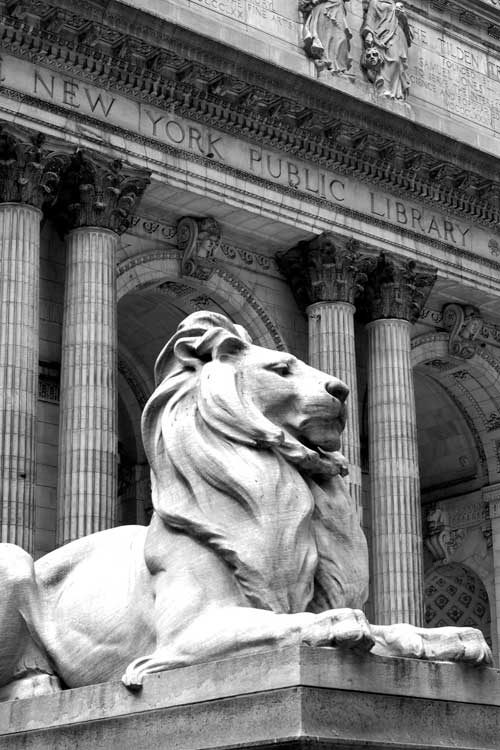
Timothy walked quickly through the tunnel, up one set of stairs and the next, and then over to the main part of the library, just below the first floor. He slowed as he reached the busy lobby toward the Fifth Avenue entrance near the famous lions, Patience and Fortitude, and stopped near the top and peered up into the crowd of people; the guards at the revolving door checking bags, the sunlight pushing weakly in, the homeless man who came in every lunchtime and slept in the reading room for an hour, and dozens and dozens of people looking up and zigzagging unpredictably in and out toward the main exhibit, or up the stairs or toward the gift shop, just like the birds in the park.
He blinked and tried to soften his face, knowing that he would look spectral to anyone who turned and saw his pale, startled head floating there. He imagined how scary that might look and forced himself to keep moving up. And as he thrust himself forward up the final stairs, his shoe-tip caught the lip of the top step.
And he flew.
For just a moment.
Up through the air.
In slow motion.
Melanie’s book flew, too, up above him, the pages fluttering, and he thought how the book looked like the bone in 2001: A Space Odyssey tumbling end over end. Timothy reached his hands out as though he were an athlete of some kind, a quarterback maybe, and caught the book as he slid under it along the stone floor and came to a halt, his eyes shut, his heart pounding, time returning to normal speed. He could hear people gathering around him cooing, and wished he could melt away under the eyes that he felt staring down at him.
“You all right?” It was a woman’s voice nearby. He opened his eyes. A pale 50-ish woman leaned over him, her eyebrows knit in worry, her lips a bright matte-orange slash in the middle of her face. Her hands were fluttering like moths around him. She knelt down next to him, and for the second time that day, he felt a blush rising up in him as he lay there clasping Melanie’s book. “You okay?” she said, patting his hand.
She’d touched him. He became very, very still. “You okay?” She was smiling and he felt a surge of love well up in him for the pumpkin orange of her lipstick and the way she had no real chin, and for her hands, trembling like birds’ wings do when they are in a birdbath.
He blinked once, twice. “My cat died last night,” he told her. There, he’d said it, and could feel the ribs in his rib-cage loosen.
She leaned closer and her lips made an O. “She was curled up in a ball this morning, her tail over her nose.” And then, as though she had asked him a question, he said, “Bipsy. I called her Bipsy.”
The woman smiled.
“She was 17 years old. I got her after 9/11 from the pound.” His mouth felt very dry, and he stopped talking and blinked up at her. He should probably try to get up. He wondered if he should tell her that, not knowing what else to do, he had finally put the cat in a plastic Food Emporium bag and thrown her down the garbage chute, but he decided to keep that to himself.
“Hey,” she said, still smiling down at him, but starting to unkneel. “Hey! I know you!” Her eyebrows came together as she tried to figure out where she knew him from. “Yes, yes, I know you.” His heart quickened, and he felt tears in his eyes. She knew him? She knew him. “You threw money in the fountain this morning. I saw you.” She had seen him, and she saw him now. She could see him.
She laughed and held out her hand to help him up, and the crowd that had gathered backed up a step.
“I saw you is all,” she said. “What are the chances of that, that I’d run into you twice in one day in this city?” She turned to no one in particular and said, “What are the chances of that? I see this guy throwing money in the fountain this morning, and the next thing I know, he falls right at my feet in the library?”
The group was dispersing, but a few responded by shaking their heads or murmuring to one another before turning away. He felt all their circles intersect, or felt the pull of their now-separating circles.
The woman with the orange lips said, “Maybe I’ll see you around.” She smiled a real smile that made her eyes crinkle up, and she touched his shoulder. “Crazy city, right?” He nodded and blinked against the wetness in his eyes.
Timothy slipped behind one of the massive columns to peek back around at where he had just been lying, at the way the sun poured in over the moving people, how every second was like a snapshot, a new one each moment.
He should have told her about how he could play the recorder, and about the caramels he’d eaten at his aunt’s that summer in Upstate New York. But memory was a kind of accomplishment in itself. And if he’d run into her twice in one day, perhaps they’d be thrown together again. He rested his cheek against the cool marble pillar. He remembered, then, why he was upstairs, and he hurried to deliver Melanie’s book to her.
As he passed the fountain on his way home that evening, he stopped again. Way back on 9/11, he had almost thrown money in. That had been the only other time he’d even considered it. The subway stops at Bryant Park. That’s what people always said, but on 9/11, when they let everyone out early from the library, he had crossed through the park on the way to his Hell’s Kitchen walk-up. It was at the fountain that he’d become aware of the lack of sound and vibration under his feet. The subways weren’t running for the first time in his whole life, and there was a stillness he couldn’t fathom, like a penny dropped down a well that never splashed.
There had been no way into or out of the city that day, and he had stood in the silent park with a handful of pennies ready to throw into the fountain as a gesture against hopelessness, but he’d been waved away by the National Guard with their guns, everything deranged and toppled together in his mind. The fires and the fallen towers smelled like burning rubber, and like concrete smashed into bits light enough to float, and like the scent of unsettled souls. Were there particles of people in the air? Of course there must have been.
His awareness of the silence of the stopped subways beneath the park had never dissipated, and now it got layered beneath the missing sound of Bipsy’s paws thumping down off the couch behind him. The space of her absence would make a palpable presence of its own, like the repercussive silence of the subways, and the music of his mother and brother whispering the names of birds back and forth, call and response, while he stood apart and listened.
N. West Moss was the winner of the Post’s 2015 Great American Fiction Contest for “Omeer’s Mangoes,” which, with “Absence of Sound,” appears in her first short-story collection, The Subway Stops at Bryant Park (Leapfrog Press, 2017). This story first appeared in Neworld Review. Her work has appeared in The New York Times, Salon, McSweeney’s, and Brevity, among others. For more, visit nwestmoss.wordpress.com.
This article is featured in the July/August 2017 issue of The Saturday Evening Post. Subscribe to the magazine for more art, inspiring stories, fiction, humor, and features from our archives.
Movies for the Rest of Us with Bill Newcott: Action Flicks for Grownups
Award-winning film critic and writer Bill Newcott has been covering Hollywood for more than 40 years. He is the creator of AARP’s Movies For Grownups franchise and the movie critic for The Saturday Evening Post.
Saturday Evening Post movie critic Bill Newcott reviews two action flicks that are definitely not just for kids and one seriously haunting ghost story. Plus, for home viewing, Richard Gere talks about his unforgettable role as a persistent New York fixer and Marta Dusseldorp explains how she can play three starring roles on TV at the same time.
Listen to all of Bill’s podcasts.
When Wheat Turned the Streets into Gold
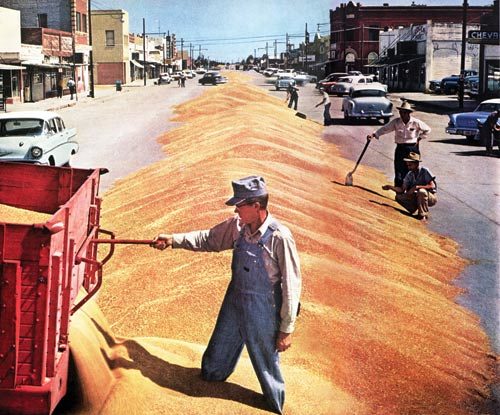
Each summer, the golden scythe of harvest sweeps more than a thousand miles across the ripe fields of wheat that checkerboard the Great Plains, writing a new ending to one of nature’s most suspenseful thrillers. For growers such as Roy Niebruegge, heaping his freshly threshed grain on the main street of Snyder, Oklahoma, this year’s story had its happiest ending — a yield so bountiful that it filled granaries to overflowing. The citizens of this wheat-belt town were happy, indeed, to lend their pavement last June for temporary storage of 50,000 bushels of the bumper crop which assures them another year of prosperity. Oklahoma’s record-breaking production of 113 million bushels would fill hundreds of miles of streets. And, as the army of combines now cut their way through later-ripening grain of the northern plains, the story is the same: The wheat that supplies our daily bread has won its yearly race against drought, rust, grasshoppers, hailstorms, and other possible disasters.
The only question is: Where shall we put it all?
—“Wheat in the Street,”
Face of America,
August 30, 1958
This article is featured in the July/August 2017 issue of The Saturday Evening Post. Subscribe to the magazine for more art, inspiring stories, fiction, humor, and features from our archives.
The Art of the Post: Gustaf Tenggren: The Man Who Shaped Disney’s First Animated Movies
When the Saturday Evening Post ran a cover story about Walt Disney in 1955, it needed to find a cover artist with two very different talents: one “who could accurately depict Disney’s famous [cartoon] creations and one who could handle the quite different job of portraying the cartoonist himself.” ¹ None of the Post’s regular cover artists would do. Art editor Ken Stuart launched a nationwide search for the artist he knew could do the job: Gustaf Tenggren. Eventually, he located Tenggren on a remote farm in Maine and persuaded him to paint this cover:
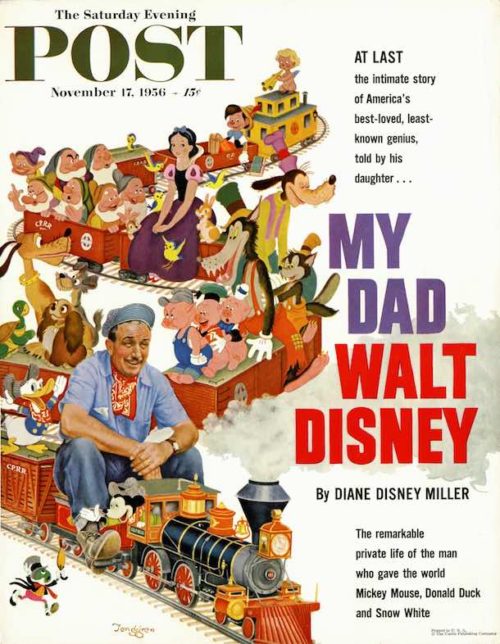
But what made Gustaf Tenggren uniquely qualified to illustrate this particular cover?
Like his cover, Tenggren combined qualities from very different worlds. Born in 1896, he grew up on a remote farm near Västergötland, Sweden. His father abandoned the family, leaving the boy to spend an impoverished childhood with his grandfather under primitive conditions and with few childhood friends. Yet by age 25, he was a successful illustrator in Manhattan. He then moved to Hollywood, where, combining the worlds of art and science, he played a key role in the birth of feature animated films for the fledgling Walt Disney Company. He was also the illustrator of the top-selling children’s book of all time, The Poky Little Puppy.
Tenggren eventually left the Disney studio because of artistic differences with Walt Disney. He lived in many places before settling down to live his final days on a farm in Dogfish Head, Maine, because it reminded him of the Swedish countryside. And that’s where the Post found him.
On June 22, 2017, Tenggren, who died in 1970, was inducted into the Society of Illustrators Hall of Fame.


Tenggren’s life is a good example of how artists can make creative use of varied experiences. As a young boy, he tagged along with his grandfather, who went door to door painting traditional Swedish designs in the homes of villagers. He recalled, “[M]y grandfather … was a woodcarver and painter, and also a fine companion for a small boy. I never tired of watching him carve or mix the colors he used when commissioned to decorate, with typical primitive designs, churches and public buildings in the community.”²
Tenggren couldn’t afford art school, so the local community arranged for an art scholarship, which changed his life. In 1920, Tenggren left Sweden with his new wife and headed for the United States, where work was plentiful. He settled in Cleveland and within six months was painting a cover for Life magazine (the April 1921 issue). He recalled, “Those were busy days, drawing for the Cleveland Plain Dealer, painting six posters weekly for Keith’s Palace Theater, fashion drawings for a department store, and at the same time working full time for an art studio.”³
Within two years, Tenggren moved to New York City. The boy who grew up on an isolated, rocky farm in Sweden loved the big city: “For many years my studio was in this great city. Work was plentiful and during this period I illustrated a number of children’s books.” Tenggren became a well-known book illustrator, working on classics like Mother Goose, Hans Christian Andersen, and Heidi. He illustrated at least 22 books between 1923 and 1939. He also illustrated fiction and advertisements for magazines. In 1934, Tenggren encountered a talent scout for Walt Disney, who was searching for artists to work on the world’s first full-length animated feature film, Snow White and the Seven Dwarfs. Tenggren jumped at the chance and moved out to California in the early spring of 1936 to start work as an art director on Snow White.


Famed Disney animators Frank Thomas and Ollie Johnston witnessed Tenggren’s great contribution at the formative stage of the creative process. They wrote:
Before any actual story work was begun, Walt would look for an artist of unique ability to make some drawings or paintings that would excite everybody. … He brought in top illustrators of children’s books, such as … Gustaf Tenggren to explore the visual possibilities of a subject. … These inspirational sketches started the whole staff thinking.
Tenggren drew upon his childhood experiences with his grandfather for some of the most dramatic scenes, including the rustic cottage of the seven dwarfs, the deep woods where Snow White flees from the hunter and the evil queen’s laboratory where she concocts the poison apple.
Filmgoers today may forget the significance of Snow White, but film critic and historian Roger Ebert wrote, “Snow White and the Seven Dwarfs was immediately hailed as a masterpiece. (The Russian director Sergei Eisenstein called it the greatest movie ever made.) It remains the jewel in Disney’s crown.” Technologically, Disney’s rich, colorful films were a great leap forward in expressive imagery.
Tenggren’s success with Snow White earned him an even greater role in Disney’s next feature film, Pinocchio. Biographer Lars Emanuelsson described Tenggren’s contribution:
The look of Pinocchio, on which he was engaged during the major part of 1938, owes much to Tenggren’s creative input. The interiors and exteriors, the Tyrolean clothing, the craftsman’s workshop, the painted dolls and toys and the decorated and carved wood work were all heavily influenced by the conceptual drawings Tenggren worked on while the film was in production.

Tenggren’s beautiful watercolors of the small towns with carved wooden beams and furniture, Geppetto’s workshop with its cleverly painted surfaces, and the underwater scenes remain some of the highlights of Disney’s art.
Tenggren also worked on the “Sorcerer’s Apprentice” section of Fantasia and on shorter cartoons, such as The Ugly Duckling, The Old Mill, and Hiawatha. Shortly after Disney started work on Bambi, he and Tenggren parted company.
In 1940, Tenggren produced his first children’s book bearing his own name, The Tenggren Mother Goose. This was followed by books such as the Tenggren Tell-It-Again Book, Tenggren’s Storybook, Tenggren’s Farm Stories, Tenggren’s Folk Tales, and Tenggren’s Pirates, Ships and Sailors. These books were highly popular. Tenggren and his wife were able to spend time traveling in search of a home where they could finally put down roots. They tried Mexico, Florida, and Cape Cod before deciding upon a farm in Maine, which they furnished with Swedish antiques.
Among his most important and best received projects during this period were Tenggren’s Golden Tales from the Arabian Nights which employed rich decorative middle eastern patterns in vivid images and The Canterbury Tales, which updated Chaucer’s classic for children. But he was best known to the general public for his series of Little Golden Books. He illustrated 28 books in this series between 1942 and 1962, including the classics The Poky Little Puppy, The Saggy Baggy Elephant, The Shy Little Kitten, The Big Brown Bear, and The Little Trapper. The prolific Tenggren continued to work from his home in Maine until his death from lung cancer on April 6, 1970.
Tenggren’s induction into the Illustration Hall of Fame confirms his key role at the dawn of animation and the importance of his many illustrated children’s books. His imaginative creations will long be remembered and enjoyed by audiences around the world.
1 source: Saturday Evening Post brochure Take Five, vol. 1, no. 7
2 They Drew as They Pleased: The Hidden Art of Disney’s Golden Age by Didier Ghez
3 They Drew as They Pleased: The Hidden Art of Disney’s Golden Age by Didier Ghez
Cover Gallery: Salute to the 50 States
From the lighthouses of Maine to the majestic Cascades of Oregon, The Saturday Evening Post has represented every state on its cover. Here are 50 of our favorites.
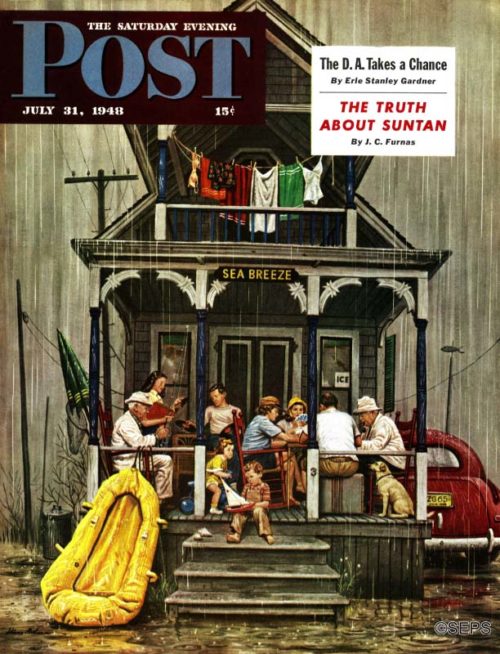
Rainy Day at the Beach
Stevan Dohanos
July 31, 1948
This lonely, wet house surrounded by raindrops and telephone poles would fit right in at Ft. Morgan Beach, Alabama, the narrowest strip of land with nothing but sand, sea grass, and a handful of houses.
Portage Glacier
John Falter
July 25, 1959
One overheated July day when artist John Clymer was motoring in Alaska he paused at this spot at Portage Glacier. People came and boated around beside the small bergs. Next day, when John returned to sketch, a change of wind had blown Mother Nature’s chopped ice over against the glacier, and the sketching spot was as hot as Tophet. The artist says no, he did not go over and take a ride on the glacier.
Prospector
Norman Rockwell
July 13, 1929
Rockwell portrayed many forms of transportation in his Saturday Evening Post covers. People traveled by car, train, boat, airplane, soapbox, and stilts, but there was only one way to observe the mountainous terrain of the West successfully – on the back of a mule. When Rockwell traveled through the West, he preferred to tickle his audience with human-sized details, rather than its awesome magnificence.
Evening Picnic
John Falter
August 18, 1951
Sometimes Nature rains on a picnic; sometimes she is just neutral; and sometimes, as in this mood caught by John Falter’s brush, she glories in the occasion herself, painting a magic sunset, smoothing the waterways into mirrors, tempering the temperature, even arranging for watermelons to be at their most luscious ripeness.
Santa Monica Pier Fishing
John Falter
August 13, 1949
On the long fishing pier at Santa Monica, California, tourists from all over the United States stand packed together like sardines while they try to catch fish. Many of the fishermen go through their routine calmly and expertly; occasionally a greenhorn flies into a tizzy, yelps for the landing net and hauls in a dwarf flounder or something else depressing. Artist John Falter was non-committal about whether he caught anything—besides a Post cover.
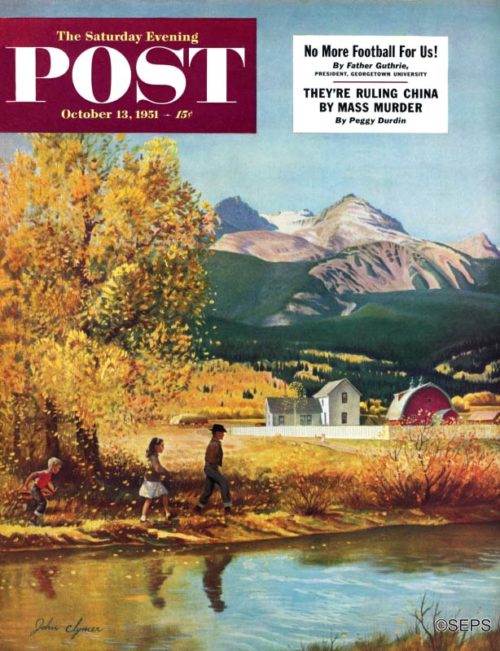
Colorado Creek
John Clymer
October 13, 1951
John Clymer, unable to put all of America on one canvas, settles for a mountain valley in Colorado, where pines and cottonwoods are waging a color battle in the foothills of the Rockies, while up beyond the timber line the slanting sun rays play a red-and-violet game of tag.
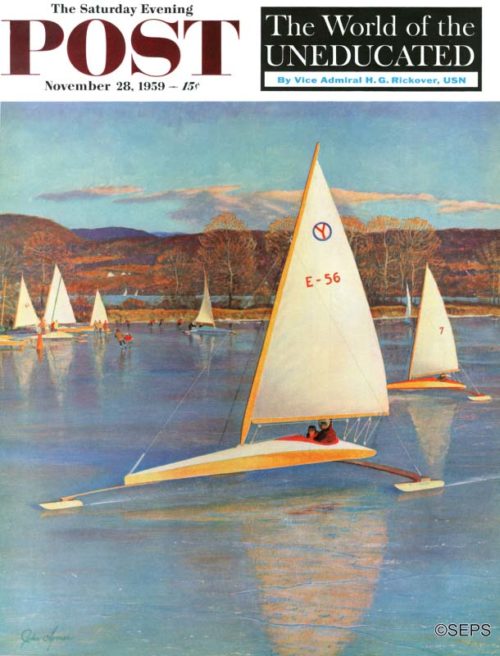
Sailboats
John Clymer
November 28, 1959
Hollanders started putting runners on boats circa 1750. Early United States ice- boaters appeared on the Hudson, where they raced New York Central trains. In 1959, ice-yacht clubs were likely to spring up wherever it didn’t snow too much but where water turned hard in winter. The original caption from 1959 claims this to be Lake Warren, Connecticut, but modern searching could find no such lake. Perhaps it’s Lake Waramaug, near the town of Warren.
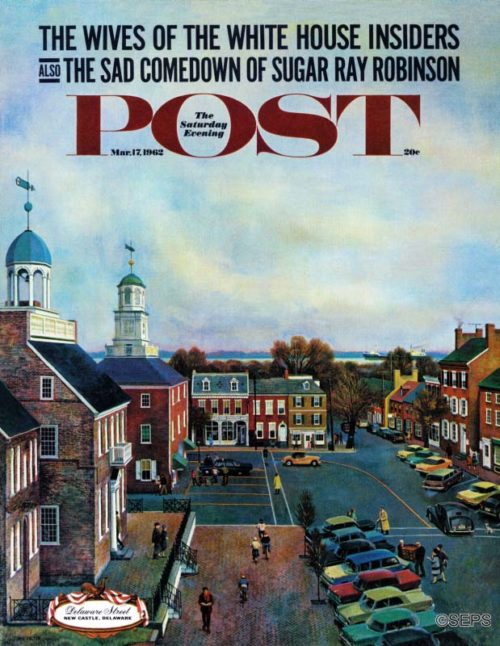
Town Square, New Castle, Delaware
March 17, 1962
New Castle, on the busy Delaware River, is six miles south of the state’s largest city, Wilmington, and two miles off the main highway. Once it was Delaware’s capital. Founded in 1651, it was William Penn’s landing place when he came to America in 1682. Penn is thought to have spent a night in the house at the extreme right of our cover. The spire atop the Court House (left foreground) was used as the center of a twelve-mile radius in part of the 1763-67 survey—to settle a boundary dispute—that resulted in the Mason-Dixon Line, which later played a key part in United States history.
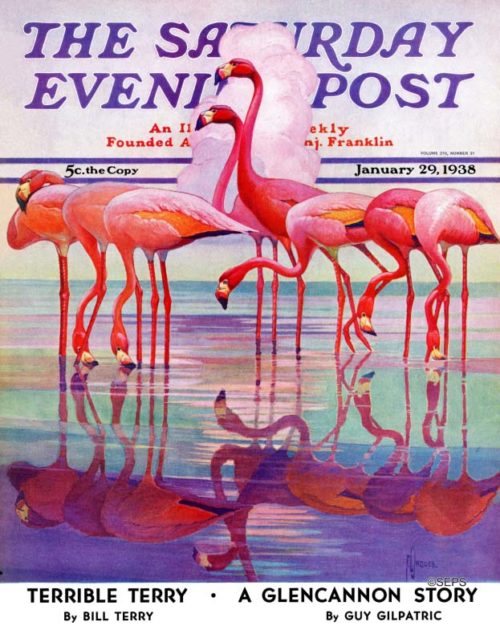
Pink Flamingos
Francis Lee Jacques
January 29, 1938
In the early 1800s, Florida was home to hundreds of thousands of Flamingos. By the turn of the century, the wild birds were all but gone from the state, eradicated by egg and feather collectors. In recent years, the birds seem to be making a slow comeback in the Everglades, a vast improvement over the plastic, front-lawn variety.
Peachtree Street, Atlanta
John Falter
June 25, 1960
John Falter depicted Peachtree Street at the Harris Street intersection, looking south toward Five Points. The gentleman on crutches at lower left is Ernest Rogers, who was an Atlanta Journal columnist and the popular “Mayor of Peachtree Street.”
First Vote in the New States
Constantin Alajalov
November 12, 1960
We couldn’t find a cover dedicated solely to Hawaii; here it must share billing with Alaska, the other “new” state in 1960. Cover artist Constantin Alajalov shows the citizens of each state waiting in line to vote in the 1960 presidential election (Nixon v. Kennedy—Kennedy won). Alajalov earned his voting rights the hard way. He was born in Rostov, Russia, and arrived in New York in 1923. Naturalized citizen Alajalov has produced a lighthearted scene, but his underlying message gives us pause: This amalgam of people living together in harmony is bright evidence of the democratic way of life they’re voting to preserve.
Fishing on a Mountain Lake
John Clymer
July 16, 1955
In America’s Western skylands are many jewel lakes, set in the gold and silver of clasping peaks. This looks to be in the vicinity of Sawtooth National Forest, but which mountain lake is anybody’s guess.
Michigan Avenue, Chicago
John Falter
October 15, 1960
The standard picture-post-card view of Chicago is of Michigan Avenue, looking north toward the Tribune Tower and Wrigley Building. Artist John Falter gives us instead a southern exposure of this elegant avenue—with the Wrigley Building and environs reflected in the camera lens at left. Behind the lofty buildings on the right is the Loop; facing them are the Art Institute, set in Grant Park, and Lake Michigan. The whiskered gent with sketch pad is the late Louis Sullivan, Frank Lloyd Wright’s mentor and an architect who helped reshape the face of this frisky city. (Sullivan had an office in Orchestra Hall, the second building from right.) We thought we had spotted another eminent Chicagoan, Al Capone, in the foreground. But Falter assures us we’re imagining things.
Monument Circle
John Falter
October 28, 1961
Monument Circle takes its name from the limestone memorial to soldiers and sailors at its center. And the circle is at the very center of Indianapolis, which is right in the middle of the Hoosier state. Artist John Falter discerned a faintly French flavor in this scene — perhaps because Indianapolis was planned on the pattern of Washington, D.C., which was laid out by a Frenchman. But consider the English Gothic architecture of Christ Church Cathedral at the left, the vaguely Tudor air of the neighboring Columbia Club, and the bluntly modern design of the Fidelity Building. French, English, or just plain American, the circle suits a city with a half-Greek name.
Corn Harvest
Mead Schaeffer
October 9, 1948
This Mead Schaeffer cover shows corn being picked by the “bang-board” method, which allowed a man to throw ears into the wagon without looking, because they would bang against a high board at the far side of the wagon and drop in. By 1948, most big farms used mechanical corn pickers, including the Lawton, Iowa, farm of Louis Peterson, the setting of this picture. The mechanical picker had already been used on much of the field, as the rows of stubble indicate, but the day Schaeffer was there, the machine was busy elsewhere. Farmer Peterson needed a little corn for his hogs. He got it the bang-board way—and Schaeffer got this cover.
Steam Engine Along the Missouri
John Falter
June 22, 1946
You are looking across one of the great rivers of America—the Missouri. You are in Kansas, gazing across into Missouri. The town in the distance is Armour Junction. Those flat fields across the way are likely to disappear when the Missouri gets one of its expansive moods. John Falter painted the scene when he visited a farm his father had just bought—painted it, in fact, from a bedroom window in the farmhouse. He had paints and brushes, but no canvas, so painted this one over an old picture that came with the house. The tagalong lad bringing up the rear of the little expedition—Lewis and Clark used the same route—is Falter’s nephew.
Green Kentucky Pastures
John Clymer
July 29, 1961
Our cover is a composite of scenes observed by artist John Clymer near Lexington. There may be gold—a future Derby winner, that is—among the foals behind the fences of that paddock. But none of the foals seems in a hurry to be over the fence and romping with Goldilocks and her three Dalmatians or thundering down the homestretch at Churchill Downs. Perhaps the reason is that the grass down here doesn’t always seem greener on the other side. This is Bluegrass country.
Spanish Moss Pickers
Mead Schaeffer
April 5, 1947
Artist Mead Schaeffer contributes another to our series of regional covers with a scene he sketched south of New Orleans, in the bayou country. Near Lafitte, Louisiana, he watched a harvest distinctive to the South. Moss pickers were hauling down boatloads of the beautiful Spanish moss that festoons trees in the South; the moss was dried and used in upholstering.
Lighthouse Keeper
Stevan Dohanos
September 22, 1945
The lighthouse on the cover is the West Quoddy Light, Lubec, Maine, but the lighthouse keeper is pruning the grass at Sankaty Light, Nantucket, a neat trick that can happen only in the world of art. What happened was that artist Stevan Dohanos made his preliminary sketches of the West Quoddy Light the summer before. The next year, to freshen his memory on lighthouse detail, he journeyed up to the Sankaty Light. It turned out the Sankaty Light had “a very strong personality of its own,” and wasn’t much good as a source of information on the situation in West Quoddy. However, they were cutting the grass at Sankaty Light, and Dohanos liked that touch of domesticity, so he included it.
Crabbing
Ellen Pyle
August 1, 1931
The Chesapeake Bay makes a great location for crabbing, with more than 7,000 miles of shoreline and plenty of piers to dip your net. Any good Marylander knows what to do with that fat crab, but these kids don’t look so sure.
Park Street, Boston
January 7, 1961
Welcome to historic Park Street circa 1961, looking north toward the gold-domed State House. To the left, Boston Common; to the right, the Old Granary Burial Ground, where lie Paul Revere, John Hancock and Samuel Adams. That’s Park Street Church in the foreground; its site is known as “Brimstone Corner.” The yule tree being carted off at lower left indicates that Christmas no longer is banned in Boston, as it was when the Puritans held sway. As for the 1913 Pierce Arrow approaching from the right, artist John Falter tells us it originally belonged to Boston astronomer Percival Lowell, brother of poet Amy Lowell.
Ice Fishing Camp
Stevan Dohanos
January 12, 1957
These shacks, which sit over fishing holes on the ice, are as cozy as living rooms, though less roomy, and they smell deliciously of coffee with occasional whiffs of kerosene.
Ore Barge
John Atherton
June 14, 1947
John Atherton’s cover painting is a view of the husky city of Duluth. This is the ship canal through which ore boats moved out to begin their travels in the Great Lakes. The ore came from the great Mesabi Range. Atherton chose a moment when the bridge had lifted to let one of the ore boats pass below.
Shrimpers
Mead Schaeffer
October 25, 1947
Mead Schaeffer turned south to Biloxi and its shrimp-fishing fleet. As one who sees shrimp most often in a cocktail, served pretty sparingly, the artist was slightly staggered by the size of the fleet and the volume in which they bring shrimp to the packing houses.
Kansas City
John Falter
September 23, 1961
Spanish architecture in Missouri? If such a state of affairs seems peculiar, consider that the unpredictable Show Me state even has a town named Peculiar (pop. 458), some twenty miles south of here, on U.S. 71. Our cover scene is in Kansas City, “the gateway to the Southwest,” and you are looking at the intersection where U.S. 50, gateway to the Country Club Plaza shopping center, crosses J. C. Nichols Parkway. This elegant community of shops was conceived and built by Jesse Clyde Nichols (1880-1950), to whom the fountain in the foreground is a memorial. The scene appealed to artist John Falter because the Old World architecture seemed to symbolize our nation’s roots — which is not to deny the notion expressed by lyricist Oscar Hammerstein in Oklahoma! that “everything’s up-to-date in Kansas City.”
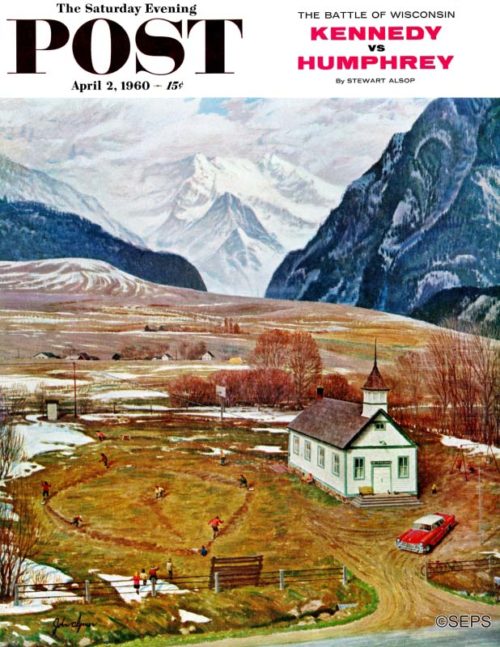
Recess at Pine Creek
John Clymer
April 2, 1960
It’s recess time in Pine Creek, Montana. Artist John Clymer had often passed this one-room schoolhouse en route to nearby Yellowstone National Park, thinking each time that it belonged on the cover of the Post. Clymer confesses that in order to get the part of the Absaroka Mountains on the canvas, he had to turn the schoolyard around.
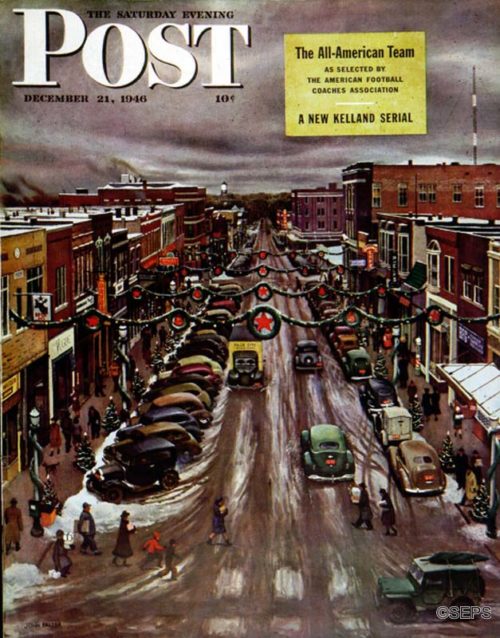
Falls City, Nebraska
John Falter
December 21, 1946
As a setting for his picture of the last-minute Christmas rush, John Falter chose the town where he spent his boyhood: Falls City, Nebraska. The finished job is a mixture of paint and recollection. That water tower in the distance, for example, was a favored roost for Falls City boys on hot summer nights. They liked to sleep there. City authorities met in some alarm — the surrounding platform is seventy-five feet above ground — and forbade it. Falter had no trouble recalling the Christmas rush. As a boy, he worked in his father’s clothing store on this street. A good many customers bought new outfits for the holidays, and young Falter was the pants runner — he ran trousers from the store to the tailor’s, to get them shortened. Only customers appear in this painting. But the artist’s sympathies doubtless are with those on the selling side of the counter.
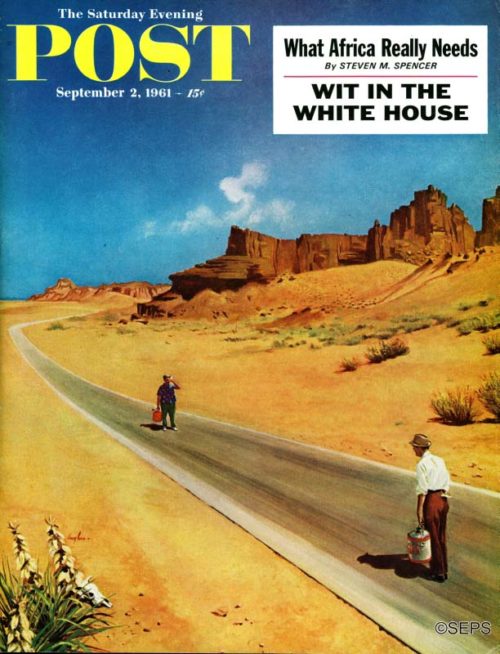
Out of Gas
George Hughes
September 2, 1961
The setting of this depressing encounter is not fifty miles from nowhere. This is nowhere. Artist George Hughes pieced together the landscape from some of the more desolate terrain of the Southwest, where the skies are not cloudy all day and where seldom is heard a discouraging word. Both pedestrians on our cover have, however, been subjected to some rather discouraging words: Exactly 2.6 miles in either direction is a fuelless automobile, and in each automobile sits a wife who was ignored earlier in the day when she suggested, “Don’t you think we’d better stop? The sign at that station says, Last Gas for 40 Miles.” And you should have heard the discouraging mutterings when these chastised males discovered that their spare-gas cans were drier than a sun-baked skull.
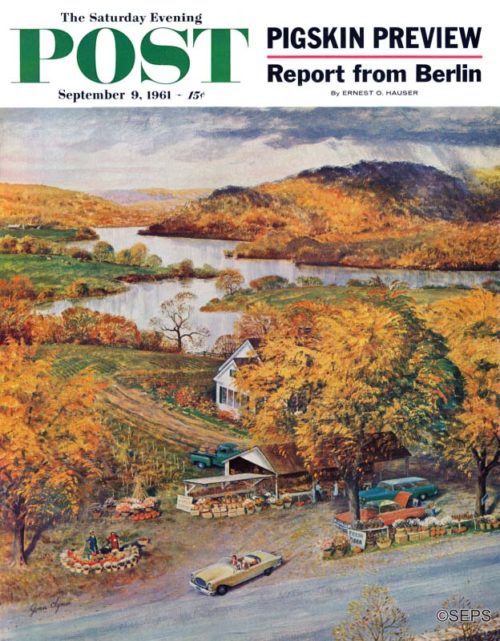
Roadside Vegetable Stand
John Clymer
September 9, 1961
What is more inspiring than the New England countryside in the fall? Indeed, the autumnal delicacies on sale in the foreground of John Clymer’s pumpkin-colored scene inspired us to turn to our bookshelf, where we found Henry David Thoreau saying, “I would rather sit on a pumpkin, and have it all to myself, than to be crowded on a velvet cushion.” (Although there’s no denying that pumpkins are more advantageously used in pies, soups and puddings.)
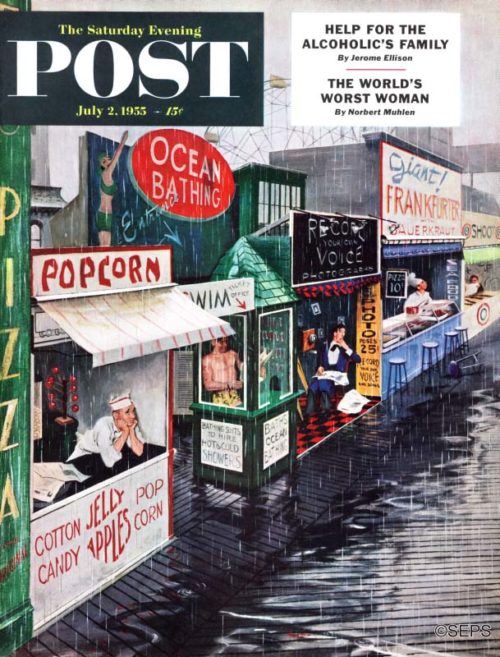
Rain on the Boardwalk
George Hughes
July 2, 1955
True, these poor fellows on Mr. Hughes’ boardwalk are heart-rending, also 5,000 souls sardined into nearby cottages, but as oceans are useless without water, can’t everybody resolve to observe this as Be Kind to Rain Week?
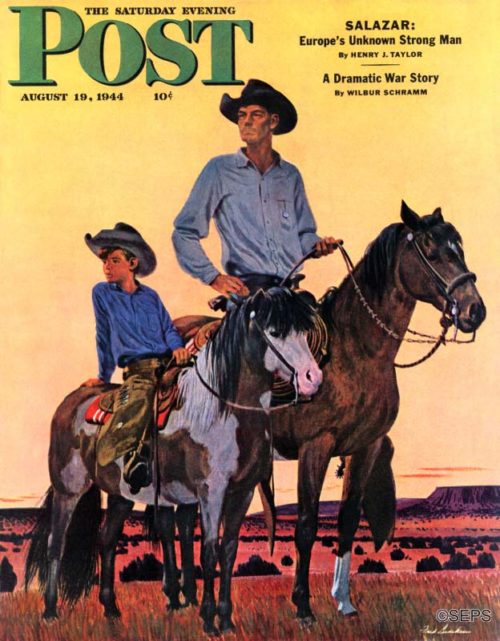
Surveying the Ranch
Fred Ludekens
August 19, 1944
Although Fred Ludekens lived most of his life in California, this scene has a distinctly New Mexican flavor. Ludekens never worked from photos and didn’t use models. Not one to limit himself to just one subject, Ludekens also painted interior images to accompany a Robert Heinlein story about interplanetary travel, which also appeared in the Post.
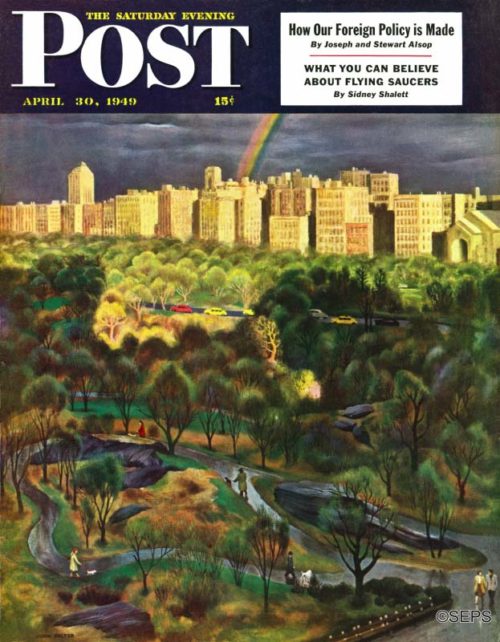
Central Park Rainbow
John Falter
April 30, 1949
When John Falter’s cover painting was accepted, there was lightning trickling down the sky beside the rainbow. Presently the Art Department began to worry—do lightning and rainbows ever show up at the same time? The ever helpful Weather Bureau was asked to look at the Post‘s storm—which has just doused midtown New York and is rumbling away beyond Central Park’s man-made ramparts. “Fair and cooler,” was the comment. “But we never saw a streak of lightning in such bright daylight. Of course, where weather is concerned, anything can happen.” So the picture was delightninged, leaving only that sign of clearing weather, a patch of blue sky large enough to make a sailor a pair of breeches.
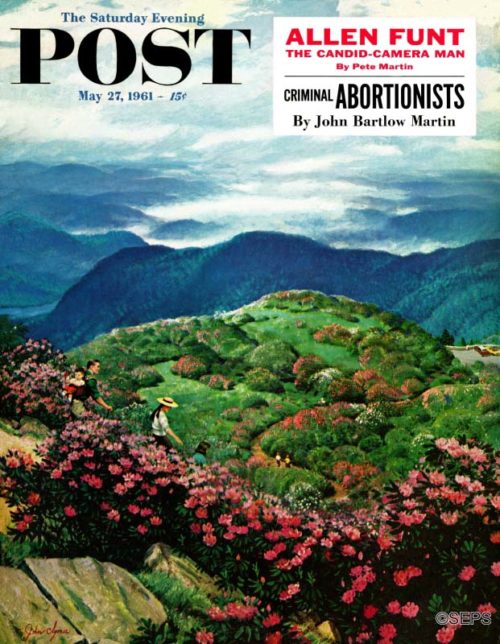
Appalachian Rhododendrons
John Clymer
May 27, 1961
Catawba rhododendron thrives in many sections of the southern Appalachians, but rarely is it so brilliantly beautiful as here at Craggy Gardens, along the Blue Ridge Parkway near Asheville, North Carolina. Our scene shows the trail to Craggy Pinnacle. “Sections of the trail wind through ten-foot-high rhododendrons,” artist John Clymer said. “And the ground is carpeted with the rich-pink petals of the flowers that have fallen.” Clymer’s painting is a preview of a coming attraction: These floriferous slopes look their best in mid-June, as they did in the days when the Catawba and the Cherokee held sway in the Carolinas.
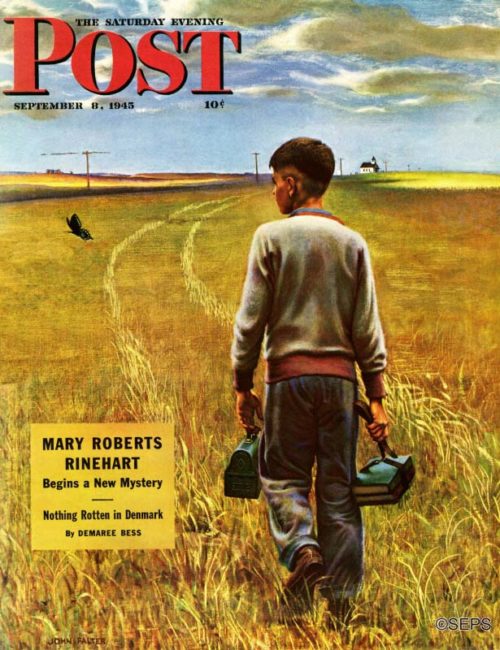
Amber Waves of Grain
John Falter
September 8, 1945
John Falter’s ” back-to-school ” cover shows a lad with a new haircut crossing the fields to a country schoolhouse. This is one that we’re not 100% sure is in North Dakota, but the scene landscape looks decidedly North Dakotan. If you’re from the state, let us know if you disagree.
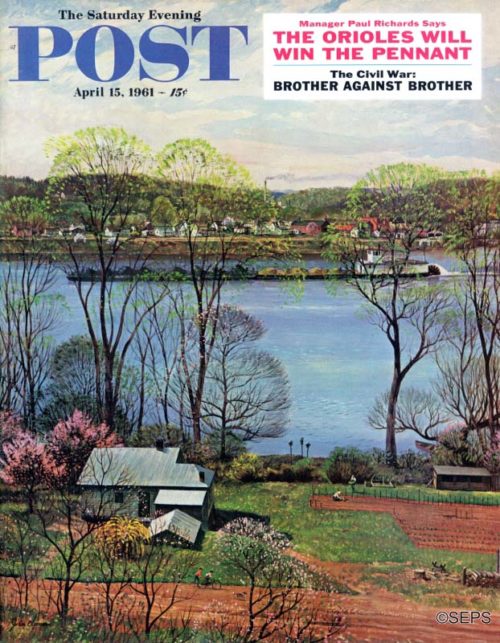
Ohio River in April
John Clymer
April 15, 1961
Heading down the Ohio is a venerable stern-wheeler, push-towing barges loaded with coal and gravel. Cargo by the tens of millions of tons is shipped up and down the Ohio in this manner each year, between Pittsburgh, at the confluence of the Allegheny and Monongahela, and Cairo, Illinois, where the Ohio empties into the Mississippi. (The watershed of the Ohio reaches into fourteen states.) Artist John Clymer formed his riverscape by piecing together the water’s-edge scenes that appealed to him most. The near shore is West Virginia; the far shore is Ohio.
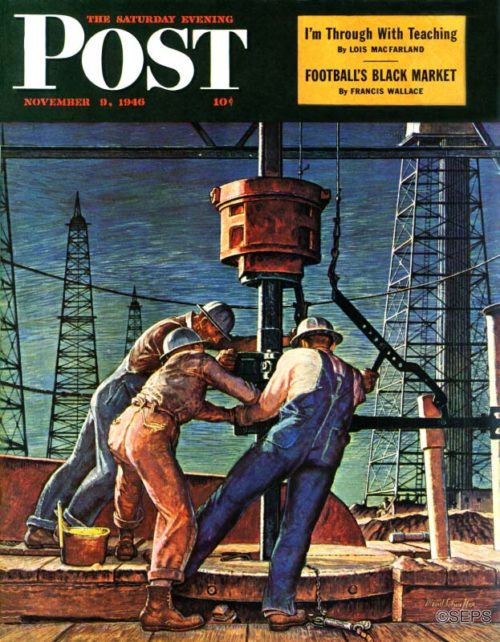
Drilling for Oil
Mead Schaeffer
November 9, 1946
Artist Mead Schaeffer and his wife worked near Oklahoma City, Oklahoma, for Schaeffer’s oil country cover—if you can call it ” working.” Had they come to town on a vacation, they couldn’t have had more of a social whirl. Their plane arrived just before sunrise and, much to the Schaeffers’ surprise, the fire chief’s red car was waiting. So was the mayor, who read a proclamation declaring them welcome and offered a key to the city. The Schaeffers found every minute they could spare had been booked for social engagements, and this was true throughout their stay. It was by all odds the warmest reception the Schaeffers have met in their travels working on Post covers, and they went away as impressed with Oklahoma courtesy as with Oklahoma oil.
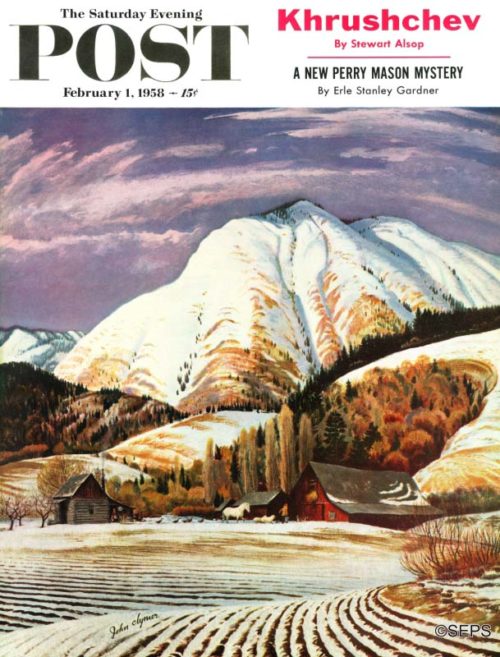
Cascade Mountain Farm
John Clymer
February 1, 1958
At length there’ll come a south-breeze day when the snow on the big hills will give Mr. Frost the heave-ho and begin rollicking down from the skylands in rejoicing cascades. That last word fits in here fine, come to think of it, for John Clymer’s scene is in the Cascade Range.
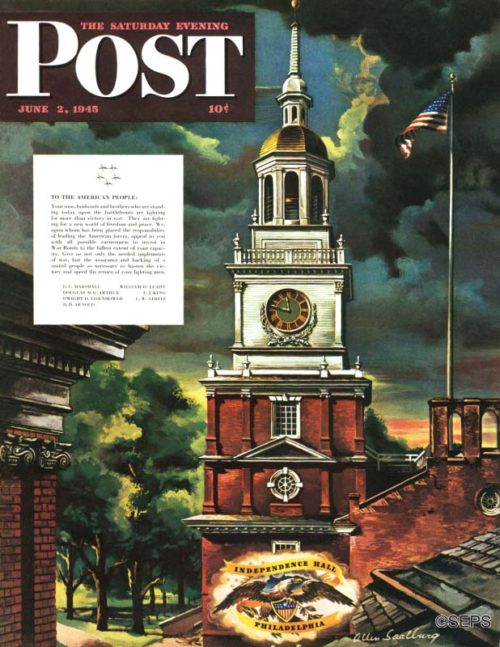
Independence Hall, Philadelphia
Allen Saalburg
June 2, 1945
In 1945, Independence Hall was just across the way from the Post. Allen Saalburg’s painting is a view of Independence Hall looking west. The building at the left was The American Philosophical Society. The Post‘s offices were directly behind the trees in the left foreground.
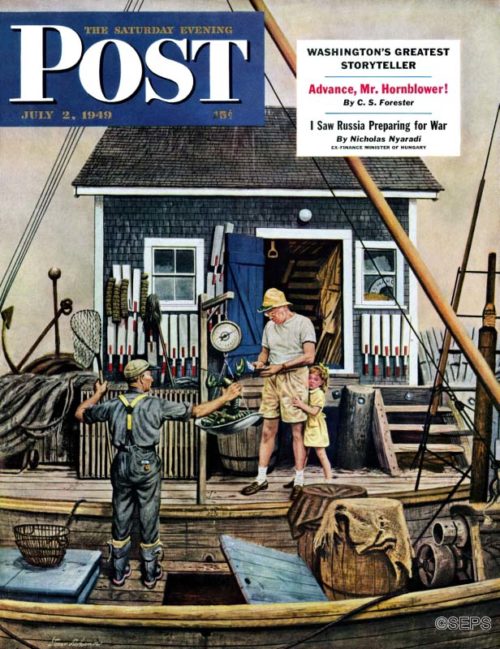
Buying Lobsters
Stevan Dohanos
July 2, 1949
The vacationer in the picture has been caught with that combination of mouth-watering smile and grimace of pain common to human beings when about to pay for a lobster. As for the little girl, you may be too old to recall that the first sight of a lobster is enough to scare the daylights out of anybody. After the first taste, fear vanishes.
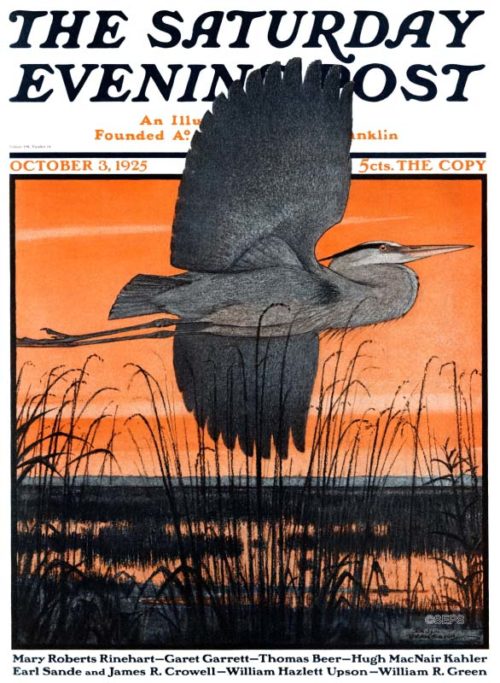
Marsh Bird
Paul Bransom
October 3, 1925
South Carolina has 344,500 acres of salt marsh, the most of any state on the east coast. This regal bird looks as though he’s happy to claim every last one as his own.
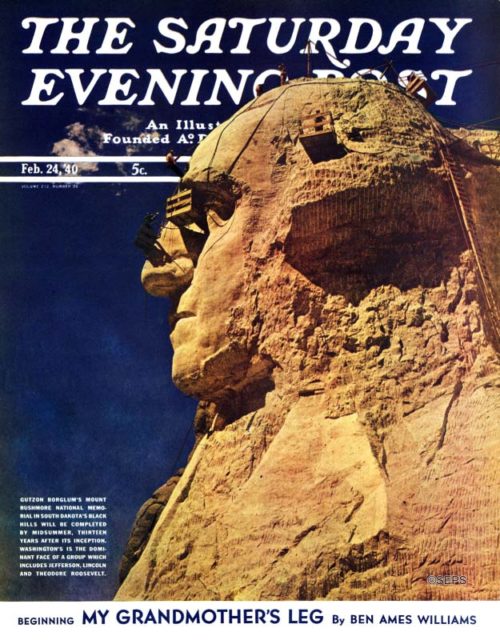
Mt. Rushmore
Lincoln Borglum
February 24, 1940
A photograph instead of an illustration was quite the departure for the Post at the time, but there was important information to document: Mt. Rushmore was scheduled to be completed later that year, so they took the opportunity to capture the monument during its final phase of creation.
Point Lookout
Richard Sargent
July 18, 1953
Papa has been steering the bus for three days toward Point Lookout, and, having finally made it, is he not justified in decrying the little ones’ disinterest in lookouting? On the other hand, for three days the kids have been peering at interminable scenery; so now that the car has quit jiggling and reading is possible, what is more dutiful than rejoicing in the new hooks that papa bought them to read? Of course, modern readers may long for the days when children were glued to books and not phones.
Flying Cowboy/ Airport at Amarillo, TX
Mead Schaeffer
May 17, 1947
“The cowboy carrying his pet saddle to his plane is an everyday sight in the West,” artist Mead Schaeffer wrote when he delivered this painting. “Many a rancher lives in town and commutes to his ranch or ranches by air. The tableland makes landing fields all through the West, and because of the long distances involved, the West takes to planes the way the East takes to cars. Many a business engagement, even luncheon engagements, are kept this way.” One of the flying ranchers, Lee Bivins, was Schaeffer’s model. The background is the airport at Amarillo, Texas.
Cowboy
Edward Penfield
September 22, 1906
Artist Edward Penfield is considered the father of the American poster and was an important figure in the field of graphic design. You can see Penfield’s development of the use of simple shapes and limited colors in this work. Are we sure this is Utah? No, but we can’t be too far off the mark.
Maple Syrup Time in Vermont
Mead Schaeffer
February 17, 1945
The models are Arlington, Vermont, neighbors of artist Mead Schaeffer’s, Mr. and Mrs. Jim Edgerton and their children. The Edgertons owned one of the best sugar bushes—a bush is a grove of sugar trees—in that section. The shed in the background is the boiling-off house. Vermont farmers can, and do, argue for hours and days over what is the best time to tap. The season starts as early as February and may end as late as April.
Blue Ridge Burro Ride
John Clymer
October 10, 1959
When those green highlands are seen from afar, they are blue, as highlands are wont to be. Hence, long ago somebody had an inspiration and named them the Blue Ridge Mountains. In the foreground you see a stationary burro, a detail which painter John Clymer probably considers a still life. It’s a pretty fair bet that fifteen minutes from now the animal will still be still.
Yakima River Cattle Roundup
John Clymer
May 10, 1958
This is the Yakima River in Washington, not far from artist John Clymer’s boyhood home in Ellensburg; here, one side of the stream (see irrigation canal) is for farming, and the other side for looking. At this river bend Clymer and his father often fished for trout and, furthermore, caught same. In case this lovely spot gives you ideas about temporarily leaving home, just off the bottom of the cover is U.S. Highway No. 10.
Ohio River in April
John Clymer
April 15, 1961
Heading down the Ohio is a venerable stern-wheeler, push-towing barges loaded with coal and gravel. Cargo by the tens of millions of tons is shipped up and down the Ohio in this manner each year, between Pittsburgh, at the confluence of the Allegheny and Monongahela, and Cairo, Illinois, where the Ohio empties into the Mississippi. (The watershed of the Ohio reaches into fourteen states.) Artist John Clymer formed his riverscape by piecing together the water’s-edge scenes that appealed to him most. The near shore is West Virginia; the far shore is Ohio.
Dairy Farm
John Atherton
July 19, 1947
Artist John Atherton paints an early morning scene in the rich dairy country of Wisconsin, where if all cows are not contented they are hard to please. It’s a section as sleek as its cows, where life has a very high butterfat content. The farm Atherton chose is near New Glarus, in Green County, a town settled in 1845 by Swiss from Glarus, Switzerland.
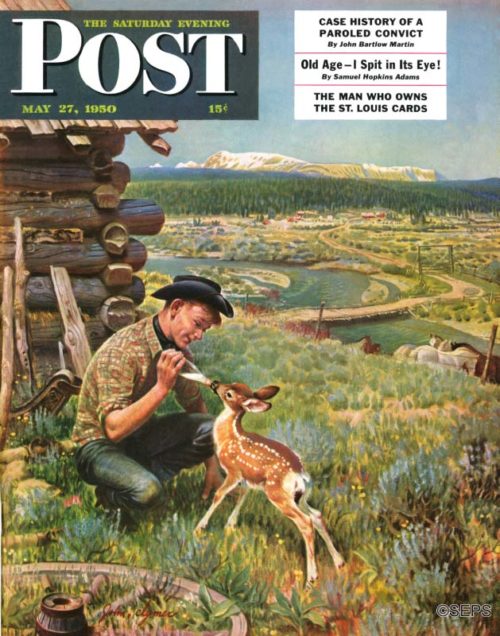
Feeding Fawn Near Flowering Field
John Clymer
May 27, 1950
Boys everywhere have pets; this variation of the pleasant practice is taking place in Wyoming. John Clymer kindheartedly omitted from the landscape the typical haystacks with ten-foot fences around them to persuade horses, cows, elk and high-jumping deer to go elsewhere in search of meals.