Long Live the Landline
Do you still have your old, corded phone? We have 7 Reasons to Keep Your Landline Phone.
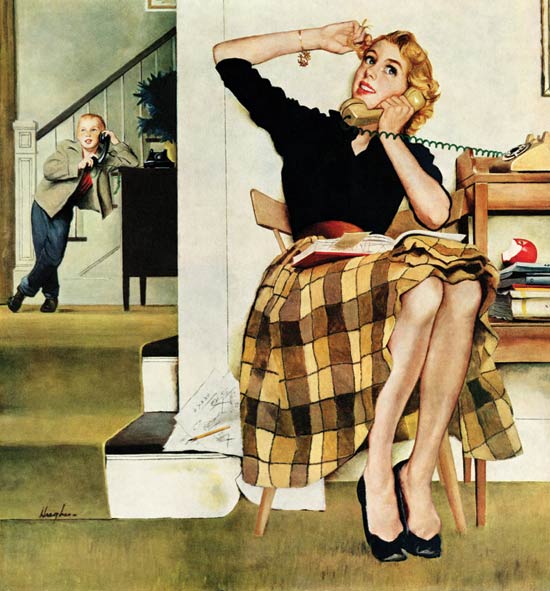
The landline was once our connection. For almost a hundred years, it was the model for talking to someone who was not in the room with us. The telephone wire plugged into the wall jack, and the phone wires ran from the house to the perfectly named telephone pole, and from that pole and all of its stalwart cousins standing along our streets, those wires found the people we would talk to on what was called the telephone.
We had a telephone on the little desk in the kitchen. For years the phone would ring, the beautiful sonorous periodic ringing that alerted us all that a call was coming in — someone had dialed our number! — and my mother would answer it. My father, unless he was there alone, did not answer the telephone because it fell under the duties of the household, I think, and he was a welder who was away all day fixing things and didn’t come home to answer the phone. After some years, we had another phone. Not another line, but another phone. When that happened, when people achieved two phones, it was thought far and wide to be a sort of luxury, a phone in the kitchen and one upstairs, so indulgent and in fact sort of lazy in that you wouldn’t have to come down to answer the phone, but you could simply turn there in the bedroom and take the call. It was the beginning of taking a call while not fully dressed.
When the phone rang in our house, we didn’t know who it was. I want to say it could have been anybody, but it couldn’t have been anybody. It was one of four or five people who had our number. We generally knew what they would say by what time the phone rang. Morning calls were certain people, neighbors, and early evening were relatives looking to chat. We didn’t want any calls after 10 or 11 at night, and we lived in fear of any call after midnight. My father said we should unplug it when we went to bed so that no one would have dire trouble in the night.
The telephone didn’t ring a dozen times a day, and its sound was a kind of minor event. Kids didn’t pick up the phone. I didn’t get a phone call until I was 12, if then. My mother would pick up the ringing phone and say hello and we all knew in a moment whom she was talking to, and her voice as she spoke to one of her sisters or my father or a friend was the tenor of the house. We didn’t listen to what she said, but we knew by her tone what the world was like.
There were films and stories in which the people in the dark, lonely house lifted the telephone receiver to find it dead, the wires cut. Sometimes we saw the gloved hand and the wire cutters snip the cord outside in the night. They were cut off! No communication in or out! The people on the island were getting murdered one by one, and there were heavy clues about who would be next, and all of this because the lines were down or cut or out of service. None of this: “Can you hear me now?” It was: “No one can possibly hear us now.” People were alone. Now, of course, the people on the island, as soon as there is any mischief, all send text messages with photos along with voicemails from their cellphones. So, everybody is safer, but our stories have taken a mortal blow from the fact that no one now is ever alone. No one is going to write a film where the bad guy goes around with his tiny little snippers and clips the internal diode in each cellphone. And most of the time, in the world that offered that special condition — being alone — as a possibility, it was a good thing. We miss it.
There is a moment we also miss, which was a wondrous landline moment. The phone would ring after dinner, and my brother would answer it and say hello, and after a moment, he would holler, “Ronnie! It’s for you.” The phrase is long gone because no one shares a phone anymore. And my brother would call me loudly enough to wake the house, the downstairs and the upstairs. I was 16 and the phone was for me! But he wouldn’t stop there. He would ask, as he’d been instructed in phone etiquette, who was calling, and then he would yell, at the same terrific volume, “It’s Joylene!,” a name that had never been said aloud before in my house and the sound of which would arouse in all listeners, mainly my mother and father and little brother, the same alertness as if he had said, “There is an alligator in the house! A big one!” I would spring from my bed, throwing to the floor (sacrilege!) the new issue of Famous Monsters of Filmland I’d been studying, and sprint down the stairs, sweat bursting from my forehead before he could add what I heard him say as I turned the slippery corner into the kitchen: “Ronnie, it’s Joylene, a girl from school!” Then I would yank the phone from him, ignoring his grin, and say hello to Joylene, the nicest girl in the 10th grade, in such a way as to make it sound like, “Yes, who’s calling and why are you bothering me?” And no matter that she needed to know what time I would pick her up for the sophomore dance tomorrow night, I would answer in monosyllables, listening hard to the old telltale clues of our house so I could hear the residents creeping closer in the hall to hear what Ronnie was saying to Joylene: yes, no, okay, yes, sure, okay. Bye. And standing there in the kitchen in a household with a landline, I knew that the news was now public. Ronnie was taking Joylene to the dance. The village had been alerted.
This is the information we’re not getting now. There are no such moments in our beautiful houses now when the phone rings and everyone stops and listens to it ring twice, knowing someone else will rise to answer, and the communal well will fill.
Ron Carlson is the award-winning author of six story collections and six novels, most recently Return to Oakpine. His fiction has appeared in Harper’s, The New Yorker, Playboy, and GQ, and has been featured on NPR’s This American Life and Selected Shorts.

From the Archive: Reach Out and Touch
Though landline phones may be on the endangered species list, in the 1950s and before, they were the lifeline of communities — and a teenager’s life. Throughout the 20th century, telephone accessibility and use increased dramatically. And with more use came more misuse. To counter growing problems with the mumblers, party-line hogs, and profanity, utility companies launched national campaigns to instruct consumers on proper telephone etiquette.
In So Many Words
People who talk interminably about conversation being dead in the United States ought to listen for a change — preferably on a party line. The Federal Communications Commission, in its recently published statistics for the fiscal year of 1954, reports that there were, on an average, 179,000,000 local telephone conversations a day, as well as 6,600,000 long-distance calls daily.
Purists frequently have strict interpretations of what constitutes conversation, but even in the 18th century undoubtedly only a minuscule part of talk was “brilliant.”
Perhaps the most pleasant conversation in the world is the easy, friendly exchange of personal thoughts and doings, which wouldn’t rate one-two with Dr. Samuel Johnson.
At any rate, telephone-company officials estimate that in a three-minute call the number of words exchanged may range — depending on whether the conversation is at a “normal pace” or a “blue-streak” rate — from 450 to 750, averaging about 500 words a call. This means, in a manner of speaking, that the nation’s telephone conversations represent approximately 185,000,000 addresses and soliloquies a day. Anyway it’s a safe bet that among all the trivial and perfunctory telephone messages, an extraordinary number of people at both ends of the telephone line every day find in their own “conversation” something pretty essential to getting through an average day.
—“Is Our Talk Witty, or Just Non-Stop?,”
Editorial, July 16, 1955
You Talking to Me?
In the Bell System and in other large companies, such as the General Telephone Corporation, the problem is classified as one of etiquette, or manners. A look at their bulging files on etiquette suggests that, among all the machines with which men have complicated their living while seeking to enrich their lives, the telephone stands apart. It is used more frequently by more people than any other complex mechanism we have, but the more it is used, the more it is misused. In contrast to the oboe, which Danny Kaye condemned as an ill wind nobody blows good, the telephone has to be described as a good instrument nearly everybody ill-treats.
Bad telephone manners are by no means limited to those who shout, or to those who hold the transmitter more than an inch from their lips when speaking. They are also displayed by the mumblers; the chewers and gnawers who try to talk with a mouth full of gum, or with pipes, cigars, pencils, or other impediments between their teeth; the wrong-number guessers who disdain directories; the executives who want the party they are calling to be on the line before picking up their own phones; the party-line hogs; the busy, busy people who let their phones ring and ring before answering; the operator baiters; and a long list of others. To the telephone executive, they all add up to one thing — wasteful inefficiency. Even the time-honored word “hello” is now passé. It is a fascinating, if idle, speculation to wonder how Alexander Graham Bell, the man who invented the telephone in 1876, would make out if he should return from his grave. It was his habit to open a telephone conversation with a resounding “Whoo-hoo.”…
Since the United States has more telephones in service than all the rest of the world combined, by a ratio of about six to five, it is here that the problems of bad telephone manners reach gigantic proportions. The operating utilities long ago realized that the installation of equipment and the maintenance of service was only part of their job. As early as 1912 they had begun a campaign to teach subscribers how to make more effective use of the instrument.
In that year the New York Telephone Company, a part of the Bell System, asked one of its bright young copy writers — a fellow named Howard G. Stokes — to prepare a booklet that could be used in this educational program. Stokes took the oblique approach. He felt he couldn’t come right out and tell the customers they were a lot of ill-mannered, ill-tempered boors, however truthful that might have been. So he reminded his readers that a display of friendliness is the surest way to get things done easily and quickly, and extolled the virtues of cheerful courtesy. Anticipating Dale Carnegie by decades, Stokes titled his booklet Winning Friends by Telephone, and closed it with the line, “The voice with the smile wins.”
—“How’s Your Telephone Etiquette?”
by Craig Thompson, March 16, 1957
This article is featured in the March/April 2017 issue of The Saturday Evening Post. Subscribe to the magazine for more art, inspiring stories, fiction, humor, and features from our archives.
Roses Are Red: Gorgeous Valentines from the 1800s
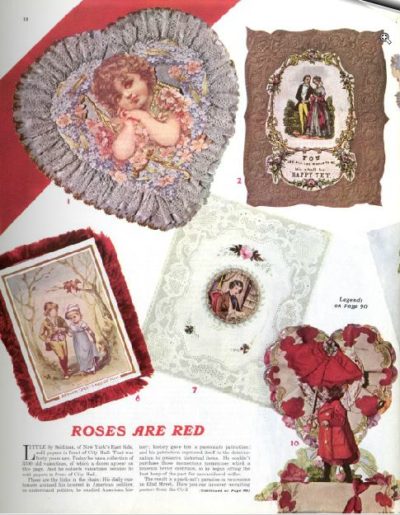
In their Valentine issue from 1940, the Post told the story of Sy Seidman, of New York’s East Side, who amassed a collection of 3500 old valentines, a dozen of which they featured in the magazine. (He also collected paper fans and mechanical banks.)
The tradition of Valentine cards continues, even in our digital age. As poet Charles Lamb noted, “This is the day on which those charming little missives, ycleped Valentines, cross and inter-cross each other at every street and turning. The weary and all forspent twopenny postman sinks beneath a load of delicate embarrassments, not his own.”
“Négligé” by Sophie Kerr
Originally published on March 3, 1928
“What,” asked Lillian James, “are you going to do with poor Ella’s things?”
“What things do you mean?” asked Mr. Mallett. He looked very worn, his thin mouth sagged, his eyes were dully pathetic. The funeral, which had been large and elaborate — poor Ella had always liked fancy funerals — had tired him to the bone. He had meant to lie down awhile when he got back to the house, but here were Mrs. James and her sister, Eva McChord, poor Ella’s best friends, who had stayed to keep him, they said, from feeling his loneliness. Incidentally, they had rummaged through the closets, the dressers, the linen and china cupboards, even the bookshelves, choosing objects they would enjoy owning in case Herbert Mallett felt he couldn’t bear to see poor Ella’s possessions about.
At his question Lillian realized that she couldn’t say “The hemstitched sheets and the down quilt, and the set of Spode and the copper percolator” — these were what she had her eye on. No, it would be too crude; it wouldn’t sound right.
Instead she said” Why, her clothes, of course.” And Eva looked at her sister admiringly. Eva wanted the Italian cutwork scarf, the green-glass finger bowls, the brass jardinière with the aspidistra, and the teak taboret it sat upon. And she would accept the after-dinner coffee cups if urged, and the dessert forks, even though they were plated.
“Why do I have to do anything with her clothes?” asked Herbert Mallett stupidly.
“But, Herbert,” said Eva, who was thinking hard, “surely you don’t want them to hang up in the closet and get dusty and out of style and probably moth-eaten. It’s so wasteful. They should be looked over carefully and given to the social-service department at the hospital for worthy persons.”
“Eva and I will gladly undertake to do it for you,” chimed in Lillian.
Herbert Mallett looked from one to the other of the gaunt black-robed vulgar creatures who had been in and out of his house every day for more years than he cared to remember, and who had never ceased to stir a futile hate in his heart. Poor Ella’s most intimate! He wished they would leave him alone. He did not know what to do, and it seemed strange that no thin peevish voice called down the stairs to direct him. He actually waited for that voice; it had so long dominated his every act in his own house. With a strange shock it came to him that he would never hear that voice again, and he must make up his own mind.
For the moment he was incapable. His head throbbed, his eyes ached, and his back and his legs. He was sure he was coming down with grippe.
“I tell you,” he said, “I’ll think it over and let you know what I decide. Thank you both, very much. I hope you’ll excuse me now. I’m not feeling well. Goodbye.”
Whereupon he mounted the stairs and got away. Lillian and Eva were resentful. They held their tongues until they got out on the street, but no longer.
“Can you imagine!” said Lillian.
“And after all we did while she was sick!”
“He simply, you might say, snubbed us. No wonder poor Ella used to be so out of patience with him.”
Eva was mindful of the desired loot. “Well, I always say you’ve got to make allowances for anybody who’s just had a great loss. They’re not themselves.”
“That’s true. We’d better see him again in a day or so. I shall say, right out, that I’d value a keepsake of my dearest friend.”
“That’s the way to do it. He’d certainly ask us to choose.”
They walked on thoughtfully. “You know,” said Lillian at last, “that’s a nice house, and he’s done very well with the store, and he’s got no bad habits, and he’s not exactly homely, though he isn’t handsome. He’s used to giving in. Poor Ella had her own way in everything.”
Eva understood. She was to try to hook Herbert Mallett, and Lillian was pledged to aid. A good idea. Far better to be Mrs. Mallett than a woman alone, with a tiny income and too much pride to work. Lillian had good ideas.
“We’ll do what we can to make him feel that we’re just as much attached to him as we were to poor Ella,” Eva said presently, and the sisters went on their way in content.
Herbert Mallett, now safely upstairs, felt rather better from having checkmated his two poison mushrooms, Eva and Lillian. He did not now want to lie down and rest. He went into poor Ella’s bedroom and looked about him.
It was a gloomy room, filled with knobby massive furniture sitting at spaced intervals on a dark un-wear-out-able carpet. Sash curtains, long curtains, and overdraperies of a dreary tan barred light through the windows. By tugging these away and setting a chair to hold them back, Herbert Mallett managed to see what was in the closet. He had been made curious by Lillian’s remark about the clothes.
There they hung, not very many of them, but all on plain wooden hangers. As in her furnishings, so in her personal garments, Ella Mallett had leaned to the durable and drab. She had a passion for the more malevolent purples, the dunner duns, the blacks with an undertone of morbid green, and the most ferrous iron grays, all in hard and wiry stuffs. Herbert Mallett put out a cautious forefinger and touched a satin gown, the last worldly gaud Ella had bought, and solely at her husband’s request. “Get a blue,” he had urged — “a real pretty blue. You wore a blue ribbon once when you were a girl.”
And Ella had got a blue — probably the only blue of its kind in the world — a lugubrious slaty blue instantly suggestive of desolation and disaster. It had been made up like everything else she had — very plain, very stiff, designed to conceal and distort all softer femininity. Herbert Mallett shuddered and drew back his finger.
“I didn’t know how awful it was,” he said aloud.
Now his eyes were caught by a garment which was his greatest detestation — a dingy black-and-gray négligé, a sort of blanket robe with a black twisted cord for belt. Ella had taken a robe like that on their honeymoon; it had, as it were, struck the keynote of their marriage. When the first one wore out she had replaced it with another exactly like it. They had become a series, a continued story, an endless dreariness. Memories of poor Ella in this robe and black crocheted bedroom slippers with purple edges, padding downstairs to let him in on nights when he had to stay late at the store — she would not let him have a latchkey; memories of poor Ella in this robe sitting before the mirror doing up her front hair on kid curlers; memories of poor Ella presiding over breakfast in the same robe, the same curlers; memories of poor Ella’s last illness, and many other illnesses, when she either had the robe on or kept it draped on the foot of the bed!
“Oh,” cried Herbert Mallett, banged to the closet door and fled. He had hardly gained the haven of his own room when Janie Terrace, the maid, called him.
“Supper’s ready, Mr. Mallett.”
As he entered the dining room he was immediately aware of a taboo violated — at the end of the table was a steaming coffeepot. Ella had never allowed him to have coffee for supper; she thought it unhealthful. Cocoa and an imitation coffee were her standbys. And here was Janie Terrace dashing in with a plate of hot biscuit — another taboo.
She answered his unspoken surprise: “Nothing like a cuppa good coffee to hearten you up after such a day. And my biscuit don’t set heavy. Go ahead. No reason why you shouldn’t.”
The words made a refrain in his head: “Go ahead. No reason why you shouldn’t. Go ahead, no reason why you shouldn’t.” Until this moment everyone had treated him as a griefstricken, bereaved husband, drowned in sorrow, inconsolable for the loss of the best of women. But Janie Terrace, who for years had been thrall, like him, to Ella Mallett’s implacable will, knew better. Janie was pointing out to him that he was free of all the petty restrictions, limitations, barriers and denials which his wife, with the terrible strength and obstinacy of the meek, had placed upon him.
Go ahead, no reason why you shouldn’t. Hot coffee with two — yes, two lumps of sugar. Hot biscuit, oozing butter, laden with strawberry preperves. Go ahead, no reason why you shouldn’t. No pale accusing eyes, no whining voice to say “Herbert, you mustn’t. It’s so bad for you.”
Presently Janie Terrace came in on the pretext of bringing fresh biscuit. She lingered; she had something to say. “Mrs. James and Miss McChord was here today snooping through every land’s living thing in the house, Mr. Mallett. I make no insinuations, but if you find anything missing you can look to them for it and not to me. They was all through the bureau drawers and the sideboard and Mrs. Mallett’s bureau, prying and peering and fingering — such a nerve! I laid out to tell you soon’s I got the chance. I know what’s on their minds, Mr. Mallett. They think maybe you’ll quit housekeeping and maybe go to board at the hotel or at Mrs. Toohey’s Select, and they want to pick up what they can outa the house. They think you’re easy. They think all they’ve got to do is to hint strong enough that they’re perishing to have something of Mrs. Mallett’s to remember her by, and you’ll hand over whatever they want. Excuse me, Mr. Mallett, for speaking out so plain, but those two nosey old devils certainly did get my goat today — not that they haven’t done so before, Lord knows.”
Janie put her hands on her wide hips and looked at Mr. Mallett kindly.
“You’re the salt of the earth, Mr. Mallett, and don’t I know it! And I won’t see you done by anybody, if I can help it. Of course if you do intend to give up housekeeping and go board somewhere, I’d be glad if you’d say so, because I’d have to look out for another place. But if you want me to stay on and keep house and do the ordering, I’ll be pleased to. And I’d like to see them McChord-Jameses get so much as a common pin off you while I’m on deck. No, sir.”
This was the longest speech Herbert Mallett had ever heard Janie make. Usually she was as silent as if her mouth were sewed up. It occurred to him, hearing her, that perhaps she, too, was experiencing freedom.
But here he was with more things to decide. “I hadn’t thought where I’d live, exactly, nor how,” he said at last. “I hadn’t made any plan. But for the time being I’m going to live here, and I’d like to have you stay on and take charge. I guess we can get along all right.”
“Like a house afire!”
“I think you’re too severe on Mrs. James and Miss McChord, Janie. They very kindly offered to- to” — he thought of that horrible dressing gown and could hardly go on — “to look through Mrs. Mallett’s clothes and dispose of them through the social service department of the hospital. They pointed out, very rightly, that good, durable clothing should not be allowed to go to waste, or be eaten up by moths.”
Janie gave a militant sniff. “They’d say something like that to take you in. Don’t you pay them no mind, Mr. Mallett, the interfering snoops. You can just as well call up the social service at the hospital yourself and ask do they want the clothes, and no trouble to anybody, and no fuss, and no old meddlesome Matties prancing up and down the stairs and opening closets and bureaus and all. Ain’t it the truth?”
Herbert Mallett realized his freedom anew. He had suffered so much from the close friendship of Ella for her Lillian and her Eva — suffered without protest or palpable wincing, but the suffering had not been less because ingrowing and hidden. But now, if he desired, he could banish them from his life forever. And, in this case, make the plea that he was actually saving them bother!
“Yes, it is so, Janie,” he said, “and that’s what I’ll do.”
“Very good, Mr. Mallett, and I wish to say that you’ve only to tell me what you want and I’ll see to it instanter, and I’ll serve you as honest and as faithful as I did you and Mrs. Mallett. And now maybe you’d fancy a piece of pie for dessert.”
This was revolutionary. “Pie for dessert!” exclaimed Herbert Mallett, not believing his ears. Ella had always had sanitary desserts — watery junket, sour baked apples, thin custard, pallid gelatins. Pie, she was fond of saying, is a deadly compound of fruit, fat and fire.
“As fine a lemon meringue as you ever swung a tonsil over,” declared Janie Terrace. “Don’t you be afraid of my pastry, Mr. Mallett. I may not have had much practice at it, but it’s light as a feather and will set no heavier on your stomick than do my biscuits.”
She put before him a segment of pale gold topped with a snowdrift, and Herbert Mallett ate it to the last exquisite morsel. This was indeed freedom.
He was no longer weary; some of the lightness of the meringue had apparently entered his spirit. He complimented Janie.
“That was a fine pie,” he said. “I enjoyed it. I’ll write a note to Mrs. James tonight about the clothes. And I’ll call up the hospital or write them too.”
Janie beamed. “And would you like something tasty for breakfast, sir?” she asked. “Hot cakes, maybe, and a dash of crisp sausages?”
Go ahead, no reason why you shouldn’t. “Yes, Janie, please, and order some cream for my coffee. I don’t care so much for hot milk.”
She dashed into the living room ahead of him and turned on the lights, twitched down the blinds, unfolded the evening paper and, before he could stop her, put a match to the fire which was always laid but never lighted, save for important guests.
“A new-made widower’s got a right to his comfort,” she said quickly, and dashed out again before he could think of an appropriate reply.
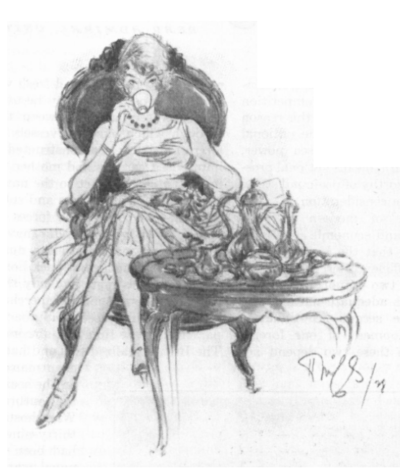 He pulled the easiest chair from its place at the far end of the room, tipped the shade of the nearest lamp so that he could read, and sat down, for the first time since his wedding day, relaxed, replete and at ease in body and mind.
He held the newspaper before his eyes, but he could not read. His mind raced on in a jumble of imaginings, rememberings. Poor Ella! Poor, poor Ella! Had he done everything he could to make her truly happy? Yes, he could think of nothing she had asked him to do that he had refused. She had required that he be Presbyterian and Republican, whereas his inclination was Baptist and Democrat. She had chosen his friends, his opinions, his beliefs, inexorably; all by her own narrow pattern. He spoke when and what she wished to hear; he was silent if she desired it.
After the first few weeks of marriage he had submitted to her yoke without rebellion, even without deception, save in one place — the store. He had kept to himself or had deliberately misrepresented many items about the store, because he knew her interference there would be ruinous. Of course she questioned him; she went over each hour of his day with the fine-tooth comb of a tyrannous inquisitor. It occurred to Herbert Mallett that possibly Ella’s spirit might now be aware of the lies he had told the living Ella. “In that case,” he thought, “she knows I did it for the best. And” — oh, this was a cheerful gleam — “she can’t do anything about it now.” No, she couldn’t sit up in bed and sniffle and whine and nag and pick and chip at him until from sheer fatigue he gave in to whatever whim she wanted gratified at the moment. Never again!
“Poor Ella,” he sighed, “I surely did everything I could to make her happy. But yet she wasn’t happy. At least she didn’t act so. Maybe that was her way of being happy.”
Then all the long-latent romance in him flared up, and there came to him a sudden bright beatific vision of what his home might have been with a wife who sang, a wife who giggled, who was pink and plump and cuddlish, whose mouth curled up at the corners, who wore pink ruffles here and there, and silk stockings, and sprayed a little fresh violet perfume on herself. Who liked to go to shows and was fond of candy, who didn’t feel that a friendly game of cards damned you, who didn’t whine or sniffle or nag or pick or chip, but who looked up to him and thought he was wonderful! He had seen in the store, more than once, a wife look up at her husband with round admiring eyes and say “George” — or “Walter” or “Harry,” as the case might be — “you’re won-der-ful!” And he had never heard it without getting a lump in his throat and yearning all over with a wistful, hopeless envy and desire. “Herbert, you’re won-derful !” No, poor Ella had never said it to him. She hadn’t thought it, either.
And then, quite as suddenly as this vision had appeared to him, a thought leaped high in his mind — a thought daring and revolutionary. It was this: Being a widower and only thirty-seven, there wasn’t the least reason why he shouldn’t, in the decent course of time, look about him and pick himself a wife according to specifications, won-der-ful and all! Not the least reason in the world.
“Well, by Gemini,” said Herbert Mallett to himself severely, “I ought to be ashamed to think of anything like that the day of poor Ella’s funeral. I ought to be ashamed. I must be nutty or something. I’ll just write those notes to Lillian and the hospital, get Janie to mail them, and pop off to bed. The fatigue and the strain of the day have weakened my common sense. I’ll be more myself after a good night’s rest.”
He went to the desk and wrote the note to poor Ella’s rapacious friend, and then paused. “I’ll stop by the hospital in the morning on my way to the store. I can tell them better than I can write it. There’s something very unfeeling about a man writing an offer to give away his wife’s clothes on the day of her funeral. I wouldn’t do it if it wasn’t for those two ghouls.”
So the next morning he stopped at the hospital and was directed down a corridor to the social-service department. There he found a room half filled with sad-eyed children, women with shawls over their heads, and huddled, hopeless men, and a faint tinct of carbolic and iodoform mingled with the odors of dirt, poverty and disease.
The sight, the smell, gave Herbert Mallett a distinct shock. He was feeling well this morning. His breakfast of hot cakes and sausages and coffee with cream had been good, and the eating of it had confirmed his state of freedom and well-being. Coffee with milk and no sugar, the most tasteless and flabbiest cereals, stewed prunes and dry toast were the menu which poor Ella had prescribed for him. It occurred to Herbert Mallett that all these social-service applicants looked as though they had been eating poor Ella’s choice of breakfast. It made him very sorry for them.
“Did you wish to see someone?” asked a voice at his side — a pleasant voice, feminine, kind, but with a gentle briskness about it that intimated the speaker had no time to waste. Herbert Mallett turned and looked into a pair of blue eyes slightly below the level of his own — eyes that were as feminine, as kind, but as impersonal as the voice. “I’m Miss Greeley, in charge here,” went on the voice.
He explained his errand, observing as he did so that Miss Greeley had, besides the pleasant eyes and voice, a close brown bob, white teeth and rosy lips, a jolly little turned-up nose, a general outline of rounded slenderness and a general air of great capability.
“You’re more than kind to think of others in your bereavement,” said Miss Greeley. “I’ll be thankful to have the clothes; there are so many sick and half sick and convalescent who need warm things — you’ve no idea. You say the maid will pack them? Now, Mr. Mallett, would you have any objection if I went to your house and helped her do it? In that way I could select exactly what we can use, and you can dispose of anything that is not suitable for our people in some other way.”
That seemed reasonable to Herbert Mallett. “When can you come?” he asked.
“Not today, nor tomorrow. I’m frightfully busy until very late. But Friday afternoon, between three and three-thirty, if that is all right. You’ll tell your maid to expect me, please?”
Yes, he would tell Janie Terrace. And Miss Greeley smiled, shook hands and made it plain that the matter was settled. But it was the smile that unsettled it. Miss Greeley had a warming and ingratiating smile — a magic smile, that turned her from a wholesome clever young woman into a fascinating and lovely girl, the sort of girl who lingers in your consciousness and can’t be dislodged. She bloomed and softened and charmed when she smiled.
It had the most marvelous effect on Herbert Mallett, unused as he was to feminine smiles and feminine charm. He almost staggered out of the room, and couldn’t forbear to look back when he got to the door. But it did him no good, for Miss Greeley had gone to her desk and was very busy.
He went on to the store, where there was much to do, as he had been away from it for a week, save for an hour or so each day. The two clerks, the bookkeeper and the porter who made his staff were waiting for him, their demeanor tuned to proper seriousness and gravity, and for an instant — Miss Greeley’s smile still dizzying him — he wondered what they were looking so solemn about. Then he remembered, and thanked them for the beautiful wreath they had sent to poor Ella’s funeral. From his hesitant manner they understood how deeply he suffered, and that it was hard for him to talk about it, and so they tactfully began to recall him to business matters. For as Eddie Paine, chief clerk, said to Bob Taylor, second clerk, “Mrs. Mallett always seemed to me like a terrible lemon, quince and hunk of cheese, but the boss was so nice to her I dare say he must have liked her.”
And Bob had replied wisely, “He sure did. She was, maybe, better in the home.”
Mr. Mallett looked about his store critically, yet appreciatively. It was a beautifully arranged, beautifully managed stationery store, not large, but with a carefully chosen stock and a rigorous policy of the-customer-be-pleased. Into this store Mr. Mallett poured all his suppressed æsthetic instincts, all his need for something to cherish, adorn and love. The shelves, the counters, the lighting, the display were matters of his constant concern. Poor Ella had complained that he spent half his profits each year in redecorating, and that he fussed in the most ridiculous manner over details which were of no importance. Mr. Mallet never defended himself against her charges, nor did he change his ways. Ella’s whine and sniffle got her nowhere when she used them against the store.
Today he moved some yellow second sheets slightly nearer some blue filing boxes, that the colors might enhance each other, put a collection of red pencils out of sight, changed a stiff showing of fine gray French papeteries into a tricky half circle which lured the eye, and corrected an error in the placing, by size, of a popular series of school tablets. He did all this almost mechanically, so accustomed was he to observing and repairing flaws in the perfection of his pet and pride. Then in his little office he looked over the reports of sales, bank balance, stock needs, orders, and tried to put his thoughts on them. But somehow that smile of Miss Greeley’s kept coming through the figures in the most extraordinary way, and instead of grappling with reorders of loose-leaf notebooks, fountain pens and children’s letter paper, he was wondering whether or not he might appear on Friday afternoon at his own home between the hours of three and three-thirty, to receive Miss Greeley in person.
“It would be only polite. I can hardly leave her to Janie Terrace. But if I am there she may think I didn’t trust her about the clothes. Oh, pshaw, she won’t think that. She can’t. If those two snakes, Eva and Lillian, discover that I went home to meet her, they’ll blazon it over town and make it very uncomfortable for the girl. But Janie Terrace’ll be there — and anyway I could chance their not finding it out. She was certainly an extremely attractive girl — extremely attractive. Well, I suppose I ought not to have noticed that.” He argued pro and con, and was still doing it when Eddie Paine came in and said that Mrs. James and Miss McChord were in the store and wanted to speak to him.
Eva and Lillian were grieved and worried. His note had upset their plans.
“Oh, Herbert,” began Lillian, “you couldn’t let a stranger or servant go through poor Ella’s clothes and pack them up. You don’t realize how unfeeling it seems. We’ll gladly do it, Eva and I; we want to help you; we don’t mind the bother a bit, really.”
“No, not a bit, Herbert,” chimed in Eva affectionately.
Perhaps it was the combination of sausages and smile that helped him to stand out against them — that, and a quick disgust at Eva’s tone and languishing manner.
“I appreciate your offer more than I can tell you,” he said, “but it’s — it’s impossible to change my arrangements.”
“Impossible — why?”
Mr. Mallett was caught. He looked embarrassed and mysterious, and he squirmed inside. “I really can’t tell you why. It’s — well, it’s confidential.”
His manner woke dire suspicions in Lillian James’ mind, always active in inventing the worst of motives.
“Why, surely, Herbert,” she said, “Ella didn’t say anything against us, and we her best friends for so long — ”
In her false conclusion Herbert Mallett saw his deliverance.
“Lillian, please don’t urge me to tell you. It will be better for all of us if I don’t. I can only say that I feel bound to let the matter rest as it is.”
Lillian and Eva stalked out, crushed — or at least partly crushed, for though they were balked in one direction, it didn’t mean that they were balked in another. Herbert still remained desirable.
“To think that we never even suspected Ella of being insincere! Sweet to our faces and pretending to like us, and mistrusting us in her heart. It makes me feel terrible.”
“But it must be so. You saw how much it hurt Herbert to tell us. He’s the most truthful man in the world.”
“Too good for her, I say. Look at what he’s had to put up with in her.”
“And he such a good provider, and kind and generous. He was a splendid husband to her and she didn’t deserve him.”
“We ought to keep in touch with him and let him feel that we appreciate him. I’ll ask him to supper Sunday night,” concluded Lillian. “Just family — us and the children and you, Eva. He’ll take you home, of course.”
“I’ll never forget what you’ve done for me, Lillian.”
And just as clearly as though they had put on sandwich boards proclaiming it, so was it silently agreed between the sisters that when Eva acquired poor Ella’s household goods, not by gift but by marrying poor Ella’s husband, she was to remember her sister’s desire for the hemstitched sheets, the down quilt, the set of Spode and the copper percolator. But in her own mind Eva determined to hold on to the Spode. Spode is valuable.
Herbert Mallett, unaware of these fell designs, congratulated himself on getting out of a tight place. He had said nothing which was not true, but he couldn’t be responsible for what they might infer from his words.
He went on with the store routine but his subconscious mind was busy with Miss Greeley. Eddie Paine and Bob Taylor agreed that the boss was being mighty brave and bearing up better than they expected. And back at the house Janie Terrace inaugurated a mighty cleaning, airing, scrubbing, dusting and polishing, while she planned a series of meals designed to make Mr. Mallett keep her on as a housekeeper forever and ever.
All through Wednesday and Thursday Mr. Mallett wabbled back and forth as to whether he should show up at the house when Miss Greeley called. First he thought he would, then he thought he wouldn’t. He could not decide. It seemed almost a pity that poor Ella wasn’t there to make up his mind for him; only she wouldn’t have allowed him to go. He had so little initiative, save about the store; it had been so ground out of him that he was pitiable. But somehow, the matter settled itself. On Friday morning he refused Lillian’s invitation to Sunday supper on the plea that he didn’t feel up to it. Strengthened by this deed, in the afternoon at three he heard himself saying to Eddie Paine that he had an errand up at the house and would be gone maybe an hour, and then he put on his hat and walked out. He was filled with a queer deep hankering to see that smile again.
Janie Terrace had put on a white apron to receive Miss Greeley, and was prepared for a delightful visit in which she would tell what she thought of her late mistress to someone who had never known her. So Janie was not pleased when Mr. Mallett appeared. It meant goodbye gossip, goodbye all the tasty little bites in the back which she had prepared. However, here he was and she must lump it.
Miss Greeley was prompt and very businesslike. If she was surprised at Mr. Mallett’s presence she didn’t show it, but she didn’t smile at him — not at first. But when they went upstairs and she saw the gloomy bedroom, the stiff ugly dresses, the plain thick muslin underwear, the round-toed flat-heeled shoes and cotton stockings, she became very gentle with Mr. Mallett. For though Miss Greeley wore the dark and simple uniform and hat required by the hospital for her hours on duty, they were by no means her personal taste in dress. Poor Ella’s furniture and garments repelled her.
Moreover, Miss Greeley was not a believer in giving the very poor only useful clothing. She felt that beauty was often more desirable than warmth and durability. If she could have done so with good grace, she would have turned down Mr. Mallett’s donation flat. “It’s enough to make the ones that are getting well have a relapse to hand them such awful things,” she thought. When she saw the black and gray négligé she couldn’t repress a little shudder of horror. But she concealed it.
“That’s splendidly warm,” she said. She ran through the rest of the clothing hastily, without comment. At the end she said, “I have my little car here and I’ll take them with me, if you don’t mind. You’ll receive a formal letter of thanks from the hospital, of course, but I want to express my own appreciation of your kindness. So few people realize the suffering and need right here in our own city. We have to beg almost on our knees to get our annual endowment, and it’s never enough. I tell you, a gift like this heartens us all and makes us feel that there are still kind and thoughtful people, even at moments when they might be expected to think only of themselves.”
She laid it on thick because she felt so sorry for Mr. Mallett. Miss Greeley’s work required much knowledge of human nature. He interested her. She divined the truth — that he had been oppressed and ruled by a woman without desire for or knowledge of grace and beauty, while he himself loved them. So she said more than she meant, and at last she turned her delicious smile on him.
But Mr. Mallett was not a student of human nature; he could not guess people’s inner selves, their hidden character. In spite of Miss Greeley’s smile he was disappointed. That severe hat and dress of hers did not look to him very different from the clothes he had just given her for her poor, and when she seemed entirely pleased with the gift, he felt that she didn’t see its devastating ugliness. If she had said “Mr. Mallett, I wouldn’t insult any decent, self-respecting woman, however needy, by asking her to put on such unspeakable atrocities,” he would have been glad and thankful.
Every word of praise Miss Greeley said, and especially her approbation of the black and gray négligé, drove him away from her. True, her eyes and her voice were still there — and that last lovely winning smile. If she had not smiled Mr. Mallett would never have thought of her again, save as one of life’s dear gazelles who had gladdened him for a moment and passed on.
But the smile caused him to say more than he meant. “If you will let me know of any special case where I could be of aid, I’ll be glad to do what I can. Though I’m not much good at that sort of thing,” he added, leaving himself a loophole of escape.
Again Miss Greeley displayed her knowledge of human nature, having heard such vague promises many thousands of times, and knowing well how little they meant.
“Thank you,” she said warmly “thank you very much. You’re so kind.” Whereupon she picked up a bundle of clothing and carried it out to the car, while Mr. Mallett and Janie Terrace carried out the others. One more smile — a small one — and she had rolled away.
Mr. Mallett went his way back to the store considering Miss Greeley far more calmly than when he had gone to meet her. A pleasant capable young woman, with an agreeable manner, but that was all. And, he reminded himself severely, he mustn’t be thinking of such things.
Nevertheless, as time went on he could not help thinking. Life flowed along so pleasantly, full of small comforts, little luxuries, ease of mind and body. There was a fire in the living room every night after supper. The easy-chair, the lamp and the evening paper were always ready for him there. His meals were no longer meager and invalidish, they were cunningly prepared to please and pamper his appetite.
And having loosed an orgy of speech immediately after the passing of poor Ella, Janie Terrace went back to her former taciturnity and bothered her employer no more with long tales of this and that and nothing at all. So Mr. Mallett reveled in silence. He came home from his day in the busy chattering store to a quiet orderly house. No more did he dress, eat, smoke and read to an obbligato of petty commands and corrections administered by a thin peevish voice. It was marvelously peaceful.
Yes, it was peaceful, very peaceful, save for one thing — the attentions pressed upon him by Miss Eva McChord and Mrs. Lillian James. These good ladies were, like the world, too much with him. Late and soon they pursued him. They offered him endless invitations. They lay in wait for him as he passed, leaped out at him and walked with him wherever he was going, talking to him with persistent sympathy and a cloying sweetness. They invented errands to the store — errands which did not involve any purchases. They sent him large plates of muffins, cookies, cakes, puddings, jellies, sillabubs — infuriating to Janie Terrace.
“What’ll I do with this here?” she would demand balefully of. Mr. Mallett.
At first Mr. Mallett told her to hand out the stuff to any passing beggar, but there were too few of these. Then he recalled his promise to aid Miss Greeley’s poor people.
“Take ‘em all over to the social service department of the hospital, Janie; let the young lady who was here give ‘em away” a command Janie faithfully followed.
This action had the result of keeping Mr. Mallett alive in Miss Greeley’s thoughts. He must be a very odd person, she supposed — very odd indeed — but rather nice. There were many undernourished children to whom the cakes and cookies were an enormous treat, and there were plenty of convalescents who needed custards and sillabubs and jellies, so she used the McChord-James offerings very well.
She always told Janie to thank Mr. Mallett for her, and she made a memo on her calendar to write him a note at the end of the year and let him know that his unusual donations had been appreciated and put to good use. She did that every year to everyone who sent gifts to her department.
In the calm serenity of his present life Mr. Mallett had very nearly forgotten Miss Greeley and her smile; at least they had lost all special significance for him. He had his store, more scrupulously and charmingly adorned than ever before, and he had his still, well-ordered home, and even the pursuit of Eva and Lillian could not spoil his existence. He had learned to disconnect the telephone in the evening, and Janie had orders to tell them he was out on the occasions when they came to call on him, and though they were sure Janie was lying and tricking them, they couldn’t prove it. When they came into the store, Eddie or Bob headed them away from him. Only when they caught him on the street was he at their mercy. But he kept a sharp lookout and grew very adept in dodging into doorways and up alleys, and when they did actually corner him and press on him invitations to supper and dinner, he always said “I’m sorry, but I’ve another engagement.” Eva and Lillian were more than ever certain that poor Ella had been a false friend to them and had poisoned his mind against them. Still, they felt it was their due that they should keep on trying to make him see them as their own sweet and kind and guileless selves, teeming with consolation and tenderness for him.
As the uneventful easy weeks rolled along, enlivened by nothing more than dodging Eva and Lillian, Mr. Mallett felt a certain dissatisfaction within. Several things irked him. His home’s appearance was one of these. After a day spent in the store, so lively and smart in color, so well arranged, the dark hangings, the bleak misshapen furniture, the dismal ornaments of the house struck hard on his æsthetic sensitiveness. Several of the old friends of his bachelor days — men whom poor Ella had not allowed him to visit — had looked him up and invited him to their homes, and he had gazed into new vistas of comfort which made him, when he came home again, dislike his own surroundings even more. Janie Terrace was a good cook and cleaner, but there she stopped. She could not change things about and brighten them up. So Mr. Mallett began to do it himself. Go ahead. No reason why you shouldn’t.
He began with the dining room, and when it was done in cream and orange, with a new set of blue china and a gold-framed mirror over the mantel, it was, said Janie Terrace, as nice as a dining room in the movies! Certainly it was cheerful and gay, and its appearance added gusto to Mr. Mallett’s excellent meals.
From the dining room he went to the living room, then to the hall, then upstairs. Paint, paper, new curtains, new rugs, new furniture — everything light, bright, joyous. Mr. Mallett had a very good time playing with it all. Oh, it took time, but he didn’t mind that. He matched colors and fussed with samples, and tried this shade and that stuff, and had pieces of furniture sent home on trial, and shipped them back when they didn’t quite suit. It was fun!
It drove Lillian James and Eva McChord to desperation when they learned what he was doing. It could portend but one thing, that he was looking about. And looking about meant that presently some woman was to rule in poor Ella’s place. But who? Try as they would, they could not find that Mr. Mallett was paying attention to anyone. They pried and peered and spied, with all the energy and resource of tried and trusty priers and peerers and spiers, but it did them no good. They were forced to conclude that it was either a free-for-all or else that he was very, very sly! It was frightfully hard on them to be unable to decide which. But they redoubled their gifts of edibles, and Janie Terrace declared that she was wearing out good shoe leather running to the hospital with pies and cakes.
But as Mr. Mallett’s house became transformed and regenerated and he knew that in a short time he’d have nothing more to do with it, a great loneliness came upon him. All the romance and sentiment in him had been thwarted and nipped and stunted and stifled as much as possible by poor Ella, but his heart and his spirit still contained sparks; and these sparks now brightened and burned. The vision that had come to him the night after the funeral, which he had resolutely put away, returned and haunted him. This house, now so charming, needed a woman in it — a woman dressed in pretty frocks, frivolous, who would run up and down stairs and hum lively tunes, shake up the chintz pillows, put vases of flowers about, drop the regular two lumps of sugar in his coffee with short dimpled fingers, and be always ready to join him in whatever slight diversion and pleasure came to his mind. If he wanted to tell her about the store she would listen attentively; if he wanted to talk to her about himself she would listen even more attentively, and would understand and appreciate all the little fancies and whimseys and jollities he’d never dared shape into words. She would think and say he was won-der-ful. More and more Mr. Mallett felt the need of someone like this. He was, in very truth, ripe for picking.
He was finding the constant pursuit of Eva and Lillian a nuisance, an abomination. Eddie Paine and Bob Taylor did not always hide their snickers when the two women came into the store and, like all normal human beings, Herbert Mallett could not endure being made ridiculous. He was as rude to Eva and Lillian as he knew how to be, but that didn’t stop them. Mr. Mallett felt certain that Eva, aided and abetted by her sister, was bound to marry him. And presently he began to be secretly afraid. They were large, strong, determined — oh, how determined. He didn’t know but they’d trap him and make him commit matrimony no matter how he struggled. He remembered Mr. Kipling’s sapient words about the female of the species, and he was distinctly alarmed and nervous. He lost his appetite and became still more nervous.
Finally he went to see a doctor. He didn’t tell him about Lillian and Eva, only about his nerves.
“You need a change of air, a trip,” said the doctor. “You’ve had a hard year, and you stay too steadily in your store. Go off for a week or so, make some new contacts, see some new sights. It’ll do you a world of good. You don’t need any pills or powders; you only need a change.”
Mr. Mallett thought this over and went to a travel bureau, but the man in charge tried to send him to Egypt, Algiers, the Riviera, Bermuda, and finally Florida. He terrified Herbert Mallett with his talk of three-month voyages, deluxe hotels and tropical oceans, so the travel bureau man had the chagrin of seeing Herbert Mallett ooze out without taking any.
“He never meant to go anywhere anyway, the poor sap,” thought the travel bureau man scornfully.
But there he wronged his would-be client. Herbert Mallett went right down to the station and bought a ticket for the big city.
“I’ll look at the new lines of stationery and the city shops, and I’ll go to the shows and get myself all pepped up,” he resolved. “Eddie and Bob can run the store perfectly well for a little while, and if they can’t it’s time I knew it.”
When he told Janie Terrace he was going away, she exclaimed: “Don’t tell me how long you’ll stay, for if I don’t know I can’t tell the two old snoops. You can send me a telegram the day you’re due. I’ll be here, don’t worry.”
And this seemed to him such a good idea that he told Eddie and Bob also that his stay would be indefinite. Let Eva and Lillian chew on that!
And no sooner was he on the train than his cares and worries and nervousness all slid away from him and were replaced by a buoyant expectancy! He’d never made a trip like this before, free and untrammeled. Poor Ella had either gone with him or had fixed his time of return forty-eight hours after his departure, and excuses for staying longer were not the least use. So mostly he bought his stock from salesmen who came to him. It created less friction.
He went to a good hotel and took a room with private bath — a quiet, comfortable, sunny room, high up, with a stirring vista of skyscrapers dramatically large as compared to himself, dramatically small as compared to the mighty sweep of sky above. Gazing out at them, Herbert Mallett felt like a maggot, but a rather jolly maggot. He might be no more than a maggot, an atom, an ort — a word he’d culled from crossword puzzles — but he had a world of emotions to release, desires to be fulfilled, senses to be gratified. He was powerful and complex to himself — a grateful sensation.
For the first day or so he pattered in and out of art galleries, mostly, quite neglecting business, and he saw much that was thrilling and much that was puzzling and much that was revolting. All of it he enjoyed, lapping up color and pattern as a thirsty dog laps at a clear stream.
And he passed a great hall, and seeing a concert advertised, he went in on chance and had his ears and soul ravished by a feast of Brahms and Beethoven, done by one of the finest of musicians before an audience that sat dead still, not coughing or sniffling or even so much as rattling its programs! Herbert Mallett had never even dreamed of such music, and he came away exalted to the heights.
But after so much that was sublime he felt the need of something lighter. He bought a new necktie, not at all like those poor Ella had chosen for him, and called on two dealers in wholesale stationery. In one of them he found a salesman he knew — a certain Giles Brody who had cherished Mr. Mallett as a good customer who didn’t need time on his bills. Giles Brody hailed him with glee and proposed to entertain him with, inevitably, dinner and a show.
Brody led Mr. Mallett to a restaurant where both food and orchestra were above the average, and ordered a trick meal — a hot hors d’oeuvre prepared on the table before them, a sole matelote followed by guinea hen breast with Prague ham and mushrooms, an alligator pear dashed with lime juice for salad, and a chocolate soufflé for dessert. From his pocket came a small flask of excellent Scotch. Mr. Mallett ate and drank and looked about him with great appreciation. Soon he found he was telling Brody all about his finished house and his loneliness, even about Eva and Lillian. Brody listened and, like Miss Greeley, comprehended much more than Mr. Mallett uttered. He found himself liking Mr. Mallett as more than a good customer.
“Poor chap,” he thought. “He’s never had any fun in his life. It’s a shame!”
He had bought tickets for a musical comedy of the average sort, full of catchy tunes, expert dancing, pretty girls not too nude but nude enough, wise cracks that varied from plain foolery to subtle lewdness, a comic lead and a sweet soubrette, a high baritone with slick hair for the love songs, and so on, and so on. Mr. Brody chose this show as suiting any taste, and because Teresa Lance, his wife’s cousin, was in it and he had found that such acquaintance impressed out-of-town customers and made him seem the perfect sophisticate. His wife’s cousin was not young, her part was merely the chaperon of the soubrette, but she had one song which she put over pretty well. And she liked to have Giles bring his friends around and take her to supper.
So after the intermission, Brody, who had been waiting to spring it, said, “The woman who’s playing Mrs. Passedall is a relative of mine. What say we send her a note and ask if she’d care to go out for a bite to eat after the show?”
Mr. Mallett thought it would be great. He was enjoying himself hugely, the singing and dancing entranced him, the pretty girls dazzled him. Brody’s remark centered his interest on Teresa Lance, who now came out for her song — done before the drop curtain while the scenery was being changed for the garden-flower scene.
Mr. Mallett saw a fair-haired and blue-eyed woman whose legs still looked very young but whose face had lost the facile promise of youth and whose figure was somewhat overcurved. She had on a white dress spangled in lavish silver, and she carried an enormous scarlet ostrich fan. Her song was a plaintive moron ballad to the effect that Somebody Wants Somebody, But Nobody Wants Me, one of the “I sit at home, all, all alone waiting for the ring of the telephone” sort of things. It so fitted Mr. Mallett’s own state of mind — except that he certainly didn’t wait for the ring of the telephone — that he was infinitely touched. Tears sprang to his eyes.
“Your cousin is a true artist,” he whispered to Mr. Brody.
“Tess isn’t bad. She’s a very nice woman off the stage, too — not tough and gay like a lot of these theatrical wrens.”
Mr. Mallett felt sure of it. He applauded the song violently, and Miss Lance came back and sang the chorus again.
“She sees us,” said Mr. Brody, and Mr. Mallett’s blood rushed to his head as he saw her smile directly toward them.
After the show the two men hurried around to the stage door, and presently Miss Lance came down that bleak and whiffy alley and they went to supper. She looked older without her stage make-up, harder and more worn, but she had a dashing green-feather toque and a coat with fur which gave her quite an air. She ate a rarebit, drank what was left of Mr. Brody’s Scotch, and carried the conversation along without a pause. Mr. Mallett had never seen a woman who could laugh and joke and tease the way Tessie Lance did. He tingled all over with the joy of it. He, Herbert Mallett, actually out at supper with an actress! If Eva and Lillian, Eddie and Bob could but have seen him! He threw back his shoulders and told the only funny story he knew, and Tessie Lance rocked with laughter. She was really laughing to think that anyone would have the nerve to spring such an ancient bewhiskered wheeze, but Mr. Mallett thought she was enjoying it.
After the supper Brody suggested that Mr. Mallett take Tessie home, because there was only one more train before three o’clock out to the suburban town where he lived. And he gave Tessie a meaningful look which meant “He’s a good sort.”
Tessie got the look and accordingly joked and jollied Mr. Mallett all the way to her apartment, and without the least difficulty extracted a luncheon engagement out of him for the next day. Then she shook hands cordially and told him good night.
Mr. Mallett went off in a whirl. Tessie did not look old and hard to him. He only saw her yellow hair, her blue eyes, the dimple in her chin, her plump shoulders. He did not catch the professional gayety of her voice; he only thought what fine company she was, how merry, how kind. He liked her green toque, her light green dress with its rhinestone straps. He hoped she would wear the toque at lunch tomorrow. For a long time that night he lay awake thinking of her. Her arm had touched his in the taxi — it was soft and round and warm! He patted his own arm where that touch had been. Poor Ella had been very angular.
Tessie, on her side, had felt a genuine liking for him. Though she had made him ask her to luncheon, that was merely part of her plan never to pay for her own meals if anyone else would. Tessie’s looks and voice were waning and she knew it. The time was drawing near when she would not be able to get any sort of engagement, and she saved desperately every penny she could spare from “putting up a front.” Enough clothes to look prosperous she must have. Beyond that she scrimped and pinched and squeezed. She lived in two tiny rooms, and cooked most of her meals on a gas ring. The house was old, run-down, and there was no elevator, so rent was cheap; and the two rooms were not an extravagance, for they permitted her to refer grandly to her apartment — that was part of her front.
The Brodys were kind to her and it was understood that she was to help Giles entertain visiting customers whenever he wished it. Usually she got nothing from it but a meal or so, and an hour of boredom. But Herbert Mallett, even with his ancient funny story, did not bore her. And she started out to lunch with him in agreeable anticipation.
The luncheon was very pleasant, and afterward they took a walk up the Avenue and through the Park. Tessie did most of the talking, and she put on a lot of dog. She told of the splendid parts she’d had, the hit she’d made with this song and that, how rival managers fought for her, the great stage people she knew, of course very intimately, until Mr. Mallett was more in a whirl than ever. Too marvelous to think that such a popular figure, a star almost, a beautiful and sophisticated woman, should be his companion! He couldn’t believe his good luck.
For the next few days Herbert Mallett lunched with Tessie Lance, tea-ed with her, went to hear her sing her song each night, and took her to supper afterward. She arranged all that, though he thought he was doing it. She seemed to him exactly what he had dreamed of — a materialization of his fondest hopes. He was treading an enchanted way.
Tessie was so pretty, so animated, so smart, so droll, so appealing. And so kind to him! It all made him bewilderingly happy. This was the way to fall in love, this was idyllic. He was having such a delicious bask and gloat that he was more than content to drift along. He did not move to make it permanent. That could wait a little– it would surely come later. He had never had a beautiful romantic love affair before, and he wanted to drain every second of it. That Tessie cared for him he did not doubt. It was a glorious intoxicating situation, and so he dallied and delayed, finding it sublimely sweet after his pinched and acid past.
But to Tessie his behavior was disappointing. Mr. Mallett was, she thought, hanging back and, not knowing why, she fretted. Tessie wanted the matter clinched. Her show would soon end its run and go out on the road, and Tessie dreaded the road. Mr. Mallett looked the perfect meal ticket to Tessie. Giles Brody had told her that he was a widower with a paying business, a house of his own, no children. She could ask for no better refuge, no better guaranty against a desolate old age. Yet he didn’t come on!
She racked her brains to understand his reluctance. He was too dazzled, she decided at last. He couldn’t imagine that a great sought-after artist, as she’d made herself out to be, would give up a magnificent career for him. Doubtless he also feared that she’d find domesticity flat and tame, that she was too much the actress, too little the woman. Perhaps he considered her extravagant and felt he could not afford a wife deluxe. Well, then, she determined to reveal her real self to him, to throw down her pretentious front and show him the plain hard truth of her life. That would get him, if anything would.
She made a plan and gave it a push. “We’ll go up to my apartment and have a bite there instead of going to a restaurant tonight. You’ve never seen my apartment.” She had, in fact, firmly kept him out of it.
Mr. Mallett’s heart beat faster at the invitation. He, too, made a plan. Tonight, in her own apartment, he would tell her that he loved her, adored her, and wanted her for his wife. The moment had come when he could delay no longer. Over the intimacy of a little supper for two, in the charming environment which he was sure must be hers, he would reveal his affection, they would pledge their solemn troth.
They walked over from the theater after the show, for the apartment was only a few blocks away. Mr. Mallett was silent, absorbed, intent. And so was Tessie. He followed her up many flights of dark stuffy stairs, but at last she said “Here we are” and put her latchkey in the door.
“Sit down and make yourself at home,” she said, switching on the lights, “while I get things going.” She went on into the bedroom, took off her hat and coat and came back with a big apron, which she put on over her dress. The apron caught Mr. Mallett’s attention — brought him out of his trance. It was an ample gingham, not too clean, and it was for all the world exactly like the aprons with which poor Ella used to protect her frocks when she was housekeeping bent. Mr. Mallett looked and looked at the apron. It made him feel very queer. It covered all of Tessie except her head and arms, so that it seemed as if poor Ella was once more before him, only turned oddly blond and fattish.
Tessie was talking gayly as she set out a few mismatched dishes on the bare table. “We’ll have something very plain and nourishing — a cup of cocoa, some arrowroot crackers. We’ve been eating a lot of rich things every night lately, and they’re not good for the digestion. I don’t want you to think that I’m like the chorus girls in the comic papers, who’re supposed to live on lobster and champagne.”
Cocoa! Cocoa and arrowroot! Plain and nourishing! The words fell on Mr. Mallett’s ears with the accent of doom. If there were any two things in the dietary which poor Ella doted on, they were cocoa and arrowroot, and she was always saying that food must be plain and nourishing. That, and then — the apron! Mr. Mallett grew numb all over. He could scarcely breathe.
Tessie went on speaking about health and the need of a quiet sane life, and the awful strain of a stage career and why she felt that those who had, like herself, won to the pinnacle, ought to retire in their heyday and give place to the younger generation. Mr. Mallett did not hear her. He had torn his eyes from the apron and was gazing at the rigid bareness, the ugliness of the room. The furniture, thriftily bought by Tessie at secondhand shops, reminded him in every knobby contour of the bedroom where poor Ella — yes, it might have come from there! His numbness increased.
“Just a second now and everything’ll be ready,” said Tessie. “I keep the sugar locked in my trunk — the maid steals it. Excuse me.”
She went into the bedroom, leaving the door open. Mr. Mallett’s stare followed her and he saw — he saw — no, it could not be — yes, it was — it was — a black and gray blanket négligé hanging on the foot of the bed. Dingy, doleful, draped with its attenuated rope girdle, it was a twin to the négligé which had been the bane of his wedded life. And this was hers — Tessie’s. With a horrible constriction all over his body, Mr. Mallett felt sure that there were kid curlers lying on Tessie’s dresser.
That thought stampeded him. He got silently to his feet, picked up his coat and hat, opened the door with a noiseless hand, stepped like a cat into the hall. Down the flights of stairs he fled, down, down, to the open street. He jumped panting into the first taxicab. Arrived at his hotel, he packed his bag and paid his bill almost as one gesture. As he left his room the telephone rang, but he did not pause.
On the midnight express, bound for home, he lay sleepless, torn by his sensibilities. How close capture had been! How nearly had he been sold down the river into a slavery like to his first. He thought bitterly of Tessie. She had deceived him with her green toque, her jingling bracelets, her appetite for Welsh rarebits — deceived and well-nigh trapped him. He remembered how poor Ella, when he was courting her, had worn the blue ribbon in her hair. Women were all the same!
It was a sad and disheveled Mr. Mallett who arrived at his own home in time for a breakfast from Janie Terrace’s skilled hands — a breakfast that contained nothing hygienic but ramped and reveled in hot indigestibles. As he ate he looked over his accumulated letters, and presently found a note from Miss Greeley thanking him for the supplies sent to the hospital from time to time.
“Miss Greeley’s written to thank me for the things you carried over to her, Janie,” he said, as the maid bounced in with a relay of griddlecakes.
“Oh, that nice young lady!” exclaimed Janie. “What do you think but that she’s had an accident, Mr. Mallett. Somebody run into that little car of hers and she got a busted ankle. I told her she was lucky it wasn’t the spine of her backbone.”
“Why, did you go to see her?” asked Mr. Mallett in surprise.
“I should think I did, what with being in and out of her office for the whole year, as you might say, like an inmate. And a treat it was to look at her out of them dark work duds, all dolled up in a cutie pink silk jacket with ribbons and lace, pretty enough to eat with a spoon.”
“What!” cried Mr. Mallett, suddenly alert and attentive. “Pink silk?”
“Sure, I’m telling you. Some days pink silk, some days blue silk with little teeny rosebuds, just as cutie as the pink ones.”
Mr. Mallett looked at the clear handwriting of the note; he lifted the paper to his nose and detected a faint fresh odor of violets. He remembered Miss Greeley’s smile. This must be investigated.
“I’m sorry to hear she was hurt, Janie. I wonder if she’d think it was odd if I stopped in to see her, with a few flowers.”
“She’d like it, Mr. Mallett. She’s crazy about flowers. She asked for you. She thinks you’re won-der-ful!”
The blood sang in his head, his pulses leaped. She’d asked for him! Pink and blue négligés! Violet scent! Won-der-ful!
“The longest way round, Janie,” he said, with happy irrelevance, “is sometimes the shortest way home.”
“Ain’t it the truth,” agreed Janie. “Wait, I’m going to bring more griddlecakes.”
“No,” said Mr. Mallett, “I’ve waited long enough.”
A Syncopated Valentine (Poem)
WHEN this world was more old-fashioned
Any touching and impassioned
Sort of sentimental valentine would do.
But today it’s somewhat harder
To convey romantic ardor
To a very modern damosel like you.
If I quoted Keats or Kipling,
With your lilting laughter rippling
You’d make fun of every one of their great rimes.
Since to win you I must woo you,
I’ve resolved to ballyhoo you
In the syncopated tempo of the times!
You’re a witch and you’re a knock-out!
How I itch to chuck the clock out
Every cozy Wednesday evening when I call.
You’re the kind of clever cutie
Who has mind as well as beauty—
You’re the smooth banana peel that made me fall!
You have eyes that shine like headlights.
They are green lights, they are red lights,
They are Stop and Go and gleaming moon and sun.
As a bride you’d be a panic!
You’re the qualified mechanic
Who can fix it so two hearts will beat as one!
I’ll intrust my destination
To your skillful navigation.
If you’ll steer the ship I’ll always be on deck.
If you’ll amble to the altar
I won’t falter when the halter
Is forever placed around my willing neck.
We can mingle in a penthouse,
In a shingle or cement house
With a breakfast nook, a German cook and Peke.
Here’s to love! Come on, let’s share it,
Let’s both Lohengrin and bear it.
Let’s declare it to a preacher in a week!
—Arthur L. Lippmann
From the Feburary 13, 1932 issue of the Post.
Dam Calamities: Oroville and Johnstown
The compromised Oroville Dam in California, where 188,000 people have been evacuated, will no doubt draw comparisons to what was a preventable disaster in Pennsylvania 128 years ago: the infamous Johnstown Flood.
In the 1880s, a group of speculators in western Pennsylvania purchased an abandoned reservoir, Lake Conemaugh, and turned it into a private resort called The South Fork Fishing and Hunting Club . The club lowered and broadened the dam so they could build a road across it. Little attention was paid to the dam itself. When it sprang leaks, they were hastily patched. A mechanism for lowering the water level of the dam was sold for scrap.
In late May, 1889, a torrential rainfall raised the water level of the reservoir, and at 3:10 PM on May 31, the dam burst. Twenty million tons of water, carrying with it trees and houses was unleashed down a narrow gorge. Fourteen miles downstream, the water swept through unsuspecting Johnstown, levelling four square miles of the town. The deluge destroyed 1,600 homes, caused $17 million in property damage, and killed 2,200 people.
The club was sued for damages, but the court declared the flood was an “act of God,” and not the club’s responsibility. Survivors were unable to obtain any compensation for damages.
America had known floods before, but they had been unpreventable. Johnstown, Pennsylvania, and its residents were swept off the earth by inattention and reckless disregard.
Ten years later, the Post was still seething over the negligence, which prompted this editorial.
The Conquest of the Preventable
THIS world would be a beautiful place to live in — if it were not for the people. Man’s worst enemy is man. The first trouble that came to man was in the Garden of Eden. Then, he threw the whole responsibility for it on some one else — and he has been doing so ever since. The greater part of the pain, sorrow and misery in life is purely a human invention, yet man, with cowardly irreverence, dares to throw the responsibility on God. It comes through man’s breaking natural, mental, physical or moral laws — which he knows. It is rarely a wrong of ignorance.
Nine-tenths of the world’s sorrow and unhappiness is preventable. What can be prevented, should be prevented. The old Greek fable of Atlas, the African King, who supported the world on his shoulders, has a modern application. The Individual is the Atlas upon whom the fate of the world rests to-day. Let each individual do his best — and the result is foreordained; it is but a matter of the unconquerable massing of the units. Let each individual bear his part as faithfully as though all the responsibility rested on him, and as calmly, as gently and as unworried as though all the responsibility rested on others.
The newspapers are the great chroniclers of preventable pain and sorrow. Paragraph after paragraph, column after column, and page after page of their story of the dark side of life might be checked off with the word “Preventable.” In each instance might be added the name of the human weakness, the sin or wrong through which the sorrow came. The “Preventable” exists in three degrees: First, that which might be prevented by the individual himself; second, that which he suffers through others; third, wherein he is the unnecessary victim of the wrongs of Society, the innocent legatee of the folly of humanity.
Ten years ago, this very month, over six thousand persons lost their lives in the Johnstown Flood by the bursting of a dam. The flood was one of the great crimes of the century. A leaking dam, for more than a year known to be unsafe, known to be unable to withstand any increased pressure, stood at the head of the valley. Below it lay a chain of villages containing over 45,000 persons in the direct line of the flood. When the heavy rains came the weakened dam gave way. Had there been one individual, one member of the South Fork Fishing Club brave enough to have done merely his duty, one member with the courage to so move his fellows and to stir up public action to make the barrier safe, over six thousand murders could have been prevented.
~Editorial, May 6, 1899
Ultimately, the Johnstown flood prompted changes in liability laws. And a hundred years later, we have better engineering, improved safety oversights, and more effective means of communication. Despite these improvements, Oroville reminds us that where human ambition meets mother nature, we need to be dam careful.
Henry Ford’s Grandson Defends the Car
This article and other features about the early automobile can be found in the Post’s Special Collector’s Edition: Automobiles in America!

Scion of the famous automobile family, Henry Ford II wrote this Post article in 1976 at the height of the energy crisis. In a time of oil shortages, long gas lines, and worries about U.S. dependence on the oil-producing nations of the Middle East, Ford defends the car and his grandfather’s legacy.
It was just 70 years ago that my grandfather, Henry Ford, wrote a letter to a magazine called The Automobile describing his plans to build 20,000 runabouts the following year. One purpose of the letter was to answer the many skeptics who saw the automobile only as a fad. He wrote: “The assertion has often been made that it would be only a question of a few years before the automobile industry would go the way the bicycle went. I think this is in no way a fair comparison and that the automobile, while it may have been a luxury when first put out, is now one of the absolute necessities of our later-day civilization.”
That letter was written when the car was still something of a curiosity. It had not yet gone into mass production. There was no highway system worthy of the name. The relatively few cars on the roads were mostly in the hands of people of means. There were millions of people in the country who had never seen an automobile, and many towns and villages where none had ever appeared.
But it was in that same year, 1906, that the automobile proved to be the absolute necessity that my grandfather had called it. When the San Francisco earthquake struck, the 200 private automobiles in the city were immediately pressed into service, transporting the injured to hospitals, moving police from one part of the stricken city to another, and helping out in a variety of ways. When it was all over, the San Francisco Chronicle observed: “Men high in official service … say that, but for the auto, it would not have been possible to save even a portion of the city or to take care of the sick or to preserve a semblance of law and order.”

I recall my grandfather’s letter and the role cars played in the San Francisco earthquake only to provide some historical perspective. In order to look at the future of the automobile with any degree of objectivity, I believe you have to remember that the automobile has always had its share of critics. It has them today and it will certainly continue to have them in the future.
In the early part of the century, the critics of the car would see one stalled at the side of the road, laugh at the hapless driver and tell him — in that memorable phrase — to get a horse. Today’s critics are more sophisticated. They assail our automotive culture for the pollution it has brought, for destroying the beauty of the countryside, for congesting the cities, and for a variety of other real and imagined sins too numerous to mention here.
Some of the critics’ charges are true, some are exaggerated, and some are completely false. But the important point is that the automobile is here to stay. Its use will continue to grow, not only in the United States, but in Europe and Asia as well. In the underdeveloped nations of the world, cars and trucks will exert enormous influence in raising the standard of living and providing millions with a cheap, fast, and comfortable means of transportation.
—“A Message from Henry Ford II,”
The Saturday Evening Post, November 1, 1976
News of the Week: Best Places to Live, Good Health Habits, and Some Great American Pies
What Do San Francisco and Boise Have in Common?
Every year, U.S. News & World Report issues a list of the best metro areas in the U.S. to live in, based on a survey of readers. The list is based on many things, including cost of living, jobs, crime statistics, access to good education and healthcare, and other factors. Here’s this year’s list of the top 25.
Number 25 is Omaha, Nebraska, for its affordability. Number 15 is the Dallas-Fort Worth, Texas, area, for the growth and job market. And number one? It’s not Boston (which comes in at number 8 for the low unemployment rate and high salaries) but it does rhyme with it.
The worst place to live in America? For the 30th year in a row, it’s Cabot Cove, Maine. Everybody gets murdered there!
Don’t Eat at Midnight
The common wisdom has always been that if you eat the right kinds of foods (vegetables, fruits, low-fat and low-carb foods) and avoid the bad stuff (too much pasta, too much saturated fats, boxes of Ring Dings) and get some exercise, you’ll be all set. Now we find out that we have to be aware of when we eat foods, too.
Researchers at the American Heart Association say that people who eat breakfast are healthier in general than people who skip it; they have less heart disease and are less likely to have high cholesterol or high blood pressure. Even their blood sugar levels and metabolism are better. Yeah, the “breakfast is the most important meal of the day” saying comes to mind.
Research also suggests that if you eat most of your meals and calories earlier in the day, you’ll be healthier. In other words, try to skip that leftover pizza or that bag of Reese’s Peanut Butter Cups while you’re watching The Tonight Show.
I’m not saying I ate a bag of Reese’s Peanut Cups last night at midnight, but I’m sure somebody somewhere did.
RIP Richard Hatch, Professor Irwin Corey, and Alec McCowen
Richard Hatch was best known as Captain Apollo on the original Battlestar Galactica. He also took over for Michael Douglas on The Streets of San Francisco when Douglas left the series in the last season, and had roles on All My Children, Hawaii Five-0, Murder, She Wrote, Dynasty, Santa Barbara, and many other shows and movies. He wrote three Battlestar Galactica novels and tried to get an updated version of the show on the air in the late ’90s but it didn’t happen. A different version did become a hit show in 2004, and Hatch appeared as a different character, Tom Zarek.
Hatch died after a battle with cancer. He was 71.
Professor Irwin Corey is a rather hard–to-describe personality. He was a comic famous for long riffs that included weird wordplay, but he was also an actor, appearing in such movies as Car Wash, I’m Not Rappaport, Jack, and Woody Allen’s The Curse of the Jade Scorpion, as well as TV shows like The Phil Silvers Show and Doc. He also appeared on stage with Richard Dreyfuss in Sly Fox and Marlo Thomas in Thieves. And he had appeared on many variety shows and game shows since the 1950s.
Corey was 102. Here he is on Late Night with David Letterman in 1983.
British actor Alec McCowen had many acclaimed roles on the stage, including in St. Mark’s Gospel, Ivanov, King Lear, Equus, Waiting for Godot, The Philanthropist, and Kipling, but he was a film actor as well. He played the inspector in Alfred Hitchcock’s thriller Frenzy, and even played gadget-guru Q in the unofficial James Bond movie Never Say Never Again. He was also in Gangs of New York, A Night to Remember, The Loneliness of the Long Distance Runner, and Hanover Street, along with dozens of British and American TV shows.
McCowen passed away Monday at the age of 91.
Throwing Shade at Arancini in Your Safe Space
Back in September I told you about the new words being added to the Oxford English Dictionary. Now Merriam-Webster has released its list of new words too.
The list released this past week includes ghosting, which is when you suddenly cut off contact with a friend; throwing shade, where you insult someone in a subtle way; microaggression, a term we heard a lot during the presidential election that means (supposedly) a discriminatory action or comment that hurts another person or group; binge-watch, where you watch several episodes of a TV show in a row, thereby getting caught up and probably ruining the experience for you; and safe space, a term popular on college campuses now that Merriam-Webster defines as “a place intended to be free of bias, conflict, and criticism.” In other words, a place that doesn’t or shouldn’t exist.
They’re also adding arancini, which are rice balls. I have no idea why that wasn’t a word already or why it’s suddenly in vogue to the level that it needs to be added in 2017. Was there an arancini meme or hashtag I missed on social media?
Do we even need new words in the dictionary? I don’t think we’ve used all the old ones yet.
Vera Lynn to Release Album for 100th Birthday
I’ll be completely honest and say that I didn’t even realize Vera Lynn was still with us. Not only is she still going strong at 99 (she turns 100 on March 20), she’s going to release an album! The British singer’s Vera Lynn 100 will feature her original vocals — on songs such as “The White Cliffs of Dover” and “Auf Wiederseh’n, Sweetheart” — set to new orchestral arrangements.
The London Palladium will also hold a special concert in honor of Lynn on March 18.
This Week in History
Aaron Burr Born (February 6, 1756)
The Broadway musical Hamilton is massively popular. But does it get Aaron Burr wrong?
The Boy Scouts of America Founded (February 8, 1910)
Here’s a great essay from Jeff Csatari, who modeled for Norman Rockwell’s last calendar painting for The Boy Scouts of America, “Spirit of 1976.”
February Is Great American Pies Month
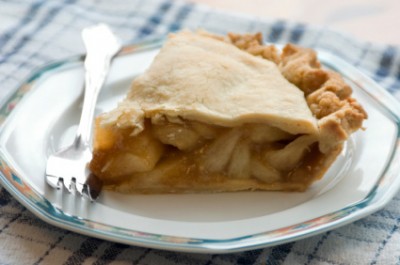 I have a weird confession to make: I don’t really like homemade pie. It’s not that I dislike it, it’s just that I find that it’s often too flaky, and the apples aren’t what they should be. And I absolutely hate hot pie. I can’t eat a pie hot (or warm). It has to be ice cold. I’m pretty sure this is because I used to eat store-bought Table Talk pies when I was a kid, and they’re still the pies I go to when I buy pies. I just think they taste better.
But most people like hot, homemade pie, so don’t let me stop you from making them!
Apple pie is probably the most American of the American pies, so to celebrate Great American Pie Month in a real American way, here’s a classic recipe from the most American of magazines. Here’s one from Curtis Stone, Spiced Apple Pie. And if you’d like to put apple pie in some historical perspective, here’s an interesting piece from the July 25, 1942, issue of The Saturday Evening Post, “The Decline of Apple Pie.”
Just make sure you don’t make eating pie at midnight a regular habit.
Next Week’s Holidays and Events
Valentine’s Day (February 14)
Sure, you could look at all of the great love-related Saturday Evening Post covers or spend a special night out with your significant other, but what if you don’t have someone? You can celebrate Singles Awareness Day, which is officially February 15 but often celebrated on Valentine’s Day. And please note what the acronym is.
National Drink Wine Day (February 18)
If you didn’t drink enough wine on Valentine’s Day, you can do it today. There’s even an official web site for it. I suggest a nice Cabernet Sauvignon.
Bids
Jake saw the sign, “NOW ACCEPTING PLOW BIDS,” stationed high on a pole in the parking lot of Brown’s car dealership on his way home from work. His methodical brain repeated the phrase as he navigated rush-hour traffic through the center of town.
“Now accepting plow bids, now accepting plow bids, now–accepting–plow–bids.”
Something was stirring, and although he wasn’t usually quick to make a connection, his synapses were firing particularly well.
“Bids!” he exclaimed, though excitement wasn’t his strong suit either.
He mulled over his idea as he drove his battered red pickup toward home, arriving at the weed-covered driveway of his small ranch 20 minutes later still excited by his thoughts. It was such an obvious answer he was surprised no one had thought of it before.
The house had belonged to his parents, Rose and Chester. Jake was their only child and a blessing after they’d nearly given up hope of having children.
Jake was determined to do right by his parents and take good care of the home, especially since he felt he had been a disappointment to them. It was nothing Rose or Chester had said, or would ever have dreamed of saying. They had been loving people, always full of laughter and good ideas.
Jake could remember many a rainy Sunday afternoon as a boy, when Rose would play her small upright piano and Chester would join her to sing something by The Beatles or the Mamas and Papas, because Rose liked to stay current.
“Come on, Jake,” his mother would say, looking over her shoulder at him from her perch on the piano bench, “try this one.” And then she’d bang away on the keys, and Jake would freeze with shyness, pretending to play with his toys while a deep sadness settled low in his belly.
On the weekly trips to the supermarket, Jake would often wander away and Rose would find him helping one of the clerks stock a shelf, or straighten a display.
“Mama,” Jake said one day in the car after the shopping, “I heard Mr. Santori tell Joe that I’m slow. What does that mean?”
He watched as his mother’s lips tightened. She shook her head. “You know what? You’re kind, and you always have a smile on your face. People think that anyone who dares to be happy must not be quite right. Don’t you listen to them, Jake.”
He tried to believe his mother, but the thought that he might not “be quite right” stuck with him, coloring his confidence with an undertone of gray.
Taking care of the house had become harder for Jake. He worked days at a construction site and by the time he got home, he was too tired to clean, or mow, or do any of the chores necessary to keep the place tidy. Sometimes he would pull into the driveway and sit in his truck, trying to muster the energy to go into the house.
Jake was motivated that day by his new idea though, and he sprang from the truck and walked briskly to the door, stopping to scratch the dappled fur of his mother’s cat Tessie on the way.
He went to the kitchen, opened a can of cat food, and placed Tessie’s bowl on the Formica counter. The cat jumped to the counter and meowed softly at him as he spooned the food into her dish.
“Tessie,” he said, stroking her soft fur while she ate, “Tess, I got an idea.”
He took a frozen dinner from the freezer and unwrapped it.
“I’m gonna accept bids, Tess. Why not?” His voice rose slightly, causing the cat to peer at him and then continue eating. “If the dealership can do it, why can’t I?” He waved the empty dinner carton in the air. “Things are too damn expensive, make them work for it, that’s what I should do.”
These thoughts occupied his mind as he ate his roast turkey, gravy, peas, and a tiny sampling of apple cobbler.
After dinner, with his small television on for company, but the volume on low so as not to distract him, he rummaged through closets looking for his mother’s craft supplies.
His parents had died within a year of each other — first Chester, then Rose. While his father had a diagnosis of heart disease, Rose had no ailment other than heartbreak. When he thought of his mother, which he did daily, Jake would sigh and tell Tessie that it was the love that got her.
“She just couldn’t live without him, loving him the way she did,” Jake would say, staring into Tessie’s solemn eyes.
Those first months after his mother died, Jake had wandered from room to room, unable to settle anywhere.
Eventually he found solace in the empty evenings by watching the news with Tessie curled up in his lap. And although he had never been one to have much interest in politics or the economy, he had begun to offer his simple thoughts and opinions to Tessie, which hadn’t seemed to bother her in the least.
After searching through the cellar, Jake finally found his mother’s poster board and markers in the back of the hall closet. He cleared assorted newspapers, credit offers, and old bills from the dining room table and laid the materials out to begin his work.
He took great care that his words didn’t dip or sway across the poster board. An hour later, he stepped back from the table to admire his handiwork.
On the first sign he had written in large letters, “NOW ACCEPTING HOUSEWORK BIDS,” and on the second, “NOW ACCEPTING DOCTOR BIDS,” and on the third, “NOW ACCEPTING BIDS FOR A COMPANION.”
He had hesitated a little on the last one, wondering if he could hope to find a suitable companion from a sign. But he remembered his initial excitement, and looking around for Tess, who was watching him from her perch on the windowsill, he said, “Tessie, I wouldn’t take real money from them of course, they could maybe fill out an application.” Tessie blinked at him, which he took for her agreement.
In the frosty morning, before he left for the job site, he plunged three tomato stakes into the front lawn, having attached his poster board to each. He took a moment to appreciate his handiwork, and drove away in his truck with an odd sense of hope emanating from somewhere near his chest.
“Gone a little bit off, huh?” Reginald said to his wife as he squinted across the street at the strange signs on Jake’s front lawn.
“What’s that?” Marta put her sewing down and got up slowly to join Reginald at the window. “What the blazes? A doctor? A companion?” She shook her head. “I told you before, I told you he wasn’t right in the head.” She looked at her husband’s craggy face for confirmation. “Didn’t I tell you?”
“Yes … yes you did.” Reginald hated admitting when Marta was right, but in this instance, there was nothing to be done. “Well, no one’s going to answer those signs, so that will take care of it right there.” He sat heavily in his favorite recliner, turning the volume of the morning news up with the remote, signaling the end of the matter.
Marta continued to stare across the street, past their own neatly trimmed lawn, to the overgrowth on Jake’s side of the street. She shook her head every few seconds, muttering things under her breath. “What would Chester and Rose say? Rolling around in their graves right now, betcha,” until finally she tired of the view and returned to her sewing.
Throughout the day they noticed several cars slow as the occupants drove past Jake’s signs, and they chuckled to each other. “Now everyone knows he’s off,” they said.
The signs had gone up on Tuesday morning. By Friday, Reginald and Marta had become slightly miffed at the number of cars stopping on the street.
“And anyway,” snapped Marta, “we shouldn’t have to stare at those darn things day in and day out.”
By the time a white van with the letters “WCFH” and “News 13” emblazoned on the side arrived on Saturday morning, Reginald was seriously thinking of yanking the signs down himself, just so he could have a little peace from Marta’s increasingly incensed mood.
They both peered surreptitiously from the sides of their front picture window, watching as the dressed-up newsperson knocked on Jake’s front door. And they watched as Jake came out on the front lawn in his weekend jeans, and tried to read his lips from across the street as he talked to the reporter, arms occasionally waving, and more animated than they’d ever witnessed.
Unsuccessful at reading Jake’s lips from across the street, they waited until 6 o’clock and turned on WCFH, Channel 13, determined to hear what Jake had told the reporter.
“Mr. Oliver, can you explain to our viewers why you put up these signs” — the reporter gestured at the poster board on the front lawn — “and what kind of response you’ve been getting to them?”
Reginald and Marta watched as Jake stuck his thumbs through the belt loops of his jeans and rocked back slightly on his heels.
“I’d be happy to!” he said. “Well, I was driving home ’bout a week or so ago, and I saw this sign up at Brown’s car dealership — ‘now accepting plow bids’ — that’s what the sign said. I got to thinking” — and here Jake paused, his forehead wrinkling in concentration — “we should all accept bids for the stuff we need.” Jake pulled his hands from his belt loops, gesturing in excitement. “Why, I need a doctor, and I need someone to keep this house up. Why not turn the tables a little?”
“Turn the tables?” the young reporter asked, taking a step back from Jake’s gesticulating arms.
“Turn the tables! They’ve got us by the balls, all of them — expecting us all to pay outrageous prices for a doctor visit, for milk, for gas, for anything at all.” Jake’s face lit up with a smile. “Here’s our chance to make them come to us, compete for it, work for it.” That seemed to settle the issue for Jake, and he looked at the reporter expectantly, sure he had made himself clear.
“Uh, and the companion? Should she ‘compete for it’ too?”
“Oh, well, that.” Jake looked a little abashed. “I thought maybe they could fill out an application, you know, not really put a price on something like that.”
“And have you gotten any responses?” The reporter looked dubious.
“Yes! Why yes I have. I’ve gotten two calls from housekeepers, and one from a fella down the street asking if I’d found a doctor yet, because he needs one too.” Jake’s face registered triumph, and so the reporter, thinking of nothing else to ask, wished him luck.
When several weeks went by and the signs rather than vanishing, multiplied instead, the white van could again be seen outside Jake’s increasingly cluttered yard.
The reporter, not yet 25 and already moving a little more slowly than in his previous visit, made his way through the forest of signs, reading along the way, “NOW ACCEPTING FURNACE REPAIR BIDS,” and “NOW ACCEPTING DENTAL CARE BIDS.”
Jake met him excitedly at the door, and waved to Reginald and Marta, whose faces he could see poking from the sides of their front window.
“It’s working!” Jake exclaimed, grabbing the reporter’s arm and pulling him out into the middle of the signs. “Right here” — he pointed to the one reading “NOW ACCEPTING SQUIRREL REMOVAL BIDS” — “I got three bids on this one alone!” He shook his head, clearly amazed.
“How do you decide which bid to accept?” asked the reporter.
Jake studied the young man’s face for a moment. “Why, I take the lowest one.”
“Oh yes, of course,” said the young man, nodding. “Well, how can you afford to pay for all these things you’re accepting bids for?”
Jake glanced around the yard, seeming to register the number of signs for the first time.
“So — how can you afford all this?” the reporter repeated, smiling tightly and hoping he’d found the odd man’s downfall that guaranteed this was his last visit.
“Well now …” Jake took a step back and looked around again. “Of course I can’t.” The reporter smiled again, almost encouragingly. “That’s why I ask everyone to agree their bid’s good for a year, so I can work my way down the list.”
“Oh.” The reporter inwardly saw himself standing on the same lawn again in a few months’ time. “What a good idea.”
“I thought so, too!” Jake exclaimed. “Now, why don’t you go talk to my neighbors across the street?” He nodded toward Reginald and Marta. “They’ve been so excited; I see them looking out near every day, and I bet they’re thinking of trying it too!” With that, Jake pumped the young man’s hand and strode through the forest of signs to his front door, stopping to pet Tessie along the way.
Let’s Forget the First Amendment
Not since the Vietnam War have Americans seen such an angry divide, manifested in outspoken resistance to government policies, protests, and the reaction against protests.
The current wave of public protesting began in 2013, when the Black Lives Matter movement began its street demonstrations. Protesting rose sharply after the last election when opponents of the new administration staged massive demonstrations across the country.
Now some state lawmakers are launching counter-protests through new bills. They hope to discourage demonstrations by increasing the criminality and liability of protesting.
- Legislators in Minnesota and Iowa have proposed laws that will raise the fines for freeway protesters.
- A Washington state legislator wants to reclassify civil disobedience that results in “economic disruption” as “economic terrorism” — and a felony.
- Virginia and Michigan lawmakers also want to raise their penalties on protesting, including union-organized picketing. And Michigan and Minnesota legislators want to make it easier for businesses to sue individual protestors.
- North Dakota Republicans introduced a bill that would remove the penalties for running over and killing a protestor blocking a highway if the driver’s actions were “accidental.”
Activists claim the new state laws threaten the free speech protected by the First Amendment. The laws would overturn the tradition of allowing public protests so long as the demonstrators didn’t incite violence, disrupt public meetings of police business, resist arrest, or refuse to disperse when so ordered by police.
Fifty years ago, there was similar talk of restraining protests. Thirty-two state legislatures supported the idea of a Constitutional convention that would rewrite the laws on representation and voting rights.
A Post editorial from June 17, 1967, noted that the attack on Constitutional rights had now spread to the First Amendment. Representative F. Edward Hebert had claimed that the guarantee of free speech allowed black leaders (including Martin Luther King, Jr.) to “incite violation of the law.”
His solution? “Let’s forget the First Amendment.”
He knew the Supreme Court would overrule any measure violating the First Amendment, but he thought Congress and the Justice Department should at least try to clean up this “rat-infested area” of civil protests.
There are more than a few similarities between then and now. If the present state of social conflict develops as it did in 1967, there are more protests to come.
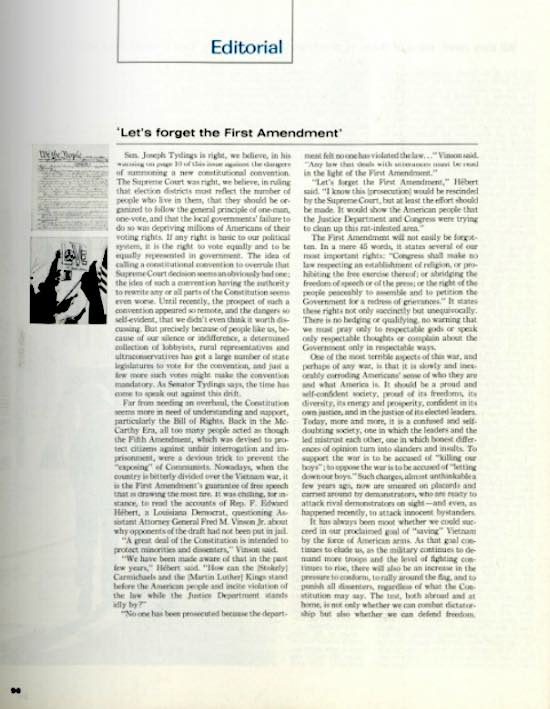
Read the editorial, “Let’s Forget the First Amendment,” from the June 17, 1967, issue of the Post.
Featured image: Mounted policemen watch a Vietnam War protest march in San Francisco, April 15, 1967 (Photo by George Garrigues, author GeorgeLouis, Wikimedia Commons via GNU Free Documentation License)
7 Things You Need to Know About the Ninth Circuit Court of Appeals
The U.S. Court of Appeals for the Ninth Circuit has drawn significant attention as it decides whether to sustain federal judge James L. Robart’s temporary restraining order on President Trump’s travel ban last week. The appeals court panel is expected to make a decision within a few days, and if it decides in favor of Robart, the Justice Department will likely appeal the case to the Supreme Court. The panel consists of Judge Richard R. Clifton, appointed by George W. Bush, Judge Michelle T. Friedland, appointed by Barack Obama, and William Cameron Canby, Jr., appointed by Jimmy Carter.
There are 13 courts of appeals in the U.S., and they each hear cases that are appealed from their respective district courts. Cases that are appealed further can be heard by the Supreme Court.
Here are 7 facts about the Ninth Circuit Court of Appeals:
- The Ninth Circuit Court of Appeals is the largest of the 13 appellate courts in the country. The Ninth Circuit currently holds 29 judgeships with four vacancies. The next-most populous jurisdiction is that of the Fifth Circuit, which maintains 17 judgeships.
- The Ninth Circuit Court of Appeals was established by Congress in 1891. Since then the jurisdiction of the Ninth Circuit — originally six states — has expanded to include more Western states. Its jurisdiction includes California, Arizona, Alaska, Washington, Oregon, Idaho, Nevada, Montana, Hawaii, Territory of Guam, and Territory of Northern Mariana Islands. The upsurges in populations of these states over the 20th century have led to more and more authorizations for judgeships in the Ninth Circuit.
- The great size of the Ninth Circuit has been cause for many congressional proposals to split the circuit in various ways. The most recent such effort involves a bill proposal from Arizona senators to form a new circuit.
- Of all the circuit courts, the Ninth Circuit has the highest percentage of rulings reversed or vacated by the Supreme Court.
- Nicknamed the “Hollywood Circuit,” the court hears a number of celebrity cases. In 1993, “Wheel of Fortune” star Vanna White won a case against Samsung for appropriation of her likeness when they featured an ad of a robot turning letters.
- Several highly publicized cases seen by the Ninth Circuit have been the cause for conservative criticism of the court. In the 2004 case, Elk Grove Unified School District v. Newdow, the Ninth Circuit found the words “under God” in the Pledge of Allegiance to violate the Establishment Clause of the U.S. Constitution. In 2011, the court upheld the order against the military’s “don’t ask, don’t tell” policy.
- Of the sitting judges in the Ninth Circuit, 18 have been appointed by Democratic presidents and 7 by Republicans. At one time 15 out of 23 sitting judges were President Carter’s appointments, but only one of his appointed judges still remains.
Trump and Goldwater: Same Message, Different Outcome
Brash, opinionated, and promising to overturn the political status quo, Donald Trump surprised many Americans who’d never seen a presidential candidate like him. Many people looked for a precedent for him in our history. Some compared him to Andrew Jackson, but he may be more like the man who wrote the editorial below.
Arizona senator Barry Goldwater was the Republican presidential nominee in 1964, running against Lyndon B. Johnson. Like Trump, Goldwater promoted dramatic solutions to the country’s problems. Both portrayed the federal government as the enemy of liberty. Neither man openly espoused racist policies, but both were lauded by overtly racist organizations. Both played to the media with startling rhetoric that challenged the political establishment. And both criticized the media for how their campaigns were covered.
The 1964 Democrats, led by Johnson, had little problem portraying Goldwater as a wild extremist who couldn’t be trusted to maintain peace with the Soviet Union or to promote the civil rights of Americans. Goldwater lost heavily, receiving 27 million votes compared with President Johnson’s 43 million.
In this article from the February 11, 1967, issue of the Post, which Goldwater wrote three years after losing the election, he struck back at “liberals”— i.e., reporters — who he claimed, with some fairness, had been extremely critical of him.
He cited a groundless CBS report that hinted he was playing up to a reviving fascist party in Germany. The San Francisco Examiner, he added, claimed he wanted to shut down Social Security. Even the Post received its fair share of criticism. He quoted an anti-Goldwater editorial from 1964 that called the candidate “a wild man, a stray, an unprincipled and ruthless political jujitsu artist.”
Obviously, things turned out very differently for Trump than they did for Goldwater. Much has changed in 50 years, but Goldwater’s screed reveals that the media and “fake news” have long been the target of diatribes, even if the criticisms have since shrunk to 140 characters.
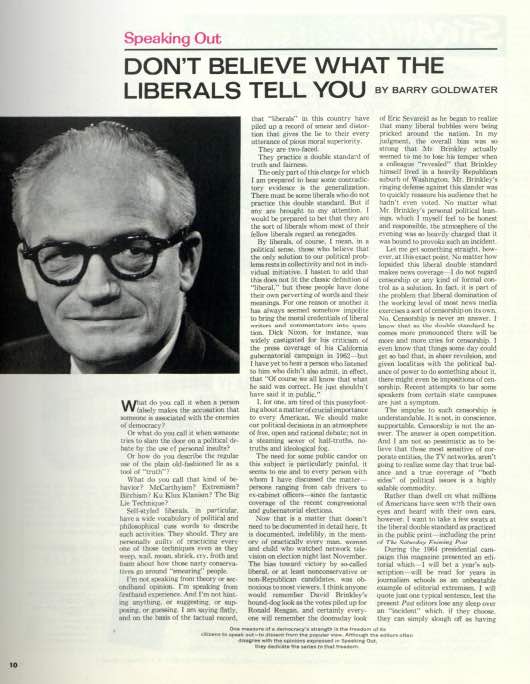
Featured image: Barry Goldwater (Ollie Atkins for The Saturday Evening Post) and Donald Trump (Shutterstock)
The Boy Scouts Are Here to Stay
On the 107th anniversary of the Boy Scouts of America, we are reprinting this Saturday Evening Post editorial from our February 10, 1945, issue.
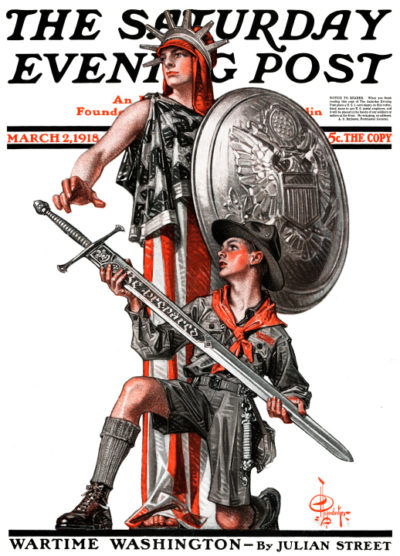
THE Boy Scouts are so much a part of the American picture that it is hard to believe they have been around for only thirty-five years. They are so tangled in the vocabulary, humor, ideals and daily life of the nation that one would think they had been around as long as the Grange or the W.C.T.U. Actually, the Boy Scouts of America — from the daily good deed to the load of hardware considered necessary to hiking — were organized in February, 1910, two years after Sir Robert Baden-Powell set them up in England. There have been all sorts of movements and organizations devoted to training boys and giving them something to do in their spare time, but it would be hard to name any which does the job as well as the Boy Scout movement does it. Probably, the secret is that the Scouts, instead of playing soldier or cops-and-robbers, actually participate in the life of their communities. During the war, they have sold Bonds, collected scrap materials, assisted ration boards and other civilian boards. In time of peace, they have been equally useful. Who can tell how much the Boy Scout movement has done to relieve the blackout of the Seven Ages of Man—those years when a boy is too old to have nothing useful to do and too young to be allowed to do it? Nor is it unimportant that the Boy Scouts are an international organization, have contacts with Scouts in other countries and are encouraged to develop the kind of attitudes that will be necessary in the closerknit world of the future. That alone justifies a feeling of satisfaction that the Boy Scouts of America are thirty-five this week and showing no sign of senility.
~Editorial, February 10, 1945
“Thankless Child” by Rose Wilder Lane
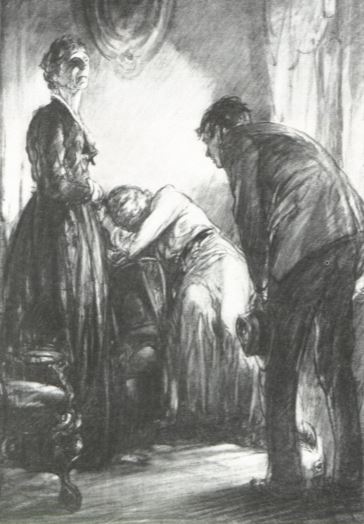 Originally published on February 2, 1935
No one in our town had ever known such a wholly devoted mother as Mrs. Estes was. “Maybe it’s only natural,” Mrs. Rogers said uneasily. “When you think she’s buried five. But my land, she don’t have a thought in her head but Lois. She just lives and breathes in that child.”
My mother didn’t glance at me, but her reply did. “Well, such a sweet, good, obedient little thing. Anybody’d be thankful to have a little girl like Lois you didn’t have to nag at the livelong time to make ‘em behave.”
Mrs. Rogers agreed: “If ever there was a little angel on earth — and those curls, just like sunshine.”
The worst of it was that we could not take it out on Lois. She was a constant good example, but somehow we could not wholeheartedly detest her. Her goodness did not seem to be quite her fault. She was good as if she couldn’t help it. “Mama says I mustn’t,” she’d almost whimper.
“All right for you, fraidy cat!” we’d answer, leaving her. It must be said that she was no tattletale. Of course, she was never questioned; no one could suspect her of even knowing about our naughtiness. Quite often she didn’t. She was a rather lonely little girl.
Mrs. Estes lived in a tiny unpainted house on the back street, behind the Shermans’ barn. Of course Mr. Estes lived there, too, but he was a little man with walrus mustaches, always answering advertisements which promised a live hustler as much as $10.86 a week. We connected him vaguely with books, perfumes, complexion soaps — things no sensible woman would spend good money for. Once he frightened us with the notion of burning gasoline in a lamp; it was a mercy the thing didn’t explode and burn everybody out of house and home. Then he tried to sell mats of a new thing called asbestos. He said fire wouldn’t burn them.
“Mercy, what next?” my mother said. “How Mrs. Estes ever puts up with it all — and she trying to hold up her head with the best, the way she does.”
“They won’t burn, for a fact,” said my father. “Most the men in the barber shop bet money on it. Jay Willard put up a dollar bill. So we all went across to the blacksmith shop and got Murphy to blow up his fire full blast, but to save our necks we couldn’t make the dang thing — ”
“Joe Allen!” my mother interrupted. “You mean to tell me you bet good mon — ”
“I am not telling you any such a thing!” my father almost shouted. “You want to know what goes on uptown, or don’t you?”
“Go on,” she said coldly.
“That’s all,” said my father.
We ate in silence, till at last she said, “So it wouldn’t burn.”
“You said yourself it would,” he accused her. “And it did turn brown and start smoking. We — that is, Jay let out a yell you could hear from here to breakfast and begun joshing Estes, when dummed if the dang thing didn’t turn white again.”
“You might as well swear outright as use such language,” said my mother.
He went on: “Estes was all set up, pleased as Punch and grinning like a Chessy cat. Said he finally got hold of the right thing, this time. He sold Jim Miller a mat right there, ten cents apiece, and you can boil potatoes plumb dry on it; Estes guarantees they won’t so much as scorch.”
“Let me catch you squandering ten cents for one,” my mother said ominously. “When did I burn potatoes? If that Estes comes around insinuating I let my cooking burn, he’ll get short shrift, I promise him! Even if it would keep anything from burning; a trick of some kind’s what it is. And ten cents don’t grow on bushes. Not for me they don’t,” she added, rubbing that bet in on my father.
I don’t remember what Mr. Estes died of, nor exactly when. His death was as vague as his life. Mrs. Estes did not put Lois in black; she herself had never got out of mourning for her children in heaven, and she could not afford widow’s weeds. We had always thought of the house as her house; no doubt Mr. Estes would have lived on the south side of the tracks but for her.
How she made both ends meet no one quite knew. Women who sank to taking in washing must have earned more money than she earned by dressmaking. But Mrs. Estes was determined to keep a social position for Lois.
It was true that she lived only for Lois. As Mrs. Miniver said, that woman didn’t seem to have a selfish bone in her body. My mother suspected that she scrimped herself even on food, to keep the child looking like a little doll.
“Our lives are past,” she said once to my mother, who accepted the statement as if it didn’t taste good. “I never had anything I wanted, and I never will, but Lois is going to. If I work my fingers to the bone, she’s not going to go without.”
She was a gaunt woman with a sallow complexion and mud-colored eyes set deep against a big nose. Even as a girl she couldn’t have been pretty; likely Mr. Estes was the best she could get. They had been country folks, and at least he had ambition enough to move to town, though in the upshot she hadn’t bettered herself much. It must have been a consolation to her to have the prettiest little girl in town.
It is hard to say why I felt in Mrs. Estes a kind of tigerish hunger. She was always a lady; I never saw her make a brusque gesture or heard her voice raised. She slept in her corsets to keep her straight, inflexible figure, and at dawn she incased herself in starched calico with a tall collar. Her nondescript hair was always smooth. Nothing less tigerish can be imagined than Mrs. Estes, swiftly making buttonholes or whaleboning a bodice, her skirts concealing feet planted on the thin clean rag carpet of her front room, and her mouth shut neatly. Lois and I would glance at each other with diffidence. Mrs. Estes was an even heavier constraint than one’s own mother.
“Well, I must go now,” I’d blurt. “I only came to bring the pickle receipt, mama said I had to.”
Mrs. Estes’ look at Lois made me uncomfortable. It was a pouring-out look, as if all of Mrs. Estes came out of her eyes and ate up the delicate little face, the golden curls topped by a blue bow, the big brown eyes and fringing lashes, even the pretty dress, the unwrinkled stockings and the shoes with not one button missing.
“Say goodbye to Ernestine, nicely now.” Her voice was like a mother cat’s loud purr, licking her kitten. And that look would follow Lois. None of us had such pretty manners. A crinkle went over me. It was somehow as if Lois really were a doll — one of those figures held on a ventriloquist’s knee and speaking unnaturally with the voices he put into them. They seemed somehow wrong inside, too, so that I didn’t like to hear them and was uncomfortable without knowing why. Lois would murmur, “Goodbye, Ernestine. I am glad you called. Come again.”
I would be glad to get away. And for no reason, while I wandered homeward, rattling a stick along the Shermans’ picket fence and dragging one foot after the other, I’d chant, “I don’t care; I do as I please, I do as I please, I do as I — ”
My mother’s voice would stop that: “Ernestine! Stop that caterwauling this minute! Shame on you! And how often must I tell you to stop scuffing out your shoes as if we’re made of money? My land, I don’t know what gets into you!”
Days were limitless then; summer was summer forever, and each year’s end was too far away to be seen from that year’s beginning. When did we leave childhood’s eternity, when did space begin to close upon us and time begin to hurry us toward the end too clearly known?
There was no moment when we might have felt a pang of hesitation. Yet it seems to me now that quite suddenly we were young ladies. Our battle was for recognition. “My goodness, mama, I’m not a child! I’m going on sixteen, and I can’t wear skirts way up to my ankles! I’d just die, I’d look such a freak. Elsie’s mother’s putting her in long skirts. It won’t take but a yard more of goods, mama, please. Please, mama!”
Elsie Miller not only wore the longest skirts; she put up her hair with rhinestone combs and barrette. The rest of us had to fold our braids on the neck, under a black ribbon bow. But out of sight of our mothers, with surreptitious hairpins we pinned those braids up on our heads. Only Lois still wore dangling curls, a rich mass now almost reaching her waist. Every morning Mrs. Estes brushed each of those curls around her finger until it was a shining, perfect tube. We thought they were babyish. But we did not ask Lois why she didn’t make her mother let her stop wearing them.
It was not that we ignored her, as we ignored poor girls from south of the tracks. She was with us in school and in Sunday school; she was always invited to parties, and came, beautifully dressed and with beautiful manners. At Easter she was chosen for the tableau, Rock of Ages. Clinging to a gilded cross, her golden hair rippling down a long white robe, her gaze fixed faithfully on Heaven above the rain spot on the church ceiling, and green cheesecloth waves agitated beneath her, while Mr. Sherman, choking, held the hot shovel from which tableau powder fumed a blue light, she was so beautiful that tears filled my mother’s eyes.
We did not dislike Lois. We didn’t like her either. You could not say she wasn’t there, when she was, yet in some indefinable way she really wasn’t. Elsie said, “Oh, she’s just a namby-pamby.” But I felt that there was a real Lois, far down inside her somewhere. And I was sorry for her. She was always so good, so proper and ladylike, and if you suddenly asked her whether she wanted this or that, an odd confusion came into her eyes. She didn’t know what she wanted; she had to have a rule to go by, and she’d say, “Well, I don’t know if mama — ”
“Oh, shoot your mama!” Elsie shocked us all. “I’d have a mind of my own, I guess, mama or no mama!”
“That is not a nice way to speak, Elsie,” said Lois, perfectly reproducing her mother’s dignity. Even Elsie was squelched. Lois was right, of course; it was not a nice way to speak.
We were seventeen then. Some were already keeping steady company and all of us had beaux, except Lois. She said, “Mama says I’m too young,” and didn’t seem to mind. In spite of her beauty and her clothes, no boy paid any attention to her until the night Dan Murphy taught her to skate.
She was outdressing us all that winter. It was the winter Mrs. Sherman died; not that we marked time from that event. The Shermans’ square white house was only a little way from ours, across the street, but I had seen Mrs. Sherman only when she was polishing windows or hanging out clothes. She slaved her whole life away taking perfect care of that big house which no one ever set foot into; not even Mr. Sherman, for in order to save the house they lived in the kitchen and its lean-to bedroom. A bedraggled wisp of a woman, she was so timid that if you knocked at the locked door, she wouldn’t answer, fearing tramps. So no one missed her except Mr. Sherman. But her going had been, you might say, a blessing for Mrs. Estes. Mr. Sherman was the station agent; he made good wages and had no time to cook. Mrs. Estes sold him bread and baked beans, cakes and pies, and spent the money on Lois.
“The way to a man’s heart is through his stomach,” Mrs. Rogers said, but my mother pooh-poohed her. “Mrs. Estes’d never set her cap for any man, and his wife not cold in her grave. No, all she’s thinking about is more falderals for Lois.”
I wasn’t interested. The mill pond had frozen, and for a little while a madness came upon us; we forgot we were young ladies now. Our mothers shook their heads dubiously, but on those starlit evenings sparkling with frost they couldn’t keep us indoors. A bonfire crackled and blazed by the pond; the keen air bit our cheeks and blew in steam from our mouths, and all the good ladies were faintly scandalized by our loud shouts and laughter.
Elsie and I were tightening our skates in the firelight when Dan Murphy came swooping toward us, and my heart thumped at my ribs. Dan was black Irish, like his father, the blacksmith, and he’d set any girl’s heart thumping. It was impossible to say why. Mothers didn’t approve of him. In that instant while he was flying toward us on one skate, I remembered how wild he was; he’d fight anybody at the drop of a hat; he played cards and was suspected of smoking; he loafed around the livery stable and the barber shop and spent money as fast as he got it and would never amount to anything, but my heart was pounding with a hope that he’d skate with me instead of with Elsie.
He wasn’t even good-looking. His nose had been broken in a fight and one of his flashing white teeth was crooked. He was wearing ragged overalls and an old jacket, and he had lost his cap somewhere. His black hair was intensely alive: a lock was always tumbling across his forehead, and when, with a quick jerk of the chin, he tossed it back, my very bones seemed to melt. Dan Murphy could have gone with any girl in town, no matter what her mother did. But no girl had ever got him.
His eyes narrowed when he smiled, and the dancing twinkles in them would dance out of reach if you tried to catch them.
“Hello, girls!” he said, and without a pause, “Come on, Lois.”
Elsie and I were too staggered to answer him. We had forgotten Lois. She was there only because my mother wouldn’t let me come alone, so I’d brought her. Elsie had lent her an old pair of skates and she’d buckled them on, but didn’t dare try to step.
“Oh, th-ank you — I ca-can’t — ” she said, teetering. Dan Murphy didn’t say anything. He gripped her mittened hands firmly, and the next instant they were gone. She couldn’t fall; he was too strong, and he was the best skater on the pond.
He didn’t leave her, and every time I passed them I was more astonished. Lois wasn’t like herself at all. I saw her, breathlessly laughing, tear off her coat and fling it on the snow. Most of us had taken off our heavy coats, but not with such abandon. Her pale blue, beaded woolen fascinator kept slipping, till she flung it away too. The tossing curls grew more and more tangled, and she laughed as I’d never heard her laugh. So did Dan. Everyone was noticing them, and Lois didn’t care. That was the incredible thing — that Lois didn’t care. Her laughter made me feel queer.
I was sober, feeling responsible because I had brought Lois. Indeed, we all grew quieter than usual. Long before ten o’clock I took off my skates and said to Elsie, “I’ve got to take Lois home.”
“You’ve got to, all right,” said Elsie. “But will she go?”
“Lois?” I said. “Why, of course she’ll — ”
Those two came swinging down the middle of the pond, so carelessly swift that others got out of their way. They were swaying as if they were one person and each flying stroke ended in their wild crescendo whoop. Lois, her hair uncurling, her mouth open, yelling, and her shape showing under the blown cashmere dress, flashed by so quickly that I almost succeeded in not believing what I saw. Before I could catch my breath, Dan was spinning her around him at arm’s length. They’d just missed going headlong into the snow banks. Still on one skate, her petticoat ruffles plainly to be seen, twice she circled around him, then they crashed together in what might as well be called outright a hug.
Lois was merrily laughing, and Dan yelled, “Ooooopeeeeee!”
“Well! If that don’t cap the climax!” said Elsie.
I walked straight up to them and said, “Lois, we’re going home.”
“It can’t be ten o’clock,” she said, and suddenly I felt that she wasn’t Lois. Her voice wasn’t the same, nor her eyes. Even her rosy face seemed less soft, as if her whole body, like her voice and her eyes, were rounded out, full of a girl I didn’t know. I wasn’t sure I could cope with her.
Dan said No. 5 hadn’t gone through yet. “If you’ve got to go, run along,” he said. “I’m taking Lois home.”
She laughed at him. “Are you?” I knew he hadn’t asked her. “Oh, don’t go yet, Ernestine,” she said carelessly. “I want to skate some more.”
From another girl the words would have meant nothing. But to hear Lois say them, in that sure voice, almost unnerved me.
“I am going,” I said firmly. “And what will your mother say?” I knew well enough that no mother would allow a girl to behave as Lois was behaving that night, especially with Dan Murphy; and I’d brought her, I could be blamed. Mrs. Estes always aroused my sense of self-preservation.
The color went out of her cheeks and I knew she’d come with me. There was never any resistance in Lois. After all, she had been brought up to do as she was told. Hesitant again, she looked at Dan to tell him good night. He spoke first.
“Rats!” he said, swinging her into skating position. “I’ll get you home by ten o’clock.” They were so far away that I couldn’t hear her reply.
I could do no more. Besides, Lois was no longer making an exhibition of herself. She and Dan were still skating decorously, swinging along together and talking, when my beau took me home. He stayed some time at the gate and it was precisely two minutes to ten by the dining-room clock when, all but frozen, I went in.
My mother, who had been sitting up for me, put away the sock she was knitting.
“Did you and Lois have a good time?” she asked kindly, and I replied, “Yes, mama.”
It was no conspiracy which kept Mrs. Estes from knowing what was going on. With parents it was always prudent, as well as respectful, to be silent until spoken to. And there was nothing definite to tell. We simply knew that Dan Murphy was gone on Lois and that she wasn’t discouraging him. Their eyes said that. In one way and another they saw a great deal of each other, not secretly, yet not quite openly. She didn’t, for instance, let him see her home from church; all that next summer they didn’t go buggy-riding, and when he asked to buy her ice cream at the Ladies’ Aid socials, she said, thank you, she didn’t care for any.
I think they quarreled about it. One autumn evening I passed them at the corner of Mr. Sherman’s yard, where the side street went to Mrs. Estes’ house. They were standing there, talking. Chrysanthemums, I remember, were ghostly along the fence and there was a scent of burning leaves. Dan was speaking vehemently:
“But why can’t I? What are you afraid of? What can she do?” Lois made some warning gesture and he was silent till I’d gone by. But, walking softly, I heard him ask, “We’ve got to tell her sometime, haven’t we? Lois? Haven’t we?”
When I told Elsie we were sure that Lois was secretly engaged. We were thrilled. This was the single romance in our experience which was one bit like the romances in books. We cultivated our friendship with Lois as we had never done before, partly from curiosity and partly from a mystic feeling that some magic might be communicated to us. I wondered endlessly how she had got him to pop the question.
She was changed, and not only because at last her mother had put up her hair. Mrs. Estes arranged it beautifully; the huge pompadour and piled coils made her head enormous. Beneath that marvelous golden weight, her face was like the flower faces in children’s picture books. But if she had been vague before, now she was quivering. The slightest incident, sometimes even a word, would throw her into excited laughter or tears. “Oh, I don’t know!” she’d say, sobbing. “It isn’t anything. It’s my hair, it makes my head ache.” Once she said appealingly, “Oh, Ernestine, don’t you wish we didn’t have to grow up?”
I hadn’t thought about it. “We don’t have to do anything,” I said. “We just do grow up.”
It must have been a May evening when my mother and I noticed the light in an upstairs window of the Sherman house. We were sitting on our front porch. I remember the slender moon and a feeling of springtime, and the maple leaves were young.
“What can be going on in that bedroom?” my mother wondered. “He can’t be dressing up; it isn’t prayer meeting night.”
Our side gate clicked and Mrs. Rogers came around the house, holding her skirts above the dewy grass.” You suppose that he’s moving in up there? Poor soul, she must be turning in her grave.”
“Take the other rocker,” my mother said. “Well, it’s no disrespect now if he does get some good out of that big house. Let’s see, was it a year in January? I remember the ground was frozen.”
“February third,” said Mrs. Rogers. “And you can’t tell me he didn’t begin taking notice again, last winter. All that traipsing back and forth; it wasn’t just pies and cakes he was after.”
We could make nothing of the shadows on the window shades. The lamp went downstairs; light glimmered briefly through the colored glass in the front door. Then the house was dark, until a lantern came around it. Pepper-and-salt trousers legs moved scissors-like in the glow.
“His Sunday clothes!” Mrs. Rogers exclaimed. The lantern twinkled down the side street beyond the pickets. My mother settled back then, and so did Mrs. Rogers, exclaiming, “What did I tell you!”
“And a good thing for both of them,” said my mother.
“Yes, Mrs. Estes won’t refuse him, a good man and a good home and all. I wonder how Lois’ll take it?”
“Lois’ll have nothing to say about it,” replied my mother. “And it’s high time her mother’s mind was on something else for a change. You mark my words, if Mrs. Estes don’t let up on that girl, Lois’ll break out somewhere in a way you’d least expect.”
Next day, like a bomb, the news burst upon us that Mr. Sherman and Lois were engaged.
I couldn’t repress a gasp, but my mother remained properly composed. Sitting in our parlor, her hands folded in her lap, she smiled politely at Mrs. Estes and at Lois. “I’m sure I wish you every happiness, Lois.”
“Thank you, Mrs. Allen,” Lois murmured. The thick lashes hid her eyes and she had never had much color. The air seemed heavy, yet dangerously unstable, as though it might explode. I didn’t dare speak.
“Mr. Sherman is a good man,” my mother said carefully.
“Yes, a most suitable match in every way,” said Mrs. Estes. Her sallow skin glowed, and so did the small eyes sunk against her big nose. She was a lady from the hem of black skirts to the velvet-and-jet toque she’d made from scraps of Mrs. Miller’s dresses, but I thought of tigers, of a tiger purring triumph. She purred satisfied pride and love. “He’s all I ever dreamed of for her.”
She had saved the announcement until the end of the15-minute formal call. Now she rose, and so did Lois. I had to say something: “Oh, Lois, I hope you’ll be awfully happy.”
Her lashes quivered upward. She seemed even more confused than I was. My mother was supposing they hadn’t yet set the date. “In June,” Mrs. Estes almost caroled. “I always said Lois should be a June bride.” We all began saying, “Goodbye, goodbye. I am glad you called; call again.”
My mother and I watched till they reached Mrs. Rogers’ gate. Yes, they were calling on Mrs. Rogers. Weakly my mother sat down. “My goodness gracious me, never in all my born days — She’s been maneuvering it all this time. For Lois. We might’ve known. But — but, my goodness Keep watching, Ernestine, and tell me when they leave.”
Before sunset the town was a stirred beehive. Mrs. Rogers declared it was a sin and a shame, marrying that poor girl off to a widower old enough to be her father. Mrs. Miniver said the sooner a girl was settled the better, nowadays; what with all the wild goings-on, you couldn’t tell what might happen. My father came home early, only to be disappointed when my mother told him the news before he could tell her. She said that, after all, mothers knew what was best for a girl’s happiness. But I knew she was saying something quite different to Mrs. Rogers, after she’d left me alone in the house to do the supper dishes.
I was meditatively stirring the cooling dishwater round and round in the pan when whirlwind and thunder came upon me. There was a clatter. I whirled to confront Dan Murphy’s wild face. He had to see Lois, he shouted; I had to help them. “You’re her best friend, you’ve got to! I tell you I won’t stand it! Don’t stand there like a fool! I’m going to see her, I tell you! You’ve got to!” He propelled me out of the kitchen; his grip hurt my arm while I tried to dry my hands and take off my apron, making incoherent protest and inquiry.
“You can get in,” he told me. “You’re going in there and tell Lois I want her.” He swore at Mrs. Estes with a fury that intoxicated me. I had never heard such language. There had been a violent scene of some kind. “She can’t throw me out of her house; she can’t get away with it!” was his description. Trotting beside him and pushing loose hairpins into my hair, I prayed that my mother wasn’t seeing me from Mrs. Rogers’ porch. We hastened through a faint haze lighted by the unseen moon. Mr. Sherman’s house looked flat as pasteboard, and trees loomed gigantic.
“But — what do you want me to say?” I hesitated at Mrs. Estes’ gate. The house was dark, the shades down; only a sliver of light showed under the warped door.
“What do I care? Get her out here,” Dan said.
In the very heart of drama, I didn’t feel so adequate as I had always thought I would be. Something told me that Dan would be wiser to wait a while. I tried to convey this wisdom to him. “But,” I began again, “if you really love her, might — ”
“If I — You don’t know what you’re talking about!” he exploded.
“Sh-h-h,” I breathed. “But after all, maybe — ”
“Yes, she does,” he said harshly. “I know. I tell you I know she does, and she knows it, if she only had the nerve to. Now, will you stop asking questions and get her out here?”
Desperately contriving a plausible lie, I stole up the walk. In Mrs. Estes’ front room there was the faint, recurrent swish of skirts in a rocking chair. I knocked.
What I’d interrupted was clear. Mrs. Estes had been holding Lois in her arms. The empty chair still swayed; Lois stood near it. I could see only Mrs. Estes’ silhouette blocking the lighted doorway.
“Good evening, Mrs. Estes,” I began breathlessly. “I thought I’d run in just a minute to — Oh, hello, Lois. I — ”
Mrs. Estes did not move. “I am surprised at you, Ernestine,” she said, in that cold tone which indicates no surprise whatever — indeed, the reverse. “Your mother will not approve, I’m sure.”
“But, Mrs. Estes, I don’t know wha — what — ”
“You can tell that young man that Lois wants nothing more to do with him,” said Mrs. Estes, and Dan Murphy was there in one bound.
He was terrific and pitiable. After crying out, “No, no, Dan, no!” Lois collapsed and wept.
Mrs. Estes remained impregnable. Her manner said that Dan’s words and actions were in the worst possible taste. As always, she was right; they were.
Again and again he refused to leave until Mrs. Estes let Lois talk to him, though she told him that Lois didn’t want to.
At last she turned to Lois, huddled and sobbing in the rocking chair. “Lois, have you anything to say to — this young man?”
For a long moment there wasn’t a sound. Then Lois sobbed again.
A roar came from Dan. He swore; he accused Mrs. Estes of unspeakable cruelties; he begged Lois to be brave and to do something, it wasn’t clear what. Of course she couldn’t marry him: he hadn’t a penny.
“You are making an uproar to start the whole town talking and ruin her character,” Mrs. Estes told him, and that was true. “She wants you to leave her alone. . . Don’t you, Lois?”
The silence was not so long this time. Mrs. Estes repeated sharply, “Lois!” and Lois sobbed, “Yes.”
“You devil!” Dan shouted. “It’s a lie! Lois, don’t let her! Darling, you don’t mean it!”
“Will — you — go and leave my poor girl in peace?” Mrs. Estes said.
“Tell me it isn’t true!” Dan raved. “Tell her to go to hell! You won’t marry him, will you, Lois? You won’t let her! Speak to me, Lois, for God’s sake!”
“Lois, you must put a stop to — ” her mother was saying, when Lois screamed, a thin, high, piercing screech. Her face came up from her arms, blind, convulsed, screaming: “Go away, go away, go away and leave me alone! Leave me alone!”
Mrs. Estes softly closed the door behind us. My legs were quivering, I stumbled in the ruts of the side street. With a shock I perceived that Dan was sobbing — walking along with his fists in his pockets and his shoulders hunched and sobs tearing his chest. I didn’t say anything.
At the sidewalk we stopped. Two rockers creaked on Mrs. Rogers’ porch, and I thought I’d better get home through the alley and our back yard. I yearned to tell Dan how sorry I was, and timidly I touched his sleeve. “Dan — ”
“Oh, go to hell!” he cried, striking my hand away. That was the thanks I got. I was not surprised next day when my father told us that Dan Murphy had got rip-roaring drunk and fought the night watchman. “Took three men and his father to handle him,” he said, not without admiration. “That fellow can lick his weight in wildcats.”
Of course, that ended my knowing Dan Murphy. Even had I not given the solemn pledge that lips that touched liquor should never touch mine, no nice girl could know a man who drank. Reason told me that Mrs. Estes had acted for the best.
By a good fortune only too rare, I had reached our kitchen unseen. The scandal was dynamite which I longed to explode, but I couldn’t think how to explain my own part in it, and the first sight of my unsuspicious mother told me that silence was safety. I dared not trust even Elsie. I could speak only to Lois, and she retreated into herself like a snail.
“But, Lois, do you love him or don’t you?” I persisted hardily.
She was a timid thing, venturing, “How can you — Do you know how to — to tell, for sure? Do you, Ernestine?”
“Well, you just know,” I replied with assurance. “You don’t have any doubts about it — not if it’s real love.” We always said those two words with awe.
She murmured, trembling, “It’s so important — all your life long — and if you made a mistake — Mama says nice girls don’t ever know.” Her voice steadied: “Real love comes after you’re married. If you marry a good man you respect.”
Of course, we all fluttered about her in envious excitement. She was the first of us to be a bride. And she was making a match which we could only hope to equal. Her mother was sewing day and night, making her clothes. She had a diamond engagement ring. She would step right into that big house with all its furniture as good as new, and she’d never have to stint herself for anything she wanted. She was going to the St. Louis World’s Fair on her honeymoon, and when she came back she’d be Mrs. Sherman. Not even Mrs. Miller could look down on Mrs. Sherman.
When I thought of Mr. Sherman I felt a faint chill. He had always been simply Mr. Sherman; I had never really seen him before. Now I looked at him and could find nothing to dislike. His heavy gold watch chain curved across a front more portly than my father’s, but he was not fat. He had a gravely serious manner, suited to his position; he was a pillar of the church and superintendent of the Sunday school. He was really a good man too; strictly businesslike, but not merciless to the farmers whose mortgages he held. His large face was serious and rather heavy, with thick-lidded eyes of no particular expression, and all the lower part of it was brown whiskers, cut short and square. They were always neatly trimmed and combed. His clothes were of good substantial material and his clean hands, with blunt fingers and uncalloused palms, showed that he was able to hire work done for him. Nobody could object to anything about Mr. Sherman. He had proved that he was a good husband and a good provider.
Lois would not tell us how he had popped the question. Under Elsie’s prodding, she admitted that she hadn’t expected it.
“Did you think all the time he was making up to your mother?” Elsie asked.
Lois was startled. “Why — why, of course not! Whatever gives you such a — ”
“Oh, nothing,” Elsie said airily. “Only he’s more her age, and all. I bet he’s her ideal. I think you’re simply mean, Lois, but anyway tell me one thing — aw, please? Is it just wonderful when he kisses you, or do his whiskers tickle?”
“Elsie Miller!” I exclaimed. Lois was red as a beet.
Elsie was brazen. “Well, I don’t care! You know they say, ‘A kiss without a mustache is like an egg without salt,’ and I think Lois might tell us. He’s got mustaches and whiskers both.”
“It isn’t proper to be kissed till you’re married,” Lois said.
“Why, Lois Estes, it is too! It’s perfectly all right to be kissed as soon as you’re engaged. You mean to say you don’t even let him — “
“Oh, please, don’t!” Lois cried, and I said severely, “You shut right up, Elsie; be ashamed. Nice girls don’t ask such questions.”
It was a church wedding. The day was June’s perfection, and everyone said, “Happy is the bride the sun shines on.” There was not a vacant place in the church. The flowery lawns and silks and the flowers on new spring hats made it look, my mother said, just like a garden; though we had never seen a garden with anything in it but vegetables. Elsie Miller sang, Oh, Promise Me, and Mrs. young-Doctor Wright played on the organ, Here Comes the Bride.
Lois carried white roses. Their fragrance went up the aisle with the shimmering pure lengths of China silk and the misty veil, and its passing by seemed the passing of all lovely things — the sweetness of simple faith and unconscious hope, of dawns and noons and evenings twinkling with fireflies, of sun and wind and stars, and of all small homely matters, the sweetness of life itself. So that our awareness of the moment even then, in our first perception of it, eluding us and lost forever, was too poignant to be borne without tears.
“Beats me why women got to cry at weddings,” my father muttered huskily, turning his face from my mother’s wet glance. When the bride’s trembling voice repeated the irrevocable oath, “to love, honor and obey till death do us part,” sobs could not be choked.
Mrs. Estes had worked her fingers to the bone to make it a perfect wedding, and it was. Everything went off without a hitch. Lois, pale and remote in a bridal daze, was more beautiful than words can say. Her wide eyes saw nothing, and she quivered at a touch. Mr. Sherman, sleek in a new pepper-and-salt suit, plainly had a realizing sense of his responsibility and was able and willing to shoulder it. Her mother got her into traveling clothes for the train to St. Louis.
Climbing into the coach, she stepped blindly on her skirts and stumbled; Mr. Sherman seized her arm. Handfuls of rice were pattering; every train window was full of heads; we were all laughing or cheering. Lois glanced back at us and my heart contracted; her eyes were silent screams of terror. Trapped, I thought; no escape now, never any escape, all her life long. Mr. Sherman’s ponderous back came between us, and the grinning black porter mounted the steps.
It was over. The steel rails hummed behind the diminishing train. There was no Lois anymore; she was Mrs. Sherman. In her fawn-colored suit with bands and revers of brown velvet, with the little toque of massed violets on her golden hair and a tiny dotted veil to the tip of her small nose, she must begin now to love Mr. Sherman.
Tears dripped down Mrs. Estes’ sallow cheeks. But they were tears of joy, dried more by triumph than by her damp handkerchief. “I haven’t lost a daughter,” she said. “I have gained a son.” Nobody, she repeated, could be more generous, more kind and thoughtful; ‘a Christian and a gentleman in every way; she couldn’t want a better man for Lois. “I could die content now,” she said. “I’ve nothing more to wish for.”
“Well, it’s been all her doing,” my mother said. We walked sedately homeward in our best clothes. “And anyone can see she’s satisfied. I’m sure I hope it turns out for the best.”
From delicacy, we crossed the street to avoid passing the blacksmith shop. Mr. Murphy was striking showers of sparks from the iron on the clanging anvil. He would be ashamed to speak to us, for Dan, drunk and disorderly, had been arrested the night before. Dan was even then in the calaboose serving a two days’ sentence.
“That’s true, you never can tell,” said Mrs. Rogers. “But Lois might have gone farther and fared worse.” The words were as final as an epitaph. In those days all stories ended with the wedding.
Indeed, when Mr. and Mrs. Sherman came home, she had settled down. She was quieter and, if possible, even more proper. We called, dressed for the occasion and carrying our card cases, and she showed us pictures of the World’s Fair. In the parlor with its rich carpet, lace curtains and heavy furniture of real mahogany, we turned the album’s pages with gloved fingers and murmured what a privilege it had been to see such buildings and such flowers, and lighting by electricity.
“Yes.” Lois said.
“Look at this one.” Mrs. Estes was uplifted by pleasure. “They walked right along here. Just like paradise. Wasn’t it, Lois?”
“Mr. Sherman and I enjoyed it very much,” Lois said.
Mrs. Estes had rented her little house. Mr. Sherman was glad to have her live with them, and she did all the housework. She had never let Lois spoil her hands.
This exasperated Mrs. Miniver. “Too lazy to breathe! A married woman that don’t do a hand’s turn! It’s downright selfishness. Her poor mother’s given her whole life up to that girl, and what thanks does she get for it? The more you do for such folks, the more you can do.”
At first we girls ran in less formally to see Lois and her house. We admired the large square rooms and the good furniture so well taken care of by Mrs. Estes. The lean-to bedroom was not used any more. Mr. Sherman and Lois slept in the upstairs front bedroom with its massive walnut bed and matching bureau and washstand. The room was so neat that it seemed a little chilly. Lois had not changed it at all, and left nothing of hers lying about; everything was precisely as the first Mrs. Sherman had kept it.
“Yes, it’s a nice room,” Lois said. She agreed to everything we said about her house.
When Elsie asked outright how she liked being married, she replied in the same colorless way that she couldn’t complain. “We have to get married,” she said, “and Mr. Sherman is a good man. I try to be worthy of him.” Sometimes we were there when he came home. He was dignified and bland.
Lois met him at the door as a wife should, took the meat he had brought for supper and hung his hat on the hall rack for him. Young married women were then, among friends, calling their husbands by their first names but Lois always said, in the old fashioned way, “Mr. Sherman.”
“Blind Booth is coming next week Would you care to go?” he’d ask, and she would reply, “Just as you like, Mr. Sherman.”
They would go sedately and sit side by side in the opera house above the Racket Store, hearing the blind Negro play the piano. Then they would walk home again. She and her mother accompanied him to church, and at his request she took a class in Sunday school. She was definitely a married woman. Our mothers still masked anxiety, but Mrs. Estes rested in complacency.
Lois would undoubtedly live all her life as she lived the first two years of her marriage. The stork had not yet visited her, so probably it never would. She need not dread widowhood, though she was so much younger than her husband, because Mr. Sherman’s health was as substantial as everything else about him. His father had lived to ninety-six, his mother to eighty-seven. He often referred to their long lives and said that he didn’t feel a day older than when he was twenty.
My mother could hardly believe her ears when she heard that Mr. Sherman was down with typhoid fever. “Not Mr. Sherman!” she exclaimed.
It was the beginning of a nightmare summer. Within a month typhoid was in almost every home; whole families were down. Both doctors were working day and night; women abandoned housework entirely, eating when they could and snatching sleep when they could be spared in sick rooms. Disheveled and sandy-eyed from night vigils, we exchanged news in passing. More help was needed south of the tracks; Mr. Murphy had passed away; Gerty Bates was very low; both Mrs. Miniver’s girls were down now; old Mr. Whitty might not pull through.
The church bell tolled. We counted the funeral strokes, and the August weather seemed to have ‘a chill in it, the sunshine to be a false aspect of darkness.
Mrs. Estes was wonderful; nothing would persuade her to rest. Lois, of course, did all she could, but Mrs. Estes had never allowed her to do much. Now she took the whole care of Mr. Sherman upon herself. All the passionate intensity that had poured itself upon Lois now poured into keeping this husband alive for Lois. Her eyes burned deeper in her strained face; the sallow skin stretched taut over cheekbones and jaw. Mr. Sherman’s flesh had fallen off him. He was a foul and raving thing of skin and bones, on the walnut bed in the smothering room. Mrs. Estes bathed him every two hours, day and night. She held him when he fought her in delirium; she kept the covers over him when he tried to throw them off. She would let no one else give him medicine, dole out his spoonfuls of water and broth. She was magnificent and terrible.
The doctor himself gave her no hope. For sixteen days the fever burned unbroken, climbing higher. Day after day he was consumed by a heat that no living thing could stand. There could be only one end.
“We’ll lay him out today,” Mrs. Rogers said one morning. She had come to summon my mother. Even Mrs. Estes admitted that he was sinking into the last sleep; Lois had been at the bedside all night. “Poor soul, I wonder how she’s taking it?” I did not know whether she meant Mrs. Estes or Lois.
It seemed strange that anyone could die on such a morning. Beneficence poured from the sky, hens cackled in barnyards, and No. 4’s whistle cheerily echoed from the cut. I swept the porch slowly, in a dreamy awareness of time’s passing over the earth with the sunshine; summer was going, soon winter would come, then summer again, and at last the seasons passing over the earth would know nothing of me, nor I of them. But I did not believe it. Young Doctor Wright had gone into the Sherman house and, shocked, I caught myself thinking how pretty Lois would be in widow’s weeds. Thoughts must be controlled; triumphantly virtuous, I did not think of Dan Murphy. Nothing, I told myself, was farther from my thoughts, as certainly it must be from hers. And a terrible shriek ran up my spine and crinkled under my back hair.
I stared at the Sherman house. The shriek became a wild, uncontrollable sobbing. In a flash, while I ran, I saw that scene of tragic widowhood and wondered whether, with all that money, Lois would marry a mere blacksmith. The front door stood open to the unkempt hall and, amazed, I saw Mrs. Rogers coming downstairs. She urged me back to the porch.
“Sh! We must keep him quiet,” she murmured.
“Him?” I gaped at her. “Who?”
“Mr. Sherman’s improving; the doctor just said he’ll get well if Mrs. Cleaver reached us, and two or three others were coming. Those sobs upstairs were choked now; my mother’s firm tones could be heard.
“But that’s Lois, crying! Like that!” someone said.
“Yes. It’s — shock,” said Mrs. Rogers. “I guess.” The pause trembled with words that might be said, but weren’t. “Anyway, that’s what the doctor says: Shock. When we expected — He was getting cold at six this morning.”
Mrs. Cleaver gasped, “Did you ever!” and added hurriedly, “Well, no wonder — ” Everyone said hurriedly, yes, yes of course. Of course it was the shock, poor thing; such sudden good news and she so high-strung after those weeks of strain.
Mr. Sherman’s recovery was miraculous. Daily his fever was less, till at last he lay weak and thin, but himself again. He would get well; it was only a matter of time and of liquid diet. “Wait till you’re up and around again, good as ever,” the doctor told him jovially. “Then you can eat steaks and fried potatoes, all you want.” The patient’s outburst of temper was nothing to worry about, he said; it was another good symptom.
A blessed calm fell upon us; the epidemic was over. Wherever women met, they said they thanked God it had been no worse. With joy we attacked the delayed house cleanings and gossiped again across side fences. There was plenty of neighborly help in taking care of Mr. Sherman. He was mending; daily his temper grew worse and he demanded food so constantly and violently that even Mrs. Estes lost patience and my mother told him tartly, “You get what the doctor orders and not one sup more. We don’t want to bury you.”
Lois was an angel with him. Nothing he could say disturbed her quietness. She was thinner; shadows made her eyes enormous in the small pale face, and the golden hair was too heavy for her head, but she was still beautiful. Mr. Sherman’s eyes followed her while she went quietly about, carrying out basins and bringing towels, setting chairs in place. “Come here,” he’d say, and she came.
“Sit down, can’t you!” She did not mind his crossness; she sat down. He’d ask her, “Glad I’m getting well?” and she’d say, “Yes, of course.” She would sit for hours by the bed, doing nothing, looking at the idle hands in her lap. The thick gold wedding ring was loose on her finger.
When he spoke, she said, “Yes, Mr. Sherman,” and fixed his pillows or gave him a drink of water.
I had seen this so often that I knew what to expect when one afternoon I came into the still house. Everything was perfectly clean and in order; doors and windows were open to the balmy September day; nothing stirred but a fluttering curtain. The hush made me tiptoe before I realized that Mrs. Estes must be asleep. Carrying my bowl of steaming broth, I went noiselessly upstairs. The bedroom door stood open and for an instant, on the threshold, my mind rejected what I saw.
Mr. Sherman sat propped against pillows, and Lois was bending over him. Her whole body breathed angelic tenderness and an angel’s smile beamed from her face. I was not mistaken; it was a scene of pure love.
Her voice was sweet with selfless joy: “Would you like another, Mr. Sherman?”
Her two hands held a platter heaped with steaming sweet corn. Mr. Sherman laid down a gnawed cob and grasped a plump ear. “Butter,” he said.
“Lois!” I screeched.
She started and turned a clear gaze on me. The smile lingered in her candid eyes. “Mercy, you scared me!” she exclaimed. “What? What is it, Ernestine?”
“Don’t!” I cried. “You mustn’t!” The broth was slopping on my hands and I couldn’t find a place to set down the bowl. Mr. Sherman gnawed wolfishly. “You know better!” I told her. “Stop him!”
“Stop him what?” she asked, bewildered. The sense that Mr. Sherman was a sick man weakened my attack. He left a partly denuded cob in my hand and seized another ear. “What are you doing?” she asked me in shocked disapproval.
I said she knew it would kill him. She murmured dreamily, “Oh, no.” Mr. Sherman, ravenously munching, growled something about fool notions, starving a man. I noticed spots of melted butter on his nightshirt.
“The doctor told you!” I said furiously.
“Did he? I don’t remember,” she replied vaguely. Terrific power suddenly rose in her; in a voice I’d never heard, deep, resonant, vibrant with emotion, she said, “The doctor said nothing of the kind. Nourishing food will do him good.”
All this had occurred with utmost rapidity. I couldn’t have been half a moment in that room. I burst into Mrs. Estes’ bedroom, shouting. I sped across the street to my mother, and on her orders ran for old Doctor Wright. He was out on a country call. In a nightmare effort to hurry, I reached the other end of town. Young Doctor Wright was out too.
I forced quivering legs to bear this news to Mr. Sherman’s bedroom. It was crowded. He looked quite well. There was color in his sunken cheeks; the barber had shaved them and trimmed his beard that morning. He said doctors didn’t know anything; he felt well enough to get up right now. But he was watching the door.
Lois sat by the bed, shrinking from the looks cast at her. “Well, I didn’t know,” she breathed, trembling. “I don’t remember, really.” While her worn-out mother slept, Lois had gathered that corn from the garden, stripped the ears and boiled them, and carried them upstairs to Mr. Sherman. He had eaten eight. “He told me to get him something to eat,” she pleaded. “He was so hungry. I only thought — ” She twisted her handkerchief.
Old Doctor Wright came at dusk. Mrs. Estes lighted a lamp. Still dusty from the country trip, he listened while she told him what had happened; he took Mr. Sherman’s temperature and pulse. Lois watched him with terrible intensity. The click of his watchcase, snapped shut, made us all start. “Well, well, been cutting up didos, uh?” he said cheerfully. “Feeling pretty good? That’s fine. Take it easy, now, and don’t worry. Couple these good ladies’ll stay with you tonight, and I’ll be around again in the morning.”
We made way for Mrs. Estes and Lois to go with him into the hall. He beckoned my mother and Mrs. Rogers with a glance, and shut the door.
Mrs. Miniver said at once that she must get home to see about supper; so did Mrs. Miller, and defensively I thought of my father’s supper too. Mrs. Miniver opened the door. But the hall was empty.
Downstairs the parlor door was shut. We hesitated on the porch; it wasn’t right to go without knowing what the doctor said. The windows were open and the parlor lamp lighted. The doctor and the women were looking at Lois. She stood trembling and crying. “But I didn’t mean — I didn’t remember you said not to. I don’t remember. I can’t — ” her voice rose.
“There, there, of course you don’t, Mrs. Sherman,” the doctor said. “Of course not; we all know that.” There was a queer look on his face. Watching her under his bushy eyebrows, he shook some tablets into a twist of paper and gave it to Mrs. Estes. “Get her to bed right away. Two of these in water, and two more in an hour if she isn’t asleep. Come, come now, Mrs. Sherman; you mustn’t give way. Sorrow comes to us all.”
“Come, Lois,” Mrs. Estes said, as if she didn’t want to. She moved to put her arm around Lois, and quick as a cat, Lois turned on her.
“Leave me alone! Don’t touch me!” In the lamplight her face was hideous. “I can’t stand it! I can’t stand it! Leave me alone! I hate you, hate you!” Suddenly she screamed out the word that no one had said: “Murder! Murder! You killed him! Don’t touch me! Take her away! Don’t let her touch me!”
The old doctor picked her up, jerked open the parlor door and carried her, struggling and screaming, upstairs. Mrs. Rogers scurried after them; my mother ran to the kitchen. The hall was a babble.
“Lord save us, she’s gone stark raving — ”
“She don’t mean it, Mrs. Estes; they always turn on them they — ”
“You don’t mean she — ”
“What did she say? I didn’t — ”
My mother appeared with a steaming teakettle. “Go home, Ernestine. You hear me?” she said from the stairs. I obeyed.
Mr. Sherman lingered two days in agony. The doctor gave him morphine. He died about four o’clock on the third morning.
The funeral was perhaps the largest ever held in our town. We had to wait half an hour at the raw, open grave before the last buggies began to arrive. Mrs. Estes had aged terribly. Mrs. Miller and Mrs. Bates-that-was-Dorothy Brown supported Lois, drooping in rich black crape; the veil hid her face. Horses shook jingles from their bridles, stamped and whinnied. The sky was vibrantly blue and great shining puffs of cloud floated in it. Looking upward, one felt that heaven was a happy place to go to. We knew that Mr. Sherman, equipped with large white wings, was on his way there, or perhaps had already arrived and was even then playing a harp in the celestial choir.
The men with shovels settled to their work while the first mourners drove away. My father went to get our buggy, and Mrs. Rogers said, “They’ll have to patch it up somehow. Mrs. Estes hasn’t got a thing in the world but Lois, and Lois can’t turn her out; her own mother.”
“And just given up her whole life to that girl,” said Mrs. Miniver. We walked slowly down the grassy slope between the headstones; the iris blades were turning brown at the tips. “I must say I feel to sympathize with Mrs. Estes. I never saw anything so horrible as the way Lois turned on her. So much as intimating it was her fault Mr. Sherman passed away; I guess we know whose fault that was! I wouldn’t put anything past Lois. You mark my words, poor Mrs. Estes’ll find out how sharper than a serpent’s tooth it is to have a thankless child.”
My mother said cryptically, “Well, she’s good, and she’s smart, and a lady if ever there was one, and she’s acted only for Lois’ good. But you can push a body just so far.”
The moment had for me a pleasant melancholy; I was thinking that never again would I see the sunlight slanting on those graves and the iris tips turning brown. I was going away; for months the day had been set. It came. My father took my trunk in his dray; my mother and I walked to the depot. The Sherman house was blank behind drawn shades; we did not know what had happened between Lois and her mother. Dan Murphy was shoeing a horse when we passed the blacksmith shop. He clapped the iron on the smoking hoof and with rhythmic, sure strokes drove the nails in. In spite of his grime, there was something splendid about him.
My mother wrote me that Lois had sold the Sherman house. She was boarding with Mrs. Cleaver; Mrs. Estes lived alone in her little house, taking in sewing again. “Mrs. Miniver says — ” I skipped. “Dan Murphy has taken the pledge and keeps himself spruced up nowadays. He comes to church regular and — ” The town already seemed far away and dull.
Twenty-five years passed before I returned to the place where it had been. I recognized some old trees in the Square; the Miller mansion was still standing. But I did not know the smiling woman who stopped her car beside mine at the gas pump and cried, “Don’t you remember me? Mrs. Murphy. We used to go to school together.”
“Of course!” I cried, as one does. A stranger looked at me with affection through brown eyes sparkling with life. The silvery pale hair was cleverly cut and waved, the hat smartly defied gravity. She was contented, merry, and full of pep. I rejoiced to think I looked as young as she, and the gaze of her two tall sons and daughter made me feel older than Methuselah. “You must come to our basketball games,” she said. “Ted’s captain this year. Can you believe my youngest’s a senior, and I’m almost a grandmother? Junior is in the garage business with his father.”
I like Mrs. Dan Murphy. We have good times together. Her house and her life are open to all weather, overflowing with energy and fun. There is no pretense in her; she is sincerity itself.
Only last week we chanced to meet at the grocer’s. The vegetable truck from the city had stopped and the driver unloaded a case of Southern sweet corn. Long ago I ceased to control my thoughts, and though I am fond of Lois Murphy, I saw no reason to resist a curiosity invaluable to a writer. I picked up an ear of corn and parted the husk to the clean, milky kernels. “This looks good,” I said.
“Doesn’t it?” she agreed. “But none of us care for sweet corn, for some reason. Dear me, it’s so hard to get men to eat vegetables!” Her eyes met mine. I had known that she didn’t know why she gave Mr. Sherman that sweet corn. Now I know that she has forgotten she did it.
9 Tips for Starting Your Journaling Routine
Read How Writing Could Save Your Life by Mark Matousek.
As Mark Matousek discusses in his article, “The Writing Cure” (in the January/February 2017 issue of the Post), habitual expressive writing helps to heal wounds, both physical and emotional, in those who have experienced trauma and hardship. The purpose of expressive writing is to get to the heart of how, and why, you feel. You may find the idea of expressive writing intimidating, but there are many ways you can begin the journey. Here are nine tips to get you started:
- Pick your medium. You don’t need a costly journal with a leather-crafted cover to begin writing. You don’t even need a paper journal. There are several apps (like Penzu and Day One) that allow users to journal across multiple devices and back up their data. If you’d rather avoid electronics pick out a notebook that will suit your needs and keep it in a safe place.
- Set aside a time each day to gather your thoughts and write. If writing daily seems daunting, set a short-term goal of writing for 15 minutes each day for five consecutive days.
- Use clustering, lists, and pictures. Visual strategies can help you to see information differently. Use free-association to connect multiple words or phrases from a central idea. Work quickly without stopping to analyze or justify your notes. Similarly, you can make a list of items on a common theme. Try writing “25 Things I Am Grateful For” or “100 Things I’ve Always Wanted to Do.” Allow yourself to repeat or rephrase ideas as much as you wish. If you want to draw or use photographs in your journal, feel free. There are no rules. Visual representations can guide your memory and stimulate your emotions.
- Start with sentence stems. Use these phrases to begin statements about how you feel. If your answer strikes a chord, ask yourself more questions about why this is so.
- I feel…
- I wish I knew…
- I am excited about…
- I am upset by…
- Try a five-minute sprint. Timed writing can be a useful tool for those who find it difficult to get started. Allow yourself only five minutes to write about a specific focus, say, a past or present relationship or a moment from your day. You might be surprised at what is left on the page after you give yourself a strict time limit.
- Write naturally. Use your own voice. Don’t worry about sounding a certain way. You are writing for yourself after all. Maybe your goal in this endeavor is to find a natural writing voice. This will certainly come with honest depiction of your thoughts and feelings.
- Use writing prompts to engage in confessional writing. An important part of the healing process of expressive writing is the act of professing secrets or flaws that may be difficult to face. Allow your truth to reveal itself in your writing. As a rule: if you find that you are deeply upset, stop writing. Engage in confessional writing only when you are ready. Here are a few writing prompts that can help you get started:
- Write about a time you wish you had known something you learned later. What did you learn from the experience? Were there any positive side-effects of the experience you were unaware of at the time?
- Think about an unpleasant experience from the recent past (an annoyance or perceived slight), and write about it using third person perspective. Does this alter your view on the situation?
- Write a very simple, benign fact about yourself that you have never shared with another person. It could be a silly habit you had when you were younger or an embarrassing experience. Does it feel better to articulate it?
- Reflect on your writing. It can be helpful to look back months or even years to gain perspective on your experiences. In what ways did your viewpoint change?
- Read more about expressive writing and find strategies and styles that work best for you. Memoirs from authors you find interesting or inspiring can help you understand how to document your own feelings. You can find resources for spiritually-focused writing as well as therapeutic journaling advice. The following books represent a range of expressive writing methods.
- Expressive Writing: Words that Heal by James Pennebaker
- Your Brain on Ink: A Workbook on Neuroplasticity and the Journal Ladder by Deborah Ross and Kathleen Adams
- Bird by Bird: Some Instructions on Writing and Life by Anne Lamott
- Writing as a Way of Healing by Louise DeSalvo
Can Writing Save Your Life?

A student of mine has PTSD. Pam, 56, is a 31-year veteran of the National Guard who was stationed in Kuwait and is now a virtual shut-in in her rural New England town. Plagued by anxiety and distrust, Pam appeared in one of my online writing classes several months back and has found, to both our amazement, that the chance to explore her feelings on paper is dramatically improving her mental health.
“The paper is such a gift,” Pam tells me on the phone. “It does not judge. I can feel my emotions without as much fear rather than just being numb. My anxiety isn’t so overwhelming. It helps to have a good cry sometimes.” When we began our work together, Pam’s writing was flat, distant, and self-mocking. As time went by and she felt more at ease, her assignments opened up as well, revealing her wicked sense of humor (“The truth is, I like doughnuts better than people”) and the details of her troubled life, including early childhood sexual trauma. By the end of our third online class, Pam had become a markedly different woman. “I’m ready to take my life back,” she says during one of our teleconferences. “All because of writing.”
What is it about expressive writing that heals us so dramatically? Why have our ancestors down through the ages turned to diaries, journals, and letter writing as sources of solace and self-understanding? Scientific studies have begun to unravel this mystery, and the results are nothing short of dramatic. Writing for as little as 15 minutes a day can improve physical and mental health in grade-school children, nursing-home residents, arthritis sufferers, medical school students, maximum-security prisoners, new mothers, and rape victims. Writing about our thoughts and feelings strengthens the immune system, lowers stress levels, and decreases time spent in the hospital. According to one New Zealand study, physical wounds heal more quickly when we do expressive writing. Seriously ill individuals are able to dramatically improve their quality of life by examining their experience in writing and thinking about their disease from a different perspective.
Writing can even help you find a job. In a study conducted at the University of Texas, 50 middle-aged professionals who’d been suddenly terminated from a large Dallas computer company were split into two groups. The first group wrote for 30 minutes a day, five days in a row, about their personal experience of being fired. The second group wrote for the same period of time on an unrelated topic. The contrasting results were startling. Within three months, 27 percent of the expressive writers had landed jobs compared with less than 5 percent of the participants in the other group. After a few more months, 53 percent of those who had written about their thoughts and feelings had jobs, compared with only 18 percent of the others. Dr. James Pennebaker, the author of the study, explains how writing differentiated the two groups. “Those who had explored their thoughts and feelings were more likely to have come to terms with their extreme hostility toward previous employers and present themselves as more promising job candidates,” he says. “When our need for self-expression is blocked, it produces tension.” This tension can deter us from making positive changes in our lives. Pennebaker is quick to add that, in order for writing to have a healing effect, it must be expressive. It’s not enough just to report the facts; we must include how we feel about our experience and what it has taught us.
E.M. Forster said the same thing in different words a century ago. “How can I know what I think until I see what I say?” mused the British novelist. “Writing helps you meet your true mind,” agrees Natalie Goldberg, author of the classic Writing Down the Bones and a dozen other books. Indeed, Goldberg has devoted her entire career to helping people access this “true mind” through writing practice. “We spend most of our lives in discursive thinking,” Goldberg tells me from her home in Taos, New Mexico. “I want this. I don’t want that. I have to go shopping. Those kinds of things. Writing practice brings you below the surface to really meet what you see, think, and feel. By going to that lower layer,” she believes, “we become who we are.” Self-discovery is not just for seekers and artists. “I have businessmen reading my books,” Goldberg says. “They tell me, ‘This is about good business.’ In the practice of good business, you have to have integrity. You have to know who you are. You have to know where you stand. You have to know what you want. Writing practice can help all of that.”
It’s a matter of widening our own perspective. “When we begin to tell the story of our experience, we create a coherent, consistent narrative about it,” explains Kathleen Adams, founder of The Center for Journal Therapy in Denver, Colorado, and one of the world’s foremost experts in therapeutic writing. “This helps us to discover meaning, the Aesop’s fable moral of the story. What is the teaching in this? What is the lesson that I am being asked to learn?” Adams likens this perspicacity to having “a good angel on our shoulder.” Caryn Mirriam-Goldberg, a poet, professor, and author of The Sky Begins at Your Feet: A Memoir on Cancer, Community, and Coming Home to the Body and The Divorce Girl, a novel, recalls being saved as a teenager by her good angel. “I was 15 years old,” she remembers. “My parents were having a horrendous divorce, a bit like The War of the Roses. I realized that I needed words to survive, to find some ground of hope, a place where I could stand, to begin to believe that my life wouldn’t always be like this.” Self-expression carried her through this dark time. “Putting words down on the page opened up the tunnel between what was happening on the surface of my life and whatever possibilities there might be for the future.”
Writing about unsayable things is what frees us from suffering in silence. “There are things that people don’t talk about,” agrees Sheila Bender, a poet and essayist best known for her popular books on writing instruction, including Sorrow’s Words: Writing Exercises to Heal Grief. “Writing heals us for the same reasons that so many people are afraid of it,” Bender says. “It comes from a very vulnerable part of ourselves. We cannot heal from grief and trauma, in my experience, without facing that vulnerability. We must allow it to speak instead of disguising it. The transformation lies in the fact that what was swirling around inside of us now has a name and a shape.”
This process is not without pitfalls, however. Writing about traumatic events can sometimes get us into trouble. Dr. Louise DeSalvo, author of Writing as a Way of Healing, advises caution when diving solo into scary waters. “It’s a mistake to expect writing to replace therapy,” says DeSalvo. My student Pam, for example, has been seeing a therapist while taking my writing courses. “There are things that writing can do that therapy can’t and things that therapy can do that writing can’t. Together, they’re a very nice balance. But when dealing with traumatic experience,” DeSalvo stresses, “the simple act of writing isn’t going to do anything.”
Journaling expert Kathleen Adams (who is also a psychotherapist) agrees. “The first premise of all healing practice is do no harm. If writing is making you feel worse instead of better, that’s a signal to stop and take another look.” With such clients, Adams recommends using “sentence stems” that prevent them from getting lost in their pain. “I tell them to begin with statements like ‘Right now I want,’ or ‘Today I feel,’ or ‘What I’m most afraid of is.’ This helps them keep it short and simple. Containment gives us the freedom to write about difficult experiences while taking it in small pieces.”
Mirriam-Goldberg, a cancer survivor who facilitates workshops for people with serious illness, points out that “writing can heal us without necessarily curing us. When I was living through cancer, I wrote a lot,” she says, “but there’s a difference between healing and curing. Finding greater meaning and vitality in your life can be a very healing endeavor, but it may not cure the disease.”
All agree that both writing and healing share a spiritual component, however. Julia Cameron, whose book The Artist’s Way introduced millions of readers to the benefits of what she calls “morning pages” — daily freestyle journaling — believes that writing heals by connecting us to a higher power. “The minute you put pen to page, you start to alter your consciousness,” Cameron tells me. “The more writing you do, the more closely connected you are to this higher power. Some people call it the muse. Others describe it as God, the Tao, or simply the universe. Whatever you care to call it, we do morning pages in order to touch base with it, to connect to our own consciousness and to a larger something.”
My student Pam agrees with this. “I don’t buy the ‘higher power’ part. But spirituality is part of my healing, for sure. For me, that means working toward real honest connection with people, and becoming a kinder, more genuine person. The god of connection and the god of self-love are a work in progress for me.” Encouraged by how much more open she’s become since she began writing, Pam is even thinking of tackling a memoir. “I want to write my memoir for justice,” she says, “to show myself — and others — that even though I had some really bad luck, I am a whole person. I am not a victim. I am turning my life around.
“I am more powerful than I think.”
Mark Matousek is a teacher and speaker whose work focuses on personal awakening and creative excellence through transformational writing. The best-selling author of Sex Death Enlightenment; When You’re Falling, Dive; and Ethical Wisdom: What Makes Us Good is working on his next book, Writing to Awaken, due out July 2017.
Ready to get started? Read 9 Tips to Starting Your Journaling Routine.
80-Year-Old Report Predicts DeVos’s Attitude on Public Education
The vote for Betsy DeVos’s Secretary of Education nomination is expected to occur next week, and a tie-breaking vote from Vice President Mike Pence is likely to confirm the cabinet appointment.
DeVos has faced criticism over her performance at her confirmation hearing as well as her history of large donations to the Republican Party. Republican Senators Susan Collins and Lisa Murkowski said they would vote against Devos’s confirmation, citing her preoccupation with school vouchers and lack of experience in public education. Devos’s approach to education reform seems, to many, to be a diversion of public funds to religious schools and charter schools.
The United States has argued about public education reform for decades. In the 1937 article “Why Send Them to School?” from the Post (read the full article below), University of Chicago president Robert M. Hutchins identified many pitfalls and successes of public education.
Hutchins called for federal support of public education, and he even argued a rigorous appointment process for the then-nonexistent Secretary of Education Cabinet position:
“If we are going to have a program of Federal support, we shall want it to be directed intelligently. The only way we can insure this kind of direction is to set up a department of the National Government, headed by a Secretary of Education in the Cabinet. Vigilant taxpayers and vigilant members of the affected profession would see to it, as they have in the erection of other Federal agencies, that the personnel of this new department was recruited not from the roll of party workers but from experts in the field.”
Hutchins made his case for higher wages for teachers as well as more freedom in the classroom, warning against “legislative ‘investigations’” that amounted to “loyalty oaths” paving the way towards propaganda: “We shall have depressions in the future, and the parents and taxpayers of America will do well, while everything is still rosy, to protect the freedom to teach against the attacks that will occur again.” Anyone familiar with the laments of many public educators today will recognize Hutchins’s call for empowerment of teachers, politically and financially, from almost 80 years ago.
In his story Hutchins expresses the essence and purpose of education in a manner that causes one to wonder whether these ideas have been lost in today’s public education debate. He notes the school’s function is neither to create adults who believe “everything they read in the newspapers” nor any that “accept ours as the best of all possible worlds.”